EP1618949A2 - Agent for separating optical isomers - Google Patents
Agent for separating optical isomers Download PDFInfo
- Publication number
- EP1618949A2 EP1618949A2 EP04728920A EP04728920A EP1618949A2 EP 1618949 A2 EP1618949 A2 EP 1618949A2 EP 04728920 A EP04728920 A EP 04728920A EP 04728920 A EP04728920 A EP 04728920A EP 1618949 A2 EP1618949 A2 EP 1618949A2
- Authority
- EP
- European Patent Office
- Prior art keywords
- enantiomeric isomers
- separating agent
- group represented
- polysaccharide
- atomic group
- Prior art date
- Legal status (The legal status is an assumption and is not a legal conclusion. Google has not performed a legal analysis and makes no representation as to the accuracy of the status listed.)
- Granted
Links
- JCHMLZVBGIWMCZ-UHFFFAOYSA-N CC(NC(c(cc1)ccc1Cl)=O)=O Chemical compound CC(NC(c(cc1)ccc1Cl)=O)=O JCHMLZVBGIWMCZ-UHFFFAOYSA-N 0.000 description 1
- RTWDQWBBEFARDJ-UHFFFAOYSA-N CC(NC(c1cc(C)cc(C)c1)=O)=O Chemical compound CC(NC(c1cc(C)cc(C)c1)=O)=O RTWDQWBBEFARDJ-UHFFFAOYSA-N 0.000 description 1
- 0 Cc1c(*)c(*)c(*)c(*)c1* Chemical compound Cc1c(*)c(*)c(*)c(*)c1* 0.000 description 1
Classifications
-
- B—PERFORMING OPERATIONS; TRANSPORTING
- B01—PHYSICAL OR CHEMICAL PROCESSES OR APPARATUS IN GENERAL
- B01J—CHEMICAL OR PHYSICAL PROCESSES, e.g. CATALYSIS OR COLLOID CHEMISTRY; THEIR RELEVANT APPARATUS
- B01J20/00—Solid sorbent compositions or filter aid compositions; Sorbents for chromatography; Processes for preparing, regenerating or reactivating thereof
- B01J20/281—Sorbents specially adapted for preparative, analytical or investigative chromatography
- B01J20/29—Chiral phases
-
- B—PERFORMING OPERATIONS; TRANSPORTING
- B01—PHYSICAL OR CHEMICAL PROCESSES OR APPARATUS IN GENERAL
- B01J—CHEMICAL OR PHYSICAL PROCESSES, e.g. CATALYSIS OR COLLOID CHEMISTRY; THEIR RELEVANT APPARATUS
- B01J20/00—Solid sorbent compositions or filter aid compositions; Sorbents for chromatography; Processes for preparing, regenerating or reactivating thereof
- B01J20/22—Solid sorbent compositions or filter aid compositions; Sorbents for chromatography; Processes for preparing, regenerating or reactivating thereof comprising organic material
- B01J20/24—Naturally occurring macromolecular compounds, e.g. humic acids or their derivatives
-
- B—PERFORMING OPERATIONS; TRANSPORTING
- B01—PHYSICAL OR CHEMICAL PROCESSES OR APPARATUS IN GENERAL
- B01J—CHEMICAL OR PHYSICAL PROCESSES, e.g. CATALYSIS OR COLLOID CHEMISTRY; THEIR RELEVANT APPARATUS
- B01J20/00—Solid sorbent compositions or filter aid compositions; Sorbents for chromatography; Processes for preparing, regenerating or reactivating thereof
- B01J20/22—Solid sorbent compositions or filter aid compositions; Sorbents for chromatography; Processes for preparing, regenerating or reactivating thereof comprising organic material
- B01J20/26—Synthetic macromolecular compounds
- B01J20/262—Synthetic macromolecular compounds obtained otherwise than by reactions only involving carbon to carbon unsaturated bonds, e.g. obtained by polycondensation
-
- B—PERFORMING OPERATIONS; TRANSPORTING
- B01—PHYSICAL OR CHEMICAL PROCESSES OR APPARATUS IN GENERAL
- B01J—CHEMICAL OR PHYSICAL PROCESSES, e.g. CATALYSIS OR COLLOID CHEMISTRY; THEIR RELEVANT APPARATUS
- B01J20/00—Solid sorbent compositions or filter aid compositions; Sorbents for chromatography; Processes for preparing, regenerating or reactivating thereof
- B01J20/22—Solid sorbent compositions or filter aid compositions; Sorbents for chromatography; Processes for preparing, regenerating or reactivating thereof comprising organic material
- B01J20/26—Synthetic macromolecular compounds
- B01J20/265—Synthetic macromolecular compounds modified or post-treated polymers
-
- B—PERFORMING OPERATIONS; TRANSPORTING
- B01—PHYSICAL OR CHEMICAL PROCESSES OR APPARATUS IN GENERAL
- B01J—CHEMICAL OR PHYSICAL PROCESSES, e.g. CATALYSIS OR COLLOID CHEMISTRY; THEIR RELEVANT APPARATUS
- B01J20/00—Solid sorbent compositions or filter aid compositions; Sorbents for chromatography; Processes for preparing, regenerating or reactivating thereof
- B01J20/281—Sorbents specially adapted for preparative, analytical or investigative chromatography
- B01J20/282—Porous sorbents
- B01J20/285—Porous sorbents based on polymers
-
- B—PERFORMING OPERATIONS; TRANSPORTING
- B01—PHYSICAL OR CHEMICAL PROCESSES OR APPARATUS IN GENERAL
- B01J—CHEMICAL OR PHYSICAL PROCESSES, e.g. CATALYSIS OR COLLOID CHEMISTRY; THEIR RELEVANT APPARATUS
- B01J20/00—Solid sorbent compositions or filter aid compositions; Sorbents for chromatography; Processes for preparing, regenerating or reactivating thereof
- B01J20/281—Sorbents specially adapted for preparative, analytical or investigative chromatography
- B01J20/286—Phases chemically bonded to a substrate, e.g. to silica or to polymers
-
- G—PHYSICS
- G01—MEASURING; TESTING
- G01N—INVESTIGATING OR ANALYSING MATERIALS BY DETERMINING THEIR CHEMICAL OR PHYSICAL PROPERTIES
- G01N30/00—Investigating or analysing materials by separation into components using adsorption, absorption or similar phenomena or using ion-exchange, e.g. chromatography or field flow fractionation
- G01N30/02—Column chromatography
- G01N30/88—Integrated analysis systems specially adapted therefor, not covered by a single one of the groups G01N30/04 - G01N30/86
-
- B—PERFORMING OPERATIONS; TRANSPORTING
- B01—PHYSICAL OR CHEMICAL PROCESSES OR APPARATUS IN GENERAL
- B01D—SEPARATION
- B01D15/00—Separating processes involving the treatment of liquids with solid sorbents; Apparatus therefor
- B01D15/08—Selective adsorption, e.g. chromatography
- B01D15/26—Selective adsorption, e.g. chromatography characterised by the separation mechanism
- B01D15/38—Selective adsorption, e.g. chromatography characterised by the separation mechanism involving specific interaction not covered by one or more of groups B01D15/265 and B01D15/30 - B01D15/36, e.g. affinity, ligand exchange or chiral chromatography
- B01D15/3833—Chiral chromatography
Definitions
- the present invention relates to a separating agent for enantiomeric isomers which is suitable for separation of enantiomeric isomers through a method of separating compounds, in particular, a chromatography method.
- Enantiomeric isomers having a relationship of a real image and a mirror image have exactly the same physical and chemical properties such as physical properties including a boiling point, a melting point, and solubility.
- physical properties including a boiling point, a melting point, and solubility.
- enantiomeric isomers have differences in interaction with a living body, that is, in physiological activities such as taste and smell.
- cases where enantiomeric isomers have significant differences in medicinal efficacy and toxicity are expected at high probability.
- the enantiomeric isomers have exactly the same physical and chemical properties such as physical properties including a boiling point, a melting point, and solubility, and thus have a crucial problem in that the enantiomeric isomers cannot be analyzed by classical and usual separation means.
- researches on techniques for simple and highly accurate analysis of a wide variety of enantiomeric isomers have been conducted energetically.
- an optical resolution method by high-performance liquid chromatography in particular, an optical resolution method by using an enantiomeric isomer separation column for HPLC has been developed.
- an asymmetry identifying agent itself is used or a chiral stationary phase having an asymmetry identifying agent carried on an appropriate carrier is used.
- the asymmetry identifying agent include: optically active triphenylmethyl polymethacrylate (see JP-A-57-150432); cellulose and amylose derivatives (Y. Okamoto, M. Kawashima, and K. Hatada, J. Am. Chem. Soc., 106, 5337, 1984); and ovomucoid which is a protein (JP-A-63-307829).
- a cellulose derivative or an amylose derivative, in particular, a phenyl carbamate derivative has been known to serve as a chiral stationary phase to exhibit high optical resolving power.
- a substance having a hydrogen atom of a phenyl group substituted by an alkyl group or a halogen group has been known to exhibit high optical resolving power.
- a substance having a methylene group between the carbamate group and the phenyl group is known to exhibit significantly reduced optical resolving power
- a substance having a hydrogen atom of the methylene group substituted by a methyl group is known to exhibit high optical resolving power.
- a substance having an excessively bulky group introduced into the portion of the methylene group is found to actually exhibit reduced optical resolving power.
- the inventors of the present invention have pursued researches based on the above findings, and have found that a polysaccharide derivative having an even larger ⁇ value can be obtained by introducing a carbonyl group between the carbamate group and the phenyl group, thereby completing the present invention.
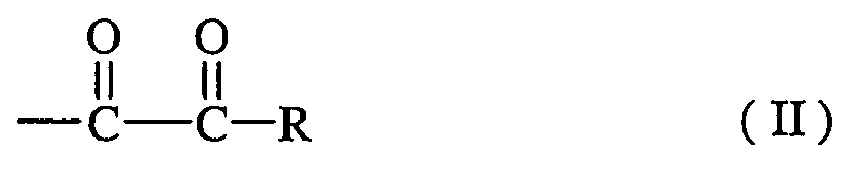
- the present invention provides a separating agent for enantiomeric isomers including, as an active ingredient, a polysaccharide derivative having at least part of hydrogen atoms of hydroxyl groups of a polysaccharide substituted by at least one of atomic groups represented by the following general formulae (I) and (II): (in the formulae, R represents a substituted or unsubstituted aromatic group, or a linear, branched, or cyclic aliphatic group).
- the present invention relates to a use of the above-described polysaccharide derivative as a separating agent for enantiomeric isomers.
- the present invention relates to a method of separating enantiomeric isomers by bringing the above-described polysaccharide derivative into contact with the enantiomeric isomers.
- a polysaccharide derivative used in a separating agent for enantiomeric isomers of the present invention has at least part of hydrogen atoms of hydroxyl groups of a polysaccharide substituted by at least one of atomic groups represented by the general formulae (I) and (II).
- the polysaccharide may be any of a synthetic polysaccharide, a natural polysaccharide, or a modified natural polysaccharide as long as the polysaccharide is optically active.
- the polysaccharide preferably has a highly regulated bonding pattern.
- polysaccharide examples include: ⁇ -1,4-glucan (cellulose); ⁇ -1,4-glucan (amylose or amylopectin); ⁇ -1,6-glucan (dextran); ⁇ -1,6-glucan (pustulan); ⁇ -1,3-glucan (such as curdlan or schizophyllan); ⁇ -1,3-glucan; ⁇ -1,2-glucan (Crown Gall polysaccharide); ⁇ -1,9-galactan; ⁇ -1,4-mannan;.
- ⁇ -1,6-mannan ⁇ -1,2-fructan (inulin); ⁇ -2, 6-fructan (levan); ⁇ -1,4-xylan; ⁇ -1,3-xylan; ⁇ -1,4-chitosan; ⁇ -1,4-N-acetylchitosan (chitin); pullulan; agarose; alginic acid; and starch containing amylose.
- cellulose, amylose, ⁇ -1,4-xylan, ⁇ -1, 4-chitosan, chitin, ⁇ -1, 4-mannan, inulin, curdlan, and the like are preferable because they are easily available high purity polysaccharides.
- Cellulose and amylose are particularly preferable.
- a number-average degree of polymerization of the polysaccharide (average number of pyranose rings or furanose rings in a molecule) is 5 or more, and preferably 10 or more.
- the number-average degree of polymerization thereof has no upper limit, but is desirably 1,000 or less from a viewpoint of easy handling.
- the atomic groups which substitute at least part of hydrogen atoms of hydroxyl groups of a polysaccharide are represented by the general formulae (I) and (II), and examples thereof include atomic groups described below.
- the polysaccharide derivative may be: a polysaccharide derivative having atomic groups identical to each other bonded to a polysaccharide; or a polysaccharide derivative having different atomic groups bonded to a polysaccharide.
- a distribution of atomic groups in the polysaccharide derivative may be even or uneven.
- the number of the atomic groups bonded to a monosaccharide unit of the polysaccharide derivative may be the same for all monosaccharide units or different therefor.
- Positions of the atomic groups bonded to the monosaccharide unit of the polysaccharide derivative may be at positions of specific hydroxyl groups in the monosaccharide unit, or the atomic groups may be bonded to the monosaccharide unit without specific regularity.
- the polysaccharide derivative used in the present invention can be obtained by reacting a polysaccharide, and a compound having a functional group which may react with hydroxyl groups of the polysaccharide (a compound which may form an atomic group represented by the general formula (I) or (II)) .
- Examples of such a compound include: an aromatic or aliphatic carboxylic acid derivative such as an aromatic or aliphatic carboxylic acid, acid chloride, acid anhydride, or acid ester; and an aromatic or aliphatic isocyanic acid derivative.
- an aromatic or aliphatic carboxylic acid derivative such as an aromatic or aliphatic carboxylic acid, acid chloride, acid anhydride, or acid ester
- an aromatic or aliphatic isocyanic acid derivative such as an aromatic or aliphatic carboxylic acid, acid chloride, acid anhydride, or acid ester.
- the separating agent for enantiomeric isomers of the present invention may include: a polysaccharide derivative carried on a carrier; a polysaccharide derivative itself pulverized; or a polysaccharide derivative itself formed into spherical particles.
- a polysaccharide derivative carried indicates that a polysaccharide derivative is fixed on a carrier.
- Examples of a carrying method that can be used include: physical adsorption between a polysaccharide derivative and a carrier; chemical bonding between a polysaccharide derivative and a carrier; chemical bonding between polysaccharide derivatives; chemical bonding of a third component; photoirradiation to a polysaccharide derivative; and a radical reaction.
- Examples of a carrier include a porous organic carrier and a porous inorganic carrier.
- Appropriate examples of the porous organic carrier include polymer substances such as polystyrene, polyacrylamide, and polyacrylate.
- Appropriate examples of the porous inorganic carrier include silica, alumina, magnesia, glass, kaolin, titanium oxide, a silicate, and hydroxyapatite.
- a particularly preferable carrier is silica gel
- silica gel has a particle size of 0.1 ⁇ m to 10 ⁇ m, preferably 1 ⁇ m to 300 ⁇ m, more preferably 1 ⁇ m to 100 ⁇ m.
- Silica gel has an average pore size of 10 ⁇ to 100 mm, and preferably 50 ⁇ to 50,000 ⁇ .
- Silica gel is preferably subjected to surface treatment for eliminating an effect of remaining silanol on its surface, but needs not be subjected to surface treatment at all.
- An amount of the polysaccharide derivative carried on a carrier is preferably 1 to 100 parts by mass, more preferably 5 to 60 parts by mass, and particularly preferably 10 to 40 parts by mass with respect to 100 parts by mass of the separating agent for enantiomeric isomers.
- the obtained pulverized or spherical polysaccharide derivative is desirably classified by using a mortar or the like to have a similar particle size.
- the separating agent for enantiomeric isomers of the present invention can be used as a stationary phase for chromatography.
- the separating agent for enantiomeric isomers of the present invention can be used for gas chromatography, liquid chromatography, thin-layer chromatography, electrophoresis, and the like.
- the separating agent for enantiomeric isomers of the present invention is preferably used for (continuous) liquid chromatography, thin-layer chromatography, and electrophoresis.
- the separating agent for enantiomeric isomers of the present invention maybe not only used as a separating agent for chromatography, but also applied as a host/guest separating agent, and for membrane separation and liquid crystal materials.
- the separating agent for enantiomeric isomers of the present invention a stationary phase for chromatography using the same, and a stationary phase for continuous liquid chromatography using the same are suitable for enantiomeric isomers analysis technique involving optical separation of a wide range of chiral compounds at high separation factors in analysis of drugs, food products, agricultural chemicals, and fragrance materials.
- the separating agent for enantiomeric isomers of the present invention has excellent optical resolving power.
- a retention factor (k') and a separation factor ( ⁇ ) in the examples are defined by the following equations.
- Retention factor ( k ′ ) k ′ [ ( Retention time of racemic modification ) - ( Dead time ) ] / Dead time (Dead time represents an elution time of Tri-tert-butylbenzene.)
- Separation factor ( ⁇ ) ⁇ ( Retention factor of enantiomeric isomer retained more strongly ) / ( Retention factor of enantiomeric isomer retained more weakly )
- Benzamide and oxalyl chloride were stirred in dimethylsulfoxide (DMSO) in a nitrogen atmosphere at 60°C for 6 hours, to thereby synthesize benzoyl isocyanate.
- DMSO dimethylsulfoxide
- the obtained benzoyl isocyanate was purified through distillation under reduced pressure (61°C/4 mmHg).
- 4-Chlorobenzamide and oxalyl chloride were stirred in dimethylsulfoxide (DMSO) in a nitrogen atmosphere at 60°C for 6 hours, to thereby synthesize 4-chlorobenzoyl isocyanate.
- DMSO dimethylsulfoxide
- the obtained 4-chlorobenzoyl isocyanate was purified through distillation under reduced pressure (93°C/6 mmHg).
- Thionyl chloride was gradually added to 3,5-dimethylbenzoic acid in a nitrogen atmosphere while the whole was cooled in an ice bath. After the addition was completed, the whole was heated to 80°C for a reaction, to thereby synthesize 3,5-dimethylbenzoyl chloride.
- 3,5-Dimethylbenzoyl chloride and ammonium carbonate were stirred in diethyl ether in a nitrogen atmosphere at room temperature for 4 hours, to thereby synthesize 3,5-dimethylbenzamide.
- Porous silica gel (particle size of 7 ⁇ m) was reacted with 3-aminopropyl triethoxysilane for aminopropylsilane (APS) treatment.
- the filler obtained in the above section (c) was pressed and filled into a stainless column of 0.2 cm ⁇ ⁇ 25 cmL through a slurry filling method, to thereby prepare an enantiomeric isomer separation column.
Landscapes
- Chemical & Material Sciences (AREA)
- Analytical Chemistry (AREA)
- Chemical Kinetics & Catalysis (AREA)
- Organic Chemistry (AREA)
- General Health & Medical Sciences (AREA)
- Health & Medical Sciences (AREA)
- Life Sciences & Earth Sciences (AREA)
- Biochemistry (AREA)
- Physics & Mathematics (AREA)
- General Physics & Mathematics (AREA)
- Immunology (AREA)
- Pathology (AREA)
- Organic Low-Molecular-Weight Compounds And Preparation Thereof (AREA)
- Solid-Sorbent Or Filter-Aiding Compositions (AREA)
- Steroid Compounds (AREA)
- Polysaccharides And Polysaccharide Derivatives (AREA)
Abstract

(in the formulae, R represents a substituted or unsubstituted aromatic group, or a linear, branched, or cyclic aliphatic group) .
Description
- The present invention relates to a separating agent for enantiomeric isomers which is suitable for separation of enantiomeric isomers through a method of separating compounds, in particular, a chromatography method.
- Enantiomeric isomers having a relationship of a real image and a mirror image have exactly the same physical and chemical properties such as physical properties including a boiling point, a melting point, and solubility. However, there are many cases where enantiomeric isomers have differences in interaction with a living body, that is, in physiological activities such as taste and smell. In particular, in a pharmaceutical field, cases where enantiomeric isomers have significant differences in medicinal efficacy and toxicity are expected at high probability. Thus, "Drug Approval and Licensing Procedures in Japan" of Ministry of Health, Labour and Welfare includes the description "in a case where the drug is a racemic modification, it is desirable that the absorption, distribution, metabolism, and excretion behaviors of each isomer be studied in advance".
- As described above, the enantiomeric isomers have exactly the same physical and chemical properties such as physical properties including a boiling point, a melting point, and solubility, and thus have a crucial problem in that the enantiomeric isomers cannot be analyzed by classical and usual separation means. Thus, researches on techniques for simple and highly accurate analysis of a wide variety of enantiomeric isomers have been conducted energetically.
- As an analysis technique satisfying such need, an optical resolution method by high-performance liquid chromatography (HPLC), in particular, an optical resolution method by using an enantiomeric isomer separation column for HPLC has been developed. In the "enantiomeric isomer separation column" as used herein, an asymmetry identifying agent itself is used or a chiral stationary phase having an asymmetry identifying agent carried on an appropriate carrier is used. Examples of the asymmetry identifying agent include: optically active triphenylmethyl polymethacrylate (see JP-A-57-150432); cellulose and amylose derivatives (Y. Okamoto, M. Kawashima, and K. Hatada, J. Am. Chem. Soc., 106, 5337, 1984); and ovomucoid which is a protein (JP-A-63-307829).
- Of numerous chiral stationary phases for HPLC, an optical resolution column having cellulose and amylose derivatives carried on silica gel is known to exhibit high asymmetry identifying power for a very wide variety of compounds.
- Studies on preparative liquid chromatography of optically active substances at an industrial level, in which a chiral stationary phase for HPLC and a simulated moving bed method are combined, have progressed (Pharm Tech Japan 12, 43) . Further, a chiral stationary phase capable of efficiently separating compounds to be separated, that is, a chiral stationary phase having an even larger separation factor (α value) is required not only for simple and complete separation but also for improvement in productivity of preparative chromatography. Thus, researches on finding a polysaccharide derivative having a large α value and exhibiting high asymmetry identifying power have been conducted energetically.
- It is an obj ect of the present invention to provide a separating agent for enantiomeric isomers which is suitable for a chiral stationary phase used in chromatography or the like and which contains, as an active ingredient, a polysaccharide derivative having a large α value and exhibiting high asymmetry identifying power.
- Conventionally, a cellulose derivative or an amylose derivative, in particular, a phenyl carbamate derivative has been known to serve as a chiral stationary phase to exhibit high optical resolving power. Of those, a substance having a hydrogen atom of a phenyl group substituted by an alkyl group or a halogen group has been known to exhibit high optical resolving power.
- A substance having a methylene group between the carbamate group and the phenyl group is known to exhibit significantly reduced optical resolving power, and a substance having a hydrogen atom of the methylene group substituted by a methyl group is known to exhibit high optical resolving power. Further, a substance having an excessively bulky group introduced into the portion of the methylene group is found to actually exhibit reduced optical resolving power.
- The inventors of the present invention have pursued researches based on the above findings, and have found that a polysaccharide derivative having an even larger α value can be obtained by introducing a carbonyl group between the carbamate group and the phenyl group, thereby completing the present invention.
- As means for achieving the object, the present invention provides a separating agent for enantiomeric isomers including, as an active ingredient, a polysaccharide derivative having at least part of hydrogen atoms of hydroxyl groups of a polysaccharide substituted by at least one of atomic groups represented by the following general formulae (I) and (II):


(in the formulae, R represents a substituted or unsubstituted aromatic group, or a linear, branched, or cyclic aliphatic group). - The present invention relates to a use of the above-described polysaccharide derivative as a separating agent for enantiomeric isomers.
- The present invention relates to a method of separating enantiomeric isomers by bringing the above-described polysaccharide derivative into contact with the enantiomeric isomers.
- A polysaccharide derivative used in a separating agent for enantiomeric isomers of the present invention has at least part of hydrogen atoms of hydroxyl groups of a polysaccharide substituted by at least one of atomic groups represented by the general formulae (I) and (II).
- The polysaccharide may be any of a synthetic polysaccharide, a natural polysaccharide, or a modified natural polysaccharide as long as the polysaccharide is optically active. However, the polysaccharide preferably has a highly regulated bonding pattern.
- Examples of the polysaccharide include: β-1,4-glucan (cellulose); α-1,4-glucan (amylose or amylopectin); α-1,6-glucan (dextran); β-1,6-glucan (pustulan); β-1,3-glucan (such as curdlan or schizophyllan); α-1,3-glucan; β-1,2-glucan (Crown Gall polysaccharide); β-1,9-galactan; β-1,4-mannan;. α-1,6-mannan; β-1,2-fructan (inulin); β-2, 6-fructan (levan); β-1,4-xylan; β-1,3-xylan; β-1,4-chitosan; α-1,4-N-acetylchitosan (chitin); pullulan; agarose; alginic acid; and starch containing amylose.
- Of those, cellulose, amylose, β-1,4-xylan, β-1, 4-chitosan, chitin, β-1, 4-mannan, inulin, curdlan, and the like are preferable because they are easily available high purity polysaccharides. Cellulose and amylose are particularly preferable.
- A number-average degree of polymerization of the polysaccharide (average number of pyranose rings or furanose rings in a molecule) is 5 or more, and preferably 10 or more. The number-average degree of polymerization thereof has no upper limit, but is desirably 1,000 or less from a viewpoint of easy handling.
- The atomic groups which substitute at least part of hydrogen atoms of hydroxyl groups of a polysaccharide are represented by the general formulae (I) and (II), and examples thereof include atomic groups described below.
- (1) An atomic group in which R in each of the general formulae (I) and (II) represents an atomic group represented by the following general formula (III):
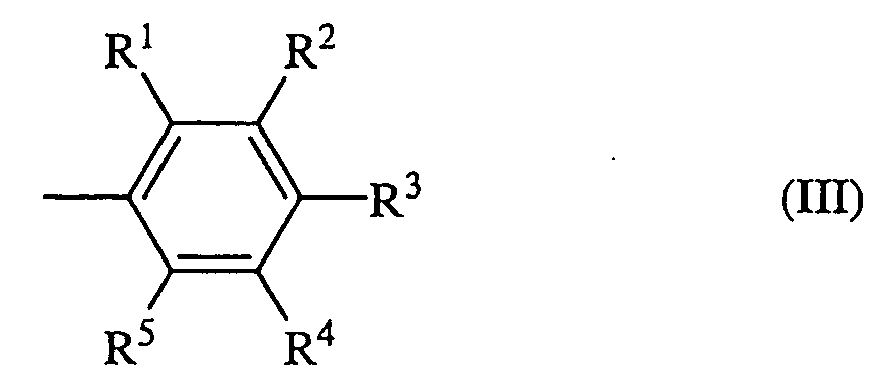
(in the formula, R1 to R5 may be identical to or different from each other, and R1 to R5 each represent an atom or group selected from hydrogen, a halogen, an alkyl group, an alkoxy group, an amino group, a nitro group, a siloxy group, and an alkylthio group).
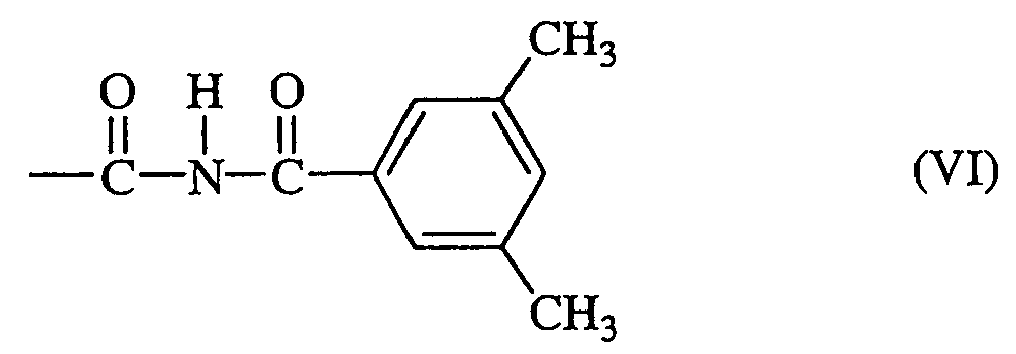
R1 to R5 in the general formula (III) each preferably represent an atom or group selected from hydrogen, a halogen, and an alkyl group. - (2) An atomic group in which the atomic group represented by the general formula (I) is selected from atomic groups represented by the following formulae (IV), (V), (VI), and (VII).


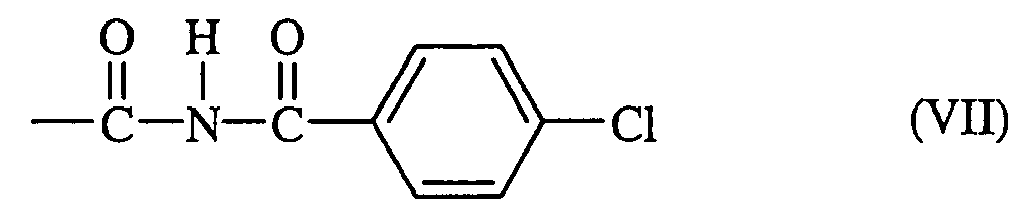
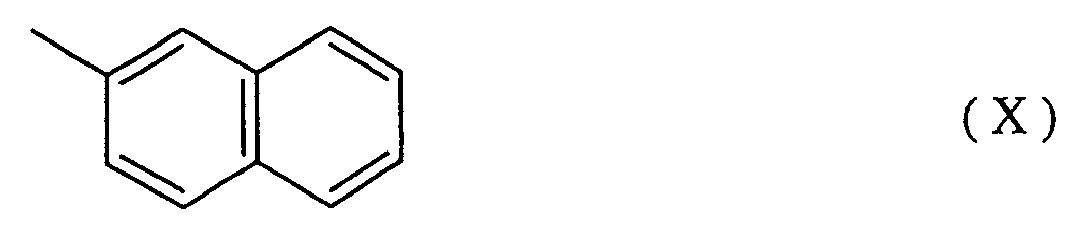
- (3) An atomic group in which R in each of the general formulae (I) and (II) is selected from atomic groups represented by the following formulae (VIII), (IX), and (X).


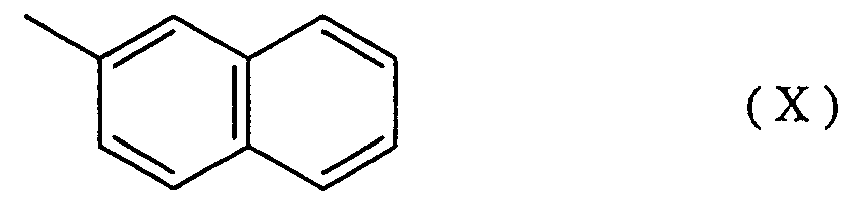
- The polysaccharide derivative may be: a polysaccharide derivative having atomic groups identical to each other bonded to a polysaccharide; or a polysaccharide derivative having different atomic groups bonded to a polysaccharide. A distribution of atomic groups in the polysaccharide derivative may be even or uneven. The number of the atomic groups bonded to a monosaccharide unit of the polysaccharide derivative may be the same for all monosaccharide units or different therefor. Positions of the atomic groups bonded to the monosaccharide unit of the polysaccharide derivative may be at positions of specific hydroxyl groups in the monosaccharide unit, or the atomic groups may be bonded to the monosaccharide unit without specific regularity.
- The polysaccharide derivative used in the present invention can be obtained by reacting a polysaccharide, and a compound having a functional group which may react with hydroxyl groups of the polysaccharide (a compound which may form an atomic group represented by the general formula (I) or (II)) .
- Examples of such a compound include: an aromatic or aliphatic carboxylic acid derivative such as an aromatic or aliphatic carboxylic acid, acid chloride, acid anhydride, or acid ester; and an aromatic or aliphatic isocyanic acid derivative.
- The separating agent for enantiomeric isomers of the present invention may include: a polysaccharide derivative carried on a carrier; a polysaccharide derivative itself pulverized; or a polysaccharide derivative itself formed into spherical particles. The phrase "a polysaccharide derivative carried" as used herein indicates that a polysaccharide derivative is fixed on a carrier. Examples of a carrying method that can be used include: physical adsorption between a polysaccharide derivative and a carrier; chemical bonding between a polysaccharide derivative and a carrier; chemical bonding between polysaccharide derivatives; chemical bonding of a third component; photoirradiation to a polysaccharide derivative; and a radical reaction.
- Examples of a carrier include a porous organic carrier and a porous inorganic carrier. Preferred is a porous inorganic carrier. Appropriate examples of the porous organic carrier include polymer substances such as polystyrene, polyacrylamide, and polyacrylate. Appropriate examples of the porous inorganic carrier include silica, alumina, magnesia, glass, kaolin, titanium oxide, a silicate, and hydroxyapatite.
- A particularly preferable carrier is silica gel, and silica gel has a particle size of 0.1 µm to 10 µm, preferably 1 µm to 300 µm, more preferably 1 µm to 100 µm. Silica gel has an average pore size of 10 Å to 100 mm, and preferably 50 Å to 50,000 Å. Silica gel is preferably subjected to surface treatment for eliminating an effect of remaining silanol on its surface, but needs not be subjected to surface treatment at all.
- An amount of the polysaccharide derivative carried on a carrier is preferably 1 to 100 parts by mass, more preferably 5 to 60 parts by mass, and particularly preferably 10 to 40 parts by mass with respect to 100 parts by mass of the separating agent for enantiomeric isomers.
- For pulverization or formation of spherical particles of the polysaccharide derivative itself, the obtained pulverized or spherical polysaccharide derivative is desirably classified by using a mortar or the like to have a similar particle size.
- The separating agent for enantiomeric isomers of the present invention can be used as a stationary phase for chromatography. The separating agent for enantiomeric isomers of the present invention can be used for gas chromatography, liquid chromatography, thin-layer chromatography, electrophoresis, and the like. In particular, the separating agent for enantiomeric isomers of the present invention is preferably used for (continuous) liquid chromatography, thin-layer chromatography, and electrophoresis. The separating agent for enantiomeric isomers of the present invention maybe not only used as a separating agent for chromatography, but also applied as a host/guest separating agent, and for membrane separation and liquid crystal materials.
- The separating agent for enantiomeric isomers of the present invention, a stationary phase for chromatography using the same, and a stationary phase for continuous liquid chromatography using the same are suitable for enantiomeric isomers analysis technique involving optical separation of a wide range of chiral compounds at high separation factors in analysis of drugs, food products, agricultural chemicals, and fragrance materials.
- The separating agent for enantiomeric isomers of the present invention has excellent optical resolving power.
- The present invention will be described in more detail by way of examples, but the present invention is not limited to the examples. Note that, a retention factor (k') and a separation factor (α) in the examples are defined by the following equations.

(Dead time represents an elution time of Tri-tert-butylbenzene.)
- Benzamide and oxalyl chloride were stirred in dimethylsulfoxide (DMSO) in a nitrogen atmosphere at 60°C for 6 hours, to thereby synthesize benzoyl isocyanate. The obtained benzoyl isocyanate was purified through distillation under reduced pressure (61°C/4 mmHg).
- p-Toluamide and oxalyl chloride were stirred in dimethylsulfoxide (DMSO) in a nitrogen atmosphere at 60°C for 6 hours, to thereby synthesize 4-methylbenzoyl isocyanate. The obtained 4-methylbenzoyl isocyanate was purified through distillation under reduced pressure (86°C/4 mmHg).
- 4-Chlorobenzamide and oxalyl chloride were stirred in dimethylsulfoxide (DMSO) in a nitrogen atmosphere at 60°C for 6 hours, to thereby synthesize 4-chlorobenzoyl isocyanate. The obtained 4-chlorobenzoyl isocyanate was purified through distillation under reduced pressure (93°C/6 mmHg).
- Thionyl chloride was gradually added to 3,5-dimethylbenzoic acid in a nitrogen atmosphere while the whole was cooled in an ice bath. After the addition was completed, the whole was heated to 80°C for a reaction, to thereby synthesize 3,5-dimethylbenzoyl chloride.
- 3,5-Dimethylbenzoyl chloride and ammonium carbonate were stirred in diethyl ether in a nitrogen atmosphere at room temperature for 4 hours, to thereby synthesize 3,5-dimethylbenzamide.
- 3 , 5-Dimethylbenzoyl chloride and oxalyl chloride were stirred in dimethylsulfoxide (DMSO) in a nitrogen atmosphere at 60°C for 6 hours, to thereby synthesize 3, 5-dimethylbenzoyl isocyanate. The obtained 3,5-dimethylbenzoyl isocyanate was purified through distillation under reduced pressure (104°C/8 mmHg).
- In a nitrogen atmosphere, 20 ml of pyridine or dimethylsulfoxide was added to 1 g of a polysaccharide (cellulose or amylose), and each of the corresponding isocyanates (1) to (3) and (6) was added thereto in an amount of 1.5 equivalents to that of hydroxyl groups of the polysaccharide, and stirred under heating to thereby obtain each of polysaccharide benzoyl carbamate derivatives (7) to (13) shown in Table 1.

- Porous silica gel (particle size of 7 µm) was reacted with 3-aminopropyl triethoxysilane for aminopropylsilane (APS) treatment.
- 0.225 g of each of the polysaccharide benzoyl carbamate derivatives (7) to (13) obtained in the above section (a) wasdissolved in tetrahydrofuran (THF) or dimethylsulfoxide (DMSO), and 0.9 g of silica gel obtained in the above section (b) was evenly coated with the resulting solution. Then, the solvent was distilled off under reduced pressure, to thereby obtain a filler for enantiomeric isomers having the target polysaccharide derivative carried on silica gel.
- The filler obtained in the above section (c) was pressed and filled into a stainless column of 0.2 cmΦ × 25 cmL through a slurry filling method, to thereby prepare an enantiomeric isomer separation column.
- The enantiomeric isomer separation columns prepared in Examples were each evaluated for asymmetry identifying power (retention factor k' value and separation factor α value) by using the following ten compounds by means of liquid chromatography. Table 2 shows the results.


Claims (15)
- A separating agent for enantiomeric isomers comprising, as an active ingredient, a polysaccharide derivative having at least part of hydrogen atoms of hydroxyl groups of a polysaccharide substituted by at least one of atomic groups represented by the following general formulae (I) and (II):


(in the formulae, R represents a substituted or unsubstituted aromatic group, or a linear, branched, or cyclic aliphatic group). - The separating agent for enantiomeric isomers according to claim 1, wherein the polysaccharide comprises cellulose or amylose.
- The separating agent for enantiomeric isomers according to claim 1 or 2, wherein R in each of the general formulae (I) and (II) represents an atomic group represented by the following general formula (III):
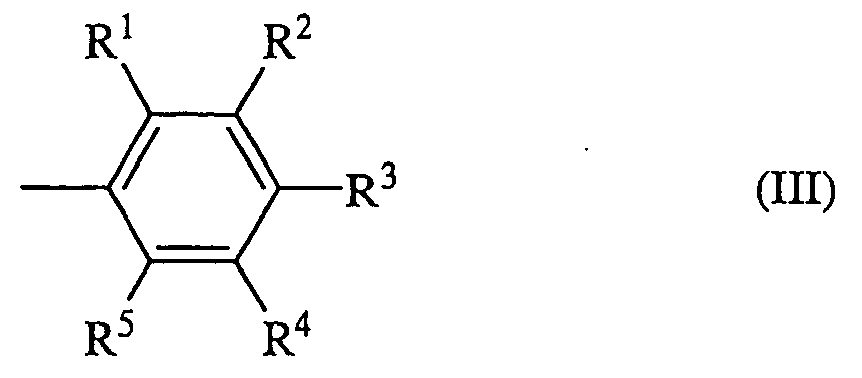
(in the formula, R1 to R5 may be identical to or different from each other, and R1 to R5 each represent an atom or group selected from hydrogen, a halogen, an alkyl group, an alkoxy group, an amino group, a nitro group, a siloxy group, and an alkylthio group). - The separating agent for enantiomeric isomers according to claim 3, wherein R1 to R5 in the general formula (III) each represent an atom or group selected from hydrogen, a halogen, and an alkyl group.
- The separating agent for enantiomeric isomers according to claim 1 or 2, wherein the atomic group represented by the general formula (I) comprises an atomic group represented by the following formula (IV).

- The separating agent for enantiomeric isomers according to claim 1 or 2, wherein the atomic group represented by the general formula (I) comprises an atomic group represented by the following formula (V).

- The separating agent for enantiomeric isomers according to claim 1 or 2, wherein the atomic group represented by the general formula (I) comprises an atomic group represented by the following formula (VI).
- The separating agent for enantiomeric isomers according to claim 1 or 2, wherein the atomic group represented by the general formula (I) comprises an atomic group represented by the following formula (VII) .

- The separating agent for enantiomeric isomers according to claim 1 or 2, wherein R in each of the general formulae (I) and (II) represents an atomic group represented by the following formula (VIII).

- The separating agent for enantiomeric isomers according to claim 1 or 2, wherein R in each of the general formulae (I) and (II) represents an atomic group represented by the following formula (IX).

- The separating agent for enantiomeric isomers according to claim 1 or 2, wherein R in each of the general formulae (I) and (II) represents an atomic group represented by the following formula (X) .
- The separating agent for enantiomeric isomers according to any one of claims 1 to 11, which is used as a stationary phase for chromatography.
- The separating agent for enantiomeric isomers according to any one of claims 1 to 11, which is used as a stationary phase for continuous liquid chromatography.
- Use of the polysaccharide derivative according to claim 1 as a separating agent for enantiomeric isomers.
- A method of separating enantiomeric isomers by bringing the polysaccharide derivative according to claim 1 into contact with the enantiomeric isomers.
Priority Applications (1)
| Application Number | Priority Date | Filing Date | Title |
|---|---|---|---|
| EP10003366A EP2208519B1 (en) | 2003-04-24 | 2004-04-22 | Agent for separating optical isomers |
Applications Claiming Priority (2)
| Application Number | Priority Date | Filing Date | Title |
|---|---|---|---|
| JP2003119710 | 2003-04-24 | ||
| PCT/JP2004/005760 WO2004094342A2 (en) | 2003-04-24 | 2004-04-22 | Agent for separating optical isomers |
Related Child Applications (2)
| Application Number | Title | Priority Date | Filing Date |
|---|---|---|---|
| EP10003366A Division EP2208519B1 (en) | 2003-04-24 | 2004-04-22 | Agent for separating optical isomers |
| EP10003366.1 Division-Into | 2010-03-29 |
Publications (3)
| Publication Number | Publication Date |
|---|---|
| EP1618949A2 true EP1618949A2 (en) | 2006-01-25 |
| EP1618949A4 EP1618949A4 (en) | 2007-08-29 |
| EP1618949B1 EP1618949B1 (en) | 2010-06-16 |
Family
ID=33308106
Family Applications (2)
| Application Number | Title | Priority Date | Filing Date |
|---|---|---|---|
| EP04728920A Expired - Lifetime EP1618949B1 (en) | 2003-04-24 | 2004-04-22 | Agent for separating optical isomers |
| EP10003366A Expired - Lifetime EP2208519B1 (en) | 2003-04-24 | 2004-04-22 | Agent for separating optical isomers |
Family Applications After (1)
| Application Number | Title | Priority Date | Filing Date |
|---|---|---|---|
| EP10003366A Expired - Lifetime EP2208519B1 (en) | 2003-04-24 | 2004-04-22 | Agent for separating optical isomers |
Country Status (8)
| Country | Link |
|---|---|
| US (1) | US7683167B2 (en) |
| EP (2) | EP1618949B1 (en) |
| JP (1) | JP4340264B2 (en) |
| KR (1) | KR101011780B1 (en) |
| CN (1) | CN100364661C (en) |
| AT (1) | ATE471207T1 (en) |
| DE (1) | DE602004027720D1 (en) |
| WO (1) | WO2004094342A2 (en) |
Families Citing this family (5)
| Publication number | Priority date | Publication date | Assignee | Title |
|---|---|---|---|---|
| WO2006121060A1 (en) * | 2005-05-09 | 2006-11-16 | National University Corporation Nagoya University | Bead for optical-isomer resolution and process for producing the same |
| JP6016631B2 (en) * | 2010-06-18 | 2016-10-26 | 株式会社ダイセル | Separating agent for optical isomers |
| DE112012002794B4 (en) * | 2011-07-01 | 2023-11-09 | Daicel Corp. | Spot detection kit, spot detection method and transfer disk |
| JP6469958B2 (en) * | 2014-03-17 | 2019-02-13 | 株式会社島津製作所 | Method for separating triacylglycerol |
| JP6409528B2 (en) * | 2014-11-27 | 2018-10-24 | Jnc株式会社 | Porous cellulose particles having an ion exchange group containing amino groups and a hydrophobic group containing butyl groups, a chromatography carrier containing the same, and a method for purifying virus-like particles of hepatitis B virus |
Family Cites Families (8)
| Publication number | Priority date | Publication date | Assignee | Title |
|---|---|---|---|---|
| JPH0691956B2 (en) | 1981-03-11 | 1994-11-16 | ダイセル化学工業株式会社 | Adsorbent for separation supporting optically active polymer |
| JPH0713030B2 (en) | 1986-04-02 | 1995-02-15 | エーザイ株式会社 | Separation agent for optical isomers |
| HU214160B (en) * | 1994-02-25 | 1998-01-28 | Daicel Chemical Industries Ltd. | Process for the preparation of optically active mevalon lactones |
| US5965026A (en) * | 1995-12-21 | 1999-10-12 | Daicel Chemical Industries, Ltd. | Packing material for high-performance liquid chromatography |
| JP2001124752A (en) | 1999-10-26 | 2001-05-11 | Daicel Chem Ind Ltd | Method for producing optically active oxybutynin |
| JP2002148247A (en) * | 2000-11-09 | 2002-05-22 | Nagoya Industrial Science Research Inst | Separating agent for optical isomer and method for producing the same |
| JP4618932B2 (en) * | 2001-05-28 | 2011-01-26 | 株式会社同仁化学研究所 | Composition for measuring chlorine concentration |
| JP2003277401A (en) * | 2002-03-27 | 2003-10-02 | Guroobu Kk | Polysaccharide amino acid carbamate derivative |
-
2004
- 2004-04-22 US US10/552,939 patent/US7683167B2/en not_active Expired - Fee Related
- 2004-04-22 KR KR1020057013457A patent/KR101011780B1/en not_active Expired - Fee Related
- 2004-04-22 JP JP2005505777A patent/JP4340264B2/en not_active Expired - Fee Related
- 2004-04-22 CN CNB2004800062017A patent/CN100364661C/en not_active Expired - Fee Related
- 2004-04-22 EP EP04728920A patent/EP1618949B1/en not_active Expired - Lifetime
- 2004-04-22 DE DE602004027720T patent/DE602004027720D1/en not_active Expired - Lifetime
- 2004-04-22 WO PCT/JP2004/005760 patent/WO2004094342A2/en not_active Ceased
- 2004-04-22 AT AT04728920T patent/ATE471207T1/en not_active IP Right Cessation
- 2004-04-22 EP EP10003366A patent/EP2208519B1/en not_active Expired - Lifetime
Also Published As
| Publication number | Publication date |
|---|---|
| US20070039890A1 (en) | 2007-02-22 |
| ATE471207T1 (en) | 2010-07-15 |
| EP1618949B1 (en) | 2010-06-16 |
| WO2004094342A8 (en) | 2005-05-12 |
| EP2208519A1 (en) | 2010-07-21 |
| KR101011780B1 (en) | 2011-02-07 |
| CN1758958A (en) | 2006-04-12 |
| WO2004094342A3 (en) | 2005-03-03 |
| EP2208519B1 (en) | 2012-08-29 |
| JP4340264B2 (en) | 2009-10-07 |
| WO2004094342A2 (en) | 2004-11-04 |
| CN100364661C (en) | 2008-01-30 |
| EP1618949A4 (en) | 2007-08-29 |
| KR20070066816A (en) | 2007-06-27 |
| US7683167B2 (en) | 2010-03-23 |
| JPWO2004094342A1 (en) | 2006-07-13 |
| DE602004027720D1 (en) | 2010-07-29 |
Similar Documents
| Publication | Publication Date | Title |
|---|---|---|
| US20070215549A1 (en) | Separating agent for enantiomeric isomers | |
| US20090008329A1 (en) | Separating agent for enantiomeric isomers | |
| JP4515812B2 (en) | Separating agent for optical isomers | |
| EP1632286A1 (en) | Separating agent for optical isomer | |
| EP1618949B1 (en) | Agent for separating optical isomers | |
| US6736967B2 (en) | Separating agent for enantiomeric isomers | |
| WO2011158935A1 (en) | Resolving agent for optical isomers | |
| JP3635002B2 (en) | Filler for separation of optical isomers for liquid chromatography | |
| JP4293792B2 (en) | Separation agent comprising a polysaccharide derivative having a polycyclic structure | |
| JP2001163806A (en) | Optical isomer separating agent | |
| JP2005017174A (en) | Separating agent for optical isomers | |
| JPH0551327A (en) | Optical resolution by polysaccharide derivative | |
| JP4430881B2 (en) | Method for producing filler for separation of optical isomers for liquid chromatography | |
| EP1637542A1 (en) | Separatory agent for optical isomer | |
| JPWO2002088049A1 (en) | Separating agent for optical isomers |
Legal Events
| Date | Code | Title | Description |
|---|---|---|---|
| PUAI | Public reference made under article 153(3) epc to a published international application that has entered the european phase |
Free format text: ORIGINAL CODE: 0009012 |
|
| 17P | Request for examination filed |
Effective date: 20051019 |
|
| AK | Designated contracting states |
Kind code of ref document: A2 Designated state(s): AT BE BG CH CY CZ DE DK EE ES FI FR GB GR HU IE IT LI LU MC NL PL PT RO SE SI SK TR |
|
| AX | Request for extension of the european patent |
Extension state: AL HR LT LV MK |
|
| RIN1 | Information on inventor provided before grant (corrected) |
Inventor name: YAMAMOTO, CHIYO Inventor name: OKAMOTO, YOSHIO |
|
| DAX | Request for extension of the european patent (deleted) | ||
| A4 | Supplementary search report drawn up and despatched |
Effective date: 20070727 |
|
| RAP1 | Party data changed (applicant data changed or rights of an application transferred) |
Owner name: DAICEL CHEMICAL INDUSTRIES, LTD. |
|
| 17Q | First examination report despatched |
Effective date: 20081113 |
|
| GRAP | Despatch of communication of intention to grant a patent |
Free format text: ORIGINAL CODE: EPIDOSNIGR1 |
|
| GRAS | Grant fee paid |
Free format text: ORIGINAL CODE: EPIDOSNIGR3 |
|
| GRAA | (expected) grant |
Free format text: ORIGINAL CODE: 0009210 |
|
| AK | Designated contracting states |
Kind code of ref document: B1 Designated state(s): AT BE BG CH CY CZ DE DK EE ES FI FR GB GR HU IE IT LI LU MC NL PL PT RO SE SI SK TR |
|
| REG | Reference to a national code |
Ref country code: CH Ref legal event code: EP Ref country code: CH Ref legal event code: NV Representative=s name: MICHELI & CIE SA |
|
| REG | Reference to a national code |
Ref country code: IE Ref legal event code: FG4D |
|
| REF | Corresponds to: |
Ref document number: 602004027720 Country of ref document: DE Date of ref document: 20100729 Kind code of ref document: P |
|
| REG | Reference to a national code |
Ref country code: SE Ref legal event code: TRGR |
|
| REG | Reference to a national code |
Ref country code: NL Ref legal event code: VDEP Effective date: 20100616 |
|
| PG25 | Lapsed in a contracting state [announced via postgrant information from national office to epo] |
Ref country code: SI Free format text: LAPSE BECAUSE OF FAILURE TO SUBMIT A TRANSLATION OF THE DESCRIPTION OR TO PAY THE FEE WITHIN THE PRESCRIBED TIME-LIMIT Effective date: 20100616 Ref country code: FI Free format text: LAPSE BECAUSE OF FAILURE TO SUBMIT A TRANSLATION OF THE DESCRIPTION OR TO PAY THE FEE WITHIN THE PRESCRIBED TIME-LIMIT Effective date: 20100616 Ref country code: AT Free format text: LAPSE BECAUSE OF FAILURE TO SUBMIT A TRANSLATION OF THE DESCRIPTION OR TO PAY THE FEE WITHIN THE PRESCRIBED TIME-LIMIT Effective date: 20100616 |
|
| PG25 | Lapsed in a contracting state [announced via postgrant information from national office to epo] |
Ref country code: PL Free format text: LAPSE BECAUSE OF FAILURE TO SUBMIT A TRANSLATION OF THE DESCRIPTION OR TO PAY THE FEE WITHIN THE PRESCRIBED TIME-LIMIT Effective date: 20100616 Ref country code: GR Free format text: LAPSE BECAUSE OF FAILURE TO SUBMIT A TRANSLATION OF THE DESCRIPTION OR TO PAY THE FEE WITHIN THE PRESCRIBED TIME-LIMIT Effective date: 20100917 Ref country code: CY Free format text: LAPSE BECAUSE OF FAILURE TO SUBMIT A TRANSLATION OF THE DESCRIPTION OR TO PAY THE FEE WITHIN THE PRESCRIBED TIME-LIMIT Effective date: 20100616 |
|
| PG25 | Lapsed in a contracting state [announced via postgrant information from national office to epo] |
Ref country code: EE Free format text: LAPSE BECAUSE OF FAILURE TO SUBMIT A TRANSLATION OF THE DESCRIPTION OR TO PAY THE FEE WITHIN THE PRESCRIBED TIME-LIMIT Effective date: 20100616 Ref country code: NL Free format text: LAPSE BECAUSE OF FAILURE TO SUBMIT A TRANSLATION OF THE DESCRIPTION OR TO PAY THE FEE WITHIN THE PRESCRIBED TIME-LIMIT Effective date: 20100616 |
|
| PG25 | Lapsed in a contracting state [announced via postgrant information from national office to epo] |
Ref country code: SK Free format text: LAPSE BECAUSE OF FAILURE TO SUBMIT A TRANSLATION OF THE DESCRIPTION OR TO PAY THE FEE WITHIN THE PRESCRIBED TIME-LIMIT Effective date: 20100616 Ref country code: BE Free format text: LAPSE BECAUSE OF FAILURE TO SUBMIT A TRANSLATION OF THE DESCRIPTION OR TO PAY THE FEE WITHIN THE PRESCRIBED TIME-LIMIT Effective date: 20100616 Ref country code: CZ Free format text: LAPSE BECAUSE OF FAILURE TO SUBMIT A TRANSLATION OF THE DESCRIPTION OR TO PAY THE FEE WITHIN THE PRESCRIBED TIME-LIMIT Effective date: 20100616 Ref country code: PT Free format text: LAPSE BECAUSE OF FAILURE TO SUBMIT A TRANSLATION OF THE DESCRIPTION OR TO PAY THE FEE WITHIN THE PRESCRIBED TIME-LIMIT Effective date: 20101018 Ref country code: RO Free format text: LAPSE BECAUSE OF FAILURE TO SUBMIT A TRANSLATION OF THE DESCRIPTION OR TO PAY THE FEE WITHIN THE PRESCRIBED TIME-LIMIT Effective date: 20100616 |
|
| PG25 | Lapsed in a contracting state [announced via postgrant information from national office to epo] |
Ref country code: IT Free format text: LAPSE BECAUSE OF FAILURE TO SUBMIT A TRANSLATION OF THE DESCRIPTION OR TO PAY THE FEE WITHIN THE PRESCRIBED TIME-LIMIT Effective date: 20100616 |
|
| PLBE | No opposition filed within time limit |
Free format text: ORIGINAL CODE: 0009261 |
|
| STAA | Information on the status of an ep patent application or granted ep patent |
Free format text: STATUS: NO OPPOSITION FILED WITHIN TIME LIMIT |
|
| PG25 | Lapsed in a contracting state [announced via postgrant information from national office to epo] |
Ref country code: DK Free format text: LAPSE BECAUSE OF FAILURE TO SUBMIT A TRANSLATION OF THE DESCRIPTION OR TO PAY THE FEE WITHIN THE PRESCRIBED TIME-LIMIT Effective date: 20100616 |
|
| 26N | No opposition filed |
Effective date: 20110317 |
|
| REG | Reference to a national code |
Ref country code: DE Ref legal event code: R097 Ref document number: 602004027720 Country of ref document: DE Effective date: 20110316 |
|
| PGFP | Annual fee paid to national office [announced via postgrant information from national office to epo] |
Ref country code: IE Payment date: 20110418 Year of fee payment: 8 Ref country code: SE Payment date: 20110420 Year of fee payment: 8 |
|
| PG25 | Lapsed in a contracting state [announced via postgrant information from national office to epo] |
Ref country code: MC Free format text: LAPSE BECAUSE OF NON-PAYMENT OF DUE FEES Effective date: 20110430 |
|
| REG | Reference to a national code |
Ref country code: SE Ref legal event code: EUG |
|
| REG | Reference to a national code |
Ref country code: IE Ref legal event code: MM4A |
|
| PG25 | Lapsed in a contracting state [announced via postgrant information from national office to epo] |
Ref country code: IE Free format text: LAPSE BECAUSE OF NON-PAYMENT OF DUE FEES Effective date: 20120422 |
|
| PG25 | Lapsed in a contracting state [announced via postgrant information from national office to epo] |
Ref country code: SE Free format text: LAPSE BECAUSE OF NON-PAYMENT OF DUE FEES Effective date: 20120423 |
|
| PG25 | Lapsed in a contracting state [announced via postgrant information from national office to epo] |
Ref country code: LU Free format text: LAPSE BECAUSE OF NON-PAYMENT OF DUE FEES Effective date: 20110422 |
|
| PG25 | Lapsed in a contracting state [announced via postgrant information from national office to epo] |
Ref country code: TR Free format text: LAPSE BECAUSE OF FAILURE TO SUBMIT A TRANSLATION OF THE DESCRIPTION OR TO PAY THE FEE WITHIN THE PRESCRIBED TIME-LIMIT Effective date: 20100616 Ref country code: BG Free format text: LAPSE BECAUSE OF FAILURE TO SUBMIT A TRANSLATION OF THE DESCRIPTION OR TO PAY THE FEE WITHIN THE PRESCRIBED TIME-LIMIT Effective date: 20100916 |
|
| PG25 | Lapsed in a contracting state [announced via postgrant information from national office to epo] |
Ref country code: ES Free format text: LAPSE BECAUSE OF FAILURE TO SUBMIT A TRANSLATION OF THE DESCRIPTION OR TO PAY THE FEE WITHIN THE PRESCRIBED TIME-LIMIT Effective date: 20100927 Ref country code: HU Free format text: LAPSE BECAUSE OF FAILURE TO SUBMIT A TRANSLATION OF THE DESCRIPTION OR TO PAY THE FEE WITHIN THE PRESCRIBED TIME-LIMIT Effective date: 20100616 |
|
| REG | Reference to a national code |
Ref country code: FR Ref legal event code: PLFP Year of fee payment: 13 |
|
| PGFP | Annual fee paid to national office [announced via postgrant information from national office to epo] |
Ref country code: FR Payment date: 20160309 Year of fee payment: 13 |
|
| PGFP | Annual fee paid to national office [announced via postgrant information from national office to epo] |
Ref country code: DE Payment date: 20160419 Year of fee payment: 13 Ref country code: CH Payment date: 20160411 Year of fee payment: 13 Ref country code: GB Payment date: 20160420 Year of fee payment: 13 |
|
| REG | Reference to a national code |
Ref country code: DE Ref legal event code: R119 Ref document number: 602004027720 Country of ref document: DE |
|
| REG | Reference to a national code |
Ref country code: CH Ref legal event code: PL |
|
| GBPC | Gb: european patent ceased through non-payment of renewal fee |
Effective date: 20170422 |
|
| REG | Reference to a national code |
Ref country code: FR Ref legal event code: ST Effective date: 20171229 |
|
| PG25 | Lapsed in a contracting state [announced via postgrant information from national office to epo] |
Ref country code: DE Free format text: LAPSE BECAUSE OF NON-PAYMENT OF DUE FEES Effective date: 20171103 Ref country code: FR Free format text: LAPSE BECAUSE OF NON-PAYMENT OF DUE FEES Effective date: 20170502 |
|
| PG25 | Lapsed in a contracting state [announced via postgrant information from national office to epo] |
Ref country code: CH Free format text: LAPSE BECAUSE OF NON-PAYMENT OF DUE FEES Effective date: 20170430 Ref country code: LI Free format text: LAPSE BECAUSE OF NON-PAYMENT OF DUE FEES Effective date: 20170430 Ref country code: GB Free format text: LAPSE BECAUSE OF NON-PAYMENT OF DUE FEES Effective date: 20170422 |