EP1616312B1 - Verfahren zur fahrzeugkommunikation - Google Patents
Verfahren zur fahrzeugkommunikation Download PDFInfo
- Publication number
- EP1616312B1 EP1616312B1 EP04729338A EP04729338A EP1616312B1 EP 1616312 B1 EP1616312 B1 EP 1616312B1 EP 04729338 A EP04729338 A EP 04729338A EP 04729338 A EP04729338 A EP 04729338A EP 1616312 B1 EP1616312 B1 EP 1616312B1
- Authority
- EP
- European Patent Office
- Prior art keywords
- messages
- vehicle
- communication
- sent
- information
- Prior art date
- Legal status (The legal status is an assumption and is not a legal conclusion. Google has not performed a legal analysis and makes no representation as to the accuracy of the status listed.)
- Expired - Lifetime
Links
- 238000004891 communication Methods 0.000 title claims abstract description 47
- 238000000034 method Methods 0.000 title claims description 18
- 230000006978 adaptation Effects 0.000 claims description 20
- 230000005540 biological transmission Effects 0.000 claims description 14
- 230000008901 benefit Effects 0.000 description 2
- 238000013459 approach Methods 0.000 description 1
- 230000001276 controlling effect Effects 0.000 description 1
- 230000009365 direct transmission Effects 0.000 description 1
- 238000012544 monitoring process Methods 0.000 description 1
- 238000012545 processing Methods 0.000 description 1
- 230000001105 regulatory effect Effects 0.000 description 1
- 230000033764 rhythmic process Effects 0.000 description 1
- 238000007619 statistical method Methods 0.000 description 1
- 230000001960 triggered effect Effects 0.000 description 1
Images

Classifications
-
- G—PHYSICS
- G08—SIGNALLING
- G08G—TRAFFIC CONTROL SYSTEMS
- G08G1/00—Traffic control systems for road vehicles
- G08G1/123—Traffic control systems for road vehicles indicating the position of vehicles, e.g. scheduled vehicles; Managing passenger vehicles circulating according to a fixed timetable, e.g. buses, trains, trams
- G08G1/127—Traffic control systems for road vehicles indicating the position of vehicles, e.g. scheduled vehicles; Managing passenger vehicles circulating according to a fixed timetable, e.g. buses, trains, trams to a central station ; Indicators in a central station
-
- G—PHYSICS
- G08—SIGNALLING
- G08G—TRAFFIC CONTROL SYSTEMS
- G08G1/00—Traffic control systems for road vehicles
- G08G1/07—Controlling traffic signals
- G08G1/081—Plural intersections under common control
Definitions
- the present invention relates to a method in communication between a vehicle travelling along a route and a stationary system, the vehicle being equipped with a communication unit which communicates messages to the stationary system.
- AB TRYGGIT As an alternative to information systems based on polling of vehicles in a fleet of vehicles (such as buses in a public transport system), AB TRYGGIT has recently developed a system where each vehicle on its own initiates communication with a central unit and, thus, notifies the system of position, speed etc.
- the system which is disclosed in the Publication WO01/76105 is based on radio communication, where all vehicles transmit messages on the same radio frequency. The need for frequency bands thus is extremely limited, and by frequently transmitting messages from every vehicle, collisions, if any, between messages do not constitute a problem.
- the object of the present invention is to obviate the above problems and provide a system for traffic information which is updated with sufficient accuracy.
- this object is achieved by a method of the type stated by way of introduction, further comprising dividing the route into a plurality of partial sections, defining for each partial section an adaption of the communication, and adapting the communication to this definition.
- “Stationary system” can relate to, for instance, stationary radio receivers connected to one or more central units, for collecting information from a plurality of vehicles. However, it may also relate to local units provided with radio receivers which are adapted to receive information from vehicles in the absolute vicinity. Such local units can be suitable to assist in controlling traffic lights and to allow display of information at stops.
- the method makes it possible to command the communication unit always to communicate with correctly adjusted accuracy. This also improves the possibility of effectively utilising the traffic information in local units, for instance for displays and traffic signals.
- the option of collecting, along certain sections, more frequent information can also be used, for instance, to make a statistical analysis of this section.
- the method comprises creating a set of parameters which define when messages should be sent and/or which contents the messages should have, and making said set available to the communication unit, so that the communication unit is capable of adapting the communication.
- a definition of a set of parameters that is made available to the communication method is a simple way to accomplish the invention.
- the method may further comprise associating each partial section with one of a plurality of predetermined classes, and determining which class the current partial section is associated with, and adapting the communication according to this class.
- This method can be combined with the definition of a set of parameters, but it may also constitute an alternative where the division into differently classified partial sections replaces the parameters.
- time control for instance a message is transmitted at least every 10th second
- distance control for instance a message is sent at least every 10th metre
- the message frequency can in both cases be still more adapted, with more frequent messages along critical sections. This occurs in time control by changing a fixed longest time period which is allowed to pass before the next messages are sent, and in distance control by changing a fixed longest section along which the vehicle should travel before the next messages are sent.
- distance control can be more explicit by indicating fixed points along the route at which messages should be sent. This is advantageous if the need for information is associated with predetermined places, such as a crossing.
- the adaptation may also comprise indicating an event which is to initiate transmission of a message.
- an event which is to initiate transmission of a message.
- a rule opening or closing of doors initiates transmission of a message, but it may also be appropriate, along certain sections, to let other events recorded by the information system of the vehicle trigger messages. This may involve an accidental stop, a request from a passenger that the vehicle stop at the next stop etc.
- Another adaptation may involve the contents of the message. On certain sections limited information (for instance position) may be sufficient, while on other sections more extensive information may be relevant, (for instance position, speed, display of direction of travel etc).
- information about the speed of the bus just before the stop can at an early stage indicate whether the bus intends to stop at the current stop or not. This information thus allows earlier update of the information about the bus than would otherwise have been possible.
- the partial section preceding the stop can thus be given priority, in which case the communication unit is arranged to communicate, along this section, information about position and speed at frequent intervals, for instance every 5th metre or every two seconds.
- the communication unit can be arranged to include, in certain places, information whether the doors of the bus are open or closed in every message.
- the unit can also be arranged to initiate transmission of a message each time the doors of the bus are opened or closed. Consequently this involves a change from time- or distance-controlled transmission to event-controlled transmission.
- a further example is a route in conjunction with a crossing with traffic lights. Since crossings controlled by traffic lights frequently cause a sudden change of the rhythm of the traffic (the bus may have to stop), which affects the estimate of the next time of arrival, it is important for the system to receive more information in connection with traffic lights. There is also a further advantage of adapting the behaviour of the communication unit just before a crossing, viz. in connection with intelligent traffic lights. There are prior-art systems where traffic lights are affected by information received from approaching vehicles. In such systems it is necessary somehow to initiate the communication from the vehicle, and this may take place using different types of sensors etc. The present invention presents a simple way of ensuring that the communication unit transmits messages with sufficient frequency and with sufficient contents for the traffic lights to function in a satisfactory manner.
- the communication unit may be adapted to send additional messages if certain events should occur. For instance, it may be justified to send a message if the speed of the bus falls below a predetermined value since this indicates some kind of traffic disturbance on the route.
- the bus 1 has a communication unit 3 which is adapted to transmit radio messages containing information about speed, position etc.
- the messages are received by the stationary system 2, which may comprise one or more radio receivers 4 which, via a data network 5 (for instance the Internet), is connected to a central unit 6, for collecting and processing large amounts of information.
- the stationary system may further comprise local units 9 which are provided with a radio receiver, such as control units for traffic lights or displays at stops. This allows direct transmission of information from a vehicle to such local units.
- the route 7 is divided into partial sections 8, which each are associated with a certain desired flow of information from the vehicle 1 to the system 2.
- This division is made available to the communication unit in the bus, in the same way as the unit knows which stops are included in the route. This can be achieved by preprogramming of the communication unit 3, for instance as described in WO01/76105. Alternatively, the division can occur from the stationary system 2 and be communicated (for instance broadcasted) to the bus. However, it is essential for the invention that the communication unit 3 be aware of the current division.
- the communication unit 3 is arranged, according to the adaptation as defined for the currently run partial section, to adapt the communication, i.e. the transmissions of messages. It can imply, for instance, that communication is initiated more frequently along certain partial sections, that a message is sent at predetermined places, or that each message that is sent contains more information along certain partial sections. It may also imply that a message is triggered by different events on the different sections.
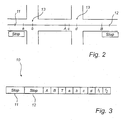
- Figs 2-3 show in more detail a method of accomplishing adapted communication.
- the partial sections 8 of the route are in this case identical with the sections between the stops 11, 12 along the route, which also passes two crossings 13.
- a set of data 10 is stored (see Fig. 3) for each partial section 8 which is given priority, i.e. a partial section along which an adaptation of the information flow should take place.
- the partial section can be defined in the data set 10 by indicating the preceding (left) stop 11 and the current stop 12 (approached by the bus).
- the communication unit 3 is provided with the file containing all relevant data sets and can thus determine whether a currently run section has a defined set of parameters, in which case adaptation of the information flow should take place.
- the data set 10 in Fig. 3 may contain two parameters A, B which define a section along which messages are to be sent at shorter time intervals.
- the parameters may correspond to the distance to the next stop 12.
- Another parameter T may indicate the longest time between two messages along this section A-B.
- the time T thus is a form of time-out and represents the longest time that it is allowed to pass before a new message is to be sent.
- Such a section with more frequent reporting can, as described above, suitably occur just before the current stop.
- distance-controlled message frequency can instead be applied to a selected section.
- a parameter then represents the longest section that is allowed to pass before a new message is to be sent.
- the data set 10 may also contain parameters (a-d) which indicate a plurality of places along the partial section when messages are always to be sent.
- This type of distance-related reporting can be advantageous, for example, in connection with crossings with traffic lights.
- Fig. 2 illustrates parameters a, c which correspond to places just before the crossings 13, and parameters b, d which correspond to places in the middle of the crossings 13.
- the set 10 may further contain parameters which indicate different transmission and monitoring frequencies f 1 , f 2 than the frequencies that are usually employed by the communication unit 3. This can be used to increase the reliability of adapted communication.
- the adapted partial section between the stops 11 and 12 has two segments (section A-B and section a-d) which have a different "class" than the remaining partial section.
- the section a-d contains points which are specific for the current partial section, but if this need is disregarded, a similar adaptation could be provided by defining in advance a number of classes, and then indicating which partial sections should belong to the respective classes. In this case it may be advantageous to let the partial sections constitute only parts of sections between stops (such as section A-B in Fig. 2).
- the invention does not exclude overlapping partial sections.
- a classification involving increased information contents does not prevent classification corresponding to increased message frequency. On occasions where both adaptations are active, messages are sent frequently and with increased information contents.
- this can be regulated in a suitable manner. For instance, it is possible to let the highest message frequency rule, or send the union of the different information contents.
- the set of parameters that has been described relate to the adaptation of the information flow according to the invention.
- the normal information flow comprises transmission of messages in addition to the parameters in the set 10.
- the set of parameters 10 controls all transmission of messages. It may then be suitable to increase the set 10 with parameters corresponding to the normal occasions of transmission, for instance the above-mentioned transmissions before the current stop.
Landscapes
- Physics & Mathematics (AREA)
- General Physics & Mathematics (AREA)
- Engineering & Computer Science (AREA)
- Radar, Positioning & Navigation (AREA)
- Remote Sensing (AREA)
- Mobile Radio Communication Systems (AREA)
- Traffic Control Systems (AREA)
- Near-Field Transmission Systems (AREA)
- Small-Scale Networks (AREA)
Claims (9)
- Verfahren in der Kommunikation zwischen einem Fahrzeug (1), das einer Strecke (7) entlang fährt, und einem ortsfesten System (2), wobei das Fahrzeug (1) mit einer Kommunikationseinheit (3) ausgerüstet ist, die Nachrichten zum ortsfesten System (2) übermittelt, dadurch gekennzeichnet, dassdie Strecke (7) in eine Mehrzahl von Teilabschnitten (8) unterteilt wird,für jeden Teilabschnitt (8) ein vom Fahrzeug verlangter Informationfluss definiert wird,ein Satz von Parametern (10) erzeugt wird, die definieren, wann Nachrichten geschickt werden sollten und/oder welchen Inhalt die Nachrichten haben sollten, unddieser Satz der Kommunikationseinheit (3) verfügbar gemacht wird, so dass die Kommunikationseinheit (8) in der Lage ist, die Kommunikation anzupassen.
- Verfahren nach Anspruch 1, das weiter beinhaltet,jeden Teilabschnitt (8) mit einer aus einer Mehrzahl von im Voraus definierten Klassen zu assoziieren, deren jede eine Anpassung des Informationsflusses definiert, undzu ermitteln, mit welcher Klasse der derzeitige Teilabschnitt assoziiert ist, und die Kommunikation dieser Klasse entsprechend anzupassen.
- Verfahren nach einem der vorangehenden Ansprüche, worin die Anpassung beinhaltet, zwischen zeitgesteuerter Kommunikation und streckengesteuerter Kommunikation umzuschalten.
- Verfahren nach einem der vorangehenden Ansprüche, worin die Anpassung beinhaltet, eine längste Zeitdauer (T) zu verändern, die ablaufen darf, ehe die nächsten Nachrichten geschickt werden.
- Verfahren nach einem der vorangehenden Ansprüche, worin die Anpassung beinhaltet, einen festgelegten längsten Abschnitt zu verändern, den das Fahrzeug durchfahren darf, ehe die nächsten Nachrichten geschickt werden.
- Verfahren nach einem der vorangehenden Ansprüche, worin die Anpassung beinhaltet, feste Punkte (a, b, c, d) entlang der Strecke anzugeben, an denen Nachrichten zu schicken sind.
- Verfahren nach einem der vorangehenden Ansprüche, worin die Anpassung beinhaltet, ein Ereignis anzugeben, das die Übermittlung einer Nachricht auslösen soll.
- Verfahren nach einem der vorangehenden Ansprüche, worin die Anpassung beinhaltet, den Inhalt der Nachricht zu beeinflussen.
- Verfahren nach einem der vorangehenden Ansprüche, worin jede Nachricht Information über die Fahrzeugposition und/oder die Fahrzeuggeschwindigkeit und/oder den Zustand der Fahrzeugausrüstung enthält.
Applications Claiming Priority (2)
| Application Number | Priority Date | Filing Date | Title |
|---|---|---|---|
| SE0301175A SE0301175L (sv) | 2003-04-23 | 2003-04-23 | Metod för fordonskommunikation |
| PCT/SE2004/000622 WO2004095391A1 (en) | 2003-04-23 | 2004-04-23 | Method for vehicle communication |
Publications (2)
| Publication Number | Publication Date |
|---|---|
| EP1616312A1 EP1616312A1 (de) | 2006-01-18 |
| EP1616312B1 true EP1616312B1 (de) | 2007-05-30 |
Family
ID=20291089
Family Applications (1)
| Application Number | Title | Priority Date | Filing Date |
|---|---|---|---|
| EP04729338A Expired - Lifetime EP1616312B1 (de) | 2003-04-23 | 2004-04-23 | Verfahren zur fahrzeugkommunikation |
Country Status (7)
| Country | Link |
|---|---|
| US (1) | US7945381B2 (de) |
| EP (1) | EP1616312B1 (de) |
| AT (1) | ATE363704T1 (de) |
| AU (1) | AU2004232286B2 (de) |
| DE (1) | DE602004006739T2 (de) |
| SE (1) | SE0301175L (de) |
| WO (1) | WO2004095391A1 (de) |
Families Citing this family (4)
| Publication number | Priority date | Publication date | Assignee | Title |
|---|---|---|---|---|
| SE531824C2 (sv) | 2007-03-26 | 2009-08-18 | Tryggit Ab | Metod för styrning av trafiksignaler för att signalprioritera ett fordon |
| AU2015394863A1 (en) | 2015-05-12 | 2018-01-04 | Pedro Renato GONZÁLEZ MÉNDEZ | Monitoring system for anticipating dangerous conditions during the transportation of a cargo over land |
| US9824583B2 (en) | 2015-10-31 | 2017-11-21 | Steven Cameron Popple | Vehicle-to-vehicle and traffic signal-to-vehicle traffic control system |
| CN109493593B (zh) * | 2018-10-15 | 2020-11-27 | 同济大学 | 一种考虑舒适度的公交运行轨迹优化方法 |
Family Cites Families (9)
| Publication number | Priority date | Publication date | Assignee | Title |
|---|---|---|---|---|
| US2535162A (en) * | 1945-08-04 | 1950-12-26 | Philco Corp | Position indication and control system for moving objects or vehicles |
| US2972742A (en) * | 1956-09-12 | 1961-02-21 | Ibm | Automatic position-reporting system |
| US6700507B2 (en) * | 1993-05-18 | 2004-03-02 | Arrivalstar, Inc. | Advance notification system and method utilizing vehicle signaling |
| EP0805953B1 (de) * | 1995-11-29 | 2001-07-11 | Häni Prolectron Ag | Verfahren zur ortung eines fahrzeugs |
| SE517980C2 (sv) * | 2000-03-29 | 2002-08-13 | Tryggit Ab | Förfarande och system för radiokommunikation med mobila enheter |
| US6924750B2 (en) * | 2000-05-17 | 2005-08-02 | Omega Patents, L.L.C. | Vehicle tracking unit for controlling operable vehicle devices using a vehicle data bus and related methods |
| US6737989B2 (en) | 2000-05-17 | 2004-05-18 | Omega Patents, L.L.C. | Vehicle tracker including variable frequency transmission and related methods |
| SE0003526L (sv) | 2000-09-29 | 2001-10-01 | Thoreb Ab | Förfarande för att automatiskt upprätta och uppdatera en avståndstabell |
| AU2003211108A1 (en) * | 2002-02-14 | 2003-09-04 | Everyday Wireless Llc | Wireless moble vehicle real-time tracking and notification systems and methods related thereto |
-
2003
- 2003-04-23 SE SE0301175A patent/SE0301175L/xx not_active IP Right Cessation
-
2004
- 2004-04-23 DE DE602004006739T patent/DE602004006739T2/de not_active Expired - Lifetime
- 2004-04-23 US US10/554,085 patent/US7945381B2/en not_active Expired - Fee Related
- 2004-04-23 EP EP04729338A patent/EP1616312B1/de not_active Expired - Lifetime
- 2004-04-23 AU AU2004232286A patent/AU2004232286B2/en not_active Ceased
- 2004-04-23 WO PCT/SE2004/000622 patent/WO2004095391A1/en not_active Ceased
- 2004-04-23 AT AT04729338T patent/ATE363704T1/de not_active IP Right Cessation
Also Published As
| Publication number | Publication date |
|---|---|
| DE602004006739D1 (de) | 2007-07-12 |
| WO2004095391A1 (en) | 2004-11-04 |
| EP1616312A1 (de) | 2006-01-18 |
| ATE363704T1 (de) | 2007-06-15 |
| SE0301175D0 (sv) | 2003-04-23 |
| DE602004006739T2 (de) | 2008-03-06 |
| US7945381B2 (en) | 2011-05-17 |
| US20070213923A1 (en) | 2007-09-13 |
| SE523595C2 (sv) | 2004-05-04 |
| SE0301175L (sv) | 2004-05-04 |
| AU2004232286A1 (en) | 2004-11-04 |
| AU2004232286B2 (en) | 2007-05-17 |
Similar Documents
| Publication | Publication Date | Title |
|---|---|---|
| Lehmann et al. | A generic approach towards maneuver coordination for automated vehicles | |
| CN108010307B (zh) | 车队控制 | |
| Bell | Future directions in traffic signal control | |
| US7116245B1 (en) | Method and system for beacon/heading emergency vehicle intersection preemption | |
| US8362924B2 (en) | Method for running vehicles detecting network and system thereof | |
| JP2000516366A (ja) | 高速道路を制御する方法と装置 | |
| CN101673471A (zh) | 用于车辆和基础设施之间的数据通信的系统和方法 | |
| EP2913809B1 (de) | Anpassung eines Verkehrssignal-Rahmensignalplans auf Grundlage von örtlichen Umgebungsbedingungen | |
| EP3118830B1 (de) | Adaptive befeuerung für fahrzeugnetzwerke | |
| JP2003261028A (ja) | 無線応用閉塞制御システム及び方法 | |
| JP3184873B2 (ja) | 車両通信システムおよび方法 | |
| US20200193819A1 (en) | Vehicle dilemma zone warning using artificial detection | |
| Hounsell et al. | AVL based bus priority at traffic signals: a review of architectures and case study | |
| EP1616312B1 (de) | Verfahren zur fahrzeugkommunikation | |
| Caravani et al. | Communication control and driving assistance to a platoon of vehicles in heavy traffic and scarce visibility | |
| Renzler et al. | Looking into the path future: Extending CAMs for cooperative event handling | |
| US9463799B1 (en) | Control for a high or fully automatic driving function | |
| Avedisov et al. | Cooperative perception based on intent sharing messages | |
| US20040239527A1 (en) | System for apprehending traffic signal violators | |
| Khoder et al. | Impact of interference on visible light communication performance in a vehicular platoon | |
| US20240169831A1 (en) | Method and device for providing traffic information | |
| JPH0656036A (ja) | 列車運行管理システム | |
| KR20040086675A (ko) | 도착예상시간 산출장치 및 방법 | |
| US10580297B2 (en) | Reverse travelling preventing device and reverse travelling preventing system | |
| WO2020142160A2 (en) | Vehicle dilemma zone warning using artificial detection |
Legal Events
| Date | Code | Title | Description |
|---|---|---|---|
| PUAI | Public reference made under article 153(3) epc to a published international application that has entered the european phase |
Free format text: ORIGINAL CODE: 0009012 |
|
| 17P | Request for examination filed |
Effective date: 20051020 |
|
| AK | Designated contracting states |
Kind code of ref document: A1 Designated state(s): AT BE BG CH CY CZ DE DK EE ES FI FR GB GR HU IE IT LI LU MC NL PL PT RO SE SI SK TR |
|
| AX | Request for extension of the european patent |
Extension state: AL HR LT LV MK |
|
| DAX | Request for extension of the european patent (deleted) | ||
| GRAP | Despatch of communication of intention to grant a patent |
Free format text: ORIGINAL CODE: EPIDOSNIGR1 |
|
| GRAS | Grant fee paid |
Free format text: ORIGINAL CODE: EPIDOSNIGR3 |
|
| GRAA | (expected) grant |
Free format text: ORIGINAL CODE: 0009210 |
|
| AK | Designated contracting states |
Kind code of ref document: B1 Designated state(s): AT BE BG CH CY CZ DE DK EE ES FI FR GB GR HU IE IT LI LU MC NL PL PT RO SE SI SK TR |
|
| PG25 | Lapsed in a contracting state [announced via postgrant information from national office to epo] |
Ref country code: CH Free format text: LAPSE BECAUSE OF FAILURE TO SUBMIT A TRANSLATION OF THE DESCRIPTION OR TO PAY THE FEE WITHIN THE PRESCRIBED TIME-LIMIT Effective date: 20070530 Ref country code: LI Free format text: LAPSE BECAUSE OF FAILURE TO SUBMIT A TRANSLATION OF THE DESCRIPTION OR TO PAY THE FEE WITHIN THE PRESCRIBED TIME-LIMIT Effective date: 20070530 Ref country code: FI Free format text: LAPSE BECAUSE OF FAILURE TO SUBMIT A TRANSLATION OF THE DESCRIPTION OR TO PAY THE FEE WITHIN THE PRESCRIBED TIME-LIMIT Effective date: 20070530 |
|
| REG | Reference to a national code |
Ref country code: GB Ref legal event code: FG4D |
|
| REG | Reference to a national code |
Ref country code: CH Ref legal event code: EP |
|
| REG | Reference to a national code |
Ref country code: IE Ref legal event code: FG4D |
|
| REF | Corresponds to: |
Ref document number: 602004006739 Country of ref document: DE Date of ref document: 20070712 Kind code of ref document: P |
|
| REG | Reference to a national code |
Ref country code: RO Ref legal event code: EPE |
|
| PG25 | Lapsed in a contracting state [announced via postgrant information from national office to epo] |
Ref country code: SE Free format text: LAPSE BECAUSE OF FAILURE TO SUBMIT A TRANSLATION OF THE DESCRIPTION OR TO PAY THE FEE WITHIN THE PRESCRIBED TIME-LIMIT Effective date: 20070830 |
|
| PG25 | Lapsed in a contracting state [announced via postgrant information from national office to epo] |
Ref country code: ES Free format text: LAPSE BECAUSE OF FAILURE TO SUBMIT A TRANSLATION OF THE DESCRIPTION OR TO PAY THE FEE WITHIN THE PRESCRIBED TIME-LIMIT Effective date: 20070910 |
|
| PG25 | Lapsed in a contracting state [announced via postgrant information from national office to epo] |
Ref country code: AT Free format text: LAPSE BECAUSE OF FAILURE TO SUBMIT A TRANSLATION OF THE DESCRIPTION OR TO PAY THE FEE WITHIN THE PRESCRIBED TIME-LIMIT Effective date: 20070530 Ref country code: PL Free format text: LAPSE BECAUSE OF FAILURE TO SUBMIT A TRANSLATION OF THE DESCRIPTION OR TO PAY THE FEE WITHIN THE PRESCRIBED TIME-LIMIT Effective date: 20070530 |
|
| NLV1 | Nl: lapsed or annulled due to failure to fulfill the requirements of art. 29p and 29m of the patents act | ||
| REG | Reference to a national code |
Ref country code: CH Ref legal event code: PL |
|
| PG25 | Lapsed in a contracting state [announced via postgrant information from national office to epo] |
Ref country code: BE Free format text: LAPSE BECAUSE OF FAILURE TO SUBMIT A TRANSLATION OF THE DESCRIPTION OR TO PAY THE FEE WITHIN THE PRESCRIBED TIME-LIMIT Effective date: 20070530 |
|
| PG25 | Lapsed in a contracting state [announced via postgrant information from national office to epo] |
Ref country code: CZ Free format text: LAPSE BECAUSE OF FAILURE TO SUBMIT A TRANSLATION OF THE DESCRIPTION OR TO PAY THE FEE WITHIN THE PRESCRIBED TIME-LIMIT Effective date: 20070530 Ref country code: PT Free format text: LAPSE BECAUSE OF FAILURE TO SUBMIT A TRANSLATION OF THE DESCRIPTION OR TO PAY THE FEE WITHIN THE PRESCRIBED TIME-LIMIT Effective date: 20071030 Ref country code: BG Free format text: LAPSE BECAUSE OF FAILURE TO SUBMIT A TRANSLATION OF THE DESCRIPTION OR TO PAY THE FEE WITHIN THE PRESCRIBED TIME-LIMIT Effective date: 20070830 Ref country code: NL Free format text: LAPSE BECAUSE OF FAILURE TO SUBMIT A TRANSLATION OF THE DESCRIPTION OR TO PAY THE FEE WITHIN THE PRESCRIBED TIME-LIMIT Effective date: 20070530 Ref country code: SI Free format text: LAPSE BECAUSE OF FAILURE TO SUBMIT A TRANSLATION OF THE DESCRIPTION OR TO PAY THE FEE WITHIN THE PRESCRIBED TIME-LIMIT Effective date: 20070530 Ref country code: DK Free format text: LAPSE BECAUSE OF FAILURE TO SUBMIT A TRANSLATION OF THE DESCRIPTION OR TO PAY THE FEE WITHIN THE PRESCRIBED TIME-LIMIT Effective date: 20070530 |
|
| PG25 | Lapsed in a contracting state [announced via postgrant information from national office to epo] |
Ref country code: SK Free format text: LAPSE BECAUSE OF FAILURE TO SUBMIT A TRANSLATION OF THE DESCRIPTION OR TO PAY THE FEE WITHIN THE PRESCRIBED TIME-LIMIT Effective date: 20070530 |
|
| PLBE | No opposition filed within time limit |
Free format text: ORIGINAL CODE: 0009261 |
|
| STAA | Information on the status of an ep patent application or granted ep patent |
Free format text: STATUS: NO OPPOSITION FILED WITHIN TIME LIMIT |
|
| PG25 | Lapsed in a contracting state [announced via postgrant information from national office to epo] |
Ref country code: IT Free format text: LAPSE BECAUSE OF FAILURE TO SUBMIT A TRANSLATION OF THE DESCRIPTION OR TO PAY THE FEE WITHIN THE PRESCRIBED TIME-LIMIT Effective date: 20070530 Ref country code: GR Free format text: LAPSE BECAUSE OF FAILURE TO SUBMIT A TRANSLATION OF THE DESCRIPTION OR TO PAY THE FEE WITHIN THE PRESCRIBED TIME-LIMIT Effective date: 20070831 |
|
| 26N | No opposition filed |
Effective date: 20080303 |
|
| PG25 | Lapsed in a contracting state [announced via postgrant information from national office to epo] |
Ref country code: FR Free format text: LAPSE BECAUSE OF FAILURE TO SUBMIT A TRANSLATION OF THE DESCRIPTION OR TO PAY THE FEE WITHIN THE PRESCRIBED TIME-LIMIT Effective date: 20080125 |
|
| PG25 | Lapsed in a contracting state [announced via postgrant information from national office to epo] |
Ref country code: MC Free format text: LAPSE BECAUSE OF NON-PAYMENT OF DUE FEES Effective date: 20080430 |
|
| PG25 | Lapsed in a contracting state [announced via postgrant information from national office to epo] |
Ref country code: EE Free format text: LAPSE BECAUSE OF FAILURE TO SUBMIT A TRANSLATION OF THE DESCRIPTION OR TO PAY THE FEE WITHIN THE PRESCRIBED TIME-LIMIT Effective date: 20070530 |
|
| PG25 | Lapsed in a contracting state [announced via postgrant information from national office to epo] |
Ref country code: IE Free format text: LAPSE BECAUSE OF NON-PAYMENT OF DUE FEES Effective date: 20080423 |
|
| PG25 | Lapsed in a contracting state [announced via postgrant information from national office to epo] |
Ref country code: CY Free format text: LAPSE BECAUSE OF FAILURE TO SUBMIT A TRANSLATION OF THE DESCRIPTION OR TO PAY THE FEE WITHIN THE PRESCRIBED TIME-LIMIT Effective date: 20070530 |
|
| PG25 | Lapsed in a contracting state [announced via postgrant information from national office to epo] |
Ref country code: LU Free format text: LAPSE BECAUSE OF NON-PAYMENT OF DUE FEES Effective date: 20080423 Ref country code: HU Free format text: LAPSE BECAUSE OF FAILURE TO SUBMIT A TRANSLATION OF THE DESCRIPTION OR TO PAY THE FEE WITHIN THE PRESCRIBED TIME-LIMIT Effective date: 20071201 |
|
| PGFP | Annual fee paid to national office [announced via postgrant information from national office to epo] |
Ref country code: TR Payment date: 20110418 Year of fee payment: 8 |
|
| PGFP | Annual fee paid to national office [announced via postgrant information from national office to epo] |
Ref country code: RO Payment date: 20110418 Year of fee payment: 8 Ref country code: GB Payment date: 20110506 Year of fee payment: 8 |
|
| PGFP | Annual fee paid to national office [announced via postgrant information from national office to epo] |
Ref country code: DE Payment date: 20110504 Year of fee payment: 8 |
|
| GBPC | Gb: european patent ceased through non-payment of renewal fee |
Effective date: 20120423 |
|
| PG25 | Lapsed in a contracting state [announced via postgrant information from national office to epo] |
Ref country code: GB Free format text: LAPSE BECAUSE OF NON-PAYMENT OF DUE FEES Effective date: 20120423 |
|
| REG | Reference to a national code |
Ref country code: DE Ref legal event code: R119 Ref document number: 602004006739 Country of ref document: DE Effective date: 20121101 |
|
| PG25 | Lapsed in a contracting state [announced via postgrant information from national office to epo] |
Ref country code: RO Free format text: LAPSE BECAUSE OF NON-PAYMENT OF DUE FEES Effective date: 20120423 |
|
| PG25 | Lapsed in a contracting state [announced via postgrant information from national office to epo] |
Ref country code: TR Free format text: LAPSE BECAUSE OF NON-PAYMENT OF DUE FEES Effective date: 20120423 |
|
| PG25 | Lapsed in a contracting state [announced via postgrant information from national office to epo] |
Ref country code: DE Free format text: LAPSE BECAUSE OF NON-PAYMENT OF DUE FEES Effective date: 20121101 |