EP1614901A1 - Cover structure for engine - Google Patents
Cover structure for engine Download PDFInfo
- Publication number
- EP1614901A1 EP1614901A1 EP04713682A EP04713682A EP1614901A1 EP 1614901 A1 EP1614901 A1 EP 1614901A1 EP 04713682 A EP04713682 A EP 04713682A EP 04713682 A EP04713682 A EP 04713682A EP 1614901 A1 EP1614901 A1 EP 1614901A1
- Authority
- EP
- European Patent Office
- Prior art keywords
- cover
- cylinder head
- engine
- structure according
- cover structure
- Prior art date
- Legal status (The legal status is an assumption and is not a legal conclusion. Google has not performed a legal analysis and makes no representation as to the accuracy of the status listed.)
- Granted
Links
Images




Classifications
-
- F—MECHANICAL ENGINEERING; LIGHTING; HEATING; WEAPONS; BLASTING
- F01—MACHINES OR ENGINES IN GENERAL; ENGINE PLANTS IN GENERAL; STEAM ENGINES
- F01P—COOLING OF MACHINES OR ENGINES IN GENERAL; COOLING OF INTERNAL-COMBUSTION ENGINES
- F01P1/00—Air cooling
- F01P1/02—Arrangements for cooling cylinders or cylinder heads, e.g. ducting cooling-air from its pressure source to cylinders or along cylinders
-
- F—MECHANICAL ENGINEERING; LIGHTING; HEATING; WEAPONS; BLASTING
- F01—MACHINES OR ENGINES IN GENERAL; ENGINE PLANTS IN GENERAL; STEAM ENGINES
- F01P—COOLING OF MACHINES OR ENGINES IN GENERAL; COOLING OF INTERNAL-COMBUSTION ENGINES
- F01P5/00—Pumping cooling-air or liquid coolants
- F01P5/02—Pumping cooling-air; Arrangements of cooling-air pumps, e.g. fans or blowers
- F01P5/06—Guiding or ducting air to, or from, ducted fans
-
- F—MECHANICAL ENGINEERING; LIGHTING; HEATING; WEAPONS; BLASTING
- F02—COMBUSTION ENGINES; HOT-GAS OR COMBUSTION-PRODUCT ENGINE PLANTS
- F02B—INTERNAL-COMBUSTION PISTON ENGINES; COMBUSTION ENGINES IN GENERAL
- F02B61/00—Adaptations of engines for driving vehicles or for driving propellers; Combinations of engines with gearing
- F02B61/06—Combinations of engines with mechanical gearing
-
- F—MECHANICAL ENGINEERING; LIGHTING; HEATING; WEAPONS; BLASTING
- F02—COMBUSTION ENGINES; HOT-GAS OR COMBUSTION-PRODUCT ENGINE PLANTS
- F02B—INTERNAL-COMBUSTION PISTON ENGINES; COMBUSTION ENGINES IN GENERAL
- F02B63/00—Adaptations of engines for driving pumps, hand-held tools or electric generators; Portable combinations of engines with engine-driven devices
-
- F—MECHANICAL ENGINEERING; LIGHTING; HEATING; WEAPONS; BLASTING
- F02—COMBUSTION ENGINES; HOT-GAS OR COMBUSTION-PRODUCT ENGINE PLANTS
- F02B—INTERNAL-COMBUSTION PISTON ENGINES; COMBUSTION ENGINES IN GENERAL
- F02B77/00—Component parts, details or accessories, not otherwise provided for
- F02B77/11—Thermal or acoustic insulation
- F02B77/13—Acoustic insulation
-
- F—MECHANICAL ENGINEERING; LIGHTING; HEATING; WEAPONS; BLASTING
- F04—POSITIVE - DISPLACEMENT MACHINES FOR LIQUIDS; PUMPS FOR LIQUIDS OR ELASTIC FLUIDS
- F04C—ROTARY-PISTON, OR OSCILLATING-PISTON, POSITIVE-DISPLACEMENT MACHINES FOR LIQUIDS; ROTARY-PISTON, OR OSCILLATING-PISTON, POSITIVE-DISPLACEMENT PUMPS
- F04C18/00—Rotary-piston pumps specially adapted for elastic fluids
- F04C18/30—Rotary-piston pumps specially adapted for elastic fluids having the characteristics covered by two or more of groups F04C18/02, F04C18/08, F04C18/22, F04C18/24, F04C18/48, or having the characteristics covered by one of these groups together with some other type of movement between co-operating members
- F04C18/34—Rotary-piston pumps specially adapted for elastic fluids having the characteristics covered by two or more of groups F04C18/02, F04C18/08, F04C18/22, F04C18/24, F04C18/48, or having the characteristics covered by one of these groups together with some other type of movement between co-operating members having the movement defined in group F04C18/08 or F04C18/22 and relative reciprocation between the co-operating members
- F04C18/356—Rotary-piston pumps specially adapted for elastic fluids having the characteristics covered by two or more of groups F04C18/02, F04C18/08, F04C18/22, F04C18/24, F04C18/48, or having the characteristics covered by one of these groups together with some other type of movement between co-operating members having the movement defined in group F04C18/08 or F04C18/22 and relative reciprocation between the co-operating members with vanes reciprocating with respect to the outer member
-
- F—MECHANICAL ENGINEERING; LIGHTING; HEATING; WEAPONS; BLASTING
- F01—MACHINES OR ENGINES IN GENERAL; ENGINE PLANTS IN GENERAL; STEAM ENGINES
- F01P—COOLING OF MACHINES OR ENGINES IN GENERAL; COOLING OF INTERNAL-COMBUSTION ENGINES
- F01P11/00—Component parts, details, or accessories not provided for in, or of interest apart from, groups F01P1/00 - F01P9/00
- F01P11/12—Filtering, cooling, or silencing cooling-air
-
- F—MECHANICAL ENGINEERING; LIGHTING; HEATING; WEAPONS; BLASTING
- F01—MACHINES OR ENGINES IN GENERAL; ENGINE PLANTS IN GENERAL; STEAM ENGINES
- F01P—COOLING OF MACHINES OR ENGINES IN GENERAL; COOLING OF INTERNAL-COMBUSTION ENGINES
- F01P5/00—Pumping cooling-air or liquid coolants
- F01P5/02—Pumping cooling-air; Arrangements of cooling-air pumps, e.g. fans or blowers
-
- F—MECHANICAL ENGINEERING; LIGHTING; HEATING; WEAPONS; BLASTING
- F02—COMBUSTION ENGINES; HOT-GAS OR COMBUSTION-PRODUCT ENGINE PLANTS
- F02B—INTERNAL-COMBUSTION PISTON ENGINES; COMBUSTION ENGINES IN GENERAL
- F02B75/00—Other engines
- F02B75/16—Engines characterised by number of cylinders, e.g. single-cylinder engines
- F02B75/18—Multi-cylinder engines
- F02B2075/1804—Number of cylinders
- F02B2075/1816—Number of cylinders four
Definitions
- the present invention relates to a structure of an engine cover that covers an upper part of an engine.
- Japanese Patent Application Publication No. Hei 8-232654 discloses a technique to send cooling air from a fan provided on one side of a cylinder block to the opposite side of the cylinder block, thereby improving cooling efficiency of the engine.
- the engine is provided with only a structure for guiding cooling air wherein the cylinder head and a cylinder are arranged to be surrounded by an air exhaust flange.
- attaching of a cover on an engine is an ordinary technique for preventing emission or transmission of vibration, noise, etc. caused by driving an engine.
- the cover is arranged to cover an overall body of the engine so that the engine must have a large housing.
- attachment of the cover must be a time and labor consuming task, thereby making maintenance work harder.
- a different cover is required corresponding to a type of working vehicle to which the engine is mounted.
- an engine whose cylinder head is covered at three of front, rear, right and left sides thereof by a fuel tank, an air cleaner and a muffler, respectively, comprises a cover which covers the remaining one side and/or a top side of the cylinder head. Due to this structure, the cylinder head can be protected by the cover, and noise caused by the cylinder head can be reduced. Furthermore, the cover can send cooling air from a fan provided on one side of a cylinder block via the cylinder head to an exhaust pipe disposed on the opposite side of the cylinder block, which is an exposed side of the cylinder head where no device such as a muffler is disposed. Therefore, the cylinder head and the exhaust pipe can be cooled.
- the cover is formed to have an approximate inverse L shape in a section view so as to cover an exposed side of the cylinder head and the top of the cylinder head. Due to this structure, sound insulation is improved to reduce noise caused by the cylinder head. Furthermore, cooling air from a fan provided on one side of the cylinder block can be guided to cool the cylinder head as well as a bonnet cover, etc. disposed over the cylinder head, thereby improving cooling efficiency. Still further, the cover covers the exhaust pipe disposed on the exposed side of the cylinder head, thereby preventing users from accidentally touching the exhaust pipe. In addition, the cover can be used as a means for covering a base portion of a muffler (a joint between the muffler and the exhaust pipe).
- the cover comprises a side cover to cover the exposed side of the cylinder head and a top cover to cover the top side of the cylinder head. Due to this structure, the cover can be separated into the top cover and the side cover, thereby facilitating attachment of the cover onto the engine. Furthermore, the top cover or the side cover can be removed individually so that parts desired to be detached from the engine can be easily detached, thereby enhancing ease of maintenance.
- the side cover and the top cover are integrally formed. Due to this structure, attachment work of the cover onto the engine is made easier.
- the side cover is bent corresponding to a shape of an exhaust pipe disposed on a side surface of the cylinder head. Due to this structure, the side cover covers the exhaust pipe, thereby preventing users from accidentally touching the exhaust pipe.
- the side cover is disposed on a side of the cylinder head opposite to the air cleaner. Due to this structure, the cylinder head is covered at the front, rear, left and right sides thereof by the muffler, the fuel tank, the air cleaner and the side cover, and also covered by the top cover disposed thereabove, thereby improving sound insulation to reduce noise caused by the cylinder head. Furthermore, the side cover covers an exposed portion of the cylinder, thereby preventing users from accidentally touching the cylinder head, and also improving appearance of the engine.
- a fan is disposed on one side of a cylinder block beneath the cylinder head, and the side cover is extended to cover another side of the cylinder block opposite to the fan. Due to this structure, the side cover functions as a guiding plate to guide cooling air from the fan to an outer surface of the cylinder block opposite to the fan. Therefore, the whole body of the cylinder head is cooled down, and further the surface of the cylinder block opposite to the fan is also cooled down.
- the side cover has a notched upper edge portion fixed on a side surface of the top cover. Due to this structure, an operating portion of a decompressor provided on the engine can be disposed at the notched portion without projecting to the outside of the side cover. Therefore, the operating portion of the decompressor can be operated without having to detach the cover from the engine, thereby keeping good appearance of the engine. Furthermore, the top cover and the side cover can be joined to form an approximate inverse L shape, thereby improving appearance of the engine.
- the side cover is formed on a side surface thereof with an opening. Due to this structure, cooling air can be sufficiently drawn out from the opening, thereby improving cooling efficiency. In addition, weight of the side cover can be reduced by the area of the opening.
- the side cover has a lower edge portion whose at least one side is perpendicularly bent to form a projection inserted into a slit formed in a main body of the engine so as to attach the side cover to the main body. Due to this structure, the side cover can easily be fixedly positioned with respect to the main body of the engine. Furthermore, a fixed portion can be easily formed in the side cover.
- the top cover is formed on a top surface thereof with an attachment hole for attachment of the top cover onto the engine, periphery of the attachment hole being funnel-formed and the attachment hole being formed with a slit on an inner side surface thereof. Due to this structure, water is drained through the slit, thereby preventing water from ponding on the top surface of the top cover when, for example, rainwater falls on the top surface of the top cover. Furthermore, water draining structure can be easily formed on the top cover.
- the top cover is formed on a top surface thereof with a hole for inserting a lifting member and a hole for feeding startup assisting material. Due to this structure, a lifting member for lifting up the engine can be easily attached to the cylinder head without having to detach the top cover from the engine. Therefore, the engine can be easily lifted up only by the lifting member without any additional member such as a guide member attached on the main body of the engine. And, also due to this structure, startup assisting material can be fed from the latter hole without having to detach the top cover from the main body of the engine.
- an operating portion of a decompressor is disposed below a top surface of the top cover. Due to this structure, the operating portion of the decompressor does not jut out above the top surface of the top cover, thereby keeping good appearance of the engine.
- the operating portion of the decompressor is provided as a decompressor lever, and the side cover is formed thereon with a hole for inserting a control shaft of the decompressor lever, the decompressor lever being projected to the outside of the side cover. Due to this structure, the decompressor can be controlled with the decompressor lever in a state where the cover is attached on the engine.
- a cooling air guide for guiding cooling air to a space between a bonnet cover and the top cover disposed over the cylinder head is formed in a cylinder head side of a body of the air cleaner. Due to this structure, cooling air from a fan can be guided and divided by the cooling air guide to cool the bonnet cover and a fuel injection nozzle as well as the cylinder head. Furthermore, the cooling air guide can be easily formed by casting, etc.
- the cooling air guide is integrally formed on a partition wall formed in the cylinder head side of the body of the air cleaner. Due to this structure, the cooling air guide can be produced cost-effectively because it requires neither special additional part attached onto the body of the air cleaner nor processing of the body.
- An engine 1 comprises a cylinder block 2 in an upper part thereof and a crankcase 3 in a lower part thereof.
- a vertically-directed cylinder 2a In the middle of cylinder block 2 is formed a vertically-directed cylinder 2a with a piston 4.
- Piston 4 is connected via a connection rod 6 to a crankshaft 5 which is pivotally supported by crankcase 3.
- a balance weight, a governor 11, etc. are disposed within crankcase 3 beneath cylinder block 2.
- a cam shaft 13, a fuel injection pump 12, etc. are disposed above governor 11.
- Fuel injection pump 12 draws fuel from a fuel tank 10 by pushing and pulling a plunger of fuel injection pump 12 with a pump-driving cam 14 provided on cam shaft 13 at the center thereof in the fore-and-aft direction, and supplies a certain amount of fuel to a fuel injection nozzle 15 via a high-pressure pipe 19 at a certain timing.
- the amount of fuel injection from nozzle 15 can be controlled by turning a control lever 16 of fuel injection pump 12 to change a stroke of the plunger.
- cylinder block 2 On cylinder block 2 is disposed a cylinder head 7, inside of which a suction valve 31, an exhaust valve 32 and fuel injection nozzle 15 are disposed.
- a bonnet cover 8 is provided on cylinder head 7 forming a rock arm chamber 8a, within which upper end portions of respective suction valve 31 and exhaust valve 32, upper end portions of respective rock arms 27 and 28 and a pushrod 25, etc. are disposed.
- Three out of four sides (front, rear left and right sides) of cylinder head 7 and bonnet cover 8 are surrounded by a muffler 9, fuel tank 10 and an air cleaner 20.
- muffler 9, fuel tank 10 and air cleaner 20 are respectively disposed in the right, left and rear sides of cylinder head 7.
- the remaining side (front side) and an upper side of cylinder head 7 are respectively covered with a side cover 51 and a top cover 55 of a cover 50.
- a fan 35 is disposed on one side (rear side) of cylinder block 2 under air cleaner 20.
- Fan 35 consists of a flywheel 35a which is fixed on one end of crankshaft 5 and integrally formed with fins 35b on a peripheral portion of an outer side surface thereof.
- Fan 35 is covered by a fan case 36. By rotating fan 35, air is drawn into fan case 36 from outside and then sent toward cylinder block 2, cylinder head 7, etc. to cool them. The air is also supplied to air cleaner 20.
- suction valve 31 (exhaust valve 32) comprises a valve head 31a (32a) as a bottom part thereof and a valve rod 31b (32b) as a body part thereof and is disposed over piston 4.
- Valve head 31a (32a) is arranged so that it can be fitted or separated on and from a valve seat formed on a bottom surface of cylinder head 7, thereby connecting or disconnecting a suction port 7a (a exhaust port 7b) formed in cylinder head 7 to and from an inside space of cylinder 2a formed in cylinder block 2.
- Suction port 7a is connected to air cleaner 20 provided behind cylinder head 7.
- Exhaust port 7b is connected to muffler 9 via an exhaust pipe 34 provided before cylinder head 7.
- Valve rod 31b (32b) is slidably inserted into cylinder head 7 and projecting upward to the bonnet cover 8 side. A top end of valve rod 31b (32b) is contacted with a rock arm 27 (28). Inside rock arm chamber 8a, a spring 33 (33) is put on valve rod 31b (32b) so that valve head 31a (31b) is biased to slide upward and shut suction valve 31 (exhaust valve 32).
- Fuel injection nozzle 15 is disposed between suction valve 31 and exhaust valve 32. Fuel injection nozzle 15 is inserted into cylinder head 7 and projects downward with a tip thereof (an injecting portion) positioned above a center of cylinder 2a. Fuel injection nozzle 15 is connected at the other end thereof to high pressure pipe 19 extending from fuel injection pump 12 so as to inject fuel supplied from fuel injection pump 12 into cylinder 2a.
- Cylinder head 7 and bonnet cover 8 are pierced at one ends thereof by a vertical connecting hole 37.
- Connecting hole 37 is connected to suction port 7a.
- Startup-assisting material is injected into cylinder 2a from connecting hole 37 through suction port 7a for assisting smooth startup of an engine under the condition of low temperature.
- connecting hole 37 is normally plugged with a cap 38 to prevent an extraneous substance from entering into cylinder 2a and mixing with internal air.
- a decompressor 39 is provided on bonnet cover 8.
- Decompressor 39 forcedly opens exhaust valve 32 or suction valve 31 at engine startup in order to decrease a compressive force inside cylinder 2a and reduce a cranking force, thereby enhancing starting performance of the engine.
- decompressor 39 is typically provided on exhaust valve 32.
- Decompressor 39 comprises a control shaft 39a pivotally supported by bonnet cover 8 and a decompressor lever 39b attached to control shaft 39a as an operating portion.
- Control shaft 39a of decompressor 39 is disposed horizontally in the fore-and-aft direction, and turnably supported by bonnet cover 8.
- Decompressor lever 39b is integrally fixed on one end of control shaft 39a projecting forward to the outside.
- the other end of control shaft 39a projecting into the inside of rock arm chamber 8a is formed with a notched semicylindrical contacting portion 39c.
- Contacting portion 39c is arranged so that it can contact with rock arm 28. Therefore, as control shaft 39a is turned by decompressor lever 39b, contacting portion 39c comes to contact with rock arm 28 and push it. Then, rock arm 28 pushes exhaust valve 32 and slides it downward against the biased force of the spring, thereby opening exhaust valve 32. Therefore, when piston 4 moves upward, air inside cylinder 2a is not compressed as it is exhausted from exhaust valve 32. As a result, crankshaft 5 can be rotated with a little driving force.
- air cleaner 20 comprises a body 40, a cover 41 and an element 42.
- Cover 41 is fixed on body 40 via a seal member 43.
- Element 42 is contained between cover 41 and body 40.
- air cleaner 20 is constructed in the following way: Body 40 is formed with a step-like shaped inward recess portion 40a so as to fit to periphery of element 42, element 42 is fitted via seal member 44 into recess portion 40a and fastened to body 40 by a bolt 45 with a nut 46, and finally, cover 71 is fixed to element 42 with a nut 47.
- a suction opening 20a is formed at a bottom part of air cleaner 20 for sucking air directly from outside or from fan case 36.
- Suction opening 20a is formed by a cutaway part in a bottom periphery of cover 41 when cover 41 is fixed on body 40.
- Suction opening 20a opens downward so as to suck air into air cleaner 20 from outside.
- a suction hole 40j which serves as a flow path for air, is formed at a central part of body 40. Suction hole 40j and suction port 7a of cylinder head 7 are connected with each other.
- Partition wall 40b extends horizontally from a vertically middle part of body 40.
- Partition walls 40c are extended continuously from partition wall 40b and toward cylinder head 7 at both sides of a bottom part of body 40.
- Partition wall 40d is approximately U-shaped in a bottom view and extended downward from a bottom part of body 40 on the opposite side to the cylinder head 7.
- Partition walls 40b and 40c are formed therein with bolt holes for attachment of body 40 to cylinder head 7.
- partition wall 40b and partition wall 40c are integrally formed at respective middle parts thereof with respective upwardly projecting cooling air guides 40e and 40f.
- cooling air guides 40e and 40f are positioned over a top surface of cylinder head 7 to respectively form openings 48 and 49 so that a space formed between partition walls 40b, 40c and 40d and cylinder head 7 is fluidly connected to a space formed between a later-discussed top cover 55 of cover 50 and cylinder head 7.
- cooling air guides 40e and 40f of partition walls 40b and 40c so as not to be sent into cylinder head 7 but to be sent from openings 48 and 49 to a space between bonnet cover 8 and top cover 55 over cylinder head 7.
- cooling air guides 40e and 40f which serve as intakes of cooling air into the space between bonnet cover 9 and top cover 55 over cylinder head 7, are formed in the cylinder head 7 side of body 40 of air cleaner 20. Therefore, cooling air guides 40e and 40f can guide cooling air sent from fan 35 to bonnet cover 8 to cool it as well as cylinder head 7. Furthermore, cooling air guides 40e and 40f can be easily formed by casting, etc.
- cooling air guides 40e and 40f are integrally formed on respective partition walls 40b and 40c which are formed in the cylinder head 7 side of body 40 of air cleaner 20 so that there is no need for any special additional part or for processing for body 40, thereby being produced cost-effectively.
- Cover 50 comprises side cover 51 and top cover 55. While the upper part of the engine includes cylinder head 7 covered at three of front, rear, left and right sides thereof with muffler 9, fuel tank 10 and air cleaner 20, side cover 51 is arranged at the upper part of the engine so as to cover the remaining one side of cylinder head 7. Top cover 55 is arranged to cover the top of cylinder head 7 and bonnet cover 8. Cover 50, which covers both the remaining side and the top of cylinder head 7 in the present embodiment, may be arranged to cover at least one of the remaining side and the top of cylinder head 7. Cover 50 may be arranged to cover a wider area in addition to the exposed part of cylinder head 7.
- side cover 51 is placed on the front side of cylinder head 7 which is not covered by any of muffler 9, fuel tank 10 and air cleaner 20.
- Side cover 51 is arranged to also cover exhaust pipe 34 disposed in front of cylinder head 7 and to cover the corresponding side of an upper part of cylinder block 2.
- Side cover 51 is formed to have a hat-like shape and, in a rear view, to have an approximately trapezoidal shape.
- a vertically middle part of side cover 51 which serves as a part to cover exhaust pipe 34, projects forward to form a projecting portion 52 whose right and left sides are opened.
- Projecting portion 52 is formed in such a way that a vertical width thereof is increased in the direction from cylinder head 7 to muffler 9 so as to fit the shape of exhaust pipe 34.
- side cover 51 is formed on a front surface thereof with plural openings 52a, 52b and 52c.
- openings 52a, 52b and 52c are three vertically long openings formed on projecting portion 52 of side cover 51 at regular intervals.
- the number and the shape of openings are not to be specified.
- more than three openings may be provided on projecting portion 52.
- heat may be exhausted through right and left sides or top and bottom sides of side cover 51 without any openings provided. Any arrangement is possible of side cover 51 for exhausting heat only if exhaust pipe 34 is prevented from being directly contacted by side cover 51.
- side cover 51 has a lower edge portion 53 whose at least one side is squarely bent so as to form a projection 53a.
- a vertical slit 2b is formed through plural laterally horizontal fins for radiating heat projecting from a front side of a main body of engine 1, (cylinder block 2).
- a recess 54a which is approximately V-shaped in a side view, is formed in an upper end portion 54 of side cover 51.
- Recess 54a has a closed arcuate end part 54c which is disposed on the axial line of control shaft 39a of decompressor 39 projecting forward from bonnet cover 8 when side cover 51 is attached on the main body of engine 1.
- Decompressor lever 39b on the outer end of control shaft 39a is positioned in recess 54a lower than the top of projecting part 52 of side cover 51, that is, in a receding part of side cover 51. Therefore, decompressor lever 39b does not protrude to the outside of side cover 51, thereby keeping good appearance of engine 1.
- recess 54a may also be easily formed by punching, etc.
- the shape of recess 54a is not limited.
- side cover 51 is provided at lower end portion 53 thereof with an attachment hole 53b for attachment of side cover 51 to the main body of the engine (cylinder block 2), and at upper end portion 54 thereof with plural attachment holes 54b and 54b for attachment of side cover 51 to top cover 55.
- a nut 68 is fixed on the inner side of upper end portion 54 of side cover 51 to correspond to attachment hole 54b.
- Top cover 55 is disposed over cylinder head 7 to cover cylinder head 7, bonnet cover 8, etc.
- Top cover 55 is approximately rectangularly shaped, and a top surface 56 of top cover 55 is bent vertically downward at right, left and front sides thereof to form respective edge portions 57, 58 and 59.
- Top cover 55 is provided on top surface 56 thereof with plural attachment holes 56a for attachment of top cover 55 to the main body of the engine.
- four attachment holes 56a are provided, which are respectively arranged at four corners of top surface 56 of top cover 55.
- each attachment hole 56a is formed into a funnel shape having a peripherally lowered central part.
- a slit 56b is formed on the inner side surface of each attachment hole 56a. Therefore, top surface 56 of top cover 55 fixed with bolts or the like is prevented from ponding of rainwater dropping thereon since the rainwater is drained through slit 56b. In this way, water draining structure is easily formed by providing slit 56b.
- top cover 55 is formed on top surface 56 thereof with a lifting member insertion hole 56c and a startup assisting material injection hole 56d.
- lifting member insertion hole 56c is positioned to correspond to a bolt hole 61 formed on the top surface of cylinder head 7.
- Lifting member insertion hole 56c is normally closed with a bolt.
- an attachment member such as an eyebolt, is screwed through lifting member insertion hole 56c into a boss or the like formed in cylinder head 7. Therefore, when engine 1 is transferred or engine 1 is installed on a working vehicle, engine 1 can be lifted by use of a lifting member easily attached on cylinder head 7 without removing top cover 55 from engine 1.
- engine 1 requires no additional member such as a guide member onto the main body thereof to be lifted since engine 1 can be easily lifted by only the lifting member.
- Startup assisting material injection hole 56d is positioned so that an opening thereof corresponds to the connecting hole 37 formed on bonnet cover 8 and cylinder head 7.
- Startup assisting material injection hole 56d has a width enough to pass cap 38 fitted into connecting hole 37 therethrough, so that cap 38 can be removed from startup assisting material injection hole 56d while keeping top cover 55 attached on the main body of engine 1. Therefore, startup assisting material can be injected into cylinder 2a from startup assisting material injection hole 56d via connecting hole 37 by opening connecting hole 37 without removing top cover 55 from the main body of engine 1.
- edge portion 59 which doesn't contact with any of muffler 9, fuel tank 10 and air cleaner 20, is formed thereon with plural attachment holes 59a and 59a for attachment of side cover 51 onto top cover 55. Further, edge portion 59 is formed in a lower end part thereof with a notched arcuate portion 59b that faces arcuate portion 54c of recess 54a formed on upper end portion 54 of side cover 51.
- Top cover 55 of cover 50 is attached on body 40 of air cleaner 20, cylinder head 7 and bonnet cover 8.
- Side cover 51 of cover 50 is attached on cylinder block 2 and top cover 55.
- Body 40 of air cleaner 20 is formed in a cylinder head side thereof with projecting boss portions 40g and 40g for attachment of top cover 55.
- Each boss portion 40g is formed with a vertical bolt hole 40h.
- attachment holes 56a formed on top cover 55 attachment holes 56a and 56a disposed in the air cleaner 20 side of top cover 55 are arranged to correspond to bolt holes 40h of boss portions 40g. Then, a bolt 64 is screwed into bolt hole 40h of boss portion 40g through attachment hole 56a of top cover 55 and an interposal member 65, such as a rubber cushion, thereby fastening top cover 55 onto body 40 of air cleaner 20.
- top cover 55 On the top surfaces of cylinder head 7 and bonnet cover 8 are formed respective vertical bolt holes 62 and 63 for attachment of top cover 55.
- the remaining attachment holes 56a and 56a of top cover 55 are arranged to correspond to respective bolt holes 62 and 63.
- bolts 64 and 64 are screwed into bolt holes 62 and 63 through attachment holes 56a of top cover 55, interposal members and bosses, respectively, thereby fastening top cover 55 onto cylinder head 7 and bonnet cover 8.
- side cover 51 is arranged to cover exhaust pipe 34 with projecting portion 52, and projection 53a on lower end portion 53 of side cover 51 is inserted into slit 2b formed on the side surface of cylinder block 2, thereby positioning and fixing side cover 51.
- attachment hole 53b formed on lower end portion 53 of side cover 51 is arranged to correspond to the bolt hole in boss portion 2c projecting from the front surface of cylinder block 2. Then, a bolt 66 is screwed into the bolt hole of boss portion 2c through attachment hole 53b of side cover 51 and an interposal member 67, thereby fastening side cover 51 onto cylinder block 2.
- upper end portion 54 of side cover 51 is fitted onto front edge portion 58 of top cover 55 so that attachment holes 59a and 59a on front edge portion 58 correspond to respective attachment holes 54b and 54b on upper end portion 54 of side cover 51.
- a bolt 69 is screwed into nut 68 on upper end portion 54 interposing through attachment holes 54b and 59a, thereby fastening side cover 51 onto top cover 55.
- top cover 55 and side cover 51 are joined so as to form approximately inverse L-like shaped cover 50, thereby achieving better appearance of engine 1.
- top cover 55 and side cover 51 may be integrally formed. In this case, attachment of cover 50 onto engine 1 is made easier.
- a circular opening is formed by fitting arcuate portion 54c of recess 54a formed in upper end portion 54 of side cover 51 and arcuate portion 59b formed in front edge portion 59 of top cover 55.
- Control shaft 39a of decompressor 39 is protruded from the opening.
- Decompressor lever 39b fixed on the outside end of control shaft 39a is positioned below top surface 56 of top cover 55 and above projecting portion 52 of side cover 51 so as not to protrude to the outside of top cover 55 and side cover 51. Therefore, decompressor 39 is operable by decompressor lever 39b in the state that cover 50 is attached on engine 1, thereby keeping good appearance of engine 1.
- top cover 50 is made up of separable top cover 55 and side cover 51, thereby facilitating attachment of cover 50 onto engine 1. Furthermore, maintenance of engine 1 is also facilitated because top cover 55 or side cover 51 can be removed separately from engine 1 so that parts desired to be detached from engine 1 can be easily detached.
- cylinder head 7 is covered by cover 50 which blocks out noise caused by cylinder head 7. More in detail, the noise caused by cylinder head 7 is reduced because three sides (out of front, rear, left and right sides) of cylinder head 7 are covered by fuel tank 10, air cleaner 20 and muffler 9, the remaining one side of cylinder head 7 is covered by side cover 51, and the upper side of cylinder head 7 is covered by top cover 55.
- side cover 51 covers exhaust pipe 34 which is disposed in the exposed side of cylinder head 7, that is, in the side where devices such as muffler 9 are not disposed.
- cover 50 attached on the main body of engine 1 as described above functions as a guiding plate to guide the cooling air from fan 35 to exhaust pipe 34 disposed on the opposite side to fan 35.
- cooling air from fan 35 is guided by fan case 36 and sent out upward from an upper end portion of fan case 36 to a space between cylinder head 7 and air cleaner 20.
- the cooling air is guided and divided by partition walls 40b, 40c and 40d and cooling air guides 40e and 40g formed on body 40 of air cleaner 20.
- a part of the cooling air is led into a space between top cover 55 and bonnet cover 8 from openings 48 and 49 formed by cooling air guides 40e and 40g.
- the cooling air flows forward to exhaust pipe 34 along top cover 55, bonnet cover 8 and cylinder head 7, and, finally, is let out from the right and left sides and openings 52a, 52b and 52c of projecting portion 52 of side cover 51.
- cover 50 serves as a guide plate for guiding cooling air from fan 35 to exhaust pipe 34 via cylinder head 7. Therefore, cylinder head 7, bonnet cover 8, and exhaust pipe 34 disposed on the opposite side to cylinder head 7 can be cooled by the cooling air.
- the rest of the divided cooling air is led into cylinder head 7 by partition walls 40b, 40c and 40d.
- the cooling air cools cylinder head 7 from the inside thereof.
- the cooling air reunites with the other divided part of cooling air getting out of the space between top cover 55 and bonnet cover 8, and, finally, the reunited cooling air is let out from the right and left sides and openings 52a, 52b and 52c of projecting portion 52 of side cover 51.
- cooling air from fan 35 also flows through a space between cylinder block 2 and muffler 9 and through a space between cylinder block 2 and fuel tank 10.
- the cooling air passes through the space between cylinder block 2 and muffler 9 and the space between cylinder block 2 and fuel tank 10 cooling these devices, and, finally, it is drawn out from the lateral sides of side cover 51.
- cylinder head 7 is covered at three sides (out of front, rear, left and right sides) thereof by muffler 9, fuel tank 10 and air cleaner 20.
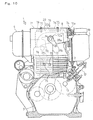
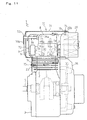
- a cover 70 is provided to cover the remaining side and an upper side of cylinder head 7.
- Cover 70 is formed to have an approximate inverse L shape in a section view, and arranged to protect exposed portions of cylinder head 7, bonnet cover 8, etc. and to reduce noise caused by cylinder head 7, bonnet cover 8, etc.
- cover 70 is spaced from cylinder head 7 so that a top surface of cover 70 is substantially aligned with one, two or all of top surfaces of muffler 9, fuel tank 10 and air cleaner 20, and a side surface of cover 70 is substantially aligned with at least one of side surfaces (front surfaces) of muffler 9 and fuel tank 10. In this way, projections and depressions on the outer surface of engine 1 are reduced, thereby improving appearance of engine 1.
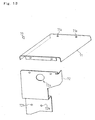
- cover 70 comprises a horizontal top cover 71 as an upper part thereof and a vertical side cover 72 as a side part thereof.
- Top cover 71 is substantially rectangular in a plan view, and right and left sides thereof are bent vertically downward to form edge portions.
- Top cover 71 may be made of, for example, vibration absorbing steel plate in order to improve sound insulation.
- Side cover 72 is bent twice in a vertically middle part thereof toward the cylinder side so as to have steps fitting the shape of exhaust pipe 34 disposed on the front surface of cylinder head 7. Also, side cover 72 is formed on a top surface thereof with a later-discussed insertion hole 72a.
- Cover 70 may comprise separate top cover 71 and side cover 72 which are mutually joined with bolts or other means. Alternatively, cover 70 may be made of a single member.
- Cover 70 is attached on engine 1, being supported by housing portions of respective fuel tank 10 and air cleaner 20 and by an outer surface of cylinder block 2. Alternatively, cover 70 may be supported by bonnet cover 8 or cylinder head 7.
- fuel tank 10 is formed with an indented support portion 10a projecting from the housing portion thereof.
- a rubber cushion 74 is pressed in an indent of indented support portion 10a.
- Rubber cushion 74 is formed at a top thereof with a slit into which an end of cover 70 is inserted.
- indented support portion 70a itself may be made up of vibration absorbing members.
- the above-described three edge portions of top cover 71 are bent squarely and extending vertically downward. One of these downward extending portions is disposed on a fuel tank 10 side to be fitted in upwardly opened indented support portion 10a.
- fuel tank 10 is also formed on the front side thereof with another indented support portion 10a projecting from the housing portion.
- Side cover 72 is squarely bent and extended rearward at right and left edge portions thereof. The rearward extending edge portion of side cover 72 on the fuel tank 10 side corresponds to forwardly opened indented support portion 10a. In this way, cover 70 is attached onto fuel tank 10 by pressing cover 70 into engine 1 from the upper front side thereof.
- air cleaner 20 is formed on a top surface of the housing portion thereof with a projecting attachment portion 20b for attachment of cover 70.
- Attachment portion 20b is formed thereon with bolt holes extending downward from the top surface thereof.
- top cover 71 is formed with insertion holes 71a and 7 1 a so as to overlap the bolt holes formed on attachment portion 20b in a plan view in the state that cover 70 is attached on engine 1.
- Bolts 75 are screwed into the respective bolt holes of attachment portion 20b through insertion hole 71a of top cover 71 and rubber cushion 76 as an interposal member, thereby supporting cover 70 onto air cleaner 20.
- rubber cushion 76 is also formed thereon with insertion holes for inserting bolts 75.
- cylinder block 2 is formed on a front surface thereof with a projecting attachment portion 2d for attachment of cover 70.
- Attachment portion 2d is formed with bolt holes extending rearward from the front surface thereof.
- side cover 72 of cover 70 is formed with insertion holes 72b and 72b so as to overlap the bolt holes formed on attachment portion 2d of cylinder block 2 in a plan view in the state that cover 70 is attached on engine 1.
- Bolts 75 are screwed into the respective bolt holes on attachment portion 2d through insertion hole 72b on side cover 72 and rubber cushion 76 as an interposal member, thereby firmly supporting side cover 72 onto cylinder block 2.
- cover 70 is supported on the housing portion of fuel tank 10 and air cleaner 20 and the outer surface of cylinder block 2.
- cover 70 can be vibratory-isolatingly supported on the main body of the engine, thereby improving sound insulation to reduce noise.
- cooling air from fan 35 can be guided by cover 70 so as to be led into a space between cylinder head 7 and cover 70, thereby improving the efficiency of cooling cylinder head 7, bonnet cover 8, etc.
- cover 70 covers exhaust pipe 34 so that users are prevented from accidentally touching exhaust pipe 34. Furthermore, cover 70 can be used as a means for covering a base portion of muffler 9 (a joint between muffler 9 and exhaust pipe 34).
- cover 70 on the housing portions of the above-mentioned devices does not always require rubber cushions 74 and 76.
- cover 70 may be fixed onto engine 1 by means of direct bolting, for example, without any vibration-absorbing interposal member.
- cover 70 is made up of a bending-pressed metal plate member. For this reason, cover 70 is vibratory-isolatingly supported on the main body of engine 1 so as to be prevented from resonating with engine 1 to cause metallic noise when engine 1 is driven.
- cover 70 is made up of a metallic plate member and vibratory-isolatingly supported on the main body of engine 1 via a rubber cushion 74 which is an elastic member.
- a cover itself may be made up of an elastic member such as a resinous member, for example, to have vibration-absorbing effect. Any other configuration is possible as long as the cover is attachable on engine 1.
- Side cover 72 of cover 70 is formed on a top surface thereof with an insertion hole 72a for inserting control shaft 39a of decompressor 39.
- Control shaft 39a projects to the outside from insertion hole 72a.
- On the outer end of control shaft 39a is fixed decompressor lever 39b.
- the diameter of insertion hole 72a substantially corresponds to the outer diameter of control shaft 39a. Therefore, an exposed area of cylinder head 7 in insertion hole 72a is negligibly small.
- decompressor lever 39b is arranged outside side cover 72 to be operable for controlling decompressor 39 while keeping the silent condition that cover 70 is attached on engine 1.
- decompressor lever 39b serves as the above-mentioned operating portion of decompressor 39, and does not jut out above cover 70, thereby keeping good appearance of the top surface of engine 1.
- fan case 36 containing fan 35 is disposed on one side (rear side) of cylinder block 2. Cooling air from fan 35 is guided by fan case 36 to be sent out to the other side (the opposite side to the one side, namely, the front side) and the upper side of cylinder block 2.
- the cooling air cools the rear surface of cylinder head 7, and further cools the side surfaces of cylinder block 2, cylinder head 7, etc. while passing through cylinder block 2 and through a space between cylinder head 7 and devices such as muffler 9 and fuel tank 10.
- side cover 72 of cover 70 is extended to the front side of cylinder block 2 so as to cover the front side (the opposite side to fan 35) of cylinder block 2.
- cover 70 which is arranged to cover the top side and the one side (front side) of cylinder block 2, functions as an air guiding plate to lead cooling air from fan 35 to the opposite side of cylinder block 2 to fan 35.
- cooling air from fan 35 is sent out from a top of fan case 36 and flows upward through a space between cylinder head 7 and air cleaner 20. Then, the cooling air flows forward through a space between top cover 71 and bonnet cover 8, and, finally, it flows downward through a space between side cover 72 and cylinder head 7.
- cooling air from fan 35 is guided by cover 70 to cool cylinder head 7, bonnet cover 8, etc.
- cooling air also flows through a space between muffler 9, fuel tank 10 and cylinder block 2 to cool cylinder block 2.
- muffler 9 and fuel tank 10 are disposed on the left and right sides of cylinder head 7, respectively.
- Air cleaner 20 is disposed on the rear side of cylinder head 7 (one of the sides where neither muffler 9 nor fuel tank 10 are disposed).
- top cover 70 which is formed to have an approximate inverse L shape in a section view, comprises top cover 71 and side cover 72.
- Side cover 72 is disposed on the opposite side of cylinder head 7 to air cleaner 20 (that is, on the front side of cylinder head 7).
- cylinder head 7 the front, rear, left and right sides of cylinder head 7 are covered by side cover 72, air cleaner 20, fuel tank 10 and muffler 9, respectively, and the top of cylinder head 7 is covered by top cover 71.
- top cover 71 the top and the four sides of cylinder head 7, bonnet cover 8, etc. are all covered, thereby improving sound insulation to reduce noise generated from cylinder head 7, bonnet cover 8, etc.
- the engine cover structure according to the present invention has the merit of improving sound insulation so that noise generated from the cylinder head is reduced, and also has the merit that the cylinder head and the exhaust pipe are cooled by cooling air from the fan.
Landscapes
- Engineering & Computer Science (AREA)
- Mechanical Engineering (AREA)
- General Engineering & Computer Science (AREA)
- Chemical & Material Sciences (AREA)
- Combustion & Propulsion (AREA)
- Physics & Mathematics (AREA)
- Acoustics & Sound (AREA)
- Cylinder Crankcases Of Internal Combustion Engines (AREA)
- Exhaust Silencers (AREA)
Abstract
Description
- The present invention relates to a structure of an engine cover that covers an upper part of an engine.
- Conventionally, there is a well-known type of engine whose cylinder head is surrounded by devices such as a muffler, a fuel tank and an air cleaner. For example, Japanese Patent Application Publication No. Hei 8-232654 discloses a technique to send cooling air from a fan provided on one side of a cylinder block to the opposite side of the cylinder block, thereby improving cooling efficiency of the engine.
- However, according to the above conventional art, sound insulation is not taken into consideration and the engine is provided with only a structure for guiding cooling air wherein the cylinder head and a cylinder are arranged to be surrounded by an air exhaust flange.
- On the other hand, attaching of a cover on an engine is an ordinary technique for preventing emission or transmission of vibration, noise, etc. caused by driving an engine. In this case, the cover is arranged to cover an overall body of the engine so that the engine must have a large housing. Furthermore, attachment of the cover must be a time and labor consuming task, thereby making maintenance work harder. Furthermore, for attaching a cover onto a general purpose engine, a different cover is required corresponding to a type of working vehicle to which the engine is mounted.
- According to the present invention, an engine whose cylinder head is covered at three of front, rear, right and left sides thereof by a fuel tank, an air cleaner and a muffler, respectively, comprises a cover which covers the remaining one side and/or a top side of the cylinder head. Due to this structure, the cylinder head can be protected by the cover, and noise caused by the cylinder head can be reduced. Furthermore, the cover can send cooling air from a fan provided on one side of a cylinder block via the cylinder head to an exhaust pipe disposed on the opposite side of the cylinder block, which is an exposed side of the cylinder head where no device such as a muffler is disposed. Therefore, the cylinder head and the exhaust pipe can be cooled.
- According to the invention, the cover is formed to have an approximate inverse L shape in a section view so as to cover an exposed side of the cylinder head and the top of the cylinder head. Due to this structure, sound insulation is improved to reduce noise caused by the cylinder head. Furthermore, cooling air from a fan provided on one side of the cylinder block can be guided to cool the cylinder head as well as a bonnet cover, etc. disposed over the cylinder head, thereby improving cooling efficiency. Still further, the cover covers the exhaust pipe disposed on the exposed side of the cylinder head, thereby preventing users from accidentally touching the exhaust pipe. In addition, the cover can be used as a means for covering a base portion of a muffler (a joint between the muffler and the exhaust pipe).
- According to the invention, the cover comprises a side cover to cover the exposed side of the cylinder head and a top cover to cover the top side of the cylinder head. Due to this structure, the cover can be separated into the top cover and the side cover, thereby facilitating attachment of the cover onto the engine. Furthermore, the top cover or the side cover can be removed individually so that parts desired to be detached from the engine can be easily detached, thereby enhancing ease of maintenance.
- According to the invention, the side cover and the top cover are integrally formed. Due to this structure, attachment work of the cover onto the engine is made easier.
- According to the invention, the side cover is bent corresponding to a shape of an exhaust pipe disposed on a side surface of the cylinder head. Due to this structure, the side cover covers the exhaust pipe, thereby preventing users from accidentally touching the exhaust pipe.
- According to the invention, the side cover is disposed on a side of the cylinder head opposite to the air cleaner. Due to this structure, the cylinder head is covered at the front, rear, left and right sides thereof by the muffler, the fuel tank, the air cleaner and the side cover, and also covered by the top cover disposed thereabove, thereby improving sound insulation to reduce noise caused by the cylinder head. Furthermore, the side cover covers an exposed portion of the cylinder, thereby preventing users from accidentally touching the cylinder head, and also improving appearance of the engine.
- According to the invention, a fan is disposed on one side of a cylinder block beneath the cylinder head, and the side cover is extended to cover another side of the cylinder block opposite to the fan. Due to this structure, the side cover functions as a guiding plate to guide cooling air from the fan to an outer surface of the cylinder block opposite to the fan. Therefore, the whole body of the cylinder head is cooled down, and further the surface of the cylinder block opposite to the fan is also cooled down.
- According to the invention, the side cover has a notched upper edge portion fixed on a side surface of the top cover. Due to this structure, an operating portion of a decompressor provided on the engine can be disposed at the notched portion without projecting to the outside of the side cover. Therefore, the operating portion of the decompressor can be operated without having to detach the cover from the engine, thereby keeping good appearance of the engine. Furthermore, the top cover and the side cover can be joined to form an approximate inverse L shape, thereby improving appearance of the engine.
- According to the invention, the side cover is formed on a side surface thereof with an opening. Due to this structure, cooling air can be sufficiently drawn out from the opening, thereby improving cooling efficiency. In addition, weight of the side cover can be reduced by the area of the opening.
- According to the invention, the side cover has a lower edge portion whose at least one side is perpendicularly bent to form a projection inserted into a slit formed in a main body of the engine so as to attach the side cover to the main body. Due to this structure, the side cover can easily be fixedly positioned with respect to the main body of the engine. Furthermore, a fixed portion can be easily formed in the side cover.
- According to the invention, the top cover is formed on a top surface thereof with an attachment hole for attachment of the top cover onto the engine, periphery of the attachment hole being funnel-formed and the attachment hole being formed with a slit on an inner side surface thereof. Due to this structure, water is drained through the slit, thereby preventing water from ponding on the top surface of the top cover when, for example, rainwater falls on the top surface of the top cover. Furthermore, water draining structure can be easily formed on the top cover.
- According to the invention, the top cover is formed on a top surface thereof with a hole for inserting a lifting member and a hole for feeding startup assisting material. Due to this structure, a lifting member for lifting up the engine can be easily attached to the cylinder head without having to detach the top cover from the engine. Therefore, the engine can be easily lifted up only by the lifting member without any additional member such as a guide member attached on the main body of the engine. And, also due to this structure, startup assisting material can be fed from the latter hole without having to detach the top cover from the main body of the engine.
- According to the invention, an operating portion of a decompressor is disposed below a top surface of the top cover. Due to this structure, the operating portion of the decompressor does not jut out above the top surface of the top cover, thereby keeping good appearance of the engine.
- According to the invention, the operating portion of the decompressor is provided as a decompressor lever, and the side cover is formed thereon with a hole for inserting a control shaft of the decompressor lever, the decompressor lever being projected to the outside of the side cover. Due to this structure, the decompressor can be controlled with the decompressor lever in a state where the cover is attached on the engine.
- According to the invention, a cooling air guide for guiding cooling air to a space between a bonnet cover and the top cover disposed over the cylinder head is formed in a cylinder head side of a body of the air cleaner. Due to this structure, cooling air from a fan can be guided and divided by the cooling air guide to cool the bonnet cover and a fuel injection nozzle as well as the cylinder head. Furthermore, the cooling air guide can be easily formed by casting, etc.
- According to the invention, the cooling air guide is integrally formed on a partition wall formed in the cylinder head side of the body of the air cleaner. Due to this structure, the cooling air guide can be produced cost-effectively because it requires neither special additional part attached onto the body of the air cleaner nor processing of the body.
-
- Fig. 1 is a perspective view of an engine attached thereon with a cover.
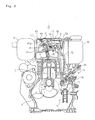
- Fig. 2 is a sectional front view of the engine attached thereon with the cover.
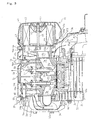
- Fig. 3 is a sectional side view of an upper portion of the engine attached thereon with the cover.
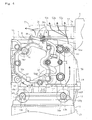
- Fig. 4 is a plan view of the upper portion of the engine.
- Fig. 5 is a front view of a body of an air cleaner.
- Fig. 6 is a bottom view of the body of the air cleaner.
- Fig. 7 is a front view of a side cover and a top cover.
- Fig. 8 is a right side view of the side cover and the top cover.
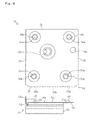
- Fig. 9 is a plan view of the side cover and the top cover.
- Fig. 10 is a front view of an engine attached thereon with a cover according to a second embodiment.
- Fig. 11 is a side view of the engine attached thereon with the cover according to the second embodiment.
- Fig. 12 is a plan view of the engine attached thereon with the cover according to the second embodiment.
- Fig. 13 is a perspective view of a side cover and a top cover of the cover according to the second embodiment.
- Referring to Fig. 1 to Fig. 3, description will now be given of an overall structure of an air-cooled engine with a cover structure according to the present invention. Hereafter, the front side of the engine is assumed as indicated by an arrow F shown in Fig. 1.
- An
engine 1 comprises acylinder block 2 in an upper part thereof and acrankcase 3 in a lower part thereof. In the middle ofcylinder block 2 is formed a vertically-directedcylinder 2a with apiston 4.Piston 4 is connected via aconnection rod 6 to acrankshaft 5 which is pivotally supported bycrankcase 3. - A balance weight, a
governor 11, etc. are disposed withincrankcase 3 beneathcylinder block 2. Acam shaft 13, afuel injection pump 12, etc. are disposed abovegovernor 11. Fuel injection pump 12 draws fuel from afuel tank 10 by pushing and pulling a plunger offuel injection pump 12 with a pump-drivingcam 14 provided oncam shaft 13 at the center thereof in the fore-and-aft direction, and supplies a certain amount of fuel to afuel injection nozzle 15 via a high-pressure pipe 19 at a certain timing. The amount of fuel injection fromnozzle 15 can be controlled by turning acontrol lever 16 offuel injection pump 12 to change a stroke of the plunger. - On
cylinder block 2 is disposed acylinder head 7, inside of which asuction valve 31, anexhaust valve 32 andfuel injection nozzle 15 are disposed. Abonnet cover 8 is provided oncylinder head 7 forming arock arm chamber 8a, within which upper end portions ofrespective suction valve 31 andexhaust valve 32, upper end portions ofrespective rock arms pushrod 25, etc. are disposed. Three out of four sides (front, rear left and right sides) ofcylinder head 7 andbonnet cover 8 are surrounded by amuffler 9,fuel tank 10 and anair cleaner 20. According to the present embodiment,muffler 9,fuel tank 10 andair cleaner 20 are respectively disposed in the right, left and rear sides ofcylinder head 7. The remaining side (front side) and an upper side ofcylinder head 7 are respectively covered with aside cover 51 and atop cover 55 of acover 50. - A
fan 35 is disposed on one side (rear side) ofcylinder block 2 underair cleaner 20.Fan 35 consists of aflywheel 35a which is fixed on one end ofcrankshaft 5 and integrally formed withfins 35b on a peripheral portion of an outer side surface thereof.Fan 35 is covered by afan case 36. By rotatingfan 35, air is drawn intofan case 36 from outside and then sent towardcylinder block 2,cylinder head 7, etc. to cool them. The air is also supplied toair cleaner 20. - As shown in Fig. 3, suction valve 31 (exhaust valve 32) comprises a
valve head 31a (32a) as a bottom part thereof and avalve rod 31b (32b) as a body part thereof and is disposed overpiston 4.Valve head 31a (32a) is arranged so that it can be fitted or separated on and from a valve seat formed on a bottom surface ofcylinder head 7, thereby connecting or disconnecting a suction port 7a (aexhaust port 7b) formed incylinder head 7 to and from an inside space ofcylinder 2a formed incylinder block 2. Suction port 7a is connected toair cleaner 20 provided behindcylinder head 7.Exhaust port 7b is connected tomuffler 9 via anexhaust pipe 34 provided beforecylinder head 7. -
Valve rod 31b (32b) is slidably inserted intocylinder head 7 and projecting upward to thebonnet cover 8 side. A top end ofvalve rod 31b (32b) is contacted with a rock arm 27 (28). Insiderock arm chamber 8a, a spring 33 (33) is put onvalve rod 31b (32b) so thatvalve head 31a (31b) is biased to slide upward and shut suction valve 31 (exhaust valve 32). -
Fuel injection nozzle 15 is disposed betweensuction valve 31 andexhaust valve 32.Fuel injection nozzle 15 is inserted intocylinder head 7 and projects downward with a tip thereof (an injecting portion) positioned above a center ofcylinder 2a.Fuel injection nozzle 15 is connected at the other end thereof tohigh pressure pipe 19 extending fromfuel injection pump 12 so as to inject fuel supplied fromfuel injection pump 12 intocylinder 2a. -
Cylinder head 7 andbonnet cover 8 are pierced at one ends thereof by a vertical connectinghole 37. Connectinghole 37 is connected to suction port 7a. Startup-assisting material is injected intocylinder 2a from connectinghole 37 through suction port 7a for assisting smooth startup of an engine under the condition of low temperature. When injecting operation is not performed, connectinghole 37 is normally plugged with acap 38 to prevent an extraneous substance from entering intocylinder 2a and mixing with internal air. - A
decompressor 39 is provided onbonnet cover 8.Decompressor 39 forcedly opensexhaust valve 32 orsuction valve 31 at engine startup in order to decrease a compressive force insidecylinder 2a and reduce a cranking force, thereby enhancing starting performance of the engine. (In this embodiment,decompressor 39 is typically provided onexhaust valve 32.)Decompressor 39 comprises acontrol shaft 39a pivotally supported bybonnet cover 8 and adecompressor lever 39b attached to controlshaft 39a as an operating portion. -
Control shaft 39a ofdecompressor 39 is disposed horizontally in the fore-and-aft direction, and turnably supported bybonnet cover 8.Decompressor lever 39b is integrally fixed on one end ofcontrol shaft 39a projecting forward to the outside. The other end ofcontrol shaft 39a projecting into the inside ofrock arm chamber 8a is formed with a notched semicylindrical contacting portion 39c. Contacting portion 39c is arranged so that it can contact withrock arm 28. Therefore, ascontrol shaft 39a is turned bydecompressor lever 39b, contacting portion 39c comes to contact withrock arm 28 and push it. Then,rock arm 28 pushesexhaust valve 32 and slides it downward against the biased force of the spring, thereby openingexhaust valve 32. Therefore, whenpiston 4 moves upward, air insidecylinder 2a is not compressed as it is exhausted fromexhaust valve 32. As a result,crankshaft 5 can be rotated with a little driving force. - As shown in Fig. 3,
air cleaner 20 comprises abody 40, acover 41 and anelement 42.Cover 41 is fixed onbody 40 via aseal member 43.Element 42 is contained betweencover 41 andbody 40. More concretely,air cleaner 20 is constructed in the following way:Body 40 is formed with a step-like shapedinward recess portion 40a so as to fit to periphery ofelement 42,element 42 is fitted viaseal member 44 intorecess portion 40a and fastened tobody 40 by abolt 45 with anut 46, and finally, cover 71 is fixed toelement 42 with anut 47. - A
suction opening 20a is formed at a bottom part ofair cleaner 20 for sucking air directly from outside or fromfan case 36.Suction opening 20a is formed by a cutaway part in a bottom periphery ofcover 41 whencover 41 is fixed onbody 40.Suction opening 20a opens downward so as to suck air into air cleaner 20 from outside. Further, asuction hole 40j, which serves as a flow path for air, is formed at a central part ofbody 40.Suction hole 40j and suction port 7a ofcylinder head 7 are connected with each other. - As shown in Fig. 5 and Fig. 6, in a
cylinder head 7 side ofbody 40 are integrally formedpartition walls fan 35 from thefan case 36 side to thecylinder head 7 side.Partition wall 40b extends horizontally from a vertically middle part ofbody 40. Partition walls 40c are extended continuously frompartition wall 40b and towardcylinder head 7 at both sides of a bottom part ofbody 40.Partition wall 40d is approximately U-shaped in a bottom view and extended downward from a bottom part ofbody 40 on the opposite side to thecylinder head 7.Partition walls 40b and 40c are formed therein with bolt holes for attachment ofbody 40 tocylinder head 7. - Furthermore,
partition wall 40b and partition wall 40c are integrally formed at respective middle parts thereof with respective upwardly projecting cooling air guides 40e and 40f. Whenbody 40 is attached tocylinder head 7, cooling air guides 40e and 40f are positioned over a top surface ofcylinder head 7 to respectively formopenings partition walls cylinder head 7 is fluidly connected to a space formed between a later-discussedtop cover 55 ofcover 50 andcylinder head 7. Therefore, a part of cooling air flowing fromfan 35 is guided by cooling air guides 40e and 40f ofpartition walls 40b and 40c so as not to be sent intocylinder head 7 but to be sent fromopenings bonnet cover 8 andtop cover 55 overcylinder head 7. - In this way, cooling air guides 40e and 40f, which serve as intakes of cooling air into the space between
bonnet cover 9 andtop cover 55 overcylinder head 7, are formed in thecylinder head 7 side ofbody 40 ofair cleaner 20. Therefore, cooling air guides 40e and 40f can guide cooling air sent fromfan 35 tobonnet cover 8 to cool it as well ascylinder head 7. Furthermore, cooling air guides 40e and 40f can be easily formed by casting, etc. - Furthermore, cooling air guides 40e and 40f are integrally formed on
respective partition walls 40b and 40c which are formed in thecylinder head 7 side ofbody 40 ofair cleaner 20 so that there is no need for any special additional part or for processing forbody 40, thereby being produced cost-effectively. - Referring now to Fig. 1 and Fig. 7 through Fig. 9, description will be given of the cover structure of
engine 1. -
Cover 50 comprisesside cover 51 andtop cover 55. While the upper part of the engine includescylinder head 7 covered at three of front, rear, left and right sides thereof withmuffler 9,fuel tank 10 andair cleaner 20, side cover 51 is arranged at the upper part of the engine so as to cover the remaining one side ofcylinder head 7.Top cover 55 is arranged to cover the top ofcylinder head 7 andbonnet cover 8.Cover 50, which covers both the remaining side and the top ofcylinder head 7 in the present embodiment, may be arranged to cover at least one of the remaining side and the top ofcylinder head 7.Cover 50 may be arranged to cover a wider area in addition to the exposed part ofcylinder head 7. - In the present embodiment, side cover 51 is placed on the front side of
cylinder head 7 which is not covered by any ofmuffler 9,fuel tank 10 andair cleaner 20.Side cover 51 is arranged to also coverexhaust pipe 34 disposed in front ofcylinder head 7 and to cover the corresponding side of an upper part ofcylinder block 2. -
Side cover 51 is formed to have a hat-like shape and, in a rear view, to have an approximately trapezoidal shape. In other words, a vertically middle part ofside cover 51, which serves as a part to coverexhaust pipe 34, projects forward to form a projectingportion 52 whose right and left sides are opened. Projectingportion 52 is formed in such a way that a vertical width thereof is increased in the direction fromcylinder head 7 tomuffler 9 so as to fit the shape ofexhaust pipe 34. - Furthermore, side cover 51 is formed on a front surface thereof with
plural openings openings portion 52 of side cover 51 at regular intervals. However, the number and the shape of openings are not to be specified. For example, more than three openings may be provided on projectingportion 52. Alternatively, instead of these openings, heat may be exhausted through right and left sides or top and bottom sides of side cover 51 without any openings provided. Any arrangement is possible of side cover 51 for exhausting heat only ifexhaust pipe 34 is prevented from being directly contacted byside cover 51. - As shown in Fig. 8 and Fig. 9, side cover 51 has a
lower edge portion 53 whose at least one side is squarely bent so as to form aprojection 53a. As shown in Fig. 3, avertical slit 2b is formed through plural laterally horizontal fins for radiating heat projecting from a front side of a main body ofengine 1, (cylinder block 2). By insertingprojection 53a intoslit 2b, side cover 41 can be easily positioned with respect to the main body ofengine 1 and fixed on it. - On the other hand, a
recess 54a, which is approximately V-shaped in a side view, is formed in anupper end portion 54 ofside cover 51.Recess 54a has a closedarcuate end part 54c which is disposed on the axial line ofcontrol shaft 39a ofdecompressor 39 projecting forward frombonnet cover 8 when side cover 51 is attached on the main body ofengine 1.Decompressor lever 39b on the outer end ofcontrol shaft 39a is positioned inrecess 54a lower than the top of projectingpart 52 ofside cover 51, that is, in a receding part ofside cover 51. Therefore,decompressor lever 39b does not protrude to the outside ofside cover 51, thereby keeping good appearance ofengine 1. Here, it should be noted thatrecess 54a may also be easily formed by punching, etc. The shape ofrecess 54a is not limited. - Furthermore, side cover 51 is provided at
lower end portion 53 thereof with anattachment hole 53b for attachment of side cover 51 to the main body of the engine (cylinder block 2), and atupper end portion 54 thereof with plural attachment holes 54b and 54b for attachment of side cover 51 totop cover 55. Anut 68 is fixed on the inner side ofupper end portion 54 of side cover 51 to correspond toattachment hole 54b. -
Top cover 55 is disposed overcylinder head 7 to covercylinder head 7,bonnet cover 8, etc.Top cover 55 is approximately rectangularly shaped, and atop surface 56 oftop cover 55 is bent vertically downward at right, left and front sides thereof to formrespective edge portions -
Top cover 55 is provided ontop surface 56 thereof with plural attachment holes 56a for attachment oftop cover 55 to the main body of the engine. In this embodiment, fourattachment holes 56a are provided, which are respectively arranged at four corners oftop surface 56 oftop cover 55. - As shown in Fig. 8 and Fig. 9, each
attachment hole 56a is formed into a funnel shape having a peripherally lowered central part. Aslit 56b is formed on the inner side surface of eachattachment hole 56a. Therefore,top surface 56 oftop cover 55 fixed with bolts or the like is prevented from ponding of rainwater dropping thereon since the rainwater is drained throughslit 56b. In this way, water draining structure is easily formed by providingslit 56b. - Furthermore,
top cover 55 is formed ontop surface 56 thereof with a liftingmember insertion hole 56c and a startup assistingmaterial injection hole 56d. As shown in Fig. 4, liftingmember insertion hole 56c is positioned to correspond to abolt hole 61 formed on the top surface ofcylinder head 7. Liftingmember insertion hole 56c is normally closed with a bolt. During lifting operation, the bolt is removed from liftingmember insertion hole 56c, and an attachment member, such as an eyebolt, is screwed through liftingmember insertion hole 56c into a boss or the like formed incylinder head 7. Therefore, whenengine 1 is transferred orengine 1 is installed on a working vehicle,engine 1 can be lifted by use of a lifting member easily attached oncylinder head 7 without removingtop cover 55 fromengine 1. Thus,engine 1 requires no additional member such as a guide member onto the main body thereof to be lifted sinceengine 1 can be easily lifted by only the lifting member. - Startup assisting
material injection hole 56d is positioned so that an opening thereof corresponds to the connectinghole 37 formed onbonnet cover 8 andcylinder head 7. Startup assistingmaterial injection hole 56d has a width enough to passcap 38 fitted into connectinghole 37 therethrough, so thatcap 38 can be removed from startup assistingmaterial injection hole 56d while keepingtop cover 55 attached on the main body ofengine 1. Therefore, startup assisting material can be injected intocylinder 2a from startup assistingmaterial injection hole 56d via connectinghole 37 by opening connectinghole 37 without removingtop cover 55 from the main body ofengine 1. - Furthermore, of
edge portions top cover 55,front edge portion 59, which doesn't contact with any ofmuffler 9,fuel tank 10 andair cleaner 20, is formed thereon withplural attachment holes top cover 55. Further,edge portion 59 is formed in a lower end part thereof with a notchedarcuate portion 59b that facesarcuate portion 54c ofrecess 54a formed onupper end portion 54 ofside cover 51. - Referring to Fig. 3 and Fig. 4, description will now be given of attachment structure of
cover 50. -
Top cover 55 ofcover 50 is attached onbody 40 ofair cleaner 20,cylinder head 7 andbonnet cover 8. Side cover 51 ofcover 50 is attached oncylinder block 2 andtop cover 55. -
Body 40 ofair cleaner 20 is formed in a cylinder head side thereof with projectingboss portions top cover 55. Eachboss portion 40g is formed with avertical bolt hole 40h. Ofattachment holes 56a formed ontop cover 55, attachment holes 56a and 56a disposed in theair cleaner 20 side oftop cover 55 are arranged to correspond to boltholes 40h ofboss portions 40g. Then, abolt 64 is screwed intobolt hole 40h ofboss portion 40g throughattachment hole 56a oftop cover 55 and aninterposal member 65, such as a rubber cushion, thereby fasteningtop cover 55 ontobody 40 ofair cleaner 20. - Also, on the top surfaces of
cylinder head 7 andbonnet cover 8 are formed respective vertical bolt holes 62 and 63 for attachment oftop cover 55. The remainingattachment holes top cover 55 are arranged to correspond to respective bolt holes 62 and 63. Then,bolts attachment holes 56a oftop cover 55, interposal members and bosses, respectively, thereby fasteningtop cover 55 ontocylinder head 7 andbonnet cover 8. - Furthermore, as shown in Fig. 3, side cover 51 is arranged to cover
exhaust pipe 34 with projectingportion 52, andprojection 53a onlower end portion 53 of side cover 51 is inserted intoslit 2b formed on the side surface ofcylinder block 2, thereby positioning and fixingside cover 51. - Furthermore,
attachment hole 53b formed onlower end portion 53 of side cover 51 is arranged to correspond to the bolt hole inboss portion 2c projecting from the front surface ofcylinder block 2. Then, abolt 66 is screwed into the bolt hole ofboss portion 2c throughattachment hole 53b ofside cover 51 and aninterposal member 67, thereby fastening side cover 51 ontocylinder block 2. - Furthermore,
upper end portion 54 of side cover 51 is fitted ontofront edge portion 58 oftop cover 55 so that attachment holes 59a and 59a onfront edge portion 58 correspond to respective attachment holes 54b and 54b onupper end portion 54 ofside cover 51. Then, abolt 69 is screwed intonut 68 onupper end portion 54 interposing through attachment holes 54b and 59a, thereby fastening side cover 51 ontotop cover 55. In this way,top cover 55 and side cover 51 are joined so as to form approximately inverse L-likeshaped cover 50, thereby achieving better appearance ofengine 1. Alternatively,top cover 55 and side cover 51 may be integrally formed. In this case, attachment ofcover 50 ontoengine 1 is made easier. - At a joint between
side cover 51 andtop cover 55, a circular opening is formed by fittingarcuate portion 54c ofrecess 54a formed inupper end portion 54 ofside cover 51 andarcuate portion 59b formed infront edge portion 59 oftop cover 55.Control shaft 39a ofdecompressor 39 is protruded from the opening.Decompressor lever 39b fixed on the outside end ofcontrol shaft 39a is positioned belowtop surface 56 oftop cover 55 and above projectingportion 52 of side cover 51 so as not to protrude to the outside oftop cover 55 andside cover 51. Therefore,decompressor 39 is operable bydecompressor lever 39b in the state that cover 50 is attached onengine 1, thereby keeping good appearance ofengine 1. - In this way,
top cover 50 is made up of separabletop cover 55 andside cover 51, thereby facilitating attachment ofcover 50 ontoengine 1. Furthermore, maintenance ofengine 1 is also facilitated becausetop cover 55 or side cover 51 can be removed separately fromengine 1 so that parts desired to be detached fromengine 1 can be easily detached. - Furthermore, sound insulation is improved because
cylinder head 7 is covered bycover 50 which blocks out noise caused bycylinder head 7. More in detail, the noise caused bycylinder head 7 is reduced because three sides (out of front, rear, left and right sides) ofcylinder head 7 are covered byfuel tank 10,air cleaner 20 andmuffler 9, the remaining one side ofcylinder head 7 is covered byside cover 51, and the upper side ofcylinder head 7 is covered bytop cover 55. - In addition, users are prevented from accidentally touching
exhaust pipe 34 because side cover 51 coversexhaust pipe 34 which is disposed in the exposed side ofcylinder head 7, that is, in the side where devices such asmuffler 9 are not disposed. - Furthermore, cover 50 attached on the main body of
engine 1 as described above functions as a guiding plate to guide the cooling air fromfan 35 toexhaust pipe 34 disposed on the opposite side tofan 35. - More specifically, as shown in Fig. 3 and Fig. 4, cooling air from
fan 35 is guided byfan case 36 and sent out upward from an upper end portion offan case 36 to a space betweencylinder head 7 andair cleaner 20. In the space, the cooling air is guided and divided bypartition walls body 40 ofair cleaner 20. A part of the cooling air is led into a space betweentop cover 55 and bonnet cover 8 fromopenings exhaust pipe 34 alongtop cover 55,bonnet cover 8 andcylinder head 7, and, finally, is let out from the right and left sides andopenings portion 52 ofside cover 51. - In this way, cover 50 serves as a guide plate for guiding cooling air from
fan 35 toexhaust pipe 34 viacylinder head 7. Therefore,cylinder head 7,bonnet cover 8, andexhaust pipe 34 disposed on the opposite side tocylinder head 7 can be cooled by the cooling air. - On the other hand, the rest of the divided cooling air is led into
cylinder head 7 bypartition walls cylinder head 7 from the inside thereof. After getting out ofcylinder head 7, the cooling air reunites with the other divided part of cooling air getting out of the space betweentop cover 55 andbonnet cover 8, and, finally, the reunited cooling air is let out from the right and left sides andopenings portion 52 ofside cover 51. - Thus, due to
openings side cover 51, the cooling air flowing out from thecylinder head 7 side can be sufficiently drawn out from side cover 51 without staying inside, thereby improving cooling efficiency. In addition, the weight of side cover 51 is reduced by the total areas ofopenings - Here, cooling air from
fan 35 also flows through a space betweencylinder block 2 andmuffler 9 and through a space betweencylinder block 2 andfuel tank 10. The cooling air passes through the space betweencylinder block 2 andmuffler 9 and the space betweencylinder block 2 andfuel tank 10 cooling these devices, and, finally, it is drawn out from the lateral sides ofside cover 51. - Referring to Fig. 10 through Fig. 13, description will now be given of a second embodiment of the cover structure of
engine 1. - As shown in Fig. 10 and Fig. 11, in an upper part of
engine 1,cylinder head 7 is covered at three sides (out of front, rear, left and right sides) thereof bymuffler 9,fuel tank 10 andair cleaner 20. Acover 70 is provided to cover the remaining side and an upper side ofcylinder head 7.Cover 70 is formed to have an approximate inverse L shape in a section view, and arranged to protect exposed portions ofcylinder head 7,bonnet cover 8, etc. and to reduce noise caused bycylinder head 7,bonnet cover 8, etc. - While
muffler 9 andfuel tank 10 are arranged to project over and forward ofcylinder head 7, cover 70 is spaced fromcylinder head 7 so that a top surface ofcover 70 is substantially aligned with one, two or all of top surfaces ofmuffler 9,fuel tank 10 andair cleaner 20, and a side surface ofcover 70 is substantially aligned with at least one of side surfaces (front surfaces) ofmuffler 9 andfuel tank 10. In this way, projections and depressions on the outer surface ofengine 1 are reduced, thereby improving appearance ofengine 1. - As shown in Fig. 13, cover 70 comprises a horizontal
top cover 71 as an upper part thereof and a vertical side cover 72 as a side part thereof.Top cover 71 is substantially rectangular in a plan view, and right and left sides thereof are bent vertically downward to form edge portions.Top cover 71 may be made of, for example, vibration absorbing steel plate in order to improve sound insulation.Side cover 72 is bent twice in a vertically middle part thereof toward the cylinder side so as to have steps fitting the shape ofexhaust pipe 34 disposed on the front surface ofcylinder head 7. Also, side cover 72 is formed on a top surface thereof with a later-discussedinsertion hole 72a.Cover 70 may comprise separatetop cover 71 and side cover 72 which are mutually joined with bolts or other means. Alternatively, cover 70 may be made of a single member. - Now, description will given of a supporting structure of cover70.
-
Cover 70 is attached onengine 1, being supported by housing portions ofrespective fuel tank 10 andair cleaner 20 and by an outer surface ofcylinder block 2. Alternatively, cover 70 may be supported bybonnet cover 8 orcylinder head 7. - Firstly, description will be given of a supporting structure for
cover 70 by the housing portion offuel tank 10. - As shown in Fig. 10,
fuel tank 10 is formed with anindented support portion 10a projecting from the housing portion thereof. Arubber cushion 74 is pressed in an indent ofindented support portion 10a.Rubber cushion 74 is formed at a top thereof with a slit into which an end ofcover 70 is inserted. Alternatively, indented support portion 70a itself may be made up of vibration absorbing members. The above-described three edge portions oftop cover 71 are bent squarely and extending vertically downward. One of these downward extending portions is disposed on afuel tank 10 side to be fitted in upwardly openedindented support portion 10a. - Furthermore, as shown in Fig. 12,
fuel tank 10 is also formed on the front side thereof with anotherindented support portion 10a projecting from the housing portion.Side cover 72 is squarely bent and extended rearward at right and left edge portions thereof. The rearward extending edge portion of side cover 72 on thefuel tank 10 side corresponds to forwardly openedindented support portion 10a. In this way, cover 70 is attached ontofuel tank 10 by pressingcover 70 intoengine 1 from the upper front side thereof. - Next, description will be given of a supporting structure for
cover 70 by the housing portion ofair cleaner 20. - As shown in Fig. 10 and Fig. 12,
air cleaner 20 is formed on a top surface of the housing portion thereof with a projecting attachment portion 20b for attachment ofcover 70. Attachment portion 20b is formed thereon with bolt holes extending downward from the top surface thereof. As shown in Fig. 13,top cover 71 is formed withinsertion holes engine 1. -
Bolts 75 are screwed into the respective bolt holes of attachment portion 20b throughinsertion hole 71a oftop cover 71 andrubber cushion 76 as an interposal member, thereby supportingcover 70 ontoair cleaner 20. Here,rubber cushion 76 is also formed thereon with insertion holes for insertingbolts 75. - Next, description will be given of a supporting structure for
cover 70 bycylinder block 2. - As shown in Fig. 11,
cylinder block 2 is formed on a front surface thereof with a projecting attachment portion 2d for attachment ofcover 70. Attachment portion 2d is formed with bolt holes extending rearward from the front surface thereof. As shown in Fig. 13, side cover 72 ofcover 70 is formed withinsertion holes cylinder block 2 in a plan view in the state that cover 70 is attached onengine 1. -
Bolts 75 are screwed into the respective bolt holes on attachment portion 2d throughinsertion hole 72b onside cover 72 andrubber cushion 76 as an interposal member, thereby firmly supportingside cover 72 ontocylinder block 2. - In this way, cover 70 is supported on the housing portion of
fuel tank 10 andair cleaner 20 and the outer surface ofcylinder block 2. - Due to the above structure, cover 70 can be vibratory-isolatingly supported on the main body of the engine, thereby improving sound insulation to reduce noise.
- Furthermore, in a configuration where
fan 35 is arranged behindcylinder block 2, as detailed later, cooling air fromfan 35 can be guided bycover 70 so as to be led into a space betweencylinder head 7 and cover 70, thereby improving the efficiency of coolingcylinder head 7,bonnet cover 8, etc. - In addition, even in a configuration where
exhaust pipe 34 is arranged in the exposed side ofcylinder head 7, that is, in the side where devices such asmuffler 9 are not disposed, cover 70 coversexhaust pipe 34 so that users are prevented from accidentally touchingexhaust pipe 34. Furthermore, cover 70 can be used as a means for covering a base portion of muffler 9 (a joint betweenmuffler 9 and exhaust pipe 34). - Here, cover 70 on the housing portions of the above-mentioned devices does not always require
rubber cushions engine 1 by means of direct bolting, for example, without any vibration-absorbing interposal member. - Now, detailed description will be given of the supporting structure of
cover 70 focusing on vibration-reducing mechanism. - In this embodiment, cover 70 is made up of a bending-pressed metal plate member. For this reason, cover 70 is vibratory-isolatingly supported on the main body of
engine 1 so as to be prevented from resonating withengine 1 to cause metallic noise whenengine 1 is driven. - Here, in this embodiment, cover 70 is made up of a metallic plate member and vibratory-isolatingly supported on the main body of
engine 1 via arubber cushion 74 which is an elastic member. However, this configuration is not limitative. Alternatively, a cover itself may be made up of an elastic member such as a resinous member, for example, to have vibration-absorbing effect. Any other configuration is possible as long as the cover is attachable onengine 1. - Now, description will be given of a configuration for controlling
decompressor 39 in the state that cover 70 is attached onengine 1. - Side cover 72 of
cover 70 is formed on a top surface thereof with aninsertion hole 72a for insertingcontrol shaft 39a ofdecompressor 39.Control shaft 39a projects to the outside frominsertion hole 72a. On the outer end ofcontrol shaft 39a is fixeddecompressor lever 39b. The diameter ofinsertion hole 72a substantially corresponds to the outer diameter ofcontrol shaft 39a. Therefore, an exposed area ofcylinder head 7 ininsertion hole 72a is negligibly small. - In this way,
decompressor lever 39b is arranged outside side cover 72 to be operable for controllingdecompressor 39 while keeping the silent condition that cover 70 is attached onengine 1. - Furthermore, the operating portion of
decompressor 39 is disposed below the top surface ofcover 70. In the present embodiment,decompressor lever 39b serves as the above-mentioned operating portion ofdecompressor 39, and does not jut out abovecover 70, thereby keeping good appearance of the top surface ofengine 1. - Now, description will be given of cooling structure of
cylinder block 2. - As shown in Fig. 11,
fan case 36 containingfan 35 is disposed on one side (rear side) ofcylinder block 2. Cooling air fromfan 35 is guided byfan case 36 to be sent out to the other side (the opposite side to the one side, namely, the front side) and the upper side ofcylinder block 2. - The cooling air cools the rear surface of
cylinder head 7, and further cools the side surfaces ofcylinder block 2,cylinder head 7, etc. while passing throughcylinder block 2 and through a space betweencylinder head 7 and devices such asmuffler 9 andfuel tank 10. - Furthermore, as shown in Fig. 10 and Fig. 12, side cover 72 of
cover 70 is extended to the front side ofcylinder block 2 so as to cover the front side (the opposite side to fan 35) ofcylinder block 2. - As a result, cover 70, which is arranged to cover the top side and the one side (front side) of
cylinder block 2, functions as an air guiding plate to lead cooling air fromfan 35 to the opposite side ofcylinder block 2 tofan 35. - As shown in Fig. 11, cooling air from
fan 35 is sent out from a top offan case 36 and flows upward through a space betweencylinder head 7 andair cleaner 20. Then, the cooling air flows forward through a space betweentop cover 71 andbonnet cover 8, and, finally, it flows downward through a space betweenside cover 72 andcylinder head 7. - In this way, the cooling air from
fan 35 is guided bycover 70 to coolcylinder head 7,bonnet cover 8, etc. In addition, the cooling air also flows through a space betweenmuffler 9,fuel tank 10 andcylinder block 2 to coolcylinder block 2. - Next, description will be given of an effect of the layout of
cover 70 relative to the devices includingair cleaner 20 provided onengine 1. - As described above,
muffler 9 andfuel tank 10 are disposed on the left and right sides ofcylinder head 7, respectively.Air cleaner 20 is disposed on the rear side of cylinder head 7 (one of the sides where neithermuffler 9 norfuel tank 10 are disposed). - Further,
top cover 70, which is formed to have an approximate inverse L shape in a section view, comprisestop cover 71 andside cover 72.Side cover 72 is disposed on the opposite side ofcylinder head 7 to air cleaner 20 (that is, on the front side of cylinder head 7). - Therefore, the front, rear, left and right sides of
cylinder head 7 are covered byside cover 72,air cleaner 20,fuel tank 10 andmuffler 9, respectively, and the top ofcylinder head 7 is covered bytop cover 71. As a result, the top and the four sides ofcylinder head 7,bonnet cover 8, etc. are all covered, thereby improving sound insulation to reduce noise generated fromcylinder head 7,bonnet cover 8, etc. - In addition, by entirely covering
cylinder head 7, users are prevented from accidentally touchingexhaust pipe 34, and the appearance ofengine 1 is improved. - As described above, the engine cover structure according to the present invention has the merit of improving sound insulation so that noise generated from the cylinder head is reduced, and also has the merit that the cylinder head and the exhaust pipe are cooled by cooling air from the fan.
Claims (16)
- An engine cover structure for an engine whose cylinder head is covered at three of front, rear, right and left sides thereof by a fuel tank, an air cleaner and a muffler, respectively, comprising a cover which covers the remaining one side and/or a top side of said cylinder head.
- An engine cover structure according to claim 1, wherein said cover is formed to have an approximate inverse L shape in a section view in order to cover an exposed side of said cylinder head and the top side of said cylinder head.
- An engine cover structure according to claim 1, wherein said cover comprises a side cover to cover the exposed side of said cylinder head and a top cover to cover the top side of said cylinder head.
- An engine cover structure according to claim 3, wherein said side cover and said top cover are integrally formed.
- An engine cover structure according to claim 3, wherein said side cover is bent corresponding to a shape of an exhaust pipe disposed on a side surface of said cylinder head.
- An engine cover structure according to claim 3, wherein said side cover is disposed on a side of said cylinder head opposite to said air cleaner.
- An engine cover structure according to claim 3, wherein a fan is disposed on one side of a cylinder block beneath said cylinder head, and said side cover is extended to cover another side of said cylinder block opposite to the fan.
- An engine cover structure according to claim 3, wherein said side cover has a notched upper edge portion fixed on a side surface of said top cover.
- An engine cover structure according to claim 3, wherein said side cover is formed on a side surface thereof with an opening.
- An engine cover structure according to claim 3, wherein said side cover has a lower edge portion whose at least one side is perpendicularly bent to form an projection inserted into a slit formed in a main body of said engine so as to attach said side cover to said main body.
- An engine cover structure according to claim 3, wherein said top cover is formed on a top surface thereof with an attachment hole for attachment of said top cover onto said engine, periphery of said attachment hole being funnel-formed and said attachment hole being formed with a slit on an inner side surface thereof.
- An engine cover structure according to claim 3, wherein said top cover is formed on a top surface thereof with a hole for inserting a lifting member and a hole for feeding startup assisting material.
- An engine cover structure according to claim 3, wherein an operating portion of a decompressor is disposed below a top surface of said top cover.
- An engine cover structure according to claim 13, wherein said operating portion of said decompressor is provided as a decompressor lever, and said side cover is formed thereon with a hole for inserting a control shaft of said decompressor lever, said decompressor lever being projected to the outside of said side cover.
- An engine cover structure according to claim 3, wherein a cooling air guide for guiding cooling air to a space between a bonnet cover and said top cover disposed over said cylinder head is formed in a cylinder head side of a body of said air cleaner.
- An engine cover structure according to claim 15, wherein said cooling air guide is integrally formed on a partition wall formed in the cylinder head side of said body of said air cleaner.
Applications Claiming Priority (3)
| Application Number | Priority Date | Filing Date | Title |
|---|---|---|---|
| JP2003068934A JP4213971B2 (en) | 2003-03-13 | 2003-03-13 | Sound insulation cover structure for air-cooled engine |
| JP2003365904A JP4328177B2 (en) | 2003-10-27 | 2003-10-27 | Engine cover |
| PCT/JP2004/002091 WO2004081386A1 (en) | 2003-03-13 | 2004-02-23 | Cover structure for engine |
Publications (3)
| Publication Number | Publication Date |
|---|---|
| EP1614901A1 true EP1614901A1 (en) | 2006-01-11 |
| EP1614901A4 EP1614901A4 (en) | 2007-06-13 |
| EP1614901B1 EP1614901B1 (en) | 2018-12-26 |
Family
ID=32992971
Family Applications (1)
| Application Number | Title | Priority Date | Filing Date |
|---|---|---|---|
| EP04713682.5A Expired - Lifetime EP1614901B1 (en) | 2003-03-13 | 2004-02-23 | Cover structure for engine |
Country Status (5)
| Country | Link |
|---|---|
| US (1) | US7191753B2 (en) |
| EP (1) | EP1614901B1 (en) |
| KR (1) | KR101074973B1 (en) |
| TW (1) | TW200506187A (en) |
| WO (1) | WO2004081386A1 (en) |
Cited By (5)
| Publication number | Priority date | Publication date | Assignee | Title |
|---|---|---|---|---|
| EP2607642A1 (en) * | 2011-12-07 | 2013-06-26 | Andreas Stihl AG & Co. KG | Work device |
| US9016165B2 (en) | 2011-12-07 | 2015-04-28 | Andreas Stihl Ag & Co. Kg | Power tool with Bowden cable |
| US9175594B2 (en) | 2011-12-07 | 2015-11-03 | Andreas Stihl Ag & Co. Kg | Power tool |
| US9534528B2 (en) | 2011-12-07 | 2017-01-03 | Andreas Stihl Ag & Co. Kg | Internal combustion engine with fuel system |
| CN107969899A (en) * | 2016-10-24 | 2018-05-01 | Seb公司 | The household cooking appliance of heating with discharge conduit |
Families Citing this family (11)
| Publication number | Priority date | Publication date | Assignee | Title |
|---|---|---|---|---|
| USD570878S1 (en) * | 2005-07-28 | 2008-06-10 | Briggs & Stratton Corporation | Muffler for an engine |
| USD570879S1 (en) * | 2007-01-05 | 2008-06-10 | Onihr Manufacturing Srl | Muffler housing |
| USD576638S1 (en) * | 2007-09-21 | 2008-09-09 | Black & Decker Inc. | Engine |
| US8424498B2 (en) | 2009-07-23 | 2013-04-23 | Briggs & Stratton Corporation | Engine blower scroll |
| EP2627884B1 (en) * | 2010-10-14 | 2014-12-17 | Daimler AG | Combustion engine and a method for producing such a combustion engine |
| CN102606302A (en) * | 2012-03-27 | 2012-07-25 | 重庆长安汽车股份有限公司 | Integrated body of engine decorating cover and resonant cavity |
| US9617951B2 (en) * | 2014-05-06 | 2017-04-11 | Champion Engine Technology, LLC | Air flow guide for an internal combustion engine |
| JP6432631B2 (en) * | 2017-03-24 | 2018-12-05 | マツダ株式会社 | Engine superstructure |
| AU2019202008B2 (en) * | 2019-03-20 | 2024-06-20 | Aeroklas Asia Pacific Group Pty Ltd | Air Compressor |
| US11530636B2 (en) | 2020-05-06 | 2022-12-20 | Kohler Co. | Engine exhaust heat management system |
| US12320416B2 (en) * | 2021-05-07 | 2025-06-03 | Kawasaki Motors, Ltd. | Utility vehicle |
Family Cites Families (15)
| Publication number | Priority date | Publication date | Assignee | Title |
|---|---|---|---|---|
| US2693789A (en) * | 1953-05-11 | 1954-11-09 | Briggs & Stratton Corp | Air-cooled internal-combustion engine |
| AT292388B (en) * | 1968-04-16 | 1971-08-25 | H C Hans Dipl Ing Dr Dr List | Air-cooled internal combustion engine |
| AT341833B (en) * | 1974-05-20 | 1978-02-27 | List Hans | COMBUSTION MACHINE WITH SILENCING COVERING |
| DE2651257A1 (en) * | 1976-11-10 | 1978-05-18 | Hatz Motoren | SIGNAL INDICATOR ON COMBUSTION MACHINERY |
| JPS58148231U (en) * | 1982-03-31 | 1983-10-05 | 小松ゼノア株式会社 | cylinder cover |
| DE3907083A1 (en) * | 1989-03-04 | 1990-09-06 | Hatz Motoren | INTERNAL COMBUSTION ENGINE WITH NOISE-REDUCING PANELING |
| JP2691461B2 (en) * | 1990-01-29 | 1997-12-17 | ヤンマーディーゼル株式会社 | Air-cooled internal combustion engine |
| JP2899078B2 (en) | 1990-07-10 | 1999-06-02 | 三菱製紙株式会社 | Support for photosensitive material |
| JP2507374Y2 (en) * | 1990-10-29 | 1996-08-14 | 三菱重工業株式会社 | Engine cover mounting structure |
| JP2818504B2 (en) | 1991-08-02 | 1998-10-30 | 日本電気アイシーマイコンシステム株式会社 | Time measurement circuit |
| JP3061303B2 (en) | 1991-08-09 | 2000-07-10 | 日立マクセル株式会社 | Method for producing sintered nickel electrode for alkaline secondary battery |
| JPH0534472U (en) * | 1991-09-26 | 1993-05-07 | 東洋ラジエーター株式会社 | Female screw holding part of synthetic resin tank for heat exchanger |
| JPH0547377U (en) * | 1991-11-22 | 1993-06-22 | 株式会社クボタ | Partial engine liquid cooling forced air cooling system |
| JP3103000B2 (en) * | 1994-11-21 | 2000-10-23 | 株式会社共立 | Internal combustion engine with decompression device |
| JP2686736B2 (en) | 1996-02-14 | 1997-12-08 | ヤンマーディーゼル株式会社 | Air-cooled internal combustion engine |
-
2004
- 2004-02-23 WO PCT/JP2004/002091 patent/WO2004081386A1/en not_active Ceased
- 2004-02-23 EP EP04713682.5A patent/EP1614901B1/en not_active Expired - Lifetime
- 2004-03-10 TW TW093106343A patent/TW200506187A/en not_active IP Right Cessation
-
2005
- 2005-09-07 KR KR1020057016715A patent/KR101074973B1/en not_active Expired - Fee Related
- 2005-09-07 US US11/219,912 patent/US7191753B2/en not_active Expired - Lifetime
Cited By (6)
| Publication number | Priority date | Publication date | Assignee | Title |
|---|---|---|---|---|
| EP2607642A1 (en) * | 2011-12-07 | 2013-06-26 | Andreas Stihl AG & Co. KG | Work device |
| US9016165B2 (en) | 2011-12-07 | 2015-04-28 | Andreas Stihl Ag & Co. Kg | Power tool with Bowden cable |
| US9175594B2 (en) | 2011-12-07 | 2015-11-03 | Andreas Stihl Ag & Co. Kg | Power tool |
| US9534528B2 (en) | 2011-12-07 | 2017-01-03 | Andreas Stihl Ag & Co. Kg | Internal combustion engine with fuel system |
| US10329994B2 (en) | 2011-12-07 | 2019-06-25 | Andreas Stihl Ag & Co. Kg | Power tool |
| CN107969899A (en) * | 2016-10-24 | 2018-05-01 | Seb公司 | The household cooking appliance of heating with discharge conduit |
Also Published As
| Publication number | Publication date |
|---|---|
| KR20050120757A (en) | 2005-12-23 |
| KR101074973B1 (en) | 2011-10-18 |
| US7191753B2 (en) | 2007-03-20 |
| TWI322222B (en) | 2010-03-21 |
| EP1614901B1 (en) | 2018-12-26 |
| US20060048742A1 (en) | 2006-03-09 |
| EP1614901A4 (en) | 2007-06-13 |
| TW200506187A (en) | 2005-02-16 |
| WO2004081386A1 (en) | 2004-09-23 |
Similar Documents
| Publication | Publication Date | Title |
|---|---|---|
| EP1614901B1 (en) | Cover structure for engine | |
| US6378468B1 (en) | Engine operated machine | |
| US6378469B1 (en) | Engine generating machine | |
| US4702201A (en) | Soundproof type engine working machine | |
| US6845739B2 (en) | Small-size engine with forced air cooling system | |
| EP1645733A1 (en) | Engine-driven electric generator | |
| US7007660B2 (en) | Portable power working machine | |
| JP2007092595A (en) | Multi-cylinder engine | |
| US20190032531A1 (en) | Engine and engine work machine | |
| JP4328177B2 (en) | Engine cover | |
| TWI731576B (en) | Opening and closing mechanism of suction member | |
| CN100406736C (en) | engine cover structure | |
| JP2007064120A (en) | Package type compressor | |
| JP4183533B2 (en) | Engine cylinder block | |
| CN112639277B (en) | The opening and closing mechanism of the intake member | |
| JP2021099052A (en) | Engine with ventilation device | |
| JP4123470B2 (en) | Cooling water bleeder for automobile engine | |
| JP4328775B2 (en) | Air-cooled engine | |
| JP2026002108A (en) | Blow-by gas treatment device and engine | |
| JPS6124653Y2 (en) | ||
| JP2009203915A (en) | Air-cooled engine | |
| JP2018189005A (en) | Lubrication device of engine and knapsack type blower | |
| JPH09125956A (en) | Fan case support device for air-cooled engine | |
| JP2004316629A (en) | Inclined engine | |
| JP2007255339A (en) | Air-cooled engine |
Legal Events
| Date | Code | Title | Description |
|---|---|---|---|
| PUAI | Public reference made under article 153(3) epc to a published international application that has entered the european phase |
Free format text: ORIGINAL CODE: 0009012 |
|
| 17P | Request for examination filed |
Effective date: 20051013 |
|
| AK | Designated contracting states |
Kind code of ref document: A1 Designated state(s): AT BE BG CH CY CZ DE DK EE ES FI FR GB GR HU IE IT LI LU MC NL PT RO SE SI SK TR |
|
| AX | Request for extension of the european patent |
Extension state: AL LT LV MK |
|
| DAX | Request for extension of the european patent (deleted) | ||
| A4 | Supplementary search report drawn up and despatched |
Effective date: 20070516 |
|
| RIC1 | Information provided on ipc code assigned before grant |
Ipc: F01P 5/02 20060101ALI20070510BHEP Ipc: F04C 18/356 20060101AFI20041001BHEP Ipc: F01P 5/06 20060101ALI20070510BHEP Ipc: F02B 77/13 20060101ALI20070510BHEP |
|
| 17Q | First examination report despatched |
Effective date: 20080611 |
|
| STAA | Information on the status of an ep patent application or granted ep patent |
Free format text: STATUS: EXAMINATION IS IN PROGRESS |
|
| GRAP | Despatch of communication of intention to grant a patent |
Free format text: ORIGINAL CODE: EPIDOSNIGR1 |
|
| STAA | Information on the status of an ep patent application or granted ep patent |
Free format text: STATUS: GRANT OF PATENT IS INTENDED |
|
| INTG | Intention to grant announced |
Effective date: 20180711 |
|
| GRAS | Grant fee paid |
Free format text: ORIGINAL CODE: EPIDOSNIGR3 |
|
| GRAA | (expected) grant |
Free format text: ORIGINAL CODE: 0009210 |
|
| STAA | Information on the status of an ep patent application or granted ep patent |
Free format text: STATUS: THE PATENT HAS BEEN GRANTED |
|
| REG | Reference to a national code |
Ref country code: DE Ref legal event code: R081 Ref document number: 602004053573 Country of ref document: DE Owner name: YANMAR POWER TECHNOLOGY CO., LTD., JP Free format text: FORMER OWNER: YANMAR CO., LTD., OSAKA-SHI, JP |
|
| RIN1 | Information on inventor provided before grant (corrected) |
Inventor name: SAGARA, MASASHI Inventor name: KAMIYAMA, TOSHIO Inventor name: NISHIMURA, SHINJI Inventor name: SAMO, JUNICHI |
|
| AK | Designated contracting states |
Kind code of ref document: B1 Designated state(s): AT BE BG CH CY CZ DE DK EE ES FI FR GB GR HU IE IT LI LU MC NL PT RO SE SI SK TR |
|
| REG | Reference to a national code |
Ref country code: GB Ref legal event code: FG4D |
|
| REG | Reference to a national code |
Ref country code: CH Ref legal event code: EP |
|
| REG | Reference to a national code |
Ref country code: DE Ref legal event code: R096 Ref document number: 602004053573 Country of ref document: DE |
|
| REG | Reference to a national code |
Ref country code: AT Ref legal event code: REF Ref document number: 1081803 Country of ref document: AT Kind code of ref document: T Effective date: 20190115 |
|
| REG | Reference to a national code |
Ref country code: IE Ref legal event code: FG4D |
|
| PG25 | Lapsed in a contracting state [announced via postgrant information from national office to epo] |
Ref country code: BG Free format text: LAPSE BECAUSE OF FAILURE TO SUBMIT A TRANSLATION OF THE DESCRIPTION OR TO PAY THE FEE WITHIN THE PRESCRIBED TIME-LIMIT Effective date: 20190326 Ref country code: FI Free format text: LAPSE BECAUSE OF FAILURE TO SUBMIT A TRANSLATION OF THE DESCRIPTION OR TO PAY THE FEE WITHIN THE PRESCRIBED TIME-LIMIT Effective date: 20181226 |
|
| REG | Reference to a national code |
Ref country code: NL Ref legal event code: MP Effective date: 20181226 |
|
| PG25 | Lapsed in a contracting state [announced via postgrant information from national office to epo] |
Ref country code: SE Free format text: LAPSE BECAUSE OF FAILURE TO SUBMIT A TRANSLATION OF THE DESCRIPTION OR TO PAY THE FEE WITHIN THE PRESCRIBED TIME-LIMIT Effective date: 20181226 Ref country code: GR Free format text: LAPSE BECAUSE OF FAILURE TO SUBMIT A TRANSLATION OF THE DESCRIPTION OR TO PAY THE FEE WITHIN THE PRESCRIBED TIME-LIMIT Effective date: 20190327 |
|
| REG | Reference to a national code |
Ref country code: AT Ref legal event code: MK05 Ref document number: 1081803 Country of ref document: AT Kind code of ref document: T Effective date: 20181226 |
|
| PG25 | Lapsed in a contracting state [announced via postgrant information from national office to epo] |
Ref country code: NL Free format text: LAPSE BECAUSE OF FAILURE TO SUBMIT A TRANSLATION OF THE DESCRIPTION OR TO PAY THE FEE WITHIN THE PRESCRIBED TIME-LIMIT Effective date: 20181226 |
|
| PG25 | Lapsed in a contracting state [announced via postgrant information from national office to epo] |
Ref country code: IT Free format text: LAPSE BECAUSE OF FAILURE TO SUBMIT A TRANSLATION OF THE DESCRIPTION OR TO PAY THE FEE WITHIN THE PRESCRIBED TIME-LIMIT Effective date: 20181226 Ref country code: ES Free format text: LAPSE BECAUSE OF FAILURE TO SUBMIT A TRANSLATION OF THE DESCRIPTION OR TO PAY THE FEE WITHIN THE PRESCRIBED TIME-LIMIT Effective date: 20181226 Ref country code: CZ Free format text: LAPSE BECAUSE OF FAILURE TO SUBMIT A TRANSLATION OF THE DESCRIPTION OR TO PAY THE FEE WITHIN THE PRESCRIBED TIME-LIMIT Effective date: 20181226 Ref country code: PT Free format text: LAPSE BECAUSE OF FAILURE TO SUBMIT A TRANSLATION OF THE DESCRIPTION OR TO PAY THE FEE WITHIN THE PRESCRIBED TIME-LIMIT Effective date: 20190426 |
|
| PG25 | Lapsed in a contracting state [announced via postgrant information from national office to epo] |
Ref country code: SK Free format text: LAPSE BECAUSE OF FAILURE TO SUBMIT A TRANSLATION OF THE DESCRIPTION OR TO PAY THE FEE WITHIN THE PRESCRIBED TIME-LIMIT Effective date: 20181226 Ref country code: RO Free format text: LAPSE BECAUSE OF FAILURE TO SUBMIT A TRANSLATION OF THE DESCRIPTION OR TO PAY THE FEE WITHIN THE PRESCRIBED TIME-LIMIT Effective date: 20181226 Ref country code: EE Free format text: LAPSE BECAUSE OF FAILURE TO SUBMIT A TRANSLATION OF THE DESCRIPTION OR TO PAY THE FEE WITHIN THE PRESCRIBED TIME-LIMIT Effective date: 20181226 |
|
| REG | Reference to a national code |
Ref country code: DE Ref legal event code: R097 Ref document number: 602004053573 Country of ref document: DE |
|
| REG | Reference to a national code |
Ref country code: CH Ref legal event code: PL |
|
| PG25 | Lapsed in a contracting state [announced via postgrant information from national office to epo] |
Ref country code: AT Free format text: LAPSE BECAUSE OF FAILURE TO SUBMIT A TRANSLATION OF THE DESCRIPTION OR TO PAY THE FEE WITHIN THE PRESCRIBED TIME-LIMIT Effective date: 20181226 Ref country code: DK Free format text: LAPSE BECAUSE OF FAILURE TO SUBMIT A TRANSLATION OF THE DESCRIPTION OR TO PAY THE FEE WITHIN THE PRESCRIBED TIME-LIMIT Effective date: 20181226 Ref country code: LU Free format text: LAPSE BECAUSE OF NON-PAYMENT OF DUE FEES Effective date: 20190223 Ref country code: MC Free format text: LAPSE BECAUSE OF FAILURE TO SUBMIT A TRANSLATION OF THE DESCRIPTION OR TO PAY THE FEE WITHIN THE PRESCRIBED TIME-LIMIT Effective date: 20181226 |
|
| PLBE | No opposition filed within time limit |
Free format text: ORIGINAL CODE: 0009261 |
|
| STAA | Information on the status of an ep patent application or granted ep patent |
Free format text: STATUS: NO OPPOSITION FILED WITHIN TIME LIMIT |
|
| REG | Reference to a national code |
Ref country code: BE Ref legal event code: MM Effective date: 20190228 |
|
| GBPC | Gb: european patent ceased through non-payment of renewal fee |
Effective date: 20190326 |
|
| REG | Reference to a national code |
Ref country code: IE Ref legal event code: MM4A |
|
| 26N | No opposition filed |
Effective date: 20190927 |
|
| PG25 | Lapsed in a contracting state [announced via postgrant information from national office to epo] |
Ref country code: LI Free format text: LAPSE BECAUSE OF NON-PAYMENT OF DUE FEES Effective date: 20190228 Ref country code: CH Free format text: LAPSE BECAUSE OF NON-PAYMENT OF DUE FEES Effective date: 20190228 |
|
| PG25 | Lapsed in a contracting state [announced via postgrant information from national office to epo] |
Ref country code: GB Free format text: LAPSE BECAUSE OF NON-PAYMENT OF DUE FEES Effective date: 20190326 Ref country code: IE Free format text: LAPSE BECAUSE OF NON-PAYMENT OF DUE FEES Effective date: 20190223 |
|
| PG25 | Lapsed in a contracting state [announced via postgrant information from national office to epo] |
Ref country code: FR Free format text: LAPSE BECAUSE OF NON-PAYMENT OF DUE FEES Effective date: 20190226 Ref country code: SI Free format text: LAPSE BECAUSE OF FAILURE TO SUBMIT A TRANSLATION OF THE DESCRIPTION OR TO PAY THE FEE WITHIN THE PRESCRIBED TIME-LIMIT Effective date: 20181226 Ref country code: BE Free format text: LAPSE BECAUSE OF NON-PAYMENT OF DUE FEES Effective date: 20190228 |
|
| PG25 | Lapsed in a contracting state [announced via postgrant information from national office to epo] |
Ref country code: TR Free format text: LAPSE BECAUSE OF FAILURE TO SUBMIT A TRANSLATION OF THE DESCRIPTION OR TO PAY THE FEE WITHIN THE PRESCRIBED TIME-LIMIT Effective date: 20181226 |
|
| PGFP | Annual fee paid to national office [announced via postgrant information from national office to epo] |
Ref country code: DE Payment date: 20200211 Year of fee payment: 17 |
|
| REG | Reference to a national code |
Ref country code: DE Ref legal event code: R082 Ref document number: 602004053573 Country of ref document: DE Representative=s name: JOSTARNDT PATENTANWALTS-AG, DE Ref country code: DE Ref legal event code: R081 Ref document number: 602004053573 Country of ref document: DE Owner name: YANMAR POWER TECHNOLOGY CO., LTD., JP Free format text: FORMER OWNER: YANMAR CO., LTD., OSAKA-SHI, JP |
|
| PG25 | Lapsed in a contracting state [announced via postgrant information from national office to epo] |
Ref country code: CY Free format text: LAPSE BECAUSE OF FAILURE TO SUBMIT A TRANSLATION OF THE DESCRIPTION OR TO PAY THE FEE WITHIN THE PRESCRIBED TIME-LIMIT Effective date: 20181226 |
|
| PG25 | Lapsed in a contracting state [announced via postgrant information from national office to epo] |
Ref country code: HU Free format text: LAPSE BECAUSE OF FAILURE TO SUBMIT A TRANSLATION OF THE DESCRIPTION OR TO PAY THE FEE WITHIN THE PRESCRIBED TIME-LIMIT; INVALID AB INITIO Effective date: 20040223 |
|
| REG | Reference to a national code |
Ref country code: DE Ref legal event code: R119 Ref document number: 602004053573 Country of ref document: DE |
|
| PG25 | Lapsed in a contracting state [announced via postgrant information from national office to epo] |
Ref country code: DE Free format text: LAPSE BECAUSE OF NON-PAYMENT OF DUE FEES Effective date: 20210901 |