EP1614766A1 - Method for forming porous thin film - Google Patents
Method for forming porous thin film Download PDFInfo
- Publication number
- EP1614766A1 EP1614766A1 EP04727675A EP04727675A EP1614766A1 EP 1614766 A1 EP1614766 A1 EP 1614766A1 EP 04727675 A EP04727675 A EP 04727675A EP 04727675 A EP04727675 A EP 04727675A EP 1614766 A1 EP1614766 A1 EP 1614766A1
- Authority
- EP
- European Patent Office
- Prior art keywords
- metal
- thin film
- metal component
- forming
- portions
- Prior art date
- Legal status (The legal status is an assumption and is not a legal conclusion. Google has not performed a legal analysis and makes no representation as to the accuracy of the status listed.)
- Withdrawn
Links
Images

Classifications
-
- C—CHEMISTRY; METALLURGY
- C23—COATING METALLIC MATERIAL; COATING MATERIAL WITH METALLIC MATERIAL; CHEMICAL SURFACE TREATMENT; DIFFUSION TREATMENT OF METALLIC MATERIAL; COATING BY VACUUM EVAPORATION, BY SPUTTERING, BY ION IMPLANTATION OR BY CHEMICAL VAPOUR DEPOSITION, IN GENERAL; INHIBITING CORROSION OF METALLIC MATERIAL OR INCRUSTATION IN GENERAL
- C23C—COATING METALLIC MATERIAL; COATING MATERIAL WITH METALLIC MATERIAL; SURFACE TREATMENT OF METALLIC MATERIAL BY DIFFUSION INTO THE SURFACE, BY CHEMICAL CONVERSION OR SUBSTITUTION; COATING BY VACUUM EVAPORATION, BY SPUTTERING, BY ION IMPLANTATION OR BY CHEMICAL VAPOUR DEPOSITION, IN GENERAL
- C23C14/00—Coating by vacuum evaporation, by sputtering or by ion implantation of the coating forming material
- C23C14/58—After-treatment
- C23C14/5873—Removal of material
-
- B—PERFORMING OPERATIONS; TRANSPORTING
- B01—PHYSICAL OR CHEMICAL PROCESSES OR APPARATUS IN GENERAL
- B01J—CHEMICAL OR PHYSICAL PROCESSES, e.g. CATALYSIS OR COLLOID CHEMISTRY; THEIR RELEVANT APPARATUS
- B01J37/00—Processes, in general, for preparing catalysts; Processes, in general, for activation of catalysts
- B01J37/02—Impregnation, coating or precipitation
- B01J37/0238—Impregnation, coating or precipitation via the gaseous phase-sublimation
-
- B—PERFORMING OPERATIONS; TRANSPORTING
- B01—PHYSICAL OR CHEMICAL PROCESSES OR APPARATUS IN GENERAL
- B01J—CHEMICAL OR PHYSICAL PROCESSES, e.g. CATALYSIS OR COLLOID CHEMISTRY; THEIR RELEVANT APPARATUS
- B01J37/00—Processes, in general, for preparing catalysts; Processes, in general, for activation of catalysts
- B01J37/34—Irradiation by, or application of, electric, magnetic or wave energy, e.g. ultrasonic waves ; Ionic sputtering; Flame or plasma spraying; Particle radiation
-
- C—CHEMISTRY; METALLURGY
- C23—COATING METALLIC MATERIAL; COATING MATERIAL WITH METALLIC MATERIAL; CHEMICAL SURFACE TREATMENT; DIFFUSION TREATMENT OF METALLIC MATERIAL; COATING BY VACUUM EVAPORATION, BY SPUTTERING, BY ION IMPLANTATION OR BY CHEMICAL VAPOUR DEPOSITION, IN GENERAL; INHIBITING CORROSION OF METALLIC MATERIAL OR INCRUSTATION IN GENERAL
- C23C—COATING METALLIC MATERIAL; COATING MATERIAL WITH METALLIC MATERIAL; SURFACE TREATMENT OF METALLIC MATERIAL BY DIFFUSION INTO THE SURFACE, BY CHEMICAL CONVERSION OR SUBSTITUTION; COATING BY VACUUM EVAPORATION, BY SPUTTERING, BY ION IMPLANTATION OR BY CHEMICAL VAPOUR DEPOSITION, IN GENERAL
- C23C14/00—Coating by vacuum evaporation, by sputtering or by ion implantation of the coating forming material
- C23C14/06—Coating by vacuum evaporation, by sputtering or by ion implantation of the coating forming material characterised by the coating material
- C23C14/14—Metallic material, boron or silicon
-
- C—CHEMISTRY; METALLURGY
- C23—COATING METALLIC MATERIAL; COATING MATERIAL WITH METALLIC MATERIAL; CHEMICAL SURFACE TREATMENT; DIFFUSION TREATMENT OF METALLIC MATERIAL; COATING BY VACUUM EVAPORATION, BY SPUTTERING, BY ION IMPLANTATION OR BY CHEMICAL VAPOUR DEPOSITION, IN GENERAL; INHIBITING CORROSION OF METALLIC MATERIAL OR INCRUSTATION IN GENERAL
- C23F—NON-MECHANICAL REMOVAL OF METALLIC MATERIAL FROM SURFACE; INHIBITING CORROSION OF METALLIC MATERIAL OR INCRUSTATION IN GENERAL; MULTI-STEP PROCESSES FOR SURFACE TREATMENT OF METALLIC MATERIAL INVOLVING AT LEAST ONE PROCESS PROVIDED FOR IN CLASS C23 AND AT LEAST ONE PROCESS COVERED BY SUBCLASS C21D OR C22F OR CLASS C25
- C23F1/00—Etching metallic material by chemical means
-
- H—ELECTRICITY
- H01—ELECTRIC ELEMENTS
- H01M—PROCESSES OR MEANS, e.g. BATTERIES, FOR THE DIRECT CONVERSION OF CHEMICAL ENERGY INTO ELECTRICAL ENERGY
- H01M4/00—Electrodes
- H01M4/86—Inert electrodes with catalytic activity, e.g. for fuel cells
- H01M4/90—Selection of catalytic material
- H01M4/92—Metals of platinum group
-
- B—PERFORMING OPERATIONS; TRANSPORTING
- B01—PHYSICAL OR CHEMICAL PROCESSES OR APPARATUS IN GENERAL
- B01J—CHEMICAL OR PHYSICAL PROCESSES, e.g. CATALYSIS OR COLLOID CHEMISTRY; THEIR RELEVANT APPARATUS
- B01J37/00—Processes, in general, for preparing catalysts; Processes, in general, for activation of catalysts
- B01J37/02—Impregnation, coating or precipitation
- B01J37/0215—Coating
-
- Y—GENERAL TAGGING OF NEW TECHNOLOGICAL DEVELOPMENTS; GENERAL TAGGING OF CROSS-SECTIONAL TECHNOLOGIES SPANNING OVER SEVERAL SECTIONS OF THE IPC; TECHNICAL SUBJECTS COVERED BY FORMER USPC CROSS-REFERENCE ART COLLECTIONS [XRACs] AND DIGESTS
- Y02—TECHNOLOGIES OR APPLICATIONS FOR MITIGATION OR ADAPTATION AGAINST CLIMATE CHANGE
- Y02E—REDUCTION OF GREENHOUSE GAS [GHG] EMISSIONS, RELATED TO ENERGY GENERATION, TRANSMISSION OR DISTRIBUTION
- Y02E60/00—Enabling technologies; Technologies with a potential or indirect contribution to GHG emissions mitigation
- Y02E60/30—Hydrogen technology
- Y02E60/50—Fuel cells
Definitions
- This invention relates to a method for forming a porous thin film such as a porous metal compound thin film such as a porous metal oxide thin film useful in an electrode of a solar cell, a photocatalyst or the like or a porous metal thin film useful in a catalyst layer of a fuel cell or in a like layer.
- a porous metal compound thin film such as a porous metal oxide thin film useful in an electrode of a solar cell, a photocatalyst or the like or a porous metal thin film useful in a catalyst layer of a fuel cell or in a like layer.
- porous thin films of a metal oxide or a metal are suited for members in which many active sites (sites of action) are required to be distributed per unit volume. Accordingly, they are applied to members such as electrodes and catalysts that require many active sites (sites of action) in limited volumes, and have found utility in fields such as electrodes for solar cells and catalysts such as photocatalysts.
- porous metal oxide thin films are used as metal oxide semiconductor electrodes, and solar cells making use of an oxide semiconductor, which is sensitized with an organic dye, without using silicon as a light-transforming material are known (JP-A 1-220308, JP-A 5-504023).
- JP-A 10-92477 discloses a solar cell making use of oxide semiconductor films, each of which is composed of a baked product of an aggregate of oxide semiconductor microparticles, as electrodes of a metal oxide semiconductor sensitized with an organic dye.
- the semiconductor films are each formed by coating slurry of oxide semiconductor microparticles on a transparent electrode, drying the slurry, and then conducting baking.
- a porous metal oxide thin film which is a baked product of an aggregate of oxide semiconductor microparticles, is formed by the so-called sol-gel process.
- sol-gel process For the provision of electrodes made of a metal oxide semiconductor sensitized with an organic dye and having a high photoenergy conversion efficiency, however, it is necessary to provide porous metal oxide thin films themselves with a still larger specific surface area, resulting in an outstanding demand for a method capable of forming a porous metal oxide semiconductor thin film equipped with a large specific surface area.
- metal oxides such as TiO 2 , ZnO 2 and WO 3 are known to have photocatalytic functions that absorb ultraviolet rays to give effects such as superhydrophilization and oxidation, and are used widely in water purification, air purification, deodorization, oil degradation and the like. Upon their applications, it is a frequent practice to form and immobilize a metal oxide, which has such photocatalytic effects, in the form of a film on a substrate.
- a method that forms a film by mixing a resin, rubber or the like as a binder with powder, coating the resulting mixture on a substrate, and then sintering the thus-coated mixture a method that forms a film by a so-called sol-gel process, namely, by forming a gel coating film with a metal alkoxide solution and then baking the gel coating film; and a method that forms a metal oxide thin film by sputtering (JP-A 11-92176).
- metal oxide thin films to be used as photocatalysts it is also effective for the provision of metal oxide thin films, which are imparted with high catalytic activities by a small amount of the metal oxide, to make the metal oxide thin films porous such that active sites are highly distributed. According to such conventional processes as mentioned above, however, no porous thin film has been obtained with a sufficient specific surface area. Similar to metal oxide semiconductor thin films for solar cells, there is an outstanding demand for a method for forming a porous metal oxide thin film having a still higher specific surface area.
- a catalyst layer is arranged between an electrolyte film and a porous substrate.
- a process which includes coating supported catalyst particles, which are formed of a metal such as platinum supported on activated carbon or the like, on a porous substrate such as a carbon sheet.
- the present invention has as objects thereof the provision of methods capable of forming a porous metal oxide thin film and porous metal thin film having a high specific surface area, which are suited as a metal oxide thin film and metal thin film, respectively, such as a metal oxide semiconductor thin film for a solar cell electrode, a photocatalyst thin film and a catalyst layer for a fuel cell, each of which is used in a form formed on a substrate.
- an application of this process as a method for forming a metal oxide semiconductor thin film for a solar cell electrode can provide an organic-dye-sensitized metal oxide semiconductor electrode having a high photoenergy conversion efficiency and an application of this process as a method for forming a photocatalyst thin film can provides a photocatalyst thin film having a high specific surface area and containing highly-distributed active sites.
- the formation of a porous metal thin film as a catalyst layer by applying this process as a method for the formation of a catalyst layer for a fuel cell makes it possible to highly distribute active catalyst sites and the use of the catalyst layer makes it possible to provide the fuel cell with an improved power generation efficiency.
- the present invention provides the following methods for the formation of porous thin films.
- a porous metal oxide thin film and porous metal thin film having a high specific surface area which are suited as a metal oxide thin film and metal thin film, respectively, such as a metal oxide semiconductor thin film for a solar cell electrode, a photocatalyst thin film and a catalyst layer for a fuel cell, each of which is used in a form formed on a substrate.
- the method according to the first embodiment of the present invention for the formation of a porous thin film forms the porous thin film by forming on a substrate a composite thin film in which metal portions composed of a first metal component and metal compound portions composed of a compound of a second metal component different from the first metal component are randomly distributed together, and then, removing only the metal portions from the composite thin film.
- a desired substrate can be selected depending on the application purpose of the porous thin film.
- a metal oxide semiconductor thin film for use as a solar cell electrode a glass substrate coated with ITO or fluorine-doped tin oxide can be used as a substrate, for example.
- a ceramic, resin or the like can be applied.
- ceramic substrates can include glass substrates such as non-alkali glass substrates and silica glass substrates
- resin substrates can include substrates of hydrocarbon resins such as polyethylene, polypropylene, and polystyrene, substrates of polyesters such as polyethylene terephthalate, polyamide resin substrates, and polycarbonate resin substrates.
- the composite thin film can be formed by arranging a metal target composed of the first metal component and a metal compound target composed of the compound of the second metal component different from the first metal component or arranging a metal target composed of the first metal component and a metal compound target composed of a compound of the second metal component different from the first metal component as a combination of a metal component hard to form a compound such as an oxide, nitride or oxynitride and a metal component easy to form the above-described compound, in a chamber, and simultaneously applying electric powers to these targets to perform sputtering.
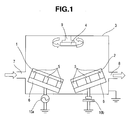
- a composite thin film can be formed, for example, as illustrated in FIG. 1, by conducting sputtering while rotating a substrate 4, on which the composite thin film is to be formed, with a film-forming surface being directed toward sputtering surfaces of a metal target 1 composed of a first metal component and a metal compound target 2 composed of a compound of a second metal component different from the first metal component in a sputtering atmosphere formed by arranging the targets 1, 2 in a chamber 3 and simultaneously applying electric powers to these targets 1, 2 (the sputtering atmosphere being formed primarily in a space extending from the sputtering surfaces of the metal target 1 and metal oxide target 2 toward the side of the substrate 4).
- magnets 5 target electrodes 6, a gas inlet port 7, a gas outlet port (evacuation port) 8, a rotary support 9, an RF power supply 10a, and a DC power supply 10b.
- the formation of a composite thin film by such a method makes it possible to obtain the composite thin film in such a form that fine metal portions composed of the first metal component and fine metal compound portions composed of the second metal component are highly distributed together.
- the state of distribution of the metal portions and the metal oxide portions in the direction of the plane of the composite thin film can be controlled uniform.
- it is also possible to change the ratio of the metal portions to the metal oxide portions by altering the electric powers to be applied to the respective targets.
- the method can also be applied to the roll-to-roll processing of a film substrate or the in-line coating of a glass substrate by arranging the first and the second targets as rectangular targets in positions inclined at predetermined angles.
- a metal oxide, a metal nitride, or a metal oxynitride can be preferably mentioned as a metal compound.
- an inert gas such as helium or argon can be used.
- an inert gas such as helium or argon
- a metal target made of a first metal component and another metal target made of a second metal component different from the first metal component it is possible to form a compound of the second metal component by using oxygen gas in the case of forming a metal oxide as a compound of the second metal component, nitrogen gas in the case of forming a metal nitride as a compound of the second metal component, or oxygen gas, nitrogen gas or nitric oxide gas in the case of forming a metal oxynitride as a compound of the second metal component.
- oxygen gas, nitrogen gas or nitric oxide gas in the case of forming a metal oxynitride as a compound of the second metal component.
- the first metal component a metal selected from the group consisting of Zn, Cr, Al, Cu, Si, Ti, Ag, Mn, Fe, Co, Cd, Ni, Zr, Nb, Mo, In, Sn, Sb, Hf, Ta, W, and Mg, and as the second metal component a metal different from the first metal component selected from the group, especially a metal different from the first metal component selected from the group consisting of Zn, Ti, Nb, In, Sn, Sb, and W.
- the first metal component is suitably a metal selected from the group consisting of Zn, Cr, Al, Cu, Si, Ag, Mn, Fe, Co, Cd, Ni, Zr, Nb, Mo, In, Sn, Sb, Hf, Ta, W, and Mg.
- the first metal component and the second metal component may preferably be in such a combination that only the metal portions can be dissolved out of the composite thin film in an aqueous acid solution or aqueous alkali solution.
- the thickness of the composite thin film may preferably be from 10 nm to 20 ⁇ m, notably from 100 nm to 10 ⁇ m, although it can be selectively determined as desired depending on the application purpose of the porous thin film.
- the porous thin film is formed by removing only the metal portions from the composite thin film.
- the porous thin film is obtained as a porous metal compound thin film.
- a suitable aqueous acid solution or aqueous alkali solution can be chosen as desired in conformity with the kinds and combination of the first and the second metal components.
- Usable acids can include hydrochloric acid, sulfuric acid, nitric acid, phosphoric acid, acetic acid, hydrofluoric acid, chromic acid, hydrogen peroxide, perchloric acid, chloric acid, chlorous acid, hypochlorous acid, citric acid, oxalic acid, hydrogen bromides, and the like. They can be used as aqueous solutions of single acids or mixed acids obtained by mixing them.
- a mixed aqueous solution of a mixed acid and a metal chloride such as ferric chloride or a metal sulfide.
- aqueous alkali solution it is possible to use an aqueous solution of sodium hydroxide or potassium hydroxide or aqueous ammonia. It is to be noted that the concentration and composition of the aqueous acid solution or aqueous alkali solution can be selectively determined as desired depending on the kinds of the metals to be dissolved.
- the method according to the second embodiment of the present invention for the formation of a porous thin film forms the porous thin film by forming on a substrate a composite thin film in which metal portions composed of a first metal component and metal portions composed of a second metal component different from the first metal component are randomly distributed together, and then, removing only one metal portions of the first metal portions and the second metal portions from the composite thin film.
- a desired substrate can be selected depending on the application purpose of the porous thin film.
- a high molecular electrolyte film useful in the fuel cell oxide can be used as a substrate.
- the composite thin film can be formed by arranging a first metal target composed of the first metal component and a second metal target composed of the second metal component different from the first metal component in a chamber, and simultaneously applying electric powers to these targets to perform sputtering.
- a composite thin film can be formed, for example, as illustrated in FIG. 2, by conducting sputtering while rotating a substrate 4, on which the composite thin film is to be formed, with a film-forming surface being directed toward sputtering surfaces of targets 1a, 1b in a sputtering atmosphere formed by arranging a first metal target 1a composed of a first metal component and a second metal target 1b composed of a second metal component different from the first metal component in a chamber 3 and simultaneously applying electric powers to these targets 1a, 1b (the sputtering atmosphere being formed primarily in a space extending from the sputtering surfaces of the first metal target 1a and the second metal target 1b toward the side of the substrate 4).
- FIG. 1 there are shown the magnets 5, the target electrodes 6, the gas inlet port 7, the gas outlet port (evacuation port) 8, the rotary support 9, the RF power supply 10a, and the DC power supply 10b.
- the formation of a composite thin film by such a method makes it possible to obtain the composite thin film in such a form that fine first metal portions composed of the first metal component and fine second metal compound portions composed of the second metal component are highly distributed together.
- the state of distribution of the first metal portions and the second metal portions in the direction of the plane of the composite thin film can be controlled uniform.
- it is also possible to change the ratio of the first metal portions to the second metal portions by altering the electric powers to be applied to the respective targets.
- an inert gas such as helium or argon can be used.
- a suitable method can be chosen depending on the kind of the composite thin film to be formed.
- RF power supply, AC power supply, and DC power supply are all usable. Different power supplies can be used for the respective targets.
- the first metal component a metal selected from the group consisting of Pt, Ru, Ir, Rh, Zn, Cr, Al, Cu, Si, Ti, Ag, Mn, Fe, Co, Cd, Ni, Zr, Nb, Mo, In, Sn, Sb, Hf, Ta, W, and Mg, and as the second metal component, a metal different from the first metal component and selected from the group.
- the first metal component and the second metal component may preferably be in such a combination that only one of the metal components can be dissolved out of the composite thin film in an aqueous acid solution or aqueous alkali solution.
- the thickness of the composite thin film may preferably be from 1 to 500 nm, notably from 10 to 50 nm, although it can be selectively determined as desired depending on the application purpose of the porous thin film.
- the porous thin film is formed by removing only one metal portions of the first metal portions and the second metal portions from the composite thin film.
- the porous thin film is obtained as a porous metal thin film.
- first metal component and the second metal component are in such a combination that only one metal portions of the first metal portions and the second metal portions can be dissolved out of the composite thin film in an aqueous acid solution or an aqueous alkali solution
- a suitable aqueous acid solution or aqueous alkali solution can be chosen as desired in conformity with the kinds and combination of the first and the second metal components.
- Usable acids can include hydrochloric acid, sulfuric acid, nitric acid, phosphoric acid, acetic acid, hydrofluoric acid, chromic acid, hydrogen peroxide, perchloric acid, chloric acid, chlorous acid, hypochlorous acid, citric acid, oxalic acid, hydrogen bromides, and the like. They can be used as aqueous solutions of single acids or mixed acids obtained by mixing them.
- a mixed aqueous solution of a mixed acid and a metal chloride such as ferric chloride or a metal sulfide.
- aqueous alkali solution it is possible to use an aqueous solution of sodium hydroxide or potassium hydroxide or aqueous ammonia. It is to be noted that the concentration and composition of the aqueous acid solution or aqueous alkali solution can be selectively determined as desired depending on the kind of the metal to be dissolved.
- porous thin film metal oxide semiconductor thin film for solar cell electrode
- a TiOx (“TXO", product of Asahi Glass Ceramics Co., Ltd.) target and Zn target were arranged, and a glass substrate coated with fluorine-doped tin oxide was arranged as a substrate in a vacuum chamber.
- the glass substrate coated with fluorine-doped tin oxide and carrying the composite thin film formed thereon was then immersed at room temperature for 30 minutes in a 1N aqueous solution of sulfuric acid to dissolve out and remove Zn from the composite thin film. Further, baking was conducted at 450°C for 30 minutes in the surrounding air atmosphere to form a porous thin film of TiOx.
- a 3 ⁇ 10 -4 mol/L ruthenium (II) cis-di(thiocyanato)-bis(2,2'-bipyridyl-4-dicarboxylate-4'-tetrabutylammonium carboxylate)-ethanol solution was prepared.
- the glass substrate coated with fluorine-doped tin oxide and carrying the thin film of TiOx thereon was immersed at room temperature for 18 hours in the solution such that the spectral sensitizing dye was adsorbed to afford a metal oxide semiconductor electrode.
- the adsorption of the spectral sensitizing dye was 8 ⁇ g per cm 2 of the surface area of the porous thin film of TiOx.
- the metal oxide semiconductor electrode was used as one of electrodes, and as the counter electrode, a transparent conductive glass substrate coated with fluorine-doped tin oxide and carrying platinum thereon was employed. An electrolyte was placed between those two electrodes, and the thus-formed unit was sealed at side walls thereof with a resin. Lead wires were then attached to fabricate a solar cell according to the present invention.
- electrolyte was one prepared by dissolving lithium iodide, 1,2-dimethyl-3-propylimidazolium iodide, iodine and t-butylpyridine at concentrations of 0.1 mol/L, 0.3 mol/L, 0.05 mol/L and 0.5 mol/L, respectively, in acetonitrile as a solvent.
- a TiOx (“TXO", product of Asahi Glass Ceramics Co., Ltd.) target was arranged, and a glass substrate coated with fluorine-doped tin oxide was arranged as a substrate in a vacuum chamber.
- the spectral sensitizing dye was adsorbed.
- the adsorption of the spectral sensitizing dye was 0.6 ⁇ g per cm 2 of the surface area of the porous thin film of TiOx.
- Example 2 In a similar manner as in Example 1, a solar cell was fabricated. Its Voc was 0.58 V, its Jsc was 0.52 mA/cm 2 , its FF (fill factor) was 0.50, and its ⁇ (conversion efficiency) was 1.51%. The solar cell was, therefore, inferior in performance to that of Example 1.
- a Ti target was arranged, and a glass substrate coated with fluorine-doped tin oxide was arranged as a substrate in a vacuum chamber.
- Ar gas and O 2 gas were introduced at flow rates of 80 sccm and 20 sccm, respectively, as a mixed gas to adjust the pressure to 0.5 Pa, 1 kW electric power was applied to the Ti target to perform sputtering, thereby forming a TiOx thin film of about 1,000 nm on a conductive surface of the glass substrate having been coated with fluorine-doped tin oxide.
- baking was conducted at 450°C for 30 minutes in the surrounding air atmosphere.
- the spectral sensitizing dye was adsorbed.
- the adsorption of the spectral sensitizing dye was 0.5 ⁇ g per cm 2 of the surface area of the porous thin film of TiOx.
- Example 2 In a similar manner as in Example 1, a solar cell was fabricated. Its Voc was 0.56 V, its Jsc was 0.53 mA/cm 2 , its FF (fill factor) was 0.47, and its ⁇ (conversion efficiency) was 1.39%. The solar cell was, therefore, inferior in performance to that of Example 1.
- a TiOx (“TXO", product of Asahi Glass Ceramics Co., Ltd.) target and Zn target were arranged, and a non-alkali glass substrate was arranged as a substrate in a vacuum chamber.
- the non-alkali glass substrate with the composite thin film formed thereon was then immersed at room temperature for 30 minutes in a 1N aqueous solution of sulfuric acid to dissolve out and remove Zn from the composite thin film. Further, baking was conducted at 450°C for 30 minutes in the surrounding air atmosphere to form a porous thin film of TiOx.
- the non-alkali glass substrate with the porous thin film of TiOx formed thereon was immersed in 22 mL of an amaranth (red pigment) solution (3 mL/L), and was exposed to light under a 250 W extra-high pressure mercury lamp (for 20 minutes). Variations in its concentration were measured by a W-visible photometer. The decomposition rate of amaranth was as high as 87.2%.
- a TiOx (“TXO", product of Asahi Glass Ceramics Co., Ltd.) target was arranged, and a non-alkali glass substrate was arranged as a substrate in a vacuum chamber.
- Ar gas and O 2 gas were introduced at flow rates of 98 sccm and 2 sccm, respectively, as a mixed gas to adjust the pressure to 0.5 Pa, 1 kW electric power was applied to the TiOx target to perform sputtering, thereby forming a TiOx thin film of about 300 nm on a surface of the non-alkali glass substrate.
- baking was conducted at 450°C for 30 minutes in the surrounding air atmosphere.
- a Ti target was arranged, and a non-alkali glass substrate was arranged as a substrate in a vacuum chamber.
- Ar gas and O 2 gas were introduced at flow rates of 80 sccm and 20 sccm, respectively, as a mixed gas to adjust the pressure to 0.5 Pa, 1 kW electric power was applied to the Ti target to perform sputtering, thereby forming a TiOx thin film of about 300 nm on a surface of the non-alkali glass substrate.
- baking was conducted at 450°C for 30 minutes in the surrounding air atmosphere.
- a Pt target and Zn target were arranged as targets, and "NAFION 112" (product of E.I. Du Pont de Nemours & Co., Inc.), an electrolyte film, was arranged as a substrate in a vacuum chamber.
- NAFION 112 product of E.I. Du Pont de Nemours & Co., Inc.
- the electrolyte film with the composite thin film formed thereon was then immersed at room temperature for 30 minutes in a 1N aqueous solution of sulfuric acid to dissolve out and remove Zn from the composite thin film, thereby forming a porous thin film of Pt.
- Printed (coated) on the thus-obtained electrolyte film with the porous thin film of Pt on both sides thereof was a carbon paste, which had been prepared by kneading carbon particles, the particle size of which was 50 nm, and a solution of "NAFION 117" (product of E.I. Du Pont de Nemours & Co., Inc.) of the same components as the electrolyte film into a paste form.
- Carbon paper sheets which were to act as an anode and cathode, respectively, were then placed on the opposite sides of the electrolyte film with the carbon paste coated thereon, and the resulting preform was subjected to hot pressing at a temperature of 120°C under a pressure of 5 MPa for 10 minutes to form a film electrode stack.
- the thus-obtained film electrode stack was held between graphite-made separators to fabricate a solar cell.
- Humidified hydrogen and humidified oxygen were supplied from the side of the anode and from the side of the cathode, respectively, to operate the fuel cell, and its current-voltage characteristics were measured.
- the open circuit voltage was 0.82 V, and the critical current density was 0.33 A/cm 2 .
- a Pt target was arranged as a target, and "NAFION 112" (product of E.I. Du Pont de Nemours & Co., Inc.), an electrolyte film, was arranged as a substrate in a vacuum chamber.
- Ar gas was introduced at a flow rate of 100 sccm to adjust the pressure to 0.5 Pa, 1 kW electric power was applied to the Pt target to perform sputtering, thereby forming a Pt thin film of 20 nm on a surface of "NAFION 112" as the electrolyte film.
- the above processing was also applied to the opposite side of the electrolyte film to obtain an electrolyte film with Pt thin films of 20 nm formed on both sides of the electrolyte film.
- a film electrode stack was formed in a similar manner as in Example 3.
- a fuel cell was fabricated in a similar manner as in Example 3, and its current-voltage characteristics were measured.
- the open circuit voltage was 0.66 V, and the critical current density was 0.17 A/cm 2 .
- the fuel cell was, therefore, inferior in fuel cell performance to that of Example 3.
Landscapes
- Chemical & Material Sciences (AREA)
- Engineering & Computer Science (AREA)
- Chemical Kinetics & Catalysis (AREA)
- Materials Engineering (AREA)
- Organic Chemistry (AREA)
- Metallurgy (AREA)
- Mechanical Engineering (AREA)
- General Chemical & Material Sciences (AREA)
- Toxicology (AREA)
- Physics & Mathematics (AREA)
- Plasma & Fusion (AREA)
- Health & Medical Sciences (AREA)
- Electrochemistry (AREA)
- Physical Vapour Deposition (AREA)
- Catalysts (AREA)
- Oxygen, Ozone, And Oxides In General (AREA)
- Inorganic Compounds Of Heavy Metals (AREA)
- Inert Electrodes (AREA)
Abstract
Description
- This invention relates to a method for forming a porous thin film such as a porous metal compound thin film such as a porous metal oxide thin film useful in an electrode of a solar cell, a photocatalyst or the like or a porous metal thin film useful in a catalyst layer of a fuel cell or in a like layer.
- Owing to large specific surface areas, porous thin films of a metal oxide or a metal are suited for members in which many active sites (sites of action) are required to be distributed per unit volume. Accordingly, they are applied to members such as electrodes and catalysts that require many active sites (sites of action) in limited volumes, and have found utility in fields such as electrodes for solar cells and catalysts such as photocatalysts.
- In solar cells, porous metal oxide thin films are used as metal oxide semiconductor electrodes, and solar cells making use of an oxide semiconductor, which is sensitized with an organic dye, without using silicon as a light-transforming material are known (JP-A 1-220308, JP-A 5-504023). JP-A 10-92477, on the other hand, discloses a solar cell making use of oxide semiconductor films, each of which is composed of a baked product of an aggregate of oxide semiconductor microparticles, as electrodes of a metal oxide semiconductor sensitized with an organic dye. In this patent publication, the semiconductor films are each formed by coating slurry of oxide semiconductor microparticles on a transparent electrode, drying the slurry, and then conducting baking.
- According to the above-described method, a porous metal oxide thin film, which is a baked product of an aggregate of oxide semiconductor microparticles, is formed by the so-called sol-gel process. For the provision of electrodes made of a metal oxide semiconductor sensitized with an organic dye and having a high photoenergy conversion efficiency, however, it is necessary to provide porous metal oxide thin films themselves with a still larger specific surface area, resulting in an outstanding demand for a method capable of forming a porous metal oxide semiconductor thin film equipped with a large specific surface area.
- On the other hand, metal oxides such as TiO2, ZnO2 and WO3 are known to have photocatalytic functions that absorb ultraviolet rays to give effects such as superhydrophilization and oxidation, and are used widely in water purification, air purification, deodorization, oil degradation and the like. Upon their applications, it is a frequent practice to form and immobilize a metal oxide, which has such photocatalytic effects, in the form of a film on a substrate.
- As methods for forming such a metal oxide thin film as described above, there are, for example, a method that forms a film by mixing a resin, rubber or the like as a binder with powder, coating the resulting mixture on a substrate, and then sintering the thus-coated mixture; a method that forms a film by a so-called sol-gel process, namely, by forming a gel coating film with a metal alkoxide solution and then baking the gel coating film; and a method that forms a metal oxide thin film by sputtering (JP-A 11-92176).
- In the case of metal oxide thin films to be used as photocatalysts, it is also effective for the provision of metal oxide thin films, which are imparted with high catalytic activities by a small amount of the metal oxide, to make the metal oxide thin films porous such that active sites are highly distributed. According to such conventional processes as mentioned above, however, no porous thin film has been obtained with a sufficient specific surface area. Similar to metal oxide semiconductor thin films for solar cells, there is an outstanding demand for a method for forming a porous metal oxide thin film having a still higher specific surface area.
- In a fuel cell, a catalyst layer is arranged between an electrolyte film and a porous substrate. Employed generally for the formation of this catalyst layer is a process which includes coating supported catalyst particles, which are formed of a metal such as platinum supported on activated carbon or the like, on a porous substrate such as a carbon sheet. For the improvement of the power generation efficiency of a fuel cell, however, it is necessary to achieve a still higher distribution of active catalyst sites.
- With the foregoing circumstances in view, the present invention has as objects thereof the provision of methods capable of forming a porous metal oxide thin film and porous metal thin film having a high specific surface area, which are suited as a metal oxide thin film and metal thin film, respectively, such as a metal oxide semiconductor thin film for a solar cell electrode, a photocatalyst thin film and a catalyst layer for a fuel cell, each of which is used in a form formed on a substrate.
- The present inventors have proceeded with an extensive investigation to achieve the above-described objects. As a result, it has been found that a porous thin film formed by forming on a substrate a composite thin film, in which metal portions composed of a first metal component and metal compound portions composed of a compound of a second metal component different from the first metal component are randomly distributed together, and then removing only the metal portions from the composite thin film is equipped with a high specific surface area. Especially, an application of this process as a method for forming a metal oxide semiconductor thin film for a solar cell electrode can provide an organic-dye-sensitized metal oxide semiconductor electrode having a high photoenergy conversion efficiency and an application of this process as a method for forming a photocatalyst thin film can provides a photocatalyst thin film having a high specific surface area and containing highly-distributed active sites.
- It has also been found that a porous thin film formed by forming on a substrate a composite thin film, in which first metal portions composed of a first metal component and second metal portions composed of a second metal component different from the first metal component are randomly distributed together, and then removing only one metal portions of the first metal portions and second metal portions is equipped with a high specific surface area. Especially, the formation of a porous metal thin film as a catalyst layer by applying this process as a method for the formation of a catalyst layer for a fuel cell makes it possible to highly distribute active catalyst sites and the use of the catalyst layer makes it possible to provide the fuel cell with an improved power generation efficiency. These findings have led to the completion of the present invention.
- Described specifically, the present invention provides the following methods for the formation of porous thin films.
- Claim 1: A method for forming a porous thin film, including the step of forming on a substrate a composite thin film in which metal portions composed of a first metal component and metal compound portions composed of a compound of a second metal component different from the first metal component are randomly distributed together, and then, removing only the metal portions from the composite thin film.
- Claim 2: A method for forming a porous thin film according to
claim 1, wherein the composite thin film is formed by arranging a metal target composed of the first metal component and a metal compound target composed of the compound of the second metal component different from the first metal component in a chamber, and simultaneously applying electric powers to the targets to perform sputtering. - Claim 3: A method for forming a porous thin film according to claim 1 or 2, wherein the metal compound is a metal oxide, metal nitride or metal oxynitride.
- Claim 4: A method for forming a porous thin film according to any one of
claims 1 to 3, wherein the first metal component is at least one metal selected from the group consisting of Zn, Cr, Al, Cu, Si, Ti, Ag, Mn, Fe, Co, Cd, Ni, Zr, Nb, Mo, In, Sn, Sb, Hf, Ta, W, and Mg, and the second metal component is at least one metal different from the first metal component and selected from the group. - Claim 5: A method for forming a porous thin film according to any one of
claims 1 to 3, wherein the first metal component is at least one metal selected from the group consisting of Zn, Cr, Al, Cu, Si, Ti, Ag, Mn, Fe, Co, Cd, Ni, Zr, Nb, Mo, In, Sn, Sb, Hf, Ta, W, and Mg, and the second metal component is at least one metal different from the first metal component and selected from the group consisting of Zn, Ti, Nb, In, Sn, Sb and W. - Claim 6: A method for forming a porous thin film according to any one of
claims 1 to 3, wherein the first metal component is at least one metal selected from the group consisting of Zn, Cr, Al, Cu, Si, Ag, Mn, Fe, Co, Cd, Ni, Zr, Nb, Mo, In, Sn, Sb, Hf, Ta, W, and Mg, and the second metal component is Ti. - Claim 7: A method for forming a porous thin film according to any one of
claims 1 to 6, wherein the first metal component and second metal component are in such a combination that only the metal portions can be dissolved out of the composite thin film in an aqueous acid solution or aqueous alkali solution. - Claim 8: A method for forming a porous thin film according to
claim 7, wherein the removal of the metal portions includes dissolving the metal portions with the aqueous acid solution or aqueous alkali solution. - Claim 9: A method for forming a porous thin film according to any one of
claims 1 to 8, further includes the step of conducting baking after the metal portions are removed. - Claim 10: A method for forming a porous thin film, including the step of forming on a substrate a composite thin film in which first metal portions composed of a first metal component and second metal portions composed of a second metal component different from the first metal component are randomly distributed together, and then, removing only one metal portions of the first metal portions and the second metal portions from the composite thin film.
- Claim 11: A method for forming a porous thin film according to
claim 10, wherein the composite thin film is formed by arranging a first metal target composed of the first metal component and a second metal target composed of the second metal component different from the first metal component in a chamber, and simultaneously applying electric powers to the targets to perform sputtering. - Claim 12: A method for forming a porous thin film according to
claim 10 or 11, wherein the first metal component is at least one metal selected from the group consisting of Pt, Ru, Ir, Rh, Zn, Cr, Al, Cu, Si, Ti, Ag, Mn, Fe, Co, Cd, Ni, Zr, Nb, Mo, In, Sn, Sb, Hf, Ta, W, and Mg, and the second metal component is at least one metal different from the first metal component and selected from the group. - Claim 13: A method for forming a porous thin film according to any one of
claims 10 to 12, wherein the first metal component and second metal component are in such a combination that the metal portions of only one metal component can be dissolved out of the composite thin film in an aqueous acid solution or aqueous alkali solution. - Claim 14: A method for forming a porous thin film according to claim 13, wherein the removal of the metal portions includes dissolving only one metal portions of the first metal portions and second metal portions with the aqueous acid solution or aqueous alkali solution.
- According to the present invention, it is possible to a porous metal oxide thin film and porous metal thin film having a high specific surface area, which are suited as a metal oxide thin film and metal thin film, respectively, such as a metal oxide semiconductor thin film for a solar cell electrode, a photocatalyst thin film and a catalyst layer for a fuel cell, each of which is used in a form formed on a substrate.
-
- FIG. 1 is a simplified schematic plan view of a sputtering apparatus for forming a composite thin film by sputtering in a method according to one example of a first embodiment of the present invention for the formation of a porous thin film.
- FIG. 2 is a simplified schematic plan view of a sputtering apparatus for forming a composite thin film by sputtering in a method according to one example of a second embodiment of the present invention for the formation of a porous thin film.
- The present invention will hereinafter be described in further detail.
- The method according to the first embodiment of the present invention for the formation of a porous thin film forms the porous thin film by forming on a substrate a composite thin film in which metal portions composed of a first metal component and metal compound portions composed of a compound of a second metal component different from the first metal component are randomly distributed together, and then, removing only the metal portions from the composite thin film.
- In the first embodiment, no particular limitation is imposed on the kind of the substrate to be processed, and a desired substrate can be selected depending on the application purpose of the porous thin film. When forming a metal oxide semiconductor thin film for use as a solar cell electrode, a glass substrate coated with ITO or fluorine-doped tin oxide can be used as a substrate, for example. When forming a photocatalyst thin film, a ceramic, resin or the like can be applied. In this case, ceramic substrates can include glass substrates such as non-alkali glass substrates and silica glass substrates, while resin substrates can include substrates of hydrocarbon resins such as polyethylene, polypropylene, and polystyrene, substrates of polyesters such as polyethylene terephthalate, polyamide resin substrates, and polycarbonate resin substrates.
- In the first embodiment, the composite thin film can be formed by arranging a metal target composed of the first metal component and a metal compound target composed of the compound of the second metal component different from the first metal component or arranging a metal target composed of the first metal component and a metal compound target composed of a compound of the second metal component different from the first metal component as a combination of a metal component hard to form a compound such as an oxide, nitride or oxynitride and a metal component easy to form the above-described compound, in a chamber, and simultaneously applying electric powers to these targets to perform sputtering.
- As such a method, a composite thin film can be formed, for example, as illustrated in FIG. 1, by conducting sputtering while rotating a
substrate 4, on which the composite thin film is to be formed, with a film-forming surface being directed toward sputtering surfaces of ametal target 1 composed of a first metal component and ametal compound target 2 composed of a compound of a second metal component different from the first metal component in a sputtering atmosphere formed by arranging thetargets chamber 3 and simultaneously applying electric powers to thesetargets 1, 2 (the sputtering atmosphere being formed primarily in a space extending from the sputtering surfaces of themetal target 1 andmetal oxide target 2 toward the side of the substrate 4). It is to be noted that in FIG. 1, there are indicatedmagnets 5,target electrodes 6, agas inlet port 7, a gas outlet port (evacuation port) 8, arotary support 9, anRF power supply 10a, and aDC power supply 10b. - The formation of a composite thin film by such a method makes it possible to obtain the composite thin film in such a form that fine metal portions composed of the first metal component and fine metal compound portions composed of the second metal component are highly distributed together. As the substrate is rotated especially in the illustrated example, the state of distribution of the metal portions and the metal oxide portions in the direction of the plane of the composite thin film can be controlled uniform. In this case, it is also possible to change the ratio of the metal portions to the metal oxide portions by altering the electric powers to be applied to the respective targets. Further, the method can also be applied to the roll-to-roll processing of a film substrate or the in-line coating of a glass substrate by arranging the first and the second targets as rectangular targets in positions inclined at predetermined angles.
- In the first embodiment, a metal oxide, a metal nitride, or a metal oxynitride can be preferably mentioned as a metal compound.
- As sputtering gas, an inert gas such as helium or argon can be used. Upon forming a composite thin film by using targets of metal oxides, metal nitrides or metal oxynitrides, it is also possible to make combined use of oxygen gas in the case of the use of the metal oxides, nitrogen gas in the case of the use of metal nitrides, or oxygen gas, nitrogen gas or nitric oxide gas in the case of the use of the metal oxynitrides provided that such gas is limited to a small amount. When a metal target made of a first metal component and another metal target made of a second metal component different from the first metal component are used in combination, it is possible to form a compound of the second metal component by using oxygen gas in the case of forming a metal oxide as a compound of the second metal component, nitrogen gas in the case of forming a metal nitride as a compound of the second metal component, or oxygen gas, nitrogen gas or nitric oxide gas in the case of forming a metal oxynitride as a compound of the second metal component. No particular limitation is imposed on the method for applying electric powers to the targets, and a suitable method can be chosen depending on the kind of the composite thin film to be formed. RF power supply, AC power supply and DC power supply are all usable. Different power supplies can be used for the respective targets.
- Concerning the first and the second metal components, it is preferred to use as the first metal component a metal selected from the group consisting of Zn, Cr, Al, Cu, Si, Ti, Ag, Mn, Fe, Co, Cd, Ni, Zr, Nb, Mo, In, Sn, Sb, Hf, Ta, W, and Mg, and as the second metal component a metal different from the first metal component selected from the group, especially a metal different from the first metal component selected from the group consisting of Zn, Ti, Nb, In, Sn, Sb, and W.
- Especially when the metal compound is a titanium compound (when the second metal component is Ti), the first metal component is suitably a metal selected from the group consisting of Zn, Cr, Al, Cu, Si, Ag, Mn, Fe, Co, Cd, Ni, Zr, Nb, Mo, In, Sn, Sb, Hf, Ta, W, and Mg.
- It is to be noted that in any combination of the first metal component and the second metal component, the first metal component and the second metal component may preferably be in such a combination that only the metal portions can be dissolved out of the composite thin film in an aqueous acid solution or aqueous alkali solution.
- The thickness of the composite thin film may preferably be from 10 nm to 20 µm, notably from 100 nm to 10 µm, although it can be selectively determined as desired depending on the application purpose of the porous thin film.
- In the method according to the first embodiment of the present invention for the formation of the porous thin film, the porous thin film is formed by removing only the metal portions from the composite thin film. In this case, the porous thin film is obtained as a porous metal compound thin film. When the first metal component and the second metal component are in such a combination that only the metal portions can be dissolved out of the composite thin film in an aqueous acid solution or an aqueous alkali solution, it is possible to adopt, as a method for removing the metal portions, a method of dissolving the metal portions with the aqueous acid solution or the aqueous alkali solution and further a method of immersing the composite thin film in the aqueous acid solution or the aqueous alkali solution.
- A suitable aqueous acid solution or aqueous alkali solution can be chosen as desired in conformity with the kinds and combination of the first and the second metal components. Usable acids can include hydrochloric acid, sulfuric acid, nitric acid, phosphoric acid, acetic acid, hydrofluoric acid, chromic acid, hydrogen peroxide, perchloric acid, chloric acid, chlorous acid, hypochlorous acid, citric acid, oxalic acid, hydrogen bromides, and the like. They can be used as aqueous solutions of single acids or mixed acids obtained by mixing them. Depending on the metals to be dissolved, it is also possible to use a mixed aqueous solution of a mixed acid and a metal chloride such as ferric chloride or a metal sulfide. As the aqueous alkali solution, on the other hand, it is possible to use an aqueous solution of sodium hydroxide or potassium hydroxide or aqueous ammonia. It is to be noted that the concentration and composition of the aqueous acid solution or aqueous alkali solution can be selectively determined as desired depending on the kinds of the metals to be dissolved.
- In the first embodiment, it is preferred to conduct baking after the removal of the metal portions. This baking makes it possible to provide the resulting porous thin film with higher strength.
- A description will next be made about the method according to the second embodiment of the present invention for the formation of a porous thin film.
- The method according to the second embodiment of the present invention for the formation of a porous thin film forms the porous thin film by forming on a substrate a composite thin film in which metal portions composed of a first metal component and metal portions composed of a second metal component different from the first metal component are randomly distributed together, and then, removing only one metal portions of the first metal portions and the second metal portions from the composite thin film.
- In this second embodiment, no particular limitation is imposed on the kind of the substrate to be processed, and a desired substrate can be selected depending on the application purpose of the porous thin film. When forming the porous thin film metal as a catalyst for a fuel cell, a high molecular electrolyte film useful in the fuel cell oxide can be used as a substrate.
- In the second embodiment, the composite thin film can be formed by arranging a first metal target composed of the first metal component and a second metal target composed of the second metal component different from the first metal component in a chamber, and simultaneously applying electric powers to these targets to perform sputtering.
- As such a method, a composite thin film can be formed, for example, as illustrated in FIG. 2, by conducting sputtering while rotating a
substrate 4, on which the composite thin film is to be formed, with a film-forming surface being directed toward sputtering surfaces oftargets first metal target 1a composed of a first metal component and asecond metal target 1b composed of a second metal component different from the first metal component in achamber 3 and simultaneously applying electric powers to thesetargets first metal target 1a and thesecond metal target 1b toward the side of the substrate 4). It is to be noted that in FIG. 1, there are shown themagnets 5, thetarget electrodes 6, thegas inlet port 7, the gas outlet port (evacuation port) 8, therotary support 9, theRF power supply 10a, and theDC power supply 10b. - The formation of a composite thin film by such a method makes it possible to obtain the composite thin film in such a form that fine first metal portions composed of the first metal component and fine second metal compound portions composed of the second metal component are highly distributed together. As the substrate is rotated especially in the illustrated example, the state of distribution of the first metal portions and the second metal portions in the direction of the plane of the composite thin film can be controlled uniform. In this case, it is also possible to change the ratio of the first metal portions to the second metal portions by altering the electric powers to be applied to the respective targets.
- As sputtering gas, an inert gas such as helium or argon can be used. No particular limitation is imposed on the method for applying electric powers to the targets, and a suitable method can be chosen depending on the kind of the composite thin film to be formed. RF power supply, AC power supply, and DC power supply are all usable. Different power supplies can be used for the respective targets.
- Concerning the first and the second metal components, it is preferred to use as the first metal component a metal selected from the group consisting of Pt, Ru, Ir, Rh, Zn, Cr, Al, Cu, Si, Ti, Ag, Mn, Fe, Co, Cd, Ni, Zr, Nb, Mo, In, Sn, Sb, Hf, Ta, W, and Mg, and as the second metal component, a metal different from the first metal component and selected from the group.
- It is to be noted that in any combination of the first metal component and the second metal component, the first metal component and the second metal component may preferably be in such a combination that only one of the metal components can be dissolved out of the composite thin film in an aqueous acid solution or aqueous alkali solution.
- The thickness of the composite thin film may preferably be from 1 to 500 nm, notably from 10 to 50 nm, although it can be selectively determined as desired depending on the application purpose of the porous thin film.
- In the method according to the second embodiment of the present invention for the formation of the porous thin film, the porous thin film is formed by removing only one metal portions of the first metal portions and the second metal portions from the composite thin film. In this case, the porous thin film is obtained as a porous metal thin film. When the first metal component and the second metal component are in such a combination that only one metal portions of the first metal portions and the second metal portions can be dissolved out of the composite thin film in an aqueous acid solution or an aqueous alkali solution, it is possible to adopt, as a method for removing the metal portions, a method of dissolving the one metal portions of the first metal portions and the second metal portions with the aqueous acid solution or the aqueous alkali solution and further a method of immersing the composite thin film in the aqueous acid solution or the aqueous alkali solution.
- A suitable aqueous acid solution or aqueous alkali solution can be chosen as desired in conformity with the kinds and combination of the first and the second metal components. Usable acids can include hydrochloric acid, sulfuric acid, nitric acid, phosphoric acid, acetic acid, hydrofluoric acid, chromic acid, hydrogen peroxide, perchloric acid, chloric acid, chlorous acid, hypochlorous acid, citric acid, oxalic acid, hydrogen bromides, and the like. They can be used as aqueous solutions of single acids or mixed acids obtained by mixing them. Depending on the metal to be dissolved, it is also possible to use a mixed aqueous solution of a mixed acid and a metal chloride such as ferric chloride or a metal sulfide. As the aqueous alkali solution, on the other hand, it is possible to use an aqueous solution of sodium hydroxide or potassium hydroxide or aqueous ammonia. It is to be noted that the concentration and composition of the aqueous acid solution or aqueous alkali solution can be selectively determined as desired depending on the kind of the metal to be dissolved.
- The present invention will hereinafter be described specifically on the basis of examples and comparative examples. It should, however, be borne in mind that the present invention is not limited to the following examples.
- In a magnetron DC sputtering apparatus, a TiOx ("TXO", product of Asahi Glass Ceramics Co., Ltd.) target and Zn target were arranged, and a glass substrate coated with fluorine-doped tin oxide was arranged as a substrate in a vacuum chamber. After evacuated to 5×10⁻⁴ Pa by a turbo-molecular pump, Ar gas and O2 gas were introduced at flow rates of 99 sccm and 1 sccm, respectively, as a mixed gas to adjust the pressure to 0.5 Pa, 1 kW electric power and 100 W electric power were applied to the TiOx target and Zn target, respectively, to perform sputtering, thereby forming a TiOx/Zn composite thin film of about 1,500 nm on a conductive surface of the glass substrate having been coated with fluorine-doped tin oxide.
- The glass substrate coated with fluorine-doped tin oxide and carrying the composite thin film formed thereon was then immersed at room temperature for 30 minutes in a 1N aqueous solution of sulfuric acid to dissolve out and remove Zn from the composite thin film. Further, baking was conducted at 450°C for 30 minutes in the surrounding air atmosphere to form a porous thin film of TiOx.
- As a solution of a spectral sensitizing dye, a 3×10⁻⁴ mol/L ruthenium (II) cis-di(thiocyanato)-bis(2,2'-bipyridyl-4-dicarboxylate-4'-tetrabutylammonium carboxylate)-ethanol solution was prepared. The glass substrate coated with fluorine-doped tin oxide and carrying the thin film of TiOx thereon was immersed at room temperature for 18 hours in the solution such that the spectral sensitizing dye was adsorbed to afford a metal oxide semiconductor electrode. The adsorption of the spectral sensitizing dye was 8 µg per cm2 of the surface area of the porous thin film of TiOx.
- The metal oxide semiconductor electrode was used as one of electrodes, and as the counter electrode, a transparent conductive glass substrate coated with fluorine-doped tin oxide and carrying platinum thereon was employed. An electrolyte was placed between those two electrodes, and the thus-formed unit was sealed at side walls thereof with a resin. Lead wires were then attached to fabricate a solar cell according to the present invention. Employed as the electrolyte was one prepared by dissolving lithium iodide, 1,2-dimethyl-3-propylimidazolium iodide, iodine and t-butylpyridine at concentrations of 0.1 mol/L, 0.3 mol/L, 0.05 mol/L and 0.5 mol/L, respectively, in acetonitrile as a solvent.
- When the thus-obtained solar cell was exposed to light of 100 W/cm2 intensity in a solar simulator. Its Voc (open circuit voltage) was 0.62 V, its Jsc (the density of a current that flowed when the circuit was shortened) was 1.30 mA/cm2, its FF (fill factor) was 0.54, and its η (conversion efficiency) was 4.35%. It was, therefore, confirmed to be excellent as a solar cell.
- In a magnetron DC sputtering apparatus, a TiOx ("TXO", product of Asahi Glass Ceramics Co., Ltd.) target was arranged, and a glass substrate coated with fluorine-doped tin oxide was arranged as a substrate in a vacuum chamber. After evacuated to 5×10⁻⁴ Pa by a turbo-molecular pump, Ar gas and O2 gas were introduced at flow rates of 98 sccm and 2 sccm, respectively, as a mixed gas to adjust the pressure to 0.5 Pa, 1 kW electric power was applied to the TiOx target to perform sputtering, thereby forming a TiOx thin film of about 1,000 nm on a conductive surface of the glass substrate having been coated with fluorine-doped tin oxide. Further, baking was conducted at 450°C for 30 minutes in the surrounding air atmosphere.
- In a similar manner as in Example 1, the spectral sensitizing dye was adsorbed. The adsorption of the spectral sensitizing dye was 0.6 µg per cm2 of the surface area of the porous thin film of TiOx.
- In a similar manner as in Example 1, a solar cell was fabricated. Its Voc was 0.58 V, its Jsc was 0.52 mA/cm2, its FF (fill factor) was 0.50, and its η (conversion efficiency) was 1.51%. The solar cell was, therefore, inferior in performance to that of Example 1.
- In a magnetron DC sputtering apparatus, a Ti target was arranged, and a glass substrate coated with fluorine-doped tin oxide was arranged as a substrate in a vacuum chamber. After evacuated to 5x10⁻⁴ Pa by a turbo-molecular pump, Ar gas and O2 gas were introduced at flow rates of 80 sccm and 20 sccm, respectively, as a mixed gas to adjust the pressure to 0.5 Pa, 1 kW electric power was applied to the Ti target to perform sputtering, thereby forming a TiOx thin film of about 1,000 nm on a conductive surface of the glass substrate having been coated with fluorine-doped tin oxide. Further, baking was conducted at 450°C for 30 minutes in the surrounding air atmosphere.
- In a similar manner as in Example 1, the spectral sensitizing dye was adsorbed. The adsorption of the spectral sensitizing dye was 0.5 µg per cm2 of the surface area of the porous thin film of TiOx.
- In a similar manner as in Example 1, a solar cell was fabricated. Its Voc was 0.56 V, its Jsc was 0.53 mA/cm2, its FF (fill factor) was 0.47, and its η (conversion efficiency) was 1.39%. The solar cell was, therefore, inferior in performance to that of Example 1.
- In a magnetron DC sputtering apparatus, a TiOx ("TXO", product of Asahi Glass Ceramics Co., Ltd.) target and Zn target were arranged, and a non-alkali glass substrate was arranged as a substrate in a vacuum chamber. After evacuated to 5×10⁻⁴ Pa by a turbo-molecular pump, Ar gas and O2 gas were introduced at flow rates of 99 sccm and 1 sccm, respectively, as a mixed gas to adjust the pressure to 0.5 Pa, 1 kW electric power and 100 W electric power were applied to the TiOx target and Zn target, respectively, to perform sputtering, thereby forming a TiOx/Zn composite thin film of about 600 nm on a surface of the non-alkali glass substrate.
- The non-alkali glass substrate with the composite thin film formed thereon was then immersed at room temperature for 30 minutes in a 1N aqueous solution of sulfuric acid to dissolve out and remove Zn from the composite thin film. Further, baking was conducted at 450°C for 30 minutes in the surrounding air atmosphere to form a porous thin film of TiOx.
- The non-alkali glass substrate with the porous thin film of TiOx formed thereon was immersed in 22 mL of an amaranth (red pigment) solution (3 mL/L), and was exposed to light under a 250 W extra-high pressure mercury lamp (for 20 minutes). Variations in its concentration were measured by a W-visible photometer. The decomposition rate of amaranth was as high as 87.2%.
- In a magnetron DC sputtering apparatus, a TiOx ("TXO", product of Asahi Glass Ceramics Co., Ltd.) target was arranged, and a non-alkali glass substrate was arranged as a substrate in a vacuum chamber. After evacuated to 5×10⁻⁴ Pa by a turbo-molecular pump, Ar gas and O2 gas were introduced at flow rates of 98 sccm and 2 sccm, respectively, as a mixed gas to adjust the pressure to 0.5 Pa, 1 kW electric power was applied to the TiOx target to perform sputtering, thereby forming a TiOx thin film of about 300 nm on a surface of the non-alkali glass substrate. Further, baking was conducted at 450°C for 30 minutes in the surrounding air atmosphere.
- In a similar manner as in Example 2, photocatalytic performance was evaluated. The decomposition rate of amaranth by the thin film was 43.4%. The thin film was, therefore, inferior in decomposition performance to that of Example 2.
- In a magnetron DC sputtering apparatus, a Ti target was arranged, and a non-alkali glass substrate was arranged as a substrate in a vacuum chamber. After evacuated to 5×10⁻⁴ Pa by a turbo-molecular pump, Ar gas and O2 gas were introduced at flow rates of 80 sccm and 20 sccm, respectively, as a mixed gas to adjust the pressure to 0.5 Pa, 1 kW electric power was applied to the Ti target to perform sputtering, thereby forming a TiOx thin film of about 300 nm on a surface of the non-alkali glass substrate. Further, baking was conducted at 450°C for 30 minutes in the surrounding air atmosphere.
- In a similar manner as in Example 2, photocatalytic performance was evaluated. The decomposition rate of amaranth by the thin film was 39.7%. The thin film was, therefore, inferior in decomposition performance to that of Example 2.
- In a magnetron DC sputtering apparatus, a Pt target and Zn target were arranged as targets, and "NAFION 112" (product of E.I. Du Pont de Nemours & Co., Inc.), an electrolyte film, was arranged as a substrate in a vacuum chamber. After evacuated to 5×10⁻⁴ Pa by a turbo-molecular pump, Ar gas was introduced at a flow rate of 100 sccm to adjust the pressure to 0.5 Pa, 1 kW electric power and 100 W electric power were applied to the Pt target and Zn target, respectively, to perform sputtering, thereby forming a Pt/Zn composite thin film of 20 nm on a surface of "NAFION 112" as the electrolyte film. In addition, the above processing was also applied to the opposite side of the electrolyte film to obtain an electrolyte film with Pt/Zn composite thin films of 20 nm formed on both sides of the electrolyte film.
- The electrolyte film with the composite thin film formed thereon was then immersed at room temperature for 30 minutes in a 1N aqueous solution of sulfuric acid to dissolve out and remove Zn from the composite thin film, thereby forming a porous thin film of Pt.
- Printed (coated) on the thus-obtained electrolyte film with the porous thin film of Pt on both sides thereof was a carbon paste, which had been prepared by kneading carbon particles, the particle size of which was 50 nm, and a solution of "NAFION 117" (product of E.I. Du Pont de Nemours & Co., Inc.) of the same components as the electrolyte film into a paste form.
- Carbon paper sheets, which were to act as an anode and cathode, respectively, were then placed on the opposite sides of the electrolyte film with the carbon paste coated thereon, and the resulting preform was subjected to hot pressing at a temperature of 120°C under a pressure of 5 MPa for 10 minutes to form a film electrode stack.
- The thus-obtained film electrode stack was held between graphite-made separators to fabricate a solar cell. Humidified hydrogen and humidified oxygen were supplied from the side of the anode and from the side of the cathode, respectively, to operate the fuel cell, and its current-voltage characteristics were measured. The open circuit voltage was 0.82 V, and the critical current density was 0.33 A/cm2 .
- In a magnetron DC sputtering apparatus, a Pt target was arranged as a target, and "NAFION 112" (product of E.I. Du Pont de Nemours & Co., Inc.), an electrolyte film, was arranged as a substrate in a vacuum chamber. After evacuated to 5×10⁻⁴ Pa by a turbo-molecular pump, Ar gas was introduced at a flow rate of 100 sccm to adjust the pressure to 0.5 Pa, 1 kW electric power was applied to the Pt target to perform sputtering, thereby forming a Pt thin film of 20 nm on a surface of "NAFION 112" as the electrolyte film. In addition, the above processing was also applied to the opposite side of the electrolyte film to obtain an electrolyte film with Pt thin films of 20 nm formed on both sides of the electrolyte film.
- A film electrode stack was formed in a similar manner as in Example 3.
- A fuel cell was fabricated in a similar manner as in Example 3, and its current-voltage characteristics were measured. The open circuit voltage was 0.66 V, and the critical current density was 0.17 A/cm2. The fuel cell was, therefore, inferior in fuel cell performance to that of Example 3.
Claims (14)
- A method for forming a porous thin film, comprising the step of forming on a substrate a composite thin film in which metal portions composed of a first metal component and metal compound portions composed of a compound of a second metal component different from said first metal component are randomly distributed together, and then, removing only said metal portions from said composite thin film.
- A method for forming a porous thin film according to claim 1, wherein said composite thin film is formed by arranging a metal target composed of said first metal component and a metal compound target composed of said compound of said second metal component different from said first metal component in a chamber, and simultaneously applying electric powers to said targets to perform sputtering.
- A method for forming a porous thin film according to claim 1 or 2, wherein said metal compound is a metal oxide, metal nitride or metal oxynitride.
- A method for forming a porous thin film according to any one of claims 1 to 3, wherein said first metal component is at least one metal selected from the group consisting of Zn, Cr, Al, Cu, Si, Ti, Ag, Mn, Fe, Co, Cd, Ni, Zr, Nb, Mo, In, Sn, Sb, Hf, Ta, W, and Mg, and said second metal component is at least one metal different from said first metal component and selected from said group.
- A method for forming a porous thin film according to any one of claims 1 to 3, wherein said first metal component is at least one metal selected from the group consisting of Zn, Cr, Al, Cu, Si, Ti, Ag, Mn, Fe, Co, Cd, Ni, Zr, Nb, Mo, In, Sn, Sb, Hf, Ta, W, and Mg, and said second metal component is at least one metal different from said first metal component and selected from the group consisting of Zn, Ti, Nb, In, Sn, Sb and W.
- A method for forming a porous thin film according to any one of claims 1 to 3, wherein said first metal component is at least one metal selected from the group consisting of Zn, Cr, Al, Cu, Si, Ag, Mn, Fe, Co, Cd, Ni, Zr, Nb, Mo, In, Sn, Sb, Hf, Ta, W, and Mg, and said second metal component is Ti.
- A method for forming a porous thin film according to any one of claims 1 to 6, wherein said first metal component and second metal component are in such a combination that only said metal portions can be dissolved out of said composite thin film in an aqueous acid solution or aqueous alkali solution.
- A method for forming a porous thin film according to claim 7, wherein said removal of said metal portions comprises dissolving said metal portions with said aqueous acid solution or aqueous alkali solution.
- A method for forming a porous thin film according to any one of claims 1 to 8, further comprising the step of conducting baking after said metal portions are removed.
- A method for forming a porous thin film, comprising the step of forming on a substrate a composite thin film in which first metal portions composed of a first metal component and second metal portions composed of a second metal component different from said first metal component are randomly distributed together, and then, removing only one metal portions of said first metal portions and said second metal portions from said composite thin film.
- A method for forming a porous thin film according to claim 10, wherein said composite thin film is formed by arranging a first metal target composed of said first metal component and a second metal target composed of said second metal component different from said first metal component in a chamber, and simultaneously applying electric powers to said targets to perform sputtering.
- A method for forming a porous thin film according to claim 10 or 11, wherein said first metal component is at least one metal selected from the group consisting of Pt, Ru, Ir, Rh, Zn, Cr, Al, Cu, Si, Ti, Ag, Mn, Fe, Co, Cd, Ni, Zr, Nb, Mo, In, Sn, Sb, Hf, Ta, W, and Mg, and said second metal component is at least one metal different from said first metal component and selected from said group.
- A method for forming a porous thin film according to any one of claims 10 to 12, wherein said first metal component and second metal component are in such a combination that said metal portions of only one metal component can be dissolved out of said composite thin film in an aqueous acid solution or aqueous alkali solution.
- A method for forming a porous thin film according to claim 13, wherein said removal of said metal portions comprises dissolving only one metal portions of said first metal portions and second metal portions with said aqueous acid solution or aqueous alkali solution.
Applications Claiming Priority (2)
| Application Number | Priority Date | Filing Date | Title |
|---|---|---|---|
| JP2003111003 | 2003-04-16 | ||
| PCT/JP2004/005378 WO2004092440A1 (en) | 2003-04-16 | 2004-04-15 | Method for forming porous thin film |
Publications (2)
| Publication Number | Publication Date |
|---|---|
| EP1614766A1 true EP1614766A1 (en) | 2006-01-11 |
| EP1614766A4 EP1614766A4 (en) | 2011-07-06 |
Family
ID=33295985
Family Applications (1)
| Application Number | Title | Priority Date | Filing Date |
|---|---|---|---|
| EP04727675A Withdrawn EP1614766A4 (en) | 2003-04-16 | 2004-04-15 | Method for forming porous thin film |
Country Status (4)
| Country | Link |
|---|---|
| US (1) | US20060189132A1 (en) |
| EP (1) | EP1614766A4 (en) |
| JP (1) | JPWO2004092440A1 (en) |
| WO (1) | WO2004092440A1 (en) |
Families Citing this family (10)
| Publication number | Priority date | Publication date | Assignee | Title |
|---|---|---|---|---|
| JP4725701B2 (en) * | 2004-02-04 | 2011-07-13 | 株式会社ブリヂストン | Method for forming porous thin film |
| JP4518019B2 (en) * | 2005-12-26 | 2010-08-04 | 住友金属鉱山株式会社 | Porous metal foil and method for producing the same |
| JP5342824B2 (en) * | 2008-07-25 | 2013-11-13 | 株式会社東芝 | Method for producing catalyst layer-carrying substrate, catalyst layer-carrying substrate, membrane electrode assembly, and fuel cell |
| US10995400B2 (en) * | 2010-04-16 | 2021-05-04 | Guardian Glass, LLC | Method of making coated article having antibacterial and/or antifungal coating and resulting product |
| US8894825B2 (en) | 2010-12-17 | 2014-11-25 | Semiconductor Energy Laboratory Co., Ltd. | Sputtering target, method for manufacturing the same, manufacturing semiconductor device |
| JP6045780B2 (en) | 2011-09-26 | 2016-12-14 | 株式会社東芝 | CATALYST CARRIER SUBSTRATE AND METHOD FOR MANUFACTURING THE SAME |
| JP2015065183A (en) * | 2014-12-24 | 2015-04-09 | 株式会社東芝 | CATALYST CARRIER SUBSTRATE AND METHOD FOR PRODUCING THE SAME, MEMBRANE ELECTRODE ASSEMBLY, AND FUEL CELL |
| US10760156B2 (en) | 2017-10-13 | 2020-09-01 | Honeywell International Inc. | Copper manganese sputtering target |
| US11035036B2 (en) | 2018-02-01 | 2021-06-15 | Honeywell International Inc. | Method of forming copper alloy sputtering targets with refined shape and microstructure |
| CN112442669B (en) * | 2020-11-23 | 2022-09-23 | 南京工程学院 | A kind of preparation method of self-cleaning anti-reflection film |
Family Cites Families (18)
| Publication number | Priority date | Publication date | Assignee | Title |
|---|---|---|---|---|
| JPS573137B2 (en) * | 1974-03-13 | 1982-01-20 | ||
| JPS6059066A (en) * | 1983-09-12 | 1985-04-05 | Clarion Co Ltd | Manufacture of porous thin film |
| JPS6059063A (en) * | 1983-09-12 | 1985-04-05 | Clarion Co Ltd | Manufacture of porous thin film |
| US4851096A (en) * | 1984-07-07 | 1989-07-25 | Kyocera Corporation | Method for fabricating a magneto-optical recording element |
| JPS61238958A (en) * | 1985-04-15 | 1986-10-24 | Hitachi Ltd | Composite thin film formation method and device |
| JPH01123067A (en) * | 1987-11-06 | 1989-05-16 | Nippon Kentetsu Co Ltd | Manufacture of thin porous film |
| US4851095A (en) * | 1988-02-08 | 1989-07-25 | Optical Coating Laboratory, Inc. | Magnetron sputtering apparatus and process |
| DE68905980T2 (en) * | 1988-02-26 | 1993-10-28 | Mitsubishi Materials Corp | HIGH-STRENGTH SUPER-CONDUCTIVE WIRES AND CABLES WITH HIGH CURRENT DENSITY AND METHOD FOR THE PRODUCTION THEREOF. |
| ES2080313T3 (en) * | 1990-04-17 | 1996-02-01 | Ecole Polytech | PHOTOVOLTAIC CELLS. |
| JP2999854B2 (en) * | 1991-05-18 | 2000-01-17 | 株式会社堀場製作所 | Method for producing metal thin film for hydrogen sensor, gas sensor or pH response |
| JPH07150356A (en) * | 1993-11-25 | 1995-06-13 | Canon Inc | Method of manufacturing optical thin film |
| US6333084B1 (en) * | 1994-09-09 | 2001-12-25 | Southwall Technologies, Inc. | Double-sided reflector films |
| JP3735461B2 (en) * | 1998-03-27 | 2006-01-18 | 株式会社シンクロン | Compound metal compound thin film forming method and thin film forming apparatus therefor |
| JP4060595B2 (en) * | 2000-03-13 | 2008-03-12 | 三井金属鉱業株式会社 | Manufacturing method of composite material |
| JP3772194B2 (en) * | 2000-08-31 | 2006-05-10 | 独立行政法人産業技術総合研究所 | Light limiting material |
| US20020144903A1 (en) * | 2001-02-09 | 2002-10-10 | Plasmion Corporation | Focused magnetron sputtering system |
| US6596187B2 (en) * | 2001-08-29 | 2003-07-22 | Motorola, Inc. | Method of forming a nano-supported sponge catalyst on a substrate for nanotube growth |
| US6770353B1 (en) * | 2003-01-13 | 2004-08-03 | Hewlett-Packard Development Company, L.P. | Co-deposited films with nano-columnar structures and formation process |
-
2004
- 2004-04-15 EP EP04727675A patent/EP1614766A4/en not_active Withdrawn
- 2004-04-15 JP JP2005505444A patent/JPWO2004092440A1/en active Pending
- 2004-04-15 WO PCT/JP2004/005378 patent/WO2004092440A1/en not_active Ceased
- 2004-04-15 US US10/553,190 patent/US20060189132A1/en not_active Abandoned
Also Published As
| Publication number | Publication date |
|---|---|
| EP1614766A4 (en) | 2011-07-06 |
| WO2004092440A1 (en) | 2004-10-28 |
| JPWO2004092440A1 (en) | 2006-07-06 |
| US20060189132A1 (en) | 2006-08-24 |
Similar Documents
| Publication | Publication Date | Title |
|---|---|---|
| Chandra et al. | Highly efficient electrocatalysis and mechanistic investigation of intermediate IrO x (OH) y nanoparticle films for water oxidation | |
| CN104159669A (en) | Electrode for photohydrolysis, and method for manufacturing same | |
| CN102064367B (en) | Semiconductor electrode, production process thereof and photovoltaic cell using semiconductor electrode | |
| EP1614766A1 (en) | Method for forming porous thin film | |
| JPWO2005041216A1 (en) | Transparent conductive substrate, dye-sensitized solar cell electrode, and dye-sensitized solar cell | |
| CN109569684A (en) | Plasma modification metal oxide and the co-modified titanium dioxide nano-rod composite photo-catalyst of g- carbonitride and its preparation and application | |
| CN102895963A (en) | Method of loading titanium dioxide nanorod arrays on surface of titanium wire mesh | |
| CN108855078A (en) | A kind of Ag- (010) crystal face BiVO4@RGO photochemical catalyst and preparation method thereof | |
| JP5361612B2 (en) | Photoelectric conversion element | |
| EP2996126A2 (en) | Dye-sensitized solar cell equipped with beam-condensing unit | |
| CN110035822B (en) | Photocatalyst electrode for oxygen generation, method for manufacturing photocatalyst electrode for oxygen generation, and module | |
| JP4185980B2 (en) | Translucent porous conductor and method for producing the same | |
| Tsuji et al. | Improvement of Photoelectrocatalytic Activity and Stability of WO3 for Oxygen Photoevolution Reaction by Loading of Brownmillerite‐Type Ca2FeCoO5 as a Cocatalyst | |
| Long et al. | Scalable one-step synthesis of TiO 2/WO 3 films on titanium plates with an efficient electron storage ability | |
| JP2002231326A (en) | Photoelectric conversion element and manufacturing method therefor | |
| JP2008104899A (en) | Photocatalyst film, method for producing photocatalyst film, and hydrogen generator using the same | |
| EP1413355B1 (en) | Phosphate photocatalyst comprising metal ion in d10 or d0 electron state | |
| JP5683594B2 (en) | Superporous photocatalytic material, method for producing the same, and use thereof | |
| JP2007252974A (en) | Photocatalytic film, semiconductor photoelectrode for water splitting, and water splitting apparatus using the same | |
| JP2005039013A (en) | Method for forming porous metal compound thin film and organic dye-sensitized solar cell | |
| JP4725701B2 (en) | Method for forming porous thin film | |
| CN107615426A (en) | The dye-sensitized solar cell of colelctor electrode is provided with to electrode | |
| KR20090060253A (en) | Paint and photovoltaic cell for forming porous metal oxide semiconductor film for photovoltaic cell | |
| CN116177683A (en) | A kind of composite ZnFe2O4/SiNWs material and its preparation method and application | |
| JP2002117912A (en) | Semiconductor electrode, manufacturing method for semiconductor electrode and solar cell |
Legal Events
| Date | Code | Title | Description |
|---|---|---|---|
| PUAI | Public reference made under article 153(3) epc to a published international application that has entered the european phase |
Free format text: ORIGINAL CODE: 0009012 |
|
| 17P | Request for examination filed |
Effective date: 20051017 |
|
| AK | Designated contracting states |
Kind code of ref document: A1 Designated state(s): AT BE BG CH CY CZ DE DK EE ES FI FR GB GR HU IE IT LI LU MC NL PL PT RO SE SI SK TR |
|
| AX | Request for extension of the european patent |
Extension state: AL HR LT LV MK |
|
| DAX | Request for extension of the european patent (deleted) | ||
| RBV | Designated contracting states (corrected) |
Designated state(s): DE FR GB |
|
| A4 | Supplementary search report drawn up and despatched |
Effective date: 20110606 |
|
| STAA | Information on the status of an ep patent application or granted ep patent |
Free format text: STATUS: THE APPLICATION IS DEEMED TO BE WITHDRAWN |
|
| 18D | Application deemed to be withdrawn |
Effective date: 20120105 |