EP1609844A1 - Conductive lubricant composition - Google Patents
Conductive lubricant composition Download PDFInfo
- Publication number
- EP1609844A1 EP1609844A1 EP04725488A EP04725488A EP1609844A1 EP 1609844 A1 EP1609844 A1 EP 1609844A1 EP 04725488 A EP04725488 A EP 04725488A EP 04725488 A EP04725488 A EP 04725488A EP 1609844 A1 EP1609844 A1 EP 1609844A1
- Authority
- EP
- European Patent Office
- Prior art keywords
- lubricant composition
- conductive lubricant
- base oil
- oil
- compound
- Prior art date
- Legal status (The legal status is an assumption and is not a legal conclusion. Google has not performed a legal analysis and makes no representation as to the accuracy of the status listed.)
- Withdrawn
Links
Classifications
-
- C—CHEMISTRY; METALLURGY
- C10—PETROLEUM, GAS OR COKE INDUSTRIES; TECHNICAL GASES CONTAINING CARBON MONOXIDE; FUELS; LUBRICANTS; PEAT
- C10M—LUBRICATING COMPOSITIONS; USE OF CHEMICAL SUBSTANCES EITHER ALONE OR AS LUBRICATING INGREDIENTS IN A LUBRICATING COMPOSITION
- C10M107/00—Lubricating compositions characterised by the base-material being a macromolecular compound
- C10M107/20—Lubricating compositions characterised by the base-material being a macromolecular compound containing oxygen
- C10M107/30—Macromolecular compounds obtained otherwise than by reactions only involving carbon-to-carbon unsaturated bonds
- C10M107/32—Condensation polymers of aldehydes or ketones; Polyesters; Polyethers
- C10M107/34—Polyoxyalkylenes
-
- C—CHEMISTRY; METALLURGY
- C10—PETROLEUM, GAS OR COKE INDUSTRIES; TECHNICAL GASES CONTAINING CARBON MONOXIDE; FUELS; LUBRICANTS; PEAT
- C10M—LUBRICATING COMPOSITIONS; USE OF CHEMICAL SUBSTANCES EITHER ALONE OR AS LUBRICATING INGREDIENTS IN A LUBRICATING COMPOSITION
- C10M105/00—Lubricating compositions characterised by the base-material being a non-macromolecular organic compound
- C10M105/08—Lubricating compositions characterised by the base-material being a non-macromolecular organic compound containing oxygen
- C10M105/18—Ethers, e.g. epoxides
-
- C—CHEMISTRY; METALLURGY
- C10—PETROLEUM, GAS OR COKE INDUSTRIES; TECHNICAL GASES CONTAINING CARBON MONOXIDE; FUELS; LUBRICANTS; PEAT
- C10M—LUBRICATING COMPOSITIONS; USE OF CHEMICAL SUBSTANCES EITHER ALONE OR AS LUBRICATING INGREDIENTS IN A LUBRICATING COMPOSITION
- C10M105/00—Lubricating compositions characterised by the base-material being a non-macromolecular organic compound
- C10M105/08—Lubricating compositions characterised by the base-material being a non-macromolecular organic compound containing oxygen
- C10M105/32—Esters
-
- C—CHEMISTRY; METALLURGY
- C10—PETROLEUM, GAS OR COKE INDUSTRIES; TECHNICAL GASES CONTAINING CARBON MONOXIDE; FUELS; LUBRICANTS; PEAT
- C10M—LUBRICATING COMPOSITIONS; USE OF CHEMICAL SUBSTANCES EITHER ALONE OR AS LUBRICATING INGREDIENTS IN A LUBRICATING COMPOSITION
- C10M111/00—Lubrication compositions characterised by the base-material being a mixture of two or more compounds covered by more than one of the main groups C10M101/00 - C10M109/00, each of these compounds being essential
- C10M111/02—Lubrication compositions characterised by the base-material being a mixture of two or more compounds covered by more than one of the main groups C10M101/00 - C10M109/00, each of these compounds being essential at least one of them being a non-macromolecular organic compound
-
- C—CHEMISTRY; METALLURGY
- C10—PETROLEUM, GAS OR COKE INDUSTRIES; TECHNICAL GASES CONTAINING CARBON MONOXIDE; FUELS; LUBRICANTS; PEAT
- C10M—LUBRICATING COMPOSITIONS; USE OF CHEMICAL SUBSTANCES EITHER ALONE OR AS LUBRICATING INGREDIENTS IN A LUBRICATING COMPOSITION
- C10M129/00—Lubricating compositions characterised by the additive being an organic non-macromolecular compound containing oxygen
- C10M129/02—Lubricating compositions characterised by the additive being an organic non-macromolecular compound containing oxygen having a carbon chain of less than 30 atoms
- C10M129/68—Esters
- C10M129/76—Esters containing free hydroxy or carboxyl groups
-
- C—CHEMISTRY; METALLURGY
- C10—PETROLEUM, GAS OR COKE INDUSTRIES; TECHNICAL GASES CONTAINING CARBON MONOXIDE; FUELS; LUBRICANTS; PEAT
- C10M—LUBRICATING COMPOSITIONS; USE OF CHEMICAL SUBSTANCES EITHER ALONE OR AS LUBRICATING INGREDIENTS IN A LUBRICATING COMPOSITION
- C10M169/00—Lubricating compositions characterised by containing as components a mixture of at least two types of ingredient selected from base-materials, thickeners or additives, covered by the preceding groups, each of these compounds being essential
- C10M169/04—Mixtures of base-materials and additives
-
- C—CHEMISTRY; METALLURGY
- C10—PETROLEUM, GAS OR COKE INDUSTRIES; TECHNICAL GASES CONTAINING CARBON MONOXIDE; FUELS; LUBRICANTS; PEAT
- C10M—LUBRICATING COMPOSITIONS; USE OF CHEMICAL SUBSTANCES EITHER ALONE OR AS LUBRICATING INGREDIENTS IN A LUBRICATING COMPOSITION
- C10M171/00—Lubricating compositions characterised by purely physical criteria, e.g. containing as base-material, thickener or additive, ingredients which are characterised exclusively by their numerically specified physical properties, i.e. containing ingredients which are physically well-defined but for which the chemical nature is either unspecified or only very vaguely indicated
-
- C—CHEMISTRY; METALLURGY
- C10—PETROLEUM, GAS OR COKE INDUSTRIES; TECHNICAL GASES CONTAINING CARBON MONOXIDE; FUELS; LUBRICANTS; PEAT
- C10M—LUBRICATING COMPOSITIONS; USE OF CHEMICAL SUBSTANCES EITHER ALONE OR AS LUBRICATING INGREDIENTS IN A LUBRICATING COMPOSITION
- C10M171/00—Lubricating compositions characterised by purely physical criteria, e.g. containing as base-material, thickener or additive, ingredients which are characterised exclusively by their numerically specified physical properties, i.e. containing ingredients which are physically well-defined but for which the chemical nature is either unspecified or only very vaguely indicated
- C10M171/02—Specified values of viscosity or viscosity index
-
- F—MECHANICAL ENGINEERING; LIGHTING; HEATING; WEAPONS; BLASTING
- F16—ENGINEERING ELEMENTS AND UNITS; GENERAL MEASURES FOR PRODUCING AND MAINTAINING EFFECTIVE FUNCTIONING OF MACHINES OR INSTALLATIONS; THERMAL INSULATION IN GENERAL
- F16C—SHAFTS; FLEXIBLE SHAFTS; ELEMENTS OR CRANKSHAFT MECHANISMS; ROTARY BODIES OTHER THAN GEARING ELEMENTS; BEARINGS
- F16C33/00—Parts of bearings; Special methods for making bearings or parts thereof
- F16C33/02—Parts of sliding-contact bearings
- F16C33/04—Brasses; Bushes; Linings
- F16C33/06—Sliding surface mainly made of metal
- F16C33/10—Construction relative to lubrication
- F16C33/1025—Construction relative to lubrication with liquid, e.g. oil, as lubricant
- F16C33/109—Lubricant compositions or properties, e.g. viscosity
-
- C—CHEMISTRY; METALLURGY
- C10—PETROLEUM, GAS OR COKE INDUSTRIES; TECHNICAL GASES CONTAINING CARBON MONOXIDE; FUELS; LUBRICANTS; PEAT
- C10M—LUBRICATING COMPOSITIONS; USE OF CHEMICAL SUBSTANCES EITHER ALONE OR AS LUBRICATING INGREDIENTS IN A LUBRICATING COMPOSITION
- C10M2203/00—Organic non-macromolecular hydrocarbon compounds and hydrocarbon fractions as ingredients in lubricant compositions
- C10M2203/02—Well-defined aliphatic compounds
- C10M2203/0206—Well-defined aliphatic compounds used as base material
-
- C—CHEMISTRY; METALLURGY
- C10—PETROLEUM, GAS OR COKE INDUSTRIES; TECHNICAL GASES CONTAINING CARBON MONOXIDE; FUELS; LUBRICANTS; PEAT
- C10M—LUBRICATING COMPOSITIONS; USE OF CHEMICAL SUBSTANCES EITHER ALONE OR AS LUBRICATING INGREDIENTS IN A LUBRICATING COMPOSITION
- C10M2203/00—Organic non-macromolecular hydrocarbon compounds and hydrocarbon fractions as ingredients in lubricant compositions
- C10M2203/10—Petroleum or coal fractions, e.g. tars, solvents, bitumen
- C10M2203/102—Aliphatic fractions
- C10M2203/1025—Aliphatic fractions used as base material
-
- C—CHEMISTRY; METALLURGY
- C10—PETROLEUM, GAS OR COKE INDUSTRIES; TECHNICAL GASES CONTAINING CARBON MONOXIDE; FUELS; LUBRICANTS; PEAT
- C10M—LUBRICATING COMPOSITIONS; USE OF CHEMICAL SUBSTANCES EITHER ALONE OR AS LUBRICATING INGREDIENTS IN A LUBRICATING COMPOSITION
- C10M2205/00—Organic macromolecular hydrocarbon compounds or fractions, whether or not modified by oxidation as ingredients in lubricant compositions
- C10M2205/02—Organic macromolecular hydrocarbon compounds or fractions, whether or not modified by oxidation as ingredients in lubricant compositions containing acyclic monomers
- C10M2205/0206—Organic macromolecular hydrocarbon compounds or fractions, whether or not modified by oxidation as ingredients in lubricant compositions containing acyclic monomers used as base material
-
- C—CHEMISTRY; METALLURGY
- C10—PETROLEUM, GAS OR COKE INDUSTRIES; TECHNICAL GASES CONTAINING CARBON MONOXIDE; FUELS; LUBRICANTS; PEAT
- C10M—LUBRICATING COMPOSITIONS; USE OF CHEMICAL SUBSTANCES EITHER ALONE OR AS LUBRICATING INGREDIENTS IN A LUBRICATING COMPOSITION
- C10M2207/00—Organic non-macromolecular hydrocarbon compounds containing hydrogen, carbon and oxygen as ingredients in lubricant compositions
- C10M2207/04—Ethers; Acetals; Ortho-esters; Ortho-carbonates
- C10M2207/0406—Ethers; Acetals; Ortho-esters; Ortho-carbonates used as base material
-
- C—CHEMISTRY; METALLURGY
- C10—PETROLEUM, GAS OR COKE INDUSTRIES; TECHNICAL GASES CONTAINING CARBON MONOXIDE; FUELS; LUBRICANTS; PEAT
- C10M—LUBRICATING COMPOSITIONS; USE OF CHEMICAL SUBSTANCES EITHER ALONE OR AS LUBRICATING INGREDIENTS IN A LUBRICATING COMPOSITION
- C10M2207/00—Organic non-macromolecular hydrocarbon compounds containing hydrogen, carbon and oxygen as ingredients in lubricant compositions
- C10M2207/28—Esters
- C10M2207/2805—Esters used as base material
-
- C—CHEMISTRY; METALLURGY
- C10—PETROLEUM, GAS OR COKE INDUSTRIES; TECHNICAL GASES CONTAINING CARBON MONOXIDE; FUELS; LUBRICANTS; PEAT
- C10M—LUBRICATING COMPOSITIONS; USE OF CHEMICAL SUBSTANCES EITHER ALONE OR AS LUBRICATING INGREDIENTS IN A LUBRICATING COMPOSITION
- C10M2207/00—Organic non-macromolecular hydrocarbon compounds containing hydrogen, carbon and oxygen as ingredients in lubricant compositions
- C10M2207/28—Esters
- C10M2207/282—Esters of (cyclo)aliphatic oolycarboxylic acids
- C10M2207/2825—Esters of (cyclo)aliphatic oolycarboxylic acids used as base material
-
- C—CHEMISTRY; METALLURGY
- C10—PETROLEUM, GAS OR COKE INDUSTRIES; TECHNICAL GASES CONTAINING CARBON MONOXIDE; FUELS; LUBRICANTS; PEAT
- C10M—LUBRICATING COMPOSITIONS; USE OF CHEMICAL SUBSTANCES EITHER ALONE OR AS LUBRICATING INGREDIENTS IN A LUBRICATING COMPOSITION
- C10M2207/00—Organic non-macromolecular hydrocarbon compounds containing hydrogen, carbon and oxygen as ingredients in lubricant compositions
- C10M2207/28—Esters
- C10M2207/283—Esters of polyhydroxy compounds
- C10M2207/2835—Esters of polyhydroxy compounds used as base material
-
- C—CHEMISTRY; METALLURGY
- C10—PETROLEUM, GAS OR COKE INDUSTRIES; TECHNICAL GASES CONTAINING CARBON MONOXIDE; FUELS; LUBRICANTS; PEAT
- C10M—LUBRICATING COMPOSITIONS; USE OF CHEMICAL SUBSTANCES EITHER ALONE OR AS LUBRICATING INGREDIENTS IN A LUBRICATING COMPOSITION
- C10M2207/00—Organic non-macromolecular hydrocarbon compounds containing hydrogen, carbon and oxygen as ingredients in lubricant compositions
- C10M2207/28—Esters
- C10M2207/287—Partial esters
- C10M2207/289—Partial esters containing free hydroxy groups
-
- C—CHEMISTRY; METALLURGY
- C10—PETROLEUM, GAS OR COKE INDUSTRIES; TECHNICAL GASES CONTAINING CARBON MONOXIDE; FUELS; LUBRICANTS; PEAT
- C10M—LUBRICATING COMPOSITIONS; USE OF CHEMICAL SUBSTANCES EITHER ALONE OR AS LUBRICATING INGREDIENTS IN A LUBRICATING COMPOSITION
- C10M2209/00—Organic macromolecular compounds containing oxygen as ingredients in lubricant compositions
- C10M2209/10—Macromolecular compoundss obtained otherwise than by reactions only involving carbon-to-carbon unsaturated bonds
- C10M2209/103—Polyethers, i.e. containing di- or higher polyoxyalkylene groups
-
- C—CHEMISTRY; METALLURGY
- C10—PETROLEUM, GAS OR COKE INDUSTRIES; TECHNICAL GASES CONTAINING CARBON MONOXIDE; FUELS; LUBRICANTS; PEAT
- C10M—LUBRICATING COMPOSITIONS; USE OF CHEMICAL SUBSTANCES EITHER ALONE OR AS LUBRICATING INGREDIENTS IN A LUBRICATING COMPOSITION
- C10M2209/00—Organic macromolecular compounds containing oxygen as ingredients in lubricant compositions
- C10M2209/10—Macromolecular compoundss obtained otherwise than by reactions only involving carbon-to-carbon unsaturated bonds
- C10M2209/103—Polyethers, i.e. containing di- or higher polyoxyalkylene groups
- C10M2209/1033—Polyethers, i.e. containing di- or higher polyoxyalkylene groups used as base material
-
- C—CHEMISTRY; METALLURGY
- C10—PETROLEUM, GAS OR COKE INDUSTRIES; TECHNICAL GASES CONTAINING CARBON MONOXIDE; FUELS; LUBRICANTS; PEAT
- C10M—LUBRICATING COMPOSITIONS; USE OF CHEMICAL SUBSTANCES EITHER ALONE OR AS LUBRICATING INGREDIENTS IN A LUBRICATING COMPOSITION
- C10M2215/00—Organic non-macromolecular compounds containing nitrogen as ingredients in lubricant Compositions
- C10M2215/02—Amines, e.g. polyalkylene polyamines; Quaternary amines
-
- C—CHEMISTRY; METALLURGY
- C10—PETROLEUM, GAS OR COKE INDUSTRIES; TECHNICAL GASES CONTAINING CARBON MONOXIDE; FUELS; LUBRICANTS; PEAT
- C10M—LUBRICATING COMPOSITIONS; USE OF CHEMICAL SUBSTANCES EITHER ALONE OR AS LUBRICATING INGREDIENTS IN A LUBRICATING COMPOSITION
- C10M2215/00—Organic non-macromolecular compounds containing nitrogen as ingredients in lubricant Compositions
- C10M2215/02—Amines, e.g. polyalkylene polyamines; Quaternary amines
- C10M2215/06—Amines, e.g. polyalkylene polyamines; Quaternary amines having amino groups bound to carbon atoms of six-membered aromatic rings
- C10M2215/064—Di- and triaryl amines
- C10M2215/065—Phenyl-Naphthyl amines
-
- C—CHEMISTRY; METALLURGY
- C10—PETROLEUM, GAS OR COKE INDUSTRIES; TECHNICAL GASES CONTAINING CARBON MONOXIDE; FUELS; LUBRICANTS; PEAT
- C10M—LUBRICATING COMPOSITIONS; USE OF CHEMICAL SUBSTANCES EITHER ALONE OR AS LUBRICATING INGREDIENTS IN A LUBRICATING COMPOSITION
- C10M2215/00—Organic non-macromolecular compounds containing nitrogen as ingredients in lubricant Compositions
- C10M2215/08—Amides [having hydrocarbon substituents containing less than thirty carbon atoms]
-
- C—CHEMISTRY; METALLURGY
- C10—PETROLEUM, GAS OR COKE INDUSTRIES; TECHNICAL GASES CONTAINING CARBON MONOXIDE; FUELS; LUBRICANTS; PEAT
- C10M—LUBRICATING COMPOSITIONS; USE OF CHEMICAL SUBSTANCES EITHER ALONE OR AS LUBRICATING INGREDIENTS IN A LUBRICATING COMPOSITION
- C10M2215/00—Organic non-macromolecular compounds containing nitrogen as ingredients in lubricant Compositions
- C10M2215/086—Imides [having hydrocarbon substituents containing less than thirty carbon atoms]
-
- C—CHEMISTRY; METALLURGY
- C10—PETROLEUM, GAS OR COKE INDUSTRIES; TECHNICAL GASES CONTAINING CARBON MONOXIDE; FUELS; LUBRICANTS; PEAT
- C10M—LUBRICATING COMPOSITIONS; USE OF CHEMICAL SUBSTANCES EITHER ALONE OR AS LUBRICATING INGREDIENTS IN A LUBRICATING COMPOSITION
- C10M2215/00—Organic non-macromolecular compounds containing nitrogen as ingredients in lubricant Compositions
- C10M2215/24—Organic non-macromolecular compounds containing nitrogen as ingredients in lubricant Compositions having hydrocarbon substituents containing thirty or more carbon atoms, e.g. nitrogen derivatives of substituted succinic acid
- C10M2215/28—Amides; Imides
-
- C—CHEMISTRY; METALLURGY
- C10—PETROLEUM, GAS OR COKE INDUSTRIES; TECHNICAL GASES CONTAINING CARBON MONOXIDE; FUELS; LUBRICANTS; PEAT
- C10M—LUBRICATING COMPOSITIONS; USE OF CHEMICAL SUBSTANCES EITHER ALONE OR AS LUBRICATING INGREDIENTS IN A LUBRICATING COMPOSITION
- C10M2219/00—Organic non-macromolecular compounds containing sulfur, selenium or tellurium as ingredients in lubricant compositions
- C10M2219/04—Organic non-macromolecular compounds containing sulfur, selenium or tellurium as ingredients in lubricant compositions containing sulfur-to-oxygen bonds, i.e. sulfones, sulfoxides
- C10M2219/044—Sulfonic acids, Derivatives thereof, e.g. neutral salts
-
- C—CHEMISTRY; METALLURGY
- C10—PETROLEUM, GAS OR COKE INDUSTRIES; TECHNICAL GASES CONTAINING CARBON MONOXIDE; FUELS; LUBRICANTS; PEAT
- C10M—LUBRICATING COMPOSITIONS; USE OF CHEMICAL SUBSTANCES EITHER ALONE OR AS LUBRICATING INGREDIENTS IN A LUBRICATING COMPOSITION
- C10M2219/00—Organic non-macromolecular compounds containing sulfur, selenium or tellurium as ingredients in lubricant compositions
- C10M2219/08—Thiols; Sulfides; Polysulfides; Mercaptals
- C10M2219/082—Thiols; Sulfides; Polysulfides; Mercaptals containing sulfur atoms bound to acyclic or cycloaliphatic carbon atoms
-
- C—CHEMISTRY; METALLURGY
- C10—PETROLEUM, GAS OR COKE INDUSTRIES; TECHNICAL GASES CONTAINING CARBON MONOXIDE; FUELS; LUBRICANTS; PEAT
- C10M—LUBRICATING COMPOSITIONS; USE OF CHEMICAL SUBSTANCES EITHER ALONE OR AS LUBRICATING INGREDIENTS IN A LUBRICATING COMPOSITION
- C10M2223/00—Organic non-macromolecular compounds containing phosphorus as ingredients in lubricant compositions
- C10M2223/02—Organic non-macromolecular compounds containing phosphorus as ingredients in lubricant compositions having no phosphorus-to-carbon bonds
- C10M2223/04—Phosphate esters
- C10M2223/043—Ammonium or amine salts thereof
-
- C—CHEMISTRY; METALLURGY
- C10—PETROLEUM, GAS OR COKE INDUSTRIES; TECHNICAL GASES CONTAINING CARBON MONOXIDE; FUELS; LUBRICANTS; PEAT
- C10N—INDEXING SCHEME ASSOCIATED WITH SUBCLASS C10M RELATING TO LUBRICATING COMPOSITIONS
- C10N2030/00—Specified physical or chemical properties which is improved by the additive characterising the lubricating composition, e.g. multifunctional additives
-
- C—CHEMISTRY; METALLURGY
- C10—PETROLEUM, GAS OR COKE INDUSTRIES; TECHNICAL GASES CONTAINING CARBON MONOXIDE; FUELS; LUBRICANTS; PEAT
- C10N—INDEXING SCHEME ASSOCIATED WITH SUBCLASS C10M RELATING TO LUBRICATING COMPOSITIONS
- C10N2030/00—Specified physical or chemical properties which is improved by the additive characterising the lubricating composition, e.g. multifunctional additives
- C10N2030/02—Pour-point; Viscosity index
-
- C—CHEMISTRY; METALLURGY
- C10—PETROLEUM, GAS OR COKE INDUSTRIES; TECHNICAL GASES CONTAINING CARBON MONOXIDE; FUELS; LUBRICANTS; PEAT
- C10N—INDEXING SCHEME ASSOCIATED WITH SUBCLASS C10M RELATING TO LUBRICATING COMPOSITIONS
- C10N2030/00—Specified physical or chemical properties which is improved by the additive characterising the lubricating composition, e.g. multifunctional additives
- C10N2030/04—Detergent property or dispersant property
-
- C—CHEMISTRY; METALLURGY
- C10—PETROLEUM, GAS OR COKE INDUSTRIES; TECHNICAL GASES CONTAINING CARBON MONOXIDE; FUELS; LUBRICANTS; PEAT
- C10N—INDEXING SCHEME ASSOCIATED WITH SUBCLASS C10M RELATING TO LUBRICATING COMPOSITIONS
- C10N2030/00—Specified physical or chemical properties which is improved by the additive characterising the lubricating composition, e.g. multifunctional additives
- C10N2030/28—Anti-static
-
- C—CHEMISTRY; METALLURGY
- C10—PETROLEUM, GAS OR COKE INDUSTRIES; TECHNICAL GASES CONTAINING CARBON MONOXIDE; FUELS; LUBRICANTS; PEAT
- C10N—INDEXING SCHEME ASSOCIATED WITH SUBCLASS C10M RELATING TO LUBRICATING COMPOSITIONS
- C10N2040/00—Specified use or application for which the lubricating composition is intended
- C10N2040/02—Bearings
-
- C—CHEMISTRY; METALLURGY
- C10—PETROLEUM, GAS OR COKE INDUSTRIES; TECHNICAL GASES CONTAINING CARBON MONOXIDE; FUELS; LUBRICANTS; PEAT
- C10N—INDEXING SCHEME ASSOCIATED WITH SUBCLASS C10M RELATING TO LUBRICATING COMPOSITIONS
- C10N2040/00—Specified use or application for which the lubricating composition is intended
- C10N2040/14—Electric or magnetic purposes
Definitions
- the present invention relates to a conductive lubricant composition and, more particularly, to a conductive lubricant composition suitable for a bearing oil such as a fluid bearing oil or an oil-impregnated sintered bearing oil.
- roller bearings such as fluid bearings and oil-impregnated sintered bearings have often been employed as bearings of spindle motors for a magnetic disk, an optical disk, etc., since such roller bearings realize silent operation and durability.
- a shaft is not in direct contact with the bearing inner surface but is in contact therewith by the mediation of lubricant, which sustains a load applied to the shaft, thereby reducing friction between the shaft and the bearing.
- the performance of the bearings greatly depends on the performance of lubricating oil.
- Requirements in performance of the lubricating oil for use in the roller bearings include viscosity, durability, and antistatic property.
- viscosity is an essential factor for determining electric power loss and bearing toughness of a spindle motor.
- a lubricating oil of low viscosity is selected so as to reduce electric power loss during high-speed operation.
- ester compounds Japanese Patent Application Laid-Open ( kokai ) No. 11-315292, p. 1
- monoesters diitto No. 2000-63860, p. 1
- carbonate esters diitto No. 2001-107046, p. 1
- use of poly( ⁇ -olefin) and an ester in combination ditto Nos. 2001-172656, p. 1 and 2001-240885, p. 1
- use of a diester and a polyol ester in combination (ditto No. 2001-279284, p.
- neopentyl glycol esters (ditto No. 2001-316687, p. 1), an aromatic ester or diester (ditto No. 2002-97482, p. 1), monoesters (ditto No. 2002-146381, paragraph [0007]), and specific diesters formed from oxalic acid, malonic acid, succinic acid, etc. (ditto No. 2002-155944, p. 1).
- the aforementioned conventional bearing lubricating oils still have the problem that they have problematically large volume resistivity, which readily induces generation of static electricity, although they satisfy both low viscosity and low volatility.
- a lubricating oil to which conductive microparticles of a metal or a metal oxide have been added is reported (see, for example, Japanese Patent Application Laid-Open ( kokai ) No. 10-30096, p. 1 or 11-315292, paragraph [0023]).
- a lubricating oil containing such microparticles is employed, microparticles present on the sliding surface cause anomalous wear of the bearing during start and stop of the motor.
- a lubricating oil containing a metal organic salt such as sulfonate, phenate, or salicylate, instead of such metallic particles, has also been proposed (see Japanese Patent Application Laid-Open ( kokai ) 2001-234187, p. 1).
- the above metal organic salt antistatic agent can exhibit antistaticity only when added in a large amount.
- the antistatic agent problematically forms an inorganic salt (sludge), which is insoluble in oil.
- the present invention has been accomplished in an attempt for solving the aforementioned problems, and an object of the present invention is to provide a conductive lubricant composition which, without impairing roller bearing oil performance, prevents anomalous wearing, generation of sludge, and occurrence of static electricity which would otherwise be generated by movement of fluid.
- the present inventors have carried out extensive studies in order to attain the aforementioned object, and have found that the above object can be attained by adding a non-metallic antistatic agent to a lubricating oil, and limiting specific characteristics to fall within specific ranges.
- the present invention has been accomplished on the basis of this finding.
- the present invention provides a conductive lubricant composition, characterized in that the composition comprises a lubricating base oil (A) other than a silicone oil, and a non-metallic antistatic agent (B), and exhibits a kinematic viscosity of 25 mm 2 /s or less at 40°C, a viscosity index of 100 or higher, a flash point of 150°C or higher, preferably 200°C or higher, and a volume resistivity of 1 x 10 10 ⁇ cm or less at 25°C.
- A lubricating base oil
- B non-metallic antistatic agent
- the present invention also provides a bearing oil comprising the lubricant composition.
- the conductive lubricant composition of the present invention comprises a lubricating base oil (A) and a non-metallic antistatic agent (B).
- the composition must satisfy at least the following characteristic requirements (1) to (4).
- the lubricating base oil of the present invention preferably exhibits a pour point, as measured in accordance with JIS K2265, of -30°C or lower, more preferably -40°C or lower.
- the lubricating base oil, serving as component (A) employed in the lubricant composition of the present invention satisfying the above requirements, preferably contains a compound formed of carbon, hydrogen, and oxygen (hereinafter the compound is referred to as "an oxygen-containing compound").
- the oxygen-containing compound is preferably an ether ether, an ester, or a compound having a carbonate moiety, with an ether compound being particularly preferred.
- ester compound which is preferably employed include polyol esters produced through condensation between a polyhydric alcohol such as neopentyl glycol, trimethylolpropane, or pentaerythritol and a fatty acid; diesters produced through condensation between a dibasinc acid such as adipic acid or sebacic acid and a monohydroc alcohol; and monoesters produced through a fatty acid and a monohydric alcohol.
- polyhydric alcohol such as neopentyl glycol, trimethylolpropane, or pentaerythritol and a fatty acid
- diesters produced through condensation between a dibasinc acid such as adipic acid or sebacic acid and a monohydroc alcohol
- monoesters produced through a fatty acid and a monohydric alcohol include polyol esters produced through condensation between a polyhydric alcohol such as neopentyl glycol, trimethylolpropane, or pentaeryth
- the ether compound is preferably any of the compounds represented by the following formula (I), or a mixture thereof.
- each of R 1 and R 5 represents hydrogen, a C1-C24 alkyl group, a phenyl group, or a C7-C24 alkylaryl group; each of R 2 , R 3 , and R 4 represents a C2-C18 alkylene group; each of a, b, and c is 0 to 8 (preferably 0 to 5); and the sum of a to c is 0 to 8 (preferably 0 to 5).
- the units (R 2 -O), (R 3 -O), and (R 4 -O) may be identical to or different from one another.
- the alkyl group represented by R 1 or R 5 may be linear, branched, or cyclic.
- Examples of the alkyl group include methyl, ethyl, propyl, butyl, hexyl, 2-ethylhexyl, 3,5,5-trimethylhexyl, heptyl, octyl, 3,7-dimethyloctyl, nonyl, 2-pentylnonyl, decyl, 2-octylundecanyl, dodecyl, cyclopentyl, and cyclohexyl.
- 2-ethylhexyl, 3,5,5-trimethylhexyl, octyl, 3,7-dimethyloctyl, nonyl, 2-pentylnonyl, decyl, and 2-octylundecanyl are particularly preferred.
- Examples of the alkylaryl group represented by R 1 or R 5 include alkylphenyl and alkylnaphthyl.
- Exampled of the alkyl moiety of the alkylaryl group include the groups described above. Among them, octyl, decyl, and dodecyl are particularly preferred.
- the alkylene group represented by R 2 , R 3 , or R 4 may be linear, branched, or cyclic.
- Examples of the alkylene group include ethylene, propylene, butylene, hexylene, nonylene, decylene, dodecylene, cyclopentylene, and cyclohexylene. Of these, ethylene, propylene, butylene, hexylene, nonylene, and decylene are particularly preferred.
- the ether compound is preferably a monoether compound represented by formula (II).
- one of R 6 and R 7 is a C1 to C24 alkyl group, and the other is a C1 to C24 alkyl group, a phenyl group, or a C7 to C24 alkylaryl group.
- the ether compounds represented by formulas (I) and (II) may be used singly or in combination.
- ether compounds may be used in combination with the ester compound.
- the ether compound and/or the ester compound may be incorporated in a total amount of 20 to 80 mass% based on the hydrocarbon base material.
- the lubricating base oil of the present invention may contain, in addition to the oxygen-containing compound, any of a variety of hydrocarbon compounds.
- the lubricating base oil must satisfy the above-mentioned requirements (1) to (4).
- hydrocarbon compound No particular limitation is imposed on the hydrocarbon compound to be mixed with the oxygen-containing compound, so long as the hydrocarbon compound does not impair the effects of the lubricating base oil of the present invention.
- the hydrocarbon compound include mineral oils (e.g., 80 neutral mineral oils), poly( ⁇ -olefin) (e.g., viscosity grade 4 mm 2 /s or 8 mm 2 /s (100°C)), ethylene-propylene copolymers, and alkylbenzenes (e.g., propylbenzene and butylbenzene). Of these, poly( ⁇ -olefin) is preferred.
- the lubricating base oil of the present invention excludes silicone oil.
- silicone oil satisfies the aforementioned requirements, silicone oil exhibits poor lubricity.
- the non-metallic antistatic agent (B) to be added to the lubricating base oil(A) is preferably an amine derivative, a succinic acid derivative, a poly(oxyalkylene) glycol, or a polyhydric alcohol partial ester.
- the antistatic agent is preferably incorporated in an amount of 0.01 to 10 mass% on the basis of entire amount of the composition.
- amine derivatives include poly(oxyethylene)alkylamines represented by the following formula: (wherein R 8 represents a C1 to C18 alkyl group), poly(oxyethylene)alkylamides represented by the following formula: (wherein R 9 represents a C1 to C18 alkyl group), and condensates produced from a polyethyleneimine such as tetraethylenepentamine (TEPE) and a fatty acid. Of these, a condensate produced from TEPE and stearic acid is preferred.
- TEPE tetraethylenepentamine
- Examples of preferred succinic acid derivatives include polybutenylsuccinimide.
- the poly(oxyalkylene) glycol is preferably a compound represented by formula (III), or a mixture thereof.
- R 1 to R 5 have the same meanings as defined in relation to formula (I); each of d, e, and f is 0 to 50; and the sum of d to f is 9 to 50.
- the units (R 2 -O), (R 3 -O), and (R 4 -O) may be identical to or different from one another.
- poly(oxyethylene) alkyl ether R 10 O (CH 2 CH 2 O) n H (wherein R 10 represents a C1 to C18 alkyl group, and n is a number of 1 to 10); poly(oxyethylene) alkyl phenyl ether R 11 -Q-O (CH 2 CH 2 O) n H (wherein R 11 is a C1 to C18 alkyl group, Q represents an aromatic residue, and n is a number of 1 to 10); and poly(oxyethylene) glycol fatty acid ester R 12 COO(CH 2 CH 2 O) n H (wherein R 12 is a C1 to C18 alkyl group, and n is a number of 1 to 10) are more preferred.
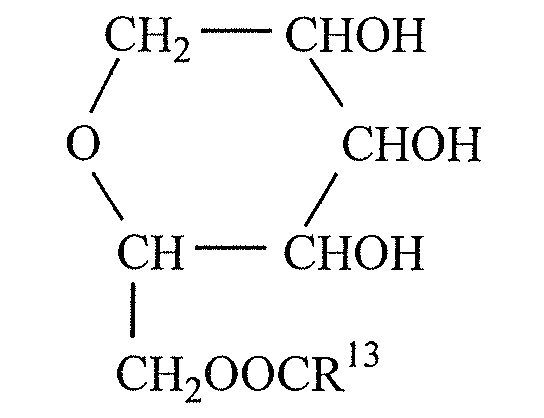
- polyhydric alcohol partial ester examples include sorbitan fatty acid esters such as sorbitan monoleate and sorbitan dioleate represented by the following formula: (wherein R 13 is a C1 to C18 alkyl group, and each of n and m is a number of 1 to 10); glycerin fatty acid esters such as glycerin monoleate and glycerin dioleate represented by the following formula: (wherein R 14 is a C1 to C18 alkyl group, and each of n and m is a number of 1 to 10); and partial ester compounds produced from a polyhydric ester such as pentyl glycol, trimethylolpropane, or pentaerythritol and a C1 to C24 fatty acid.
- sorbitan fatty acid esters such as sorbitan monoleate and sorbitan dioleate represented by the following formula: (wherein R 13 is a C1 to C18 alkyl group,
- a composition including a monoether having alkyl groups (component A) and a condensate produced from tetraethylenepentamine and a fatty acid (e.g., stearic acid (component (B)) is particularly preferred, from the viewpoint of low viscosity, low volatility, heat resistance, and antistaticity.
- an additive other than the aforementioned additive is added, in accordance with needs, to the lubricating base oil of the present invention, to thereby form a lubricant composition, which is employed as uses of interest.
- additives Any of known additives may be used, and examples include antioxidants, oiliness agents, friction reducers, rust preventives, metal deactivators, defoaming agents, and viscosity index improvers, as described below.
- antioxidants examples include amine-based antioxidants, phenol-based antioxidants, and sulfur compounds.
- amine-based anti-oxidants examples include monoalkyldiphenylamines such as monoctyldiphenylamine and monononyldiphenylamine; dialkyldiphenylamines such as 4,4'-dibutyldiphenylamine, 4,4'-dipentyldiphenylamine, 4,4'-dihexyldiphenylamine, 4,4'-diheptyldiphenylamine, 4,4'-dioctyldiphenylamine, and 4,4'-dinonyldiphenylamine; polyalkyldiphenylamines such as tetrabutyldiphenylamine, tetrahexyldiphenylamine, tetraoctyldiphenylamine, and tetranonyldiphenylamine; and naphtylamines such as ⁇ -naphthylamine, phenyl- ⁇ -naphtylamine
- the above amine-based anti-oxidants may be used singly or in combination of two or more species.
- phenol-based anti-oxidants examples include monophenolic anti-oxidants such as 2,6-di-tert-butyl-4-methylphenol, 2,6-di-tert-butyl-4-ethylphenol, and 2,6-ditert-butyl-p-cresol; and diphenolic anti-oxidants such as 4,4'-methylenebis(2,6-di-tert-butylphenol) and 2,2'-methylenebis(4-ethyl-6-tert-butylphenol).
- monophenolic anti-oxidants such as 2,6-di-tert-butyl-4-methylphenol, 2,6-di-tert-butyl-4-ethylphenol, and 2,6-ditert-butyl-p-cresol
- diphenolic anti-oxidants such as 4,4'-methylenebis(2,6-di-tert-butylphenol) and 2,2'-methylenebis(4-ethyl-6-tert-butylphenol).
- the above phenol-based anti-oxidants may be used singly or in combination of two or more species.
- sulfur compounds examples include phenothiazine, pentaerythritol-tetrakis(3-laurylthiopropionate), bis(3,5-tert-butyl-4-hydroxybenzyl) sulfide, thiodiethylenebis(3-(3,5-di-tert-butyl-4-hydroxyphenyl)) propionate, and 2,6-ditert-butyl-4-(4,6-bis(octylthio)-1,3,5-triazine-2-methylamino)phenol.
- the antioxidant(s) are preferably incorporated in an amount of 0.01 to 10 mass% based on the total amount of the composition, particularly preferably 0.03 to 5 mass%.
- oilsiness agents aliphatic saturated and unsaturated monocarboxylic acids such as stearic acid and oleic acid; polymerized fatty acids such as dimer acid and hydrogenated dimer acid; hydroxyfatty acids such as ricinoleic acid and 12-hydroxystearic acid; aliphatic saturated and unsaturated monoalcohols such as lauryl alcohol and oleyl alcohol; aliphatic saturated and unsaturated monoamines such as stearylamine and oleylamine; and aliphatic saturated and unsaturated monocarbamides such as laurylamide and oleylamide.
- monocarboxylic acids such as stearic acid and oleic acid
- polymerized fatty acids such as dimer acid and hydrogenated dimer acid
- hydroxyfatty acids such as ricinoleic acid and 12-hydroxystearic acid
- aliphatic saturated and unsaturated monoalcohols such as lauryl alcohol and oleyl alcohol
- the oiliness agent(s) are preferably incorporated in an amount of 0.01 to 10 mass% based on the total amount of the composition, particularly preferably 0.1 to 5 mass%.
- friction modifiers examples include agents generally employed as oiliness agents or extreme pressure agents, more particularly, phosphate esters, amine salts of phosphate ester, and sulfur-containing extreme pressure agents.
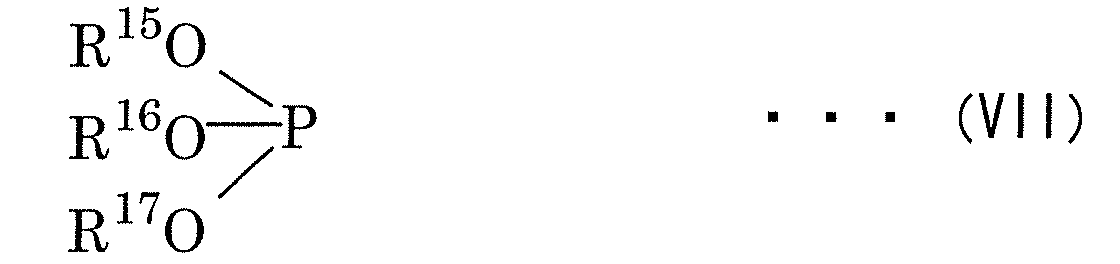
- the phosphate esters include phosphate esters, acid phosphate esters, phosphite esters, and acid phosphite esters represented by the following formulas (IV) to (VIII): (wherein R 15 to R 17 , which may be identical to or different from one another, each represents a C4 to C30 alkyl group, an alkenyl group, an alkylaryl group, or an arylalkyl group).
- phosphate esters examples include triaryl phosphates, trialkyl phosphates, trialkylaryl phosphates, triarylalkyl phosphates, and trialkenyl phosphates. Specific examples include triphenyl phosphate, tricresyl phosphate, benzyl diphenyl phosphate, ethyl diphenyl phosphate, tributyl phosphate, ethyl dibutyl phosphate, cresyl diphenyl phosphate, dicresyl phenyl phosphate, ethylphenyl diphenyl phosphate, diethylphenyl phenyl phosphate, propylphenyl diphenyl phosphate, dipropylphenyl phenyl phosphate, triethylphenyl phosphate, tripropylphenyl phosphate, butylphenyl diphenyl phosphate, dibutylphenyl pheny
- acid phosphate esters examples include 2-ethylhexyl acid phosphate, ethyl acid phosphate, butyl acid phosphate, oleyl acid phosphate, tetracosyl acid phosphate, isodecyl acid phosphate, lauryl acid phosphate, tridecyl acid phosphate, stearly acid phosphate, and isostearyl acid phosphate.
- phosphite esters examples include triethyl phosphite, tributyl phosphite, triphenyl phosphite, tricresyl phosphite, tri(nonylphenyl) phosphite, tri(2-ethylhexyl) phosphite, tridecyl phosphite, trilauryl phosphite, triisooctyl phosphite, diphenyl isodecyl phosphite, tristearyl phosphite, and trioleyl phosphite.
- acid phosphite esters examples include dibutyl hydrogen phosphite, dilauryl hydrogen phosphite, dioleyl hydrogen phosphite, distearyl hydrogen phosphite, and diphenyl hydrogen phosphite.
- phosphate esters tricresyl phosphate and triphenyl phosphate are preferred.
- Examples of the amines which form amine salts with the phosphate esters include monosubstituted amines, disubstituted amines, and trisubstituted amines, which are represented by formula (IX): R 18 p NH 3-p (wherein R 18 represents a C3 to C30 alkyl group or alkenyl group, a C6 to C30 aryl group or arylalkyl group, or a C2 to C30 hydroxyalkyl group; p is 1, 2, or 3; when a plurality of R 18 s are present, these R 18 s may be identical to or different from one another).
- the C3 to C30 alkyl or alkenyl group represented by R 18 in formula (IX) may be linear, branched, or cyclic.
- Examples of the monosubstituted amines include butylamine, pentylamine, hexylamine, cyclohexylamine, octylamine, laurylamine, stearylamine, oleylamine, and benzylamine.
- disubstituted amines examples include dibutylamine, dipentylamine, dihexylamine, dicyclohexylamine, dioctylamine, dilaurylamine, distearylamine, dioleylamine, dibenzylamine, stearylmonoethanolamine, decylmonoethanolamine, hexylmonopropanolamine, benzylmonoethanolamine, phenylmonoethanolamine, and tolylmonopropanol.
- trisubstituted amines examples include tributylamine, tripentyl amine, trihexylamine, tricyclohexylamine, trioctylamine, trilaurylamine, tristearylamine, trioleylamine, tribenzylamine, dioleylmonoethanolamine, dilaurylmonopropanolamine, dioctylmonoethanolamine, dihexylmonopropanolamine, dibutylmonopropaolamine, oleyldiethanolamine, stearyldipropanolamine, lauryldiethanolamine, octyldipropanolamine, butyldiethanolamine, benzyldiethanolamine, phenyldiethanolamine, tolyldipronanolamine, xylyldiethanolamine, triethanolamine, and tripropanolamine.
- the sulfur-containing extreme pressure may be any compound having a sulfur atom in the molecule thereof, so long as the compound can be dissolved or uniformly dispersed in a lubricating base oil and can exhibit extreme pressure performance and excellent friction characteristics.
- sulfur-containing compound examples include sulfidized fats and oils, sulfidized fatty acid, sulfidized esters, sulfidized olefins, dihydrocarbyl polysulfides, thiadiazole compounds, thiophosphate esters (thiophosphites and thiophosphates), alkyl thiocarbamoyl compounds, thiocarbamate compounds, thioterpene compounds, and dialkyl thiodipropionate compounds.
- the sulfidized fats and oils are produced through reaction of a fat or an oil (e.g., lard, whale oil, vegetable oil, or fish oil) with sulfur or a sulfur-containing compound.
- a fat or an oil e.g., lard, whale oil, vegetable oil, or fish oil
- sulfur or a sulfur-containing compound e.g., sulfur-containing compound
- the sulfur content preferably 5 to 30 mass%.
- Specific examples include sulfidized lard, sulfidized rape seed oil, sulfidized castor oil, sulfidized soy bean oil, and sulfidized rice bran oil.
- sulfidized fatty acids include sulfidized oleic acid.
- sulfidized esters include sulfidized methyl oleate and sulfidized octyl ester of rice bran fatty acid.
- Examples of the sulfidized olefins include compounds represented by the following formula (X): R 19 -S q -R 20 (wherein R 19 represents a C2 to C15 alkenyl group, R 20 represents a C2 to C15 alkyl group or alkenyl group; and q is an integer of 1 to 8).
- olefins are propylene, isobutene, and diisobutene.
- Examples of the dihydrocarbyl polysulfides include compounds represented by the following formula (XI): R 21 - S r -R 22 (wherein R 21 and R 22 , which may be identical to or different from each other, each represents a C1 to C20 alkyl group or cyclic alkyl group, a C6 to C20 aryl group, a C7 to C20 alkyl aryl group, or a C7 to C20 arylalkyl group; and r is an integer of 1 to 8).
- R 21 and R 22 which may be identical to or different from each other, each represents a C1 to C20 alkyl group or cyclic alkyl group, a C6 to C20 aryl group, a C7 to C20 alkyl aryl group, or a C7 to C20 arylalkyl group; and r is an integer of 1 to 8).
- Examples of the group represented by R 21 or R 22 in formula (XI) include methyl, ethyl, n-propyl, isopropyl, n-butyl, isobutyl, sec-butyl, tert-butyl, pentyl groups, hexyl groups, heptyl groups, octyl groups, nonyl groups, decyl groups, dodecyl groups, cyclohexyl, cyclooctyl, phenyl, naphthyl, tolyl, xylyl, benzyl, and phenetyl.
- Examples of preferred dihydrocarbyl polysulfides include dibenzyl polysulfides, dinonyl polysulfides, dodecyl polysulfides, dibutyl polysulfides, dioctyl polysulfides, diphenyl polysulfides, and dicyclohexyl polysulfided.
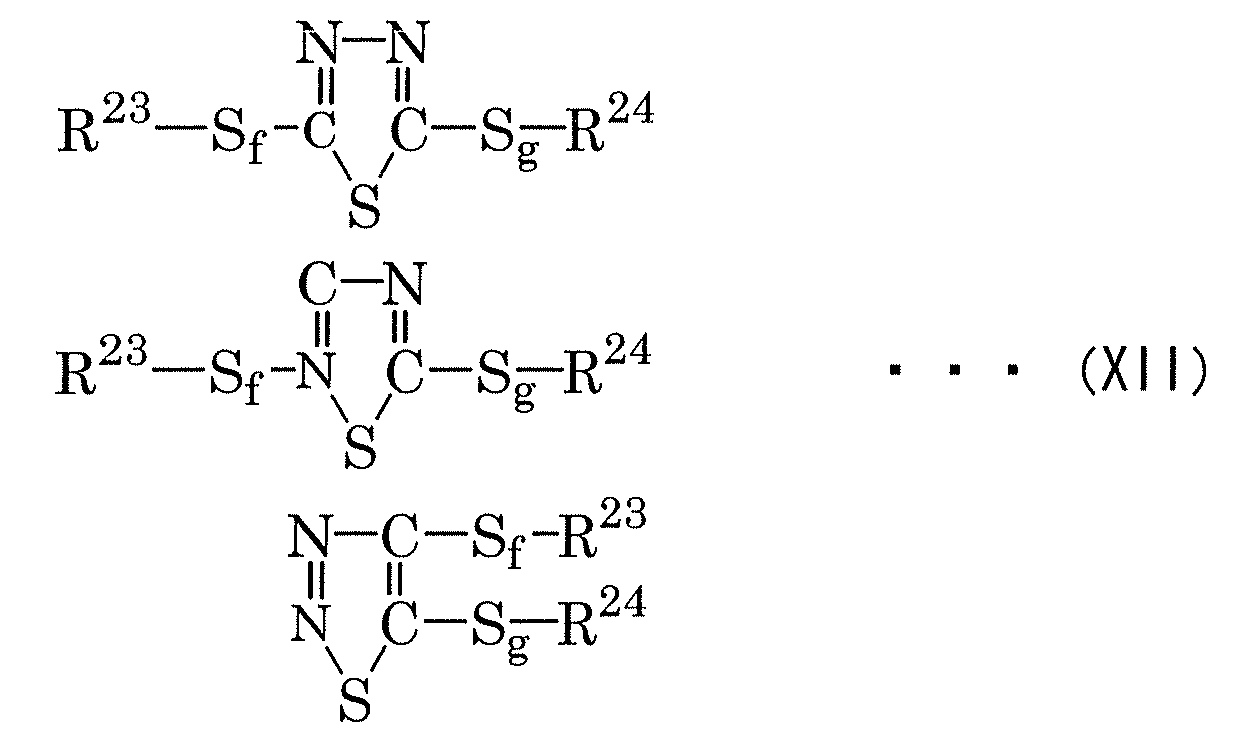
- Examples of preferred thiadiazole compounds include 1,3,4-thiadiazole, 1,2,4-thiadiazole compound, and 1,4,5-thiadiazole represented by the following formula (XII): (wherein each of R 23 and R 24 represents a hydrogen atom, a C1 to C20 hydrocarbon group; and each of f and g is an integer of 0 to 8).
- preferred thiadiazole compounds include 2,5-bis(n-hexyldithio)-1,3,4-thiadiazole, 2,5-bis(n-octyldithio)-1,3,4-thiadiazole, 2,5-bis(n-nonyldithio)-1,3,4-thiadiazole, 2,5-bis(1,1,3,3-tetramethylbutyldithio)-1,3,4-thiadiazole, 3,5-bis(n-hexyldithio)-1,2,4-thiadiazole, 3,5-bis(n-octyldithio)-1,2,4-thiadiazole, 3,5-bis(n-nonyldithio)-1,2,4-thiadiazole, 3,5-bis(1,1,3,3-tetramethylbutyldithio)-1,2,4-thiadiazole, 4,5-bis(n-hexyldithio)-1,2,3-thiadiazole, 4,5
- thiophosphate esters examples include alkyl trithiophosphites, aryl or alkyl arylthiophosphates, dilauryl dithiophosphate zinc salts, with lauryl trithiophosphites and triphenyl thiophosphate being particularly preferred.
- alkyl thiocarbamoyl compounds examples include compounds represented by the following formula (XIII): (wherein each of R 25 to R 28 represents a C1 to C20 alkyl group, and h is an integer of 1 to 8).
- alkyl thiocarbamoyl compounds include bis(dimethylthiocarbamoyl) monosulfide, bis(dibutylthiocarbamoyl) monosulfide, bis(dimethylthiocarbamoyl) disulfide , bis(dibutylthiocarbamoyl) disulfide, bis(diamylthiocarbamoyl) disulfide, and bis(octylthiocarbamoyl) disulfide.
- Examples of the thiocarbamate compound compounds include zinc dialkyl thithiacarbamate.
- Examples of the thioterpene compounds include a reaction product of phosphorus pentasulfide and pinene.
- Examples of the dialkyl thiodipropionate compounds include dilauryl thiodipropionate and distearyl thiodipropionate.
- thiadiazole compounds and benzyl sulfide are preferred, from the viewpoint of extreme pressure performance, friction characteristics, and stability against thermal oxidation, etc.
- the friction modifier(s) are preferably incorporated in an amount of 0.01 to 10 mass% based on the total amount of the composition, particularly preferably 0.05 to 5 mass%.
- rust preventives which may be employed include alkyl and alkenyl succinate derivatives such as dodecenyl succinate half esters, otcadecenyl succinic anhydride, and dodecenylsuccinamide; polyhydric alcohol partial esters such as sorbitan monooleate, glycerin monoolate, and pentaerythritol monooleate; amines such as rosin amines and N-oleylsarcosine; and dialkyl phosphite amine salts.
- alkyl and alkenyl succinate derivatives such as dodecenyl succinate half esters, otcadecenyl succinic anhydride, and dodecenylsuccinamide
- polyhydric alcohol partial esters such as sorbitan monooleate, glycerin monoolate, and pentaerythritol monooleate
- amines such as rosin amines and N
- the rust preventive(s) are preferably incorporated in an amount of 0.01 to 5 mass% based on the total amount of the composition, particularly preferably 0.05 to 2 mass%.
- metal deactivator examples include benzotriazoles, thiadiazoles, and gallic acid esters.
- the metal deactivator(s) are preferably incorporated in an amount of 0.01 to 0.4 mass% based on the total amount of the composition, particularly preferably 0.01 to 0.2 mass%.
- Examples of the defoaming agent which may be employed in the invention include liquid silicone, and thus methylsilicone, fluorosilicone, and polyacrylate may be employed.
- the defoaming agent(s) are preferably incorporated in an amount of 0.0005 to 0.01 mass% based on the total amount of the composition.
- Examples of the viscosity index improver which may be employed in the present invention include olefin copolymers such as poly(alkyl methacrylate), polyalkylstyrene, polybutene, ethylene-propylene copolymer, styrene-diene copolymer, and styrene-maleic anhydride ester copolymer.
- olefin copolymers such as poly(alkyl methacrylate), polyalkylstyrene, polybutene, ethylene-propylene copolymer, styrene-diene copolymer, and styrene-maleic anhydride ester copolymer.
- the viscosity index improver(s) are preferably incorporated in an amount of 0.1 to 15 mass% based on the total amount of the composition, particularly preferably 0.5 to 7 mass%.
- the conductive lubricant composition of the present invention is suitably employed as a bearing oil such as a fluid bearing oil or an oil-impregnated sintered bearing oil.
- the compounds produced in the following Production Examples were identified to have a purity of 99% or higher on the basis of a peak area obtained by use of a gas chromatograph (Hitachi: model 263-70, column: OV-1 packed column (2 m), product of GL Science Inc.).
- the structure of each compound was determined by use of a nuclear magnetic resonance apparatus ( 1 H-NMR, 13 C-NMR: GSX400, product of JEOL Ltd.).
- 2-Octyl-1-dodecanol 300 g
- 1-bromooctane 300 g
- tetrabutylammonium bromide 30 g
- an aqueous sodium hydroxide solution 500 g
- sodium hydroxide 150 g
- water 350 g
- reaction mixture was transferred to a separating funnel, and the aqueous layer was separated through filtration. The remaining organic layer was washed five times with water (500 mL).
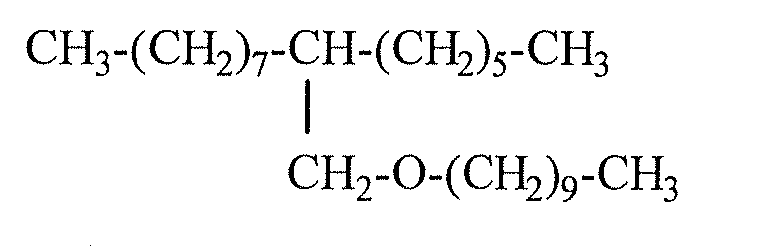
- the organic layer was distilled under reduced pressure, to thereby separate an ether compound having the following structure.
- 2-Hexyl-1-decanol 300 g
- 1-bromodecane 300 g
- tetrabutylammonium bromide 30 g
- a 30% aqueous sodium hydroxide solution 500 g
- sodium hydroxide 150 g
- water 350 g
- reaction mixture was transferred to a separating funnel, and the aqueous layer was separated through filtration. The remaining organic layer was washed five times with water (500 mL).
- the organic layer was distilled under reduced pressure, to thereby separate an ether compound having the following structure.
- 2-Octyl-1-dodecanol 300 g
- 1-bromodecane 300 g
- tetrabutylammonium bromide 30 g
- a 30% aqueous sodium hydroxide solution 500 g
- sodium hydroxide 150 g
- water 350 g
- reaction mixture was transferred to a separating funnel, and the aqueous layer was separated through filtration. The remaining organic layer was washed five times with water (500 mL).
- the organic layer was distilled under reduced pressure, to thereby separate an ether compound having the following structure.
- Base oils and additives employed in the following Examples and Comparative Examples are listed in Tables 1 and 2.
- Lubricant compositions were prepared in accordance with the formulations listed in Tables 3, and the aforementioned characteristics (1) to (6) were determined.
- the conductive lubricant composition of the present invention without impairing roller bearing oil performance, can prevent anomalous wear, generation of sludge, and occurrence of static electricity which would otherwise be generated by movement of fluid. Therefore, the conductive lubricant composition is suitable for a bearing oil such as a fluid bearing oil or an oil-impregnated sintered bearing oil.
Landscapes
- Chemical & Material Sciences (AREA)
- Oil, Petroleum & Natural Gas (AREA)
- Chemical Kinetics & Catalysis (AREA)
- General Chemical & Material Sciences (AREA)
- Organic Chemistry (AREA)
- Health & Medical Sciences (AREA)
- Emergency Medicine (AREA)
- Engineering & Computer Science (AREA)
- General Engineering & Computer Science (AREA)
- Mechanical Engineering (AREA)
- Lubricants (AREA)
Abstract
Description







Determined at 40°C in accordance with JIS K2283
Determined in accordance with JIS K2283
Determined in accordance with JIS K2265
Determined in accordance with JIS K2269
Determined in accordance with JIS C2102


| Base oil | Compounds |
| Base oil A-1 | Compound synthesized in Production Example 1 |
| Base oil A-2 | Compound synthesized in Production Example 2 |
| Base oil A-3 | Compound synthesized in Production Example 3 |
| Base oil B | Neopentyl glycol dipelargonate |
| Base oil C | Dioctyl sebacate |
| Base oil D | 1-Dodecene dimer, polyα-olefin |
| Base oil E | High-pure mineral oil obtained through hydroreformation of paraffin crude oil |
| Additive | Compounds |
| Anti-oxidant | Phenyl α-naphtylamine |
| Rust preventive | Sorbitan monooleate |
| Friction modifier A | di(mono)methyl acid phosphate amine salt [mono : di = 50:50(mol)] |
| Friction modifier B | Di-t-nonyl polysulfide |
| Antistatic agent A | Neutral barium sulfonate (base value 1) |
| Antistatic agent B | polybutenylsuccinimide |
| Antistatic agent C | Tetraethylenepentamine-stearic acid condensate |
| Lubricant composition (parts by mass) | Ex. 1 | Ex. 2 | Ex. 3 | Ex. 4 | Ex. 5 | Ex. 6 |
| Base oil A-1 | 99.8 | |||||
| Base oil A-2 | 98.8 | 98.8 | ||||
| Base oil A-3 | 98.8 | |||||
| Base oil B | 98.8 | |||||
| Base oil C | 98.8 | |||||
| Base oil D | ||||||
| Base oil E | ||||||
| Anti-oxidant | 1 | 1 | 1 | 1 | ||
| Rust preventive | ||||||
| Friction modifier A | ||||||
| Friction modifier B | ||||||
| Antistatic agent A | ||||||
| Antistatic agent B | 0.2 | |||||
| Antistatic agent C | 0.2 | 0.2 | 0.2 | 0.2 | 0.2 | |
| (Total) | 100 | 100 | 100 | 100 | 100 | 100 |
| Kinematic viscosity (mm2/s) at 40°C | 9.79 | 8.387 | 8.41 | 11.73 | 8.75 | 11.6 |
| Viscosity index | 138 | 129 | 129 | 146 | 136 | 153 |
| Flash point (COC method) (°C) | 212 | 209 | 207 | 218 | 220 | 220 |
| Pour point (°C) | -30 | -45 | -45 | -27.5 | -40 | -50> |
| Volume resistivity (×1010Ω·cm) | 0.21 | 0.12 | 0.1 | 0.38 | 0.22 | 0.14 |
| Thin film residue test (80°C, 500 hr) | ||||||
| Percent oil retention (mass%) | 94.54 | 88.53 | 95.34 | 98.47 | 94.63 | 99.5 |
| Appearance (sludge) | No | No | No | No | No | No |
| Lubricant composition (parts by mass) | Ex. 7 | Ex. 8 | Ex. 9 | Ex. 10 | Ex. 11 | Ex. 12 |
| Base oil A-1 | ||||||
| Base oil A-2 | 68.8 | 68.8 | 97.75 | 67.7 | 67.75 | |
| Base oil A-3 | ||||||
| Base oil B | 30 | 98.75 | 30 | |||
| Base oil C | ||||||
| Base oil D | 30 | 30 | ||||
| Base oil E | ||||||
| Anti-oxidant | 1 | 1 | 1 | 1 | 1 | 1 |
| Rust preventive | 1 | 1 | 1 | |||
| Friction modifier A | 0.05 | 0.05 | 0.05 | |||
| Friction modifier B | 0.05 | 0.05 | ||||
| Antistatic agent A | ||||||
| Antistatic agent B | ||||||
| Antistatic agent C | 0.2 | 0.2 | 0.2 | 0.2 | 0.2 | 0.2 |
| (Total) | 100 | 100 | 100 | 100 | 100 | 100 |
| Kinematic viscosity (mm2/s) at 40°C | 8.58 | 8.71 | 8.851 | 9.009 | 8.49 | 8.95 |
| Viscosity index | 131 | 112 | 123 | 132 | 131 | 112 |
| Flash point (COC method) (°C) | 214 | 205 | 204 | 210 | 211 | 204 |
| Pour point (°C) | -45 | -45 | -50 | -40 | -45 | -45 |
| Volume resistivity (×1010Ω·cm) | 0.15 | 0.27 | 0.0135 | 0.36 | 0.0122 | 0.014 |
| Thin film residue test (80°C, 500 hr) | ||||||
| Percent oil retention (mass%) | 95.2 | 91.44 | 94.97 | 94.06 | 94.83 | 91.27 |
| Appearance (sludge) | No | No | No | No | No | No |
| Lubricant composition (parts by mass) | Comp. Ex. 1 | Comp. Ex. 2 | Comp. Ex. 3 | Comp. Ex. 4 | Comp. Ex. 5 | Comp. Ex. 6 |
| Base oil A-1 | ||||||
| Base oil A-2 | ||||||
| Base oil A-3 | 99 | 98.8 | ||||
| Base oil B | 99 | 98.8 | ||||
| Base oil C | ||||||
| Base oil D | 98.8 | |||||
| Base oil E | 98.8 | |||||
| Anti-oxidant | 1 | 1 | 1 | 1 | 1 | 1 |
| Rust preventive | 1 | 1 | ||||
| Friction modifier A | ||||||
| Friction modifier B | ||||||
| Antistatic agent A | 0.2 | 0.2 | ||||
| Antistatic agent B | 0.2 | |||||
| Antistatic agent C | 0.2 | |||||
| (Total) | 100 | 100 | 100 | 100 | 101 | 101 |
| Kinematic viscosity (mm2/s) at 40°C | 8.34 | 11.81 | 8.41 | 8.73 | 9.686 | 8.135 |
| Viscosity index | 129 | 146 | 129 | 136 | 85 | 80 |
| Flash point (COC method) (°C) | 210 | 218 | 208 | 218 | 202 | 156 |
| Pour point (°C) | -45 | -27.5 | -45 | -40 | -50 | -7.5 |
| Volume resistivity (×1010Ω·cm) | 8 | 12.00 | 0.73 | 0.7 | 0.02 | 0.0185 |
| Thin film residue test (80°C, 500 hr) | ||||||
| Percent oil retention (mass%) | 99.42 | 98.2 | 99.31 | 97.86 | 67.15 | 20.88 |
| Appearance (sludge) | No | No | Yes | Yes | No | No |
Claims (15)
- A conductive lubricant composition, characterized in that the composition comprises a lubricating base oil (A) other than a silicone oil, and a non-metallic antistatic agent (B), and exhibits a kinematic viscosity of 25 mm2/s or less at 40°C, a viscosity index of 100 or higher, a flash point, as determined through the COC method, of 150°C or higher, and a volume resistivity of 1 x 10¹⁰ Ω·cm or less at 25°C.
- A conductive lubricant composition as described in claim 1, which exhibits a kinematic viscosity of 20 mm2/s or less at 40°C.
- A conductive lubricant composition as described in claim 1, which exhibits a viscosity index of 120 or higher.
- A conductive lubricant composition as described in claim 1, which exhibits a pour point of -40°C or lower.
- A conductive lubricant composition as described in claim 1, which comprises a lubricating base oil (A) formed of carbon, hydrogen, and oxygen, and 0.01 to 10 mass% of at least one compound selected from among an amine derivative, a succinic acid derivative, a poly(oxyalkylene) glycol, and a polyhydric alcohol partial ester, serving as a non-metallic antistatic agent (B).
- A conductive lubricant composition as described in claim 1, wherein the lubricating base oil (A) contains an ester compound.
- A conductive lubricant composition as described in claim 6, wherein the ester compound is at least one compound selected from among a polyol ester produced through condensation reaction between a polyhydric alcohol and a fatty acid, a diester produced through condensation reaction between a dibasic acid and a monohydric alcohol, and a monoester produced through condensation reaction between a fatty acid and a monohydric alcohol.
- A conductive lubricant composition as described in claim 1, wherein the lubricating base oil (A) contains an ether compound.
- A conductive lubricant composition as described in claim 8, wherein the ether compound is a compound represented by formula (I):
- A conductive lubricant composition as described in claim 9, wherein the ether compound is a monoether compound represented by formula (II):
- A conductive lubricant composition as described in claim 5, wherein the lubricating base oil (A) is an ether compound and the non-metallic antistatic agent (B) is an amine derivative.
- A conductive lubricant composition as described in claim 5, wherein the amine derivative serving as the non-metallic antistatic agent (B) is a condensate produced from tetraethylenepentamine and a fatty acid.
- A conductive lubricant composition as described in claim 1, wherein the lubricating base oil (A) further contains a hydrocarbon compound.
- A conductive lubricant composition as described in claim 1, which further contains at least one additive selected from among an antioxidant, an oiliness agent, a friction reducer, a rust preventive, a metal deactivator, a defoaming agent, and a viscosity index improver.
- A bearing oil comprising a conductive lubricant composition as recited in claim 1.
Applications Claiming Priority (3)
| Application Number | Priority Date | Filing Date | Title |
|---|---|---|---|
| JP2003099652 | 2003-04-02 | ||
| JP2003099652 | 2003-04-02 | ||
| PCT/JP2004/004852 WO2004090082A1 (en) | 2003-04-02 | 2004-04-02 | Conductive lubricant composition |
Publications (2)
| Publication Number | Publication Date |
|---|---|
| EP1609844A1 true EP1609844A1 (en) | 2005-12-28 |
| EP1609844A4 EP1609844A4 (en) | 2008-02-13 |
Family
ID=33156705
Family Applications (1)
| Application Number | Title | Priority Date | Filing Date |
|---|---|---|---|
| EP04725488A Withdrawn EP1609844A4 (en) | 2003-04-02 | 2004-04-02 | DRIVER LUBRICANT COMPOSITION |
Country Status (6)
| Country | Link |
|---|---|
| US (1) | US8293693B2 (en) |
| EP (1) | EP1609844A4 (en) |
| JP (1) | JP4989890B2 (en) |
| KR (1) | KR101302940B1 (en) |
| CN (1) | CN100341988C (en) |
| WO (1) | WO2004090082A1 (en) |
Cited By (9)
| Publication number | Priority date | Publication date | Assignee | Title |
|---|---|---|---|---|
| JP2007204451A (en) * | 2006-02-03 | 2007-08-16 | Idemitsu Kosan Co Ltd | Polyether compound and lubricating oil base oil and lubricating oil composition containing the same |
| WO2008115483A1 (en) * | 2007-03-20 | 2008-09-25 | Exxonmobil Research And Engineering Company | Lubricant composition with improved electrical properties |
| WO2011017629A1 (en) * | 2009-08-06 | 2011-02-10 | Seagate Technology Llc | Hydrodynamic disc drive spindle motors having hydro bearing with lubricant including conductivity inducing agent |
| EP1752515A4 (en) * | 2004-06-03 | 2012-07-18 | Idemitsu Kosan Co | LUBRICANT OIL AND LUBRICATING OIL COMPOSITION |
| DE102011018644A1 (en) * | 2011-04-21 | 2012-10-25 | Minebea Co., Ltd. | Lubricant composition useful in fluid dynamic bearing systems comprises base fluid and additive comprising antioxidant and/or anti-wear additive |
| DE102012008752A1 (en) * | 2011-05-04 | 2012-11-08 | Minebea Co., Ltd. | Lubricant composition, useful in fluid dynamic bearing systems, which are useful for the rotational mounting of a spindle motor, comprises base fluid and an additive comprising polyethylene oxide-sorbitol ester |
| EP2479248A4 (en) * | 2009-09-15 | 2013-05-15 | Idemitsu Kosan Co | LUBRICANT COMPOSITION |
| WO2018067906A1 (en) * | 2016-10-07 | 2018-04-12 | Exxonmobil Research And Engineering Company | High conductivity lubricating oils for electric and hybrid vehicles |
| EP3666860A1 (en) * | 2018-11-06 | 2020-06-17 | Kyodo Yushi Co., Ltd. | Anti-flaking agent and lubricant composition comprising the same |
Families Citing this family (19)
| Publication number | Priority date | Publication date | Assignee | Title |
|---|---|---|---|---|
| US20070281873A1 (en) * | 2004-08-30 | 2007-12-06 | Idemitsu Kosan Co., Ltd | Lubricant Composition for Fluid Dynamic Bearing |
| JP5074687B2 (en) * | 2005-07-15 | 2012-11-14 | 出光興産株式会社 | Oil-impregnated bearing lubricant |
| JP5416879B2 (en) * | 2005-10-14 | 2014-02-12 | Jx日鉱日石エネルギー株式会社 | Lubricating oil composition |
| JP2008291149A (en) * | 2007-05-25 | 2008-12-04 | Kao Corp | Lubricating base oil |
| GB0913644D0 (en) * | 2009-08-05 | 2009-09-16 | Palox Offshore S A L | Compositions for preparing emulsions |
| DE102009036856A1 (en) * | 2009-08-10 | 2011-02-17 | Magna Steyr Fahrzeugtechnik Ag & Co. Kg | Electric machine with anti-electric shock protected rolling bearing and geared motor with such |
| US20120050916A1 (en) * | 2010-08-31 | 2012-03-01 | Seagate Technology Llc | Hydrodynamic disc drive spindle motor having hydro bearing with lubricant |
| JP5771799B2 (en) * | 2011-02-10 | 2015-09-02 | 株式会社Moresco | Lubricant for bearing and use thereof |
| US9790448B2 (en) | 2012-07-19 | 2017-10-17 | Climax Engineered Materials, Llc | Spherical copper/molybdenum disulfide powders, metal articles, and methods for producing same |
| US9365789B2 (en) | 2012-12-27 | 2016-06-14 | Idemitsu Kosan Co., Ltd. | Dialkyl ether, and lubricant base oil and lubricating oil composition containing the same |
| JP6231877B2 (en) * | 2013-12-27 | 2017-11-15 | 出光興産株式会社 | Lubricating base oil containing dialkyl ether |
| JP6550697B2 (en) | 2014-07-23 | 2019-07-31 | 株式会社ジェイテクト | Rolling bearing device and oil supply unit |
| US9368150B2 (en) | 2014-09-24 | 2016-06-14 | HGST Netherlands B.V. | Charge control agent for fluid dynamic bearing motor lubricant |
| WO2016129148A1 (en) | 2015-02-09 | 2016-08-18 | 株式会社Moresco | Lubricant composition, use thereof and aliphatic ether compound |
| JP2017057278A (en) * | 2015-09-16 | 2017-03-23 | 出光興産株式会社 | Refrigerator oil, composition for refrigerator and compressive refrigerator |
| EP3555250B1 (en) | 2016-12-16 | 2022-03-16 | Castrol Limited | Ether-based lubricant composition and its use |
| JP7260323B2 (en) * | 2019-02-20 | 2023-04-18 | 日立建機株式会社 | Additives for electrical conductivity in hydraulic fluids for working machines |
| FR3129949B1 (en) * | 2021-12-06 | 2024-08-30 | Totalenergies Marketing Services | Conductive lubricating greases. |
| CN114678156B (en) * | 2022-01-24 | 2022-11-29 | 中国科学院兰州化学物理研究所 | Oil-soluble conductive additive and preparation method thereof |
Family Cites Families (16)
| Publication number | Priority date | Publication date | Assignee | Title |
|---|---|---|---|---|
| DE3424702A1 (en) * | 1984-07-05 | 1986-02-06 | Basf Ag, 6700 Ludwigshafen | HEAT LIQUIDS |
| US5652201A (en) * | 1991-05-29 | 1997-07-29 | Ethyl Petroleum Additives Inc. | Lubricating oil compositions and concentrates and the use thereof |
| US5464546A (en) * | 1994-06-16 | 1995-11-07 | Henkel Kommanditgesellschaft Auf Aktien | Thermally stable textile lubricants |
| JP3961618B2 (en) | 1997-05-27 | 2007-08-22 | 出光興産株式会社 | Lubricating base oil |
| JP4029533B2 (en) * | 1999-10-21 | 2008-01-09 | 株式会社ジェイテクト | Conductive lubricant for hydrodynamic bearings |
| JP4757379B2 (en) | 1999-12-13 | 2011-08-24 | 新日鐵化学株式会社 | Lubricating oil composition |
| JP2001208069A (en) | 2000-01-24 | 2001-08-03 | Nsk Ltd | Fluid bearing spindle motor |
| JP4226750B2 (en) | 2000-02-25 | 2009-02-18 | 日本電産株式会社 | Lubricating fluid for hydrodynamic bearings |
| JP4951828B2 (en) * | 2000-08-31 | 2012-06-13 | 新日本理化株式会社 | Bearing lubricant |
| JP4105862B2 (en) | 2000-11-08 | 2008-06-25 | 出光興産株式会社 | Lubricating oil composition and bearing using the same |
| JP3915397B2 (en) * | 2000-11-09 | 2007-05-16 | 日本精工株式会社 | Rolling device |
| JP4083392B2 (en) * | 2001-03-29 | 2008-04-30 | 昭和シェル石油株式会社 | Lubricating oil composition |
| JP2003003188A (en) | 2001-06-22 | 2003-01-08 | Nsk Ltd | Fluid bearing device and lubricant for fluid bearing device |
| JP4028982B2 (en) | 2001-12-27 | 2008-01-09 | 新日鐵化学株式会社 | Fluid bearing unit and lubricating oil composition for bearing |
| US6528458B1 (en) * | 2002-04-19 | 2003-03-04 | The Lubrizol Corporation | Lubricant for dual clutch transmission |
| JP4354157B2 (en) * | 2002-07-18 | 2009-10-28 | 出光興産株式会社 | Liquid lubricant, lubricating oil composition and bearing oil |
-
2004
- 2004-04-02 KR KR1020057018769A patent/KR101302940B1/en not_active Expired - Fee Related
- 2004-04-02 US US10/551,238 patent/US8293693B2/en not_active Expired - Fee Related
- 2004-04-02 CN CNB2004800088360A patent/CN100341988C/en not_active Expired - Fee Related
- 2004-04-02 EP EP04725488A patent/EP1609844A4/en not_active Withdrawn
- 2004-04-02 WO PCT/JP2004/004852 patent/WO2004090082A1/en not_active Ceased
- 2004-04-02 JP JP2005505268A patent/JP4989890B2/en not_active Expired - Fee Related
Cited By (11)
| Publication number | Priority date | Publication date | Assignee | Title |
|---|---|---|---|---|
| EP1752515A4 (en) * | 2004-06-03 | 2012-07-18 | Idemitsu Kosan Co | LUBRICANT OIL AND LUBRICATING OIL COMPOSITION |
| JP2007204451A (en) * | 2006-02-03 | 2007-08-16 | Idemitsu Kosan Co Ltd | Polyether compound and lubricating oil base oil and lubricating oil composition containing the same |
| WO2008115483A1 (en) * | 2007-03-20 | 2008-09-25 | Exxonmobil Research And Engineering Company | Lubricant composition with improved electrical properties |
| EP1975223A1 (en) * | 2007-03-20 | 2008-10-01 | ExxonMobil Research and Engineering Company | Lubricant composition with improved electrical properties |
| US8759266B2 (en) | 2007-03-20 | 2014-06-24 | Exxonmobil Research And Engineering Company | Lubricant composition with improved electrical properties |
| WO2011017629A1 (en) * | 2009-08-06 | 2011-02-10 | Seagate Technology Llc | Hydrodynamic disc drive spindle motors having hydro bearing with lubricant including conductivity inducing agent |
| EP2479248A4 (en) * | 2009-09-15 | 2013-05-15 | Idemitsu Kosan Co | LUBRICANT COMPOSITION |
| DE102011018644A1 (en) * | 2011-04-21 | 2012-10-25 | Minebea Co., Ltd. | Lubricant composition useful in fluid dynamic bearing systems comprises base fluid and additive comprising antioxidant and/or anti-wear additive |
| DE102012008752A1 (en) * | 2011-05-04 | 2012-11-08 | Minebea Co., Ltd. | Lubricant composition, useful in fluid dynamic bearing systems, which are useful for the rotational mounting of a spindle motor, comprises base fluid and an additive comprising polyethylene oxide-sorbitol ester |
| WO2018067906A1 (en) * | 2016-10-07 | 2018-04-12 | Exxonmobil Research And Engineering Company | High conductivity lubricating oils for electric and hybrid vehicles |
| EP3666860A1 (en) * | 2018-11-06 | 2020-06-17 | Kyodo Yushi Co., Ltd. | Anti-flaking agent and lubricant composition comprising the same |
Also Published As
| Publication number | Publication date |
|---|---|
| US8293693B2 (en) | 2012-10-23 |
| KR101302940B1 (en) | 2013-09-06 |
| US20060199747A1 (en) | 2006-09-07 |
| WO2004090082A1 (en) | 2004-10-21 |
| KR20050119185A (en) | 2005-12-20 |
| EP1609844A4 (en) | 2008-02-13 |
| JPWO2004090082A1 (en) | 2006-07-06 |
| CN1768128A (en) | 2006-05-03 |
| JP4989890B2 (en) | 2012-08-01 |
| CN100341988C (en) | 2007-10-10 |
Similar Documents
| Publication | Publication Date | Title |
|---|---|---|
| US8293693B2 (en) | Conductive lubricant composition | |
| EP1672051B1 (en) | Use of an ionic liquid as a base oil of a lubricating oil composition | |
| JP5350583B2 (en) | Lubricating oil composition and method for improving metal fatigue of automobile transmission using the same | |
| CN101568627A (en) | Lubricating oil composition | |
| US20070281873A1 (en) | Lubricant Composition for Fluid Dynamic Bearing | |
| JP4105862B2 (en) | Lubricating oil composition and bearing using the same | |
| JP2004051720A (en) | Liquid lubricant, lubricating oil composition and bearing oil | |
| JP7222613B2 (en) | lubricating oil composition | |
| JP4871606B2 (en) | Polyether compound and lubricating oil base oil and lubricating oil composition containing the same | |
| JP4777526B2 (en) | Oil-impregnated bearing and lubricating oil used for the bearing | |
| JPH11209776A (en) | Lubricating oil composition | |
| JP4365080B2 (en) | Sintered oil-impregnated bearing oil composition and sintered oil-impregnated bearing unit | |
| US10647940B2 (en) | Lubricating oil composition, and precision reduction gear using same | |
| JP5373568B2 (en) | Lubricating oil composition for ball screw | |
| JP2007211234A (en) | Lubricating oil composition | |
| JP5771799B2 (en) | Lubricant for bearing and use thereof | |
| EP3778833B1 (en) | Lubricant composition | |
| CN120092070A (en) | Lubricating oil composition | |
| CN117551489A (en) | Air compressor oil based on coal base oil and its application | |
| KR20250029233A (en) | Use of antiwear additives to improve the thermal conductivity of coolants for electric vehicles |
Legal Events
| Date | Code | Title | Description |
|---|---|---|---|
| PUAI | Public reference made under article 153(3) epc to a published international application that has entered the european phase |
Free format text: ORIGINAL CODE: 0009012 |
|
| 17P | Request for examination filed |
Effective date: 20050920 |
|
| AK | Designated contracting states |
Kind code of ref document: A1 Designated state(s): AT BE BG CH CY CZ DE DK EE ES FI FR GB GR HU IE IT LI LU MC NL PL PT RO SE SI SK TR |
|
| AX | Request for extension of the european patent |
Extension state: AL HR LT LV MK |
|
| DAX | Request for extension of the european patent (deleted) | ||
| A4 | Supplementary search report drawn up and despatched |
Effective date: 20080116 |
|
| RIC1 | Information provided on ipc code assigned before grant |
Ipc: C10M 111/02 20060101ALI20080110BHEP Ipc: C10M 107/34 20060101ALI20080110BHEP Ipc: C10M 105/32 20060101ALI20080110BHEP Ipc: C10M 105/18 20060101ALI20080110BHEP Ipc: F16C 33/10 20060101ALI20080110BHEP Ipc: C10M 169/04 20060101ALI20080110BHEP Ipc: C10M 171/00 20060101AFI20041025BHEP |
|
| 17Q | First examination report despatched |
Effective date: 20111128 |
|
| STAA | Information on the status of an ep patent application or granted ep patent |
Free format text: STATUS: THE APPLICATION IS DEEMED TO BE WITHDRAWN |
|
| 18D | Application deemed to be withdrawn |
Effective date: 20150415 |