EP1604625A1 - Method and apparatus for treatment of snoring and sleep apnea - Google Patents
Method and apparatus for treatment of snoring and sleep apnea Download PDFInfo
- Publication number
- EP1604625A1 EP1604625A1 EP05253550A EP05253550A EP1604625A1 EP 1604625 A1 EP1604625 A1 EP 1604625A1 EP 05253550 A EP05253550 A EP 05253550A EP 05253550 A EP05253550 A EP 05253550A EP 1604625 A1 EP1604625 A1 EP 1604625A1
- Authority
- EP
- European Patent Office
- Prior art keywords
- support member
- human
- skin
- snoring
- neck
- Prior art date
- Legal status (The legal status is an assumption and is not a legal conclusion. Google has not performed a legal analysis and makes no representation as to the accuracy of the status listed.)
- Withdrawn
Links
- 206010041235 Snoring Diseases 0.000 title claims abstract description 77
- 238000000034 method Methods 0.000 title claims description 18
- 201000002859 sleep apnea Diseases 0.000 title description 12
- 239000000853 adhesive Substances 0.000 claims abstract description 47
- 230000001070 adhesive effect Effects 0.000 claims abstract description 47
- 239000007943 implant Substances 0.000 claims abstract description 14
- 230000000638 stimulation Effects 0.000 claims description 38
- 241000282414 Homo sapiens Species 0.000 claims description 28
- 230000029058 respiratory gaseous exchange Effects 0.000 claims description 18
- 230000005291 magnetic effect Effects 0.000 claims description 15
- 230000008878 coupling Effects 0.000 claims description 8
- 238000010168 coupling process Methods 0.000 claims description 8
- 238000005859 coupling reaction Methods 0.000 claims description 8
- 230000006835 compression Effects 0.000 claims description 5
- 238000007906 compression Methods 0.000 claims description 5
- 230000009467 reduction Effects 0.000 claims description 2
- 208000001797 obstructive sleep apnea Diseases 0.000 abstract description 5
- 239000004033 plastic Substances 0.000 description 11
- 239000000463 material Substances 0.000 description 10
- 238000012360 testing method Methods 0.000 description 7
- 210000003437 trachea Anatomy 0.000 description 7
- 229910000831 Steel Inorganic materials 0.000 description 6
- 210000001847 jaw Anatomy 0.000 description 6
- 239000010959 steel Substances 0.000 description 6
- 238000010276 construction Methods 0.000 description 5
- 230000007958 sleep Effects 0.000 description 5
- 238000013461 design Methods 0.000 description 4
- 229920001971 elastomer Polymers 0.000 description 3
- 238000002474 experimental method Methods 0.000 description 3
- 239000004417 polycarbonate Substances 0.000 description 3
- 229920000515 polycarbonate Polymers 0.000 description 3
- 239000005060 rubber Substances 0.000 description 3
- 210000004872 soft tissue Anatomy 0.000 description 3
- JOYRKODLDBILNP-UHFFFAOYSA-N Ethyl urethane Chemical compound CCOC(N)=O JOYRKODLDBILNP-UHFFFAOYSA-N 0.000 description 2
- 230000009471 action Effects 0.000 description 2
- 239000002390 adhesive tape Substances 0.000 description 2
- 230000009286 beneficial effect Effects 0.000 description 2
- 230000008901 benefit Effects 0.000 description 2
- 239000011248 coating agent Substances 0.000 description 2
- 238000000576 coating method Methods 0.000 description 2
- 229920001821 foam rubber Polymers 0.000 description 2
- 230000006870 function Effects 0.000 description 2
- 210000003205 muscle Anatomy 0.000 description 2
- 210000001584 soft palate Anatomy 0.000 description 2
- 210000001519 tissue Anatomy 0.000 description 2
- XLYOFNOQVPJJNP-UHFFFAOYSA-N water Substances O XLYOFNOQVPJJNP-UHFFFAOYSA-N 0.000 description 2
- 208000000884 Airway Obstruction Diseases 0.000 description 1
- NLIUQMTWFJKJJN-UHFFFAOYSA-N CC1(C2CC3)C2C3CC1 Chemical compound CC1(C2CC3)C2C3CC1 NLIUQMTWFJKJJN-UHFFFAOYSA-N 0.000 description 1
- 241000282412 Homo Species 0.000 description 1
- 235000016838 Pomo dAdamo Nutrition 0.000 description 1
- 244000003138 Pomo dAdamo Species 0.000 description 1
- 206010040880 Skin irritation Diseases 0.000 description 1
- 239000012790 adhesive layer Substances 0.000 description 1
- 208000008784 apnea Diseases 0.000 description 1
- 238000005452 bending Methods 0.000 description 1
- 210000001715 carotid artery Anatomy 0.000 description 1
- 230000007423 decrease Effects 0.000 description 1
- 238000009795 derivation Methods 0.000 description 1
- 229910003460 diamond Inorganic materials 0.000 description 1
- 239000010432 diamond Substances 0.000 description 1
- 238000007599 discharging Methods 0.000 description 1
- 230000009977 dual effect Effects 0.000 description 1
- 230000005294 ferromagnetic effect Effects 0.000 description 1
- 239000003302 ferromagnetic material Substances 0.000 description 1
- 239000006260 foam Substances 0.000 description 1
- 239000003292 glue Substances 0.000 description 1
- 230000036541 health Effects 0.000 description 1
- 230000007794 irritation Effects 0.000 description 1
- 210000004072 lung Anatomy 0.000 description 1
- 239000000696 magnetic material Substances 0.000 description 1
- 239000002184 metal Substances 0.000 description 1
- 229910052751 metal Inorganic materials 0.000 description 1
- 230000004048 modification Effects 0.000 description 1
- 238000012986 modification Methods 0.000 description 1
- 210000004237 neck muscle Anatomy 0.000 description 1
- 229910001172 neodymium magnet Inorganic materials 0.000 description 1
- 230000008520 organization Effects 0.000 description 1
- 210000002741 palatine tonsil Anatomy 0.000 description 1
- 239000008188 pellet Substances 0.000 description 1
- 229910052761 rare earth metal Inorganic materials 0.000 description 1
- 150000002910 rare earth metals Chemical class 0.000 description 1
- 230000002040 relaxant effect Effects 0.000 description 1
- 210000002345 respiratory system Anatomy 0.000 description 1
- 230000004044 response Effects 0.000 description 1
- 230000036556 skin irritation Effects 0.000 description 1
- 231100000475 skin irritation Toxicity 0.000 description 1
- 125000006850 spacer group Chemical group 0.000 description 1
Images



Classifications
-
- A—HUMAN NECESSITIES
- A61—MEDICAL OR VETERINARY SCIENCE; HYGIENE
- A61F—FILTERS IMPLANTABLE INTO BLOOD VESSELS; PROSTHESES; DEVICES PROVIDING PATENCY TO, OR PREVENTING COLLAPSING OF, TUBULAR STRUCTURES OF THE BODY, e.g. STENTS; ORTHOPAEDIC, NURSING OR CONTRACEPTIVE DEVICES; FOMENTATION; TREATMENT OR PROTECTION OF EYES OR EARS; BANDAGES, DRESSINGS OR ABSORBENT PADS; FIRST-AID KITS
- A61F5/00—Orthopaedic methods or devices for non-surgical treatment of bones or joints; Nursing devices ; Anti-rape devices
- A61F5/56—Devices for preventing snoring
Definitions
- the present invention relates generally to health and medical devices, and more particularly to an improved method and apparatus for the treatment of snoring and sleep apnea.
- the fundamental cause of snoring is a restriction or blockage of the air passage in the throat. This occurs when muscles relax during sleep allowing soft tissue in the back of the throat to sag. This soft tissue then blocks the flow of air needed for breathing. Most people that snore overcome this blockage by breathing harder, and the increased air pressure partially opens up the air passage. The snoring sound is the restricted airflow vibrating the soft tissue. Besides the obvious noise, the snoring person also has laborious breathing that decreases the quality of sleep. In extreme cases of air passage blockage, there is obstructive sleep apnea where the quality of sleep is severely degraded.
- the second class of anti-snoring devices that opens the blocked air passage in the throat utilizes an air mask, a hose and a low-pressure air compressor to inflate the lungs and air passages to a pressure typically between 70 and 120 Pascal above atmospheric pressure (a pressure between about 7 mm and 12 mm of water).
- This class of device is usually called a CPAP machine (Continuous Positive Airways Pressure machine). These machines are expensive, uncomfortable and restrictive. About half of the people that start using CPAP machines to treat sleep apnea cannot tolerate them and discontinue their use. All the known prior art anti-snoring devices that utilize an adhesive are intended to be worn somewhere on the face. These devices open the nose, distort the cheek or cover the mouth. None of these prior art adhesive devices stop snoring by expanding a portion of the neck to open up the blocked air passage in the throat.
- US patent 5,592,938 to Scarberry describes a body part enclosure comprising a sheath or rap that can be made rigid by the application of a vacuum.
- a sheath to create a partial vacuum on the neck as a treatment for sleep apnea.
- the vacuum is intended to draw out tissue and expand the airway during sleep to relieve airway obstruction. No specific design is given for a device that would treat sleep apnea.
- the Scarberry prior art requires that the vacuum device be attached to a vacuum pump to compensate for minor leaks. Also, movement of a sleeping person can break the vacuum seal and cause a major leak. There will also be a strong pushing force exerted on the seals and this will tend to nullify any possible beneficial effect obtained from the vacuum expansion of other tissue.
- the invention herein is much more practical. The invention avoids the problems associated with vacuum by using mechanical means to connect to the skin.
- the method and apparatus for treatment of snoring and sleep apnea of this invention provides a mechanical means to exert a predetermined force on a predetermined area of the neck, causing this area of the neck to expand outward from its normal position. This expansion opens a blockage in the throat of a sleeping person, thereby eliminating snoring and helping some people with obstructive sleep apnea.
- the mechanical means includes adhesive patches, mechanical clips and magnetic implants which receive a pulling force from an external means.
- the present invention describes how humans have multiple responsive points within a specific area of the neck (hereafter called the "throat stimulation area") that exhibit the ability to stimulate the throat in such a way as to open the blockage in the air passage of a sleeping person.
- This eliminates snoring and sleep apnea in some people.
- the surface of the skin in at least a portion of the throat stimulation area must be pulled so that the surface of the skin is extended by at least 2.5 mm beyond the normal position.
- the invention provides an attachment device, such as an adhesive coated patch, that attaches to the skin within the throat stimulation area and preferably over a responsive point. Pulling on this patch (or other attachment device) expands the skin and maintains an open-air passage in a sleeping person. The snoring sound is reduced or eliminated and even some people with obstructive sleep apnea can have their breathing passage opened by this invention.
- adhesive patches are attached to the skin to cover two responsive points along the left and right edges of the trachea.
- the pulling force to expand these areas is generated by a separate springy connector that pulls both patches apart with a predetermined force.
- Other adhesive based embodiments are also disclosed such as an elastic bridge and a cantilevered patch. Additional embodiments include clips that physically grab and pull a portion of the skin and magnetic implants which can be externally pulled to expand the surface of the skin.
- a further object or feature of the present invention is a new and improved anti-snoring device, which is comfortable in use.
- An even further object of the present invention is to provide a novel anti-snoring device that expands a portion of the user's neck to facilitate breathing.
- FIGS 1 through 15 wherein like reference numerals refer to like components in the various views, there is illustrated therein a new and improved anti-snoring device.
- FIG 1 shows a human 20 with a neck 24.
- the lower edge of the jawbone is 21 (hereafter called the "jawbone line”).
- the left end of the jawbone is 21L.
- Within the throat stimulation area there are several points collectively designated as 27 that will be called “responsive points”.
- FIG 1 illustrates responsive points 27 A, B, C, E and F that are on the left side of the neck. Each of these points has a comparable point on the right side of the neck, but points on the right side are not illustrated here for simplicity.
- Point 27G is in the center of the neck, so there are a total of 11 responsive points (including 5 points on the right not illustrated).
- Responsive points 27A, 27B and 27C all are located about 1.5 cm below the jawbone line 21.
- Responsive point 27E is located along the left edge of the trachea (windpipe) and about 3 cm below the jawbone line 21. Point 27E is most easily located because it is very near the portion of the neck where the carotid artery produces a strong pulse.
- Point 27F is also along the left edge of the trachea and about 3 cm below point 27E.
- Point 27G is located on the center of the trachea. Not all the responsive points work the same way and these differences will be discussed later. Points 27E (left and right side) are believed to be the most important of the 11 responsive points.
- Throat stimulation area 22 in FIG 1 encompasses all the responsive points.
- This throat stimulation area is "T” shaped and the top of the “T” extends from the left end of the jawbone 22L to the right end of the jawbone (not shown). This top portion of the “T” extends about 3 cm below the jawbone line 21.
- the vertical portion of the "T” includes the trachea and extends about 1.5 cm beyond the left and right edge of the trachea.
- the amount of force required to stop the simulated snoring depended on whether the head was tilted forward or back and also depended on the degree of opening between the lower and upper jaw.
- the simulated snoring sound stopped for a specific head position when the pulling force reached 0.25 Newton (about 25 gram force).
- This 120 Pascal pressure reduction is the exact opposite of the 120 Pascal pressure increase sometimes used by CPAP machines to open a blocked air passage.
- This pressure similarity might not be a coincidence since the internal pressure exerted by CPAP machines also expands the portion of the neck covered by the patch. It is possible that some of the benefit of CPAP machines is the result of expanding this area. In any case, it appears that in some people, lowering the pressure on just the outside surface of the neck has a similar beneficial effect to raising the internal pressure on the entire respiratory system.
- FIGS 2 through 5, taken together, show the preferred embodiment of this invention.
- FIG 2 shows a human, 20, with two adhesive anti-snoring patches, 30J and 30JJ. These two patches are attached together by an elastic connector, 37J that will be called either a "bow connector” or an “elastic connector in compression”.
- the bow connector attempts to separate 30J and 30JJ and provides the required pulling force on each patch.
- the patches 30J and 30JJ are illustrated as being placed over previously described responsive points 27E (left and right). When this placement is used, successful results have been obtained when the bow connector has a pulling force of .36 Newton (37 gram force).
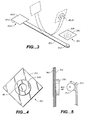
- FIG 3 illustrates the flexibility of the bow connector, 37J.
- the solid line drawing shows bow connector 37J when no force is being exerted.
- bow connector 37J is a springy material and can be elastically bent (compressed) into the position shown by the dashed line drawing in FIG 3.
- Successful tests have used strips of either 0.75 mm or 0.62 mm thick polycarbonate plastic for bow connector, 37J.
- FIGS 3, 4, and 5 illustrate the preferred method of attaching (coupling) the bow connector 37J with patches 30J and 30 JJ. It is desirable that the patches can be oriented at different angles to accommodate different size people. This calls for a coupling means that has the characteristic of a ball joint. Another desirable characteristic is the ability to easily attach and remove the patches from the flexible bow connector.
- FIG 5 shows a spherical magnet 41J attached to bow connector 37J by glue 49.
- the letter “N” represents the north pole of the magnet. This implies that the magnetic axis is pointing out of the page.
- This magnetic orientation means that the spherical magnet 41J will be drawn towards a hole 48 in the steel disk 31K.
- the diameter of hole 48 is optimally slightly smaller than the diameter of the spherical magnet.
- the size of bow connector, 37F was adjusted so that it exerted a 0.33 Newton pulling force (about 34 gram force) on patches 31J and 31JJ. This force was sufficient to open the blocked air passage for a person who suffers from obstructive sleep apnea. Less force may be required for a person with just a snoring problem.
- FIGS 4 and 5, taken together, show details of the construction of patches 30J and 30JJ.
- the thicknesses of components in FIGS 5 are exaggerated for clarity.
- 31J and 34J together are a piece of tape.
- 34J is the adhesive side of the tape and 31J is the carrier or support member for the adhesive.
- 31JJ and 34JJ are another piece of tape.
- 31K is another type of support member for the adhesive 34J.
- 31K is a steel disk with a hole 48.
- the steel disk 31K provides the desired stiffness and area so that the experimentally determined optimum area is skin is expanded by the pulling action of the connector.
- the adhesive could have been applied directly to disk 31K, but it has been experimentally determined that the best adhesion and comfort occurs when the support for the adhesive has both a stiff component 31K and a flexible component (the portion of 31J that extends beyond the edge of 31K).
- FIG 5 illustrates the device after the release liner has been removed.
- 31J and 34J together were a piece of tape, 25 mm X 25 mm X 0.8 mm thick.
- Ferromagnetic material 31K was a 0.75 mm thick steel washer, 16 mm outer diameter and 5.6 mm inner diameter. This steel washer was attached to tape 31J.
- the spherical magnet 41J was 6.35 mm (1/4 inch) in diameter and made from the rare earth magnetic material known as NdFeB.
- the patches 30J and 30JJ were attached to the test subject as shown in FIG 2. The diamond orientation of the square patches was used because this minimized skin irritation. The patches were applied over points 27E previously described in FIG 1. The bow coupler 37J was then attached using the magnets previously described.
- test subject normally sleeps with his jaw completely closed (teeth contacting), and if the blockage is strong, then it is advisable for the subject to also wear a commercially available dental spacer to slightly separate the teeth.
- This is a plastic device that fits over the front two teeth and is usually used to prevent grinding of the teeth.
- This device is completely different from oral anti-snoring devices that cause the jaw to jut forward unnaturally. Those oral anti-snoring devices are uncomfortable, and can shift the position of teeth.
- FIGS 6 and 7 show a bridge type anti-snoring device, 30A, attached to a human, 20.
- This device is used to expand one or more of responsive points 27A, B, C or E described in FIG 1.
- the orientation of 30A is generally parallel to the jaw line 21 and in FIG 7 the orientation is generally perpendicular to 21.
- device 30A consists of a support member 31A and an adhesive layer. The adhesive, not visible in FIGS 6 or 7, is attached to the skin covering at least a portion of the previously designated throat stimulation area.
- Pads 33A and 33AA push on the skin in the vicinity of the jawbone line 21 in FIG 6. In FIG 7 pad 33A pushes on the jawbone 21 and pad 33AA pushes on a portion of the neck 24.
- Support member, 31A has an adhesive coating, 34A, on it's inside surface.
- This adhesive can be either double coated tape or an adhesive coating directly on member, 31A.
- FIG 9 shows an embodiment where adhesive, 34A, is double coated tape. This double-coated tape preferably extends beyond two edges of the support member, 31A as seen in FIG 8.
- FIG 9 also shows a release liner, 35A, on the surface of adhesive, 34A. Normally, this release liner would be present before the neck patch anti-snoring device is used. Just prior to application, the user would peel off liner, 35A, exposing the adhesive surface, 34A. The remainder of the discussion of FIG 9 will presume that the release liner, 35A, has been removed.
- support member, 31A it is most desirable for support member, 31A, to be flexible.
- FIG 9 shows this flexibility.
- Support member, 31A would have the shape shown by the solid line drawing in FIG 9, when there is no force bending this support member. However, pushing on 31A can cause it to flatten as shown by the dashed line, 31AA, in FIG 9.
- the member, 31A in FIG 9 attempts to spring back to the solid line drawing in FIG 9.
- the adhesive, 34A is now attached to the skin; the flexible support member 31A can only partly spring back to the starting shape of member 31A in FIG 9. This exerts a predetermined pulling force on the skin that is being adhered to the adhesive, 34A. This pulling force expands the throat stimulation area and causes the skin of the throat stimulation area to protrude beyond its normal position by at least 2.5 mm.
- the predetermined pulling force exerted by the flexible support member reduces the height of the arch to considerably less than the arch shown in FIG 9. This intentional flexing also straightens out the pressure surfaces, 33A and 33AA, in FIG 9 so that they press approximately flat on the skin over the jawbone.
- the support member be flexible since the skin is flexible and it is possible to apply even a rigid neck patch anti-snoring device by deforming the skin sufficiently during application.
- a springy material such as springy plastic, metal, rubber or urethane for support member, 31A.
- FIGS 8 and 9 One successful device had the shape shown in FIGS 8 and 9.
- This device had support member 31A made of 0.5 mm thick polycarbonate plastic, with dimensions of 7 cm X 2.8 cm and an unloaded arch height of about 2 cm.
- the tape, 34A extended about 6 mm beyond the top and bottom edge of the plastic.
- the optimum arch height varies with individuals and depends on factors such as the tightness of the skin and the degree of air passage blockage.
- the adhesive area, 34A is shown extending beyond the edges of support member, 31A, but not extending over the entire width of the support member, 31A. This partial width coverage is easier to illustrate and seems to work well.
- the adhesive, 34A is depicted as being double coated adhesive tape since it extends beyond the edge of member, 31A. This adhesive extension is desirable, but not necessary. Extending the tape, beyond the edge of member, 31A, helps the adhesion of the tape to the skin.
- FIG 8 also shows the preferred placement of the anti-snoring device, 30A, relative to the jawbone line, 21, and the left end of the jawbone, 21L. It can be seen that dashed line, 21, (representing the lower edge of the jawbone) is not centered on device, 30A. Also, pressure surface, 33AA, is near the left end of the jawbone, 21L. This positioning centers part of the arch over one or more of the throat stimulation areas 27 in the throat stimulation area 22 in FIG 1.
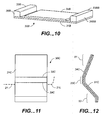
- FIG 10 shows another bridge type anti-snoring device, 30B, which is similar to device 30A illustrated in FIGS 8 and 9.
- the support member is designated 31B
- the adhesive surface is 34B
- the pressure surfaces are 33B and 33BB.
- the adhesive, 34B is illustrated thicker than normal for clarity.
- support member, 31B is shown as a generally flat material, but curved shapes are also possible.
- Member, 31B can be either flexible or rigid.
- the key point in this embodiment is that soft pads, 36B and 36BB, have been added to member, 31B. These pads can be made of any suitable material, but the preferred material is foam rubber or foam urethane.
- the outer surfaces of these pads form the pressure surfaces, 33B and 33BB. These pads can also be removable or applied after the adhesive is attached to the skin.
- FIG 10 The design depicted in FIG 10 is shown with a similar projected shape to the design in FIG 8.
- the design in FIG 10 could also be positioned as shown in FIGS 6 or 7.
- the size and position of both the soft pads and the support member can be modified in any way to accomplish the goal of expanding the throat stimulation area beyond its normal position.
- soft pads can be substituted for contours in the shape of the support member, 31, in any figure.
- bridge type anti-snoring device is used to describe the devices in FIGS 6 through 10. This is because the characteristic of a bridge type anti-snoring device is to have a central region positioned above a portion of the throat stimulation area, and between two or more supports.
- the device depicted in FIGS 6, through 9 has an arch shape, while the device depicted in FIG 10 is planar. However, both devices have the characteristics of a bridge. Other bridging shapes are also possible.
- FIGS 11 and 12 taken together, illustrate a cantilever type anti-snoring device, 30C.
- a cantilever type anti-snoring device applies a pulling force on the desired region of the throat stimulation area by pushing on the jawbone and pulling on the cheek.
- FIGS 11 and 12 there is a support member 31C, and an adhesive 34C.
- This device is illustrated as being bent with fold lines, 38C and 39C.
- the structural material made out of 0.5 mm or 0.75 mm thick polycarbonate plastic. When applied to a person, this flexible material straightens out somewhat compared to the amount of bend illustrated in FIG 12.
- FIGS 11 and 12 When the device in FIGS 11 and 12 is applied to a person, it is positioned similar to FIG 7, except that device 30C is positioned higher.
- FIG 11 shows the proper positioning of the anti-snoring device, 30C, relative to jawbone line, 21.
- the left end of the jawbone is 21L.
- the lower half of the anti-snoring device, 30C is cantilevered out past the jawbone line, 21, and pulls on the skin of the throat stimulation area, preferably over one or more responsive points.
- region 53 in FIG 12 applies the pulling force to the desired part of the throat stimulation area.
- the cheek exerts a counterbalancing pulling force because region 51 is adhered to the cheek and the jawbone acts like a fulcrum.
- Some individuals with only a slight snoring problem and tight skin may be able to have no fold lines so that support member 31C is flat. Even a flat support member will exert some pulling force on throat stimulation area, 22L. This is because a normal weight person has the skin of the throat stimulation area indented below the jawbone line, 21. Pulling this skin out with a flat surface is actually expanding the throat stimulation area by at least 2.5 mm.
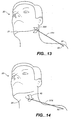
- FIG 13 shows an "elastic connector in tension" type anti-snoring device.
- Adhesive patch, 30H is a piece of adhesive tape with a connection means such as a 6 mm diameter magnet captured between the tape and the skin.
- Elastic connector, 37H, in FIG 13 is connected to an anchor point, 50, located on the shoulder, 25.
- the elastic connector, 37H has been stretched so that it is in tension and exerts a pulling force on at least one throat stimulation area in the throat stimulation area (not illustrated, but located under 30H).
- the elastic connector in tension, 37H could be any material or device that can maintain a predetermined pulling force such as a rubber band or a spring. It would also be possible to use a device such as a spring loaded rewind spool similar to a rewind tape measure device.
- the anchor point, 50 is shown on the shoulder, but this anchor point could be on other parts of the body such as the chest, back, or waist.
- the exact method of attaching to the anchor point is not important.
- the anchor point is illustrated in FIG 13 as if it were a real point. In practice, it could be any attachment means such as a loop under the arm.
- FIG 14 shows the use of a mechanical clip 42 to grab a portion of the skin in the throat stimulation area.
- An elastic connector, 37N attached to anchor point 50 expands a portion of the skin in the throat stimulation area by pulling on the clip and the skin.
- the anchor point, 50 is shown on the shoulder, but this anchor point could be on other parts of the body such as the chest, back, or waist. The exact method of attaching to the anchor point is not important.
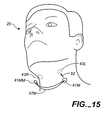
- FIG 15 shows another mechanical way of causing the throat stimulation area to expand.
- Implants 43L and 43R are magnetic devices buried below the surface of the skin. They are depicted in FIG 15 as being circular disks, however, they could be other shapes such as rods or even multiple pellets. Preferably they would be ferromagnetic or permanent magnets so that they exhibit a magnetic attraction to an external magnet.
- 41M and 41MM are permanent magnets attached to the end of bow connector 37M.
- FIG 15 shows the connector 37M and magnets41M, 41MM slightly removed from the engaged position.
- Arrow 52 implies the connection.
- magnets 41M and 41MM would contact the skin over the magnetic implants 43L and 43R.
- the operation of this is very similar to the preferred embodiment previously described in FIGS 2 and 3.
- the previous explanation for FIGS 2 and 3 applies to the variation shown in FIG 15.
- throat stimulation area 27F has previously been described as lying along the edge of the trachea.
- 27F has the property that it can be used either alone or in combination with other responsive points.
- FIG 2 shows patches 20J and 30JJ attached to responsive points 27E (left and right). Adding a second set of patches on top of 27F (left and right) and pulling on these areas with a second bow coupler can totally eliminate a snoring sound in a test subject that has sleep apnea.
- Using just the single device illustrated in FIG 2 eliminates the apnea episodes, but does not totally eliminate any snoring sound. In people with just a snoring problem (without sleep apnea), the single anti-snoring device illustrated in FIG 2 is probably sufficient.
- Responsive point 27G in FIG 1 lies directly over the center of a man's Adam's apple. This point is not too desirable and it probably requires the additional use of points 27F (left and right). In tests, the best results have experimentally been achieved using responsive points 27E or those points in combination with 27F.
- bias means for providing a predetermined pulling force to cause at least a portion of the throat stimulation area to expand outward by at least 2.5 mm from its normal position.
- the expansion of the throat stimulation area modifies the throat such that the human exhibits improved ease of breathing while sleeping.
- the above disclosure is sufficient to enable one of ordinary skill in the art to practice the invention, and provides the best mode of practicing the invention presently contemplated by the inventor. While there is provided herein a full and complete disclosure of the preferred embodiments of this invention, it is not desired to limit the invention to the exact construction, dimensional relationships, and operation shown and described. Various modifications, alternative constructions, changes and equivalents will readily occur to those skilled in the art and may be employed, as suitable, without departing from the true spirit and scope of the invention. Such changes might involve alternative materials, components, structural arrangements, sizes, shapes, forms, functions, operational features or the like.
Landscapes
- Health & Medical Sciences (AREA)
- Otolaryngology (AREA)
- Pulmonology (AREA)
- Nursing (AREA)
- Orthopedic Medicine & Surgery (AREA)
- Engineering & Computer Science (AREA)
- Biomedical Technology (AREA)
- Heart & Thoracic Surgery (AREA)
- Vascular Medicine (AREA)
- Life Sciences & Earth Sciences (AREA)
- Animal Behavior & Ethology (AREA)
- General Health & Medical Sciences (AREA)
- Public Health (AREA)
- Veterinary Medicine (AREA)
- Orthopedics, Nursing, And Contraception (AREA)
- Prostheses (AREA)
Applications Claiming Priority (4)
| Application Number | Priority Date | Filing Date | Title |
|---|---|---|---|
| US10/866,058 US20050274386A1 (en) | 2004-06-10 | 2004-06-10 | Method and apparatus for treatment of snoring and sleep apnea |
| US866058 | 2004-06-10 | ||
| US11/102,314 US20050274387A1 (en) | 2004-06-10 | 2005-04-08 | Method and apparatus for treatment of snoring and sleep apnea |
| US102314 | 2005-04-08 |
Publications (1)
| Publication Number | Publication Date |
|---|---|
| EP1604625A1 true EP1604625A1 (en) | 2005-12-14 |
Family
ID=34941623
Family Applications (1)
| Application Number | Title | Priority Date | Filing Date |
|---|---|---|---|
| EP05253550A Withdrawn EP1604625A1 (en) | 2004-06-10 | 2005-06-09 | Method and apparatus for treatment of snoring and sleep apnea |
Country Status (4)
| Country | Link |
|---|---|
| US (2) | US20050274387A1 (cg-RX-API-DMAC7.html) |
| EP (1) | EP1604625A1 (cg-RX-API-DMAC7.html) |
| JP (1) | JP2005349210A (cg-RX-API-DMAC7.html) |
| CA (1) | CA2509123A1 (cg-RX-API-DMAC7.html) |
Cited By (4)
| Publication number | Priority date | Publication date | Assignee | Title |
|---|---|---|---|---|
| US8096303B2 (en) | 2005-02-08 | 2012-01-17 | Koninklijke Philips Electronics N.V | Airway implants and methods and devices for insertion and retrieval |
| US8371307B2 (en) | 2005-02-08 | 2013-02-12 | Koninklijke Philips Electronics N.V. | Methods and devices for the treatment of airway obstruction, sleep apnea and snoring |
| CN105055070A (zh) * | 2015-08-10 | 2015-11-18 | 赵菁 | 一种伸缩式喉部支架 |
| US9314312B2 (en) | 2012-03-20 | 2016-04-19 | Carpal Aid, Llc | Therapeutic skin lifting device and related systems and methods |
Families Citing this family (45)
| Publication number | Priority date | Publication date | Assignee | Title |
|---|---|---|---|---|
| US20050274386A1 (en) * | 2004-06-10 | 2005-12-15 | John Macken | Method and apparatus for treatment of snoring and sleep apnea |
| US7644714B2 (en) | 2005-05-27 | 2010-01-12 | Apnex Medical, Inc. | Devices and methods for treating sleep disorders |
| EP1797846A1 (en) * | 2005-12-13 | 2007-06-20 | John A. Macken | Method and apparatus for treatment of snoring and sleep apnea |
| US7748493B2 (en) * | 2006-06-14 | 2010-07-06 | Zmed Technologies, Inc. | Respiration stimulation |
| US7734350B2 (en) * | 2006-06-14 | 2010-06-08 | Zmed Technologies, Inc. | Respiration apparatus |
| CN101594841B (zh) * | 2006-12-15 | 2012-04-25 | 5I科学公司 | 用于打开气道的装置和方法 |
| US20080182479A1 (en) * | 2007-01-26 | 2008-07-31 | Ellihay Corp. | Items With Stretchable Members And/Or Magnetic Action |
| US8167787B2 (en) | 2008-01-03 | 2012-05-01 | Revent Medical, Inc. | Partially erodable systems for treatment of obstructive sleep apnea |
| US9439801B2 (en) * | 2012-06-29 | 2016-09-13 | Revent Medical, Inc. | Systems and methods for treatment of sleep apnea |
| JP5834337B2 (ja) | 2008-05-12 | 2015-12-16 | レベント メディカル インコーポレイテッド | 閉塞性睡眠時無呼吸の治療のための部分的侵食性システム |
| US8733363B2 (en) | 2010-03-19 | 2014-05-27 | Revent Medical, Inc. | Systems and methods for treatment of sleep apnea |
| CN102065804B (zh) * | 2008-05-20 | 2015-05-20 | 索美瑞克斯公司 | 用于打开气道的器械和方法 |
| US20100114153A1 (en) * | 2008-09-13 | 2010-05-06 | John Michael Kretz | Snap-Off Diet Aid™ tragus clip with single-point removable pressure head |
| EP2547296A4 (en) | 2010-03-19 | 2014-08-06 | Revent Medical Inc | SYSTEMS AND METHODS FOR TREATMENT OF SLEEP APNEA |
| EP2571464A4 (en) | 2010-05-21 | 2014-08-06 | Revent Medical Inc | SYSTEMS AND METHOD FOR THE TREATMENT OF SLEEP APNEA |
| WO2012018545A2 (en) | 2010-07-26 | 2012-02-09 | Revent Medical, Inc. | Systems and methods for treatment of sleep apnea |
| US20120203268A1 (en) * | 2011-02-07 | 2012-08-09 | Lin Chien | Wrinkle remover |
| US9084859B2 (en) | 2011-03-14 | 2015-07-21 | Sleepnea Llc | Energy-harvesting respiratory method and device |
| US20140207181A1 (en) * | 2012-09-20 | 2014-07-24 | Paul Otto Kretz | Snap-Off Diet Aid Tragus Clip with Single-Point Removable Pressure Head |
| CA2888030A1 (en) | 2012-10-16 | 2014-11-27 | Cook Medical Technologies Llc | Method and apparatus for treating obstructive sleep apnea (osa) |
| CN103099701B (zh) * | 2012-11-01 | 2014-11-05 | 陈彩霞 | 鼻鼾颈筒治疗系统 |
| CN103099700B (zh) * | 2012-11-01 | 2015-01-21 | 邱晨 | 声控式颈筒鼻鼾治疗系统 |
| US20140236059A1 (en) * | 2013-02-17 | 2014-08-21 | Jae S. Son | Carpal tunnel relief device |
| WO2015020953A1 (en) | 2013-08-05 | 2015-02-12 | Darin Schaeffer | Medical devices having a releasable tubular member and methods of using the same |
| US10556095B2 (en) | 2013-12-20 | 2020-02-11 | James D. Castillo | Google breathing system |
| US9283106B2 (en) * | 2013-12-20 | 2016-03-15 | James D. Castillo | Breathing system |
| US9675493B2 (en) * | 2013-12-20 | 2017-06-13 | James D. Castillo | Goggle breathing system |
| US10729575B2 (en) | 2013-12-20 | 2020-08-04 | James D. Castillo | Eyewear system for securing lens on a user's nose and dilating user's nose |
| US10137028B2 (en) | 2013-12-20 | 2018-11-27 | James D. Castillo | Eyewear system for securing lens on a user's nose and dilating user's nose |
| US10137027B2 (en) | 2013-12-20 | 2018-11-27 | James D. Castillo | Nasal applique and related applicator for applying applique to a nose of a wearer |
| US9974563B2 (en) | 2014-05-28 | 2018-05-22 | Cook Medical Technologies Llc | Medical devices having a releasable member and methods of using the same |
| WO2016022454A1 (en) | 2014-08-04 | 2016-02-11 | Darin Schaeffer | Medical devices having a releasable tubular member and methods of using the same |
| CN105748187B (zh) * | 2014-12-19 | 2017-12-01 | 张湘民 | 咽侧壁牵引装置和植入方法 |
| US10799387B2 (en) * | 2015-01-26 | 2020-10-13 | BLR Sleepwell, LLC | Method and apparatus for reducing snoring |
| US11246741B2 (en) | 2015-01-26 | 2022-02-15 | BLR Sleepwell, LLC | Method and apparatus for mandibular support |
| WO2016130221A1 (en) * | 2015-02-13 | 2016-08-18 | Castillo James D | Nasal applique and related applicator for applying applique to a nose of a wearer |
| US10010313B2 (en) | 2015-05-18 | 2018-07-03 | Richard L. Arden | Mandibular subluxation device and method |
| US10258319B2 (en) | 2015-05-18 | 2019-04-16 | Richard L. Arden | Airway assist device and method |
| US10342526B2 (en) | 2015-07-01 | 2019-07-09 | Richard L. Arden | Airway assist device and method |
| EP3416598A4 (en) | 2016-02-16 | 2019-10-30 | BLR Sleepwell LLC | METHOD AND DEVICE FOR SUPPORT FOR SUBSTRUCTURE |
| KR101700384B1 (ko) * | 2016-04-26 | 2017-01-26 | 심길섭 | 안경용 자석 임플란트 및 그 이식장치 |
| CN110022800A (zh) * | 2016-12-02 | 2019-07-16 | 3M创新有限公司 | 带有条带的肌肉或关节支撑制品 |
| HUE055578T2 (hu) * | 2017-02-17 | 2021-12-28 | Inst Nat Sante Rech Med | Temporo-mandibuláris protézis |
| US11076975B2 (en) | 2018-09-23 | 2021-08-03 | Sohn Inc. | Carpal tunnel syndrome relief devices and methods of using thereof |
| US12502315B2 (en) * | 2021-06-08 | 2025-12-23 | Intermed Labs @ Mon Health, Llc | Protective eye shield |
Citations (20)
| Publication number | Priority date | Publication date | Assignee | Title |
|---|---|---|---|---|
| US1292083A (en) | 1918-02-04 | 1919-01-21 | William F Sawyer | Nostril-dilator. |
| US3594813A (en) | 1968-07-10 | 1971-07-27 | Roger S Sanderson | Protective device |
| US3782372A (en) | 1972-04-20 | 1974-01-01 | J Carlton | Camouflaged device for temporary face lifting |
| FR2420338A1 (fr) | 1978-03-21 | 1979-10-19 | Blander Josef | Masque anti-ronflement |
| US4817636A (en) | 1987-10-01 | 1989-04-04 | Woods Thomas H | Anti-snoring device |
| DE3837277A1 (de) | 1988-11-03 | 1990-05-10 | Obermeier Johann | Vorrichtung zur schnarch - verhinderung |
| US5176618A (en) * | 1989-08-10 | 1993-01-05 | George Freedman | System for preventing closure of passageways |
| USRE35408E (en) | 1986-11-19 | 1996-12-24 | Patent Development & Investment S.A. | Nasal devices |
| US5592938A (en) | 1992-06-08 | 1997-01-14 | Respironics Inc. | Mask apparatus |
| US5752524A (en) | 1997-06-12 | 1998-05-19 | Corcoran; Timothy C. | Device for preventing or reducing snoring |
| CA2206354A1 (en) * | 1997-06-11 | 1998-12-11 | Eugene Marshall | Snor-eze(tm) a snoring and sleep apnea elimination or relief device |
| US5979456A (en) * | 1996-04-22 | 1999-11-09 | Magovern; George J. | Apparatus and method for reversibly reshaping a body part |
| WO2000066048A1 (en) * | 1999-04-28 | 2000-11-09 | Caccamo, Alessandro | Device for improving respiration and for eliminating snoring |
| US20020000227A1 (en) * | 2000-06-29 | 2002-01-03 | Duyke Andrew L. Von | Tissue dilator devices, methods of fabrication of tissue dilators, and methods of use for tissue dilators |
| US6523542B2 (en) | 1999-09-17 | 2003-02-25 | Pi Medical, Inc. | Snoring treatment implant and method |
| US6523543B2 (en) | 1999-09-17 | 2003-02-25 | Pi Medical, Inc. | Permanent snoring implant |
| US6578580B2 (en) | 1999-09-17 | 2003-06-17 | Restore Medical, Inc. | Needle with pre-loaded implant for snoring treatment |
| US6601584B2 (en) | 1999-09-17 | 2003-08-05 | Pi Medical, Inc. | Contracting snoring treatment implant |
| US6634362B2 (en) | 1999-09-17 | 2003-10-21 | Restore Medical, Inc. | Braided implant for snoring treatment |
| US6668834B1 (en) * | 1996-11-01 | 2003-12-30 | Bashir Zikria | Anti-snoring apparatus |
Family Cites Families (16)
| Publication number | Priority date | Publication date | Assignee | Title |
|---|---|---|---|---|
| US5476091A (en) * | 1991-06-10 | 1995-12-19 | Creative Integration & Design, Inc. | Dilator for anatomical outer wall tissues which is adhesively mounted |
| US5643315A (en) * | 1994-09-22 | 1997-07-01 | Daneshvar; Yousef | Device for wound therapy and prevention of bleeding |
| WO1997038651A1 (en) * | 1996-04-16 | 1997-10-23 | Torsten De Voss | A nasal dilator and a method of producing same |
| AU729566B2 (en) * | 1996-05-10 | 2001-02-01 | Wallace J. Beaudry | Nasal epidermal lifting mechanism |
| US5922006A (en) * | 1996-08-12 | 1999-07-13 | Sugerman; Joseph H. | Nasal appliance |
| US6196228B1 (en) * | 1996-11-26 | 2001-03-06 | Cns, Inc. | Nasal dilator |
| JPH10192412A (ja) * | 1997-01-16 | 1998-07-28 | Kazuhiro Kaneko | 鼻孔拡張テープ |
| US6769428B2 (en) * | 1997-01-29 | 2004-08-03 | Peter J. Cronk | Adhesively applied external nasal strips and dilators containing medications and fragrances |
| US6098616A (en) * | 1998-03-13 | 2000-08-08 | Acutek International | Non-linear nasal dilator |
| US6375667B1 (en) * | 1999-09-23 | 2002-04-23 | North American Financial Corp | Nasal dilator |
| US6390089B1 (en) * | 2001-02-23 | 2002-05-21 | Michael Lacouture | Nostril expansion device with interchangeable components |
| JP4625600B2 (ja) * | 2001-09-27 | 2011-02-02 | 医療法人社団松田歯科医院 | 睡眠時無呼吸等の防止具 |
| US7188627B2 (en) * | 2002-09-06 | 2007-03-13 | Apneon, Inc. | Magnetic force devices, systems, and methods for resisting tissue collapse within the pharyngeal conduit |
| US6955172B2 (en) * | 2002-09-06 | 2005-10-18 | Apneon, Inc. | Systems and methods for moving and/or restraining the tongue in the oral cavity |
| JP4782422B2 (ja) * | 2002-09-06 | 2011-09-28 | コーニンクレッカ フィリップス エレクトロニクス エヌ ヴィ | 咽頭管内の組織閉塞に抵抗する磁力デバイスおよびシステム |
| US7107992B2 (en) * | 2002-10-04 | 2006-09-19 | Pavad Medical, Inc. | System and method for preventing closure of passageways |
-
2005
- 2005-04-08 US US11/102,314 patent/US20050274387A1/en not_active Abandoned
- 2005-06-03 CA CA002509123A patent/CA2509123A1/en not_active Abandoned
- 2005-06-09 EP EP05253550A patent/EP1604625A1/en not_active Withdrawn
- 2005-06-10 JP JP2005171152A patent/JP2005349210A/ja active Pending
-
2008
- 2008-07-11 US US12/172,132 patent/US7793661B2/en not_active Expired - Fee Related
Patent Citations (24)
| Publication number | Priority date | Publication date | Assignee | Title |
|---|---|---|---|---|
| US1292083A (en) | 1918-02-04 | 1919-01-21 | William F Sawyer | Nostril-dilator. |
| US3594813A (en) | 1968-07-10 | 1971-07-27 | Roger S Sanderson | Protective device |
| US3782372A (en) | 1972-04-20 | 1974-01-01 | J Carlton | Camouflaged device for temporary face lifting |
| FR2420338A1 (fr) | 1978-03-21 | 1979-10-19 | Blander Josef | Masque anti-ronflement |
| USRE35408E (en) | 1986-11-19 | 1996-12-24 | Patent Development & Investment S.A. | Nasal devices |
| US4817636A (en) | 1987-10-01 | 1989-04-04 | Woods Thomas H | Anti-snoring device |
| DE3837277A1 (de) | 1988-11-03 | 1990-05-10 | Obermeier Johann | Vorrichtung zur schnarch - verhinderung |
| US5176618A (en) * | 1989-08-10 | 1993-01-05 | George Freedman | System for preventing closure of passageways |
| US5592938A (en) | 1992-06-08 | 1997-01-14 | Respironics Inc. | Mask apparatus |
| US5979456A (en) * | 1996-04-22 | 1999-11-09 | Magovern; George J. | Apparatus and method for reversibly reshaping a body part |
| US6668834B1 (en) * | 1996-11-01 | 2003-12-30 | Bashir Zikria | Anti-snoring apparatus |
| CA2206354A1 (en) * | 1997-06-11 | 1998-12-11 | Eugene Marshall | Snor-eze(tm) a snoring and sleep apnea elimination or relief device |
| US5752524A (en) | 1997-06-12 | 1998-05-19 | Corcoran; Timothy C. | Device for preventing or reducing snoring |
| WO2000066048A1 (en) * | 1999-04-28 | 2000-11-09 | Caccamo, Alessandro | Device for improving respiration and for eliminating snoring |
| US6523542B2 (en) | 1999-09-17 | 2003-02-25 | Pi Medical, Inc. | Snoring treatment implant and method |
| US6523543B2 (en) | 1999-09-17 | 2003-02-25 | Pi Medical, Inc. | Permanent snoring implant |
| US6578580B2 (en) | 1999-09-17 | 2003-06-17 | Restore Medical, Inc. | Needle with pre-loaded implant for snoring treatment |
| US6601584B2 (en) | 1999-09-17 | 2003-08-05 | Pi Medical, Inc. | Contracting snoring treatment implant |
| US6601585B1 (en) | 1999-09-17 | 2003-08-05 | Restore Medical, Inc. | Expandable snoring implant |
| US6626181B2 (en) | 1999-09-17 | 2003-09-30 | Restore Medical, Inc. | Stiff snoring implant |
| US6634362B2 (en) | 1999-09-17 | 2003-10-21 | Restore Medical, Inc. | Braided implant for snoring treatment |
| US6848447B2 (en) | 1999-09-17 | 2005-02-01 | Restore Medical, Inc. | Braided implant for snoring treatment |
| US6631714B2 (en) | 2000-06-29 | 2003-10-14 | Cns, Inc. | Tissue dilator devices, methods of fabrication of tissue dilators, and methods of use for tissue dilators |
| US20020000227A1 (en) * | 2000-06-29 | 2002-01-03 | Duyke Andrew L. Von | Tissue dilator devices, methods of fabrication of tissue dilators, and methods of use for tissue dilators |
Cited By (8)
| Publication number | Priority date | Publication date | Assignee | Title |
|---|---|---|---|---|
| US8096303B2 (en) | 2005-02-08 | 2012-01-17 | Koninklijke Philips Electronics N.V | Airway implants and methods and devices for insertion and retrieval |
| US8371307B2 (en) | 2005-02-08 | 2013-02-12 | Koninklijke Philips Electronics N.V. | Methods and devices for the treatment of airway obstruction, sleep apnea and snoring |
| US8757163B2 (en) | 2005-02-08 | 2014-06-24 | Koninklijke Philips N.V. | Airway implants and methods and devices for insertion and retrieval |
| US9314312B2 (en) | 2012-03-20 | 2016-04-19 | Carpal Aid, Llc | Therapeutic skin lifting device and related systems and methods |
| US9463071B2 (en) | 2012-03-20 | 2016-10-11 | Carpal Aid, Llc | Therapeutic skin lifting device and related systems and methods |
| US10517687B2 (en) | 2012-03-20 | 2019-12-31 | Carpal Aid, Llc | Therapeutic skin lifting device and related systems and methods |
| US11653994B2 (en) | 2012-03-20 | 2023-05-23 | Carpal Aid, Llc | Therapeutic skin lifting device and related systems and methods |
| CN105055070A (zh) * | 2015-08-10 | 2015-11-18 | 赵菁 | 一种伸缩式喉部支架 |
Also Published As
| Publication number | Publication date |
|---|---|
| US7793661B2 (en) | 2010-09-14 |
| JP2005349210A (ja) | 2005-12-22 |
| US20080264427A1 (en) | 2008-10-30 |
| US20050274387A1 (en) | 2005-12-15 |
| CA2509123A1 (en) | 2005-12-10 |
Similar Documents
| Publication | Publication Date | Title |
|---|---|---|
| US7793661B2 (en) | Method and apparatus for treatment of snoring and sleep apnea | |
| JP2005349210A5 (cg-RX-API-DMAC7.html) | ||
| EP2353555B1 (en) | Automated negative pressure oral apparatus | |
| US7367340B2 (en) | Systems and methods for moving and/or restraining tissue in the upper respiratory system | |
| US20070221231A1 (en) | Method and apparatus for treatment of snoring and sleep apnea | |
| US6955172B2 (en) | Systems and methods for moving and/or restraining the tongue in the oral cavity | |
| US7073505B2 (en) | Systems and methods for moving and/or restraining tissue in the oral cavity | |
| US6470886B1 (en) | Continuous positive airway pressure headgear | |
| US10149783B2 (en) | Negative pressure oral apparatus | |
| US6228101B1 (en) | Breathing assistance improvements | |
| EP1477197A1 (en) | Device for holding a tracheal cannula | |
| JP2006507038A (ja) | 上気道系中の組織を移動および/または拘束するためのシステムおよび方法 | |
| US20110180075A1 (en) | Adjustable oral interface and method to maintain upper airway patency | |
| US20050274386A1 (en) | Method and apparatus for treatment of snoring and sleep apnea | |
| US20090198268A1 (en) | Nasal dilation apparatus | |
| US20180361099A1 (en) | Device for securing a nasal cannula | |
| EP1797846A1 (en) | Method and apparatus for treatment of snoring and sleep apnea | |
| CA2529764A1 (en) | Method and apparatus for treatment of snoring and sleep apnea | |
| JP5651488B2 (ja) | 口腔内で負圧を生成する口部装置及びその方法 | |
| JP2008302223A (ja) | いびき防止装置 | |
| TW200800314A (en) | Belt for fixing endotracheal tube and method for using the same | |
| HK1024848B (en) | Breathing assistance improvements |
Legal Events
| Date | Code | Title | Description |
|---|---|---|---|
| PUAI | Public reference made under article 153(3) epc to a published international application that has entered the european phase |
Free format text: ORIGINAL CODE: 0009012 |
|
| AK | Designated contracting states |
Kind code of ref document: A1 Designated state(s): AT BE BG CH CY CZ DE DK EE ES FI FR GB GR HU IE IS IT LI LT LU MC NL PL PT RO SE SI SK TR |
|
| AX | Request for extension of the european patent |
Extension state: AL BA HR LV MK YU |
|
| AKX | Designation fees paid | ||
| REG | Reference to a national code |
Ref country code: DE Ref legal event code: 8566 |
|
| STAA | Information on the status of an ep patent application or granted ep patent |
Free format text: STATUS: THE APPLICATION IS DEEMED TO BE WITHDRAWN |
|
| 18D | Application deemed to be withdrawn |
Effective date: 20060615 |