EP1603840B1 - Sol-gel process for the manufacture of optical articles - Google Patents
Sol-gel process for the manufacture of optical articles Download PDFInfo
- Publication number
- EP1603840B1 EP1603840B1 EP04718284.5A EP04718284A EP1603840B1 EP 1603840 B1 EP1603840 B1 EP 1603840B1 EP 04718284 A EP04718284 A EP 04718284A EP 1603840 B1 EP1603840 B1 EP 1603840B1
- Authority
- EP
- European Patent Office
- Prior art keywords
- mould
- preparation
- optical
- sol
- gel
- Prior art date
- Legal status (The legal status is an assumption and is not a legal conclusion. Google has not performed a legal analysis and makes no representation as to the accuracy of the status listed.)
- Expired - Lifetime
Links
Images

Classifications
-
- C—CHEMISTRY; METALLURGY
- C03—GLASS; MINERAL OR SLAG WOOL
- C03B—MANUFACTURE, SHAPING, OR SUPPLEMENTARY PROCESSES
- C03B19/00—Other methods of shaping glass
- C03B19/12—Other methods of shaping glass by liquid-phase reaction processes
-
- Y—GENERAL TAGGING OF NEW TECHNOLOGICAL DEVELOPMENTS; GENERAL TAGGING OF CROSS-SECTIONAL TECHNOLOGIES SPANNING OVER SEVERAL SECTIONS OF THE IPC; TECHNICAL SUBJECTS COVERED BY FORMER USPC CROSS-REFERENCE ART COLLECTIONS [XRACs] AND DIGESTS
- Y10—TECHNICAL SUBJECTS COVERED BY FORMER USPC
- Y10T—TECHNICAL SUBJECTS COVERED BY FORMER US CLASSIFICATION
- Y10T428/00—Stock material or miscellaneous articles
- Y10T428/24—Structurally defined web or sheet [e.g., overall dimension, etc.]
- Y10T428/24802—Discontinuous or differential coating, impregnation or bond [e.g., artwork, printing, retouched photograph, etc.]
Definitions
- the present invention refers to the preparation of optical articles consisting of silicon oxide in final or nearly final dimensions, having an almost totally isotropy and sizes equal to or lower than 500 ⁇ m.
- optical materials are typical materials of known machining difficulty and, sometimes, troublesome preparation because their fragility and hardness which, for example, are conditioning the hot molding by causing optical components and devices not being generally acceptable for reasons of product quality.
- the methods for the production of uncommon morphology optical elements comprise reducing suitable preforms through extremely accuracy lens milling operations: These are methods requiring a very precise handling even through the employment of suitable equipment, this sometimes being the reason of difficult repeatibility and poor process flexibility.
- plastic material which can be melted and molded using very economical processes.
- plastic material is sometimes the cause of dimensional defects of final optical product, because of the insufficiently controllable material shrinkage during the molding treatment.
- the Applicant is able to overcome all drawbacks being in the processes for the preparation of optical materials according to the known art, by means of the object defined in the European patents no. 586.013 and no. 705.797 it may freely use: according to such patents, it is possible to prepare perfectly and completely isotropic optical components in their final or nearly final dimensions by applying thermochemical densification treatment to an amorphous monolithic aerogel of silica, and/or other oxides, by the use of high precision tools and the former preparation of such aerogel via a so called sol-gel process during which the intermediate products, till the gel formation, undergo an ultrawave treatment.
- the final optical product obtainable through tolerable investments and absolutely repeatable methods, is characterized by very high precision and dimensional steadfastness: however, it is such and the relevant preparation method is advantageous when the optical article dimensions are beyond a threshold, under which machining difficulties may arise in the mould formation formation, particularly in the preparation of moulds representing microstructures which cannot be processed by means of the common machining tools such as, for example, the microlens matrix or other periodic microstructures needing a dimensional resolution of each element under the entrusting threshold of the existing machinery.
- WO 93/21120 discloses a sol-gel process for the preparation of monoliths having hyperfine features below 500 ⁇ m by repeated miniaturisation of the obtained monolith by using intermediate monoliths a molds.
- the Applicant has now found it is possible to overcome all above drawbacks and to consequently prepare optical articles, till to the lowest possible dimensions, according to an economically advantageous and repeatable method, which substantially consists in a preliminar arrangement of the desired dimension moulds and the subsequent use thereof in the preparation of the very optical article.
- the present invention relates to a process for the preparation of optical articles, these consisting silicon oxide, as such or whit suitable additives, and characterized by an almost total isotropy and dimensions equal to or lower than 500 ⁇ m, which process comprises one or more of the following operations that, all together, can be continuously carried out in a fall and/or stopped at the desired or suitable step:
- the preparation of the original mould according to item a) can be the first operation of the fall process according to the present invention, or it may be carried out independently, and the obtained mould may be suitably stored, to be subsequently employed.
- the materials employed to prepare the original moulds commonly are metal alloys, preferably nickel/phosphorous based alloys on aluminum carriers, or aluminum alloys commercially known as "anticorodal" such as, for instance, the ones defined as follows by UNI rules: 9006/1, 9006/2, 9006/4, 9006/5, 9006/6.
- antiicorodal aluminum alloys commercially known as "anticorodal”
- 9006/1, 9006/2, 9006/4, 9006/5, 9006/6 are aluminum alloys commercially known as "anticorodal” such as, for instance, the ones defined as follows by UNI rules: 9006/1, 9006/2, 9006/4, 9006/5, 9006/6.
- any other carrier with the necessary workability and steadiness properties.
- the replication of these moulds into siliconic rubber (or other material) imprints, without any risk occurring onto the original mould is carried out according to procedures well known to the people skilled in the art.
- the main purpose of this preparation step is the production of an opportune, even if not necessary
- sol-gel processes are carried out according to the well known technologies, on the ground of just common principles and methods, about which reference can be made to the field literature, patents too such as U.S. patents no.4.317.668 , no. 4.426.216 , no. 4.432.956 e no. 4.806.328 .
- the dried gel is removed from the mould to be submitted to a suitable isotropic miniaturization.
- composition of the moulds and/or optical articles prepared after the step b) of the inventive process comprises a silicon oxide, as such or added by oxides of elements modifying the properties thereof, in particular way le optical properties.
- An example of the modification of the optical properties of the silica glasses consists in the refraction index increase, that is obtained by a suitable chemical formulation of the sol, which precursors of the appropriate oxide are added to, particularly titanium and/or germanium oxides.
- other optical properties are modified such as the optical dispersion, through the addition of precursors of oxides of elements belonging to the lanthanium group.
- the addition of appropriate active oxide precursors to sol can promote also the modification of properties other than the optical ones: for instance, the silica glass thermomechanical properties, mainly the specific thermic dilatation may be reduced beyond one magnitude order if the glass formulation comprises a titanium oxide fraction.
- silica glass novel functional properties such as, for instance, the photoluminescence with peculiar emittance and excitation spectrum selectivities that can be obtained by the presence of traces of oxides particularly active in the field such as the appropriate excited rare earth oxides.
- silica glass mould An example for the preparation of a silica glass mould is given by the surface silanization to passivate all surface active sites (hydroxyl groups or hydroxyl groups precursors) in order to avoid the adhesion of the silicic gel that is aimed to be molded.
- the material to build the original mould was an aluminum alloy, commercially known as "CERTAL".
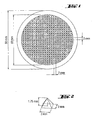
- the structure of the original mould was a 48mm diameter ring fully covered by square pyramids having a 2mm side and about 1.75 mm height.
- the structured ring was in the center of a metal disk made by aluminum alloy "CERTAL" and having a 56 mm diameter.
- a view of the structure is in the figure 1 showing, at sizes doubled with respect to the true ones, the structure layout.
- the single square pyramid is illustrated, with strongly enlarged sizes, (10:1) by the lateral view of the figure 2 .
- An imprint of the original mould was obtained by using the suitable compound ELASTOSIL M4601 produced by WACKER CHEMIE GmbH according the usual procedure suggested by the very producer.
- the siliconic rubber imprint obtained in B was used as a mould for a conventional high precision moulding silicic sol, according to US patent No.5,948,535 .
- TEOS tetraethylorthosilicate
- 300g of 0,01NHCl in bidistilled water were added to TEOS in the flask.
- the TEOS complete hydrolysis was achieved by an ultrasound probe treatment over 10 minutes.
- Hydrolysis ethanol was partially extracted under reduced pressure by a 150 ml volume liquid.
- 60g of AEROSIL SiO2, OX-50 DEGUSSA A.G. were added to the residue recovered from the rotating evaporator and properly homogenized and centrifuged.
- the silicic sol before being poured into the siliconic rubber mould, was brought to pH 4 through a gradual addition of a 0,5N watery ammonium hydroxide.
- the obtained gel was conventionally treated, according to US patent No.5,948,535 , converted to aerogel and densified to silica glass.
- the obtained product as very pure silica glass, was a miniaturized replication of the original mould. It is possible to note, through an eye inspection, that the structure of the original mould was faithfully reproduced in the glass replication with an isotropic linear reduction of all sizes by a factor of about 2.
- the siliconic rubber imprint obtained in D was employed as a mould according to a procedure similar to the one previously specified in the operation C.
- the obtained silica glass product was a very good quality replication of the original mould structure once miniaturized in C, and, the second time, in E. It is possible to note, through an eye inspection, that the structure of the original mould was apparently faithfully reproduced with an isotropic linear shrinkage of a factor equal to 4.
- An original mould replication was prepared through the procedure already described in the paragraph C of the example 1.
- the silica glass original replication having good optical properties, was similar to the original one, also having a morphology ideally corresponding to the morphology of the original mould, according to one to one correspondence. Only the dimensions were smaller being linearly reduced by a factor of 2. Particularly the base side of the truncated pyramid was reduced to 1mm and the height to 0, 82mm.
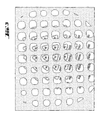
- the obtained manufactured article was used in the optical field as microlens matrix. Accordingly, an object was put under the ground containing the truncated pyramid square bases, 15mm for therefrom. The imagine was collected and focused by a lens having the optical axis perpendicular to the base ground on the structure side, sited to see the structure even if in the opposite side with respect to the object: therefore, vertically above the truncated pyramids.
- the figure 4 shows, under the same optical conditions, the same pyramidal structure, the object having been removed: clearly, there is no multiple imagine of the object.
- the manufactured article, prepared according to this example was used, in the same example, as optical device so called "fly eye", i.e. as the multichannel lens of an optical system able to show an object at 360 degree latitude above a determined horizon.
- optical device so called "fly eye”
- the multichannel lens of an optical system able to show an object at 360 degree latitude above a determined horizon.
Landscapes
- Chemical & Material Sciences (AREA)
- Engineering & Computer Science (AREA)
- Chemical Kinetics & Catalysis (AREA)
- Manufacturing & Machinery (AREA)
- Materials Engineering (AREA)
- Organic Chemistry (AREA)
- Glass Compositions (AREA)
- Silicon Compounds (AREA)
- Moulds For Moulding Plastics Or The Like (AREA)
- Glass Melting And Manufacturing (AREA)
- Colloid Chemistry (AREA)
- Inorganic Compounds Of Heavy Metals (AREA)
Description
- The present invention refers to the preparation of optical articles consisting of silicon oxide in final or nearly final dimensions, having an almost totally isotropy and sizes equal to or lower than 500 µm.
- It is known that the optical materials, particularly the transparent optical materials, are typical materials of known machining difficulty and, sometimes, troublesome preparation because their fragility and hardness which, for example, are conditioning the hot molding by causing optical components and devices not being generally acceptable for reasons of product quality.
- Usually, the methods for the production of uncommon morphology optical elements comprise reducing suitable preforms through extremely accuracy lens milling operations: These are methods requiring a very precise handling even through the employment of suitable equipment, this sometimes being the reason of difficult repeatibility and poor process flexibility.
- One solution has been achieved by producing aspheric lenses through high temperature and pressure preparations, directly from suitable preforms of the desired optical material: however, the method has applicability limits, needs sophisticated equipment and can be carried out only through considerable investment.
- One method for reducing costs consists in the use of organic optical material, i.e. plastic material, which can be melted and molded using very economical processes. However, the employment of plastic material is sometimes the cause of dimensional defects of final optical product, because of the insufficiently controllable material shrinkage during the molding treatment.
- The Applicant is able to overcome all drawbacks being in the processes for the preparation of optical materials according to the known art, by means of the object defined in the European patents no.
586.013 705.797 - The final optical product, obtainable through tolerable investments and absolutely repeatable methods, is characterized by very high precision and dimensional steadfastness: however, it is such and the relevant preparation method is advantageous when the optical article dimensions are beyond a threshold, under which machining difficulties may arise in the mould formation formation, particularly in the preparation of moulds representing microstructures which cannot be processed by means of the common machining tools such as, for example, the microlens matrix or other periodic microstructures needing a dimensional resolution of each element under the entrusting threshold of the existing machinery. Such difficulties increase in the case of preparation of optical articles in the peculiar microoptical field, wherein positioning and lining up problems have to solve of the magnitude order of micron and lower, and that, furthermore, has applications other than the ones pertaining to the traditional optic such as telecommunications, pick-up laser, semiconductor laser, optical memory.
-
WO 93/21120 - The Applicant has now found it is possible to overcome all above drawbacks and to consequently prepare optical articles, till to the lowest possible dimensions, according to an economically advantageous and repeatable method, which substantially consists in a preliminar arrangement of the desired dimension moulds and the subsequent use thereof in the preparation of the very optical article.
- Therefore the present invention relates to a process for the preparation of optical articles, these consisting silicon oxide, as such or whit suitable additives, and characterized by an almost total isotropy and dimensions equal to or lower than 500µm, which process comprises one or more of the following operations that, all together, can be continuously carried out in a fall and/or stopped at the desired or suitable step:
- a. preparation of an original high precision mould;
- b. reproduction, in a siliconic rubber or other suitable compound, of one or more imprints, having the same sizes and a reversed symmetry with respect to the moulds obtainable through the preceding steps;
- c. preparation, by the employment of one or more of the products obtained in the preceding steps, of the optical article having reduced dimensions and reversed symmetry with respect to the starting mould/imprint; according to a sol-gel procedure, wherein the sol-gel procedure comprises a preliminary step wherein the mould is cool filled with a sol containing the interesting oxide precursors, the sol gelation, the gel drying, the removal of gel from the mould and the final miniaturization of the dried gel;
- d. preparation, inside the so obtained optical article, of a further article again having reduced sizes and reversed symmetry, or of imprints according to the preceding item b);
- e. and so on, possibly, through the preparation of optical articles by sol-gel procedures and/or imprints according to b), till the desired dimensions or, anyhow, till the lowest dimensions on the ground of the physical limit of the process;
- f. separation, in relation with any step, of the imprint and/or the article obtained in the very step.
- Some of the above operative steps may be furtherly detailed:
- a) a mould is prepared, hereinafter defined as original mould, made by aluminum alloy or in other material with a suitable chemical stability and able to undergo a precision machining processing;
- b) one or more imprint are prepared in siliconic rubber or other suitable compound, having the same sizes and a reversed symmetry (mirror image) with respect to the original mould;
- c) by the use of the so obtained imprint as a new mould (resulting symmetrically reversed with respect to the original mould) a molded manufactured article is prepared trough a sol-gel process in silica glass which has lower dimensions according to the linear shrinkage coefficient and the same symmetry as the original mould. The so obtained silica glass can be find application either as optical component or as a mould for a following molding operation;
- d) the so obtained manufactured article is used as a reversed imprint in view of a further operation to sol-gel produce an optical article having further reduced dimensions and reversed symmetry (mirror image) with respect to the original mould.
- The use of the reversed imprint made by a siliconic rubber (or other material) is a possible one and may be repeated during the process route, if necessary or opportune according to the man skilled in the art.
- The preparation of the original mould according to item a) can be the first operation of the fall process according to the present invention, or it may be carried out independently, and the obtained mould may be suitably stored, to be subsequently employed.
- Such a preparation occurs according to techniques well known to the people skilled in the art, and the choice thereof substantially depends on the sizes of the mould itself. The technique grounds, starting from the conventional ones, are:
- use of numerically controlled machines;
- use of special machine tools provided with a "turning diamond";
- use of cutting machine to treat conventional optical networks;
- microscopic geometry based technologies providing photolitographic techniques combined with microerosion techniques;
- ablation through high power laser radiations.
- The materials employed to prepare the original moulds commonly are metal alloys, preferably nickel/phosphorous based alloys on aluminum carriers, or aluminum alloys commercially known as "anticorodal" such as, for instance, the ones defined as follows by UNI rules: 9006/1, 9006/2, 9006/4, 9006/5, 9006/6. Of course it is possible the use of any other carrier with the necessary workability and steadiness properties. Also the replication of these moulds into siliconic rubber (or other material) imprints, without any risk occurring onto the original mould, is carried out according to procedures well known to the people skilled in the art. The main purpose of this preparation step is the production of an opportune, even if not necessary, mould number in view of any subsequent operation, as well as the maintenance of the original mould.
- Inside the moulds obtained thereby, in the original one as well as in the subsequent imprints, other manufactured articles employable as moulds or optical articles are then produced, having reduced dimensions and, time by time, reversed symmetry, through sol-gel procedures: the sol-gel processes are carried out according to the well known technologies, on the ground of just common principles and methods, about which reference can be made to the field literature, patents too such as
U.S. patents no.4.317.668 , no.4.426.216 , no.4.432.956 e no.4.806.328 . - When the production, at any step of the above fall process, aims to obtain an optical article, the dried gel is removed from the mould to be submitted to a suitable isotropic miniaturization.
- The composition of the moulds and/or optical articles prepared after the step b) of the inventive process, comprises a silicon oxide, as such or added by oxides of elements modifying the properties thereof, in particular way le optical properties.
- An example of the modification of the optical properties of the silica glasses consists in the refraction index increase, that is obtained by a suitable chemical formulation of the sol, which precursors of the appropriate oxide are added to, particularly titanium and/or germanium oxides. By following the same trick, other optical properties are modified such as the optical dispersion, through the addition of precursors of oxides of elements belonging to the lanthanium group. The addition of appropriate active oxide precursors to sol can promote also the modification of properties other than the optical ones: for instance, the silica glass thermomechanical properties, mainly the specific thermic dilatation may be reduced beyond one magnitude order if the glass formulation comprises a titanium oxide fraction. Moreover it is possible to give the silica glass novel functional properties such as, for instance, the photoluminescence with peculiar emittance and excitation spectrum selectivities that can be obtained by the presence of traces of oxides particularly active in the field such as the appropriate excited rare earth oxides.
- In the case of use of the manufactured article obtained via the inventive process as a mould, the same submitted to surface treatments by means of appropriate antiadhesive agents that permit the removal of the product subsequently obtained therein, either optical component or mould again to prosecute the miniaturization fall process.
- An example for the preparation of a silica glass mould is given by the surface silanization to passivate all surface active sites (hydroxyl groups or hydroxyl groups precursors) in order to avoid the adhesion of the silicic gel that is aimed to be molded.
- An original mould was prepared as specified hereinafter. Drawings according to the
figures 1 and 2 were supplied by a shop qualified for very high precision works through the commercially known "turning diamond" machine tool, by which it is possible to finish off a metal surface having an average roughness lower than 20 nm. - The material to build the original mould was an aluminum alloy, commercially known as "CERTAL".
- The structure of the original mould was a 48mm diameter ring fully covered by square pyramids having a 2mm side and about 1.75 mm height. The structured ring was in the center of a metal disk made by aluminum alloy "CERTAL" and having a 56 mm diameter.
- A view of the structure is in the
figure 1 showing, at sizes doubled with respect to the true ones, the structure layout. The single square pyramid is illustrated, with strongly enlarged sizes, (10:1) by the lateral view of thefigure 2 . - The structure to be build, integrally formed by rectilinear segments of dimensions not lower than about 2mm, was, as far as that kind of drawing was concerned, in a size range well compatible with the type of machine used. The prototype of the original mould satisfying required specifications, was easily obtained by the encharged shop.
- An imprint of the original mould was obtained by using the suitable compound ELASTOSIL M4601 produced by WACKER CHEMIE GmbH according the usual procedure suggested by the very producer.
- The siliconic rubber imprint obtained in B was used as a mould for a conventional high precision moulding silicic sol, according to
US patent No.5,948,535 . - Accordingly, the following operation was carried out: 100gr of TEOS (tetraethylorthosilicate) were put into a 1000 ml borosilicate glass flask, under a suitable stirring of a magnetic anchor. 300g of 0,01NHCl in bidistilled water were added to TEOS in the flask. The TEOS complete hydrolysis was achieved by an ultrasound probe treatment over 10 minutes. Hydrolysis ethanol was partially extracted under reduced pressure by a 150 ml volume liquid. 60g of AEROSIL SiO2, OX-50 DEGUSSA A.G., were added to the residue recovered from the rotating evaporator and properly homogenized and centrifuged. The silicic sol, before being poured into the siliconic rubber mould, was brought to
pH 4 through a gradual addition of a 0,5N watery ammonium hydroxide. - The sol gelation occurred in about 60 minutes. The obtained gel was conventionally treated, according to
US patent No.5,948,535 , converted to aerogel and densified to silica glass. - The obtained product, as very pure silica glass, was a miniaturized replication of the original mould. It is possible to note, through an eye inspection, that the structure of the original mould was faithfully reproduced in the glass replication with an isotropic linear reduction of all sizes by a factor of about 2.
- By using the silica glass product obtained in the preceding operation, a novel imprint was prepared according to the procedure previously disclosed in B with reference to the original mould.
- The siliconic rubber imprint obtained in D was employed as a mould according to a procedure similar to the one previously specified in the operation C. The obtained silica glass product was a very good quality replication of the original mould structure once miniaturized in C, and, the second time, in E. It is possible to note, through an eye inspection, that the structure of the original mould was apparently faithfully reproduced with an isotropic linear shrinkage of a factor equal to 4.
- The same procedure was applied to reach, through subsequent operations of siliconic imprint as well as of miniaturization in silica glass, a third and a fourth reduction level of reduction of the original mould structure.
- The results of the dimensional analyses of all silica glass structures obtained thereby are summarized in the table 1.
Table 1 original reduction 1 reduction 3 reduction 2reduction 4disk external diameter (mm) (not inventive) 56.0 28.0 14.0 7.0 3.5 square pyramid side (mm) 2.0 1.0 0.5 0,25 0.125 - The table 1 data outline that a microstructure was obtained through a novel "cascade" process allowing to use the conventional mechanical processing high precision to build the original mould as well as to transfer the same precision to a micrometric scale through the new cascade miniaturized process.
- An original mould was prepared according to the disclosure of example n.1, paragraph A, but one difference: the square pyramids having a 2mm side and a 1,75mm height of the example 1 were now substituted by truncated square pyramids, fully equal to the above described pyramids, but being truncated at a 1,6 mm height.
- One original mould imprint was obtained by means of the procedure already disclosed in the paragraph B of the example 1.
- An original mould replication was prepared through the procedure already described in the paragraph C of the example 1. The silica glass original replication, having good optical properties, was similar to the original one, also having a morphology ideally corresponding to the morphology of the original mould, according to one to one correspondence. Only the dimensions were smaller being linearly reduced by a factor of 2. Particularly the base side of the truncated pyramid was reduced to 1mm and the height to 0, 82mm.
- The obtained manufactured article was used in the optical field as microlens matrix. Accordingly, an object was put under the ground containing the truncated pyramid square bases, 15mm for therefrom. The imagine was collected and focused by a lens having the optical axis perpendicular to the base ground on the structure side, sited to see the structure even if in the opposite side with respect to the object: therefore, vertically above the truncated pyramids.
- The results are photographically illustrated in the
figure 3 , showing the object, constituted by a triangular mark with thenumber 02, faithfully reproduced through multiple imagines, each one produced from a different lens of the circular matrix, i.e. from a truncated pyramid of the molded structure. - As a control, the
figure 4 shows, under the same optical conditions, the same pyramidal structure, the object having been removed: clearly, there is no multiple imagine of the object. - The manufactured article, prepared according to this example was used, in the same example, as optical device so called "fly eye", i.e. as the multichannel lens of an optical system able to show an object at 360 degree latitude above a determined horizon. The comparison between the
figures 3 and4 outlines that the result was obtained.
Claims (3)
- Process for the preparation of optical articles of final or nearly final dimensions, the optical articles consisting of silicon oxide or of silicon oxide modified by the addition of one or more oxides of titanium, germanium, lanthanides and rare earths, and having an almost complete isotropy and dimensions equal to or lower than 500µm, characterized that the following operations are performed:a) preparation of an original high precision mould from a material selected from nickel/phosphorus alloys on aluminum carriers and aluminum alloys;b) reproduction, in a siliconic rubber, of one or more imprints, having the same sizes and a reversed symmetry with respect to the mould obtainable through the preceding step;c) preparation, by the employment of one or more of the products obtained in the preceding steps, of an optical article having reduced dimensions and reversed symmetry with respect to the starting mould/imprint, according to a sol-gel procedure in which the sol-gel procedure comprises a preliminar step wherein the mould is cool filled with a sol containing the oxide precursors, the gelation of the sol, the drying of the gel, removal of the gel from the mould and subsequent miniaturization of the gel by drying;d) preparation with the so obtained article of a further article again having reduced sizes and reversed symmetry, as an imprint according to the preceding step b);e) repeating the preceding steps until the desired dimensions are reached;f) separation, in relation with any step, of the optical article obtained.
- Process for the preparation of an optical article according to claim 1, characterized in that the mould is previously submitted to surface treatment by means of appropriate antiadhesive agents.
- Process for the preparation of an optical article according to claim 1 or 2, characterized in that the mould is previously filled with a silicon oxide precursor.
Applications Claiming Priority (3)
| Application Number | Priority Date | Filing Date | Title |
|---|---|---|---|
| IT000004A ITNO20030004A1 (en) | 2003-03-20 | 2003-03-20 | OPTICAL ITEMS, PROCESS FOR THEIR PREPARATION E |
| ITNO20030004 | 2003-03-20 | ||
| PCT/EP2004/002327 WO2004083137A1 (en) | 2003-03-20 | 2004-03-08 | Optical articles and sol-gel process for their manufacture |
Publications (2)
| Publication Number | Publication Date |
|---|---|
| EP1603840A1 EP1603840A1 (en) | 2005-12-14 |
| EP1603840B1 true EP1603840B1 (en) | 2013-05-08 |
Family
ID=33017983
Family Applications (1)
| Application Number | Title | Priority Date | Filing Date |
|---|---|---|---|
| EP04718284.5A Expired - Lifetime EP1603840B1 (en) | 2003-03-20 | 2004-03-08 | Sol-gel process for the manufacture of optical articles |
Country Status (12)
| Country | Link |
|---|---|
| US (3) | US20060181779A1 (en) |
| EP (1) | EP1603840B1 (en) |
| JP (1) | JP4504354B2 (en) |
| KR (1) | KR100755736B1 (en) |
| CN (1) | CN1761626B (en) |
| AU (1) | AU2004222140B2 (en) |
| BR (1) | BRPI0408548B1 (en) |
| CA (1) | CA2519645C (en) |
| IT (1) | ITNO20030004A1 (en) |
| RU (1) | RU2361826C2 (en) |
| TW (1) | TWI331226B (en) |
| WO (1) | WO2004083137A1 (en) |
Families Citing this family (4)
| Publication number | Priority date | Publication date | Assignee | Title |
|---|---|---|---|---|
| US8181197B2 (en) * | 2008-02-06 | 2012-05-15 | Google Inc. | System and method for voting on popular video intervals |
| US9962535B2 (en) | 2012-05-11 | 2018-05-08 | 10X Technology Llc | Hollow silica glass microneedle arrays and method and apparatus for manufacturing same |
| EP3521868A1 (en) * | 2018-01-31 | 2019-08-07 | Essilor International | Phase change optical device |
| CN113121107B (en) | 2019-12-31 | 2024-05-03 | 深圳市绎立锐光科技开发有限公司 | A method for preparing micro-optical glass device |
Family Cites Families (13)
| Publication number | Priority date | Publication date | Assignee | Title |
|---|---|---|---|---|
| JPS5858292B2 (en) | 1980-01-21 | 1983-12-24 | 株式会社日立製作所 | Silica glass manufacturing method |
| FR2507171A1 (en) * | 1981-06-04 | 1982-12-10 | Zarzycki Jerzy | MONOLITHIC SILICA AEROGELS, THEIR PREPARATION AND THEIR USE FOR THE PREPARATION OF SILICA GLASS ARTICLES AND THERMALLY INSULATING MATERIALS |
| US4426216A (en) * | 1982-01-06 | 1984-01-17 | Hitachi, Ltd. | Process for producing optical glass |
| NL8403667A (en) * | 1984-12-03 | 1986-07-01 | Philips Nv | METHOD FOR THE MANUFACTURE OF MONOLITIC GLASS BODIES |
| JPS6352104A (en) * | 1986-08-22 | 1988-03-05 | Furukawa Electric Co Ltd:The | Manufacture of adaptor for optical fiber |
| JPS6456330A (en) * | 1987-08-26 | 1989-03-03 | Seiko Epson Corp | Production of quartz crucible |
| WO1993021120A1 (en) * | 1992-04-13 | 1993-10-28 | Geltech, Inc. | Glass and ceramic components having microscopic features |
| IT1256359B (en) | 1992-09-01 | 1995-12-01 | Enichem Spa | PROCEDURE FOR THE PREPARATION OF OPTICAL COMPONENTS AND DEVICES FINAL OR ALMOST FINAL DIMENSIONS, AND PRODUCTS SO OBTAINED |
| IT1270628B (en) * | 1994-10-06 | 1997-05-07 | Enichem Spa | SILICON OXIDE AND / OR OTHER MIXED METAL OXID MANUFACTURES AND PROCEDURE FOR THEIR PREPARATION IN FINAL OR ALMOST FINAL DIMENSIONS |
| RU2113993C1 (en) * | 1995-11-21 | 1998-06-27 | Комбинат "Электрохимприбор" | Method of applying antiadhesive coating to working surfaces of molding tools |
| JPH10273329A (en) * | 1997-03-27 | 1998-10-13 | Olympus Optical Co Ltd | Production of amorphous glass and drying vessel therefor |
| JP2002068755A (en) * | 2000-09-01 | 2002-03-08 | Masaaki Yokoyama | Method of producing optical element |
| JP4125889B2 (en) * | 2000-12-04 | 2008-07-30 | 日本板硝子株式会社 | Optical element, mold and method for producing the same |
-
2003
- 2003-03-20 IT IT000004A patent/ITNO20030004A1/en unknown
-
2004
- 2004-03-08 AU AU2004222140A patent/AU2004222140B2/en not_active Ceased
- 2004-03-08 BR BRPI0408548-5A patent/BRPI0408548B1/en not_active IP Right Cessation
- 2004-03-08 RU RU2005132271/03A patent/RU2361826C2/en not_active IP Right Cessation
- 2004-03-08 US US10/550,161 patent/US20060181779A1/en not_active Abandoned
- 2004-03-08 CN CN2004800075820A patent/CN1761626B/en not_active Expired - Fee Related
- 2004-03-08 JP JP2006504573A patent/JP4504354B2/en not_active Expired - Fee Related
- 2004-03-08 KR KR1020057017440A patent/KR100755736B1/en not_active Expired - Fee Related
- 2004-03-08 WO PCT/EP2004/002327 patent/WO2004083137A1/en not_active Ceased
- 2004-03-08 EP EP04718284.5A patent/EP1603840B1/en not_active Expired - Lifetime
- 2004-03-08 CA CA002519645A patent/CA2519645C/en not_active Expired - Fee Related
- 2004-03-17 TW TW093107143A patent/TWI331226B/en not_active IP Right Cessation
-
2008
- 2008-05-15 US US12/120,664 patent/US20080237904A1/en not_active Abandoned
- 2008-07-18 US US12/175,699 patent/US8029887B2/en not_active Expired - Fee Related
Also Published As
| Publication number | Publication date |
|---|---|
| CN1761626B (en) | 2011-01-05 |
| US20080237904A1 (en) | 2008-10-02 |
| US20060181779A1 (en) | 2006-08-17 |
| AU2004222140B2 (en) | 2009-11-05 |
| RU2005132271A (en) | 2007-04-27 |
| TWI331226B (en) | 2010-10-01 |
| US8029887B2 (en) | 2011-10-04 |
| CA2519645A1 (en) | 2004-09-30 |
| BRPI0408548A (en) | 2006-03-07 |
| JP4504354B2 (en) | 2010-07-14 |
| RU2361826C2 (en) | 2009-07-20 |
| KR100755736B1 (en) | 2007-09-06 |
| ITNO20030004A1 (en) | 2004-09-21 |
| CN1761626A (en) | 2006-04-19 |
| US20090017274A1 (en) | 2009-01-15 |
| TW200426388A (en) | 2004-12-01 |
| BRPI0408548B1 (en) | 2013-05-07 |
| WO2004083137A1 (en) | 2004-09-30 |
| AU2004222140A1 (en) | 2004-09-30 |
| CA2519645C (en) | 2009-01-20 |
| EP1603840A1 (en) | 2005-12-14 |
| JP2006520313A (en) | 2006-09-07 |
| KR20050112102A (en) | 2005-11-29 |
Similar Documents
| Publication | Publication Date | Title |
|---|---|---|
| US6413682B1 (en) | Synthetic quartz glass substrate for photomask and making method | |
| EP0586013B1 (en) | Method of manufacturing optical components and devices in their final or nearly final dimensions | |
| US8029887B2 (en) | Optical articles and sol-gel process for their manufacture | |
| EP0705797B1 (en) | Process for the manufacture of optical articles in silicon oxide and/or other mixed metallic oxides in "final" or "almost final" dimensions | |
| JP4166174B2 (en) | Precision press molding preform manufacturing method and optical element manufacturing method | |
| US4940675A (en) | Method for making low-expansion glass article of complex shape | |
| US4391622A (en) | Method for the precision/manufacture of glass articles | |
| US5914086A (en) | Method of manufacturing structured mouldings | |
| HK1086249A (en) | Optical articles and sol-gel process for their manufacture | |
| JPWO2009057586A1 (en) | Glass material, optical element and manufacturing method thereof | |
| US7043940B2 (en) | Method for making thin fused glass articles | |
| SU1456380A1 (en) | Method of producing articles with polished surface | |
| JP2003222743A (en) | Photonic crystal and waveguide element, its manufacturing method | |
| JP2002097030A (en) | Die and method of producing the same | |
| JP2004083308A (en) | Method for producing quartz glass products | |
| KR20000060200A (en) | Manufacturing method of silica glass for sol-gel process | |
| JPH06222232A (en) | Manufacture of optical waveguide | |
| JPS61197429A (en) | Production of molded glass article having high surface quality | |
| JP2006265026A (en) | Translucent ceramic structure, its production method, and method for production of microlens array | |
| JPH0881227A (en) | Molding of lens | |
| KR20040051879A (en) | Cemented carbide micromold insert and fabrication method of cemented carbide micromold insert for glass molding | |
| JPH06222231A (en) | Optical waveguide fabrication method | |
| JPH01176236A (en) | Method for cleaning press molding molds for optical glass elements | |
| JPH07267666A (en) | Method for producing synthetic quartz glass molded body for optics | |
| JPS60195026A (en) | Material for direct press molding of optical glass part |
Legal Events
| Date | Code | Title | Description |
|---|---|---|---|
| PUAI | Public reference made under article 153(3) epc to a published international application that has entered the european phase |
Free format text: ORIGINAL CODE: 0009012 |
|
| 17P | Request for examination filed |
Effective date: 20050916 |
|
| AK | Designated contracting states |
Kind code of ref document: A1 Designated state(s): AT BE BG CH CY CZ DE DK EE ES FI FR GB GR HU IE IT LI LU MC NL PL PT RO SE SI SK TR |
|
| AX | Request for extension of the european patent |
Extension state: AL LT LV MK |
|
| DAX | Request for extension of the european patent (deleted) | ||
| 17Q | First examination report despatched |
Effective date: 20100122 |
|
| RAP1 | Party data changed (applicant data changed or rights of an application transferred) |
Owner name: EVONIK DEGUSSA GMBH |
|
| GRAP | Despatch of communication of intention to grant a patent |
Free format text: ORIGINAL CODE: EPIDOSNIGR1 |
|
| GRAS | Grant fee paid |
Free format text: ORIGINAL CODE: EPIDOSNIGR3 |
|
| GRAA | (expected) grant |
Free format text: ORIGINAL CODE: 0009210 |
|
| AK | Designated contracting states |
Kind code of ref document: B1 Designated state(s): AT BE BG CH CY CZ DE DK EE ES FI FR GB GR HU IE IT LI LU MC NL PL PT RO SE SI SK TR |
|
| REG | Reference to a national code |
Ref country code: GB Ref legal event code: FG4D |
|
| REG | Reference to a national code |
Ref country code: CH Ref legal event code: EP Ref country code: AT Ref legal event code: REF Ref document number: 611004 Country of ref document: AT Kind code of ref document: T Effective date: 20130515 |
|
| REG | Reference to a national code |
Ref country code: IE Ref legal event code: FG4D |
|
| REG | Reference to a national code |
Ref country code: DE Ref legal event code: R096 Ref document number: 602004042041 Country of ref document: DE Effective date: 20130704 |
|
| REG | Reference to a national code |
Ref country code: AT Ref legal event code: MK05 Ref document number: 611004 Country of ref document: AT Kind code of ref document: T Effective date: 20130508 |
|
| REG | Reference to a national code |
Ref country code: NL Ref legal event code: VDEP Effective date: 20130508 |
|
| PG25 | Lapsed in a contracting state [announced via postgrant information from national office to epo] |
Ref country code: SE Free format text: LAPSE BECAUSE OF FAILURE TO SUBMIT A TRANSLATION OF THE DESCRIPTION OR TO PAY THE FEE WITHIN THE PRESCRIBED TIME-LIMIT Effective date: 20130508 Ref country code: ES Free format text: LAPSE BECAUSE OF FAILURE TO SUBMIT A TRANSLATION OF THE DESCRIPTION OR TO PAY THE FEE WITHIN THE PRESCRIBED TIME-LIMIT Effective date: 20130819 Ref country code: GR Free format text: LAPSE BECAUSE OF FAILURE TO SUBMIT A TRANSLATION OF THE DESCRIPTION OR TO PAY THE FEE WITHIN THE PRESCRIBED TIME-LIMIT Effective date: 20130809 Ref country code: AT Free format text: LAPSE BECAUSE OF FAILURE TO SUBMIT A TRANSLATION OF THE DESCRIPTION OR TO PAY THE FEE WITHIN THE PRESCRIBED TIME-LIMIT Effective date: 20130508 Ref country code: SI Free format text: LAPSE BECAUSE OF FAILURE TO SUBMIT A TRANSLATION OF THE DESCRIPTION OR TO PAY THE FEE WITHIN THE PRESCRIBED TIME-LIMIT Effective date: 20130508 Ref country code: PT Free format text: LAPSE BECAUSE OF FAILURE TO SUBMIT A TRANSLATION OF THE DESCRIPTION OR TO PAY THE FEE WITHIN THE PRESCRIBED TIME-LIMIT Effective date: 20130909 Ref country code: FI Free format text: LAPSE BECAUSE OF FAILURE TO SUBMIT A TRANSLATION OF THE DESCRIPTION OR TO PAY THE FEE WITHIN THE PRESCRIBED TIME-LIMIT Effective date: 20130508 |
|
| PG25 | Lapsed in a contracting state [announced via postgrant information from national office to epo] |
Ref country code: PL Free format text: LAPSE BECAUSE OF FAILURE TO SUBMIT A TRANSLATION OF THE DESCRIPTION OR TO PAY THE FEE WITHIN THE PRESCRIBED TIME-LIMIT Effective date: 20130508 Ref country code: BG Free format text: LAPSE BECAUSE OF FAILURE TO SUBMIT A TRANSLATION OF THE DESCRIPTION OR TO PAY THE FEE WITHIN THE PRESCRIBED TIME-LIMIT Effective date: 20130808 Ref country code: CY Free format text: LAPSE BECAUSE OF FAILURE TO SUBMIT A TRANSLATION OF THE DESCRIPTION OR TO PAY THE FEE WITHIN THE PRESCRIBED TIME-LIMIT Effective date: 20130508 |
|
| PG25 | Lapsed in a contracting state [announced via postgrant information from national office to epo] |
Ref country code: DK Free format text: LAPSE BECAUSE OF FAILURE TO SUBMIT A TRANSLATION OF THE DESCRIPTION OR TO PAY THE FEE WITHIN THE PRESCRIBED TIME-LIMIT Effective date: 20130508 Ref country code: CZ Free format text: LAPSE BECAUSE OF FAILURE TO SUBMIT A TRANSLATION OF THE DESCRIPTION OR TO PAY THE FEE WITHIN THE PRESCRIBED TIME-LIMIT Effective date: 20130508 Ref country code: SK Free format text: LAPSE BECAUSE OF FAILURE TO SUBMIT A TRANSLATION OF THE DESCRIPTION OR TO PAY THE FEE WITHIN THE PRESCRIBED TIME-LIMIT Effective date: 20130508 Ref country code: EE Free format text: LAPSE BECAUSE OF FAILURE TO SUBMIT A TRANSLATION OF THE DESCRIPTION OR TO PAY THE FEE WITHIN THE PRESCRIBED TIME-LIMIT Effective date: 20130508 Ref country code: BE Free format text: LAPSE BECAUSE OF FAILURE TO SUBMIT A TRANSLATION OF THE DESCRIPTION OR TO PAY THE FEE WITHIN THE PRESCRIBED TIME-LIMIT Effective date: 20130508 |
|
| PG25 | Lapsed in a contracting state [announced via postgrant information from national office to epo] |
Ref country code: IT Free format text: LAPSE BECAUSE OF FAILURE TO SUBMIT A TRANSLATION OF THE DESCRIPTION OR TO PAY THE FEE WITHIN THE PRESCRIBED TIME-LIMIT Effective date: 20130508 Ref country code: RO Free format text: LAPSE BECAUSE OF FAILURE TO SUBMIT A TRANSLATION OF THE DESCRIPTION OR TO PAY THE FEE WITHIN THE PRESCRIBED TIME-LIMIT Effective date: 20130508 Ref country code: NL Free format text: LAPSE BECAUSE OF FAILURE TO SUBMIT A TRANSLATION OF THE DESCRIPTION OR TO PAY THE FEE WITHIN THE PRESCRIBED TIME-LIMIT Effective date: 20130508 |
|
| PLBE | No opposition filed within time limit |
Free format text: ORIGINAL CODE: 0009261 |
|
| STAA | Information on the status of an ep patent application or granted ep patent |
Free format text: STATUS: NO OPPOSITION FILED WITHIN TIME LIMIT |
|
| 26N | No opposition filed |
Effective date: 20140211 |
|
| PGFP | Annual fee paid to national office [announced via postgrant information from national office to epo] |
Ref country code: DE Payment date: 20140319 Year of fee payment: 11 Ref country code: MC Payment date: 20140313 Year of fee payment: 11 Ref country code: IE Payment date: 20140325 Year of fee payment: 11 Ref country code: CH Payment date: 20140319 Year of fee payment: 11 Ref country code: LU Payment date: 20140326 Year of fee payment: 11 |
|
| REG | Reference to a national code |
Ref country code: DE Ref legal event code: R097 Ref document number: 602004042041 Country of ref document: DE Effective date: 20140211 |
|
| PGFP | Annual fee paid to national office [announced via postgrant information from national office to epo] |
Ref country code: FR Payment date: 20140319 Year of fee payment: 11 |
|
| PGFP | Annual fee paid to national office [announced via postgrant information from national office to epo] |
Ref country code: GB Payment date: 20140319 Year of fee payment: 11 |
|
| REG | Reference to a national code |
Ref country code: DE Ref legal event code: R119 Ref document number: 602004042041 Country of ref document: DE |
|
| PG25 | Lapsed in a contracting state [announced via postgrant information from national office to epo] |
Ref country code: LU Free format text: LAPSE BECAUSE OF NON-PAYMENT OF DUE FEES Effective date: 20150308 Ref country code: MC Free format text: LAPSE BECAUSE OF NON-PAYMENT OF DUE FEES Effective date: 20150331 |
|
| REG | Reference to a national code |
Ref country code: CH Ref legal event code: PL |
|
| GBPC | Gb: european patent ceased through non-payment of renewal fee |
Effective date: 20150308 |
|
| REG | Reference to a national code |
Ref country code: FR Ref legal event code: ST Effective date: 20151130 |
|
| REG | Reference to a national code |
Ref country code: IE Ref legal event code: MM4A |
|
| PG25 | Lapsed in a contracting state [announced via postgrant information from national office to epo] |
Ref country code: CH Free format text: LAPSE BECAUSE OF NON-PAYMENT OF DUE FEES Effective date: 20150331 Ref country code: GB Free format text: LAPSE BECAUSE OF NON-PAYMENT OF DUE FEES Effective date: 20150308 Ref country code: IE Free format text: LAPSE BECAUSE OF NON-PAYMENT OF DUE FEES Effective date: 20150308 Ref country code: DE Free format text: LAPSE BECAUSE OF NON-PAYMENT OF DUE FEES Effective date: 20151001 Ref country code: LI Free format text: LAPSE BECAUSE OF NON-PAYMENT OF DUE FEES Effective date: 20150331 |
|
| PG25 | Lapsed in a contracting state [announced via postgrant information from national office to epo] |
Ref country code: FR Free format text: LAPSE BECAUSE OF NON-PAYMENT OF DUE FEES Effective date: 20150331 |
|
| PG25 | Lapsed in a contracting state [announced via postgrant information from national office to epo] |
Ref country code: TR Free format text: LAPSE BECAUSE OF FAILURE TO SUBMIT A TRANSLATION OF THE DESCRIPTION OR TO PAY THE FEE WITHIN THE PRESCRIBED TIME-LIMIT Effective date: 20130508 Ref country code: HU Free format text: LAPSE BECAUSE OF FAILURE TO SUBMIT A TRANSLATION OF THE DESCRIPTION OR TO PAY THE FEE WITHIN THE PRESCRIBED TIME-LIMIT; INVALID AB INITIO Effective date: 20040308 |