EP1602539A1 - Vehicle security device and id code management device - Google Patents
Vehicle security device and id code management device Download PDFInfo
- Publication number
- EP1602539A1 EP1602539A1 EP04799488A EP04799488A EP1602539A1 EP 1602539 A1 EP1602539 A1 EP 1602539A1 EP 04799488 A EP04799488 A EP 04799488A EP 04799488 A EP04799488 A EP 04799488A EP 1602539 A1 EP1602539 A1 EP 1602539A1
- Authority
- EP
- European Patent Office
- Prior art keywords
- code
- vehicle
- ecu
- security device
- communication means
- Prior art date
- Legal status (The legal status is an assumption and is not a legal conclusion. Google has not performed a legal analysis and makes no representation as to the accuracy of the status listed.)
- Granted
Links
Images
Classifications
-
- B—PERFORMING OPERATIONS; TRANSPORTING
- B60—VEHICLES IN GENERAL
- B60R—VEHICLES, VEHICLE FITTINGS, OR VEHICLE PARTS, NOT OTHERWISE PROVIDED FOR
- B60R25/00—Fittings or systems for preventing or indicating unauthorised use or theft of vehicles
- B60R25/20—Means to switch the anti-theft system on or off
- B60R25/24—Means to switch the anti-theft system on or off using electronic identifiers containing a code not memorised by the user
-
- B—PERFORMING OPERATIONS; TRANSPORTING
- B60—VEHICLES IN GENERAL
- B60R—VEHICLES, VEHICLE FITTINGS, OR VEHICLE PARTS, NOT OTHERWISE PROVIDED FOR
- B60R25/00—Fittings or systems for preventing or indicating unauthorised use or theft of vehicles
- B60R25/002—Locking of control actuating or transmitting means
- B60R25/003—Locking of control actuating or transmitting means locking of control actuating means
-
- B—PERFORMING OPERATIONS; TRANSPORTING
- B60—VEHICLES IN GENERAL
- B60R—VEHICLES, VEHICLE FITTINGS, OR VEHICLE PARTS, NOT OTHERWISE PROVIDED FOR
- B60R25/00—Fittings or systems for preventing or indicating unauthorised use or theft of vehicles
- B60R25/01—Fittings or systems for preventing or indicating unauthorised use or theft of vehicles operating on vehicle systems or fittings, e.g. on doors, seats or windscreens
- B60R25/04—Fittings or systems for preventing or indicating unauthorised use or theft of vehicles operating on vehicle systems or fittings, e.g. on doors, seats or windscreens operating on the propulsion system, e.g. engine or drive motor
-
- B—PERFORMING OPERATIONS; TRANSPORTING
- B60—VEHICLES IN GENERAL
- B60R—VEHICLES, VEHICLE FITTINGS, OR VEHICLE PARTS, NOT OTHERWISE PROVIDED FOR
- B60R25/00—Fittings or systems for preventing or indicating unauthorised use or theft of vehicles
- B60R25/20—Means to switch the anti-theft system on or off
- B60R25/2036—Means to switch the anti-theft system on or off by using the door logic and door and engine unlock means
-
- B—PERFORMING OPERATIONS; TRANSPORTING
- B60—VEHICLES IN GENERAL
- B60R—VEHICLES, VEHICLE FITTINGS, OR VEHICLE PARTS, NOT OTHERWISE PROVIDED FOR
- B60R25/00—Fittings or systems for preventing or indicating unauthorised use or theft of vehicles
- B60R25/20—Means to switch the anti-theft system on or off
- B60R25/209—Remote starting of engine
-
- B—PERFORMING OPERATIONS; TRANSPORTING
- B60—VEHICLES IN GENERAL
- B60R—VEHICLES, VEHICLE FITTINGS, OR VEHICLE PARTS, NOT OTHERWISE PROVIDED FOR
- B60R2325/00—Indexing scheme relating to vehicle anti-theft devices
- B60R2325/10—Communication protocols, communication systems of vehicle anti-theft devices
- B60R2325/108—Encryption
Definitions
- the present invention relates to a security device, and more specifically, to a vehicle security device for enabling and disabling operation of a vehicle apparatus such as an engine, and an identification management device used by the vehicle security device.
- Patent document 1 discloses an example of an immobilizer system for preventing vehicle theft.
- This immobilizer system includes a code verification device, which is installed in the vehicle.
- the code verification device compares an identification code transmitted from an ignition key with an identification code set in the vehicle.
- the code verification device enables the starting of the engine when the two codes match and disables starting of the engine when the two codes do not match.
- An authentic key is provided with an identification code that matches the identification code of the vehicle, which makes it possible to start the engine.
- a third person who does not possess the authentic ignition key cannot drive the vehicle. Consequently, the immobilizer system prevents vehicle theft.
- Patent document 2 discloses an example of an engine start enabling mechanism provided with a smart ignition function.
- the engine start enabling mechanism provided with a smart ignition function enables the engine to start when the user carries a portable device corresponding to the vehicle into the vehicle.
- This engine start enabling mechanism frees the user from burdensome operations such as inserting a mechanical key of a portable device into a key cylinder.
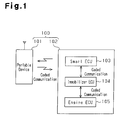
- An engine start enabling mechanism 100 shown in Fig. 1 includes a portable device 101 and a communication controller 102, which is installed in the vehicle.
- the communication controller 102 is provided with a smart ignition electronic control unit (smart ECU) 103, an immobilizer electronic control unit (immobilizer ECU) 104, and an engine control electronic control unit (engine ECU) 105.
- smart ECU smart ignition electronic control unit
- immobilizer ECU immobilizer ECU
- engine ECU engine control electronic control unit
- coded communications occur between the portable device 101 and the smart ECU 103, between the smart ECU 103 and the immobilizer ECU 104, and between the immobilizer ECU 104 and the engine ECU 105 to compare the identification codes.
- the engine ECU 105 enables the engine to start. Therefore, a high level of vehicle security is ensured.
- the present invention provides a vehicle security device and an identification management device, used by a vehicle security device, that improve vehicle security.
- Patent Document 1 Japanese Laid-Open Patent Publication No. 10-157571
- Patent Document 2 Japanese Laid-Open Patent Publication No. 2002-295089
- a first aspect of the present invention is a vehicle security device connected to a vehicle apparatus for communicating with a portable device.
- the security device includes a first communication means for performing a first coded communication to establish a first mutual authentication with the portable device.
- An ID code management means is connected to the first communication means, having a first code and a second code, and is incommunicable with the portable device.
- the ID code management means performs a second coded communication for establishing a second mutual authentication with the first communication means using the first code.
- a second communication means performs a third coded communication to establish mutual authentication with the ID code management means using the second code.
- the second communication means enables the operation of the vehicle apparatus when every one of the first, second, and third mutual authentications have been established.
- a second aspect of the present invention is a vehicle security device connected to a vehicle apparatus for communicating with a portable device having a portable device code.
- the security device includes a first electronic control unit, having a vehicle code and a first code, for receiving the portable device code from the portable device.
- An ID code box connected to the first electronic control unit and having a first code and a second code, exchanges the first codes with the first electronic control unit.
- a second electronic control unit having a second code, exchanges the second codes with the ID code box.
- the second electronic control unit enables the vehicle apparatus to operate when the portable device code matches the vehicle code, the first code of the first electronic control unit matches the first code of the ID code box, and the second code of the ID code box matches the second code of the second electronic control unit.
- a third aspect of the present invention is an ID code management device for use in a vehicle security device connected to a vehicle apparatus.
- the vehicle security device includes a first communication means for performing a first coded communication to establish a first mutual authentication with the portable device.
- a second communication means disables operation of the vehicle apparatus when the first mutual authentication is not established.
- the ID code management device manages a first code and a second code without communicating with the portable device, performs a second coded communication using the first code to establish a second mutual authentication with the first communication means, and performs a third coded communication using the second code to establish a third mutual authentication with the second communication means.
- the vehicle security device disables the operation of the vehicle apparatus when the third mutual authentication is not established.
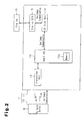
- a vehicle security device 11 according to an embodiment of the present invention will now be described in detail with reference to Fig. 2.
- a vehicle theft prevention system 1 includes a portable device 10, which has a communication function and is carried by a user, and a vehicle security device 11, which is installed in a vehicle.
- the vehicle security device 11 (specifically, a transceiver unit 12 of the vehicle security device 11) transmits a request signal to the portable device 10.
- the portable device 10 has a portable device code unique (differing between portable devices) to the portable device 10.
- the portable device 10 encodes a code signal included in the portable device code and transmits the encoded code signal in response to the request signal transmitted from the vehicle security device 11.
- the vehicle security device 11 is connected to a transceiver unit 12, a smart ECU 13 functioning as a first communications means, ID code box 14 functioning as an ID code management means, and an engine ECU 15 functioning as a second communication means and connected to the ID code box 14.
- a transceiver unit 12 the smart ECU 13 functioning as a first communications means
- ID code box 14 functioning as an ID code management means
- an engine ECU 15 functioning as a second communication means and connected to the ID code box 14.
- at least the ID code box 14 and the engine ECU 15 are installed at locations from which they cannot be easily removed from the vehicle.
- the transceiver unit 12, the smart ECU 13, the ID code box 14, and the engine ECU 15 are connected by wires.
- the smart ECU 13 includes a plurality of connectors connected to a plurality of control units (none shown), such as a body ECU for controlling a steering lock mechanism or lock and unlocking a door.
- the smart ECU 13 is provided with a smart ECU function and an immobilizer function of the conventional vehicle security device (engine start enabling mechanism).
- the smart ECU 13 provides a request signal for requesting the transmission of the portable device code to the transceiver unit 12.
- the transceiver unit 12 includes an antenna and a vehicle transceiver circuit (not shown).
- the transceiver unit 12 receives the signal transmitted from the portable device 10, demodulates the reception signal, and provides the demodulated reception signal to the smart ECU 13.
- the transceiver unit 12 receives a request signal from the smart ECU 13, the request signal is modulated and a modulated request signal is transmitted via the antenna.
- the smart ECU 13, the ID code box 14, and the engine ECU 15 include CPUs (not shown).
- the smart ECU 13 includes a volatile memory 13a (for example, RAM) and functions as a storage means.
- the memory 13a stores beforehand a first code used for verification. Further, the smart ECU 13 has a vehicle code unique (differing between vehicle security devices) to the vehicle security device 11.
- the smart ECU 13 decodes the reception signal provided from the transceiver unit 12. Then, the smart ECU 13 compares the portable device code of the portable device 10 included in the reception signal with its own vehicle code. In this manner, mutual authentication is performed through communication between the portable device 10 and the smart ECU 13 with coded signals (first coded communication) via the transceiver unit 12. When mutual authentication is established in the first coded communication by the matching of the portable device code and the vehicle code, the smart ECU 13 determines that the portable device 10 is authentic.
- the ID code box 14 does not communicate with the portable device 10.
- the ID code box 14 includes a communication circuit, a CPU, and a nonvolatile memory (none shown).
- the ID code box 14 does not include circuits for controlling vehicle apparatuses (e.g., doors, an engine 16, and car audio device).
- the memory of the ID code box 14 stores one or more codes used to perform mutual authentication with other devices.
- the memory of the ID code box 14 stores a first code and a second code.
- the memory of the ID code box 14 may also store a vehicle code in addition to the first code and second code.
- a second coded communication is performed between the smart ECU 13 and the ID code box 14 to compare a first code of the smart ECU 13 and the first code of the ID code box 14 and perform mutual authentication.
- the mutual authentication may be conducted by either the smart ECU 13 or the ID code box 14.
- the engine ECU 15 stores a second code.
- a third coded communication is performed between the engine ECU 15 and the ID code box 14 to compare the second code of the ID code box 14 and the second code of the engine ECU 15 and perform mutual authentication.
- the mutual authentication may be conducted by either the engine ECU 15 or the ID code box 14.
- the communication circuit of the ID code box 14 transmits or receives the first code used in mutual authentication of the smart ECU 13 based on instructions of the CPU. Furthermore, in the third coded communication between the engine ECU 15 and the ID code box 14, the communication circuit transmits or receives the second code used for mutual authentication of the engine ECU 15 based on instructions of the CPU.
- the engine ECU 15 is connected to the engine 16 (vehicle apparatus) to control the engine 16.
- the engine ECU 15 enables the engine 16 to start when mutual authentication has been established in every one of the first coded communication, the second coded communication, and the third coded communication. That is, the engine ECU 15 verifies whether or not mutual authentication has been established between the portable device 10 and the smart ECU 13, mutual authentication has been established between the smart ECU 13 and the ID code box 14, and mutual authentication has been established between the ID code box 14 and the engine ECU 15 to enable the engine 16 to start when all mutual authentications have been established.
- the engine ECU 15 enables the engine 16 to start.
- the memory 13a of the smart ECU 13 is volatile. Accordingly, the first code stored in the memory 13a is erased when the supply of power to the smart ECU 13 is instantaneously cut. Thereafter, when power is supplied, the smart ECU 13 generates the first code through a calculation formula unique to the smart ECU 13 (differing between smart ECUs) with the vehicle code (third code), which is used in the first coded communication. Therefore, the second coded communication is performed and the user may start the engine 16 to drive the vehicle even during an unexpected circumstance such as instantaneous interruption of battery power.
- the first code is erased from the memory 13a in the same manner as when an instantaneous battery power interruption occurs. Therefore, the first code cannot be obtained by analyzing the removed smart ECU 13. Thus, it is impossible to obtain the first code through an unauthorized means.
- the smart ECU 13 when the power supply is cut and then the power is restored, the smart ECU 13 generates the first code using the calculation formula.
- the calculation formula used at this time differs for each smart ECU. Accordingly, when the smart ECU 13 is exchanged, the first code generated by the exchanged smart ECU 13 differs from the first code generated by the original smart ECU 13. Thus, the second coded communication cannot be established. Consequently, the engine ECU 15 disables the starting of the engine 16. That is, when a third person exchanges the smart ECU in an unauthorized manner, the third person cannot drive the vehicle.
- the ID code box 14 is provided with a nonvolatile memory. Therefore, the first code and second code stored in the memory of the ID code box 14 cannot be erased and is saved even when power is not supplied to the ID code box 14 due to, for example, an instantaneous battery power interruption.
- the vehicle security device 11 of the present embodiment has the advantages described below.
- the smart ECU 13 and the engine ECU 15 are connected to the ID code box 14.
- the connection layout of each element in the vehicle security device 11 is not limited to the connection layout shown in Fig. 2.
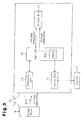
- the engine ECU 15 may be connected to a smart ECU 32 as shown in Fig. 3.
- the smart ECU 32 is provided with a function for performing mutual authentication through a first coded communication and mutual authentication through a second coded communication.
- the smart ECU 32 also mediates mutual authentication through a third coded communication between the engine ECU 15 and the ID code box 14.
- the smart ECU 32 is provided with a volatile memory 32a, which functions as a storage means.
- the smart ECU 32 provides a reception signal from the engine ECU 15 to the ID code box 14 via the memory 32a. Furthermore, the smart ECU 32 provides a signal received from the ID code box 14 to the engine ECU 15 via the memory 32a.
- the smart ECU 32 mediates mutual authentication for the third coded communication. That is, the smart ECU 32 uses the memory 32a as a buffer to mediate mutual authentication through the third coded communication.
- the vehicle security device 31 prevents unauthorized establishment of the mutual authentication between the ID code box 14 and the engine ECU 15 and maintains the security level of the vehicle. Moreover, there are more options for the connection layout of the structural elements in the vehicle security device while the vehicle security level is maintained.
- the ID code box 14 Since the ID code box 14 is only connected to the smart ECU 32, the ID code box 14 has fewer connectors. The ID code box 14 therefore has a relatively simple structure. Accordingly, the ID code box 14 can be made more compact. This facilitates installation of the ID code box 14 at a location from which it is difficult to remove from the vehicle.
- the smart ECU 13 of the present embodiment generates a first code by performing a calculation with the vehicle code in order to establish the second coded communication and stores the generated first code in the volatile memory 13a.
- the smart ECU 13 does need not to store the generated first code in the memory 13a. In such a case, the smart ECU 13 generates a first code by performing a calculation each time the second coded communication is performed.
- the third coded communication is performed between the ID code box 14 and the engine ECU 15.
- the ECU that performs the third coded communication with the ID code box 14 is not limited to the engine ECU 15.
- the vehicle security device may include a steering lock ECU connected to the ID code box 14, and the third coded communication may be performed between the ID code box 14 and the steering lock ECU.
- the steering lock ECU unlocks the steering wheel when mutual authentication is established in all coded communications, including the first coded communication, the second coded communication, and the third coded communication.
- a second communication means connected to the ID code box 14 may be any ECU having the capability to restrict driving of the vehicle.
- the functions of the smart ECU and the functions of the immobilizer ECU are integrated in the smart ECU 13.
- the smart ECU and the immobilizer ECU may be provided separately as in a conventional vehicle security device.
- the second coded communication is performed between the ID code box 14 and the smart ECU 32 and between the ID code box 14 and the immobilizer ECU. This increases the number of coded communications necessary to enable the starting of the engine 16 in comparison to the conventional device. Therefore, the security level of the vehicle is improved.
- the second communication means is not limited to the engine ECU 15.
- the second communication means may also be a door ECU for controlling the raising and lowering of the window glass.
- the door ECU enables the raising and lowering of the window glass when mutual authentications have been established in all mutual authentications including the first coded communication, the second coded communication, and the third coded communication.
- the second communication means may also be a CPU (ECU) for controlling the operation of a car audio device. In such cases, the CPU enables the operation of the power window or the operation of the car audio device when mutual authentication is established for all mutual authentications including the first through third coded communications. This prevents unauthorized use of these vehicle apparatuses by a third person.
- the second communication means may also be a shift-lock CPU (ECU) for controlling the locking of the shift lever in a non-driving position (parking position or neutral position) or a tire-lock CPU (ECU) for controlling the locking of the tires.
- ECU shift-lock CPU
- the shift-lock CPU releases the lock on the shift level and enables the vehicle to be driven when mutual authentication has been established in all of the coded communications including the first through third coded communications.
- the tire-lock CPU releases the lock on the tires and enables the vehicle to be driven when mutual authentication has been established in all of the coded communications including the first through third coded communications.
- the driving of the vehicle is disabled. Accordingly, vehicle theft is prevented, and the vehicle security level is further improved.
Landscapes
- Engineering & Computer Science (AREA)
- Mechanical Engineering (AREA)
- Lock And Its Accessories (AREA)
- Combined Controls Of Internal Combustion Engines (AREA)
Abstract
Description
[Patent Document 1] Japanese Laid-Open Patent Publication No. 10-157571
[Patent Document 2] Japanese Laid-Open Patent Publication No. 2002-295089
Claims (11)
- A vehicle security device connected to a vehicle apparatus for communicating with a portable device, the security device being characterized by:a first communication means for performing a first coded communication to establish a first mutual authentication with the portable device;an ID code management means connected to the first communication means, having a first code and a second code, and being incommunicable with the portable device, the ID code management means performing a second coded communication for establishing a second mutual authentication with the first communication means using the first code; anda second communication means for performing a third coded communication to establish mutual authentication with the ID code management means using the second code, the second communication means enabling the operation of the vehicle apparatus when every one of the first, second, and third mutual authentications have been established.
- The vehicle security device according to claim 1 characterized in that the second communication means enables the vehicle to be driven when all of the first, second, and third mutual authentications are established.
- The vehicle security device according to claim 1 or 2, characterized in that the first communication means includes a volatile storage means for storing the first code.
- The vehicle security device according to any one of claims 1 to 3, characterized in that the second communication means includes a nonvolatile storage means for storing the first code and the second code.
- The vehicle security device according to any one of claims 1 to 4, characterized in that the first communication means generates a first code using a calculation formula, unique to the first communication device, and a third code.
- The vehicle security device according to any one of claims 1 to 5, characterized in that:the vehicle apparatus includes an engine; andthe second communication means enables the engine to be started when all of the first, second, and third mutual authentications have been established.
- The vehicle security device according to any one of claims 1 to 6, characterized in that:the first communication means includes a volatile storage means for storing a signal; andthe second communication means and the ID code management means sends and receives the signal via the storage means.
- The vehicle security device according to any one of claims 1 to 7, characterized in that the first communication means includes an electronic control unit used for smart ignition.
- The vehicle security device according to any one of claims 1 to 8, wherein the second communication means includes an electronic control unit used for engine control.
- A vehicle security device connected to a vehicle apparatus for communicating with a portable device having a portable device code, the security device being
characterized by:a first electronic control unit, having a vehicle code and a first code, for receiving the portable device code from the portable device;an ID code box, connected to the first electronic control unit and having a first code and a second code, for exchanging the first codes with the first electronic control unit; anda second electronic control unit, having a second code, for exchanging the second codes with the ID code box, the second electronic control unit enabling the vehicle apparatus to operate when the portable device code matches the vehicle code, the first code of the first electronic control unit matches the first code of the ID code box, and the second code of the ID code box matches the second code of the second electronic control unit. - An ID code management device for use in a vehicle security device connected to a vehicle apparatus, the vehicle security device being characterized by:a first communication means for performing a first coded communication to establish a first mutual authentication with the portable device, and a second communication means for disabling operation of the vehicle apparatus when the first mutual authentication is not established;the ID code management device managing a first code and a second code without communicating with the portable device, performing a second coded communication using the first code to establish a second mutual authentication with the first communication means, and performing a third coded communication using the second code to establish a third mutual authentication with the second communication means; andthe vehicle security device disables the operation of the vehicle apparatus when the third mutual authentication is not established.
Applications Claiming Priority (3)
| Application Number | Priority Date | Filing Date | Title |
|---|---|---|---|
| JP2003374654A JP4156493B2 (en) | 2003-11-04 | 2003-11-04 | Vehicle security device and ID code management device |
| JP2003374654 | 2003-11-04 | ||
| PCT/JP2004/016309 WO2005042317A1 (en) | 2003-11-04 | 2004-11-04 | Vehicle security device and id code management device |
Publications (3)
| Publication Number | Publication Date |
|---|---|
| EP1602539A1 true EP1602539A1 (en) | 2005-12-07 |
| EP1602539A4 EP1602539A4 (en) | 2009-05-06 |
| EP1602539B1 EP1602539B1 (en) | 2011-06-29 |
Family
ID=34544217
Family Applications (1)
| Application Number | Title | Priority Date | Filing Date |
|---|---|---|---|
| EP20040799488 Expired - Lifetime EP1602539B1 (en) | 2003-11-04 | 2004-11-04 | Vehicle security device and id code management device |
Country Status (6)
| Country | Link |
|---|---|
| US (1) | US7327227B2 (en) |
| EP (1) | EP1602539B1 (en) |
| JP (1) | JP4156493B2 (en) |
| KR (1) | KR100687915B1 (en) |
| CN (2) | CN2787784Y (en) |
| WO (1) | WO2005042317A1 (en) |
Families Citing this family (44)
| Publication number | Priority date | Publication date | Assignee | Title |
|---|---|---|---|---|
| JP4156493B2 (en) * | 2003-11-04 | 2008-09-24 | 株式会社東海理化電機製作所 | Vehicle security device and ID code management device |
| JP2006117086A (en) * | 2004-10-21 | 2006-05-11 | Matsushita Electric Ind Co Ltd | Vehicle antitheft device |
| JP2006321453A (en) * | 2005-05-20 | 2006-11-30 | Yamaha Motor Co Ltd | Vehicle control device for saddle riding type vehicle |
| JP2006321452A (en) | 2005-05-20 | 2006-11-30 | Yamaha Motor Co Ltd | Vehicle control device for saddle riding type vehicle |
| JP4716428B2 (en) * | 2006-03-31 | 2011-07-06 | 本田技研工業株式会社 | Vehicle antitheft device |
| JP2007334825A (en) * | 2006-06-19 | 2007-12-27 | Denso Corp | Vehicle position information notification system. |
| JP4366382B2 (en) * | 2006-08-02 | 2009-11-18 | 株式会社東海理化電機製作所 | Charging system |
| JP2008109205A (en) * | 2006-10-23 | 2008-05-08 | Tokai Rika Co Ltd | Cipher communication apparatus |
| KR100803060B1 (en) * | 2006-10-30 | 2008-02-18 | 현대자동차주식회사 | Immobilizer Reinforcement System Using Body Authentication Module and Its Method |
| KR100916343B1 (en) * | 2007-07-30 | 2009-09-11 | 동아대학교 산학협력단 | Automobile engine starting device and method using the start button |
| JP4842907B2 (en) * | 2007-10-04 | 2011-12-21 | 本田技研工業株式会社 | Immobilizer device |
| JP2009097241A (en) * | 2007-10-17 | 2009-05-07 | Tokai Rika Co Ltd | Security system for vehicle |
| CN101159555B (en) * | 2007-11-08 | 2011-03-02 | 中兴通讯股份有限公司 | Motor vehicle starting method and system |
| DE102008005309A1 (en) * | 2008-01-21 | 2009-07-23 | Bayerische Motoren Werke Aktiengesellschaft | Wiring system of a motor vehicle with an authentication device |
| JP5081103B2 (en) * | 2008-08-22 | 2012-11-21 | ヤマハ発動機株式会社 | Ship theft deterrent device and ship equipped with the same |
| US8327153B2 (en) | 2009-12-04 | 2012-12-04 | Electronics And Telecommunications Research Institute | Method and system for verifying software platform of vehicle |
| IT1399197B1 (en) * | 2010-03-30 | 2013-04-11 | St Microelectronics Srl | SYSTEM TO IDENTIFY THE COMPONENTS OF A VEHICLE |
| CN101863229A (en) * | 2010-06-04 | 2010-10-20 | 奇瑞汽车股份有限公司 | Engine start switch |
| US9079494B2 (en) | 2010-07-01 | 2015-07-14 | Mill Mountain Capital, LLC | Systems, devices and methods for vehicles |
| WO2012043167A1 (en) * | 2010-09-27 | 2012-04-05 | 日本電気株式会社 | Information processing system, method for checking vehicle, and program for checking vehicle |
| US10194017B2 (en) * | 2011-12-12 | 2019-01-29 | Mill Mountain Capital, LLC | Systems, devices and methods for vehicles |
| WO2013090282A1 (en) * | 2011-12-12 | 2013-06-20 | Clay Skelton | Systems, devices and methods for vehicles |
| CN103166943A (en) * | 2011-12-19 | 2013-06-19 | 北汽福田汽车股份有限公司 | Method and system for encryption transmission electronic control unit (ECU) objective file |
| JP5887948B2 (en) * | 2012-01-20 | 2016-03-16 | マツダ株式会社 | Vehicle authentication system |
| US8799657B2 (en) | 2012-08-02 | 2014-08-05 | Gm Global Technology Operations, Llc | Method and system of reconstructing a secret code in a vehicle for performing secure operations |
| US9571284B2 (en) * | 2014-03-13 | 2017-02-14 | GM Global Technology Operations LLC | Controlling access to personal information stored in a vehicle using a cryptographic key |
| KR101664883B1 (en) * | 2014-11-12 | 2016-10-12 | 현대오트론 주식회사 | Method for interworking electronic control device of vehicle and apparatus thereof |
| CN106256616B (en) * | 2015-06-19 | 2018-10-19 | 株式会社三国 | vehicle anti-theft device |
| JP6217728B2 (en) * | 2015-10-19 | 2017-10-25 | トヨタ自動車株式会社 | Vehicle system and authentication method |
| KR101877602B1 (en) * | 2015-10-20 | 2018-07-11 | 현대자동차주식회사 | Security method and apparatus for electric vehicle power transfer system |
| CN105235642B (en) * | 2015-10-28 | 2018-09-25 | 铁将军汽车电子股份有限公司 | Control instruction safety execution method and automobile burglar alarm host |
| WO2017172871A1 (en) * | 2016-03-31 | 2017-10-05 | Spectrum Brands, Inc. | Locking device with multiple authentication devices |
| CN106101111B (en) * | 2016-06-24 | 2019-10-25 | 郑州信大捷安信息技术股份有限公司 | Vehicle electronics safe communication system and communication means |
| KR102642924B1 (en) * | 2016-12-07 | 2024-03-04 | 삼성전자주식회사 | Method and apparatus for operating a vehicle |
| IT201700007911A1 (en) * | 2017-01-25 | 2018-07-25 | Prinoth Spa | TRACKED VEHICLE AND FLEET OF TRACKED VEHICLES |
| JP7037748B2 (en) * | 2018-01-26 | 2022-03-17 | トヨタ自動車株式会社 | Electronic control unit and connection authentication method |
| US10155499B1 (en) * | 2018-02-12 | 2018-12-18 | Ford Global Technologies, Llc | Methods and apparatus to facilitate vehicle locking |
| JP7057944B2 (en) * | 2018-11-15 | 2022-04-21 | 株式会社東海理化電機製作所 | Authentication system and authentication method |
| JP7191319B2 (en) * | 2018-12-05 | 2022-12-19 | 朝日電装株式会社 | wireless communication system |
| DE112020001900T5 (en) * | 2019-04-12 | 2021-12-30 | Kabushiki Kaisha Tokai Rika Denki Seisakusho | Communication system and communication device |
| JP7465127B2 (en) * | 2019-04-12 | 2024-04-10 | 株式会社東海理化電機製作所 | Communication system and communication device |
| WO2021156891A1 (en) * | 2020-02-05 | 2021-08-12 | SUNDARAM, Rajarajeswari | Electronic signal based authentication system and method thereof |
| US11945447B2 (en) * | 2020-02-13 | 2024-04-02 | Toyota Motor North America, Inc. | Transport boundary expansion |
| CN111469803B (en) * | 2020-05-06 | 2022-05-17 | 浙江吉利新能源商用车集团有限公司 | An anti-theft system and anti-theft method for a vehicle |
Family Cites Families (12)
| Publication number | Priority date | Publication date | Assignee | Title |
|---|---|---|---|---|
| JPH0886130A (en) | 1994-09-14 | 1996-04-02 | Omron Corp | Electronic key and vehicle theft prevention system using the same |
| US6359547B1 (en) * | 1994-11-15 | 2002-03-19 | William D. Denison | Electronic access control device |
| JPH10140900A (en) * | 1996-09-13 | 1998-05-26 | Tokai Rika Co Ltd | Immobilizer system mounting vehicle and member used for immobilizer system |
| JPH10157571A (en) | 1996-12-02 | 1998-06-16 | Tokai Rika Co Ltd | Immobilizer system for automobile |
| JP3256666B2 (en) | 1996-12-25 | 2002-02-12 | 三菱電機株式会社 | Vehicle remote control device and vehicle security device |
| US6144112A (en) * | 1998-10-15 | 2000-11-07 | Ford Global Technologies, Inc. | Fuel pump immobilization |
| DE19960958B4 (en) * | 1999-12-17 | 2004-10-07 | Robert Bosch Gmbh | Anti-theft device |
| JP2002295089A (en) | 2001-03-29 | 2002-10-09 | Tokai Rika Co Ltd | Engine start permission mechanism with key cylinder |
| JP4071450B2 (en) * | 2001-04-02 | 2008-04-02 | 矢崎総業株式会社 | Rolling code generation method and vehicle control apparatus using rolling code |
| JP3810280B2 (en) | 2001-04-04 | 2006-08-16 | 三井金属鉱業株式会社 | Latch device for vehicle tailgate |
| JP4705317B2 (en) * | 2003-04-16 | 2011-06-22 | 株式会社東海理化電機製作所 | Switch device, security system |
| JP4156493B2 (en) * | 2003-11-04 | 2008-09-24 | 株式会社東海理化電機製作所 | Vehicle security device and ID code management device |
-
2003
- 2003-11-04 JP JP2003374654A patent/JP4156493B2/en not_active Expired - Lifetime
-
2004
- 2004-11-04 WO PCT/JP2004/016309 patent/WO2005042317A1/en not_active Ceased
- 2004-11-04 KR KR20057013239A patent/KR100687915B1/en not_active Expired - Lifetime
- 2004-11-04 EP EP20040799488 patent/EP1602539B1/en not_active Expired - Lifetime
- 2004-11-04 CN CNU2004200096684U patent/CN2787784Y/en not_active Expired - Lifetime
- 2004-11-04 US US10/542,282 patent/US7327227B2/en not_active Expired - Lifetime
- 2004-11-04 CN CNB2004800019303A patent/CN100420596C/en not_active Expired - Lifetime
Also Published As
| Publication number | Publication date |
|---|---|
| US7327227B2 (en) | 2008-02-05 |
| JP2005138633A (en) | 2005-06-02 |
| WO2005042317A1 (en) | 2005-05-12 |
| EP1602539B1 (en) | 2011-06-29 |
| CN1723142A (en) | 2006-01-18 |
| US20060152348A1 (en) | 2006-07-13 |
| KR20060017484A (en) | 2006-02-23 |
| CN100420596C (en) | 2008-09-24 |
| CN2787784Y (en) | 2006-06-14 |
| EP1602539A4 (en) | 2009-05-06 |
| KR100687915B1 (en) | 2007-02-27 |
| JP4156493B2 (en) | 2008-09-24 |
Similar Documents
| Publication | Publication Date | Title |
|---|---|---|
| US7327227B2 (en) | Vehicle security device and ID code management device | |
| EP1564690B1 (en) | Security control system for managing registration of ID codes for portable devices | |
| US8884739B2 (en) | Vehicle security apparatus and system which prevents unauthorized use of a vehicle by immobilization | |
| US7466216B2 (en) | Security control system | |
| US6127922A (en) | Vehicle security system with remote systems control | |
| US8978109B2 (en) | Electronic control device for a vehicle | |
| JP5170177B2 (en) | Vehicle anti-theft device | |
| US9352723B2 (en) | Theft prevention device and theft prevention method | |
| EP1000826B1 (en) | Remote control system for a motor vehicle | |
| JP2004042741A (en) | Electronic controller for vehicle with theft prevention function | |
| US20070228827A1 (en) | Synchronous or asynchronous multi layer data link communication between a multi-functional data bus interface and a transponder bypass for automotive aftermarket security system and/or remote car starter | |
| JP2008163935A (en) | Starting control apparatus and tuner device | |
| JP4988648B2 (en) | Vehicle security device | |
| JP2008273520A (en) | Engine start controlling system | |
| JP2009033264A (en) | Vehicle data communication system and vehicle | |
| JP7445256B2 (en) | Vehicle wireless authentication system | |
| JP2006120072A (en) | Cardless ETC in-vehicle device and in-vehicle system | |
| KR100513622B1 (en) | System and method for making a card invalid in a smart card system | |
| JP2009161147A (en) | Theft prevention device and vehicle security system | |
| JP2007051453A (en) | Vehicular keyless device | |
| JP2006213286A (en) | Vehicle start control device | |
| KR100762923B1 (en) | Immobilizer bypass module and electronic certification system | |
| CA2578562A1 (en) | Synchronous or asynchronous multi layer data link communication between a multi-functional data bus interface and transponder bypass for automotive aftermarket security system and/or remote car starter | |
| KR20070078431A (en) | How to Start a Vehicle | |
| JP2004250965A (en) | Fail-safe method in losing keyless remote control |
Legal Events
| Date | Code | Title | Description |
|---|---|---|---|
| PUAI | Public reference made under article 153(3) epc to a published international application that has entered the european phase |
Free format text: ORIGINAL CODE: 0009012 |
|
| 17P | Request for examination filed |
Effective date: 20050708 |
|
| AK | Designated contracting states |
Kind code of ref document: A1 Designated state(s): AT BE BG CH CY CZ DE DK EE ES FI FR GB GR HU IE IS IT LI LU MC NL PL PT RO SE SI SK TR |
|
| AX | Request for extension of the european patent |
Extension state: AL HR LT LV MK YU |
|
| DAX | Request for extension of the european patent (deleted) | ||
| RBV | Designated contracting states (corrected) |
Designated state(s): DE FR GB IT |
|
| A4 | Supplementary search report drawn up and despatched |
Effective date: 20090402 |
|
| 17Q | First examination report despatched |
Effective date: 20090617 |
|
| GRAP | Despatch of communication of intention to grant a patent |
Free format text: ORIGINAL CODE: EPIDOSNIGR1 |
|
| GRAC | Information related to communication of intention to grant a patent modified |
Free format text: ORIGINAL CODE: EPIDOSCIGR1 |
|
| GRAS | Grant fee paid |
Free format text: ORIGINAL CODE: EPIDOSNIGR3 |
|
| GRAA | (expected) grant |
Free format text: ORIGINAL CODE: 0009210 |
|
| AK | Designated contracting states |
Kind code of ref document: B1 Designated state(s): DE FR GB IT |
|
| REG | Reference to a national code |
Ref country code: GB Ref legal event code: FG4D |
|
| REG | Reference to a national code |
Ref country code: DE Ref legal event code: R096 Ref document number: 602004033310 Country of ref document: DE Effective date: 20110825 |
|
| PLBE | No opposition filed within time limit |
Free format text: ORIGINAL CODE: 0009261 |
|
| STAA | Information on the status of an ep patent application or granted ep patent |
Free format text: STATUS: NO OPPOSITION FILED WITHIN TIME LIMIT |
|
| 26N | No opposition filed |
Effective date: 20120330 |
|
| REG | Reference to a national code |
Ref country code: DE Ref legal event code: R097 Ref document number: 602004033310 Country of ref document: DE Effective date: 20120330 |
|
| REG | Reference to a national code |
Ref country code: FR Ref legal event code: PLFP Year of fee payment: 12 |
|
| REG | Reference to a national code |
Ref country code: FR Ref legal event code: PLFP Year of fee payment: 13 |
|
| REG | Reference to a national code |
Ref country code: FR Ref legal event code: PLFP Year of fee payment: 14 |
|
| REG | Reference to a national code |
Ref country code: FR Ref legal event code: PLFP Year of fee payment: 15 |
|
| PGFP | Annual fee paid to national office [announced via postgrant information from national office to epo] |
Ref country code: GB Payment date: 20230928 Year of fee payment: 20 |
|
| PGFP | Annual fee paid to national office [announced via postgrant information from national office to epo] |
Ref country code: FR Payment date: 20230929 Year of fee payment: 20 |
|
| PGFP | Annual fee paid to national office [announced via postgrant information from national office to epo] |
Ref country code: IT Payment date: 20231010 Year of fee payment: 20 Ref country code: DE Payment date: 20230929 Year of fee payment: 20 |
|
| REG | Reference to a national code |
Ref country code: DE Ref legal event code: R071 Ref document number: 602004033310 Country of ref document: DE |
|
| REG | Reference to a national code |
Ref country code: GB Ref legal event code: PE20 Expiry date: 20241103 |
|
| PG25 | Lapsed in a contracting state [announced via postgrant information from national office to epo] |
Ref country code: GB Free format text: LAPSE BECAUSE OF EXPIRATION OF PROTECTION Effective date: 20241103 |
|
| PG25 | Lapsed in a contracting state [announced via postgrant information from national office to epo] |
Ref country code: GB Free format text: LAPSE BECAUSE OF EXPIRATION OF PROTECTION Effective date: 20241103 |