EP1602310A2 - Cleaning sheet - Google Patents
Cleaning sheet Download PDFInfo
- Publication number
- EP1602310A2 EP1602310A2 EP05253210A EP05253210A EP1602310A2 EP 1602310 A2 EP1602310 A2 EP 1602310A2 EP 05253210 A EP05253210 A EP 05253210A EP 05253210 A EP05253210 A EP 05253210A EP 1602310 A2 EP1602310 A2 EP 1602310A2
- Authority
- EP
- European Patent Office
- Prior art keywords
- cleaning
- sheet
- cleaning sheet
- viscoelastic polymer
- attachment surface
- Prior art date
- Legal status (The legal status is an assumption and is not a legal conclusion. Google has not performed a legal analysis and makes no representation as to the accuracy of the status listed.)
- Granted
Links
- 238000004140 cleaning Methods 0.000 title claims abstract description 152
- 229920000642 polymer Polymers 0.000 claims abstract description 48
- 238000003860 storage Methods 0.000 claims abstract description 13
- 239000007788 liquid Substances 0.000 claims description 61
- 230000002745 absorbent Effects 0.000 claims description 26
- 239000002250 absorbent Substances 0.000 claims description 26
- 229920001971 elastomer Polymers 0.000 claims description 22
- 239000000806 elastomer Substances 0.000 claims description 15
- JOYRKODLDBILNP-UHFFFAOYSA-N Ethyl urethane Chemical compound CCOC(N)=O JOYRKODLDBILNP-UHFFFAOYSA-N 0.000 claims description 8
- 239000005038 ethylene vinyl acetate Substances 0.000 claims description 7
- 239000005060 rubber Substances 0.000 claims description 7
- DQXBYHZEEUGOBF-UHFFFAOYSA-N but-3-enoic acid;ethene Chemical compound C=C.OC(=O)CC=C DQXBYHZEEUGOBF-UHFFFAOYSA-N 0.000 claims description 5
- 229920001200 poly(ethylene-vinyl acetate) Polymers 0.000 claims description 5
- 239000000243 solution Substances 0.000 claims description 5
- KAKZBPTYRLMSJV-UHFFFAOYSA-N Butadiene Chemical compound C=CC=C KAKZBPTYRLMSJV-UHFFFAOYSA-N 0.000 claims description 4
- RRHGJUQNOFWUDK-UHFFFAOYSA-N Isoprene Chemical compound CC(=C)C=C RRHGJUQNOFWUDK-UHFFFAOYSA-N 0.000 claims description 4
- PPBRXRYQALVLMV-UHFFFAOYSA-N Styrene Chemical compound C=CC1=CC=CC=C1 PPBRXRYQALVLMV-UHFFFAOYSA-N 0.000 claims description 4
- 239000000839 emulsion Substances 0.000 claims description 4
- 239000004816 latex Substances 0.000 claims description 4
- 229920000126 latex Polymers 0.000 claims description 4
- 229920001296 polysiloxane Polymers 0.000 claims description 3
- 229920003051 synthetic elastomer Polymers 0.000 claims description 2
- 239000005061 synthetic rubber Substances 0.000 claims description 2
- 125000000383 tetramethylene group Chemical group [H]C([H])([*:1])C([H])([H])C([H])([H])C([H])([H])[*:2] 0.000 claims description 2
- 229920001935 styrene-ethylene-butadiene-styrene Polymers 0.000 abstract 1
- 239000004745 nonwoven fabric Substances 0.000 description 27
- 239000000835 fiber Substances 0.000 description 15
- 230000000052 comparative effect Effects 0.000 description 14
- 239000010410 layer Substances 0.000 description 13
- 229920005989 resin Polymers 0.000 description 8
- 239000011347 resin Substances 0.000 description 8
- 239000004698 Polyethylene Substances 0.000 description 7
- 239000004743 Polypropylene Substances 0.000 description 7
- 229920000573 polyethylene Polymers 0.000 description 7
- 229920000139 polyethylene terephthalate Polymers 0.000 description 7
- 239000005020 polyethylene terephthalate Substances 0.000 description 7
- 229920001155 polypropylene Polymers 0.000 description 7
- 229920003002 synthetic resin Polymers 0.000 description 7
- 239000000057 synthetic resin Substances 0.000 description 7
- -1 styrene ethylene butylene styrene Chemical class 0.000 description 6
- 239000006260 foam Substances 0.000 description 5
- 239000000463 material Substances 0.000 description 5
- 230000000717 retained effect Effects 0.000 description 5
- XLYOFNOQVPJJNP-UHFFFAOYSA-N water Substances O XLYOFNOQVPJJNP-UHFFFAOYSA-N 0.000 description 5
- 238000010586 diagram Methods 0.000 description 4
- 239000000428 dust Substances 0.000 description 4
- 239000004820 Pressure-sensitive adhesive Substances 0.000 description 3
- 239000003795 chemical substances by application Substances 0.000 description 3
- 238000004049 embossing Methods 0.000 description 3
- 230000009477 glass transition Effects 0.000 description 3
- 238000007373 indentation Methods 0.000 description 3
- 229920003048 styrene butadiene rubber Polymers 0.000 description 3
- 229920000468 styrene butadiene styrene block copolymer Polymers 0.000 description 3
- 229920002725 thermoplastic elastomer Polymers 0.000 description 3
- 229920000459 Nitrile rubber Polymers 0.000 description 2
- 239000005062 Polybutadiene Substances 0.000 description 2
- 239000002174 Styrene-butadiene Substances 0.000 description 2
- 239000000853 adhesive Substances 0.000 description 2
- 230000001070 adhesive effect Effects 0.000 description 2
- 239000000470 constituent Substances 0.000 description 2
- 239000003599 detergent Substances 0.000 description 2
- 239000013013 elastic material Substances 0.000 description 2
- 229920001973 fluoroelastomer Polymers 0.000 description 2
- 238000009963 fulling Methods 0.000 description 2
- 238000010438 heat treatment Methods 0.000 description 2
- 239000012943 hotmelt Substances 0.000 description 2
- 229920003049 isoprene rubber Polymers 0.000 description 2
- 239000002245 particle Substances 0.000 description 2
- 229920002857 polybutadiene Polymers 0.000 description 2
- 229920000346 polystyrene-polyisoprene block-polystyrene Polymers 0.000 description 2
- 239000002904 solvent Substances 0.000 description 2
- 229920006132 styrene block copolymer Polymers 0.000 description 2
- 229920000247 superabsorbent polymer Polymers 0.000 description 2
- RLRINNKRRPQIGW-UHFFFAOYSA-N 1-ethenyl-2-[4-(2-ethenylphenyl)butyl]benzene Chemical compound C=CC1=CC=CC=C1CCCCC1=CC=CC=C1C=C RLRINNKRRPQIGW-UHFFFAOYSA-N 0.000 description 1
- 229920000297 Rayon Polymers 0.000 description 1
- 239000004676 acrylonitrile butadiene styrene Substances 0.000 description 1
- 238000007792 addition Methods 0.000 description 1
- 239000011230 binding agent Substances 0.000 description 1
- MTAZNLWOLGHBHU-UHFFFAOYSA-N butadiene-styrene rubber Chemical compound C=CC=C.C=CC1=CC=CC=C1 MTAZNLWOLGHBHU-UHFFFAOYSA-N 0.000 description 1
- 239000002131 composite material Substances 0.000 description 1
- 230000007423 decrease Effects 0.000 description 1
- 238000000151 deposition Methods 0.000 description 1
- 238000001704 evaporation Methods 0.000 description 1
- 239000004744 fabric Substances 0.000 description 1
- 230000005484 gravity Effects 0.000 description 1
- 230000002209 hydrophobic effect Effects 0.000 description 1
- 238000002347 injection Methods 0.000 description 1
- 239000007924 injection Substances 0.000 description 1
- 238000004519 manufacturing process Methods 0.000 description 1
- 230000007246 mechanism Effects 0.000 description 1
- 238000000034 method Methods 0.000 description 1
- 229920013716 polyethylene resin Polymers 0.000 description 1
- 229920006124 polyolefin elastomer Polymers 0.000 description 1
- 238000003825 pressing Methods 0.000 description 1
- 239000002964 rayon Substances 0.000 description 1
- 239000005871 repellent Substances 0.000 description 1
- 239000011115 styrene butadiene Substances 0.000 description 1
- 239000011345 viscous material Substances 0.000 description 1
Images



Classifications
-
- A—HUMAN NECESSITIES
- A47—FURNITURE; DOMESTIC ARTICLES OR APPLIANCES; COFFEE MILLS; SPICE MILLS; SUCTION CLEANERS IN GENERAL
- A47L—DOMESTIC WASHING OR CLEANING; SUCTION CLEANERS IN GENERAL
- A47L13/00—Implements for cleaning floors, carpets, furniture, walls, or wall coverings
- A47L13/10—Scrubbing; Scouring; Cleaning; Polishing
- A47L13/16—Cloths; Pads; Sponges
-
- A—HUMAN NECESSITIES
- A47—FURNITURE; DOMESTIC ARTICLES OR APPLIANCES; COFFEE MILLS; SPICE MILLS; SUCTION CLEANERS IN GENERAL
- A47L—DOMESTIC WASHING OR CLEANING; SUCTION CLEANERS IN GENERAL
- A47L13/00—Implements for cleaning floors, carpets, furniture, walls, or wall coverings
- A47L13/10—Scrubbing; Scouring; Cleaning; Polishing
- A47L13/20—Mops
-
- A—HUMAN NECESSITIES
- A47—FURNITURE; DOMESTIC ARTICLES OR APPLIANCES; COFFEE MILLS; SPICE MILLS; SUCTION CLEANERS IN GENERAL
- A47L—DOMESTIC WASHING OR CLEANING; SUCTION CLEANERS IN GENERAL
- A47L13/00—Implements for cleaning floors, carpets, furniture, walls, or wall coverings
- A47L13/10—Scrubbing; Scouring; Cleaning; Polishing
- A47L13/20—Mops
- A47L13/24—Frames for mops; Mop heads
- A47L13/254—Plate frames
- A47L13/256—Plate frames for mops made of cloth
-
- A—HUMAN NECESSITIES
- A47—FURNITURE; DOMESTIC ARTICLES OR APPLIANCES; COFFEE MILLS; SPICE MILLS; SUCTION CLEANERS IN GENERAL
- A47L—DOMESTIC WASHING OR CLEANING; SUCTION CLEANERS IN GENERAL
- A47L13/00—Implements for cleaning floors, carpets, furniture, walls, or wall coverings
- A47L13/10—Scrubbing; Scouring; Cleaning; Polishing
- A47L13/42—Details
- A47L13/44—Securing scouring-cloths to the brush or like body of the implement
Definitions
- the present invention relates to a cleaning sheet which is intended to be used for cleaning a floor surface or the like when attached to a cleaning head of a mop-like cleaning device, and more particularly to a cleaning sheet which is resistant to slipping relative to a bottom face of the cleaning head.
- cleaning sheets which may be used for cleaning the house floor when attached to a cleaning head of a mop-like cleaning device.
- Such conventional cleaning sheets are typically constructed of a single nonwoven fabric or by layering two or more nonwoven fabrics on top of one another and used in a dry state or in a wet state with water or detergent contained in a liquid absorbent layer.
- they are preferably disposable and easy to attach to and detach from the cleaning head of the cleaning device.
- Japanese Examined Patent Publication No. S62-013008 discloses a loop tape of a Velcro fastener secured on either a cleaning head or a cleaning member to be attached to the cleaning head and a hook tape of the Velcro fastener secured on the other.
- Japanese Utility-Model Registration No. 2507300 discloses retainers which are slashed sheets and disposed on a top face of a cleaning head. By tucking a part of a cleaning sheet into cuts of the retainers, the cleaning sheet can be retained on the cleaning head.
- Japanese Unexamined Patent Publication No. H09-187411 discloses clamp members pivotally mounted on a top face of a cleaning head. By clamping a part of a cleaning sheet between the clamp members and the cleaning head, the cleaning sheet can be retained on the cleaning head.
- Japanese Unexamined Patent Publication No. H09-075284 discloses a pressure-sensitive adhesive layer (or sticky layer) disposed on a bottom face or top face of a cleaning head for retaining a cleaning sheet on the bottom face.
- the mechanisms disclosed in Utility-Model Registration No. 2507300 and Patent Publication No. H09-187411 are suitable for use with a disposable cleaning sheet.
- the cleaning sheet is retained such that its central portion is laid on the bottom face of the cleaning head and its side portions are folded back and secured on the top face of the cleaning head.
- the central portion of the cleaning sheet which is laid on the bottom face of the cleaning head, tends to slip and shift by the friction between the cleaning sheet and the floor surface or the like during cleaning.
- the bottom face of the cleaning head may be made of a material having a relatively high coefficient of friction such as urethane foam resin, but even in this case, it is still difficult to prevent slipping between the cleaning head and the cleaning sheet if the frictional resistance between the cleaning sheet and the floor surface is high.
- the pressure-sensitive adhesive layer disclosed in Patent Publication No. H09-075284 is not practical because its adhesion decreases with the passage of time and also by dirt or dust adhering to the pressure-sensitive adhesive layer.
- the present invention has been developed to solve the problems in the prior art set forth above and has an object to provide a cleaning sheet which is effective in preventing slipping relative to a bottom face of a cleaning head.
- a cleaning sheet comprising: a main body having an attachment surface to be applied to a cleaning head of a cleaning device and a cleaning surface opposite the attachment surface; and attachment portions to be engaged to the cleaning head, wherein the attachment surface has a viscoelastic polymer for preventing slipping.
- the viscoelasticity is effective in preventing slipping of the cleaning sheet relative to the cleaning head, the cleaning sheet can remain stationary with respect to the cleaning head even if the frictional resistance between the cleaning sheet and the floor surface or the like is high.
- the viscoelastic polymer may be selected from the group consisting of rubber-based elastomers, silicone-based elastomers and urethane-based elastomers.
- the viscoelastic polymer may be a synthetic rubber comprising styrene and at least one of butylene, butadiene and isoprene.
- the viscoelastic polymer is applied to the attachment surface in a hot, molten state.
- the viscoelastic polymer may be applied to the attachment surface in an emulsion, latex or solution state.
- the viscoelastic polymer in a hot, molten state can be applied efficiently for mass production.
- the viscoelastic polymer in an emulsion, latex or solution state can be uniformly applied to the attachment surface of the cleaning sheet in a relatively small amount.
- the viscoelastic polymer has a storage modulus of 10 4 to 10 6 (Pa) over a temperature range between -20°C and 40°C.
- Pa storage modulus
- the viscoelasticity remains stable over the temperature range for practical use. Accordingly, the viscoelastic polymer is effective in preventing slipping in both hot and cold conditions.
- the viscoelastic polymer preferably has a peak value of loss tangent (tan ⁇ ) below -20°C. If the viscoelastic polymer has a peak value of tan ⁇ above -20°C, it means that the glass transition temperature is above -20°C.
- the viscoelastic polymer has a loop-tack strength equal to or less than 10 ounces. If the loop-tack strength is equal to or less than 10 ounces, the attachment surface feels less tacky to the touch. More preferably, the loop-tack strength is equal to or less than 5 ounces.
- the attachment surface may be intended to be applied to a bottom face of the cleaning head which is made of ethylene-vinyl acetate (EVA). Since the viscoelastic polymer is effective in preventing slipping, the cleaning head may be made of EVA, which has a lower coefficient of friction than urethane foam resin but is superior in water resistance to urethane foam resin.
- EVA ethylene-vinyl acetate
- the cleaning sheet may comprise a liquid absorbent sheet which enables cleaning with liquid absorbed in the cleaning sheet.
- Fig. 1 is a bottom view showing a cleaning surface of a cleaning sheet 1 according to one embodiment of the present invention
- Fig. 2 is a sectional view taken along line II-II of Fig. 1
- Fig. 3 is an exploded perspective view of the cleaning sheet 1
- Fig. 4 is a perspective view showing a state where the cleaning sheet 1 is attached to a cleaning head of a cleaning device
- Fig. 5 is a front view of the cleaning head
- Fig. 6 is a bottom view of the cleaning head
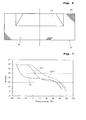
- Fig. 7 is a diagram showing a temperature characteristic of storage modulus of a preferred viscoelastic polymer
- Fig. 8 is a diagram showing a temperature characteristic of loss tangent of the preferred viscoelastic polymer.
- the cleaning sheet 1 includes a rectangular main body having an attachment surface 1b to be applied to a bottom face 23 of a pad 22 of a cleaning head 11 (which will be described later) and a cleaning surface 1a to be applied to a floor surface or the like.
- the rectangular main body has parallel longer sides 1c, 1c and parallel shorter sides 1d, 1d.
- one of the longer sides 1c, 1c is to be situated forward in a wiping direction.
- the rectangular main body may be constructed by stacking an exterior nonwoven fabric 2, a liquid permeable sheet 3, a liquid absorbent sheet 4 and a backing sheet 5 in the order mentioned above from the cleaning surface 1a to the attachment surface 1b.
- the individual sheets have an equal width W in a direction from side to side (hereinafter called the "transverse direction").
- the exterior nonwoven fabric 2 has a length L2
- the liquid permeable sheet 3 has a length L3
- the liquid absorbent sheet 4 has a length L4
- the backing sheet 5 has a length L5.
- the length L3 of the liquid permeable sheet 3 is equal to the length of the shorter side 1d of the rectangular main body.
- the length L4 of the liquid absorbent sheet 4 is preferably equal to the length L5 of the backing sheet 5, and the length L4/L5 is preferably shorter than the length L3 of the liquid permeable sheet 3. As shown in Fig. 2, therefore, one longer side 3a of the liquid permeable sheet 3 is at a distance from one longer side 4a of the liquid absorbent sheet 4. Likewise, the other longer side 3b of the liquid permeable sheet 3 is at a distance from the other longer side 4b of the liquid absorbent sheet 4.
- the length L2 of the exterior nonwoven fabric 2 is preferably shorter than the length L3 of the liquid permeable sheet 3 and the length L4 of the liquid absorbent sheet 4.
- the cleaning surface 1a of the cleaning sheet 1 is preferably not covered with the exterior nonwoven fabric 2 and the liquid permeable sheet 3 covering the liquid absorbent sheet 4 is exposed externally, as shown in Fig. 2.
- the cleaning surface 1a is covered with the exterior nonwoven fabric 2.
- the dimensions of the main body (or the cleaning surface 1a) are not particularly limited as long as the cleaning sheet 1 can be suitably used for wiping a floor surface or the like, but for instance, the length L3 may be about 60 to 160 mm, the width W may be about 200 to 320 mm.
- the length La of the side region 9 is preferably 5 mm or more, more preferably 10 mm or more.
- the exterior nonwoven fabric 2 and the liquid permeable sheet 3 both preferably contain heat-fusible synthetic resin fibers.
- the exterior nonwoven fabric 2, the liquid permeable sheet 3 and the liquid absorbent sheet 4 are preferably joined together to have a plurality of parallel join lines 71 by heating under pressure, such as by heat embossing or ultrasonic embossing.
- the backing sheet 5 is preferably bonded to the liquid absorbent layer 4 through a hot-melt type adhesive.
- the exterior nonwoven fabric 2 and the liquid permeable sheet 3 are also fixed to each other at join lines 72.
- the join lines 72 are preferably formed by heating under pressure, such as by embossing the exterior nonwoven fabric 2 and the liquid permeable sheet 3.
- the join lines 72 are spaced inward from the longer sides 2a, 2b of the exterior nonwoven fabric 2 and extend parallel to the longer sides 2a, 2b.
- the exterior nonwoven fabric 2 preferably provides a flap 61 which is allowed to move freely while being fixed on the cleaning surface 1a at the join line 72.
- the exterior nonwoven fabric 2 provides another flap 61.
- the flaps 61, 61 function to remove dirt adhering to the floor surface.
- the flap 61 has a free length Lb which is preferably 0.5 mm or more, more preferably 1 mm or more. If the free length Lb is excessively long, the frictional resistance between the cleaning surface 1a and the floor surface may be increased. Therefore, the free length Lb is preferably 10 mm or less, more preferably 5 mm or less.
- the attachment sheets 6, 7 preferably have indentations 6a, 7a.
- the indentations 6a, 7a preferably face each other as shown in Fig. 3.
- the longer side 6b of the attachment sheet 6 is aligned with the longer side 3a of the liquid permeable sheet 3, and the liquid permeable sheet 3 and the attachment sheet 6, which are in face-to-face contact, are preferably bonded together through a hot-melt type adhesive to provide a join line 73 outside the longer side 4a of the liquid absorbent sheet 4.
- the join line 73 is parallel to the longer side 3a of the liquid permeable sheet 3 and preferably extends the entire length of the cleaning sheet 1 in the transverse direction.
- the longer side 7b of the attachment sheet 7 is aligned with the longer side 3b of the liquid permeable sheet 3, and the liquid permeable sheet 3 and the attachment sheet 7 are preferably bonded together to provide another join line 73 outside the longer side 4b of the liquid absorbent sheet 4.
- the surface of the backing sheet 5 (or the attachment surface 1b) has a viscoelastic polymer for preventing slipping.
- viscoelastic refers to such a property that when a cone-shaped or disc-shaped sensor is put on a polymeric material layer of a given thickness and rotated reciprocally in positive and reverse directions, the strain curve (variation curve of strain caused by the sensor in the polymeric material layer) and the stress curve (variation curve of strain) have a phase difference ⁇ which is greater than 0 degrees and less than 90 degrees.
- the viscoelastic polymer may be a rubber-based elastomer.
- the rubber-based elastomer include thermoplastic elastomers such as SEBS (styrene ethylene butylene styrene block copolymer), SBS (styrene butadiene styrene block copolymer), SBBS (styrene butadiene butylene styrene block copolymer), SIS (styrene isoprene styrene block copolymer), etc.
- thermoplastic elastomers may be melted by heat and applied to the sheet surface in a hot, molten state.
- thermoplastic elastomers may be dispersed in a solvent, sprayed in an emulsion state on the backing sheet 5 and fixed on the sheet surface by evaporating the solvent.
- Examples of the rubber-based elastomer also include SBR (styrene butadiene rubber), BR (butadiene rubber), NBR (nitrile butadiene rubber), etc. They may be applied in a latex state to the surface of the backing sheet 5.
- SBR styrene butadiene rubber
- BR butadiene rubber
- NBR nitrile butadiene rubber
- Examples of the rubber-based elastomer further include IR (isoprene rubber), FR (fluoro rubber), etc.
- the viscoelastic polymer may be a silicone-based elastomer or a urethane-based elastomer.
- the foregoing elastomers may also be dissolved in a solution and applied in a solution state to the surface of the backing sheet 5.
- the viscoelastic polymer preferably has a low tack strength. As the tack strength becomes higher, the surface tackiness of the backing sheet 5 increases so that when unpacked, the cleaning sheet may stick to the user's hand and feel unpleasant. However, the cleaning sheet 1 may be stored with the attachment sheets 6, 7 laid on the attachment surface 1b (or the backing sheet 5). Accordingly, even if the viscoelastic polymer has a relatively high tack strength, the cleaning sheet 1 whose attachment surface 1b is covered with the attachment sheets 6, 7 can be prevented from adhering to another cleaning sheet 1 during storage.
- the viscoelastic polymer is preferably applied in an amount of 1 to 10 g/m 2 to the surface of the backing sheet 5.
- the viscoelastic polymer may be applied uniformly on the whole surface of the backing sheet 5 or in a stripe pattern or a dot pattern.
- the exterior nonwoven fabric 2 is preferably a nonwoven fabric having a high fiber density, wherein at least 70 wt. % of constituent fibers are synthetic resin fibers treated to be hydrophilic or hydrophilic fibers, so that the exterior nonwoven fabric 2 is capable of being wetted by liquid and allows liquid applied to the sheet surface to pass through it toward the liquid absorbent sheet 4.
- the exterior nonweven fabric 2 may be a spunbonded nonwoven fabric.
- the liquid permeable sheet 3 is preferably a low-density nonwoven fabric containing at least 70 wt. % of hydrophobic fibers.
- the liquid permeable sheet 3 may be a through-air bonded nonwoven fabric in which polyethylene (PE) resin fibers, polypropylene (PP) resin fibers, polyethylene terephthalate (PET) resin fibers, PE/PP bicomponent synthetic resin fibers, or PE/PET bicomponent synthetic resin fibers are thermally bonded together by hot air.
- PE polyethylene
- PP polypropylene
- PET polyethylene terephthalate
- the liquid absorbent sheet 4 may be a layered structure of a first absorbent sheet 4d and a second absorbent sheet 4e.
- the first absorbent sheet 4d and the second absorbent sheet 4e are both an air-laid pulp which is manufactured by depositing pulp by air-laid process and then bonding the fibers through a resin binder.
- the liquid absorbent layer 4 may be a compressed deposited pulp.
- the liquid absorbent layer 4 preferably has a basis weight of about 50 to 200 g/m 2 .
- the liquid absorbent layer 4 may further contain superabsorbent polymer (SAP).
- the backing sheet 5 may be impermeable or permeable to liquid.
- a spunbonded nonwoven fabric or a composite nonwoven fabric e.g., spunbonded/meltblown
- the attachment sheets 6, 7 may be a point-bonded or spunbonded nonwoven fabric of synthetic resin fibers.
- FIGs. 4 and 5 show a cleaning device 10 to which the cleaning sheet 1 may be attached.
- Cleaning device 10 may comprise a cleaning head 11, a shaft 13 connected to the top face of the cleaning head 11 through a universal joint 12, and a grip (not shown) secured on the top end of the shaft 13.
- the cleaning head 11 is preferably constructed of a rigid holder 21 injection molded of a synthetic resin, such as acrylonitrile-butadiene-styrene (ABS), polyethylene (PE), polypropylene (PP), polyethylene terephthalate (PET), etc., and the pad 22 secured beneath the holder 21.
- the pad 22 is preferably formed of ethylene-vinyl acetate (EVA). Because EVA is superior in water resistance, the pad 22 will not deteriorate even if liquid is kept in the liquid absorbent sheet 4 of the cleaning sheet 1 during use.
- EVA is superior in water resistance but its surface is smooth and has a lower coefficient of friction than urethane foam resin and the like. However, slipping of the cleaning sheet 1 relative to the cleaning head 11 can be prevented even if the pad 22 is formed of EVA, because the viscoelastic polymer for preventing slipping is provided on the backing sheet 5 of the cleaning sheet 1.
- the pad 22 may be formed of another flexible elastic material such as urethane foam resin or rubber. In another alternative, the pad 22 may be formed of soft PP or PE.
- the bottom face 23 of the pad 22 is rectangular and has a longer side almost equal to or slightly smaller than the width W of the cleaning sheet 1 and a shorter side almost equal to or slightly smaller than the length L3 of the cleaning sheet 1.
- the bottom face 23 of the pad 22 is generally flat except for a shallow recess 23a which is formed in the bottom face 23 to face forward.
- the whole bottom face 23 is preferably formed with a large number of grooves crossing each other to define a large number of small projections 23b for increasing the coefficient of friction.
- the holder 21 has sheet retainers 24.
- the sheet retainer 24 is preferably constructed by forming an opening in the top face of the holder 21 and covering the opening with a deformable sheet made of PE, PP, PET, etc.
- the deformable sheet has a cut.
- the cleaning sheet 1 may be retained on the cleaning head 11 such that the attachment sheets 6, 7 are pushed into the cuts.
- a liquid jetting part 30 is mounted on the holder 21.
- the liquid jetting part 30 is preferably located in front of the universal joint 12.
- the liquid jetting part 30 may be constructed of two components: a base 31 and a nozzle head 32.
- the nozzle head 32 has a front face (squirt surface) 33 where three nozzles 35, 36, 37 have orifices.
- the nozzles 35, 36, 37 face the indentation 6a of the attachment sheet 6.
- the cleaning sheet 1 is attached to the cleaning head 11 with its main body, in which the liquid absorbent sheet 4 is present, being laid on the bottom face 23 of the pad 22.
- the cleaning sheet 1 is fixed on the cleaning head 11 by placing the attachment sheets 6, 7 on the top face of the holder 21 and tucking them into the sheet retainers 24.
- the viscoelastic polymer on the backing sheet 5 are in contact with the battom face 23 of the pad 22.
- liquid within a container mounted on the shaft 13 reaches a chamber provided inside the nozzle head 32 through a hollow of the shaft 13 and a pipe 44 and is then squirted forward from the nozzles 35, 36, 37 under force of gravity. After the floor surface is wetted with the liquid in front of the cleaning head 11, the cleaning head 11 is moved forward to wipe the floor with the cleaning sheet 1.
- the liquid in the container may be plain water, or may contain a detergent for cleansing a floor surface, a high gloss wax, etc.
- the liquid permeable sheet 3 which is exposed externally in the side regions 9, 9, can collect relatively large dust particles.
- the liquid which may be fouled with fine dust particles on the floor surface, passes through the voids between the constituent fibers of the liquid permeable sheet 3 and is absorbed and retained by the liquid absorbent sheet 4.
- the exterior nonwoven fabric 2 in the central region 8 is moderately wetted with the liquid to efficiently wipe off fine dust or dirt.
- the flaps 61, 61 which are able to move freely on the cleaning surface 1a at boundaries between the central region 8 and the side regions 9, 9, also facilitate removal of the dirt adhering to the floor surface.
- the cleaning sheet according to the present invention should not be construed as limited to use with the cleaning device 10.
- the cleaning sheet may be attached to a cleaning device which has no nozzles for squirting liquid.
- the attachment sheets 6, 7 may be integral with one of the sheets constituting the main body of the cleaning sheet 1.
- the viscoelastic polymer according to the present invention preferably has a storage modulus of 10 4 to 10 6 (Pa) over the temperature range between -20°C and 40°C, a peak value of loss tangent (tan ⁇ ) below -20°C, and a loop-tack strength equal to or less than 10 ounces.
- the loop-tack strength is more preferably equal to or less than 5 ounces.
- the viscoelastic polymer preferably has melt viscosities of 1000 to 3500 (mPa ⁇ S) at 120°C and 100 to 400 (mPa ⁇ S) at 180°C.
- melt viscosities 1000 to 3500 (mPa ⁇ S) at 120°C and 100 to 400 (mPa ⁇ S) at 180°C.
- phase difference ⁇ occurs between the variation curve of strain E in the polymeric material layer in both positive and reverse directions and the variation curve of stress ⁇ .
- the phase difference ⁇ is 0 degrees
- the polymer is a perfectly elastic material
- the phase difference ⁇ is 90 degrees
- the viscoelastic polymer has a phase difference ⁇ greater than 0 degrees and less than 90 degrees.
- Storage modulus G' is obtained by multiplying an absolute value of ( ⁇ / ⁇ ) and (cos ⁇ ) together and expressed in terms of (Pa).
- the storage modulus G' represents an energy that is stored and restored per one cycle of the reciprocal rotational movement of the sensor and may be used as an indication of the elastic component of the polymer.
- Loss tangent ⁇ is G"/G', wherein G" is obtained by multiplying an absolute value of ( ⁇ / ⁇ ) and (sin ⁇ ) together.
- the loss tangent ⁇ represents an energy that is lost as heat per one cycle of the reciprocal rotational movement of the sensor and may be used as an indication of the viscous component of the polymer.
- Fig. 7 shows the storage modulus G' in ordinate (logarithmic axis) and the temperature in abscissa
- Fig. 8 shows the loss tangent ⁇ in ordinate (logarithmic axis) and the temperature in abscissa.
- Example 1 is indicated by (i)
- Comparative Example 1 is indicated by (ii)
- Comparative Example 2 is indicated by (iii).
- the results shown in Figs. 7 and 8 were measured with a dynamic viscoelastic analyzer "Rheogel-E4000 (type HR500)" manufactured by UBM Co. Ltd.
- Example 1 was prepared by mixing a small amount of viscosity imparting agent and oil with SEBS elastomer as a major component to have melt viscosities of 2100 (mPa ⁇ S) at 120°C, 700 (mPa ⁇ S) at 140°C, 360 (mPa ⁇ S) at 160°C, 230 (mPa ⁇ S) at 180°C.
- Comparative Example 1 was prepared by mixing a certain amount of viscosity imparting agent and oil with SBS elastomer as a major component to have melt viscosities of 20000 (mPa ⁇ S) at 120°C, 7500 (mPa ⁇ S) at 140°C, 3300 (mPa ⁇ S) at 160°C, 2000 (mPa ⁇ S) at 180°C.
- Comparative Example 2 was prepared by mixing a certain amount of viscosity imparting agent and oil with an olefin-based elastomer as a major component to have melt viscosities of 20000 (mPa ⁇ S) at 120°C, 9000 (mPa ⁇ S) at 140°C, 4500 (mPa ⁇ S) at 160°C, 2400 (mPa ⁇ S) at 180°C.
- the storage modulus G' of Example 1 does not vary greatly and falls within the range of 10 4 (Pa) to 10 6 (Pa).
- the storage moduli G' of Comparative Examples 1 and 2 increase greatly in the temperature range between -20°C and 40°C so that Comparative Examples 1 and 2 will behave elastically, rather than viscoelastically.
- Example 1 has a peak value (p) below -20°C. Since the peak value (p) represents the glass transition temperature (Tg), it is understood that Example 1 can retain viscoelasticity over the temperature range between -20°C and 40°C. On the other hand, since Comparative Examples 1 and 2 have their peaks (or glass transition temperatures) within a temperature range between 10°C and 20°C, they are not sufficiently effective in preventing slipping.
- Tg glass transition temperature
- the viscoelastic polymer of Example 1 prevents slipping not only with tackiness but also with viscoelasticity. Therefore, the backing sheet 5 feels less tacky to the touch.
- Loop-tack strength was measured with a loop-tack tester "Accuforce Cadet" manufactured by AMETEK, Inc.
- Samples (125 mm in MD; 25 mm in CD) were prepared by uniformly applying the individual polymers of Example 1, Comparative Example 1, Comparative Example 2 into a thickness of 50 ⁇ m on the surface of a PET sheet having a thickness of 50 ⁇ m. Each sample was situated on the loop-tack tester with the polymer facing outward and the load (ounce) was measured when the sample was adhered to and peeled from a PE plate at a rate of 300 mm/min
- Example 1 The loop-tack strength of Example 1 was 0 ounces. On the other hand, Comparative Example 1 had a loop-tack strength of 80 to 90 ounces and Comparative Example 2 had a loop-tack strength equal to or less than 10 ounces.
Landscapes
- Cleaning Implements For Floors, Carpets, Furniture, Walls, And The Like (AREA)
- Laminated Bodies (AREA)
Abstract
Description
- The present invention relates to a cleaning sheet which is intended to be used for cleaning a floor surface or the like when attached to a cleaning head of a mop-like cleaning device, and more particularly to a cleaning sheet which is resistant to slipping relative to a bottom face of the cleaning head.
- There have been known cleaning sheets which may be used for cleaning the house floor when attached to a cleaning head of a mop-like cleaning device. Such conventional cleaning sheets are typically constructed of a single nonwoven fabric or by layering two or more nonwoven fabrics on top of one another and used in a dry state or in a wet state with water or detergent contained in a liquid absorbent layer. Moreover, they are preferably disposable and easy to attach to and detach from the cleaning head of the cleaning device.
- Japanese Examined Patent Publication No. S62-013008 discloses a loop tape of a Velcro fastener secured on either a cleaning head or a cleaning member to be attached to the cleaning head and a hook tape of the Velcro fastener secured on the other.
- Japanese Utility-Model Registration No. 2507300 discloses retainers which are slashed sheets and disposed on a top face of a cleaning head. By tucking a part of a cleaning sheet into cuts of the retainers, the cleaning sheet can be retained on the cleaning head.
- Japanese Unexamined Patent Publication No. H09-187411 discloses clamp members pivotally mounted on a top face of a cleaning head. By clamping a part of a cleaning sheet between the clamp members and the cleaning head, the cleaning sheet can be retained on the cleaning head.
- Japanese Unexamined Patent Publication No. H09-075284 discloses a pressure-sensitive adhesive layer (or sticky layer) disposed on a bottom face or top face of a cleaning head for retaining a cleaning sheet on the bottom face.
- In the invention disclosed in Patent Publication No. S62-013008, either of the loop tape and the hook tape must be provided on the cleaning sheet for enabling the use of the Velcro fastener. However, if the cleaning sheet is designed to be thrown away after use (or disposable), providing the loop/hook tape on the cleaning sheet will raise the cost.
- On the other hand, the mechanisms disclosed in Utility-Model Registration No. 2507300 and Patent Publication No. H09-187411 are suitable for use with a disposable cleaning sheet. Here, the cleaning sheet is retained such that its central portion is laid on the bottom face of the cleaning head and its side portions are folded back and secured on the top face of the cleaning head. However, in the case where only the side portions of the cleaning sheet are secured on the cleaning head, the central portion of the cleaning sheet, which is laid on the bottom face of the cleaning head, tends to slip and shift by the friction between the cleaning sheet and the floor surface or the like during cleaning.
- In order to prevent slipping between the cleaning head and the cleaning sheet, the bottom face of the cleaning head may be made of a material having a relatively high coefficient of friction such as urethane foam resin, but even in this case, it is still difficult to prevent slipping between the cleaning head and the cleaning sheet if the frictional resistance between the cleaning sheet and the floor surface is high.
- On the other hand, the pressure-sensitive adhesive layer disclosed in Patent Publication No. H09-075284 is not practical because its adhesion decreases with the passage of time and also by dirt or dust adhering to the pressure-sensitive adhesive layer.
- The present invention has been developed to solve the problems in the prior art set forth above and has an object to provide a cleaning sheet which is effective in preventing slipping relative to a bottom face of a cleaning head.
- According to the invention, there is provided a cleaning sheet comprising: a main body having an attachment surface to be applied to a cleaning head of a cleaning device and a cleaning surface opposite the attachment surface; and attachment portions to be engaged to the cleaning head,
wherein the attachment surface has a viscoelastic polymer for preventing slipping. - Since the viscoelasticity is effective in preventing slipping of the cleaning sheet relative to the cleaning head, the cleaning sheet can remain stationary with respect to the cleaning head even if the frictional resistance between the cleaning sheet and the floor surface or the like is high.
- The viscoelastic polymer may be selected from the group consisting of rubber-based elastomers, silicone-based elastomers and urethane-based elastomers. Preferably, the viscoelastic polymer may be a synthetic rubber comprising styrene and at least one of butylene, butadiene and isoprene.
- Preferably, the viscoelastic polymer is applied to the attachment surface in a hot, molten state. Alternatively, the viscoelastic polymer may be applied to the attachment surface in an emulsion, latex or solution state. The viscoelastic polymer in a hot, molten state can be applied efficiently for mass production. On the other hand, the viscoelastic polymer in an emulsion, latex or solution state can be uniformly applied to the attachment surface of the cleaning sheet in a relatively small amount.
- Preferably, the viscoelastic polymer has a storage modulus of 104 to 106 (Pa) over a temperature range between -20°C and 40°C. In this viscoelastic polymer, the viscoelasticity remains stable over the temperature range for practical use. Accordingly, the viscoelastic polymer is effective in preventing slipping in both hot and cold conditions.
- Here, the viscoelastic polymer preferably has a peak value of loss tangent (tan δ) below -20°C. If the viscoelastic polymer has a peak value of tan δ above -20°C, it means that the glass transition temperature is above -20°C.
- Preferably, the viscoelastic polymer has a loop-tack strength equal to or less than 10 ounces. If the loop-tack strength is equal to or less than 10 ounces, the attachment surface feels less tacky to the touch. More preferably, the loop-tack strength is equal to or less than 5 ounces.
- The attachment surface may be intended to be applied to a bottom face of the cleaning head which is made of ethylene-vinyl acetate (EVA). Since the viscoelastic polymer is effective in preventing slipping, the cleaning head may be made of EVA, which has a lower coefficient of friction than urethane foam resin but is superior in water resistance to urethane foam resin.
- The cleaning sheet may comprise a liquid absorbent sheet which enables cleaning with liquid absorbed in the cleaning sheet.
- The present invention will be understood more fully from the detailed description given hereinafter and from the accompanying drawings of the preferred embodiment of the present invention, which, however, should not be taken to limit the invention, but are for explanation and understanding only.
- In the drawings:
- Fig. 1 is a bottom view showing a cleaning surface of a cleaning sheet according to one embodiment of the present invention;
- Fig. 2 is a sectional view taken along line II-II of Fig. 1;
- Fig. 3 is an exploded perspective view of a cleaning sheet according to an embodiment of the invention;
- Fig. 4 is a perspective view showing a state where a cleaning sheet is attached to a cleaning head of a cleaning device according to an embodiment of the invention;
- Fig. 5 is a front view of a cleaning head;
- Fig. 6 is a bottom view of a cleaning head;
- Fig. 7 is a diagram showing a temperature characteristic of storage modulus of a preferred viscoelastic polymer according to an embodiment of the invention; and
- Fig. 8 is a diagram showing a temperature characteristic of loss tangent of the preferred viscoelastic polymer according to an embodiment of the invention.
-
- The present invention will be discussed hereinafter in detail in terms of the preferred embodiment according to the present invention with reference to the accompanying drawings. In the following description, numerous specific details are set forth in order to provide a thorough understanding of the present invention. It will be obvious, however, to those skilled in the art that the present invention may be practiced without these specific details. In other instance, well-known structures are not shown in detail in order to avoid unnecessary obscuring of the present invention.
- Fig. 1 is a bottom view showing a cleaning surface of a
cleaning sheet 1 according to one embodiment of the present invention; Fig. 2 is a sectional view taken along line II-II of Fig. 1; Fig. 3 is an exploded perspective view of thecleaning sheet 1; Fig. 4 is a perspective view showing a state where thecleaning sheet 1 is attached to a cleaning head of a cleaning device; Fig. 5 is a front view of the cleaning head; Fig. 6 is a bottom view of the cleaning head; Fig. 7 is a diagram showing a temperature characteristic of storage modulus of a preferred viscoelastic polymer; and Fig. 8 is a diagram showing a temperature characteristic of loss tangent of the preferred viscoelastic polymer. - As shown in Figs. 1 to 3, the
cleaning sheet 1 includes a rectangular main body having anattachment surface 1b to be applied to abottom face 23 of apad 22 of a cleaning head 11 (which will be described later) and a cleaning surface 1a to be applied to a floor surface or the like. As shown in Fig. 1, the rectangular main body has parallellonger sides shorter sides cleaning sheet 1 is used for cleaning the floor surface or the like, one of thelonger sides - As shown in the exploded perspective view of Fig. 3, the rectangular main body may be constructed by stacking an exterior
nonwoven fabric 2, a liquidpermeable sheet 3, a liquidabsorbent sheet 4 and abacking sheet 5 in the order mentioned above from the cleaning surface 1a to theattachment surface 1b. On the main body, furthermore, there is provided a pair ofattachment sheet 6, 7. - The individual sheets have an equal width W in a direction from side to side (hereinafter called the "transverse direction"). In a direction from front to rear (hereinafter called the "longitudinal direction"), on the other hand, the exterior
nonwoven fabric 2 has a length L2, the liquidpermeable sheet 3 has a length L3, the liquidabsorbent sheet 4 has a length L4 and thebacking sheet 5 has a length L5. As shown in Fig. 1, the length L3 of the liquidpermeable sheet 3 is equal to the length of theshorter side 1d of the rectangular main body. - The length L4 of the liquid
absorbent sheet 4 is preferably equal to the length L5 of thebacking sheet 5, and the length L4/L5 is preferably shorter than the length L3 of the liquidpermeable sheet 3. As shown in Fig. 2, therefore, onelonger side 3a of the liquidpermeable sheet 3 is at a distance from one longer side 4a of the liquidabsorbent sheet 4. Likewise, the otherlonger side 3b of the liquidpermeable sheet 3 is at a distance from the otherlonger side 4b of the liquidabsorbent sheet 4. - The length L2 of the exterior
nonwoven fabric 2 is preferably shorter than the length L3 of the liquidpermeable sheet 3 and the length L4 of the liquidabsorbent sheet 4. In aside region 9 which extends along thelonger side 1c with a length La, the cleaning surface 1a of thecleaning sheet 1 is preferably not covered with the exteriornonwoven fabric 2 and the liquidpermeable sheet 3 covering the liquidabsorbent sheet 4 is exposed externally, as shown in Fig. 2. In acentral region 8, on the other hand, the cleaning surface 1a is covered with the exteriornonwoven fabric 2. - The dimensions of the main body (or the cleaning surface 1a) are not particularly limited as long as the
cleaning sheet 1 can be suitably used for wiping a floor surface or the like, but for instance, the length L3 may be about 60 to 160 mm, the width W may be about 200 to 320 mm. The length La of theside region 9 is preferably 5 mm or more, more preferably 10 mm or more. - The exterior
nonwoven fabric 2 and the liquidpermeable sheet 3 both preferably contain heat-fusible synthetic resin fibers. In thecentral region 8, as shown in Figs. 1 and 2, the exteriornonwoven fabric 2, the liquidpermeable sheet 3 and the liquidabsorbent sheet 4 are preferably joined together to have a plurality ofparallel join lines 71 by heating under pressure, such as by heat embossing or ultrasonic embossing. Thebacking sheet 5 is preferably bonded to the liquidabsorbent layer 4 through a hot-melt type adhesive. - The exterior
nonwoven fabric 2 and the liquidpermeable sheet 3 are also fixed to each other at join lines 72. The join lines 72 are preferably formed by heating under pressure, such as by embossing the exteriornonwoven fabric 2 and the liquidpermeable sheet 3. The join lines 72 are spaced inward from thelonger sides nonwoven fabric 2 and extend parallel to thelonger sides - Along the
longer side 2a, as shown in Fig. 2, the exteriornonwoven fabric 2 preferably provides aflap 61 which is allowed to move freely while being fixed on the cleaning surface 1a at thejoin line 72. Along thelonger side 2b, likewise, the exteriornonwoven fabric 2 provides anotherflap 61. When thecleaning sheet 1 is slid on the floor surface with the longer sides 1c, 1c directed forward and rearward in the sliding direction, theflaps flap 61 has a free length Lb which is preferably 0.5 mm or more, more preferably 1 mm or more. If the free length Lb is excessively long, the frictional resistance between the cleaning surface 1a and the floor surface may be increased. Therefore, the free length Lb is preferably 10 mm or less, more preferably 5 mm or less. - At the transverse center, the
attachment sheets 6, 7 preferably haveindentations indentations - As shown in Fig. 2, the
longer side 6b of theattachment sheet 6 is aligned with thelonger side 3a of the liquidpermeable sheet 3, and the liquidpermeable sheet 3 and theattachment sheet 6, which are in face-to-face contact, are preferably bonded together through a hot-melt type adhesive to provide ajoin line 73 outside the longer side 4a of the liquidabsorbent sheet 4. Thejoin line 73 is parallel to thelonger side 3a of the liquidpermeable sheet 3 and preferably extends the entire length of thecleaning sheet 1 in the transverse direction. Likewise, the longer side 7b of the attachment sheet 7 is aligned with thelonger side 3b of the liquidpermeable sheet 3, and the liquidpermeable sheet 3 and the attachment sheet 7 are preferably bonded together to provide anotherjoin line 73 outside thelonger side 4b of the liquidabsorbent sheet 4. - The surface of the backing sheet 5 (or the
attachment surface 1b) has a viscoelastic polymer for preventing slipping. The term "viscoelastic" as used herein refers to such a property that when a cone-shaped or disc-shaped sensor is put on a polymeric material layer of a given thickness and rotated reciprocally in positive and reverse directions, the strain curve (variation curve of strain caused by the sensor in the polymeric material layer) and the stress curve (variation curve of strain) have a phase difference δ which is greater than 0 degrees and less than 90 degrees. - The viscoelastic polymer may be a rubber-based elastomer. Examples of the rubber-based elastomer include thermoplastic elastomers such as SEBS (styrene ethylene butylene styrene block copolymer), SBS (styrene butadiene styrene block copolymer), SBBS (styrene butadiene butylene styrene block copolymer), SIS (styrene isoprene styrene block copolymer), etc. Such thermoplastic elastomers may be melted by heat and applied to the sheet surface in a hot, molten state.
- In an alternative, the thermoplastic elastomers may be dispersed in a solvent, sprayed in an emulsion state on the
backing sheet 5 and fixed on the sheet surface by evaporating the solvent. - Examples of the rubber-based elastomer also include SBR (styrene butadiene rubber), BR (butadiene rubber), NBR (nitrile butadiene rubber), etc. They may be applied in a latex state to the surface of the
backing sheet 5. - Examples of the rubber-based elastomer further include IR (isoprene rubber), FR (fluoro rubber), etc.
- In an alternative, the viscoelastic polymer may be a silicone-based elastomer or a urethane-based elastomer.
- The foregoing elastomers may also be dissolved in a solution and applied in a solution state to the surface of the
backing sheet 5. - The viscoelastic polymer preferably has a low tack strength. As the tack strength becomes higher, the surface tackiness of the
backing sheet 5 increases so that when unpacked, the cleaning sheet may stick to the user's hand and feel unpleasant. However, thecleaning sheet 1 may be stored with theattachment sheets 6, 7 laid on theattachment surface 1b (or the backing sheet 5). Accordingly, even if the viscoelastic polymer has a relatively high tack strength, thecleaning sheet 1 whoseattachment surface 1b is covered with theattachment sheets 6, 7 can be prevented from adhering to anothercleaning sheet 1 during storage. - The viscoelastic polymer is preferably applied in an amount of 1 to 10 g/m2 to the surface of the
backing sheet 5. The viscoelastic polymer may be applied uniformly on the whole surface of thebacking sheet 5 or in a stripe pattern or a dot pattern. - The exterior
nonwoven fabric 2 is preferably a nonwoven fabric having a high fiber density, wherein at least 70 wt. % of constituent fibers are synthetic resin fibers treated to be hydrophilic or hydrophilic fibers, so that the exteriornonwoven fabric 2 is capable of being wetted by liquid and allows liquid applied to the sheet surface to pass through it toward the liquidabsorbent sheet 4. For example, theexterior nonweven fabric 2 may be a spunbonded nonwoven fabric. - The liquid
permeable sheet 3 is preferably a low-density nonwoven fabric containing at least 70 wt. % of hydrophobic fibers. For example, the liquidpermeable sheet 3 may be a through-air bonded nonwoven fabric in which polyethylene (PE) resin fibers, polypropylene (PP) resin fibers, polyethylene terephthalate (PET) resin fibers, PE/PP bicomponent synthetic resin fibers, or PE/PET bicomponent synthetic resin fibers are thermally bonded together by hot air. - The liquid
absorbent sheet 4 may be a layered structure of a firstabsorbent sheet 4d and a secondabsorbent sheet 4e. Preferably, the firstabsorbent sheet 4d and the secondabsorbent sheet 4e are both an air-laid pulp which is manufactured by depositing pulp by air-laid process and then bonding the fibers through a resin binder. Alternatively, the liquidabsorbent layer 4 may be a compressed deposited pulp. The liquidabsorbent layer 4 preferably has a basis weight of about 50 to 200 g/m2. The liquidabsorbent layer 4 may further contain superabsorbent polymer (SAP). - The
backing sheet 5 may be impermeable or permeable to liquid. In order to make thebacking sheet 5 permeable to liquid, there may be used the same through-air bonded nonwoven fabric as used for the liquid permeable sheet or a spunlaced nonwoven fabric including rayon and pulp. In order to make thebacking sheet 5 impermeable to liquid, there may be used a spunbonded nonwoven fabric or a composite nonwoven fabric (e.g., spunbonded/meltblown) treated by a water-repellent. Preferably used is a spunbonded nonwoven fabric formed of synthetic resin fibers treated to be hydrophilic and having a basis weight of 20 g/m2. - The
attachment sheets 6, 7 may be a point-bonded or spunbonded nonwoven fabric of synthetic resin fibers. - Figs. 4 and 5 show a
cleaning device 10 to which thecleaning sheet 1 may be attached.Cleaning device 10 may comprise a cleaninghead 11, ashaft 13 connected to the top face of the cleaninghead 11 through auniversal joint 12, and a grip (not shown) secured on the top end of theshaft 13. - The cleaning
head 11 is preferably constructed of arigid holder 21 injection molded of a synthetic resin, such as acrylonitrile-butadiene-styrene (ABS), polyethylene (PE), polypropylene (PP), polyethylene terephthalate (PET), etc., and thepad 22 secured beneath theholder 21. Thepad 22 is preferably formed of ethylene-vinyl acetate (EVA). Because EVA is superior in water resistance, thepad 22 will not deteriorate even if liquid is kept in the liquidabsorbent sheet 4 of thecleaning sheet 1 during use. - EVA is superior in water resistance but its surface is smooth and has a lower coefficient of friction than urethane foam resin and the like. However, slipping of the
cleaning sheet 1 relative to the cleaninghead 11 can be prevented even if thepad 22 is formed of EVA, because the viscoelastic polymer for preventing slipping is provided on thebacking sheet 5 of thecleaning sheet 1. - In an alternative, the
pad 22 may be formed of another flexible elastic material such as urethane foam resin or rubber. In another alternative, thepad 22 may be formed of soft PP or PE. - As shown in Fig. 6, the
bottom face 23 of thepad 22 is rectangular and has a longer side almost equal to or slightly smaller than the width W of thecleaning sheet 1 and a shorter side almost equal to or slightly smaller than the length L3 of thecleaning sheet 1. Thebottom face 23 of thepad 22 is generally flat except for ashallow recess 23a which is formed in thebottom face 23 to face forward. The wholebottom face 23 is preferably formed with a large number of grooves crossing each other to define a large number ofsmall projections 23b for increasing the coefficient of friction. - Inside the four corners of the top face, the
holder 21 hassheet retainers 24. Thesheet retainer 24 is preferably constructed by forming an opening in the top face of theholder 21 and covering the opening with a deformable sheet made of PE, PP, PET, etc. The deformable sheet has a cut. Thecleaning sheet 1 may be retained on the cleaninghead 11 such that theattachment sheets 6, 7 are pushed into the cuts. - As shown in Fig. 4, a
liquid jetting part 30 is mounted on theholder 21. Theliquid jetting part 30 is preferably located in front of theuniversal joint 12. Theliquid jetting part 30 may be constructed of two components: abase 31 and anozzle head 32. Thenozzle head 32 has a front face (squirt surface) 33 where threenozzles nozzles indentation 6a of theattachment sheet 6. - Hereinbelow, how to use the
cleaning device 10 will be described. - The
cleaning sheet 1 is attached to the cleaninghead 11 with its main body, in which the liquidabsorbent sheet 4 is present, being laid on thebottom face 23 of thepad 22. Thecleaning sheet 1 is fixed on the cleaninghead 11 by placing theattachment sheets 6, 7 on the top face of theholder 21 and tucking them into thesheet retainers 24. Here, the viscoelastic polymer on thebacking sheet 5 are in contact with thebattom face 23 of thepad 22. - By pressing an operating part (not shown) with the grip being held by hand, liquid within a container mounted on the
shaft 13 reaches a chamber provided inside thenozzle head 32 through a hollow of theshaft 13 and apipe 44 and is then squirted forward from thenozzles head 11, the cleaninghead 11 is moved forward to wipe the floor with thecleaning sheet 1. - The liquid in the container may be plain water, or may contain a detergent for cleansing a floor surface, a high gloss wax, etc.
- When the cleaning
head 11 is slid on the floor surface, the liquidpermeable sheet 3, which is exposed externally in theside regions permeable sheet 3 and is absorbed and retained by the liquidabsorbent sheet 4. Moreover, the exteriornonwoven fabric 2 in thecentral region 8 is moderately wetted with the liquid to efficiently wipe off fine dust or dirt. Here, theflaps central region 8 and theside regions - The cleaning sheet according to the present invention should not be construed as limited to use with the
cleaning device 10. For example, the cleaning sheet may be attached to a cleaning device which has no nozzles for squirting liquid. - The
attachment sheets 6, 7 may be integral with one of the sheets constituting the main body of thecleaning sheet 1. - As described hereinabove, the viscoelastic polymer according to the present invention preferably has a storage modulus of 104 to 106 (Pa) over the temperature range between -20°C and 40°C, a peak value of loss tangent (tan δ) below -20°C, and a loop-tack strength equal to or less than 10 ounces. The loop-tack strength is more preferably equal to or less than 5 ounces. In order to stabilize viscoelasticity over the temperature range between -20°C and 40°C, the viscoelastic polymer preferably has melt viscosities of 1000 to 3500 (mPa·S) at 120°C and 100 to 400 (mPa·S) at 180°C. Hereinbelow, these properties will be described with reference to Example and Comparative Examples 1 and 2.
- When a reciprocal rotational force is exerted on a polymeric material layer by the sensor, as set forth above, a phase difference δ occurs between the variation curve of strain E in the polymeric material layer in both positive and reverse directions and the variation curve of stress τ. When the phase difference δ is 0 degrees, the polymer is a perfectly elastic material, whereas when the phase difference δ is 90 degrees, the polymer is a perfectly viscous material. As set forth above, the viscoelastic polymer has a phase difference δ greater than 0 degrees and less than 90 degrees.
- Storage modulus G' is obtained by multiplying an absolute value of (τ/ε) and (cos δ) together and expressed in terms of (Pa). The storage modulus G' represents an energy that is stored and restored per one cycle of the reciprocal rotational movement of the sensor and may be used as an indication of the elastic component of the polymer. Loss tangent δ is G"/G', wherein G" is obtained by multiplying an absolute value of (τ/ε) and (sin δ) together. The loss tangent δ represents an energy that is lost as heat per one cycle of the reciprocal rotational movement of the sensor and may be used as an indication of the viscous component of the polymer.
- Fig. 7 shows the storage modulus G' in ordinate (logarithmic axis) and the temperature in abscissa, and Fig. 8 shows the loss tangent δ in ordinate (logarithmic axis) and the temperature in abscissa. In Figs. 7 and 8, Example 1 is indicated by (i), Comparative Example 1 is indicated by (ii), and Comparative Example 2 is indicated by (iii). The results shown in Figs. 7 and 8 were measured with a dynamic viscoelastic analyzer "Rheogel-E4000 (type HR500)" manufactured by UBM Co. Ltd.
- Example 1 was prepared by mixing a small amount of viscosity imparting agent and oil with SEBS elastomer as a major component to have melt viscosities of 2100 (mPa·S) at 120°C, 700 (mPa·S) at 140°C, 360 (mPa· S) at 160°C, 230 (mPa·S) at 180°C.
- Comparative Example 1 was prepared by mixing a certain amount of viscosity imparting agent and oil with SBS elastomer as a major component to have melt viscosities of 20000 (mPa·S) at 120°C, 7500 (mPa· S) at 140°C, 3300 (mPa·S) at 160°C, 2000 (mPa·S) at 180°C.
- Comparative Example 2 was prepared by mixing a certain amount of viscosity imparting agent and oil with an olefin-based elastomer as a major component to have melt viscosities of 20000 (mPa·S) at 120°C, 9000 (mPa·S) at 140°C, 4500 (mPa·S) at 160°C, 2400 (mPa·S) at 180°C.
- Over the temperature range between -20°C and 40°C for practical use of the
cleaning sheet 1, as indicated by (i) in Fig. 7, the storage modulus G' of Example 1 does not vary greatly and falls within the range of 104 (Pa) to 106 (Pa). On the other hand, the storage moduli G' of Comparative Examples 1 and 2, as indicated by (ii) and (iii), increase greatly in the temperature range between -20°C and 40°C so that Comparative Examples 1 and 2 will behave elastically, rather than viscoelastically. - Fig. 8 shows that Example 1 has a peak value (p) below -20°C. Since the peak value (p) represents the glass transition temperature (Tg), it is understood that Example 1 can retain viscoelasticity over the temperature range between -20°C and 40°C. On the other hand, since Comparative Examples 1 and 2 have their peaks (or glass transition temperatures) within a temperature range between 10°C and 20°C, they are not sufficiently effective in preventing slipping.
- The viscoelastic polymer of Example 1 prevents slipping not only with tackiness but also with viscoelasticity. Therefore, the
backing sheet 5 feels less tacky to the touch. - Loop-tack strength was measured with a loop-tack tester "Accuforce Cadet" manufactured by AMETEK, Inc.
- Samples (125 mm in MD; 25 mm in CD) were prepared by uniformly applying the individual polymers of Example 1, Comparative Example 1, Comparative Example 2 into a thickness of 50 µm on the surface of a PET sheet having a thickness of 50 µm. Each sample was situated on the loop-tack tester with the polymer facing outward and the load (ounce) was measured when the sample was adhered to and peeled from a PE plate at a rate of 300 mm/min
- The loop-tack strength of Example 1 was 0 ounces. On the other hand, Comparative Example 1 had a loop-tack strength of 80 to 90 ounces and Comparative Example 2 had a loop-tack strength equal to or less than 10 ounces.
- Although the present invention has been illustrated and described with respect to exemplary embodiment thereof, it should be understood by those skilled in the art that the foregoing and various other changes, omission and additions may be made therein and thereto, without departing from the spirit and scope of the present invention. Therefore, the present invention should not be understood as limited to the specific embodiment set out above but to include all possible embodiments which can be embodied within a scope encompassed and equivalent thereof with respect to the feature set out in the appended claims.
Claims (10)
- A cleaning sheet comprising: a main body having an attachment surface (1b) to be applied to a cleaning head (11) of a cleaning device (10) and a cleaning surface (1a) opposite the attachment surface (1b); and attachment portions (6, 7) to be engaged to the cleaning head (11),
wherein the attachment surface (1b) has a viscoelastic polymer for preventing slipping. - The cleaning sheet of claim 1, wherein the viscoelastic polymer is selected from the group consisting of rubber-based elastomers, silicone-based elastomers and urethane-based elastomers.
- The cleaning sheet of claim 1, wherein the viscoelastic polymer is a synthetic rubber comprising styrene and at least one of butylene, butadiene and isoprene.
- The cleaning sheet of any one of claims 1 to 3, wherein the viscoelastic polymer is applied to the attachment surface (1b) in a hot, molten state.
- The cleaning sheet of any one of claims 1 to 3, wherein the viscoelastic polymer is applied to the attachment surface (1b) in an emulsion, latex or solution state.
- The cleaning sheet of any preceding claim, wherein the viscoelastic polymer has a storage modulus of 104 to 106 over a temperature range between -20°C and 40°C.
- The cleaning sheet of claim 6, wherein the viscoelastic polymer has a peak value of loss tangent below -20°C.
- The cleaning sheet of any preceding claim, wherein the viscoelastic polymer has a loop-tack strength equal to or less than 10 ounces.
- The cleaning sheet of any preceding claim, wherein the attachment surface (1b) is intended to be applied to a bottom face of the cleaning head (11) which is made of ethylene-vinyl acetate.
- The cleaning sheet of any preceding claim, which comprises a liquid absorbent sheet which enables cleaning with liquid absorbed in the cleaning sheet.
Applications Claiming Priority (2)
| Application Number | Priority Date | Filing Date | Title |
|---|---|---|---|
| JP2004166288A JP4116590B2 (en) | 2004-06-03 | 2004-06-03 | Cleaning sheet |
| JP2004166288 | 2004-06-03 |
Publications (3)
| Publication Number | Publication Date |
|---|---|
| EP1602310A2 true EP1602310A2 (en) | 2005-12-07 |
| EP1602310A3 EP1602310A3 (en) | 2008-04-30 |
| EP1602310B1 EP1602310B1 (en) | 2010-07-21 |
Family
ID=34941447
Family Applications (1)
| Application Number | Title | Priority Date | Filing Date |
|---|---|---|---|
| EP05253210A Expired - Lifetime EP1602310B1 (en) | 2004-06-03 | 2005-05-25 | Cleaning device with cleaning sheet |
Country Status (7)
| Country | Link |
|---|---|
| US (1) | US7735180B2 (en) |
| EP (1) | EP1602310B1 (en) |
| JP (1) | JP4116590B2 (en) |
| KR (1) | KR101157250B1 (en) |
| CN (1) | CN100515310C (en) |
| DE (1) | DE602005022380D1 (en) |
| TW (1) | TW200600050A (en) |
Cited By (4)
| Publication number | Priority date | Publication date | Assignee | Title |
|---|---|---|---|---|
| FR2919796A1 (en) * | 2007-08-07 | 2009-02-13 | Service Nettoyage Manutention | Absorbing band for ground cleaning device in e.g. operation block, has peripheral zone with longitudinal and lateral fixation portions that fix band on brush and protrude from circumference of absorbing layer of specific length |
| WO2018106854A1 (en) * | 2016-12-08 | 2018-06-14 | The Procter & Gamble Company | Cleaning pad with split core fibrous structures |
| US11503977B2 (en) | 2016-12-08 | 2022-11-22 | The Procter & Gamble Company LLC | Pre-moistened cleaning pad |
| US11622664B2 (en) | 2016-12-08 | 2023-04-11 | The Procter & Gamble Company | Fibrous structures having a contact surface |
Families Citing this family (14)
| Publication number | Priority date | Publication date | Assignee | Title |
|---|---|---|---|---|
| GB0602876D0 (en) * | 2006-02-14 | 2006-03-22 | Young Ronald A | Absorbent mop sheet |
| US8557360B2 (en) | 2008-10-24 | 2013-10-15 | Kikuo Yamada | Cleaning sheet |
| US20100144257A1 (en) * | 2008-12-05 | 2010-06-10 | Bart Donald Beaumont | Abrasive pad releasably attachable to cleaning devices |
| AU2010343085A1 (en) * | 2009-12-29 | 2012-06-14 | Saint-Gobain Abrasifs | Method of cleaning a household surface |
| DE102010054010B4 (en) * | 2010-12-09 | 2014-03-06 | Carl Freudenberg Kg | mop |
| USD661442S1 (en) | 2011-03-04 | 2012-06-05 | Freudenberg Household Products Lp | Spray mop head |
| US9144363B2 (en) * | 2012-06-14 | 2015-09-29 | Darryl Moskowitz | Extraction and absorbent pad |
| TWI611789B (en) * | 2016-11-23 | 2018-01-21 | Kang Na Hsiung Enterprise Co Ltd | Cleaning sheet |
| JP6847078B2 (en) * | 2018-06-15 | 2021-03-24 | ユニ・チャーム株式会社 | Method of continuously manufacturing materials for cleaning sheets |
| CN111698935B (en) * | 2018-06-15 | 2022-09-30 | 尤妮佳股份有限公司 | Cleaning sheet and method for continuously producing material for cleaning sheet |
| JP6865713B2 (en) * | 2018-06-15 | 2021-04-28 | ユニ・チャーム株式会社 | Cleaning sheet and surface sheet for cleaning sheet |
| JP6914228B2 (en) * | 2018-06-15 | 2021-08-04 | ユニ・チャーム株式会社 | Cleaning sheet |
| WO2021183263A1 (en) | 2020-03-13 | 2021-09-16 | Carbon, Inc. | Additively manufactured products having a matte surface finish |
| KR102541341B1 (en) * | 2021-06-25 | 2023-06-12 | 최규호 | Bottom cleanning tool |
Citations (4)
| Publication number | Priority date | Publication date | Assignee | Title |
|---|---|---|---|---|
| EP0702926A1 (en) | 1994-09-22 | 1996-03-27 | LEIFHEIT Aktiengesellschaft | Mop for a cleaning implement |
| JPH0975284A (en) | 1995-09-13 | 1997-03-25 | Mochida Shoko Kk | Cleaning tools |
| DE10126358C1 (en) | 2001-05-30 | 2002-07-18 | Vermop Salmon Gmbh | Cover, for mop-holder has textile cleaner, adhesive part, ridged edges with cords and two main surfaces |
| DE10310320A1 (en) | 2002-03-13 | 2004-03-25 | Bogoljub Stankovic | Floor mop has head, across which cloth strip is fastened using hooks at each end which fit into holes spaced along handle |
Family Cites Families (23)
| Publication number | Priority date | Publication date | Assignee | Title |
|---|---|---|---|---|
| JP2507300B2 (en) | 1985-06-10 | 1996-06-12 | 日本電気株式会社 | Motion compensation coding method and apparatus thereof |
| JPS6213008A (en) | 1985-07-10 | 1987-01-21 | Shimadzu Corp | Uniform magnetic field generator |
| JP3042737B2 (en) | 1991-09-27 | 2000-05-22 | 日本バイリーン株式会社 | Non-woven fabric for wiping |
| US5307005A (en) | 1992-12-23 | 1994-04-26 | International Business Machines Corporation | Zero current switching reverse recovery circuit |
| JPH0810207A (en) * | 1994-06-29 | 1996-01-16 | Lion Corp | Cleaner |
| JP3170443B2 (en) | 1996-01-09 | 2001-05-28 | ユニ・チャーム株式会社 | Cleaning tools |
| US6119298A (en) * | 1999-01-12 | 2000-09-19 | Uni-Charm Corporation | Disposable wiping sheet |
| US6048123A (en) | 1996-09-23 | 2000-04-11 | The Procter & Gamble Company | Cleaning implement having high absorbent capacity |
| US5960508A (en) | 1996-11-26 | 1999-10-05 | The Proctor & Gamble Company | Cleaning implement having controlled fluid absorbency |
| US6101661A (en) * | 1997-03-20 | 2000-08-15 | The Procter & Gamble Company | Cleaning implement comprising a removable cleaning pad having multiple cleaning surfaces |
| JP3621223B2 (en) | 1997-04-15 | 2005-02-16 | 花王株式会社 | Cleaning sheet |
| JP3450691B2 (en) | 1998-01-27 | 2003-09-29 | 花王株式会社 | Liquid absorbing / releasing sheet and method for producing the same |
| CN2352120Y (en) * | 1998-08-22 | 1999-12-08 | 关世峰 | Multi-functional brooming implement |
| JP3558892B2 (en) * | 1998-09-24 | 2004-08-25 | ユニ・チャーム株式会社 | Cleaning sheet |
| US20020050016A1 (en) * | 2000-02-24 | 2002-05-02 | Willman Kenneth William | Cleaning sheets comprising a polymeric additive to improve particulate pick-up and minimize residue left on surfaces and cleaning implements for use with cleaning sheets |
| AU3873600A (en) | 1999-03-09 | 2000-09-28 | Bba Nonwovens Simpsonville, Inc. | Enhanced particle capturing nonwoven |
| JP2001238840A (en) * | 2000-02-29 | 2001-09-04 | Tokai:Kk | Cleaning tools |
| JP4033645B2 (en) | 2001-07-12 | 2008-01-16 | 花王株式会社 | Cleaning sheet |
| JP2005502415A (en) * | 2001-09-20 | 2005-01-27 | ザ プロクター アンド ギャンブル カンパニー | Cleaning tool |
| CN2582531Y (en) * | 2002-06-06 | 2003-10-29 | 黄昌贤 | Quick dry absorbent paper mop |
| JP4033724B2 (en) | 2002-06-28 | 2008-01-16 | 花王株式会社 | Cleaning sheet |
| WO2004060133A1 (en) * | 2002-12-27 | 2004-07-22 | Kao Corporation | Cleaning sheet |
| US20060137123A1 (en) * | 2004-12-23 | 2006-06-29 | Andre Sampaio | Cleaning apparatus with changeable head |
-
2004
- 2004-06-03 JP JP2004166288A patent/JP4116590B2/en not_active Expired - Fee Related
-
2005
- 2005-05-20 US US11/133,362 patent/US7735180B2/en not_active Expired - Fee Related
- 2005-05-24 TW TW094116818A patent/TW200600050A/en not_active IP Right Cessation
- 2005-05-25 EP EP05253210A patent/EP1602310B1/en not_active Expired - Lifetime
- 2005-05-25 DE DE602005022380T patent/DE602005022380D1/en not_active Expired - Lifetime
- 2005-06-02 KR KR1020050046999A patent/KR101157250B1/en not_active Expired - Fee Related
- 2005-06-03 CN CNB2005100760462A patent/CN100515310C/en not_active Expired - Fee Related
Patent Citations (4)
| Publication number | Priority date | Publication date | Assignee | Title |
|---|---|---|---|---|
| EP0702926A1 (en) | 1994-09-22 | 1996-03-27 | LEIFHEIT Aktiengesellschaft | Mop for a cleaning implement |
| JPH0975284A (en) | 1995-09-13 | 1997-03-25 | Mochida Shoko Kk | Cleaning tools |
| DE10126358C1 (en) | 2001-05-30 | 2002-07-18 | Vermop Salmon Gmbh | Cover, for mop-holder has textile cleaner, adhesive part, ridged edges with cords and two main surfaces |
| DE10310320A1 (en) | 2002-03-13 | 2004-03-25 | Bogoljub Stankovic | Floor mop has head, across which cloth strip is fastened using hooks at each end which fit into holes spaced along handle |
Cited By (5)
| Publication number | Priority date | Publication date | Assignee | Title |
|---|---|---|---|---|
| FR2919796A1 (en) * | 2007-08-07 | 2009-02-13 | Service Nettoyage Manutention | Absorbing band for ground cleaning device in e.g. operation block, has peripheral zone with longitudinal and lateral fixation portions that fix band on brush and protrude from circumference of absorbing layer of specific length |
| WO2018106854A1 (en) * | 2016-12-08 | 2018-06-14 | The Procter & Gamble Company | Cleaning pad with split core fibrous structures |
| US11503977B2 (en) | 2016-12-08 | 2022-11-22 | The Procter & Gamble Company LLC | Pre-moistened cleaning pad |
| US11622664B2 (en) | 2016-12-08 | 2023-04-11 | The Procter & Gamble Company | Fibrous structures having a contact surface |
| US12226063B2 (en) | 2016-12-08 | 2025-02-18 | The Procter & Gamble Company | Fibrous structures having a contact surface |
Also Published As
| Publication number | Publication date |
|---|---|
| EP1602310A3 (en) | 2008-04-30 |
| KR101157250B1 (en) | 2012-06-15 |
| JP2005342257A (en) | 2005-12-15 |
| US20050268419A1 (en) | 2005-12-08 |
| DE602005022380D1 (en) | 2010-09-02 |
| KR20060049479A (en) | 2006-05-19 |
| TW200600050A (en) | 2006-01-01 |
| EP1602310B1 (en) | 2010-07-21 |
| CN100515310C (en) | 2009-07-22 |
| US7735180B2 (en) | 2010-06-15 |
| TWI299258B (en) | 2008-08-01 |
| CN1704014A (en) | 2005-12-07 |
| JP4116590B2 (en) | 2008-07-09 |
Similar Documents
| Publication | Publication Date | Title |
|---|---|---|
| US7735180B2 (en) | Cleaning sheet | |
| US7607192B2 (en) | Cleaning implement, cleaning system comprising a cleaning implement, and method for cleaning hard surfaces | |
| CN101171183B (en) | Device with pull tab activation | |
| US8407848B2 (en) | Cleaning pad and cleaning implement | |
| US7506397B2 (en) | Cleaning sheet | |
| US20040128786A1 (en) | Cleaning pads | |
| US7451516B2 (en) | Cleaning sheet | |
| MX2011000103A (en) | A floor cleaning tool with a surrounding capture sheet. | |
| CA2527510A1 (en) | Cleaning pads | |
| MX2007011762A (en) | Absorbent cleaning pad with extended portion for use with a cleaning implement. | |
| WO2005034710A1 (en) | Cleaning pad and cleaning implement | |
| US7516510B2 (en) | Cleaning sheet | |
| JP4369372B2 (en) | Cleaning pad | |
| US20050132519A1 (en) | Mop with disposable wipe and squeegee blade | |
| MXPA06006257A (en) | Disposable, nonwoven cleaning wipes, and kits comprising them |
Legal Events
| Date | Code | Title | Description |
|---|---|---|---|
| PUAI | Public reference made under article 153(3) epc to a published international application that has entered the european phase |
Free format text: ORIGINAL CODE: 0009012 |
|
| AK | Designated contracting states |
Kind code of ref document: A2 Designated state(s): AT BE BG CH CY CZ DE DK EE ES FI FR GB GR HU IE IS IT LI LT LU MC NL PL PT RO SE SI SK TR |
|
| AX | Request for extension of the european patent |
Extension state: AL BA HR LV MK YU |
|
| PUAL | Search report despatched |
Free format text: ORIGINAL CODE: 0009013 |
|
| AK | Designated contracting states |
Kind code of ref document: A3 Designated state(s): AT BE BG CH CY CZ DE DK EE ES FI FR GB GR HU IE IS IT LI LT LU MC NL PL PT RO SE SI SK TR |
|
| AX | Request for extension of the european patent |
Extension state: AL BA HR LV MK YU |
|
| 17P | Request for examination filed |
Effective date: 20080829 |
|
| 17Q | First examination report despatched |
Effective date: 20081009 |
|
| AKX | Designation fees paid |
Designated state(s): DE FR GB NL SE |
|
| GRAP | Despatch of communication of intention to grant a patent |
Free format text: ORIGINAL CODE: EPIDOSNIGR1 |
|
| RTI1 | Title (correction) |
Free format text: CLEANING DEVICE WITH CLEANING SHEET |
|
| RIN1 | Information on inventor provided before grant (corrected) |
Inventor name: TANAKA, YOSHINORIC/O TECHNICAL CENTER OF UNI-CHARM |
|
| GRAS | Grant fee paid |
Free format text: ORIGINAL CODE: EPIDOSNIGR3 |
|
| GRAA | (expected) grant |
Free format text: ORIGINAL CODE: 0009210 |
|
| AK | Designated contracting states |
Kind code of ref document: B1 Designated state(s): DE FR GB NL SE |
|
| REG | Reference to a national code |
Ref country code: GB Ref legal event code: FG4D |
|
| REF | Corresponds to: |
Ref document number: 602005022380 Country of ref document: DE Date of ref document: 20100902 Kind code of ref document: P |
|
| REG | Reference to a national code |
Ref country code: SE Ref legal event code: TRGR |
|
| REG | Reference to a national code |
Ref country code: NL Ref legal event code: T3 |
|
| PLBE | No opposition filed within time limit |
Free format text: ORIGINAL CODE: 0009261 |
|
| STAA | Information on the status of an ep patent application or granted ep patent |
Free format text: STATUS: NO OPPOSITION FILED WITHIN TIME LIMIT |
|
| 26N | No opposition filed |
Effective date: 20110426 |
|
| REG | Reference to a national code |
Ref country code: DE Ref legal event code: R097 Ref document number: 602005022380 Country of ref document: DE Effective date: 20110426 |
|
| REG | Reference to a national code |
Ref country code: FR Ref legal event code: PLFP Year of fee payment: 12 |
|
| REG | Reference to a national code |
Ref country code: FR Ref legal event code: PLFP Year of fee payment: 13 |
|
| REG | Reference to a national code |
Ref country code: FR Ref legal event code: PLFP Year of fee payment: 14 |
|
| PGFP | Annual fee paid to national office [announced via postgrant information from national office to epo] |
Ref country code: DE Payment date: 20200512 Year of fee payment: 16 Ref country code: NL Payment date: 20200417 Year of fee payment: 16 Ref country code: FR Payment date: 20200414 Year of fee payment: 16 |
|
| PGFP | Annual fee paid to national office [announced via postgrant information from national office to epo] |
Ref country code: SE Payment date: 20200512 Year of fee payment: 16 Ref country code: GB Payment date: 20200513 Year of fee payment: 16 |
|
| REG | Reference to a national code |
Ref country code: DE Ref legal event code: R119 Ref document number: 602005022380 Country of ref document: DE |
|
| REG | Reference to a national code |
Ref country code: SE Ref legal event code: EUG |
|
| REG | Reference to a national code |
Ref country code: NL Ref legal event code: MM Effective date: 20210601 |
|
| GBPC | Gb: european patent ceased through non-payment of renewal fee |
Effective date: 20210525 |
|
| PG25 | Lapsed in a contracting state [announced via postgrant information from national office to epo] |
Ref country code: SE Free format text: LAPSE BECAUSE OF NON-PAYMENT OF DUE FEES Effective date: 20210526 |
|
| PG25 | Lapsed in a contracting state [announced via postgrant information from national office to epo] |
Ref country code: GB Free format text: LAPSE BECAUSE OF NON-PAYMENT OF DUE FEES Effective date: 20210525 Ref country code: DE Free format text: LAPSE BECAUSE OF NON-PAYMENT OF DUE FEES Effective date: 20211201 |
|
| PG25 | Lapsed in a contracting state [announced via postgrant information from national office to epo] |
Ref country code: NL Free format text: LAPSE BECAUSE OF NON-PAYMENT OF DUE FEES Effective date: 20210601 Ref country code: FR Free format text: LAPSE BECAUSE OF NON-PAYMENT OF DUE FEES Effective date: 20210531 |