EP1601744B1 - Vergasungsvorrichtung und verfahren - Google Patents
Vergasungsvorrichtung und verfahren Download PDFInfo
- Publication number
- EP1601744B1 EP1601744B1 EP04716268A EP04716268A EP1601744B1 EP 1601744 B1 EP1601744 B1 EP 1601744B1 EP 04716268 A EP04716268 A EP 04716268A EP 04716268 A EP04716268 A EP 04716268A EP 1601744 B1 EP1601744 B1 EP 1601744B1
- Authority
- EP
- European Patent Office
- Prior art keywords
- chamber
- vanes
- pyrolysis unit
- waste material
- flow
- Prior art date
- Legal status (The legal status is an assumption and is not a legal conclusion. Google has not performed a legal analysis and makes no representation as to the accuracy of the status listed.)
- Expired - Lifetime
Links
Images


Classifications
-
- F—MECHANICAL ENGINEERING; LIGHTING; HEATING; WEAPONS; BLASTING
- F23—COMBUSTION APPARATUS; COMBUSTION PROCESSES
- F23G—CREMATION FURNACES; CONSUMING WASTE PRODUCTS BY COMBUSTION
- F23G5/00—Incineration of waste; Incinerator constructions; Details, accessories or control therefor
- F23G5/02—Incineration of waste; Incinerator constructions; Details, accessories or control therefor with pretreatment
- F23G5/027—Incineration of waste; Incinerator constructions; Details, accessories or control therefor with pretreatment pyrolising or gasifying stage
-
- B—PERFORMING OPERATIONS; TRANSPORTING
- B09—DISPOSAL OF SOLID WASTE; RECLAMATION OF CONTAMINATED SOIL
- B09C—RECLAMATION OF CONTAMINATED SOIL
- B09C1/00—Reclamation of contaminated soil
- B09C1/06—Reclamation of contaminated soil thermally
-
- C—CHEMISTRY; METALLURGY
- C10—PETROLEUM, GAS OR COKE INDUSTRIES; TECHNICAL GASES CONTAINING CARBON MONOXIDE; FUELS; LUBRICANTS; PEAT
- C10B—DESTRUCTIVE DISTILLATION OF CARBONACEOUS MATERIALS FOR PRODUCTION OF GAS, COKE, TAR, OR SIMILAR MATERIALS
- C10B1/00—Retorts
- C10B1/02—Stationary retorts
- C10B1/04—Vertical retorts
-
- C—CHEMISTRY; METALLURGY
- C10—PETROLEUM, GAS OR COKE INDUSTRIES; TECHNICAL GASES CONTAINING CARBON MONOXIDE; FUELS; LUBRICANTS; PEAT
- C10B—DESTRUCTIVE DISTILLATION OF CARBONACEOUS MATERIALS FOR PRODUCTION OF GAS, COKE, TAR, OR SIMILAR MATERIALS
- C10B53/00—Destructive distillation, specially adapted for particular solid raw materials or solid raw materials in special form
- C10B53/02—Destructive distillation, specially adapted for particular solid raw materials or solid raw materials in special form of cellulose-containing material
-
- F—MECHANICAL ENGINEERING; LIGHTING; HEATING; WEAPONS; BLASTING
- F23—COMBUSTION APPARATUS; COMBUSTION PROCESSES
- F23G—CREMATION FURNACES; CONSUMING WASTE PRODUCTS BY COMBUSTION
- F23G2900/00—Special features of, or arrangements for incinerators
- F23G2900/50009—Furnace with progressive waste movements in vertical or steeply inclined direction
-
- Y—GENERAL TAGGING OF NEW TECHNOLOGICAL DEVELOPMENTS; GENERAL TAGGING OF CROSS-SECTIONAL TECHNOLOGIES SPANNING OVER SEVERAL SECTIONS OF THE IPC; TECHNICAL SUBJECTS COVERED BY FORMER USPC CROSS-REFERENCE ART COLLECTIONS [XRACs] AND DIGESTS
- Y02—TECHNOLOGIES OR APPLICATIONS FOR MITIGATION OR ADAPTATION AGAINST CLIMATE CHANGE
- Y02E—REDUCTION OF GREENHOUSE GAS [GHG] EMISSIONS, RELATED TO ENERGY GENERATION, TRANSMISSION OR DISTRIBUTION
- Y02E50/00—Technologies for the production of fuel of non-fossil origin
- Y02E50/10—Biofuels, e.g. bio-diesel
Definitions
- the present invention relates to gasification apparatus for the treatment of organic waste material or of material contaminated with organic materials.
- Gasification systems are intended to destroy -CH- compounds, basically organic materials. Such materials may constitute a waste stream in themselves such as from municipal "black bag” waste or from materials which have contaminated work sites. Gasification systems heat organic waste or soil, for example, contaminated with oil, for example, at a temperature generally in the range from about 700 to about 800°C in a substantially oxygen-free environment to break down long chain molecules into smaller molecules which, ideally, can be contained and recycled or used as a fuel.
- Organic compounds will if heated in the absence of oxygen, break down into lower molecular weight compounds. Solids can break down, often changing their physical form to liquids or gases. The rate of break down is dependent upon temperature and hence availability of energy. Therefore, the resulting product obtained is dependent upon the temperature of treatment and on the time at which the contaminated material has been at temperature.
- Known gasification systems generally utilise mechanically driven fans or paddles to move and distribute heat in the system and have the following further disadvantages: poor control over process parameters, leading to little control of the final products produced; mechanical moving parts in high temperature environments leading to regular maintenance requirements and frequent process down time.
- US 3,150,063 discloses apparatus suitable for the treatment of organic waste material, the apparatus including hopper means having flow control means for controlling the rate of flow of material from said hopper means; at least one pyrolysis unit comprising a chamber in which a plurality of vanes are mounted, the vanes being positioned one above the other at alternate sides of the chamber so that in passage through the unit, from top to bottom thereof, the material falls from each vane onto the next lower vane in the manner of a cascade, the vanes also being adjustable in attitude so as to control the rate of flow of material through the chamber, and heating means for said chamber; means for removing gaseous products generated in the pyrolysis unit; and treated waste material collection means in accordance with the preamble of claim 1, as well as corresponding method in accordance with the preamble of claim 8.
- US 3,841,836 discloses apparatus for chemical processing of polymers in which a plurality of pivotally adjustable trays are mounted one above the other at alternate sides of a vertical processing chamber so that molten polymer flows from one tray onto the next lower tray.
- the slope of the trays is adjustable in response to the viscosity of the polymer which is sensed by suitable sensing means.
- the waste material is heated substantially in the absence of oxygen or air.
- waste material is intended to cover any material which can be physically broken down into “particles" which can be fed through the apparatus.
- material may include, for example, contaminated materials such as; clods of soil; building materials such as concrete, cement, stone, aggregate and brickwork, for example, which can be pre-crushed into sufficiently small pieces; and sand, for example.
- the organic waste material may comprise a waste stream in itself and include materials such as; municipal "black bag” waste, tyres, waste paper, cardboard and packaging materials, natural wastes such as forestry wood off cuts, pine needles and the like.
- Any waste to be pyrolised would need to be treated to ensure that the particles of waste are of a correct size and the moisture content is of an acceptable level. This may be achieved by a combination of some or all of the following known processes: high temperature steam treatment, segregation, drying and shredding.
- Municipal waste for example, would require treatment with high temperature steam in an autoclave and then segregation of the ferrous and non-ferrous metallic content by use of magnets and eddy current separation for example, followed by drying. Wood off cuts may be treated, for example, by shredding and drying.
- the organic material may comprise gaseous materials adsorbed or occluded on the surface of particles of waste; liquid organic material soaked into the waste material or solid organic materials such as scrap synthetic plastics materials on their own or mixed up with other waste materials.
- gravity is used to promote and assist the flow of material through the apparatus, the component units thereof being arranged in a generally vertical manner.
- additional assistance in the form of vibrators or shakers may also be utilised with the apparatus and method of the present invention to assist flow of material.
- the process to break down large molecules into smaller molecules is preferably carried out in the absence of oxygen or air.
- the apparatus according to the present invention when being used to implement the method of the present invention, as far as possible excludes the ingress of air into the system.
- the waste materials are preferably heated substantially in the absence of oxygen. Whilst it is an impossibility for the apparatus or process to be completely free of oxygen or completely sealed against the ingress thereof in absolute terms, the description of "substantially oxygen-free" is to be taken to mean that reasonable steps have been taken in terms of process engineering to prevent the free access of air to the heating chambers in which the waste material is being heated.
- the hopper means may be a container or tank having an upper face open to receive waste which is either periodically or continuously topped-up to maintain a relatively large volume of waste to be treated therein and form a seal with the container and so exclude large scale ingress of air.
- the hopper means may have a lower frusto-conical portion, for example, so as to channel the waste towards the flow control means which may be a mechanically driven compartmentalised rotary valve known in the art and which also serves to exclude large quantities of air from entering the apparatus.
- Control of the flow control valve may be integrated with an overall process control system to control the rate of admission of waste material in response to the temperature sensors in the pyrolysis unit.
- the at least one pyrolysis unit may comprise a box-like structure having an inner chamber or passage through which waste to be treated may pass and, an outer chamber generally surrounding at least the vertical walls of the inner chamber or passage, the outer chamber being supplied with heating means such as combustion gases to heat the interior of the inner chamber.
- the inner chamber is closed to the ambient environment so that neither air nor combustion gases may enter. Only waste material from the flow control valve may enter the inner chamber.
- the heating means for the outer chamber may be gas burners and the temperature controlled by temperature sensing means such as thermocouples, for example, by a feedback control loop. Heat is then transferred to the inner chamber or passage by conduction and convection, the temperature thereof being controlled by the temperature of the outer chamber.
- the inner chamber or passage of the at least one pyrolysis unit is provided with a plurality of movable plate vanes onto which the waste material falls during its passage through the apparatus.
- the plate-like vanes are positioned alternately on opposing inner faces of the inner chamber so as to form a cascade-like structure within the inner chamber.
- the waste material falls onto the first vane, slides over the surface and then onto the next lower vane in the series and so on until the waste material passes out of the heating part of the apparatus and into the final collection means.
- the vanes are attitude controllable, that is to say that the angle of inclination of each vane may be altered with respect to a reference datum so as to control the rate of flow of the waste material through the pyrolysis unit.
- the angles of the vanes to a horizontal datum will be may be reduced so as to reduce the flow rate of waste material through the pyrolysis units.
- the temperature of the waste material is too high then the relative angles of the vanes will be increased so as to increase the flow rate.
- the vanes are mounted on pivot means such as shafts or axles passing through the pyrolysis unit, the axles having suitable attitude control means such as lever arms, bell-cranks or the like at their ends, preferably outside the pyrolysis unit, that is, not in the heated part thereof.
- the attitude control means is connected into a control system for the apparatus such that the attitude of the vanes is automatically controlled by position control means such as electro-mechanical servos, hydraulic cylinders, pneumatic cylinders or any suitable position control means known in the art, in response to temperature control signals from the temperature sensors in a feed back loop control system.
- vanes may not all be controlled in the same way, that is to say that some vanes may be set to different attitudes than other vanes in the same pyrolysis unit or to vanes in another pyrolysis unit either upstream or downstream thereof. Thus, it is possible to vary the rate of flow of waste material within the apparatus.
- Such turbulence assists the transfer of heat from the chamber walls to the waste material and helps to provide uniformity of temperature within the apparatus.
- additional means for supplying a particulate treatment assist material such as sand into the apparatus.
- the additional means may comprise a dedicated hopper or may alternatively comprise feeding means which supplies treatment assist material to the waste material hopper.
- Additional hopper means may be provided with heating means so as to heat the treatment assist material in the additional hopper means.
- This treatment assist material is to aid precise control of the rate of energy input into the apparatus.
- the treatment assist material provides a secondary energy input for peak flows of waste material.
- a further important advantage of using a heated treatment assist material is that it forms a hot flowing bed of material which passes over the vanes with the waste material being treated and thus, where the waste material contains plastics materials prone to melting, prevents that material from sticking to the vane surfaces. This is important because when the plastics material becomes stuck to the apparatus it invariably overheats and degrades eventually to carbon and partly negates the objectives of the apparatus and process which are to precisely control the pyrolysis process.
- the treatment assist material can be recycled by passing the treated waste material and sand, for example, through screens, for example, to separate the differing particle sizes. Other separation means are known in the art and can be used.
- the ability to recycle the treatment assist material saves both material and heat energy.
- the apparatus is also provided at various points with gas collection conduits to remove the gases produced during the pyrolysis process and to either liquefy them for further processing or use as process fuel or to directly use the gases so produced to fuel the gasification process of the present invention.
- Figure 1 shows a schematic representation in elevation of an apparatus 10 for treating waste material such as soil contaminated with oil.
- the apparatus shown in Figure 1 could equally well be used for treating a waste stream comprising pre-treated municipal black bag waste, as described hereinabove.
- the apparatus comprises a hopper 12 for holding the contaminated waste 14.
- the hopper has a lower frusto-conical portion 16 leading to a rotary valve 18, the velocity of rotation of which and hence the rate at which the waste 14 is removed from the hopper 12 is controlled by a control system (not shown) at a variable rate depending upon the desired flow rate.
- the flowing waste falls into a first pyrolysis unit 20 and then into a second pyrolysis unit 22.
- the pyrolysis units 20, 22 are heated by burning gas supplied by pipes 24 from a burner 26.
- the flowing waste material finally passes from the second pyrolysis unit 22 into a further rotary valve 30 from which it is discharged into an ash box 32.
- the apparatus is also provided with a second, additional hopper 34 which contains a treatment assist material 36, in this instance, sand.
- a treatment assist material 36 in this instance, sand.
- the hopper itself may be provided with heating means (not shown) and/or the sand may be heated by heaters (not shown) surrounding a transfer conduit 38 which takes the treatment assist material from a rotary valve 40 which controls the flow rate thereof.
- the transfer conduit 38 delivers the treatment assist material under the influence of gravity to the first pyrolysis unit 20 from which point the treatment assist material flows through the apparatus with the waste material being treated until finally passing into the ash box 32.
- the hopper 12 is maintained at a relatively constant level with waste 14 by means of a conveyor and chute 42, for example.
- the purpose of keeping the hopper at a constant level is to maintain a generally constant seal to prevent excessive amounts of air/oxygen from entering the system.
- the additional hopper when in use, is also maintained at a constant level with sand, for example, by a suitable supply system such as a second conveyor and chute arrangement 44.
- the rotary valves 18, 30, 40 are also intended to prevent excess ingress of oxygen into the system and comprise a plurality of individual compartments around the periphery of the valve wheel which fill with waste or treatment assist material and are then sealed against a peripheral outer member as they rotate towards a lower opening where the contained material drops into the transfer conduit 46, 38.
- the valve 30 acts in the same manner and controls in an airtight manner the discharge of treated material from the apparatus.
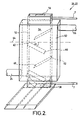
- Each pyrolysis unit 20, 22 has an inner chamber or passage 50 and surrounding outer chamber 52.
- the inner chamber provides an air tight passage 54 for the waste material 14 and treatment assist material 36, if present, from the transfer conduits 46, 38 to the final discharge rotary valve 30.
- the inner chamber has an entry aperture 56 and an exit aperture 58, the entry aperture 56 being connected in an airtight manner either to the transfer conduits 46, 38 or to the exit aperture 58 of a preceding pyrolysis unit.
- the exit aperture 58 of the pyrolysis unit is connected in an airtight manner either to the entry aperture 56 of a downstream pyrolysis unit or to the valve 30 at the discharge end of the cycle.
- the inner chamber 50 is provided with a series of vanes 60, the attitude of which may be controlled or varied as desired.
- the vanes extend substantially across the whole width of the inner chamber and are pivotable about their outer edge 62 so that the angle ⁇ between the plane of the vane and a horizontal datum line (shown as dashed line 64) may be varied and controlled by means externally of the pyrolysis unit.
- the series of vanes 60 form a cascade from entry to exit of the pyrolysis unit forcing waste material and treatment assist material to fall in a cascade from one vane to the next.
- the outer chamber 52 essentially forms a closed volume around the vertical faces of the inner chamber 50 and receives combustion gases from the burner 26 via the pipes 24 so as to heat the inner chamber 50.
- An exhaust pipe 66 takes the spent and cooled combustion gases away to a flare stack (not shown).
- the rate of flow of the waste material and treatment assist material through the pyrolysis unit is controlled by the angles of the vanes 60 being varied. If, for example, the temperature of the inner chamber and waste material is too low then the rate of flow of material may be reduced by reducing the angle ⁇ . Conversely, if the material is overheating, the rate of flow may be increased by increasing the angle ⁇ .
- the angles of the vanes are adjusted automatically in response to temperature sensors in the pyrolysis units.
- Each pyrolysis unit is provided with gas collection conduits 70 connected in an airtight manner to the inner chamber 50.
- the gas collection conduits lead the gases produced during pyrolysis of the waste material away to suitable further use or processing apparatus.
- the gases could be used as a heating fuel to make the apparatus self-sustaining or lead away to liquefaction apparatus to store the products for further processing into useful products.
- the vanes 60 are shown with hydraulically or pneumatically actuated jacks 80 in operable association therewith, a jack rod 82 being connected to the underside of each vane so that inward or outward movement of the jack rod 82 raises or lowers the free end of the vane, respectively.
- the jack rod may pass through and slide in an airtight bushing 84 in the walls of the inner and outer chambers.
- the pivoted edges 62 of the vanes may have shafts 90 or axles attached thereto which pass through the inner and outer chamber walls and have lever arms 92 secured thereto and which are connected to suitable actuating devices 94 such as electro-mechanical, hydraulic or pneumatic actuators, for example.
- suitable actuating devices 94 such as electro-mechanical, hydraulic or pneumatic actuators, for example.
- the actuating means for controlling the attitude of the vanes 60 respond automatically to control signals from temperature sensors associated with the pyrolysis units.
- Figure 3 is a flow diagram corresponding to the apparatus shown and described with reference to figures 1 and 2 .
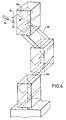
- Figure 4 shows a stack of three pyrolysis units linked to each other by sloping manifold portions 100.
- the manifold portions are set at a mean angle of the vanes 60 so that the rate of material through flow between pyrolysis units does not vary greatly from the flow rate within each pyrolysis unit.
- a simple collection box 32 is shown at the end of the process to receive the residue of treated material, this may be replaced with more complex equipment intended to separate the treated waste from the treatment assist material, for example.
- Such equipment may include conveyors and screening sieves or fluidised bed separation equipment, for example.
Landscapes
- Engineering & Computer Science (AREA)
- Chemical & Material Sciences (AREA)
- Oil, Petroleum & Natural Gas (AREA)
- Materials Engineering (AREA)
- Organic Chemistry (AREA)
- General Engineering & Computer Science (AREA)
- Mechanical Engineering (AREA)
- Physics & Mathematics (AREA)
- Thermal Sciences (AREA)
- Life Sciences & Earth Sciences (AREA)
- Soil Sciences (AREA)
- Environmental & Geological Engineering (AREA)
- Processing Of Solid Wastes (AREA)
- Gasification And Melting Of Waste (AREA)
Claims (12)
- Vorrichtung für die Behandlung von organischem Abfallmaterial, wobei die Vorrichtung umfasst:eine Trichtereinrichtung (12) mit einer Durchflusssteuereinrichtung (18) zum Steuern der Durchflussrate von Material aus der Trichtereinrichtung;mindestens eine Pyrolyseeinheit (20, 22) mit einer Kammer (50), in der eine Vielzahl von Leitwänden (60) montiert sind, wobei die Leitwände (60) übereinander auf abwechselnden Seiten der Kammer (50) angeordnet sind, so dass beim Durchgang durch die Einheit von deren Oberseite zur Unterseite das Material von jeder Leitwand auf die nächstniedrigere Leitwand in der Weise einer Kaskade fällt, wobei die Leitwände (60) auch in der Lage einstellbar sind, um die Durchflussrate von Material durch die Kammer zu steuern, und einer Heizeinrichtung (26, 24, 52) zum Heizen der Kammer;eine Einrichtung (70) zum Entfernen von gasförmigen Produkten, die in der Pyrolyseeinheit erzeugt werden, wobei die gasförmigen Produkte zurückgeführt oder gesammelt werden, undeine Sammeleinrichtung (32) für behandeltes Abfallmaterial, dadurch gekennzeichnet, dass die Leitwände (60) an Schwenkeinrichtungen montiert sind und in Form von schwenkbar einstellbaren Platten vorliegen, dass Temperatursensoren innerhalb der Pyrolyseeinheit (20, 22) vorgesehen sind und dass die Lage der jeweiligen Leitwände (60) über ein Steuersystem in Reaktion auf Signale von diesen Temperatursensoren automatisch einstellbar ist.
- Vorrichtung nach Anspruch 1, die ferner Vibratoren oder Rüttler umfasst, die wirksam sind, um den Durchfluss von Material durch die Pyrolyseeinheit zu unterstützen.
- Vorrichtung nach Anspruch 1 oder 2, wobei die Lage jeder Leitwand (60) individuell einstellbar ist.
- Vorrichtung nach einem vorangehenden Anspruch, die ferner eine Einrichtung (34) zum Halten eines durch die mindestens eine Pyrolyseeinheit (20, 22) zu leitenden Behandlungshilfsmaterials (36) umfasst.
- Vorrichtung nach einem vorangehenden Anspruch, wobei die Kammer (50) der Pyrolyseeinheit (20, 22), in der die Leitwände (60) montiert sind, vom Eintritt von Sauerstoff abgedichtet ist.
- Vorrichtung nach einem vorangehenden Anspruch, wobei die Heizeinrichtung eine äußere Kammer (52), die zumindest vertikale Wände der Kammer (50) umgibt, in der die Leitwände (60) montiert sind, und eine Einrichtung (24) zum Zuführen von Heizgasen zur äußeren Kammer (52) umfasst.
- Vorrichtung nach einem vorangehenden Anspruch mit einer Vielzahl von Pyrolyseeinheiten.
- Verfahren zum Behandeln von organischem Abfallmaterial mit den Schritten:Vorsehen mindestens einer Pyrolyseeinheit (20, 22) mit einer Kammer (50), in der eine Vielzahl von Leitwänden (60) übereinander auf abwechselnden Seiten montiert sind;Zuführen des Materials zu einem Trichter;Einspeisen des Materials mit einer steuerbaren Rate vom Trichter (12) in ein oberes Ende der Kammer (50), so dass, wenn es nach unten läuft, es von jeder Leitwand (60) auf die nächstniedrigere Leitwand in der Weise einer Kaskade fällt;Heizen der Kammer (50);Einstellen der Lage der Leitwände, um die Durchflussrate des Materials durch die Kammer zu steuern;Entfernen von gasförmigen Produkten aus der Kammer zum Sammeln und/oder Zurückführen; undSammeln von Abfallmaterial von der Unterseite der Kammer, dadurch gekennzeichnet, dass die Leitwände (60) an Schwenkeinrichtungen montiert sind und in Form von schwenkbar einstellbaren Platten vorliegen, und durch die weiteren Schritte des Erfassens der Temperatur in der Kammer (50) und des automatischen Einstellens der Lage der Leitwände (60) in Reaktion auf die Temperatur, die erfasst wurde.
- Verfahren nach Anspruch 8, mit dem weiteren Schritt des Zuführens eines Behandlungshilfsmaterials (36) zu der mindestens einen Pyrolyseeinheit (20, 22) und des Leitens des Behandlungshilfsmaterials (36) durch die mindestens eine Pyrolyseeinheit (20, 22) gleichzeitig mit dem Abfallmaterial.
- Verfahren nach Anspruch 9 mit dem weiteren Schritt des Erhitzens des Behandlungshilfsmaterials (36) vor seinem Eintritt in die mindestens eine Pyrolyseeinheit (20, 22).
- Verfahren nach Anspruch 9 oder 10, wobei das Behandlungshilfsmaterial Sand ist.
- Verfahren nach einem der Ansprüche 8 bis 11, wobei das Abfallmaterial innerhalb der Kammer (50) der mindestens einen Pyrolyseeinheit (20, 22) im Wesentlichen bei Abwesenheit von Sauerstoff erhitzt wird.
Priority Applications (2)
| Application Number | Priority Date | Filing Date | Title |
|---|---|---|---|
| PL04716268T PL1601744T3 (pl) | 2003-03-07 | 2004-03-02 | Urządzenie do gazyfikacji i sposób gazyfikacji |
| CY20121100685T CY1113073T1 (el) | 2003-03-07 | 2012-08-01 | Συσκευη και μεθοδος αεριοποιησης |
Applications Claiming Priority (3)
| Application Number | Priority Date | Filing Date | Title |
|---|---|---|---|
| GB0305224 | 2003-03-07 | ||
| GBGB0305224.8A GB0305224D0 (en) | 2003-03-07 | 2003-03-07 | Gasification apparatus and method |
| PCT/GB2004/000872 WO2004078879A1 (en) | 2003-03-07 | 2004-03-02 | Gasification apparatus and method |
Publications (2)
| Publication Number | Publication Date |
|---|---|
| EP1601744A1 EP1601744A1 (de) | 2005-12-07 |
| EP1601744B1 true EP1601744B1 (de) | 2012-05-30 |
Family
ID=9954301
Family Applications (1)
| Application Number | Title | Priority Date | Filing Date |
|---|---|---|---|
| EP04716268A Expired - Lifetime EP1601744B1 (de) | 2003-03-07 | 2004-03-02 | Vergasungsvorrichtung und verfahren |
Country Status (13)
| Country | Link |
|---|---|
| US (1) | US7293511B2 (de) |
| EP (1) | EP1601744B1 (de) |
| AU (1) | AU2004218220B2 (de) |
| CA (1) | CA2515431C (de) |
| CY (1) | CY1113073T1 (de) |
| DK (1) | DK1601744T3 (de) |
| ES (1) | ES2388282T3 (de) |
| GB (1) | GB0305224D0 (de) |
| NZ (1) | NZ542062A (de) |
| PL (1) | PL1601744T3 (de) |
| PT (1) | PT1601744E (de) |
| WO (1) | WO2004078879A1 (de) |
| ZA (1) | ZA200506306B (de) |
Cited By (2)
| Publication number | Priority date | Publication date | Assignee | Title |
|---|---|---|---|---|
| PL424346A1 (pl) * | 2018-01-23 | 2019-07-29 | S.E.A. Wagner Spółka Z Ograniczoną Odpowiedzialnością | Sposób termicznej utylizacji odpadów komunalnych i/lub osadów ściekowych |
| PL127153U1 (pl) * | 2018-03-19 | 2019-09-23 | Akademia Górniczo-Hutnicza im. Stanisława Staszica w Krakowie | Urządzenie do podawania materiału do reaktora pirolitycznego |
Families Citing this family (17)
| Publication number | Priority date | Publication date | Assignee | Title |
|---|---|---|---|---|
| CN101294707B (zh) * | 2007-04-27 | 2011-09-14 | 韩枫 | 生物质燃料热解汽化燃烧方法 |
| WO2009023557A2 (en) * | 2007-08-10 | 2009-02-19 | Warren Vanderpool | Waste processing process |
| EP2045311B1 (de) | 2007-10-02 | 2013-03-20 | IN.SER. S.p.A. | System und Verfahren zur Pyrolisierung und Vergasung von organischen Substanzen |
| US8020499B2 (en) * | 2007-11-09 | 2011-09-20 | Overseas Capital Assets Limited | Apparatus and method for pyrolysis of scrap tyres and the like |
| WO2010019877A2 (en) | 2008-08-15 | 2010-02-18 | Wayne/Scott Fetzer Company | Biomass fuel furnace system and related methods |
| US8518336B2 (en) * | 2010-01-25 | 2013-08-27 | Mid-Atlantic Technology, Research & Innovation Center, Inc. | Cascading planar baffle reactor |
| EP2999535A1 (de) * | 2013-05-23 | 2016-03-30 | Battelle Memorial Institute | Fallbettreaktor |
| ITMI20130919A1 (it) * | 2013-06-05 | 2014-12-06 | Greentek Di Salomoni Marco & C S N C | Impianto per la produzione di energia partendo da biomasse |
| CA2953803A1 (en) * | 2014-05-23 | 2015-11-26 | Batelle Memorial Institute | Dual bed pyrolysis system and method |
| CN104140851B (zh) * | 2014-08-12 | 2017-10-31 | 余式正 | 一种无二噁英和无废气排放的立式负压垃圾干馏焚烧炉 |
| US10000339B2 (en) | 2015-07-02 | 2018-06-19 | Lockheed Martin Corporation | Gravity-fed housing for gasification system |
| PL237169B1 (pl) * | 2017-08-30 | 2021-03-22 | Filen Spolka Z Ograniczona Odpowiedzialnoscia | Zgazowarka wysokociśnieniowa i sposób sterowania jej pracą |
| US11545343B2 (en) | 2019-04-22 | 2023-01-03 | Board Of Trustees Of Michigan State University | Rotary plasma reactor |
| JOP20220203A1 (ar) * | 2020-02-27 | 2023-01-30 | Pyro Dynamics LLC | جهاز ونظام وطريقة للانحلال الحراري الصخري |
| US11866649B2 (en) | 2020-02-27 | 2024-01-09 | Pyro Dynamics, Llc | Apparatus, system, and method for shale pyrolysis |
| CN113684040A (zh) * | 2021-09-18 | 2021-11-23 | 辽宁恒润农业有限公司 | 一种用于生物质炭基肥料生产的炭化炉 |
| KR102651349B1 (ko) * | 2022-02-07 | 2024-03-27 | 한국에너지기술연구원 | 축분 처리 시스템 및 방법 |
Family Cites Families (17)
| Publication number | Priority date | Publication date | Assignee | Title |
|---|---|---|---|---|
| DE490556C (de) * | 1927-04-15 | 1930-01-30 | Richard Feige | Spuelgasofen zum Schwelen von Brennstoffen |
| GB741353A (en) * | 1950-05-11 | 1955-11-30 | Weber Ludwig | Method and apparatus for the heat treatment of fuels and the like |
| US3118574A (en) * | 1959-04-23 | 1964-01-21 | Alsacieme De Const Mecaniques | Apparatus for controlling the downflow of a column of divided material |
| FR1232500A (fr) * | 1959-04-23 | 1960-10-10 | Alsacienne Constr Meca | Procédé de traitement en continu d'un matériau, solide meuble, par au moins un fluide |
| US3586084A (en) * | 1969-12-05 | 1971-06-22 | Sanford Redmond | Plastic blank for making a container |
| US3841836A (en) | 1972-08-10 | 1974-10-15 | Eastman Kodak Co | Apparatus for the production of condensation polymers |
| US4419765A (en) * | 1979-10-12 | 1983-12-06 | Keith H. Wycoff | Signal absence detector |
| US4374288A (en) * | 1980-12-17 | 1983-02-15 | Scragg Robert L | Electromagnetic process and apparatus for making methanol |
| US4539917A (en) * | 1983-09-21 | 1985-09-10 | The United States Of America As Represented By The United States Department Of Energy | Combustion heater for oil shale |
| US4732092A (en) * | 1985-09-30 | 1988-03-22 | G.G.C., Inc. | Pyrolysis and combustion apparatus |
| FR2650204B1 (fr) * | 1989-07-26 | 1993-07-16 | Saint Gobain Isover | Procede et dispositif pour le traitement de dechets de verre ou de fibres minerales en vue de leur recuperation |
| DE4037743A1 (de) | 1989-12-06 | 1991-06-13 | Gerhard Dr Ing Linde | Verfahren und vorrichtung zur thermischen reinigung von koernigem gut, insbesondere von erdreich |
| US5198018A (en) * | 1991-02-14 | 1993-03-30 | General Motors Corporation | Pyrolysis process and apparatus |
| US5615627A (en) | 1995-02-23 | 1997-04-01 | Biocon, Incorporated | Method and apparatus for destruction of waste by thermal scission and chemical recombination |
| JPH1010386A (ja) | 1996-06-27 | 1998-01-16 | Denso Corp | 照明用耐湿プラスチック光ファイバ |
| DE19706606A1 (de) * | 1997-02-20 | 1998-08-27 | Babcock Anlagen Gmbh | Verfahren zur Regelung der Temperatur in thermischen Abfallbehandlunganlagen und Abfallbehandlunganlage |
| KR200254366Y1 (ko) | 2001-08-23 | 2001-11-24 | 장영광 | 쓰레기 건조장치 |
-
2003
- 2003-03-07 GB GBGB0305224.8A patent/GB0305224D0/en not_active Ceased
-
2004
- 2004-03-02 WO PCT/GB2004/000872 patent/WO2004078879A1/en not_active Ceased
- 2004-03-02 DK DK04716268.0T patent/DK1601744T3/da active
- 2004-03-02 EP EP04716268A patent/EP1601744B1/de not_active Expired - Lifetime
- 2004-03-02 PL PL04716268T patent/PL1601744T3/pl unknown
- 2004-03-02 US US10/546,809 patent/US7293511B2/en not_active Expired - Lifetime
- 2004-03-02 PT PT04716268T patent/PT1601744E/pt unknown
- 2004-03-02 NZ NZ542062A patent/NZ542062A/en not_active IP Right Cessation
- 2004-03-02 AU AU2004218220A patent/AU2004218220B2/en not_active Ceased
- 2004-03-02 CA CA2515431A patent/CA2515431C/en not_active Expired - Lifetime
- 2004-03-02 ES ES04716268T patent/ES2388282T3/es not_active Expired - Lifetime
-
2005
- 2005-08-05 ZA ZA2005/06306A patent/ZA200506306B/en unknown
-
2012
- 2012-08-01 CY CY20121100685T patent/CY1113073T1/el unknown
Cited By (2)
| Publication number | Priority date | Publication date | Assignee | Title |
|---|---|---|---|---|
| PL424346A1 (pl) * | 2018-01-23 | 2019-07-29 | S.E.A. Wagner Spółka Z Ograniczoną Odpowiedzialnością | Sposób termicznej utylizacji odpadów komunalnych i/lub osadów ściekowych |
| PL127153U1 (pl) * | 2018-03-19 | 2019-09-23 | Akademia Górniczo-Hutnicza im. Stanisława Staszica w Krakowie | Urządzenie do podawania materiału do reaktora pirolitycznego |
Also Published As
| Publication number | Publication date |
|---|---|
| ES2388282T3 (es) | 2012-10-11 |
| CA2515431A1 (en) | 2004-09-16 |
| PL1601744T3 (pl) | 2012-10-31 |
| CY1113073T1 (el) | 2016-04-13 |
| ZA200506306B (en) | 2006-12-27 |
| PT1601744E (pt) | 2012-08-14 |
| GB0305224D0 (en) | 2003-04-09 |
| US7293511B2 (en) | 2007-11-13 |
| CA2515431C (en) | 2010-11-02 |
| DK1601744T3 (da) | 2012-08-20 |
| AU2004218220A1 (en) | 2004-09-16 |
| AU2004218220B2 (en) | 2008-08-28 |
| US20060144304A1 (en) | 2006-07-06 |
| NZ542062A (en) | 2007-01-26 |
| WO2004078879A1 (en) | 2004-09-16 |
| EP1601744A1 (de) | 2005-12-07 |
Similar Documents
| Publication | Publication Date | Title |
|---|---|---|
| EP1601744B1 (de) | Vergasungsvorrichtung und verfahren | |
| US6213764B1 (en) | Disposal of waste tires | |
| CN101495808B (zh) | 带有横向传送系统的水平取向气化器 | |
| US20110100272A1 (en) | Vortex incinerator | |
| US8475726B2 (en) | Reactor and apparatus for pyrolyzing waste, especially tyre | |
| EP2331269B1 (de) | Vergasungsapparat mit mehrere erwärmungszonen | |
| EP0415539B1 (de) | Apparat zur Wärmebehandlung von kontaminiertem, stückigem Material | |
| JPH03291331A (ja) | 屑鉄に含まれている樹脂質残留物のエネルギの全てを回収するとともに、製鋼サイクルを向上させながら、この樹脂質残留物を熱分解することにより、屑鉄を予熱する方法 | |
| US4646661A (en) | Combustion furnace | |
| WO2009143402A2 (en) | Method and apparatus to deliver solid fuel to a combustion zone | |
| US11835231B2 (en) | Thermogenic vortex combustor | |
| US5060584A (en) | Fluidized bed combustion | |
| US4510021A (en) | Fluidized bed charcoal particle production system | |
| US5101742A (en) | Fluidized bed combustion | |
| CN209078921U (zh) | 一种生活垃圾焚烧炉渣再生集料制砖系统 | |
| US5110288A (en) | Gravity flow thermal process for reclaiming foundry sand | |
| US5165888A (en) | Gravity flow thermal process for reclaiming foundry sand | |
| RU2775844C1 (ru) | Установка для огневой утилизации отходов | |
| WO2017221004A1 (en) | Filter apparatus for treatment of fluids and a gasifier for use in a gasification process | |
| CA1065194A (en) | Low pollution incineration of solid waste | |
| CN1212673A (zh) | 制备水泥熟料的设备 | |
| CA2067865A1 (en) | Gravity flow thermal process for reclaiming foundry sand | |
| HK1134105A (en) | A gasifier comprising vertically successive processing regions |
Legal Events
| Date | Code | Title | Description |
|---|---|---|---|
| PUAI | Public reference made under article 153(3) epc to a published international application that has entered the european phase |
Free format text: ORIGINAL CODE: 0009012 |
|
| 17P | Request for examination filed |
Effective date: 20050816 |
|
| AK | Designated contracting states |
Kind code of ref document: A1 Designated state(s): AT BE BG CH CY CZ DE DK EE ES FI FR GB GR HU IE IT LI LU MC NL PL PT RO SE SI SK TR |
|
| AX | Request for extension of the european patent |
Extension state: AL LT LV MK |
|
| DAX | Request for extension of the european patent (deleted) | ||
| 17Q | First examination report despatched |
Effective date: 20090527 |
|
| REG | Reference to a national code |
Ref country code: DE Ref legal event code: R079 Ref document number: 602004037969 Country of ref document: DE Free format text: PREVIOUS MAIN CLASS: C10B0001040000 Ipc: B09B0003000000 |
|
| RIC1 | Information provided on ipc code assigned before grant |
Ipc: F23G 5/027 20060101ALI20111117BHEP Ipc: C10B 53/02 20060101ALI20111117BHEP Ipc: C10B 1/04 20060101ALI20111117BHEP Ipc: B09C 1/06 20060101ALI20111117BHEP Ipc: B09B 3/00 20060101AFI20111117BHEP |
|
| GRAP | Despatch of communication of intention to grant a patent |
Free format text: ORIGINAL CODE: EPIDOSNIGR1 |
|
| GRAS | Grant fee paid |
Free format text: ORIGINAL CODE: EPIDOSNIGR3 |
|
| GRAA | (expected) grant |
Free format text: ORIGINAL CODE: 0009210 |
|
| AK | Designated contracting states |
Kind code of ref document: B1 Designated state(s): AT BE BG CH CY CZ DE DK EE ES FI FR GB GR HU IE IT LI LU MC NL PL PT RO SE SI SK TR |
|
| REG | Reference to a national code |
Ref country code: GB Ref legal event code: FG4D |
|
| REG | Reference to a national code |
Ref country code: CH Ref legal event code: EP |
|
| REG | Reference to a national code |
Ref country code: AT Ref legal event code: REF Ref document number: 559808 Country of ref document: AT Kind code of ref document: T Effective date: 20120615 |
|
| REG | Reference to a national code |
Ref country code: IE Ref legal event code: FG4D |
|
| REG | Reference to a national code |
Ref country code: DE Ref legal event code: R096 Ref document number: 602004037969 Country of ref document: DE Effective date: 20120726 |
|
| REG | Reference to a national code |
Ref country code: RO Ref legal event code: EPE |
|
| REG | Reference to a national code |
Ref country code: PT Ref legal event code: SC4A Free format text: AVAILABILITY OF NATIONAL TRANSLATION Effective date: 20120808 |
|
| REG | Reference to a national code |
Ref country code: NL Ref legal event code: T3 |
|
| REG | Reference to a national code |
Ref country code: DK Ref legal event code: T3 |
|
| REG | Reference to a national code |
Ref country code: SE Ref legal event code: TRGR |
|
| REG | Reference to a national code |
Ref country code: ES Ref legal event code: FG2A Ref document number: 2388282 Country of ref document: ES Kind code of ref document: T3 Effective date: 20121011 |
|
| REG | Reference to a national code |
Ref country code: GR Ref legal event code: EP Ref document number: 20120401836 Country of ref document: GR Effective date: 20120920 |
|
| PG25 | Lapsed in a contracting state [announced via postgrant information from national office to epo] |
Ref country code: FI Free format text: LAPSE BECAUSE OF FAILURE TO SUBMIT A TRANSLATION OF THE DESCRIPTION OR TO PAY THE FEE WITHIN THE PRESCRIBED TIME-LIMIT Effective date: 20120530 |
|
| REG | Reference to a national code |
Ref country code: PL Ref legal event code: T3 |
|
| REG | Reference to a national code |
Ref country code: AT Ref legal event code: MK05 Ref document number: 559808 Country of ref document: AT Kind code of ref document: T Effective date: 20120530 |
|
| PG25 | Lapsed in a contracting state [announced via postgrant information from national office to epo] |
Ref country code: SI Free format text: LAPSE BECAUSE OF FAILURE TO SUBMIT A TRANSLATION OF THE DESCRIPTION OR TO PAY THE FEE WITHIN THE PRESCRIBED TIME-LIMIT Effective date: 20120530 |
|
| PG25 | Lapsed in a contracting state [announced via postgrant information from national office to epo] |
Ref country code: AT Free format text: LAPSE BECAUSE OF FAILURE TO SUBMIT A TRANSLATION OF THE DESCRIPTION OR TO PAY THE FEE WITHIN THE PRESCRIBED TIME-LIMIT Effective date: 20120530 Ref country code: EE Free format text: LAPSE BECAUSE OF FAILURE TO SUBMIT A TRANSLATION OF THE DESCRIPTION OR TO PAY THE FEE WITHIN THE PRESCRIBED TIME-LIMIT Effective date: 20120530 Ref country code: SK Free format text: LAPSE BECAUSE OF FAILURE TO SUBMIT A TRANSLATION OF THE DESCRIPTION OR TO PAY THE FEE WITHIN THE PRESCRIBED TIME-LIMIT Effective date: 20120530 |
|
| PLBE | No opposition filed within time limit |
Free format text: ORIGINAL CODE: 0009261 |
|
| STAA | Information on the status of an ep patent application or granted ep patent |
Free format text: STATUS: NO OPPOSITION FILED WITHIN TIME LIMIT |
|
| 26N | No opposition filed |
Effective date: 20130301 |
|
| REG | Reference to a national code |
Ref country code: DE Ref legal event code: R097 Ref document number: 602004037969 Country of ref document: DE Effective date: 20130301 |
|
| REG | Reference to a national code |
Ref country code: HU Ref legal event code: AG4A Ref document number: E015900 Country of ref document: HU |
|
| REG | Reference to a national code |
Ref country code: DK Ref legal event code: EBP Effective date: 20130331 Ref country code: DK Ref legal event code: EBP |
|
| PG25 | Lapsed in a contracting state [announced via postgrant information from national office to epo] |
Ref country code: MC Free format text: LAPSE BECAUSE OF NON-PAYMENT OF DUE FEES Effective date: 20130331 |
|
| PG25 | Lapsed in a contracting state [announced via postgrant information from national office to epo] |
Ref country code: DK Free format text: LAPSE BECAUSE OF NON-PAYMENT OF DUE FEES Effective date: 20130331 |
|
| REG | Reference to a national code |
Ref country code: FR Ref legal event code: PLFP Year of fee payment: 12 |
|
| PG25 | Lapsed in a contracting state [announced via postgrant information from national office to epo] |
Ref country code: LU Free format text: LAPSE BECAUSE OF NON-PAYMENT OF DUE FEES Effective date: 20130302 |
|
| REG | Reference to a national code |
Ref country code: FR Ref legal event code: PLFP Year of fee payment: 13 |
|
| REG | Reference to a national code |
Ref country code: FR Ref legal event code: PLFP Year of fee payment: 14 |
|
| PGFP | Annual fee paid to national office [announced via postgrant information from national office to epo] |
Ref country code: CH Payment date: 20170309 Year of fee payment: 14 Ref country code: RO Payment date: 20170223 Year of fee payment: 14 Ref country code: NL Payment date: 20170308 Year of fee payment: 14 |
|
| PGFP | Annual fee paid to national office [announced via postgrant information from national office to epo] |
Ref country code: CZ Payment date: 20170224 Year of fee payment: 14 Ref country code: BG Payment date: 20170307 Year of fee payment: 14 Ref country code: BE Payment date: 20170301 Year of fee payment: 14 Ref country code: HU Payment date: 20170322 Year of fee payment: 14 |
|
| REG | Reference to a national code |
Ref country code: FR Ref legal event code: PLFP Year of fee payment: 15 |
|
| PGFP | Annual fee paid to national office [announced via postgrant information from national office to epo] |
Ref country code: SE Payment date: 20180308 Year of fee payment: 15 Ref country code: PT Payment date: 20180220 Year of fee payment: 15 |
|
| PGFP | Annual fee paid to national office [announced via postgrant information from national office to epo] |
Ref country code: ES Payment date: 20180531 Year of fee payment: 15 |
|
| PG25 | Lapsed in a contracting state [announced via postgrant information from national office to epo] |
Ref country code: RO Free format text: LAPSE BECAUSE OF NON-PAYMENT OF DUE FEES Effective date: 20180302 |
|
| REG | Reference to a national code |
Ref country code: CH Ref legal event code: PL |
|
| REG | Reference to a national code |
Ref country code: NL Ref legal event code: MM Effective date: 20180401 |
|
| PG25 | Lapsed in a contracting state [announced via postgrant information from national office to epo] |
Ref country code: CZ Free format text: LAPSE BECAUSE OF NON-PAYMENT OF DUE FEES Effective date: 20180302 |
|
| REG | Reference to a national code |
Ref country code: BE Ref legal event code: MM Effective date: 20180331 |
|
| PG25 | Lapsed in a contracting state [announced via postgrant information from national office to epo] |
Ref country code: NL Free format text: LAPSE BECAUSE OF NON-PAYMENT OF DUE FEES Effective date: 20180401 |
|
| PG25 | Lapsed in a contracting state [announced via postgrant information from national office to epo] |
Ref country code: BG Free format text: LAPSE BECAUSE OF NON-PAYMENT OF DUE FEES Effective date: 20181006 Ref country code: HU Free format text: LAPSE BECAUSE OF NON-PAYMENT OF DUE FEES Effective date: 20180303 |
|
| PG25 | Lapsed in a contracting state [announced via postgrant information from national office to epo] |
Ref country code: BE Free format text: LAPSE BECAUSE OF NON-PAYMENT OF DUE FEES Effective date: 20180331 Ref country code: LI Free format text: LAPSE BECAUSE OF NON-PAYMENT OF DUE FEES Effective date: 20180331 Ref country code: CH Free format text: LAPSE BECAUSE OF NON-PAYMENT OF DUE FEES Effective date: 20180331 |
|
| PGFP | Annual fee paid to national office [announced via postgrant information from national office to epo] |
Ref country code: DE Payment date: 20190228 Year of fee payment: 14 Ref country code: IT Payment date: 20190307 Year of fee payment: 16 Ref country code: IE Payment date: 20190308 Year of fee payment: 16 |
|
| PGFP | Annual fee paid to national office [announced via postgrant information from national office to epo] |
Ref country code: GR Payment date: 20190304 Year of fee payment: 16 Ref country code: TR Payment date: 20190227 Year of fee payment: 16 |
|
| REG | Reference to a national code |
Ref country code: SE Ref legal event code: EUG |
|
| PG25 | Lapsed in a contracting state [announced via postgrant information from national office to epo] |
Ref country code: PT Free format text: LAPSE BECAUSE OF NON-PAYMENT OF DUE FEES Effective date: 20190902 Ref country code: SE Free format text: LAPSE BECAUSE OF NON-PAYMENT OF DUE FEES Effective date: 20190303 |
|
| REG | Reference to a national code |
Ref country code: ES Ref legal event code: FD2A Effective date: 20200724 |
|
| REG | Reference to a national code |
Ref country code: DE Ref legal event code: R119 Ref document number: 602004037969 Country of ref document: DE |
|
| PG25 | Lapsed in a contracting state [announced via postgrant information from national office to epo] |
Ref country code: ES Free format text: LAPSE BECAUSE OF NON-PAYMENT OF DUE FEES Effective date: 20190303 |
|
| PG25 | Lapsed in a contracting state [announced via postgrant information from national office to epo] |
Ref country code: GR Free format text: LAPSE BECAUSE OF NON-PAYMENT OF DUE FEES Effective date: 20201008 Ref country code: IE Free format text: LAPSE BECAUSE OF NON-PAYMENT OF DUE FEES Effective date: 20200302 Ref country code: DE Free format text: LAPSE BECAUSE OF NON-PAYMENT OF DUE FEES Effective date: 20201001 |
|
| PG25 | Lapsed in a contracting state [announced via postgrant information from national office to epo] |
Ref country code: PL Free format text: LAPSE BECAUSE OF NON-PAYMENT OF DUE FEES Effective date: 20200302 |
|
| PG25 | Lapsed in a contracting state [announced via postgrant information from national office to epo] |
Ref country code: IT Free format text: LAPSE BECAUSE OF NON-PAYMENT OF DUE FEES Effective date: 20200302 |
|
| PGFP | Annual fee paid to national office [announced via postgrant information from national office to epo] |
Ref country code: FR Payment date: 20220309 Year of fee payment: 19 |
|
| PG25 | Lapsed in a contracting state [announced via postgrant information from national office to epo] |
Ref country code: TR Free format text: LAPSE BECAUSE OF NON-PAYMENT OF DUE FEES Effective date: 20200302 |
|
| PGFP | Annual fee paid to national office [announced via postgrant information from national office to epo] |
Ref country code: GB Payment date: 20230308 Year of fee payment: 20 |
|
| PGFP | Annual fee paid to national office [announced via postgrant information from national office to epo] |
Ref country code: CY Payment date: 20230310 Year of fee payment: 20 |
|
| PG25 | Lapsed in a contracting state [announced via postgrant information from national office to epo] |
Ref country code: FR Free format text: LAPSE BECAUSE OF NON-PAYMENT OF DUE FEES Effective date: 20230331 |
|
| REG | Reference to a national code |
Ref country code: GB Ref legal event code: PE20 Expiry date: 20240301 |
|
| PG25 | Lapsed in a contracting state [announced via postgrant information from national office to epo] |
Ref country code: GB Free format text: LAPSE BECAUSE OF EXPIRATION OF PROTECTION Effective date: 20240301 |