TECHNICAL FIELD
The present invention relates to a fluid (referred to as immersion
fluid, hereinafter) suitable for use in liquid immersion lithography,
in particular, a type of liquid immersion lithography in which a
predetermined thickness of fluid having a higher refractive index than
that of air is placed at least on a resist film in the path of the exposure
light irradiated onto the resist film to expose the resist film, thereby
increasing the resolution of the resist pattern. The present invention
also relates to a method of forming a resist pattern using such an
immersion fluid.
BACKGROUND ART
Lithography is a technique commonly used to form fine structure
on semiconductor devices, liquid crystal devices, and various other
electronic devices. Finer resist patterns are required in the
lithographic process as the structures of these devices have become
even finer.
Although today's most advanced lithography technique can form
resist patterns with a line width as narrow as 90 nm, it is expected
that even finer patterns will be required in the near future.
A first key factor in achieving formation of 90 nm or finer patterns
is a development of high precision lithography systems and resist
materials for use with such systems. In many lithography systems,
developments are generally made to decrease the wavelength of light
sources, such as F2 laser, extreme Ultraviolet (EUV), electron beam,
and X-ray, or to increase the numerical aperture (NA) of lenses.
However, decreasing the wavelength of light sources requires a
new expensive lithography system, and the approach to increase NA is
associated with the problem that a resolution trades off with a focal
depth, namely an increase in the resolution generally leads to a decrease
in the focal depth.
To address these problems, liquid immersion lithography has
recently been developed as a new lithography technology (See,
J.Vac.Sci.Technol.B (1999) 17(6) p3306-3309 (non-patent article 1);
J.Vac.Sci.Technol.B (2001) 19(6) p2353-2356 (non-patent article 2);
and Proceedings of SPIE Vol.4691 (2002) 4691 p459-465) (non-patent
article 3)). In this technique, a predetermined thickness of a liquid,
such as pure water and fluorine-based inert liquid (immersion fluid),
is placed between a lens and a resist film on a substrate during exposure.
The immersion fluid is placed at least over the resist film. In this
technique, the immersion fluid, such as water, has a relatively large
refractive index (n) and replaces air or inert gas, such as nitrogen,
that has previously been used to fill the space through which the light
passes. As a result, similar advantages to the short wavelength light
sources and high NA lenses can be obtained by using the light source
of the same wavelength and at the same time high resolution is achieved
without decreasing the focal depth.
Thus, the liquid immersion lithography, allowing resist
patterning with low cost, high resolution and good focal depth by using
lenses mounted on existing apparatuses, has attracted significant
attention.
DISCLOSURE OF THE INVENTION
Inert water, such as pure water and deionized water, and
perfluoroether have been proposed as immersion fluids for use in the
liquid immersion lithography. Inert water is considered particularly
useful because of its cost efficiency and easy handling. Since the
resist film is contacted with immersion fluids during exposure and may
be eroded, conventional resist compositions need to be tested to inspect
whether they can be used in the liquid immersion lithography or not.
An essential property of resist compositions is transparency to
the exposure light. Currently used resist compositions have been
established through extensive searches for resins that meet this
requirement. The present inventors have conducted experiments in an
effort to obtain resist compositions suitable for use in liquid immersion
lithography and to determine if conventional resist compositions can
be used in liquid immersion lithography with or without slight
modification. As a result, some resist compositions proved to be
suitable for use in liquid immersion lithography, but many others were
susceptible to change due to exposure to the fluid and could provide
only a decreased pattern resolution. Even that the compositions provide
only a decreased pattern resolution, such compositions gave high
resolution when used in a common lithography where the exposure light
transmits through an air layer. Any of these resist compositions has
various favorable resist properties, including transparency to the
exposure light, developability and storage stability, and has been
developed by expending on significant development resources. The only
disadvantage of these resist composition is the lack of resistance to
immersion fluids.
Even for resist films intended for use with liquid immersion
lithography, the quality and yield of nondefective products have proven
to be lower when the compositions are used in liquid immersion lithography
than in common lithography where the resist films are exposed via an
air layer.
To evaluate the aforementioned requirements of conventional
resist films for the liquid immersion lithography, the following
analysis is conducted.
Specifically, the following three factors are considered in
evaluating the performance of liquid immersion lithography to form
resist patterns: (i) the performance of optical system used in the liquid
immersion lithography; (ii) the effectof the resist film to the immersion
fluid; and (iii) the alteration of the resist film due to the immersion
fluid. Analysis of these factors is satisfactory to confirm the
usefulness of the resist films.
Regarding the optical system (i), as can be understood from an
experiment in which a water-resistant photographic photosensitive plate
is submerged in water and a patterned light is irradiated onto the surface
of the plate, the performance of the optical system (i) is sufficient,
in principle, as long as the propagating light is not lost at the water
surface and at the interface between water and the plate surface, for
example, by reflection. The loss of the propagating light can be easily
avoided by optimizing the incident angle of the exposure light. Thus,
a subject to be exposed - whether it is a resist film, photographic
sensitive plate or imaging screen - does not have any influence on the
performance of the optical system, as long as the subject to be exposed
is inert to the immersion fluid, namely, the subject to be exposed does
not affect the immersion fluid, nor affected by the immersion fluid.
Therefore, it does not require any experimentation to prove it.
The effect of the resist film (ii) on the immersion fluid
specifically means a phenomenon in which the components of the resist
film are dissolved into the immersion fluid to change the refractive
index of the liquid. It is theoretically obvious that the change in
the refractive index of the liquid affects the optical resolution of
the pattern exposure. Therefore, no experiment is required to prove
it and it is sufficient to confirm that the components of the immersed
resist film have dissolved into the liquid to change its composition
or refractive index. It is therefore not necessary to actually irradiate
the patterning light to develop the pattern and thereby confirm the
resolution.
Conversely, irradiating the patterning light onto the immersed
resist film and developing the pattern to confirm the resolution may
confirm the state of the resolution but cannot determine whether the
effect on the resolution is caused by alteration of the immersion fluid
or by alteration of the resist material or both.
The alteration of the resist film (iii) due to the immersion fluid
results in a decreased resolution. This can be evaluated by sprinkling
the immersion fluid onto the exposed resist film, subsequently
developing the resist film and examining the resolution of the resulting
resist pattern. Since this method involves directly sprinkling the
liquid onto the resist film, the condition for liquid immersion becomes
more harsh. When this test is conducted by exposing a completely
immersed resist film, it becomes difficult to determine whether the
change in the resolution has been caused by the alteration of the immersion
fluid or by the alteration of the resist composition caused by the
immersion fluid, or both.
The phenomena (ii) and (iii) are inextricably linked one another
and can be evaluated by determining the degree of alteration of the
resist film caused by the liquid.
Based on these analyses, the above-described conventional resist
films were evaluated for their aptitude for liquid immersion lithography
by sprinkling an immersion fluid (pure water) onto the exposed resist
films , developing the films and examining the resolution of the resulting
resist patterns (referred to as Evaluation Test 1, hereinafter). Also,
actual production process was simulated by using the two-beam
interference exposure method. Specifically, interference light
generated by a prism to serve as a substitute light beam for patterning
was irradiated onto immersed samples for exposure (referred to as
Evaluation Test 2, hereinafter). Furthermore, the relationship
between resist film and immersion fluid was evaluated by using the quartz
oscillator method, a technique for measuring extremely small changes
in the film thickness (the technique detects film thickness based on
the weight change as measured by a quartz crystal microbalance) (referred
to as Evaluation Test 3, hereinafter).
As mentioned above, the development of new resist films suitable
for use in liquid immersion lithography should require significant
manpower and development resources. Through the above-described
analysis, however, it has been demonstrated that some of the conventional
resist compositions can be directly used in the liquid immersion
lithography with or without slight modification, although their quality
may deteriorate to some degree. It has also been demonstrated that
many resist films are susceptible to alteration and fail to provide
sufficient pattern resolution when exposed to an immersion fluid (pure
water) in liquid immersion lithography, and such resist films can still
be used in common air layer-based lithography to form fine patterns
with high resolution.
In view of the aforementioned drawbacks of the prior art, it is
an objective of the present invention to provide a technique that allows
the use of resist films made of conventional resist compositions, which
have been developed at the cost of significant manpower and resources,
in liquid immersion lithography. Specifically, the technique provided
in accordance with the present invention employs, as the immersion fluid,
a water-free liquid that is transparent to the exposure light, little
evaporates under temperature conditions used during exposure, and is
readily removed from the exposed resist film. According to the technique
of the present invention, high resolution resist patterning using liquid
immersion lithography is made possible. In addition, the resist films
during liquid immersion lithography are prevented from altering and
the used liquids themselves are simultaneously prevented from altering.
To achieve the above-described objective, an immersion fluid for
use in liquid immersion lithography in accordance with the present
invention is characterized by being transparent to the exposure light
used in the liquid immersion lithography and comprising a fluorine-based
solvent having a boiling point of 70 to 270 °C.
A method of forming resist pattern using liquid immersion
lithography according to the present invention comprises the steps of:
A second method of forming resist pattern using liquid immersion
lithography according to the present invention comprises the steps of:
In a particularly preferred construction of the liquid immersion
lithography for use in the present invention, a predetermined thickness
of the immersion fluid, which has a higher refractive index than that
of air, is placed in the path of the lithography exposure light and
at least on the resist film. In this manner, the exposed resist pattern
has an improved resolution.
The present invention enables the use of any of the conventional
resist compositions in forming a resist film suitable to make high
precision resist patterns. The resist patterns produced according to
the present invention are free of defects, such as T-shaped top profile,
rough resist patternsurfaces,pattern fluctuation, and string formation,
are highly sensitive, and have a superb resist pattern profile.
According to the present invention, favorable resist patterning is
achieved in cases where a protective film is formed on the resist film
and the immersion film of the present invention is placed on the protective
film.
Thus, the immersion filmof the present invention enables effective
resist patterning by using liquid immersion lithography.
BRIEF DESCRIPTION OF THE DRAWINGS
Fig. 1 is a graph showing variation of the film thickness of a
resist film with respect to the immersion time.
Fig. 2 is a graph showing variation of the film thickness of a
resist film with respect to the immersion time.
BEST MODE FOR CARRYING OUT THE INVENTION
As described above, the immersion fluid according to the present
invention comprises a fluorine-based liquid that is transparent to the
exposure light used in the liquid immersion lithography and has a boiling
point of 70 to 270 °C.
The immersion fluid comprising such fluorine-based liquid offers
the following advantages: (i) the immersion fluid is inert to resist
films formed of any of conventional resist compositions and does not
change in quality of the resist films; (ii) the immersion fluid does
not dissolve components of the resist film, so that its composition
and refractive index to the exposure light are kept constant before
and after exposure, providing stable light path; (iii) the immersion
fluid has a boiling point of 70 °C or above, so that variation of
composition of the immersion fluid due to evaporation, as well as
variation of liquid level, is avoided during the exposure carried out
at near room temperature, thereby ensuring stable and favorable light
path; and (iv) the immersion fluid has a boiling of 270 °C or below,
so that upon completion of the liquid immersion lithography, the
immersion fluid can be completely removed from the resist film using
simple techniques, such as drying at room temperature, spin drying,
heat drying, and nitrogen blowing. Furthermore, the immersion fluid
can dissolve significant amounts of oxygen, nitrogen, and other gases,
so that the generation of microbubbles and nanobubbles can be effectively
suppressed.
The fluorine-based liquids for use in the immersion fluid of the
present invention have a boiling point preferably in the range of 70
to 270 °C and, more preferably, in the range of 80 to 220 °C. Specific
examples of such fluorine-based liquids include perfluoroalkyl
compounds,including perfluoroalkylether compounds and perfluoroalkyl
amine compounds.
Examples of the perfluoroalkyl ether compound include
perfluoroalkyl cyclic ethers, such as
perfluoro(2-butyl-tetrahydrofuran) (bp = 102 °C). Examples of the
perfluoroalkyl amine compound include perfluorotripropylamine N(C3F7)3
(bp = 130 °C), perfluorotributylamine N(C4F9)3 (bp = 174 °C),
perfluorotripentylamine N(C5F11)3 (bp = 215 °C) and
perfluorotrihexylamine N(C6F13)3 (bp = approx. 255 °C). Among them,
the fluorine-based liquid containing concentrated hydrogen to a
concentration of 10 ppm or below is preferably, because, the dissolving
or swelling of the resist film is minimized, and the seeping out of
various components from the resist film is also minimized.
Preferably, the fluorine-based liquid hardly absorbs the exposure
light and has a volatility suitable for use as the immersion fluid.
Examples of such a fluorine-based liquid include
perfluorotripropylamine and perfluorotributylamine.
The aforementioned non-patent article, which is a relevant article
of liquid immersion lithography, proposes the use of perfluoroalkyl
polyether as an immersion fluid. In the course of our study to accomplish
this invention, the present inventors examined the practicality of
commercially available perfluoroalkyl polyether products as immersion
fluids in terms of ease of development. As a result, it was proven
that none of these products had a boiling point of 270 °C or below,
which was one of the requirements for immersion fluids as described
by the present inventors. For this reason, these products, when used
as an immersion fluid, cannot be effectively removed after exposure
of the resist film by using any of the above-described simple techniques.
The residue of the immersion fluid then interferes with formation of
the resist pattern.
In addition, these perfluoroalkyl polyethers have a large variance
of their molecular weight. This may affect stable refractive index
to the exposure light and, thus, the optical stability of exposure
conditions.
The immersion fluid of the present invention, on the other hand,
has a relatively small variance of its molecular weight and is thus
considered suitable since the optical stability is not affected.
Any resist film formed of any of conventional resist compositions
can be used as the resist film for use in the present invention. This
is the most notable feature of the present invention.
As described above, the resist composition for use in the immersion
liquid lithography of the present invention may be any resist composition
used to make positive type photoresists or negative type photoresists.
Specific examples of such a resist composition will now be described.
The base polymer (resin component) for use in positive type
photoresist compositions may be an acrylic resin, cycloolefin resin,
silsesquioxane resin, or fluorine-containing polymer.
The acrylic resin contains structural units (a1) derived from
a (meth) acrylate having a functional group that dissociates in an acidic
environment and serves to keep the resin from dissolving. The resin
typically contains the structural units (a1) and other
(meth)acrylate-derived structural units in an amount of 80 mol % or
more, preferably 90 mol %, and most preferably 100 mol %.
To ensure resolution, resistance to dry etching, and fine pattern
formation, the resin component comprises different monomer units other
than the units (a1) with different functions. For example, the resin
comprises a combination of the following structural units.
Namely, the resin comprises a combination of structural units
derived from a (meth) acrylate having lactone units (referred to as unit
(a2) or (a2), hereinafter); structural units derived from a
(meth)acrylate having an alcoholic hydroxyl group-containing
polycyclic group (referred to as unit (a3) or (a3), hereinafter) ; and
structural units containing a polycyclic group that differs from any
of the acid-dissociative anti-dissolving group of the unit (a1), the
lactone unit of the unit (a2) and the alcoholic hydroxyl group-containing
polycyclic group of the unit (a3) (referred to as unit (a4) or (a4),
hereinafter).
Units (a2), (a3), and/or (a4) are used in a.proper combination
depending on the required properties. Good resolution as well as resist
patterning can be ensured if the resin contains (a1) along with at least
one selected from (a2), (a3), and (a4). Each of (a1) through (a4) may
comprise a plurality of different types of units.
The structural units derived frommethacrylate and the structural
units derived from acrylate are used in amounts of from 10 to 85 mol %
and from 15 to 90 mol %, respectively, and preferably in amounts of
from 20 to 80 mol % and from 20 to 80 mol %, respectively, with respect
to the total number of mols of the methacrylate-derived structural units
and the acrylate-derived structural units.
The units (a1) through (a4) will now be described in further detail.
The unit (a1) is a structural unit derived from (meth)acrylate
having a functional group that dissociates in an acidic environment
and serves to keep the resin from dissolving. This acid-dissociative
anti-dissolving group of the unit (a1) may be any functional group that
serves to keep the entire resin components from dissolving in an alkali
solution prior to exposure and, following exposure, dissociates as it
is acted upon by an acid generated during exposure, making the resin
components dissolvable in an alkali solution. Among widely known such
functional groups include functional groups that can form cyclic or
chain-like tertiary alkyl esters with carboxyl groups of (meth) acrylic
acids, tertiary alkoxycarbonyl groups, and chain-like alkoxyalkyl
groups.
One preferred example of the acid-dissociative anti-dissolving
group of the unit (a1) is an acid-dissociative anti-dissolving group
containing an aliphatic polycyclic group.
Examples of such polycyclic groups include bicycloalkane,
tricycloalkane, and teroracycloalkane that may or may not be substituted
with a fluorine atom or a fluorinated alkyl group and from which single
hydrogen atom has been removed. Specific examples are polycycloalkanes,
such as adamantane, norbornane, isobornane, tricyclodecane, and
tetracyclododecane, from which single hydrogen atom has been removed.
Such polycyclic groups may be properly selected from many of those
proposed for use with ArF resists. Of these, adamantyl group, norbornyl
group, and tetracyclododecanyl group are industrially preferred.
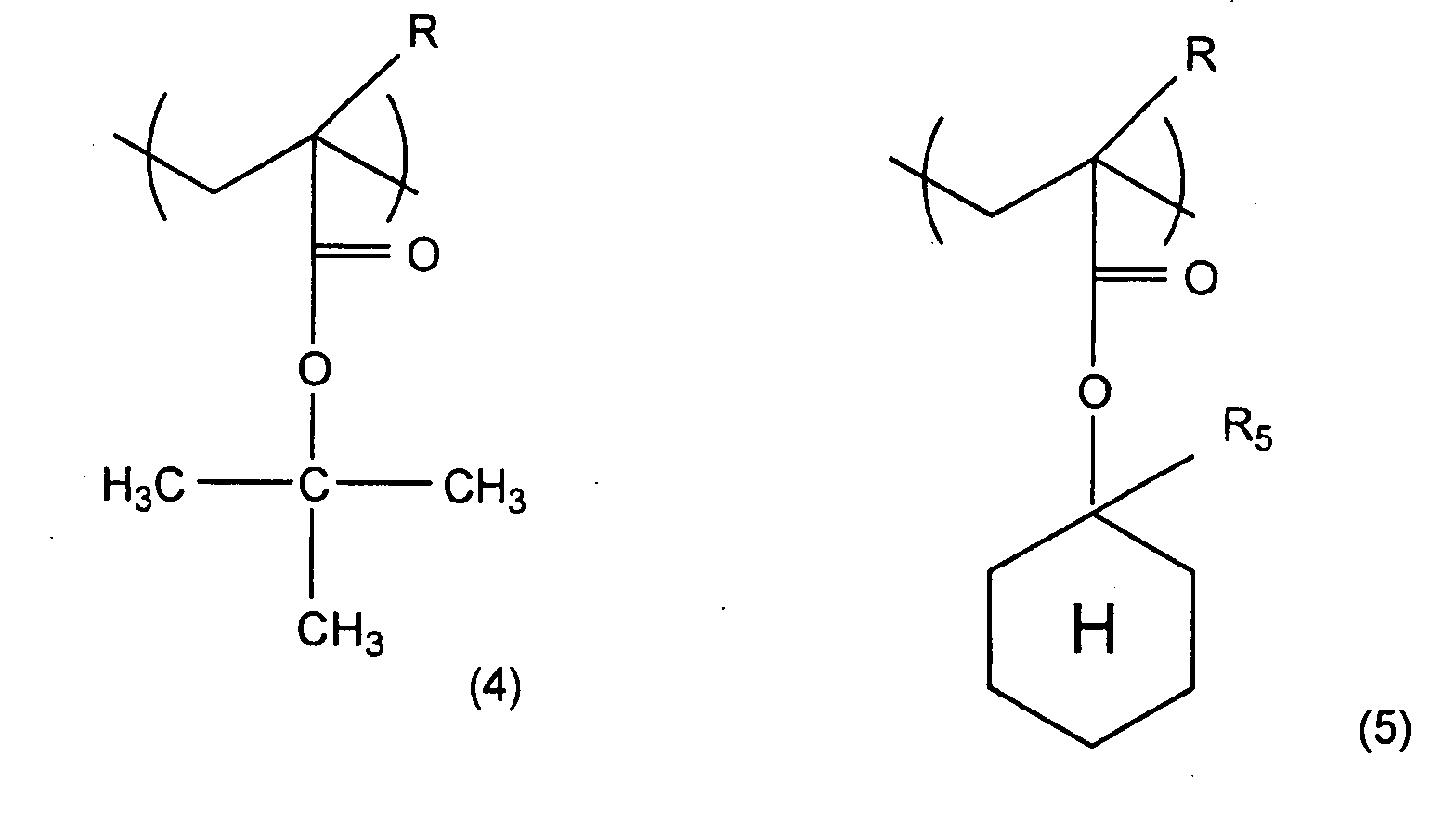
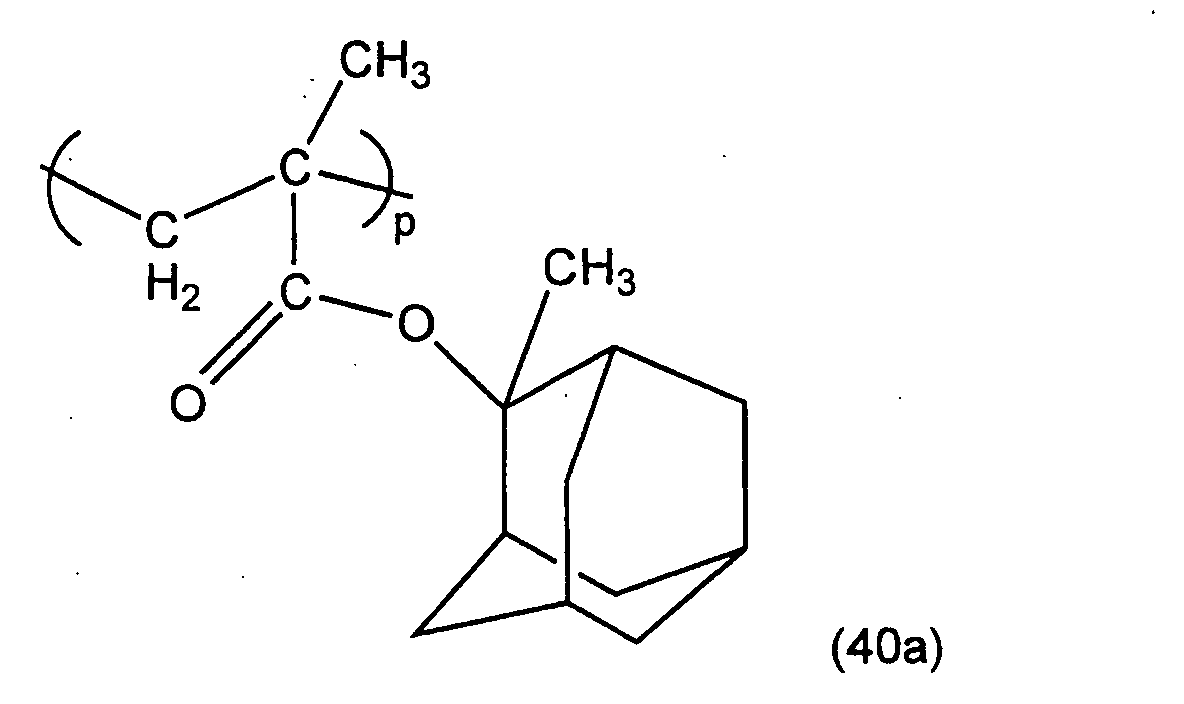
Preferred monomer units for use as the unit (a1) are shown by
the following general formulae (1) through (7). In the general formulae
(1) through (7), R is hydrogen or methyl group, R1 is lower alkyl group,
R2 and R3 are each independently lower alkyl group, R4 is tertiary alkyl
group, R5 is methyl group, and R6 is lower alkyl group.
Preferably, R1 through R3 and R6 are each a straight-chained or
branched lower alkyl group having 1 to 5 carbon atoms, such as methyl
group, ethyl group, propyl group, isopropyl group, n-butyl group,
isobutyl group, tert-butyl group, pentyl group, isopentyl group, and
neopentyl group. Methyl and ethyl groups are industrially preferred.
R
4 is tertiary alkyl group such as tert-butyl group and tert-amyl
group. Tert-butyl group is industrially preferred.
As the units (a1) shown above, the structural units shown by the
general formulae (1), (2), and (3) are particularly preferred since
they can be used to formpatterns with high transparency, high resolution,
and high response to dry etching.
The unit (a2) bears a lactone unit and thus serves to increase
affinity to a developing solution.
The unit (a2) may be any monomer unit that contains a lactone
unit and can copolymerize with the other structural units of the resin
component.
An example of monocyclic lactone unit is γ-butylolactone having
one hydrogen atom removed. An example of polycyclic lactone unit is
a lactone-containing polycycloalkane having one hydrogen atom removed.
Preferred monomer units for use as the unit (a2) are shown by
the following general formulae (8) through (10). In these general
formulae, R is hydrogen or methyl group.
Of the units shown above, γ-butylolactone esters of (meth) acrylic
acids that have an ester bond at the a-carbon and are represented by
the general formula (10) and norbornane lactone esters as represented
by the general formulae (8) and (9) are preferred because of their
industrial availability.
The unit (a3) is a structural unit derived from a (meth) acrylate
having a polycyclic group with an alcoholic hydroxyl group.
The hydroxyl group in the alcoholic hydroxyl group-containing
polycyclic group is a polar group and acts to increase the affinity
of the entire resin components to the developing solution. As a result,
the exposed areas will more readily dissolve in an alkali solution.
Thus, the resin component when containing (a3) gives an increased
resolution and is thus preferred.
The polycyclic group in (a3) may be properly selected from the
same aliphatic polycyclic groups as those described above with reference
to (a1).
While the alcoholic hydroxyl group-containing polycyclic group
is not limited to particular functional groups, hydroxyl-containing
adamantyl group is preferred.
When having the structure shown by the following general formula
(11), the hydroxyl-containing adamantyl group serves to increase
resistance to dry etching and ensures vertical pattern cross section,
and is thus preferred. In the general formula, 1 is an integer from
1 to 3.
The unit (a3) may be any monomer unit that includes the
above-described alcoholic hydroxyl group-containing polycyclic group
and can copolymerize with the other structural units of the resin
component.
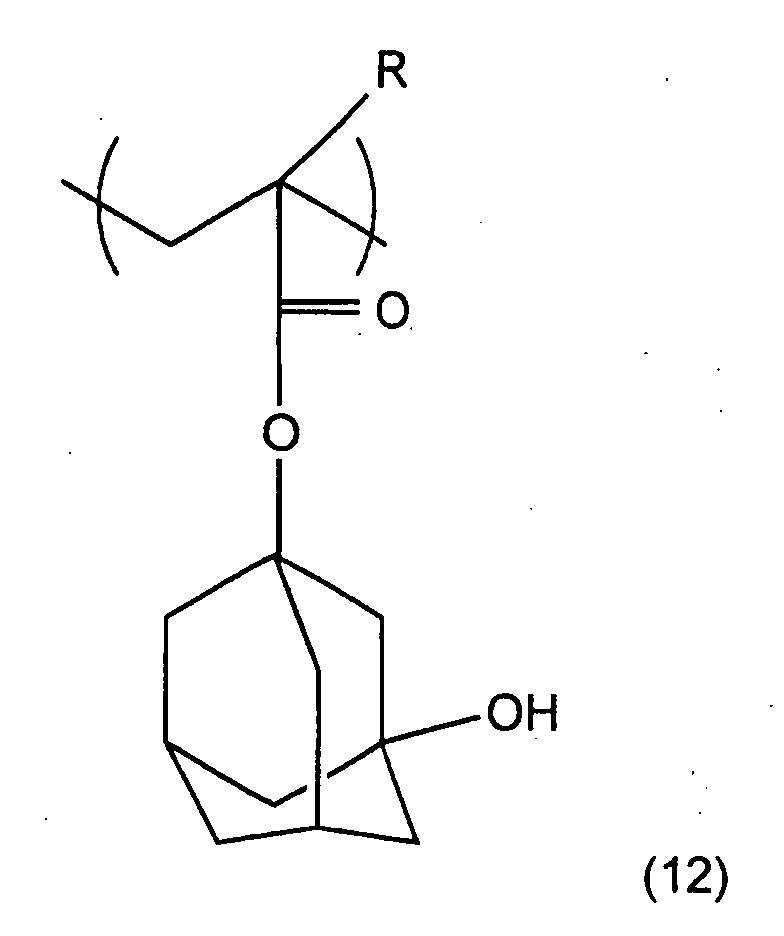
Specifically, the structural units as represented by the following
general formula (12) areparticularlypreferred. In the general formula
(12), R is hydrogen or methyl group.
With regard to the unit (a4), the polycyclic group that "differs
from any of the acid-dissociative anti-dissolving group, the lactone
unit, and the alcoholic hydroxyl group-containing polycyclic group"
means that the polycyclic group of the unit (a4) differs from any of
the acid-dissociative anti-dissolving group of the unit (a1), the
lactone unit of the unit (a2), and the alcoholic hydroxyl
group-containing polycyclic group of the unit (a3). In other words,
the unit (a4) bears none of the acid-dissociative anti-dissolving group
of the unit (a1), the lactone unit of the unit (a2), and the alcoholic
hydroxyl group-containing polycyclic group of the unit (a3) that
together compose the resin component.
The polycyclic group of the unit (a4) may be any polycyclic group
as long as it differs from any of the structural units used as (a1)
through (a3) in one resin component. For example, the polycyclic group
of the unit (a4) may be the same aliphatic polycyclic group as those
described above with reference to the unit (a1). Many of conventional
ArF positive type resist materials can be used.
The polycyclic group of the unit (a4) is preferably at least one
selected from tricyclodecanyl group, adamantyl group, and
tetracyclododecanyl group since they are industrially readily
available.
The unit (a4) may be any structural unit that contains the
above-described polycyclic group and can copolymerize with the other
structural units of the resin component.
Preferred examples of the unit (a4) are given by the following
general formulae (13) through (15). In the general formulae, R is
hydrogen or methyl group.
The composition of the acrylic resin component contains the unit
(a1) in an amount of 20 to 60 mol % and preferably, in an amount of
30 to 50 mol % with respect to the total amount of the structural units
composing the resin component. In this manner, high resolution is
ensured.
The unit (a2) provides high resolution when present in an amount
of 20 to 60 mol % and preferably, in an amount of 30 to 50 mol % with
respect to the total amount of the structural units composing the resin
component.
The unit (a3) ensures favorable resist patterning when present
in an amount of 5 to 50 mol % and preferably, in an amount of 10 to
40 mol % with respect to the total amount of the structural units composing
the resin component.
The unit (a4) ensures resolution of isolated patterns to semi-dense
patterns when present in an amount of 1 to 30 mol % and preferably,
in an amount of 5 to 20 mol % with respect to the total amount of the
structural units composing the resin component.
While the unit (a1) may be used with at least one selected from
the units (a2), (a3), and (a4) in a proper combination in accordance
with the intended purpose, a terpolymer composed of the units (a1),
(a2), and (a3) is preferred because of the resulting resist patterns,
exposure tolerance, resistance to heat, and resolution. Preferred
amounts of the structural units (a1), (a2), and (a3) are from 20 to
60 mol %, from 20 to 60 mol % and from 5 to 50 mol %, respectively.
While not limited to a particular molecular weight, the
weight-average molecular weight (as determined using polystyrene
standards. All weight-average molecular weights are determined using
the same standards) of the resin component for use in the present invention
is preferably in the range of 5000 to 30000 and more preferably, in
the range of from 8000 to 20000. If the weight-average molecular weight
exceeds this range, the resin component becomes less soluble in the
resist solvent. If the weight-average molecular weight is less than
this range, the resistance to dry etching will be decreased and the
resulting resist pattern will be unfavorable.
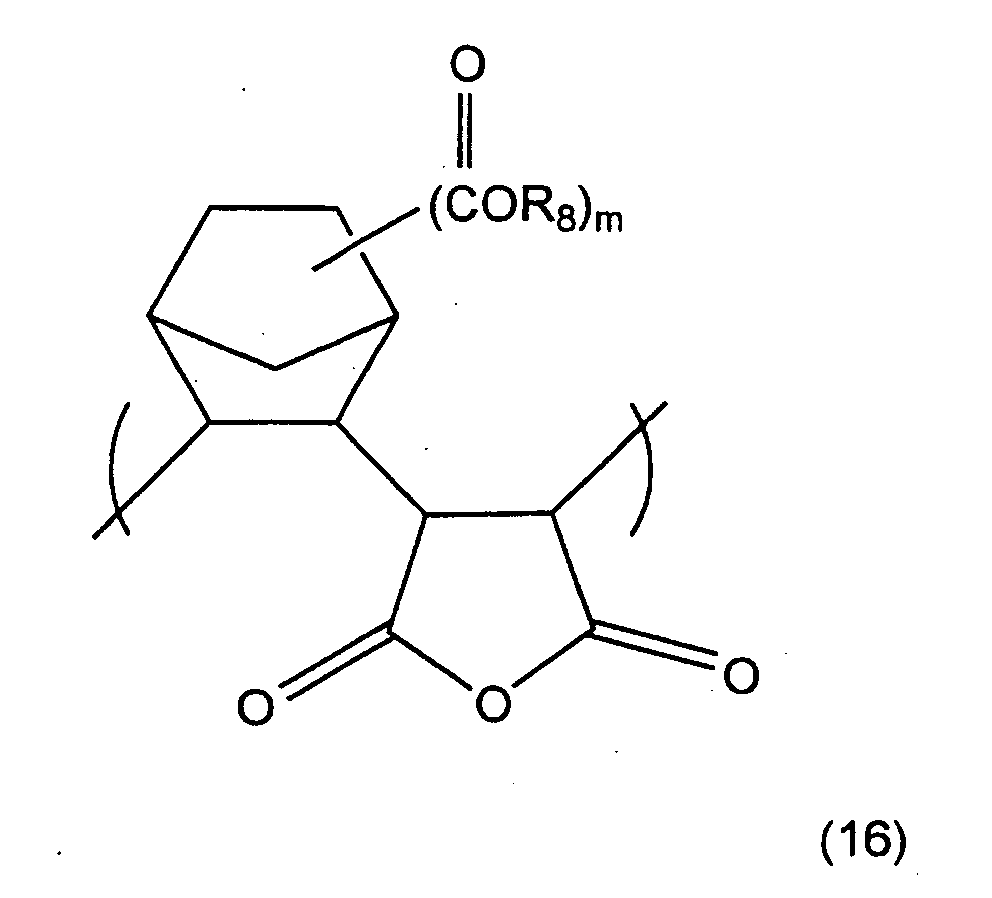
The cycloolefin resin is preferably a resin composed of the
structural unit (a5) shown by the following general formula (16), which
may be optionally copolymerized with a structural unit obtained from
the unit (a1) above:
(wherein R
8 is a substituent as described above as the acid-dissociative
anti-dissolving group with reference to the unit (a1); and m is an integer
from 0 to 3).
When m is 0 in the unit (a5) above, the cycloolefin resin is
preferably a copolymer copolymerized with the unit (a1).
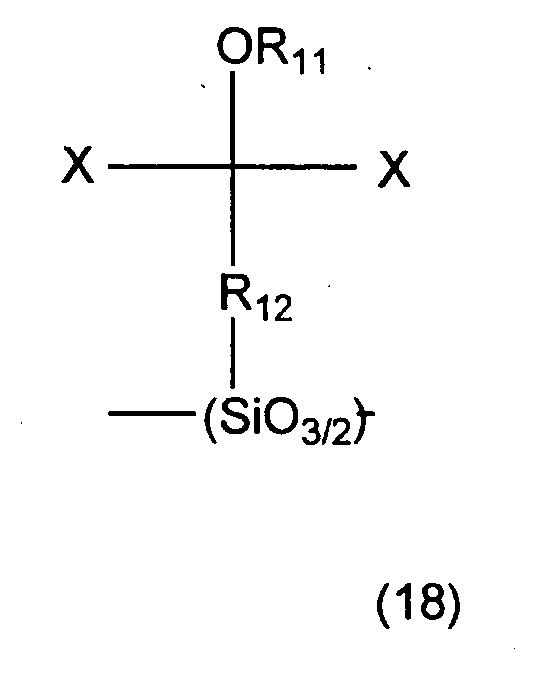
The silsesquioxane resin may be a resin comprising the structural
unit (a6) as shown by the following general formula (17) or a resin
comprising the structural unit (a7) as shown by the following general
formula (18):
(wherein R
9 is an acid-dissociative anti-dissolving group comprising
an aliphatic monocyclic or polycyclic hydrocarbon; R
10 is a
straight-chained, branched, or cyclic saturated aliphatic hydrocarbon:
In the (a6) and (a7) above, the acid-dissociative anti-dissolving
group of R9 is a functional group that keeps the entire silsesquioxane
resin insoluble in an alkali solution prior to exposure and, following
exposure, dissociates as it is acted upon by an acid generated from
an acid-generating agent, making the entire silsesquioxane resin soluble
in an alkali solution.
Preferred examples of such acid-dissociative anti-dissolving
groups include those shown by the following general formulae (19) through
(23), which comprise a hydrocarbon having a bulky, monocyclic or
polycyclic aliphatic group. These acid-dissociative anti-dissolving
groups serve to keep the anti-dissolving groups from forming a gas after
dissociation and suppress degassing.
R9 preferably has 7 to 15 carbon atoms, more preferably 9 to 13
carbon atoms to keep the anti-dissolving groups from forming a gas upon
dissociation and ensure proper solubility in a resist solvent and a
developing solution.
The acid-dissociative anti-dissolving groups comprise
hydrocarbons having an aliphatic monocyclic or polycyclic group and
may be selected from many of those proposed as resins for use in resist
compositions depending on the type of the light source used, for example
ArF excimer laser. Those that can form a cyclic tertiary alkyl ester
with a carboxyl group of (meth)acrylates are commonly known.
The acid-dissociative anti-dissolving groups preferably contain
an aliphatic polycyclic group. Such aliphatic polycyclic groups may
be properly selected frommany of those proposed for use with ArF resists.
Examples of such an aliphatic polycyclic group include bicycloalkane,
tricycloalkane and teroracycloalkane from which single hydrogen atom
has been removed. Specific examples include polycycloalkanes, such
as adamantane, norbornane, isobornane, tricyclodecane and
tetracyclododecane, from which single hydrogen atom has been removed.
Silsesquioxane resins that have a 2-methyladamantyl group as shown
by the general formula (21) and/or a 2-ethyladamantyl group as shown
by the general formula (22) are preferred since they hardly cause
degassing while offering favorable resist properties such as resolution
and resistance to heat.
R10 and R12 preferably have 1 to 20 carbon atoms, more preferably
5 to 12 carbon atoms in view of the solubility in a resist solvent and
control over the size of the molecules. Cyclic saturated aliphatic
hydrocarbons are particularly preferred since the resulting
silsesquioxane resins have high transparency to high energy light and
have high glass transition point (Tg), facilitating control of the
generation of an acid from the acid-generating agent upon PEB (post
exposure bake).
The cyclic saturated aliphatic hydrocarbon group may be either
monocyclic or polycyclic. Examples of the polycyclic group include
bicycloalkane, tricycloalkane and teroracycloalkane from which two
hydrogen atoms have been removed. Specific examples include
polycycloalkanes, such as adamantane, norbornane, isobornane,
tricyclodecane and tetracyclododecane from which two hydrogen atoms
have been removed.
More specifically, R
10 and R
12 may be an alicyclic compound or a
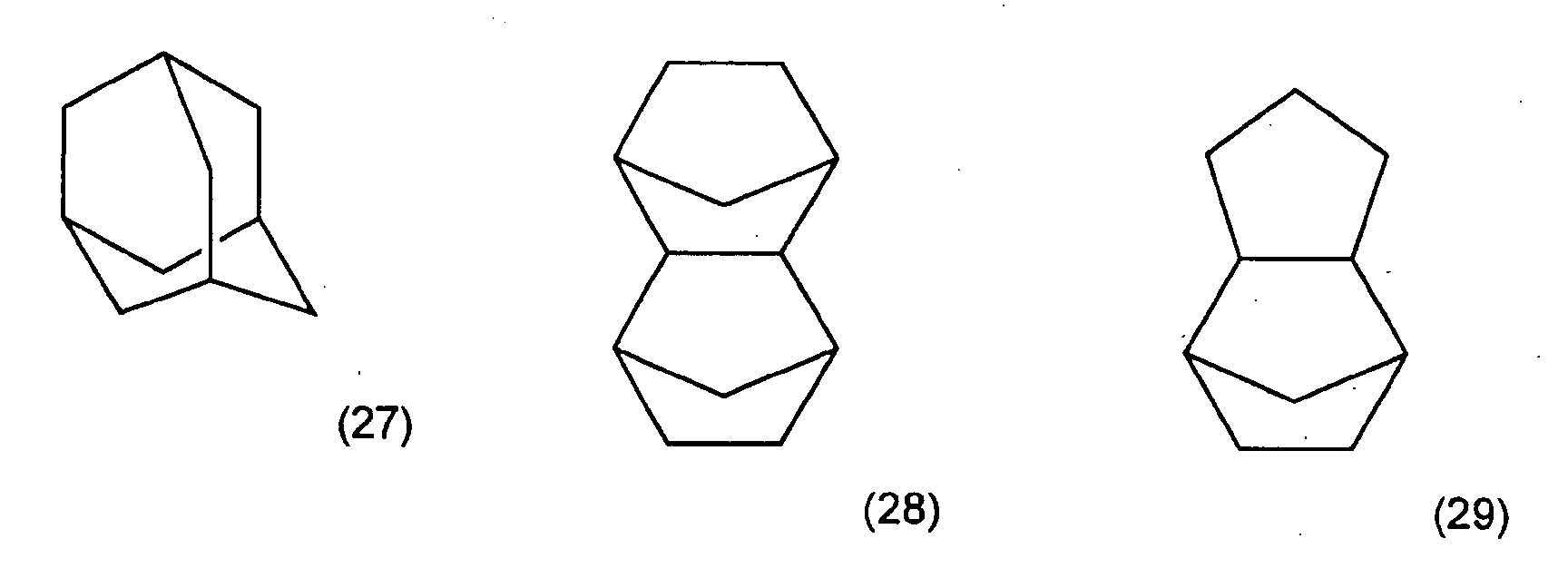
derivative thereof as shown by the following general formulae (24)
through (29) having two hydrogen atoms removed:
The term "derivative" above refers to the alicyclic compounds
shown by the chemical formulae (24) through (29) above means that at
least one hydrogen atom has been substituted with a lower alkyl group,
such as methyl group and ethyl group, oxygen atom, and halogen atom,
such as fluorine, chlorine and bromine. Among them, alicyclic compounds
selected from those represented by the chemical formulae (24) through
(29) having two hydrogen atoms removed are preferred because of their
high transparency and industrial availability.
R11 is preferably a lower alkyl group having 1 to 10 carbon atoms,
more preferably 1 to 4 carbon atoms to ensure solubility in a resist
solvent. Examples of such an alkyl group include methyl group, ethyl
group, propyl group, isopropyl group, n-butyl group, sec-butyl group,
tert-butyl group, cyclopentyl group, cyclohexyl group, 2-ethylhexyl
group and n-octyl group.
R11 is properly selected from the above candidates depending on
the desired solubility of the silsesquioxane resin in an alkali solution.
The highest solubility in an alkali solution is achieved when R11 is
hydrogen. A higher solubility in an alkali solution offers an advantage
that the resulting resin has higher sensitivity.
As the above-described alkyl group has more carbon atoms or becomes
bulkier, the solubility of the resultant silsesquioxane resin in an
alkali solution is decreased. The decreased solubility in an alkali
solution leads to an increase in the resistance of the resin to alkali
developing solution, so that the exposure margin is improved during
resist patterning using the silsesquioxane resin. As a result, the
size variation upon exposure is minimized. In addition, the decreased
solubility in an alkali solution eliminates nonuniform development and,
thus, improves roughness at the edges of the resulting resist patterns.
Preferably, X in the general formulae (17) and (18) is a
straight-chained alkyl group. The alkyl group is a lower alkyl group
that has 1 to 8 carbon atoms, preferably 1 to 4 carbon atoms in view
of the glass transition point (Tg) and the solubility in a resist solvent
of the silsesquioxane resin. The alkyl group preferably has more
hydrogen atoms substituted with fluorine atoms since transparency to
high energy light of 200 nm or shorter wavelengths or electron beam
can be increased in this manner. Most preferably, the alkyl group is
a perfluoroalkyl group that has all of its hydrogen atoms substituted
with fluorine atoms. Xs may or may not be identical to one another.
"m" in the general formula (17) is an integer from 1 to 3, preferably
1, so that the acid-dissociative anti-dissolving group can readily
dissociate.
More specifically, the silsesquioxane resin may be one shown by
the following general formula (30) or (31):
(wherein R
6, R
10, R
12, and n are same as those defined above).
The structural units (a6) and (a7) typically compose 30 to 100
mol %, preferably 70 to 100 mol %, more preferably 100 mol % of the
entire structural units forming the silsesquioxane resin of the present
invention.
The proportion of the structural unit (a6) with respect to the
total amount of the structural units (a6) and (a7) is preferably 5 to
70 mol %, and more preferably 10 to 40 mol %. The proportion of the
structural unit (a7) is preferably 30 to 95 mol %, and more preferably
60 to 90 mol %.
Adjusting the proportion of the structural unit (a6) within the
above range automatically determines the proportion of the
acid-dissociative anti-dissolving group, so that the change in the
solubility of the silsesquioxane resin in an alkali solution before
and after exposure becomes suitable for a base resin of a positive type
resist composition.
As long as the advantages of the present invention are not affected,
the silsesquioxane resin may contain additional structural units other
than (a6) and (a7). Such additional structural units may be those that
have been used in silsesquioxane resins for use in resist compositions
for ArF excimer laser. Examples include alkyl silsesquioxane units
having alkyl groups, such as methyl group, ethyl group, propyl group
and butyl group.
The silsesquioxane resin preferably has a weight-average
molecular weight (Mw) (as determined by using polystyrene standards
in gel permeation chromatography) of 2000 to 15000, more preferably
3000 to 8000, while it may have any weight-average molecular weight.
The silsesquioxane resin with a weight-average molecular weight greater
than this range is hardly soluble in a resist solvent, whereas the resin
with too small a molecular weight may affect the resist pattern cross
section.
The value of the weight-average molecular weight (Mw)/the
number-average molecular weight (Mn) is preferably in the range of 1.0
to 6.0, and more preferably in the range of 1.5 to 2.5 while it may
take any value. If this value is greater than the specified range,
then the resolution and the pattern shape may be deteriorated.
Having the silsesquioxane backbone composed of the structural
units (a6) and (a7), the silsesquioxane resin of the present invention
has high transparency to high energy light of 200 nmor shorter wavelengths
and electron beam. For this reason, the positive type resist composition
containing the silsesquioxane resin of the present invention is suitable
for use in lithography that uses light sources that emit light with
shorter wavelengths than ArF excimer laser. The positive type resist
composition can be used to form fine resist patterns with a line width
of 150 nm or less, in particular 120 nm or less, in the single layer
process. When used in the upper layer of a two-layered laminate, the
positive type resist composition allows formation of fine resist
patterns with a line width of 120 nm or less, in particular 100 nm or
less.
While the resin component for use in the above-described negative
type resist composition may be any conventional resin component used
for this purpose, it is preferably a resin component as described below.
Specifically, the resin component (a8) is such that it becomes
insoluble when acted upon by an acid and includes two functional groups
that react with each other to form an ester. When an acid is generated
from an acid-generating agent, which is added to the resist material
along with the resin component, the acid acts on the resin component
and, as a result, the resin component is dehydrated to form an ester,
thereby becoming insoluble in an alkali solution. What is meant by
saying "two functional groups that react with each other to form an
ester" is, for example, a combination of a hydroxyl group and a carboxyl
group or a carboxylate that together form a carboxylic acid ester. In
other words, these are two functional groups that together form an ester.
Preferably, such a resin has a hydroxyalkyl group and at least one of
carboxylic group and carboxylate on side chains of the resin backbone.
The resin component may be a resin component (a9) composed of
a polymer comprising a dicarboxylic acid monoester unit.
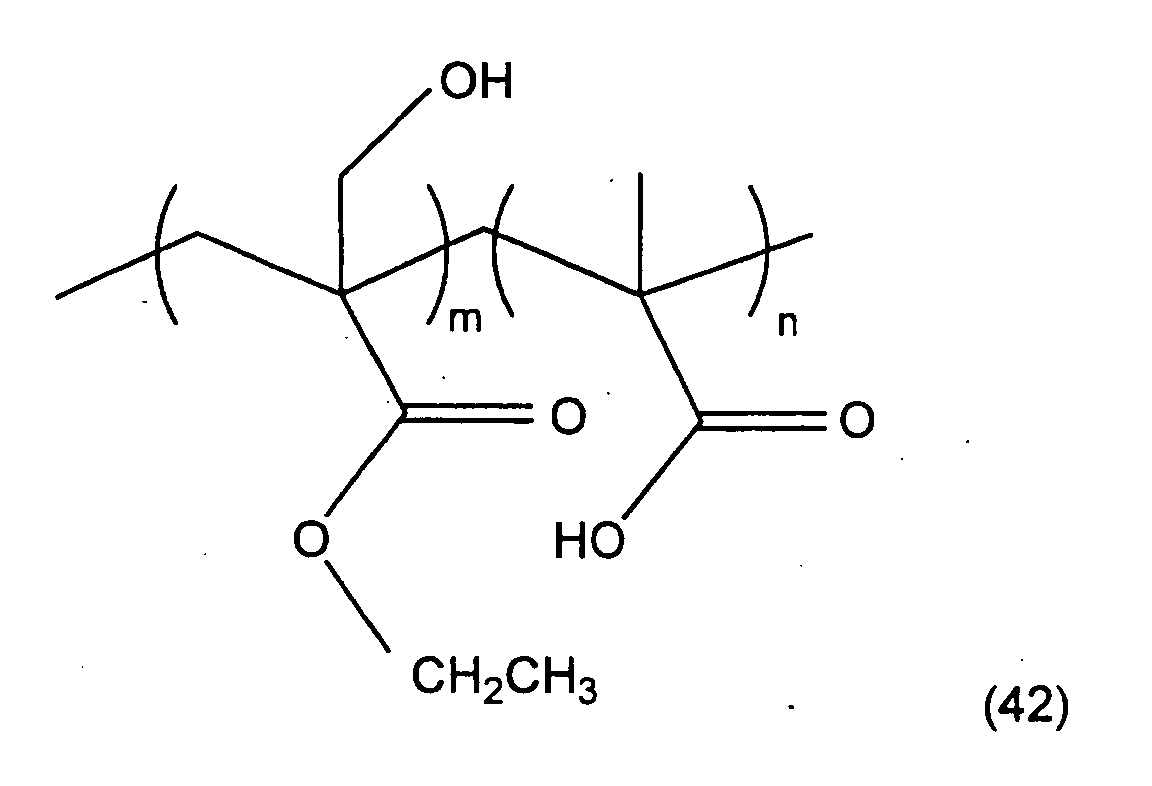
In other words, the unit (a8) is a resin component comprising
at least the structural unit shown by the following general formula
(32) :
(wherein R
13 is hydrogen, alkyl group having 1 to 6 carbon atoms, or
alkyl group having a polycyclic ring structure, such as bornyl group,
adamantyl group, tetracyclododecyl group and tricyclodecyl group).
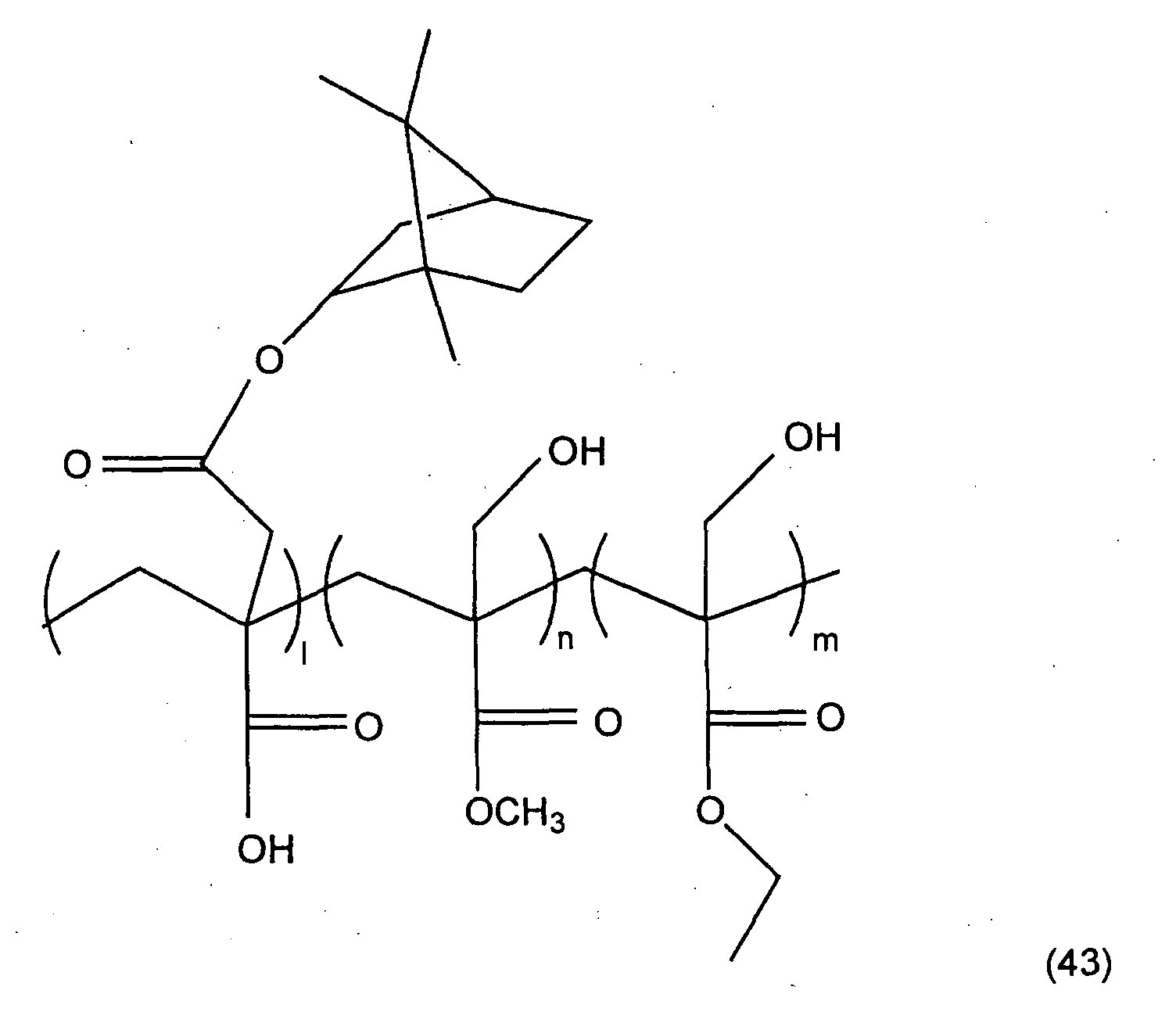
Examples of such a resin include a polymer (a8-1) (homopolymer
or copolymer) composed of at least one monomer selected from
a- (hydroxyalkyl) acrylic acids and a- (hydroxyalkyl) acrylic acid alkyl
esters; and a copolymer (a8-2) composed of at least one monomer selected
from a- (hydroxyalkyl) acrylic acids and a- (hydroxyalkyl) acrylic acid
alkyl esters and at least one monomer selected from other ethylenic
unsaturated carboxylic acids and ethylenic unsaturated carboxylates.
Preferably, the polymer (a8-1) is a copolymer of
a- (hydroxyalkyl) acrylic acid and a- (hydroxyalkyl) acrylic acid alkyl
ester. Preferably, the copolymer (a8-2) uses, as the other ethylenic
unsaturated carboxylic acids or ethylenic unsaturated carboxylates,
at least one selected from acrylic acids, methacrylic acids, alkyl esters
of acrylic acids and alkyl esters of methacrylic acids.
Examples of the hydroxyalkyl group in the a- (hydroxyalkyl) acrylic
acids and a- (hydroxyalkyl)acrylic acid alkyl esters are lower
hydroxyalkyl groups, including hydroxymethyl group, hydroxyethyl group,
hydroxypropyl group and hydroxybutyl group. Among them, hydroxyethyl
group and hydroxymethyl group are preferred since they readily form
esters.
Examples of the alkyl group in the alkylester moieties of the
a- (hydroxyalkyl) acrylic acid alkyl esters include lower alkyl groups,
such as methyl group, ethyl group, propyl group, isopropyl group, n-butyl
group, sec-butyl group, tert-butyl group and amyl group; and crosslinked
polycyclic ring hydrocarbons, such as bicyclo[2.2.1]heptyl group,
bornyl group, adamantyl group, tetracyclo [4.4.0.12.5.17.10] dodecyl group
and tricyclo [5.2.1.02.6] decyl group. The alkyl esters in which the alkyl
group of the ester moiety is a polycyclic ring hydrocarbon are effective
in increasing resistance to dry etching. The alkyl esters having a
lower alkyl group, such as methyl group, ethyl group, propyl group or
butyl group are preferred since the alcohols used to form the esters
are inexpensive and readily available.
In the case of the lower alkyl esters, in which esterification
takes place with both carboxyl groups and hydroxyalkyl groups,
esterification can hardly take place for the esters formed with the
crosslinked polycyclic ring hydrocarbons. Thus, when it is desired
to introduce an ester with a crosslinked polycyclic ring hydrocarbons
into the resin, the resin preferably contains carboxyl groups on its
side chains.
Examples of the other ethylenic unsaturated carboxylic acids and
ethylenic unsaturated carboxylates used in the (a8-2) include
unsaturated carboxylic acids of acrylic acid, methacrylic acid, maleic
acid, and fumaric acid, and alkyl esters of these unsaturated carboxylic
acids, such as methyl, ethyl, propyl, isopropyl, n-butyl, isobutyl,
n-hexyl, and octyl esters. Examples of the alkyl group in the ester
moieties include esters of acrylic acids or methacrylic acids having
crosslinked polycyclic ring hydrocarbons, such as bicyclo [2.2.1] heptyl
group, bornyl group, adamantyl group,
tetracyclo[4.4.0.12.5.17.10]dodecyl group, and
tricyclo[5.2.1.02.6]decyl group. Among them, acrylic acids and
methacrylic acids, and lower alkyl esters thereof , such as methyl, ethyl,
propyl, andn-butyl esters are preferred because of their cost efficiency
and availability.
In the resin formed of the resin component (a8-2), the at least
one monomer unit selected from a- (hydroxyalkyl)acrylic acids and
a- (hydroxyalkyl) acrylic acid alkyl esters and the at least one monomer
unit selected from the other ethylenic unsaturated carboxylic acids
and ethylenic unsaturated carboxylates are present at a molar ratio
of 20 : 80 to 95 : 5, in particular, at a molar ratio of 50 : 50 to
90 : 10. With the both units falling within the respective ranges,
intramolecular or intermolecular esters are readily formed and, as a
result, improved resist patterns can be obtained.
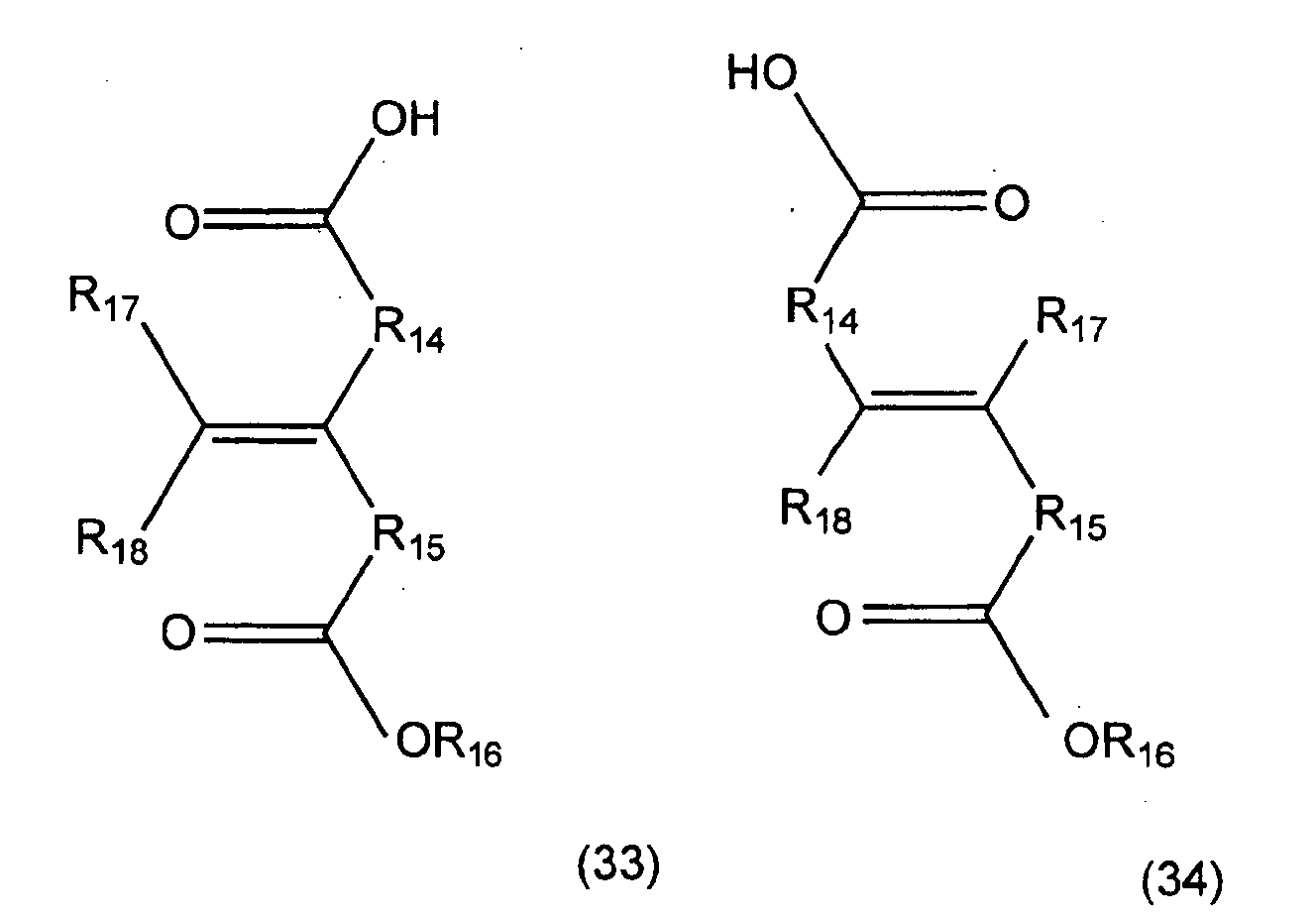
The resin component (a9) comprises at least the structural units
shown by the following general formula (33) or (34):
(wherein R
14 and R
15 are each alkyl chain having 0 to 8 carbon atoms;
R
16 is a substituent having at least two alicyclic structures; and R
17
and R
18 are each hydrogen or alkyl group having 1 to 8 .carbon atoms).
The negative type resist compositions using the resin component
comprising such a dicarboxylic acid monoester monomer unit provide high
resolution and reduce the line edge roughness and is thus preferred.
Such resist compositions have high resistance to swelling and are
particularly suitable for use in liquid immersion lithography.
Examples of such dicarboxylic acid monoester compounds include
fumaric acid, itaconic acid, mesaconic acid, glutaconic acid and
traumatic acid.
Preferred resins comprising the dicarboxylic acid monoester unit
include polymers or copolymers (a9-1) of a dicarboxylic acid monoester
monomer; and copolymers (a9-2) of a dicarboxylic acid monoester monomer
and at least one monomer selected from the above-described
a-(hydroxyalkyl)acrylic acids, a-(hydroxyalkyl)acrylic acid alkyl
esters, the other ethylenic unsaturated carboxylic acids, and ethylenic
unsaturated carboxylates.
The resin components of the negative type resist may be used either
individually or in combination of two or more. The resin component
has a weight-average molecular weight of 1000 to 50000, preferably 2000
to 30000.
Many fluorine-containing polymers have been proposed for use as
resin components of F2 positive type resists. Any of these polymers
may be used in the present invention. Of such polymers, preferred are
fluorine-containing polymers (a10) comprising an alkali-soluble
structural unit (a10-1) containing an aliphatic cyclic group that has
both of (i) fluorine atom or fluorinated alkyl group and (ii) alcoholic
hydroxyl group. Preferably, the solubility of these polymers in an
alkali solution changes when the polymers are acted upon by an acid.
What is meant by saying "the solubility of the polymer (a10) changes
when the polymer is acted upon by an acid" is the change of the polymer
that takes place in the exposed area. Specifically, if the solubility
of the polymer in an alkali solution increases in the exposed area,
then the exposed area becomes soluble in an alkali solution, so that
the polymer can serve as a positive type resist. Conversely, if the
solubility in an alkali solution decreases in the exposed area, then
the exposed area becomes insoluble in an alkali solution, so that the
polymer can serve as a negative type resist.
The alkali-soluble structural unit (a10-1) containing an
aliphatic cyclic group that has both of (i) fluorine atom or fluorinated
alkyl group and (ii) alcoholic hydroxyl group may be any structural
unit in which an organic functional group bearing both (i) and (ii)
is bonded to an aliphatic cyclic group and such a cyclic group is present
in the structural unit of the polymer.
The aliphatic cyclic group may be a monocyclic or polycyclic
hydrocarbon, such as cyclopentane, cyclohexane, bicycloalkane,
tricycloalkane, and teroracycloalkane, that has one or more hydrogen
atoms removed.
Specific examples of the polycyclic hydrocarbon include
polycycloalkanes, such as adamantane, norbornane, isobornane,
tricyclodecane and tetracyclododecane, from which one or more hydrogen
atoms have been removed.
Of these functional groups, those derived by removing hydrogen
atoms from cyclopentane, cyclohexane or norbornane are industrially
preferred.
The fluorine atom or fluorinated alkyl group (i) may be a fluorine
atom or lower alkyl group that has some or all of its hydrogen atoms
substituted with fluorine atoms. Specific examples include
trifluoromethyl group, pentafluoroethyl group, heptafluoropropyl
group and nonafluorobutyl group. Fluorine atom and trifluoromethyl
group are industrially preferred.
The alcoholic hydroxyl group (ii) may be simply a hydroxyl group,
or it may be an alcoholic hydroxyl group-containing alkyloxy group,
alcoholic hydroxyl group-containing alkyloxyalkyl group, or alcoholic
hydroxyl group-containing alkyl group, such as hydroxyl-containing
alkyloxy group, alkyloxyalkyl group or alkyl group. The alkyloxy group,
alkyloxyalkyl group and alkyl group are preferably lower alkyloxy group,
lower alkyloxy lower alkyl group and lower alkyl group, respectively.
Examples of the lower alkyloxy group are methyloxy group, ethyloxy
group, propyloxy group and buthyloxy group. Examples of the lower
alkyloxy lower alkyl group are methyloxymethyl group, ethyloxymethyl
group, propyloxymethyl group and butyloxymethyl group. Examples of
the lower alkyl group are methyl group, ethyl group, propyl group and
butyl group.
The alcoholic hydroxyl group-containing alkyloxy group, alcoholic
hydroxyl group-containing alkyloxyalkyl group or alcoholic hydroxyl
group-containing alkyl group (ii) may have some or all of the hydrogen
atoms of its alkyloxy group, alkyloxyalkyl group or alkyl group
substituted with fluorine atoms.
Preferably, the alkyloxy moiety of the alcoholic hydroxyl
group-containing alkyloxy group or the alcoholic hydroxyl
group-containing alkyloxyalkyl group has some of its hydrogen atoms
substituted with fluorine atoms. Preferably, the alkyl moiety of the
alcoholic hydroxyl group-containing alkyl group has its hydrogen atoms
substituted with fluorine atoms. Specific examples are alcoholic
hydroxyl group-containing fluoroalkyloxy groups, alcoholic hydroxyl
group-containing fluoroalkyloxyalkyl groups, and alcoholic hydroxyl
group-containing fluoroalkyl groups.
Examples of the alcoholic hydroxyl group-containing
fluoroalkyloxy group include (HO)C(CF3)2CH2O- group
(2-bis(hexafluoromethyl)-2-hydroxy-ethyloxy group and
(HO)C(CF3)2CH2CH2O- group
3-bis(hexafluoromethyl)-3-hydroxy-propyloxy group. Examples of the
alcoholic hydroxyl group-containing fluoroalkyloxyalkyl group include
(HO)C(CF3)2CH2O-CH2- group and (HO)C(CF3)2CH2CH2O-CH2- group. Examples
of the alcoholic hydroxyl group-containing fluoroalkyl group include
(HO)C(CF3)2CH2- group (2-bis(hexafluoromethyl)-2-hydroxy-ethyl group
and (HO)C(CF3)2CH2CH2- group 3-bis (hexafluoromethyl)-3-hydroxy-propyl
group.
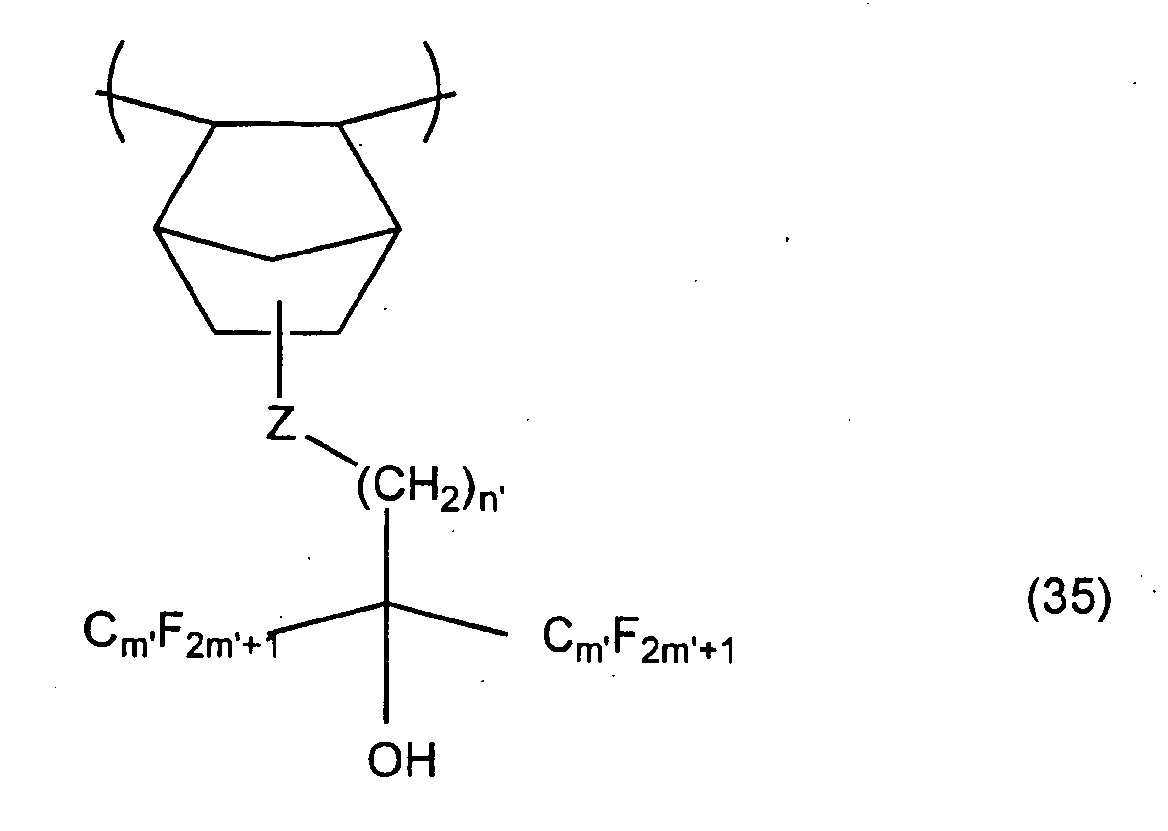
The groups (i) and (ii) may be directly bonded to the aliphatic
cyclic group. Preferably, the structural unit (a10-1) is a unit shown
by the following general formula (35), which is formedwhen the norbornene
ring is bonded to the alcoholic hydroxyl group-containing fluoroalkyloxy
group, the alcoholic hydroxyl group-containing fluoroalkyloxyalkyl
group or the alcoholic hydroxyl group-containing fluoroalkyl group,
and the double bond in the norbornene ring opens. This structural unit
provides high transparency, high alkali solubility, and high resistance
to dry etching and is industrially readily available.
(wherein Z is oxygen atom, oxymethylene group (-O(CH
2)-) or single bond;
and n' and m' are each independently an integer from 1 to 5).
The polymer unit used in conjunction with the unit (a10-1) may
be any known polymer unit. When the polymer is used as a positive type
polymer that becomes soluble in an alkali solution when acted upon by
an acid, the structural unit (a1), derived from (meth) acryl ester having
the above-described acid-dissociative anti-dissolving group, is
preferably used since it ensures high resolution.
Preferably, the structural unit (a1) is derived from a tertiary
alkyl ester of (meth) acrylic acids, such as tert-butyl (meth) acrylates
and tert-amyl (meth)acrylates.
The polymer (a10) may be a polymer (a11) that comprises the
fluorinated alkylene structural unit (a10-2) to improve transparency
of the polymer and becomes soluble in an alkali solution when acted
upon by an acid. The presence of the structural unit (a10-2) further
improves the transparency of the polymer. The structural unit (a10-2)
is preferably derived from tetrafluoroethylene.
The polymer (a10) and the polymer (a11) are represented by the
following general formulae (36) and (37), respectively:
(wherein Z, n' and m' are the same as in the general formula (35); R
is hydrogen or methyl group; and R
19 is an acid-dissociative
anti-dissolving group);
(wherein Z, n', m', R and R
19 are the same as in the general formula
(36)).
As a polymer, which comprises another structural unit (a10-1)
that differs from the polymer (a10) and the polymer (a11) and whose
solubility in an alkali solution changes when acted upon by an acid,
may be a polymer having the following structure unit.
Specifically, in the structural unit (a10-1), (i) fluorine atom
or fluorinated alkyl group and (ii) alcoholic hydroxyl group are each
bonded to an aliphatic cyclic group, which forms the backbone.
The fluorine atom or fluorinated alkyl group (i) may be the same
as that described above. The alcoholic hydroxyl group (ii) is simply
a hydroxyl group.
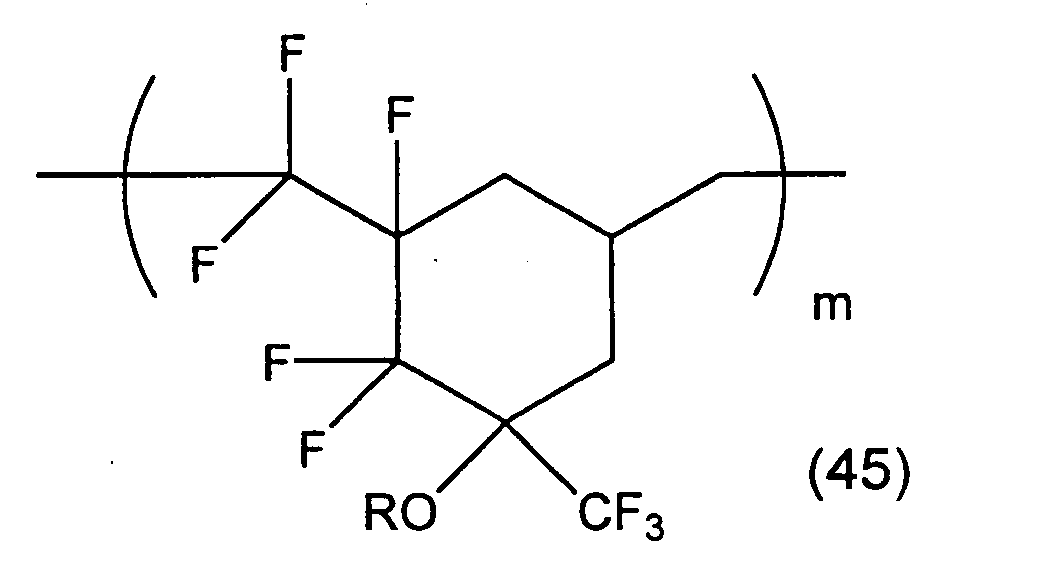
A polymer (a12) comprising such a unit is formed through cyclic
polymerization of a hydroxyl group and a diene compound having a fluorine
atom. The diene compound is preferably a heptadiene, which can readily
form a five-membered or six-membered ring and provides high transparency
and high resistance to dry etching. Polymers formed through cyclic
polymerization of
1, 1, 2, 3,3-pentafluoro-4-trifluoromethyl-4-hydroxy-1, 6-heptadiene
(CF2=CFCF2C(CF3) (OH)CH2CH=CH2) are industrially most preferred.
A polymer (a13) of positive type that becomes soluble in an alkali
solution when acted upon by an acid may also be used. The polymer (a13)
preferably comprises a structural unit (a10-3) in which hydrogen atoms
of the alcoholic hydroxyl group have been substituted with
acid-dissociative anti-dissolving groups. In view of acid
dissociation, the acid-dissociative anti-dissolving group is
preferably a straight-chained, branched or cyclic alkyloxymethyl group
having 1 to 15 carbon atoms. Lower alkoxymethyl groups, such as
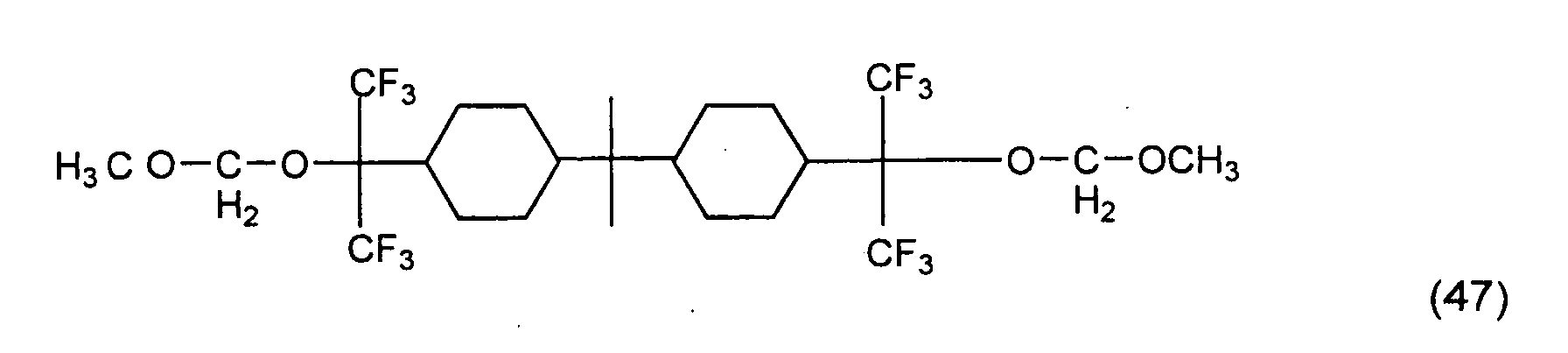
methoxymethyl group are particularly preferred since they provide high
resolution and ensure good patterning shape. The acid-dissociative
anti-dissolving groups can ensure good formative ability of patterns
when accounting for 10 to 40%, preferably 15 to 30% of the entire hydroxyl
groups.
The polymer (a13) are represented by the following general formula
(38) :
(wherein R
20 is hydrogen or alkyloxymethyl group having 1 to 15 carbon
atoms; and x and y are each 10 to 50 mol %).
The polymers (a10), (a11), (a12), and (a13) can be synthesized
by using techniques described in non-patent articles such as S. Kodama
et al., "Synthesis of Novel Fluoropolymer for 157 nm Photoresists by
Cyclo-polymerization" Proceedings of SPIE, Vol. 4690, (2002) pp76-83,
and patent articles such as International Patent Publication No. WO
00/67072 pamphlet, International Patent Publication No. WO 02/65212
pamphlet, and International Patent Publication No. WO 02/64648 pamphlet.
The resin composed of the components (a10), (a11), (a12), and
(a13) has a weight-average molecular weight (as determined by GPC using
polystyrene standards) preferably in the range of 5000 to 80000, and
more preferably in the range of 8000 to 50000 while the resin may have
any weight-average molecular weight.
The polymer (a10) may be composed of one or two or more of resins,
and for example, two or more selected from the (a10), (a11), (a12),
and (a13) may be mixed and conventionally known resins for photoresist
composition may further be added.
Of the resins described above, the positive type resists using
the acrylic resins (a1) through (a4) contain resins that are relatively
resistant to liquid immersion. When used as the immersion medium, the
immersion fluid of the present invention can elicit comparable or higher
effects. The effect of the immersion fluid of the present invention
will become prominent near the resolution limit of approximately 50
nm or less.
The positive type resists using the silsesquioxane resins ((a6)
and (a7)) have a lower resistance to liquid immersion than those using
the acrylic resins. Nonetheless, the aptitude of the photoresists for
liquid immersion lithography can be improved by the use of the immersion
fluid of the present invention.
Similar to the positive type resists using the silsesquioxane
resins, the negative type photoresists using the resins (a8) and/or
(a9) have a lower resistance to liquid immersion than those of the positive
type resists using the acrylic resins. Nonetheless, swelling and other
effects of liquid immersion can be reduced by the use of the immersion
fluid of the present invention. In the negative type resists, the line
edge roughness can also be improved.
The present inventors realize that the cycloolefine resins can
achieve very low resistance to liquid immersion lithography, making
the patterning impossible, as described in the Comparative Example.
The immersion fluid of the present invention even allows the use of
these resins in liquid immersion lithography.
Thus, the immersion fluid of the present invention serves as a
useful tool for extending the use of the liquid immersion lithography
to the resists using resins with low resistance to liquid immersion.
The resists using the fluorine-containing polymers are mainly
used in F2 excimer laser lithography. The immersion fluid of the present
invention is also suitable for use in liquid immersion lithography using
excimer laser with a wavelength of 157 nm.
The acid-generating agent for use with the above-described resin
components of positive or negative type resists may be any known
acid-generating agent conventionally used in chemical amplification
type resists.
Examples of such an acid-generating agent include onium salts,
such as diphenyliodonium trifluoromethanesulfonate,
(4-methoxyphenyl)phenyliodonium trifluoromethanesulfonate,
bis(p-tert-butylphenyl)iodonium trifluoromethanesulfonate,
triphenylsulfonium trifluoromethanesulfonate,
(4-methoxyphenyl)diphenylsulfonium trifluoromethanesulfonate,
(4-methylphenyl)diphenylsulfonium nonafluorobutanesulfonate,
(p-tert-butylphenyl)diphenylsulfonium trifluoromethanesulfonate,
diphenyliodonium nonafluorobutanesulfonate,
bis(p-tert-butylphenyl)iodonium nonafluorobutanesulfonate,
triphenylsulfonium nonafluorobutanesulfonate,
(4-trifluoromethylphenyl)diphenylsulfonium
trifluoromethanesulfonate,
(4-trifluoromethylphenyl)diphenylsulfonium
nonafluorobutanesulfonate, and tri(p-tert-butylphenyl)sulfonium
trifluoromethanesulfonate.
Of these onium salts, triphenylsulfonates are less susceptible
to decomposition and generate little organic gases and are, thus, favored.
The triphenylsulfonate is added preferably in an amount of 50 to 100
mol %, more preferably in an amount of 70 to 100 mol %, and most preferably
in an amount of 100 mol % with respect to the total amount of the
acid-generating agent.
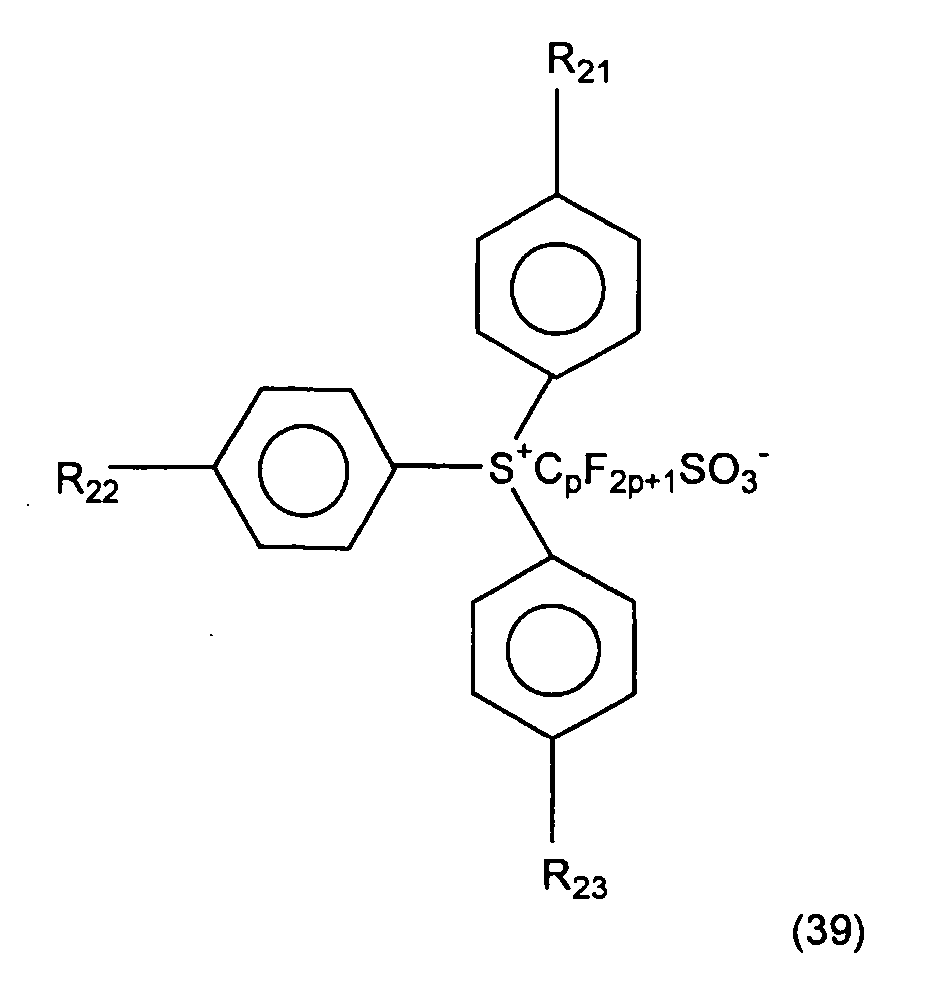
Among triphenylsulfonates, those shown by the following general
formula (39) and having perfluoroalkylsulfonic acid ion as its anion
can be used to increase the sensitivity and are, thus, preferred:
(wherein R
21, R
22, and R
23 are each independently hydrogen, lower alkyl
group having 1 to 8, preferably 1 to 4 carbon atoms, or halogen, such
as chlorine, fluorine and bromine; and p is an integer from 1 to 12,
preferably from 1 to 8 and more preferably from 1 to 4).
The above-described acid-generating agents may be used either
individually or in combination of two or more. The acid-generating
agent is added in an amount of 0.5 parts by weight, and preferably in
an amount of 1 to 10 parts by weight with respect to 100 parts by weight
of the above-described resin component. If the amount of the
acid-generating agent is less than 0.5 parts by weight, then sufficient
pattern formation cannot be achieved. If the amount of the
acid-generating agent is more than 30 parts by weight, then it becomes
difficult to obtain a uniform solution, resulting in a decreased
stability during storage.
The positive or negative type resist compositions of the present
invention are produced by dissolving the resin component, the
acid-generating agent, and the below-described optional components
preferably in an organic solvent.
The organic solvent may be any organic solvent that can dissolve
the resin component and the acid-generating agent to form a uniform
solution. One or two or more solvents may be selected from known solvents
for use with chemical amplification type resists.
Examples of the organic solvent include ketones, such as acetone,
methyl ethyl ketone, cyclohexanone, methylisoamylketone and
2-heptanone; polyhydric alcohols and derivatives thereof, such as
monomethyl ether, monoethyl ether, monopropyl ether, monobutyl ether
and monophenyl ether of ethylene glycol, ethylene glycol monoacetate,
diethylene glycol, diethylene glycol monoacetate, propylene glycol,
propylene glycol monoacetate, dipropylene glycol and dipropylene glycol
monoacetate; cyclic ethers such as dioxane; and esters, such as methyl
lactate, ethyl lactate, methyl acetate, ethyl acetate, butyl acetate,
methyl pyruvate, ethyl pyruvate, methyl methoxypropionate and ethyl
ethoxypropionate. These organic solvents may be used either
individually or in combination of two or more.
As a quencher, a known amine, preferably a secondary lower aliphatic
amine or a tertiary lower aliphatic amine, or an organic acid, such
as an organic carboxylic acid, and oxo acid of phosphorus, may be added
to the positive or negative type resists for the purpose of improving
the shape and the stability over time of resist patterns.
The lower aliphatic amine refers to amines of alkyl or alkyl alcohol
having 5 or less carbon atoms. Examples of the secondary or tertiary
amine include trimethylamine, diethylamine, triethylamine,
di-n-propylamine, tri-n-propylamine, tribentylamine, diethanolamine
and triethanolamine. Alkanolamines, such as triethanolamine, are
particularly preferred. These amines may be used either individually
or in combination of two or more.
The amine is typically used in an amount of 0.01 to 2.0 weight %
with respect to the resin component.
The organic carboxylic acid is preferably malonic acid, citric
acid, malic acid, succinic acid, benzoic acid and salicylic acid.
Examples of the oxo acid of phosphorus or derivatives thereof
include phosphoric acid and derivatives, such as esters, thereof,
including phosphoric acid, di-n-butyl phosphate, and diphenyl
phosphate; phosphonic acid and derivatives, such as esters, thereof,
including phosphonic acid, dimethyl phosphonate, di-n-butyl
phosphonate, phenyl phosphonate, diphenyl phosphonate, and dibenzyl
phosphonate; and phosphinic acid and derivatives, such as esters,
thereof, includingphosphinic acid and phenyl phosphinate. Among them,
phosphonic acid is particularly preferred.
The organic acid is used in an amount of 0.01 to 5.0 parts by
weight with respect to 100 parts by weight of the resin component. The
organic acids may be used either individually or in combination of two
or more.
These organic acids are preferably used in equimolar or less amounts
with the above-described amine.
If desired, the positive type resist composition of the present
invention may further contain miscible additives, such as additional
resins for improving the performance of resist film, surfactants for
improving the coatability, anti-dissolving agents, plasticizers,
stabilizers, coloring agents, and anti-halation agents.
If necessary, the negative type resist composition of the present
invention may further contain a crosslinking agent for the purpose of
increasing crosslink density and improving the shape of resist patterns,
resolution, and resistance to dry etching.
The crosslinking agent may be any conventional crosslinking agent
conventionally used in chemical amplification negative type resists.
Examples include aliphatic cyclic hydrocarbons having hydroxyl group
or hydroxyalkyl group or both, or oxygen-containing derivatives thereof,
such as 2,3-dihydroxy-5-hydroxymethylnorbornane,
2-hydroxy-5,6-bis(hydroxymethyl)norbornane, cyclohexanedimethanol,
3,4,8 (or 9)-trihydroxytricyclodecane, 2-methyl-2-adamantanol,
1,4-dioxane-2,3-diol and 1,3,5-trihydroxycyclohexane; and compounds
obtained by reacting formaldehyde, or formaldehyde and lower alcohol,
with an amino group-containing compound, such as melamine,
acetoguanamine, benzoguanamine, urea, ethylene urea and glycoluril,
and substituting the hydrogen atoms of the amino group with hydroxymethyl
group or lower alkoxymethyl group, examples being
hexamethoxymethylmelamine, bismethoxymethyl urea,
bismethoxymethylbismethoxyethylene urea, tetramethoxymethyl
glycoluril and tetrabutoxymethyl glycoluril with tetrabutoxymethyl
glycoluril being particularly preferred.
These crosslinking agents may be used either individually or in
combination of two or more.
Methods of forming resist patterns by liquid immersion lithography
using the immersion fluid of the present invention will now be described.
A first method of forming resist pattern in accordance with the
present invention using liquid immersion lithography comprises the steps
of:
A second method of forming resist pattern in accordance with the
present invention using liquid immersion lithography comprises the steps
of:
In the first method of forming resist pattern, a commonly available
resist composition is first applied to a substrate, such as silicon
wafer, by a spinner and then the substrate is prebaked (PAB treatment).
An organic or inorganic anti-reflection film may be disposed
between the substrate and the coating layer of the resist composition
to form a two-layered laminate.
The above steps can be carried out using known techniques.
Conditions for the process are suitably adjusted depending on the
composition and properties of the resist composition used.
The resist film formed on the substrate is then exposed to an
immersion fluid comprising "a fluorine-based liquid that is transparent
to the exposure light used in the liquid immersion lithography and has
a boiling point of 70 to 270 °C." While not limited to a particular
meaning, the term "exposure" as usedhereinmeans immersing the substrate
in the immersion fluid, or directly placing the immersion fluid on the
resist film.
The resist film formed on the substrate and immersed in the immersion
fluid is then selectively exposed to light via a desired mask pattern.
Thus, the exposure light passes through the immersion fluid before it
reaches the resist film.
During immersion, the resist film is directly in contact with
the immersion fluid. However, the immersion fluid, as described above,
is inert to the resist film and does not alter, nor is it altered by,
the resist film. The refractive index or other optical characteristics
of the immersion film are not affected either. As opposed to room
temperature used in the exposure step, the immersion fluid has a boiling
point of 70 °C or above, so that the fluid level does not lower and
the fluid concentration remains stable. This ensures stable, constant
refractive index as well as transparency of the immersion fluid to provide
the light path.
The exposure light may be of any wavelength; radiations such as
ArF excimer laser, KrF excimer, F2 laser, extreme ultraviolet (EUV),
vacuum ultraviolet (VUV), electron beam, X-ray and soft X-ray may be
used. The immersion fluid of the present invention is transparent to
any of these wavelengths; light with a suitable wavelength for use is
determined depending principally on the characteristics of the resist
film.
Once the exposure step carried out in the immersion fluid has
been completed, the substrate, for example, is pulled out of the immersion
fluid and the immersion fluid is removed from the substrate using such
techniques as drying at room temperature, spin drying, heat drying,
and nitrogen blowing. Since the boiling point of the immersion fluid
is at most 270 °C, the immersion fluid can be completely removed from
the resist film using any of the above-described techniques.
Subsequently, the exposed resist film is subjected to
post-exposure baking (PEB) and is then developed in an alkaline
developing solution comprising an aqueous alkaline solution. The
development process may be followed by post baking. The resist film
is then rinsed preferably with pure water. The rinsing with water
specifically involves dropping or spraying water droplets onto the
rotating substrate to rinse off the developing solution, along with
the resist composition decomposed by the developing solution and
remaining on the substrate. Following this, drying the substrate gives
a resist pattern corresponding to the mask pattern.
The second method of forming resist pattern is the same as the
first method except that a protective film is disposedbetween the resist
film and the immersion fluid.
While the immersion fluid of the present invention serves as a
useful tool for extending the use of the liquid immersion lithography
to the resists using resins with low liquid immersion resistance, it
is also suitable for use in the process to dispose a protective film
over the resist film. The coating solution for forming the protective
film is preferably an aqueous solution containing a water-soluble or
alkali-soluble film forming component.
While the water-soluble film forming component may be any film
component that is either water- or alkali-soluble and is transparent
to the exposure light, the film component preferably has the following
characteristics: i) it can be applied by a common coating technique,
such as spin coating, to form a uniform coating film; ii) when applied
over the photoresist film, it does not form an altered layer between
the photoresist film and the protective film; iii) it can effectively
be transparent to active rays; and iv) it can form highly transparent
film with small absorption coefficient.
Examples of such a water-soluble film component include cellulose
polymers, such as hydroxypropylmethylcellulose phthalate,
hydroxypropylmethylcellulose acetate phthalate,
hydroxypropylmethylcellulose acetate succinate,
hydroxypropylmethylcellulose hexahydrophthalate,
hydroxypropylmethylcellulose, hydroxypropylcellulose,
hydroxyethylcellulose, cellulose acetate hexahydrophthalate,
carboxymethylcellulose, ethylcellulose and methylcellulose; acrylic
acid polymers formed of such monomers as N,N-dimethylacrylamide,
N,N-dimethylaminopropylmethacrylamide,
N,N-dimethylaminopropylacrylamide, N-methylacrylamide, diacetone
acrylamide, N,N-dimethylaminoethylmethacrylate,
N,N-diethylaminoethylmethacrylate, N,N-dimethylaminoethylacrylate,
acryloylmorpholine and acrylic acid; and vinyl polymers, such as
polyvinylalcohol and polyvinylpyrrolidone. Among them, acrylic acid
polymers and polyvinylpyrrolidone, each a water-soluble polymer that
does not bear any hydroxyl groups within its molecule, are preferred.
These water-soluble film forming components may be used either
individually or in combination of two or more.
Examples of the alkali-soluble film forming component include
novolac resins obtained by condensing a phenol (e.g. , phenol, m-cresol,
xylenol and trimethylphenol), an aldehyde (e.g., formaldehyde,
formaldehyde precursors, propionaldehyde, 2-hydroxybenzaldehyde,
3-hydroxybenzaldehyde and 4-hydroxybenzaldehyde) and/or a ketone (e.g.,
methyl ethyl ketone and acetone) in the presence of an acidic catalyst;
and hydroxystyrene resins, such as homopolymers of hydroxystyrene,
copolymers of hydroxystyrene and other styrene monomers, and copolymers
of hydroxystyrene and acrylic acid or methacrylic acid or a derivative
thereof. These alkali-soluble film forming components may be used
either individually or in combination of two or more.
The water-soluble film forming components are preferred to the
alkali-soluble film forming components.
The coating solution for forming the protective film may further
contain at least one selected from acid-generating agents and acidic
compounds. The acid-generating agent may be any known compound used
in chemical amplification type resists. Examples include onium salts,
such as diphenyliodonium trifluoromethanesulfonate,
(4-methoxyphenyl)phenyliodonium trifluoromethanesulfonate,
bis(p-tert-butylphenyl)iodonium trifluoromethanesulfonate,
triphenylsulfonium trifluoromethanesulfonate,
(4-methoxyphenyl)diphenylsulfonium trifluoromethanesulfonate,
(4-methylphenyl)diphenylsulfonium trifluoromethanesulfonate,
(4-methylphenyl)diphenylsulfonium nonafluorobutanesulfonate,
(p-tert-butylphenyl)diphenylsulfonium trifluoromethanesulfonate,
diphenyliodonium nonafluorobutanesulfonate,
bis(p-tert-butylphenyl)iodonium nonafluorobutanesulfonate,
triphenylsulfonium nonafluorobutanesulfonate,
(4-trifluoromethylphenyl)diphenylsulfonium
trifluoromethanesulfonate,
(4-trifluoromethylphenyl)diphenylsulfonium
nonafluorobutanesulfonate, and tri(p-tert-butylphenyl)sulfonium
trifluoromethanesulfonate.
Examples of the acidic compounds include inorganic acids, such
as hydrochloric acid, sulfuric acid, nitric acid and phosphoric acid,
and organic acids, such as formic acid, acetic acid, propionic acid,
benzenesulfonic acid and toluenesulfonic acid. These organic acids
may be used either individually or in combination of two or more.
Among the above-described acidic compounds, preferred are
aliphatic carboxylic acids or aliphatic sulfonic acids having 1 to 20
carbon atoms in which some or all of the hydrogen atoms of the saturated
or unsaturated hydrocarbon have been substituted with fluorine atoms,
and fluorine-substituted sulfonyl compounds.
Examples of the fluorine-substituted carboxylic acid include
perfluoroheptanoic acid and perfluorooctanoic acid. Examples of the
fluorine-substituted sulfonic acid include perfluoropropylsulfonic
acid, perfluorooctylsulfonic acid and perfluorodecylsulfonic acid.
Perfluoroheptanoic acid and perfluorooctylsulfonic acid suitable for
use in the present invention are sold under the product names of EF-201
and EF-101, respectively (both manufactured by Tochem Products Co.,
Ltd.).
Examples of the fluorine-substituted sulfonyl compound include
tris(trifluoromethylsulfonyl)methane (CF3SO2)3CH,
bis(trifluoromethylsulfonyl)amine (CF3SO2)2NH and
bis(pentafluoroethylsulfonyl)amine (C2F5SO2)2NH.
The acidic compound and/or the acid-generating agent serve to
improve the shape of the resulting resist patterns as well as the stability
of the protective film forming material over time.
The coating solution for forming the protective film is typically
used in the form of aqueous solution and preferably contains the water-or
alkali-soluble film forming component in an amount of 0.5 to 10.0
wt%. The coating solution preferably contains the acidic compound
and/or the acid-generating agent in an amount of 1.0 to 15.0 wt%. The
coating solution preferably has an acidic pH while it may have any pH
value.
The coating solution for forming the protective film may further
contain a nitrogen-containing compound. Examples of the preferred
nitrogen-containing compound include quaternary ammonium hydroxides,
alkanol amine compound, and amino acid derivatives.
The nitrogen-containing compound serves to adjust the pH of the
protective film forming material and, thus, improve the shape of the
resulting resist pattern.
The resist patterning carried out in the above-described manner
can achieve resist patterns with fine line widths, in particular,
line-and-space patterns with small pitches and high resolution. The
term "pitch" of the line-and-space patterns as used herein refers to
the total of the resist pattern width and the space width.
Examples
The present invention will now be described with reference to
examples, which are intended to be illustrative only and do not limit
the scope of the invention in any way. In the description that follows,
Examples are presented along with Comparative Examples.
(Example 1)
In the manner described below, a resin component, an
acid-generating agent and a nitrogen-containing organic compound are
uniformly dissolved in an organic solvent to form a positive type resist
composition 1.
The resin component used was 100 parts by weight of a
methacrylate/acrylate copolymer composed of three structural units
shown by the following chemical formulae (40a), (40b), and (40c). The
structural units p, q, and r to form the resin component were used in
proportions of 50 mol %, 30 mol %, and 20 mol %, respectively. The
resulting resin component had a weight-average molecular weight of
10000.
The acid-generating agent used was 3.5 parts by weight of
triphenylsulfonium nonafluorobutanesulfonate in combination with 1.0
part by weight of (4-methylphenyl)diphenylsulfonium
trifluoromethanesulfonate.
The organic solvent used was 1900 parts by weight of a mixed solvent
of propyleneglycol monomethylether acetate with ethyl lactate (6 : 4
by weight ratio).
0.3 parts by weight of triethanolamine was used as the
nitrogen-containing organic compound.
The positive type resist composition 1 prepared in this manner
was used to form a resist pattern.
First, using a spinner, an organic anti-reflection film
composition AR-19 (tradename, manufactured by Shipley Co., Ltd.) was
applied to a silicon wafer. The composition was dried by baking the
wafer on a hot plate at 215 °C for 60 seconds to form an 82 nm thick
organic anti-reflection film. Using a spinner, the positive type resist
composition 1 was applied over the anti-reflection film, and the
composition was dried by pre-baking the wafer on a hot plate at 115 °C
for 90 seconds to form a 150 nm thick resist film over the anti-reflection
film.
Perfluoro (2-butyl tetrahydrofuran) with a boiling point of 102 °C
was used as the immersion fluid. As the liquid immersion lithography
apparatus, an apparatus manufactured by Nikon Co. , Ltd. that operates
based on the two-beam interference exposure method was used
(Specifically, the apparatus is designed such that the interference
light generated by a prism is used as a substitute light beam for the
patterning light and is irradiated onto the immersed sample for exposure).
Using exposure light with a wavelength of 193 nm (ArF excimer laser),
liquid immersion lithography was performed on the resist film. During
the process, the bottom surface of the prism, arranged at the lowest
part of the apparatus, was in contact with the resist film via the
perfluoro(2-butyl tetrahydrofuran) immersion fluid.
Following the exposure, the substrate was spin-dried to completely
remove the perfluoro (2-butyl tetrahydrofuran) immersion fluid from the
resist film.
Subsequently, the substrate was subjected to PEB at 115 °C for
90 seconds and was then developed in an alkaline developing solution
at 23 °C for 60 seconds. The alkaline developing solution used was
a 2.38 weight % aqueous solution of tetramethylammonium hydroxide.
The resulting resist pattern having 65 nm line-to-space ratio
of 1 : 1 was observed with a scanning electron microscope (SEM). As
a result, the pattern profile proved to be of sufficient quality and
no defects were observed, including fluctuation phenomenon (partial
narrowing of lines). An observation using focused ion-beam SEM (Altura
835, manufactured by FEI Co., Ltd.) revealed that the pattern profile
had well-defined edges.
(Example 2)
The same procedure was followed as in Example 1 to make a resist
pattern, except that a photoresist composition 2 as described below
was used.
The resin component used was 100 parts by weight of the structural
unit shown by the following chemical formula (41). The resulting resin
component had a weight-average molecular weight of 10000.
The acid-generating agent used was 3.5 parts by weight of
triphenylsulfonium nonafluorobutanesulfonate in combination with 1.0
part by weight of (4-methylphenyl)diphenylsulfonium
trifluoromethanesulfonate.
The organic solvent used was 1900 parts by weight of a mixed solvent
of propyleneglycol monomethylether acetate with ethyl lactate (6 : 4
by weight ratio).
0.3 parts by weight of triethanolamine was used as the
nitrogen-containing organic compound.
The resulting resist film was 140 nm thick and the resist pattern
had 90 nm line-to-space ratio of 1 : 1.
Scanning electron microscopy (SEM) of the resulting resist pattern
revealed that the pattern profile was of sufficient quality and the
resistpatternhadnodefects, including fluctuation phenomenon (partial
narrowing of lines).
(Example 3)
The same procedure was followed as in Example 2 to make a resist
pattern with a 90 nm line-to-space ratio of 1 : 1, except that a photoresist
composition 3, a negative type resist composition as described below,
was used.
The resin component used was 100 parts by weight of a copolymer
composed of two structural units shown in the following chemical formula
(42). The two structural units were present in the resin component
in proportions of m = 84 mol % and n = 16 mol %. The resulting resin
component had a weight-average molecular weight of 8700.
10 weight % (relative to the resin component) of
tetrabutoxymethylated glycoluril to serve as the crosslinking agent,
along with 1 weight % of triphenylsulfonium nonafluorobutanesulfonate
in combination with 0.6 weight % of 4-phenylpyridine to serve as the
acid-generating agent, were dissolved in a mixed solvent of
propyleneglycolmonomethylether acetate and ethyl lactate to make a
composition containing 8.1 weight % of the solid component. The
resulting resist film was 220 nm thick. Scanning electron
microscopy (SEM) of the resulting resist pattern revealed that the
pattern profile was of sufficient quality and the resist pattern had
no defects, including fluctuation phenomenon (partial narrowing of
lines).
(Comparative Example 1)
The same procedure was performed as in Example 1 on a similar
resist film to make a resist pattern, except that the immersion fluid
used was pure water.
The resulting pattern profile showed some degree of fluctuation
phenomenon.
(Comparative Example 2)
The same procedure was performed as in Example 1 on a similar
resist film to make a resist pattern, except that the immersion fluid
used was a perfluoroalkyl polyether compound (tradename: DEMNUM S-20,
DAIKIN Industries, Ltd.), which had an extremely low volatility with
a vapor pressure at 200 °C of 10-1 torr.
As a result, the immersion fluid could not be removed even after
the resist film was subjected to the spin drying for a sufficient time
period following the exposure. Heating and nitrogen blowing, the other
fluid-removing techniques, also failed to remove the immersion fluid
from the resist film. The remaining perfluoropolyether compound
interfered with the formation of resist patterns.
(Comparative Example 3)
The same procedure was followed as in Example 2 to make a resist
pattern with a 90 nm line-to-space ratio of 1 : 1, except that water
was used as the medium to fill the space between the bottom surface
of the prism and the substrate.
Scanning electron microscopy (SEM) of the resulting resist pattern
revealed significant alteration of the resist pattern.
(Comparative Example 4)
The same procedure was followed as in Example 3 to make a resist
pattern with a 90 nm line-to-space ratio of 1 : 1, except that water
was used as the medium to fill the space between the bottom surface
of the prism and the substrate.
Scanning electron microscopy (SEM) of the resulting resist pattern
revealed some degree of fluctuation phenomenon in the pattern profile.
(Example 4)
A res in component containing repeating units shown by the following
chemical formula (43), along with 10 weight % (relative to the resin
component) of tetrabutoxymethylated glycoluril to serve as the
crosslinking agent, 1.5 weight % of triphenylsulfonium
perfluorobutanesulfonate to serve as the acid-generating agent and 0.2
weight % of triethanolamine to serve as the amine component, was dissolved
in propyleneglycolmonomethylether to make a negative type resist
containing 7.0 weight % of the solid component.
(wherein 1 : m : n = 20 : 40 : 40 (mol %))
Meanwhile, an organic anti-reflection film composition "AR-19"
(tradename, manufactured by Shipley Co., Ltd.) was applied to a silicon
wafer substrate using a spinner. The composition was dried by baking
the substrate on a hot plate at 215°C for 60 seconds to form a 82 nm
thick organic anti-reflection film. Using a spinner, the negative type
resist was then applied over the anti-reflection film, and the resist
was dried by pre-baking the substrate at 140 °C for 60 seconds to form
a 150 nm thick resist film over the anti-reflection film.
Subsequently, the substrate was subjected to liquid immersion
lithography using a two-beam interference exposure apparatus
(manufactured by Nikon Co., Ltd.) (The apparatus operates by irradiating
a two-beam interference beam via a prism to simulate the patterning
exposure light). Perfluoro(2-butyl tetrahydrofuran) was used as the
immersion fluid and ArF excimer laser with a wavelength of 193 nm was
used as the light source. During the process, the bottom surface of
the prism of the apparatus was in contact with the resist film via
perfluoro(2-butyl tetrahydrofuran).
Following the exposure, the substrate was subjected to PEB at
130 °C for 60 seconds and was then developed in an alkaline developing
solution at 23 °C for 60 seconds. The alkaline developing solution
used was a 2.38 wt % aqueous solution of tetramethylammonium hydroxide.
The resulting resist pattern having a 90nm line-to-space ratio
of 1 : 1 was observed with a scanning electron microscope (SEM). As
a result, the pattern profile proved to be of sufficient quality with
no pattern defects such as swelling.
Similarly, the line edge roughness (LER) was observed with SEM
and was determined to be 2.9 nm.
(Example 5)
The same procedure was followed as in Example 4 to make a resist
pattern having a 65nm line-to-space ratio of 1 : 1. Scanning electron
microscopy (SEM) of the resist pattern revealed that the pattern profile
was of sufficient quality with no pattern defects including swelling.
(Example 6)
A positive resist was prepared composed of 100 parts by weight
of a resin component shown by the following general formula (44) and
having a weight-average molecular weight of 10000, 2.5 parts by weight
of triphenylsulfonium nonafluorobutanesulfonate in combination with
1.0 part by weight of (4-methylphenyl)diphenylsulfonium
trifluoromethanesulfonate to serve as the acid-generating agent, 0.3
parts by weight of triethanolamine, and 1900 parts by weight of a mixed
solvent composed of propyleneglycolmonomethylether acetate and ethyl
lactate (6 : 4 by weight ratio).
(wherein j : k : l = 50 : 30 : 20 (mol %))
Meanwhile, an organic anti-reflection film composition "AR-19"
(tradename, manufactured by Shipley Co. , Ltd.) was applied to a silicon
wafer substrate using a spinner. The composition was dried by baking
the substrate on a hot plate at 215 °C for 60 seconds to form a 82 nm
thick organic anti-reflection film. Using a spinner, the positive
resist was then applied over the anti-reflection film, and the resist
was dried by pre-baking the substrate at 115 °C for 90 seconds to form
a 140 nm thick resist film over the anti-reflection film.
Subsequently, the substrate was subjected to liquid immersion
lithography using a two-beam interference exposure apparatus
(manufactured by Nikon Co., Ltd.) (The apparatus operates by irradiating
a two-beam interference beam via a prism to simulate the patterning
exposure light). Perfluoro(2-butyl tetrahydrofuran) was used as the
immersion fluid and ArF excimer laser with a wavelength of 193 nm was
used as the light source. During the process, the bottom surface of
the prism of the apparatus was in contact with the resist film via
perfluoro(2-butyl tetrahydrofuran).
Following the exposure, the substrate was subjected to PEB at
115 °C for 90 seconds and was then developed in an alkaline developing
solution at 23 °C for 60 seconds. The alkaline developing solution
used was a 2.38 wt% aqueous solution of tetramethylammonium hydroxide.
The resulting resist pattern having a 50 nm line-to-space ratio
of 1 : 1 was observed with a scanning electron microscope (SEM). As
a result, the pattern profile proved to be of sufficient quality with
no pattern defects such as swelling.
(Example 7)
A resist pattern having a 45 nm line-to-space ratio of 1 : 1 was
formed in the same manner as in Example 6, except that the resist film
was 110 nm thick and the baking prior to exposure was carried out at
125 °C for 90 seconds. Scanning electron microscopy (SEM) revealed
that the pattern profile was of sufficient quality with no pattern defects
such as swelling.
(Example 8)
A resist pattern having a 50 nm line-to-space ratio of 1 : 1 was
formed in the same manner as in Example 6, except that 5.0 parts by
weight of perfluorooctylsulfonic acid was used as the acid-generating
agent. Scanning electron microscopy (SEM) revealed that the pattern
profile was of sufficient quality with no pattern defects such as
swelling.
(Example 9)
(Evaluation Test 1 to evaluate a resist using a fluorine polymer)
A resin component, an acid-generating agent and a
nitrogen-containing organic compound were dissolved in an organic
solvent to form a positive type resist composition F1. The resin
component used was 100 parts by weight of a copolymer composed of two
structural units shown in the following chemical formulae. The two
structural units were present in the resin component in proportions
of m = 50 mol % and n = 50 mol %. The resulting resin component had
a weight-average molecular weight of 10000.
(In the general formulae (45) and (46) above, R is CH
2OCH
3 or H)
The acid-generating agent used was 5.0 parts by weight of
triphenylsulfonium perfluorobutanesulfonate.
The organic solvent used was propyleneglycol monomethylether
acetate (PGMEA).
The nitrogen containing organic compound used was 0.4 parts by
weight of triisopropanolamine in combination with 0.1 parts by weight
of salicylic acid.
5 parts by weight of a fluorine compound as shown by the following
chemical formula (47) were used as an anti-dissolving agent:
The positive type resist composition F1 prepared in this manner
was used to form a resist pattern. First, using a spinner, an organic
anti-reflection film composition "AR-19" (tradename, manufactured by
Shipley Co., Ltd.) was applied to a silicon wafer. The composition
was dried by baking the wafer on a hot plate at 215 °C for 60 seconds
to form an 82 nm thick organic anti-reflection film. Using a spinner,
the positive type resist composition F1 was applied over the
anti-reflection film, and the composition was dried by pre-baking the
wafer on a hot plate at 90 °C for 90 seconds to form a 250 nm thick
resist film over the anti-reflection film.
Meanwhile, 500g of a 20 wt% aqueous solution of a
perfluorooctylsulfonic acid (C8F17SO3H, EF-101, manufactured by Tochem
Products Co., Ltd.) was mixed with 80g of a 20 wt% aqueous solution
of monoethanolamine. 25g of this mixture was added to 20g of a 10 wt%
aqueous solution of polyvinylpyrrolidone. To the resulting aqueous
solution, pure water was added to form 200g of a coating solution for
forming a protective film. The pH of the coating solution was 2.7.
The coating solution was then applied over the resist film and
the wafer was spin-dried (dried by rotation) to form a 44 nm thick
protective film.
Using a lithography apparatus NSR-302B (NA (numerical aperture)
= 0.60, 2/3 orbicular zone, manufactured by Nikon Co., Ltd.) with ArF
excimer laser (193 nm), a patterning light was irradiated (exposure).
Subsequently, the wafer was subjected to PEB at 120 °C for 90 seconds
and was then developed in a 2.38 weight % aqueous solution of
tetramethylammonium, serving as the alkaline developing solution, at
23 °C for 60 seconds. The resulting resist pattern having a 130 nm
line-to-space ratio of 1 : 1 was observed with a scanning electron
microscope (SEM). As a result, the pattern profile proved to be of
sufficient quality with no fluctuation or other defects. The exposure
sensitivity was 18.55 mJ/cm2 (equal to the sensitivity in normal dry
process).
During the pattern forming process, liquid immersion lithography
was performed in the same manner, except that a fluorine-based liquid
comprising perfluoro(2-butyltetrahydrofuran) was added dropwise at
23 °C over a 1-minute period onto the rotating exposed silicon wafer
with the resist film formed on it.
In actual production process, the exposure to light is carried
out while the resist film is completely immersed in the immersion fluid.
In this test, however, the resist film is exposed to light in advance
and the fluorine-based liquid (i.e., immersion fluid) having a high
refractive index was simply applied to the resist film after the exposure,
so that the effect of the immersion fluid on the resist film can be
evaluated exclusively. This is supported by the previous analysis of
liquid immersion lithography showing that the exposure process itself
can be completely carried out with the optical system alone.
The resulting resist pattern having a 130 nm line-to-space ratio
of 1 : 1 was observed with a scanning electron microscope (SEM). As
a result, the pattern profile proved to be of sufficient quality with
no fluctuation or other defects. The exposure sensitivity (the
sensitivity in liquid immersion lithography) was 18.54 mJ/cm2, which
differed from the sensitivity in normal dry process by 0.05%. Thus,
the sensitivity in the liquid immersion process showed substantially
no difference from the process that did not use the fluorine-based liquid.
This indicates that the fluorine-based solvent comprising
perfluoro(2-butyltetrahydrofuran) does not significantly affect the
resist film in the liquid immersion lithography.
(Example 10)
Liquid immersion lithography was carried out in the same manner
as in Example 9 to form a resist pattern, except that
perfluorotripropylamine was used as the immersion fluid in place of
perfluoro(2-butyltetrahydrofuran) serving as a fluorine-based liquid.
The resulting resist pattern having a 130 nm line-to-space ratio
of 1 : 1 was observed with a scanning electron microscope (SEM). As
a result, the pattern profile proved to be of sufficient quality with
no fluctuation or other defects. The exposure sensitivity (the
sensitivity in liquid immersion lithography) was 19.03 mJ/cm2, which
differed from the sensitivity in normal dry process by 2.58%. Thus,
the sensitivity in the liquid immersion process showed substantially
no difference from the process that the fluorine-based liquid was dropped.
This indicates that the fluorine-based solvent comprising
perfluorotripropylamine does not significantly affect the resist film
in the liquid immersion lithography.
(Example 11)
A positive type resist composition F2, which will be described
in Example 13, was applied to a rotating silicon wafer. The wafer was
then heated at 90 °C for 90 seconds to form a 150 nm thick resist exposed
film. This is referred to as "unexposed film." Meanwhile, the
above-described resist coating was exposed to F2 excimer laser (157
nm) on a contact lithography apparatus VUVES-4500 (manufactured by
Lithotech Japan Co. , Ltd.). The laser was irradiated onto an area large
enough to visually observe it (approx. 10 mm2). The exposure amount
was 40 mJ/cm2. The wafer was then subjected to PEB at 120 °C for 90
seconds. The resulting film is referred to as "exposed film."
The unexposed film and the exposed film were each immersed in
perfluorotripropylamine, which had a boiling point of 130 °C. While
the films were immersed in the liquid, the variation of the thickness
of each film was determined by a film thickness analyzer "RDA-QZ3"
(manufactured by Lithotech Japan Co., Ltd.) equipped with a quartz
crystal microbalance (referred to as "QCM," hereinafter).
Measurements were taken up to 300 seconds.
The change in the frequency of the quartz substrate was measured
and the data obtained was analyzed by an accompanying analysis software.
Based on the analysis, a curve showing the relationship between the
immersion time and the film thickness was constructed. The curves of
the examples are shown in Fig. 1.
To clearly visualize the difference between the exposed and
unexposed film, the variation of the film thickness was in each case
plotted again with respect to the thickness difference based on 0 second
immersion time. Thus, a film thickness smaller than the initial film
thickness has a negative value and a film thickness larger than the
initial film thickness has a positive value. For each sample, the
positive maximum value and the negative maximum value of the variation
of the film thickness were determined. When there was no variation,
either positive or negative, the variation was assigned 0 nm.
The maximum increase in the film thickness during the first 10
seconds of the measurement was 1.26 nm for the unexposed film and 1.92
nm for the exposed film. The maximum decrease in the film thickness
during the first 10 seconds was 0 nm for the unexposed film and 0.49
nm for the exposed film.
(Example 12)
The variation of the thickness of each film was measured in the
same manner as in Example 11, except that
perfluoro(2-butyltetrahydrofuran) was used in place of
perfluorotripropylamine. The curves of the examples are shown in Fig.
2. The maximum increase in the film thickness during the first 10 seconds
of the measurement was 1.62 nm for the unexposed film and 2.76 nm for
the exposed film. The maximum decrease in the film thickness during
the first 10 seconds was 0 nm for the unexposed film and 0 nm for the
exposed film.
(Example 13)
The following components were dissolved in propyleneglycol
monomethylether acetate to form a uniform solution containing 8.5 wt%
solid component: 100 parts by weight of the resin component used in
the positive type resist composition F1 of Example 9 and shown by the
general formulae (45) and (46) ; 2.0 parts by weight of triphenylsulfonium
nonafluorobutanesulfonate to serve as the acid-generating agent; and
0.6 parts by weight of tridodecylamine to serve as the amine.
The resulting solution was used as a positive type resist
composition F2 to form a resist pattern.
First, using a spinner, an organic anti-reflection film
composition "AR-19" (tradename, manufactured by Shipley Co. , Ltd.) was
applied to a silicon wafer. The composition was dried by baking the
wafer on a hot plate at 215 °C for 60 seconds to form an 82 nm thick
organic anti-reflection film. Using a spinner, the positive type resist
composition F2 was applied over the anti-reflection film, and the
composition was dried by pre-baking the wafer on a hot plate at 95 °C
for 90 seconds to form a 102 nm thick resist film over the anti-reflection
film.
Using an apparatus manufactured by Nikon Co., Ltd, liquid immersion
lithography was performed as Evaluation Test 2 (two-beam interference
test), which involved a prism and a fluorine-based solvent comprising
perfluorotripropylamine and which took advantage of the interference
between two 193 nm light beams. Similar technique is disclosed in the
aforementioned non-patent article 2 (J.Vac.Sci.Technol.B (2001) 19(6)
p2353-2356). The technique can readily achieve a line-and-space
pattern at laboratory level.
In the above-described liquid immersion lithography, a layer of
the fluorine-based solvent to serve as the immersion medium was disposed
between the upper surface of the protective film and the lower surface
of the prism.
The amount of the exposure light was selected such that a stable
line-and-space pattern could be obtained. Following the exposure via
a mask, the fluorine-based liquid was wiped off the wafer and the wafer
was subjected to PEB at 115 °C for 90 seconds.
Subsequently, the resist was developed in a 2.38 weight % aqueous
solution of tetramethylammonium hydroxide at 23 °C for 60 seconds.
As a result, a 65nm line-and-space (1:1) was obtained. The
sensitivity of the resist was 11.3 mJ/cm2. The pattern profile was
somewhat T-shaped but was of sufficient quality.
(Example 14)
A resist pattern was formed in a two-beam interference test in
the same manner as in Example 13, except that the coating solution,
used to form the protective film in Example 9, was applied between the
resist film and the fluorine-based solvent and was dried by heating
at 95 °C for 60 seconds to form a 35 nm thick protective film.
As a result, a 90 nm line-and-space (1:1) was obtained. The
sensitivity of the resist was 10.4 mJ/cm2. The pattern profile had
well-defined rectangle edges and was of sufficient quality.
(Example 15)
A resist pattern was formed in a two-beam interference test in
the same manner as in Example 13, except that the resist film was 125
nm thick, rather than 102 nm, and the coating solution used to form
the protective film in Example 9 was applied between the resist film
and the fluorine-based solvent and was dried by heating at 95 °C for
60 seconds to form a 35 nm thick protective film.
As a result, a 65 nm line-and-space (1:1) was obtained. The
sensitivity of the resist was 7.3 mJ/cm2. The pattern profile had
well-defined rectangle edges and was of excellent quality.
(Example 16)
A resist pattern was formed in a two-beam interference test in
the same manner as in Example 13, except that the positive type resist
composition 1 used in Example 1 was used in place of the positive type
resist composition F2; pre-baking was carried out at 125 °C; the resist
film formed was 95 nm thick; and the coating solution used to form the
protective film in Example 9 was applied between the resist film and
the fluorine-based liquid and was dried by heating at 95 ° C for 60 seconds
to form a 35 nm thick protective film.
As a result, a 90 nm line-and-space (1:1) was obtained. The
sensitivity of the resist was 14.8 mJ/cm2. The pattern profile had
well-defined rectangle edges and was of sufficient quality.
(Example 17)
A resist pattern was formed in a two-beam interference test in
the same manner as in Example 1, except that perfluorotributylamine
having a boiling point of 174 °C was used in place of the
perfluoro(2-butyltetrahydrofuran) immersion fluid used in Example 1.
The resulting resist pattern having a 65 nm line-to-space ratio
of 1 : 1 was observed with a scanning electron microscope (SEM). As
a result, the pattern profile proved to be of sufficient quality with
no fluctuation phenomenon (partial narrowing of lines) or other defects.
A further observation of the pattern profile using a focused ion beam
SEM (Altra 835, manufactured by FEI Company) revealed that the profile
had well-defined rectangle edges and was of sufficient quality.
(Example 18)
A resist pattern was formed in a two-beam interference test in
the same manner as in Example 1, except that perfluorotripentylamine
having a boiling point of 215 °C was used in place of the
perfluoro(2-butyltetrahydrofuran) immersion fluid used in Example 1.
The resulting resist pattern having a 65 nm line-to-space ratio
of 1 : 1 was observed with a scanning electron microscope (SEM). As
a result, the pattern profile proved to be of sufficient quality with
no fluctuation phenomenon (partial narrowing of lines) or other defects.
A further observation of the pattern profile using a focused ion beam
SEM (Altra 835, manufactured by FEI Company) revealed that the profile
had well-defined rectangle edges and was of sufficient quality.
INDUSTRIAL APPLICABILITY
As set forth, the immersion fluid of the present invention for
use in liquid immersion lithography can be used in liquid immersion
lithography to formprecision resist patterns that are highly sensitive,
and have a superb resist pattern profile. In particular, the immersion
fluid can be used in liquid immersion lithography with any of conventional
resist compositions to form resist patterns that do not have defects
such as surface roughness, including T-shaped top profile, pattern
fluctuation and string formation phenomenon.
The method of forming resist pattern using the immersion fluid
for liquid immersion lithography in accordance with the present
invention allows the production of superb resist patterns whether the
immersion fluid is directly placed on the resist film or the immersion
fluid is placed on a protective film deposited on the resist film.
(References)
1. Journal of Vacuum Science & Technology B (J. Vac. Sci. Technol. B)
vol.17 No.6 (1999): pp. 3306-3309, USA
2. Journal of Vacuum Science & Technology B (J.'Vac. Sci. Technol. B)
vol.19 No.6 (2001): pp. 2353-2356, USA
3. Proceedings of SPIE Vol. 4691 (2002): pp. 459-465, USA