EP1600197A1 - Game apparatus and control method therefor - Google Patents
Game apparatus and control method therefor Download PDFInfo
- Publication number
- EP1600197A1 EP1600197A1 EP05011410A EP05011410A EP1600197A1 EP 1600197 A1 EP1600197 A1 EP 1600197A1 EP 05011410 A EP05011410 A EP 05011410A EP 05011410 A EP05011410 A EP 05011410A EP 1600197 A1 EP1600197 A1 EP 1600197A1
- Authority
- EP
- European Patent Office
- Prior art keywords
- objects
- stop
- display data
- rising
- display
- Prior art date
- Legal status (The legal status is an assumption and is not a legal conclusion. Google has not performed a legal analysis and makes no representation as to the accuracy of the status listed.)
- Ceased
Links
Images









Classifications
-
- A63F13/10—
-
- A—HUMAN NECESSITIES
- A63—SPORTS; GAMES; AMUSEMENTS
- A63F—CARD, BOARD, OR ROULETTE GAMES; INDOOR GAMES USING SMALL MOVING PLAYING BODIES; VIDEO GAMES; GAMES NOT OTHERWISE PROVIDED FOR
- A63F13/00—Video games, i.e. games using an electronically generated display having two or more dimensions
- A63F13/80—Special adaptations for executing a specific game genre or game mode
-
- A—HUMAN NECESSITIES
- A63—SPORTS; GAMES; AMUSEMENTS
- A63F—CARD, BOARD, OR ROULETTE GAMES; INDOOR GAMES USING SMALL MOVING PLAYING BODIES; VIDEO GAMES; GAMES NOT OTHERWISE PROVIDED FOR
- A63F13/00—Video games, i.e. games using an electronically generated display having two or more dimensions
- A63F13/40—Processing input control signals of video game devices, e.g. signals generated by the player or derived from the environment
- A63F13/42—Processing input control signals of video game devices, e.g. signals generated by the player or derived from the environment by mapping the input signals into game commands, e.g. mapping the displacement of a stylus on a touch screen to the steering angle of a virtual vehicle
-
- A—HUMAN NECESSITIES
- A63—SPORTS; GAMES; AMUSEMENTS
- A63F—CARD, BOARD, OR ROULETTE GAMES; INDOOR GAMES USING SMALL MOVING PLAYING BODIES; VIDEO GAMES; GAMES NOT OTHERWISE PROVIDED FOR
- A63F13/00—Video games, i.e. games using an electronically generated display having two or more dimensions
- A63F13/45—Controlling the progress of the video game
-
- A—HUMAN NECESSITIES
- A63—SPORTS; GAMES; AMUSEMENTS
- A63F—CARD, BOARD, OR ROULETTE GAMES; INDOOR GAMES USING SMALL MOVING PLAYING BODIES; VIDEO GAMES; GAMES NOT OTHERWISE PROVIDED FOR
- A63F13/00—Video games, i.e. games using an electronically generated display having two or more dimensions
- A63F13/50—Controlling the output signals based on the game progress
- A63F13/53—Controlling the output signals based on the game progress involving additional visual information provided to the game scene, e.g. by overlay to simulate a head-up display [HUD] or displaying a laser sight in a shooting game
- A63F13/537—Controlling the output signals based on the game progress involving additional visual information provided to the game scene, e.g. by overlay to simulate a head-up display [HUD] or displaying a laser sight in a shooting game using indicators, e.g. showing the condition of a game character on screen
-
- A—HUMAN NECESSITIES
- A63—SPORTS; GAMES; AMUSEMENTS
- A63F—CARD, BOARD, OR ROULETTE GAMES; INDOOR GAMES USING SMALL MOVING PLAYING BODIES; VIDEO GAMES; GAMES NOT OTHERWISE PROVIDED FOR
- A63F2300/00—Features of games using an electronically generated display having two or more dimensions, e.g. on a television screen, showing representations related to the game
- A63F2300/60—Methods for processing data by generating or executing the game program
- A63F2300/64—Methods for processing data by generating or executing the game program for computing dynamical parameters of game objects, e.g. motion determination or computation of frictional forces for a virtual car
-
- A—HUMAN NECESSITIES
- A63—SPORTS; GAMES; AMUSEMENTS
- A63F—CARD, BOARD, OR ROULETTE GAMES; INDOOR GAMES USING SMALL MOVING PLAYING BODIES; VIDEO GAMES; GAMES NOT OTHERWISE PROVIDED FOR
- A63F2300/00—Features of games using an electronically generated display having two or more dimensions, e.g. on a television screen, showing representations related to the game
- A63F2300/80—Features of games using an electronically generated display having two or more dimensions, e.g. on a television screen, showing representations related to the game specially adapted for executing a specific type of game
- A63F2300/8094—Unusual game types, e.g. virtual cooking
Definitions
- the present invention relates to a game in which the user operates a plurality of objects that stop falling to re-arrange positions of the objects and clear the objects and, more particularly, to a designation technique and display control technique of objects to be re-arranged.
- falling block games such as Tetris, Columns, and the like are available in the game market.
- the "falling block game” is a kind of computer game and a generic name for a game in which objects are falling from the upper portion of a display area.
- Tetris when one row is fully filled with blocks, it is indicated that blocks to be cleared are settled, and the blocks arranged in one row are then immediately cleared.
- Columns when three or more blocks of the same color run on in the vertical, horizontal, or oblique direction, it is indicated that blocks to be cleared are settled, and the blocks are then immediately cleared.
- the player can operate only new blocks which are falling independently of the player's will.
- the player cannot operate blocks which stop falling and are fixed in position. In other words, the player himself or herself cannot designate a block to be operated at all.
- the player can select an object to be operated in a game called "falling block game".
- objects other than falling objects which are newly falling e.g., stop objects that stop falling or the like
- stop objects that stop falling or the like
- stop objects When a predetermined combination is formed by re arranging a plurality of stop objects, the stop objects are raised (launched) and cleared.
- a plurality of rising objects (including stop objects that begin to rise, and rising stop objects which begin to fall once they are raised) can be designated as objects to be operated, and the positions of the plurality of designated rising objects can be re-arranged.
- the objects When the number of designated objects is smaller than a predetermined value, the objects are raised to a position where they are not cleared. Note that display control may be made so that after the objects (rising stop objects) stop rising, they begin to fall again.
- both the objects When a falling object coming from the upper portion of the display area of the display screen collides against an object which is rising halfway (to a position where it is not cleared) (the rising object contacts the falling object), both the objects may be cleared. Note that display control may be made so that both the objects are cleared only when they are of the same type, or both the objects fall if they are of different types (e.g., different colors, shapes, or the like).
- display control may be made so that the rising stop object unites with (contacts) the rising object to form a new rising object.
- Display control may be made so that not only objects that match the predetermined combination but also those carried on the objects are raised together.
- the player can operate objects other than newly falling objects (e.g., objects that stop falling or the like), the objects to be operated are quite contrary to those in the conventional "falling block games", and the player can experience novel operability.
- objects other than newly falling objects e.g., objects that stop falling or the like
- the difficulty level of the game can be maintained to be appropriate one.
- Fig. 1 shows a basic display example of a game according to this embodiment.
- the concept of this game will be explained first.
- meteor blocks fall from the outer space (the upper portion of a display area of a display screen) toward the surface of earth (the lower portion of the display area of the display screen), and the player designates and re-arranges a plurality of meteor blocks which lie (fall) on the surface of earth (the lower portion of the display area of the display screen) to change the meteor blocks to rockets (blocks that can rise).
- the meteor blocks which have changed to rocket blocks (blocks that can rise) are launched (raised) toward the outer space (the upper portion of the display area of the display screen) and are cleared when they reach the outer space (the upper portion of the display area of the display screen).
- falling blocks 101 to 104 represent meteor blocks which are falling toward the surface of earth (the lower portion of the display area of the display screen).
- the field 100 is a basic display area.
- a display area which displays information such as a score and the like is present outside the field 100.
- the falling blocks fall via the atmosphere (the middle portion of the display area of the display screen) and land on the surface of earth (the bottom of the field 100) or other blocks (meteor blocks which stop), they stop falling, and become stop blocks 105.
- Fig. 1 illustrates three different types of blocks for the sake of simplicity, and the present invention can adopt two or more different types of blocks. If approximately five different types of blocks are adopted, an appropriate game difficulty level can be set.
- the differences of block types can be identified by colors, patterns, shapes, and the like.
- a cursor 106 is a pointer used to allow the player to designate an object to be operated such as an object to be re-arranged, an object to be shot, or the like.
- the cursor 106 moves upward or downward, or to the right or left in accordance with an operation instruction from an operation unit such as direction keys provided to a game operation unit.
- "Shoot" is to launch only stop blocks upward of the display area of the display screen when stop blocks fewer than a maximum number of blocks that can be accommodated in the cursor are accommodated in the cursor.
- a line 110 is a boundary line indicating the inside and outside of the atmosphere, and a block that rises beyond this line is cleared. In this sense, the position indicated by the line 110 can also be expressed as a block clear position.
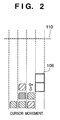
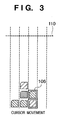
- Figs. 2 and 3 show move examples of the cursor according to this embodiment.
- the cursor 106 can freely move within the field 100 in accordance with an operation input from the operation unit. As shown in Fig. 3, the cursor 106 can be displayed to surround the stop meteor blocks 105. As a result, meteor blocks to be operated can be designated. According to the present invention, appropriate cursor shape and size can be adopted as long as a predetermined number of (e.g., two) blocks can be consequently designated.
- Fig. 4 shows a re-arrange example of meteor blocks according to this embodiment.
- a re-arrange instruction is input from the operation unit to two blocks surrounded by the cursor 106 in Fig. 3, the positions of the two blocks are re-arranged.
- Fig. 4 shows re-arranged blocks.
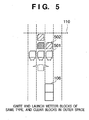
- Fig. 5 shows a display example of ignition/launch of meteor blocks according to this embodiment.
- a predetermined number of (e.g., three or more) blocks of the same type line up vertically or horizontally after the blocks are re-arranged, as shown in, e.g., Fig. 4, these blocks meet an ignition/launch condition and are changed to ignition blocks 501.
- the ignition blocks 501 begin to rise toward the outer space (the upper portion of the display area of the display screen), and are cleared from the field 100 when they rise beyond the line 110 indicating the clear position.
- the ignition block 501 rises together with the carried block 502. Note that the impelling force of the ignition block 501 may be limited.
- the ignition block 501 can rise while carrying other blocks in correspondence with the impelling force. That is, if the ignition block 501 carries too many blocks, since they are heavy, a joint rising condition is not satisfied, and the ignition block 501 cannot rise. That is, a so called unsuccessful launch occurs.
- Fig. 6 is a view for explaining the operation when the cursor designates one block in this embodiment.
- the cursor 106 according to this embodiment can normally accommodate two meteor blocks. However, the cursor 106 can sometimes accommodate only one block.
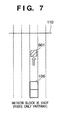
- Fig. 7 is a view for explaining a shoot operation in this embodiment.
- the player designates a single meteor block 601 using the cursor 106 in Fig. 6, and presses an operation button of the operation unit, the designated meteor block 601 can be launched up to a predetermined position. This operation is called “shoot" in this embodiment.
- Figs. 8 and 9 are views for explaining an intercept (collision) process of a falling meteor by means of "shoot” in this embodiment.
- the meteor block 601 When the meteor block 601 is shot toward a falling meteor block 103, both the meteor blocks can be exploded, destroyed, and cleared. Note that control may be made to clear the falling meteor block 103 and the meteor block 601 to be shot only when they are of the same type (e.g., the same color or the like). This can increase the difficulty level of the game.
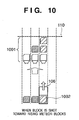
- Figs. 10 and 11 are views for explaining the shoot process for a rising block in this embodiment.
- the shot meteor block 1002 is integrated with the rising block group. If the impelling force of the ignition blocks have an enough margin, the integrated block group rises to the outer space (the upper portion of the display area of the display screen) and are cleared. On the other hand, if the impelling force is insufficient, the block group may be controlled to shift to fall again.
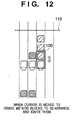
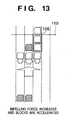
- Figs. 12 and 13 are views for explaining an operation designation process and re-arrange process for rising meteor blocks according to this embodiment.
- rising meteor blocks can also be designated as objects to be re-arranged.
- Fig. 12 when the player moves the cursor 106 and designates two rising blocks, he or she can designate the two blocks as objects to be re-arranged.
- the blocks are re-arranged, as shown in Fig. 13.
- a predetermined number or more of blocks of the same type line up in the rising blocks, they are also changed to ignition blocks.
- the number of ignition blocks increases in the rising blocks, the total impelling force also increases, and the rising velocity increases. Hence, these blocks can easily reach the outer space (the upper portion of the display area of the display screen).
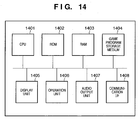
- Fig. 14 is a block diagram showing an example of a game apparatus according to this embodiment.
- a CPU 1401 is a central processing unit which systematically controls the overall game apparatus.
- a ROM 1402 is a storage circuit for storing basic programs such as an OS and the like.
- a RAM 1403 is a storage circuit for storing data associated with the game.
- a game program storage medium 1404 is a storage medium such as a mask ROM, flash memory, optical disk, or the like, which stores a game program.
- a display unit 1405 is a liquid crystal display device for displaying the contents of the game.
- An operation unit 1406 includes a plurality of buttons and keys, and outputs, to the CPU 1401, operation input signals used to move the cursor 106 upward/downward or to the right or left, to re-arrange meteor blocks designated by the cursor 106, and to shoot a meteor block designated by the cursor 106.
- An audio output unit 1407 includes an audio output circuit and loudspeaker which are used to audibly output music data and effect sounds stored in the storage medium 1404.
- a communication interface 1408 is a communication circuit which connects an external PC or the like such as another game apparatus or the like and exchanges data.
- the CPU 1401 When the CPU 1401 manipulates various data in the following description, it reads out the data from a storage unit (RAM 1403 or the like), appropriately processes the readout data, and writes that data in the storage unit, needless to say.
- a storage unit RAM 1403 or the like
- Fig. 15 is a flowchart showing an example of the main sequence of the game program according to this embodiment.
- step S1501 the CPU 1401 performs display control of the cursor 106.
- the CPU 1401 stores and manages display position data indicating the current display position of the cursor 106 in the RAM 1403.
- the field 100 is divided into 15 grids in the horizontal direction and 10 grids in the vertical direction, and one grid can accommodate one meteor block.
- the cursor 106 has two grids.
- coordinate data can be expressed by [Cursor_X, Cursor_Y] with reference to the lower grid of the cursor.
- the range that the coordinate data can assume is defined by 0 ⁇ Cursor_X ⁇ 16 and 0 ⁇ Cursor_Y ⁇ 11.
- a grid which is located at the leftmost and uppermost position of the field 100 is defined by [1, 1] and a grid which is located at the rightmost and lowermost position is defined by [15, 10]
- Cursor [3, 4]
- the lower grid of the cursor 106 is displayed at the third leftmost and fourth uppermost position.
- the upper grid of the cursor 106 is displayed at the third leftmost and third uppermost position.
- the CPU 1401 adds 1 to the value of Cursor_X. If the down key is operated, the CPU 1401 adds 1 to the value of Cursor_Y. If the left or up key is operated, the CPU 1401 subtracts 1 from Cursor_X or Cursor_Y. This is merely an example.
- step S1502 the CPU 1401 controls the falling blocks 101 to 104, stop blocks 105, and rising blocks 1001 (ignition blocks 501, carried blocks 502, and shoot block 601) in the field 100.
- the CPU 1401 stores and manages, in the RAM 1403, display position data, color data indicating types of colors such as red, blue, green, and the like, impelling force data indicating impelling forces, type data indicating types of movements such as falling, rising, stop, and the like, and so forth.
- the CPU 1401 changes data in a falling direction as the game progresses until they reach falling stop positions (e.g., the bottom of the field, positions above other stop blocks, and the like).
- falling stop positions e.g., the bottom of the field, positions above other stop blocks, and the like.
- the CPU 1401 checks if the stop blocks 105 satisfy rising start conditions such as the aforementioned joint rising condition and the like (i.e., a condition to ignite and launch blocks). If the blocks that satisfy the conditions are found, the CPU 1401 changes data of stop blocks satisfying the rising start conditions to express the rising block (especially, the ignition blocks 501) and their display position data to rise according to the impelling forces of the blocks. As for a stop blocks carried on the ignition blocks 501, the CPU 1401 changes data to express the carried block 502. Of these rising blocks, if rising blocks which have reached the clear position are found, the display of the blocks is cleared.
- rising start conditions such as the aforementioned joint rising condition and the like (i.e., a condition to ignite and launch blocks). If the blocks that satisfy the conditions are found, the CPU 1401 changes data of stop blocks satisfying the rising start conditions to express the rising block (especially, the ignition blocks 501) and their display position data to rise according to the impelling forces of the blocks.
- the CPU 1401 changes data to express the carried block 502. Of
- the CPU 1401 When the stop block 105 satisfies a shoot condition (the operation of the operation button when the cursor accommodates a stop block fewer than its maximum number of blocks to be accommodated), the CPU 1401 changes the type data of that stop block to express a shoot block 601 and writes it in the RAM 1403, and changes the display position data to raise the block so as not to reach the clear position.
- a shoot condition the operation of the operation button when the cursor accommodates a stop block fewer than its maximum number of blocks to be accommodated
- step S1503 the CPU 1401 generates data such as display positions, colors, and the like of a new falling block, stores them in the RAM 1403, and performs display control to make that block begin to fall.
- the CPU 1401 checks in step S1504 if the game is over. If meteor blocks are piled up in the vertical direction of the field 100 and there is no room for falling new meteor blocks, the CPU 1401 determines that the game is over. Otherwise, the flow returns to step S1501.
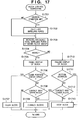
- Fig. 16 is a flowchart showing an example of a cursor control subroutine according to this embodiment. This subroutine corresponds to step S1501 described above.
- the CPU 1401 checks in step S1601 if a key input from the operation unit 1406 is detected. If a key input is detected, the flow advances to step S1602; otherwise, the control exits this subroutine.
- the CPU 1401 checks in step S1602 if the key input signal from the operation unit 1406 indicates an operation instruction that instructs to re-arrange. If the key input signal is a re-arrange instruction, the flow jumps to step S1605; otherwise, the flow advances to step S1603.
- the CPU 1401 checks in step S1603 if the key input signal from the operation unit 1406 indicates an operation instruction that instructs to one of left, right, up, and down movements. If the key input signal is a move instruction, the flow advances to step S1604; otherwise, the control exits this subroutine and returns to the main routine.
- step S1604 the CPU 1401 performs display control to move the cursor 106 upward or downward or to the right or left in accordance with the move instruction from the operation unit 1406.
- the CPU 1401 reads out variables indicating the display position data, changes their values, and stores them in the RAM 1403 again, as described above.
- the CPU 1401 reads out the display position data, and transmits a display command of the cursor 106 to the display unit 1405. With this command, the cursor 106 is displayed as if it were moving.
- the CPU 1401 checks in step S1605 if the cursor 106 designates a stop block or blocks 105. For example, the CPU 1401 reads out the display position data of the cursor 106 and that of each stop block 105 from the RAM 1403, and compares them to check if they match. If the two display position data match, the cursor 106 is displayed to surround an arbitrary stop block or blocks 105. If the cursor 106 designates the stop block or blocks 105, the flow advances to step S1609; otherwise, the flow advances to step S1606.
- the CPU 1401 checks in step S1606 if the cursor 106 designates a rising block or blocks 1001. For example, the CPU 1401 reads out the display position data of the cursor 106 and that of each rising block 1001 from the RAM 1403, and compares them to check if they match.
- the rising blocks include not only the ignition blocks 501 which are ignited and launched but also actually rising blocks such as the carried block 501 which is carried on the ignition block and the like (in some cases, a block which begins to fall after rising or the like is included). If the two display position data match, the cursor 106 is displayed to surround an arbitrary rising block or blocks 1001. If the cursor 106 designates a rising block or blocks 1001, the flow advances to step S1607; otherwise, the flow returns to the main routine.
- the CPU 1401 checks in step S1607 if the cursor 106 designates two blocks. For example, the CPU 1401 reads out the display position data of the cursor 106 and those of the rising blocks 1001 from the RAM 1403, and compares them to check if the rising block 1001 which matches the upper grid of the cursor 106 and the rising block 1001 which matches the lower grid of the cursor 106 are present. If such rising blocks are present, two meteor blocks are accommodated and displayed in the two grids of the cursor 106. If the two blocks are designated, the flow advances to step S1608; otherwise, the flow returns to the main routine.
- step S1608 the CPU 1401 re-arranges the positions of the two designated blocks.
- the CPU 1401 reads out the display position data (especially, coordinate data) of the two designated blocks from the RAM 1403, swaps them, and stores the swapped display position data in the RAM 1403 again.
- the CPU 1401 reads out the changed display position data from the RAM 1403 and outputs a rendering command to the display unit 1405.
- the display unit 1405 displays the two blocks as if their positions were re-arranged. After that, the flow returns to the main routine.
- step S1609 the CPU 1401 checks in step S1609 if the cursor 106 designates two blocks. If the two blocks are designated, the flow advances to step S1608; otherwise, the flow advances to step S1610.
- step S1610 the CPU 1401 shoot displays the single stop block 501 which is designated by the cursor 106.
- the CPU 1401 changes the values of the display position data of the single stop block 501 to raise it.
- the CPU 1401 sets the value of the impelling force to a value which makes the block stall and fall again before the block reaches the clear position.
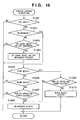
- Fig. 17 is a flowchart showing an example of a block control process according to this embodiment.
- step S1701 the CPU 1401 searches blocks in the field 100 to check if blocks that meet the ignition condition are present. For example, the CPU 1401 reads out the display position data and color data of each block located in the field, and checks if a plurality of blocks (in this example, three or more blocks) of the same type line up vertically or horizontally. If the blocks that meet the ignition condition are found, the flow advances to step S1702; otherwise, the flow jumps to step S1703.
- a plurality of blocks in this example, three or more blocks of the same type line up vertically or horizontally.
- the CPU 1401 calculates the impelling forces of the blocks that meet the ignition condition. For example, in case of the n th ignition of a rising block, the impelling force per ignition block can be calculated by n ⁇ Px (where Px is a default impelling force of an ignition block). As can be seen from this formula, if the number of times of ignition increases in a given ignition block, the impelling force increases. Even after a given rising block group begins to rise, when blocks are re-arranged successively, the number of times of ignition can be increased to the second ignition, third ignition, ..., n th ignition, and the impelling force can increase dramatically. Note that an impelling force Py may be provided to a carried block. Note that these values are parameters on the game, and do not perfectly follow the physical laws. The impelling forces calculated in this way are stored in the RAM 1403.
- step S1703 the CPU 1401 calculates an increment/decrement of the total impelling force for a rising block group including the ignition block 501 that satisfies the ignition condition, and the carried block 502 carried on that block 501.
- the impelling force of the ignition block 501 can be expressed as a function of time, and is changed to decrease in inverse proportion to an elapsed time. For this reason, the rising acceleration of the rising block becomes smaller, and the rising velocity also gradually slows down.
- the impelling force increases.
- the calculated value of the impelling force, and the values of the acceleration, rising velocity, and the like calculated based on the impelling force are also stored in the RAM 1403.
- a total impelling force P(t) is given by n ⁇ Px ⁇ i/t+Py ⁇ j.
- t is an elapsed time, which normally has a progress frame of the game as a unit.
- the progress frame is a periodic rewrite unit of the display screen.
- i is the number of ignition blocks.
- j is the number of carried blocks. Note that the carried block may also be multiplied by the n th ignition coefficient n.
- the impelling force P(t) decreases along with an elapse of time t. In this case, P(t) is directly divided by t.
- any other formulas may be used as long as the impelling force of the ignition block decreases along with an elapse of time.
- a rising acceleration a can be calculated by P(t)/(m(i+j)), where m is a parameter indicating a mass per block.
- a rising velocity v is given by (a g)t (strictly speaking, a must be integrated, but a simple formula is adopted because of a game), where g is the gravitational acceleration.
- a final rising distance s is expressed by 0.5(a g)t2 (strictly speaking, since the rising acceleration a itself is a function of t, it must be calculated by integration, but a simple formula is adopted because of a game).
- the CPU 1401 checks in step S1704 if the rising block group satisfies a rising condition. For example, the CPU 1401 reads out the rising velocity v of the overall rising block group from the RAM 1403, and determines that the rising block group rises if the readout value is positive. If the rising block group rises, the flow advances to step S1705; otherwise, the flow advances to step S1710.
- step S1705 the CPU 1401 displays the rising block group to rise.
- the CPU 1401 reads out the rising velocity data v or acceleration data a from the RAM 1403, substitutes it in the rising distance calculation formula to calculate the rising distance s, and adds the calculated distance s to the display position data of each block, thus reflecting the calculated distance s in the display position data.
- the reflected display position data are stored in the RAM 1403 again.
- the CPU 1401 checks in step S1706 if the rising blocks have reached the clear position 110. For example, the CPU 1401 reads out the display position data of each rising block and compares the readout data with that of the clear position. If the ordinate value of the rising block exceeds that of the clear position, it is determined that the clear position has been reached. If the clear position has been reached, the flow advances to step S1707; otherwise, the flow advances to step S1708.
- step S1707 the CPU 1401 changes display data to clear display of the block pair that has reached the clear position 110. After that, the control exits this subroutine, and returns to the main routine.
- the CPU 1401 checks in step S1708 if the rising block contacts another block located at its upper position. For example, the CPU 1401 reads out the display position data of the rising block from the RAM 1403, and searches for and extracts another block having a coordinate position higher by one than that of the block of interest as display position data. If the other block is found by search, it is determined that the rising block contacts the other block. If the rising block contacts the other block, the flow advances to step S1709; otherwise, the flow returns to the main routine.
- step S1710 the CPU 1401 displays each rising block, which is determined not to be rising, to fall.
- the CPU 1401 reads out the velocity data, acceleration data, and the like of each rising block, which is determined not to be rising, and substitutes them in the distance calculation formula to calculate a falling distance.
- the CPU 1401 reads out the display position data of the rising block which is determined not to be rising, changes the display position data to lower a display position by the falling distance, and stores the changed display position data in the RAM 1403. Since the changed display position data indicates a position lower than the display position data before change, the display unit 1405 displays the rising block as if it were falling.
- the CPU 1401 checks in step S1711 if the falling block contacts the bottom of the field 100. For example, the CPU 1401 reads out the display position data of the block of interest from the RAM 1403, and checks if its ordinate value indicates the bottom (10 in the example of Fig. 1). If the block lands on the bottom (surface of earth), the flow jumps to step S1713; otherwise, the flow advances to step S1712.
- the CPU 1401 checks in step S1712 if the falling block contacts another block located at its lower position. For example, the CPU 1401 reads out the display position data of the falling block from the RAM 1403, and searches for another block having a coordinate position lower by one than that of the block of interest as display position data. If the other block is found by search, it is determined that the falling block contacts the other block. If the falling block contacts the other block, the flow advances to step S1709; otherwise, the flow returns to the main routine.
- step S1713 the CPU 1401 displays the block which contacts the bottom and a block carried on that block to stop their movement.
- the CPU 1401 reads out the velocity data of the block from the RAM 1403, and changes and stores the data to set zero velocity.
- the CPU 1401 changes data indicating the block type to express a stop block and stores the changed data in the RAM 1403.
- Fig. 18 is a flowchart showing an example of block addition control according to this embodiment. This flowchart corresponds to step S1503.
- the CPU 1401 checks in step S1801 if an addition timing is reached. For example, if periodic addition timings are adopted, the CPU 1401 reads out time data from a timer, and checks if the periodic addition timing is reached. Note that the periodic addition timings need not always be adopted, and the interval from when a given falling block is added until a new falling block is added may be controlled to gradually become shorter along with the progress of the game. Also, the CPU 1401 may control the interval to several times (e.g., eight times) the normal one while a specific button of the operation unit 1406 is pressed. Such process is called time acceleration. As a result of checking, if the addition timing is reached, the flow advances to step S1802; otherwise, the flow returns to the main routine.
- step S1802 the CPU 1401 selects the type of a new falling block. For example, the CPU 1401 determines type data (e.g., color or the like) using a random number function, and stores the determined data in the RAM 1403 as the type data of the block of interest.
- type data e.g., color or the like
- step S1803 the CPU 1401 selects a falling start position of the new falling block, generates display position data including the falling start position as a display position, and stores the generated data in the RAM 1403.
- the ordinate value of the falling start position indicates the uppermost portion of the field, but its abscissa value is determined by a random number function.
- step S1804 the CPU 1401 displays the new falling block at the falling start position, and exits this subroutine.
- Fig. 19 is a flowchart showing an example of the intercept (collision) process by a shoot block according to this embodiment.
- this flowchart some steps of the flowchart in Fig. 17 are modified. To avoid a repetitive description, the modified steps will be mainly explained.
- step S1706 If it is determined in step S1706 above that the rising block contacts an upper block, the flow advances to step S1901.
- the CPU 1401 checks in step S1901 if the two contacting blocks are the falling block 103 and shoot block 601. More specifically, the CPU 1401 reads out the type data of both the blocks, and checks if the rising block is the shoot block 601, and the upper block is the falling block 103. If the two contacting blocks are the falling block 103 and shoot block 601, the flow advances to step S1902; otherwise, the flow advances to step S1708. In step S1902, the CPU 1401 explodes and clears both the blocks. For example, display that expresses explosion is made to clear display of the blocks.
- the player can operate the meteor blocks 105 which stop falling and rising meteor blocks (including blocks which are falling after rising) 1001 in place of newly falling meteor blocks 101 to 104.
- objects to be operated can be freely selected unlike the conventional "falling block games" in which only newly falling blocks are forcibly designated as objects to be operated, the player can experience novel operability.
- the difficulty level of the game can be maintained to be appropriate one.
- the shoot block 1002 When a plurality of blocks 1001 are rising, and the shoot block 1002 rises from below these blocks and collides against them, the shoot block 1002 unites with the rising object, and the shoot block 1002 can also be cleared, thus counterchanging the clearing conditions. Since the clear conditions are counterchanged, the strategy becomes important, and the player can experience the difficulty and a sense of mastery enjoy unlike in the conventional games.
- the CPU 1401 When the ignition blocks 501 which meet the ignition/launch condition and the carried blocks 502 carried on them do not meet the joint rising condition, the CPU 1401 performs display control to inhibit these blocks from rising or not to raise the blocks up to the clear position. Hence, simultaneous clearing cannot be simply executed, and the attraction is further enhanced although the difficulty increases.
- the present invention can be applied to a system constituted by a plurality of devices, or to an apparatus comprising a single device. Furthermore, it goes without saying that the invention is applicable also to a case where the object of the invention is attained by supplying a program to a system or apparatus.
Landscapes
- Engineering & Computer Science (AREA)
- Multimedia (AREA)
- Human Computer Interaction (AREA)
- Physics & Mathematics (AREA)
- Optics & Photonics (AREA)
- Processing Or Creating Images (AREA)
- User Interface Of Digital Computer (AREA)
Abstract
Description
Claims (27)
- A computer program executed on a computer (1401) having an operation unit (1406) which inputs an operation to a game, a display unit (1405) which displays information associated with the game, and a storage unit (1403) which stores data required to execute the game, the computer program making the computer (1401) execute:characterized in that the computer program making the computer (1401) execute:a step of generating display data of falling objects (101, 102, 103, 104) which are displayed to fall from an upper portion to a lower portion in a predetermined display area (100) on the display unit (1405), and storing the display data in the storage unit (1403);a step of reading out the generated display data of the falling objects from the storage unit (1403), and displaying the falling objects to fall from the upper portion to the lower portion in the predetermined display area (100); anda step of changing, when the falling objects reach a falling stop position in the display area (100), the display data to display the falling objects as stop objects (105) whose falling movement stops, and storing the changed display data in the storage unit (1403),a step of designating the predetermined number or less of stop objects (105) in accordance with a designation instruction from the operation unit (1406) anda step of changing, when the stop objects (105) are designated, the display data of stop objects (105) to re-arrange positions of the designated stop objects in accordance with a re-arrange instruction from the operation unit (1406), and storing the changed display data in the storage unit (1403).
- The program according to claim 1, wherein said computer program makes the computer (1401) further execute:a step of changing, when the re-arranged stop objects and stop objects which are located around the re-arranged stop objects form a predetermined combination, display data of a plurality of stop objects which match the predetermined combination to display data that express rising objects which rise from the lower portion to the upper portion in the predetermined display area (100) on the display unit (1405), and storing the changed display data in the storage unit (1403); anda step of changing, when the rising objects reach a predetermined clear position in the display area, the display data to clear display of the rising objects.
- The program according to claim 2, wherein said computer program makes the computer (1401) further execute:a step of designating, when a plurality of rising objects are rising, the predetermined number of rising objects included in the plurality of rising objects in accordance with a designation instruction from the operation unit (1406); anda step of changing the display data of the rising objects to re-arrange positions of the predetermined number of designated rising objects in accordance with a re-arrange instruction from the operation unit (1406), and storing the changed display data in the storage unit (1403).
- The program according to claim 2 or 3, wherein said computer program makes the computer (1401) further execute a step of changing, when stop objects fewer than the predetermined number are designated in accordance with a designation instruction from the operation unit (1406), the display data of the stop objects to rise the designated stop objects within a range that does not reach the clear position, and storing the changed display data in the storage unit (1403).
- The program according to claim 4, wherein said computer program makes the computer (1401) further execute a step of changing, when the stop objects fewer than the predetermined number are rising and a display position of the stop object matches a display position of the falling object, the display data of the stop object and the falling object to clear the stop object and the falling object, and storing the changed display data in the storage unit (1403).
- The program according to claim 4, wherein said computer program makes the computer (1401) further execute a step of changing, when the stop objects fewer than the predetermined number are rising and a display position of the stop object matches a display position of the rising object, the display data of the stop object to display data expressing a new rising object, and storing the changed display data in the storage unit (1403).
- The program according to claim 2, wherein the predetermined combination is formed by three or more re-arranged stop objects and stop objects located around the re-arranged stop objects, which have the same type, and line up vertically or horizontally.
- The program according to claim 2, wherein said computer program makes the computer (1401) further execute a step of changing not only display data of a plurality of stop objects which match the predetermined combination but also display data of other stop objects located above the stop objects to be display data that express the rising objects, and storing the changed display data in the storage unit (1403).
- The program according to claim 8, wherein said computer program makes the computer (1401) further execute a step of inhibiting, when both the number of the plurality of stop objects which match the predetermined combination and the number of the other stop objects located above the stop objects do not satisfy a condition that permits the stop object to rise, the display data of the stop objects from being changed to display data that express the rising objects, or changing the display data of the stop objects to display data that express rising stop objects which stop rising before the clear position is reached, and storing the changed display data in the storage unit (1403).
- A game apparatus having an operation unit (1406) which inputs an operation to a game, a display unit (1405) which displays information associated with the game, and a storage unit (1403) which stores data required to execute the game, the game apparatus comprising:means for generating display data of falling objects (101, 102, 103, 104) which are displayed to fall from an upper portion to a lower portion in a predetermined display area (100) on the display unit (1405), and storing the display data in the storage unit (1403);means for reading out the generated display data of the falling objects from the storage unit (1403), and displaying the falling objects to fall from the upper portion to the lower portion in the predetermined display area (100); andmeans for, when the falling objects reach a falling stop position in the display area, changing the display data to display the falling objects as stop objects whose falling movement stops, and storing the changed display data in the storage unit (1403), the game apparatus characterized by further comprising:means for designating the predetermined number or less of stop objects in accordance with a designation instruction from the operation unit (1406) andmeans for, when the stop objects are designated, changing the display data of stop objects to re-arrange positions of the predetermined number of designated stop objects in accordance with a re-arrange instruction from the operation unit (1406), and storing the changed display data in the storage unit (1403).
- The apparatus according to claim 10,
characterized by further comprising:means for, when the re-arranged stop objects and stop objects which are located around the re-arranged stop objects form a predetermined combination, changing display data of a plurality of stop objects which match the predetermined combination to display data that express rising objects which rise from the lower portion to the upper portion in the predetermined display area (100) on the display unit (1405), and storing the changed display data in the storage unit (1403); andmeans for, when the rising objects reach a predetermined clear position in the display area, changing the display data to clear display of the rising objects. - The apparatus according to claim 11,
characterized by further comprising:means for, when a plurality of rising objects are rising, designating the predetermined number of rising objects included in the plurality of rising objects in accordance with a designation instruction from the operation unit (1406); andmeans for changing the display data of the rising objects to re-arrange positions of the predetermined number of designated rising objects in accordance with a re-arrange instruction from the operation unit (1406), and storing the changed display data in the storage unit (1403). - The apparatus according to claim 11 or 12,
characterized by further comprising means for, when stop objects fewer than the predetermined number are designated in accordance with a designation instruction from the operation unit (1406), changing the display data of the stop objects to rise the designated stop objects within a range that does not reach the clear position, and storing the changed display data in the storage unit (1403). - The apparatus according to claim 13,
characterized by further comprising means for, when the stop objects fewer than the predetermined number are rising and a display position of the stop object matches a display position of the falling object, changing the display data of the stop object and the falling object to clear the stop object and the falling object, and storing the changed display data in the storage unit (1403). - The apparatus according to claim 13,
characterized by further comprising means for, when the stop objects fewer than the predetermined number are rising and a display position of the stop object matches a display position of the rising object, changing the display data of the stop object to display data expressing a new rising object, and storing the changed display data in the storage unit (1403). - The apparatus according to claim 11,
characterized in that the predetermined combination is formed by three or more re-arranged stop objects and stop objects located around the re-arranged stop objects, which have the same type, and are juxtaposed vertically or horizontally. - The apparatus according to claim 11,
characterized by further comprising means for changing not only display data of a plurality of stop objects which match the predetermined combination but also display data of other stop objects located above the stop objects to be display data that express the rising objects, and storing the changed display data in the storage unit (1403). - The apparatus according to claim 17,
characterized by further comprising means for, when both the number of the plurality of stop objects which match the predetermined combination and the number of the other stop objects located above the stop objects do not satisfy a condition that permits the stop object to rise, inhibiting the display data of the stop objects from being changed to display data that express the rising objects, or changing the display data of the stop objects to display data that express rising stop objects which stop rising before the clear position is reached, and storing the changed display data in the storage unit (1403). - A method of controlling a game apparatus having an operation unit (1406) which inputs an operation to a game, a display unit (1405) which displays information associated with the game, and a storage unit (1403) which stores data required to execute the game, the method comprising:a step of generating display data of falling objects which are displayed to fall from an upper portion to a lower portion in a predetermined display area (100) on the display unit (1405), and storing the display data in the storage unit (1403);a step of reading out the generated display data of the falling objects from the storage unit (1403), and displaying the falling objects to fall from the upper portion to the lower portion in the predetermined display area (100); anda step of changing, when the falling objects reach a falling stop position in the display area, the display data to display the falling objects as stop objects whose falling movement stops, and storing the changed display data in the storage unit (1403), the method characterized by further comprising:a step of designating the predetermined number or less of stop objects in accordance with a designation instruction from the operation unit (1406) anda step of changing, when the stop objects are designated, the display data of stop objects to re-arrange positions of the predetermined number of designated stop objects in accordance with a re-arrange instruction from the operation unit (1406), and storing the changed display data in the storage unit (1403).
- The method according to claim 19, characterized by further comprising:a step of changing, when the re-arranged stop objects and stop objects which are located around the re-arranged stop objects form a predetermined combination, display data of a plurality of stop objects which match the predetermined combination to display data that express rising objects which rise from the lower portion to the upper portion in the predetermined display area (100) on the display unit (1405), and storing the changed display data in the storage unit (1403); anda step of changing, when the rising objects reach a predetermined clear position in the display area, the display data to clear display of the rising objects.
- The method according to claim 20, characterized by further comprising:a step of designating, when a plurality of rising objects are rising, the predetermined number of rising objects included in the plurality of rising objects in accordance with a designation instruction from the operation unit (1406); anda step of changing the display data of the rising objects to re-arrange positions of the predetermined number of designated rising objects in accordance with a re-arrange instruction from the operation unit (1406), and storing the changed display data in the storage unit (1403).
- The method according to claim 20 or 21,
characterized by further comprising a step of changing, when stop objects fewer than the predetermined are designated in accordance with a designation instruction from the operation unit (1406), the display data of the stop objects to rise the designated stop objects within a range that does not reach the clear position, and storing the changed display data in the storage unit (1403). - The method according to claim 22, characterized by further comprising a step of changing, when the stop objects fewer than the predetermined number are rising and a display position of the stop object matches a display position of the falling object, the display data of the stop object and the falling object to clear the stop object and the falling object, and storing the changed display data in the storage unit (1403).
- The method according to claim 22, characterized by further comprising a step of changing, when the stop objects fewer than the predetermined number are rising and a display position of the stop object matches a display position of the rising object, the display data of the stop object to display data expressing a new rising object, and storing the changed display data in the storage unit (1403).
- The method according to claim 20, characterized in that the predetermined combination is formed by three or more re-arranged stop objects and stop objects located around the re-arranged stop objects, which have the same type, and are juxtaposed vertically or horizontally.
- The method according to claim 20, characterized by further comprising a step of changing not only display data of a plurality of stop objects which match the predetermined combination but also display data of other stop objects located above the stop objects to be display data that express the rising objects, and storing the changed display data in the storage unit (1403).
- The method according to claim 26, characterized by further comprising a step of inhibiting, when both the number of the plurality of stop objects which match the predetermined combination and the number of the other stop objects located above the stop objects do not satisfy a condition that permits the stop object to rise, the display data of the stop objects from being changed to display data that express the rising objects, or changing the display data of the stop objects to display data that express rising stop objects which stop rising before the clear position is reached, and storing the changed display data in the storage unit (1403).
Applications Claiming Priority (2)
| Application Number | Priority Date | Filing Date | Title |
|---|---|---|---|
| JP2004157986A JP3739777B2 (en) | 2004-05-27 | 2004-05-27 | GAME DEVICE, ITS CONTROL METHOD, AND COMPUTER PROGRAM |
| JP2004157986 | 2004-05-27 |
Publications (1)
| Publication Number | Publication Date |
|---|---|
| EP1600197A1 true EP1600197A1 (en) | 2005-11-30 |
Family
ID=34936967
Family Applications (1)
| Application Number | Title | Priority Date | Filing Date |
|---|---|---|---|
| EP05011410A Ceased EP1600197A1 (en) | 2004-05-27 | 2005-05-25 | Game apparatus and control method therefor |
Country Status (3)
| Country | Link |
|---|---|
| US (1) | US7775866B2 (en) |
| EP (1) | EP1600197A1 (en) |
| JP (1) | JP3739777B2 (en) |
Families Citing this family (28)
| Publication number | Priority date | Publication date | Assignee | Title |
|---|---|---|---|---|
| US9852649B2 (en) | 2001-12-13 | 2017-12-26 | Mind Research Institute | Method and system for teaching vocabulary |
| US20070046678A1 (en) | 2005-09-01 | 2007-03-01 | Peterson Matthew R | System and method for training with a virtual apparatus |
| JP5008953B2 (en) | 2006-11-22 | 2012-08-22 | 任天堂株式会社 | GAME PROGRAM AND GAME DEVICE |
| JP5221873B2 (en) * | 2006-12-27 | 2013-06-26 | 株式会社タイトー | Block game machine and block game program |
| JP5221874B2 (en) * | 2006-12-27 | 2013-06-26 | 株式会社タイトー | Block game machine and block game program |
| US8313370B2 (en) * | 2008-09-02 | 2012-11-20 | Tetris Holding Llc | Video game systems and methods for providing software-based skill adjustment mechanisms for video game systems |
| US9138649B2 (en) * | 2008-10-08 | 2015-09-22 | Sony Corporation | Game control program, game device, and game control method adapted to control game where objects are moved in game field |
| JP4480784B1 (en) * | 2009-02-17 | 2010-06-16 | 株式会社コナミデジタルエンタテインメント | Game console and game program |
| JP4480781B1 (en) * | 2008-12-11 | 2010-06-16 | 株式会社コナミデジタルエンタテインメント | Game machine and game program |
| US20110218041A1 (en) * | 2008-12-11 | 2011-09-08 | Konami Digital Entertainment Co., Ltd. | Game machine and computer game program |
| US9120010B2 (en) * | 2009-12-03 | 2015-09-01 | Megatouch, Llc | Touchscreen game allowing simultaneous movement of multiple rows and/or columns |
| US20120264497A1 (en) * | 2011-04-18 | 2012-10-18 | Alex Iosilevsky | Poker tetro computer game |
| US9373213B1 (en) * | 2011-11-08 | 2016-06-21 | Zynga Inc. | Adaptive object placement in computer-implemented games |
| US10456686B2 (en) | 2012-09-05 | 2019-10-29 | Zynga Inc. | Methods and systems for adaptive tuning of game events |
| US9345965B2 (en) | 2012-09-17 | 2016-05-24 | King.Com Ltd. | Method for implementing a computer game |
| US9633570B2 (en) * | 2012-12-28 | 2017-04-25 | Mind Research Institute | Systems and methods incorporating animated widgets in a virtual learning environment |
| US9776093B2 (en) * | 2015-02-02 | 2017-10-03 | King.Com Ltd. | Controlling a user interface of a computer device |
| US10828558B2 (en) | 2013-02-19 | 2020-11-10 | King.Com Ltd. | Video game with spreading tile backgrounds for matched tiles |
| US10625159B2 (en) | 2014-08-27 | 2020-04-21 | Gree, Inc. | Game program, game processing method, and information processing apparatus |
| US9724606B2 (en) | 2014-09-09 | 2017-08-08 | Zynga Inc. | Systems and methods for indicating positions of selected symbols in a target sequence |
| US9757650B2 (en) * | 2014-09-10 | 2017-09-12 | Zynga Inc. | Sequencing and locations of selected virtual objects to trigger targeted game actions |
| US9675889B2 (en) | 2014-09-10 | 2017-06-13 | Zynga Inc. | Systems and methods for determining game level attributes based on player skill level prior to game play in the level |
| US10561944B2 (en) | 2014-09-10 | 2020-02-18 | Zynga Inc. | Adjusting object adaptive modification or game level difficulty and physical gestures through level definition files |
| US10409457B2 (en) * | 2014-10-06 | 2019-09-10 | Zynga Inc. | Systems and methods for replenishment of virtual objects based on device orientation |
| US10179288B2 (en) | 2016-06-20 | 2019-01-15 | Zynga Inc. | Adaptive object placement in computer-implemented games |
| JP6743102B2 (en) * | 2018-09-06 | 2020-08-19 | 株式会社アグニ・フレア | Game program, recording medium, and game control method |
| US11857882B1 (en) * | 2022-06-29 | 2024-01-02 | Superplay Ltd | Altering computer game tiles having multiple matchable ends |
| US12128304B2 (en) * | 2022-06-29 | 2024-10-29 | Superplay Ltd | Altering computer game tiles having multiple matchable ends |
Family Cites Families (5)
| Publication number | Priority date | Publication date | Assignee | Title |
|---|---|---|---|---|
| US5184830A (en) * | 1989-01-10 | 1993-02-09 | Nintendo Company Limited | Compact hand-held video game system |
| JPH1066784A (en) | 1996-06-18 | 1998-03-10 | Konami Co Ltd | Method for moving object in game in which continuous object of same kind is eliminated, game device, game system, and computer-readable storage medium on which game program data is stored |
| JP3019970B2 (en) | 1998-01-08 | 2000-03-15 | 任天堂株式会社 | Game equipment |
| JP3506641B2 (en) | 1999-07-30 | 2004-03-15 | 任天堂株式会社 | Three-dimensional puzzle game apparatus and storage medium for three-dimensional puzzle game |
| JP2003260269A (en) | 2002-03-07 | 2003-09-16 | Hiitoshinku:Kk | Game information and information memory medium |
-
2004
- 2004-05-27 JP JP2004157986A patent/JP3739777B2/en not_active Expired - Fee Related
-
2005
- 2005-05-25 EP EP05011410A patent/EP1600197A1/en not_active Ceased
- 2005-05-27 US US11/138,693 patent/US7775866B2/en active Active
Non-Patent Citations (1)
| Title |
|---|
| No Search * |
Also Published As
| Publication number | Publication date |
|---|---|
| US7775866B2 (en) | 2010-08-17 |
| US20050277456A1 (en) | 2005-12-15 |
| JP2005334356A (en) | 2005-12-08 |
| JP3739777B2 (en) | 2006-01-25 |
Similar Documents
| Publication | Publication Date | Title |
|---|---|---|
| EP1600197A1 (en) | Game apparatus and control method therefor | |
| US10569176B2 (en) | Video game gameplay having nuanced character movements and dynamic movement indicators | |
| US6652384B2 (en) | Image processing device for placing a player character in a virtual space | |
| AU730470B2 (en) | Competitive video game apparatus, method of playing video game, and computer-readable recording medium | |
| Ebner et al. | Towards a video game description language | |
| CN111921198B (en) | Control method, device and equipment of virtual prop and computer readable storage medium | |
| US7557808B2 (en) | Image processing device and information recording medium | |
| EP0880983B1 (en) | Game device, game displaying method, game result evaluating method, and recording medium for recording game program | |
| US8231468B2 (en) | Game control program, game machine, and game control method | |
| US12179115B2 (en) | Deck building for real-time strategy game | |
| US9987558B2 (en) | Game system with interactive show control | |
| KR100308859B1 (en) | Display control method | |
| US12434147B2 (en) | Information processing apparatus, recording medium, and usage object creating method | |
| JP2008093307A (en) | Electronic game device, electronic game control method, and game program | |
| JP2019130105A (en) | Game program, method, and recording medium | |
| WO2009067796A1 (en) | Interactive game | |
| JP2014033909A (en) | Game device, game control method, and game control program | |
| JP4140058B2 (en) | Game control program and recording medium | |
| JP3435809B2 (en) | Target appearance method in game device and game device | |
| Flavell | The Game Engine | |
| JP4142534B2 (en) | Game machine | |
| HK40037956A (en) | Method and apparatus for controlling virtual object, terminal and storage medium | |
| JP2025540622A (en) | Virtual scene interaction method, device, electronic device, and computer program | |
| JP2020031798A (en) | Game program, game system, and game control method | |
| Turns et al. | Structuring Gametime |
Legal Events
| Date | Code | Title | Description |
|---|---|---|---|
| PUAI | Public reference made under article 153(3) epc to a published international application that has entered the european phase |
Free format text: ORIGINAL CODE: 0009012 |
|
| AK | Designated contracting states |
Kind code of ref document: A1 Designated state(s): AT BE BG CH CY CZ DE DK EE ES FI FR GB GR HU IE IS IT LI LT LU MC NL PL PT RO SE SI SK TR |
|
| AX | Request for extension of the european patent |
Extension state: AL BA HR LV MK YU |
|
| 17P | Request for examination filed |
Effective date: 20060502 |
|
| AKX | Designation fees paid |
Designated state(s): AT BE BG CH CY CZ DE DK EE ES FI FR GB GR HU IE IS IT LI LT LU MC NL PL PT RO SE SI SK TR |
|
| RAP1 | Party data changed (applicant data changed or rights of an application transferred) |
Owner name: SAKURAI, MASAHIRO Owner name: Q ENTERTAINMENT, INC. Owner name: NAMCO BANDAI GAMES INC. |
|
| RAP1 | Party data changed (applicant data changed or rights of an application transferred) |
Owner name: SAKURAI, MASAHIRO Owner name: Q ENTERTAINMENT, INC. Owner name: NAMCO BANDAI GAMES INC. Owner name: BANDAI CO., LTD. |
|
| APBK | Appeal reference recorded |
Free format text: ORIGINAL CODE: EPIDOSNREFNE |
|
| APBN | Date of receipt of notice of appeal recorded |
Free format text: ORIGINAL CODE: EPIDOSNNOA2E |
|
| APBR | Date of receipt of statement of grounds of appeal recorded |
Free format text: ORIGINAL CODE: EPIDOSNNOA3E |
|
| APAF | Appeal reference modified |
Free format text: ORIGINAL CODE: EPIDOSCREFNE |
|
| APBT | Appeal procedure closed |
Free format text: ORIGINAL CODE: EPIDOSNNOA9E |
|
| STAA | Information on the status of an ep patent application or granted ep patent |
Free format text: STATUS: THE APPLICATION HAS BEEN REFUSED |
|
| 18R | Application refused |
Effective date: 20110505 |