EP1599582B1 - Method for the production of polyunsaturated fatty acids - Google Patents
Method for the production of polyunsaturated fatty acids Download PDFInfo
- Publication number
- EP1599582B1 EP1599582B1 EP04706146A EP04706146A EP1599582B1 EP 1599582 B1 EP1599582 B1 EP 1599582B1 EP 04706146 A EP04706146 A EP 04706146A EP 04706146 A EP04706146 A EP 04706146A EP 1599582 B1 EP1599582 B1 EP 1599582B1
- Authority
- EP
- European Patent Office
- Prior art keywords
- seq
- fatty acids
- nucleic acid
- acyl
- acid
- Prior art date
- Legal status (The legal status is an assumption and is not a legal conclusion. Google has not performed a legal analysis and makes no representation as to the accuracy of the status listed.)
- Expired - Lifetime
Links
- 238000000034 method Methods 0.000 title claims abstract description 152
- 235000020777 polyunsaturated fatty acids Nutrition 0.000 title claims abstract description 93
- 238000004519 manufacturing process Methods 0.000 title claims description 36
- 239000000194 fatty acid Substances 0.000 claims abstract description 174
- 235000014113 dietary fatty acids Nutrition 0.000 claims abstract description 171
- 229930195729 fatty acid Natural products 0.000 claims abstract description 171
- 150000007523 nucleic acids Chemical class 0.000 claims abstract description 169
- 150000004665 fatty acids Chemical class 0.000 claims abstract description 158
- 230000008569 process Effects 0.000 claims abstract description 68
- 150000002632 lipids Chemical class 0.000 claims abstract description 67
- 230000009261 transgenic effect Effects 0.000 claims abstract description 54
- 230000000694 effects Effects 0.000 claims abstract description 46
- 229920001184 polypeptide Polymers 0.000 claims abstract description 26
- 108090000765 processed proteins & peptides Proteins 0.000 claims abstract description 25
- 102000004196 processed proteins & peptides Human genes 0.000 claims abstract description 25
- 230000004129 fatty acid metabolism Effects 0.000 claims abstract description 15
- 230000037356 lipid metabolism Effects 0.000 claims abstract description 15
- YZXBAPSDXZZRGB-DOFZRALJSA-N arachidonic acid Chemical compound CCCCC\C=C/C\C=C/C\C=C/C\C=C/CCCC(O)=O YZXBAPSDXZZRGB-DOFZRALJSA-N 0.000 claims description 74
- 108010052187 1-Acylglycerophosphocholine O-Acyltransferase Proteins 0.000 claims description 71
- 102000018659 1-Acylglycerophosphocholine O-Acyltransferase Human genes 0.000 claims description 66
- 108091028043 Nucleic acid sequence Proteins 0.000 claims description 48
- JAZBEHYOTPTENJ-JLNKQSITSA-N all-cis-5,8,11,14,17-icosapentaenoic acid Chemical compound CC\C=C/C\C=C/C\C=C/C\C=C/C\C=C/CCCC(O)=O JAZBEHYOTPTENJ-JLNKQSITSA-N 0.000 claims description 37
- 235000021342 arachidonic acid Nutrition 0.000 claims description 37
- 229940114079 arachidonic acid Drugs 0.000 claims description 37
- 235000020673 eicosapentaenoic acid Nutrition 0.000 claims description 37
- 229960005135 eicosapentaenoic acid Drugs 0.000 claims description 37
- JAZBEHYOTPTENJ-UHFFFAOYSA-N eicosapentaenoic acid Natural products CCC=CCC=CCC=CCC=CCC=CCCCC(O)=O JAZBEHYOTPTENJ-UHFFFAOYSA-N 0.000 claims description 37
- 108010037138 Linoleoyl-CoA Desaturase Proteins 0.000 claims description 33
- 244000005700 microbiome Species 0.000 claims description 32
- 102100034544 Acyl-CoA 6-desaturase Human genes 0.000 claims description 31
- FWMNVWWHGCHHJJ-SKKKGAJSSA-N 4-amino-1-[(2r)-6-amino-2-[[(2r)-2-[[(2r)-2-[[(2r)-2-amino-3-phenylpropanoyl]amino]-3-phenylpropanoyl]amino]-4-methylpentanoyl]amino]hexanoyl]piperidine-4-carboxylic acid Chemical compound C([C@H](C(=O)N[C@H](CC(C)C)C(=O)N[C@H](CCCCN)C(=O)N1CCC(N)(CC1)C(O)=O)NC(=O)[C@H](N)CC=1C=CC=CC=1)C1=CC=CC=C1 FWMNVWWHGCHHJJ-SKKKGAJSSA-N 0.000 claims description 24
- -1 allenoxide synthases Proteins 0.000 claims description 24
- MBMBGCFOFBJSGT-KUBAVDMBSA-N all-cis-docosa-4,7,10,13,16,19-hexaenoic acid Chemical compound CC\C=C/C\C=C/C\C=C/C\C=C/C\C=C/C\C=C/CCC(O)=O MBMBGCFOFBJSGT-KUBAVDMBSA-N 0.000 claims description 22
- 102100034542 Acyl-CoA (8-3)-desaturase Human genes 0.000 claims description 21
- 108010073542 Delta-5 Fatty Acid Desaturase Proteins 0.000 claims description 21
- 125000003275 alpha amino acid group Chemical group 0.000 claims description 18
- 239000000758 substrate Substances 0.000 claims description 17
- HOBAELRKJCKHQD-QNEBEIHSSA-N dihomo-γ-linolenic acid Chemical compound CCCCC\C=C/C\C=C/C\C=C/CCCCCCC(O)=O HOBAELRKJCKHQD-QNEBEIHSSA-N 0.000 claims description 15
- 235000021588 free fatty acids Nutrition 0.000 claims description 15
- HOBAELRKJCKHQD-UHFFFAOYSA-N (8Z,11Z,14Z)-8,11,14-eicosatrienoic acid Natural products CCCCCC=CCC=CCC=CCCCCCCC(O)=O HOBAELRKJCKHQD-UHFFFAOYSA-N 0.000 claims description 14
- 108700016155 Acyl transferases Proteins 0.000 claims description 13
- 150000001413 amino acids Chemical class 0.000 claims description 13
- 235000020669 docosahexaenoic acid Nutrition 0.000 claims description 13
- 108091026890 Coding region Proteins 0.000 claims description 12
- 241001465754 Metazoa Species 0.000 claims description 12
- 229940090949 docosahexaenoic acid Drugs 0.000 claims description 11
- 230000002068 genetic effect Effects 0.000 claims description 10
- 102000057234 Acyl transferases Human genes 0.000 claims description 9
- 108010022240 delta-8 fatty acid desaturase Proteins 0.000 claims description 9
- YUFFSWGQGVEMMI-JLNKQSITSA-N (7Z,10Z,13Z,16Z,19Z)-docosapentaenoic acid Chemical compound CC\C=C/C\C=C/C\C=C/C\C=C/C\C=C/CCCCCC(O)=O YUFFSWGQGVEMMI-JLNKQSITSA-N 0.000 claims description 8
- 235000021298 Dihomo-γ-linolenic acid Nutrition 0.000 claims description 8
- 108010087894 Fatty acid desaturases Proteins 0.000 claims description 8
- 101000912235 Rebecca salina Acyl-lipid (7-3)-desaturase Proteins 0.000 claims description 8
- 101000877236 Siganus canaliculatus Acyl-CoA Delta-4 desaturase Proteins 0.000 claims description 8
- 235000021294 Docosapentaenoic acid Nutrition 0.000 claims description 5
- 102100034543 Fatty acid desaturase 3 Human genes 0.000 claims description 5
- 108010016219 Acetyl-CoA carboxylase Proteins 0.000 claims description 4
- 102000000452 Acetyl-CoA carboxylase Human genes 0.000 claims description 4
- 101710146995 Acyl carrier protein Proteins 0.000 claims description 4
- 244000038559 crop plants Species 0.000 claims description 4
- 238000003306 harvesting Methods 0.000 claims description 4
- 108010001058 Acyl-CoA Dehydrogenase Proteins 0.000 claims description 3
- 102000002735 Acyl-CoA Dehydrogenase Human genes 0.000 claims description 3
- 102000004539 Acyl-CoA Oxidase Human genes 0.000 claims description 3
- 108020001558 Acyl-CoA oxidase Proteins 0.000 claims description 3
- 102000036181 Fatty Acid Elongases Human genes 0.000 claims description 3
- 108010058732 Fatty Acid Elongases Proteins 0.000 claims description 3
- 102100027297 Fatty acid 2-hydroxylase Human genes 0.000 claims description 3
- 102000009114 Fatty acid desaturases Human genes 0.000 claims description 3
- 101000937693 Homo sapiens Fatty acid 2-hydroxylase Proteins 0.000 claims description 3
- 102000004882 Lipase Human genes 0.000 claims description 3
- 108090001060 Lipase Proteins 0.000 claims description 3
- 102000003820 Lipoxygenases Human genes 0.000 claims description 3
- 108090000128 Lipoxygenases Proteins 0.000 claims description 3
- 108010056748 acetylenase Proteins 0.000 claims description 3
- 108700021044 acyl-ACP thioesterase Proteins 0.000 claims description 3
- 238000012258 culturing Methods 0.000 claims description 3
- 108010064894 hydroperoxide lyase Proteins 0.000 claims description 3
- 102100022089 Acyl-[acyl-carrier-protein] hydrolase Human genes 0.000 claims description 2
- 108010039731 Fatty Acid Synthases Proteins 0.000 claims description 2
- 239000013598 vector Substances 0.000 abstract description 108
- 108020004707 nucleic acids Proteins 0.000 abstract description 93
- 102000039446 nucleic acids Human genes 0.000 abstract description 93
- 230000015572 biosynthetic process Effects 0.000 abstract description 47
- 239000003921 oil Substances 0.000 abstract description 41
- 241000196324 Embryophyta Species 0.000 description 212
- 108090000623 proteins and genes Proteins 0.000 description 146
- 230000014509 gene expression Effects 0.000 description 145
- 210000004027 cell Anatomy 0.000 description 79
- 240000004808 Saccharomyces cerevisiae Species 0.000 description 52
- 235000014680 Saccharomyces cerevisiae Nutrition 0.000 description 52
- 108020004414 DNA Proteins 0.000 description 51
- 239000000047 product Substances 0.000 description 43
- 235000019198 oils Nutrition 0.000 description 41
- 102000004169 proteins and genes Human genes 0.000 description 36
- 150000001875 compounds Chemical class 0.000 description 35
- 239000000203 mixture Substances 0.000 description 34
- 235000018102 proteins Nutrition 0.000 description 32
- 125000003729 nucleotide group Chemical group 0.000 description 29
- 239000002773 nucleotide Substances 0.000 description 28
- 230000001105 regulatory effect Effects 0.000 description 28
- 241000233866 Fungi Species 0.000 description 26
- 235000004977 Brassica sinapistrum Nutrition 0.000 description 24
- 230000009466 transformation Effects 0.000 description 24
- 102000004190 Enzymes Human genes 0.000 description 23
- 108090000790 Enzymes Proteins 0.000 description 23
- 229940088598 enzyme Drugs 0.000 description 23
- 239000013612 plasmid Substances 0.000 description 22
- 240000006240 Linum usitatissimum Species 0.000 description 21
- 239000013604 expression vector Substances 0.000 description 21
- 239000012528 membrane Substances 0.000 description 21
- 240000002791 Brassica napus Species 0.000 description 20
- 241000195887 Physcomitrella patens Species 0.000 description 20
- 230000001965 increasing effect Effects 0.000 description 20
- 238000003786 synthesis reaction Methods 0.000 description 20
- 241000244203 Caenorhabditis elegans Species 0.000 description 19
- 241000195493 Cryptophyta Species 0.000 description 19
- 235000010469 Glycine max Nutrition 0.000 description 19
- 150000003904 phospholipids Chemical class 0.000 description 19
- 235000004431 Linum usitatissimum Nutrition 0.000 description 18
- 238000010367 cloning Methods 0.000 description 18
- 150000003626 triacylglycerols Chemical class 0.000 description 18
- 235000019387 fatty acid methyl ester Nutrition 0.000 description 17
- 239000002609 medium Substances 0.000 description 17
- 150000004670 unsaturated fatty acids Chemical class 0.000 description 17
- 235000021122 unsaturated fatty acids Nutrition 0.000 description 17
- IJGRMHOSHXDMSA-UHFFFAOYSA-N Atomic nitrogen Chemical compound N#N IJGRMHOSHXDMSA-UHFFFAOYSA-N 0.000 description 16
- 235000006008 Brassica napus var napus Nutrition 0.000 description 16
- 241000206731 Phaeodactylum Species 0.000 description 16
- 210000001519 tissue Anatomy 0.000 description 16
- 238000012546 transfer Methods 0.000 description 16
- 241000208818 Helianthus Species 0.000 description 15
- 235000003222 Helianthus annuus Nutrition 0.000 description 15
- OKKJLVBELUTLKV-UHFFFAOYSA-N Methanol Chemical compound OC OKKJLVBELUTLKV-UHFFFAOYSA-N 0.000 description 15
- 238000004458 analytical method Methods 0.000 description 15
- 238000009396 hybridization Methods 0.000 description 15
- LWTDZKXXJRRKDG-KXBFYZLASA-N (-)-phaseollin Chemical compound C1OC2=CC(O)=CC=C2[C@H]2[C@@H]1C1=CC=C3OC(C)(C)C=CC3=C1O2 LWTDZKXXJRRKDG-KXBFYZLASA-N 0.000 description 14
- 239000002253 acid Substances 0.000 description 14
- 235000001014 amino acid Nutrition 0.000 description 14
- 239000013615 primer Substances 0.000 description 14
- 241000206744 Phaeodactylum tricornutum Species 0.000 description 13
- 235000013305 food Nutrition 0.000 description 13
- 241000589158 Agrobacterium Species 0.000 description 12
- OKTJSMMVPCPJKN-UHFFFAOYSA-N Carbon Chemical group [C] OKTJSMMVPCPJKN-UHFFFAOYSA-N 0.000 description 12
- 235000003255 Carthamus tinctorius Nutrition 0.000 description 12
- 244000020518 Carthamus tinctorius Species 0.000 description 12
- 241000235575 Mortierella Species 0.000 description 12
- ISAKRJDGNUQOIC-UHFFFAOYSA-N Uracil Chemical compound O=C1C=CNC(=O)N1 ISAKRJDGNUQOIC-UHFFFAOYSA-N 0.000 description 12
- DTOSIQBPPRVQHS-PDBXOOCHSA-N alpha-linolenic acid Chemical compound CC\C=C/C\C=C/C\C=C/CCCCCCCC(O)=O DTOSIQBPPRVQHS-PDBXOOCHSA-N 0.000 description 12
- 230000001404 mediated effect Effects 0.000 description 12
- 235000006618 Brassica rapa subsp oleifera Nutrition 0.000 description 11
- HEMHJVSKTPXQMS-UHFFFAOYSA-M Sodium hydroxide Chemical compound [OH-].[Na+] HEMHJVSKTPXQMS-UHFFFAOYSA-M 0.000 description 11
- 239000002299 complementary DNA Substances 0.000 description 11
- 230000002255 enzymatic effect Effects 0.000 description 11
- 238000000855 fermentation Methods 0.000 description 11
- 230000004151 fermentation Effects 0.000 description 11
- 235000014698 Brassica juncea var multisecta Nutrition 0.000 description 10
- 240000000385 Brassica napus var. napus Species 0.000 description 10
- 244000025254 Cannabis sativa Species 0.000 description 10
- 235000012766 Cannabis sativa ssp. sativa var. sativa Nutrition 0.000 description 10
- 235000012765 Cannabis sativa ssp. sativa var. spontanea Nutrition 0.000 description 10
- 241000588724 Escherichia coli Species 0.000 description 10
- 244000068988 Glycine max Species 0.000 description 10
- 235000007340 Hordeum vulgare Nutrition 0.000 description 10
- 240000005979 Hordeum vulgare Species 0.000 description 10
- 240000008042 Zea mays Species 0.000 description 10
- 235000002017 Zea mays subsp mays Nutrition 0.000 description 10
- 229940024606 amino acid Drugs 0.000 description 10
- 235000009120 camo Nutrition 0.000 description 10
- 229910052799 carbon Inorganic materials 0.000 description 10
- 235000005607 chanvre indien Nutrition 0.000 description 10
- 239000012634 fragment Substances 0.000 description 10
- 239000011487 hemp Substances 0.000 description 10
- 235000017060 Arachis glabrata Nutrition 0.000 description 9
- 244000105624 Arachis hypogaea Species 0.000 description 9
- 235000010777 Arachis hypogaea Nutrition 0.000 description 9
- 235000018262 Arachis monticola Nutrition 0.000 description 9
- WQZGKKKJIJFFOK-GASJEMHNSA-N Glucose Natural products OC[C@H]1OC(O)[C@H](O)[C@@H](O)[C@@H]1O WQZGKKKJIJFFOK-GASJEMHNSA-N 0.000 description 9
- PEDCQBHIVMGVHV-UHFFFAOYSA-N Glycerine Chemical compound OCC(O)CO PEDCQBHIVMGVHV-UHFFFAOYSA-N 0.000 description 9
- OYHQOLUKZRVURQ-HZJYTTRNSA-N Linoleic acid Chemical compound CCCCC\C=C/C\C=C/CCCCCCCC(O)=O OYHQOLUKZRVURQ-HZJYTTRNSA-N 0.000 description 9
- 102100038805 Lysophospholipid acyltransferase 2 Human genes 0.000 description 9
- 125000002252 acyl group Chemical group 0.000 description 9
- 235000020661 alpha-linolenic acid Nutrition 0.000 description 9
- 238000006243 chemical reaction Methods 0.000 description 9
- 239000003925 fat Substances 0.000 description 9
- 235000019197 fats Nutrition 0.000 description 9
- VZCCETWTMQHEPK-QNEBEIHSSA-N gamma-linolenic acid Chemical compound CCCCC\C=C/C\C=C/C\C=C/CCCCC(O)=O VZCCETWTMQHEPK-QNEBEIHSSA-N 0.000 description 9
- 235000020664 gamma-linolenic acid Nutrition 0.000 description 9
- 238000010348 incorporation Methods 0.000 description 9
- 230000001939 inductive effect Effects 0.000 description 9
- 238000003780 insertion Methods 0.000 description 9
- 230000037431 insertion Effects 0.000 description 9
- 235000020778 linoleic acid Nutrition 0.000 description 9
- OYHQOLUKZRVURQ-IXWMQOLASA-N linoleic acid Natural products CCCCC\C=C/C\C=C\CCCCCCCC(O)=O OYHQOLUKZRVURQ-IXWMQOLASA-N 0.000 description 9
- 229960004488 linolenic acid Drugs 0.000 description 9
- 235000020232 peanut Nutrition 0.000 description 9
- 239000002243 precursor Substances 0.000 description 9
- 101000972350 Bombyx mori Lebocin-4 Proteins 0.000 description 8
- 235000007689 Borago officinalis Nutrition 0.000 description 8
- 240000004355 Borago officinalis Species 0.000 description 8
- 241000199913 Crypthecodinium Species 0.000 description 8
- 101710097496 Lysophospholipid acyltransferase Proteins 0.000 description 8
- 101710163746 Lysophospholipid acyltransferase 2 Proteins 0.000 description 8
- 241000219925 Oenothera Species 0.000 description 8
- 235000004496 Oenothera biennis Nutrition 0.000 description 8
- 240000007594 Oryza sativa Species 0.000 description 8
- 235000007164 Oryza sativa Nutrition 0.000 description 8
- 238000007792 addition Methods 0.000 description 8
- 125000000539 amino acid group Chemical group 0.000 description 8
- 239000002585 base Substances 0.000 description 8
- 239000012847 fine chemical Substances 0.000 description 8
- 125000005456 glyceride group Chemical group 0.000 description 8
- 230000004048 modification Effects 0.000 description 8
- 238000012986 modification Methods 0.000 description 8
- 229910052757 nitrogen Inorganic materials 0.000 description 8
- 235000009566 rice Nutrition 0.000 description 8
- 238000013518 transcription Methods 0.000 description 8
- 230000035897 transcription Effects 0.000 description 8
- 235000013162 Cocos nucifera Nutrition 0.000 description 7
- 244000060011 Cocos nucifera Species 0.000 description 7
- LFQSCWFLJHTTHZ-UHFFFAOYSA-N Ethanol Chemical compound CCO LFQSCWFLJHTTHZ-UHFFFAOYSA-N 0.000 description 7
- 235000002637 Nicotiana tabacum Nutrition 0.000 description 7
- 244000061176 Nicotiana tabacum Species 0.000 description 7
- 101710163504 Phaseolin Proteins 0.000 description 7
- 235000005824 Zea mays ssp. parviglumis Nutrition 0.000 description 7
- 235000005822 corn Nutrition 0.000 description 7
- 150000002148 esters Chemical class 0.000 description 7
- 238000000605 extraction Methods 0.000 description 7
- 230000006870 function Effects 0.000 description 7
- 238000010353 genetic engineering Methods 0.000 description 7
- 235000020660 omega-3 fatty acid Nutrition 0.000 description 7
- 229940012843 omega-3 fatty acid Drugs 0.000 description 7
- LWTDZKXXJRRKDG-UHFFFAOYSA-N phaseollin Natural products C1OC2=CC(O)=CC=C2C2C1C1=CC=C3OC(C)(C)C=CC3=C1O2 LWTDZKXXJRRKDG-UHFFFAOYSA-N 0.000 description 7
- 238000002360 preparation method Methods 0.000 description 7
- 238000000926 separation method Methods 0.000 description 7
- 239000000126 substance Substances 0.000 description 7
- 238000006467 substitution reaction Methods 0.000 description 7
- 238000013519 translation Methods 0.000 description 7
- DCXXMTOCNZCJGO-UHFFFAOYSA-N tristearoylglycerol Chemical compound CCCCCCCCCCCCCCCCCC(=O)OCC(OC(=O)CCCCCCCCCCCCCCCCC)COC(=O)CCCCCCCCCCCCCCCCC DCXXMTOCNZCJGO-UHFFFAOYSA-N 0.000 description 7
- 241000894006 Bacteria Species 0.000 description 6
- 235000001950 Elaeis guineensis Nutrition 0.000 description 6
- 244000127993 Elaeis melanococca Species 0.000 description 6
- ROHFNLRQFUQHCH-YFKPBYRVSA-N L-leucine Chemical compound CC(C)C[C@H](N)C(O)=O ROHFNLRQFUQHCH-YFKPBYRVSA-N 0.000 description 6
- ROHFNLRQFUQHCH-UHFFFAOYSA-N Leucine Natural products CC(C)CC(N)C(O)=O ROHFNLRQFUQHCH-UHFFFAOYSA-N 0.000 description 6
- 101710163717 Lysophospholipid acyltransferase 5 Proteins 0.000 description 6
- 108091034117 Oligonucleotide Proteins 0.000 description 6
- NBIIXXVUZAFLBC-UHFFFAOYSA-N Phosphoric acid Chemical compound OP(O)(O)=O NBIIXXVUZAFLBC-UHFFFAOYSA-N 0.000 description 6
- KWYUFKZDYYNOTN-UHFFFAOYSA-M Potassium hydroxide Chemical compound [OH-].[K+] KWYUFKZDYYNOTN-UHFFFAOYSA-M 0.000 description 6
- QAOWNCQODCNURD-UHFFFAOYSA-N Sulfuric acid Chemical compound OS(O)(=O)=O QAOWNCQODCNURD-UHFFFAOYSA-N 0.000 description 6
- 235000021307 Triticum Nutrition 0.000 description 6
- 241000209140 Triticum Species 0.000 description 6
- 230000001851 biosynthetic effect Effects 0.000 description 6
- 125000004432 carbon atom Chemical group C* 0.000 description 6
- 238000012217 deletion Methods 0.000 description 6
- 230000037430 deletion Effects 0.000 description 6
- 238000005516 engineering process Methods 0.000 description 6
- 239000001963 growth medium Substances 0.000 description 6
- 230000001976 improved effect Effects 0.000 description 6
- KQQKGWQCNNTQJW-UHFFFAOYSA-N linolenic acid Natural products CC=CCCC=CCC=CCCCCCCCC(O)=O KQQKGWQCNNTQJW-UHFFFAOYSA-N 0.000 description 6
- 230000004060 metabolic process Effects 0.000 description 6
- 238000006140 methanolysis reaction Methods 0.000 description 6
- 210000002706 plastid Anatomy 0.000 description 6
- 150000003839 salts Chemical class 0.000 description 6
- 229920006395 saturated elastomer Polymers 0.000 description 6
- 150000004671 saturated fatty acids Chemical class 0.000 description 6
- 229940035893 uracil Drugs 0.000 description 6
- AJBZENLMTKDAEK-UHFFFAOYSA-N 3a,5a,5b,8,8,11a-hexamethyl-1-prop-1-en-2-yl-1,2,3,4,5,6,7,7a,9,10,11,11b,12,13,13a,13b-hexadecahydrocyclopenta[a]chrysene-4,9-diol Chemical compound CC12CCC(O)C(C)(C)C1CCC(C1(C)CC3O)(C)C2CCC1C1C3(C)CCC1C(=C)C AJBZENLMTKDAEK-UHFFFAOYSA-N 0.000 description 5
- 241000219198 Brassica Species 0.000 description 5
- 241000195940 Bryophyta Species 0.000 description 5
- 235000003880 Calendula Nutrition 0.000 description 5
- 240000001432 Calendula officinalis Species 0.000 description 5
- 241000223782 Ciliophora Species 0.000 description 5
- 229920000742 Cotton Polymers 0.000 description 5
- OPGOLNDOMSBSCW-CLNHMMGSSA-N Fursultiamine hydrochloride Chemical compound Cl.C1CCOC1CSSC(\CCO)=C(/C)N(C=O)CC1=CN=C(C)N=C1N OPGOLNDOMSBSCW-CLNHMMGSSA-N 0.000 description 5
- 244000299507 Gossypium hirsutum Species 0.000 description 5
- 101710202365 Napin Proteins 0.000 description 5
- 241000244206 Nematoda Species 0.000 description 5
- 241000195888 Physcomitrella Species 0.000 description 5
- 108700001094 Plant Genes Proteins 0.000 description 5
- FAPWRFPIFSIZLT-UHFFFAOYSA-M Sodium chloride Chemical compound [Na+].[Cl-] FAPWRFPIFSIZLT-UHFFFAOYSA-M 0.000 description 5
- 244000061456 Solanum tuberosum Species 0.000 description 5
- 235000002595 Solanum tuberosum Nutrition 0.000 description 5
- 235000009470 Theobroma cacao Nutrition 0.000 description 5
- 244000299461 Theobroma cacao Species 0.000 description 5
- JLCPHMBAVCMARE-UHFFFAOYSA-N [3-[[3-[[3-[[3-[[3-[[3-[[3-[[3-[[3-[[3-[[3-[[5-(2-amino-6-oxo-1H-purin-9-yl)-3-[[3-[[3-[[3-[[3-[[3-[[5-(2-amino-6-oxo-1H-purin-9-yl)-3-[[5-(2-amino-6-oxo-1H-purin-9-yl)-3-hydroxyoxolan-2-yl]methoxy-hydroxyphosphoryl]oxyoxolan-2-yl]methoxy-hydroxyphosphoryl]oxy-5-(5-methyl-2,4-dioxopyrimidin-1-yl)oxolan-2-yl]methoxy-hydroxyphosphoryl]oxy-5-(6-aminopurin-9-yl)oxolan-2-yl]methoxy-hydroxyphosphoryl]oxy-5-(6-aminopurin-9-yl)oxolan-2-yl]methoxy-hydroxyphosphoryl]oxy-5-(6-aminopurin-9-yl)oxolan-2-yl]methoxy-hydroxyphosphoryl]oxy-5-(6-aminopurin-9-yl)oxolan-2-yl]methoxy-hydroxyphosphoryl]oxyoxolan-2-yl]methoxy-hydroxyphosphoryl]oxy-5-(5-methyl-2,4-dioxopyrimidin-1-yl)oxolan-2-yl]methoxy-hydroxyphosphoryl]oxy-5-(4-amino-2-oxopyrimidin-1-yl)oxolan-2-yl]methoxy-hydroxyphosphoryl]oxy-5-(5-methyl-2,4-dioxopyrimidin-1-yl)oxolan-2-yl]methoxy-hydroxyphosphoryl]oxy-5-(5-methyl-2,4-dioxopyrimidin-1-yl)oxolan-2-yl]methoxy-hydroxyphosphoryl]oxy-5-(6-aminopurin-9-yl)oxolan-2-yl]methoxy-hydroxyphosphoryl]oxy-5-(6-aminopurin-9-yl)oxolan-2-yl]methoxy-hydroxyphosphoryl]oxy-5-(4-amino-2-oxopyrimidin-1-yl)oxolan-2-yl]methoxy-hydroxyphosphoryl]oxy-5-(4-amino-2-oxopyrimidin-1-yl)oxolan-2-yl]methoxy-hydroxyphosphoryl]oxy-5-(4-amino-2-oxopyrimidin-1-yl)oxolan-2-yl]methoxy-hydroxyphosphoryl]oxy-5-(6-aminopurin-9-yl)oxolan-2-yl]methoxy-hydroxyphosphoryl]oxy-5-(4-amino-2-oxopyrimidin-1-yl)oxolan-2-yl]methyl [5-(6-aminopurin-9-yl)-2-(hydroxymethyl)oxolan-3-yl] hydrogen phosphate Polymers Cc1cn(C2CC(OP(O)(=O)OCC3OC(CC3OP(O)(=O)OCC3OC(CC3O)n3cnc4c3nc(N)[nH]c4=O)n3cnc4c3nc(N)[nH]c4=O)C(COP(O)(=O)OC3CC(OC3COP(O)(=O)OC3CC(OC3COP(O)(=O)OC3CC(OC3COP(O)(=O)OC3CC(OC3COP(O)(=O)OC3CC(OC3COP(O)(=O)OC3CC(OC3COP(O)(=O)OC3CC(OC3COP(O)(=O)OC3CC(OC3COP(O)(=O)OC3CC(OC3COP(O)(=O)OC3CC(OC3COP(O)(=O)OC3CC(OC3COP(O)(=O)OC3CC(OC3COP(O)(=O)OC3CC(OC3COP(O)(=O)OC3CC(OC3COP(O)(=O)OC3CC(OC3COP(O)(=O)OC3CC(OC3COP(O)(=O)OC3CC(OC3CO)n3cnc4c(N)ncnc34)n3ccc(N)nc3=O)n3cnc4c(N)ncnc34)n3ccc(N)nc3=O)n3ccc(N)nc3=O)n3ccc(N)nc3=O)n3cnc4c(N)ncnc34)n3cnc4c(N)ncnc34)n3cc(C)c(=O)[nH]c3=O)n3cc(C)c(=O)[nH]c3=O)n3ccc(N)nc3=O)n3cc(C)c(=O)[nH]c3=O)n3cnc4c3nc(N)[nH]c4=O)n3cnc4c(N)ncnc34)n3cnc4c(N)ncnc34)n3cnc4c(N)ncnc34)n3cnc4c(N)ncnc34)O2)c(=O)[nH]c1=O JLCPHMBAVCMARE-UHFFFAOYSA-N 0.000 description 5
- 150000007513 acids Chemical class 0.000 description 5
- AWUCVROLDVIAJX-UHFFFAOYSA-N alpha-glycerophosphate Natural products OCC(O)COP(O)(O)=O AWUCVROLDVIAJX-UHFFFAOYSA-N 0.000 description 5
- 230000006696 biosynthetic metabolic pathway Effects 0.000 description 5
- 235000010633 broth Nutrition 0.000 description 5
- 238000012512 characterization method Methods 0.000 description 5
- 239000007795 chemical reaction product Substances 0.000 description 5
- 238000010276 construction Methods 0.000 description 5
- 239000002537 cosmetic Substances 0.000 description 5
- IQLUYYHUNSSHIY-HZUMYPAESA-N eicosatetraenoic acid Chemical compound CCCCCCCCCCC\C=C\C=C\C=C\C=C\C(O)=O IQLUYYHUNSSHIY-HZUMYPAESA-N 0.000 description 5
- 230000004927 fusion Effects 0.000 description 5
- VZCCETWTMQHEPK-UHFFFAOYSA-N gamma-Linolensaeure Natural products CCCCCC=CCC=CCC=CCCCCC(O)=O VZCCETWTMQHEPK-UHFFFAOYSA-N 0.000 description 5
- 229960002733 gamolenic acid Drugs 0.000 description 5
- 238000004817 gas chromatography Methods 0.000 description 5
- 238000002290 gas chromatography-mass spectrometry Methods 0.000 description 5
- 150000002327 glycerophospholipids Chemical class 0.000 description 5
- 239000007788 liquid Substances 0.000 description 5
- 239000000463 material Substances 0.000 description 5
- 239000006014 omega-3 oil Substances 0.000 description 5
- 235000020665 omega-6 fatty acid Nutrition 0.000 description 5
- 229940033080 omega-6 fatty acid Drugs 0.000 description 5
- IPCSVZSSVZVIGE-UHFFFAOYSA-N palmitic acid group Chemical group C(CCCCCCCCCCCCCCC)(=O)O IPCSVZSSVZVIGE-UHFFFAOYSA-N 0.000 description 5
- 230000008488 polyadenylation Effects 0.000 description 5
- 238000003259 recombinant expression Methods 0.000 description 5
- 235000003441 saturated fatty acids Nutrition 0.000 description 5
- XLYOFNOQVPJJNP-UHFFFAOYSA-N water Substances O XLYOFNOQVPJJNP-UHFFFAOYSA-N 0.000 description 5
- 210000005253 yeast cell Anatomy 0.000 description 5
- WRIDQFICGBMAFQ-UHFFFAOYSA-N (E)-8-Octadecenoic acid Natural products CCCCCCCCCC=CCCCCCCC(O)=O WRIDQFICGBMAFQ-UHFFFAOYSA-N 0.000 description 4
- LQJBNNIYVWPHFW-UHFFFAOYSA-N 20:1omega9c fatty acid Natural products CCCCCCCCCCC=CCCCCCCCC(O)=O LQJBNNIYVWPHFW-UHFFFAOYSA-N 0.000 description 4
- QSBYPNXLFMSGKH-UHFFFAOYSA-N 9-Heptadecensaeure Natural products CCCCCCCC=CCCCCCCCC(O)=O QSBYPNXLFMSGKH-UHFFFAOYSA-N 0.000 description 4
- 241000589155 Agrobacterium tumefaciens Species 0.000 description 4
- QGZKDVFQNNGYKY-UHFFFAOYSA-N Ammonia Chemical compound N QGZKDVFQNNGYKY-UHFFFAOYSA-N 0.000 description 4
- 241000244202 Caenorhabditis Species 0.000 description 4
- 108020004635 Complementary DNA Proteins 0.000 description 4
- 239000003155 DNA primer Substances 0.000 description 4
- 101100364969 Dictyostelium discoideum scai gene Proteins 0.000 description 4
- RTZKZFJDLAIYFH-UHFFFAOYSA-N Diethyl ether Chemical compound CCOCC RTZKZFJDLAIYFH-UHFFFAOYSA-N 0.000 description 4
- ZHNUHDYFZUAESO-UHFFFAOYSA-N Formamide Chemical compound NC=O ZHNUHDYFZUAESO-UHFFFAOYSA-N 0.000 description 4
- 229930186217 Glycolipid Natural products 0.000 description 4
- 241000238631 Hexapoda Species 0.000 description 4
- 101000607909 Homo sapiens Ubiquitin carboxyl-terminal hydrolase 1 Proteins 0.000 description 4
- 101000939517 Homo sapiens Ubiquitin carboxyl-terminal hydrolase 2 Proteins 0.000 description 4
- 101000777220 Homo sapiens Ubiquitin carboxyl-terminal hydrolase 3 Proteins 0.000 description 4
- XEEYBQQBJWHFJM-UHFFFAOYSA-N Iron Chemical compound [Fe] XEEYBQQBJWHFJM-UHFFFAOYSA-N 0.000 description 4
- 235000007688 Lycopersicon esculentum Nutrition 0.000 description 4
- 101100364971 Mus musculus Scai gene Proteins 0.000 description 4
- 239000005642 Oleic acid Substances 0.000 description 4
- ZQPPMHVWECSIRJ-UHFFFAOYSA-N Oleic acid Natural products CCCCCCCCC=CCCCCCCCC(O)=O ZQPPMHVWECSIRJ-UHFFFAOYSA-N 0.000 description 4
- 235000008753 Papaver somniferum Nutrition 0.000 description 4
- 240000001090 Papaver somniferum Species 0.000 description 4
- 235000010627 Phaseolus vulgaris Nutrition 0.000 description 4
- 244000046052 Phaseolus vulgaris Species 0.000 description 4
- MUPFEKGTMRGPLJ-RMMQSMQOSA-N Raffinose Natural products O(C[C@H]1[C@@H](O)[C@H](O)[C@@H](O)[C@@H](O[C@@]2(CO)[C@H](O)[C@@H](O)[C@@H](CO)O2)O1)[C@@H]1[C@H](O)[C@@H](O)[C@@H](O)[C@@H](CO)O1 MUPFEKGTMRGPLJ-RMMQSMQOSA-N 0.000 description 4
- 235000004443 Ricinus communis Nutrition 0.000 description 4
- 241000235070 Saccharomyces Species 0.000 description 4
- 235000007238 Secale cereale Nutrition 0.000 description 4
- 244000082988 Secale cereale Species 0.000 description 4
- 240000003768 Solanum lycopersicum Species 0.000 description 4
- MUPFEKGTMRGPLJ-UHFFFAOYSA-N UNPD196149 Natural products OC1C(O)C(CO)OC1(CO)OC1C(O)C(O)C(O)C(COC2C(C(O)C(O)C(CO)O2)O)O1 MUPFEKGTMRGPLJ-UHFFFAOYSA-N 0.000 description 4
- 102100039865 Ubiquitin carboxyl-terminal hydrolase 1 Human genes 0.000 description 4
- 102100029643 Ubiquitin carboxyl-terminal hydrolase 2 Human genes 0.000 description 4
- 102100031287 Ubiquitin carboxyl-terminal hydrolase 3 Human genes 0.000 description 4
- 102000045404 acyltransferase activity proteins Human genes 0.000 description 4
- 108700014220 acyltransferase activity proteins Proteins 0.000 description 4
- AVKUERGKIZMTKX-NJBDSQKTSA-N ampicillin Chemical compound C1([C@@H](N)C(=O)N[C@H]2[C@H]3SC([C@@H](N3C2=O)C(O)=O)(C)C)=CC=CC=C1 AVKUERGKIZMTKX-NJBDSQKTSA-N 0.000 description 4
- 229960000723 ampicillin Drugs 0.000 description 4
- 238000013459 approach Methods 0.000 description 4
- 230000001580 bacterial effect Effects 0.000 description 4
- 230000033228 biological regulation Effects 0.000 description 4
- 238000003776 cleavage reaction Methods 0.000 description 4
- 230000004186 co-expression Effects 0.000 description 4
- 239000003623 enhancer Substances 0.000 description 4
- 238000002474 experimental method Methods 0.000 description 4
- 239000000835 fiber Substances 0.000 description 4
- 239000012467 final product Substances 0.000 description 4
- 235000004426 flaxseed Nutrition 0.000 description 4
- QXJSBBXBKPUZAA-UHFFFAOYSA-N isooleic acid Natural products CCCCCCCC=CCCCCCCCCC(O)=O QXJSBBXBKPUZAA-UHFFFAOYSA-N 0.000 description 4
- 238000010369 molecular cloning Methods 0.000 description 4
- 230000035772 mutation Effects 0.000 description 4
- 235000015097 nutrients Nutrition 0.000 description 4
- ZQPPMHVWECSIRJ-KTKRTIGZSA-N oleic acid Chemical compound CCCCCCCC\C=C/CCCCCCCC(O)=O ZQPPMHVWECSIRJ-KTKRTIGZSA-N 0.000 description 4
- 235000021313 oleic acid Nutrition 0.000 description 4
- 210000000056 organ Anatomy 0.000 description 4
- WTJKGGKOPKCXLL-RRHRGVEJSA-N phosphatidylcholine Chemical compound CCCCCCCCCCCCCCCC(=O)OC[C@H](COP([O-])(=O)OCC[N+](C)(C)C)OC(=O)CCCCCCCC=CCCCCCCCC WTJKGGKOPKCXLL-RRHRGVEJSA-N 0.000 description 4
- 230000008092 positive effect Effects 0.000 description 4
- 238000000746 purification Methods 0.000 description 4
- MUPFEKGTMRGPLJ-ZQSKZDJDSA-N raffinose Chemical compound O[C@H]1[C@H](O)[C@@H](CO)O[C@@]1(CO)O[C@@H]1[C@H](O)[C@@H](O)[C@H](O)[C@@H](CO[C@@H]2[C@@H]([C@@H](O)[C@@H](O)[C@@H](CO)O2)O)O1 MUPFEKGTMRGPLJ-ZQSKZDJDSA-N 0.000 description 4
- 230000002441 reversible effect Effects 0.000 description 4
- 230000007017 scission Effects 0.000 description 4
- 150000003408 sphingolipids Chemical class 0.000 description 4
- 239000007858 starting material Substances 0.000 description 4
- JIWBIWFOSCKQMA-UHFFFAOYSA-N stearidonic acid Natural products CCC=CCC=CCC=CCC=CCCCCC(O)=O JIWBIWFOSCKQMA-UHFFFAOYSA-N 0.000 description 4
- 235000000346 sugar Nutrition 0.000 description 4
- 238000004809 thin layer chromatography Methods 0.000 description 4
- 239000011782 vitamin Substances 0.000 description 4
- 235000013343 vitamin Nutrition 0.000 description 4
- 229940088594 vitamin Drugs 0.000 description 4
- 229930003231 vitamin Natural products 0.000 description 4
- YUFFSWGQGVEMMI-UHFFFAOYSA-N (7Z,10Z,13Z,16Z,19Z)-7,10,13,16,19-docosapentaenoic acid Natural products CCC=CCC=CCC=CCC=CCC=CCCCCCC(O)=O YUFFSWGQGVEMMI-UHFFFAOYSA-N 0.000 description 3
- OYHQOLUKZRVURQ-NTGFUMLPSA-N (9Z,12Z)-9,10,12,13-tetratritiooctadeca-9,12-dienoic acid Chemical compound C(CCCCCCC\C(=C(/C\C(=C(/CCCCC)\[3H])\[3H])\[3H])\[3H])(=O)O OYHQOLUKZRVURQ-NTGFUMLPSA-N 0.000 description 3
- 108091032973 (ribonucleotides)n+m Proteins 0.000 description 3
- TZCPCKNHXULUIY-RGULYWFUSA-N 1,2-distearoyl-sn-glycero-3-phosphoserine Chemical compound CCCCCCCCCCCCCCCCCC(=O)OC[C@H](COP(O)(=O)OC[C@H](N)C(O)=O)OC(=O)CCCCCCCCCCCCCCCCC TZCPCKNHXULUIY-RGULYWFUSA-N 0.000 description 3
- QTBSBXVTEAMEQO-UHFFFAOYSA-N Acetic acid Chemical compound CC(O)=O QTBSBXVTEAMEQO-UHFFFAOYSA-N 0.000 description 3
- 229920001817 Agar Polymers 0.000 description 3
- 235000007319 Avena orientalis Nutrition 0.000 description 3
- 244000075850 Avena orientalis Species 0.000 description 3
- 235000000832 Ayote Nutrition 0.000 description 3
- 208000016444 Benign adult familial myoclonic epilepsy Diseases 0.000 description 3
- 235000002566 Capsicum Nutrition 0.000 description 3
- 241000195898 Ceratodon Species 0.000 description 3
- 240000007154 Coffea arabica Species 0.000 description 3
- 240000004244 Cucurbita moschata Species 0.000 description 3
- 235000009854 Cucurbita moschata Nutrition 0.000 description 3
- 235000009804 Cucurbita pepo subsp pepo Nutrition 0.000 description 3
- 102000004163 DNA-directed RNA polymerases Human genes 0.000 description 3
- 241000380130 Ehrharta erecta Species 0.000 description 3
- 102100031780 Endonuclease Human genes 0.000 description 3
- 241001480508 Entomophthora Species 0.000 description 3
- ZWZWYGMENQVNFU-UHFFFAOYSA-N Glycerophosphorylserin Natural products OC(=O)C(N)COP(O)(=O)OCC(O)CO ZWZWYGMENQVNFU-UHFFFAOYSA-N 0.000 description 3
- 101000852539 Homo sapiens Importin-5 Proteins 0.000 description 3
- 102100036340 Importin-5 Human genes 0.000 description 3
- 241001501885 Isochrysis Species 0.000 description 3
- 240000007049 Juglans regia Species 0.000 description 3
- 235000009496 Juglans regia Nutrition 0.000 description 3
- COLNVLDHVKWLRT-QMMMGPOBSA-N L-phenylalanine Chemical compound OC(=O)[C@@H](N)CC1=CC=CC=C1 COLNVLDHVKWLRT-QMMMGPOBSA-N 0.000 description 3
- 240000003183 Manihot esculenta Species 0.000 description 3
- 235000016735 Manihot esculenta subsp esculenta Nutrition 0.000 description 3
- 240000004658 Medicago sativa Species 0.000 description 3
- 235000017587 Medicago sativa ssp. sativa Nutrition 0.000 description 3
- 241000235395 Mucor Species 0.000 description 3
- 239000006002 Pepper Substances 0.000 description 3
- 108091005804 Peptidases Proteins 0.000 description 3
- 108010002747 Pfu DNA polymerase Proteins 0.000 description 3
- 235000016761 Piper aduncum Nutrition 0.000 description 3
- 240000003889 Piper guineense Species 0.000 description 3
- 235000017804 Piper guineense Nutrition 0.000 description 3
- 235000008184 Piper nigrum Nutrition 0.000 description 3
- 240000004713 Pisum sativum Species 0.000 description 3
- 235000010582 Pisum sativum Nutrition 0.000 description 3
- 239000004365 Protease Substances 0.000 description 3
- 108010092799 RNA-directed DNA polymerase Proteins 0.000 description 3
- 102100037486 Reverse transcriptase/ribonuclease H Human genes 0.000 description 3
- 241000124033 Salix Species 0.000 description 3
- 241000233671 Schizochytrium Species 0.000 description 3
- 244000061458 Solanum melongena Species 0.000 description 3
- 108091081024 Start codon Proteins 0.000 description 3
- NINIDFKCEFEMDL-UHFFFAOYSA-N Sulfur Chemical compound [S] NINIDFKCEFEMDL-UHFFFAOYSA-N 0.000 description 3
- 235000012308 Tagetes Nutrition 0.000 description 3
- 241000736851 Tagetes Species 0.000 description 3
- 244000269722 Thea sinensis Species 0.000 description 3
- 235000019714 Triticale Nutrition 0.000 description 3
- 241000219873 Vicia Species 0.000 description 3
- 235000016383 Zea mays subsp huehuetenangensis Nutrition 0.000 description 3
- ATBOMIWRCZXYSZ-XZBBILGWSA-N [1-[2,3-dihydroxypropoxy(hydroxy)phosphoryl]oxy-3-hexadecanoyloxypropan-2-yl] (9e,12e)-octadeca-9,12-dienoate Chemical compound CCCCCCCCCCCCCCCC(=O)OCC(COP(O)(=O)OCC(O)CO)OC(=O)CCCCCCC\C=C\C\C=C\CCCCC ATBOMIWRCZXYSZ-XZBBILGWSA-N 0.000 description 3
- 239000008272 agar Substances 0.000 description 3
- 229910000147 aluminium phosphate Inorganic materials 0.000 description 3
- 230000003321 amplification Effects 0.000 description 3
- QVGXLLKOCUKJST-UHFFFAOYSA-N atomic oxygen Chemical compound [O] QVGXLLKOCUKJST-UHFFFAOYSA-N 0.000 description 3
- 230000009286 beneficial effect Effects 0.000 description 3
- WQZGKKKJIJFFOK-VFUOTHLCSA-N beta-D-glucose Chemical compound OC[C@H]1O[C@@H](O)[C@H](O)[C@@H](O)[C@@H]1O WQZGKKKJIJFFOK-VFUOTHLCSA-N 0.000 description 3
- 238000004422 calculation algorithm Methods 0.000 description 3
- 229940041514 candida albicans extract Drugs 0.000 description 3
- KRKNYBCHXYNGOX-UHFFFAOYSA-N citric acid Chemical compound OC(=O)CC(O)(C(O)=O)CC(O)=O KRKNYBCHXYNGOX-UHFFFAOYSA-N 0.000 description 3
- 238000011161 development Methods 0.000 description 3
- 230000018109 developmental process Effects 0.000 description 3
- 150000001982 diacylglycerols Chemical group 0.000 description 3
- XIVFQYWMMJWUCD-UHFFFAOYSA-N dihydrophaseic acid Natural products C1C(O)CC2(C)OCC1(C)C2(O)C=CC(C)=CC(O)=O XIVFQYWMMJWUCD-UHFFFAOYSA-N 0.000 description 3
- 239000003814 drug Substances 0.000 description 3
- 150000002066 eicosanoids Chemical class 0.000 description 3
- 210000002472 endoplasmic reticulum Anatomy 0.000 description 3
- 210000003527 eukaryotic cell Anatomy 0.000 description 3
- 208000016427 familial adult myoclonic epilepsy Diseases 0.000 description 3
- 230000004136 fatty acid synthesis Effects 0.000 description 3
- ZGNITFSDLCMLGI-UHFFFAOYSA-N flubendiamide Chemical compound CC1=CC(C(F)(C(F)(F)F)C(F)(F)F)=CC=C1NC(=O)C1=CC=CC(I)=C1C(=O)NC(C)(C)CS(C)(=O)=O ZGNITFSDLCMLGI-UHFFFAOYSA-N 0.000 description 3
- 239000004459 forage Substances 0.000 description 3
- 230000002538 fungal effect Effects 0.000 description 3
- 239000007789 gas Substances 0.000 description 3
- 239000008103 glucose Substances 0.000 description 3
- 238000004128 high performance liquid chromatography Methods 0.000 description 3
- 238000000338 in vitro Methods 0.000 description 3
- 229960000318 kanamycin Drugs 0.000 description 3
- 229930027917 kanamycin Natural products 0.000 description 3
- SBUJHOSQTJFQJX-NOAMYHISSA-N kanamycin Chemical compound O[C@@H]1[C@@H](O)[C@H](O)[C@@H](CN)O[C@@H]1O[C@H]1[C@H](O)[C@@H](O[C@@H]2[C@@H]([C@@H](N)[C@H](O)[C@@H](CO)O2)O)[C@H](N)C[C@@H]1N SBUJHOSQTJFQJX-NOAMYHISSA-N 0.000 description 3
- 229930182823 kanamycin A Natural products 0.000 description 3
- 230000000670 limiting effect Effects 0.000 description 3
- 150000004668 long chain fatty acids Chemical class 0.000 description 3
- 235000009973 maize Nutrition 0.000 description 3
- 239000003550 marker Substances 0.000 description 3
- 239000012092 media component Substances 0.000 description 3
- 108020004999 messenger RNA Proteins 0.000 description 3
- 229930182817 methionine Natural products 0.000 description 3
- 238000002703 mutagenesis Methods 0.000 description 3
- 231100000350 mutagenesis Toxicity 0.000 description 3
- VLKZOEOYAKHREP-UHFFFAOYSA-N n-Hexane Chemical compound CCCCCC VLKZOEOYAKHREP-UHFFFAOYSA-N 0.000 description 3
- 238000003199 nucleic acid amplification method Methods 0.000 description 3
- 239000001301 oxygen Substances 0.000 description 3
- 229910052760 oxygen Inorganic materials 0.000 description 3
- 230000037361 pathway Effects 0.000 description 3
- COLNVLDHVKWLRT-UHFFFAOYSA-N phenylalanine Natural products OC(=O)C(N)CC1=CC=CC=C1 COLNVLDHVKWLRT-UHFFFAOYSA-N 0.000 description 3
- 238000003752 polymerase chain reaction Methods 0.000 description 3
- 238000003825 pressing Methods 0.000 description 3
- 210000001236 prokaryotic cell Anatomy 0.000 description 3
- 235000015136 pumpkin Nutrition 0.000 description 3
- 230000006798 recombination Effects 0.000 description 3
- 238000005215 recombination Methods 0.000 description 3
- 108091008146 restriction endonucleases Proteins 0.000 description 3
- 238000012552 review Methods 0.000 description 3
- 239000000523 sample Substances 0.000 description 3
- 239000013049 sediment Substances 0.000 description 3
- 239000011734 sodium Chemical class 0.000 description 3
- 229910052717 sulfur Inorganic materials 0.000 description 3
- 239000011593 sulfur Substances 0.000 description 3
- 150000007970 thio esters Chemical class 0.000 description 3
- 230000002103 transcriptional effect Effects 0.000 description 3
- 238000001890 transfection Methods 0.000 description 3
- 241000701447 unidentified baculovirus Species 0.000 description 3
- 235000020234 walnut Nutrition 0.000 description 3
- 241000228158 x Triticosecale Species 0.000 description 3
- 239000012138 yeast extract Substances 0.000 description 3
- YBJHBAHKTGYVGT-ZKWXMUAHSA-N (+)-Biotin Chemical compound N1C(=O)N[C@@H]2[C@H](CCCCC(=O)O)SC[C@@H]21 YBJHBAHKTGYVGT-ZKWXMUAHSA-N 0.000 description 2
- MTCFGRXMJLQNBG-REOHCLBHSA-N (2S)-2-Amino-3-hydroxypropansäure Chemical compound OC[C@H](N)C(O)=O MTCFGRXMJLQNBG-REOHCLBHSA-N 0.000 description 2
- OOJGMLFHAQOYIL-SQIWNDBBSA-N (2e,4e)-hexadeca-2,4-dienoic acid Chemical compound CCCCCCCCCCC\C=C\C=C\C(O)=O OOJGMLFHAQOYIL-SQIWNDBBSA-N 0.000 description 2
- DVSZKTAMJJTWFG-SKCDLICFSA-N (2e,4e,6e,8e,10e,12e)-docosa-2,4,6,8,10,12-hexaenoic acid Chemical compound CCCCCCCCC\C=C\C=C\C=C\C=C\C=C\C=C\C(O)=O DVSZKTAMJJTWFG-SKCDLICFSA-N 0.000 description 2
- 101710124165 1-acyl-sn-glycerol-3-phosphate acyltransferase Proteins 0.000 description 2
- OWEGMIWEEQEYGQ-UHFFFAOYSA-N 100676-05-9 Natural products OC1C(O)C(O)C(CO)OC1OCC1C(O)C(O)C(O)C(OC2C(OC(O)C(O)C2O)CO)O1 OWEGMIWEEQEYGQ-UHFFFAOYSA-N 0.000 description 2
- HEWZVZIVELJPQZ-UHFFFAOYSA-N 2,2-dimethoxypropane Chemical compound COC(C)(C)OC HEWZVZIVELJPQZ-UHFFFAOYSA-N 0.000 description 2
- GZJLLYHBALOKEX-UHFFFAOYSA-N 6-Ketone, O18-Me-Ussuriedine Natural products CC=CCC=CCC=CCC=CCC=CCC=CCCCC(O)=O GZJLLYHBALOKEX-UHFFFAOYSA-N 0.000 description 2
- 241000251468 Actinopterygii Species 0.000 description 2
- 102100039239 Amidophosphoribosyltransferase Human genes 0.000 description 2
- 108010039224 Amidophosphoribosyltransferase Proteins 0.000 description 2
- NLXLAEXVIDQMFP-UHFFFAOYSA-N Ammonia chloride Chemical compound [NH4+].[Cl-] NLXLAEXVIDQMFP-UHFFFAOYSA-N 0.000 description 2
- 241000219194 Arabidopsis Species 0.000 description 2
- 241000219195 Arabidopsis thaliana Species 0.000 description 2
- XKRFYHLGVUSROY-UHFFFAOYSA-N Argon Chemical compound [Ar] XKRFYHLGVUSROY-UHFFFAOYSA-N 0.000 description 2
- 241000228212 Aspergillus Species 0.000 description 2
- 101001074429 Bacillus subtilis (strain 168) Polyketide biosynthesis acyltransferase homolog PksD Proteins 0.000 description 2
- 101000936617 Bacillus velezensis (strain DSM 23117 / BGSC 10A6 / FZB42) Polyketide biosynthesis acyltransferase homolog BaeD Proteins 0.000 description 2
- 239000002028 Biomass Substances 0.000 description 2
- 235000011331 Brassica Nutrition 0.000 description 2
- 235000003351 Brassica cretica Nutrition 0.000 description 2
- 235000003343 Brassica rupestris Nutrition 0.000 description 2
- OYPRJOBELJOOCE-UHFFFAOYSA-N Calcium Chemical class [Ca] OYPRJOBELJOOCE-UHFFFAOYSA-N 0.000 description 2
- 241000282994 Cervidae Species 0.000 description 2
- 241000132536 Cirsium Species 0.000 description 2
- 108020004705 Codon Proteins 0.000 description 2
- 241000248395 Colpidium Species 0.000 description 2
- 108091035707 Consensus sequence Proteins 0.000 description 2
- 102000053602 DNA Human genes 0.000 description 2
- 241000199914 Dinophyceae Species 0.000 description 2
- 108010070675 Glutathione transferase Proteins 0.000 description 2
- 102000005720 Glutathione transferase Human genes 0.000 description 2
- 108010068370 Glutens Proteins 0.000 description 2
- DHMQDGOQFOQNFH-UHFFFAOYSA-N Glycine Chemical compound NCC(O)=O DHMQDGOQFOQNFH-UHFFFAOYSA-N 0.000 description 2
- DGAQECJNVWCQMB-PUAWFVPOSA-M Ilexoside XXIX Chemical class C[C@@H]1CC[C@@]2(CC[C@@]3(C(=CC[C@H]4[C@]3(CC[C@@H]5[C@@]4(CC[C@@H](C5(C)C)OS(=O)(=O)[O-])C)C)[C@@H]2[C@]1(C)O)C)C(=O)O[C@H]6[C@@H]([C@H]([C@@H]([C@H](O6)CO)O)O)O.[Na+] DGAQECJNVWCQMB-PUAWFVPOSA-M 0.000 description 2
- HNDVDQJCIGZPNO-YFKPBYRVSA-N L-histidine Chemical compound OC(=O)[C@@H](N)CC1=CN=CN1 HNDVDQJCIGZPNO-YFKPBYRVSA-N 0.000 description 2
- AGPKZVBTJJNPAG-WHFBIAKZSA-N L-isoleucine Chemical compound CC[C@H](C)[C@H](N)C(O)=O AGPKZVBTJJNPAG-WHFBIAKZSA-N 0.000 description 2
- FFEARJCKVFRZRR-BYPYZUCNSA-N L-methionine Chemical compound CSCC[C@H](N)C(O)=O FFEARJCKVFRZRR-BYPYZUCNSA-N 0.000 description 2
- AYFVYJQAPQTCCC-GBXIJSLDSA-N L-threonine Chemical compound C[C@@H](O)[C@H](N)C(O)=O AYFVYJQAPQTCCC-GBXIJSLDSA-N 0.000 description 2
- QIVBCDIJIAJPQS-VIFPVBQESA-N L-tryptophane Chemical compound C1=CC=C2C(C[C@H](N)C(O)=O)=CNC2=C1 QIVBCDIJIAJPQS-VIFPVBQESA-N 0.000 description 2
- OUYCCCASQSFEME-QMMMGPOBSA-N L-tyrosine Chemical compound OC(=O)[C@@H](N)CC1=CC=C(O)C=C1 OUYCCCASQSFEME-QMMMGPOBSA-N 0.000 description 2
- KZSNJWFQEVHDMF-BYPYZUCNSA-N L-valine Chemical compound CC(C)[C@H](N)C(O)=O KZSNJWFQEVHDMF-BYPYZUCNSA-N 0.000 description 2
- 239000006137 Luria-Bertani broth Substances 0.000 description 2
- LTYOQGRJFJAKNA-KKIMTKSISA-N Malonyl CoA Natural products S(C(=O)CC(=O)O)CCNC(=O)CCNC(=O)[C@@H](O)C(CO[P@](=O)(O[P@](=O)(OC[C@H]1[C@@H](OP(=O)(O)O)[C@@H](O)[C@@H](n2c3ncnc(N)c3nc2)O1)O)O)(C)C LTYOQGRJFJAKNA-KKIMTKSISA-N 0.000 description 2
- GUBGYTABKSRVRQ-PICCSMPSSA-N Maltose Natural products O[C@@H]1[C@@H](O)[C@H](O)[C@@H](CO)O[C@@H]1O[C@@H]1[C@@H](CO)OC(O)[C@H](O)[C@H]1O GUBGYTABKSRVRQ-PICCSMPSSA-N 0.000 description 2
- 241000907999 Mortierella alpina Species 0.000 description 2
- IMNFDUFMRHMDMM-UHFFFAOYSA-N N-Heptane Chemical compound CCCCCCC IMNFDUFMRHMDMM-UHFFFAOYSA-N 0.000 description 2
- PVNIIMVLHYAWGP-UHFFFAOYSA-N Niacin Chemical compound OC(=O)C1=CC=CN=C1 PVNIIMVLHYAWGP-UHFFFAOYSA-N 0.000 description 2
- 240000007817 Olea europaea Species 0.000 description 2
- 101710089395 Oleosin Proteins 0.000 description 2
- 108700026244 Open Reading Frames Proteins 0.000 description 2
- 241000133276 Osteospermum Species 0.000 description 2
- 101150101414 PRP1 gene Proteins 0.000 description 2
- 235000021314 Palmitic acid Nutrition 0.000 description 2
- OAICVXFJPJFONN-UHFFFAOYSA-N Phosphorus Chemical compound [P] OAICVXFJPJFONN-UHFFFAOYSA-N 0.000 description 2
- 241000233614 Phytophthora Species 0.000 description 2
- 101710172946 Probable 1-acyl-sn-glycerol-3-phosphate acyltransferase Proteins 0.000 description 2
- 108010029485 Protein Isoforms Proteins 0.000 description 2
- 102000001708 Protein Isoforms Human genes 0.000 description 2
- 108010076504 Protein Sorting Signals Proteins 0.000 description 2
- 241001083505 Punica Species 0.000 description 2
- 238000012181 QIAquick gel extraction kit Methods 0.000 description 2
- 108020004511 Recombinant DNA Proteins 0.000 description 2
- AUNGANRZJHBGPY-SCRDCRAPSA-N Riboflavin Chemical compound OC[C@@H](O)[C@@H](O)[C@@H](O)CN1C=2C=C(C)C(C)=CC=2N=C2C1=NC(=O)NC2=O AUNGANRZJHBGPY-SCRDCRAPSA-N 0.000 description 2
- 241000235346 Schizosaccharomyces Species 0.000 description 2
- 238000012300 Sequence Analysis Methods 0.000 description 2
- MTCFGRXMJLQNBG-UHFFFAOYSA-N Serine Natural products OCC(N)C(O)=O MTCFGRXMJLQNBG-UHFFFAOYSA-N 0.000 description 2
- 235000003434 Sesamum indicum Nutrition 0.000 description 2
- 244000040738 Sesamum orientale Species 0.000 description 2
- WQDUMFSSJAZKTM-UHFFFAOYSA-N Sodium methoxide Chemical compound [Na+].[O-]C WQDUMFSSJAZKTM-UHFFFAOYSA-N 0.000 description 2
- 241000208292 Solanaceae Species 0.000 description 2
- 241000248520 Stylonychia Species 0.000 description 2
- 240000003480 Talinum paniculatum Species 0.000 description 2
- 241000233675 Thraustochytrium Species 0.000 description 2
- AYFVYJQAPQTCCC-UHFFFAOYSA-N Threonine Natural products CC(O)C(N)C(O)=O AYFVYJQAPQTCCC-UHFFFAOYSA-N 0.000 description 2
- 239000004473 Threonine Substances 0.000 description 2
- 241000723873 Tobacco mosaic virus Species 0.000 description 2
- 108700019146 Transgenes Proteins 0.000 description 2
- QIVBCDIJIAJPQS-UHFFFAOYSA-N Tryptophan Natural products C1=CC=C2C(CC(N)C(O)=O)=CNC2=C1 QIVBCDIJIAJPQS-UHFFFAOYSA-N 0.000 description 2
- XSQUKJJJFZCRTK-UHFFFAOYSA-N Urea Chemical compound NC(N)=O XSQUKJJJFZCRTK-UHFFFAOYSA-N 0.000 description 2
- KZSNJWFQEVHDMF-UHFFFAOYSA-N Valine Natural products CC(C)C(N)C(O)=O KZSNJWFQEVHDMF-UHFFFAOYSA-N 0.000 description 2
- 235000010599 Verbascum thapsus Nutrition 0.000 description 2
- 244000178289 Verbascum thapsus Species 0.000 description 2
- 235000010749 Vicia faba Nutrition 0.000 description 2
- 240000006677 Vicia faba Species 0.000 description 2
- 108020000999 Viral RNA Proteins 0.000 description 2
- 241000700605 Viruses Species 0.000 description 2
- ZSLZBFCDCINBPY-ZSJPKINUSA-N acetyl-CoA Chemical compound O[C@@H]1[C@H](OP(O)(O)=O)[C@@H](COP(O)(=O)OP(O)(=O)OCC(C)(C)[C@@H](O)C(=O)NCCC(=O)NCCSC(=O)C)O[C@H]1N1C2=NC=NC(N)=C2N=C1 ZSLZBFCDCINBPY-ZSJPKINUSA-N 0.000 description 2
- 108060000307 allene oxide cyclase Proteins 0.000 description 2
- 108090000637 alpha-Amylases Proteins 0.000 description 2
- 102000004139 alpha-Amylases Human genes 0.000 description 2
- WQZGKKKJIJFFOK-PHYPRBDBSA-N alpha-D-galactose Chemical compound OC[C@H]1O[C@H](O)[C@H](O)[C@@H](O)[C@H]1O WQZGKKKJIJFFOK-PHYPRBDBSA-N 0.000 description 2
- 229940024171 alpha-amylase Drugs 0.000 description 2
- 230000004075 alteration Effects 0.000 description 2
- 229910021529 ammonia Inorganic materials 0.000 description 2
- BFNBIHQBYMNNAN-UHFFFAOYSA-N ammonium sulfate Chemical compound N.N.OS(O)(=O)=O BFNBIHQBYMNNAN-UHFFFAOYSA-N 0.000 description 2
- 229910052921 ammonium sulfate Inorganic materials 0.000 description 2
- 235000011130 ammonium sulphate Nutrition 0.000 description 2
- 235000019728 animal nutrition Nutrition 0.000 description 2
- 239000003242 anti bacterial agent Substances 0.000 description 2
- 229940088710 antibiotic agent Drugs 0.000 description 2
- GUBGYTABKSRVRQ-QUYVBRFLSA-N beta-maltose Chemical compound OC[C@H]1O[C@H](O[C@H]2[C@H](O)[C@@H](O)[C@H](O)O[C@@H]2CO)[C@H](O)[C@@H](O)[C@@H]1O GUBGYTABKSRVRQ-QUYVBRFLSA-N 0.000 description 2
- 238000010364 biochemical engineering Methods 0.000 description 2
- QKSKPIVNLNLAAV-UHFFFAOYSA-N bis(2-chloroethyl) sulfide Chemical compound ClCCSCCCl QKSKPIVNLNLAAV-UHFFFAOYSA-N 0.000 description 2
- 210000004556 brain Anatomy 0.000 description 2
- 239000000872 buffer Substances 0.000 description 2
- 239000011575 calcium Substances 0.000 description 2
- 229910052791 calcium Inorganic materials 0.000 description 2
- 230000006652 catabolic pathway Effects 0.000 description 2
- 230000015556 catabolic process Effects 0.000 description 2
- YCIMNLLNPGFGHC-UHFFFAOYSA-N catechol Chemical compound OC1=CC=CC=C1O YCIMNLLNPGFGHC-UHFFFAOYSA-N 0.000 description 2
- 238000004113 cell culture Methods 0.000 description 2
- 230000001413 cellular effect Effects 0.000 description 2
- 238000005119 centrifugation Methods 0.000 description 2
- 239000002738 chelating agent Substances 0.000 description 2
- HVYWMOMLDIMFJA-DPAQBDIFSA-N cholesterol Chemical compound C1C=C2C[C@@H](O)CC[C@]2(C)[C@@H]2[C@@H]1[C@@H]1CC[C@H]([C@H](C)CCCC(C)C)[C@@]1(C)CC2 HVYWMOMLDIMFJA-DPAQBDIFSA-N 0.000 description 2
- 238000004587 chromatography analysis Methods 0.000 description 2
- 238000006482 condensation reaction Methods 0.000 description 2
- 238000002425 crystallisation Methods 0.000 description 2
- 230000008025 crystallization Effects 0.000 description 2
- 238000005520 cutting process Methods 0.000 description 2
- 230000001086 cytosolic effect Effects 0.000 description 2
- 230000002950 deficient Effects 0.000 description 2
- 238000006731 degradation reaction Methods 0.000 description 2
- 238000001212 derivatisation Methods 0.000 description 2
- 238000004821 distillation Methods 0.000 description 2
- KAUVQQXNCKESLC-UHFFFAOYSA-N docosahexaenoic acid (DHA) Natural products COC(=O)C(C)NOCC1=CC=CC=C1 KAUVQQXNCKESLC-UHFFFAOYSA-N 0.000 description 2
- 210000002257 embryonic structure Anatomy 0.000 description 2
- 238000011067 equilibration Methods 0.000 description 2
- 235000019688 fish Nutrition 0.000 description 2
- OVBPIULPVIDEAO-LBPRGKRZSA-N folic acid Chemical compound C=1N=C2NC(N)=NC(=O)C2=NC=1CNC1=CC=C(C(=O)N[C@@H](CCC(O)=O)C(O)=O)C=C1 OVBPIULPVIDEAO-LBPRGKRZSA-N 0.000 description 2
- 235000013350 formula milk Nutrition 0.000 description 2
- 108020001507 fusion proteins Proteins 0.000 description 2
- 102000037865 fusion proteins Human genes 0.000 description 2
- 229930182830 galactose Natural products 0.000 description 2
- 238000001502 gel electrophoresis Methods 0.000 description 2
- 238000012239 gene modification Methods 0.000 description 2
- 230000005017 genetic modification Effects 0.000 description 2
- 235000013617 genetically modified food Nutrition 0.000 description 2
- 239000003102 growth factor Substances 0.000 description 2
- 210000004209 hair Anatomy 0.000 description 2
- 208000019622 heart disease Diseases 0.000 description 2
- HNDVDQJCIGZPNO-UHFFFAOYSA-N histidine Natural products OC(=O)C(N)CC1=CN=CN1 HNDVDQJCIGZPNO-UHFFFAOYSA-N 0.000 description 2
- 239000000411 inducer Substances 0.000 description 2
- 230000010354 integration Effects 0.000 description 2
- 239000000543 intermediate Substances 0.000 description 2
- 229910052742 iron Inorganic materials 0.000 description 2
- AGPKZVBTJJNPAG-UHFFFAOYSA-N isoleucine Natural products CCC(C)C(N)C(O)=O AGPKZVBTJJNPAG-UHFFFAOYSA-N 0.000 description 2
- 229960000310 isoleucine Drugs 0.000 description 2
- JVTAAEKCZFNVCJ-UHFFFAOYSA-N lactic acid Chemical compound CC(O)C(O)=O JVTAAEKCZFNVCJ-UHFFFAOYSA-N 0.000 description 2
- 235000021374 legumes Nutrition 0.000 description 2
- 235000020978 long-chain polyunsaturated fatty acids Nutrition 0.000 description 2
- 230000014759 maintenance of location Effects 0.000 description 2
- LTYOQGRJFJAKNA-DVVLENMVSA-N malonyl-CoA Chemical compound O[C@@H]1[C@H](OP(O)(O)=O)[C@@H](COP(O)(=O)OP(O)(=O)OCC(C)(C)[C@@H](O)C(=O)NCCC(=O)NCCSC(=O)CC(O)=O)O[C@H]1N1C2=NC=NC(N)=C2N=C1 LTYOQGRJFJAKNA-DVVLENMVSA-N 0.000 description 2
- 210000001161 mammalian embryo Anatomy 0.000 description 2
- 230000007246 mechanism Effects 0.000 description 2
- 230000003228 microsomal effect Effects 0.000 description 2
- 238000003801 milling Methods 0.000 description 2
- 210000003470 mitochondria Anatomy 0.000 description 2
- 235000013379 molasses Nutrition 0.000 description 2
- 150000002759 monoacylglycerols Chemical class 0.000 description 2
- 235000010460 mustard Nutrition 0.000 description 2
- WQEPLUUGTLDZJY-UHFFFAOYSA-N n-Pentadecanoic acid Natural products CCCCCCCCCCCCCCC(O)=O WQEPLUUGTLDZJY-UHFFFAOYSA-N 0.000 description 2
- 108091027963 non-coding RNA Proteins 0.000 description 2
- 102000042567 non-coding RNA Human genes 0.000 description 2
- 235000016709 nutrition Nutrition 0.000 description 2
- 238000005457 optimization Methods 0.000 description 2
- 150000007524 organic acids Chemical class 0.000 description 2
- 235000005985 organic acids Nutrition 0.000 description 2
- 150000002894 organic compounds Chemical class 0.000 description 2
- 239000003960 organic solvent Substances 0.000 description 2
- 238000007254 oxidation reaction Methods 0.000 description 2
- SECPZKHBENQXJG-FPLPWBNLSA-N palmitoleic acid Chemical compound CCCCCC\C=C/CCCCCCCC(O)=O SECPZKHBENQXJG-FPLPWBNLSA-N 0.000 description 2
- 230000036961 partial effect Effects 0.000 description 2
- 239000002245 particle Substances 0.000 description 2
- 239000003208 petroleum Substances 0.000 description 2
- 150000003905 phosphatidylinositols Chemical class 0.000 description 2
- 229910052698 phosphorus Inorganic materials 0.000 description 2
- 239000011574 phosphorus Substances 0.000 description 2
- 230000037039 plant physiology Effects 0.000 description 2
- 229920001223 polyethylene glycol Polymers 0.000 description 2
- 102000054765 polymorphisms of proteins Human genes 0.000 description 2
- LXNHXLLTXMVWPM-UHFFFAOYSA-N pyridoxine Chemical compound CC1=NC=C(CO)C(CO)=C1O LXNHXLLTXMVWPM-UHFFFAOYSA-N 0.000 description 2
- 230000002829 reductive effect Effects 0.000 description 2
- 230000001850 reproductive effect Effects 0.000 description 2
- 238000011160 research Methods 0.000 description 2
- 230000028201 sequestering of triglyceride Effects 0.000 description 2
- AWUCVROLDVIAJX-GSVOUGTGSA-N sn-glycerol 3-phosphate Chemical group OC[C@@H](O)COP(O)(O)=O AWUCVROLDVIAJX-GSVOUGTGSA-N 0.000 description 2
- 229910052708 sodium Inorganic materials 0.000 description 2
- 239000011780 sodium chloride Substances 0.000 description 2
- 239000007787 solid Substances 0.000 description 2
- 239000002904 solvent Substances 0.000 description 2
- 238000003860 storage Methods 0.000 description 2
- 150000008163 sugars Chemical class 0.000 description 2
- 150000003467 sulfuric acid derivatives Chemical class 0.000 description 2
- 230000008685 targeting Effects 0.000 description 2
- 239000011573 trace mineral Substances 0.000 description 2
- 235000013619 trace mineral Nutrition 0.000 description 2
- 230000032258 transport Effects 0.000 description 2
- UFTFJSFQGQCHQW-UHFFFAOYSA-N triformin Chemical compound O=COCC(OC=O)COC=O UFTFJSFQGQCHQW-UHFFFAOYSA-N 0.000 description 2
- OUYCCCASQSFEME-UHFFFAOYSA-N tyrosine Natural products OC(=O)C(N)CC1=CC=C(O)C=C1 OUYCCCASQSFEME-UHFFFAOYSA-N 0.000 description 2
- 238000011144 upstream manufacturing Methods 0.000 description 2
- 239000004474 valine Substances 0.000 description 2
- 235000015112 vegetable and seed oil Nutrition 0.000 description 2
- 239000013603 viral vector Substances 0.000 description 2
- 230000003612 virological effect Effects 0.000 description 2
- DQGMPXYVZZCNDQ-KBPWROHVSA-N (8E,10E,12Z)-octadecatrienoic acid Chemical compound CCCCC\C=C/C=C/C=C/CCCCCCC(O)=O DQGMPXYVZZCNDQ-KBPWROHVSA-N 0.000 description 1
- PORPENFLTBBHSG-MGBGTMOVSA-N 1,2-dihexadecanoyl-sn-glycerol-3-phosphate Chemical compound CCCCCCCCCCCCCCCC(=O)OC[C@H](COP(O)(O)=O)OC(=O)CCCCCCCCCCCCCCC PORPENFLTBBHSG-MGBGTMOVSA-N 0.000 description 1
- POFFJVRXOKDESI-UHFFFAOYSA-N 1,3,5,7-tetraoxa-4-silaspiro[3.3]heptane-2,6-dione Chemical compound O1C(=O)O[Si]21OC(=O)O2 POFFJVRXOKDESI-UHFFFAOYSA-N 0.000 description 1
- 102100026152 1-acyl-sn-glycerol-3-phosphate acyltransferase epsilon Human genes 0.000 description 1
- QHDHNVFIKWGRJR-UHFFFAOYSA-N 1-cyclohexenol Chemical compound OC1=CCCCC1 QHDHNVFIKWGRJR-UHFFFAOYSA-N 0.000 description 1
- WRGQSWVCFNIUNZ-GDCKJWNLSA-N 1-oleoyl-sn-glycerol 3-phosphate Chemical group CCCCCCCC\C=C/CCCCCCCC(=O)OC[C@@H](O)COP(O)(O)=O WRGQSWVCFNIUNZ-GDCKJWNLSA-N 0.000 description 1
- IIZPXYDJLKNOIY-JXPKJXOSSA-N 1-palmitoyl-2-arachidonoyl-sn-glycero-3-phosphocholine Chemical compound CCCCCCCCCCCCCCCC(=O)OC[C@H](COP([O-])(=O)OCC[N+](C)(C)C)OC(=O)CCC\C=C/C\C=C/C\C=C/C\C=C/CCCCC IIZPXYDJLKNOIY-JXPKJXOSSA-N 0.000 description 1
- PAWQVTBBRAZDMG-UHFFFAOYSA-N 2-(3-bromo-2-fluorophenyl)acetic acid Chemical compound OC(=O)CC1=CC=CC(Br)=C1F PAWQVTBBRAZDMG-UHFFFAOYSA-N 0.000 description 1
- 101710099475 3'-phosphoadenosine 5'-phosphate phosphatase Proteins 0.000 description 1
- YQUVCSBJEUQKSH-UHFFFAOYSA-N 3,4-dihydroxybenzoic acid Chemical compound OC(=O)C1=CC=C(O)C(O)=C1 YQUVCSBJEUQKSH-UHFFFAOYSA-N 0.000 description 1
- CAAMSDWKXXPUJR-UHFFFAOYSA-N 3,5-dihydro-4H-imidazol-4-one Chemical compound O=C1CNC=N1 CAAMSDWKXXPUJR-UHFFFAOYSA-N 0.000 description 1
- SOWUYFYWTFVKPP-UHFFFAOYSA-N 4,4-dimethoxy-5h-1,3-oxazole Chemical class COC1(OC)COC=N1 SOWUYFYWTFVKPP-UHFFFAOYSA-N 0.000 description 1
- 108010000700 Acetolactate synthase Proteins 0.000 description 1
- 229920000936 Agarose Polymers 0.000 description 1
- GUBGYTABKSRVRQ-XLOQQCSPSA-N Alpha-Lactose Chemical compound O[C@@H]1[C@@H](O)[C@@H](O)[C@@H](CO)O[C@H]1O[C@@H]1[C@@H](CO)O[C@H](O)[C@H](O)[C@H]1O GUBGYTABKSRVRQ-XLOQQCSPSA-N 0.000 description 1
- ATRRKUHOCOJYRX-UHFFFAOYSA-N Ammonium bicarbonate Chemical compound [NH4+].OC([O-])=O ATRRKUHOCOJYRX-UHFFFAOYSA-N 0.000 description 1
- VHUUQVKOLVNVRT-UHFFFAOYSA-N Ammonium hydroxide Chemical compound [NH4+].[OH-] VHUUQVKOLVNVRT-UHFFFAOYSA-N 0.000 description 1
- 239000004254 Ammonium phosphate Substances 0.000 description 1
- 108091093088 Amplicon Proteins 0.000 description 1
- 244000144725 Amygdalus communis Species 0.000 description 1
- 235000011437 Amygdalus communis Nutrition 0.000 description 1
- 244000105975 Antidesma platyphyllum Species 0.000 description 1
- 108700021822 Arabidopsis oleosin Proteins 0.000 description 1
- 101100499137 Arabidopsis thaliana DGAT1 gene Proteins 0.000 description 1
- 239000004475 Arginine Substances 0.000 description 1
- DCXYFEDJOCDNAF-UHFFFAOYSA-N Asparagine Natural products OC(=O)C(N)CC(N)=O DCXYFEDJOCDNAF-UHFFFAOYSA-N 0.000 description 1
- 241000208838 Asteraceae Species 0.000 description 1
- 241000972773 Aulopiformes Species 0.000 description 1
- 241000206761 Bacillariophyta Species 0.000 description 1
- 241000193830 Bacillus <bacterium> Species 0.000 description 1
- 108010018763 Biotin carboxylase Proteins 0.000 description 1
- 241000722877 Borago Species 0.000 description 1
- 235000005637 Brassica campestris Nutrition 0.000 description 1
- 240000008100 Brassica rapa Species 0.000 description 1
- 101100119767 Caenorhabditis elegans fat-4 gene Proteins 0.000 description 1
- 101100468762 Caenorhabditis elegans ric-3 gene Proteins 0.000 description 1
- UXVMQQNJUSDDNG-UHFFFAOYSA-L Calcium chloride Chemical compound [Cl-].[Cl-].[Ca+2] UXVMQQNJUSDDNG-UHFFFAOYSA-L 0.000 description 1
- 240000005508 Calendula stellata Species 0.000 description 1
- 235000015445 Calendula stellata Nutrition 0.000 description 1
- 102000014914 Carrier Proteins Human genes 0.000 description 1
- 241000701489 Cauliflower mosaic virus Species 0.000 description 1
- 241000195897 Ceratodon purpureus Species 0.000 description 1
- VEXZGXHMUGYJMC-UHFFFAOYSA-M Chloride anion Chemical compound [Cl-] VEXZGXHMUGYJMC-UHFFFAOYSA-M 0.000 description 1
- 108020004638 Circular DNA Proteins 0.000 description 1
- 241000252203 Clupea harengus Species 0.000 description 1
- 108700010070 Codon Usage Proteins 0.000 description 1
- RYGMFSIKBFXOCR-UHFFFAOYSA-N Copper Chemical compound [Cu] RYGMFSIKBFXOCR-UHFFFAOYSA-N 0.000 description 1
- 240000009226 Corylus americana Species 0.000 description 1
- 235000001543 Corylus americana Nutrition 0.000 description 1
- 235000007466 Corylus avellana Nutrition 0.000 description 1
- 241000186216 Corynebacterium Species 0.000 description 1
- 241000192700 Cyanobacteria Species 0.000 description 1
- 241000252233 Cyprinus carpio Species 0.000 description 1
- AUNGANRZJHBGPY-UHFFFAOYSA-N D-Lyxoflavin Natural products OCC(O)C(O)C(O)CN1C=2C=C(C)C(C)=CC=2N=C2C1=NC(=O)NC2=O AUNGANRZJHBGPY-UHFFFAOYSA-N 0.000 description 1
- WQZGKKKJIJFFOK-QTVWNMPRSA-N D-mannopyranose Chemical compound OC[C@H]1OC(O)[C@@H](O)[C@@H](O)[C@@H]1O WQZGKKKJIJFFOK-QTVWNMPRSA-N 0.000 description 1
- 108010066133 D-octopine dehydrogenase Proteins 0.000 description 1
- HMFHBZSHGGEWLO-SOOFDHNKSA-N D-ribofuranose Chemical compound OC[C@H]1OC(O)[C@H](O)[C@@H]1O HMFHBZSHGGEWLO-SOOFDHNKSA-N 0.000 description 1
- ZAQJHHRNXZUBTE-NQXXGFSBSA-N D-ribulose Chemical compound OC[C@@H](O)[C@@H](O)C(=O)CO ZAQJHHRNXZUBTE-NQXXGFSBSA-N 0.000 description 1
- ZAQJHHRNXZUBTE-UHFFFAOYSA-N D-threo-2-Pentulose Natural products OCC(O)C(O)C(=O)CO ZAQJHHRNXZUBTE-UHFFFAOYSA-N 0.000 description 1
- 238000001712 DNA sequencing Methods 0.000 description 1
- 108010014303 DNA-directed DNA polymerase Proteins 0.000 description 1
- 102000016928 DNA-directed DNA polymerase Human genes 0.000 description 1
- 108090000626 DNA-directed RNA polymerases Proteins 0.000 description 1
- 229920002307 Dextran Polymers 0.000 description 1
- 102000002148 Diacylglycerol O-acyltransferase Human genes 0.000 description 1
- 108010001348 Diacylglycerol O-acyltransferase Proteins 0.000 description 1
- RWSOTUBLDIXVET-UHFFFAOYSA-N Dihydrogen sulfide Chemical class S RWSOTUBLDIXVET-UHFFFAOYSA-N 0.000 description 1
- MYMOFIZGZYHOMD-UHFFFAOYSA-N Dioxygen Chemical compound O=O MYMOFIZGZYHOMD-UHFFFAOYSA-N 0.000 description 1
- 241000588722 Escherichia Species 0.000 description 1
- 241000248488 Euplotes Species 0.000 description 1
- 241000282326 Felis catus Species 0.000 description 1
- 229930091371 Fructose Natural products 0.000 description 1
- 239000005715 Fructose Substances 0.000 description 1
- RFSUNEUAIZKAJO-ARQDHWQXSA-N Fructose Chemical compound OC[C@H]1O[C@](O)(CO)[C@@H](O)[C@@H]1O RFSUNEUAIZKAJO-ARQDHWQXSA-N 0.000 description 1
- 101710196411 Fructose-1,6-bisphosphatase Proteins 0.000 description 1
- 101710186733 Fructose-1,6-bisphosphatase, chloroplastic Proteins 0.000 description 1
- 101710109119 Fructose-1,6-bisphosphatase, cytosolic Proteins 0.000 description 1
- 101710198902 Fructose-1,6-bisphosphate aldolase/phosphatase Proteins 0.000 description 1
- 101150082479 GAL gene Proteins 0.000 description 1
- 101150094690 GAL1 gene Proteins 0.000 description 1
- 102100028501 Galanin peptides Human genes 0.000 description 1
- 108700028146 Genetic Enhancer Elements Proteins 0.000 description 1
- 108700007698 Genetic Terminator Regions Proteins 0.000 description 1
- 206010071602 Genetic polymorphism Diseases 0.000 description 1
- 208000010412 Glaucoma Diseases 0.000 description 1
- 108010061711 Gliadin Proteins 0.000 description 1
- WHUUTDBJXJRKMK-UHFFFAOYSA-N Glutamic acid Natural products OC(=O)C(N)CCC(O)=O WHUUTDBJXJRKMK-UHFFFAOYSA-N 0.000 description 1
- 102100031181 Glyceraldehyde-3-phosphate dehydrogenase Human genes 0.000 description 1
- 101710091951 Glycerol-3-phosphate acyltransferase Proteins 0.000 description 1
- JZNWSCPGTDBMEW-UHFFFAOYSA-N Glycerophosphorylethanolamin Natural products NCCOP(O)(=O)OCC(O)CO JZNWSCPGTDBMEW-UHFFFAOYSA-N 0.000 description 1
- 239000004471 Glycine Substances 0.000 description 1
- 241001465965 Holotrichia Species 0.000 description 1
- 241000282412 Homo Species 0.000 description 1
- 101000927999 Homo sapiens Diacylglycerol O-acyltransferase 2-like protein 6 Proteins 0.000 description 1
- 101100121078 Homo sapiens GAL gene Proteins 0.000 description 1
- 206010020772 Hypertension Diseases 0.000 description 1
- 206010061218 Inflammation Diseases 0.000 description 1
- 241001501873 Isochrysis galbana Species 0.000 description 1
- 108020003285 Isocitrate lyase Proteins 0.000 description 1
- 108010025815 Kanamycin Kinase Proteins 0.000 description 1
- LKDRXBCSQODPBY-AMVSKUEXSA-N L-(-)-Sorbose Chemical compound OCC1(O)OC[C@H](O)[C@@H](O)[C@@H]1O LKDRXBCSQODPBY-AMVSKUEXSA-N 0.000 description 1
- XUJNEKJLAYXESH-REOHCLBHSA-N L-Cysteine Chemical compound SC[C@H](N)C(O)=O XUJNEKJLAYXESH-REOHCLBHSA-N 0.000 description 1
- ONIBWKKTOPOVIA-BYPYZUCNSA-N L-Proline Chemical compound OC(=O)[C@@H]1CCCN1 ONIBWKKTOPOVIA-BYPYZUCNSA-N 0.000 description 1
- QNAYBMKLOCPYGJ-REOHCLBHSA-N L-alanine Chemical compound C[C@H](N)C(O)=O QNAYBMKLOCPYGJ-REOHCLBHSA-N 0.000 description 1
- ODKSFYDXXFIFQN-BYPYZUCNSA-P L-argininium(2+) Chemical compound NC(=[NH2+])NCCC[C@H]([NH3+])C(O)=O ODKSFYDXXFIFQN-BYPYZUCNSA-P 0.000 description 1
- DCXYFEDJOCDNAF-REOHCLBHSA-N L-asparagine Chemical compound OC(=O)[C@@H](N)CC(N)=O DCXYFEDJOCDNAF-REOHCLBHSA-N 0.000 description 1
- CKLJMWTZIZZHCS-REOHCLBHSA-N L-aspartic acid Chemical compound OC(=O)[C@@H](N)CC(O)=O CKLJMWTZIZZHCS-REOHCLBHSA-N 0.000 description 1
- WHUUTDBJXJRKMK-VKHMYHEASA-N L-glutamic acid Chemical compound OC(=O)[C@@H](N)CCC(O)=O WHUUTDBJXJRKMK-VKHMYHEASA-N 0.000 description 1
- ZDXPYRJPNDTMRX-VKHMYHEASA-N L-glutamine Chemical compound OC(=O)[C@@H](N)CCC(N)=O ZDXPYRJPNDTMRX-VKHMYHEASA-N 0.000 description 1
- KDXKERNSBIXSRK-YFKPBYRVSA-N L-lysine Chemical compound NCCCC[C@H](N)C(O)=O KDXKERNSBIXSRK-YFKPBYRVSA-N 0.000 description 1
- GUBGYTABKSRVRQ-QKKXKWKRSA-N Lactose Natural products OC[C@H]1O[C@@H](O[C@H]2[C@H](O)[C@@H](O)C(O)O[C@@H]2CO)[C@H](O)[C@@H](O)[C@H]1O GUBGYTABKSRVRQ-QKKXKWKRSA-N 0.000 description 1
- 235000017858 Laurus nobilis Nutrition 0.000 description 1
- 101710094902 Legumin Proteins 0.000 description 1
- 108090000364 Ligases Proteins 0.000 description 1
- 102000003960 Ligases Human genes 0.000 description 1
- 241000208204 Linum Species 0.000 description 1
- KDXKERNSBIXSRK-UHFFFAOYSA-N Lysine Natural products NCCCCC(N)C(O)=O KDXKERNSBIXSRK-UHFFFAOYSA-N 0.000 description 1
- 239000004472 Lysine Substances 0.000 description 1
- 241000208467 Macadamia Species 0.000 description 1
- FYYHWMGAXLPEAU-UHFFFAOYSA-N Magnesium Chemical class [Mg] FYYHWMGAXLPEAU-UHFFFAOYSA-N 0.000 description 1
- 241000124008 Mammalia Species 0.000 description 1
- 108090000301 Membrane transport proteins Proteins 0.000 description 1
- 102000003939 Membrane transport proteins Human genes 0.000 description 1
- 239000012901 Milli-Q water Substances 0.000 description 1
- ZOKXTWBITQBERF-UHFFFAOYSA-N Molybdenum Chemical class [Mo] ZOKXTWBITQBERF-UHFFFAOYSA-N 0.000 description 1
- 229920000715 Mucilage Polymers 0.000 description 1
- 241000699660 Mus musculus Species 0.000 description 1
- OVBPIULPVIDEAO-UHFFFAOYSA-N N-Pteroyl-L-glutaminsaeure Natural products C=1N=C2NC(N)=NC(=O)C2=NC=1CNC1=CC=C(C(=O)NC(CCC(O)=O)C(O)=O)C=C1 OVBPIULPVIDEAO-UHFFFAOYSA-N 0.000 description 1
- 239000000020 Nitrocellulose Substances 0.000 description 1
- 108091092724 Noncoding DNA Proteins 0.000 description 1
- 108091005461 Nucleic proteins Proteins 0.000 description 1
- 239000004677 Nylon Substances 0.000 description 1
- 101100008883 Oryza sativa subsp. japonica DGAT1-1 gene Proteins 0.000 description 1
- 238000012408 PCR amplification Methods 0.000 description 1
- 229910019142 PO4 Inorganic materials 0.000 description 1
- 101150054213 PUT1 gene Proteins 0.000 description 1
- 235000021319 Palmitoleic acid Nutrition 0.000 description 1
- 241000223785 Paramecium Species 0.000 description 1
- 235000019483 Peanut oil Nutrition 0.000 description 1
- 241000269799 Perca fluviatilis Species 0.000 description 1
- 241000243198 Peritrichia Species 0.000 description 1
- 235000008673 Persea americana Nutrition 0.000 description 1
- 244000025272 Persea americana Species 0.000 description 1
- 102000001107 Phosphatidate Phosphatase Human genes 0.000 description 1
- 108010069394 Phosphatidate Phosphatase Proteins 0.000 description 1
- 108091000041 Phosphoenolpyruvate Carboxylase Proteins 0.000 description 1
- 101710133727 Phospholipid:diacylglycerol acyltransferase Proteins 0.000 description 1
- 241000233622 Phytophthora infestans Species 0.000 description 1
- 235000003447 Pistacia vera Nutrition 0.000 description 1
- 240000006711 Pistacia vera Species 0.000 description 1
- 241000018149 Platyophrya Species 0.000 description 1
- 241000269980 Pleuronectidae Species 0.000 description 1
- 239000002202 Polyethylene glycol Substances 0.000 description 1
- 108010030975 Polyketide Synthases Proteins 0.000 description 1
- 241000208476 Primulaceae Species 0.000 description 1
- ONIBWKKTOPOVIA-UHFFFAOYSA-N Proline Natural products OC(=O)C1CCCN1 ONIBWKKTOPOVIA-UHFFFAOYSA-N 0.000 description 1
- 241000233639 Pythium Species 0.000 description 1
- 241000197220 Pythium insidiosum Species 0.000 description 1
- 241001632427 Radiola Species 0.000 description 1
- 241000700159 Rattus Species 0.000 description 1
- 101100368710 Rattus norvegicus Tacstd2 gene Proteins 0.000 description 1
- 102000007056 Recombinant Fusion Proteins Human genes 0.000 description 1
- 108010008281 Recombinant Fusion Proteins Proteins 0.000 description 1
- 108700005075 Regulator Genes Proteins 0.000 description 1
- 208000025747 Rheumatic disease Diseases 0.000 description 1
- PYMYPHUHKUWMLA-LMVFSUKVSA-N Ribose Natural products OC[C@@H](O)[C@@H](O)[C@@H](O)C=O PYMYPHUHKUWMLA-LMVFSUKVSA-N 0.000 description 1
- 108010003581 Ribulose-bisphosphate carboxylase Proteins 0.000 description 1
- 235000005066 Rosa arkansana Nutrition 0.000 description 1
- 241000109365 Rosa arkansana Species 0.000 description 1
- 229910003798 SPO2 Inorganic materials 0.000 description 1
- 101100434411 Saccharomyces cerevisiae (strain ATCC 204508 / S288c) ADH1 gene Proteins 0.000 description 1
- 101100342406 Saccharomyces cerevisiae (strain ATCC 204508 / S288c) PRS1 gene Proteins 0.000 description 1
- 101100139089 Saccharomyces cerevisiae (strain ATCC 204508 / S288c) PUT3 gene Proteins 0.000 description 1
- 241000607142 Salmonella Species 0.000 description 1
- 241000277331 Salmonidae Species 0.000 description 1
- 241000785681 Sander vitreus Species 0.000 description 1
- 241000233667 Saprolegnia Species 0.000 description 1
- 241001125046 Sardina pilchardus Species 0.000 description 1
- 101100478210 Schizosaccharomyces pombe (strain 972 / ATCC 24843) spo2 gene Proteins 0.000 description 1
- 241000269821 Scombridae Species 0.000 description 1
- VYPSYNLAJGMNEJ-UHFFFAOYSA-N Silicium dioxide Chemical compound O=[Si]=O VYPSYNLAJGMNEJ-UHFFFAOYSA-N 0.000 description 1
- 108020004682 Single-Stranded DNA Proteins 0.000 description 1
- 235000002597 Solanum melongena Nutrition 0.000 description 1
- 235000019764 Soybean Meal Nutrition 0.000 description 1
- 108010073771 Soybean Proteins Proteins 0.000 description 1
- 241001467592 Spirotrichea Species 0.000 description 1
- 229920002472 Starch Polymers 0.000 description 1
- 235000021355 Stearic acid Nutrition 0.000 description 1
- 241000187747 Streptomyces Species 0.000 description 1
- 208000006011 Stroke Diseases 0.000 description 1
- 241000248518 Stylonychia lemnae Species 0.000 description 1
- 229930006000 Sucrose Natural products 0.000 description 1
- CZMRCDWAGMRECN-UGDNZRGBSA-N Sucrose Chemical compound O[C@H]1[C@H](O)[C@@H](CO)O[C@@]1(CO)O[C@@H]1[C@H](O)[C@@H](O)[C@H](O)[C@@H](CO)O1 CZMRCDWAGMRECN-UGDNZRGBSA-N 0.000 description 1
- 241001531212 Suctoria Species 0.000 description 1
- 235000019486 Sunflower oil Nutrition 0.000 description 1
- 101000590575 Takifugu rubripes Putative protein 2 Proteins 0.000 description 1
- 108010006785 Taq Polymerase Proteins 0.000 description 1
- 235000005212 Terminalia tomentosa Nutrition 0.000 description 1
- 244000125380 Terminalia tomentosa Species 0.000 description 1
- 241000223892 Tetrahymena Species 0.000 description 1
- JZRWCGZRTZMZEH-UHFFFAOYSA-N Thiamine Natural products CC1=C(CCO)SC=[N+]1CC1=CN=C(C)N=C1N JZRWCGZRTZMZEH-UHFFFAOYSA-N 0.000 description 1
- 108090000848 Ubiquitin Proteins 0.000 description 1
- 102000044159 Ubiquitin Human genes 0.000 description 1
- 241000607598 Vibrio Species 0.000 description 1
- 101710196023 Vicilin Proteins 0.000 description 1
- 229920002494 Zein Polymers 0.000 description 1
- HCHKCACWOHOZIP-UHFFFAOYSA-N Zinc Chemical compound [Zn] HCHKCACWOHOZIP-UHFFFAOYSA-N 0.000 description 1
- 230000036579 abiotic stress Effects 0.000 description 1
- 125000000218 acetic acid group Chemical group C(C)(=O)* 0.000 description 1
- 238000005903 acid hydrolysis reaction Methods 0.000 description 1
- 230000002378 acidificating effect Effects 0.000 description 1
- 230000009471 action Effects 0.000 description 1
- 101150102866 adc1 gene Proteins 0.000 description 1
- 230000002730 additional effect Effects 0.000 description 1
- 239000000654 additive Substances 0.000 description 1
- 239000000853 adhesive Substances 0.000 description 1
- 238000000246 agarose gel electrophoresis Methods 0.000 description 1
- 235000004279 alanine Nutrition 0.000 description 1
- 150000001298 alcohols Chemical class 0.000 description 1
- 108010027591 aleurain Proteins 0.000 description 1
- 239000003513 alkali Substances 0.000 description 1
- HQPCSDADVLFHHO-LTKCOYKYSA-N all-cis-8,11,14,17-icosatetraenoic acid Chemical compound CC\C=C/C\C=C/C\C=C/C\C=C/CCCCCCC(O)=O HQPCSDADVLFHHO-LTKCOYKYSA-N 0.000 description 1
- JIWBIWFOSCKQMA-LTKCOYKYSA-N all-cis-octadeca-6,9,12,15-tetraenoic acid Chemical compound CC\C=C/C\C=C/C\C=C/C\C=C/CCCCC(O)=O JIWBIWFOSCKQMA-LTKCOYKYSA-N 0.000 description 1
- 235000020224 almond Nutrition 0.000 description 1
- HMFHBZSHGGEWLO-UHFFFAOYSA-N alpha-D-Furanose-Ribose Natural products OCC1OC(O)C(O)C1O HMFHBZSHGGEWLO-UHFFFAOYSA-N 0.000 description 1
- 239000012080 ambient air Substances 0.000 description 1
- 239000001099 ammonium carbonate Substances 0.000 description 1
- 235000012501 ammonium carbonate Nutrition 0.000 description 1
- 235000019270 ammonium chloride Nutrition 0.000 description 1
- 235000011114 ammonium hydroxide Nutrition 0.000 description 1
- 229910000148 ammonium phosphate Inorganic materials 0.000 description 1
- 235000019289 ammonium phosphates Nutrition 0.000 description 1
- 150000003863 ammonium salts Chemical class 0.000 description 1
- 238000012435 analytical chromatography Methods 0.000 description 1
- 238000000137 annealing Methods 0.000 description 1
- 239000003963 antioxidant agent Substances 0.000 description 1
- 235000006708 antioxidants Nutrition 0.000 description 1
- 239000012062 aqueous buffer Substances 0.000 description 1
- ODKSFYDXXFIFQN-UHFFFAOYSA-N arginine Natural products OC(=O)C(N)CCCNC(N)=N ODKSFYDXXFIFQN-UHFFFAOYSA-N 0.000 description 1
- 229910052786 argon Inorganic materials 0.000 description 1
- 125000003118 aryl group Chemical group 0.000 description 1
- 235000009582 asparagine Nutrition 0.000 description 1
- 229960001230 asparagine Drugs 0.000 description 1
- 235000003704 aspartic acid Nutrition 0.000 description 1
- 235000008452 baby food Nutrition 0.000 description 1
- 150000007514 bases Chemical class 0.000 description 1
- OGBUMNBNEWYMNJ-UHFFFAOYSA-N batilol Chemical class CCCCCCCCCCCCCCCCCCOCC(O)CO OGBUMNBNEWYMNJ-UHFFFAOYSA-N 0.000 description 1
- OQFSQFPPLPISGP-UHFFFAOYSA-N beta-carboxyaspartic acid Natural products OC(=O)C(N)C(C(O)=O)C(O)=O OQFSQFPPLPISGP-UHFFFAOYSA-N 0.000 description 1
- 229910002056 binary alloy Inorganic materials 0.000 description 1
- 108091008324 binding proteins Proteins 0.000 description 1
- 238000005842 biochemical reaction Methods 0.000 description 1
- 239000012620 biological material Substances 0.000 description 1
- 230000004790 biotic stress Effects 0.000 description 1
- 235000020958 biotin Nutrition 0.000 description 1
- 229960002685 biotin Drugs 0.000 description 1
- 239000011616 biotin Substances 0.000 description 1
- 238000004061 bleaching Methods 0.000 description 1
- 239000008280 blood Substances 0.000 description 1
- 210000004369 blood Anatomy 0.000 description 1
- 238000009395 breeding Methods 0.000 description 1
- 230000001488 breeding effect Effects 0.000 description 1
- 239000006227 byproduct Substances 0.000 description 1
- 239000001110 calcium chloride Substances 0.000 description 1
- 229910001628 calcium chloride Inorganic materials 0.000 description 1
- 239000001506 calcium phosphate Substances 0.000 description 1
- 229910000389 calcium phosphate Inorganic materials 0.000 description 1
- 235000011010 calcium phosphates Nutrition 0.000 description 1
- 239000004202 carbamide Substances 0.000 description 1
- 150000001720 carbohydrates Chemical class 0.000 description 1
- 235000014633 carbohydrates Nutrition 0.000 description 1
- 150000001732 carboxylic acid derivatives Chemical group 0.000 description 1
- 239000012159 carrier gas Substances 0.000 description 1
- 210000000170 cell membrane Anatomy 0.000 description 1
- 239000001913 cellulose Substances 0.000 description 1
- 229920002678 cellulose Polymers 0.000 description 1
- 210000003763 chloroplast Anatomy 0.000 description 1
- 230000002759 chromosomal effect Effects 0.000 description 1
- 230000006020 chronic inflammation Effects 0.000 description 1
- SECPZKHBENQXJG-UHFFFAOYSA-N cis-palmitoleic acid Natural products CCCCCCC=CCCCCCCCC(O)=O SECPZKHBENQXJG-UHFFFAOYSA-N 0.000 description 1
- 238000012411 cloning technique Methods 0.000 description 1
- 239000013599 cloning vector Substances 0.000 description 1
- 101150074451 clpP gene Proteins 0.000 description 1
- 101150043719 clpP1 gene Proteins 0.000 description 1
- 101150102296 clpP2 gene Proteins 0.000 description 1
- 238000000975 co-precipitation Methods 0.000 description 1
- 239000003245 coal Substances 0.000 description 1
- 239000010941 cobalt Chemical class 0.000 description 1
- 229910017052 cobalt Inorganic materials 0.000 description 1
- GUTLYIVDDKVIGB-UHFFFAOYSA-N cobalt atom Chemical class [Co] GUTLYIVDDKVIGB-UHFFFAOYSA-N 0.000 description 1
- 239000003240 coconut oil Substances 0.000 description 1
- 235000019864 coconut oil Nutrition 0.000 description 1
- 239000005515 coenzyme Substances 0.000 description 1
- 230000005494 condensation Effects 0.000 description 1
- 230000021615 conjugation Effects 0.000 description 1
- 108091036078 conserved sequence Proteins 0.000 description 1
- 229910052802 copper Inorganic materials 0.000 description 1
- 239000010949 copper Substances 0.000 description 1
- PQANGXXSEABURG-UHFFFAOYSA-N cyclohexenol Natural products OC1CCCC=C1 PQANGXXSEABURG-UHFFFAOYSA-N 0.000 description 1
- XUJNEKJLAYXESH-UHFFFAOYSA-N cysteine Natural products SCC(N)C(O)=O XUJNEKJLAYXESH-UHFFFAOYSA-N 0.000 description 1
- 235000018417 cysteine Nutrition 0.000 description 1
- 238000010908 decantation Methods 0.000 description 1
- 239000007857 degradation product Substances 0.000 description 1
- 238000006297 dehydration reaction Methods 0.000 description 1
- 108010011713 delta-15 desaturase Proteins 0.000 description 1
- 238000004925 denaturation Methods 0.000 description 1
- 230000036425 denaturation Effects 0.000 description 1
- 230000030609 dephosphorylation Effects 0.000 description 1
- 238000006209 dephosphorylation reaction Methods 0.000 description 1
- 238000013461 design Methods 0.000 description 1
- MNNHAPBLZZVQHP-UHFFFAOYSA-N diammonium hydrogen phosphate Chemical compound [NH4+].[NH4+].OP([O-])([O-])=O MNNHAPBLZZVQHP-UHFFFAOYSA-N 0.000 description 1
- 235000005911 diet Nutrition 0.000 description 1
- 230000000378 dietary effect Effects 0.000 description 1
- 230000029087 digestion Effects 0.000 description 1
- 229910001882 dioxygen Inorganic materials 0.000 description 1
- FRKBLBQTSTUKOV-UHFFFAOYSA-N diphosphatidyl glycerol Natural products OP(O)(=O)OCC(OP(O)(O)=O)COP(O)(O)=O FRKBLBQTSTUKOV-UHFFFAOYSA-N 0.000 description 1
- ZPWVASYFFYYZEW-UHFFFAOYSA-L dipotassium hydrogen phosphate Chemical compound [K+].[K+].OP([O-])([O-])=O ZPWVASYFFYYZEW-UHFFFAOYSA-L 0.000 description 1
- 201000010099 disease Diseases 0.000 description 1
- 208000037265 diseases, disorders, signs and symptoms Diseases 0.000 description 1
- ZGSPNIOCEDOHGS-UHFFFAOYSA-L disodium [3-[2,3-di(octadeca-9,12-dienoyloxy)propoxy-oxidophosphoryl]oxy-2-hydroxypropyl] 2,3-di(octadeca-9,12-dienoyloxy)propyl phosphate Chemical compound [Na+].[Na+].CCCCCC=CCC=CCCCCCCCC(=O)OCC(OC(=O)CCCCCCCC=CCC=CCCCCC)COP([O-])(=O)OCC(O)COP([O-])(=O)OCC(OC(=O)CCCCCCCC=CCC=CCCCCC)COC(=O)CCCCCCCC=CCC=CCCCCC ZGSPNIOCEDOHGS-UHFFFAOYSA-L 0.000 description 1
- NEKNNCABDXGBEN-UHFFFAOYSA-L disodium;4-(4-chloro-2-methylphenoxy)butanoate;4-(2,4-dichlorophenoxy)butanoate Chemical compound [Na+].[Na+].CC1=CC(Cl)=CC=C1OCCCC([O-])=O.[O-]C(=O)CCCOC1=CC=C(Cl)C=C1Cl NEKNNCABDXGBEN-UHFFFAOYSA-L 0.000 description 1
- 239000012153 distilled water Substances 0.000 description 1
- 238000009826 distribution Methods 0.000 description 1
- 238000011143 downstream manufacturing Methods 0.000 description 1
- 229940079593 drug Drugs 0.000 description 1
- 239000000975 dye Substances 0.000 description 1
- 238000004520 electroporation Methods 0.000 description 1
- 238000006911 enzymatic reaction Methods 0.000 description 1
- 210000001339 epidermal cell Anatomy 0.000 description 1
- 210000002615 epidermis Anatomy 0.000 description 1
- 241001233957 eudicotyledons Species 0.000 description 1
- 238000010195 expression analysis Methods 0.000 description 1
- 210000001723 extracellular space Anatomy 0.000 description 1
- 239000000284 extract Substances 0.000 description 1
- 239000011552 falling film Substances 0.000 description 1
- 150000002190 fatty acyls Chemical group 0.000 description 1
- 239000010685 fatty oil Substances 0.000 description 1
- 230000002349 favourable effect Effects 0.000 description 1
- 238000001914 filtration Methods 0.000 description 1
- 229940013317 fish oils Drugs 0.000 description 1
- 239000012530 fluid Substances 0.000 description 1
- 230000004907 flux Effects 0.000 description 1
- 235000019152 folic acid Nutrition 0.000 description 1
- 229960000304 folic acid Drugs 0.000 description 1
- 239000011724 folic acid Substances 0.000 description 1
- 238000003958 fumigation Methods 0.000 description 1
- 230000005714 functional activity Effects 0.000 description 1
- 239000005350 fused silica glass Substances 0.000 description 1
- 239000000499 gel Substances 0.000 description 1
- 238000007429 general method Methods 0.000 description 1
- 239000011521 glass Substances 0.000 description 1
- 235000013922 glutamic acid Nutrition 0.000 description 1
- 239000004220 glutamic acid Substances 0.000 description 1
- ZDXPYRJPNDTMRX-UHFFFAOYSA-N glutamine Natural products OC(=O)C(N)CCC(N)=O ZDXPYRJPNDTMRX-UHFFFAOYSA-N 0.000 description 1
- 108010050792 glutenin Proteins 0.000 description 1
- 150000004676 glycans Chemical class 0.000 description 1
- 108020004445 glyceraldehyde-3-phosphate dehydrogenase Proteins 0.000 description 1
- 108010083391 glycinin Proteins 0.000 description 1
- 150000002339 glycosphingolipids Chemical class 0.000 description 1
- 125000003630 glycyl group Chemical group [H]N([H])C([H])([H])C(*)=O 0.000 description 1
- 239000007952 growth promoter Substances 0.000 description 1
- ZJYYHGLJYGJLLN-UHFFFAOYSA-N guanidinium thiocyanate Chemical compound SC#N.NC(N)=N ZJYYHGLJYGJLLN-UHFFFAOYSA-N 0.000 description 1
- 235000009424 haa Nutrition 0.000 description 1
- 235000019514 herring Nutrition 0.000 description 1
- 239000005556 hormone Substances 0.000 description 1
- 229940088597 hormone Drugs 0.000 description 1
- 235000006486 human diet Nutrition 0.000 description 1
- 239000003501 hydroponics Substances 0.000 description 1
- SBHCLVQMTBWHCD-UHFFFAOYSA-N icosa-2,4,6,8,10-pentaenoic acid Chemical compound CCCCCCCCCC=CC=CC=CC=CC=CC(O)=O SBHCLVQMTBWHCD-UHFFFAOYSA-N 0.000 description 1
- 208000026278 immune system disease Diseases 0.000 description 1
- 230000006698 induction Effects 0.000 description 1
- 230000002757 inflammatory effect Effects 0.000 description 1
- 230000004054 inflammatory process Effects 0.000 description 1
- 238000001802 infusion Methods 0.000 description 1
- 229910017053 inorganic salt Inorganic materials 0.000 description 1
- 230000002452 interceptive effect Effects 0.000 description 1
- 210000003734 kidney Anatomy 0.000 description 1
- 238000011005 laboratory method Methods 0.000 description 1
- 239000004310 lactic acid Substances 0.000 description 1
- 235000014655 lactic acid Nutrition 0.000 description 1
- 239000008101 lactose Substances 0.000 description 1
- 238000011031 large-scale manufacturing process Methods 0.000 description 1
- 239000000787 lecithin Substances 0.000 description 1
- 229940067606 lecithin Drugs 0.000 description 1
- 235000010445 lecithin Nutrition 0.000 description 1
- 150000002617 leukotrienes Chemical class 0.000 description 1
- 238000001638 lipofection Methods 0.000 description 1
- 150000002634 lipophilic molecules Chemical class 0.000 description 1
- 238000004895 liquid chromatography mass spectrometry Methods 0.000 description 1
- XIXADJRWDQXREU-UHFFFAOYSA-M lithium acetate Chemical compound [Li+].CC([O-])=O XIXADJRWDQXREU-UHFFFAOYSA-M 0.000 description 1
- 230000004807 localization Effects 0.000 description 1
- 235000020640 mackerel Nutrition 0.000 description 1
- 239000011777 magnesium Chemical class 0.000 description 1
- 229910052749 magnesium Inorganic materials 0.000 description 1
- 229910001425 magnesium ion Inorganic materials 0.000 description 1
- WPBNNNQJVZRUHP-UHFFFAOYSA-L manganese(2+);methyl n-[[2-(methoxycarbonylcarbamothioylamino)phenyl]carbamothioyl]carbamate;n-[2-(sulfidocarbothioylamino)ethyl]carbamodithioate Chemical class [Mn+2].[S-]C(=S)NCCNC([S-])=S.COC(=O)NC(=S)NC1=CC=CC=C1NC(=S)NC(=O)OC WPBNNNQJVZRUHP-UHFFFAOYSA-L 0.000 description 1
- 235000013372 meat Nutrition 0.000 description 1
- 150000004667 medium chain fatty acids Chemical class 0.000 description 1
- 230000009061 membrane transport Effects 0.000 description 1
- 230000037353 metabolic pathway Effects 0.000 description 1
- 229910021645 metal ion Inorganic materials 0.000 description 1
- 125000001360 methionine group Chemical group N[C@@H](CCSC)C(=O)* 0.000 description 1
- 150000004702 methyl esters Chemical class 0.000 description 1
- 230000000813 microbial effect Effects 0.000 description 1
- 230000002906 microbiologic effect Effects 0.000 description 1
- 238000013048 microbiological method Methods 0.000 description 1
- 238000001823 molecular biology technique Methods 0.000 description 1
- 229910052750 molybdenum Inorganic materials 0.000 description 1
- 239000011733 molybdenum Chemical class 0.000 description 1
- 229910000402 monopotassium phosphate Inorganic materials 0.000 description 1
- 235000019796 monopotassium phosphate Nutrition 0.000 description 1
- 238000001728 nano-filtration Methods 0.000 description 1
- 230000007935 neutral effect Effects 0.000 description 1
- 235000001968 nicotinic acid Nutrition 0.000 description 1
- 229960003512 nicotinic acid Drugs 0.000 description 1
- 239000011664 nicotinic acid Substances 0.000 description 1
- 150000002823 nitrates Chemical class 0.000 description 1
- 229920001220 nitrocellulos Polymers 0.000 description 1
- 229910017464 nitrogen compound Inorganic materials 0.000 description 1
- 150000002830 nitrogen compounds Chemical class 0.000 description 1
- 229920001778 nylon Polymers 0.000 description 1
- QIQXTHQIDYTFRH-UHFFFAOYSA-N octadecanoic acid Chemical compound CCCCCCCCCCCCCCCCCC(O)=O QIQXTHQIDYTFRH-UHFFFAOYSA-N 0.000 description 1
- OQCDKBAXFALNLD-UHFFFAOYSA-N octadecanoic acid Natural products CCCCCCCC(C)CCCCCCCCC(O)=O OQCDKBAXFALNLD-UHFFFAOYSA-N 0.000 description 1
- 235000014593 oils and fats Nutrition 0.000 description 1
- 125000001477 organic nitrogen group Chemical group 0.000 description 1
- 239000012074 organic phase Substances 0.000 description 1
- 150000002898 organic sulfur compounds Chemical class 0.000 description 1
- 230000002018 overexpression Effects 0.000 description 1
- 230000003647 oxidation Effects 0.000 description 1
- 229940094443 oxytocics prostaglandins Drugs 0.000 description 1
- 230000020477 pH reduction Effects 0.000 description 1
- 244000052769 pathogen Species 0.000 description 1
- 230000001717 pathogenic effect Effects 0.000 description 1
- 239000000312 peanut oil Substances 0.000 description 1
- 230000002093 peripheral effect Effects 0.000 description 1
- 210000002824 peroxisome Anatomy 0.000 description 1
- 239000012071 phase Substances 0.000 description 1
- 238000005191 phase separation Methods 0.000 description 1
- 239000010452 phosphate Substances 0.000 description 1
- 150000008104 phosphatidylethanolamines Chemical class 0.000 description 1
- 108010028995 phospholipid diacylglycerol acyltransferase Proteins 0.000 description 1
- PJNZPQUBCPKICU-UHFFFAOYSA-N phosphoric acid;potassium Chemical compound [K].OP(O)(O)=O PJNZPQUBCPKICU-UHFFFAOYSA-N 0.000 description 1
- 230000035479 physiological effects, processes and functions Effects 0.000 description 1
- 235000020233 pistachio Nutrition 0.000 description 1
- 229920000151 polyglycol Polymers 0.000 description 1
- 239000010695 polyglycol Substances 0.000 description 1
- 229920001282 polysaccharide Polymers 0.000 description 1
- 239000005017 polysaccharide Substances 0.000 description 1
- 230000004481 post-translational protein modification Effects 0.000 description 1
- 238000004382 potting Methods 0.000 description 1
- 238000001556 precipitation Methods 0.000 description 1
- 238000012545 processing Methods 0.000 description 1
- 238000011027 product recovery Methods 0.000 description 1
- 230000000770 proinflammatory effect Effects 0.000 description 1
- 108060006613 prolamin Proteins 0.000 description 1
- 230000001915 proofreading effect Effects 0.000 description 1
- 230000000644 propagated effect Effects 0.000 description 1
- 150000003180 prostaglandins Chemical class 0.000 description 1
- 230000004850 protein–protein interaction Effects 0.000 description 1
- 230000017854 proteolysis Effects 0.000 description 1
- 235000008160 pyridoxine Nutrition 0.000 description 1
- 239000011677 pyridoxine Substances 0.000 description 1
- WQGWDDDVZFFDIG-UHFFFAOYSA-N pyrogallol Chemical class OC1=CC=CC(O)=C1O WQGWDDDVZFFDIG-UHFFFAOYSA-N 0.000 description 1
- 238000011084 recovery Methods 0.000 description 1
- 230000009467 reduction Effects 0.000 description 1
- 238000006722 reduction reaction Methods 0.000 description 1
- 238000007670 refining Methods 0.000 description 1
- 238000009419 refurbishment Methods 0.000 description 1
- 230000008929 regeneration Effects 0.000 description 1
- 238000011069 regeneration method Methods 0.000 description 1
- 230000022532 regulation of transcription, DNA-dependent Effects 0.000 description 1
- 230000003252 repetitive effect Effects 0.000 description 1
- 230000000717 retained effect Effects 0.000 description 1
- 238000001223 reverse osmosis Methods 0.000 description 1
- 206010039073 rheumatoid arthritis Diseases 0.000 description 1
- 235000019192 riboflavin Nutrition 0.000 description 1
- 229960002477 riboflavin Drugs 0.000 description 1
- 239000002151 riboflavin Substances 0.000 description 1
- 210000003705 ribosome Anatomy 0.000 description 1
- 235000019515 salmon Nutrition 0.000 description 1
- 238000007127 saponification reaction Methods 0.000 description 1
- 235000019512 sardine Nutrition 0.000 description 1
- 238000012216 screening Methods 0.000 description 1
- 238000012163 sequencing technique Methods 0.000 description 1
- 125000003607 serino group Chemical group [H]N([H])[C@]([H])(C(=O)[*])C(O[H])([H])[H] 0.000 description 1
- 150000004666 short chain fatty acids Chemical class 0.000 description 1
- 235000021391 short chain fatty acids Nutrition 0.000 description 1
- 238000004904 shortening Methods 0.000 description 1
- 238000002741 site-directed mutagenesis Methods 0.000 description 1
- 239000001509 sodium citrate Substances 0.000 description 1
- NLJMYIDDQXHKNR-UHFFFAOYSA-K sodium citrate Chemical compound O.O.[Na+].[Na+].[Na+].[O-]C(=O)CC(O)(CC([O-])=O)C([O-])=O NLJMYIDDQXHKNR-UHFFFAOYSA-K 0.000 description 1
- 239000002689 soil Substances 0.000 description 1
- 238000000527 sonication Methods 0.000 description 1
- 229940001941 soy protein Drugs 0.000 description 1
- 239000004455 soybean meal Substances 0.000 description 1
- 239000003549 soybean oil Substances 0.000 description 1
- 235000012424 soybean oil Nutrition 0.000 description 1
- 238000004611 spectroscopical analysis Methods 0.000 description 1
- 238000001228 spectrum Methods 0.000 description 1
- 238000007447 staining method Methods 0.000 description 1
- 238000012409 standard PCR amplification Methods 0.000 description 1
- 238000010561 standard procedure Methods 0.000 description 1
- 239000008107 starch Substances 0.000 description 1
- 235000019698 starch Nutrition 0.000 description 1
- 239000008117 stearic acid Substances 0.000 description 1
- 238000011146 sterile filtration Methods 0.000 description 1
- 230000004960 subcellular localization Effects 0.000 description 1
- 239000005720 sucrose Substances 0.000 description 1
- 150000005846 sugar alcohols Polymers 0.000 description 1
- LSNNMFCWUKXFEE-UHFFFAOYSA-L sulfite Chemical class [O-]S([O-])=O LSNNMFCWUKXFEE-UHFFFAOYSA-L 0.000 description 1
- 239000002600 sunflower oil Substances 0.000 description 1
- 230000002194 synthesizing effect Effects 0.000 description 1
- 238000010189 synthetic method Methods 0.000 description 1
- 230000002123 temporal effect Effects 0.000 description 1
- 238000012360 testing method Methods 0.000 description 1
- KYMBYSLLVAOCFI-UHFFFAOYSA-N thiamine Chemical compound CC1=C(CCO)SCN1CC1=CN=C(C)N=C1N KYMBYSLLVAOCFI-UHFFFAOYSA-N 0.000 description 1
- 235000019157 thiamine Nutrition 0.000 description 1
- 229960003495 thiamine Drugs 0.000 description 1
- 239000011721 thiamine Substances 0.000 description 1
- 239000010409 thin film Substances 0.000 description 1
- 150000003568 thioethers Chemical class 0.000 description 1
- 150000003573 thiols Chemical class 0.000 description 1
- 150000004764 thiosulfuric acid derivatives Chemical class 0.000 description 1
- 238000005924 transacylation reaction Methods 0.000 description 1
- 238000010361 transduction Methods 0.000 description 1
- 230000026683 transduction Effects 0.000 description 1
- 238000005809 transesterification reaction Methods 0.000 description 1
- 238000005820 transferase reaction Methods 0.000 description 1
- 238000011426 transformation method Methods 0.000 description 1
- 230000001131 transforming effect Effects 0.000 description 1
- 238000012250 transgenic expression Methods 0.000 description 1
- 230000001052 transient effect Effects 0.000 description 1
- QORWJWZARLRLPR-UHFFFAOYSA-H tricalcium bis(phosphate) Chemical compound [Ca+2].[Ca+2].[Ca+2].[O-]P([O-])([O-])=O.[O-]P([O-])([O-])=O QORWJWZARLRLPR-UHFFFAOYSA-H 0.000 description 1
- 210000003934 vacuole Anatomy 0.000 description 1
- 125000002987 valine group Chemical group [H]N([H])C([H])(C(*)=O)C([H])(C([H])([H])[H])C([H])([H])[H] 0.000 description 1
- 229940011671 vitamin b6 Drugs 0.000 description 1
- 238000005406 washing Methods 0.000 description 1
- 238000010626 work up procedure Methods 0.000 description 1
- 239000007221 ypg medium Substances 0.000 description 1
- 239000005019 zein Substances 0.000 description 1
- 229940093612 zein Drugs 0.000 description 1
- 239000011701 zinc Substances 0.000 description 1
- 229910052725 zinc Inorganic materials 0.000 description 1
Images

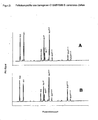

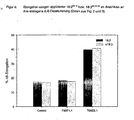
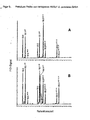


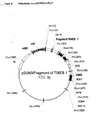
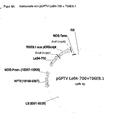

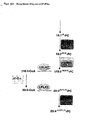

Classifications
-
- C—CHEMISTRY; METALLURGY
- C12—BIOCHEMISTRY; BEER; SPIRITS; WINE; VINEGAR; MICROBIOLOGY; ENZYMOLOGY; MUTATION OR GENETIC ENGINEERING
- C12N—MICROORGANISMS OR ENZYMES; COMPOSITIONS THEREOF; PROPAGATING, PRESERVING, OR MAINTAINING MICROORGANISMS; MUTATION OR GENETIC ENGINEERING; CULTURE MEDIA
- C12N15/00—Mutation or genetic engineering; DNA or RNA concerning genetic engineering, vectors, e.g. plasmids, or their isolation, preparation or purification; Use of hosts therefor
- C12N15/09—Recombinant DNA-technology
- C12N15/63—Introduction of foreign genetic material using vectors; Vectors; Use of hosts therefor; Regulation of expression
- C12N15/79—Vectors or expression systems specially adapted for eukaryotic hosts
- C12N15/82—Vectors or expression systems specially adapted for eukaryotic hosts for plant cells, e.g. plant artificial chromosomes (PACs)
- C12N15/8241—Phenotypically and genetically modified plants via recombinant DNA technology
- C12N15/8242—Phenotypically and genetically modified plants via recombinant DNA technology with non-agronomic quality (output) traits, e.g. for industrial processing; Value added, non-agronomic traits
- C12N15/8243—Phenotypically and genetically modified plants via recombinant DNA technology with non-agronomic quality (output) traits, e.g. for industrial processing; Value added, non-agronomic traits involving biosynthetic or metabolic pathways, i.e. metabolic engineering, e.g. nicotine, caffeine
- C12N15/8247—Phenotypically and genetically modified plants via recombinant DNA technology with non-agronomic quality (output) traits, e.g. for industrial processing; Value added, non-agronomic traits involving biosynthetic or metabolic pathways, i.e. metabolic engineering, e.g. nicotine, caffeine involving modified lipid metabolism, e.g. seed oil composition
-
- C—CHEMISTRY; METALLURGY
- C12—BIOCHEMISTRY; BEER; SPIRITS; WINE; VINEGAR; MICROBIOLOGY; ENZYMOLOGY; MUTATION OR GENETIC ENGINEERING
- C12N—MICROORGANISMS OR ENZYMES; COMPOSITIONS THEREOF; PROPAGATING, PRESERVING, OR MAINTAINING MICROORGANISMS; MUTATION OR GENETIC ENGINEERING; CULTURE MEDIA
- C12N9/00—Enzymes; Proenzymes; Compositions thereof; Processes for preparing, activating, inhibiting, separating or purifying enzymes
- C12N9/10—Transferases (2.)
- C12N9/1025—Acyltransferases (2.3)
- C12N9/1029—Acyltransferases (2.3) transferring groups other than amino-acyl groups (2.3.1)
-
- C—CHEMISTRY; METALLURGY
- C12—BIOCHEMISTRY; BEER; SPIRITS; WINE; VINEGAR; MICROBIOLOGY; ENZYMOLOGY; MUTATION OR GENETIC ENGINEERING
- C12P—FERMENTATION OR ENZYME-USING PROCESSES TO SYNTHESISE A DESIRED CHEMICAL COMPOUND OR COMPOSITION OR TO SEPARATE OPTICAL ISOMERS FROM A RACEMIC MIXTURE
- C12P7/00—Preparation of oxygen-containing organic compounds
- C12P7/64—Fats; Fatty oils; Ester-type waxes; Higher fatty acids, i.e. having at least seven carbon atoms in an unbroken chain bound to a carboxyl group; Oxidised oils or fats
- C12P7/6409—Fatty acids
- C12P7/6427—Polyunsaturated fatty acids [PUFA], i.e. having two or more double bonds in their backbone
-
- C—CHEMISTRY; METALLURGY
- C12—BIOCHEMISTRY; BEER; SPIRITS; WINE; VINEGAR; MICROBIOLOGY; ENZYMOLOGY; MUTATION OR GENETIC ENGINEERING
- C12P—FERMENTATION OR ENZYME-USING PROCESSES TO SYNTHESISE A DESIRED CHEMICAL COMPOUND OR COMPOSITION OR TO SEPARATE OPTICAL ISOMERS FROM A RACEMIC MIXTURE
- C12P7/00—Preparation of oxygen-containing organic compounds
- C12P7/64—Fats; Fatty oils; Ester-type waxes; Higher fatty acids, i.e. having at least seven carbon atoms in an unbroken chain bound to a carboxyl group; Oxidised oils or fats
- C12P7/6409—Fatty acids
- C12P7/6427—Polyunsaturated fatty acids [PUFA], i.e. having two or more double bonds in their backbone
- C12P7/6432—Eicosapentaenoic acids [EPA]
-
- C—CHEMISTRY; METALLURGY
- C12—BIOCHEMISTRY; BEER; SPIRITS; WINE; VINEGAR; MICROBIOLOGY; ENZYMOLOGY; MUTATION OR GENETIC ENGINEERING
- C12P—FERMENTATION OR ENZYME-USING PROCESSES TO SYNTHESISE A DESIRED CHEMICAL COMPOUND OR COMPOSITION OR TO SEPARATE OPTICAL ISOMERS FROM A RACEMIC MIXTURE
- C12P7/00—Preparation of oxygen-containing organic compounds
- C12P7/64—Fats; Fatty oils; Ester-type waxes; Higher fatty acids, i.e. having at least seven carbon atoms in an unbroken chain bound to a carboxyl group; Oxidised oils or fats
- C12P7/6409—Fatty acids
- C12P7/6427—Polyunsaturated fatty acids [PUFA], i.e. having two or more double bonds in their backbone
- C12P7/6434—Docosahexenoic acids [DHA]
-
- C—CHEMISTRY; METALLURGY
- C12—BIOCHEMISTRY; BEER; SPIRITS; WINE; VINEGAR; MICROBIOLOGY; ENZYMOLOGY; MUTATION OR GENETIC ENGINEERING
- C12P—FERMENTATION OR ENZYME-USING PROCESSES TO SYNTHESISE A DESIRED CHEMICAL COMPOUND OR COMPOSITION OR TO SEPARATE OPTICAL ISOMERS FROM A RACEMIC MIXTURE
- C12P7/00—Preparation of oxygen-containing organic compounds
- C12P7/64—Fats; Fatty oils; Ester-type waxes; Higher fatty acids, i.e. having at least seven carbon atoms in an unbroken chain bound to a carboxyl group; Oxidised oils or fats
- C12P7/6436—Fatty acid esters
- C12P7/6445—Glycerides
- C12P7/6472—Glycerides containing polyunsaturated fatty acid [PUFA] residues, i.e. having two or more double bonds in their backbone
Definitions
- the present invention relates to a process for producing polyunsaturated fatty acids in an organism by introducing into the organism nucleic acids encoding polypeptides having acyl-CoA: lysophospholipid acyltransferase activity.
- these nucleic acid sequences may optionally be expressed in the transgenic organism along with other nucleic acid sequences encoding polypeptides of biosynthesis of the fatty acid or lipid metabolism.
- Fatty acids and triglycerides have a variety of uses in the food, animal nutrition, cosmetics and pharmaceutical industries. Depending on whether they are free saturated or unsaturated fatty acids or triglycerides with an increased content of saturated or unsaturated fatty acids, they are suitable for a wide variety of applications. For example, polyunsaturated fatty acids are added to baby foods to increase their nutritional value. Polyunsaturated ⁇ -3 fatty acids and ⁇ -6 fatty acids represent an important component of animal and human food. Due to the composition of human food that is customary today, the addition of polyunsaturated ⁇ -3 fatty acids, which are preferred in fish oils, is a nourishment particularly important.
- DHA docosahexaenoic acid
- EPA icosapentaenoic acid
- polyunsaturated fatty acids as PUFA, PUFAs, LCPUFA or LCPUFAs are denoted (p oly u nsaturated f atty a cids, PUFA, l ong c hain p oly u nsaturated f atty a cids, LCPUFA).
- the free Fatty acids are advantageously produced by saponification.
- Common natural sources of these fatty acids are fish such as herring, salmon, sardine, perch, eel, carp, trout, halibut, mackerel, zander or tuna or algae.
- oils with saturated or unsaturated fatty acids are preferred, for example.
- lipids with unsaturated fatty acids especially polyunsaturated fatty acids are preferred.
- polyunsaturated ⁇ -3 fatty acids we attribute the polyunsaturated ⁇ -3 fatty acids to a positive effect on the blood cholesterol level and thus on the possibility of preventing heart disease.
- inflammatory especially chronic inflammatory processes in the context of immunological diseases such as rheumatoid arthritis can be positively influenced by w-3 fatty acids. They are therefore added to foods especially dietary foods or found in medicines application.
- ⁇ -6 fatty acids such as arachidonic acid tend to have a negative effect on these diseases in these rheumatic diseases due to our usual food composition.
- ⁇ -3- and ⁇ -6 fatty acids are precursors of tissue hormones, the so-called eicosanoids such as the prostaglandins derived from dihomo- ⁇ -linolenic acid, arachidonic acid and eicosapentaenoic acid, the thromoxanes and leukotrienes derived from arachidonic acid and Derive the eicosapentaenoic acid.
- Eicosanoids (so-called PG 2 series), which are formed from ⁇ -6 fatty acids generally promote inflammatory reactions, while eicosanoids (so-called PG 3 series) of ⁇ -3 fatty acids have little or no pro-inflammatory effect.
- ⁇ -6-desaturases are in WO 93/06712 . US 5,614,393 . US5614393 . WO 96/21022 . WO00 / 21557 and WO 99/27111 described and also the application for production in transgenic organisms as described in WO98 / 46763 WO98 / 46764 . WO9846765 , The expression of different desaturases as in WO99 / 64616 or WO98 / 46776 and formation of polyunsaturated fatty acids. Concerning.
- microorganisms for producing PUFAs are microorganisms such as Thraustochytria or Schizochytria strains, algae such as Phaeodactylum tricornutum or Crypthecodinium species, ciliates such as Stylonychia or Colpidium, fungi such as Mortierella, Entomophthora or Mucor.
- strain selection a number of mutant strains of the corresponding microorganisms have been developed which produce a number of desirable compounds, including PUFAs.
- mutation and selection of strains with improved production of a particular molecule, such as polyunsaturated fatty acids is a time-consuming and difficult procedure. Therefore, whenever possible, genetic engineering methods are preferred as described above.
- large scale production of fine chemicals can be advantageously carried out via production in plants designed to produce the aforementioned PUFAs.
- Particularly suitable plants for this purpose are oil crops containing large amounts of upid compounds such as rapeseed, canola, linseed, soy, sunflower, borage and evening primrose.
- other crops containing oils or lipids and fatty acids are also well-suited, as mentioned in the detailed description of this invention.
- a number of mutant plants have been developed which produce a spectrum of desirable lipids and fatty acids, cofactors and enzymes.
- microalgae such as Phaeodactylum and mosses
- Physcomitrella unsaturated fatty acids such as linoleic acid or linolenic acid in the form of their acyl-CoAs in several desaturation and Elongationsön to LCPUFAs ( Zank et al. (2000) Biochemical Society Transactions 28: 654-658 ).
- biosynthesis of DHA involves chain shortening via ⁇ -oxidation in addition to desaturation and elongation steps.
- LCPUFAs exist in microorganisms and lower plants either exclusively in the form of membrane lipids, as in Physcomitrella and Phaeodactylum, or they are present in membrane lipids and triacylglycerides, as in Schizochytrium and Mortierella.
- the incorporation of LCPUFAs into lipids and oils is catalyzed by a variety of acyttransferases and transacylases. These enzymes are already known for the incorporation of saturated and unsaturated fatty acids [ Slabas (2001) J. Plant Physiology 158: 505-513 ; Frentzen (1998) fat / lipid 100: 161-166 ); Cases et al. (1998) Proc. Nat. Acad.
- acyltransferases are enzymes of the so-called Kennedy pathway located on the cytoplasmic side of the endoplasmic reticulum membrane system, hereafter referred to as 'ER'.
- 'ER' cytoplasmic side of the endoplasmic reticulum membrane system
- membranes of the ER can be isolated as so-called 'microsomal fractions' from different organisms ( Knutzon et al. (1995) Plant Physiology 109: 999-1006 ; Mishra & Kamisaka (2001) Biochemistry 355: 315-322 ; US 5968791 ).
- These ER-linked acyltransferases in the microsomal fraction use acyl-CoA as the activated form of the fatty acids.
- Glycerol-3-phosphate acyltransferase catalyzes the incorporation of acyl groups at the sn-1 position of glycerol-3-phosphate.
- 1-acylglycerol-3-phosphate acyltransferase (EC 2.3.1.51), also lysophosphatidic acyltransferase, hereinafter LPAAT , catalyses the incorporation of acyl groups at the sn-2 position of lysophosphatidic acid, hereinafter abbreviated as LPA.
- diacylglycerol acyltransferase catalyzes the incorporation of acyl groups at the sn-3 position of diacylglycerol.
- DAGAT diacylglycerol acyltransferase
- other enzymes are involved in the incorporation of fatty acids into triacylglycerides, which can incorporate acyl groups from membrane lipids into triacylglycerols.
- Phospholipid diacylglycerol acyltransferase hereinafter called PDAT
- LPCAT lysophosphatidylcholine acyltransferase
- LPCAT The enzymatic activity of a LPCAT was first described in rats [ Country (1960) Journal of Biological Chemistry 235: 2233-2237 ]. There is a plastidic isoform of LPCAT in plants [ Akermoun et al. (2000) Biochemical Society Transactions 28: 713-715 ] and an ER bound isoform [ Tumaney and Rajasekharan (1999) Biochimica et Biophysica Acta 1439: 47-56 ; Fraser and Stobart, Biochemical Society Transactions (2000) 28: 715-7718 ]. LPCAT is involved in the biosynthesis and transacylation of polyunsaturated fatty acids in both animals and plants [ Stymne and Stobart (1984) Biochem. J.
- LPCAT lysophospholipid acyltransferase
- Higher plants contain polyunsaturated fatty acids such as linoleic acid (C18: 2) and linolenic acid (C18: 3).
- Arachidonic acid (ARA), eicosapentaenoic acid (EPA) and docosahexaenoic acid (DHA) do not occur at all or only in traces in the seed oil of higher plants, as described above.
- ARA Arachidonic acid
- EPA eicosapentaenoic acid
- DHA docosahexaenoic acid
- genes encoding enzymes of the biosynthesis of LCPUFAs in oilseeds are advantageously introduced and expressed via genetic engineering methods. These are, for example, genes encoding ⁇ -6-desaturase, ⁇ -6 elongase, ⁇ -5-desaturase, ⁇ -5 elongase and ⁇ -4-desaturase.
- ⁇ -6-desaturase genes from the moss Physcomitrella patens and ⁇ -6 elongase genes isolated from P. patens and the nematode C. elegans can be advantageously isolated from microorganisms, animals and lower plants that produce LCPUFAs and incorporate them into the membranes or triacylglycerides.
- the polyunsaturated fatty acids prepared in the process according to the invention contain at least two advantageously three double bonds.
- the fatty acids contain four or five double bonds.
- Fatty acids produced in the process advantageously have 16, 18, 20 or 22 C atoms in the fatty acid chain. These produced fatty acids can be produced as the only product in the process or present in a fatty acid mixture.
- nucleic acid sequences used in the method of the invention are isolated nucleic acid sequences encoding polypeptides having acyl-CoA: lysophospholipid acyltransferase activity.
- the polyunsaturated fatty acids produced in the process are advantageously bound in membrane lipids and / or triacylglycerides, but may also occur as free fatty acids or bound in the form of other fatty acid esters in the organisms. As stated, they may be present as "pure products" or else advantageously in the form of mixtures of different fatty acids or mixtures of different glycerides.
- the different fatty acids bound in the triacylglycerides can be derived from short-chain fatty acids having 4 to 6 C atoms, medium-chain fatty acids having 8 to 12 C atoms or long-chain fatty acids having 14 to 24 C atoms, the long-chain fatty acids being particularly preferred the long-chain fatty acids LCPUFAs of C 18 , C 20 and / or C 22 fatty acids.
- fatty acid esters with polyunsaturated C 16 , C 18 , C 20 and / or C 22 fatty acid molecules having at least two double bonds in the fatty acid ester.
- hexadecadienoic acid C
- the fatty acid esters with polyunsaturated C 16 , C 18 , C 20 and / or C 22 fatty acid molecules can be prepared from the organisms used for the preparation of the fatty acid esters in the form of an oil or lipid, for example in the form of compounds such as sphingolipids , Phosphoglycerides, lipids, glycolipids such as glycosphingolipid, phospholipids such as phosphatidylethanolamine, phosphatidylcholine, phosphatidylserine, phosphatidylglycerol, phosphatidylinositol or diphosphatidylglycerol, monoacylglycerides, diacylglycerides, triacylglycerides or other fatty acid esters such as the acetyl-coenzymeA esters containing the polyunsaturated fatty acids having at least two preferably three double bonds, be isolated.
- compounds such as sphingolipids , Phospho
- the polyunsaturated fatty acids are also included as free fatty acids or bound in other compounds in the organisms beneficial to the plants.
- the various compounds mentioned above are present in the organisms in an approximate distribution of 80 to 90% by weight of triglycerides, 2 to 5% by weight of diglycerides, 5 to 10% by weight of monoglycerides, 1 to 5 wt .-% of free fatty acids, 2 to 8 wt .-% phospholipids ago, wherein the sum of the various compounds to 100 wt .-% complements.
- the LCPUFAs produced have a content of at least 3% by weight, preferably at least 5% by weight, preferably from at least 8 wt .-%, particularly preferably of at least 10 wt .-%, most preferably of at least 15 wt .-% based on the total fatty acids in the transgenic organisms advantageously produced in a transgenic plant.
- hexadecadienoic acid (C16: 2), linoleic acid (C18: 2) and linolenic acid (C18: 3) are passed through several reaction steps, the end products of the process such as arachidonic acid (ARA) or eicosapentaenoic acid (EPA) are not as absolute pure products, there are always small traces of precursors in the final product. If both linoleic acid and linolenic acid are present in the starting organism or in the starting plant, for example, the end products such as ARA and EPA are present as mixtures.
- ARA arachidonic acid
- EPA eicosapentaenoic acid
- the precursors should advantageously not more than 20 wt .-%, preferably not more than 15 wt .-%, more preferably not more than 10 wt .-%, most preferably not more than 5 wt .-% based on the amount of the respective Final product.
- ARA or only EPA are bound in the process according to the invention or produced as free acids in a transgenic plant. If both compounds (ARA + EPA) are produced simultaneously, they are advantageously used in a ratio of at least 1: 2 (EPA: ARA), advantageously of at least 1: 3, preferably 1: 4, more preferably 1: 5 prepared.
- nucleic acid sequences according to the invention an increase in the yield of polyunsaturated fatty acids of at least 50%, preferably of at least 80%, more preferably of at least 100%, most preferably of at least 150% compared to the non-transgenic starting organism in the comparison in the GC analysis see examples can be achieved.
- chemically pure polyunsaturated fatty acids or fatty acid compositions can be prepared by the methods described above.
- the fatty acids or fatty acid compositions from the organism such as the microorganisms or plants or the culture medium in which or on which the organisms were grown, or from the organism and the culture medium in a known manner, for example via extraction, distillation, crystallization, chromatography or Isolated combinations of these methods.
- These chemically pure fatty acids or fatty acid compositions are advantageous for applications in the food industry, the cosmetics industry and especially the pharmaceutical industry.
- organisms such as fungi such as Mortierella or Traustochytrium, yeasts such as Saccharomyces or Schizosaccharomyces, mosses such as Physcomitrella or Ceratodon, non-human animals such as Caenorhabditis, algae such as Crypthecodinium or Phaeodactylum or plants such as dicotyledonous or Einkeimbijantrige plants come as an organism for the preparation in the process according to the invention in question.
- fungi such as Mortierella or Traustochytrium
- yeasts such as Saccharomyces or Schizosaccharomyces
- mosses such as Physcomitrella or Ceratodon
- non-human animals such as Caenorhabditis
- algae such as Crypthecodinium or Phaeodactylum
- plants such as dicotyledonous or Einkeimbijantrige plants come as an organism for the preparation in the process according to the invention in question
- organisms are used in the process according to the invention which belong to the oil-producing organisms, that is to say those which are used for the production of oils, such as fungi such as Mortierella or Traustochytrium, algae such as Crypthecodinium, Phaeodactylum or plants, in particular plants preferred oil crop plants, containing large amounts of lipid compounds such as peanut, canola, canola, sunflower, safflower, poppy, mustard, hemp, castor, olive, sesame, calendula, punica, evening primrose, mullein, thistle, wild rose, hazelnut, almond, macadamia , avocado, laurel, pumpkin, flax, soy, pistachio, borage, trees (oil palm, coconut or walnut) or crops such as corn, wheat, rye, oats, triticale, rice, barley, cotton, cassava, pepper, tagetes, solanaceae Plants such as potato, tobacco, aubergine and
- Preferred plants according to the invention are oil crop plants, such as peanut, oilseed rape, canola, sunflower, safflower, poppy, mustard, hemp, castor, olive, calendula, punica, evening primrose, pumpkin, flax, soy, borage, trees (oil palm, coconut) , Particularly preferred are C18: 2 and / or C18: 3 fatty acid rich plants such as sunflower, safflower, tobacco, mullein, sesame, cotton, pumpkin, poppy, evening primrose, walnut, flax, hemp, thistle or safflower. Very particularly preferred are plants such as safflower, sunflower, poppy, evening primrose, walnut, flax or hemp.
- nucleic acids introduced under method steps (a) to (c) it is advantageous to additionally introduce into the organism, in addition to the nucleic acids introduced under method steps (a) to (c), further nucleic acids which code for enzymes of the fatty acid or lipid metabolism.
- acyl-CoA lysophospholipid acyltransferase in the process for preparing polyunsaturated fatty acids.
- Fatty acid or lipid metabolism genes selected from the group acyl-CoA-dehydrogenase ( n), acyl-ACP [acyl carrier protein] desaturase (s), acyl-ACP thioesterase (s), fatty acyl transferase (s), fatty acid synthase (s), fatty acid hydroxylase (s), Acetyl coenzyme A carboxylase (s), acyl coenzyme A oxidase (s), fatty acid desaturase (s), fatty acid acetylenases, lipoxygenases, triacylglycerol lipases, allene oxide synthases, hydroperoxide lyases, or fatty acid elongase (n ) in combination
- nucleic acids used in the method according to the invention which code for polypeptides having acyl-CoA: lysophospholipid acyltransferase activity, advantageously in combination with nucleic acid sequences which are suitable for polypeptides of the fatty acid or lipid metabolism such as ⁇ -4-, ⁇ -5- , ⁇ -6, ⁇ -8-desaturase or ⁇ -5, ⁇ -6 or ⁇ -9 elongase activity, a wide variety of polyunsaturated fatty acids can be prepared in the process of the invention.
- mixtures of the various polyunsaturated fatty acids or individual polyunsaturated fatty acids such as EPA or ARA can be prepared in free or bound form.
- fatty acids derived from C18: 2 fatty acids such as GLA, DGLA or ARA, or those derived from C18: 3 fatty acids derive, such as SDA, ETA or EPA.
- linoleic acid LA, C18: 2 ⁇ 9,12
- GLA, DGLA and ARA can arise as products of the process, which may be present as free fatty acids or bound.
- ⁇ -linolenic acid ALA, C18: 3 ⁇ 9,12,15
- the products of the process can only be SDA, ETA and EPA, which are as described above may be present as free fatty acids or bound.
- acyl-CoA lysophospholipid acyltransferase, advantageously in combination with the ⁇ -5, ⁇ -6-desaturase and ⁇ -6 elongase, or the ⁇ -5-, ⁇ -8- Desaturase and ⁇ -9 elongase or in combination with only the first two genes ⁇ -6-desaturase and ⁇ -6 elongase or ⁇ -8-desaturase and ⁇ -9 elongase of the synthesis chain can be targeted in the aforementioned organisms advantageously in the above-mentioned plants produced only individual products.
- ⁇ -6-desaturase and ⁇ -6 elongase Due to the activity of ⁇ -6-desaturase and ⁇ -6 elongase, for example, GLA and DGLA or SDA and ETA are formed, depending on the starting plant and unsaturated fatty acid. Preference is given to DGLA or ETA or mixtures thereof. If the ⁇ -5-desaturase is additionally introduced into the organism advantageously into the plant, additional ARA or EPA are produced. This also applies to organisms in which previously the ⁇ -8-desaturase and ⁇ -9 elongase was introduced. Advantageously, only ARA or EPA or their mixtures are synthesized, depending on the fatty acid present in the organism or in the plant, which serves as the starting substance for the synthesis.
- Nucleic acids used in the method of the invention are advantageously derived from plants such as algae such as Isochrysis or Crypthecodinium, algae / diatoms such as Phaeodactylum, mosses such as Physcomitrella or Ceratodon or higher plants such as Primulaceae such as Aleuritia, Calendula stellata, Osteospermum spinescens or Osteospermum hyoseroides, microorganisms such as fungi such as Aspergillus , Thraustochytrium, Phytophthora, Entomophthora, Mucor or Mortierella, yeasts or animals such as nematodes such as Caenorhabditis, insects or humans.
- the nucleic acids are derived from fungi, animals or from plants such as algae or mosses, preferably from nematodes such as Caenorhabditis.
- nucleic acid sequences or their derivative or homologs which code for polypeptides which still possess the enzymatic activity of the proteins encoded by nucleic acid sequences.
- These sequences are cloned individually or in combination with the nucleic acid sequence coding for the acyl-CoA: lysophospholipid acyltransferase into expression constructs and used for introduction and for expression in organisms. By their construction, these expression constructs enable a favorable optimal synthesis of the polyunsaturated fatty acids produced in the process according to the invention.
- the method further comprises the step of obtaining a cell or a whole organism containing the nucleic acid sequences used in the method, wherein the cell and / or the organism with the nucleic acid sequence according to the invention, which for the acyl-CoA: lysophospholipid acyltransferase encoded a gene construct or a vector as described below, alone or in combination with other nucleic acid sequences coding for proteins of the fatty acid or lipid metabolism is transformed.
- this method further comprises the step of recovering the fine chemical from the culture.
- the culture may be, for example, a fermentation culture, for example, in the case of culturing microorganisms such as e.g.
- the cell or organism thus produced is advantageously a cell of an oil-producing organism such as an oil crop such as peanut, canola, canola, flax, hemp, peanut, soybean, safflower, hemp, sunflower or borage.
- an oil-producing organism such as an oil crop such as peanut, canola, canola, flax, hemp, peanut, soybean, safflower, hemp, sunflower or borage.
- Cultivation is, for example, culturing in the case of plant cells, tissue or organs on or in a nutrient medium or the whole plant on or in a substrate, for example in hydroponics, potting soil or on arable land.
- transgenic organism or transgenic plant As mentioned above is to be understood that the nucleic acids used in the method are not in their natural place in the genome of an organism, while the nucleic acids can be expressed homologously or heterologously.
- transgene also means, as mentioned, that the nucleic acids according to the invention are in their natural place in the genome of an organism, but that the sequence has been changed compared to the natural sequence and / or the regulatory sequences of the natural sequences have been changed.
- Transgenic is preferably understood to mean the expression of the nucleic acids according to the invention at a non-natural site in the genome, that is to say a homologous or preferably heterologous expression of the nucleic acids is present.
- Preferred transgenic organisms are fungi such as Mortierella or plants are the open-plan plants.
- all organisms which are capable of synthesizing fatty acids, especially unsaturated fatty acids, or which are suitable for the expression of recombinant genes are suitable in principle as organisms or host organisms for the nucleic acids, the expression cassette or the vector used in the method according to the invention.
- Examples include plants such as Arabidopsis, Asteraceae such as calendula or crops such as soybean, peanut, castor, sunflower, corn, cotton, flax, rapeseed, coconut, oil palm, safflower (Carthamus tinctorius) or cocoa bean, microorganisms such as fungi such as the genus Mortierella, Saprolegnia or Pythium, bacteria such as the genus Escherichia, yeasts such as Genus Saccharomyces, cyanobacteria, ciliates, algae or protozoans such as dinoflagellates such as Crypthecodinium called.
- organisms that can naturally synthesize oils in larger quantities such as fungi such as Mortierella alpina, Pythium insidiosum or plants such as soy, rapeseed, coconut, oil palm, Klarbersafflor, flax, hemp, castor, calendula, peanut, cocoa or sunflower or yeasts such as Saccharomyces cerevisiae, with particular preference being given to soy, flax, oilseed rape, safflower, sunflower, calendula, mortierella or Saccharomyces cerevisiae.
- transgenic animals are also advantageously suitable for non-human animals, for example C. elegans.
- transgenic plants include plant cells and certain tissues, organs and parts of plants in all their forms, such as anthers, fibers, root hairs, stems, embryos, calli, kotelydons, petioles, crops, plant tissue, reproductive tissue and cell cultures, that of the actual transgenic plant is derived and / or can be used to produce the transgenic plant.
- Transgenic plants containing the polyunsaturated fatty acids synthesized in the process according to the invention can advantageously be marketed directly without having to isolate the synthesized oils, upides or fatty acids.
- Plants in the process according to the invention include whole plants and all plant parts, plant organs or plant parts such as leaves, stems, seeds, roots, tubers, anthers, fibers, root hairs, stems, embryos, calli, kotelydons, petioles, emtem material, plant tissue, reproductive tissue, Cell cultures that can be derived from the transgenic plant and / or used to produce the transgenic plant.
- the seed includes all seed parts such as the seed shells, epidermis and sperm cells, endosperm or embryonic tissue.
- the compounds prepared in the process according to the invention can also be isolated from the organisms advantageously plants in the form of their oils, fat, lipids and / or free fatty acids.
- Polyunsaturated fatty acids produced by this process can be harvested by harvesting the organisms either from the culture in which they grow or from the field. This can be done by pressing or extraction of the plant parts, preferably the plant seeds.
- the oils, fats, lipids and / or free fatty acids by so-called cold beat or cold pressing can be obtained without supplying heat by pressing. So that the plant parts especially the seeds are easier to digest, they are first crushed, steamed or roasted. The thus pretreated seeds can then be pressed or extracted with solvents such as warm hexane.
- the solvent is removed again, In the case of microorganisms, these are harvested after harvesting, for example, directly without further operations or, after digestion, extracted by various methods known to those skilled in the art. In this way, more than 96% of the compounds prepared in the process can be isolated. Thereafter, the products thus obtained are further processed, that is to say refined. First of all, for example, the mucilages and turbid matter are removed. The so-called degumming can be carried out enzymatically or, for example, chemically / physically by adding acid, such as phosphoric acid. Subsequently, the free fatty acids are removed by treatment with a base, for example sodium hydroxide solution.
- a base for example sodium hydroxide solution.
- the product obtained is thoroughly washed with water to remove the lye remaining in the product and dried.
- the products are bleached with, for example, bleaching earth or activated carbon.
- the product is still deodorized, for example, with steam.
- the PUFAs or LCPUFAs produced by this process are C 18 , C 20 or C 22 fatty acid molecules having at least two double bonds in the fatty acid molecule, preferably three, four, five or six double bonds.
- These C 18 , C 20 or C 22 fatty acid molecules can be isolated from the organism in the form of an oil, lipid or a free fatty acid. Suitable organisms are, for example, those mentioned above. Preferred organisms are transgenic plants.
- oils, lipids or fatty acids or fractions thereof prepared by the method described above, more preferably oil, lipid or fatty acid composition comprising PUFAs derived from transgenic plants.
- oil, lipid, fatty acids and / or fatty acid composition in feed, food, cosmetics or pharmaceuticals
- oil is understood to mean a fatty acid mixture containing unsaturated, saturated, preferably esterified fatty acid (s). It is preferred that the oil, lipid or fat have a high proportion of polyunsaturated free or advantageous
- the proportion of unsaturated esterified fatty acids is about 30%, more preferred is a proportion, preferably esterified fatty acid (s), especially linoleic acid, ⁇ -linolenic acid, dihomoylinolenic acid, arachidonic acid, ⁇ -linoic acid, stearidonic acid, eicosatetraenoic acid, eicosapentaenoic acid, docosapentaenoic acid or docosahexaenoic acid of 50%, even more preferred is a proportion of 60%, 70%, 80% or more.
- the proportion of fatty acid after conversion of the fatty acids into the methyl esters can be determined by transesterification by gas chromatography.
- the oil, lipid or fat can be various other saturated or unsaturated Fatty acids, eg calendulic acid, palmitic, palmitoleic, stearic, oleic acid etc.
- the proportion of the various fatty acids in the oil or fat may vary depending on the starting organism.
- the polyunsaturated fatty acids having advantageously at least two double bonds produced in the process are, for example, sphingolipids, phosphoglycerides, lipids, glycolipids, phospholipids, monoacylglycerol, diacylglycerol, triacylglycerol or other fatty acid esters.
- the polyunsaturated fatty acids containing, for example, an alkali treatment such as aqueous KOH or NaOH or acid hydrolysis advantageously in the presence of an alcohol such as methanol or methanol or release via an enzymatic cleavage and isolate via, for example, phase separation and subsequent acidification over, for example, H 2 SO 4 .
- an alkali treatment such as aqueous KOH or NaOH or acid hydrolysis
- an alcohol such as methanol or methanol
- the release of the fatty acids can also be carried out directly without the workup described above.
- the nucleic acids used in the method can advantageously be either a plant cell or plants, either on a separate plasmid or integrated into the genome of the host cell.
- integration may be at random or by such recombination as to replace the native gene with the incorporated copy, thereby modulating the production of the desired compound by the cell, or by using a gene in trans such that Gene having a functional expression unit, which contains at least one expression of a gene ensuring sequence and at least one polyadenylation of a functionally transcribed gene ensuring sequence is operably linked.
- the nucleic acids are brought into the plants via multi-expression cassettes or constructs for multiparallel expression in the organisms, advantageously for multiparallel seed-specific expression of genes
- Moose and algae are the only known plant systems that produce significant amounts of polyunsaturated fatty acids, such as arachidonic acid (ARA) and / or eicosapentaenoic acid (EPA) and / or docosahexaenoic acid (DHA).
- ARA arachidonic acid
- EPA eicosapentaenoic acid
- DHA docosahexaenoic acid
- Moose contain PUFAs in membrane lipids while algae, algae-related organisms and some fungi also accumulate significant levels of PUFAs in the triacylglycerol fraction.
- nucleic acid molecules are suitable; which are isolated from such strains that accumulate PUFAs also in the triacylglycerol fraction, particularly advantageous for the method according to the invention and thus for the modification of the lipid and PUFA production system in a host, in particular plants such as oil crops, for example oilseed rape, canola, linseed, hemp , Soy, sunflower, borage. They are therefore advantageously used in the process according to the invention.
- Suitable substrates of the acyl-CoA: lysophospholipid acyltransferases are advantageously C 16 , C 18 , C 20 or C 22 fatty acids
- the polyunsaturated C 16 - or C 18 -fatty acids must first be desaturated by the enzymatic activity of a desaturase and then be extended by at least two carbon atoms via an elongase. After one round of elongation this enzyme activity leads to C 18 or C 20 fatty acids, and after two or three rounds of elongation to C 22 or C 24 fatty acids.
- the desaturases and elongases used in the activity of the processes according to the invention preferably lead to C 18 , C 20 and / or C 22 fatty acids advantageously having at least two double bonds in the fatty acid molecule, preferably having three, four or five double bonds, more preferably C 20 and / or C 22 fatty acids having at least two double bonds in the fatty acid molecule, preferably having three, four or five double bonds in the molecule.
- further desaturation steps such as those in A-5 position, can occur.
- Particularly preferred products of the process according to the invention are dihomo- ⁇ -linolenic acid, arachidonic acid, eicosapentaenoic acid, docosapentaenoic acid and / or docosaheic acid.
- the C 18 fatty acids having at least two double bonds in the fatty acid can be extended by the enzymatic activity according to the invention in the form of the free fatty acid or in the form of the esters, such as phospholipids, glycolipids, sphingolipids, phosphoglycerides, monoacylglycerol, diacylglycerol or triacylglycerol.
- the preferred biosynthetic site of fatty acids, oils, lipids or fats in the favorably used plants is generally the seed or cell layers of the seed, so that a specific expression of the nucleic acids used in the method is meaningful.
- the biosynthesis of fatty acids, Oils or lipids need not be limited to the seed tissue, but also in all other parts of the plant - for example, in epidermal cells or in the tubers - can be made tissue-specific.
- microorganisms such as yeasts such as Saccharomyces or Schizosaccharomyces
- fungi such as Mortierella, Aspergillus, Phytophtora, Entomophthora, Mucor or Traustochytrium algae such as Isochrysis, Phaeodactylum or Crypthecodinium are used in the method according to the invention as organisms, these organisms are advantageously attracted to fermentation.
- the polyunsaturated fatty acids produced in the process can be at least 10%, preferably at least 15%, more preferably at least 20%, very particularly preferably at least 50%. be increased compared to the wild type of organisms that do not contain the nucleic acids recombinantly.
- the polyunsaturated fatty acids produced in the organisms used in the process can in principle be increased in two ways. It may advantageously be the pool of free polyunsaturated fatty acids and / or the proportion of the esterified ones prepared over the process several times unsaturated fatty acids are increased.
- the process according to the invention increases the pool of esterified polyunsaturated fatty acids in the transgenic organisms.
- microorganisms are used as organisms in the process according to the invention, they are grown or grown, depending on the host organism, in a manner known to the person skilled in the art.
- Microorganisms are usually in a liquid medium containing a carbon source usually in the form of sugars, a nitrogen source usually in the form of organic nitrogen sources such as yeast extract or salts such as ammonium sulfate, trace elements such as iron, manganese, magnesium salts and optionally vitamins, at temperatures between 0 ° C and 100 ° C, preferably between 10 ° C to 60 ° C attracted under oxygen fumigation.
- the pH of the nutrient fluid can be kept at a fixed value, that is regulated during the cultivation or not.
- the cultivation can be batchwise, semi-batch wise or continuous. Nutrients can be presented at the beginning of the fermentation or fed semi-continuously or continuously.
- the polyunsaturated fatty acids prepared can be isolated from the organisms by methods known to those skilled in the art as described above. For example, extraction, distillation, crystallization, optionally salt precipitation and / or chromatography. The organisms can be opened up for this purpose yet advantageous.
- the method according to the invention when the host organisms are microorganisms, is advantageous at a temperature between 0 ° C to 95 ° C, preferably between 10 ° C to 85 ° C, more preferably between 15 ° C to 75 ° C, completely more preferably carried out between 15 ° C to 45 ° C.
- the pH is advantageously maintained between pH 4 and 12, preferably between pH 6 and 9, particularly preferably between pH 7 and 8.
- the process according to the invention can be operated batchwise, semi-batchwise or continuously.
- a summary of known cultivar methods is given in the textbook by Chmiel ( Bioprocess Engineering 1. Introduction to Bioprocess Engineering (Gustav Fischer Verlag, Stuttgart, 1991 )) or in the textbook of Storhas ( Bioreactors and Peripheral Facilities (Vieweg Verlag, Braunschweig / Wiesbaden, 1994 )) to find.
- the culture medium to be used must suitably satisfy the requirements of the respective strains. Descriptions of culture media of various microorganisms are in the Handbook "Manual of Methods for General Bacteriology” of the American Society of Bacteriology (Washington DC, USA, 1981 ) contain.
- these media which can be used according to the invention usually comprise one or more carbon sources, nitrogen sources, inorganic salts, vitamins and / or trace elements.
- Preferred carbon sources are sugars, such as mono-, di- or polysaccharides.
- sugars such as mono-, di- or polysaccharides.
- very good carbon sources are glucose, fructose, mannose, galactose, ribose, sorbose, ribulose, lactose, maltose, sucrose, raffinose, starch or cellulose.
- Sugar can also be added to the media via complex compounds, such as molasses, or other by-products of sugar refining. It may also be advantageous to add mixtures of different carbon sources.
- Other possible sources of carbon are oils and fats such. As soybean oil, sunflower oil, peanut oil and / or coconut oil, fatty acids such.
- Nitrogen sources are usually organic or inorganic nitrogen compounds or materials containing these compounds.
- Exemplary nitrogen sources include ammonia in liquid or gaseous form or ammonium salts such as ammonium sulfate, ammonium chloride, ammonium phosphate, ammonium carbonate or ammonium nitrate, nitrates, urea, amino acids or complex nitrogen sources such as corn steep liquor, soybean meal, soy protein, yeast extract, meat extract and others.
- the nitrogen sources can be used singly or as a mixture.
- Inorganic salt compounds which may be included in the media include the chloride, phosphorus or sulfate salts of calcium, magnesium, sodium, cobalt, molybdenum, calcium, manganese, zinc, copper and iron.
- sulfur-containing fine chemicals in particular methionine
- inorganic sulfur-containing compounds such as sulfates, sulfites, dithionites, tetrathionates, thiosulfates, sulfides but also organic sulfur compounds, such as mercaptans and thiols can be used.
- Phosphoric acid potassium dihydrogen phosphate or dipotassium hydrogen phosphate or the corresponding sodium-containing salts can be used as the phosphorus source.
- Chelating agents can be added to the medium to keep the metal ions in solution.
- Particularly suitable chelating agents include dihydroxyphenols, such as catechol or protocatechuate, or organic acids, such as citric acid.
- the fermentation media used according to the invention for the cultivation of microorganisms usually also contain other growth factors, such as vitamins or growth promoters, which include, for example, biotin, riboflavin, thiamine, folic acid, nicotinic acid, panthothenate and pyridoxine.
- growth factors and salts are often derived from complex media components, such as yeast extract, molasses, corn steep liquor, and the like.
- suitable precursors may be added to the culture medium.
- the exact composition of the media compounds will depend heavily on the particular experiment and will be decided on a case by case basis. Information about media optimization is available from the textbook " Applied Microbiol. Physiology, A Practical Approach "(Ed.
- Growth media may also be obtained from commercial suppliers such as Standard 1 (Merck) or BHI (Brain heart infusion, DIFCO) and the like.
- All media components are sterilized either by heat (20 min at 1.5 bar and 121 ° C) or by sterile filtration.
- the components can be sterilized either together or, if necessary, separately. All media components may be present at the beginning of the culture or added randomly or batchwise, as desired.
- the temperature of the culture is usually between 15 ° C and 45 ° C, preferably 25 ° C to 40 ° C and can be kept constant or changed during the experiment.
- the pH of the medium should be in the range of 5 to 8.5, preferably around 7.0.
- the pH for cultivation can be controlled during cultivation by addition of basic compounds such as sodium hydroxide, potassium hydroxide, ammonia or ammonia water or acidic compounds such as phosphoric acid or sulfuric acid. To control the GeFiumwiklung antifoams such. As fatty acid polyglycol, are used.
- the medium can be selected selectively acting substances such. As antibiotics, are added.
- oxygen or oxygen-containing gas mixtures such. B. ambient air entered into the culture.
- the temperature of the culture is usually 20 ° C to 45 ° C, and preferably 25 ° C to 40 ° C.
- the culture is continued until a maximum of the desired product has formed. This goal is usually reached within 10 hours to 160 hours
- the fermentation broths thus obtained in particular containing polyunsaturated fatty acids, usually have a dry matter content of 7.5 to 25% by weight.
- the fermentation broth can then be further processed.
- the biomass can be wholly or partly by separation methods, such. As centrifugation, filtration, decantation or a combination of these methods are removed from the fermentation broth or completely left in it.
- the biomass is worked up after separation.
- the fermentation broth can also without cell separation with known methods such. B. with the aid of a rotary evaporator, thin film evaporator, falling film evaporator, by reverse osmosis, or by nanofiltration, thickened or concentrated. This concentrated fermentation broth may eventually be worked up to recover the fatty acids contained therein.
- the fatty acids obtained in the process are also suitable as starting material for the chemical synthesis of further products of value. They may be used, for example, in combination with each other or solely for the manufacture of pharmaceuticals, foods, animal feed or cosmetics.
- isolated nucleic acid sequences encoding polypeptides having acyl-CoA: lysophospholipid acyltransferase activity wherein the acyl-CoA: lysophospholipid acyltransferases encoded by the nucleic acid sequences include C 16 , C 18 , C 20 or C 22 fatty acids specifically implement at least one double bond in the fatty acid molecule.
- nucleic acid sequences are derived from a eukaryotic organism.
- the nucleic acids used in the method are advantageously subjected to amplification and ugation in a known manner.
- the procedure is based on the protocol of the Pfu DNA polymerase or of a Pfu / Taq DNA polymerase mixture.
- the primers are chosen according to the sequence to be amplified. Conveniently, the primers should be chosen so that the amplificate comprises the entire codogenic sequence from the start to the stop codon.
- the amplificate is conveniently analyzed. For example, the analysis can be carried out after gel electrophoretic separation in terms of quality and quantity. Subsequently, the amplificate can be purified according to a standard protocol (eg Qiagen).
- Suitable cloning vectors are well known to those skilled in the art. These include, in particular, vectors which can be replicated in microbial systems, ie in particular vectors which are efficient Ensure cloning in yeasts or fungi, and allow the stable transformation of plants.
- vectors which can be replicated in microbial systems ie in particular vectors which are efficient Ensure cloning in yeasts or fungi, and allow the stable transformation of plants.
- various suitable for the T-DNA-mediated transformation binary and co-integrated vector systems. Such vector systems are usually characterized in that they contain at least the vir genes required for the Agrobacterium-mediated transformation as well as the T-DNA limiting sequences (T-DNA border).
- these vector systems also include other cis-regulatory regions, such as promoters and terminators and / or selection markers, with which appropriately transformed organisms can be identified.
- vir genes and T-DMA sequences are located on the same vector
- binary systems are based on at least two vectors, one of them vir genes, but no T-DNA and a second T-DNA, but no As a result, the latter vectors are relatively small, easy to manipulate and replicate in both E coli and Agrobacterium.
- These binary vectors include vectors of the series pBIB-HYG, pPZP, pBecks, pGreen.
- Bin19, pB1101, pBinAR, pGPTV and pCAMBIA are preferably used according to the invention.
- An overview of binary vectors and their use gives Hellens et al, Trends in Plant Science (2000) 5, 446-451 .
- the vectors can first be linearized with restriction endonuclease (s) and then enzymatically modified in a suitable manner. The vector is then purified and an aliquot used for cloning. In cloning, the enzymatically cut and if necessary purified amplicon is cloned with similarly prepared vector fragments using ligase.
- a particular nucleic acid construct or vector or plasmid construct can have one or more codogenic gene segments.
- the codogenic gene segments are preferably functionally linked to regulatory sequences in these constructs.
- the regulatory sequences include, in particular, plant sequences such as the promoters and terminators described above.
- the constructs can advantageously be stably propagated in microorganisms, in particular Escherichia coli and Agrobacterium tumefaciens, under selective conditions and enable a transfer of heterologous DNA into plants or microorganisms.
- the nucleic acids used in the method can be introduced into organisms such as microorganisms or advantageously plants and thus used in plant transformation, such as those published in and cited therein: Plant Molecular Biology and Biotechnology (CRC Press, Boca Raton, Florida), Chapter 6/7, pp. 71-119 (1993 ); FF White, Vectors for Gene Transfer to Higher Plants; in: Transgenic Plants, Vol. 1, Engineering and Utilization, eds .: Kung and R. Wu, Academic Press, 1993, 15-38 ; Techniques for Gene Transfer, Transgenic Plants, Vol. 1, Engineering and Utilization, eds. Kung and R.
- nucleic acids used in the method, the nucleic acids and nucleic acid constructs and / or vectors can thus be used for genetic modification to use a wide range of organisms advantageously on plants so that they become better and / or more efficient producers of PUFAs.
- acyl-CoA lysophospholipid acyltransferase protein
- the number or activity of the acyl-CoA: lysophospholipid acyltransferase protein or gene and of the gene combinations of acyl-CoA: lysophospholipid acyltransferases, desaturases and / or elongases may be increased so that larger amounts of the compounds produced are produced de novo, because the organisms lacked this activity and ability to biosynthesize before introducing the corresponding gene (s).
- acyl-CoA lysophospholipid-acyltransferase, desaturase and / or elongase gene or multiple acyl-CoA: lysophospholipid-acyltransferase, desaturase and / or bongase genes into an organism alone or in combination with other genes not only can the biosynthetic flux to the final product be increased into a cell, but also the corresponding triacylglycerol composition can be increased or created de novo.
- the number or activity of other genes necessary for the biosynthesis of one or more fine chemicals (eg fatty acids, polar and neutral lipids) of other nutrients may be increased, such that the concentration of these precursors, cofactors or intermediates within the cells or within the storage compartment, thereby further increasing the ability of the cells to produce PUFAs, as described below.
- fine chemicals eg fatty acids, polar and neutral lipids
- Fatty acids and lipids are desirable even as fine chemicals; by optimizing the activity or increasing the number of one or more acyl-CoA: lysophospholipid acyltransferase, desaturases and / or elongases involved in the biosynthesis of these compounds, or by destroying the activity of one or more desaturases involved in the degradation of these compounds involved, it may be possible to increase the yield, production and / or efficiency of the production of fatty acid and lipid molecules from organisms, and advantageously from plants.
- acyl-CoA lysophospholipid acyltransferase, desaturases and / or elongases involved in the biosynthesis of these compounds, or by destroying the activity of one or more desaturases involved in the degradation of these compounds involved
- the isolated nucleic acid molecules used in the method of the invention encode proteins or parts thereof, wherein the proteins or the single protein or parts thereof contain an amino acid sequence sufficiently homologous to an amino acid sequence of the sequence SEQ ID NO: 2, SEQ ID NO 4, SEQ ID NO: 6 or SEQ ID NO: 8, such that the protein or portion thereof has an acyl-CoA: lysophospholipid acyltransferase activity
- the protein or portion thereof encoded by the nucleic acid molecule still has its essential enzymatic activity and ability to metabolize compounds necessary for planting cell membranes or lipid bodies in organisms, or transporting molecules into plants these membranes still has to participate.
- the protein encoded by the nucleic acid molecules is at least 90% identical to an amino acid sequence of the sequence SEQ ID NO: 2, SEQ ID NO: 4, SEQ ID NO: 6 or SEQ ID NO: 8.
- Advantageous embodiments of the amino acid sequence according to the invention of the sequence SEQ ID NO Figure 2 are amino acid sequences having a valine residue in place of the existing methionine at position 30 of SEQ ID NO: 2 or having a glycine residue at position 100 in place of the existing serine or having a serine residue at position 170 in place of the existing phenylalanine. These are given in SEQ ID NO: 4, SEQ ID NO: 6 and SEQ ID NO: 8, respectively.
- Essential enzymatic activity of the acyl-CoA lysophospholipid acyltransferases used is to be understood as meaning that they differ from those represented by the sequence having SEQ ID NO: 1, SEQ ID NO: 3, SEQ ID NO: 5 or SEQ ID NO: 7 and their Derivatives coded proteins / enzymes by comparison still have at least one enzymatic activity of at least 10%, preferably 20%, more preferably 30% and most especially 40% and thus the metabolism of compounds necessary for the construction of fatty acids in an organism advantageously a plant cell or am Transporting molecules across membranes, wherein denatured C 16 , C 18 or C 20-24 carbon chains having double bonds at least two, preferably three, four or five positions is meant.
- Nucleic acids useful in the method are derived from fungi or plants such as algae or mosses such as the genera Physcomitrella, Thraustochytrium, Phytophthora, Ceratodon, Isochrysis, Aleurita, Muscarioides, Mortierella, Borago, Phaeodactylum, Crypthecodinium or from nematodes such as Caenorhabditis, especially from the genera and species Physcomitrella patens, Phytophthora infestans, Ceratodon purpureus, Isochrysis galbana, Aleurita farinosa, Muscarioides viallii, Mortierella alpina, Borago officinalis, Phaeodactylum tricomutum, or particularly beneficial from Caenorhabditis elegans.
- algae or mosses such as the genera Physcomitrella, Thraustochytrium, Phytoph
- the isolated nucleotide sequences used for acyl-CoA may encode: lysophospholipid acyltransferases which hybridize to a nucleotide sequence of SEQ ID NO: 1, SEQ ID NO: 3, SEQ ID NO: 5 or SEQ ID NO: 7, eg under stringent conditions hybridize.
- nucleic acid sequences coding for the inventive acyl-CoA: lysophospholipid acyltransferases, the desaturases used and / or the elongases are advantageously linked functionally with one or more regulatory signals in order to increase gene expression.
- These regulatory sequences are intended to allow the targeted expression of genes and protein expression. Depending on the host organism, this may mean, for example, that the gene is expressed and / or overexpressed only after induction, or that it is expressed and / or overexpressed immediately.
- these regulatory sequences are sequences that bind to the inducers or repressors and thus regulate the expression of the nucleic acid.
- the natural regulation of these sequences may still be present before the actual structural genes and may have been genetically altered so that natural regulation is eliminated and expression of the genes increased.
- the gene construct may advantageously also contain one or more so-called enhancer sequences functionally linked to the promoter, which allow increased expression of the nucleic acid sequence. Additional advantageous sequences can also be inserted at the 3 'end of the DNA sequences, such as further regulatory elements or terminators.
- the gene construct or gene constructs can be expressed together in the host organism.
- the gene construct or the gene constructs can be inserted in one or more vectors and be present freely in the cell or else be inserted in the genome. It is advantageous for the insertion of additional genes in the host genome when the genes to be expressed are present together in a gene construct.
- the regulatory sequences or factors can, as described above, preferably positively influence the gene expression of the introduced genes and thereby increase them.
- enhancement of the regulatory elements can advantageously be done at the transcriptional level by using strong transcription signals such as Promoters and / or "enhancers" are used.
- an enhancement of the translation is possible by, for example, the stability of the mRNA is improved.
- acyl-CoA lysophospholipid acyltransferases lead to an exchange of the fatty acids between the mono-, di- and / or triglyceride pool of the cell and the CoA fatty acid ester pool, the substrate advantageously one, two, three, four or five.
- Advantageous regulatory sequences for the novel process are, for example, in promoters, such as the cos, tac, trp, tet, trp tet, lpp, lac, lpp-lac, laclq, T7-T5, T3 , gal, tro, ara, SP6, ⁇ -PR or ⁇ -PL promoter and are advantageously used in Gram-negative bacteria.
- promoters such as the cos, tac, trp, tet, trp tet, lpp, lac, lpp-lac, laclq, T7-T5, T3 , gal, tro, ara, SP6, ⁇ -PR or ⁇ -PL promoter and are advantageously used in Gram-negative bacteria.
- Further advantageous regulatory sequences are, for example, in the Gram-positive promoters amy and SPO2, in the yeast or fungal promoters ADC1, MF ⁇ , AC, P-60, CYC1, GAPDH, TEF, rp28, ADH or in the plant promoters CaMV / 35S [ Franck et al., Cell 21 (1980) 285-294 ], PRP1 [ Ward et al., Plant. Mol. Biol. 22 (1993 )], SSU, OCS, lib4, usp, STLS1, B33, nos or in the ubiquitin or phaseolin promoter.
- inducible promoters such as those in EP-A-0 388 186 (Benzylsulfonamide-inducible), Plant J. 2,1992: 397-404 (Gatz et al., Tetracycline-inducible), EP-A-0 335 528 (Abzisinklare inducible) or WO 93/21334 (Ethanol or cyclohexenol inducible) promoters described.
- Further suitable plant promoters are the cytosolic FBPase promoter or the potato ST-LSI promoter ( Stockhaus et al., EMBO J.
- promoters which allow expression in tissues involved in fatty acid biosynthesis.
- seed-specific promoters such as the USP promoter according to the invention, but also other promoters such as the LeB4, DC3, phaseolin or napin promoter.
- promoters are seed-specific promoters which can be used for monocotyledonous or dicotyledonous plants and in US 5,608,152 (Napin promoter from rapeseed), WO 98/45461 (Oleosin promoter from Arobidopsis), US 5,504,200 (Phaseolin promoter from Phaseolus vulgaris), WO 91/13980 (Brassica Bce4 promoter), from Baeumlein et al., Plant J., 2, 2, 1992: 233-239 (LeB4 promoter from a legume) are described, these promoters are suitable for dicotyledons.
- the following promoters are suitable, for example, for monocotylone lpt-2 or Ipt-1 promoter from barley ( WO 95/15389 and
- the PUFA biosynthesis genes should advantageously be seed-specifically expressed in oilseeds.
- seed-specific promoters can be used, or such promoters that are active in the embryo and / or in the endosperm.
- seed-specific promoters can be isolated from both dicotolydone and monocotolydonous plants.
- USP unknown seed protein
- Vicilin Vicia faba
- WO95 / 23230 Seed-specific promoters from rice, corn, and the like.
- Wheat [ WO 99/16890 ], Amy32b, Amy 6-6 and Aleurain [ US 5,677,474 ], Bce4 (rape) [ US 5,530,149 ], Glycinin (soybean) [ EP 571 741 ], Phosphoenol pyruvate carboxylase (soybean) [ JP 06/62870 ], ADR12-2 (soy) [ WO 98/08962 ], Isocitrate lyase (rapeseed) [ US 5,689,040 ] or ⁇ -amylase (barley) [ EP 781 849 ].
- Plant gene expression can also be facilitated by a chemically inducible promoter (see an overview in Gatz 1997, Annu. Rev. Plant Physiol. Plant Mol. Biol., 48: 89-108 ).
- Chemically inducible promoters are particularly useful when it is desired that gene expression be in a time-specific manner. Examples of such promoters are a salicylic acid-inducible promoter ( WO 95/19443 ), a tetracycline-inducible promoter ( Gatz et al. (1992) Plant J. 2, 397-404 ) and an ethanol-inducible promoter.
- each of the nucleic acids used in the method which for the acyl-CoA: lysophospholipid acyltransferase, the beneficial ⁇ -4-desaturase, the ⁇ -5-desaturase, the ⁇ 6-desaturase expressing ⁇ 8-desaturase and / or ⁇ 5-elongase, ⁇ 6-elongase and / or ⁇ 9-elongase are expressed under the control of their own preferably different promoter because repetitive sequence motifs could lead to instability of the T-DNA or to recombination events.
- the expression cassette is advantageously constructed so that a promoter, a suitable interface for insertion of the nucleic acid to be expressed follows advantageously in a polylinker, optionally followed by a terminator behind the polylinker. This sequence is repeated several times three, four or five times, so that up to five genes can be brought together in one construct and thus be introduced into the transgenic plant for expression. Advantageously, the sequence is repeated up to three times.
- the nucleic acid sequences are inserted for expression via the appropriate interface, for example in the polylinker behind the promoter.
- each nucleic acid sequence has its own promoter and optionally its own terminator. However, it is also possible to insert several nucleic acid sequences behind a promoter and possibly in front of a terminator.
- the insertion site or the sequence of the inserted nucleic acid in the expression cassette is not of decisive importance, that is to say a nucleic acid sequence can be inserted at the first or last position in the cassette, without the expression being significantly influenced thereby.
- different promoters such as the USP, LegB4 or DC3 promoter and different terminators can be used in the expression cassette. But it is also possible to use only one type of promoter in the cassette. However, this can lead to unwanted recombination events.
- transcription of the introduced genes should be advantageously aborted by suitable terminators at the 3 'end of the introduced biosynthetic genes (beyond the stop codon). It can be used here e.g. the OCS1 terminator. As for the promoters, different terminator sequences should be used for each gene.
- the gene construct may, as described above, also include other genes to be introduced into the organisms. It is possible and advantageous to introduce into the host organisms regulatory genes, such as genes for inducers, repressors or enzymes, which intervene by their enzyme activity in the regulation of one or more genes of a biosynthetic pathway, and to express therein. These genes may be of heterologous or homologous origin. Furthermore, further biosynthesis genes of the fatty acid or lipid metabolism can advantageously be contained in the nucleic acid construct or gene construct, or else these genes can be located on a further or several further nucleic acid constructs.
- acyl-CoA dehydrogenase s
- acyl-ACP [acyl carrier protein] desaturase
- acyl-ACP thioesterase s
- fatty acid Acyltransferase s
- fatty acid symthase s
- fatty acid hydroxylase s
- acetyl coenzyme A carboxylase s
- fatty acid Acetylenases lipoxygenases, triacylglycerol lipases, allene oxide synthases, hydroperoxide lyases or fatty acid elongase (s) or combinations thereof.
- nucleic acid sequences are biosynthesis genes of the fatty acid or lipid metabolism selected from the group of ⁇ -4-desaturase, ⁇ -5-desaturase, ⁇ -6-desaturase, ⁇ -8-desatuase, ⁇ -9-desaturase, ⁇ 12-desaturase, ⁇ 5-elongase, ⁇ 6-elongase or ⁇ 9-elongase.
- the abovementioned desaturases can be cloned in combination with other elongases and desaturases in expression cassettes according to the invention and used to transform plants using Agrobacterium.
- the regulatory sequences or factors can, as described above, preferably positively influence the gene expression of the introduced genes and thereby increase them.
- enhancement of the regulatory elements can advantageously be done at the transcriptional level by using strong transcription signals such as promoters and / or enhancers.
- an enhancement of the translation is possible by, for example, the stability of the mRNA is improved.
- the expression cassettes can in principle be used directly for introduction into the plant or else introduced into a vector.
- vectors preferably expression vectors, contain the nucleic acids encoding acyl-CoA: lysophospholipid acyltransferases used in the method or a nucleic acid construct containing the nucleic acid used alone or in combination with other biosynthesis genes of the fatty acid or lipid metabolism, such as ⁇ -4-desaturase -, ⁇ -5-desaturase, ⁇ -6-desaturase, ⁇ -8-desatuase, ⁇ -9-desaturase, ⁇ -12-desaturase, ⁇ -5-elongase, ⁇ -6-dongase and / or ⁇ -9 elongase.
- acyl-CoA lysophospholipid acyltransferases used in the method or a nucleic acid construct containing the nucleic acid used alone or in combination with other biosynthesis genes of the fatty acid or lipid metabolism, such as ⁇ -4-desaturase -, ⁇ -5-desaturase, ⁇ -6-des
- vector refers to a nucleic acid molecule that can transport another nucleic acid to which it is attached.
- a vector is a "piasmid", which is a circular double-stranded DNA loop into which additional DNA segments can be ligated.
- a viral vector Another type of vector, where additional DNA segments can be ligated into the viral genome.
- Certain vectors can autonomously replicate in a host cell in which they have been introduced (e.g., bacterial origin of bacterial vectors). Other vectors are advantageously integrated into the genome of a host cell upon introduction into the host cell and thereby replicated together with the host genome.
- certain vectors may direct the expression of genes to which they are operably linked.
- expression vectors are referred to herein as "expression vectors.”
- expression vectors suitable for recombinant DNA techniques are in the form of plasmids.
- plasmid and “vector” can be used interchangeably because the plasmid is the most commonly used vector form.
- the invention is intended to encompass these other forms of expression vectors, such as viral vectors that perform similar functions.
- vector is also intended to encompass other vectors known to those skilled in the art, such as phages, viruses such as SV40, CMV, TMV, transposons, IS elements, phasmids, phagemids, cosmids, linear or circular DNA.
- the recombinant expression vectors advantageously used in the method comprise the nucleic acids described below or the gene construct described above in a form suitable for expression of the nucleic acids used in a host cell, which means that the recombinant expression vectors have one or more regulatory sequences selected on the basis the host cells to be used for the expression which are to be expressed with the nucleic acid sequence to be expressed is operatively connected.
- operably linked means that the nucleotide sequence of interest is bound to the regulatory sequence (s) such that the expression of the nucleotide sequence is possible and they are linked together such that both sequences fulfill the predicted function ascribed to the sequence (eg in an in vitro transcription / translation system or in a host cell when the vector is introduced into the host cell).
- regulatory sequence is intended to include promoters, enhancers, and other expression control elements (eg, polyadenylation signals).
- Regulatory sequences include those that direct the constitutive expression of a nucleotide sequence in many types of host cells and those that direct the direct expression of the nucleotide sequence only in certain host cells under certain conditions.
- the design of the expression vector may depend on factors such as the selection of the host cell to be transformed, the level of expression of the desired protein, etc.
- acyl-CoA lysophospholipid acyltransferases, desaturases and elongases in prokaryotic or eukaryotic cells. This is advantageous because intermediate steps of the vector construction are often carried out in microorganisms for the sake of simplicity.
- acyl-CoA lysophospholipid acyltransferase, desaturase and / or elongase genes can be detected in bacterial cells, insect cells (using baculovirus expression vectors), yeast and other fungal cells (see Romanos, MA, et al.
- Ciliates of the types Holotrichia, Peritrichia, Spirotrichia, Suctoria, Tetrahymena, Paramecium, Colpidium, Glaucoma, Platyophrya, Potomacus, Desaturaseudocohnilembus, Euplotes, Engelmaniella and Stylonychia, in particular the genus Stylonychia lemnae, with vectors according to a transformation method as described in WO 98/01572 , and preferably in cells of multicellular plants (see Schmidt, R.
- Suitable host cells are further discussed in Goeddel, Gene Expression Technology: Methods in Enzymology 185, Academic Press, San Diego, CA (1990 ).
- the recombinant expression vector may alternatively be transcribed and translated in vitro using, for example, T7 promoter regulatory sequences and T7 polymerase.
- fusion expression vectors include pGEX (Pharmacia Biotech Inc; Smith, DB, and Johnson, KS (1988) Gene 67: 31-40 ), pMAL (New England Biolabs, Beverly, MA) and pRIT5 (Pharmacia, Piscataway, NJ), in which glutathione-S-transferase (GST), maltose E-binding protein and protein A, respectively, are fused to the recombinant target protein.
- GST glutathione-S-transferase
- Suitable inducible non-fusion E. coli expression vectors include pTrc ( Amann et al. (1988) Gene 69: 301-315 ) and pET 11d ( Studier et al., Gene Expression Technology: Methods in Enzymology 185, Academic Press, San Diego, California (1990) 60-89 ).
- Target gene expression from the pTrc vector is based on transcription by host RNA polymerase from a hybrid trp-lac fusion promoter.
- Target gene expression from the pET 11 d vector is based on transcription from a T7 gn10-lac fusion promoter mediated by a co-expressed viral RNA polymerase (T7 gn1). This viral polymerase is provided by the host strains BL21 (DE3) or HMS174 (DE3) from a resident ⁇ prophage harboring a T7 gn1 gene under the transcriptional control of the lacUV 5 promoter.
- vectors in prokaryotic organisms are known to those skilled in the art, these vectors are, for example, in E. coli pLG338, pACYC184, the pBR series, such as pBR322, the pUC series, such as pUC18 or pUC19, the M113mp series, pKC30, pRep4, pHS1, pHS2, pPLc236, pMBL24, pLG200, pUR290, pIN-III113-B1, ⁇ gt11 or pBdCl, in Streptomyces pIJ101, pIJ364, pIJ702 or pIJ361, in Bacillus pUB110, pC194 or pBD214, in Corynebacterium pSA77 or pAJ667.
- the expression vector is a yeast expression vector.
- yeast expression vectors for expression in the yeast S. cerevisiae include pYe-desaturase c1 ( Baldari et al. (1987) Embo J. 6: 229-234 ), pMFa ( Kurjan and Herskowitz (1982) Cell 30: 933-943 ), pJRY88 ( Schuitz et al. (1987) Gene 54: 113-123 ) and pYES2 (Invitrogen Corporation, San Diego, CA).
- Vectors and methods for constructing vectors suitable for use in other fungi, such as filamentous fungi include those described in detail in: van den Hondel, CAMJJ, & Punt, PJ (1991) "Gene transfer systems and vector development for filamentous fungi," Applied Molecular Genetics of Fungi, JF Peberdy et al., Eds., 1-28, Cambridge University Press : Cambridge , or in: More Gene Manipulations in Fungi [JW Bennet & LL Lasure, eds., Pp. 396-428: Academic Press: San Diego ].
- Other suitable yeast vectors are, for example, pAG-1, YEp6, YEp13 or pEMBLYe23.
- acyl-CoA lysophospholipid acitransferases, desaturases and / or elongases can be expressed in insect cells using baculovirus expression vectors.
- Baculovirus vectors available for expression of proteins in cultured insect cells include the pAc grater ( Smith et al. (1983) Mol. Cell Biol. 3: 2156-2165 ) and the pVL series ( Lucklow and Summers (1989) Virology 170: 31-39 ).
- the acyl-CoA lysophospholipid acyltransferases, desaturases and / or elongases can be found in unicellular plant cells (such as algae) Falciatore et al., 1999, Marine Biotechnology 1 (3): 239-251 and references cited therein, and plant cells from higher plants (eg, spermatophytes, such as crops) are expressed.
- plant expression vectors include those described in detail in: Becker, D., Kemper, E., Schell, J., and Masterson, R. (1992) "Plant Plants. Biol.
- a plant expression cassette preferably contains regulatory sequences that can direct gene expression in plant cells and are operably linked so that each sequence can perform its function, such as termination of transcription, for example, polyadenylation signals.
- Preferred polyadenylation signals are those derived from Agrobacterium tumefaciens T-DNA, such as the gene 3 of the Ti plasmid pTiACH5 known as octopine synthase ( Gielen et al., EMBO J. 3 (1984) 835ff .) or functional. Equivalents thereof, but also all other terminators functionally active in plants, are suitable.
- a plant expression cassette preferably contains other operably linked sequences, such as translation enhancers such as the overdrive sequence containing the 5'-untranslated tobacco mosaic virus leader sequence encoding the protein-in / RNA -Relationship increases, contains ( Gallie et al., 1987, Nucl. Acids Research 15: 8693-8711 ).
- Plant gene expression-as described above-must be operably linked to a suitable promoter that performs gene expression in a timely, cell, or tissue-specific manner.
- useful promoters are constitutive promoters ( Benfey et al., EMBO J. 8 (1989) 2195-2202 ), such as those derived from plant viruses, such as 35S CAMV ( Franck et al., Cell 21 (1980) 285-294 ), 19S CaMV (see also US 5352605 and WO 84/02913 ) or plant promoters, such as those in US 4,962,028 described the small subunit of Rubisco.
- telomeres are preferred sequences necessary to direct the gene product into its corresponding cell compartment (see review in FIG Kermode, Crit Rev. Plant Sci. 15, 4 (1996) 285-423 and references cited therein), for example, the vacuole, the nucleus, all types of plastids such as amyloplasts, chloroplasts, chromoplasts, extracellular space, mitochondria, endoplasmic reticulum, oily bodies, peroxisomes and other compartments of plant cells.
- plastids such as amyloplasts, chloroplasts, chromoplasts, extracellular space, mitochondria, endoplasmic reticulum, oily bodies, peroxisomes and other compartments of plant cells.
- Plant gene expression can also be facilitated via a chemically inducible promoter as described above (see an overview in FIG Gatz 1997, Annu. Rev. Plant Physiol. Plant Mol. Biol., 48: 89-108 ).
- Chemically inducible promoters are particularly useful when it is desired that gene expression be in a time-specific manner. Examples of such promoters are a salicylic acid-inducible promoter ( WO 95/19443 ), a tetracycline-inducible promoter ( Gatz et al. (1992) Plant J. 2, 397-404 ) and an ethanol-inducible promoter.
- Promoters which react to biotic or abiotic stress conditions are also suitable promoters, for example the pathogen-induced PRP1 gene promoter ( Ward et al., Plant. Mol. Biol. 22 (1993) 361-366 ), the heat-inducible hsp80 promoter from tomato ( US 5,187,267 ), the potash-inducible alpha-amylase promoter from potato ( WO 96/12814 ) or the wound-inducible pinII promoter ( EP-A-0 375 091 ).
- the pathogen-induced PRP1 gene promoter Ward et al., Plant. Mol. Biol. 22 (1993) 361-366
- the heat-inducible hsp80 promoter from tomato US 5,187,267
- the potash-inducible alpha-amylase promoter from potato WO 96/12814
- the wound-inducible pinII promoter EP-A-0 375 091 .
- promoters which induce gene expression in tissues and organs in which fatty acid, lipid and oil biosynthesis take place are preferred in sperm cells such as the cells of the endosperm and the developing embryo.
- Suitable promoters are the Napingen promoter from rapeseed ( US 5,608,152 ), the USP promoter from Vicia faba ( Baeumlein et al., Mol Gen Genet, 1991, 225 (3): 459-67 ), the Arabidopsis oleosin promoter ( WO 98/45461 ), the phaseolin promoter from Phaseolus vulgaris ( US 5,504,200 ), the Bce4 promoter from Brassica ( WO 91/13980 ) or the legumin B4 promoter (LeB4; Baeumlein et al., 1992, Plant Journal, 2 (2): 233-9 ) as well as promoters which induce seed-specific expression in monocotyledonous plants, such as maize, barley, wheat, rye, rice and
- Suitable noteworthy promoters are the lpt2 or lpt1 gene promoter from barley ( WO 95/15389 and WO 95/23230 ) or the in WO 99/16890 (promoters from the barley hordein gene, the rice glutelin gene, the rice oryzine gene, the rice prolamin gene, the wheat gliadin gene, the wheat glutelin gene, the corn zein, Gene, the oat glutelin gene, the sorghum-kasirin gene, the rye-secalin gene).
- the multiparallel expression of the acyl-CoA: lysophospholipid acyltransterases used in the process may be desired alone or in combination with desaturases and / or elongases.
- the introduction of such expression cassettes can be carried out via a simultaneous transformation of a plurality of individual expression constructs or preferably by combining a plurality of expression cassettes on a construct. It is also possible to transform a plurality of vectors each having a plurality of expression cassettes and to transfer them to the host cell.
- promoters which induce plastid-specific expression, since plastids are the compartment in which the precursors as well as some end products of lipid biosynthesis are synthesized.
- Suitable promoters such as the viral RNA polymerase promoter, are described in US-A-5,677,786 WO 95/16783 and WO 97/06250 , and the clpP promoter from Arabidopsis described in WO 99/46394 ,
- Vector DNA can be introduced into prokaryotic or eukaryotic cells via conventional transformation or transfection techniques.
- transformation and “transfection”, conjugation and transduction are intended to encompass a variety of methods known in the art for introducing foreign nucleic acid (eg DNA) into a host cell, including calcium phosphate or calcium chloride coprecipitation, DEAE- Dextran-mediated transfection, lipofection, natural competence, chemically mediated transfer, electroporation or particle bombardment.
- Suitable methods for transforming or transfecting host cells, including plant cells can be found in US Pat Sambrook et al.
- Host cells which are suitable in principle for receiving the nucleic acid according to the invention, the gene product according to the invention or the vector according to the invention are all prokaryotic or eukaryotic organisms.
- the host organisms which are advantageously used are microorganisms, such as fungi or yeasts or plant cells, preferably plants or parts thereof.
- Fungi, yeasts or plants are preferably used, more preferably plants, most preferably plants such as oil crops containing high levels of lipid compounds such as oilseed rape, evening primrose, hemp, Diestel, peanut, canola, flax, soybean, safflower, sunflower, borage , or plants such as corn, wheat, rye, oats, triticale, rice, barley, cotton, cassava, pepper, tagetes, solanaceae plants such as potato, tobacco, eggplant and tomato, vicia species, pea, alfalfa, bush plants ( Coffee, cocoa, tea), Salix species, trees (oil plan, coconut) and perennial grasses and forage crops.
- Particularly preferred plants according to the invention are oil crop plants, such as soybean, peanut, rapeseed, canola, flax, hemp, evening primrose, sunflower, safflower, trees (oil palm, coconut).
- isolated nucleic acid sequences encoding polypeptides having acyl-CoA: lysophospholipid acyltransferase activity; wherein the encoded by the nucleic acid sequences acyl-CoA: lysophospholipid acyltransferases specifically C 16 -, C 18 -, C 20 - or C 22 fatty acids having at least one double bonds in the fatty acid molecule implement.
- nucleic acids are derived from organisms such as animals, ciliates, fungi, plants such as algae or dinoflagellates that can synthesize PUFAs.
- nucleic acid (molecule) also comprises, in an advantageous embodiment, the untranslated sequence located at the 3 'and 5' end of the coding gene region: at least 500, preferably 200, more preferably 100 nucleotides of the sequence upstream of the 5 'end of the coding region and at least 100, preferably 50, more preferably 20 nucleotides of the sequence downstream of the 3' end of the coding gene region.
- An "isolated" nucleic acid molecule is separated from other nucleic acid molecules present in the natural source of the nucleic acid.
- an "isolated" nucleic acid preferably does not have sequences that naturally flank the nucleic acid in the genomic DNA of the organism from which the nucleic acid is derived (eg, sequences located at the 5 'and 3' ends of the nucleic acid).
- the isolated acyl-CoA: lysophospholipid acyltransferase molecule may be less than about 5 kb, 4 kb, 3 kb, 2 kb, 1 kb, 0.5 kb or 0.1 kb to nucleotide sequences that naturally flank the nucleic acid molecule in the genomic DNA of the cell from which the nucleic acid is derived.
- nucleic acid molecules used in the method for example a nucleic acid molecule having a nucleotide sequence of SEQ ID NO: 1, SEQ ID NO: 3, SEQ ID NO: 5 or SEQ ID NO: 7 or a part thereof, can be determined using standard molecular biology techniques and here provided sequence information can be isolated. Also, by comparison algorithms, for example, a homologous sequence or homologous, conserved sequence regions at the DNA or amino acid level can be identified. These can be used as a hybridization probe as well as standard hybridization techniques (such as described in, for example, US Pat Sambrook et al., Molecular Cloning: A Laboratory Manual.
- nucleic acid molecule comprising a complete sequence of SEQ ID NO: 1, SEQ ID NO: 3, SEQ ID NO: 5 or SEQ ID NO: 7 or a part thereof can be isolated by polymerase chain reaction using oligonucleotide primers based on of this sequence or portions thereof (eg, a nucleic acid molecule comprising the complete sequence or a portion thereof can be isolated by polymerase chain reaction using oligonucleotide primers prepared based on this same sequence).
- mRNA can be isolated from cells (eg, by the guanidinium thiocyanate extraction method of Chirgwin et al. (1979) Biochemistry 18: 5294-5299 ) and cDNA by reverse transcriptase (eg, Moloney MLV reverse transcriptase, available from Gibco / BRL, Bethesda, MD, or AMV reverse transcriptase, available from Seikagaku America, Inc., St. Russia, FL).
- reverse transcriptase eg, Moloney MLV reverse transcriptase, available from Gibco / BRL, Bethesda, MD, or AMV reverse transcriptase, available from Seikagaku America, Inc., St. Russia, FL.
- Synthetic oligonucleotide primers for polymerase chain reaction amplification can be prepared on the basis of one of the sequences shown in SEQ ID NO: 1, SEQ ID NO: 3, SEQ ID NO: 5 or SEQ ID NO: 7 or using the sequences shown in SEQ ID NO: 2, SEQ ID NO: 4, SEQ ID NO: 6 or SEQ ID NO: 8 create amino acid sequences shown.
- a nucleic acid of the invention may be amplified using cDNA or alternatively genomic DNA as a template and suitable oligonucleotide primers according to standard PCR amplification techniques. The thus amplified nucleic acid can be cloned into a suitable vector and characterized by DNA sequence analysis.
- Oligonucleotides corresponding to a desaturase nucleotide sequence can be prepared by standard synthetic methods, for example, with an automated DNA synthesizer.
- Homologs of the acyl-CoA used lysophospholipid acyltransferase nucleic acid sequences having the sequence SEQ ID NO: 1, SEQ ID NO: 3, SEQ ID NO: 5 or SEQ ID NO: 7 means for example allelic variants with at least 90 to 95% and still more preferably at least 95%, 96%, 97%, 98%, 99% or more identity to a nucleotide sequence shown in SEQ ID NO: 1, SEQ ID NO: 3, SEQ ID NO: 5 or SEQ ID NO: 7 or their Homologs, derivatives or analogs or parts thereof.
- nucleic acid molecules of a nucleotide sequence which hybridize to one of the nucleotide sequences shown in SEQ ID NO: 1, SEQ ID NO: 3, SEQ ID NO: 5 or SEQ ID NO: 7 or a part thereof, eg under stringent conditions, are hybridized.
- Allelic variants include in particular functional variants which can be obtained by deletion, insertion or substitution of nucleotides from / in the sequence shown in SEQ ID NO: 1, SEQ ID NO: 3, SEQ ID NO: 5 or SEQ ID NO: 7, but it is the intention that the enzyme activity of the resulting synthesized proteins for the insertion of one or more genes is advantageously maintained.
- Proteins which still possess the enzymatic activity of the acyl-CoA means proteins with at least 10%, preferably 20%, more preferably 30%, very preferably 40% of the original one Enzyme activity compared to the protein encoded by SEQ ID NO: 1, SEQ ID NO: 3, SEQ ID NO: 5 or SEQ ID NO: 7.
- homologues of SEQ ID NO: 1, SEQ ID NO: 3, SEQ ID NO: 5 or SEQ ID NO: 7 also mean bacterial, fungal and plant homologs, truncated sequences, single-stranded DNA or RNA of the coding and non-coding DNA Sequence.
- Homologs of SEQ ID NO: 1, SEQ ID NO: 3, SEQ ID NO: 5 or SEQ ID NO: 7 also mean derivatives such as promoter variants.
- the promoters upstream of the indicated nucleotide sequences may be modified by one or more nucleotide exchanges, insertion (s) and / or deletion (s), without, however, interfering with the functionality or activity of the promoters. It is also possible that the activity of the promoters is increased by modification of their sequence or that they are completely replaced by more active promoters, even from heterologous organisms.
- nucleic acids and protein molecules having acyl-CoA lysophospholipid acyltransferase activity, which are involved in the metabolism of lipids and fatty acids, PUFA cofactors and enzymes or in the transport of lipophilic compounds via membranes, are used in the method according to the invention for modulating the production of PUFAs in transgenic organisms advantageous in plants such as maize, wheat, rye, oats, triticale, rice, barley, soybean, peanut, cotton, linum species such as oil or fiber kidney, Brassica species such as rapeseed, canola and turnip rape, pepper, sunflower, borage, Evening primrose and Tagetes, Solanacaen plants such as potato, tobacco, aubergine and tomato, Vicia species, pea, cassava, alfalfa, bush plants (coffee, cocoa, tea), Salix species, trees (oil palm, coconut) and perennial grasses and Forage crops, either directly (eg
- PUFAs polyunsaturated fatty acids
- the lipid synthesis can be divided into two sections: the synthesis of fatty acids and their attachment to sn-glycerol-3-phosphate and the addition or modification of a polar head group.
- Common lipids used in membranes include phospholipid, glycolipids, sphingolipids and phosphoglycerides.
- Fatty acid synthesis begins with the conversion of acetyl-CoA into malonyl-CoA by the acetyl-CoA carboxylase or into acetyl-ACP by the acetyl transacylase.
- Precursors for the PUFA biosynthesis are, for example, oleic acid, linoleic acid and linolenic acid. These C18-carbon fatty acids must be elongated to C20 and C22 to give fatty acids of the eicosa and docosa chain type.
- acyl-CoA lysophospholipid acyltransferases used in the process, advantageously in combination with desaturases such as ⁇ -4-, ⁇ -5-, A-6- and ⁇ -8-desaturases and / or ⁇ -5-, ⁇
- desaturases such as ⁇ -4-, ⁇ -5-, A-6- and ⁇ -8-desaturases and / or ⁇ -5-, ⁇
- ⁇ 6- ⁇ 6-elongase may be obtained from arachidonic acid, eicosapentaenoic acid, docosapentaenoic acid or docosahexaenoic acid, as well as various other long-chain PUFAs, extracted and used for various purposes in food, feed, cosmetic or pharmaceutical applications.
- C 18 , C 20 , and / or C 22 -fatty acids with at least two advantageous at least three, four, five or six double bonds in the fatty acid molecule, preferably to C 20 , and / or C 22 fatty acids having advantageously three, four or five double bonds in the fatty acid molecule are produced.
- the desaturation can be carried out before or after elongation of the corresponding fatty acid.
- the products of desaturase activities and possible further desaturation and elongation result in preferred PUFAs having a higher degree of desaturation, including a further elongation of C 20 to C 22 fatty acids, to fatty acids such as ⁇ -linolenic acid, dihomo- ⁇ -linolenic acid, arachidonic acid, stearidonic acid, Eicosatetraenoic acid or eicosapentaenoic acid.
- Lysophospholipid acyltransferases in the process according to the invention are C 16 , C 18 , C 20 or C 22 fatty acids, for example palmitic acid, palmitoleic acid, linoleic acid, ⁇ -linolenic acid, ⁇ -linolenic acid, dihomo- ⁇ -linolenic acid , Eicosatetraenoic acid or stearidonic acid.
- Preferred substrates are linoleic acid, ⁇ -linoic acid and / or ⁇ -linolenic acid, dihomo- ⁇ -linolenic acid or arachidonic acid, eicosatetraenoic acid or eicosapentenoic acid.
- the C 18 , C 20 or C 22 fatty acids having at least two double bonds in the fatty acid are obtained in the novel process in the form of the free fatty acid or in the form of their esters, for example in the form of their glycerides.
- glycolide is understood to mean a glycerol esterified with one, two or three carboxylic acid residues (mono-, di- or triglyceride).
- glycolide is also meant a mixture of different glycerides.
- the glyceride or glyceride mixture may contain other additives, e.g. contain free fatty acids, antioxidants, proteins, carbohydrates, vitamins and / or other substances.
- a "glyceride” in the sense of the method according to the invention is also understood to mean derivatives derived from glycerol.
- these also include glycerophosphorlipids and glyceroglycolipids:
- the glycerophospholipids such as lecithin (phosphatidylcholine), cardiolipin, phosphatidylglycerol, phosphatidylserine and alkylacylglycerophospholipids should be mentioned here by way of example
- fatty acids must subsequently be transported to various modification sites and incorporated into the triacylglycerol storage lipid.
- Another important step in lipid synthesis is the transfer of fatty acids to the polar head groups, for example by glycerol-fatty acid acyltransferase (see Frentzen, 1998, Lipid, 100 (4-5): 161-166 ).
- the PUFAs produced in the process comprise a group of molecules that are no longer able to synthesize, and therefore need to take up, higher animals, or that can no longer sufficiently produce higher animals themselves, and thus have to additionally take up, even though they are readily synthesized by other organisms, such as bacteria For example, cats can no longer synthesize arachidonic acid.
- acyl-CoA lysophospholipid acyltransferases
- phospholipids are phosphatidylcholine, phosphatidylethanoiamine, phosphatidylserine, phosphatidylglycerol, and / or phosphatidylinositol, advantageously phosphatidylcholine.
- acyl-CoA lysophospholipid-acyltransferase nucleic acid sequence (s) include nucleic acid sequences encoding an acyl-CoA: lysophospholipid acyltransferase and in which a portion may be a coding region and also corresponding 5 'and 3' untranslated sequence regions.
- production or productivity are known in the art and include the concentration of the fermentation product (compounds of formula I) formed in a given period of time and fermentation volume (eg, kg of product per hour per liter).
- efficiency of production includes the time required to reach a certain amount of production (eg, how long the cell needs to set up a specific throughput rate of a fine chemical).
- yield or product / coal yield is known in the art and includes the efficiency of converting the carbon source into the product (ie, the fine chemical). This is usually expressed, for example, as kg of product per kg of carbon source.
- yield or production of the compound By increasing the yield or production of the compound, the amount of molecules or molecules of this compound recovered in a given amount of culture is increased over a specified period of time.
- biosynthesis or biosynthetic pathway are known in the art and include the synthesis of a compound, preferably an organic compound through a cell of interconnects, for example in a multi-step and highly regulated process.
- degradation or degradation pathway are well known in the art and involve the cleavage of a compound, preferably an organic compound, by a cell into degradation products (more generally, smaller or less complex molecules), for example in a multi-step and highly regulated process.
- metabolism is known in the art and includes the entirety of the biochemical reactions that take place in an organism.
- the metabolism of a particular compound eg the metabolism of a fatty acid
- nucleic acid molecule according to the invention as disclosed herein and given in SEQ ID NO: 1, SEQ ID NO: 3, SEQ ID NO: 5 or SEQ ID NO: 7 proteins with at least 90%, 90 to 95% and most preferably at least about 96%, 97%, 98%, 99% or more identity to a full amino acid sequence of SEQ ID NO: 2, SEQ ID NO: 4, SEQ ID NO: 6 or SEQ ID NO: 8 Amino acid or nucleic acid sequence range calculated For the sequence comparisons the program PileUp was used ( J. Mol. Evolution., 25, 351-360, 1987 . Higgins et al., CABIOS, 5 1989: 151-153 ) or the Gap and BestFit programs [ Needleman and Wunsch (J.
- Nucleic acid molecules which differ from one of the nucleotide sequences shown in SEQ ID NO: 1, SEQ ID NO: 3, SEQ ID NO: 5 or SEQ ID NO: 7 (and parts thereof) due to the degenerate genetic code and thus the nucleic acid sequences are also disclosed same acyl-CoA: lysophospholipid acyltransferase as that encoded by the nucleotide sequences shown in SEQ ID NO: 1, SEQ ID NO: 3, SEQ ID NO: 5 or SEQ ID NO: 7.
- acyl-CoA lysophospholipid acyltransferase nucleotide sequences shown in SEQ ID NO: 1, SEQ ID NO: 3, SEQ ID NO: 5, or SEQ ID NO: 7, those skilled in the art will recognize that DNA sequence polymorphisms that result in alterations in the amino acid sequences of the acyl-CoA: lysophospholipid acyltransferases, can exist within a population. These genetic polymorphisms in the acyl-CoA: lysophospholipid acyltransferase gene may exist between individuals within a population due to natural variation.
- Nucleic acid molecules advantageous for the process of the invention as described in claim 1 can be prepared on the basis of their homology to the acyl-CoA: lysophospholipid acyltransferase nucleic acids disclosed herein using the sequences or a part thereof as a hybridization probe according to standard hybridization techniques be isolated under stringent hybridization conditions.
- isolated nucleic acid molecules can be used that are at least 15 nucleotides in length and under stringent conditions with the nucleic acid molecules comprising a nucleotide sequence of SEQ ID NO: 1, SEQ ID NO: 3, SEQ ID NO: 5, or SEQ ID NO: 7 , hybridize.
- Nucleic acids of at least 25, 50, 100, 250 or more nucleotides may also be used.
- hybridized under stringent conditions is intended to describe hybridization and washing conditions under which nucleotide sequences which are at least 60% homologous to each other usually remain hybridized to each other. , more preferably at least about 70%, and even more preferably at least about 75% or more, are homologous to each other, usually remaining hybridized to one another Current Protocols in Molecular Biology, John Wiley & Sons, NY (1989); 6.3.1-6.3.6 ., Find.
- a preferred, non-limiting example of stringent hybridization conditions is hybridizations in 6x sodium chloride / sodium citrate (SSC) at about 45 ° C, followed by one or more washes in 0.2x SSC, 0.1% SDS 50 to 65 ° C.
- hybridization conditions differ with respect to the type of nucleic acid and, for example, when organic solvents are present, with respect to the temperature and the concentration of the buffer.
- the temperature differs, for example under "standard hybridization conditions” depending on the type of nucleic acid between 42 ° C and 58 ° C in aqueous buffer with a concentration of 0.1 to 5 x SSC (pH 7.2). If organic solvent is present in the above buffer, for example 50% formamide, the temperature is about 42 ° C under standard conditions.
- the hybridization conditions for DNA are, for example, 0.1 x SSC and 20 ° C to 45 ° C, preferably between 30 ° C and 45 ° C.
- the hybridization conditions for DNA: RNA hybrids are, for example, 0.1 x SSC and 30 ° C to 55 ° C, preferably between 45 ° C and 55 ° C.
- the abovementioned hybridization temperatures are determined, for example, for a nucleic acid of about 100 bp (base pairs) in length and a G + content of 50% in the absence of formamide.
- the sequences are written among each other for the purpose of optimal comparison (eg, gaps can be inserted into the sequence of a protein or nucleic acid to obtain an optimal Alignment with the another protein or nucleic acid).
- the amino acid residues or nucleotides at the corresponding amino acid positions or nucleotide positions are then compared.
- amino acid or nucleic acid "homology” as used herein corresponds to amino acid or nucleic acid “identity”).
- the programs or algorithms used are described above.
- An isolated nucleic acid molecule encoding an acyl-CoA: lysophospholipid acyltransferase which is homologous to a protein sequence of SEQ ID NO: 2, SEQ ID NO: 4, SEQ ID NO: 6 or SEQ ID NO: 8 as described in claim 1 may be generated by introducing one or more nucleotide substitutions, additions or deletions into a nucleotide sequence of SEQ ID NO: 1, SEQ ID NO: 3, SEQ ID NO: 5 or SEQ ID NO: 7 such that one or more Amino acid substitutions, additions or deletions are introduced into the encoded protein.
- Mutations can be introduced into any of the sequences of SEQ ID NO: 1, SEQ ID NO: 3, SEQ ID NO: 5 or SEQ ID NO: 7 by standard techniques such as site-directed mutagenesis and PCR-mediated mutagenesis.
- conservative amino acid substitutions are made on one or more of the predicted nonessential amino acid residues.
- conservative amino acid substitution the amino acid residue is replaced with an amino acid residue having a similar side chain. Families of amino acid residues having similar side chains have been defined in the art.
- amino acids with basic side chains eg, lysine, arginine, histidine
- acidic side chains eg, aspartic acid, glutamic acid
- uncharged polar side chains eg, glycine, asparagine, glutamine, serine, threonine, tyrosine, cysteine
- nonpolar side chains eg alanine, valine, leucine, isoleucine, proline, phenylalanine, methionine, tryptophan
- beta-branched side chains eg threonine, valine, isoleucine
- aromatic side chains eg tyrosine, phenylalanine, tryptophan, histidine
- a predicted nonessential amino acid residue in an acyl-CoA: lysophospholipid acyltransferase is thus preferably exchanged for another amino acid residue from the same side chain family.
- the mutations may be randomized over all or part of the acyl-CoA: lysophospholipid Acyltransferase-encoding sequence can be introduced, for example, by saturation mutagenesis, and the resulting mutants can be screened by the acyl-CoA: lysophospholipid acyltransferase activity described herein to identify mutants that have retained the acyl-COA: lysophospholipid acyltransferase activity , After mutagenesis of any of the sequences of SEQ ID NO: 1, SEQ ID NO: 3, SEQ ID NO: 5 or SEQ ID NO: 7, the encoded protein can be recombinantly expressed, and the activity of the protein can be determined using, for example, those described herein Tests are determined. This invention is further
- Cloning procedures such as restriction digests, agarose gel electrophoresis, purification of DNA fragments, transfer of nucleic acids to nitrocellulose and nylon membranes, combination of DNA fragments, transformation of Escherichia coli and yeast cells, culture of bacteria, and sequence analysis of recombinant DNA were carried out as described described in Sambrook et al. (1989) (Cold Spring Harbor Laboratory Press: ISBN 0-87969-309-6) or Kaiser, Michaelis and Mitchell (1994) "Methods in Yeast Genetics” (Cold Spring Harbor Laboratory Press: ISBN 0-87989-451-3 ).
- Restriction endonucleases, DNA modifying enzymes, and molecular artiological kits were purchased from AGS (Heidelberg), Amersham (Brunswick), Biometra (Göttingen), Boehringer (Mannheim), Genomed (Bad Oeynhausen), New England Biolabs (Schwalbach / Taunus), Novagen (Madison, Wisconsin, USA), Perkin-Elmer (Weiterstadt), Pharmacia (Freiburg), Qiagen (Hilden) and Stratagene (Amsterdam, The Netherlands). Unless otherwise stated, they were used according to the manufacturer's instructions
- Escherichia coli strain XL1 Blue MRF 'kan (Stratagene) was used to subclone Physcomitrella patens ⁇ 6-desaturase.
- Saccharomyces cerevisiae strain INVSc 1 (Invitrogen Co.) was used.
- E. coli was cultured in Luria Bertani broth (LB, Duchefa, Haarlem, Netherlands) at 37 ° C. When necessary, ampicillin (100 mg / liter) was added and 1.5% agar (w / v) was added for solid LB media. S. cerevisiae was either incubated at 30 ° C.
- cDNA clones from SEQ ID NO: 9,11 or 13 were modified so that only the coding region are amplified by means of polymerase chain reaction with the aid of two oligonucleotides. It was ensured that a consensus sequence was observed before the start codon for efficient translation. Either the base sequence ATA or AAA was chosen and inserted into the sequence before the ATG [ Kozak, M. (1986) Point mutations define a sequence flanking the AUG initiator codon that modulates translation by eukaryotic ribosomes, Cell 44, 283-2929 ]. Prior to this consensus triplet, a restriction cleavage site was additionally introduced, which must be compatible with the target vector interface into which the fragment is to be cloned and used to gene expression in microorganisms or plants.
- the PCR reaction was performed with plasmid DNA as a template in a thermocycler (Biometra) with the Pfu-DNA (Stratagene) polymerase and the following temperature program: 3 min at 96 ° C, followed by 30 cycles of 30 s at 96 ° C, at 55 ° C for 30 seconds and 72 ° C for 2 minutes, 1 cycle at 72 ° C for 10 minutes and stop at 4 ° C.
- the annealing temperature was varied depending on the selected oligonucleotides. Per kilobase pairs of DNA, a synthesis time of about one minute is assumed.
- Other parameters that influence the PCR e.g. Mg ions, salt, DNA polymerase, etc., will be apparent to those skilled in the art and may be varied as needed.
- the correct size of the amplified DNA fragment was confirmed by agarose TBE gel electrophoresis.
- the amplified DNA was extracted from the gel with the QIAquick Gel Extraction Kit (QIAGEN) and ligated into the SmaI restriction site of the dephosphorylated vector pUC18 using the Sure Clone Ligation Kit (Pharmacia) to give the pUC derivatives.
- QIAGEN QIAquick Gel Extraction Kit
- Sure Clone Ligation Kit Pharmacia
- BioTechnicjues 4,310-313 were performed on ampicillin-resistant transformants, and positive clones were identified by BamHI restriction analysis. The sequence of the cloned PCR product was confirmed by resequencing using the ABI PRISM Big Dye Terminator Cycle Sequencing Ready Reaction Kit (Perkin-Elmer, Rothstadt).
- the Agrobacterium -mediated plant transformation was, unless otherwise described, as of Deblaere et al. (1984, Nucl. Acids Res. 13, 4777-4788 ) using an Agrobacterium tumefaciens strain.
- the Agrobacterium-mediated plant transformation was carried out using standard transformation and regeneration techniques, unless otherwise specified ( Gelvin, Stanton B., Schilperoort, Robert A., Plant Molecular Biology Manual, 2nd Ed., Dordrecht Kluwer Academic Publ., 1995, in Sect., Ringbuc Central Signature: BT11-P ISBN 0-7923-2731-4 ; Glick, Bemard R., Thompson, John E., Methods in Plant Molecular Biology and Biotechnology, Boca Raton: CRC Press, 1993, 360 p., ISBN 0-8493-5164-2 ).
- rapeseed can be transformed by means of Kotyledonen- or hypocotyl transformation ( Moloney et al., Plant Cell 8 (1989) 238-242 ; De Block et al., Plant Physiol. 91 (1989) 694-701 ).
- the use of antibiotics for Agrobacterium and plant selection depends on the binary vector and Agrobacterium strain used for the transformation. Rapeseed selection is usually carried out using kanamycin as a selectable plant marker.
- soy can be done using, for example, an in EP-A-0 0424 047 (Pioneer Hi-Bred International) or in EP-A-0 0397 687 . US 5,376,543 . US 5,169,770 (University Toledo) described technique.
- binary vectors based on the vectors pBinAR ( Hofgen and Willmitzer, Plant Science 66 (1990) 221-230 ) or pGPTV ( Becker et al 1992, Plant Mol. Biol. 20: 1195-1197 ) used.
- the construction of the binary vectors containing the nucleic acids to be expressed is carried out by ligation of the cDNA in sense orientation into the T-DNA. 5 'of the cDNA, a plant promoter activates the transcription of the cDNA. A polyadenylation sequence is 3 ' from the cDNA.
- the binary vectors may carry different marker genes, such as the acetolactate synthase gene (AHAS or ALS) [ Ott et al., J. Mol. Biol. 1996, 263: 359-360 ] conferring resistance to the imidazolinone or the nptil marker gene encoding kanamycin resistance mediated by neomycin phosphotransferase.
- tissue-specific expression of the nucleic acids can be achieved using a tissue-specific promoter.
- the LeB4 or the USP promoter or the phaseolin promoter 5 'of the cDNA is cloned in.
- Terminators used were the NOS terminator and the OCS terminator (see FIG. 8).
- FIG. 8 shows a vector map of the vector used for expression pSUN3CeLPLAT.
- Any other seed-specific promoter element such as the napin or arcelin promoter Goossens et al. 1999, Plant Phys. 120 (4): 1095-1103 and Gerhardt et al. 2000, Biochimica et Biophysica Acta 1490 (1-2): 87-98 ) can be used.
- the CaMV 35S promoter or a v-ATPase C1 promoter can be used.
- nucleic acids used in the method / for the acyl-CoA lysophospholipid acyltransferases; Desaturases or elongases were cloned by constructing several expression cassettes one behind the other in a binary vector to replicate the Stoft grillweg in plants.
- the protein to be expressed can be directed into a cellular compartment using a signal peptide, for example for plastids, mitochondria or the endoplasmic reticulum ( Kermode, Crit. ReV. Plant Sci. 15, 4 (1996) 285-423 ).
- the signal peptide is cloned 5 'in frame with the cDNA to achieve subcellular localization of the fusion protein.
- Expression cassettes consist of at least two functional units such as a promoter and a terminator. Further desired gene sequences, such as targeting sequences, coding regions of genes or parts thereof, etc. can be inserted between promoter and terminator.
- promoters and terminators USP promoter: Baeumlein et al., Mol Gen Genet, 1991, 225 (3): 459-67 ); OCS Terminator. Gielen et al. EMBO J. 3 (1984) 835ff .) isolated using the potymerase chain reaction and tailored with flanking sequences of choice based on synthetic oligonucleotides.
- a promoter and a terminator were amplified by PCR. Then the terminator was cloned into a recipient plasmid and in a second step the promoter was inserted in front of the terminator. As a result, an expression cassette was cloned into the base plasmid. On the basis of the plaque pUC19 so the plasmids pUT1, 2 and 3 were created
- construct pUT12 was constructed by cutting pUT1 using SalI / ScaI and cutting pUT2 using XhoI / ScaI. The fragments containing the expression cassettes were ligated and transformed into E. coli XL1 blue MRF. After separation of ampicillin-resistant colonies, DNA was prepared and, by restriction analysis, clones containing two expression cassettes were identified. The XhoI / SalI ligation of compatible ends has eliminated the two XhoI and SalI cleavage sites between the expression cassettes.
- the resulting plasmid pUT12 is shown in SEQ ID NO: 18. Subsequently, pUT12 was again cut by SaI / ScaI and pUT3 cut by XhoI / ScaI. The fragments containing the expression cassettes were ligated and transformed into E. coli XLI blue MRF. After separation from ampicillin-resistant colonies, DNA was again prepared and restriction clones were used to identify clones containing three expression cassettes. In this way, a set of multi-expression cassettes has been created that can be used for the insertion of desired DNA and described in Table 1 and can also accommodate other expression cassettes.
- the DC3 promoter is described at Thomas, Plant Cell 1996, 263: 359-368 and consists only of the region -117 to +26 which is why it therefore represents one of the smallest known seed-specific promoters.
- the expression cassettes can contain multiple times the schh promoter or be built up via three different promoters.
- Advantageously used polylinker or polylinker terminator polylinkers can be found in the sequences SEQ ID NO: 23 to 25.
- Table 2 Multiple expression cassettes Plasmid name of the pUC19 derivative Interfaces before the respective promoter , Multiple cloning interfaces Interfaces behind the OCS terminator pUT1 (pUC19 with USP-OCS1) EcoRI / AscI / SacI / XhoI (1) BstXI / NotI / PstI / XbaI / StnI SalI / EcoRI / SacI / AscI / HindIII PDCT (pUC19 with DC3-OCS) EcoRI / AscI / SacI / XhoI (2) BamHI / EcoRI / ApaI / NheI HpaI SalI / EcoRI / SacI / AscI / HindIII PleBT (pUC19-with LeB4 (700) -OCS) EcoRI / Asc
- seed-specific multiexpression cassettes such as e.g. to use the napin promoter or the arcelin-5 promoter.
- the ⁇ -6 elongase Pp_PSE1 is first inserted into the first cassette via BstXI and XbaI. Then the ⁇ 6-desaturase from moss (Pp_des6) is inserted via Bam-HI / Nael into the second cassette and finally the ⁇ -5-desaturase from Phaeodactylum (Pt_des5) is inserted into the third cassette via BglII / NcoI (see SEQ ID NO: 19).
- the triple construct is named pARA1. Taking into account sequence-specific restriction sites, further expression cassettes according to Table 3 with the designation pARA2, pARA3 and pARA4 can be prepared.
- Ce_des6 ⁇ 6-desaturase from Caenorhabditis elegans (Genbank Acc No. AF031477, bases 11-1342)
- Ce_PSE1 ⁇ 6-elongase from Caenorhabditis elegans (Genbank Acc No. AF244356, bases 1-867)
- the resulting constructs were inserted by Ascl into the binary vector pGPTV.
- the multiple cloning sequence was extended by an Ascl interface for this purpose.
- the polylinker was newly synthesized as two double-stranded oligonucleosides, with an additional Ascl DNA sequence inserted.
- the oligonucleotide was inserted into the vector pGPTV by means of EcoRI and HindIII. The necessary cloning techniques are known to the person skilled in the art and can simply be read as described in Example 1.
- nucleic acid sequences for ⁇ 5-desaturase (SEQ ID NO: 13), ⁇ 6-desaturase (SEQ ID NO: 9) and ⁇ 6-elongase (SEQ ID NO: 11 ) using sequences from Physcomitrella patens and Phaedactylum tricornutum.
- the corresponding amino acid sequences are the sequences SEQ ID NO: 10, SEQ ID NO: 12 and SEQ ID NO: 14.
- a vector containing all the aforementioned genes is shown in SEQ ID NO: 19.
- the corresponding ones Amino acid sequences of the genes are shown in SEQ ID NO: 20, SEQ ID NO: 21 and SEQ ID NO: 22.
- ceLPLATs acyl-CoA: lysophosphhotipid acyltransferase from Caenorhabditis elegans
- the search was performed using the BLAST Psi algorithm ( Altschul et al., J. Mol. Biol. 1990, 215: 403-410 ) is restricted to the nematode genome ( Caenorhabditis elegans ) since this organism synthesizes LCPUFAs.
- an LPAAT protein sequence from Mus musculus (MsLPAAT Accession No. NP_061350) was used as the probe.
- LPLAT catalyzes the ATP independent synthesis of acyl-CoAs from phospholipids by means of a reversible transferase reaction using CoA as cofactor ( Yamashita et al., J. Biol. Chem. 2001, 20: 26745-26752 ). Sequence comparisons identified two putative ceLPLAT sequences (accession no. T06E8.1 and F59F4.4, respectively ). The identified sequences are most similar to each other and to MsLPAATs ( FIG. 1 ). The alignment was created with the program Clustal.
- Conditions for PCR were as follows First denaturation at 95 ° C for 5 minutes, followed by 30 cycles at 94 ° C for 30 seconds, 58 ° C for 1 minute, and 72 ° C for 2 minutes, and a final extension step at 72 ° C for 10 minutes.
- the sequence of LPLAT cDNAs was confirmed by DNA sequencing.
- Table 4 Nucleotide sequences of the PCR primers for cloning CeLPLATs primer nucleotide 5 'T06E8.1f * 5 'ACATAATGGAGAACTTCTGGTCGATCGTC 3' 3 'T06E8.1 r * 5 'TTACTCAGATTTCTTCCCGTCTTT 3' 5 'F59F4.4f * 5 'ACATAATGACCTTCCTAGCCATATTA 3'. 3 'F59F4.4r * 5 'TCAGATATTCAAATTGGCGGCTTC 3' * f: forward, r: reverse
- the effect of genetic modification in fungi, algae, ciliates or in yeasts on the production of polyunsaturated fatty acids or plants as described in the Examples, supra, can be determined by using the modified microorganisms or modified plant under appropriate conditions (such as those described above ) and the medium and / or cellular components are assayed for increased production of lipids or fatty acids.
- These analytical techniques are well known to those skilled in the art and include spectroscopy, thin layer chromatography, staining methods of various types, enzymatic and microbiological methods, and analytical chromatography such as high performance liquid chromatography (see, for example, U.S. Pat Ullman, Encyclopedia of Industrial Chemistry, Vol. A2, pp. 89-90 and pp.
- TAG fatty acids or triacylglycerol
- FAME fatty acid methyl ester
- GC-MS gas-liquid chromatography-mass spectrometry
- TLC thin-layer chromatography
- the plant material to be analyzed may be broken up either by sonication, milling in the glass mill, liquid nitrogen and milling or by other applicable methods. The material is then centrifuged after rupture. The sediment is then distilled in aqua. re-suspended, heated at 100 ° C for 10 min, cooled on ice and recentrifuged, followed by extraction into 0.5 M sulfuric acid in methanol with 2% dimethoxypropane for 1 h at 90 ° C resulting in hydrolyzed oil and lipid compounds. give the transmethylated upide.
- fatty acid methyl esters can then be extracted into petroleum ether and finally subjected to GC analysis using a capillary column (Chrompack, WCOT Fused Silica, CP-Wax-52 CB, 25 microm, 0.32 mm) at a temperature gradient between 170 ° C and 240 ° C for 20 min and 5 min at 240 ° C are subjected.
- the identity of the resulting fatty acid methyl esters can be defined using standards available from commercial sources (i.e., Sigma).
- the total fatty acids were extracted from plant seeds and analyzed by gas chromatography.
- the seeds were taken up with 1% sodium methoxide in methanol and incubated for 20 min at RT (about 22 ° C). The mixture was then washed with NaCl solution and the FAME was taken up in 0.3 ml of heptane.
- the samples were separated on a ZEBRON-ZB-Wax capillary column (30 m, 0.32 mm, 0.25 micron, Phenomenex) in a Hewlett Packard 6850 gas chromatograph with a flame ionization detector.
- the oven temperature was measured from 70 ° C (1 min hold) to 200 ° C at a rate of 20 ° C / min, then to 250 ° C (hold for 5 min) at a rate of 5 ° C / min and finally to 260 ° C at a rate of 5 ° C / min programmed.
- Nitrogen was used as the carrier gas (4.5 ml / min at 70 ° C).
- the fatty acids were identified by comparison with retention times of FAME standards (SIGMA).
- the double construct pESCLeu-PpD6-Pse1 was also prepared, which contains the open reading frames of a ⁇ 6-desaturase (PpD6) and a ⁇ 6-elongase (PSE1) from Physcomitrella patens ( please refer DE 102 19 203 ) includes.
- the nucleic acid sequence of ⁇ 6-desaturase (PpD6) and ⁇ 6-elongase (Pse1) are shown in SEQ ID NO: 9 and SEQ ID NO: 11, respectively.
- the corresponding amino acid sequences are shown in SEQ ID NO: 10 and SEQ ID NO: 12.
- the Saccharomyces cerevisiae strains C13ABYS86 (protease deficient) and INVSc1 were simultaneously probed by means of a modified PEG / lithium acetate protocol with the vectors pYes2-T06E8.1 and pESCLeu-PpD6-Pse1 and pYes2-F59F4.4 and pESCLeu-PpD6-Pse1, respectively transformed.
- a yeast was used which was transformed with the vector pESCLeu-PpD6-Pse1 and the empty vector pYes2.
- the selection of the transformed yeasts was carried out on complete minimal medium (CMdum) agar plates with 2% glucose but without uracil and leucine.
- CeLPAATs For the expression of the CeLPAATs first precultures from 2 ml CMdum liquid medium with 2% (w / v) raffinose, but without uracil and leucine with the selected transformants were inoculated and incubated for 2 days at 30 ° C, 200rpm. 5 ml CMdum liquid medium (without uracil and leucine) with 2% raffinose, 1% (v / v) Tergitol NP-40 and 250 ⁇ M linoleic acid (18: 2 ⁇ 9,12 ) or linolenic acid (18: 3 ⁇ 9,12,15 ) were then inoculated with the precultures to an OD 600 of 0.08. Expression was induced at an OD 600 of 0.2-0.4 by the addition of 2% (w / v) galactose. The cultures were incubated for a further 48 h at 20 ° C.
- the yeast cells from the major cultures were harvested by centrifugation (100 xg, 10 min, 20 ° C) and washed with 100 mM NaHCO 3 , pH 8.0 to remove residual medium and fatty acids.
- fatty acid methyl esters FAMEs
- the cell sediments were incubated with 2 ml of 1N methanolic sulfuric acid and 2% (v / v) dimethoxypropane for 1 h at 80 ° C.
- the extraction of the FAMES was carried out by extraction twice with petroleum ether (PE).
- the organic phases were washed once each with 2 ml of 100 mM NaHCO 3 , pH 8.0 and 2 ml of distilled water. washed. Subsequently, the PE phases were dried with Na 2 SO 4 , evaporated under argon and taken up in 100 ⁇ l of PE.
- the samples were separated on a DB-23 capillary column (30 m, 0.25 mm, 0.25 ⁇ m, Agilent) in a Hewlett-Packard 6850 gas chromatograph with flame ionization detector.
- the conditions for the GLC analysis were as follows: The oven temperature was programmed from 50 ° C to 250 ° C at a rate of 5 ° C / min and finally at 250 ° C (hold) for 10 min.
- the signals were identified by comparing the retention times with corresponding fatty acid standards (Sigma).
- acyl-CoA analysis was carried out as in Larson and Graham (2001, Plant Journal 25: 115-125 ).
- FIGS. 2A and B such as 3A and B show the fatty acid profiles of transgenic C13ABYS86 yeasts fed with 18: 2 ⁇ 9,12 and 18: 3 ⁇ 9,12,15 , respectively.
- the lined substrates can be detected in large quantities in all transgenic yeasts.
- All four transgenic yeasts show a synthesis of 18: 3 ⁇ 6,9,12 and 20: 3 ⁇ 8,11,14 and 18: 4 ⁇ , 6,9,12,15 and 20: 4 ⁇ 8,11,14,17, respectively , the products of ⁇ 6-desaturase and ⁇ 6-elongase reactions. This means that the genes Pp96 and Pse1 could be expressed functionally.
- FIG. 2 As described above, there are the fatty acid profiles of transgenic C13ABYS86 S. cerevisiae cells.
- the synthesis of the fatty acid methyl esters was carried out by acid methanolysis of intact cells which had been transformed either with the vectors pESCLeu-PpD6-Pse1 / pYes2 (A) or pYes2-T06E8.1 / pESCLeu-PpD6-Pse1 (B).
- the yeasts were cultured in minimal medium in the presence of 18: 2 ⁇ 9,12 . Subsequently, the fatty acid methyl esters were analyzed by GLC.
- the LPLAT T06E8.1 is able to very efficiently reconvert the ⁇ 6-desaturated acyl groups into CoA thioesters. Interestingly, the elongation of the fed fatty acids 18: 2 ⁇ 9,12 and 18: 3 ⁇ 9,12,15 could also be improved. ( FIGS. 2A and B respectively. 3A and B ).
- FIG. 3 gives the fatty acid profiles of transgenic C13ABYS86 S. cerevisiae cells.
- the synthesis of the fatty acid methyl esters was carried out by acid methanolysis of intact cells which had been transformed either with the vectors pESCLeu-PpD6-Pse1 / pYes2 (A) or pYes2-T06E8.1 / pESCLeu-PpD6-Pse1 (B) .
- the yeasts were cultured in minimal medium in the presence of 18: 3 ⁇ 9,12,15 . Subsequently, the fatty acid methyl esters were analyzed by GLC.
- FIG. 4 gives the elongation of exogenously applied 18: 2 ⁇ 9,12 and 18: 3 ⁇ 9,12,15, respectively , following their endogenous ⁇ -6 desaturation (data from Fig. 2 and 3 ) again.
- the exogenously fed fatty acids are first incorporated into phospholipids and there to 18: 3 ⁇ 6,9,12 and 18: 4 ⁇ 6,9,12,15 desaturated.
- the LPLAT T06E8.1 is capable of efficiently converting the ⁇ -6-desaturated acyl groups back into CoA thioesters.
- CeLPLAT leads to efficient production of C20 PUFAs upon coexpression with ⁇ 6-desaturase and ⁇ 6-elongase.
- CeLPLAT allows an efficient exchange of the newly synthesized fatty acids between lipids and the acyl-CoA-pool (see FIG. 7 ).
- FIG. 7 represents the acyl-CoA composition of transgenic INVSc1 yeasts transformed with the vectors pESCLeu PpD6Pse1 / pYes2 (A) or pESCLeu-PpD6-Pse1 / pYes2-T06E8.1 (B) .
- the yeast cells were in minimal medium without Uracil and leucine cultured in the presence of 250 ⁇ M 18: 2 ⁇ 9,12 .
- the acyl-CoA derivatives were analyzed by HPLC.
- Table 6 shows that the additional expression of CeLPLAT surprisingly increased the content of 20: 3 ⁇ 8,11,14 (at feeding of 18: 2) and 20: 4 ⁇ 8,11,14,17 (when fed of 18: 3). 2 is ⁇ 6,9 efficiently elongated: 2 ⁇ 6,9 to C18: Besides, that C16 shows.
- Table 5 Fatty acid composition (in mol%) of transgenic yeasts transformed with the vectors pESCLeu PpD6Pse1 / pYes2 (PpD6 Pse1) or pESCLeu-PpD6-Pse1 / pYes2-T06E8.1 (PpD6 Pse1 + T06E8).
- the yeast cells were cultured in minimal medium without uracil and leucine in the presence of 250 ⁇ M 18: 2 ⁇ sup> ⁇ 9,12 ⁇ / sup> or 18: 3 ⁇ sup> ⁇ 9,12,15 ⁇ / sup>.
- FIG. 5 the fatty acid profile of transgenic INVSc1 S. cerevisiae cells is shown.
- the synthesis of the fatty acid methyl esters was carried out by acid methanolysis of intact cells which had been transformed either with the vectors pESCLeu-PpD6-Pse1 / pYes2 (A) or pYes2-T06E8.1 / pESCLeu-PpD6-Pse1 (B).
- the yeasts were in minimal medium in the presence of 18: 2 ⁇ 9,12 .
- the fatty acid methyl esters were analyzed by GLC.
- FIG. 6 gives the fatty acid profiles of transgenic INVSc1 S. cerevisiae cells.
- the synthesis of the fatty acid methyl esters was carried out by acid methanolysis of intact cells which had been transformed either with the vectors pESCLeu-PpD6-Pse1 / pYes2 (A) or pYes2-T06E8.1 / pESCLeu-PpD6-Pse1 (B) .
- the yeasts were cultured in minimal medium in the presence of 18: 3 ⁇ , 12.15 . Subsequently, the fatty acid methyl esters were analyzed by GLC.
- a measure of the efficiency of LCPUFA biosynthesis in transgenic yeast is the quotient of the content of the desired ⁇ -6 elongation product after ⁇ -6 desaturation (20: 3 ⁇ 8,11,14 or 20: 4 ⁇ 8,11,14, This ratio is 0.04 in INVSc1 control yeasts expressing PpD6 and Pse1, and 0.60 in yeasts.
- the content of desired ⁇ -6 elongation product after ⁇ -6 desaturation upon co-expression of CeLPLAT is 60% of the content of each fed fatty acid. In control yeast, this content is only about 4%. This represents a 15-fold increase in the efficiency of LCPUFA biosynthesis in transgenic yeast by co-expression of LPLAT.
- CeLPLAT not only causes an increase in the elongation products 20: 3 ⁇ 8,11,14 and 20: 4 ⁇ 8,11,14,17 , respectively , but also an increase in the ratio 20: 3 ⁇ 8,11,14 : 20: 2 ⁇ 11,14 and 20: 4 ⁇ 8,11,14,17 : 20: 3 ⁇ 11,14,17, respectively .
- the ⁇ -6 elongase preferentially uses polyunsaturated fatty acids (18: 3 ⁇ 6, 9, 12 and 18: 4 ⁇ 6, 9, 12, 15 ) as the substrate, while in the absence of LPLAT no pronounced Substrate specificity can be seen (also 18: 2 ⁇ 9,12 and 18: 3 ⁇ 9,12,15 are elongated). This may be due to protein-protein interactions between ⁇ 6-elongase, ⁇ 6-desturase and LPLAT or post-translational modifications (eg partial proteolysis). This would also explain why the above-described increase of ⁇ -6 elongation products upon co-expression of ⁇ -6-desaturase, ⁇ -6 elongase and LPLAT is less when using a protease-deficient yeast strain.
- transgenic plants were described whose seed oil contains small amounts of ARA and EPA by seed-specific expression of functional genes encoding ⁇ -6-desaturase, ⁇ -6 elongase and ⁇ -5-desaturase.
- the vector used to transform these plants is shown in SEQ ID NO: 19.
- the gene CeLPLAT T06E8.1 was additionally expressed in seeds in the abovementioned transgenic plants.
- the coding region of CeLPLAT was amplified by PCR.
- Table 6 shows the primers used to clone another clone of ceLPLAT into binary vectors.
- Table 6 Nucleotide sequences of the PCR primers for cloning CeLPLAT (T06E8.1) into the binary vector pSUN3 primer nucleotide ARe503f * 5 'TTAAGCGCGGCCGCATGGAGAACTTCTGGTCG 3' ARe504r * 5 'ACCTCGGCGGCCGCCCTTTTACTCAGATTTC 3' * f: forward, r: reverse
- the PCR product was cloned into a pENTRY vector between USP promoter and OCS terminator. Subsequently, the expression cassette was cloned into the binary vectors pSUN300. The resulting vector was transformed with pSUN3CeLPLAT ( FIG. 8 ) designated. In addition, the coding region of CeLPLAT was amplified and cloned between LegB4 promoter and OCS terminator: this vector was designated pGPTVCeLPLAT ( Figure 9A ).
- CeLPLAT was amplified by PCR and cloned between LegB4 promoter and OCS terminator.
- the PCR primers used for this purpose were selected such that an efficient Cocak sequence was introduced into the PCR product.
- the DNA sequence of CeLPLAT was changed so that it was adapted to the codon usage of higher plants.
- Reverse primer 5'-CTAGCTAGCTTACTCAGATTTCTTCCCGTCTTTTGTTTCTG-3 '
- the PCR product was cloned into the cloning vector pCR Script and cloned via the restriction enzymes Xmal and Sacl in the vector pGPTV LegB4-700.
- the resulting plasmid was designated pGPTV LegB4-700 + T06E8.1 ( Figure 9A ).
- the same PCR product was further cloned into a multigene expression vector which already expresses the genes for a Delta-6 desaturase from Phaeodactylum tricomutum (SEQ ID NO: 32, amino acid sequence SEQ ID NO: 33) and a Delta-6 elongase P. patens contained.
- the resulting plasmid was designated pGPTV USP / OCS-1,2,3 PSE1 (Pp) + D6-Des (Pt) + 2AT (T06E8-1) ( FIG. 9B ).
- the sequences of the vector as well as of the genes are shown in SEQ ID NO: -34, SEQ ID NO: 35, SEQ ID NO: 36 and SEQ ID NO: 37.
- the ⁇ -6 desaturase from Phaeodactylum ticomutum ranges from nucleotide 4554 to 5987 in SEQ ID NO: 34.
- the A-6 elongase from Physcomitrella patens ranges from nucleotide 1026 to 1898 and that of LPLAT from Caenorhabditis elegans ranges from nucleotide 2805 to 3653 in SEQ ID NO: 34.
- Tobacco plants were co-transformed with the vector pSUN3CeLPLAT and the in DE 10219 203 and SEQ ID NO: 19 containing genes encoding ⁇ -6-desaturase, ⁇ -6 elongase and ⁇ -5-desaturase, wherein the selection of transgenic plants was carried out with kanamycin.
- Tobacco plants were also transformed with the vector pGPTV USP / OCS-1,2,3 PSE1 (Pp) + D6-Des (Pt) + 2AT (T06E8-1) [see SEQ ID NO: 34, SEQ ID NO: 35, SEQ ID NO: 36 and SEQ ID NO: 37].
- Flax was transformed with the vector pSUN3CeLPLAT.
- the resulting transgenic plants were crossed with those transgenic flax plants which already contained small amounts of ARA and EPA due to the functional gene expression of ⁇ -6-desaturase, ⁇ -6 elongase and ⁇ -5-desaturase.
- flax was transformed with the vector pGPTV LegB4-700 + T06E8.1.
- the resulting transgenic plants were crossed with those transgenic flax plants which already contained small amounts of ARA and EPA due to the functional expression of ⁇ -6-desaturase, ⁇ -6 elongase and ⁇ -5-desaturase.
- acyl-CoA lysophopholipid acyltranserase (LPLAT) as in FIG. 10 derived derived.
- LCPUFAS lysophopholipid acyltranserase
- Desaturases catalyze the introduction of double bonds into lipid-coupled fatty acids (sn2-acyl-phosphatidylcholine), while the elongases exclusively catalyze the elongation of coenzyme A-esterified fatty acids (acyl-CoAs).
- acyl-CoAs coenzyme A-esterified fatty acids
- the alternating action of desaturases and elongases requires a constant exchange of acyl substrates between phospholipids and acyl-CoA pool, and thus the existence of an additional activity which converts the acyl substrates into the respectively required substrate form, ie lipids (for desaturases ) or CoA thioester (for elongases).
Landscapes
- Chemical & Material Sciences (AREA)
- Life Sciences & Earth Sciences (AREA)
- Organic Chemistry (AREA)
- Health & Medical Sciences (AREA)
- Engineering & Computer Science (AREA)
- Genetics & Genomics (AREA)
- Zoology (AREA)
- Wood Science & Technology (AREA)
- Biotechnology (AREA)
- Bioinformatics & Cheminformatics (AREA)
- General Engineering & Computer Science (AREA)
- Microbiology (AREA)
- Biochemistry (AREA)
- General Health & Medical Sciences (AREA)
- Oil, Petroleum & Natural Gas (AREA)
- Chemical Kinetics & Catalysis (AREA)
- General Chemical & Material Sciences (AREA)
- Biomedical Technology (AREA)
- Molecular Biology (AREA)
- Nutrition Science (AREA)
- Cell Biology (AREA)
- Physics & Mathematics (AREA)
- Biophysics (AREA)
- Plant Pathology (AREA)
- Medicinal Chemistry (AREA)
- Preparation Of Compounds By Using Micro-Organisms (AREA)
- Micro-Organisms Or Cultivation Processes Thereof (AREA)
- Enzymes And Modification Thereof (AREA)
- Fats And Perfumes (AREA)
Abstract
Description
Die vorliegende Erfindung betrifft ein Verfahren zur Herstellung von mehrfach ungesättigten Fettsäuren in einem Organismus indem Nukleinsäuren in den Organismus eingebracht werden, die für Polypeptide mit Acyl-CoA:Lysophospholipid-Acyltransferaseaktivität codieren. Vorteilhaft können diese Nukleinsäuresequenzen gegebenenfalls zusammen mit weiteren Nukleinsäuresequenzen, die für Polypeptide der Biosynthese des Fettsäure- oder Lipidstoffwechels codieren, in dem transgenen Organismus exprimiert werden.The present invention relates to a process for producing polyunsaturated fatty acids in an organism by introducing into the organism nucleic acids encoding polypeptides having acyl-CoA: lysophospholipid acyltransferase activity. Advantageously, these nucleic acid sequences may optionally be expressed in the transgenic organism along with other nucleic acid sequences encoding polypeptides of biosynthesis of the fatty acid or lipid metabolism.
Fettsäuren und Triglyceride haben eine Vielzahl von Anwendungen in der Lebensmittelindustrie, der Tierernährung, der Kosmetik und im Pharmabereich. Je nachdem ob es sich um freie gesättigte oder ungesättigte Fettsäuren oder um Triglyceride mit einem erhöhten Gehalt an gesättigten oder ungesättigten Fettsäuren handelt, sind sie für die unterschiedlichsten Anwendungen geeignet, so werden beispielsweise mehrfach ungesättigte Fettsäuren Babynahrung zur Erhöhung des Nährwertes zugesetzt.. Mehrfach ungesättigte ω-3-Fettsäuren und ω-6-Fettsäuren stellen dabei einen wichtigen Bestandteil der tierischen und menschlichen Nahrung dar. Aufgrund der heute üblichen Zusammensetzung der menschlichen Nahrung ist ein Zusatz von mehrfach ungesättigten ω-3-Fettsäuren, die bevorzugt in Fischölen vorkommen, zur Nahrung besonders wichtig. So werden beispielsweise mehrfach ungesättigte Fettsäuren wie Docosahexaensäure (= DHA, C22:6Δ4,7,10,13,16,19) oder Eisosapentaensäure (= EPA, C20:5Δ5,8,11,14,17) Babynahrung zur Erhöhung des Nährwertes zugesetzt. Der ungesättigten Fettsäure DHA wird dabei ein positiver Effekt auf die Entwicklung des Gehirns zugeschrieben.Fatty acids and triglycerides have a variety of uses in the food, animal nutrition, cosmetics and pharmaceutical industries. Depending on whether they are free saturated or unsaturated fatty acids or triglycerides with an increased content of saturated or unsaturated fatty acids, they are suitable for a wide variety of applications. For example, polyunsaturated fatty acids are added to baby foods to increase their nutritional value. Polyunsaturated ω -3 fatty acids and ω-6 fatty acids represent an important component of animal and human food. Due to the composition of human food that is customary today, the addition of polyunsaturated ω-3 fatty acids, which are preferred in fish oils, is a nourishment particularly important. For example, polyunsaturated fatty acids such as docosahexaenoic acid (= DHA, C22: 6 Δ4,7,10,13,16,19 ) or icosapentaenoic acid (= EPA, C20: 5 Δ5,8,11,14,17 ) are used to increase the infant formula Nutritional value added. The unsaturated fatty acid DHA is thereby attributed a positive effect on the development of the brain.
Im folgenden werden mehrfach ungesättigte Fettsäuren als PUFA, PUFAs, LCPUFA oder LCPUFAs bezeichnet ( p oly u nsaturated f atty a cids, PUFA , l ong c hain p oly u nsaturated f atty acids, LCPUFA ).In the following polyunsaturated fatty acids as PUFA, PUFAs, LCPUFA or LCPUFAs are denoted (p oly u nsaturated f atty a cids, PUFA, l ong c hain p oly u nsaturated f atty a cids, LCPUFA).
Hauptsächlich werden die verschiedenen Fettsäuren und Triglyceride aus Mikroorganismen wie Mortierella oder Schizochytrium oder aus Öl-produzierenden Pflanzen wie Soja, Raps, Algen wie Crypthecodinium oder Phaeodactylum und weiteren gewonnen, wobei sie in der Regel in Form ihrer Triacylglyceride (= Triglyceride = Triglycerole) anfallen. Sie können aber auch aus Tieren wie z.B. Fischen gewonnen werden. Die freien Fettsäuren werden vorteilhaft durch Verseifung hergestellt. Höhere mehrfach ungesättigte Fettsäuren wie DHA, EPA, Arachidonsäure (= ARA, C20:4Δ5,8,11,14), Dihomo-γlinolensäure (C20:3Δ8,11,14) oder Docosapentaensäure (DPA, C22:5Δ7,10,13,16,19) lassen sich nicht aus Ölfruchtpflanzen wie Raps, Soja, Sonnenblume, Färberdistel oder anderen isolieren. Übliche natürliche Quellen für diese Fettsäuren sind Fische wie Hering, Lachs, Sardine, Goldbarsch, Aal, Karpfen, Forelle, Heilbutt, Makrele, Zander oder Thunfisch oder Algen.Mainly the various fatty acids and triglycerides are obtained from microorganisms such as Mortierella or Schizochytrium or from oil-producing plants such as soybean, oilseed rape, algae such as Crypthecodinium or Phaeodactylum and others, where they are usually in the form of their triacylglycerides (= triglycerides = triglycerols). But they can also be obtained from animals such as fish. The free Fatty acids are advantageously produced by saponification. Higher polyunsaturated fatty acids such as DHA, EPA, arachidonic acid (= ARA, C20: 4 Δ5,8,11,14 ), dihomo-γ-linolenic acid (C20: 3 Δ8,11,14 ) or docosapentaenoic acid (DPA, C22: 5 Δ7,10 , 13, 16, 19 ) can not be isolated from oil crops such as rapeseed, soy, sunflower, safflower or others. Common natural sources of these fatty acids are fish such as herring, salmon, sardine, perch, eel, carp, trout, halibut, mackerel, zander or tuna or algae.
Je nach Anwendungszweck sind Öle mit gesättigten oder ungesättigten Fettsäuren bevorzugt, so sind zB. in der humanen Ernährung Lipide mit ungesättigten Fettsäuren speziell mehrfach ungesättigten Fettsäuren bevorzugt. Den mehrfach ungesättigten ω-3-Fettsäuren wir dabei ein positiver Effekt auf den Cholesterinspiegel im Blut und damit auf die Möglichkeit der Prävention einer Herzerkrankung zugeschrieben. Durch Zugabe dieser ω-3-Fettsäuren zu Nahrung kann das Risiko einer Herzerkrankung, eines Schlaganfalls oder von Bluthochdruck deutlich verringert werden. Auch entzündliche speziell chronisch entzündliche Prozesse im Rahmen immunologischer Erkrankungen wie rheumatroider Arthritis lassen sich durch w-3-Fettsäuren positiv beeinflussen. Sie werden deshalb Lebensmitteln speziell diätischen Lebensmitteln zugegeben oder finden in Medikamenten Anwendung. ω-6-Fettsäuren wie Arachidonsäure haben bei diesen rheumatischen Erkrankungen aufgrund unserer üblichen Nahrungsmittelzusammensetzung eher einen negativen Effekt auf diese Krankheiten.Depending on the application, oils with saturated or unsaturated fatty acids are preferred, for example. in the human diet lipids with unsaturated fatty acids especially polyunsaturated fatty acids are preferred. We attribute the polyunsaturated ω-3 fatty acids to a positive effect on the blood cholesterol level and thus on the possibility of preventing heart disease. By adding these ω-3 fatty acids to food, the risk of heart disease, stroke, or hypertension can be significantly reduced. Also, inflammatory, especially chronic inflammatory processes in the context of immunological diseases such as rheumatoid arthritis can be positively influenced by w-3 fatty acids. They are therefore added to foods especially dietary foods or found in medicines application. ω-6 fatty acids such as arachidonic acid tend to have a negative effect on these diseases in these rheumatic diseases due to our usual food composition.
ω-3- und ω-6-Fettsäuren sind Vorläufer von Gewebshormonen, den sogenannten Eicosanoiden wie den Prostaglandinen, die sich von der Dihomo-γ-linolensäure, der Arachidonsäure und der Eicosapentaensäure ableiten, den Thromoxanen und Leukotrienen, die sich von der Arachidonsäure und der Eicosapentaensäure ableiten. Eicosanoide (sog. PG2-Serie), die aus ω-6-Fettsäuren gebildet werden fördern in der Regel Entzündungsreaktionen, während Eicosanoide (sog. PG3-Serie) aus ω-3-Fettsäuren geringe oder keine entzündungsfördernde Wirkung haben.ω-3- and ω-6 fatty acids are precursors of tissue hormones, the so-called eicosanoids such as the prostaglandins derived from dihomo-γ-linolenic acid, arachidonic acid and eicosapentaenoic acid, the thromoxanes and leukotrienes derived from arachidonic acid and Derive the eicosapentaenoic acid. Eicosanoids (so-called PG 2 series), which are formed from ω-6 fatty acids generally promote inflammatory reactions, while eicosanoids (so-called PG 3 series) of ω-3 fatty acids have little or no pro-inflammatory effect.
Aufgrund ihrer positiven Eigenschaften hat es in der Vergangenheit nicht an Ansätzen gefehlt, Gene, die an der Synthese von Fettsäuren bzw. Triglyceriden beteiligt sind, für die Herstellung von Ölen in verschiedenen Organismen mit geändertem Gehalt an ungesättigten Fettsäuren verfügbar zu machen. So wird in
Besonders geeignete Mikroorganismen zur Herstellung von PUFAs sind Mikroorganismen wie Thraustochytrien oder Schizochytrien-Stämme, Algen wie Phaeodactylum tricornutum oder Crypthecodinium-Arten, Ciliaten, wie Stylonychia oder Colpidium, Pilze, wie Mortierella, Entomophthora oder Mucor. Durch Stammselektion ist eine Anzahl von Mutantenstämmen der entsprechenden Mikroorganismen entwickelt worden, die eine Reihe wünschenswerter Verbindungen, einschließlich PUFAs, produzieren. Die Mutation und Selektion von Stämmen mit verbesserter Produktion eines bestimmten Moleküls wie den mehrfach ungesättigten Fettsäuren ist jedoch ein zeitraubendes und schwieriges Verfahren. Deshalb werden, wenn immer möglich wie oben beschrieben gentechnologische Verfahren bevorzugt. Mit Hilfe der vorgenannten Mikroorganismen lassen sich jedoch nur begrenzte Mengen der gewünschten mehrfach ungesättigten Fettsäuren wie DPA, EPA oder ARA herstellen. Wobei diese in der Regel je nach verwendeten Mikroorganismus als Fettsäuregemische aus beispielsweise EPA, DPA und DHA anfallen.Particularly suitable microorganisms for producing PUFAs are microorganisms such as Thraustochytria or Schizochytria strains, algae such as Phaeodactylum tricornutum or Crypthecodinium species, ciliates such as Stylonychia or Colpidium, fungi such as Mortierella, Entomophthora or Mucor. Through strain selection, a number of mutant strains of the corresponding microorganisms have been developed which produce a number of desirable compounds, including PUFAs. However, mutation and selection of strains with improved production of a particular molecule, such as polyunsaturated fatty acids, is a time-consuming and difficult procedure. Therefore, whenever possible, genetic engineering methods are preferred as described above. With the aid of the aforementioned microorganisms, however, only limited amounts of the desired polyunsaturated fatty acids such as DPA, EPA or ARA can be produced. These are usually obtained depending on the microorganism used as fatty acid mixtures of, for example, EPA, DPA and DHA.
Alternativ kann die Produktion von Feinchemikalien im großen Maßstab vorteilhaft über die Produktion in Pflanzen durchgeführt werden, die so entwickelt werden, dass sie die vorstehend genannten PUFAs herstellen. Besonders gut für diesen Zweck geeignete Pflanzen sind Ölfruchtpflanzen, die große Mengen an Upidverbindungen enthalten wie Raps, Canola, Lein, Soja, Sonnenblumen, Borretsch und Nachtkerze. Aber auch andere Nutzpflanzen, die Öle oder Lipide und Fettsäuren enthalten, sind gut geeignet, wie in der eingehenden Beschreibung dieser Erfindung erwähnt. Mittels herkömmlicher Züchtung ist eine Reihe von Mutantenpflanzen entwickelt worden, die ein Spektrum an wünschenswerten lipiden und Fettsäuren, Cofaktoren und Enzymen produzieren. Die Selektion neuer Pflanzensorten mit verbesserter Produktion eines bestimmten Moleküls ist jedoch ein zeitaufwändiges und schwieriges Verfahren oder sogar unmöglich, wenn die Verbindung in der entsprechenden Pflanze nicht natürlich vorkommt, wie im Fall von mehrfach ungesättigten C18-, C20-Fettsäuren und C22-Fettsäuren und solchen mit längeren Kohlenstoffketten.Alternatively, large scale production of fine chemicals can be advantageously carried out via production in plants designed to produce the aforementioned PUFAs. Particularly suitable plants for this purpose are oil crops containing large amounts of upid compounds such as rapeseed, canola, linseed, soy, sunflower, borage and evening primrose. However, other crops containing oils or lipids and fatty acids are also well-suited, as mentioned in the detailed description of this invention. By means of conventional breeding, a number of mutant plants have been developed which produce a spectrum of desirable lipids and fatty acids, cofactors and enzymes. However, the selection of new plant varieties with improved production of a particular molecule is a time-consuming and difficult process or even impossible if the compound does not naturally occur in the corresponding plant, as in the case of polyunsaturated C 18 , C 20 fatty acids and C 22 - Fatty acids and those with longer carbon chains.
Aufgrund der positiven Eigenschaften ungesättigter Fettsäuren hat es in der Vergangenheit nicht an Ansätzen gefehlt, diese Gene, die an der Synthese von Fettsäuren bzw. Triglyceriden beteiligt sind, für die Herstellung von Ölen in verschiedenen Pflanzen mit einem geändertem Gehalt an mehrfach ungesättigten Fettsäuren verfügbar zu machen. Bisher konnten jedoch längerkettige mehrfach ungesättigte C20- und/oder C22-Fettsäuren wie EPA oder ARA nicht in Pflanzen hergestellt werden.Due to the positive properties of unsaturated fatty acids, there has been no shortage of approaches in the past, those genes involved in the synthesis of fatty acids or triglycerides, for the production of oils in various plants with a modified polyunsaturated fatty acid content. So far, however, longer-chain polyunsaturated C 20 and / or C 22 fatty acids such as EPA or ARA could not be produced in plants.
Aber auch in anderen Organismen wie Mikroorganismen wie Algen oder Pilzen führten die gentechnischen Veränderungen des Fettsäurestoffwechselweges über das Einbringen und die Expression beispielsweise von Desaturasen nur zu relativ geringen Steigerungen der Produktivität in diesen Organismen. Ein Grund hierfür mag in dem sehr komplexen Fettsäurestoffwechsel liegen. So ist der Einbau von mehrfach ungesättigten Fettsäuren in Membranlipide und/oder in Triacylglyceride und deren Ab- und Umbau sehr komplex und bis heute biochemisch und speziell genetisch noch nicht vollständig aufgeklärt und verstanden.However, in other organisms such as microorganisms such as algae or fungi, the genetic engineering changes in the fatty acid pathway via the introduction and expression of, for example, desaturases have only led to relatively small increases in productivity in these organisms. One reason for this may be the very complex fatty acid metabolism. Thus, the incorporation of polyunsaturated fatty acids in membrane lipids and / or in triacylglycerides and their removal and modification is very complex and to date biochemically and specifically genetically not fully understood and understood.
Die Biosynthese von LCPUFAs und der Einbau von LCPUFAs in Membranen oder Triacylglyceride erfolgt über verschiedene Stoffwechselwege (
LCPUFAs liegen in Mikroorganismen und niederen Pflanzen entweder ausschließlich in Form von Membranlipiden vor, wie bei Physcomitrella und Phaeodactylum oder sie sind in Membranlipiden und Triacylglyceriden vorhanden, wie bei Schizochytrium und Mortierella. Der Einbau von LCPUFAs in Lipide und Öle wird durch verschiedene - Acyttransferasen und Transacylasen katalysiert. Diese Enzyme sind bereits bekannt für den Einbau von gesättigten und ungesättigten Fettsäuren [
Die enzymatische Aktivität einer LPCAT wurde erstmals in Ratten beschrieben [
Trotz vieler biochemischer Daten konnten bisher keine Gene kodierend für LPCAT identifiziert werden. Gene anderer verschiedener pflanzlicher Acyltransferasen konnten isoliert werden und werden in
Höhere Pflanzen enthalten mehrfach ungesättigte Fettsäuren wie Linolsäure (C18:2) und Linolensäure (C18:3). Arachidonsäure (ARA), Eicosapentaensäure (EPA) und Docosahexaensäure (DHA) kommen wie oben beschrieben im Samenöl höherer Pflanzen gar nicht oder nur in Spuren vor (
Erste transgene Pflanzen, die Gene kodierend für Enzyme der LCPUFA-Biosynthese enthalten und exprimieren und LCPUFAs produzieren wurden beispielsweise in
Um eine Anreicherung der Nahrung und des Futters mit diesen mehrfach ungesättigten Fettsäuren zu ermöglichen, besteht daher ein großer Bedarf an einem einfachen, kostengünstigen Verfahren zur Herstellung dieser mehrfach ungesättigten Fettsäuren speziell in eukaryontischen Systemen.Therefore, in order to facilitate fortification of food and feed with these polyunsaturated fatty acids, there is a great need for a simple, inexpensive process for producing these polyunsaturated fatty acids, especially in eukaryotic systems.
Es bestand daher die Aufgabe ein Verfahren zur Herstellung von mehrfach ungesättigten Fettsäuren in einem eukaryontischen Organismus zu entwickeln. Diese Aufgabe wurde durch das erfindungsgemäße Verfahren zur Herstellung mehrfach ungesättigter Fettsäuren in einem Organismus, dadurch gekennzeichnet, dass das Verfahren - folgende Schritte umfasst:
- a) Einbringen mindestens einer Nukleinsäuresequenz in den Organismus mit der in SEQ ID NO: 1, SEQ ID NO: 3, SEQ ID NO: 5 oder SEQ ID NO: 7 dargestellten Sequenz, die für ein Polypeptid mit einer Acyl-CoA:Lysophospholipid-Acyltransferaseaktivität codiert; oder '
- b) Einbringen mindestens einer Nukleinsäuresequenz in den Organismus, die sich als Ergebnis des degenerierten genetischen Codes von der in SEQ ID NO:1, SEQ ID NO: 3, SEQ ID NO: 5 oder SEQ ID NO: 7 enthaltenden codierenden Sequenz ableiten lässt, oder
- c) Einbringen mindestens eines Derivates der in SEQ ID NO: 1, SEQ ID NO: 3, SEQ ID NO: 5 oder SEQ ID NO: 7 dargestellten Nukleinsäuresequenz in den Organismus, die für Polypeptide mit der in SEQ ID NO: 2, SEQ ID NO: 4, SEQ ID NO: 6 oder SEQ ID NO: 8 dargestellten Aminosäuresequenz codieren und mindestens 90 % Homologie auf Aminosäureebene mit SEQ ID NO: 2, SEQ ID NO: 4, SEQ ID NO: 6 oder SEQ ID NO: 8 aufweisen und cyl-CoA:Lysophospholipid-Acyltransferaseaktivität aufweisen, und
- d) kultivieren und ernten des Organismus.
- a) introduction of at least one nucleic acid sequence into the organism with the sequence shown in SEQ ID NO: 1, SEQ ID NO: 3, SEQ ID NO: 5 or SEQ ID NO: 7 which is suitable for a polypeptide having an acyl-CoA: lysophospholipid Encoded acyltransferase activity; or '
- b) introduction of at least one nucleic acid sequence into the organism which, as a result of the degenerate genetic code, can be deduced from the coding sequence contained in SEQ ID NO: 1, SEQ ID NO: 3, SEQ ID NO: 5 or SEQ ID NO: 7, or
- c) introduction of at least one derivative of the nucleic acid sequence shown in SEQ ID NO: 1, SEQ ID NO: 3, SEQ ID NO: 5 or SEQ ID NO: 7 into the organism, which for polypeptides having the sequence shown in SEQ ID NO: 2, SEQ ID NO: 4, SEQ ID NO: 6 or SEQ ID NO: 8 and at least 90% homology at the amino acid level with SEQ ID NO: 2, SEQ ID NO: 4, SEQ ID NO: 6 or SEQ ID NO: 8 and cyl-CoA: have lysophospholipid acyltransferase activity, and
- d) cultivating and harvesting the organism.
Vorteilhaft enthalten die im erfindungsgemäßen Verfahren hergestellten mehrfach ungesättigten Fettsäuren mindestens zwei vorteilhaft drei Doppelbindungen. Besonders vorteilhaft enthalten die Fettsäuren vier oder fünf Doppelbindungen. Im Verfahren hergestellte Fettsäuren haben vorteilhaft 16-, 18-, 20- oder 22 C-Atome in der Fettsäurekette. Diese hergestellten Fettsäuren können als einziges Produkt im Verfahren hergestellt werden oder in einem Fettsäuregemisch vorliegen.Advantageously, the polyunsaturated fatty acids prepared in the process according to the invention contain at least two advantageously three double bonds. Particularly advantageously, the fatty acids contain four or five double bonds. Fatty acids produced in the process advantageously have 16, 18, 20 or 22 C atoms in the fatty acid chain. These produced fatty acids can be produced as the only product in the process or present in a fatty acid mixture.
Bei den im erfindungsgemäßen Verfahren verwendeten Nukleinsäuresequenzen handelt es sich um isolierte Nukleinsäuresequenzen, die für Polypeptide mit Acyl-CoA:Lysophospholipid-Acyltransferaseaktivität codieren.The nucleic acid sequences used in the method of the invention are isolated nucleic acid sequences encoding polypeptides having acyl-CoA: lysophospholipid acyltransferase activity.
Die im Verfahren hergestellten mehrfach ungesättigten Fettsäuren sind vorteilhaft in Membranlipiden und/oder Triacylglyceriden gebunden, können aber auch als frei Fettsäuren oder aber gebunden in Form anderer Fettsäureester in den Organismen vorkommen. Dabei können sie wie gesagt als "Reinprodukte" oder aber vorteilhaft in Form von Mischungen verschiedener Fettsäuren oder Mischungen unterschiedlicher Glyceride vorliegen. Dabei lassen sich die in den Triacylglyceriden gebundenen verschieden Fettsäuren von kurzkettigen Fettsäuren mit 4 bis 6 C-Atomen, mittelkettigen Fettsäuren mit 8 bis 12 C-Atomen oder langkettigen Fettsäuren mit 14 bis 24 C-Atomen ableiten, bevorzugt sind die langkettigen Fettsäuren besonders bevorzugt sind die langkettigen Fettsäuren LCPUFAs von C18-, C20- und/oder C22-Fettsäuren.The polyunsaturated fatty acids produced in the process are advantageously bound in membrane lipids and / or triacylglycerides, but may also occur as free fatty acids or bound in the form of other fatty acid esters in the organisms. As stated, they may be present as "pure products" or else advantageously in the form of mixtures of different fatty acids or mixtures of different glycerides. In this case, the different fatty acids bound in the triacylglycerides can be derived from short-chain fatty acids having 4 to 6 C atoms, medium-chain fatty acids having 8 to 12 C atoms or long-chain fatty acids having 14 to 24 C atoms, the long-chain fatty acids being particularly preferred the long-chain fatty acids LCPUFAs of C 18 , C 20 and / or C 22 fatty acids.
Im erfindungsgemäßen Verfahren werden vorteilhaft Fettsäureester mit mehrfach ungesättigten C16-, C18-, C20- und/oder C22-Fettsäuremolekülen mit mindestens zwei Doppelbindungen im Fettsäureester hergestellt. Bevorzugt enthalten diese Fettsäuremoleküle drei, vier oder fünf Doppelbindungen und führen vorteilhaft zur Synthese von Hexadecadiensäure (C16:2Δ9,12), γ-Linolensäure (= GLA, C18:3Δ6,9,12), Stearidonsäure (= SDA, C18:4Δ6,9,12,15), Dihomo-γ-Linolensäure (= DGLA, 20:3Δ8,11,14), Eicosatetraensäure (= ETA, C20:4Δ5,8,11,14), Arachidonsäure (ARA), Eicosapentaensäure (EPA) oder deren Mischungen, bevorzugt EPA und/oder ARA.In the process according to the invention, it is advantageous to prepare fatty acid esters with polyunsaturated C 16 , C 18 , C 20 and / or C 22 fatty acid molecules having at least two double bonds in the fatty acid ester. These fatty acid molecules preferably contain three, four or five double bonds and advantageously lead to the synthesis of hexadecadienoic acid (C16: 2 Δ9,12 ), γ-linolenic acid (= GLA, C18: 3 Δ6,9,12 ), stearidonic acid (= SDA, C18: 4 Δ6 , 9, 12, 15 ), dihomo-γ-linolenic acid (= DGLA, 20: 3 Δ8 , 11, 14 ), eicosatetraenoic acid (= ETA, C20: 4 Δ5, 8, 11, 14 ), arachidonic acid (ARA) , Eicosapentaenoic acid (EPA) or mixtures thereof, preferably EPA and / or ARA.
Die Fettsäureester mit mehrfach ungesättigten C16-, C18-, C20- und/oder C22-Fettsäuremolekülen können aus den Organismen, die für die Herstellung der Fettsäureester verwendet wurden, in Form eines Öls oder Lipids beispielsweise in Form von Verbindungen wie Sphingolipide, Phosphoglyceride, Lipide, Glycolipide wie Glycosphingolipid, Phospholipide wie Phosphatidylethanolamin, Phosphatidylchotin, Phosphatidylserin, Phosphatidylglycerol, Phosphatidylinositol oder Diphosphatidylglycerol, Monoacylglyceride, Diacylglyceride, Triacylglyceride oder sonstige Fettsäureester wie die AcetylCoenzymA-Ester, die die mehrfach ungesättigten Fettsäuren mit mindestens zwei bevorzugt drei Doppelbindungen enthalten, isoliert werden. Neben diesen Estern sind die mehrfach ungesättigten Fettsäuren auch als freie Fettsäuren oder gebunden in anderen Verbindungen in den Organismen vorteilhaft den Pflanzen enthalten. In der Regel liegen die verschiedenen vorgenannten Verbindungen (Fettsäureester und frei Fettsäuren) in den Organismen in einer ungefähren Verteilung von 80 bis 90 Gew.-% Triglyceride, 2 bis 5 Gew.-% Diglyceride, 5 bis 10 Gew.-% Monoglyceride, 1 bis 5 Gew.-% freie Fettsäuren, 2 bis 8 Gew.-% Phospholipide vor, wobei sich die Summe der verschiedenen Verbindungen zu 100 Gew.-% ergänzt.The fatty acid esters with polyunsaturated C 16 , C 18 , C 20 and / or C 22 fatty acid molecules can be prepared from the organisms used for the preparation of the fatty acid esters in the form of an oil or lipid, for example in the form of compounds such as sphingolipids , Phosphoglycerides, lipids, glycolipids such as glycosphingolipid, phospholipids such as phosphatidylethanolamine, phosphatidylcholine, phosphatidylserine, phosphatidylglycerol, phosphatidylinositol or diphosphatidylglycerol, monoacylglycerides, diacylglycerides, triacylglycerides or other fatty acid esters such as the acetyl-coenzymeA esters containing the polyunsaturated fatty acids having at least two preferably three double bonds, be isolated. In addition to these esters, the polyunsaturated fatty acids are also included as free fatty acids or bound in other compounds in the organisms beneficial to the plants. In general, the various compounds mentioned above (fatty acid esters and free fatty acids) are present in the organisms in an approximate distribution of 80 to 90% by weight of triglycerides, 2 to 5% by weight of diglycerides, 5 to 10% by weight of monoglycerides, 1 to 5 wt .-% of free fatty acids, 2 to 8 wt .-% phospholipids ago, wherein the sum of the various compounds to 100 wt .-% complements.
Im erfindungsgemäßen Verfahren werden die hergestellten LCPUFAs mit einem Gehalt von mindestens 3 Gew.-%, vorteilhaft von mindestens 5 Gew.-%, bevorzugt von mindestens 8 Gew.-%, besonders bevorzugt von mindestens 10 Gew.-%, ganz besonders bevorzugt von mindestens 15 Gew.-% bezogen auf die gesamten Fettsäuren in der transgenen Organismen vorteilhaft in einer transgenen Pflanze hergestellt. Da im erfindungsgemäßen Verfahren von den Ausgangsverbindungen Hexadecadiensäure (C16:2), Linolsäure (C18:2) bzw. Linolensäure (C18:3) mehrere Reaktionsschritte durchlaufen werden, fallen die Endprodukte des Verfahrens wie beispielsweise Arachidonsäure (ARA) oder Eicosapentaensäure (EPA) nicht als absolute Reinprodukte an, es sind immer auch geringe Spuren der Vorstufen im Endprodukt enthalten. Sind in dem Ausgangsorganismus bzw. in der Ausgangspflanze beispielsweise sowohl Linolsäure als auch Linolensäure vorhanden, so liegen die Endprodukte wie ARA und EPA als Mischungen vor. Die Vorstufen sollten vorteilhaft nicht mehr als 20 Gew.-%, bevorzugt nicht mehr als 15 Gew.-%, besonders bevorzugt nicht als 10 Gew.-%, ganz besonders bevorzugt nicht mehr als 5 Gew.-% bezogen auf die Menge des jeweilige Endprodukts betragen. Vorteilhaft werden in einer transgenen Pflanze als Endprodukte nur ARA oder nur EPA im erfindungsgemäßen Verfahren gebunden oder als freie Säuren hergestellt Werden beide Verbindungen (ARA + EPA) gleichzeitig hergestellt, werden sie vorteilhaft in einem Verhältnis von mindesten 1:2 (EPA:ARA), vorteilhaft von mindestens 1:3, bevorzugt von 1:4, besonders bevorzugt von 1:5 hergestellt.In the process according to the invention, the LCPUFAs produced have a content of at least 3% by weight, preferably at least 5% by weight, preferably from at least 8 wt .-%, particularly preferably of at least 10 wt .-%, most preferably of at least 15 wt .-% based on the total fatty acids in the transgenic organisms advantageously produced in a transgenic plant. Since in the process according to the invention of the starting compounds hexadecadienoic acid (C16: 2), linoleic acid (C18: 2) and linolenic acid (C18: 3) are passed through several reaction steps, the end products of the process such as arachidonic acid (ARA) or eicosapentaenoic acid (EPA) are not as absolute pure products, there are always small traces of precursors in the final product. If both linoleic acid and linolenic acid are present in the starting organism or in the starting plant, for example, the end products such as ARA and EPA are present as mixtures. The precursors should advantageously not more than 20 wt .-%, preferably not more than 15 wt .-%, more preferably not more than 10 wt .-%, most preferably not more than 5 wt .-% based on the amount of the respective Final product. Advantageously, only ARA or only EPA are bound in the process according to the invention or produced as free acids in a transgenic plant. If both compounds (ARA + EPA) are produced simultaneously, they are advantageously used in a ratio of at least 1: 2 (EPA: ARA), advantageously of at least 1: 3, preferably 1: 4, more preferably 1: 5 prepared.
Durch die erfindungsgemäßen Nukleinsäuresequenzen kann eine Steigerung der Ausbeute an mehrfach ungesättigten Fettsäuren von mindestens 50 %, vorteilhaft von mindestens 80 %, besonders vorteilhaft von mindestens 100 %, ganz besonders vorteilhaft von mindestens 150 % gegenüber den nicht transgenen Ausgangsorganismus beim Vergleich in der GC-Analyse siehe Beispiele erreicht werden.By the nucleic acid sequences according to the invention an increase in the yield of polyunsaturated fatty acids of at least 50%, preferably of at least 80%, more preferably of at least 100%, most preferably of at least 150% compared to the non-transgenic starting organism in the comparison in the GC analysis see examples can be achieved.
Auch chemisch reine mehrfach ungesättigte Fettsäuren oder Fettsäurezusammensetzungen sind nach den vorbeschriebenen Verfahren darstellbar. Dazu werden die Fettsäuren oder die Fettsäurezusammensetzungen aus dem Organismus wie den Mikroorganismen oder den Pflanzen oder dem Kulturmedium, in dem oder auf dem die Organismen angezogen wurden, oder aus dem Organismus und dem Kulturmedium in bekannter Weise beispielsweise über Extraktion, Destillation, Kristallisation, Chromatographie oder Kombinationen dieser Methoden isoliert. Diese chemisch reinen Fettsäuren oder Fettsäurezusammensetzungen sind für Anwendungen im Bereich der Lebensmittelindustrie, der Kosmetikindustrie und besonders der Pharmaindustrie vorteilhaft.Also, chemically pure polyunsaturated fatty acids or fatty acid compositions can be prepared by the methods described above. For this purpose, the fatty acids or fatty acid compositions from the organism such as the microorganisms or plants or the culture medium in which or on which the organisms were grown, or from the organism and the culture medium in a known manner, for example via extraction, distillation, crystallization, chromatography or Isolated combinations of these methods. These chemically pure fatty acids or fatty acid compositions are advantageous for applications in the food industry, the cosmetics industry and especially the pharmaceutical industry.
Als Organismus für die Herstellung im erfindungsgemäßen Verfahren kommen prinzipiell alle Organismen wie Pilze wie Mortierella oder Traustochytrium, Hefen wie Saccharomyces oder Schizosaccharomyces, Moose wie Physcomitrella oder Ceratodon, nicht-humane Tiere wie Caenorhabditis, Algen wie Crypthecodinium oder Phaeodactylum oder Pflanzen wie zweikeimblättrige oder einkeimbiättrige Pflanzen in Frage. Vorteilhaft werden Organismen im erfindungsgemäßen Verfahren verwendet, die zu den Öl-produzierenden Organismen gehören, das heißt die für die Herstellung von Ölen verwendet werden, wie Pilze wie Mortierella oder Traustochytrium, Algen wie Crypthecodinium, Phaeodactylum oder Pflanzen, insbesondere Pflanzen bevorzugt Ölfruchtpflanzen, die große Mengen an Lipidverbindungen enthalten, wie Erdnuss, Raps, Canola, Sonnenblume, Safflor (Färberdistel), Mohn, Senf, Hanf, Rizinus, Olive, Sesam, Calendula, Punica, Nachtkerze, Königskerze, Distel, Wildrosen, Haselnuss, Mandel, Macadamia, Avocado, Lorbeer, Kürbis, Lein, Soja, Pistazien, Borretsch, Bäume (Ölpalme; Kokosnuss oder Walnuss) oder Feldfrüchte, wie Mais, Weizen, Roggen, Hafer, Triticale, Reis, Gerste, Baumwolle, Maniok, Pfeffer, Tagetes, Solanaceen-Pflanzen, wie Kartoffel, Tabak, Aubergine und Tomate, Vicia-Arten, Erbse, Alfalfa oder Buschpflanzen (Kaffee, Kakao, Tee), Salix-Arten sowie ausdauernde Gräser und Futterfeldfrüchte. Bevorzugte erfindungsgemäße Pflanzen sind Ölfruchtpflanzen, wie Erdnuss, Raps, Canola, Sonnenblume, Safflor (Färberdistel), Mohn, Senf, Hanf, Rhizinus, Olive, Calendula, Punica, Nachtkerze, Kürbis, Lein, Soja, Borretsch, Bäume (Ölpalme, Kokosnuss). Besonders bevorzugt sind C18:2- und/oder C18:3-Fettsäure reiche Pflanzen wie Sonnenblume, Färberdistel, Tabak, Königskerze, Sesam, Baumwolle, Kürbis, Mohn, Nachtkerze, Walnuss, Lein, Hanf, Distel oder Färberdistel. Ganz besonders bevorzugt sind Pflanzen wie Färberdistel, Sonnenblume, Mohn, Nachtkerze, Walnuss, Lein oder Hanf.In principle, all organisms such as fungi such as Mortierella or Traustochytrium, yeasts such as Saccharomyces or Schizosaccharomyces, mosses such as Physcomitrella or Ceratodon, non-human animals such as Caenorhabditis, algae such as Crypthecodinium or Phaeodactylum or plants such as dicotyledonous or Einkeimbiättrige plants come as an organism for the preparation in the process according to the invention in question. Advantageously, organisms are used in the process according to the invention which belong to the oil-producing organisms, that is to say those which are used for the production of oils, such as fungi such as Mortierella or Traustochytrium, algae such as Crypthecodinium, Phaeodactylum or plants, in particular plants preferred oil crop plants, containing large amounts of lipid compounds such as peanut, canola, canola, sunflower, safflower, poppy, mustard, hemp, castor, olive, sesame, calendula, punica, evening primrose, mullein, thistle, wild rose, hazelnut, almond, macadamia , Avocado, laurel, pumpkin, flax, soy, pistachio, borage, trees (oil palm, coconut or walnut) or crops such as corn, wheat, rye, oats, triticale, rice, barley, cotton, cassava, pepper, tagetes, solanaceae Plants such as potato, tobacco, aubergine and tomato, Vicia species, pea, alfalfa or bush plants (coffee, cocoa, tea), Salix species and perennial grasses and forage crops. Preferred plants according to the invention are oil crop plants, such as peanut, oilseed rape, canola, sunflower, safflower, poppy, mustard, hemp, castor, olive, calendula, punica, evening primrose, pumpkin, flax, soy, borage, trees (oil palm, coconut) , Particularly preferred are C18: 2 and / or C18: 3 fatty acid rich plants such as sunflower, safflower, tobacco, mullein, sesame, cotton, pumpkin, poppy, evening primrose, walnut, flax, hemp, thistle or safflower. Very particularly preferred are plants such as safflower, sunflower, poppy, evening primrose, walnut, flax or hemp.
Für das efindungsgemäße beschriebene Verfahren ist es vorteilhaft in den Organismus zusätzlich zu den unter Verfahrensschritt (a) bis (c) eingebrachten Nukleinsäuren zusätzlich weitere Nukleinsäuren einzubringen, die für Enzyme des Fettsäure- oder Lipidstoffwechsels codieren.For the method according to the invention, it is advantageous to additionally introduce into the organism, in addition to the nucleic acids introduced under method steps (a) to (c), further nucleic acids which code for enzymes of the fatty acid or lipid metabolism.
Im Prinzip können alle Gene des Fettsäure- oder Lipidstoffwechsels vorteilhaft in Kombination mit der erfinderischen Acyl-CoA:Lysophospholipid-Acyltransferase im Verfahren zur Herstellung mehrfach ungesättigter Fettsäuren verwendet werden vorteilhaft werden Gene des Fettsäure- oder Lipidstoffwechsels ausgewählt aus der Gruppe Acyl-CoA-Dehydrogenase(n), Acyl-ACP[=acyl carrier protein]-Desaturase(n), Acyl-ACP-Thioesterase(n), Fettsäure-Acyl-Transferase(n), Fettsäure-Synthase(n), Fettsäure-Hydroxylase(n), Acetyl-Coenzym A-Carboxylase(n), Acyl-Coenzym A-Oxidase(n), Fettsäure-Desaturase(n), Fettsäure-Acetylenasen, Lipoxygenasen, Triacylglycerol-Lipasen, Allenoxid-Synthasen, Hydroperoxid-Lyasen oder Fettsäure-Elongase(n) in Kombination mit der Acyl-CoA:Lysophospholipid-Acyltransferase verwendet. Besonders bevorzugt werden Gene ausgewählt aus der Gruppe der Δ-4-Desaturasen, Δ-5-Desaturasen, Δ-6-Desafturasen, Δ-8-Desatuasen, Δ-9-Desaturasen, Δ-12-Desaturasen, Δ-5-Elongasen, Δ-6-Elongasen oder Δ-9-Elongasen in Kombination mit der Acyl-CoA:Lysophospholipid-Acyltransferase im erfindungsgemäßen Verfahren verwendet.In principle, all genes of the fatty acid or lipid metabolism can advantageously be used in combination with the inventive acyl-CoA: lysophospholipid acyltransferase in the process for preparing polyunsaturated fatty acids. Fatty acid or lipid metabolism genes selected from the group acyl-CoA-dehydrogenase ( n), acyl-ACP [acyl carrier protein] desaturase (s), acyl-ACP thioesterase (s), fatty acyl transferase (s), fatty acid synthase (s), fatty acid hydroxylase (s), Acetyl coenzyme A carboxylase (s), acyl coenzyme A oxidase (s), fatty acid desaturase (s), fatty acid acetylenases, lipoxygenases, triacylglycerol lipases, allene oxide synthases, hydroperoxide lyases, or fatty acid elongase (n ) in combination with the acyl-CoA: lysophospholipid acyltransferase. Particular preference is given to genes selected from the group of Δ-4-desaturases, Δ-5-desaturases, Δ-6-desafturases, Δ-8-desatuases, Δ-9-desaturases, Δ-12-desaturases, Δ-5-elongases , Δ6-elongases or Δ9-elongases in combination with the acyl-CoA: lysophospholipid acyltransferase used in the method according to the invention.
Durch die enzymatische Aktivität der im erfindungsgemäßen Verfahren verwendeten Nukleinsäuren, die für Polypeptide mit Acyl-CoA:Lysophospholipid-Acyltransferase-aktivität codieren, vorteilhaft in Kombination mit Nukleinsäuresequenzen, die für Polypeptide des Fettsäure- oder Lipidstoffwechsels wie Δ-4-, Δ-5-, Δ-6-, Δ-8-Desaturase-oder Δ-5-, Δ-6-oder Δ-9-Elongaseaktivität codieren, können unterschiedlichste mehrfach ungesättigte Fettsäuren im erfindungsgemäßen Verfahren hergestellt werden. Je nach Auswahl der für das erfindungsgemäße Verfahren verwendeten Organismen wie den vorteilhaften Pflanze lassen sich Mischungen der verschiedenen mehrfach ungesättigten Fettsäure oder einzelne mehrfach ungesättigte Fettsäuren wie EPA oder ARA in freier oder gebundener Form herstellen. Je nachdem welche Fettsäurezusammensetzung in der Ausgangspflanze vorherrscht (C18:2- oder C18:3-Fettsäuren) entstehen so Fettsäuren, die sich von C18:2-Fettsäuren ableiten, wie GLA, DGLA oder ARA oder, die sich von C18:3-Fettsäuren ableiten, wie SDA, ETA oder EPA. Liegt in der für das Verfahren verwendeten Pflanze als ungesättigte Fettsäure nur Linolsäure (= LA, C18:2Δ9,12) vor, so können als Produkte des Verfahrens nur GLA, DGLA und ARA entstehen, die als freie Fettsäuren oder gebunden vorliegen können. Ist in der im Verfahren verwendeten Pflanze als ungesättigte Fettsäure nur α-Linolensäure (= ALA, C18:3Δ9,12,15) beispielsweise wie in Lein, so können als Produkte des Verfahrens nur SDA, ETA und EPA entstehen, die wie oben beschrieben als freie Fettsäuren oder gebunden vorliegen können. Durch Modifikation der Aktivität der an der Synthese beteiligten Enzyme Acyl-CoA:Lysophospholipid-Acyltransferase vorteilhaft in Kombination mit der Δ-5-, Δ-6-Desaturase und Δ-6-Elongase, oder der Δ-5-, Δ-8-Desaturase und Δ-9-Elongase oder in Kombination mit nur den ersten beiden Gene Δ-6-Desaturase und Δ-6-Elongase oder Δ-8-Desaturase und Δ-9-Elongase der Synthesekette lassen sich gezielt in den vorgenannten Organismen vorteilhaft in den vorgenannten Pflanzen nur einzelne Produkte herstellten. Durch die Aktivität der Δ-6-Desaturase und Δ-6-Elongase entstehen beispielsweise GLA und DGLA bzw. SDA und ETA, je nach Ausgangspflanze und ungesättigter Fettsäure. Bevorzugt entstehen DGLA bzw. ETA oder deren Mischungen. Wird die Δ-5-Desaturase zusätzlich in die Organismen vorteilhaft in die Pflanze eingebracht, so entstehen zusätzlich ARA oder EPA. Dies gilt auch für Organismen in die vorher die Δ-8-Desaturase und Δ-9-Elongase eingebracht wurde. Vorteilhaft werden nur ARA oder EPA oder deren Mischungen synthetisiert, abhängig von der in im Organismus bzw. in der Pflanze vorliegenden Fettsäure, die als Ausgangssubstanz für die Synthese dient. Da es sich um Biosyntheseketten handelt, liegen die jeweiligen Endprodukte nicht als Reinsubstanzen in den Organismen vor. Es sind immer auch geringe Mengen der Vorläuferverbindungen im Endprodukt enthalten. Diese geringen Mengen betragen weniger als 20 Gew.-%, vorteilhaft weniger als 15 Gew.-%, besonders vorteilhaft weniger als 10 Gew.-%, ganz besonders vorteilhaft weniger als 5, 4, 3, 2 oder 1 Gew.-% bezogen auf das Endprodukt DGLA, ETA oder deren Mischungen bzw. ARA, EPA oder deren Mischungen.By the enzymatic activity of the nucleic acids used in the method according to the invention which code for polypeptides having acyl-CoA: lysophospholipid acyltransferase activity, advantageously in combination with nucleic acid sequences which are suitable for polypeptides of the fatty acid or lipid metabolism such as Δ-4-, Δ-5- , Δ-6, Δ-8-desaturase or Δ-5, Δ-6 or Δ-9 elongase activity, a wide variety of polyunsaturated fatty acids can be prepared in the process of the invention. Depending on the selection of the organisms used for the method according to the invention Like the advantageous plant, mixtures of the various polyunsaturated fatty acids or individual polyunsaturated fatty acids such as EPA or ARA can be prepared in free or bound form. Depending on which fatty acid composition prevails in the starting plant (C18: 2 or C18: 3 fatty acids), fatty acids derived from C18: 2 fatty acids, such as GLA, DGLA or ARA, or those derived from C18: 3 fatty acids derive, such as SDA, ETA or EPA. If only linoleic acid (= LA, C18: 2 Δ9,12 ) is present as unsaturated fatty acid in the plant used for the process, only GLA, DGLA and ARA can arise as products of the process, which may be present as free fatty acids or bound. If, in the plant used in the process, only α-linolenic acid (= ALA, C18: 3 Δ9,12,15 ), for example as in flax, is present as the unsaturated fatty acid, the products of the process can only be SDA, ETA and EPA, which are as described above may be present as free fatty acids or bound. By modifying the activity of the enzymes involved in the synthesis, acyl-CoA: lysophospholipid acyltransferase, advantageously in combination with the Δ-5, Δ-6-desaturase and Δ-6 elongase, or the Δ-5-, Δ-8- Desaturase and Δ-9 elongase or in combination with only the first two genes Δ-6-desaturase and Δ-6 elongase or Δ-8-desaturase and Δ-9 elongase of the synthesis chain can be targeted in the aforementioned organisms advantageously in the above-mentioned plants produced only individual products. Due to the activity of Δ-6-desaturase and Δ-6 elongase, for example, GLA and DGLA or SDA and ETA are formed, depending on the starting plant and unsaturated fatty acid. Preference is given to DGLA or ETA or mixtures thereof. If the Δ-5-desaturase is additionally introduced into the organism advantageously into the plant, additional ARA or EPA are produced. This also applies to organisms in which previously the Δ-8-desaturase and Δ-9 elongase was introduced. Advantageously, only ARA or EPA or their mixtures are synthesized, depending on the fatty acid present in the organism or in the plant, which serves as the starting substance for the synthesis. Since these are biosynthetic chains, the respective end products are not present as pure substances in the organisms. There are always small amounts of precursor compounds in the final product. These small amounts are less than 20 wt .-%, advantageously less than 15 wt .-%, more preferably less than 10 wt .-%, most preferably less than 5, 4, 3, 2 or 1 wt .-% based on the end product DGLA, ETA or their mixtures or ARA, EPA or mixtures thereof.
Zur Steigerung der Ausbeute im beschriebenen Verfahren zur Herstellung von Ölen und/oder Triglyceriden mit einem vorteilhaft erhöhten Gehalt an mehrfach ungesättigten Fettsäuren ist es vorteilhaft die Menge an Ausgangsprodukt für die Fettsäuresynthese zu steigern, dies kann beispielsweise durch das Einbringen einer Nukleinsäure in den Organismus, die für ein Polypeptid mit Δ-12-Desaturase codiert, erreicht werden. Dies ist besonders vorteilhaft in Öl-produzierenden Organismen wie Raps, die einen hohen Ölsäuregehalt aufweisen. Da diese Organismen nur einen geringen Gehalt an Linolsäure aufweisen (
Im erfindungsgemäßen Verfahren verwendeten Nukleinsäuren stammen vorteilhaft aus Pflanzen wie Algen wie Isochrysis oder Crypthecodinium, Algen/Diatomeen wie Phaeodactylum, Moose wie Physcomitrella oder Ceratodon oder höheren Pflanzen wie den Primulaceae wie Aleuritia, Calendula stellata, Osteospermum spinescens oder Osteospermum hyoseroides, Mikroorganismen wie Pilzen wie Aspergillus, Thraustochytrium, Phytophtora, Entomophthora, Mucor oder Mortierella, Hefen oder Tieren wie Nematoden wie Caenorhabditis, Insekten oder dem Mensch. Vorteilhaft stammen die Nukleinsäuren aus Pilzen, Tieren oder aus Pflanzen wie Algen oder Moosen, bevorzugt aus Nematoden wie Caenorhabditis.Nucleic acids used in the method of the invention are advantageously derived from plants such as algae such as Isochrysis or Crypthecodinium, algae / diatoms such as Phaeodactylum, mosses such as Physcomitrella or Ceratodon or higher plants such as Primulaceae such as Aleuritia, Calendula stellata, Osteospermum spinescens or Osteospermum hyoseroides, microorganisms such as fungi such as Aspergillus , Thraustochytrium, Phytophthora, Entomophthora, Mucor or Mortierella, yeasts or animals such as nematodes such as Caenorhabditis, insects or humans. Advantageously, the nucleic acids are derived from fungi, animals or from plants such as algae or mosses, preferably from nematodes such as Caenorhabditis.
Vorteilhaft werden im erfindungsgemäßen Verfahren die vorgenannten Nukleinsäuresequenzen oder deren Derivat oder Homologe, die für Polypeptide codieren, die noch die enzymatische Aktivität der durch Nukleinsäuresequenzen codierten Proteine besitzen. Diese Sequenzen werden einzeln oder in Kombination mit der für die Acyl-CoA:Lysophospholipid-Acyltransferase codierenden Nukleinsäuresquenz in Expressionskonstrukte cloniert und zum Einbringen und zur Expression in Organismen verwendet. Diese Expressionskonstrukte ermöglichen durch ihre Konstruktion eine vorteilhafte optimale Synthese der im erfindungsgemäßen Verfahren produzierten mehrfach ungesättigten Fettsäuren.Advantageous in the method according to the invention are the abovementioned nucleic acid sequences or their derivative or homologs which code for polypeptides which still possess the enzymatic activity of the proteins encoded by nucleic acid sequences. These sequences are cloned individually or in combination with the nucleic acid sequence coding for the acyl-CoA: lysophospholipid acyltransferase into expression constructs and used for introduction and for expression in organisms. By their construction, these expression constructs enable a favorable optimal synthesis of the polyunsaturated fatty acids produced in the process according to the invention.
Bei einer bevorzugten Ausführungsform umfasst das Verfahren ferner den Schritt des Gewinnens einer Zelle oder eines ganzen Organismus, der die im Verfahren verwendeten Nukleinsäuresequenzen enthält, wobei die Zelle und/oder der Organismus mit der erfindungsgemäßen Nukleinsäuresequenz, die für die Acyl-CoA:Lysophospholipid-Acyltransferase codiert einem Genkonstrukt oder einem Vektor wie nachfolgend beschrieben, allein oder in Kombination mit weiteren Nukleinsäuresequenzen, die für Proteine des Fettsäure- oder Lipidsstoffwechsels codieren, transformiert wird. Bei einer weiteren bevorzugten Ausführungsform umfasst dieses Verfahren ferner den Schritt des Gewinnens der Feinchemikalie aus der Kultur. Bei der Kultur kann es sich beispielsweise um eine Fermentationskultur beispielsweise im Falle der Kultivierung von Mikroorganismen wie z.B. Mortierella, Saccharomyces oder Traustochytrium oder um eine Treibhaus oder Feldkultur einer Pflanze handeln. Die so hergestellte Zelle oder der so hergestellte Organismus ist vorteilhaft eine Zelle eines Öl-produzierenden Organismus wie einer Ölfruchtpflanze wie beispielsweise Erdnuss, Raps, Canola, Lein, Hanf, Erdnuss, Soja, Safflower, Hanf, Sonnenblumen oder Borretsch.In a preferred embodiment, the method further comprises the step of obtaining a cell or a whole organism containing the nucleic acid sequences used in the method, wherein the cell and / or the organism with the nucleic acid sequence according to the invention, which for the acyl-CoA: lysophospholipid acyltransferase encoded a gene construct or a vector as described below, alone or in combination with other nucleic acid sequences coding for proteins of the fatty acid or lipid metabolism is transformed. In a further preferred embodiment, this method further comprises the step of recovering the fine chemical from the culture. The culture may be, for example, a fermentation culture, for example, in the case of culturing microorganisms such as e.g. Mortierella, Saccharomyces or Traustochytrium or to act as a greenhouse or field crop of a plant. The cell or organism thus produced is advantageously a cell of an oil-producing organism such as an oil crop such as peanut, canola, canola, flax, hemp, peanut, soybean, safflower, hemp, sunflower or borage.
Unter Anzucht ist beispielsweise die Kultivierung im Falle von Pflanzenzellen, -gewebe oder -organe auf oder in einem Nährmedium oder der ganzen Pflanze auf bzw. in einem Substrat beispielsweise in Hydrokultur, Blumentopferde oder auf einem Ackerboden zu verstehen.Cultivation is, for example, culturing in the case of plant cells, tissue or organs on or in a nutrient medium or the whole plant on or in a substrate, for example in hydroponics, potting soil or on arable land.
"Transgen" bzw. "Rekombinant" im Sinne der Erfindung bedeutet bezüglich zum Beispiel einer Nukleinsäuresequenz, einer Expressionskassette (= Genkonstrukt) oder einem Vektor enthaltend die Nukleinsäuresequenz oder einem Organismus transformiert mit den Nukleinsäuresequenzen, Expressionskassette oder Vektor alle solche durch gentechnische Methoden zustandegekommenen Konstruktionen, in denen sich entweder
- a) die Nukleinsauresequenz, oder
- b) eine mit der Nukleinsäuresequenz funktionell verknüpfte genetische Kontrollsequenz, zum Beispiel ein Promotor, oder
- c) (a) und (b)
- a) the nucleic acid sequence, or
- b) a genetic control sequence functionally linked to the nucleic acid sequence, for example a promoter, or
- c) (a) and (b)
Unter transgenen Organismus bzw. transgener Pflanze im Sinne der Erfindung ist wie vorgenannt zu verstehen, dass die im Verfahren verwendeten Nukleinsäuren nicht an ihrer natürlichen Stelle im Genom eines Organismus sind, dabei können die Nukleinsäuren homolog oder heterolog exprimiert werden. Transgen bedeutet aber auch wie genannt, dass die erfindungsgemäßen Nukleinsäuren an ihrem natürlichen Platz im Genom eines Organismus sind, dass jedoch die Sequenz gegenüber der natürlichen Sequenz verändert wurde und/oder das die Regulationssequenzen, der natürlichen Sequenzen verändert wurden. Bevorzugt ist unter transgen die Expression der erfindungsgemäßen Nukleinsäuren an nicht natürlicher Stelle im-Genom zu verstehen, das heißt eine homologe oder bevorzugt heterologe Expression der Nukleinsäuren liegt vor. Bevorzugte transgene Organismen sind Pilze wie Mortierella oder Pflanzen sind die Öffruchtpflanzen.Under the transgenic organism or transgenic plant according to the invention as mentioned above is to be understood that the nucleic acids used in the method are not in their natural place in the genome of an organism, while the nucleic acids can be expressed homologously or heterologously. However, transgene also means, as mentioned, that the nucleic acids according to the invention are in their natural place in the genome of an organism, but that the sequence has been changed compared to the natural sequence and / or the regulatory sequences of the natural sequences have been changed. Transgenic is preferably understood to mean the expression of the nucleic acids according to the invention at a non-natural site in the genome, that is to say a homologous or preferably heterologous expression of the nucleic acids is present. Preferred transgenic organisms are fungi such as Mortierella or plants are the open-plan plants.
Als Organismen bzw. Wirtsorganismen für die im erfindungsgemäßen Verfahren verwendeten Nukleinsäuren, die Expressionskassette oder den Vektor eignen sich prinzipiell vorteilhaft alle Organismen, die in der Lage sind Fettsäuren speziell ungesättigte Fettsäuren zu synthetisieren bzw. für die Expression rekombinanter Gene geeignet sind. Beispielhaft seien Pflanzen wie Arabidopsis, Asteraceae wie Calendula oder Kulturpflanzen wie Soja, Erdnuss, Rizinus, Sonnenblume, Mais, Baumwolle, Flachs, Raps, Kokosnuss, Ölpalme, Färbersafflor (Carthamus tinctorius) oder Kakaobohne, Mikroorganismen wie Pilze beispielsweise die Gattung Mortierella, Saprolegnia oder Pythium, Bakterien wie die Gattung Escherichia, Hefen wie die Gattung Saccharomyces, Cyanobakterien, Ciliaten, Algen oder Protozoen wie Dinoflagellaten wie Crypthecodinium genannt. Bevorzugt werden Organismen, die natürlicherweise Öle in größeren Mengen synthetisieren können wie Pilze wie Mortierella alpina, Pythium insidiosum oder Pflanzen wie Soja, Raps, Kokosnuss, Ölpalme, Färbersafflor, Flachs, Hanf, Rizinus, Calendula, Erdnuss, Kakaobohne oder Sonnenblume oder Hefen wie Saccharomyces cerevisiae, besonders bevorzugt werden Soja, Flachs, Raps, Färbersafflor, Sonnenblume, Calendula, Mortierella oder Saccharomyces cerevisiae. Prinzipiell sind als Wirtsorganismen neben den vorgenannten transgenen Organismen auch transgene Tiere vorteilhaft nicht-humane Tiere geeignet beispielsweise C. elegans.In principle, all organisms which are capable of synthesizing fatty acids, especially unsaturated fatty acids, or which are suitable for the expression of recombinant genes, are suitable in principle as organisms or host organisms for the nucleic acids, the expression cassette or the vector used in the method according to the invention. Examples include plants such as Arabidopsis, Asteraceae such as calendula or crops such as soybean, peanut, castor, sunflower, corn, cotton, flax, rapeseed, coconut, oil palm, safflower (Carthamus tinctorius) or cocoa bean, microorganisms such as fungi such as the genus Mortierella, Saprolegnia or Pythium, bacteria such as the genus Escherichia, yeasts such as Genus Saccharomyces, cyanobacteria, ciliates, algae or protozoans such as dinoflagellates such as Crypthecodinium called. Preferred are organisms that can naturally synthesize oils in larger quantities such as fungi such as Mortierella alpina, Pythium insidiosum or plants such as soy, rapeseed, coconut, oil palm, Färbersafflor, flax, hemp, castor, calendula, peanut, cocoa or sunflower or yeasts such as Saccharomyces cerevisiae, with particular preference being given to soy, flax, oilseed rape, safflower, sunflower, calendula, mortierella or Saccharomyces cerevisiae. In principle, as host organisms, in addition to the abovementioned transgenic organisms, transgenic animals are also advantageously suitable for non-human animals, for example C. elegans.
Nutzbare Wirtszellen sind weiterhin genannt in:
Verwendbare Expressionsstämme z.B. solche, die eine geringere Proteaseaktivität aufweisen sind beschrieben in:
Hierzu gehören Pflanzenzellen und bestimmte Gewebe, Organe und Teile von Pflanzen in all ihren Erscheinungsformen, wie Antheren, Fasern, Wurzelhaare, Stängel, Embryos, Kalli, Kotelydonen, Petiolen, Erntematerial, pflanzliches Gewebe, reproduktives Gewebe und Zellkulturen, das von der eigentlichen transgenen Pflanze abgeleitet ist und/oder dazu verwendet werden kann, die transgene Pflanze hervorzubringen.These include plant cells and certain tissues, organs and parts of plants in all their forms, such as anthers, fibers, root hairs, stems, embryos, calli, kotelydons, petioles, crops, plant tissue, reproductive tissue and cell cultures, that of the actual transgenic plant is derived and / or can be used to produce the transgenic plant.
Transgene Pflanzen, die die im efindungsgemäßen Verfahren synthetisierten mehrfach ungesättigten Fettsäuren enthalten, können vorteilhaft direkt vermarktet werden ohne dass, die synthetisierten Öle, Upide oder Fettsäuren isoliert werden müssen. Unter Pflanzen im erfindungsgemäßen Verfahren sind ganze Pflanzen sowie alle Pflanzenteile, Pflanzenorgane oder Pflanzenteile wie Blatt, Stiel, Samen, Wurzel, Knollen, Antheren, Fasern, Wurzelhaare, Stängel, Embryos, Kalli, Kotelydonen, Petiolen, Emtematerial, pflanzliches Gewebe, reproduktives Gewebe, Zellkulturen, die sich von der transgenen Pflanze abgeleiten und/oder dazu verwendet werden können, die transgene Pflanze hervorzubringen. Der Samen umfasst dabei alle Samenteile wie die Samenhüllen, Epidermis- und Samenzellen, Endosperm oder Embyrogewebe. Die im erfindungsgemäßen Verfahren hergestellten Verbindungen können aber auch aus den Organismen vorteilhaft Pflanzen in Form ihrer Öle, Fett, Lipide und/oder freien Fettsäuren isoliert werden. Durch dieses Verfahren hergestellte mehrfach ungesättigten Fettsäuren lassen sich durch Ernten der Organismen entweder aus der Kultur, in der sie wachsen, oder vom Feld ernten. Dies kann über Pressen oder Extraktion der Pflanzenteile bevorzugt der Pflanzensamen erfolgen. Dabei können die Öle, Fette, Lipide und/oder freien Fettsäuren durch sogenanntes kalt schlagen oder kalt pressen ohne Zuführung von Wärme durch Pressen gewonnen werden. Damit sich die Pflanzenteile speziell die Samen leichter aufschließen lassen, werden sie vorher zerkleinert, gedämpft oder geröstet. Die so vorbehandelten Samen können anschließend gepresst werden oder mit Lösungsmittel wie warmen Hexan extrahiert werden. Anschließend wird das Lösungsmittel wieder entfernt, Im Falle von Mikroorganismen werden diese nach Ernte beispielsweise direkt ohne weitere Arbeitsschritte extrahiert oder aber nach Aufschluss über verschiedene dem Fachmann bekannte Methoden extrahiert. Auf diese Weise können mehr als 96 % der im Verfahren hergestellten Verbindungen isoliert werden-Anschließend werden die so erhaltenen Produkte weiter bearbeitet, das heißt raffiniert. Dabei werden zunächst beispielsweise die Pflanzenschleime und Trübstoffe entfernt. Die sogenannte Entschleimung kann enzymatisch oder beispielsweise chemisch/physikalisch durch Zugabe von Säure wie Phosphorsäure erfolgen. Anschlieβend werden die freien Fettsäuren durch Behandlung mit einer Base beispielsweise Natronlauge entfernt. Das erhaltene Produkt wird zur Entfernung der im Produkt verbliebenen Lauge mit Wasser gründlich gewaschen und getrocknet Um die noch im Produkt enthaltenen Farbstoffe zu entfernen werden die Produkte einer Bleichung mit beispielsweise Bleicherde oder Aktivkohle unterzogen. Zum Schluss wird das Produkt noch beispielsweise mit Wasserdampf noch desodoriert.Transgenic plants containing the polyunsaturated fatty acids synthesized in the process according to the invention can advantageously be marketed directly without having to isolate the synthesized oils, upides or fatty acids. Plants in the process according to the invention include whole plants and all plant parts, plant organs or plant parts such as leaves, stems, seeds, roots, tubers, anthers, fibers, root hairs, stems, embryos, calli, kotelydons, petioles, emtem material, plant tissue, reproductive tissue, Cell cultures that can be derived from the transgenic plant and / or used to produce the transgenic plant. The seed includes all seed parts such as the seed shells, epidermis and sperm cells, endosperm or embryonic tissue. However, the compounds prepared in the process according to the invention can also be isolated from the organisms advantageously plants in the form of their oils, fat, lipids and / or free fatty acids. Polyunsaturated fatty acids produced by this process can be harvested by harvesting the organisms either from the culture in which they grow or from the field. This can be done by pressing or extraction of the plant parts, preferably the plant seeds. In this case, the oils, fats, lipids and / or free fatty acids by so-called cold beat or cold pressing can be obtained without supplying heat by pressing. So that the plant parts especially the seeds are easier to digest, they are first crushed, steamed or roasted. The thus pretreated seeds can then be pressed or extracted with solvents such as warm hexane. Subsequently, the solvent is removed again, In the case of microorganisms, these are harvested after harvesting, for example, directly without further operations or, after digestion, extracted by various methods known to those skilled in the art. In this way, more than 96% of the compounds prepared in the process can be isolated. Thereafter, the products thus obtained are further processed, that is to say refined. First of all, for example, the mucilages and turbid matter are removed. The so-called degumming can be carried out enzymatically or, for example, chemically / physically by adding acid, such as phosphoric acid. Subsequently, the free fatty acids are removed by treatment with a base, for example sodium hydroxide solution. The product obtained is thoroughly washed with water to remove the lye remaining in the product and dried. In order to remove the dyes still contained in the product, the products are bleached with, for example, bleaching earth or activated carbon. Finally, the product is still deodorized, for example, with steam.
Vorzugsweise sind die durch dieses Verfahren produzierten PUFAs bzw. LCPUFAs C18-, C20- oder C22-Fettsäuremoleküle mit mindestens zwei Doppelbindungen im Fettsäuremolekül, vorzugsweise drei, vier, fünf oder sechs Doppelbindungen. Diese C18-, C20- oder C22-Fettsäuremoleküle lassen sich aus dem Organismus in Form eines Öls, Lipids oder einer freien Fettsäure isolieren. Geeignete Organismen sind beispielsweise die vorstehend erwähnten. Bevorzugte Organismen sind transgene Pflanzen.Preferably, the PUFAs or LCPUFAs produced by this process are C 18 , C 20 or C 22 fatty acid molecules having at least two double bonds in the fatty acid molecule, preferably three, four, five or six double bonds. These C 18 , C 20 or C 22 fatty acid molecules can be isolated from the organism in the form of an oil, lipid or a free fatty acid. Suitable organisms are, for example, those mentioned above. Preferred organisms are transgenic plants.
Offenbart werden auch Öle, Lipide oder Fettsäuren oder Fraktionen davon, die durch das oben beschriebene Verfahren hergestellt worden sind, besonders bevorzugt Öl, Lipid oder eine Fettsäurezusammensetzung, die PUFAs umfassen und von transgenen Pflanzen herrühren.Also disclosed are oils, lipids or fatty acids or fractions thereof prepared by the method described above, more preferably oil, lipid or fatty acid composition comprising PUFAs derived from transgenic plants.
Zudem wird die Verwendung des Öls, Lipids, der Fettsäuren und/oder der Fettsäurezusammensetzung in Futtermitteln, Nahrungsmitteln, Kosmetika oder Pharmazeutika.- offenbartAlso disclosed is the use of the oil, lipid, fatty acids and / or fatty acid composition in feed, food, cosmetics or pharmaceuticals
Unter dem Begriff "Öl", "Lipid" oder "Fett" wird ein Fettsäuregemisch verstanden, das ungesättigte, gesättigte, vorzugsweise veresterte Fettsäure(n) enthält Bevorzugt ist, dass das Öl, Lipid oder Fett einen hohen Anteil an mehrfach ungesättigten freien oder vorteilhaft veresterten Fettsäure(n), insbesondere Linolsäure, Y-Linolensäure, Dihomoy-linolensäure, Arachidonsäure, α-Linofensäure, Stearidonsäure, Eicosatetraensäure, Eicosapentaensäure, Docosapentaensäure oder Docosahexaensäure hat Vorzugsweise ist der Anteil an ungesättigten veresterten Fettsäuren ungefähr 30 %, mehr bevorzugt ist ein Anteil von 50 %, noch mehr bevorzugt ist ein Anteil von 60 %, 70 %, 80 % oder mehr. Zur Bestimmung kann z.B. der Anteil an Fettsäure nach Überführung der Fettsäuren in die Methylestern durch Umesterung gaschromatographisch bestimmt werden. Das Öl, Lipid oder Fett kann verschiedene andere gesättigte oder ungesättigte Fettsäuren, z.B. Calendulasäure, Palmitin-, Palmitolein-, Stearin-, Ölsäure etc., enthalten. Insbesondere kann je nach Ausgangsorganismus der Anteil der verschiedenen Fettsäuren in dem Öl oder Fett schwanken.The term "oil", "lipid" or "fat" is understood to mean a fatty acid mixture containing unsaturated, saturated, preferably esterified fatty acid (s). It is preferred that the oil, lipid or fat have a high proportion of polyunsaturated free or advantageous Preferably, the proportion of unsaturated esterified fatty acids is about 30%, more preferred is a proportion, preferably esterified fatty acid (s), especially linoleic acid, γ-linolenic acid, dihomoylinolenic acid, arachidonic acid, α-linoic acid, stearidonic acid, eicosatetraenoic acid, eicosapentaenoic acid, docosapentaenoic acid or docosahexaenoic acid of 50%, even more preferred is a proportion of 60%, 70%, 80% or more. For the determination, for example, the proportion of fatty acid after conversion of the fatty acids into the methyl esters can be determined by transesterification by gas chromatography. The oil, lipid or fat can be various other saturated or unsaturated Fatty acids, eg calendulic acid, palmitic, palmitoleic, stearic, oleic acid etc. In particular, depending on the starting organism, the proportion of the various fatty acids in the oil or fat may vary.
Bei den im Verfahren hergestellten mehrfach ungesättigte Fettsäuren mit vorteilhaft mindestens zwei Doppelbindungen enthalten, handelt es sich beispielsweise um Sphingolipide, Phosphoglyceride, Lipide, Glycolipide, Phospholipide, Monoacylglycerin, Diacylglycerin, Triacylglycerin oder sonstige Fettsäureester.The polyunsaturated fatty acids having advantageously at least two double bonds produced in the process are, for example, sphingolipids, phosphoglycerides, lipids, glycolipids, phospholipids, monoacylglycerol, diacylglycerol, triacylglycerol or other fatty acid esters.
Aus den so im erfindungsgemäßen Verfahren hergestellten mehrfach ungesättigte Fettsäuren mit vorteilhaft mindestens zwei Doppelbindungen lassen sich die enthaltenden mehrfach ungesättigten Fettsäuren beispielsweise über eine Alkalibehandlung beispielsweise wäßrige KOH oder NaOH oder saure Hydrolyse vorteilhaft in Gegenwart eines Alkohols wie Methanol oder Methanol oder über eine enzymatische Abspaltung freisetzen und isolieren über beispielsweise Phasentrennung und anschließender Ansäuerung über z.B. H2SO4. Die Freisetzung der Fettsäuren kann auch direkt ohne die vorhergehend beschriebene Aufarbeitung erfolgen.From the polyunsaturated fatty acids thus produced in the process according to the invention advantageously having at least two double bonds, the polyunsaturated fatty acids containing, for example, an alkali treatment such as aqueous KOH or NaOH or acid hydrolysis advantageously in the presence of an alcohol such as methanol or methanol or release via an enzymatic cleavage and isolate via, for example, phase separation and subsequent acidification over, for example, H 2 SO 4 . The release of the fatty acids can also be carried out directly without the workup described above.
Die im Verfahren verwendeten Nukleinsäuren können nach Einbringung in einem Organismus vorteilhaft einer Pflanzenzelle bzw. Pflanzen entweder auf einem separaten Plasmid liegen oder in das Genom der Wirtszelle integriert sein. Bei Integration in das Genom kann die Integration zufallsgemäß sein oder durch derartige Rekombination erfolgen, dass das native Gen durch die eingebrachte Kopie ersetzt wird, wodurch die Produktion der gewünschten Verbindung durch die Zelle moduliert wird, oder durch Verwendung eines Gens in trans, so dass das Gen mit einer funktionellen Expressionseinheit, welche mindestens eine die Expression eines Gens gewährleistende Sequenz und mindestens eine die Polyadenylierung eines funktionell transkribierten Gens gewährleistende Sequenz enthält, funktionell verbunden ist. Vorteilhaft werden die Nukleinsäuren über Multiexpressionskassetten oder Konstrukte zur multiparallelen Expression in die Organismen vorteilhaft zur multiparallelen samenspezifischen Expression von Genen in die Pflanzen gebrachtAfter incorporation into an organism, the nucleic acids used in the method can advantageously be either a plant cell or plants, either on a separate plasmid or integrated into the genome of the host cell. When integrated into the genome, integration may be at random or by such recombination as to replace the native gene with the incorporated copy, thereby modulating the production of the desired compound by the cell, or by using a gene in trans such that Gene having a functional expression unit, which contains at least one expression of a gene ensuring sequence and at least one polyadenylation of a functionally transcribed gene ensuring sequence is operably linked. Advantageously, the nucleic acids are brought into the plants via multi-expression cassettes or constructs for multiparallel expression in the organisms, advantageously for multiparallel seed-specific expression of genes
Moose und Algen sind die einzigen bekannten Pflanzensysteme, die erhebliche Mengen an mehrfach ungesättigten Fettsäuren, wie Arachidonsäure (ARA) und/oder Eicosapentaensäure (EPA) und/oder Docosahexaensäure (DHA) herstellen. Moose enthalten PUFAs in Membranlipiden während Algen, algenverwandte Organismen und einige Pilze auch nennenswerte Mengen an PUFAs in der Triacylglyceroffraktion akkumulieren. Daher eignen sich Nukleinsäuremoleküle; die aus solchen Stämmen isoliert werden, die PUFAs auch in der Triacylglycerolfraktion akkumulieren, besonders vorteilhaft für das erfindungsgemäße Verfahren und damit zur Modifikation des Lipid- und PUFA-Produktionssystems in einem Wirt, insbesondere Pflanzen, wie Ölfruchtpflanzen, beispielsweise Raps, Canola, Lein, Hanf, Soja, Sonnenblumen, Borretsch. Sie sind deshalb Vorteilhaft im erfindungsgemäßen Verfahren verwendbar.Moose and algae are the only known plant systems that produce significant amounts of polyunsaturated fatty acids, such as arachidonic acid (ARA) and / or eicosapentaenoic acid (EPA) and / or docosahexaenoic acid (DHA). Moose contain PUFAs in membrane lipids while algae, algae-related organisms and some fungi also accumulate significant levels of PUFAs in the triacylglycerol fraction. Therefore, nucleic acid molecules are suitable; which are isolated from such strains that accumulate PUFAs also in the triacylglycerol fraction, particularly advantageous for the method according to the invention and thus for the modification of the lipid and PUFA production system in a host, in particular plants such as oil crops, for example oilseed rape, canola, linseed, hemp , Soy, sunflower, borage. They are therefore advantageously used in the process according to the invention.
Als Substrate der Acyl-CoA:Lysophospholipid-Acyltransferasen werden vorteilhaft C16-, C18-, C20- oder C22-Fettsäuren verwendetSuitable substrates of the acyl-CoA: lysophospholipid acyltransferases are advantageously C 16 , C 18 , C 20 or C 22 fatty acids
Zur Herstellung der langkettiger PUFAs müssen die mehrfach ungesättigten C16- oder C18-Fettsäuren zunächst durch die enzymatische Aktivität einer Desaturase zunächst desaturiert und anschließend über eine Elongase um mindestens zwei Kohlenstoffatome verlängert werden. Nach einer Elongationsrunde führt diese Enzymaktivität zu C18- oder C20-Fettsäuren, und nach zwei oder drei Elongationsrunden zu C22- oder C24-Fettsäuren. Die Aktivität der erfindungsgemäßen Verfahren verwendeten Desaturasen und Elongasen führt vorzugsweise zu C18, C20 und/oder C22-Fettsäuren vorteilhaft mit mindestens zwei Doppelbindungen im Fettsäuremolekül, vorzugsweise mit drei, vier oder fünf Doppelbindungen, besonders bevorzugt zu C20-und/oder C22-Fettsäuren mit mindestens zwei Doppelbindungen im Fettsäuremolekül, vorzugsweise mit drei, vier oder fünf Doppelbindungen im Molekül. Nachdem eine erste Desaturierung und die Verlängerung stattgefunden hat, können weitere Desaturierungsschritte wie z.B. eine solche in A-5-Position erfolgen. Besonders bevorzugt als Produkte des erfindungsgemäßen Verfahrens sind Dihomo-γ-linolensäure, Arachidonsäure, Eicosapentaensäure, Docosapetaensäure und/oder Docosahesaensäure. Die C18-Fettsäuren mit mindestens zwei Doppelbindungen in der Fettsäure können durch die erfindungsgemäße enzymatische Aktivität in Form der freien Fettsäure oder in Form der Ester, wie Phospholipide, Glycolipide, Sphingolipide, Phosphoglyceride, Monoacylglycerin, Diacylglycerin oder Triacylglycerin, verlängert werden.To prepare the long-chain PUFAs, the polyunsaturated C 16 - or C 18 -fatty acids must first be desaturated by the enzymatic activity of a desaturase and then be extended by at least two carbon atoms via an elongase. After one round of elongation this enzyme activity leads to C 18 or C 20 fatty acids, and after two or three rounds of elongation to C 22 or C 24 fatty acids. The desaturases and elongases used in the activity of the processes according to the invention preferably lead to C 18 , C 20 and / or C 22 fatty acids advantageously having at least two double bonds in the fatty acid molecule, preferably having three, four or five double bonds, more preferably C 20 and / or C 22 fatty acids having at least two double bonds in the fatty acid molecule, preferably having three, four or five double bonds in the molecule. After a first desaturation and extension has taken place, further desaturation steps, such as those in A-5 position, can occur. Particularly preferred products of the process according to the invention are dihomo-γ-linolenic acid, arachidonic acid, eicosapentaenoic acid, docosapentaenoic acid and / or docosaheic acid. The C 18 fatty acids having at least two double bonds in the fatty acid can be extended by the enzymatic activity according to the invention in the form of the free fatty acid or in the form of the esters, such as phospholipids, glycolipids, sphingolipids, phosphoglycerides, monoacylglycerol, diacylglycerol or triacylglycerol.
Der bevorzugte Biosyntheseort von Fettsäuren, Ölen, Lipiden oder Fette in den vorteilhaft verwendeten Pflanzen ist beispielsweise im allgemeinen der Samen oder Zellschichten des Samens, so dass eine sämenspezifische Expression der im Verfahren verwendeten Nukleinsäuren sinnvoll ist Es ist jedoch naheliegend, dass die Biosynthese von Fettsäuren, Ölen oder Lipiden nicht auf das Samengewebe beschränkt sein muss, sondern auch in allen übrigen Teilen der Pflanze - beispielsweise in Epidermiszellen oder in den Knollen - gewebespezifisch erfolgen kann.For example, the preferred biosynthetic site of fatty acids, oils, lipids or fats in the favorably used plants is generally the seed or cell layers of the seed, so that a specific expression of the nucleic acids used in the method is meaningful. However, it is obvious that the biosynthesis of fatty acids, Oils or lipids need not be limited to the seed tissue, but also in all other parts of the plant - for example, in epidermal cells or in the tubers - can be made tissue-specific.
Werden im erfindungsgemäßen Verfahren als Organismen Mikroorganismus wie Hefen wie Saccharomyces oder Schizosaccharomyces, Pilze wie Mortierella, Aspergillus, Phytophtora, Entomophthora, Mucor oder Traustochytrium Algen wie lsochrysis, Phaeodactylum oder Crypthecodinium verwendet, so werden diese Organismen vorteilhaft fermentativ angezogen.If microorganisms such as yeasts such as Saccharomyces or Schizosaccharomyces, fungi such as Mortierella, Aspergillus, Phytophtora, Entomophthora, Mucor or Traustochytrium algae such as Isochrysis, Phaeodactylum or Crypthecodinium are used in the method according to the invention as organisms, these organisms are advantageously attracted to fermentation.
Durch die Verwendung der erfindungsgemäßen Nukleinsäuren, die für Acyl-CoA:Lysophospholipid-Acyltransferasen codieren, können im Verfahren die hergestellten mehrfach ungesättigten Fettsäuren mindestens um 10 % , bevorzugt mindestens um 15 %, besonders bevorzugt mindestens um 20 % ganz besonders bevorzugt um mindestens 50 % gegenüber dem Wildtyp der Organismen, die die Nukleinsäuren nicht rekombinant enthalten, erhöht werden.By using the nucleic acids according to the invention which code for acyl-CoA: lysophospholipid acyltransferases, the polyunsaturated fatty acids produced in the process can be at least 10%, preferably at least 15%, more preferably at least 20%, very particularly preferably at least 50%. be increased compared to the wild type of organisms that do not contain the nucleic acids recombinantly.
Durch das erfindungsgemäße Verfahren können die hergestellten mehrfach ungesättigten Fettsäuren in den im Verfahren verwendeten Organismen prinzipiell auf zwei Arten erhöht werden. Es kann vorteilhaft der Pool an freien mehrfach ungesättigten Fettsäuren und/oder der Anteil der über das Verfahren hergestellten veresterten mehrfach ungesättigten Fettsäuren erhöht werden. Vorteilhaft wird durch das erfindungsgemäße Verfahren der Pool an veresterten mehrfach ungesättigten Fettsäuren in den transgenen Organismen erhöht.By the method according to the invention, the polyunsaturated fatty acids produced in the organisms used in the process can in principle be increased in two ways. It may advantageously be the pool of free polyunsaturated fatty acids and / or the proportion of the esterified ones prepared over the process several times unsaturated fatty acids are increased. Advantageously, the process according to the invention increases the pool of esterified polyunsaturated fatty acids in the transgenic organisms.
Werden im erfindungsgemäßen Verfahren als Organismen Mikroorganismen verwendet, so werden sie je nach Wirtsorganismus in dem Fachmann bekannter Weise angezogen bzw. gezüchtet. Mikroorganismen werden in der Regel in einem flüssigen Medium, das eine Kohlenstoffquelle meist in Form von Zuckern, eine Stickstoffquelle meist in Form von organischen Stickstoffquellen wie Hefeextrakt oder Salzen wie Ammoniumsulfat, Spurenelemente wie Eisen-, Mangan-, Magnesiumsalze und gegebenenfalls Vitamine enthält, bei Temperaturen zwischen 0 °C und 100 °C, bevorzugt zwischen 10 °C bis 60 °C unter Sauerstoffbegasung angezogen. Dabei kann der pH der Nährflüssigkeit auf einen festen Wert gehalten werden, das heißt während der Anzucht reguliert werden oder nicht. Die Anzucht kann batch weise, semi batch weise oder kontinuierlich erfolgen. Nährstoffe können zu Beginn der Fermentation vorgelegt oder semikontinuierlich oder kontinuierlich nachgefüttert werden. Die hergestellten mehrfach ungesättigten Fettsäuren können nach dem Fachmann bekannten Verfahren wie oben beschrieben aus den Organismen isoliert werden. Beispielsweise über Extraktion, Destillation, Kristallisation, ggf. Salzfällung und/oder Chromatographie. Die Organismen können dazu vorher noch vorteilhaft aufgeschlossen werden.If microorganisms are used as organisms in the process according to the invention, they are grown or grown, depending on the host organism, in a manner known to the person skilled in the art. Microorganisms are usually in a liquid medium containing a carbon source usually in the form of sugars, a nitrogen source usually in the form of organic nitrogen sources such as yeast extract or salts such as ammonium sulfate, trace elements such as iron, manganese, magnesium salts and optionally vitamins, at temperatures between 0 ° C and 100 ° C, preferably between 10 ° C to 60 ° C attracted under oxygen fumigation. In this case, the pH of the nutrient fluid can be kept at a fixed value, that is regulated during the cultivation or not. The cultivation can be batchwise, semi-batch wise or continuous. Nutrients can be presented at the beginning of the fermentation or fed semi-continuously or continuously. The polyunsaturated fatty acids prepared can be isolated from the organisms by methods known to those skilled in the art as described above. For example, extraction, distillation, crystallization, optionally salt precipitation and / or chromatography. The organisms can be opened up for this purpose yet advantageous.
Das erfindungsgemäße Verfahren wird, wenn es sich bei den Wirtsorganismen um Mikroorganismen handelt, vorteilhaft bei einer Temperatur zwischen 0 °C bis 95 °C, bevorzugt zwischen 10 °C bis 85 °C, besonders bevorzugt zwischen 15 °C bis 75 °C, ganz besonders bevorzugt zwischen 15 °C bis 45 °C durchgeführt Der pH-Wert wird dabei vorteilhaft zwischen pH 4 und 12, bevorzugt zwischen pH 6 und 9, besonders bevorzugt zwischen pH 7 und 8 gehalten.The method according to the invention, when the host organisms are microorganisms, is advantageous at a temperature between 0 ° C to 95 ° C, preferably between 10 ° C to 85 ° C, more preferably between 15 ° C to 75 ° C, completely more preferably carried out between 15 ° C to 45 ° C. The pH is advantageously maintained between
Das erfindungsgemäße Verfahren kann batchweise, semi-batchweise oder kontinuierlich betrieben werden. Eine Zusammenfassung über bekannte Kultivienrngsmethoden ist im Lehrbuch von Chmiel (
Das zu verwendende Kulturmedium hat in geeigneter Weise den Ansprüchen der jeweiligen Stämme zu genügen. Beschreibungen von Kulturmedien verschiedener Mikroorganismen sind im
Diese erfindungsgemäß einsetzbare Medien umfassen wie oben beschrieben gewöhnlich eine oder mehrere Kohlenstoffquellen, Stickstoffquellen, anorganische Salze, Vitamine und/oder Spurenelemente.As described above, these media which can be used according to the invention usually comprise one or more carbon sources, nitrogen sources, inorganic salts, vitamins and / or trace elements.
Bevorzugte Kohlenstoffquellen sind Zucker, wie Mono-, Di- oder Polysaccharide. Sehr gute Kohlenstoffquellen sind beispielsweise Glucose, Fructose, Mannose, Galactose, Ribose, Sorbose, Ribulose, Lactose, Maltose, Saccharose, Raffinose, Stärke oder Cellulose. Man kann Zucker auch über komplexe Verbindungen, wie Melassen, oder andere Nebenprodukte der Zucker-Raffinierung zu den Medien geben. Es kann auch vorteilhaft sein, Gemische verschiedener Kohlenstoffquellen zuzugeben. Andere mögliche Kohlenstoffquellen sind Öle und Fette wie z. B. Sojaöl, Sonnenblumenöl, Erdnussöl und/oder Kokosfett, Fettsäuren wie z. B. Palmitinsäure, Stearinsäure und/oder Unolsäure, Alkohole und/oder Polyalkohole wie z. B. Glycerin, Methanol und/oder Ethanol und/oder organische Säuren wie z. B. Essigsäure und/oder Milchsäure.Preferred carbon sources are sugars, such as mono-, di- or polysaccharides. Examples of very good carbon sources are glucose, fructose, mannose, galactose, ribose, sorbose, ribulose, lactose, maltose, sucrose, raffinose, starch or cellulose. Sugar can also be added to the media via complex compounds, such as molasses, or other by-products of sugar refining. It may also be advantageous to add mixtures of different carbon sources. Other possible sources of carbon are oils and fats such. As soybean oil, sunflower oil, peanut oil and / or coconut oil, fatty acids such. As palmitic acid, stearic acid and / or oleic acid, alcohols and / or polyhydric alcohols such as. As glycerol, methanol and / or ethanol and / or organic acids such. As acetic acid and / or lactic acid.
Stickstoffquellen sind gewöhnlich organische oder anorganische Stickstoffverbindungen oder Materialien, die diese Verbindungen enthalten. Beispielhafte Stickstoffquellen umfassen Ammoniak in flüssiger- oder gasform oder Ammoniumsalze, wie Ammoniumsulfat, Ammoniumchlorid, Ammoniumphosphat, Ammoniumcarbonat oder Ammoniumnitrat, Nitrate, Harnstoff, Aminosäuren oder komplexe Stickstoffquellen, wie Maisquellwasser, Sojamehl, Sojaprotein, Hefeextrakt, Fleischextrakt und andere. Die Stickstoffquellen können einzeln oder als Mischung verwendet werden.Nitrogen sources are usually organic or inorganic nitrogen compounds or materials containing these compounds. Exemplary nitrogen sources include ammonia in liquid or gaseous form or ammonium salts such as ammonium sulfate, ammonium chloride, ammonium phosphate, ammonium carbonate or ammonium nitrate, nitrates, urea, amino acids or complex nitrogen sources such as corn steep liquor, soybean meal, soy protein, yeast extract, meat extract and others. The nitrogen sources can be used singly or as a mixture.
Anorganische Salzverbindungen, die in den Medien enthalten sein können, umfassen die Chlorid-, Phosphor- oder Sulfatsalze von Calcium, Magnesium, Natrium, Kobalt, Molybdän, Kalzium, Mangan, Zink, Kupfer und Eisen.Inorganic salt compounds which may be included in the media include the chloride, phosphorus or sulfate salts of calcium, magnesium, sodium, cobalt, molybdenum, calcium, manganese, zinc, copper and iron.
Als Schwefelquelle für die Herstellung von schwefelhaltigen Feinchemikalien, insbesondere von Methionin, können anorganische schwefelhaltige Verbindungen wie beispielsweise Sulfate, Sulfite, Dithionite, Tetrathionate, Thiosulfate, Sulfide aber auch organische Schwefelverbindungen, wie Mercaptane und Thiole, verwendet werden.As the sulfur source for the production of sulfur-containing fine chemicals, in particular methionine, inorganic sulfur-containing compounds such as sulfates, sulfites, dithionites, tetrathionates, thiosulfates, sulfides but also organic sulfur compounds, such as mercaptans and thiols can be used.
Als Phosphorquelle können Phosphorsäure, Kaliumdihydrogenphosphat oder Dikaliumhydrogenphosphat oder die entsprechenden Natrium haltigen Salze verwendet werden.Phosphoric acid, potassium dihydrogen phosphate or dipotassium hydrogen phosphate or the corresponding sodium-containing salts can be used as the phosphorus source.
Chelatbildner können zum Medium gegeben werden, um die Metallionen in Lösung zu halten. Besonders geeignete Chelatbildner umfassen Dihydroxyphenole, wie Catechol oder Protocatechuat, oder organische Säuren, wie Citronensäure.Chelating agents can be added to the medium to keep the metal ions in solution. Particularly suitable chelating agents include dihydroxyphenols, such as catechol or protocatechuate, or organic acids, such as citric acid.
Die erfindungsgemäß zur Kultivierung von Mikroorganismen eingesetzten Fermentationsmedien enthalten üblicherweise auch andere Wachstumsfaktoren, wie Vitamine oder Wachstumsförderer, zu denen beispielsweise Biotin, Riboflavin, Thiamin, Folsäure, Nikotinsäure, Panthothenat und Pyridoxin gehören. Wachstumsfaktoren und Salze stammen häufig von komplexen Medienkomponenten, wie Hefeextrakt, Melassen, Maisquellwasser und dergleichen. Dem Kulturmedium können überdies geeignete Vor stufen-zugesetzt werden. Die genaue Zusammensetzung der Medienverbindungen hängt stark vom jeweiligen Experiment ab und wird für jeden spezifischen Fall individuell entschieden. Information über die Medienoptimierung ist erhältlich aus dem Lehrbuch "
Sämtliche Medienkomponenten werden, entweder durch Hitze (20 min bei 1,5 bar und 121°C) oder durch Sterilfiltration, sterilisiert Die Komponenten können entweder zusammen oder nötigenfalls getrennt sterilisiert werden. Sämtliche Medienkomponenten können zu Beginn der Anzucht zugegen sein oder wahlfrei kontinuierlich oder chargenweise hinzugegeben werden.All media components are sterilized either by heat (20 min at 1.5 bar and 121 ° C) or by sterile filtration. The components can be sterilized either together or, if necessary, separately. All media components may be present at the beginning of the culture or added randomly or batchwise, as desired.
Die Temperatur der Kultur liegt normalerweise zwischen 15°C und 45°C, vorzugsweise bei 25°C bis 40°C und kann während des Experiments konstant gehalten oder verändert werden. Der pH-Wert des Mediums sollte im Bereich von 5 bis 8,5, vorzugsweise um 7,0 liegen. Der pH-Wert für die Anzucht lässt sich während der Anzucht durch Zugabe von basischen Verbindungen wie Natriumhydroxid, Kaliumhydroxid, Ammoniak bzw. Ammoniakwasser oder sauren Verbindungen wie Phosphorsäure oder Schwefelsäure kontrollieren. Zur Kontrolle der Schaumentwiklung können Antischaummittel wie z. B. Fettsäurepolyglykolester, eingesetzt werden. Zur Aufrechterhaltung der Stabilität von Plasmiden können dem Medium geeignete selektiv wirkende Stoffe, wie z. B. Antibiotika, hinzugefügt werden. Um aerobe Bedingungen aufrechtzuerhalten, werden Sauerstoff oder Sauerstoff haltige Gasmischungen, wie z. B. Umgebungsluft in die Kultur eingetragen. Die Temperatur der Kultur liegt normalerweise bei 20°C bis 45°C und vorzugsweise bei 25°C bis 40°C. Die Kultur wird solange fortgesetzt, bis sich ein Maximum des gewünschten Produktes gebildet hat. Dieses Ziel wird normalerweise innerhalb von 10 Stunden bis 160 Stunden erreichtThe temperature of the culture is usually between 15 ° C and 45 ° C, preferably 25 ° C to 40 ° C and can be kept constant or changed during the experiment. The pH of the medium should be in the range of 5 to 8.5, preferably around 7.0. The pH for cultivation can be controlled during cultivation by addition of basic compounds such as sodium hydroxide, potassium hydroxide, ammonia or ammonia water or acidic compounds such as phosphoric acid or sulfuric acid. To control the Geschäumwiklung antifoams such. As fatty acid polyglycol, are used. To maintain the stability of plasmids, the medium can be selected selectively acting substances such. As antibiotics, are added. In order to maintain aerobic conditions, oxygen or oxygen-containing gas mixtures, such. B. ambient air entered into the culture. The temperature of the culture is usually 20 ° C to 45 ° C, and preferably 25 ° C to 40 ° C. The culture is continued until a maximum of the desired product has formed. This goal is usually reached within 10 hours to 160 hours
Die so erhaltenen, insbesondere mehrfach ungesättigte Fettsäuren enthaltenden, Fermentationsbrühen haben üblicherweise eine Trockenmasse von 7,5 bis 25 Gew.-%.The fermentation broths thus obtained, in particular containing polyunsaturated fatty acids, usually have a dry matter content of 7.5 to 25% by weight.
Die Fermentationsbrühe kann anschließend weiterverarbeitet werden. Je nach Anforderung kann die Biomasse ganz oder teilweise durch Separationsmethoden, wie z. B. Zentrifugation, Filtration, Dekantieren oder einer Kombination dieser Methoden aus der Fermentationsbrühe entfernt oder vollständig in ihr belassen werden. Vorteilhaft wird die Biomasse nach Abtrennung aufgearbeitet.The fermentation broth can then be further processed. Depending on the requirement, the biomass can be wholly or partly by separation methods, such. As centrifugation, filtration, decantation or a combination of these methods are removed from the fermentation broth or completely left in it. Advantageously, the biomass is worked up after separation.
Die Fermentationsbrühe kann aber auch ohne Zellabtrennung mit bekannten Methoden, wie z. B. mit Hilfe eines Rotationsverdampfers, Dünnschichtverdampfers, Fallfilmverdampfers, durch Umkehrosmose, oder durch Nanofiltration, eingedickt beziehungsweise aufkonzentriert werden. Diese aufkonzentrierte Fermentationsbrühe kann schließlich zur Gewinnung der darin enthaltenen Fettsäuren aufgearbeitet werden.The fermentation broth can also without cell separation with known methods such. B. with the aid of a rotary evaporator, thin film evaporator, falling film evaporator, by reverse osmosis, or by nanofiltration, thickened or concentrated. This concentrated fermentation broth may eventually be worked up to recover the fatty acids contained therein.
Die im Verfahren gewonnenen Fettsäuren eignen sich auch als Ausgangsmaterial für die chemische Synthese von weiteren Wertprodukten. Sie können beispielsweise in Kombination miteinander oder allein zur Herstellung von Pharmaka, Nahrungsmittel, Tierfutter oder Kosmetika verwendet werden. Offenbart werden ferner isolierte Nukleinsäuresequenzen, die für Polypeptide mit Acyl-CoA:Lysophospholipid-Acyltransferaseaktivität codieren, wobei die durch die Nukleinsäuresequenzen codierten Acyl-CoA:Lysophospholipid-Acyltransferasen spezifisch C16-, C18-, C20- oder C22-Fettsäuren mit mindestens einer Doppelbindungen im Fettsäuremolekül umsetzen.The fatty acids obtained in the process are also suitable as starting material for the chemical synthesis of further products of value. They may be used, for example, in combination with each other or solely for the manufacture of pharmaceuticals, foods, animal feed or cosmetics. Also disclosed are isolated nucleic acid sequences encoding polypeptides having acyl-CoA: lysophospholipid acyltransferase activity wherein the acyl-CoA: lysophospholipid acyltransferases encoded by the nucleic acid sequences include C 16 , C 18 , C 20 or C 22 fatty acids specifically implement at least one double bond in the fatty acid molecule.
Vorteilhafte isolierte Nukleinsäuresequenzen sind Sequenzen ausgewählt aus der Gruppe :
- a) einer Nukleinsäuresequenz mit der in SEQ ID NO: 1, SEQ ID NO: 3, SEQ ID NO: 5 oder SEQ ID NO: 7 dargestellten Sequenz,
- b) Nukleinsäuresequenzen, die sich als Ergebnis des degenerierten genetischen Codes von der in SEQ ID NO: 1, SEQ ID NO: 3, SEQ ID NO: 5 oder SEQ ID NO: 7 enthaltenden codierenden Sequenz ableiten lassen
- c) Derivate der in SEQ ID NO:1, SEQ ID NO: 3, SEQ ID NO: 5 oder SEQ ID NO: 7 dargestellten Nuldeinsäuresequenz, die für Polypeptide mit der in SEQ ID NO: 2, SEQ ID NO: 4, SEQ ID NO: 6 oder SEQ ID NO: 8 dargestellten Aminosäuresequenz codieren und mindestens 90% Homologie auf Aminosäureebene mit SEQ ID NO: 2, SEQ ID NO: 4, SEQ ID NO: 6 oder SEQ ID NO: 8 aufweisen und eine Acyl-CoA:Lysophosphofipid-Acyltransferaseaktivität aufweisen.
- a) a nucleic acid sequence having the sequence shown in SEQ ID NO: 1, SEQ ID NO: 3, SEQ ID NO: 5 or SEQ ID NO: 7,
- b) Nucleic acid sequences which can be derived as a result of the degenerate genetic code from the coding sequence contained in SEQ ID NO: 1, SEQ ID NO: 3, SEQ ID NO: 5 or SEQ ID NO: 7
- c) derivatives of the nucleic acid sequence shown in SEQ ID NO: 1, SEQ ID NO: 3, SEQ ID NO: 5 or SEQ ID NO: 7, which for polypeptides having the in SEQ ID NO: 2, SEQ ID NO: 4, SEQ ID NO: 6 or SEQ ID NO: 8 and have at least 90% homology at the amino acid level with SEQ ID NO: 2, SEQ ID NO: 4, SEQ ID NO: 6 or SEQ ID NO: 8 and an acyl-CoA Have lysophosphofipid acyltransferase activity.
Vorteilhaft stammen die oben genannten Nukfeinsäuresequenzen- aus einem eukaryontischen Organismus.Advantageously, the above-mentioned nucleic acid sequences are derived from a eukaryotic organism.
Die im Verfahren verwendeten Nukleinsäuresequenzen, die für Proteine mit Acyl-CoA:Lysophospholipid-Acyltransferase-Aktivität codieren oder für Proteine des Fettsäure- oder Lipidstoffwechsels, werden vorteilhaft in einer Expressionskassette (= Nukleinsäurekonstrukt), die die Expression der Nukleinsäuren in einem Organismus vorteilhaft einer Pflanze oder einem Mikroorganismus ermöglicht, eingebracht.The nucleic acid sequences used in the method, which code for proteins having acyl-CoA: lysophospholipid acyltransferase activity or for proteins of the fatty acid or lipid metabolism, are advantageously in an expression cassette (= nucleic acid construct), the expression of the nucleic acids in an organism advantageously a plant or a microorganism introduced.
Zum Einbringen werden die im Verfahren verwendeten Nukleinsäuren vorteilhaft einer Amplifikation und Ugation in bekannter Weise unterworfen. Vorzugsweise geht man in Anlehnung an das Protokoll der Pfu-DNA-Polymerase oder eines Pfu/Taq-DNA-Polymerasegemisches vor. Die Primer werden in Anlehnung an die zu amplifizierende Sequenz gewählt Zweckmäßigerweise sollten die Primer so gewählt werden, dass das Amplifikat die gesamte kodogene Sequenz vom Start- bis zum Stop-Kodon umfasst. Im Anschluss an die Amplifikation wird das Amplifikat zweckmäßigerweise analysiert. Beispielsweise kann die Analyse nach gelelektrophoretischer Auftrennung hinsichtlich Qualität und Quantität erfolgen. Im Anschluss kann das Amplifikat nach einem Standardprotokoll gereinigt werden (z.B. Qiagen). Ein Aliquot des gereinigten Amplifikats steht dann für die nachfolgende Klonierung zur Verfügung. Geeignete Klonierungsvektoren sind dem Fachmann allgemein bekannt. Hierzu gehören insbesondere Vektoren, die in mikrobiellen Systemen replizierbar sind, also vor allem Vektoren, die eine effiziente Klonierung in Hefen oder Pilze gewährleisten, und die stabile Transformation von Pflanzen ermöglichen. Zu nennen sind insbesondere verschiedene für die T-DNAvermittelte Transformation geeignete, binäre und co-integrierte Vektorsysteme. Derartige Vektorsysteme sind in der Regel dadurch gekennzeichnet, dass sie zumindest die für die Agrobakterium-vermittelte Transformation benötigten vir-Gene sowie die T-DNA begrenzenden Sequenzen (T-DNA-Border) beinhalten. Vorzugsweise umfassen diese Vektorsysteme auch weitere cis-regulatorische Regionen wie Promotoren und Terminatoren und/oder Selektionsmarker, mit denen entsprechend transformierte Organismen identifiziert werden können. Während bei co-integrierten Vektorsystemen vir-Gene und T-DMA-Sequenzen auf demselben Vektor angeordnet sind, basieren binäre Systeme auf wenigstens zwei Vektoren, von denen einer vir-Gene, aber keine T-DNA und ein zweiter T-DNA, jedoch kein vir-Gen trägt Dadurch sind letztere Vektoren relativ klein, leicht zu manipulieren und sowohl in E-coli als auch in Agrobacterium zu replizieren. Zu diesen binären Vektoren gehören Vektoren der Serien pBIB-HYG, pPZP, pBecks, pGreen. Erfindungsgemäß bevorzugt verwendet werden Bin19, pB1101, pBinAR, pGPTV und pCAMBIA. Eine Übersicht über binäre Vektoren und ihre Verwendung gibt
Unter der vorteilhaften Verwendung von Klonierungsvektoren können die im Verfahren verwendeten Nukleinsäuren, die Nukleinsäuren und Nukleinsäurekonstrukte in Organismen wie Mikroorganismen oder vorteilhaft Pflanzen eingebracht werden und damit bei der Pflanzentransformation verwendet werden, wie denjenigen, die veröffentlicht sind in und dort zitiert sind:
Es gibt eine Reihe von Mechanismen, durch die die Veränderung eines Acyl-CoA:Lysophospholipid-Acyltransferase-Proteins die Ausbeute, Produktion und/oder Effizienz der Produktion einer Feinchemikalie aus einer Ölfruchtpflanze oder einem Mikroorganismus aufgrund eines veränderten Proteins direkt beeinflussen kann. Die Anzahl oder Aktivität des Acyl-CoA:Lysophospholipid-Acyltransferase-Proteins oder -Gens sowie von Genkombinationen von Acyl-CoA:Lysophospholipid-Acyltransferasen, Desaturasen und/oder Elongasen kann erhöht sein, so dass größere Mengen der produzierten Verbindungen de novo hergestellt werden, weil den Organismen diese Aktivität und Fähigkeit zur Biosynthese vor dem Einbringen des/der entsprechenden Gens/Gene fehlte. Entsprechendes gilt für die Kombination mit weiteren Desaturasen oder Elongasen oder weiteren Enzymen aus dem Fettsäure- und Lipidstoffwechsel. Auch die Verwendung verschiedener divergenter, d.h. auf DNA= Sequenzebene unterschiedlicher Sequenzen kann dabei vorteilhaft sein bzw. die Verwendung von Promotoren zur Genexpression, die eine andere zeitliche Genexpression zB. abhängig vom Reifegrad eines Samens oder Öl-speichernden Gewebes ermöglicht.There are a number of mechanisms by which alteration of an acyl-CoA: lysophospholipid acyltransferase protein can directly affect the yield, production and / or efficiency of production of a fine chemical from an oil crop or microorganism due to an altered protein. The number or activity of the acyl-CoA: lysophospholipid acyltransferase protein or gene and of the gene combinations of acyl-CoA: lysophospholipid acyltransferases, desaturases and / or elongases may be increased so that larger amounts of the compounds produced are produced de novo, because the organisms lacked this activity and ability to biosynthesize before introducing the corresponding gene (s). The same applies to the combination with other desaturases or elongases or other enzymes from the fatty acid and lipid metabolism. Also, the use of various divergent, i. On DNA = sequence level of different sequences may be advantageous or the use of promoters for gene expression, the other temporal gene expression eg. depending on the maturity level of a seed or oil-storing tissue.
Durch das Einbringen eines Acyl-CoA:Lysophospholipid-Acyltransferase-, Desaturase-und/oder Elongase-Gens oder mehrerer Acyl-CoA:Lysophospholipid-Acyltransferasen-, Desaturase- und/oder Bongase-Gene in einen Organismus allein oder in Kombination mit anderen Genen in eine Zelle kann nicht nur den Biosynthesefluss zum Endprodukt erhöht, sondern auch die entsprechende Triacylglycerin-Zusammensetzung erhöht oder de novo geschaffen werden. Ebenso kann die Anzahl oder Aktivität anderer Gene, die am import von Nährstoffen, die zur Biosynthese einer oder mehrerer Feinchemikalien (z.B. Fettsäuren, polaren und neutralen Lipiden) nötig sind, erhöht sein, so dass die Konzentration dieser Vorläufer, Cofaktoren oder Zwischenverbindungen innerhalb der Zellen oder innerhalb des Speicherkompartiments erhöht ist, wodurch die Fähigkeit der Zellen zur Produktion von PUFAs, wie im folgenden beschrieben, weiter gesteigert wird. Fettsäuren und Lipide sind selbst als Feinchemikalien wünschenswert; durch Optimierung der Aktivität oder Erhöhung der Anzahl einer oder mehrerer Acyl-CoA:Lysophospholipid-Acyltransferase-, Desaturasen und/oder Elongasen, die an der Biosynthese dieser Verbindungen beteiligt sind, oder durch Zerstören der Aktivität einer oder mehrerer Desaturasen, die am Abbau dieser Verbindungen beteiligt sind, kann es möglich sein, die Ausbeute, Produktion und/oder Effizienz der Produktion von Fettsäure- und Lipidmolekülen aus Organismen und vorteilhaft aus Pflanzen zu steigern.By introducing an acyl-CoA: lysophospholipid-acyltransferase, desaturase and / or elongase gene or multiple acyl-CoA: lysophospholipid-acyltransferase, desaturase and / or bongase genes into an organism alone or in combination with other genes not only can the biosynthetic flux to the final product be increased into a cell, but also the corresponding triacylglycerol composition can be increased or created de novo. Similarly, the number or activity of other genes necessary for the biosynthesis of one or more fine chemicals (eg fatty acids, polar and neutral lipids) of other nutrients may be increased, such that the concentration of these precursors, cofactors or intermediates within the cells or within the storage compartment, thereby further increasing the ability of the cells to produce PUFAs, as described below. Fatty acids and lipids are desirable even as fine chemicals; by optimizing the activity or increasing the number of one or more acyl-CoA: lysophospholipid acyltransferase, desaturases and / or elongases involved in the biosynthesis of these compounds, or by destroying the activity of one or more desaturases involved in the degradation of these compounds involved, it may be possible to increase the yield, production and / or efficiency of the production of fatty acid and lipid molecules from organisms, and advantageously from plants.
Die im erfindungsgemäßen Verfahren verwendeten isolierten Nukleinsäuremoleküle codieren für Proteine oder Teile von diesen, wobei die Proteine oder das einzelne Protein oder Teile davon eine Aminosäuresequenz enthält, die wie zu vor beschrieben ausreichend homolog zu einer Aminosäuresequenz der Sequenz SEQ ID NO: 2, SEQ ID NO: 4, SEQ ID NO: 6 oder SEQ ID NO: 8 ist, so dass das Protein oder der Teil davon eine Acyl-CoA:Lysophospholipid-Acyltransferase-Aktivität beibehält Vorzugsweise hat das Protein oder der Teil davon, das/der von dem Nukleinsäuremolekül kodiert wird, noch seine wesentliche enzymatische Aktivität und die Fähigkeit, am Stoffwechsel von zum Aufbau von Zellmembranen oder Lipidkörperchen in Organismen vorteilhaft in Pflanzen notwendigen Verbindungen oder am Transport von Molekülen über diese Membranen teilzunehmen noch hat. Das von den Nukleinsäuremolekülen kodierte Protein ist mindestens 90 % identisch zu einer Aminosäuresequenz der Sequenz SEQ ID NO: 2, SEQ ID NO: 4, SEQ ID NO: 6 oder SEQ ID NO: 8. Vorteilhafte Ausführungsformen der erfindungsgemäßen Aminosäuresequenz der sequenz SEQ ID NO: 2 sind Aminosäuresequenzen, die an Position 30 der SEQ ID NO: 2 anstelle des vorhandenen Methionin einen Valinrest haben oder in Position 100 anstelle des vorhandenen Serin einen Glycinrest haben oder in Position 170 anstelle des vorhandenen Phenylalanin einen Serinrest haben. Diese werden in SEQ ID NO: 4, SEQ ID NO: 6 bzw. SEQ ID NO: 8 wiedergegeben. Im Sinne der Erfindung ist unter Homologie oder homolog, Identität oder identisch zu verstehen.The isolated nucleic acid molecules used in the method of the invention encode proteins or parts thereof, wherein the proteins or the single protein or parts thereof contain an amino acid sequence sufficiently homologous to an amino acid sequence of the sequence SEQ ID NO: 2,
Unter wesentliche enzymatischer Aktivität der verwendeten Acyl-CoA:Lysophospholipid-Acyltransferasen ist zu verstehen, dass sie gegenüber den durch die Sequenz mit SEQ ID NO: 1, SEQ ID NO: 3, SEQ ID NO: 5 oder SEQ ID NO: 7 und deren Derivate codierten Proteinen/Enzymen im Vergleich noch mindestens eine enzymatische Aktivität von mindestens 10 %, bevorzugt 20 %, besonders bevorzugt 30 % und ganz besonders 40 % aufweisen und damit am Stoffwechsel von zum Aufbau von Fettsäuren in einem Organismus vorteilhaft einer Pflanzenzelle notwendigen Verbindungen oder am Transport von Molekülen über Membranen teilnehmen können, wobei desaturierte C16-, C18- oder C20-24-Kohlenstoffketten mit Doppelbindungen an mindesteris zwei, vorteilhaft drei, vier oder fünf Stellen gemeint ist.Essential enzymatic activity of the acyl-CoA: lysophospholipid acyltransferases used is to be understood as meaning that they differ from those represented by the sequence having SEQ ID NO: 1, SEQ ID NO: 3, SEQ ID NO: 5 or SEQ ID NO: 7 and their Derivatives coded proteins / enzymes by comparison still have at least one enzymatic activity of at least 10%, preferably 20%, more preferably 30% and most especially 40% and thus the metabolism of compounds necessary for the construction of fatty acids in an organism advantageously a plant cell or am Transporting molecules across membranes, wherein denatured C 16 , C 18 or C 20-24 carbon chains having double bonds at least two, preferably three, four or five positions is meant.
Vorteilhaft im Verfahren verwendbare Nukleinsäuren stammen aus Pilzen oder Pflanzen wie Algen oder Moosen wie den Gattungen Physcomitrella, Thraustochytrium, Phytophtora, Ceratodon, Isochrysis, Aleurita, Muscarioides, Mortierella, Borago, Phaeodactylum, Crypthecodinium oder aus Nematoden wie Caenorhabditis, speziell aus den Gattungen und Arten Physcomitrella patens, Phytophtora infestans, Ceratodon purpureus, Isochrysis galbana, Aleurita farinosa, Muscarioides viallii, Mortierella alpina, Borago officinalis, Phaeodactylum tricomutum oder besonders vorteilhaft aus Caenorhabditis elegans.Nucleic acids useful in the method are derived from fungi or plants such as algae or mosses such as the genera Physcomitrella, Thraustochytrium, Phytophthora, Ceratodon, Isochrysis, Aleurita, Muscarioides, Mortierella, Borago, Phaeodactylum, Crypthecodinium or from nematodes such as Caenorhabditis, especially from the genera and species Physcomitrella patens, Phytophthora infestans, Ceratodon purpureus, Isochrysis galbana, Aleurita farinosa, Muscarioides viallii, Mortierella alpina, Borago officinalis, Phaeodactylum tricomutum, or particularly beneficial from Caenorhabditis elegans.
Alternativ können die verwendeten isolierten Nukleotidsequenzen für Acyl-CoA:Lysophospholipid-Acyltransferasen codieren, die an eine Nukleotidsequenz der SEQ ID NO: 1, SEQ ID NO: 3, SEQ ID NO: 5 oder SEQ ID NO: 7 hybridisieren, z.B. unter stringenten Bedingungen hybridisieren.Alternatively, the isolated nucleotide sequences used for acyl-CoA may encode: lysophospholipid acyltransferases which hybridize to a nucleotide sequence of SEQ ID NO: 1, SEQ ID NO: 3, SEQ ID NO: 5 or SEQ ID NO: 7, eg under stringent conditions hybridize.
Die im Verfahren verwendeten Nukleinsäuresequenzen werden vorteilhaft in einer Expressionskassette, die die Expression der Nukleinsäuren in Organismen wie Mikroorganismen oder Pflanzen ermöglicht, eingebrachtThe nucleic acid sequences used in the method are advantageously introduced into an expression cassette which enables expression of the nucleic acids in organisms such as microorganisms or plants
Dabei werden die für die erfinderische Acyl-CoA:Lysophospholipid-Acyltransferasen, die verwendeten Desaturasen und/oder die Elongasen codierenden Nukleinsäuresequenzen mit einem oder mehreren Regulafionssignalen vorteilhafterweise zur Erhöhung der Genexpression funktionell verknüpft. Diese regulatorischen Sequenzen sollen die gezielte Expression der Gene und der Proteinexpression ermöglichen. Dies kann beispielsweise je nach Wirtsorganismus bedeuten, dass das Gen erst nach Induktion exprimiert und/oder überexprimiert wird, oder dass es sofort exprimiert und/oder überexprimiert wird. Beispielsweise handelt es sich bei diesen regulatorischen Sequenzen um Sequenzen an die Induktoren oder Repressoren binden und so die Expression der Nukleinsäure regulieren. Zusätzlich zu diesen neuen Regulationssequenzen oder anstelle dieser Sequenzen kann die natürliche Regulation dieser Sequenzen vor den eigentlichen Strukturgenen noch vorhanden sein und gegebenenfalls genetisch verändert worden sein, so dass die natürlichen Regulation ausgeschaltet und die Expression der Gene erhöht wurde. Die Expressionskassette (= Expressionskonstrukt = Genkonstrukt) kann aber auch einfacher aufgebaut sein, das heißt es wurden keine zusätzlichen Regulationssignale vor die Nukleinsäuresequenz oder dessen Derivate inseriert und der natürliche Promotor mit seiner Regulation wurde nicht entfernt. Stattdessen wurde die natürliche Regulationssequenz so mutiert, dass keine Regulation mehr erfolgt und/oder die Genexpression gesteigert wird. Diese veränderten Promotoren können in Form von Teilsequenzen (= Promotor mit Teilen der erfindungsgemäßen Nukleinsäuresequenzen) auch allein vor das natürliche Gen zur Steigerung der Aktivität gebracht werden. Das Genkonstrukt kann außerdem vorteilhafterweise auch eine oder mehrere sogenannte "enhancer Sequenzen" funktionell verknüpft mit dem Promotor enthalten, die eine erhöhte Expression der Nukleinsäuresequenz ermöglichen. Auch am 3'-Ende der DNA-Sequenzen können zusätzliche vorteilhafte Sequenzen inseriert werden wie weitere regulatorische Elemente oder Terminatoren. Die Acyl-CoA:Lysophospholipid-Acyltransferase-Gene sowie die vorteilhaft verwendeten Δ-4-Desaturase-, Δ5-Desaturase-, Δ-6-Desaturase- und/oder Δ-8-Desaturase-Gene und/oder die Δ-5-Elongase-, Δ-6-Elongase- und/oder Δ-9-Elongase-Gene können in einer oder mehreren Kopien in der Expressionskassette (= Genkonstrukt) enthalten sein. Vorteilhaft liegt nur jeweils eine Kopie der Gene in der Expressionskassette vor. Dieses Genkonstrukt oder die Genkonstrukte können zusammen im Wirtsorganismus exprimiert werden. Dabei kann das Genkonstrukt oder die Genkonstrukte in einem - oder mehreren Vektoren inseriert sein und frei in der Zelle vorliegen oder aber im Genom inseriert sein. Es ist vorteilhaft für die Insertion weiterer Gene im Wirtsgenom, wenn die zu exprimierenden Gene zusammen in einem Genkonstrukt vorliegen.In this case, the nucleic acid sequences coding for the inventive acyl-CoA: lysophospholipid acyltransferases, the desaturases used and / or the elongases are advantageously linked functionally with one or more regulatory signals in order to increase gene expression. These regulatory sequences are intended to allow the targeted expression of genes and protein expression. Depending on the host organism, this may mean, for example, that the gene is expressed and / or overexpressed only after induction, or that it is expressed and / or overexpressed immediately. For example, these regulatory sequences are sequences that bind to the inducers or repressors and thus regulate the expression of the nucleic acid. In addition to these new regulatory sequences or instead of these sequences, the natural regulation of these sequences may still be present before the actual structural genes and may have been genetically altered so that natural regulation is eliminated and expression of the genes increased. However, the expression cassette (= expression construct = gene construct) can also be constructed more simply, that is, no additional regulatory signals were inserted before the nucleic acid sequence or its derivatives, and the natural promoter with its regulation was not removed. Instead, the natural regulatory sequence has been mutated to no longer regulate and / or increase gene expression. These modified promoters can be brought in the form of partial sequences (= promoter with parts of the nucleic acid sequences according to the invention) alone before the natural gene for increasing the activity. In addition, the gene construct may advantageously also contain one or more so-called enhancer sequences functionally linked to the promoter, which allow increased expression of the nucleic acid sequence. Additional advantageous sequences can also be inserted at the 3 'end of the DNA sequences, such as further regulatory elements or terminators. The acyl-CoA: lysophospholipid acyltransferase genes and the advantageously used Δ-4-desaturase, Δ5-desaturase, Δ-6-desaturase and / or Δ-8-desaturase genes and / or the Δ-5 Elongase, Δ6-elongase and / or Δ-9 elongase genes may be contained in one or more copies in the expression cassette (= gene construct). Advantageously, only one copy of the genes is present in the expression cassette. This gene construct or gene constructs can be expressed together in the host organism. In this case, the gene construct or the gene constructs can be inserted in one or more vectors and be present freely in the cell or else be inserted in the genome. It is advantageous for the insertion of additional genes in the host genome when the genes to be expressed are present together in a gene construct.
Die regulatorischen Sequenzen bzw. Faktoren können dabei wie oben beschrieben vorzugsweise die Genexpression der eingeführten Gene positiv beeinflussen und dadurch erhöhen. So kann eine Verstärkung der regulatorischen Elemente vorteilhafterweise auf der Transkriptionsebene erfolgen, indem starke Transkriptionssignale wie Promotoren und/oder "Enhancer" verwendet werden. Daneben ist aber auch eine Verstärkung der Translation möglich, indem beispielsweise die Stabilität der mRNA verbessert wird.The regulatory sequences or factors can, as described above, preferably positively influence the gene expression of the introduced genes and thereby increase them. Thus, enhancement of the regulatory elements can advantageously be done at the transcriptional level by using strong transcription signals such as Promoters and / or "enhancers" are used. In addition, however, an enhancement of the translation is possible by, for example, the stability of the mRNA is improved.
Offenbart werden ein oder mehrere Genkonstrukte, die eine oder mehrere Sequenzen enthalten, die durch SEQ ID NO: 1, SEQ ID NO: 3, SEQ ID NO: 5 oder SEQ ID NO: 7 oder dessen Derivate definiert sind und für Polypeptide gemäß SEQ ID NO: 2, SEQ ID NO: 4, SEQ ID NO: 6 oder SEQ ID NO: 8 kodieren. Die genannten Acyl-CoA:Lysophospholipid-Acyftransferasen führen dabei zu einem Austausch der Fettsäuren zwischen dem Mono-, Di- und/oder Triglyceridpool der Zelle und dem CoA Fettsäureester-Pool, wobei das Substrat vorteilhaft ein, zwei, drei, vier oder fünf. Doppelbindungen aufweist und vorteilhaft 16, 18, 20, 22 oder 24 Kohlenstoffatome im Fettsäuremolekül aufweist. Gleiches gilt für ihre Homologen, Derivate oder Analoga, die funktionsfähig mit einem oder mehreren Regulationssignalen, vorteilhafterweise zur Steigerung der Genexpression, verbunden sind.Disclosed are one or more gene constructs which contain one or more sequences which are defined by SEQ ID NO: 1, SEQ ID NO: 3, SEQ ID NO: 5 or SEQ ID NO: 7 or its derivatives and for polypeptides according to SEQ ID NO: 2, SEQ ID NO: 4, SEQ ID NO: 6 or SEQ ID NO: 8. The mentioned acyl-CoA: lysophospholipid acyltransferases lead to an exchange of the fatty acids between the mono-, di- and / or triglyceride pool of the cell and the CoA fatty acid ester pool, the substrate advantageously one, two, three, four or five. Has double bonds and advantageously has 16, 18, 20, 22 or 24 carbon atoms in the fatty acid molecule. The same applies to their homologs, derivatives or analogs which are operably linked to one or more regulatory signals, advantageously to increase gene expression.
Vorteilhafte Regulationssequenzen für das neue Verfahren liegen beispielsweise in Promotoren vor, wie dem cos-, tac-, trp-, tet-, trp-tet , lpp-, lac-, lpp-lac-, laclq-, T7-T5-, T3-, gal-, tro-, ara-, SP6-, λ-PR- oder λ-PL-Promotor und werden vorteilhafterweise in Gram-negativen Bakterien angewendet. Weitere vorteilhafte Regulationssequenzen liegen beispielsweise in den Gram-positiven Promotoren amy und SPO2, in den Hefe- oder Pilzpromotoren ADC1, MFα, AC, P-60, CYC1, GAPDH, TEF, rp28, ADH oder in den Pflanzenpromotoren CaMV/35S [
Es ist im Prinzip möglich, alle natürlichen Promotoren mit ihren Regulationssequenzen, wie die oben genannten, für das neue Verfahren zu verwenden. Es ist ebenfalls möglich und vorteilhaft, zusätzlich oder alleine synthetische Promotoren zu verwenden, besonders wenn sie eine Samen-spezifische Expression vermitteln, wie z.B. beschrieben in
Um einen besonders hohen Gehalt an PUFAs vor allem in transgenen Pflanzen zu erzielen, sollten die PUFA-Biosynthesegene vorteilhaft samenspezifisch in Ölsaaten exprimiert werden. Hierzu können Samen-spezifische Promotoren verwendet werden, bzw. solche Promotoren die im Embryo und/oder im Endosperm aktiv sind. Samenspezifische Promotoren können prinzipiell sowohl aus dikotolydonen als auch aus monokotolydonen Pflanzen isoliert werden. Im folgenden sind vorteilhafte bevorzugte Promotoren aufgeführt: USP (= unknown seed protein) und Vicilin (Vicia faba) [
Die Pflanzengenexpression lässt sich auch über einen chemisch induzierbare Promotor erleichtern (siehe eine Übersicht in
Um eine stabile Integration der Biosynthesegene in die transgene Pflanze über mehrere Generation sicherzustellen, sollte jede der im Verfahren verwendeten Nukleinsäuren, die für die Acyl-CoA:Lysophospholipid-Acyltransferase, die vorteilhafte Δ-4-Desaturase, die Δ-5-Desaturase, die Δ-6-Desaturase, die Δ-8-Desaturase und/oder die Δ-5-Elongase, die Δ-6-Elongase und/oder die Δ-9-Elongase codieren, unter der Kontrolle eines eigenen bevorzugt eines unterschiedlichen Promotors exprimiert werden, da sich wiederholende Sequenzmotive zu Instabilität der T-DNA bzw. zu Rekombinationsereignissen führen könnten. Die Expressionskassette ist dabei vorteilhaft so aufgebaut, dass einem Promotor eine geeignete Schnittstelle zur Insertion der zu expremierenden Nukleinsäure folgt vorteilhaft in einem Polylinker anschließend gegebenenfalls ein Terminator hinter dem Polylinker liegt. Diese Abfolge wiederholt sich mehrfach bevorzugt drei-, vier- oder fünfmal, so dass bis zu fünf Gene in einem Konstrukt zusammengeführt werden und so zur Expression in die transgene Pflanze eingebracht werden können. Vorteilhaft wiederholt sich die Abfolge bis zu dreimal. Die Nukleinsäuresequenzen werden zur Expression über die geeignete Schnittstelle beispielsweise im Polylinker hinter den Promotor inseriert. Vorteilhaft hat jede Nukleinsäuresequenz ihren eigenen Promotor und gegebenenfalls ihren eigenen Terminator. Es ist aber auch möglich mehrere Nukleinsäuresequenzen hinter einem Promotor und ggf. vor einem Terminator zu inserieren. Dabei ist die Insertionsstelle bzw. die Abfolge der inserierten Nukleinsäure in der Expressionskassette nicht von entscheidender Bedeutung, das heißt eine Nukleinsäuresequenz kann an erster oder letzter Stelle in der Kassette inseriert sein, ohne dass dadurch die Expression wesentlich beeinflusst wird. Es können in der Expressionskassette vorteilhaft unterschiedliche Promotoren wie beispielsweise der USP-, LegB4 oder DC3-Promotor und unterschiedliche Terminatoren verwendet werden. Es ist aber auch möglich nur einen Promotortyp in der Kassette zu verwenden. Dies kann jedoch zu unerwünschten Rekombinationsereignissen führen.In order to ensure stable integration of the biosynthetic genes into the transgenic plant over several generations, each of the nucleic acids used in the method, which for the acyl-CoA: lysophospholipid acyltransferase, the beneficial Δ-4-desaturase, the Δ-5-desaturase, the Δ6-desaturase expressing Δ8-desaturase and / or Δ5-elongase, Δ6-elongase and / or Δ9-elongase are expressed under the control of their own preferably different promoter because repetitive sequence motifs could lead to instability of the T-DNA or to recombination events. The expression cassette is advantageously constructed so that a promoter, a suitable interface for insertion of the nucleic acid to be expressed follows advantageously in a polylinker, optionally followed by a terminator behind the polylinker. This sequence is repeated several times three, four or five times, so that up to five genes can be brought together in one construct and thus be introduced into the transgenic plant for expression. Advantageously, the sequence is repeated up to three times. The nucleic acid sequences are inserted for expression via the appropriate interface, for example in the polylinker behind the promoter. Advantageously, each nucleic acid sequence has its own promoter and optionally its own terminator. However, it is also possible to insert several nucleic acid sequences behind a promoter and possibly in front of a terminator. In this case, the insertion site or the sequence of the inserted nucleic acid in the expression cassette is not of decisive importance, that is to say a nucleic acid sequence can be inserted at the first or last position in the cassette, without the expression being significantly influenced thereby. Advantageously, different promoters such as the USP, LegB4 or DC3 promoter and different terminators can be used in the expression cassette. But it is also possible to use only one type of promoter in the cassette. However, this can lead to unwanted recombination events.
Wie oben beschrieben sollte die Transkription der eingebrachten Gene vorteilhaft durch geeignete Terminatoren am 3'-Ende der eingebrachten Biosynthesegene (hinter dem Stoppcodon) abgebrochen werden. Verwendet werden kann hier z.B. der OCS1 Terminator. Wie auch für die Promotoren, so sollten hier für jedes Gen unterschiedliche Terminatorsequenzen verwendet werden.As described above, transcription of the introduced genes should be advantageously aborted by suitable terminators at the 3 'end of the introduced biosynthetic genes (beyond the stop codon). It can be used here e.g. the OCS1 terminator. As for the promoters, different terminator sequences should be used for each gene.
Das Genkonstrukt kann, wie oben beschrieben, auch weitere Gene umfassen, die in die Organismen eingebracht werden sollen. Es ist möglich und vorteilhaft, in die Wirtsorganismen Regulationsgene, wie Gene für Induktoren, Repressoren oder Enzyme, welche durch ihre Enzymaktivität in die Regulation eines oder mehrerer Gene eines Biosynthesewegs eingreifen, einzubringen und darin zu exprimieren. Diese Gene können heterologen oder homologen Ursprungs sein. Weiterhin können vorteilhaft im Nukleinsäurekonstrukt bzw. Genkonstrukt weitere Biosynthesegene des Fettsäure- oder Lipidstoffwechsels enthalten sein oder aber diese Gene können auf einem weiteren oder mehreren weiteren Nukleinsäurekonstrukten liegen. Vorteilhaft werden als Biosynthesegene des Fettsäure- oder Lipidstoffwechsels ein Gen ausgewählt aus der Gruppe Acyl-CoA-Dehydrogenase(n), Acyl-ACP[= acyl carrier protein]-Desaturase(n), Acyl-ACP-Thioesterase(n), Fettsäure-Acyl-Transferase(n), Fettsäure-Symthase(n), Fettsäure-Hydroxylase(n), Acetyl-Coenzym A-Carboxylase(n), Acyl-Coenzym A-Oxidase(n), Fettsäure-Desaturase(n), Fettsäure-Acetylenasen, Lipoxygenasen, Triacylglycerol-Lipasen, Allenoxid-Synthasen, Hydroperoxid-Lyasen oder Fettsäure-Elongase(n) oder deren Kombinationen verwendet. Besonders vorteilhafte Nukleinsäuresequenzen sind Biosynthesegene des Fettsäure- oder Lipidstoffwechsels ausgewählt aus der Gruppe der Δ-4-Desaturase-, Δ-5-Desaturase-, Δ-6-Desaturase-, Δ-8-Desatuase-, Δ-9-Desaturase-, Δ-12-Desaturase-, Δ-5-Elongase-, Δ-6-Elongase-oder Δ-9-Elongase.The gene construct may, as described above, also include other genes to be introduced into the organisms. It is possible and advantageous to introduce into the host organisms regulatory genes, such as genes for inducers, repressors or enzymes, which intervene by their enzyme activity in the regulation of one or more genes of a biosynthetic pathway, and to express therein. These genes may be of heterologous or homologous origin. Furthermore, further biosynthesis genes of the fatty acid or lipid metabolism can advantageously be contained in the nucleic acid construct or gene construct, or else these genes can be located on a further or several further nucleic acid constructs. As biosynthesis genes of the fatty acid or lipid metabolism, a gene selected from the group consisting of acyl-CoA dehydrogenase (s), acyl-ACP [acyl carrier protein] desaturase (s), acyl-ACP thioesterase (s), fatty acid Acyltransferase (s), fatty acid symthase (s), fatty acid hydroxylase (s), acetyl coenzyme A carboxylase (s), acyl coenzyme A oxidase (s), fatty acid desaturase (s), fatty acid Acetylenases, lipoxygenases, triacylglycerol lipases, allene oxide synthases, hydroperoxide lyases or fatty acid elongase (s) or combinations thereof. Particularly advantageous nucleic acid sequences are biosynthesis genes of the fatty acid or lipid metabolism selected from the group of Δ-4-desaturase, Δ-5-desaturase, Δ-6-desaturase, Δ-8-desatuase, Δ-9-desaturase, Δ12-desaturase, Δ5-elongase, Δ6-elongase or Δ9-elongase.
Dabei können die vorgenannten Desaturasen in Kombination mit anderen Elongasen und Desaturasen in erfindungsgemäßen Expressionskassetten kloniert werden und zur Transformation von Pflanzen mithilfe von Agrobakterium eingesetzt werden.The abovementioned desaturases can be cloned in combination with other elongases and desaturases in expression cassettes according to the invention and used to transform plants using Agrobacterium.
Die regulatorischen Sequenzen bzw. Faktoren können dabei wie oben beschrieben vorzugsweise die Genexpression der eingeführten Gene positiv beeinflussen und dadurch erhöhen. So kann eine Verstärkung der regulatorischen Elemente vorteilhafterweise auf der Transkriptionsebene erfolgen, indem starke Transkriptionssignale wie Promotoren und/oder "Enhancer" verwendet werden. Daneben ist aber auch eine Verstärkung der Translation möglich, indem beispielsweise die Stabilität der mRNA verbessert wird. Die Expressionskassetten können prinzipiell direkt zum Einbringen in die Pflanze verwendet werden oder aber in einen Vektoren eingebracht werden.The regulatory sequences or factors can, as described above, preferably positively influence the gene expression of the introduced genes and thereby increase them. Thus, enhancement of the regulatory elements can advantageously be done at the transcriptional level by using strong transcription signals such as promoters and / or enhancers. In addition, however, an enhancement of the translation is possible by, for example, the stability of the mRNA is improved. The expression cassettes can in principle be used directly for introduction into the plant or else introduced into a vector.
Diese Vektoren, vorzugsweise Expressionsvektoren, enthalten die im Verfahren verwendeten Nukleinsäuren, die für Acyl-CoA:Lysophospholipid-Acyltransferasen codieren, oder ein Nukleinsäurekonstrukt, die die verwendeten Nukleinsäure allein oder in Kombination mit weiteren Biosynthesegenen des Fettsäure-oder Lipidstoffwechsels wie Δ-4-Desaturase-, Δ-5-Desaturase-, Δ-6-Desaturase-, Δ-8-Desatuase-, Δ-9-Desaturase-, Δ-12-Desaturase-, Δ-5-Elongase-, Δ-6-dongase-und/oder Δ-9-Elongase. Wie hier verwendet, betrifft der Begriff "Vektor" ein Nukleinsäuremolekül, das eine andere Nukleinsäure transportieren kann, an welche es gebunden ist. Ein Vektortyp ist ein "Piasmid", was für eine zirkuläre doppelsträngige DNA-Schleife steht, in die zusätzlichen DNA-Segmente ligiert werden können. Ein weiterer Vektortyp ist ein viraler Vektor, wobei zusätzliche DNA-Segmente in das virale Genom ligiert werden können. Bestimmte Vektoren können in einer Wirtszelle, in die sie eingebracht worden sind, autonom replizieren (z.B. Bakterienvektoren mit bakteriellem Replikationsursprung). Andere Vektoren werden vorteilhaft beim Einbringen in die Wirtszelle in das Genom einer Wirtszelle integriert und dadurch zusammen mit dem Wirtsgenom repliziert. Zudem können bestimmte Vektoren die Expression von Genen, mit denen sie funktionsfähig verbunden sind, steuern. Diese Vektoren werden hier als "Expressionsvektoren" bezeichnet Gewöhnlich haben Expressionsvektoren, die für DNA-Rekombinationstechniken geeignet sind, die Form von Plasmiden. In der vorliegenden Beschreibung können "Plasmid" und "Vektor" austauschbar verwendet werden, da das Plasmid die am häufigsten verwendete Vektorform ist. Die Erfindung soll jedoch diese anderen Expressionsvektorformen, wie virale Vektoren, die ähnliche Funktionen ausüben, umfassen. Ferner soll der Begriff Vektor auch andere Vektoren, die dem Fachmann bekannt sind, wie Phagen, Viren, wie SV40, CMV, TMV, Transposons, IS-Elemente, Phasmide, Phagemide, Cosmide, lineare oder zirkuläre DNA, umfassen.These vectors, preferably expression vectors, contain the nucleic acids encoding acyl-CoA: lysophospholipid acyltransferases used in the method or a nucleic acid construct containing the nucleic acid used alone or in combination with other biosynthesis genes of the fatty acid or lipid metabolism, such as Δ-4-desaturase -, Δ-5-desaturase, Δ-6-desaturase, Δ-8-desatuase, Δ-9-desaturase, Δ-12-desaturase, Δ-5-elongase, Δ-6-dongase and / or Δ-9 elongase. As used herein, the term "vector" refers to a nucleic acid molecule that can transport another nucleic acid to which it is attached. One type of vector is a "piasmid", which is a circular double-stranded DNA loop into which additional DNA segments can be ligated. Another type of vector is a viral vector, where additional DNA segments can be ligated into the viral genome. Certain vectors can autonomously replicate in a host cell in which they have been introduced (e.g., bacterial origin of bacterial vectors). Other vectors are advantageously integrated into the genome of a host cell upon introduction into the host cell and thereby replicated together with the host genome. In addition, certain vectors may direct the expression of genes to which they are operably linked. These vectors are referred to herein as "expression vectors." Usually, expression vectors suitable for recombinant DNA techniques are in the form of plasmids. In the present specification, "plasmid" and "vector" can be used interchangeably because the plasmid is the most commonly used vector form. However, the invention is intended to encompass these other forms of expression vectors, such as viral vectors that perform similar functions. Further, the term vector is also intended to encompass other vectors known to those skilled in the art, such as phages, viruses such as SV40, CMV, TMV, transposons, IS elements, phasmids, phagemids, cosmids, linear or circular DNA.
Die im Verfahren vorteilhaft verwendeten rekombinanten Expressionsvektoren umfassen die die unten beschriebenen Nukleinsäuren oder das oben beschriebene GenKonstrukt in einer Form, die sich zur Expression der verwendeten Nukleinsäuren in einer Wirtszelle eignen, was bedeutet, dass die rekombinanten Expressionsvektoren eine oder mehrere Regulationssequenzen, ausgewählt auf der Basis der zur Expression zu verwendenden Wirtszellen, die mit der zu exprimierenden Nukleinsäuresequenz funktionsfähig verbunden ist, umfasst. In einem rekombinanten Expressionsvektor bedeutet "funktionsfähig verbunden", dass die Nukleotidsequenz von Interesse derart an die Regulationssequenz(en) gebunden ist, dass die Expression der Nukleotidsequenz möglich ist und sie aneinander gebunden sind, so dass beide Sequenzen die vorhergesagte, der Sequenz zugeschrieben Funktion erfüllen (z.B. in einem In-vitro-Transkriptions-/Translationssystem oder in einer Wirtszelle, wenn der Vektor in die Wirtszelle eingebracht wird). Der Begriff "Regulationssequenz" soll Promotoren, Enhancer und andere Expressionskontrollelemente (z.B. Polyadenylierungssignale) umfassen. Diese Regulationssequenzen sind z.B. beschrieben in
Die verwendeten rekombinanten Expressionsvektoren können zur Expression von Acyl-CoA:Lysophospholipid-Acyltransferasen, Desaturasen und Elongasen in prokaryotischen oder eukaryotischen Zellen gestaltet sein. Dies ist vorteilhaft, da häufig Zwischenschritte der Vektorkonstruktion der Einfachheithalber in Mikroorganismen durchgeführt werden. Beispielsweise können Acyl-CoA:Lysophospholipid-Acyltransferase-, Desaturase- und/oder Elongase-Gene in bakteriellen Zellen, Insektenzellen (unter Verwendung von Baculovirus-Expressionsvektoren), Hefe- und anderen Pilzzellen (siehe
Die Expression von Proteinen in Prokaryoten erfolgt meist mit Vektoren, die konstitutive oder induzierbare Promotoren enthalten, welche die Expression von Fusions- oder nicht-Fusionsproteinen steuern. Typische Fusions-Expressionsvektoren sind u.a. pGEX (Pharmacia Biotech Inc;
Beispiele für geeignete induzierbare nicht-Fusions-E. coli-Expressionsvektoren sind u.a. pTrc (
Andere in prokaryotischen Organismen geeignete Vektoren sind dem Fachmann bekannt, diese Vektoren sind beispielsweise in E. coli pLG338, pACYC184, die pBR-Reihe, wie pBR322, die pUC-Reihe, wie pUC18 oder pUC19, die M113mp-Reihe, pKC30, pRep4, pHS1, pHS2, pPLc236, pMBL24, pLG200, pUR290, pIN-III113-B1, λgt11 or pBdCl, in Streptomyces pIJ101, plJ364, plJ702 oder pIJ361, in Bacillus pUB110, pC194 oder pBD214, in Corynebacterium pSA77 oder pAJ667.Other suitable vectors in prokaryotic organisms are known to those skilled in the art, these vectors are, for example, in E. coli pLG338, pACYC184, the pBR series, such as pBR322, the pUC series, such as pUC18 or pUC19, the M113mp series, pKC30, pRep4, pHS1, pHS2, pPLc236, pMBL24, pLG200, pUR290, pIN-III113-B1, λgt11 or pBdCl, in Streptomyces pIJ101, pIJ364, pIJ702 or pIJ361, in Bacillus pUB110, pC194 or pBD214, in Corynebacterium pSA77 or pAJ667.
Bei einer weiteren Ausführungsform ist der Expressionsvektor ein Hefe-Expressionsvektor. Beispiele für Vektoren zur Expression in der Hefe S. cerevisiae umfassen pYe-Desaturasec1 (
Alternativ können die Acyl-CoA:Lysophospholipid-Acyitransferasen, Desaturasen und/oder Elongasen in Insektenzellen unter Verwendung von Baculovirus-Expressionsvektoren exprimiert werden. Baculovirus-Vektoren, die zur Expression von Proteinen in gezüchteten Insektenzellen (z.B. Sf9-Zellen) verfügbar sind, umfassen die pAc-Reibe (
Die oben genannten Vektoren bieten nur einen kleinen Überblick über mögliche geeignete Vektoren. Weitere Plasmide sind dem Fachmann bekannt und sind zum Beispiel beschrieben in:
Bei einer weiteren Ausführungsform des Verfahrens können die Acyl-CoA:Lysophospholipid-Acyltransferasen, Desaturasen und/oder Elongasen in einzelligen Pflanzenzellen (wie Algen), siehe
Eine Pflanzen-Expressionskassette enthält vorzugsweise Regulationssequenzen, welche die Genexpression in Pflanzenzellen steuern können und funktionsfähig verbunden sind, so dass jede Sequenz ihre Funktion, wie Termination der Transkription, erfüllen kann, beispielsweise Polyadenylierungssignale. Bevorzugte Polyadenylierungssignale sind diejenigen, die aus Agrobacterium tumefaciens-T-DNA stammen, wie das als Octopinsynthase bekannte Gen 3 des Ti-Plasmids pTiACH5 (
Da die Pflanzengenexpression sehr oft nicht auf Transkriptionsebenen beschränkt ist, enthält eine Pflanzen-Expressionskassette vorzugsweise andere funktionsfähig verbunden Sequenzen, wie Translationsenhancer, beispielsweise die Overdrive-Sequenz, welche die 5'-untranslatierte Leader-Sequenz aus Tabakmosaikvirus, die das Prote-in/RNA-Verhältnis erhöht, enthält (
Die Pflanzengenexpression-muss wie oben beschrieben funktionsfähig mit einem geeigneten Promotor verbunden sein, der die Genexpression auf rechtzeitige, zell- oder gewebespezifische Weise durchführt Nutzbare Promotoren sind konstitutive Promotoren (
Andere bevorzugte Sequenzen für die Verwendung zur funktionsfähigen Verbindung in Pflanzengenexpressions-Kassetten sind Targeting-Sequenzen, die zur Steuerung des Genproduktes in sein entsprechendes Zellkompartiment notwendig sind (siehe eine Übersicht in
Die Pflanzengenexpression lässt sich auch wie oben beschrieben über einen chemisch induzierbaren Promotor erleichtern (siehe eine Übersicht in
Auch Promotoren, die auf biotische oder abiotische Stressbedingungen reagieren, sind geeignete Promotoren, beispielsweise der pathogeninduzierte PRP1-Gen-Promotor (
Es sind insbesondere solche Promotoren bevorzugt, welche die Genexpression in Geweben und Organen herbeiführen, in denen die Fettsäure-, Lipid- und Ölbiosynthese stattfindet, in Samenzellen, wie den Zellen des Endosperms und des sich entwickelnden Embryos. Geeignete Promotoren sind der Napingen-Promotor aus Raps (
Insbesondere kann die multiparallele Expression der im Verfahren verwendeten Acyl-CoA:Lysophospholipid-Acyltransterasen allein oder in Kombination mit Desaturasen und/oder Elongasen gewünscht sein. Die Einführung solcher Expressionskassetten kann über eine simultane Transformation mehrerer einzelner Expressionskonstrukte erfolgen oder bevorzugt durch Kombination mehrerer Expressionskassetten auf einem Konstrukt. Auch können mehrere Vektoren mit jeweils mehreren Expressionskassetten transformiert und auf die Wirtszelle übertragen werden.In particular, the multiparallel expression of the acyl-CoA: lysophospholipid acyltransterases used in the process may be desired alone or in combination with desaturases and / or elongases. The introduction of such expression cassettes can be carried out via a simultaneous transformation of a plurality of individual expression constructs or preferably by combining a plurality of expression cassettes on a construct. It is also possible to transform a plurality of vectors each having a plurality of expression cassettes and to transfer them to the host cell.
Ebenfalls besonders geeignet sind Promotoren, welche die plastidenspezfische Expression herbeiführen, da Plastiden das Kompartiment sind, in dem die Vorläufer sowie einige Endprodukte der Lipidbiosynthese synthetisiert werden. Geeignete Promotoren, wie der virale RNA-Polymerase-Promotor, sind beschrieben in
Vektor-DNA lässt sich in prokaryotische oder eukaryotische Zellen über herkömmliche Transformations- oder Transfektionstechniken einbringen. Die Begriffe "Transformation" und "Transfektion", Konjugation und Transduktion, wie hier verwendet, sollen eine Vielzahl von im Stand der Technik bekannten Verfahren zum Einbringen fremder Nukleinsäure (z.B. DNA) in eine Wirtszelle, einschließlich Calciumphosphat- oder Calciumchlorid-Copräzipitation, DEAE-Dextran-vermittelte Transfektion, Lipofektion, natürliche Kompetenz, chemisch vermittelter Transfer, Elektroporation oder Teilchenbeschuss, umfassen. Geeignete Verfahren zur Transformation oder Transfektion von Wirtszellen, einschließlich Pflanzenzellen, lassen sich finden in
Wirtszellen, die im Prinzip zum Aufnehmen der erfindungsgemäßen Nukleinsäure, des erfindungsgemäßen Genproduktes oder des erfindungsgemäßen Vektors geeignet sind, sind alle prokaryotischen oder eukaryotischen Organismen. Die vorteilhafterweise verwendeten Wirtsorganismen sind Mikroorganismen, wie Pilze oder Hefen oder Pflanzenzellen vorzugsweise Pflanzen oder Teile davon. Pilze, Hefen oder Pflanzen werden vorzugsweise verwendet, besonders bevorzugt Pflanzen, ganz besonders bevorzugt Pflanzen, wie Ölfruchtpflanzen, die große Mengen an Lipidverbindungen enthalten, wie Raps, Nachtkerze, Hanf, Diestel, Erdnuss, Canola, Lein, Soja, Safflor, Sonnenblume, Borretsch, oder Pflanzen, wie Mais, Weizen, Roggen, Hafer, Triticale, Reis, Gerste, Baumwolle, Maniok, Pfeffer, Tagetes, Solanaceen-Pflanzen, wie Kartoffel, Tabak, Aubergine und Tomate, Vicia-Arten, Erbse, Alfalfa, Buschpflanzen (Kaffee, Kakao, Tee), Salix-Arten, Bäume (Ölplame, Kokosnuss) sowie ausdauernde Gräser und Futterfeldfrüchte. Besonders bevorzugte erfindungsgemäße Pflanzen sind Ölfruchtpflanzen, wie Soja, Erdnuß, Raps, Canola, Lein, Hanf, Nachtkerze, Sonnenblume, Safflor, Bäume (Ölpalme, Kokosnuß).Host cells which are suitable in principle for receiving the nucleic acid according to the invention, the gene product according to the invention or the vector according to the invention are all prokaryotic or eukaryotic organisms. The host organisms which are advantageously used are microorganisms, such as fungi or yeasts or plant cells, preferably plants or parts thereof. Fungi, yeasts or plants are preferably used, more preferably plants, most preferably plants such as oil crops containing high levels of lipid compounds such as oilseed rape, evening primrose, hemp, Diestel, peanut, canola, flax, soybean, safflower, sunflower, borage , or plants such as corn, wheat, rye, oats, triticale, rice, barley, cotton, cassava, pepper, tagetes, solanaceae plants such as potato, tobacco, eggplant and tomato, vicia species, pea, alfalfa, bush plants ( Coffee, cocoa, tea), Salix species, trees (oil plan, coconut) and perennial grasses and forage crops. Particularly preferred plants according to the invention are oil crop plants, such as soybean, peanut, rapeseed, canola, flax, hemp, evening primrose, sunflower, safflower, trees (oil palm, coconut).
Offenbart werden zudem isolierte Nukleinsäuresequenzen, die für Polypeptide mit Acyl-CoA:Lysophospholipid-Acyltransferaseaktivität codieren; wobei die durch die Nukleinsäuresequenzen codierten Acyl-CoA:Lysophospholipid-Acyltransferasen spezifisch C16-, C18-, C20- oder C22-Fettsäuren mit mindestens einer Doppelbindungen im Fettsäuremolekül umsetzen.Also disclosed are isolated nucleic acid sequences encoding polypeptides having acyl-CoA: lysophospholipid acyltransferase activity; wherein the encoded by the nucleic acid sequences acyl-CoA: lysophospholipid acyltransferases specifically C 16 -, C 18 -, C 20 - or C 22 fatty acids having at least one double bonds in the fatty acid molecule implement.
Vorteilhafte isolierte Nukleinsäuresequenzen sind Sequenzen ausgewählt aus der Gruppe:
- d) einer Nukleinsäuresequenz mit der in SEQ ID NO: 1, SEQ ID NO: 3, SEQ ID NO: 5 oder SEQ ID NO: 7 dargestellten Sequenz,
- e) Nukleinsäuresequenzen, die sich als Ergebnis des degenerierten genetischen Codes von der in SEQ ID NO: 1, SEQ ID NO: 3, SEQ ID NO: 5 oder SEQ ID NO: 7 enthaltenden codierenden Sequenz ableiten lassen
- f) Derivate der in SEQ ID NO:1, SEQ ID NO: 3, SEQ ID NO: 5 oder SEQ ID NO: 7 dargestellten Nukleinsäuresequenz, die für Polypeptide mit der in SEQ ID NO: 2, SEQ ID NO: 4, SEQ ID NO: 6 oder SEQ ID NO: 8 dargestellten Aminosäuresequenz codieren und mindestens 90 % Homologie auf Aminosäureebene mit SEQ ID NO: 2, SEQ ID NO: 4, SEQ ID NO: 6 oder SEQ ID NO: 8 aufweisen und eine Acyl-CoA:Lysophospholipid-Acyltransferaseaktivität aufweisen.
- d) a nucleic acid sequence having the sequence shown in SEQ ID NO: 1, SEQ ID NO: 3, SEQ ID NO: 5 or SEQ ID NO: 7,
- e) Nucleic acid sequences which can be derived as a result of the degenerate genetic code from the coding sequence contained in SEQ ID NO: 1, SEQ ID NO: 3, SEQ ID NO: 5 or SEQ ID NO: 7
- f) derivatives of the nucleic acid sequence shown in SEQ ID NO: 1, SEQ ID NO: 3, SEQ ID NO: 5 or SEQ ID NO: 7, which for polypeptides having the in SEQ ID NO: 2, SEQ ID NO: 4, SEQ ID NO: 6 or SEQ ID NO: 8 and have at least 90% homology at the amino acid level with SEQ ID NO: 2, SEQ ID NO: 4, SEQ ID NO: 6 or SEQ ID NO: 8 and an acyl-CoA Have lysophospholipid acyltransferase activity.
Die oben genannte Nukleinsäuren stammen von Organismen, wie Tieren, Ciliaten, Pilzen, Pflanzen wie Algen oder Dinoflagellaten, die PUFAs synthetisieren können.The above nucleic acids are derived from organisms such as animals, ciliates, fungi, plants such as algae or dinoflagellates that can synthesize PUFAs.
Der Begriff "Nukleinsäure(molekül)", wie hier verwendet, umfasst in einer vorteilhaften Ausführungsform zudem die am 3'- und am 5'-Ende des kodierenden Genbereichs gelegene untranslatierte Sequenz: mindestens 500, bevorzugt 200, besonders bevorzugt 100 Nukleotide der Sequenz stromaufwärts des 5'-Endes des kodierenden Bereichs und mindestens 100, bevorzugt 50, besonders bevorzugt 20 Nukleotide der Sequenz stromabwärts des 3'-Endes des kodierenden Genbereichs. Ein "isoliertes" Nukleinsäuremolekül wird von anderen Nukleinsäuremolekülen abgetrennt, die in der natürlichen Quelle der Nukleinsäure vorliegen. Eine "isolierte" Nukleinsäure hat vorzugsweise keine Sequenzen, welche die Nukleinsäure in der genomischen DNA des Organismus, aus dem die Nukleinsäure stammt, natürlicherweise flankieren (z.B. Sequenzen, die sich an den 5'- und 3'-Enden der Nukleinsäure befinden). Bei verschiedenen Ausführungsformen kann das isolierte Acyl-CoA:Lysophospholipid-Acyltransferasemolekül zum Beispiel weniger als etwa 5 kb, 4 kb, 3 kb, 2 kb, 1 kb, 0,5 kb oder 0,1 kb an Nukleotidsequenzen enthalten, die natürlicherweise das Nukleinsäuremolekül in der genomischen DNA der Zelle, aus der die Nukleinsäure stammt flankieren.The term "nucleic acid (molecule)" as used herein also comprises, in an advantageous embodiment, the untranslated sequence located at the 3 'and 5' end of the coding gene region: at least 500, preferably 200, more preferably 100 nucleotides of the sequence upstream of the 5 'end of the coding region and at least 100, preferably 50, more preferably 20 nucleotides of the sequence downstream of the 3' end of the coding gene region. An "isolated" nucleic acid molecule is separated from other nucleic acid molecules present in the natural source of the nucleic acid. An "isolated" nucleic acid preferably does not have sequences that naturally flank the nucleic acid in the genomic DNA of the organism from which the nucleic acid is derived (eg, sequences located at the 5 'and 3' ends of the nucleic acid). For example, in various embodiments, the isolated acyl-CoA: lysophospholipid acyltransferase molecule may be less than about 5 kb, 4 kb, 3 kb, 2 kb, 1 kb, 0.5 kb or 0.1 kb to nucleotide sequences that naturally flank the nucleic acid molecule in the genomic DNA of the cell from which the nucleic acid is derived.
Die im-Verfahren verwendeten Nukleinsäuremoleküle, z.B. ein Nukleinsäuremolekül mit einer Nuldeotidsequenz der SEQ ID NO:1, SEQ ID NO: 3, SEQ ID NO: 5 oder SEQ ID NO: 7 oder eines Teils davon, kann unter Verwendung molekularbiologischer Standardtechniken und der hier bereitgestellten Sequenzinformation isoliert werden. Auch kann mithilfe von Vergleichsalgorithmen beispielsweise eine homologe Sequenz oder homologe, konservierte Sequenzbereiche auf DNA oder Aminosäureebene identifiziert werden. Diese können als Hybridisierungssonde sowie Standard-Hybridisierungstechniken (wie z.B. beschrieben in
Homologe der verwendeten Acyl-CoA:Lysophospholipid-Acyltransferase-Nukleinsäuresequenzen mit der Sequenz SEQ ID NO: 1, SEQ ID NO: 3, SEQ ID NO: 5 oder SEQ ID NO: 7 bedeutet beispielsweise allelische Varianten mit mindestens 90 bis 95 % und noch stärker bevorzugt mindestens 95 %, 96 %, 97 %, 98 %, 99 % oder mehr Identität zu einer in SEQ ID NO: 1, SEQ ID NO: 3, SEQ ID NO: 5 oder SEQ ID NO: 7 gezeigten Nukleotidsequenzen oder ihren Homologen, Derivaten oder Analoga oder Teilen davon. Weiterhin sind isolierte Nukleinsäuremoleküle einer Nukleotidsequenz, die an eine der in SEQ ID NO: 1, SEQ ID NO: 3, SEQ ID NO: 5 oder SEQ ID NO: 7 gezeigten Nukleotidsequenzen oder einen Teil davon hybridisieren, z.B. unter stringenten Bedingungen hybridisiert. Allelische Varianten umfassen insbesondere funktionelle Varianten, die sich durch Deletion, Insertion oder Substitution von Nukleotiden aus/in der in SEQ ID NO:1, SEQ ID NO: 3, SEQ ID NO: 5 oder SEQ ID NO: 7 dargestellten Sequenz erhalten lassen, wobei aber die Absicht ist, dass die Enzymaktivität der davon herrührenden synthetisierten Proteine für die Insertion eines oder mehrerer Gene vorteilhafterweise beibehalten wird. Proteine, die noch die enzymatische Aktivität der Acyl-CoA:Lysophospholipid-Acyltransferase besitzen, das heißt deren Aktivität im wesentlichen nicht reduziert ist, bedeutet Proteine mit mindestens 10 %, vorzugsweise 20 %, besonders bevorzugt 30 %, ganz besonders bevorzugt 40 % der ursprünglichen Enzymaktivität, verglichen mit dem durch SEQ ID NO:1, SEQ ID NO: 3, SEQ ID NO: 5 oder SEQ ID NO: 7 kodierten Protein.Homologs of the acyl-CoA used: lysophospholipid acyltransferase nucleic acid sequences having the sequence SEQ ID NO: 1, SEQ ID NO: 3, SEQ ID NO: 5 or SEQ ID NO: 7 means for example allelic variants with at least 90 to 95% and still more preferably at least 95%, 96%, 97%, 98%, 99% or more identity to a nucleotide sequence shown in SEQ ID NO: 1, SEQ ID NO: 3, SEQ ID NO: 5 or SEQ ID NO: 7 or their Homologs, derivatives or analogs or parts thereof. Furthermore, isolated nucleic acid molecules of a nucleotide sequence which hybridize to one of the nucleotide sequences shown in SEQ ID NO: 1, SEQ ID NO: 3, SEQ ID NO: 5 or SEQ ID NO: 7 or a part thereof, eg under stringent conditions, are hybridized. Allelic variants include in particular functional variants which can be obtained by deletion, insertion or substitution of nucleotides from / in the sequence shown in SEQ ID NO: 1, SEQ ID NO: 3, SEQ ID NO: 5 or SEQ ID NO: 7, but it is the intention that the enzyme activity of the resulting synthesized proteins for the insertion of one or more genes is advantageously maintained. Proteins which still possess the enzymatic activity of the acyl-CoA: lysophospholipid acyltransferase, ie whose activity is essentially not reduced, means proteins with at least 10%, preferably 20%, more preferably 30%, very preferably 40% of the original one Enzyme activity compared to the protein encoded by SEQ ID NO: 1, SEQ ID NO: 3, SEQ ID NO: 5 or SEQ ID NO: 7.
Homologen der SEQ ID NO: 1, SEQ ID NO: 3, SEQ ID NO: 5 oder SEQ ID NO: 7 bedeuten beispielsweise auch bakterielle, Pilz- und Pflanzenhomologen, verkürzte Sequenzen, einzelsträngige DNA oder RNA der kodierenden und nicht-kodierenden DNA-Sequenz.For example, homologues of SEQ ID NO: 1, SEQ ID NO: 3, SEQ ID NO: 5 or SEQ ID NO: 7 also mean bacterial, fungal and plant homologs, truncated sequences, single-stranded DNA or RNA of the coding and non-coding DNA Sequence.
Homologen der SEQ ID NO: 1, SEQ ID NO: 3, SEQ ID NO: 5 oder SEQ ID NO: 7 bedeutet auch Derivate, wie beispielsweise Promotorvarianten. Die Promotoren stromaufwärts der angegebenen Nukleotidsequenzen können durch einen oder mehrere Nukleotidaustausche, durch Insertion(en) und/oder Deletion(en) modifiziert werden, ohne dass jedoch die Funktionalität oder Aktivität der Promotoren gestört wird. Es ist weiterhin möglich, dass die Aktivität der Promotoren durch Modifikation ihrer Sequenz erhöht ist oder dass sie vollständig durch aktivere Promotoren, sogar aus heterologen Organismen, ersetzt werden.Homologs of SEQ ID NO: 1, SEQ ID NO: 3, SEQ ID NO: 5 or SEQ ID NO: 7 also mean derivatives such as promoter variants. The promoters upstream of the indicated nucleotide sequences may be modified by one or more nucleotide exchanges, insertion (s) and / or deletion (s), without, however, interfering with the functionality or activity of the promoters. It is also possible that the activity of the promoters is increased by modification of their sequence or that they are completely replaced by more active promoters, even from heterologous organisms.
Die vorgenannten Nukleinsäuren und Proteinmoleküle mit Acyl-CoA:Lysophospholipid-Acyltransferaseaktivität, die am Stoffwechsel von Lipiden und Fettsäuren, PUFA-Cofaktoren und Enzymen oder am Transport lipophiler Verbindungen über Membranen beteiligt sind, werden im erfindungsgemäßen Verfahren zur Modulation der Produktion von PUFAs in transgenen Organismen vorteilhaft in Pflanzen, wie Mais, Weizen, Roggen, Hafer, Triticale, Reis, Gerste, Sojabohne, Erdnuss, Baumwolle, Linum Arten wie Öl- oder Faserlein, Brassica-Arten, wie Raps, Canola und Rübsen, Pfeffer, Sonnenblume, Borretsch, Nachtkerze und Tagetes, Solanacaen-Pflanzen, wie Kartoffel, Tabak, Aubergine und Tomate, Vicia-Arten, Erbse, Maniok, Alfalfa, Buschpflanzen (Kaffee, Kakao, Tee), Salix-Arten, Bäume (Ölpalme, Kokosnuss) und ausdauernden Gräsern und Futterfeldfrüchten, entweder direkt (z.B. wenn die Überexpression oder Optimierung eines Fettsäurebiosynthese-Proteins einen direkten Einfluss auf die Ausbeute, Produktion und/oder Effizienz der Produktion der Fettsäure aus modifizierten Organismen hat) verwendet und/oder können eine indirekt Auswirkung haben, die dennoch zu einer Steigerung der Ausbeute, Produktion und/oder Effizienz der Produktion der PU-FAs oder einer Abnahme unerwünschter Verbindungen führt (z.B. wenn die Modulation des Stoffwechsels von Lipiden und Fettsäuren, Cofaktoren und Enzymen zu Veränderungen der Ausbeute, Produktion und/oder Effizienz der Produktion oder der Zusammensetzung der gewünschten Verbindungen innerhalb der Zellen führt, was wiederum die Produktion einer oder mehrerer Fettsäuren beeinflussen kann).The abovementioned nucleic acids and protein molecules having acyl-CoA: lysophospholipid acyltransferase activity, which are involved in the metabolism of lipids and fatty acids, PUFA cofactors and enzymes or in the transport of lipophilic compounds via membranes, are used in the method according to the invention for modulating the production of PUFAs in transgenic organisms advantageous in plants such as maize, wheat, rye, oats, triticale, rice, barley, soybean, peanut, cotton, linum species such as oil or fiber kidney, Brassica species such as rapeseed, canola and turnip rape, pepper, sunflower, borage, Evening primrose and Tagetes, Solanacaen plants such as potato, tobacco, aubergine and tomato, Vicia species, pea, cassava, alfalfa, bush plants (coffee, cocoa, tea), Salix species, trees (oil palm, coconut) and perennial grasses and Forage crops, either directly (eg, when overexpression or optimization of a fatty acid biosynthesis protein has a direct impact on yield, product i on and / or production efficiency of the fatty acid from modified organisms has been used) and / or may have an indirect effect, which nevertheless results in an increase in the yield, production and / or production efficiency of the PU-FAs or a decrease in undesired compounds (eg, when the modulation of the metabolism of lipids and fatty acids, cofactors and enzymes results in changes in the yield, production and / or efficiency of production or composition of the desired compounds within the cells, which in turn causes the production of one or more of the compounds can affect several fatty acids).
Die Kombination verschiedener Vorläufermoleküle und Biosyntheseenzyme führt zur Herstellung verschiedener Fettsäuremoleküle, was eine entscheidende Auswirkung auf die Zusammensetzung der Lipide hat Da mehrfach ungesättigte Fettsäuren (= PUFAs) nicht nur einfach in Triacylglycerin sondern auch in Membranlipide eingebaut werden.The combination of different precursor molecules and biosynthetic enzymes leads to the production of various fatty acid molecules, which has a decisive effect on the composition of the lipids Since polyunsaturated fatty acids (= PUFAs) are not only incorporated in triacylglycerol but also in membrane lipids.
Die Lipidsynthese lässt sich in zwei Abschnitte unterteilen: die Synthese von Fettsäuren und ihre Bindung an sn-Glycerin-3-Phosphat sowie die Addition oder Modifikation einer polaren Kopfgruppe. Übliche Lipide, die in Membranen verwendet werden, umfassen Phospholipid, Glycolipide, Sphingolipide und Phosphoglyceride. Die Fettsäuresynthese beginnt mit der Umwandlung von Acetyl-CoA in Malonyl-CoA durch die Acetyl-CoA-Carboxylase oder in Acetyl-ACP durch die Acetyltransacylase. Nach einer Kondensationsreaktion bilden diese beiden Produktrnoleküte zusammen Acetoacetyl-ACP, das über eine Reihe von Kondensations-, Reduktions- und Dehydratisierungsreaktionen umgewandelt wird, so dass ein gesättigtes Fettsäuremolekül mit der gewünschten Kettenlänge erhalten wird. Die Produktion der ungesättigten Fettsäuren aus diesen Molekülen wird durch spezifische Desaturasen katalysiert, und zwar entweder aerob mittels molekularem Sauerstoff oder anaerob (bezüglich der
Vorläufer für die PUFA-Biosynthese sind beispielsweise Ölsäure, Linol- und Linolensäure. Diese C18-Kohlenstoff-Fettsäuren müssen auf C20 und C22 verlängert werden, damit Fettsäuren vom Eicosa- und Docosa-Kettentyp erhalten werden. Mithilfe der im Verfahren verwendeten Acyl-CoA:Lysophospholipid-Acyltransferasen, vorteilhaft in Kombination mit Desaturasen wie der Δ-4-, Δ-5-, A-6- und Δ-8-Desaturasen und/oder der Δ-5-, Δ-6-, Δ-9-Elongase können Arachidonsäure, Eicosapentaensäure, Docosapentaensäure oder Docosahexaensäure sowie verschiedene andere langkettige PUFAs erhalten, extrahiert und für verschiedene Zwecke bei Nahrungsmittel-, Futter-, Kosmetik- oder pharmazeutischen Anwendungen verwendet werden. Mit den genannten Enzymen können vorzugsweise C18-, C20-, und/oder C22-Fettsäuren mit mindestens zwei vorteilhaft mindestens drei, vier, fünf oder sechs Doppelbindungen im Fettsäuremolekül, vorzugsweise zu C20-, und/oder C22-Fettsäuren mit vorteilhaft drei, vier oder fünf Doppelbindungen im Fettsäuremolekül hergestellt werden. Die Desaturierung kann vor oder nach Elongation der entsprechenden Fettsäure erfolgen. Daher führen die Produkte der Desaturaseaktivitäten und der möglichen weiteren Desaturierung und Elongation zu bevorzugten PUFAs mit höherem Desaturierungsgrad, einschließlich einer weiteren Elongation von C20 zu C22-Fettsäuren, zu Fettsäuren wie γ-Linolensäure, Dihomo-γ-linolensäure, Arachidonsäure, Stearidonsäure, Eicosatetraensäure oder Eicosapentaensäure. Substrate Substrat der Acyl-CoA:Lysophospholipid-Acyltransferasen im erfindungsgemäßen Verfahren sind C16, C18-, C20 oder C22-Fettsäuren wie zum Beispiel Palmitinsäure, Palmitoleinsäure, Linolsäure, γ-Linolensäure, α-Linolensäure, Dihomo-γ-linolensäure, Eicosatetraensäure oder Stearidonsäure. Bevorzugte Substrate sind Linolsäure, γ-Linofensäure und/oder α-Linolensäure, Dihomo-γ-linolensäure bzw. Arachidonsäure, Eicosatetraensäure oder Eicosaptsntaensäure. Die C18-, C20- oder C22-Fettsäuren mit mindestens zwei Doppelbindungen in der Fettsäure fallen im erfindungsgemäßen Verfahren in Form der freien Fettsäure oder in Form ihrer Ester beispielsweise in Form ihrer Glyceride an.Precursors for the PUFA biosynthesis are, for example, oleic acid, linoleic acid and linolenic acid. These C18-carbon fatty acids must be elongated to C20 and C22 to give fatty acids of the eicosa and docosa chain type. With the aid of the acyl-CoA: lysophospholipid acyltransferases used in the process, advantageously in combination with desaturases such as Δ-4-, Δ-5-, A-6- and Δ-8-desaturases and / or Δ-5-, Δ For example, Δ6-Δ6-elongase may be obtained from arachidonic acid, eicosapentaenoic acid, docosapentaenoic acid or docosahexaenoic acid, as well as various other long-chain PUFAs, extracted and used for various purposes in food, feed, cosmetic or pharmaceutical applications. C 18 , C 20 , and / or C 22 -fatty acids with at least two advantageous at least three, four, five or six double bonds in the fatty acid molecule, preferably to C 20 , and / or C 22 fatty acids having advantageously three, four or five double bonds in the fatty acid molecule are produced. The desaturation can be carried out before or after elongation of the corresponding fatty acid. Thus, the products of desaturase activities and possible further desaturation and elongation result in preferred PUFAs having a higher degree of desaturation, including a further elongation of C 20 to C 22 fatty acids, to fatty acids such as γ-linolenic acid, dihomo-γ-linolenic acid, arachidonic acid, stearidonic acid, Eicosatetraenoic acid or eicosapentaenoic acid. Substrates Substrate of the acyl-CoA: Lysophospholipid acyltransferases in the process according to the invention are C 16 , C 18 , C 20 or C 22 fatty acids, for example palmitic acid, palmitoleic acid, linoleic acid, γ-linolenic acid, α-linolenic acid, dihomo-γ-linolenic acid , Eicosatetraenoic acid or stearidonic acid. Preferred substrates are linoleic acid, γ-linoic acid and / or α-linolenic acid, dihomo-γ-linolenic acid or arachidonic acid, eicosatetraenoic acid or eicosapentenoic acid. The C 18 , C 20 or C 22 fatty acids having at least two double bonds in the fatty acid are obtained in the novel process in the form of the free fatty acid or in the form of their esters, for example in the form of their glycerides.
Unter dem Begriff "Glycerid" wird ein mit ein, zwei oder drei Carbonsäureresten verestertes Glycerin verstanden (Mono-, Di- oder Triglycerid). Unter "Glycerid" wird auch ein Gemisch an verschiedenen Glyceriden verstanden. Das Glycerid oder das Gylceridgemisch kann weitere Zusätze, z.B. freie Fettsäuren, Antioxidantien, Proteine, Kohlenhydrate, Vitamine und/oder andere Substanzen enthalten.The term "glyceride" is understood to mean a glycerol esterified with one, two or three carboxylic acid residues (mono-, di- or triglyceride). By "glyceride" is also meant a mixture of different glycerides. The glyceride or glyceride mixture may contain other additives, e.g. contain free fatty acids, antioxidants, proteins, carbohydrates, vitamins and / or other substances.
Unter einem "Glycerid" im Sinne des erfindungsgemäßen Verfahrens werden ferner vom Glycerin abgeleitete Derivate verstanden. Dazu zählen neben den oben beschriebenen Fettsäureglyceriden auch Glycerophosphorlipide und Glyceroglycolipide: Bevor zugt seien hier die Glycerophospholipide wie Lecithin (Phosphatidylcholin), Cardiolipin, Phosphatidylglycerin, Phosphatidylserin und Alkylacylglycerophospholipide beispielhaft genanntA "glyceride" in the sense of the method according to the invention is also understood to mean derivatives derived from glycerol. In addition to the fatty acid glycerides described above, these also include glycerophosphorlipids and glyceroglycolipids: The glycerophospholipids such as lecithin (phosphatidylcholine), cardiolipin, phosphatidylglycerol, phosphatidylserine and alkylacylglycerophospholipids should be mentioned here by way of example
Ferner müssen Fettsäuren anschließend an verschiedene Modifikationsorte transportier und in das Triacylglycertn-Speicherlipid eingebaut werden. Ein weiterer wichtiger Schritt bei der Lipidsynthese ist der Transfer von Fettsäuren auf die polaren Kopfgruppen, beispielsweise durch Glycerin-Fettsäure-Acyftransferase (siehe
Veröffentlichungen über die Pflanzen-Fettsäurebiosynthese, Desaturierung, den Lipidstoffwechsel und Membrantransport von fetthaltigen Verbindungen, die Betaoxidation, Fettsäuremodfikation und Cofaktoren, Triacylglycerin-Speicherung und -Assemblierung einschließlich der Literaturstellen darin siehe in den folgenden Artikeln:
Die im Verfahren hergestellten PUFAs, umfassen eine Gruppe von Molekülen, die höhere Tiere nicht mehr synthetisieren können und somit aufnehmen müssen oder die höhere Tiere nicht mehr ausreichend selbst herstellen können und somit zusätzlich aufnehmen müssen, obwohl sie leicht von anderen Organismen, wie Bakterien, synthetisiert werden, beispielsweise können Katzen Arachidonsäure nicht mehr synthetisieren.The PUFAs produced in the process comprise a group of molecules that are no longer able to synthesize, and therefore need to take up, higher animals, or that can no longer sufficiently produce higher animals themselves, and thus have to additionally take up, even though they are readily synthesized by other organisms, such as bacteria For example, cats can no longer synthesize arachidonic acid.
Der Begriff " Acyl-CoA:Lysophospholipid-Acyltransferasen " im Sinne der Erfindung umfasst Proteine, die am Transfer der an Phospholipide gebundenen Fettsäuren in den CoA-Ester-Pool und vice versa teilnehmen, sowie ihre Homologen, Derivaten oder Analoga. ,Unter Phospholipiden im Sinne der Erfindung sind zu verstehen Phosphatidylcholin, Phosphatidylethanoiamin, Phosphatidylserin, Phosphatidylglycerin, und/oder Phosphatidylinositol vorteilhafterweise Phosphatidylcholin. Die Begriffe Acyl-CoA:Lysophospholipid-Acyltransferase-Nukleinsäuresequenz(en) umfassen Nukleinsäuresequenzen, die eine Acyl-CoA:Lysophospholipid-Acyltransferase kodieren und bei denen ein Teil eine kodierende Region und ebenfalls entsprechende 5'- und 3'-untranslatierte Sequenzbereiche sein können. Die Begriffe Produktion oder Produktivität sind im Fachgebiet bekannt und beinhalten die Konzentration des Fermentationsproduktes (Verbindungen der Formel I), das in einer bestimmten Zeitspanne und einem bestimmten Fermentationsvolumen gebildet wird (z.B. kg Produkt pro Stunde pro Liter). Der Begriff Effizienz der Produktion umfasst die Zeit, die zur Erzielung einer bestimmten Produktionsmenge nötig ist (z.B. wie lange die Zelle zur Aufrichtung einer bestimmten Durchsatzrate einer Feinchemikalie benötigt). Der Begriff Ausbeute oder Produkt/Kohtenstoff-Aüsbeute ist im Fachgebiet bekannt und umfasst die Effizienz der Umwandlung der Kohlenstoffquelle in das Produkt (d.h. die Feinchemikalie). Dies wird gewöhnlich beispielsweise ausgedrückt als kg Produkt pro kg Kohlenstoffquelle. Durch Erhöhen der Ausbeute oder Produktion der Verbindung wird die Menge der gewonnenen Moleküle oder der geeigneten gewonnenen Moleküle dieser Verbindung in einer bestimmten Kulturmenge über einen festgelegten Zeitraum erhöht Die Begriffe Biosynthese oder Biosyntheseweg sind im Fachgebiet bekannt und umfassen die Synthese einer Verbindung, vorzugsweise einer organischen Verbindung, durch eine Zelle aus Zwischenverbindungen, beispielsweise in einem Mehrschritt- und stark regulierten Prozess. Die Begriffe Abbau oder Abbauweg sind im Fachgebiet bekannt und umfassen die Spaltung einer Verbindung, vorzugsweise einer organischen Verbindung, durch eine Zelle in Abbauprodukte (allgemeiner gesagt, kleinere oder weniger komplexe Moleküle) beispielsweise in einem Mehrschritt- und stark regulierten Prozess. Der Begriff Stoffwechsel ist im Fachgebiet bekannt und umfasst die Gesamtheit der biochemischen Reaktionen, die in einem Organismus stattfinden. Der Stoffwechsel einer bestimmten Verbindung (z.B. der Stoffwechsel einer Fettsäure) umfasst dann die Gesamtheit der Biosynthese-, Modifikations- und Abbauwege dieser Verbindung in der Zelle, die diese Verbindung betreffen.The term "acyl-CoA: lysophospholipid acyltransferases" within the meaning of the invention includes proteins which participate in the transfer of the phospholipid-bound fatty acids into the CoA ester pool and vice versa, as well as their homologs, derivatives or analogs. For the purposes of the invention, phospholipids are phosphatidylcholine, phosphatidylethanoiamine, phosphatidylserine, phosphatidylglycerol, and / or phosphatidylinositol, advantageously phosphatidylcholine. The terms acyl-CoA: lysophospholipid-acyltransferase nucleic acid sequence (s) include nucleic acid sequences encoding an acyl-CoA: lysophospholipid acyltransferase and in which a portion may be a coding region and also corresponding 5 'and 3' untranslated sequence regions. The terms production or productivity are known in the art and include the concentration of the fermentation product (compounds of formula I) formed in a given period of time and fermentation volume (eg, kg of product per hour per liter). The term efficiency of production includes the time required to reach a certain amount of production (eg, how long the cell needs to set up a specific throughput rate of a fine chemical). The term yield or product / coal yield is known in the art and includes the efficiency of converting the carbon source into the product (ie, the fine chemical). This is usually expressed, for example, as kg of product per kg of carbon source. By increasing the yield or production of the compound, the amount of molecules or molecules of this compound recovered in a given amount of culture is increased over a specified period of time. The terms biosynthesis or biosynthetic pathway are known in the art and include the synthesis of a compound, preferably an organic compound through a cell of interconnects, for example in a multi-step and highly regulated process. The terms degradation or degradation pathway are well known in the art and involve the cleavage of a compound, preferably an organic compound, by a cell into degradation products (more generally, smaller or less complex molecules), for example in a multi-step and highly regulated process. The term metabolism is known in the art and includes the entirety of the biochemical reactions that take place in an organism. The metabolism of a particular compound (eg the metabolism of a fatty acid) then includes the whole the biosynthesis, modification and degradation pathways of this compound in the cell affecting this compound.
Derivate des efindungsgemäßen Nukleinsäuremoteküls wie hier in offenbart und wieder gegeben in SEQ ID NO: 1, SEQ ID NO: 3, SEQ ID NO: 5 oder SEQ ID NO: 7 Proteine mit mindestens 90 %, 90 bis 95 % und am stärksten bevorzugt mindestens etwa 96 %, 97 %, 98 %, 99 % oder mehr Identität zu einer vollständigen Aminosäuresequenz der SEQ ID NO: 2, SEQ ID NO: 4, SEQ ID NO: 6 oder SEQ ID NO: 8. Die Homologie wurde über den gesamten Aminosäure- bzw. Nukleinsäuresequenzbereich berechnet Für die Sequenzvergleiche wurde das Programm PileUp verwendet (
Offenbart werden auch Nukleinsäuremoleküle, die sich von einer der in SEQ ID NO: 1, SEQ ID NO: 3, SEQ ID NO: 5 oder SEQ ID NO: 7 gezeigten Nukleotidsequenzen (und Teilen davon) aufgrund des degenerierten genetischen Codes unterscheiden und somit die gleiche Acyl-CoA:Lysophospholipid-Acyltransferase kodieren wie diejenige, die von den in SEQ ID NO:1, SEQ ID NO: 3, SEQ ID NO: 5 oder SEQ ID NO: 7 gezeigten Nukleotidsequenzen kodiert wird.Nucleic acid molecules which differ from one of the nucleotide sequences shown in SEQ ID NO: 1, SEQ ID NO: 3, SEQ ID NO: 5 or SEQ ID NO: 7 (and parts thereof) due to the degenerate genetic code and thus the nucleic acid sequences are also disclosed same acyl-CoA: lysophospholipid acyltransferase as that encoded by the nucleotide sequences shown in SEQ ID NO: 1, SEQ ID NO: 3, SEQ ID NO: 5 or SEQ ID NO: 7.
Zusätzlich zu den in SEQ ID NO: 1, SEQ ID NO: 3, SEQ ID NO: 5 oder SEQ ID NO: 7 gezeigten Acyl-CoA:Lysophospholipid-Acyltransferase-Nuldeotidsequenzen erkennt der Fachmann, dass DNA-Sequenzpolymorphismen, die zu Änderungen in den Aminosäuresequenzen der Acyl-CoA:Lysophospholipid-Acyltransferasen führen, innerhalb einer Population existieren können. Diese genetischen Polymorphismen im Acyl-CoA:Lysophospholipid-Acyltransferase-Gen können zwischen Individuen innerhalb einer Population aufgrund von natürlicher Variation existieren. Diese natürlichen Varianten bewirken üblicherweise eine Varianz von 1 bis 5 % in der Nukleotidsequenz des Acyl-CoA:Lysophospholipid-Acyltransferase-Gens. Sämtliche und alle dieser Nukleotidvariationen und daraus resultierende Aminosäurepolymorphismen in der Acyl-CoA:Lysophospholipid-Acyltransferase, die das Ergebnis natürlicher Variation sind und die funktionelle Aktivität von Acyl-CoA:Lysophospholipid-Acyltransferasen nicht verändern, sollen im Umfang der Erfindung enthalten sein.In addition to the acyl-CoA: lysophospholipid acyltransferase nucleotide sequences shown in SEQ ID NO: 1, SEQ ID NO: 3, SEQ ID NO: 5, or SEQ ID NO: 7, those skilled in the art will recognize that DNA sequence polymorphisms that result in alterations in the amino acid sequences of the acyl-CoA: lysophospholipid acyltransferases, can exist within a population. These genetic polymorphisms in the acyl-CoA: lysophospholipid acyltransferase gene may exist between individuals within a population due to natural variation. These natural variants usually cause a variance of 1 to 5% in the nucleotide sequence of the acyl-CoA: lysophospholipid acyltransferase gene. All and all of these nucleotide variations and resulting amino acid polymorphisms in the acyl-CoA: lysophospholipid acyltransferase, which are the result of natural variation and do not alter the functional activity of acyl-CoA: lysophospholipid acyltransferases, are intended to be included within the scope of the invention.
Für das erfindungsgemäße Verfahren vorteilhafte NUkleinsäuremoleküle wie in Anspruch 1 beschreiben können auf der Grundlage ihrer Homologie zu den hier offenbarten Acyl-CoA:Lysophospholipid-Acyttransferase-Nukleinsäuren unter Verwendung der Sequenzen oder eines Teils davon als Hybridisierungssonde gemäß Standard-Hybridisierungstechniken unter stringenten Hybridisierungsbedingungen isoliert werden. Dabei können beispielsweise isolierte Nukleinsäuremoleküle verwendet werden, die mindestens 15 Nukleotide lang sind und unter stringenten Bedingungen mit dem Nukleinsäutemolekülen, die eine Nukteotidsequenz der SEQ ID NO:1, SEQ ID NO: 3, SEQ ID NO: 5 oder SEQ ID NO: 7 umfassen, hybridisieren. Es können auch Nukleinsäuren mindestens 25, 50, 100, 250 oder mehr Nukleotide verwendet werden. Der Begriff hybridisiert unter stringenten Bedingungen", wie hier verwendet, soll Hybridisierungs- und Waschbedingungen beschreiben, unter denen Nukleotidsequenzen, die mindestens 60 % homolog zueinander sind, gewöhnlich aneinander hybridisiert bleiben. Die Bedingungen sind vorzugsweise derart, dass Sequenzen, die mindestens etwa 65 %, stärker bevorzugt mindestens etwa 70 % und noch stärker bevorzugt mindestens etwa 75 % oder stärker zueinander homolog sind, gewöhnlich aneinander hybridisiert bleiben. Diese stringenten Bedingungen sind dem Fachmann bekannt und lassen sich in
Zur Bestimmung der prozentualen Homologie (= Identität) von zwei Aminosäuresequenzen (z.B. einer der Sequenzen der SEQ ID NO: 2, SEQ ID NO: 4, SEQ ID NO: 6 oder SEQ ID NO: 8) oder von zwei Nukleinsäuren (z.B. SEQ ID NO:1, SEQ ID NO: 3, SEQ ID NO: 5 oder SEQ ID NO: 7) werden die Sequenzen zum Zweck des optimalen Vergleichs untereinander geschrieben (z.B. können Lücken in die Sequenz eines Proteins oder einer Nukleinsäure eingefügt werden, um ein optimales Alignment mit dem anderen Protein oder der anderen Nukleinsäure zu erzeugen). Die Aminosäureresten oder Nucleotide an den entsprechenden Aminosäurepositionen oder Nukleotidpositionen werden dann verglichen. Wenn eine Position in einer Sequenz durch den gleichen Aminosäurerest oder das gleiche Nukleotid wie die entsprechende Stelle in der anderen Sequenz belegt wird, dann sind die Moleküle an dieser Position homolog (d.h. Aminosäure- oder Nukteinsäure-"Homologie", wie hier verwendet, entspricht Aminosäure- oder Nukleinsäure-"Identität"). Die prozentuale Homologie zwischen den beiden Sequenzen ist eine Funktion der Anzahl an identischen Positionen, die den Sequenzen gemeinsam sind (d.h. % Homologie = Anzahl der identischen Positionen/Gesamtanzahl der Positionen x 100). Die Begriffe Homologie und Identität sind damit als Synonym anzusehen. Die verwendeten Programme bzw. Algorithmen sind oben beschrieben.To determine the percent homology (= identity) of two amino acid sequences (eg one of the sequences of SEQ ID NO: 2, SEQ ID NO: 4, SEQ ID NO: 6 or SEQ ID NO: 8) or of two nucleic acids (eg SEQ ID NO: 1, SEQ ID NO: 3, SEQ ID NO: 5 or SEQ ID NO: 7), the sequences are written among each other for the purpose of optimal comparison (eg, gaps can be inserted into the sequence of a protein or nucleic acid to obtain an optimal Alignment with the another protein or nucleic acid). The amino acid residues or nucleotides at the corresponding amino acid positions or nucleotide positions are then compared. If a position in one sequence is occupied by the same amino acid residue or nucleotide as the corresponding site in the other sequence, then the molecules are homologous at that position (ie, amino acid or nucleic acid "homology" as used herein corresponds to amino acid or nucleic acid "identity"). The percent homology between the two sequences is a function of the number of identical positions that are common to the sequences (ie% homology = number of identical positions / total number of positions x 100). The terms homology and identity are thus to be regarded as synonymous. The programs or algorithms used are described above.
Ein isoliertes Nukleinsäuremolekül, das eine Acyl-CoA:Lysophospholipid-Acyltransferase kodiert, die zu einer Proteinsequenz der SEQ ID NO: 2, SEQ ID NO:4, SEQ ID-NO: 6 oder SEQ ID NO: 8 wie in Anspruch 1 beschrieben homolog ist, kann durch Einbringen einer oder mehrerer Nukieotidsubstitutionen, -additionen oder -deletionen in eine Nukleotidsequenz der SEQ ID NO:1, SEQ ID NO: 3, SEQ ID NO: 5 oder SEQ ID NO: 7 erzeugt werden, so dass eine oder mehrere Aminosäuresubstitutionen, -additionen oder -deletionen in das kodierte Protein eingebracht werden. Mutationen können in eine der Sequenzen der SEQ ID NO: 1, SEQ ID NO: 3, SEQ ID NO: 5 oder SEQ ID NO: 7 durch Standardtechniken, wie stellenspezifische Mutagenese und PCR-vermittette Mutagenese, eingebracht werden. Vorzugsweise werden konservative Aminosäuresubstitutionen an einer oder mehreren der vorhergesagten nicht-essentiellen Aminosäureresten hergestelk. Bei einer "konservativen Aminosäuresubstitution" wird der Aminosäurerest gegen einen Aminosäurerest mit einer ähnlichen Seitenkette ausgetauscht Im Fachgebiet sind Familien von Aminosäureresten mit ähnlichen Seitenketten definiert worden. Diese Familien umfassen Aminosäuren mit basischen Seitenketten (z.B. Lysin, Arginin, Histidin), sauren Seitenketten (z.B. Asparaginsäure, Glutaminsäure), ungeladenen polaren Seitenketten (zB. Glycin, Asparagin, Glutamin, Serin, Threonin, Tyrosin, Cystein), unpolaren Seitenketten, (z.B. Alanin, Valin, Leucin, Isoleucin, Prolin, Phenylalanin, Methionin, Tryptophan), beta-verzweigten Seitenketten (z.B. Threonin, Valin, Isoleucin) und aromatischen Seitenketten (zB. Tyrosin, Phenylalanin, Tryptophan, Histidin). Ein vorhergesagter nicht-essentieller Aminosäurerest in einer Acyl-CoA:Lysophospholipid-Acyltransferase.wird somit vorzugsweise durch einen anderen Aminosäurerest aus der gleichen Seitenkettenfamilie ausgetauscht Alternativ können bei einer anderen Ausführungsform die Mutationen zufallsgemäß über die gesamte oder einen Teil der Acyl-CoA:Lysophospholipid-Acyltransferase-kodierenden Sequenz eingebracht werden, z.B. durch Sättigungsmutagenese, und die resultierenden Mutanten können nach der hier beschriebenen Acyl-CoA:Lysophospholipid-Acyttransferase-Aktivität durchmustert werden, um Mutanten zu identifizieren, die die Acyl-COA:Lysophöspholipid-Acyltransferase-Aktivität beibehalten haben. Nach der Mutagenese einer der Sequenzen der SEQ ID NO: 1, SEQ ID NO: 3, SEQ ID NO: 5 oder SEQ ID NO: 7 kann das kodierte Protein rekombinant exprimiert werden, und die Aktivität des Proteins kann z.B. unter Verwendung der hier beschriebenen Tests bestimmt werden. Diese Erfindung wird durch die nachstehenden Beispiele weiter veranschauücht, die nicht als beschränkend aufgefasst werden sollten.An isolated nucleic acid molecule encoding an acyl-CoA: lysophospholipid acyltransferase which is homologous to a protein sequence of SEQ ID NO: 2, SEQ ID NO: 4, SEQ ID NO: 6 or SEQ ID NO: 8 as described in
klonienrungsverfahren, wie beispielsweise Restriktionsspaltungen, Agarosegelelektrophorese, Reinigung von DNA-Fragmenten, Transfer von Nukleinsäuren auf Nitrocellulose- und Nylonmembranen, Verbindung von DNA-Fragmenten, Transformation von Escherichia coli- und Hefe-Zellen, Anzucht von Bakterien und Sequenzanalyse rekombinanter DNA, wurden durchgeführt wie beschrieben in Sambrook et al. (1989) (Cold Spring Harbor Laboratory Press: ISBN 0-87969-309-6) oder
Die verwendeten Chemikalien wurden, wenn im Text nicht anders angegeben, in p. A.-Qualität von den Firmen Fluka (Neu-Ulm), Merck (darmstadt); Roth (Karisruhe), Serva (Heidelberg) und Sigma (Deisenhofen) bezogen. Lösungen wurden unter Verwendung von reinem pyrogenfreiem Wasser, im nachstehenden Text als H2O bezeichnet, aus einer Milli-Q-Wassersystem-Wasserreinigungsanlage (millipore, Eschbom) hergestellt. Restriktionsendonukleasen, DNA-modifizierende Enzyme und molekutartiologische Kits wurden bezogen von den Firmen AGS (Heidelberg), Amersham (Braunschweig), Biometra (Göttingen), Boehringer (Mannheim), Genomed (Bad Oeynhausen), New England Biolabs (Schwalbach/Taunus), Novagen (Madison, Wisconsin, USA), Perkin-Elmer (Weiterstadt), Pharmacia (Freiburg), Qiagen (Hilden) und Stratagene (Amsterdam, Niederlande). Wenn nicht anders angegeben, wurden sie nach den Anweisungen des Herstellers verwendetThe chemicals used were, unless otherwise stated in the text, in p. A. quality of the companies Fluka (Neu-Ulm), Merck (darmstadt); Roth (Karisruhe), Serva (Heidelberg) and Sigma (Deisenhofen). Solutions were prepared using pure pyrogen-free water, referred to below as H 2 O, from a Milli-Q water system water purification system (millipore, Eschbom). Restriction endonucleases, DNA modifying enzymes, and molecular artiological kits were purchased from AGS (Heidelberg), Amersham (Brunswick), Biometra (Göttingen), Boehringer (Mannheim), Genomed (Bad Oeynhausen), New England Biolabs (Schwalbach / Taunus), Novagen (Madison, Wisconsin, USA), Perkin-Elmer (Weiterstadt), Pharmacia (Freiburg), Qiagen (Hilden) and Stratagene (Amsterdam, The Netherlands). Unless otherwise stated, they were used according to the manufacturer's instructions
Der Escherichia coli-Stamm XL1 Blue MRF' kan (Stratagene) wurde zur Subklonierung der Δ-6-Desaturase aus Physcomitrella patens verwendet. Für die funktionelle Expression dieses Gens wurde der Saccharomyces cerevisiae-Stamm INVSc 1 (Invitrogen Co.) verwendet. E. coli wurde in Luria-Bertani-Brühe (LB, Duchefa, Haarlem, Niederlande) bei 37°C kultiviert. Wenn nötig, wurde Ampicillin (100 mg/Liter) zugegeben, und 1,5,% Agar (Gew./Vol.) wurde für feste LB-Medien hinzugefügt. S. cerevisiae wurde bei 30°C entweder in YPG-Medium oder in komplettem Minimalmedium ohne Uracil (CMdum; siehe in:
Für die Expression in Pflanzen wurden cDNA Klone aus SEQ ID NO: 9,11 oder 13 so modifiziert, dass lediglich die Codierregion mittels Polymerase Kettenreaktion unter Zuhilfenahme zweier Oligonukleotide amplifiziert werden. Dabei wurde darauf geachtet, dass eine Konsensusequenz vor dem Startcodon zur effizienten Translation eingehalten wurde. Entweder wurde hierzu die Basenfolge ATA oder AAA gewählt und vor das ATG in die Sequenz eingefügt [
Die PCR-Reaktion wurde mit Plasmid-DNA als Matrize in einem Thermocycler (Biometra) mit der Pfu-DNA-(Stratagene)Polymerase und dem folgenden Temperaturprogramm durchgeführt: 3 min bei 96°C, gefolgt von 30 Zyklen mit 30 s bei 96°C, 30 s bei 55°C und 2 min bei 72°C, 1 Zyklus mit 10 min bei 72°C und Stop bei 4°C. Die Anlagerungstemperatur wurde je nach gewählten Oligonukleotiden variiert Pro Kilobasenpaare DNA ist von einer Synthesezeit von etwa einer Minute auszugehen. Weitere Parameter, die Einfluss auf die PCR haben wie z.B. Mg-Ionen, Salz, DNA Polymerase etc., sind dem Fachmann auf dem Gebiet geläufig und können nach Bedarf variiert werden.The PCR reaction was performed with plasmid DNA as a template in a thermocycler (Biometra) with the Pfu-DNA (Stratagene) polymerase and the following temperature program: 3 min at 96 ° C, followed by 30 cycles of 30 s at 96 ° C, at 55 ° C for 30 seconds and 72 ° C for 2 minutes, 1 cycle at 72 ° C for 10 minutes and stop at 4 ° C. The annealing temperature was varied depending on the selected oligonucleotides. Per kilobase pairs of DNA, a synthesis time of about one minute is assumed. Other parameters that influence the PCR, e.g. Mg ions, salt, DNA polymerase, etc., will be apparent to those skilled in the art and may be varied as needed.
Die korrekte Größe des amplifizierten DNA-Fragments wurde mittels Agarose-TBE-Geletektrophorese bestätigt. Die amplifizierte DNA wurde aus dem Gel mit dem QIAquick-Gelextraktionskit (QIAGEN) extrahiert und in die Smal-Restriktionsstelle des dephosphorylierten Vektors pUC18 unter Verwendung des Sure Clone Ligations Kit (Pharmacia) ligiert, wobei die pUC-Derivate erhalten wurden. Nach der Transformation von E. coli XL1 Blue MRF' kan wurde eine DNA-Minipräparation [
Die Agrobacterium-vermittelte Pflanzentransformation wurde, wenn nicht anders beschrieben, wie von
Die Agrobacterium-vermittette Pflanzentransformation wurde, wenn nicht anders beschrieben, unter Verwendung von Standard-Transformations- und Regenerationstechniken durchgeführt (
Nach diesen kann beispielsweise Raps mittels Kotyledonen- oder Hypokotyltransformation transformiert werden (
Die Transformation von Soja kann unter Verwendung von beispielsweise einer in
Die Pflanzentransformation unter Verwendung von Teilchenbeschuss, Polyethylenglycol-vermittelter DNA-Aufnahme oder über die Siliziumcarbonatfaser-Technik ist beispielsweise beschrieben von
Der Agrobacterium-vermittelte Gentransfer in Lein (Linum usitatissimum) wurde, wenn nicht anders beschrieben, wie bei
Zur Pflanzentransformation wurden binäre Vektoren auf Basis der Vektoren pBinAR (
Die gewebespezifische Expression der Nukleinsäuren lässt sich unter Verwendung eines gewebespezifischen Promotors erzielen. Wenn nicht anders beschrieben wurde der LeB4- oder der USP-Promotor oder der Phaseolin-Promotor 5' der cDNA einkloniert wird. Als Terminatoren wurde der NOS-Terminator und der OCS-Terminator verwendet (siehe
Auch jedes andere samenspezifische Promotorelement wie z.B. der Napin- oder Arcelin Promotor
Zur konstitutiven Expression in der ganzen Pflanzen lässt sich der CaMV-35S-Promotor oder ein v-ATPase C1 Promotor verwenden.For constitutive expression throughout the plant, the CaMV 35S promoter or a v-ATPase C1 promoter can be used.
Die im Verfahren verwendeten Nukleinsäuren/die für die Acyl-CoA:Lysophospholipid-Acyltransferasen; Desaturasen oder Elongasen codieren, wurden durch Konstruktion mehrerer Expressionskassetten hintereinander in einen binären Vektor kloniert, um den Stoftwechselweg in Pflanzen nachzubilden.The nucleic acids used in the method / for the acyl-CoA: lysophospholipid acyltransferases; Desaturases or elongases were cloned by constructing several expression cassettes one behind the other in a binary vector to replicate the Stoftwechselweg in plants.
Innerhalb einer Expressionskassette kann das zu exprimierende Protein unter Verwendung eines Signalpeptids, beispielsweise für Plastiden, Mitochondrien oder das Endoplasmatische Retikulum, in ein zelluläres Kompartiment dirigiert werden (
Beispiele für Multiexpressionskassetten wurden in
Expressionskassetten bestehen aus wenigstens zwei funktiönellen Einheiten wie einem Promotor und einem Terminator. Zwischen Promotor und Terminator können weitere gewünschte Gensequenzen wie Targetting-Sequenzen, Codierregionen von Genen oder Teilen davon etc. eingefügt werden. Zum Aufbau der Expressionskassetten wurden Promotoren und Terminatoren (USP Promotor:
Folgende Oligonukleotide können beispielsweise verwendet werden:
- USP1 vorne:
CCGGAATTCGGCGCGCCGAGCTCCTCGAGCAAATTTACACATTGCCA - - USP2 vorne:
- CCGGAATTCGGCGCGCCGAGCTCCTCGAGCAAATTTACACATTGCCA - - USP3 vorne:
- CCGGAATTCGGCGCGCCGAGCTCCTCGAGCAAATTTACACATTGCCA - - USP1 hinten:
- AAAACTGCAGGCGGCCGCCCACCGCGGTGGGCTGGCTATGAAGAAATT - - USP2 hinten:
- CGCGGATCCGCTGGCTATGAAGAAATT - - USP3 hinten:
- TCCCCCGGGATCGATGCCGGCAGATCTGCTGGCTATGAAGAAATT - - OCS1. vorne:
- AAAACTGCAGTCTAGAAGGCCTCCTGCTTTAATGAGATAT - - OCS2 vorne:
- CGCGGATCCGATATCGGGCCCGCTAGCGTTAACCCTGCTTTAATGAGATAT - - OCS3 vorne:
- TCCCCCGGGCCATGGCCTGCTTTAATGAGATAT - - OCS1 hinten:
- CCCAAGCTTGGCGCGCCGAGCTCGAATTCGTCGACGGACAATCAGTAAATTGA - - OCS2 hinten:
- CCCAAGCTTGGCGCGCCGAGCTCGAATTCGTCGACGGACAATCAGTAAATTGA - - OCS3 hinten:
-CCCAAGCTTGGCGCGCCGAGCTCGTCGACGGACAATCAGTAAATTGA-
- USP1 front:
CCGGAATTCGGCGCGCCGAGCTCCTCGAGCAAATTTACACATTGCCA - - USP2 front:
- CCGGAATTCGGCGCGCCGAGCTCCTCGAGCAAATTTACACATTGCCA - - USP3 front:
- CCGGAATTCGGCGCGCCGAGCTCCTCGAGCAAATTTACACATTGCCA - - USP1 rear:
- AAAACTGCAGGCGGCCGCCCACCGCGGTGGGCTGGCTATGAAGAAATT - - USP2 rear:
- CGCGGATCCGCTGGCTATGAAGAAATT - - USP3 at the back:
- TCCCCCGGGATCGATGCCGGCAGATCTGCTGGCTATGAAGAAATT - - OCS1. front:
AAAACTGCAGTCTAGAAGGCCTCCTGCTTTAATGAGATAT - OCS2 front:
- CGCGGATCCGATATCGGGCCCGCTAGCGTTAACCCTGCTTTAATGAGATAT - - OCS3 front:
- TCCCCCGGGCCATGGCCTGCTTTAATGAGATAT - - OCS1 rear:
- CCCAAGCTTGGCGCGCCGAGCTCGAATTCGTCGACGGACAATCAGTAAATTGA - - OCS2 rear:
- CCCAAGCTTGGCGCGCCGAGCTCGAATTCGTCGACGGACAATCAGTAAATTGA - - OCS3 rear:
-CCCAAGCTTGGCGCGCCGAGCTCGTCGACGGACAATCAGTAAATTGA-
Die Methoden sind dem Fachmann auf dem Gebiet bekannt und sind allgemein literaturbekanntThe methods are known to the person skilled in the art and are generally known from the literature
In einem ersten Schritt wurden ein Promotor und ein Terminator über PCR amplifiziert. Dann wurde der Terminator in ein Empfängerplasmid kloniert und in einem zweiten Schritt der Promotor vor den Terminator inseriert. Dadurch wurde eine Expressionskassette in das Basis-Plasmid cloniert. Auf Basis des Plamides pUC19 wurden so die Plasmide pUT1, 2 und 3 erstelltIn a first step, a promoter and a terminator were amplified by PCR. Then the terminator was cloned into a recipient plasmid and in a second step the promoter was inserted in front of the terminator. As a result, an expression cassette was cloned into the base plasmid. On the basis of the plaque pUC19 so the plasmids pUT1, 2 and 3 were created
Die entsprechenden Konstrukt bzw. Plasmide sind in SEQ ID NO: 15, 16 bis 17 definiert. Sie enthalten den USP-Promotor und den OCS Terminator. Auf Basis dieser Plasmide wurde das Konstrukt pUT12 erstellt, indem pUT1 mittels SalI/ScaI geschnitten wurde und pUT2 mittels XhoI/ScaI geschnitten wurde. Die die Expressionskassetten enthaltenden Fragmente wurden ligiert und in E. coli XL1 blue MRF transformiert. Es wurde nach Vereinzelung von ampicillinresistenten Kolonien DNA präpariert und per Restriktionsanalyse solche Klone identifiziert, die zwei Expressionskassetten enthalten. Die XhoI/SalI Ligation kompatibler Enden hat dabei die beiden Schnittstelien XhoI und SalI zwischen den Expressionskassetten eleminiert. Das resultierende Plasmid pUT12 wird in SEQ ID NO: 18 wiedergegeben. Anschließend wurde pUT12 wiederum mittels SaI/ScaI geschnitten und pUT3 mittels XhoI/ScaI geschnitten. Die die Expressionskassetten enthaltenden Fragmente wurden ligiert und in E. coli XLI blue MRF transformiert. Es wurde wieder nach Vereinzelung aus ampicillinresistenten Kolonien DNA präpariert und per Restriktionsanalyse solche Klone identifiziert, die drei Expressionskassetten enthalten. Auf diese Weise wurde ein Set von Multiexpressionskassetten geschaffen, dass für die Insertion gewünschter DNA genutzt werden kann und in Tabelle 1 beschrieben wird und zudem noch weitere Expressionskassetten aufnehmen kann.The corresponding construct or plasmids are defined in SEQ ID NO: 15, 16 to 17. They contain the USP promoter and the OCS terminator. Based on these plasmids, construct pUT12 was constructed by cutting pUT1 using SalI / ScaI and cutting pUT2 using XhoI / ScaI. The fragments containing the expression cassettes were ligated and transformed into E. coli XL1 blue MRF. After separation of ampicillin-resistant colonies, DNA was prepared and, by restriction analysis, clones containing two expression cassettes were identified. The XhoI / SalI ligation of compatible ends has eliminated the two XhoI and SalI cleavage sites between the expression cassettes. The resulting plasmid pUT12 is shown in SEQ ID NO: 18. Subsequently, pUT12 was again cut by SaI / ScaI and pUT3 cut by XhoI / ScaI. The fragments containing the expression cassettes were ligated and transformed into E. coli XLI blue MRF. After separation from ampicillin-resistant colonies, DNA was again prepared and restriction clones were used to identify clones containing three expression cassettes. In this way, a set of multi-expression cassettes has been created that can be used for the insertion of desired DNA and described in Table 1 and can also accommodate other expression cassettes.
Diese enthalten folgende Elemente:
Weiterhin lassen sich wie beschrieben und wie in Tabelle 2 näher spezifiziert weitere Multiexpressionskassetten mithilfe des
- i) USP-Promotors oder-mithilfe des
- ii) 700 Basenpaare 3'-Fragmentes des LeB4-Promotors oder mithilfe des
- iii) DC3-Promotors erzeugen und für samenspezifische Genexpression einsetzen.
- i) USP promoter or using the
- ii) 700 base pair 3 'fragment of the LeB4 promoter or by using the
- iii) generate DC3 promoter and use for seed-specific gene expression.
Der DC3-Promotor ist beschrieben bei
Vorteilhaft verwendete Polylinker- bzw. Polylinker-Terminator-Polylinker sind den Sequenzen SEQ ID NO: 23 bis 25 zu entnehmen.
Analog lassen sich weitere Promotoren für Muttigenkonstrukte erzeugen insbesondere unter Verwendung des
- a) 2,7 kB Fragmentes des LeB4-Promotors oder mithilfe des
- b) Phaseolin-Promotors oder mithilfe des
- c) konstitutiven v-ATPase c1-Promotors.
- a) 2.7 kb fragment of the LeB4 promoter or by using the
- b) Phaseolin promoter or using the
- c) constitutive v-ATPase c1 promoter.
Es kann insbesondere wünschenswert sein, weitere besonders geeignete Promotoren zum Aufbau samenspezfischer Multiexpressionskassetten wie z.B. den Napin-Promotor oder den Arcelin-5 Promotor zu verwenden.In particular, it may be desirable to use further particularly suitable promoters for constructing seed-specific multiexpression cassettes, such as e.g. to use the napin promoter or the arcelin-5 promoter.
Weitere in Pflanzen nutzbare Vektoren mit einer bzw. zwei oder drei Promotor-Terminator-Expressionkassetten sind den Sequenzen SEQ ID NO: 26 bis SEQ ID NO: 31 zu entnehmen.Further vectors which can be used in plants with one or two or three promoter-terminator expression cassettes can be found in the sequences SEQ ID NO: 26 to SEQ ID NO: 31.
In pUT123 wird zunächst über BstXI und XbaI die Δ-6-Elongase Pp_PSE1 in die erste Kassette inseriert. Dann wird die Δ-6-Desaturase aus Moos (Pp_des6) über Bam-HI/Nael in die zweite Kassette inseriert und schließlich die Δ-5-Desaturase aus Phaeodactylum (Pt_des5) über BgIII/NcoI in die dritte Kassette inseriert (siehe SEQ ID NO: 19). Das Dreifachkonstrukt erhält den Namen pARA1. Unter Berücksichtigung sequenzspezifischer Restriktionsschnittstellen können weitere Expressionskassetten gemäß Tabelle 3 mit der Bezeichnung pARA2, pARA3 und pARA4 erstellt werden.
des6 = PUFA spezifische Δ-6-Desaturase
PSE = PUFA spezifische Δ-6-Elongase
Pt_des5 = Δ-5-Desaturase aus Phaeodactylum tricomutum
Pp_des6 oder Pt_des6 = Δ-6-Desaturase aus Physcomitrella patens bzw. Phaeodactylum tricomutum
Pp = Physcomitrella patens, Pt = Phaeodactylum tricomutum
Pp_PSE1 = Δ-6-Elongase aus Physcomitrella patens
Pt_PSE1 = Δ-6-Elongase aus Phaeodactylum tricomutum
Ce_des5 = Δ-5-Desaturase aus Caenorhabditis elegans (Genbank Acc. Nr. AF078796) Ce_des6 = Δ-6-Desaturase aus Caenorhabditis elegans (Genbank Acc. Nr. AF031477, Basen 11-1342)
Ce_PSE1 = Δ-6-Elongase aus Caenorhabditis elegans (Genbank Acc. Nr. AF244356, Basen 1-867)In pUT123, the Δ-6 elongase Pp_PSE1 is first inserted into the first cassette via BstXI and XbaI. Then the Δ6-desaturase from moss (Pp_des6) is inserted via Bam-HI / Nael into the second cassette and finally the Δ-5-desaturase from Phaeodactylum (Pt_des5) is inserted into the third cassette via BglII / NcoI (see SEQ ID NO: 19). The triple construct is named pARA1. Taking into account sequence-specific restriction sites, further expression cassettes according to Table 3 with the designation pARA2, pARA3 and pARA4 can be prepared.
des6 = PUFA specific Δ6-desaturase
PSE = PUFA specific Δ-6 elongase
Pt_des5 = Δ-5-desaturase from Phaeodactylum tricomutum
Pp_des6 or Pt_des6 = Δ-6-desaturase from Physcomitrella patens or Phaeodactylum tricomutum
Pp = Physcomitrella patens, Pt = Phaeodactylum tricomutum
Pp_PSE1 = Δ-6 elongase from Physcomitrella patens
Pt_PSE1 = Δ-6 elongase from Phaeodactylum tricomutum
Ce_des5 = Δ5-desaturase from Caenorhabditis elegans (Genbank Acc No. AF078796) Ce_des6 = Δ6-desaturase from Caenorhabditis elegans (Genbank Acc No. AF031477, bases 11-1342)
Ce_PSE1 = Δ6-elongase from Caenorhabditis elegans (Genbank Acc No. AF244356, bases 1-867)
Auch weitere Desaturasen oder Elongasegensequenzen können in Expressionskassetten beschriebener Art inseriert werden wie z.B. Genbank Acc. Nr. AF231981, NM_013402, AF206662, AF268031, AF226273, AF110510 oder AF110509.Other desaturases or elongase gene sequences can also be inserted in expression cassettes of the type described, e.g. Genbank Acc. Nos. AF231981, NM_013402, AF206662, AF268031, AF226273, AF110510 or AF110509.
Die so erstellten Konstrukte wurden mittels Ascl in den binären Vektor pGPTV inseriert. Die multiple Klonierungssequenz wurde zu diesem Zweck um eine Ascl Schnittstelle erweitert. Zu diesem Zweck wurde der Polylinker als zwei doppelsträngige Oligonukleoside neu synthetisiert, wobei eine zusätzliche Ascl DNA Sequenz eingefügt wird. Das Oligonukleotid wurde mittels EcoRI und HindIII in den Vektor pGPTV inseriert. Die notwendigen Kloniertechniken sind dem Fachmann bekannt und können einfach wie in Beispiel 1 beschrieben nachgelesen werden.The resulting constructs were inserted by Ascl into the binary vector pGPTV. The multiple cloning sequence was extended by an Ascl interface for this purpose. For this purpose, the polylinker was newly synthesized as two double-stranded oligonucleosides, with an additional Ascl DNA sequence inserted. The oligonucleotide was inserted into the vector pGPTV by means of EcoRI and HindIII. The necessary cloning techniques are known to the person skilled in the art and can simply be read as described in Example 1.
Für die im folgenden beschriebenen Versuche wurden als Nukleinsäuresequenzen für die Δ-5-Desaturase (SEQ ID NO: 13), die Δ-6-Desaturase (SEQ ID NO: 9) und die Δ-6-Elongase (SEQ ID NO: 11), die Sequenzen aus Physcomitrella patens und Phaedactylum tricornutum verwendet. Die entsprechenden Aminosäuresequenzen sind den Sequenzen SEQ ID NO: 10, SEQ ID NO: 12 und SEQ ID NO: 14. Ein Vektor der alle vorgenannten Gene enthält ist in SEQ ID NO: 19 wiedergegeben. Die korrespondierenden Aminosäurensequenzen der Gene sind SEQ ID NO: 20, SEQ ID NO: 21 und SEQ ID NO: 22 zu entnehmen.For the experiments described below, nucleic acid sequences for Δ5-desaturase (SEQ ID NO: 13), Δ6-desaturase (SEQ ID NO: 9) and Δ6-elongase (SEQ ID NO: 11 ) using sequences from Physcomitrella patens and Phaedactylum tricornutum. The corresponding amino acid sequences are the sequences SEQ ID NO: 10, SEQ ID NO: 12 and SEQ ID NO: 14. A vector containing all the aforementioned genes is shown in SEQ ID NO: 19. The corresponding ones Amino acid sequences of the genes are shown in SEQ ID NO: 20, SEQ ID NO: 21 and SEQ ID NO: 22.
Die Identifizierung der ceLPLATs (= Acyl-CoA:Lysophosphotipid-Acyltransferase aus Caenorhabditis elegans) erfolgte durch Sequenzvergleiche mit bekannten LPA-ATs. Die Suche wurde mit Hilfe des BLAST-Psi-Algorithmus (
Auf der Basis der CeLPLAT-Nukleinsäuresequenzen wurden Primerpaare synthetisiert (Tab. 1) und mittels PCR-Verfahren die zugehörigen cDNAs aus einer C. eleganscDNA-Bank isoliert. Die entsprechenden Primerpaare wurden so ausgewählt, dass sie die Hefe-Konsensus-Sequenz für hocheffiziente Translation (
Die Auswirkung der genetischen Modifikation in Pilzen, Algen, Ciliaten oder wie in den Beispielen weiter oben beschrieben in Hefen auf die Produktion der mehrfach ungesättigten Fettsäuren oder Pflanzen kann bestimmt werden, indem die modifizierten Mikroorganismen oder die modifizierten Pflanze unter geeigneten Bedingungen (wie den vorstehend beschriebenen) gezüchtet werden und das Medium und/oder die zellulären Komponenten auf die erhöhte Produktion der Lipide oder Fettsäuren untersucht wird. Diese Analysetechniken sind dem Fachmann bekannt und umfassen Spektroskopie, Dünnschichtchromatographie, Färbeverfahren verschiedener Art, enzymatische und mikrobiologische Verfahren sowie analytische Chromatographie, wie Hochleistungs-Flüssigkeitschromatographie (siehe beispielsweise
Neben den oben erwähnten Verfahren zum Nachweis von Fettsäuren in Hefen werden Pflanzenlipide aus Pflanzenmaterial wie von
So kann die Analyse von Fettsäuren oder Triacylglycerin (= TAG, Abkürzungen in Klammern angegeben) z.B. mittels Fettsäuremethylester (= FAME), Gas-Flüssigkeitschromatographie-Massenspektrometrie (= GC-MS) oder Dünnschichtchromatographie (TLC) erfolgen.Thus, the analysis of fatty acids or triacylglycerol (= TAG, abbreviations given in parentheses) may e.g. by means of fatty acid methyl ester (= FAME), gas-liquid chromatography-mass spectrometry (= GC-MS) or thin-layer chromatography (TLC).
Der unzweideutige Nachweis für das Vorliegen von Fettsäureprodukten kann mittels Analyse rekombinanter Organismen nach Standard-Analyseverfahren erhalten werden: GC, GC-MS oder TLC, wie verschiedentlich beschrieben von Christie und den Literaturstellen darin (
Das zu analysierende Pflanzenmaterial kann dazu entweder durch Ultraschallbehandlung, Mahlen in der Glasmühle, flüssigen Stickstoff und Mahlen oder über andere anwendbare Verfahren aufgebrochen werden. Das Material wird dann anschließend nach dem Aufbrechen zentrifugiert. Das Sediment wird danach in Aqua dest. resuspendiert, 10 min bei 100°C erhitzt, auf Eis abgekühlt und erneut zentrifugiert, gefolgt von Extraktion in 0,5 M Schwefelsäure in Methanol mit 2 % Dimethoxypropan für 1 Std. bei 90°C, was zu hydrolysierten Öl- und Lipidverbindungen führt, die transmethylierte Upide ergeben. Diese Fettsäuremethylester können anschließend in Petrolether extrahiert und schließlich einer GC-Analyse unter Verwendung einer Kapillarsäule (Chrompack, WCOT Fused Silica, CP-Wax-52 CB, 25 mikrom, 0,32 mm) bei einem Temperaturgradienten zwischen 170°C und 240°C für 20 min und 5 min bei 240°C unterworfen werden. Die Identität der erhaltenen Fettsäuremethylester lassen sich unter Verwendung von Standards, die aus kommerziellen Quellen erhältlich sind (d.h. Sigma), definieren.The plant material to be analyzed may be broken up either by sonication, milling in the glass mill, liquid nitrogen and milling or by other applicable methods. The material is then centrifuged after rupture. The sediment is then distilled in aqua. re-suspended, heated at 100 ° C for 10 min, cooled on ice and recentrifuged, followed by extraction into 0.5 M sulfuric acid in methanol with 2% dimethoxypropane for 1 h at 90 ° C resulting in hydrolyzed oil and lipid compounds. give the transmethylated upide. These fatty acid methyl esters can then be extracted into petroleum ether and finally subjected to GC analysis using a capillary column (Chrompack, WCOT Fused Silica, CP-Wax-52 CB, 25 microm, 0.32 mm) at a temperature gradient between 170 ° C and 240 ° C for 20 min and 5 min at 240 ° C are subjected. The identity of the resulting fatty acid methyl esters can be defined using standards available from commercial sources (i.e., Sigma).
Bei Fettsäuren, für die keine Standards verfügbar sind, kann die Identität über Derivatisierung und anschließende GC-MS-Analyse gezeigt werden. Beispielsweise wird die Lokalisierung von Fettsäuren mit Dreifachbindung über GC-MS nach Derivatisierung mit 4,4-Dimethoxyoxazolin-Derivaten (Christie, 1998, siehe oben) gezeigt.For fatty acids for which no standards are available, identity via derivatization and subsequent GC-MS analysis can be demonstrated. For example, the localization of triple bond fatty acids is demonstrated via GC-MS after derivatization with 4,4-dimethoxyoxazoline derivatives (Christie, 1998, supra).
Die Gesamt-Fettsäuren wurden aus Pflanzensamen extrahiert und mittels Gaschromatographie analysiert.The total fatty acids were extracted from plant seeds and analyzed by gas chromatography.
Die Samen wurden mit 1 % Natriummethanolat in Methoanol aufgenommen und 20 min bei RT (ca. 22 °C) inkubiert. Anschließend wurde mit NaCl Lösung gewaschen und die FAME in 0,3 ml Heptan aufgenommen.The seeds were taken up with 1% sodium methoxide in methanol and incubated for 20 min at RT (about 22 ° C). The mixture was then washed with NaCl solution and the FAME was taken up in 0.3 ml of heptane.
Die Proben wurden auf einer ZEBRON-ZB-Wax Kapillarsäule (30 m, 0,32 mm, 0,25 mikro m; Phenomenex) in einem Hewlett Packard-6850-Gaschromatograph mit einem Flammenionisationsdetektor aufgetrennt Die Ofentemperatur wurde von 70°C (1 min halten) bis 200°C mit einer Rate von 20°C/min, dann auf 250°C (5 min halten) mit einer Rate von 5°C/min und schließlich auf 260°C mit einer Rate von 5°C/min programmiert. Stickstoff wurde als Trägergas verwendet (4,5 ml/min bei 70°C). Die Fettsäuren wurden durch Vergleich mit Retentionszeiten von FAME-Standards (SIGMA) identifiziert.The samples were separated on a ZEBRON-ZB-Wax capillary column (30 m, 0.32 mm, 0.25 micron, Phenomenex) in a Hewlett Packard 6850 gas chromatograph with a flame ionization detector. The oven temperature was measured from 70 ° C (1 min hold) to 200 ° C at a rate of 20 ° C / min, then to 250 ° C (hold for 5 min) at a rate of 5 ° C / min and finally to 260 ° C at a rate of 5 ° C / min programmed. Nitrogen was used as the carrier gas (4.5 ml / min at 70 ° C). The fatty acids were identified by comparison with retention times of FAME standards (SIGMA).
Zur Charakterisierung der Funktion der CeLPLATs aus C. elegans wurden die offenen Leserahmen der jeweilgen cDNAs stromabwärts des Galactose-induzierbaren GAL1-Promotors von pYes2.1Topo unter Verwendung des pYes2.1TOPO TA Expression Kit (Invitrogen) kloniert, wobei pYes2-T06E8.1 und pYes2-F59F4.4 erhalten wurden.To characterize the function of the CeLPLATs from C. elegans , the open reading frames of the respective cDNAs were cloned downstream of the galactose-inducible GAL1 promoter of pYes2.1Topo using the pYes2.1TOPO TA expression kit (Invitrogen) using pYes2-T06E8.1 and pYes2-F59F4.4 were obtained.
Da die Expression der CeLPLATs zu einem effizienten Austausch der Acyl-Substrate führen sollte, wurde weiterhin das Doppelkonstrukt pESCLeu-PpD6-Pse1 hergestellt, das die offenen Leserahmen einer Δ6-Desaturase (PpD6) und einer Δ6-Elongase (PSE1) aus Physcomitrella patens (siehe
Die Saccharomyces cerevisiae-Stämme C13ABYS86 (Protease-defizient) und INVSc1 wurde mittels eines modifizierten PEG/Lithiumacetat-Protokolls gleichzeitig mit den Vektoren pYes2-T06E8.1 und pESCLeu-PpD6-Pse1 bzw. pYes2-F59F4.4 und pESCLeu-PpD6-Pse1 transformiert. Als Kontrolle wurde eine Hefe verwendet, die mit dem Vektor pESCLeu-PpD6-Pse1 und dem leeren Vektor pYes2 transformiert wurde. Die Selektion der transformierten Hefen-erfolgte auf Komplett-Minimalmedium (CMdum)-Agarplatten mit 2% Glucose, aber ohne Uracil und Leucin. Nach der Selektion wurden 4 Transformanten, zwei pYes2-T06E8.1/pESCLeu-PpD6-Pse1 und zwei pYes2-F59F4.4/pESCLeu-PpD6-Pse1 und eine pESCLeu-PpD6-Pse1/ pYes2 zur weiteren funktionellen Expression ausgewählt. Die beschriebenen Experimente wurden auch im Hefestamm INVSc1 durchgeführt.The Saccharomyces cerevisiae strains C13ABYS86 (protease deficient) and INVSc1 were simultaneously probed by means of a modified PEG / lithium acetate protocol with the vectors pYes2-T06E8.1 and pESCLeu-PpD6-Pse1 and pYes2-F59F4.4 and pESCLeu-PpD6-Pse1, respectively transformed. As a control, a yeast was used which was transformed with the vector pESCLeu-PpD6-Pse1 and the empty vector pYes2. The selection of the transformed yeasts was carried out on complete minimal medium (CMdum) agar plates with 2% glucose but without uracil and leucine. After selection, 4 transformants, two pYes2-T06E8.1 / pESCLeu-PpD6-Pse1 and two pYes2-F59F4.4 / pESCLeu-PpD6-Pse1 and one pESCLeu-PpD6-Pse1 / pYes2 were selected for further functional expression. The experiments described were also carried out in the yeast strain INVSc1.
Für die Expresssion der CeLPAATs wurden zunächst Vorkulturen aus jeweils 2 ml CMdum-Flüssigmedium mit 2% (w/v) Raffinose, aber ohne Uracil und Leucin mit den ausgewählten Transformanten angeimpft und 2 Tage bei 30°C, 200rpm inkubiert. 5 ml CMdum-Flüssigmedium (ohne Uracil und Leucin) mit 2% Raffinose, 1% (v/v) Tergitol NP-40 und 250 µM Linolsäure (18:2Δ9,12) oder Linolensäure (18:3Δ9,12,15) wurden dann mit den Vorkulturen auf eine OD600 von 0,08 angeimpft. Die Expression wurde bei einer OD600 von 0,2-0,4 durch die Zugabe von 2% (w/v) Galactose induziert. Die Kulturen wurden für weitere 48 h bei 20°C inkubiert.For the expression of the CeLPAATs first precultures from 2 ml CMdum liquid medium with 2% (w / v) raffinose, but without uracil and leucine with the selected transformants were inoculated and incubated for 2 days at 30 ° C, 200rpm. 5 ml CMdum liquid medium (without uracil and leucine) with 2% raffinose, 1% (v / v) Tergitol NP-40 and 250 μM linoleic acid (18: 2 Δ 9,12 ) or linolenic acid (18: 3 Δ 9,12,15 ) were then inoculated with the precultures to an OD 600 of 0.08. Expression was induced at an OD 600 of 0.2-0.4 by the addition of 2% (w / v) galactose. The cultures were incubated for a further 48 h at 20 ° C.
Die Hefezellen aus den Hauptkulturen wurden durch Zentrifugation (100 x g, 10 min, 20°C) geerntet und mit 100 mM NaHCO3, pH 8,0 gewaschen, um restliches Medium und Fettsäuren zu entfernen. Aus den Hefe-Zellsedimenten wurden Fettsäuremethylester (FAMEs) durch saure Methanolyse hergestellt. Hierzu wurden die Zellsedimente mit 2 ml 1N methanolischer Schwefelsäure und 2% (v/v) Dimethoxypropan für 1 h bei 80°C inkubiert. Die Extraktion der FAMES erfolgte durch zweimalige Extraktion mit Petrolether (PE). Zur Entfernung nicht derivatisierter Fettsäuren wurden die organischen Phasen je einmal mit 2 ml 100 mM NaHCO3, pH 8,0 und 2 ml Aqua dest. gewaschen. Anschließend wurden die PE-Phasen mit Na2SO4 getrocknet, unter Argon eingedampft und in 100 µl PE aufgenommen. Die Proben wurden auf einer DB-23-Kapillarsäule (30 m, 0,25 mm, 0,25 µm, Agilent) in einem Hewlett-Packard 6850-Gaschromatographen mit Flammenionisationsdetektor getrennt. Die Bedingungen für die GLC-Analyse waren wie folgt: Die Ofentemperatur wurde von 50°C bis 250°C mit einer Rate 5°C/min und schließlich 10 min bei 250°C (halten) programmiert.The yeast cells from the major cultures were harvested by centrifugation (100 xg, 10 min, 20 ° C) and washed with 100 mM NaHCO 3 , pH 8.0 to remove residual medium and fatty acids. From the yeast cell sediments, fatty acid methyl esters (FAMEs) were prepared by acid methanolysis. For this purpose, the cell sediments were incubated with 2 ml of 1N methanolic sulfuric acid and 2% (v / v) dimethoxypropane for 1 h at 80 ° C. The extraction of the FAMES was carried out by extraction twice with petroleum ether (PE). To remove non-derivatized fatty acids, the organic phases were washed once each with 2 ml of 100 mM NaHCO 3 , pH 8.0 and 2 ml of distilled water. washed. Subsequently, the PE phases were dried with Na 2 SO 4 , evaporated under argon and taken up in 100 μl of PE. The samples were separated on a DB-23 capillary column (30 m, 0.25 mm, 0.25 μm, Agilent) in a Hewlett-Packard 6850 gas chromatograph with flame ionization detector. The conditions for the GLC analysis were as follows: The oven temperature was programmed from 50 ° C to 250 ° C at a rate of 5 ° C / min and finally at 250 ° C (hold) for 10 min.
Die identifikation der Signale erfolgte durch Vergleiche der Retentionszeiten mit entsprechenden Fettsäurestandards (Sigma).The signals were identified by comparing the retention times with corresponding fatty acid standards (Sigma).
Die Acyl-CoA-Analyse erfolgte wie bei
In den Kontroll-Hefen, die mit den Vektoren pESCLeu-PpD6-Pse1/pYes2 transformiert wurden, ist der Anteil von 20:3Δ8,11,14, zu dem 18:3Δ6,9,12 durch Pse1 elongiert wird, wesentlich niedriger als in den Hefen, die zusätzlich die LPLAT T06E8.1 exprimieren. Tatsächlich konnte die Elongation von 18:3Δ6,9,12 und 18:4Δ6,9,12,15 durch die zusätzliche Expression von CeLPLAT (T06E8.1) um 100-150% verbessert werden (
Die Expression einer anderen CeLPLAT (F59F4.4) hat dagegen keinen Einfluss auf die Elongation (
Diese Ergebnisse zeigen, dass die CeLPLAT (T06E8.1) nach Co-expression mit der Δ-6-Desaturase und Δ-6-Elongase zu einer effizienten Produktion von C20-PUFAs führt. Diese Ergebnisse sind dadurch zu erklären, dass die CeLPLAT (T06E8.1) einen effizienten Austausch der neusynthetisierten Fettsäuren zwischen Lipiden und dem Acyl-CoA-Pool ermöglicht (siehe
Bei Verwendung des Hefe-Stammes INVSc1 zur Co-Expression von CeLPLAT (T06E8.1) zusammen mit PpD6 und Pse1 ergibt sich folgendes Bild: Kontrollhefen, die PpD6 und Pse1 exprimieren, enthalten wie schon bei Verwendung des Stammes C13ABYS86 gezeigt nur geringe Mengen des Elongationsprodukts (20:3Δ8,11,14 bei Fütterung von 18:2 bzw. 20:4Δ8,11,14,17 bei Fütterung von 18:3; siehe
Ein Maß für die Effizienz der LCPUFA-Biosynthese in transgener Hefe stellt der Quotient aus Gehalt der erwünschten Δ-6-Elongationsprodukt nach Δ-6-Desaturierung (20:3Δ8,11,14 bzw. 20:4Δ8,11,14,17) zu Gehalt an zugefütterter Fettsäure (18:2Δ9,12 bzw. 18:3Δ9,12,15) dar. Dieser Quotient beträgt 0,04 in INVSc1 Kontrollhefen, die PpD6 und Pse1 exprimieren, und 0,60 in Hefen die zusätzlich zu PpD6 und Pse1 CeLPLAT exprimieren. In anderen Worten: der Gehalt an erwünschtem Δ-6-Elongationsprodukt nach Δ-6-Desaturierung bei Co-Expression von CeLPLAT beträgt 60% des Gehalts der jeweils zugefütterten Fettsäure. In Kontrollhefen beträgt dieser Gehalt nur ca. 4%. Dies bedeutet eine 15-fache Erhöhung der Effizienz der LCPUFA-Biosynthese in transgener Hefe durch Co-Expression von LPLAT.A measure of the efficiency of LCPUFA biosynthesis in transgenic yeast is the quotient of the content of the desired Δ-6 elongation product after Δ-6 desaturation (20: 3 Δ8,11,14 or 20: 4 Δ8,11,14, This ratio is 0.04 in INVSc1 control yeasts expressing PpD6 and Pse1, and 0.60 in yeasts. FIG . 17 ) to feeded fatty acid (18: 2 Δ9,12 and 18: 3 Δ9,12,15, respectively ) in addition to PpD6 and Pse1 express CeLPLAT. In other words, the content of desired Δ-6 elongation product after Δ-6 desaturation upon co-expression of CeLPLAT is 60% of the content of each fed fatty acid. In control yeast, this content is only about 4%. This represents a 15-fold increase in the efficiency of LCPUFA biosynthesis in transgenic yeast by co-expression of LPLAT.
Interessanterweise bewirkt die Co-Expression von CeLPLAT nicht nur eine Erhöhung der genannten Elongationsprodukte 20:3Δ8,11,14 bzw. 20:4Δ8,11,14,17, sondern auch eine Erhöhung des Verhältnisses 20:3Δ8,11,14 : 20:2Δ11,14 bzw. 20:4Δ8,11,14,17 : 20:3Δ11,14,17. Dies bedeutet, dass in Anwesenheit der LPLAT die Δ-6-Elongase bevorzugt mehrfach ungesättigte Fettsäuren (18:3Δ6,9,12 und 18:4Δ6,9,12,15) als Substrat verwendet, während bei Abwesenheit der LPLAT keine ausgeprägte Substratspezifität zu erkennen ist (auch 18:2Δ9,12 und 18:3Δ9,12,15 werden elongiert). Grund hierfür können Protein-Protein-Wechselwirkungen zwischen Δ-6-Elongase, Δ-6-Desturase und LPLAT oder posttranslationale Modifikationen (z.B. partielle Proteolyse) sein. Dies würde auch erklären, warum der oben beschriebene Anstieg von Δ-6-Elongationsprodukten bei Co-Expression von Δ-6-Desaturase, Δ-6-Elongase und LPLAT bei Verwendung eines proteasedefizienten Hefestamms geringer ausfällt.Interestingly, the coexpression of CeLPLAT not only causes an increase in the elongation products 20: 3 Δ8,11,14 and 20: 4 Δ8,11,14,17 , respectively , but also an increase in the ratio 20: 3 Δ8,11,14 : 20: 2 Δ11,14 and 20: 4 Δ8,11,14,17 : 20: 3 Δ11,14,17, respectively . This means that in the presence of LPLAT the Δ-6 elongase preferentially uses polyunsaturated fatty acids (18: 3 Δ6, 9, 12 and 18: 4 Δ6, 9, 12, 15 ) as the substrate, while in the absence of LPLAT no pronounced Substrate specificity can be seen (also 18: 2 Δ9,12 and 18: 3 Δ9,12,15 are elongated). This may be due to protein-protein interactions between Δ6-elongase, Δ6-desturase and LPLAT or post-translational modifications (eg partial proteolysis). This would also explain why the above-described increase of Δ-6 elongation products upon co-expression of Δ-6-desaturase, Δ-6 elongase and LPLAT is less when using a protease-deficient yeast strain.
Acyl-CoA Analysen von transgenen INVSc1 Hefen, die mit 18:2Δ9,12 gefüttert wurden, ergaben folgendes Ergebnis: in Kontrollhefen, die PpD6 und Pse1 exprimieren, ist kein 18:3Δ6,9,12-CoA und 20:3Δ8,11,14-CoA nachweisbar. Dies weist darauf hin, dass weder das Substrat (18:3Δ6,9,12-CoA) noch das Produkt (20:3Δ8,11,14-CoA) der Δ-6-Elongase in Kontrollhefen in nachweisbaren Mengen vorhanden ist. Dies lässt darauf schließen, das der Transfer von 18:3Δ6,9,12 aus Membranlipiden in den Acyl-CoA Pool nicht oder nicht richtig stattfindet. Das bedeutet, dass kaum Substrat für die vorhandene Δ-6-Elongase zur Verfügung steht, was wiederum den geringen Gehalt an Elongationsprodukt in Kontrollhefen erklärt. INVSc1 Hefen, die zusätzlich zur PpD6 und Pse1 die CeLPLAT exprimieren und mit 182Δ9,12 gefüttert worden waren, weisen keine signifikanten Mengen an 18:3Δ6,9,12-CoA auf, wohl aber 20:3Δ8,11,14-CoA. Dies deutet darauf hin, dass LPLAT sehr effizient 18:3Δ6,9,12 aus den Membranlipiden in den Acyl-CoA-Pool überführt. 18:3Δ6,9,12-CoA wird dann von der Δ-6-Elongase elongiert, so dass kein 18:3Δ6,9,12-CoA, wohl aber 20:3Δ8,11,14-CoA nachweisbar ist.Acyl-CoA analyzes of transgenic INVSc1 yeasts fed with 18: 2 Δ9,12 gave the following result: in control yeasts expressing PpD6 and Pse1, there is no 18: 3 Δ6,9,12 CoA and 20: 3 Δ8 , 11,14 -CoA detectable. This indicates that neither the substrate (18: 3 Δ6,9,12 -CoA) nor the product (20: 3 Δ8,11,14 -CoA) of Δ6-elongase is present in control yeasts in detectable amounts. This suggests that the transfer of 18: 3 Δ6,9,12 from membrane lipids into the acyl-CoA pool does not or does not take place properly. This means that hardly any substrate for the existing Δ-6 elongase is available, which in turn explains the low content of elongation product in control yeasts. INVSc1 yeasts expressing CeLPLAT in addition to PpD6 and Pse1 and fed with 182 Δ9,12 show no significant amounts of 18: 3 Δ6,9,12 -CoA, but 20: 3 Δ8,11,14 - CoA. This indicates suggested that LPLAT transferred very efficiently 18: 3 Δ6,9,12 from the membrane lipids to the acyl-CoA pool. 18: 3 Δ6,9,12 -CoA is then elongated from the Δ6 elongase so that no 18: 3 Δ6,9,12 CoA, but 20: 3 Δ8,11,14 CoA is detectable.
In
Zu diesem Zweck wurde der kodierende Bereich von CeLPLAT über PCR amplifiziert.For this purpose, the coding region of CeLPLAT was amplified by PCR.
In Tabelle 6 sind die Primer wiedergegeben, die zur Klonierung eines weiteren Clones der ceLPLAT in binäre Vektoren verwendet wurden.
Das PCR-Produkt wurde in einen pENTRY Vektor zwischen USP Promotor und OCS-Terminator kloniert. Anschließend wurde die Expressionskassette in die binären Vektoren pSUN300 kloniert. Der entstandene Vektor wurde mit pSUN3CeLPLAT (
Darüberhinaus wurde der kodierende Bereich von CeLPLAT über PCR amplifiziert und zwischen LegB4 Promotor und OCS-Terminator kloniert. Die hierfür verwendeten PCR Primer wurden so ausgewählt, dass in das PCR-Produkt eine effiziente Kosaksequenz eingeführt wurde. Außerdem wurde die DNA-Sequenz von CeLPLAT so verändert, dass sie der codon usage von höheren Pflanzen angepasst war.In addition, the coding region of CeLPLAT was amplified by PCR and cloned between LegB4 promoter and OCS terminator. The PCR primers used for this purpose were selected such that an efficient Cocak sequence was introduced into the PCR product. In addition, the DNA sequence of CeLPLAT was changed so that it was adapted to the codon usage of higher plants.
Folgende Primer wurden für die PCR verwendetThe following primers were used for the PCR
Forward primer: 5'-ACATAATGGAGAACTTCTGGTCTATTGTTGTGTTTTTTCTA-3'Forward primer: 5'-ACATAATGGAGAACTTCTGGTCTATTGTTGTGTTTTTTCTA-3 '
Reverse primer: 5'-CTAGCTAGCTTACTCAGATTTCTTCCCGTCTTTTGTTTCTG-3'Reverse primer: 5'-CTAGCTAGCTTACTCAGATTTCTTCCCGTCTTTTGTTTCTG-3 '
Das PCR Produkt wurde in den Klonierungsvektor pCR Script kloniert und über die Restriktionsenzyme Xmal und Sacl in den Vektor pGPTV LegB4-700 kloniert. Das entstandene Plasmid wurde mit pGPTV LegB4-700 + T06E8.1 bezeichnet (
Das gleiche PCR Produkt wurde darüber hinaus in einen Multigen-Expressionsvektor kloniert, der bereits die Gene für eine Delta-6-Desaturase aus Phaeodactylum tricomutum (SEQ ID NO: 32, Aminosäuresequenz SEQ ID NO: 33) und einer Delta-6-Elongase aus P. patens enthielt. Das entstandene Plasmid wurde mit pGPTV USP/OCS-1,2,3 PSE1 (Pp)+D6-Des(Pt)+2AT (T06E8-1) bezeichnet (
Tabakpflanzen wurden co-transformiert mit dem Vektor pSUN3CeLPLAT und dem in
Tabakpflanzen wurden außerdem transformiert mit dem Vektor pGPTV USP/OCS-1,2,3 PSE1(Pp)+D6-Des(Pt)+2AT (T06E8-1) [siehe SEQ ID NO:.34, SEQ ID NO: 35, SEQ ID NO: 36 und SEQ ID NO: 37].Tobacco plants were also transformed with the vector pGPTV USP / OCS-1,2,3 PSE1 (Pp) + D6-Des (Pt) + 2AT (T06E8-1) [see SEQ ID NO: 34, SEQ ID NO: 35, SEQ ID NO: 36 and SEQ ID NO: 37].
Lein wurde mit dem Vektor pSUN3CeLPLAT transformiert. Die entstandenen transgenen Pflanzen wurden mit solchen transgenen Leinpflanzen gekreuzt, die bereits geringe Mengen an ARA und EPA aufgrund der funktionellen Genexpression von Δ-6-Desaturase, Δ-6-Elongase und Δ-5-Desaturase enthielten.Flax was transformed with the vector pSUN3CeLPLAT. The resulting transgenic plants were crossed with those transgenic flax plants which already contained small amounts of ARA and EPA due to the functional gene expression of Δ-6-desaturase, Δ-6 elongase and Δ-5-desaturase.
Weiterhin wurde Lein mit dem Vektor pGPTV LegB4-700 + T06E8.1 transformiert. Die entstandenen transgenen Pflanzen wurden mit solchen transgene Leinpflanzen gekreuzt, die bereits geringe Mengen an ARA und EPA aufgrund der funktionellen Expression von Δ-6-Desaturase, Δ-6-Elongase und Δ-5-Desaturase enthielten.Furthermore, flax was transformed with the vector pGPTV LegB4-700 + T06E8.1. The resulting transgenic plants were crossed with those transgenic flax plants which already contained small amounts of ARA and EPA due to the functional expression of Δ-6-desaturase, Δ-6 elongase and Δ-5-desaturase.
Die Samen von tränsgenen Tabak- und Leinpflanzen wurden wie weiter vorne beschrieben [Beispiel 3 b)] auf erhöhte Gehalte an LCPUFAs in untersucht.The seeds of transient tobacco and linseed plants were analyzed for increased levels of LCPUFAs as described previously [Example 3 (b)].
Aus den hier vorliegenden.Arbeiten lässt sich die Funktion der Acyl-CoA:Lysophopholipid-Acyltranserase (LPLAT) wie in
Desaturasen katalysieren die Einführung von Doppelbindungen in lipidgekoppelte Fettsäuren (sn2-Acyl-Phosphatidylcholin), während die Elongasen exklusiv die Elongation Coenzym A-veresterter Fettsäuren (Acyl-CoAs) katalysieren. Nach diesem Mechanismus erfordert die alternierende Wirkung von Desaturasen und Elongasen einen ständigen Austausch von Acyl-Substraten zwischen Phospholipiden und Acyl-CoA-Pool und somit die Existenz einer zusätzlichen Aktivität, die die Acyl-Substrate in die jeweils notwendige Substratform, d.h. Lipide (für Desaturasen) oder CoA-Thioester (für Elongasen), überführt. Dieser Austausch zwischen Acyl-CoA Pool und Phospholipiden wird durch LCPUFA-spezifische LPLAT ermöglicht. Die Biosynthese von ARA (A) erfolgt analog zu EPA (B), mit dem Unterschied, dass bei EPA der Δ-6-Desaturierung eine Δ-15-Desaturierung vorgeschaltet ist, so dass α18:3-PC als Substrat für die Δ-6-Desaturase fungiert. Die Biosynthese von DHA macht einen weiteren Austausch zwischen Phospholipiden und Acyl-CoA-Pool über LPLAT notwendig: 20:5Δ5,8,11,14,17 wird vom Phospholipid- zum CoA-Pool transferiert und nach erfolgter Δ-5-Elongation wird 22:5□7,10,13,16,19 vom CoA- zum Phospholipid-Pool transferiert und schließlich durch Δ-4-Desaturase zu DHA umgesetzt. Gleiches gilt für den Austausch im Biosyntheseweg unter Verwendung der Δ-8-Desaturase, der Δ-9-Elongase und der Δ-5-Desaturase.Desaturases catalyze the introduction of double bonds into lipid-coupled fatty acids (sn2-acyl-phosphatidylcholine), while the elongases exclusively catalyze the elongation of coenzyme A-esterified fatty acids (acyl-CoAs). According to this mechanism, the alternating action of desaturases and elongases requires a constant exchange of acyl substrates between phospholipids and acyl-CoA pool, and thus the existence of an additional activity which converts the acyl substrates into the respectively required substrate form, ie lipids (for desaturases ) or CoA thioester (for elongases). This exchange between acyl-CoA pool and phospholipids is facilitated by LCPUFA-specific LPLAT. The biosynthesis of ARA (A) is analogous to EPA (B), with the difference that in the case of EPA the Δ-6 desaturation is preceded by Δ-15 desaturation, so that α18: 3-PC is used as substrate for the Δ- 6-desaturase acts. The biosynthesis of DHA necessitates further exchange between phospholipids and acyl-CoA pool via LPLAT: 20: 5 Δ5,8,11,14,17 is transferred from the phospholipid to the CoA pool and becomes Δ5 after elongation 22: 5 □ 7,10,13,16,19 transferred from the CoA to the phospholipid pool and finally converted by Δ-4-desaturase to DHA. The same applies to the exchange in the biosynthetic pathway using the Δ-8-desaturase, the Δ-9 elongase and the Δ-5-desaturase.
- <110> BASF Plant Science GmbH<110> BASF Plant Science GmbH
- <120> Verfahren zur Herstellung mehrfach ungesättigter Fettsäuren<120> Process for producing polyunsaturated fatty acids
- <130> 20030015<130> 20030015
- <160> 37<160> 37
- <170> PatentIn version 3.1<170> PatentIn version 3.1
-
<210> 1
<211> 849
<212> DNA
<213> Caenorhabditis elegans<210> 1
<211> 849
<212> DNA
<213> Caenorhabditis elegans -
<220>
<221> CDS
<222> (1)..(849)
<223> Acyl-CoA:Lysophospholipid-Acyltransferase<220>
<221> CDS
<222> (1) .. (849)
<223> Acyl-CoA: lysophospholipid acyltransferase -
<400> 1
 <400> 1
-
<210> 2
<211> 282
<212> PRT
<213> Caenorhabditis elegans<210> 2
<211> 282
<212> PRT
<213> Caenorhabditis elegans -
<400> 2
 <400> 2
-
<210> 3
<211> 849
<212> DNA
<213> Caenorhabditis elegans<210> 3
<211> 849
<212> DNA
<213> Caenorhabditis elegans -
<220>
<221> CDS
<222> (1)..(849)
<223> Acyl-CoA:Lysophospholipid-Acyltransferase
<400> 3 <220>
<220>
<221> CDS
<222> (1) .. (849)
<223> Acyl-CoA: lysophospholipid acyltransferase
<400> 3 -
<210> 4
<211> 282
<212> PRT
<213> Caenorhabditis elegans<210> 4
<211> 282
<212> PRT
<213> Caenorhabditis elegans -
<400> 4
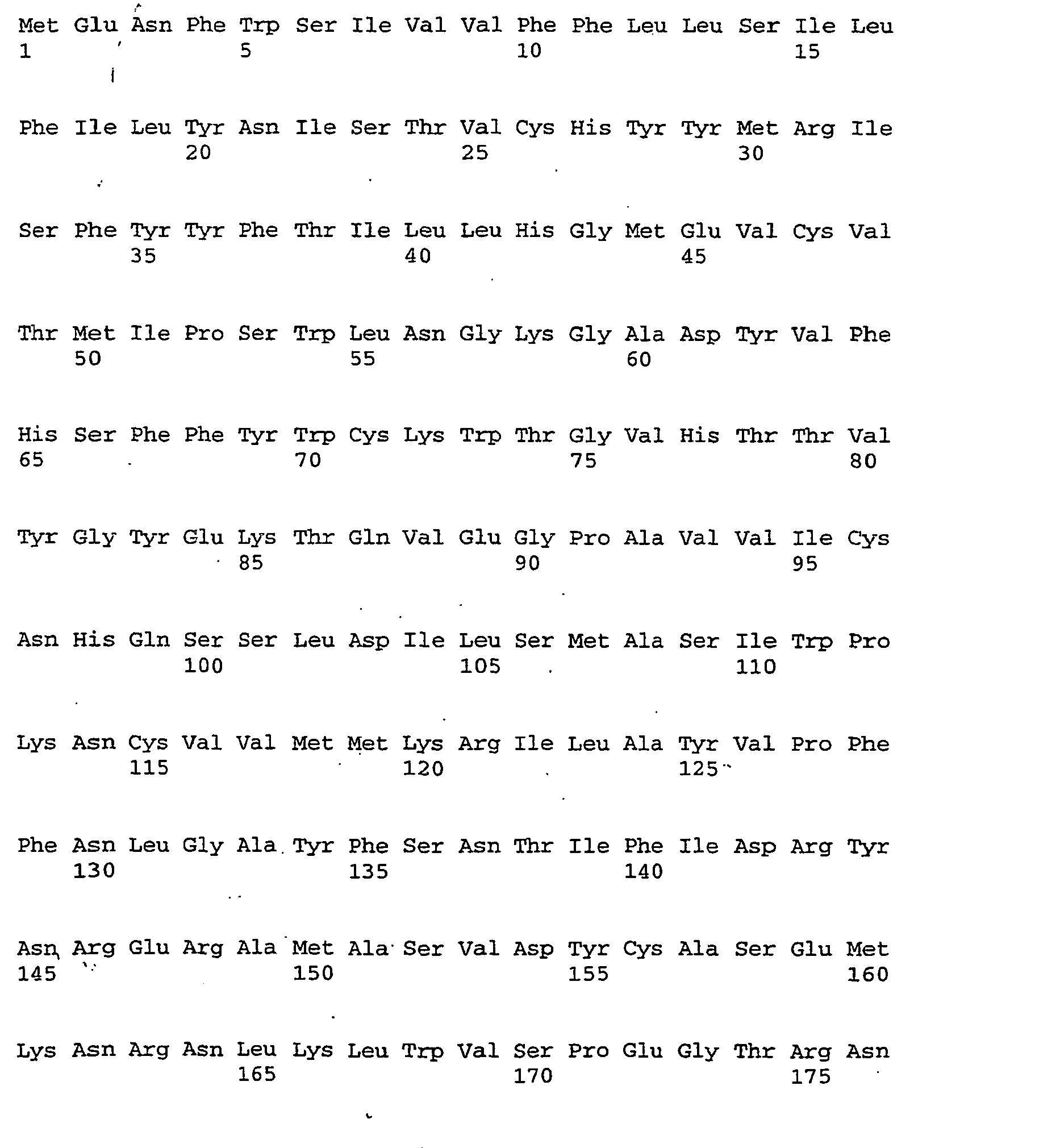 <400> 4
-
<210> 5
<211> 849
<212> DNA
<213> Caenorhabditis elegans<210> 5
<211> 849
<212> DNA
<213> Caenorhabditis elegans -
<220>
<221> CDS
<222> (1)..(849)
<223> Acyl-CoA:Lysophospholipid-Acyltransferase<220>
<221> CDS
<222> (1) .. (849)
<223> Acyl-CoA: lysophospholipid acyltransferase -
<400> 5
 <400> 5
-
<210> 6
<211> 282
<212> PRT
<213> Caenorhabditis elegans<210> 6
<211> 282
<212> PRT
<213> Caenorhabditis elegans -
<400> 6

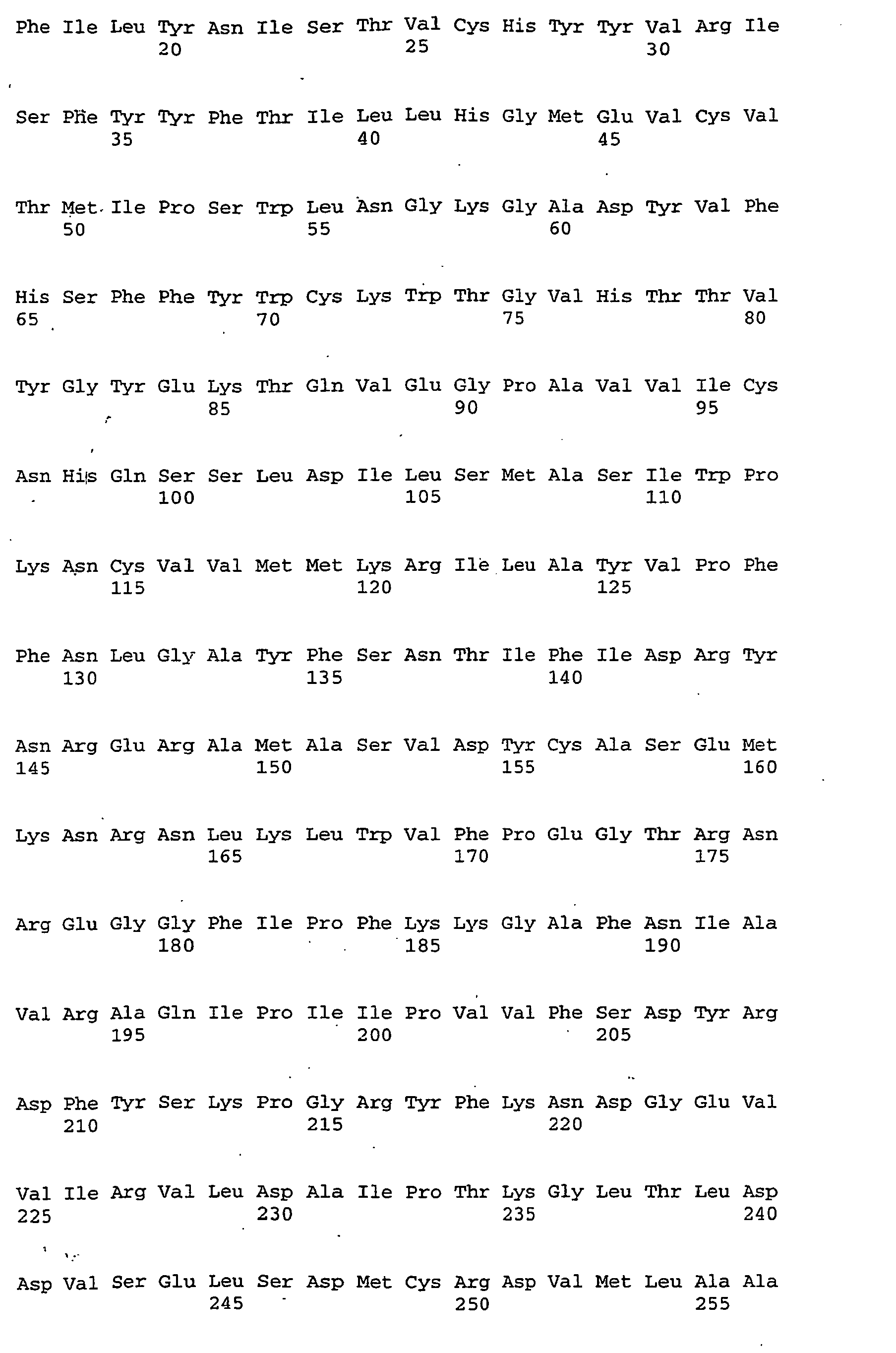 <400> 6
-
<210> 7
<211> 849
<212> DNA
<213> Caenorhabditis elegans<210> 7
<211> 849
<212> DNA
<213> Caenorhabditis elegans -
<220>
<221> CDS
<222> (1)..(849)
<223> Acyl-CoA:Lysophospholipid-Acyltransferase<220>
<221> CDS
<222> (1) .. (849)
<223> Acyl-CoA: lysophospholipid acyltransferase -
<400> 7
 <400> 7
-
<210> 8
<211> 282
<212> PRT
<213> Caenorhabditis elegans<210> 8
<211> 282
<212> PRT
<213> Caenorhabditis elegans -
<400> 8
 <400> 8
-
<210> 9
<211> 1578
<212> DNA
<213> Physcomitrella patens<210> 9
<211> 1578
<212> DNA
<213> Physcomitrella patens -
<220>
<221> CDS
<222> (1)..(1578)
<223> Delta-6-Desaturase<220>
<221> CDS
<222> (1) .. (1578)
<223> Delta-6 desaturase -
<400> 9


 <400> 9
-
<210> 10
<211> 525
<212> PRT
<213> Physcomitrella patens'<210> 10
<211> 525
<212> PRT
<213> Physcomitrella patens' -
<400> 10

 <400> 10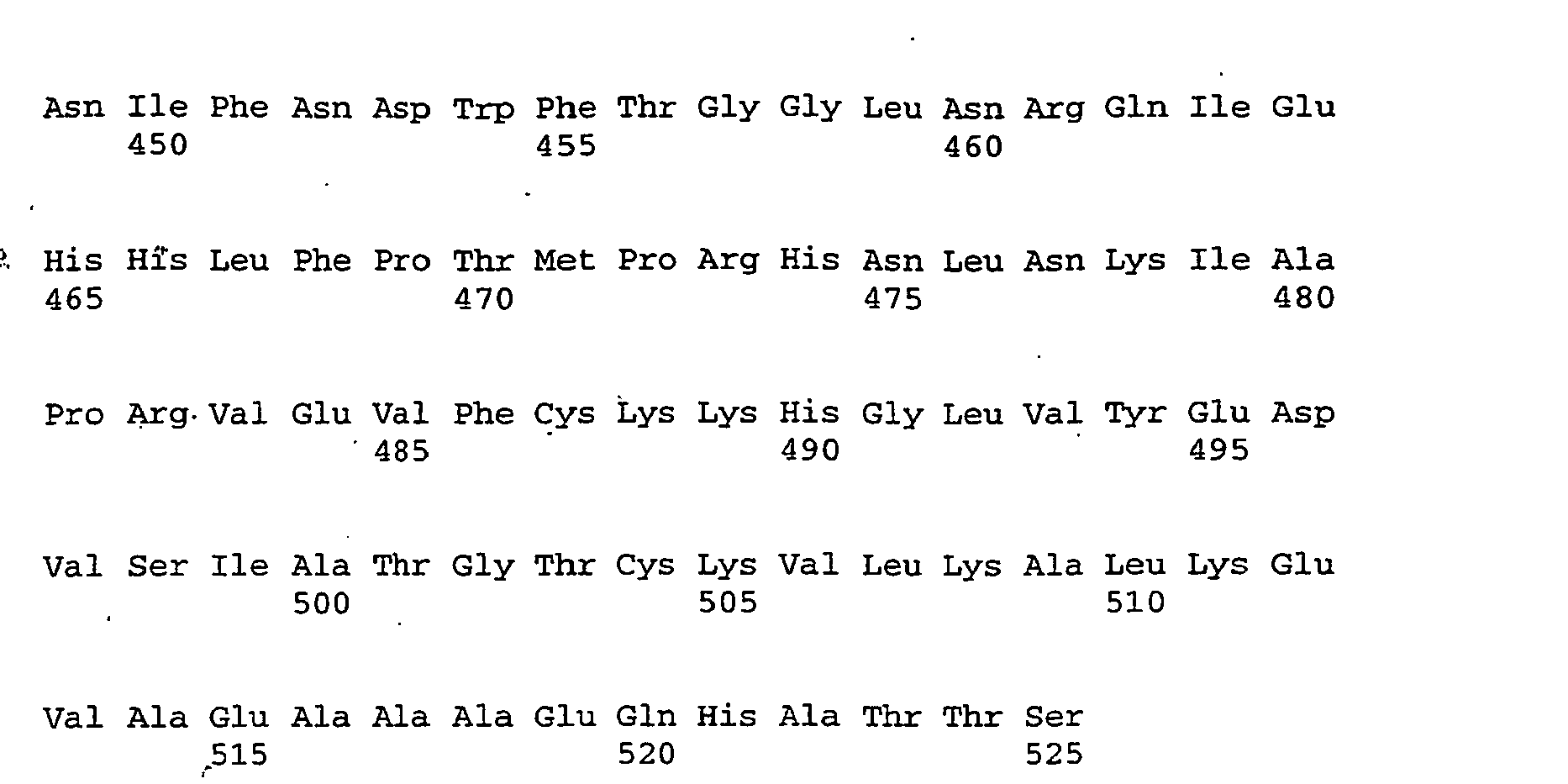
-
<210> 11
<211> 1192
<212> DNA
<213> Physcomitrella patens<210> 11
<211> 1192
<212> DNA
<213> Physcomitrella patens -
<220>
<221> CDS
<222> (58)..(930)
<223> Delta-6-Elongase<220>
<221> CDS
<222> (58) .. (930)
<223> Delta-6 elongase -
<400> 11
 <400> 11
-
<210> 12
<211> 290
<212> PRT
<213> Physcomitrella patens<210> 12
<211> 290
<212> PRT
<213> Physcomitrella patens -
<400> 12
 <400> 12
-
<210> 13
<211> 1410
<212> DNA
<213> Phaeodactylum tricornutum<210> 13
<211> 1410
<212> DNA
<213> Phaeodactylum tricornutum -
<220>
<221> CDS
<222> (1)..(1410)
<223> Delta-5-Desaturase<220>
<221> CDS
<222> (1) .. (1410)
<223> Delta 5-desaturase -
<400> 13

 <400> 13
-
<210> 14
<211> 469
<212> PRT
<213> Phaeodactylum tricornutum<210> 14
<211> 469
<212> PRT
<213> Phaeodactylum tricornutum -
<400> 14

 <400> 14
-
<210> 15
<211> 3598
<212> DNA
<213> artificial sequence<210> 15
<211> 3598
<212> DNA
<213> artificial sequence -
<220>
<221> misc_feature
<223> Sequenz stellt eine pflanzliche Promotor-Terminator-Expressionska ssette in Vektor pUC19 dar<220>
<221> misc_feature
<223> sequence represents a plant promoter-terminator expression chain in vector pUC19 -
<400> 15

 <400> 15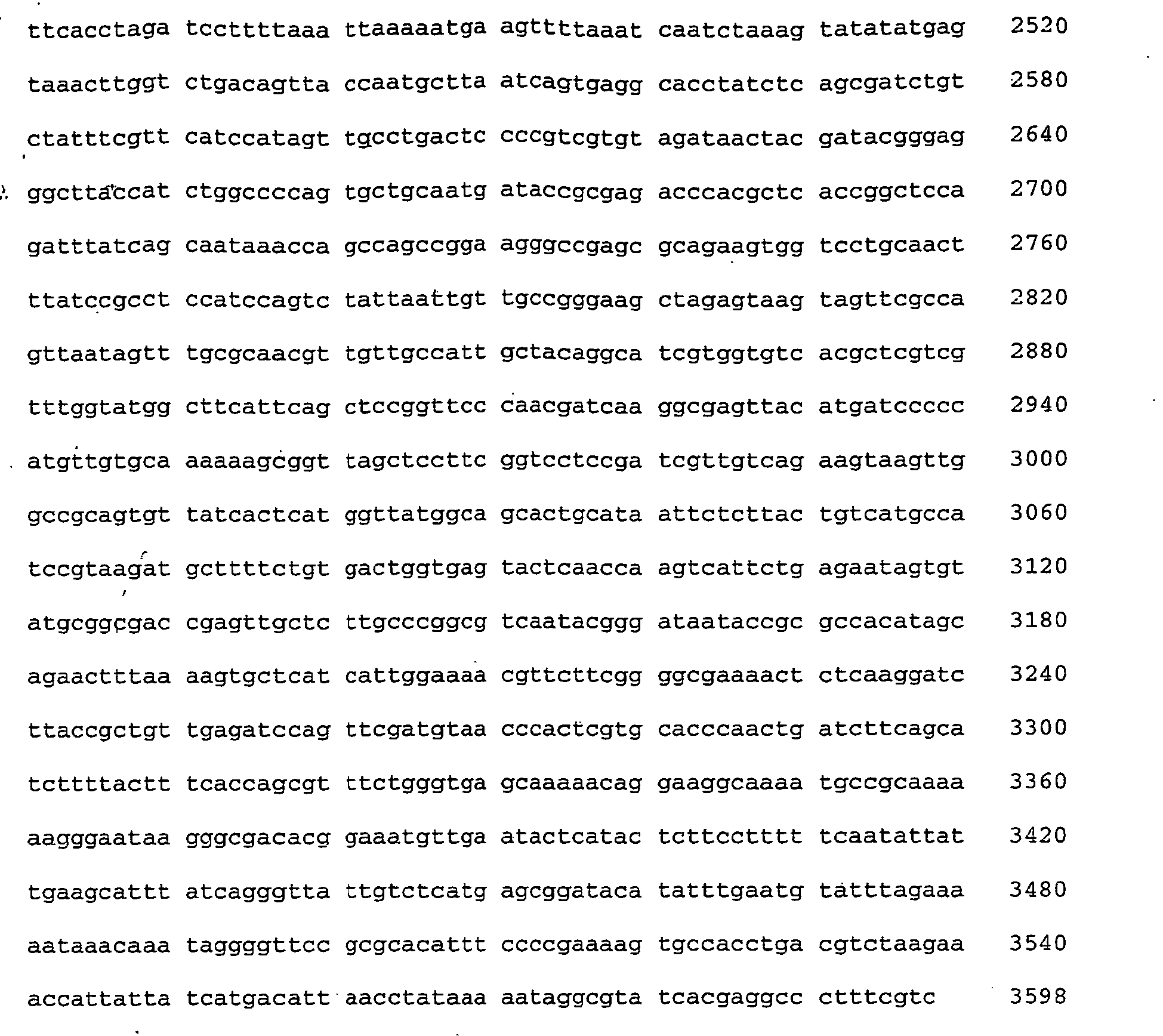
-
<210> 16
<211> 3590
<212> DNA
<213> artificial sequence<210> 16
<211> 3590
<212> DNA
<213> artificial sequence -
<220>
<221> misc_feature
<223> Sequenz stellt eine pflanzliche Promotor-Terminator-Expressionska ssette in Vektor pUC19 dar<220>
<221> misc_feature
<223> sequence represents a plant promoter-terminator expression chain in vector pUC19 -
<400> 16

 <400> 16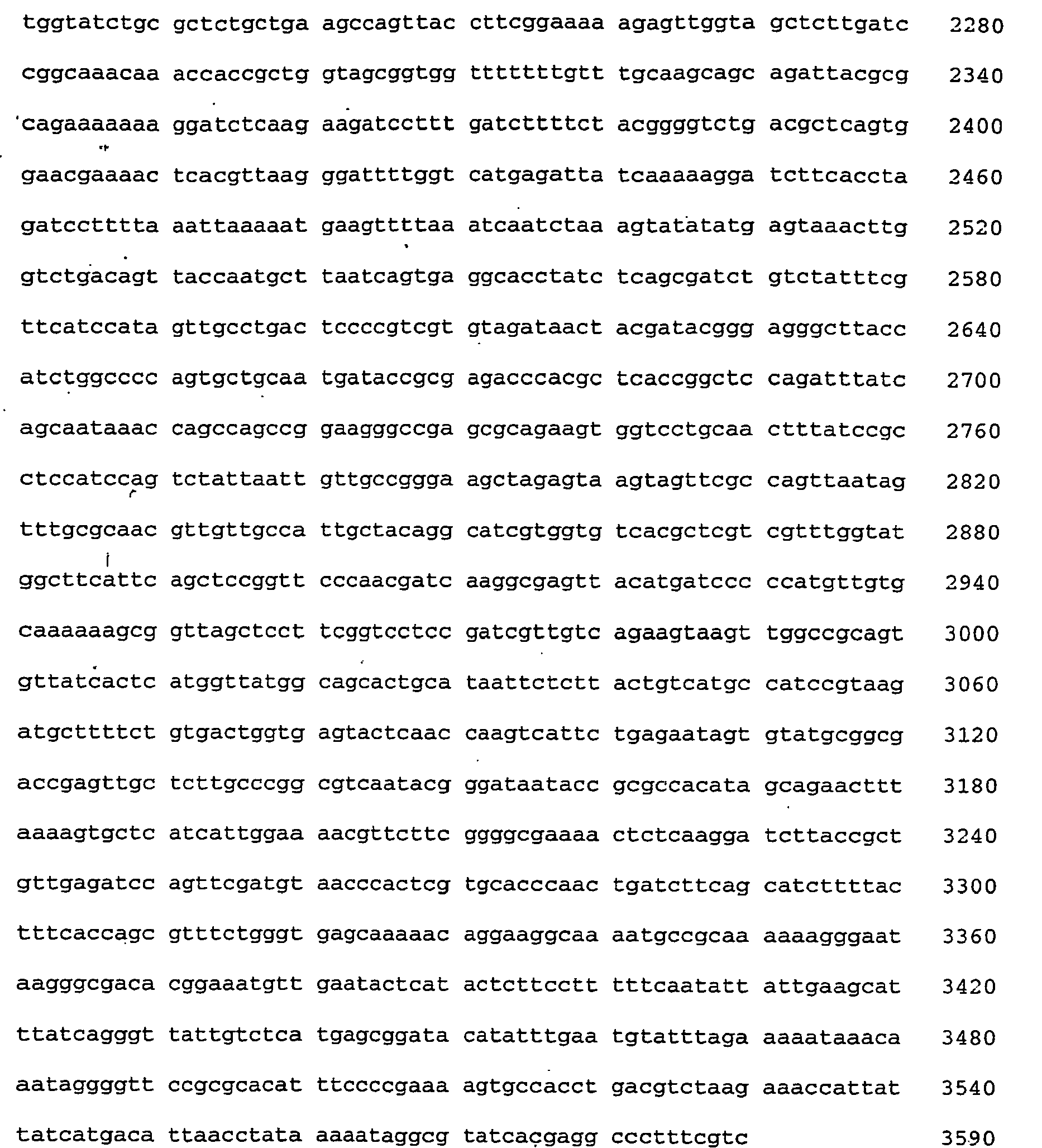
-
<210> 17
<211> 3584
<212> DNA
<213> artificial sequence<210> 17
<211> 3584
<212> DNA
<213> artificial sequence -
<220>
<221> misc_feature
<223> Sequenz stellt eine pflanzliche Promotor-Terminator-Expressionska ssette in Vektor pUC19 dar<220>
<221> misc_feature
<223> sequence represents a plant promoter-terminator expression chain in vector pUC19 -
<400> 17

 <400> 17
-
<210> 18
<211> 4507
<212> DNA
<213> artificial sequence
<220>
<221> misc_feature
<223> Sequenz stellt eine pflanzliche Promotor-Terminator-Expressionska ssette in Vektor pUC19 dar<210> 18
<211> 4507
<212> DNA
<213> artificial sequence
<220>
<221> misc_feature
<223> sequence represents a plant promoter-terminator expression chain in vector pUC19 -
<400> 18
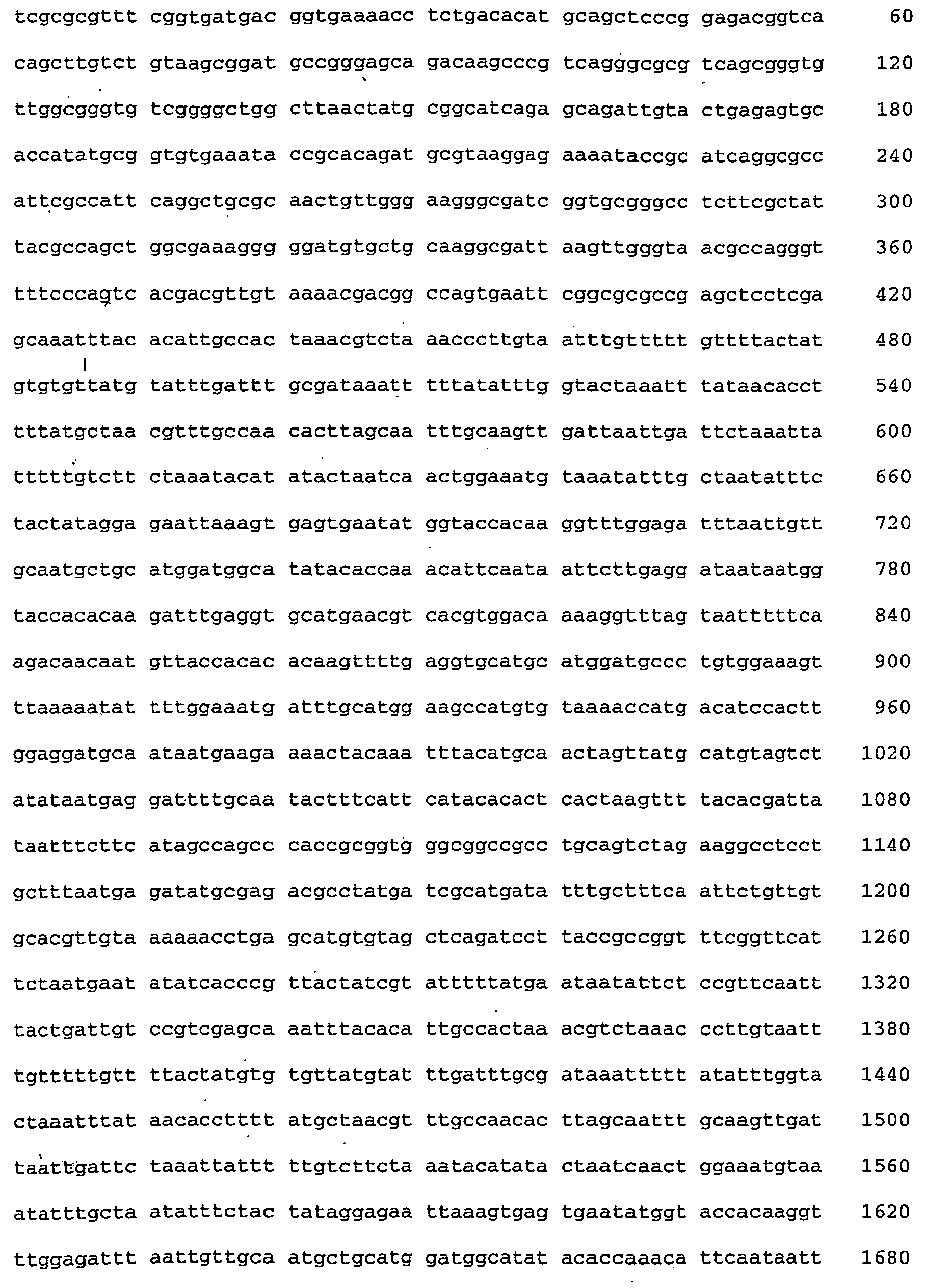
 <400> 18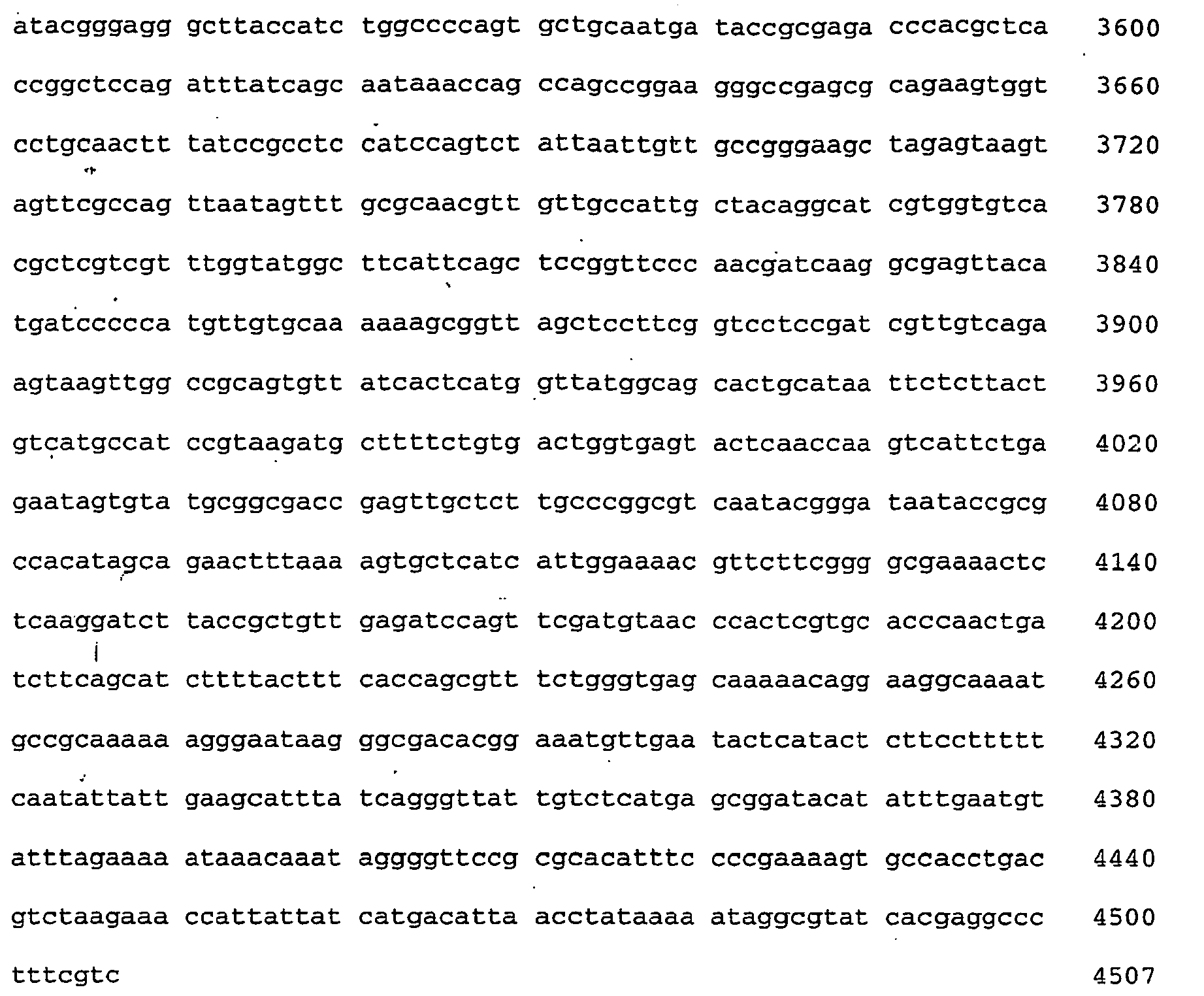
-
<210> 19
<211> 17752
<212> DNA
<213> Phaeodactylum tricornutum, Physcomitrella patens<210> 19
<211> 17752
<212> DNA
<213> Phaeodactylum tricornutum, Physcomitrella patens -
<220>
<221> CDS
<222> (11543)..(12415)
<223> Delta-6-Elongase<220>
<221> CDS
<222> (11543) .. (12415)
<223> Delta-6 elongase -
<220>
<221> CDS
<222> (13313)..(14890)
<223> Delta-6-Desaturase<220>
<221> CDS
<222> (13313) .. (14890)
<223> Delta-6 desaturase -
<220>
<221> CDS
<222> (15791)..(17200)
<223> Delta-5-Desaturase<220>
<221> CDS
<222> (15791) .. (17200)
<223> Delta 5-desaturase -
<400> 19


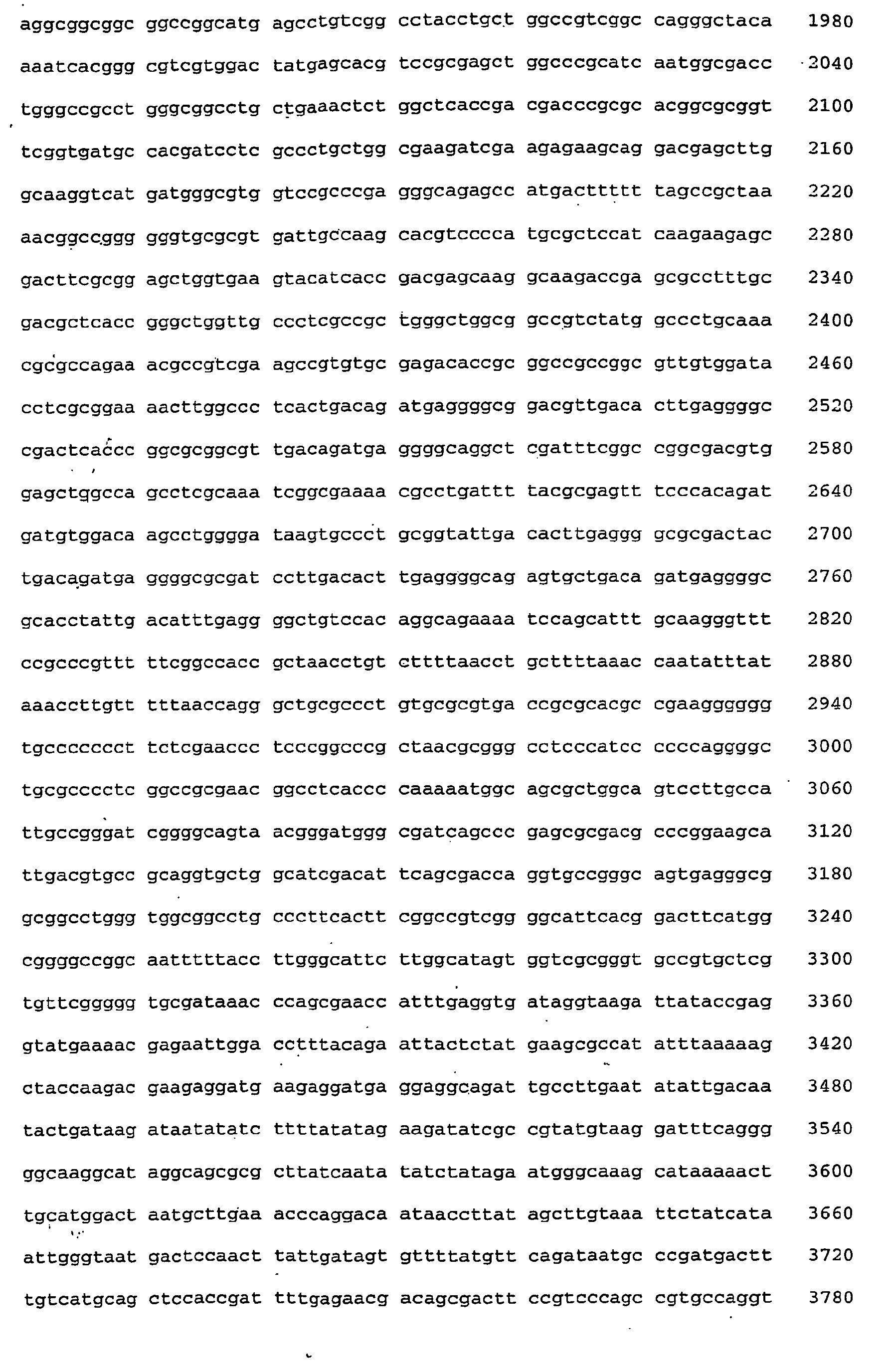
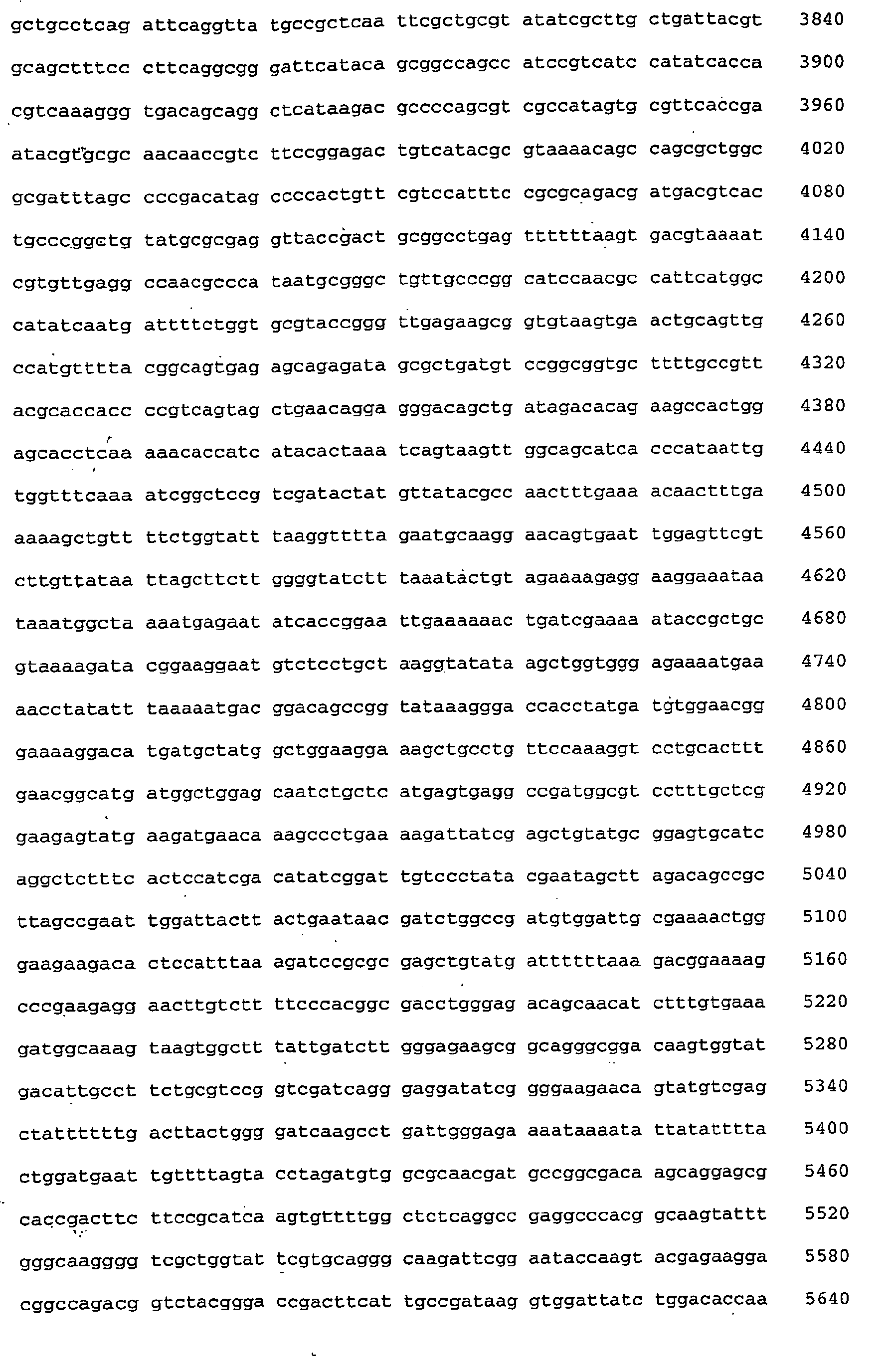


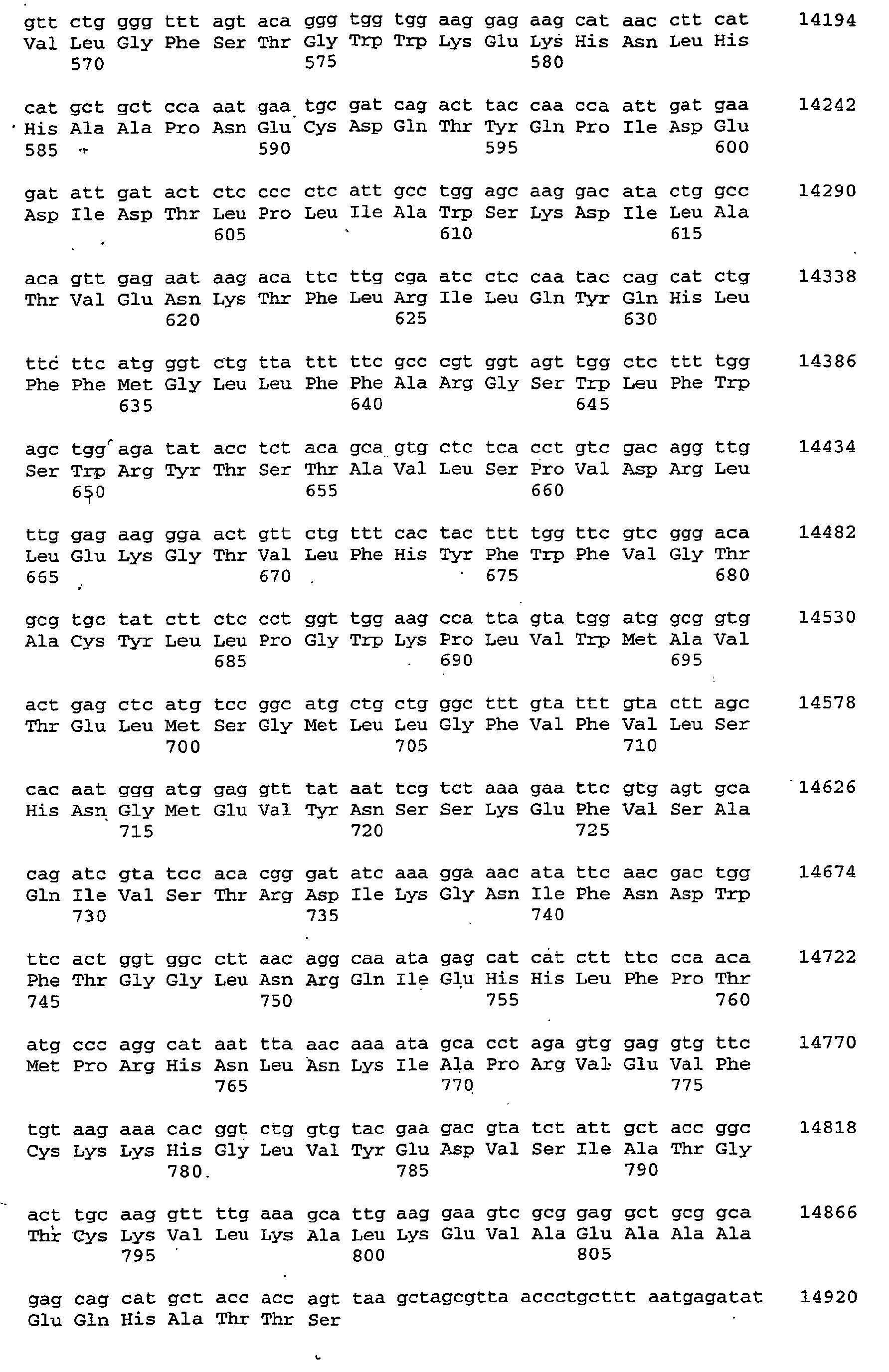

 <400> 19
-
<210> 20
<211> 290
<212> PRT
<213> Phaeodactylum tricornutum, Physcomitrella patens<210> 20
<211> 290
<212> PRT
<213> Phaeodactylum tricornutum, Physcomitrella patens -
<400> 20

 <400> 20
-
<210> 21
<211> 525
<212> PRT
<213> Phaeodactylum tricornutum, Physcomitrella patens<210> 21
<211> 525
<212> PRT
<213> Phaeodactylum tricornutum, Physcomitrella patens -
<400> 21

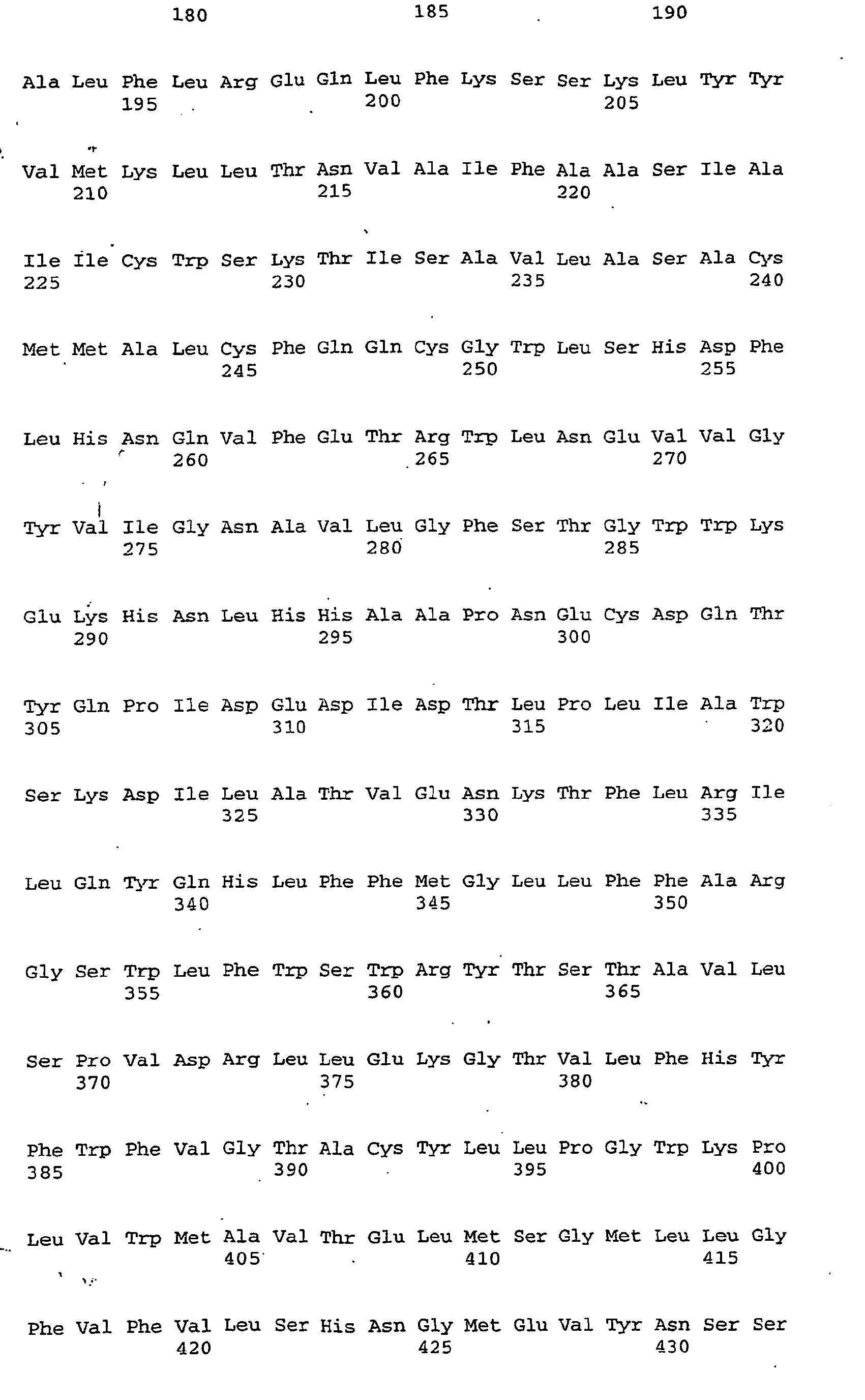

 <400> 21
-
<210> 23
<211> 26
<212> DNA
<213> artificial sequence<210> 23
<211> 26
<212> DNA
<213> artificial sequence -
<400> 23
gaattcggcg cgccgagctc ctcgag 26<400> 23
gaattcggcg cgccgagctc ctcgag 26 -
<210> 24
<211> 265
<212> DNA
<213> artificial sequence<210> 24
<211> 265
<212> DNA
<213> artificial sequence -
<400> 24
<400> 24

-
<210> 25
<211> 257
<212> DNA
<213> artificial sequence<210> 25
<211> 257
<212> DNA
<213> artificial sequence -
<400> 25
 <400> 25
-
<210> 26
<211> 5410
<212> DNA
<213> artificial sequence<210> 26
<211> 5410
<212> DNA
<213> artificial sequence -
<400> 26
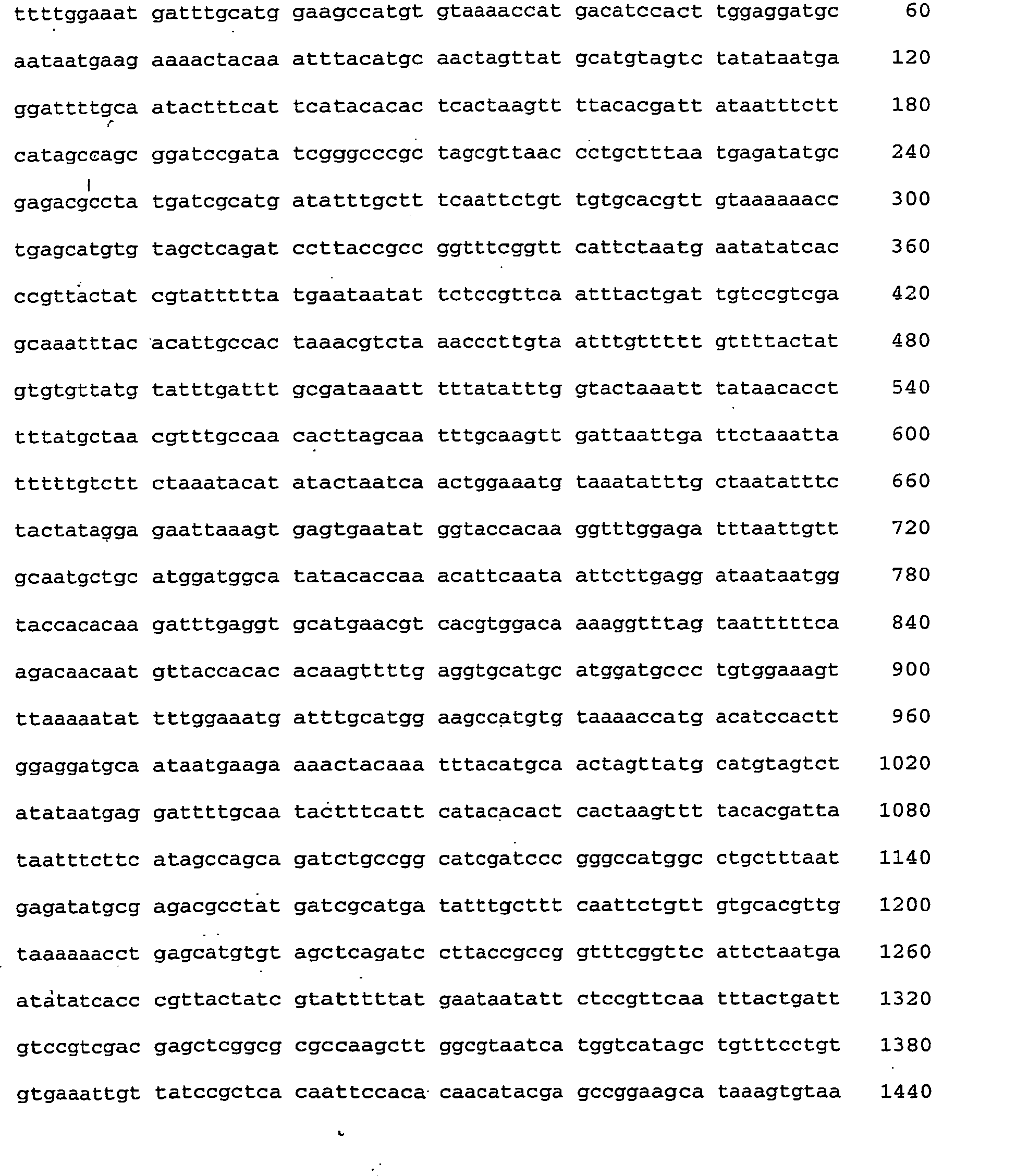

 <400> 26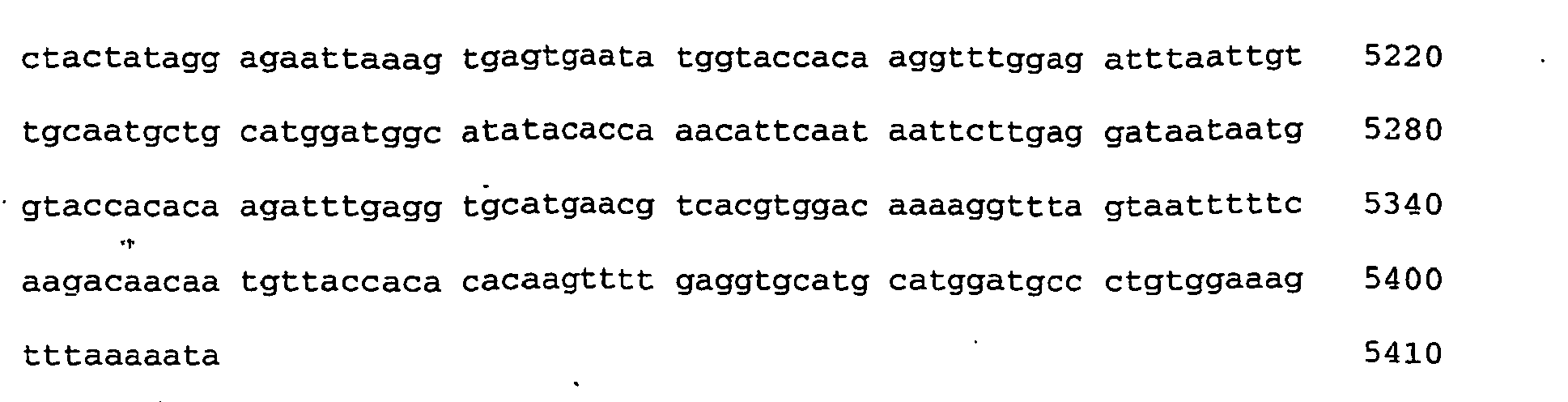
-
<210> 27
<211> 12093
<212> DNA
<213> artificial sequence<210> 27
<211> 12093
<212> DNA
<213> artificial sequence -
<400> 27


 <400> 27
-
<210> 28
<211> 12085
<212> DNA
<213> artificial sequence<210> 28
<211> 12085
<212> DNA
<213> artificial sequence -
<220>
<221> misc_feature
<223> pflanzlicher Expressionsvektor mit einer Promotor-Terminator-Expr essionskassette<220>
<221> misc_feature
<223> plant expression vector with a promoter-terminator expression cassette -
<400> 28


 <400> 28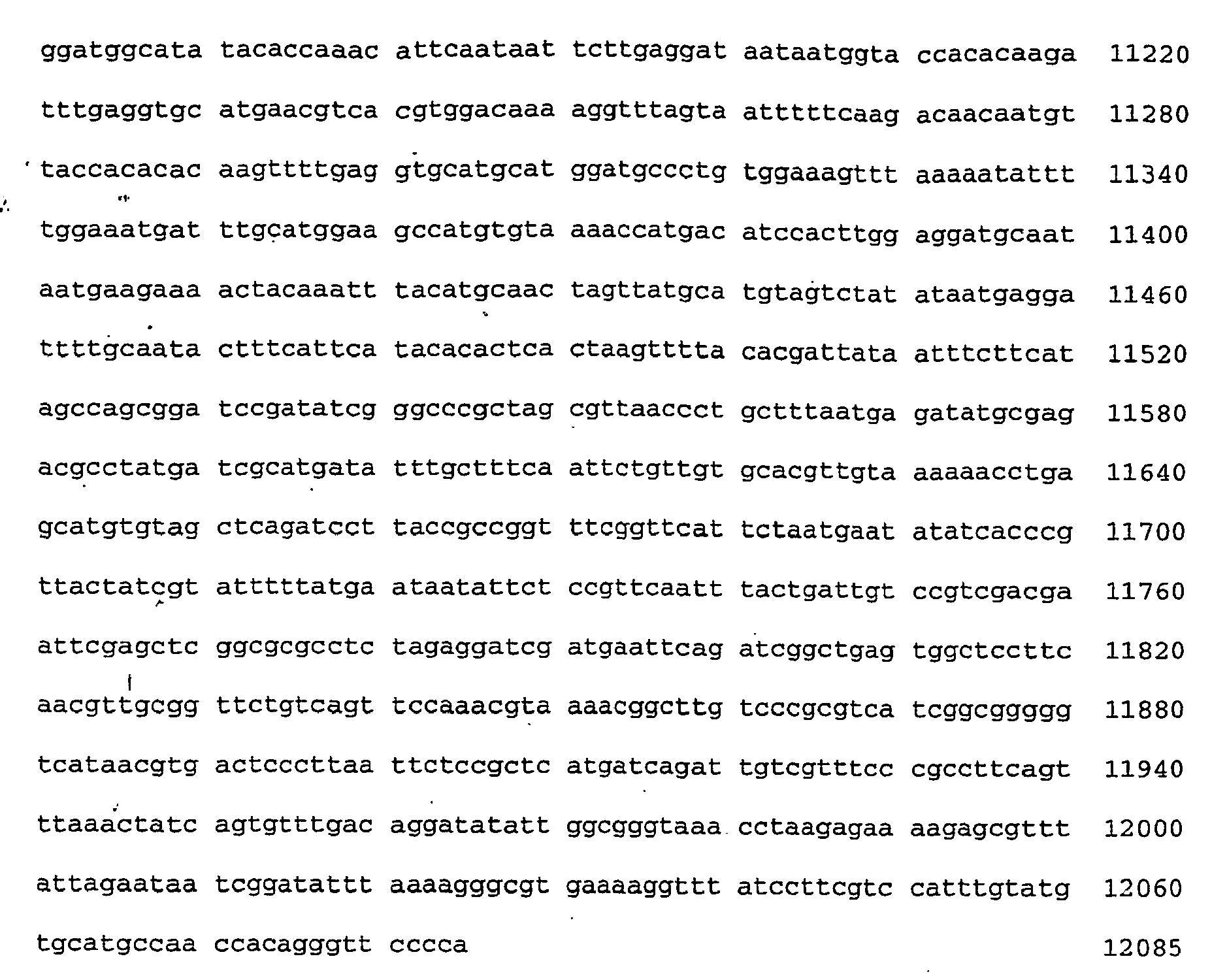
-
<210> 29
<211> 12079
<212> DNA
<213> artificial sequence<210> 29
<211> 12079
<212> DNA
<213> artificial sequence -
<400> 29


 <400> 29
-
<210> 30
<211> 13002
<212> DNA
<213> artificial sequence<210> 30
<211> 13002
<212> DNA
<213> artificial sequence -
<220>
<223> pflanzlicher Expressionsvektor mit zwei Promotor-Terminator-Expre ssionskassetten<220>
<223> plant expression vector with two promoter-terminator expression cassettes -
<400> 30
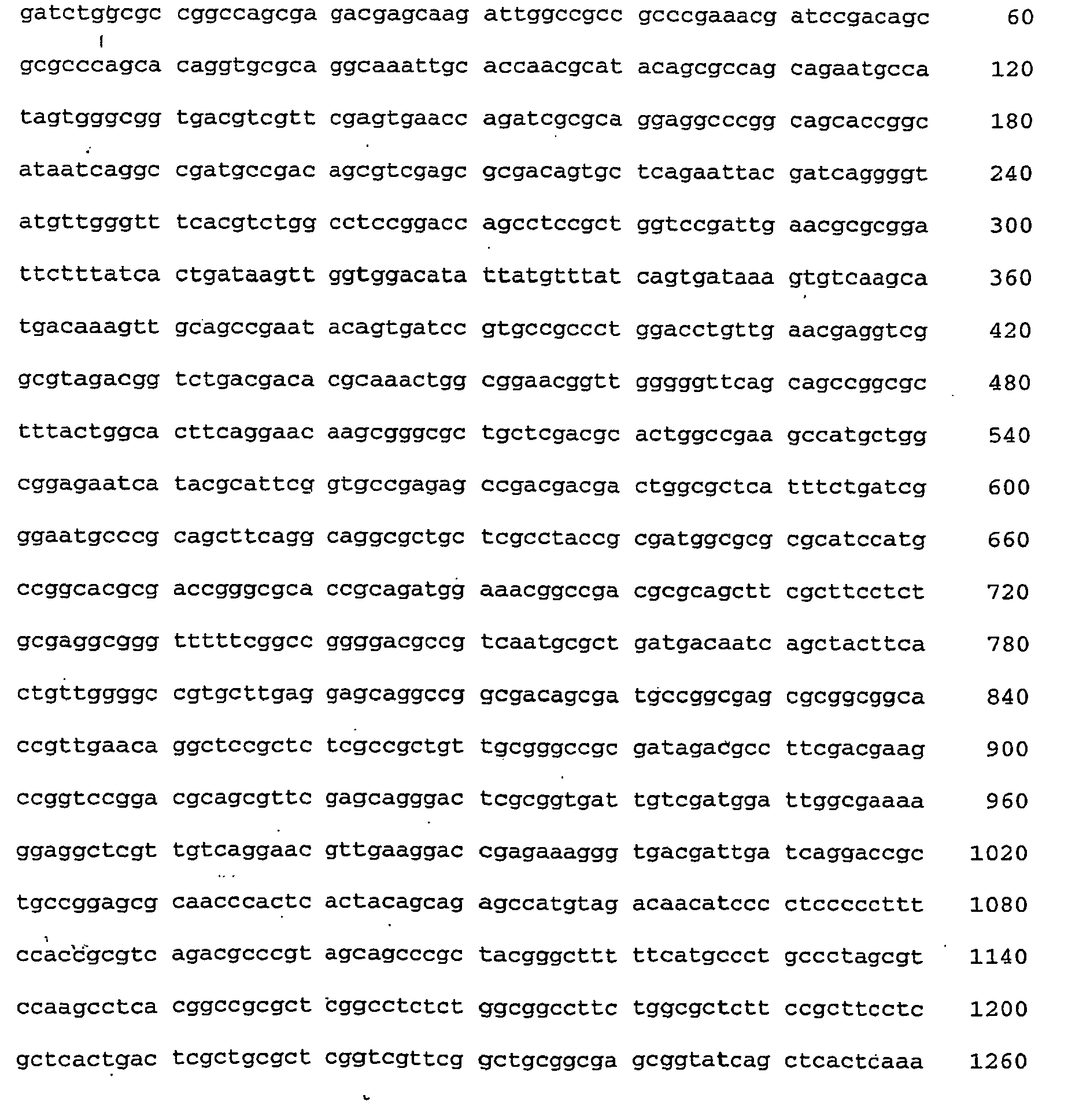
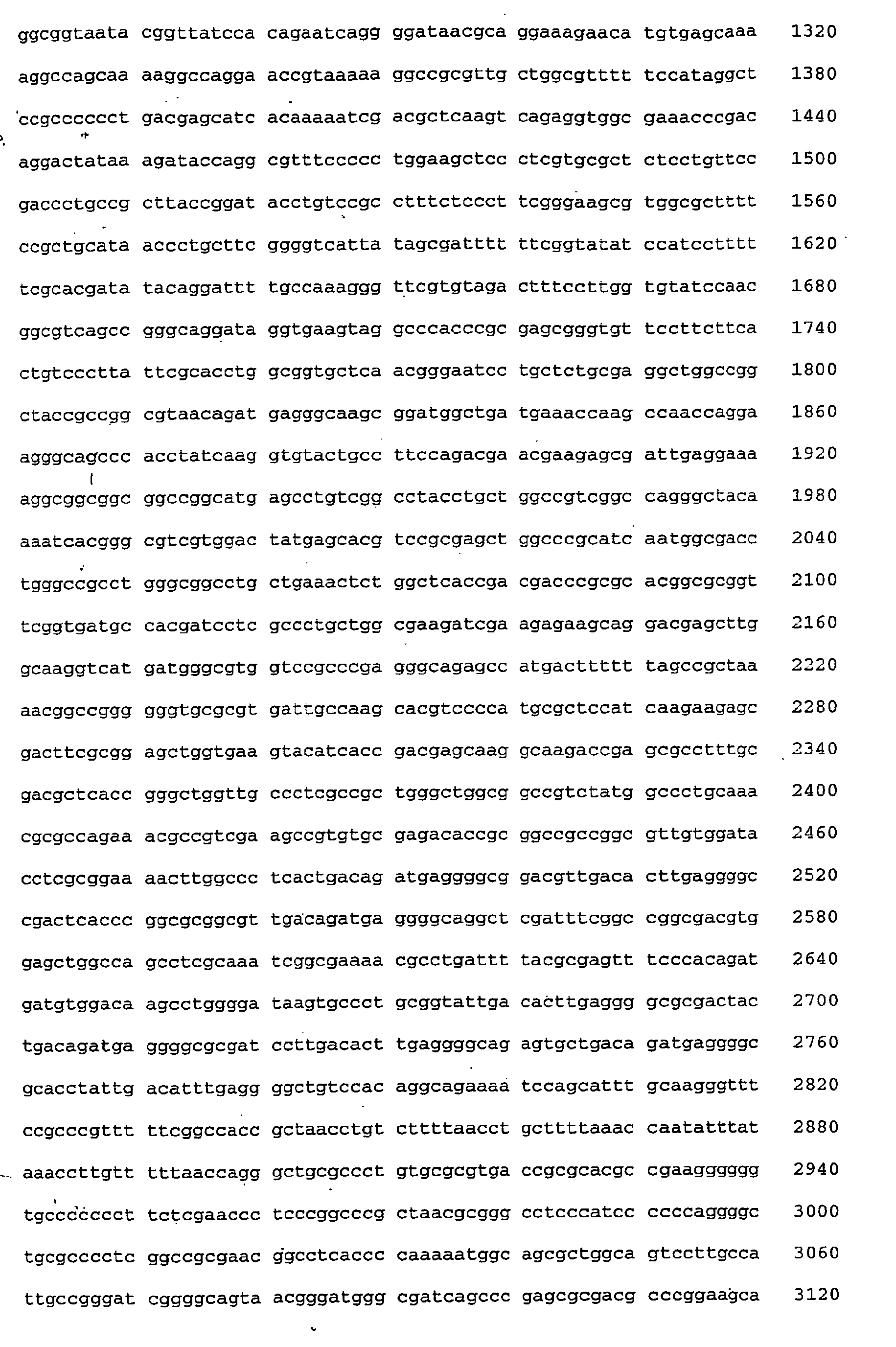


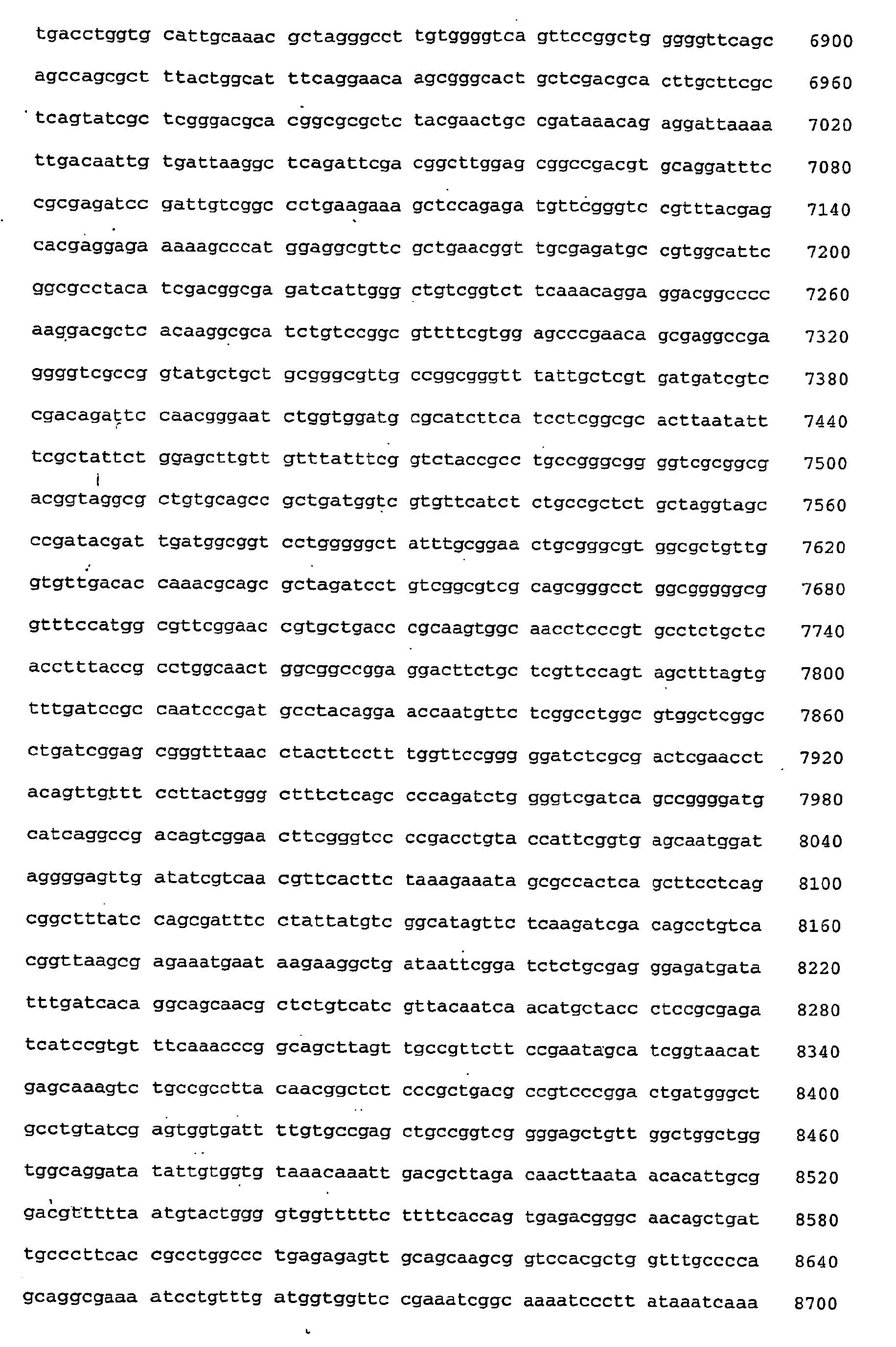
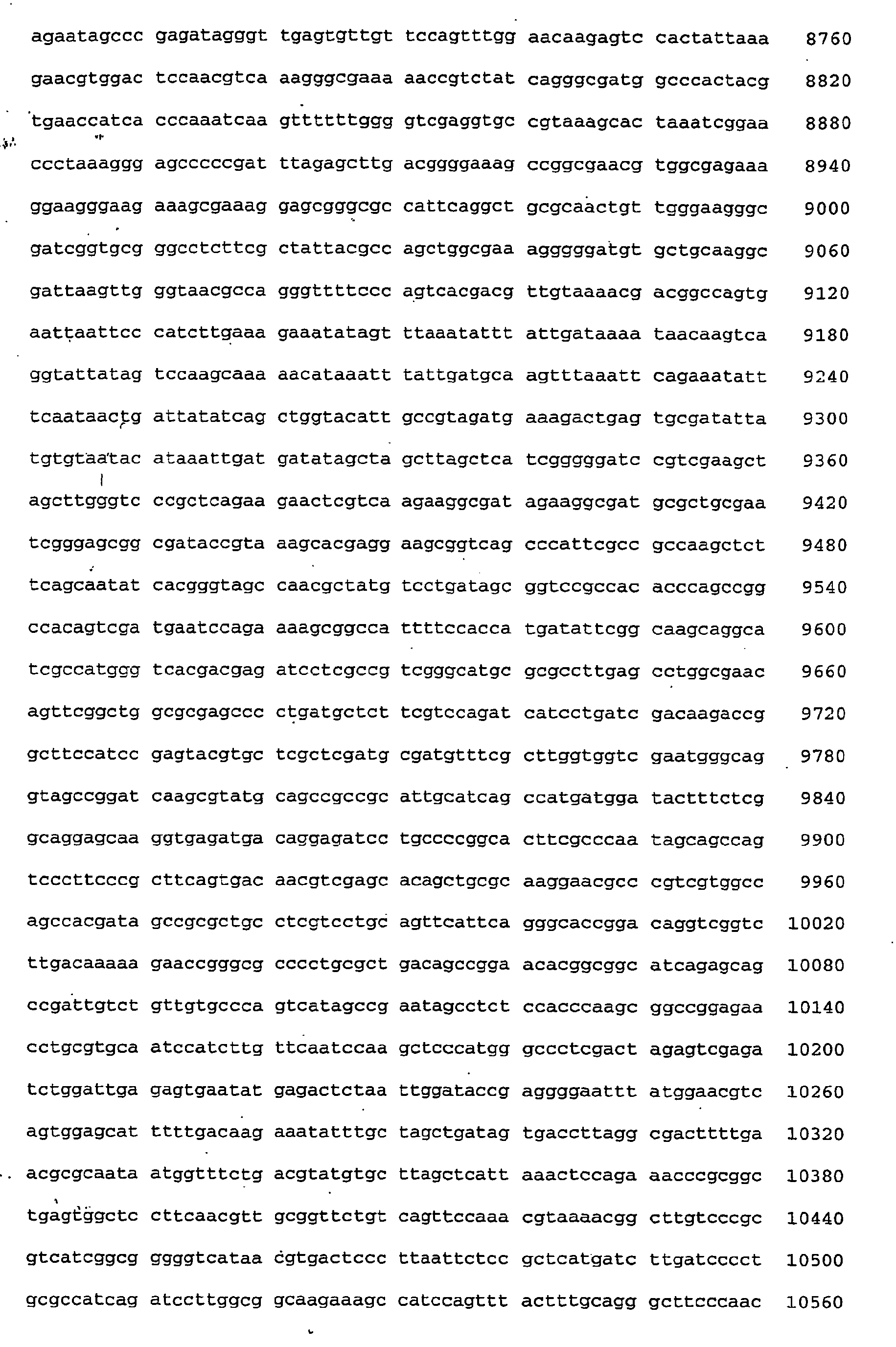
 <400> 30
-
<210> 31
<211> 13905
<212> DNA
<213> artificial sequence<210> 31
<211> 13905
<212> DNA
<213> artificial sequence -
<220>
<223> pflanzlicher Expressionsvektor mit drei Promotor-Terminator-Expre ssionskassetten<220>
<223> plant expression vector with three promoter-terminator expression cassettes -
<400> 31


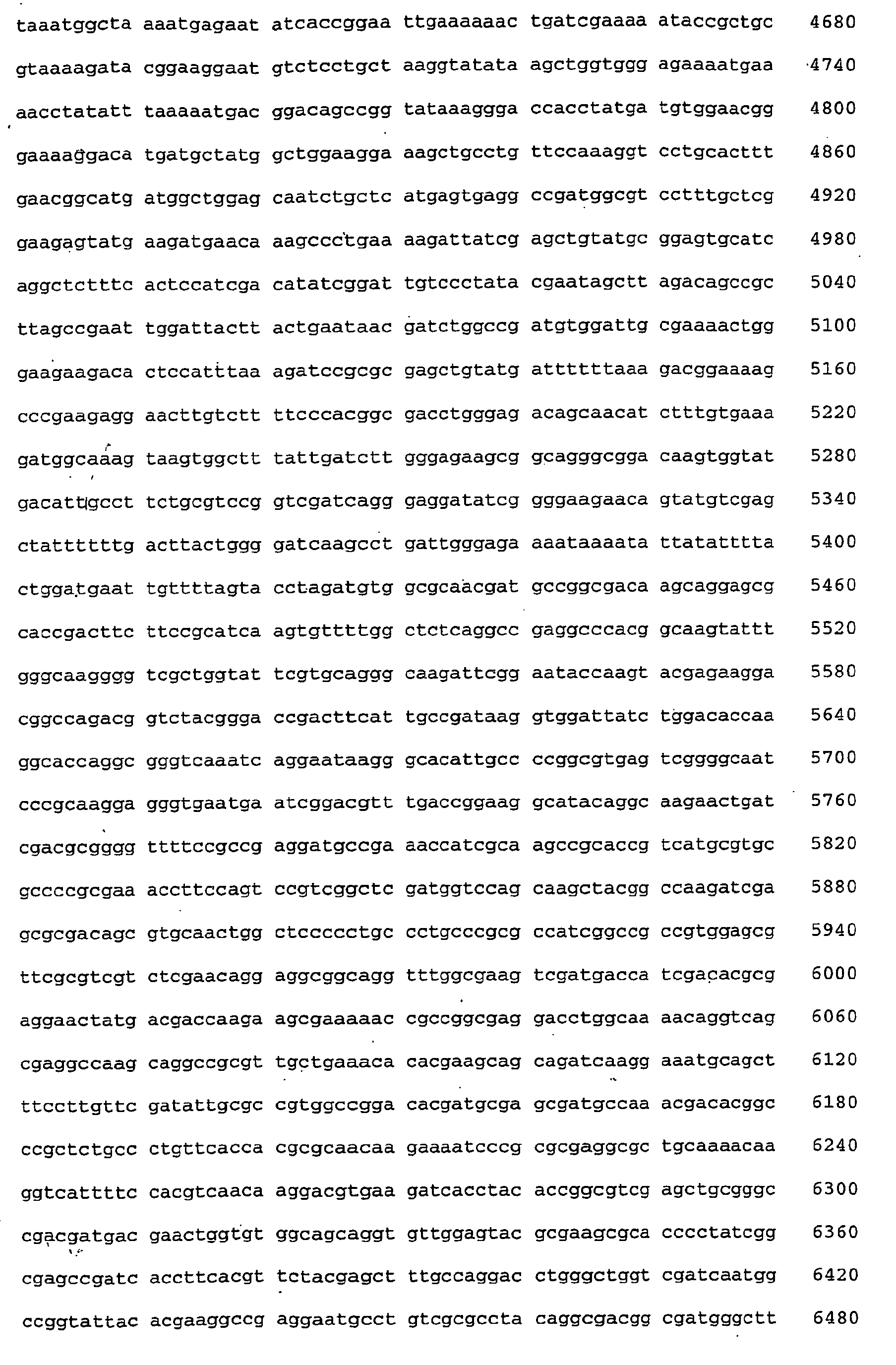


 <400> 31
-
<210> 32
<211> 1443
<212> DNA
<213> Phaeodactylum tricornutum<210> 32
<211> 1443
<212> DNA
<213> Phaeodactylum tricornutum -
<220>
<221> CDS
<222> (9)..(1442)
<223><220>
<221> CDS
<222> (9) .. (1442)
<223> -
<400> 32

 <400> 32
-
<210> 33
<211> 477
<212> PRT
<213> Phaeodactylum tricornutum<210> 33
<211> 477
<212> PRT
<213> Phaeodactylum tricornutum -
<400> 33

 <400> 33
-
<210> 34
<211> 17061
<212> DNA
<213> Phaeodactylum tricornutum, Physcomitrella patens, Caenorhabditis elegans<210> 34
<211> 17061
<212> DNA
<213> Phaeodactylum tricornutum, Physcomitrella patens, Caenorhabditis elegans -
<220>
<221> CDS
<222> (4554)..(5987)
<223> I<220>
<221> CDS
<222> (4554) .. (5987)
<223> I -
<220>
<221> CDS
<222> (2805)..(3653)
<223><220>
<221> CDS
<222> (2805) .. (3653)
<223> -
<220>
<221> CDS
<222> (1026)..(1898)
<223><220>
<221> CDS
<222> (1026) .. (1898)
<223> -
<400> 34


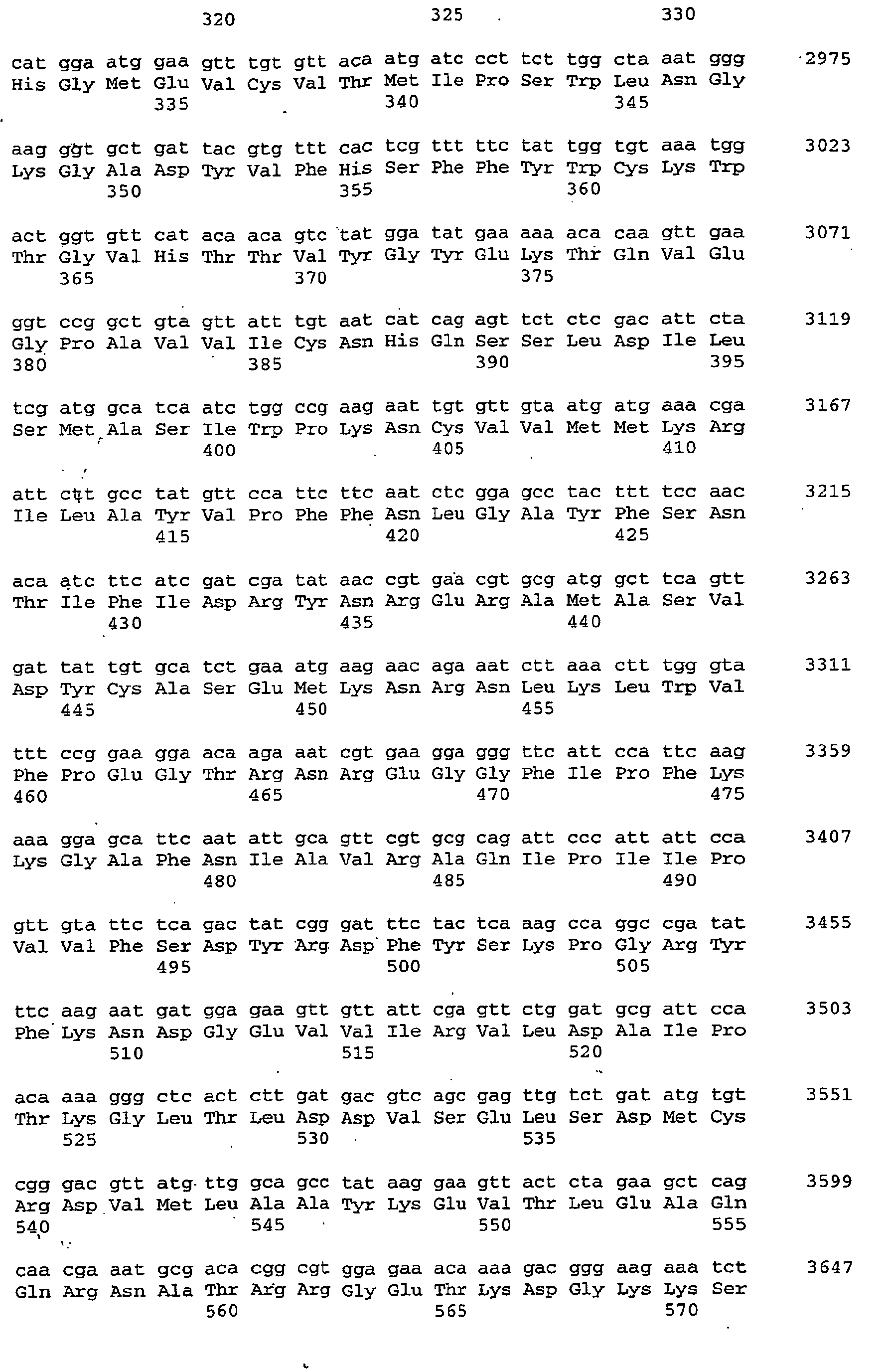

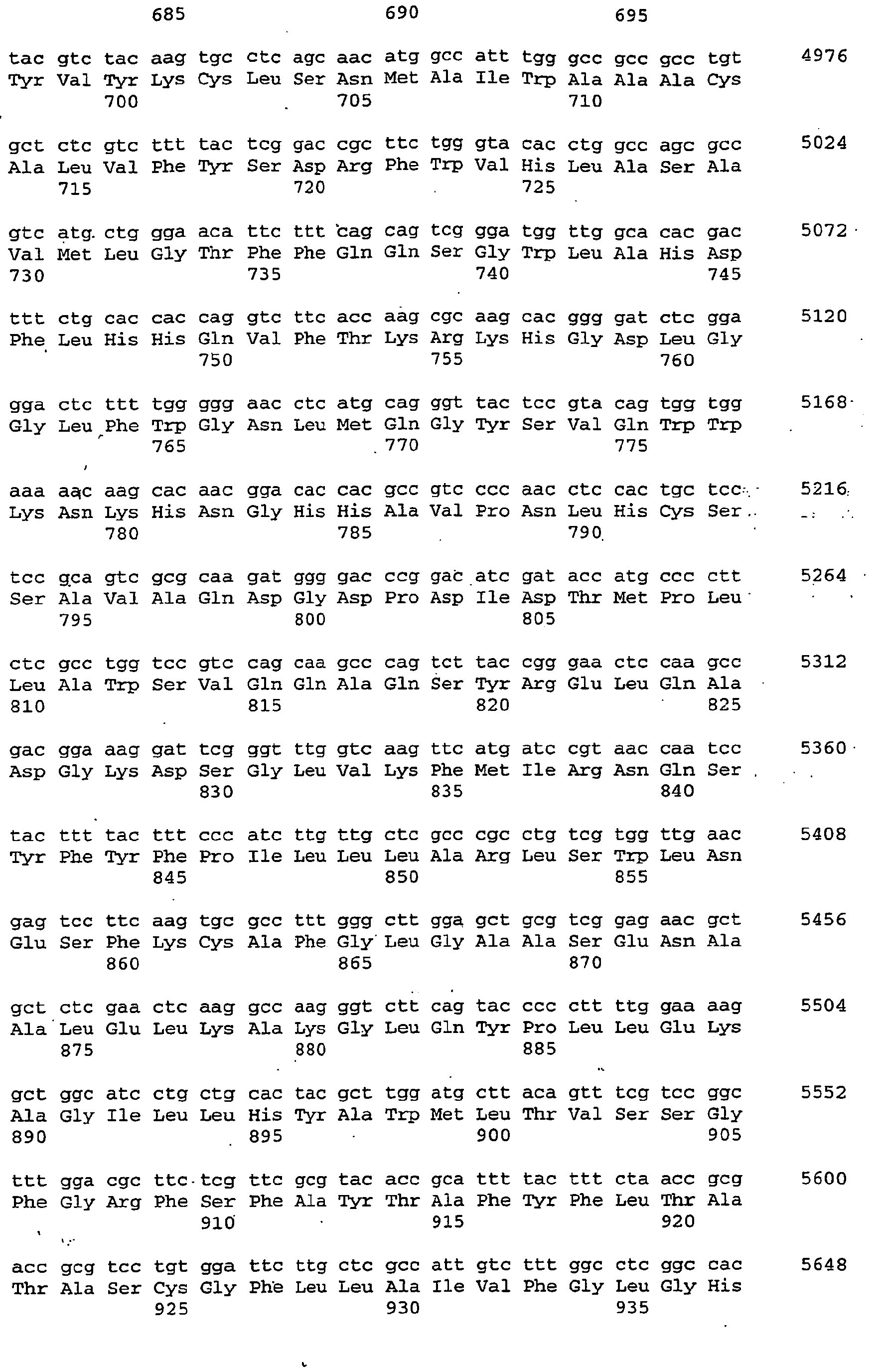


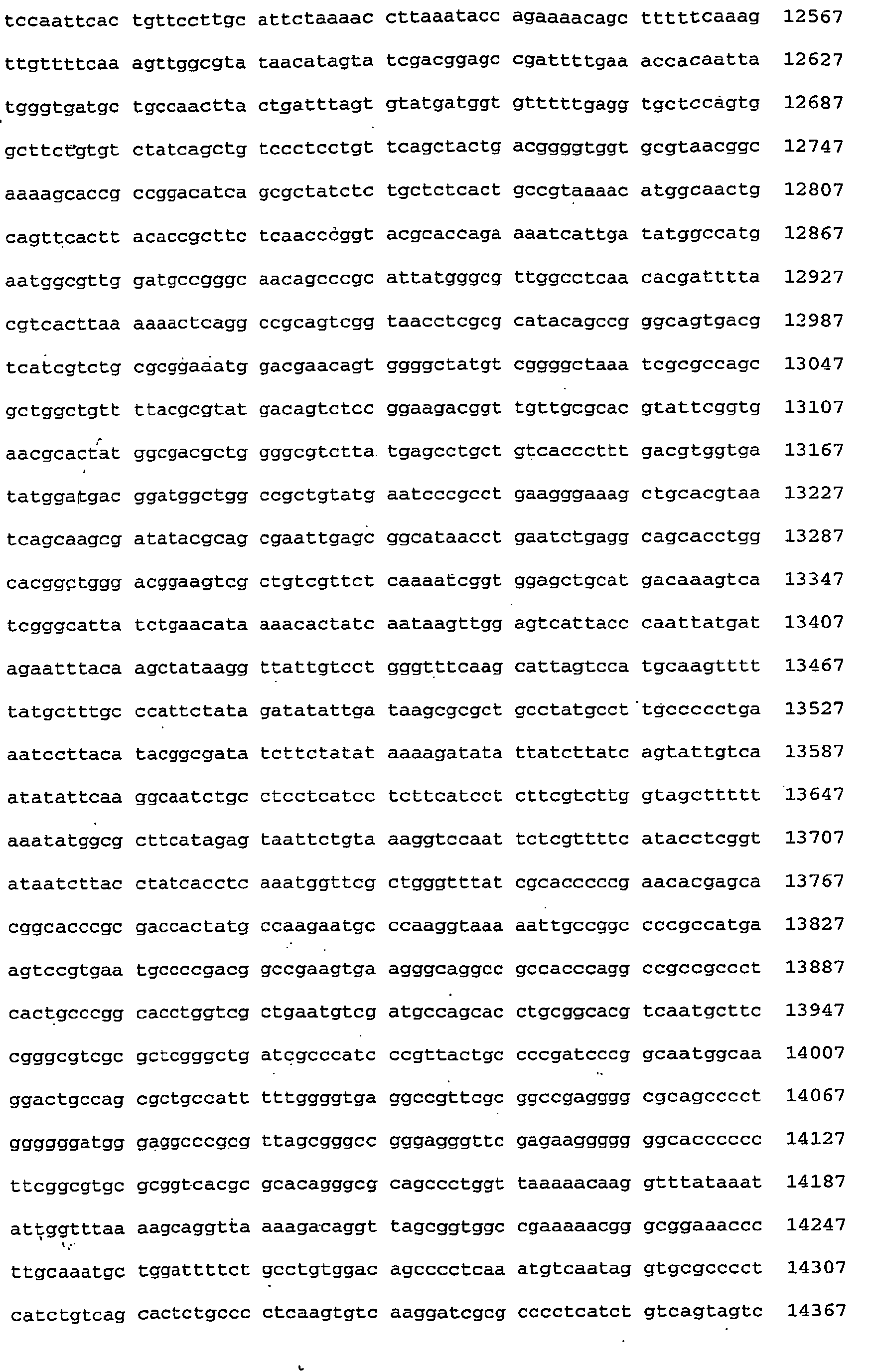
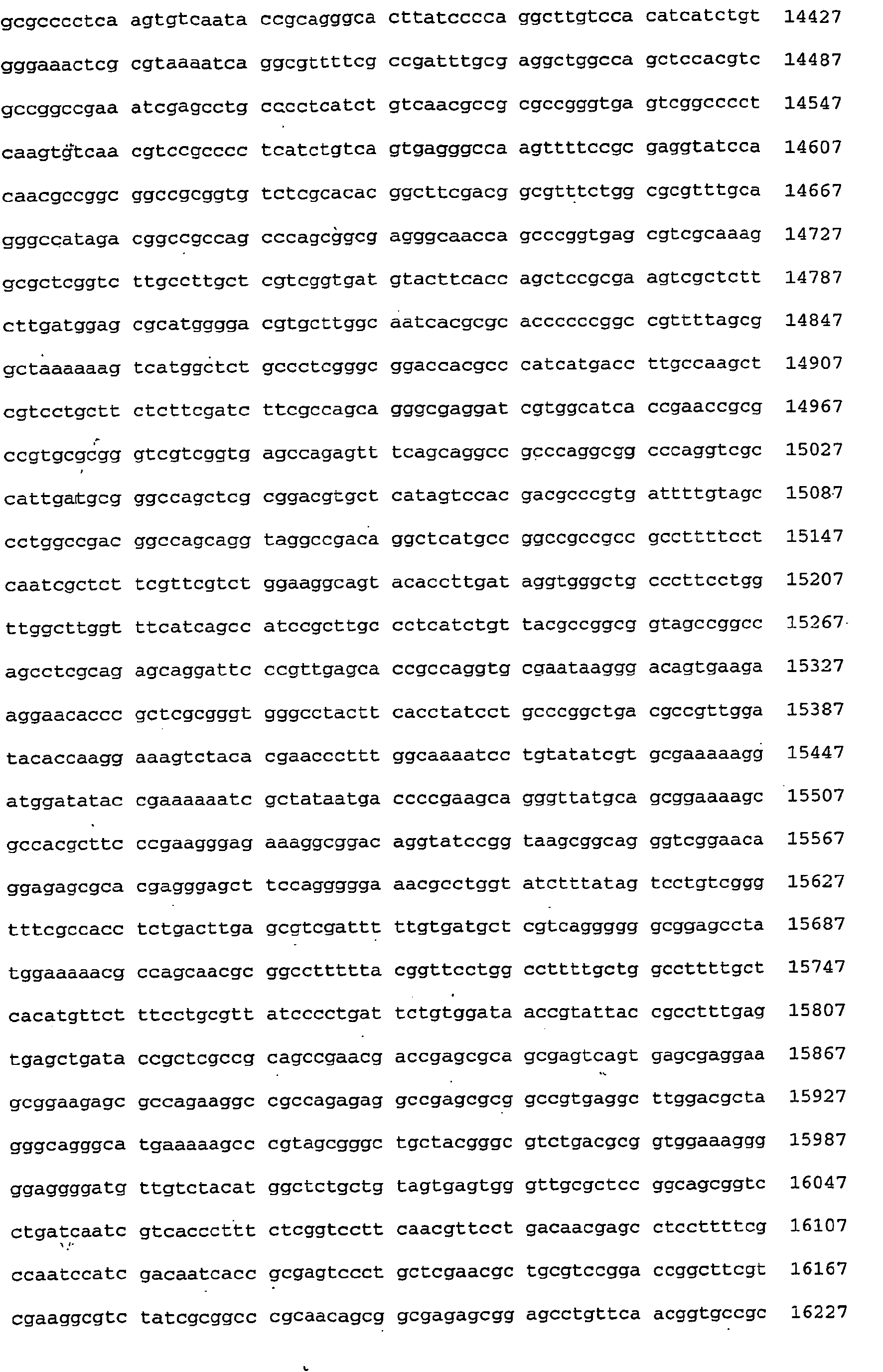 <400> 34
-
<210> 35
<211> 290
<212> PRT
<213> Phaeodactylum tricornutum, Physcomitrella patens, Caenorhabditis elegans<210> 35
<211> 290
<212> PRT
<213> Phaeodactylum tricornutum, Physcomitrella patens, Caenorhabditis elegans -
<400> 35
 <400> 35
-
<210> 36
<211> 282
<212> PRT
<213> Phaeodactylum tricornutum, Physcomitrella patens, Caenorhabditis elegans<210> 36
<211> 282
<212> PRT
<213> Phaeodactylum tricornutum, Physcomitrella patens, Caenorhabditis elegans -
<400> 36

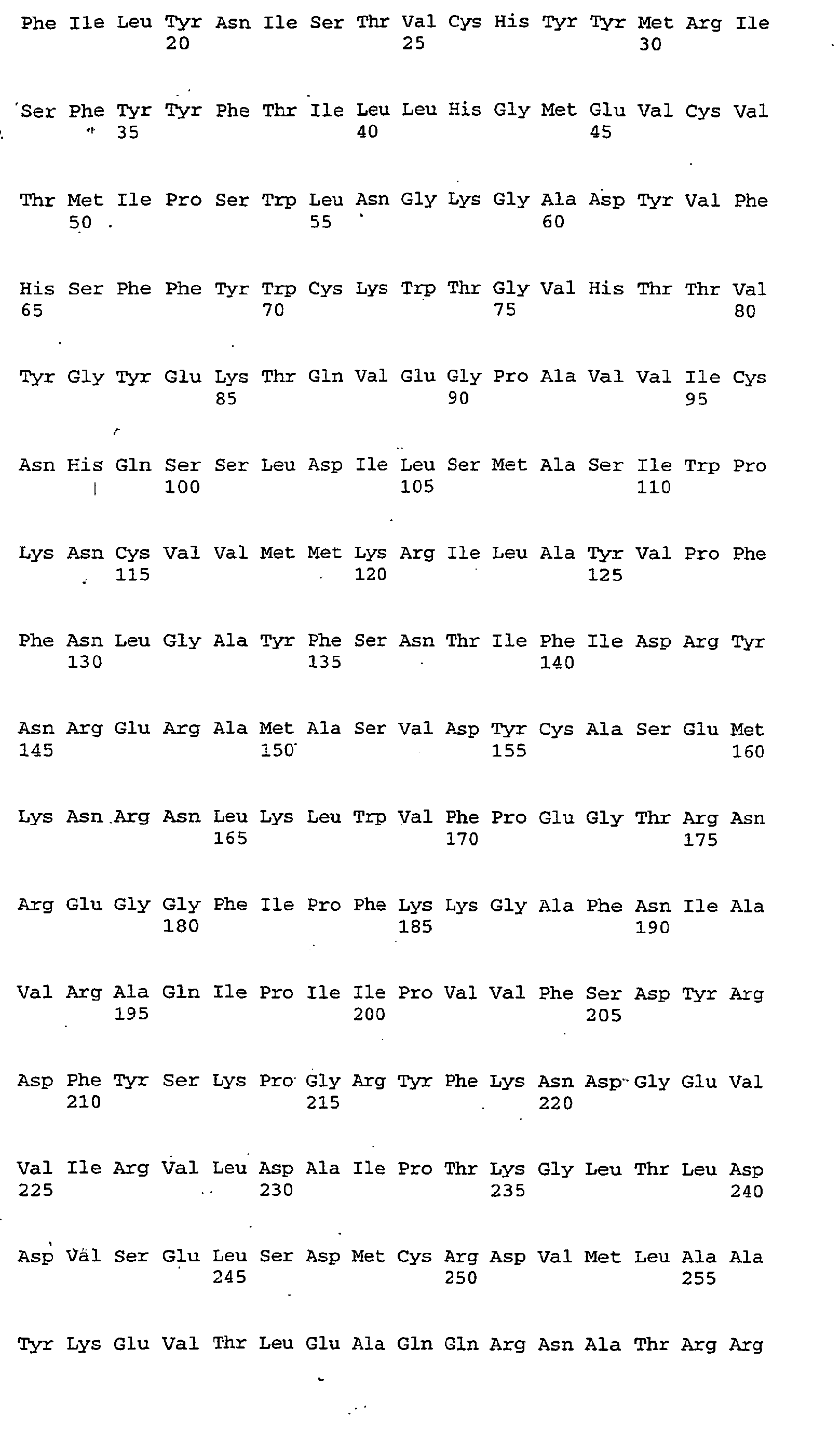 <400> 36
-
<210> 37
<211> 477
<212> PRT
<213> Phaeodactylum tricornutum, Physcomitrella patens, Caenorhabditis elegans<210> 37
<211> 477
<212> PRT
<213> Phaeodactylum tricornutum, Physcomitrella patens, Caenorhabditis elegans -
<400> 37

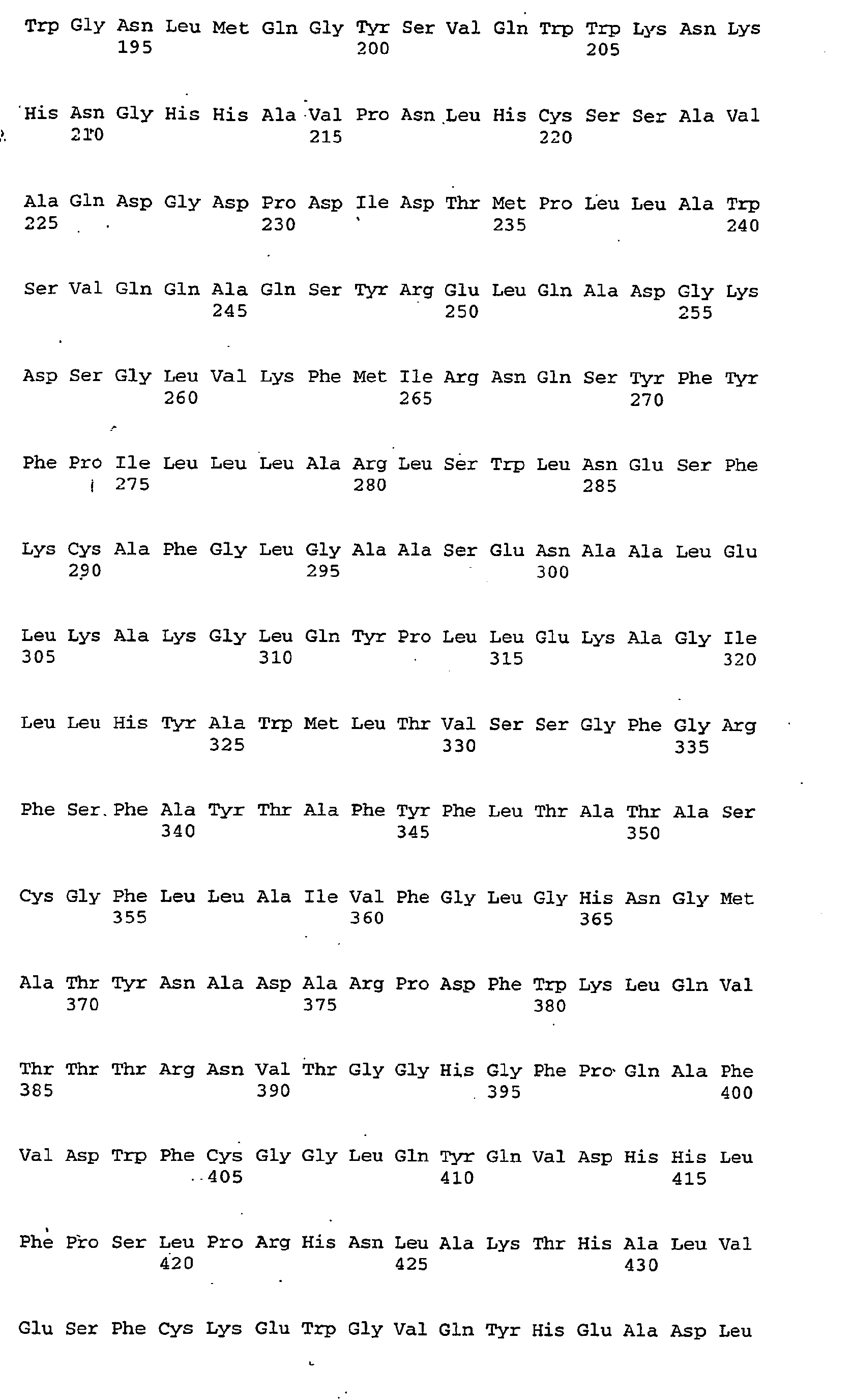 <400> 37
Claims (11)
- A process for producing polyunsaturated fatty acids in an organism, wherein said process comprises the following steps:a) introducing into the organism at least one nucleic acid sequence having the sequence depicted in SEQ ID NO: 1, SEQ ID NO: 3, SEQ ID NO: 5 or SEQ ID NO: 7, which sequence codes for a polypeptide having an acyl-CoA:lysophospholipid-acyltransferase activity; orb) introducing into said organism at least one nucleic acid sequence which can be derived, as a result of the degenerate genetic code, from the coding sequence comprised in SEQ ID NO: 1, SEQ ID NO: 3, SEQ ID NO: 5 or SEQ ID NO: 7, orc) introducing into said organism at least one derivative of the nucleic acid sequence depicted in SEQ ID NO: 1, SEQ ID NO: 3, SEQ ID NO: 5 or SEQ ID NO: 7, which code for polypeptides having the amino acid sequence depicted in SEQ ID NO: 2, SEQ ID NO: 4, SEQ ID NO: 6 or SEQ ID NO: 8 and which are at least 90% identical at the amino acid level to SEQ ID NO: 2, SEQ ID NO: 4, SEQ ID NO: 6 or SEQ ID NO: 8 and have acyl-CoA:lysophospholipidacyltransferase activity, andd) culturing and harvesting said organism.
- The process for producing polyunsaturated fatty acids according to claim 1, wherein, in addition to the nucleic acid sequences mentioned under (a) to (c), further nucleic acid sequences have been introduced into said organism, which code for polypeptides of the fatty acid or lipid metabolism, selected from the group consisting of acyl-CoA-dehydrogenase(s), acyl-ACP[= acyl carrier protein] desaturase(s), acyl-ACP thioesterase(s), fatty acid acyltransferase(s), fatty acid synthase(s), fatty acid hydroxylase(s), acetyl-coenzyme A carboxylase(s), acyl-coenzyme A oxidase(s), fatty acid desaturase(s), fatty acid acetylenases, lipoxygenases, triacylglycerol lipases, allenoxide synthases, hydroperoxide lyases or fatty acid elongase(s).
- The process for producing polyunsaturated fatty acids according to claim 2, wherein, in addition to the nucleic acid sequences mentioned under (a) to (c), further nucleic acid sequences have been introduced into the organism, which code for polypeptides selected from the group consisting of Δ4-desaturase, Δ5-desaturase, Δ6-desaturase, Δ8-desaturase, Δ9-desaturase, Δ12-desaturase, Δ5-elongase, Δ6-elongate or Δ9-elongate activity.
- The process for producing polyunsaturated fatty acids according to claims 1 to 3, wherein C16-, C18-, C20- or C22- fatty acids are used as substrate of the acyl-CoA:lysophospholipid acyltransferases.
- The process for producing polyunsaturated fatty acids according to claims 1 to 3, wherein the polyunsaturated fatty acids are isolated from the organism in the form of an oil, lipid or a free fatty acid.
- The process for producing polyunsaturated fatty acids according to claims 1 to 5, wherein the polyunsaturated fatty acid produced in said process is a C18-, C20- or C22- fatty acid having at least two double bonds in the molecule.
- The process for producing polyunsaturated fatty acids according to claims 1 to 6, wherein a polyunsaturated fatty acid selected from the group consisting of dihomo-γ-linolenic acid, arachidonic acid, eicosapentaenoic acid, docosapentaenoic acid and docosahexaenoic acid is produced in said process.
- The process for producing polyunsaturated fatty acids according to claims 1 to 7, wherein the organism is a microorganism, a nonhuman animal or a plant.
- The process for producing polyunsaturated fatty acids according to claims 1 to 8, wherein the organism is a transgenic plant.
- The process for producing polyunsaturated fatty acids according to claims 1 to 9, wherein the transgenic plant is an oil crop plant.
- The use of a nucleic acid sequence for the production of polyunsaturated fatty acids (PUFAs) in plants, the nucleic acid sequence being selected from the group consisting of:a) a nucleic acid sequence having the sequence depicted in SEQ ID NO: 1, SEQ ID NO: 3, SEQ ID NO: 5 or SEQ ID NO: 7, which sequence codes for a polypeptide having an acyl-CoA:lysophospholipid-acyltransferase activity;b) a nucleic acid sequence which can be derived from the coding sequence comprised in SEQ ID NO: 1, SEQ ID NO: 3, SEQ ID NO: 5 or SEQ ID NO: 7 as a result of the degenerate genetic code, andc) a derivative of the nucleic acid sequence depicted in SEQ ID NO: 1, SEQ ID NO: 3, SEQ ID NO: 5 or SEQ ID NO: 7 which codes for polypeptides having the amino acid sequence depicted in SEQ ID NO: 2, SEQ ID NO: 4, SEQ ID NO: 6 or SEQ ID NO: 8 and is at least 90% identical at the amino acid level to SEQ ID NO: 2, SEQ ID NO: 4, SEQ ID NO: 6 or SEQ ID NO: 8 and has acyl-CoA:lysophospholipid-acyltransferase activity.
Applications Claiming Priority (3)
| Application Number | Priority Date | Filing Date | Title |
|---|---|---|---|
| DE10308836 | 2003-02-27 | ||
| DE10308836 | 2003-02-27 | ||
| PCT/EP2004/000771 WO2004076617A2 (en) | 2003-02-27 | 2004-01-29 | Method for the production of polyunsaturated fatty acids |
Publications (2)
| Publication Number | Publication Date |
|---|---|
| EP1599582A2 EP1599582A2 (en) | 2005-11-30 |
| EP1599582B1 true EP1599582B1 (en) | 2011-07-27 |
Family
ID=32920641
Family Applications (1)
| Application Number | Title | Priority Date | Filing Date |
|---|---|---|---|
| EP04706146A Expired - Lifetime EP1599582B1 (en) | 2003-02-27 | 2004-01-29 | Method for the production of polyunsaturated fatty acids |
Country Status (8)
| Country | Link |
|---|---|
| US (3) | US7537920B2 (en) |
| EP (1) | EP1599582B1 (en) |
| AT (1) | ATE517984T1 (en) |
| AU (1) | AU2004215705B2 (en) |
| BR (1) | BRPI0407138A (en) |
| CA (1) | CA2517253C (en) |
| NO (1) | NO20053149D0 (en) |
| WO (1) | WO2004076617A2 (en) |
Families Citing this family (43)
| Publication number | Priority date | Publication date | Assignee | Title |
|---|---|---|---|---|
| CA2520795C (en) * | 2003-03-31 | 2015-06-23 | University Of Bristol | Novel plant acyltransferases specific for long-chained, multiply unsaturated fatty acids |
| US11952581B2 (en) | 2003-08-01 | 2024-04-09 | Basf Plant Science Gmbh | Process for the production of polyunsaturated fatty acids in transgenic organisms |
| EP2166070B1 (en) | 2003-08-01 | 2015-09-16 | BASF Plant Science GmbH | Method for producing polyunsaturated fatty acids in transgenic organisms |
| CN1930277B (en) | 2004-02-27 | 2011-02-02 | 巴斯福植物科学有限公司 | Method for producing polyunsaturated fatty acids in transgenic plants |
| US7777098B2 (en) | 2004-02-27 | 2010-08-17 | Basf Plant Science Gmbh | Method for producing unsaturated ω-3-fatty acids in transgenic organisms |
| EP2363492A3 (en) | 2004-04-22 | 2012-03-14 | Commonwealth Scientific and Industrial Research Organisation | Synthesis of long-chain polyunsaturated fatty acids by recombinant cells. |
| ES2529572T3 (en) | 2004-04-22 | 2015-02-23 | Commonwealth Scientific And Industrial Research Organisation | Synthesis of long chain polyunsaturated fatty acids by recombinant cells |
| BRPI0511236A (en) * | 2004-06-04 | 2007-11-27 | Fluxome Sciences As | A method for producing four or more double bond polyunsaturated fatty acids, genetically modified saccharomyces cerevisiae which is capable of producing four or more double bond polyunsaturated fatty acids when developed on a substrate other than fatty acid, composition, use of the composition and use of a genetically modified saccharomyces cervisiae |
| US7550286B2 (en) | 2004-11-04 | 2009-06-23 | E. I. Du Pont De Nemours And Company | Docosahexaenoic acid producing strains of Yarrowia lipolytica |
| US7879591B2 (en) | 2004-11-04 | 2011-02-01 | E.I. Du Pont De Nemours And Company | High eicosapentaenoic acid producing strains of Yarrowia lipolytica |
| DE102004062294A1 (en) | 2004-12-23 | 2006-07-06 | Basf Plant Science Gmbh | Process for the preparation of polyunsaturated long-chain fatty acids in transgenic organisms |
| AR059376A1 (en) | 2006-02-21 | 2008-03-26 | Basf Plant Science Gmbh | PROCEDURE FOR THE PRODUCTION OF POLYINSATURATED FATTY ACIDS |
| US7678560B2 (en) | 2006-05-17 | 2010-03-16 | E.I. Du Pont De Nemours And Company | Δ 5 desaturase and its use in making polyunsaturated fatty acids |
| US7695950B2 (en) * | 2006-05-17 | 2010-04-13 | E. I. Du Pont De Nemours And Company | Δ5 desaturase and its use in making polyunsaturated fatty acids |
| TW200820913A (en) * | 2006-08-25 | 2008-05-16 | Martek Biosciences Corp | Food fortification with polyunsaturated fatty acids |
| US8816106B2 (en) | 2006-08-29 | 2014-08-26 | Commonwealth Scientific And Industrial Research Organisation | Synthesis of fatty acids |
| KR20090092758A (en) * | 2006-09-18 | 2009-09-01 | 더 아리조나 보드 오브 리전트스, 어 바디 코포레이트 액팅 포 앤드 온 비핼프 오브 아리조나 스테이트 유니버시티 | Algal medium chain length fatty acids and hydrocarbons |
| CA2687610C (en) | 2007-05-25 | 2017-01-24 | Suntory Holdings Limited | Lysophosphatidic acid acyltransferase genes |
| WO2009001315A2 (en) * | 2007-06-26 | 2008-12-31 | Staahl Ulf | Use of a class of genes encoding lysophospholipid acyl transferases for application in agriculture, biotechnology, and medicine |
| RU2496881C2 (en) * | 2007-07-23 | 2013-10-27 | Сантори Холдингз Лимитед | Compositions of fatty acids having new proportion of fatty acids |
| KR100877957B1 (en) * | 2007-07-31 | 2009-01-12 | 김봉호 | Golden moon |
| US8461417B2 (en) | 2008-05-21 | 2013-06-11 | National Research Council Of Canada | Reduction of lyso-phosphatidylcholine acyltransferase activity |
| AU2009286755B2 (en) | 2008-08-26 | 2015-10-22 | Basf Plant Science Gmbh | Nucleic acids encoding desaturases and modified plant oil |
| CN113957054B (en) | 2008-11-18 | 2024-07-16 | 联邦科学技术研究组织 | Enzymes and methods for producing omega-3 fatty acids |
| EP2676554B1 (en) | 2009-03-26 | 2014-12-31 | Suntory Holdings Limited | Novel lysophospholipid acyltransferase |
| CA2760326A1 (en) | 2009-05-13 | 2010-11-18 | Basf Plant Science Company Gmbh | Acyltransferases and uses thereof in fatty acid production |
| WO2010147904A1 (en) * | 2009-06-16 | 2010-12-23 | E. I. Du Pont De Nemours And Company | Improved optimized strains of yarrowia lipolytica for high eicosapentaenoic acid production |
| DK2442666T3 (en) | 2009-06-16 | 2015-07-13 | Du Pont | HIGH-EICOSAPENTAIC ACID OILS FROM IMPROVED AND OPTIMIZED STRAINS OF YARROWIA LIPOLYTICA |
| CA2763424C (en) * | 2009-06-16 | 2018-06-12 | E.I. Du Pont De Nemours And Company | Improvement of long chain omega-3 and omega-6 polyunsaturated fatty acid biosynthesis by expression of acyl-coa lysophospholipid acyltransferases |
| US8524485B2 (en) | 2009-06-16 | 2013-09-03 | E I Du Pont De Nemours And Company | Long chain omega-3 and omega-6 polyunsaturated fatty acid biosynthesis by expression of acyl-CoA lysophospholipid acyltransferases |
| US9428757B2 (en) | 2009-08-31 | 2016-08-30 | Basf Plant Science Company Gmbh | Regulatory nucleic acid molecules for enhancing seed-specific gene expression in plants promoting enhanced polyunsaturated fatty acid synthesis |
| IN2012DN05162A (en) * | 2009-12-24 | 2015-10-23 | Du Pont | |
| AU2011293180B2 (en) | 2010-08-26 | 2017-03-02 | E. I. Du Pont De Nemours And Company | Recombinant microbial host cells for high eicosapentaenoic acid production |
| US9096834B2 (en) | 2012-02-24 | 2015-08-04 | Exxonmobil Research And Engineering Company | Recombinant microorganisms comprising thioesterase and lysophosphatidic acid acyltransferase genes for fatty acid production |
| PT2814972T (en) * | 2012-02-24 | 2020-06-16 | Exxonmobil Res & Eng Co | Enhanced production of fatty acids and fatty acid derivatives by recombinant microorganisms |
| SG10201810439SA (en) | 2012-06-15 | 2018-12-28 | Commw Scient Ind Res Org | Production of long chain polyunsaturated fatty acids in plant cells |
| JP2015519921A (en) | 2012-06-19 | 2015-07-16 | イー・アイ・デュポン・ドウ・ヌムール・アンド・カンパニーE.I.Du Pont De Nemours And Company | Mutant acyl CoA: lysophosphatidylcholine acyltransferase |
| CA2892516A1 (en) | 2012-12-21 | 2014-06-26 | E. I. Du Pont De Nemours And Company | Down-regulation of a polynucleotide encoding a sou2 sorbitol utilization protein to modify lipid production in microbial cells |
| WO2014100062A1 (en) | 2012-12-21 | 2014-06-26 | E. I. Du Pont De Nemours And Company | Recombinant microbial cells that produce at least 28% eicosapentaenoic acid as dry cell weight |
| CA2933909C (en) | 2013-12-18 | 2024-07-02 | Commonwealth Scientific And Industrial Research Organisation | Lipid comprising long chain polyunsaturated fatty acids |
| EP3160482A4 (en) | 2014-06-27 | 2018-02-14 | Commonwealth Scientific and Industrial Research Organisation | Lipid comprising docosapentaenoic acid |
| CN108251401B (en) * | 2016-12-28 | 2022-11-04 | 丰益(上海)生物技术研发中心有限公司 | Lipase and application thereof |
| US10513718B2 (en) | 2017-06-06 | 2019-12-24 | City University Of Hong Kong | Method of producing polyunsaturated fatty acid |
Family Cites Families (61)
| Publication number | Priority date | Publication date | Assignee | Title |
|---|---|---|---|---|
| US5352605A (en) | 1983-01-17 | 1994-10-04 | Monsanto Company | Chimeric genes for transforming plant cells using viral promoters |
| EP0131623B2 (en) | 1983-01-17 | 1999-07-28 | Monsanto Company | Chimeric genes suitable for expression in plant cells |
| US5504200A (en) | 1983-04-15 | 1996-04-02 | Mycogen Plant Science, Inc. | Plant gene expression |
| US5420034A (en) | 1986-07-31 | 1995-05-30 | Calgene, Inc. | Seed-specific transcriptional regulation |
| DK162399C (en) | 1986-01-28 | 1992-03-23 | Danisco | PROCEDURE FOR EXPRESSION OF GENES IN BELGIUM PLANT CELLS, DNA FRAGMENT, RECOMBINED DNA FRAGMENT AND PLASMID FOR USE IN EXERCISING THE PROCEDURE |
| US4962028A (en) | 1986-07-09 | 1990-10-09 | Dna Plant Technology Corporation | Plant promotors |
| US5110728A (en) | 1986-07-31 | 1992-05-05 | Calgene, Inc. | Acyl carrier protein - DNA sequence and synthesis |
| ATE105585T1 (en) | 1987-12-21 | 1994-05-15 | Univ Toledo | TRANSFORMATION OF GERMINATED PLANT SEEDS USING AGROBACTERIUM. |
| US5614395A (en) | 1988-03-08 | 1997-03-25 | Ciba-Geigy Corporation | Chemically regulatable and anti-pathogenic DNA sequences and uses thereof |
| NZ228320A (en) | 1988-03-29 | 1991-06-25 | Du Pont | Nucleic acid promoter fragments of the promoter region homologous to the em gene of wheat, dna constructs therefrom and plants thereof |
| CA1341467C (en) | 1988-07-29 | 2004-12-07 | John C. Rogers | Producing commercially valuable polypeptides with genetically transformed endosperm tissue |
| DE3843628A1 (en) | 1988-12-21 | 1990-07-05 | Inst Genbiologische Forschung | Wound-inducible and potato-tuber-specific transcriptional regulation |
| HU218717B (en) | 1989-03-17 | 2000-11-28 | E. I. Du Pont De Nemours And Co. | Nucleic acid production enhancing plant gene fragments and process for their production |
| US5322783A (en) | 1989-10-17 | 1994-06-21 | Pioneer Hi-Bred International, Inc. | Soybean transformation by microparticle bombardment |
| ATE241007T1 (en) | 1990-03-16 | 2003-06-15 | Calgene Llc | DNAS CODING FOR PLANT DESATURASES AND THEIR APPLICATIONS |
| EP0472712B1 (en) | 1990-03-16 | 2001-09-12 | Calgene LLC | Novel sequences preferentially expressed in early seed development and methods related thereto |
| US5187267A (en) | 1990-06-19 | 1993-02-16 | Calgene, Inc. | Plant proteins, promoters, coding sequences and use |
| WO1993020216A1 (en) | 1991-02-22 | 1993-10-14 | University Technologies International, Inc. | Oil-body protein cis-elements as regulatory signals |
| EP0580649B1 (en) | 1991-04-09 | 2001-06-13 | Unilever Plc | Plant promoter involved in controlling lipid biosynthesis in seeds |
| US5614393A (en) | 1991-10-10 | 1997-03-25 | Rhone-Poulenc Agrochimie | Production of γ-linolenic acid by a Δ6-desaturase |
| PH31293A (en) | 1991-10-10 | 1998-07-06 | Rhone Poulenc Agrochimie | Production of y-linolenic acid by a delta6-desaturage. |
| DK0616644T3 (en) | 1991-12-04 | 2003-10-27 | Du Pont | Fatty acid desaturase genes from plants |
| CA2084348A1 (en) | 1991-12-31 | 1993-07-01 | David F. Hildebrand | Fatty acid alteration by a d9 desaturase in transgenic plant tissue |
| DE4208050A1 (en) | 1992-03-13 | 1993-09-23 | Bayer Ag | AZOLYL METHYL FLUORCYCLOPROPYL DERIVATIVES |
| CA2092069A1 (en) | 1992-03-27 | 1993-09-28 | Asako Iida | An expression plasmid for seeds |
| DK0637339T3 (en) | 1992-04-13 | 2001-12-03 | Syngenta Ltd | DNA constructs and plants in which they are incorporated |
| JPH0662870A (en) | 1992-08-18 | 1994-03-08 | Mitsui Giyousai Shokubutsu Bio Kenkyusho:Kk | Promoter region of soybean phosphoenolpyruvate carboxylase gene and 5'-nontranslating region |
| DE69333025T2 (en) | 1992-11-17 | 2004-04-29 | E.I. Du Pont De Nemours And Co., Wilmington | GENES ENCODING FOR MICROSOME DELTA 12 FATTY ACID DESATURASE AND RELATED ENZYMS OF PLANTS |
| EP0684998A1 (en) | 1993-02-05 | 1995-12-06 | Monsanto Company | Altered linolenic and linoleic acid content in plants |
| GB9324707D0 (en) | 1993-12-02 | 1994-01-19 | Olsen Odd Arne | Promoter |
| US5576198A (en) | 1993-12-14 | 1996-11-19 | Calgene, Inc. | Controlled expression of transgenic constructs in plant plastids |
| US6043411A (en) | 1993-12-28 | 2000-03-28 | Kirin Beer Kabushiki Kaisha | Gene for fatty acid desaturase, vector containing said gene, plant transformed with said gene, and process for creating said plant |
| GB9403512D0 (en) | 1994-02-24 | 1994-04-13 | Olsen Odd Arne | Promoter |
| US5910630A (en) | 1994-04-06 | 1999-06-08 | Davies; Huw Maelor | Plant lysophosphatidic acid acyltransferases |
| US6310194B1 (en) | 1994-09-26 | 2001-10-30 | Carnegie Institution Of Washington | Plant fatty acid hydroxylases |
| GB9421286D0 (en) | 1994-10-21 | 1994-12-07 | Danisco | Promoter |
| US5689040A (en) | 1995-02-23 | 1997-11-18 | The Regents Of The University Of California | Plant promoter sequences useful for gene expression in seeds and seedlings |
| DK0781849T3 (en) | 1995-07-05 | 2008-01-14 | Sapporo Breweries | Process using a tissue-specific promoter |
| CA2225652C (en) | 1995-08-10 | 2007-11-20 | Pal Maliga | Nuclear-encoded transcription system in plastids of higher plants |
| CA2238964C (en) | 1995-12-14 | 2006-10-10 | Cargill, Incorporated | Plants having mutant sequences that confer altered fatty acid profiles |
| EP0794250A1 (en) | 1996-03-04 | 1997-09-10 | Soremartec S.A. | Isolation and sequencing of the hazel FAd2-N gene |
| DE19626564A1 (en) | 1996-07-03 | 1998-01-08 | Hoechst Ag | Genetic transformation of ciliate cells by microcarrier bombardment with DNA-loaded gold particles |
| US5981841A (en) | 1996-08-30 | 1999-11-09 | Monsanto Company | Early seed 5' regulatory sequence |
| US6033883A (en) | 1996-12-18 | 2000-03-07 | Kosan Biosciences, Inc. | Production of polyketides in bacteria and yeast |
| US5977436A (en) | 1997-04-09 | 1999-11-02 | Rhone Poulenc Agrochimie | Oleosin 5' regulatory region for the modification of plant seed lipid composition |
| HUP0001517A3 (en) | 1997-04-11 | 2002-04-29 | Calgene Llc Davis | Methods and compositions for synthesis of long chain polyunsaturated fatty acids in plants |
| US5968809A (en) | 1997-04-11 | 1999-10-19 | Abbot Laboratories | Methods and compositions for synthesis of long chain poly-unsaturated fatty acids |
| US5972664A (en) | 1997-04-11 | 1999-10-26 | Abbott Laboratories | Methods and compositions for synthesis of long chain poly-unsaturated fatty acids |
| AR013633A1 (en) | 1997-04-11 | 2001-01-10 | Calgene Llc | METHOD FOR THE ALTERATION OF THE COMPOSITION OF AVERAGE CHAIN FAT ACIDS IN VEGETABLE SEEDS THAT EXPRESS A THIOESTERASE THAT PREFERS HETEROLOGICAL VEGETABLE AVERAGE CHAIN. |
| JP2002510205A (en) | 1997-06-04 | 2002-04-02 | カルジーン エルエルシー | Production of polyunsaturated fatty acids by expressing polyketide-like synthetic genes in plants |
| US6566583B1 (en) | 1997-06-04 | 2003-05-20 | Daniel Facciotti | Schizochytrium PKS genes |
| ATE346944T1 (en) | 1997-09-30 | 2006-12-15 | Univ California | PRODUCTION OF PROTEINS IN PLANT SEEDS |
| GB9724783D0 (en) | 1997-11-24 | 1998-01-21 | Inst Arable Crops Research | Novel polypeptides |
| AR014690A1 (en) | 1998-03-11 | 2001-03-28 | Novartis Ag | METHOD OF TRANSFORMATION OF IMPROVED PLASTIDE, NUCLEIC ACID MOLECULA TO BE USED IN SUCH METHOD, CHEMICAL GENE, VECTOR OF DEPLANTATION TRANSFORMATION, AND PLANT, PLANT CELL, PLANT SEED, PLANT FABRIC, OR TRANSGED PLANT. |
| AU4564399A (en) | 1998-06-12 | 1999-12-30 | Abbott Laboratories | Polyunsaturated fatty acids in plants |
| EP1115844A2 (en) | 1998-09-25 | 2001-07-18 | Calgene LLC | Sequenzes of putative plant acyltransferases |
| CA2346006A1 (en) | 1998-10-09 | 2000-04-20 | Merck & Co., Inc. | Delta 6 fatty acid desaturase |
| US7070970B2 (en) * | 1999-08-23 | 2006-07-04 | Abbott Laboratories | Elongase genes and uses thereof |
| EP1254238B1 (en) * | 2000-02-09 | 2009-09-16 | Basf Se | Novel elongase gene and method for producing multiple-unsaturated fatty acids |
| PT1239022E (en) | 2001-03-09 | 2009-06-05 | Nestle Sa | OIL CONTAINING ONE OR MORE LONG-STRANDED POLYESATURATED FATTY (S) FROM BIOMASS, PREPARATION PROCESS, FOOD, NUTRITIONAL, COSMETIC OR PHARMACEUTICAL COMPOSITION CONTAINING THE SAME |
| DE10219203A1 (en) | 2002-04-29 | 2003-11-13 | Basf Plant Science Gmbh | Process for the production of polyunsaturated fatty acids in plants |
-
2004
- 2004-01-29 EP EP04706146A patent/EP1599582B1/en not_active Expired - Lifetime
- 2004-01-29 AU AU2004215705A patent/AU2004215705B2/en not_active Ceased
- 2004-01-29 AT AT04706146T patent/ATE517984T1/en active
- 2004-01-29 BR BR0407138-7A patent/BRPI0407138A/en not_active Application Discontinuation
- 2004-01-29 CA CA2517253A patent/CA2517253C/en not_active Expired - Fee Related
- 2004-01-29 US US10/547,447 patent/US7537920B2/en not_active Expired - Fee Related
- 2004-01-29 WO PCT/EP2004/000771 patent/WO2004076617A2/en not_active Ceased
-
2005
- 2005-06-28 NO NO20053149A patent/NO20053149D0/en unknown
-
2009
- 2009-04-02 US US12/417,171 patent/US8486671B2/en not_active Expired - Fee Related
-
2013
- 2013-06-07 US US13/912,731 patent/US20140026259A1/en not_active Abandoned
Also Published As
| Publication number | Publication date |
|---|---|
| ATE517984T1 (en) | 2011-08-15 |
| AU2004215705A1 (en) | 2004-09-10 |
| NO20053149D0 (en) | 2005-06-28 |
| AU2004215705B2 (en) | 2009-11-12 |
| US20060168687A1 (en) | 2006-07-27 |
| US20140026259A1 (en) | 2014-01-23 |
| WO2004076617A2 (en) | 2004-09-10 |
| CA2517253A1 (en) | 2004-09-10 |
| US20090209774A1 (en) | 2009-08-20 |
| CA2517253C (en) | 2018-07-03 |
| EP1599582A2 (en) | 2005-11-30 |
| US8486671B2 (en) | 2013-07-16 |
| US7537920B2 (en) | 2009-05-26 |
| WO2004076617A3 (en) | 2004-10-28 |
| BRPI0407138A (en) | 2006-01-10 |
Similar Documents
| Publication | Publication Date | Title |
|---|---|---|
| EP1599582B1 (en) | Method for the production of polyunsaturated fatty acids | |
| EP2365063B1 (en) | New vegetable acyltransferases specifically for long-chain polyunsaturated fatty acids | |
| EP2180046B1 (en) | Method for producing polyunsaturated long-chain fatty acids in transgenic organisms | |
| US7893320B2 (en) | Method for producing multiple unsaturated fatty acids in plants | |
| EP1356067B1 (en) | Method for producing polyunsaturated fatty acids, novel biosynthesis genes and novel plant expression constructs | |
| EP2046960A1 (en) | Process for producing arachidonic acid and/or eicosapentaenoic acid in plants |
Legal Events
| Date | Code | Title | Description |
|---|---|---|---|
| PUAI | Public reference made under article 153(3) epc to a published international application that has entered the european phase |
Free format text: ORIGINAL CODE: 0009012 |
|
| 17P | Request for examination filed |
Effective date: 20050927 |
|
| AK | Designated contracting states |
Kind code of ref document: A2 Designated state(s): AT BE BG CH CY CZ DE DK EE ES FI FR GB GR HU IE IT LI LU MC NL PT RO SE SI SK TR |
|
| AX | Request for extension of the european patent |
Extension state: AL LT LV MK |
|
| RIN1 | Information on inventor provided before grant (corrected) |
Inventor name: ZANK, THORSTEN Inventor name: ABBADI, AMINE Inventor name: HEINZ, ERNST Inventor name: DOMERGUE, FREDERIC Inventor name: RENZ, ANDREAS |
|
| DAX | Request for extension of the european patent (deleted) | ||
| 17Q | First examination report despatched |
Effective date: 20090120 |
|
| GRAP | Despatch of communication of intention to grant a patent |
Free format text: ORIGINAL CODE: EPIDOSNIGR1 |
|
| GRAS | Grant fee paid |
Free format text: ORIGINAL CODE: EPIDOSNIGR3 |
|
| GRAA | (expected) grant |
Free format text: ORIGINAL CODE: 0009210 |
|
| AK | Designated contracting states |
Kind code of ref document: B1 Designated state(s): AT BE BG CH CY CZ DE DK EE ES FI FR GB GR HU IE IT LI LU MC NL PT RO SE SI SK TR |
|
| REG | Reference to a national code |
Ref country code: GB Ref legal event code: FG4D Free format text: NOT ENGLISH |
|
| REG | Reference to a national code |
Ref country code: CH Ref legal event code: EP |
|
| REG | Reference to a national code |
Ref country code: DE Ref legal event code: R096 Ref document number: 502004012732 Country of ref document: DE Effective date: 20110915 |
|
| REG | Reference to a national code |
Ref country code: NL Ref legal event code: T3 |
|
| PG25 | Lapsed in a contracting state [announced via postgrant information from national office to epo] |
Ref country code: PT Free format text: LAPSE BECAUSE OF FAILURE TO SUBMIT A TRANSLATION OF THE DESCRIPTION OR TO PAY THE FEE WITHIN THE PRESCRIBED TIME-LIMIT Effective date: 20111128 Ref country code: SE Free format text: LAPSE BECAUSE OF FAILURE TO SUBMIT A TRANSLATION OF THE DESCRIPTION OR TO PAY THE FEE WITHIN THE PRESCRIBED TIME-LIMIT Effective date: 20110727 Ref country code: FI Free format text: LAPSE BECAUSE OF FAILURE TO SUBMIT A TRANSLATION OF THE DESCRIPTION OR TO PAY THE FEE WITHIN THE PRESCRIBED TIME-LIMIT Effective date: 20110727 |
|
| PG25 | Lapsed in a contracting state [announced via postgrant information from national office to epo] |
Ref country code: GR Free format text: LAPSE BECAUSE OF FAILURE TO SUBMIT A TRANSLATION OF THE DESCRIPTION OR TO PAY THE FEE WITHIN THE PRESCRIBED TIME-LIMIT Effective date: 20111028 Ref country code: CY Free format text: LAPSE BECAUSE OF FAILURE TO SUBMIT A TRANSLATION OF THE DESCRIPTION OR TO PAY THE FEE WITHIN THE PRESCRIBED TIME-LIMIT Effective date: 20110727 Ref country code: SI Free format text: LAPSE BECAUSE OF FAILURE TO SUBMIT A TRANSLATION OF THE DESCRIPTION OR TO PAY THE FEE WITHIN THE PRESCRIBED TIME-LIMIT Effective date: 20110727 |
|
| REG | Reference to a national code |
Ref country code: IE Ref legal event code: FD4D |
|
| PG25 | Lapsed in a contracting state [announced via postgrant information from national office to epo] |
Ref country code: SK Free format text: LAPSE BECAUSE OF FAILURE TO SUBMIT A TRANSLATION OF THE DESCRIPTION OR TO PAY THE FEE WITHIN THE PRESCRIBED TIME-LIMIT Effective date: 20110727 Ref country code: CZ Free format text: LAPSE BECAUSE OF FAILURE TO SUBMIT A TRANSLATION OF THE DESCRIPTION OR TO PAY THE FEE WITHIN THE PRESCRIBED TIME-LIMIT Effective date: 20110727 Ref country code: IE Free format text: LAPSE BECAUSE OF FAILURE TO SUBMIT A TRANSLATION OF THE DESCRIPTION OR TO PAY THE FEE WITHIN THE PRESCRIBED TIME-LIMIT Effective date: 20110727 |
|
| PG25 | Lapsed in a contracting state [announced via postgrant information from national office to epo] |
Ref country code: RO Free format text: LAPSE BECAUSE OF FAILURE TO SUBMIT A TRANSLATION OF THE DESCRIPTION OR TO PAY THE FEE WITHIN THE PRESCRIBED TIME-LIMIT Effective date: 20110727 Ref country code: IT Free format text: LAPSE BECAUSE OF FAILURE TO SUBMIT A TRANSLATION OF THE DESCRIPTION OR TO PAY THE FEE WITHIN THE PRESCRIBED TIME-LIMIT Effective date: 20110727 Ref country code: EE Free format text: LAPSE BECAUSE OF FAILURE TO SUBMIT A TRANSLATION OF THE DESCRIPTION OR TO PAY THE FEE WITHIN THE PRESCRIBED TIME-LIMIT Effective date: 20110727 |
|
| PLBE | No opposition filed within time limit |
Free format text: ORIGINAL CODE: 0009261 |
|
| STAA | Information on the status of an ep patent application or granted ep patent |
Free format text: STATUS: NO OPPOSITION FILED WITHIN TIME LIMIT |
|
| PG25 | Lapsed in a contracting state [announced via postgrant information from national office to epo] |
Ref country code: DK Free format text: LAPSE BECAUSE OF FAILURE TO SUBMIT A TRANSLATION OF THE DESCRIPTION OR TO PAY THE FEE WITHIN THE PRESCRIBED TIME-LIMIT Effective date: 20110727 |
|
| 26N | No opposition filed |
Effective date: 20120502 |
|
| BERE | Be: lapsed |
Owner name: BASF PLANT SCIENCE G.M.B.H. Effective date: 20120131 |
|
| REG | Reference to a national code |
Ref country code: DE Ref legal event code: R097 Ref document number: 502004012732 Country of ref document: DE Effective date: 20120502 |
|
| PG25 | Lapsed in a contracting state [announced via postgrant information from national office to epo] |
Ref country code: MC Free format text: LAPSE BECAUSE OF NON-PAYMENT OF DUE FEES Effective date: 20120131 |
|
| PG25 | Lapsed in a contracting state [announced via postgrant information from national office to epo] |
Ref country code: BE Free format text: LAPSE BECAUSE OF NON-PAYMENT OF DUE FEES Effective date: 20120131 |
|
| PG25 | Lapsed in a contracting state [announced via postgrant information from national office to epo] |
Ref country code: ES Free format text: LAPSE BECAUSE OF FAILURE TO SUBMIT A TRANSLATION OF THE DESCRIPTION OR TO PAY THE FEE WITHIN THE PRESCRIBED TIME-LIMIT Effective date: 20111107 |
|
| PG25 | Lapsed in a contracting state [announced via postgrant information from national office to epo] |
Ref country code: BG Free format text: LAPSE BECAUSE OF FAILURE TO SUBMIT A TRANSLATION OF THE DESCRIPTION OR TO PAY THE FEE WITHIN THE PRESCRIBED TIME-LIMIT Effective date: 20111027 |
|
| PG25 | Lapsed in a contracting state [announced via postgrant information from national office to epo] |
Ref country code: TR Free format text: LAPSE BECAUSE OF FAILURE TO SUBMIT A TRANSLATION OF THE DESCRIPTION OR TO PAY THE FEE WITHIN THE PRESCRIBED TIME-LIMIT Effective date: 20110727 |
|
| PG25 | Lapsed in a contracting state [announced via postgrant information from national office to epo] |
Ref country code: LU Free format text: LAPSE BECAUSE OF NON-PAYMENT OF DUE FEES Effective date: 20120129 |
|
| PGFP | Annual fee paid to national office [announced via postgrant information from national office to epo] |
Ref country code: AT Payment date: 20140129 Year of fee payment: 11 |
|
| PG25 | Lapsed in a contracting state [announced via postgrant information from national office to epo] |
Ref country code: HU Free format text: LAPSE BECAUSE OF FAILURE TO SUBMIT A TRANSLATION OF THE DESCRIPTION OR TO PAY THE FEE WITHIN THE PRESCRIBED TIME-LIMIT Effective date: 20040129 |
|
| REG | Reference to a national code |
Ref country code: AT Ref legal event code: MM01 Ref document number: 517984 Country of ref document: AT Kind code of ref document: T Effective date: 20150129 |
|
| PG25 | Lapsed in a contracting state [announced via postgrant information from national office to epo] |
Ref country code: AT Free format text: LAPSE BECAUSE OF NON-PAYMENT OF DUE FEES Effective date: 20150129 |
|
| REG | Reference to a national code |
Ref country code: FR Ref legal event code: PLFP Year of fee payment: 13 |
|
| REG | Reference to a national code |
Ref country code: FR Ref legal event code: PLFP Year of fee payment: 14 |
|
| REG | Reference to a national code |
Ref country code: FR Ref legal event code: PLFP Year of fee payment: 15 |
|
| PGFP | Annual fee paid to national office [announced via postgrant information from national office to epo] |
Ref country code: GB Payment date: 20190130 Year of fee payment: 16 Ref country code: NL Payment date: 20190125 Year of fee payment: 16 Ref country code: CH Payment date: 20190130 Year of fee payment: 16 Ref country code: FR Payment date: 20190128 Year of fee payment: 16 |
|
| PGFP | Annual fee paid to national office [announced via postgrant information from national office to epo] |
Ref country code: DE Payment date: 20190401 Year of fee payment: 16 |
|
| REG | Reference to a national code |
Ref country code: DE Ref legal event code: R119 Ref document number: 502004012732 Country of ref document: DE |
|
| REG | Reference to a national code |
Ref country code: CH Ref legal event code: PL |
|
| REG | Reference to a national code |
Ref country code: NL Ref legal event code: MM Effective date: 20200201 |
|
| GBPC | Gb: european patent ceased through non-payment of renewal fee |
Effective date: 20200129 |
|
| PG25 | Lapsed in a contracting state [announced via postgrant information from national office to epo] |
Ref country code: DE Free format text: LAPSE BECAUSE OF NON-PAYMENT OF DUE FEES Effective date: 20200801 Ref country code: FR Free format text: LAPSE BECAUSE OF NON-PAYMENT OF DUE FEES Effective date: 20200131 Ref country code: GB Free format text: LAPSE BECAUSE OF NON-PAYMENT OF DUE FEES Effective date: 20200129 Ref country code: NL Free format text: LAPSE BECAUSE OF NON-PAYMENT OF DUE FEES Effective date: 20200201 |
|
| PG25 | Lapsed in a contracting state [announced via postgrant information from national office to epo] |
Ref country code: CH Free format text: LAPSE BECAUSE OF NON-PAYMENT OF DUE FEES Effective date: 20200131 Ref country code: LI Free format text: LAPSE BECAUSE OF NON-PAYMENT OF DUE FEES Effective date: 20200131 |