EP1599460B1 - Oxathiin carboxamide - Google Patents
Oxathiin carboxamide Download PDFInfo
- Publication number
- EP1599460B1 EP1599460B1 EP04708349A EP04708349A EP1599460B1 EP 1599460 B1 EP1599460 B1 EP 1599460B1 EP 04708349 A EP04708349 A EP 04708349A EP 04708349 A EP04708349 A EP 04708349A EP 1599460 B1 EP1599460 B1 EP 1599460B1
- Authority
- EP
- European Patent Office
- Prior art keywords
- alkyl
- formula
- cycloalkyl
- halogen
- chlorine
- Prior art date
- Legal status (The legal status is an assumption and is not a legal conclusion. Google has not performed a legal analysis and makes no representation as to the accuracy of the status listed.)
- Expired - Lifetime
Links
- 0 **C(C([N+](C1N)[O-])=C(N)OC1N)=O Chemical compound **C(C([N+](C1N)[O-])=C(N)OC1N)=O 0.000 description 10
- IPWKHHSGDUIRAH-UHFFFAOYSA-O CC1(C)OB(B2[OH+]C(C)(C)C(C)(C)O2)OC1(C)C Chemical compound CC1(C)OB(B2[OH+]C(C)(C)C(C)(C)O2)OC1(C)C IPWKHHSGDUIRAH-UHFFFAOYSA-O 0.000 description 1
- ODJSDCDBHWIZTG-UHFFFAOYSA-N CCC(CC(C)c(cccc1)c1N)Cl Chemical compound CCC(CC(C)c(cccc1)c1N)Cl ODJSDCDBHWIZTG-UHFFFAOYSA-N 0.000 description 1
- QSQYPDZSPHLVIU-UHFFFAOYSA-N CCCCC#Cc(cccc1)c1NC(C1=C(C(F)(F)F)OCCS1)=O Chemical compound CCCCC#Cc(cccc1)c1NC(C1=C(C(F)(F)F)OCCS1)=O QSQYPDZSPHLVIU-UHFFFAOYSA-N 0.000 description 1
- NWRGUGLILKOCJU-UHFFFAOYSA-O O=C(C1=C(C(F)(F)F)OCCS1)Nc(cccc1)c1-c(c([FH+])c1)ccc1Cl Chemical compound O=C(C1=C(C(F)(F)F)OCCS1)Nc(cccc1)c1-c(c([FH+])c1)ccc1Cl NWRGUGLILKOCJU-UHFFFAOYSA-O 0.000 description 1
- FSRFWUBWOGAKJF-UHFFFAOYSA-N O=C(C1=C(C(F)(F)F)OCCS1)Nc(cccc1)c1-c(cc1Cl)ccc1F Chemical compound O=C(C1=C(C(F)(F)F)OCCS1)Nc(cccc1)c1-c(cc1Cl)ccc1F FSRFWUBWOGAKJF-UHFFFAOYSA-N 0.000 description 1
- XFCZRYNPGZBVCR-UHFFFAOYSA-N O=C(C1=C(C(F)(F)F)OCCS1)Nc(cccc1)c1Br Chemical compound O=C(C1=C(C(F)(F)F)OCCS1)Nc(cccc1)c1Br XFCZRYNPGZBVCR-UHFFFAOYSA-N 0.000 description 1
- SMKYVMYZCXHOCX-UHFFFAOYSA-O O=C(C1=C(C(F)(F)F)[OH+]CCS1)Cl Chemical compound O=C(C1=C(C(F)(F)F)[OH+]CCS1)Cl SMKYVMYZCXHOCX-UHFFFAOYSA-O 0.000 description 1
- WKODDSHZJOFDHC-UHFFFAOYSA-N [FH+]c1cc(Cl)ccc1Br Chemical compound [FH+]c1cc(Cl)ccc1Br WKODDSHZJOFDHC-UHFFFAOYSA-N 0.000 description 1
Classifications
-
- A—HUMAN NECESSITIES
- A01—AGRICULTURE; FORESTRY; ANIMAL HUSBANDRY; HUNTING; TRAPPING; FISHING
- A01N—PRESERVATION OF BODIES OF HUMANS OR ANIMALS OR PLANTS OR PARTS THEREOF; BIOCIDES, e.g. AS DISINFECTANTS, AS PESTICIDES OR AS HERBICIDES; PEST REPELLANTS OR ATTRACTANTS; PLANT GROWTH REGULATORS
- A01N43/00—Biocides, pest repellants or attractants, or plant growth regulators containing heterocyclic compounds
- A01N43/72—Biocides, pest repellants or attractants, or plant growth regulators containing heterocyclic compounds having rings with nitrogen atoms and oxygen or sulfur atoms as ring hetero atoms
- A01N43/84—Biocides, pest repellants or attractants, or plant growth regulators containing heterocyclic compounds having rings with nitrogen atoms and oxygen or sulfur atoms as ring hetero atoms six-membered rings with one nitrogen atom and either one oxygen atom or one sulfur atom in positions 1,4
-
- C—CHEMISTRY; METALLURGY
- C07—ORGANIC CHEMISTRY
- C07D—HETEROCYCLIC COMPOUNDS
- C07D327/00—Heterocyclic compounds containing rings having oxygen and sulfur atoms as the only ring hetero atoms
- C07D327/02—Heterocyclic compounds containing rings having oxygen and sulfur atoms as the only ring hetero atoms one oxygen atom and one sulfur atom
- C07D327/06—Six-membered rings
Definitions
- the present invention relates to new Oxathiincarboxamide, several processes for their preparation and their use for controlling unwanted microorganisms.
- 6-methyl-2,3-dihydro-1,4-oxathiin-5-carboxamides have already become known.
- Examples include N - (4'-fluoro-1,1'-biphenyl-2-yl) -6-methyl-2,3-dihydro-1,4-oxathiin-5-carboxamide and (6-methyl (2, 3-dihydro-1,4-oxathiin-5-yl)) - N - [2- (2-methylpropyl) phenyl] -carboxamide
- EP-A 0 545 099 (6-methyl (2,3-dihydro-1,4-oxathiin-5-yl)) - N - (2,4,6-trimethylphenyl) carboxamide DE-OS 16 17 921 , N - [2- (1,3-dimethylbutyl) phenyl] (6-methyl (2,3-dihydro-1,4-oxathiin-5-yl)) carboxamide JP-A
- the new oxathiine carboxamides of the formula (I) have very good microbicidal properties and can be used for controlling unwanted microorganisms both in crop protection and in the protection of materials.
- the oxathiine carboxamides of the formula (I) according to the invention have a significantly better fungicidal activity than the constitutionally most similar, previously known active compounds of the same direction of action.
- the compounds of the invention may optionally be used as mixtures of various possible isomeric forms, in particular of stereoisomers, such as. B. E and Z, threo and erythro, and optical isomers, but optionally also of tautomers. Both the E and the Z isomers, as well as the threo and erythro, and the optical isomers, any mixtures of these isomers, as well as the possible tautomeric forms claimed.
- Saturated or unsaturated hydrocarbon radicals such as alkyl or alkenyl
- heteroatoms e.g. in alkoxy, as far as possible, in each case straight-chain or branched.
- C 4 -C 20 alkyl includes the largest range defined herein for an alkyl radical.
- this definition includes the meanings n-, iso-, sec-, tert-butyl, and in each case all isomeric pentyls, hexyls, heptyls, octyls, nonyls, decyls, undecycles, dodecyls, tridecyls, tetradecyls, pentadecyls, hexadecyls, heptadecyls, Octadecyle, nonadecyle and eicosyls.
- alkenyl includes the largest range defined herein for an alkenyl radical.
- this definition includes the meanings ethenyl, n-, iso-propenyl, n-, iso-, sec-, tert-butenyl, and in each case all isomeric pentenyls, hexenyls, heptenyls, octenyls, nonenyls, decenyls, undecenyls, dodecenyls, tridecenyls , Tetradecenyls, pentadecenyls, hexadecenyls, heptadecenyls, octadecenyls, nonadecenyls and eicosenyls.
- C 2 -C 20 alkynyl includes the largest range defined herein for an alkynyl radical. Specifically, this definition includes the meanings ethynyl, n-, iso-propynyl, n-, iso-, sec-, tert-butynyl, and in each case all isomeric pentinyls, hexynyls, heptynyls, octynyls, nonynyls, decinyls, undecynyls, dodecynyls, tridecinyls , Tetradecinyle, Pentadecinyle, Hexadecinyle, Heptadecinyle, Octadecinyle, Nonadecinyle and Eicosinyle.
- Optionally substituted radicals may be monosubstituted or polysubstituted, with multiple substituents the substituents may be the same or different.
- Halogen substituted radicals e.g. Halogenallyl
- Halogen substituted radicals are halogenated singly or multiply.
- the halogen atoms may be the same or different.
- Halogen stands for fluorine, chlorine, bromine and iodine, in particular fluorine, chlorine and bromine.
- Oxathiincarbonklare derivatives are generally defined by the formula (II).
- G 1 , G 2 , G 3 and n have preferably, more preferably or very particularly preferably those meanings which have already been mentioned in connection with the description of the compounds of the formula (I) as being preferred, particularly preferred or preferred most preferably for G 1 , G 2 , G 3 and n.
- X 1 is preferably chlorine or hydroxy.
- the starting materials of the formula (II) are for the most part known and / or can be prepared by known processes (cf. Han'guk Nonghwa Hakhoechi 2001, 44, 191-196 ). Novel compounds of the formula (II) and processes for their preparation can be found in the preparation examples.
- aniline derivatives which are furthermore required as starting materials for carrying out the process (a) according to the invention are generally defined by the formula (III).
- R 1, R 2, R 3, R 4, R 5 and Z are preferred, particularly preferred and very particularly preferably have those meanings already mentioned in connection with the description of compounds of the formula (I) have been given as preferred, particularly preferred or very particularly preferred for these radicals.
- the starting materials of the formula (III) are for the most part known and / or can be prepared by known processes (cf., for example, US Pat Bull. Korean Chem. Soc. 2000, 21, 165-166 ; Chem. Pharm. Bull. 1992, 40, 240-244 ; Heterocycles 1989, 29, 1013-1016 ; J. Med. Chem. 1996, 39, 892-903 ; Synthesis 1995, 713-16 ; Synth. Commun. 1994, 24, 267-272 ; Synthesis 1994, 42-144 ; DE-A 27 27 416 ; EP-A 0 824 099 ; WO 93/11117 . EP-A 0 545 099 . EP-A 0 589 301 . EP-A 0 589 313 and WO 02/38542 ).
- Halogenoxathiincarboxamide are generally defined by the formula (IV).
- G 1 , G 2 , G 3 , n, R 1 , R 2 , R 3 , R 4 and R 5 have preferably, more preferably or very particularly preferably those meanings which have already been described in connection with US Pat Description of the compounds of the formula (I) according to the invention as preferred, particularly preferred or very particularly preferred for these radicals or this index.
- X 2 is bromine or iodine.
- haloanilines which are furthermore required as starting materials for carrying out the process (j) according to the invention are generally defined by the formula (XIV).
- R 1, R 2, R 3, R 4, R 5 and X 2 are preferred, particularly preferred and very particularly preferably have those meanings which (I already in connection with the description of the compounds of the formula ), or the precursors of the formula (III) have been given as preferred, particularly preferred or very particularly preferred for these radicals.
- haloanilines of the formula (XIV) are commercially available synthetic chemicals or can be obtained by known methods.
- R 5 is not hydrogen
- the radical R 5 can be introduced at the stage of the compounds of the formula (XIV) by customary derivatization methods. It is also possible first to prepare compounds of the formula (IV) in which R 5 is hydrogen and then to derivatize the products obtained by customary methods [cf. the inventive method (i)].
- the boronic acid derivatives which are furthermore required as starting materials for carrying out the process (b) according to the invention are generally defined by the formula (V).
- Z 1 has preferably, more preferably or very particularly preferably those meanings which have already been mentioned in connection with the description of the compounds of the formula (I) as being preferred, particularly preferred or very particularly preferred for Z 1 were.
- a 1 and A 2 are each hydrogen or together are tetramethylethylene.
- the boronic acid derivatives of the formula (V) are known and / or can be prepared by known processes (cf., for example, US Pat WO 01/90084 and US 5,633,218 ).
- Oxathiincarboxamid-boronic acid derivatives are generally defined by the formula (VI).
- G 1 , G 2 , G 3 , n, R 1 , R 2 , R 3 , R 4 and R 5 have preferably, more preferably or very particularly preferably those meanings which have already been mentioned in connection with Description of the compounds of the formula (I) according to the invention as preferred, particularly preferred or very particularly preferred for these radicals or this index.
- a 3 and A 4 are each hydrogen or together are tetramethylethylene.
- the aniline boronic acid derivatives furthermore required for carrying out the process (k) according to the invention as starting materials are generally defined by the formula (XV).
- R 1, R 2, R 3, R 4 and R 5 are preferred, particularly preferred and very particularly preferably have those meanings already mentioned in connection with the description of compounds of the formula (I) as being preferred, , particularly preferably or very particularly preferably given for these radicals.
- a 3 and A 4 are each hydrogen or together are tetramethylethylene.
- the aniline boronic acid derivatives of formula (XV) are known synthetic chemicals or can be obtained by known methods.
- R 5 is not for hydrogen the radical R 5 can be introduced at the stage of the compounds of the formula (XV) by customary derivatization methods. It is also possible first to prepare compounds of the formula (VI) in which R 5 is hydrogen and then to derivatize the products obtained by customary methods [cf. the inventive method (i)].
- Z 1 has preferably, more preferably or very particularly preferably those meanings which have already been mentioned in connection with the description of the compounds of the formula (I) as being preferred, particularly preferred or very particularly preferred for Z 1 were.
- X 3 is chlorine, bromine, iodine or trifluoromethylsulfonate.
- the phenyl derivatives of the formula (VII) are known synthetic chemicals.
- the 4,4,4 ', 4', 5,5,5 ', 5'-octamethyl-2,2'-bis-1,3,2-dioxaborolane furthermore required for carrying out the process (d) according to the invention is a commercially available one chemical for synthesis.
- the compounds of the formula (Ia) are compounds according to the invention and can be prepared by the processes (a), (f), (g) or (h).
- hydroxyalkylpyrazolylcarboxamides of the formula (VIII) have very good microbicidal properties and can be used for controlling unwanted microorganisms both in crop protection and in the protection of materials.
- hydroxyalkylaniline derivatives which are furthermore required as starting materials for carrying out process (1) according to the invention are generally defined by the formula (XVI).
- R 1, R 2, R 3, R 4, R 5 and X 5 are preferred, particularly preferred and very particularly preferably have those meanings which (already in connection with the description of the compounds of the formulas I ) or (VIII) have been given as preferred, particularly preferred or very particularly preferred for these radicals.
- the hydroxyalkylaniline derivatives of the formula (XVI) are known and / or can be obtained by known methods (cf., for example, US Pat US 3,917,592 or EP-A 0 824 099 ).
- R 5 is not hydrogen
- the radical R 5 can be introduced at the stage of the compounds of the formula (XVI) by customary derivatization methods. It is also possible first to prepare compounds of the formula (VIII) in which R 5 is hydrogen and then to derivatize the products obtained by customary methods [cf. the inventive method (i)].
- the alkynes of formula (VI) are known synthetic chemicals.
- the alkenes of formula (VII) are known synthetic chemicals.
- ketoanilines which are furthermore required as starting materials for carrying out the process (m) according to the invention are generally defined by the formula (XVII).
- R 1, R 2, R 3, R 4, R 5 and A 9 preferred, particularly preferred and very particularly preferably have those meanings which (already in connection with the description of the compounds of the formulas I ) or (XI) are given as preferred, particularly preferred or very particularly preferred for these radicals.
- ketoanilines of the formula (XII) are generally customary synthetic chemicals (cf., for example, US Pat J. Am. Chem. Soc. 1978, 100, 4842-4857 or US 4,032,573 ).
- R 5 is not hydrogen
- the radical R 5 can be introduced at the stage of the compounds of the formula (XVII) by customary derivatization methods. It is also possible first to prepare compounds of the formula (XI) in which R 5 is hydrogen and then to derivatize the products obtained by customary methods [cf. the inventive method (i)].
- the phosphorus compounds of the formula (XII) are known and / or can be prepared by known processes (cf., for example, US Pat Justus Liebigs Ann Chem. 1953, 580, 44-57 or Pure Appl. Chem. 1964, 9, 307-335 ).
- the iodopyrazolylcarboxanilides required as starting materials for carrying out the process (i) according to the invention are generally defined by the formula (Ib).
- G 1 , G 2 , G 3 , n, R 1 , R 2 , R 3 , R 4 and Z have preferably, more preferably or very particularly preferably those meanings which have already been described in connection with the description the compounds of the formula (I) according to the invention have been indicated as being preferred, particularly preferred or very particularly preferred for these radicals or this index.
- the compounds of the formula (Ib) are compounds according to the invention and can be prepared by the processes (a) to (h).
- halides which are furthermore required as starting materials for carrying out the process (i) according to the invention are generally defined by the formula (XIII).
- R 5-1 is preferred, particularly preferably or very particularly preferably for those meanings which have already been mentioned above in connection with the description of the compounds of the formula (Ig) are given as preferred, particularly preferred or very particularly preferred for these radicals.
- X 6 is chlorine, bromine or iodine.
- Suitable diluents for carrying out the processes (a), (j), (k), (1) and (m) according to the invention are all inert organic solvents.
- These include, preferably, aliphatic, alicyclic or aromatic hydrocarbons, such as, for example, petroleum ether, hexane, heptane, cyclohexane, methylcyclohexane, benzene, toluene, xylene or decalin; halogenated hydrocarbons, such as chlorobenzene, dichlorobenzene, dichloromethane, chloroform, carbon tetrachloride, dichloroethane or trichloroethane; Ethers, such as diethyl ether, diisopropyl ether, methyl t-butyl ether, methyl t-amyl ether, dioxane, tetrahydrofuran, 1,2-dimethoxyethane, 1,2-diethoxy
- the processes (a), (j), (k), (l) and (m) according to the invention are optionally carried out in the presence of a suitable acid acceptor.
- a suitable acid acceptor As such, all customary inorganic or organic bases are suitable. These preferably include alkaline earth metal or alkali metal hydrides, hydroxides, amides, alkoxides, acetates, carbonates or bicarbonates, such as sodium hydride, sodium amide, lithium diisopropylamide, sodium methoxide, sodium ethoxide, potassium tert-butoxide, sodium hydroxide , Potassium hydroxide, sodium acetate, sodium carbonate, potassium carbonate, potassium hydrogencarbonate, sodium bicarbonate or ammonium carbonate, and also tertiary amines, such as trimethylamine, triethylamine, tributylamine, N, N-dimethylaniline, N, N-dimethylbenzylamine, pyridine, N-methylpiperidine, N
- reaction temperatures can be varied within a substantial range when carrying out the processes (a), (j), (k), (l) and (m) according to the invention. In general, one works at temperatures of 0 ° C to 150 ° C; preferably at temperatures from 0 ° C to 80 ° C.
- ketoaniline of the formula (XVII) are added per mole of the oxathiincarboxylic acid derivative of the formula (II) ) one.
- Suitable diluents for carrying out the processes (b), (c) and (d) according to the invention are all inert organic solvents. These include, preferably, aliphatic, alicyclic or aromatic hydrocarbons, e.g. Petroleum ether, hexane, heptane, cyclohexane, methylcyclohexane, benzene, toluene, xylene or decalin; Ethers, such as diethyl ether, diisopropyl ether, methyl t-butyl ether, methyl t-amyl ether, dioxane, tetrahydrofuran, 1,2-dimethoxyethane, 1,2-diethoxyethane or anisole; Nitriles, such as acetonitrile, propionitrile, n- or i-butyronitrile or benzonitrile; Amides, such as N, N-dimethylformamide, N, N-di
- reaction temperatures can be varied within a substantial range when carrying out the processes (b), (c) and (d) according to the invention. In general, one works at temperatures of 0 ° C to 180 ° C, preferably at temperatures of 20 ° C to 150 ° C.
- the processes (b), (c) and (d) according to the invention are optionally carried out in the presence of a suitable acid acceptor.
- a suitable acid acceptor As such, all customary inorganic or organic bases are suitable. These include preferably alkaline earth metal or alkali metal hydrides, hydroxides, amides, alkoxides, acetates, fluorides, phosphates, carbonates or bicarbonates, such as sodium hydride, sodium amide, lithium diisopropylamide, sodium methoxide, sodium ethoxide, potassium tert.
- tertiary amines such as trimethylamine, triethylamine, tributylamine, N, N-dimethylaniline, N, N-dimethyl benzylamine, pyridine, N-methylpiperidine, N-methylmorpholine, N, N-dimethylaminopyridine, diazabicyclooctane (DABCO), diazabicyclononene (DBN) or diazabicycloundecene (DBU).
- DABCO diazabicyclooctane
- DBN diazabicyclononene
- DBU diazabicycloundecene
- a catalyst for example a palladium salt or complex.
- a catalyst for example a palladium salt or complex.
- a catalyst for example a palladium salt or complex.
- a catalyst for example a palladium salt or complex.
- a catalyst for example a palladium salt or complex.
- a catalyst for example a palladium salt or complex.
- a catalyst for example a palladium salt or complex.
- a catalyst for example a palladium salt or complex.
- a catalyst for example a palladium salt or complex.
- palladium chloride palladium acetate, tetrakis (triphenylphosphine) palladium, bis (triphenylphosphine) -Palladiumdichlorid or (1,1'-bis (diphenylphosphino) ferrocenpalladiurn (II) chloride
- a palladium complex can be formed in the reaction mixture by reacting a palladium salt and a complexing ligand, e.g. Triethylphosphine, tri-tert-butylphosphine, tricyclohexylphosphine, 2- (dicyclohexylphosphine) -biphenyl, 2- (di-tert-butylphosphine) -biphenyl, 2- (dicyclohexylphosphine) -2 '- (N, N-dimethylamino) -biphenyl, triphenylphosphine , Tris (o-tolyl) phosphine, sodium 3- (diphenylphosphino) benzenesulfonate, tris-2- (methoxyphenyl) phosphane, 2,2'-bis (diphenylphosphine) -1,1'-binaphthyl, 1,4 Bis
- Suitable diluents for carrying out the process (e) according to the invention are all inert organic solvents. These include, preferably, aliphatic or alicyclic hydrocarbons, such as petroleum ether, hexane, heptane, cyclohexane, methylcyclohexane or decalin; Ethers, such as diethyl ether, diisopropyl ether, methyl t-butyl ether, methyl t-amyl ether, dioxane, tetrahydrofuran, 1,2-dimethoxyethane or 1,2-diethoxyethane; Alcohols such as methanol, ethanol, n- or i-propanol, n-, i-, sec- or tert-butanol, ethanediol, propane-1,2-diol, ethoxyethanol, methoxyethanol, diethylene glycol monomethyl ether, diethylene glycol monoethy
- the process according to the invention is carried out in the presence of a catalyst.
- a catalyst As such, all catalysts which are commonly used for hydrogenations are suitable. Examples include: Raney nickel, palladium or platinum, optionally on a support material, such as activated carbon.
- reaction temperatures can be varied within a substantial range when carrying out the process (e) according to the invention. In general, one works at temperatures of 0 ° C to 150 ° C, preferably at temperatures of 20 ° C to 100 ° C.
- Suitable diluents for carrying out the process (f) according to the invention are all inert organic solvents. These include, preferably, aliphatic, alicyclic or aromatic hydrocarbons, such as, for example, petroleum ether, hexane, heptane, cyclohexane, methylcyclohexane, benzene, toluene, xylene or decalin; halogenated hydrocarbons, such as chlorobenzene, dichlorobenzene, dichloromethane, chloroform, carbon tetrachloride, dichloroethane or trichloroethane; Ethers, such as diethyl ether, diisopropyl ether, methyl t-butyl ether, methyl t-amyl ether, dioxane, tetrahydrofuran, 1,2-dimethoxyethane, 1,2-diethoxyethane or anisole; Ketones such as
- the process (f) according to the invention is carried out in the presence of an acid.
- an acid include, for example, hydrogen chloride, sulfuric acid, phosphoric acid, formic acid, acetic acid, trifluoroacetic acid, methanesulfonic acid, trifluoromethanesulfonic acid, toluenesulfonic acid, boron trifluoride (also known as etherate), boron tribromide, aluminum trichloride, titanium tetrachloride, tetrabutyl orthotitanate, zinc chloride, Ferric chloride, antimony pentachloride, acidic ion exchangers, acidic clays and acid silica gel.
- reaction temperatures can be varied within a substantial range when carrying out the process (f) according to the invention. In general, one works at temperatures of 0 ° C to 150 ° C, preferably at temperatures of 0 ° C to 100 ° C.
- Suitable diluents for carrying out process (g) according to the invention are all inert organic solvents. These preferably include nitriles, such as acetonitrile, propionitrile, n- or i-butyronitrile or benzonitrile or amides, such as N, N-dimethylformamide, N, N-dimethylacetamide, N-methylformanilide, N-methylpyrrolidone or hexamethylphosphoric triamide.
- nitriles such as acetonitrile, propionitrile, n- or i-butyronitrile or benzonitrile
- amides such as N, N-dimethylformamide, N, N-dimethylacetamide, N-methylformanilide, N-methylpyrrolidone or hexamethylphosphoric triamide.
- the process (g) according to the invention is carried out in the presence of a suitable acid acceptor.
- a suitable acid acceptor all customary inorganic or organic bases are suitable. These preferably include alkaline earth metal or alkali metal hydrides, hydroxides, amides, alkoxides, acetates, carbonates or bicarbonates, such as sodium hydride, sodium amide, sodium methoxide, sodium ethoxide, potassium tert-butoxide, sodium hydroxide, potassium hydroxide , Ammonium hydroxide, sodium acetate, potassium acetate, calcium acetate, ammonium acetate, sodium carbonate, potassium carbonate, potassium bicarbonate, sodium bicarbonate or ammonium carbonate, and tertiary amines such as trimethylamine, triethylamine, tributylamine, N, N-dimethylaniline, N, N-dimethylbenzylamine, pyridine, N- Methylpiperidine, N-methylmorpho
- the erfmdungswashe process (g) is carried out in the presence of one or more catalysts.
- Palladium salts or complexes are particularly suitable for this purpose.
- a palladium complex can be generated in the reaction mixture by adding a palladium salt and a complexing ligand separately for reaction.
- Suitable ligands are preferably organophosphorus compounds. Examples include: triphenylphosphine, tri-o-tolylphosphine, 2,2'-bis (diphenylphosphino) -1,1'-binaphthyl, Dicyclohexylphosphinebiphenyl, 1,4-bis (diphenylphosphino) butane, bisdiphenylphosphinoferrocene, di (tert-butylphosphino) biphenyl, di (cyclohexylphosphino) biphenyl, 2-dicyclohexylphosphino-2'-N, N-dimethylaminobiphenyl, tricyclohexylphosphine, tri-tert-butylphosphine , But it can also be dispensed with ligands.
- the process (g) according to the invention is further optionally carried out in the presence of a further metal salt, such as copper salts, for example copper (I) iodide.
- a further metal salt such as copper salts, for example copper (I) iodide.
- reaction temperatures can be varied within a substantial range when carrying out process (g) according to the invention. In general, one works at temperatures of 20 ° C to 180 ° C, preferably at temperatures of 50 ° C to 150 ° C.
- Suitable diluents for carrying out process (h) according to the invention are all inert organic solvents. These include, preferably, aliphatic, alicyclic or aromatic hydrocarbons, such as, for example, petroleum ether, hexane, heptane, cyclohexane, methylcyclohexane, benzene, toluene, xylene or decalin; halogenated hydrocarbons, e.g.
- Chlorobenzene dichlorobenzene, dichloromethane, chloroform, carbon tetrachloride, dichloroethane or trichloroethane
- Ethers such as diethyl ether, diisopropyl ether, methyl t-butyl ether, methyl t-amyl ether, dioxane, tetrahydrofuran, 1,2-dimethoxyethane, 1,2-diethoxyethane or anisole
- Nitriles such as acetonitrile, propionitrile, n- or i-butyronitrile or benzonitrile
- Amides such as N, N-dimethylformamide, N, N-dimethylacetamide, N-methylformanilide, N-methylpyrrolidone or hexamethylphosphoric triamide
- Esters such as methyl acetate or ethyl acetate
- Sulfoxides such as dimethylsulfoxide
- the process (h) according to the invention is carried out in the presence of a suitable acid acceptor.
- a suitable acid acceptor preferably include alkaline earth metal or alkali metal hydrides, hydroxides, amides, alkoxides or alkali metal hydrocarbon compounds, such as, for example Sodium hydride, sodium hydroxide, potassium hydroxide, sodium amide, lithium diisopropylamide, sodium methoxide, sodium ethoxide; Potassium tert-butoxide, methylitium, phenyllithium or butyllithium.
- reaction temperatures can be varied within a substantial range when carrying out the process (h) according to the invention. In general, one works at temperatures from -80 ° C to 150 ° C, preferably at temperatures from -30 ° C to 80 ° C.
- Suitable diluents for carrying out process (i) according to the invention are all inert organic solvents. These include, preferably, aliphatic, alicyclic or aromatic hydrocarbons, such as, for example, petroleum ether, hexane, heptane, cyclohexane, methylcyclohexane, benzene, toluene, xylene or decalin; halogenated hydrocarbons, such as chlorobenzene, dichlorobenzene, dichloromethane, chloroform, carbon tetrachloride, dichloroethane or trichloroethane; Ethers, such as diethyl ether, diisopropyl ether, methyl tert-butyl ether, methyl tert-amyl ether, dioxane, tetrahydrofuran, 1,2-dimethoxyethane, 1,2-diethoxyethane or anisole or amides, such
- the process (i) according to the invention is carried out in the presence of a base.
- a base preferably include alkaline earth metal or alkali metal hydrides, hydroxides, amides, alkoxides, acetates, carbonates or bicarbonates, such as sodium hydride, sodium amide, sodium methoxide, sodium ethoxide, potassium tert-butoxide, sodium hydroxide, potassium hydroxide , Ammonium hydroxide, sodium acetate, potassium acetate, calcium acetate, ammonium acetate, sodium carbonate, potassium carbonate, potassium bicarbonate, sodium bicarbonate or cesium carbonate, and tertiary amines, such as trimethylamine, triethylamine, tributylamine, N, N-dimethylaniline, N, N-dimethylbenzylamine, pyridine, N, Methylpiperidine, N-methylmorpholine, N, N-dimethyl
- reaction temperatures can be varied within a substantial range. In general, one works at temperatures of 0 ° C to 150 ° C, preferably at temperatures of 20 ° C to 110 ° C.
- process (i) according to the invention for preparing the compounds of the formula (I) in general from 0.2 to 5 mol, preferably from 0.5 to 2 mol, of halide of the formula (XIII) are employed per mole of the oxathiine carboxamide of the formula (Ib) ) one. All processes according to the invention are generally carried out under normal pressure. However, it is also possible to work under elevated or reduced pressure, generally between 0.1 bar and 10 bar.
- the substances according to the invention have a strong microbicidal activity and can be used for controlling unwanted microorganisms, such as fungi and bacteria, in crop protection and in the protection of materials.
- Fungicides can be used for the control of Plasmodiophoromycetes, Oomycetes, Chytridiomycetes, Zygomycetes, Ascomycetes, Basidiomycetes and Deuteromycetes.
- Bactericides can be used in crop protection for controlling Pseudomonadaceae, Rhizobiaceae, Enterobacteriaceae, Corynebacteriaceae and Streptomycetaceae.
- the active compounds according to the invention also have a strong tonic effect in plants. They are therefore suitable for mobilizing plant-own defenses against attack by unwanted microorganisms.
- plant-strengthening (resistance-inducing) substances are to be understood as meaning those substances which are capable of stimulating the defense system of plants in such a way that the treated plants exhibit extensive resistance to these microorganisms with subsequent inoculation with undesired microorganisms.
- Undesirable microorganisms in the present case are phytopathogenic fungi, bacteria and viruses.
- the substances according to the invention can therefore be used to protect plants within a certain period of time after the treatment against the infestation by the said pathogens.
- the period within which protection is provided generally ranges from 1 to 10 days, preferably 1 to 7 days after treatment of the plants with the active substances.
- the good plant tolerance of the active ingredients in the necessary concentrations for controlling plant diseases allows treatment of aboveground plant parts, of plant and seed, and the soil.
- the active compounds according to the invention can be used with particularly good success for controlling cereal diseases, such as, for example, against Puccinia species and diseases in the cultivation of wine, fruit and vegetables, for example against Botrytis, Venturia or Alternaria species.
- the active compounds according to the invention are also suitable for increasing crop yield. They are also low toxicity and have good plant tolerance.
- the active compounds according to the invention may optionally also be used in certain concentrations and application rates as herbicides, for influencing plant growth and for controlling animal pests. If appropriate, they can also be used as intermediates and precursors for the synthesis of other active ingredients.
- plants and parts of plants can be treated.
- plants are understood as meaning all plants and plant populations, such as desired and undesired wild plants or crop plants (including naturally occurring crop plants).
- Crop plants can be plants which can be obtained by conventional breeding and optimization methods or by biotechnological and genetic engineering methods or combinations of these methods, including the transgenic plants and including the plant varieties which can or can not be protected by plant breeders' rights.
- Plant parts are to be understood as meaning all aboveground and subterranean parts and organs of the plants, such as shoot, leaf, flower and root, examples of which include leaves, needles, stems, stems, flowers, fruiting bodies, fruits and seeds, and roots, tubers and rhizomes.
- the plant parts also include crops and vegetative and generative propagation material, such as cuttings, tubers, rhizomes, offshoots and seeds.
- the treatment according to the invention of the plants and plant parts with the active ingredients takes place directly or by acting on their environment, habitat or storage space according to the usual treatment methods, for example by dipping, spraying, evaporating, nebulizing, spreading, brushing and in propagation material, in particular in seeds, further by single or multi-layer wrapping.
- the substances according to the invention can be used to protect industrial materials against infestation and destruction by undesired microorganisms.
- Technical materials as used herein mean non-living materials that have been prepared for use in the art.
- technical materials to be protected from microbial change or destruction by the active compounds of the invention may be adhesives, glues, paper and cardboard, textiles, leather, wood, paints and plastics, coolants, and other materials that may be infested or degraded by microorganisms .
- materials to be protected are also parts of production plants, such as cooling water circuits, called, which can be affected by the proliferation of microorganisms.
- technical materials which may be mentioned are preferably adhesives, glues, papers and cartons, leather, wood, paints, cooling lubricants and heat transfer fluids, particularly preferably wood.
- microorganisms that can cause degradation or a change in the technical materials, for example, bacteria, fungi, yeasts, algae and mucus organisms may be mentioned.
- the active compounds according to the invention preferably act against fungi, in particular molds, wood-discolouring and wood-destroying fungi (Basidiomycetes) and against slime organisms and algae.
- the active compounds can be converted into the customary formulations, such as solutions, emulsions, suspensions, powders, foams, pastes, granules, aerosols, ultrafine encapsulations in polymeric substances and in seed coating compositions, as well as ULV Cold and warm mist formulations.
- customary formulations such as solutions, emulsions, suspensions, powders, foams, pastes, granules, aerosols, ultrafine encapsulations in polymeric substances and in seed coating compositions, as well as ULV Cold and warm mist formulations.
- formulations are prepared in a known manner, for example by mixing the active compounds with extenders, ie liquid solvents, liquefied gases under pressure and / or solid carriers, optionally with the use of surface-active agents, ie emulsifiers and / or dispersants and / or foam-forming agents.
- extenders ie liquid solvents, liquefied gases under pressure and / or solid carriers
- surface-active agents ie emulsifiers and / or dispersants and / or foam-forming agents.
- organic solvents can also be used as auxiliary solvents.
- Suitable liquid solvents are essentially: aromatics such as xylene, toluene or alkylnaphthalenes, chlorinated aromatics or chlorinated aliphatic hydrocarbons such as chlorobenzenes, chloroethylenes or methylene chloride, aliphatic hydrocarbons such as cyclohexane or paraffins, eg petroleum fractions, alcohols such as butanol or glycol and their Ethers and esters, ketones, such as acetone, methyl ethyl ketone, methyl isobutyl ketone or cyclohexanone, strongly polar solvents, such as dimethylformamide and dimethyl sulfoxide, and water.
- aromatics such as xylene, toluene or alkylnaphthalenes
- chlorinated aromatics or chlorinated aliphatic hydrocarbons such as chlorobenzenes, chloroethylenes or methylene chloride
- aliphatic hydrocarbons such
- liquefied gaseous diluents or carriers are meant those liquids which are gaseous at normal temperature and under normal pressure, for example aerosol propellants, such as halogenated hydrocarbons as well as butane, propane, nitrogen and carbon dioxide.
- Suitable solid carriers are: for example ground natural minerals, such as kaolins, clays, talc, chalk, quartz, attapulgite, montmorillonite or diatomaceous earth, and ground synthetic minerals, such as finely divided silica, alumina and silicates.
- solid carriers for granules are: for example, broken and fractionated natural rocks such as calcite, pumice, marble, sepiolite, dolomite and synthetic granules of inorganic and organic flours and granules of organic material such as sawdust, coconut shells, corn cobs and tobacco stalks.
- Suitable emulsifiers and / or foam-formers are: for example nonionic and anionic emulsifiers, such as polyoxyethylene fatty acid esters, polyoxyethylene fatty alcohol ethers, for example alkylaryl polyglycol ethers, alkylsulfonates, alkyl sulfates, arylsulfonates and protein hydrolysates.
- Suitable dispersants are: for example lignin-sulphite liquors and methylcellulose.
- Adhesives such as carboxymethyl cellulose, natural and synthetic powdery, granular or latex polymers may be used in the formulations, such as gum arabic, polyvinyl alcohol, polyvinyl acetate, as well as natural phospholipids such as cephalins and lecithins, and synthetic phospholipids.
- Other additives may be mineral and vegetable oils.
- Dyes such as inorganic pigments, e.g. Iron oxide, titanium oxide, ferrocyan blue and organic dyes such as alizarin, azo and metal phthalocyanine dyes and trace nutrients such as salts of iron, manganese, boron, copper, cobalt, molybdenum and zinc.
- inorganic pigments e.g. Iron oxide, titanium oxide, ferrocyan blue and organic dyes such as alizarin, azo and metal phthalocyanine dyes and trace nutrients such as salts of iron, manganese, boron, copper, cobalt, molybdenum and zinc.
- the formulations generally contain between 0.1 and 95% by weight of active ingredient, preferably between 0.5 and 90%.
- the active compounds according to the invention can also be used in admixture with known fungicides, bactericides, acaricides, nematicides or insecticides, so as to obtain e.g. to broaden the spectrum of action or to prevent development of resistance.
- synergistic effects i. E. the effectiveness of the mixture is greater than the effectiveness of the individual components.
- the compounds of the formula (I) according to the invention also have very good antifungal effects. They have a very broad antimycotic spectrum of activity, in particular against dermatophytes and yeasts, mold and diphasic fungi (for example against Candida species such as Candida albicans, Candida glabrata) and Epidermophyton floccosum, Aspergillus species such as Aspergillus niger and Aspergillus fumigatus, Trichophyton species such as Trichophyton mentagrophytes, Microsporon species such as Microsporon canis and audouinii.
- Candida species such as Candida albicans, Candida glabrata
- Epidermophyton floccosum for example against Candida species such as Candida albicans, Candida glabrata
- Epidermophyton floccosum for example against Candida species such as Candida albicans, Candida glabrata
- Epidermophyton floccosum for example against Candida species such as Candida albicans, Candida glabrata
- the active compounds can be used as such, in the form of their formulations or in the use forms prepared therefrom, such as ready-to-use solutions, suspensions, wettable powders, pastes, soluble powders, dusts and granules.
- the application is done in the usual way, e.g. by pouring, spraying, spraying, scattering, dusting, foaming, brushing, etc. It is also possible to apply the active ingredients by the ultra-low-volume method or to inject the active ingredient preparation or the active ingredient itself into the soil. It can also be the seed of the plants to be treated.
- the application rates can be varied within a relatively wide range, depending on the mode of administration.
- the application rates of active ingredient are generally between 0.1 and 10,000 g / ha, preferably between 10 and 1,000 g / ha.
- the application rates of active ingredient are generally between 0.001 and 50 g per kilogram of seed, preferably between 0.01 and 10 g per kilogram of seed.
- the application rates of active ingredient are generally between 0.1 and 10,000 g / ha, preferably between 1 and 5,000 g / ha.
- plants and their parts can be treated.
- wild-type or plant species obtained by conventional biological breeding methods such as crossing or protoplast fusion
- plant cultivars and their parts are treated.
- transgenic plants and plant cultivars obtained by genetic engineering if appropriate in combination with conventional methods (Genetically Modified Organisms), and parts thereof are treated.
- the term “parts” or “parts of plants” or “plant parts” has been explained above.
- Plant varieties are understood as meaning plants having new traits which have been bred by conventional breeding, by mutagenesis or by recombinant DNA techniques. These may be varieties, breeds, biotypes and genotypes.
- the treatment according to the invention may also give rise to superadditive ("synergistic") effects.
- superadditive for example, reduced application rates and / or extensions of the spectrum of action and / or an increase in the effect of the substances and agents usable in the invention, better plant growth, increased tolerance to high or low temperatures, increased tolerance to drought or to water or soil salt content, increased flowering power facilitated harvest, acceleration of ripeness, higher crop yields, higher quality and / or higher nutritional value of the harvested products, higher shelf life and / or machinability of the harvested products, which exceed the actual expected effects.
- the preferred plants or plant varieties to be treated according to the invention to be treated include all plants which, as a result of the genetic engineering modification, obtained genetic material which gives these plants particularly advantageous valuable properties ("traits").
- traits are better plant growth, increased tolerance to high or low temperatures, increased tolerance to dryness or to bottoms salt, increased flowering, easier harvesting, acceleration of ripeness, higher crop yields, higher quality and / or higher nutritional value of the harvested products , higher shelf life and / or workability of the harvested products.
- Further and particularly emphasized examples of such properties are an increased defense of the plants against animal and microbial pests, as against insects, mites, phytopathogenic fungi, bacteria and / or viruses as well as an increased tolerance of the plants to certain herbicidal active substances.
- transgenic plants include the important crops such as cereals (wheat, rice), corn, soybean, potato, cotton, tobacco, oilseed rape and fruit plants (with the fruits apples, pears, citrus fruits and grapes), with corn, soybean, potato , Cotton, tobacco and oilseed rape.
- Traits which are particularly emphasized are the increased defense of the plants against insects, arachnids, namatodes and snails by toxins which are formed in the plants, in particular those which are produced by the genetic material from Bacillus thuringiensis (for example by the genes CrylA (a) , CryIA (b), CryIA (c), CryIIA, CryIIIA, CryIIIB2, Cry9c Cry2Ab, Cry3Bb and CryIF and their combinations) in the plants (hereinafter "Bt plants”).
- Bt plants the increased defense of plants against fungi, bacteria and viruses by systemic acquired resistance (SAR) are also particularly emphasized.
- Bt plants are maize varieties, cotton varieties, soybean varieties and potato varieties which are sold under the trade names YIELD GARD® (eg corn, cotton, soya), KnockOut® (eg maize), StarLink® (eg maize), Bollgard® ( Cotton), Nucoton® (cotton) and NewLeaf® (potato).
- YIELD GARD® eg corn, cotton, soya
- KnockOut® eg maize
- StarLink® eg maize
- Bollgard® Cotton
- Nucoton® cotton
- NewLeaf® potato
- herbicide-tolerant plants are maize varieties, cotton varieties and soybean varieties, which are sold under the trade names Roundup Ready® (tolerance to glyphosate eg corn, cotton, soy), Liberty Link® (tolerance to phosphinotricin, eg rapeseed), IMI® (tolerance to Imidazolinone) and STS® (tolerance to sulfonylureas eg corn).
- Herbicide-resistant (conventionally grown on herbicide tolerance) plants are also the varieties marketed under the name Clearfield® (eg corn) mentioned. Of course, these statements also apply to future or future marketed plant varieties with these or future developed genetic traits.
- the listed plants can be treated particularly advantageously according to the invention with the compounds of the general formula (I) or the active substance mixtures according to the invention.
- the preferred ranges given above for the active compounds or mixtures also apply to the treatment of these plants. Particularly emphasized is the plant treatment with the compounds or mixtures specifically mentioned in the present text.
- reaction mixture is mixed with 10 ml of water, the organic phase separated and washed first with 10 ml of saturated ammonium chloride solution, then with 10 ml of water, dried over sodium sulfate and evaporated.
- the specified logP values were determined according to EEC Directive 79/831 Annex V.A8 by HPLC (High Performance Liquid Chromatography) on a phase reversal column (C 18). Temperature: 43 ° C.
- Eluents for determination in the acidic range (pH 2.3): 0.1% aqueous phosphoric acid, acetonitrile; linear gradient from 10% acetonitrile to 90% acetonitrile.
- the calibration was carried out with unbranched alkan-2-ones (with 3 to 16 carbon atoms) whose LogP values are known (determination of the LogP values by means of the retention times by linear interpolation between two consecutive alkanones).
- the lambda max values were determined on the basis of the UV spectra from 200 nm to 400 nm in the maxima of the chromatographic signals.
- active compound 1 part by weight of active compound is mixed with the indicated amounts of solvent and emulsifier, and the concentrate is diluted with water to the desired concentration.
- the plants are then placed in the greenhouse at about 21 ° C and a relative humidity of about 90%.
- active compound 1 part by weight of active compound is mixed with the indicated amounts of solvent and emulsifier, and the concentrate is diluted with water to the desired concentration.
- Solvent 49 Parts by weight of N, N-dimethylformamide emulsifier: 1 Part by weight of alkylaryl polyglycol ether
- active compound 1 part by weight of active compound is mixed with the indicated amounts of solvent and emulsifier, and the concentrate is diluted with water to the desired concentration.
- active compound 1 part by weight of active compound is mixed with the indicated amounts of solvent and emulsifier, and the concentrate is diluted with water to the desired concentration.
- the plants are then placed in a greenhouse at a temperature of about 20 ° C and a relative humidity of 80% to promote the development of rust pustules.
Landscapes
- Chemical & Material Sciences (AREA)
- Organic Chemistry (AREA)
- Life Sciences & Earth Sciences (AREA)
- Wood Science & Technology (AREA)
- Environmental Sciences (AREA)
- Plant Pathology (AREA)
- Health & Medical Sciences (AREA)
- Engineering & Computer Science (AREA)
- Dentistry (AREA)
- General Health & Medical Sciences (AREA)
- Agronomy & Crop Science (AREA)
- Zoology (AREA)
- Pest Control & Pesticides (AREA)
- Preparation Of Compounds By Using Micro-Organisms (AREA)
- Agricultural Chemicals And Associated Chemicals (AREA)
- Plural Heterocyclic Compounds (AREA)
- Organic Low-Molecular-Weight Compounds And Preparation Thereof (AREA)
- Heterocyclic Carbon Compounds Containing A Hetero Ring Having Oxygen Or Sulfur (AREA)
- Heterocyclic Carbon Compounds Containing A Hetero Ring Having Nitrogen And Oxygen As The Only Ring Hetero Atoms (AREA)
- Nitrogen And Oxygen Or Sulfur-Condensed Heterocyclic Ring Systems (AREA)
Abstract
Description
Die vorliegende Erfindung betrifft neue Oxathiincarboxamide, mehrere Verfahren zu deren Herstellung und deren Verwendung zur Bekämpfung von unerwünschten Mikroorganismen.The present invention relates to new Oxathiincarboxamide, several processes for their preparation and their use for controlling unwanted microorganisms.
Es ist bereits bekannt, dass zahlreiche Carboxamide fungizide Eigenschaften besitzen (vgl. z.B.
So sind bereits einige 6-Methyl-2,3-dihydro-1,4-oxathiin-5-carboxamide bekannt geworden. Beispielhaft seien genannt N-(4'-Fluor-1,1'-biphenyl-2-yl)-6-methyl-2,3-dihydro-1,4-oxathiin-5-carboxamid und (6-Methyl(2,3-dihydro-1,4-oxathiin-5-yl))-N-[2-(2-methylpropyl)phenyl]-carboxamid aus
Es wurden nun neue Oxathiincarboxamide der Formel (I)

- G1
- für Halogen, Trifluormethyl, Difluormethyl oder Cyclopropyl steht,
- G2 und G3
- unabhängig voneinander für Wasserstoff oder Methyl stehen,
- n
- für 0, 1 oder 2 steht,
- R1, R2, R3 und R4
- unabhängig voneinander für Wasserstoff, Fluor, Chlor, Methyl, iso-Propyl oder Methylthio stehen,
- R5
- für Wasserstoff, C1-C8-Alkyl, C1-C6-Alkylsulfinyl, C1-C6-Alkylsulfonyl, C1-C4-Alkoxy-C1-C4-alkyl, C3-C8-Cycloalkyl; C1-C6-Halogenalkyl, C1-C4-Halogenalkylthio, C1-C4-Halogenalkylsulfinyl, C1-C4-Halogenakylsulfonyl, Halogen-C1-C4-alkoxy-C1-C4-alkyl, C3-C8-Halogencycloalkyl mit jeweils 1 bis 9 Fluor-, Chlor- und/oder Bromatomen, Formyl-C1-C3-alkyl, (C1-C3-Alkyl)carbonyl-C1-C3-alkyl, (C1-C3-Alkoxy)carbonyl-C1-C3-alkyl; (C1-C3-Halogenalkyl)carbonyl-C1-C3-alkyl, (C1-C3-Halogenalkoxy)carbonyl-C1-C3-alkyl mit jeweils 1 bis 7 Fluor-, Chlor- und/oder Bromatomen, (C1-C3-Alkyl)carbonyl-C1-C3-halogenalkyl, (C1-C3-Alkoxy)carbonyl-C1-C3-halogenalkyl mit jeweils 1 bis 6 Fluor-, Chlor- und/oder Bromatomen, (C1-C3-Halogenalkyl)carbonyl-C1-C3-halogenalkyl, (C1-C3-Halogenalkoxy)carbonyl-C1-C3-halogenalkyl mit jeweils 1 bis 13 Fluor-, Chlor- und/oder Bromatomen; -COR6, -CONR7R8 oder -CH2NR9R10 steht,
- R6
- für Wasserstoff, C1-C8-Alkyl, C1-C8-Alkoxy, C1-C4-Alkoxy-C1-C4-alkyl, C3-C8-Cycloalkyl; C1-C6-Halogenalkyl, C1-C6-Halogenalkoxy, Halogen-C1-C4-akoxy-C1-C4-alkyl, C3-C8-Halogencycloalkyl mit jeweils 1 bis 9 Fluor-, Chlor- und/oder Bromatomen; -COR11 steht,
- R7 und R8
- unabhängig voneinander für Wasserstoff, C1-C8-Alkyl, C1-C4-Alkoxy-C1-C4-alkyl, C3-C8-Cycloalkyl; C1-C8-Halogenalkyl, Halogen-C1-C4-alkoxy-C1-C4-alkyl, C3-C8-Halogencycloalkyl mit jeweils 1 bis 9 Fluor-, Chlor- und/oder Bromatomen stehen,
- R7 und R8
- außerdem gemeinsam mit dem Stickstoffatom, an das sie gebunden sind, einen gegebenenfalls einfach oder mehrfach, gleich oder verschieden durch Halogen oder C1-C4-Alkyl substituierten gesättigten Heterocyclus mit 5 bis 8 Ringatomen bilden, wobei der Heterocyclus 1 oder 2 weitere, nicht benachbarte Heteroatome aus der Reihe Sauerstoff, Schwefel oder NR12 enthalten kann,
- R9 und R10
- unabhängig voneinander für Wasserstoff, C1-C8-Alkyl, C3-C8-Cycloalkyl; C1-C8-Halogenalkyl, C3-C8-Halogencycloalkyl mit jeweils 1 bis 9 Fluor-, Chlor- und/oder Bromatomen stehen,
- R9 und R10
- außerdem gemeinsam mit dem Stickstoffatom, an das sie gebunden sind, einen gegebenenfalls einfach oder mehrfach, gleich oder verschieden durch Halogen oder C1-C4-Alkyl substituierten gesättigten Heterocyclus mit 5 bis 8 Ringatomen bilden, wobei der Heterocyclus 1 oder 2 weitere, nicht benachbarte Heteroatome aus der Reihe Sauerstoff, Schwefel oder NR12 enthalten kann,
- R11
- für Wasserstoff, C1-C8-Alkyl, C1-C8-Alkoxy, C1-C4-Alkoxy-C1-C4-alkyl, C3-C8-Cycloalkyl; C1-C6-Halogenalkyl, C1-C6-Halogenalkoxy, Halogen-C1-C4-alkoxy-C1-C4-alkyl, C3-C8-Halogencycloalkyl mit jeweils 1 bis 9 Fluor-, Chlor- und/oder Bromatomen steht,
- R12
- für Wasserstoff oder C1-C6-Alkyl steht,
- Z
- für Z1, Z2, Z3 oder Z4 steht, worin
Z1 für einfach bis fünffach, gleich oder verschieden substituiertes Phenyl steht, - Z2
- für gegebenenfalls einfach oder mehrfach, gleich oder verschieden substituiertes Cycloalkyl oder Bicycloalkyl steht,
- Z3
- für unsubstituiertes C4-C20-Alkyl oder für einfach oder mehrfach, gleich oder verschieden durch Halogen und/oder C3-C6-Cycloalkyl substituiertes C1-C20-Alkyl steht, wobei der Cycloalkylteil seinerseits gegebenenfalls einfach oder mehrfach, gleich oder verschieden durch Halogen und/oder C1-C4-Alkyl substituiert sein kann,
- Z4
- für jeweils gegebenenfalls einfach oder mehrfach, gleich oder verschieden durch Halogen und/oder C3-C6-Cycloalkyl substituiertes C2-C20-Alkenyl oder C2-C20-Alkinyl steht, wobei der Cycloalkylteil seinerseits gegebenenfalls einfach oder mehrfach, gleich oder verschieden durch Halogen und/oder C1-C4-Alkyl substituiert sein kann,
- R1, R2 und R3
- unabhängig voneinander für Wasserstoff oder Fluor stehen und
- Z und
- R4 gemeinsam mit den Kohlenstoffatomen, an die sie gebunden sind, einen gegebenenfalls substituierten 5- oder 6-gliedrigen carbocyclischen oder heterocyclischen Ring bilden.
- G 1
- is halogen, trifluoromethyl, difluoromethyl or cyclopropyl,
- G 2 and G 3
- independently of one another represent hydrogen or methyl,
- n
- stands for 0, 1 or 2,
- R 1 , R 2 , R 3 and R 4
- independently of one another represent hydrogen, fluorine, chlorine, methyl, isopropyl or methylthio,
- R 5
- is hydrogen, C 1 -C 8 alkyl, C 1 -C 6 alkylsulfinyl, C 1 -C 6 alkylsulfonyl, C 1 -C 4 alkoxy-C 1 -C 4 alkyl, C 3 -C 8 cycloalkyl ; C 1 -C 6 -haloalkyl, C 1 -C 4 -haloalkylthio, C 1 -C 4 -haloalkylsulfinyl, C 1 -C 4 -haloacylsulfonyl, halogeno-C 1 -C 4 -alkoxy-C 1 -C 4 -alkyl, C 3 -C 8 -halocycloalkyl having in each case 1 to 9 fluorine, chlorine and / or bromine atoms, formyl-C 1 -C 3 -alkyl, (C 1 -C 3 -alkyl) carbonyl-C 1 -C 3 -alkyl , (C 1 -C 3 alkoxy) carbonyl-C 1 -C 3 -alkyl; (C 1 -C 3 -haloalkyl) carbonyl-C 1 -C 3 -alkyl, (C 1 -C 3 -haloalkoxy) carbonyl-C 1 -C 3 -alkyl having in each case 1 to 7 fluorine, chlorine and / or Bromatomen, (C 1 -C 3 alkyl) carbonyl-C 1 -C 3 haloalkyl, (C 1 -C 3 alkoxy) carbonyl-C 1 -C 3 haloalkyl each having 1 to 6 fluorine, chlorine and or bromine atoms, (C 1 -C 3 -haloalkyl) carbonyl-C 1 -C 3 -haloalkyl, (C 1 -C 3 -haloalkoxy) carbonyl-C 1 -C 3 -haloalkyl having in each case 1 to 13 fluorine, chlorine and / or bromine atoms; -COR 6 , -CONR 7 R 8 or -CH 2 NR 9 R 10 ,
- R 6
- is hydrogen, C 1 -C 8 -alkyl, C 1 -C 8 -alkoxy, C 1 -C 4 -alkoxy-C 1 -C 4 -alkyl, C 3 -C 8 -cycloalkyl; C 1 -C 6 -haloalkyl, C 1 -C 6 -haloalkoxy, halo-C 1 -C 4 -acoxy-C 1 -C 4 -alkyl, C 3 -C 8 -halocycloalkyl having in each case 1 to 9 fluorine, chlorine and / or bromine atoms; -COR 11 stands,
- R 7 and R 8
- independently of one another are hydrogen, C 1 -C 8 -alkyl, C 1 -C 4 -alkoxy-C 1 -C 4 -alkyl, C 3 -C 8 -cycloalkyl; C 1 -C 8 -haloalkyl, halogeno-C 1 -C 4 -alkoxy-C 1 -C 4 -alkyl, C 3 -C 8 -halocycloalkyl having in each case 1 to 9 fluorine, chlorine and / or bromine atoms,
- R 7 and R 8
- also together with the nitrogen atom to which they are attached, form a mono- or polysubstituted by identical or different halogen or C 1 -C 4 alkyl-substituted saturated heterocycle having 5 to 8 ring atoms, where the heterocycle is 1 or 2 further, not may contain adjacent heteroatoms from the series oxygen, sulfur or NR 12 ,
- R 9 and R 10
- independently of one another are hydrogen, C 1 -C 8 -alkyl, C 3 -C 8 -cycloalkyl; C 1 -C 8 -haloalkyl, C 3 -C 8 -halocycloalkyl having in each case 1 to 9 fluorine, chlorine and / or bromine atoms,
- R 9 and R 10
- also together with the nitrogen atom to which they are attached, form a mono- or polysubstituted by identical or different halogen or C 1 -C 4 alkyl-substituted saturated heterocycle having 5 to 8 ring atoms, where the heterocycle is 1 or 2 further, not may contain adjacent heteroatoms from the series oxygen, sulfur or NR 12 ,
- R 11
- is hydrogen, C 1 -C 8 -alkyl, C 1 -C 8 -alkoxy, C 1 -C 4 -alkoxy-C 1 -C 4 -alkyl, C 3 -C 8 -cycloalkyl; C 1 -C 6 -haloalkyl, C 1 -C 6 -haloalkoxy, halo-C 1 -C 4 -alkoxy-C 1 -C 4 -alkyl, C 3 -C 8 -halocycloalkyl having in each case 1 to 9 fluorine, chlorine - and / or bromine atoms is,
- R 12
- is hydrogen or C 1 -C 6 -alkyl,
- Z
- is Z 1 , Z 2 , Z 3 or Z 4 , wherein
Z 1 represents phenyl which is monosubstituted to monosubstituted, identical or differently substituted, - Z 2
- represents optionally monosubstituted or polysubstituted, identically or differently substituted cycloalkyl or bicycloalkyl,
- Z 3
- is unsubstituted C 4 -C 20 -alkyl or monosubstituted or polysubstituted, identically or differently by halogen and / or C 3 -C 6 -cycloalkyl-substituted C 1 -C 20 -alkyl, where the cycloalkyl moiety in turn may be mono- or polysubstituted, identical or may be substituted differently by halogen and / or C 1 -C 4 -alkyl,
- Z 4
- is in each case optionally mono- or polysubstituted, identically or differently by halogen and / or C 3 -C 6 -cycloalkyl-substituted C 2 -C 20 -alkenyl or C 2 -C 20 -alkynyl, where the cycloalkyl moiety in turn may be mono- or polysubstituted, identical or may be substituted differently by halogen and / or C 1 -C 4 -alkyl,
- R 1 , R 2 and R 3
- independently represent hydrogen or fluorine and
- Z and
- R 4 together with the carbon atoms to which they are attached form an optionally substituted 5- or 6-membered carbocyclic or heterocyclic ring.
Weiterhin wurde gefunden, dass man Oxathiincarboxamide der Formel (I) erhält, indem man
- a) Oxathiincarbonsäurederivate der Formel (II)

- G1, G2, G3 und n
- die oben angegebenen Bedeutungen haben und
- X1
- für Halogen oder Hydroxy steht,
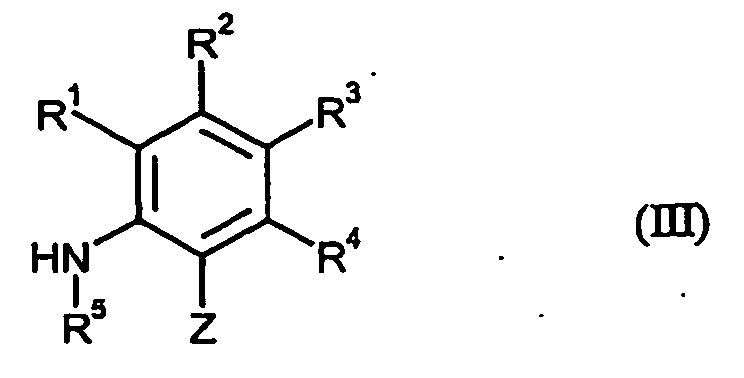
- R1, R2, R3, R4, R5 und Z
- die oben angegebenen Bedeutungen haben,
- b) Halogenoxathiincarboxamide der Formel (IV)
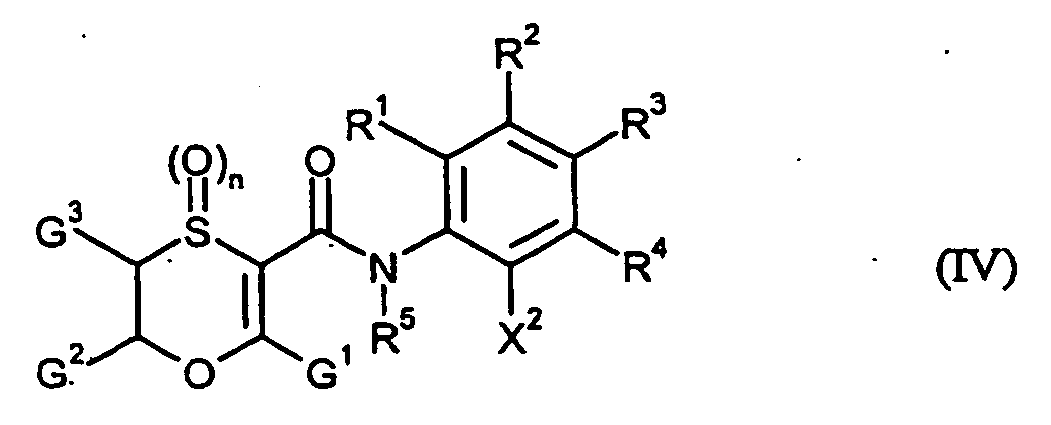
- G1, G2, G3, n, R1, R2, R3, R4 und R5
- die oben angegebenen Bedeutungen haben,
- X2
- für Brom oder Iod steht,

- Z1
- die oben angegebenen Bedeutungen hat und
- A1 und A2
- jeweils für Wasserstoff oder zusammen für Tetramethylethylen stehen,
- c) Oxathiincarboxamid-Boronsäure-Derivate der Formel (VI)

- G1, G2, G3, n, R1, R2, R3, R4 und R5
- die oben angegebenen Bedeutungen haben,
- A3 und A4
- jeweils für Wasserstoff oder zusammen für Tetramethylethylen stehen,
X3-Z1 (VII)
in welcher- Z1
- die oben angegebenen Bedeutungen hat und
- X3
- für Chlor, Brom, Iod oder Trifluormethylsulfonat steht,
- d) Halogenoxathiincarboxamide der Formel (IV)

- G1, G2, G3, n, R1, R2, R3, R4 und R5
- die oben angegebenen Bedeutungen haben,
- X2
- für Brom oder Iod steht,
X3-Z1 (VII)
in welcher- Z1
- die oben angegebenen Bedeutungen hat und
- X3
- für Chlor, Brom, Iod oder Trifluormethylsulfonat steht,
- e) Oxathiincarboxamide der Formel (Ia)

- G1, G2, G3, n, R1, R2, R3, R4 und R5
- die oben angegebenen Bedeutungen haben,
- X4
- für jeweils gegebenenfalls einfach oder mehrfach, gleich oder verschieden durch Halogen und/oder C3-C6-Cycloalkyl substituiertes C2-C20-Alkenyl oder C2-C20-Alkinyl steht, wobei der Cycloalkylteil seinerseits gegebenenfalls durch Halogen und/oder C1-C4-Alkyl substituiert sein kann,
- f) Hydroxyalkyloxathiincarboxamide der Formel (VIII)

- G1, G2, G3, n, R1, R2, R3, R4 und R5
- die oben angegebenen Bedeutungen haben,
- X5
- für gegebenenfalls zusätzlich einfach oder mehrfach, gleich oder verschieden durch Halogen und/oder C3-C6-Cycloalkyl substituiertes C2-C20-Hydroxyalkyl steht, wobei der Cycloalkylteil seinerseits gegebenenfalls durch Halogen und/oder C1-C4-Alkyl substituiert sein kann,
- g) Halogenoxathiincarboxamide der Formel (IV)

- G1, G2, G3, n, R1, R2, R3, R4 und R5
- die oben angegebenen Bedeutungen haben,
- X2
- für Brom oder Iod steht,
HC≡-A5 (IX),
in welcher- A5
- für jeweils gegebenenfalls einfach oder mehrfach, gleich oder verschieden durch Halogen und/oder C3-C6-Cycloalkyl substituiertes C2-C18-Alkyl steht, wobei der Cycloalkylteil seinerseits gegebenenfalls durch Halogen und/oder C1-C4-Alkyl substituiert sein kann,

- A6, A7 und A8
- unabhängig voneinander jeweils für Wasserstoff oder gegebenenfalls einfach oder mehrfach, gleich oder verschieden durch Halogen und/oder C3-C6-Cycloalkyl substituiertes Alkyl stehen, wobei der Cycloalkylteil seinerseits gegebenenfalls durch Halogen und/oder C1-C4-Alkyl substituiert sein kann und die Gesamtzahl der Kohlenstoffatome des offenkettigen Molekülteils die Zahl 20 nicht übersteigt,
- h) Ketone der Formel (XI)

- G1, G2, G3, n, R1, R2, R3, R4 und R5
- die oben angegebenen Bedeutungen haben,
- A9
- für Wasserstoff oder gegebenenfalls einfach oder mehrfach, gleich oder verschieden durch Halogen und/oder C3-C6-Cycloalkyl substituiertes C1-C18-Alkyl steht, wobei der Cycloalkylteil seinerseits gegebenenfalls durch Halogen und/oder C1-C4-Alkyl substituiert sein kann,
A10-Px (XII),
in welcher- A10
- für gegebenenfalls einfach oder mehrfach, gleich oder verschieden durch Halogen und/oder C3-C6-Cycloalkyl substituiertes C1-C18-Alkyl steht, wobei der Cycloalkylteil seinerseits gegebenenfalls durch Halogen und/oder C1-C4-Alkyl substituiert sein kann,
- Px
- für eine Gruppierung -P+(C6H5)3 Cl-, -P+(C6H5)3 Br-, -P+(C6H5)3 I-, -P(=O)(OCH3)3 oder -P(=O)(OC2H5)3 steht,
- i) Oxathiincarboxamide der Formel (Ib)

- G1, G2, G3, n, R1, R2, R3, R4 und Z
- die oben angegebenen Bedeutungen haben,
R5-1-X6 (XIII)
in welcher- R5-1
- für C1-C8-Alkyl, C1-C6-Alkylsulfinyl, C1-C6-Alkylsulfonyl, C1-C4-Alkoxy-C1-C4-alkyl, C3-C8-Cycloalkyl; C1-C6-Halogenalkyl, C1-C4-Halogenalkylthio, C1-C4-Halogenalkylsulfinyl, C1-C4-Halogenalkylsulfonyl, Halogen-C1-C4-alkoxy-C1-C4-alkyl, C3-C8-Halogencycloalkyl mit jeweils 1 bis 9 Fluor-, Chlor- und/oder Bromatomen, Formyl-C1-C3-alkyl, (C1-C3-Alkyl)carbonyl-C1-C3-alkyl, (C1-C3-Alkoxy)carbonyl-C1-C3-alkyl; (C1-C3-Halogenalkyl)carbonyl-C1-C3-alkyl, (C1-C3-Halogenalkoxy)carbonyl-C1-C3-alkyl mit jeweils 1 bis 7 Fluor-, Chlor- und/oder Bromatomen, (C1-C3-Alkyl)carbonyl-C1-C3-halogenalkyl, (C1-C3-Alkoxy)carbonyl-C1-C3-halogenalkyl mit jeweils 1 bis 6 Fluor-, Chlor- und/oder Bromatomen, (C1-C3-Halogenalkyl)carbonyl-C1-C3-halogenalkyl, (C1-C3-Halogenalkoxy)carbonyl-C1-C3-halogenalkyl mit jeweils 1 bis 13 Fluor-, Chlor- und/oder Bromatomen; -COR6, -CONR7R8 oder -CH2NR9R10 steht,
- R6, R7, R8, R9 und R10
- die oben angegebenen Bedeutungen haben,
- X6
- für Chlor, Brom oder Iod steht,
- a) Oxathiincarboxylic acid derivatives of the formula (II)
- G 1 , G 2 , G 3 and n
- have the meanings given above and
- X 1
- is halogen or hydroxy,
- R 1 , R 2 , R 3 , R 4 , R 5 and Z
- have the meanings given above,
- b) Halogenoxathinecarboxamides of the formula (IV)
- G 1 , G 2 , G 3 , n, R 1 , R 2 , R 3 , R 4 and R 5
- have the meanings given above,
- X 2
- represents bromine or iodine,
- Z 1
- has the meanings given above and
- A 1 and A 2
- are each hydrogen or together are tetramethylethylene,
- c) oxathiincarboxamide-boronic acid derivatives of the formula (VI)
- G 1 , G 2 , G 3 , n, R 1 , R 2 , R 3 , R 4 and R 5
- have the meanings given above,
- A 3 and A 4
- are each hydrogen or together are tetramethylethylene,
X 3 -Z 1 (VII)
in which- Z 1
- has the meanings given above and
- X 3
- represents chlorine, bromine, iodine or trifluoromethylsulfonate,
- d) Halogenoxathinecarboxamides of the formula (IV)
- G 1 , G 2 , G 3 , n, R 1 , R 2 , R 3 , R 4 and R 5
- have the meanings given above,
- X 2
- represents bromine or iodine,
X 3 -Z 1 (VII)
in which- Z 1
- has the meanings given above and
- X 3
- represents chlorine, bromine, iodine or trifluoromethylsulfonate,
- e) Oxathiine carboxamides of the formula (Ia)
- G 1 , G 2 , G 3 , n, R 1 , R 2 , R 3 , R 4 and R 5
- have the meanings given above,
- X 4
- is in each case optionally mono- or polysubstituted, identically or differently by halogen and / or C 3 -C 6 -cycloalkyl-substituted C 2 -C 20 -alkenyl or C 2 -C 20 -alkynyl, where the cycloalkyl moiety is in turn optionally substituted by halogen and / or C 1 -C 4 -alkyl may be substituted,
- f) Hydroxyalkyloxathiine carboxamides of the formula (VIII)
- G 1 , G 2 , G 3 , n, R 1 , R 2 , R 3 , R 4 and R 5
- have the meanings given above,
- X 5
- optionally additionally C 1 -C 20 -hydroxyalkyl which is optionally monosubstituted or polysubstituted, identically or differently, by halogen and / or C 3 -C 6 -cycloalkyl, the cycloalkyl part itself optionally being substituted by halogen and / or C 1 -C 4 -alkyl can be,
- g) Halogenoxathinecarboxamides of the formula (IV)
- G 1 , G 2 , G 3 , n, R 1 , R 2 , R 3 , R 4 and R 5
- have the meanings given above,
- X 2
- represents bromine or iodine,
HC≡-A 5 (IX),
in which- A 5
- is in each case optionally mono- or polysubstituted, identically or differently by halogen and / or C 3 -C 6 -cycloalkyl-substituted C 2 -C 18 -alkyl, wherein the cycloalkyl part in turn optionally substituted by halogen and / or C 1 -C 4 -alkyl can be,
- A 6 , A 7 and A 8
- independently of one another are each hydrogen or optionally mono- or polysubstituted by identical or different halogen and / or C 3 -C 6 -cycloalkyl-substituted alkyl, the cycloalkyl moiety in turn optionally being substituted by halogen and / or C 1 -C 4 -alkyl and the total number of carbon atoms of the open-chain moiety does not exceed 20,
- h) ketones of the formula (XI)
- G 1 , G 2 , G 3 , n, R 1 , R 2 , R 3 , R 4 and R 5
- have the meanings given above,
- A 9
- is hydrogen or optionally mono- or polysubstituted, identically or differently by halogen and / or C 3 -C 6 -cycloalkyl-substituted C 1 -C 18 -alkyl, wherein the cycloalkyl part in turn optionally substituted by halogen and / or C 1 -C 4 -alkyl may be substituted
A 10 -Px (XII),
in which- A 10
- represents optionally mono- or polysubstituted, identically or differently by halogen and / or C 3 -C 6 -cycloalkyl-substituted C 1 -C 18 -alkyl, wherein the cycloalkyl moiety in turn may optionally be substituted by halogen and / or C 1 -C 4 -alkyl can
- px
- for a grouping -P + (C 6 H 5 ) 3 Cl - , -P + (C 6 H 5 ) 3 Br - , -P + (C 6 H 5 ) 3 I - , -P (= O) (OCH 3 ) 3 or -P (= O) (OC 2 H 5 ) 3 ,
- i) oxathiincarboxamides of the formula (Ib)
- G 1 , G 2 , G 3 , n, R 1 , R 2 , R 3 , R 4 and Z
- have the meanings given above,
R 5-1 -X 6 (XIII)
in which- R 5-1
- C 1 -C 8 -alkyl, C 1 -C 6 -alkylsulfinyl, C 1 -C 6 -alkylsulfonyl, C 1 -C 4 -alkoxy-C 1 -C 4 -alkyl, C 3 -C 8 -cycloalkyl; C 1 -C 6 -haloalkyl, C 1 -C 4 -haloalkylthio, C 1 -C 4 -haloalkylsulfinyl, C 1 -C 4 -haloalkylsulfonyl, halogeno-C 1 -C 4 -alkoxy-C 1 -C 4 -alkyl, C 3 -C 8 -halocycloalkyl having in each case 1 to 9 fluorine, chlorine and / or bromine atoms, formyl-C 1 -C 3 -alkyl, (C 1 -C 3 -alkyl) carbonyl-C 1 -C 3 -alkyl , (C 1 -C 3 alkoxy) carbonyl-C 1 -C 3 -alkyl; (C 1 -C 3 -haloalkyl) carbonyl-C 1 -C 3 -alkyl, (C 1 -C 3 -haloalkoxy) carbonyl-C 1 -C 3 -alkyl having in each case 1 to 7 fluorine, chlorine and / or Bromatomen, (C 1 -C 3 alkyl) carbonyl-C 1 -C 3 haloalkyl, (C 1 -C 3 alkoxy) carbonyl-C 1 -C 3 haloalkyl each having 1 to 6 fluorine, chlorine and or bromine atoms, (C 1 -C 3 -haloalkyl) carbonyl-C 1 -C 3 -haloalkyl, (C 1 -C 3 -haloalkoxy) carbonyl-C 1 -C 3 -haloalkyl having in each case 1 to 13 fluorine, chlorine and / or bromine atoms; -COR 6 , -CONR 7 R 8 or -CH 2 NR 9 R 10 ,
- R 6 , R 7 , R 8 , R 9 and R 10
- have the meanings given above,
- X 6
- represents chlorine, bromine or iodine,
Schließlich wurde gefunden, dass die neuen Oxathiincarboxamide der Formel (I) sehr gute mikrobizide Eigenschaften besitzen und zur Bekämpfung unerwünschter Mikroorganismen sowohl im Pflanzenschutz als auch im Materialschutz verwendbar sind.Finally, it has been found that the new oxathiine carboxamides of the formula (I) have very good microbicidal properties and can be used for controlling unwanted microorganisms both in crop protection and in the protection of materials.
Überraschenderweise zeigen die erfindungsgemäßen Oxathiincarboxamide der Formel (I) eine wesentlich bessere fungizide Wirksamkeit als die konstitutionell ähnlichsten, vorbekannten Wirkstoffe gleicher Wirkungsrichtung.Surprisingly, the oxathiine carboxamides of the formula (I) according to the invention have a significantly better fungicidal activity than the constitutionally most similar, previously known active compounds of the same direction of action.
Die erfindungsgemäßen Verbindungen können gegebenenfalls als Mischungen verschiedener möglicher isomerer Formen, insbesondere von Stereoisomeren, wie z. B. E- und Z-, threo- und erythro-, sowie optischen Isomeren, gegebenenfalls aber auch von Tautomeren vorliegen. Es werden sowohl die E- als auch die Z-Isomeren, wie auch die threo- und erythro-, sowie die optischen Isomeren, beliebige Mischungen dieser Isomeren, sowie die möglichen tautomeren Formen beansprucht.The compounds of the invention may optionally be used as mixtures of various possible isomeric forms, in particular of stereoisomers, such as. B. E and Z, threo and erythro, and optical isomers, but optionally also of tautomers. Both the E and the Z isomers, as well as the threo and erythro, and the optical isomers, any mixtures of these isomers, as well as the possible tautomeric forms claimed.
Die erfindungsgemäßen Oxathiincarboxamide sind durch die Formel (I) allgemein definiert. Bevorzugte Restedefinitionen der vorstehenden und nachfolgend genannten Formeln sind im Folgenden angegeben. Diese Definitionen gelten für die Endprodukte der Formel (I) wie für alle Zwischenprodukte gleichermaßen.
- G1
- steht bevorzugt für Fluor, Chlor, Brom, Iod, Trifluormethyl, Difluormethyl oder Cyclopropyl.
- G1
- steht besonders bevorzugt für Chlor, Brom, Iod, Trifluormethyl, Difluormethyl oder Cyclopropyl.
- G1
- steht ganz besonders bevorzugt für Trifluormethyl.
- G1
- steht auch ganz besonders bevorzugt für Difluormethyl.
- G1
- steht auch ganz besonders bevorzugt für Cyclopropyl.
- G2
- steht bevorzugt für Wasserstoff.
- G2
- steht auch bevorzugt für Methyl.
- G3
- steht bevorzugt für Wasserstoff.
- G3
- steht auch bevorzugt für Methyl.
- G2 und G3
- stehen besonders bevorzugt gleichzeitig für Wasserstoff.
- n
- steht bevorzugt 0 oder 2.
- n
- steht besonders bevorzugt für 0.
- n
- steht auch besonders bevorzugt für 2.
- R1
- steht bevorzugt für Wasserstoff, Fluor, Chlor oder Methyl.
- R1
- steht besonders bevorzugt für Wasserstoff, Fluor oder Chlor.
- R1
- steht ganz besonders bevorzugt für Wasserstoff.
- R1
- steht auch ganz besonders bevorzugt für Fluor.
- R2
- steht bevorzugt für Wasserstoff, Fluor, Chlor, iso-Propyl oder Methylthio.
- R2
- steht besonders bevorzugt für Wasserstoff, Fluor, iso-Propyl oder Methylthio.
- R2
- steht ganz besonders bevorzugt für Wasserstoff.
- R3
- steht bevorzugt für Wasserstoff, Fluor, Chlor oder Methyl.
- R3
- steht besonders bevorzugt für Wasserstoff oder Fluor.
- R3
- steht ganz besonders bevorzugt für Wasserstoff.
- R3
- steht auch ganz besonders bevorzugt für Fluor.
- R4
- steht bevorzugt für Wasserstoff, Fluor, Chlor oder Methyl.
- R4
- steht besonders bevorzugt für Wasserstoff oder Methyl.
- R4
- steht ganz besonders bevorzugt für Wasserstoff.
- R4
- steht auch ganz besonders bevorzugt für Methyl.
- R1, R2, R3 und R4
- stehen ganz besonders bevorzugt gleichzeitig für Wasserstoff.
- R5
- steht bevorzugt für Wasserstoff; C1-C6-Alkyl, C1-C4-Alkylsulfinyl, C1-C4-Alkylsulfonyl, C1-C3-Alkoxy-C1-C3-alkyl, C3-C6-Cycloalkyl; C1-C4-Halogenalkyl, C1-C4-Halogenalkylthio, C1-C4-Halogenalkylsulfinyl, C1-C4-Halogenalkylsulfonyl, Halogen-C1-C3-alkoxy-C1-C3-alkyl, C3-C6-Halogencycloalkyl mit jeweils 1 bis 9 Fluor-, Chlor- und/oder Bromatomen, Formyl-C1-C3-alkyl, (C1-C3-Alkyl)carbonyl-C1-C3-alkyl, (C1-C3-Alkoxy)carbonyl-C1-C3-alkyl; (C1-C3-Halogenalkyl)carbonyl-C1-C3-alkyl, (C1-C3-Halogenalkoxy)carbonyl-C1-C3-alkyl mit jeweils 1 bis 7 Fluor-, Chlor- und/oder Bromatomen, (C1-C3-Alkyl)carbonyl-C1-C3-halogenalkyl, (C1-C3-Alkoxy)carbonyl-C1-C3-halogenalkyl mit jeweils 1 bis 6 Fluor-, Chlor- und/oder Bromatomen, (C1-C3-Halogenalkyl)carbonyl-C1-C3-halogenalkyl, (C1-C3-Halogenalkoxy)carbonyl-C1-C3-halogenalkyl mit jeweils 1 bis 13 Fluor-, Chlor- und/oder Bromatomen; -COR6, -CONR7R8 oder -CH2NR9R10.
- R5
- steht besonders bevorzugt für Wasserstoff, Methyl, Ethyl, n- oder iso-Propyl, n-, iso-, sec- oder tert-Butyl, Pentyl oder Hexyl, Methylsulfinyl, Ethylsulfinyl, n- oder iso-Propylsulfinyl, n-, iso-, sec- oder tert-Butylsulfinyl, Methylsulfonyl, Ethylsulfonyl, n- oder iso-Propylsulfonyl, n-, iso-, sec- oder tert-Butylsulfonyl, Methoxymethyl, Methoxyethyl, Ethoxymethyl, Ethoxyethyl, Cyclopropyl, Cyclopentyl, Cyclohexyl, Trifluormethyl, Trichlormethyl, Trifluorethyl, Difluormethylthio, Difluorchlormethylthio, Trifluormethylthio, Trifluormethylsulfinyl, Trifluormethylsulfonyl, Trifluormethoxymethyl, -CH2-CHO, -CH2CH2-CHO, -CH2-CO-CH3, -CH2-CO-CH2CH3, -CH2-CO-CH(CH3)2, -CH2CH2-CO-CH3, -CH2CH2-CO-CH2CH3, -CH2CH2-CO-CH(CH3)2, -CH2-C(O)OCH3, -CH2-C(O)OCH2CH3, -CH2-C(O)OCH(CH3)2, -CH2CH2-C(O)OCH3, -CH2CH2-C(O)OCH2CH3, -CH2CH2-C(O)OCH(CH3)2, -CH2-CO-CF3, -CH2-CO-CCl3, -CH2-CO-CH2CF3, -CH2-CO-CH2CCl3, -CH2CH2-CO-CH2CF3, -CH2CH2-CO-CH2CCl3, -CH2-C(O)OCH2CF3, -CH2-C(O)OCF2CF3, -CH2-C(O)OCH2CCl3, -CH2-C(O)OCCl2CCl3, -CH2CH2-C(O)OCH2CF3, -CH2CH2-C(O)OCF2CF3, -CH2CH2-C(O)OCH2CCl3, -CH2CH2-C(O)O-CCl2CCl3; -COR6, -CONR7R8 oder -CH2NR9R10.
- R5
- steht ganz besonders bevorzugt für Wasserstoff; Methyl, Methoxymethyl, -CH2-CHO, -CH2CH2-CHO, -CH2-CO-CH3, -CH2-CO-CH2CH3, -CH2-CO-CH(CH3)2 oder -COR6.
- R6
- steht bevorzugt für Wasserstoff, C1-C6-Alkyl, C1-C4-Alkoxy, C1-C3-Alkoxy-C1-C3-alkyl, C3-C6-Cycloalkyl; C1-C4-Halogenalkyl, C1-C4-Halogenalkoxy, Halogen-C1-C3-alkoxy-C1-C3-alkyl, C3-C6-Halogencycloalkyl mit jeweils 1 bis 9 Fluor-, Chlor- und/oder Bromatomen, -COR11.
- R6
- steht besonders bevorzugt für Wasserstoff, Methyl, Ethyl, n- oder iso-Propyl, tert-Butyl, Methoxy, Ethoxy, iso-Propoxy, tert-Butoxy, Cyclopropyl; Trifluormethyl, Trifluormethoxy, -COR11.
- R6
- steht ganz besonders bevorzugt für Wasserstoff, -COCH3, -CHO, -COCH2OCH3, -COCO2CH3, -COCO2CH2CH3.
- R7 und R8
- stehen unabhängig voneinander bevorzugt für Wasserstoff, C1-C6-Alkyl, C1-C3-Alkoxy-C1-C3-alkyl, C3-C6-Cycloalkyl; C1-C4-Halogenalkyl, Halogen-C1-C3-alkoxy-C1-C3-alkyl, C3-C6-Halogencycloalkyl mit jeweils 1 bis 9 Fluor-, Chlor- und/oder Bromatomen.
- R7 und R8
- bilden außerdem gemeinsam mit dem Stickstoffatom, an das sie gebunden sind, bevorzugt einen gegebenenfalls einfach bis vierfach, gleich oder verschieden durch Halogen oder C1-C4-Alkyl substituierten gesättigten Heterocyclus mit 5 bis 8 Ringatomen, wobei der Heterocyclus 1 oder 2 weitere, nicht benachbarte Heteroatome aus der Reihe Sauerstoff, Schwefel oder NR12 enthalten kann.
- R7 und R8
- stehen unabhängig voneinander besonders bevorzugt für Wasserstoff, Methyl, Ethyl, n- oder iso-Propyl, n-, iso-, sec- oder tert-Butyl, Methoxymethyl, Methoxyethyl, Ethoxymethyl, Ethoxyethyl, Cyclopropyl, Cyclopentyl, Cyclohexyl; Trifluormethyl, Trichlormethyl, Trifluorethyl, Trifluormethoxymethyl.
- R7 und R8
- bilden außerdem gemeinsam mit dem Stickstoffatom, an das sie gebunden sind, besonders bevorzugt einen gegebenenfalls einfach bis vierfach, gleich oder verschieden durch Fluor, Chlor, Brom oder Methyl substituierten gesättigten Heterocyclus aus der Reihe Morpholin, Thiomorpholin oder Piperazin, wobei das Piperazin am zweiten Stickstoffatom durch R12 substituiert sein kann.
- R9 und R10
- stehen unabhängig voneinander bevorzugt für Wasserstoff, C1-C6-Alkyl, C3-C6-Cycloalkyl; C1-C4-Halogenalkyl, C3-C6-Halogencycloalkyl mit jeweils 1 bis 9 Fluor-, Chlor- und/oder Bromatomen.
- R9 und R10
- bilden außerdem gemeinsam mit dem Stickstoffatom, an das sie gebunden sind, bevorzugt einen gegebenenfalls einfach oder mehrfach, gleich oder verschieden durch Halogen oder C1-C4-Alkyl substituierten gesättigten Heterocyclus mit 5 bis 8 Ringatomen, wobei der Heterocyclus 1 oder 2 weitere, nicht benachbarte Heteroatome aus der Reihe Sauerstoff, Schwefel oder NR12 enthalten kann.
- R9 und R10
- stehen unabhängig voneinander besonders bevorzugt für Wasserstoff, Methyl, Ethyl, n- oder iso-Propyl, n-, iso-, sec- oder tert-Butyl, Methoxymethyl, Methoxyethyl, Ethoxymethyl, Ethoxyethyl, Cyclopropyl, Cyclopentyl, Cyclohexyl; Trifluormethyl, Trichlormethyl, Trifluorethyl, Trifluormethoxymethyl.
- R9 und R10
- bilden außerdem gemeinsam mit dem Stickstoffatom, an das sie gebunden sind, besonders bevorzugt einen gegebenenfalls einfach bis vierfach, gleich oder verschieden durch Fluor, Chlor, Brom oder Methyl substituierten gesättigten Heterocyclus aus der Reihe Morpholin, Thiomorpholin oder Piperazin, wobei das Piperazin am zweiten Stickstoffatom durch R12 substituiert sein kann.
- R11
- steht bevorzugt für Wasserstoff, C1-C6-Alkyl, C1-C4-Alkoxy, C1-C3-Alkoxy-C1-C3-alkyl, C3-C6-Cycloalkyl; C1-C4-Halogenalkyl, C1-C4-Halogenalkoxy, Halogen-C1-C3-alkoxy-C1-C3-alkyl, C3-C6-Halogencycloalkyl mit jeweils 1 bis 9 Fluor-, Chlor- und/oder Bromatomen.
- R11
- steht besonders bevorzugt für Wasserstoff, Methyl, Ethyl, n- oder iso-Propyl, tert-Butyl, Methoxy, Ethoxy, iso-Propoxy, tert-Butoxy, Cyclopropyl; Trifluormethyl, Trifluormethoxy.
- R12
- steht bevorzugt für Wasserstoff oder C1-C4-Alkyl.
- R12
- steht besonders bevorzugt für Wasserstoff, Methyl, Ethyl, n- oder iso-Propyl, n-, iso-, sec- oder tert-Butyl.
- Z
- steht bevorzugt für Z1.
- Z1
- steht bevorzugt für einfach bis fünffach, gleich oder verschieden substituiertes Phenyl, wobei die Substituenten aus der Liste W1 ausgewählt sind.
- Z1
- steht besonders bevorzugt für einfach substituiertes Phenyl, wobei die Substituenten aus der Liste W1 ausgewählt sind.
- Z1
- steht auch besonders bevorzugt für zweifach, gleich oder verschieden substituiertes Phenyl, wobei die Substituenten aus der Liste W1 ausgewählt sind.
- Z1
- steht auch besonders bevorzugt für dreifach, gleich oder verschieden substituiertes Phenyl, wobei die Substituenten aus der Liste W1 ausgewählt sind.
- Z1
- steht ganz besonders bevorzugt für einfach in 4-Position substituiertes Phenyl, wobei die Substituenten aus der Liste W1 ausgewählt sind.
- Z1
- steht ganz besonders bevorzugt für zweifach, gleich oder verschieden in 3,4-Position substituiertes Phenyl, wobei die Substituenten aus der Liste W1 ausgewählt sind.
- Z1
- steht ganz besonders bevorzugt für zweifach, gleich oder verschieden in 2,4-Position substituiertes Phenyl, wobei die Substituenten aus der Liste W1 ausgewählt sind.
- Z1
- steht ganz besonders bevorzugt für zweifach, gleich oder verschieden in 3,5-postition substituiertes Phenyl, wobei die Substituenten aus der Liste W1 ausgewählt sind.
- Z1
- steht ganz besonders bevorzugt für dreifach, gleich oder verschieden in 2,4,6-Position substituiertes Phenyl, wobei die Substituenten aus der Liste W1 ausgewählt sind.
- W1
- steht für Halogen, Cyano, Nitro, Amino, Hydroxy, Formyl, Carboxy, Carbamoyl, Thiocarbamoyl;
jeweils geradkettiges oder verzweigtes Alkyl, Hydroxyalkyl, Oxoalkyl, Alkoxy, Alkoxyalkyl, Alkylthioalkyl, Dialkoxyalkyl, Alkylthio, Alkylsulfinyl oder Alkylsulfonyl mit jeweils 1 bis 8 Kohlenstoffatomen;
jeweils geradkettiges oder verzweigtes Alkenyl oder Alkenyloxy mit jeweils 2 bis 6 Kohlenstoffatomen;
jeweils geradkettiges oder verzweigtes Halogenalkyl, Halogenalkoxy, Halogenalkylthio, Halogenalkylsulfinyl oder Halogenalkylsulfonyl mit jeweils 1 bis 6 Kohlenstoffatomen und 1 bis 13 gleichen oder verschiedenen Halogenatomen;
jeweils geradkettiges oder verzweigtes Halogenalkenyl oder Halogenalkenyloxy mit jeweils 2 bis 6 Kohlenstoffatomen und 1 bis 11 gleichen oder verschiedenen Halogenatomen;
jeweils geradkettiges oder verzweigtes Alkylamino, Dialkylamino, Alkylcarbonyl, Alkylcarbonyloxy, Alkoxycarbonyl, Alkylaminocarbonyl, Dialkylaminocarbonyl, Arylalkylaminocarbonyl, Dialkylaminocarbonyloxy mit 1 bis 6 Kohlenstoffatomen in den jeweiligen Kohlenwasserstoffketten, Alkenylcarbonyl oder Alkinylcarbonyl, mit 2 bis 6 Kohlenstoffatomen in den jeweiligen Kohlenwasserstoffketten;
Cycloalkyl oder Cycloalkyloxy mit jeweils 3 bis 6 Kohlenstoffatomen;
jeweils gegebenenfalls einfach bis vierfach, gleich oder verschieden durch Fluor, Chlor, Oxo, Methyl, Trifluormethyl oder Ethyl substituiertes, jeweils zweifach verknüpftes Alkylen mit 3 oder 4 Kohlenstoffatomen, Oxyalkylen mit 2 oder 3 Kohlenstoffatomen oder Dioxyalkylen mit 1 oder 2 Kohlenstoffatomen;
oder eine Gruppierung
Q1 für Wasserstoff, Hydroxy oder Alkyl mit 1 bis 4 Kohlenstoffatomen, Halogenalkyl mit 1 bis 4 Kohlenstoffatomen und 1 bis 9 Fluor-, Chlor- und/oder Bromatomen oder Cycloalkyl mit 1 bis 6 Kohlenstoffatomen steht und
Q2 für Hydroxy, Amino, Methylamino, Phenyl, Benzyl oder für jeweils gegebenenfalls durch Cyano, Hydroxy, Alkoxy, Alkylthio, Alkylamino, Dialkylamino oder Phenyl substituiertes Alkyl oder. Alkoxy mit 1 bis 4 Kohlenstoffatomen, oder für Alkenyloxy oder Alkinyloxy mit jeweils 2 bis 4 Kohlenstoffatomen steht, sowie jeweils gegebenenfalls im Ringteil einfach bis dreifach durch Halogen, und/oder geradkettiges oder verzweigtes Alkyl oder Alkoxy mit 1 bis 4 Kohlenstoffatomen substituiertes Phenyl, Phenoxy, Phenyllthio, Benzoyl, Benzoylethenyl, Cinnamoyl, Heterocyclyl oder Phenylalkyl, Phenylalkyloxy, Phenylalkylthio, oder Heterocyclylalkyl, mit jeweils 1 bis 3 Kohlenstoffatomen in den jeweiligen Alkylteilen. - W1
- steht bevorzugt für Fluor, Chlor, Brom, Methyl, Ethyl, n- oder i-Propyl, n-, i-, s- oder t-Butyl, Methoxy, Ethoxy, n- oder i-Propoxy, Trifluormethyl, Trifluorethyl, Difluormethoxy, Trifluormethoxy, Difluorchlormethoxy, Trifluorethoxy, jeweils zweifach verknüpftes Difluormethylendioxy oder Tetrafluorethylendioxy,
oder eine Gruppierung
Q1 für Wasserstoff, Methyl, Ethyl oder Trifluormethyl steht und
Q2 für Hydroxy, Methoxy, Ethoxy, Propoxy oder Isopropoxy steht.
- Z
- steht auch bevorzugt für Z2.
- Z2
- steht bevorzugt für jeweils gegebenenfalls einfach bis vierfach, gleich oder verschieden durch Halogen und/oder C1-C4-Alkyl substituiertes Cycloalkyl oder Bicycloalkyl mit jeweils 3 bis 10 Kohlenstoffatomen.
- Z2
- steht besonders bevorzugt für jeweils gegebenenfalls einfach bis vierfach, gleich oder verschieden durch Chlor und/oder Methyl substituiertes Cyclopropyl, Cyclopentyl, Cyclohexyl, Cycloheptyl, Cyclooctyl, Cyclononyl, Bicyclo[2.2.1]heptyl oder Bicyclo[2.2.2]octyl.
- Z2
- steht ganz besonders bevorzugt für durch Chlor und Methyl substituiertes Cyclopropyl.
- Z
- steht auch bevorzugt für Z3.
- Z3
- steht bevorzugt für unsubstituiertes C4-C20-Alkyl oder für einfach oder mehrfach, gleich oder verschieden durch Fluor, Chlor, Brom, Iod und/oder C3-C6-Cycloalkyl substituiertes C1-C20-Alkyl steht, wobei der Cycloalkylteil seinerseits gegebenenfalls einfach bis vierfach, gleich oder verschieden durch Fluor, Chlor, Brom, Iod, C1-C4-Alkyl und/oder C1-C4-Halogenalkyl substituiert sein kann.
- Z3
- steht besonders bevorzugt für unsubstituiertes C4-C20-Alkyl.
- Z3
- steht auch besonders bevorzugt für durch Chlor, Cyclopropyl, Dichlorcyclopropyl, Cyclobutyl, Cyclopentyl oder Cyclohexyl substituiertes C4-C20-Alkyl.
- Z
- steht auch bevorzugt für Z4.
- Z4
- steht bevorzugt für jeweils gegebenenfalls einfach oder mehrfach, gleich oder verschieden durch Fluor, Chlor, Brom, Iod und/oder C3-C6-Cycloalkyl substituiertes C2-C20-Alkenyl oder C2-C20-Alkinyl steht, wobei der Cycloalkylteil seinerseits gegebenenfalls einfach bis vierfach, gleich oder verschieden durch Fluor, Chlor, Brom, Iod, C1-C4-Alkyl und/oder C1-C4-Halogenalkyl substituiert sein kann.
- Z4
- steht besonders bevorzugt für C2-C20-Alkenyl oder C2-C20-Alkinyl.
- Z und R4
- stehen auch bevorzugt gemeinsam mit den Kohlenstoffatomen, an die sie gebunden sind, für einen gegebenenfalls einfach bis vierfach, gleich oder verschieden substituierten 5- oder 6-gliedrigen carbocyclischen oder heterocyclischen Ring.
- Z und R4
- stehen auch besonders bevorzugt gemeinsam mit den Kohlenstoffatomen, an die sie gebunden sind, für einen gegebenenfalls einfach, zweifach oder dreifach durch Methyl substituierten 5- oder 6-gliedrigen carbocyclischen Ring.
- G 1
- is preferably fluorine, chlorine, bromine, iodine, trifluoromethyl, difluoromethyl or cyclopropyl.
- G 1
- is particularly preferably chlorine, bromine, iodine, trifluoromethyl, difluoromethyl or cyclopropyl.
- G 1
- is very particularly preferably trifluoromethyl.
- G 1
- is also very particularly preferred for difluoromethyl.
- G 1
- is also very particularly preferably cyclopropyl.
- G 2
- is preferably hydrogen.
- G 2
- is also preferably methyl.
- G 3
- is preferably hydrogen.
- G 3
- is also preferably methyl.
- G 2 and G 3
- are particularly preferably simultaneously hydrogen.
- n
- is preferably 0 or 2.
- n
- is particularly preferably 0.
- n
- is also particularly preferred for 2.
- R 1
- is preferably hydrogen, fluorine, chlorine or methyl.
- R 1
- is particularly preferably hydrogen, fluorine or chlorine.
- R 1
- is very particularly preferably hydrogen.
- R 1
- is also most preferably fluorine.
- R 2
- is preferably hydrogen, fluorine, chlorine, isopropyl or methylthio.
- R 2
- is particularly preferably hydrogen, fluorine, isopropyl or methylthio.
- R 2
- is very particularly preferably hydrogen.
- R 3
- is preferably hydrogen, fluorine, chlorine or methyl.
- R 3
- is particularly preferably hydrogen or fluorine.
- R 3
- is very particularly preferably hydrogen.
- R 3
- is also most preferably fluorine.
- R 4
- is preferably hydrogen, fluorine, chlorine or methyl.
- R 4
- is particularly preferably hydrogen or methyl.
- R 4
- is very particularly preferably hydrogen.
- R 4
- is also very particularly preferably methyl.
- R 1 , R 2 , R 3 and R 4
- very particularly preferably are simultaneously hydrogen.
- R 5
- is preferably hydrogen; C 1 -C 6 alkyl, C 1 -C 4 alkylsulfinyl, C 1 -C 4 alkylsulfonyl, C 1 -C 3 alkoxy-C 1 -C 3 alkyl, C 3 -C 6 cycloalkyl; C 1 -C 4 -haloalkyl, C 1 -C 4 -haloalkylthio, C 1 -C 4 -haloalkylsulfinyl, C 1 -C 4 -haloalkylsulfonyl, halogeno-C 1 -C 3 -alkoxy-C 1 -C 3 -alkyl, C 3 -C 6 -halo cycloalkyl having in each case 1 to 9 fluorine, chlorine and / or bromine atoms, formyl-C 1 -C 3 -alkyl, (C 1 -C 3 -alkyl) carbonyl-C 1 -C 3 -alkyl , (C 1 -C 3 alkoxy) carbonyl-C 1 -C 3 -alkyl; (C 1 -C 3 -haloalkyl) carbonyl-C 1 -C 3 -alkyl, (C 1 -C 3 -haloalkoxy) carbonyl-C 1 -C 3 -alkyl having in each case 1 to 7 fluorine, chlorine and / or Bromatomen, (C 1 -C 3 alkyl) carbonyl-C 1 -C 3 haloalkyl, (C 1 -C 3 alkoxy) carbonyl-C 1 -C 3 haloalkyl each having 1 to 6 fluorine, chlorine and or bromine atoms, (C 1 -C 3 -haloalkyl) carbonyl-C 1 -C 3 -haloalkyl, (C 1 -C 3 -haloalkoxy) carbonyl-C 1 -C 3 -haloalkyl having in each case 1 to 13 fluorine, chlorine and / or bromine atoms; -COR 6 , -CONR 7 R 8 or -CH 2 NR 9 R 10 .
- R 5
- is particularly preferably hydrogen, methyl, ethyl, n- or iso-propyl, n-, iso-, sec- or tert-butyl, pentyl or hexyl, methylsulfinyl, ethylsulfinyl, n- or iso-propylsulfinyl, n-, iso- , sec- or tert-butylsulfinyl, methylsulfonyl, ethylsulfonyl, n- or iso-propylsulfonyl, n-, iso-, sec- or tert-butylsulfonyl, methoxymethyl, methoxyethyl, ethoxymethyl, ethoxyethyl, cyclopropyl, cyclopentyl, cyclohexyl, trifluoromethyl, trichloromethyl, Trifluoroethyl, difluoromethylthio, difluorochloromethylthio, trifluoromethylthio, trifluoromethylsulfinyl, trifluoromethylsulfonyl, trifluoromethoxymethyl, -CH 2 -CHO, -CH 2 CH 2 -CHO, -CH 2 -CO-CH 3 , -CH 2 -CO-CH 2 CH 3 , -CH 2 -CO-CH (CH 3 ) 2 , -CH 2 CH 2 -CO-CH 3 , -CH 2 CH 2 -CO-CH 2 CH 3 , -CH 2 CH 2 -CO-CH (CH 3 ) 2 , -CH 2 -C (O) OCH 3 , -CH 2 -C (O) OCH 2 CH 3 , -CH 2 -C (O) OCH (CH 3 ) 2 , -CH 2 CH 2 -C (O) OCH 3 , -CH 2 CH 2 -C (O) OCH 2 CH 3 , -CH 2 CH 2 -C (O) OCH (CH 3 ) 2 , -CH 2 -CO-CF 3 , -CH 2 -CO-CCl 3 , -CH 2 -CO-CH 2 CF 3 , -CH 2 -CO-CH 2 CC l 3 , -CH 2 CH 2 -CO-CH 2 CF 3 , -CH 2 CH 2 -CO-CH 2 CCl 3 , -CH 2 -C (O) OCH 2 CF 3 , -CH 2 -C (O) OCF 2 CF 3 , -CH 2 -C (O) OCH 2 CCl 3 , -CH 2 -C (O) OCCl 2 CCl 3 , -CH 2 CH 2 -C (O) OCH 2 CF 3 , -CH 2 CH 2 -C (O) OCF 2 CF 3 , -CH 2 CH 2 -C (O) OCH 2 CCl 3 , -CH 2 CH 2 -C (O) O-CCl 2 CCl 3 ; -COR 6 , -CONR 7 R 8 or -CH 2 NR 9 R 10 .
- R 5
- is very particularly preferably hydrogen; Methyl, methoxymethyl, -CH 2 -CHO, -CH 2 CH 2 -CHO, -CH 2 -CO-CH 3 , -CH 2 -CO-CH 2 CH 3 , -CH 2 -CO-CH (CH 3 ) 2 or -COR 6 .
- R 6
- R 2 preferably represents hydrogen, C 1 -C 6 -alkyl, C 1 -C 4 -alkoxy, C 1 -C 3 -alkoxy-C 1 -C 3 -alkyl, C 3 -C 6 -cycloalkyl; C 1 -C 4 -haloalkyl, C 1 -C 4 -haloalkoxy, halogeno-C 1 -C 3 -alkoxy-C 1 -C 3 -alkyl, C 3 -C 6 -halo cycloalkyl having in each case 1 to 9 fluorine, chlorine and / or bromine atoms, -COR 11 .
- R 6
- is particularly preferably hydrogen, methyl, ethyl, n- or iso-propyl, tert-butyl, methoxy, ethoxy, iso-propoxy, tert-butoxy, cyclopropyl; Trifluoromethyl, trifluoromethoxy, -COR 11 .
- R 6
- is very particularly preferably hydrogen, -COCH 3 , -CHO, -COCH 2 OCH 3 , -COCO 2 CH 3 , -COCO 2 CH 2 CH 3 .
- R 7 and R 8
- independently of one another are preferably hydrogen, C 1 -C 6 -alkyl, C 1 -C 3 -alkoxy-C 1 -C 3 -alkyl, C 3 -C 6 -cycloalkyl; C 1 -C 4 -haloalkyl, halogeno-C 1 -C 3 -alkoxy-C 1 -C 3 -alkyl, C 3 -C 6 -halocycloalkyl having in each case 1 to 9 fluorine, chlorine and / or bromine atoms.
- R 7 and R 8
- together with the nitrogen atom to which they are bonded, furthermore, preferably form a saturated heterocycle having from 5 to 8 ring atoms, optionally monosubstituted to monosubstituted, identically or differently, by halogen or C 1 -C 4 -alkyl, where the heterocycle contains 1 or 2 further, may contain non-adjacent heteroatoms from the series oxygen, sulfur or NR 12 .
- R 7 and R 8
- independently of one another are particularly preferably hydrogen, methyl, ethyl, n- or iso-propyl, n-, iso-, sec- or tert-butyl, methoxymethyl, methoxyethyl, ethoxymethyl, ethoxyethyl, cyclopropyl, cyclopentyl, cyclohexyl; Trifluoromethyl, trichloromethyl, trifluoroethyl, trifluoromethoxymethyl.
- R 7 and R 8
- furthermore, together with the nitrogen atom to which they are attached, more preferably form a saturated heterocycle from the series morpholine, thiomorpholine or piperazine which is optionally monosubstituted to monosubstituted, identically or differently by fluorine, chlorine, bromine or methyl, where the piperazine is attached to the second nitrogen atom may be substituted by R 12 .
- R 9 and R 10
- independently of one another are preferably hydrogen, C 1 -C 6 -alkyl, C 3 -C 6 -cycloalkyl; C 1 -C 4 -haloalkyl, C 3 -C 6 -halocycloalkyl having in each case 1 to 9 fluorine, chlorine and / or bromine atoms.
- R 9 and R 10
- together with the nitrogen atom to which they are bonded, furthermore preferably form a saturated heterocycle having 5 to 8 ring atoms which is optionally monosubstituted or polysubstituted, identically or differently by halogen or C 1 -C 4 -alkyl, where the heterocycle contains 1 or 2 further, may contain non-adjacent heteroatoms from the series oxygen, sulfur or NR 12 .
- R 9 and R 10
- independently of one another particularly preferably represent hydrogen, methyl, ethyl, n- or iso-propyl, n-, iso-, sec- or tert-butyl, methoxymethyl, methoxyethyl, Ethoxymethyl, ethoxyethyl, cyclopropyl, cyclopentyl, cyclohexyl; Trifluoromethyl, trichloromethyl, trifluoroethyl, trifluoromethoxymethyl.
- R 9 and R 10
- furthermore, together with the nitrogen atom to which they are attached, more preferably form a saturated heterocycle from the series morpholine, thiomorpholine or piperazine which is optionally monosubstituted to monosubstituted, identically or differently by fluorine, chlorine, bromine or methyl, where the piperazine is attached to the second nitrogen atom may be substituted by R 12 .
- R 11
- R 2 preferably represents hydrogen, C 1 -C 6 -alkyl, C 1 -C 4 -alkoxy, C 1 -C 3 -alkoxy-C 1 -C 3 -alkyl, C 3 -C 6 -cycloalkyl; C 1 -C 4 -haloalkyl, C 1 -C 4 -haloalkoxy, halo-C 1 -C 3 -alkoxy-C 1 -C 3 -alkyl, C 3 -C 6 -halocycloalkyl having in each case 1 to 9 fluorine, chlorine and / or bromine atoms.
- R 11
- is particularly preferably hydrogen, methyl, ethyl, n- or iso-propyl, tert-butyl, methoxy, ethoxy, iso-propoxy, tert-butoxy, cyclopropyl; Trifluoromethyl, trifluoromethoxy.
- R 12
- is preferably hydrogen or C 1 -C 4 -alkyl.
- R 12
- is particularly preferably hydrogen, methyl, ethyl, n- or iso-propyl, n-, iso-, sec- or tert-butyl.
- Z
- is preferably Z 1 .
- Z 1
- is preferably monosubstituted to pentane, identical or different, substituted phenyl, the substituents being selected from list W 1 .
- Z 1
- is particularly preferably monosubstituted phenyl, wherein the substituents are selected from list W 1 .
- Z 1
- is also particularly preferably for doubly, identically or differently substituted phenyl, wherein the substituents are selected from the list W 1 .
- Z 1
- is also particularly preferably triply, identically or differently substituted phenyl, wherein the substituents are selected from the list W 1 .
- Z 1
- is very particularly preferably phenyl which is monosubstituted in the 4-position, the substituents being selected from the list W 1 .
- Z 1
- is very particularly preferably twice, identically or differently substituted in the 3,4-position-substituted phenyl, where the substituents are selected from the list W 1 .
- Z 1
- most preferably represents twice, identically or differently substituted in the 2,4-position-substituted phenyl, wherein the substituents are selected from the list W 1 .
- Z 1
- very particularly preferably represents twice, identically or differently, phenyl substituted in 3,5-position, the substituents being selected from the list W 1 .
- Z 1
- is very particularly preferably phenyl substituted in trisubstituted by identical or different substituents in 2,4,6-position, the substituents being selected from list W 1 .
- W 1
- is halogen, cyano, nitro, amino, hydroxy, formyl, carboxy, carbamoyl, thiocarbamoyl;
in each case straight-chain or branched alkyl, hydroxyalkyl, oxoalkyl, alkoxy, alkoxyalkyl, alkylthioalkyl, dialkoxyalkyl, alkylthio, alkylsulfinyl or alkylsulfonyl having in each case 1 to 8 carbon atoms;
in each case straight-chain or branched alkenyl or alkenyloxy having in each case 2 to 6 carbon atoms;
in each case straight-chain or branched haloalkyl, haloalkoxy, haloalkylthio, haloalkylsulfinyl or haloalkylsulfonyl having in each case 1 to 6 carbon atoms and 1 to 13 identical or different halogen atoms;
in each case straight-chain or branched haloalkenyl or haloalkenyloxy having in each case 2 to 6 carbon atoms and 1 to 11 identical or different halogen atoms;
in each case straight-chain or branched alkylamino, dialkylamino, alkylcarbonyl, alkylcarbonyloxy, alkoxycarbonyl, alkylaminocarbonyl, dialkylaminocarbonyl, arylalkylaminocarbonyl, dialkylaminocarbonyloxy having 1 to 6 carbon atoms in the respective hydrocarbon chains, alkenylcarbonyl or alkynylcarbonyl having 2 to 6 carbon atoms in the respective hydrocarbon chains;
Cycloalkyl or cycloalkyloxy each having 3 to 6 carbon atoms;
in each case optionally monosubstituted to trisubstituted, identically or differently, by fluorine, chlorine, oxo, methyl, trifluoromethyl or ethyl, in each case doubly linked alkylene having 3 or 4 carbon atoms, oxyalkylene having 2 or 3 carbon atoms or dioxyalkylene having 1 or 2 carbon atoms;
or a grouping
Q 1 is hydrogen, hydroxy or alkyl of 1 to 4 carbon atoms, haloalkyl of 1 to 4 carbon atoms and 1 to 9 fluorine, chlorine and / or bromine atoms or cycloalkyl of 1 to 6 carbon atoms, and
Q 2 is hydroxy, amino, methylamino, phenyl, benzyl or each optionally substituted by cyano, hydroxy, alkoxy, alkylthio, alkylamino, dialkylamino or phenyl alkyl or. Alkoxy having 1 to 4 carbon atoms, or represents alkenyloxy or alkynyloxy having in each case 2 to 4 carbon atoms, and in each case optionally in the ring member monosubstituted by halogen, and / or straight-chain or branched alkyl or alkoxy having 1 to 4 carbon atoms, phenyl, phenoxy, Phenylthio, benzoyl, benzoylethenyl, cinnamoyl, heterocyclyl or phenylalkyl, phenylalkyloxy, phenylalkylthio, or heterocyclylalkyl each having 1 to 3 carbon atoms in the respective alkyl moieties. - W 1
- is preferably fluorine, chlorine, bromine, methyl, ethyl, n- or i-propyl, n-, i-, s- or t-butyl, methoxy, ethoxy, n- or i-propoxy, trifluoromethyl, trifluoroethyl, difluoromethoxy, Trifluoromethoxy, difluorochloromethoxy, trifluoroethoxy, in each case doubly linked difluoromethylenedioxy or tetrafluoroethylenedioxy,
or a grouping
Q 1 is hydrogen, methyl, ethyl or trifluoromethyl and
Q 2 is hydroxy, methoxy, ethoxy, propoxy or isopropoxy.
- Z
- is also preferably Z 2 .
- Z 2
- is preferably in each case optionally monosubstituted to monosubstituted, identically or differently by halogen and / or C 1 -C 4 -alkyl-substituted cycloalkyl or bicycloalkyl having in each case 3 to 10 carbon atoms.
- Z 2
- is particularly preferably in each case optionally monosubstituted to monosubstituted by identical or different chlorine and / or methyl, cyclopropyl, cyclopentyl, cyclohexyl, cycloheptyl, cyclooctyl, cyclononyl, bicyclo [2.2.1] heptyl or bicyclo [2.2.2] octyl.
- Z 2
- most preferably represents cyclopropyl substituted by chlorine and methyl.
- Z
- is also preferred for Z 3 .
- Z 3
- is preferably unsubstituted C 4 -C 20 -alkyl or mono- or polysubstituted by identical or different fluorine, chlorine, bromine, iodine and / or C 3 -C 6 -cycloalkyl-substituted C 1 -C 20 -alkyl, wherein the Cycloalkyl part in turn optionally may be monosubstituted to trisubstituted, identically or differently, by fluorine, chlorine, bromine, iodine, C 1 -C 4 -alkyl and / or C 1 -C 4 -haloalkyl.
- Z 3
- is particularly preferably unsubstituted C 4 -C 20 -alkyl.
- Z 3
- is also particularly preferably substituted by chlorine, cyclopropyl, dichlorocyclopropyl, cyclobutyl, cyclopentyl or cyclohexyl substituted C 4 -C 20 alkyl.
- Z
- is also preferred for Z 4 .
- Z 4
- is preferably in each case optionally mono- or polysubstituted by identical or different fluorine, chlorine, bromine, iodine and / or C 3 -C 6 -cycloalkyl-substituted C 2 -C 20 -alkenyl or C 2 -C 20 -alkynyl, wherein the Cycloalkyl part in turn may optionally be monosubstituted to fourfold, the same or different by fluorine, chlorine, bromine, iodine, C 1 -C 4 alkyl and / or C 1 -C 4 haloalkyl may be substituted.
- Z 4
- is particularly preferably C 2 -C 20 alkenyl or C 2 -C 20 alkynyl.
- Z and R 4
- are also preferably together with the carbon atoms to which they are attached, for an optionally mono- to di-quadrivalent, identically or differently substituted 5- or 6-membered carbocyclic or heterocyclic ring.
- Z and R 4
- are also particularly preferably together with the carbon atoms to which they are attached, for an optionally mono-, di- or trisubstituted by methyl 5- or 6-membered carbocyclic ring.
Bevorzugt sind solche Verbindungen der Formel (I), in welcher alle Reste jeweils die oben genannten bevorzugten Bedeutungen haben.Preference is given to those compounds of the formula (I) in which all radicals each have the abovementioned preferred meanings.
Besonders bevorzugt sind solche Verbindungen der Formel (I), in welcher alle Reste jeweils die oben genannten besonders bevorzugten Bedeutungen haben.Particular preference is given to those compounds of the formula (I) in which all radicals each have the abovementioned particularly preferred meanings.
Bevorzugt sind außerdem Verbindungen der Formel (Ic)

- G1, G2, G3, n, R1, R2, R3, R4 und Z1
- die oben angegebenen Bedeutungen haben.
- G 1 , G 2 , G 3 , n, R 1 , R 2 , R 3 , R 4 and Z 1
- have the meanings given above.
Besonders bevorzugt sind Verbindungen der Formel (Ic), in welcher G1 für Trifluormethyl steht.Particular preference is given to compounds of the formula (Ic) in which G 1 is trifluoromethyl.
Besonders bevorzugt sind Verbindungen der Formel (Ic), in welcher G1 für Difluormethyl steht.Particular preference is given to compounds of the formula (Ic) in which G 1 is difluoromethyl.
Besonders bevorzugt sind Verbindungen der Formel (Ic), in welcher R1, R2, R3 und R4 jeweils für Wasserstoff stehen.Particular preference is given to compounds of the formula (Ic) in which R 1 , R 2 , R 3 and R 4 are each hydrogen.
Besonders bevorzugt sind Verbindungen der Formel (Ic), in welcher n für 0 steht.Particular preference is given to compounds of the formula (Ic) in which n is 0.
Bevorzugt sind außerdem Verbindungen der Formel (Id)

- G1, G2, G3, n, R1, R2, R3, R4 und Z2
- die oben angegebenen Bedeutungen haben.
- G 1 , G 2 , G 3 , n, R 1 , R 2 , R 3 , R 4 and Z 2
- have the meanings given above.
Besonders bevorzugt sind Verbindungen der Formel (Id), in welcher G1 für Trifluormethyl steht.Particular preference is given to compounds of the formula (Id) in which G 1 is trifluoromethyl.
Besonders bevorzugt sind Verbindungen der Formel (Id), in welcher G1 für Difluormethyl steht.Particular preference is given to compounds of the formula (Id) in which G 1 is difluoromethyl.
Besonders bevorzugt sind Verbindungen der Formel (Id), in welcher R1, R2, R3 und R4 jeweils für Wasserstoff stehen.Particular preference is given to compounds of the formula (Id) in which R 1 , R 2 , R 3 and R 4 are each hydrogen.
Besonders bevorzugt sind Verbindungen der Formel (Id), in welcher n für 0 stehtParticular preference is given to compounds of the formula (Id) in which n is 0
Bevorzugt sind außerdem Verbindungen der Formel (Ie)

- G1, G2, G3, n, R1, R2, R3, R4 und Z3
- die oben angegebenen Bedeutungen haben.
- G 1 , G 2 , G 3 , n, R 1 , R 2 , R 3 , R 4 and Z 3
- have the meanings given above.
Besonders bevorzugt sind Verbindungen der Formel (Ie), in welcher G1 für Trifluormethyl steht.Particular preference is given to compounds of the formula (Ie) in which G 1 is trifluoromethyl.
Besonders bevorzugt sind Verbindungen der Formel (Ie), in welcher G1 für Difluormethyl steht.Particular preference is given to compounds of the formula (Ie) in which G 1 is difluoromethyl.
Besonders bevorzugt sind Verbindungen der Formel (Ie), in welcher R1, R2, R3 und R4 jeweils für Wasserstoff stehen.Particular preference is given to compounds of the formula (Ie) in which R 1 , R 2 , R 3 and R 4 are each hydrogen.
Besonders bevorzugt sind Verbindungen der Formel (Ie), in welcher n für 0 steht.Particular preference is given to compounds of the formula (Ie) in which n is 0.
Bevorzugt sind außerdem Verbindungen der Formel (If)

- G1, G2, G3, n, R1, R2, R3, R4 und Z4
- die oben angegebenen Bedeutungen haben.
- G 1 , G 2 , G 3 , n, R 1 , R 2 , R 3 , R 4 and Z 4
- have the meanings given above.
Besonders bevorzugt sind Verbindungen der Formel (If), in welcher G1 für Trifluormethyl steht.Particular preference is given to compounds of the formula (If) in which G 1 is trifluoromethyl.
Besonders bevorzugt sind Verbindungen der Formel (If), in welcher G1 für Difluormethyl steht.Particular preference is given to compounds of the formula (If) in which G 1 is difluoromethyl.
Besonders bevorzugt sind Verbindungen der Formel (If), in welcher R1, R2, R3 und R4 jeweils für Wasserstoff stehen.Particular preference is given to compounds of the formula (If) in which R 1 , R 2 , R 3 and R 4 are each hydrogen.
Besonders bevorzugt sind Verbindungen der Formel (If), in welcher n für 0 steht.Particular preference is given to compounds of the formula (If) in which n is 0.
Bevorzugt sind außerdem Verbindungen der Formel (Ig)

- G1, G2, G3, n, R1, R2, R3, R4, R5-1 und Z
- die oben angegebenen Bedeutungen haben.
- R5-1
- steht bevorzugt für C1-C6-Alkyl, C1-C4-Alkylsulfinyl, C1-C4-Alkylsulfonyl, C1-C3-Alkoxy-C1-C3-alkyl, C3-C6-Cycloalkyl; C1-C4-Halogenalkyl, C1-C4-Halogenalkylthio, C1-C4-Halogenalkylsulfinyl, C1-C4-Halogenalkylsulfonyl, Halogen-C1-C3-alkoxy-C1-C3-alkyl, C3-C6-Halogencycloalkyl mit jeweils 1 bis 9 Fluor-, Chlor- und/oder Bromatomen, Formyl-C1-C3-alkyl, (C1-C3-Alkyl)carbonyl-C1-C3-alkyl, (C1-C3-Alkoxy)carbonyl-C1-C3-alkyl; (C1-C3-Halogenalkyl)carbonyl-C1-C3-alkyl, (C1-C3-Halogenalkoxy)carbonyl-C1-C3-alkyl mit jeweils 1 bis 7 Fluor-, Chlor- und/oder Bromatomen, (C1-C3-Alkyl)carbonyl-C1-C3-halogenalkyl, (C1-C3-Alkoxy)carbonyl-C1-C3-halogenalkyl mit jeweils 1 bis 6 Fluor-, Chlor- und/oder Bromatomen, (C1-C3-Halogenalkyl)carbonyl-C1-C3-halogenalkyl, (C1-C3-Halogenalkoxy)carbonyl-C1-C3-halogenalkyl mit jeweils 1 bis 13 Fluor-, Chlor- und/oder Bromatomen; -COR6, -CONR7R8 oder -CH2NR9R10.
- R5-1
- steht besonders bevorzugt für Methyl, Ethyl, n- oder iso-Propyl, n-, iso-, sec- oder tert-Butyl, Pentyl oder Hexyl, Methylsulfinyl, Ethylsulfinyl, n- oder iso-Propylsulfinyl, n-, iso-, sec- oder tert-Butylsulfinyl, Methylsulfonyl, Ethylsulfonyl, n- oder iso-Propylsulfonyl, n-, iso-, sec- oder tert-Butylsulfonyl, Methoxymethyl, Methoxyethyl, Ethoxymethyl, Ethoxyethyl, Cyclopropyl, Cyclopentyl, Cyclohexyl, Trifluormethyl, Trichlormethyl, Trifluorethyl, Difluormethylthio, Difluorchlormethylthio, Trifluormethylthio, Trifluormethylsulfinyl, Trifluormethylsulfonyl, Trifluormethoxymethyl, -CH2-CHO, -CH2CH2-CHO, -CH2-CO-CH3, -CH2-CO-CH2CH3, -CH2-CO-CH(CH3)2, -CH2CH2-CO-CH3, -CH2CH2-CO-CH2CH3, -CH2CH2-CO-CH(CH3)2, -CH2-C(O)OCH3, -CH2-C(O)OCH2CH3, -CH2-C(O)OCH(CH3)2, -CH2CH2-C(O)OCH3, -CH2CH2-C(O)OCH2CH3, -CH2CH2-C(O)OCH(CH3)2, -CH2-CO-CF3, -CH2-CO-CCl3, -CH2-CO-CH2CF3, -CH2-CO-CH2CCl3, -CH2CH2-CO-CH2CF3, -CH2CH2-CO-CH2CCl3, -CH2-C(O)OCH2CF3, -CH2-C(O)OCF2CF3, -CH2-C(O)OCH2CCl3, -CH2-C(O)OCCl2CCl3, -CH2CH2-C(O)OCH2CF3, -CH2CH2-C(O)OCF2CF3, -CH2CH2-C(O)OCH2CCl3, -CH2CH2-C(O)O-CCl2CCl3; -COR6, -CONR7R8 oder -CH2NR9R10.
- R5-1
- steht ganz besonders bevorzugt für Methyl, Methoxymethyl, -CH2-CHO, -CH2CH2-CHO, -CH2-CO-CH3, -CH2-CO-CH2CH3, -CH2-CO-CH(CH3)2 oder -COR6 .
- G 1 , G 2 , G 3 , n, R 1 , R 2 , R 3 , R 4 , R 5-1 and Z
- have the meanings given above.
- R 5-1
- is preferably C 1 -C 6 -alkyl, C 1 -C 4 -alkylsulfinyl, C 1 -C 4 -alkylsulfonyl, C 1 -C 3 -alkoxy-C 1 -C 3 -alkyl, C 3 -C 6 -cycloalkyl ; C 1 -C 4 -haloalkyl, C 1 -C 4 -haloalkylthio, C 1 -C 4 -haloalkylsulfinyl, C 1 -C 4 -haloalkylsulfonyl, halogeno-C 1 -C 3 -alkoxy-C 1 -C 3 -alkyl, C 3 -C 6 -halo cycloalkyl having in each case 1 to 9 fluorine, chlorine and / or bromine atoms, formyl-C 1 -C 3 -alkyl, (C 1 -C 3 -alkyl) carbonyl-C 1 -C 3 -alkyl , (C 1 -C 3 alkoxy) carbonyl-C 1 -C 3 -alkyl; (C 1 -C 3 -haloalkyl) carbonyl-C 1 -C 3 -alkyl, (C 1 -C 3 -haloalkoxy) carbonyl-C 1 -C 3 -alkyl having in each case 1 to 7 fluorine, chlorine and / or Bromatomen, (C 1 -C 3 alkyl) carbonyl-C 1 -C 3 haloalkyl, (C 1 -C 3 alkoxy) carbonyl-C 1 -C 3 haloalkyl each having 1 to 6 fluorine, chlorine and or bromine atoms, (C 1 -C 3 -haloalkyl) carbonyl-C 1 -C 3 -haloalkyl, (C 1 -C 3 -haloalkoxy) carbonyl-C 1 -C 3 -haloalkyl having in each case 1 to 13 fluorine, chlorine and / or bromine atoms; -COR 6 , -CONR 7 R 8 or -CH 2 NR 9 R 10 .
- R 5-1
- is particularly preferably methyl, ethyl, n- or iso-propyl, n-, iso-, sec- or tert-butyl, pentyl or hexyl, methylsulfinyl, ethylsulfinyl, n- or iso-propylsulfinyl, n-, iso-, sec or tert-butylsulfinyl, methylsulfonyl, ethylsulfonyl, n- or iso-propylsulfonyl, n-, iso-, sec- or tert-butylsulfonyl, methoxymethyl, methoxyethyl, ethoxymethyl, ethoxyethyl, cyclopropyl, cyclopentyl, cyclohexyl, trifluoromethyl, trichloromethyl, trifluoroethyl, Difluoromethylthio, difluorochloromethylthio, trifluoromethylthio, trifluoromethylsulfinyl, trifluoromethylsulfonyl, trifluoromethoxymethyl, -CH 2 -CHO, -CH 2 CH 2 -CHO, -CH 2 -CO-CH 3 , -CH 2 -CO-CH 2 CH 3 , -CH 2 - CO-CH (CH 3 ) 2 , -CH 2 CH 2 -CO-CH 3 , -CH 2 CH 2 -CO-CH 2 CH 3 , -CH 2 CH 2 -CO-CH (CH 3 ) 2 , -CH 2 -C (O) OCH 3 , -CH 2 -C (O) OCH 2 CH 3 , -CH 2 -C (O) OCH (CH 3 ) 2 , -CH 2 CH 2 -C (O) OCH 3 , -CH 2 CH 2 -C (O) OCH 2 CH 3 , -CH 2 CH 2 -C (O) OCH (CH 3 ) 2 , -CH 2 -CO-CF 3 , -CH 2 -CO-CCl 3 , -CH 2 -CO-CH 2 CF 3 , -CH 2 -CO-CH 2 CCl 3 , -CH 2 C H 2 -CO-CH 2 CF 3 , -CH 2 CH 2 -CO-CH 2 CCl 3 , -CH 2 -C (O) OCH 2 CF 3 , -CH 2 -C (O) OCF 2 CF 3 , CH 2 -C (O) OCH 2 CCl 3 , -CH 2 -C (O) OCCl 2 CCl 3 , -CH 2 CH 2 -C (O) OCH 2 CF 3 , -CH 2 CH 2 -C (O) OCF 2 CF 3 , -CH 2 CH 2 -C (O) OCH 2 CCl 3 , -CH 2 CH 2 -C (O) O-CCl 2 CCl 3 ; -COR 6 , -CONR 7 R 8 or -CH 2 NR 9 R 10 .
- R 5-1
- is very particularly preferably methyl, methoxymethyl, -CH 2 -CHO, -CH 2 CH 2 -CHO, -CH 2 -CO-CH 3 , -CH 2 -CO-CH 2 CH 3 , -CH 2 -CO-CH (CH 3 ) 2 or -COR 6 .
Besonders bevorzugt sind Verbindungen der Formel (Ig), in welcher G1 für Trifluormethyl steht.Particular preference is given to compounds of the formula (Ig) in which G 1 is trifluoromethyl.
Besonders bevorzugt sind Verbindungen der Formel (Ig), in welcher G1 für Difluormethyl steht.Particular preference is given to compounds of the formula (Ig) in which G 1 is difluoromethyl.
Besonders bevorzugt sind Verbindungen der Formel (Ig), in welcher R1, R2, R3 und R4 jeweils für Wasserstoff stehen.Particular preference is given to compounds of the formula (Ig) in which R 1 , R 2 , R 3 and R 4 are each hydrogen.
Besonders bevorzugt sind Verbindungen der Formel (Ig), in welcher n für 0 steht.Particular preference is given to compounds of the formula (Ig) in which n is 0.
Gesättigte oder ungesättigte Kohlenwasserstoffreste wie Alkyl oder Alkenyl können, auch in Verbindung mit Heteroatomen, wie z.B. in Alkoxy, soweit möglich, jeweils geradkettig oder verzweigt sein.Saturated or unsaturated hydrocarbon radicals, such as alkyl or alkenyl, may also be used in conjunction with heteroatoms, e.g. in alkoxy, as far as possible, in each case straight-chain or branched.
Die Definition C4-C20-Alkyl umfasst den größten hierin definierten Bereich für einen Alkylrest. Im Einzelnen umfasst diese Definition die Bedeutungen n-, iso-, sec-, tert-Butyl, sowie jeweils alle isomeren Pentyle, Hexyle, Heptyle, Octyle, Nonyle, Decyle, Undecyle, Dodecyle, Tridecyle, Tetradecyle, Pentadecyle, Hexadecyle, Heptadecyle, Octadecyle, Nonadecyle und Eicosyle.The definition C 4 -C 20 alkyl includes the largest range defined herein for an alkyl radical. In detail, this definition includes the meanings n-, iso-, sec-, tert-butyl, and in each case all isomeric pentyls, hexyls, heptyls, octyls, nonyls, decyls, undecycles, dodecyls, tridecyls, tetradecyls, pentadecyls, hexadecyls, heptadecyls, Octadecyle, nonadecyle and eicosyls.
Die Definition C2-C20-Alkenyl umfasst den größten hierin definierten Bereich für einen Alkenylrest. Im Einzelnen umfasst diese Definition die Bedeutungen Ethenyl, n-, iso-Propenyl, n-, iso-, sec-, tert-Butenyl, sowie jeweils alle isomeren Pentenyle, Hexenyle, Heptenyle, Octenyle, Nonenyle, Decenyle, Undecenyle, Dodecenyle, Tridecenyle, Tetradecenyle, Pentadecenyle, Hexadecenyle, Heptadecenyle, Octadecenyle, Nonadecenyle und Eicosenyle.The definition C 2 -C 20 alkenyl includes the largest range defined herein for an alkenyl radical. In detail, this definition includes the meanings ethenyl, n-, iso-propenyl, n-, iso-, sec-, tert-butenyl, and in each case all isomeric pentenyls, hexenyls, heptenyls, octenyls, nonenyls, decenyls, undecenyls, dodecenyls, tridecenyls , Tetradecenyls, pentadecenyls, hexadecenyls, heptadecenyls, octadecenyls, nonadecenyls and eicosenyls.
Die Definition C2-C20-Alkinyl umfasst den größten hierin definierten Bereich für einen Alkinylrest. Im Einzelnen umfasst diese Definition die Bedeutungen Ethinyl, n-, iso-Propinyl, n-, iso-, sec-, tert-Butinyl, sowie jeweils alle isomeren Pentinyle, Hexinyle, Heptinyle, Octinyle, Noninyle, Decinyle, Undecinyle, Dodecinyle, Tridecinyle, Tetradecinyle, Pentadecinyle, Hexadecinyle, Heptadecinyle, Octadecinyle, Nonadecinyle und Eicosinyle.The definition C 2 -C 20 alkynyl includes the largest range defined herein for an alkynyl radical. Specifically, this definition includes the meanings ethynyl, n-, iso-propynyl, n-, iso-, sec-, tert-butynyl, and in each case all isomeric pentinyls, hexynyls, heptynyls, octynyls, nonynyls, decinyls, undecynyls, dodecynyls, tridecinyls , Tetradecinyle, Pentadecinyle, Hexadecinyle, Heptadecinyle, Octadecinyle, Nonadecinyle and Eicosinyle.
Gegebenenfalls substituierte Reste können einfach oder mehrfach substituiert sein, wobei bei Mehrfachsubstitutionen die Substituenten gleich oder verschieden sein können.Optionally substituted radicals may be monosubstituted or polysubstituted, with multiple substituents the substituents may be the same or different.
Durch Halogen substituierte Reste, wie z.B. Halogenallyl, sind einfach oder mehrfach halogeniert. Bei mehrfacher Halogenierung können die Halogenatome gleich oder verschieden sein. Halogen steht dabei für Fluor, Chlor, Brom und Iod, insbesondere für Fluor, Chlor und Brom.Halogen substituted radicals, e.g. Halogenallyl, are halogenated singly or multiply. For multiple halogenation, the halogen atoms may be the same or different. Halogen stands for fluorine, chlorine, bromine and iodine, in particular fluorine, chlorine and bromine.
Die oben aufgeführten allgemeinen oder in Vorzugsbereichen aufgeführten Restedefnitionen bzw. Erläuterungen können zwischen den jeweiligen Bereichen und Vorzugsbereichen beliebig kombiniert werden. Sie gelten für die Endprodukte sowie für die Vor- und Zwischenprodukte entsprechend.The general or preferred radical definitions or explanations given above may vary between the respective fields and preferred ranges can be combined arbitrarily. They apply accordingly to the end products as well as to the precursors and intermediates.
Verwendet man 6-Trifluormethyl-2,3-dihydro-1,4-oxathiin-5-carbonsäurechlorid und 4'-Chlor-2'-fluor-1,1'-biphenyl-2-amin als Ausgangsstoffe, so kann der Verlauf des erfindungsgemäßen Verfahrens (a) durch das folgende Formelschema veranschaulicht werden.

Die zur Durchführung des erfindungsgemäßen Verfahrens (a) als Ausgangsstoffe benötigten Oxathiincarbonsäure-Derivate sind durch die Formel (II) allgemein definiert. In dieser Formel (II) haben G1, G2, G3 und n bevorzugt, besonders bevorzugt bzw. ganz besonders bevorzugt diejenigen Bedeutungen, die bereits im Zusammenhang mit der Beschreibung der erfindungsgemäßen Verbindungen der Formel (I) als bevorzugt, besonders bevorzugt bzw. ganz besonders bevorzugt für G1, G2, G3 und n angegeben wurden. X1 steht bevorzugt für Chlor oder Hydroxy.For carrying out the process (a) required as starting materials Oxathiincarbonsäure derivatives are generally defined by the formula (II). In this formula (II), G 1 , G 2 , G 3 and n have preferably, more preferably or very particularly preferably those meanings which have already been mentioned in connection with the description of the compounds of the formula (I) as being preferred, particularly preferred or preferred most preferably for G 1 , G 2 , G 3 and n. X 1 is preferably chlorine or hydroxy.
Die Ausgangsstoffe der Formel (II) sind größtenteils bekannt und/oder können nach bekannten Verfahren hergestellt werden (vgl.
Verbindungen der Formel (II), in welcher n für 1 oder 2 steht, werden aus den entsprechenden Verbindungen, in welchen n für 0 steht, durch übliche Methoden der Oxidation erhalten, beispielsweise durch Umsetzung mit Wasserstoffperoxid (H2O2) in Gegenwart von Ameisensäure und einem Verdünnungsmittel (z.B. 4-Methyl-2-pentanon). Der Grad der Oxidation lässt sich jeweils durch die Reaktionsbedingungen steuern.Compounds of the formula (II) in which n is 1 or 2 are obtained from the corresponding compounds in which n is 0 by conventional methods of oxidation, for example by reaction with hydrogen peroxide (H 2 O 2 ) in the presence of Formic acid and a diluent (eg 4-methyl-2-pentanone). The degree of oxidation can be controlled by the reaction conditions.
Auf die gleiche Weise ist es auch möglich, Verbindungen der Formel (I), in welcher n für 0 steht, zu oxidieren und so Verbindungen der Formel (I) zu erhalten, in welcher n für 1 oder 2 steht. Der Grad der Oxidation lässt sich jeweils durch die Reaktionsbedingungen steuern.In the same way it is also possible to use compounds of the formula (I) in which n is 0 is to oxidize and thus obtain compounds of formula (I) in which n is 1 or 2. The degree of oxidation can be controlled by the reaction conditions.
Die zur Durchführung des erfindungsgemäßen Verfahrens (a) weiterhin als Ausgangsstoffe benötigten Anilin-Derivate sind durch die Formel (III) allgemein definiert. In dieser Formel (III) haben R1, R2, R3, R4, R5 und Z bevorzugt, besonders bevorzugt bzw. ganz besonders bevorzugt diejenigen Bedeutungen, die bereits im Zusammenhang mit der Beschreibung der erfindungsgemäßen Verbindungen der Formel (I) als bevorzugt, besonders bevorzugt bzw. ganz besonders bevorzugt für diese Reste angegeben wurden.The aniline derivatives which are furthermore required as starting materials for carrying out the process (a) according to the invention are generally defined by the formula (III). In this formula (III) R 1, R 2, R 3, R 4, R 5 and Z are preferred, particularly preferred and very particularly preferably have those meanings already mentioned in connection with the description of compounds of the formula (I) have been given as preferred, particularly preferred or very particularly preferred for these radicals.
Die Ausgangsstoffe der Formel (III) sind größtenteils bekannt und/oder können nach bekannten Verfahren hergestellt werden (vgl. z.B.
Es ist auch möglich, zunächst Anilin-Derivate der Formel (III), in welcher R5 für Wasserstoff steht, herzustellen und die so erhaltenen Verbindungen anschließend nach üblichen Methoden zu derivatisieren [z.B. analog zum erfindungsgemäßen Verfahren (i)].It is also possible first to prepare aniline derivatives of the formula (III) in which R 5 is hydrogen, and then to derivatize the compounds thus obtained by customary methods [eg analogously to the process (i) according to the invention].
Neue Verbindungen der Formel (III) sowie Verfahren zu deren Herstellung sind den Herstellungsbeispielen zu entnehmen.Novel compounds of the formula (III) and processes for their preparation can be found in the preparation examples.
Verwendet man N-(2-Bromphenyl)-6-trifluormethyl-2,3-dihydro-1,4-oxathiin-5-carboxamid und 4-Chlor-2-fluorphenylboronsäure als Ausgangsstoffe sowie einen Katalysator, so kann der Verlauf des erfindungsgemäßen Verfahrens (b) durch das folgende Formelschema veranschaulicht werden.

Die zur Durchführung des erfindungsgemäßen Verfahrens (b) als Ausgangsstoffe benötigten Halogenoxathiincarboxamide sind durch die Formel (IV) allgemein definiert. In dieser Formel (IV) haben G1, G2, G3, n, R1, R2, R3, R4 und R5 bevorzugt, besonders bevorzugt bzw. ganz besonders bevorzugt diejenigen Bedeutungen, die bereits im Zusammenhang mit der Beschreibung der erfindungsgemäßen Verbindungen der Formel (I) als bevorzugt, besonders bevorzugt bzw. ganz besonders bevorzugt für diese Reste bzw. diesen Index angegeben wurden. X2 steht für Brom oder Iod.For carrying out the process (b) required as starting materials Halogenoxathiincarboxamide are generally defined by the formula (IV). In this formula (IV), G 1 , G 2 , G 3 , n, R 1 , R 2 , R 3 , R 4 and R 5 have preferably, more preferably or very particularly preferably those meanings which have already been described in connection with US Pat Description of the compounds of the formula (I) according to the invention as preferred, particularly preferred or very particularly preferred for these radicals or this index. X 2 is bromine or iodine.
Die Halogenoxathiincarboxamide der Formel (IV) sind noch nicht bekannt. Sie sind als neue chemische Verbindungen ebenfalls Gegenstand der vorliegenden Anmeldung. Sie werden erhalten, indem man
- j) Oxathiincarbonsäure-Derivate der Formel (II)

- G1, G2, G3
- und n die oben angegebenen Bedeutungen haben und
- X1
- für Halogen oder Hydroxy steht,

- R1, R2, R3, R4, R5 und X2
- die oben angegebenen Bedeutungen haben,
- j) Oxathiocarboxylic acid derivatives of the formula (II)
- G 1 , G 2 , G 3
- and n have the meanings given above and
- X 1
- is halogen or hydroxy,
- R 1 , R 2 , R 3 , R 4 , R 5 and X 2
- have the meanings given above,
Verwendet man 6-Trifluormethyl-2,3-dihydro-1,4-oxathiin-5-carbonsäurechlorid und 2-Bromanilin als Ausgangsstoffe, so kann der Verlauf des erfindungsgemäßen Verfahrens (j) durch das folgende Formelschema veranschaulicht werden.

Die zur Durchführung des erfindungsgemäßen Verfahrens (j) als Ausgangsstoffe benötigten Oxathiincarbonsäure-Halogide der Formel (II) sind bereits weiter oben im Zusammenhang mit dem erfindungsgemäßen Verfahren (a) beschrieben worden.The oxathiocarboxylic acid halides of the formula (II) required as starting materials for carrying out the process (j) according to the invention have already been described above in connection with the process (a) according to the invention.
Die zur Durchführung des erfindungsgemäßen Verfahrens (j) weiterhin als Ausgangsstoffe benötigten Halogenaniline sind durch die Formel (XIV) allgemein definiert. In dieser Formel (XIV) haben R1, R2, R3, R4, R5 und X2 bevorzugt, besonders bevorzugt bzw. ganz besonders bevorzugt diejenigen Bedeutungen, die bereits im Zusammenhang mit der Beschreibung der erfindungsgemäßen Verbindungen der Formel (I), bzw. die Vorprodukte der Formel (III) als bevorzugt, besonders bevorzugt bzw. ganz besonders bevorzugt für diese Reste angegeben wurden.The haloanilines which are furthermore required as starting materials for carrying out the process (j) according to the invention are generally defined by the formula (XIV). In this formula (XIV), R 1, R 2, R 3, R 4, R 5 and X 2 are preferred, particularly preferred and very particularly preferably have those meanings which (I already in connection with the description of the compounds of the formula ), or the precursors of the formula (III) have been given as preferred, particularly preferred or very particularly preferred for these radicals.
Die Halogenaniline der Formel (XIV) sind handelsübliche Synthesechemikalien oder können nach bekannten Verfahren erhalten werden. Im Fall, dass R5 nicht für Wasserstoff steht, kann der Rest R5 auf der Stufe der Verbindungen der Formel (XIV) durch übliche Derivatisierungsmethoden eingeführt werden. Es ist auch möglich, zunächst Verbindungen der Formel (IV), in denen R5 für Wasserstoff steht, herzustellen und die erhaltenen Produkte anschließend durch übliche Methoden zu derivatisieren [vgl. das erfindungsgemäße Verfahren (i)].The haloanilines of the formula (XIV) are commercially available synthetic chemicals or can be obtained by known methods. In the event that R 5 is not hydrogen, the radical R 5 can be introduced at the stage of the compounds of the formula (XIV) by customary derivatization methods. It is also possible first to prepare compounds of the formula (IV) in which R 5 is hydrogen and then to derivatize the products obtained by customary methods [cf. the inventive method (i)].
Die zur Durchführung des erfindungsgemäßen Verfahrens (b) weiterhin als Ausgangsstoffe benötigten Boronsäure-Derivate sind durch die Formel (V) allgemein definiert. In dieser Formel (V) hat Z1 bevorzugt, besonders bevorzugt bzw. ganz besonders bevorzugt diejenigen Bedeutungen, die bereits im Zusammenhang mit der Beschreibung der erfindungsgemäßen Verbindungen der Formel (I) als bevorzugt, besonders bevorzugt bzw. ganz besonders bevorzugt für Z1 angegeben wurden. A1 und A2 stehen jeweils für Wasserstoff oder zusammen für Tetramethylethylen.The boronic acid derivatives which are furthermore required as starting materials for carrying out the process (b) according to the invention are generally defined by the formula (V). In this formula (V), Z 1 has preferably, more preferably or very particularly preferably those meanings which have already been mentioned in connection with the description of the compounds of the formula (I) as being preferred, particularly preferred or very particularly preferred for Z 1 were. A 1 and A 2 are each hydrogen or together are tetramethylethylene.
Die Boronsäure-Derivate der Formel (V) sind bekannt und/oder lassen sich nach bekannten Verfahren herstellen (vgl. z.B.
Verwendet man 2-{[6-(Trifluormethyl)-2,3-dihydro-1,4-oxathiin-5-yl]carbonylamino}phenylboronsäure und 1-Brom-4-chlor-2-fluorbenzol als Ausgangsstoffe sowie einen Katalysator, so kann der Verlauf des erfindungsgemäßen Verfahrens (c) durch das folgende Formelschema veranschaulicht werden.

Die zur Durchführung des erfindungsgemäßen Verfahrens (c) als Ausgangsstoffe benötigten Oxathiincarboxamid-Boronsäure-Derivate sind durch die Formel (VI) allgemein definiert. In dieser Formel (VI) haben G1, G2, G3, n, R1, R2, R3, R4 und R5 bevorzugt, besonders bevorzugt bzw. ganz besonders bevorzugt diejenigen Bedeutungen, die bereits im Zusammenhang mit der Beschreibung der erfindungsgemäßen Verbindungen der Formel (I) als bevorzugt, besonders bevorzugt bzw. ganz besonders bevorzugt für diese Reste bzw. diesen Index angegeben wurden. A3 und A4 stehen jeweils für Wasserstoff oder zusammen für Tetramethylethylen.For carrying out the process (c) required as starting materials Oxathiincarboxamid-boronic acid derivatives are generally defined by the formula (VI). In this formula (VI), G 1 , G 2 , G 3 , n, R 1 , R 2 , R 3 , R 4 and R 5 have preferably, more preferably or very particularly preferably those meanings which have already been mentioned in connection with Description of the compounds of the formula (I) according to the invention as preferred, particularly preferred or very particularly preferred for these radicals or this index. A 3 and A 4 are each hydrogen or together are tetramethylethylene.
Die Oxathiincarboxamid-Boronsäure-Derivate der Formel (VI) sind noch nicht bekannt. Sie sind neue chemische Verbindungen und ebenfalls Gegenstand der vorliegenden Anmeldung. Sie werden erhalten, indem man
- k) ein Oxathiincarbonsäurederivat der Formel (II)

- G1, G2, G3
- und n die oben angegebenen Bedeutungen haben und
- X1
- für Halogen oder Hydroxy steht,
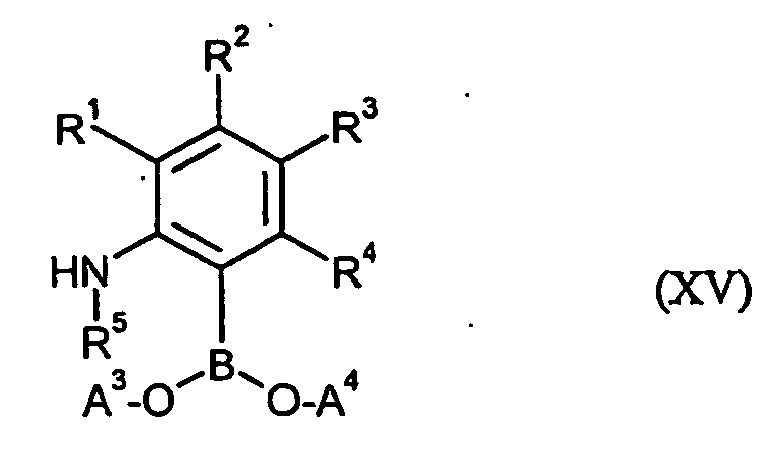
- R1, R2, R3, R4, R5, A3 und A4
- die oben angegebenen Bedeutungen haben,
- k) an oxathiincarboxylic acid derivative of the formula (II)
- G 1 , G 2 , G 3
- and n have the meanings given above and
- X 1
- is halogen or hydroxy,
- R 1 , R 2 , R 3 , R 4 , R 5 , A 3 and A 4
- have the meanings given above,
Verwendet man 6-Trifluormethyl-2,3-dihydro-1,4-oxathiin-5-carbonsäurechlorid und 2-Aminophenylboronsäure als Ausgangsstoffe, so kann der Verlauf des erfindungsgemäßen Verfahrens (k) durch das folgende Formelschema veranschaulicht werden.
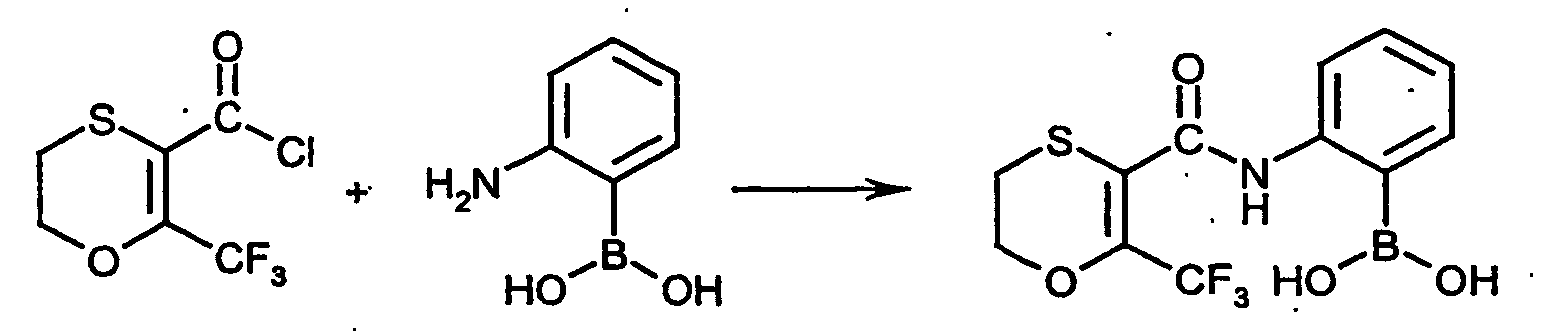
Die zur Durchführung des erfindungsgemäßen Verfahrens (k) als Ausgangsstoffe benötigten Oxathiincarbonsäurederivate der Formel (II) sind bereits weiter oben im Zusammenhang mit dem erfindungsgemäßen Verfahren (a) beschrieben worden.The oxathiincarboxylic acid derivatives of the formula (II) required as starting materials for carrying out the process (k) according to the invention have already been described above in connection with the process (a) according to the invention.
Die weiterhin zur Durchführung des erfindungsgemäßen Verfahrens (k) als Ausgangsstoffe benötigten Anilinboronsäurederivate sind durch die Formel (XV) allgemein definiert. In dieser Formel (XV) haben R1, R2, R3, R4 und R5 bevorzugt, besonders bevorzugt bzw. ganz besonders bevorzugt diejenigen Bedeutungen, die bereits im Zusammenhang mit der Beschreibung der erfindungsgemäßen Verbindungen der Formel (I) als bevorzugt, besonders bevorzugt bzw. ganz besonders bevorzugt für diese Reste angegeben wurden. A3 und A4 stehen jeweils für Wasserstoff oder gemeinsam für Tetramethylethylen.The aniline boronic acid derivatives furthermore required for carrying out the process (k) according to the invention as starting materials are generally defined by the formula (XV). In this formula (XV), R 1, R 2, R 3, R 4 and R 5 are preferred, particularly preferred and very particularly preferably have those meanings already mentioned in connection with the description of compounds of the formula (I) as being preferred, , particularly preferably or very particularly preferably given for these radicals. A 3 and A 4 are each hydrogen or together are tetramethylethylene.
Die Anilinboronsäurederivate der Formel (XV) sind bekannte Synthesechemikalien oder können nach bekannten Verfahren erhalten werden. Im Fall, dass R5 nicht für Wasserstoff steht, kann der Rest R5 auf der Stufe der Verbindungen der Formel (XV) durch übliche Derivatisierungsmethoden eingeführt werden. Es ist auch möglich, zunächst Verbindungen der Formel (VI), in denen R5 für Wasserstoff steht, herzustellen und die erhaltenen Produkte anschließend durch übliche Methoden zu derivatisieren [vgl. das erfindungsgemäße Verfahren (i)].The aniline boronic acid derivatives of formula (XV) are known synthetic chemicals or can be obtained by known methods. In the case that R 5 is not for hydrogen the radical R 5 can be introduced at the stage of the compounds of the formula (XV) by customary derivatization methods. It is also possible first to prepare compounds of the formula (VI) in which R 5 is hydrogen and then to derivatize the products obtained by customary methods [cf. the inventive method (i)].
Die zur Durchführung des erfindungsgemäßen Verfahrens (c) weiterhin als Ausgangsstoffe benötigten Phenyl-Derivate sind durch die Formel (VII) allgemein definiert. In dieser Formel (VII) hat Z1 bevorzugt, besonders bevorzugt bzw. ganz besonders bevorzugt diejenigen Bedeutungen, die bereits im Zusammenhang mit der Beschreibung der erfindungsgemäßen Verbindungen der Formel (I) als bevorzugt, besonders bevorzugt bzw. ganz besonders bevorzugt für Z1 angegeben wurden. X3 steht für Chlor, Brom, Iod oder Trifluormethylsulfonat.The phenyl derivatives which are furthermore required as starting materials for carrying out the process (c) according to the invention are generally defined by the formula (VII). In this formula (VII), Z 1 has preferably, more preferably or very particularly preferably those meanings which have already been mentioned in connection with the description of the compounds of the formula (I) as being preferred, particularly preferred or very particularly preferred for Z 1 were. X 3 is chlorine, bromine, iodine or trifluoromethylsulfonate.
Die Phenyl-Derivate der Formel (VII) sind bekannte Synthesechemikalien.The phenyl derivatives of the formula (VII) are known synthetic chemicals.
Verwendet man N-(2-Bromphenyl)-6-trifluormethyl-2,3-dihydro-1,4-oxathiin-5-carboxamid und 1-Brom-4-chlor-2-fluorbenzol als Ausgangsstoffe sowie einen Katalysator und 4,4,4',4',5,5,5',5'-Octamethyl-2,2'-bis-1,3,2-dioxaborolan, so kann der Verlauf des erfindungsgemäßen Verfahrens (d) durch das folgende Formelschema veranschaulicht werden.

Die zur Durchführung des erfindungsgemäßen Verfahrens (d) als Ausgangsstoffe benötigten Halogenoxathiincarboxmide der Formel (IV), sowie die Phenyl-Derivate der Formel (VII) sind bereits weiter oben im Zusammenhang mit den erfindungsgemäßen Verfahren (b) und (c) beschrieben worden.For carrying out the process (d) required as starting materials Halogenoxathiincarboxmide of formula (IV), and the phenyl derivatives of the formula (VII) have already been described above in connection with the inventive method (b) and (c).
Das weiterhin zur Durchführung des erfindungsgemäßen Verfahrens (d) benötigte 4,4,4',4',5,5,5',5'-Octamethyl-2,2'-bis-1,3,2-dioxaborolan ist eine handelsübliche Synthesechemikalie.The 4,4,4 ', 4', 5,5,5 ', 5'-octamethyl-2,2'-bis-1,3,2-dioxaborolane furthermore required for carrying out the process (d) according to the invention is a commercially available one chemical for synthesis.
Hydriert man beispielsweise N-[2-(1,3-Dimethylbut-1-enyl)phenyl][6-(trifluormethyl)(2,3-dihydro-1,4-oxathiin-5-yl)]carboxamid, so kann der Verlauf des erfindungsgemäßen Verfahrens (e) durch das folgende Formelschema veranschaulicht werden.

Die zur Durchführung des erfindungsgemäßen Verfahrens (e) als Ausgangsstoffe benötigten Oxathiincarboxamide sind durch die Formel (Ia) allgemein definiert. In dieser Formel (Ia) haben G1, G2, G3, n, R1, R2, R3 und R4 bevorzugt, besonders bevorzugt bzw. ganz besonders bevorzugt diejenigen Bedeutungen, die bereits im Zusammenhang mit der Beschreibung der erfindungsgemäßen Verbindungen der Formel (I) als bevorzugt, besonders bevorzugt bzw. ganz besonders bevorzugt für diese Reste bzw. diesen Index angegeben wurden.
- X4
- steht bevorzugt für jeweils gegebenenfalls einfach oder mehrfach, gleich oder verschieden durch Fluor, Chlor, Brom, Iod und/oder C3-C6-Cycloalkyl substituiertes C2-C20-Alkenyl oder C2-C20-Alkinyl steht, wobei der Cycloalkylteil seinerseits gegebenenfalls einfach bis vierfach, gleich oder verschieden durch Fluor, Chlor, Brom, Iod, C1-C4-Alkyl und/oder C1-C4-Halogenalkyl substituiert sein kann.
- X4
- steht besonders bevorzugt für C2-C20-Alkenyl oder C2-C20-Alkinyl.
- X 4
- is preferably in each case optionally mono- or polysubstituted by identical or different fluorine, chlorine, bromine, iodine and / or C 3 -C 6 -cycloalkyl-substituted C 2 -C 20 -alkenyl or C 2 -C 20 -alkynyl, wherein the Cycloalkyl part in turn may optionally be monosubstituted to fourfold, the same or different by fluorine, chlorine, bromine, iodine, C 1 -C 4 alkyl and / or C 1 -C 4 haloalkyl may be substituted.
- X 4
- is particularly preferably C 2 -C 20 alkenyl or C 2 -C 20 alkynyl.
Die Verbindungen der Formel (Ia) sind erfindungsgemäße Verbindungen und können nach den Verfahren (a), (f), (g) oder (h) hergestellt werden.The compounds of the formula (Ia) are compounds according to the invention and can be prepared by the processes (a), (f), (g) or (h).
Dehydratisiert man beispielsweise N-[2-(1-Hydroxy-1,3-dimethylbutyl)phenyl][6-trifluormethyl)(2,3-dihydro-1,4-oxathiin-5-yl)]carboxamid, so kann der Verlauf des erfindungsgemäßen Verfahrens (f) durch das folgende Formelschema veranschaulicht werden.
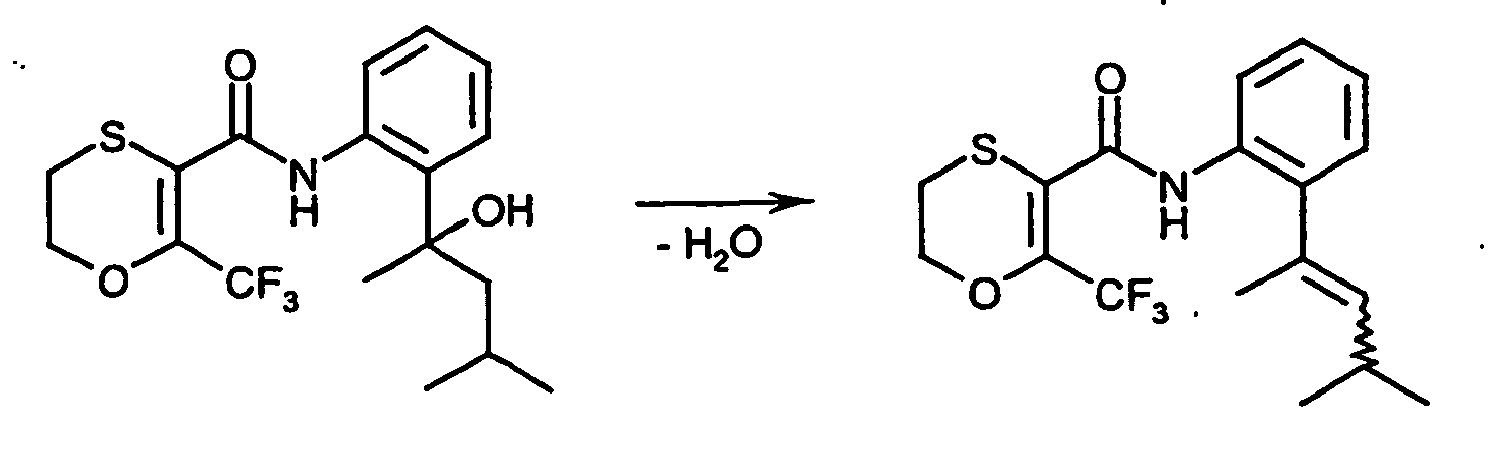
Die zur Durchführung des erfindungsgemäßen Verfahrens (f) als Ausgangsstoffe benötigten Hydroxyalkyloxathiincarboxamide sind durch die Formel (VIII) allgemein definiert. In dieser Formel (VIII) haben G1, G2, G3, n, R1, R2, R3, R4 und R5 bevorzugt, besonders bevorzugt bzw. ganz besonders bevorzugt diejenigen Bedeutungen, die bereits im Zusammenhang mit der Beschreibung der erfindungsgemäßen Verbindungen der Formel (I) als bevorzugt, besonders bevorzugt bzw. ganz besonders bevorzugt für diese Reste bzw. diesen Index angegeben wurden.
- X5
- steht bevorzugt für gegebenenfalls zusätzlich einfach bis vierfach, gleich oder verschieden durch Chlor, Fluor, Brom und/oder C3-C6-Cycloalkyl substituiertes C2-C12- Hydroxyalkyl, wobei der Cycloalkylteil seinerseits gegebenenfalls durch Halogen und/oder C1-C4-Alkyl substituiert sein kann.
- X5
- steht besonders bevorzugt für gegebenenfalls einfach bis vierfach, gleich oder verschieden durch Fluor, Cyclopropyl, Difluorcyclopropyl, Cyclobutyl, Cyclopentyl und/oder Cyclohexyl substituiertes, jeweils geradkettiges oder verzweigtes, jeweils an beliebiger Stelle verknüpftes Hydroxyethyl, Hydroxypropyl, Hydroxybutyl, Hydroxypentyl, Hydroxyhexyl, Hydroxyheptyl, Hydroxyoctyl, Hydroxynonyl oder Hydroxydecyl.
- X 5
- preferably represents optionally additionally monosubstituted to tetrasubstituted by identical or different substituents from chlorine, fluorine, bromine and / or C 3 -C 6 cycloalkyl-substituted C 2 -C 12 - hydroxyalkyl, where the cycloalkyl moiety for its part is optionally substituted by halogen and / or C 1 - C 4 alkyl may be substituted.
- X 5
- is particularly preferably optionally monosubstituted to trisubstituted by fluorine, cyclopropyl, difluorocyclopropyl, cyclobutyl, cyclopentyl and / or cyclohexyl, in each case straight-chain or branched, in each case linked to hydroxyethyl, hydroxypropyl, hydroxybutyl, hydroxypentyl, hydroxyhexyl, hydroxyheptyl, Hydroxyoctyl, hydroxynonyl or hydroxydecyl.
Die Verbindungen der Formel (VIII) sind noch nicht bekannt und als neue Verbindungen ebenfalls Gegenstand der vorliegenden Anmeldung:The compounds of the formula (VIII) are not yet known and are also the subject of the present application as novel compounds:
Es wurde auch gefunden, dass die Hydroxyalkylpyrazolylcarboxamide der Formel (VIII) sehr gute mikrobizide Eigenschaften besitzen und zur Bekämpfung unerwünschter Mikroorganismen sowohl im Pflanzenschutz als auch im Materialschutz eingesetzt werden können.It has also been found that the hydroxyalkylpyrazolylcarboxamides of the formula (VIII) have very good microbicidal properties and can be used for controlling unwanted microorganisms both in crop protection and in the protection of materials.
Die Hydroxyalkylpyrazolylcarboxamide der Formel (VIII) werden erhalten, indem man
- l) Oxathiincarbonsäurederivate der Formel (II)

- G1, G2, G3
- und n die oben angegebenen Bedeutungen haben und
- X1
- für Halogen oder Hydroxy steht,
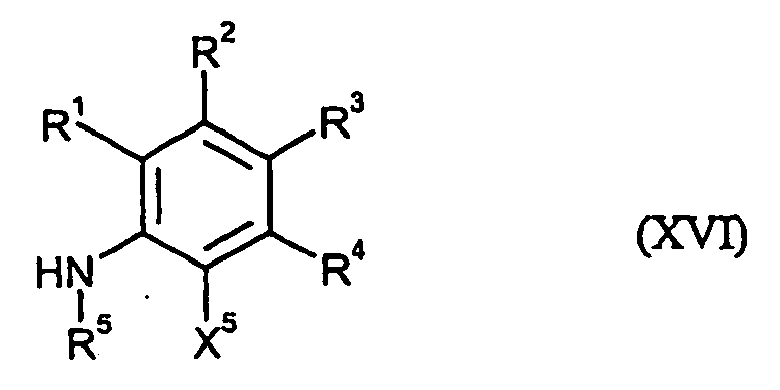
- R1, R2, R3, R4, R5 und X5
- die oben angegebenen Bedeutungen haben,
- I) oxathiocarboxylic acid derivatives of the formula (II)
- G 1 , G 2 , G 3
- and n have the meanings given above and
- X 1
- is halogen or hydroxy,
- R 1 , R 2 , R 3 , R 4 , R 5 and X 5
- have the meanings given above,
Verwendet man beispielsweise 6-Trifluormethyl-2,3-dihydro-1,4-oxathiin-5-carbonsäurechlorid und 2-(2-Aminophenyl)-2-heptanol als Ausgangsstoffe, so kann der Verlauf des erfindungsgemäßen Verfahrens (1) durch das folgende Formelschema veranschaulicht werden:

Die zur Durchführung des erfindungsgemäßen Verfahrens (1) als Ausgangsstoffe benötigten Oxathiincarbonsäurederivate der Formel (II) sind bereits weiter oben im Zusammenhang mit dem erfindungsgemäßen Verfahren (a) beschrieben worden.For carrying out the process (1) required as starting materials Oxathiincarbonsäurederivate of formula (II) have already been described above in connection with the inventive method (a).
Die zur Durchführung des erfindungsgemäßen Verfahrens (l) als Ausgangsstoffe weiterhin benötigten Hydroxyalkylanilinderivate sind durch die Formel (XVI) allgemein definiert. In dieser Formel (XVI) haben R1, R2, R3, R4, R5 und X5 bevorzugt, besonders bevorzugt bzw. ganz besonders bevorzugt diejenigen Bedeutungen, die bereits im Zusammenhang mit der Beschreibung der erfindungsgemäßen Verbindungen der Formeln (I) bzw. (VIII) als bevorzugt, besonders bevorzugt bzw. ganz besonders bevorzugt für diese Reste angegeben wurden.The hydroxyalkylaniline derivatives which are furthermore required as starting materials for carrying out process (1) according to the invention are generally defined by the formula (XVI). In this formula (XVI), R 1, R 2, R 3, R 4, R 5 and X 5 are preferred, particularly preferred and very particularly preferably have those meanings which (already in connection with the description of the compounds of the formulas I ) or (VIII) have been given as preferred, particularly preferred or very particularly preferred for these radicals.
Die Hydroxyalkylanilinderivate der Formel (XVI) sind bekannt und/oder können nach bekannten Methoden erhalten werden (vgl. z.B.
Verwendet man beispielsweise N-(2-Bromphenyl)-6-trifluormethyl-2,3-dihydro-1,4-oxathiin-5-carboxamid und 1-Hexin als Ausgangsstoffe sowie einen Katalysator, so kann der Verlauf des erfindungsgemäßen Verfahrens (g) durch das folgende Formelschema veranschaulicht werden.

Die zur Durchführung des erfindungsgemäßen Verfahrens (g) als Ausgangsstoffe benötigten Halogenoxathiincarboxamide der Formel (IV) sind bereits weiter oben im Zusammenhang mit dem erfindungsgemäßen Verfahrens (c) beschrieben worden.The halogenoxathiincarboxamides of the formula (IV) required as starting materials for carrying out the process (g) according to the invention have already been described above in connection with the process (c) according to the invention.
Die zur Durchführung des erfindungsgemäßen Verfahrens (g) weiterhin als Ausgangsstoffe benötigten Alkine sind durch die Formel (IX) allgemein definiert.
- A5
- steht bevorzugt für gegebenenfalls einfach bis vierfach, gleich oder verschieden durch Fluor, Chlor, Brom und/oder C3-C6-Cycloalkyl substituiertes C2-C10-Alkyl, wobei der Cycloalkylteil seinerseits gegebenenfalls durch Halogen und/oder C1-C4-Alkyl substituiert sein kann.
- A5
- steht besonders bevorzugt für gegebenenfalls einfach bis vierfach, gleich oder verschieden durch Fluor, Cyclopropyl, Difluorcyclopropyl, Cyclobutyl, Cyclopentyl und/oder Cyclohexyl substituiertes, jeweils geradkettiges oder verzweigtes, jeweils an beliebiger Stelle verknüpftes Ethyl, Propyl, Butyl, Pentyl, Hexyl, Heptyl oder Octyl.
- A 5
- preferably represents optionally mono- to tetrasubstituted by identical or different fluorine, chlorine, bromine and / or C 3 -C 6 cycloalkyl-substituted C 2 -C 10 alkyl, where the cycloalkyl moiety for its part is optionally substituted by halogen and / or C 1 -C 4- alkyl may be substituted.
- A 5
- is particularly preferably optionally mono- or di-allyl, identically or differently substituted by fluoro, cyclopropyl, difluorocyclopropyl, cyclobutyl, cyclopentyl and / or cyclohexyl, in each case straight-chain or branched, in each case linked at any position ethyl, propyl, butyl, pentyl, hexyl, heptyl or octyl.
Die Alkine der Formel (VI) sind bekannte Synthesechemikalien.The alkynes of formula (VI) are known synthetic chemicals.
Die zur Durchführung des erfindungsgemäßen Verfahrens (g) weiterhin alternativ als Ausgangsstoffe benötigten Alkene sind durch die Formel (X) allgemein definiert.
- A6, A7 und A8
- stehen unabhängig voneinander bevorzugt jeweils für Wasserstoff oder gegebenenfalls einfach bis vierfach, gleich oder verschieden durch Fluor, Chlor, Brom und/oder C3-C6-Cycloalkyl substituiertes Alkyl, wobei der Cycloalkylteil seinerseits gegebenenfalls durch Halogen und/oder C1-C4-Alkyl substituiert sein kann und die Gesamtzahl der Kohlenstoffatome des offenkettigen Molekülteils die Zahl 12 nicht übersteigt.
- A6, A7 und A8
- stehen unabhängig voneinander besonders bevorzugt jeweils für Wasserstoff oder gegebenenfalls einfach bis vierfach, gleich oder verschieden durch Fluor, Cyclopropyl, Difluorcyclopropyl, Cyclobutyl, Cyclopentyl und/ oder Cyclohexyl substituiertes, jeweils geradkettiges oder verzweigtes, jeweils an beliebiger Stelle verknüpftes Ethyl, Propyl, Butyl, Pentyl, Hexyl, Heptyl oder Octyl, wobei die Gesamtzahl der Kohlenstoffatome des offenkettigen Molekülteils die Zahl 12 nicht übersteigt.
- A 6 , A 7 and A 8
- are each independently of the other preferably hydrogen or optionally monosubstituted to trisubstituted, identically or differently by fluorine, chlorine, bromine and / or C 3 -C 6 -cycloalkyl-substituted alkyl, wherein the cycloalkyl moiety in turn optionally substituted by halogen and / or C 1 -C 4 Alkyl may be substituted and the total number of carbon atoms of the open-chain molecular moiety does not exceed the number 12.
- A 6 , A 7 and A 8
- independently of one another are particularly preferably in each case hydrogen or optionally mono- to di-ore, identically or differently substituted by fluoro, cyclopropyl, difluorocyclopropyl, cyclobutyl, cyclopentyl and / or cyclohexyl, in each case straight-chain or branched, in each case linked to ethyl, propyl, butyl, pentyl , Hexyl, heptyl or octyl, wherein the total number of carbon atoms of the open-chain moiety does not exceed 12.
Die Alkene der Formel (VII) sind bekannte Synthesechemikalien.The alkenes of formula (VII) are known synthetic chemicals.
Verwendet man N-(2-Acetylphenyl)[6-(trifluormethyl)(2,3-dihydro-1,4-oxathiin-5-yl)]-carboxamid und Butyl(triphenyl)-phosphonium-iodid als Ausgangsstoffe, so kann der Verlauf des erfindungsgemäßen Verfahrens (h) durch das folgende Formelschema veranschaulicht werden:

Die zur Durchführung des erfindungsgemäßen Verfahrens (h) als Ausgangsstoffe benötigten Ketone sind durch die Formel (XI) allgemein definiert. In dieser Formel haben G1, G2, G3, n, R1, R2, R3, R4 und R5 bevorzugt, besonders bevorzugt bzw. ganz besonders bevorzugt diejenigen Bedeutungen, die bereits im Zusammenhang mit der Beschreibung der erfindungsgemäßen Verbindungen der Formel (I) als bevorzugt, besonders bevorzugt bzw. ganz besonders bevorzugt für diese Reste bzw. diesen Index angegeben wurden.
- A9
- steht bevorzugt für gegebenenfalls einfach bis vierfach, gleich oder verschieden durch Fluor, Chlor, Brom und/oder C3-C6-Cycloalkyl substituiertes C2-C10-Alkyl, wobei der Cycloalkylteil seinerseits gegebenenfalls durch Halogen und/oder C1-C4-Alkyl substituiert sein kann.
- A9
- steht besonders bevorzugt für gegebenenfalls einfach bis vierfach, gleich oder verschieden durch Fluor, Cyclopropyl, Difluorcyclopropyl, Cyclobutyl, Cyclopentyl und/oder Cyclohexyl substituiertes, jeweils geradkettiges oder verzweigtes, jeweils an beliebiger Stelle verknüpftes Ethyl, Propyl, Butyl, Pentyl, Hexyl, Heptyl oder Octyl.
- A 9
- preferably represents optionally mono- to tetrasubstituted by identical or different fluorine, chlorine, bromine and / or C 3 -C 6 cycloalkyl-substituted C 2 -C 10 alkyl, where the cycloalkyl moiety for its part is optionally substituted by halogen and / or C 1 -C 4- alkyl may be substituted.
- A 9
- is particularly preferably optionally mono- or di-allyl, identically or differently substituted by fluoro, cyclopropyl, difluorocyclopropyl, cyclobutyl, cyclopentyl and / or cyclohexyl, in each case straight-chain or branched, in each case linked at any position ethyl, propyl, butyl, pentyl, hexyl, heptyl or octyl.
Die Ketone der Formel (XI) sind noch nicht bekannt. Sie sind als neue chemische Verbindungen ebenfalls Gegenstand der vorliegenden Anmeldung. Sie werden erhalten, indem man
- m) Oxathiincarbonsäurederivate der Formel (II)

- G1, G2, G3
- und n die oben angegebenen Bedeutungen haben und
- X1
- für Halogen oder Hydroxy steht,

- R1, R2, R3, R4, R5 und A9
- die oben angegebenen Bedeutungen haben,
- m) oxathiincarboxylic acid derivatives of the formula (II)
- G 1 , G 2 , G 3
- and n have the meanings given above and
- X 1
- is halogen or hydroxy,
- R 1 , R 2 , R 3 , R 4 , R 5 and A 9
- have the meanings given above,
Verwendet man 6-Trifluornlethyl-2,3-dihydro-1,4-oxathiin-5-carbonsäurechlorid und 1-(2-Aminophenym)ethanon als Ausgangsstoffe, so kann der Verlauf des erfindungsgemäßen Verfahrens (m) durch das folgende Formelschema veranschaulicht werden:

Die zur Durchführung des erfindungsgemäßen Verfahrens (m) als Ausgangsstoffe benötigten Oxathiincarbonsäurederivate der Formel (II) sind bereits weiter oben im Zusammenhang mit dem erfindungsgemäßen Verfahrens a) beschrieben worden.The oxathiincarboxylic acid derivatives of the formula (II) required as starting materials for carrying out the process (m) according to the invention have already been described above in connection with the process a) according to the invention.
Die zur Durchführung des erfindungsgemäßen Verfahrens (m) weiterhin als Ausgangsstoffe benötigten Ketoaniline sind durch die Formel (XVII) allgemein definiert. In dieser Formel (XVII) haben R1, R2, R3, R4, R5 und A9 bevorzugt, besonders bevorzugt bzw. ganz besonders bevorzugt diejenigen Bedeutungen, die bereits im Zusammenhang mit der Beschreibung der erfindungsgemäßen Verbindungen der Formeln (I) bzw. (XI) als bevorzugt, besonders bevorzugt bzw. ganz besonders bevorzugt für diese Reste angegeben wurden.The ketoanilines which are furthermore required as starting materials for carrying out the process (m) according to the invention are generally defined by the formula (XVII). In this formula (XVII), R 1, R 2, R 3, R 4, R 5 and A 9 preferred, particularly preferred and very particularly preferably have those meanings which (already in connection with the description of the compounds of the formulas I ) or (XI) are given as preferred, particularly preferred or very particularly preferred for these radicals.
Die Ketoaniline der Formel (XII) sind allgemein übliche Synthesechemikalien (vgl. z.B.
Die zur Durchführung des erfindungsgemäßen Verfahrens (h) weiterhin als Ausgangsstoffe benötigten Phosphorverbindungen sind durch die Formel (XII) allgemein definiert.
- A10
- steht bevorzugt für gegebenenfalls einfach bis vierfach, gleich oder verschieden durch Chlor, Fluor, Brom und/oder C3-C6-Cycloalkyl substituiertes C2-C10-Alkyl, wobei der Cycloalkylteil seinerseits gegebenenfalls durch Halogen und/oder C1-C4-Alkyl substituiert sein kann.
- A10
- steht besonders bevorzugt für gegebenenfalls einfach bis vierfach, gleich oder verschieden durch Fluor, Cyclopropyl, Difluorcyclopropyl, Cyclobutyl, Cyclopentyl und/oder Cyclohexyl substituiertes, jeweils geradkettiges oder verzweigtes, jeweils an beliebiger Stelle verknüpftes Ethyl, Propyl, Butyl, Pentyl, Hexyl, Heptyl oder Octyl.
- Px
- steht bevorzugt für eine Gruppierung -P+(C6H5)3 Cl-, -P+(C6H5)3 Br-, -P+(C6H5)3 I-, -P(=O)(OCH3)3 oder -P(=O)(OC2H5)3.
- A 10
- preferably represents optionally mono- to tetrasubstituted by identical or different substituents from chlorine, fluorine, bromine and / or C 3 -C 6 cycloalkyl-substituted C 2 -C 10 alkyl, where the cycloalkyl moiety for its part is optionally substituted by halogen and / or C 1 -C 4- alkyl may be substituted.
- A 10
- is particularly preferably optionally mono- or di-allyl, identically or differently substituted by fluoro, cyclopropyl, difluorocyclopropyl, cyclobutyl, cyclopentyl and / or cyclohexyl, in each case straight-chain or branched, in each case linked at any position ethyl, propyl, butyl, pentyl, hexyl, heptyl or octyl.
- px
- is preferably a grouping -P + (C 6 H 5 ) 3 Cl - , -P + (C 6 H 5 ) 3 Br - , -P + (C 6 H 5 ) 3 I - , -P (= O) (OCH 3 ) 3 or -P (= O) (OC 2 H 5 ) 3 .
Die Phosphorverbindungen der Formel (XII) sind bekannt und/oder können nach bekannten Verfahren hergestellt werden (vgl. z.B.
Verwendet man N-[2-(1,3-Dimethylbutyl)phenyl]-2-(trifluormethyl)-5,6-dihydro-1,4-oxathiin-3-carboxamid und Acetylchlorid als Ausgangsstoffe, so kann der Verlauf des erfindungsgemäßen Verfahrens (i) durch das folgende Formelschema veranschaulicht werden:
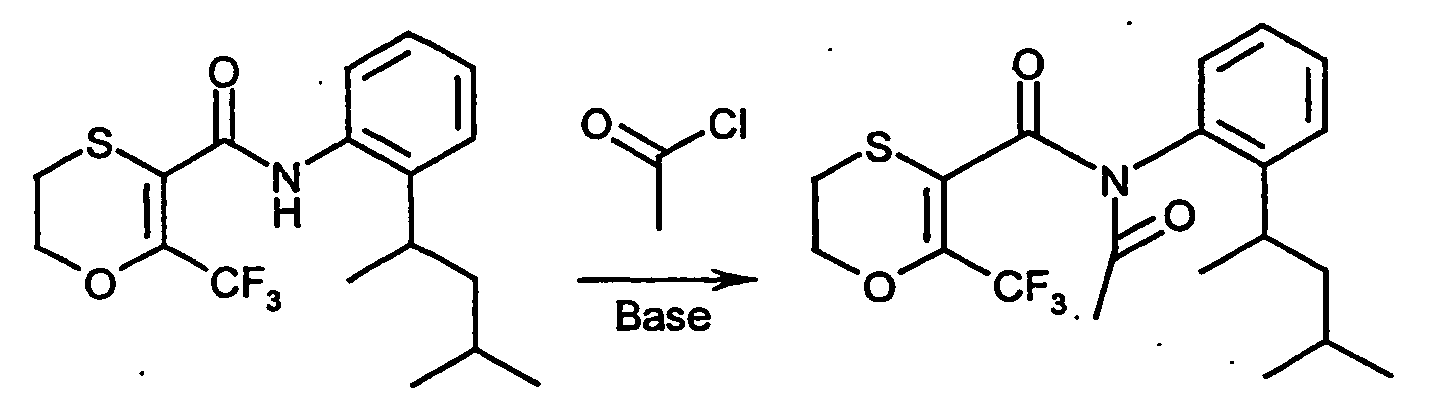
Die zur Durchführung des erfindungsgemäßen Verfahrens (i) als Ausgangsstoffe benötigten Iodpyrazolylcarboxanilide sind durch die Formel (Ib) allgemein definiert. In dieser Formel (Ib) haben G1, G2, G3, n, R1, R2, R3, R4 und Z bevorzugt, besonders bevorzugt bzw. ganz besonders bevorzugt diejenigen Bedeutungen, die bereits im Zusammenhang mit der Beschreibung der erfindungsgemäßen Verbindungen der Formel (I) als bevorzugt, besonders bevorzugt bzw. ganz besonders bevorzugt für diese Reste bzw. diesen Index angegeben wurden.The iodopyrazolylcarboxanilides required as starting materials for carrying out the process (i) according to the invention are generally defined by the formula (Ib). In this formula (Ib), G 1 , G 2 , G 3 , n, R 1 , R 2 , R 3 , R 4 and Z have preferably, more preferably or very particularly preferably those meanings which have already been described in connection with the description the compounds of the formula (I) according to the invention have been indicated as being preferred, particularly preferred or very particularly preferred for these radicals or this index.
Die Verbindungen der Formel (Ib) sind erfindungsgemäße Verbindungen und können nach den Verfahren (a) bis (h) hergestellt werden.The compounds of the formula (Ib) are compounds according to the invention and can be prepared by the processes (a) to (h).
Die zur Durchführung des erfindungsgemäßen Verfahrens (i) weiterhin als Ausgangsstoffe benötigten Halogenide sind durch die Formel (XIII) allgemein definiert. In dieser Formel (XIII) steht R5-1 bevorzugt, besonders bevorzugt bzw. ganz besonders bevorzugt für diejenigen Bedeutungen, die bereits oben in Zusammenhang mit der Beschreibung der Verbindungen der Formel (Ig) als bevorzugt, besonders bevorzugt bzw. ganz besonders bevorzugt für diese Reste angegeben wurden. X6 steht für Chlor, Brom oder Iod.The halides which are furthermore required as starting materials for carrying out the process (i) according to the invention are generally defined by the formula (XIII). In this formula (XIII), R 5-1 is preferred, particularly preferably or very particularly preferably for those meanings which have already been mentioned above in connection with the description of the compounds of the formula (Ig) are given as preferred, particularly preferred or very particularly preferred for these radicals. X 6 is chlorine, bromine or iodine.
Halogenide der Formel (XIII) sind bekannt.Halides of the formula (XIII) are known.
Als Verdünnungsmittel zur Durchführung der erfindungsgemäßen Verfahren (a), (j), (k), (1) und (m) kommen alle inerten organischen Lösungsmittel in Betracht. Hierzu gehören vorzugsweise aliphatische, alicyclische oder aromatische Kohlenwasserstoffe, wie beispielsweise Petrolether, Hexan, Heptan, Cyclohexan, Methylcyclohexan, Benzol, Toluol, Xylol oder Decalin; halogenierte Kohlenwasserstoffe, wie beispielsweise Chlorbenzol, Dichlorbenzol, Dichlormethan, Chloroform, Tetrachlormethan, Dichlorethan oder Trichlorethan; Ether, wie Diethylether, Diisopropylether, Methyl-t-butylether, Methyl-t-Amylether, Dioxan, Tetrahydrofuran, 1,2- Dimethoxyethan, 1,2-Diethoxyethan oder Anisol; Ketone, wie Aceton, Butanon, Methyl-isobutylketon oder Cyclohexanon; Nitrile, wie Acetonitril, Propionitril, n- oder i-Butyronitril oder Benzonitril; Amide, wie N,N-Dimethylformamid, N,N-Dimethylacetamid, N-Methylformanilid, N-Methylpyrrolidon oder Hexamethylphosphorsäuretriamid; deren Gemische mit Wasser oder reines Wasser.Suitable diluents for carrying out the processes (a), (j), (k), (1) and (m) according to the invention are all inert organic solvents. These include, preferably, aliphatic, alicyclic or aromatic hydrocarbons, such as, for example, petroleum ether, hexane, heptane, cyclohexane, methylcyclohexane, benzene, toluene, xylene or decalin; halogenated hydrocarbons, such as chlorobenzene, dichlorobenzene, dichloromethane, chloroform, carbon tetrachloride, dichloroethane or trichloroethane; Ethers, such as diethyl ether, diisopropyl ether, methyl t-butyl ether, methyl t-amyl ether, dioxane, tetrahydrofuran, 1,2-dimethoxyethane, 1,2-diethoxyethane or anisole; Ketones such as acetone, butanone, methyl isobutyl ketone or cyclohexanone; Nitriles, such as acetonitrile, propionitrile, n- or i-butyronitrile or benzonitrile; Amides, such as N, N-dimethylformamide, N, N-dimethylacetamide, N-methylformanilide, N-methylpyrrolidone or hexamethylphosphoric triamide; their mixtures with water or pure water.
Die erfindungsgemäßen Verfahren (a), (j), (k), (l) und (m) werden gegebenenfalls in Gegenwart eines geeigneten Säureakzeptors durchgeführt. Als solche kommen alle üblichen anorganischen oder organischen Basen infrage. Hierzu gehören vorzugsweise Erdalkalimetall- oder Alkalimetallhydride, -hydroxide, -amide, -alkoholate, -acetate, -carbonate oder -hydrogencarbonate, wie beispielsweise Natriumhydrid, Natriumamid, Lithiumdiisopropylamid, Natrium-methylat, Natrium-ethylat, Kalium-tert.-butylat, Natriumhydroxid, Kaliumhydroxid, Natriumacetat, Natriumcarbonat, Kaliumcarbonat, Kaliumhydrogencarbonat, Natriumhydrogencarbonat oder Ammoniumcarbonat, sowie tertiäre Amine, wie Trimethylamin, Triethylamin, Tributylamin, N,N-Dimethylanilin, N,N-Dimethyl-benzylamin, Pyridin, N-Methylpiperidin, N-Methylmorpholin, N,N-Dimethylaminopyridin, Diazabicyclooctan (DABCO), Diazabicyclononen (DBN) oder Diazabicycloundecen (DBU).The processes (a), (j), (k), (l) and (m) according to the invention are optionally carried out in the presence of a suitable acid acceptor. As such, all customary inorganic or organic bases are suitable. These preferably include alkaline earth metal or alkali metal hydrides, hydroxides, amides, alkoxides, acetates, carbonates or bicarbonates, such as sodium hydride, sodium amide, lithium diisopropylamide, sodium methoxide, sodium ethoxide, potassium tert-butoxide, sodium hydroxide , Potassium hydroxide, sodium acetate, sodium carbonate, potassium carbonate, potassium hydrogencarbonate, sodium bicarbonate or ammonium carbonate, and also tertiary amines, such as trimethylamine, triethylamine, tributylamine, N, N-dimethylaniline, N, N-dimethylbenzylamine, pyridine, N-methylpiperidine, N-methylmorpholine, N, N-dimethylaminopyridine, diazabicyclooctane (DABCO), diazabicyclononene (DBN) or diazabicycloundecene (DBU).
Die erfindungsgemäßen Verfahren (a), (j), (k), (l) und (m) werden gegebenenfalls in Gegenwart eines geeigneten Kondensationsmittels durchgeführt. Als solche kommen alle üblicherweise für derartige Amidierungsreaktionen verwendbaren Kondensationsmittel infrage. Beispielhaft genannt seien Säurehalogenidbildner wie Phosgen, Phosphortribromid, Phosphortrichlorid, Phosphorpentachlorid, Phosphoroxychlorid oder Thionylchlorid; Anhydridbildner wie Chlorameisensäureethylester, Chlorameisensäuremethylester, Chlorameisensäureisopropylester, Chlorameisensäureisobutylester oder Methansulfonylchlorid; Carbodiimide, wie N,N-Dicyclohexylcarbodiimid (DCC) oder andere übliche Kondensationsmittel, wie Phosphorpentoxid, Polyphosphorsäure, N.N'-Carbonyldiimidazol, 2-Ethoxy-N-ethoxycarbonyl-1,2-dihydrochinolin (EEDQ), Triphenylphosphin/Tetrachlorkohlenstoff oder Brom-tripyrrolidinophosphonium-hexafluorophosphat.The processes (a), (j), (k), (l) and (m) according to the invention are optionally carried out in the presence of a suitable condensing agent. As such, all conventionally usable for such amidation reactions condensing agent come into question. Examples which may be mentioned are acid halide formers such as phosgene, phosphorus tribromide, phosphorus trichloride, phosphorus pentachloride, phosphorus oxychloride or thionyl chloride; anhydride formers such as ethyl chloroformate, methyl chloroformate, isopropyl chloroformate, isobutyl chloroformate or methanesulfonyl chloride; Carbodiimides such as N, N-dicyclohexylcarbodiimide (DCC) or other conventional condensing agents such as phosphorus pentoxide, polyphosphoric acid, N, N'-carbonyldiimidazole, 2-ethoxy-N-ethoxycarbonyl-1,2-dihydroquinoline (EEDQ), triphenylphosphine / carbon tetrachloride or bromine -tripyrrolidinophosphonium hexafluorophosphate.
Die erfindungsgemäßen Verfahren (a), (j), (k), (l) und (m) werden gegebenenfalls in Gegenwart eines Katalysators durchgeführt. Beispielsweise genannt seien 4-Dimethylaminopyridin, 1-Hydroxy-benzotriazol oder Dimethylformamid.The processes (a), (j), (k), (l) and (m) according to the invention are optionally carried out in the presence of a catalyst. Examples which may be mentioned are 4-dimethylaminopyridine, 1-hydroxybenzotriazole or dimethylformamide.
Die Reaktionstemperaturen können bei der Durchführung der erfindungsgemäßen Verfahren (a), (j), (k), (l) und (m) in einem größeren Bereich variiert werden. Im allgemeinen arbeitet man bei Temperaturen von 0°C bis 150°C; vorzugsweise bei Temperaturen von 0°C bis 80°C.The reaction temperatures can be varied within a substantial range when carrying out the processes (a), (j), (k), (l) and (m) according to the invention. In general, one works at temperatures of 0 ° C to 150 ° C; preferably at temperatures from 0 ° C to 80 ° C.
Zur Durchführung des erfindungsgemäßen Verfahrens (a) zur Herstellung der Verbindungen der Formel (I) setzt man pro Mol des Oxathiincarbonsäurederivates der Formel (II) im Allgemeinen 0,8 bis 15 Mol, vorzugsweise 0,8 bis 8 Mol an Anilin-Derivat der Formel (III) ein.For carrying out process (a) according to the invention for preparing the compounds of the formula (I), in general 0.8 to 15 mol, preferably 0.8 to 8 mol, of aniline derivative of the formula are employed per mole of the oxathiincarboxylic acid derivative of the formula (II) (III).
Zur Durchführung des erfindungsgemäßen Verfahrens (j) zur Herstellung der Verbindungen der Formel (IV) setzt man pro Mol des Oxathiincarbonsäurederivates der Formel (II) im Allgemeinen 0,8 bis 15 Mol, vorzugsweise 0,8 bis 8 Mol an Halogenaniline der Formel (XIV) ein.For carrying out the process (j) according to the invention for the preparation of the compounds of the formula (IV), in general from 0.8 to 15 mol, preferably from 0.8 to 8 mol, of haloanilines of the formula (XIV) are employed per mole of the oxathiincarboxylic acid derivative of the formula (II) ) one.
Zur Durchführung des erfindungsgemäßen Verfahrens (k) zur Herstellung der Verbindungen der Formel (VI) setzt man pro Mol des Oxathiincarbonsäurederivates der Formel (II) im Allgemeinen 0,8 bis 15 Mol, vorzugsweise 0,8 bis 8 Mol an Anilinboronsäurederivat der Formel (XV) ein.For carrying out the process (k) according to the invention for preparing the compounds of the formula (VI), in general from 0.8 to 15 mol, preferably from 0.8 to 8 mol, of anilinboronic acid derivative of the formula (XV) are employed per mole of the oxathiincarboxylic acid derivative of the formula (II) ) one.
Zur Durchführung des erfindungsgemäßen Verfahrens (1) zur Herstellung der Verbindungen der Formel (VIII) setzt man pro Mol des Oxathiincarbonsäurederivates der Formel (II) im Allgemeinen 0,8 bis 15 Mol, vorzugsweise 0,8 bis 8 Mol an Hydroxyalkylanilinderivat der Formel (XVI) ein.For carrying out the process (1) according to the invention for the preparation of the compounds of the formula (VIII), in general 0.8 to 15 mol, preferably 0.8 to 8 mol, of hydroxyalkylaniline derivative of the formula (XVI) are employed per mole of the oxathiincarboxylic acid derivative of the formula (II) ) one.
Zur Durchführung des erfindungsgemäßen Verfahrens (m) zur Herstellung der Verbindungen der Formel (IX) setzt man pro Mol des Oxathiincarbonsäurederivates der Formel (II) im Allgemeinen 0,8 bis 15 Mol, vorzugsweise 0,8 bis 8 Mol an Ketoanilin der Formel (XVII) ein.For carrying out the process (m) according to the invention for preparing the compounds of the formula (IX), in general from 0.8 to 15 mol, preferably from 0.8 to 8 mol, of ketoaniline of the formula (XVII) are added per mole of the oxathiincarboxylic acid derivative of the formula (II) ) one.
Als Verdünnungsmittel zur Durchführung der erfindungsgemäßen Verfahren (b), (c) und (d) kommen alle inerten organischen Lösungsmittel in Betracht. Hierzu gehören vorzugsweise aliphatische, alicyclische oder aromatische Kohlenwasserstoffe, wie z.B. Petrolether, Hexan, Heptan, Cyclohexan, Methylcyclohexan, Benzol, Toluol, Xylol oder Decalin; Ether, wie Diethylether, Diisopropylether, Methyl-t-butylether, Methyl-t-Amylether, Dioxan, Tetrahydrofuran, 1,2-Dimethoxyethan, 1,2-Diethoxyethan oder Anisol; Nitrile, wie Acetonitril, Propionitril, n- oder i-Butyronitril oder Benzonitril; Amide, wie N,N-Dimethylformamid, N,N-Dimethylacetamid, N-Methylformanilid, N-Methylpyrrolidon oder Hexamethylphosphorsäuretriamid; Ester wie Essigsäuremethylester oder Essigsäureethylester, Sulfoxide, wie Dimethylsulfoxid; Sulfone, wie Sulfolan; Alkohole, wie Methanol, Ethanol, n- oder i-Propanol, n-, i-, sek- oder tert-Butanol, Ethandiol, Propan-1,2-diol, Ethoxyethanol, Methoxyethanol, Diethylenglykolmonomethylether, Diethylenglykolmonoethylether, deren Gemische mit Wasser oder reines Wasser.Suitable diluents for carrying out the processes (b), (c) and (d) according to the invention are all inert organic solvents. These include, preferably, aliphatic, alicyclic or aromatic hydrocarbons, e.g. Petroleum ether, hexane, heptane, cyclohexane, methylcyclohexane, benzene, toluene, xylene or decalin; Ethers, such as diethyl ether, diisopropyl ether, methyl t-butyl ether, methyl t-amyl ether, dioxane, tetrahydrofuran, 1,2-dimethoxyethane, 1,2-diethoxyethane or anisole; Nitriles, such as acetonitrile, propionitrile, n- or i-butyronitrile or benzonitrile; Amides, such as N, N-dimethylformamide, N, N-dimethylacetamide, N-methylformanilide, N-methylpyrrolidone or hexamethylphosphoric triamide; Esters such as methyl acetate or ethyl acetate, sulfoxides such as dimethyl sulfoxide; Sulfones, such as sulfolane; Alcohols such as methanol, ethanol, n- or i-propanol, n-, i-, sec- or tert-butanol, ethanediol, propane-1,2-diol, ethoxyethanol, methoxyethanol, diethylene glycol monomethyl ether, diethylene glycol monoethyl ether, mixtures thereof with water or pure water.
Die Reaktionstemperaturen können bei der Durchführung der erfindungsgemäßen Verfahren (b), (c) und (d) in einem größeren Bereich variiert werden. Im allgemeinen arbeitet man bei Temperaturen von 0°C bis 180°C, vorzugsweise bei Temperaturen von 20°C bis 150°C.The reaction temperatures can be varied within a substantial range when carrying out the processes (b), (c) and (d) according to the invention. In general, one works at temperatures of 0 ° C to 180 ° C, preferably at temperatures of 20 ° C to 150 ° C.
Die der erfindungsgemäßen Verfahren (b), (c) und (d) werden gegebenenfalls in Gegenwart eines geeigneten Säureakzeptors durchgeführt. Als solche kommen alle üblichen anorganischen oder organischen Basen infrage. Hierzu gehören vorzugsweise Erdalkalimetall- oder Alkalimetallhydride, -hydroxide, -amide, -alkoholate, -acetate, fluoride, phosphate, -carbonate oder -hydrogencarbonate, wie beispielsweise Natriumhydrid, Natriumamid, Lithiumdiisopropylamid, Natrium-methylat, Natrium-ethylat, Kalium-tert.-butylat, Natriumhydroxid, Kaliumhydroxid, Natriumacetat, Natriumphosphat, Kaliumphosphat, Kaliumfluorid, Cäsiumfluorid, Natriumcarbonat, Kaliumcarbonat, Kaliumhydrogencarbonat, Natriumhydrogencarbonat oder Cäsiumcarbonat, sowie tertiäre Amine, wie Trimethylamin, Triethylamin, Tributylamin, N,N-Dimethylanilin, N,N-Dimethyl-benzylamin, Pyridin, N-Methylpiperidin, N-Methylmorpholin, N,N-Dimethylaminopyridin, Diazabicyclooctan (DABCO), Diazabicyclononen (DBN) oder Diazabicycloundecen (DBU).The processes (b), (c) and (d) according to the invention are optionally carried out in the presence of a suitable acid acceptor. As such, all customary inorganic or organic bases are suitable. These include preferably alkaline earth metal or alkali metal hydrides, hydroxides, amides, alkoxides, acetates, fluorides, phosphates, carbonates or bicarbonates, such as sodium hydride, sodium amide, lithium diisopropylamide, sodium methoxide, sodium ethoxide, potassium tert. butylate, sodium hydroxide, potassium hydroxide, sodium acetate, sodium phosphate, potassium phosphate, potassium fluoride, cesium fluoride, sodium carbonate, potassium carbonate, potassium bicarbonate, sodium bicarbonate or cesium carbonate, and tertiary amines such as trimethylamine, triethylamine, tributylamine, N, N-dimethylaniline, N, N-dimethyl benzylamine, pyridine, N-methylpiperidine, N-methylmorpholine, N, N-dimethylaminopyridine, diazabicyclooctane (DABCO), diazabicyclononene (DBN) or diazabicycloundecene (DBU).
Die der erfindungsgemäßen Verfahren (b), (c) und (d) werden in Gegenwart eines Katalysators, wie beispielsweise eines Palladiumsalzes oder -komplexes, durchgeführt. Hierzu kommen vorzugsweise Palladiumchlorid, Palladiumacetat, Tetrakis-(triphenylphosphin)-Palladium, Bis-(triphenylphosphin)-Palladiumdichlorid oder (1,1'-Bis(diphenylphosphino)-ferrocenpalladiurn(II)chlorid) infrage.The processes (b), (c) and (d) according to the invention are carried out in the presence of a catalyst, for example a palladium salt or complex. For this purpose, preferably palladium chloride, palladium acetate, tetrakis (triphenylphosphine) palladium, bis (triphenylphosphine) -Palladiumdichlorid or (1,1'-bis (diphenylphosphino) ferrocenpalladiurn (II) chloride) in question.
Es kann auch ein Palladiumkomplex in der Reaktionsmischung erzeugt werden, wenn man ein Palladiumsalz und ein Komplexligand, wie z.B. Triethylphosphan, Tri-tert-butylphosphan, Tricyclohexylphosphan, 2-(Dicyclohexylphosphan)-biphenyl, 2-(Di-tert-butylphosphan)-biphenyl, 2-(Dicyclohexylphosphan)-2'-(N,N-dimethylamino)-biphenyl, Triphenylphosphan, Tris-(o-tolyl)-phosphan, Natrium 3-(Diphenylphosphino)benzolsulfonat, Tris-2-(Methoxyphenyl)-phosphan, 2,2'-Bis-(diphenylphosphan)-1,1'-binaphthyl, 1,4-Bis-(diphenylphosphan)-butan, 1,2-Bis-(diphenylphosphan)-ethan, 1,4-Bis-(dicyclohexylphosphan)-butan, 1,2-Bis-(dicyclohexylphosphan)-ethan, 2-(Dicyclohexylphosphan)-2'-(N,N-dimethylamino)-biphenyl, Bis(diphenylphosphino)ferrocen oder Tris-(2,4-tert-butylphenyl)-phosphit getrennt zur Reaktion zugibtAlso, a palladium complex can be formed in the reaction mixture by reacting a palladium salt and a complexing ligand, e.g. Triethylphosphine, tri-tert-butylphosphine, tricyclohexylphosphine, 2- (dicyclohexylphosphine) -biphenyl, 2- (di-tert-butylphosphine) -biphenyl, 2- (dicyclohexylphosphine) -2 '- (N, N-dimethylamino) -biphenyl, triphenylphosphine , Tris (o-tolyl) phosphine, sodium 3- (diphenylphosphino) benzenesulfonate, tris-2- (methoxyphenyl) phosphane, 2,2'-bis (diphenylphosphine) -1,1'-binaphthyl, 1,4 Bis (diphenylphosphine) butane, 1,2-bis (diphenylphosphane) ethane, 1,4-bis (dicyclohexylphosphane) butane, 1,2-bis (dicyclohexylphosphane) ethane, 2- (dicyclohexylphosphane) -2 '- (N, N-dimethylamino) biphenyl, bis (diphenylphosphino) ferrocene or tris (2,4-tert-butylphenyl) phosphite separately added to the reaction
Zur Durchführung des erfindungsgemäßen Verfahrens (b) zur Herstellung der Verbindungen der Formel (I) setzt man pro Mol des Halogenoxathiincarboxamids der Formel (IV) im Allgemeinen 1 bis 15 Mol, vorzugsweise 2 bis 8 Mol an Boronsäurederivat der Formel (V) ein.For carrying out the process (b) according to the invention for the preparation of the compounds of the formula (I), in general from 1 to 15 mol, preferably from 2 to 8 mol, of boronic acid derivative of the formula (V) are employed per mole of the haloxathinecarboxamide of the formula (IV).
Zur Durchführung des erfindungsgemäßen Verfahrens (c) zur Herstellung der Verbindungen der Formel (I) setzt man pro Mol des Oxathiincarboxamid-Boronsäure-Derivate der Formel (VI) im Allgemeinen 0,8 bis 15 Mol, vorzugsweise 0,8 bis 8 Mol an Phenyl-Derivat der Formel (VII) ein.For carrying out the process (c) according to the invention for the preparation of the compounds of the formula (I), in general from 0.8 to 15 mol, preferably from 0.8 to 8 mol, of phenyl are employed per mole of the oxathiincarboxamide-boronic acid derivatives of the formula (VI) -Derivative of the formula (VII).
Zur Durchführung des erfindungsgemäßen Verfahrens (d) zur Herstellung der Verbindungen der Formel (I) setzt man pro Mol des Halogenoxathiincarboxamides der Formel (IV) im Allgemeinen 0,8 bis 15 Mol, vorzugsweise 0,8 bis 8 Mol an Phenyl-Derivat der Formel (VII) und 0,8 bis 15 Mol, vorzugsweise 0,8 bis 8 Mol an 4,4,4',4,5,5,5',5'-Octamethyl-2,2'-bis-1,3,2-dioxaborolan ein.For carrying out the process (d) according to the invention for the preparation of the compounds of the formula (I), in general 0.8 to 15 mol, preferably 0.8 to 8 mol, of phenyl derivative of the formula are employed per mole of the haloxathinecarboxamide of the formula (IV) (VII) and 0.8 to 15 moles, preferably 0.8 to 8 moles of 4,4,4 ', 4,5,5,5', 5'-octamethyl-2,2'-bis-1,3 , 2-dioxaborolane.
Als Verdünnungsmittel zur Durchführung des erfindungsgemäßen Verfahrens (e) kommen alle inerten organischen Lösungsmittel in Betracht. Hierzu gehören vorzugsweise aliphatische oder alicyclische Kohlenwasserstoffe, wie beispielsweise Petrolether, Hexan, Heptan, Cyclohexan, Methylcyclohexan oder Decalin; Ether, wie Diethylether, Diisopropylether, Methyl-t-butylether, Methyl-t-Amylether, Dioxan, Tetrahydrofuran, 1,2- Dimethoxyethan oder 1,2-Diethoxyethan; Alkohole, wie Methanol, Ethanol, n- oder i-Propanol, n-, i-, sek- oder tert-Butanol, Ethandiol, Propan-1,2-diol, Ethoxyethanol, Methoxyethanol, Diethylenglykolmonomethylether, Diethylenglykolmonoethylether, deren Gemische mit Wasser oder reines Wasser.Suitable diluents for carrying out the process (e) according to the invention are all inert organic solvents. These include, preferably, aliphatic or alicyclic hydrocarbons, such as petroleum ether, hexane, heptane, cyclohexane, methylcyclohexane or decalin; Ethers, such as diethyl ether, diisopropyl ether, methyl t-butyl ether, methyl t-amyl ether, dioxane, tetrahydrofuran, 1,2-dimethoxyethane or 1,2-diethoxyethane; Alcohols such as methanol, ethanol, n- or i-propanol, n-, i-, sec- or tert-butanol, ethanediol, propane-1,2-diol, ethoxyethanol, methoxyethanol, diethylene glycol monomethyl ether, diethylene glycol monoethyl ether, mixtures thereof with water or pure water.
Das erfindungsgemäße (e) Verfahren wird in Gegenwart eines Katalysators durchgeführt. Als solche kommen alle Katalysatoren infrage, die für Hydrierungen üblicherweise verwendet werden. Beispielhaft seien genannt: Raney-Nickel, Palladium oder Platin, gegebenenfalls auf einem Trägermaterial, wie beispielsweise Aktivkohle.The process according to the invention is carried out in the presence of a catalyst. As such, all catalysts which are commonly used for hydrogenations are suitable. Examples include: Raney nickel, palladium or platinum, optionally on a support material, such as activated carbon.
Die Reaktionstemperaturen können bei der Durchführung des erfindungsgemäßen Verfahrens (e) in einem größeren Bereich variiert werden. Im allgemeinen arbeitet man bei Temperaturen von 0°C bis 150°C, vorzugsweise bei Temperaturen von 20°C bis 100°C.The reaction temperatures can be varied within a substantial range when carrying out the process (e) according to the invention. In general, one works at temperatures of 0 ° C to 150 ° C, preferably at temperatures of 20 ° C to 100 ° C.
Als Verdünnungsmittel zur Durchführung des erfindungsgemäßen Verfahrens (f) kommen alle inerten organischen Lösungsmittel in Betracht. Hierzu gehören vorzugsweise aliphatische, alicyclische oder aromatische Kohlenwasserstoffe, wie beispielsweise Petrolether, Hexan, Heptan, Cyclohexan, Methylcyclohexan, Benzol, Toluol, Xylol oder Decalin; halogenierte Kohlenwasserstoffe, wie beispielsweise Chlorbenzol, Dichlorbenzol, Dichlormethan, Chloroform, Tetrachlormethan, Dichlorethan oder Trichlorethan; Ether, wie Diethylether, Diisopropylether, Methyl-t-butylether, Methyl-t-Amylether, Dioxan, Tetrahydrofuran, 1,2-Dimethoxyethan, 1,2-Diethoxyethan oder Anisol; Ketone, wie Aceton, Butanon, Methylisobutylketon oder Cyclohexanon; Nitrile, wie Acetonitril; Propionitril, n- oder i-Butyronitril oder Benzonitril; Amide, wie N,N-Dimethylformamid, N,N-Dimethylacetamid, N-Methylformanilid, N-Methylpyrrolidon oder Hexamethylphosphorsäuretriamid; Ester wie Essigsäuremethylester oder Essigsäureethylester; Sulfoxide, wie Dimethylsulfoxid; Sulfone, wie Sulfolan; Alkohole, wie Methanol, Ethanol, n- oder i-Propanol, n-, i-, sek- oder tert-Butanol, Ethandiol, Propan-1,2-diol, Ethoxyethanol, Methoxyethanol, Diethylenglykolmonomethylether, Diethylenglykolmonoethylether, deren Gemische mit Wasser oder reines Wasser.Suitable diluents for carrying out the process (f) according to the invention are all inert organic solvents. These include, preferably, aliphatic, alicyclic or aromatic hydrocarbons, such as, for example, petroleum ether, hexane, heptane, cyclohexane, methylcyclohexane, benzene, toluene, xylene or decalin; halogenated hydrocarbons, such as chlorobenzene, dichlorobenzene, dichloromethane, chloroform, carbon tetrachloride, dichloroethane or trichloroethane; Ethers, such as diethyl ether, diisopropyl ether, methyl t-butyl ether, methyl t-amyl ether, dioxane, tetrahydrofuran, 1,2-dimethoxyethane, 1,2-diethoxyethane or anisole; Ketones such as acetone, butanone, methyl isobutyl ketone or cyclohexanone; Nitriles, such as acetonitrile; Propionitrile, n- or i-butyronitrile or benzonitrile; Amides, such as N, N-dimethylformamide, N, N-dimethylacetamide, N-methylformanilide, N-methylpyrrolidone or hexamethylphosphoric triamide; Esters, such as methyl acetate or ethyl acetate; Sulfoxides, such as dimethylsulfoxide; Sulfones, such as sulfolane; Alcohols such as methanol, ethanol, n- or i-propanol, n-, i-, sec- or tert-butanol, ethanediol, propane-1,2-diol, ethoxyethanol, methoxyethanol, diethylene glycol monomethyl ether, diethylene glycol monoethyl ether, mixtures thereof with water or pure water.
Das erfindungsgemäße Verfahren (f) wird gegebenenfalls in Gegenwart einer Säure durchgeführt. Als solche kommen alle anorganischen und organischen Protonen- wie auch Lewissäuren, sowie auch alle polymeren Säuren infrage. Hierzu gehören beispielsweise Chlorwasserstoff, Schwefelsäure, Phosphorsäure, Ameisensäure, Essigsäure, Trifluoressigsäure, Methansulfonsäure, Trifluormethansulfonsäure, Toluolsulfonsäure, Bortrifluorid (auch als Etherat), Bortribromid, Aluminiumtrichlorid, Titantetrachlorid, Tetrabutylorthotitanat, Zinkchlorid, Eisen-III-chlorid, Antimonpentachlorid, saure Ionenaustauscher, saure Tonerden und saures Kieselgel.If appropriate, the process (f) according to the invention is carried out in the presence of an acid. As such, all inorganic and organic protic as well as Lewis acids, as well as all polymeric acids come into question. These include, for example, hydrogen chloride, sulfuric acid, phosphoric acid, formic acid, acetic acid, trifluoroacetic acid, methanesulfonic acid, trifluoromethanesulfonic acid, toluenesulfonic acid, boron trifluoride (also known as etherate), boron tribromide, aluminum trichloride, titanium tetrachloride, tetrabutyl orthotitanate, zinc chloride, Ferric chloride, antimony pentachloride, acidic ion exchangers, acidic clays and acid silica gel.
Die Reaktionstemperaturen können bei der Durchführung des erfindungsgemäßen Verfahrens (f) in einem größeren Bereich variiert werden. Im allgemeinen arbeitet man bei Temperaturen von 0°C bis 150°C, vorzugsweise bei Temperaturen von 0°C bis 100°C.The reaction temperatures can be varied within a substantial range when carrying out the process (f) according to the invention. In general, one works at temperatures of 0 ° C to 150 ° C, preferably at temperatures of 0 ° C to 100 ° C.
Als Verdünnungsmittel zur Durchführung des erfindungsgemäßen Verfahrens (g) kommen alle inerten organischen Lösungsmittel in Betracht. Hierzu gehören vorzugsweise Nitrile, wie Acetonitril, Propionitril, n- oder i-Butyronitril oder Benzonitril oder Amide, wie N,N-Dimethylformamid, N,N-Dimethylacetamid, N-Methylformanilid, N-Methylpyrrolidon oder Hexamethylphosphorsäuretriamid.Suitable diluents for carrying out process (g) according to the invention are all inert organic solvents. These preferably include nitriles, such as acetonitrile, propionitrile, n- or i-butyronitrile or benzonitrile or amides, such as N, N-dimethylformamide, N, N-dimethylacetamide, N-methylformanilide, N-methylpyrrolidone or hexamethylphosphoric triamide.
Das erfindungsgemäße Verfahren (g) wird gegebenenfalls in Gegenwart eines geeigneten Säureakzeptors durchgeführt. Als solche kommen alle üblichen anorganischen oder organischen Basen infrage. Hierzu gehören vorzugsweise Erdalkalimetall- oder Alkalimetallhydride, -hydroxide, -amide, -alkoholate, -acetate, -carbonate oder -hydrogencarbonate, wie beispielsweise Natriumhydrid, Natriumamid, Natrium-methylat, Natrium-ethylat, Kalium-tert.-butylat, Natriumhydroxid, Kaliumhydroxid, Ammoniumhydroxid, Natriumacetat, Kaliumacetat, Calciumacetat, Ammoniumacetat, Natriumcarbonat, Kaliumcarbonat, Kaliumhydrogencarbonat, Natriumhydrogencarbonat oder Ammoniumcarbonat, sowie tertiäre Amine, wie Trimethylamin, Triethylamin, Tributylamin, N,N-Dimethylanilin, N,N-Dimethyl-benzylamin, Pyridin, N-Methylpiperidin, N-Methylmorpholin, N,N-Dimethylaminopyridin, Diazabicyclooctan (DABCO), Diazabicyclononen (DBN) oder Diazabicycloundecen (DBU).If appropriate, the process (g) according to the invention is carried out in the presence of a suitable acid acceptor. As such, all customary inorganic or organic bases are suitable. These preferably include alkaline earth metal or alkali metal hydrides, hydroxides, amides, alkoxides, acetates, carbonates or bicarbonates, such as sodium hydride, sodium amide, sodium methoxide, sodium ethoxide, potassium tert-butoxide, sodium hydroxide, potassium hydroxide , Ammonium hydroxide, sodium acetate, potassium acetate, calcium acetate, ammonium acetate, sodium carbonate, potassium carbonate, potassium bicarbonate, sodium bicarbonate or ammonium carbonate, and tertiary amines such as trimethylamine, triethylamine, tributylamine, N, N-dimethylaniline, N, N-dimethylbenzylamine, pyridine, N- Methylpiperidine, N-methylmorpholine, N, N-dimethylaminopyridine, diazabicyclooctane (DABCO), diazabicyclononene (DBN) or diazabicycloundecene (DBU).
Das erfmdungsgemäße Verfahren (g) wird in Gegenwart eines oder mehrerer Katalysatoren durchgeführt.The erfmdungsgemäße process (g) is carried out in the presence of one or more catalysts.
Dazu eignen sich besonders Palladiumsalze oder -komplexe. Hierzu kommen vorzugsweise Palladiumchlorid, Palladiumacetat, Tetrakis-(triphenylphosphin)-Palladium oder Bis-(triphenylphosphin)-Palladiumdichlorid infrage. Es kann auch ein Palladiumkomplex in der Reaktionsmischung erzeugt werden, wenn man ein Palladiumsalz und ein Komplexligand getrennt zur Reaktion zugibt.Palladium salts or complexes are particularly suitable for this purpose. For this purpose, preferably palladium chloride, palladium acetate, tetrakis (triphenylphosphine) palladium or bis (triphenylphosphine) -Palladiumdichlorid in question. Also, a palladium complex can be generated in the reaction mixture by adding a palladium salt and a complexing ligand separately for reaction.
Als Liganden kommen vorzugsweise Organophosphorverbindungen infrage. Beispielhaft seien genannt: Triphenylphosphin, tri-o-Tolylphosphin, 2,2'-Bis(diphenylphosphino)-1,1'-binaphthyl, Dicyclohexylphosphinebiphenyl, 1,4-Bis(diphenylphosphino)butan, Bisdiphenylphosphinoferrocen, Di(tert.-butylphosphino)biphenyl, Di(cyclohexylphosphino)biphenyl, 2-Dicyclohexylphosphino-2'-N,N-dimethylaminobiphenyl, tricyclohexylphosphine, tri-tert.-butylphosphine. Es kann aber auch auf Liganden verzichtet werden.Suitable ligands are preferably organophosphorus compounds. Examples include: triphenylphosphine, tri-o-tolylphosphine, 2,2'-bis (diphenylphosphino) -1,1'-binaphthyl, Dicyclohexylphosphinebiphenyl, 1,4-bis (diphenylphosphino) butane, bisdiphenylphosphinoferrocene, di (tert-butylphosphino) biphenyl, di (cyclohexylphosphino) biphenyl, 2-dicyclohexylphosphino-2'-N, N-dimethylaminobiphenyl, tricyclohexylphosphine, tri-tert-butylphosphine , But it can also be dispensed with ligands.
Das erfindungsgemäße Verfahren (g) wird ferner gegebenenfalls in Gegenwart eines weiteren Metallsalzes, wie Kupfersalzen, beispielsweise Kupfer-(I)-iodid durchgeführt.The process (g) according to the invention is further optionally carried out in the presence of a further metal salt, such as copper salts, for example copper (I) iodide.
Die Reaktionstemperaturen können bei der Durchführung des erfindungsgemäßen Verfahrens (g) in einem größeren Bereich variiert werden. Im allgemeinen arbeitet man bei Temperaturen von 20°C bis 180°C, vorzugsweise bei Temperaturen von 50°C bis 150°C.The reaction temperatures can be varied within a substantial range when carrying out process (g) according to the invention. In general, one works at temperatures of 20 ° C to 180 ° C, preferably at temperatures of 50 ° C to 150 ° C.
Zur Durchführung des erfindungsgemäßen Verfahrens (g) zur Herstellung der Verbindungen der Formel (I) setzt man pro mol des Halogenoxathiincarboxamides der Formel (IV) im Allgemeinen 1 bis 5 mol, vorzugsweise 1 bis 2 mol an Alkin der Formel (IX) oder Alken der Formel (X) ein.For carrying out the process (g) according to the invention for the preparation of the compounds of the formula (I), in general from 1 to 5 mol, preferably from 1 to 2 mol, of alkyne of the formula (IX) or alkene are added per mole of the haloxathiine carboxamide of the formula (IV) Formula (X).
Als Verdünnungsmittel zur Durchführung des erfindungsgemäßen Verfahrens (h) kommen alle inerten organischen Lösungsmittel in Betracht. Hierzu gehören vorzugsweise aliphatische, alicyclische oder aromatische Kohlenwasserstoffe, wie beispielsweise Petrolether, Hexan, Heptan, Cyclohexan, Methylcyclohexan, Benzol, Toluol, Xylol oder Decalin; halogenierte Kohlenwasserstoffe, wie z.B. Chlorbenzol, Dichlorbenzol, Dichlormethan, Chloroform, Tetrachlormethan, Dichlorethan oder Trichlorethan; Ether, wie Diethylether, Diisopropylether, Methyl-t-butylether, Methyl-t-Amylether, Dioxan, Tetrahydrofuran, 1,2-Dimethoxyethan, 1,2-Diethoxyethan oder Anisol; Nitrile, wie Acetonitril, Propionitril, n- oder i-Butyronitril oder Benzonitril; Amide, wie N,N-Dimethylformamid, N,N-Dimethylacetamid, N-Methylformanilid, N-Methylpyrrolidon oder Hexamethylphosphorsäuretriamid; Ester wie Essigsäuremethylester oder Essigsäureethylester; Sulfoxide, wie Dimethylsulfoxid; Sulfone, wie Sulfolan; Alkohole, wie Methanol, Ethanol, n- oder i-Propanol, n-, i-, sek- oder tert-Butanol, Ethandiol, Propan-1,2-diol, Ethoxyethanol, Methoxyethanol, Diethylenglykolmonomethylether, Diethylenglykolmonoethylether.Suitable diluents for carrying out process (h) according to the invention are all inert organic solvents. These include, preferably, aliphatic, alicyclic or aromatic hydrocarbons, such as, for example, petroleum ether, hexane, heptane, cyclohexane, methylcyclohexane, benzene, toluene, xylene or decalin; halogenated hydrocarbons, e.g. Chlorobenzene, dichlorobenzene, dichloromethane, chloroform, carbon tetrachloride, dichloroethane or trichloroethane; Ethers, such as diethyl ether, diisopropyl ether, methyl t-butyl ether, methyl t-amyl ether, dioxane, tetrahydrofuran, 1,2-dimethoxyethane, 1,2-diethoxyethane or anisole; Nitriles, such as acetonitrile, propionitrile, n- or i-butyronitrile or benzonitrile; Amides, such as N, N-dimethylformamide, N, N-dimethylacetamide, N-methylformanilide, N-methylpyrrolidone or hexamethylphosphoric triamide; Esters, such as methyl acetate or ethyl acetate; Sulfoxides, such as dimethylsulfoxide; Sulfones, such as sulfolane; Alcohols such as methanol, ethanol, n- or i-propanol, n-, i-, sec- or tert-butanol, ethanediol, propane-1,2-diol, ethoxyethanol, methoxyethanol, diethylene glycol monomethyl ether, diethylene glycol monoethyl ether.
Das erfindungsgemäße Verfahren (h) wird gegebenenfalls in Gegenwart eines geeigneten Säureakzeptors durchgeführt. Als solche kommen alle üblichen starken Basen infrage. Hierzu gehören vorzugsweise Erdalkalimetall- oder Alkalimetallhydride, -hydroxide, -amide, -alkoholate oder Alkalimetall-Kohlenwasserstoffverbindungen, wie beispielsweise Natriumhydrid, Natriumhydroxid, Kaliumhydroxid, Natriumamid, Litiumdiisopropylamid, Natrium-methylat, Natrium-ethylat; Kalium-tert.-butylat, Methylitium, Phenyllitium oder Butyllitium.If appropriate, the process (h) according to the invention is carried out in the presence of a suitable acid acceptor. As such, all common strong bases are eligible. These preferably include alkaline earth metal or alkali metal hydrides, hydroxides, amides, alkoxides or alkali metal hydrocarbon compounds, such as, for example Sodium hydride, sodium hydroxide, potassium hydroxide, sodium amide, lithium diisopropylamide, sodium methoxide, sodium ethoxide; Potassium tert-butoxide, methylitium, phenyllithium or butyllithium.
Die Reaktionstemperaturen können bei der Durchführung des erfindungsgemäßen Verfahrens (h) in einem größeren Bereich variiert werden. Im allgemeinen arbeitet man bei Temperaturen von -80°C bis 150°C, vorzugsweise bei Temperaturen von -30°C bis 80°C.The reaction temperatures can be varied within a substantial range when carrying out the process (h) according to the invention. In general, one works at temperatures from -80 ° C to 150 ° C, preferably at temperatures from -30 ° C to 80 ° C.
Zur Durchführung des erfindungsgemäßen Verfahrens (h) zur Herstellung der Verbindungen der Formel (I) setzt man pro mol des Ketons der Formel (XI) im Allgemeinen 1 bis 5 mol, vorzugsweise 1 bis 2 mol an Phosphorverbindung der Formel (XII) ein.For carrying out the process (h) according to the invention for the preparation of the compounds of the formula (I), in general from 1 to 5 mol, preferably from 1 to 2, mol of phosphorus compound of the formula (XII) are employed per mole of the ketone of the formula (XI).
Als Verdünnungsmittel zur Durchführung des erfindungsgemäßen Verfahrens (i) kommen alle inerten organischen Lösungsmittel in Betracht. Hierzu gehören vorzugsweise aliphatische, alicyclische oder aromatische Kohlenwasserstoffe, wie beispielsweise Petrolether, Hexan, Heptan, Cyclohexan, Methylcyclohexan, Benzol, Toluol, Xylol oder Decalin; halogenierte Kohlenwasserstoffe, wie beispielsweise Chlorbenzol, Dichlorbenzol, Dichlormethan, Chloroform, Tetrachlormethan, Dichlorethan oder Trichlorethan; Ether, wie Diethylether, Düsopropylether, Methyl-tert-butylether, Methyl-tert-Amylether, Dioxan, Tetrahydrofuran, 1,2- Dimethoxyethan, 1,2-Diethoxyethan oder Anisol oder Amide, wie N,N-Dimethylformamid, N,N-Dimethylacetamid, N-Methylformanilid, N-Methylpyrrolidon oder Hexamethylphosphorsäuretriamid.Suitable diluents for carrying out process (i) according to the invention are all inert organic solvents. These include, preferably, aliphatic, alicyclic or aromatic hydrocarbons, such as, for example, petroleum ether, hexane, heptane, cyclohexane, methylcyclohexane, benzene, toluene, xylene or decalin; halogenated hydrocarbons, such as chlorobenzene, dichlorobenzene, dichloromethane, chloroform, carbon tetrachloride, dichloroethane or trichloroethane; Ethers, such as diethyl ether, diisopropyl ether, methyl tert-butyl ether, methyl tert-amyl ether, dioxane, tetrahydrofuran, 1,2-dimethoxyethane, 1,2-diethoxyethane or anisole or amides, such as N, N-dimethylformamide, N, N- Dimethylacetamide, N-methylformanilide, N-methylpyrrolidone or hexamethylphosphoric triamide.
Das erfindungsgemäße Verfahren (i) wird in Gegenwart einer Base durchgeführt. Als solche kommen alle üblichen anorganischen oder organischen Basen infrage. Hierzu gehören vorzugsweise Erdalkalimetall- oder Alkalimetallhydride, -hydroxide, -amide, -alkoholate, -acetate, -carbonate oder -hydrogencarbonate, wie beispielsweise Natriumhydrid, Natriumamid, Natrium-methylat, Natrium-ethylat, Kalium-tert.-butylat, Natriumhydroxid, Kaliumhydroxid, Ammoniumhydroxid, Natriumacetat, Kaliumacetat, Calciumacetat, Ammoniumacetat, Natriumcarbonat, Kaliumcarbonat, Kaliumhydrogencarbonat, Natriumhydrogencarbonat oder Caesiumcarbonat, sowie tertiäre Amine, wie Trimethylamin, Triethylamin, Tributylamin, N,N-Dimethylanilin, N,N-Dimethyl-benzylamin, Pyridin, N-Methylpiperidin, N-Methylmorpholin, N,N-Dimethylaminopyridin, Diazabicyclooctan (DABCO), Diazabicyclononen (DBN) oder Diazabicycloundecen (DBU).The process (i) according to the invention is carried out in the presence of a base. As such, all customary inorganic or organic bases are suitable. These preferably include alkaline earth metal or alkali metal hydrides, hydroxides, amides, alkoxides, acetates, carbonates or bicarbonates, such as sodium hydride, sodium amide, sodium methoxide, sodium ethoxide, potassium tert-butoxide, sodium hydroxide, potassium hydroxide , Ammonium hydroxide, sodium acetate, potassium acetate, calcium acetate, ammonium acetate, sodium carbonate, potassium carbonate, potassium bicarbonate, sodium bicarbonate or cesium carbonate, and tertiary amines, such as trimethylamine, triethylamine, tributylamine, N, N-dimethylaniline, N, N-dimethylbenzylamine, pyridine, N, Methylpiperidine, N-methylmorpholine, N, N-dimethylaminopyridine, diazabicyclooctane (DABCO), diazabicyclononene (DBN) or diazabicycloundecene (DBU).
Die Reaktionstemperaturen können bei der Durchführung des erfindungsgemäßen Verfahrens (i) in einem größeren Bereich variiert werden. Im allgemeinen arbeitet man bei Temperaturen von 0°C bis 150°C, vorzugsweise bei Temperaturen von 20°C bis 110°C.When carrying out the process (i) according to the invention, the reaction temperatures can be varied within a substantial range. In general, one works at temperatures of 0 ° C to 150 ° C, preferably at temperatures of 20 ° C to 110 ° C.
Zur Durchführung des erfindungsgemäßen Verfahrens (i) zur Herstellung der Verbindungen der Formel (I) setzt man pro Mol des Oxathiincarboxamids der Formel (Ib) im Allgemeinen 0,2 bis 5 Mol, vorzugsweise 0,5 bis 2 Mol an Halogenid der Formel (XIII) ein. Alle erfindungsgemäßen Verfahren werden im Allgemeinen unter Normaldruck durchgeführt. Es ist jedoch auch möglich, unter erhöhtem oder vermindertem Druck - im Allgemeinen zwischen 0,1 bar und 10 bar - zu arbeiten.For carrying out process (i) according to the invention for preparing the compounds of the formula (I), in general from 0.2 to 5 mol, preferably from 0.5 to 2 mol, of halide of the formula (XIII) are employed per mole of the oxathiine carboxamide of the formula (Ib) ) one. All processes according to the invention are generally carried out under normal pressure. However, it is also possible to work under elevated or reduced pressure, generally between 0.1 bar and 10 bar.
Die erfindungsgemäßen Stoffe weisen eine starke mikrobizide Wirkung auf und können zur Bekämpfung von unerwünschten Mikroorganismen, wie Fungi und Bakterien, im Pflanzenschutz und im Materialschutz eingesetzt werden.The substances according to the invention have a strong microbicidal activity and can be used for controlling unwanted microorganisms, such as fungi and bacteria, in crop protection and in the protection of materials.
Fungizide lassen sich Pflanzenschutz zur Bekämpfung von Plasmodiophoromycetes, Oomycetes, Chytridiomycetes, Zygomycetes, Ascomycetes, Basidiomycetes und Deuteromycetes einsetzen.Fungicides can be used for the control of Plasmodiophoromycetes, Oomycetes, Chytridiomycetes, Zygomycetes, Ascomycetes, Basidiomycetes and Deuteromycetes.
Bakterizide lassen sich im Pflanzenschutz zur Bekämpfung von Pseudomonadaceae, Rhizobiaceae, Enterobacteriaceae, Corynebacteriaceae und Streptomycetaceae einsetzen.Bactericides can be used in crop protection for controlling Pseudomonadaceae, Rhizobiaceae, Enterobacteriaceae, Corynebacteriaceae and Streptomycetaceae.
Beispielhaft aber nicht begrenzend seien einige Erreger von pilzlichen und bakteriellen Erkrankungen, die unter die oben aufgezählten Oberbegriffe fallen, genannt:
- Xanthomonas-Arten, wie beispielsweise Xanthomonas campestris pv. oryzae;
- Pseudomonas-Arten, wie beispielsweise Pseudomonas syringae pv. lachrymans;
- Erwinia-Arten, wie beispielsweise Erwinia amylovora;
- Pythium-Arten, wie beispielsweise Pythium ultimum;
- Phytophthora-Arten, wie beispielsweise Phytophthora infestans;
- Pseudoperonospora-Arten, wie beispielsweise Pseudoperonospora humuli oder Pseudoperonospora cubensis;
- Plasmopara-Arten, wie beispielsweise Plasmopara viticola;
- Bremia-Arten, wie beispielsweise Bremia lactucae;
- Peronospora-Arten, wie beispielsweise Peronospora pisi oder P. brassicae;
- Erysiphe-Arten, wie beispielsweise Erysiphe graminis;
- Sphaerotheca-Arten, wie beispielsweise Sphaerotheca fuliginea;
- Podosphaera-Arten, wie beispielsweise Podosphaera leucotricha;
- Venturia-Arten, wie beispielsweise Venturia inaequalis;
- Pyrenophora-Arten, wie beispielsweise Pyrenophora teres oder P. graminea
- (Konidienform: Drechslera, Syn: Helminthosporium);
- Cochliobolus-Arten, wie beispielsweise Cochliobolus sativus
- (Konidienform: Drechslera, Syn: Helminthosporium);
- Uromyces-Arten, wie beispielsweise Uromyces appendiculatus;
- Puccinia-Arten, wie beispielsweise Puccinia recondita;
- Sclerotinia-Arten, wie beispielsweise Sclerotinia sclerotiorum;
- Tilletia-Arten, wie beispielsweise Tilletia caries;
- Ustilago-Arten, wie beispielsweise Ustilago nuda oder Ustilago avenae;
- Pellicularia-Arten, wie beispielsweise Pellicularia sasakii;
- Pyricularia-Arten, wie beispielsweise Pyricularia oryzae;
- Fusarium-Arten, wie beispielsweise Fusarium culmorum;
- Botrytis-Arten, wie beispielsweise Botrytis cinerea;
- Septoria-Arten, wie beispielsweise Septoria nodorum;
- Leptosphaeria-Arten, wie beispielsweise Leptosphaeria nodorum;
- Cercospora-Arten, wie beispielsweise Cercospora canescens;
- Alternaria-Arten, wie beispielsweise Alternaria brassicae;
- Pseudocercosporella-Arten, wie beispielsweise Pseudocercosporella herpotrichoides.
- Xanthomonas species, such as Xanthomonas campestris pv. Oryzae;
- Pseudomonas species, such as Pseudomonas syringae pv. Lachrymans;
- Erwinia species, such as Erwinia amylovora;
- Pythium species such as Pythium ultimum;
- Phytophthora species, such as Phytophthora infestans;
- Pseudoperonospora species, such as, for example, Pseudoperonospora humuli or Pseudoperonospora cubensis;
- Plasmopara species, such as Plasmopara viticola;
- Bremia species, such as Bremia lactucae;
- Peronospora species such as Peronospora pisi or P. brassicae;
- Erysiphe species, such as Erysiphe graminis;
- Sphaerotheca species, such as Sphaerotheca fuliginea;
- Podosphaera species, such as Podosphaera leucotricha;
- Venturia species, such as Venturia inaequalis;
- Pyrenophora species, such as, for example, Pyrenophora teres or P. graminea
- (Conidia form: Drechslera, Syn: Helminthosporium);
- Cochliobolus species, such as Cochliobolus sativus
- (Conidia form: Drechslera, Syn: Helminthosporium);
- Uromyces species, such as Uromyces appendiculatus;
- Puccinia species, such as Puccinia recondita;
- Sclerotinia species, such as Sclerotinia sclerotiorum;
- Tilletia species, such as Tilletia caries;
- Ustilago species such as Ustilago nuda or Ustilago avenae;
- Pellicularia species, such as, for example, Pellicularia sasakii;
- Pyricularia species, such as Pyricularia oryzae;
- Fusarium species such as Fusarium culmorum;
- Botrytis species, such as Botrytis cinerea;
- Septoria species such as Septoria nodorum;
- Leptosphaeria species, such as Leptosphaeria nodorum;
- Cercospora species, such as Cercospora canescens;
- Alternaria species, such as Alternaria brassicae;
- Pseudocercosporella species, such as Pseudocercosporella herpotrichoides.
Die erfindungsgemäßen Wirkstoffe weisen auch eine starke stärkende Wirkung in Pflanzen auf. Sie eignen sich daher zur Mobilisierung pflanzeneigener Abwehrkräfte gegen Befall durch unerwünschte Mikroorganismen.The active compounds according to the invention also have a strong tonic effect in plants. They are therefore suitable for mobilizing plant-own defenses against attack by unwanted microorganisms.
Unter pflanzenstärkenden (resistenzinduzierenden) Stoffen sind im vorliegenden Zusammenhang solche Substanzen zu verstehen, die in der Lage sind, das Abwehrsystem von Pflanzen so zu stimulieren, dass die behandelten Pflanzen bei nachfolgender Inokulation mit unerwünschten Mikroorganismen weitgehende Resistenz gegen diese Mikroorganismen entfalten.In the present context, plant-strengthening (resistance-inducing) substances are to be understood as meaning those substances which are capable of stimulating the defense system of plants in such a way that the treated plants exhibit extensive resistance to these microorganisms with subsequent inoculation with undesired microorganisms.
Unter unerwünschten Mikroorganismen sind im vorliegenden Fall phytopathogene Pilze, Bakterien und Viren zu verstehen. Die erfindungsgemäßen Stoffe können also eingesetzt werden, um Pflanzen innerhalb eines gewissen Zeitraumes nach der Behandlung gegen den Befall durch die genannten Schaderreger zu schützen. Der Zeitraum, innerhalb dessen Schutz herbeigeführt wird, erstreckt sich im Allgemeinen von 1 bis 10 Tage, vorzugsweise 1 bis 7 Tage nach der Behandlung der Pflanzen mit den Wirkstoffen.Undesirable microorganisms in the present case are phytopathogenic fungi, bacteria and viruses. The substances according to the invention can therefore be used to protect plants within a certain period of time after the treatment against the infestation by the said pathogens. The period within which protection is provided generally ranges from 1 to 10 days, preferably 1 to 7 days after treatment of the plants with the active substances.
Die gute Pflanzenverträglichkeit der Wirkstoffe in den zur Bekämpfung von Pflanzenkrankheiten notwendigen Konzentrationen erlaubt eine Behandlung von oberirdischen Pflanzenteilen, von Pflanz- und Saatgut, und des Bodens.The good plant tolerance of the active ingredients in the necessary concentrations for controlling plant diseases allows treatment of aboveground plant parts, of plant and seed, and the soil.
Dabei lassen sich die erfindungsgemäßen Wirkstoffe mit besonders gutem Erfolg zur Bekämpfung von Getreidekrankheiten, wie beispielsweise gegen Puccinia-Arten und von Krankheiten im Wein-, Obst- und Gemüseanbau, wie beispielsweise gegen Botrytis-, Venturia- oder Alternaria-Arten, einsetzen.In this case, the active compounds according to the invention can be used with particularly good success for controlling cereal diseases, such as, for example, against Puccinia species and diseases in the cultivation of wine, fruit and vegetables, for example against Botrytis, Venturia or Alternaria species.
Die erfindungsgemäßen Wirkstoffe eignen sich auch zur Steigerung des Ernteertrages. Sie sind außerdem mindertoxisch und weisen eine gute Pflanzenverträglichkeit auf.The active compounds according to the invention are also suitable for increasing crop yield. They are also low toxicity and have good plant tolerance.
Die erfindungsgemäßen Wirkstoffe können gegebenenfalls in bestimmten Konzentrationen und Aufwandmengen auch als Herbizide, zur Beeinflussung des Pflanzenwachstums, sowie zur Bekämpfung von tierischen Schädlingen verwendet werden. Sie lassen sich gegebenenfalls auch als Zwischen- und Vorprodukte für die Synthese weiterer Wirkstoffe einsetzen.The active compounds according to the invention may optionally also be used in certain concentrations and application rates as herbicides, for influencing plant growth and for controlling animal pests. If appropriate, they can also be used as intermediates and precursors for the synthesis of other active ingredients.
Erfindungsgemäß können alle Pflanzen und Pflanzenteile behandelt werden. Unter Pflanzen werden hierbei alle Pflanzen und Pflanzenpopulationen verstanden, wie erwünschte und unerwünschte Wildpflanzen oder Kulturpflanzen (einschließlich natürlich vorkommender Kulturpflanzen). Kulturpflanzen können Pflanzen sein, die durch konventionelle Züchtungs- und Optimierungsmethoden oder durch biotechnologische und gentechnologische Methoden oder Kombinationen dieser Methoden erhalten werden können, einschließlich der transgenen Pflanzen und einschließlich der durch Sortenschutzrechte schützbaren oder nicht schützbaren Pflanzensorten. Unter Pflanzenteilen sollen alle oberirdischen und unterirdischen Teile und Organe der Pflanzen, wie Spross, Blatt, Blüte und Wurzel verstanden werden, wobei beispielhaft Blätter, Nadeln, Stängel, Stämme, Blüten, Fruchtkörper, Früchte und Samen sowie Wurzeln, Knollen und Rhizome aufgeführt werden. Zu den Pflanzenteilen gehört auch Erntegut sowie vegetatives und generatives Vermehrungsmaterial, beispielsweise Stecklinge, Knollen, Rhizome, Ableger und Samen.According to the invention, all plants and parts of plants can be treated. In this context, plants are understood as meaning all plants and plant populations, such as desired and undesired wild plants or crop plants (including naturally occurring crop plants). Crop plants can be plants which can be obtained by conventional breeding and optimization methods or by biotechnological and genetic engineering methods or combinations of these methods, including the transgenic plants and including the plant varieties which can or can not be protected by plant breeders' rights. Plant parts are to be understood as meaning all aboveground and subterranean parts and organs of the plants, such as shoot, leaf, flower and root, examples of which include leaves, needles, stems, stems, flowers, fruiting bodies, fruits and seeds, and roots, tubers and rhizomes. The plant parts also include crops and vegetative and generative propagation material, such as cuttings, tubers, rhizomes, offshoots and seeds.
Die erfindungsgemäße Behandlung der Pflanzen und Pflanzenteile mit den Wirkstoffen erfolgt direkt oder durch Einwirkung auf deren Umgebung, Lebensraum oder Lagerraum nach den üblichen Behandlungsmethoden, z.B. durch Tauchen, Sprühen, Verdampfen, vernebeln, Streuen, Aufstreichen und bei Vermehrungsmaterial, insbesondere bei Samen, weiterhin durch ein- oder mehrschichtiges Umhüllen.The treatment according to the invention of the plants and plant parts with the active ingredients takes place directly or by acting on their environment, habitat or storage space according to the usual treatment methods, for example by dipping, spraying, evaporating, nebulizing, spreading, brushing and in propagation material, in particular in seeds, further by single or multi-layer wrapping.
Im Materialschutz lassen sich die erfindungsgemäßen Stoffe zum Schutz von technischen Materialien gegen Befall und Zerstörung durch unerwünschte Mikroorganismen einsetzen.In the protection of materials, the substances according to the invention can be used to protect industrial materials against infestation and destruction by undesired microorganisms.
Unter technischen Materialien sind im vorliegenden Zusammenhang nichtlebende Materialien zu verstehen, die für die Verwendung in der Technik zubereitet worden sind. Beispielsweise können technische Materialien, die durch erfindungsgemäße Wirkstoffe vor mikrobieller Veränderung oder Zerstörung geschützt werden sollen, Klebstoffe, Leime, Papier und Karton, Textilien, Leder, Holz, Anstrichmittel und Kunststoffartikel, Kühlschmierstoffe und andere Materialien sein, die von Mikroorganismen befallen oder zersetzt werden können. Im Rahmen der zu schützenden Materialien seien auch Teile von Produktionsanlagen, beispielsweise Kühlwasserkreisläufe, genannt, die durch Vermehrung von Mikroorganismen beeinträchtigt werden können. Im Rahmen der vorliegenden Erfindung seien als technische Materialien vorzugsweise Klebstoffe, Leime, Papiere und Kartone, Leder, Holz, Anstrichmittel, Kühlschmiermittel und Wärmeübertragungsflüssigkeiten genannt, besonders bevorzugt Holz.Technical materials as used herein mean non-living materials that have been prepared for use in the art. For example, technical materials to be protected from microbial change or destruction by the active compounds of the invention may be adhesives, glues, paper and cardboard, textiles, leather, wood, paints and plastics, coolants, and other materials that may be infested or degraded by microorganisms , In the context of the materials to be protected are also parts of production plants, such as cooling water circuits, called, which can be affected by the proliferation of microorganisms. In the context of the present invention, technical materials which may be mentioned are preferably adhesives, glues, papers and cartons, leather, wood, paints, cooling lubricants and heat transfer fluids, particularly preferably wood.
Als Mikroorganismen, die einen Abbau oder eine Veränderung der technischen Materialien bewirken können, seien beispielsweise Bakterien, Pilze, Hefen, Algen und Schleimorganismen genannt. Vorzugsweise wirken die erfindungsgemäßen Wirkstoffe gegen Pilze, insbesondere Schimmelpilze, holzverfärbende und holzzerstörende Pilze (Basidiomyceten) sowie gegen Schleimorganismen und Algen.As microorganisms that can cause degradation or a change in the technical materials, for example, bacteria, fungi, yeasts, algae and mucus organisms may be mentioned. The active compounds according to the invention preferably act against fungi, in particular molds, wood-discolouring and wood-destroying fungi (Basidiomycetes) and against slime organisms and algae.
Es seien beispielsweise Mikroorganismen der folgenden Gattungen genannt:
- Altemaria, wie Alternaria tenuis,
- Aspergillus, wie Aspergillus niger,
- Chaetomium, wie Chaetomium globosum,
- Coniophora, wie Coniophora puetana,
- Lentinus, wie Lentinus tigrinus,
- Penicillium, wie Penicillium glaucum,
- Polyporus, wie Polyporus versicolor,
- Aureobasidium, wie Aureobasidium pullulans,
- Sclerophoma, wie Sclerophoma pityophila,
- Trichoderma, wie Trichoderma viride,
- Escherichia, wie Escherichia coli,
- Pseudomonas, wie Pseudomonas aeruginosa,
- Staphylococcus, wie Staphylococcus aureus.
- Altemaria, such as Alternaria tenuis,
- Aspergillus, such as Aspergillus niger,
- Chaetomium, such as Chaetomium globosum,
- Coniophora, like Coniophora puetana,
- Lentinus, like Lentinus tigrinus,
- Penicillium, such as Penicillium glaucum,
- Polyporus, such as Polyporus versicolor,
- Aureobasidium, such as Aureobasidium pullulans,
- Sclerophoma, such as Sclerophoma pityophila,
- Trichoderma, like Trichoderma viride,
- Escherichia, like Escherichia coli,
- Pseudomonas, such as Pseudomonas aeruginosa,
- Staphylococcus, such as Staphylococcus aureus.
Die Wirkstoffe können in Abhängigkeit von ihren jeweiligen physikalischen und/ oder chemischen Eigenschaften in die üblichen Formulierungen überführt werden, wie Lösungen, Emulsionen, Suspensionen, Pulver, Schäume, Pasten, Granulate, Aerosole, Feinstverkapselungen in polymeren Stoffen und in Hüllmassen für Saatgut, sowie ULV-Kalt- und Warmnebel-Formulierungen.Depending on their respective physical and / or chemical properties, the active compounds can be converted into the customary formulations, such as solutions, emulsions, suspensions, powders, foams, pastes, granules, aerosols, ultrafine encapsulations in polymeric substances and in seed coating compositions, as well as ULV Cold and warm mist formulations.
Diese Formulierungen werden in bekannter Weise hergestellt, z.B. durch Vermischen der Wirkstoffe mit Streckmitteln, also flüssigen Lösungsmitteln, unter Druck stehenden verflüssigten Gasen und/oder festen Trägerstoffen, gegebenenfalls unter Verwendung von oberflächenaktiven Mitteln, also Emulgiermitteln und/oder Dispergiermitteln und/oder schaumerzeugenden Mitteln. Im Falle der Benutzung von Wasser als Streckmittel können z.B. auch organische Lösungsmittel als Hilfslösungsmittel verwendet werden. Als flüssige Lösungsmittel kommen im Wesentlichen infrage: Aromaten, wie Xylol, Toluol oder Alkylnaphthäline, chlorierte Aromaten oder chlorierte aliphatische Kohlenwasserstoffe, wie Chlorbenzole, Chlorethylene oder Methylenchlorid, aliphatische Kohlenwasserstoffe, wie Cyclohexan oder Paraffine, z.B. Erdölfraktionen, Alkohole, wie Butanol oder Glycol sowie deren Ether und Ester, Ketone, wie Aceton, Methylethylketon, Methylisobutylketon oder Cyclohexanon, stark polare Lösungsmittel, wie Dimethylformamid und Dimethylsulfoxid, sowie Wasser. Mit verflüssigten gasförmigen Streckmitteln oder Trägerstoffen sind solche Flüssigkeiten gemeint, welche bei normaler Temperatur und unter Normaldruck gasförmig sind, z.B. Aerosol-Treibgase, wie Halogenkohlenwasserstoffe sowie Butan, Propan, Stickstoff und Kohlendioxid. Als feste Trägerstoffe kommen infrage: z.B. natürliche Gesteinsmehle, wie Kaoline, Tonerden, Talkum, Kreide, Quarz, Attapulgit, Montmorillonit oder Diatomeenerde und synthetische Gesteinsmehle, wie hochdisperse Kieselsäure, Aluminiumoxid und Silikate. Als feste Trägerstoffe für Granulate kommen infrage: z.B. gebrochene und fraktionierte natürliche Gesteine wie Calcit, Bims, Marmor, Sepiolith, Dolomit sowie synthetische Granulate aus anorganischen und organischen Mehlen sowie Granulate aus organischem Material wie Sägemehl, Kokosnussschalen, Maiskolben und Tabakstängel. Als Emulgier und/oder schaumerzeugende Mittel kommen infrage: z.B. nichtionogene und anionische Emulgatoren, wie Polyoxyethylen-Fettsäureester, Polyoxyethylen-Fettalkoholether, z.B. Alkylarylpolyglycolether, Alkylsulfonate, Alkylsulfate, Arylsulfonate sowie Eiweißhydrolysate. Als Dispergiermittel kommen infrage: z.B. Lignin-Sulfitablaugen und Methylcellulose.These formulations are prepared in a known manner, for example by mixing the active compounds with extenders, ie liquid solvents, liquefied gases under pressure and / or solid carriers, optionally with the use of surface-active agents, ie emulsifiers and / or dispersants and / or foam-forming agents. In the case of using water as extender, for example, organic solvents can also be used as auxiliary solvents. Suitable liquid solvents are essentially: aromatics such as xylene, toluene or alkylnaphthalenes, chlorinated aromatics or chlorinated aliphatic hydrocarbons such as chlorobenzenes, chloroethylenes or methylene chloride, aliphatic hydrocarbons such as cyclohexane or paraffins, eg petroleum fractions, alcohols such as butanol or glycol and their Ethers and esters, ketones, such as acetone, methyl ethyl ketone, methyl isobutyl ketone or cyclohexanone, strongly polar solvents, such as dimethylformamide and dimethyl sulfoxide, and water. By liquefied gaseous diluents or carriers are meant those liquids which are gaseous at normal temperature and under normal pressure, for example aerosol propellants, such as halogenated hydrocarbons as well as butane, propane, nitrogen and carbon dioxide. Suitable solid carriers are: for example ground natural minerals, such as kaolins, clays, talc, chalk, quartz, attapulgite, montmorillonite or diatomaceous earth, and ground synthetic minerals, such as finely divided silica, alumina and silicates. As solid carriers for granules are: for example, broken and fractionated natural rocks such as calcite, pumice, marble, sepiolite, dolomite and synthetic granules of inorganic and organic flours and granules of organic material such as sawdust, coconut shells, corn cobs and tobacco stalks. Suitable emulsifiers and / or foam-formers are: for example nonionic and anionic emulsifiers, such as polyoxyethylene fatty acid esters, polyoxyethylene fatty alcohol ethers, for example alkylaryl polyglycol ethers, alkylsulfonates, alkyl sulfates, arylsulfonates and protein hydrolysates. Suitable dispersants are: for example lignin-sulphite liquors and methylcellulose.
Es können in den Formulierungen Haftmittel wie Carboxymethylcellulose, natürliche und synthetische pulverige, körnige oder latexförmige Polymere verwendet werden, wie Gummiarabicum, Polyvinylalkohol, Polyvinylacetat, sowie natürliche Phospholipide, wie Kephaline und Lecithine, und synthetische Phospholipide. Weitere Additive können mineralische und vegetabile Öle sein.Adhesives such as carboxymethyl cellulose, natural and synthetic powdery, granular or latex polymers may be used in the formulations, such as gum arabic, polyvinyl alcohol, polyvinyl acetate, as well as natural phospholipids such as cephalins and lecithins, and synthetic phospholipids. Other additives may be mineral and vegetable oils.
Es können Farbstoffe wie anorganische Pigmente, z.B. Eisenoxid, Titanoxid, Ferrocyanblau und organische Farbstoffe, wie Alizarin-, Azo- und Metallphthalocyaninfarbstoffe und Spurennährstoffe, wie Salze von Eisen, Mangan, Bor, Kupfer, Kobalt, Molybdän und Zink verwendet werden.Dyes such as inorganic pigments, e.g. Iron oxide, titanium oxide, ferrocyan blue and organic dyes such as alizarin, azo and metal phthalocyanine dyes and trace nutrients such as salts of iron, manganese, boron, copper, cobalt, molybdenum and zinc.
Die Formulierungen enthalten im Allgemeinen zwischen 0,1 und 95 Gewichtsprozent Wirkstoff, vorzugsweise zwischen 0,5 und 90 %.The formulations generally contain between 0.1 and 95% by weight of active ingredient, preferably between 0.5 and 90%.
Die erfindungsgemäßen Wirkstoffe können als solche oder in ihren Formulierungen auch in Mischung mit bekannten Fungiziden, Bakteriziden, Akariziden, Nematiziden oder Insektiziden verwendet werden, um so z.B. das Wirkungsspektrum zu verbreitern oder Resistenzentwicklungen vorzubeugen. In vielen Fällen erhält man dabei synergistische Effekte, d.h. die Wirksamkeit der Mischung ist größer als die Wirksamkeit der Einzelkomponenten.The active compounds according to the invention, as such or in their formulations, can also be used in admixture with known fungicides, bactericides, acaricides, nematicides or insecticides, so as to obtain e.g. to broaden the spectrum of action or to prevent development of resistance. In many cases synergistic effects, i. E. the effectiveness of the mixture is greater than the effectiveness of the individual components.
Als Mischpartner kommen zum Beispiel folgende Verbindungen infrage:As mixing partners, for example, the following compounds are suitable:
2-Phenylphenol; 8-Hydroxychinolinsulfat; Acibenzolar-S-methyl; Aldimorph; Amidoflumet; Ampropylfos; Ampropylfos-potassium; Andoprim; Anilazine; Azaconazole; Azoxystrobin; Benalaxyl; Benodanil; Benomyl; Benthiavalicarb-isopropyl; Benzamacril; Benzamacril-isobutyl; Bilanafos; Binapacryl; Biphenyl; Bitertanol; Blasticidin-S; Bromuconazole; Bupirimate; Buthiobate; Butylamin; Calcium polysulfide; Capsimycin; Captafol; Captan; Carbendazim; Carboxin; Carpropamid; Carvone; Chinomethionat; Chlobenthiazone; Chlorfenazole; Chloroneb; Chlorothalonil; Chlozolinate; Clozylacon; Cyazofamid; Cyflufenamid; Cymoxanil; Cyproconazole; Cyprodinil; Cyprofuram; Dagger G; Debacarb; Dichlofluanid; Dichlone; Dichlorophen; Diclocymet; Diclomezine; Dicloran; Diethofencarb; Difenoconazole; Diflumetorim; Dimethirimol; Dimethomotph; Dimoxystrobin; Diniconazole; Diniconazole-M; Dinocap; Diphenylamine; Dipyrithione; Ditalimfos; Dithianon; Dodine; Drazoxolon; Edifenphos; Epoxiconazole; Ethaboxam; Ethirimol; Etridiazole; Famoxadone; Fenamidone; Fenapanil; Fenarimol; Fenbuconazole; Fenfuram; Fenhexamid; Fenitropan; Fenoxanil; Fenpiclonil; Fenpropidin; Fenpropimorph; Ferbam; Fluazinam; Flubenzimine; Fludioxonil; Flumetover; Flumorph; Fluoromide; Fluoxastrobin; Fluquinconazole; Flurprimidol; Flusilazole; Flusulfamide; Flutolanil; Flutriafol; Folpet; Fosetyl-Al; Fosetyl-sodium; Fuberidazole; Furalaxyl; Furametpyr; Furcarbanil; Furmecyclox; Guazatine; Hexachlorobenzene; Hexaconazole; Hymexazol; Imazalil; Imibenconazole; Iminoctadine triacetate; Iminoctadine tris(albesil; Iodocarb; Ipconazole; Iprobenfos; Iprodione; Iprovalicarb; Irumamycin; Isoprothiolane; Isovaledione; Kasugamycin; Kresoxim-methyl; Mancozeb; Maneb; Meferimzone; Mepanipyrim; Mepronil; Metalaxyl; Metalaxyl-M; Metconazole; Methasulfocarb; Methfuroxam; Metiram; Metominostrobin; Metsulfovax; Mildiomycin; Myclobutanil; Myclozolin; Natamycin; Nicobifen; Nitrothal-isopropyl; Noviflumuron; Nuarimol; Ofurace; Orysastrobin; Oxadixyl; Oxolinic acid; Oxpoconazole; Oxycarboxin; Oxyfenthiin; Paclobutrazol; Pefurazoate; Penconazole; Pencycuron; Phosdiphen; Phthalide; Picoxystrobin; Piperalin; Polyoxins; Polyoxorim; Probenazole; Prochloraz; Procymidone; Propamocarb; Propanosine-sodium; Propiconazole; Propineb; Proquinazid; Prothioconazole; Pyraclostrobin; Pyrazophos; Pyrifenox; Pyrimethanil; Pyroquilon; Pyroxyfur; Pyrrolnitrine; Quinconazole; Quinoxyfen; Quintozene; Simeconazole; Spiroxamine; Sulfur; Tebuconazole; Tecloftalam; Tecnazene; Tetcyclacis; Tetraconazole; Thiabendazole; Thicyofen; Thifluzamide; Thiophanate-methyl; Thiram; Tioxymid; Tolclofos-methyl; Tolylfluanid; Triadimefon; Triadimenol; Triazbutil; Triazoxide; Tricyclamide; Tricyclazole; Tridemorph; Trifloxystrobin; Triflumizole; Triforine; Triticonazole; Uniconazole; Validamyein A; Vinclozolin; Zineb; Ziram; Zoxamide; (2S)-N-[2-[4-[[3-(4-Chlorphenyl)-2-propinyl]-oxy]-3-methoxyphenyl]ethyl]-3-methyl-2-[(methylsulfonyl)amino]-butanamid; 1-(1-Naphthalenyl)-1H-pyrrol-2,5-dion; 2,3,5,6-Tetrachlor-4-(methylsulfonyl)-pyridin; 2-Amino-4-methyl-N-phenyl-5-thiazolcarboxamid; 2-Chlor-N-(2,3-dihydro-1,1,3-trimethyl-1H-inden-4-yl)-3-pyridincarboxamide; 3,4,5-Trichlor-2,6-pyridindicarbonitril; Actinovate; cis-1-(4-Chlorphenyl)-2-(1H-1,2,4-triazol-1-yl)-cycloheptanol; Methyl 1-(2,3-dihydro-2,2-dimethyl-1H-inden-1-yl)-1H-imidazol-5-carboxylat; Monokaliumcarbonat; N-(6-Methoxy-3 pyridinyl)-cyclopropancarboxamid; N-Butyl-8-(1,1-dimethylethyl)-1-oxaspiro[4.5]decan-3-amin; Natriumtetrathiocarbonat; sowie Kupfersalze und -zubereitungen, wie Bordeaux mixture; Kupferhydroxid, Kupfernaphthenat; Kupferoxychlorid; Kupfersulfat; Cufraneb; Kupferoxid; Mancopper; Oxine-copper.2-phenylphenol; 8-hydroxyquinoline sulfate; Acibenzolar-S-methyl; aldimorph; amidoflumet; Ampropylfos; Ampropylfos-potassium; andoprim; anilazine; azaconazole; azoxystrobin; benalaxyl; Benodanil; benomyl; Benthiavalicarb-isopropyl; Benzamacril; Benzamacril-isobutyl; bilanafos; binapacryl; biphenyl; bitertanol; Blasticidin-S; bromuconazole; Bupirimate; Buthiobate; butylamine; Calcium polysulfides; capsimycin; captafol; captan; carbendazim; carboxin; carpropamid; carvones; chinomethionat; Chlobenthiazone; Chlorfenazole; chloroneb; chlorothalonil; chlozolinate; Clozylacon; cyazofamid; cyflufenamid; cymoxanil; cyproconazole; cyprodinil; cyprofuram; Dagger G; debacarb; dichlofluanid; dichlone; dichlorophen; diclocymet; Diclomezine; dicloran; diethofencarb; Difenoconazole; diflumetorim; dimethirimol; Dimethomotph; dimoxystrobin; diniconazole; Diniconazole-M; dinocap; diphenylamines; Dipyrithione; Ditalimfos; dithianon; dodine; Drazoxolon; edifenphos; epoxiconazole; ethaboxam; ethirimol; etridiazole; famoxadone; fenamidone; Fenapanil; fenarimol; Fenbuconazole; fenfuram; fenhexamid; Fenitropan; fenoxanil; fenpiclonil; fenpropidin; fenpropimorph; ferbam; fluazinam; Flubenzimine; fludioxonil; flumetover; flumorph; fluoromides; fluoxastrobin; fluquinconazole; flurprimidol; flusilazole; flusulfamide; flutolanil; flutriafol; folpet; Fosetyl-Al; Fosetyl-sodium; fuberidazole; furalaxyl; furametpyr; Furcarbanil; Furmecyclox; guazatine; Hexachlorobenzene; hexaconazole; hymexazol; imazalil; Imibenconazole; Iminoctadine triacetate; Iminoctadine tris (albesil; iodocarb; ipconazole; iprospectin; iprodiol; isoprothiolane; isovalic dione; kasugamycin; kresoxim-methyl; mancozeb; maneb; meferimzone; mepanipyrim; mepronil; metalaxyl; metalaxyl-M; metconazole; methasulfocarb; methfuroxam; metiram Metominostrobin; Metsulfovax; Mildiomycin; Myclobutanil; Myclozolin; Natamycin; Nicobifen; Nitrothal-isopropyl; Noviflumuron; Nuarimol; Ofurace; Orysastrobin; Oxadixyl; Oxolinic acid; Oxpoconazole; Oxycarboxin; Oxyfenthiine; Paclobutrazole; Pefurazoate; Penconazole; Pencycuron; Phosdiphene; Phthalide; Picoxystrobin; piperine; polyoxins; polyoxorim; Probenazole; Prochloraz; Procymidone; Propamocarb; Propanosine-sodium; Propiconazole; Propineb; Proquinazid; Prothioconazole; Pyraclostrobin; Pyrazophos; Pyrifenox; Pyrimethanil; Pyroquilon; Pyroxyfur; Pyrrolidonitrile; Quinconazole; Quinoxyfen; Quintozene; Simeconazole; Spiroxamine; sulfur; tebuconazole; tecloftalam; tecnazene; tetcyclacis; tetraconazole; thiabenda Zole; Thicyofen; Thifluzamide; Thiophanate-methyl; thiram; Tioxymid; Tolclofos-methyl; tolylfluanid; triadimefon; triadimenol; Triazbutil; triazoxide; Tricyclamide; Tricyclazole; tridemorph; trifloxystrobin; triflumizole; triforine; triticonazole; Uniconazole; Validamyein A; vinclozolin; Zineb; ziram; zoxamide; (2S) -N- [2- [4 - [[3- (4-chlorophenyl) -2-propynyl] oxy] -3-methoxyphenyl] ethyl] -3-methyl-2 - [(methylsulfonyl) amino] - butanamide; 1- (1-naphthalenyl) -1H-pyrrole-2,5-dione; 2,3,5,6-tetrachloro-4- (methylsulfonyl) -pyridine; 2-amino-4-methyl-N-phenyl-5-thiazolecarboxamide; 2-chloro-N- (2,3-dihydro-1,1,3-trimethyl-1H-inden-4-yl) -3-pyridinecarboxamides; 3,4,5-trichloro-2,6-pyridinedicarbonitrile; Actinovate; cis-1- (4-chlorophenyl) -2- (1H-1,2,4-triazol-1-yl) cycloheptanol; Methyl 1- (2,3-dihydro-2,2-dimethyl-1H-inden-1-yl) -1H-imidazole-5-carboxylate; Monokaliumcarbonat; N- (6-methoxy-3-pyridinyl) -cyclopropanecarboxamide; N-butyl-8- (1,1-dimethylethyl) -1-oxaspiro [4.5] decan-3-amine; sodium tetrathiocarbonate; and copper salts and preparations, such as Bordeaux mixture; Copper hydroxide, copper naphthenate; copper oxychloride; Copper sulfate; Cufraneb; copper; mancopper; Oxine-copper.
Bronopol, Dichlorophen, Nitrapyrin, Nickel-dimethyldithiocarbamat, Kasugamycin, Octhilinon, Furancarbonsäure, Oxytetracyclin, Probenazol, Streptomycin, Tecloftalam, Kupfersulfat und andere Kupfer-Zubereitungen.Bronopol, dichlorophen, nitrapyrin, nickel dimethyldithiocarbamate, kasugamycin, octhilinone, furancarboxylic acid, oxytetracycline, probenazole, streptomycin, tecloftalam, copper sulfate and other copper preparations.
Abamectin, ABG-9008, Acephate, Acequinocyl, Acetamiprid, Acetoprole, Acrinathrin, AKD-1022, AKD-3059, AKD-3088, Alanycarb, Aldicarb, Aldoxycarb, Allethrin, Allethrin 1R-isomers, Alpha-Cypermethrin (Alphamethrin), Amidoflumet, Aminocarb, Amitraz, Avermectin, AZ-60541, Azadirachtin, Azamethiphos, Azinphos-methyl, Azinphos-ethyl, Azocyclotin, Bacillus popilliae, Bacillus sphaericus, Bacillus subtilis, Bacillus thuringiensis, Bacillus thuringiensis strain EG-2348, Bacillus thuringiensis strain GC-91, Bacillus thuringiensis strain NCTC-11821, Baculoviren, Beauveria bassiana, Beauveria tenella, Bendiocarb, Benfuracarb, Bensultap, Benzoximate, Beta-Cyfluthrin, Beta-Cyperinethrin, Bifenazate, Bifenthrin, Binapacryl, Bioallethrin, Bioallethrin-S-cyclopentyl-isomer, Bioethanomethrin, Biopermethrin, Bioresmethrin, Bistrifluron, BPMC, Brofenprox, Bromophos-ethyl, Bromopropylate, Bromfenvinfos (-methyl), BTG-504, BTG-505, Bufencarb, Buprofezin, Butathiofos, Butocarboxim, Butoxycarboxim, Butylpyridaben, Cadusafos, Camphechlor, Carbaryl, Carbofuran, Carbophenothion, Carbosulfan, Cartap, CGA-50439, Chinomethionat, Chlordane, Chlordimeform, Chloethocarb, Chlorethoxyfos, Chlorfenapyr, Chlorfenvinphos, Chlorfluazuron, Chlormephos, Chlorobenzilate, Chloropicrin, Chlorproxyfen, Chlorpyrifos-methyl, Chlorpyrifos (-ethyl), Chlovaporthtin; Chromafenozide, Cis-Cypermethrin, Cis-Resmethrin, Cis-Permethrin, Clocythrin, Cloethocarb, Clofentezine, Clothianidin, Clothiazoben, Codlemone, Coumaphos, Cyanofenphos, Cyanophos, Cycloprene, Cycloprothrin, Cydia pomonella, Cyfluthrin, Cyhalothrin, Cyhexatin, Cypermethrin, Cyphenothrin (1R-trans-isomer), Cyromazine, DDT, Deltamethin, Demeton-S-methyl, Demeton-S-methylsulphon, Diafenthiuron, Dialifos, Diazinon, Dichlofenthion, Dichlorvos, Dicofol, Dicrotophos, Dicyclanil, Diflubenzuron, Dimethoate, Dimethylvinphos, Dinobuton, Dinocap, Dinotefuran, Diofenolan, Disulfoton, Docusat-sodium, Dofenapyn, DOWCO-439, Eflusilanate, Emamectin, Emamectin-benzoate, Empenthrin (1R-isomer), Endosulfan; Entomopthora spp., EPN, Esfenvalerate, Ethiofencarb, Ethiprole, Ethion, Ethoprophos, Etofenprox, Etoxazole, Etrimfos, Famphur, Fenamiphos, Fenazaquin, Fenbutatin oxide, Fenfluthrin, Fenitrothion, Fenobucarb, Fenothiocarb, Fenoxacrim, Fenoxycarb, Fenpropathrin, Fenpyrad, Fenpyrithrin, Fenpyroximate, Fensulfothion, Fenthion, Fentrifanil, Fenvalerate, Fipronil, Flonicamid, Fluacrypyrim, Fluazuron, Flubenzimine, Flubrocythrinate, Flucycloxuron, Flucythrinate, Flufenerim, Flufenoxuron, Flufenprox, Flumethrin, Flupyrazofos, Flutenzin (Flufenzine), Fluvalinate, Fonofos, Formetanate, Formothion, Fosmethilan, Fosthiazate, Fubfenprox (Fluproxyfen), Furathiocarb, Gamma-HCH, Gossyplure, Grandlure, Granuloseviren, Halfenprox, Halofenozide, HCH, HCN-801, Heptenophos, Hexaflumuron, Hexythiazox, Hydramethylnone, Hydroprene, IKA-2002, Imidacloprid, Imiprothrin, Indoxacarb, Iodofenphos, Iprobenfos, Isazofos, Isofenphos, Isoprocarb, Isoxathion, Ivermectin, Japonilure, Kadethrin, Kernpolyederviren, Kinoprene, Lambda-Cyhalothrin, Lindane, Lufenuron, Malathion, Mecarbam, Mesulfenfos, Metaldehyd, Metam-sodium, Methacrifos, Methamidophos, Metharhizium anisopliae, Metharhizium flavoviride, Methidathion, Methiocarb, Methomyl, Methoprene, Methoxychlor, Methoxyfenozide, Metolcarb, Metoxadiazone, Mevinphos, Milbemectin, Milbemycin, MKI-245, MON-45700, Monocrotophos, Moxidectin, MTI-800, Naled, NC-104, NC-170, NC-184, NC-194, NC-196, Niclosamide, Nicotine, Nitenpyram, Nithiazine, NNI-0001, NNI-0101, NNI-0250, NNI-9768, Novaluron, Noviflumuron, OK-5101, OK-5201, OK-9601, OK-9602, OK-9701, OK-9802, Omethoate, Oxamyl, Oxydemeton-methyl, Paecilomyces fumosoroseus, Parathion-methyl, Parathion (-ethyl), Permethrin (cis-, trans-), Petroleum, PH-6045, Phenothrin (1R-trans isomer), Phenthoate, Phorate, Phosalone, Phosmet, Phosphamidon, Phosphocarb, Phoxim, Piperonyl butoxide, Pirimicarb, Pirimiphos-methyl, Pirimiphos-ethyl, Prallethrin, Profenofos, Promecarb, Propaphos, Propargite, Propetamphos, Propoxur, Prothiofos, Prothoate, Protrifenbute, Pymetrozine, Pyraclofos, Pyresmethrin, Pyrethrum, Pyridaben, Pyridalyl, Pyridaphenthion, Pyridathion, Pyrimidifen, Pyriproxyfen, Quinalphos, Resmethrin, RH-5849, Ribavirin, RU-12457, RU-15525, S-421, S-1833, Salithion, Sebufos, SI-0009, Silafluofen, Spinosad, Spirodiclofen, Spiromesifen, Sulfluramid, Sulfotep, Sulprofos, SZI-121, Tau-Fluvalinate, Tebufenozide, Tebufenpyrad, Tebupirimfos, Teflubenzuron, Tefluthrin, Temephos, Temivinphos, Terbam, Terbufos, Tetrachlorvinphos, Tetradifon, Tetramethrin, Tetramethrin (1R-isomer), Tetrasul, Theta-Cypermethrin, Thiacloprid, Thiamethoxam, Thiapronil, Thiatriphos, Thiocyclam hydrogen oxalate, Thiodicarb, Thiofanox, Thiometon, Thiosultap-sodium, Thuringiensin, Tolfenpyrad, Tralocythrin, Tralomethrin, Transfluthrin, Triarathene, Triazamate, Triazophos, Triazuron, Trichlophenidine, Trichlorfon, Triflumuron, Trimethacarb, Vamidothion, Vaniliprole, Verbutin, Verticillium lecanii, WL-108477, WL-40027, YI-5201, YI-5301, YI-5302, XMC, Xylylcarb, ZA-3274, Zeta-Cypermethrin, Zolaprofos, ZXI-8901, die Verbindung 3-Methyl-phenyl-propylcarbamat (Tsumacide Z), die Verbindung 3-(5-Chlor-3-pyridinyl)-8-(2,2,2-trifluorethyl)-8-azabicyclo[3.2.1]octan-3-carbonitril (CAS-Reg.-Nr. 185982-80-3) und das entsprechende 3-endo-Isomere (CAS-Reg.-Nr. 185984-60-5) (vgl.
sowie Präparate, welche insektizid wirksame Pflanzenextrakte, Nematoden, Pilze oder Viren enthalten.Abamectin, ABG-9008, Acephate, Acequinocyl, Acetamipride, Acetoprole, Acrinathrin, AKD-1022, AKA-3059, AKA-3088, alanycarb, aldicarb, aldoxycarb, allethrin, allethrin 1R-isomers, alpha-cypermethrin (alpha-methine), amidoflumet, aminocarb, amitraz, avermectin, AZ-60541, azadirachtin, azamethiphos, azinphos-methyl, azinphos- ethyl, azocyclotin, Bacillus popilliae, Bacillus sphaericus, Bacillus subtilis, Bacillus thuringiensis, Bacillus thuringiensis strain EG-2348, Bacillus thuringiensis strain GC-91, Bacillus thuringiensis strain NCTC-11821, baculoviruses, Beauveria bassiana, Beauveria tenella, Bendiocarb, Benfuracarb, Bensultap , Benzoximate, Beta-Cyfluthrin, Beta-Cyperinethrin, Bifenazate, Bifenthrin, Binapacryl, Bioallethrin, Bioallethrin-S-cyclopentyl-isomer, Bioethanomethrin, Biopermethrin, Bioresmethrin, Bistrifluron, BPMC, Brofenprox, Bromophos-ethyl, Bromopropylate, Bromfenvinfos (-methyl) , BTG-504, BTG-505, Bufencarb, Buprofezin, Butathiofos, Butocarboxim, Butoxycarboxim, Butylpyridaben, Cadusafos, Camphechlor, Carbaryl, Carbofuran, Carbophenothione, Carbosulfan, Cartap, CGA -50,439, quinomethionate, chlordane, chlordimeform, chloethocarb, chloroethoxyfos, chlorfenapyr, chlorfenvinphos, chlorofluorazuron, chlormephos, chlorobenzilates, chloropicrin, chloroproxyfen, chlorpyrifos-methyl, chlorpyrifos (-ethyl), chlovaporthtin; Chromafenozide, Cis-Cypermethrin, Cis-Resmethrin, Cis-Permethrin, Clocythrin, Cloethocarb, Clofentezine, Clothianidin, Clothiazoben, Codlemone, Coumaphos, Cyanofenphos, Cyanophos, Cycloprene, Cycloprothrin, Cydia pomonella, Cyfluthrin, Cyhalothrin, Cyhexatin, Cypermethrin, Cyphenothrin (1R trans-isomer), cyromazine, DDT, deltamethine, demeton-S-methyl, demeton-S-methylsulphone, diafenthiuron, dialifos, diazinon, dichlofenthione, dichlorvos, dicofol, dicrotophos, dicyclanil, diflubenzuron, dimethoates, dimethylvinphos, dinobutone, dinocap, Dinotefuran, Diofenolan, Disulfoton, Docusat-sodium, Dofenapine, DOWCO-439, Eflusilanate, Emamectin, Emamectin-benzoate, Empenthrin (1R-isomer), Endosulfan; Entomopthora spp., EPN, Esfenvalerate, Ethiofencarb, Ethiprole, Ethion, Ethoprophos, Etofenprox, Etoxazole, Etrimfos, Famphur, Fenamiphos, Fenazaquin, Fenbutatin oxide, Fenfluthrin, Fenitrothion, Fenobucarb, Fenothiocarb, Fenoxacrim, Fenoxycarb, Fenpropathrin, Fenpyrad, Fenpyrithrin, Fenpyroximate , Fensulfothion, fenthion, fentrifanil, fenvalerate, fipronil, flonicamid, fluacrypyrim, fluazuron, flubenzimines, flubrocythrinates, flucycloxuron, flucythrinates, flufenerim, flufenoxuron, flufenprox, flumethrin, flupyrazofos, flutenzin, fluvalinates, fonofos, formetanates, formothion, fosmethilane, Fosthiazate, Fubfenprox (Fluproxyfen), Furathiocarb, Gamma-HCH, Gossyplure, Grandlure, Granuloseviruses, Halfenprox, Halofenozide, HCH, HCN-801, Heptenophos, Hexaflumuron, Hexythiazox, Hydramethylnone, Hydroprene, IKA-2002, Imidacloprid, Imiprothrin, Indoxacarb, Iodofenphos , Iprobenfos, Isazofos, Isofenphos, Isoprocarb, Isoxathion, Ivermectin, Japonilure, Kadethrin, Kernpolyederviren, Kinopr ene, lambda-cyhalothrin, lindane, lufenuron, malathion, mecarbam, mesulfenfos, metaldehyde, metam-sodium, methacrifos, methamidophos, metharhizium anisopliae, metharhizium flavoviride, methidathion, methiocarb, Methomyl, Methoprene, Methoxychlor, Methoxyfenozide, Metolcarb, Metoxadiazone, Mevinphos, Milbemectin, Milbemycin, MKI-245, MON-45700, Monocrotophos, Moxidectin, MTI-800, Naled, NC-104, NC-170, NC-184, NC 194, NC-196, niclosamide, nicotine, nitenpyram, nithiazine, NNI-0001, NNI-0101, NNI-0250, NNI-9768, novaluron, noviflumuron, OK-5101, OK-5201, OK-9601, OK-9602, OK-9701, OK-9802, omethoate, oxamyl, oxydemeton-methyl, Paecilomyces fumosoroseus, parathion-methyl, parathion (-ethyl), permethrin (cis-, trans-), petroleum, PH-6045, phenothrin (1R-trans isomer ), Phenthoate, Phorate, Phosalone, Phosmet, Phosphamidon, Phosphocarb, Phoxim, Piperonylbutoxide, Pirimicarb, Pirimiphos-methyl, Pirimiphos-ethyl, Prallethrin, Profenofos, Promecarb, Propaphos, Propargite, Propetamphos, Propoxur, Prothiofos, Prothoate, Protrifenbute, Pymetrozine , Pyraclofos, Pyresmethrin, Pyrethrum, Pyridaben, Pyralidyl, Pyridapenthione, Pyridathione, Pyrimidifen, Pyriproxyfen, Quinalphos, Resmethrin, RH-5849, Ribaviri n, RU-12457, RU-15525, S-421, S-1833, Salithion, Sebufos, SI-0009, Silafluofen, Spinosad, Spirodiclofen, Spiromesifen, Sulfluramid, Sulfotep, Sulprofos, SZI-121, Tau Fluvalinate, Tebufenozide, Tebufenpyrad, Tebupirimfos, Teflubenzuron, Tefluthrin, Temephos, Temivinphos, Terbam, Terbufos, Tetrachlorvinphos, Tetradifon, Tetramethrin, Tetramethrin (1R-isomer), Tetrasul, Theta-Cypermethrin, Thiacloprid, Thiamethoxam, Thiapronil, Thiatriphos, Thiocyclam hydrogen oxalate, Thiodicarb, Thiofanox , Thiometone, thiosultap-sodium, thuringiensin, tolfenpyrad, tralocythrin, tralomethrin, transfluthrin, triarathene, triazamates, triazophos, triazuron, trichlophenidines, trichlorofon, triflumuron, trimethacarb, vamidothione, vaniliprole, verbutin, verticillium lecanii, WL-108477, WL-40027, YI-5201, YI-5301, YI-5302, XMC, xylylcarb, ZA-3274, zeta-cypermethrin, zolaprofos, ZXI-8901, the compound 3-methyl-phenyl-propylcarbamate (Tsumacide Z), the compound 3- (5 chloro-3-pyridinyl) -8- (2,2,2-trifluoroethyl) -8-a zabicyclo [3.2.1] octane-3-carbonitrile (CAS Reg. 185982-80-3) and the corresponding 3-endo isomer (CAS Reg. No. 185984-60-5) (cf.
and preparations containing insecticidal plant extracts, nematodes, fungi or viruses.
Auch eine Mischung mit anderen bekannten Wirkstoffen, wie Herbiziden oder mit Düngemitteln und Wachstumsregulatoren, Safener bzw. Semiochemicals ist möglich.A mixture with other known active substances, such as herbicides or with fertilizers and growth regulators, safeners or semiochemicals is possible.
Darüber hinaus weisen die erfindungsgemäßen Verbindungen der Formel (I) auch sehr gute antimykotische Wirkungen auf. Sie besitzen ein sehr breites antimykotisches Wirkungsspektrum, insbesondere gegen Dermatophyten und Sprosspilze, Schimmel und diphasische Pilze (z.B. gegen Candida-Spezies wie Candida albicans, Candida glabrata) sowie Epidermophyton floccosum, Aspergillus-Spezies wie Aspergillus niger und Aspergillus fumigatus, Trichophyton-Spezies wie Trichophyton mentagrophytes, Microsporon-Spezies wie Microsporon canis und audouinii. Die Aufzählung dieser Pilze stellt keinesfalls eine Beschränkung des erfassbaren mykotischen Spektrums dar, sondern hat nur erläuternden Charakter.In addition, the compounds of the formula (I) according to the invention also have very good antifungal effects. They have a very broad antimycotic spectrum of activity, in particular against dermatophytes and yeasts, mold and diphasic fungi (for example against Candida species such as Candida albicans, Candida glabrata) and Epidermophyton floccosum, Aspergillus species such as Aspergillus niger and Aspergillus fumigatus, Trichophyton species such as Trichophyton mentagrophytes, Microsporon species such as Microsporon canis and audouinii. The list of these fungi is by no means a limitation of the detectable mycotic spectrum, but has only an explanatory character.
Die Wirkstoffe können als solche, in Form ihrer Formulierungen oder den daraus bereiteten Anwendungsformen, wie gebrauchsfertige Lösungen, Suspensionen, Spritzpulver, Pasten, lösliche Pulver, Stäubemittel und Granulate angewendet werden. Die Anwendung geschieht in üblicher Weise, z.B. durch Gießen, Verspritzen, Versprühen, Verstreuen, Verstäuben, Verschäumen, Bestreichen usw. Es ist ferner möglich, die Wirkstoffe nach dem Ultra-Low-Volume-Verfahren auszubringen oder die Wirkstoffzubereitung oder den Wirkstoff selbst in den Boden zur injizieren. Es kann auch das Saatgut der Pflanzen behandelt werden.The active compounds can be used as such, in the form of their formulations or in the use forms prepared therefrom, such as ready-to-use solutions, suspensions, wettable powders, pastes, soluble powders, dusts and granules. The application is done in the usual way, e.g. by pouring, spraying, spraying, scattering, dusting, foaming, brushing, etc. It is also possible to apply the active ingredients by the ultra-low-volume method or to inject the active ingredient preparation or the active ingredient itself into the soil. It can also be the seed of the plants to be treated.
Beim Einsatz der erfindungsgemäßen Wirkstoffe als Fungizide können die Aufwandmengen je nach Applikationsart innerhalb eines größeren Bereiches variiert werden. Bei der Behandlung von Pflanzenteilen liegen die Aufwandmengen an Wirkstoff im Allgemeinen zwischen 0,1 und 10.000 g/ha, vorzugsweise zwischen 10 und 1.000 g/ha. Bei der Saatgutbehandlung liegen die Aufwandmengen an Wirkstoff im Allgemeinen zwischen 0,001 und 50 g pro Kilogramm Saatgut, vorzugsweise zwischen 0,01 und 10 g pro Kilogramm Saatgut. Bei der Behandlung des Bodens liegen die Aufwandmengen an Wirkstoff im Allgemeinen zwischen 0,1 und 10.000 g/ha, vorzugsweise zwischen 1 und 5.000 g/ha.When using the active compounds according to the invention as fungicides, the application rates can be varied within a relatively wide range, depending on the mode of administration. In the treatment of parts of plants, the application rates of active ingredient are generally between 0.1 and 10,000 g / ha, preferably between 10 and 1,000 g / ha. In the case of seed treatment, the application rates of active ingredient are generally between 0.001 and 50 g per kilogram of seed, preferably between 0.01 and 10 g per kilogram of seed. In the treatment of the soil, the application rates of active ingredient are generally between 0.1 and 10,000 g / ha, preferably between 1 and 5,000 g / ha.
Wie bereits oben erwähnt, können erfindungsgemäß alle Pflanzen und deren Teile behandelt werden. In einer bevorzugten Ausführungsform werden wild vorkommende oder durch konventionelle biologische Zuchtmethoden, wie Kreuzung oder Protoplastenfusion erhaltenen Pflanzenarten und Pflanzensorten sowie deren Teile behandelt. In einer weiteren bevorzugten Ausführungsform werden transgene Pflanzen und Pflanzensorten, die durch gentechnologische Methoden gegebenenfalls in Kombination mit konventionellen Methoden erhalten wurden (Genetically Modified Organisms) und deren Teile behandelt. Der Begriff "Teile" bzw. "Teile von Pflanzen" oder "Pflanzenteile" wurde oben erläutert.As already mentioned above, according to the invention all plants and their parts can be treated. In a preferred embodiment, wild-type or plant species obtained by conventional biological breeding methods, such as crossing or protoplast fusion, and plant cultivars and their parts are treated. In a further preferred embodiment, transgenic plants and plant cultivars obtained by genetic engineering, if appropriate in combination with conventional methods (Genetically Modified Organisms), and parts thereof are treated. The term "parts" or "parts of plants" or "plant parts" has been explained above.
Besonders bevorzugt werden erfindungsgemäß Pflanzen der jeweils handelsüblichen oder in Gebrauch befindlichen Pflanzensorten behandelt. Unter Pflanzensorten versteht man Pflanzen mit neuen Eigenschaften ("Traits"), die sowohl durch konventionelle Züchtung, durch Mutagenese oder durch rekombinante DNA-Techniken gezüchtet worden sind. Dies können Sorten, Rassen, Bio- und Genotypen sein.It is particularly preferred according to the invention to treat plants of the respective commercially available or in use plant cultivars. Plant varieties are understood as meaning plants having new traits which have been bred by conventional breeding, by mutagenesis or by recombinant DNA techniques. These may be varieties, breeds, biotypes and genotypes.
Je nach Pflanzenarten bzw. Pflanzensorten, deren Standort und Wachstumsbedingungen (Böden, Klima, Vegetationsperiode, Ernährung) können durch die erfindungsgemäße Behandlung auch überadditiv ("synergistische") Effekte auftreten. So sind beispielsweise erniedrigte Aufwandmengen und/oder Erweiterungen des Wirkungsspektrums und/oder eine Verstärkung der Wirkung der erfindungsgemäß verwendbaren Stoffe und Mittel, besseres Pflanzenwachstum, erhöhte Toleranz gegenüber hohen oder niedrigen Temperaturen, erhöhte Toleranz gegen Trockenheit oder gegen Wasser- bzw. Bodensalzgehalt, erhöhte Blühleistung, erleichterte Ernte, Beschleunigung der Reife, höhere Ernteerträge, höhere Qualität und/oder höherer Ernährungswert der Ernteprodukte, höhere Lagerfähigkeit und/oder Bearbeitbarkeit der Ernteprodukte möglich, die über die eigentlich zu erwartenden Effekte hinausgehen.Depending on the plant species or plant cultivars, their location and growth conditions (soils, climate, vegetation period, diet), the treatment according to the invention may also give rise to superadditive ("synergistic") effects. Thus, for example, reduced application rates and / or extensions of the spectrum of action and / or an increase in the effect of the substances and agents usable in the invention, better plant growth, increased tolerance to high or low temperatures, increased tolerance to drought or to water or soil salt content, increased flowering power facilitated harvest, acceleration of ripeness, higher crop yields, higher quality and / or higher nutritional value of the harvested products, higher shelf life and / or machinability of the harvested products, which exceed the actual expected effects.
Zu den bevorzugten erfindungsgemäß zu behandelnden transgenen (gentechnologisch erhaltenen) Pflanzen bzw. Pflanzensorten gehören alle Pflanzen, die durch die gentechnologische Modifikation genetisches Material erhielten, welches diesen Pflanzen besondere vorteilhafte wertvolle Eigenschaften ("Traits") verleiht. Beispiele für solche Eigenschaften sind besseres Pflanzenwachstum, erhöhte Toleranz gegenüber hohen oder niedrigen Temperaturen, erhöhte Toleranz gegen Trockenheit oder gegen Wasser- bzw. Bodensalzgehalt, erhöhte Blühleistung, erleichterte Ernte, Beschleunigung der Reife, höhere Ernteerträge, höhere Qualität und/oder höherer Ernährungswert der Ernteprodukte, höhere Lagerfähigkeit und/oder Bearbeitbarkeit der Ernteprodukte. Weitere und besonders hervorgehobene Beispiele für solche Eigenschaften sind eine erhöhte Abwehr der Pflanzen gegen tierische und mikrobielle Schädlinge, wie gegenüber Insekten, Milben, pflanzenpathogenen Pilzen, Bakterien und/oder Viren sowie eine erhöhte Toleranz der Pflanzen gegen bestimmte herbizide Wirkstoffe. Als Beispiele transgener Pflanzen werden die wichtigen Kulturpflanzen, wie Getreide (Weizen, Reis), Mais, Soja, Kartoffel, Baumwolle, Tabak, Raps sowie Obstpflanzen (mit den Früchten Äpfel, Birnen, Zitrusfrüchten und Weintrauben) erwähnt, wobei Mais, Soja, Kartoffel, Baumwolle, Tabak und Raps besonders hervorgehoben werden. Als Eigenschaften ("Traits") werden besonders hervorgehoben die erhöhte Abwehr der Pflanzen gegen Insekten, Spinnentiere, Namatoden und Schnecken durch in den Pflanzen entstehende Toxine, insbesondere solche, die durch das genetische Material aus Bacillus Thuringiensis (z.B. durch die Gene CrylA(a), CryIA(b), CryIA(c), CryIIA, CryIIIA, CryIIIB2, Cry9c Cry2Ab, Cry3Bb und CryIF sowie deren Kombinationen) in den Pflanzen erzeugt werden (im folgenden "Bt Pflanzen"). Als Eigenschaften ("Traits") werden auch besonders hervorgehoben die erhöhte Abwehr von Pflanzen gegen Pilze, Bakterien und Viren durch Systemische Akquirierte Resistenz (SAR), Systemin, Phytoalexine, Elicitoren sowie Resistenzgene und entsprechend exprimierte Proteine und Toxine. Als Eigenschaften ("Traits") werden weiterhin besonders hervorgehoben die erhöhte Toleranz der Pflanzen gegenüber bestimmten herbiziden Wirkstoffen, z.B. Imidazolinonen, Sulfonylharnstoffen, Glyphosate oder Phosphinotricin (z.B. "PAT"-Gen). Die jeweils die gewünschten Eigenschaften ("Traits") verleihenden Gene können auch in Kombinationen miteinander in den transgenen Pflanzen vorkommen. Als Beispiele für "Bt Pflanzen" seien Maissorten, Baumwollsorten, Sojasorten und Kartoffelsorten genannt, die unter den Handelsbezeichnungen YIELD GARD® (z.B. Mais, Baumwolle, Soja), KnockOut® (z.B. Mais), StarLink® (z.B. Mais), Bollgard® (Baumwolle), Nucoton® (Baumwolle) und NewLeaf® (Kartoffel) vertrieben werden. Als Beispiele für Herbizid tolerante Pflanzen seien Maissorten, Baumwollsorten und Sojasorten genannt, die unter den Handelsbezeichnungen Roundup Ready® (Toleranz gegen Glyphosate z.B. Mais, Baumwolle, Soja), Liberty Link® (Toleranz gegen Phosphinotricin, z.B. Raps), IMI® (Toleranz gegen Imidazolinone) und STS® (Toleranz gegen Sulfonylharnstoffe z.B. Mais) vertrieben werden. Als Herbizid resistente (konventionell auf Herbizid-Toleranz gezüchtete) Pflanzen seien auch die unter der Bezeichnung Clearfield® vertriebenen Sorten (z.B. Mais) erwähnt. Selbstverständlich gelten diese Aussagen auch für in der Zukunft entwickelte bzw. zukünftig auf den Markt kommende Pflanzensorten mit diesen oder zukünftig entwickelten genetischen Eigenschaften ("Traits").The preferred plants or plant varieties to be treated according to the invention to be treated include all plants which, as a result of the genetic engineering modification, obtained genetic material which gives these plants particularly advantageous valuable properties ("traits"). Examples of such properties are better plant growth, increased tolerance to high or low temperatures, increased tolerance to dryness or to bottoms salt, increased flowering, easier harvesting, acceleration of ripeness, higher crop yields, higher quality and / or higher nutritional value of the harvested products , higher shelf life and / or workability of the harvested products. Further and particularly emphasized examples of such properties are an increased defense of the plants against animal and microbial pests, as against insects, mites, phytopathogenic fungi, bacteria and / or viruses as well as an increased tolerance of the plants to certain herbicidal active substances. Examples of transgenic plants include the important crops such as cereals (wheat, rice), corn, soybean, potato, cotton, tobacco, oilseed rape and fruit plants (with the fruits apples, pears, citrus fruits and grapes), with corn, soybean, potato , Cotton, tobacco and oilseed rape. Traits which are particularly emphasized are the increased defense of the plants against insects, arachnids, namatodes and snails by toxins which are formed in the plants, in particular those which are produced by the genetic material from Bacillus thuringiensis (for example by the genes CrylA (a) , CryIA (b), CryIA (c), CryIIA, CryIIIA, CryIIIB2, Cry9c Cry2Ab, Cry3Bb and CryIF and their combinations) in the plants (hereinafter "Bt plants"). As traits, the increased defense of plants against fungi, bacteria and viruses by systemic acquired resistance (SAR) are also particularly emphasized. Systemin, phytoalexins, elicitors and resistance genes and correspondingly expressed proteins and toxins. Traits which are also particularly emphasized are the increased tolerance of the plants to certain herbicidal active compounds, for example imidazolinones, sulfonylureas, glyphosate or phosphinotricin (eg "PAT" gene). The genes which confer the desired properties ("traits") can also occur in combinations with one another in the transgenic plants. Examples of "Bt plants" are maize varieties, cotton varieties, soybean varieties and potato varieties which are sold under the trade names YIELD GARD® (eg corn, cotton, soya), KnockOut® (eg maize), StarLink® (eg maize), Bollgard® ( Cotton), Nucoton® (cotton) and NewLeaf® (potato). Examples of herbicide-tolerant plants are maize varieties, cotton varieties and soybean varieties, which are sold under the trade names Roundup Ready® (tolerance to glyphosate eg corn, cotton, soy), Liberty Link® (tolerance to phosphinotricin, eg rapeseed), IMI® (tolerance to Imidazolinone) and STS® (tolerance to sulfonylureas eg corn). Herbicide-resistant (conventionally grown on herbicide tolerance) plants are also the varieties marketed under the name Clearfield® (eg corn) mentioned. Of course, these statements also apply to future or future marketed plant varieties with these or future developed genetic traits.
Die aufgeführten Pflanzen können besonders vorteilhaft erfindungsgemäß mit den Verbindungen der allgemeinen Formel (I) bzw. den erfindungsgemäßen Wirkstoffmischungen behandelt werden. Die bei den Wirkstoffen bzw. Mischungen oben angegebenen Vorzugsbereiche gelten auch für die Behandlung dieser Pflanzen. Besonders hervorgehoben sei die Pflanzenbehandlung mit den im vorliegenden Text speziell aufgeführten Verbindungen bzw. Mischungen.The listed plants can be treated particularly advantageously according to the invention with the compounds of the general formula (I) or the active substance mixtures according to the invention. The preferred ranges given above for the active compounds or mixtures also apply to the treatment of these plants. Particularly emphasized is the plant treatment with the compounds or mixtures specifically mentioned in the present text.
Die Herstellung und die Verwendung der erfindungsgemäßen Wirkstoffe geht aus den folgenden Beispielen hervor.The preparation and the use of the active compounds according to the invention are evident from the following examples.

Eine Mischung aus 6 ml Dichlormethan, 100 mg (0,467 mmol) 6-Trifluormethyl-2,3-dihydro-1,4-oxathiin-5-carbonsäure, 88 mg (0,389 mmol) 2'-Amino-biphenyl-4-carbaldehyd O-methyl-oxim, 100,6 mg (0,778 mmol) N,N-Diisopropylethylamin und 272 mg (0,584 mmol) Brom-tripyrrolidinophosphonium-hexafluorophosphat wird 2 Tage bei Raumtemperatur gerührt. Anschließend wird das Reaktionsgemisch mit 10 ml Wasser versetzt, die organische Phase abgetrennt und zuerst mit 10 ml gesättigter Ammoniumchloridlösung, danach mit 10 ml Wasser gewaschen, über Natriumsulfat getrocknet und eingedampft. Das Rohprodukt wird mittels präparativer HPLC (reversed phase Kieselgel (C18), Laufmittel: Wasser/Acetonitril 34:66) gereinigt.
Man erhält: 35 mg (21 % der Theorie) 6-Trifluormethyl-2,3-dihydro-1,4-oxathiin-5-carbonsäure [4'-(methoxyimino-methyl)-biphenyl-2-yl]-amid mit dem logP (pH 2.3) = 3.51.A mixture of 6 ml of dichloromethane, 100 mg (0.467 mmol) of 6-trifluoromethyl-2,3-dihydro-1,4-oxathiin-5-carboxylic acid, 88 mg (0.389 mmol) of 2'-amino-biphenyl-4-carbaldehyde O Methyl oxime, 100.6 mg (0.778 mmol) of N, N-diisopropylethylamine and 272 mg (0.584 mmol) of bromine-tripyrrolidinophosphonium hexafluorophosphate are stirred for 2 days at room temperature. Then the reaction mixture is mixed with 10 ml of water, the organic phase separated and washed first with 10 ml of saturated ammonium chloride solution, then with 10 ml of water, dried over sodium sulfate and evaporated. The crude product is purified by preparative HPLC (reversed phase silica gel (C 18 ), eluent: water / acetonitrile 34:66).
This gives: 35 mg (21% of theory) of 6-trifluoromethyl-2,3-dihydro-1,4-oxathiin-5-carboxylic acid [4 '- (methoxyimino-methyl) -biphenyl-2-yl] -amide with the logP (pH 2.3) = 3.51.
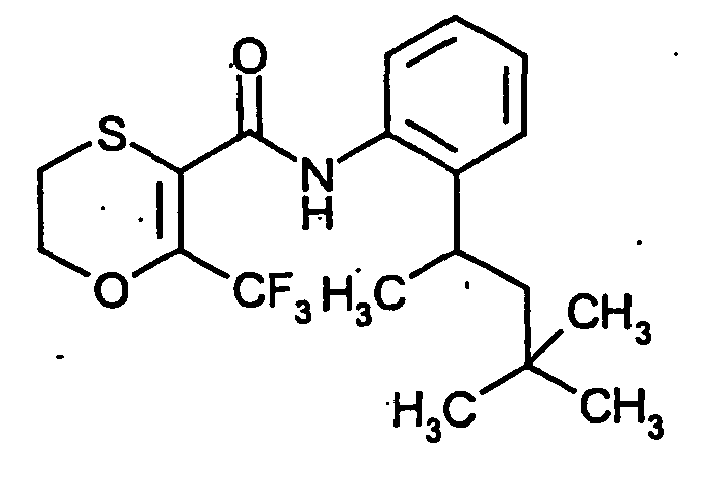
300 mg (1.7 mmol) 6-Trifluormethyl-2,3-dihydro-1,4-oxathiin-5-carbonsäurechlorid und 220 mg (1.1 mmol) 2-(1,3,3-Trimethyl-butyl)-phenylamin werden in 5 ml Acetonitril 4 Tage bei Raumtemperatur im abgeschlossenen Gefäß gerührt. Anschließend wird das Reaktionsgemisch mit 10 ml Wasser versetzt, die organische Phase abgetrennt und zuerst mit 10 ml gesättigter Ammoniumchloridlösung, danach mit 10 ml Wasser gewaschen, über Natriumsulfat getrocknet und eingedampft. Das Rohprodukt wird mittels präparativer HPLC (reversed phase Kieselgel (C18), Laufmittel: 2%ige Essigsäure/Acetonitril 25:75) gereinigt.
Man erhält: 200 mg (37 % der Theorie) 6-Trifluormethyl-2,3-dihydro-1,4-oxathiin-5-carbonsäure [2-(1,3,3-trimethyl-butyl)-phenyl]-amid mit dem logP (pH 2.3) = 4.18.300 mg (1.7 mmol) of 6-trifluoromethyl-2,3-dihydro-1,4-oxathiin-5-carbonyl chloride and 220 mg (1.1 mmol) of 2- (1,3,3-trimethyl-butyl) -phenylamine are dissolved in 5 ml of acetonitrile for 4 days at room temperature in a sealed vessel. Subsequently, the reaction mixture with 10 ml of water, the organic phase separated and washed first with 10 ml of saturated ammonium chloride solution, then with 10 ml of water, dried over sodium sulfate and evaporated. The crude product is purified by preparative HPLC (reversed phase silica gel (C 18 ), eluent: 2% acetic acid / acetonitrile 25:75).
200 mg (37% of theory) of 6-trifluoromethyl-2,3-dihydro-1,4-oxathiin-5-carboxylic acid [2- (1,3,3-trimethyl-butyl) -phenyl] -amide are obtained the logP (pH 2.3) = 4.18.
Analog Beispiel 1 und 2, sowie entsprechend den Angaben in der allgemeinen Beschreibung der erfindungsgemäßen Herstellverfahren (a) bis (h) wurden auch die in der nachstehenden Tabelle 1 genannten Verbindungen der Formel (I) erhalten:

114-116°C
167°C
125-127°C
100- 102°C
114-116 ° C
167 ° C
125-127 ° C
100-102 ° C
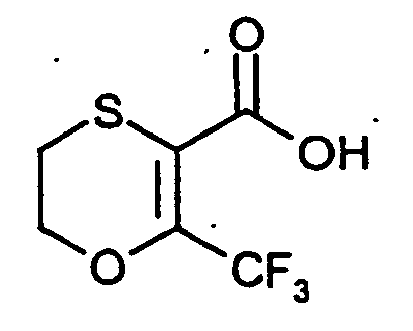

Zu einer Lösung von 20,0 g (0,092 mol) Ethyl-2-chlor-3-keto-4,4,4-trifluorbutyrat in 100 ml Toluol tropft man bei ca. 5°C 10,17 g (0,09 Mol) Triethylamin. Danach wird innerhalb von 1 Stunde eine Lösung von 7,0 g (0,09 Mol) 2-Mercaptoethanol in 5 ml Toluol zugetropft und 2 Stunden bei ca. 5°C nachgerührt. Die Suspension wird abfiltriert und mit wenig Toluol nachgewaschen. Das Filtrat wird zuerst mit 50 ml 1N Salzsäure, dann zweimal mit 50 ml gesättigter Natriumhydrogencarbonatlösung, zuletzt mit 50 ml Wasser gewaschen, über Magnesiumsulfat getrocknet und eingedampft.
Man erhält: 18,8 g (62 % der Theorie) 4,4,4-Trifluor-2-(2-hydroxy-ethylsulfanyl)-3-oxo-buttersäureethylester (vgl.
This gives: 18.8 g (62% of theory) of ethyl 4,4,4-trifluoro-2- (2-hydroxyethylsulfanyl) -3-oxo-butyrate (cf.

Zu einer Lösung von 18,7g (0,071 mol) 4,4,4-Trifluor-2-(2-hydroxy-ethylsulfanyl)-3-oxo-buttersäureethylester (II-1a) in 60 ml Toluol gibt man zuerst 6,25g (0,079Mol) Pyridin und tropft danach innerhalb von 30 Minuten bei 20°C 4 g (0,079Mol) Thionylchlorid zu. Aufgrund der exothermen Reaktion muss die Temperatur der Reaktionsmischung mit Eiswasser gekühlt werden. Nach Ende der heftigen Reaktion wird noch 5 Stunden bei Raumtemperatur gerührt. Die Mischung wird filtriert und der Rückstand mit 10 ml Toluol gewaschen. Zum Filtrat wird bei ca. 10°C innerhalb von 1 Stunde 10,9 g (0,108 Mol) Triethylamin getropft und für 16 Stunden bei Raumtemperatur gerührt. Das Reaktionsgemisch wird zuerst zweimal mit 50 ml 1N Salzsäure, dann zweimal mit 50 ml gesättigter Natriumhydrogencarbonatlösung, zuletzt mit 50 ml Wasser gewaschen, über Magnesiumsulfat getrocknet und eingedampft. Der Rückstand wird mit Petrolether/Essigester (10:1 bis 1:1) an Kieselgel chromatografiert.
Man erhält 12,6 g (59,4 % der Theorie) 6-Trifluormethyl-2,3-dihydro-1,4-oxathiin-5-carbonsäureethylester (vgl.
This gives 12.6 g (59.4% of theory) of ethyl 6-trifluoromethyl-2,3-dihydro-1,4-oxathiin-5-carboxylate (cf.

12,6 g (0,05 mol) 6-Trifluormethyl-2,3-dihydro-1,4-oxathiin-5-carbonsäureethylester (II-1b) und 3,14 g (0,08 mol) Natriumhydroxid werden in 50 ml Wasser 1 Stunde unter Rückfluss gekocht. Das Reaktionsgemisch wird abgekühlt und zweimal mit Dichlormethan extrahiert. Die wässrige Phase wird mit 6 N Salzsäure auf pH 2 angesäuert, dann 5 mal mit Diethylether extrahiert. Die vereinigten organischen Extrakte werden über Natriumsulfat getrocknet und eingedampft.
Man erhält: 9,2 g (82 % der Theorie) 6-Trifluormethyl-2,3-dihydro-1,4-oxathiin-5-carbonsäure.12.6 g (0.05 mol) of ethyl 6-trifluoromethyl-2,3-dihydro-1,4-oxathiin-5-carboxylate (II-1b) and 3.14 g (0.08 mol) of sodium hydroxide are dissolved in 50 ml Water boiled under reflux for 1 hour. The reaction mixture is cooled and extracted twice with dichloromethane. The aqueous phase is acidified to pH 2 with 6 N hydrochloric acid, then extracted 5 times with diethyl ether. The combined organic extracts are dried over sodium sulfate and evaporated.
This gives: 9.2 g (82% of theory) of 6-trifluoromethyl-2,3-dihydro-1,4-oxathiin-5-carboxylic acid.
Analog Beispiel (II-1) wurden auch die in nachstehend genannten Verbindungen der Formel (II) erhalten:Analogously to Example (II-1), the compounds of the formula (II) mentioned below were also obtained:
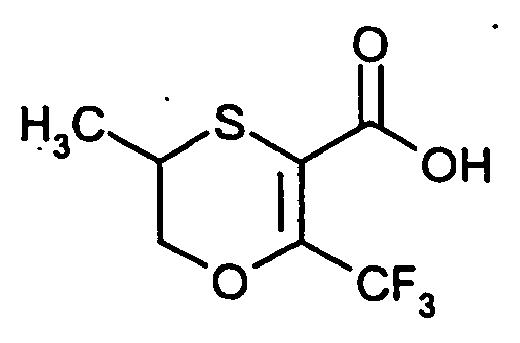


4.5 g (21 mmol) 6-Trifluormethyl-2,3-dihydro-1,4-oxathiin-5-carbonsäure (II-1) und 21 g Thionylchlorid werden in 10 ml Toluol 4 Stunden bei 80°C gerührt. Das Ende der Reaktion wird festgestellt, indem aus der Reaktionslösung regelmäßig Proben entnommen und mit Methanol versetzt werden, wovon dann Dünnschichtchromatogramme angefertigt werden.4.5 g (21 mmol) of 6-trifluoromethyl-2,3-dihydro-1,4-oxathiin-5-carboxylic acid (II-1) and 21 g of thionyl chloride are stirred in 10 ml of toluene at 80 ° C. for 4 hours. The end of the reaction is determined by regularly taking samples from the reaction solution and adding methanol, which is then processed into thin-layer chromatograms.
Nach Ende der Reaktion werden flüchtige Bestandteile abdestilliert. Der Rückstand wird dreimal mit jeweils 20 ml Dichlormethan verrührt und wieder eingedampft.After the reaction, volatiles are distilled off. The residue is stirred three times with 20 ml of dichloromethane and evaporated again.
Man erhält 4,5 g (80 % der Theorie) 6-Trifluormethyl-2,3-dihydro-1,4-oxathiin-5-carbonsäurechlorid. Das Produkt wurde charakterisiert, indem eine Probe davon 2 Stunden mit Methanol gekocht wurde und der so erhaltene 6-Trifluormethyl-2,3-dihydro-1,4-oxathiin-5-carbonsäuremethylester mittels GC/MS nachgewiesen wurde.This gives 4.5 g (80% of theory) of 6-trifluoromethyl-2,3-dihydro-1,4-oxathiin-5-carboxylic acid chloride. The product was characterized by boiling a sample of it with methanol for 2 hours and detecting the resulting 6-trifluoromethyl-2,3-dihydro-1,4-oxathiin-5-carboxylic acid methyl ester by GC / MS.


Zu einer Lösung von 15 g (124 mmol) 2-Ethylanilin, 25 g (248 mMol) Triethylamin in 150 ml Dichlormethan tropft man bei 0° C das 15 g (124 mmol) Pivalinsäurechlorid und rührt 2 Stunden bei 0°C und anschließend ohne weitere Kühlung für 16 Stunden. Das Gemisch wird mit Dichlormethan verdünnt, zuerst mit Wasser dann mit Ammoniumchlorid-Lösung gewaschen, die organische Phase abgetrennt, über Natriumsulfat getrocknet und eingeengt.To a solution of 15 g (124 mmol) of 2-ethylaniline, 25 g (248 mmol) of triethylamine in 150 ml of dichloromethane is added dropwise at 0 ° C, the 15 g (124 mmol) of pivaloyl chloride and stirred for 2 hours at 0 ° C and then without additional cooling for 16 hours. The mixture is diluted with dichloromethane, washed first with water then with ammonium chloride solution, the organic phase separated, dried over sodium sulfate and concentrated.
Man erhält 25 g (98 % der Theorie) N-(2-Ethyl-phenyl)-2,2-dimethyl-propionamid.25 g (98% of theory) of N - (2-ethyl-phenyl) -2,2-dimethyl-propionamide are obtained.

Zu einer Lösung aus 5,6 g (0,0275 Mol) N-(2-Ethyl-phenyl)-2,2-dimethyl-propionamid (IIIla) in 150 ml n-Pentan/Methyl-t-butylether (1:1) gibt man unter Argon bei -25 °C zuerst 3,7 g (0,03 Mol) Diazabicyclo[2.2.2]octan (DABCO) dann 44,5 ml (0,058 mol) sec-Butyllithium-Lösung (1,3 molar in Hexan) und rührt weitere 2 Stunden bei der gleichen Temperatur. Nun wird das Gemisch auf -78 °C gekühlt, 3,33 g (0,0275 Mol) Allylbromid zugetropft und 60 Minuten bei -60 bis -78 °C gerührt. Reste von sec-Butyllithium werden durch Zugabe von 30 ml Methanol zersetzt. Das Gemisch wird auf Raumtemperatur erwärmt, mit 50 ml 5%iger Phosphorsäure geschüttelt. Die organische Phase wird abgetrennt, über Kieselgel filtriert und mittels präparativer HPLC (reversed phase Kieselgel (C18), Laufmittel: Wasser/Acetonitril 38:62) gereinigt.To a solution of 5.6 g (0.0275 mol) of N - (2-ethylphenyl) -2,2-dimethyl-propionamide (IIIla) in 150 ml of n-pentane / methyl t-butyl ether (1: 1 3.7 g (0.03 mol) of diazabicyclo [2.2.2] octane (DABCO) are then added under argon at -25 ° C first then 44.5 ml (0.058 mol) of sec-butyllithium solution (1.3 molar in hexane) and stirred for a further 2 hours at the same temperature. Now, the mixture is cooled to -78 ° C, 3.33 g (0.0275 mol) of allyl bromide are added dropwise and stirred at -60 to -78 ° C for 60 minutes. Residues of sec-butyllithium are decomposed by the addition of 30 ml of methanol. The mixture is warmed to room temperature, shaken with 50 ml of 5% phosphoric acid. The organic phase is separated, filtered through silica gel and purified by preparative HPLC (reversed phase silica gel (C 18 ), eluent: water / acetonitrile 38:62).
Man erhält 1,8 g (26 % der Theorie) 2,2-Dimethyl-N-[2-(1-methyl-but-3-enyl)-phenyl]-propionamid.This gives 1.8 g (26% of theory) of 2,2-dimethyl- N - [2- (1-methyl-but-3-enyl) -phenyl] -propionamide.

1,5g (6,1 mmol) 2,2-Dimethyl-N-[2-(1-methyl-but-3-enyl)-phenyl]-propionamid (III-1b) und 1,2 g (12,2 mmol) konzentrierter Salzsäure werden in 24,5 ml Dioxan 12 Stunden bei 80 °C gerührt. Das Reaktionsgemisch wird mit 10 ml Wasser versetzt und mit verdünnter Natronlauge alkalisch gestellt und 5 mal mit Essigsäureethylester extrahiert. Die vereinigten, organischen Extrakte werden über Natriumsulfat getrocknet und eingedampft, über Kieselgel filtriert (Essigester/Methanol 5:1) und mittels präparativer HPLC (reversed phase Kieselgel (C18), Laufmittel: 2%ige Essigsäure/Acetonitril 70:30) gereinigt
Man erhält 0,3 g (30 % der Theorie) 2-(1-Methyl-but-3-enyl)-phenylamin.1.5 g (6.1 mmol) of 2,2-dimethyl- N - [2- (1-methyl-but-3-enyl) -phenyl] -propionamide (III-1b) and 1.2 g (12.2 mmol) of concentrated hydrochloric acid are stirred in 24.5 ml of dioxane at 80 ° C. for 12 hours. The reaction mixture is mixed with 10 ml of water and made alkaline with dilute sodium hydroxide solution and extracted 5 times with ethyl acetate. The combined organic extracts are dried over sodium sulfate and evaporated, filtered through silica gel (ethyl acetate / methanol 5: 1) and purified by preparative HPLC (reversed phase silica gel (C 18 ), eluent: 2% acetic acid / acetonitrile 70:30)
This gives 0.3 g (30% of theory) of 2- (1-methyl-but-3-enyl) -phenylamine.
Analog Beispiel (III-1) wurden auch die in nachstehend genannten Verbindungen der Formel (III) erhalten:Analogously to Example (III-1), the compounds of the formula (III) mentioned below were also obtained:

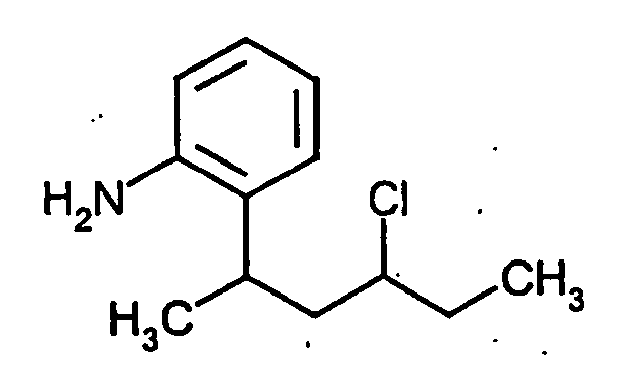
2-(3-Chlor-1-methylpentyl)phenylamin (III-3) wird erhalten, indem man zunächst N-[2-(2-Cyclopropyl-isopropyl)phenyl]-2,2-dimethylpropanamid analog den Beispielen (III-1a) und (III-1b) herstellt. In der dritten Stufe wird mit Salzsäure umgesetzt, wobei neben 2-(2-Cyclopropyl-isopropyl)phenylamin auch die Verbindung (III-3) erhalten wird.2- (3-Chloro-1-methylpentyl) -phenylamine (III-3) is obtained by first reacting N - [2- (2-cyclopropyl-isopropyl) -phenyl] -2,2-dimethylpropanamide analogously to Examples (III-1a ) and (III-1b). In the third step, it is reacted with hydrochloric acid to give, besides 2- (2-cyclopropyl-isopropyl) -phenylamine, also the compound (III-3).

Zu einer Lösung von 2,2-Dimethyl-N-[2-(1-methyl-but-3-enyl)-phenyl]-propionamid (III-1b) 900 mg (3,7 mmol) in 5 ml Chloroform/Wasser (1:1) gibt man nacheinander bei Raumtemperatur 100 mg Benzyltriethylammoniumchlorid und 1 ml 50%ige Natronlauge und rührt 5 Tage. Das Reaktionsgemisch wird mit 20 ml Chloroform weiter verdünnt, mit 50 ml Natriumchlorid-Lösung gewaschen, die organische Phase abgetrennt, über Natriumsulfat getrocknet und eingeengt.To a solution of 2,2-dimethyl-N- [2- (1-methyl-but-3-enyl) -phenyl] -propionamide (III-1b) 900 mg (3.7 mmol) in 5 ml of chloroform / water (1: 1) are added successively at room temperature, 100 mg of benzyltriethylammonium chloride and 1 ml of 50% sodium hydroxide solution and stirred for 5 days. The reaction mixture is further diluted with 20 ml of chloroform, washed with 50 ml of sodium chloride solution, the organic phase separated, dried over sodium sulfate and concentrated.
Man erhält 800 mg (37 % der Theorie) N-{2-[2-(2,2-Dichlorcymopropyl)-1-methylethyl]-phenyl}-2,2-dimethyl-propionamid mit dem logP (pH 2,3) = 3,77.800 mg (37% of theory) of N - {2- [2- (2,2-dichloro-cymopropyl) -1-methyl-ethyl] -phenyl} -2,2-dimethyl-propionamide are obtained with the logP (pH 2.3). = 3.77.
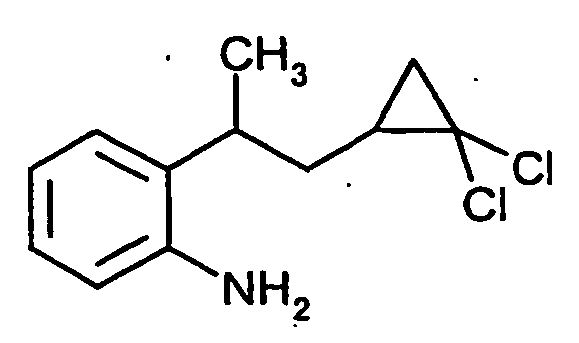
800 mg (1,34 mmol) N-{2-[2-(2,2-Dichlorcyclopropyl)-1-methylethyl]-phenyl}-2,2-dimethyl-propionamid (III-4a) werden in 25 ml Dioxan gelöst und mit 0,1 ml konzentrierter Salzsäure versetzt, 72 Stunden bei Raumtemperatur und 24 Stunden bei 80°C gerührt. Das Gemisch wird mit Eiswasser verdünnt, mit konzentrierter Natronlauge alkalisch gestellt und mit 50 ml Essigsäureethylester extrahiert. Die organische Phase wird über Natriumsulfat getrocknet und bei vermindertem Druck eingeengt. Der Rückstand wird über Kieselgel mit Methanol filtriert und mittels präparativer HPLC (reversed phase Kieselgel (C18), Laufmittel: 2%ige Posphorsäure/Àcetonitril 52:48) gereinigt.800 mg (1.34 mmol) of N- {2- [2- (2,2-dichlorocyclopropyl) -1-methylethyl] -phenyl} -2,2-dimethyl-propionamide (III-4a) are dissolved in 25 ml of dioxane and treated with 0.1 ml of concentrated hydrochloric acid, 72 hours at room temperature and 24 hours at 80 ° C stirred. The mixture is diluted with ice-water, made alkaline with concentrated sodium hydroxide solution and extracted with 50 ml of ethyl acetate. The organic phase is dried over sodium sulfate and concentrated under reduced pressure. The residue is filtered through silica gel with methanol and purified by preparative HPLC (reversed phase silica gel (C 18 ), eluent: 2% phosphoric acid / acetonitrile 52:48).
Man erhält 0,8 g (60 % der Theorie) 2-[2-(2,2-Dichlorcyclopropyl)-1-methylethyl]-phenylamin mit dem logP (pH 2,3) = 2,52.0.8 g (60% of theory) of 2- [2- (2,2-dichlorocyclopropyl) -1-methylethyl] -phenylamine with the logP (pH 2.3) = 2.52 is obtained.
Die Bestimmung der angegebenen logP-Werte erfolgte gemäß EEC-Directive 79/831 Annex V.A8 durch HPLC (High Performance Liquid Chromatography) an einer Phasenumkehrsäule (C 18). Temperatur: 43°C.The specified logP values were determined according to EEC Directive 79/831 Annex V.A8 by HPLC (High Performance Liquid Chromatography) on a phase reversal column (C 18). Temperature: 43 ° C.
Eluenten für die Bestimmung im sauren Bereich (pH 2,3): 0,1 % wässrige Phosphorsäure, Acetonitril; linearer Gradient von 10 % Acetonitril bis 90 % Acetonitril.Eluents for determination in the acidic range (pH 2.3): 0.1% aqueous phosphoric acid, acetonitrile; linear gradient from 10% acetonitrile to 90% acetonitrile.
Die Eichung erfolgte mit unverzweigten Alkan-2-onen (mit 3 bis 16 Kohlenstoffatomen), deren LogP-Werte bekannt sind (Bestimmung der LogP-Werte anhand der Retentionszeiten durch lineare Interpolation zwischen zwei aufeinanderfolgenden Alkanonen).The calibration was carried out with unbranched alkan-2-ones (with 3 to 16 carbon atoms) whose LogP values are known (determination of the LogP values by means of the retention times by linear interpolation between two consecutive alkanones).
Die lambda-max-Werte wurden an Hand der UV-Spektren von 200 nm bis 400 nm in den Maxima der chromatographischen Signale ermittelt.The lambda max values were determined on the basis of the UV spectra from 200 nm to 400 nm in the maxima of the chromatographic signals.
Zur Herstellung einer zweckmäßigen Wirkstoffzubereitung vermischt man 1 Gewichtsteil Wirkstoff mit den angegebenen Mengen Lösungsmittel und Emulgator und verdünnt das Konzentrat mit Wasser auf die gewünschte Konzentration.To prepare a suitable preparation of active compound, 1 part by weight of active compound is mixed with the indicated amounts of solvent and emulsifier, and the concentrate is diluted with water to the desired concentration.
Zur Prüfung auf protektive Wirksamkeit werden junge Pflanzen mit der Wirkstoffzubereitung in der angegebenen Aufwandmenge besprüht. Nach Antrocknen des Spritzbelages werden die Pflanzen mit einer wässrigen Konidiensuspension des Apfelschorferregers Venturia inaequalis inokuliert und verbleiben dann 1 Tag bei ca. 20°C und 100 % relativer Luftfeuchtigkeit in einer Inkubationskabine.To test for protective activity, young plants are sprayed with the preparation of active compound in the stated application rate. After the spray coating has dried on, the plants are inoculated with an aqueous conidia suspension of the apple scab pathogen Venturia inaequalis and then remain in an incubation cabin for 1 day at about 20 ° C. and 100% relative atmospheric humidity.
Die Pflanzen werden dann im Gewächshaus bei ca. 21°C und einer relativen Luftfeuchtigkeit von ca. 90 % aufgestellt.The plants are then placed in the greenhouse at about 21 ° C and a relative humidity of about 90%.
10 Tage nach der Inokulation erfolgt die Auswertung. Dabei bedeutet 0% ein Wirkungsgrad, der demjenigen der Kontrolle entspricht, während ein Wirkungsgrad von 100 % bedeutet, dass kein Befall beobachtet wird.10 days after the inoculation the evaluation takes place. In this case, 0% means an efficiency which corresponds to that of the control, while an efficiency of 100% means that no infestation is observed.
Wirkstoffe, Aufwandmengen und Versuchsergebnisse gehen aus der folgenden Tabelle hervor.


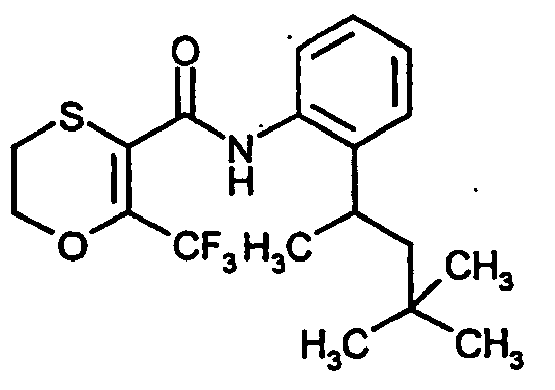
Zur Herstellung einer zweckmäßigen Wirkstoffzubereitung vermischt man 1 Gewichtsteil Wirkstoff mit den angegebenen Mengen Lösungsmittel und Emulgator und verdünnt das Konzentrat mit Wasser auf die gewünschte Konzentration.To prepare a suitable preparation of active compound, 1 part by weight of active compound is mixed with the indicated amounts of solvent and emulsifier, and the concentrate is diluted with water to the desired concentration.
Zur Prüfung auf protektive Wirksamkeit werden junge Pflanzen mit der Wirkstoffzubereitung in der angegebenen Aufwandmenge besprüht. Nach Antrocknen des Spritzbelages werden auf jedes Blatt 2 kleine mit Botrytis cinerea bewachsene Agarstückchen aufgelegt. Die inokulierten Pflanzen werden in einer abgedunkelten Kammer bei ca. 20°C und 100 % relativer Luftfeuchtigkeit aufgestellt.To test for protective activity, young plants are sprayed with the preparation of active compound in the stated application rate. After the spray coating has dried, 2 small pieces of agar covered with Botrytis cinerea are placed on each leaf. The inoculated plants are placed in a darkened chamber at about 20 ° C and 100% relative humidity.
2 Tage nach der Inokulation wird die Größe der Befallsflecken auf den Blättern ausgewertet Dabei bedeutet 0 % ein Wirkungsgrad, der demjenigen der Kontrolle entspricht, während ein Wirkungsgrad von 100 % bedeutet, dass kein Befall beobachtet wird.2 days after the inoculation, the size of the infestation spots on the leaves is evaluated. 0% means an efficiency which corresponds to that of the control, while an efficiency of 100% means that no infestation is observed.
Wirkstoffe, Aufwandmengen und Versuchsergebnisse gehen aus der folgenden Tabelle hervor.


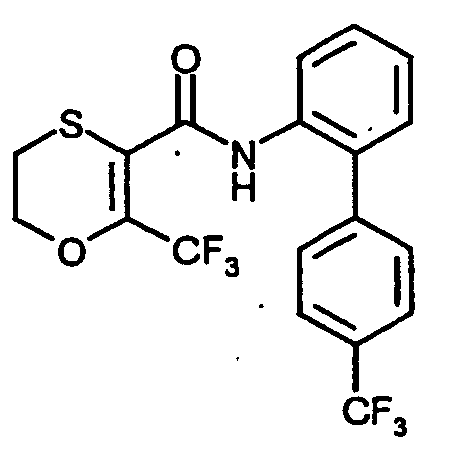


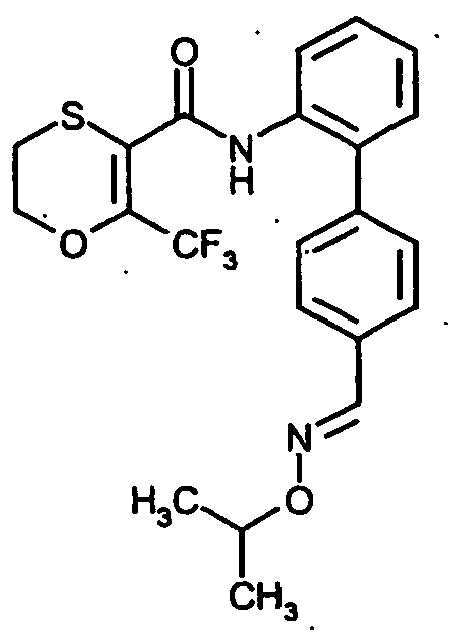


Zur Herstellung einer zweckmäßigen Wirkstoffzubereitung vermischt man 1 Gewichtsteil Wirkstoff mit den angegebenen Mengen Lösungsmittel und Emulgator und verdünnt das Konzentrat mit Wasser auf die gewünschte Konzentration.To prepare a suitable preparation of active compound, 1 part by weight of active compound is mixed with the indicated amounts of solvent and emulsifier, and the concentrate is diluted with water to the desired concentration.
Zur Prüfung auf protektive Wirksamkeit bespritzt man junge Tomatenpflanzen mit der Wirkstoffzubereitung in der angegebenen Aufwandmenge. 1 Tag nach der Behandlung werden die Pflanzen mit einer Sporensuspension von Alternaria solani inokuliert und stehen dann 24 h bei 100 % relativer Feuchte und 20°C. Anschließend stehen die Pflanzen bei 96 % relativer Luftfeuchtigkeit und einer Temperatur von 20°C.To test for protective activity, young tomato plants are sprayed with the preparation of active compound in the stated application rate. One day after the treatment, the plants are inoculated with a spore suspension of Alternaria solani and then stand for 24 h at 100% relative humidity and 20 ° C. Subsequently, the plants are at 96% relative humidity and a temperature of 20 ° C.
7 Tage nach der Inokulation erfolgt die Auswertung. Dabei bedeutet 0 % ein Wirkungsgrad, der demjenigen der Kontrolle entspricht, während ein Wirkungsgrad von 100 % bedeutet, dass kein Befall beobachtet wird.7 days after the inoculation the evaluation takes place. In this case, 0% means an efficiency which corresponds to that of the control, while an efficiency of 100% means that no infestation is observed.
Wirkstoffe, Aufwandmenge und Versuchsergebnisse gehen aus der folgenden Tabelle hervor.


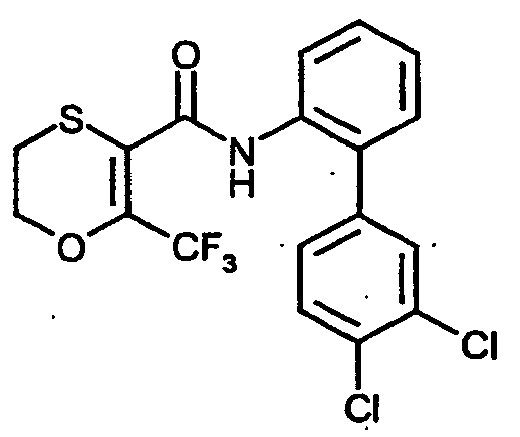

Zur Herstellung einer zweckmäßigen Wirkstoffzubereitung vermischt man 1 Gewichtsteil Wirkstoff mit den angegebenen Mengen Lösungsmittel und Emulgator und verdünnt das Konzentrat mit Wasser auf die gewünschte Konzentration.To prepare a suitable preparation of active compound, 1 part by weight of active compound is mixed with the indicated amounts of solvent and emulsifier, and the concentrate is diluted with water to the desired concentration.
Zur Prüfung auf protektive Wirksamkeit werden junge Pflanzen mit der Wirkstoffzubereitung in der angegebenen Aufwandmenge besprüht. Nach Antrocknen des Spritzbelages werden die Pflanzen mit einer Konidiensuspension von Puccinia recondita besprüht. Die Pflanzen verbleiben 48 Stunden bei 20°C und 100 % relativer Luftfeuchtigkeit in einer Inkubationskabine.To test for protective activity, young plants are sprayed with the preparation of active compound in the stated application rate. After the spray coating has dried on, the plants are sprayed with a conidia suspension of Puccinia recondita. The plants remain for 48 hours at 20 ° C and 100% relative humidity in an incubation cabin.
Die Pflanzen werden dann in einem Gewächshaus bei einer Temperatur von ca. 20°C und einer relativen Luftfeuchtigkeit von 80 % aufgestellt, um die Entwicklung von Rostpusteln zu begünstigen.The plants are then placed in a greenhouse at a temperature of about 20 ° C and a relative humidity of 80% to promote the development of rust pustules.
10 Tage nach der Inokulation erfolgt die Auswertung. Dabei bedeutet 0 % ein Wirkungsgrad, der demjenigen der Kontrolle entspricht, während ein Wirkungsgrad von 100 % bedeutet, dass kein Befall beobachtet wird.10 days after the inoculation the evaluation takes place. In this case, 0% means an efficiency which corresponds to that of the control, while an efficiency of 100% means that no infestation is observed.
Wirkstoffe, Aufwandmengen, Lösungmittelmengen, Emulgatormengen und Versuchsergebnisse gehen aus der folgenden Tabelle hervor.


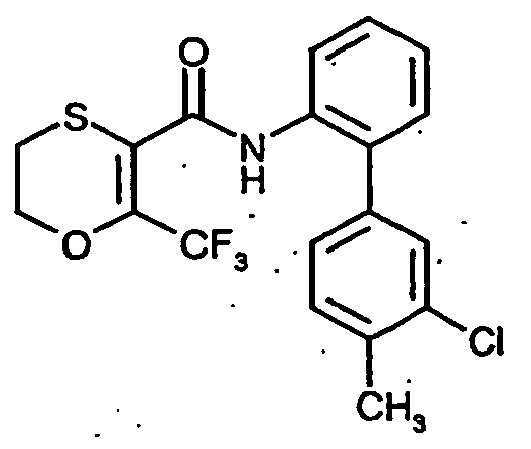


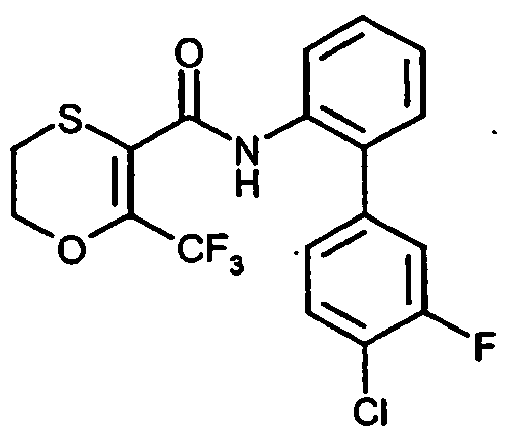


Claims (16)
- Oxathiincarboxamides of the formula (I)
 G1 represents halogen, trifluoromethyl, difluoromethyl or cyclopropyl,G2 and G3 independently of one another represent hydrogen or methyl,n represents 0, 1 or 2,R1, R2, R3 and R4 independently of one another represent hydrogen, fluorine, chlorine, methyl, isopropyl or methylthio,R5 represents hydrogen, C1-C8-alkyl, C1-C6-alkylsulfinyl, C1-C6-alkylsulfonyl, C1-C4-alkoxy-C1-C4-alkyl, C3-C8-cycloalkyl; C1-C6-haloalkyl, C1-C4-haloalkylthio, C1-C4-haloalkylsulfinyl, C1-C4-haloalkylsulfonyl, halo-C1-C4-alkoxy-C1-C4-alkyl, C3-C8-halocycloalkyl having in each case 1 to 9 fluorine, chlorine and/or bromine atoms, formyl-C1-C3-alkyl, (C1-C3-alkyl)carbonyl-C1-C3-alkyl, (C1-C3-alkoxy)carbonyl-C1-C3-alkyl; (C1-C3-haloalkyl)carbonyl-C1-C3-alkyl, (C1-C3-haloalkoxy)carbonyl-C1-C3-alkyl having in each case 1 to 7 fluorine, chlorine and/or bromine atoms, (C1-C3-alkyl)carbonyl-C1-C3-haloalkyl, (C1-C3-alkoxy)carbonyl-C1-C3-haloalkyl having in each case 1 to 6 fluorine, chlorine and/or bromine atoms, (C1-C3-haloalkyl)carbonyl-C1-C3-haloalkyl, (C1-C3-haloalkoxy)carbonyl-C1-C3-haloalkyl having in each case 1 to 13 fluorine, chlorine and/or bromine atoms; -COR6, -CONR7R8 or -CH2NR9R10,R6 represents hydrogen, C1-C8-alkyl, C1-C8-alkoxy, C1-C4-alkoxy-C1-C4-alkyl, C3-C8-cycloalkyl; C1-C6-haloalkyl, C1-C6-haloalkoxy, halo-C1-C4-alkoxy-C1-C4-alkyl, C3-C8-halocycloalkyl having in each case 1 to 9 fluorine, chlorine and/or bromine atoms; -COR11,R7 and R8 independently of one another represent hydrogen, C1-C8-alkyl, C1-C4-alkoxy-C1-C4-alkyl, C3-C8-cycloalkyl; C1-C8-haloalkyl, halo-C1-C4-alkoxy-C1-C4-alkyl, C3-C8-halocycloalkyl having in each case 1 to 9 fluorine, chlorine and/or bromine atoms,R7 and R8 furthermore together with the nitrogen atom to which they are attached form a saturated heterocycle having 5 to 8 ring atoms, where the heterocycle may contain 1 or 2 further nonadjacent heteroatoms from the group consisting of oxygen, sulfur and NR12 and is optionally mono- or poly-substituted by identical or different substituents from the group consisting of halogen and C1-C4-alkyl,R9 and R10 independently of one another represent hydrogen, C1-C8-alkyl, C3-C8-cycloalkyl; C1-C8-haloalkyl, C3-C8-halocycloalkyl having in each case 1 to 9 fluorine, chlorine and/or bromine atoms,R9 and R10 furthermore together with the nitrogen atom to which they are attached form a saturated heterocycle having 5 to 8 ring atoms, where the heterocycle may contain 1 or 2 further nonadjacent heteroatoms from the group consisting of oxygen, sulfur and NR12 and is optionally mono- or poly-substituted by identical or different substituents from the group consisting of halogen and C1-C4-alkyl,R11 represents hydrogen, C1-C8-alkyl, C1-C8-alkoxy, C1-C4-alkoxy-C1-C4-alkyl, C3-C8-cycloalkyl; C1-C6-haloalkyl, C1-C6-haloalkoxy, halo-C1-C4-alkoxy-C1-C4-alkyl, C3-C8-halocycloalkyl having in each case 1 to 9 fluorine, chlorine and/or bromine atoms,R12 represents hydrogen or C1-C6-alkyl,Z represents Z1, Z2, Z3 or Z4, whereZ1 represents phenyl which is mono- to pentasubstituted by identical or different substituents,Z2 represents cycloalkyl or bicycloalkyl which is optionally mono- or poly-substituted by identical or different substituents,Z3 represents unsubstituted C4-C20-alkyl or represents C1-C20-alkyl which is mono- or polysubstituted by identical or different substituents from the group consisting of halogen and C3-C6-cycloalkyl, where the cycloalkyl moiety for its part may optionally be mono- or polysubstituted by identical or different substituents from the group consisting of halogen and C1-C4-alkyl,Z4 represents C2-C20-alkenyl or C2-C20-alkynyl which is in each case optionally mono- or polysubstituted by identical or different substituents from the group consisting of halogen and C3-C6-cycloalkyl, where the cycloalkyl moiety for its part may optionally be mono- or polysubstituted by identical or different substituents from the group consisting of halogen and C1-C4-alkyl,orR1, R2 and R3 independently of one another represent hydrogen or fluorine andZ and R4 together with the carbon atoms to which they are attached form an optionally substituted 5- or 6-membered carbocyclic or heterocyclic ring.
 - Oxathiincarboxamides of the formula (I) according to Claim 1, in whichG1 represents fluorine, chlorine, bromine, iodine, trifluoromethyl, difluoromethyl or cyclopropyl,G2 and G3 independently of one another represent hydrogen or methyl,n represents 0 or 2.
- Oxathiincarboxamides of the formula (I) according to Claim 1 in whichR5 represents hydrogen.
- Oxathiincarboxamides of the formula (I) according to Claim 1 in whichR1 represents hydrogen, fluorine, chlorine or methyl,R2 represents hydrogen, fluorine, chlorine, isopropyl or methylthio,R3 represents hydrogen, fluorine, chlorine or methyl,R4 represents hydrogen, fluorine, chlorine or methyl.
- Oxathiincarboxamides of the formula (I) according to Claim 1 in whichZ represents Z1,Z1 represents phenyl which is mono- to pentasubstituted by identical or different substituents, where the substituents are selected from the list W1W1 represents halogen, cyano, nitro, amino, hydroxyl, formyl, carboxyl, carbamoyl, thiocarbamoyl;
in each case straight-chain or branched alkyl, hydroxyalkyl, oxoalkyl, alkoxy, alkoxyalkyl, alkylthioalkyl, dialkoxyalkyl, alkylthio, alkylsulfinyl or alkylsulfonyl having in each case 1 to 8 carbon atoms;
in each case straight-chain or branched alkenyl or alkenyloxy having in each case 2 to 6 carbon atoms;
in each case straight-chain or branched haloalkyl, haloalkoxy, haloalkylthio, haloalkylsulfinyl or haloalkylsulfonyl having in each case 1 to 6 carbon atoms and 1 to 13 identical or different halogen atoms;
in each case straight-chain or branched haloalkenyl or haloalkenyloxy having in each case 2 to 6 carbon atoms and 1 to 11 identical or different halogen atoms;
in each case straight-chain or branched alkylamino, dialkylamino, alkylcarbonyl, alkylcarbonyloxy, alkoxycarbonyl, alkylaminocarbonyl, dialkylaminocarbonyl, arylalkylaminocarbonyl, dialkylaminocarbonyloxy having 1 to 6 carbon atoms in the respective hydrocarbon chains, alkenylcarbonyl or alkynylcarbonyl having 2 to 6 carbon atoms in the respective hydrocarbon chains;
cycloalkyl or cycloalkyloxy having in each case 3 to 6 carbon atoms;
in each case doubly attached alkylene having 3 or 4 carbon atoms, oxyalkylene having 2 or 3 carbon atoms or dioxyalkylene having 1 or 2 carbon atoms, each of which radicals is optionally mono- to tetrasubstituted by identical or different substituents from the group consisting of fluorine, chlorine, oxo, methyl, trifluoromethyl and ethyl;
or a grouping Q1 represents hydrogen, hydroxyl or alkyl having 1 to 4 carbon atoms, haloalkyl having 1 to 4 carbon atoms and 1 to 9 fluorine, chlorine and/or bromine atoms or cycloalkyl having 1 to 6 carbon atoms andQ2 represents hydroxyl, amino, methylamino, phenyl, benzyl or represents in each case optionally cyano-, hydroxyl-, alkoxy-, alkylthio-, alkylamino-, dialkylamino- or phenyl-substituted alkyl or alkoxy having 1 to 4 carbon atoms, or represents alkenyloxy or alkynyloxy having in each case 2 to 4 carbon atoms,and also phenyl, phenoxy, phenylthio, benzoyl, benzoylethenyl, cinnamoyl, heterocyclyl or phenylalkyl, phenylalkyloxy, phenylalkylthio or heterocyclylalkyl having in each case 1 to 3 carbon atoms in the respective alkyl moieties, each of which radicals is optionally mono- to trisubstituted in the cyclic part by halogen and/or straight-chain or branched alkyl or alkoxy having 1 to 4 carbon atoms.
 - Oxathiincarboxamides of the formula (I) according to Claim 1 in whichZ represents Z2,Z2 represents cycloalkyl or bicycloalkyl having in each case 3 to 10 carbon atoms, each of which radicals is optionally mono- to tetrasubstituted by identical or different substituents from the group consisting of halogen and/or C1-C4-alkyl.
- Oxathiincarboxamides of the formula (I) according to Claim 1 in whichZ represents Z3,Z3 represents unsubstituted C4-C20-alkyl or represents C1-C20-alkyl which is monosubstituted or polysubstituted by identical or different substituents from the group consisting of fluorine, chlorine, bromine, iodine and C3-C6-cycloalkyl, where the cycloalkyl moiety for its part may optionally be mono- to tetrasubstituted by identical or different substituents from the group consisting of fluorine, chlorine, bromine, iodine, C1-C4-alkyl and/or C1-C4-haloalkyl.
- Oxathiincarboxamides of the formula (I) according to Claim 1 in whichZ represents Z4,Z4 represents C2-C20-alkenyl or C2-C20-alkynyl, each of which is mono- or polysubstituted by identical or different substituents from the group consisting of fluorine, chlorine, bromine, iodine and C3-C6-cycloalkyl, where the cycloalkyl moiety for its part may optionally be mono- to tetra-substituted by identical or different substituents from the group consisting of fluorine, chlorine, bromine, iodine, C1-C4-alkyl and C1-C4-haloalkyl.
- Process for preparing the oxathiincarboxamides of the formula (1) according to Claim 1, characterized in thata) oxathiincarboxylic acid derivatives of the formula (II)
 G1, G2, G3 and n are as defined in Claim 1,X1 represents halogen or hydroxyl,are reacted with aniline derivatives of the formula (III)
 R1, R2, R3, R4, R5 and Z are as defined in Claim 1,if appropriate in the presence of a catalyst, if appropriate in the presence of a condensing agent, if appropriate in the presence of an acid binder and if appropriate in the presence of a diluent, orb) halooxathiincarboxamides of the formula (IV)
 G1, G2, G3, n, R1, R2, R3, R4 and R5 are as defined in Claim 1,X2 represents bromine or iodine,are reacted with boronic acid derivatives of the formula (V)
 Z1 is as defined in Claim 1 andA1 and A2 each represent hydrogen or together represent tetramethylethylene,in the presence of a catalyst, if appropriate in the presence of an acid binder and if appropriate in the presence of a diluent, orc) oxathiincarboxamide boronic acid derivatives of the formula (VI)
 G1, G2, G3, n, R1, R2, R3, R4 and R5 are as defined in Claim 1,A3 and A4 each represent hydrogen or together represent tetramethylethylene,are reacted with phenyl derivatives of the formula (VII)
X3-Z1 (VII)
in whichZ1 is as defined in Claim 1 andX3 represents chlorine, bromine, iodine or trifluoromethylsulfonate,in the presence of a catalyst, if appropriate in the presence of an acid binder and if appropriate in the presence of a diluent, ord) halooxathiincarboxamides of the formula (IV) G1, G2, G3, n, R1, R2, R3, R4 and R5 are as defined in Claim 1,X2 represents bromine or iodine,are reacted with phenyl derivatives of the formula (VII)
X3-Z1 (VII)
in whichZ1 is as defined in Claim 1 andX3 represents chlorine, bromine, iodine or trifluoromethylsulfonate,in the presence of a palladium or nickel catalyst and in the presence of 4,4,4',4',5,5,5',5'-octamethyl-2,2'-bis-1,3,2-dioxaborolane, if appropriate in the presence of an acid binder and if appropriate in the presence of a diluent, ore) oxathiincarboxamides of the formula (Ia) G1, G2, G3, n, R1, R2, R3, R4 and R5 are as defined in Claim 1,X4 represents C2-C20-alkenyl or C2-C20-alkynyl, each of which is optionally mono- or polysubstituted by identical or different substituents from the group consisting of halogen and C3-C6-cycloalkyl, where the cycloalkyl moiety for its part may optionally be substituted by halogen and/or C1-C4-alkyl,are hydrogenated, if appropriate in the presence of a diluent and if appropriate in the presence of a catalyst, orf) hydroxyalkyloxathiincarboxamides of the formula (VIII)
 G1, G2, G3, n, R1, R2, R3, R4 and R5 are as defined in Claim 1,X5 represents C2-C20-hydroxyalkyl which is optionally additionally mono- or polysubstituted by identical or different substituents from the group consisting of halogen and C3-C6-cycloalkyl, where the cycloalkyl moiety for its part may optionally be substituted by halogen and/or C1-C4-alkyl,are dehydrated, if appropriate in the presence of a diluent and if appropriate in the presence of an acid, org) halooxathiincarboxamides of the formula (IV)
 G1, G2, G3, n, R1, R2, R3, R4 and R5 are as defined in Claim 1,X2 represents bromine or iodine,are reacted with an alkyne of the formula (IX)
HC≡-A5 (IX),
in whichA5 represents C2-C18-alkyl, each of which is optionally mono- or polysubstituted by identical or different substituents from the group consisting of halogen and C3-C6-cycloalkyl, where the cycloalkyl moiety for its part may optionally be substituted by halogen and/or C1-C4-alkyl,or an alkene of the formula (X) A6, A7 and A8 independently of one another each represent hydrogen or alkyl which is optionally mono- or polysubstituted by identical or different substituents from the group consisting of halogen and C3-C6-cycloalkyl, where the cycloalkyl moiety for its part may optionally be substituted by halogen and/or C1-C4-alkyl and the total number of carbon atoms of the open-chain part of the molecule does not exceed the number 20,if appropriate in the presence of a diluent, if appropriate in the presence of an acid binder and in the presence of one or more catalysts, orh) ketones of the formula (XI)
 G1, G2, G3, n, R1, R2, R3, R4 and R5 are as defined in Claim 1,A9 represents hydrogen or C1-C18-alkyl which is optionally mono- or polysubstituted by identical or different substituents from the group consisting of halogen and C3-C6-cycloalkyl, where the cycloalkyl moiety for its part may optionally be substituted by halogen and/or C1-C4-alkyl,are reacted with a phosphorus compound of the formula (XII)
A10-Px (XII),
in whichA10 represents C1-C18-alkyl which is optionally mono- or polysubstituted by identical or different substituents from the group consisting of halogen and C3-C6-cycloalkyl, where the cycloalkyl moiety for its part may optionally be substituted by halogen and/or C1-C4-alkyl,Px represents a grouping -P+(C6H5)3 Cl-, -P+(C6H5)3 Br-, -P+(C6H5)3 I-, -P(=O)(OCH3)3 or -P(=O)(OC2H5)3,if appropriate in the presence of a diluent, ori) oxathiincarboxamides of the formula (Ib) G1, G2, G3, n, R1, R2, R3, R4 and Z are as defined in Claim 1,are reacted with halides of the formula (XIII)
R5-1-X6 (XIII)
in whichR5-1 represents C1-C8-alkyl, C1-C6-alkylsulfinyl, C1-C6-alkylsulfonyl, C1-C4-alkoxy-C1-C4-alkyl, C3-C8-cycloalkyl; C1-C6-haloalkyl, C1-C4-haloalkylthio, C1-C4-haloalkylsulfinyl, C1-C4-haloalkylsulfonyl, halo-C1-C4-alkoxy-C1-C4-alkyl, C3-C8-halocycloalkyl having in each case 1 to 9 fluorine, chlorine and/or bromine atoms, formyl-C1-C3-alkyl, (C1-C3-alkyl)carbonyl-C1-C3-alkyl, (C1-C3-alkoxy)carbonyl-C1-C3-alkyl; (C1-C3-haloalkyl)carbonyl-C1-C3-alkyl, (C1-C3-haloalkoxy)carbonyl-C1-C3-alkyl having in each case 1 to 7 fluorine, chlorine and/or bromine atoms, (C1-C3-alkyl)carbonyl-C1-C3-haloalkyl, (C1-C3-alkoxy)carbonyl-C1-C3-haloalkyl having in each case 1 to 6 fluorine, chlorine and/or bromine atoms, (C1-C3-haloalkyl)carbonyl-C1-C3-haloalkyl, (C1-C3-haloalkoxy)carbonyl-C1-C3-haloalkyl having in each case 1 to 13 fluorine, chlorine and/or bromine atoms; -COR6, -CONR7R8 or -CH2NR9R10,R6, R7, R8, R9 and R10 are as defined in Claim 1,X6 represents chlorine, bromine or iodine,in the presence of a base and in the presence of a diluent. - Compositions for controlling unwanted microorganisms, characterized in that they comprise at least one oxathiincarboxamide of the formula (I) according to Claim 1, in addition to extenders and/or surfactants.
- Use of oxathiincarboxamides of the formula (I) according to Claim 1 for controlling unwanted microorganisms.
- Method for controlling unwanted microorganisms, characterized in that oxathiincarboxamides of the formula (I) according to Claim 1 are applied to the microorganisms and/or their habitat.
- Process for preparing compositions for controlling unwanted microorganisms, characterized in that oxathiincarboxamides of the formula (I) according to Claim 1 are mixed with extenders and/or surfactants.
- Halooxathiincarboxamides of the formula (IV)
 G1, G2, G3, n, R1, R2, R3, R4 and R5 are as defined in Claim 1, andX2 represents bromine or iodine.
 - Oxathiincarboxamideboronic acid derivatives of the formula (VI)
 G1, G2, G3, n, R1, R2, R3, R4 and R5 are as defined in Claim 1 andA3 and A4 each represent hydrogen or together represent tetramethylethylene.
 - Hydroxyalkyloxathiincarboxamides of the formula (VIII)
 G1, G2, G3, n, R1, R2, R3, R4 and R5 are as defined in Claim 1 andX5 represents C2-C20-hydroxyalkyl which is optionally additionally mono- or polysubstituted by identical or different substituents from the group consisting of halogen and C3-C6-cycloalkyl, where the cycloalkyl moiety for its part may optionally be substituted by halogen and/or C1-C4-alkyl.
Priority Applications (1)
| Application Number | Priority Date | Filing Date | Title |
|---|---|---|---|
| SI200430581T SI1599460T1 (en) | 2003-02-14 | 2004-02-05 | Oxathiin carboxamide |
Applications Claiming Priority (5)
| Application Number | Priority Date | Filing Date | Title |
|---|---|---|---|
| DE10306244 | 2003-02-14 | ||
| DE10306244A DE10306244A1 (en) | 2003-02-14 | 2003-02-14 | New oxathiin carboxamide derivatives useful for controlling unwanted microorganisms, especially for protecting plants and materials from attack by fungi and bacteria |
| DE10321270 | 2003-05-13 | ||
| DE2003121270 DE10321270A1 (en) | 2003-05-13 | 2003-05-13 | New oxathiin carboxamide derivatives useful for controlling unwanted microorganisms, especially for protecting plants and materials from attack by fungi and bacteria |
| PCT/EP2004/001053 WO2004072023A2 (en) | 2003-02-14 | 2004-02-05 | Oxathiin carboxamide |
Publications (2)
| Publication Number | Publication Date |
|---|---|
| EP1599460A2 EP1599460A2 (en) | 2005-11-30 |
| EP1599460B1 true EP1599460B1 (en) | 2007-11-07 |
Family
ID=32870339
Family Applications (1)
| Application Number | Title | Priority Date | Filing Date |
|---|---|---|---|
| EP04708349A Expired - Lifetime EP1599460B1 (en) | 2003-02-14 | 2004-02-05 | Oxathiin carboxamide |
Country Status (18)
| Country | Link |
|---|---|
| US (1) | US7847108B2 (en) |
| EP (1) | EP1599460B1 (en) |
| JP (1) | JP4722829B2 (en) |
| KR (1) | KR20050105464A (en) |
| AT (1) | ATE377594T1 (en) |
| AU (1) | AU2004212056A1 (en) |
| BR (1) | BRPI0407254B1 (en) |
| CA (1) | CA2515922A1 (en) |
| CO (1) | CO5650197A2 (en) |
| DE (1) | DE502004005430D1 (en) |
| DK (1) | DK1599460T3 (en) |
| EA (1) | EA009904B1 (en) |
| EC (1) | ECSP055965A (en) |
| ES (1) | ES2295821T3 (en) |
| MX (1) | MXPA05008525A (en) |
| PL (1) | PL378118A1 (en) |
| PT (1) | PT1599460E (en) |
| WO (1) | WO2004072023A2 (en) |
Families Citing this family (10)
| Publication number | Priority date | Publication date | Assignee | Title |
|---|---|---|---|---|
| DE10258314A1 (en) * | 2002-12-13 | 2004-06-24 | Bayer Cropscience Ag | New alkoxyimino-substituted biphenylcarboxamide derivatives, useful as pesticides, antimicrobials, herbicides and antimycotics, also their new intermediates |
| DE10352067A1 (en) * | 2003-10-23 | 2005-05-25 | Bayer Cropscience Ag | Isopentylcarboxanilide |
| DE102004005787A1 (en) * | 2004-02-06 | 2005-08-25 | Bayer Cropscience Ag | carboxamides |
| DE102004059725A1 (en) * | 2004-12-11 | 2006-06-22 | Bayer Cropscience Ag | 2-alkyl-cycloalk (en) yl-carboxamide |
| EP1721899A1 (en) * | 2005-05-13 | 2006-11-15 | Bayer CropScience S.A. | Process for the preparation of a carboxamide derivative |
| IT1403275B1 (en) | 2010-12-20 | 2013-10-17 | Isagro Ricerca Srl | HIGH-ACTIVITY INDANYLANILIDES FUNGICIDE AND THEIR PHYTOSANITARY COMPOSITIONS |
| ITMI20121045A1 (en) | 2012-06-15 | 2013-12-16 | Isagro Ricerca Srl | SYNERGIC COMPOSITIONS FOR THE PROTECTION OF AGRICULTURAL CROPS AND ITS USE |
| PL3442944T3 (en) | 2016-04-15 | 2020-09-21 | Stichting I-F Product Collaboration | Process for the preparation of 4-aminoindane derivatives and related aminoindane amides |
| JP6836780B2 (en) * | 2017-01-18 | 2021-03-03 | 国立大学法人 名古屋工業大学 | Tetrafluorobenzoxatian compound and its production method |
| IT201900017330A1 (en) | 2019-09-26 | 2021-03-26 | Isagro Spa | PROCESS FOR THE PREPARATION OF (R) -4-AMINOINDANE AND CORRESPONDING AMIDES. |
Family Cites Families (24)
| Publication number | Priority date | Publication date | Assignee | Title |
|---|---|---|---|---|
| GB112431A (en) * | 1916-12-11 | 1918-05-02 | Herbert Leggett | Improvements in Valve Grinding Machines. |
| US3538225A (en) | 1966-06-27 | 1970-11-03 | Uniroyal Inc | Control of animal disease using certain 2,3-dihydro-5-carboxamido - 6-methyl-1,4-oxathins |
| US3657449A (en) * | 1970-03-09 | 1972-04-18 | Uniroyal Inc | Control of virus diseases of plants with carboxamido oxathins |
| US4032573A (en) | 1971-12-13 | 1977-06-28 | Sumitomo Chemical Company, Limited | Ortho-acylated anilide derivatives and salts thereof |
| US3917592A (en) | 1974-09-27 | 1975-11-04 | Chevron Res | Herbicidal N-haloacetyl-1,2-dihydro-4H-3,1-benzoxazine |
| US4194008A (en) | 1976-09-03 | 1980-03-18 | Bayer Aktiengesellschaft | N-aryl-N'-(cyclo)-alkyl-thioureas and their use as agents for combating animal pests and plant pests |
| JPS5372823A (en) | 1976-12-08 | 1978-06-28 | Kumiai Chem Ind Co Ltd | Fungicides for agriculture and horticulture |
| IL103614A (en) * | 1991-11-22 | 1998-09-24 | Basf Ag | Carboxamides for controlling botrytis and certain novel such compounds |
| US5223526A (en) | 1991-12-06 | 1993-06-29 | Monsanto Company | Pyrazole carboxanilide fungicides and use |
| DE4231517A1 (en) | 1992-09-21 | 1994-03-24 | Basf Ag | Carboxylic acid anilides, process for their preparation and compositions containing them for controlling harmful fungi |
| DE4231519A1 (en) | 1992-09-21 | 1994-03-24 | Basf Ag | Cyclohex (en) ylcarboxamides, process for their preparation and compositions containing them for controlling harmful fungi |
| DE4231518A1 (en) | 1992-09-21 | 1994-03-24 | Basf Ag | N-Hydroxy-N-phenylcarboxamides, process for their preparation and compositions containing them for controlling harmful fungi |
| JPH08176112A (en) | 1994-12-22 | 1996-07-09 | Mitsui Toatsu Chem Inc | N, N-disubstituted aniline derivative and agricultural and horticultural fungicide containing the same as an active ingredient |
| US5633218A (en) | 1995-05-24 | 1997-05-27 | E. I. Du Pont De Nemours And Company | Herbicidal benzodioxoles and benzodioxanes |
| GB9510459D0 (en) | 1995-05-24 | 1995-07-19 | Zeneca Ltd | Bicyclic amines |
| US5914344A (en) | 1996-08-15 | 1999-06-22 | Mitsui Chemicals, Inc. | Substituted carboxanilide derivative and plant disease control agent comprising same as active ingredient |
| TR199901704T2 (en) | 1996-11-26 | 1999-12-21 | Zeneca Limited | 8-azabicyclo $ 3.2.1] octan-, 8-azabicyclo $ 3.2.1] oct-6-en-, 9-azabicyclo $ 3.3.1] nonan-, 9-aza-3-oxabicyclo $ 3.3.1] nonan-ve 9- aza-3-tiabicyclo $ 3.3.1] breadcrumbs, which are not prepared and used as insecticides. |
| GB9624611D0 (en) | 1996-11-26 | 1997-01-15 | Zeneca Ltd | Bicyclic amine compounds |
| JP2001302605A (en) * | 2000-04-20 | 2001-10-31 | Sumitomo Chem Co Ltd | Biphenyl compounds and their uses |
| GB0012671D0 (en) | 2000-05-24 | 2000-07-19 | Merck Sharp & Dohme | Therapeutic agents |
| AU2001278480A1 (en) * | 2000-07-24 | 2002-02-05 | Bayer Crop Science Ag | Biphenyl carboxamides |
| RU2294925C2 (en) | 2000-11-08 | 2007-03-10 | Синджента Партисипейшнс Аг | Pyrrole carboxamides and pyrrole thiocarboxylic acid amides and their using in agricultural chemistry |
| DE10222886A1 (en) * | 2002-05-23 | 2003-12-11 | Bayer Cropscience Ag | oxathiinecarboxamides |
| DE10347090A1 (en) * | 2003-10-10 | 2005-05-04 | Bayer Cropscience Ag | Synergistic fungicidal drug combinations |
-
2004
- 2004-02-05 EP EP04708349A patent/EP1599460B1/en not_active Expired - Lifetime
- 2004-02-05 MX MXPA05008525A patent/MXPA05008525A/en unknown
- 2004-02-05 BR BRPI0407254-5B1A patent/BRPI0407254B1/en not_active IP Right Cessation
- 2004-02-05 ES ES04708349T patent/ES2295821T3/en not_active Expired - Lifetime
- 2004-02-05 DE DE502004005430T patent/DE502004005430D1/en not_active Expired - Lifetime
- 2004-02-05 DK DK04708349T patent/DK1599460T3/en active
- 2004-02-05 PL PL378118A patent/PL378118A1/en not_active Application Discontinuation
- 2004-02-05 EA EA200501244A patent/EA009904B1/en not_active IP Right Cessation
- 2004-02-05 US US10/544,897 patent/US7847108B2/en not_active Expired - Fee Related
- 2004-02-05 KR KR1020057014784A patent/KR20050105464A/en not_active Withdrawn
- 2004-02-05 AT AT04708349T patent/ATE377594T1/en not_active IP Right Cessation
- 2004-02-05 JP JP2006501741A patent/JP4722829B2/en not_active Expired - Fee Related
- 2004-02-05 AU AU2004212056A patent/AU2004212056A1/en not_active Abandoned
- 2004-02-05 WO PCT/EP2004/001053 patent/WO2004072023A2/en not_active Ceased
- 2004-02-05 PT PT04708349T patent/PT1599460E/en unknown
- 2004-02-05 CA CA002515922A patent/CA2515922A1/en not_active Abandoned
-
2005
- 2005-08-11 EC EC2005005965A patent/ECSP055965A/en unknown
- 2005-09-09 CO CO05091401A patent/CO5650197A2/en not_active Application Discontinuation
Also Published As
| Publication number | Publication date |
|---|---|
| DK1599460T3 (en) | 2008-03-25 |
| EA200501244A1 (en) | 2006-02-24 |
| US7847108B2 (en) | 2010-12-07 |
| ES2295821T3 (en) | 2008-04-16 |
| CA2515922A1 (en) | 2004-08-26 |
| BRPI0407254B1 (en) | 2013-12-10 |
| ATE377594T1 (en) | 2007-11-15 |
| US20070004793A1 (en) | 2007-01-04 |
| CO5650197A2 (en) | 2006-06-30 |
| ECSP055965A (en) | 2006-01-16 |
| WO2004072023A8 (en) | 2006-06-08 |
| BRPI0407254A (en) | 2006-01-31 |
| AU2004212056A1 (en) | 2004-08-26 |
| JP2006517555A (en) | 2006-07-27 |
| DE502004005430D1 (en) | 2007-12-20 |
| EA009904B1 (en) | 2008-04-28 |
| PT1599460E (en) | 2008-02-08 |
| WO2004072023A2 (en) | 2004-08-26 |
| PL378118A1 (en) | 2006-03-06 |
| MXPA05008525A (en) | 2005-10-20 |
| KR20050105464A (en) | 2005-11-04 |
| WO2004072023A3 (en) | 2005-04-07 |
| EP1599460A2 (en) | 2005-11-30 |
| JP4722829B2 (en) | 2011-07-13 |
Similar Documents
| Publication | Publication Date | Title |
|---|---|---|
| EP1628962B1 (en) | Iodopyrazolyl carboxanilides | |
| EP1490342B1 (en) | Disubstituted pyrazolyl carboxanilides | |
| EP1590330B1 (en) | Pyrazolyl carboxanilides for controlling unwanted microorganisms | |
| DE102004005785A1 (en) | 2-Halogenfuryl / thienyl-3-carboxamide | |
| DE102004005787A1 (en) | carboxamides | |
| DE102004005786A1 (en) | Haloalkylcarboxamide | |
| EP2192115B1 (en) | 1,3-dimethylbutylcarboxanilides for controlling undesirable micro-organisms | |
| EP1678142B1 (en) | Hexyl carboxanilides and their use for controlling undesirable micro-organisms | |
| EP1558592B1 (en) | Thiazol-(bi)cycloalkyl-carboxanilides | |
| EP1680407A1 (en) | Isopentyl carboxanilides for combating undesired micro-organisms | |
| DE10325438A1 (en) | Difluormethylbenzanilide | |
| EP1599460B1 (en) | Oxathiin carboxamide | |
| EP1480516B1 (en) | Microbicidal agents on the basis of biphenyl benzamide derivatives | |
| EP1687315B1 (en) | Silylated carboxamides | |
| EP1678143B1 (en) | N-substituted pyrazolyl carboxanilides | |
| EP1551816B1 (en) | Thiazolyl biphenyl amides | |
| DE102004012901A1 (en) | Silylated carboxamides | |
| EP1628948A1 (en) | Difluoromethylbenzanilides and use thereof for combating micro-organisms, intermediate products and use thereof | |
| EP1501820B1 (en) | Methylthiophene carboxanilides | |
| DE10352067A1 (en) | Isopentylcarboxanilide | |
| DE10325439A1 (en) | Iodpyrazolylcarboxanilide | |
| DE10321270A1 (en) | New oxathiin carboxamide derivatives useful for controlling unwanted microorganisms, especially for protecting plants and materials from attack by fungi and bacteria | |
| DE10306244A1 (en) | New oxathiin carboxamide derivatives useful for controlling unwanted microorganisms, especially for protecting plants and materials from attack by fungi and bacteria | |
| DE10352082A1 (en) | hexylcarboxanilides | |
| DE102004005317A1 (en) | Optically active carboxamides |
Legal Events
| Date | Code | Title | Description |
|---|---|---|---|
| PUAI | Public reference made under article 153(3) epc to a published international application that has entered the european phase |
Free format text: ORIGINAL CODE: 0009012 |
|
| AK | Designated contracting states |
Kind code of ref document: A2 Designated state(s): AT BE BG CH CY CZ DE DK EE ES FI FR GB GR HU IE IT LI LU MC NL PT RO SE SI SK TR |
|
| AX | Request for extension of the european patent |
Extension state: AL LT LV MK |
|
| 17P | Request for examination filed |
Effective date: 20051007 |
|
| RBV | Designated contracting states (corrected) |
Designated state(s): AT BE BG CH CY CZ DE DK EE ES FI FR GB GR HU IE IT LI LU MC NL PT RO SE SI SK TR |
|
| DAX | Request for extension of the european patent (deleted) | ||
| R17D | Deferred search report published (corrected) |
Effective date: 20060608 |
|
| R17D | Deferred search report published (corrected) |
Effective date: 20060608 |
|
| GRAP | Despatch of communication of intention to grant a patent |
Free format text: ORIGINAL CODE: EPIDOSNIGR1 |
|
| 17Q | First examination report despatched |
Effective date: 20060420 |
|
| RIN1 | Information on inventor provided before grant (corrected) |
Inventor name: KUCK, KARL-HEINZ Inventor name: DAHMEN, PETER Inventor name: HARTMANN, BENOIT Inventor name: ELBE, HANS-LUDWIG Inventor name: DUNKEL, RALF Inventor name: WACHENDORFF-NEUMANN, ULRIKE Inventor name: GREUL, NICO, JOERG Inventor name: RIECK, HEIKO |
|
| GRAJ | Information related to disapproval of communication of intention to grant by the applicant or resumption of examination proceedings by the epo deleted |
Free format text: ORIGINAL CODE: EPIDOSDIGR1 |
|
| GRAP | Despatch of communication of intention to grant a patent |
Free format text: ORIGINAL CODE: EPIDOSNIGR1 |
|
| GRAS | Grant fee paid |
Free format text: ORIGINAL CODE: EPIDOSNIGR3 |
|
| GRAA | (expected) grant |
Free format text: ORIGINAL CODE: 0009210 |
|
| AK | Designated contracting states |
Kind code of ref document: B1 Designated state(s): AT BE BG CH CY CZ DE DK EE ES FI FR GB GR HU IE IT LI LU MC NL PT RO SE SI SK TR |
|
| REG | Reference to a national code |
Ref country code: GB Ref legal event code: FG4D Free format text: NOT ENGLISH |
|
| REG | Reference to a national code |
Ref country code: IE Ref legal event code: FG4D Free format text: LANGUAGE OF EP DOCUMENT: GERMAN |
|
| REG | Reference to a national code |
Ref country code: CH Ref legal event code: EP |
|
| REF | Corresponds to: |
Ref document number: 502004005430 Country of ref document: DE Date of ref document: 20071220 Kind code of ref document: P |
|
| REG | Reference to a national code |
Ref country code: CH Ref legal event code: NV Representative=s name: E. BLUM & CO. AG PATENT- UND MARKENANWAELTE VSP |
|
| REG | Reference to a national code |
Ref country code: RO Ref legal event code: EPE |
|
| GBT | Gb: translation of ep patent filed (gb section 77(6)(a)/1977) |
Effective date: 20080104 |
|
| REG | Reference to a national code |
Ref country code: PT Ref legal event code: SC4A Free format text: AVAILABILITY OF NATIONAL TRANSLATION Effective date: 20080128 |
|
| REG | Reference to a national code |
Ref country code: SE Ref legal event code: TRGR |
|
| REG | Reference to a national code |
Ref country code: GR Ref legal event code: EP Ref document number: 20080400206 Country of ref document: GR |
|
| REG | Reference to a national code |
Ref country code: DK Ref legal event code: T3 |
|
| REG | Reference to a national code |
Ref country code: HU Ref legal event code: AG4A Ref document number: E002441 Country of ref document: HU |
|
| REG | Reference to a national code |
Ref country code: ES Ref legal event code: FG2A Ref document number: 2295821 Country of ref document: ES Kind code of ref document: T3 |
|
| PGFP | Annual fee paid to national office [announced via postgrant information from national office to epo] |
Ref country code: CH Payment date: 20080129 Year of fee payment: 5 Ref country code: DK Payment date: 20080215 Year of fee payment: 5 |
|
| PGFP | Annual fee paid to national office [announced via postgrant information from national office to epo] |
Ref country code: BG Payment date: 20080207 Year of fee payment: 5 Ref country code: CZ Payment date: 20071218 Year of fee payment: 5 Ref country code: EE Payment date: 20080201 Year of fee payment: 5 Ref country code: HU Payment date: 20080124 Year of fee payment: 5 Ref country code: IE Payment date: 20080218 Year of fee payment: 5 Ref country code: PT Payment date: 20080204 Year of fee payment: 5 Ref country code: SE Payment date: 20080219 Year of fee payment: 5 Ref country code: SI Payment date: 20080201 Year of fee payment: 5 Ref country code: SK Payment date: 20071207 Year of fee payment: 5 |
|
| ET | Fr: translation filed | ||
| PGFP | Annual fee paid to national office [announced via postgrant information from national office to epo] |
Ref country code: AT Payment date: 20080213 Year of fee payment: 5 Ref country code: RO Payment date: 20080116 Year of fee payment: 5 |
|
| PLBE | No opposition filed within time limit |
Free format text: ORIGINAL CODE: 0009261 |
|
| STAA | Information on the status of an ep patent application or granted ep patent |
Free format text: STATUS: NO OPPOSITION FILED WITHIN TIME LIMIT |
|
| PGFP | Annual fee paid to national office [announced via postgrant information from national office to epo] |
Ref country code: BE Payment date: 20080422 Year of fee payment: 5 |
|
| 26N | No opposition filed |
Effective date: 20080808 |
|
| PG25 | Lapsed in a contracting state [announced via postgrant information from national office to epo] |
Ref country code: MC Free format text: LAPSE BECAUSE OF NON-PAYMENT OF DUE FEES Effective date: 20080228 |
|
| PG25 | Lapsed in a contracting state [announced via postgrant information from national office to epo] |
Ref country code: FI Free format text: LAPSE BECAUSE OF FAILURE TO SUBMIT A TRANSLATION OF THE DESCRIPTION OR TO PAY THE FEE WITHIN THE PRESCRIBED TIME-LIMIT Effective date: 20071107 |
|
| PGFP | Annual fee paid to national office [announced via postgrant information from national office to epo] |
Ref country code: GR Payment date: 20080129 Year of fee payment: 5 |
|
| PG25 | Lapsed in a contracting state [announced via postgrant information from national office to epo] |
Ref country code: CY Free format text: LAPSE BECAUSE OF FAILURE TO SUBMIT A TRANSLATION OF THE DESCRIPTION OR TO PAY THE FEE WITHIN THE PRESCRIBED TIME-LIMIT Effective date: 20071107 |
|
| REG | Reference to a national code |
Ref country code: PT Ref legal event code: MM4A Free format text: LAPSE DUE TO NON-PAYMENT OF FEES Effective date: 20090805 |
|
| BERE | Be: lapsed |
Owner name: BAYER CROPSCIENCE A.G. Effective date: 20090228 |
|
| REG | Reference to a national code |
Ref country code: CH Ref legal event code: PL |
|
| EUG | Se: european patent has lapsed | ||
| REG | Reference to a national code |
Ref country code: EE Ref legal event code: MM4A Ref document number: E001823 Country of ref document: EE Effective date: 20090228 |
|
| REG | Reference to a national code |
Ref country code: DK Ref legal event code: EBP |
|
| PG25 | Lapsed in a contracting state [announced via postgrant information from national office to epo] |
Ref country code: CH Free format text: LAPSE BECAUSE OF NON-PAYMENT OF DUE FEES Effective date: 20090228 Ref country code: AT Free format text: LAPSE BECAUSE OF NON-PAYMENT OF DUE FEES Effective date: 20090205 Ref country code: CZ Free format text: LAPSE BECAUSE OF NON-PAYMENT OF DUE FEES Effective date: 20090205 Ref country code: PT Free format text: LAPSE BECAUSE OF NON-PAYMENT OF DUE FEES Effective date: 20090805 Ref country code: EE Free format text: LAPSE BECAUSE OF NON-PAYMENT OF DUE FEES Effective date: 20090228 Ref country code: LI Free format text: LAPSE BECAUSE OF NON-PAYMENT OF DUE FEES Effective date: 20090228 |
|
| PG25 | Lapsed in a contracting state [announced via postgrant information from national office to epo] |
Ref country code: SK Free format text: LAPSE BECAUSE OF NON-PAYMENT OF DUE FEES Effective date: 20090205 Ref country code: HU Free format text: LAPSE BECAUSE OF NON-PAYMENT OF DUE FEES Effective date: 20090206 Ref country code: SI Free format text: LAPSE BECAUSE OF NON-PAYMENT OF DUE FEES Effective date: 20090206 |
|
| REG | Reference to a national code |
Ref country code: SI Ref legal event code: KO00 Effective date: 20090910 |
|
| PG25 | Lapsed in a contracting state [announced via postgrant information from national office to epo] |
Ref country code: IE Free format text: LAPSE BECAUSE OF NON-PAYMENT OF DUE FEES Effective date: 20090205 |
|
| PG25 | Lapsed in a contracting state [announced via postgrant information from national office to epo] |
Ref country code: GR Free format text: LAPSE BECAUSE OF NON-PAYMENT OF DUE FEES Effective date: 20090902 Ref country code: BE Free format text: LAPSE BECAUSE OF NON-PAYMENT OF DUE FEES Effective date: 20090228 |
|
| PG25 | Lapsed in a contracting state [announced via postgrant information from national office to epo] |
Ref country code: RO Free format text: LAPSE BECAUSE OF NON-PAYMENT OF DUE FEES Effective date: 20090205 |
|
| PGFP | Annual fee paid to national office [announced via postgrant information from national office to epo] |
Ref country code: TR Payment date: 20100120 Year of fee payment: 7 |
|
| PG25 | Lapsed in a contracting state [announced via postgrant information from national office to epo] |
Ref country code: DK Free format text: LAPSE BECAUSE OF NON-PAYMENT OF DUE FEES Effective date: 20090831 Ref country code: LU Free format text: LAPSE BECAUSE OF NON-PAYMENT OF DUE FEES Effective date: 20080205 |
|
| PG25 | Lapsed in a contracting state [announced via postgrant information from national office to epo] |
Ref country code: BG Free format text: LAPSE BECAUSE OF FAILURE TO SUBMIT A TRANSLATION OF THE DESCRIPTION OR TO PAY THE FEE WITHIN THE PRESCRIBED TIME-LIMIT Effective date: 20090228 |
|
| PG25 | Lapsed in a contracting state [announced via postgrant information from national office to epo] |
Ref country code: SE Free format text: LAPSE BECAUSE OF NON-PAYMENT OF DUE FEES Effective date: 20090206 |
|
| PGFP | Annual fee paid to national office [announced via postgrant information from national office to epo] |
Ref country code: ES Payment date: 20130214 Year of fee payment: 10 |
|
| PGFP | Annual fee paid to national office [announced via postgrant information from national office to epo] |
Ref country code: NL Payment date: 20130216 Year of fee payment: 10 |
|
| PG25 | Lapsed in a contracting state [announced via postgrant information from national office to epo] |
Ref country code: TR Free format text: LAPSE BECAUSE OF NON-PAYMENT OF DUE FEES Effective date: 20110205 |
|
| REG | Reference to a national code |
Ref country code: NL Ref legal event code: V1 Effective date: 20140901 |
|
| PG25 | Lapsed in a contracting state [announced via postgrant information from national office to epo] |
Ref country code: NL Free format text: LAPSE BECAUSE OF NON-PAYMENT OF DUE FEES Effective date: 20140901 |
|
| REG | Reference to a national code |
Ref country code: DE Ref legal event code: R081 Ref document number: 502004005430 Country of ref document: DE Owner name: BAYER INTELLECTUAL PROPERTY GMBH, DE Free format text: FORMER OWNER: BAYER CROPSCIENCE AG, 40789 MONHEIM, DE Effective date: 20141023 |
|
| REG | Reference to a national code |
Ref country code: FR Ref legal event code: PLFP Year of fee payment: 12 |
|
| REG | Reference to a national code |
Ref country code: ES Ref legal event code: PC2A Owner name: BAYER INTELLECTUAL PROPERTY GMBH Effective date: 20150316 Ref country code: ES Ref legal event code: PC2A Owner name: BAYER INTELLECTUAL PROPERTY GMBH Effective date: 20150408 |
|
| REG | Reference to a national code |
Ref country code: ES Ref legal event code: FD2A Effective date: 20150327 |
|
| PG25 | Lapsed in a contracting state [announced via postgrant information from national office to epo] |
Ref country code: ES Free format text: LAPSE BECAUSE OF NON-PAYMENT OF DUE FEES Effective date: 20140206 |
|
| REG | Reference to a national code |
Ref country code: GB Ref legal event code: 732E Free format text: REGISTERED BETWEEN 20150416 AND 20150422 |
|
| REG | Reference to a national code |
Ref country code: FR Ref legal event code: TP Owner name: BAYER INTELLECTUAL PROPERTY GMBH, DE Effective date: 20151117 |
|
| REG | Reference to a national code |
Ref country code: FR Ref legal event code: PLFP Year of fee payment: 13 |
|
| PGFP | Annual fee paid to national office [announced via postgrant information from national office to epo] |
Ref country code: IT Payment date: 20160222 Year of fee payment: 13 |
|
| REG | Reference to a national code |
Ref country code: FR Ref legal event code: PLFP Year of fee payment: 14 |
|
| PGFP | Annual fee paid to national office [announced via postgrant information from national office to epo] |
Ref country code: FR Payment date: 20170126 Year of fee payment: 14 Ref country code: DE Payment date: 20170131 Year of fee payment: 14 |
|
| PGFP | Annual fee paid to national office [announced via postgrant information from national office to epo] |
Ref country code: GB Payment date: 20170201 Year of fee payment: 14 |
|
| PG25 | Lapsed in a contracting state [announced via postgrant information from national office to epo] |
Ref country code: IT Free format text: LAPSE BECAUSE OF NON-PAYMENT OF DUE FEES Effective date: 20170205 |
|
| REG | Reference to a national code |
Ref country code: DE Ref legal event code: R119 Ref document number: 502004005430 Country of ref document: DE |
|
| GBPC | Gb: european patent ceased through non-payment of renewal fee |
Effective date: 20180205 |
|
| REG | Reference to a national code |
Ref country code: FR Ref legal event code: ST Effective date: 20181031 |
|
| PG25 | Lapsed in a contracting state [announced via postgrant information from national office to epo] |
Ref country code: DE Free format text: LAPSE BECAUSE OF NON-PAYMENT OF DUE FEES Effective date: 20180901 |
|
| PG25 | Lapsed in a contracting state [announced via postgrant information from national office to epo] |
Ref country code: GB Free format text: LAPSE BECAUSE OF NON-PAYMENT OF DUE FEES Effective date: 20180205 Ref country code: FR Free format text: LAPSE BECAUSE OF NON-PAYMENT OF DUE FEES Effective date: 20180228 |