EP1599013B1 - Verteiiltes beherbergungssystem für webinhalt mit partieller vervielfältigen - Google Patents
Verteiiltes beherbergungssystem für webinhalt mit partieller vervielfältigen Download PDFInfo
- Publication number
- EP1599013B1 EP1599013B1 EP05103215.9A EP05103215A EP1599013B1 EP 1599013 B1 EP1599013 B1 EP 1599013B1 EP 05103215 A EP05103215 A EP 05103215A EP 1599013 B1 EP1599013 B1 EP 1599013B1
- Authority
- EP
- European Patent Office
- Prior art keywords
- file
- weight
- content
- site
- web
- Prior art date
- Legal status (The legal status is an assumption and is not a legal conclusion. Google has not performed a legal analysis and makes no representation as to the accuracy of the status listed.)
- Expired - Lifetime
Links
Images




Classifications
-
- H—ELECTRICITY
- H04—ELECTRIC COMMUNICATION TECHNIQUE
- H04L—TRANSMISSION OF DIGITAL INFORMATION, e.g. TELEGRAPHIC COMMUNICATION
- H04L67/00—Network arrangements or protocols for supporting network services or applications
- H04L67/01—Protocols
- H04L67/10—Protocols in which an application is distributed across nodes in the network
- H04L67/104—Peer-to-peer [P2P] networks
-
- G—PHYSICS
- G06—COMPUTING OR CALCULATING; COUNTING
- G06F—ELECTRIC DIGITAL DATA PROCESSING
- G06F9/00—Arrangements for program control, e.g. control units
-
- G—PHYSICS
- G06—COMPUTING OR CALCULATING; COUNTING
- G06F—ELECTRIC DIGITAL DATA PROCESSING
- G06F13/00—Interconnection of, or transfer of information or other signals between, memories, input/output devices or central processing units
-
- H—ELECTRICITY
- H04—ELECTRIC COMMUNICATION TECHNIQUE
- H04L—TRANSMISSION OF DIGITAL INFORMATION, e.g. TELEGRAPHIC COMMUNICATION
- H04L67/00—Network arrangements or protocols for supporting network services or applications
- H04L67/01—Protocols
- H04L67/10—Protocols in which an application is distributed across nodes in the network
- H04L67/104—Peer-to-peer [P2P] networks
- H04L67/1074—Peer-to-peer [P2P] networks for supporting data block transmission mechanisms
- H04L67/1076—Resource dissemination mechanisms or network resource keeping policies for optimal resource availability in the overlay network
-
- H—ELECTRICITY
- H04—ELECTRIC COMMUNICATION TECHNIQUE
- H04L—TRANSMISSION OF DIGITAL INFORMATION, e.g. TELEGRAPHIC COMMUNICATION
- H04L67/00—Network arrangements or protocols for supporting network services or applications
- H04L67/01—Protocols
- H04L67/10—Protocols in which an application is distributed across nodes in the network
- H04L67/1095—Replication or mirroring of data, e.g. scheduling or transport for data synchronisation between network nodes
-
- H—ELECTRICITY
- H04—ELECTRIC COMMUNICATION TECHNIQUE
- H04L—TRANSMISSION OF DIGITAL INFORMATION, e.g. TELEGRAPHIC COMMUNICATION
- H04L69/00—Network arrangements, protocols or services independent of the application payload and not provided for in the other groups of this subclass
- H04L69/30—Definitions, standards or architectural aspects of layered protocol stacks
- H04L69/32—Architecture of open systems interconnection [OSI] 7-layer type protocol stacks, e.g. the interfaces between the data link level and the physical level
- H04L69/322—Intralayer communication protocols among peer entities or protocol data unit [PDU] definitions
- H04L69/329—Intralayer communication protocols among peer entities or protocol data unit [PDU] definitions in the application layer [OSI layer 7]
Definitions
- This document generally relates to the hosting of web content, and more particularly, to the hosting of web content in a computer cluster.
- the content owners may host the web content on their own computer.
- Using one's own computer to host the web content avoids the additional fee, gives the owner virtually unlimited amount of hosting space (only limited by the size of the hard drive used), and bestows the owner with the freedom to choose any application/database.
- One obstacle is the unreliable and insufficient nature of delivering the web content to other users.
- the owner's home computer and internet connection must be running and working all the time. If the home computer experiences a failure or the computer is inadvertently powered off, it will not be able to provide the content.
- ISPs Internet Service Providers
- P2P peer-to-peer
- Examples of P2P consumer applications include “NAPSTER”, “KAZAA”, and gnutella.
- Each of these P2P consumer applications focus on sharing files among multiple computers. While sharing files may appear to be similar to sharing web sites, the sharing of web sites present unique challenges.
- the web site has multiple web pages, with each web page consisting of a collection of files. The entire collection of files must be readily available when an associated hyperlink is selected on one of the web pages. Thus, sharing a web site requires more storage space and consumes larger bandwidths than sharing a single file.
- Another challenge is the retrieval speeds and response time for serving the collection of files.
- Current P2P consumer applications allow the retrieval of the one file to be performed quite slowly, such as over several hours or even days.
- the retrieval can be scheduled for a time when the network is not as busy or as soon as the computer holding the content comes online. This slow retrieval speed is unacceptable when retrieving web pages because the requesting client is unlikely to wait for hours to view the web pages or wait for the computer to come online.
- US 2002/087797 A1 relates to a method for caching files.
- a request history list or a file history list is maintained for determining whether a particular file should be cached locally.
- the popularity value for the requested content and the request history list is computed periodically.
- the popularity value is based on the number of requests.
- the popularity values may be weighted based on factors other than raw popularity.
- a prioritized popularity list is generated with the most popular files at the top of the list.
- the caching analysis module which makes the final determination as to which files are to be cached, will transmit files in the prioritized list to the cache until the cache is full.
- US 2003/204613 A1 relates to a multi-source peer content distribution system which transfers content files from multiple distributed peer computers to any requesting computer.
- Each unit of content is segmented into discreet parts that are each uniquely indentified. Multiple copies of each segment are preferably distributed to cache stores maintained throughout the network.
- the distribution of segments within the network of caches is determined by a mediation server system. Information on the performance of individual peers and the patterns of requests are collected and evaluated. This information is utilized to control the storage distribution of content segments throughout the network.
- WO 01/93536 A2 relates to gathering information for a networked directory.
- a method for gathering information for a directory on a packet switched network is disclosed.
- a directory is determined for a first web site.
- the directory is reported to a second web site a first time.
- the directory is updated with the changes.
- the directory is reported to a second web site a second time.
- US 5 963 944 discloses a system in which autonomous agents manage the distribution of data and index information among the nodes of a computer network.
- the system comprises a network of computer nodes, each of which includes a data store and an agent interface for execution of the autonomous agents.
- the autonomous agents move independently among the network nodes, using the agent interface at each node they visit to execute their functions.
- Various types of agents are employed to implement different functions in the system.
- Index agents transfer index fields to and from the data stores of the network nodes according to a transfer criterion that is biased to aggregate index blocks into index files on one or more network nodes.
- Replication agents replicate index files on different nodes to make the system robust against node loss.
- Balance agents break large index files into smaller subfiles, to prevent overloading any nodes of the network, and query agents locate and retrieve index file entries that match a query criterion.
- the different agent types manage index and data information on the network nodes without need for a central organizing computer.
- the techniques and mechanisms described herein are directed at hosting content of a web site on multiple computing devices using partial replication.
- a relative importance for each file associated with the web site is calculated. This relative importance is used to calculate several subsets of the content which are distributed to several devices within a computer cluster, such as a server array, peer-to-peer network, and the like.
- the subsets may include coded messages created using an erasure coding scheme on packets containing portions of one or more files.
- Upon retrieving a file a fixed number of distinct packets are retrieved from the devices based on the erasure coding scheme.
- the file is re-created with these distinct packets. Because multiple devices hold the content, the web site may be retrieved significantly faster and the reliability is increased without consuming a large amount of storage space or bandwidth of any one computing device.
- the present web hosting mechanism supports retrieval of web content from several computing devices within a computer cluster wherein each computing device stores a subset of the web content.
- the present web hosting mechanism also supports the distribution of the web content into the several subsets that are stored on the multiple computing devices within the computer cluster.
- the distribution method minimizes the amount of storage space needed when replicating the web content.
- the distribution and retrieval methods improve the reliability and access time to the web content.
- FIG. 1 illustrates one exemplary system for implementing the present web hosting mechanism.
- the system includes a computing device, such as computing device 100.
- computing device 100 typically includes at least one processing unit 102 and system memory 104.
- system memory 104 may be volatile (such as RAM), nonvolatile (such as ROM, flash memory, etc.) or some combination of the two.
- System memory 104 typically includes an operating system 105, one or more program modules 106, and may include program data 107.
- the program modules 106 include modules 130 for implementing the present web hosting mechanism which distributes and retrieves content from multiple computing devices.
- system memory 104 includes a browser for locating and displaying web pages. This basic configuration is illustrated in FIG. 1 by those components within dashed line 108.
- Computing device 100 may have additional features or functionality.
- computing device 100 may also include additional data storage devices (removable and/or non-removable) such as, for example, magnetic disks, optical disks, or tape.
- additional storage is illustrated in FIG. 1 by removable storage 109 and non-removable storage 110.
- Computer storage media may include volatile and nonvolatile, removable and non-removable media implemented in any method or technology for storage of information, such as computer readable instructions, data structures, program modules, or other data.
- System memory 104, removable storage 109 and non-removable storage 110 are all examples of computer storage media.
- computer storage media includes, but is not limited to, RAM, ROM, EEPROM, flash memory or other memory technology, CD-ROM, digital versatile disks (DVD) or other optical storage, magnetic cassettes, magnetic tape, magnetic disk storage or other magnetic storage devices, or any other medium which can be used to store the desired information and which can be accessed by computing device 100. Any such computer storage media may be part of device 100.
- Computing device 100 may also have input device(s) 112 such as keyboard, mouse, pen, voice input device, touch input device, etc.
- Output device(s) 114 such as a display, speakers, printer, etc. may also be included. These devices are well know in the art and need not be discussed at length here.
- Computing device 100 may also contain communication connections 116 that allow the device to communicate with other computing devices 118, such as over a network.
- Communication connection(s) 116 is one example of communication media.
- Communication media may typically be embodied by computer readable instructions, data structures, program modules, or other data in a modulated data signal, such as a carrier wave or other transport mechanism, and includes any information delivery media.
- modulated data signal means a signal that has one or more of its characteristics set or changed in such a manner as to encode information in the signal.
- communication media includes wired media such as a wired network or direct-wired connection, and wireless media such as acoustic, RF, infrared and other wireless media.
- Computer readable media can be any available media that can be accessed by a computer.
- computer readable media may comprise "computer storage media” and "communications media.”
- program modules include routines, programs, objects, components, data structures, etc. for performing particular tasks or implement particular abstract data types.
- program modules and the like may be executed as native code or may be downloaded and executed, such as in a virtual machine or other just-in-time compilation execution environment.
- functionality of the program modules may be combined or distributed as desired in various embodiments.
- An implementation of these modules and techniques may be stored on or transmitted across some form of computer readable media.
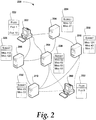
- FIG. 2 is an illustrative network in which two or more computing devices, such as computing device 100 shown in FIG. 1 , are arranged to implement the techniques and mechanisms of the present distributed web hosting mechanism.
- the network may be referred to as a computer cluster 200.
- the computer cluster 200 may be configured as a server array.
- the computer cluster 200 may be configured using a peer-to-peer (P2P) network.
- P2P peer-to-peer
- the computer cluster 200 includes multiple computing devices 202-212. Each computing device 202-212 is configured to communicate with one or more of the other computing devices 202-212.
- the communication paths are represented in FIG. 2 by solid lines between two of the computing devices 202-212.
- the communication paths may be via a local area network, internet, wireless, and the like.
- One of the computing devices holds the original web content (e.g., web content 222).
- computing device 202 will be referred to as host computer 202.
- the other computing devices e.g., computing devices 204-212 each hold a subset (e.g., subsets 224-232) of web content 222.
- computing devices 204-212 are referred to as peers 204-212 of host computer 202 throughout the following discussion. It is important to note that the use of the term peer does not require computer cluster 200 to be configured as a peer-to-peer network. Rather, the term peer reflects that the peer holds content for another computing device.
- host computer 202 wants to delivery the web content 222 to one or more computing devices, such as a client computing device 260 (hereinafter referred to as client 260).
- client 260 is not shown as part of the computer cluster 200. While this is the typical configuration, the present distributed web hosting mechanism will work equally as well if the client 260 is a part of the computer cluster 200. In either configuration, client 260 may access the subsets on the peers via the Internet using well known techniques, in conjunction with the present distributed web hosting mechanism described below.
- Prior implementations for publishing personal content have the client 260 either obtaining the entire web content 203 from host computer 202 or from another computing device that had replicated the entire web content 222.
- the present distributed web hosting mechanism focuses on replicating a subset 224-232 of the web content 222 on each of the peers 204-212.
- Each subset 224-232 may include a different set of content 222.
- client 260 obtains the entire web content 222 from multiple peers (e.g., peers 208-212) in accordance with the present distributed web hosting mechanism.
- the mechanism for determining the subsets of web content 222 and the distribution of these subsets 224-232 to the peers 204-212 is illustrated in flow diagram 300 that is shown in FIG. 3 .
- the distribution process 300 determines which subsets of the content should be duplicated on various peers. Because the entire content is not distributed to each of the peers, the storage cost for the peers is minimized and the cost/time associated with distributing the subsets to the peers is minimized.
- a type weight is assigned for each file within a web site hierarchy.
- the web content may include several types of content, such as text, pictures, video, and the like.
- the several types of content may each have different attributes associated with their type of content.
- each type of content is assigned a certain weight (i.e., a type weight).
- the type weight reflects the importance of that type of content in relation to other types of content.
- a higher weight indicates a desire to ensure that the content of this type is not missing when any of the web pages having this type of content are retrieved. For example, having icons appear on the web page may be less important than having text appear on the web page.
- the type weight assigned to icon content may be lower than the type weight assigned to text content.
- a user may assign the type weight for each individual type of content. For example, the user may assign a type weight for each type of file extension. The distribution process will then assign the specified type weight for the content once the file extension is recognized.
- a default type weight setting may be set for the different types of content. The user can then override the default setting. Processing continues at block 304.
- a site weight is assigned for each file within a web site hierarchy.
- any web site can be organized into topics, such as by interest, by time/event, and the like.
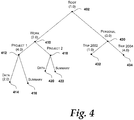
- Files associated with a particular web page may be organized on the storage media by placing them in directories. Therefore, the web site hierarchy may be graphically illustrated as a hierarchical directory tree, such as shown in FIG. 4 .
- the exemplary web site hierarchy includes a root directory 402 having two sub-directories: work directory 410 and personal directory 430. Both of these sub-directories also have sub-directories.
- Work directory 410 has a project 1 sub-directory 412 and a project 2 sub-directory 418. Both project 1 and project 2 have two sub-directories: data 414 and 420 and summary 416 and 422, respectively.
- Personal directory 420 has two sub-directories: trip 2002 432 and trip 2004 434. While the actual layout for the web site hierarchy is not particularly interesting, one will note that each directory has an associated site weight associated with the directory. The site weight for the directories may be assigned by the owner of the web site hierarchy to reflect the relative importance between the various directories within the web site.
- the relative importance between the directories reflects the different levels of annoyance that persons viewing the web site would experience if certain content was missing.
- the relative importance also reflects that certain content is more likely to be visited than other content. For example, recently created web pages will more likely be visited than older web pages.
- the assigning of the site weight may be achieved by providing a graphical web site hierarchy, such as shown in FIG. 4 , and allowing the user to select each directory or file and assign a site weight.
- a site weight may be assigned to just a few directories. The unassigned directories may then inherit their own site weight from their parent directory. Thus, if a directory or file does not have its own site weight assigned, that directory or file may inherit the site weight from its parent.
- work directory 410 is assigned a site weight of 2.0. Project2 directory and its sub-directories are not assigned any specific site weight. Thus, project2 418, data 420, and summary 422 inherit the site weight of 2.0 from the work directory 410.
- the site weight may be listed in a file.
- a file weight FW is calculated for each file within the website hierarchy.
- the file weight FW will affect the calculation of a replication ratio w m,i for the associated file m.
- the replication ratio w m,i determines how often the content (e.g., the file) is replicated on the peers.
- the replication ratio w m,i affects the retrieval reliability for the particular file m.
- doubling the file weight FW results in the doubling of the content replication ratio, which causes the resultant file to be retrieved with twice the serving bandwidth and retrieval reliability.
- a relative peer replication factor ⁇ is determined for the peer (e.g., peers 204-212 shown in FIG. 2 ).
- the relative peer replication factor ⁇ is based on an agreed replication amount D that the peer agreed to store for the host computing device.
- the relative peer replication factor ⁇ i may be determined.
- the agreed replication amount may be negotiated with each peer.
- the agreed replication amount may represent a mutual agreement by the host computer that the host computer will reciprocate the replication of the agreed amount on the host computer to support replication of the peer's web site.
- the replication factor ⁇ depends on the storage agreement with the peer, i.e., D (see eqn 2). There is no constraint that all the peer's agreed amounts equal at least the storage size needed for the entire web site.
- any amount of replicated data stored by the peers improves the reliability and retrieval speed.
- certain files having a large file weight FW m may be extensively duplicated, which improves the reliability and retrieval speed of those files.
- the peer replication ratio of each file within the web site is calculated in order to determine the content that is sent to the peer for replication.
- the peer replication ratio w m,i can be viewed as the amount of the content related to the mth file sent to peer i in proportional to the size of the m th file
- a web site is a collection of web pages.
- Each web page includes several files (i.e., web files 501).
- These web files 501 are arranged into a number of packets (e.g., packets 502-510).
- packets 502-510 are a fixed size to aid in data manipulation.
- it is important to note that some of the packets may not be the fixed size. For example, this may occur when splitting a large file into multiple packets. The last packet may be smaller than the other packets.
- the majority of packets are the fixed size.
- Each of these packets may be further split into k messages (e.g., messages 512 -520). Again, these k messages may be fixed in size.
- one message e.g., message 512
- a number of these k messages are distributed to the peer. It is advantageous to distribute the messages when the traffic on the connection between the host computer and peer i is minimal.
- a random number of the k messages are sent to peer i .
- the random number of messages may be proportional to the peer replication ratio w m,i calculated for peer i for the m th file. As an example, if a packet A is split into 16 messages, and the peer replication ratio for the file associated with packet A for peer Z is .5, half of these 16 messages (i.e., 8 messages) are sent to peer Z.
- the peer replication ratio for the file associated with packet A for peer Z is .5, half of these 16 messages (i.e., 8 messages) are sent to peer Z.
- a client locates each of the 16 messages from one or more of the peers in the computer cluster in order to recreate packet A.
- This embodiment has short comings. Even if a large number of messages are distributed to several peers, at the time the client sends a request for packet A, the computer cluster may not have each specific message associated with packet A available. If this occurs, packet A, as well as the file that contains packet A, is irretrievable.
- One method for increasing the chances of recreating each packet is by performing erasure coding on the messages prior to distribution. Thus, block 314 may be performed prior to block 316.
- erasure coding may optionally be performed on the messages. As will be shown below, applying erasure coding in conjunction with file weights further increases the reliability and retrieval speed of the web content.
- messages 512-520 are processed using a well known mathematical tool called erasure coding. While erasure coding is well known for coding data, its application to web site content has not been previously envisioned. In overview, messages 512-520 are processed through an (n, k) erasure codec to form an erasure coding space of n coded messages (e.g., coded messages 522-550).
- n coded messages 522-550 There are several well known erasure coding technologies that may be used, such as Reed-Solomon erasure codes, tornado codes, and LPDC codes.
- the present hosting mechanism utilizes the generator matrix G to define a coded message space.
- Reed-Solomon codes have a maximum distance separable (MDS) property which guarantees decoding as long as k distinct coded messages are retrieved.
- MDS maximum distance separable
- the Reed-Solomon codes are particularly well-suited for the present distributed web hosting mechanism.
- the parameter k of the erasure codes determines both the granularity of the packet as well as the size of the erasure coding space. Because the original packets 502-510 are each broken into k equal sized messages, the larger the value of parameter k, the larger the number of messages 512-520 that results from each packet. This leads to an increase of both the granularity of the access and the overhead of the erasure coding. On the other hand, k governs the maximum number of peers that the content can be simultaneously retrieved by the user. Therefore, it is beneficial to select a moderate size k in order to ensure that the user can retrieve content from a large number of peers for the greatest possible increase in speed.
- the parameter n determines the number of coded messages that can be generated from the erasure codes.
- each peer receives a number Z of distinct coded messages out of the n coded messages in the erasure coding space.
- a peer that has a replication ratio of 0.5 means that the peer should receive a number of coded messages that equals half the number of original messages for the packet (i.e., 50% duplication rate).
- the number of distinct coded messages Z i may be a factional value. When this occurs, Z i is simply interpreted as being ⁇ Z i ⁇ with probability (1+ ⁇ Z i ⁇ - Z i ), and being ⁇ Z i ⁇ +1 with probability ( Z i - ⁇ Z i ⁇ ), where ⁇ x ⁇ is the floor function. Thus, with this probability alignment some peers will have one more coded message and other peers will not have the extra coded message.
- a different erasure coding key may be assigned to each peer.
- the erasure coding key may be derived from the row index of the matrix associated with the erasure code.
- FIG. 6 is a flow diagram that illustrates a retrieval process 600 for retrieving the missing items from one or more of the peers.
- the missing items may be the actual web site file, a packet, a message, or a coded message.
- throughput for retrieving the web page is increased.
- the reliability of obtaining the requested web page is improved because the desired content may be obtained from multiple computers (i.e., peers).
- the general principal during retrieval is to retrieve the original number (i.e. k ) of items (e.g., messages, coded messages) from any number of peers for each packet.
- the retrieved items can then be combined to recreate the original packets, which are combined to create the original web file.
- the coded messages are erasure decoded to obtain the original messages, which are then combined as described above.
- the packet can be retrieved.
- Each original web file can be recovered if the constituent packets are retrievable.
- each of the original messages are retrieved to recreate the packet.
- erasure coding only k distinct coded messages are retrieved to recreate the packet, where k is the number of original messages.
- the retrieval process 600 begins when a browser sends out a request.
- a host is identified, along with a relative address under the host.
- a typical request may appear as follows: ⁇ dweb>www.xyz.com.
- a tag such as ⁇ dweb> or the like, may appear along with the host address. The tag will indicate that the host address that follows is a distributed web site. Without such a tag, the program that receives the browser request may not be able to distinguish a distributed web site from a normal web site hosted by a single server.
- the program is implemented as a proxy. In this implementation, the program communicates with the peers via a proxy port. However, the program may be implemented in other configurations.
- the program may be a component (e.g., toolbar) within the browser that is installed along with other browser components. It may also be implemented as an optional retrieval block of the browser. For any configuration, the retrieval process performed by the program is described in detail in conjunction with the flow chart illustrated in FIG. 6 .
- a uniform resource locator (URL) is accepted, such as www.xyz.com/personal/trip2004/picture1.jpg.
- the URL is recognized as having distributed web content. Processing continues at block 604.
- a list of peers that hold portions of the web content associated with the URL is obtained.
- the URL is translated into a large integer value, such as a global unifier identifier (GUID).
- the list of peers holding the URL is the list of peers associated with the GUID.
- determining the list of peers is achieved by checking a local GUID table that has one column that specifies a root path and a second column that specifies the GUID. This local GUID table may be created and updated whenever the client accesses a distributed web site.
- the GUID table list is then transmitted through out the computer cluster to obtain a list of computers that are storing portions of the web content.
- the list of peers that hold the GUID is determined by performing a look up using a distributed hash table (DHT) approach.
- DHT distributed hash table
- the DHT technique for identifying peers that are associated with a GUID is well known in the art. Processing continues at block 606.
- a summary file associated with the URL is obtained.
- the summary file provides a glimpse of the structure of the web site.
- the client can determine the number and the indexes of the packets that constitute the web page/files, and thus retrieve the right packets for the desired web page/file.
- the summary file associated with the directory in which the requested file is located is obtained.
- the summary file includes one entry for each file/child directory.
- Each entry of the summary file identifies the name of the file/child directory, and includes a modification property, a file/folder identifier, and the length of the file.
- each entry may include an erasure coding packet identifier that identifies the packets that constitute the web page/file.
- the modification property is the timestamp at which the associated file/child directory was last updated. If the modification property is different from one peer to another peer, the items stored on the peer having the older time stamp will not be retrieved.
- the summary file is first checked to see whether it resides locally. The summary file will reside locally if any of the files under this directory have been previously visited by the client. When this occurs, the summary file does not need to be retrieved from the peers.
- the summary file is retrieved from one or more of the peers and stored on the local client for subsequent requests.
- the summary file itself may be broken into packets, and encoded with erasure coded messages.
- the client retrieves the erasure coded messages associated with the summary file, decodes the coded messages into packets, and reassembles the summary file.
- the summary files obtained from multiple peers are verified.
- the peer whose summary file indicates that it holds an older (i.e., earlier) version of the web page/file is not involved in the retrieval process.
- a negotiation process is performed with the available peers.
- the negotiation process is used to retrieve both the web page/file and the summary file described above.
- the negotiation process will obtain the actual web site files from the available peers.
- the negotiation process will obtain the packets that make up a web site file from the available peers.
- the negotiation process will obtain messages or coded messages from the available peers. The coded messages are then decoded into packets, which are further assembled to recreate the original web page/file.
- FIG. 7 a sequential flow diagram that illustrates an exemplary negotiation process 700 for obtaining missing files or messages from the available peers is described.
- the term "item" is used in FIG. 7 to indicate that the requested information may be a web site file, a packet, a message, or a coded message.
- the left line represents communication received or transmitted from the client (i.e., the computing device that desires to see the web content and that has transmitted the URL of the distributed web site).
- the right line represents communication received or transmitted from one of the peers.
- the negotiation process 700 may be performed for each of the peers identified until the necessary items have been retrieved.
- the client via the proxy, announces which items are needed 702. If the items are coded messages, the client provides the packet identifier and the key. In response, the peer provides information regarding its available items associated with the requested missing items. Again, if the items are coded messages, the peer provides the packet identifier and the key for each coded message that is stored locally on the peer. At 706, the client sends a request for specific missing items that the peer informed were available. At 708, the peer sends the specific missing items to the client.
- processing continues at block 612.
- the information is assembled and the associated web page is displayed. Assembling the information may involve decoding the coded message into packets, and then assembling the packets into the specific web file associated with the URL.
- different portions of one web file may be obtained from multiple computing devices running in difference locations. Typically, none of the computing devices have a complete copy of the web file. This is particular true when erasure coding is performed.
- the client is then responsible for retrieving the multiple portions and piecing them together to create the requested web file and then displaying the web file in the browser.
- FIGS. 8 and 9 illustrate test results 801, 802, 803 and 901, 902, and 903, respectively, for the above three identified scenarios.
- scenario 2 each packet is split into k pieces.
- the original message piece is sent to the other peers without erasure coding.
- An assumption was made that the same amount of network and storage resources are used to distribute and host the content (i.e., the aggregated content replication ratio C) for all scenarios.
- FIG. 8 The probability of successfully retrieving the web site in the computer cluster (e.g., P2P network) is shown in FIG. 8 .
- FIG. 9 The average speed increase for retrieving the web site using the various scenarios is shown in FIG. 9 .
- the horizontal axis is the probability of a peer being online.
- FIG. 8 is a graph illustrating test results associated with the retrieval failure rate versus the probability of being online in various scenarios.
- curve 801 represents scenario one in which the entire web site is replicated
- curve 802 represents scenario two in which a portion of the entire web site is replicated without erasure coding
- curve 803 represents scenario three in which a portion of the entire web site is replicated using erasure coding.
- curve 803 provides a significant improvement in the reliability of retrieval in comparison with curves 801 and 802 using the same amount of network and storage resources.
- the rate of failure to retrieve the web site for the erasure coded content was thousands times smaller than that of the whole web replication curve 801 and the partial web replication without erasure coding curve 802.
- FIG. 9 is a graph illustrating test results associated with the increase of retrieval speed versus the probability of being online in various scenarios.
- curve 901 represents scenario one in which the entire web site is replicated
- curve 902 represents scenario two in which a portion of the entire web site is replicated without erasure coding
- curve 903 represents scenario three in which a portion of the entire web site is replicated using erasure coding.
- the erasure coded curve 903 provides increased retrieval speeds of around 16 times and 1-10 times faster than the whole web replication (curve 901) and the partial web replication without erasure coding (curve 902), respectively.
- An exemplary P2P web hosting system with erasure coded content distribution and hierarchical content organization with unequal weight assignment was designed.
- the web site was replicated on seven peers.
- the original web site consumed 228 megabytes.
- each peer agreed to host 60 megabytes of the web site, which resulted in an average replication ratio of 0.26. Since the web files were unequally weighted, the peer replication ratio for the actual web files varied from 0.25 to 1.0.
- the client retrieved the web content from the seven peers simultaneously, decoded the erasure coded messages, and rendered the web page.
- the present distributed hosting mechanism increases the retrieval speeds for accessing web content and increases the reliability of retrieving the content.
- the distributed hosting mechanism reduces the amount of replicated content on each individual peer.
- the present web hosting mechanism includes three components: the host component, the peer component, and the client component.
- the host component distributes the portions (i.e., subsets) of web pages/files to the peers.
- the peer component receives the distributed portions of the web pages/files, and then redistributes them upon request of the client.
- the client component coordinates the retrieval of the portions of web pages/files in the form of original messages or erasure coded messages from multiple peers.
- the original messages are then assembled to form the requested web pages/files.
- the coded messages are erasure decoded into packets, which are then assembled to form the requested web pages/files.
Landscapes
- Engineering & Computer Science (AREA)
- Computer Networks & Wireless Communication (AREA)
- Signal Processing (AREA)
- Theoretical Computer Science (AREA)
- Physics & Mathematics (AREA)
- General Engineering & Computer Science (AREA)
- General Physics & Mathematics (AREA)
- Computer Security & Cryptography (AREA)
- Software Systems (AREA)
- Information Transfer Between Computers (AREA)
- Information Retrieval, Db Structures And Fs Structures Therefor (AREA)
- Computer And Data Communications (AREA)
Claims (18)
- Verfahren zur Verteilung des Inhalts einer Website auf mehrere Peer-Vorrichtungen (204-212) innerhalb eines Computerclusters (200), wobei der Inhalt eine Vielzahl von Dateien umfasst, die in Verzeichnissen innerhalb eines Verzeichnisbaums organisiert sind, wobei das Verfahren Folgendes umfasst:Zuweisen (302) eines Typgewichts zu einer Datei, die der Website zugeordnet ist, wobei das Typgewicht die Wichtigkeit eines Inhaltstyps widerspiegelt;Zuweisen (304) eines Website-gewichts zu der Datei, wobei das Website-gewicht einem der Verzeichnisse zugeordnet ist und die relative Wichtigkeit des Verzeichnisses unter den verschiedenen Verzeichnissen innerhalb der Website widerspiegelt;Berechnen (306) eines individuellen Dateigewichts für die Datei basierend auf dem Typgewicht und dem Website-gewicht, wobei das Dateigewicht unabhängig von den Peer-Vorrichtungen innerhalb des Computerclusters ist;Berechnen (310) eines Replikationsverhältnisses für die Datei basierend auf dem Dateigewicht, wobei das Replikationsverhältnis bestimmt wie oft eine Datei auf den Peer-Vorrichtungen repliziert wird, undVerteilen (316) der Datei auf eine der mehreren Peer-Vorrichtungen innerhalb des Computerclusters basierend auf dem Replikationsverhältnis.
- Verfahren nach Anspruch 1, wobei der Computercluster ein Serverarray umfasst.
- Verfahren nach Anspruch 1, wobei der Computercluster ein Peer-to-Peer-Netzwerk umfasst.
- Verfahren nach Anspruch 1, wobei die Berechnung des Dateigewichts ferner auf einem Typgewicht basiert, welches jeder der Vielzahl von Dateien zugewiesenen ist, wobei das Typgewicht die Wichtigkeit eines Inhaltstyps widerspiegelt.
- Verfahren nach Anspruch 4, wobei das Typgewicht auf einer Dateierweiterung basiert.
- Verfahren nach Anspruch 1, wobei das Website-gewicht einem Verzeichnis zugewiesen wird, wobei jede Datei innerhalb des Verzeichnisses das Website-gewicht des Verzeichnisses hat.
- Verfahren nach Anspruch 6, wobei ein Unterverzeichnis des Verzeichnisses das dem Verzeichnis zugewiesene Website-gewicht erbt.
- Verfahren nach Anspruch 1, wobei das Erzeugen der Vielzahl von Teilmengen ferner auf einer für jeden Rechner angegebenen individuellen Replikationsmenge basiert, wobei die individuelle Replikationsmenge auf einer Speichermenge auf dem Rechner zum Aufnehmen einer der Teilmengen basiert.
- Verfahren nach Anspruch 1, wobei die Vielzahl von Dateien in eine Vielzahl von Nachrichten unterteilt sind und jede Teilmenge mindestens eine Nachricht enthält.
- Verfahren nach Anspruch 9, wobei eine Mehrheit der Vielzahl von Nachrichten eine feste Größe hat.
- Verfahren nach Anspruch 1, ferner umfassend das Unterteilen der Vielzahl von Dateien in eine Vielzahl von Originalnachrichten, das Anwenden (314) eines Löschcodierungsschemas, um eine Vielzahl von codierten Nachrichten abzuleiten, und das Hinzufügen einer oder mehrerer der codierten Nachrichten zu jeder Teilmenge.
- Verfahren nach Anspruch 11, wobei das Löschcodierungsschema einen Reed-Solomon-Codec umfasst.
- Verfahren nach Anspruch 11, wobei das Verteilen einer der Vielzahl von Teilmengen das Verteilen der Teilmengen auf der Grundlage eines Schlüssels umfasst, der dem Löschcodierungsschema zugeordnet ist.
- Computerlesbares Medium mit computerausführbaren Anweisungen, die, wenn sie auf einem Computer ausgeführt werden, ein Verfahren zur Verteilung des Inhalts einer Website unter mehreren Peer-Vorrichtungen (204-212) innerhalb eines Computerclusters (200) ausführen, wobei der Inhalt eine Vielzahl von Dateien umfasst, die in Verzeichnissen innerhalb eines Verzeichnisbaums organisiert sind, wobei das Verfahren Folgendes umfasst:Zuweisen (302) eines Typgewichts zu einer Datei, die der Website zugeordnet ist, wobei das Typgewicht die Wichtigkeit eines Inhaltstyps widerspiegelt;Zuweisen (304) eines Website-gewichts zu der Datei, wobei das Website-gewicht einem der Verzeichnisse zugeordnet ist und die relative Wichtigkeit des Verzeichnisses unter den verschiedenen Verzeichnissen innerhalb der Website widerspiegelt;Berechnen (306) eines individuellen Dateigewichts für die Datei basierend auf dem Typgewicht und dem Website-gewicht, wobei das Dateigewicht unabhängig ist von den Peer-Vorrichtungen innerhalb des Computerclusters;Berechnen (310) eines Replikationsverhältnisses für die Datei basierend auf dem Dateigewicht, wobei das Replikationsverhältnis bestimmt wie oft eine Datei auf den Peer-Vorrichtungen repliziert wird, undVerteilen (316) der Datei auf eine der mehreren Peer-Vorrichtungen innerhalb des Computerclusters basierend auf dem Replikationsverhältnis.
- Computerlesbares Medium nach Anspruch 14 mit weiteren computerausführbaren Anweisungen zur Ausführung der in den Ansprüchen 2 bis 13 angegebenen Verfahren.
- Ein System, welches Folgendes umfasst:einen Prozessor (102); undeinen Speicher (104, 109, 110), in den eine Vielzahl von Anweisungen geladen wird, wobei die Vielzahl von Anweisungen, wenn sie auf einem Computer ausgeführt werden, derart konfiguriert sind, dass sie ein Verfahren zur Verteilung des Inhalts einer Website unter mehreren Peer-Vorrichtungen (204-212) innerhalb eines Computerclusters (200) ausführen, wobei der Inhalt eine Vielzahl von Dateien umfasst, die in Verzeichnissen innerhalb eines Verzeichnisbaums organisiert sind, wobei das Verfahren Folgendes umfasst:Zuweisen (302) eines Typgewichts zu einer der Vielzahl von Dateien, die der Website zugeordnet sind, wobei das Typgewicht die Wichtigkeit eines Inhaltstyps widerspiegelt;Zuweisen (304) eines Website-gewichts zu der Datei, wobei das Website-gewicht einem der Verzeichnisse zugeordnet ist und die relative Wichtigkeit des Verzeichnisses unter den verschiedenen Verzeichnissen innerhalb der Website widerspiegelt;Berechnen (306) eines individuellen Dateigewichts für die Datei basierend auf dem Typgewicht und dem Website-gewicht, wobei das Dateigewicht unabhängig ist von den Peer-Vorrichtungen innerhalb des Computerclusters;Berechnen (310) eines Replikationsverhältnisses für die Datei basierend auf dem Dateigewicht, wobei das Replikationsverhältnis bestimmt wie oft eine Datei auf den Peer-Vorrichtungen repliziert wird, undVerteilen (316) der Datei auf eine der Peer-Vorrichtungen innerhalb des Computerclusters basierend auf dem Replikationsverhältnis.
- System nach Anspruch 16, ferner umfassend das Aufteilen der Datei in eine Vielzahl von Nachrichten, wobei das Verteilen der Datei das Senden von mindestens einer der Vielzahl von Nachrichten, die der Datei zugeordnet sind, an den einen Rechner umfasst.
- System nach Anspruch 17, ferner umfassend das Anwenden eines Löschcodierungsschemas zum Ableiten einer Vielzahl von codierten Nachrichten, wobei die codierten Nachrichten die Nachrichten sind.
Applications Claiming Priority (2)
| Application Number | Priority Date | Filing Date | Title |
|---|---|---|---|
| US10/845,625 US7546342B2 (en) | 2004-05-14 | 2004-05-14 | Distributed hosting of web content using partial replication |
| US845625 | 2004-05-14 |
Publications (3)
| Publication Number | Publication Date |
|---|---|
| EP1599013A2 EP1599013A2 (de) | 2005-11-23 |
| EP1599013A3 EP1599013A3 (de) | 2005-11-30 |
| EP1599013B1 true EP1599013B1 (de) | 2019-01-16 |
Family
ID=34980253
Family Applications (1)
| Application Number | Title | Priority Date | Filing Date |
|---|---|---|---|
| EP05103215.9A Expired - Lifetime EP1599013B1 (de) | 2004-05-14 | 2005-04-21 | Verteiiltes beherbergungssystem für webinhalt mit partieller vervielfältigen |
Country Status (5)
| Country | Link |
|---|---|
| US (1) | US7546342B2 (de) |
| EP (1) | EP1599013B1 (de) |
| JP (1) | JP4950439B2 (de) |
| KR (1) | KR101130387B1 (de) |
| CN (1) | CN100498772C (de) |
Families Citing this family (74)
| Publication number | Priority date | Publication date | Assignee | Title |
|---|---|---|---|---|
| US8626820B1 (en) | 2003-01-21 | 2014-01-07 | Peer Fusion, Inc. | Peer to peer code generator and decoder for digital systems |
| US9372870B1 (en) | 2003-01-21 | 2016-06-21 | Peer Fusion, Inc. | Peer to peer code generator and decoder for digital systems and cluster storage system |
| US7707265B2 (en) * | 2004-05-15 | 2010-04-27 | International Business Machines Corporation | System, method, and service for interactively presenting a summary of a web site |
| US8102837B2 (en) * | 2004-12-30 | 2012-01-24 | Massachusetts Institute Of Technology | Network coding approach to rapid information dissemination |
| US8046426B2 (en) * | 2004-12-30 | 2011-10-25 | Massachusetts Institute Of Technology | Random linear coding approach to distributed data storage |
| US20060184968A1 (en) * | 2005-02-11 | 2006-08-17 | Clayton Richard M | Automatic content update for a target device |
| KR20070103758A (ko) * | 2005-02-11 | 2007-10-24 | 제너럴 인스트루먼트 코포레이션 | 타겟 디바이스를 위한 자동 컨텐츠 업데이트 |
| KR20070059597A (ko) * | 2005-12-07 | 2007-06-12 | 현대자동차주식회사 | 후드 고정 장치 |
| US9047310B2 (en) * | 2006-02-22 | 2015-06-02 | Microsoft Technology Licensing, Llc | Reliable, efficient peer-to-peer storage |
| US8738778B2 (en) * | 2006-04-26 | 2014-05-27 | Bittorrent, Inc. | Peer-to-peer download and seed policy management |
| DE102006019711A1 (de) * | 2006-04-27 | 2007-10-31 | Siemens Ag | Verfahren zum Verteilen eines in Teilblöcke aufgeteilten Datenblocks in einem mehrere Knoten umfassenden Netzwerk, sowie dazugehöriger Knoten und System |
| DE602006017040D1 (de) * | 2006-05-19 | 2010-11-04 | Microsoft Corp | Inhaltsverwaltung in Peer-to-peer Datenverteilungswolken |
| US20080059631A1 (en) * | 2006-07-07 | 2008-03-06 | Voddler, Inc. | Push-Pull Based Content Delivery System |
| US7886034B1 (en) * | 2006-09-27 | 2011-02-08 | Symantec Corporation | Adaptive liveness management for robust and efficient peer-to-peer storage |
| US8006281B2 (en) | 2006-12-21 | 2011-08-23 | Microsoft Corporation | Network accessible trusted code |
| US20080189429A1 (en) * | 2007-02-02 | 2008-08-07 | Sony Corporation | Apparatus and method for peer-to-peer streaming |
| WO2008117295A2 (en) * | 2007-03-28 | 2008-10-02 | Unison Play Ltd. | Distributed storage management |
| US7979311B2 (en) * | 2007-05-31 | 2011-07-12 | International Business Machines Corporation | Payment transfer strategies for bandwidth sharing in ad hoc networks |
| US7898993B2 (en) * | 2007-05-31 | 2011-03-01 | International Business Machines Corporation | Efficiency and resiliency enhancements for transition states in ad hoc networks |
| US7860081B2 (en) * | 2007-05-31 | 2010-12-28 | International Business Machines Corporation | Optimization process and system for multiplexed gateway architecture |
| US7817623B2 (en) * | 2007-05-31 | 2010-10-19 | International Business Machines Corporation | Optimization process and system for non-multiplexed peer-to-peer architecture |
| US7873019B2 (en) * | 2007-05-31 | 2011-01-18 | International Business Machines Corporation | Systems and methods for establishing gateway bandwidth sharing ad-hoc networks |
| US10419360B2 (en) | 2007-05-31 | 2019-09-17 | International Business Machines Corporation | Market-driven variable price offerings for bandwidth-sharing ad hoc networks |
| US10623998B2 (en) | 2007-05-31 | 2020-04-14 | International Business Machines Corporation | Price offerings for bandwidth-sharing ad hoc networks |
| US8620784B2 (en) | 2007-05-31 | 2013-12-31 | International Business Machines Corporation | Formation and rearrangement of ad hoc networks |
| US8520535B2 (en) * | 2007-05-31 | 2013-08-27 | International Business Machines Corporation | Optimization process and system for a heterogeneous ad hoc Network |
| US8040863B2 (en) * | 2007-05-31 | 2011-10-18 | International Business Machines Corporation | Demand pull and supply push communication methodologies |
| US7843861B2 (en) * | 2007-05-31 | 2010-11-30 | International Business Machines Corporation | Coalition formation and service provisioning of bandwidth sharing AD HOC networks |
| US8249984B2 (en) * | 2007-05-31 | 2012-08-21 | International Business Machines Corporation | System and method for fair-sharing in bandwidth sharing ad-hoc networks |
| US8320414B2 (en) | 2007-05-31 | 2012-11-27 | International Business Machines Corporation | Formation and rearrangement of lender devices that perform multiplexing functions |
| US8051362B2 (en) * | 2007-06-15 | 2011-11-01 | Microsoft Corporation | Distributed data storage using erasure resilient coding |
| US20090083148A1 (en) * | 2007-09-26 | 2009-03-26 | Sony Corporation | System and method for facilitating content transfers between client devices in an electronic network |
| US8397168B2 (en) | 2008-04-05 | 2013-03-12 | Social Communications Company | Interfacing with a spatial virtual communication environment |
| US7769806B2 (en) | 2007-10-24 | 2010-08-03 | Social Communications Company | Automated real-time data stream switching in a shared virtual area communication environment |
| US7992037B2 (en) * | 2008-09-11 | 2011-08-02 | Nec Laboratories America, Inc. | Scalable secondary storage systems and methods |
| US9098519B2 (en) * | 2008-09-16 | 2015-08-04 | File System Labs Llc | Methods and apparatus for distributed data storage |
| WO2010091101A1 (en) * | 2009-02-03 | 2010-08-12 | Bittorent, Inc. | Distributed storage of recoverable data |
| EP2249550A1 (de) | 2009-05-04 | 2010-11-10 | Thomson Licensing | Vorrichtung und Verfahren zur Steuerung der Verbreitung von Inhalten zwischen Peers mit drahtlosen Kommunikationskapazitäten je nach Ungeduldsreaktionsfunktionen |
| EP2252031A1 (de) * | 2009-05-15 | 2010-11-17 | Thomson Licensing | Vorrichtung und Verfahren zur Steuerung der Verbreitung von Daten durch Übertragung von Reihen von Befehlen zwischen Peers mit drahtlosen Kommunikationskapazitäten |
| US8458287B2 (en) * | 2009-07-31 | 2013-06-04 | Microsoft Corporation | Erasure coded storage aggregation in data centers |
| US8683311B2 (en) * | 2009-12-11 | 2014-03-25 | Microsoft Corporation | Generating structured data objects from unstructured web pages |
| JP5765950B2 (ja) | 2010-01-28 | 2015-08-19 | トムソン ライセンシングThomson Licensing | 票ベクトルに従って、ワイヤレス・コミュニケーション能力を有するピア間のコンテンツ配布を制御するためのデバイス、及び方法 |
| EP2372976B1 (de) * | 2010-03-31 | 2013-05-08 | Thomson Licensing | Vorrichtung und Verfahren zur Steuerung der Verbreitung von Inhalten zwischen Peers mit drahtlosen Kommunikationskapazitäten je nach Wahl der Vektoren |
| JP5293670B2 (ja) * | 2010-03-31 | 2013-09-18 | ブラザー工業株式会社 | 情報処理装置、情報処理プログラム、情報処理方法、及び配信システム |
| JP5234041B2 (ja) * | 2010-03-31 | 2013-07-10 | ブラザー工業株式会社 | 情報通信システム、ノード装置および情報処理方法ならびにノード装置用プログラム |
| GB2560449A (en) * | 2010-08-24 | 2018-09-12 | Qando Service Inc | Accessing a web site |
| WO2013078062A1 (en) * | 2011-11-23 | 2013-05-30 | Social Communications Company | Creating and managing virtual areas |
| US9104560B2 (en) | 2012-06-13 | 2015-08-11 | Caringo, Inc. | Two level addressing in storage clusters |
| US8762353B2 (en) | 2012-06-13 | 2014-06-24 | Caringo, Inc. | Elimination of duplicate objects in storage clusters |
| US8799746B2 (en) | 2012-06-13 | 2014-08-05 | Caringo, Inc. | Erasure coding and replication in storage clusters |
| US8965845B2 (en) | 2012-12-07 | 2015-02-24 | International Business Machines Corporation | Proactive data object replication in named data networks |
| US9558206B2 (en) * | 2013-02-25 | 2017-01-31 | Datadirect Networks, Inc. | Asymmetric distributed data storage system |
| US10248667B1 (en) * | 2013-03-15 | 2019-04-02 | Twitter, Inc. | Pre-filtering in a messaging platform |
| US9600365B2 (en) | 2013-04-16 | 2017-03-21 | Microsoft Technology Licensing, Llc | Local erasure codes for data storage |
| US9354991B2 (en) | 2013-06-25 | 2016-05-31 | Microsoft Technology Licensing, Llc | Locally generated simple erasure codes |
| EP2863566B1 (de) | 2013-10-18 | 2020-09-02 | Université de Nantes | Verfahren zur Rekonstruktion eines Datenblocks und Vorrichtung zur Verwendung davon |
| CN103631539B (zh) * | 2013-12-13 | 2016-08-24 | 百度在线网络技术(北京)有限公司 | 基于擦除编码机制的分布式存储系统及其存储方法 |
| US9087012B1 (en) | 2014-06-04 | 2015-07-21 | Pure Storage, Inc. | Disaster recovery at high reliability in a storage cluster |
| US8850108B1 (en) * | 2014-06-04 | 2014-09-30 | Pure Storage, Inc. | Storage cluster |
| US9811677B2 (en) | 2014-07-03 | 2017-11-07 | Pure Storage, Inc. | Secure data replication in a storage grid |
| US9450617B2 (en) * | 2014-08-08 | 2016-09-20 | Quantum Corporation | Distribution and replication of erasure codes |
| US10671252B2 (en) | 2014-09-04 | 2020-06-02 | Home Box Office, Inc. | Styling system |
| WO2016051512A1 (ja) | 2014-09-30 | 2016-04-07 | 株式会社日立製作所 | 分散型ストレージシステム |
| US20160162510A1 (en) * | 2014-12-03 | 2016-06-09 | International Business Machines Corporation | Clone data management |
| CN107844268B (zh) * | 2015-06-04 | 2021-09-14 | 华为技术有限公司 | 一种数据分发方法、数据存储方法、相关装置以及系统 |
| US10977124B2 (en) | 2016-01-07 | 2021-04-13 | Hitachi, Ltd. | Distributed storage system, data storage method, and software program |
| WO2017145223A1 (ja) | 2016-02-22 | 2017-08-31 | 株式会社日立製作所 | 計算機システム、計算機システムの制御方法、および記録媒体 |
| US10394484B2 (en) | 2016-02-26 | 2019-08-27 | Hitachi, Ltd. | Storage system |
| US20160255149A1 (en) * | 2016-04-07 | 2016-09-01 | Michael Lewis Moravitz | Mirror links |
| US10547681B2 (en) | 2016-06-30 | 2020-01-28 | Purdue Research Foundation | Functional caching in erasure coded storage |
| US10417094B1 (en) | 2016-07-13 | 2019-09-17 | Peer Fusion, Inc. | Hyper storage cluster |
| US10733225B1 (en) * | 2017-09-06 | 2020-08-04 | Snap Inc. | Scaled delivery of media content |
| JP6676203B2 (ja) * | 2019-03-13 | 2020-04-08 | 株式会社エヌ・ティ・ティ・データ | 管理装置、ストレージシステム、ストレージ管理方法、及びプログラム |
| US11100236B2 (en) | 2019-06-26 | 2021-08-24 | Seagate Technology Llc | Distributed data security |
Citations (4)
| Publication number | Priority date | Publication date | Assignee | Title |
|---|---|---|---|---|
| US5963944A (en) * | 1996-12-30 | 1999-10-05 | Intel Corporation | System and method for distributing and indexing computerized documents using independent agents |
| WO2001093536A2 (en) * | 2000-06-01 | 2001-12-06 | Aerocast.Com, Inc. | Reverse content harvester |
| US20020087797A1 (en) * | 2000-12-29 | 2002-07-04 | Farid Adrangi | System and method for populating cache servers with popular media contents |
| US20030204613A1 (en) * | 2002-04-26 | 2003-10-30 | Hudson Michael D. | System and methods of streaming media files from a dispersed peer network to maintain quality of service |
Family Cites Families (32)
| Publication number | Priority date | Publication date | Assignee | Title |
|---|---|---|---|---|
| US6047309A (en) * | 1995-10-02 | 2000-04-04 | International Business Machines Corporation | Recording observed and reported response characteristics at server and/or client nodes in a replicated data environment, and selecting a server to provide data based on the observed and/or reported response characteristics |
| KR100229015B1 (ko) * | 1996-08-06 | 1999-11-01 | 윤종용 | 디지탈 처리시스템의 에러정정장치 및 방법 |
| JP3795166B2 (ja) * | 1997-01-07 | 2006-07-12 | 三菱電機株式会社 | コンテンツ管理方式 |
| US6108703A (en) * | 1998-07-14 | 2000-08-22 | Massachusetts Institute Of Technology | Global hosting system |
| US6307487B1 (en) * | 1998-09-23 | 2001-10-23 | Digital Fountain, Inc. | Information additive code generator and decoder for communication systems |
| US6820133B1 (en) * | 2000-02-07 | 2004-11-16 | Netli, Inc. | System and method for high-performance delivery of web content using high-performance communications protocol between the first and second specialized intermediate nodes to optimize a measure of communications performance between the source and the destination |
| US7313616B1 (en) * | 2000-02-17 | 2007-12-25 | International Business Machines Corporation | Web site management in a world wide web communication network through periodic reassignment of the server computers designated for respective web documents related to document weight based on byte count and program content |
| US6718365B1 (en) * | 2000-04-13 | 2004-04-06 | International Business Machines Corporation | Method, system, and program for ordering search results using an importance weighting |
| WO2001090943A2 (en) * | 2000-05-19 | 2001-11-29 | Clearway Technologies, Llc | Distributed internet content delivery system |
| JP2001333032A (ja) * | 2000-05-23 | 2001-11-30 | Matsushita Electric Ind Co Ltd | 限定受信システム |
| JP2002032280A (ja) * | 2000-07-13 | 2002-01-31 | Ism Consulting Firm Kk | 分散型サーバによるコンテンツ及びソフトウェア配信サービスシステム、及び分散型サーバによるコンテンツ及びソフトウェア配信方法、並びに情報記憶媒体 |
| JP3672483B2 (ja) * | 2000-08-16 | 2005-07-20 | 日本電信電話株式会社 | コンテンツ配信装置、コンテンツ配信方法、コンテンツ配信プログラムを記録した記録媒体 |
| US20020040389A1 (en) * | 2000-10-03 | 2002-04-04 | Wirespring Technologies, Inc. | System and method for remotely-managed content distribution network |
| US7036138B1 (en) * | 2000-11-08 | 2006-04-25 | Digeo, Inc. | Method and apparatus for scheduling broadcast information |
| US7277950B1 (en) * | 2000-12-29 | 2007-10-02 | Swarmcast, Inc. | Packet transfer mechanism over a peer to peer network |
| US7275102B2 (en) * | 2001-01-22 | 2007-09-25 | Sun Microsystems, Inc. | Trust mechanisms for a peer-to-peer network computing platform |
| JP4191902B2 (ja) * | 2001-02-28 | 2008-12-03 | 株式会社日立製作所 | コンテンツ配信装置 |
| JP2002278859A (ja) * | 2001-03-16 | 2002-09-27 | Nec Corp | コンテンツ配信システム、コンテンツ配信方法及びコンテンツを再生するためのコンテンツ再生装置 |
| US20030005465A1 (en) * | 2001-06-15 | 2003-01-02 | Connelly Jay H. | Method and apparatus to send feedback from clients to a server in a content distribution broadcast system |
| JP4410963B2 (ja) * | 2001-08-28 | 2010-02-10 | 日本電気株式会社 | コンテンツ動的ミラーリングシステム、 |
| JP2003216521A (ja) * | 2002-01-28 | 2003-07-31 | Nippon Telegr & Teleph Corp <Ntt> | コンテンツの配置方法、この方法のプログラム、このプログラムを記録した記録媒体 |
| US20030158958A1 (en) * | 2002-02-20 | 2003-08-21 | Koninklijke Philips Electronics N.V. | Distributed storage network architecture using user devices |
| US7571251B2 (en) * | 2002-05-06 | 2009-08-04 | Sandvine Incorporated Ulc | Path optimizer for peer to peer networks |
| US7343418B2 (en) * | 2002-06-03 | 2008-03-11 | Microsoft Corporation | Peer to peer network |
| JP2004080145A (ja) | 2002-08-12 | 2004-03-11 | Canon Inc | 映像サーバシステム及びその映像再生方法 |
| JP2004127189A (ja) | 2002-10-07 | 2004-04-22 | Matsushita Electric Ind Co Ltd | ゲートウェイ装置、コンテンツ転送システム及びコンテンツ転送方法 |
| US7424514B2 (en) * | 2002-11-08 | 2008-09-09 | The Regents Of The University Of Michigan | Peer-to-peer method and system for performing and managing backups in a network of nodes |
| GB0230331D0 (en) * | 2002-12-31 | 2003-02-05 | British Telecomm | Method and apparatus for operating a computer network |
| US6970987B1 (en) * | 2003-01-27 | 2005-11-29 | Hewlett-Packard Development Company, L.P. | Method for storing data in a geographically-diverse data-storing system providing cross-site redundancy |
| US20050015511A1 (en) * | 2003-07-02 | 2005-01-20 | Nec Laboratories America, Inc. | Accelerated large data distribution in overlay networks |
| US7379974B2 (en) * | 2003-07-14 | 2008-05-27 | International Business Machines Corporation | Multipath data retrieval from redundant array |
| US20050160107A1 (en) * | 2003-12-29 | 2005-07-21 | Ping Liang | Advanced search, file system, and intelligent assistant agent |
-
2004
- 2004-05-14 US US10/845,625 patent/US7546342B2/en active Active
-
2005
- 2005-04-21 EP EP05103215.9A patent/EP1599013B1/de not_active Expired - Lifetime
- 2005-05-12 JP JP2005139956A patent/JP4950439B2/ja not_active Expired - Fee Related
- 2005-05-13 KR KR1020050040216A patent/KR101130387B1/ko not_active Expired - Fee Related
- 2005-05-13 CN CNB2005100688900A patent/CN100498772C/zh not_active Expired - Fee Related
Patent Citations (4)
| Publication number | Priority date | Publication date | Assignee | Title |
|---|---|---|---|---|
| US5963944A (en) * | 1996-12-30 | 1999-10-05 | Intel Corporation | System and method for distributing and indexing computerized documents using independent agents |
| WO2001093536A2 (en) * | 2000-06-01 | 2001-12-06 | Aerocast.Com, Inc. | Reverse content harvester |
| US20020087797A1 (en) * | 2000-12-29 | 2002-07-04 | Farid Adrangi | System and method for populating cache servers with popular media contents |
| US20030204613A1 (en) * | 2002-04-26 | 2003-10-30 | Hudson Michael D. | System and methods of streaming media files from a dispersed peer network to maintain quality of service |
Also Published As
| Publication number | Publication date |
|---|---|
| CN1696936A (zh) | 2005-11-16 |
| EP1599013A3 (de) | 2005-11-30 |
| US20050283537A1 (en) | 2005-12-22 |
| US7546342B2 (en) | 2009-06-09 |
| KR20060047899A (ko) | 2006-05-18 |
| EP1599013A2 (de) | 2005-11-23 |
| JP4950439B2 (ja) | 2012-06-13 |
| JP2005327291A (ja) | 2005-11-24 |
| CN100498772C (zh) | 2009-06-10 |
| KR101130387B1 (ko) | 2012-03-27 |
Similar Documents
| Publication | Publication Date | Title |
|---|---|---|
| EP1599013B1 (de) | Verteiiltes beherbergungssystem für webinhalt mit partieller vervielfältigen | |
| JP3967806B2 (ja) | リソースの位置を指名するためのコンピュータ化された方法及びリソース指名機構 | |
| EP1579349B1 (de) | Methode und system zum identifizieren von computern zur speicherung von dateifragmenten in einem computernetzwerk | |
| US6898633B1 (en) | Selecting a server to service client requests | |
| US7530115B2 (en) | Access to content addressable data over a network | |
| US7783600B1 (en) | Redundancy management service for peer-to-peer networks | |
| US8312107B2 (en) | Rate sensitive packet transfer mechanism over a peer-to-peer network | |
| KR101220614B1 (ko) | 피어 투 피어 게이트웨이 | |
| US7587446B1 (en) | Acquisition and synchronization of digital media to a personal information space | |
| BRPI0015347A2 (pt) | recurso de armazenamento de internet compartilhada, sistema de interface com o usuário, e método | |
| JP4671332B2 (ja) | ユーザ識別情報を変換するファイルサーバ | |
| US20020133597A1 (en) | Global storage system | |
| JP2004310371A (ja) | ファイル共有システム及び方法、ファイル共有サーバ、ファイル共有サービスのクライアント端末、ファイル共有プログラム、ファイル共有プログラムを記録した記録媒体 | |
| JP5431475B2 (ja) | 検索システム、及び検索空間マップサーバ装置、並びにプログラム | |
| WO2012170309A2 (en) | Crawl freshness in disaster data center | |
| US9626378B2 (en) | Method for handling requests in a storage system and a storage node for a storage system | |
| US7275078B2 (en) | Distributed web CGI architecture | |
| Li et al. | Distributed hosting of web content with erasure coding and unequal weight assignment | |
| Sit | Storing and managing data in a distributed hash table | |
| CN113448937A (zh) | 一种基于arm微服务器的数据传输方法 | |
| CN119544798A (zh) | 业务调度方法、装置、计算机设备、存储介质和计算机程序产品 | |
| Endler et al. | Middleware 2003: ACM/IFIP/USENIX International Middleware Conference, Rio de Janeiro, Brazil, June 16-20, 2003, Proceedings | |
| Nandan et al. | On index load balancing in scalable P2P media distribution | |
| Savage et al. | Search on the cloud file system | |
| Harwood et al. | Localhost: A browsable peer-to-peer file sharing system |
Legal Events
| Date | Code | Title | Description |
|---|---|---|---|
| PUAI | Public reference made under article 153(3) epc to a published international application that has entered the european phase |
Free format text: ORIGINAL CODE: 0009012 |
|
| PUAL | Search report despatched |
Free format text: ORIGINAL CODE: 0009013 |
|
| AK | Designated contracting states |
Kind code of ref document: A2 Designated state(s): AT BE BG CH CY CZ DE DK EE ES FI FR GB GR HU IE IS IT LI LT LU MC NL PL PT RO SE SI SK TR |
|
| AX | Request for extension of the european patent |
Extension state: AL BA HR LV MK YU |
|
| AK | Designated contracting states |
Kind code of ref document: A3 Designated state(s): AT BE BG CH CY CZ DE DK EE ES FI FR GB GR HU IE IS IT LI LT LU MC NL PL PT RO SE SI SK TR |
|
| AX | Request for extension of the european patent |
Extension state: AL BA HR LV MK YU |
|
| 17P | Request for examination filed |
Effective date: 20060330 |
|
| AKX | Designation fees paid |
Designated state(s): AT BE BG CH CY CZ DE DK EE ES FI FR GB GR HU IE IS IT LI LT LU MC NL PL PT RO SE SI SK TR |
|
| 17Q | First examination report despatched |
Effective date: 20070123 |
|
| RAP1 | Party data changed (applicant data changed or rights of an application transferred) |
Owner name: MICROSOFT TECHNOLOGY LICENSING, LLC |
|
| STAA | Information on the status of an ep patent application or granted ep patent |
Free format text: STATUS: EXAMINATION IS IN PROGRESS |
|
| GRAP | Despatch of communication of intention to grant a patent |
Free format text: ORIGINAL CODE: EPIDOSNIGR1 |
|
| STAA | Information on the status of an ep patent application or granted ep patent |
Free format text: STATUS: GRANT OF PATENT IS INTENDED |
|
| INTG | Intention to grant announced |
Effective date: 20180806 |
|
| GRAS | Grant fee paid |
Free format text: ORIGINAL CODE: EPIDOSNIGR3 |
|
| GRAA | (expected) grant |
Free format text: ORIGINAL CODE: 0009210 |
|
| STAA | Information on the status of an ep patent application or granted ep patent |
Free format text: STATUS: THE PATENT HAS BEEN GRANTED |
|
| REG | Reference to a national code |
Ref country code: DE Ref legal event code: R081 Ref document number: 602005055283 Country of ref document: DE Owner name: MICROSOFT TECHNOLOGY LICENSING, LLC, REDMOND, US Free format text: FORMER OWNER: MICROSOFT CORP., REDMOND, WASH., US |
|
| AK | Designated contracting states |
Kind code of ref document: B1 Designated state(s): AT BE BG CH CY CZ DE DK EE ES FI FR GB GR HU IE IS IT LI LT LU MC NL PL PT RO SE SI SK TR |
|
| REG | Reference to a national code |
Ref country code: GB Ref legal event code: FG4D |
|
| RIN1 | Information on inventor provided before grant (corrected) |
Inventor name: LI, JIN Inventor name: ZHANG, CHA |
|
| REG | Reference to a national code |
Ref country code: CH Ref legal event code: EP Ref country code: CH Ref legal event code: PK Free format text: BERICHTIGUNGEN |
|
| REG | Reference to a national code |
Ref country code: IE Ref legal event code: FG4D |
|
| REG | Reference to a national code |
Ref country code: DE Ref legal event code: R096 Ref document number: 602005055283 Country of ref document: DE |
|
| RIC2 | Information provided on ipc code assigned after grant |
Ipc: G06F 17/30 20060101ALI20051003BHEP Ipc: H04L 29/06 20060101AFI20051003BHEP |
|
| REG | Reference to a national code |
Ref country code: AT Ref legal event code: REF Ref document number: 1090572 Country of ref document: AT Kind code of ref document: T Effective date: 20190215 |
|
| REG | Reference to a national code |
Ref country code: NL Ref legal event code: FP |
|
| REG | Reference to a national code |
Ref country code: LT Ref legal event code: MG4D |
|
| REG | Reference to a national code |
Ref country code: AT Ref legal event code: MK05 Ref document number: 1090572 Country of ref document: AT Kind code of ref document: T Effective date: 20190116 |
|
| PG25 | Lapsed in a contracting state [announced via postgrant information from national office to epo] |
Ref country code: PT Free format text: LAPSE BECAUSE OF FAILURE TO SUBMIT A TRANSLATION OF THE DESCRIPTION OR TO PAY THE FEE WITHIN THE PRESCRIBED TIME-LIMIT Effective date: 20190516 Ref country code: FI Free format text: LAPSE BECAUSE OF FAILURE TO SUBMIT A TRANSLATION OF THE DESCRIPTION OR TO PAY THE FEE WITHIN THE PRESCRIBED TIME-LIMIT Effective date: 20190116 Ref country code: SE Free format text: LAPSE BECAUSE OF FAILURE TO SUBMIT A TRANSLATION OF THE DESCRIPTION OR TO PAY THE FEE WITHIN THE PRESCRIBED TIME-LIMIT Effective date: 20190116 Ref country code: PL Free format text: LAPSE BECAUSE OF FAILURE TO SUBMIT A TRANSLATION OF THE DESCRIPTION OR TO PAY THE FEE WITHIN THE PRESCRIBED TIME-LIMIT Effective date: 20190116 Ref country code: ES Free format text: LAPSE BECAUSE OF FAILURE TO SUBMIT A TRANSLATION OF THE DESCRIPTION OR TO PAY THE FEE WITHIN THE PRESCRIBED TIME-LIMIT Effective date: 20190116 Ref country code: LT Free format text: LAPSE BECAUSE OF FAILURE TO SUBMIT A TRANSLATION OF THE DESCRIPTION OR TO PAY THE FEE WITHIN THE PRESCRIBED TIME-LIMIT Effective date: 20190116 |
|
| PG25 | Lapsed in a contracting state [announced via postgrant information from national office to epo] |
Ref country code: GR Free format text: LAPSE BECAUSE OF FAILURE TO SUBMIT A TRANSLATION OF THE DESCRIPTION OR TO PAY THE FEE WITHIN THE PRESCRIBED TIME-LIMIT Effective date: 20190417 Ref country code: IS Free format text: LAPSE BECAUSE OF FAILURE TO SUBMIT A TRANSLATION OF THE DESCRIPTION OR TO PAY THE FEE WITHIN THE PRESCRIBED TIME-LIMIT Effective date: 20190516 Ref country code: BG Free format text: LAPSE BECAUSE OF FAILURE TO SUBMIT A TRANSLATION OF THE DESCRIPTION OR TO PAY THE FEE WITHIN THE PRESCRIBED TIME-LIMIT Effective date: 20190416 |
|
| REG | Reference to a national code |
Ref country code: DE Ref legal event code: R097 Ref document number: 602005055283 Country of ref document: DE |
|
| PG25 | Lapsed in a contracting state [announced via postgrant information from national office to epo] |
Ref country code: EE Free format text: LAPSE BECAUSE OF FAILURE TO SUBMIT A TRANSLATION OF THE DESCRIPTION OR TO PAY THE FEE WITHIN THE PRESCRIBED TIME-LIMIT Effective date: 20190116 Ref country code: DK Free format text: LAPSE BECAUSE OF FAILURE TO SUBMIT A TRANSLATION OF THE DESCRIPTION OR TO PAY THE FEE WITHIN THE PRESCRIBED TIME-LIMIT Effective date: 20190116 Ref country code: IT Free format text: LAPSE BECAUSE OF FAILURE TO SUBMIT A TRANSLATION OF THE DESCRIPTION OR TO PAY THE FEE WITHIN THE PRESCRIBED TIME-LIMIT Effective date: 20190116 Ref country code: RO Free format text: LAPSE BECAUSE OF FAILURE TO SUBMIT A TRANSLATION OF THE DESCRIPTION OR TO PAY THE FEE WITHIN THE PRESCRIBED TIME-LIMIT Effective date: 20190116 Ref country code: AT Free format text: LAPSE BECAUSE OF FAILURE TO SUBMIT A TRANSLATION OF THE DESCRIPTION OR TO PAY THE FEE WITHIN THE PRESCRIBED TIME-LIMIT Effective date: 20190116 Ref country code: CZ Free format text: LAPSE BECAUSE OF FAILURE TO SUBMIT A TRANSLATION OF THE DESCRIPTION OR TO PAY THE FEE WITHIN THE PRESCRIBED TIME-LIMIT Effective date: 20190116 Ref country code: SK Free format text: LAPSE BECAUSE OF FAILURE TO SUBMIT A TRANSLATION OF THE DESCRIPTION OR TO PAY THE FEE WITHIN THE PRESCRIBED TIME-LIMIT Effective date: 20190116 |
|
| PLBE | No opposition filed within time limit |
Free format text: ORIGINAL CODE: 0009261 |
|
| STAA | Information on the status of an ep patent application or granted ep patent |
Free format text: STATUS: NO OPPOSITION FILED WITHIN TIME LIMIT |
|
| REG | Reference to a national code |
Ref country code: CH Ref legal event code: PL |
|
| REG | Reference to a national code |
Ref country code: BE Ref legal event code: MM Effective date: 20190430 |
|
| 26N | No opposition filed |
Effective date: 20191017 |
|
| PG25 | Lapsed in a contracting state [announced via postgrant information from national office to epo] |
Ref country code: LU Free format text: LAPSE BECAUSE OF NON-PAYMENT OF DUE FEES Effective date: 20190421 Ref country code: MC Free format text: LAPSE BECAUSE OF FAILURE TO SUBMIT A TRANSLATION OF THE DESCRIPTION OR TO PAY THE FEE WITHIN THE PRESCRIBED TIME-LIMIT Effective date: 20190116 |
|
| PG25 | Lapsed in a contracting state [announced via postgrant information from national office to epo] |
Ref country code: CH Free format text: LAPSE BECAUSE OF NON-PAYMENT OF DUE FEES Effective date: 20190430 Ref country code: LI Free format text: LAPSE BECAUSE OF NON-PAYMENT OF DUE FEES Effective date: 20190430 |
|
| PG25 | Lapsed in a contracting state [announced via postgrant information from national office to epo] |
Ref country code: BE Free format text: LAPSE BECAUSE OF NON-PAYMENT OF DUE FEES Effective date: 20190430 Ref country code: SI Free format text: LAPSE BECAUSE OF FAILURE TO SUBMIT A TRANSLATION OF THE DESCRIPTION OR TO PAY THE FEE WITHIN THE PRESCRIBED TIME-LIMIT Effective date: 20190116 |
|
| PG25 | Lapsed in a contracting state [announced via postgrant information from national office to epo] |
Ref country code: TR Free format text: LAPSE BECAUSE OF FAILURE TO SUBMIT A TRANSLATION OF THE DESCRIPTION OR TO PAY THE FEE WITHIN THE PRESCRIBED TIME-LIMIT Effective date: 20190116 |
|
| PG25 | Lapsed in a contracting state [announced via postgrant information from national office to epo] |
Ref country code: IE Free format text: LAPSE BECAUSE OF NON-PAYMENT OF DUE FEES Effective date: 20190421 |
|
| PG25 | Lapsed in a contracting state [announced via postgrant information from national office to epo] |
Ref country code: CY Free format text: LAPSE BECAUSE OF FAILURE TO SUBMIT A TRANSLATION OF THE DESCRIPTION OR TO PAY THE FEE WITHIN THE PRESCRIBED TIME-LIMIT Effective date: 20190116 |
|
| PG25 | Lapsed in a contracting state [announced via postgrant information from national office to epo] |
Ref country code: HU Free format text: LAPSE BECAUSE OF FAILURE TO SUBMIT A TRANSLATION OF THE DESCRIPTION OR TO PAY THE FEE WITHIN THE PRESCRIBED TIME-LIMIT; INVALID AB INITIO Effective date: 20050421 |
|
| REG | Reference to a national code |
Ref country code: DE Ref legal event code: R079 Ref document number: 602005055283 Country of ref document: DE Free format text: PREVIOUS MAIN CLASS: H04L0029060000 Ipc: H04L0065000000 |
|
| PGFP | Annual fee paid to national office [announced via postgrant information from national office to epo] |
Ref country code: GB Payment date: 20220303 Year of fee payment: 18 |
|
| PGFP | Annual fee paid to national office [announced via postgrant information from national office to epo] |
Ref country code: NL Payment date: 20220314 Year of fee payment: 18 Ref country code: FR Payment date: 20220308 Year of fee payment: 18 |
|
| PGFP | Annual fee paid to national office [announced via postgrant information from national office to epo] |
Ref country code: DE Payment date: 20220302 Year of fee payment: 18 |
|
| P01 | Opt-out of the competence of the unified patent court (upc) registered |
Effective date: 20230505 |
|
| REG | Reference to a national code |
Ref country code: DE Ref legal event code: R119 Ref document number: 602005055283 Country of ref document: DE |
|
| REG | Reference to a national code |
Ref country code: NL Ref legal event code: MM Effective date: 20230501 |
|
| GBPC | Gb: european patent ceased through non-payment of renewal fee |
Effective date: 20230421 |
|
| PG25 | Lapsed in a contracting state [announced via postgrant information from national office to epo] |
Ref country code: GB Free format text: LAPSE BECAUSE OF NON-PAYMENT OF DUE FEES Effective date: 20230421 |
|
| PG25 | Lapsed in a contracting state [announced via postgrant information from national office to epo] |
Ref country code: NL Free format text: LAPSE BECAUSE OF NON-PAYMENT OF DUE FEES Effective date: 20230501 Ref country code: GB Free format text: LAPSE BECAUSE OF NON-PAYMENT OF DUE FEES Effective date: 20230421 Ref country code: FR Free format text: LAPSE BECAUSE OF NON-PAYMENT OF DUE FEES Effective date: 20230430 Ref country code: DE Free format text: LAPSE BECAUSE OF NON-PAYMENT OF DUE FEES Effective date: 20231103 |