EP1599005A1 - Verfahren und System für das Lokalisieren von Einrichtungen in der Nähe einer Benutzereinheit - Google Patents
Verfahren und System für das Lokalisieren von Einrichtungen in der Nähe einer Benutzereinheit Download PDFInfo
- Publication number
- EP1599005A1 EP1599005A1 EP04011956A EP04011956A EP1599005A1 EP 1599005 A1 EP1599005 A1 EP 1599005A1 EP 04011956 A EP04011956 A EP 04011956A EP 04011956 A EP04011956 A EP 04011956A EP 1599005 A1 EP1599005 A1 EP 1599005A1
- Authority
- EP
- European Patent Office
- Prior art keywords
- user
- client computer
- services
- facilities
- web server
- Prior art date
- Legal status (The legal status is an assumption and is not a legal conclusion. Google has not performed a legal analysis and makes no representation as to the accuracy of the status listed.)
- Granted
Links
- 238000000034 method Methods 0.000 title claims abstract description 23
- 238000004891 communication Methods 0.000 claims abstract description 50
- 230000029305 taxis Effects 0.000 abstract description 2
- 230000006870 function Effects 0.000 description 3
- 230000003993 interaction Effects 0.000 description 3
- 230000001413 cellular effect Effects 0.000 description 2
- 230000000694 effects Effects 0.000 description 2
- 238000005516 engineering process Methods 0.000 description 2
- 230000003213 activating effect Effects 0.000 description 1
- 239000000284 extract Substances 0.000 description 1
- 230000004807 localization Effects 0.000 description 1
- 238000013507 mapping Methods 0.000 description 1
- 238000012544 monitoring process Methods 0.000 description 1
- 235000013550 pizza Nutrition 0.000 description 1
- 238000001356 surgical procedure Methods 0.000 description 1
- 238000012546 transfer Methods 0.000 description 1
Images


Classifications
-
- H—ELECTRICITY
- H04—ELECTRIC COMMUNICATION TECHNIQUE
- H04L—TRANSMISSION OF DIGITAL INFORMATION, e.g. TELEGRAPHIC COMMUNICATION
- H04L67/00—Network arrangements or protocols for supporting network services or applications
- H04L67/2866—Architectures; Arrangements
- H04L67/30—Profiles
- H04L67/306—User profiles
-
- H—ELECTRICITY
- H04—ELECTRIC COMMUNICATION TECHNIQUE
- H04L—TRANSMISSION OF DIGITAL INFORMATION, e.g. TELEGRAPHIC COMMUNICATION
- H04L67/00—Network arrangements or protocols for supporting network services or applications
- H04L67/01—Protocols
- H04L67/02—Protocols based on web technology, e.g. hypertext transfer protocol [HTTP]
-
- H—ELECTRICITY
- H04—ELECTRIC COMMUNICATION TECHNIQUE
- H04L—TRANSMISSION OF DIGITAL INFORMATION, e.g. TELEGRAPHIC COMMUNICATION
- H04L67/00—Network arrangements or protocols for supporting network services or applications
- H04L67/50—Network services
- H04L67/52—Network services specially adapted for the location of the user terminal
Definitions
- the invention relates to a method and a communications system for retrieving services and/or facilities in the vicinity of a user.
- the Internet is an established medium for dispreading information to a large number of people.
- the most famous part of the Internet is the so-called World Wide Web (www) providing any kind of information and search machine to retrieve information and data about anything of interest.
- the most popular protocol used is the so-called Hyper Text Transfer Protocol (http) which is most commonly used to interchange information between clients and hosts.
- http Hyper Text Transfer Protocol
- the web server is able to retrieve information from further servers, for example from database servers.
- web servers usually have gateways like Common Gateway Interface (CGI), PHP or the like.
- CGI Common Gateway Interface
- the request is processed by the web server which is requesting data from a database server and then is sending the data back to the client computer. There the resulting data are processed and presented by a browser.
- the web server retrieves on the fly data from remote data sources like data base servers. That means that the client computer is not able to recognize and is not notified about the fact that secondary data sources are used. Beside this the web server may locally cache often-retrieved data.
- Web servers are e.g. used to constitute parts of data communications networks to provide data communications services such as Email or Instant Messaging.
- PSTN Public Switched Telecommunications Networks
- the network for providing the telecommunication service can be any kind of analogue or digital telephone service network, i.e. any PSTN, Integrated Services Digital Networks (ISDN) or packet switched telephone networks, e.g. ATM networks and the like.
- ISDN Integrated Services Digital Networks
- packet switched telephone networks e.g. ATM networks and the like.
- cellular mobile telephone networks like GSM or UMTS networks may be used as well.
- EP 1359702 a communications environment is disclosed for providing a multitude of communication services, especially web messaging services and telephone services.
- the user is offered a personalized web site to perform and control these multitude of communication services and to be reached and contacted at the single address of said website.
- WO03/094432 discloses a telecommunications website, where telephone connections between two or more telephones are established under control of a website.
- Such electronic search tool can be found at certain websites which are similar to the well-known "yellow pages". Such a website offering this search tool can e.g. be found at the URLs http: //www.gelbeput.de/ or http://www.yellowpages.com/ .
- the aforesaid object is achieved by a method, a communications system and a web server according to the claims attached hereto.
- the aforesaid object is especially achieved by a method for retrieving information about services and/or facilities in the vicinity of a user equipment being part of a communications environment, the communications environment comprising a web server and a client computer being connected to a information communications network, a telecommunications terminal (e.g. a telephone) being connected to a telecommunications network, said client computer and telephone equipment both being parts of said user equipment which is assigned to the user, wherein said client computer sends information requests to said web server which delivers the requested information (e.g. name, address and phone No.
- the location of the user equipment is found by taking for the search the telephone number assigned to the user equipment as reference.
- the prefix or area code of telephone number can easily be taken as a reference for the location, namely the town or even district at which the user is present.
- the location is not at all a fixed address, but may change quite often.
- the word services is not restricted to special services like communication services or the like, but shall mean any kind of services or attendances.
- the word facility shall mean all kinds of institutions, places, houses, rooms or the like where public or private valuable services can be found.
- the word facilities comprise all kinds of locations, addresses or the like. In particular facilities can be restaurants, shops, garages, offices, surgeries, agencies etc.
- a client computer might be a so-called personal computer, a terminal of a larger computer system, a laptop or the like.
- the web server is usually run by a central computer host as a software application that provides web pages for client computers that are connected to the hosts by said data network. Information provided by the web server is graphically displayed as a webpage by the client computer.
- Said data network is usually referred to as Internet, Wide Area Network, and Metropolitan Network etc.
- Telephone equipment can be a telephone using a public switched network, any kind of packet switched network, in particular IP network for VoIP, often referred to as Internet Telephony, or any kind of mobile terminal, in particular WLAN, GSM or UMTS terminal .
- telephone equipment might be a single standalone terminal or apparatus for use without connection to the client computer, or can be a software based Telephone application running on said client computer.
- the client computer and the telephone equipment form said user equipment. Therefore, nevertheless whether those systems are integrated parts or single units, telephone equipment and client computer are located near each other, so that a user can use them simultaneously.
- the user is assigned a personal website being available for managing and controlling his/her communication from any place where he or her can access an end user equipment being part of the communications environment.
- the user equipment is also referred to as user unit.
- a communications environment having these features has been disclosed by the applicant in WO 03/094469 A2.
- the user can define more than one user unit suitable for interaction with the communications environment.
- a client-computer located in the office of the user together with a telephone located in this office can form a first user unit
- a client computer located at home together with a home phone might be a second user unit
- a client computer in the lobby of a hotel together with a mobile phone e.g. GSM or UMTS phone
- the user simply defines within his/her settings the currently used user unit by choosing the telephone number of the telephone equipment assigned to this user unit. In other words.
- the currently used unit is marked by the corresponding number being the active number. If the user for example uses the client computer and the telephone located in his/her office, he will choose the telephone number of the office's telephone e.g. in a list box (check box) of his/her personal website and therewith define the first user unit as the currently used one. So by choosing said telephone number to be the active number the location of the unit is defined.
- the personalized website of the user now further offers a search tool for easily retrieving information about services and/or facilities in the vicinity of the current location defined by the chosen telephone number.
- the system takes this telephone number as a starting point for performing the search.
- this telephone number is taken to determine the current location of the user unit. This location is then taken as a reference, e.g. as center point of a circle area, for searching for facilities in the vicinity of the user unit.
- the current location is determined by retrieving the Location Area Indentity (LAI) from the mobile service provider or other localization information such as Radio Cell ID or even GPS data.
- LAI Location Area Indentity
- said search for facilities in the vicinity of said user unit is performed after entering one or more key words into an input field being presented on a webpage of the communications website.
- This field is also referred to as search field.
- These entered words are also referred to as search terms for the requested information about the services and/or facilities of interest.
- the user may input also some parameters or conditions for that search, such as a maximum number of results to be retrieved and/or displayed distance or a certain distance around his own place for searching for facilities. For example the user enters the keywords "Italian" and "restaurant” and a distance of for example "500" meters to conduct a search for Italian restaurants in a maximum distance of 500 meters around his or her current location .
- said method further comprises a step of ranking the results of the search by user-defined rules.
- the user defines rules for ranking the results.
- the rules are applied similar to a filter that extracts and/or rearranges the results of the query.
- Such a user rule may be that all results containing the keyword "Napoli" shall appear first in the result list.
- global or system-wide rules may be used, such as alphabetic order or ranking according to the retrieved zip codes.
- the rules can be stored locally on the client computer or on the web server.
- the rules are preferably defined by a simple programming language or by choosing rules out of predefined global rules.
- the aforesaid object is furthermore achieved by a communications environment and a web server being prepared to perform that method.
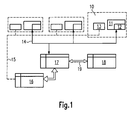
- Fig. 1 depicts a sketch showing the principal architecture or the communications environment according to the present invention.
- the communications environment comprises a client computer 11, which is connected via a data communications network 14 with a web server 17.
- the network 14 an IP network which connects a multitude of client computers 11 with a multitude of web servers such as web server 17.
- the Fig. 1 just shows three client computers being connected with one web server 17 as a simple example to reduce the complexity of the following description.
- the following description can be limited on the description of these elements.
- the client computer 11 can be any kind of computer or computing system, such as a personal computer, a laptop, a computer terminal or the like.
- the client computer 11 runs a web browser 12 as software application to easily access and request the web server 17 for providing information.
- the web server 17 retrieves information to be provided to the client computer 11.
- the information data is then processed by the client computer 11 and preferably displayed as a web page by web browser 12.
- the web page displayed by web browser 2 may include active and/or user controlled elements, for example buttons, sliders, check boxes or input fields for the purpose of interaction between user and the web server 18.
- the user may simply enter his or her search terms into an text input field (search field) and may start the search by simply clicking on a send button. Or the user may chose standard terms from a list or pull-down menu.
- the web server 17 offers a diversity of services for the client computer 11 and said web browser 12, respectively. Services are for example e-mail, chat, data base front ends of a great variety of information systems or so called unified messaging systems and so on.
- the communication system according to Fig. 1 further comprises a telecommunications network 15 having a switching centre 16 to switch lines from telecommunication terminals such as the telephone 13 being located at the same place than client computer 11.
- the telephones 13 might be analogue or digital telephones of a public switched telephone network, where the telephones 5 are connected with cables or the like to telephone network 6.
- Telephones 5 might also be mobile phones of a cellular telephone network like GSM or UMTS.
- Telephone net 6 as well as switching centre 7 allow to establish telephone connections between two or more telephones 5.
- PSTN telephones such as 13
- other equipment such as VoIP equipment for the so-called Internet telephony may be used as well.
- IP network 14 may also be used to provide telephone service.
- voice data is transmitted as data packets of the IP network (voice over IP).
- client computer 11 will be equipped with a microphone and a loudspeaker, preferably as a headset.
- the switching centre 16 is noit only connected to the PSTN network 15, but also (via a PSTN/IP gateway) to the web server 17. Because of this inter-connection, the PSTN services can be controlled by the user accessing the web server 17 by a user unit 10 such as shown in Fig. 1. Thus the user can establish a telephone connection between his or her telephone 13 and any other phone being connected to the PSTN network 15. Therefore the user simply need to enter or choose a telephone number in at the web page and then click on a call button. This means, that the user is simultaneously using the client computer 11 and the telephone 13. Of course both functionality may be integrated into a single user unit, such as a mobile phone or PDA.
- the web server 17 is further connected with a database server 18.
- the connection can be established by use of any data network, such as network 14 or the like.
- a dedicated connection 19 within a private network is used.
- the database itself can be integrated into or installed on the web server 17.
- the database server 18 provides a directory service to find contact data, in particular address data and telephone contact data, of services and/or facilities within a certain area, city, district etc.. Thus the content of the database server 18 may be compared to that of yellow page books.
- the database also provides reference data to map telecommunications identities, in particular telephone numbers or parts therefrom, to respective location data, such as name of city, town, district, street etc. or zip code and the like.
- respective location data such as name of city, town, district, street etc. or zip code and the like.
- the Fig. 2a shows an example of the web page displayed by the web browser 12 of client computer 11.
- the web page 12 is divided into different graphical zones and elements with different functions.
- An upper zone 13 head zone or head frame
- buttons 21a By clicking on one of these buttons a new window is opened or application is started.
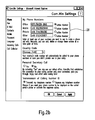
- Fig. 2b When clicking on the second button at the left side window with webpage 20 (see Fig. 2b) will be opened which provides settings of the user profile to be changed, such as inputting and/or selecting the active telephone number 28 at which the user can be reached. This is normally the telephone number 28 of that terminal (see 13 in Fig. 2a) which he or her is currently using.
- the user profile settings provide a set of four input fields to input there different phone numbers such as the user's office number, his or her mobile number, private number or any other number the user wants to be selectable for activating one number of the set, this active number is representing the telephone equipment at which the user wants to be reached and from which he or her wants to make calls.
- this active number is representing the telephone equipment at which the user wants to be reached and from which he or her wants to make calls.
- the user has activated his/her office number "+49.721.9432." by just clicking the respective button (so-called radio button).
- every incoming call will be switched and/routed through the communication networks to finally terminate at the telephone equipment 13 (see Fig. 2a) being located at the user's office.
- the web server 17 will control the switching centre 16 to establish a first PSTN connection (first leg) to the calling party, i.e. the office telephone equipment 13. Further a second PSTN connection (second leg) is established to the called party according to that telephone number which the user wants to be called.
- first leg a first PSTN connection
- second leg a second PSTN connection
- the word party means any contact to be reached within the communications environment by any communication means and technology, such a phone, fax, SMS, e-mail, instant messaging and the like.
- the user can very easily reach a contact by just selecting it from a list presented in the address field 22 of the webpage 20 (see Fig. 2a), because every shown contact, e.g. "Axel AST", represents a set with a multitude of contact data, such as name, address, telephone number, fax number, e-mail address etc..
- every shown contact e.g. "Axel AST”
- the user clicks onto that contact he wants to reach a window with the numbers and address is opened and the user can immediately initiate a phone call, fax, SMS, e-mail etc. by just clicking on that respective number (e.g. Axel's mobile phone number 0171-1234..) or address (e . g. axel.ast@email.de).
- the webpage 20 further comprises a real time zone 23 to monitor and/or control the current status of communication, in particular the status of the telecommunications activities, which is displayed in real-time.
- a real time zone 23 On the top of the real-time zone 23 there is displayed the user status itself, in particular the status (e.g. "disconnected") of the terminal which the user currently uses, i.e. which is having the activated number (e.g. +49.721.9432918.").
- the communication activities such as making a call with a contact, receiving a call, e.g. on the answering machine etc., are recorded (not shown here in detail).
- a user unit 10 may comprise a telephone 13 or terminal and a client computer 11 having access to the Internet by a Browser 12. All devices may be integrated into a single housing, e.g. a single communications terminal having telecommunication and web browsing functions.
- the user selects the active number in dependence of what terminal he/her is currently using and where he/her is currently located (office, mobile, private or other).
- the user has selected the office number to be the active one. Accordingly this number will appear in the user status field 24 on page 20 (see Fig. 2a).
- the location where the user is currently present is clearly defined by the active telephone number, since the telephone number is assigned to a telephone residing at a certain place or address.
- the location may finally be defined by any method of locating the mobile terminal, such as triangulation or just evaluating the so-called LAI (location area identification) or any other location parameters.
- a further zone 27 for presenting links 27a with different key words for services and/or facilities, such as taxis, couriers, pizzerias, flowers (flower shops) or presents (gift shops or the like).
- keywords can be listed here.
- the presentation of keyword may depend on a list of favorites which the user has defined and which has been stored in his settings or anywhere else in the system.
- the user can very easily conduct a search for example for a flower shop in the vicinity of his current location. His current location is defined by taking his/her current telephone number from in list box 20.
- the user can enter a key word in an editable input field. This is performed by clicking on button 26 to start a yellow page search and to enter keywords for a services or facilities that fit.
- the principle of focusing the search to the vicinity of the user's current location is performed by evaluating the active number from his/her settings (see 28 in Fig. 2b).
- the system may take this telephone number and according to the PSTN numbering scheme may find from the first digits the corresponding city, village or district from where the user currently resides.
- the system therefore asks a database which can be installed on a remote server or which can be part of the system.
- the search will be optimized, the results will automatically be filtered and presented in comfortable form such as shown in Fig. 3.
- the communications system may comprise a multitude of servers, each server performing a special task in the communications system.
- one server might be a web server
- a second server fulfills communication requests between a web application of the web server and a telephone net
- a third server is responsible for conducting the search for locations in the vicinity of the user and so on.
- the means to process said location as a reference for searching for facilities in the vicinity of the user unit is usually a software application run by one of the servers.
- a web page 30 with the results of the conducted search is presented to the user. All result are services and/or facilities in the vicinity of the user.
- a first row 31 the names and addresses of the retrieved services or facilities are displayed.
- a second row 32 the corresponding telephone numbers are displayed, preferably in form of links which just have to be clicked to initiate a call.
- the third row 33 offers links to click to open a window with a city map of the region where the corresponding facility of service is located.
- a fourth row 34 includes links for more information such as links to the home pages of the services or facilities.
- the user has conducted a search for pizzerias in the vicinity of his/her current location.
- the user resides in his/her office (see active number in Fig. his/her office having the phone number as shown in Fig.3 (active number).
- active number By mapping this number to a zip code the system can immediately find out that the office is located in a village having the postal code (zip code) "12345" which means that the user's office is located in "Ofenhausen".
- zip code zip code
- the result list will appear first which are also located in the same village.
- the ranking of the results may be done by name, by zip codes or by any other appropriate parameter.
- the results may appear in sets of a given number, such as 1-10, 11-20, 21-30 and so forth.
- the rules for searching and displaying the results can be defined globally for the whole system.
- the user can define own rules for conducting a search.
- the user may define time limits or a method for ranking of results. Defining a time limit means for example, the user may define that in a time period from 11 am to 1 pm only Italian restaurants shall be listed when searching for restaurants, between 6 pm and 9 pm only French restaurants shall be listed.
- the user can for example define a rule, that at lunchtime only local pizza delivery services are searched and displayed.
- the user can define a rule that for example shops or other facilities shall only be listed during regular opening hours for example between 9 am and 5 pm. On special events, for example during holidays or during a trade fair in the city or the like, locations related with this event may be listed first.
- this building may be listed first when searching for local authorities.
- the user can define rules for evaluating and sorting the results of a search. By using the rules certain characteristics of every service or facility is analyzed. Theses characteristics can be defined by the user within his settings (see Fig. 2b) or maybe globally defined by means of the communication system.
Landscapes
- Engineering & Computer Science (AREA)
- Computer Networks & Wireless Communication (AREA)
- Signal Processing (AREA)
- Telephonic Communication Services (AREA)
- Information Transfer Between Computers (AREA)
- Vehicle Body Suspensions (AREA)
- Radar Systems Or Details Thereof (AREA)
- Position Fixing By Use Of Radio Waves (AREA)
Priority Applications (3)
| Application Number | Priority Date | Filing Date | Title |
|---|---|---|---|
| DE602004000358T DE602004000358T2 (de) | 2004-05-19 | 2004-05-19 | Verfahren und System für das Lokalisieren von Einrichtungen in der Nähe einer Benutzereinheit |
| AT04011956T ATE317197T1 (de) | 2004-05-19 | 2004-05-19 | Verfahren und system für das lokalisieren von einrichtungen in der nähe einer benutzereinheit |
| EP04011956A EP1599005B1 (de) | 2004-05-19 | 2004-05-19 | Verfahren und System für das Lokalisieren von Einrichtungen in der Nähe einer Benutzereinheit |
Applications Claiming Priority (1)
| Application Number | Priority Date | Filing Date | Title |
|---|---|---|---|
| EP04011956A EP1599005B1 (de) | 2004-05-19 | 2004-05-19 | Verfahren und System für das Lokalisieren von Einrichtungen in der Nähe einer Benutzereinheit |
Publications (2)
| Publication Number | Publication Date |
|---|---|
| EP1599005A1 true EP1599005A1 (de) | 2005-11-23 |
| EP1599005B1 EP1599005B1 (de) | 2006-02-01 |
Family
ID=34925071
Family Applications (1)
| Application Number | Title | Priority Date | Filing Date |
|---|---|---|---|
| EP04011956A Expired - Lifetime EP1599005B1 (de) | 2004-05-19 | 2004-05-19 | Verfahren und System für das Lokalisieren von Einrichtungen in der Nähe einer Benutzereinheit |
Country Status (3)
| Country | Link |
|---|---|
| EP (1) | EP1599005B1 (de) |
| AT (1) | ATE317197T1 (de) |
| DE (1) | DE602004000358T2 (de) |
Cited By (1)
| Publication number | Priority date | Publication date | Assignee | Title |
|---|---|---|---|---|
| FR2945906A1 (fr) * | 2009-05-25 | 2010-11-26 | Pesages Et Volumetrie | Procede et dispositif de localisation de materiel medical. |
Citations (3)
| Publication number | Priority date | Publication date | Assignee | Title |
|---|---|---|---|---|
| WO2000041090A1 (en) * | 1999-01-08 | 2000-07-13 | Micro-Integration Corporation | Search engine database and interface |
| WO2002017567A2 (en) * | 2000-08-25 | 2002-02-28 | Yogogo Limited | Wireless communications system with location-dependent services |
| WO2002093290A2 (en) * | 2001-05-15 | 2002-11-21 | Nokia Corporation | Service discovery access to user location |
-
2004
- 2004-05-19 AT AT04011956T patent/ATE317197T1/de not_active IP Right Cessation
- 2004-05-19 EP EP04011956A patent/EP1599005B1/de not_active Expired - Lifetime
- 2004-05-19 DE DE602004000358T patent/DE602004000358T2/de not_active Expired - Fee Related
Patent Citations (3)
| Publication number | Priority date | Publication date | Assignee | Title |
|---|---|---|---|---|
| WO2000041090A1 (en) * | 1999-01-08 | 2000-07-13 | Micro-Integration Corporation | Search engine database and interface |
| WO2002017567A2 (en) * | 2000-08-25 | 2002-02-28 | Yogogo Limited | Wireless communications system with location-dependent services |
| WO2002093290A2 (en) * | 2001-05-15 | 2002-11-21 | Nokia Corporation | Service discovery access to user location |
Cited By (1)
| Publication number | Priority date | Publication date | Assignee | Title |
|---|---|---|---|---|
| FR2945906A1 (fr) * | 2009-05-25 | 2010-11-26 | Pesages Et Volumetrie | Procede et dispositif de localisation de materiel medical. |
Also Published As
| Publication number | Publication date |
|---|---|
| DE602004000358T2 (de) | 2006-10-19 |
| DE602004000358D1 (de) | 2006-04-13 |
| EP1599005B1 (de) | 2006-02-01 |
| ATE317197T1 (de) | 2006-02-15 |
Similar Documents
| Publication | Publication Date | Title |
|---|---|---|
| US6728731B2 (en) | Method and apparatus for accessing targeted, personalized voice/audio web content through wireless devices | |
| US6788769B1 (en) | Internet directory system and method using telephone number based addressing | |
| US6546005B1 (en) | Active user registry | |
| USRE49054E1 (en) | Telecommunications addressing system and method | |
| JP3636266B2 (ja) | ウェブ・フォーン・ダイヤラー・システム | |
| US8175249B2 (en) | Technique for effectively collecting and analyzing data in providing information assistance services | |
| JP2001510663A (ja) | インターネットアドレスなどのようなパケット切換によるアドレスを用いた回路切換による発呼のセットアップ | |
| AU2005209773A1 (en) | Method and system of providing personal and business information | |
| US7023837B1 (en) | Intelligent call routing system | |
| US7831030B2 (en) | Method and apparatus for automatic advance calling to contacts | |
| JP2004015763A (ja) | コールセンタ支援装置、および、プログラム | |
| WO2014174518A1 (en) | A url transmission system and means thereof | |
| US20080084976A1 (en) | Context-sensitive communications function | |
| EP1599005B1 (de) | Verfahren und System für das Lokalisieren von Einrichtungen in der Nähe einer Benutzereinheit | |
| US20030092430A1 (en) | Information storage system | |
| EP1944703A2 (de) | Suche nach Kommunikationsinformationen | |
| KR20030026371A (ko) | 이동통신단말용 전화번호안내 시스템 | |
| KR20020036076A (ko) | 인터넷상의 무료 웹투폰 전화 서비스를 이용한애프터서비스 전화 검색 및 자동접속 시스템 | |
| KR20010078974A (ko) | 웹서버와 전화망 및 콜서버 통합에 기반한 웹과 700서비스통합 비즈니스 모델 | |
| HK1058566B (en) | Method and apparatus for accessing targeted, personalized voice/audio web content through wireless devices | |
| KR20010044737A (ko) | 전화번호와 연동된 주민등록번호를 이용한 개인통신매체연결시스템 | |
| EP1502411A2 (de) | Kommunikationswebsite |
Legal Events
| Date | Code | Title | Description |
|---|---|---|---|
| GRAP | Despatch of communication of intention to grant a patent |
Free format text: ORIGINAL CODE: EPIDOSNIGR1 |
|
| PUAI | Public reference made under article 153(3) epc to a published international application that has entered the european phase |
Free format text: ORIGINAL CODE: 0009012 |
|
| 17P | Request for examination filed |
Effective date: 20050426 |
|
| AK | Designated contracting states |
Kind code of ref document: A1 Designated state(s): AT BE BG CH CY CZ DE DK EE ES FI FR GB GR HU IE IT LI LU MC NL PL PT RO SE SI SK TR |
|
| AX | Request for extension of the european patent |
Extension state: AL HR LT LV MK |
|
| GRAS | Grant fee paid |
Free format text: ORIGINAL CODE: EPIDOSNIGR3 |
|
| GRAA | (expected) grant |
Free format text: ORIGINAL CODE: 0009210 |
|
| AK | Designated contracting states |
Kind code of ref document: B1 Designated state(s): AT BE BG CH CY CZ DE DK EE ES FI FR GB GR HU IE IT LI LU MC NL PL PT RO SE SI SK TR |
|
| AX | Request for extension of the european patent |
Extension state: AL HR LT LV MK |
|
| PG25 | Lapsed in a contracting state [announced via postgrant information from national office to epo] |
Ref country code: IT Free format text: LAPSE BECAUSE OF FAILURE TO SUBMIT A TRANSLATION OF THE DESCRIPTION OR TO PAY THE FEE WITHIN THE PRESCRIBED TIME-LIMIT;WARNING: LAPSES OF ITALIAN PATENTS WITH EFFECTIVE DATE BEFORE 2007 MAY HAVE OCCURRED AT ANY TIME BEFORE 2007. THE CORRECT EFFECTIVE DATE MAY BE DIFFERENT FROM THE ONE RECORDED. Effective date: 20060201 Ref country code: SK Free format text: LAPSE BECAUSE OF FAILURE TO SUBMIT A TRANSLATION OF THE DESCRIPTION OR TO PAY THE FEE WITHIN THE PRESCRIBED TIME-LIMIT Effective date: 20060201 Ref country code: PL Free format text: LAPSE BECAUSE OF FAILURE TO SUBMIT A TRANSLATION OF THE DESCRIPTION OR TO PAY THE FEE WITHIN THE PRESCRIBED TIME-LIMIT Effective date: 20060201 Ref country code: NL Free format text: LAPSE BECAUSE OF FAILURE TO SUBMIT A TRANSLATION OF THE DESCRIPTION OR TO PAY THE FEE WITHIN THE PRESCRIBED TIME-LIMIT Effective date: 20060201 Ref country code: SI Free format text: LAPSE BECAUSE OF FAILURE TO SUBMIT A TRANSLATION OF THE DESCRIPTION OR TO PAY THE FEE WITHIN THE PRESCRIBED TIME-LIMIT Effective date: 20060201 Ref country code: FI Free format text: LAPSE BECAUSE OF FAILURE TO SUBMIT A TRANSLATION OF THE DESCRIPTION OR TO PAY THE FEE WITHIN THE PRESCRIBED TIME-LIMIT Effective date: 20060201 Ref country code: BE Free format text: LAPSE BECAUSE OF FAILURE TO SUBMIT A TRANSLATION OF THE DESCRIPTION OR TO PAY THE FEE WITHIN THE PRESCRIBED TIME-LIMIT Effective date: 20060201 Ref country code: RO Free format text: LAPSE BECAUSE OF FAILURE TO SUBMIT A TRANSLATION OF THE DESCRIPTION OR TO PAY THE FEE WITHIN THE PRESCRIBED TIME-LIMIT Effective date: 20060201 |
|
| REG | Reference to a national code |
Ref country code: GB Ref legal event code: FG4D |
|
| REG | Reference to a national code |
Ref country code: CH Ref legal event code: EP |
|
| RAP2 | Party data changed (patent owner data changed or rights of a patent transferred) |
Owner name: COMBOTS PRODUCT GMBH & CO.KG |
|
| REG | Reference to a national code |
Ref country code: IE Ref legal event code: FG4D |
|
| REF | Corresponds to: |
Ref document number: 602004000358 Country of ref document: DE Date of ref document: 20060413 Kind code of ref document: P |
|
| NLT2 | Nl: modifications (of names), taken from the european patent patent bulletin |
Owner name: COMBOTS PRODUCT GMBH & CO.KG Effective date: 20060222 |
|
| PG25 | Lapsed in a contracting state [announced via postgrant information from national office to epo] |
Ref country code: SE Free format text: LAPSE BECAUSE OF FAILURE TO SUBMIT A TRANSLATION OF THE DESCRIPTION OR TO PAY THE FEE WITHIN THE PRESCRIBED TIME-LIMIT Effective date: 20060501 Ref country code: BG Free format text: LAPSE BECAUSE OF FAILURE TO SUBMIT A TRANSLATION OF THE DESCRIPTION OR TO PAY THE FEE WITHIN THE PRESCRIBED TIME-LIMIT Effective date: 20060501 Ref country code: DK Free format text: LAPSE BECAUSE OF FAILURE TO SUBMIT A TRANSLATION OF THE DESCRIPTION OR TO PAY THE FEE WITHIN THE PRESCRIBED TIME-LIMIT Effective date: 20060501 |
|
| PG25 | Lapsed in a contracting state [announced via postgrant information from national office to epo] |
Ref country code: ES Free format text: LAPSE BECAUSE OF FAILURE TO SUBMIT A TRANSLATION OF THE DESCRIPTION OR TO PAY THE FEE WITHIN THE PRESCRIBED TIME-LIMIT Effective date: 20060512 |
|
| PGFP | Annual fee paid to national office [announced via postgrant information from national office to epo] |
Ref country code: AT Payment date: 20060523 Year of fee payment: 3 |
|
| PGFP | Annual fee paid to national office [announced via postgrant information from national office to epo] |
Ref country code: IE Payment date: 20060530 Year of fee payment: 3 |
|
| PG25 | Lapsed in a contracting state [announced via postgrant information from national office to epo] |
Ref country code: MC Free format text: LAPSE BECAUSE OF NON-PAYMENT OF DUE FEES Effective date: 20060531 |
|
| NLV1 | Nl: lapsed or annulled due to failure to fulfill the requirements of art. 29p and 29m of the patents act | ||
| PG25 | Lapsed in a contracting state [announced via postgrant information from national office to epo] |
Ref country code: PT Free format text: LAPSE BECAUSE OF FAILURE TO SUBMIT A TRANSLATION OF THE DESCRIPTION OR TO PAY THE FEE WITHIN THE PRESCRIBED TIME-LIMIT Effective date: 20060703 |
|
| AKX | Designation fees paid |
Designated state(s): AT BE BG CH CY CZ DE DK EE ES FI FR GB GR HU IE IT LI LU MC NL PL PT RO SE SI SK TR |
|
| ET | Fr: translation filed | ||
| PLBE | No opposition filed within time limit |
Free format text: ORIGINAL CODE: 0009261 |
|
| STAA | Information on the status of an ep patent application or granted ep patent |
Free format text: STATUS: NO OPPOSITION FILED WITHIN TIME LIMIT |
|
| 26N | No opposition filed |
Effective date: 20061103 |
|
| PG25 | Lapsed in a contracting state [announced via postgrant information from national office to epo] |
Ref country code: AT Free format text: LAPSE BECAUSE OF NON-PAYMENT OF DUE FEES Effective date: 20070519 |
|
| PG25 | Lapsed in a contracting state [announced via postgrant information from national office to epo] |
Ref country code: GR Free format text: LAPSE BECAUSE OF FAILURE TO SUBMIT A TRANSLATION OF THE DESCRIPTION OR TO PAY THE FEE WITHIN THE PRESCRIBED TIME-LIMIT Effective date: 20060502 Ref country code: CZ Free format text: LAPSE BECAUSE OF FAILURE TO SUBMIT A TRANSLATION OF THE DESCRIPTION OR TO PAY THE FEE WITHIN THE PRESCRIBED TIME-LIMIT Effective date: 20060201 |
|
| PG25 | Lapsed in a contracting state [announced via postgrant information from national office to epo] |
Ref country code: IE Free format text: LAPSE BECAUSE OF NON-PAYMENT OF DUE FEES Effective date: 20070521 |
|
| PG25 | Lapsed in a contracting state [announced via postgrant information from national office to epo] |
Ref country code: EE Free format text: LAPSE BECAUSE OF FAILURE TO SUBMIT A TRANSLATION OF THE DESCRIPTION OR TO PAY THE FEE WITHIN THE PRESCRIBED TIME-LIMIT Effective date: 20060201 |
|
| PG25 | Lapsed in a contracting state [announced via postgrant information from national office to epo] |
Ref country code: LU Free format text: LAPSE BECAUSE OF NON-PAYMENT OF DUE FEES Effective date: 20060519 Ref country code: TR Free format text: LAPSE BECAUSE OF FAILURE TO SUBMIT A TRANSLATION OF THE DESCRIPTION OR TO PAY THE FEE WITHIN THE PRESCRIBED TIME-LIMIT Effective date: 20060201 Ref country code: HU Free format text: LAPSE BECAUSE OF FAILURE TO SUBMIT A TRANSLATION OF THE DESCRIPTION OR TO PAY THE FEE WITHIN THE PRESCRIBED TIME-LIMIT Effective date: 20060802 |
|
| PGFP | Annual fee paid to national office [announced via postgrant information from national office to epo] |
Ref country code: CH Payment date: 20080509 Year of fee payment: 5 Ref country code: DE Payment date: 20080529 Year of fee payment: 5 |
|
| PG25 | Lapsed in a contracting state [announced via postgrant information from national office to epo] |
Ref country code: CY Free format text: LAPSE BECAUSE OF FAILURE TO SUBMIT A TRANSLATION OF THE DESCRIPTION OR TO PAY THE FEE WITHIN THE PRESCRIBED TIME-LIMIT Effective date: 20060201 |
|
| PGFP | Annual fee paid to national office [announced via postgrant information from national office to epo] |
Ref country code: GB Payment date: 20080522 Year of fee payment: 5 |
|
| REG | Reference to a national code |
Ref country code: CH Ref legal event code: PL |
|
| GBPC | Gb: european patent ceased through non-payment of renewal fee |
Effective date: 20090519 |
|
| PG25 | Lapsed in a contracting state [announced via postgrant information from national office to epo] |
Ref country code: LI Free format text: LAPSE BECAUSE OF NON-PAYMENT OF DUE FEES Effective date: 20090531 Ref country code: CH Free format text: LAPSE BECAUSE OF NON-PAYMENT OF DUE FEES Effective date: 20090531 |
|
| REG | Reference to a national code |
Ref country code: FR Ref legal event code: ST Effective date: 20100129 |
|
| PG25 | Lapsed in a contracting state [announced via postgrant information from national office to epo] |
Ref country code: FR Free format text: LAPSE BECAUSE OF NON-PAYMENT OF DUE FEES Effective date: 20090602 |
|
| PGFP | Annual fee paid to national office [announced via postgrant information from national office to epo] |
Ref country code: FR Payment date: 20080519 Year of fee payment: 5 |
|
| PG25 | Lapsed in a contracting state [announced via postgrant information from national office to epo] |
Ref country code: GB Free format text: LAPSE BECAUSE OF NON-PAYMENT OF DUE FEES Effective date: 20090519 |
|
| PG25 | Lapsed in a contracting state [announced via postgrant information from national office to epo] |
Ref country code: DE Free format text: LAPSE BECAUSE OF NON-PAYMENT OF DUE FEES Effective date: 20091201 |