EP1598766A2 - Simulationssystem zum simulieren von Substanzkonzentrationen in einem lebenden Körper und Speichermedien - Google Patents
Simulationssystem zum simulieren von Substanzkonzentrationen in einem lebenden Körper und Speichermedien Download PDFInfo
- Publication number
- EP1598766A2 EP1598766A2 EP05010236A EP05010236A EP1598766A2 EP 1598766 A2 EP1598766 A2 EP 1598766A2 EP 05010236 A EP05010236 A EP 05010236A EP 05010236 A EP05010236 A EP 05010236A EP 1598766 A2 EP1598766 A2 EP 1598766A2
- Authority
- EP
- European Patent Office
- Prior art keywords
- insulin
- glucose
- block
- liver
- model
- Prior art date
- Legal status (The legal status is an assumption and is not a legal conclusion. Google has not performed a legal analysis and makes no representation as to the accuracy of the status listed.)
- Withdrawn
Links
- 238000004088 simulation Methods 0.000 title claims abstract description 46
- 239000000463 material Substances 0.000 title claims abstract description 19
- 238000003860 storage Methods 0.000 title claims abstract description 17
- 210000000056 organ Anatomy 0.000 claims abstract description 18
- 230000008859 change Effects 0.000 claims abstract description 11
- NOESYZHRGYRDHS-UHFFFAOYSA-N insulin Chemical compound N1C(=O)C(NC(=O)C(CCC(N)=O)NC(=O)C(CCC(O)=O)NC(=O)C(C(C)C)NC(=O)C(NC(=O)CN)C(C)CC)CSSCC(C(NC(CO)C(=O)NC(CC(C)C)C(=O)NC(CC=2C=CC(O)=CC=2)C(=O)NC(CCC(N)=O)C(=O)NC(CC(C)C)C(=O)NC(CCC(O)=O)C(=O)NC(CC(N)=O)C(=O)NC(CC=2C=CC(O)=CC=2)C(=O)NC(CSSCC(NC(=O)C(C(C)C)NC(=O)C(CC(C)C)NC(=O)C(CC=2C=CC(O)=CC=2)NC(=O)C(CC(C)C)NC(=O)C(C)NC(=O)C(CCC(O)=O)NC(=O)C(C(C)C)NC(=O)C(CC(C)C)NC(=O)C(CC=2NC=NC=2)NC(=O)C(CO)NC(=O)CNC2=O)C(=O)NCC(=O)NC(CCC(O)=O)C(=O)NC(CCCNC(N)=N)C(=O)NCC(=O)NC(CC=3C=CC=CC=3)C(=O)NC(CC=3C=CC=CC=3)C(=O)NC(CC=3C=CC(O)=CC=3)C(=O)NC(C(C)O)C(=O)N3C(CCC3)C(=O)NC(CCCCN)C(=O)NC(C)C(O)=O)C(=O)NC(CC(N)=O)C(O)=O)=O)NC(=O)C(C(C)CC)NC(=O)C(CO)NC(=O)C(C(C)O)NC(=O)C1CSSCC2NC(=O)C(CC(C)C)NC(=O)C(NC(=O)C(CCC(N)=O)NC(=O)C(CC(N)=O)NC(=O)C(NC(=O)C(N)CC=1C=CC=CC=1)C(C)C)CC1=CN=CN1 NOESYZHRGYRDHS-UHFFFAOYSA-N 0.000 claims description 272
- 229940125396 insulin Drugs 0.000 claims description 137
- 102000004877 Insulin Human genes 0.000 claims description 135
- 108090001061 Insulin Proteins 0.000 claims description 135
- WQZGKKKJIJFFOK-GASJEMHNSA-N Glucose Natural products OC[C@H]1OC(O)[C@H](O)[C@@H](O)[C@@H]1O WQZGKKKJIJFFOK-GASJEMHNSA-N 0.000 claims description 105
- 239000008103 glucose Substances 0.000 claims description 105
- 239000008280 blood Substances 0.000 claims description 56
- 210000004369 blood Anatomy 0.000 claims description 56
- 230000002093 peripheral effect Effects 0.000 claims description 42
- 210000004185 liver Anatomy 0.000 claims description 34
- 210000000496 pancreas Anatomy 0.000 claims description 30
- 238000010521 absorption reaction Methods 0.000 claims description 19
- 238000004590 computer program Methods 0.000 claims description 16
- 230000003914 insulin secretion Effects 0.000 claims description 14
- 230000009229 glucose formation Effects 0.000 claims description 13
- WQZGKKKJIJFFOK-VFUOTHLCSA-N beta-D-glucose Chemical compound OC[C@H]1O[C@@H](O)[C@H](O)[C@@H](O)[C@@H]1O WQZGKKKJIJFFOK-VFUOTHLCSA-N 0.000 claims description 8
- 230000001419 dependent effect Effects 0.000 claims description 7
- 238000004364 calculation method Methods 0.000 claims description 6
- 230000004153 glucose metabolism Effects 0.000 claims description 6
- 230000028327 secretion Effects 0.000 claims description 6
- 230000000694 effects Effects 0.000 claims description 5
- 230000009471 action Effects 0.000 claims description 4
- 230000004190 glucose uptake Effects 0.000 claims description 4
- 230000004060 metabolic process Effects 0.000 claims description 4
- 230000014509 gene expression Effects 0.000 claims 8
- 238000009825 accumulation Methods 0.000 claims 2
- 238000004519 manufacturing process Methods 0.000 claims 2
- 230000032258 transport Effects 0.000 claims 2
- 238000005094 computer simulation Methods 0.000 abstract description 2
- 238000000034 method Methods 0.000 description 15
- 230000008569 process Effects 0.000 description 10
- 230000000638 stimulation Effects 0.000 description 9
- 238000009826 distribution Methods 0.000 description 6
- 238000004891 communication Methods 0.000 description 5
- 206010012601 diabetes mellitus Diseases 0.000 description 4
- 238000010586 diagram Methods 0.000 description 4
- 238000004422 calculation algorithm Methods 0.000 description 3
- 230000035945 sensitivity Effects 0.000 description 3
- 238000003745 diagnosis Methods 0.000 description 2
- 230000002068 genetic effect Effects 0.000 description 2
- 238000007410 oral glucose tolerance test Methods 0.000 description 2
- 230000004936 stimulating effect Effects 0.000 description 2
- 230000033228 biological regulation Effects 0.000 description 1
- 239000013065 commercial product Substances 0.000 description 1
- 238000011835 investigation Methods 0.000 description 1
- 238000005259 measurement Methods 0.000 description 1
- 210000004798 organs belonging to the digestive system Anatomy 0.000 description 1
- 230000035479 physiological effects, processes and functions Effects 0.000 description 1
- 230000001105 regulatory effect Effects 0.000 description 1
- 238000002922 simulated annealing Methods 0.000 description 1
- 238000002945 steepest descent method Methods 0.000 description 1
- 238000012360 testing method Methods 0.000 description 1
- 238000013334 tissue model Methods 0.000 description 1
Images




Classifications
-
- G—PHYSICS
- G16—INFORMATION AND COMMUNICATION TECHNOLOGY [ICT] SPECIALLY ADAPTED FOR SPECIFIC APPLICATION FIELDS
- G16H—HEALTHCARE INFORMATICS, i.e. INFORMATION AND COMMUNICATION TECHNOLOGY [ICT] SPECIALLY ADAPTED FOR THE HANDLING OR PROCESSING OF MEDICAL OR HEALTHCARE DATA
- G16H50/00—ICT specially adapted for medical diagnosis, medical simulation or medical data mining; ICT specially adapted for detecting, monitoring or modelling epidemics or pandemics
- G16H50/50—ICT specially adapted for medical diagnosis, medical simulation or medical data mining; ICT specially adapted for detecting, monitoring or modelling epidemics or pandemics for simulation or modelling of medical disorders
Definitions
- the present invention relates to a system for simulating material concentrations in living tissue using a computer, and relates to a storage medium for recording a computer program for having a computer function as such a system.
- the models used include, for example, Bergman's minimal model (Bergman et al., American Journal of Physiology, vol. 236(6), p. E-667-77 (1979), and Bergman et al., Journal of Clinical Investigation, vol. 68(6), p. 1456-67 (1981)).
- This minimal model numerically represents plasma glucose concentration, plasma insulin concentration, and amount of acting insulin at the insulin action site of peripheral tissue, that is, remote insulin, as variables.
- G(t) plasma glucose concentration at time t
- I(t) plasma insulin concentration
- X(t) remote insulin
- blood glucose is regulated by four mutually inter-related blocks including the pancreas which secretes insulin in accordance with blood glucose stimulation, the liver which produces glucose into the blood or takes up glucose from the blood in accordance with insulin and blood glucose levels, circulation system kinetics which distribute insulin to peripheral tissues, and peripheral tissues which are acted upon by the insulin and metabolize the insulin.
- the structural elements of the model are abstract elements which do not correspond to the four blocks of living bodies, which presents difficulties when applying the simulated results of living body blood glucose fluctuation and insulin level fluctuation to the four inter-related blocks of the living body.
- Other blood glucose level reproduction methods include methods of predicting blood glucose level of a diabetic patient (for example, refer to Japanese Laid-Open Patent Publication No. 11-296598). Although it is possible to predict blood glucose levels according to this method, it is not possible to know the condition of organs participating in the regulation of blood glucose.
- an object of the present invention is to provide a system for computer simulation of function in a living body using a biological simulation model configured by a program readily corresponding to structural elements of a living body.
- the first aspect of the present invention relates to a simulation system comprising a biological simulation model representing the functions of organs in a living body related to a object material, and having a plurality of blocks corresponding to the organs respectively, which are mutually linked so as to enable the transference of data among blocks, and a calculation means for successively calculating the object material concentration in the living body to simulate the activity of the organs, and simulating the activity of the organs by driving the biological simulation model.
- the second aspect of the present invention relates to a computer-readable storage medium for recording a computer program for working a computer as a system for simulating a change over time in object material concentration in a living body, the computer program comprising a step of driving, in a computer, a biological simulation model representing the functions of organs in a living body related to the object material to successively calculate the object material concentration in the living body, and wherein the biological simulation model have a plurality of blocks corresponding to the organs respectively , which are mutually linked so as to enable the transference of data among blocks.
- FIG. 1 is a block diagram showing the hardware structure of the simulation system of an embodiment of the present invention.
- a simulation system 100 of an embodiment of the present invention is configured by a computer 100a, which mainly includes a body 110, display 120, and input device 130.
- the body 110 is mainly configured by a CPU 110a, ROM 110b, RAM 110c, hard disk 110d, reading device 110e, I/O interface 110f, communication interface 110g, and image output interface 110h.
- the CPU 110a, ROM 110b, RAM 110c, hard disk 110d, reading device 110e, I/O interface 110f, and image output interface 110h are connected by a bus 110i capable of data communication.
- the CPU 110a is capable of executing computer programs loaded in RAM 110c and computer programs stored in ROM 110b. Each of the function blocks, which are described later, are realized by the CPU 110a executing an application program 140a, also described later, such that the computer 100a functions as the simulation system 100.
- the ROM 110b may be mask ROM, PROM, EPROM, EEPROM or the like, and stores computer programs executed by the CPU 110a and data used by the computer programs.
- the RAM 110c may be SRAM, or DRAM or the like.
- the RAM 110c is used to read the computer programs recorded on the hard disk 110d and ROM 110. Furthermore, the RAM 110c is used as an operation area of the CPU 110a when these computer programs are executed.
- the hard disk 110d is used for installing an operating system and applications programs and the like, various types of computer programs executed by the CPU 110a and data used in the execution of the computer programs.
- the application program 140a which is described later, is also installed on the hard disk 110d.
- the reading device 110e may be a flexible disk drive, CD-ROM drive, DVD-ROM drive or the like, capable of reading data and computer programs recorded on a portable storage medium 140.
- the application program 140a which enables a computer to function as the simulation system of the present invention is stored on the portable storage medium 140, and the application program 140a of the present invention can be read from the portable storage medium 140 by the computer 100a and the application program 140a can be installed on the hard disk 110d.
- the application program 140a need not be provided on the portable storage medium 140, inasmuch as the application program 140a also may be provided over an electric communication line from an external device connected to the computer 100a so as to enable communication by means of an electric communication line (wire line or wireless).
- the application program 140a may be stored on the hard disk or a server computer connected to the internet, such that the computer 100a can access the server computer and download computer programs and the like which are then installed on the hard disk 110d.
- An operating system providing a graphical user interface environment such as, for example, Windows (registered trademark), a commercial product of Microsoft Corporation of the USA, or the like is installed on the hard disk 110d.
- Windows registered trademark
- the application program 140a of the present embodiment operates in such an operating system.
- the I/O interface 110f may be, for example, a serial interface such as a USB, IEEE1394, RS-232C or the like, a parallel interface such as SCSI, IDE, IEEE1284 or the like, or an analog interface such as a D/A converter, A/D converter or the like.
- the I/O interface 110f is connected to an input device 130 configured by a keyboard and mouse, such that a user may input data to the computer 100a using the input device 130.
- the image output interface 110h is connected to a device 120 such as an LCD, CRT or the like, so as to output image signals corresponding to image data received from the CPU 110a on the display 120.
- the display 120 displays the images (screens) in accordance with the input image signals.
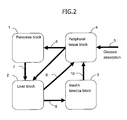
- Fig. 2 is a function block diagram showing the general structure of the models of the embodiment of the present invention.
- a living body model used in the simulation of the present invention is configured by a pancreas block 1, liver block 2, insulin kinetics block 3, and peripheral tissue block 4, in which each block has respective inputs and outputs.
- the pancreas block 1 has blood glucose level 6 as an input, and insulin secretion rate 7 as an output.
- the liver block 2 has blood glucose level 6 and insulin secretion rate 7 as inputs, and net glucose production 8 and liver-passed insulin 9 as outputs.
- the insulin kinetics block 3 has liver-passed insulin 9 as an input, and insulin level 10 in the peripheral tissue as an output.
- the peripheral tissue block 4 has net glucose production 8, external glucose absorption 5, and insulin level 10 in the peripheral tissue as inputs, and blood glucose level 6 as an output.
- Glucose absorption 5 is externally obtained data, and this function can be realized, for example, by a user inputting testing data and the like using the input device 130.
- the function blocks 1-4 may be realized by the CPU 100a executing the computer program 140a.
- the blood glucose level 6, which is input to the pancreas block 1 in Fig. 2 corresponds to BG(t).
- the insulin secretion rate 7, which is output from the pancreas block 1 in Fig. 2, corresponds to SR(t).
- 11 refers to the blood glucose level (blood glucose) BG
- 12 refers to the glucose level threshold H capable of stimulating insulin delivery
- 13 refers to sensitivity ⁇ to glucose stimulation
- 14 refers to follow-up ⁇ to glucose stimulation
- 15 refers to integral elements
- 16 refers to insulin delivery rate Y of insulin newly delivered under glucose stimulation
- 17 refers to integral elements
- 18 refers to total insulin X secretable from the pancreas
- 19 refers to secretion rate M per unit concentration
- 20 refers to insulin secretion rate SR from the pancreas.
- the blood glucose level 6, which is input to the liver block in Fig. 2 corresponds to BG(t)
- the insulin secretion rate 7 corresponds to SR(t).
- the net glucose production 8, which is output from the liver block in Fig. 2, corresponds to RGout(t)
- the liver-passed insulin 9 corresponds to SRout(t).
- 21 refers to blood glucose level (blood glucose value) BG
- 22 refers to insulin secretion rate SR from the pancreas
- 23 refers to the basal glucose concentration G b
- 24 refers to the glucose production rate P 1 below glucose stimulation G b
- 25 refers to glucose uptake rate P 2 per unit glucose and unit insulin by the liver
- 26 refers to the insulin uptake rate K by the liver
- 27 refers to the glucose production rate G off relative to the base metabolism
- 28 refers to the net glucose RGout from the liver
- 29 refers to liver-passed insulin SRpost.
- liver-passed insulin 9 which is input to the insulin kinetic block in Fig. 2, corresponds to SRout(t).
- the peripheral tissue insulin level 10, which is output from the insulin kinetic block in Fig. 2, corresponds to I 3 (t).
- 31 refers to liver-passed insulin SRpost
- 32 refers to integral element
- 33 refers to liver-passed insulin distribution rate A3
- 34 and 35 refer to blood insulin level I1
- 36 refers to insulin distribution rate A2 to the peripheral tissue
- 40 refers to insulin loss rate A 1 in the peripheral tissue
- 41 refers to peripheral tissue-passed insulin outflow rate A 4
- 42 refers to insulin distribution rate A 6 to the insulin-independent tissue
- 43 refers to an integral element
- 44 refers to insulin level I 2 in the insulin-independent tissue
- 45 refers to insulin loss rate A 5 in the insulin-independent tissue.
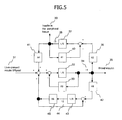
- the insulin level 10 in the peripheral tissue which is input to the peripheral tissue block in Fig. 2, corresponds to I 3 (t)
- the net glucose 8 from the liver corresponds to RGout(t)
- glucose absorption 5 from the alimentary canal corresponds to RG(t).
- 51 refers to the net glucose RGout from the liver
- 52 refers to the glucose absorption RG from the alimentary canal
- 53 refers to integral element
- 54 refers to the insulin-independent glucose consumption rate K 1 in the peripheral tissue
- 55 refers to the insulin level I 3 in the peripheral tissue
- 56 refers to the insulin-dependent glucose consumption rate K 2 in the peripheral tissue
- 57 refers to the blood glucose level BG.
- FIG.7 is a flow chart showing the flow of the operation of the simulation system of the embodiment of the present invention.
- a user performs predetermined operation to the input device 130, such as double-clicking to the corresponding icon, instructs the computer 100a to execute the application program 140a.
- Application program 140a is read-outed from hard disk 110d, and is loaded into RAM110c.
- the time-series data of glucose absorption 5 i.e. intake of glucose
- glucose concentration i.e. blood glucose level
- insulin concentration which provided by OGTT (Oral Glucose-Tolerance Test
- the CPU 110a accepts the input of these data (step S1), and implements the parameter values generation process (step S2).
- the appropriate parameter values for the model are computed.
- the time-series data of glucose concentration and insulin concentration approximated to the inputted data is obtained as a simulation result.
- the genetic algorithm is used for the parameter values generation process S2 of this embodiment, and this process S2 is able to compute the group of the parameter values which obtain the simulation result data most approximated to input data.
- a well-known other algorithm such as the least-squares method, the steepest descent method or the simulated annealing method may be used as a calculation method of parameter values.
- the CPU110a sets a group of parameter values produced by parameter values generation process S2 to the living body simulation model (step S3), and implements the simulation process (step S4).
- the glucose absorption 5 is inputted into the living body simulation model, and the insulin concentration 10 and blood glucose concentration 6 which correspond to the glucose absorption 5 is calculated.
- the glucose absorption 5 in step S1 may be used, and the time-series data of glucose absorption inputted separately from step S1 may be used.
- time-series data of glucose absorption produced by CPU110a automatically may be used.
- the change over time in blood glucose and insulin levels can be calculated based on the equations to effect simulation by the glucose absorption 5 from the alimentary canal.
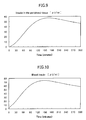
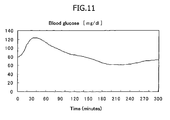
- CPU110a makes display 120 display the time-series data of insulin concentration 10 and blood glucose level 6 which are provided by the simulation process S4 (step S5), and finishes the application program 140a. Then, in the step S5, the graph of which the vertical axis is assigned to the blood glucose level or the insulin concentration and the cross axis is assigned to time, as shown in figure 9 and figure 10, is displayed on the display 120.
- numerical value of the blood glucose level in each time and numerical value of the insulin concentration in each time may be displayed, and besides the time-series data of insulin concentration 10 and blood glucose level 6, other data treated by living body simulation model such as blood insulin concentration 35 may be displayed.
- the successively calculated blood glucose and insulin levels can be displayed on the display 120.
- the present system also may be used as a subsystem for simulating body functions in medical systems, such as a diabetic diagnostic support system.
- the change over time in the calculated blood glucose and insulin levels may be transferred to other structural elements of the medical system to prepare, for example, diabetic diagnosis support information and the like, so as to provide highly reliable medical treatment information based on the blood glucose and insulin levels calculated by this system.
- Calculations using the differential equations in the simulation process S4 can be accomplished using, for example, E-Cell (Public domain software created by Keio University), and MatLab (MathWorks, Inc.). Other calculation systems may also be used.
- the change over time in blood glucose and insulin levels accompanying glucose absorption can be reproduced in a form which closely matches physiological changes by using the present system.
- the models used in the present system are easily understandable from a medical perspective since they include blocks respectively corresponding to the pancreas, liver, insulin kinetics, and peripheral tissue as structural elements.
Landscapes
- Medical Informatics (AREA)
- Engineering & Computer Science (AREA)
- Public Health (AREA)
- Health & Medical Sciences (AREA)
- Pathology (AREA)
- Databases & Information Systems (AREA)
- Data Mining & Analysis (AREA)
- Biomedical Technology (AREA)
- Epidemiology (AREA)
- General Health & Medical Sciences (AREA)
- Primary Health Care (AREA)
- Measuring And Recording Apparatus For Diagnosis (AREA)
- Measurement Of The Respiration, Hearing Ability, Form, And Blood Characteristics Of Living Organisms (AREA)
Applications Claiming Priority (2)
| Application Number | Priority Date | Filing Date | Title |
|---|---|---|---|
| JP2004141721 | 2004-05-11 | ||
| JP2004141721 | 2004-05-11 |
Publications (1)
| Publication Number | Publication Date |
|---|---|
| EP1598766A2 true EP1598766A2 (de) | 2005-11-23 |
Family
ID=34936396
Family Applications (1)
| Application Number | Title | Priority Date | Filing Date |
|---|---|---|---|
| EP05010236A Withdrawn EP1598766A2 (de) | 2004-05-11 | 2005-05-11 | Simulationssystem zum simulieren von Substanzkonzentrationen in einem lebenden Körper und Speichermedien |
Country Status (3)
| Country | Link |
|---|---|
| US (1) | US20050256690A1 (de) |
| EP (1) | EP1598766A2 (de) |
| CN (1) | CN100533429C (de) |
Cited By (1)
| Publication number | Priority date | Publication date | Assignee | Title |
|---|---|---|---|---|
| EP1722311A1 (de) * | 2005-05-09 | 2006-11-15 | Sysmex Corporation | System zur Simulation von Funktionen biologischer Organe und Aufzeichnungsmedium mit aufgezeichnetem Programm dafür |
Families Citing this family (7)
| Publication number | Priority date | Publication date | Assignee | Title |
|---|---|---|---|---|
| JP4861687B2 (ja) * | 2005-11-21 | 2012-01-25 | シスメックス株式会社 | 医療用シミュレーションシステム及びそのコンピュータプログラム |
| EP1830333A1 (de) * | 2006-01-27 | 2007-09-05 | Sysmex Corporation | Medizinisches Simulationssystem, Computersystem und Computerprogrammprodukt |
| JP2007312922A (ja) * | 2006-05-24 | 2007-12-06 | Sysmex Corp | 生体応答予測システム及びそのプログラム |
| WO2008131324A1 (en) * | 2007-04-20 | 2008-10-30 | Veridex, Llc | A method for determining insulin sensitivity and glucose absorption |
| JP2008293171A (ja) * | 2007-05-23 | 2008-12-04 | Sysmex Corp | 医療診断支援コンピュータシステム、コンピュータプログラム、及びサーバコンピュータ |
| CN102031292A (zh) * | 2010-08-18 | 2011-04-27 | 李国辉 | 一种检测克柔念珠菌的dna探针、基因芯片及其应用 |
| CN111540436B (zh) * | 2020-04-17 | 2022-06-03 | 北京航空航天大学 | 一种自适应葡萄糖和胰岛素的浓度预测系统及方法 |
Family Cites Families (3)
| Publication number | Priority date | Publication date | Assignee | Title |
|---|---|---|---|---|
| FI112545B (fi) * | 1997-05-30 | 2003-12-15 | Nokia Corp | Menetelmä ja järjestelmä potilaan veren glykosyloidun hemoglobiinikomponentin tason ennustamiseksi |
| JPH11296598A (ja) * | 1998-04-07 | 1999-10-29 | Seizaburo Arita | 血糖値の予測システム及び予測方法並びにこの方法を記録した記録媒体 |
| JP4289869B2 (ja) * | 2002-11-06 | 2009-07-01 | シスメックス株式会社 | 糖尿病診断支援システム |
-
2005
- 2005-05-10 CN CNB2005100696752A patent/CN100533429C/zh not_active Expired - Fee Related
- 2005-05-11 EP EP05010236A patent/EP1598766A2/de not_active Withdrawn
- 2005-05-11 US US11/126,627 patent/US20050256690A1/en not_active Abandoned
Cited By (1)
| Publication number | Priority date | Publication date | Assignee | Title |
|---|---|---|---|---|
| EP1722311A1 (de) * | 2005-05-09 | 2006-11-15 | Sysmex Corporation | System zur Simulation von Funktionen biologischer Organe und Aufzeichnungsmedium mit aufgezeichnetem Programm dafür |
Also Published As
| Publication number | Publication date |
|---|---|
| CN100533429C (zh) | 2009-08-26 |
| US20050256690A1 (en) | 2005-11-17 |
| CN1696931A (zh) | 2005-11-16 |
Similar Documents
| Publication | Publication Date | Title |
|---|---|---|
| US20250160696A1 (en) | Method, system and computer program product for cgm-based prevention of hypoglycemia via hypoglycemia risk assessment and smooth reduction insulin delivery | |
| US8073629B2 (en) | Simulation system of function of biological organ | |
| US7914449B2 (en) | Diagnostic support system for diabetes and storage medium | |
| EP1859731B1 (de) | System zur Vorhersage biologischer Reaktionen, Verfahren zur Vorhersage biologischer Reaktionen und Computerprogramm | |
| Hatheway et al. | Long-term efficacy of a novel spinal cord stimulation clinical workflow using kilohertz stimulation: twelve-month results from the vectors study | |
| EP1598766A2 (de) | Simulationssystem zum simulieren von Substanzkonzentrationen in einem lebenden Körper und Speichermedien | |
| JP5102439B2 (ja) | シミュレーションシステム及びコンピュータプログラム | |
| JP4861687B2 (ja) | 医療用シミュレーションシステム及びそのコンピュータプログラム | |
| JP2007200093A (ja) | 医療用シミュレーションシステム及びそのコンピュータプログラム | |
| JP2009522068A (ja) | 医学的状態の評価 | |
| EP1830333A1 (de) | Medizinisches Simulationssystem, Computersystem und Computerprogrammprodukt | |
| EP2224363A2 (de) | Diagnostische Hilfsvorrichtung für Diabetes und Computerprogrammprodukt | |
| Martin et al. | Application of the SAAM modeling program to minimal model analysis of intravenous glucose tolerance test data | |
| Imamović et al. | Modelling and simulation of blood glucose dynamics | |
| EP1722311A1 (de) | System zur Simulation von Funktionen biologischer Organe und Aufzeichnungsmedium mit aufgezeichnetem Programm dafür | |
| Tolks | Modelling, identification, and online state estimation for a personalized model-based diabetes monitoring | |
| Urbina | Mathematical Modeling of Nonlinear Dynamics of Blood Hormones on the Regulatory System | |
| CN121034666A (zh) | 一种系统性红斑狼疮干预路径生成系统 | |
| Macpherson et al. | Simulating physiology and methods for therapeutic evaluation with emphasis on hypertension | |
| Lehmann et al. | A blood glucose simulator for insulin-dosage optimisation |
Legal Events
| Date | Code | Title | Description |
|---|---|---|---|
| PUAI | Public reference made under article 153(3) epc to a published international application that has entered the european phase |
Free format text: ORIGINAL CODE: 0009012 |
|
| AK | Designated contracting states |
Kind code of ref document: A2 Designated state(s): AT BE BG CH CY CZ DE DK EE ES FI FR GB GR HU IE IS IT LI LT LU MC NL PL PT RO SE SI SK TR |
|
| AX | Request for extension of the european patent |
Extension state: AL BA HR LV MK YU |
|
| STAA | Information on the status of an ep patent application or granted ep patent |
Free format text: STATUS: THE APPLICATION HAS BEEN WITHDRAWN |
|
| 18W | Application withdrawn |
Effective date: 20120411 |