EP1598389A1 - Process for producing cation-curable silicon compound - Google Patents
Process for producing cation-curable silicon compound Download PDFInfo
- Publication number
- EP1598389A1 EP1598389A1 EP04714889A EP04714889A EP1598389A1 EP 1598389 A1 EP1598389 A1 EP 1598389A1 EP 04714889 A EP04714889 A EP 04714889A EP 04714889 A EP04714889 A EP 04714889A EP 1598389 A1 EP1598389 A1 EP 1598389A1
- Authority
- EP
- European Patent Office
- Prior art keywords
- group
- formula
- cation
- compound
- bond
- Prior art date
- Legal status (The legal status is an assumption and is not a legal conclusion. Google has not performed a legal analysis and makes no representation as to the accuracy of the status listed.)
- Withdrawn
Links
- 238000000034 method Methods 0.000 title claims abstract description 36
- 150000003377 silicon compounds Chemical class 0.000 title claims abstract description 22
- 238000006460 hydrolysis reaction Methods 0.000 claims abstract description 47
- 230000007062 hydrolysis Effects 0.000 claims abstract description 46
- 125000003566 oxetanyl group Chemical group 0.000 claims abstract description 36
- 238000009833 condensation Methods 0.000 claims abstract description 22
- 125000000217 alkyl group Chemical group 0.000 claims abstract description 20
- 239000003054 catalyst Substances 0.000 claims abstract description 20
- 230000002378 acidificating effect Effects 0.000 claims abstract description 15
- 125000000524 functional group Chemical group 0.000 claims abstract description 14
- 125000003118 aryl group Chemical group 0.000 claims abstract description 13
- 125000000753 cycloalkyl group Chemical group 0.000 claims abstract description 13
- 230000005494 condensation Effects 0.000 claims abstract description 12
- 238000009835 boiling Methods 0.000 claims abstract description 5
- 125000002887 hydroxy group Chemical group [H]O* 0.000 claims abstract description 5
- 150000003961 organosilicon compounds Chemical class 0.000 claims description 36
- 125000004432 carbon atom Chemical group C* 0.000 claims description 9
- 125000004435 hydrogen atom Chemical group [H]* 0.000 claims description 4
- 125000002947 alkylene group Chemical group 0.000 claims description 3
- 239000000203 mixture Substances 0.000 description 38
- 150000001875 compounds Chemical class 0.000 description 36
- WYURNTSHIVDZCO-UHFFFAOYSA-N Tetrahydrofuran Chemical compound C1CCOC1 WYURNTSHIVDZCO-UHFFFAOYSA-N 0.000 description 34
- 239000000047 product Substances 0.000 description 33
- KFZMGEQAYNKOFK-UHFFFAOYSA-N Isopropanol Chemical compound CC(C)O KFZMGEQAYNKOFK-UHFFFAOYSA-N 0.000 description 27
- VEXZGXHMUGYJMC-UHFFFAOYSA-N Hydrochloric acid Chemical compound Cl VEXZGXHMUGYJMC-UHFFFAOYSA-N 0.000 description 22
- 238000004519 manufacturing process Methods 0.000 description 21
- 238000006243 chemical reaction Methods 0.000 description 20
- 238000005227 gel permeation chromatography Methods 0.000 description 10
- 239000007858 starting material Substances 0.000 description 10
- QTBSBXVTEAMEQO-UHFFFAOYSA-N Acetic acid Chemical compound CC(O)=O QTBSBXVTEAMEQO-UHFFFAOYSA-N 0.000 description 9
- 239000003377 acid catalyst Substances 0.000 description 9
- 238000006482 condensation reaction Methods 0.000 description 9
- 150000002894 organic compounds Chemical class 0.000 description 9
- 239000002904 solvent Substances 0.000 description 9
- 239000011342 resin composition Substances 0.000 description 8
- 238000003860 storage Methods 0.000 description 8
- XLYOFNOQVPJJNP-UHFFFAOYSA-N water Substances O XLYOFNOQVPJJNP-UHFFFAOYSA-N 0.000 description 8
- 125000003545 alkoxy group Chemical group 0.000 description 7
- 239000011248 coating agent Substances 0.000 description 7
- CPUDPFPXCZDNGI-UHFFFAOYSA-N triethoxy(methyl)silane Chemical compound CCO[Si](C)(OCC)OCC CPUDPFPXCZDNGI-UHFFFAOYSA-N 0.000 description 7
- ZWEHNKRNPOVVGH-UHFFFAOYSA-N 2-Butanone Chemical compound CCC(C)=O ZWEHNKRNPOVVGH-UHFFFAOYSA-N 0.000 description 6
- YXFVVABEGXRONW-UHFFFAOYSA-N Toluene Chemical compound CC1=CC=CC=C1 YXFVVABEGXRONW-UHFFFAOYSA-N 0.000 description 6
- 239000012298 atmosphere Substances 0.000 description 6
- 239000003960 organic solvent Substances 0.000 description 6
- 125000005843 halogen group Chemical group 0.000 description 5
- 239000000463 material Substances 0.000 description 5
- 239000000178 monomer Substances 0.000 description 5
- 229920001296 polysiloxane Polymers 0.000 description 5
- 125000004104 aryloxy group Chemical group 0.000 description 4
- 125000000000 cycloalkoxy group Chemical group 0.000 description 4
- HGCIXCUEYOPUTN-UHFFFAOYSA-N cyclohexene Chemical compound C1CCC=CC1 HGCIXCUEYOPUTN-UHFFFAOYSA-N 0.000 description 4
- 230000003247 decreasing effect Effects 0.000 description 4
- UQEAIHBTYFGYIE-UHFFFAOYSA-N hexamethyldisiloxane Chemical compound C[Si](C)(C)O[Si](C)(C)C UQEAIHBTYFGYIE-UHFFFAOYSA-N 0.000 description 4
- 230000003301 hydrolyzing effect Effects 0.000 description 4
- 125000005372 silanol group Chemical group 0.000 description 4
- -1 t-butoxy groups Chemical group 0.000 description 4
- CSCPPACGZOOCGX-UHFFFAOYSA-N Acetone Chemical compound CC(C)=O CSCPPACGZOOCGX-UHFFFAOYSA-N 0.000 description 3
- OKTJSMMVPCPJKN-UHFFFAOYSA-N Carbon Chemical compound [C] OKTJSMMVPCPJKN-UHFFFAOYSA-N 0.000 description 3
- 229940126062 Compound A Drugs 0.000 description 3
- LFQSCWFLJHTTHZ-UHFFFAOYSA-N Ethanol Chemical compound CCO LFQSCWFLJHTTHZ-UHFFFAOYSA-N 0.000 description 3
- NLDMNSXOCDLTTB-UHFFFAOYSA-N Heterophylliin A Natural products O1C2COC(=O)C3=CC(O)=C(O)C(O)=C3C3=C(O)C(O)=C(O)C=C3C(=O)OC2C(OC(=O)C=2C=C(O)C(O)=C(O)C=2)C(O)C1OC(=O)C1=CC(O)=C(O)C(O)=C1 NLDMNSXOCDLTTB-UHFFFAOYSA-N 0.000 description 3
- OKKJLVBELUTLKV-UHFFFAOYSA-N Methanol Chemical compound OC OKKJLVBELUTLKV-UHFFFAOYSA-N 0.000 description 3
- BOTDANWDWHJENH-UHFFFAOYSA-N Tetraethyl orthosilicate Chemical compound CCO[Si](OCC)(OCC)OCC BOTDANWDWHJENH-UHFFFAOYSA-N 0.000 description 3
- 229910052799 carbon Inorganic materials 0.000 description 3
- 238000004821 distillation Methods 0.000 description 3
- 125000003700 epoxy group Chemical group 0.000 description 3
- 125000001301 ethoxy group Chemical group [H]C([H])([H])C([H])([H])O* 0.000 description 3
- 125000001495 ethyl group Chemical group [H]C([H])([H])C([H])([H])* 0.000 description 3
- 239000011521 glass Substances 0.000 description 3
- 238000006459 hydrosilylation reaction Methods 0.000 description 3
- VLKZOEOYAKHREP-UHFFFAOYSA-N n-Hexane Chemical compound CCCCCC VLKZOEOYAKHREP-UHFFFAOYSA-N 0.000 description 3
- 238000006386 neutralization reaction Methods 0.000 description 3
- 229920000734 polysilsesquioxane polymer Polymers 0.000 description 3
- 239000002994 raw material Substances 0.000 description 3
- 238000007142 ring opening reaction Methods 0.000 description 3
- 125000001424 substituent group Chemical group 0.000 description 3
- 239000000758 substrate Substances 0.000 description 3
- QGZKDVFQNNGYKY-UHFFFAOYSA-N Ammonia Chemical compound N QGZKDVFQNNGYKY-UHFFFAOYSA-N 0.000 description 2
- KRHYYFGTRYWZRS-UHFFFAOYSA-N Fluorane Chemical compound F KRHYYFGTRYWZRS-UHFFFAOYSA-N 0.000 description 2
- BLRPTPMANUNPDV-UHFFFAOYSA-N Silane Chemical compound [SiH4] BLRPTPMANUNPDV-UHFFFAOYSA-N 0.000 description 2
- 229910000831 Steel Inorganic materials 0.000 description 2
- QYKIQEUNHZKYBP-UHFFFAOYSA-N Vinyl ether Chemical group C=COC=C QYKIQEUNHZKYBP-UHFFFAOYSA-N 0.000 description 2
- QVGXLLKOCUKJST-UHFFFAOYSA-N atomic oxygen Chemical compound [O] QVGXLLKOCUKJST-UHFFFAOYSA-N 0.000 description 2
- 230000000052 comparative effect Effects 0.000 description 2
- MLIREBYILWEBDM-UHFFFAOYSA-N cyanoacetic acid Chemical compound OC(=O)CC#N MLIREBYILWEBDM-UHFFFAOYSA-N 0.000 description 2
- 125000000113 cyclohexyl group Chemical group [H]C1([H])C([H])([H])C([H])([H])C([H])(*)C([H])([H])C1([H])[H] 0.000 description 2
- 230000007423 decrease Effects 0.000 description 2
- 235000019441 ethanol Nutrition 0.000 description 2
- 239000012433 hydrogen halide Substances 0.000 description 2
- 229910000039 hydrogen halide Inorganic materials 0.000 description 2
- 125000000959 isobutyl group Chemical group [H]C([H])([H])C([H])(C([H])([H])[H])C([H])([H])* 0.000 description 2
- 125000001449 isopropyl group Chemical group [H]C([H])([H])C([H])(*)C([H])([H])[H] 0.000 description 2
- JVTAAEKCZFNVCJ-UHFFFAOYSA-N lactic acid Chemical compound CC(O)C(O)=O JVTAAEKCZFNVCJ-UHFFFAOYSA-N 0.000 description 2
- BDAGIHXWWSANSR-UHFFFAOYSA-N methanoic acid Natural products OC=O BDAGIHXWWSANSR-UHFFFAOYSA-N 0.000 description 2
- 125000000956 methoxy group Chemical group [H]C([H])([H])O* 0.000 description 2
- 125000002496 methyl group Chemical group [H]C([H])([H])* 0.000 description 2
- BFXIKLCIZHOAAZ-UHFFFAOYSA-N methyltrimethoxysilane Chemical compound CO[Si](C)(OC)OC BFXIKLCIZHOAAZ-UHFFFAOYSA-N 0.000 description 2
- 125000004108 n-butyl group Chemical group [H]C([H])([H])C([H])([H])C([H])([H])C([H])([H])* 0.000 description 2
- 125000004123 n-propyl group Chemical group [H]C([H])([H])C([H])([H])C([H])([H])* 0.000 description 2
- 229910052760 oxygen Inorganic materials 0.000 description 2
- 239000001301 oxygen Substances 0.000 description 2
- 125000001997 phenyl group Chemical group [H]C1=C([H])C([H])=C(*)C([H])=C1[H] 0.000 description 2
- 229920000642 polymer Polymers 0.000 description 2
- 238000006116 polymerization reaction Methods 0.000 description 2
- 230000001681 protective effect Effects 0.000 description 2
- 238000000746 purification Methods 0.000 description 2
- 230000035484 reaction time Effects 0.000 description 2
- 239000011347 resin Substances 0.000 description 2
- 229920005989 resin Polymers 0.000 description 2
- 229910000077 silane Inorganic materials 0.000 description 2
- 239000010959 steel Substances 0.000 description 2
- 239000000126 substance Substances 0.000 description 2
- 125000000999 tert-butyl group Chemical group [H]C([H])([H])C(*)(C([H])([H])[H])C([H])([H])[H] 0.000 description 2
- WGTYBPLFGIVFAS-UHFFFAOYSA-M tetramethylammonium hydroxide Chemical compound [OH-].C[N+](C)(C)C WGTYBPLFGIVFAS-UHFFFAOYSA-M 0.000 description 2
- JOXIMZWYDAKGHI-UHFFFAOYSA-N toluene-4-sulfonic acid Chemical compound CC1=CC=C(S(O)(=O)=O)C=C1 JOXIMZWYDAKGHI-UHFFFAOYSA-N 0.000 description 2
- JCVQKRGIASEUKR-UHFFFAOYSA-N triethoxy(phenyl)silane Chemical compound CCO[Si](OCC)(OCC)C1=CC=CC=C1 JCVQKRGIASEUKR-UHFFFAOYSA-N 0.000 description 2
- YQJPWWLJDNCSCN-UHFFFAOYSA-N 1,3-diphenyltetramethyldisiloxane Chemical compound C=1C=CC=CC=1[Si](C)(C)O[Si](C)(C)C1=CC=CC=C1 YQJPWWLJDNCSCN-UHFFFAOYSA-N 0.000 description 1
- RYHBNJHYFVUHQT-UHFFFAOYSA-N 1,4-Dioxane Chemical compound C1COCCO1 RYHBNJHYFVUHQT-UHFFFAOYSA-N 0.000 description 1
- GVJSGABMOHZNSD-UHFFFAOYSA-N 1-triphenylsilylethanone Chemical compound C=1C=CC=CC=1[Si](C=1C=CC=CC=1)(C(=O)C)C1=CC=CC=C1 GVJSGABMOHZNSD-UHFFFAOYSA-N 0.000 description 1
- SMZOUWXMTYCWNB-UHFFFAOYSA-N 2-(2-methoxy-5-methylphenyl)ethanamine Chemical compound COC1=CC=C(C)C=C1CCN SMZOUWXMTYCWNB-UHFFFAOYSA-N 0.000 description 1
- NIXOWILDQLNWCW-UHFFFAOYSA-N 2-Propenoic acid Natural products OC(=O)C=C NIXOWILDQLNWCW-UHFFFAOYSA-N 0.000 description 1
- BMYNFMYTOJXKLE-UHFFFAOYSA-N 3-azaniumyl-2-hydroxypropanoate Chemical compound NCC(O)C(O)=O BMYNFMYTOJXKLE-UHFFFAOYSA-N 0.000 description 1
- OSWFIVFLDKOXQC-UHFFFAOYSA-N 4-(3-methoxyphenyl)aniline Chemical compound COC1=CC=CC(C=2C=CC(N)=CC=2)=C1 OSWFIVFLDKOXQC-UHFFFAOYSA-N 0.000 description 1
- 239000004593 Epoxy Substances 0.000 description 1
- 239000004793 Polystyrene Substances 0.000 description 1
- XUIMIQQOPSSXEZ-UHFFFAOYSA-N Silicon Chemical group [Si] XUIMIQQOPSSXEZ-UHFFFAOYSA-N 0.000 description 1
- LSNNMFCWUKXFEE-UHFFFAOYSA-N Sulfurous acid Chemical compound OS(O)=O LSNNMFCWUKXFEE-UHFFFAOYSA-N 0.000 description 1
- 229910021529 ammonia Inorganic materials 0.000 description 1
- 239000007864 aqueous solution Substances 0.000 description 1
- HJZCNLHTOYUECS-UHFFFAOYSA-N benzhydryloxymethylsilane Chemical compound C1(=CC=CC=C1)C(OC[SiH3])C1=CC=CC=C1 HJZCNLHTOYUECS-UHFFFAOYSA-N 0.000 description 1
- RFXODRCAZTVEOH-UHFFFAOYSA-N benzyl-ethoxy-dimethylsilane Chemical compound CCO[Si](C)(C)CC1=CC=CC=C1 RFXODRCAZTVEOH-UHFFFAOYSA-N 0.000 description 1
- FIQWLKKNIDPHPE-UHFFFAOYSA-N benzyl-methoxy-dimethylsilane Chemical compound CO[Si](C)(C)CC1=CC=CC=C1 FIQWLKKNIDPHPE-UHFFFAOYSA-N 0.000 description 1
- 230000015572 biosynthetic process Effects 0.000 description 1
- SXPLZNMUBFBFIA-UHFFFAOYSA-N butyl(trimethoxy)silane Chemical compound CCCC[Si](OC)(OC)OC SXPLZNMUBFBFIA-UHFFFAOYSA-N 0.000 description 1
- RYBVCZSZPZFJOK-UHFFFAOYSA-N butyl-[butyl(dimethyl)silyl]oxy-dimethylsilane Chemical compound CCCC[Si](C)(C)O[Si](C)(C)CCCC RYBVCZSZPZFJOK-UHFFFAOYSA-N 0.000 description 1
- 238000012663 cationic photopolymerization Methods 0.000 description 1
- 239000003795 chemical substances by application Substances 0.000 description 1
- 238000000576 coating method Methods 0.000 description 1
- 230000001010 compromised effect Effects 0.000 description 1
- 239000007859 condensation product Substances 0.000 description 1
- 238000004132 cross linking Methods 0.000 description 1
- ATGKAFZFOALBOF-UHFFFAOYSA-N cyclohexyl(triethoxy)silane Chemical compound CCO[Si](OCC)(OCC)C1CCCCC1 ATGKAFZFOALBOF-UHFFFAOYSA-N 0.000 description 1
- MEWFSXFFGFDHGV-UHFFFAOYSA-N cyclohexyl(trimethoxy)silane Chemical compound CO[Si](OC)(OC)C1CCCCC1 MEWFSXFFGFDHGV-UHFFFAOYSA-N 0.000 description 1
- 125000002933 cyclohexyloxy group Chemical group C1(CCCCC1)O* 0.000 description 1
- ZMAPKOCENOWQRE-UHFFFAOYSA-N diethoxy(diethyl)silane Chemical compound CCO[Si](CC)(CC)OCC ZMAPKOCENOWQRE-UHFFFAOYSA-N 0.000 description 1
- ZZNQQQWFKKTOSD-UHFFFAOYSA-N diethoxy(diphenyl)silane Chemical compound C=1C=CC=CC=1[Si](OCC)(OCC)C1=CC=CC=C1 ZZNQQQWFKKTOSD-UHFFFAOYSA-N 0.000 description 1
- MNFGEHQPOWJJBH-UHFFFAOYSA-N diethoxy-methyl-phenylsilane Chemical compound CCO[Si](C)(OCC)C1=CC=CC=C1 MNFGEHQPOWJJBH-UHFFFAOYSA-N 0.000 description 1
- VSYLGGHSEIWGJV-UHFFFAOYSA-N diethyl(dimethoxy)silane Chemical compound CC[Si](CC)(OC)OC VSYLGGHSEIWGJV-UHFFFAOYSA-N 0.000 description 1
- JJQZDUKDJDQPMQ-UHFFFAOYSA-N dimethoxy(dimethyl)silane Chemical compound CO[Si](C)(C)OC JJQZDUKDJDQPMQ-UHFFFAOYSA-N 0.000 description 1
- AHUXYBVKTIBBJW-UHFFFAOYSA-N dimethoxy(diphenyl)silane Chemical compound C=1C=CC=CC=1[Si](OC)(OC)C1=CC=CC=C1 AHUXYBVKTIBBJW-UHFFFAOYSA-N 0.000 description 1
- CVQVSVBUMVSJES-UHFFFAOYSA-N dimethoxy-methyl-phenylsilane Chemical compound CO[Si](C)(OC)C1=CC=CC=C1 CVQVSVBUMVSJES-UHFFFAOYSA-N 0.000 description 1
- YYLGKUPAFFKGRQ-UHFFFAOYSA-N dimethyldiethoxysilane Chemical compound CCO[Si](C)(C)OCC YYLGKUPAFFKGRQ-UHFFFAOYSA-N 0.000 description 1
- 230000000694 effects Effects 0.000 description 1
- DFJDZTPFNSXNAX-UHFFFAOYSA-N ethoxy(triethyl)silane Chemical compound CCO[Si](CC)(CC)CC DFJDZTPFNSXNAX-UHFFFAOYSA-N 0.000 description 1
- RSIHJDGMBDPTIM-UHFFFAOYSA-N ethoxy(trimethyl)silane Chemical compound CCO[Si](C)(C)C RSIHJDGMBDPTIM-UHFFFAOYSA-N 0.000 description 1
- ZVJXKUWNRVOUTI-UHFFFAOYSA-N ethoxy(triphenyl)silane Chemical compound C=1C=CC=CC=1[Si](C=1C=CC=CC=1)(OCC)C1=CC=CC=C1 ZVJXKUWNRVOUTI-UHFFFAOYSA-N 0.000 description 1
- STBFUFDKXHQVMJ-UHFFFAOYSA-N ethoxy(tripropyl)silane Chemical compound CCC[Si](CCC)(CCC)OCC STBFUFDKXHQVMJ-UHFFFAOYSA-N 0.000 description 1
- ADLWTVQIBZEAGJ-UHFFFAOYSA-N ethoxy-methyl-diphenylsilane Chemical compound C=1C=CC=CC=1[Si](C)(OCC)C1=CC=CC=C1 ADLWTVQIBZEAGJ-UHFFFAOYSA-N 0.000 description 1
- SBRXLTRZCJVAPH-UHFFFAOYSA-N ethyl(trimethoxy)silane Chemical compound CC[Si](OC)(OC)OC SBRXLTRZCJVAPH-UHFFFAOYSA-N 0.000 description 1
- 238000011156 evaluation Methods 0.000 description 1
- 235000019253 formic acid Nutrition 0.000 description 1
- 238000001879 gelation Methods 0.000 description 1
- 229910052739 hydrogen Inorganic materials 0.000 description 1
- 239000001257 hydrogen Substances 0.000 description 1
- XMBWDFGMSWQBCA-UHFFFAOYSA-N hydrogen iodide Chemical compound I XMBWDFGMSWQBCA-UHFFFAOYSA-N 0.000 description 1
- IOANYFLVSWZRND-UHFFFAOYSA-N hydroxy(tripropyl)silane Chemical compound CCC[Si](O)(CCC)CCC IOANYFLVSWZRND-UHFFFAOYSA-N 0.000 description 1
- 239000003999 initiator Substances 0.000 description 1
- 238000011835 investigation Methods 0.000 description 1
- 150000002576 ketones Chemical class 0.000 description 1
- 239000004310 lactic acid Substances 0.000 description 1
- 235000014655 lactic acid Nutrition 0.000 description 1
- QSHDDOUJBYECFT-UHFFFAOYSA-N mercury Chemical compound [Hg] QSHDDOUJBYECFT-UHFFFAOYSA-N 0.000 description 1
- 229910052753 mercury Inorganic materials 0.000 description 1
- POPACFLNWGUDSR-UHFFFAOYSA-N methoxy(trimethyl)silane Chemical compound CO[Si](C)(C)C POPACFLNWGUDSR-UHFFFAOYSA-N 0.000 description 1
- FUMSHFZKHQOOIX-UHFFFAOYSA-N methoxy(tripropyl)silane Chemical compound CCC[Si](CCC)(CCC)OC FUMSHFZKHQOOIX-UHFFFAOYSA-N 0.000 description 1
- RJMRIDVWCWSWFR-UHFFFAOYSA-N methyl(tripropoxy)silane Chemical compound CCCO[Si](C)(OCCC)OCCC RJMRIDVWCWSWFR-UHFFFAOYSA-N 0.000 description 1
- RFGGTTPASBFBTB-UHFFFAOYSA-N methyl-[methyl(diphenyl)silyl]oxy-diphenylsilane Chemical compound C=1C=CC=CC=1[Si](C=1C=CC=CC=1)(C)O[Si](C)(C=1C=CC=CC=1)C1=CC=CC=C1 RFGGTTPASBFBTB-UHFFFAOYSA-N 0.000 description 1
- HLXDKGBELJJMHR-UHFFFAOYSA-N methyl-tri(propan-2-yloxy)silane Chemical compound CC(C)O[Si](C)(OC(C)C)OC(C)C HLXDKGBELJJMHR-UHFFFAOYSA-N 0.000 description 1
- 238000002156 mixing Methods 0.000 description 1
- 230000007935 neutral effect Effects 0.000 description 1
- 238000005580 one pot reaction Methods 0.000 description 1
- 150000002921 oxetanes Chemical class 0.000 description 1
- 238000006068 polycondensation reaction Methods 0.000 description 1
- 229920002223 polystyrene Polymers 0.000 description 1
- 125000004805 propylene group Chemical group [H]C([H])([H])C([H])([*:1])C([H])([H])[*:2] 0.000 description 1
- LVTJOONKWUXEFR-FZRMHRINSA-N protoneodioscin Natural products O(C[C@@H](CC[C@]1(O)[C@H](C)[C@@H]2[C@]3(C)[C@H]([C@H]4[C@@H]([C@]5(C)C(=CC4)C[C@@H](O[C@@H]4[C@H](O[C@H]6[C@@H](O)[C@@H](O)[C@@H](O)[C@H](C)O6)[C@@H](O)[C@H](O[C@H]6[C@@H](O)[C@@H](O)[C@@H](O)[C@H](C)O6)[C@H](CO)O4)CC5)CC3)C[C@@H]2O1)C)[C@H]1[C@H](O)[C@H](O)[C@H](O)[C@@H](CO)O1 LVTJOONKWUXEFR-FZRMHRINSA-N 0.000 description 1
- 238000010526 radical polymerization reaction Methods 0.000 description 1
- 239000011541 reaction mixture Substances 0.000 description 1
- 238000006884 silylation reaction Methods 0.000 description 1
- 239000000243 solution Substances 0.000 description 1
- 239000011877 solvent mixture Substances 0.000 description 1
- YLQBMQCUIZJEEH-UHFFFAOYSA-N tetrahydrofuran Natural products C=1C=COC=1 YLQBMQCUIZJEEH-UHFFFAOYSA-N 0.000 description 1
- LFQCEHFDDXELDD-UHFFFAOYSA-N tetramethyl orthosilicate Chemical compound CO[Si](OC)(OC)OC LFQCEHFDDXELDD-UHFFFAOYSA-N 0.000 description 1
- JYVWRCIOZLRMKO-UHFFFAOYSA-N tributyl(hydroxy)silane Chemical compound CCCC[Si](O)(CCCC)CCCC JYVWRCIOZLRMKO-UHFFFAOYSA-N 0.000 description 1
- DENFJSAFJTVPJR-UHFFFAOYSA-N triethoxy(ethyl)silane Chemical compound CCO[Si](CC)(OCC)OCC DENFJSAFJTVPJR-UHFFFAOYSA-N 0.000 description 1
- NBXZNTLFQLUFES-UHFFFAOYSA-N triethoxy(propyl)silane Chemical compound CCC[Si](OCC)(OCC)OCC NBXZNTLFQLUFES-UHFFFAOYSA-N 0.000 description 1
- GAMLUOSQYHLFCT-UHFFFAOYSA-N triethoxy-[3-[(3-ethyloxetan-3-yl)methoxy]propyl]silane Chemical compound CCO[Si](OCC)(OCC)CCCOCC1(CC)COC1 GAMLUOSQYHLFCT-UHFFFAOYSA-N 0.000 description 1
- WVMSIBFANXCZKT-UHFFFAOYSA-N triethyl(hydroxy)silane Chemical compound CC[Si](O)(CC)CC WVMSIBFANXCZKT-UHFFFAOYSA-N 0.000 description 1
- HUZZQXYTKNNCOU-UHFFFAOYSA-N triethyl(methoxy)silane Chemical compound CC[Si](CC)(CC)OC HUZZQXYTKNNCOU-UHFFFAOYSA-N 0.000 description 1
- WILBTFWIBAOWLN-UHFFFAOYSA-N triethyl(triethylsilyloxy)silane Chemical compound CC[Si](CC)(CC)O[Si](CC)(CC)CC WILBTFWIBAOWLN-UHFFFAOYSA-N 0.000 description 1
- AAURKQPZJJMXER-UHFFFAOYSA-N triethylsilyl acetate Chemical compound CC[Si](CC)(CC)OC(C)=O AAURKQPZJJMXER-UHFFFAOYSA-N 0.000 description 1
- BSECONLXOCDYBU-UHFFFAOYSA-N triethylsilyl benzoate Chemical compound CC[Si](CC)(CC)OC(=O)C1=CC=CC=C1 BSECONLXOCDYBU-UHFFFAOYSA-N 0.000 description 1
- ZNOCGWVLWPVKAO-UHFFFAOYSA-N trimethoxy(phenyl)silane Chemical compound CO[Si](OC)(OC)C1=CC=CC=C1 ZNOCGWVLWPVKAO-UHFFFAOYSA-N 0.000 description 1
- AAPLIUHOKVUFCC-UHFFFAOYSA-N trimethylsilanol Chemical compound C[Si](C)(C)O AAPLIUHOKVUFCC-UHFFFAOYSA-N 0.000 description 1
- QHUNJMXHQHHWQP-UHFFFAOYSA-N trimethylsilyl acetate Chemical compound CC(=O)O[Si](C)(C)C QHUNJMXHQHHWQP-UHFFFAOYSA-N 0.000 description 1
- VFFKJOXNCSJSAQ-UHFFFAOYSA-N trimethylsilyl benzoate Chemical compound C[Si](C)(C)OC(=O)C1=CC=CC=C1 VFFKJOXNCSJSAQ-UHFFFAOYSA-N 0.000 description 1
- NLSXASIDNWDYMI-UHFFFAOYSA-N triphenylsilanol Chemical compound C=1C=CC=CC=1[Si](C=1C=CC=CC=1)(O)C1=CC=CC=C1 NLSXASIDNWDYMI-UHFFFAOYSA-N 0.000 description 1
- KHQZLUVCZCAMFU-UHFFFAOYSA-N tripropyl(tripropylsilyloxy)silane Chemical compound CCC[Si](CCC)(CCC)O[Si](CCC)(CCC)CCC KHQZLUVCZCAMFU-UHFFFAOYSA-N 0.000 description 1
- 238000009281 ultraviolet germicidal irradiation Methods 0.000 description 1
- 125000000391 vinyl group Chemical group [H]C([*])=C([H])[H] 0.000 description 1
- 239000002699 waste material Substances 0.000 description 1
Classifications
-
- C—CHEMISTRY; METALLURGY
- C08—ORGANIC MACROMOLECULAR COMPOUNDS; THEIR PREPARATION OR CHEMICAL WORKING-UP; COMPOSITIONS BASED THEREON
- C08G—MACROMOLECULAR COMPOUNDS OBTAINED OTHERWISE THAN BY REACTIONS ONLY INVOLVING UNSATURATED CARBON-TO-CARBON BONDS
- C08G77/00—Macromolecular compounds obtained by reactions forming a linkage containing silicon with or without sulfur, nitrogen, oxygen or carbon in the main chain of the macromolecule
- C08G77/04—Polysiloxanes
- C08G77/06—Preparatory processes
-
- C—CHEMISTRY; METALLURGY
- C09—DYES; PAINTS; POLISHES; NATURAL RESINS; ADHESIVES; COMPOSITIONS NOT OTHERWISE PROVIDED FOR; APPLICATIONS OF MATERIALS NOT OTHERWISE PROVIDED FOR
- C09D—COATING COMPOSITIONS, e.g. PAINTS, VARNISHES OR LACQUERS; FILLING PASTES; CHEMICAL PAINT OR INK REMOVERS; INKS; CORRECTING FLUIDS; WOODSTAINS; PASTES OR SOLIDS FOR COLOURING OR PRINTING; USE OF MATERIALS THEREFOR
- C09D183/00—Coating compositions based on macromolecular compounds obtained by reactions forming in the main chain of the macromolecule a linkage containing silicon, with or without sulfur, nitrogen, oxygen, or carbon only; Coating compositions based on derivatives of such polymers
- C09D183/04—Polysiloxanes
- C09D183/06—Polysiloxanes containing silicon bound to oxygen-containing groups
-
- C—CHEMISTRY; METALLURGY
- C08—ORGANIC MACROMOLECULAR COMPOUNDS; THEIR PREPARATION OR CHEMICAL WORKING-UP; COMPOSITIONS BASED THEREON
- C08G—MACROMOLECULAR COMPOUNDS OBTAINED OTHERWISE THAN BY REACTIONS ONLY INVOLVING UNSATURATED CARBON-TO-CARBON BONDS
- C08G77/00—Macromolecular compounds obtained by reactions forming a linkage containing silicon with or without sulfur, nitrogen, oxygen or carbon in the main chain of the macromolecule
- C08G77/04—Polysiloxanes
- C08G77/06—Preparatory processes
- C08G77/08—Preparatory processes characterised by the catalysts used
-
- C—CHEMISTRY; METALLURGY
- C08—ORGANIC MACROMOLECULAR COMPOUNDS; THEIR PREPARATION OR CHEMICAL WORKING-UP; COMPOSITIONS BASED THEREON
- C08G—MACROMOLECULAR COMPOUNDS OBTAINED OTHERWISE THAN BY REACTIONS ONLY INVOLVING UNSATURATED CARBON-TO-CARBON BONDS
- C08G77/00—Macromolecular compounds obtained by reactions forming a linkage containing silicon with or without sulfur, nitrogen, oxygen or carbon in the main chain of the macromolecule
- C08G77/04—Polysiloxanes
- C08G77/14—Polysiloxanes containing silicon bound to oxygen-containing groups
Definitions
- the present invention relates to a process for producing a cation-curable silicon compound having an oxetanyl group by use of a hydrolysis condensation reaction.
- the cation-curable silicon compound obtained according to the present invention is useful as a hard coating agent or a starting material for protective films for various substrates because of its excellent curability and ability to form a film having a high degree of hardness, and is also useful as a starting material for a resist due to the fact that the ratio of inorganic components therein can be increased to a high degree. Since the compound has high storage stability, it does not require refrigerated storage and is easy to handle.
- radical polymerization is inhibited by oxygen in air, a polymerization should be performed in an inert atmosphere in order to rapidly and completely polymerize a radical-polymerizable monomer.
- a cation-polymerizable monomer can be completely polymerized even in air since the polymerization reaction is not inhibited by oxygen.
- cation-polymerizable monomer compounds having an epoxy group, a vinylether group or an oxetanyl group are known.
- the cured product thereof is so soft that it cannot be used for a hard coating agent and a protective film of various base materials.
- a compound having an oxetanyl group has high cation-curability and its cured product is excellent in physical strength. Therefore, a hard coating agent having an oxetanyl group has been frequently investigated, and particularly it has been studied how the compound having an oxetanyl group is introduced into a highly rigid cyclohexene skelton.
- the method for introducing the oxetanyl group into the cyclohexene skelton is roughly divided into two ways.
- One is a method for taking advantage of a hydrosilylation reaction as disclosed in Japanese Patent Application Laid-Open (JP-A) H06-16804 that uses a raw material having Si-H bond and a hydrosilylation catalyst.
- JP-A Japanese Patent Application Laid-Open
- H06-16804 uses a raw material having Si-H bond and a hydrosilylation catalyst.
- this raw material is relatively expensive, and the hydrosilylation catalyst is difficult to remove.
- the other is a method for taking advantage of a hydrolysis condensation reaction and it is considered to be industrially advantageous since a cheap raw material can be used and the catalyst is readily removed.
- JP-A Japanese Patent Application Laid-Open (JP-A) H11-29640
- a method for producing a cation-curable composition comprising a silsesquioxane compound having an oxetanyl group, wherein a method for producing a cation-curable composition in which hydrolysis of a compound represented by the structural formula shown in the formula (5) below is performed under pH of 7 or more, is disclosed.
- R 0 is an organic functional group having an oxetanyl group
- X is a hydrolyzable group.
- JP-A Japanese Patent Application Laid-Open
- a method for producing a cation-curable resin composition comprising a hydrolysis product obtained by hydrolyzing a mixture of a compound represented by the structural formula shown in the formula (6) and a reactive silicone having one or more hydrolysable group in one molecule, is disclosed.
- R 0 is an organic functional group having an epoxy group or an oxetanyl group
- X is a hydrolyzable group.
- JP-A H10-59984 an oligomer mixture of condensed alkylalkoxysilanes is disclosed.
- the method for producing this mixture is characterized in hydrolyzing and condensing an alkyltrialkoxysilane, which has an alkyl group in which the silane used has from 3 to 18 carbon atoms and a methoxy and/or an ethoxy group as alkyl group and alkoxy group, using water in a proportion of 1 mole or more per 1 mole of Si, and using HCl as a catalyst; and post-treating the reaction mixture obtained by distillation in a reaction vessel at a temperature of less than 95°C under a reduced pressure.
- JP-A H10-59984 describes the reason for using the acid catalyst that HCl may be advantageously used as a hydrolysis catalyst that can almost be quantitatively removed, although no essential explanation is disclosed.
- JP-A H08-113648 discloses a method for producing polysilsesquioxane silylated at the terminal characterized in mixing vinyltrialkoxysilane or organotrialkoxysilane having a vinyl group as a substituent and other organotrialkoxysilane to allow them to react with water in the presence of an acid catalyst; hydrolyzing and polycondensing the trialkoxysilane; and allowing thus obtained polymer to react with a silylating agent without isolating it to silylate the terminal group of the polymer.
- the reason for using the acid catalyst in this patent publication is to perform a series of steps of a polysilsesquioxane silylated producing step and a silylation step in one pot.
- JP-A 2001-31767 an epoxy-functional organopolysiloxane resin is disclosed.
- One of objectives in this patent publication is to provide an amine-curable epoxy-functional organopolysiloxane resin by hydrolyzing and polycondensing an epoxy-containing trialkoxysilane and a specified silane. While it is disclosed in the patent publication that the acid catalyst is available in the hydrolysis and polycondensation step, the oxetane compounds are not described at all, and applicability of the acid catalyst to the production of a cation-curable silicon compound having an oxetanyl group is neither disclosed nor suggested.
- An objective of the present invention is to provide a highly productive process for producing a cation-curable silicon compound having an oxetanyl group in which there is no need for a complex operation in the step of removing a catalyst or a solvent after hydrolysis condensation when the cation-curable silicon compound is produced by hydrolysis condensation reaction.
- the inventors investigated a production process performed under a neutral-to-acidic condition, circumventing investigation under alkaline conditions in which a purification step based on neutralization treatment is needed.
- the inventors perfected the present invention upon discovering that a cation-curable silicon compound having excellent storage stability and curability can be obtained even without performing a neutralization treatment step in the hydrolysis condensation reaction of a silicon compound having a specific oxetanyl group and a siloxane-bond-forming group, and a silicon compound having a siloxane-bond-forming group and no specific oxetanyl group in the presence of an acidic catalyst.
- the present invention is a process for producing a cation-curable silicon compound, comprising the step of performing hydrolysis co-condensation of an organosilicon compound (A) represented by the formula (1) below and an organosilicon compound (B) represented by the formula (2) below in the presence of an acidic catalyst whose pKa at 25°C is 5 or lower and whose boiling point at atmospheric pressure is 150°C or lower.
- R 0 is an organic functional group having an oxetanyl group; X is a hydrolyzable group; and each X may be the same or different.
- R 2 n SiX 4-n (wherein, X is a siloxane-bond-forming group; R 2 is an alkyl group, a cycloalkyl group or an aryl group; and n is an integer from 0 to 2.)
- the present invention is a process for producing a cation-curable silicon compound comprising the step of performing hydrolysis condensation of an organosilicon compound (A) represented by the formula (1) below, an organosilicon compound (B) having a siloxane-bond-forming group and no oxetanyl group represented by the (2) below, and an organosilicon compound (C) represented by the formula (3) below in the presence of an acidic catalyst.
- an organosilicon compound (A) represented by the formula (1) below an organosilicon compound (B) having a siloxane-bond-forming group and no oxetanyl group represented by the (2) below
- an organosilicon compound (C) represented by the formula (3) below in the presence of an acidic catalyst.
- R 0 is an organic functional group having an oxetanyl group; X is a siloxane-bond-forming group; and each X may be the same or different.
- R 1 n SiX 4-n (wherein, X is a siloxane-bond-forming group; R 1 is an alkyl group, a cycloalkyl group or an aryl group; and n is an integer from 0 to 2.)
- R 2 is an alkyl group, a cycloalkyl group or an aryl group.
- the starting material in the present invention is the organosilicon compounds below.
- the organosilicon compound (A) in the present invention is the compound represented by the formula (1) below.
- R 0 is an organic functional group having an oxetanyl group
- X is a siloxane-bond-forming group
- each X may be the same or different.
- the siloxane-bond-forming group X in the formula (1) above is not particularly limited so far as it is a hydrolyzable group.
- X is preferably a halogen atom, an alkoxy group, a cycloalkoxy group, an aryloxy group or the like; and X is more preferably an alkoxy group, a cycloalkoxy group or an aryloxy group.
- the reason for this is that since a hydrogen halide is formed by hydrolysis when X is a halogen atom, the atmosphere of the reaction system becomes strongly acidic more readily, and there is therefore a risk of the oxetanyl group undergoing ring opening.
- alkoxy group includes methoxy group, ethoxy group, n- and i-propoxy groups, n-, i-, and t-butoxy groups, and the like.
- cycloalkoxy group includes cyclohexyloxy group and the like
- aryloxy group includes phenyloxy group and the like.
- the alkoxy group having carbon atoms of 1 to 3 is preferred as X because of the good hydrolysis properties of the alkoxy group.
- ethoxy group is particularly preferred because it is readily available or because the hydrolysis reaction thereof is easy to control.
- R 0 in the formula (1) above is an organic functional group having an oxetanyl group.
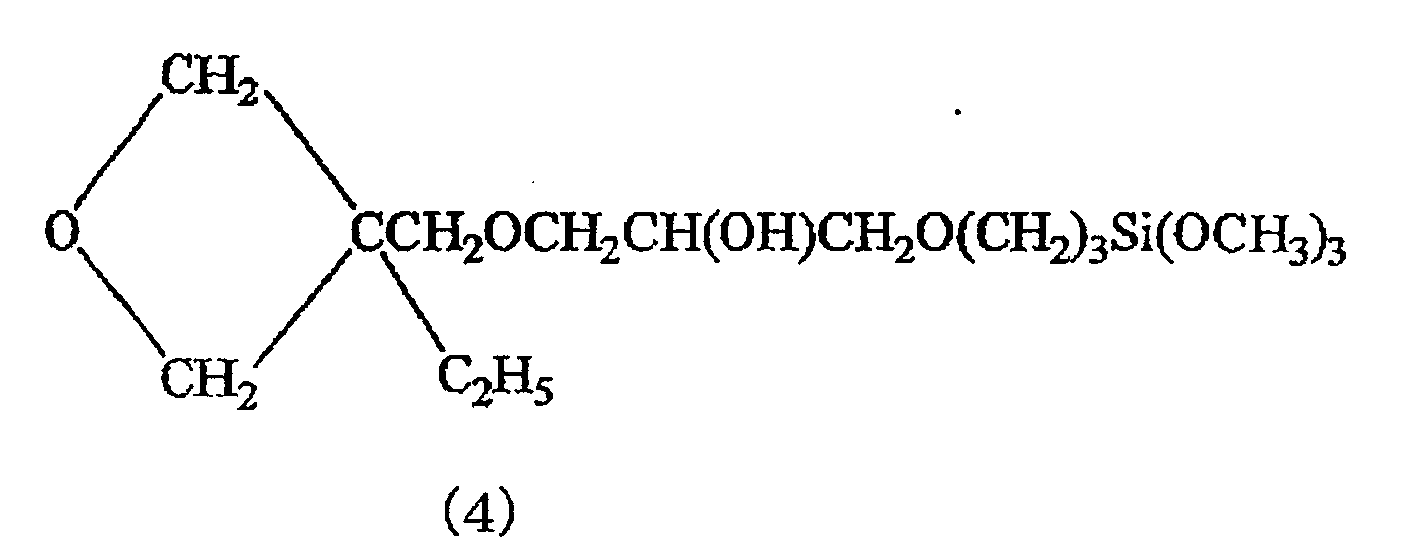
- the preferred R 0 in the present invention is one having carbon atoms of 20 or less, and particularly preferred R 0 is the organic functional group represented by the structural formula shown in the formula (4) below. (wherein, R 6 is hydrogen atom or an alkyl group having carbon atoms of 1 to 6; and R 7 is an alkylene group having carbon atoms of 2 to 6.)
- R 6 is hydrogen atom or an alkyl group having carbon atoms of 1 to 6, and ethyl group is preferred.
- R 7 is an alkylene group having carbon atoms of 2 to 6, and propylene group is preferred. This is because an oxetane compound for forming this type of organic functional group is easily obtained or synthesized. If the carbon number in R 6 or R 7 in the formula (3) is 7 or more, it is not preferred because the surface hardness of the cured product tends to be inadequate.
- the organosilicon compound (B) in the present invention is an organosilicon compound having a siloxane-bond-forming group and no oxetanyl group, and a preferable example thereof is the compound represented by the formula (2) below.
- (R 2 ) n SiX 4-n (wherein, X is a siloxane-bond-forming group; R 2 is an alkyl group, a cycloalkyl group or an aryl group; and n is an integer from 0 to 2.)
- the "siloxane-bond-forming group" of X refers to a group whereby a siloxane bond can be formed by hydrolysis between the silicon atoms of the compound represented by the structural formula shown in the formula (1) above, and example thereof includes hydrogen atom, a hydroxyl group, an alkoxy group, a cycloalkoxy group, an aryloxy group, a halogen atom and the like. Among these, a species other than a halogen atom is preferred.
- R 2 in the formula (2) above is a substituent selected from an alkyl group, a cycloalkyl group and an aryl group.
- the preferable carbon number of the alkyl group is 1 to 6, and more preferably 1 to 4.
- Example of the preferable alkyl group includes methyl group, ethyl group, n- and i-propyl groups, n-, i-, and t-butyl groups, and the like.
- Example of the "cycloalkyl group” includes cyclohexyl group and the like, and example of the "aryl group” includes phenyl group and the like.
- Example of the compound represented by the formula (2) above is as follows.
- n when n is 0, specific examples thereof are tetramethoxysilane and tetraethoxysilane.
- n 1, specific examples thereof are methyltrimethoxysilane, methyltriethoxysilane, methyltripropoxysilane, methyltriisopropoxysilane, ethyltrimethoxysilane, ethyltriethoxysilane, propyltriethoxysilane, butyltrimethoxysilane, cyclohexyltrimethoxysilane, cyclohexyltriethoxysilane, phenyltrimethoxysilane and phenyltriethoxysilane.
- n 2
- specific examples thereof are dimethyldimethoxysilane, dimethyldiethoxysilane, diethyldimethoxysilane, diethyldiethoxysilane, diphenyldimethoxysilane, diphenyldiethoxysilane, methylphenyldimethoxysilane and methylphenyldiethoxysilane.
- the compound represented by the formula (2) above is introduced for the purpose of reducing the oxetanyl group concentration in the cation-curable silicon compound, lowering the viscosity without decreasing the molecular weight of the silsesquioxane compound, and decreasing the curing shrinkage ratio by decreasing the crosslinking density thereof, and especially preferred examples of this compound are methyltrimethoxysilane and methyltriethoxysilane.
- the organosilicon compound (C) in the present invention is represented by the formula (3) below, and is a component which bonds with a terminal silanol group formed by a hydrolysis condensation process in the present invention and has an effect of improving a storage stability of a cation-curable composition obtained according to the present invention.
- Y is a hydroxyl group or a siloxane-bond-forming group
- R 2 is an alkyl group, a cycloalkyl group or an aryl group.
- R 2 in the formula (3) above is a substituent selected from an alkyl group, a cycloalkyl group and an aryl group.
- the preferable carbon number of the alkyl group is 1 to 6, and more preferably 1 to 4.
- Example of the preferable alkyl group includes methyl group, ethyl group, n- and i-propyl groups, n-, i-, and t-butyl groups, and the like.
- Example of the "cycloalkyl group” includes cyclohexyl group and the like, and example of the "aryl group” includes phenyl group and the like.
- Example of the organosilicon compound represented by the formula (3) above is as follows.
- trimethylsilanol triethylsilanol, tripropylsilanol, tributylsilanol, triphenylsilanol, trimethylmethoxysilane, trimethylethoxysilane, triethylmethoxysilane, triethylethoxysilane, tripropylmethoxysilane, tripropylethoxysilane, trimethylsilyl acetate, trimethylsilyl benzoate, triethylsilyl acetate, triethylsilyl benzoate, benzyldimethylmethoxysilane, benzyldimethylethoxysilane, diphenylmethoxymethylsilane, diphenylethoxymethylsilane, acetyltriphenylsilane, ethoxytriphenylsilane, hexamethyldisiloxane, hexaeth
- the production process of the present invention is characterized in that a hydrolysis co-condensation of the starting materials above is performed in the presence of an acidic catalyst whose pKa at 25°C is 5 or lower and whose boiling point at atmospheric pressure is 150°C or lower, and a step for removing an organic solvent used in the hydrolysis condensation reaction step usually includes after the hydrolysis co-condensation step.
- Example of charging method of the abovementioned three types of starting material compounds includes a method whereby organosilicon compound (A), organosilicon compound (B), and organosilicon compound (C) are all charged at once (hereinafter referred to as a batch charging method), and a method whereby organosilicon compound (C) is added to reaction system after a hydrolysis co-condensation of organosilicon compound (A) and organosilicon compound (B) (hereinafter referred to as a divided charging method).
- the preferable charging ratio of the organic compound B is in the range from 0.01 to 99 mol, and particularly from 0.1 to 90 mol, based on 1 mole of the starting material compound A
- the preferable charging ratio of the organic compound C is less than the total amount of siloxane-bond-forming group (X) in organic compounds (A) and (B).
- an amount of the organic compound (C) to be charged is preferably less than [3a + (4 - n)b] mol.
- An amount of water used in the hydrolysis co-condensation step is preferably in the range from 0.5 to 10 equivalents and particularly from 1.5 to 5 equivalents when the amount of water needed in order to completely hydrolyze a siloxane-bond-forming groups in the organosilicon compounds (A) and (B) is equal to 1 equivalent.
- the system is preferably an acidic atmosphere having pH in the range from 0.5 to 4.5 during cohydrolysis of the compound represented by the formula (1) above.
- the pH is less than 0.5, most of the oxetanyl groups undergo ring opening, and photo-curability are severely compromised.
- rates of hydrolysis and condensation decrease and a long time is required for production.
- a neutral pH of 7 a desired cation-curable silicon compound is not obtained because hydrolysis of the organosilicon compound (A) does not progress to completion.
- the co-condensation of the organosilicon compounds (A) and (B), or the co condensation thereof with organosilicon compound (C) in the present invention induces gelation in an alkaline atmosphere having pH of 7 or higher according to the combination thereof, and production is completely impossible.
- an acidic catalyst whose pKa is 5 or lower at 25°C and whose boiling point is 150°C or lower at atmospheric pressure is used.
- Acidic catalysts that are preferred for use include hydrofluoric acid, hydriodic acid, hydrobromic acid, hydrochloric acid, sulfurous acid, cyanoacetic acid, formic acid, acrylic acid, p-toluene sulfonic acid, acetic acid, lactic acid, and the like.
- hydrochloric acid is particularly preferred for its ready availability.
- the organic solvent used in hydrolysis is not particularly limited, for example, an alcohol such as methyl alcohol, ethyl alcohol and isopropyl alcohol; a ketone such as acetone and methylethylketone; tetrahydrofuran, toluene, 1,4-dioxane, hexane, ligroin and the like can be used.
- the reaction system is preferably made into a uniform solution using one type of solvent or a solvent mixture of two or more types of these solvents.
- the preferable reaction temperature in hydrolysis is independent of the type of starting material compound, and is in the range from 10 to 120°C, more preferably from 20 to 80°C, for both the batch charging method and the divided charging method.
- the suitable reaction time for hydrolysis is in the range between 2 and 30 hours, more preferably between 4 and 24 hours.
- the cation-curable silicon compound formed by hydrolysis co-condensation of the organosilicon compounds (A) and (B) comprises a silsesquioxane compound that is composed of three-dimensional (Si-O-Si) bond formed by hydrolysis of the hydrolyzable group X in the formulae (1) and (2) above, and that has an oxetanyl group.
- the cation-curable silicon compound formed by hydrolysis co-condensation of the organosilicon compounds (A) through (C) (hereinafter abbreviated as co-condensate) is composed of one-dimensional to three-dimensional (Si-O-Si) bonds formed by hydrolysis of the siloxane-bond-forming group X in the formulae (1) and (2) above for both the batch charging method and the divided charging method, and has a structure in which the compound represented by the formula (3) above is condensed at the terminal end thereof.
- the co-condensate may contain a linear silicone compound. Additionally, the co-condensate may also contain a silsesquioxane compound having a ladder structure, a cage structure or a random structure. The co-condensate may contain only one type of silsesquioxane compound, or may contain two or more types of silsesquioxane compounds having different structures or molecular weights. The co-condensate significantly varies according to the type and composition ratio of the organosilicon compounds (A) through (C), but a linear silicone compound is often contained therein in production by a batch charging method, and a three-dimensional silsesquioxane compound is often contained therein in production by a divided charging method.
- the hydrolyzable groups in the organosilicon compounds (A) and (B) are condensed in the co-condensate, and it is more preferred that essentially all of the hydrolyzable groups be condensed.
- ratio of the residual hydrolyzable group exceeds 10%, hardness reduces due to an inadequate formation of silsesquioxane structures and there is a risk of decreased storage stability of the composition.
- a state in which "essentially all of the hydrolyzable groups are condensed" can be recognized, for example, by the fact that a peak based on the hydrolyzable group is not observed in NMR chart of the resultant silsesquioxane compound.
- the co-condensate is composed of a silsesquioxane compound in which equivalent of the oxetanyl group is reduced. This compound has low viscosity and is easily handled, and is useful as a product in which curing shrinkage is minimized.
- the batch charging method can lower molecular weight of the co-condensate itself, the co-condensate can be made less viscous and easier to handle.
- the divided charging method regardless of the fact that the resultant co-condensate has a high molecular weight, since a silanol group in the product is end-capped by the organosilicon compound (C), there are no hydrogen bonds between the silanol groups, the viscosity can be reduced, and the product is easy to handle. Furthermore, since the silanol group in the product is end-capped, a product having high storage stability in which there is extremely little change over time can be obtained.
- the co-condensate obtained according to the present invention preferably has number-average molecular weight in the range from 600 to 5,000, and more preferably from 1,000 to 3,000.
- the number-average molecular weight is less than 600, an adequate hardness may not obtain in a cured film formed from the composition.
- viscosity of the composition also lowers, it is easily splashed on the coated surface when the composition is used as a hard coating agent composition.
- the number-average molecular weight is more than 5,000, the viscosity of the composition becomes too high, it becomes difficult to handle, and coating properties of the composition decline when it is used as a hard coating agent composition.
- this composition is used as a hard coating agent composition in particular, it is preferred that 50 wt% or more, more preferably 70 wt% or more, of the co-condensate as a whole be composed of a silsesquioxane compound having a number-average molecular weight in the range from 1,000 to 3,000.
- the number-average molecular weight in the present specification is given in terms of the equivalent polystyrene molecular weight as measured by gel permeation chromatography (GPC).
- hydrolysis condensation in the case water unconsumed in hydrolysis is present, both the water and an organic solvent used in the hydrolysis condensation reaction step is removed.
- This step may be performed as a normal distillation operation under a normal pressure or a reduced pressure.
- Oxe-TRIES 3-ethyl-3-[[3 (triethoxysilyl)propoxy]methyl]oxetane
- the progress of the reaction was tracked by gel permeation chromatography, and the reaction was considered completed at the time when Oxe-TRIES was nearly exhausted (20 hours after addition of the mixture was started) .
- the solvent was then distilled under a reduced pressure, and a colorless and transparent product whose viscosity is 32,000 mPa•s was obtained.
- the solvent was then distilled under a reduced pressure, and a colorless and transparent product whose viscosity is 25,000 mPa•s was obtained.
- the above product was stored in darkness for three months at 25°C, and when solubility in THF and viscosity were measured, its solubility in THF was good, and its viscosity was 39,000 mPa•s (viscosity increase ratio: 156%).
- Example 2 The same procedure was followed as in Example 1 except that 52.58 g (H 2 O: 2.87 mol; acetic acid: 14.3 mmol) of 1.6% acetic acid were used, and a colorless and transparent product having a viscosity of 31,000 mPa•s was obtained.
- Example 2 The same procedure was followed as in Example 1 except that 200 g of methylethylketone were used, and a colorless and transparent product having a viscosity of 33,000 mPa•s was obtained.
- the solvent was then distilled under a reduced pressure, and a colorless and transparent product whose viscosity is 20,000 mPa•s was obtained.
- the above product was stored in darkness for three months at 25°C, and when solubility in THF and viscosity were measured, its solubility in THF was good, and its viscosity was 21,600 mPa•s (viscosity increase ratio: 108%).
- compositions A through H are shown in Table 1 below.
- Composition Compound A Coumpound obtained in Example 1 B Coumpound obtained in Example 2 C Coumpound obtained in Example 3 D Coumpound obtained in Example 4 E Coumpound obtained in Example 5 F Coumpound obtained in Example 6 G Coumpound obtained in Example 7 H Coumpound obtained in Example 8
- a composition was applied on a glass substrate to a thickness of approximately 20 ⁇ m using a bar coater, ultraviolet irradiation was performed under the condition below, and the number of irradiations was measured until there was no more surface tackiness.
- Each composition was applied on a steel plate and a glass substrate to a thickness of approximately 20 ⁇ m using a bar coater, ultraviolet irradiation was performed under the condition above, and a cured film was obtained.
- This cured film was left for 24 hours in a thermostatic chamber at a temperature of 25°C and a relative humidity of 60%, and then pencil hardness of the surface was measured according to JIS K5400. The results thereof were shown in Table 2 below. As is apparent from this table, since the product obtained according to the production process of the present invention has an oxetanyl group, excellent cation-curability are obtained, and the resultant cured film is extremely hard due to the fact that it is a film of a silsesquioxane compound.
- Pencil hardness (steel plate) Pencil hardness (glass plate) Number of passes Flaw Peeled Flaw Peeled Composition A 7 5H 6H 5H >9H Composition B 6 5H 6H 6H 8H Composition C 5 5H 6H 6H >9H Composition D 7 5H 6H 5H >9H Composition E 7 5H 6H 5H >9H Composition F 4 5H 6H 6H >9H Composition G 5 5H 6H 6H >9H Composition H 5 5H 6H 6H >9H
- the production process of the present invention produces only a small quantity of waste product, it places little strain on the environment.
- the composition obtained by the production process of the present invention also has no need for refrigerated storage and is easy to handle due to its high storage stability.
Landscapes
- Chemical & Material Sciences (AREA)
- Chemical Kinetics & Catalysis (AREA)
- Organic Chemistry (AREA)
- Health & Medical Sciences (AREA)
- Medicinal Chemistry (AREA)
- Polymers & Plastics (AREA)
- Life Sciences & Earth Sciences (AREA)
- Engineering & Computer Science (AREA)
- Materials Engineering (AREA)
- Wood Science & Technology (AREA)
- Silicon Polymers (AREA)
Abstract
The present invention is a process for producing an oxetanyl
group-containing cation-curable silicon compound where a hydrolysis
co-condensation of (A) and (B) below is performed in the presence of
an acidic catalyst in which pKa ≦ 5 (25°C) and boiling point ≦ 150°C
(at atmospheric pressure); and is preferably a process for producing
an oxetanyl group-containing cation-curable silicon compound where a
hydrolysis condensation of (A), (B) and (C) below is performed in the
presence of an acidic catalyst.
 wherein R0 is an oxetanyl group-containing organic functional
group; X is a siloxane-bond-forming group; R2 is an alkyl group, a
cycloalkyl group or an aryl group; n = 0 - 2; and Y is a hydroxyl
group or a siloxane-bond-forming group.
wherein R0 is an oxetanyl group-containing organic functional
group; X is a siloxane-bond-forming group; R2 is an alkyl group, a
cycloalkyl group or an aryl group; n = 0 - 2; and Y is a hydroxyl
group or a siloxane-bond-forming group.
Description
The present invention relates to a process for producing a
cation-curable silicon compound having an oxetanyl group by use of a
hydrolysis condensation reaction.
The cation-curable silicon compound obtained according to the
present invention is useful as a hard coating agent or a starting
material for protective films for various substrates because of its
excellent curability and ability to form a film having a high degree
of hardness, and is also useful as a starting material for a resist
due to the fact that the ratio of inorganic components therein can be
increased to a high degree. Since the compound has high storage
stability, it does not require refrigerated storage and is easy to
handle.
Since radical polymerization is inhibited by oxygen in air, a
polymerization should be performed in an inert atmosphere in order to
rapidly and completely polymerize a radical-polymerizable monomer.
On the other hand, a cation-polymerizable monomer can be
completely polymerized even in air since the polymerization reaction
is not inhibited by oxygen.
As the cation-polymerizable monomer, compounds having an epoxy
group, a vinylether group or an oxetanyl group are known.
While a cation-polymerizable monomer having an epoxy group has
good heat resistance, leads to an excellent adhesiveness and is able
to obtain a cured product being excellent in chemical resistance, it
has been considered to be a hardly applicable material under recent
environments where improvement of productivity is emphasized, since
cation-curability is relatively low.
In addition, while the cation-polymerizable monomer having a
vinylether group has relatively high cation-curability and sufficient
performance with respect to productivity, the cured product thereof is
so soft that it cannot be used for a hard coating agent and a
protective film of various base materials.
In contrast to the materials described above, a compound having
an oxetanyl group has high cation-curability and its cured product is
excellent in physical strength. Therefore, a hard coating agent having
an oxetanyl group has been frequently investigated, and particularly
it has been studied how the compound having an oxetanyl group is
introduced into a highly rigid cyclohexene skelton.
The method for introducing the oxetanyl group into the
cyclohexene skelton is roughly divided into two ways. One is a method
for taking advantage of a hydrosilylation reaction as disclosed in
Japanese Patent Application Laid-Open (JP-A) H06-16804 that uses a raw
material having Si-H bond and a hydrosilylation catalyst. However,
this raw material is relatively expensive, and the hydrosilylation
catalyst is difficult to remove.
The other is a method for taking advantage of a hydrolysis
condensation reaction and it is considered to be industrially
advantageous since a cheap raw material can be used and the catalyst
is readily removed.
Although a chemical structure formula of a repeating unit of a
hydrolysis condensation product of the compound represented by the
formula (4) below has been described in USP No. 3,338,867, no
description is found at all on the hydrolysis condensation process and
the method for recovering the product.
In Japanese Patent Application Laid-Open (JP-A) H11-29640, a
method for producing a cation-curable composition comprising a
silsesquioxane compound having an oxetanyl group, wherein a method for
producing a cation-curable composition in which hydrolysis of a
compound represented by the structural formula shown in the formula
(5) below is performed under pH of 7 or more, is disclosed.
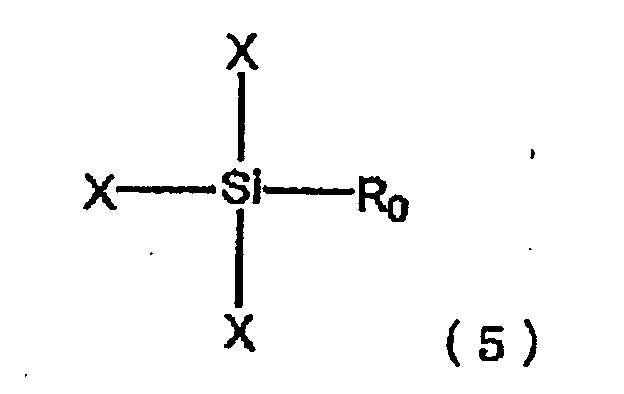 (wherein, R0 is an organic functional group having an oxetanyl group,
and X is a hydrolyzable group.)
(wherein, R0 is an organic functional group having an oxetanyl group,
and X is a hydrolyzable group.)
In Japanese Patent Application Laid-Open (JP-A) H11-199673, a
method for producing a cation-curable resin composition comprising a
hydrolysis product obtained by hydrolyzing a mixture of a compound
represented by the structural formula shown in the formula (6) and a
reactive silicone having one or more hydrolysable group in one
molecule, is disclosed.
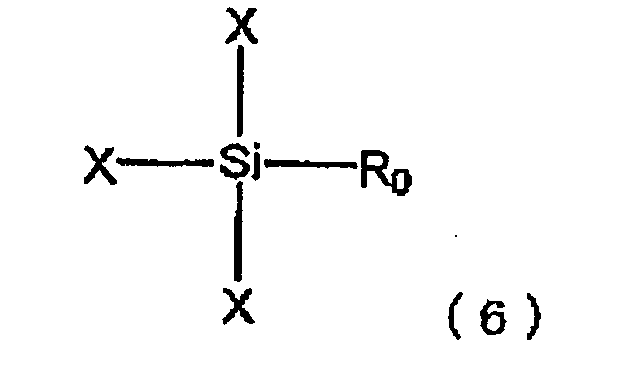 (wherein, R0 is an organic functional group having an epoxy group or an
oxetanyl group, and X is a hydrolyzable group.)
(wherein, R0 is an organic functional group having an epoxy group or an
oxetanyl group, and X is a hydrolyzable group.)
Since the methods for producing the cation-curable resin
compositions disclosed in JP-A Nos. H11-29640 and H11-199673 are ones
where hydrolysis condensation reaction is preformed in the presence of
an alkaline catalyst such as ammonia, quite complicated operations
were necessary for removing the alkaline catalyst after the hydrolysis
condensation reaction.
On the other hand, in Japanese Patent Application Laid-Open (JP-A)
H10-59984, an oligomer mixture of condensed alkylalkoxysilanes is
disclosed. The method for producing this mixture is characterized in
hydrolyzing and condensing an alkyltrialkoxysilane, which has an alkyl
group in which the silane used has from 3 to 18 carbon atoms and a
methoxy and/or an ethoxy group as alkyl group and alkoxy group, using
water in a proportion of 1 mole or more per 1 mole of Si, and using
HCl as a catalyst; and post-treating the reaction mixture obtained by
distillation in a reaction vessel at a temperature of less than 95°C
under a reduced pressure.
JP-A H10-59984 describes the reason for using the acid catalyst
that HCl may be advantageously used as a hydrolysis catalyst that can
almost be quantitatively removed, although no essential explanation is
disclosed.
There are no compounds having a highly reactive functional group
such as an oxetanyl group in alkoxysilane, as a material for
contacting with an acid catalyst in the production method of an
oligomer in JP-A H10-59984, which neither disclose nor suggest that
the acid catalyst is applicable to the production of the cation-curable
resin composition having an oxetanyl group.
In addition, Japanese Patent Application Laid-Open (JP-A) H08-113648
discloses a method for producing polysilsesquioxane silylated
at the terminal characterized in mixing vinyltrialkoxysilane or
organotrialkoxysilane having a vinyl group as a substituent and other
organotrialkoxysilane to allow them to react with water in the
presence of an acid catalyst; hydrolyzing and polycondensing the
trialkoxysilane; and allowing thus obtained polymer to react with a
silylating agent without isolating it to silylate the terminal group
of the polymer. The reason for using the acid catalyst in this patent
publication is to perform a series of steps of a polysilsesquioxane
silylated producing step and a silylation step in one pot. There are
no compounds having a highly cation-polymerizable functional group
such as an oxetanyl group in alkoxysilane, as a material for
contacting with an acid catalyst in the production method of a
polysilsesquioxane silylated at the terminal in this patent
publication, which neither disclose nor suggests that the acid
catalyst is applicable to the production of the cation-curable silicon
compound having an oxetanyl group.
Further, in Japanese Patent Application Laid-Open (JP-A) 2001-31767,
an epoxy-functional organopolysiloxane resin is disclosed. One
of objectives in this patent publication is to provide an amine-curable
epoxy-functional organopolysiloxane resin by hydrolyzing and
polycondensing an epoxy-containing trialkoxysilane and a specified
silane. While it is disclosed in the patent publication that the acid
catalyst is available in the hydrolysis and polycondensation step, the
oxetane compounds are not described at all, and applicability of the
acid catalyst to the production of a cation-curable silicon compound
having an oxetanyl group is neither disclosed nor suggested.
An objective of the present invention is to provide a highly
productive process for producing a cation-curable silicon compound
having an oxetanyl group in which there is no need for a complex
operation in the step of removing a catalyst or a solvent after
hydrolysis condensation when the cation-curable silicon compound is
produced by hydrolysis condensation reaction.
In order to achieve the objective above, the inventors
investigated a production process performed under a neutral-to-acidic
condition, circumventing investigation under alkaline conditions in
which a purification step based on neutralization treatment is needed.
As a result, the inventors perfected the present invention upon
discovering that a cation-curable silicon compound having excellent
storage stability and curability can be obtained even without
performing a neutralization treatment step in the hydrolysis
condensation reaction of a silicon compound having a specific oxetanyl
group and a siloxane-bond-forming group, and a silicon compound having
a siloxane-bond-forming group and no specific oxetanyl group in the
presence of an acidic catalyst.
That is, the present invention is a process for producing a
cation-curable silicon compound, comprising the step of performing
hydrolysis co-condensation of an organosilicon compound (A)
represented by the formula (1) below and an organosilicon compound (B)
represented by the formula (2) below in the presence of an acidic
catalyst whose pKa at 25°C is 5 or lower and whose boiling point at
atmospheric pressure is 150°C or lower.
 (in the formula above, R0 is an organic functional group having
an oxetanyl group; X is a hydrolyzable group; and each X may be the
same or different.)
(in the formula above, R0 is an organic functional group having
an oxetanyl group; X is a hydrolyzable group; and each X may be the
same or different.)
(R2)nSiX4-n
(wherein, X is a siloxane-bond-forming group; R2 is an alkyl
group, a cycloalkyl group or an aryl group; and n is an integer from 0
to 2.)
In addition, the present invention is a process for producing a
cation-curable silicon compound comprising the step of performing
hydrolysis condensation of an organosilicon compound (A) represented
by the formula (1) below, an organosilicon compound (B) having a
siloxane-bond-forming group and no oxetanyl group represented by the
(2) below, and an organosilicon compound (C) represented by the
formula (3) below in the presence of an acidic catalyst.
 (in the formula above, R0 is an organic functional group having
an oxetanyl group; X is a siloxane-bond-forming group; and each X may
be the same or different.)
(in the formula above, R0 is an organic functional group having
an oxetanyl group; X is a siloxane-bond-forming group; and each X may
be the same or different.)
(R1)nSiX4-n
(wherein, X is a siloxane-bond-forming group; R1 is an alkyl
group, a cycloalkyl group or an aryl group; and n is an integer from 0
to 2.)
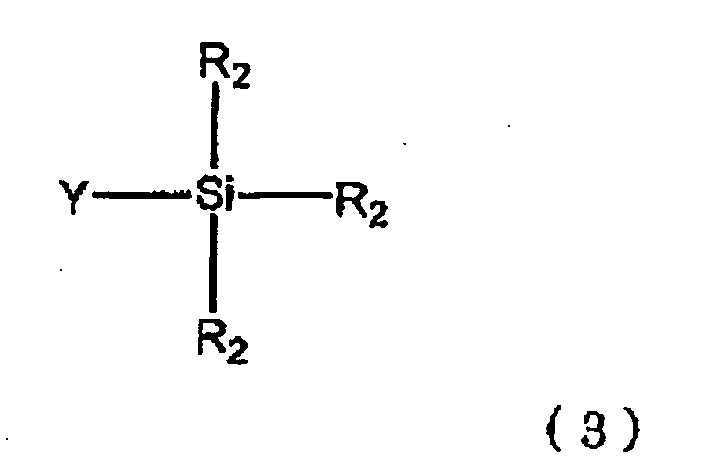 (wherein, Y is a hydroxyl group or a siloxane-bond-forming
group; and R2 is an alkyl group, a cycloalkyl group or an aryl group.)
(wherein, Y is a hydroxyl group or a siloxane-bond-forming
group; and R2 is an alkyl group, a cycloalkyl group or an aryl group.)
The present invention will be described in detail hereinafter.
The starting material in the present invention is the
organosilicon compounds below.
The organosilicon compound (A) in the present invention is the
compound represented by the formula (1) below.
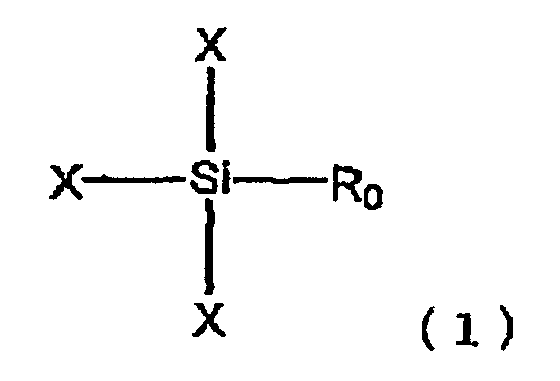 (in the formula above, R0 is an organic functional group having
an oxetanyl group; X is a siloxane-bond-forming group; and each X may
be the same or different.)
(in the formula above, R0 is an organic functional group having
an oxetanyl group; X is a siloxane-bond-forming group; and each X may
be the same or different.)
The siloxane-bond-forming group X in the formula (1) above is
not particularly limited so far as it is a hydrolyzable group. X is
preferably a halogen atom, an alkoxy group, a cycloalkoxy group, an
aryloxy group or the like; and X is more preferably an alkoxy group, a
cycloalkoxy group or an aryloxy group. The reason for this is that
since a hydrogen halide is formed by hydrolysis when X is a halogen
atom, the atmosphere of the reaction system becomes strongly acidic
more readily, and there is therefore a risk of the oxetanyl group
undergoing ring opening.
The abovementioned "alkoxy group" includes methoxy group, ethoxy
group, n- and i-propoxy groups, n-, i-, and t-butoxy groups, and the
like. In addition, the "cycloalkoxy group" includes cyclohexyloxy
group and the like, and the "aryloxy group" includes phenyloxy group
and the like. Among these, the alkoxy group having carbon atoms of 1
to 3 is preferred as X because of the good hydrolysis properties of
the alkoxy group. Further, particularly preferred is ethoxy group as X
because it is readily available or because the hydrolysis reaction
thereof is easy to control.
R0 in the formula (1) above is an organic functional group
having an oxetanyl group.
The preferred R0 in the present invention is one having carbon
atoms of 20 or less, and particularly preferred R0 is the organic
functional group represented by the structural formula shown in the
formula (4) below.
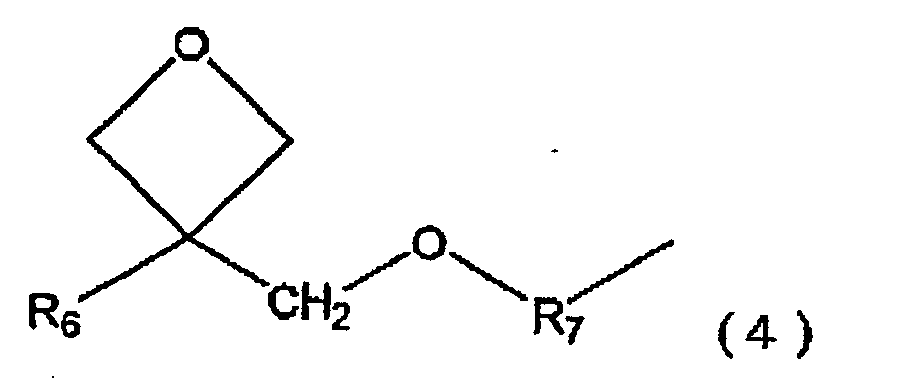 (wherein, R6 is hydrogen atom or an alkyl group having carbon
atoms of 1 to 6; and R7 is an alkylene group having carbon atoms of 2
to 6.)
(wherein, R6 is hydrogen atom or an alkyl group having carbon
atoms of 1 to 6; and R7 is an alkylene group having carbon atoms of 2
to 6.)
In this formula (4), R6 is hydrogen atom or an alkyl group
having carbon atoms of 1 to 6, and ethyl group is preferred. In
addition, R7 is an alkylene group having carbon atoms of 2 to 6, and
propylene group is preferred. This is because an oxetane compound for
forming this type of organic functional group is easily obtained or
synthesized. If the carbon number in R6 or R7 in the formula (3) is 7
or more, it is not preferred because the surface hardness of the cured
product tends to be inadequate.
The organosilicon compound (B) in the present invention is an
organosilicon compound having a siloxane-bond-forming group and no
oxetanyl group, and a preferable example thereof is the compound
represented by the formula (2) below.
(R2)nSiX4-n
(wherein, X is a siloxane-bond-forming group; R2 is an alkyl
group, a cycloalkyl group or an aryl group; and n is an integer from 0
to 2.)
In the formula (2) above, the "siloxane-bond-forming group" of X
refers to a group whereby a siloxane bond can be formed by hydrolysis
between the silicon atoms of the compound represented by the
structural formula shown in the formula (1) above, and example thereof
includes hydrogen atom, a hydroxyl group, an alkoxy group, a
cycloalkoxy group, an aryloxy group, a halogen atom and the like.
Among these, a species other than a halogen atom is preferred. The
reason for this is that since a hydrogen halide is formed by
hydrolysis when X' is a halogen atom, the atmosphere of the reaction
system becomes strongly acidic with greater ease, and there is
therefore a risk of the oxetanyl group or the like undergoing ring
opening.
R2 in the formula (2) above is a substituent selected from an
alkyl group, a cycloalkyl group and an aryl group. The preferable
carbon number of the alkyl group is 1 to 6, and more preferably 1 to 4.
Example of the preferable alkyl group includes methyl group, ethyl
group, n- and i-propyl groups, n-, i-, and t-butyl groups, and the
like. Example of the "cycloalkyl group" includes cyclohexyl group and
the like, and example of the "aryl group" includes phenyl group and
the like.
Example of the compound represented by the formula (2) above is
as follows.
That is, when n is 0, specific examples thereof are
tetramethoxysilane and tetraethoxysilane. When n is 1, specific
examples thereof are methyltrimethoxysilane, methyltriethoxysilane,
methyltripropoxysilane, methyltriisopropoxysilane,
ethyltrimethoxysilane, ethyltriethoxysilane, propyltriethoxysilane,
butyltrimethoxysilane, cyclohexyltrimethoxysilane,
cyclohexyltriethoxysilane, phenyltrimethoxysilane and
phenyltriethoxysilane.
When n is 2, specific examples thereof are
dimethyldimethoxysilane, dimethyldiethoxysilane,
diethyldimethoxysilane, diethyldiethoxysilane, diphenyldimethoxysilane,
diphenyldiethoxysilane, methylphenyldimethoxysilane and
methylphenyldiethoxysilane.
The compound represented by the formula (2) above is introduced
for the purpose of reducing the oxetanyl group concentration in the
cation-curable silicon compound, lowering the viscosity without
decreasing the molecular weight of the silsesquioxane compound, and
decreasing the curing shrinkage ratio by decreasing the crosslinking
density thereof, and especially preferred examples of this compound
are methyltrimethoxysilane and methyltriethoxysilane.
The organosilicon compound (C) in the present invention is
represented by the formula (3) below, and is a component which bonds
with a terminal silanol group formed by a hydrolysis condensation
process in the present invention and has an effect of improving a
storage stability of a cation-curable composition obtained according
to the present invention.
 (wherein, Y is a hydroxyl group or a siloxane-bond-forming
group; and R2 is an alkyl group, a cycloalkyl group or an aryl group.)
(wherein, Y is a hydroxyl group or a siloxane-bond-forming
group; and R2 is an alkyl group, a cycloalkyl group or an aryl group.)
R2 in the formula (3) above is a substituent selected from an
alkyl group, a cycloalkyl group and an aryl group. The preferable
carbon number of the alkyl group is 1 to 6, and more preferably 1 to 4.
Example of the preferable alkyl group includes methyl group, ethyl
group, n- and i-propyl groups, n-, i-, and t-butyl groups, and the
like. Example of the "cycloalkyl group" includes cyclohexyl group and
the like, and example of the "aryl group" includes phenyl group and
the like.
Example of the organosilicon compound represented by the formula
(3) above is as follows.
That is, specific examples thereof are trimethylsilanol,
triethylsilanol, tripropylsilanol, tributylsilanol, triphenylsilanol,
trimethylmethoxysilane, trimethylethoxysilane, triethylmethoxysilane,
triethylethoxysilane, tripropylmethoxysilane, tripropylethoxysilane,
trimethylsilyl acetate, trimethylsilyl benzoate, triethylsilyl acetate,
triethylsilyl benzoate, benzyldimethylmethoxysilane,
benzyldimethylethoxysilane, diphenylmethoxymethylsilane,
diphenylethoxymethylsilane, acetyltriphenylsilane,
ethoxytriphenylsilane, hexamethyldisiloxane, hexaethyldisiloxane,
hexapropyldisiloxane, 1,3-dibutyl-1,1,3,3-tetramethyldisiloxane, 1,3-diphenyl-1,1,3,3-tetramethyldisiloxane
and 1,3-dimethyl-1,1,3,3-tetraphenyldisiloxane.
The production process of the present invention is characterized
in that a hydrolysis co-condensation of the starting materials above
is performed in the presence of an acidic catalyst whose pKa at 25°C
is 5 or lower and whose boiling point at atmospheric pressure is 150°C
or lower, and a step for removing an organic solvent used in the
hydrolysis condensation reaction step usually includes after the
hydrolysis co-condensation step.
Example of charging method of the abovementioned three types of
starting material compounds includes a method whereby organosilicon
compound (A), organosilicon compound (B), and organosilicon compound
(C) are all charged at once (hereinafter referred to as a batch
charging method), and a method whereby organosilicon compound (C) is
added to reaction system after a hydrolysis co-condensation of
organosilicon compound (A) and organosilicon compound (B) (hereinafter
referred to as a divided charging method).
In the present invention, no particular limitation is placed on
the charging ratios of organic compounds A to C that are the starting
material compounds, except that at least organic compound A and
organic compound B be used in combination.
The preferable charging ratio of the organic compound B is in
the range from 0.01 to 99 mol, and particularly from 0.1 to 90 mol,
based on 1 mole of the starting material compound A
The preferable charging ratio of the organic compound C is less
than the total amount of siloxane-bond-forming group (X) in organic
compounds (A) and (B). For example, when a mol of the organic compound
(A) and b mol of the organic compound (B) are charged, an amount of
the organic compound (C) to be charged is preferably less than [3a +
(4 - n)b] mol.
An amount of water used in the hydrolysis co-condensation step
is preferably in the range from 0.5 to 10 equivalents and particularly
from 1.5 to 5 equivalents when the amount of water needed in order to
completely hydrolyze a siloxane-bond-forming groups in the
organosilicon compounds (A) and (B) is equal to 1 equivalent.
In the hydrolysis condensation step, the system is preferably an
acidic atmosphere having pH in the range from 0.5 to 4.5 during cohydrolysis
of the compound represented by the formula (1) above. In
the case where the pH is less than 0.5, most of the oxetanyl groups
undergo ring opening, and photo-curability are severely compromised.
In the case at a weakly acidic pH of 5 to 6, rates of hydrolysis and
condensation decrease and a long time is required for production. In
the case at a neutral pH of 7, a desired cation-curable silicon
compound is not obtained because hydrolysis of the organosilicon
compound (A) does not progress to completion. In addition, the co-condensation
of the organosilicon compounds (A) and (B), or the co
condensation thereof with organosilicon compound (C) in the present
invention induces gelation in an alkaline atmosphere having pH of 7 or
higher according to the combination thereof, and production is
completely impossible.
As described above, when the system in hydrolysis is set to pH
in the range from 0.5 to 4.5 an acidic catalyst whose pKa is 5 or
lower at 25°C and whose boiling point is 150°C or lower at atmospheric
pressure is used. Acidic catalysts that are preferred for use include
hydrofluoric acid, hydriodic acid, hydrobromic acid, hydrochloric acid,
sulfurous acid, cyanoacetic acid, formic acid, acrylic acid, p-toluene
sulfonic acid, acetic acid, lactic acid, and the like. Among these,
hydrochloric acid is particularly preferred for its ready availability.
The organic solvent used in hydrolysis is not particularly
limited, for example, an alcohol such as methyl alcohol, ethyl alcohol
and isopropyl alcohol; a ketone such as acetone and methylethylketone;
tetrahydrofuran, toluene, 1,4-dioxane, hexane, ligroin and the like
can be used. The reaction system is preferably made into a uniform
solution using one type of solvent or a solvent mixture of two or more
types of these solvents.
The preferable reaction temperature in hydrolysis is independent
of the type of starting material compound, and is in the range from 10
to 120°C, more preferably from 20 to 80°C, for both the batch charging
method and the divided charging method. The suitable reaction time for
hydrolysis is in the range between 2 and 30 hours, more preferably
between 4 and 24 hours.
The cation-curable silicon compound formed by hydrolysis co-condensation
of the organosilicon compounds (A) and (B) (hereinafter
abbreviated as co-condensate) comprises a silsesquioxane compound that
is composed of three-dimensional (Si-O-Si) bond formed by hydrolysis
of the hydrolyzable group X in the formulae (1) and (2) above, and
that has an oxetanyl group.
The cation-curable silicon compound formed by hydrolysis co-condensation
of the organosilicon compounds (A) through (C)
(hereinafter abbreviated as co-condensate) is composed of one-dimensional
to three-dimensional (Si-O-Si) bonds formed by hydrolysis
of the siloxane-bond-forming group X in the formulae (1) and (2) above
for both the batch charging method and the divided charging method,
and has a structure in which the compound represented by the formula
(3) above is condensed at the terminal end thereof.
The co-condensate may contain a linear silicone compound.
Additionally, the co-condensate may also contain a silsesquioxane
compound having a ladder structure, a cage structure or a random
structure. The co-condensate may contain only one type of
silsesquioxane compound, or may contain two or more types of
silsesquioxane compounds having different structures or molecular
weights. The co-condensate significantly varies according to the type
and composition ratio of the organosilicon compounds (A) through (C),
but a linear silicone compound is often contained therein in
production by a batch charging method, and a three-dimensional
silsesquioxane compound is often contained therein in production by a
divided charging method.
Preferably 90% or more of the hydrolyzable groups in the
organosilicon compounds (A) and (B) are condensed in the co-condensate,
and it is more preferred that essentially all of the hydrolyzable
groups be condensed. In the case where ratio of the residual
hydrolyzable group exceeds 10%, hardness reduces due to an inadequate
formation of silsesquioxane structures and there is a risk of
decreased storage stability of the composition. A state in which
"essentially all of the hydrolyzable groups are condensed" can be
recognized, for example, by the fact that a peak based on the
hydrolyzable group is not observed in NMR chart of the resultant
silsesquioxane compound.
The co-condensate is composed of a silsesquioxane compound in
which equivalent of the oxetanyl group is reduced. This compound has
low viscosity and is easily handled, and is useful as a product in
which curing shrinkage is minimized.
Since the batch charging method can lower molecular weight of
the co-condensate itself, the co-condensate can be made less viscous
and easier to handle. In the divided charging method, regardless of
the fact that the resultant co-condensate has a high molecular weight,
since a silanol group in the product is end-capped by the
organosilicon compound (C), there are no hydrogen bonds between the
silanol groups, the viscosity can be reduced, and the product is easy
to handle. Furthermore, since the silanol group in the product is end-capped,
a product having high storage stability in which there is
extremely little change over time can be obtained.
The co-condensate obtained according to the present invention
preferably has number-average molecular weight in the range from 600
to 5,000, and more preferably from 1,000 to 3,000. In the case where
the number-average molecular weight is less than 600, an adequate
hardness may not obtain in a cured film formed from the composition.
In addition, since viscosity of the composition also lowers, it is
easily splashed on the coated surface when the composition is used as
a hard coating agent composition. On the other hand, in the case where
the number-average molecular weight is more than 5,000, the viscosity
of the composition becomes too high, it becomes difficult to handle,
and coating properties of the composition decline when it is used as a
hard coating agent composition. When this composition is used as a
hard coating agent composition in particular, it is preferred that 50
wt% or more, more preferably 70 wt% or more, of the co-condensate as a
whole be composed of a silsesquioxane compound having a number-average
molecular weight in the range from 1,000 to 3,000. The number-average
molecular weight in the present specification is given in terms of the
equivalent polystyrene molecular weight as measured by gel permeation
chromatography (GPC).
After hydrolysis condensation, in the case water unconsumed in
hydrolysis is present, both the water and an organic solvent used in
the hydrolysis condensation reaction step is removed. This step may be
performed as a normal distillation operation under a normal pressure
or a reduced pressure.
The present invention will be described in further detail using
examples.
200 g of isopropyl alcohol, 80.13 g (0.25 mol) of 3-ethyl-3-[[3
(triethoxysilyl)propoxy]methyl]oxetane (hereinafter referred to as
"Oxe-TRIES") represented by the formula (7) below, and 126.59 g (0.71
mol) of methyltriethoxysilane were charged into a reactor equipped
with a stirrer and a thermometer. Then, 52.32 g (H2O: 2.87 mol; HCl:
14.3 mmol) of 1% hydrochloric acid was gradually added, and the
contents were stirred at 25°C. The progress of the reaction was
tracked by gel permeation chromatography, and the reaction was
considered completed at the time when Oxe-TRIES was nearly exhausted
(20 hours after addition of the mixture was started) . The solvent was
then distilled under a reduced pressure, and a colorless and
transparent product whose viscosity is 32,000 mPa•s was obtained.
The above product was stored in darkness for three months at
25°C, and when solubility in THF and viscosity were measured, its
solubility in THF was good, and its viscosity was 52,000 mPa•s
(viscosity increase ratio: 1630).

167 g of isopropyl alcohol, 95.15 g (0.3 mol) of Oxe-TRIES, and
72.11 g (0.3 mol) of phenyltriethoxysilane were charged into a reactor
equipped with a stirrer and a thermometer. Then, 32.7 g (H2O: 1.8 mol;
HCl: 9 mmol) of 1% hydrochloric acid was gradually added, and the
contents were stirred at 25°C. The progress of the reaction was
tracked by gel permeation chromatography, and the reaction was
considered completed at the time when Oxe-TRIES was nearly exhausted
(20 hours after addition of the mixture was started).
The solvent was then distilled under a reduced pressure, and a
colorless and transparent product whose viscosity is 21,000 mPa•s was
obtained. The above product was stored in darkness for three months at
25°C, and when solubility in THF and viscosity were measured, its
solubility in THF was good, and its viscosity was 36,000 mPa•s
(viscosity increase ratio: 171%).
50 g of isopropyl alcohol, 32.05 g (0.1 mol) of Oxe-TRIES, and
10.42 g (0.05 mol) of tetraethoxysilane were charged into a reactor
equipped with a stirrer and a thermometer. Then, 7.28 g (H2O: 0.40
mol; HCl: 2 mmol) of 1% hydrochloric acid was gradually added, and the
contents were stirred at 25°C. The progress of the reaction was
tracked by gel permeation chromatography, and the reaction was
considered completed at the time when Oxe-TRIES was nearly exhausted
(20 hours after addition of the mixture was started). The solvent was
then distilled under a reduced pressure, and a colorless and
transparent product whose viscosity is 25,000 mPa•s was obtained. The
above product was stored in darkness for three months at 25°C, and
when solubility in THF and viscosity were measured, its solubility in
THF was good, and its viscosity was 39,000 mPa•s (viscosity increase
ratio: 156%).
The same procedure was followed as in Example 1 except that
52.58 g (H2O: 2.87 mol; acetic acid: 14.3 mmol) of 1.6% acetic acid
were used, and a colorless and transparent product having a viscosity
of 31,000 mPa•s was obtained.
The above product was stored in darkness for three months at
25°C, and when solubility in THF and viscosity were measured, its
solubility in THF was good, and its viscosity was 49,000 mPa•s
(viscosity increase ratio: 158%).
The same procedure was followed as in Example 1 except that 200
g of methylethylketone were used, and a colorless and transparent
product having a viscosity of 33,000 mPa•s was obtained.
The above product was stored in darkness for three months at
25°C, and when solubility in THF and viscosity were measured, its
solubility in THF was good, and its viscosity was 53,000 mPa•s
(viscosity increase ratio: 161%).
200 g of isopropyl alcohol, 80.13 g (0.25 mol) of Oxe-TRIES, and
126.59 g (0.71 mol) of methyltriethoxysilane were charged into a
reactor equipped with a stirrer and a thermometer. Then, 53.01 g (H2O:
2.87 mol; HCl: 14.3 mmol) of 2.45% aqueous solution of
tetramethylammonium hydroxide were gradually added, and the contents
were stirred at 25°C. The progress of the reaction was tracked by gel
permeation chromatography, but the contents in the reactor had gelled
at the time when Oxe-TRIES was nearly exhausted (20 hours after
addition of the mixture was started), and a product could not be
obtained.
200 g of isopropyl alcohol, 80.13 g (0.25 mol) of Oxe-TRIES, and
126.59 g (0.71 mol) of methyltriethoxysilane were charged into a
reactor equipped with a stirrer and a thermometer. Then, 51.71 g (H2O:
2.87 mol) of pure water were gradually added, and the contents were
stirred at 65°C. The progress of the reaction was tracked by gel
permeation chromatography, but Oxe-TRIES peak had not disappeared even
after 20 hours from the start of addition of the mixture, and a
product could not be obtained.
60 g of isopropyl alcohol, 115.38 g (360 mmol) of Oxe-TRIES,
32.09 g (180 mmol) of methyltriethoxysilane, and 14.62 g (90 mmol) of
hexamethyldisiloxane were charged into a reactor equipped with a
stirrer and a thermometer. Then, 29.2 g of 1% hydrochloric acid were
gradually added, and the contents were stirred at 25°C. The progress
of the reaction was tracked by gel permeation chromatography, and the
reaction was considered completed at the time when Oxe-TRIES was
nearly exhausted (20 hours after addition of the mixture was started).
The solvent was then distilled under a reduced pressure, and a
colorless and transparent product whose viscosity is 6,600 mPa•s was
obtained.
The above product was stored in darkness for three months at
25°C, and when solubility in THF and viscosity were measured, its
solubility in THF was good, and its viscosity was 6,700 mPa•s
(viscosity increase ratio: 102%).
50 g of isopropyl alcohol, 32.05 g (100 mmol) of Oxe-TRIES, and
17.83 g (100 mmol) of methyltriethoxysilane were charged into a
reactor equipped with a stirrer and a thermometer. Then, 11 g of 1%
hydrochloric acid were gradually added, and the contents were stirred
at 25°C. The progress of the reaction was tracked by gel permeation
chromatography. And when Oxe-TRIES was nearly exhausted (20 hours
after addition of the mixture was started), 0.65 g (4 mmol) of
hexamethyldisiloxane was added dropwise therein, and the product was
heated and stirred for one hour at 50°C. The solvent was then
distilled under a reduced pressure, and a colorless and transparent
product whose viscosity is 20,000 mPa•s was obtained. The above
product was stored in darkness for three months at 25°C, and when
solubility in THF and viscosity were measured, its solubility in THF
was good, and its viscosity was 21,600 mPa•s (viscosity increase
ratio: 108%).
40 g of isopropyl alcohol, 32.05 g (100 mmol) of Oxe-TRIES,
10.42 g (50 mmol) of tetraethoxysilane, and 4.06 g (25 mmol) of
hexamethyldisiloxane were charged into a reactor equipped with a
stirrer and a thermometer. Then, 10 g of 1% hydrochloric acid were
gradually added, and the contents were stirred at 25°C. The progress
of the reaction was tracked by gel permeation chromatography, and the
reaction was considered completed at the time when Oxe-TRIES was
nearly exhausted (20 hours after addition of the mixture was started).
The solvent was then distilled under a reduced pressure, and a
colorless and transparent product whose viscosity is 13,000 mPa•s was
obtained. The above product was stored in darkness for three months at
25°C, and when solubility in THF and viscosity were measured, its
solubility in THF was good, and its viscosity was 17,000 mPa•s
(viscosity increase ratio: 131%).
3 weight parts of bis(dodecylphenyl)iodonium
hexafluoroantimonate as a cationic photopolymerization initiator were
added with respect to 100 weight parts of the compound obtained in
Examples 1 through 8 above, 10 weight parts of toluene for lowering
viscosity were also added, and cation-curable resin compositions A
through H were prepared.
The types of compounds used in compositions A through H are
shown in Table 1 below.
| Composition | Compound |
| A | Coumpound obtained in Example 1 |
| B | Coumpound obtained in Example 2 |
| C | Coumpound obtained in Example 3 |
| D | Coumpound obtained in Example 4 |
| E | Coumpound obtained in Example 5 |
| F | Coumpound obtained in Example 6 |
| G | Coumpound obtained in Example 7 |
| H | Coumpound obtained in Example 8 |
The curability and pencil hardness for cation-curable resin
compositions A through H were evaluated using the following methods.
A composition was applied on a glass substrate to a thickness of
approximately 20 µm using a bar coater, ultraviolet irradiation was
performed under the condition below, and the number of irradiations
was measured until there was no more surface tackiness.
Each composition was applied on a steel plate and a glass
substrate to a thickness of approximately 20 µm using a bar coater,
ultraviolet irradiation was performed under the condition above, and a
cured film was obtained.
This cured film was left for 24 hours in a thermostatic chamber
at a temperature of 25°C and a relative humidity of 60%, and then
pencil hardness of the surface was measured according to JIS K5400.
The results thereof were shown in Table 2 below. As is apparent from
this table, since the product obtained according to the production
process of the present invention has an oxetanyl group, excellent
cation-curability are obtained, and the resultant cured film is
extremely hard due to the fact that it is a film of a silsesquioxane
compound.
| Curability | Pencil hardness (steel plate) | Pencil hardness (glass plate) | |||
| Number of passes | Flaw | Peeled | Flaw | Peeled | |
| Composition A | 7 | 5H | 6H | 5H | >9H |
| Composition B | 6 | 5H | 6H | 6H | 8H |
| Composition C | 5 | 5H | 6H | 6H | >9H |
| Composition D | 7 | 5H | 6H | 5H | >9H |
| Composition E | 7 | 5H | 6H | 5H | >9H |
| Composition F | 4 | 5H | 6H | 6H | >9H |
| Composition G | 5 | 5H | 6H | 6H | >9H |
| Composition H | 5 | 5H | 6H | 6H | >9H |
In the process for producing a cation-curable resin composition
according to the present invention, there are fewer steps following
hydrolysis condensation compared with the conventional production
process and it is useful as a highly productive process for producing
a cation-curable resin composition, since there is no need for a
neutralization step after hydrolysis condensation reaction, and
purification can be performed simply by removing an organic solvent by
a common distillation operation.
In addition, since the production process of the present
invention produces only a small quantity of waste product, it places
little strain on the environment. The composition obtained by the
production process of the present invention also has no need for
refrigerated storage and is easy to handle due to its high storage
stability.
Claims (4)
- A process for producing a cation-curable silicon compound, comprising the step of performing hydrolysis co-condensation of an organosilicon compound (A) represented by the formula (1) below and an organosilicon compound (B) represented by the formula (2) below in the presence of an acidic catalyst whose pKa at 25°C is 5 or lower and whose boiling point at atmospheric pressure is 150°C or lower.(in the formula above, R0 is an organic functional group having an oxetanyl group; X is a hydrolyzable group; and each X may be the same or different.)
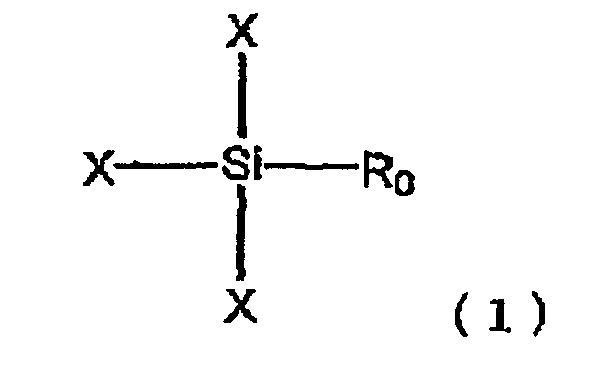
- A process for producing a cation-curable silicon compound comprising the step of performing hydrolysis condensation of an organosilicon compound (A) represented by the formula (1) below, an organosilicon compound (B) having a siloxane-bond-forming group and no oxetanyl group represented by the formula (2) below, and an organosilicon compound (C) represented by the formula (3) below in the presence of an acidic catalyst.(in the formula above, R0 is an organic functional group having an oxetanyl group; X is a siloxane-bond-forming group; and each X may be the same or different.)
 (wherein, Y is a hydroxyl group or a siloxane-bond-forming group; and R2 is an alkyl group, a cycloalkyl group or an aryl group.)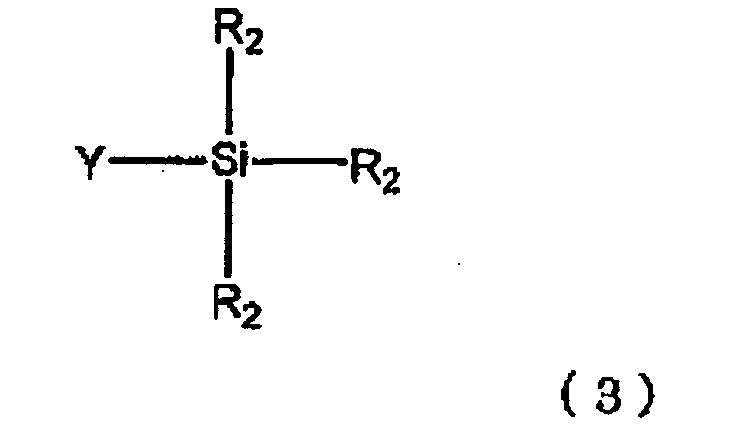
- The process for producing a cation-curable silicon compound according to Claim 1 or 2, wherein R0 in the formula (1) above is an organic functional group represented by the structural formula shown in the formula (4) below.(wherein, R3 is hydrogen atom or an alkyl group having carbon atoms from 1 to 6; and R4 is an alkylene group having carbon atoms from 2 to 6.)
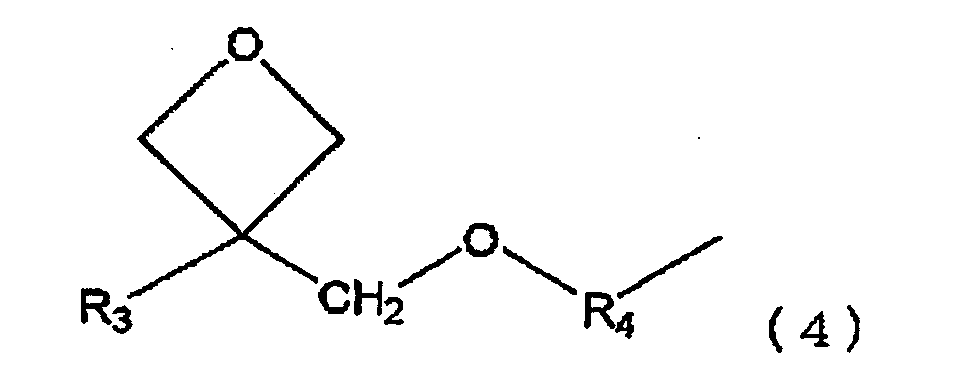
- The process for producing a cation-curable silicon compound according to Claim 1 or 2, wherein charging amount of said acidic catalyst is 1/50 mol to 1/200 mol with respect to the total amount of said organosilicon compound (A) and said organosilicon compound (B).
Applications Claiming Priority (5)
| Application Number | Priority Date | Filing Date | Title |
|---|---|---|---|
| JP2003052030 | 2003-02-27 | ||
| JP2003052030 | 2003-02-27 | ||
| JP2003052029 | 2003-02-27 | ||
| JP2003052029 | 2003-02-27 | ||
| PCT/JP2004/002285 WO2004076534A1 (en) | 2003-02-27 | 2004-02-26 | Process for producing cation-curable silicon compound |
Publications (2)
| Publication Number | Publication Date |
|---|---|
| EP1598389A1 true EP1598389A1 (en) | 2005-11-23 |
| EP1598389A4 EP1598389A4 (en) | 2006-06-21 |
Family
ID=32929658
Family Applications (1)
| Application Number | Title | Priority Date | Filing Date |
|---|---|---|---|
| EP04714889A Withdrawn EP1598389A4 (en) | 2003-02-27 | 2004-02-26 | Process for producing cation-curable silicon compound |
Country Status (5)
| Country | Link |
|---|---|
| US (1) | US20070055034A1 (en) |
| EP (1) | EP1598389A4 (en) |
| JP (1) | JPWO2004076534A1 (en) |
| KR (1) | KR20050106458A (en) |
| WO (1) | WO2004076534A1 (en) |
Families Citing this family (12)
| Publication number | Priority date | Publication date | Assignee | Title |
|---|---|---|---|---|
| JP4524602B2 (en) * | 2004-10-13 | 2010-08-18 | 信越化学工業株式会社 | Method for producing cage oligosiloxane |
| JP2006131849A (en) * | 2004-11-09 | 2006-05-25 | Toagosei Co Ltd | Two-pack curable composition |
| JP2006131848A (en) * | 2004-11-09 | 2006-05-25 | Toagosei Co Ltd | Polyorganosiloxane and method for producing the same and curable composition containing polyorganosiloxane |
| EP1867674A1 (en) * | 2005-04-08 | 2007-12-19 | Toagosei Co., Ltd. | Polycarbosilane and method for producing same |
| JP5167609B2 (en) * | 2005-08-24 | 2013-03-21 | 東レ・ファインケミカル株式会社 | Silicone copolymer having oxetanyl group |
| KR101587297B1 (en) * | 2008-01-15 | 2016-01-20 | 도아고세이가부시키가이샤 | Organosilicon compounds which have oxetanyl groups, and a method for the production and curable compositions of the same |
| JP5454761B2 (en) * | 2008-01-15 | 2014-03-26 | 東亞合成株式会社 | Method for producing silicon compound having oxetanyl group |
| JP5454762B2 (en) * | 2008-02-06 | 2014-03-26 | 東亞合成株式会社 | Cationic curable composition |
| CN102746467B (en) | 2008-04-22 | 2015-01-14 | 东亚合成株式会社 | Curable composition and process for production of organosilicon compound |
| JP5382000B2 (en) * | 2008-12-26 | 2014-01-08 | 東亞合成株式会社 | Method for producing silicon compound having oxetanyl group |
| JP5527432B2 (en) * | 2010-12-28 | 2014-06-18 | 東亞合成株式会社 | Method for producing solvent-soluble reactive polysiloxane |
| US20240158904A1 (en) | 2021-02-05 | 2024-05-16 | Toagosei Co., Ltd. | Undercoat agent composition for layering inorganic material layer, cured product thereof and production method thereof |
Family Cites Families (21)
| Publication number | Priority date | Publication date | Assignee | Title |
|---|---|---|---|---|
| US3338867A (en) * | 1963-07-24 | 1967-08-29 | Dow Corning | Silanes and siloxanes containing oxetane groups |
| JP3161583B2 (en) * | 1995-07-21 | 2001-04-25 | 東亞合成株式会社 | Active energy ray-curable composition |
| JPH1087834A (en) * | 1996-09-10 | 1998-04-07 | Showa Denko Kk | Polyorganosilsesquioxane, its production, and resin composition containing the same compound |
| FR2758557B1 (en) * | 1997-01-21 | 1999-11-12 | Toagosei Co Ltd | COMPOUND HAVING OXETANYL GROUP, PROCESS FOR PREPARING SAME, AND HARDENING COMPOSITION |
| US6096903A (en) * | 1997-03-25 | 2000-08-01 | Ivoclar Ag | Hydrolysable and polymerizable oxetane silanes |
| DE19714324B4 (en) * | 1997-03-25 | 2004-09-02 | Ivoclar Vivadent Ag | Hydrolyzable and polymerizable oxetane silanes |
| JP3796906B2 (en) * | 1997-05-14 | 2006-07-12 | 東亞合成株式会社 | Photocationically polymerizable organosilicon compound and method for producing the same, photocationically polymerizable coating composition, and film coating agent for peeling |
| JP3598749B2 (en) * | 1997-07-07 | 2004-12-08 | 東亞合成株式会社 | Method for producing photocationically curable composition and photocationically curable hard coat agent composition |
| JP3653976B2 (en) * | 1997-08-11 | 2005-06-02 | 東亞合成株式会社 | Photocationic curable resin composition |
| US6121342A (en) * | 1998-01-13 | 2000-09-19 | Toagosei Co., Ltd. | Photocationically curable compositions and process for producing the same |
| JP3843575B2 (en) * | 1998-01-13 | 2006-11-08 | 東亞合成株式会社 | Photocationic curable resin composition |
| JP3965789B2 (en) * | 1998-07-09 | 2007-08-29 | Jsr株式会社 | Curable composition, curable metal oxide particles, and method for producing curable metal oxide particles |
| TW482817B (en) * | 1998-06-18 | 2002-04-11 | Jsr Corp | Photosetting compositions and photoset articles |
| JP2000212443A (en) * | 1999-01-27 | 2000-08-02 | Toagosei Co Ltd | Photo-cationically curable resin composition |
| JP2000264969A (en) * | 1999-03-16 | 2000-09-26 | Ge Toshiba Silicones Co Ltd | Condensation type silicone composition, cured product, surface modification method thereof, and planographic plate |
| US6344520B1 (en) * | 1999-06-24 | 2002-02-05 | Wacker Silicones Corporation | Addition-crosslinkable epoxy-functional organopolysiloxane polymer and coating compositions |
| JP2001329112A (en) * | 2000-05-23 | 2001-11-27 | Toray Ind Inc | Silane coupling agent, curable resin solution composition, and functional cured product comprising the same |
| US6743885B2 (en) * | 2001-07-31 | 2004-06-01 | Sumitomo Chemical Company, Limited | Resin composition for intermediate layer of three-layer resist |
| US6743510B2 (en) * | 2001-11-13 | 2004-06-01 | Sumitomo Chemical Company, Limited | Composition comprising a cationic polymerization compound and coating obtained from the same |
| JP2003321545A (en) * | 2002-04-26 | 2003-11-14 | Toagosei Co Ltd | Method for producing photo-cationic curable resin |
| US6881765B2 (en) * | 2003-03-10 | 2005-04-19 | Toagosei Co., Ltd. | Curable release agent and separator using same |
-
2004
- 2004-02-26 JP JP2005502929A patent/JPWO2004076534A1/en active Pending
- 2004-02-26 EP EP04714889A patent/EP1598389A4/en not_active Withdrawn
- 2004-02-26 WO PCT/JP2004/002285 patent/WO2004076534A1/en not_active Ceased
- 2004-02-26 KR KR1020057015939A patent/KR20050106458A/en not_active Withdrawn
- 2004-02-26 US US10/547,429 patent/US20070055034A1/en not_active Abandoned
Also Published As
| Publication number | Publication date |
|---|---|
| WO2004076534A1 (en) | 2004-09-10 |
| EP1598389A4 (en) | 2006-06-21 |
| JPWO2004076534A1 (en) | 2006-06-01 |
| US20070055034A1 (en) | 2007-03-08 |
| KR20050106458A (en) | 2005-11-09 |
Similar Documents
| Publication | Publication Date | Title |
|---|---|---|
| US5650474A (en) | Process for preparing organic functional group-containing organopolysiloxanes, organopolysiloxanes obtained by the process and novel mercapto group and alkoxy group-containing organopolysiloxanes and preparation thereof | |
| CN102167830B (en) | Process for the preparation of amine-amide-functional siloxanes | |
| EP1022302B1 (en) | Catalyst system, process and silicone compositions | |
| US20070055034A1 (en) | Process for producing cation-curable silicon compound | |
| US5633311A (en) | Method of producing organopolysiloxanes containing hydrolyzable functional groups, and curable resin composition using said organopolysiloxanes | |
| CN107075119B (en) | Method for producing siloxane resin | |
| EP0564108A1 (en) | Process for forming siloxane bonds | |
| JPH1087834A (en) | Polyorganosilsesquioxane, its production, and resin composition containing the same compound | |
| JP5828292B2 (en) | Acid anhydride group-containing organosiloxane and method for producing the same | |
| JP3598749B2 (en) | Method for producing photocationically curable composition and photocationically curable hard coat agent composition | |
| EP0714936A2 (en) | Organosilicon compounds and low temperature curing organosiloxane compositions containing same | |
| EP0705866B1 (en) | Process for producing organopolysiloxanes | |
| JP3263177B2 (en) | Epoxy group-containing silicone resin and method for producing the same | |
| JP3801208B2 (en) | Curable polymethylsilsesquioxane composition | |
| KR100344475B1 (en) | Organosiloxane Compound | |
| JP4187941B2 (en) | Boron-containing polyorganosilsesquioxane and adhesive composition | |
| KR20090004213A (en) | Hydroxide organic oligosiloxane resin and its manufacturing method | |
| JP3022101B2 (en) | Release organopolysiloxane composition and release paper | |
| JPH11199673A (en) | Photo-cationically hardenable resin composition | |
| JP2001089570A (en) | Production of alkoxylated resin/polymer organosilicone network sturctural material and article produced from it | |
| JP2000086765A (en) | Organic silicon composition | |
| JPH10130393A (en) | Wholly side-chain mercapto group-bearing polyorganosilsesquioxane and its production | |
| JP3635179B2 (en) | Silylated polymethylsilsesquioxane, process for producing the same, and composition using the same | |
| JPH09176322A (en) | Isocyanate group-containing polysilsesquioxane, its production and resin modifying agent | |
| JPH1121353A (en) | Each method of producing curable silicone resin and cured product |
Legal Events
| Date | Code | Title | Description |
|---|---|---|---|
| PUAI | Public reference made under article 153(3) epc to a published international application that has entered the european phase |
Free format text: ORIGINAL CODE: 0009012 |
|
| 17P | Request for examination filed |
Effective date: 20050907 |
|
| AK | Designated contracting states |
Kind code of ref document: A1 Designated state(s): AT BE BG CH CY CZ DE DK EE ES FI FR GB GR HU IE IT LI LU MC NL PT RO SE SI SK TR |
|
| AX | Request for extension of the european patent |
Extension state: AL LT LV MK |
|
| DAX | Request for extension of the european patent (deleted) | ||
| RBV | Designated contracting states (corrected) |
Designated state(s): DE FR GB |
|
| A4 | Supplementary search report drawn up and despatched |
Effective date: 20060522 |
|
| STAA | Information on the status of an ep patent application or granted ep patent |
Free format text: STATUS: THE APPLICATION HAS BEEN WITHDRAWN |
|
| 18W | Application withdrawn |
Effective date: 20080404 |