EP1598317A1 - Method for producing mixed electrolyzed water - Google Patents
Method for producing mixed electrolyzed water Download PDFInfo
- Publication number
- EP1598317A1 EP1598317A1 EP04713663A EP04713663A EP1598317A1 EP 1598317 A1 EP1598317 A1 EP 1598317A1 EP 04713663 A EP04713663 A EP 04713663A EP 04713663 A EP04713663 A EP 04713663A EP 1598317 A1 EP1598317 A1 EP 1598317A1
- Authority
- EP
- European Patent Office
- Prior art keywords
- water
- aqueous solution
- organic electrolyte
- electrolysis
- electrolyzed water
- Prior art date
- Legal status (The legal status is an assumption and is not a legal conclusion. Google has not performed a legal analysis and makes no representation as to the accuracy of the status listed.)
- Withdrawn
Links
Images


Classifications
-
- C—CHEMISTRY; METALLURGY
- C02—TREATMENT OF WATER, WASTE WATER, SEWAGE, OR SLUDGE
- C02F—TREATMENT OF WATER, WASTE WATER, SEWAGE, OR SLUDGE
- C02F1/00—Treatment of water, waste water, or sewage
- C02F1/46—Treatment of water, waste water, or sewage by electrochemical methods
- C02F1/461—Treatment of water, waste water, or sewage by electrochemical methods by electrolysis
- C02F1/467—Treatment of water, waste water, or sewage by electrochemical methods by electrolysis by electrochemical disinfection; by electrooxydation or by electroreduction
- C02F1/4672—Treatment of water, waste water, or sewage by electrochemical methods by electrolysis by electrochemical disinfection; by electrooxydation or by electroreduction by electrooxydation
-
- C—CHEMISTRY; METALLURGY
- C02—TREATMENT OF WATER, WASTE WATER, SEWAGE, OR SLUDGE
- C02F—TREATMENT OF WATER, WASTE WATER, SEWAGE, OR SLUDGE
- C02F1/00—Treatment of water, waste water, or sewage
- C02F1/46—Treatment of water, waste water, or sewage by electrochemical methods
- C02F1/461—Treatment of water, waste water, or sewage by electrochemical methods by electrolysis
-
- C—CHEMISTRY; METALLURGY
- C02—TREATMENT OF WATER, WASTE WATER, SEWAGE, OR SLUDGE
- C02F—TREATMENT OF WATER, WASTE WATER, SEWAGE, OR SLUDGE
- C02F1/00—Treatment of water, waste water, or sewage
- C02F1/46—Treatment of water, waste water, or sewage by electrochemical methods
- C02F1/461—Treatment of water, waste water, or sewage by electrochemical methods by electrolysis
- C02F1/46104—Devices therefor; Their operating or servicing
- C02F1/46109—Electrodes
-
- C—CHEMISTRY; METALLURGY
- C02—TREATMENT OF WATER, WASTE WATER, SEWAGE, OR SLUDGE
- C02F—TREATMENT OF WATER, WASTE WATER, SEWAGE, OR SLUDGE
- C02F1/00—Treatment of water, waste water, or sewage
- C02F1/46—Treatment of water, waste water, or sewage by electrochemical methods
- C02F1/461—Treatment of water, waste water, or sewage by electrochemical methods by electrolysis
- C02F1/467—Treatment of water, waste water, or sewage by electrochemical methods by electrolysis by electrochemical disinfection; by electrooxydation or by electroreduction
-
- C—CHEMISTRY; METALLURGY
- C02—TREATMENT OF WATER, WASTE WATER, SEWAGE, OR SLUDGE
- C02F—TREATMENT OF WATER, WASTE WATER, SEWAGE, OR SLUDGE
- C02F2103/00—Nature of the water, waste water, sewage or sludge to be treated
- C02F2103/02—Non-contaminated water, e.g. for industrial water supply
- C02F2103/026—Treating water for medical or cosmetic purposes
-
- C—CHEMISTRY; METALLURGY
- C02—TREATMENT OF WATER, WASTE WATER, SEWAGE, OR SLUDGE
- C02F—TREATMENT OF WATER, WASTE WATER, SEWAGE, OR SLUDGE
- C02F2201/00—Apparatus for treatment of water, waste water or sewage
- C02F2201/46—Apparatus for electrochemical processes
- C02F2201/461—Electrolysis apparatus
- C02F2201/46105—Details relating to the electrolytic devices
- C02F2201/4618—Supplying or removing reactants or electrolyte
-
- C—CHEMISTRY; METALLURGY
- C02—TREATMENT OF WATER, WASTE WATER, SEWAGE, OR SLUDGE
- C02F—TREATMENT OF WATER, WASTE WATER, SEWAGE, OR SLUDGE
- C02F2209/00—Controlling or monitoring parameters in water treatment
- C02F2209/04—Oxidation reduction potential [ORP]
-
- C—CHEMISTRY; METALLURGY
- C02—TREATMENT OF WATER, WASTE WATER, SEWAGE, OR SLUDGE
- C02F—TREATMENT OF WATER, WASTE WATER, SEWAGE, OR SLUDGE
- C02F2209/00—Controlling or monitoring parameters in water treatment
- C02F2209/05—Conductivity or salinity
-
- C—CHEMISTRY; METALLURGY
- C02—TREATMENT OF WATER, WASTE WATER, SEWAGE, OR SLUDGE
- C02F—TREATMENT OF WATER, WASTE WATER, SEWAGE, OR SLUDGE
- C02F2209/00—Controlling or monitoring parameters in water treatment
- C02F2209/06—Controlling or monitoring parameters in water treatment pH
-
- C—CHEMISTRY; METALLURGY
- C02—TREATMENT OF WATER, WASTE WATER, SEWAGE, OR SLUDGE
- C02F—TREATMENT OF WATER, WASTE WATER, SEWAGE, OR SLUDGE
- C02F2209/00—Controlling or monitoring parameters in water treatment
- C02F2209/22—O2
-
- C—CHEMISTRY; METALLURGY
- C02—TREATMENT OF WATER, WASTE WATER, SEWAGE, OR SLUDGE
- C02F—TREATMENT OF WATER, WASTE WATER, SEWAGE, OR SLUDGE
- C02F2303/00—Specific treatment goals
- C02F2303/04—Disinfection
Definitions
- This invention relates to a process for preparing a mixed electrolyzed water consisting of an anodic and a cathodic electrolyzed waters, which is capable of dismutating superoxide radical.
- this invention relates to a process for preparing a mixed electrolyzed water capable of dismutating superoxide radical, comprising electrolyzing an aqueous organic electrolyte solution containing virtually only an organic water-soluble electrolyte such a ascorbic acid as an electrolyte.
- aqueous dilute electrolyte solution of an alkali-metal chloride is electrolyzed, followed by removing an anodic electrolyzed water (acidic water) with a lower pH generated in the anodic side, which can be utilized for sterilization or disinfection.
- anodic electrolyzed water acidic water
- Examples of a diaphragm used include a charged membrane which is an ion-exchange resin film and a non-charged membrane having a microporous structure.
- hypochlorous acid In an anodic electrolyzed water, hypochlorous acid is generated.
- an anodic electrolyzed water is used for sterilization or disinfection.
- Such utilization is prevalent in medical institutions and so on.
- small amounts of ozone and dissolved oxygen present in the acidic water promotes granulation, it has been studied as an aid for surgical treatment.
- a cathodic electrolyzed water (alkaline water) in the cathodic side can be generated by electrolyzing tap water in place of a dilute electrolytic solution, and has been used for drinking. It has been also reported that to the aqueous electrolytic solution, an organic acid such as ascorbic acid and gallic acid is added, not as an electrolytic aid, but as an additive.
- ascorbic acid is used in the presence of an electrolytic aid. Ascorbic acid is added for controlling pH of a cathodic electrolyzed water and for removing free chlorine in an anodic electrolyzed water.
- Ascorbic acid has OH groups at 2- and 3-positions.
- the OH at 3-position is dissociated into -O - and H + , having acidity.
- the OH at 2-position is dissociated into -O - and H + , its dissociation ratio is too low to allow ascorbic acid to be used as an electrolytic aid.
- An electrolysis mechanism for an aqueous solution of ascorbic acid is so complicated that intermediates have not been identified, but the mechanism is observed a redox reaction in principle.
- Ascorbic acid is a strong reducing agent by itself. It is, however, well-known that ascorbic acid undergoes autoxidation in an aqueous solution, leading to deteriorated reducing power.
- Ascorbic acid generally undergoes autoxidation in the following manner.
- AsA, MDA, DHA and DKG represent ascorbic acid, monodehydroascorbic acid, dehydroascorbic acid and 2,3-diketogulonic acid, respectively.
- ascorbic acid can dismutate and eliminate superoxide radical which is generally known as "active oxygen”. Therefore, ascorbic acid has drawn attention as an antioxidant.
- Dismutation is a reaction where superoxide radical is decomposed and hydrogen peroxide generates as shown in equation (2): O - 2 ⁇ + O - 2 ⁇ + 2H + ⁇ H 2 O 2 + O 2
- ascorbic acid is a useful compound for eliminating superoxide radical.
- An objective of this invention is to provide a process for preparing a mixed electrolyzed water having improved ability to dismutate superoxide radical.
- the mixed electrolyzed water thus obtained has a lower DO and improved ability to dismutate superoxide radical.
- the mixed electrolyzed water can be, therefore, conveniently used in a variety of applications such as sterilization, disinfection, granulation, health maintenance and cosmetic applications.
- an anodic and a cathodic electrolyzed waters are prepared as a mixture in this preparation process, it requires a simpler manufacturing apparatus in comparison with a conventional process where an electrolyzed water in one electrode side is taken out.
- this invention employs a vitamin, ascorbic acid whose safety to a human body has been established, the cathodic electrolyzed water prepared using the vitamin as an electrolysis aid is also quite safe.
- an inorganic electrolyte such as sodium chloride, potassium chloride, calcium chloride and sodium sulfate is ionized, i. e., completely dissociated into a cation and an anion.
- an electrolyte i. e., a substance comprised of electrically positive and negative elements, and loosens association between molecules comprised of a positive and a negative elements.
- electrolytes inherently has lower freedom. Such an electrolyte may not be, although being dissolved to some degree, completely dissolved in water and some part of the electrolyte remains insoluble. Examples of a measure of freedom in an aqueous solution include a dissociation constant, a dissociation index and an electrolytic dissociation constant.
- a dissociation constant is defined as below.
- AB ⁇ A + + B - [A + ] [B - ]/ [AB] Ka
- [A + ], [B - ] and [AB] represent concentrations of the corresponding entities.
- a dissociation ratio herein is called a dissociation constant, Ka, provided that in terms of conditions, a temperature and a pressure must be constant; specifically 25 °C and 1 atm, respectively, in a standard condition.
- a dissociation constant of a water-soluble electrolyte indicates a degree of its dissociation.
- This reaction proceeds in a strong electric-field layer in the electrode surface, so that the reaction is initiated by an extremely minute electric energy.
- Relative dissociation rates may be compared by neutralization titration of the raw aqueous solution before electrolysis and the resulting solution after electrolysis with an acid or base, followed by determination of a difference between the titration volumes. A smaller titration volume indicates a larger dissociation in an aqueous solution.
- AsA L-ascorbic acid
- AsA is dissociated in two dissociation sites as shown in formula (8).
- reactive sites are essentially OH groups attached at 2 - and 3 - positions, which are dissociated into H + and -O - .
- a dissociation index of 4.25 indicates that the OH group is dissociated into a positive and a negative ions in an extremely small amount of (1/2) ⁇ 10 -4.25 M (2.8117 ⁇ 10 -5 M) in an aqueous solution up to one liter at 1 atm and 25 °C.
- a low-dissociating water-soluble substance can be dissolved in an electrolyzed water with improved dissociating ability, to improve dissociation of the substance, resulting in making the low-dissociating water-soluble substance more reactive.
- ascorbic acid has dissociable groups (-OH group) at 2- and 3-positions, which have dissociation indices, pKa, of 11.79 and 4.25, respectively, at 25 °C and 1 atm.
- pKa dissociation indices
- pKa dissociation indices
- a mixed electrolyzed water consisting of a cathodic and an anodic electrolyzed waters prepared by electrolysis of a dilute aqueous solution of ascorbic acid contains no electrolyte ions other than ascorbate ions.
- the OH group at 3-position is, therefore, not used in neutralization of an alkali generated in the cathode, maintaining its reducibility.
- an anodic and a cathodic electrolyzed waters may be easily mixed.
- dissolved oxygen generated by anodic oxidation of water reacts with dissolved hydrogen generated by cathodic reduction of water, to give water.
- polarity of an electrolysis voltage can be alternated to further accelerate mixing of the anodic and the cathodic electrolyzed waters. Consequently, a concentration of dissolved oxygen generated by oxidation of water in the anode becomes 1 mg/L or less because the dissolved oxygen is consumed by AsA and reducing dissolved hydrogen.
- a dissociation ratio can be compared by a neutralization volume for a substance such as AsA which exhibits acidity by a 2, 3-ene diol, while the dissociation ratio can be compared by determining dismutating ability for superoxide radical to a substance which does not exhibit acidity or basicity.
- water-soluble polyphenols, water-soluble flavonoids and catechins exhibit dismutating ability to superoxide radical.
- AsA proton from an OH group attached to a carbon atom having a double bond exhibits dismutating ability.
- a flavonoid a proton from the OH group exhibits antioxidation ability as shown in equation (9). O 2 - ⁇ + 2H + ⁇ H 2 O 2
- quercetine and catechin are shown in formulas (10) and (11).
- an aqueous solution of an organic electrolyte comprising substantially exclusively the organic electrolyte is electrolyzed to give a mixed electrolyzed water consisting of the resulting anodic and cathodic electrolyzed waters.
- the mixed electrolyzed water has an increased dissociation ratio of the organic electrolyte and improved ability to dismutate superoxide radical, and can be thus used in a variety of applications such as skin care.
- FIG. 1 schematically shows a configuration of an electrolysis apparatus used in a process for preparing a mixed electrolyzed water of this invention.
- 2 denotes a raw electrolysis water reservoir, which is filled with an aqueous solution of an organic electrolyte (raw electrolysis water) 4.
- the aqueous solution of an organic electrolyte 4 contains 1 to 50 mM, preferably 2 to 20 mM of the organic electrolyte.
- a concentration of the organic electrolyte is less than 1 mM, an electric conductivity is too low to conduct electrolysis. If a concentration of the organic electrolyte is more than 50 mM, the mixed electrolyzed water obtained feels sticky, for example, when being applied to the skin for care, and may be inconvenient for some applications.
- Examples of an organic electrolyte include ascorbic acid and its water-soluble derivatives, water-soluble flavonoids, water-soluble polyphenols including water-soluble catechins, and water-soluble extract from herbs.
- the aqueous solution of the organic electrolyte 4 substantially contains, besides the organic electrolyte, no electrolytes such as water-soluble inorganic salts.
- a content of the water-soluble inorganic electrolytes is preferably up to 0.1 mM, particularly preferably up to 0.02 mM as the total of these water-soluble inorganic electrolytes.
- a concentration of the inorganic electrolytes is much lower than that of inorganic electrolytes in common well water, tap water or the like.
- Such an aqueous solution of an organic electrolyte 4 can be prepared, for example, by dissolving an organic electrolyte such as ascorbic acid in purified water (pure water) such as distilled water and deionized water within the above concentration range.
- purified water purified water
- 6 is a pump intervening a feeding line 8 through which an aqueous solution of an organic electrolyte is fed.
- aqueous solution of an organic electrolyte 4 is fed to a non-diaphragm electrolytic bath 10 via the feeding line 8.
- a distance between the paired electrodes 12, 14 is no more than 2 mm, preferably 1.5 to 0.05 mm, more preferably 1.0 to 0.1 mm. If the inter-electrode distance is more than 2 mm, an anodic and a cathodic electrolyzed waters generated by electrolysis cannot be adequately mixed, leading to inadequate increase in a dissociation ratio of hydroxyl group of the organic electrolyte in the resulting mixed electrolyzed water or inadequate dismutation of superoxide radical.
- a diaphragm between the electrodes 12, 14 in the electrolytic bath 10 is undesirable because it causes inadequate mixing of the anodic and the cathodic electrolyzed waters generated by electrolysis.
- the electrodes 12, 14 are made of an electrochemically inactive metal material.
- Preferable electrode materials include platinum and platinum alloys. Although a pair of electrodes has been used in the above description, multiple pairs of electrodes may be, without limitations, placed in an electrolytic bath for improving an electrolysis efficiency.
- 16 is a power source for electrolysis, whose plus and minus terminals are connected to the above electrodes 12 and 14 via interconnections 18 and 20, respectively.
- Polarity of an electric power applied to each of the electrodes may be constant or alternated at an appropriate time interval. Alternation of polarity of an applied power at a certain time interval is particularly preferable because a cathodic and an anodic electrolyzed waters are alternately generated in one electrode, resulting in effective mixing of the anodic and the cathodic electrolyzed waters.
- An interval of polarity alternation is preferably 2 to 60 times /min.
- the aqueous solution of an organic electrolyte 4 passes through the feeding line for an aqueous solution of an organic electrolyte 8 and is fed into the non-diaphragm electrolytic bath 10, in which the solution is then subjected to electrolysis.
- An electrolysis current density is preferably 0.003 to 0.03 A/cm 2 , particularly preferably 0.01 to 0.02 A/cm 2 .
- An electrolysis current density of less than 0.003 A/cm 2 may lead to inadequate increase in a dissociation ratio of hydroxyl group in the organic electrolyte in the resulting mixed electrolyzed water or inadequate dismutation for superoxide radical.
- an electrolysis current density of more than 0.03 A/cm 2 may be uneconomical because a dissociation ratio of hydroxyl group in the organic electrolyte in the mixed electrolyzed water is not increased or dismutation for superoxide radical is not increased in proportion to the higher current value.
- an electrolysis current density can be controlled within the above range to obtain an at least 1.25-fold dissociation ratio of hydroxyl group in the mixed electrolyzed water discharged from the electrolytic bath in comparison with that before electrolysis and an at least 1.2-fold dismutation for superoxide radical in comparison with that before electrolysis.
- Electrolysis as described above results in spontaneous mixing of an anodic and cathodic electrolyzed waters generated in an electrolytic bath during electrolysis.
- the mixed electrolyzed water as a mixture of both electrolyzed waters is continuously drained through a drain line for a mixed electrolyzed water 22.
- Presence of ability to dismutating superoxide radical may be determined by observing a superoxide radical signal in ESR described later.
- FIG. 2 shows another embodiment of an electrolysis apparatus.
- an aqueous solution of an organic electrolyte is not continuously fed to an electrolytic bath.
- 30 is a non-diaphragm electrolytic bath, in which there are placed a pair of mutually facing electrodes 32, 34 in parallel.
- 36 is a power source for electrolysis, which supplies electrolysis power to the electrodes 32, 34.
- the electrolytic bath is filled with an aqueous solution of an organic electrolyte 38. Electric power is supplied from the power source for electrolysis 36 to these electrodes 32, 34, to initiate electrolysis of the aqueous solution of an organic electrolyte 38. Details of the configuration is as described above, and thus are not described herein.
- a raw electrolysis water containing ascorbic acid (AsA) was electrolyzed using an electrolysis apparatus shown in FIG. 2.
- Electrolysis was conducted while alternating polarity at an interval of 30 sec after the initiation of electrolysis.
- Table 1 shows pH, a oxidation-reduction potential (ORP), a dissolved oxygen content (DO) and an electrical conductivity (EC) of the mixed electrolyzed water generated by electrolysis.
- ORP oxidation-reduction potential
- DO dissolved oxygen content
- EC electrical conductivity
- an ORP was reduced, i. e., it moved toward a reducing side. Furthermore, a DO was reduced, indicating that an anodic and a cathodic electrolyzed waters were effectively mixed, resulting in a reduced DO. In addition, an EC did not vary very much, indicating that the number of electrolyte ions little varied.
- FIG. 3 demonstrates that along with elapse of an electrolysis time, a titration volume was reduced, indicating that a dissociation ratio of the mixed electrolyzed water generated by electrolysis was increased. Furthermore, table 1 shows that pH of the mixed electrolyzed water was little varied.
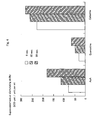
- FIG. 4 indicates that along with elapse of an electrolysis time, ability to dismutate superoxide radical was increased.
Landscapes
- Chemical & Material Sciences (AREA)
- Chemical Kinetics & Catalysis (AREA)
- Electrochemistry (AREA)
- General Chemical & Material Sciences (AREA)
- Life Sciences & Earth Sciences (AREA)
- Hydrology & Water Resources (AREA)
- Engineering & Computer Science (AREA)
- Environmental & Geological Engineering (AREA)
- Water Supply & Treatment (AREA)
- Organic Chemistry (AREA)
- Water Treatment By Electricity Or Magnetism (AREA)
Abstract
This invention discloses a process for preparing a
mixed electrolyzed water consisting of a cathodic and an
anodic electrolyzed waters comprising the step of
electrolyzing an aqueous solution of an organic
electrolyte containing a water-soluble inorganic salt in
less than 0.1 mM and an organic electrolyte in 1 to 50 mM
which is fed into a non-diaphragm electrolytic bath
comprising at least a pair of inactive electrodes
separated from each other by an inter-electrode distance
of 2 mm or less, wherein the aqueous solution of an
organic electrolyte with pH equal to that of the mixed
electrolyzed water prepared by electrolysis is
neutralized with a titration volume less than that for the
raw aqueous solution in neutralization titration with an
aqueous solution of sodium hydroxide or has a higher
dismutation activity to superoxide radical per mole than
the raw aqueous solution.
Description
This invention relates to a process for preparing a
mixed electrolyzed water consisting of an anodic and a
cathodic electrolyzed waters, which is capable of
dismutating superoxide radical. In particular, this
invention relates to a process for preparing a mixed
electrolyzed water capable of dismutating superoxide
radical, comprising electrolyzing an aqueous organic
electrolyte solution containing virtually only an organic
water-soluble electrolyte such a ascorbic acid as an
electrolyte.
It has been well-known that using an electrolytic
bath within which inactive electrodes made of platinum
or a platinum alloy are placed via a diaphragm, aqueous
dilute electrolyte solution of an alkali-metal chloride is
electrolyzed, followed by removing an anodic
electrolyzed water (acidic water) with a lower pH
generated in the anodic side, which can be utilized for
sterilization or disinfection. Examples of a diaphragm
used include a charged membrane which is an
ion-exchange resin film and a non-charged membrane
having a microporous structure.
In an anodic electrolyzed water, hypochlorous acid
is generated. Thus, because of strong oxidizing and
chlorinating action of hypochlorous acid, an anodic
electrolyzed water is used for sterilization or
disinfection. Such utilization is prevalent in medical
institutions and so on. Further, since small amounts of
ozone and dissolved oxygen present in the acidic water
promotes granulation, it has been studied as an aid for
surgical treatment.
Meanwhile, a cathodic electrolyzed water (alkaline
water) in the cathodic side can be generated by
electrolyzing tap water in place of a dilute electrolytic
solution, and has been used for drinking. It has been also
reported that to the aqueous electrolytic solution, an
organic acid such as ascorbic acid and gallic acid is added,
not as an electrolytic aid, but as an additive.
In this technique, ascorbic acid is used in the
presence of an electrolytic aid. Ascorbic acid is added for
controlling pH of a cathodic electrolyzed water and for
removing free chlorine in an anodic electrolyzed water.
Ascorbic acid has OH groups at 2- and 3-positions.
In an acidic range, the OH at 3-position is dissociated
into -O- and H+, having acidity. In an alkaline range,
although the OH at 2-position is dissociated into -O- and
H+, its dissociation ratio is too low to allow ascorbic acid
to be used as an electrolytic aid. An electrolysis
mechanism for an aqueous solution of ascorbic acid is so
complicated that intermediates have not been identified,
but the mechanism is observed a redox reaction in
principle.
Ascorbic acid is a strong reducing agent by itself.
It is, however, well-known that ascorbic acid undergoes
autoxidation in an aqueous solution, leading to
deteriorated reducing power.
Ascorbic acid generally undergoes autoxidation in
the following manner.
 wherein AsA, MDA, DHA and DKG represent
ascorbic acid, monodehydroascorbic acid,
dehydroascorbic acid and 2,3-diketogulonic acid,
respectively.
wherein AsA, MDA, DHA and DKG represent
ascorbic acid, monodehydroascorbic acid,
dehydroascorbic acid and 2,3-diketogulonic acid,
respectively.
It has been recently demonstrated that ascorbic
acid can dismutate and eliminate superoxide radical
which is generally known as "active oxygen". Therefore,
ascorbic acid has drawn attention as an antioxidant.
Dismutation is a reaction where superoxide radical
is decomposed and hydrogen peroxide generates as shown
in equation (2):
O- 2· + O- 2· + 2H+ → H2O2 + O2
As described above, ascorbic acid is a useful
compound for eliminating superoxide radical.
We have focused on dismutating effect of ascorbic
acid on superoxide radical and have intensely studied to
obtain an anodic electrolyzed water having the above
ability. We have consequently found that an anodic
electrolyzed water having ability of dismutating
superoxide radical can be obtained by electrolyzing an
aqueous solution containing only ascorbic acid in a
relatively low concentration without using any inorganic
electrolyte such as a water-soluble metal salt as an
electrolytic aid. We have thus filed a patent application
on a process for preparing an anodic electrolyzed water
having improved ability to dismutate superoxide radical
(Japanese Patent Application No. 20010-172538, Claim
1).
In the above process for preparing an anodic
electrolyzed water having improved ability to dismutate
superoxide radical, a cathodic electrolyzed water is
discarded without being effectively utilized because it
has been believed that OH- ion present in a cathodic
electrolyzed water would react with dissociated
ascorbate ion (AsA-) to oxidize ascorbic acid, as shown in
equation (3):
AsA- + OH- → AsAO + H2
We have intensely attempted to solve the above
problem, and have finally found that when mixing an
anodic electrolyzed water with a cathodic electrolyzed
water, oxygen generated in an anode side and hydrogen
generated in a cathode side quickly react to form water so
that oxidation of ascorbic acid actually fails to occur.
Furthermore, it has been found that these electrolyzed
waters can be effectively mixed by selecting a
inter-electrode distance not more than a certain value;
that thus a mixed electrolyzed water having improved
ability of dismutating superoxide radical can be
effectively prepared; and further that there is no need to
discharge a cathodic electrolyzed water as waste.
Based on the above findings, this invention has
been achieved. An objective of this invention is to
provide a process for preparing a mixed electrolyzed
water having improved ability to dismutate superoxide
radical.
Since a raw electrolysis water comprising an
organic electrolyte as an electrolysis aid is electrolyzed
and resulting an anodic and a cathodic electrolyzed
waters are mixed in this invention, the mixed
electrolyzed water thus obtained has a lower DO and
improved ability to dismutate superoxide radical. The
mixed electrolyzed water can be, therefore, conveniently
used in a variety of applications such as sterilization,
disinfection, granulation, health maintenance and
cosmetic applications. Furthermore, since an anodic and
a cathodic electrolyzed waters are prepared as a mixture
in this preparation process, it requires a simpler
manufacturing apparatus in comparison with a
conventional process where an electrolyzed water in one
electrode side is taken out. Additionally, since as an
organic electrolyte, this invention employs a vitamin,
ascorbic acid whose safety to a human body has been
established, the cathodic electrolyzed water prepared
using the vitamin as an electrolysis aid is also quite safe.
This invention will be described below.
Generally, on being dissolved in water, an
inorganic electrolyte such as sodium chloride, potassium
chloride, calcium chloride and sodium sulfate is ionized,
i. e., completely dissociated into a cation and an anion.
Specific properties of water as a solvent is responsible to
dissociation of these salts. Water dissolves and ionizes
an electrolyte, i. e., a substance comprised of electrically
positive and negative elements, and loosens association
between molecules comprised of a positive and a negative
elements. Once a solid electrolyte with limited freedom
is dissolved in water, its freedom is so increased that the
electrolyte can be attached to or detached from a variety
of chemical species.
Some of electrolytes inherently has lower freedom.
Such an electrolyte may not be, although being dissolved
to some degree, completely dissolved in water and some
part of the electrolyte remains insoluble. Examples of a
measure of freedom in an aqueous solution include a
dissociation constant, a dissociation index and an
electrolytic dissociation constant.
A dissociation constant is defined as below. For
example, when an electrolyte AB is dissociated or ionized
into A+ and B- in water as shown in equation (3), a
relationship shown in equation (4) holds true:
AB A+ + B-
[A+] [B-]/ [AB] = Ka
wherein [A+], [B-] and [AB] represent
concentrations of the corresponding entities.
A dissociation ratio herein is called a dissociation
constant, Ka, provided that in terms of conditions, a
temperature and a pressure must be constant;
specifically 25 °C and 1 atm, respectively, in a standard
condition.
Thus, a dissociation constant of a water-soluble
electrolyte indicates a degree of its dissociation.
In electrolysis of a dilute aqueous electrolytic
solution such as a brine, water itself is oxidized and
reduced in an anode and a cathode, respectively, to
generate oxygen and hydrogen as shown in equations (5)
and (6).
2H2O 4H+ + O2 +4e- (anode)
2H2O + 2e- 2OH- + H2 (cathode)
This reaction proceeds in a strong electric-field
layer in the electrode surface, so that the reaction is
initiated by an extremely minute electric energy.
Furthermore, in electrolysis of a dilute aqueous
electrolytic solution, water itself is electrolyzed while
its dissociation is accelerated.
One liter of water contains 55.55 moles (6×10²³) of
molecules, but they are ionized into positive and
negative ions according to equation (7) in an extremely
small ratio.
2H2O H3O+ + OH- (pKw= 14)
As indicated in this equation, only 10-7 mols are
ionized in one liter neutral water.
However, electrolysis can accelerate ionization to
increase the numbers of positive and negative ions (See,
J. Appl. Electrochem. 31 (2001), 1307-1313).
When applying an electric field such that a direct
current flows through an aqueous solution of an organic
electrolyte with a relatively lower ionization degree,
substances having positive charge and having negative
charge move toward a cathode and an anode, respectively.
Then, they are involved in giving and receiving electrons
in the surfaces, to give corresponding electrode-reaction
products.
Simultaneously, water itself is oxidized in the
anode while being reduced in the cathode, and the
resulting products react with the ionized organic
electrolyte to give new products. In particular, in the
course of oxidation and reduction of water, dissociation
of water proceeds, resulting in a minor increase in a
water ion product. Furthermore, the ionized organic
electrolyte is also dissociated to a minor degree to reduce
a dissociation index.
Relative dissociation rates may be compared by
neutralization titration of the raw aqueous solution
before electrolysis and the resulting solution after
electrolysis with an acid or base, followed by
determination of a difference between the titration
volumes. A smaller titration volume indicates a larger
dissociation in an aqueous solution.
The above principle will be more specifically
described using L-ascorbic acid (AsA) as an organic
electrolyte.
AsA is dissociated in two dissociation sites as
shown in formula (8).

In AsA, reactive sites are essentially OH groups
attached at 2- and 3-positions, which are dissociated into
H+ and -O-. For example, dissociation for the OH group
at 3-position is expressed as pKa = 4.25. A dissociation
index of 4.25 indicates that the OH group is dissociated
into a positive and a negative ions in an extremely small
amount of (1/2)×10-4.25 M (2.8117×10⁻⁵ M) in an aqueous
solution up to one liter at 1 atm and 25 °C.
When dissolving a low-dissociating substance such
as AsA in a cathodic electrolyzed water prepared by
electrolysis of a dilute aqueous electrolyte solution such
as a brine, the dissociation is accelerated. As a result,
it has been found that a dismutation activity (SOD
activity) for superoxide radical is increased in
comparison with an aqueous solution of As A with an
equal pH. Specifically, dissociation of the OH group at
2-position of AsA shown in formula (8) is accelerated so
that the group becomes more reactive to a radical or
active oxygen. The OH group at 3-position is consumed
in neutralization of the alkaline electrolyzed water. The
OH, therefore, exhibits lower SOD activity and does not
act as a scavenger to superoxide radical. Thus, a
low-dissociating water-soluble substance can be
dissolved in an electrolyzed water with improved
dissociating ability, to improve dissociation of the
substance, resulting in making the low-dissociating
water-soluble substance more reactive.
As shown in formula (8), ascorbic acid has
dissociable groups (-OH group) at 2- and 3-positions,
which have dissociation indices, pKa, of 11.79 and 4.25,
respectively, at 25 °C and 1 atm. In an aqueous solution,
the OH group at 3-position in ascorbic acid is dissociated
into -O- and H+, exhibiting acidity. A mixed electrolyzed
water consisting of a cathodic and an anodic electrolyzed
waters prepared by electrolysis of a dilute aqueous
solution of ascorbic acid contains no electrolyte ions
other than ascorbate ions. The OH group at 3-position is,
therefore, not used in neutralization of an alkali
generated in the cathode, maintaining its reducibility.
When an anode and a cathode are closely disposed
to each other and these electrodes are not separated by a
diaphragm, an anodic and a cathodic electrolyzed waters
may be easily mixed. As a result, dissolved oxygen
generated by anodic oxidation of water reacts with
dissolved hydrogen generated by cathodic reduction of
water, to give water. In addition, polarity of an
electrolysis voltage can be alternated to further
accelerate mixing of the anodic and the cathodic
electrolyzed waters. Consequently, a concentration of
dissolved oxygen generated by oxidation of water in the
anode becomes 1 mg/L or less because the dissolved
oxygen is consumed by AsA and reducing dissolved
hydrogen.
As described above, a dissociation ratio can be
compared by a neutralization volume for a substance
such as AsA which exhibits acidity by a 2, 3-ene diol,
while the dissociation ratio can be compared by
determining dismutating ability for superoxide radical
to a substance which does not exhibit acidity or basicity.
Generally, water-soluble polyphenols,
water-soluble flavonoids and catechins exhibit
dismutating ability to superoxide radical. As in AsA,
proton from an OH group attached to a carbon atom
having a double bond exhibits dismutating ability. For
example, in quercetine, a flavonoid, a proton from the OH
group exhibits antioxidation ability as shown in
equation (9).
O2 -· + 2H+ → H2O2
These water-soluble antioxidants release free
proton to dismutate superoxide radical. As described
above, proton dissociation is accelerated by electrolysis,
resulting in increased dismutating ability per mol. It is,
therefore, possible to estimate a dissolution degree by
comparing dismutating ability.
As flavonoids, quercetine and catechin are shown
in formulas (10) and (11).


In these drawings, the symbols have the following
meanings; 2: raw electrolysis water reservoir; 4: aqueous
solution of an organic electrolyte; 6: pump; 8: feeding
line for an aqueous solution of an organic electrolyte; 10:
In this invention, an aqueous solution of an organic
electrolyte comprising substantially exclusively the
organic electrolyte is electrolyzed to give a mixed
electrolyzed water consisting of the resulting anodic and
cathodic electrolyzed waters. The mixed electrolyzed
water has an increased dissociation ratio of the organic
electrolyte and improved ability to dismutate superoxide
radical, and can be thus used in a variety of applications
such as skin care.
FIG. 1 schematically shows a configuration of an
electrolysis apparatus used in a process for preparing a
mixed electrolyzed water of this invention. In this figure,
2 denotes a raw electrolysis water reservoir, which is
filled with an aqueous solution of an organic electrolyte
(raw electrolysis water) 4.
The aqueous solution of an organic electrolyte 4
contains 1 to 50 mM, preferably 2 to 20 mM of the organic
electrolyte. When a concentration of the organic
electrolyte is less than 1 mM, an electric conductivity is
too low to conduct electrolysis. If a concentration of the
organic electrolyte is more than 50 mM, the mixed
electrolyzed water obtained feels sticky, for example,
when being applied to the skin for care, and may be
inconvenient for some applications.
Examples of an organic electrolyte include ascorbic
acid and its water-soluble derivatives, water-soluble
flavonoids, water-soluble polyphenols including
water-soluble catechins, and water-soluble extract from
herbs.
The aqueous solution of the organic electrolyte 4
substantially contains, besides the organic electrolyte,
no electrolytes such as water-soluble inorganic salts. A
content of the water-soluble inorganic electrolytes is
preferably up to 0.1 mM, particularly preferably up to
0.02 mM as the total of these water-soluble inorganic
electrolytes. A concentration of the inorganic
electrolytes is much lower than that of inorganic
electrolytes in common well water, tap water or the like.
Such an aqueous solution of an organic electrolyte
4 can be prepared, for example, by dissolving an organic
electrolyte such as ascorbic acid in purified water (pure
water) such as distilled water and deionized water
within the above concentration range.
In this figure, 6 is a pump intervening a feeding
line 8 through which an aqueous solution of an organic
electrolyte is fed. By actuating this pump 6, the aqueous
solution of an organic electrolyte 4 is fed to a
non-diaphragm electrolytic bath 10 via the feeding line
8.
Inside of the non-diaphragm electrolytic bath 10,
there are placed a pair of mutually facing electrodes 12,
14 which are separated from each other by a certain
distance. A distance between the paired electrodes 12,
14 is no more than 2 mm, preferably 1.5 to 0.05 mm, more
preferably 1.0 to 0.1 mm. If the inter-electrode distance
is more than 2 mm, an anodic and a cathodic electrolyzed
waters generated by electrolysis cannot be adequately
mixed, leading to inadequate increase in a dissociation
ratio of hydroxyl group of the organic electrolyte in the
resulting mixed electrolyzed water or inadequate
dismutation of superoxide radical.
Furthermore, a diaphragm between the electrodes
12, 14 in the electrolytic bath 10 is undesirable because
it causes inadequate mixing of the anodic and the
cathodic electrolyzed waters generated by electrolysis.
The electrodes 12, 14 are made of an
electrochemically inactive metal material. Preferable
electrode materials include platinum and platinum
alloys. Although a pair of electrodes has been used in the
above description, multiple pairs of electrodes may be,
without limitations, placed in an electrolytic bath for
improving an electrolysis efficiency.
In the figure, 16 is a power source for electrolysis,
whose plus and minus terminals are connected to the
above electrodes 12 and 14 via interconnections 18 and
20, respectively. Polarity of an electric power applied to
each of the electrodes may be constant or alternated at an
appropriate time interval. Alternation of polarity of an
applied power at a certain time interval is particularly
preferable because a cathodic and an anodic electrolyzed
waters are alternately generated in one electrode,
resulting in effective mixing of the anodic and the
cathodic electrolyzed waters. An interval of polarity
alternation is preferably 2 to 60 times /min.
The aqueous solution of an organic electrolyte 4
passes through the feeding line for an aqueous solution
of an organic electrolyte 8 and is fed into the
non-diaphragm electrolytic bath 10, in which the
solution is then subjected to electrolysis. An electrolysis
current density is preferably 0.003 to 0.03 A/cm2,
particularly preferably 0.01 to 0.02 A/cm2. An
electrolysis current density of less than 0.003 A/cm2 may
lead to inadequate increase in a dissociation ratio of
hydroxyl group in the organic electrolyte in the resulting
mixed electrolyzed water or inadequate dismutation for
superoxide radical. On the other hand, an electrolysis
current density of more than 0.03 A/cm2 may be
uneconomical because a dissociation ratio of hydroxyl
group in the organic electrolyte in the mixed electrolyzed
water is not increased or dismutation for superoxide
radical is not increased in proportion to the higher
current value.
Therefore, an electrolysis current density can be
controlled within the above range to obtain an at least
1.25-fold dissociation ratio of hydroxyl group in the
mixed electrolyzed water discharged from the
electrolytic bath in comparison with that before
electrolysis and an at least 1.2-fold dismutation for
superoxide radical in comparison with that before
electrolysis.
Electrolysis as described above results in
spontaneous mixing of an anodic and cathodic
electrolyzed waters generated in an electrolytic bath
during electrolysis. The mixed electrolyzed water as a
mixture of both electrolyzed waters is continuously
drained through a drain line for a mixed electrolyzed
water 22.
Presence of ability to dismutating superoxide
radical may be determined by observing a superoxide
radical signal in ESR described later.
FIG. 2 shows another embodiment of an electrolysis
apparatus. In this embodiment, an aqueous solution of
an organic electrolyte is not continuously fed to an
electrolytic bath. In FIG. 2, 30 is a non-diaphragm
electrolytic bath, in which there are placed a pair of
mutually facing electrodes 32, 34 in parallel. In this
figure, 36 is a power source for electrolysis, which
supplies electrolysis power to the electrodes 32, 34. The
electrolytic bath is filled with an aqueous solution of an
organic electrolyte 38. Electric power is supplied from
the power source for electrolysis 36 to these electrodes
32, 34, to initiate electrolysis of the aqueous solution of
an organic electrolyte 38. Details of the configuration is
as described above, and thus are not described herein.
This invention will be more specifically described
with reference to examples.
A raw electrolysis water containing ascorbic acid
(AsA) was electrolyzed using an electrolysis apparatus
shown in FIG. 2.
In an electrolytic bath was placed a pair of
electrodes which are a 10 × 10 cm titanium plate coated
with platinum. An inter-electrode distance was 2 mm.
The electrolytic bath was a rectangular solid with a size
of 11 cm (length) × 5 cm (width) × 12 cm (height). A 30 mM
aqueous solution of AsA was prepared and 600 mL of the
solution was charged in the electrolytic bath. While
stirring the aqueous AsA solution, a current of 0.25 A was
applied to the electrodes to conduct electrolysis.
Electrolysis was conducted while alternating polarity at
an interval of 30 sec after the initiation of electrolysis.
Table 1 shows pH, a oxidation-reduction potential (ORP),
a dissolved oxygen content (DO) and an electrical
conductivity (EC) of the mixed electrolyzed water
generated by electrolysis. Mixed electrolyzed water
generated at various electrolysis times were
netralization-titrated with a 0.1N NaOH solution and
the titration amounts were compared. The results are
shown in FIG. 3. Furthermore, FIG. 4 shows the results
of superoxide-radical dismutating ability of AsA, a
water-soluble flavonoid and a water-soluble catechin,
which were measured by an electron spin resonance
spectroscope. The conditions in signal measurement
using the electron spin resonance spectroscope are as
follows:
| Electrolysis time (sec) | 0 | 30 | 90 |
| PH | 3.01 | 3.02 | 3.02 |
| ORP (mV) | 148 | 109 | 80 |
| DO (mg/L) | 6.62 | 0.5 | 0.01 |
| EC (mS/m) | 46.5 | 46.4 | 46.3 |
As seen from Table 1, along with elapse of an
electrolysis time, an ORP was reduced, i. e., it moved
toward a reducing side. Furthermore, a DO was reduced,
indicating that an anodic and a cathodic electrolyzed
waters were effectively mixed, resulting in a reduced DO.
In addition, an EC did not vary very much, indicating
that the number of electrolyte ions little varied.
FIG. 3 demonstrates that along with elapse of an
electrolysis time, a titration volume was reduced,
indicating that a dissociation ratio of the mixed
electrolyzed water generated by electrolysis was
increased. Furthermore, table 1 shows that pH of the
mixed electrolyzed water was little varied.
FIG. 4 indicates that along with elapse of an
electrolysis time, ability to dismutate superoxide radical
was increased.
Claims (3)
- A process for preparing a mixed electrolyzed water consisting of a cathodic and an anodic electrolyzed waters comprising the step of electrolyzing an aqueous solution of an organic electrolyte containing a water-soluble inorganic salt in less than 0.1 mM and an organic electrolyte in 1 to 50 mM which is fed into a non-diaphragm electrolytic bath comprising at least a pair of inactive electrodes separated from each other by an inter-electrode distance of 2 mm or less, wherein the aqueous solution of an organic electrolyte with pH equal to that of the mixed electrolyzed water prepared by electrolysis is neutralized with a titration volume less than that for the raw aqueous solution in neutralization titration with an aqueous solution of sodium hydroxide or has a higher dismutation activity to superoxide radical per mole than the raw aqueous solution.
- The process for preparing a mixed electrolyzed water as claimed in Claim 1, wherein a polarity of electric power supplied between both electrodes at least one irreversible electrodes is alternated at least twice per minute.
- The process for preparing a mixed electrolyzed water as claimed in Claim 1, wherein the organic electrolyte is selected from the group consisting of ascorbic acid and its water-soluble derivatives, water-soluble flavonoids, water-soluble polyphenols including water-soluble catechins and a water-soluble extract from herbs.
Applications Claiming Priority (3)
| Application Number | Priority Date | Filing Date | Title |
|---|---|---|---|
| JP2003046903 | 2003-02-25 | ||
| JP2003046903A JP2004261656A (en) | 2003-02-25 | 2003-02-25 | Method for producing mixed electrolyzed water |
| PCT/JP2004/002083 WO2004076363A1 (en) | 2003-02-25 | 2004-02-23 | Method for producing mixed electrolyzed water |
Publications (2)
| Publication Number | Publication Date |
|---|---|
| EP1598317A1 true EP1598317A1 (en) | 2005-11-23 |
| EP1598317A4 EP1598317A4 (en) | 2009-11-25 |
Family
ID=32923247
Family Applications (1)
| Application Number | Title | Priority Date | Filing Date |
|---|---|---|---|
| EP04713663A Withdrawn EP1598317A4 (en) | 2003-02-25 | 2004-02-23 | PROCESS FOR THE PRODUCTION OF MIXED ELECTROLYSIS WATER |
Country Status (7)
| Country | Link |
|---|---|
| US (1) | US20060065544A1 (en) |
| EP (1) | EP1598317A4 (en) |
| JP (1) | JP2004261656A (en) |
| KR (1) | KR20050107446A (en) |
| CN (1) | CN100343179C (en) |
| TW (1) | TW200424133A (en) |
| WO (1) | WO2004076363A1 (en) |
Families Citing this family (11)
| Publication number | Priority date | Publication date | Assignee | Title |
|---|---|---|---|---|
| CN1986894B (en) * | 2005-12-21 | 2011-06-15 | 中国科学院上海应用物理研究所 | Integrated hydrogen producing and storing process and apparatus |
| JP2007296434A (en) * | 2006-04-28 | 2007-11-15 | Mikuni Corp | Electrolyzed water and method for producing the same |
| ITMI20071863A1 (en) * | 2007-09-28 | 2009-03-29 | Industrie De Nora Spa | ELECTROCHEMICAL DEVICE FOR BIOCIDAL TREATMENT IN AGRICULTURAL APPLICATIONS |
| US9101537B2 (en) | 2008-07-25 | 2015-08-11 | Reven Pharmaceuticals, Inc. | Compositions and methods for the prevention and treatment of cardiovascular diseases |
| CN101767848B (en) * | 2008-12-30 | 2012-07-18 | 肖志邦 | Functional water preparation method and device by undivided micro-current electrolysis |
| US20100276278A1 (en) * | 2009-04-30 | 2010-11-04 | Doug Bender | Modular electrolysis device |
| JP2013532661A (en) | 2010-07-22 | 2013-08-19 | リベン ファーマシューティカルズ インコーポレイテッド | Methods of treating or ameliorating diseases and methods of improving behavior involving the use of magnetic dipole stabilization solutions |
| CA2871460A1 (en) * | 2012-04-23 | 2013-10-31 | Nbip, Llc | Dermal-appropriate compositions and methods of use |
| JP2014200778A (en) * | 2013-04-10 | 2014-10-27 | 至明 松尾 | Antioxidative drinking water |
| US20160205982A1 (en) * | 2013-09-19 | 2016-07-21 | Reoxcyn Discoveries Group, Inc. | Life enhancing beverages |
| CN105217738A (en) * | 2014-06-24 | 2016-01-06 | 罗民雄 | A kind of method and apparatus having one or more water entrys also water inlet can be made brine electrolysis |
Family Cites Families (5)
| Publication number | Priority date | Publication date | Assignee | Title |
|---|---|---|---|---|
| JPH0648315B2 (en) * | 1987-09-16 | 1994-06-22 | 動力炉・核燃料開発事業団 | Thermal decomposition treatment equipment for radioactive waste |
| JPH1160429A (en) * | 1997-08-26 | 1999-03-02 | Matsushita Electric Works Ltd | Preparation of cleansing lotion, preparation apparatus for cleansing lotion and cleansing lotion |
| JP3602773B2 (en) * | 2000-06-08 | 2004-12-15 | 株式会社ミクニ | Anode electrolyzed water and method for producing the same |
| US6921743B2 (en) * | 2001-04-02 | 2005-07-26 | The Procter & Gamble Company | Automatic dishwashing compositions containing a halogen dioxide salt and methods for use with electrochemical cells and/or electrolytic devices |
| JP2002301476A (en) * | 2001-04-10 | 2002-10-15 | Mikuni Corp | Ascorbyl glucosamine electrolyzed water and method for producing the same |
-
2003
- 2003-02-25 JP JP2003046903A patent/JP2004261656A/en active Pending
-
2004
- 2004-02-20 TW TW093104321A patent/TW200424133A/en unknown
- 2004-02-23 CN CNB2004800051243A patent/CN100343179C/en not_active Expired - Fee Related
- 2004-02-23 WO PCT/JP2004/002083 patent/WO2004076363A1/en not_active Ceased
- 2004-02-23 EP EP04713663A patent/EP1598317A4/en not_active Withdrawn
- 2004-02-23 KR KR1020057015543A patent/KR20050107446A/en not_active Withdrawn
- 2004-02-23 US US10/545,341 patent/US20060065544A1/en not_active Abandoned
Also Published As
| Publication number | Publication date |
|---|---|
| CN100343179C (en) | 2007-10-17 |
| CN1753838A (en) | 2006-03-29 |
| JP2004261656A (en) | 2004-09-24 |
| US20060065544A1 (en) | 2006-03-30 |
| WO2004076363A1 (en) | 2004-09-10 |
| EP1598317A4 (en) | 2009-11-25 |
| KR20050107446A (en) | 2005-11-11 |
| TW200424133A (en) | 2004-11-16 |
Similar Documents
| Publication | Publication Date | Title |
|---|---|---|
| EP1162176B1 (en) | Electrolyzed water of anode side and process for production thereof | |
| US6730211B2 (en) | Aqueous electrolyzed solution of ascorbyl glucosamine and preparation process therefor | |
| US6623615B1 (en) | Electrolytic hydrogen dissolved water and method and apparatus of production thereof | |
| JP5640266B1 (en) | Electrolyzed water production apparatus and electrolyzed water production method using the same | |
| WO2004080901A1 (en) | Process for producing mixed electrolytic water | |
| JP2006519090A (en) | High electrolysis cell | |
| JP3785219B2 (en) | Method for producing acidic water and alkaline water | |
| US20060065544A1 (en) | Process for preducing mixed electrolyzed water | |
| JP2000226680A (en) | Method and apparatus for producing electrolyzed water having bactericidal properties | |
| KR20060007369A (en) | High field electrolytic cell | |
| KR100761099B1 (en) | Apparatus and method for producing reduced hydrogen water using Brown's | |
| JP2001079549A (en) | Production of electrolytic water, electrolyzed water on cathode side, electrolytic auxiliary and water electrolytic device | |
| JP2005342645A (en) | Method for producing electrolyzed water | |
| JP4181170B2 (en) | Drinking electrolyzed water and method for producing the same | |
| KR100658409B1 (en) | Anode Electrolyzed Water and Manufacturing Method Thereof | |
| JP7347867B2 (en) | Active oxygen water and method for producing active oxygen water | |
| JPH1160429A (en) | Preparation of cleansing lotion, preparation apparatus for cleansing lotion and cleansing lotion | |
| JP2605642B2 (en) | Electrolytic ionic water generating apparatus and electrolytic ionic water generating method | |
| TW554077B (en) | Anodic electrolytic water and manufacturing method thereof | |
| CN1259252C (en) | Anolyte and its making method | |
| JP2005152867A (en) | Electrolytic water manufacturing means | |
| TW202016026A (en) | Method and apparatus for forming sterilized water by electrolysis | |
| CN101391832A (en) | Method for preparing acidic high oxidation water | |
| JP2004202440A (en) | Super-electrolytic water, production method therefor and apparatus, and evaluation methods for the water | |
| KR20200089325A (en) | Method and apparatus for oxidant concentration control |
Legal Events
| Date | Code | Title | Description |
|---|---|---|---|
| PUAI | Public reference made under article 153(3) epc to a published international application that has entered the european phase |
Free format text: ORIGINAL CODE: 0009012 |
|
| 17P | Request for examination filed |
Effective date: 20050810 |
|
| AK | Designated contracting states |
Kind code of ref document: A1 Designated state(s): AT BE BG CH CY CZ DE DK EE ES FI FR GB GR HU IE IT LI LU MC NL PT RO SE SI SK TR |
|
| AX | Request for extension of the european patent |
Extension state: AL LT LV MK |
|
| DAX | Request for extension of the european patent (deleted) | ||
| RBV | Designated contracting states (corrected) |
Designated state(s): DE FR GB IT |
|
| A4 | Supplementary search report drawn up and despatched |
Effective date: 20091026 |
|
| STAA | Information on the status of an ep patent application or granted ep patent |
Free format text: STATUS: THE APPLICATION IS DEEMED TO BE WITHDRAWN |
|
| 18D | Application deemed to be withdrawn |
Effective date: 20100123 |