TECHNICAL FIELD
The present invention relates to a biaxially stretched
laminated polyester film. More particularly, it relates to
a biaxially stretched laminated polyester film which is
suited for use as a constituent of packaging material such
as industrial materials, medicines, hygienic materials,
foodstuff, etc., and which is also useful as a packaging
material which excels in printing ink adhesion, laminating
compatibility with other materials, antistatic and gas
barrier properties, and besides has excellent hand cutting
quality. It is also relates to a biaxially stretched
laminated polyester film which is suited for use as the
coverings of the containers of the type which are broken
when the content is to be taken out, for example, the
coverings of the press-through packages for some forms of
medicines such as tablets and capsules, various kinds of
foodstuff, industrial parts, etc., and the coverings of the
cup-type drink containers of which the content is sucked
through a straw thrust into the container through the
covering when it is desired to drink the content.
BACKGROUND ART
The package materials for the industrial materials,
medicines, hygienic materials, foods and such are mostly
required to have good hand cutting quality. For example, if
a pouch type small package for sweet stuff, powdered
medicine or such is possessed of good hand cutting quality,
it is afforded a big merit that the content can be taken out
with ease.
Cellophane or so-called moisture-proof cellophane
obtained by coating cellophane with a vinyl chloride-vinyl
acetate copolymer, and the films (K-coated cellophane)
obtained by coating cellophane with vinylidene chloride are
known as the material having good hand cutting quality.
This type of packaging materials are also required to
have barrier properties such as oxygen barrier properties,
moisture resistance and content fragrance retainability. To
meet such a requirement, a method is used in which
cellophane with good hand cutting quality is laminated with
an aluminum foil with good barrier properties. For instance,
a laminate structure of cellophane/printed
matter/adhesive/aluminum foil/adhesive/polyethylene is used.
However, cellophane, moisture-proof cellophane and K-coated
cellophane, although having excellent hand cutting
quality, have the problems that their film properties are
liable to change depending on ambient humidity and they are
poor in printability. Also, cellophane used as base
material is expensive and its supply in the future is
uncertain. Further, as regard K-coated cellophane in
particular, its use is unrecommendable in view of its
adverse environmental effect (possibility of generating
dioxin when this cellophane is burned). There is also a
move to restrict use of aluminum foil because of its
environmental effect.
Under such a dilemma, Japanese Patent Application
Laid-Open (KOKAI) No. 5-104618 proposes use of a polyester
film in place of cellophane as a packaging material with
good hand cutting quality. Also, Japanese Patent
Application Laid-Open (KOKAI) Nos. 2002-87459 and 2002-104496
propose a packaging material comprising a laminate of
an ultra-thin polyester film and an aluminum foil.
In the packages for industrial materials, medicines,
hygienic materials, foods, etc., usually ink printing is
made on the film for indicating the content or for
explaining how to treat the content, or the film is bonded
to other material with an adhesive for raising functionality
as a package. The polyester film surface, however, is poor
in ink adhesion and compatibility with adhesives, and the
improvements thereof have been required.
Further, use of the said polyester film as a packaging
material for industrial materials, medicines, hygienic
materials, foods, etc., often leads to various troubles as
the film is liable to be electrically charged. For instance,
in the case of the packages for powdery substances such as
powdered medicine or powdery food or sliced substances such
as flakes of dried bonito, there arises the problem that the
content substance adheres to the package film and is hard to
take out. Also, in the case of packages for industrial
materials, in case where for instance an electronic device
is packed, the packed article may be damaged by generating
charge or discharge.
Also, the press-through packages (hereinafter referred
to as PTP packages) for some forms of medicine such as
tablets and capsules, various kinds of foodstuff, industrial
parts and such involve the following problems.
The PTP packages are the packages of the type in which
a polyvinyl chloride, polyolefin or polyester film is molded
by drawing to form a plurality of recessed portions in which
to contain a medicinal preparation such as tablet or capsule
or a food, and each recession is topped by a cover which can
be easily ripped off when taking out the content. The sheet
formed with the recessions is usually called blister bottom.
When the content substance in the package is pushed from the
blister bottom side, the content substance can be easily
taken out by breaking through the easy-to-rip covering.
In this type of packages, an aluminum foil is normally
used as covering, but single use of an aluminum foil as
covering has the problem that the covering could be broken
when an inadvertent force is exerted to the molded portion
though it is not actually desired to take out the content
substance because aluminum foil can be torn too easy.
As a solution to the problems in single use of
aluminum foil, Japanese Patent Application Laid-Open (KOKAI)
No. 2002-178450 proposes lamination of a polyester film
which has been subjected to an easy-to-cut treatment and an
aluminum foil. This method, however, is costly because it
includes the step of conducting an easy-to-cut treatment on
the polyester film. Also, use of an aluminum foil has the
problems of disposal of its waste and unusability of a metal
detector. Use of a porous polyolefin in place of aluminum
foil has been proposed, but this method has the problem that
it is unable to provide the desired barrier properties.
The present invention has been made in view of the
above circumstances, and its objects are as described below.
DISCLOSURE OF THE INVENTION
The said objects of the present invention can be
accomplished by embodying the following first and second
aspects of the invention.
The first aspect of the present invention relates to
a biaxially stretched laminated polyester film having
tensile break strengths in the machine and transverse
directions of 40 to 200 MPa, and satisfying at least one of
the following items:
This aspect of the present invention has been
completed based on the present inventors' finding that the
above-said first to third objects can be accomplished by
satisfying at least one of the above-said requirements for
specific wetting tension, surface resistivity and layer
structure.
The second aspect of the present invention pertains to
a biaxially stretched laminated polyester film for covering,
which film has tensile break strength in the machine and
transverse directions of 41 to 170 MPa.
This aspect of the present invention has been
completed based on the present inventors' finding that the
said fourth object of the present invention can be
accomplished by providing a biaxially stretched laminated
polyester film having a specific tensile break strength.
BEST MODE FOR CARRYING OUT THE INVENTION
A detailed description of the present invention is
given below. First, the biaxially stretched laminated
polyester films provided in the said aspects of the present
invention are explained.
The "polyesters" referred to in the present invention
mean the polymers having ester groups that can be obtained
by polycondensation of dicarboxylic acids and diols or
hydroxycarboxylic acids. Examples of the dicarboxylic acids
usable for the polycondensation include terephthalic acid,
isophthalic acid, adipic acid, azelaic acid, sebacic acid,
2,6-naphthalenedicarboxylic acid, and 1,4-cyclohexanedicarboxylic
acid. Examples of the diols include
ethylene glycol, 1,4-butanediol, diethylene glycol,
triethylene glycol, neopentyl glycol, 1,4-cyclohexanedimethanol,
and polyethylene glycol. Examples of
the hydroxycarboxylic acids include p-hydroxybenzoic acid
and 6-hydroxy-2-naphthoic acid.
These polyesters can be produced by, for example, a
method in which a lower alkyl ester of an aromatic
dicarboxylic acid and a glycol are subjected to an ester
exchange reaction, or an aromatic dicarboxylic acid and a
glycol are directly esterified to form substantially a
bisglycol ester of the aromatic dicarboxylic acid or a low
polymer thereof, and this low polymer is polycondensed under
reduced pressure and heating.
Typical examples of such polymers are polyethylene
terephthalate and polyethylene-2,6-naphthalate. These
polymers may be homopolymers or the polymers having a third
component copolymerized therewith.
The biaxially stretched laminated polyester film of
the present invention is preferably a laminated film
comprising a layer (layer A) made of a polyester material
comprising one or both of a copolymeric polyethylene
terephthalate and a copolymeric polybutyrene terephthalate
and a polyester layer (layer B). The melting point of the
layer B is preferably 10°C or more higher than that of the
layer A, and is preferably not lower than 245°C. By having
this condition, the tear properties of the film are improved.
If this condition is not satisfied, there is a problem that
tensile strength at break of the film may exceed 200 MPa,
the desired tear properties may not be attained.
The "copolymeric polyethylene terephthalate" is
represented by a polyester in which the acid moiety
comprises terephthalic acid and isophthalic acid and the
glycol moiety comprises ethyleneg glycol. It can be
produced by the known methods mentioned above. Other
copolymeric substance(s) may be copolymerized therewith.
The "copolymeric polybutyrene terephthalate" is
represented by a polyester in which the acid moiety
comprises terephthalic acid and isophthalic acid and the
glycol moiety comprises buthylene glycol, and it can be
produced by the known methods mentioned above. Other
copolymeric substance(s) may be copolymerized therewith.
Examples of other copolymeric substances include, as
acid moiety, aliphatic dicarboxylic acids such as adipic
acid, azelaic acid, sebacic acid and decanedicarboxylic acid,
and aromatic carboxylic acids such as phthalic acid, 2,6-naphthalenedicarboxylic
acid, 2,7-naphthalenedicarboxylic
acid, 1,5-naphthalenedicarboxylic acid,
diphenoxyethanedicarboxylic acid, diphenyldicarboxylic acid,
diphenyletherdicarboxylic acid and anthracenedicarboxylic
acid. As alcohol moiety, they include aliphatic diols such
as diethylene glycol, propylene glycol, neopentyl glycol,
butanediol, pentanediol and hexanediol, and polyalkylene
glycols such as polyethylene glycol, polypropylene glycol
and polytetramethylene glycol. These copolymeric substances
may be used alone or as a mixture of two or more.
The ratios of the copolymers in the layer A are
preferably selected so that the melting point of the layer A
will become 10°C or more lower than that of the layer B. For
example, in the case of copolymeric polyethylene
terephthalate, the ratios of the copolymeric substances are
selected so that when the composition was made into a
polyester film, the melting point of the layer A will become
not higher than 240°C, preferably 195 to 235°C, more
preferably 215 to 235°C. More specifically, the percentage
of, for instance, isophthalic acid in the whole dicarboxylic
acid moiety in the layer A of the polyester film is selected
to usually 1 to 25% by mole, preferably 1 to 20% by mole,
more preferably 5 to 20% by mole, especially preferably 5 to
15% by mole.
As the polyester in the layer A, a copolymer with a
high content of isophthalic acid may be used by diluting it
with polyethylene terephthalate to a concentration in the
above specified range.
In the polyester film of the present invention, it is
preferable to contain fine particles as the presence of such
fine particles in the film contributes to the improvement of
workability in the film working steps such as winding,
coating and depositing. Examples of these fine particles
include, though not limited to, the inorganic particles such
as particles of calcium carbonate, magnesium carbonate,
calcium sulfate, barium sulfate, lithium phosphate,
magnesium phosphate, calcium phosphate, lithium fluoride,
aluminum oxide, silicon oxide and kaolin, the organic
particles such as particles of acrylic resins and guanamine
resins, and the precipitated particles such as those
obtained by forming the catalyst residue into particles.
The size and amount of these particles may be properly
decided according to the purpose of use of the film. The
fine particles to be contained may comprise either single
component or two or more components. The method of blending
these particles in the base material polyester is not
specifically defined, but it is preferable to use, for
instance, a method in which the particles are added in the
polymerization step for forming the polyester or the base
material polyester and the particles are mixed in a molten
state.
Appropriate additives such as various types of
stabilizer, lubricant, antistatic agent, etc., may be
contained in each layer.
For producing the polyester film according to the
present invention, a base material polyester comprising
copolymeric polyethylene terephthalate and a single base
material polyester are supplied to the respective known melt
extruders and heated to a temperature above the melting
point of the said polymer to melt it. Then the molten
polymers are extruded in lamination through a slit die, and
rapidly cooled on a rotary cooling drum to a temperature
below the glass transition point and thereby solidified to
obtain a non-oriented sheet of a substantially amorphous
state. This sheet is stretched in two axial directions to
form a film and heat set. Stretching may be effectuated
either by stretching the sheet in two directions
successively or by stretching the sheet in both directions
simultaneously. If necessary, the film may be re-stretched
in the machine and/or transverse direction before or after
heat setting. In the present invention, in order to obtain
sufficient dimensional stability and nerve as a packaging
material, stretching is conducted to provide a stretch ratio
of usually not less than 9 times, preferably not less than
12 times in terms of areal ratio, and thermal shrinkage of
the film is preferably defined to be not more than 10%, more
preferably not more than 5%, after left at 150°C for 30
minutes.
Thickness of the film of the present invention is
usually 6 to 50 µm, preferably 9 to 38 µm, with the
thickness of the layer A being preferably 50 to 90% of the
overall thickness of the film. If the film thickness is
below the above-defined range, the film will prove too weak
in nerve, causing wrinkling or break of the film in its
working process, and the obtained film may be found unsuited
for use as a packaging material. Also, if the thickness of
the layer A is too large, the film may have too high tear
strength for use as a packaging material.
The first aspect of the present invention is explained.
Tensile break strength of the polyester film in the
first aspect of the present invention falls within the range
of 40 to 200 MPa, preferably 40 to 140 MPa, more preferably
50 to 120 MPa. Too high tensile break strength impairs tear
properties of the film while too low tensile break strength
may cause break of the film during its working, making the
film unsuited for use as a packaging material.
The polyester film according to the first aspect of
the present invention satisfies at least one of the
following three items:
First, the requirement of item (1) - wetting tension
of at least one side of the film is not less than 48 mN/m -
is explained by showing the embodiment of meeting such a
requirement.
As means for making wetting tension of the film not
less than 48 mN/m, there are available, for example, a
method comprising a known surface treatment so as to afford
good adhesion properties to the film, and a method in which
a resin capable of providing good adhesion properties is
incorporated in the layer B of the laminated polyester film.
Specifically, the film is subjected to a surface treatment
such as corona discharge treatment, corona discharge in a
nitrogen atmosphere and/or a carbon dioxide gas atmosphere,
plasma treatment, flame treatment, various types of solvent
treatment and coating with a high polymeric compound, or
polyalkylene glycol is incorporated in the layer B of the
laminated polyester film. By affording such good adhesion
properties to the film surface, it is possible to improve
adhesion properties of the film with printing ink and
adhesives. Coating with a high polymeric compound or
incorporation of polyalkylene glycol is preferred to corona
discharge treatment in that the good adhesion characteristic
is less attenuated with time. If necessary, both
incorporation of polyalkylene glycol in the layer B of the
polyester film and corona discharge or plasma treatment may
be applied in combination.
Exemplary of polyalkylene glycol incorporated in the
layer B are polyethylene glycol, polytetramethylene glycol,
polypropylene glycol, and ethylene glycol-propylene glycol
copolymer, of which polyethylene glycol is preferred in view
of thermal stability and adhesive performance. Such
polyalkylene glycol is used in an amount of usually 0.1 to
5.0% by weight although variable depending on the
polymerization degree and the type of polyalkylene glycol
used.
Molecular weight of the said polyethylene glycol is
usually 1,000 to 50,000, preferably 4,000 to 20,000. If its
molecular weight is less than 1,000, the polyester is found
low in thermal stability, which may make it difficult to
form the desired film. Also, the obtained film may prove
unsatisfactory in improvement of its adhesion properties.
If the molecular weight of the polyethylene glycol used
exceeds 50,000, its compatibility with the polyester becomes
poor and the obtained film may produce an impression of non-transparency.
In case of using polyethylene glycol as the
polyalkylene glycol, its amount added is usually 0.3 to 5.0%
by weight. If its amount added is less than 0.3%, the
desired good adhesion properties may not be obtained, and if
its amount exceeds 5.0%, heat resistance of the polyester
may lower and film productivity is liable to reduce.
The method of incorporating the polyalkylene glycol is
not defined; for instance, it may be blended with the
polyester or may be added in the polymerization process of
the polyester. Especially preferable is a method in which a
polyester copolymer with a high concentration of
polyethylene glycol is prepared and this copolymer is
blended with the polyester after diluted to a concentration
in the range defined in the present invention. According to
this method, it is possible to easily obtain a polyester
film with good thermal stability.
The requirement of item (2) - surface resistivity on
at least one side of the film is not more than 5 × 10¹² Ω/□
- is explained here.
The method of making film surface resistivity not
higher than 5 × 10¹² Ω/□ is not specified; it can be
achieved, for instance, by a method in which an antistatic
agent is incorporated in the layer B or a method in which a
coating layer containing an antistatic agent is provided.
It is even more preferable for a packaging film if it
is provided with good adhesion properties with ink and
adhesives in addition to antistatic properties. For
affording good adhesion properties to the film, the method
for providing good adhesion mentioned above with reference
to item (1) can be used.
In case of providing a coating layer containing an
antistatic agent, it is possible, by affording ink adhesion
properties to this coating layer, to obtain an easy-to-tear
film which excels in both antistatic and good adhesion
properties.
A typical example of the antistatic agent usable for
the above purpose is sulfonic acid metal salts such as
alkylsulfonic acid metal salts, alkylbenzenesulfonates,
alkylsulfoisophthalates, and alkylnaphthalenesulfonates.
Metals in these metal salts are preferably lithium,
potassium and sodium. Alkyl groups are preferably those
with a carbon number of 8 to 30. Use of an alkyl group with
a fewer carbon number tends to deteriorate compatibility
with the polyester, while use of an alkyl group with a
greater carbon number has a tendency to reduce the
antistatic performance of the film.
An antistatic agent is contained in an amount of
usually 0.05 to 10% by weight, preferably 0.1 to 5% by
weight, based on the weight of the layer B. If the content
of the antistatic agent is less than 0.05% by weight, the
anticipated antistatic effect may not be obtained, and if
its content exceeds 10% by weight, the film tends to become
slippery and the film forming properties are liable to
deteriorate.
In case of incorporating an antistatic agent, it is
possible to use a mixture of the compounds differing in
carbon number of the alkyl group in the said sulfonic acid
metal salts. Also, a polyethylene glycol or a styrene
oligomer may be added for bettering dispersibility,
As the antistatic agent to be contained in the coating
layer, the afore-mentioned sulfonates, alkylsulfuric ester
salts and cationic compounds can be cited as examples. It
is preferable to provide an antistatic coating layer which
can improve adhesion properties of the film.
The alkyl groups in the said sulfonates and
alkylsulfuric ester salts are preferably those with a carbon
number of 8 to 30. The alkyl groups with a fewer carbon
number tend to adversely affect compatibility with the
coating resin, while the alkyl groups with a greater carbon
number tend to lower the antistatic effect.
The cationic compounds usable as the cationic
antistatic agents in the present invention include, for
example, the compounds having a quaternary ammonium base,
namely the compounds having a constituent containing a
quaternary ammonium base on the backbone or in the side
chains in the molecule. Examples of such compounds are
pyrrolidinium ring compounds, quaternarized alkylamines,
those copolymerized with an acrylic or methacrylic acid,
quaternarized N-alkylaminoacrylamides,
vinylbenzyltrimethylammonium salts, and 2-hydroxy-3-methacryloxypropyltrimethylamine
salts. These compounds may
be combined with each other or copolymerized with other
resins. The anions forming the counter ions of these
quaternary ammonium salts may be, for instance, the ions of
halogens, alkyl sulfates, alkyl sulfonates, nitric acid and
such.
The compounds having the said quaternary ammonium
bases are preferably the high polymeric compounds. Number-average
molecular weight of these high polymeric compounds
is usually not less than 1,000, preferably not less than
2,000, more preferably not less than 5,000 but not more than
500,000. If the molecular weight of these compounds is less
than 1,000, the antistatic agent may bleed out and transfer
to the contacting side of the film. If the molecular weight
is more than 500,000, the coating solution may be increased
in viscosity to deteriorate coating performance.
Thickness (dry thickness) of the antistatic layer is
usually 0.003 to 1.5 µm, preferably 0.005 to 0.5 µm. If its
thickness is less than 0.003 µm, the desired antistatic
performance may not be obtained, and if the layer thickness
exceeds 1.5 µm, blocking of the films tend to take place.
For forming the coating layer containing an antistatic
agent on the polyester film, there are available a method in
which coating is made on a biaxially stretched film by using
the conventional techniques and a method in which coating is
conducted in the process of production of the polyester film
using the conventional techniques. Either of these methods
can be used. More specifically, in a successive biaxial
stretching method, a water dispersion containing an
antistatic agent is coated on the film which has undergone
monoaxial stretching in the machine direction, and the
coated film is further stretched in the transverse direction
and then heat treated, or the said dispersion is coated on
the biaxially stretched film and then dried. The successive
biaxial stretching method, in which coating is conducted on
the monoaxially stretched film and the coated film is
further stretched in the transverse direction and then heat
treated, is preferable as it is possible with this method to
form a thin and uniform coat.
For coating the polyester film with a coating solution
containing an antistatic agent, various known coating
techniques such as shown in Y. Harasaki: Coating Systems,
Maki Shoten, 1979. Specifically, such coating devices as
air doctor coater, blade coater, rod coater, knife coater,
squeeze coater, dip coater, reverse roll coater, transfer
roll coater, gravure coater, kiss-roll coater, cast coater,
spray coater, curtain coater, calender coater, extrusion
coater and bar coater, and the methods using these coating
devices can be used.
In the mode of practice for satisfying the requirement
of item (2), polyalkylene glycol may be incorporated in the
layer B for the purpose of affording the desired adhesion
properties to the film as in the case of item (1) mentioned
above. The properties of the polyalkylene glycol used, its
amount incorporated and the method for its incorporation are
the same as described in the explanation of item (1).
Now, the requirement of item (3) - a barrier layer is
provided on at least one side of the film - is explained.
The barrier layer is not specified regarding its
material; it may be, for instance, a layer formed by coating
a solution of a high polymeric compound or a solution of a
mixture of a high polymeric compound and an inorganic
compound, and drying the coat, or a layer formed by
depositing a metal or a metal oxide on the film.
As examples of the said high polymeric compounds, the
resins having a Permachor value of not less than 75 cal/cc
(such as polyvinyl alcohol resins and vinylidene chloride
resins) and the acrylic resins disclosed in Japanese Patent
Application Laid-Open (KOKAI) No. 2000-37822 can be
mentioned.
As means for providing a barrier layer, there are used
a method in which a barrier layer is provided after forming
the film and a method in which a barrier layer is provided
in the film forming process. For instance, in the
successive biaxial stretching method, a coating solution for
forming a barrier layer is applied on the film which has
been monoaxially stretched in the machine direction, and the
coated film is further stretched in the transverse direction
and then heat treated, or the coating solution is applied on
the biaxially stretched film and dried.
Examples of the metals and/or metal oxides to be
deposited include aluminum, silicon, magnesium, palladium,
zinc, tin, nickel, silver, copper, gold, indium, stainless
steel, chromium, titanium, oxides of these metals, and
mixtures thereof. As the depositing method, generally
vacuum deposition is used, but it is also possible to use
other methods such as ion plating, sputtering and CVD. For
instance, in case of depositing silicon oxide, a CVD method
is used in which a gas of a reactive silicon compound such
as hexamethyldisiloxane and oxygen are charged into a state
of plasma and reacted to form a deposit on the film surface.
The deposited metal or metal oxide film thickness is usually
5 to 500 nm, preferably 10 to 200 nm, although variable
depending on the final use of the deposited film.
In order to secure close adhesion between the said
barrier layer and the polyester film or to allow maximum
performance of the barrier layer, it is preferable to
initially provide an undercoating layer on the film surface
and provide a barrier layer thereon. Presence of such an
undercoating layer is particularly expedient in case where
the barrier layer is made of a metal or a metal oxide. The
undercoating layer in the present invention may be provided
after forming the film, and it is preferable to provide this
layer in the film forming process in view of production cost.
For example, in the case of the successive biaxial
stretching system, it is suggested to adopt a method in
which a coating solution for the undercoating layer is
applied on the film after it has been monoaxially stretched
in the machine direction, and then the film is further
stretched in the transverse direction and then heat treated,
or a method in which the coating solution is applied on the
biaxially stretched film and dried. The former method
comprising applying a coating solution for the undercoating
layer on the monoaxially stretched film, stretching in the
transverse direction and then heat treating is preferred
because it is possible with this method to form a thin and
uniform coating layer.
The resin used for the undercoating is preferably an
aqueous high-molecular weight resin which can be dissolved,
emulsified or suspended in water. Examples of such resins
include polyurethane resins, polyacrylic resins, polyester
resins, epoxy resins, polyvinyl alcohol resins,
polyvinylidene chloride resins, polystyrene resins,
polyvinyl pyrrolidone, and copolymers thereof. These
compounds can be used alone or as a mixture of two or more.
A crosslinking agent is preferably used as a component
of the coating solution for improving solvent resistance,
water resistance, anti-blocking properties and scratch
resistance of the coating layer. As such a crosslinking
agent, hydroxymethylated or hydroxyalkylated urea-based,
melamine-based, guanamine-based, acrylamide-based and amide-based
compounds, epoxy compounds, aziridine compounds,
polyisocyanurates, blocked polyisocyanurates, oxazoline
group-containing water-soluble polymers, silane coupling
agent, titanium coupling agent, zirco-aluminate coupling
agent and the like can be used. Also, in order to improve
coating properties, inorganic or organic particles,
lubricant, antistatic agent, defoaming agent and such may be
contained in the coating solution within limits not
impairing the effect of the present invention.
For applying the coating solution on the polyester
film, the method explained above with reference to the
requirement of item (2), in which a coating solution
containing an antistatic agent is applied on a polyester
film, can be used.
Next, the second aspect of the present invention is
explained. In the biaxially stretched laminated polyester
film for covering in the second aspect of the present
invention, tensile break strength in both machine and
transverse directions is 41 to 170 MPa, preferably 50 to 150
MPa. If tensile break strength of the film exceeds 170 MPa,
tear properties of the film are vitiated, and if it is below
50 MPa, the film may break during its working and is
therefore unsuited for use as a packaging material.
In case where the covering is not required to have
barrier properties, a sealant layer is provided on the film
in the form as it is or after making a print as required,
and this film is sealed to the blister bottom housing a
content substance such as a tablet. On the other hand, in
order to enhance the preservation property of content, the
covering whose burrier properties are enhanced is often used.
Since the blister bottom of the PTP packages is not
planar, it is difficult to print thereon information
regarding the content, so that printing is mostly made on
the covering. Since a transparent sheet is mostly used for
the blister bottom, printing can be made either on the inner
surface or on the outer surface of the covering. Also, in
order to make printed information easier to recognize, the
film for covering of the present invention may be a
biaxially stretched film having an opacifying effect. For
providing such an opacifying effect to the film, methods are
known in which the particles of such a material as titanium
dioxide, calcium carbonate, barium sulfate or carbon black
are contained in the polyester film. Use of titanium
dioxide is especially preferred in view of high opacifying
effect and good appearance of the film. The average
particle diameter (dA) of titanium dioxide is usually 0.20
to 0.50 µm, and it is added in an amount of usually 3 to 30%
based on the weight of the layer in which this compound is
incorporated.
The film in the second aspect of the present invention
preferably has barrier properties. The method of imparting
barrier properties to the film is not specified in the
present invention; it can be attained, for instance, by
providing a barrier layer in lamination. More specifically,
this can be effected by a method in which an aluminum foil
is laminated, a method in which a solution of a high
polymeric compound or a solution of a mixture of a high
polymeric compound and an inorganic compound is applied on
the film and dried, or a method in which a metal or a metal
oxide is deposited on the film.
For laminating an aluminum foil, usually an adhesive
is used. The thickness of aluminum foil used is usually 9
to 25 µm. If its thickness is too small, the foil will
easily break, while if its thickness is too large, the foil
will become costly. As the adhesive, there can be used
those known in the art, such as polyester adhesives, epoxy
adhesives, isocyanate adhesives, urethane adhesives and
acrylic adhesives.
The high polymeric compounds usable for the barrier
layer of the film in the second aspect of the present
invention and the methods of preparing these compounds are
identical with those described above with reference to the
first aspect of the present invention.
Also, in the film according to the second aspect of
the present invention, the type of the metal and/or metal
oxide to be deposited, its deposition method and thickness
of the deposit are the same as described in the explanation
of the requirement of item (3) in the first aspect of the
present invention.
In the film in the second aspect of the present
invention, in order to ensure fast adhesion between the
barrier layer and the polyester film or to derive the
maximum performance of the barrier layer, preferably an
undercoating is previously provided on the surface of the
polyester film and then a barrier layer is provided thereon.
The makeup of the undercoating and its forming method are
the same as described in the explanation of the requirement
of item (3) in the first aspect of the present invention.
EXAMPLES
The present invention is described in more detail with
reference to the embodiments thereof, but it should be
understood that the present invention is not limited to
these embodiments but can be embodied otherwise as well
without departing from the scope and spirit of the invention.
In the following descriptions of the Examples and the
Comparative Examples, all "parts" are by weight unless
otherwise noted. The measuring methods used in the
following embodiments are as described below.
(1) Measurement of intrinsic viscosity [η] (dl/g) of the
polymers:
1 g of polymer was dissolved in 100 ml of a
phenol/tetrachloroethane (50/50 by weight) mixed solvent,
and intrinsic viscosity of the solution was measured by an
Ubbellohde viscometer at 30°C.
(2) Measurement of film thickness:
10 pieces of film were stacked, and the overall
thickness of this pile of films was measured by a micrometer
and divided by 10 to determine the mean value, which was
presented as film thickness.
(3) Measurement of thickness of laminated polyester layer:
A small piece of film was molded with an epoxy resin
by a stationary mold and cut by a microtome, and the cut
section of the film was observed by transmission electron
microphotographs. At the cut section of the film, there
were observed two lines of interface substantially parallel
to the film surface by light and darkness. The distance
from these two lines of interface to the film surface was
measured with reference to each of the 10 pieces of
photograph, and the mean value of the measurements on 10
pieces of photograph was determined and presented as
thickness of the laminated polyester film.
(4) Measurement of melting point:
Melting point (Tm) of the film was measured by a
differential scanning calorimeter DSC-7 mfd. by PerkinElmer
Japan Co., Ltd. under the following conditions. 6 mg of the
sample film was set in DSC-7, melted and kept in a molten
state at 300°C for 5 minutes and then rapidly cooled with
liquid nitrogen. The rapidly cooled sample was then heated
at a heating rate of 10°C/min, detecting the melting point.
(5) Measurement of tensile break strength:
Using an Intesco tensile tester Model 2001, and in a
chamber adjusted to 23°C and 50% RH, the sample film
measuring 50 mm in length (the length between chucks) and 15
mm in width was pulled at a strain rate of 200 mm/min. The
load at break of the film was measured, and its tensile
break strength was determined from the following equation:
Tensile break strength (MPa) = load at break
(N)/sectional area (mm2) of the sample film
(6) Measurement of thermal shrinkage:
The film was cut into a 35 mm × 1,000 mm strip to make
a sample, and it was subjected to a 30-minute heat treatment
in a 150°C oven (circulating hot air oven mfd. by Tabai
Espec Corp. in a tension-less state. The length of the
sample film before and after the heat treatment was measured,
and thermal shrinkage of the film was determined from the
following equation:
Thermal shrinkage (%) = [(a - b)/a] × 100
(wherein a is the length (mm) of the sample before heat
treatment and b is the length (mm) after heat treatment).
(7) Measurement of haze:
Haze of the film was measured by an integrating sphere
type turbidimeter NDH-20D (mfd. by Nippon Denshoku
Industries Co., Ltd.) according to JIS K7105.
(8) Measurement of tear properties:
It was tried to tear the film without giving any notch
to the film to see weather it could be torn smoothly with
hands. Tear properties were rated according to the
following gradation. Rating was made in both machine
direction (MD) and transverse direction (TD).
(9) Wetting tension:
It was measured using a wetting index reagent
(produced by Nacalai Tesque, Inc.) according to JIS-K6768-1977.
(10) Ink adhesion:
Celocolor printing ink CCST39 Indigo produced by TOYO
INK MFG. CO., LTD. was coated on the film surface so that
the coating thickness after drying would become 1.5 µm, and
hot air dried at 80°C for one minute to make a film for
evaluation. This film for evaluation was subjected to 24-hour
temperature and moisture conditioning at 23°C and 50%
RH, then a Nichiban Cellotape (registered trade mark) (18 mm
wide) was stuck on the ink coated side of the film along the
length of 7 cm with care so as not to allow entrance of air
cells, and a constant load was given thereon by a 3 kg
manual loading roll. With the film fixed, one end of the
cellophane tape was connected to a 500 g weight, and the
weight was let drop gravitationally through a distance of 45
cm, causing peel of the tape in the direction of 180°.
Adhesion properties were evaluated according to the
following three-rating formula:
If adhesion is rated as 3 or 2 in the above rating
formula, there is no problem for practical use.
(11) Measurement of surface resistivity:
A concentric circular electrode unit 16008A (mfd. by
Yokokawa Hewlet Packard, Ltd.) with a 50 mm inner electrode
and a 70 mm outer electrode was set on the sample in an
atmosphere of 23°C and 50% RH, and volume resistivity of the
sample was measured by a high resistance meter 4329A (mfd.
by the same company) by applying a voltage of 100 V to the
sample.
(12) Measurement of oxygen transmittance:
This was measured by an isotactic method at 25°C and
60% RH according to JIS K-7126.
(13) Transmitted light density (OD):
The optical density of the light which has passed the
G filter was measured by a Macbeth densitometer TD-904.
(14) Evaluation of the film as covering of PTP packages
(evaluation of tear-open properties of the film):
A covering was made with the sample film, and after
applying a polyester sealant, the covering was attached to
the tablet-housing blister bottom and sealed. For taking
out the content (tablet) from the thus obtained PTP package,
the tablet was pushed from the blister bottom side and the
tear-open properties of the covering (film) was evaluated
according to the following rating:
The polyesters used as base material in the following
Examples and the Comparative Examples were produced in the
manner described below.
<Production of polyester 1>
Polyester 1 was produced using terephthalic acid as
dicarboxylic acid moiety and ethylene glycol as polyhydric
alcohol moiety according to a conventional melt
polycondensation method, and the polyester chips containing
0.18 part of amorphous silica with an average particle
diameter of 2.5 µm and having a melting point (Tm) of 254°C
and an intrinsic viscosity ([η]) of 0.70 were obtained.
<Production of polyester 2>
Polyester 2 was produced using isophthalic acid and
terephthalic acid as dicarboxylic acid moiety and ethylene
glycol as polyhydric alcohol moiety according to a
conventional melt polycondensation method. The isophthalic
acid content in the dicarboxylic acid moiety was 6% by mole.
The obtained polyester chips had a melting point (Tm) of
239°C and an intrinsic viscosity ([η]) of 0.69.
<Production of polyester 3>
Polyester 3 was produced using isophthalic acid and
terephthalic acid as dicarboxylic acid moiety and ethylene
glycol as polyhydric alcohol moiety by a conventional melt
polycondensation method. The isophthalic acid content in
the dicarboxylic acid moiety was 15% by mole. Melting point
(Tm): 220°C; intrinsic viscosity ([η]): 0.69.
<Production of polyester 4>
Polyester 4 was produced using isophthalic acid and
terephthalic acid as dicarboxylic acid moiety and ethylene
glycol as polyhydric alcohol moiety by a conventional melt
polycondensation method. The isophthalic acid content in
dicarboxylic acid moiety was 22% by mole. Melting point
(Tm): 200°C; intrinsic viscosity ([η]): 0.69.
<Production of polyester 5>
Polyester 5 was obtained by blending 35 parts of
polyester 1 and 65 parts of polyester 4. The content of
isophthalic acid in polyester 5 was 14% by mole.
<Production of polyester 6>
This polyester was produced using isophthalic acid and
terephthalic acid as dicarboxylic acid moiety and 1,4-butanediol
as polyhydric alcohol moiety according to a
conventional melt polycondensation method. The isophthalic
acid content in dicarboxylic acid moiety was 11% by mole.
Melting point (Tm): 218°C; intrinsic viscosity ([η]): 0.80.
<Production of polyester 7>
90.0 parts of dimethyl terephthalate, 61 parts of
ethylene glycol and 10 parts of polyethylene glycol having a
molecular weight of 8,000 were supplied into a reactor and
reacted in the usual way using calcium acetate monohydrate
as catalyst to obtain an oligomer. Then 0.18 part of
amorphous silica having an average particle diameter of 2.5
µm and an antimony trioxide catalyst were added, and the
mixture was polymerized by a conventional method to obtain a
copolymer polyester containing 10% of polyethylene glycol.
<Production of polyester 8>
20 parts of sodium alkylsulfonates with carbon numbers
of 14, 15 and 16 were blended with 80 parts of polyester 1,
and the mixture was melt extruded to obtain polyester chips.
<Examples 1-1 to 1-4 and Comparative Example 1>
These examples are designed for explaining the
embodiments of the present invention for satisfying the
requirement of item (1) in the first aspect of the present
invention.
Example 1-1:
The pellets of polyester 1 and the pellets of
polyester 7 were blended in a ratio of 90 to 10 to prepare a
base material (blend I). This blend I and the pellets of
polyester 3 were melted in the separate extruders and passed
through a lamination die to extrude a binary (2-component)
3-layer laminated polyester resin with a structure of blend
I (layer B)/polyester 3 (layer A)/blend I (layer B) onto a
cooling drum with a surface temperature of 30°C whereby the
extrudate was rapidly cooled to obtain a non-stretched film
with a thickness of about 180 µm. This film was stretched
3.8 times in the machine direction at 80°C, then after
preheated in a tenter, further stretched 4.0 times in the
transverse direction at 90°C and then heat treated at 230°C
for 10 seconds to obtain a 12 µm thick laminated polyester
film. Thickness profile of the layer B/layer A/layer B
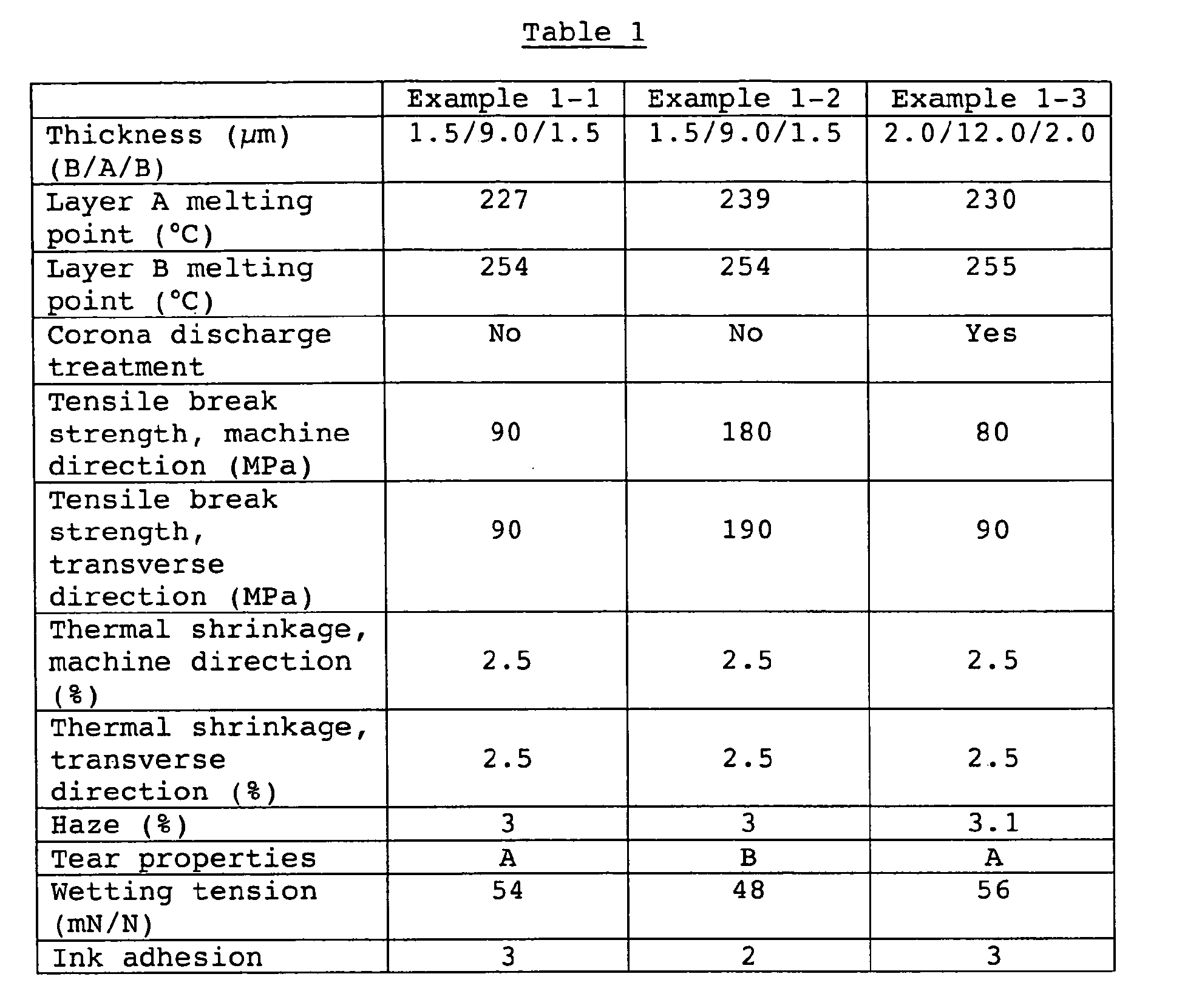
structure was 1.5 µm/9 µm/1.5 µm. The properties of the
obtained film are shown in Table 1. This film showed
excellent ink adhesion and had good hand cutting quality.
Example 1-2 :
The pellets of polyester 1 and the pellets of
polyester 7 was blended in a ratio of 97 to 3 to prepare a
base material (blend II), and this blend II and the pellets
of polyester 2 were melted in the separate extruders and
passed through a lamination die to extrude a binary 3-layer
laminated polyester resin having a structure of blend II
(layer B)/polyester 2 (layer A)/blend II (layer B) onto a
cooling drum having a surface temperature of 30°C whereby
the extrudate was rapidly cooled to obtain an approximately
180 µm thick non-stretched film. This film was stretched
3.8 times in the machine direction at 80°C, then after
preheated in a tenter, further stretched 4.0 times in the
transverse direction at 90°C and heat treated at 230°C for 10
seconds to obtain a 12 µm thick laminated polyester film.
Thickness profile of the layer B/layer A/layer B structure
was 1.5 µm/9 µm/1.5 µm. The properties of the obtained film
are shown in Table 1. This film was inferior to that of
Example 1 in ink adhesion and hand cutting quality, but was
of a practical quality level.
Example 1-3:
The pellets of polyester 1 and the pellets of
polyester 5 were melted in the separate extruders and passed
through a lamination die to extrude a binary 3-layer
(polyester 1 (layer B)/polyester 5 (layer A)/polyester 1
(layer B)) laminated polyester resin onto a cooling drum
with a surface temperature of 30°C whereby the extrudate was
rapidly cooled to obtain an approximately 250 µm thick non-stretched
film. This film was stretched 3.8 times in the
machine direction at 80°C, then after preheated in a tenter,
further stretched 4.1 times in the transverse direction at
90°C by a tenter, and then heat treated at 225°C for 10
seconds to obtain a 16 µm thick laminated polyester film.
Thickness profile of the layer B/layer A/layer B structure
was 2 µm/12 µm/2 µm. This film was subjected to a corona
discharge treatment by a corona discharge treating device
mfd. by Kasuga Electric Co., Ltd. to provide a wetting
tension of 56 mN/m to the film. The properties of the
obtained film are shown in Table 1. This film excelled in
ink adhesion and also had good hand cutting quality.
Example 1-4:
The pellets of polyester 1 and the pellets of
polyester 6 were melted in the separate extruders and passed
through a lamination die to extrude a binary 3-layer
(polyester 1 (layer B)/polyester 6 (layer A)/polyester 1
(layer B)) laminated polyester resin onto a cooling drum
with a surface temperature of 30°C whereby the extrudate was
rapidly cooled to obtain an approximately 250 µm thick non-stretched
film. This film was stretched 3.8 times in the
machine direction at 80°C, then after preheated in tenter,
further stretched 4.1 times in the transverse direction at
90°C and heat treated at 230°C for 10 seconds to obtain a 16
µm thick laminated polyester film with a thickness profile
of layer B/layer A/layer B = 2 µm/12 µm/2 µm. This film was
subjected to a corona discharge treatment by a corona
discharge treating device mfd. by Kasuga Electric Co., Ltd.
to provide a wetting tension of 56 mN/m to the film. The
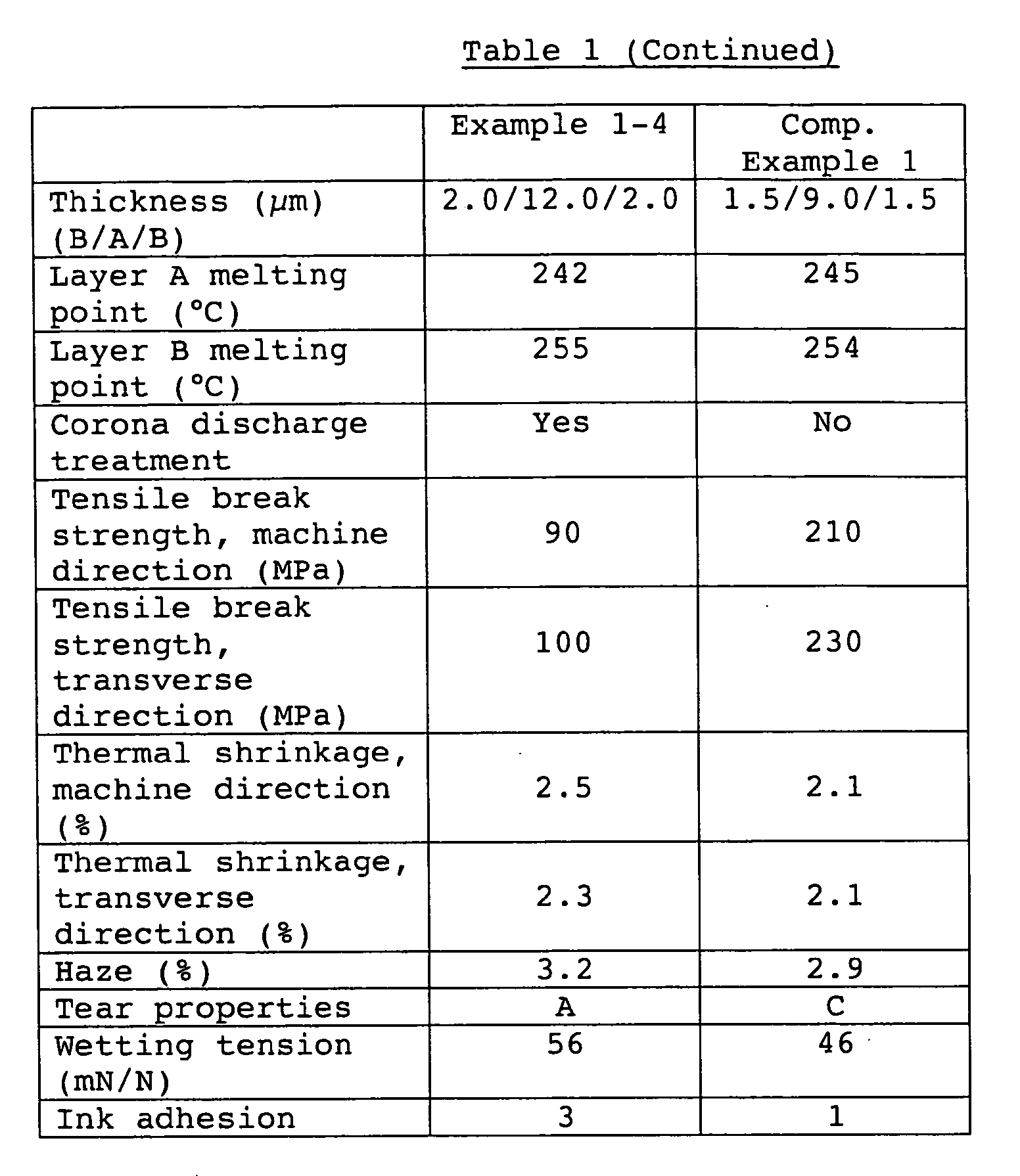
properties of the obtained film are shown in Table 1. This
film showed excellent ink adhesion and also had good hand
cutting quality.
Comparative Example 1:
A film was obtained by repeating the same procedure as
defined in Example 1-1 but by using as the layer A material
a polyester having a molar ratio of the isophthalic acid
moiety of 3%, obtained in the same way as polyester 2, while
using as the layer B material a blend having a polyethylene
glycol content of 0.2% obtained in the same way as in
Example 1-1. The properties of the obtained film are shown
in Table 1. This film was poor in hand cutting quality and
ink adhesion.
These examples are presented for explaining the
embodiments of the present invention for satisfying the
requirement of item (2) in the first aspect of the present
invention.
Example 2-1:
A 97:3 blend (blend I) of pellets of polyester 1 and
pellets of polyester 8 was prepared. This blend I and the
pellets of polyester 3 were melted in the separate extruders
and passed through a lamination die to extrude a binary 3-layer
(blend I (layer B)/polyester 3 (layer A)/blend I
(layer B)) laminated polyester resin onto a cooling drum
with a surface temperature of 30°C whereby the extrudate was
rapidly cooled to obtain an approximately 180 µm thick non-stretched
film. This film was stretched 3.8 times in the
machine direction at 80°C, then after preheated in a tenter,
further stretched 4.0 times in the transverse direction at
90°C, and heat treated at 230°C for 10 seconds to obtain a 12
µm thick laminated polyester film. Thickness profile of
layer B/layer A/layer B = 1.5 µm/9 µm/1.5 µm. The properties
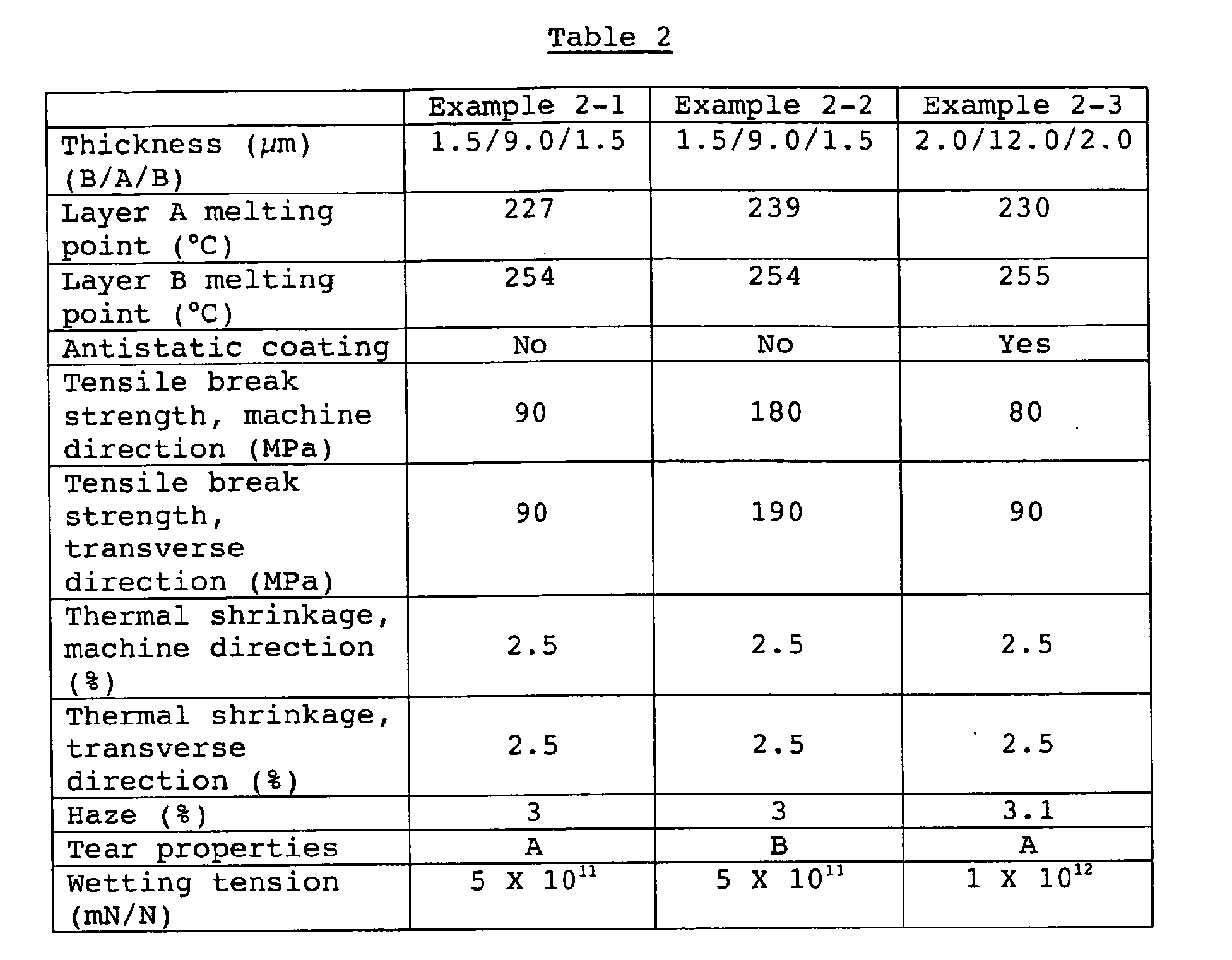
of the obtained film are shown in Table 2, Surface
resistivity of this film was 5 × 10¹¹ Ω/□, and it had
excellent antistatic properties and good hand cutting
quality. The corona discharge treated version of this film
showed excellent antistatic properties and its adhesion
properties with celocolor ink was rated as 3 (excellent) in
the above-shown rating criterion.
Example 2-2:
A 87:3:10 blend (blend II) of the pellets of polyester
1, polyester 8 and polyester 7 was prepared, and this
blend II and the pellets of polyester 2 were melted in the
separate extruders and passed through a lamination die to
extrude a binary 3-layer (blend II (layer B)/polyester 2
(layer A)/blend II (layer B)) laminated polyester resin onto
a cooling drum with a surface temperature of 30°C whereby
the extrudate was rapidly cooled to obtain an approximately
180 µm thick non-stretched film. This film was stretched
3.8 times in the machine direction at 80°C, then after
preheated in a tenter, further stretched 4.0 times in the
transverse direction at 90°C and heat treated at 230°C for 10
seconds to obtain a 12 µm thick laminated polyester film.
Thickness profile of layer B/layer A/layer B = 1.5 µm/9
µm/1.5 µm. The properties of the obtained film are shown in
Table 2. Surface resistivity of this film was 5 × 10¹¹ Ω/□,
and it had excellent antistatic properties, excellent ink
adhesion and good hand cutting quality. Celocolor ink
adhesion of this film was rated as 3 in the above-shown
rating criterion.
Example 2-3:
The pellets of polyester 1 and the pellets of
polyester 5 were melted in the separate extruders and passed
through a lamination die to extrude a binary 3-layer
(polyester 1 (layer B)/polyester 5 (layer A)/polyester 1
(layer B)) laminated polyester resin onto a cooling drum
with a surface temperature of 30°C whereby the extrudate was
rapidly cooled to obtain an approximately 250 µm thick non-stretched
film. This film was stretched 3.5 times in the
machine direction at 85-110°C to obtain a monoaxially (in
the machine direction) stretched film. A coating solution A
of the formulation shown below was applied on one side of
the film, and then the film was further stretched 4.0 times
in the transverse direction in an atmosphere of 85-110°C,
and heat treated at 235°C to obtain a 16 µm thick laminated
polyester film. Thickness profile of the layer B/layer
A/layer B = 2 µm/12 µm/2 µm. The properties of the obtained
film are shown in Table 2. Solids thickness of the coating
layer was 0.08 µm. This film had surface resistivity of 1 ×
1012 Ω/□ and showed excellent antistatic properties and good
hand cutting quality.
Coating solution A
A coating solution was prepared by dissolving in water
the following compounds (1) to (4) to the solids contents
shown in parts below.
Example 2-4
The pellets of polyester 1 and the pellets of
polyester 6 were melted in the separate extruders and passed
through a lamination die to extrudate a binary 3-layer
(polyester 1 (layer B)/polyester 6 (layer A)/polyester 1
(layer B)) laminated polyester resin onto a cooling drum
with a surface temperature of 30°C whereby the extrudate was
rapidly cooled to obtain an approximately 250 µm thick non-stretched
film. This film was stretched 3.5 times in the
machine direction at 85-100°C to obtain a monoaxially (in
the machine direction) stretched film. A coating solution B
of the formulation shown below was applied on both sides of
the film, and the film was further stretched 4.0 times in
the transverse direction in an atmosphere of 85-110°C and
then heat treated at 235°C to obtain a 16 µm thick laminated
polyester film. Thickness profile of the layer B/layer
A/layer B structure was 2 µm/12 µm/2 µm. The properties of
the obtained film are shown in Table 2. Surface resistivity
of the film was 2 × 10¹⁰ Ω/□, and it had excellent
antistatic properties and good hand cutting quality.
Celocolor ink adhesion of the coating layer of the film was
rated 3 in the above-shown criterion.
Coating solution B:
This coating solution was prepared by dissolving the
following compounds (1) to (3) in water to the solids
contents shown in parts below:
Comparative Example 2:
The same procedure as defined in Example 2-1 was
repeated except that a polyester with a 3% molar ratio of
the isophthalic acid moiety, obtained in the same way as
polyester 2, was used as layer A and polyester 1 was used
singly as layer B to obtain a film. The properties of the
obtained film are shown in Table 2. This film was poor in
antistatic properties and hand cutting quality.
The properties of the obtained films are shown in
Table 2.
These examples are presented to explain the
embodiments relating to item (3) in the first aspect of the
present invention.
Example 3-1:
The pellets of polyester 1 and the pellets of
polyester 3 were melted in the separate extruders and passed
through a lamination die to extrude a binary 3-layer
(polyester 1 (layer B)/polyester 3 (layer A)/polyester 1
(layer B)) laminated polyester resin onto a cooling drum
with a surface temperature of 30°C whereby the extrudate was
rapidly cooled to obtain an approximately 180 µm thick non-stretched
film. This film was stretched 3.8 times in the
machine direction at 80°C, then after preheated in a tenter,
further stretched 4.0 times in the transverse direction at
90°C, and heat treated at 230°C for 10 seconds to obtain a 12
µm thick laminated polyester film having a thickness profile
of layer B/layer A/layer B = 1.5 µm/9 µm/1.5 µm. The
properties of the obtained film are shown in Table 3.
Aluminum oxide was deposited on this film to a deposit
thickness of 20 nm to obtain a deposited film. Oxygen
transmission rate of this deposited film was 4 cc/m2·day·atm,
and it was possible to obtain a barrier film with excellent
easy-to-tear properties.
Example 3-2:
The same procedure as defined in Example 3-1 was
conducted except for use of polyester 2 as layer A of
Example 3-1 to obtain a 12 µm thick laminated polyester film.
Thickness profile of layer B/layer A/layer B was 1.5 µm/9
µm/1.5 µm. The properties of the obtained film are shown in
Table 3.
Polyvinyl alcohol with a polymerization degree of 200
and a saponification degree of 95 mol% was gradually
supplied into 75°C hot water with stirring, and after it has
been uniformly dispersed, the solution was filtered and
cooled to obtain a 20% PVA solution. Surfynol 440 (produced
by Nisshin Chemical Industry Co., Ltd.) was blended in an
amount of 0.1% for improving coating properties. The
surface of the said film was subjected to corona discharge
treatment to make its wetting tension not less than 56
dynes/cm, and the above solution was applied on this side of
the film to form a 2 µm thick PVA coating. Oxygen
transmission rate of this film was 10 cc/m2·day·atm, and it
was possible to obtain a barrier film with excellent easy-to-tear
properties.
Example 3-3:
The pellets of polyester 1 and the pellets of
polyester 5 were melted in the separate extruders passed
through a lamination die to extrude a binary 3-layer
(polyester 1 (layer B)/polyester 5 (layer A)/polyester 1
(layer B)) laminated polyester resin onto a cooling drum
with a surface temperature of 30°C whereby the extrudate was
rapidly cooled to obtain an approximately 250 µm thick non-stretched
film. This film was stretched 3.8 times in the
machine direction at 80°C, then after preheated in a tenter,
further stretched 4.1 times in the transverse direction at
90°C and heat treated at 225°C for 10 seconds to obtain a 16
µm thick laminated polyester film. Thickness profile of
layer B/layer A/layer B was 2 µm/12 µm/2 µm. The properties
of the obtained film are shown in Table 3.
Aluminum was deposited on this film to a deposit
thickness of 40 nm to obtain a deposited film. Oxygen
transmission rate of the obtained film was 2 cc/m2·day·atm,
and it was possible to obtain a barrier film with excellent
easy-to-tear properties.
Example 3-4:
The pellets of polyester 1 and the pellets of
polyester 6 were melted in the separate extruders and passed
through a lamination die to extrude a binary 3-layer
(polyester 1 (layer B)/polyester 6 (layer A)/polyester 1
(layer B)) laminated polyester resin onto a cooling drum
with a surface temperature of 30°C whereby the extrudate was
rapidly cooled to obtain an approximately 250 µm thick non-stretched
film. This film was stretched 3.8 times in the
machine direction at 80°C, then after preheated in a tenter,
further stretched 4.1 times in the transverse direction at
90°C, and heat treated at 230°C for 10 seconds to obtain a 16
µm thick laminated polyester film. Thickness profile of the
layer B/layer A/layer B structure was 2 µm/12 µm/2 µm. The
properties of the obtained film are shown in Table 4.
Aluminum oxide was deposited on this film to a deposit
thickness of 20 nm to obtain a deposited film. Oxygen
transmission rate of this film was 4 cc/m2·day·atm, and it
was possible to obtain a barrier film having excellent easy-to-tear
properties.
Example 3-5
The pellets of polyester 1 and the pellets of
polyester 5 were melted in the separate extruders and passed
through a lamination die to extrude a binary 3-layer
(polyester 1 (layer B)/polyester 5 (layer A)/polyester 1
(layer B)) laminated polyester resin onto a cooling drum
with a surface temperature of 30°C whereby the extrudate was
rapidly cooled to form a film, and this film was stretched
3.8 times in the machine direction at 80°C to obtain a film
stretched in the machine direction alone.
A coating solution prepared by blending 35 parts, 30
parts, 25 parts and 10 parts (all by weight), respectively,
of resin a, resin b, resin c and resin d described below,
using water as medium, was applied on one side of the said
film, and this film was further stretched 4.0 times in the
transverse direction at 85-110°C and then heat treated at
225°C to obtain a 16 µm thick biaxially stretched film with
an undercoating thickness of 0.1 µm. Thickness profile of
this film was 2 µm/12 µm/2 µm. The properties of this film
are shown in Table 4.
Silicon oxide was deposited on the undercoating side
of this film to a deposit thickness of 20 nm to obtain a
deposited film. Oxygen transmission rate of this film was 2
cc/m
2·day·atm, and it was possible to obtain a barrier film
with excellent easy-to-tear properties.
Comparative Example 3:
The same procedure as defined in Example 3-1 was
repeated except that the molar ratio of the isophthalic acid
in the dicarboxylic acid moiety in the layer A was 3%. The
properties of the obtained film are shown in Table 4.
| | Example 3-1 | Example 3-2 | Example 3-3 |
| Thickness (µm) (B/A/B) | 1.5/9.0/1.5 | 1.5/9.0/1.5 | 2.0/12.0/2.0 |
| Features of layer A resin | IPA 15 mol% PET copolymer | IPA 6 mol% PET copolymer | IPA 22 mol% PET copolymer: 35 parts; PET: 65 parts |
| Features of layer B resin | PET | PET | PET |
| Heat treatment temperature (°C) | 230 | 230 | 225 |
| Layer A melting point (°C) | 227 | 239 | 230 |
| Layer B melting point (°C) | 254 | 254 | 255 |
| Tensile break strength, machine direction (MPa) | 90 | 180 | 80 |
| Tensile break strength, transverse direction (MPa) | 90 | 190 | 90 |
| Thermal shrinkage, machine direction (%) | 2.5 | 2.5 | 2.5 |
| Thermal shrinkage, transverse direction (%) | 2.5 | 2.5 | 2.5 |
| Haze (%) | 3 | 3 | 3.1 |
| Tear properties | A | B | A |
| (Note) PET: polyethylene terephthalate; IPA: isophthalic acid |
| | Example 3-4 | Example 3-5 | Comp. Example 3 |
| Thickness (µm) (B/A/B) | 2.0/12.0/2.0 | 2.0/12.0/2.0 | 1.5/9.0/1.5 |
| Features of layer A resin | IPA 11 mol% PBT copolymer | IPA 22 mol% PET copolymer 65 parts; PET: 35 parts | IPA 3 mol% PET copolymer |
| Features of layer B resin | PET | PET | PET |
| Heat treatment temperature (°C) | 230 | 225 | 230 |
| Layer A melting point (°C) | 242 | 230 | 245 |
| Layer B melting point (°C) | 255 | 255 | 254 |
| Tensile break strength, machine direction (MPa) | 90 | 80 | 210 |
| Tensile break strength, transverse direction (MPa) | 100 | 90 | 230 |
| Thermal shrinkage, machine direction (%) | 2.5 | 2.5 | 2.1 |
| Thermal shrinkage, transverse direction (%) | 2.3 | 2.5 | 2.1 |
| Haze (%) | 3.2 | 3.1 | 2.9 |
| Tear properties | A | A | C |
| (Note) PET: polyethylene terephthalate; PBT: polybutyrene terephthalate; IPA: isophthalic acid. |
These examples are purposed to explain the second
aspect of the present invention.
Example 4-1:
The pellets of polyester 1 and the pellets of
polyester 3 were melted in the separate extruders and passed
through a lamination die to extrude a binary 3-layer
(polyester 1 (layer B)/polyester 3 (layer A)/polyester 1
(layer B)) laminated polyester resin onto a cooling drum
with a surface temperature of 30°C whereby the extrudate was
rapidly cooled to obtain an approximately 180 µm thick non-stretched
film. This film was stretched 3.8 times in the
machine direction at 80°C, then after preheated in a tenter,
further stretched 4.0 times in the transverse direction at
90°C and heat treated at 230°C for 10 seconds to obtain a 12
µm thick laminated polyester film. Thickness profile of the
layer B/layer A/layer B structure was 1.5 µm/9 µm/1.5 µm.
The properties of the obtained film are shown in Table 5.
Aluminum oxide was deposited on this film to a deposit
thickness of 20 nm to obtain a deposited film. Oxygen
transmission rate of the obtained film was 4 cc/m2·day·atm.
In evaluation of this film as a covering for PTP packages,
it showed excellent tear-open properties.
Example 4-2:
The pellets of polyester 1 and the pellets of
polyester 5 were melted in the separate extruders and passed
through a lamination die to extrude a binary 3-layer
(polyester 1 (layer B)/polyester 5 (layer A)/polyester 1
(layer B)) laminated polyester resin onto a cooling drum
with a surface temperature of 30°C whereby the extrudate was
rapidly cooled to obtain an approximately 250 µm thick non-stretched
film. This film was stretched 3.8 times in the
machine direction at 80°C, then after preheated in a tenter,
further stretched 4.1 times in the transverse direction at
90°C and heat treated at 225°C for 10 seconds to obtain a 16
µm thick laminated polyester film with a thickness profile
of layer B/layer A/layer B = 2 µm/12 µm/2 µm. The properties
of the obtained film are shown in Table 5. Polyvinyl
alcohol (PVA) with a polymerization degree of 200 and a
saponification degree of 95 mol% was gradually supplied to
75°C hot water with stirring, and after it has been
uniformly dispersed, the solution was filtered and then
cooled to obtain a 20% PVA solution. "Surfynol 440"
(produced by Nisshin chemical Industry Co.., Ltd.) was added
in an amount of 0.1% for improving coating properties. The
film obtained in Example 4-2 was subjected to corona
discharge treatment on the surface to make its wetting
tension not less than 56 dynes/cm, and the above coating
solution was applied thereon to provide a PVA film with a
coating thickness of 2 µm. Oxygen transmission rate of this
film was 10 cc/m2·day·atm. In evaluation of this film as
covering for PTP packages, it showed excellent tear-open
properties.
Example 4-3:
The pellets of polyester 1 and the pellets of
polyester 6 were melted in the separate extruders and passed
through a lamination die to extrude a binary 3-layer
(polyester 1 (layer B)/polyester 6 (layer A)/polyester 1
(layer B)) laminated polyester resin onto a cooling drum
with a surface temperature of 30°C whereby the extrudate was
rapidly cooled to obtain an approximately 250 µm thick non-stretched
film. This film was stretched 3.8 times in the
machine direction at 80°C, then after preheated in a tenter,
further stretched 4.1 times in the transverse direction at
90°C and heat treated at 230°C for 10 seconds to obtain a 16
µm thick laminated polyester film with a thickness profile
of layer B/layer A/layer B = 2 µm/12 µm/2 µm. The
properties of the obtained film are shown in Table 5. A 10
µm thick aluminum foil was laminated on one side of this
film with a polyester adhesive ("Vylon 240" produced by Toyo
Boseki Co., Ltd.) to obtain a covering. In evaluation of
this film as a covering for PTP packages, it showed
excellent tear-open properties.
Example 4-4:
Chips were prepared by blending 20% by weight of
titanium dioxide (anatase crystal type) having an average
particle diameter of 0.32 µm with polyester 3, and by using
these chips, a 12 µm thick laminated polyester film was
obtained in the same way as in Example 4-1. Thickness
profile of the layer B/layer A/layer B structure was 1.5
µm/9 µm/1.5 µm. Optical density of this film was 0.4,
indicating excellent opacifying properties of this film.
Other properties of this film are shown in Table 6. In
evaluation of this film as a covering for PTP packages, it
showed excellent tear-open properties.
Comparative Example 4:
The same procedure as defined in Example 4-1 was
repeated except that a 1 : 1 mixture of polyester 1 and
polyester 2 was used as layer A to obtain a 12 µm thick
laminated polyester film with a thickness profile of layer
B/layer A/layer B = 1.5 µm/9 µm/1.5 µm. The properties of
the obtained film are shown in Table 6. In evaluation of
this film as a covering for PTP packages, it was impossible
to break the covering and the contained tablet could not be
taken out.
| | Example 4-1 | Example 4-2 | Example 4-3 |
| Thickness (µm) (B/A/B) | 1.5/9.0/1.5 | 2.0/12.0/2.0 | 2.0/12.0/2.0 |
| Features of layer A resin | IPA 15 mol% PET copolymer | IPA 22 mol% PET copolymer: 35 parts; PET: 65 parts | IPA 11 mol% PBT copolymer |
| Features of layer B resin | PET | PET | PET |
| Heat treatment temperature (°C) | 230 | 225 | 230 |
| Layer A melting point (°C) | 227 | 230 | 242 |
| Layer B melting point (°C) | 254 | 255 | 255 |
| Tensile break strength, machine direction (MPa) | 90 | 80 | 90 |
| Tensile break strength, transverse direction (MPa) | 90 | 90 | 100 |
| Thermal shrinkage, machine direction (%) | 2.5 | 2.5 | 2.5 |
| Thermal shrinkage, transverse direction (%) | 2.5 | 2.5 | 2.3 |
| Haze (%) | 3 | 3.1 | 3.2 |
| Tear properties | A | A | A |
| (Note) PET: polyethylene terephthalate; IPA: isophthalic acid |
| | Example 4-4 | Comp. Example 4 |
| Thickness (µm) (B/A/B) | 1.5/9.0/1.5 | 1.5/9.0/1.5 |
| Features of layer A resin | IPA 15 mol% PET copolymer containing 20 wt% of titanium dioxide | IPA 3 mol% PET copolymer |
| Features of layer B resin | PET | PET |
| Heat treatment temperature (°C) | 230 | 230 |
| Layer A melting point (°C) | 227 | 245 |
| Layer B melting point (°C) | 254 | 254 |
| Tensile break strength, machine direction (MPa) | 80 | 210 |
| Tensile break strength, transverse direction (MPa) | 80 | 230 |
| Thermal shrinkage, machine direction (%) | 2.5 | 2.1 |
| Thermal shrinkage, transverse direction (%) | 2.5 | 2.1 |
| Haze (%) | Transmitted light density:
0.4 | 2.9 |
| Tear properties | A | C |
| (Note) PET: polyethylene terephthalate; PBT: polybutyrene terephthalate; IPA: isophthalic acid. |
According to the first aspect of the present invention,
it is possible to provide a film suited for use as a
packaging material which excels in adhesion, antistatic and
gas barrier properties and also has good hand cutting
quality. Also, according to the second aspect of the
present invention, it is possible to provide a covering with
good tear-open properties at low cost and, as required, to
provide a covering with good barrier and tear-open
properties without using aluminum foil.