EP1597828B1 - Method and apparatus for performing low-density parity-check (ldpc) code operations using a multi-level permutation - Google Patents
Method and apparatus for performing low-density parity-check (ldpc) code operations using a multi-level permutation Download PDFInfo
- Publication number
- EP1597828B1 EP1597828B1 EP04715077.6A EP04715077A EP1597828B1 EP 1597828 B1 EP1597828 B1 EP 1597828B1 EP 04715077 A EP04715077 A EP 04715077A EP 1597828 B1 EP1597828 B1 EP 1597828B1
- Authority
- EP
- European Patent Office
- Prior art keywords
- vector
- permutation
- elements
- permuter
- ldpc
- Prior art date
- Legal status (The legal status is an assumption and is not a legal conclusion. Google has not performed a legal analysis and makes no representation as to the accuracy of the status listed.)
- Expired - Lifetime
Links
- 238000000034 method Methods 0.000 title claims description 27
- 239000013598 vector Substances 0.000 claims description 125
- 238000012545 processing Methods 0.000 claims description 74
- 239000011159 matrix material Substances 0.000 claims description 36
- 125000004122 cyclic group Chemical group 0.000 claims description 33
- 230000008859 change Effects 0.000 claims description 8
- 230000008878 coupling Effects 0.000 claims 1
- 238000010168 coupling process Methods 0.000 claims 1
- 238000005859 coupling reaction Methods 0.000 claims 1
- 239000000047 product Substances 0.000 description 31
- 238000005192 partition Methods 0.000 description 10
- 238000004891 communication Methods 0.000 description 9
- 230000008569 process Effects 0.000 description 7
- 230000008901 benefit Effects 0.000 description 6
- 238000010586 diagram Methods 0.000 description 5
- 238000013459 approach Methods 0.000 description 4
- 238000010276 construction Methods 0.000 description 4
- 230000001788 irregular Effects 0.000 description 3
- 238000013461 design Methods 0.000 description 2
- 230000000694 effects Effects 0.000 description 2
- 230000006870 function Effects 0.000 description 2
- 238000013507 mapping Methods 0.000 description 2
- 230000007246 mechanism Effects 0.000 description 2
- 238000006467 substitution reaction Methods 0.000 description 2
- 230000009471 action Effects 0.000 description 1
- 230000003466 anti-cipated effect Effects 0.000 description 1
- 230000009286 beneficial effect Effects 0.000 description 1
- 230000005540 biological transmission Effects 0.000 description 1
- 239000006227 byproduct Substances 0.000 description 1
- 238000012937 correction Methods 0.000 description 1
- 238000001514 detection method Methods 0.000 description 1
- 238000011161 development Methods 0.000 description 1
- 238000000605 extraction Methods 0.000 description 1
- 238000012546 transfer Methods 0.000 description 1
Images




Classifications
-
- H—ELECTRICITY
- H03—ELECTRONIC CIRCUITRY
- H03M—CODING; DECODING; CODE CONVERSION IN GENERAL
- H03M13/00—Coding, decoding or code conversion, for error detection or error correction; Coding theory basic assumptions; Coding bounds; Error probability evaluation methods; Channel models; Simulation or testing of codes
- H03M13/03—Error detection or forward error correction by redundancy in data representation, i.e. code words containing more digits than the source words
- H03M13/05—Error detection or forward error correction by redundancy in data representation, i.e. code words containing more digits than the source words using block codes, i.e. a predetermined number of check bits joined to a predetermined number of information bits
- H03M13/11—Error detection or forward error correction by redundancy in data representation, i.e. code words containing more digits than the source words using block codes, i.e. a predetermined number of check bits joined to a predetermined number of information bits using multiple parity bits
- H03M13/1102—Codes on graphs and decoding on graphs, e.g. low-density parity check [LDPC] codes
- H03M13/1148—Structural properties of the code parity-check or generator matrix
- H03M13/116—Quasi-cyclic LDPC [QC-LDPC] codes, i.e. the parity-check matrix being composed of permutation or circulant sub-matrices
-
- H—ELECTRICITY
- H03—ELECTRONIC CIRCUITRY
- H03M—CODING; DECODING; CODE CONVERSION IN GENERAL
- H03M13/00—Coding, decoding or code conversion, for error detection or error correction; Coding theory basic assumptions; Coding bounds; Error probability evaluation methods; Channel models; Simulation or testing of codes
- H03M13/03—Error detection or forward error correction by redundancy in data representation, i.e. code words containing more digits than the source words
- H03M13/05—Error detection or forward error correction by redundancy in data representation, i.e. code words containing more digits than the source words using block codes, i.e. a predetermined number of check bits joined to a predetermined number of information bits
- H03M13/11—Error detection or forward error correction by redundancy in data representation, i.e. code words containing more digits than the source words using block codes, i.e. a predetermined number of check bits joined to a predetermined number of information bits using multiple parity bits
-
- H—ELECTRICITY
- H03—ELECTRONIC CIRCUITRY
- H03M—CODING; DECODING; CODE CONVERSION IN GENERAL
- H03M13/00—Coding, decoding or code conversion, for error detection or error correction; Coding theory basic assumptions; Coding bounds; Error probability evaluation methods; Channel models; Simulation or testing of codes
- H03M13/03—Error detection or forward error correction by redundancy in data representation, i.e. code words containing more digits than the source words
- H03M13/05—Error detection or forward error correction by redundancy in data representation, i.e. code words containing more digits than the source words using block codes, i.e. a predetermined number of check bits joined to a predetermined number of information bits
- H03M13/11—Error detection or forward error correction by redundancy in data representation, i.e. code words containing more digits than the source words using block codes, i.e. a predetermined number of check bits joined to a predetermined number of information bits using multiple parity bits
- H03M13/1102—Codes on graphs and decoding on graphs, e.g. low-density parity check [LDPC] codes
-
- H—ELECTRICITY
- H03—ELECTRONIC CIRCUITRY
- H03M—CODING; DECODING; CODE CONVERSION IN GENERAL
- H03M13/00—Coding, decoding or code conversion, for error detection or error correction; Coding theory basic assumptions; Coding bounds; Error probability evaluation methods; Channel models; Simulation or testing of codes
- H03M13/27—Coding, decoding or code conversion, for error detection or error correction; Coding theory basic assumptions; Coding bounds; Error probability evaluation methods; Channel models; Simulation or testing of codes using interleaving techniques
-
- H—ELECTRICITY
- H04—ELECTRIC COMMUNICATION TECHNIQUE
- H04L—TRANSMISSION OF DIGITAL INFORMATION, e.g. TELEGRAPHIC COMMUNICATION
- H04L1/00—Arrangements for detecting or preventing errors in the information received
-
- H—ELECTRICITY
- H03—ELECTRONIC CIRCUITRY
- H03M—CODING; DECODING; CODE CONVERSION IN GENERAL
- H03M13/00—Coding, decoding or code conversion, for error detection or error correction; Coding theory basic assumptions; Coding bounds; Error probability evaluation methods; Channel models; Simulation or testing of codes
- H03M13/63—Joint error correction and other techniques
- H03M13/635—Error control coding in combination with rate matching
- H03M13/6356—Error control coding in combination with rate matching by repetition or insertion of dummy data, i.e. rate reduction
-
- H—ELECTRICITY
- H03—ELECTRONIC CIRCUITRY
- H03M—CODING; DECODING; CODE CONVERSION IN GENERAL
- H03M13/00—Coding, decoding or code conversion, for error detection or error correction; Coding theory basic assumptions; Coding bounds; Error probability evaluation methods; Channel models; Simulation or testing of codes
- H03M13/63—Joint error correction and other techniques
- H03M13/635—Error control coding in combination with rate matching
- H03M13/6362—Error control coding in combination with rate matching by puncturing
Definitions
- Error correcting codes compensate for the intrinsic unreliability of information transfer in these systems by introducing redundancy into the data stream.
- the mathematical foundations of error correcting were established by Shannon. Shannon developed the mathematical concept of the channel in which distortion of signals in communications systems is modeled as a random process. The most fundamental result of Shannon is the noisy channel theorem, which defines for the channel a capacity, a quantity that specifies the maximum rate at which information can be reliably delivered through the channel. Reliable transmission at rates approaching capacity requires the use of error correcting codes. Thus, error-correcting codes are designed to achieve sufficient reliability while approaching capacity as closely as possible.
- LDPC codes are well represented by bipartite graphs, often called Tanner graphs, see Fig. 1 diagram 100, in which one set of nodes, the variable nodes 102, corresponds to bits of the codeword and the other set of nodes, the constraint nodes 106, sometimes called check nodes, correspond to the set of parity-check constraints which define the code.
- Edges 104 in the graph connect variable nodes to constraint nodes.
- a variable node and a constraint node are said to be neighbors if they are connected by an edge in the graph.
- LDPC codes can equivalently be represented using the parity check matrix.
- Punctured bits may be desirable in certain code structures and, in liftings (see below), both punctured and known bits can be used to achieve block lengths that are not multiples of the lifting. Punctured bits and known bits are excluded from the transmitted codeword.
- a bit sequence associated one-to-one with the variable node sequence is a codeword of the code if and only if, for each constraint node, the bits neighboring the constraint (via their association with variable nodes) sum to zero modulo two, i.e., they comprise an even number of ones.
- the decoders and decoding algorithms used to decode LDPC codewords operate by exchanging messages within the graph along the edges and updating these messages by performing computations at the nodes based on the incoming messages. Such algorithms will be generally referred to as message passing algorithms.
- Each variable node in the graph is initially provided with a soft bit, termed a received value, that indicates an estimate of the associated bit's value as determined by observations from, e.g., the communications channel.
- the estimates for separate bits are statistically independent. This ideal can be, and often is, violated in practice.
- the number of edges attached to a node i.e., a variable node or constraint node, is referred to as the degree of the node.
- a regular graph or code is one for which all variable nodes have the same degree, j say, and all constraint nodes have the same degree, k say. In this case we say that the code is a (j,k) regular code. These were the codes considered originally by Gallager (1961).
- an irregular code has constraint nodes and/or variable nodes of differing degrees. For example, some variable nodes may be of degree 4, others of degree 3 and still others of degree 2.
- irregular codes can be more complicated to represent and/or implement, it has been shown that irregular LDPC codes can provide superior error correction/detection performance when compared to regular LDPC codes.
- LDPC encoders and decoders using multiple parallel processing elements to process sets of data as part of an encoding or decoding operation have proven both useful and reliable
- the number of parallel processing elements used in a decoder are normally the same as the number of parallel processing elements used in the encoder.
- the LDPC encoders and decoders in each of the devices in the system would normally have the same level of parallelism.
- the centralized device Given that the centralized device services multiple mobile devices, assuming real time operation and the same level of parallelism within the encoder/decoder, the centralized device will have to operate at a rate many times faster than the individual devices to keep up with the encoding/decoding associated with the various mobile devices being serviced.
- the level of parallelism in different LDPC encoder/decoders in a system could be different. Such an approach would allow the level of parallelism in the encoder and/or decoder in a particular device to be matched to the amount of data to be transmitted/received by the device. By minimizing the amount of parallelism in a particular device, implementation costs can be minimized.
- permutation operations may be implemented by a switching device, referred to herein as a permuter which applies a permutation operation on elements, e.g., bits to be encoded in the case of an encoding operation or messages in the case of a decoding operation, as they are passed between a memory and a vector processing unit which performs LDPC operations in parallel.
- elements e.g., bits to be encoded in the case of an encoding operation or messages in the case of a decoding operation, as they are passed between a memory and a vector processing unit which performs LDPC operations in parallel.
- the method of the present invention can be used to implement a communications system wherein different devices using the same LDPC code can implement different levels of parallelism.
- a single codeword generated by performing an encoding operation using a LDPC code of the present invention may include a total number of bits T, where T may be several hundred or even thousands of bits.
- bits to be encoded and/or bits corresponding to a received codeword may be arranged into L Z element vectors, where Z is a positive integer greater than 1.
- Each Z element vector includes Z elements and may be read from memory. The vector read from memory can then be processed using Z processing units in parallel.
- the present invention allows for different levels of parallelism in the encoders and decoders using the same code.
- the encoder in a device using a particular code is implemented using a different number of parallel processing units than are used in decoder implementing the same code.
- Encoding is usually less processor intensive than decoding so, in some embodiments, within a single device, different numbers of processing elements are used in parallel in the decoder than in the encoder with the encoder often having fewer processing elements operating in parallel.
- different devices may have to encode different amounts of data in real time.
- a base station serving four wireless terminals. Assuming each wireless terminal transmits and receives the same amount of data, the base station will have to encode and decode 4 times as much data as any of the individual wireless terminals.
- the base station or satellite which services multiple nodes is implemented using more processing units in parallel than individual wireless terminals serviced by the base station or satellite.
- different wireless terminals within the system using the same code are implemented with different number of parallel processing elements to reflect the different amounts of data each device will have to encode and decode.
- the use of a novel class of LDPC codes which will be discussed below makes such differences in parallelism possible.
- Use of a factorable permuter in various embodiments of the invention make LDPC devices with different levels of parallelism in the encoder and decoder relatively easy to implement when using the codes in the class of LDPC codes discussed herein.
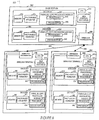
- Fig. 6 illustrates an exemplary communications system 600 which includes a base station 602, a first wireless terminal 632 and a second wireless terminal 662.
- the first and second wireless terminals 632, 662 communication with the base station 602 via wireless links 630, 660.
- Each of the devices 602, 632, 662 includes an encoder 604, 634, 664 and a decoder 606, 636, 666 implemented in accordance with the present invention.
- the encoders and decoders of each device are coupled to a wireless transceiver (transmitter/receiver) 608, 638, 668 through which the devices communicate with one another.
- a wireless transceiver transmitter/receiver
- Each device 602, 632 662 also includes a CPU 613, 643, 673 and a set of control routines which are stored in memory 615, 645, 675.
- the control routines when executed by the CPU 613, 643, 673 control the device to perform various communications operations.
- routines 615, 645, 675 include an encoder routine and/or a decoder routine which use one or more codes in accordance with the present invention to perform an encoding and/or decoding operation which includes a factorable permutation operation.
- various encoding and decoding operations are implemented in hardware.
- a device having the same general structure can be used for either encoding or decoding operations.
- the basic structure of these devices includes a factorable permuter 612, 622 which is used to couple a memory 610, 620 used to store vectors of elements which are to be processed by a parallel LDPC processing module 614, 624 which includes a number of processing elements (616, 618) (624, 628) which perform parity check operations in parallel.
- the parallel LDPC processing module 614 includes one processing element for each element of a vector which may be read out of memory 610.
- the module 614 when processing Z element vectors (vectors with Z elements) the module 614 will include Z processing elements 616, 618.
- Z Me.
- the number of processing elements Me in the encoder module 614 may be different from the number of processing element Md in the decoder processing module 624.
- the encoder and decoder may use vectors with a different number of Z elements, and thus a different level of parallelism, even though they implement the same code.
- the encoder 604 differs from the decoder 606 in that the vectors read out and processed by the encoder normally include single bit elements, e.g., information values to be encoded.
- the decoder elements of vectors which are stored in memory and passed to the processing module 624 normally include elements which each include multiple bits, e.g., are messages, corresponding to portions of a received codeword which are being decoded.
- the encoder 604 and decoder 606 also differ in the processing operation performed by the processing elements (616, 618) and (626, 628).
- each processor normally performs a logical XOR with a stored value and then replaces the stored value with the result of the XOR operation.
- processing elements 616, 618 may be implemented using an XOR circuit and a storage element which acts as an accumulator.
- Figure 12 illustrates one processing element including an XOR circuit and a storage device, e.g., accumulator, which can be used in a parallel LDPC processor module in accordance with the invention.
- the result held in the encoder's processors 616, 618 is stored in memory 610.
- the processing elements 626, 628 perform variable node and/or check node processing operations. While these operations often involve an XOR and accumulate operation, there tend to be additional processing involved with the multi-bit messages being processed by each processing element 626, 628 making decoding operations more complicated than encoding operations.
- factorable permuters 612, 622 perform, on at least some vectors processed by the permuter 612, 622, either a unity permutation operation (no change) or a permutation operation which is the product of two permutation operations.
- the factorable permuter may pass a vector without reordering the elements in the vector or, reorder the elements in a vector, e.g., by performing two sequential permutation operations with the output being the vector of reordered elements, said reordering being the result of composing the two permutation operations.
- Exemplary permutation operations will be discussed in detail in regard to the figures which follow.
- factorable permutations are performed as multi-level switching operations.
- a first level of switching elements are reordered within the vector being processed, e.g., by shifting n equal sized portions, i.e., subsets of the elements, in the vector using a first cyclic shift.
- the elements of the processed vector are then further permuted by a second permutation permuting elements within the n equal sized portions but not between portions. The same second permutation is performed on each of the n equal sized portions resulting in the same change in element positions in each of the portions.
- An equivalent description is as follows.
- the vector of Z elements are partitioned using a first partition into Z/n equal sized portions and also, using a second partition, into n equal sized portions.
- each of the Z/n equal sized portions in the first partition contain exactly one element in common with each of the n portions in the second partition.
- the above described first permutation reorders elements within the Z/n portions defined by the first partition, each reordering being identical, but does not alter the first partition.
- the second permutation reorders elements within the n portions defined by the second partition, each reordering being identical, but does not alter the second partition.
- the factorable permuter 612 performs a product of two cyclic permutations also known as cyclic shifts. While a single cyclic shift is not factorable, a product of two cyclic shifts is factorable since it can be factored into the two cyclic shifts which produce the product.
- a vector (v 0 ,v 1 ,v 2 ,v 3 ) is reordered as (v 0+2k+j , v 1+2k-j , v 2+2k+j , v 3+2k-j ) where k is an integer in [0,1] and j is an integer in [0,1] and all arithmetic is modulo 4.
- the first partition is ⁇ v 0 ,v 1 ⁇ ⁇ v 2 ,v 3 ⁇ and the second partition is ⁇ v 0 ,v 2 ⁇ ⁇ v 1 ,v 3 ⁇ .
- the first permutation is decided by choosing j, and the second permutation is decided by choosing k.
- the particular reorderings which are performed are a function of the code being implemented with the reorderings being used to, in effect, connect various nodes in the graph by directing vector elements which are to be processed to the processing element corresponding to a particular node in the graph which defines the code being implemented.
- the encoders and decoders of the wireless terminals are similar to those described with regard to the base station encoder 604 and decoder 606, respectively but may implement different levels of parallelism.
- the encoders 634, 664 and decoder 636, 666 each include a memory 640, 670, 650, 680 which is coupled by a factorable permuter 642, 672, 652, 682 to a parallel LDPC processing module 644, 674, 654, 684 respectively.
- FIGS 7 and 8 illustrate exemplary systems 700, 800 which can be used to implement LDPC operations in accordance with the present invention, e.g., either an encoding or a decoding LDPC operation depending on such things as the data to be processed, e.g., a received codeword (implying a decoding operation) or information to be generated into a codeword (implying an encoding operation).
- a received codeword implying a decoding operation
- information to be generated into a codeword implying an encoding operation
- the systems 700, 800 each include a memory 702, 802, an address generator 716, 816, an address generator and permuter controller 718, 818, stored LDPC code (graph) information 720, 820, a Z element parallel LDPC processing module 710, 810 and a factorable permuter 706, 806.
- Information to be processed is stored in memory 702, 802 via the memory input for processing. In the case of encoding, when processing is complete the result is read out of memory 702, 802. While processing is ongoing, Z element vectors are read from and written to memory under control of the address generator and permuter controller 718, 818.
- the address generator and permuter controller 718, 818 uses LDPC code (graph) information 720, 820 and information about the level of parallelism which has been implemented, e.g., the number of elements Z to be processed in parallel, to control the address generator 716, 816 to generate addresses used for read and/or write operations while also controlling the factorable permuter 706, 806 to perform the switching operations, vector element reordering, used to achieve the particular implemented graph structure corresponding to the code being implemented.
- Address generator and permuter controller 718, 818 also generates a control signal which is passed through the address generator 716, 816 to the memory 702, 802 to indicate whether a read or a write is to be performed at any given point in time.
- address generator and permuter control 718, 818 controls not only the switching performed by factorable permuter 706, 806 but also when vectors to be processed are read from memory 702, 802 and when processing results generated by modules 710, 810 are written into memory 702, 802.
- the factorable permuter 706 in the system 700 performs re-ordering operations on an input vector 704 to generate a reordered vector 708 prior to processing of the vector elements by the processing elements 712, 714 included in the parallel LDPC processing module 710.
- the results of the processing e.g, a Z element vector is stored in memory 702.
- the re-ordering by the factorable permuter 806 is performed on the Z element vector 804 generated by the processing elements 812, 814. Whether re-orderings are performed prior to processing by module 710, 810 or subsequent to processing is largely a matter of design choice.
- a lifting can be interpreted on the Tanner graph as follows. Each node in the Tanner graph is replaced by Z equivalent nodes, forming a bundle of nodes, and each edge by a bundle of Z edges. Assume that each element of a bundle is given an index in 0,... ,Z-1. A bundle of Z edges connects a bundle of variable nodes to a bundle of constraint nodes. If each connection is made by connecting nodes and edges of like index, then the construction is, in effect Z parallel copies of the original graph. Such a construction is illustrated in Fig. 3 diagram 300 corresponding to the basic example in Figs 1 and 2 .
- the parity check matrix corresponding to the graph in Fig. 3 is shown in Fig. 4 drawing 400. If the connections on, e.g., the constraint side are permuted, i.e., the edge with index j is connected to the constraint node with index ⁇ (j), where ⁇ denotes a permutation, e.g., a cyclic permutation, on 0,...,Z-1, then the resulting graph can become fully connected and is viewed as a lifted graph. Note that the projected graph may have multiple edges between a pair of nodes while the lifted graph need not. If, for example, the permutations associated to the edges in a multiple edge are all distinct, then the lifted graph will not have corresponding multiple edges.
- This architecture supports efficient high speed decoding of a large class of LDPC type codes.
- the supported codes are lifted or vectorized LDPC codes.
- cyclic permutations were a simple and desirable class of permutations to use. Using these permutations induces a group structure on the code, leading to efficient parallel encoding and decoding where the parallelism is on the scale of the size of the lifting, e.g., of the order of the cyclic structure.
- DSP digital signal processor
- the DSP with 16 times parallelism may be used, e.g., in a base station serving 4 mobile devices each of which receives data at roughly 1 ⁇ 4 the data rate at which the encoder in the base station operates.
- Each mobile device in such a system may use the same code as the encoder but be implemented in accordance with the invention with a decoder with 4 wide parallelism reflecting the fact that the mobile device has approximately 4 times as much time to process the same amount of data.
- the base station serves three mobiles, e.g.
- decoders using 4 times parallelism in the first two mobiles may be used with 8 times parallelism used in the third mobile which supports decoding at 1 ⁇ 2 the rate of the encoder.
- the method of the present invention of supporting different levels of encoder and decoder parallelism are useful in a wide range of other applications as well.
- Another example is the following.
- the FPGA does not support the parallelism required of the application so we cannot simulate the exact code intended for the final application.
- a code that is simultaneously a 64-lifting and a 256-lifting we might want a code that is simultaneously a 64-lifting and a 256-lifting.
- a third scenario is high speed applications where hardware encoders are required. Since hardware encoders generally run faster than decoders we would like to be able to reduce the parallelism (gate count) in the encoder and run it at slower speeds, more closely matching the decoder speed.
- a fourth scenario is a standardized code that requires implementation at different throughputs, e.g., at different speeds.
- a fifth scenario is software implementations: the structure of the code can be matched to the inherent parallelism in typical micro-processors. The current invention makes the above possible while maintaining a level of permutation complexity that is close to that required for cyclic permutations.
- LDPC code structures used in various embodiments of the present invention which support different levels of parallelism for a single code have not been suggested in available LDPC literature. It is the inventors realization that the class of LDPC codes used in various embodiments of the present invention, offer implementation benefits especially in the context of the V-LDPC (Vector-LDPC) architecture that forms one of the bases of the invention over other LDPC codes.
- V-LDPC Vector-LDPC
- Unary elements of are those elements whose binary vector representation has exactly one 1 and Z-1 0s.
- the codeword is thus a vector of length K over .
- Each element may be interpreted as a binary vector of length Z so the codeword is a binary vector of length ZK.
- the J x K parity check matrix contains elements of the ring, but it also may be interpreted as a binary matrix of size ZJ x ZK .
- This condition characterizes codewords of matched liftings.
- an LDPC systems based on a product lifting can be identified by the fact that the code, suitably partitioned, is invariant under element-wise multiplication by elements of a product ring.
- T txt upper triangular
- E gxt
- A txg
- C gxg
- B tx(n-m)
- D gx(n-m)
- t+g m.
- the gxg matrix ⁇ : ET -1
- a + C is invertible (we assume here that H is full row rank.)
- Encoding the proceeds as follows. Given information bits x S we solve T A B y 0 x s T 0 for y using back-substitution.
- the matrix ET -1 A + C and its inverse is an element of .
- Invertibility of ET - 1 A + C needs to be checked in the lifting, i.e., over This corresponds with invertibility as a lifted binary matrix, but not necessarily with invertibility of the projected matrix.
- diagonal entries be non-multiple edges, giving rise to unary elements in the lifting.
- Multiplication in the ring by a unary element (an element with only one non-zero entry in its vector representation) of the ring can be implemented directly in hardware as a switch.
- the switch routing mechanisms described in U.S. patent application S.N. 09/975,331 and U.S. provisional patent application S.N. 60/404,810 are exemplary mechanisms which can be used to implement unary multiplication.
- Multiplication by non-unary elements is implemented by multiple uses of the switch and adding (over the ring) the results. This corresponds to decomposing multiplication of arbitrary elements of into sums of unary multiplications. Such an approach makes the factorable permutation used in various embodiments of the invention possible.
- Product liftings are achieved by choosing a product group for the lifting.
- a product lifting can equivalently be viewed as a multi-dimensional lifting.
- the ring is a product ring.
- a lifting of size 64 is desired.
- the projected code is of size P, i.e., with P variable nodes.
- the set of codes to which the invention is directed is the case where the lifting group g is a product group, in which case the resulting ring is a product ring.
- Parallelism in our constructions amounts to parallelising over the ring. When we have a product ring there are subrings so we can also parallelise over those rings, giving us a choice of parallelism for a given code.
- Fig. 9 shows a portion of the system 700 including the memory 702, factorable permuter 706 and parallel Z element LDPC processor module 710.
- the memory 702 includes L Z element vectors. Each Z element vector includes elements 1 through Z. For purposes of explaining the invention the top portion of each Z element vector in memory 702 had been labeled A and the bottom portion B. In the case of encoding operations each element of Z will normally be one bit, e.g., a bit of information to be encoded.
- the actual number of bits in a codeword can be padded or some bits dropped, e.g., in the case of a punctured code, to make T/L and integer value.
- the elements of each Z element vector will normally be multi-bit messages.
- step 903 a Z element vector is read out of memory 702 in the sequence determined by the address generator which operates under direction of controller 718 to implement the code identified by information 720.
- Step 904 represents one of the read Z element vectors 704 being supplied to the input of the factorable permuter 706 which performs permutation operations (reorderings of vector elements) under the direction of controller 718.
- the factorable permuter 706 is implemented as a two stage switching device, a first and second switching device 902, 904 which peform first and second switching steps also referred to herein using refernce numbers 902, 904..
- the first stage includes first switching circuit 902 which operates on the full vector 704.
- Arrows 911 represent the step of dividing the result of the first permutation (reordering operation) into an integer number n, of equal portions where Z>n>1 which are unchanged by R.
- the first equal portion 913 and the second equal portion 906 are subjected to the same permutation Q in steps 907 and 909.
- This second permutation operation causes the elements in each of the equal portions 904, 906 to be reordered within the portion.
- the reordering R and Q may be an identity reordering (e.g., a shift of 0 or Z) or a shift by some amount which results in an actual change in the order of the elements.
- the combination of the first reordering operation with the application of the second reordering Q produces a permutation on the input vector Z which is factorable.
- the order in which the permutation operation R and permutation operation Q, where Q is applied to n equally sized portions does not matter since the combination of recording operation will produce the same result regardless of the order in which the operations are performed.
- Each element of the reordered Z element vector resulting from the application of Q to the each portion 913, 906 is supplied to a different corresponding processing element 712, 711, 713 or 714 of the parallel Z element LDPC processor module 710.
- the code identified by code information 720 can be implemented in a relatively straight forward manner.
- Fig 10 illustrates an example where the first permutation operation performed by the permuter 706 can be either an identity (I) permutation or a flip (F) of the upper and lower portions A, B of vector 704.
- Arrow 1002 represents the step of reading out Z element vector 704 and subjecting it to processing by the permuter 706.
- step switching step 902 the first processing path 1004 is followed if the first permutation is an identity permutation. Note that this results in vector 904 being the same as vector 704.
- Step 1007 represent the application of the permutation Q to the top A portion of vector 904 while step 1009 represents the application of the Q permutation to bottom portion B of vector 904.
- step 902 If in step 902, R was a flip operation processing would proceed along path 1005 with the resulting Z element vector 906 including B in the top portion and A in the bottom portion.
- the second permutation Q is then applied to each to these portions in steps 1007' and 1009'
- Fig. 11 is another more detailed example how the factorable permuter 706 is used to perform two sequential permutation operations R and Q on a Z element vector 704.
- the Z element vector 704 read out of memory 702 includes a first z/2 portion A 1101 which has element Y 1102 located in position 1.
- the vector 704 also includes a second portion B 1105 which includes the element X 1106 which is positioned at the start of portion B in vector position Z/2+1.
- Step 902 represent the application of the first permutation R to the vector 704 to generate the Z element vector 704'.
- R is a flip, i.e., a first cyclic shift by Z/2 applied to the vector 704.
- This first cyclic rotation results in the portion B 1105 being shifted to the top portion of the Z element vector 704' and portion A 1101 being shifted to the bottom portion of the Z element vector 704'.
- Q is a cyclic shift of one position.
- Each of the first through Z elements of the permuted vector 704" are supplied to a different one of the first through Z parallel processing elements 712, 711, 713, 714 of module 710.
- the processing results generated by the parallel processing elements may, and in some embodiments are, written back into memory 702 or, alternatively, can be written into another memory for further processing, e.g., under control of controller 718.
- the group G 2 consists of two elements F (flip) and I (identity) defined on ⁇ 0,1 ⁇ as follows.
- the present invention is directed to among other things, novel data structures, e.g., codewords, stored on machine readable media such as memory 702 which is used in some embodiments to store one or more codewords generated from input data by an encoder using one of the codes of the present invention and an encoder which implements the encoding methods of the invention.
- novel data structures e.g., codewords
- machine readable media such as memory 702 which is used in some embodiments to store one or more codewords generated from input data by an encoder using one of the codes of the present invention and an encoder which implements the encoding methods of the invention.
- a machine readable storage medium in a communications device comprising:
- the above described methods may be implemented in a computer system that includes memory, a CPU and one or more input and/or output devices coupled together.
- the memory includes a routine implemented in accordance with the invention. When executed, the routine causes the CPU to receive, process, and output data in accordance with the present invention.
- the steps of the present invention may be implemented using dedicated hardware, e.g., circuits and/or a combination of hardware and software.
Landscapes
- Physics & Mathematics (AREA)
- Engineering & Computer Science (AREA)
- Probability & Statistics with Applications (AREA)
- Theoretical Computer Science (AREA)
- Mathematical Physics (AREA)
- Computer Networks & Wireless Communication (AREA)
- Signal Processing (AREA)
- Error Detection And Correction (AREA)
- Detection And Correction Of Errors (AREA)
Description
- Nearly all forms of electronic communication and storage systems use error-correcting codes. Error correcting codes compensate for the intrinsic unreliability of information transfer in these systems by introducing redundancy into the data stream. The mathematical foundations of error correcting were established by Shannon. Shannon developed the mathematical concept of the channel in which distortion of signals in communications systems is modeled as a random process. The most fundamental result of Shannon is the Noisy channel theorem, which defines for the channel a capacity, a quantity that specifies the maximum rate at which information can be reliably delivered through the channel. Reliable transmission at rates approaching capacity requires the use of error correcting codes. Thus, error-correcting codes are designed to achieve sufficient reliability while approaching capacity as closely as possible. The complexity of implementing the error correcting code is an additional factor that always comes into play in practical applications of error correcting codes. Recent advances in error correcting coding systems resulting from the invention of turbo codes and the subsequent rediscovery and development of low-density parity-check (LDPC) codes offer coding systems of feasible complexity that can approach Shannon's capacity quite closely.
- LDPC codes are well represented by bipartite graphs, often called Tanner graphs, see
Fig. 1 diagram 100, in which one set of nodes, thevariable nodes 102, corresponds to bits of the codeword and the other set of nodes, theconstraint nodes 106, sometimes called check nodes, correspond to the set of parity-check constraints which define the code.Edges 104 in the graph connect variable nodes to constraint nodes. A variable node and a constraint node are said to be neighbors if they are connected by an edge in the graph. One typically assumes that a pair of nodes is connected by at most one edge. LDPC codes can equivalently be represented using the parity check matrix.Fig. 2 presents an example where the indicatedvector x 204 is a codeword if and only if Hx=0, whereH 202 is a parity check matrix. - To each variable node is associated one bit of the codeword. In some cases some of these bits might be punctured or known. Punctured bits may be desirable in certain code structures and, in liftings (see below), both punctured and known bits can be used to achieve block lengths that are not multiples of the lifting. Punctured bits and known bits are excluded from the transmitted codeword.
- A bit sequence associated one-to-one with the variable node sequence is a codeword of the code if and only if, for each constraint node, the bits neighboring the constraint (via their association with variable nodes) sum to zero modulo two, i.e., they comprise an even number of ones.
- The decoders and decoding algorithms used to decode LDPC codewords operate by exchanging messages within the graph along the edges and updating these messages by performing computations at the nodes based on the incoming messages. Such algorithms will be generally referred to as message passing algorithms. Each variable node in the graph is initially provided with a soft bit, termed a received value, that indicates an estimate of the associated bit's value as determined by observations from, e.g., the communications channel. Ideally, the estimates for separate bits are statistically independent. This ideal can be, and often is, violated in practice.
- The number of edges attached to a node, i.e., a variable node or constraint node, is referred to as the degree of the node. A regular graph or code is one for which all variable nodes have the same degree, j say, and all constraint nodes have the same degree, k say. In this case we say that the code is a (j,k) regular code. These were the codes considered originally by Gallager (1961). In contrast to a "regular" code, an irregular code has constraint nodes and/or variable nodes of differing degrees. For example, some variable nodes may be of degree 4, others of degree 3 and still others of
degree 2. - While irregular codes can be more complicated to represent and/or implement, it has been shown that irregular LDPC codes can provide superior error correction/detection performance when compared to regular LDPC codes.
- While implementation of LDPC encoders and decoders using multiple parallel processing elements to process sets of data as part of an encoding or decoding operation have proven both useful and reliable, in known implementations the number of parallel processing elements used in a decoder are normally the same as the number of parallel processing elements used in the encoder. Thus, in a system with multiple devices, e.g., a centralized device such as base station and/or satellite, which interacts with multiple mobile devices, the LDPC encoders and decoders in each of the devices in the system would normally have the same level of parallelism.
- Given that the centralized device services multiple mobile devices, assuming real time operation and the same level of parallelism within the encoder/decoder, the centralized device will have to operate at a rate many times faster than the individual devices to keep up with the encoding/decoding associated with the various mobile devices being serviced.
- From an implementation standpoint, it would be beneficial if the level of parallelism in different LDPC encoder/decoders in a system could be different. Such an approach would allow the level of parallelism in the encoder and/or decoder in a particular device to be matched to the amount of data to be transmitted/received by the device. By minimizing the amount of parallelism in a particular device, implementation costs can be minimized.
- Use of large codes, e.g., including many nodes, which correspond to large graph structures offer many advantages over smaller codes, e.g., including only a few nodes, in terms of error resiliency. To implement a large graph structure using a smaller graph, various permutations may be applied to copies of the smaller graph structure and the copies can be linked together to generate a larger graph structure. In encoding/decoding operations, such permutation operations may be implemented by a switching device, referred to herein as a permuter which applies a permutation operation on elements, e.g., bits to be encoded in the case of an encoding operation or messages in the case of a decoding operation, as they are passed between a memory and a vector processing unit which performs LDPC operations in parallel.
- Unfortunately, many LDPC codes do not lend themselves to implementations which would allow multiple different levels of parallelism in an encoder and decoder. In addition, while a single simple permutation operation like a cyclic shift is suitable for implementing a permuter suitable for use with many LDPC codes which can be represented using a large graph generated from a smaller graph, such a single permutation operation does not lend itself to implementing LDPC codes which could be implemented using different levels of parallelism.
- In view of the above discussion, it should be appreciated that there is a need for codes and methods and apparatus for implementing LDPC encoders/decoders in a manner which allow for different degrees of parallelism in different devices which use the same code, e.g., LDPC graph structure, to perform LDPC encoding and/or LPDC decoding operations. In addition, there is a need for a practical way of implementing such encoders/decoders, e.g., through the use of new and improved permuters which would allow devices to use relatively large codes which can be derived from smaller graphs, but which also allow for different levels of parallelism to be implemented in different devices. Prior art publication "Low-Power VLSI Decoder Architectures for LDPC Codes" by M.M. Mansour et al., published on 14 August 2002, discloses decoding of LDPC codes, constructed by permutation matrices, and where the decoding is based on carrying out the necessary permutations according to the permutation matrices and their arrangement within the H-matrix.
- The method of the present invention can be used to implement a communications system wherein different devices using the same LDPC code can implement different levels of parallelism. In order to obtain a high level of error resiliency, relatively long codewords are often used. For example, a single codeword generated by performing an encoding operation using a LDPC code of the present invention may include a total number of bits T, where T may be several hundred or even thousands of bits. For purposes of explaining the invention it is to be understood that bits to be encoded and/or bits corresponding to a received codeword may be arranged into L Z element vectors, where Z is a positive integer greater than 1. Each Z element vector includes Z elements and may be read from memory. The vector read from memory can then be processed using Z processing units in parallel. In contrast to existing systems, which use the same number of Z processing elements in parallel in an encoder that encodes codewords using a particular LDPC code (graph structure) as are used in the decoder implementing the same LDPC code, the present invention allows for different levels of parallelism in the encoders and decoders using the same code. In some embodiments, the encoder in a device using a particular code is implemented using a different number of parallel processing units than are used in decoder implementing the same code. Encoding is usually less processor intensive than decoding so, in some embodiments, within a single device, different numbers of processing elements are used in parallel in the decoder than in the encoder with the encoder often having fewer processing elements operating in parallel.
- Within a system, different devices may have to encode different amounts of data in real time. Consider a base station serving four wireless terminals. Assuming each wireless terminal transmits and receives the same amount of data, the base station will have to encode and decode 4 times as much data as any of the individual wireless terminals. In some embodiments, the base station or satellite which services multiple nodes is implemented using more processing units in parallel than individual wireless terminals serviced by the base station or satellite. In some systems implemented in accordance with the invention, different wireless terminals within the system using the same code are implemented with different number of parallel processing elements to reflect the different amounts of data each device will have to encode and decode. The use of a novel class of LDPC codes which will be discussed below makes such differences in parallelism possible. Use of a factorable permuter in various embodiments of the invention make LDPC devices with different levels of parallelism in the encoder and decoder relatively easy to implement when using the codes in the class of LDPC codes discussed herein.
-
-
Figure 1 is a diagram representing an LPDC code as a bipartite (Tanner) graph. -
Figure 2 is a diagram representing an LPDC code using a parity check matrix. -
Figure 3 is a diagram illustrating an exemplary lifting on a Tanner graph. -
Figure 4 is a parity check matrix corresponding to the Tanner graph representation ofFigure 3 . -
Figure 5 shows an exemplary lifted version of the matrix ofFigure 2 , where the Z lifting value = 3 and the permutations used are cyclic permutations. -
Figure 6 is an illustration of an exemplary communications system implemented in accordance with the present invention and using methods in accordance with the present invention. -
Figure 7 is an illustration of an exemplary system which can be used to implement LDPC operations in accordance with the present invention. -
Figure 8 is an illustration of another exemplary system which can be used to implement LDPC operations in accordance with the present invention. -
Figure 9-11 are examples of using the methods of the present invention in a portion of a system, such as the system shown inFig. 7 , which are used to describe steps of various exemplary methods of the present invention which use a factorable permuter to perform LDPC operations. -
Figure 12 illustrates an processing element including an XOR circuit and a storage device, e.g., accumulator, which can be used in a parallel LDPC processor module in accordance with the invention. -
Fig. 6 illustrates anexemplary communications system 600 which includes abase station 602, afirst wireless terminal 632 and asecond wireless terminal 662. The first andsecond wireless terminals base station 602 viawireless links devices encoder decoder device CPU memory CPU routines Fig. 6 , various encoding and decoding operations are implemented in hardware. In accordance with the novel LPDC encoding and decoding methods of the invention a device having the same general structure can be used for either encoding or decoding operations. In the case of the base station encoder 604 anddecoder 606, it can be seen that the basic structure of these devices includes afactorable permuter memory LDPC processing module LDPC processing module 614 includes one processing element for each element of a vector which may be read out ofmemory 610. Accordingly, when processing Z element vectors (vectors with Z elements) themodule 614 will includeZ processing elements
The number of processing elements Me in theencoder module 614 may be different from the number of processing element Md in thedecoder processing module 624. In other words, the encoder and decoder may use vectors with a different number of Z elements, and thus a different level of parallelism, even though they implement the same code. The encoder 604 differs from thedecoder 606 in that the vectors read out and processed by the encoder normally include single bit elements, e.g., information values to be encoded. In the case of the decoder elements of vectors which are stored in memory and passed to theprocessing module 624 normally include elements which each include multiple bits, e.g., are messages, corresponding to portions of a received codeword which are being decoded. - The encoder 604 and
decoder 606 also differ in the processing operation performed by the processing elements (616, 618) and (626, 628). In the case of the encoder 604, each processor normally performs a logical XOR with a stored value and then replaces the stored value with the result of the XOR operation. Thus, processingelements Figure 12 illustrates one processing element including an XOR circuit and a storage device, e.g., accumulator, which can be used in a parallel LDPC processor module in accordance with the invention.
At a point in the processing determined by the code (graph structure) being implemented, the result held in the encoder'sprocessors memory 610. Theprocessing elements processing element - Several of the patent applications incorporated herein by reference discuss in detail a variety of ways in which the parallel LPDC
processing module elements - In accordance with the present invention,
factorable permuters permuter
In some embodiments factorable permutations are performed as multi-level switching operations. In a first level of switching elements are reordered within the vector being processed, e.g., by shifting n equal sized portions, i.e., subsets of the elements, in the vector using a first cyclic shift. The elements of the processed vector are then further permuted by a second permutation permuting elements within the n equal sized portions but not between portions. The same second permutation is performed on each of the n equal sized portions resulting in the same change in element positions in each of the portions. An equivalent description is as follows. The vector of Z elements are partitioned using a first partition into Z/n equal sized portions and also, using a second partition, into n equal sized portions. This is done in such a way that each of the Z/n equal sized portions in the first partition contain exactly one element in common with each of the n portions in the second partition. Then, the above described first permutation reorders elements within the Z/n portions defined by the first partition, each reordering being identical, but does not alter the first partition. The second permutation reorders elements within the n portions defined by the second partition, each reordering being identical, but does not alter the second partition. - In some embodiments of the present invention, the
factorable permuter 612 performs a product of two cyclic permutations also known as cyclic shifts. While a single cyclic shift is not factorable, a product of two cyclic shifts is factorable since it can be factored into the two cyclic shifts which produce the product. To give a concrete example, let us assume Z=4. Under a cyclic shift, a vector (v0,v1,v2,v3) is reordered as (v0+k, v1+k, v2+k, v3+k) where k is an integer on [0,3] an the addition is modulo 4. Under the product of two cyclic shifts ofsize 2, a vector (v0,v1,v2,v3) is reordered as (v0+2k+j, v1+2k-j, v2+2k+j, v3+2k-j) where k is an integer in [0,1] and j is an integer in [0,1] and all arithmetic is modulo 4. In the case of the product of two cyclic shifts, the first partition is {v0,v1} {v2,v3} and the second partition is {v0,v2} {v1,v3}. The first permutation is decided by choosing j, and the second permutation is decided by choosing k. As will be discussed below, the particular reorderings which are performed are a function of the code being implemented with the reorderings being used to, in effect, connect various nodes in the graph by directing vector elements which are to be processed to the processing element corresponding to a particular node in the graph which defines the code being implemented. - The encoders and decoders of the wireless terminals are similar to those described with regard to the base station encoder 604 and
decoder 606, respectively but may implement different levels of parallelism. Theencoders decoder memory factorable permuter LDPC processing module - The methods and apparatus of the present invention can be better appreciated and understood in the context of various other LDPC coding patents and applications. Various elements, e.g., processing elements which perform LDPC operations, described in the applications included herein, may be used to implement the parallel vector processor described in the exemplary system. Various applications incorporated herein also discuss how memory access and switching operation used to perform permutation operations can be implemented based on stored information providing LDPC code (graph) information. While the codes and permutation operations described are different than those described in the present application, the memory access and switching control operations can be controlled in the same or a similar manner based on stored LPDC code information. Accordingly, such control techniques will be discussed in detail herein. In addition, since such processing elements, e.g., variable node and check node processing elements among others, are described in detail in the incorporated applications, their implementation and function will only be briefly discussed in the present application
-
Figures 7 and 8 illustrateexemplary systems - The
systems memory address generator permuter controller information LDPC processing module factorable permuter memory memory permuter controller permuter controller information address generator factorable permuter permuter controller address generator memory permuter control factorable permuter memory modules memory - The main difference between the
Fig 7 and 8 embodiments is that thefactorable permuter 706 in thesystem 700 performs re-ordering operations on aninput vector 704 to generate a reorderedvector 708 prior to processing of the vector elements by theprocessing elements LDPC processing module 710. The results of the processing, e.g, a Z element vector is stored inmemory 702. In the case of theFig. 8 embodiment, the re-ordering by thefactorable permuter 806 is performed on theZ element vector 804 generated by theprocessing elements module - To appreciate the novel codes used in various embodiments of the present invention, and the novel codewords that result from the use of such LDPC codes, "liftings" will now be discussed. In general a "lifting" or vectorization of LDPC codes is described as follows. We start with a Tanner graph or a parity check matrix representation of a small LDPC code, as in
Figures 1 and 2 . We describe the lifting from the parity check matrix perspective first. In a Z-lifting, each entry of the parity check matrix is replaced by a ZxZ matrix. 0 entries in H become 0 ZxZ matrices and Is in H become permutation matrices, usually belonging to some group.Fig 5 showsmatrix 502, a lifted version of the matrix inFig 2 where Z=3 and the permutations used are cyclic permutations. A lifting can be interpreted on the Tanner graph as follows. Each node in the Tanner graph is replaced by Z equivalent nodes, forming a bundle of nodes, and each edge by a bundle of Z edges. Assume that each element of a bundle is given an index in 0,... ,Z-1. A bundle of Z edges connects a bundle of variable nodes to a bundle of constraint nodes. If each connection is made by connecting nodes and edges of like index, then the construction is, in effect Z parallel copies of the original graph. Such a construction is illustrated inFig. 3 diagram 300 corresponding to the basic example inFigs 1 and 2 . The parity check matrix corresponding to the graph inFig. 3 is shown inFig. 4 drawing 400. If the connections on, e.g., the constraint side are permuted, i.e., the edge with index j is connected to the constraint node with index π(j), where π denotes a permutation, e.g., a cyclic permutation, on 0,...,Z-1, then the resulting graph can become fully connected and is viewed as a lifted graph. Note that the projected graph may have multiple edges between a pair of nodes while the lifted graph need not. If, for example, the permutations associated to the edges in a multiple edge are all distinct, then the lifted graph will not have corresponding multiple edges. - This architecture supports efficient high speed decoding of a large class of LDPC type codes. The supported codes are lifted or vectorized LDPC codes. In the application S.N. 09/975,331 it was suggested that cyclic permutations were a simple and desirable class of permutations to use. Using these permutations induces a group structure on the code, leading to efficient parallel encoding and decoding where the parallelism is on the scale of the size of the lifting, e.g., of the order of the cyclic structure.
- There are situations, it turns out, where it is desirable to have a given code that can be viewed as a lifting not of just one size, but of two or more sizes thereby facilitating the possibility of different levels of parallelism in encoders/decoders using the same code. This realization and the resulting code structures of the present invention allow for efficient encoder and/or decoder implementations which can have different levels of parallelism using the same LDPC codes. Encoders, decoders, codewords and encoded data which use or are produced by the use of the code structures of the present invention are also to be considered features of the invention.
- Consider the following example used to explain the invention. We wish to encode in a digital signal processor (DSP), so 16 times parallelism (lifting) is desirable, but we want to make a small decoder, with 4 wide parallelism. The DSP with 16 times parallelism may be used, e.g., in a base station serving 4 mobile devices each of which receives data at roughly ¼ the data rate at which the encoder in the base station operates. Each mobile device in such a system may use the same code as the encoder but be implemented in accordance with the invention with a decoder with 4 wide parallelism reflecting the fact that the mobile device has approximately 4 times as much time to process the same amount of data. Assuming the base station serves three mobiles, e.g. first and second mobiles operating at roughly ¼ the data rate of the encoder and a third mobile at ½ the data rate of the encoder, decoders using 4 times parallelism in the first two mobiles may be used with 8 times parallelism used in the third mobile which supports decoding at ½ the rate of the encoder.
- The method of the present invention of supporting different levels of encoder and decoder parallelism are useful in a wide range of other applications as well. Another example is the following. We wish to design a code for a very high-speed application requiring large parallelism. We would like to simulate the code on an FPGA (Floating Point Gate Array) platform before proceeding to an ASIC implementation. The FPGA does not support the parallelism required of the application so we cannot simulate the exact code intended for the final application. In the first case, it would be desirable to have a code that can be viewed both as a 4-lifting and a 16-lifting. In a second case we might want a code that is simultaneously a 64-lifting and a 256-lifting. A third scenario is high speed applications where hardware encoders are required. Since hardware encoders generally run faster than decoders we would like to be able to reduce the parallelism (gate count) in the encoder and run it at slower speeds, more closely matching the decoder speed. A fourth scenario is a standardized code that requires implementation at different throughputs, e.g., at different speeds. A fifth scenario is software implementations: the structure of the code can be matched to the inherent parallelism in typical micro-processors. The current invention makes the above possible while maintaining a level of permutation complexity that is close to that required for cyclic permutations. Moreover, there is a potential savings in complexity with regard to the description of the code: if the code has more parallelism than the implementation (by having another factor in the product) then that additional structure can be used to yield a more compact description of the code. This can allow for simplified message passing control. It is largely in the context of the Vector-LDPC architecture that the benefits of such multi-level or product liftings are realized.
- Applicant believes that the LDPC code structures used in various embodiments of the present invention which support different levels of parallelism for a single code have not been suggested in available LDPC literature. It is the inventors realization that the class of LDPC codes used in various embodiments of the present invention, offer implementation benefits especially in the context of the V-LDPC (Vector-LDPC) architecture that forms one of the bases of the invention over other LDPC codes.
- Before describing product liftings, and to facilitate their description, we first describe a general class of liftings that have additional mathematical structure. We note that liftings by cyclic groups fall in this class.
- When the order of (the number of elements in) the group used in the lifting is the same as size Z of the lifting then a mathematical structure arises that can be advantageously exploited. We refer to such a lifting as a matched lifting. In a matched lifting, sums over GF[2] of the ZxZ permutation matrices used in the lifting and binary vectors of length Z can simultaneously be identified with elements of a ring. Elements of the ring can be conveniently represented as binary vectors of length Z where addition is bit-wise modulo 2 addition and multiplication arises from the group structure. As a consequence, replacing each element of the projected parity check matrix with an element of the ring forms a lifted parity check matrix. Replacing each bit with an element of the ring lifts the binary codeword of the projected graph. The overall code is still binary, but it is represented as a Z-times smaller code over the ring. One can show that binary matrix operations on the full lifted parity check matrix can be mimicked as operations over the ring. This simplifies encoder extraction dramatically. Moreover, the mathematical structure guarantees that encoding may be performed in the ring.
- We now present the mathematical structure of matched liftings.
- Suppose we have a group g of order Z with elements g 1,..., gZ , where, by convention, g 1 is the identity element. The group can be represented using permutations p 1 ,...,pZ by setting πi (k) = j if and only if gigk = gj. Correspondingly, we can represent the group using ZxZ permutation matrices G1,...,G Z where

- Given such a group we define a ring whose elements are binary vectors of length Z. A binary vector u = (u 1 ,...,uZ ) can be identified with a subset of G, or, equivalently, with a
formal sum 


- Given two binary vectors u and v their product w:=uv is given uniquely by M(w)=M(u)M(v). Note, moreover, that if we interpret v is a column vector over GF[2] then w=M(u)v.
- Now that we have defined multiplication for binary vectors, we have a defined a ring which we denote by. Unary elements of
 are those elements whose binary vector representation has exactly one 1 and Z-1 0s.
 - Consider again the lifting indicated in
Fig 5 . Now, the matrix on the right in that figure can be interpreted a matrix of elements in, whereis the ring induced by cyclic permutations of size K (=3 in the example). The code is still the set of solutions to the parity check equation Hx=0, but elements of H and elements of x belong to: The codeword is thus a vector of length K over. Each element may be interpreted as a binary vector of length Z so the codeword is a binary vector of length ZK. The JxK parity check matrix contains elements of the ring, but it also may be interpreted as a binary matrix of size ZJxZK. - A codeword x = (x1,...,xK) is a codeword overif and only if each vector xu = (x1u,..., xKu) is a codeword for each element u∈. This condition characterizes codewords of matched liftings. Thus an LDPC systems based on a product lifting (see below) can be identified by the fact that the code, suitably partitioned, is invariant under element-wise multiplication by elements of a product ring.

- The matched lifting formalism simplifies our understanding of encoding such LDPC codes and can lead to a simplified encoding process.
- To build an encoder for a general LDPC code, the first step is to find a permutation of the rows and columns of H so that, up to reordering, we can write

Encoding the proceeds as follows. Given information bits xS we solve

2 . For this step the matrix φ -1 is pre-computed. Finally, one solves
1 using back substitution. The vector [x p1 x p2 xs ] T constitutes the codeword.
The idea to encode lifted graphs is to perform the approximate upper triangulation on the projected parity check matrix, but to then perform the encoding by interpreting matrix operations over. In practical settings, where the size of the lifting is sufficiently large, one can enforce g=1 with no discernible loss in performance. In this case the matrix ET -1 A + C and its inverse is an element of. Invertibility of ET -1 A + C needs to be checked in the lifting, i.e., overThis corresponds with invertibility as a lifted binary matrix, but not necessarily with invertibility of the projected matrix. When forming the diagonal matrix T in the presence of multiple edges, it is preferable that diagonal entries be non-multiple edges, giving rise to unary elements in the lifting. - Multiplication in the ring by a unary element (an element with only one non-zero entry in its vector representation) of the ring can be implemented directly in hardware as a switch. The switch routing mechanisms described in
U.S. patent application S.N. 09/975,331 andU.S. provisional patent application S.N. 60/404,810 are exemplary mechanisms which can be used to implement unary multiplication. Multiplication by non-unary elements is implemented by multiple uses of the switch and adding (over the ring) the results. This corresponds to decomposing multiplication of arbitrary elements ofinto sums of unary multiplications. Such an approach makes the factorable permutation used in various embodiments of the invention possible. - Product liftings are achieved by choosing a product group for the lifting. A product lifting can equivalently be viewed as a multi-dimensional lifting. Correspondingly, assuming the lifting is matched, the ringis a product ring. Consider an example in which a lifting of size 64 is desired. Assume the projected code is of size P, i.e., with P variable nodes. One could choose the cyclic group of size 64 for the lifting. An alternative, in accordance with the invention would be a product of the cyclic group of size 16 and the cyclic group of size 4. This group can be represented as follows. Consider indexing L = 0,... 63 using pairs (a,b), a = 0,..., 15 and b=0,... ,3 by the invertible map L = 4a+b. An element of this product group is a pair (c,d) c = 0,...,15 and d=0,...,3. The action of (c,d) on (a,b) is to permute the pair (a,b) to (a+c mod 16, d+b mod 4). This group also has order 64. The resulting lifted graph, however, can be interpreted as a lifting of a size 4P code by 16 or a size 16P code by 4 or a size P code by 64. Thus, implementations with parallelism 4, 16, or 64 are all simultaneously supported in accordance with the invention. This might be desirable for implementations where high speed decoding with parallelism 64 is needed, but encoding, which is much simpler, is to be performed on a digital signal processor, where the Z=16 representation is much more convenient. The advantages offered by product liftings are realized in the context of the encoder and hardware implementations. The value added by using product liftings is a feature of the invention. Liftings by groups which are not products, e.g., by a cyclic group, allow for liftings of arbitrary size but do not offer the flexibility of product liftings.
- The set of codes to which the invention is directed is the case where the lifting group g is a product group, in which case the resulting ring is a product ring. Parallelism in our constructions amounts to parallelising over the ring. When we have a product ring there are subrings so we can also parallelise over those rings, giving us a choice of parallelism for a given code.
- Cases that appear in the literature already are when g is a cyclic group or the multiplicative group of a finite field. These cases are not product groups, so our construction has not been anticipated. Furthermore its benefits are apparent only in light of parallel architectures such as the one we have disclosed.
- Use of
factorable permuter 706 which is made possible by the codes of the present invention and the above described product lifting feature will now be described with reference toFig. 9. Fig. 9 shows a portion of thesystem 700 including thememory 702,factorable permuter 706 and parallel Z elementLDPC processor module 710. Thememory 702 includes L Z element vectors. Each Z element vector includeselements 1 through Z. For purposes of explaining the invention the top portion of each Z element vector inmemory 702 had been labeled A and the bottom portion B. In the case of encoding operations each element of Z will normally be one bit, e.g., a bit of information to be encoded. The received codeword may include a total of T bits where T/L = Z. The actual number of bits in a codeword can be padded or some bits dropped, e.g., in the case of a punctured code, to make T/L and integer value. In the case of a decoding operation, the elements of each Z element vector will normally be multi-bit messages. - In step 903 a Z element vector is read out of
memory 702 in the sequence determined by the address generator which operates under direction ofcontroller 718 to implement the code identified byinformation 720. Step 904 represents one of the readZ element vectors 704 being supplied to the input of thefactorable permuter 706 which performs permutation operations (reorderings of vector elements) under the direction ofcontroller 718. Thefactorable permuter 706 is implemented as a two stage switching device, a first andsecond switching device refernce numbers first switching circuit 902 which operates on thefull vector 704. In this example, switch 902 performs a first cyclic rotation R which causes theelements input vector 704 to shift by S1=Z/n (where n=2 in this example) or S1=0 positions. with thevector 704. Thus, portions A and B are swapped, if S1=Z/2 , or not, if S1=0. In the examples ofFigs. 9, 10 and11 n=2.Arrows 911 represent the step of dividing the result of the first permutation (reordering operation) into an integer number n, of equal portions where Z>n>1 which are unchanged by R. The firstequal portion 913 and the secondequal portion 906 are subjected to the same permutation Q insteps equal portions - Each element of the reordered Z element vector resulting from the application of Q to the each
portion corresponding processing element LDPC processor module 710. As a result of the operation of thefactorable permuter 706 in combination with the control of the addressing used to determine the order in which Z element vectors are read out, the code identified bycode information 720 can be implemented in a relatively straight forward manner. - By using a
factorable permuter 706, code structures which could not be supported using a single simple cyclic shift can be supported. As discussed above, such codes have the advantage of allowing for different levels of decoder and encoder parallelism for the same code. -
Fig 10 illustrates an example where the first permutation operation performed by thepermuter 706 can be either an identity (I) permutation or a flip (F) of the upper and lower portions A, B ofvector 704.Arrow 1002 represents the step of reading outZ element vector 704 and subjecting it to processing by thepermuter 706. Instep switching step 902, thefirst processing path 1004 is followed if the first permutation is an identity permutation. Note that this results invector 904 being the same asvector 704.Step 1007 represent the application of the permutation Q to the top A portion ofvector 904 whilestep 1009 represents the application of the Q permutation to bottom portion B ofvector 904. - If in
step 902, R was a flip operation processing would proceed alongpath 1005 with the resultingZ element vector 906 including B in the top portion and A in the bottom portion. The second permutation Q is then applied to each to these portions in steps 1007' and 1009' -
Fig. 11 is another more detailed example how thefactorable permuter 706 is used to perform two sequential permutation operations R and Q on aZ element vector 704. In theFig. 11 example, theZ element vector 704 read out ofmemory 702 includes a first z/2portion A 1101 which haselement Y 1102 located inposition 1. Thevector 704 also includes asecond portion B 1105 which includes theelement X 1106 which is positioned at the start of portion B in vector position Z/2+1. Step 902 represent the application of the first permutation R to thevector 704 to generate the Z element vector 704'. In this example R is a flip, i.e., a first cyclic shift by Z/2 applied to thevector 704. This first cyclic rotation results in theportion B 1105 being shifted to the top portion of the Z element vector 704' andportion A 1101 being shifted to the bottom portion of the Z element vector 704'. This has the result of changing the order of the vector's elements so thatelement X 1106 is now in the first position andelement Y 1102 is in the (Z/2 + 1) position. The n (where n=2 in this example) even sized portions ofintermediate vector 704,portion 1105 andportion 1101 into which the Z element vector 704' is separated for application of the second permutation, are then individually subjected to the second permutation Q insteps element X 1106 being shifted to the Z/2 position within the first portion 1105' of Zelement output vector 704"'. It also results in theelement Y 1102 being being shifted to the Z position making it the last element in thevector 704" and last element of second portion 1101'. Note that the multi-step reordering process performed by thefactorable permuter 706 results in a reordering that is not possible using a single cyclic shift on the Zelement input vector 704. This novel reordering approach allows codes to be implemented which could not be implemented using a permuter that was capable of only doing single cyclic shift. - Each of the first through Z elements of the permuted
vector 704" are supplied to a different one of the first through Zparallel processing elements module 710. The processing results generated by the parallel processing elements may, and in some embodiments are, written back intomemory 702 or, alternatively, can be written into another memory for further processing, e.g., under control ofcontroller 718. - While operation of the 706 has been explained in detail, it is to be understood that the
permuter 806 shown inFig. 8 operates in the same manner except with input vectors being received from the processor parallel LDPC processing instead of memory and the results being written intomemory 802. - The
Fig. 10 example uses a product lifting with two factor G=G2 x GZ/2. The group G2 consists of two elements F (flip) and I (identity) defined on {0,1} as follows.
F(0) = 1, F(1) = 0;
I(0) = 0, I(1) = 1;
We assume a length L cycle in the process illustrated inFig. 10 . - The present invention is directed to among other things, novel data structures, e.g., codewords, stored on machine readable media such as
memory 702 which is used in some embodiments to store one or more codewords generated from input data by an encoder using one of the codes of the present invention and an encoder which implements the encoding methods of the invention. - In particular, some embodiments of the invention are directed to:
A machine readable storage medium in a communications device, comprising: - a data structure in the form of an array y of NxZ bits where N and Z are positive integers, said data structure having been generated by:
- operating an encoder circuit to receive an input u which is an array of KxZ bits, where K is a positive integer; and
- operating said encoder circuit to compute y according to the equation

- y is an array of N × Z bits where N and Z are positive integers,
- u is an array of K × Z bits where K is a positive integer,
- G is an array of K × N matrix of elements where each element of G is a vector of Z bits, and where
- y = (y 1 , y 2 ,..., yN ) where yi for i an integer in [1, N] is a Z bit vector,
- u = (u 1, iu2,...,uK ) where ui for i an integer in [1, K] is a Z bit vector,


where
for any Z bit vector a = (a 1 , a2 ,..., aZ ) and any Z bit vector b = (b 1, b 2,..., bZ ) their PRODUCT ab is a Z bit vector d = (d 1, d 2 ,...., dZ ) defined by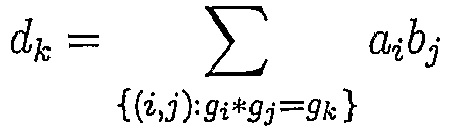
and where


and
a factorable group of order Z is a group


- The above described methods may be implemented in a computer system that includes memory, a CPU and one or more input and/or output devices coupled together. The memory includes a routine implemented in accordance with the invention. When executed, the routine causes the CPU to receive, process, and output data in accordance with the present invention.
- Alternatively, the steps of the present invention may be implemented using dedicated hardware, e.g., circuits and/or a combination of hardware and software.
Claims (16)
- A device for performing an LDPC processing operation by employing a multi-level permutation, the device comprising:a memory for storing a plurality of Z element vectors, each Z element vector includes Z elements wherein Z is an integer value greater than 1, each element including at least one bit to be processed;a parallel LDPC processing module including Z processing elements arranged to perform parity check operations including one of encoding or decoding operations on Z vector elements in parallel; anda controllable factorable permuter for coupling said memory to said parallel LDPC processing module that reorders the Z element vectors to facilitate processing of the Z element vectors by the Z processing elements, said controllable factorable permuter including switching circuitry, said switching circuitry being responsive to a control signal to perform a factorable permutation operation on a Z element vector being passed through said factorable permuter, said factorable permutation operation including first and second permutation operations which cause first and second re-orderings of vector elements to occur, said first and second reordering operations being performed on n equally sized vector portions of size Z/n, said first permutation operation causing a change in the order of at least two equally sized vector portions, said second permutation operation being performed on each of the Z/n sized portions to cause a change in the ordering of elements within each of said Z/n sized portions, where n is an integer greater than 1 and less than Z; andwherein the LPDC code being processed corresponds to a parity check matrix H that is composed of Z×Z matrices that are either zero or a Z×Z permutation matrix, and wherein the controllable factorable permuter carries out permutations corresponding to Z×Z permutation matrices.
- The device of claim 1, wherein said factorable permuter includes a first switching circuit for performing said first re-ordering and a second switching circuit for performing said second re-ordering wherein said first and second switching circuits are arranged in series.
- The device of claim 1, wherein said number n is an integer multiple of 2.
- The device of claim 1, wherein the first permutation operation can be performed after said second permutation operation or said second permutation operation can be performed after said first permutation operation.
- The device of claim 2, further comprising:a set of stored LDPC code information defining at least a portion of an LDPC code which is to be implemented; anda permuter controller, the permuter controller being responsive to said stored LDPC code information to control said factorable permuter to implement vector element reorderings in accordance with at least the portion of the LDPC code which is to be implemented.
- The device of claim 2,
further comprising an address generator coupled to said memory; and
wherein the permuter controller also operates as an address generator controller, said permuter controller controlling the selection of addresses supplied by said address generator at different points in time to coordinate memory access operations with factorable permuter reordering operations. - The device of claim 1, wherein said first and second reordering operations are cyclic shift operations.
- The device of claim 2, wherein each one of the Z processing elements in said parallel LDPC processing module includes an XOR circuit and an accumulator.
- The device of claim 2, wherein each one of the Z processing elements in said parallel LDPC processing module is one of a variable node and a check node processor.
- A method for performing an LDPC processing operation using a multi-level permutation, said LDPC processing operation being one of an encoding or decoding operation performed on of a plurality of Z element vectors, the method comprising:sequentially passing each of the plurality of Z element vectors through a permuter positioned between a memory used to store said plurality of Z element vectors and a Z element vector processor unit including Z processing elements that perform parity check operations on the plurality of Z element vectors, each Z element vector including Z elements where Z is an integer value greater than 1; andcontrolling said permuter to perform a factorable permutation operation on at least one of the Z element vectors passed between said memory and said vector processing unit to reorder the elements in said at least one Z element vector to facilitate parallel processing by the Z processing elements, said step of performing a factorable permutation operation including:performing a first reordering operation on a plurality of first equally sized subsets within said at least one Z element vector to change the order of the first equally sized subsets of said at least one Z element vector within said Z element vector; andperforming a second reordering operation on the contents of each of the plurality of first equally sized subsets within said at least one Z element vector to change the order of at least some of the elements in each of said plurality of first equally sized subsets, the same second reordering operation being performed on each of said first equally sized subset to produce the same change in the order of elements within each of said first equally sized subsets; andwherein the LPDC code being processed corresponds to a parity check matrix H that is composed of Z×Z matrices that are either zero or a Z×Z permutation matrix, and wherein the controllable factorable permuter carries permutations corresponding to Z×Z permutation matrices.
- The method of claim 10, wherein said first reordering operation is a cyclic shift of subsets within said Z element vector.
- The method of claim 10, wherein said first and second reordering operations are performed sequentially and where said second reordering operation is performed prior to said first reordering operation.
- The method of claim 11, wherein each of said plurality of equally sized subsets include n subsets, each of said subsets including Z/n elements, where n is a positive integer, where Z/n is a positive integer, and where Z>n>1.
- The method of claim 11, further comprising:
operating said permuter to pass at least some Z bit vectors without reordering the content of said vectors. - The method of claim 14, further comprising:
operating said permuter to perform a first cyclic reordering to rearrange the order of some elements within at least some vectors without performing a second reordering operation on said at least some vectors. - The method of claim 15, further comprising:
operating a controller to determine the particular reordering to be applied to a Z vector being passed through said permuter from information defining at least a portion of an LDPC coded being used.
Applications Claiming Priority (3)
| Application Number | Priority Date | Filing Date | Title |
|---|---|---|---|
| US45024503P | 2003-02-26 | 2003-02-26 | |
| US450245P | 2003-02-26 | ||
| PCT/US2004/005783 WO2004077733A2 (en) | 2003-02-26 | 2004-02-26 | Method and apparatus for performing low-density parity-check (ldpc) code operations using a multi-level permutation |
Publications (3)
| Publication Number | Publication Date |
|---|---|
| EP1597828A2 EP1597828A2 (en) | 2005-11-23 |
| EP1597828A4 EP1597828A4 (en) | 2006-05-24 |
| EP1597828B1 true EP1597828B1 (en) | 2020-10-07 |
Family
ID=32927623
Family Applications (1)
| Application Number | Title | Priority Date | Filing Date |
|---|---|---|---|
| EP04715077.6A Expired - Lifetime EP1597828B1 (en) | 2003-02-26 | 2004-02-26 | Method and apparatus for performing low-density parity-check (ldpc) code operations using a multi-level permutation |
Country Status (6)
| Country | Link |
|---|---|
| EP (1) | EP1597828B1 (en) |
| JP (1) | JP4339886B2 (en) |
| KR (1) | KR101058324B1 (en) |
| CN (1) | CN1781254B (en) |
| CA (1) | CA2516716C (en) |
| WO (1) | WO2004077733A2 (en) |
Families Citing this family (20)
| Publication number | Priority date | Publication date | Assignee | Title |
|---|---|---|---|---|
| US7020829B2 (en) | 2002-07-03 | 2006-03-28 | Hughes Electronics Corporation | Method and system for decoding low density parity check (LDPC) codes |
| US7577207B2 (en) | 2002-07-03 | 2009-08-18 | Dtvg Licensing, Inc. | Bit labeling for amplitude phase shift constellation used with low density parity check (LDPC) codes |
| US7864869B2 (en) | 2002-07-26 | 2011-01-04 | Dtvg Licensing, Inc. | Satellite communication system utilizing low density parity check codes |
| US20040019845A1 (en) | 2002-07-26 | 2004-01-29 | Hughes Electronics | Method and system for generating low density parity check codes |
| KR100922956B1 (en) | 2003-10-14 | 2009-10-22 | 삼성전자주식회사 | Low Density Parity Check Code Encoding Method |
| CA2577291C (en) * | 2004-08-13 | 2015-05-19 | The Directv Group, Inc. | Code design and implementation improvements for low density parity check codes for multiple-input multiple-output channels |
| CN101341659B (en) | 2004-08-13 | 2012-12-12 | Dtvg许可公司 | Code design and implementation improvements for low density parity check codes for multiple-input multiple-output channels |
| KR101065693B1 (en) * | 2004-09-17 | 2011-09-19 | 엘지전자 주식회사 | An encoding, decoding method using an LDPC code, and an LDPC code generation method for encoding or decoding |
| IE20050277A1 (en) * | 2005-05-04 | 2006-11-29 | Nat Univ Ireland | Method and apparatus for generating error-correcting and error-detecting codes using zero-divisors and units in group rings |
| JP2009517970A (en) | 2005-12-01 | 2009-04-30 | トムソン ライセンシング | Apparatus and method for decoding low density parity check coded signal |
| TW201334425A (en) * | 2007-01-24 | 2013-08-16 | Qualcomm Inc | LDPC encoding and decoding of packets of variable sizes |
| US8261155B2 (en) | 2007-03-09 | 2012-09-04 | Qualcomm Incorporated | Methods and apparatus for encoding and decoding low density parity check (LDPC) codes |
| CN100583649C (en) | 2007-07-23 | 2010-01-20 | 华为技术有限公司 | Vector encoding/decoding method, device and streaming media player |
| US8612823B2 (en) * | 2008-10-17 | 2013-12-17 | Intel Corporation | Encoding of LDPC codes using sub-matrices of a low density parity check matrix |
| KR101824227B1 (en) | 2009-08-07 | 2018-02-05 | 삼성전자주식회사 | Memory system and programming method thereof |
| US8595588B2 (en) * | 2009-11-13 | 2013-11-26 | Panasonic Corporation | Encoding method, decoding method, coder and decoder |
| KR101840252B1 (en) * | 2012-03-12 | 2018-03-20 | 에스케이하이닉스 주식회사 | Apparatus for low density parity check code |
| US10572342B2 (en) * | 2016-10-24 | 2020-02-25 | SK Hynix Inc. | Memory system with LDPC decoder and operating method thereof |
| EP3496277A1 (en) | 2017-12-07 | 2019-06-12 | Xieon Networks S.à r.l. | Parallel encoding method and system for protograph-based ldpc codes with hierarchical lifting stages |
| CN109379087B (en) * | 2018-10-24 | 2022-03-29 | 江苏华存电子科技有限公司 | Method for LDPC to modulate kernel coding and decoding rate according to error rate of flash memory component |
Family Cites Families (8)
| Publication number | Priority date | Publication date | Assignee | Title |
|---|---|---|---|---|
| US4295218A (en) * | 1979-06-25 | 1981-10-13 | Regents Of The University Of California | Error-correcting coding system |
| US6073250A (en) * | 1997-11-06 | 2000-06-06 | Luby; Michael G. | Loss resilient decoding technique |
| US6339834B1 (en) * | 1998-05-28 | 2002-01-15 | Her Majesty The Queen In Right Of Canada, As Represented By The Minister Of Industry Through The Communication Research Centre | Interleaving with golden section increments |
| FR2799592B1 (en) | 1999-10-12 | 2003-09-26 | Thomson Csf | SIMPLE AND SYSTEMATIC CONSTRUCTION AND CODING METHOD OF LDPC CODES |
| US6633856B2 (en) * | 2001-06-15 | 2003-10-14 | Flarion Technologies, Inc. | Methods and apparatus for decoding LDPC codes |
| US7178080B2 (en) * | 2002-08-15 | 2007-02-13 | Texas Instruments Incorporated | Hardware-efficient low density parity check code for digital communications |
| US6961888B2 (en) * | 2002-08-20 | 2005-11-01 | Flarion Technologies, Inc. | Methods and apparatus for encoding LDPC codes |
| JP4062435B2 (en) * | 2002-12-03 | 2008-03-19 | 日本電気株式会社 | Error correction code decoding apparatus |
-
2004
- 2004-02-26 EP EP04715077.6A patent/EP1597828B1/en not_active Expired - Lifetime
- 2004-02-26 CN CN2004800112035A patent/CN1781254B/en not_active Expired - Lifetime
- 2004-02-26 CA CA2516716A patent/CA2516716C/en not_active Expired - Lifetime
- 2004-02-26 KR KR1020057016049A patent/KR101058324B1/en not_active Expired - Lifetime
- 2004-02-26 JP JP2006503888A patent/JP4339886B2/en not_active Expired - Lifetime
- 2004-02-26 WO PCT/US2004/005783 patent/WO2004077733A2/en not_active Ceased
Non-Patent Citations (1)
| Title |
|---|
| TANNER R M: "On quasi-cyclic repeat-accumulate codes", 37TH ALLERTON CONFERENCE ON COMMUNICATION, CONTROL AND COMPUTING, ALLERTON HOUSE, MONTICELLO, ILLINOIS, USA,, 24 September 1999 (1999-09-24), pages 249 - 259, XP009100078 * |
Also Published As
| Publication number | Publication date |
|---|---|
| WO2004077733A2 (en) | 2004-09-10 |
| CN1781254A (en) | 2006-05-31 |
| KR101058324B1 (en) | 2011-08-22 |
| JP2006519560A (en) | 2006-08-24 |
| CA2516716A1 (en) | 2004-09-10 |
| EP1597828A2 (en) | 2005-11-23 |
| EP1597828A4 (en) | 2006-05-24 |
| WO2004077733A3 (en) | 2004-10-21 |
| CN1781254B (en) | 2012-03-14 |
| KR20060008864A (en) | 2006-01-27 |
| CA2516716C (en) | 2012-08-14 |
| JP4339886B2 (en) | 2009-10-07 |
Similar Documents
| Publication | Publication Date | Title |
|---|---|---|
| US7966542B2 (en) | Method and apparatus for performing low-density parity-check (LDPC) code operations using a multi-level permutation | |
| CA2516716C (en) | Method and apparatus for performing low-density parity-check (ldpc) code operations using a multi-level permutation | |
| EP1407420B1 (en) | Methods and apparatus for decoding ldpc codes | |
| EP1787397B1 (en) | Ldpc encoding methods and apparatus | |
| US6961888B2 (en) | Methods and apparatus for encoding LDPC codes | |
| CN102638274B (en) | Operate the Apparatus and method for of transmitter using the structured LDPC design of vector line packet | |
| WO2004019268A1 (en) | Methods and apparatus for encoding ldpc codes | |
| KR101216075B1 (en) | Apparatus and method for decoding using channel code | |
| HK1152160A (en) | Methods and apparatus for decoding ldpc codes | |
| HK1150475A1 (en) | Ldpc decoding methods and apparatus |
Legal Events
| Date | Code | Title | Description |
|---|---|---|---|
| PUAI | Public reference made under article 153(3) epc to a published international application that has entered the european phase |
Free format text: ORIGINAL CODE: 0009012 |
|
| 17P | Request for examination filed |
Effective date: 20050909 |
|
| AK | Designated contracting states |
Kind code of ref document: A2 Designated state(s): AT BE BG CH CY CZ DE DK EE ES FI FR GB GR HU IE IT LI LU MC NL PT RO SE SI SK TR |
|
| AX | Request for extension of the european patent |
Extension state: AL LT LV MK |
|
| A4 | Supplementary search report drawn up and despatched |
Effective date: 20060406 |
|
| RIC1 | Information provided on ipc code assigned before grant |
Ipc: H03M 13/11 20060101ALI20060401BHEP Ipc: H03M 13/27 20060101AFI20050915BHEP |
|
| DAX | Request for extension of the european patent (deleted) | ||
| RAP1 | Party data changed (applicant data changed or rights of an application transferred) |
Owner name: QUALCOMM INCORPORATED |
|
| 17Q | First examination report despatched |
Effective date: 20090204 |
|
| APBK | Appeal reference recorded |
Free format text: ORIGINAL CODE: EPIDOSNREFNE |
|
| APBN | Date of receipt of notice of appeal recorded |
Free format text: ORIGINAL CODE: EPIDOSNNOA2E |
|
| APBR | Date of receipt of statement of grounds of appeal recorded |
Free format text: ORIGINAL CODE: EPIDOSNNOA3E |
|
| APAF | Appeal reference modified |
Free format text: ORIGINAL CODE: EPIDOSCREFNE |
|
| APAF | Appeal reference modified |
Free format text: ORIGINAL CODE: EPIDOSCREFNE |
|
| APBT | Appeal procedure closed |
Free format text: ORIGINAL CODE: EPIDOSNNOA9E |
|
| GRAP | Despatch of communication of intention to grant a patent |
Free format text: ORIGINAL CODE: EPIDOSNIGR1 |
|
| STAA | Information on the status of an ep patent application or granted ep patent |
Free format text: STATUS: GRANT OF PATENT IS INTENDED |
|
| INTG | Intention to grant announced |
Effective date: 20200428 |
|
| GRAS | Grant fee paid |
Free format text: ORIGINAL CODE: EPIDOSNIGR3 |
|
| GRAA | (expected) grant |
Free format text: ORIGINAL CODE: 0009210 |
|
| STAA | Information on the status of an ep patent application or granted ep patent |
Free format text: STATUS: THE PATENT HAS BEEN GRANTED |
|
| REG | Reference to a national code |
Ref country code: DE Ref legal event code: R081 Ref document number: 602004054824 Country of ref document: DE Owner name: QUALCOMM INCORPORATED, SAN DIEGO, US Free format text: FORMER OWNER: FLARION TECHNOLOGIES, INC., SOUTH BEDMINISTER, N.J., US |
|
| AK | Designated contracting states |
Kind code of ref document: B1 Designated state(s): AT BE BG CH CY CZ DE DK EE ES FI FR GB GR HU IE IT LI LU MC NL PT RO SE SI SK TR |
|
| REG | Reference to a national code |
Ref country code: GB Ref legal event code: FG4D |
|
| REG | Reference to a national code |
Ref country code: AT Ref legal event code: REF Ref document number: 1322266 Country of ref document: AT Kind code of ref document: T Effective date: 20201015 Ref country code: CH Ref legal event code: EP |
|
| REG | Reference to a national code |
Ref country code: IE Ref legal event code: FG4D |
|
| REG | Reference to a national code |
Ref country code: DE Ref legal event code: R096 Ref document number: 602004054824 Country of ref document: DE |
|
| REG | Reference to a national code |
Ref country code: NL Ref legal event code: MP Effective date: 20201007 |
|
| REG | Reference to a national code |
Ref country code: AT Ref legal event code: MK05 Ref document number: 1322266 Country of ref document: AT Kind code of ref document: T Effective date: 20201007 |
|
| PG25 | Lapsed in a contracting state [announced via postgrant information from national office to epo] |
Ref country code: GR Free format text: LAPSE BECAUSE OF FAILURE TO SUBMIT A TRANSLATION OF THE DESCRIPTION OR TO PAY THE FEE WITHIN THE PRESCRIBED TIME-LIMIT Effective date: 20210108 Ref country code: FI Free format text: LAPSE BECAUSE OF FAILURE TO SUBMIT A TRANSLATION OF THE DESCRIPTION OR TO PAY THE FEE WITHIN THE PRESCRIBED TIME-LIMIT Effective date: 20201007 Ref country code: PT Free format text: LAPSE BECAUSE OF FAILURE TO SUBMIT A TRANSLATION OF THE DESCRIPTION OR TO PAY THE FEE WITHIN THE PRESCRIBED TIME-LIMIT Effective date: 20210208 Ref country code: NL Free format text: LAPSE BECAUSE OF FAILURE TO SUBMIT A TRANSLATION OF THE DESCRIPTION OR TO PAY THE FEE WITHIN THE PRESCRIBED TIME-LIMIT Effective date: 20201007 |
|
| PG25 | Lapsed in a contracting state [announced via postgrant information from national office to epo] |
Ref country code: AT Free format text: LAPSE BECAUSE OF FAILURE TO SUBMIT A TRANSLATION OF THE DESCRIPTION OR TO PAY THE FEE WITHIN THE PRESCRIBED TIME-LIMIT Effective date: 20201007 Ref country code: BG Free format text: LAPSE BECAUSE OF FAILURE TO SUBMIT A TRANSLATION OF THE DESCRIPTION OR TO PAY THE FEE WITHIN THE PRESCRIBED TIME-LIMIT Effective date: 20210107 Ref country code: ES Free format text: LAPSE BECAUSE OF FAILURE TO SUBMIT A TRANSLATION OF THE DESCRIPTION OR TO PAY THE FEE WITHIN THE PRESCRIBED TIME-LIMIT Effective date: 20201007 Ref country code: SE Free format text: LAPSE BECAUSE OF FAILURE TO SUBMIT A TRANSLATION OF THE DESCRIPTION OR TO PAY THE FEE WITHIN THE PRESCRIBED TIME-LIMIT Effective date: 20201007 |
|
| REG | Reference to a national code |
Ref country code: DE Ref legal event code: R097 Ref document number: 602004054824 Country of ref document: DE |
|
| PG25 | Lapsed in a contracting state [announced via postgrant information from national office to epo] |
Ref country code: EE Free format text: LAPSE BECAUSE OF FAILURE TO SUBMIT A TRANSLATION OF THE DESCRIPTION OR TO PAY THE FEE WITHIN THE PRESCRIBED TIME-LIMIT Effective date: 20201007 Ref country code: CZ Free format text: LAPSE BECAUSE OF FAILURE TO SUBMIT A TRANSLATION OF THE DESCRIPTION OR TO PAY THE FEE WITHIN THE PRESCRIBED TIME-LIMIT Effective date: 20201007 Ref country code: RO Free format text: LAPSE BECAUSE OF FAILURE TO SUBMIT A TRANSLATION OF THE DESCRIPTION OR TO PAY THE FEE WITHIN THE PRESCRIBED TIME-LIMIT Effective date: 20201007 Ref country code: SK Free format text: LAPSE BECAUSE OF FAILURE TO SUBMIT A TRANSLATION OF THE DESCRIPTION OR TO PAY THE FEE WITHIN THE PRESCRIBED TIME-LIMIT Effective date: 20201007 |
|
| PLBE | No opposition filed within time limit |
Free format text: ORIGINAL CODE: 0009261 |
|
| STAA | Information on the status of an ep patent application or granted ep patent |
Free format text: STATUS: NO OPPOSITION FILED WITHIN TIME LIMIT |
|
| PG25 | Lapsed in a contracting state [announced via postgrant information from national office to epo] |
Ref country code: DK Free format text: LAPSE BECAUSE OF FAILURE TO SUBMIT A TRANSLATION OF THE DESCRIPTION OR TO PAY THE FEE WITHIN THE PRESCRIBED TIME-LIMIT Effective date: 20201007 |
|
| 26N | No opposition filed |
Effective date: 20210708 |
|
| PG25 | Lapsed in a contracting state [announced via postgrant information from national office to epo] |
Ref country code: MC Free format text: LAPSE BECAUSE OF FAILURE TO SUBMIT A TRANSLATION OF THE DESCRIPTION OR TO PAY THE FEE WITHIN THE PRESCRIBED TIME-LIMIT Effective date: 20201007 |
|
| REG | Reference to a national code |
Ref country code: BE Ref legal event code: MM Effective date: 20210228 |
|
| PG25 | Lapsed in a contracting state [announced via postgrant information from national office to epo] |
Ref country code: LI Free format text: LAPSE BECAUSE OF NON-PAYMENT OF DUE FEES Effective date: 20210228 Ref country code: LU Free format text: LAPSE BECAUSE OF NON-PAYMENT OF DUE FEES Effective date: 20210226 Ref country code: CH Free format text: LAPSE BECAUSE OF NON-PAYMENT OF DUE FEES Effective date: 20210228 Ref country code: IT Free format text: LAPSE BECAUSE OF FAILURE TO SUBMIT A TRANSLATION OF THE DESCRIPTION OR TO PAY THE FEE WITHIN THE PRESCRIBED TIME-LIMIT Effective date: 20201007 |
|
| PG25 | Lapsed in a contracting state [announced via postgrant information from national office to epo] |
Ref country code: SI Free format text: LAPSE BECAUSE OF FAILURE TO SUBMIT A TRANSLATION OF THE DESCRIPTION OR TO PAY THE FEE WITHIN THE PRESCRIBED TIME-LIMIT Effective date: 20201007 |
|
| PG25 | Lapsed in a contracting state [announced via postgrant information from national office to epo] |
Ref country code: IE Free format text: LAPSE BECAUSE OF NON-PAYMENT OF DUE FEES Effective date: 20210226 |
|
| PG25 | Lapsed in a contracting state [announced via postgrant information from national office to epo] |
Ref country code: BE Free format text: LAPSE BECAUSE OF NON-PAYMENT OF DUE FEES Effective date: 20210228 |
|
| PGFP | Annual fee paid to national office [announced via postgrant information from national office to epo] |
Ref country code: FR Payment date: 20230109 Year of fee payment: 20 |
|
| PG25 | Lapsed in a contracting state [announced via postgrant information from national office to epo] |
Ref country code: HU Free format text: LAPSE BECAUSE OF FAILURE TO SUBMIT A TRANSLATION OF THE DESCRIPTION OR TO PAY THE FEE WITHIN THE PRESCRIBED TIME-LIMIT; INVALID AB INITIO Effective date: 20040226 Ref country code: CY Free format text: LAPSE BECAUSE OF FAILURE TO SUBMIT A TRANSLATION OF THE DESCRIPTION OR TO PAY THE FEE WITHIN THE PRESCRIBED TIME-LIMIT Effective date: 20201007 |
|
| PGFP | Annual fee paid to national office [announced via postgrant information from national office to epo] |
Ref country code: GB Payment date: 20230111 Year of fee payment: 20 Ref country code: DE Payment date: 20230111 Year of fee payment: 20 |
|
| REG | Reference to a national code |
Ref country code: DE Ref legal event code: R071 Ref document number: 602004054824 Country of ref document: DE |
|
| REG | Reference to a national code |
Ref country code: GB Ref legal event code: PE20 Expiry date: 20240225 |
|
| PG25 | Lapsed in a contracting state [announced via postgrant information from national office to epo] |
Ref country code: GB Free format text: LAPSE BECAUSE OF EXPIRATION OF PROTECTION Effective date: 20240225 |
|
| PG25 | Lapsed in a contracting state [announced via postgrant information from national office to epo] |
Ref country code: TR Free format text: LAPSE BECAUSE OF FAILURE TO SUBMIT A TRANSLATION OF THE DESCRIPTION OR TO PAY THE FEE WITHIN THE PRESCRIBED TIME-LIMIT Effective date: 20201007 |