EP1597287B1 - Vinyl addition polycyclic olefin polymers prepared with non-olefinic chain transfer agents and uses thereof - Google Patents
Vinyl addition polycyclic olefin polymers prepared with non-olefinic chain transfer agents and uses thereof Download PDFInfo
- Publication number
- EP1597287B1 EP1597287B1 EP04713355A EP04713355A EP1597287B1 EP 1597287 B1 EP1597287 B1 EP 1597287B1 EP 04713355 A EP04713355 A EP 04713355A EP 04713355 A EP04713355 A EP 04713355A EP 1597287 B1 EP1597287 B1 EP 1597287B1
- Authority
- EP
- European Patent Office
- Prior art keywords
- cyclic
- group
- polymer
- poly
- branched
- Prior art date
- Legal status (The legal status is an assumption and is not a legal conclusion. Google has not performed a legal analysis and makes no representation as to the accuracy of the status listed.)
- Expired - Lifetime
Links
- 229920000098 polyolefin Polymers 0.000 title claims description 14
- 125000003367 polycyclic group Chemical group 0.000 title claims description 6
- 238000012546 transfer Methods 0.000 title description 25
- 125000000391 vinyl group Chemical group [H]C([*])=C([H])[H] 0.000 title description 5
- 229920002554 vinyl polymer Polymers 0.000 title description 5
- 239000000203 mixture Substances 0.000 claims description 207
- 229920000642 polymer Polymers 0.000 claims description 205
- -1 poly(cyclic) Polymers 0.000 claims description 183
- 239000000178 monomer Substances 0.000 claims description 149
- AQRLNPVMDITEJU-UHFFFAOYSA-N triethylsilane Chemical compound CC[SiH](CC)CC AQRLNPVMDITEJU-UHFFFAOYSA-N 0.000 claims description 96
- 238000000034 method Methods 0.000 claims description 94
- OKKJLVBELUTLKV-UHFFFAOYSA-N methanol Substances OC OKKJLVBELUTLKV-UHFFFAOYSA-N 0.000 claims description 69
- 239000003054 catalyst Substances 0.000 claims description 61
- 125000000217 alkyl group Chemical group 0.000 claims description 49
- 229920002120 photoresistant polymer Polymers 0.000 claims description 47
- WEVYAHXRMPXWCK-UHFFFAOYSA-N Acetonitrile Chemical compound CC#N WEVYAHXRMPXWCK-UHFFFAOYSA-N 0.000 claims description 40
- UFHFLCQGNIYNRP-UHFFFAOYSA-N Hydrogen Chemical compound [H][H] UFHFLCQGNIYNRP-UHFFFAOYSA-N 0.000 claims description 40
- 229910052739 hydrogen Inorganic materials 0.000 claims description 38
- 238000006116 polymerization reaction Methods 0.000 claims description 38
- 150000001336 alkenes Chemical class 0.000 claims description 37
- 239000003446 ligand Substances 0.000 claims description 36
- 239000001257 hydrogen Substances 0.000 claims description 35
- 125000003118 aryl group Chemical group 0.000 claims description 33
- JRZJOMJEPLMPRA-UHFFFAOYSA-N olefin Natural products CCCCCCCC=C JRZJOMJEPLMPRA-UHFFFAOYSA-N 0.000 claims description 33
- 239000012190 activator Substances 0.000 claims description 29
- 150000001875 compounds Chemical class 0.000 claims description 29
- 125000000524 functional group Chemical group 0.000 claims description 29
- RTZKZFJDLAIYFH-UHFFFAOYSA-N ether Substances CCOCC RTZKZFJDLAIYFH-UHFFFAOYSA-N 0.000 claims description 28
- 230000003287 optical effect Effects 0.000 claims description 28
- 239000000758 substrate Substances 0.000 claims description 28
- XLYOFNOQVPJJNP-UHFFFAOYSA-N water Substances O XLYOFNOQVPJJNP-UHFFFAOYSA-N 0.000 claims description 28
- FYGUSUBEMUKACF-UHFFFAOYSA-N bicyclo[2.2.1]hept-2-ene-5-carboxylic acid Chemical compound C1C2C(C(=O)O)CC1C=C2 FYGUSUBEMUKACF-UHFFFAOYSA-N 0.000 claims description 26
- 125000000753 cycloalkyl group Chemical group 0.000 claims description 25
- 125000000999 tert-butyl group Chemical group [H]C([H])([H])C(*)(C([H])([H])[H])C([H])([H])[H] 0.000 claims description 25
- 229910001868 water Inorganic materials 0.000 claims description 25
- 239000002253 acid Substances 0.000 claims description 22
- 238000003384 imaging method Methods 0.000 claims description 22
- 230000005855 radiation Effects 0.000 claims description 22
- 150000002367 halogens Chemical class 0.000 claims description 21
- 239000002904 solvent Substances 0.000 claims description 21
- 229910052731 fluorine Inorganic materials 0.000 claims description 20
- 229910052736 halogen Inorganic materials 0.000 claims description 20
- 239000012986 chain transfer agent Substances 0.000 claims description 19
- 125000004435 hydrogen atom Chemical group [H]* 0.000 claims description 19
- YJVFFLUZDVXJQI-UHFFFAOYSA-L palladium(ii) acetate Chemical compound [Pd+2].CC([O-])=O.CC([O-])=O YJVFFLUZDVXJQI-UHFFFAOYSA-L 0.000 claims description 19
- 150000001450 anions Chemical class 0.000 claims description 18
- 125000003710 aryl alkyl group Chemical group 0.000 claims description 17
- 238000006243 chemical reaction Methods 0.000 claims description 17
- 125000002877 alkyl aryl group Chemical group 0.000 claims description 16
- JFNLZVQOOSMTJK-KNVOCYPGSA-N norbornene Chemical compound C1[C@@H]2CC[C@H]1C=C2 JFNLZVQOOSMTJK-KNVOCYPGSA-N 0.000 claims description 16
- YCKRFDGAMUMZLT-UHFFFAOYSA-N Fluorine atom Chemical compound [F] YCKRFDGAMUMZLT-UHFFFAOYSA-N 0.000 claims description 15
- 239000000460 chlorine Substances 0.000 claims description 15
- 229910052801 chlorine Inorganic materials 0.000 claims description 15
- 230000000694 effects Effects 0.000 claims description 15
- 239000011737 fluorine Substances 0.000 claims description 15
- 125000002887 hydroxy group Chemical group [H]O* 0.000 claims description 15
- 239000003431 cross linking reagent Substances 0.000 claims description 14
- 229910052757 nitrogen Inorganic materials 0.000 claims description 14
- 125000003342 alkenyl group Chemical group 0.000 claims description 13
- 125000002496 methyl group Chemical group [H]C([H])([H])* 0.000 claims description 13
- 229910052760 oxygen Inorganic materials 0.000 claims description 13
- 125000002768 hydroxyalkyl group Chemical group 0.000 claims description 12
- WKBOTKDWSSQWDR-UHFFFAOYSA-N Bromine atom Chemical compound [Br] WKBOTKDWSSQWDR-UHFFFAOYSA-N 0.000 claims description 11
- ZAMOUSCENKQFHK-UHFFFAOYSA-N Chlorine atom Chemical compound [Cl] ZAMOUSCENKQFHK-UHFFFAOYSA-N 0.000 claims description 11
- GDTBXPJZTBHREO-UHFFFAOYSA-N bromine Substances BrBr GDTBXPJZTBHREO-UHFFFAOYSA-N 0.000 claims description 11
- 229910052794 bromium Inorganic materials 0.000 claims description 11
- 150000001732 carboxylic acid derivatives Chemical class 0.000 claims description 11
- 125000000304 alkynyl group Chemical group 0.000 claims description 10
- 125000004122 cyclic group Chemical group 0.000 claims description 10
- 125000001495 ethyl group Chemical group [H]C([H])([H])C([H])([H])* 0.000 claims description 10
- CZYVCAJKUNEWLC-UHFFFAOYSA-N 2-(5-bicyclo[2.2.1]hept-2-enyl)ethanol Chemical compound C1C2C(CCO)CC1C=C2 CZYVCAJKUNEWLC-UHFFFAOYSA-N 0.000 claims description 9
- 239000002879 Lewis base Substances 0.000 claims description 9
- 150000001343 alkyl silanes Chemical class 0.000 claims description 9
- 239000011248 coating agent Substances 0.000 claims description 9
- 238000000576 coating method Methods 0.000 claims description 9
- 239000002685 polymerization catalyst Substances 0.000 claims description 9
- ZCYVEMRRCGMTRW-UHFFFAOYSA-N 7553-56-2 Chemical compound [I] ZCYVEMRRCGMTRW-UHFFFAOYSA-N 0.000 claims description 8
- 125000002057 carboxymethyl group Chemical group [H]OC(=O)C([H])([H])[*] 0.000 claims description 8
- JHIVVAPYMSGYDF-UHFFFAOYSA-N cyclohexanone Chemical compound O=C1CCCCC1 JHIVVAPYMSGYDF-UHFFFAOYSA-N 0.000 claims description 8
- LZCLXQDLBQLTDK-UHFFFAOYSA-N ethyl 2-hydroxypropanoate Chemical compound CCOC(=O)C(C)O LZCLXQDLBQLTDK-UHFFFAOYSA-N 0.000 claims description 8
- 229910052740 iodine Inorganic materials 0.000 claims description 8
- 239000011630 iodine Substances 0.000 claims description 8
- 150000007527 lewis bases Chemical group 0.000 claims description 8
- LLHKCFNBLRBOGN-UHFFFAOYSA-N propylene glycol methyl ether acetate Chemical compound COCC(C)OC(C)=O LLHKCFNBLRBOGN-UHFFFAOYSA-N 0.000 claims description 8
- 150000003839 salts Chemical class 0.000 claims description 8
- 229910052717 sulfur Inorganic materials 0.000 claims description 8
- 125000004183 alkoxy alkyl group Chemical group 0.000 claims description 7
- 125000000113 cyclohexyl group Chemical group [H]C1([H])C([H])([H])C([H])([H])C([H])(*)C([H])([H])C1([H])[H] 0.000 claims description 7
- QSHDDOUJBYECFT-UHFFFAOYSA-N mercury Chemical compound [Hg] QSHDDOUJBYECFT-UHFFFAOYSA-N 0.000 claims description 7
- 125000001997 phenyl group Chemical group [H]C1=C([H])C([H])=C(*)C([H])=C1[H] 0.000 claims description 7
- 229910052710 silicon Inorganic materials 0.000 claims description 7
- NXVKWTQVEFQQTF-UHFFFAOYSA-N 2-(5-bicyclo[2.2.1]hept-2-enylmethoxy)ethanol Chemical compound C1C2C(COCCO)CC1C=C2 NXVKWTQVEFQQTF-UHFFFAOYSA-N 0.000 claims description 6
- HHKDWDAAEFGBAC-UHFFFAOYSA-N 5-bicyclo[2.2.1]hept-2-enyl(triethoxy)silane Chemical compound C1C2C([Si](OCC)(OCC)OCC)CC1C=C2 HHKDWDAAEFGBAC-UHFFFAOYSA-N 0.000 claims description 6
- 229920000089 Cyclic olefin copolymer Polymers 0.000 claims description 6
- VGGSQFUCUMXWEO-UHFFFAOYSA-N Ethene Chemical compound C=C VGGSQFUCUMXWEO-UHFFFAOYSA-N 0.000 claims description 6
- 239000005977 Ethylene Substances 0.000 claims description 6
- 125000005647 linker group Chemical group 0.000 claims description 6
- 229910052753 mercury Inorganic materials 0.000 claims description 6
- 125000000026 trimethylsilyl group Chemical group [H]C([H])([H])[Si]([*])(C([H])([H])[H])C([H])([H])[H] 0.000 claims description 6
- 229910052724 xenon Inorganic materials 0.000 claims description 6
- FHNFHKCVQCLJFQ-UHFFFAOYSA-N xenon atom Chemical compound [Xe] FHNFHKCVQCLJFQ-UHFFFAOYSA-N 0.000 claims description 6
- JHPLUQZQEHCSIP-UHFFFAOYSA-N 5-bicyclo[2.2.1]hept-2-enylmethyl acetate Chemical compound C1C2C(COC(=O)C)CC1C=C2 JHPLUQZQEHCSIP-UHFFFAOYSA-N 0.000 claims description 5
- 150000004292 cyclic ethers Chemical class 0.000 claims description 5
- ZUOUZKKEUPVFJK-UHFFFAOYSA-N diphenyl Chemical compound C1=CC=CC=C1C1=CC=CC=C1 ZUOUZKKEUPVFJK-UHFFFAOYSA-N 0.000 claims description 5
- 150000002148 esters Chemical class 0.000 claims description 5
- 125000005842 heteroatom Chemical group 0.000 claims description 5
- 125000000325 methylidene group Chemical group [H]C([H])=* 0.000 claims description 5
- 125000000008 (C1-C10) alkyl group Chemical group 0.000 claims description 4
- 239000002585 base Substances 0.000 claims description 4
- 125000003178 carboxy group Chemical group [H]OC(*)=O 0.000 claims description 4
- 125000001511 cyclopentyl group Chemical group [H]C1([H])C([H])([H])C([H])([H])C([H])(*)C1([H])[H] 0.000 claims description 4
- DDJSWKLBKSLAAZ-UHFFFAOYSA-N cyclotetrasiloxane Chemical class O1[SiH2]O[SiH2]O[SiH2]O[SiH2]1 DDJSWKLBKSLAAZ-UHFFFAOYSA-N 0.000 claims description 4
- 229940116333 ethyl lactate Drugs 0.000 claims description 4
- 150000004820 halides Chemical class 0.000 claims description 4
- 230000000737 periodic effect Effects 0.000 claims description 4
- 150000003232 pyrogallols Chemical class 0.000 claims description 4
- 238000009877 rendering Methods 0.000 claims description 4
- 150000008648 triflates Chemical class 0.000 claims description 4
- VZPPHXVFMVZRTE-UHFFFAOYSA-N [Kr]F Chemical compound [Kr]F VZPPHXVFMVZRTE-UHFFFAOYSA-N 0.000 claims description 3
- ISQINHMJILFLAQ-UHFFFAOYSA-N argon hydrofluoride Chemical compound F.[Ar] ISQINHMJILFLAQ-UHFFFAOYSA-N 0.000 claims description 3
- 125000002843 carboxylic acid group Chemical group 0.000 claims description 3
- 239000000919 ceramic Substances 0.000 claims description 3
- 125000001995 cyclobutyl group Chemical group [H]C1([H])C([H])([H])C([H])(*)C1([H])[H] 0.000 claims description 3
- 125000001559 cyclopropyl group Chemical group [H]C1([H])C([H])([H])C1([H])* 0.000 claims description 3
- 238000010894 electron beam technology Methods 0.000 claims description 3
- 229910052696 pnictogen Inorganic materials 0.000 claims description 3
- 230000000379 polymerizing effect Effects 0.000 claims description 3
- 239000010703 silicon Substances 0.000 claims description 3
- 125000004665 trialkylsilyl group Chemical group 0.000 claims description 3
- DTGKSKDOIYIVQL-WEDXCCLWSA-N (+)-borneol Chemical group C1C[C@@]2(C)[C@@H](O)C[C@@H]1C2(C)C DTGKSKDOIYIVQL-WEDXCCLWSA-N 0.000 claims description 2
- 239000004593 Epoxy Substances 0.000 claims description 2
- 206010073306 Exposure to radiation Diseases 0.000 claims description 2
- 229920000877 Melamine resin Polymers 0.000 claims description 2
- 229910007161 Si(CH3)3 Inorganic materials 0.000 claims description 2
- 125000004450 alkenylene group Chemical group 0.000 claims description 2
- 125000002947 alkylene group Chemical group 0.000 claims description 2
- 125000004419 alkynylene group Chemical group 0.000 claims description 2
- 150000001412 amines Chemical class 0.000 claims description 2
- 125000000129 anionic group Chemical group 0.000 claims description 2
- 125000000732 arylene group Chemical group 0.000 claims description 2
- 235000019445 benzyl alcohol Nutrition 0.000 claims description 2
- VGUXWSJVGWCTEC-UHFFFAOYSA-N bicyclo[2.2.1]hept-3-ene Chemical compound C1C(C2)CCC2=C1 VGUXWSJVGWCTEC-UHFFFAOYSA-N 0.000 claims description 2
- 235000013877 carbamide Nutrition 0.000 claims description 2
- 150000007942 carboxylates Chemical class 0.000 claims description 2
- 150000003997 cyclic ketones Chemical class 0.000 claims description 2
- 125000004342 dicyclopropylmethyl group Chemical group [H]C1([H])C([H])([H])C1([H])C([H])(*)C1([H])C([H])([H])C1([H])[H] 0.000 claims description 2
- 239000012948 isocyanate Substances 0.000 claims description 2
- 150000002513 isocyanates Chemical class 0.000 claims description 2
- 150000002576 ketones Chemical class 0.000 claims description 2
- 150000002596 lactones Chemical class 0.000 claims description 2
- 150000007974 melamines Chemical class 0.000 claims description 2
- FBUKVWPVBMHYJY-UHFFFAOYSA-N noncarboxylic acid Natural products CCCCCCCCC(O)=O FBUKVWPVBMHYJY-UHFFFAOYSA-N 0.000 claims description 2
- 150000002989 phenols Chemical group 0.000 claims description 2
- WQGWDDDVZFFDIG-UHFFFAOYSA-N pyrogallol Chemical compound OC1=CC=CC(O)=C1O WQGWDDDVZFFDIG-UHFFFAOYSA-N 0.000 claims description 2
- 238000004528 spin coating Methods 0.000 claims description 2
- 238000005507 spraying Methods 0.000 claims description 2
- 150000003871 sulfonates Chemical class 0.000 claims description 2
- 238000010345 tape casting Methods 0.000 claims description 2
- 125000003718 tetrahydrofuranyl group Chemical group 0.000 claims description 2
- 150000003573 thiols Chemical class 0.000 claims description 2
- 125000005409 triarylsulfonium group Chemical group 0.000 claims description 2
- 125000002827 triflate group Chemical class FC(S(=O)(=O)O*)(F)F 0.000 claims description 2
- FAYMLNNRGCYLSR-UHFFFAOYSA-M triphenylsulfonium triflate Chemical compound [O-]S(=O)(=O)C(F)(F)F.C1=CC=CC=C1[S+](C=1C=CC=CC=1)C1=CC=CC=C1 FAYMLNNRGCYLSR-UHFFFAOYSA-M 0.000 claims description 2
- 229910052727 yttrium Inorganic materials 0.000 claims description 2
- 150000002431 hydrogen Chemical class 0.000 claims 2
- ZGYICYBLPGRURT-UHFFFAOYSA-N tri(propan-2-yl)silicon Chemical compound CC(C)[Si](C(C)C)C(C)C ZGYICYBLPGRURT-UHFFFAOYSA-N 0.000 claims 1
- YXFVVABEGXRONW-UHFFFAOYSA-N Toluene Chemical compound CC1=CC=CC=C1 YXFVVABEGXRONW-UHFFFAOYSA-N 0.000 description 158
- KDLHZDBZIXYQEI-UHFFFAOYSA-N Palladium Chemical compound [Pd] KDLHZDBZIXYQEI-UHFFFAOYSA-N 0.000 description 104
- 230000015572 biosynthetic process Effects 0.000 description 88
- 238000003786 synthesis reaction Methods 0.000 description 83
- LFQSCWFLJHTTHZ-UHFFFAOYSA-N Ethanol Chemical compound CCO LFQSCWFLJHTTHZ-UHFFFAOYSA-N 0.000 description 73
- 239000000243 solution Substances 0.000 description 71
- VLKZOEOYAKHREP-UHFFFAOYSA-N n-Hexane Chemical compound CCCCCC VLKZOEOYAKHREP-UHFFFAOYSA-N 0.000 description 55
- YMWUJEATGCHHMB-UHFFFAOYSA-N Dichloromethane Chemical compound ClCCl YMWUJEATGCHHMB-UHFFFAOYSA-N 0.000 description 46
- 229910052763 palladium Inorganic materials 0.000 description 39
- 239000011541 reaction mixture Substances 0.000 description 36
- WYURNTSHIVDZCO-UHFFFAOYSA-N Tetrahydrofuran Chemical compound C1CCOC1 WYURNTSHIVDZCO-UHFFFAOYSA-N 0.000 description 32
- PXHVJJICTQNCMI-UHFFFAOYSA-N Nickel Chemical compound [Ni] PXHVJJICTQNCMI-UHFFFAOYSA-N 0.000 description 29
- 229920006362 Teflon® Polymers 0.000 description 21
- 239000003795 chemical substances by application Substances 0.000 description 21
- YMWUJEATGCHHMB-DICFDUPASA-N dichloromethane-d2 Chemical compound [2H]C([2H])(Cl)Cl YMWUJEATGCHHMB-DICFDUPASA-N 0.000 description 19
- IJGRMHOSHXDMSA-UHFFFAOYSA-N nitrogen Substances N#N IJGRMHOSHXDMSA-UHFFFAOYSA-N 0.000 description 19
- 238000003756 stirring Methods 0.000 description 19
- LYCAIKOWRPUZTN-UHFFFAOYSA-N Ethylene glycol Chemical compound OCCO LYCAIKOWRPUZTN-UHFFFAOYSA-N 0.000 description 18
- OFBQJSOFQDEBGM-UHFFFAOYSA-N Pentane Chemical compound CCCCC OFBQJSOFQDEBGM-UHFFFAOYSA-N 0.000 description 18
- KFZMGEQAYNKOFK-UHFFFAOYSA-N Isopropanol Chemical compound CC(C)O KFZMGEQAYNKOFK-UHFFFAOYSA-N 0.000 description 17
- IMNFDUFMRHMDMM-UHFFFAOYSA-N N-Heptane Chemical compound CCCCCCC IMNFDUFMRHMDMM-UHFFFAOYSA-N 0.000 description 16
- 229920001519 homopolymer Polymers 0.000 description 16
- 230000007935 neutral effect Effects 0.000 description 16
- 235000012431 wafers Nutrition 0.000 description 15
- 238000005160 1H NMR spectroscopy Methods 0.000 description 13
- 125000001183 hydrocarbyl group Chemical group 0.000 description 13
- 229910052751 metal Inorganic materials 0.000 description 13
- KFSLWBXXFJQRDL-UHFFFAOYSA-N Peracetic acid Chemical compound CC(=O)OO KFSLWBXXFJQRDL-UHFFFAOYSA-N 0.000 description 12
- 238000002474 experimental method Methods 0.000 description 12
- LIKMAJRDDDTEIG-UHFFFAOYSA-N 1-hexene Chemical compound CCCCC=C LIKMAJRDDDTEIG-UHFFFAOYSA-N 0.000 description 11
- 239000002184 metal Substances 0.000 description 11
- 229910000077 silane Inorganic materials 0.000 description 11
- QTBSBXVTEAMEQO-UHFFFAOYSA-N Acetic acid Chemical compound CC(O)=O QTBSBXVTEAMEQO-UHFFFAOYSA-N 0.000 description 10
- BLRPTPMANUNPDV-UHFFFAOYSA-N Silane Chemical compound [SiH4] BLRPTPMANUNPDV-UHFFFAOYSA-N 0.000 description 10
- 239000011521 glass Substances 0.000 description 10
- 125000001424 substituent group Chemical group 0.000 description 10
- XEKOWRVHYACXOJ-UHFFFAOYSA-N Ethyl acetate Chemical compound CCOC(C)=O XEKOWRVHYACXOJ-UHFFFAOYSA-N 0.000 description 9
- XYFCBTPGUUZFHI-UHFFFAOYSA-N Phosphine Chemical compound P XYFCBTPGUUZFHI-UHFFFAOYSA-N 0.000 description 9
- DKGAVHZHDRPRBM-UHFFFAOYSA-N Tert-Butanol Chemical compound CC(C)(C)O DKGAVHZHDRPRBM-UHFFFAOYSA-N 0.000 description 9
- 238000004090 dissolution Methods 0.000 description 9
- 125000001449 isopropyl group Chemical group [H]C([H])([H])C([H])(*)C([H])([H])[H] 0.000 description 9
- 239000000463 material Substances 0.000 description 9
- 238000005649 metathesis reaction Methods 0.000 description 9
- 125000002023 trifluoromethyl group Chemical group FC(F)(F)* 0.000 description 9
- WGTYBPLFGIVFAS-UHFFFAOYSA-M tetramethylammonium hydroxide Chemical compound [OH-].C[N+](C)(C)C WGTYBPLFGIVFAS-UHFFFAOYSA-M 0.000 description 8
- WLPUWLXVBWGYMZ-UHFFFAOYSA-N tricyclohexylphosphine Chemical compound C1CCCCC1P(C1CCCCC1)C1CCCCC1 WLPUWLXVBWGYMZ-UHFFFAOYSA-N 0.000 description 8
- WSLDOOZREJYCGB-UHFFFAOYSA-N 1,2-Dichloroethane Chemical compound ClCCCl WSLDOOZREJYCGB-UHFFFAOYSA-N 0.000 description 7
- 238000001644 13C nuclear magnetic resonance spectroscopy Methods 0.000 description 7
- 238000004679 31P NMR spectroscopy Methods 0.000 description 7
- UGFAIRIUMAVXCW-UHFFFAOYSA-N Carbon monoxide Chemical compound [O+]#[C-] UGFAIRIUMAVXCW-UHFFFAOYSA-N 0.000 description 7
- ISWSIDIOOBJBQZ-UHFFFAOYSA-N Phenol Chemical compound OC1=CC=CC=C1 ISWSIDIOOBJBQZ-UHFFFAOYSA-N 0.000 description 7
- 238000002835 absorbance Methods 0.000 description 7
- 125000004432 carbon atom Chemical group C* 0.000 description 7
- 229910002091 carbon monoxide Inorganic materials 0.000 description 7
- 238000005259 measurement Methods 0.000 description 7
- 229910052759 nickel Inorganic materials 0.000 description 7
- LXNAVEXFUKBNMK-UHFFFAOYSA-N palladium(II) acetate Substances [Pd].CC(O)=O.CC(O)=O LXNAVEXFUKBNMK-UHFFFAOYSA-N 0.000 description 7
- 239000007787 solid Substances 0.000 description 7
- DNZZPKYSGRTNGK-PQZOIKATSA-N (1z,4z)-cycloocta-1,4-diene Chemical compound C1C\C=C/C\C=C/C1 DNZZPKYSGRTNGK-PQZOIKATSA-N 0.000 description 6
- UHOVQNZJYSORNB-UHFFFAOYSA-N Benzene Chemical compound C1=CC=CC=C1 UHOVQNZJYSORNB-UHFFFAOYSA-N 0.000 description 6
- HEDRZPFGACZZDS-MICDWDOJSA-N Trichloro(2H)methane Chemical compound [2H]C(Cl)(Cl)Cl HEDRZPFGACZZDS-MICDWDOJSA-N 0.000 description 6
- 239000006227 byproduct Substances 0.000 description 6
- VURFVHCLMJOLKN-UHFFFAOYSA-N diphosphane Chemical compound PP VURFVHCLMJOLKN-UHFFFAOYSA-N 0.000 description 6
- 238000001914 filtration Methods 0.000 description 6
- 239000000499 gel Substances 0.000 description 6
- XIXADJRWDQXREU-UHFFFAOYSA-M lithium acetate Chemical compound [Li+].CC([O-])=O XIXADJRWDQXREU-UHFFFAOYSA-M 0.000 description 6
- 239000012071 phase Substances 0.000 description 6
- HRVGJQMCNYJEHM-UHFFFAOYSA-N 2-(5-bicyclo[2.2.1]hept-2-enyl)acetic acid Chemical compound C1C2C(CC(=O)O)CC1C=C2 HRVGJQMCNYJEHM-UHFFFAOYSA-N 0.000 description 5
- 229910013594 LiOAc Inorganic materials 0.000 description 5
- 230000003197 catalytic effect Effects 0.000 description 5
- 238000007334 copolymerization reaction Methods 0.000 description 5
- LFQSCWFLJHTTHZ-WFVSFCRTSA-N deuteriooxyethane Chemical compound [2H]OCC LFQSCWFLJHTTHZ-WFVSFCRTSA-N 0.000 description 5
- 238000001704 evaporation Methods 0.000 description 5
- 230000008020 evaporation Effects 0.000 description 5
- 239000000706 filtrate Substances 0.000 description 5
- 229920001343 polytetrafluoroethylene Polymers 0.000 description 5
- 239000004810 polytetrafluoroethylene Substances 0.000 description 5
- 239000000047 product Substances 0.000 description 5
- 239000011550 stock solution Substances 0.000 description 5
- IGNTWNVBGLNYDV-UHFFFAOYSA-N triisopropylphosphine Chemical compound CC(C)P(C(C)C)C(C)C IGNTWNVBGLNYDV-UHFFFAOYSA-N 0.000 description 5
- SCYULBFZEHDVBN-UHFFFAOYSA-N 1,1-Dichloroethane Chemical compound CC(Cl)Cl SCYULBFZEHDVBN-UHFFFAOYSA-N 0.000 description 4
- 125000003903 2-propenyl group Chemical group [H]C([*])([H])C([H])=C([H])[H] 0.000 description 4
- CSCPPACGZOOCGX-UHFFFAOYSA-N Acetone Chemical compound CC(C)=O CSCPPACGZOOCGX-UHFFFAOYSA-N 0.000 description 4
- 125000006519 CCH3 Chemical group 0.000 description 4
- XDTMQSROBMDMFD-UHFFFAOYSA-N Cyclohexane Chemical compound C1CCCCC1 XDTMQSROBMDMFD-UHFFFAOYSA-N 0.000 description 4
- 229960000583 acetic acid Drugs 0.000 description 4
- 125000002015 acyclic group Chemical group 0.000 description 4
- RDOXTESZEPMUJZ-UHFFFAOYSA-N anisole Chemical compound COC1=CC=CC=C1 RDOXTESZEPMUJZ-UHFFFAOYSA-N 0.000 description 4
- RWCCWEUUXYIKHB-UHFFFAOYSA-N benzophenone Chemical compound C=1C=CC=CC=1C(=O)C1=CC=CC=C1 RWCCWEUUXYIKHB-UHFFFAOYSA-N 0.000 description 4
- 125000001797 benzyl group Chemical group [H]C1=C([H])C([H])=C(C([H])=C1[H])C([H])([H])* 0.000 description 4
- 230000000052 comparative effect Effects 0.000 description 4
- 230000007423 decrease Effects 0.000 description 4
- 125000005843 halogen group Chemical group 0.000 description 4
- 230000026030 halogenation Effects 0.000 description 4
- 238000005658 halogenation reaction Methods 0.000 description 4
- 230000007246 mechanism Effects 0.000 description 4
- 239000003921 oil Substances 0.000 description 4
- 239000012074 organic phase Substances 0.000 description 4
- 229910000073 phosphorus hydride Inorganic materials 0.000 description 4
- 230000008569 process Effects 0.000 description 4
- BDERNNFJNOPAEC-UHFFFAOYSA-N propan-1-ol Chemical compound CCCO BDERNNFJNOPAEC-UHFFFAOYSA-N 0.000 description 4
- 238000001228 spectrum Methods 0.000 description 4
- 229910001220 stainless steel Inorganic materials 0.000 description 4
- 239000010935 stainless steel Substances 0.000 description 4
- 0 *=*=CSC1C(C2)C=CC2C1 Chemical compound *=*=CSC1C(C2)C=CC2C1 0.000 description 3
- OISVCGZHLKNMSJ-UHFFFAOYSA-N 2,6-dimethylpyridine Chemical compound CC1=CC=CC(C)=N1 OISVCGZHLKNMSJ-UHFFFAOYSA-N 0.000 description 3
- OKTJSMMVPCPJKN-UHFFFAOYSA-N Carbon Chemical compound [C] OKTJSMMVPCPJKN-UHFFFAOYSA-N 0.000 description 3
- VYPSYNLAJGMNEJ-UHFFFAOYSA-N Silicium dioxide Chemical compound O=[Si]=O VYPSYNLAJGMNEJ-UHFFFAOYSA-N 0.000 description 3
- 150000001298 alcohols Chemical class 0.000 description 3
- 125000001931 aliphatic group Chemical group 0.000 description 3
- JFDZBHWFFUWGJE-UHFFFAOYSA-N benzonitrile Chemical compound N#CC1=CC=CC=C1 JFDZBHWFFUWGJE-UHFFFAOYSA-N 0.000 description 3
- 239000012965 benzophenone Substances 0.000 description 3
- 229910052799 carbon Inorganic materials 0.000 description 3
- 150000001768 cations Chemical class 0.000 description 3
- 239000003153 chemical reaction reagent Substances 0.000 description 3
- 239000008367 deionised water Substances 0.000 description 3
- 229910021641 deionized water Inorganic materials 0.000 description 3
- AQRLNPVMDITEJU-WHRKIXHSSA-N deuterio(triethyl)silane Chemical compound CC[Si]([2H])(CC)CC AQRLNPVMDITEJU-WHRKIXHSSA-N 0.000 description 3
- 229940093499 ethyl acetate Drugs 0.000 description 3
- 235000019439 ethyl acetate Nutrition 0.000 description 3
- 238000003780 insertion Methods 0.000 description 3
- 230000037431 insertion Effects 0.000 description 3
- PNDPGZBMCMUPRI-UHFFFAOYSA-N iodine Chemical compound II PNDPGZBMCMUPRI-UHFFFAOYSA-N 0.000 description 3
- 150000002739 metals Chemical class 0.000 description 3
- ACCDBHBOYZJSDT-UHFFFAOYSA-N n-(4-bromophenyl)-2-fluoroacetamide Chemical compound FCC(=O)NC1=CC=C(Br)C=C1 ACCDBHBOYZJSDT-UHFFFAOYSA-N 0.000 description 3
- 150000002815 nickel Chemical class 0.000 description 3
- 238000000424 optical density measurement Methods 0.000 description 3
- AIFSJAIZLCBORN-UHFFFAOYSA-N phenyl-di(propan-2-yl)phosphane Chemical compound CC(C)P(C(C)C)C1=CC=CC=C1 AIFSJAIZLCBORN-UHFFFAOYSA-N 0.000 description 3
- JAMNHZBIQDNHMM-UHFFFAOYSA-N pivalonitrile Chemical compound CC(C)(C)C#N JAMNHZBIQDNHMM-UHFFFAOYSA-N 0.000 description 3
- 229920000636 poly(norbornene) polymer Polymers 0.000 description 3
- 230000037048 polymerization activity Effects 0.000 description 3
- ZHOVAWFVVBWEGQ-UHFFFAOYSA-N tripropylsilane Chemical compound CCC[SiH](CCC)CCC ZHOVAWFVVBWEGQ-UHFFFAOYSA-N 0.000 description 3
- FQDXJYBXPOMIBX-UHFFFAOYSA-N 1,1,1,3,3,3-hexafluoro-2-methylpropan-2-ol Chemical compound FC(F)(F)C(O)(C)C(F)(F)F FQDXJYBXPOMIBX-UHFFFAOYSA-N 0.000 description 2
- BYEAHWXPCBROCE-UHFFFAOYSA-N 1,1,1,3,3,3-hexafluoropropan-2-ol Chemical compound FC(F)(F)C(O)C(F)(F)F BYEAHWXPCBROCE-UHFFFAOYSA-N 0.000 description 2
- RYHBNJHYFVUHQT-UHFFFAOYSA-N 1,4-Dioxane Chemical compound C1COCCO1 RYHBNJHYFVUHQT-UHFFFAOYSA-N 0.000 description 2
- AFFLGGQVNFXPEV-UHFFFAOYSA-N 1-decene Chemical compound CCCCCCCCC=C AFFLGGQVNFXPEV-UHFFFAOYSA-N 0.000 description 2
- ARXJGSRGQADJSQ-UHFFFAOYSA-N 1-methoxypropan-2-ol Chemical compound COCC(C)O ARXJGSRGQADJSQ-UHFFFAOYSA-N 0.000 description 2
- HECLRDQVFMWTQS-RGOKHQFPSA-N 1755-01-7 Chemical compound C1[C@H]2[C@@H]3CC=C[C@@H]3[C@@H]1C=C2 HECLRDQVFMWTQS-RGOKHQFPSA-N 0.000 description 2
- LVFXLZRISXUAIL-UHFFFAOYSA-N 2,2,3,4,4,4-hexafluorobutan-1-ol Chemical compound OCC(F)(F)C(F)C(F)(F)F LVFXLZRISXUAIL-UHFFFAOYSA-N 0.000 description 2
- BKCIQPUIDHPJSI-UHFFFAOYSA-N 2,3,4,5-tetramethylpyridine Chemical compound CC1=CN=C(C)C(C)=C1C BKCIQPUIDHPJSI-UHFFFAOYSA-N 0.000 description 2
- WGLLSSPDPJPLOR-UHFFFAOYSA-N 2,3-dimethylbut-2-ene Chemical compound CC(C)=C(C)C WGLLSSPDPJPLOR-UHFFFAOYSA-N 0.000 description 2
- WZJUBBHODHNQPW-UHFFFAOYSA-N 2,4,6,8-tetramethyl-1,3,5,7,2$l^{3},4$l^{3},6$l^{3},8$l^{3}-tetraoxatetrasilocane Chemical group C[Si]1O[Si](C)O[Si](C)O[Si](C)O1 WZJUBBHODHNQPW-UHFFFAOYSA-N 0.000 description 2
- VHYFNPMBLIVWCW-UHFFFAOYSA-N 4-Dimethylaminopyridine Chemical compound CN(C)C1=CC=NC=C1 VHYFNPMBLIVWCW-UHFFFAOYSA-N 0.000 description 2
- FKNQCJSGGFJEIZ-UHFFFAOYSA-N 4-methylpyridine Chemical compound CC1=CC=NC=C1 FKNQCJSGGFJEIZ-UHFFFAOYSA-N 0.000 description 2
- KWOLFJPFCHCOCG-UHFFFAOYSA-N Acetophenone Chemical compound CC(=O)C1=CC=CC=C1 KWOLFJPFCHCOCG-UHFFFAOYSA-N 0.000 description 2
- XTHFKEDIFFGKHM-UHFFFAOYSA-N Dimethoxyethane Chemical compound COCCOC XTHFKEDIFFGKHM-UHFFFAOYSA-N 0.000 description 2
- LCGLNKUTAGEVQW-UHFFFAOYSA-N Dimethyl ether Chemical compound COC LCGLNKUTAGEVQW-UHFFFAOYSA-N 0.000 description 2
- MHAJPDPJQMAIIY-UHFFFAOYSA-N Hydrogen peroxide Chemical compound OO MHAJPDPJQMAIIY-UHFFFAOYSA-N 0.000 description 2
- CSNNHWWHGAXBCP-UHFFFAOYSA-L Magnesium sulfate Chemical compound [Mg+2].[O-][S+2]([O-])([O-])[O-] CSNNHWWHGAXBCP-UHFFFAOYSA-L 0.000 description 2
- 238000005481 NMR spectroscopy Methods 0.000 description 2
- KYQCOXFCLRTKLS-UHFFFAOYSA-N Pyrazine Chemical compound C1=CN=CC=N1 KYQCOXFCLRTKLS-UHFFFAOYSA-N 0.000 description 2
- JUJWROOIHBZHMG-UHFFFAOYSA-N Pyridine Chemical compound C1=CC=NC=C1 JUJWROOIHBZHMG-UHFFFAOYSA-N 0.000 description 2
- FAPWRFPIFSIZLT-UHFFFAOYSA-M Sodium chloride Chemical compound [Na+].[Cl-] FAPWRFPIFSIZLT-UHFFFAOYSA-M 0.000 description 2
- FINHMKGKINIASC-UHFFFAOYSA-N Tetramethylpyrazine Chemical compound CC1=NC(C)=C(C)N=C1C FINHMKGKINIASC-UHFFFAOYSA-N 0.000 description 2
- CSCPPACGZOOCGX-WFGJKAKNSA-N acetone d6 Chemical compound [2H]C([2H])([2H])C(=O)C([2H])([2H])[2H] CSCPPACGZOOCGX-WFGJKAKNSA-N 0.000 description 2
- 238000012644 addition polymerization Methods 0.000 description 2
- 239000000654 additive Substances 0.000 description 2
- 150000004645 aluminates Chemical class 0.000 description 2
- 229910052785 arsenic Inorganic materials 0.000 description 2
- RQNWIZPPADIBDY-UHFFFAOYSA-N arsenic atom Chemical group [As] RQNWIZPPADIBDY-UHFFFAOYSA-N 0.000 description 2
- 230000008901 benefit Effects 0.000 description 2
- 150000001642 boronic acid derivatives Chemical class 0.000 description 2
- 125000002091 cationic group Chemical group 0.000 description 2
- 239000004020 conductor Substances 0.000 description 2
- 229920001577 copolymer Polymers 0.000 description 2
- ZSWFCLXCOIISFI-UHFFFAOYSA-N cyclopentadiene Chemical compound C1C=CC=C1 ZSWFCLXCOIISFI-UHFFFAOYSA-N 0.000 description 2
- LPIQUOYDBNQMRZ-UHFFFAOYSA-N cyclopentene Chemical compound C1CC=CC1 LPIQUOYDBNQMRZ-UHFFFAOYSA-N 0.000 description 2
- 230000003247 decreasing effect Effects 0.000 description 2
- 229960004132 diethyl ether Drugs 0.000 description 2
- QGBMSFLTRRZTGI-UHFFFAOYSA-N ethyl(dimethyl)silane Chemical compound CC[SiH](C)C QGBMSFLTRRZTGI-UHFFFAOYSA-N 0.000 description 2
- 238000009472 formulation Methods 0.000 description 2
- 239000007789 gas Substances 0.000 description 2
- 239000012362 glacial acetic acid Substances 0.000 description 2
- 125000001188 haloalkyl group Chemical group 0.000 description 2
- 239000011874 heated mixture Substances 0.000 description 2
- 238000010348 incorporation Methods 0.000 description 2
- 238000001254 matrix assisted laser desorption--ionisation time-of-flight mass spectrum Methods 0.000 description 2
- 238000001840 matrix-assisted laser desorption--ionisation time-of-flight mass spectrometry Methods 0.000 description 2
- AUHZEENZYGFFBQ-UHFFFAOYSA-N mesitylene Substances CC1=CC(C)=CC(C)=C1 AUHZEENZYGFFBQ-UHFFFAOYSA-N 0.000 description 2
- 125000001827 mesitylenyl group Chemical group [H]C1=C(C(*)=C(C([H])=C1C([H])([H])[H])C([H])([H])[H])C([H])([H])[H] 0.000 description 2
- UZKWTJUDCOPSNM-UHFFFAOYSA-N methoxybenzene Substances CCCCOC=C UZKWTJUDCOPSNM-UHFFFAOYSA-N 0.000 description 2
- 125000001624 naphthyl group Chemical group 0.000 description 2
- 125000003518 norbornenyl group Chemical group C12(C=CC(CC1)C2)* 0.000 description 2
- 238000000655 nuclear magnetic resonance spectrum Methods 0.000 description 2
- 125000005188 oxoalkyl group Chemical group 0.000 description 2
- 150000002940 palladium Chemical class 0.000 description 2
- 125000005004 perfluoroethyl group Chemical group FC(F)(F)C(F)(F)* 0.000 description 2
- 125000005062 perfluorophenyl group Chemical group FC1=C(C(=C(C(=C1F)F)F)F)* 0.000 description 2
- 150000003003 phosphines Chemical class 0.000 description 2
- 125000005592 polycycloalkyl group Polymers 0.000 description 2
- 229920002223 polystyrene Polymers 0.000 description 2
- 238000000526 short-path distillation Methods 0.000 description 2
- 239000000725 suspension Substances 0.000 description 2
- YLQBMQCUIZJEEH-UHFFFAOYSA-N tetrahydrofuran Natural products C=1C=COC=1 YLQBMQCUIZJEEH-UHFFFAOYSA-N 0.000 description 2
- YWWDBCBWQNCYNR-UHFFFAOYSA-N trimethylphosphine Chemical compound CP(C)C YWWDBCBWQNCYNR-UHFFFAOYSA-N 0.000 description 2
- HVLLSGMXQDNUAL-UHFFFAOYSA-N triphenyl phosphite Chemical compound C=1C=CC=CC=1OP(OC=1C=CC=CC=1)OC1=CC=CC=C1 HVLLSGMXQDNUAL-UHFFFAOYSA-N 0.000 description 2
- RIOQSEWOXXDEQQ-UHFFFAOYSA-N triphenylphosphine Chemical compound C1=CC=CC=C1P(C=1C=CC=CC=1)C1=CC=CC=C1 RIOQSEWOXXDEQQ-UHFFFAOYSA-N 0.000 description 2
- 238000010626 work up procedure Methods 0.000 description 2
- VCGRFBXVSFAGGA-UHFFFAOYSA-N (1,1-dioxo-1,4-thiazinan-4-yl)-[6-[[3-(4-fluorophenyl)-5-methyl-1,2-oxazol-4-yl]methoxy]pyridin-3-yl]methanone Chemical compound CC=1ON=C(C=2C=CC(F)=CC=2)C=1COC(N=C1)=CC=C1C(=O)N1CCS(=O)(=O)CC1 VCGRFBXVSFAGGA-UHFFFAOYSA-N 0.000 description 1
- RRKODOZNUZCUBN-CCAGOZQPSA-N (1z,3z)-cycloocta-1,3-diene Chemical compound C1CC\C=C/C=C\C1 RRKODOZNUZCUBN-CCAGOZQPSA-N 0.000 description 1
- 125000003837 (C1-C20) alkyl group Chemical group 0.000 description 1
- 125000006686 (C1-C24) alkyl group Chemical group 0.000 description 1
- 125000006527 (C1-C5) alkyl group Chemical group 0.000 description 1
- 125000006710 (C2-C12) alkenyl group Chemical group 0.000 description 1
- 125000006652 (C3-C12) cycloalkyl group Chemical group 0.000 description 1
- JPVQCHVLFHXNKB-UHFFFAOYSA-N 1,2,3,4,5,6-hexamethyldisiline Chemical compound CC1=C(C)[Si](C)=[Si](C)C(C)=C1C JPVQCHVLFHXNKB-UHFFFAOYSA-N 0.000 description 1
- VKQJCUYEEABXNK-UHFFFAOYSA-N 1-chloro-4-propoxythioxanthen-9-one Chemical compound S1C2=CC=CC=C2C(=O)C2=C1C(OCCC)=CC=C2Cl VKQJCUYEEABXNK-UHFFFAOYSA-N 0.000 description 1
- FALDXOCRXXUAHJ-UHFFFAOYSA-N 1-isocyano-2,3-dimethylbenzene Chemical compound CC1=CC=CC([N+]#[C-])=C1C FALDXOCRXXUAHJ-UHFFFAOYSA-N 0.000 description 1
- OVSKIKFHRZPJSS-UHFFFAOYSA-N 2,4-D Chemical compound OC(=O)COC1=CC=C(Cl)C=C1Cl OVSKIKFHRZPJSS-UHFFFAOYSA-N 0.000 description 1
- BNCADMBVWNPPIZ-UHFFFAOYSA-N 2-n,2-n,4-n,4-n,6-n,6-n-hexakis(methoxymethyl)-1,3,5-triazine-2,4,6-triamine Chemical compound COCN(COC)C1=NC(N(COC)COC)=NC(N(COC)COC)=N1 BNCADMBVWNPPIZ-UHFFFAOYSA-N 0.000 description 1
- GCYHRYNSUGLLMA-UHFFFAOYSA-N 2-prop-2-enoxyethanol Chemical compound OCCOCC=C GCYHRYNSUGLLMA-UHFFFAOYSA-N 0.000 description 1
- LUMNWCHHXDUKFI-UHFFFAOYSA-N 5-bicyclo[2.2.1]hept-2-enylmethanol Chemical compound C1C2C(CO)CC1C=C2 LUMNWCHHXDUKFI-UHFFFAOYSA-N 0.000 description 1
- CYJRNFFLTBEQSQ-UHFFFAOYSA-N 8-(3-methyl-1-benzothiophen-5-yl)-N-(4-methylsulfonylpyridin-3-yl)quinoxalin-6-amine Chemical compound CS(=O)(=O)C1=C(C=NC=C1)NC=1C=C2N=CC=NC2=C(C=1)C=1C=CC2=C(C(=CS2)C)C=1 CYJRNFFLTBEQSQ-UHFFFAOYSA-N 0.000 description 1
- QTBSBXVTEAMEQO-UHFFFAOYSA-M Acetate Chemical compound CC([O-])=O QTBSBXVTEAMEQO-UHFFFAOYSA-M 0.000 description 1
- ZOXJGFHDIHLPTG-UHFFFAOYSA-N Boron Chemical compound [B] ZOXJGFHDIHLPTG-UHFFFAOYSA-N 0.000 description 1
- BZBMBZJUNPMEBD-UHFFFAOYSA-N CC(C)(C)OC(C1C(C2)C=CC2C1)=O Chemical compound CC(C)(C)OC(C1C(C2)C=CC2C1)=O BZBMBZJUNPMEBD-UHFFFAOYSA-N 0.000 description 1
- KRJJDXSTPKETCM-UHFFFAOYSA-N CC1(CCCC1)OC(C1C(C2)C=CC2C1)=O Chemical compound CC1(CCCC1)OC(C1C(C2)C=CC2C1)=O KRJJDXSTPKETCM-UHFFFAOYSA-N 0.000 description 1
- NGYZOJBORYWEKJ-UHFFFAOYSA-N CCO.CC[SiH](CC)CC Chemical compound CCO.CC[SiH](CC)CC NGYZOJBORYWEKJ-UHFFFAOYSA-N 0.000 description 1
- YZCKVEUIGOORGS-OUBTZVSYSA-N Deuterium Chemical compound [2H] YZCKVEUIGOORGS-OUBTZVSYSA-N 0.000 description 1
- SOZQDIFYAFTXDP-UHFFFAOYSA-N O1CCCC1.[Ni] Chemical group O1CCCC1.[Ni] SOZQDIFYAFTXDP-UHFFFAOYSA-N 0.000 description 1
- ASZPSEKUSBGADD-UHFFFAOYSA-N O=C(C1C(C2)C=CC2C1)OC(CCO1)C1=O Chemical compound O=C(C1C(C2)C=CC2C1)OC(CCO1)C1=O ASZPSEKUSBGADD-UHFFFAOYSA-N 0.000 description 1
- NIQLOLNJWXWZHX-UHFFFAOYSA-N OC(CC(C1)C2C=CC1C2)(C(F)(F)F)C(F)(F)F Chemical compound OC(CC(C1)C2C=CC1C2)(C(F)(F)F)C(F)(F)F NIQLOLNJWXWZHX-UHFFFAOYSA-N 0.000 description 1
- PHSXOZKMZYKHLY-UHFFFAOYSA-N OCCOC(C1C(C2)C=CC2C1)=O Chemical compound OCCOC(C1C(C2)C=CC2C1)=O PHSXOZKMZYKHLY-UHFFFAOYSA-N 0.000 description 1
- PCNDJXKNXGMECE-UHFFFAOYSA-N Phenazine Natural products C1=CC=CC2=NC3=CC=CC=C3N=C21 PCNDJXKNXGMECE-UHFFFAOYSA-N 0.000 description 1
- OAICVXFJPJFONN-UHFFFAOYSA-N Phosphorus Chemical group [P] OAICVXFJPJFONN-UHFFFAOYSA-N 0.000 description 1
- XBDQKXXYIPTUBI-UHFFFAOYSA-M Propionate Chemical compound CCC([O-])=O XBDQKXXYIPTUBI-UHFFFAOYSA-M 0.000 description 1
- 239000007983 Tris buffer Substances 0.000 description 1
- KXKVLQRXCPHEJC-UHFFFAOYSA-N acetic acid trimethyl ester Natural products COC(C)=O KXKVLQRXCPHEJC-UHFFFAOYSA-N 0.000 description 1
- 125000005073 adamantyl group Chemical group C12(CC3CC(CC(C1)C3)C2)* 0.000 description 1
- 125000003545 alkoxy group Chemical group 0.000 description 1
- 125000005011 alkyl ether group Chemical group 0.000 description 1
- 150000005215 alkyl ethers Chemical class 0.000 description 1
- 125000005103 alkyl silyl group Chemical group 0.000 description 1
- 238000004458 analytical method Methods 0.000 description 1
- 125000002178 anthracenyl group Chemical group C1(=CC=CC2=CC3=CC=CC=C3C=C12)* 0.000 description 1
- NUZWLKWWNNJHPT-UHFFFAOYSA-N anthralin Chemical compound C1C2=CC=CC(O)=C2C(=O)C2=C1C=CC=C2O NUZWLKWWNNJHPT-UHFFFAOYSA-N 0.000 description 1
- 229910052787 antimony Chemical group 0.000 description 1
- WATWJIUSRGPENY-UHFFFAOYSA-N antimony atom Chemical group [Sb] WATWJIUSRGPENY-UHFFFAOYSA-N 0.000 description 1
- 238000013459 approach Methods 0.000 description 1
- 239000003125 aqueous solvent Substances 0.000 description 1
- 150000001491 aromatic compounds Chemical class 0.000 description 1
- 125000006615 aromatic heterocyclic group Chemical group 0.000 description 1
- 150000008365 aromatic ketones Chemical class 0.000 description 1
- 125000004429 atom Chemical group 0.000 description 1
- QVGXLLKOCUKJST-UHFFFAOYSA-N atomic oxygen Chemical compound [O] QVGXLLKOCUKJST-UHFFFAOYSA-N 0.000 description 1
- 239000004305 biphenyl Chemical group 0.000 description 1
- 235000010290 biphenyl Nutrition 0.000 description 1
- 230000000903 blocking effect Effects 0.000 description 1
- 229910052796 boron Inorganic materials 0.000 description 1
- 229940045348 brown mixture Drugs 0.000 description 1
- 150000001735 carboxylic acids Chemical class 0.000 description 1
- 230000008859 change Effects 0.000 description 1
- 150000001793 charged compounds Chemical class 0.000 description 1
- 238000005229 chemical vapour deposition Methods 0.000 description 1
- OEYIOHPDSNJKLS-UHFFFAOYSA-N choline Chemical compound C[N+](C)(C)CCO OEYIOHPDSNJKLS-UHFFFAOYSA-N 0.000 description 1
- 229960001231 choline Drugs 0.000 description 1
- 239000003426 co-catalyst Substances 0.000 description 1
- 238000004132 cross linking Methods 0.000 description 1
- 125000000392 cycloalkenyl group Chemical group 0.000 description 1
- 125000000640 cyclooctyl group Chemical group [H]C1([H])C([H])([H])C([H])([H])C([H])([H])C([H])(*)C([H])([H])C([H])([H])C1([H])[H] 0.000 description 1
- 230000001419 dependent effect Effects 0.000 description 1
- 238000000151 deposition Methods 0.000 description 1
- 230000008021 deposition Effects 0.000 description 1
- 229910052805 deuterium Inorganic materials 0.000 description 1
- 238000011161 development Methods 0.000 description 1
- CZYWAPBZHJZHJD-UHFFFAOYSA-N dibenzocyclooctadiene Chemical compound C1CCCC2=CC=CC=C2C2=CC=CC=C21 CZYWAPBZHJZHJD-UHFFFAOYSA-N 0.000 description 1
- BOUYBUIVMHNXQB-UHFFFAOYSA-N dicyclohexyl(2-dicyclohexylphosphanylethyl)phosphane Chemical compound C1CCCCC1P(C1CCCCC1)CCP(C1CCCCC1)C1CCCCC1 BOUYBUIVMHNXQB-UHFFFAOYSA-N 0.000 description 1
- RSJBEKXKEUQLER-UHFFFAOYSA-N dicyclohexyl(3-dicyclohexylphosphanylpropyl)phosphane Chemical compound C1CCCCC1P(C1CCCCC1)CCCP(C1CCCCC1)C1CCCCC1 RSJBEKXKEUQLER-UHFFFAOYSA-N 0.000 description 1
- WNZGLXFLSFWPMP-UHFFFAOYSA-N dicyclohexyl(4-dicyclohexylphosphanylbutyl)phosphane Chemical compound C1CCCCC1P(C1CCCCC1)CCCCP(C1CCCCC1)C1CCCCC1 WNZGLXFLSFWPMP-UHFFFAOYSA-N 0.000 description 1
- XCZSHKNZWNNEKE-UHFFFAOYSA-N dicyclohexyl(5-dicyclohexylphosphanylpentyl)phosphane Chemical compound C1CCCCC1P(C1CCCCC1)CCCCCP(C1CCCCC1)C1CCCCC1 XCZSHKNZWNNEKE-UHFFFAOYSA-N 0.000 description 1
- OWFLJHJHQKHZJR-UHFFFAOYSA-N dicyclohexyl(dicyclohexylphosphanylmethyl)phosphane Chemical compound C1CCCCC1P(C1CCCCC1)CP(C1CCCCC1)C1CCCCC1 OWFLJHJHQKHZJR-UHFFFAOYSA-N 0.000 description 1
- 239000003989 dielectric material Substances 0.000 description 1
- 150000001993 dienes Chemical class 0.000 description 1
- MTHSVFCYNBDYFN-UHFFFAOYSA-N diethylene glycol Chemical group OCCOCCO MTHSVFCYNBDYFN-UHFFFAOYSA-N 0.000 description 1
- XUKFPAQLGOOCNJ-UHFFFAOYSA-N dimethyl(trimethylsilyloxy)silicon Chemical compound C[Si](C)O[Si](C)(C)C XUKFPAQLGOOCNJ-UHFFFAOYSA-N 0.000 description 1
- UOUILILVWRHZSH-UHFFFAOYSA-N dimethyl-tris[(dimethyl-$l^{3}-silanyl)oxy]silyloxysilicon Chemical compound C[Si](C)O[Si](O[Si](C)C)(O[Si](C)C)O[Si](C)C UOUILILVWRHZSH-UHFFFAOYSA-N 0.000 description 1
- 150000002009 diols Chemical class 0.000 description 1
- KPUWHANPEXNPJT-UHFFFAOYSA-N disiloxane Chemical compound [SiH3]O[SiH3] KPUWHANPEXNPJT-UHFFFAOYSA-N 0.000 description 1
- 239000002612 dispersion medium Substances 0.000 description 1
- 229960002311 dithranol Drugs 0.000 description 1
- 239000003480 eluent Substances 0.000 description 1
- 238000006735 epoxidation reaction Methods 0.000 description 1
- 150000002118 epoxides Chemical class 0.000 description 1
- 125000003700 epoxy group Chemical group 0.000 description 1
- 125000001033 ether group Chemical group 0.000 description 1
- 150000002170 ethers Chemical class 0.000 description 1
- 229940052303 ethers for general anesthesia Drugs 0.000 description 1
- IIEWJVIFRVWJOD-UHFFFAOYSA-N ethyl cyclohexane Natural products CCC1CCCCC1 IIEWJVIFRVWJOD-UHFFFAOYSA-N 0.000 description 1
- 238000002397 field ionisation mass spectrometry Methods 0.000 description 1
- 125000002541 furyl group Chemical group 0.000 description 1
- 230000014509 gene expression Effects 0.000 description 1
- 125000000262 haloalkenyl group Chemical group 0.000 description 1
- 125000000232 haloalkynyl group Chemical group 0.000 description 1
- 125000003106 haloaryl group Chemical group 0.000 description 1
- 125000005347 halocycloalkyl group Chemical group 0.000 description 1
- 238000010438 heat treatment Methods 0.000 description 1
- 125000000623 heterocyclic group Chemical group 0.000 description 1
- BHEPBYXIRTUNPN-UHFFFAOYSA-N hydridophosphorus(.) (triplet) Chemical compound [PH] BHEPBYXIRTUNPN-UHFFFAOYSA-N 0.000 description 1
- 239000012535 impurity Substances 0.000 description 1
- 238000011065 in-situ storage Methods 0.000 description 1
- 239000004615 ingredient Substances 0.000 description 1
- 239000003999 initiator Substances 0.000 description 1
- 229910001410 inorganic ion Inorganic materials 0.000 description 1
- 150000002500 ions Chemical class 0.000 description 1
- 125000000959 isobutyl group Chemical group [H]C([H])([H])C([H])(C([H])([H])[H])C([H])([H])* 0.000 description 1
- 125000000555 isopropenyl group Chemical group [H]\C([H])=C(\*)C([H])([H])[H] 0.000 description 1
- 238000011068 loading method Methods 0.000 description 1
- 229920002521 macromolecule Polymers 0.000 description 1
- 229910052943 magnesium sulfate Inorganic materials 0.000 description 1
- 238000004519 manufacturing process Methods 0.000 description 1
- 239000011159 matrix material Substances 0.000 description 1
- 229910021645 metal ion Inorganic materials 0.000 description 1
- 239000003607 modifier Substances 0.000 description 1
- 125000002950 monocyclic group Chemical group 0.000 description 1
- PSHKMPUSSFXUIA-UHFFFAOYSA-N n,n-dimethylpyridin-2-amine Chemical compound CN(C)C1=CC=CC=N1 PSHKMPUSSFXUIA-UHFFFAOYSA-N 0.000 description 1
- YKYONYBAUNKHLG-UHFFFAOYSA-N n-Propyl acetate Natural products CCCOC(C)=O YKYONYBAUNKHLG-UHFFFAOYSA-N 0.000 description 1
- 125000004108 n-butyl group Chemical group [H]C([H])([H])C([H])([H])C([H])([H])C([H])([H])* 0.000 description 1
- 125000001971 neopentyl group Chemical group [H]C([*])([H])C(C([H])([H])[H])(C([H])([H])[H])C([H])([H])[H] 0.000 description 1
- 150000002825 nitriles Chemical class 0.000 description 1
- QJGQUHMNIGDVPM-UHFFFAOYSA-N nitrogen group Chemical group [N] QJGQUHMNIGDVPM-UHFFFAOYSA-N 0.000 description 1
- SJYNFBVQFBRSIB-UHFFFAOYSA-N norbornadiene Chemical compound C1=CC2C=CC1C2 SJYNFBVQFBRSIB-UHFFFAOYSA-N 0.000 description 1
- 125000002868 norbornyl group Chemical group C12(CCC(CC1)C2)* 0.000 description 1
- 230000000269 nucleophilic effect Effects 0.000 description 1
- 230000001590 oxidative effect Effects 0.000 description 1
- 239000001301 oxygen Substances 0.000 description 1
- 125000000538 pentafluorophenyl group Chemical group FC1=C(F)C(F)=C(*)C(F)=C1F 0.000 description 1
- RGSFGYAAUTVSQA-UHFFFAOYSA-N pentamethylene Natural products C1CCCC1 RGSFGYAAUTVSQA-UHFFFAOYSA-N 0.000 description 1
- 125000001147 pentyl group Chemical group C(CCCC)* 0.000 description 1
- 125000005003 perfluorobutyl group Chemical group FC(F)(F)C(F)(F)C(F)(F)C(F)(F)* 0.000 description 1
- 125000005005 perfluorohexyl group Chemical group FC(F)(F)C(F)(F)C(F)(F)C(F)(F)C(F)(F)C(F)(F)* 0.000 description 1
- 125000005009 perfluoropropyl group Chemical group FC(C(C(F)(F)F)(F)F)(F)* 0.000 description 1
- 150000004965 peroxy acids Chemical class 0.000 description 1
- 239000011574 phosphorus Chemical group 0.000 description 1
- 229910052698 phosphorus Inorganic materials 0.000 description 1
- 238000001394 phosphorus-31 nuclear magnetic resonance spectrum Methods 0.000 description 1
- 238000007747 plating Methods 0.000 description 1
- 125000004585 polycyclic heterocycle group Chemical group 0.000 description 1
- 229920006254 polymer film Polymers 0.000 description 1
- 239000002244 precipitate Substances 0.000 description 1
- 230000001376 precipitating effect Effects 0.000 description 1
- 150000003138 primary alcohols Chemical class 0.000 description 1
- 238000001314 profilometry Methods 0.000 description 1
- 229940090181 propyl acetate Drugs 0.000 description 1
- 125000001436 propyl group Chemical group [H]C([*])([H])C([H])([H])C([H])([H])[H] 0.000 description 1
- 125000006239 protecting group Chemical group 0.000 description 1
- 239000003586 protic polar solvent Substances 0.000 description 1
- 238000000425 proton nuclear magnetic resonance spectrum Methods 0.000 description 1
- 238000005086 pumping Methods 0.000 description 1
- 150000003216 pyrazines Chemical class 0.000 description 1
- UMJSCPRVCHMLSP-UHFFFAOYSA-N pyridine Natural products COC1=CC=CN=C1 UMJSCPRVCHMLSP-UHFFFAOYSA-N 0.000 description 1
- 150000003222 pyridines Chemical class 0.000 description 1
- 125000004076 pyridyl group Chemical group 0.000 description 1
- 125000000168 pyrrolyl group Chemical group 0.000 description 1
- 239000010453 quartz Substances 0.000 description 1
- 150000003254 radicals Chemical class 0.000 description 1
- 239000012429 reaction media Substances 0.000 description 1
- 230000011514 reflex Effects 0.000 description 1
- 230000000717 retained effect Effects 0.000 description 1
- 229930195734 saturated hydrocarbon Chemical group 0.000 description 1
- 125000002914 sec-butyl group Chemical group [H]C([H])([H])C([H])([H])C([H])(*)C([H])([H])[H] 0.000 description 1
- 239000004065 semiconductor Substances 0.000 description 1
- 150000004756 silanes Chemical class 0.000 description 1
- SCPYDCQAZCOKTP-UHFFFAOYSA-N silanol Chemical compound [SiH3]O SCPYDCQAZCOKTP-UHFFFAOYSA-N 0.000 description 1
- 239000000741 silica gel Substances 0.000 description 1
- 229910002027 silica gel Inorganic materials 0.000 description 1
- 239000011780 sodium chloride Substances 0.000 description 1
- UYCAUPASBSROMS-AWQJXPNKSA-M sodium;2,2,2-trifluoroacetate Chemical compound [Na+].[O-][13C](=O)[13C](F)(F)F UYCAUPASBSROMS-AWQJXPNKSA-M 0.000 description 1
- 238000009987 spinning Methods 0.000 description 1
- 238000004544 sputter deposition Methods 0.000 description 1
- 230000000087 stabilizing effect Effects 0.000 description 1
- 239000007858 starting material Substances 0.000 description 1
- 239000006188 syrup Substances 0.000 description 1
- 235000020357 syrup Nutrition 0.000 description 1
- FAGLEPBREOXSAC-UHFFFAOYSA-N tert-butyl isocyanide Chemical compound CC(C)(C)[N+]#[C-] FAGLEPBREOXSAC-UHFFFAOYSA-N 0.000 description 1
- 238000007669 thermal treatment Methods 0.000 description 1
- 125000001544 thienyl group Chemical group 0.000 description 1
- 238000006276 transfer reaction Methods 0.000 description 1
- DZQQRNFLQBSVBN-UHFFFAOYSA-N tri(butan-2-yl)phosphane Chemical compound CCC(C)P(C(C)CC)C(C)CC DZQQRNFLQBSVBN-UHFFFAOYSA-N 0.000 description 1
- KTSWILXIWHVQLR-UHFFFAOYSA-N tributylgermane Chemical compound CCCC[GeH](CCCC)CCCC KTSWILXIWHVQLR-UHFFFAOYSA-N 0.000 description 1
- TUQOTMZNTHZOKS-UHFFFAOYSA-N tributylphosphine Chemical compound CCCCP(CCCC)CCCC TUQOTMZNTHZOKS-UHFFFAOYSA-N 0.000 description 1
- DBGVGMSCBYYSLD-UHFFFAOYSA-N tributylstannane Chemical compound CCCC[SnH](CCCC)CCCC DBGVGMSCBYYSLD-UHFFFAOYSA-N 0.000 description 1
- DHWBYAACHDUFAT-UHFFFAOYSA-N tricyclopentylphosphane Chemical compound C1CCCC1P(C1CCCC1)C1CCCC1 DHWBYAACHDUFAT-UHFFFAOYSA-N 0.000 description 1
- RXJKFRMDXUJTEX-UHFFFAOYSA-N triethylphosphine Chemical compound CCP(CC)CC RXJKFRMDXUJTEX-UHFFFAOYSA-N 0.000 description 1
- FIQMHBFVRAXMOP-UHFFFAOYSA-N triphenylphosphane oxide Chemical compound C=1C=CC=CC=1P(C=1C=CC=CC=1)(=O)C1=CC=CC=C1 FIQMHBFVRAXMOP-UHFFFAOYSA-N 0.000 description 1
- SJHCUXCOGGKFAI-UHFFFAOYSA-N tripropan-2-yl phosphite Chemical compound CC(C)OP(OC(C)C)OC(C)C SJHCUXCOGGKFAI-UHFFFAOYSA-N 0.000 description 1
- KCTAHLRCZMOTKM-UHFFFAOYSA-N tripropylphosphane Chemical compound CCCP(CCC)CCC KCTAHLRCZMOTKM-UHFFFAOYSA-N 0.000 description 1
- MMYRBBZVCDXGHG-UHFFFAOYSA-N tripropylsilicon Chemical compound CCC[Si](CCC)CCC MMYRBBZVCDXGHG-UHFFFAOYSA-N 0.000 description 1
- NQPDZGIKBAWPEJ-UHFFFAOYSA-N valeric acid Chemical compound CCCCC(O)=O NQPDZGIKBAWPEJ-UHFFFAOYSA-N 0.000 description 1
- 125000005023 xylyl group Chemical group 0.000 description 1
Images




Classifications
-
- C—CHEMISTRY; METALLURGY
- C08—ORGANIC MACROMOLECULAR COMPOUNDS; THEIR PREPARATION OR CHEMICAL WORKING-UP; COMPOSITIONS BASED THEREON
- C08F—MACROMOLECULAR COMPOUNDS OBTAINED BY REACTIONS ONLY INVOLVING CARBON-TO-CARBON UNSATURATED BONDS
- C08F2/00—Processes of polymerisation
- C08F2/38—Polymerisation using regulators, e.g. chain terminating agents, e.g. telomerisation
-
- C—CHEMISTRY; METALLURGY
- C08—ORGANIC MACROMOLECULAR COMPOUNDS; THEIR PREPARATION OR CHEMICAL WORKING-UP; COMPOSITIONS BASED THEREON
- C08F—MACROMOLECULAR COMPOUNDS OBTAINED BY REACTIONS ONLY INVOLVING CARBON-TO-CARBON UNSATURATED BONDS
- C08F10/00—Homopolymers and copolymers of unsaturated aliphatic hydrocarbons having only one carbon-to-carbon double bond
-
- C—CHEMISTRY; METALLURGY
- C08—ORGANIC MACROMOLECULAR COMPOUNDS; THEIR PREPARATION OR CHEMICAL WORKING-UP; COMPOSITIONS BASED THEREON
- C08F—MACROMOLECULAR COMPOUNDS OBTAINED BY REACTIONS ONLY INVOLVING CARBON-TO-CARBON UNSATURATED BONDS
- C08F232/00—Copolymers of cyclic compounds containing no unsaturated aliphatic radicals in a side chain, and having one or more carbon-to-carbon double bonds in a carbocyclic ring system
-
- C—CHEMISTRY; METALLURGY
- C08—ORGANIC MACROMOLECULAR COMPOUNDS; THEIR PREPARATION OR CHEMICAL WORKING-UP; COMPOSITIONS BASED THEREON
- C08F—MACROMOLECULAR COMPOUNDS OBTAINED BY REACTIONS ONLY INVOLVING CARBON-TO-CARBON UNSATURATED BONDS
- C08F232/00—Copolymers of cyclic compounds containing no unsaturated aliphatic radicals in a side chain, and having one or more carbon-to-carbon double bonds in a carbocyclic ring system
- C08F232/08—Copolymers of cyclic compounds containing no unsaturated aliphatic radicals in a side chain, and having one or more carbon-to-carbon double bonds in a carbocyclic ring system having condensed rings
-
- C—CHEMISTRY; METALLURGY
- C08—ORGANIC MACROMOLECULAR COMPOUNDS; THEIR PREPARATION OR CHEMICAL WORKING-UP; COMPOSITIONS BASED THEREON
- C08F—MACROMOLECULAR COMPOUNDS OBTAINED BY REACTIONS ONLY INVOLVING CARBON-TO-CARBON UNSATURATED BONDS
- C08F4/00—Polymerisation catalysts
- C08F4/42—Metals; Metal hydrides; Metallo-organic compounds; Use thereof as catalyst precursors
- C08F4/44—Metals; Metal hydrides; Metallo-organic compounds; Use thereof as catalyst precursors selected from light metals, zinc, cadmium, mercury, copper, silver, gold, boron, gallium, indium, thallium, rare earths or actinides
- C08F4/60—Metals; Metal hydrides; Metallo-organic compounds; Use thereof as catalyst precursors selected from light metals, zinc, cadmium, mercury, copper, silver, gold, boron, gallium, indium, thallium, rare earths or actinides together with refractory metals, iron group metals, platinum group metals, manganese, rhenium technetium or compounds thereof
- C08F4/70—Iron group metals, platinum group metals or compounds thereof
-
- Y—GENERAL TAGGING OF NEW TECHNOLOGICAL DEVELOPMENTS; GENERAL TAGGING OF CROSS-SECTIONAL TECHNOLOGIES SPANNING OVER SEVERAL SECTIONS OF THE IPC; TECHNICAL SUBJECTS COVERED BY FORMER USPC CROSS-REFERENCE ART COLLECTIONS [XRACs] AND DIGESTS
- Y10—TECHNICAL SUBJECTS COVERED BY FORMER USPC
- Y10S—TECHNICAL SUBJECTS COVERED BY FORMER USPC CROSS-REFERENCE ART COLLECTIONS [XRACs] AND DIGESTS
- Y10S526/00—Synthetic resins or natural rubbers -- part of the class 520 series
- Y10S526/905—Polymerization in presence of transition metal containing catalyst in presence of hydrogen
Definitions
- the present invention relates generally to polycyclic olefin polymers and particularly to polycyclic olefin polymers prepared with non-olefinic chain transfer agents and uses of such polymers.
- Poly(cyclic) olefin polymers such as those including norbornene-type structures, have shown promise for use in photoresist compositions suitable for exposure at wavelengths such as 197 nm and 153 nm.
- photoresist compositions suitable for exposure at wavelengths such as 197 nm and 153 nm.
- such materials must also possess other characteristics in order to make them truly viable.
- a positive acting (positive tone) photoresist should have a high dissolution rate after exposure and post-exposure thermal treatment, as such high dissolution rates are both a factor in development of the image; that is to say removing the exposed regions of photoresist and providing for high wafer throughput in an integrated circuit manufacturing environment.
- DRMs optically transparent dissolution rate modifiers
- a material that can be added to the photoresist composition to enhance the dissolution rate in the exposed areas of the resist While such DRMs are useful, providing such materials is an extra step that increases both the complexity of the resist composition and its cost.
- FIG. 1 shows a plot of OD (at 193 nm) versus molecular weight (Mw) for homopolymers of ⁇ , ⁇ -bis(trifluoromethyl)bicyclo[2.2.1]hept-5-ene-2-ethanol (HFANB).
- the plot shows the trend of OD increasing as the molecular weight of the polymers decreases. Such an increase is believed to be due to the incorporation of olefinic terminal groups into the resulting polymer. It was subsequently found that when the olefinically terminated cyclic olefin polymers were treated (after polymerization) with, for example, peracetic acid, the OD was lowered.
- the peracetic acid lowers the OD by converting the highly absorbing olefinic terminal groups into less absorbing epoxides.
- FIG. 2 the result of a peracetic acid post-treatment on homopolymers of HFANB is shown by comparing the data points of FIG. 1 with additional data points reflective of OD after peracid post-treatment. Treatment with peracetic acid results in a reduced optical density. The same trend has been observed for polymers of HFANB and the t-butylester of 5-norbornene carboxylic acid (t-BuEsNB).
- any such alternate method should also provide polymerizations having high conversion rates (greater than about 50%) while not substantially deprotecting acid labile groups (for positive tone resists) or deleteriously reacting with pendant groups such as hydroxyethyl ether (for negative tone resists) that are included as portions of the monomers selected for such polymerizations.
- Exemplary embodiments of the invention provide a method of polymerizing poly(cyclic)olefin monomers including:
- Another exemplary embodiment of the invention includes poly(cyclic)olefin containing polymers prepared according to the above described method, as well as positive tone and negative tone photoresist compositions that contain such poly(cyclic)olefin polymers.
- Additional exemplary embodiments of the invention are directed to hydroxyl functional unsaturated monomers described by Formula (Ib): where X is selected from -CH 2 -, -CH 2 -CH 2 -, O, S, and -NH-; m is an integer from 0 to 5; and each occurrence of R 13 , R 14 , R 15 and R 16 is independently selected from one of the following groups, with the proviso that at least one of R 13 , R 14 , R 15 and R 16 includes the hydroxyalkyl ether of Formula (IVa) shown below:
- an integrated circuit assembly method encompassing (a) coating a substrate with the negative tone or positive tone photoresist composition described above to form a film; (b) imagewise exposing the film to radiation to form an image; (c) developing the image in the film where selected portions of the substrate are exposed; and (d) transferring the developed image to the substrate.
- a particular embodiment provides an integrated circuit chip, multichip module, or circuit board that includes the integrated circuit provided by the above-described method.
- FIG. 1 shows a plot of optical density (at 193 nm) versus weight average molecular weight for ⁇ , ⁇ -bis(trifluoromethyl)bicyclo[2.2.1]hept-5-ene-2-ethanol (HFANB) homopolymers;
- FIG. 2 shows a plot of optical density versus weight average molecular weight for HFANB homopolymers, with and without peracetic acid post-treatment
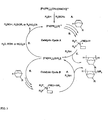
- FIG. 3 shows a schematic of a polymerization mechanism of the present invention
- FIG. 4 shows another schematic of a polymerization mechanism of the present invention
- FIG. 5 shows structures of poly(cyclic)olefin monomers that can be used in the present invention.
- FIG. 6 shows exemplary polymers of the present invention
- FIG. 7 shows a plot of optical density versus weight average molecular weight for HFANB homopolymers
- FIG. 8A shows a photomicrograph of an imaged wafer prepared according to the present invention.
- FIG. 8B shows a photomicrograph of an imaged wafer prepared according to the present invention.
- polymer composition is meant to include a synthesized polymer, as well as residues from initiators, catalysts, and other elements attendant to the synthesis of the polymer, where such residues are understood as not being covalently incorporated thereto. Such residues and other elements considered as part of the polymer composition are typically mixed or co-mingled with the polymer such that they tend to remain with the polymer when it is transferred between vessels or between solvent or dispersion media. Polymer composition also includes materials added after synthesis of the polymer to provide or modify specific properties to the polymer composition.
- the term "low molecular weight” should be taken to mean a polymer with a molecular weight of less than about 20,000 and the term “low OD” should be taken to mean an optical density (OD) of less than about 0.15 at 193 nm (for the homopolymer HFANB, where homopolymers of other monomers will have an analogously low equivalent OD) and less than about 1.5 at 157 nm (for the homopolymer HFANB, where homopolymers of other monomers will have an analogously low equivalent OD).
- embodiments in accordance with the present invention are directed to provide such an alternative method of forming polymers with controllable molecular weight that have desirably low ODs.
- the polymerization step of such embodiments employs non-olefinic chain transfer agents and, thus, does not result in the addition of absorptive terminal groups to eliminate the need for an additional synthetic step.
- An embodiment of the present invention involves a method of polymerizing poly(cyclic)olefin monomers.
- the method includes (a) combining a monomer composition including the poly(cyclic)olefin monomer, a chain transfer agent and an optional activator compound in a reaction vessel to form a mixture; (b) optionally heating the mixture to a first temperature; and (c) adding a polymerization catalyst containing Ni and/or Pd, the catalyst causing the mixture to polymerize.
- the activator is characterized as having an active hydrogen with a pK of at least about 5, in some cases at least about 7 and in other cases at least about 9.
- the activator compound includes an active hydrogen, such as the hydrogen as an -OH group in water, alcohols and/or carboxylic acids.
- the activator compound containing an -OH functional group is selected from water and C 1 -C 24 linear, branched, and cyclic alkyl, aryl, and alkaryl moiety containing at least one hydroxyl group.
- hydrocarbyl refers to a radical of a group that contains only carbon and hydrogen, non-limiting examples being alkyl, aryl, aralkyl, alkaryl, and alkenyl.
- halohydrocarbyl refers to a hydrocarbyl group where at least one hydrogen has been replaced by a halogen.
- perfluorocarbyl refers to a hydrocarbyl group where all of the hydrogens have been replaced by fluorine.
- alkyl refers to a linear or branched acyclic or cyclic, saturated hydrocarbon group having a carbon chain length of, for example, from C 1 to C 25 .
- suitable alkyl groups include, but are not limited to, -(CH 2 ) 3 CH 3 , -(CH 2 ) 4 CH 3 , -(CH 2 ) 5 CH 3 , -(CH 2 ) 10 CH 3 , -(C 2 ) 23 CH 3 and cyclohexyl.
- alkylol refers to alkyl groups that include one or more hydroxyl groups.
- aryl refers to aromatic groups that include, without limitation, groups such as phenyl, biphenyl, benzyl, xylyl, naphthalenyl, anthracenyl and the like, as well as heterocyclic aromatic groups that include, without limitation, pyridinyl, pyrrolyl, furanyl, thiophenyl and the like.
- alkaryl refers to a linear or branched acyclic alkyl group substituted with at least one aryl group, for example, phenyl, and having an alkyl carbon chain length of C 2 to C 25 .
- the aryl group can be further substituted, if desired.
- suitable substituent groups for the aryl group include, among others, hydroxyl groups, benzyl groups, carboxylic acid groups and aliphatic hydrocarbon groups.
- aralkyl refers to an aryl group substituted with at least one linear or branched acyclic alkyl group, for example, phenyl having an alkyl substituent group with a carbon chain length of C 2 to C 25 .
- the aryl group can be further substituted, if desired.
- suitable substituent groups for the aryl group include, among others, hydroxyl groups, benzyl groups, carboxylic acid groups, and aliphatic hydrocarbon groups.
- the alkyl group can be substituted with halogens.
- alkenyl refers to a linear or branched acyclic or cyclic hydrocarbon group having one or more double bonds and having an alkenyl carbon chain length of C 2 to C 25 .
- Suitable non-olefinic chain transfer agent can be used in embodiments of the present invention.
- Suitable chain transfer agents include those that do not result in a terminal unsaturated group in the resulting polymer and those that undergo sigma bond metathesis reactions.
- sigma bond metathesis reactions include replacing a sigma bond ligand, as in the metal catalyst - polymer chain sigma bond ligand, with an incoming sigma bond metathesis reagent, for example reage "G-K". As shown below, this results in a Metal-G bond and a polymer chain terminated with -K:
- the chain transfer agent undergoes sigma bond metathesis and thereby controls the molecular weight of the resulting polymer by terminating the polymer backbone without the introduction of an olefinic group.
- the non-olefinic chain transfer agents of embodiments of the present invention include H 2 , alkylsilanes, alkylalkoxysilanes, alkylgermanes, akylalkoxygermanes, alkylstannanes, alkylalkoxystannanes and mixtures thereof.
- Particular embodiments of the non-olefinic chain transfer agent include dihydrogen (H 2 ) and alkyl silanes.
- alkyl silanes encompassing triethylsilane and tri- i -propylsilane.
- alkyl germanes for example tributylgermanium hydride and alkyl stannanes, such as tributyltin hydride may also be useful.
- Some embodiments in accordance with the present invention are directed to polymers, formed using such a method, that are useful for both positive acting (positive tone) and negative acting (negative tone) photoresist compositions.
- the chain transfer agent is an alkylsilane and/or alkylalkoxysilane selected from HSiR 48 3 , HSi(OR 48 ) 1 R 48 2 , HSi(OR 48 ) 2 R 48 1 , Si(OSiR 49 3 ) 4 , HSi(OSiR 48 3 )R 48 2 , HSi(OSiR 48 3 ) 2 R 48 , Si-H containing cyclotetrasiloxanes, and mixtures thereof, where each occurrence of R 48 is independently selected from linear, branched or cyclic C 1 to C 10 alkyl and each occurrence of R 49 is independently selected from H and linear, branched or cyclic C 1 to C 10 alkyl, where at least one occurrence of R 49 is H.
- Si-H containing cyclotetrasiloxanes refers to compounds according to Formula (A):
- each occurrence of R 49 is independently selected from H and linear, branched or cyclic C 1 to C 10 alkyl, where at least one occurrence of R 49 is H.
- the Si-H containing cyclotetrasiloxane is 1,3,5,7-tetramethylcyclotetrasiloxane.
- Step A the manner in which the silane is thought to react with a palladium procatalyst to create, in situ, a palladium hydride cation stabilized presumably by two phosphine ligands is illustrated (Step A).
- the norbornene monomer reacts with the palladium hydride cation by a coordination insertion mechanism to form a poly(norbomene) chain (Step B).
- Step C An encounter during the polymerization of the palladium complex bearing the polymer chain with the silane chain transfer agent results in chain termination by a ⁇ -bond metathesis reaction with the Si-H moiety of the silane.
- a hydrogen terminated norbornene polymer is formed concomitant with a palladium silane cationic complex (Step C).
- the palladium silane cationic complex is relatively unreactive toward further norbornene monomer insertion.
- this complex is transformed into a palladium hydride cation (Step D).
- a silanol, silyl ether, or silyl ester is created, depending on whether the activator compound is water, an alcohol or a carboxylic acid, respectively.
- the catalytically active species the palladium hydride cation
- the polymerization cycle repeats. See Catalytic Cycle A.
- the palladium silane complex can contribute to the formation of poly(norbornene). See Catalytic Cycle B.
- the norbornene monomer reacts with the palladium hydride cation by a coordination insertion mechanism to form the poly(norbornene) chain (Step E).
- An encounter during the polymerization of the palladium complex bearing the polymer chain with the silane chain transfer agent results in chain termination by a ⁇ -bond metathesis reaction with the Si-H moiety of the silane.
- a silane terminated norbornene polymer is formed concomitant with a palladium silane cationic complex (Step F).
- the overall effect is a highly effective chain transfer process in which norbornene polymers are produced with end groups that are both essentially chemically benign and relatively transparent to imaging radiation (i.e. 193 nm and 157 nm).
- the molecular weight of the resulting polymer is seemingly dependant upon the concentration of the silane chain transfer agent; that is to say that it is observed that the higher the silane concentration, the lower the molecular weight of the poly(norbomene).
- concentration of the activator compound does not seem to impact the molecular weight of the resulting polymer, but rather only seems to increase the activity of the catalyst species.
- FIG. 4 illustrates the manner in which hydrogen (H 2 ) is thought to react with the norbornene polymer chain attached to a palladium cationic complex.
- a hydrogen-terminated poly(norbomene) is formed by ⁇ -bond metathesis of the Pd-C bond (Step A) in the poly(norbomene).
- a palladium hydride cation is formed that can initiate a new poly(norbomene) chain (Step B).
- the molecular weight of the poly(norbornene) is dependant upon the concentration of the hydrogen chain transfer agent; the higher the hydrogen concentration (i.e., pressure), the lower the molecular weight of the poly(norbomene).
- Embodiments in accordance with the present invention include monomers represented by Formula (I). Particular embodiments of the invention are directed to monomers and polymers derived from monomers according to Formulae (I), (Ia), (II), or (III) as described below. Monomers according to Formula (I) are described by: where X is selected from -CH 2 -, -CH 2 -CH 2 , O, S, and -NH-; m.is an integer from 0 to 5; and each occurrence of R 1 , R 2 , R 3 and R 4 is independently selected from one of the following groups:
- the monomer of Formula (I) includes acid labile substituent containing monomers.
- an acid labile substituent or moiety is one that is readily cleavable by a photoacid generator.
- R 1 to R 4 are substituents independently selected from hydrogen, a halogen (i.e., fluorine, chlorine, bromine, and/or iodine), linear or branched (C 1 to C 30 ) alkyls, linear or branched (C 1 to C 24 ) halohydrocarbyls, linear or branched (C 2 to C 30 ) olefins; -(CH 2 ) n OC(O)R', -(CH 2 ) n C(O)OR*, -(CH 2 ) n C(O)OR', -(CH 2 ) n OR, -(CH 2 ) n OC(O)R, -(CH 2 ) n C(O)R
- R can be hydrogen or linear and branched (C 1 to C 10 ) alkyls; R' can be linear and branched (C 1 to C 10 ) alkyl or alkylol, R" can be hydrogen or a halogen (i.e., fluorine, chlorine, bromine, and/or iodine); n and m* are each an integer from 0 to 10; R* represents acid labile moieties (i.e., blocking or protecting groups), for example -C(CH 3 ) 3 , -Si(CH 3 ) 3 , isobornyl, 2-methyl-2-adamantyl, tetrahydrofuranyl, tetrahydropyranoyl, 3-oxocyclohexanonyl, mevalonic lactonyl, dicyclopropylmethyl (Dcpm), and dimethylcyclopropylmethyl (Dmcp) groups that are all exemplary acid labile substituents readily
- At least one of R 1 to R 4 is either a halohydrocarbyl or a perhalocarbyl group.
- halohydrocarbyl means that at least one hydrogen atom on the hydrocarbyl group, e.g., alkyl, alkenyl, alkynyl, cycloalkyl, aryl, and aralkyl groups, is replaced with a halogen atom selected from chlorine, bromine, iodine, fluorine and combinations thereof (e.g., haloalkyl, haloalkenyl, haloalkynyl, halocycloalkyl, haloaryl, and haloaralkyl).
- the halohydrocarbyl groups can contain 1 to 24 carbon atoms.
- fluorohydrocarbyl means that at least one hydrogen atom on the hydrocarbyl group is replaced by fluorine.
- the degree of halogenation can range from at least one hydrogen atom being replaced by a halogen atom (e.g., a monofluoromethyl group) to full halogenation (perhalogenation) wherein all hydrogen atoms on the hydrocarbyl group have been replaced by a halogen atom (e.g., perhalocarbyl such as trifluoromethyl (perfluoromethyl)).
- the fluorinated hydrocarbyl and perfluorocarbyl groups contain, in one embodiment, 1 to 24 carbon atoms.
- the fluorinated hydrocarbyl and perfluorocarbyl groups contain 1 to 12 carbon atoms. In some embodiments, fluorinated hydrocarbyl and perfluorocarbyl groups contain 6 carbon atoms and can be linear or branched, cyclic, or aromatic.
- fluorinated hydrocarbyl and perfluorocarbyl groups include, but are not limited to, fluorinated and perfluorinated linear and branched C 1 -C 24 alkyl, fluorinated and perfluorinated C 3 -C 24 cycloalkyl, fluorinated and perfluorinated C 2 -C 24 alkenyl, fluorinated and perfluorinated C 3 -C 24 cycloalkenyl, fluorinated and perfluorinated C 6 -C 24 aryl, and fluorinated and perfluorinated C 7 -C 24 aralkyl.
- the fluorinated and perfluorocarbyl ether substituents are represented by the formulae -(CH 2 ) q OR ⁇ or -(CF 2 ) q OR ⁇ respectively, wherein R ⁇ is a fluorinated hydrocarbyl or perfluorocarbyl group as defined above and q is an integer from 0 to 5.
- the perhalohydrocarbyl groups include perhalogenated phenyl and alkyl groups.
- the halogenated alkyl groups useful in such embodiments are partially or fully halogenated and are linear or branched, and have the general formula C r X" 2r+1 wherein X" is an independently selected halogen (fluorine, chlorine, bromine and iodine), and r is an integer from 1 to 20.
- R 1 and R 2 can be hydrogen and R 3 and R 4 can be the structure C r X" 2r+1 described above.
- the perfluorinated substituents include perfluorophenyl, perfluoromethyl, perfluoroethyl, perfluoropropyl, perfluorobutyl and perfluorohexyl.
- cycloalkyl, aryl and aralkyl groups of such embodiments can be further substituted with linear and branched C 1 -C 5 alkyl and haloalkyl groups, aryl groups and cycloalkyl groups.
- R** in the poly(cyclic)olefin monomer can be selected from tert-butyl, tert-amyl, 1,1-diethylpropyl, 1-methylcyclopentyl, 1-ethylcyclopentyl, 1-butylcyclopentyl, 1-methylcyclohexyl, 1-ethylcyclohexyl, 1-butylcyclohexyl, 1-ethyl-2-cyclopentenyl, 1-ethyl-2-cyclohexenyl, 2-ethyl-2-adamantyl, trimethylsilyl, triethylsilyl and dimethyl-tert-butylsilyl, 3-oxocyclohexyl, 4-methyl-2-oxooxan-4-yl, and 5-methyl-2-oxooxolan-5-yl.
- m in Formula (I) is 0, R 1 to R 4 and X are as previously defined.
- Non-limiting examples of such monomers include structures A, B, C, E, F, and H in FIG. 5 .
- R 1 is the hydroxy alkyl ether according to Formula (IV)
- R 2 , R 3 , and R 4 are each H in the poly(cyclic)olefin monomer.
- A can be methylene or ethylene
- each occurrence of R 35 can be H
- q can be from 2 to 5
- p can be 0.
- the poly(cyclic)olefin monomer includes HFANB, 5-norbornene-2-methanol hydroxylethylether, t-butyl ester of norbornene 5-carboxylic acid, hydroxyethylester of 5-norbornene carboxylic acid, trimethylsilane ester of 5-norbornene carboxylic acid, 5-norbornene-2-methanol acetate, 5-norbornene-2-methanol, 5-norbornene-2-ethanol, 5-triethoxysilylnorbornene, 1-methylcyclopentyl ester of 5-norbornene carboxylic acid, tetrahydro-2-oxo-3-furanyl ester of 5-norbornene carboxylic acid and mixtures thereof.
- Monomers according to Formula (II) are described by: wherein m is an integer from 0 to 5 and each X is independently -CH 2 -, -CH 2 -CH 2 -, O, S, or NH.
- R 5 to R 8 are each an independently selected neutral substituent selected from H, -(CH 2 ) n -C(O)OR", -(CH 2 ) n -OR', Si(OR') 3 , -(CB 2 ) n -OC(O)R", -(CH 2 ) n -OC(O)OR", -(CH 2 ) n -C(O)R', -(CH 2 ) n C(R*) 2 CH(R*)(C(O)OR**), -(CH 2 ) n C(R*) 2 CH(C(O)OR**) 2 , -C(O)O-(CH 2 ) n -OR' and -(CH 2 ) n n
- cycloaliphatic moieties include, but are not limited to, unsubstituted cyclopropyl, cyclobutyl, cyclopentyl and cyclohexyl groups, as well as 1-adamantyl and 1-norbornene moieties.
- At least one of R 5 to R 8 contains a halohydrocarbyl or perhalocarbyl group as defined above.
- the degree of halogenation can range from one hydrogen atom being replaced by a halogen atom to full halogenation (perhalogenation).
- m in Formula (II) is 0, R 5 to R 8 and X are as previously defined.
- Non-limiting examples of such monomers include structures B, C, D, E, G, and I in FIG. 5 .
- Monomers according to Formula (III) are described by: where m is an integer from 0 to 5, and X represents -CH 2 -, -CH 2 -CH 2 -, O, S, or -NH-.
- At least one of R 9 to R 12 is an independently selected carboxylic acid substituent in accordance with one or more of the formulae -(CH 2 ) q C(O)OH, -(CH 2 ) q C(R 25 ) 2 CH(R 25 )(C(O)OH) or -(CH 2 ) q C(R 25 ) 2 CH(C(O)OH) 2 where q is an integer from 0 to 10 and R 25 can independently be hydrogen, a halogen such as fluorine, chlorine, bromine or iodine, a linear, branched, or cyclic (C 1 to C 10 ) alkyl group or cycloalkyl group or a linear or branched (C 1 to C 10 ) halogenated alkyl group
- R 9 to R 12 can be a linear, branched, or cyclic (C 1 to C 10 ) alkyl group or cycloalkyl group containing one or more non-carboxylic acid substituents containing an active hydrogen having a pKa of about 1 S or less.
- Those of R 9 to R 12 that are not a carboxylic acid substituent are independently selected from hydrogen and linear and branched (C 1 to C 10 ) alkyl or cycloalkyl groups as previously described with respect to R 5 to R 8 .
- m in Formula (III) is 0, R 9 to R 12 and X are as previously defined.
- the groups R 1 to R 4 and R 5 to R 8 in the poly(cyclic)olefin monomers of Formula (I) and Formula (II) are independently selected such that three or more poly(cyclic)olefin monomers are included in the monomer composition. Additionally, the groups R 1 to R 4 and R 9 to R 12 in the poly(cyclic)olefm monomers of Formula (I) and Formula (III) are independently selected such that three or more poly(cyclic)olefin monomers are included in the monomer composition.
- the groups R 1 to R 4 , R 5 to R 8 and R 9 to R 12 in the poly(cyclic)olefin monomers of Formula (I), Formula (II) and Formula (III) are independently selected such that three or more poly(cyclic)olefin monomers are included in the monomer composition.
- the monomer composition can include any one or multiple variations of the poly(cyclic)olefin monomers of Formula (1), Formula (II) and Formula (III).
- Embodiments in accordance with the present invention encompass homopolymers and polymers of monomers in accordance with any of Formulae (I), (Ia), (II), or (III) formed by vinyl addition polymerization using a catalyst containing a metal from Group 10 of the periodic table of the elements.
- a catalyst containing a metal from Group 10 of the periodic table of the elements In an embodiment of the invention, Ni or Pd containing catalysts, optionally an activator such as an alcohol as described above, and dihydrogen (H 2 ), alkyl and/or alkoxy substituted silanes, as described above, or other reagents that can undergo sigma bond metathesis reactions as chain transfer agents are used.
- the poly(cyclic)olefin monomers used to make the polymers of the present invention include one or more of those shown in FIG. 5 .
- the polymers of the present invention are particularly useful in resist compositions and have a particularly low optical density (OD), especially at wavelengths of 193 nm and below.
- Exemplary polymers of embodiments in accordance with the present invention include, but are not limited to, the structures depicted in Formulae A through G in FIG. 6 .
- Other polymers in accordance with embodiments of the present invention include such polymers as can be formed from a monomer selected from each of Formulae (I), (Ia), (II), or (III) as depicted and described above.
- An embodiment of the present invention is directed to an unsaturated monomer that can be used in the above-described polymerization method.
- the monomer includes those described above by Formula (Ia) where X and m are as described in Formula (I) and, R 13 , R 14 , R 15 and R 16 are as described above with the proviso that at least one of R 13 , R 14 , R 15 and R 16 includes the hydroxyalkylether of Formula (IVa): -A-O-[-(CR 35 2 -) t -O-] s -(CR 17 2 -) t -OH (IVa) where A, R 17 , R 35 ,t and s are as defined above.
- a non-limiting example of a monomer according to Formula (Ia) is structure D in FIG. 5 .
- X can be methylene or ethylene, each occurrence of R 17 can be H, and s can be 0; all other variables are as defined above.
- An additional embodiment of the invention provides a polymer including repeat units derived from monomers according to Formula (I), where each of R 13 , R 14 , R 15 and R 16 are independently selected from H and a group according to Formula (VI): -(CH 2 ) n -C(O)-O-R 18 (VI) where R 18 is selected from H; and linear, branched or cyclic C 1 -C 24 alkyl, aryl, aralkyl, and alkaryl and is free ofhydroxy alkyl ether groups according to Formulae (IV) or (IVa).
- An exemplary embodiment of the invention provides a polymer as shown by structure B in FIG. 6 , which includes repeat units of Formula (VII),
- each of R 13 , R 14 , R 15 and R 16 are independently selected from H and a group according to Formula (IV) described above and Formula (VIII): -CH 2 -C(CY 3 ) 2 -OH (VIII) where Y is selected from F and Cl and at least one occurrence of Y is F.
- VIII Formula (IV) described above and Formula (VIII): -CH 2 -C(CY 3 ) 2 -OH (VIII) where Y is selected from F and Cl and at least one occurrence of Y is F.
- a polymerization catalyst containing a metal from Group 10 of the periodic table of the elements, in some cases Ni and/or Pd, is added to the monomers causing the mixture to polymerize.
- the catalyst is a single component procatalyst.
- the polymerization catalyst includes a procatalyst and a co-catalyst.
- Exemplary embodiments of the invention utilize palladium or nickel catalyst complexes.
- the palladium complexes are neutral and contain Group 15 ligands accompanied by salts of weakly coordinating anions as disclosed in U.S. Patent No. 6,455,650 , incorporated herein by reference.
- Other palladium complexes are cationic and are ligated by Group 15 ligands where a weakly coordinating anion is incorporated therein to balance any charge.
- nickel complexes are employed, such encompass an organonickel complex cation and a weakly coordinating counteranion.
- Exemplary cationic nickel complexes are described in U. S. Patent No. 5,468,819 , the pertinent parts of which are incorporated herein by reference.
- Other nickel complexes that are employed are neutral and contain electron withdrawing ligands.
- Exemplary neutral nickel complexes are described in U. S. Patent No 6,232,417 , the pertinent parts of which are incorporated herein by reference.
- Particular embodiments of the invention utilize one or more catalysts selected from trans -[Pd(NCMe)(OAC)(P( i -propyl) 3 ) 2 ]B(C 6 F 5 ) 4 , trans -[Pd(NCC(CH 3 ) 3 )(OAc)(P( i -propyl) 3 ) 2 ]B(C 6 F 5 ) 4 , trans -[Pd(OC(C 6 H 5 ) 2 )(OAc)(P( i -propyl) 3 ) 2 ]B(C 6 F 5 ) 4 , trans -[Pd(HOCH(CH 3 ) 2 )(OAC)(P( i -propyl) 3 ) 2 ]B(C 6 F 5 ) 4 , trans -[Pd(NCMe)(OAc)(P(cyclohexyl) 3 ) 2 ]B(C 6 F 5 ) 4 , Pd(OAc) 2
- the catalyst complex is represented by: [(E(R) 3 ) 2 Pd(Q) 2 ] (IX)
- the catalyst complex is represented by: [(E(R) 3 ) 2 Pd(Q)(LB)][WCA] (X)
- E(R) 3 represents a Group 15 neutral electron donor ligand wherein E is selected from a Group 15 element of the Periodic Table of the Elements, and R independently represents hydrogen or an anionic hydrocarbyl containing moiety containing from 1 to 30, in some cases 1 to 10 carbon atoms;
- Q represents an anionic ligand selected from a carboxylate, thiocarboxylate, and dithiocaiboxylate group that can contain from 1 to 30, in some cases 2 to 10 carbon atoms;
- LB represents a Lewis base;
- WCA represents a weakly coordinating anion.
- salts of weakly coordinating anions are added.
- salts of weakly coordinating anions can be added to increase catalyst activity.
- WCA weakly coordinating anion
- the term "weakly coordinating anion” refers to an anion which is generally only weakly coordinated to the palladium cation. It is sufficiently labile to be displaced by solvent or monomer. More specifically, the WCA anion functions as a stabilizing anion to the palladium cation and does not transfer to the cation to form a neutral product.
- the WCA anion is relatively inert in that it is non-oxidizing, non-reducing, and non-nucleophilic.
- a neutral electron donor is any ligand which when removed from the palladium metal center in its closed shell electron configuration, has a neutral charge.
- an anionic hydrocarbyl moiety is any hydrocarbyl group which when removed from the Group 15 element, E, in its closed shell electron configuration, has a negative charge.
- a Lewis base is a donor of electron density (i.e., a pair of electrons).
- E is selected from nitrogen, phosphorus, arsenic and antimony, and the anionic hydrocarbyl containing moiety, R, is independently selected from, but not limited to, linear and branched (C 1 -C 20 ) alkyl, (C 3 -C 12 )cycloalkyl, (C 2 -C 12 ) alkenyl, (C 3 -C 12 ) cycloalkenyl, (C 5 -C 20 ) polycycloalkyl, (C 5 -C 20 ) polycycloalkenyl, and (C 6 -C 12 ) aryl, and two or more R groups taken together with E can form a heterocyclic or heteropolycyclic ring containing 5 to 24 atoms.
- Representative heteroatoms in addition to those defined by E include, but are not limited to, oxygen and nitrogen.
- Representative alkyl groups include, but are not limited to, methyl, ethyl, propyl, isopropyl, n-butyl, isobutyl, sec-butyl, tert-butyl, pentyl, and neopentyl.
- Representative alkenyl groups include, but are not limited to, vinyl, allyl, iso-propenyl, and iso-butenyl.
- Representative cycloalkyl groups include, but are not limited to, cyclopropyl, cyclobutyl, cyclopentyl, cyclohexyl, and cyclooctyl.
- Representative polycycloalkyl groups include, but are not limited to, norbornyl and adamantyl.
- Representative polycycloalkenyl groups include, but are not limited to, norbornenyl and adamantenyl.
- Representative aryl and aralkyl groups include, but are not limited to, phenyl, naphthyl and benzyl.
- the Group 15 neutral electron donor ligand is selected from a phosphine.
- Representative phosphine ligands include, but are not limited to trimethylphosphine, triethylphosphine, tri-n-propylphosphine, tri-isopropylphosphine, tri- n -butylphosphine, and tri- sec -butylphosphine.
- Other suitable phosphine ligands are exemplified in U.S. No. 6,455,650 , the pertinent portion of which is herein incorporated by reference.
- diphosphine chelating ligands include, but are not limited to, bis(dicyclohexylphosphino)methane; 1,2-bis(dicyclohexylphosphino)ethane; 1,3-bis(dicyclohexylphosphino)propane; 1,4-bis(dicyclohexylphosphino)butane; and 1,5-bis(dicyclohexylphosphino)pentane.
- Other suitable diphosphine ligands are exemplified in U.S. No. 6,455,650 , the pertinent portion of which is herein incorporated by reference.
- the anionic carboxylate, thiocarboxylate and dithiocarboxylate ligands defined under Q in combination with the palladium metal center can be unidentate, symmetric bidentate, asymmetric chelating bidentate, asymmetric bridging or symmetric bridging ligands.
- Lewis bases in accordance with the present invention can be any compound that donates an electron pair.
- the Lewis base can be water or selected from the following type of compounds: alkyl ethers, cyclic ethers, aliphatic or aromatic ketones, primary alcohols, nitriles, cyclic amines especially pyridines and pyrazines, and trialkyl or triaryl phosphines.
- Exemplary Lewis base ligands include, but are not limited to, water, dimethyl ether, diethyl ether, tetrahydrofuran, dioxane, acetone, benzophenone, acetophenone, methanol, isopropanol, acetonitrile, benzonitrile, tert-butylnitrile, tert-butylisocyanide, xylylisocyanide, pyridine, dimethylaminopyridine, 2,6-dimethylpyridine, 4-dimethylaminopyridine, tetramethylpyridine, 4-methylpyridine, pyrazine, tetramethylpyrazine, triisopropylphosphite, triphenylphosphite, and triphenylphosphine oxide.
- Phosphines can also be included as exemplary Lewis bases so long as they are added to the reaction medium during the formation of the single component procatalyst of the invention.
- Lewis base phosphines include, but are not limited to, triisopropylphosphine, tricyclohexylphosphine, tricyclopentylphosphine and triphenylphosphine.
- the WCA of Formula (X) is selected from borates and aluminates, boratobenzene anions, carborane, halocarborane and phosphaborane anions.
- Representative borate anions include, but are not limited to, tetrakis(pentafluorophenyl)borate (FABA), tetrakis(3,5-bis(trifluoromethyl)phenyl)borate and tetrakis(2-fluorophenyl)borate.
- FABA tetrakis(pentafluorophenyl)borate
- Other useful weakly coordinating anions for example other borates and aluminates, boratobenzene anions, carborane, halocarborane and phosphaborane anions, can be found in U. S. Patent No. 6,455,650 , the pertinent potions of which are incorporated herein by reference.
- Exemplary salts of weakly coordinating anions are N,N-dimethylanilinium tetrakis(pentafluorophenyl)borate (DANFABA) and lithium tetrakis(pentafluorophenyl)borate 2.5 diethyletherate (LiFABA), among others.
- DANFABA N,N-dimethylanilinium tetrakis(pentafluorophenyl)borate
- LiFABA lithium tetrakis(pentafluorophenyl)borate 2.5 diethyletherate
- the neutral nickel catalyst complex is represented by: [LnNi(R ewg ) 2 ] (XI)
- n is an integer of 0, 1, or 2.
- L is represented by a monodentate or bidentate ligand.
- monodentate ligands include, but are not limited to, ⁇ -arenes such as toluene, benzene and mesitylene; ethers such as tetrahydrofuran, dioxane, or diethylether; esters such as ethylacetate, methylacetate, or propylacetate.
- An example of a bidentate ligand is 1,2-dimethoxyethane.
- R ewg is represented by an electron withdrawing ligand advantageously selected from perhaloalkyl, perhaloaryl and perhaloalkaryl ligands.
- perhaloalkyl ligands are selected from trifluoromethyl and perfluoroethyl; perhaloaryl ligands are selected from perfluorophenyl and perchlorophenyl; perhaloalkaryl ligands are selected from 2,4,5-tris(trifluoromethylphenyl).
- n a representative neutral catalyst that contains no other ligands other than the electron withdrawing ligand is nickel(2,4,6-trifluoromethylphenyl) 2 .
- n 1, a representative neutral catalyst is nickel( ⁇ 6 -toluene)(pentafluorophenyl) 2 .
- n 2, a representative neutral catalyst is nickel (tetrahydrofuran) 2 (pentafluorophenyl) 2 .
- the cationic nickel catalyst complex is represented by: [L' y NiX z ] WCA (XII)
- L' represents a ligand containing 1, 2, or 3 olefinic ⁇ bonds
- X represents a ligand containing 1 Ni C ⁇ bond and between 0-3 olefinic ⁇ bonds
- y is 0, 1, or 2 and z is 1 or 2 and wherein y and z cannot both be 0 at the same time.
- L' represents a neutral ligand that is weakly coordinated to the nickel.
- the ligand is relatively inert and is readily displaced from the metal cation complex by the inserting monomer in the growing polymer chain.
- Suitable ligands include (C 2 to C 1 2) monoolefinic (e.g., 2,3-dimethyl-2-butene), diolefinic (C 4 -C 12 ) (e.g., norbornadiene) and (C 6 to C 20 ) aromatic moieties.
- ligand L' is a chelating bidentate cyclo(C 6 to C 12 ) diolefin, for example cyclooctadiene or dibenzo cyclooctadiene, or an aromatic compound such as benzene, toluene, or mesitylene;
- X is a single allyl ligand or a canonical form thereof, which provides a ⁇ and a ⁇ bond; and WCA is a weakly coordinating anion as described above.
- Additional complexes in accordance with Formula (XII) include, but are not limited to, [(allyl)Ni(1,4-cyclooctadiene)]PF 6 , [(crotyl)Ni(1,4-cyclooctadiene)]PF 6 and [(allyl)Ni(1,4-cyclooctadiene)]SbF 6 .
- any suitable method can be used to remove metals from the polymers and compositions containing the polymers of the present invention.
- the metals can be removed using carbon monoxide, in some cases in the presence of a protic solvent such as an alcohol, moisture, or a carboxylic acid.
- a protic solvent such as an alcohol, moisture, or a carboxylic acid.
- the mixture including the monomer composition, the chain transfer agent and the activator compound is exposed to a temperature at which the above-described catalysts can effect polymerization of the monomers.
- the temperature can be ambient temperatures and above.
- the mixture is heated to a temperature sufficient to effect polymerization, of at least 30°C, in some cases at least 75°C, and in other cases at least 125°C. In some instances, when the temperature is too low, polymerization is incomplete and/or too slow. Therefore, in some embodiments, the temperature employed is from about 100°C to 250°C or higher.
- embodiments of the invention are directed to positive tone and negative tone photoresist compositions.
- certain types of polymers that include repeat units that are derived from monomers represented by Formula (I) can be used.
- Such polymers are referred to herein as negative tone imaging polymers and include polymers that encompass monomers according to Formula (I) that contain a functional group that is capable of being cured and/or crosslinking with another group that is reactive with the functional group of the negative tone imaging polymer (for example a functional group on a crosslinking agent).
- Suitable functional groups include, but are not limited to hydroxyl, carboxylic acid and epoxy groups.
- the negative tone imaging polymers include, but are not limited to polymers prepared using monomers according to Formula (I), where the functional groups in the negative tone imaging polymers are selected from a hydroxy alkyl ether according to Formula (IV), where A, R 35 , q and p are as defined above; a group according to Formula (V), where R 36 and Z are as defined above; a group according to -(CH 2 ) n -C(CY 3 ) 2 -OH, where n and Y are as defined above; a group according to -(CH 2 ) n C(O)OR* where n and R* are as defined above, and a -(CH 2 ) 2 -C(CF 3 ) 2 -O-(CH 2 ) z -CO-(OR # ) group, where z is an integer from 1 to 6 and R # is C 1 -C 6 linear or branched alkyl.
- the negative tone photoresist compositions of the present invention have a particularly low optical density (OD), especially at wavelengths of 193nm and below.
- the crosslinking agent (C) of the negative tone photoresist composition is a compound which is capable of reacting with functional groups, as a non-limiting example hydroxyl groups, of the polymer in (D). Further to this embodiment, the crosslinking agent (C) can be activated by an acid generated by the photoacid generator (B).
- crosslinking agents examples include, but are not limited to, compounds containing one or more groups selected from methylol, alkoxyalkyl and carboxymethyl group substituted phenols; methylol, alkoxyalkyl and carboxymethyl group substituted cyclic ureas; methylol, alkoxyalkyl and carboxymethyl group substituted melamines; and methylol, alkoxyalkyl and carboxymethyl group substituted benzoguanine compounds.
- the photoacid generator (B) is a compound that, upon exposure to radiation, generates a strong acid.
- exemplary photoacid generators (B) that can be used in the invention include, but are not limited to, one or more compounds selected from triflates, pyrogallols, onium salts, hexafluoroarsenates, trifluoromethanesulfonates, esters of hydroxyimides, ⁇ , ⁇ '-bis-sulfonyl-diazomethanes, sulfonate esters of nitro-substituted benzyl alcohols and napthoquinone-4-diazides.
- the triflates include triphenylsulfonium triflate; the pyrogallols include trimesylate of pyrogallol; and the onium salts include one or both of triarylsulfonium and diaryliodium hexafluoroantimonates.
- the solvent (A) includes one or more solvents selected from propylene glycol methyl ether acetate, cyclohexanone, butyrolactate and ethyl lactate.
- FIG. 7 A comparison of the OD as a function of Mw of polymers made using olefinic chain transfer agents and the OD of polymers made using dihydrogen and triethylsilane as chain transfer agents as in the present invention is presented in FIG. 7 below.
- This figure shows data comparing the increase of OD as molecular weight decreases for polymers made using olefinic chain transfer agents with the OD of several polymers made using dihydrogen and triethylsilane non-olefinic chain transfer agents in accordance with embodiments of the present invention. It is readily apparent that polymers made using dihydrogen or triethylsilane as chain transfer agents give substantially lower ODs, and that the OD of these polymers is unrelated to molecular weight.
- positive tone photoresist compositions For positive tone photoresist compositions, another class of polymers that include repeat units that are derived from monomers represented by Formula (I) can be used. Such polymers are referred to herein as positive tone imaging polymers and include polymers that encompass monomers according to Formula (I) that contain a group that can be cleaved when exposed to radiation, rendering the polymer more soluble to a developer than the unexposed polymer.
- An embodiment of the present invention provides a positive tone photoresist composition that includes the above-described positive tone imaging polymers.
- the positive tone resist compositions of the present invention have a particularly low optical density (OD), especially at wavelengths of 193nm and below.
- the positive tone photoresist composition includes a solvent; a photosensitive acid generator; and one or more positive tone imaging polymers derived from poly(cyclic)olefin monomers, where the polymer contains a functional group containing moiety that contains a group that can be cleaved when exposed to radiation, rendering the polymer more soluble to a developer than the unexposed polymer.
- Another embodiment of the invention is directed to a method of generating an image (positive or negative tone resist image) on a substrate.
- the method includes (a) coating a substrate with a film containing, as appropriate, the negative tone photoresist composition or positive tone photoresist composition described above to form a film; (b) imagewise exposing the film to radiation to form an image; and (c) developing the image.
- the substrate includes one or more of silicon, ceramics, and polymers.
- the film is coated on the substrate in (a) using one or more methods selected from spin coating, spray coating, and doctor blading.
- this embodiment can provide that before the film has been exposed to radiation in (b), the film is heated to from 90°C to 150°C for from 30 seconds to 5 minutes.
- the film can be imagewise exposed from a radiation source selected from mercury lamps, mercury/xenon lamps, xenon lamps, argon fluoride lasers, krypton fluoride lasers, fluorine lasers, x-rays and electron beams.
- the film is imagewise exposed at a wavelength of from 90 nm to 514 nm.
- the film after the film has been exposed to radiation, the film can be heated to a temperature of from 90°C to 150°C for from 30 seconds to 5 minutes.
- the negative tone image is developed with a non-aqueous solvent.
- Suitable solvents include, but are not limited to one or more solvents selected from propylene glycol methyl ether acetate, cyclohexanone, butyrolactate, and ethyl lactate.
- An embodiment of the invention provides an integrated circuit assembly method encompassing (a) coating a substrate with appropriately the negative tone photoresist composition or positive tone photoresist composition described above to form a film; (b) imagewise exposing the film to radiation to form an image; (c) developing the image in the film where selected portions of the substrate are exposed; and (d) transferring the developed image to the substrate. Further, this embodiment extends to an integrated circuit chip, multichip module, or circuit board including the integrated circuit provided by the above-described method.
- Suitable solvents that can be used to develop the present positive tone images include, but are not limited to an aqueous base, in many cases an aqueous base without metal ions such as tetramethyl ammonium hydroxide or choline.
- the composition of the present invention provides positive images with high contrast and straight walls.
- the dissolution property of the composition of the present invention can be varied by simply varying the composition of the polymer.
- circuit patterns can be formed in the exposed areas by coating the substrate with a conductive material such as conductive metals by art known techniques such as evaporation, sputtering, plating, chemical vapor deposition, or laser induced deposition.
- a conductive material such as conductive metals
- art known techniques such as evaporation, sputtering, plating, chemical vapor deposition, or laser induced deposition.
- the surface of the film can be milled to remove any excess conductive material.
- Dielectric materials may also be deposited by similar means during the process of making circuits.
- Inorganic ions such as boron, phosphorous, or arsenic can be implanted in the substrate in the process for making p or n doped circuit transistors. Other means for forming circuits are well known to those skilled in the art.
- Ratios of repeating units incorporated into the polymer backbones are given in molar weight percent.
- Catalyst synthesis examples 1 to 5 illustrate the formation of some catalysts useful in embodiments of the present invention.
- Catalyst Example 2 trans -[Pd(NCC(CH 3 ) 3 )(OAc)(P( i -propyl) 3 ) 2 ]B(C 6 F 5 ) 4
- the suspension was stirred for 5 h, diluted with toluene (100 mL), and then filtered through a 1 ⁇ 4 inch pad of Celite® filtering aid to remove the lithium acetate by-product.
- the yellow/orange filtrate was concentrated in vacuo to a golden syrup consistency, washed with a 1:5 v/v mixture of ether and pentane (2 x 300 mL), pentane (2 x 300 mL), and concentrated using the rotary evaporator (35°C).
- the molecular weight of the resulting polymer was determined using GPC methods in THF with a poly(styrene) standard. Further, it should be noted that the examples are presented in such a manner as to illustrate the effect of the non-olefinic chain trans fer agents and/or activator materials on the resulting polymers. Therefore, for ease of illustration and understanding of these effects, Examples 1-82 are directed to the forming a homopolymer. While such homopolymers can be useful, Examples 85-109 are directed to polymers that encompass more than one type of repeat units. Such polymers are useful in positive tone and negative tone embodiments of the present invention.
- Toluene (171 mL), HFANB (100 g, 365 mmol), ethanol (2.30 mL, 40.5 mmol), and triethylsilane (5.80 mL, 36.5 mmol, 9 mol percent of the monomer used) were placed into a vial equipped with a TEFLON® coated stirbar and sealed with a septum cap. The mixture was sparged with nitrogen for 15 min then heated to 80°C.
- Example 1 The method of Example 1 was repeated in each of Examples 2-5, except that the amount of triethylsilane was changed as indicated in Table 1 along with the resulting yields, molecular weights, and optical densities of the polymer films at 193 nm. It should be observed that the polymer's molecular weight is inversely proportional to the mol% of triethylsilane employed.
- HFANB 10.97 g, 0.04000 mol
- ethanol (0.20 g, 0.0044 mol)
- triethylsilane (0.46 g, 0.0040 mol, 9 mol percent of the monomer used)
- 1.5 mL of a 0.0032 M solution of DANFABA in methylene chloride were placed into a vial equipped with a TEFLON® coated stirbar.
- the total volume was increased to 27 mL by the addition of toluene and the vial was sealed with a septum cap.
- the mixture was heated to 80°C. Once temperature was reached, 1.5 mL of a 0.0016 M solution of Catalyst Example 1 in methylene chloride was added to the monomer reaction mixture.
- the mixture was stirred for 17 h.
- the mixture was then cooled to room temperature and poured into hexane to precipitate the polymer, filtered, and dried in a vacuum oven at 80°C. Yield 8.12 g (74%).
- the activity of the palladium catalyst was determined by dividing the number of grams of polymer isolated by the number of grams of palladium employed in the reaction.
- Example 6 The procedure of Example 6 was repeated except that the amounts of catalyst and DANFABA used were changed as indicated by the ratio of monomer to catalyst to WCA shown in Table 2. The resulting yields, molecular weights, and catalyst activities of these experiments are listed in Table 2. Table 2 Effect of decreasing catalyst loading on polymerization activity, polymer yield, and molecular weight Ex.
- HFANB 8.23 g, 0.0300 mol
- 0.0048 g of DANFABA 0.00600 mmol
- 0.520 g of tri-i-propylsilane 3.33 mmol
- the total volume was increased to 20 mL by the addition of toluene and the vial was sealed with a septum cap.
- HFANB 8.23 g, 0.0300 mol
- 0.0481 g of DANFABA 0.100 g
- tripropylsilane 0.100 g
- the total volume was increased to 20 mL by the addition of toluene and the vial was sealed with a septum cap.
- HFANB 8.23 g, 0.0300 mol
- 0.0481 g of DANFABA 0.0481 g
- pentamethyldisiloxane 7.50 mmol, 20 mol percent of the monomer used
- the total volume was increased to 20 mL by the addition of toluene and the vial was sealed with a septum cap.
- the mixture was heated to 80°C. Once temperature was reached, 1.0 mL of a 0.012 M solution of Pd(acetate) 2 (tricyclohexylphosphine) 2 in toluene was added to the monomer reaction mixture.
- HFANB (5.00 g, 0.0182 mol) is weighed into a glass vial and combined with 1.8 mL of a stock solution of DANFABA (0.0032 g, 0.0040 mmol in 2 mL of toluene). To this solution is added 7 mL of toluene. The mixture is added to a glass pressure vessel and charged with hydrogen gas to 20 psig and heated to 80°C for one hour. To this mixture is added 0.7 mL of a stock solution of trans -bis(di-isopropylphenylphosphine)palladium diacetate (0.0012 g, 0.0020 mmol in 2-mL of toluene). The mixture is stirred for 18 h.
- Example 29 was repeated but with increased pressure of hydrogen (90 psig). The resulting yields and molecular weights are presented in Table 8. Optical density measurements are also given in Table 8. Table 8 Polymerization of HFANB in the presence of increasing hydrogen pressure
- Example H 2 Pressure Yield Mw Mn Mw/Mn Optical Density (193 nm) 26 0 psig 92% 1,500,000 660000 2.27 0.10 27 20 psig 89% 22900 9900 2.32 0.04 28 30 psig 86% 18100 8450 2.15 0.03 29 50 psig 76% 13500 5700 2.37 0.03 30 90 psig 70% 12200 6630 1.84 0.02
- HFANB 10.97 g, 0.04000 mol
- ethanol (0.10 g, 0.0021 mol, 5 mole percent of the monomer used)
- triethylsilane (0.46 g, 0.0040 mol, 9 mol percent of the monomer used)
- 1.0 mL of a 0.002 M solution of DANFABA in methylene chloride were placed into a vial equipped with a TEFLON® coated stirbar.
- the total volume was increased to 27 mL by the addition of toluene and the vial was sealed with a septum cap.
- HFANB 10.97 g, 0.04000 mol
- methanol (0.14 g, 0.0043 mol, 10 mole percent of the monomer used)
- triethylsilane (0.46 g, 0.0040 mol, 9 mole percent of the monomer used)
- 1.0 mL of a 0.002 M solution of DANFABA in methylene chloride were placed into a vial equipped with a TEFLON® coated stirbar.
- the total volume was increased to 27 mL by the addition of toluene and the vial was sealed with a septum cap.
- the mixture was heated to 80°C.
- the OD and Mw data are plotted in FIG. 7 . These polymers exhibit very low OD at 193 nm. The OD values are independent of molecular weight.
- the polymer was precipitated by dropwise addition to rapidly stirring hexanes (100 mL) and isolated by filtration. The resulting polymer was air-dried 3 hours and then for 15 h at 65°C in vacuo to afford 1.3 g (54 %).
- the polymer was precipitated by dropwise addition to rapidly stirring hexanes (100 mL) and isolated by filtration. The resulting polymer was air-dried 3 hours and then for 15 h at 65°C in vacuo to afford 1.1 g (46 %).
- Exo isomer 6.08 (m, 1H); 6.02 (m, 1H); 3.70 (t, 2H); 2.80 (s, 1H); 2.54 (s, 1H); 1.65 (m, 2H); 1.45 (m, 2H); 1.27 (m, partially obscured by endo isomer, 1H); 1.25 (m, partially obscured by endo isomer, 1H); 1.11 (d of t, 1H). Endo/exo ratio by 1H NMR was determined to be 80/20.
- Synthesis Example 84 Synthesis of 5-norbornene-2-methanol hydroxylethyl ether.
- Exo isomer 6.10 (m, 1H); 6.07 (m, 1H); 3.75 (t, 2H); 3.36 (m, 2H); 3.50 (t, 1H); 3.40 (t, 1H); 2.80 (s, 1H); 2.74 (s, 1H); 2.09 (br s, 1H); 1.71 (m, 1H); 1.33 (d, 1H), 1.30 (d, 1H); 1.24 (m, partially obscured by endo isomer, 1H); 1.11 (d of t, 1H). Endo/exo ratio by 1 H NMR was determined to be 82/18.
- HFANB 7.07 g, 0.0258 mol
- 5-norbornene-2-methanol hydroxyethyl ether (0.71 g, 0.0042 mol)
- 0.0481 g of DANFABA 0.600 mmol
- the total volume was increased to 20 mL by the addition of toluene and propylene glycol methyl ether (90:10 volumetric ratio) and the vial was sealed with a septum cap. The mixture was heated to 80°C.
- HFANB 7.40 g, 0.0270 mol
- 0.550 g of hydroxyethyl ester of 5-norbornene carboxylic acid 0.00300 mol
- 1.7 mL of a 0.0045 M methylene chloride solution of DANFABA 0.29 g of dimethyl ethyl silane (3.30 mmol, 10 mol percent of the monomer used)
- the total volume was increased to 20 mL by the addition of toluene and the vial was sealed with a septum cap.
- the mixture was heated to 80°C.
- HFANB (16.5 g, 0.0602 mol), hydroxyethyl ester of 5-norbornene carboxylic acid (2.05 g, 0.0113 mol), trimethylsilane ester of 5-norbornene carboxylic acid (0.80 g, 0.0038 mol), and 0.120 g DANFABA (0.150 mmol) were weighed into a glass pressure reactor and combined with sufficient toluene to make a total reaction mixture of 50 mL. The vessel was charged with hydrogen gas to 10 psig and heated to 80°C. The hydrogen gas was relieved and to this mixture was added 0.0235 g of trans -bis(tricyclohexylphosphine) palladium diacetate (0.0300 mmol).
- HFANB 65.8 g, 0.240 mol
- hydroxyethyl ester of 5-norbornene carboxylic acid (8.20 g, 0.0450 mol)
- trimethylsilane ester of 5-norbornene carboxylic acid (3.19 g, 0.0150 mol)
- 0.481 g DANFABA (0.600 mmol
- HFANB (74.9 g, 0.273 mol), hydroxyethylester of 5-norbornene carboxylic acid (4.92 g, 0.0270 mol), and 0.481 g DANFABA (0.600 mmol) were weighed into a glass pressure reactor and combined with sufficient toluene to make a total reaction mixture of 200 mL.
- the vessel was sparged with hydrogen gas for 15-20 minutes and then charged with 90 psig hydrogen. The mixture was heated to 80°C. The hydrogen gas was relieved and to this mixture was added 0.0735 g of trans -bis(di-i-propylphenylphosphine) palladium diacetate (0.120 mmol) in toluene. The mixture was stirred for 18 h.
- the composition of the polymer was determined to be 90:10 molar ratio of HFANB and hydroxyethyl ester of 5-norbornene carboxylic acid by 13 C NMR spectrometry. The optical density of this polymer at 193 nm was determined to be 0.15 absorbance units/micron.
- This example demonstrates the copolymerization of 1-methylcyclopentyl ester of 5-norbornene carboxylic acid (MCPNB), tetrahydro-2-oxo-3-furanyl ester of 5-norbornene carboxylic acid (BuLacEsNB), and HFANB using [Pd(NCMe)(OAc)(P(cyclohexyl) 2 (t-butyl)) 2 ]B(C 6 F 5 ) 4 at a ratio of MCPNB:BuLacEsNB:HFANB 40:50:10.
- the copolymer can be used in positive tone compositions.
- the yellowish filtrate was added to hexane (10-fold volumetric excess) to precipitate the polymer.
- the polymer was filtered and dried at 85°C in a vacuum oven overnight.
- the polymer was redissolved in 100 mL of a 50:50 mixture by volume of THF and methanol. The solution was added to methanol (10-fold volumetric excess).
- the precipitated polymer was filtered and dried at 85°C in a vacuum oven overnight. Yield 39.6 g (44%).
- the molar ratio of MCPNB, BuLacEsNB, HFANB, and 5-norbornene carboxylic acid was 29:49:9:13 according to 13 C NMR measurements.
- This example demonstrates the copolymerization of MCPNB, BuLacEsNB and HFANB using [Pd(NCMe)(OAc)(P(cyclohexyl) 2 (t-butyl)) 2] B(C 6 F 5 ) 4 at a ratio of MCPNB:BuLacEsNB:HFANB 35:50:15.
- the copolymer can be used in positive tone compositions.
- This example demonstrates the copolymerization of MCPNB and BuLacEsNB using [Pd(NCMe)(OAc)(P(cyclohexyl) 2 (t-butyl)) 2 ]B(C 6 F 5 ) 4 at a 50:50 ratio.
- the monomers, MCPNB (24.9 g, 0.113 mol) and BuLacEsNB (25.1 g, 0.113 mol), as well as triethylsilane (1.39 g, 0.0119 mol) and 100 mL of toluene were added to a vial equipped with a TEFLON® stir bar. The vial was sealed. The mixture was sparged with nitrogen for 15 m. The mixture was heated to 80°C.
- the mixture was cooled, drained from the reactor and filtered through a 1.0 and a 0.22 micron filter to remove black palladium metal.
- the filtrate was concentrated using a rotary evaporator and then added to a 10-fold volumetric excess of a methanol/THF mixture (90:10 by volume).
- the molar ratio of 1-methylpentyl ester of 5-norbornene carboxylic acid, tetrahydro-2-oxo-3-furanyl ester of 5-norbornene carboxylic acid and 5-norbornene carboxylic acid was 43:49:8 according to 13 C NMR measurements.
- This example demonstrates the copolymerization of MCPNB and BuLacEsNB using [Pd(NCMe)(OAc)(P(cyclohexyl) 2 (t-butyl)) 2 ]B(C 6 F 5 ) 4 at a 70:30 ratio.
- the monomers, MCPNB (34.9 g, 0.159 mol) and BuLacEsNB(15.1 g, 0.068 mol), as well as triethylsilane (1.39 g, 0.0119 mol) and 100 mL of toluene were added to a vial equipped with a TEFLON® stir bar. The vial was sealed. The mixture was sparged with nitrogen for 15 m. The mixture was heated to 80°C.
- the mixture was allowed to react for 18 h, after which time the mixture was cooled.
- the solution was further diluted with THF and methanol (16 volume percent each).
- the resulting solution was added to a stainless steel pressure vessel and was treated with carbon monoxide (120 psig) for 7 h at 50°C.
- the mixture was cooled, drained from the reactor and filtered through a 1.0 and a 0.22 micron filter to remove black palladium metal.
- the filtrate was concentrated using a rotary evaporator and then added to a 10-fold volumetric excess of a methanol/THF mixture (90:10 by volume).
- the polymer was filtered and washed twice with methanol. Yield 33.3 g (67%).
- the molar ratio of MCPNB, BuLacEsNB and 5-norbornene carboxylic acid was 61:30:9 according to 13 C NMR measurements.
- Examples 107-109 show that triethylsilane effectively controls the molecular weight of polymer compositions made with the neutral nickel catalyst, ( ⁇ 6 -toluene)Ni(C 6 F 5 ) 2 .
- the water phase was discarded and the organic phase was washed with water.
- the organic phase was separated from the water phase and added to hexane to precipitate the polymer.
- the polymer was isolated by filtration and then dried in a vacuum oven overnight. Yield 2.32 g(77%).
- the composition of the polymer was determined to be a 95:5 molar ratio of HFANB and 5-norbornene-2-acetic acid by 1 H NMR.
- Examples 107-109 show that triethylsilane effectively controls the molecular weight of polymer compositions made with the neutral nickel catalyst, ( ⁇ 6 -toluene) Ni(C 6 F 5 ) 2 .
- This example demonstrates the formation of Et 3 SiOEt as a result of using Et 3 SiH as the chain transfer reagent and ethanol as the activator in the method of the present invention, and supports step D in catalytic cycle A in FIG. 1 .
- Synthesis Example 11 was repeated, but instead of precipitating the polymer, the reaction mixture was analyzed by field ionization mass spectrometry. In addition to solvents (toluene and methylene chloride), monomer, and triethylsilane, a molecular ion peak appeared at 160 m/z consistent with the formation of triethylsilane ethoxide.
- This example demonstrates how the addition of Et 3 SiH to palladium catalysts generates palladium hydride species.
- An NMR tube was charged with trans -Pd(OAc) 2 (P(i-propyl) 3 ) 2 (10.6 mg, 19.4 ⁇ mol) and 1.1 ml CD2Cl2. The tube is shaken to dissolve the Pd complex and then Et 3 SiH (6.22 ⁇ L, mmol. 38.9 ⁇ mol, 2.0 equiv) was added via gas-tight syringe. The tube was sealed and shaken. A slight darkening of the solution from light yellow to yellow-orange was observed. After sitting at ca 23°C for 10 h, NMR spectra were acquired.
- the 31 P NMR spectrum shows the majority of starting material is consumed ( 31 P NMR: ⁇ 33.2 ppm) and the appearance of new palladium hydride species as manifested by a triplet appearing in the upfield region of the spectrum ( 1 H NMR: ⁇ -14.93 ppm). Similar results were obtained when 5 equiv of Et 3 SiH was employed.
- This example demonstrates how the addition of Et 3 SiH to palladium catalysts generates palladium hydride species as depicted in FIG. 1 .
- An NMR tube was charged with trans -[Pd(NCMe)(OAc)(P(i-propyl) 3 ) 2 ]B(C 6 F 5 ) 4 (29.9 mg, 24.0 ⁇ mol) and 1.1 ml CD 2 Cl 2 .
- the tube was shaken to dissolve the Pd complex and then Et 3 SiH (3.9 ⁇ L, mmol, 24.0 ⁇ mol, 1.0 equiv) was added via gas-tight syringe.
- the tube was sealed and shaken. After sitting at ca. 23°C for 2 h, NMR spectra were acquired.
- the 1 H NMR spectrum shows the appearance of new signals corresponding to palladium hydride species appearing in the upfield region of the spectrum in the range of ⁇ -15.2 to -15.8 ppm. Similar results were obtained upon addition of 5 equiv of Et 3 SiH.
- HFANB (12.0 g, 43.8 mmol) and 1-hexene (0.92 g, 10.9 mmol, 20 mole percent based on the moles of monomer) are weighed and combined in a glass vial.
- a stock solution of 0.0069 g of trans -bis(tricyclohexyl-phosphine)palladium diacetate (0.0088 mmol, Catalyst B) and 0.035 g DANFABA (0.044 mmol) in 10 mL of anisole is made.
- a one mL portion of this solution was added to above-mentioned monomer/1-hexene solution.
- the polymer was precipitated by pouring the reaction mixture into hexane.
- the precipitated polymer was filtered and dried at 90°C in a vacuum oven.
- the conversion was determined gravimetrically. Table 15 shows the results.
- Synthesis Examples 114 to 11.8 are identical in nature to Synthesis Example 113 except that the mole percent of 1-hexene is varied as noted in Table 15. The results from Examples 114 to 118 are also detailed below in Table 15. TABLE 15 Homopolymerization of HFANB Example No. Mol. % of 1-hexene Conversion Percentage Mw Mn Mw/Mn 114 20 84 39,562 8,590 4.61 115 30 85 23,929 5,929 4.04 116 40 86 16,251 4,607 3.53 117 50 83 11,651 3,837 3.04 118 55 80 9,429 3,451 2.73 119 60 70 8,549 3,771 2.27
- cyclic olefin polymers can be made by adjusting the percentage of hexene-1 (or other olefin chain transfer agents such as ethylene or cyclopentene) used in the reaction mixture.
- the optical density (OD) of the polymers was determined by the following method. A 15 weight percent solution of the desired polymer was formed using propylene glycol methyl ether acetate (PGMEA). The solution was dispensed onto a 1-inch quartz wafer and spun at 500 rpm for 15 sec and 2000 rpm for 60 sec. The wafers were then baked for 60 sec at 110°C.
- PMEA propylene glycol methyl ether acetate
- the optical absorbance was measured at 193 nm using a Cary 400 Scan UV-Vis spectrophotometer.
- the thickness of the films was then measured using a TENCOR Profilometer after the films were scored.
- Optical density of the film was then calculated by dividing the absorbance by the thickness (in microns).
- FIG. 7 A comparison of the OD as a function of Mw of polymers made using olefinic chain transfer agents and the OD of polymers made using dihydrogen (from Examples 26-30) and triethylsilane (from Examples 62-66) as chain transfer agents is presented in FIG. 7 below. This figure redisplays the data showing the increase of OD as molecular weight decreases for polymers made using olefinic chain transfer agents and the OD of several polymers made using dihydrogen and triethylsilane non-olefinic chain transfer agents in accordance with embodiments of the present invention.
- FIG. 7 shows the optical density of poly( ⁇ , ⁇ -bis(trifluoromethyl)-bicyclo[2.2.1]hept-5-ene-2-ethanol) with different molecular weights using olefins, triethylsilane and hydrogen.
- Negative Tone Imaging Example 1 Imaging of negative tone polymer (Synthesis Example 92).
- a mixture was prepared containing 0.25 g of the polymer obtained from Example 27, 0.025 g hexamethoxy methyl melamine (10% wt/wt) as a cross-linking agent, 0.0075 g Rhordosil (Rhodia Company, 3% wt/wt) photoacid generator, 0.005 g of 1 chloro-4-propoxy-9H-thioxanthen-9-one (Aldrich Scientific, 2% wt/wt), dissolved in 0.75 g of propylene glycol methyl ether acetate (PGMEA).
- PGMEA propylene glycol methyl ether acetate
- Wafers were prepared by base coating with hexamethyl disilazine (0.25 g), spinning for 500 rpm for 15 seconds and 2000 rpm for 60 seconds. These wafers were then baked on a hotplate for 60 seconds at 130°C. Approximately 0.50 g of the polymer formulation was filtered through a 0.2 ⁇ m TEFLON® syringe filter and applied to the wafer. The wafer was spun at 500 rpm for 15 seconds, followed by 2000 rpm for 60 seconds and then soft baked at 75° C for 90 seconds.
- Wafers were imaged on a mask aligner using a mercury vapor light source with an exposure dose of 500 mJ.
- the wafers were post-exposure baked at 75°C for 120 seconds. Latent images were observed following the post-exposure bake.
- the wafers were developed in a 0.26 N solution of tetramethyl ammonium hydroxide (TMAH) by immersing the wafer in the TMAH solution for 4 minutes.
- the wafer was then removed and rinsed in deionized water, then dried in a stream of dry nitrogen.
- Photomicrographic images FIGS. 8A and 8B ) were prepared using a Nikon microscope at a magnification of 10X. As seen in the images, features 15 ⁇ m x 85 ⁇ m were clearly resolved.
- Profilometry of the surface of the developed wafer demonstrated that the exposed region retained film, thus confirming the negative tone performance of this formulation.
Landscapes
- Chemical & Material Sciences (AREA)
- Polymers & Plastics (AREA)
- Health & Medical Sciences (AREA)
- Chemical Kinetics & Catalysis (AREA)
- Medicinal Chemistry (AREA)
- Organic Chemistry (AREA)
- Materials Engineering (AREA)
- Engineering & Computer Science (AREA)
- Addition Polymer Or Copolymer, Post-Treatments, Or Chemical Modifications (AREA)
- Materials For Photolithography (AREA)
- Polymerisation Methods In General (AREA)
- Transition And Organic Metals Composition Catalysts For Addition Polymerization (AREA)
- Polymerization Catalysts (AREA)
- Photosensitive Polymer And Photoresist Processing (AREA)
- Organic Low-Molecular-Weight Compounds And Preparation Thereof (AREA)
Description
- This application claims priority to
U.S. Provisional Application No. 60/448,939 - The present invention relates generally to polycyclic olefin polymers and particularly to polycyclic olefin polymers prepared with non-olefinic chain transfer agents and uses of such polymers.
- To meet the requirement of the semiconductor industry for smaller device sizes to produce faster and more complex devices, improvements in the resolution capabilities of current photolithographic process must be made. One area being explored for such improvements is the use of short wavelength exposure sources, for example sources that provide wavelengths of 193 nanometers (nm) and 157 nm, since it is known that imaging resolution increases as the wavelength of the imaging radiation decreases. However, current photoresist compositions which are employed for longer wavelength radiation sources, 248 nm and above, are generally not usable for exposure at 193 nm and below, as they are too absorptive at such short wavelengths. Further, the optical density (OD) of such current resist compositions is too high at wavelengths of 193 nm and below to be viable for exposure at such wavelengths. Therefore, to take advantage of the resolution benefit such short wavelength radiation affords, new photoresist compositions that have sufficiently low ODs at 193 nm and below must be made available.
- Poly(cyclic) olefin polymers, such as those including norbornene-type structures, have shown promise for use in photoresist compositions suitable for exposure at wavelengths such as 197 nm and 153 nm. However, such materials must also possess other characteristics in order to make them truly viable. For example, a positive acting (positive tone) photoresist should have a high dissolution rate after exposure and post-exposure thermal treatment, as such high dissolution rates are both a factor in development of the image; that is to say removing the exposed regions of photoresist and providing for high wafer throughput in an integrated circuit manufacturing environment.
It is generally known that low molecular weight polymers, such as those used for photoresist compositions, tend to exhibit higher dissolution rates than their higher molecular weight analogs. Unfortunately, it is also known that such low molecular weight materials generally have a higher OD than their higher molecular weight analogs. (See, Barclay et. al. Macromolecules 1998, 31, 1024 for a discussion of these issues for poly(4-hydroxystyrene), the preferred material for 248 nm photoresists.) As a result, it is often necessary for a person formulating such a polymer to target a higher molecular weight than desired for an optimal dissolution rate so that an acceptable OD can be obtained. It follows then that this compromise between optimal dissolution rate and optimal OD results in a photoresist composition that is not optimized for either characteristic. - One method of overcoming the results of this compromise is through the use of optically transparent dissolution rate modifiers (DRMs), a material that can be added to the photoresist composition to enhance the dissolution rate in the exposed areas of the resist. While such DRMs are useful, providing such materials is an extra step that increases both the complexity of the resist composition and its cost. Hence, it would be advantageous to be able to provide a polymer for a photoresist composition that is optimized for both a low OD at the target wavelength and a low molecular weight, thus making the use of a DRM in such compositions an optional material to further enhance the composition's performance.
- One method for providing norbornene-type polymers with controllably low molecular weights was disclosed in
U.S. Patent No. 5,468,819 , incorporated herein by reference. This method employs olefinic chain transfer agents (CTAs) such as ethylene, 1-hexene, 1-decene, and the like, with both nickel and palladium catalysts. While this method has been successful for providing controllably low molecular weight polymers, it was observed that the OD of the resulting polymers tended to increase as the molecular weight of the polymers decreased. -
FIG. 1 shows a plot of OD (at 193 nm) versus molecular weight (Mw) for homopolymers of α,α-bis(trifluoromethyl)bicyclo[2.2.1]hept-5-ene-2-ethanol (HFANB).
The plot shows the trend of OD increasing as the molecular weight of the polymers decreases. Such an increase is believed to be due to the incorporation of olefinic terminal groups into the resulting polymer. It was subsequently found that when the olefinically terminated cyclic olefin polymers were treated (after polymerization) with, for example, peracetic acid, the OD was lowered. It is believed that the peracetic acid lowers the OD by converting the highly absorbing olefinic terminal groups into less absorbing epoxides. Referring toFIG. 2 , the result of a peracetic acid post-treatment on homopolymers of HFANB is shown by comparing the data points ofFIG. 1 with additional data points reflective of OD after peracid post-treatment. Treatment with peracetic acid results in a reduced optical density. The same trend has been observed for polymers of HFANB and the t-butylester of 5-norbornene carboxylic acid (t-BuEsNB). - While post-treatment of olefinically terminated poly(cyclic) olefins with, for example, peracetic acid successfully creates polymers with a low OD at 193 nm, it requires an additional synthetic step after polymerization, an epoxidation. It would be desirable then to find an alternative method of providing controllably low molecular weight polymers that have desirably low ODs without the need for an additional synthetic step, for example, a method that does not result in the addition of absorptive terminal groups during the polymerization. In this manner, the need to compromise between OD and other molecular weight dependent properties, such as dissolution rate, is eliminated or at least reduced and the synthesis of the polymers is simplified. However, it should be realized that any such alternate method should also provide polymerizations having high conversion rates (greater than about 50%) while not substantially deprotecting acid labile groups (for positive tone resists) or deleteriously reacting with pendant groups such as hydroxyethyl ether (for negative tone resists) that are included as portions of the monomers selected for such polymerizations.
- Exemplary embodiments of the invention provide a method of polymerizing poly(cyclic)olefin monomers including:
- (a) combining a monomer composition encompassing one or more poly(cyclic)olefin monomers, a non-olefinic chain transfer agent and an optional activator compound in a reaction vessel to form a mixture; and
- (b) adding a polymerization catalyst containing Ni and/or Pd, the catalyst causing the mixture to polymerize;
- Another exemplary embodiment of the invention includes poly(cyclic)olefin containing polymers prepared according to the above described method, as well as positive tone and negative tone photoresist compositions that contain such poly(cyclic)olefin polymers.
- Additional exemplary embodiments of the invention are directed to hydroxyl functional unsaturated monomers described by Formula (Ib):

- (a) H, C1 to C25 linear, branched, and cyclic alkyl, aryl, aralkyl, alkaryl, alkenyl and alkynyl;
- (b) C1 to C25 linear, branched, and cyclic alkyl, aryl, aralkyl, alkaryl, alkenyl and alkynyl containing one or more hetero atoms selected from O, N, and Si; and
- (c) a hydroxy alkyl ether according to Formula (IVa):
-A-O-[-(CR35 2-)t-O-]s- (C R17 2-)t-OH (IVa)
- A further exemplary embodiment of the invention provides a negative tone Photoresist composition that includes:
- A) a solvent
- B) a photosensitive acid generator;
- C) a crosslinking agent containing one or more functional groups; and
- D) one or more negative tone imaging polymers derived from poly(cyclic)olefin monomers, where the polymers contains a functional group containing moiety having a functional group that is reactive with the functional groups of the crosslinking agent.
- An additional exemplary embodiment of the invention provides a positive tone photoresist composition that includes:
- A) a solvent;
- B) a photosensitive acid generator; and
- C) one or more positive tone imaging polymers derived from poly(cyclic)olefin monomers, where the polymer contains a functional group containing moiety that contains a group that can be cleaved when exposed to radiation, rendering the polymer more soluble to a developer than the unexposed polymer.
- Also provided in an exemplary embodiment of the invention is an integrated circuit assembly method encompassing (a) coating a substrate with the negative tone or positive tone photoresist composition described above to form a film; (b) imagewise exposing the film to radiation to form an image; (c) developing the image in the film
where selected portions of the substrate are exposed; and (d) transferring the developed image to the substrate. A particular embodiment provides an integrated circuit chip, multichip module, or circuit board that includes the integrated circuit provided by the above-described method. -
FIG. 1 shows a plot of optical density (at 193 nm) versus weight average molecular weight for α,α-bis(trifluoromethyl)bicyclo[2.2.1]hept-5-ene-2-ethanol (HFANB) homopolymers; -
FIG. 2 . shows a plot of optical density versus weight average molecular weight for HFANB homopolymers, with and without peracetic acid post-treatment; -
FIG. 3 shows a schematic of a polymerization mechanism of the present invention; -
FIG. 4 shows another schematic of a polymerization mechanism of the present invention; -
FIG. 5 shows structures of poly(cyclic)olefin monomers that can be used in the present invention. -
FIG. 6 shows exemplary polymers of the present invention; -
FIG. 7 shows a plot of optical density versus weight average molecular weight for HFANB homopolymers; -
FIG. 8A shows a photomicrograph of an imaged wafer prepared according to the present invention; and -
FIG. 8B shows a photomicrograph of an imaged wafer prepared according to the present invention. - Unless otherwise indicated, all numbers, values and/or expressions referring to quantities of ingredients, reaction conditions, etc., used herein are to be understood as modified in all instances by the term "about."
- Various numerical ranges are disclosed in this patent application. Because these ranges are continuous, they include every value between the minimum and maximum values of each range, where the ranges refer to integers, they include every integer between the minimum and maximum values of each range. Unless expressly indicated otherwise, the various numerical ranges specified in this specification and in the claims are approximations that are reflective of the various uncertainties of measurement encountered in obtaining such values.
- As used herein, the term "polymer composition" is meant to include a synthesized polymer, as well as residues from initiators, catalysts, and other elements attendant to the synthesis of the polymer, where such residues are understood as not being covalently incorporated thereto. Such residues and other elements considered as part of the polymer composition are typically mixed or co-mingled with the polymer such that they tend to remain with the polymer when it is transferred between vessels or between solvent or dispersion media. Polymer composition also includes materials added after synthesis of the polymer to provide or modify specific properties to the polymer composition.
- It will be understood that in the context of this disclosure, the term "low molecular weight" should be taken to mean a polymer with a molecular weight of less than about 20,000 and the term "low OD" should be taken to mean an optical density (OD) of less than about 0.15 at 193 nm (for the homopolymer HFANB, where homopolymers of other monomers will have an analogously low equivalent OD) and less than about 1.5 at 157 nm (for the homopolymer HFANB, where homopolymers of other monomers will have an analogously low equivalent OD).
- Therefore, embodiments in accordance with the present invention are directed to provide such an alternative method of forming polymers with controllable molecular weight that have desirably low ODs. The polymerization step of such embodiments employs non-olefinic chain transfer agents and, thus, does not result in the addition of absorptive terminal groups to eliminate the need for an additional synthetic step.
- An embodiment of the present invention involves a method of polymerizing poly(cyclic)olefin monomers. The method includes (a) combining a monomer composition including the poly(cyclic)olefin monomer, a chain transfer agent and an optional activator compound in a reaction vessel to form a mixture; (b) optionally heating the mixture to a first temperature; and (c) adding a polymerization catalyst containing Ni and/or Pd, the catalyst causing the mixture to polymerize. In an embodiment of the invention, the activator is characterized as having an active hydrogen with a pK of at least about 5, in some cases at least about 7 and in other cases at least about 9.
- In a further embodiment, the activator compound includes an active hydrogen, such as the hydrogen as an -OH group in water, alcohols and/or carboxylic acids. As a non-limiting example, the activator compound containing an -OH functional group is selected from water and C1-C24 linear, branched, and cyclic alkyl, aryl, and alkaryl moiety containing at least one hydroxyl group.
- As used herein, "hydrocarbyl" refers to a radical of a group that contains only carbon and hydrogen, non-limiting examples being alkyl, aryl, aralkyl, alkaryl, and alkenyl. The term "halohydrocarbyl" refers to a hydrocarbyl group where at least one hydrogen has been replaced by a halogen. The term perfluorocarbyl refers to a hydrocarbyl group where all of the hydrogens have been replaced by fluorine.
- As used herein, "alkyl" refers to a linear or branched acyclic or cyclic, saturated hydrocarbon group having a carbon chain length of, for example, from C1 to C25. Nonlimiting examples of suitable alkyl groups include, but are not limited to, -(CH2)3CH3, -(CH2)4CH3, -(CH2)5CH3, -(CH2)10CH3, -(C2)23CH3 and cyclohexyl. The term "alkylol refers to alkyl groups that include one or more hydroxyl groups.
- As used herein the term "aryl" refers to aromatic groups that include, without limitation, groups such as phenyl, biphenyl, benzyl, xylyl, naphthalenyl, anthracenyl and the like, as well as heterocyclic aromatic groups that include, without limitation, pyridinyl, pyrrolyl, furanyl, thiophenyl and the like.
- As used herein; "alkaryl" refers to a linear or branched acyclic alkyl group substituted with at least one aryl group, for example, phenyl, and having an alkyl carbon chain length of C2 to C25. The aryl group can be further substituted, if desired. Nonlimiting examples of suitable substituent groups for the aryl group include, among others, hydroxyl groups, benzyl groups, carboxylic acid groups and aliphatic hydrocarbon groups.
- As used herein, "aralkyl" refers to an aryl group substituted with at least one linear or branched acyclic alkyl group, for example, phenyl having an alkyl substituent group with a carbon chain length of C2 to C25. The aryl group can be further substituted, if desired. Nonlimiting examples of suitable substituent groups for the aryl group include, among others, hydroxyl groups, benzyl groups, carboxylic acid groups, and aliphatic hydrocarbon groups. The alkyl group can be substituted with halogens.
- As used herein, "alkenyl" refers to a linear or branched acyclic or cyclic hydrocarbon group having one or more double bonds and having an alkenyl carbon chain length of C2 to C25.
- Any suitable non-olefinic chain transfer agent can be used in embodiments of the present invention. Suitable chain transfer agents include those that do not result in a terminal unsaturated group in the resulting polymer and those that undergo sigma bond metathesis reactions. As a non-limiting example, sigma bond metathesis reactions include replacing a sigma bond ligand, as in the metal catalyst - polymer chain sigma bond ligand, with an incoming sigma bond metathesis reagent, for example reage "G-K". As shown below, this results in a Metal-G bond and a polymer chain terminated with -K:

- Thus in the sigma bond metathesis reaction shown above, the chain transfer agent undergoes sigma bond metathesis and thereby controls the molecular weight of the resulting polymer by terminating the polymer backbone without the introduction of an olefinic group. The non-olefinic chain transfer agents of embodiments of the present invention include H2, alkylsilanes, alkylalkoxysilanes, alkylgermanes, akylalkoxygermanes, alkylstannanes, alkylalkoxystannanes and mixtures thereof. Particular embodiments of the non-olefinic chain transfer agent include dihydrogen (H2) and alkyl silanes. Non-limiting examples of such alkyl silanes encompassing triethylsilane and tri-i-propylsilane. In addition, alkyl germanes, for example tributylgermanium hydride and alkyl stannanes, such as tributyltin hydride may also be useful. Some embodiments in accordance with the present invention are directed to polymers, formed using such a method, that are useful for both positive acting (positive tone) and negative acting (negative tone) photoresist compositions.
- In an embodiment of the invention, the chain transfer agent is an alkylsilane and/or alkylalkoxysilane selected from HSiR48 3, HSi(OR48)1R48 2, HSi(OR48)2R48 1, Si(OSiR49 3)4, HSi(OSiR48 3)R48 2, HSi(OSiR48 3)2R48, Si-H containing cyclotetrasiloxanes, and mixtures thereof, where each occurrence of R48 is independently selected from linear, branched or cyclic C1 to C10 alkyl and each occurrence of R49 is independently selected from H and linear, branched or cyclic C1 to C10 alkyl, where at least one occurrence of R49 is H.
- As used herein, the term "Si-H containing cyclotetrasiloxanes" refers to compounds according to Formula (A):

- where and each occurrence of R49 is independently selected from H and linear, branched or cyclic C1 to C10 alkyl, where at least one occurrence of R49 is H. In a particular embodiment of the invention, the Si-H containing cyclotetrasiloxane is 1,3,5,7-tetramethylcyclotetrasiloxane.
- Not wishing to be bound to any particular theory, it is believed that the polymerization and chain transfer reaction proceed, at least in part, according to the scheme outlined in
FIG. 3 . As shown, the manner in which the silane is thought to react with a palladium procatalyst to create, in situ, a palladium hydride cation stabilized presumably by two phosphine ligands is illustrated (Step A). The norbornene monomer reacts with the palladium hydride cation by a coordination insertion mechanism to form a poly(norbomene) chain (Step B). An encounter during the polymerization of the palladium complex bearing the polymer chain with the silane chain transfer agent results in chain termination by a σ-bond metathesis reaction with the Si-H moiety of the silane. As a result, a hydrogen terminated norbornene polymer is formed concomitant with a palladium silane cationic complex (Step C). The palladium silane cationic complex is relatively unreactive toward further norbornene monomer insertion. However, in the presence of an activator compound containing an -OH group, this complex is transformed into a palladium hydride cation (Step D). Simultaneously, a silanol, silyl ether, or silyl ester is created, depending on whether the activator compound is water, an alcohol or a carboxylic acid, respectively. In this manner, the catalytically active species (the palladium hydride cation) is regenerated and the polymerization cycle repeats. See Catalytic Cycle A. - In the case where no activator compound is present in the reaction mixture, the palladium silane complex can contribute to the formation of poly(norbornene). See Catalytic Cycle B. The norbornene monomer reacts with the palladium hydride cation by a coordination insertion mechanism to form the poly(norbornene) chain (Step E). An encounter during the polymerization of the palladium complex bearing the polymer chain with the silane chain transfer agent results in chain termination by a σ-bond metathesis reaction with the Si-H moiety of the silane. As a result, a silane terminated norbornene polymer is formed concomitant with a palladium silane cationic complex (Step F).
- The overall effect is a highly effective chain transfer process in which norbornene polymers are produced with end groups that are both essentially chemically benign and relatively transparent to imaging radiation (i.e. 193 nm and 157 nm).
- The molecular weight of the resulting polymer is seemingly dependant upon the concentration of the silane chain transfer agent; that is to say that it is observed that the higher the silane concentration, the lower the molecular weight of the poly(norbomene). In contrast, the concentration of the activator compound does not seem to impact the molecular weight of the resulting polymer, but rather only seems to increase the activity of the catalyst species.
-
FIG. 4 illustrates the manner in which hydrogen (H2) is thought to react with the norbornene polymer chain attached to a palladium cationic complex. As depicted, a hydrogen-terminated poly(norbomene) is formed by σ-bond metathesis of the Pd-C bond (Step A) in the poly(norbomene). Simultaneously, a palladium hydride cation is formed that can initiate a new poly(norbomene) chain (Step B). - The molecular weight of the poly(norbornene) is dependant upon the concentration of the hydrogen chain transfer agent; the higher the hydrogen concentration (i.e., pressure), the lower the molecular weight of the poly(norbomene).
- Embodiments in accordance with the present invention include monomers represented by Formula (I). Particular embodiments of the invention are directed to monomers and polymers derived from monomers according to Formulae (I), (Ia), (II), or (III) as described below. Monomers according to Formula (I) are described by:

- a) H, halogen, linear; branched or cyclic C1 to C30 alkyl, aryl, aralkyl, alkaryl, alkenyl, or alkynyl;
- b) linear or branched C1 to C24 halohydrocarbyls, -(CH2)nC(O)OR*, -(CH2)nC(O)OR', -(CH2)nOR, -(CH2)nOC(O)R, -(CH2)nC(O)R, -(CH2)n-OC(O)OR', -(CH2)nC(R)2CH(R)(C(O)OR**), -(CH2)n(CR2)nCH(R)(C(O)OR**), -(CH2)nC(OR***)(CF3)2, - (CR"2)nOR, -CH2-[O(CH2)n]m*-C(OR***)(CF3)2, -(CH2)nC(R)2CH(C(O)OR**)2, -(CH2)nC(O)OH, -(CH2)nC(R*)2CH(R*)(C(O)OH), -(CH2)n-C(O)-O-R18, -(CH2)n-C(CY3)2-OH, and -(CH2)nC(R*)2CH(C(O)OH)2; where each occurrence of R is independently selected from H and linear or branched C1 to C10 alkyl; R' is a linear or branched C1 to C10 alkyl or alkylol; R" is selected from H and halogen; n and m* are each an integer from 0 to 10; R* represents an acid labile group cleavable by a photoacid generator; R** is selected from R' and R* as defined above and tertiary C4 to C20 linear or branched alkyl and cycloalkyl, C1 to C6 trialkylsilyl groups, and C4 to C20 oxoalkyl; R*** is selected from H, -CH2OR"', -C(O)OR'" and -C(O)R"', where R'" is selected from methyl, ethyl, t-butyl, and C1 to C20 linear or branched cycloaliphatic, R18 is selected from H, and linear, branched or cyclic C1-C24 alkyl, aryl, aralkyl, and alkaryl, Y is selected from F and Cl and at least one occurrence of Y is F;
- c) C1 to C30 linear, branched, or cyclic alkyl, aryl, aralkyl, alkaryl, alkenyl or alkynyl containing one or more hetero atoms selected from O, N and Si;
- d) a hydroxy alkyl ether according to Formula (IV):
-A-O-[-(CR35 2-)q-O-]p- (CR35 2-)q-OH (IV)
wherein A is a linking group selected from C1 to C6 linear, branched, or cyclic alkylene; each occurrence of R35 is independently selected from H, methyl, ethyl and a halide; q is from 1 to 5, in some cases from 2 to 5; and p is from 0 to 3; - e) a group according to Formula (V):
-R36-Z (V)
where R36 is a linear, branched or cyclic C1 to C30, optionally partially or completely halogenated, alkylene, arylene, aralkylene, alkarylene, alkenylene or alkynylene linking group and Z is a functional group selected from hydroxyl, carboxylic acid, amine, thiol, isocyanate and epoxy; and - f) CrX"2r+1, wherein X" is independently a halogen selected from fluorine, chlorine, bromine or iodine and r is an integer from 1 to 20.
- In an embodiment of the present invention, the monomer of Formula (I) includes acid labile substituent containing monomers. As used herein, an acid labile substituent or moiety is one that is readily cleavable by a photoacid generator. R1 to R4 are substituents independently selected from hydrogen, a halogen (i.e., fluorine, chlorine, bromine, and/or iodine), linear or branched (C1 to C30) alkyls, linear or branched (C1 to C24) halohydrocarbyls, linear or branched (C2 to C30) olefins; -(CH2)nOC(O)R', -(CH2)nC(O)OR*, -(CH2)nC(O)OR', -(CH2)nOR, -(CH2)nOC(O)R, -(CH2)nC(O)R, -(CH2)n-OC(O)OR', -(CH2)nC(R)2CH(R)(C(O)OR**), -(CH2)n(CR2)nCH(R)(C(O)OR**), -(CH2)nC(OR***)(CF3)2, -(CR"2)nOR, -CH2-[O(CH2)n]m*-C(OR***)(CF3)2 and -(CH2)nC(R)2CH(C(O)OR**)2. Within such substituents, R can be hydrogen or linear and branched (C1 to C10) alkyls; R' can be linear and branched (C1 to C10) alkyl or alkylol, R" can be hydrogen or a halogen (i.e., fluorine, chlorine, bromine, and/or iodine); n and m* are each an integer from 0 to 10; R* represents acid labile moieties (i.e., blocking or protecting groups), for example -C(CH3)3, -Si(CH3)3, isobornyl, 2-methyl-2-adamantyl, tetrahydrofuranyl, tetrahydropyranoyl, 3-oxocyclohexanonyl, mevalonic lactonyl, dicyclopropylmethyl (Dcpm), and dimethylcyclopropylmethyl (Dmcp) groups that are all exemplary acid labile substituents readily cleavable by photoacid generators; R** represents an independently selected R' or R*, where R' and R* are as defined above and R* further includes tertiary (C4 to C20) linear or branched alkyl and cycloalkyl groups, tri(C1 to C6) alkylsilyl groups and oxoalkyl groups of 4 to 20 carbon atoms, exemplary tertiary alkyl groups that include, but are not limited to, tert-butyl, tert-amyl and 1,1-diethylpropyl, exemplary tertiary cycloalkyl groups that include, but are not limited to, 1-methylcyclopentyl, 1-ethylcyclopentyl, 1-butylcyclopentyl, 1-methylcyclohexyl, 1-ethylcyclohexyl, 1-butylcyclohexyl, 1-ethyl-2-cyclopentenyl, 1-ethyl-2-cyclohexenyl, 2-ethyl-2-adamantyl, exemplary trialkylsilyl groups that include, but are not limited to, trimethylsilyl, triethylsilyl and dimethyl-tert-butylsilyl and exemplary oxoalkyl groups that include, but are not limited to, 3-oxocyclohexyl, 4-methyl-2-ox-ooxan-4-yl, and 5-methyl-2-oxooxolan-5-yl; and R*** includes hydrogen, -CH2OR'", -(CH2)n***-C(O)OR"' or -C(O)R"', where R"' can be methyl, ethyl, tert-butyl, cyclopentyl, cyclohexyl or other linear and branched cycloaliphatics and n*** is an integer from 0 to 3.. The aforementioned Dcpm and Dmcp groups are respectively represented by the following structures:

- In some embodiments in accordance with the invention, at least one of R1 to R4 is either a halohydrocarbyl or a perhalocarbyl group. As used here and throughout the specification, the term halohydrocarbyl means that at least one hydrogen atom on the hydrocarbyl group, e.g., alkyl, alkenyl, alkynyl, cycloalkyl, aryl, and aralkyl groups, is replaced with a halogen atom selected from chlorine, bromine, iodine, fluorine and combinations thereof (e.g., haloalkyl, haloalkenyl, haloalkynyl, halocycloalkyl, haloaryl, and haloaralkyl). The halohydrocarbyl groups can contain 1 to 24 carbon atoms. The term fluorohydrocarbyl means that at least one hydrogen atom on the hydrocarbyl group is replaced by fluorine. The degree of halogenation can range from at least one hydrogen atom being replaced by a halogen atom (e.g., a monofluoromethyl group) to full halogenation (perhalogenation) wherein all hydrogen atoms on the hydrocarbyl group have been replaced by a halogen atom (e.g., perhalocarbyl such as trifluoromethyl (perfluoromethyl)). The fluorinated hydrocarbyl and perfluorocarbyl groups contain, in one embodiment, 1 to 24 carbon atoms. In some embodiments, the fluorinated hydrocarbyl and perfluorocarbyl groups contain 1 to 12 carbon atoms. In some embodiments, fluorinated hydrocarbyl and perfluorocarbyl groups contain 6 carbon atoms and can be linear or branched, cyclic, or aromatic. Such fluorinated hydrocarbyl and perfluorocarbyl groups include, but are not limited to, fluorinated and perfluorinated linear and branched C1-C24 alkyl, fluorinated and perfluorinated C3-C24 cycloalkyl, fluorinated and perfluorinated C2-C24 alkenyl, fluorinated and perfluorinated C3-C24 cycloalkenyl, fluorinated and perfluorinated C6-C24 aryl, and fluorinated and perfluorinated C7-C24 aralkyl. The fluorinated and perfluorocarbyl ether substituents are represented by the formulae -(CH2)qOR† or -(CF2)qOR† respectively, wherein R† is a fluorinated hydrocarbyl or perfluorocarbyl group as defined above and q is an integer from 0 to 5.
- In some embodiments in accordance with the present invention, the perhalohydrocarbyl groups include perhalogenated phenyl and alkyl groups. The halogenated alkyl groups useful in such embodiments are partially or fully halogenated and are linear or branched, and have the general formula CrX"2r+1 wherein X" is an independently selected halogen (fluorine, chlorine, bromine and iodine), and r is an integer from 1 to 20. In particular aspects of this embodiment, R1 and R2 can be hydrogen and R3 and R4 can be the structure CrX"2r+1 described above.
- In some embodiments, the perfluorinated substituents include perfluorophenyl, perfluoromethyl, perfluoroethyl, perfluoropropyl, perfluorobutyl and perfluorohexyl. In addition to the halogen substituents, cycloalkyl, aryl and aralkyl groups of such embodiments can be further substituted with linear and branched C1-C5 alkyl and haloalkyl groups, aryl groups and cycloalkyl groups.
- In particular embodiments of the invention, R** in the poly(cyclic)olefin monomer can be selected from tert-butyl, tert-amyl, 1,1-diethylpropyl, 1-methylcyclopentyl, 1-ethylcyclopentyl, 1-butylcyclopentyl, 1-methylcyclohexyl, 1-ethylcyclohexyl, 1-butylcyclohexyl, 1-ethyl-2-cyclopentenyl, 1-ethyl-2-cyclohexenyl, 2-ethyl-2-adamantyl, trimethylsilyl, triethylsilyl and dimethyl-tert-butylsilyl, 3-oxocyclohexyl, 4-methyl-2-oxooxan-4-yl, and 5-methyl-2-oxooxolan-5-yl. For some advantageous monomers in accordance with embodiments of the present invention, m in Formula (I) is 0, R1 to R4 and X are as previously defined. Non-limiting examples of such monomers include structures A, B, C, E, F, and H in
FIG. 5 . - Additional examples of monomers in accordance with embodiments of the invention where m=0 are such monomers where X is -CH2-, R1, R2 and R3 each are hydrogen and R4 is either -(CH2)t-C(OR***)-(CF3)2, where R*** is as previously defined, or -(CH2)z-C(CF3)2-O-(CH2)z-CO-(OR#), where each occurrence of z is independently an integer from 1 to 6 and R# is C1-C6 linear or branched alkyl, in some instances t-butyl.
- Other exemplary monomers in accordance with embodiments of the invention where m=0 and X is -CH2-, R1 and R2 each are hydrogen and R3 and R4 each are CrX"2r+1 (where X" is independently a halogen selected from fluorine, chlorine, bromine or iodine and r is an integer from 1 to 20).
- In further embodiments of the invention, monomers where m=0 encompass such where R1 is the hydroxy alkyl ether according to Formula (IV), and R2, R3, and R4 are each H in the poly(cyclic)olefin monomer. Additionally to this embodiment, in Formula (IV), A can be methylene or ethylene, each occurrence of R35 can be H, q can be from 2 to 5, and p can be 0.
- In some particular embodiments of the invention, the poly(cyclic)olefin monomer includes HFANB, 5-norbornene-2-methanol hydroxylethylether, t-butyl ester of norbornene 5-carboxylic acid, hydroxyethylester of 5-norbornene carboxylic acid, trimethylsilane ester of 5-norbornene carboxylic acid, 5-norbornene-2-methanol acetate, 5-norbornene-2-methanol, 5-norbornene-2-ethanol, 5-triethoxysilylnorbornene, 1-methylcyclopentyl ester of 5-norbornene carboxylic acid, tetrahydro-2-oxo-3-furanyl ester of 5-norbornene carboxylic acid and mixtures thereof.
- It should be apparent to those skilled in the art that monomers having readily cleavable acid labile moieties, as defined above, are suitable for embodiments in accordance with the present invention only where the vinyl addition polymerization of such monomers is not substantially inhibited by such moieties.
- Monomers according to Formula (II) are described by:

- In some embodiments, at least one of R5 to R8 contains a halohydrocarbyl or perhalocarbyl group as defined above. The degree of halogenation can range from one hydrogen atom being replaced by a halogen atom to full halogenation (perhalogenation). For some advantageous monomers in accordance with embodiments of the present invention, m in Formula (II) is 0, R5 to R8 and X are as previously defined. Non-limiting examples of such monomers include structures B, C, D, E, G, and I in
FIG. 5 . - Monomers according to Formula (III) are described by:

For some advantageous monomers in accordance with embodiments of the present invention, m in Formula (III) is 0, R9 to R12 and X are as previously defined. - In an embodiment of the present invention, the groups R1 to R4 and R5 to R8 in the poly(cyclic)olefin monomers of Formula (I) and Formula (II) are independently selected such that three or more poly(cyclic)olefin monomers are included in the monomer composition. Additionally, the groups R1 to R4 and R9 to R12 in the poly(cyclic)olefm monomers of Formula (I) and Formula (III) are independently selected such that three or more poly(cyclic)olefin monomers are included in the monomer composition. Further, the groups R1 to R4, R5 to R8 and R9 to R12 in the poly(cyclic)olefin monomers of Formula (I), Formula (II) and Formula (III) are independently selected such that three or more poly(cyclic)olefin monomers are included in the monomer composition. The monomer composition can include any one or multiple variations of the poly(cyclic)olefin monomers of Formula (1), Formula (II) and Formula (III).
- Embodiments in accordance with the present invention encompass homopolymers and polymers of monomers in accordance with any of Formulae (I), (Ia), (II), or (III) formed by vinyl addition polymerization using a catalyst containing a metal from Group 10 of the periodic table of the elements. In an embodiment of the invention, Ni or Pd containing catalysts, optionally an activator such as an alcohol as described above, and dihydrogen (H2), alkyl and/or alkoxy substituted silanes, as described above, or other reagents that can undergo sigma bond metathesis reactions as chain transfer agents are used.
- In a particular embodiment of the invention, the poly(cyclic)olefin monomers used to make the polymers of the present invention include one or more of those shown in
FIG. 5 . - The polymers of the present invention are particularly useful in resist compositions and have a particularly low optical density (OD), especially at wavelengths of 193 nm and below.
- Exemplary polymers of embodiments in accordance with the present invention include, but are not limited to, the structures depicted in Formulae A through G in
FIG. 6 . Other polymers in accordance with embodiments of the present invention include such polymers as can be formed from a monomer selected from each of Formulae (I), (Ia), (II), or (III) as depicted and described above. - An embodiment of the present invention is directed to an unsaturated monomer that can be used in the above-described polymerization method. The monomer includes those described above by Formula (Ia) where X and m are as described in Formula (I) and, R13, R14, R15 and R16 are as described above with the proviso that at least one of R13, R14, R15 and R16 includes the hydroxyalkylether of Formula (IVa):
-A-O-[-(CR35 2-)t-O-]s-(CR17 2-)t-OH (IVa)
where A, R17, R35,t and s are as defined above. A non-limiting example of a monomer according to Formula (Ia) is structure D inFIG. 5 . - A particular embodiment of the invention provides an ethylenically unsaturated monomer of Formula (Ia), where m=0, R13 is the hydroxy alkyl ether according to Formula (IVa), and R14, R15 and R16 are each H. In this embodiment, X can be methylene or ethylene, each occurrence of R17 can be H, and s can be 0; all other variables are as defined above.
- An additional embodiment of the invention provides a polymer including repeat units derived from monomers according to Formula (I), where each of R13, R14, R15 and R16 are independently selected from H and a group according to Formula (VI):
-(CH2)n-C(O)-O-R18 (VI)
where R18 is selected from H; and linear, branched or cyclic C1-C24 alkyl, aryl, aralkyl, and alkaryl and is free ofhydroxy alkyl ether groups according to Formulae (IV) or (IVa). In a particular embodiment of the invention, R18 can be t-butyl and m=0. - An exemplary embodiment of the invention provides a polymer as shown by structure B in
FIG. 6 , which includes repeat units of Formula (VII),
- where each of R13, R14, R15 and R16 are independently selected from H and a group according to Formula (IV) described above and Formula (VIII):
-CH2-C(CY3)2-OH (VIII)
where Y is selected from F and Cl and at least one occurrence of Y is F. A particular aspect of this embodiment is provided when each occurrence of Y is F and m=0. - In the present invention, a polymerization catalyst containing a metal from Group 10 of the periodic table of the elements, in some cases Ni and/or Pd, is added to the monomers causing the mixture to polymerize. In some embodiments of the invention, the catalyst is a single component procatalyst. In other embodiments of the invention, the polymerization catalyst includes a procatalyst and a co-catalyst.
- Exemplary embodiments of the invention utilize palladium or nickel catalyst complexes. The palladium complexes are neutral and contain Group 15 ligands accompanied by salts of weakly coordinating anions as disclosed in
U.S. Patent No. 6,455,650 , incorporated herein by reference. Other palladium complexes are cationic and are ligated by Group 15 ligands where a weakly coordinating anion is incorporated therein to balance any charge. Where nickel complexes are employed, such encompass an organonickel complex cation and a weakly coordinating counteranion. Exemplary cationic nickel complexes are described inU. S. Patent No. 5,468,819 , the pertinent parts of which are incorporated herein by reference. Other nickel complexes that are employed are neutral and contain electron withdrawing ligands. Exemplary neutral nickel complexes are described inU. S. Patent No 6,232,417 , the pertinent parts of which are incorporated herein by reference. - Particular embodiments of the invention utilize one or more catalysts selected
from trans-[Pd(NCMe)(OAC)(P(i-propyl)3)2]B(C6F5)4,
trans-[Pd(NCC(CH3)3)(OAc)(P(i-propyl)3)2]B(C6F5)4,
trans-[Pd(OC(C6H5)2)(OAc)(P(i-propyl)3)2]B(C6F5)4,
trans-[Pd(HOCH(CH3)2)(OAC)(P(i-propyl)3)2]B(C6F5)4,
trans-[Pd(NCMe)(OAc)(P(cyclohexyl)3)2]B(C6F5)4, Pd(OAc)2(P(cyclohexyl)3)2,
Pd(OAc)2(P(i-Propyl)3)2, Pd(OAC)2(P(i-propyl)2(phenyl))2,
trans-[Pd(NCMe)(OAc)(P(cyclohexyl)2(t-butyl))2]B(C6F5)4, and mixtures thereof. - In a particular embodiment of the invention, the catalyst complex is represented by:
[(E(R)3)2Pd(Q)2] (IX)
- In another particular embodiment, the catalyst complex is represented by:
[(E(R)3)2Pd(Q)(LB)][WCA] (X)
In Formulae (IX) and (X), E(R)3 represents a Group 15 neutral electron donor ligand wherein E is selected from a Group 15 element of the Periodic Table of the Elements, and R independently represents hydrogen or an anionic hydrocarbyl containing moiety containing from 1 to 30, in some cases 1 to 10 carbon atoms; Q represents an anionic ligand selected from a carboxylate, thiocarboxylate, and dithiocaiboxylate group that can contain from 1 to 30, in somecases 2 to 10 carbon atoms; LB represents a Lewis base; WCA represents a weakly coordinating anion. Where catalyst complexes in accordance with Formula (IX) are employed, salts of weakly coordinating anions are added. Where catalyst complexes in accordance with Formula (X) are employed, salts of weakly coordinating anions can be added to increase catalyst activity. - As used herein, the term "weakly coordinating anion" (WCA) refers to an anion which is generally only weakly coordinated to the palladium cation. It is sufficiently labile to be displaced by solvent or monomer. More specifically, the WCA anion functions as a stabilizing anion to the palladium cation and does not transfer to the cation to form a neutral product. The WCA anion is relatively inert in that it is non-oxidizing, non-reducing, and non-nucleophilic.
- As stated herein, a neutral electron donor is any ligand which when removed from the palladium metal center in its closed shell electron configuration, has a neutral charge. Further, an anionic hydrocarbyl moiety is any hydrocarbyl group which when removed from the Group 15 element, E, in its closed shell electron configuration, has a negative charge. Additionally, a Lewis base is a donor of electron density (i.e., a pair of electrons).
- In some embodiments in accordance with the present invention, E is selected from nitrogen, phosphorus, arsenic and antimony, and the anionic hydrocarbyl containing moiety, R, is independently selected from, but not limited to, linear and branched (C1-C20) alkyl, (C3-C12)cycloalkyl, (C2-C12) alkenyl, (C3-C12) cycloalkenyl, (C5-C20) polycycloalkyl, (C5-C20) polycycloalkenyl, and (C6-C12) aryl, and two or more R groups taken together with E can form a heterocyclic or heteropolycyclic ring containing 5 to 24 atoms. Representative heteroatoms in addition to those defined by E include, but are not limited to, oxygen and nitrogen.
- Representative alkyl groups include, but are not limited to, methyl, ethyl, propyl, isopropyl, n-butyl, isobutyl, sec-butyl, tert-butyl, pentyl, and neopentyl. Representative alkenyl groups include, but are not limited to, vinyl, allyl, iso-propenyl, and iso-butenyl. Representative cycloalkyl groups include, but are not limited to, cyclopropyl, cyclobutyl, cyclopentyl, cyclohexyl, and cyclooctyl. Representative polycycloalkyl groups include, but are not limited to, norbornyl and adamantyl. Representative polycycloalkenyl groups include, but are not limited to, norbornenyl and adamantenyl. Representative aryl and aralkyl groups include, but are not limited to, phenyl, naphthyl and benzyl.
- In an exemplary embodiment of the invention, the Group 15 neutral electron donor ligand is selected from a phosphine. Representative phosphine ligands include, but are not limited to trimethylphosphine, triethylphosphine, tri-n-propylphosphine, tri-isopropylphosphine, tri-n-butylphosphine, and tri-sec-butylphosphine. Other suitable phosphine ligands are exemplified in
U.S. No. 6,455,650 , the pertinent portion of which is herein incorporated by reference. - It is to be recognized that the two phosphine groups can be taken together to form a diphosphine chelating ligand. Exemplary diphosphine chelating ligands include, but are not limited to, bis(dicyclohexylphosphino)methane; 1,2-bis(dicyclohexylphosphino)ethane; 1,3-bis(dicyclohexylphosphino)propane; 1,4-bis(dicyclohexylphosphino)butane; and 1,5-bis(dicyclohexylphosphino)pentane. Other suitable diphosphine ligands are exemplified in
U.S. No. 6,455,650 , the pertinent portion of which is herein incorporated by reference. - The anionic carboxylate, thiocarboxylate and dithiocarboxylate ligands defined under Q in combination with the palladium metal center can be unidentate, symmetric bidentate, asymmetric chelating bidentate, asymmetric bridging or symmetric bridging ligands.
- Lewis bases in accordance with the present invention can be any compound that donates an electron pair. The Lewis base can be water or selected from the following type of compounds: alkyl ethers, cyclic ethers, aliphatic or aromatic ketones, primary alcohols, nitriles, cyclic amines especially pyridines and pyrazines, and trialkyl or triaryl phosphines.
- Exemplary Lewis base ligands include, but are not limited to, water, dimethyl ether, diethyl ether, tetrahydrofuran, dioxane, acetone, benzophenone, acetophenone, methanol, isopropanol, acetonitrile, benzonitrile, tert-butylnitrile, tert-butylisocyanide, xylylisocyanide, pyridine, dimethylaminopyridine, 2,6-dimethylpyridine, 4-dimethylaminopyridine, tetramethylpyridine, 4-methylpyridine, pyrazine, tetramethylpyrazine, triisopropylphosphite, triphenylphosphite, and triphenylphosphine oxide. Phosphines can also be included as exemplary Lewis bases so long as they are added to the reaction medium during the formation of the single component procatalyst of the invention. Examples of Lewis base phosphines include, but are not limited to, triisopropylphosphine, tricyclohexylphosphine, tricyclopentylphosphine and triphenylphosphine.
- The WCA of Formula (X) is selected from borates and aluminates, boratobenzene anions, carborane, halocarborane and phosphaborane anions. Representative borate anions include, but are not limited to, tetrakis(pentafluorophenyl)borate (FABA), tetrakis(3,5-bis(trifluoromethyl)phenyl)borate and tetrakis(2-fluorophenyl)borate. Other useful weakly coordinating anions, for example other borates and aluminates, boratobenzene anions, carborane, halocarborane and phosphaborane anions, can be found in
U. S. Patent No. 6,455,650 , the pertinent potions of which are incorporated herein by reference. - Exemplary salts of weakly coordinating anions are N,N-dimethylanilinium tetrakis(pentafluorophenyl)borate (DANFABA) and lithium tetrakis(pentafluorophenyl)borate 2.5 diethyletherate (LiFABA), among others.
- In embodiments of the invention, the neutral nickel catalyst complex is represented by:
[LnNi(Rewg)2] (XI)
- In Formula (XI), n is an integer of 0, 1, or 2. In Formula (XI), L is represented by a monodentate or bidentate ligand. Examples of monodentate ligands include, but are not limited to, π-arenes such as toluene, benzene and mesitylene; ethers such as tetrahydrofuran, dioxane, or diethylether; esters such as ethylacetate, methylacetate, or propylacetate. An example of a bidentate ligand is 1,2-dimethoxyethane.
- In Formula (XI), Rewg is represented by an electron withdrawing ligand advantageously selected from perhaloalkyl, perhaloaryl and perhaloalkaryl ligands. Such perhaloalkyl ligands are selected from trifluoromethyl and perfluoroethyl; perhaloaryl ligands are selected from perfluorophenyl and perchlorophenyl; perhaloalkaryl ligands are selected from 2,4,5-tris(trifluoromethylphenyl).
- Where n is 0, a representative neutral catalyst that contains no other ligands other than the electron withdrawing ligand is nickel(2,4,6-trifluoromethylphenyl)2. Where n is 1, a representative neutral catalyst is nickel(η6-toluene)(pentafluorophenyl)2. When n is 2, a representative neutral catalyst is nickel (tetrahydrofuran)2(pentafluorophenyl)2.
- In some embodiments in accordance with the present invention, the cationic nickel catalyst complex is represented by:
[L'yNiXz] WCA (XII)
- In Formula (XII), L' represents a ligand containing 1, 2, or 3 olefinic π bonds; X represents a ligand containing 1 Ni C σ bond and between 0-3 olefinic π bonds; y is 0, 1, or 2 and z is 1 or 2 and wherein y and z cannot both be 0 at the same time.
- In Formula (XII), L' represents a neutral ligand that is weakly coordinated to the nickel. In other words, the ligand is relatively inert and is readily displaced from the metal cation complex by the inserting monomer in the growing polymer chain. Suitable ligands include (C2 to C12) monoolefinic (e.g., 2,3-dimethyl-2-butene), diolefinic (C4-C12) (e.g., norbornadiene) and (C6 to C20) aromatic moieties. In some embodiments, ligand L' is a chelating bidentate cyclo(C6 to C12) diolefin, for example cyclooctadiene or dibenzo cyclooctadiene, or an aromatic compound such as benzene, toluene, or mesitylene; X is a single allyl ligand or a canonical form thereof, which provides a σ and a π bond; and WCA is a weakly coordinating anion as described above. Additional complexes in accordance with Formula (XII) include, but are not limited to, [(allyl)Ni(1,4-cyclooctadiene)]PF6, [(crotyl)Ni(1,4-cyclooctadiene)]PF6 and [(allyl)Ni(1,4-cyclooctadiene)]SbF6.
- Any suitable method can be used to remove metals from the polymers and compositions containing the polymers of the present invention. As a non-limiting example, the metals can be removed using carbon monoxide, in some cases in the presence of a protic solvent such as an alcohol, moisture, or a carboxylic acid. Such removal methods are disclosed in
U.S. Patent No. 6,136,499 , in particular at col. 27, lines 30-45, Example 5 (col. 33, lines 1-35), 43 and 43A (col. 45, line 45 to col. 46, line 23), the relevant portions of which are herein incorporated by reference. - In an embodiment of the invention, the mixture including the monomer composition, the chain transfer agent and the activator compound is exposed to a temperature at which the above-described catalysts can effect polymerization of the monomers. In some embodiments of the invention, the temperature can be ambient temperatures and above. In a more particular embodiment, the mixture is heated to a temperature sufficient to effect polymerization, of at least 30°C, in some cases at least 75°C, and in other cases at least 125°C. In some instances, when the temperature is too low, polymerization is incomplete and/or too slow. Therefore, in some embodiments, the temperature employed is from about 100°C to 250°C or higher.
- As previously discussed, embodiments of the invention are directed to positive tone and negative tone photoresist compositions. For negative tone photoresist compositions, certain types of polymers that include repeat units that are derived from monomers represented by Formula (I) can be used. Such polymers are referred to herein as negative tone imaging polymers and include polymers that encompass monomers according to Formula (I) that contain a functional group that is capable of being cured and/or crosslinking with another group that is reactive with the functional group of the negative tone imaging polymer (for example a functional group on a crosslinking agent). Suitable functional groups include, but are not limited to hydroxyl, carboxylic acid and epoxy groups.
- In an embodiment of the invention; the negative tone imaging polymers include, but are not limited to polymers prepared using monomers according to Formula (I), where the functional groups in the negative tone imaging polymers are selected from a hydroxy alkyl ether according to Formula (IV), where A, R35, q and p are as defined above; a group according to Formula (V), where R36 and Z are as defined above; a group according to -(CH2)n-C(CY3)2-OH, where n and Y are as defined above; a group according to -(CH2)nC(O)OR* where n and R* are as defined above, and a -(CH2)2-C(CF3)2-O-(CH2)z-CO-(OR#) group, where z is an integer from 1 to 6 and R# is C1-C6 linear or branched alkyl.
- An embodiment of the present invention provides a negative tone photoresist composition including:
- A) a solvent;
- B) a photosensitive acid generator;
- C) a crosslinking agent containing functional groups; and
- D) one or more negative tone imaging polymers containing functional groups that are reactive with the functional groups in the crosslinking agent, the functional groups being those described above.
- The negative tone photoresist compositions of the present invention have a particularly low optical density (OD), especially at wavelengths of 193nm and below.
- In an embodiment of the invention, the crosslinking agent (C) of the negative tone photoresist composition is a compound which is capable of reacting with functional groups, as a non-limiting example hydroxyl groups, of the polymer in (D). Further to this embodiment, the crosslinking agent (C) can be activated by an acid generated by the photoacid generator (B). Examples of suitable crosslinking agents that can be used in (C) include, but are not limited to, compounds containing one or more groups selected from methylol, alkoxyalkyl and carboxymethyl group substituted phenols; methylol, alkoxyalkyl and carboxymethyl group substituted cyclic ureas; methylol, alkoxyalkyl and carboxymethyl group substituted melamines; and methylol, alkoxyalkyl and carboxymethyl group substituted benzoguanine compounds.
- In an additional embodiment of the present invention, the photoacid generator (B) is a compound that, upon exposure to radiation, generates a strong acid. Exemplary photoacid generators (B) that can be used in the invention include, but are not limited to, one or more compounds selected from triflates, pyrogallols, onium salts, hexafluoroarsenates, trifluoromethanesulfonates, esters of hydroxyimides, α,α'-bis-sulfonyl-diazomethanes, sulfonate esters of nitro-substituted benzyl alcohols and napthoquinone-4-diazides. In this embodiment, the triflates include triphenylsulfonium triflate; the pyrogallols include trimesylate of pyrogallol; and the onium salts include one or both of triarylsulfonium and diaryliodium hexafluoroantimonates.
- An additional embodiment of the invention provides that the solvent (A) includes one or more solvents selected from propylene glycol methyl ether acetate, cyclohexanone, butyrolactate and ethyl lactate.
- A comparison of the OD as a function of Mw of polymers made using olefinic chain transfer agents and the OD of polymers made using dihydrogen and triethylsilane as chain transfer agents as in the present invention is presented in
FIG. 7 below. This figure shows data comparing the increase of OD as molecular weight decreases for polymers made using olefinic chain transfer agents with the OD of several polymers made using dihydrogen and triethylsilane non-olefinic chain transfer agents in accordance with embodiments of the present invention. It is readily apparent that polymers made using dihydrogen or triethylsilane as chain transfer agents give substantially lower ODs, and that the OD of these polymers is unrelated to molecular weight. - For positive tone photoresist compositions, another class of polymers that include repeat units that are derived from monomers represented by Formula (I) can be used. Such polymers are referred to herein as positive tone imaging polymers and include polymers that encompass monomers according to Formula (I) that contain a group that can be cleaved when exposed to radiation, rendering the polymer more soluble to a developer than the unexposed polymer.
- An embodiment of the present invention provides a positive tone photoresist composition that includes the above-described positive tone imaging polymers. The positive tone resist compositions of the present invention have a particularly low optical density (OD), especially at wavelengths of 193nm and below. The positive tone photoresist composition includes a solvent; a photosensitive acid generator; and one or more positive tone imaging polymers derived from poly(cyclic)olefin monomers, where the polymer contains a functional group containing moiety that contains a group that can be cleaved when exposed to radiation, rendering the polymer more soluble to a developer than the unexposed polymer.
- Another embodiment of the invention is directed to a method of generating an image (positive or negative tone resist image) on a substrate. The method includes (a) coating a substrate with a film containing, as appropriate, the negative tone photoresist composition or positive tone photoresist composition described above to form a film; (b) imagewise exposing the film to radiation to form an image; and (c) developing the image. In an aspect of this embodiment, the substrate includes one or more of silicon, ceramics, and polymers. In a further aspect, the film is coated on the substrate in (a) using one or more methods selected from spin coating, spray coating, and doctor blading. Additionally, this embodiment can provide that before the film has been exposed to radiation in (b), the film is heated to from 90°C to 150°C for from 30 seconds to 5 minutes. Further, the film can be imagewise exposed from a radiation source selected from mercury lamps, mercury/xenon lamps, xenon lamps, argon fluoride lasers, krypton fluoride lasers, fluorine lasers, x-rays and electron beams. In a particular embodiment the film is imagewise exposed at a wavelength of from 90 nm to 514 nm.
- In another embodiment, after the film has been exposed to radiation, the film can be heated to a temperature of from 90°C to 150°C for from 30 seconds to 5 minutes.
- In a further embodiment, the negative tone image is developed with a non-aqueous solvent. Suitable solvents include, but are not limited to one or more solvents selected from propylene glycol methyl ether acetate, cyclohexanone, butyrolactate, and ethyl lactate.
- An embodiment of the invention provides an integrated circuit assembly method encompassing (a) coating a substrate with appropriately the negative tone photoresist composition or positive tone photoresist composition described above to form a film; (b) imagewise exposing the film to radiation to form an image; (c) developing the image in the film where selected portions of the substrate are exposed; and (d) transferring the developed image to the substrate. Further, this embodiment extends to an integrated circuit chip, multichip module, or circuit board including the integrated circuit provided by the above-described method.
- Suitable solvents that can be used to develop the present positive tone images include, but are not limited to an aqueous base, in many cases an aqueous base without metal ions such as tetramethyl ammonium hydroxide or choline. The composition of the present invention provides positive images with high contrast and straight walls. The dissolution property of the composition of the present invention can be varied by simply varying the composition of the polymer.
- After the substrate has been exposed, circuit patterns can be formed in the exposed areas by coating the substrate with a conductive material such as conductive metals by art known techniques such as evaporation, sputtering, plating, chemical vapor deposition, or laser induced deposition. The surface of the film can be milled to remove any excess conductive material. Dielectric materials may also be deposited by similar means during the process of making circuits. Inorganic ions such as boron, phosphorous, or arsenic can be implanted in the substrate in the process for making p or n doped circuit transistors. Other means for forming circuits are well known to those skilled in the art.
- The following examples are for illustrative purposes and are not intended to limit the invention in any way. Ratios of repeating units incorporated into the polymer backbones are given in molar weight percent.
- Catalyst synthesis examples 1 to 5 illustrate the formation of some catalysts useful in embodiments of the present invention.
- A solution of LiB(C6F5)4•(OEt2)2.5(0.960 g, 1.10 mmol) and acetonitrile (10 mL, 191 mmol) was added dropwise to a stirring solution of trans-Pd(OAc)2(P(I-propyl)3)2 (0.600 g, 1.10 mmol) and acetonitrile (20 mL, 383 mmol). The mixture was stirred for 4 hours, filtered through a 0.2 µm PTFE filter to remove the LiOAc by-product, and then concentrated by evaporation. The oily residue was washed with pentane (2 x 10 mL) and dried under reduced pressure to afford [trans-Pd(NCMe)(OAc)(P(i-propyl)3)2]B(C6F5)4 (1.224 g, 93%) as a bright yellow solid. 1H NMR (δ, CD2C12): 1.38. (m, 36H, CH3), 1.92 (s, 3H, CCH3), 2.25 (m, 6H, CH(CH3)2, ), 2.42 (s, 3H, NCCH3). 31P NMR 44.5 (s). Anal. Calcd for C46H48BF20NO2P2Pd: C 45.81, H 4.01, P 5.13. Found C 46.19, H 4.00, P 5.26.
- A solution of LiB(C6F5)4•(OEt2)2.5 (0.960 g, 1.10 mmol) and trimethylacetonitrile (10.0 mL, 90.5 mmol) was added slowly over a 5 minute period to a stirring solution of trans-Pd(OAc)(P(i-propyl)3)2 (0.600 g, 1.10 mmol), CH2Cl2 (10 mL), and trimethylacetonitrile (5.0 mL, 45 mmol). The mixture was stirred for 4 hours and then filtered using a 0.2 µm PTFE filter to remove the LiOAc by-product and concentrated by evaporation. The resulting residue was dissolved in CH2Cl2 (10 mL), diluted with pentane (2 mL), and filtered a second time. Additional pentane (30 mL) was added to the orange solution causing the product to form an oil that was separated, washed with pentane (2 x 20 mL), and dried under reduced pressure to afford [trans-Pd(NCC(CH3)3)(OAc)(P(i-propyl)3)2]B(C6F5)4 (1.224 g, 91%) as a yellow/orange solid. 1H NMR (CD2Cl2): 1.38 (m, 36H, CH3), 1.40 (m, 6H, CH(CH3)2, 1.42 (s, 9H, NCC(CH3)3, 1.92 (s, 3H, CCH3),. 31P NMR 44.3 (s).
- A mixture of LiB(C6F5)4•(OEt2)2.5 (0.960 g, 1.10 mmol) and CD2Cl2 (10 mL) was slowly added to a rapidly stirring solution of trans-Pd(OAc)2)(P(i-propyl)3)2 (0.600 g, 1.10 mmol), benzophenone (3.34 g, 3.60 mmol), and CD2Cl2 (10 mL). The mixture was stirred for 4 hours and filtered through a 0.2 µm PTFE filter to remove the LiOAc by-product. The solution was then washed with H2O (3 x 30 mL) and dried with MgSO4. Pentane (30 mL) was added to the solution and the product separated. The resulting material was dissolved in CD2Cl2 (20 mL), washed with water (2 x 20 mL), filtered, and dried under reduced pressure to afford trans-Pd(OC(C6H5)2)(OAc)(P(I-propyl)3)2]B(C6F5)4 (0.95 g, 61 %) as an orange solid. 1H NMR (CD2Cl2): 1.39 (m, 36H, CH3), 2.34 (s, 3H, CCH3), 2.75 (m, 6H, CH(CH3)2, 7.47 (m, 4H, aryl), 7.58 (t, 2H, aryl ), 7.80 (d, 4H, aryl). 31P NMR 47.03 (s).
- A solution of LiB(C6F5)4•(OEt2)2.5(0.960 g, 1.10 mmol) and 2-propanol (10.0 mL, 130 mmol) was added dropwise to a stirring solution of trans-Pd(OAc)2(P(I-propyl)3)2 (1.00 g, 1.83 mmol), 2-propanol (20 mL, 260 mmol), and CD2Cl2 (15 ml). The mixture was stirred for 4 hours, filtered through a 0.2 µm PTFE filter to remove the LiOAc by-product, and then concentrated by evaporation. The oily residue was washed with pentane (2 x 10 mL) then dried under reduced pressure to afford [trans-Pd(HOCH(CH3)2)(P(i-propyl)3)2]B(C6F5)4 (1.59 g, 71 %) as a bright yellow solid. 1H NMR (CD2Cl2): 1.38 (m, 36H, PCH(CH3)2, 1.97 (s, 3H, CCH3), 2.90 (br s, 1H, HO 2.34 (m, 6H, PCH(CH3)2), 1.30 (d, 6H, OCH(CH3)2), 2.75 (m, 1H, OCH(CH3)2). 31P NMR 47.2 (s).
- A solution of LiB(C6F5)4•(OEt2)2.5(0.554 g, 637 mmol) and acetonitrile (10 mL, 191 mmol) was added dropwise to a stirring solution of trans-Pd(OAc)2(PCy3)2 (0.500 g, 637 mmol) and acetonitrile (25.0 mL, 383 mmol). The yellow mixture was stirred for 4 hours, filtered through a 0.2 µm PTFE filter to remove the LiOAc by-product, and then concentrated by evaporation. The oily residue was washed with pentane (3 x 15 mL) and dried under reduced pressure to afford [trans-Pd(NCMe)(OAc)(PCy3)2]B(C6F5)4 (0.85 g, 95%) as a bright yellow solid. 1H NMR (CDCl3): 1.12 (m, 12H, Cy), 1.28(m, 12H, Cy), 1.55 (m, 12H, Cy), 1.69 (m, 6H, Cy), 1.86 (m, 24H, Cy), 1.90 (m, 3H, OAc), 2.43 (s, 3H, NCCH3). 31P NMR 32.39 (s). Anal. Calcd for C64H72BF20NO2P2Pd: C 53.14, H 5.02, P 4.28. Found C 53.61.19, H 4.06, P 3.89.
- A solution of P(cyclohexyl)2(t-butyl)(35.4 g, 155 mmol) in CH3CN (100-mL) was added dropwise to a suspension of Pd(OAc)2 (17.3 g, 77.3 mmol) in CH3CN (400 mL) chilled to -78°C. After 10 minutes, the reddish brown mixture was warmed to room temperature with stirring. The solution turned orange and a yellow precipitate formed. After stirring for 3 h, a solution of LiB(C6F5)4•(OEt2)2.5 (67.3 g, 77.3 mmol) in CH3CN (250 mL) was added. The suspension was stirred for 5 h, diluted with toluene (100 mL), and then filtered through a ¼ inch pad of Celite® filtering aid to remove the lithium acetate by-product. The yellow/orange filtrate was concentrated in vacuo to a golden syrup consistency, washed with a 1:5 v/v mixture of ether and pentane (2 x 300 mL), pentane (2 x 300 mL), and concentrated using the rotary evaporator (35°C). Pumping in vacuo for 24 h afforded [Pd(NCMe)(OAc)(P(cyclohexyl)2(t-butyl))2]B(C6F5)4 (100 g, 71.7 mmole, 93 %) as an amorphous yellow solid. 1H NMR (acetone-d6, 23°C) δ 1.52 (m, 18H,-C(CH3)3, 1.36 (br s, 4H, -Cy), 1.52 (br s, 8H, -Cy), 1.83 (br m, 4H, -Cy), 2.25 (br m, 4H, -Cy), 2.26 (s, 3H, -O2CCH3), 2.47 (br m, 2H, -Cy), 2.94 (s, 3H, NCCH3) ppm. 31P NMR(acetone-d6, 23°C) δ 48.21 ppm (s). IR (KBr) 2935, 2856, 1643, 1514, 1465, 1373, 1274, 1086, 980, 775 cm-1. Analytical Data Calc'd for C60H68BF20NO2P2Pd: C 51.68, H 4.92, P, 4.44, N 1.0. Found: C 51.69, H 4.78, P 3.60, N 0.82.
- For the following examples, unless specifically noted otherwise, the molecular weight of the resulting polymer, where reported, was determined using GPC methods in THF with a poly(styrene) standard. Further, it should be noted that the examples are presented in such a manner as to illustrate the effect of the non-olefinic chain transfer agents and/or activator materials on the resulting polymers. Therefore, for ease of illustration and understanding of these effects, Examples 1-82 are directed to the forming a homopolymer. While such homopolymers can be useful, Examples 85-109 are directed to polymers that encompass more than one type of repeat units. Such polymers are useful in positive tone and negative tone embodiments of the present invention.
- The following examples illustrate the change in molecular weight (Mw) of a resulting homopolymer of α,α-bis(trifluoromethyl)bicyclo[2.2.1]hept-5-ene-2-ethanol (HFANB) changes as a function of the amount of triethylsilane chain transfer agent employed.
- Toluene (171 mL), HFANB (100 g, 365 mmol), ethanol (2.30 mL, 40.5 mmol), and triethylsilane (5.80 mL, 36.5 mmol, 9 mol percent of the monomer used) were placed into a vial equipped with a TEFLON® coated stirbar and sealed with a septum cap. The mixture was sparged with nitrogen for 15 min then heated to 80°C. Once temperature was reached, Catalyst.Example 1 (44.0 mg, 0.0365 mmol) dissolved in 1.5 mL of dichloroethane and N,N-dimethylanilinium tetrakis(pentafluorophenyl)borate ((DANFABA) 88.0 mg, 0.110 mmol) dissolved in 1.5 mL of dichloroethane were both injected into the monomer reaction mixture. The mixture was stirred for 18 h. The mixture was then cooled to room temperature and poured into a hexane to precipitate the polymer, filtered, and dried in a vacuum oven for 24 h at 100°C. Yield 76.5 g (77%). Mw=5350; Mn=3270.
- The method of Example 1 was repeated in each of Examples 2-5, except that the amount of triethylsilane was changed as indicated in Table 1 along with the resulting yields, molecular weights, and optical densities of the polymer films at 193 nm. It should be observed that the polymer's molecular weight is inversely proportional to the mol% of triethylsilane employed.
Table 1 Effect of triethylsilane concentration on HFANB homopolymer molecular weight in the presence of ethanol Example Mol% Et3SiH Mol% EtOH Yield (%) Mw Mn Mw/Mn Optical Density (193 nm) 1 9 10 77 5,350 3,270 1.64 0.05 2 5 10 87 9,000 5,100 1.77 0.07 3 3 10 89 15,700 7,490 2.10 0.05 4 2 10 91 22,700 10,600 2.15 0.07 5 1.5 10 93 31,900 13,700 2.32 0.06 - The following examples show that as the ratio of monomer to catalysts increases the molecular weight and yield remains reasonably constant.
- In the drybox, HFANB (10.97 g, 0.04000 mol), ethanol (0.20 g, 0.0044 mol), triethylsilane (0.46 g, 0.0040 mol, 9 mol percent of the monomer used), 1.5 mL of a 0.0032 M solution of DANFABA in methylene chloride were placed into a vial equipped with a TEFLON® coated stirbar. The total volume was increased to 27 mL by the addition of toluene and the vial was sealed with a septum cap. The mixture was heated to 80°C. Once temperature was reached, 1.5 mL of a 0.0016 M solution of Catalyst Example 1 in methylene chloride was added to the monomer reaction mixture. The mixture was stirred for 17 h. The mixture was then cooled to room temperature and poured into hexane to precipitate the polymer, filtered, and dried in a vacuum oven at 80°C. Yield 8.12 g (74%). The activity of the palladium catalyst was determined by dividing the number of grams of polymer isolated by the number of grams of palladium employed in the reaction.
- The procedure of Example 6 was repeated except that the amounts of catalyst and DANFABA used were changed as indicated by the ratio of monomer to catalyst to WCA shown in Table 2. The resulting yields, molecular weights, and catalyst activities of these experiments are listed in Table 2.
Table 2 Effect of decreasing catalyst loading on polymerization activity, polymer yield, and molecular weight Ex. Mol % Et3SiH Mol % EtOH Monomer:Pd: [Me2NHPh] [B(C6F5)4] Yield (%) Mw Mn Mw/Mn Activity (g/g Pd) 6 9 10 20k:1:3 74 -- -- -- 38500 7 9 10 25k:1:3 75 -- -- -- 48800 8 9 10 30k: 1:3 72 4890 3300 1.48 56300 9 9 10 40k:1:3 72 -- -- -- 74900 10 9 10 50k:1:3 72 -- -- -- 93900 11 9 10 60k:1:3 71 4950 3390 1.46 111000 12 9 10 80k:1:3 64 4800 3250 1.47 133000 13 9 10 100k:1:3 52 -- -- -- 134000 14 9 10 200k:1:3 43 -- -- -- 222000 - Synthesis Example 11 was repeated except that instead of ethanol, water (0.080 g, 0.0044 mol) was added to the reaction mixture. The resulting yields and molecular weights of this example are given in Table 3 and show that they are essentially identical to that from experiment 11.
Table 3 Comparison of ethanol and water as activators for HFANB homopolymerization Example No. Mol% Et3SiH Mol% ROH Monomer:Pd: [Me2NHPh] [B(C6F5)4] Yield (%) Mw Mn Mw/Mn 11 9 10 (R = Et) 60k:1:3 71 4950 3390 1.46 15 9 10 (R = H) 60k:1:3 70 4850 3280 1.48 - Synthesis Example 11 was repeated except that no ethanol was added to the reaction mixture. Results in Table 4 show that without ethanol as an activator under these conditions the yield of polymer is essentially zero.
Table 4 Comparison of polymerization of HFANB in the presence and absence of ethanol Example No. Mol % Et3SiH Mol % EtOH Monomer:Pd: [Me2NHPh] [B(C6F5)4] Yield (%) Mw Mn Mw/Mn 11 9 10 60k:1:3 71 4950 3390 1.46 16 9 0 60k:1:3 <1 - - - - Synthesis Example 11 was repeated except that the palladium catalysts, [Pd(L-)(acetate)(tri-isopropyl)2]tetrakispentafluorophenylborate with different Lewis bases, L = acetonitrile, benzophenone, isopropanol, and t-butylnitrile, were used. The resulting yields and molecular weights from these examples are given in Table 5.
Table 5 Polymerization of HFANB in the presence of triethylsilane and ethanol with different palladium catalysts Ex. Cat. Lewis Base L Mol % Et3SiH Mol % EtOH Monomer:Pd: [Me2NHPh] [B(C6F5)4] Yield (%) Mw Mn Mw/Mn 11 1 MeCN 9 10 60k:1:3 71 4950 3390 1.46 17 3 Ph2CO 9 10 60k:1:3 71 4790 3300 1.45 18 4 iPrOH 9 10 60k:1:3 73 4850 3300 1.47 19 2 tBuCN 9 10 60k:1:3 73 4750 3280 1.48 - In the drybox, HFANB (8.23 g, 0.0300 mol), 0.0048 g of DANFABA (0.00600 mmol), and 0.520 g of tri-i-propylsilane (3.33 mmol) were placed into a vial equipped with a TEFLON® coated stirbar. The total volume was increased to 20 mL by the addition of toluene and the vial was sealed with a septum cap. The mixture was heated to 80°C. Once temperature was reached, 0.5 mL of a 0.0024 M solution of Pd(acetate)2(tricyclohexylphosphine)2 in toluene was added to the monomer reaction mixture. The mixture was stirred for 18 h. After polymerization the reaction mixture was cooled. An unstirrable polymeric gel resulted. The yield was assumed to be high. Mw=943000; Mn=322000.
- The example was repeated except that an increased amount of tri-i-propylsilane (4.75 g, 30.1 mmol) was used. The mixture was stirred for 18 h. After polymerization the reaction mixture was cooled. An unstirrable polymeric gel resulted. The yield was assumed to be high. Mw=166000; Mn=41300. The examples demonstrate that tri-I-propylsilane works as a chain transfer agent.
- In the drybox, HFANB (8.23 g, 0.0300 mol), 0.0481 g of DANFABA (0.0600 mmol), and 0.100 g of tripropylsilane (0.631 mmol, 2.1 mol percent of the monomer used) were placed into a vial equipped with a TEFLON® coated stirbar. The total volume was increased to 20 mL by the addition of toluene and the vial was sealed with a septum cap. The mixture was heated to 80°C. Once temperature was reached, 1.0 mL of a 0.012 M solution of Pd(acetate)2(tricyclohexylphosphine)2 in toluene was added to the monomer reaction mixture. The mixture was stirred for 18 h. After polymerization the reaction mixture was cooled. An unstirrable polymeric gel resulted. The yield was assumed to be high. Mw=26300; Mn=11800.
- The example was repeated but increasing amounts of tripropylsilane was used (5 and 10 mol percent). After polymerization, the reaction mixture was cooled and poured into hexane to precipitate the polymer. The polymer was filtered and dried in a vacuum oven at 80°C. Yields were determined gravimetrically. The resulting yields and molecular weights are presented in Table 7.
Table 7 Polymerization of HFANB in the presence of increasing amount of tri-n-propylsilane Example Tripropylsilane (mol %) Yield (%) Mw Mn Mw/ Mn 22 2 Puck* 26300 11800 2.23 23 5 80 8760 5060 1.73 24 10 54 5770 3700 1.56 *unstirrable polymer gel, yield assumed to be high - In the drybox, HFANB (8.23 g, 0.0300 mol), 0.0481 g of DANFABA (0.0600 mmol), and 1.08 g of pentamethyldisiloxane (7.50 mmol, 20 mol percent of the monomer used) were placed into a vial equipped with a TEFLON® coated stirbar. The total volume was increased to 20 mL by the addition of toluene and the vial was sealed with a septum cap. The mixture was heated to 80°C. Once temperature was reached, 1.0 mL of a 0.012 M solution of Pd(acetate)2(tricyclohexylphosphine)2 in toluene was added to the monomer reaction mixture. The mixture was stirred for 18 h. After polymerization the reaction mixture was cooled and poured into hexane to precipitate the polymer. The polymer was filtered and dried in a vacuum oven at 80°C. Yield 2.13 g (26%). Mw=110000; Mn=33200.
- HFANB (5.00 g, 0.0182 mol) is weighed into a glass vial and combined with 1.8 mL of a stock solution of DANFABA (0.0032 g, 0.0040 mmol in 2 mL of toluene). To this solution is added 7 mL of toluene. The mixture heated to 80°C for one hour. To this mixture is added 0.7 mL of a stock solution of trans-bis(di-isopropylphenylphosphine)palladium diacetate (0.0012 g, 0.0020 mmol in 2 mL of toluene). The mixture is stirred for 18 h. Thereafter, the polymer is precipitated by pouring the reaction mixture into heptane. The precipitated polymer is filtered and dried at 100°C in a vacuum,oven. Yield.4.58 g (92%). Mw=1,500,000; Mn=660,000. Results for this example are summarized in Table 8.
- HFANB (5.00 g, 0.0182 mol) is weighed into a glass vial and combined with 1.8 mL of a stock solution of DANFABA (0.0032 g, 0.0040 mmol in 2 mL of toluene). To this solution is added 7 mL of toluene. The mixture is added to a glass pressure vessel and charged with hydrogen gas to 20 psig and heated to 80°C for one hour. To this mixture is added 0.7 mL of a stock solution of trans-bis(di-isopropylphenylphosphine)palladium diacetate (0.0012 g, 0.0020 mmol in 2-mL of toluene). The mixture is stirred for 18 h. Thereafter, the polymer is precipitated by pouring the reaction mixture into heptane. The precipitated polymer is filtered and dried at 100°C in a vacuum oven. Yield 4.32 g (86%). Mw=22,900; Mn=9900.
- This example was repeated, but at 30 psig pressure of hydrogen. The resulting yields and molecular weights are presented in Table 8. Optical density measurements are given in Table 8.
- HFANB (80.0 g, 0.292 mol) is weighed into a glass vial and combined with DANFABA (0.0468 g, 0.0584 mmol). To this solution was added sufficient toluene to make a total reaction mixture of 200 mL. The mixture was added to a glass pressure vessel and charged with hydrogen gas to 50 psig and heated to 80°C. The hydrogen gas was relieved and to this mixture was added 0.0071 g of trans-bis(di-isopropylphenylphosphine)palladium diacetate (0.0116 mmol) in toluene. The mixture was stirred for 18 h. Thereafter, the polymer was precipitated by pouring the reaction mixture into heptane. The precipitated polymer was filtered and dried at 100°C in a vacuum oven. Yield 60.6 g (76%). Mw=13600; Mn=5700. The results are summarized in Table 8.
- Example 29 was repeated but with increased pressure of hydrogen (90 psig). The resulting yields and molecular weights are presented in Table 8. Optical density measurements are also given in Table 8.
Table 8 Polymerization of HFANB in the presence of increasing hydrogen pressure Example H2 Pressure Yield Mw Mn Mw/Mn Optical Density (193 nm) 26 0 psig 92% 1,500,000 660000 2.27 0.10 27 20 psig 89% 22900 9900 2.32 0.04 28 30 psig 86% 18100 8450 2.15 0.03 29 50 psig 76% 13500 5700 2.37 0.03 30 90 psig 70% 12200 6630 1.84 0.02 - The molecular weight (Mw) and optical density (OD) results for Examples 27-30 are plotted in
FIG. 7 . - In the drybox, HFANB (10.97 g, 0.04000 mol), ethanol (0.10 g, 0.0021 mol, 5 mole percent of the monomer used), triethylsilane (0.46 g, 0.0040 mol, 9 mol percent of the monomer used), 1.0 mL of a 0.002 M solution of DANFABA in methylene chloride were placed into a vial equipped with a TEFLON® coated stirbar. The total volume was increased to 27 mL by the addition of toluene and the vial was sealed with a septum cap. The mixture was heated to 80°C Once temperature was reached, 1.0 mL of a 0.000663 M solution of Catalyst Example 1 in methylene chloride was added to the monomer reaction mixture. The mixture was stirred for 18 h. The mixture was then cooled to room temperature and poured into a hexane to precipitate the polymer which was filtered, and dried in a vacuum oven at 80°C. Yield 5.53 g (50%). This experiment was repeated with increasing concentrations of ethanol. Results in Table 9 apparently show that the optimum amount of ethanol needed to optimize yield is between 10 and 15 mole percent. These data also confirm that the concentration of ethanol does not substantially affect the molecular weight of the polymer.
Table 9 Homopolymerization of HFANB with increasing concentration of ethanol Example 31 Example 32 Example 33 Example 34 Mol % Ethanol 5 10 15 20 Yield 50% 73% 73% 51% Mw 5150 4470 4940 5720 - In the drybox, HFANB (10.97 g, 0.04000 mol), methanol (0.14 g, 0.0043 mol, 10 mole percent of the monomer used) and triethylsilane (0.46 g, 0.0040 mol, 9 mole percent of the monomer used), 1.0 mL of a 0.002 M solution of DANFABA in methylene chloride were placed into a vial equipped with a TEFLON® coated stirbar. The total volume was increased to 27 mL by the addition of toluene and the vial was sealed with a septum cap. The mixture was heated to 80°C. Once temperature was reached, 1.0 mL of a 0.000663 M solution of Catalyst Example 1 in methylene chloride was added to the monomer reaction mixture. The mixture was stirred for 17 h. The mixture was then cooled to room temperature and poured into a hexane to precipitate the polymer, which was filtered and dried in a vacuum oven at 80°C. Yield 7.05 g (64%). This experiment was repeated using different alcohols: n-propanol, i-propanol, t-butanol, phenol, 2,2,3,4,4,4-hexafluoro-1-butanol, 1,1,1,3,3,3-hexafluoro-2-propanol, and 1,1,1,3,3,3-hexafluoro-2-methyl-2-propanol. The resulting isolated yields and Mws are presented in Table 10. All hydroxyl containing additives increase the yield above what is observed in the absence of such additives (Comparative Example 16).
Table 10 Homopolymerization of HFANB with different alcohols at 10 mole percent concentration Example Alcohol (10 mole percent) Yield Mw 35 Methanol 64 5130 36 n-Propanol 70 4800 37 i-Propanol 66 4720 38 t-Butanol 44 5670 39 Phenol 55 4890 40 2,2,3,4,4,4-hexafluoro-1-butanol 13 -- 41 1,1,1,3,3,3-hexafluoro-2-propanol 10 -- 42 1,1,1,3,3,3-hexafluoro-2-methyl-2- propanol 3 -- - A comparison of different Pd catalysts for HFANB homopolymerization was made using triethylsilane and ethanol. The polymerizations were carried out as in Synthesis Example 11 and the results are shown in Table 11. All experiments were carried out in toluene with 10 mol percent triethylsilane and ethanol.
Table 11 Example Catalyst Monomer:Cat:DAN FABA Yield Mw Mn 43 [Pd(MeCN)(OAc)(PiPr3)2] FABA 10K:1:3 78% 4690 3200 44 Pd(OAc)2(PiPr3)2 10K:1:3 51% 5090 3550 45 Pd(OAc)2(PiPr3)2 10K:1:5 55% 5150 3490 - Polymerizations were run as in Synthesis Example 11 except that different ROH activators were used in a HFANB polymerization. All experiments were run at 60K: 1:3 HFANB:Pd-1206:DANFABA in toluene for 18 h at 80°C at 1.5 M monomer concentration and 9 mol percent triethylsilane. The results are shown in Table 12.
Table 12 Example ROH Mol% ROH Yield (%) Mw Mn 46 H2O 5 77 4810 3300 47 H2O 10 75 4610 3170 48 H2O 15 76 4580 3090 49 H2O 20 77 4650 3150 50 tBuOH 5 42 5520 3920 51 tBuOH 10 44 5710 4050 52 tBuOH 15 42 5940 4190 53 tBuOH 20 39 6450 4420 54 PhOH 5 36 5450 3700 55 PhOH 10 55 4890 3450 56 PhOH 15 55 4700 3220 57 PhOH 20 68 4730 3280 - The results show that the HFANB polymerization using this catalyst system is not impacted by large amounts of water. The yield also is not affected by the concentration of tBuOH. For PhOH, higher concentration seems to be better. For all of these Examples, the molecular weight of the polymer is essentially the same.
- Polymerizations were run as in Synthesis Example 11 evaluating a diol, ethylene glycol (EG), as an activator. The results demonstrating the effect of the EG activator are shown in Table 13 and compared with examples using no alcohol activator and using ethanol as activator.
Table 13 Example No. Mole % ROH Yield (%) 16 0 <1 ROH = Ethanol 45 5 50 46 10 73 47 15 73 48 20 51 ROH = Ethylene Glycol 81 5 77 82 10 86 83 15 84 84 20 57 - As observed with ethanol, the effect of ethylene glycol as measured by yield seems to reach a maximum and then fall as the concentration approaches 20 mole percent. However, the ethylene glycol seems to increase the yield by about 10%, possibly due to the additional hydroxyl group.
- The monomer, HFANB (100 g, 365 mmol), triethylsilane (5.80 mL, 36.1 mmol), ethanol (2.30 mL, 40.5 mmol), and sufficient toluene to make a 1.5 M solution of monomer were added to a glass reactor equipped with a stirbar. The solution was sparged with nitrogen for 15 minutes. The reactor was heated to 80°C in an oil bath. Catalyst 1 (0.044 g, 36.5 mmol) in about 1.5 mL of dichloroethane and DANFABA (0.0880 g, 110 mmol) in about 1.5 mL of dichloroethane were added to the reactor. The reaction was allowed to continue for 18 hours. The mixture was allowed to cool to room temperature. The mixture was added to heptane (10-fold excess). The precipitated polymer was filtered and dried in a vacuum oven for 18 hours at 100°C. Yield 84.5 g (89%).
- This experiment was repeated at different amounts of triethylsilane. The results of these experiments are given in Table 14 below.
Table 14 Example Et3SiH (mol%) Mw Mn Mw/Mn OD (193 nm) 62 9 5350 3270 1.64 0.05 63 5 9030 5070 1.78 0.07 64 3 15700 7490 2.10 0.05 65 2 22700 10600 2.15 0.07 66 1.5 31900 13700 2.32 0.06 - The OD and Mw data are plotted in
FIG. 7 . These polymers exhibit very low OD at 193 nm. The OD values are independent of molecular weight. - These examples demonstrate the use of alkylalkoxysilane-type compounds as chain transfer agents. Synthesis Example 11 was repeated but instead of triethylsilane, increasing amounts of tetrakis(dimethylsiloxy)silane (A) or 1,3,5,7-tetramethylcyclotetrasiloxane (B) was used. Results are presented in Table 15 below.
Table 15 Example Silane Yield Mw Mw/Mn 67 A (1%) 95% 13300 1.99 68 A (2%) 94% 5970 1.62 69 B (1%) 97% 10800 2.03 70 B (2%) 94% 5690 1.78 - This example demonstrates the use of acetic acid as an activator in the present method. Synthesis Example 11 was repeated except that instead of ethanol, an equivalent molar amount of acetic acid was employed. The polymerization yield was 3.37 g (31%).
- A 20 ml vial was charged with HFANB (2.6 g, 8.7 mmol), 1,2-dichloroethane (9.0 ml), Et3SiH (0.50 µL, 3.2 µmol) and a TEFLON® coated magnetic stirbar. The mixture was stirred 1 min and then [(η3-crotyl)nickel(1,4-cyclooctadiene)]PF6 (0.064, 0.17 mmol) was added directly to the mixture. The vial was capped and the orange solution was stirred for 12 hours at ambient temperature. The mixture was opened to air and diluted with 1,2-dichloroethane (10 mL). The polymer was precipitated by dropwise addition to rapidly stirring hexanes (100 mL) and isolated by filtration. The resulting polymer was air-dried 3 hours and then for 15 h at 65°C in vacuo to afford 1.3 g (54 %). The molecular weights were Mw=23400 and Mn=12200 as determined by GPC techniques.
- A 20 ml vial was charged with HFANB (2.6 g, 8.7 mmol), 1,2-dichloroethane (9.0 ml), Et3SiH (1.0 µL, 6.3 µmol) and a TEFLON® coated magnetic stirbar. The mixture was stirred 1 min and then [(η3-crotyl)nickel(1,4-cyclooctadiene)]PF6 (0.064, 0.17 mmol) was added directly to the mixture. The vial was capped and the orange solution was stirred for 12 hours at ambient temperature. The mixture was opened to air and diluted with 1,2-dichloroethane (10 mL). The polymer was precipitated by dropwise addition to rapidly stirring hexanes (100 mL) and isolated by filtration. The resulting polymer was air-dried 3 hours and then for 15 h at 65°C in vacuo to afford 1.1 g (46 %). The molecular weights were Mw=9590 and Man=5180 as determined by GPC techniques.
- Synthesis Example 11 was repeated but 5-norbornene-2-methanol acetate (MeOAcNB) (6.65 g, 0.0400 mol) was used instead of HFANB. The mixture was stirred for 20 h. The mixture was then cooled to room temperature and poured into heptane to precipitate the polymer, filtered, and dried in a vacuum oven at 80°C. Yield 5.33 g (85%). Mw=3390; Mn=1580.
- Homopolymerization of MeOAcNB using ethanol-d1. The above experiment was repeated, except ethanol-d1 was used instead of ethanol. Yield 5.25 g (79%). Mw=3640; Mn=1840.
- Homopolymerization of MeOAcNB using triethylsilane-d1. The above experiment was repeated, except triethylsilane-d1. was used instead of triethylsilane and ethanol was used instead of ethanol-d1. Yield 5..66 g (85%). Mw=4360; Mn=1710.
- Homopolymerization ofMeOAcNB using triethylsilane-d1 and ethanol-d1. The above experiment was repeated, except ethanol-d1 was used instead of ethanol. Yield 5.53 g (83%). Mw==4440; Mn=1820.
- These Examples show the incorporation of deuterium label into the polymers from Synthesis Examples 85-88. The polymers from examples 85-88 were subjected to matrix assisted laser desorption ionization time-of-flight mass spectrometry (MALDI-TOF MS) analysis in a matrix of dithranol doped with sodium trifluoroacetate using a Bruker Reflex III instrument in the positive ion mode. The results of the spectra are consistent with the following structures:
- Example 74: H-(5-norbornene-2-methanol acetate)n-H
- Example 75: D-(5-norbornene-2-methanol acetate)n-H
- Example 76: H-(5-norbornene-2-methanol acetate)n-D
- Example 77: D-(5-norbornene-2-methanol acetate)n-D
- Synthesis Example 74 was repeated except that no ethanol was added. Yield 4.60 g (69%). Mw=6570; Mn=2580.
- In the MALDI-TOF MS spectrum of this example, there is a minor series (< 10% of the total) that is consistent with the following structure which is not present in the spectra of the other samples:
H-(5-norbornene-2-methanol acetate)n-SiEt3
- Approximately 90% of the remaining signals exhibited a series in the MALDI-TOF MS spectrum consistent with the following structure:
H-(5-norbornene-2-methanol acetate)n-H
- These data support the notion that hydrogens in HSiEt3 and EtOH are responsible for the hydrogen end groups in the polymers as depicted in Catalytic Cycle A of
FIG. 3 . In addition, these data support the idea that in the absence of an effective amount of activator compound containing -OH groups, some, albeit a small amount, of the polymer is initiated by a palladium silane cationic species as depicted in Catalytic Cycle B inFIG. 3 . - A mixture of norbornene (4.8 g, 0.051 mol) in 1,2-dichloroethane was added to a vial. The mixture was sparged with nitrogen for 10 min. To this mixture was added [(η3-crotyl)Ni(1,4-cyclooctadiene)]PF6 (19.0 mg, 0.051 mmol). The mixture was stirred at room temperature for 4 h. The mixture was added to methanol (100 mL) to precipitate the polymer. The polymer was isolated by filtration and then dried in a vacuum oven at 65°C overnight. Yield 4.31 g (90%). Mw=525,000 and Mw/Mn=5.73 as determined by GPC techniques in THF/cyclohexane.
- The above reaction was repeated but in the presence of increasing amounts of triethylsilane. The results are presented in Table 16.
Table 16 Homopolymerization of norbornene Example No. Mol. % of triethylsilane Conversion Percentage Mw Mw/Mn 114 0 90 525000 5.73 115 2 92 312000 2.87 116 5 90 175000 3.31 117 8 98 144000 3.51 - In a 300 mL autoclave equipped with a thermal couple and a mechanical stirrer, a mixture of 4-butenol (89.1 g, 1.27 mol) and dicyclopentadiene (40.8 g, 0.310 mol) was stirred and heated to 190°C. The reaction was cooled after 4.5 h. The mixture was distilled using a short-path distillation column under vacuum at 70°C at 500 mTorr. The distillate was further purified chromatographically on silica gel column using ethyl acetate/cyclohexane (2/98 v/v). as eluent. After the solvent was removed under vacuum, the pure monomer remained. Yield 20 g (47%). 1H NMR (500MHz, CDCl3): Endo isomer: 6.13 (m, 1H); 5.92 (m, 1H); 3.63 (t, 2H); 2.77 (s, 2H); 2.10 (m, 1H); 1.87 (m, 1H); 1.41 (d, 2H), 1.24 (d, 2H), 0.55 (d of t, 1H). Exo isomer: 6.08 (m, 1H); 6.02 (m, 1H); 3.70 (t, 2H); 2.80 (s, 1H); 2.54 (s, 1H); 1.65 (m, 2H); 1.45 (m, 2H); 1.27 (m, partially obscured by endo isomer, 1H); 1.25 (m, partially obscured by endo isomer, 1H); 1.11 (d of t, 1H). Endo/exo ratio by 1H NMR was determined to be 80/20.
- In a 300mL autoclave equipped with a thermal couple and a mechanical stirrer, a mixture of 2-allyloxyethanol (109.5 g, 1.07 mol) and dicyclopentadiene (35.4 g; 0.27 mol) was stirred and heated to 190°C. The reaction was cooled after 3 h. Three such reactions were run and the reaction mixtures were combined. The mixture was distilled using a short-path distillation column under vacuum at 70°C at 500 mTorr. The distillate (170 g) was dissolved in a mixture of 250 mL of CH3OH and 150 mL of H2O. Hexane (3 x 125 mL) was added to the mixture in order to extract out cyclopentadiene impurities. To the remaining methanol/water solution NaCl was added to force the product to oil out from solution. Ethyl acetate (200 mL) was added to extract the oil from water. After the solvents were removed by rotovaporation the product was dried under vacuum. Yield 157 g (58%). 1H NMR (500NMR, CDCl3): Endo isomer: 6.13 (m, 1H); 5.93 (m, 1H); 3.72 (t, 2H); 3.52 (m, 2H); 3.22 (t, 1H); 3.10 (t, 1H); 2.90 (s, 1H); 2.80 (s, 1H); 2.37 (m, 1H); 2.09 (br s, 1H); 1.S2 (m, 1H); 1.43 (d, 1H), 1.26 (d, 1H), 0.50 (d of t, 1H). Exo isomer: 6.10 (m, 1H); 6.07 (m, 1H); 3.75 (t, 2H); 3.36 (m, 2H); 3.50 (t, 1H); 3.40 (t, 1H); 2.80 (s, 1H); 2.74 (s, 1H); 2.09 (br s, 1H); 1.71 (m, 1H); 1.33 (d, 1H), 1.30 (d, 1H); 1.24 (m, partially obscured by endo isomer, 1H); 1.11 (d of t, 1H). Endo/exo ratio by 1H NMR was determined to be 82/18.
- In a drybox HFANB (7.07 g, 0.0258 mol), t-butyl ester of norbornene 5-carboxylic acid (0.82 g, 0.0042 mol) and 0.0523 g of lithium tetrakis(pentafluorophenyl)borate 2.5 diethyletherate (0.0600 mmol) were placed into a vial equipped with a TEFLON® coated stirbar. The total volume was increased to 20 mL by the addition of toluene and the vial was sealed with a septum cap. The mixture was heated to 80°C. Once temperature was reached, 1.0 mL of a 0.012 M solution of Pd(acetate)2(tricyclohexylphosphine)2 in toluene was added to the monomer reaction mixture. The mixture was stirred for 18 h. After polymerization, the reaction mixture was cooled and poured into hexane to precipitate the polymer. The polymer was filtered and dried in a vacuum oven at 80°C. Yields were determined gravimetrically. Yield > 64% (some polymer was lost during workup). Mw=392000; Mn=242000.
- The example was repeated except that increasing mole percentages of triethylsilane (2, 5 and 10 mol percent) based on the monomer used was added to the monomer mixture. The resulting yields, molecular weights, and optical density (absorbance/micron) at 193 nm are presented in Table 17.
Table 17 Polymerization of HFANB and t-butyl ester of 5-norbornene carboxylic acid in the presence of increasing amount of triethylsilane Example Mol% triethylsilane Yield (%) Mw Mn Mw/Mn Optical Density (193nm) 85 0 >64* 392000 242000 1.62 -- 86 2 >84* 30900 10500 2.94 -- 87 5 89 9650 4770 2.02 -- 88 10 37 4480 3090 1.45 0.18 * some polymer was lost during workup - In the drybox, HFANB (7.07 g, 0.0258 mol), 5-norbornene-2-methanol hydroxyethyl ether (0.71 g, 0.0042 mol) and 0.0481 g of DANFABA (0.0600 mmol) were placed into a vial equipped with a TEFLON® coated stirbar. The total volume was increased to 20 mL by the addition of toluene and propylene glycol methyl ether (90:10 volumetric ratio) and the vial was sealed with a septum cap. The mixture was heated to 80°C. Once temperature was reached, 1.0 mL of a 0.012 M solution of Pd(acetate)2(tricyclohexylphosphine)2 in toluene was added to the monomer reaction mixture. The mixture was stirred for 18 h. After polymerization, the reaction mixture was cooled. An unstirrable polymeric gel resulted. The yield was assumed to be high. The polymer molecular weight was determined by GPC methods in THF using poly(styrene) as a standard. Mw=354000; Mn=122000.
- The example was repeated except that increasing mole percent of triethylsilane (2, 5 and 10 mol percent) based on the monomer used was added to the monomer mixture. After polymerization, the reaction mixture was cooled and poured into hexane to precipitate the polymer. The polymer was filtered and dried in a vacuum oven at 80°C. Yields were determined gravimetrically. The resulting yields, molecular weights, and optical density (absorbance/micron) at 193 nm are presented in Table 18.
Table 18. Polymerization of HFANB and 5-norbornene-2-methanol hydroxyethyl ether in the presence of increasing amount of triethylsilane Example Triethylsilane (mol %) Yield (%) Mw Mn Mw/Mn OD
(193nm)89 0 Puck* 354000 122000 2.90 -- 90 2 98 17300 8450 2.05 -- 91 5 96 8450 4600 1.84 -- 92 10 79 4450 2950 1.51 0.13 *unstirrable polymer gel, yield assumed to be high - In the drybox, HFANB (7.40 g, 0.0270 mol), 0.550 g of hydroxyethyl ester of 5-norbornene carboxylic acid (0.00300 mol), 1.7 mL of a 0.0045 M methylene chloride solution of DANFABA (0.00765 mmol), and 0.29 g of dimethyl ethyl silane (3.30 mmol, 10 mol percent of the monomer used) were placed into a vial equipped with a TEFLON® coated stirbar. The total volume was increased to 20 mL by the addition of toluene and the vial was sealed with a septum cap. The mixture was heated to 80°C. Once temperature was reached, 1.0 mL of a 0.0026 M solution of Pd(acetate)2(triisopropylphosphine)2 (0.0026 mmol) in toluene was added to the monomer reaction mixture. The mixture was stirred for 18 h. After polymerization the reaction mixture was cooled and poured into hexane to precipitate the polymer. The polymer was filtered and dried in a vacuum oven at 80°C. Yield 3.30 g (42%). Mw=3690; Mn=2380.
- Example 34 was repeated except that less dimethyl ethyl silane (7 mol percent of the monomer used) was employed. Yield 4.20 g (53%). Mw=4400; Mn=2720.
- HFANB (16.5 g, 0.0602 mol), hydroxyethyl ester of 5-norbornene carboxylic acid (2.05 g, 0.0113 mol), trimethylsilane ester of 5-norbornene carboxylic acid (0.80 g, 0.0038 mol), and 0.120 g DANFABA (0.150 mmol) were weighed into a glass pressure reactor and combined with sufficient toluene to make a total reaction mixture of 50 mL. The vessel was charged with hydrogen gas to 10 psig and heated to 80°C. The hydrogen gas was relieved and to this mixture was added 0.0235 g of trans-bis(tricyclohexylphosphine) palladium diacetate (0.0300 mmol). The mixture was stirred for 18 h. Some additional toluene and acetone was added and the polymer was precipitated by pouring the reaction mixture into heptane, filtered, and dried at 80°C in a vacuum oven. Yield 11.3 g (58%). Mw=237000; Mn=40000.
- HFANB (65.8 g, 0.240 mol), hydroxyethyl ester of 5-norbornene carboxylic acid (8.20 g, 0.0450 mol), trimethylsilane ester of 5-norbornene carboxylic acid (3.19 g, 0.0150 mol), and 0.481 g DANFABA (0.600 mmol) were weighed into a glass pressure reactor and combined with sufficient toluene to make a total reaction mixture of 200 mL. The vessel was sparged with hydrogen gas for 15-20 minutes and then charged with 90 psig hydrogen. The mixture was heated to 80°C. The hydrogen gas was relieved and to this mixture was added 0.0735 g of trans-bis(di-i-propylphenylphosphine) palladium diacetate (0.120 mmol) in toluene. The mixture was stirred for 18 h. The polymer was precipitated by pouring the reaction mixture into heptane, filtered and dried at 80°C in a vacuum oven. Yield 31.9 g (41%). Mw=4550; Mn=3100.
- HFANB (74.9 g, 0.273 mol), hydroxyethylester of 5-norbornene carboxylic acid (4.92 g, 0.0270 mol), and 0.481 g DANFABA (0.600 mmol) were weighed into a glass pressure reactor and combined with sufficient toluene to make a total reaction mixture of 200 mL. The vessel was sparged with hydrogen gas for 15-20 minutes and then charged with 90 psig hydrogen. The mixture was heated to 80°C. The hydrogen gas was relieved and to this mixture was added 0.0735 g of trans-bis(di-i-propylphenylphosphine) palladium diacetate (0.120 mmol) in toluene. The mixture was stirred for 18 h. Thereafter, the polymer was precipitated by pouring the reaction mixture into heptane. Then the precipitated polymer was filtered and dried at 90°C in a vacuum oven. Yield 64.3 g (81 %). Mw=7780; Mn=4170. The composition of the polymer was determined to be 90:10 molar ratio of HFANB and hydroxyethyl ester of 5-norbornene carboxylic acid by 13C NMR spectrometry. The optical density of this polymer at 193 nm was determined to be 0.15 absorbance units/micron.
- The monomers, 5-norbornene-2-methanol acetate (5.32 g, 0.032 mol) and hydroxyethyl ester of 5-norbornene-2-carboxylic acid (1.46 g, 0.00800 mol), triethylsilane (0.19 g, 0.0017 mol), 2.0 mL of a 0.003 M solution of DANFABA in methylene chloride, and sufficient toluene to yield 27 mL of solution were added to a vial equipped with a TEFLON® stir bar. The vial was sealed and heated to 80°C. The catalyst, 2.0 mL of Catalyst Example 1 (0.001 M solution in methylene chloride), was injected into the monomer mixture. After 17 hours, the mixture was cooled and the polymer was precipitated into 300 mL of hexane, filtered and dried at 80°C in a vacuum oven. Yield 2.35 g (42%). Mw=13600 and Mn=6700 as determined by GPC techniques.
- Synthesis Example 98 was repeated but with palladium catalyst 5. Yield 2.38 g (35%).
- The monomers, 5-norbornene-2-ethanol (0.55 g, 0.004 mol) and HFANB (9.87 g, 0.036 mol), triethylsilane (0.52 g, 0.0044 mol), 2.0 mL of a 0.003 M solution of DANFABA in methylene chloride, and sufficient toluene to yield 27 mL of solution were added to a vial equipped with a TEFLON® stir bar. The vial was sealed and heated to 80°C. The catalyst, 2.0 mL of Catalyst Example 1 (0.001 M solution in methylene chloride), was injected into the monomer mixture. After 17 hours, the mixture was cooled and the polymer was precipitated into 300 mL of hexane, filtered and dried at 80°C in a vacuum oven. Yield 5.64 g (54%).
- The monomers, norbornene (42.4 g, 0.45 mol) and 5-triethoxysilylnorbornene (12.8 g, 0.0500 mol), triethylsilane (6.46 g, 0.0556 mol), and DANFABA (0.020 g, 0.025 mmol) and sufficient toluene to yield 330 mL of solution were added to a vial equipped with a TEFLON® stir bar. The vial was sealed and heated to 80°C. The catalyst, 2.0 mL of palladium bis(tri-i-propylphosphine)diacetate (0.005 M solution in toluene), was injected into the monomer mixture. After 18 hours, the mixture was cooled and the polymer was precipitated into methanol, filtered and dried at 80°C in a vacuum oven. Yield 40 g (73%). Mw=109000 and Mn=46500 as determined by GPC techniques in THF/cyclohexane. The molar ratio of norbornene to 5-triethoxysilylnorbornene was 87:13 according to 13C NMR measurements.
- The monomers, norbornene (42.4 g, 0.45 mol) and 5-triethoxysilylnorbornene (12.8 g, 0.0500 mol), triethylsilane (1.80 g, 0.0155 mol), and DANFABA (0.020 g, 0.025 mmol) and sufficient toluene to yield 330 mL of solution were added to a vial equipped with a TEFLON® stir bar. The vial was sealed and heated to 80°C. The catalyst, 2.0 mL of palladium bis(tri-i-propylphosphine)diacetate (0.005 M solution in toluene), was injected into the monomer mixture. After 18 hours, the mixture was cooled and the polymer was precipitated into methanol, filtered and dried at 80°C in a vacuum oven. Yield 52 g (94%). Mw=201000 and Mn=53300 as determined by GPC techniques in THF/cyclohexane. The molar ratio of norbornene to 5-triethoxysilylnorbornene was 89:11 according to 13C NMR measurements.
- This example demonstrates the copolymerization of 1-methylcyclopentyl ester of 5-norbornene carboxylic acid (MCPNB), tetrahydro-2-oxo-3-furanyl ester of 5-norbornene carboxylic acid (BuLacEsNB), and HFANB using [Pd(NCMe)(OAc)(P(cyclohexyl)2(t-butyl))2]B(C6F5)4 at a ratio of MCPNB:BuLacEsNB:HFANB 40:50:10. The copolymer can be used in positive tone compositions. The monomers, MCPNB (35.2 g, 0.160 mol), BuLacEsNB (44.5 g, 0.200 mol) and HFANB (11.0 g, 0.0401 mol), as well as triethylsilane (2.45 g, 0.211 mol) and lithium tetrakis(pentafluorophenyl)borate · 2.5 diethyletherate (4.2 g, 0.048 mmol) and sufficient toluene to yield 260 mL of solution were added to a vial equipped with a TEFLON® stir bar. The vial was sealed and heated to 75°
C. An 8 mL solution of Catalyst Example 6 (2.23 g, 0.00160 mol) in methylene chloride was injected into the monomer mixture. After 18 hours, the mixture was cooled yielding a red-orange solution. The solution was diluted with 64 mL of THF and 64 mL of isopropanol and added to a stainless steel pressure vessel. The vessel was charged with carbon monoxide gas (140 psig) and heated to 80°C with stirring. The carbon monoxide pressure was adjusted to 155 psig and the reaction was allowed to run for 4 h. The mixture was cooled, drained from the reactor and filtered through a 0.22 micron filter to remove black palladium metal. The yellowish filtrate was added to hexane (10-fold volumetric excess) to precipitate the polymer. The polymer was filtered and dried at 85°C in a vacuum oven overnight. The polymer was redissolved in 100 mL of a 50:50 mixture by volume of THF and methanol. The solution was added to methanol (10-fold volumetric excess). The precipitated polymer was filtered and dried at 85°C in a vacuum oven overnight. Yield 39.6 g (44%). The molecular weights were Mw=6900 and Mn=3800, as determined by GPC techniques. The molar ratio of MCPNB, BuLacEsNB, HFANB, and 5-norbornene carboxylic acid was 29:49:9:13 according to 13C NMR measurements. The optical density of this polymer, measured at 193 nm, was found to be 0.35 absorbance units/micron. - This example demonstrates the copolymerization of MCPNB, BuLacEsNB and HFANB using [Pd(NCMe)(OAc)(P(cyclohexyl)2(t-butyl))2]B(C6F5)4 at a ratio of MCPNB:BuLacEsNB:HFANB 35:50:15. The copolymer can be used in positive tone compositions. The monomers, MCPNB (30.8 g, 0.140 mol), BuLacEsNB (44.5 g, 0.200 mol) and HFANB (16.5 g, 0.0602 mol), as well as triethylsilane (2.45 g, 0.211 mol) and lithium tetrakis(pentafluorophenyl)borate · 2.5 diethyletherate (4.2 g, 0.048 mmol) and sufficient toluene to yield 260 mL of solution were added to a vial equipped with a TEFLON® stir bar. The vial was sealed and heated to 75°
C. An 8 mL solution of Catalyst Example 6 (2.23 g, 0.00160 mol) in methylene chloride was injected into the monomer mixture. After 18 hours, the mixture was cooled yielding a clear orange solution. The solution was diluted with 64 mL of THF and 64 mL of isopropanol and added to a stainless steel pressure vessel. The vessel was charged with carbon monoxide gas (140 psig) and heated to 80°C with stirring. The carbon monoxide pressure was adjusted to 155 psig and the reaction was allowed to run for 4 h. The mixture was cooled, drained from the reactor and filtered through a 0.22 micron filter to remove black palladium metal. The yellowish filtrate was added to hexane (10-fold volumetric excess) to precipitate the polymer. The polymer was filtered and dried at 85°C in a vacuum oven overnight. The polymer was redissolved in 100 mL of a 50:50 mixture by volume of THF and methanol. The solution was added to methanol (10-fold volumetric excess). The precipitated polymer was filtered and dried at 85°C in a vacuum oven overnight. Yield 37.3 g (41%). Mw=7220 and Mn=4210. The molar ratio of MCPNB, BuLacEsNB, HFANB, and 5-norbornene carboxylic acid was 26:51:14:9 according to 13C NMR measurements. The optical density of this polymer, measured at 193 nm, was found to be 0.33 absorbance units/micron. - This example demonstrates the copolymerization of MCPNB and BuLacEsNB using [Pd(NCMe)(OAc)(P(cyclohexyl)2(t-butyl))2]B(C6F5)4 at a 50:50 ratio. The monomers, MCPNB (24.9 g, 0.113 mol) and BuLacEsNB (25.1 g, 0.113 mol), as well as triethylsilane (1.39 g, 0.0119 mol) and 100 mL of toluene were added to a vial equipped with a TEFLON® stir bar. The vial was sealed. The mixture was sparged with nitrogen for 15 m. The mixture was heated to 80°C. Then lithium tetrakis(pentafluorophenyl)borate · 2.5 diethyletherate (2.37 mg, 2.72 mmol) and Catalyst Example 6 (1.26 g, 0.904 mmol), both dissolved in a minimum of 1,2-dichloroethane, were added to the heated mixture. The mixture was allowed to react for 18 h, after which time the mixture was cooled. Solids were observed in the mixture that redissolved upon addition of 10 mL of THF. The solution was further diluted with THF and methanol (16 volume percent, each). The resulting solution was added to a stainless steel pressure vessel and was treated with carbon monoxide (120 psig) for 7 h at 50°C. The mixture was cooled, drained from the reactor and filtered through a 1.0 and a 0.22 micron filter to remove black palladium metal. The filtrate was concentrated using a rotary evaporator and then added to a 10-fold volumetric excess of a methanol/THF mixture (90:10 by volume). The polymer was filtered and washed twice with methanol. Yield 25.8 g (52%). Mw=7510 and Mn=4180. The molar ratio of 1-methylpentyl ester of 5-norbornene carboxylic acid, tetrahydro-2-oxo-3-furanyl ester of 5-norbornene carboxylic acid and 5-norbornene carboxylic acid was 43:49:8 according to 13C NMR measurements.
- This example demonstrates the copolymerization of MCPNB and BuLacEsNB using [Pd(NCMe)(OAc)(P(cyclohexyl)2(t-butyl))2]B(C6F5)4 at a 70:30 ratio. The monomers, MCPNB (34.9 g, 0.159 mol) and BuLacEsNB(15.1 g, 0.068 mol), as well as triethylsilane (1.39 g, 0.0119 mol) and 100 mL of toluene were added to a vial equipped with a TEFLON® stir bar. The vial was sealed. The mixture was sparged with nitrogen for 15 m. The mixture was heated to 80°C. Then lithium tetrakis(pentafluorophenyl)borate · 2.5 diethyletherate (2.37 mg, 2.72 mmol) and Catalyst of Example 6 (1.26 g, 0.904 mmol), both dissolved in a minimum of 1,2-dichloroethane, were added to the heated mixture. The mixture was allowed to react for 18 h, after which time the mixture was cooled. The solution was further diluted with THF and methanol (16 volume percent each). The resulting solution was added to a stainless steel pressure vessel and was treated with carbon monoxide (120 psig) for 7 h at 50°C. The mixture was cooled, drained from the reactor and filtered through a 1.0 and a 0.22 micron filter to remove black palladium metal. The filtrate was concentrated using a rotary evaporator and then added to a 10-fold volumetric excess of a methanol/THF mixture (90:10 by volume). The polymer was filtered and washed twice with methanol. Yield 33.3 g (67%). Mw=7630 and Mn=4260. The molar ratio of MCPNB, BuLacEsNB and 5-norbornene carboxylic acid was 61:30:9 according to 13C NMR measurements.
- Examples 107-109 show that triethylsilane effectively controls the molecular weight of polymer compositions made with the neutral nickel catalyst, (η6-toluene)Ni(C6F5)2.
- A mixture of HFANB (2.88 g, 10.5 mmol) and trimethylsilyl protected 5-norbornene-2-acetic acid (0.12 g, 0.55 mmol) in toluene was added to a vial. The mixture was sparged with nitrogen for 15 min. To this mixture was added a toluene (2 mL) solution of (η6-toluene)Ni(C6F5)2 (0.11 g, 0.22 mmol). The mixture was stirred at room temperature overnight. To this mixture was added 1 mL of glacial acetic acid and 2 mL of hydrogen peroxide (30%) in a equal volume of deionized water. The mixture was stirred overnight. The two phases were allowed to separate. The water phase was discarded and the organic phase was washed with water. The organic phase was separated from the water phase and added to hexane to precipitate the polymer. The polymer was isolated by filtration and then dried in a vacuum oven overnight. Yield 2.32 g(77%). Mw=56100 and Mn=26800. The composition of the polymer was determined to be a 95:5 molar ratio of HFANB and 5-norbornene-2-acetic acid by 1H NMR.
- A mixture ofHFANB (2.88 g, 10.5 mmol) and trimethylsilyl protected 5-norbornene-2-acetic acid (0.12 g, 0.55 mmol), and triethylsilane (0.006 g, 0.052 mmol) in toluene was added to a vial. The mixture was sparged with nitrogen for 15 min. To this mixture was added a toluene (2 mL) solution of (η6-toluene)Ni(C6F5)2 (0.11 g, 0.22 mmol). The mixture was stirred at room temperature overnight. To this mixture was added 1 mL of glacial acetic acid and 2 mL of hydrogen peroxide (30%) in an equal volume of deionized water. The mixture was stirred overnight. The two phases were allowed to separate. The water phase was discarded and the organic phase was washed with water. The organic phase was separated from the water phase and added to hexane to precipitate the polymer. The polymer was isolated by filtration and then dried in a vacuum oven overnight. Yield 2.31 g (77%). Mw=51800 and Mn=24800. The composition of the polymer was determined to be a 90:10 molar ratio of HFANB and 5 - norbornene-2-acetic acid by 1H NMR.
- This experiment was repeated with an increased amount of triethylsilane. The results are presented in Table 19.
TABLE 19 Copolymerization of HFANB and trimethylsilyl protected 5-norbornene-2-acetic acid Example No. Mol. % of triethylsilane Conversion Percentage Mw Mn 107 0 77 56100 26800 108 0.5 77 51800 24800 109 2.5 70 43800 19600 - Examples 107-109 show that triethylsilane effectively controls the molecular weight of polymer compositions made with the neutral nickel catalyst, (η6-toluene) Ni(C6F5)2.
- This example demonstrates the formation of Et3SiOEt as a result of using Et3SiH as the chain transfer reagent and ethanol as the activator in the method of the present invention, and supports step D in catalytic cycle A in
FIG. 1 . Synthesis Example 11 was repeated, but instead of precipitating the polymer, the reaction mixture was analyzed by field ionization mass spectrometry. In addition to solvents (toluene and methylene chloride), monomer, and triethylsilane, a molecular ion peak appeared at 160 m/z consistent with the formation of triethylsilane ethoxide. - This example demonstrates how the addition of Et3SiH to palladium catalysts generates palladium hydride species. An NMR tube was charged with trans-Pd(OAc)2(P(i-propyl)3)2 (10.6 mg, 19.4 µmol) and 1.1 ml CD2Cl2. The tube is shaken to dissolve the Pd complex and then Et3SiH (6.22 µL, mmol. 38.9 µmol, 2.0 equiv) was added via gas-tight syringe. The tube was sealed and shaken. A slight darkening of the solution from light yellow to yellow-orange was observed. After sitting at ca 23°C for 10 h, NMR spectra were acquired. The 31P NMR spectrum shows the majority of starting material is consumed (31P NMR: δ 33.2 ppm) and the appearance of new palladium hydride species as manifested by a triplet appearing in the upfield region of the spectrum (1H NMR: δ -14.93 ppm). Similar results were obtained when 5 equiv of Et3SiH was employed.
- This example demonstrates how the addition of Et3SiH to palladium catalysts generates palladium hydride species as depicted in
FIG. 1 . An NMR tube was charged with trans-[Pd(NCMe)(OAc)(P(i-propyl)3)2]B(C6F5)4 (29.9 mg, 24.0 µmol) and 1.1 ml CD2Cl2. The tube was shaken to dissolve the Pd complex and then Et3SiH (3.9 µL, mmol, 24.0 µmol, 1.0 equiv) was added via gas-tight syringe. The tube was sealed and shaken. After sitting at ca. 23°C for 2 h, NMR spectra were acquired. The 1H NMR spectrum shows the appearance of new signals corresponding to palladium hydride species appearing in the upfield region of the spectrum in the range of δ -15.2 to -15.8 ppm. Similar results were obtained upon addition of 5 equiv of Et3SiH. - HFANB (12.0 g, 43.8 mmol) and 1-hexene (0.92 g, 10.9 mmol, 20 mole percent based on the moles of monomer) are weighed and combined in a glass vial. To this solution was added 8 mL of anisole. A stock solution of 0.0069 g of trans-bis(tricyclohexyl-phosphine)palladium diacetate (0.0088 mmol, Catalyst B) and 0.035 g DANFABA (0.044 mmol) in 10 mL of anisole is made. A one mL portion of this solution was added to above-mentioned monomer/1-hexene solution. Next, this mixture was heated at 120°C for 91 hours. Thereafter, the polymer was precipitated by pouring the reaction mixture into hexane. The precipitated polymer was filtered and dried at 90°C in a vacuum oven. The conversion was determined gravimetrically. Table 15 shows the results.
- Synthesis Examples 114 to 11.8 are identical in nature to Synthesis Example 113 except that the mole percent of 1-hexene is varied as noted in Table 15. The results from Examples 114 to 118 are also detailed below in Table 15.
TABLE 15 Homopolymerization of HFANB Example No. Mol. % of 1-hexene Conversion Percentage Mw Mn Mw/Mn 114 20 84 39,562 8,590 4.61 115 30 85 23,929 5,929 4.04 116 40 86 16,251 4,607 3.53 117 50 83 11,651 3,837 3.04 118 55 80 9,429 3,451 2.73 119 60 70 8,549 3,771 2.27 - It is understood to those skilled in the art that various molecular weight cyclic olefin polymers can be made by adjusting the percentage of hexene-1 (or other olefin chain transfer agents such as ethylene or cyclopentene) used in the reaction mixture.
- The optical density at 193 nm of the polymers in Table 15, and other HFANB homopolymers made using olefinic chain transfer agents, as well as other HFANB homopolymers made using H2 (Synthesis Examples 26-30) and triethylsilane (Synthesis Examples 62-66) in a similar manner but with higher and lower molecular weights, are presented as a function of Mw in
FIG. 7 . - The optical density (OD) of the polymers was determined by the following method. A 15 weight percent solution of the desired polymer was formed using propylene glycol methyl ether acetate (PGMEA). The solution was dispensed onto a 1-inch quartz wafer and spun at 500 rpm for 15 sec and 2000 rpm for 60 sec. The wafers were then baked for 60 sec at 110°C.
- The optical absorbance was measured at 193 nm using a Cary 400 Scan UV-Vis spectrophotometer. The thickness of the films was then measured using a TENCOR Profilometer after the films were scored. Optical density of the film was then calculated by dividing the absorbance by the thickness (in microns).
- A comparison of the OD as a function of Mw of polymers made using olefinic chain transfer agents and the OD of polymers made using dihydrogen (from Examples 26-30) and triethylsilane (from Examples 62-66) as chain transfer agents is presented in
FIG. 7 below. This figure redisplays the data showing the increase of OD as molecular weight decreases for polymers made using olefinic chain transfer agents and the OD of several polymers made using dihydrogen and triethylsilane non-olefinic chain transfer agents in accordance with embodiments of the present invention. As seen, polymers made using dihydrogen or triethylsilane as chain transfer agents give substantially lower OD's and that the OD of these polymers is unrelated to molecular weight.FIG. 7 shows the optical density of poly(α,α-bis(trifluoromethyl)-bicyclo[2.2.1]hept-5-ene-2-ethanol) with different molecular weights using olefins, triethylsilane and hydrogen. - A mixture was prepared containing 0.25 g of the polymer obtained from Example 27, 0.025 g hexamethoxy methyl melamine (10% wt/wt) as a cross-linking agent, 0.0075 g Rhordosil (Rhodia Company, 3% wt/wt) photoacid generator, 0.005 g of 1 chloro-4-propoxy-9H-thioxanthen-9-one (Aldrich Scientific, 2% wt/wt), dissolved in 0.75 g of propylene glycol methyl ether acetate (PGMEA).
- Wafers were prepared by base coating with hexamethyl disilazine (0.25 g), spinning for 500 rpm for 15 seconds and 2000 rpm for 60 seconds. These wafers were then baked on a hotplate for 60 seconds at 130°C. Approximately 0.50 g of the polymer formulation was filtered through a 0.2 µm TEFLON® syringe filter and applied to the wafer. The wafer was spun at 500 rpm for 15 seconds, followed by 2000 rpm for 60 seconds and then soft baked at 75° C for 90 seconds.
- Wafers were imaged on a mask aligner using a mercury vapor light source with an exposure dose of 500 mJ. The wafers were post-exposure baked at 75°C for 120 seconds. Latent images were observed following the post-exposure bake. The wafers were developed in a 0.26 N solution of tetramethyl ammonium hydroxide (TMAH) by immersing the wafer in the TMAH solution for 4 minutes. The wafer was then removed and rinsed in deionized water, then dried in a stream of dry nitrogen. Photomicrographic images (
FIGS. 8A and 8B ) were prepared using a Nikon microscope at a magnification of 10X. As seen in the images, features 15 µm x 85 µm were clearly resolved. Profilometry of the surface of the developed wafer demonstrated that the exposed region retained film, thus confirming the negative tone performance of this formulation. - The present invention has been described with reference to specific details of particular embodiments thereof. It is not intended that such details be regarded as limitations upon the scope of the invention except insofar as and to the extent that they are included in the accompanying claims.
Claims (75)
- A method of polymerizing poly(cyclic)olefin monomers comprising:(a) combining a monomer composition comprising one or more poly(cyclic)olefin monomers, a non-olefinic chain transfer agent and an optional activator compound in a reaction vessel to form a mixture; and(b) adding a polymerization catalyst containing Ni and/or Pd, the catalyst causing the mixture to polymerize;wherein the non-olefinic chain transfer agent includes one or more compounds selected from the group consisting of H2, alkylsilanes, alkylalkoxysilanes, alkylgermanes, alkylalkoxygermanes, alkylstannanes, and alkylalkoxystannanes.
- The method of claim 1, wherein the non-olefinic chain transfer agent comprises alkylsilanes and/or alkylalkoxysilanes.
- The method of claim 1, wherein the non-olefinic chain transfer agent comprises H2.
- The method of claim 1, wherein an activator is present and the activator is characterized as having a functional group containing an active hydrogen with a pKa of at least about 5.
- The method of claim 4, wherein the functional group is hydroxyl or carboxylic acid.
- The method of claim 4, wherein the functional group is -OH.
- The method of claim 4, wherein the activator is a compound containing an -OH functional group selected from water and C1-C24 linear, branched, and cyclic alkyl, aryl, and alkaryl moieties containing at least one hydroxyl group.
- The method of claim 1, wherein the poly(cyclic)olefin monomers comprise a first monomer according to Formula (I):
 a) H, halogen, linear, branched or cyclic C1 to C30 alkyl, aryl, aralkyl, alkaryl, alkenyl or alkynyl;b) linear or branched C1 to C24 halohydrocarbyls, -(CH2)nC(O)OR*, -(CH2)nC(O)OR', -(CH2)nOR, -(CH2)nOC(O)R, -(CH2)nC(O)R, -(CH2)n-OC(O)OR', -(CH2)nC(R)CH(R)(C(O)OR**), -(CH2)n(CR2)CH(R)(C(O)OR**), -(CH2)nC(OR***)(CF3)2, -(CR"2)nOR, -CH2-[O(CH2)n]m*-C(OR***)(CF3)2, -(CH2)nC(R)2CH(C(O)OR**)2, -(CH2)nC(O)OH, -(CH2)nC(R*)2CH(R*)(C(O)OH), -(CH2)n-C(O)-O-R18, -(CH2)n-C(CY3)2-OH, and -(CH2)nC(R*)2CH(C(O)OH)2; where each occurrence of R is independently selected from H and linear or branched C1 to C10 alkyl; R' is a linear or branched C1 to C10 alkyl or alkylol; R" is selected from H and halogen; n and m* are each an integer from 0 to 10; R* represents an acid labile group cleavable by a photoacid generator, R** is selected from R' and R* as defined above and tertiary C4 to C20 alkyl and cycloalkyl, C1 to C6 trialkylsilyl groups, and C4 to C20 oxoalkyl; R*** is selected from H, -CH2OR"', -C(O)OR"' and -C(O)R"', where R"' is selected from methyl, ethyl, t-butyl, and C1 to C20 linear or branched cycloaliphatic, R18 is selected from H, and linear, branched or cyclic C1-C24 alkyl, aryl, aralkyl, and alkaryl, Y is selected from F and Cl and at least one occurrence of Y is F;c) C1 to C30 linear, branched, or cyclic alkyl, aryl, aralkyl, alkaryl, alkenyl or alkynyl containing one or more hetero atoms selected from O, N, and Si;d) a hydroxy alkyl ether according to Formula (IV):
-A-O-[-(CR35 2-)q-O-]p-(CR35 2-)q-OH (IV)
wherein A is a linking group selected from C1 to C6 linear, branched, or cyclic alkylene, each occurrence of R35 is independently selected from H, methyl, ethyl and a halide, q is from 1 to 5, and p is from 0 to 3;e) a group according to Formula (V):
-R36-Z (V)
where R36 is a linear, branched or cyclic C1 to C30, optionally partially or completely halogenated, alkylene, arylene, aralkylene, alkarylene, alkenylene or alkynylene linking group and Z is a functional group selected from hydroxyl, carboxylic acid, amine, thiol, isocyanate and epoxy; andf) CrX"2r+1, wherein X" is independently a halogen selected from fluorine, chlorine, bromine or iodine and r is an integer from 1 to 20. - The method of claim 8, wherein m=0.
- The method of claim 8, wherein m=0, R1 is the hydroxy alkyl ether according to Formula (IV), and R2, R3, and R4 are each H in the poly(cyclic)olefin monomer.
- The method of claim 8, wherein A is methylene or ethylene, each occurrence of R35 is H, q is from 2 to 5, and p is 0 in the poly(cyclic)olefin monomer.
- The method of claim 8, wherein m=0, X is -CH2-, R1, R2 and R3 are hydrogen, and R4 is -(CH2)n-C(OR***)-(CF3)2 where n and R*** is as defined above.
- The method of claim 8, wherein m=0, X is -CH2-, R1 and R2 are hydrogen and R3 and R4 are CrX"2r+1, wherein X" is independently a halogen selected from fluorine, chlorine, bromine or iodine and r is an integer from 1 to 20.
- The method of claim 1, wherein the poly(cyclic)olefin monomer is selected from the group consisting of α,α-bis(trifluoromethyl)bicyclo[2.2.1]hept-5-ene-2-ethanol, 5-norbornene-2-methanol hydroxylethyl ether, t-butyl ester of norbornene 5-carboxylic acid, hydroxyethyl ester of 5-norbornene carboxylic acid, trimethylsilane ester of 5-norbornene carboxylic acid, 5-norbornene-2-methanol acetate, 5-norbomene-2-methanol, 5-norbornene-2-ethanol, 5-triethoxysilylnorbornene, 1-methylcyclopentyl ester of 5-norbornene carboxylic acid, tetrahydro-2-oxo-3-furanyl ester of 5-norbornene carboxylic acid, and mixtures thereof.
- The method of claim 8, wherein the acid labile groups, denoted R*, in the poly(cyclic)olefin monomer are selected from the group consisting of -C(CH3)3, -Si(CH3)3, isobornyl, 2-methyl-2-adamantyl, tetrahydrofuranyl, tetrahydropyranoyl, 3-oxocyclohexanonyl, mevalonic lactonyl, dicyclopropylmethyl, dimethylcyclopropylmethyl and mixtures thereof.
- The method of claim 8, wherein R** in the poly(cyclic)olefin monomer is selected from the group consisting of tert-butyl, tert-amyl, 1,1-diethylpropyl, 1-methylcyclopentyl, 1-ethylcyclopentyl, 1-butylcyclopentyl, 1-methylcyclohexyl, 1-ethylcyclohexyl, 1-butylcyclohexyl, 1-ethyl-2-cyclopentenyl, 1-ethyl-2-cyclohexenyl, 2-ethyl-2-adamantyl, trimethylsilyl, triethylsilyl and dimethyl-tert-butylsilyl, 3-oxocyclohexyl, 4-methyl-2-oxooxan-4-yl, and 5-methyl-2-oxooxolan-5-yl.
- The method of claim 8, wherein the poly(cyclic)olefin monomers further comprise a second monomer according to Formula (II):

- The method of claim 17; wherein m=0 in the second monomer.
- The method of claim 17, wherein the cycloaliphatic groups of R are selected from the group consisting of cyclopropyl, cyclobutyl, cyclopentyl, cyclohexyl, 1-adamantyl, and 1-norbornene.
- The method of claim 17, wherein the groups R1 to R4 and R5 to R8 in the poly(cyclic)olefin monomers of Formula (I) and Formula (II) are independently selected such that three or more poly(cyclic)olefin monomers are included in the monomer composition.
- The method of claim 8, wherein the poly(cyclic)olefin monomers further comprise a third monomer according to Formula (III):

wherein at least one of R9 to R12 is a carboxylic acid substituent as described above. - The method of claim 21, wherein m=0 in the third monomer.
- The method of claim 21, wherein the groups R1 to R4 and R9 to R12 in the poly(cyclic)olefin monomers of Formula (I) and Formula (III) are independently selected such that three or more poly(cyclic)olefin monomers are included in the monomer composition.
- The method of claim 1, wherein the chain transfer agent is one or more of an alkylsilane or alkylalkoxysilane selected from the group consisting of Si-H containing cyclotetrasiloxanes and compounds according to the formulae HSiR48 3, HSi(OR48)1R48 2, HSi(OR48)2R48 1, Si(OSiR49 3)4, and mixtures thereof,
wherein each occurrence of R48 is independently selected from linear, branched or cyclic C1 to C10 alkyl and each occurrence of R49 is independently selected from H and linear, branched or cyclic C1 to C10 alkyl, where at least one occurrence of R49 is H. - The method of claim 24, wherein the alkylsilanes are selected from the group consisting of triethylsilane, tri-isopropylsilane, and mixtures thereof.
- The method of claim 1, wherein the combination of the monomer compositition and catalyst is heated a temperature sufficient to effect polymerization.
- The method of claim 26, wherein the mixture is heated to a temperature of from 30 to 150°C.
- The method of claim 1, wherein the polymerization catalyst comprises Pd.
- The method of claim 1, wherein the polymerization catalyst comprises a catalyst according to one or both of Formulae (IX) and (X):
[(E(R)3)2Pd(Q)2] (IX)
[(E(R)3)2Pd(Q)(LB)][WCA] (X)
wherein E is a Group 15 element from the Periodic Table of the Elements, R independently represents hydrogen or an anionic hydrocarbyl containing moiety; Q represents an anionic ligand selected from a carboxylate, thiocarboxylate, and dithiocarboxylate group; LB represents a Lewis base; WCA represents a weakly coordinating anion. - The method of claim 1, wherein the polymerization catalyst is selected from the group consisting of trans-[Pd(NCMe)(OAc)(P(i-propyl)3)2]B(C6F5)4,
trans-[Pd(NCC(CH3)3)(OAc)(P(i-propyl)3)2]B(C6F5)4,
trans-[Pd(OC(C6H5)2)(OAc)(P(I-propyl)3)2]B(C6F5)4,
trans-[Pd(HOCH(CH3)2)(OAc)(P(i-propyl)3)2]B(C6F5)4,
trans-[Pd(NCMe)(OAc)(P(cyclohexyl)3)2]B(C6F5)4, Pd(OAc)2(P(cyclohexyl)3)2,
Pd(OAc)2(P(i-propyl)3)2, Pd(OAc)2(P(i-propyl)2(phenyl))2.
trans-[Pd(NCMe)(OAc)(P(cyclohexyl)2(t-butyl))2]B(C6F5)4 and mixture thereof - The method of claim 1, wherein the polymerization catalyst comprises Ni.
- The method of claim 1, wherein the molar ratio of monomer to catalyst is from 200:1 to 200,000:1.
- A poly(cyclic)olefin polymer prepared according to the method of claim 1.
- A poly(cyclic)olefin polymer prepared according to the method of claim 8.
- A poly(cyclic)olefin polymer prepared according to the method of claim 17.
- A poly(cyclic)olefin polymer prepared according to the method of claim 21.
- An unsaturated monomer comprising Formula (Ia):
 (a) H, C1 to C25 linear, branched, and cyclic alkyl, aryl, aralkyl, alkaryl, alkenyl and alkynyl;(b) C1 to C25 linear, branched, and cyclic alkyl, aryl, aralkyl, alkaryl, alkenyl and alkynyl containing one or more hetero atoms selected from O, N, and Si;(c) a hydroxy alkyl ether according to Formula (IVa):wherein A is a linking group selected from C1 to C6 linear, branched, and cyclic alkylene, each occurrence of R17 is independently selected from H, methyl and ethyl, R35 is independently selected from H, methyl, ethyl and a halide, t is from 1 to 5, and s is from 0 to 3; and
-A-O-[-(CR35 2-)t-O-]s-(CR17 2-)t-OH (IVa)
wherein at least one of R13, R14, R15 or R16 comprise the hydroxyalkyl ether of Formula (IV). - The monomer of claim 37, wherein m=0, R13 is the hydroxy alkyl ether according to Formula (IVa), and R14, R15 and R16 are each H.
- The ethylenically unsaturated monomer of claim 38, wherein A is methylene or ethylene, each occurrence of R17 is H, and s is 0.
- A polymer comprising repeat units derived from the monomer according to Formula (Ia) of claim 37.
- A negative tone photoresist composition comprising:A) a solvent;B) a photosensitive acid generator,C) a crosslinking agent containing one or more functional groups; andD) one or more negative tone imaging polymers comprising the polymers according to claim 34, wherein the polymers contain one or more functional group containing moieties having a functional group that is reactive with the functional groups of the crosslinking agent.
- The negative tone photoresist composition according to claim 41, wherein the negative tone imaging polymers are polymers according to claim 34 and the functional groups in the negative tone imaging polymers are selected from the group consisting of a hydroxy alkyl ether according to Formula (IV), where A, R35, q and p are as defined; a group according to Formula (V), where R36 and Z are as defined; a group according to -(CH2)n-C(CY3)2-OH, where n and Y are as defined; a group according to -(CH2)nC(O)OR* where n and R* are as defined; and a -(CH2)z-C(CF3)2-O-(CH2)z-CO-(OR#) group, where z is an integer from 1 to 6 and R# is C1-C6 linear or branched alkyl.
- The negative tone photoresist composition of claim 42, wherein m=0, R1 is the hydroxy alkyl ether according to Formula (IV), and R2, R3, and R4 are each H in the negative tone imaging polymers.
- The negative tone photoresist composition of claim 42, wherein each of R1, R2, R3 and R4 are independently selected from H and a group according to Formula (VIII):
-CH2-C(CY3)2-OH (VIII)
wherein Y is selected from F and Cl and at least one occurrence of Y is F and the negative tone imaging polymers are free of hydroxy alkyl ether according to Formula (IV). - The negative tone photoresist composition of claim 41, wherein the negative tone imaging polymer in (D) contains hydroxyl groups and the crosslinking agent (C) is a compound which is capable of reacting with the hydroxyl groups of the polymer in (D).
- The negative tone photoresist composition of claim 41, wherein the crosslinking agent (C) is activated by an acid generated by the photosensitive acid generator (B).
- The negative photoresist of claim 41, wherein the crosslinking agent (C) includes one or more compounds containing one or more groups selected from the group consisting of methylol, alkoxyalkyl and carboxymethyl group substituted phenols; methylol, alkoxyalkyl and carboxymethyl group substituted cyclic ureas; methylol, alkoxyalkyl and carboxymethyl group substituted melamines; and methylol, alkoxyakyl and carboxymethyl group substituted benzoguanine compounds.
- The negative photoresist of claim 38, wherein the photosensitive acid generator (B) is a compound that, upon exposure to radiation, generates a strong acid.
- The negative photoresist of claim 41, wherein the photosensitive acid generator (B) includes one or more compounds selected from triflates, pyrogallols, onium salts, hexafluoroarsenates, trifluoromethanesulfonates, esters of hydroxyimides, a,a'-bis-sulfonyl-diazomethanes, sulfonate esters of nitro-substituted benzyl alcohols and napthoquinone-4-diazides.
- The negative photoresist of claim 49, wherein the triflates comprise triphenylsulfonium triflate; the pyrogallols comprise trimesylate of pyrogallol; and the onium salts comprise one or both of triarylsulfonium and diaryliodium hexafluoroantimonates.
- The negative photoresist of claim 38, wherein the solvent (A) comprises one or more solvents selected from the group consisting of propylene glycol methyl ether acetate, cyclohexanone, butyrolactate, and ethyl lactate.
- A method of generating a negative tone resist image on a substrate comprising the steps of: (a) coating a substrate with a film comprising the negative tone photoresist composition of claim 41; (b) imagewise exposing the film to radiation to form an image; and (c) developing the image in the film where selected portions of the substrate are exposed.
- The method of claim 52, wherein the substrate comprises one or more of silicon, ceramics and polymers.
- The method of claim 51, wherein before the film has been exposed to radiation in (b), the film is heated to from 90°C to 150°C for from 30 seconds to 5 minutes.
- The method of claim 52, wherein the film is imagewise exposed in (b) from a radiation source selected from mercury lamps, mercury/xenon lamps, xenon lamps, argon fluoride lasers, krypton fluoride lasers, x-rays and electron beams.
- The method of claim 52, wherein the film is imagewise exposed in (b) at a wavelength of from 90 nm to 514 nm.
- The method of claim 52, wherein after the film has been exposed to radiation, the film is heated to a temperature of from 90°C to 150°C for from 30 seconds to 5 minutes.
- The method of claim 51, wherein the negative tone image is developed using one or more solvents selected from the group consisting of propylene glycol methyl ether acetate, cyclohexanone, butyrolactate, and ethyl lactate.
- An integrated circuit assembly method comprising the steps of:(a) coating a substrate with the negative tone photoresist composition according to claim 41;(b) imagewise exposing the film to radiation to form an image;(c) developing the image in the film where selected portions of the substrate are exposed; and(d) transferring the developed image to the substrate.
- An integrated circuit chip, multichip module, or circuit board comprising the integrated circuit provided by the method of claim 59.
- The poly(cyclic)olefin polymer of claim 33, wherein the polymer has an optical density of less than 0.2 abs/µm at an exposure wavelength of 193 nm.
- A photoresist composition comprising the poly(cyclic olefin) polymer of claim 33.
- The poly(cyclic)olefin polymer of claim 33, wherein the polymer has an optical density of less than 0.2 abs/µm at an exposure wavelength of 193 nm.
- A photoresist composition comprising the poly(cyclic olefin) polymer of claim 33.
- The poly(cyclic)olefin polymer of claim 34, wherein the polymer has an optical density of less than 0.2 abs/µm at an exposure wavelength of 193 nm.
- A photoresist composition comprising the poly(cyclic olefin) polymer of claim 34.
- The poly(cyclic)olefin polymer of claim 35, wherein the polymer has an optical density of less than 0.2 abs/µm at an exposure wavelength of 193 nm.
- A photoresist composition comprising the poly(cyclic olefin) polymer of claim 35.
- A positive tone photoresist composition comprising(a) a solvent,(b) a photosensitive acid generator, and(c) and one or more positive tone imaging polymers comprising polymers according to claim 33, wherein the polymers contain a functional group containing moiety that contains a group that can be cleaved when exposed to radiation, rendering the polymer more soluble to a developer than the unexposed polymer.
- A method of generating a positive tone resist image on a substrate comprising the steps of:(a) coating a substrate with a film comprising the positive tone photoresist composition of claim 69;(b) imagewise exposing the film to radiation to form an image; and(c) developing the image in the film where selected portions of the substrate are exposed.
- The method of claim 70, wherein the substrate includes one or more of silicon, ceramics, and polymers.
- The method of claim 70, wherein the film is coated on the substrate in using one or more methods selected from spin coating, spray coating and doctor blading.
- The method of claim 70, wherein the film is imagewise exposed from a radiation source selected from mercury lamps, mercury/xenon lamps, xenon lamps, argon fluoride lasers, krypton fluoride lasers, fluorine lasers, x-rays and electron beams at a wavelength of from 90 nm to 514 nm.
- The method of claim 70, wherein a solvent is used to develop the positive tone image and the solvent comprises an aqueous base.
- An integrated circuit assembly method comprising the steps of:(a) coating a substrate with the positive tone photoresist composition according to claim 69;(b) imagewise exposing the film to radiation to form an image;(c) developing the image in the film where selected portions of the substrate are exposed; and(d) transferring the developed image to the substrate.
Applications Claiming Priority (5)
| Application Number | Priority Date | Filing Date | Title |
|---|---|---|---|
| US44893903P | 2003-02-21 | 2003-02-21 | |
| US448939P | 2003-02-21 | ||
| US10/782,547 US7674847B2 (en) | 2003-02-21 | 2004-02-19 | Vinyl addition polycyclic olefin polymers prepared with non-olefinic chain transfer agents and uses thereof |
| US782547 | 2004-02-19 | ||
| PCT/US2004/005002 WO2004076495A2 (en) | 2003-02-21 | 2004-02-20 | Vinyl addition polycyclic olefin polymers prepared with non-olefinic chain transfer agents and uses thereof |
Publications (3)
| Publication Number | Publication Date |
|---|---|
| EP1597287A2 EP1597287A2 (en) | 2005-11-23 |
| EP1597287A4 EP1597287A4 (en) | 2008-12-17 |
| EP1597287B1 true EP1597287B1 (en) | 2010-05-05 |
Family
ID=32930499
Family Applications (1)
| Application Number | Title | Priority Date | Filing Date |
|---|---|---|---|
| EP04713355A Expired - Lifetime EP1597287B1 (en) | 2003-02-21 | 2004-02-20 | Vinyl addition polycyclic olefin polymers prepared with non-olefinic chain transfer agents and uses thereof |
Country Status (8)
| Country | Link |
|---|---|
| US (3) | US7674847B2 (en) |
| EP (1) | EP1597287B1 (en) |
| JP (3) | JP4722828B2 (en) |
| KR (1) | KR100718315B1 (en) |
| CN (1) | CN1777624B (en) |
| DE (1) | DE602004027004D1 (en) |
| TW (1) | TWI352089B (en) |
| WO (1) | WO2004076495A2 (en) |
Families Citing this family (78)
| Publication number | Priority date | Publication date | Assignee | Title |
|---|---|---|---|---|
| TWI300165B (en) * | 2003-08-13 | 2008-08-21 | Tokyo Ohka Kogyo Co Ltd | Resin for resist, positive resist composition and resist pattern formation method |
| US20050187398A1 (en) * | 2003-10-31 | 2005-08-25 | Andrew Bell | Single component cationic palladium proinitiators for the latent polymerization of cycloolefins |
| JP4075789B2 (en) * | 2003-12-05 | 2008-04-16 | Jsr株式会社 | Method for producing cyclic olefin-based addition polymer |
| US7442487B2 (en) * | 2003-12-30 | 2008-10-28 | Intel Corporation | Low outgassing and non-crosslinking series of polymers for EUV negative tone photoresists |
| US7673083B2 (en) * | 2004-04-27 | 2010-03-02 | Apple Inc. | Method and system for controlling video selection and playback in a portable media player |
| WO2005121193A1 (en) * | 2004-06-08 | 2005-12-22 | Tokyo Ohka Kogyo Co., Ltd. | Polymer, positive resist composition and method for forming resist pattern |
| WO2006017035A1 (en) * | 2004-07-07 | 2006-02-16 | Promerus Llc | Photosensitive dielectric resin compositions and their uses |
| US7799883B2 (en) | 2005-02-22 | 2010-09-21 | Promerus Llc | Norbornene-type polymers, compositions thereof and lithographic process using such compositions |
| US20060235174A1 (en) * | 2005-02-22 | 2006-10-19 | Promerus Llc | Norbornene-type polymers, compositions thereof and lithographic processes using such compositions |
| JP4563227B2 (en) * | 2005-03-18 | 2010-10-13 | 東京応化工業株式会社 | Negative resist composition and resist pattern forming method |
| JP5017793B2 (en) * | 2005-04-06 | 2012-09-05 | Jsr株式会社 | Method for producing cyclic olefin-based addition polymer |
| JP4366603B2 (en) * | 2005-04-15 | 2009-11-18 | 信越化学工業株式会社 | Nail-like oligosiloxane-modified norbornene resin and method for producing the same |
| JP2007002082A (en) * | 2005-06-23 | 2007-01-11 | Jsr Corp | Method for producing cyclic olefin-based addition polymer |
| JP2007084764A (en) * | 2005-09-26 | 2007-04-05 | Jsr Corp | Coating material and manufacturing method thereof |
| JP2007131704A (en) | 2005-11-09 | 2007-05-31 | Fujifilm Corp | Cyclic olefin polymer, optical material using the same, polarizing plate and liquid crystal display device |
| JP2007260972A (en) * | 2006-03-27 | 2007-10-11 | Fujifilm Corp | Film laminate, method for producing the same, optical compensation film using the same, polarizing plate, polarizing plate protective film, and liquid crystal display device |
| JP5430821B2 (en) | 2006-09-19 | 2014-03-05 | 東京応化工業株式会社 | Resist pattern forming method |
| JP2008102429A (en) | 2006-10-20 | 2008-05-01 | Tokyo Ohka Kogyo Co Ltd | Resist pattern forming method and negative resist composition |
| US8053515B2 (en) | 2006-12-06 | 2011-11-08 | Promerus Llc | Directly photodefinable polymer compositions and methods thereof |
| JP4554665B2 (en) | 2006-12-25 | 2010-09-29 | 富士フイルム株式会社 | PATTERN FORMATION METHOD, POSITIVE RESIST COMPOSITION FOR MULTIPLE DEVELOPMENT USED FOR THE PATTERN FORMATION METHOD, NEGATIVE DEVELOPMENT SOLUTION USED FOR THE PATTERN FORMATION METHOD, AND NEGATIVE DEVELOPMENT RINSE SOLUTION USED FOR THE PATTERN FORMATION METHOD |
| US8530148B2 (en) * | 2006-12-25 | 2013-09-10 | Fujifilm Corporation | Pattern forming method, resist composition for multiple development used in the pattern forming method, developer for negative development used in the pattern forming method, and rinsing solution for negative development used in the pattern forming method |
| US8637229B2 (en) * | 2006-12-25 | 2014-01-28 | Fujifilm Corporation | Pattern forming method, resist composition for multiple development used in the pattern forming method, developer for negative development used in the pattern forming method, and rinsing solution for negative development used in the pattern forming method |
| US7759439B2 (en) | 2007-03-30 | 2010-07-20 | Promerus Llc | Use of a combination chain transfer and activating agent to control molecular weight and optical density of Pd catalyzed norbornene polymers |
| US8034547B2 (en) * | 2007-04-13 | 2011-10-11 | Fujifilm Corporation | Pattern forming method, resist composition to be used in the pattern forming method, negative developing solution to be used in the pattern forming method and rinsing solution for negative development to be used in the pattern forming method |
| JP4562784B2 (en) | 2007-04-13 | 2010-10-13 | 富士フイルム株式会社 | PATTERN FORMING METHOD, RESIST COMPOSITION, DEVELOPER AND RINSE SOLUTION USED FOR THE PATTERN FORMING METHOD |
| US8603733B2 (en) | 2007-04-13 | 2013-12-10 | Fujifilm Corporation | Pattern forming method, and resist composition, developer and rinsing solution used in the pattern forming method |
| KR101495346B1 (en) | 2007-04-27 | 2015-02-24 | 후지필름 가부시키가이샤 | Cyclic olefin polymer, optical material, polarizing plate and liquid crystal display |
| JP4558064B2 (en) | 2007-05-15 | 2010-10-06 | 富士フイルム株式会社 | Pattern formation method |
| US8476001B2 (en) | 2007-05-15 | 2013-07-02 | Fujifilm Corporation | Pattern forming method |
| US8617794B2 (en) | 2007-06-12 | 2013-12-31 | Fujifilm Corporation | Method of forming patterns |
| JP4590431B2 (en) * | 2007-06-12 | 2010-12-01 | 富士フイルム株式会社 | Pattern formation method |
| US8632942B2 (en) | 2007-06-12 | 2014-01-21 | Fujifilm Corporation | Method of forming patterns |
| JP4617337B2 (en) * | 2007-06-12 | 2011-01-26 | 富士フイルム株式会社 | Pattern formation method |
| EP2157477B1 (en) | 2007-06-12 | 2014-08-06 | FUJIFILM Corporation | Use of a resist composition for negative working-type development, and method for pattern formation using the resist composition |
| JP5130019B2 (en) | 2007-10-30 | 2013-01-30 | 東京応化工業株式会社 | Negative resist composition and resist pattern forming method |
| US8215496B2 (en) | 2008-01-28 | 2012-07-10 | Promerus Llc | Polynorbornene pervaporation membrane films, preparation and use thereof |
| JP5412125B2 (en) | 2008-05-01 | 2014-02-12 | 東京応化工業株式会社 | Negative resist composition for immersion exposure and method for forming resist pattern |
| JP5401126B2 (en) | 2008-06-11 | 2014-01-29 | 東京応化工業株式会社 | Resist composition for immersion exposure and resist pattern forming method using the same |
| JP5172505B2 (en) | 2008-07-07 | 2013-03-27 | 東京応化工業株式会社 | Negative resist composition and resist pattern forming method using the same |
| DE102009021081B4 (en) * | 2008-07-18 | 2017-07-06 | Asm Automation Sensorik Messtechnik Gmbh | Magnetic angle sensor |
| JP2010040849A (en) | 2008-08-06 | 2010-02-18 | Tokyo Ohka Kogyo Co Ltd | Resist pattern-forming method |
| EP3257887B1 (en) * | 2008-09-08 | 2024-11-06 | Saudi Aramco Technologies Company | Polycarbonate polyol compositions and methods |
| JP5559501B2 (en) | 2008-09-30 | 2014-07-23 | 東京応化工業株式会社 | Resist composition and resist pattern forming method |
| JP5264393B2 (en) | 2008-10-01 | 2013-08-14 | 東京応化工業株式会社 | Resist pattern forming method |
| JP5401086B2 (en) | 2008-10-07 | 2014-01-29 | 東京応化工業株式会社 | Resist composition for immersion exposure, resist pattern forming method, and fluorine-containing resin |
| US8506495B2 (en) * | 2009-06-10 | 2013-08-13 | Cardiac Pacemakers, Inc. | Implantable medical devices with piezoelectric anchoring member |
| US20100317978A1 (en) * | 2009-06-10 | 2010-12-16 | Maile Keith R | Implantable medical device housing modified for piezoelectric energy harvesting |
| US8777863B2 (en) * | 2009-06-10 | 2014-07-15 | Cardiac Pacemakers, Inc. | Implantable medical device with internal piezoelectric energy harvesting |
| JP5452102B2 (en) | 2009-07-02 | 2014-03-26 | 東京応化工業株式会社 | Resist composition and resist pattern forming method |
| US8580477B2 (en) | 2009-09-21 | 2013-11-12 | Promerus Llc | Aqueous base-developable negative-tone films based on functionalized norbornene polymers |
| JP5750272B2 (en) | 2010-02-18 | 2015-07-15 | 東京応化工業株式会社 | Resist pattern forming method |
| JP5548494B2 (en) | 2010-03-19 | 2014-07-16 | 東京応化工業株式会社 | Surface modifying material, resist pattern forming method, and pattern forming method |
| EP2611841B1 (en) | 2010-09-02 | 2015-10-28 | Merck Patent GmbH | Gate insulator layer for electronic devices |
| DE112011102916T5 (en) | 2010-09-02 | 2013-06-27 | Merck Patent Gmbh | Interlayer for electronic devices |
| US20120122031A1 (en) * | 2010-11-15 | 2012-05-17 | International Business Machines Corporation | Photoresist composition for negative development and pattern forming method using thereof |
| JP6211007B2 (en) * | 2012-02-10 | 2017-10-11 | イー・アイ・デュポン・ドウ・ヌムール・アンド・カンパニーE.I.Du Pont De Nemours And Company | Production, purification and use of advanced X diblock copolymers |
| WO2013120581A1 (en) | 2012-02-15 | 2013-08-22 | Merck Patent Gmbh | Planarization layer for organic electronic devices |
| CN104245783B (en) | 2012-04-25 | 2017-12-12 | 默克专利股份有限公司 | Bank structures for organic electronic devices |
| US9740096B2 (en) * | 2012-06-29 | 2017-08-22 | Georgia Tech Research Corporation | Positive-tone, chemically amplified, aqueous-developable, permanent dielectric |
| US9468890B2 (en) | 2012-08-07 | 2016-10-18 | Promerus, Llc | Cycloalkylnorbornene monomers, polymers derived therefrom and their use in pervaporation |
| US9425417B2 (en) | 2012-09-21 | 2016-08-23 | Merck Patent Gmbh | Polycycloolefinic polymer formulation for an organic semiconductor |
| WO2014053202A1 (en) | 2012-10-04 | 2014-04-10 | Merck Patent Gmbh | Passivation layers for organic electronic devices |
| CN104781945B (en) | 2012-11-08 | 2019-09-03 | 默克专利股份有限公司 | Method for manufacturing organic electronic device with bank structure, bank structure and electronic device produced therewith |
| JP5854016B2 (en) * | 2013-09-24 | 2016-02-09 | コニカミノルタ株式会社 | Organic photoreceptor and method for producing the same |
| KR102373812B1 (en) | 2014-03-12 | 2022-03-11 | 메르크 파텐트 게엠베하 | Organic electronic compositions and device thereof |
| US9771443B2 (en) | 2015-03-31 | 2017-09-26 | Promerus, Llc | Chain transfer agent for addition mass polymerization of polycycloolefinic monomers |
| US9765168B2 (en) * | 2015-03-31 | 2017-09-19 | Promerus, Llc | Flame retardant vinyl addition polycycloolefinic polymers |
| US10879474B2 (en) | 2016-05-18 | 2020-12-29 | Promerus, Llc | Organic dielectric layer and organic electronic device |
| US10414903B2 (en) | 2016-11-11 | 2019-09-17 | The Board Of Trustees Of The University Of Illinois | Methods for synthesis of end-functionalized polyolefins |
| DE102017107939A1 (en) * | 2017-04-12 | 2018-10-18 | Osram Opto Semiconductors Gmbh | Method for producing an optoelectronic component and optoelectronic component |
| KR20210028205A (en) | 2018-06-28 | 2021-03-11 | 메르크 파텐트 게엠베하 | Electronic device manufacturing method |
| CN109467625B (en) * | 2018-09-29 | 2020-06-12 | 东华大学 | Aniline oxime catalyst and preparation method thereof |
| WO2020165270A1 (en) | 2019-02-12 | 2020-08-20 | The University Of Southampton | Device comprising piezoelectrically active layer and method for producing such device |
| WO2021040384A1 (en) * | 2019-08-26 | 2021-03-04 | 주식회사 엘지화학 | Catalyst composition and method for preparing hydrocarbon resin by using same |
| TWI850512B (en) * | 2019-12-30 | 2024-08-01 | 日商住友電木股份有限公司 | Uv active palladium catalyzedpolycycloolefin polymer compositions as optical materials |
| TWI867226B (en) * | 2020-06-24 | 2024-12-21 | 日商住友電木股份有限公司 | Hindered amine stabilized uv active organopalladium catalyzed polycycloolefin compositions as optical materials |
| JP7809968B2 (en) * | 2020-12-18 | 2026-02-03 | 住友ベークライト株式会社 | Thermosetting resin, resin varnish, and curable resin composition |
| TW202442659A (en) | 2023-03-15 | 2024-11-01 | 美商普羅梅勒斯有限公司 | Process for the preparation of high purity norbornene silyl ethers |
Family Cites Families (27)
| Publication number | Priority date | Publication date | Assignee | Title |
|---|---|---|---|---|
| US2421597A (en) * | 1944-04-01 | 1947-06-03 | Resinous Prod & Chemical Co | Unsaturated cyclic ethers |
| US5468819A (en) | 1993-11-16 | 1995-11-21 | The B.F. Goodrich Company | Process for making polymers containing a norbornene repeating unit by addition polymerization using an organo (nickel or palladium) complex |
| US5705503A (en) * | 1995-05-25 | 1998-01-06 | Goodall; Brian Leslie | Addition polymers of polycycloolefins containing functional substituents |
| WO1997020872A1 (en) | 1995-12-07 | 1997-06-12 | Exxon Chemical Patents Inc. | Tackifiers and a process to obtain tackifiers |
| KR100536824B1 (en) | 1996-03-07 | 2006-03-09 | 스미토모 베이클라이트 가부시키가이샤 | Photoresist compositions comprising polycyclic polymers with acid labile pendant groups |
| US6232417B1 (en) | 1996-03-07 | 2001-05-15 | The B. F. Goodrich Company | Photoresist compositions comprising polycyclic polymers with acid labile pendant groups |
| JPH10130311A (en) | 1996-10-25 | 1998-05-19 | Sumitomo Chem Co Ltd | Catalyst for polymerization of cyclic olefins and method for producing cyclic olefin polymer |
| JPH10130312A (en) | 1996-10-25 | 1998-05-19 | Sumitomo Chem Co Ltd | Catalyst for polymerization of cyclic olefins and method for producing cyclic olefin polymer |
| KR100265597B1 (en) | 1996-12-30 | 2000-09-15 | 김영환 | Arf photosensitive resin and manufacturing method thereof |
| DE69826001T2 (en) * | 1997-06-09 | 2005-09-08 | Promerus Llc, Brecksville | METHOD FOR THE PRODUCTION OF COPOLYMERS OF ETHYLENE AND NORBORNE TYPE MONOMERS WITH CATIONIC PALLADIUM CATALYSTS |
| KR100321080B1 (en) | 1997-12-29 | 2002-11-22 | 주식회사 하이닉스반도체 | Copolymer resin, method for preparing the same, and photoresist using the same |
| KR100520148B1 (en) | 1997-12-31 | 2006-05-12 | 주식회사 하이닉스반도체 | Novel bicycloalkene derivatives and photoresist polymers using the same and photoresist compositions containing the polymers |
| KR100617354B1 (en) * | 1998-02-23 | 2006-08-31 | 스미토모 베이클라이트 가부시키가이샤 | Polycyclic resist composition with increased etch resistance |
| US6372869B1 (en) * | 1998-05-26 | 2002-04-16 | E. I. Du Pont De Nemours And Company | Molecular weight control in olefin polymerization |
| JP3587743B2 (en) | 1998-08-26 | 2004-11-10 | 株式会社ハイニックスセミコンダクター | A photoresist monomer and a method for producing the same, a photoresist copolymer and a method for producing the same, a photoresist composition, a method for forming a photoresist pattern, and a semiconductor device. |
| CN1847270B (en) | 1998-10-05 | 2012-05-09 | 普罗米鲁斯有限责任公司 | Composition containing polymerization catalyst precursor |
| EP1092730B1 (en) | 1999-01-22 | 2005-03-23 | Mitsui Chemicals, Inc. | Process for producing olefin polymer and olefin polymer |
| KR100557608B1 (en) | 1999-02-10 | 2006-03-10 | 주식회사 하이닉스반도체 | Novel photoresist crosslinking agent and photoresist composition using same |
| KR100301063B1 (en) | 1999-07-29 | 2001-09-22 | 윤종용 | Photosensitive Polymer and Chemically Amplified Photoresist Composition Containing the Same |
| WO2001037047A2 (en) * | 1999-11-17 | 2001-05-25 | E.I. Du Pont De Nemours And Company | Nitrile/fluoroalcohol polymer-containing photoresists and associated processes for microlithography |
| KR100520188B1 (en) | 2000-02-18 | 2005-10-10 | 주식회사 하이닉스반도체 | Partially crosslinked polymer for bilayer photoresist |
| CN100384892C (en) * | 2000-05-31 | 2008-04-30 | 纳幕尔杜邦公司 | Catalysts for olefin polymerization |
| JP4838437B2 (en) * | 2000-06-16 | 2011-12-14 | Jsr株式会社 | Radiation sensitive resin composition |
| KR100520186B1 (en) | 2000-06-21 | 2005-10-10 | 주식회사 하이닉스반도체 | Partially crosslinked polymer for bilayer photoresist |
| JP2002179875A (en) | 2000-12-08 | 2002-06-26 | Jsr Corp | Heat resistant resin composition |
| JP4632009B2 (en) | 2001-03-30 | 2011-02-16 | Jsr株式会社 | Cyclic olefin copolymer, composite, cross-linked product thereof, and optical material |
| JP2002296780A (en) * | 2001-03-30 | 2002-10-09 | Nippon Zeon Co Ltd | Photosensitive resin composition |
-
2004
- 2004-02-19 US US10/782,547 patent/US7674847B2/en not_active Expired - Fee Related
- 2004-02-20 WO PCT/US2004/005002 patent/WO2004076495A2/en not_active Ceased
- 2004-02-20 DE DE602004027004T patent/DE602004027004D1/en not_active Expired - Lifetime
- 2004-02-20 JP JP2006501176A patent/JP4722828B2/en not_active Expired - Fee Related
- 2004-02-20 TW TW093104261A patent/TWI352089B/en not_active IP Right Cessation
- 2004-02-20 CN CN2004800048999A patent/CN1777624B/en not_active Expired - Fee Related
- 2004-02-20 EP EP04713355A patent/EP1597287B1/en not_active Expired - Lifetime
- 2004-02-20 KR KR1020057015511A patent/KR100718315B1/en not_active Expired - Fee Related
-
2006
- 2006-09-07 US US11/517,538 patent/US7863394B2/en not_active Expired - Lifetime
-
2009
- 2009-04-06 JP JP2009092369A patent/JP2009185298A/en active Pending
-
2010
- 2010-02-04 US US12/699,909 patent/US7888415B2/en not_active Expired - Lifetime
- 2010-09-10 JP JP2010203090A patent/JP2011038106A/en not_active Withdrawn
Also Published As
| Publication number | Publication date |
|---|---|
| US20070066775A1 (en) | 2007-03-22 |
| US20100177488A1 (en) | 2010-07-15 |
| US7888415B2 (en) | 2011-02-15 |
| JP4722828B2 (en) | 2011-07-13 |
| HK1087135A1 (en) | 2006-10-06 |
| KR100718315B1 (en) | 2007-05-15 |
| WO2004076495A2 (en) | 2004-09-10 |
| DE602004027004D1 (en) | 2010-06-17 |
| EP1597287A4 (en) | 2008-12-17 |
| US7674847B2 (en) | 2010-03-09 |
| TWI352089B (en) | 2011-11-11 |
| WO2004076495A3 (en) | 2004-10-28 |
| KR20050115867A (en) | 2005-12-08 |
| JP2011038106A (en) | 2011-02-24 |
| CN1777624B (en) | 2011-05-04 |
| JP2006518779A (en) | 2006-08-17 |
| US20040229157A1 (en) | 2004-11-18 |
| JP2009185298A (en) | 2009-08-20 |
| CN1777624A (en) | 2006-05-24 |
| EP1597287A2 (en) | 2005-11-23 |
| US7863394B2 (en) | 2011-01-04 |
| TW200427712A (en) | 2004-12-16 |
Similar Documents
| Publication | Publication Date | Title |
|---|---|---|
| EP1597287B1 (en) | Vinyl addition polycyclic olefin polymers prepared with non-olefinic chain transfer agents and uses thereof | |
| AU725653B2 (en) | Photoresist compositions comprising polycyclic polymers with acid labile pendant groups | |
| AU747516B2 (en) | Photoresist compositions comprising polycyclic polymers with acid labile pendant groups | |
| US6303724B1 (en) | Polycyclic copolymer compositions | |
| JP4389158B2 (en) | Polymer composition and use thereof | |
| KR100804251B1 (en) | Dissolution Rate Modifiers for Photoresist Compositions | |
| HK1087135B (en) | Vinyl addition polycyclic olefin polymers prepared with non-olefinic chain transfer agents and uses thereof | |
| HK1110658A (en) | Dissolution rate modifiers for photoresist compositions | |
| HK1017442B (en) | Photoresist compositions comprising polycyclic polymers with acid labile pendant groups |
Legal Events
| Date | Code | Title | Description |
|---|---|---|---|
| PUAI | Public reference made under article 153(3) epc to a published international application that has entered the european phase |
Free format text: ORIGINAL CODE: 0009012 |
|
| 17P | Request for examination filed |
Effective date: 20050912 |
|
| AK | Designated contracting states |
Kind code of ref document: A2 Designated state(s): AT BE BG CH CY CZ DE DK EE ES FI FR GB GR HU IE IT LI LU MC NL PT RO SE SI SK TR |
|
| AX | Request for extension of the european patent |
Extension state: AL LT LV MK |
|
| RIN1 | Information on inventor provided before grant (corrected) |
Inventor name: LIPIAN, JOHN-HENRY Inventor name: BENNETT, BRIAN, K. Inventor name: BARNES, DENNIS, A. Inventor name: RHODES, LARRY, F. Inventor name: CHANG, CHUN Inventor name: BELL, ANDREW Inventor name: WU, XIAOMING |
|
| DAX | Request for extension of the european patent (deleted) | ||
| RBV | Designated contracting states (corrected) |
Designated state(s): DE FR GB |
|
| A4 | Supplementary search report drawn up and despatched |
Effective date: 20081114 |
|
| GRAP | Despatch of communication of intention to grant a patent |
Free format text: ORIGINAL CODE: EPIDOSNIGR1 |
|
| GRAS | Grant fee paid |
Free format text: ORIGINAL CODE: EPIDOSNIGR3 |
|
| GRAA | (expected) grant |
Free format text: ORIGINAL CODE: 0009210 |
|
| AK | Designated contracting states |
Kind code of ref document: B1 Designated state(s): DE FR GB |
|
| REG | Reference to a national code |
Ref country code: GB Ref legal event code: FG4D |
|
| REF | Corresponds to: |
Ref document number: 602004027004 Country of ref document: DE Date of ref document: 20100617 Kind code of ref document: P |
|
| PLBE | No opposition filed within time limit |
Free format text: ORIGINAL CODE: 0009261 |
|
| STAA | Information on the status of an ep patent application or granted ep patent |
Free format text: STATUS: NO OPPOSITION FILED WITHIN TIME LIMIT |
|
| 26N | No opposition filed |
Effective date: 20110208 |
|
| REG | Reference to a national code |
Ref country code: DE Ref legal event code: R097 Ref document number: 602004027004 Country of ref document: DE Effective date: 20110207 |
|
| PGFP | Annual fee paid to national office [announced via postgrant information from national office to epo] |
Ref country code: FR Payment date: 20120306 Year of fee payment: 9 |
|
| PGFP | Annual fee paid to national office [announced via postgrant information from national office to epo] |
Ref country code: DE Payment date: 20120228 Year of fee payment: 9 |
|
| PGFP | Annual fee paid to national office [announced via postgrant information from national office to epo] |
Ref country code: GB Payment date: 20120224 Year of fee payment: 9 |
|
| GBPC | Gb: european patent ceased through non-payment of renewal fee |
Effective date: 20130220 |
|
| REG | Reference to a national code |
Ref country code: FR Ref legal event code: ST Effective date: 20131031 |
|
| REG | Reference to a national code |
Ref country code: DE Ref legal event code: R119 Ref document number: 602004027004 Country of ref document: DE Effective date: 20130903 |
|
| PG25 | Lapsed in a contracting state [announced via postgrant information from national office to epo] |
Ref country code: FR Free format text: LAPSE BECAUSE OF NON-PAYMENT OF DUE FEES Effective date: 20130228 Ref country code: DE Free format text: LAPSE BECAUSE OF NON-PAYMENT OF DUE FEES Effective date: 20130903 Ref country code: GB Free format text: LAPSE BECAUSE OF NON-PAYMENT OF DUE FEES Effective date: 20130220 |