EP1595857A1 - Method for producing porous ceramic - Google Patents
Method for producing porous ceramic Download PDFInfo
- Publication number
- EP1595857A1 EP1595857A1 EP04708474A EP04708474A EP1595857A1 EP 1595857 A1 EP1595857 A1 EP 1595857A1 EP 04708474 A EP04708474 A EP 04708474A EP 04708474 A EP04708474 A EP 04708474A EP 1595857 A1 EP1595857 A1 EP 1595857A1
- Authority
- EP
- European Patent Office
- Prior art keywords
- water
- absorbent polymer
- water absorbent
- polymer particles
- absorption amount
- Prior art date
- Legal status (The legal status is an assumption and is not a legal conclusion. Google has not performed a legal analysis and makes no representation as to the accuracy of the status listed.)
- Granted
Links
Images
Classifications
-
- C—CHEMISTRY; METALLURGY
- C04—CEMENTS; CONCRETE; ARTIFICIAL STONE; CERAMICS; REFRACTORIES
- C04B—LIME, MAGNESIA; SLAG; CEMENTS; COMPOSITIONS THEREOF, e.g. MORTARS, CONCRETE OR LIKE BUILDING MATERIALS; ARTIFICIAL STONE; CERAMICS; REFRACTORIES; TREATMENT OF NATURAL STONE
- C04B38/00—Porous mortars, concrete, artificial stone or ceramic ware; Preparation thereof
- C04B38/06—Porous mortars, concrete, artificial stone or ceramic ware; Preparation thereof by burning-out added substances by burning natural expanding materials or by sublimating or melting out added substances
- C04B38/063—Preparing or treating the raw materials individually or as batches
- C04B38/0635—Compounding ingredients
- C04B38/0645—Burnable, meltable, sublimable materials
- C04B38/067—Macromolecular compounds
-
- C—CHEMISTRY; METALLURGY
- C04—CEMENTS; CONCRETE; ARTIFICIAL STONE; CERAMICS; REFRACTORIES
- C04B—LIME, MAGNESIA; SLAG; CEMENTS; COMPOSITIONS THEREOF, e.g. MORTARS, CONCRETE OR LIKE BUILDING MATERIALS; ARTIFICIAL STONE; CERAMICS; REFRACTORIES; TREATMENT OF NATURAL STONE
- C04B38/00—Porous mortars, concrete, artificial stone or ceramic ware; Preparation thereof
- C04B38/06—Porous mortars, concrete, artificial stone or ceramic ware; Preparation thereof by burning-out added substances by burning natural expanding materials or by sublimating or melting out added substances
-
- C—CHEMISTRY; METALLURGY
- C04—CEMENTS; CONCRETE; ARTIFICIAL STONE; CERAMICS; REFRACTORIES
- C04B—LIME, MAGNESIA; SLAG; CEMENTS; COMPOSITIONS THEREOF, e.g. MORTARS, CONCRETE OR LIKE BUILDING MATERIALS; ARTIFICIAL STONE; CERAMICS; REFRACTORIES; TREATMENT OF NATURAL STONE
- C04B38/00—Porous mortars, concrete, artificial stone or ceramic ware; Preparation thereof
-
- C—CHEMISTRY; METALLURGY
- C04—CEMENTS; CONCRETE; ARTIFICIAL STONE; CERAMICS; REFRACTORIES
- C04B—LIME, MAGNESIA; SLAG; CEMENTS; COMPOSITIONS THEREOF, e.g. MORTARS, CONCRETE OR LIKE BUILDING MATERIALS; ARTIFICIAL STONE; CERAMICS; REFRACTORIES; TREATMENT OF NATURAL STONE
- C04B2111/00—Mortars, concrete or artificial stone or mixtures to prepare them, characterised by specific function, property or use
- C04B2111/00474—Uses not provided for elsewhere in C04B2111/00
- C04B2111/00793—Uses not provided for elsewhere in C04B2111/00 as filters or diaphragms
-
- C—CHEMISTRY; METALLURGY
- C04—CEMENTS; CONCRETE; ARTIFICIAL STONE; CERAMICS; REFRACTORIES
- C04B—LIME, MAGNESIA; SLAG; CEMENTS; COMPOSITIONS THEREOF, e.g. MORTARS, CONCRETE OR LIKE BUILDING MATERIALS; ARTIFICIAL STONE; CERAMICS; REFRACTORIES; TREATMENT OF NATURAL STONE
- C04B2111/00—Mortars, concrete or artificial stone or mixtures to prepare them, characterised by specific function, property or use
- C04B2111/00474—Uses not provided for elsewhere in C04B2111/00
- C04B2111/0081—Uses not provided for elsewhere in C04B2111/00 as catalysts or catalyst carriers
Definitions
- the present invention relates to a method for producing a porous ceramic (i.e., ceramic having many fine pores), and particularly relates to a method for producing a porous ceramic with high porosity and high strength.
- Intended uses of the porous ceramic include filtration materials such as a ceramic filter for cleaning auto exhaust gas, a ceramic filter for cleaning exhaust gas exhausted from a thermal engine and a combustion equipment and a ceramic filter for filtering a liquid, such as water, catalytic carriers, such as catalysts for cleaning exhaust gas, heat exchange materials for cleaning automotive exhaust gas, thermal storage media, sintered substrates for batteries, heat insulating materials, and microbial carriers used for waste water disposal.
- the method for producing the porous ceramic of the invention is characterized by including a step of molding a mixture containing water absorbent polymer particles where a water absorption amount is 5 to 30 ml/g at a pressure of 980 Pa, a ceramic raw material and water and a step of heating/baking a resulting molded product.
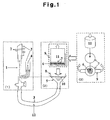
- Fig. 1 shows an apparatus for measuring a water absorption amount under a pressurization condition, in which the follow reference numerals are used.
- the water absorbent polymer particle used in the present invention functions as a pore-forming agent, and has a water absorption amount in a range of 5 to 30 ml/g at a pressure of 980 Pa. This means that 1 g of the water absorbent polymer in a dry state is capable of absorbing 5 to 30 ml of deionized water.
- the water absorption amount at a pressure of 980 Pa is less than 5 ml/g, it is necessary to add a great amount of pore-forming agent in order to obtain a sufficient porosity, and thus it is sometimes problematic in that organic gas is excessively produced when baking, which sometimes goes beyond explosion limit, and a prolonged baking time is required.
- it is greater than 30 ml/g, it may be difficult to control the hardness of a kneaded product and a baked product.
- water contained in the water absorbent polymer is easily reversed when the mixture containing the water absorbent polymer particle, the ceramic raw material and water is kneaded due to a shear force applied to the mixture, and that consequently a water-absorbing amount and a particle diameter of the polymer are easily changed. It is also not preferable because a large amount of water is required for preparing the kneaded product (or argil) with appropriate hardness for molding and an energy amount required for drying a water content is remarkably increased.
- the water absorbent polymer particles have a ratio of X/Y in the range of 1.0 to 1.6. When the above ratio is greater than 1.6, it may be difficult to control the hardness of the kneaded product and the baked product.
- the water contained in the water absorbent polymer is easily reversed due to the shear force applied to the mixture when the mixture containing the water absorbent polymer, the ceramic raw material and the water is kneaded, and that consequently a water-absorbing rate and a particle diameter of the polymer are easily changed.
- the ratio is never less than 1.
- the water absorbent polymer particle having 30 ml/g or less of the water absorption amount at a pressure of 980 Pa also has a relatively high crosslinking density and a relatively high strength. This is generally equivalent to that the larger "(osmotic pressure of ions) + (affinity of macromolecular electrolyte)" is, that the larger the water absorption amount is, "the greater the crosslinking density of polymer particles is, the less the water absorption amount is” and that "the strength of polymer particles is increased in proportion to the crosslinking density of polymer particles".
- the water absorbent polymer particle is preferably spherical in shape in the state where the particle has absorbed water and has been swollen.
- An average particle diameter in the saturated water-absorbing state falls preferably into the range of 1/30 to 1/1 , more preferably 1/15 to 1/2, and still more preferably 1/15 to 1/3 based on a thickness of a ceramic molded product.
- a porosity of the resulting ceramic baked product becomes low.
- the ceramic baked product is used as a filter, a pressured loss of gas or liquid passed through becomes large in some cases.
- the thickness of the ceramic molded product means a thickness of an individual wall when the ceramic molded product has multiple wall structures composed of the ceramic, and does not mean a thickness of a cluster as the entire ceramic molded product.
- water absorbent polymer particles examples include (1) one where a polymer obtained by polymerizing a vinyl monomer in an aqueous solution is dried followed by being pulverized into appropriate sizes, (2) a spherical polymer obtained by inverse suspension polymerization of a vinyl monomer, (3) a water absorbent polymer obtained by giving a modification treatment such as saponification to spherical hydrophobic polymer particles obtained by suspension polymerization of a vinyl monomer, and (4) one which makes a modified product of a graft polymer containing a macromolecular unit composed of starch and a macromolecular unit except for starch as an active ingredient.
- vinyl monomers which can be used in the above (1) and (2) include water soluble monomers having hydrophilic group, such as sulfone group, carboxyl group, amide group, amino group and hydroxyl group, i.e., 2-acrylamide-2-methylpropanesulfonic acid, 2-(meth)acryloyl ethanesulfonic acid, styrenesulfonic acid, (meth)acrylic acid, maleic acid, itaconic acid, crotonic acid, fumaric acid and/or partially alkali neutralized products thereof, (meth)acrylamide, N,N-dimethylacrylamide, N-isopropylacrylamide, N-methylol(meth)acrylamide, N-alkoxymethyl(meth)acrylamide, diethylaminoethyl (meth)acrylate, dimethylaminoethyl (meth)acrylate, 2-hydroxyethyl (meth)acrylate, N-vinylpyrrolidone, acryl
- Such monomers may be used in mixture with two or more.
- 2-acrylamide-2-methylpropanesulfonic acid, 2-(meth)acryloylethanesulfonic acid, (meth)acrylic acid, (meth)acrylamide, N,N-dimethylacrylamide, and N-methylol(meth)acrylamide are preferable, and in particular, 2-acrylamide-2-methylpropanesulfonic acid and acrylamide are preferable.
- Examples of the polymer of (3) include a saponified product of a copolymer of vinyl acetate and methyl acrylate.
- the polymer of (4) includes, for example, modified polymers, such as a starch-(meth)acrylic acid graft resin, a saponified product of a starch-acrylonitrile copolymer and a saponified product of a starch-acrylamide copolymer. Additionally, a crosslinked body of a modified copolymer made of isobutylene and maleic acid anhydride may be included. Two or more of the water absorbent polymers previously shown may be combined.
- the spherical water absorbent polymer particle synthesized by the inverse suspension polymerization is the most preferable because it has a good miscibility with the ceramic ingredient and a particle diameter and a water absorption rate are easily controlled by selecting a polymerization condition.
- a shape of a water absorbent polymer particle affects a shape of a pore of the porous ceramic obtained by baking. Generally, when the shape of the pore of the baked porous ceramic body is spiky, it has been known that stress is concentrated to a tip of a spiky shape to be easily broken and a strength thereof becomes insufficient. On the contrary, a spherical water absorbent polymer particle is desirable because the pore becomes spherical and thus a ceramic strength becomes high. When a pulverized article of the water absorbent polymer is used, it is preferable to uniform the particle diameter by classifying after the pulverization.
- the water absorbent polymer may be a crosslinked one.
- the crosslinked water absorbent polymer has a relatively high strength and thus the shape is unlikely to break up in a step of kneading with ceramic raw materials. Therefore, it is easy to obtain the porous ceramic which is exactly the same as a design having the pores with intended shape and size.
- One example of means for introducing a crosslinking structure into the water absorbent polymer includes simultaneous use of a crosslinking agent which is a multifunctional vinyl monomer when producing the water absorbent polymer.
- a crosslinking agent which is a multifunctional vinyl monomer when producing the water absorbent polymer.
- the multifunctional vinyl monomer used as the crosslinking agent include di- or tri-(meth)acrylate of polyols, such as polyethyleneglycol di(meth)acrylate, polypropyleneglycol di(meth)acrylate, glycerin tri(meth)acrylate, and trimethylolpropane tri(meth)acrylate; and bisamides, such as methylenebis(meth)acrylamide. Among them, methylenebisacrylamide and polyethyleneglycol diacrylate are particularly preferable.
- Preferable amount of the multifunctional vinyl monomer to be used is 0.1 to 10 mol%, more preferably 0.5 to 8 mol%, and still more preferably 1.0 to 5 mol% based on 100 mol% of a monofunctional vinyl monomer to be used. If the amount of the multifunctional vinyl monomer is less than 0.1 mol%, an effect to enhance the strength of the kneaded product with the ceramic raw material can not be sufficiently exerted in some cases. If the amount is greater than 10 mol%, it is difficult to adjust to a preferable water-absorbing performance in some cases.
- a crosslinking agent which takes advantage of a reactivity with a carboxyl group contained in an unsaturated carboxylic acid monomer and a partially neutralized salt thereof, which are a monomer constituting the water absorbent polymer.
- crosslinking agent examples include polyglycidyl compounds, such as (poly)ethyleneglycol diglycidyl ether, (poly)propyleneglycol diglycidyl ether, (poly)glycerol diglycidyl ether, (poly)glycerol triglycidyl ether, sorbitol diglycidyl ether, sorbitol triglycidyl ether, pentaerythritol diglycidyl ether, pentaerythritol triglycidyl ether and pentaerythritol tetraglycidyl ether; haloepoxy compounds, such as epichlorohydrin, epibromohydrin and ⁇ -methyl-epichlorohydrin; and isocyanate compounds, such as 2,4-tolylene diisocyanate and hexamethylene diisocyanate.
- ethyleneglycol diglycidyl ether such as (
- the water absorbent polymer When a cordierite raw material is used as a ceramic raw material, as the water absorbent polymer, those which contain no alkali metal and no alkali earth metal are desirable. Because, if the polymer which contains the above metal abundantly, a cordierite reaction is inhibited to cause physical property reduction, e.g., increase of thermal expansion coefficient. Therefore, for the water absorbent polymer containing sulfone group and carboxyl group therein, it is desirable that these functional groups do not exist as a sodium salt and a potassium salt and exist in a unneutralized state or as an ammonium salt. Additionally, the water absorbent polymer containing a nonionic hydrophilic functional group is included as a desirable one. Examples of the nonionic hydrophilic functional group include hydroxyl group, oxyalkylene group, such as oxyethylene group and oxypropylene group, amide group, and the like.
- the ceramic raw materials used in the present invention include pottery and porcelain materials, e.g., clay, clay mineral, chamotte, silica, silica sand, diatomaceous earth, pottery stone, feldspar, blast furnace slag, whitebait, whitebait balloon, fly ash, and in addition, special ceramic raw materials, e.g., cordierite, talc, alumina, kaolin, aluminum hydroxide, magnesia, ferrite, zeolite, mullite, apatite, slag, silicon carbide, zirconia, aluminum nitride and aluminum titanate, and raw materials for electrodes of batteries, e.g., nickel powder, cobalt powder, lantern manganite, lantern strontium manganite, and the like.
- pottery and porcelain materials e.g., clay, clay mineral, chamotte, silica, silica sand, diatomaceous earth, pottery stone, feldspar, blast furnace slag, whitebait, whitebai
- a method for producing the porous ceramic includes kneading and molding a mixture containing the above ceramic raw material, the water absorbent polymer particles and water. If necessary, the mixture may further contains a binder, such as methyl cellulose, and a lubricant, such as olefin wax.
- the kneading may be performed according to any known methods, and can be performed with using, for example, a kneader, a pony mixer, a screw extruder, a vacuum kneader, or the like.
- the ceramic raw material powder is normally used.
- steps of drying and baking the resulting molded product are included.
- the drying and baking may be performed according to any known methods.
- a high-frequency dielectric exothermic heating apparatus, a hot air dryer, a heated bed dryer, a mangle dryer, a tunnel dryer and the like can be used. Normally, it is preferable to dry at a temperature of 150°C or less until the product does not substantially contain moisture.
- the baking is performed by heating to a temperature greater than 150°C, and preferably to 800°C or greater.
- a baking temperature and a baking time are set so that organic materials, such as the water absorbent polymer particles and the binder, are sufficiently burned and the ceramic raw material is sufficiently baked.
- the amount of the water absorbent polymer particles is preferably 0.1 to 20 parts by mass, and more preferably 0.5 to 10 parts by mass based on 100 parts by mass of the ceramic raw material in a dry state (containing no water).
- the amount of the water absorbent polymer to be used is less than 0.1 parts by mass, a sufficient porosity is not obtained in some cases.
- it is greater than 20 parts by mass it is sometimes problematic in that organic gas is excessively produced at baking, which sometimes goes beyond an explosion limit, and a baking time is prolonged, a volume change during the baking is large, and thus the resulting ceramic molded product easily becomes one having distortions and cracks.
- the mixture containing the water absorbent polymer particles, the ceramic raw material and water is obtained by mixing these raw materials by arbitrary methods.
- the amount of water to be used is regulated depending on types of the water absorbent polymer particles and the ceramic raw material and formulation thereof so that preferable hardness and moldability of the kneaded product are obtained.
- the amount of 100 parts by mass or less of water to be used based on 100 parts by mass of the ceramic raw material is preferable because a time required for drying the kneaded product and energy cost are not excessive.
- a method for adding the water absorbent polymer particles in raw material mixing may be either a method for adding a hydrous one (water absorbing state) or a method for adding a dried one.
- An appearance of the water absorbent polymer particles in a hydrous state may be a powder or a paste.
- a moisture content ratio thereof is not particularly limited, but it is preferable to make the moisture ratio capable of handling the water absorbent polymer as the powder, i.e., in the range where the water absorbent polymer has fluidity. Because, it is difficult to handle the polymer particles in a gel state due to the high hydrous ratio, mixing and dispersing with the ceramic raw material become insufficient, and the strength and the porosity of the ceramic molded product after baking become insufficient in some cases.
- the water absorbent polymer particles in a dry powder or a powder where the hydrous ratio is controlled are easily mixed with the ceramic raw material, and the resulting mixture of the water absorbent polymer particles and the ceramic raw material has highly uniform dispersibility. That is, a method in which water is added to and mixed with the powder mixture of the water absorbent polymer particles and the ceramic raw material where the powder water absorbent polymer particles and the powder ceramic raw material have been mixed in advance is a preferable method by which the resulting raw material mixture easily becomes uniform and in a ceramic molded product obtained by drying and baking a molded raw material mixture, the strength is high and a pore distribution is uniform.
- the powder water absorbent polymer particles and the powder ceramic raw material have not been mixed in advance and the water absorbent polymer particles, the ceramic raw material and water are substantially simultaneously mixed, the resulting raw material mixture sometimes becomes uneven, and in a ceramic molded product obtained by drying and baking a molded raw material mixture, the strength is insufficient and a pore distribution is uneven in some cases.
- the hardness of the kneaded product is easily changed depending on the type of the ceramic raw material, the amount of the water absorbent polymer particles to be added, the water content and the kneading method, and the reproducible hardness is not often obtained even when the method is performed under the same condition.
- the water absorbent polymer particles of the present invention are used under the condition once set, the intended hardness of the kneaded product is easily reproduced, therefore, the steps are easily controlled and the molding can be stably performed. Any known methods can be employed for other conditions.
- the monomer aqueous solution was added with stirring the content in the separable flask at 400 rpm (rotation/min), and nitrogen substitution was performed at a flow rate of 200 ml/min for 2 hours until a dissolved oxygen concentration became sufficiently low.
- An external temperature was controlled at 30°C, and when the temperature of the content in the flask became stable, 0.58 g of an aqueous solution of 6.9% t-butylhydroxyperoxide was added. Then, 0.90 g of an aqueous solution of 5% sodium bisulfite was added in five portions, and in which one portion was added to initiate polymerization. A temperature elevation in a reaction solution due to polymerization heat was observed.
- the water absorbent polymer particles B and C were produced in the similar preparation condition for the water absorbent polymer particle A, except for changing the amount of methylenebisacrylamide to be added to 3 mol% and 2 mol%, respectively.
- the water absorbent polymer particle D was produced in the similar preparation condition for the water absorbent polymer particle A, except for changing the monomers except for the crosslinking agent to 224 g of 2-acrylamide-2-methylpropanesulfonic acid and 192 g of an aqueous solution of 50% acrylamide, and changing the amounts of 25% ammonia aqueous solution and the deionized water to 55.1 g and 261.8 g, respectively. It was the similar preparation condition to that for the water absorbent polymer particle A that 4 mol% methylenebisacrylamide, which serves as the crosslinking agent, was used based on 100 mol% of the monomers except for the crosslinking agent.
- the water absorbent polymer particle E was produced as was the case with the water absorbent polymer particle A, except for changing the monomers except for the crosslinking agent to 480 g of an aqueous solution of 50% acrylamide and 80.0 g of acrylic acid, and changing the amounts of 25% ammonia aqueous solution and the deionized water to 56.6 g and 114.7 g, respectively. It was also the same condition as that for the water absorbent polymer particle A that 4 mol% methylenebisacrylamide, a crosslinking agent, was used based on 100 mol% of the monomers except for the crosslinking agent.
- All of the water absorbent polymer particles B to E had a spherical shape.
- An aqueous solution of 35% by mass of acrylic acid was prepared by mixing 100 g of acrylic acid and deionized water and then adding an aqueous solution of 25% ammonia to partially neutralize (75 mol% neutralization) with ice-cooling, and 20 g of Aronix M-245 (polyethyleneglycol diacrylate, repeat units of oxyethylene: about 9) supplied from Toagosei Co., Ltd. was added as the crosslinking agent.
- photoinitiators 0.01 g of 2,2-dimethoxy-2-phenylacetophenone and 0.1 g of ammonium persulfate were added to this monomer solution, which was then placed in a cylindrical glass vessel (reaction vessel) with an inner diameter of 146 mm, and nitrogen bubbling was performed for 30 minutes with keeping the temperature of the aqueous solution at 20°C. Thereafter, ultraviolet light at a dose of 5.0 mW/cm 2 was irradiated for 3 minutes from the above portion of the reaction vessel using a 100W black light (product name: H100BL, supplied from Toshiba Corporation) to make a sheet hydrous crosslinked polymer gel (accumulated light intensity: 900 mJ/cm 2 ).
- a 100W black light product name: H100BL, supplied from Toshiba Corporation
- This gel was dried and pulverized to afford crude particles of a water absorbent resin. Then, the crude particles were pulverized in a ball mill and those which passed through a sieve with 330 mesh (45 ⁇ m) were collected to yield the water absorbent polymer particles F.
- the water absorbent polymer particle G was produced in the similar preparation condition for the water absorbent polymer particle F, except that 200 g of an aqueous solution of 50% acrylamide and deionized water were mixed to prepare the aqueous solution of 30% by mass of acrylamide, and 10 g of Aronix M-240 (polyethyleneglycol diacrylate, repeat units of oxyethylene: about 4) supplied from Toagosei Co., Ltd. was added as the crosslinking agent.
- Aronix M-240 polyethyleneglycol diacrylate, repeat units of oxyethylene: about 4
- a water absorption amount under pressurization of water absorbent polymer particles i.e., the water absorption amount at a pressure of 980 Pa or 9800 Pa was measured using a measurement apparatus shown in Fig. 1.
- the measurement apparatus is composed of units (1) to (3).
- the unit (1) includes a burette 1 with a branch duct for air vent, a pinch cock 2, a silicone tube 3 and a polytetrafluoroethylene tube 4.
- a columnar cylinder 8 having many holes at its bottom is placed on a funnel 5, and paper filter 10 for the apparatus is further placed thereon.
- a sample 6 of the water absorbent polymer particles is sandwiched between two sheets of paper filter 7 for holding the sample, which is then fixed to a cylindrical weight 11 by an adhesive tape 9.
- a load of 980 Pa or 9800 Pa is applied to the sample 6.
- the units (1) and (2) are communicated with a silicone tube 3. Heights of the funnel 5 and the columnar cylinder 8 are fixed with respect to the burette 1, and set so that the level of the lower end of polytetrafluoroethylene tube 4 placed in the burette branch duct and the level of the bottom of the columnar cylinder 8 are the same (dot line in Fig. 1).
- the water absorption amount under pressurization was measured using the measurement apparatus of the above configuration.
- the measurement method will be illustrated below.
- the pinch cock 2 in the unit (1) was removed, deionized water was placed from the above portion of the burette 1 through the silicone tube 3, and the space from the burette 1 to the paper filter 10 in the apparatus was filled with the deionized water. Then, the pinch cock 2 was closed to retain the pressure inside the burette 1, and the air was removed from the polytetrafluoroethylene tube 4 connected to the burette branch duct through a rubber plug. Thus, the deionized water was continuously supplied from the burette 1 to the paper filter 10 for the apparatus.
- the sum of the water absorption amounts (c) of the water absorbent polymer particles and two sheets of paper filter 7 is obtained from the expression of (a-b).
- the absorption amount of two sheets of paper filter 7 which contained no water absorbent polymer particle was measured (d).
- the hardness of the kneaded products (before molding/baking) obtained in Examples and Comparative Examples was measured by the method shown below.
- the kneaded product was tightly soaked in a 50 ml screw vial such that no space may be provided, and the surface was flattened.
- This kneaded product was retained at 23°C, and the hardness thereof was measured using a card meter (ME-303, Iio Denki) under the following conditions:
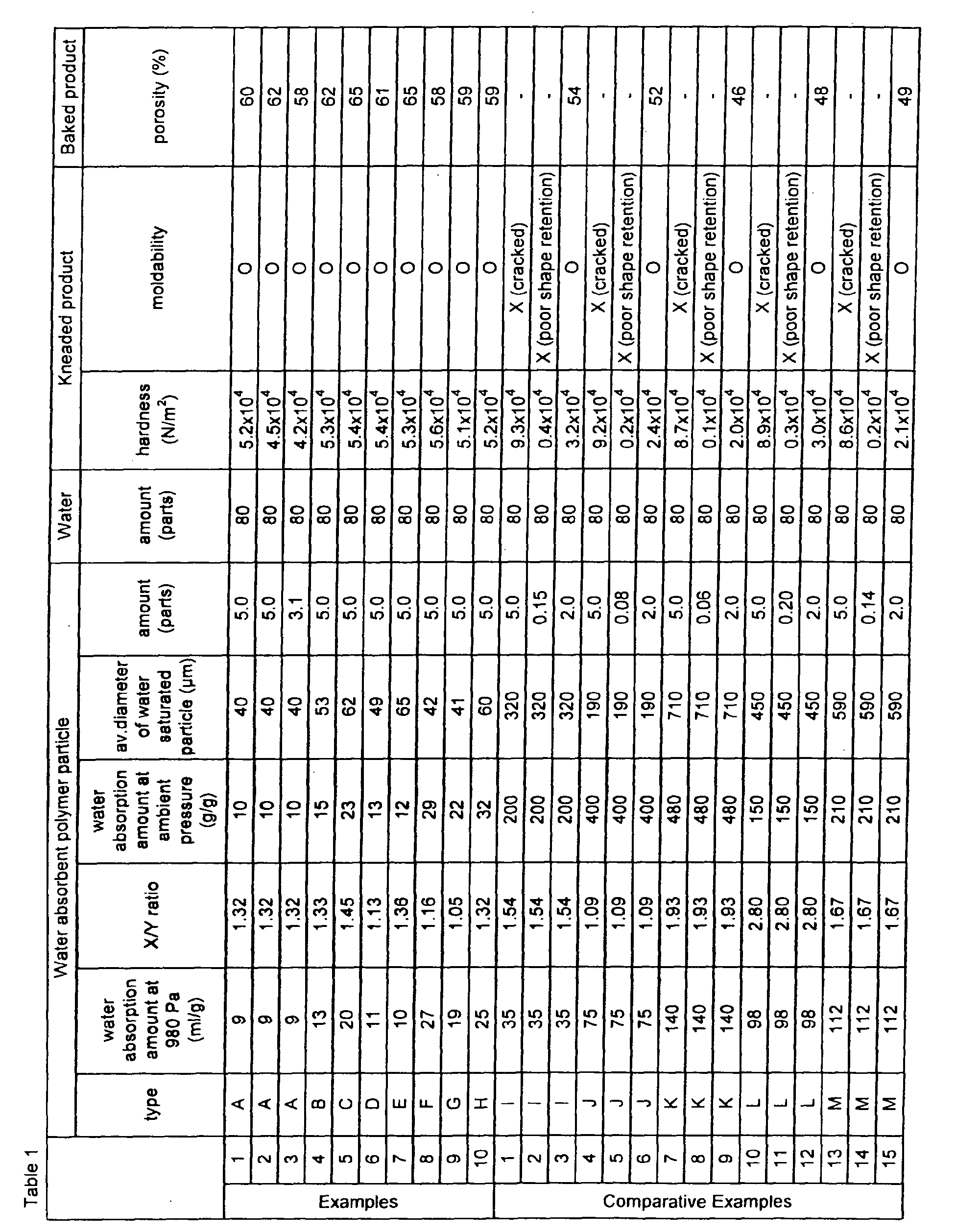
- the hardness of the kneaded product which had favorable moldability in the conditions used in Examples and Comparative Examples was in the range of 1.5 ⁇ 10 4 to 6.0 ⁇ 10 4 N/m 2 .
- the polymer particles A produced in Preparation example 1 were used as the water absorbent polymer particles.
- the water absorption amount of the polymer particles A at a pressure of 980 Pa was 9 ml/g
- an X/Y ratio when the water absorption amount at a pressure of 980 Pa was X ml/g and the water absorption amount at a pressure of 9800 Pa was Y ml/g was 1.32
- the water absorption amount at an ambient pressure mass (including the mass of the polymer itself) represented by g unit when 1 g of the water absorbent polymer in a dry state absorbed and saturated deionized water at an ambient pressure
- an average particle diameter at a water-absorbing and saturated state was 40 ⁇ m.
- the water absorption amount of the polymer particles A at an ambient pressure means the water absorption amount measured with slightly pressing without using the "weight 11" in the above "Measurement of water absorption amount under pressurization of water absorbent polymer particles".
- the water absorption amount of the polymer particles B, C and D at an ambient pressure is the same as this.
- kaolin, calcined kaolin, talc, alumina, aluminum hydroxide and silica which are cordierite materials
- silica which are cordierite materials
- a mass ratio of 21:13:39:9:13:5 total 100 parts by mass.
- 4 parts by mass of methyl cellulose which was a binder, 1 part by mass of olefin wax which was a lubricant and 5 parts by mass of the water absorbent polymer particles A which was a pore making agent were added and mixed, subsequently 80 parts by mass of deionized water was added, and immediately kneaded by an ⁇ -type kneader for 30 minutes.
- the kneaded product was molded cylindrically by an extrusion molding method, and water was eliminated by drying. The drying was performed at 120°C until the weight almost became constant. Then, the temperature was raised to 1000°C, then the temperature was raised at a temperature rising rate of 50°C/hour from 1000°C to 1400°C, and after the temperature reached 1420°C, it was retained to bake for 4 hours. A porosity of the baked body was measured by a mercury porosimeter.
- Example 2 was performed similarly to procedures of Example 1 except that the amount of deionized water was changed from 80 parts by mass to 90 parts by mass.
- Example 3 was performed similarly to procedures of Example 1 except that the amount of the water absorbent polymer particles A to be used was changed from 5 parts by mass to 3.1 parts by mass.
- Example 4 was performed similarly to procedures of Example 1 except for using the water absorbent polymer particles B produced in Preparation example 1 in place of the water absorbent polymer particles A.
- the water absorption amount at a pressure of 980 Pa of the polymer particles B was 13 ml/g, the X/Y ratio was 1.33, the water absorption amount at an ambient pressure was 15 g/g, and the average particle diameter at a water-absorbing and saturated state was 53 ⁇ m.
- Example 5 was performed similarly to procedures of Example 1 except for using the water absorbent polymer particles C produced in Preparation example 1 in place of the water absorbent polymer particles A.
- the water absorption amount at a pressure of 980 Pa of the polymer particles C was 20 ml/g, the X/Y ratio was 1.45, the water absorption amount at an ambient pressure was 23 g/g, and the average particle diameter at a water-absorbing and saturated state was 62 ⁇ m.
- Example 6 was performed similarly to procedures of Example 1 except for using the water absorbent polymer particles D produced in Preparation example 1 in place of the water absorbent polymer particles A.
- the water absorption amount at a pressure of 980 Pa of the polymer particles D was 11 ml/g, the X/Y ratio was 1.13, the water absorption amount at an ambient pressure was 13 g/g, and the average particle diameter at a water-absorbing and saturated state was 49 ⁇ m.
- Example 7 was performed similarly to procedures of Example 1 except for using the water absorbent polymer particles E produced in Preparation example 1 in place of the water absorbent polymer particles A.
- the water absorption amount at a pressure of 980 Pa of the polymer particles E was 10 ml/g, the X/Y ratio was 1.36, the water absorption amount at an ambient pressure was 12 g/g, and the average particle diameter at a water-absorbing and saturated state was 65 ⁇ m.
- Example 8 was performed similarly to procedures of Example 1 except for using the water absorbent polymer particles F produced in Preparation example 2 in place of the water absorbent polymer particles A.
- the water absorption amount at a pressure of 980 Pa of the polymer particles F was 27 ml/g, the X/Y ratio was 1.16, the water absorption amount at an ambient pressure was 29 g/g, and the average particle diameter at a water-absorbing and saturated state was 42 ⁇ m.
- Example 9 was performed similarly to procedures of Example 1 except for using the water absorbent polymer particles G produced in Preparation example 2 in place of the water absorbent polymer particles A.
- the water absorption amount at a pressure of 980 Pa of the polymer particles G was 19 ml/g, the X/Y ratio was 1.05, the water absorption amount at an ambient pressure was 22 g/g, and the average particle diameter at a water-absorbing and saturated state was 41 ⁇ m.
- Example 10 was performed similarly to procedures of Example 1 except for using the water absorbent polymer particles H (KI gel 201K, 330 mesh pass article supplied from Kuraray Isoprene Chemical Co., Ltd., pulverized article of salt of crosslinked body of modified isobutylene-maleic anhydride copolymer) in place of the water absorbent polymer particles A.
- the water absorption amount at a pressure of 980 Pa of the polymer particles H was 25 ml/g, the X/Y ratio was 1.32, the water absorption amount at an ambient pressure was 32 g/g, and the average particle diameter at a water-absorbing and saturated state was 60 ⁇ m.
- Example 2 The same procedures as those in Example 1 were performed except for using 5 parts by mass of the water absorbent polymer particles I (KI gel 201K, granulated article supplied from Kuraray Isoprene Chemical Co., Ltd., salt of crosslinked body of modified isobutylene-maleic acid anhydrate copolymer) which were not pulverized in place of 5 parts by mass of the water absorbent polymer particles A.
- the water absorption amount at a pressure of 980 Pa of the polymer particles I was 35 ml/g, the X/Y ratio was 1.54, the water absorption amount at an ambient pressure was 200 g/g (value on the catalogue), and the average particle diameter at a water-absorbing and saturated state was 320 ⁇ m.
- the molding of the kneaded product was attempted, but the kneaded product was not successfully molded due to insufficient fluidity, and cracks were observed on the molded product.
- Example 2 The same procedures as those in Example 1 were performed except for using 0.15 parts by mass of the water absorbent polymer particles I in place of 5 parts by mass of the water absorbent polymer particles A.
- the resulting kneaded product was poor in shape retention, and the molded product could not keep the shape.
- Example 1 The same procedures as those in Example 1 were performed except for using 2 parts by mass of the water absorbent polymer particles I in place of 5 parts by mass of the water absorbent polymer particles A.
- Example 2 The same procedures as those in Example 1 were performed except for using 5 parts by mass of the water absorbent polymer particles J (pulverized article of Sanfresh ST-500D supplied from Sanyo Chemical Industries Ltd., polyacrylic crosslinked resin) in place of 5 parts by mass of the water absorbent polymer particles A.
- the water absorption amount at a pressure of 980 Pa of the polymer particles J was 75 ml/g
- the X/Y ratio was 1.09
- the water absorption amount at an ambient pressure was 400 g/g (value on the catalog)
- the average particle diameter at a water-absorbing and saturated state was 190 ⁇ m.
- the molding of the kneaded product was attempted, but the kneaded product was not successfully molded due to insufficient fluidity, and cracks were observed on the molded product.
- Example 2 The same procedures as those in Example 1 were performed except for using 0.08 parts by mass of the water absorbent polymer particles J in place of 5 parts by mass of the water absorbent polymer particles A.
- the resulting kneaded product was poor in shape retention, and the molded product could not keep the shape.
- Example 1 The same procedures as those in Example 1 were performed except for using 2 parts by mass of the water absorbent polymer particles J in place of 5 parts by mass of the water absorbent polymer particles A.
- Example 2 The same procedures as those in Example 1 were performed except for using 5 parts by mass of the spherical water absorbent polymer particles K (Aqua Keep SA-60N supplied from Sumitomo Seika Chemicals Co., Ltd., polyacrylamide crosslinked resin) in place of 5 parts by mass of the water absorbent polymer particles A.
- the water absorption amount at a pressure of 980 Pa of the polymer particles K was 140 ml/g, the X/Y ratio was 1.93, the water absorption amount at an ambient pressure was 430 g/g, and the average particle diameter at a water-absorbing and saturated state was 710 ⁇ m.
- the molding of the kneaded product was attempted, but the kneaded product was not successfully molded due to insufficient fluidity, and cracks were observed on the molded product.
- Example 2 The same procedures as those in Example 1 were performed except for using 0.06 parts by mass of the water absorbent polymer particles K in place of 5 parts by mass of the water absorbent polymer particles A.
- the resulting kneaded product was poor in shape retention, and the molded product could not keep the shape.
- Example 1 The same procedures as those in Example 1 were performed except for using 2 parts by mass of the water absorbent polymer particles K in place of 5 parts by mass of the water absorbent polymer particles A.
- Example 2 The same procedures as those in Example 1 were performed except for using 5 parts by mass of the spherical water absorbent polymer particles L (Aron zap TS-U-1 supplied from Toagosei Co., Ltd., crosslinked polymer having acrylic acid units and 2-acrylamide-2-methylpropanesulfonic acid units) in place of 5 parts by mass of the water absorbent polymer particles A.
- the water absorption amount at a pressure of 980 Pa of the polymer particles L was 98 ml/g
- the X/Y ratio was 2.80
- the water absorption amount at an ambient pressure was 150 g/g
- the average particle diameter at a water-absorbing and saturated state was 450 ⁇ m.
- the molding of the kneaded product was attempted, but the kneaded product was not successfully molded due to insufficient fluidity, and cracks were observed on the molded product.
- Example 2 The same procedures as those in Example 1 was performed except for using 0.2 parts by mass of the water absorbent polymer particles L in place of 5 parts by mass of the water absorbent polymer particles A.
- the resulting kneaded product was poor in shape retention, and the molded product could not keep the shape.
- Example 1 The same procedures as those in Example 1 were performed except for using 2 parts by mass of the water absorbent polymer particles L in place of 5 parts by mass of the water absorbent polymer particles A.
- Example 2 The same procedures as those in Example 1 were performed except for using 5 parts by mass of the spherical water absorbent polymer particles M (Aron zap U supplied from Toagosei Co., Ltd., crosslinked polymer having an acrylic acid unit as a major structural unit) in place of 5 parts by mass of the water absorbent polymer particles A.
- the water absorption amount at a pressure of 980 Pa of the polymer particles M was 112 ml/g
- the X/Y ratio was 1.67
- the water absorption amount at an ambient pressure was 210 g/g
- the average particle diameter at a water-absorbing and saturated state was 590 ⁇ m.
- the molding of the kneaded product was attempted, but the kneaded product was not successfully molded due to insufficient fluidity, and cracks were observed on the molded product.
- Example 2 The same procedures as those in Example 1 were performed except for using 0.14 parts by mass of the water absorbent polymer particles M in place of 5 parts by mass of the water absorbent polymer particles A.
- the resulting kneaded product was poor in shape retention, and the molded product could not keep the shape.
- Example 1 The same procedures as those in Example 1 were performed except for using 2 parts by mass of the water absorbent polymer particles M in place of 5 parts by mass of the water absorbent polymer particles A.
- Comparative Examples 1, 4, 7, 10 and 13 the same amount of the water absorbent polymer particles as that in Examples 1, 2, 4, 5, 6, 7, 8, 9 and 10 was used, and consequently the moldability of the kneaded product was poor and the molded product had a crack(s).
- Example 3 the experiments were performed using the amount where 30 parts by mass of deionized water calculated by subtracting 50 parts by mass required for kneading the ceramic raw material in the absence of the water absorbent polymer from 80 parts by mass which is the total deionized water amount to be used corresponded to the saturated water absorption amount. Consequently, in Example 3, the kneaded product had an appropriate hardness and the good moldability, but in Comparative Examples 2, 5, 8, 11 and 14, the hardness of the kneaded product was low and the moldability (shape retention) was poor.
- the essence of the present invention is the use of the water absorbent polymer particles whose water absorption amount is relatively low (but is not zero) at around ambient pressure as the pore making agent (invention according to Claim 1).
- the water absorption amount of the water absorbent polymer particles is excessively low at around ambient pressure, the sufficient porosity is not obtained because the water amount which the polymer particles retain is low.
- the water absorption amount of the water absorbent polymer particles is excessively large at around ambient pressure, it may be difficult to control hardness and pore distribution of the kneaded product and the baked product because the water reverses from the polymer particles to change the particle diameters when shear force is applied in the kneading step.
- the water absorption amount at ambient pressure is greatly affected by the measurement condition, and additionally when the particle diameters of the water absorbent polymer are too small, it is not easy to measure them and reproducibility of the obtained data for the water absorption amount is sometimes poor.
- the water absorption amount at a pressure of 980 Pa obtained by adding a slight load to the ambient pressure is defined as the good condition which typifies the ambient pressure (close to the ambient pressure) and in which the reproducibility is good.
- the water absorption amount when shear force is applied in the kneading step is not extremely low compared to the water absorption amount at around ambient pressure.
- the water absorption amount at a pressure of 9800 Pa corresponding to the shear force at kneading
- 980 Pa approximately low compared to the water absorption amount at around ambient pressure
- Patent Reference 3 deformation of water absorbent gel was inhibited by making fine particles of the water absorbent resin with high gel strength absorb water and be saturated with water and by the use thereof as the pore making agent.
- the gel strength is for a water absorbent polymer gel containing saline whose water absorbability is considerably low compared to purified water, and when used by absorbing the deionized water, the reverse of water occurs, i.e., the water absorbent polymer having a relatively high water absorption amount is used.
- an absorption performance for purified water is 50 g/g or greater, and preferably 100 to 1000 g/g".
- the present invention it is possible to easily control the hardness and the pore distribution of the kneaded product with the porous ceramic and to provide a porous ceramic with high hardness and high porosity, by using the hard water absorbent resin where the water reverse due to a shear force caused by kneading unlikely occurs.
- porous ceramic examples include filtration materials such as a ceramic filter for cleaning auto exhaust gas, a ceramic filter for cleaning exhaust gas exhausted from a thermal engine and a combustion equipment and a ceramic filter for filtering a liquid such as water, catalytic carriers such as catalysts for cleaning exhaust gas, heat exchange materials for cleaning automotive exhaust gas, thermal storage media, sintered substrates for batteries, heat insulating materials, and microbial carriers used for waste water disposal.
- filtration materials such as a ceramic filter for cleaning auto exhaust gas, a ceramic filter for cleaning exhaust gas exhausted from a thermal engine and a combustion equipment and a ceramic filter for filtering a liquid such as water
- catalytic carriers such as catalysts for cleaning exhaust gas
- heat exchange materials for cleaning automotive exhaust gas thermal storage media
- sintered substrates for batteries heat insulating materials
- microbial carriers used for waste water disposal.
Landscapes
- Chemical & Material Sciences (AREA)
- Engineering & Computer Science (AREA)
- Ceramic Engineering (AREA)
- Materials Engineering (AREA)
- Structural Engineering (AREA)
- Organic Chemistry (AREA)
- Solid-Sorbent Or Filter-Aiding Compositions (AREA)
- Compositions Of Macromolecular Compounds (AREA)
Abstract
Description
- 1
- burette
- 2
- pinch cock
- 3
- silicone tube
- 4
- polytetrafluoroethylene tube
- 5
- funnel
- 6
- sample (water absorbent polymer particles)
- 7
- paper filter for holding sample
- 8
- columnar cylinder (made of stainless, having many holes)
- 9
- adhesive tape
- 10
- paper filter for apparatus
- 11
- weight (cylindrical, made of stainless)
- 12
- deionized water
Claims (6)
- A method for producing porous ceramic, the method comprising:molding a mixture containing a water absorbent polymer particle, a ceramic raw material, and water, the water absorbent polymer particle having a water absorption amount in a range of 5 to 30 ml/g at a pressure of 980 Pa; andheating and baking the resulting molded product.
- The method for producing porous ceramic according to claim 1, wherein the water absorbent polymer particle has an X/Y ratio in a range of 1.0 to 1.6, wherein X represents the water absorption amount (ml/g) at a pressure of 980 Pa and Y represents the water absorption amount (ml/g) at a pressure of 9800 Pa.
- The method for producing porous ceramic according to claim 1 or 2, wherein the water absorbent polymer particle is composed of a polymer obtained by radical polymerization of a monomer mixture containing a monofunctional vinyl monomer having one unsaturated bond and a multifunctional vinyl monomer having two or more unsaturated bonds at a ratio of 100 mol% and 0.1 to 10 mol%, respectively.
- The method for producing porous ceramic according to any of claims 1 to 3, wherein the water absorbent polymer particle is composed of a polymer obtained by polymerizing a vinyl monomer by inverse suspension polymerization.
- The method for producing porous ceramic according to any of claims 1 to 4, wherein the water absorbent polymer particle is composed of a polymer having a 2-acrylamide-2-methylpropanesulfonic acid unit or an acrylamide unit as a constituting monomer unit.
- The method for producing porous ceramic according to claim 1, wherein the mixture containing the water absorbent polymer particle, the ceramic raw material, and water is obtained by mixing water with a powder mixture of the water absorbent polymer particle and the ceramic raw material in which powder water absorbent polymer particle and powder ceramic raw material are mixed.
Applications Claiming Priority (3)
| Application Number | Priority Date | Filing Date | Title |
|---|---|---|---|
| JP2003033704 | 2003-02-12 | ||
| JP2003033704 | 2003-02-12 | ||
| PCT/JP2004/001189 WO2004071995A1 (en) | 2003-02-12 | 2004-02-05 | Method for producing porous ceramic |
Publications (3)
| Publication Number | Publication Date |
|---|---|
| EP1595857A1 true EP1595857A1 (en) | 2005-11-16 |
| EP1595857A4 EP1595857A4 (en) | 2009-08-19 |
| EP1595857B1 EP1595857B1 (en) | 2015-04-08 |
Family
ID=32866239
Family Applications (1)
| Application Number | Title | Priority Date | Filing Date |
|---|---|---|---|
| EP04708474.4A Expired - Lifetime EP1595857B1 (en) | 2003-02-12 | 2004-02-05 | Method for producing porous ceramic |
Country Status (7)
| Country | Link |
|---|---|
| US (1) | US7537716B2 (en) |
| EP (1) | EP1595857B1 (en) |
| KR (1) | KR100687695B1 (en) |
| CN (1) | CN100347135C (en) |
| PL (1) | PL214676B1 (en) |
| WO (1) | WO2004071995A1 (en) |
| ZA (1) | ZA200506383B (en) |
Cited By (1)
| Publication number | Priority date | Publication date | Assignee | Title |
|---|---|---|---|---|
| WO2009090580A1 (en) * | 2008-01-15 | 2009-07-23 | Koninklijke Philips Electronics N.V. | Light scattering by controlled porosity in optical ceramics for leds |
Families Citing this family (28)
| Publication number | Priority date | Publication date | Assignee | Title |
|---|---|---|---|---|
| DE10343498A1 (en) * | 2003-02-07 | 2005-05-04 | Univ Leipzig | Method for determining at least one state parameter of a sealing system and sealing system |
| JP4627498B2 (en) * | 2003-12-26 | 2011-02-09 | 日本碍子株式会社 | Manufacturing method of honeycomb structure |
| JP2007001836A (en) * | 2005-06-27 | 2007-01-11 | Ngk Insulators Ltd | Method of manufacturing honeycomb structure |
| WO2008117621A1 (en) | 2007-03-28 | 2008-10-02 | Hitachi Metals, Ltd. | Process for producing ceramic honeycomb structure |
| JP4911002B2 (en) * | 2007-11-30 | 2012-04-04 | 株式会社豊田中央研究所 | Heat exchange type heat utilization apparatus and manufacturing method thereof |
| JP4574693B2 (en) * | 2008-03-28 | 2010-11-04 | 日本碍子株式会社 | Manufacturing method of honeycomb structure |
| JP4571990B2 (en) * | 2008-03-31 | 2010-10-27 | 日本碍子株式会社 | Manufacturing method of honeycomb structure |
| DE102009026059B4 (en) * | 2009-06-29 | 2024-02-01 | Krones Aktiengesellschaft | Device for spreading a film web |
| JP5736454B2 (en) * | 2010-07-30 | 2015-06-17 | エンパイア テクノロジー ディベロップメント エルエルシー | Production of cordierite articles using waste steel slag |
| WO2012033078A1 (en) * | 2010-09-10 | 2012-03-15 | 東亞合成株式会社 | Additive for molding of ceramic material |
| TWI554488B (en) * | 2010-10-18 | 2016-10-21 | 國立聯合大學 | Fabrication of porous ceramics using waste sludge or ash |
| JP5486539B2 (en) | 2011-03-30 | 2014-05-07 | 日本碍子株式会社 | Honeycomb structure and manufacturing method thereof |
| CN102391012B (en) * | 2011-08-02 | 2013-04-17 | 西安交通大学 | Method for preparing recrystallized silicon carbide porous ceramic by combining carbothermic reduction |
| US9109138B2 (en) * | 2011-08-02 | 2015-08-18 | Toray Plastics (America), Inc. | Optically clear biaxially oriented polyester film with anti-iridescent primer layer |
| WO2015190367A1 (en) | 2014-06-10 | 2015-12-17 | 東亞合成株式会社 | Electrode for non-aqueous electrolyte secondary cell, production method for same, and non-aqueous electrolyte secondary cell |
| CN104230345A (en) * | 2014-09-15 | 2014-12-24 | 中国科学院上海硅酸盐研究所 | Preparation method of porous silicon nitride ceramic material |
| CN105532228A (en) * | 2015-12-17 | 2016-05-04 | 李积山 | Water-saving planting method for sand-binding green plants |
| US10194694B2 (en) | 2016-01-05 | 2019-02-05 | Rai Strategic Holdings, Inc. | Aerosol delivery device with improved fluid transport |
| RU2646650C2 (en) * | 2016-05-04 | 2018-03-06 | Федеральное государственное бюджетное образовательное учреждение высшего образования "Волгоградский государственный технический университет" (ВолгГТУ) | Ceramic mixture for making filters |
| US10617151B2 (en) | 2016-07-21 | 2020-04-14 | Rai Strategic Holdings, Inc. | Aerosol delivery device with a liquid transport element comprising a porous monolith and related method |
| US10602775B2 (en) | 2016-07-21 | 2020-03-31 | Rai Strategic Holdings, Inc. | Aerosol delivery device with a unitary reservoir and liquid transport element comprising a porous monolith and related method |
| KR102888595B1 (en) * | 2017-04-05 | 2025-11-20 | 필립모리스 프로덕츠 에스.에이. | Susceptor for use with an inductively heated aerosol-generating device or system |
| CN108947480A (en) * | 2018-08-14 | 2018-12-07 | 福建省威尔陶瓷股份有限公司 | Based on high intensity porcelain and preparation method thereof made from dead meal |
| US20200077703A1 (en) | 2018-09-11 | 2020-03-12 | Rai Strategic Holdings, Inc. | Wicking element for aerosol delivery device |
| US12426637B2 (en) | 2021-08-17 | 2025-09-30 | Rai Strategic Holdings, Inc. | Inductively heated aerosol delivery device consumable |
| KR102729591B1 (en) * | 2022-02-04 | 2024-11-14 | 주식회사 이엠텍 | Preparing method of porous ceramic made of magnesium silicate |
| CN116444287B (en) * | 2023-04-19 | 2024-05-07 | 国发环保新材料(江门)有限公司 | Foamed ceramic production process and equipment |
| CN116854496B (en) * | 2023-07-06 | 2024-06-25 | 广西中玻新材料科技集团有限公司 | A method for preparing fly ash porous thermal insulation material |
Family Cites Families (12)
| Publication number | Priority date | Publication date | Assignee | Title |
|---|---|---|---|---|
| US3651035A (en) * | 1970-03-12 | 1972-03-21 | Dow Chemical Co | Copolymers of alkyl styrenes and nvinyl heterocyclic monomers and inverse suspension polymerization using the same |
| JP2517225B2 (en) * | 1986-03-10 | 1996-07-24 | 住友化学工業株式会社 | Manufacturing method of porous inorganic material molded plate |
| CA1338677C (en) * | 1989-09-29 | 1996-10-22 | Yoshihiro Nishiyama | Thermosetting covering sheet and a method of forming hard coating on the surface of substrates using the same |
| JP2854039B2 (en) * | 1989-10-23 | 1999-02-03 | 三菱化学株式会社 | Granulation method of granular material |
| JPH0873282A (en) | 1994-08-31 | 1996-03-19 | Takumi Sekkei:Kk | Production of porous ceramic molded body |
| JPH0873283A (en) * | 1994-09-07 | 1996-03-19 | Sekisui Chem Co Ltd | Foaming inorganic composition |
| JPH10167856A (en) * | 1996-12-12 | 1998-06-23 | Sanyo Chem Ind Ltd | Porous ceramic and its production |
| JPH10245278A (en) | 1997-02-28 | 1998-09-14 | Taguchi Takashi | Production of porous ceramic block |
| JP3994233B2 (en) | 1997-07-30 | 2007-10-17 | 孝資 田口 | Porous ceramic product and manufacturing method thereof |
| TW473485B (en) * | 1997-12-10 | 2002-01-21 | Nippon Catalytic Chem Ind | The production process of a water-absorbent resin |
| CN1125003C (en) * | 1998-05-28 | 2003-10-22 | 中国科学技术大学 | Extrusion forming method of porous ceramics solidified by adopting high molecular polymerization crosslinking process |
| GB9825109D0 (en) * | 1998-11-16 | 1999-01-13 | Dytech Corp Ltd | Porous ceramic matrices |
-
2004
- 2004-02-05 KR KR1020057014609A patent/KR100687695B1/en not_active Expired - Fee Related
- 2004-02-05 PL PL378440A patent/PL214676B1/en unknown
- 2004-02-05 CN CNB200480003861XA patent/CN100347135C/en not_active Expired - Lifetime
- 2004-02-05 WO PCT/JP2004/001189 patent/WO2004071995A1/en not_active Ceased
- 2004-02-05 EP EP04708474.4A patent/EP1595857B1/en not_active Expired - Lifetime
- 2004-02-05 US US10/545,153 patent/US7537716B2/en not_active Expired - Lifetime
-
2005
- 2005-08-10 ZA ZA200506383A patent/ZA200506383B/en unknown
Non-Patent Citations (2)
| Title |
|---|
| No further relevant documents disclosed * |
| See also references of WO2004071995A1 * |
Cited By (2)
| Publication number | Priority date | Publication date | Assignee | Title |
|---|---|---|---|---|
| WO2009090580A1 (en) * | 2008-01-15 | 2009-07-23 | Koninklijke Philips Electronics N.V. | Light scattering by controlled porosity in optical ceramics for leds |
| US8728835B2 (en) | 2008-01-15 | 2014-05-20 | Koninklijke Philips N.V. | Light scattering by controlled porosity in optical ceramics for LEDs |
Also Published As
| Publication number | Publication date |
|---|---|
| CN1747909A (en) | 2006-03-15 |
| KR100687695B1 (en) | 2007-02-27 |
| US20060192326A1 (en) | 2006-08-31 |
| KR20050113178A (en) | 2005-12-01 |
| CN100347135C (en) | 2007-11-07 |
| PL214676B1 (en) | 2013-09-30 |
| WO2004071995A1 (en) | 2004-08-26 |
| EP1595857B1 (en) | 2015-04-08 |
| PL378440A1 (en) | 2006-04-03 |
| EP1595857A4 (en) | 2009-08-19 |
| ZA200506383B (en) | 2006-04-26 |
| US7537716B2 (en) | 2009-05-26 |
Similar Documents
| Publication | Publication Date | Title |
|---|---|---|
| EP1595857B1 (en) | Method for producing porous ceramic | |
| JP4540094B2 (en) | Method for producing porous ceramic | |
| JP4991084B2 (en) | Water absorbent, process for producing the same and use of the water absorbent | |
| KR101771996B1 (en) | Water absorbent resin and method for producing same | |
| CN101627086B (en) | Granulated water absorbent containing water-absorbing resin as the main component | |
| CN109265152B (en) | Preparation method of ceramic hollow sphere | |
| KR20060072148A (en) | Moisture absorber and its manufacturing method | |
| CN101511395A (en) | Superabsorbent polymers having superior gel integrity, absorption capacity, and permeability | |
| US20030144386A1 (en) | Mixtures of hydrogel-forming polymers and building materials | |
| JP2005288265A (en) | Aqueous liquid absorbent and method for producing the same | |
| CN101448896A (en) | Water absorbing agent and production method thereof | |
| GB2577054A (en) | Catalyst Support | |
| EP3168241A1 (en) | Water-absorbing resin and absorbent article | |
| CN110423135A (en) | Porous alumina ceramic and preparation method thereof | |
| WO2022181452A1 (en) | Method for producing water absorbent resin particles | |
| CN103108845B (en) | Additive for molding of ceramic material | |
| CN108164278A (en) | High-gas-permeability silicon carbide porous ceramic material and preparation method thereof | |
| JP4514847B2 (en) | Method for producing ceramic porous body | |
| JP4440030B2 (en) | Ceramic composition | |
| JPH0597537A (en) | Production of ceramic porous material | |
| KR20240089201A (en) | Absorbent resin compositions, absorbents and absorbent articles | |
| JPH10245278A (en) | Production of porous ceramic block | |
| JPH10167856A (en) | Porous ceramic and its production | |
| KR20120093797A (en) | Porous ceramic media for microbes by sawdust and method of manufacturing the same | |
| JP6003827B2 (en) | Solid oxide fuel cell and method for producing the same |
Legal Events
| Date | Code | Title | Description |
|---|---|---|---|
| PUAI | Public reference made under article 153(3) epc to a published international application that has entered the european phase |
Free format text: ORIGINAL CODE: 0009012 |
|
| 17P | Request for examination filed |
Effective date: 20050809 |
|
| AK | Designated contracting states |
Kind code of ref document: A1 Designated state(s): AT BE BG CH CY CZ DE DK EE ES FI FR GB GR HU IE IT LI LU MC NL PT RO SE SI SK TR |
|
| AX | Request for extension of the european patent |
Extension state: AL LT LV MK |
|
| DAX | Request for extension of the european patent (deleted) | ||
| RBV | Designated contracting states (corrected) |
Designated state(s): DE FR |
|
| A4 | Supplementary search report drawn up and despatched |
Effective date: 20090722 |
|
| 17Q | First examination report despatched |
Effective date: 20091222 |
|
| GRAP | Despatch of communication of intention to grant a patent |
Free format text: ORIGINAL CODE: EPIDOSNIGR1 |
|
| INTG | Intention to grant announced |
Effective date: 20141124 |
|
| GRAS | Grant fee paid |
Free format text: ORIGINAL CODE: EPIDOSNIGR3 |
|
| GRAA | (expected) grant |
Free format text: ORIGINAL CODE: 0009210 |
|
| AK | Designated contracting states |
Kind code of ref document: B1 Designated state(s): DE FR |
|
| REG | Reference to a national code |
Ref country code: DE Ref legal event code: R096 Ref document number: 602004046952 Country of ref document: DE Effective date: 20150521 |
|
| REG | Reference to a national code |
Ref country code: DE Ref legal event code: R097 Ref document number: 602004046952 Country of ref document: DE |
|
| PLBE | No opposition filed within time limit |
Free format text: ORIGINAL CODE: 0009261 |
|
| STAA | Information on the status of an ep patent application or granted ep patent |
Free format text: STATUS: NO OPPOSITION FILED WITHIN TIME LIMIT |
|
| REG | Reference to a national code |
Ref country code: FR Ref legal event code: PLFP Year of fee payment: 13 |
|
| 26N | No opposition filed |
Effective date: 20160111 |
|
| REG | Reference to a national code |
Ref country code: FR Ref legal event code: PLFP Year of fee payment: 14 |
|
| REG | Reference to a national code |
Ref country code: FR Ref legal event code: PLFP Year of fee payment: 15 |
|
| PGFP | Annual fee paid to national office [announced via postgrant information from national office to epo] |
Ref country code: FR Payment date: 20200219 Year of fee payment: 17 |
|
| PG25 | Lapsed in a contracting state [announced via postgrant information from national office to epo] |
Ref country code: FR Free format text: LAPSE BECAUSE OF NON-PAYMENT OF DUE FEES Effective date: 20210228 |
|
| PGFP | Annual fee paid to national office [announced via postgrant information from national office to epo] |
Ref country code: DE Payment date: 20230228 Year of fee payment: 20 |
|
| REG | Reference to a national code |
Ref country code: DE Ref legal event code: R071 Ref document number: 602004046952 Country of ref document: DE |