BACKGROUND OF THE INVENTION
[1] Field of the Invention
The present invention relates to a prismatic
sealed secondary battery having a case made of a metal
material and a method for manufacturing the same, in
particular to a technology for suppressing swelling of
the case when the battery is being charged, has gone
through several charge-discharge cycles, or has been
left in an elevated temperature environment.
[2] Related Art
The spread of sealed secondary batteries as
electrical power sources for portable devices, such as
PDAs, is remarkable in late years. Especially,
prismatic sealed secondary batteries (hereinafter
referred to simply as "prismatic batteries") have been
brought to attention due to their increased space
efficiency and such when attached to devices.
The prismatic batteries have a structure in which
the open end of the case is sealed by a sealing cap
with an electrode assembly and like housed in the
prismatic tubular case having a bottom, and the
prismatic tubular case is made of a metal material.
For prismatic batteries having such a structure, as
with other forms of batteries, there is a demand for
compatibility between higher capacity and a reduction
in size and weight, and the prismatic batteries are
required to have as large an electrode assembly as
possible within specified outside dimensions.
Therefore, a case with thin plate thickness of 0.2-0.4
mm is generally used for the prismatic batteries. In
addition, when the prismatic batteries are attached to
devices, there is little clearance between the outer
surface of the case and the device having the battery
attached thereto in order to improve space efficiency
and like of the device.
As to sealed secondary batteries including the
prismatic batteries, the internal pressure increases
due to, for example, the expansion of gases generated
from electrode plates, which are components of the
electrode assembly, and/or the swelling of the
electrode assembly when the sealed secondary batteries
are being charged, have gone through several charge-discharge
cycles, or have been left in an elevated
temperature environment. When the internal pressure of
the batteries exceeds a given value, it is sometimes
the case that the swelling occurs in main planes of
the case. This is especially pronounced in the
prismatic batteries. By taking into consideration the
fact that, when the sealed secondary battery is
attached to a device, there is little clearance
between them, such swelling of the case becomes a
problem even if the amount of the swelling is small.
Consequently, it is desired that the case swelling be
suppressed as much as possible.
In order to suppress such case swelling of the
prismatic batteries, various measures are being taken.
The followings are examples of such measures that have
been developed: a technology for improving the
strength of the case by hardening it with use of a
laser beam irradiation on the case surface (Japanese
Laid-Open Patent Application Publication No. 2002-110108);
and a technology for creating grooves
arranged in an X pattern on the case by press working
before the electrode assembly is housed therein and
herewith improving the strength of the case (Japanese
Laid-Open Patent Application Publication No. 2001-57179)
.
A method of suppressing the case swelling by so-called
a laser forming process has also been studied.
In the process, a laser beam is irradiated on the main
planes of the case in order to cause the irradiated
parts to melt. Subsequently, the irradiated parts cool
off and then resolidify. Thus, by forming parts
composed of a recoagulated structure, the case is
dented inward centering around the laser irradiation
signatures.
However, the technology disclosed in the above-mentioned
Japanese Laid-Open Patent Application
Publication No. 2002-110108 is, in general, hardly
effective for Al-Mn alloys (Japanese Industrial
Standard: 3000-series) used for cases of the prismatic
batteries. This is because the 3000-series Al alloys
have characteristics of little hardening by heat
treatments, including the treatment by laser beam
irradiation. If a type of Al alloys which can be
easily hardened by quenching (2000-, 6000-, and 7000-series)
is used for the case, a problem of less
weldability will arise since these Al alloys contain
Mg in the compositions. For this reason, these Al
alloys cannot be practically used for the case.
The technology disclosed in the above-mentioned
Japanese Laid-Open Patent Application Publication No.
2001-57179 requires the press working on the case
before the electrode assembly is placed therein, and
the size of the electrode assembly has to be set
smaller by the depth of the grooves. Accordingly, this
technology does not satisfy the requirement that the
prismatic batteries must have the highest possible
capacity within the limited outside dimensions.
Compared to the technologies disclosed in the
former two documents (Japanese Laid-Open Patent
Application Publications No. 2002-110108 and 2001-57179),
the above-mentioned technology using the laser
forming process excels in accomplishing the objectives
for ensuring a high battery capacity and suppressing
the case swelling. However, these objectives can only
be achieved when a plurality of linear laser
irradiation signatures aligned parallel to each other
are created on the main planes of the case. Therefore,
this technology remains a problem in terms of working
efficiency. That is, this method requires at least a
plurality of parallel laser irradiation signatures to
be created so that a sufficient area of the main
planes of the case is subjected to heat strain.
Herewith, this method takes a large number of
manufacturing stages required for the process, and
therefore the method requires improvement in terms of
mass production.
Additionally, in the above technology using the
laser forming process, each laser irradiation
signature remains conspicuous, which is undesirable
for quality in appearance. Furthermore, the
depressions formed in this method have large dip
angles, and this may cause wrapping film of the case
to lift from the case surface.
SUMMARY OF THE INVENTION
The present invention was made in order to solve
the above problems, and aims to provide a prismatic
sealed secondary battery which is capable of ensuring
a high battery capacity and suppressing the case
swelling and which achieves high quality in appearance
at low cost. In addition, the present invention also
aims to provide a method for manufacturing such a
prismatic sealed secondary battery.
In order to accomplish the above objectives, as
considering both advantages and disadvantages of the
above-mentioned technology using the laser forming
process, the inventors of the present invention
earnestly concentrated their thoughts on improving the
mass productive. Consequently, they reached a
conclusion that the above problems could be solved by
employing the following features.
A prismatic sealed secondary battery of the
present invention comprises at least an electrode
assembly, a case, and a sealing cap.
The electrode assembly is composed of a positive
electrode, a negative electrode, and a separator
sandwiched between the positive electrode and the
negative electrode. The case is made of a metal
material formed in one or more plates, has a prismatic
tubular shape with four lateral planes, one open end,
and one closed end, and has an internal space in which
the electrode assembly is housed. The four lateral
planes are composed of two main planes and two
secondary planes. The main planes are laid along a
direction intersecting thickness of the positive
electrode or the negative electrode. The sealing cap
joined with the open end to seal the internal space.
Here, on at least one of the main planes, one or more
linear heat strain signatures formed as a result of an
application of heat are created. One or more
depressions are formed, surrounding the linear heat
strain signatures, with the heat strain signatures
being the principal cause of the formation of the
depressions. The prismatic sealed secondary battery of
the present invention is characterized by a linear
portion formed within each of the linear heat strain
signatures. The linear portion is, on cross section,
fanned out inwardly toward the case plate from the
center of a width of the linear heat strain signature,
and is composed of the recrystallized structure.
In the prismatic sealed secondary battery of the
present invention, the depressions are formed largely
owing to the heat strain signatures. In addition,
within where each of the heat strain signatures is
created, there is a portion composed of the
recrystallized structure. This portion is, on cross
section, fanned out inwardly the case plate from the
center of the linewidth of the heat strain signature
on the external surface of the case. In other words,
as with the prismatic sealed secondary battery of the
present invention, the depressions are formed, for
example, by irradiating an energy beam that is
controlled so that the surface temperature of the
irradiated area stays within the range no lower than a
recrystallization temperature but below a melting
point of a material of the case.
In the above conventional technology using the
laser forming process, the irradiation is implemented
with the energy density at which the surface
temperature of the irradiated area reaches no lower
than the melting point. In this situation, it is
required to create depressions by strain, and the spot
diameter of the laser beam has to be set small in
order to curb the impact on the electrode assembly
housed inside. In this case, the depressions effective
in suppressing the case swelling cannot be formed by
creating laser irradiation signatures having only one
single line, and therefore multiple-line laser
irradiation signatures, in which a plurality of lines
are running side-by-side with one another, have to be
provided as noted above.
In the prismatic sealed secondary battery of the
present invention, on the other hand, the heat strain
signatures are created, each of which includes a
portion fanned out inwardly the case plate on cross
section and composed of the recrystallized structure,
and depressions are formed owing to these heat strain
signatures. As a result, in the prismatic sealed
secondary battery of the present invention, the energy
density at the irradiated area is reduced compared to
the above conventional method using the laser forming
process. Consequently, the prismatic sealed secondary
battery of the present invention is able to provide a
larger area for irradiation and form depressions
effective in suppressing the case swelling by creating
single-line heat strain signatures as avoiding the
impact on the electrode assembly housed inside, and
has advantages on the manufacturing cost. Note that
the prismatic sealed secondary battery of the present
invention is capable of effectively suppressing the
case swelling which occurs when the battery is, for
example, being charged, has gone through several
charge-discharge cycles, or has been left in an
elevated temperature environment.
As seen in the above conventional technology,
when depressions are formed by creating heat strain
signatures having a narrow linewidth, these
depressions have large dip angles, and this is
undesirable for quality in appearance. On the other
hand, since the present invention forms depressions
using heat strain signatures having a wider linewidth,
the depressions have small dip angles and therefore
the prismatic sealed secondary battery of the present
invention has high quality in appearance. Furthermore,
it is less likely that air remains in the depressions
when the case is wrapped with film. Again from this
aspect, the prismatic sealed secondary battery of the
present invention achieves high quality in appearance.
In the prismatic sealed secondary battery of the
present invention, the depressions are formed largely
owing to heat strain signatures. Therefore, unlike the
case of Japanese Laid-Open Patent Application
Publication No. 2001-57179, there is no need to form
depressions on the case prior to placing the electrode
assembly therein, and the battery of the present
invention ensures a high battery capacity.
As a result, the prismatic sealed secondary
battery of the present invention is capable of
ensuring a high battery capacity and suppressing the
case swelling, and achieves high quality in appearance
at low cost.
In the above prismatic sealed secondary battery
of the present invention, it is desirable that the
linear portion composed of the recrystallized
structure has been heated at the temperature no lower
than the recrystallization temperature but below the
melting point of the material of the case.
In the above prismatic sealed secondary battery
of the present invention, it is desirable to form
depressions in a manner that meets the following
conditions. When the direction from the sealed open
end toward the closed end is the first direction, and
a direction perpendicular to the first direction is
the second direction, the main plane has a height in
the first direction and a width in the second
direction when viewed in a plan. The depressions are
formed in a manner that, on the main plane, a surface
area ratio of the depressions within a predetermined
area becomes higher than a surface area ratio of the
depressions outside the predetermined area. The
predetermined area is a region where a first swath
intersects a second swath. The first swath stretches
over the main plane in the second direction, and
begins from 10 % of the height from the joined edge
and ends at 40 %. The second swath stretches over the
main plane in the first direction and occupies 40 % of
the width in a middle of the main plane in the first
direction.
In the above prismatic sealed secondary battery
of the present invention, it is desirable that the
heat strain signatures be created in the shape of one
of a straight line, a cross, and a swirl, when the
main plane is viewed in a plan.
A method for manufacturing a prismatic sealed
secondary battery of the present invention is
characterized by including the following steps:
In the step (c) of the method for manufacturing
the prismatic sealed secondary battery of the present
invention, the energy beam for irradiation is
controlled so that the maximum temperature of the
irradiated area (on the case surface of the side
irradiated by a beam) is within the range no lower
than the recrystallization temperature but below the
melting point of the material of the case, when the
energy beam is irradiated on the main plane of the
case as the irradiation spots are being scanned.
Herewith, one or more linear heat strain signatures
are created, and one or more depressions are formed
along the heat strain signatures. Consequently, unlike
the case in the conventional technology described
above, the method for manufacturing the prismatic
sealed secondary battery of the present invention is
capable of forming the depressions effective in
suppressing the case swelling without creating
multiple-line laser irradiation signatures.
The method for manufacturing the prismatic sealed
secondary battery of the present invention is capable
of forming the depressions having slopes with a gentle
rise, and thereby producing a prismatic sealed
secondary battery having high quality in appearance.
The method for manufacturing the prismatic sealed
secondary battery of the present invention forms the
depressions largely owing to the heat strain
signatures. Therefore, unlike Japanese Laid-Open
Patent Application Publication No. 2001-57179, there
is no need to form depressions on the case prior to
placing the electrode assembly therein, and the method
of the present invention is capable of manufacturing
prismatic sealed secondary batteries having a high
battery capacity.
As a result, the manufacturing method of the
present invention is capable of manufacturing
prismatic sealed secondary batteries which ensure a
high battery capacity, suppress the case swelling, and
achieve high quality in appearance at low cost.
In the step (c) of the above method for
manufacturing the prismatic sealed secondary battery
of the present invention, it is desirable that the
spot diameter of the energy beam formed on the main
plane be set in the range of 2.0 mm and 6.0 mm
inclusive.
In the above method for manufacturing the
prismatic sealed secondary battery of the present
invention, it is desirable to form depressions in a
manner that meets the following conditions. When the
direction from the sealed open end toward the closed
end is the first direction, and a direction
perpendicular to the first direction is the second
direction, the main plane has a height in the first
direction and a width in the second direction when
viewed in a plan. In the step (c), the depressions are
formed in a manner that, on the main plane, a surface
area ratio of the depressions within a predetermined
area becomes higher than a surface area ratio of the
depressions outside the predetermined area. The
predetermined area is a region where a first swath
intersects a second swath. The first swath stretches
over the main plane in the second direction, and
begins from 10 % of the height from the joined edge
and ends at 40 %. The second swath stretches over the
main plane in the first direction and occupies 40 % of
the width in a middle of the main plane in the first
direction.
In the step (c) of the above method for
manufacturing the prismatic sealed secondary battery
of the present invention, it is desirable to scan the
irradiation spots of the energy beam on the main plane
in a manner that the heat strain signatures are
created in the shape of one of a straight line, a
cross, and a swirl.
BRIEF DESCRIPTION OF THE DRAWINGS
These and other objects, advantages and features
of the invention will become apparent from the
following description thereof taken in conjunction
with the accompanying drawings which illustrate a
specific embodiment of the invention.
FIG. 1 is an external perspective view showing a
prismatic lithium ion battery 1 according to a first
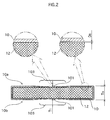
embodiment of the present invention; FIG. 2 is a cross section of the prismatic
lithium ion battery 1 along the line A-A; FIG. 3 is a cross section of a laser irradiation
signature 101 on a case 10 in the thickness direction; FIG. 4 is a schematic diagram showing a laser
forming apparatus 700 used for forming depressions 103
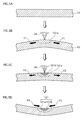
and 104 on the case 10; FIGs. 5A-5D are process drawings showing a
process of forming depressions 103 and 104 by a laser
forming process, where FIG. 5A is a partial cross
section showing the case 10 before a laser beam is
irradiated thereto, FIG. 5B is a partial cross section
showing the case 10 in a state of being heated
immediately after the laser beam irradiation has
started, FIG. 5C is a partial cross section showing
the case 10 in which a recrystallized portion 101b has
been formed, and FIG. 5D is a partial cross section
showing the case 10 after the laser beam irradiation
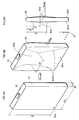
has finished; FIGs. 6A-6C are appearance diagrams of the case
80, which is a conventional prismatic sealed secondary
battery having no depressions, related to the case
swelling owing to an increased internal pressure,
where FIG. 6A is a perspective view of the case 80
prior to the increased internal pressure, FIG. 6B is a
perspective view of the case 80 swollen owing to the
increased internal pressure, and FIG. 6C is a side
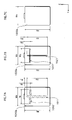
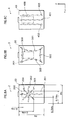
view of FIG. 6B. FIGs. 7A-7C are front elevational views of
prismatic lithium ion batteries used in confirmatory
experiments, where FIG. 7A illustrates a prismatic
lithium ion battery of a working example, FIG. 7B
illustrates a prismatic lithium ion battery of a
comparative example I, and FIG. 7C illustrates a
prismatic lithium ion battery of a comparative example
II; FIGs. 8A-8C are front elevational views of
prismatic sealed secondary batteries, where FIG. 8A
illustrates a prismatic sealed secondary battery 2 of
a second embodiment of the present invention, FIG. 8B
illustrates a prismatic sealed secondary battery 3 of
a third embodiment, and FIG. 8C illustrates a
prismatic sealed secondary battery 4 of a fourth
embodiment; and FIGs. 9A-9B are front elevational views of
prismatic sealed secondary batteries, where FIG. 9A
illustrates a prismatic sealed secondary battery 5 of
a fifth embodiment of the present invention, and FIG.
9B illustrates a prismatic sealed secondary battery 6
of a sixth embodiment.
DESCRIPTION OF PREFERRED EMBODIMENTS
1. First Embodiment
The following describes the first embodiment of
the present invention taking a prismatic lithium ion
battery 1 as an example. The prismatic lithium ion
battery 1 according to this embodiment represents
merely one example of the present invention, and
therefore the present invention is not confined to
this embodiment.
1.1 Structure of Prismatic Lithium Ion Battery 1
The structure of the prismatic lithium ion
battery (hereinafter, simply "prismatic battery") 1
according to this embodiment is explained with the aid
of FIGs. 1 and 2. FIG. 1 is an external perspective
view of the prismatic battery 1, and FIG. 2 is a cross
section of the prismatic battery 1 of FIG. 1 along the
line A-A.
As shown in FIG. 1, the prismatic battery 1
includes a prismatic case 10, and has an external
structure where a sealing cap 11 is joined with an
open end of the case 10 located in the Z-axis
direction. The case 10 is made of, for example, an Al-Mn
alloy (Japanese Industrial Standards: 3000-series
aluminum alloy).
The sealing cap 11 is joined with the case 10 by
welding (e.g. laser welding), and an external contact
terminal 110 is provided in the midsection of the main
plane of the sealing cap 11. On the lateral plane of
the external contact terminal 110, a gas exhaust vent
110H for exhausting gases generated inside of the case
10 is provided.
As shown in FIG. 2, in the internal space formed
by joining the sealing cap 11 with the case 10, an
electrode assembly 12 is housed. The electrode
assembly 12 is formed by spirally winding a separator
(not shown) sandwiched between a positive electrode
(not shown) and a negative electrode (not shown),
where the positive and negative electrodes are placed
opposite from one another. The electrode assembly 12
housed in the internal space is impregnated with a
nonaqueous electrolyte solution.
Referring now back to FIG. 1, on a main plane 10a
of the case 10 of the prismatic battery 1, two linear
laser irradiation signatures 101 and 102 are created
which intersect each other within an area 100. Each of
these two linear laser irradiation signatures 101 and
102 is striated, and the laser irradiation signature
101 is provided in the Z-axis direction while the
laser irradiation signature 102 is in the Y-axis
direction. The area 100 where the laser irradiation
signatures 101 and 102 intersect is set at the
position slightly off, in the Z-direction, the
midsection of the main plane 10a toward where the
sealing cap 11 is joined. The setting of the area 100
will be described later.
As shown in FIG. 1, on the main plane 10a of the
case 10, depressions 103 and 104 which dent inwards
are formed along the laser irradiation signatures 101
and 102, with the laser irradiation signatures 101 and
102 being a principal cause of these depressions 103
and 104. Namely, on the main plane 10a of the case 10,
the laser irradiation signatures 101 and 102 are
arranged in the shape of a cross, and the depressions
103 and 104 are formed centering along these laser
irradiation signatures 101 and 102. Here, the surface
distribution of the depressions 103 and 104 on the
main plane 10a of the case 10 is set in a manner that
the surface area ratio of the depressions 103 and 104
within the area 100 (a ratio of the surface area of
the depressions 103 and 104 to the total surface area
of the area 100) is higher than the surface area ratio
of the depressions 103 and 104 outside the area 100 on
the main plane 10a.
In FIG. 1, for the sake of convenience, the laser
irradiation signatures 101 and 102 are illustrated
with clear-cut outlines. However, these signatures 101
and 102 do not really have such distinct outlines as
shown in the figure. That is, unless a detailed
observation is conducted, it is difficult to detect
outlines of the laser irradiation signatures 101 and
102 in the prismatic battery 1, and only the formation
of the depressions 103 and 104 can be detected. These
depressions 103 and 104 have slopes with a gradual
rise.
On the A-A cross section of the prismatic battery
1 as shown in FIG. 2, a part of the interior surface
of the case 10 where the depression 103 is formed is
in contact with the exterior surface of the electrode
assembly 12. More specifically, as shown in the two
magnified figures of FIG. 2, there is an interspace Do
between the interior surface of the case 10 and the
exterior surface of the electrode assembly 12 in the
section where the depression 103 is not formed. On the
other hand, in the section where the depression 103 is
formed, there is a narrower interspace between the
interior surface of the case 10 and the exterior
surface of the electrode assembly 12, or these two are
in contact as described above. Note that the section
where the depression 104 is formed centering around
the laser irradiation signature 102 has the same
structure.
On the main plane 10b on the back of the
prismatic battery 1, the depressions 103 and 104
largely owing to the laser irradiation signatures 101
and 102 are created as in the same manner as the main
plane 10a. Note that, in FIG. 2, only the laser
irradiation signature 101 and the depression 103 are
shown for convenience of illustration.
In the case 10 of the prismatic battery 1, the
battery thickness between the midsections of the
depressions 103 and 104 each on the main planes 10a
and 10b, respectively, is T1. That is, in the
prismatic battery 1, the battery thickness between the
midsections of the depressions 103 and 104, T1, is set
smaller than the battery thickness elsewhere T 0 .
1.2 Configuration of Depressions 103 and 104
The configuration of the depressions 103 and 104
formed as described above is explained with the aid of
FIG. 3. FIG. 3 is a magnified cross section of FIG. 2
of the midsection where the depression 103 is formed.
Note that only the depression 103 is illustrated in
FIG. 3, however the depression 104 has the same
configuration as the depression 103.
As shown in FIG. 3, the case 10 is dented inward
to the battery due to the formation of the laser
irradiation signature 101, and the interior surface of
the case 10 and the exterior surface of the electrode
assembly 12 are in contact at which the laser
irradiation signature 101 is created. In terms of
metallic composition, the laser irradiation signature
101 is made up of a heat-influenced portion 101a and a
recrystallized portion 101b. More specifically, the
laser irradiation signature 101 on the outer surface
of the case 10 comprises: the recrystallized portion
101b which is, on cross section, fanned out inwardly
the plate of the case 10 from the center of the
linewidth of the laser irradiation signature 101, and
composed of a recrystallized structure; and the heat-influenced
portion 101a radially surrounding and
adjoining the outside of the bulbous part of the
recrystallized portion 101b. Here, the recrystallized
portion 101b is a portion subjected to heating by the
laser beam irradiation when the depression 103 is
being formed. The heating temperature applied is set
within the range no lower than the recrystallization
temperature but below the melting point of the Al-Mn
alloy of the case 10. The heat-influenced portion 101a
is a portion subjected to the heat temperature below
the recrystallization temperature. The manufacturing
method including these setting parameters will be
described later.
Note that the laser irradiation signatures 101
and 102 on the other main plane 10b of the case 10
have portions composed of the recrystallized structure,
the same as found in the laser irradiation signatures
101 and 102 on the main plane 10a.
1.3 Formation Method of Depressions 103 and 104
The method for forming the depressions 103 and
104 on the case 10 of the prismatic battery 1 is
explained with the aid of FIGs. 4 and 5. Note that the
formation method of only the depression 103 is shown
in FIGs. 4 and 5, however the depression 104 can be
formed by the same method.
As shown in FIG. 4, for forming the depression
103, the prismatic battery is placed on the
manufacturing base (not shown) corresponding to the Y-Z
plane so that the main plane 10a faces upward in the
X-axis direction. Here, in the case 10 of the
prismatic battery, the electrode assembly 12 (not
shown in FIG. 4) is already housed, and the open end
of the case 10 is sealed by the sealing cap 11 joined
therewith in advance. Then, using a laser forming
apparatus (hereinafter, "LF apparatus") 700, a laser
beam LB is irradiated on the main plane 10a and the
laser irradiation signature 101 is created. The
structure of the LF apparatus 700 is as follows.
As shown in FIG. 4, the LF apparatus 700
comprises: a YAG laser welding machine 701; a mirror
702; and lenses 703 and 704. The YAG laser-welding
machine 701 emits a laser beam LB in the pulse
oscillation mode. The mirror 702 deflects the emitted
laser beam LB to a direction perpendicular to the main
plane 10a. The lenses 703 and 704 converge the
deflected laser beam LB to a given spot diameter.
The irradiation parameters are set as follows
when, for example, the case 10 is made of a 3000-series
aluminum alloy and the plate thickness of the
main plane 10a is 0.3 mm.
<Irradiation parameters>
Laser Output: 156 J/pulse
Pulse Frequency: 20 pulses/s
Pulse Propagation Speed: 12 mm/s
Spot Diameter: (theoretical value) 4.0-4.3 mm
Note that these irradiation parameters provided
above are merely illustrative, and they shall be
modified depending on the plate material used for the
case 10, the plate thickness, the predetermined
manufacturing Takt time (i.e. the predetermined time
between units of production output) and so on.
Using the above laser irradiation parameters, the
depression 103 is formed as shown in FIG. 3 by
creating the laser irradiation signature 101 on the
main plane 10a of the case 10. The mechanism of this
formation is explained with the aid of FIGs. 5A-5D.
On the case 10 shown in FIG. 5A, the laser beam
LB with the above parameters is irradiated from the
main plane side as shown in FIG. 5B. Subsequently, the
peripheral area centering around the irradiated spots
is heated up. At this point, the case 10 causes
elastic deformation in the direction of the arrows F1
due to thermal expansion of the heated area in the
case 10.
As shown in FIG. 5C, when the heated area of the
case 10 subjected to irradiation of the laser beam LB
reaches the recrystallization temperature or higher,
the amount of the elastic deformation decreases as
indicated with the dashed arrows F2 owing to a
reduction in yield stress. At this point,
recrystallization occurs in the area radially extended
from the irradiation point of the laser beam LB.
As shown in FIG. 5D, after the irradiation by the
laser beam LB is finished, the heated area is cooled
off and thereby the case 10 causes thermal contraction
as indicated with the arrows F3. Consequently, the
depression 103 is formed on the case 10. After the
cooling off of the heated area, the laser irradiation
signature 101 is made up of the heat-influenced
portion 101a subjected to heating below the
recrystallization temperature and the recrystallized
portion 101b subjected to heating no lower than the
recrystallization temperature but below the melting
point. In the manufacturing according to the above
parameters, the maximum temperature for the heating is
controlled to below the melting point. Therefore, the
area subjected to the heating does not melt even while
being heated. As a result, not a recoagulated portion
composed of a recoagulated structure but the
recrystallized portion 101b composed of the
recrystallized structure is formed after the cooling
off.
Table 1 shows recrystallization temperatures and
melting points of various metals. Table 2 shows
irradiation parameters examined by the present
inventors for each plate thickness of the
case 10 as
well as for each pulse propagation speed used when the
depression 103 was formed.
| | Recrystallization Temperature (°C) | Melting Point (°C) |
| Aluminum (Al) | 150-200 | 660 |
| Iron (Fe) | 350-500 | 1535 |
| Copper (Cu) | 200-250 | 1083 |
| Nickel (Ni) | 530-660 | 1453 |
Note that the values of the recrystallization
temperatures and melting points shown in Table 1 above
will be changed when the metals are alloyed by other
elements.
| Plate Thickness of Case 10 (mm) | Pulse Propagation Speed (mm/s) | Laser Output (J/pulse) | Pulse Frequency (pulses/s) |
| 0.30 | 12.0 | 156 | 20 |
| 0.25 | 128 | 20 |
| 0.20 | 105 | 20 |
| 0.30 | 18.0 | 220 | 30 |
| 0.25 | 188 | 30 |
| 0.20 | 151 | 30 |
By employing the above-mentioned method and
irradiation parameters, the depressions 103 and 104 as
shown in FIGs. 1-3 can be formed. The recrystallized
portions 101b and 102b (FIGs. 3 and 5 showing only the
recrystallized portion 101b) each in the laser
irradiation signatures 101 and 102, respectively, can
be examined with the following method.
When a laser beam is irradiated on the main plane
10a and the irradiated part is heated at or above the
recrystallization temperature, the metal structure,
having been disturbed by the drawing and like when the
case was formed, is recrystallized, and refined
crystal grains are formed. In order to examine this
recrystallized portion, a cut plane of the portion is
ground to achieve a mirrored surface and then etched.
Then, the processed surface of the recrystallized
portion can be examined under the microscope (at a
magnification of approximately 500 times).
1.4 Setting for Area 100
With the aid of FIGs. 6A-6C, the following gives
an account of how to set the area 100 of FIG. 1 above.
FIGs. 6A-6C are appearance diagrams related to the
swelling of the main plane 80a developed as the
internal pressure of a conventional prismatic battery
that has a case 80 with no depressions is increased.
As shown in FIG. 6A, prior to the internal
pressure being increased, the case 80 is a prismatic
tubular case having a bottom with the dimensions of
height H0, width W0, and thickness T 0 . The open end of
the case 80 located on the upper side in the Z-axis
direction is sealed by the sealing cap 81 joined
therewith. As the internal pressure of such a
prismatic battery is increased, a swelling 800 occurs
with two ridgelines 800a on the main plane 80a of the
case 80 as shown in FIG. 6B.
When the prismatic battery of FIG. 6B is viewed
from the arrow B, the swelling 800 appears in the case
80 as shown in FIG. 6C, and the thickness of the
prismatic battery reaches the maximum thickness Tmax.
At this point, the place at which the maximum
thickness Tmax appears is adjacent to where the
distance between the ridgelines 800a shown in FIG. 6B
becomes shortest, a width W1.
As shown in FIG. 6C, within the case 80, the
maximum thickness Tmax appears at a place located a
length H1 downward in the Z-axis direction from the
joined edge of the sealing cap 81. The length H1
varies depending on the plate thickness of the case 80
and other factors, but in general the length H1 takes a
value of around 25 % of the height H0 of the case 80.
In view of the swelling of the case 80 as
described above, in the prismatic battery 1 according
to the present embodiment, the area 100 shall be set
as follows.
The area 100, on the main plane of the case 10 in
the prismatic battery 1 according to the present
embodiment, has its height in the height direction of
the case 10 (i.e. the Z-axis direction). It is
desirable that, when the case 10 has the height H0, the
height of the area 100 be set in the manner that the
area 100 occupies the range between H2 /H0 = 10 % and
H3 /H0 = 40 % in the height direction.
As to the width of the area 100, the width W1
between the ridgelines 800a shown in FIG. 6B is taken
into account, where W1 = 0.4W0 . Herewith, it is
desirable that the width of the area 100 be set in a
manner that the area 100 occupies 20 % of the width W0
both directions away from the center axis of the case
10 in the width direction of the case 10 (i.e. the Y-axis
direction).
1.5 Advantages in Prismatic Battery 1 of First
Embodiment and in Method for Manufacturing The Same
As described above, the prismatic battery 1
according to the first embodiment has the laser
irradiation signatures 101 and 102 arranged in the
shape of a cross. The laser irradiation signatures 101
and 102 are created on both main planes 10a and 10b of
the case 10. Largely owing to these laser irradiation
signatures 101 and 102, the depressions 103 and 104
are formed. The laser irradiation signatures 101 and
102 are set so as to have their intersection in the
area 100 where a swelling most likely appears. The
case 10 with such depressions 103 and 104 formed on
the main planes 10a and 10b excels in strength against
the swelling, compared to the case having no
depressions. Namely, the depressions 103 and 104
formed on the main planes 10a and 10b function as
reinforcement beams. Because of this function, the
swelling of the case 10 is suppressed when the
prismatic battery 1 is being charged, has gone through
several charge-discharge cycles, or has been left in
an elevated temperature environment.
In addition, according to the present embodiment,
the spot diameter of the laser beam is set large, 4.0-4.3
mm, when the depressions 103 and 104 are formed.
The depressions 103 and 104 are formed with the energy
density at which the recrystallized portion 101b is
formed on the external surface of the case 10 within
the laser irradiation signatures 101 and 102. Thereby,
the depressions 103 and 104, which are effective in
suppressing the swelling of the case 10, can be formed
simply by single-line laser irradiation signatures 101
and 102. As a result, the Takt time involved for the
formation of the depressions 103 and 104 can be set
short.
In the manufacturing method of the prismatic
battery 1 according to the present embodiment, first
the electrode assembly 12 is housed in the case 10,
and the sealing cap 11 is joined with the case 10.
Then, the depressions 103 and 104 are formed.
Consequently, this manufacturing method achieves the
energy-efficient prismatic battery 1 without
sacrificing the capacity of the electrode assembly for
forming the depressions, unlike the case of the
prismatic battery according to the above-mentioned
technology disclosed in Japanese Laid-Open Patent
Application Publication No. 2001-57179.
Furthermore, the method for forming the
depressions 103 and 104 according to the present
embodiment allows the slopes of the depressions 103
and 104 to be gradual (i.e. small dip angles).
Therefore, it is less likely to include air in the
depressions 103 and 104 when film is wrapped and
adhered to the outer surface of the case 10. As a
result, the prismatic battery 1 according to the
present embodiment achieves high quality in appearance.
Hence, the prismatic battery 1 is capable of
ensuring a high battery capacity and suppressing the
case swelling, and achieves high quality in appearance
at low cost.
1.6 Confirmatory Experiments
The following describes experiments conducted in
order to check the advantages of the prismatic battery
1 according to the first embodiment.
Each of the prismatic batteries used in the
experiments has the following dimensions and is made
of the following material.
- Outside Dimensions of the Case: Thickness 4.9 mm ×
Width 33.7 mm × Height 49.5 mm
- Height of the Case: 48.0 mm
- Plate Thickness of the Case: Main plane 0.3 mm;
Lateral plane 0.35 mm
- Material of the Case: 3000-series aluminum alloy
- Inside Dimensions of the Case: Thickness 4.3 mm ×
Width 33.0 mm
- Outside Dimensions of the Electrode assembly:
Thickness 4.2 mm × Width 32.3 mm
The following explains battery samples according
to a working example, and comparative examples I and
II with the aid of FIGs. 7A-7C and Table 3.
| | Working Example | Comparative Example I |
| Laser Output (J/pulse) | 156 | 45 |
| Pulse Frequency (pulses/s) | 20 | 35 |
| Pulse Propagation Speed (mm/s) | 12.0 | 12.0 |
| Spot Diameter (mm) | (theoretical value)
4.0-4.3 | 0.6-0.7 |
| Manufacturing Total Length (mm) | 64.0 | 192.0 |
| Manufacturing Takt Time (s) | 16.0 | 60.0 |
The prismatic battery according to the working
example had
laser irradiation signatures 1011 and 1012
on a
main plane 1010a as shown in FIG. 7A, and thereby
depressions (not shown) were formed on the
main plane
1010a. The
laser signatures 1011 and 1012 were the
same as those created in the
prismatic battery 1 of
the first embodiment above, and took the following
dimensional relationship.
| H 4 | 40 mm |
| H |
| 5 | 3 mm |
| H |
| 6 | 12 mm |
| W2 | 24 mm |
The laser beam irradiation parameters used for
forming depressions are shown in Table 3. When the
depressions were formed using the irradiation
parameters of this working example, the laser
irradiation signatures 1011 and 1012 were made up of
both a recrystallized portion and a heat-influenced
portion as is the case in the above first embodiment.
1.6.2 Comparative Example I
As shown in FIG. 7B, the prismatic battery
according to the comparative example I had two sets of
three linear
laser irradiation signatures 1021 and
1022 on a
main plane 1020a, and thereby depressions
(not shown) were formed. The dimensional relationship
of these
laser irradiation signatures 1021 and 1022 is
shown below.
| H 7 | 40 mm |
| H |
| 8 | 3 mm |
| H |
| 9 | 12 mm |
| W3 | 24 mm |
As to the prismatic battery according to the
comparative example I shown in FIG. 7B, the laser beam
irradiation parameters shown in Table 3 were used for
forming depressions on a main plane 1020a. In the
laser irradiation signatures 1021 and 1022 created
using these irradiation parameters, portions composed
of a recoagulated structure centering around the
irradiated spots on the external surface of the main
plane 1020a were formed. Namely, when the laser beam
irradiation parameters of the comparative example I
shown in Table 3 were used, the area radially extended
to a given distance centering around the laser beam
irradiation spots was heated up until the temperature
of the area exceeded the melting point. Subsequently,
the heated area was cooled off, and herewith the
recoagulated portion was formed.
Note that the reason why the laser beam
irradiation for creating the laser irradiation
signatures 1021 and 1022 was implemented with sets of
three lines is that the spot diameter of the
irradiation parameter was 0.6-0.7 mm, which is very
small compared to that of the working example. By
creating single-line laser irradiation signatures,
perfect depressions cannot be formed.
1.6.3 Comparative Example II
As to the prismatic battery according to the
comparative example II, depressions were not formed on
a main plane 1030a as shown in FIG. 7C.
Five each of the prismatic batteries according to
the working example and the comparative examples I and
II, respectively, were prepared and the following
experiments were conducted.
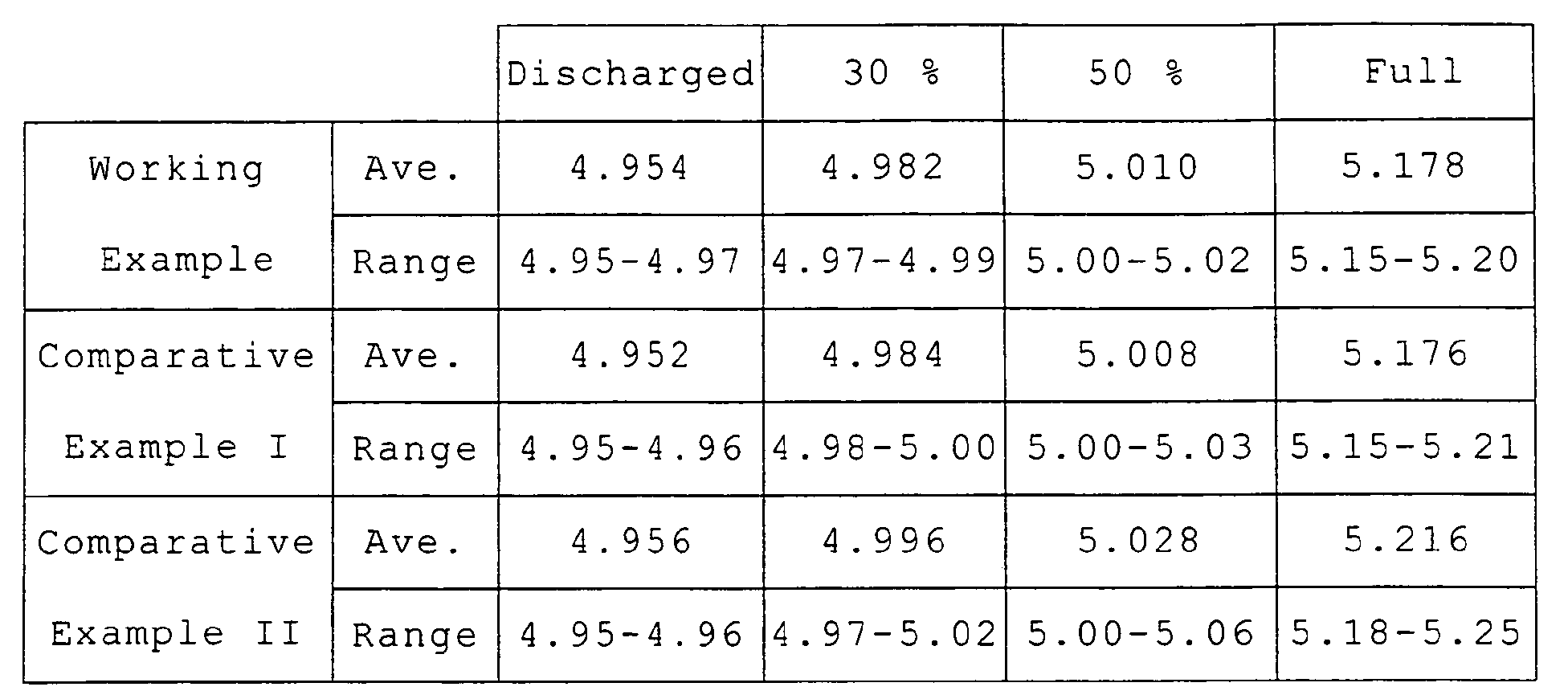
1.6.4 Experiment I
Each of the batteries according to the above
working example and comparative examples I and II was
charged until the battery reached a full charge. In
this situation, the thickness of the battery was
measured at the following points: discharged; 30 %
charged; 50 % charged; and full charged. The results
of the measurements are shown in Table 4.
As shown in Table 4, as with the prismatic
batteries of the comparative example II in which
depressions were not formed on the main plane 1030a,
the average thickness of the batteries changed from
4.956 mm (discharged) to 5.216 mm (full charged).
Namely, the cases of the prismatic batteries of the
comparative example II swelled 0.260 mm on an average
owing to charging. On the other hand, as with the
prismatic batteries of the working example as well as
those of the comparative example I, their average
swelling was suppressed, 0.224 mm. That is, the
prismatic batteries of the working example and the
comparative example I achieved a 14 % suppression in
the case swelling by forming depressions on the cases.
1.6.5 Experiment II
In this experiment, each of the batteries
according to the above working example and comparative
examples I and II was stored in a high temperature
environment of 85 °C for three hours. In this
situation, the thickness of the battery was measured
at the following points: before stored; immediately
after taken out from the above environment; and after
cooled off. The results of the measurements are shown
in Table 5.
As shown in Table 5, as with the prismatic
batteries of the comparative example II, the average
difference in the battery thicknesses between "before
stored" and "immediately after the batteries were
taken out" was 1.098 mm. On the other hand, as with
the prismatic batteries of the comparative example I
and those of the working example, their average
differences were 0.896 mm and 0.852 mm, respectively.
The results show that the prismatic batteries of the
working example exhibited the smallest swelling in the
cases when left in the elevated temperature
environment, and the swelling was suppressed by
approximately 23 % when compared to the prismatic
batteries of the comparative example II.
By cooling off the batteries taken out from the
above environment, the swelling of each battery became
reduced. Nonetheless, all prismatic batteries here
remained swollen as compared to before they were
stored in the above environment: the prismatic
batteries of the comparative example II remained
swollen by 0.402 mm, of the comparative example I by
0.310 mm, and of the working example by 0.278 mm. Thus,
again the prismatic batteries of the working example
exhibited the least swelling remained after the
cooling off, and the remaining swelling was reduced by
31 % when compared to the prismatic batteries of the
comparative example II.
1.6.6 Discussion
The results of the above two experiments show
that, among the prismatic batteries of the working
example and comparative examples I and II, the case
swelling was suppressed most in the prismatic
batteries of the working example in both cases in
which the batteries were being recharged and were left
in the elevated temperature environment. What this
tells us is that the depressions formed on the case of
the prismatic batteries of the working example
function as reinforcement beams on the main planes of
the case, and contribute to suppressing the case
swelling.
According to the results of the experiment I
above, it can be observed that the case swelling was
suppressed in the prismatic batteries of the
comparative example I, as with the prismatic batteries
of the working example. However, since portions
composed of the recoagulated structure are formed
within the respective laser irradiation signatures
1021 and 1022 as described above, very conspicuous
signatures remain there. Furthermore, there is a
problem that these signatures are likely to create
dead-air spaces when film is wrapped and adhered to
the case. Therefore, when comprehensively evaluated in
consideration of quality in appearance, it can be said
that the prismatic batteries of the working example
excel those of the comparative examples I and II.
2. Second Embodiment
The following explains the prismatic sealed
secondary battery 2 according to a second embodiment
of the present invention with the aid of FIG. 8A.
As shown in FIG. 8A, the prismatic sealed
secondary battery 2 according to the second embodiment
has four linear laser irradiation signatures 201, 202,
203, and 204 created on a main plane of a case 20.
These laser irradiation signatures 201-204 are also
created so as to intersect each other within an area
200, as in the case of the prismatic battery 1
according to the first embodiment above. Each of the
laser irradiation signatures 201-204 is made up of the
recrystallized portion and the heat-influenced portion
in the same manner shown in FIG. 3, and does not
include a portion composed of the recoagulated
structure. Namely, for creating the laser irradiation
signatures 201-204, the laser beam is irradiated on
the condition that the case surface temperature in the
irradiated spots on the case 20 by the laser beam LB
is within the range no lower than the
recrystallization temperature but below the melting
point.
Although not shown in the figure, depressions
formed due to the laser irradiation signatures 201-204
above are established in a manner that the surface
area ratio of the depressions within the area 200
becomes higher than the surface area ratio of the
depressions outside the area 200 on the main plane of
the case 20. The setting of this area 200 is the same
in the case of the first embodiment above. Here, the
height and the width of the main plane of the case 20
are H0 and W0, respectively. On the main plane, the
area 200 is defined as a region delineated by 0.1H0 to
0.4H0 from the edge of the joined sealing cap and by
0.3W0 to 0.7W0 from the left edge (on the figure) of
the case 10.
Note that on the other main plane of the case 20,
opposite from the above main plane, the laser
irradiation signatures and the depression formed
thereby are also created in the same manner.
Thus, as in the case of the prismatic battery 1
of the first embodiment above, the swelling of the
case 20 can be effectively suppressed in the prismatic
sealed secondary battery 2 of the second embodiment.
In addition, since the depressions are formed using
the same method shown in FIG. 4 above, the prismatic
sealed secondary battery 2 can reduce the work
processes and also has advantages on the cost front.
3. Third Embodiment
The following explains a prismatic sealed
secondary battery 3 according to a third embodiment
with aid of FIG. 8B.
As shown in FIG. 8B, the prismatic sealed
secondary battery 3 according to the third embodiment
has four arc-shaped laser irradiation signatures 301-304
created on the main planes of the case 30. Also on
the prismatic sealed secondary battery 3, depressions
are formed due to these laser irradiation signatures
301-304. The prismatic battery having the depressions
formed in such a configuration is less effective in
suppressing the swelling of the case 30 as compared to
the prismatic battery 1 of the first embodiment and
the prismatic sealed secondary battery 2 of the second
embodiment above. This is thought to be because the
surface area ratio of the depressions within an area
300 is not set to be higher than the surface area
ratio of the depressions outside the area 300.
Nonetheless, the prismatic sealed secondary battery 3
has an effect on suppressing the swelling of the case
30 compared to a conventional prismatic sealed
secondary battery having no depressions formed on the
main planes of the case 30.
As in the case of the prismatic battery 1 of the
first embodiment, the prismatic sealed secondary
battery 3 of the third embodiment reduces the work
processes during the manufacturing stage and also has
advantages on the cost front.
4. Fourth Embodiment
The following explains a prismatic sealed
secondary battery 4 according to a fourth embodiment
with aid of FIG. 8C.
As shown in FIG. 8C, the prismatic sealed
secondary battery 4 according to the fourth embodiment
has three-stripe laser irradiation signatures 401-403
created in the longitudinal direction (i.e. the Z-axis
direction of FIG. 8A) on the main planes of the case
40. Among the laser irradiation signatures 401-403
created in such a configuration, the laser irradiation
signature 401 located in the middle runs
longitudinally through an area 400, and is effective
in suppressing the swelling of the case 40 of the
prismatic sealed secondary battery 4. Again, each of
the laser irradiation signatures 401-403 of the fourth
embodiment is made up of the recrystallized portion
and heat-influenced portion formed inward to the case
plate. In addition, the spot diameter for the laser
beam irradiation is set large. Herewith, the
manufacturing processes required for the formation of
the depressions can be reduced.
5. Fifth Embodiment
The following explains a prismatic sealed
secondary battery 5 according to a fifth embodiment
with aid of FIG. 9A.
As shown in FIG. 9A, the prismatic sealed
secondary battery 5 of the fifth embodiment has a
single linear laser irradiation signature 501 created
in the height direction (i.e. the Z-axis direction of
FIG. 9A) of the case 50, and a depression (not shown
in FIG. 9A) is formed along the laser irradiation
signature 501 that is a principal cause of the
formation of the depression. Again, in this case, the
prismatic sealed secondary battery 5 of the fifth
embodiment has the same effects as the prismatic
sealed secondary battery 4 of the fourth embodiment
and so on.
6. Sixth Embodiment
The following explains a prismatic sealed
secondary battery 6 according to a sixth embodiment
with aid of FIG. 9B.
As shown in FIG. 9B, the prismatic sealed
secondary battery 6 of the sixth embodiment has a
swirling laser irradiation signature 601 with its
center set in an area 600 on each main plane of the
case 60. In the prismatic sealed secondary battery 6,
the laser irradiation signature 601 is intensively
created over the area 600, and herewith a depression
(not shown in FIG. 9B) is formed. Consequently, the
swelling of the case 60 can be suppressed highly
efficiently. Again in this case, the laser irradiation
signature 601 is made up of the recrystallized portion
and heat-influenced portion formed inward to the case
plate.
Hence, in the prismatic sealed secondary battery
6 of the sixth embodiment, the swelling of the case 60
is effectively suppressed and the work processes
required for the formation of the depressions can be
reduced.
Note that the first to sixth embodiments
described above are merely examples, and the present
invention may be a prismatic sealed secondary battery
having one or more depressions formed by one or more
laser irradiation signatures of a different
configuration.
7. Additional Particulars
In the above first embodiment, the prismatic
lithium ion battery 1 is used as an example. However,
the present invention can be applied to other types of
prismatic sealed secondary batteries, and thus the
configuration of batteries to which the present
invention can be applied is not confined to prismatic
lithium ion batteries. For instance, the present
invention achieves the same effects as described above
when applied to prismatic nickel-cadmium batteries and
prismatic Nickel-Metal Hydride batteries.
In the above first to sixth embodiments, the
prismatic sealed secondary batteries 1-6 each having
the cases 10-60, respectively, which are made of the
3000-series aluminum alloy, are used as examples.
However, materials used for the cases 10-60 are not
confined to this. For instance, metals shown in Table
1 above can be used as case materials.
The laser beam irradiation parameters of FIG. 2,
which are employed at manufacturing the battery
according to the first embodiment, are also merely
examples, and the present invention is not confined to
these. In short, for creating laser irradiation
signatures in order to form depressions, what is
required is that each of the laser irradiation
signatures is made up of the recrystallized portion
and the heat-influenced portion. For this purpose,
within the spots irradiated by the laser beam, parts
having the highest temperature should be set to be no
lower than the recrystallization temperature but below
the melting point. Here, from the aspect of enhancing
workability of the depression formation, it is
desirable to set the spot diameter in the range of 2.0
mm and 6.0 mm inclusive.
In the first embodiment, the spot shape of the
laser beam LB irradiated on the main plane 10a of the
case 10 is round, however, the shape of the laser beam
LB of the present invention is not confined to this.
For example, the laser beam LB with a rectangular spot
shape may be irradiated by providing cylindrical
lenses in the light path.
Furthermore, in the above first embodiment, the
laser beam LB is irradiated on the main plane 10a of
the case 10 in order to form the depressions, however,
the present invention is not confined to this and any
energy beam, for instance, an electron beam and a
plasma beam, can be used.
Although the present invention has been fully
described by way of examples with reference to the
accompanying drawings, it is to be noted that various
changes and modifications will be apparent to those
skilled in the art. Therefore, unless otherwise such
changes and modifications depart from the scope of the
present invention, they should be constructed as being
included therein.