EP1593675A1 - Hetero-polycyclic compounds, and coloring matters, pigments, dyes, color-changing material compositions, and color-changing films, made by using the compounds - Google Patents
Hetero-polycyclic compounds, and coloring matters, pigments, dyes, color-changing material compositions, and color-changing films, made by using the compounds Download PDFInfo
- Publication number
- EP1593675A1 EP1593675A1 EP04710500A EP04710500A EP1593675A1 EP 1593675 A1 EP1593675 A1 EP 1593675A1 EP 04710500 A EP04710500 A EP 04710500A EP 04710500 A EP04710500 A EP 04710500A EP 1593675 A1 EP1593675 A1 EP 1593675A1
- Authority
- EP
- European Patent Office
- Prior art keywords
- substituent
- carbon atoms
- group
- color
- aryl group
- Prior art date
- Legal status (The legal status is an assumption and is not a legal conclusion. Google has not performed a legal analysis and makes no representation as to the accuracy of the status listed.)
- Withdrawn
Links
- 0 *N(c(cc1)ccc1-c1c(cccc2)c2c(*C([Al])=N2)c2c1)I Chemical compound *N(c(cc1)ccc1-c1c(cccc2)c2c(*C([Al])=N2)c2c1)I 0.000 description 2
- VHIPBVOYHRJDEF-UHFFFAOYSA-N CCCCN(CCCC)c(cc1)cc(O2)c1-c1c3c2cccc3c2[o]c(-c(cc3)ccc3C#N)nc2c1 Chemical compound CCCCN(CCCC)c(cc1)cc(O2)c1-c1c3c2cccc3c2[o]c(-c(cc3)ccc3C#N)nc2c1 VHIPBVOYHRJDEF-UHFFFAOYSA-N 0.000 description 1
- LRLNTFGSZKTTIC-UHFFFAOYSA-N CCCCN(CCCC)c(cc1)cc(O2)c1-c1c3c2cccc3c2nc(-c(cc3)ccc3C#N)[nH]c2c1 Chemical compound CCCCN(CCCC)c(cc1)cc(O2)c1-c1c3c2cccc3c2nc(-c(cc3)ccc3C#N)[nH]c2c1 LRLNTFGSZKTTIC-UHFFFAOYSA-N 0.000 description 1
- UENVSCASYNNPMH-UHFFFAOYSA-N CCCCN(CCCC)c(cc1)cc(O2)c1-c1c3c2cccc3c2nc(-c(cc3)ccc3C#N)[o]c2c1 Chemical compound CCCCN(CCCC)c(cc1)cc(O2)c1-c1c3c2cccc3c2nc(-c(cc3)ccc3C#N)[o]c2c1 UENVSCASYNNPMH-UHFFFAOYSA-N 0.000 description 1
Images


Classifications
-
- C—CHEMISTRY; METALLURGY
- C07—ORGANIC CHEMISTRY
- C07D—HETEROCYCLIC COMPOUNDS
- C07D307/00—Heterocyclic compounds containing five-membered rings having one oxygen atom as the only ring hetero atom
- C07D307/77—Heterocyclic compounds containing five-membered rings having one oxygen atom as the only ring hetero atom ortho- or peri-condensed with carbocyclic rings or ring systems
-
- C—CHEMISTRY; METALLURGY
- C07—ORGANIC CHEMISTRY
- C07D—HETEROCYCLIC COMPOUNDS
- C07D263/00—Heterocyclic compounds containing 1,3-oxazole or hydrogenated 1,3-oxazole rings
- C07D263/52—Heterocyclic compounds containing 1,3-oxazole or hydrogenated 1,3-oxazole rings condensed with carbocyclic rings or ring systems
- C07D263/60—Naphthoxazoles; Hydrogenated naphthoxazoles
-
- C—CHEMISTRY; METALLURGY
- C07—ORGANIC CHEMISTRY
- C07D—HETEROCYCLIC COMPOUNDS
- C07D311/00—Heterocyclic compounds containing six-membered rings having one oxygen atom as the only hetero atom, condensed with other rings
- C07D311/02—Heterocyclic compounds containing six-membered rings having one oxygen atom as the only hetero atom, condensed with other rings ortho- or peri-condensed with carbocyclic rings or ring systems
- C07D311/78—Ring systems having three or more relevant rings
-
- C—CHEMISTRY; METALLURGY
- C07—ORGANIC CHEMISTRY
- C07D—HETEROCYCLIC COMPOUNDS
- C07D498/00—Heterocyclic compounds containing in the condensed system at least one hetero ring having nitrogen and oxygen atoms as the only ring hetero atoms
- C07D498/02—Heterocyclic compounds containing in the condensed system at least one hetero ring having nitrogen and oxygen atoms as the only ring hetero atoms in which the condensed system contains two hetero rings
- C07D498/04—Ortho-condensed systems
-
- C—CHEMISTRY; METALLURGY
- C09—DYES; PAINTS; POLISHES; NATURAL RESINS; ADHESIVES; COMPOSITIONS NOT OTHERWISE PROVIDED FOR; APPLICATIONS OF MATERIALS NOT OTHERWISE PROVIDED FOR
- C09B—ORGANIC DYES OR CLOSELY-RELATED COMPOUNDS FOR PRODUCING DYES, e.g. PIGMENTS; MORDANTS; LAKES
- C09B57/00—Other synthetic dyes of known constitution
-
- C—CHEMISTRY; METALLURGY
- C09—DYES; PAINTS; POLISHES; NATURAL RESINS; ADHESIVES; COMPOSITIONS NOT OTHERWISE PROVIDED FOR; APPLICATIONS OF MATERIALS NOT OTHERWISE PROVIDED FOR
- C09K—MATERIALS FOR MISCELLANEOUS APPLICATIONS, NOT PROVIDED FOR ELSEWHERE
- C09K11/00—Luminescent materials, e.g. electroluminescent or chemiluminescent
- C09K11/06—Luminescent materials, e.g. electroluminescent or chemiluminescent containing organic luminescent materials
-
- C—CHEMISTRY; METALLURGY
- C09—DYES; PAINTS; POLISHES; NATURAL RESINS; ADHESIVES; COMPOSITIONS NOT OTHERWISE PROVIDED FOR; APPLICATIONS OF MATERIALS NOT OTHERWISE PROVIDED FOR
- C09K—MATERIALS FOR MISCELLANEOUS APPLICATIONS, NOT PROVIDED FOR ELSEWHERE
- C09K2211/00—Chemical nature of organic luminescent or tenebrescent compounds
- C09K2211/10—Non-macromolecular compounds
- C09K2211/1003—Carbocyclic compounds
- C09K2211/1011—Condensed systems
-
- C—CHEMISTRY; METALLURGY
- C09—DYES; PAINTS; POLISHES; NATURAL RESINS; ADHESIVES; COMPOSITIONS NOT OTHERWISE PROVIDED FOR; APPLICATIONS OF MATERIALS NOT OTHERWISE PROVIDED FOR
- C09K—MATERIALS FOR MISCELLANEOUS APPLICATIONS, NOT PROVIDED FOR ELSEWHERE
- C09K2211/00—Chemical nature of organic luminescent or tenebrescent compounds
- C09K2211/10—Non-macromolecular compounds
- C09K2211/1018—Heterocyclic compounds
- C09K2211/1025—Heterocyclic compounds characterised by ligands
- C09K2211/1029—Heterocyclic compounds characterised by ligands containing one nitrogen atom as the heteroatom
- C09K2211/1033—Heterocyclic compounds characterised by ligands containing one nitrogen atom as the heteroatom with oxygen
-
- C—CHEMISTRY; METALLURGY
- C09—DYES; PAINTS; POLISHES; NATURAL RESINS; ADHESIVES; COMPOSITIONS NOT OTHERWISE PROVIDED FOR; APPLICATIONS OF MATERIALS NOT OTHERWISE PROVIDED FOR
- C09K—MATERIALS FOR MISCELLANEOUS APPLICATIONS, NOT PROVIDED FOR ELSEWHERE
- C09K2211/00—Chemical nature of organic luminescent or tenebrescent compounds
- C09K2211/10—Non-macromolecular compounds
- C09K2211/1018—Heterocyclic compounds
- C09K2211/1025—Heterocyclic compounds characterised by ligands
- C09K2211/1088—Heterocyclic compounds characterised by ligands containing oxygen as the only heteroatom
Definitions
- the present invention relates to novel hetero-polycyclic compounds, and coloring matters, pigments or dyes, color-changing material compositions and color-changing films, which are produced by using the above compounds, specifically to color-changing material compositions which are not deteriorated in a color-changing performance even after used for long time and which are prevented from being unusable due to deposition of coloring matters during storage and color-changing films produced by using the same, and novel hetero-polycyclic compounds, coloring matters and pigments or dyes which actualize them.
- Organic fluorescent coloring matters have so far been used in the wide fields as coloring matters for fluorescence-changing films in various display equipments and as coloring matters for dye lasers, copy prevention, solar energy changing and fluorescent films in green houses, in addition to uses as dyes and pigments.
- the organic fluorescent coloring matters used for the above applications are strongly desired to be controlled in a fluorescent wavelength in a solid state and improved in a luminous intensity.
- a fluorescent intensity of an organic fluorescent coloring matter in a solid state is weak as compared with the fluorescent intensity thereof in a solution state. It is the existing situation that this phenomenon is neglected as concentration quenching and that the details thereof are not known well. This is because it has been difficult in conventional organic fluorescent coloring matters to allow a molecular packing structure in a crystal lattice to variously change to investigate an influence thereof exerted to light absorption and a fluorescent property of an organic fluorescent coloring matter in a solid state.
- the present inventors have created previously as substances for solving the above points, novel fluorescent coloring matters having a clathrate-forming ability capable of changing an intrinsic color and a fluorescent luminescence which the coloring matters are endowed with to a large extent by allowing various organic low molecular compounds (organic guest molecules) to be included therein in a solid state (refer to, for example, “Chem. Lett.”, p. 9 (1996), “Chem. Lett.”, p. 837 (1999), “Chem. Lett.”, p. 714 (2000), “Chem. Lett.”, p. 808 (2001) and “J. Chem. Perkin Trans.”, vol. 2, p. 700 to 714 and p. 708 to 714 (2002)).
- Organic electroluminescent elements (hereinafter referred to as organic EL elements) are completely solid elements and can produce displays which are light-weight and thin and which are driven at low voltage, and therefore they are actively researched in various fields at present.
- the largest technical subject for producing displays from organic EL elements is development of a full colorization method. Light emissions of blue, green and red colors have to be finely arranged in order to produce such full color displays, and three methods of a three-color separate coating method, a color filter method and a color-changing method are considered as the method therefor at present.
- the color-changing method makes it easy to produce large-scaled displays as compared with the three-color separate coating method, and it has the advantage that a loss in the luminance is small as compared with that in the color filter method. Accordingly, the present inventors have been investigating full colorization of organic EL elements by the color-changing method.
- a color-changing film used for changing a blue color emitted to a green color and a red color has to be finely patterned.
- a color-changing film is constituted from a fluorescent coloring matter and a resin for dispersing it, and a fine processing property is required to this resin itself in order to highly finely pattern the film.
- color-changing material compositions prepared by using basic resins such as vinylpyridine derivatives and aminostyrene derivatives are used in, for example, Japanese Patent Application Laid-Open No.
- color-changing material compositions prepared by using ethylenically unsaturated carboxylic acid copolymers are disclosed in Japanese Patent Application Laid-Open No. 106888/1997; and color-changing material compositions comprising unsaturated group-containing compounds obtained by reacting polybasic carboxylic acids or anhydrides thereof with reaction products of epoxy compounds and acrylic acid or methacrylic acid and at least one fluorescent substance selected from fluorescent coloring matters and fluorescent pigments are disclosed in Japanese Patent Application Laid-Open No. 119645/2000.
- the above color-changing material compositions have had the problems that when a color-changing film containing a coumarin base coloring matter as a coloring matter absorbing blue light is continued to be irradiated with blue light emitted from an organic EL, the coumarin base coloring matter is decomposed and can not sufficiently absorb blue light of a light source to allow it to be transmitted and that the color-changing property is deteriorated or the coloring matter is deposited during storage depending on the resin composition to make it impossible to use the film.
- the present invention has been made in order to solve the problems described above, and a an object of the present invention is to provide a novel hetero-polycyclic compound which functions as a conventional organic coloring matter and organic fluorescent coloring matter or as an organic fluorescent coloring matter having a clathrate-forming ability and a fluorescent property and capable of changing the solid optical properties (color tone and fluorescent property) of the coloring matter to a large extent by allowing organic guest molecules to be included therein and which is suitably used for various applications, and a coloring matter and a pigment or a dye which are prepared by using the above compound.
- an object of the present invention is to provide a color-changing material composition prepared by using the above compound, which is not deteriorated in a color-changing performance even after used for long time and which is prevented from being unusable due to deposition of the coloring matter during storage, and a color-changing film produced by using the same.
- the present invention provides a hetero-polycyclic compound represented by any of the following Formulas (I) to (VIII): wherein R 1 and R 2 each represent independently an alkyl group having 1 to 10 carbon atoms which may have a substituent, an arylalkyl group having 7 to 30 carbon atoms which may have a substituent, an aryl group having 6 to 20 carbon atoms which may have a substituent or a heteroaryl group having 5 to 20 carbon atoms which may have a substituent, and they may be combined with each other to form a cyclic structure or may form a cyclic structure together with a benzene ring to which a nitrogen atom is bonded;
- X represents an oxygen atom, a sulfur atom, -NH- or -NR 3 - (R 3 represents an alkyl group having 1 to 10 carbon atoms which may have a substituent, an aryl group having 6 to 20 carbon atoms which may have a substituent or a heteroaryl group having
- the resent invention provides a color-changing material composition
- a color-changing material composition comprising (A) a fluorescent coloring matter comprising at least one of the hetero-polycyclic compounds represented by Formulas (III) to (VIII) and (B) a binder material, and a color-changing film comprising the above color-changing material composition.
- the resent invention provides a coloring matter comprising the hetero-polycyclic compound described above and a pigment or a dye containing the hetero-polycyclic compound described above.
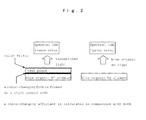
- a number 1 is a glass substrate; 2 is a color-changing film; 2 is an anode; 4 is an organic EL luminescent layer; and 5 is a cathode.
- the hetero-polycyclic compound of the present invention is a novel hetero-polycyclic compound which has a structure represented by any of the following Formulas (I) to (VIII) and which is not described in documents:
- R 1 and R 2 each represent independently an alkyl group having 1 to 10 carbon atoms which may have a substituent, an arylalkyl group having 7 to 30 carbon atoms which may have a substituent, an aryl group having 6 to 20 carbon atoms which may have a substituent or a heteroaryl group having 5 to 20 carbon atoms which may have a substituent, and they may be combined with each other to form a cyclic structure or may form a cyclic structure together with a benzene ring to which a nitrogen atom is bonded.
- the alkyl group described above may be any of linear, branched and cyclic groups, and the examples thereof include methyl, ethyl, n-propyl, isopropyl, various butyls, various pentyls, various hexyls, various octyls, various decyls, cyclopentyl, cyclohexyl, cyclooctyl, benzyl and phenethyl.
- arylalkyl group described above include benzyl, 1-phenylethyl, 2-phenylethyl, 1-phenylisopropyl, 2-phenylisopropyl, phenyl-t-butyl, ⁇ -naphthylmethyl, 1- ⁇ -naphthylethyl, 2- ⁇ -naphthylethyl, 1- ⁇ -naphthylisopropyl, 2- ⁇ -naphthylisopropyl, ⁇ -naphthylmethyl, 1- ⁇ -naphthylethyl, 2- ⁇ -naphthylethyl, 1- ⁇ -naphthylisopropyl, 2- ⁇ -naphthylisopropyl, 1-pyrrolylmethyl, 2-(1-pyrrolyl)ethyl, p-methylbenzyl, m-methylbenzyl, o-methylbenzyl,
- aryl group described above examples include phenyl, naphthyl, anthryl and pyrenyl.
- heteroaryl group described above examples include 1-aza-indolizine-2-yl, 1-aza-indolizine-3-yl, 1-aza-indolizine-5-yl, 1-aza-indolizine-6-yl, 1-aza-indolizine-7-yl, 1-aza-indolizine-8-yl, 2-aza-indolizine-1-yl, 2-aza-indolizine-3-yl, 2-aza-indolizine-5-yl, 2-aza-indolizine-6-yl, 2-aza-indolizine-7-yl, 2-aza-indolizine-8-yl, 6-aza-indolizine-1-yl, 6-aza-indolizine-2-yl, 6-aza-indolizine-3-yl, 6-aza-indolizine-5-yl, 6-aza-indolizine-7-yl, 6-aza-indolizine-8-yl, 7-aza-indolizine-1-y
- the above respective groups may have suitable substituents, and the substituents include, for example, an alkyl group, an alkoxyl group, a halogen atom, a cyano group, an alkoxycarbonyl group, a carboxyl group, an ester group, an amide group, a sulfoxyl group, a sulfonamide group, a nitro group, an aryl group and a heteroaryl group.
- substituents include, for example, an alkyl group, an alkoxyl group, a halogen atom, a cyano group, an alkoxycarbonyl group, a carboxyl group, an ester group, an amide group, a sulfoxyl group, a sulfonamide group, a nitro group, an aryl group and a heteroaryl group.
- the examples of the above alkyl group, aryl group and heteroaryl group include the same groups as described above.
- the examples of the halogen atom include a fluorine atom, a chlorine atom, a bromine atom and an iodine atom.
- the alkoxyl group may be any of linear, branched and cyclic groups, and the examples thereof include methoxy, ethoxy, n-propoxy, isopropoxy, various butoxy, various pentoxy, various hexoxy, various octoxy, various decyloxy, cyclopenthyloxy, cyclohexyloxy, benzyloxy and phenethyloxy.
- the sulfonamide group may be either of substituted sulfonamide and non-substituted sulfonamide
- the amide group may be either of substituted amide and non-substituted amide.
- Substituents for the above alkoxyl group, sulfonamide group and amide group include the same groups as given in R 1 and R 2 described above. Further, the examples of an alkoxyl group in the alkoxycarbonyl group include the same groups as described above.
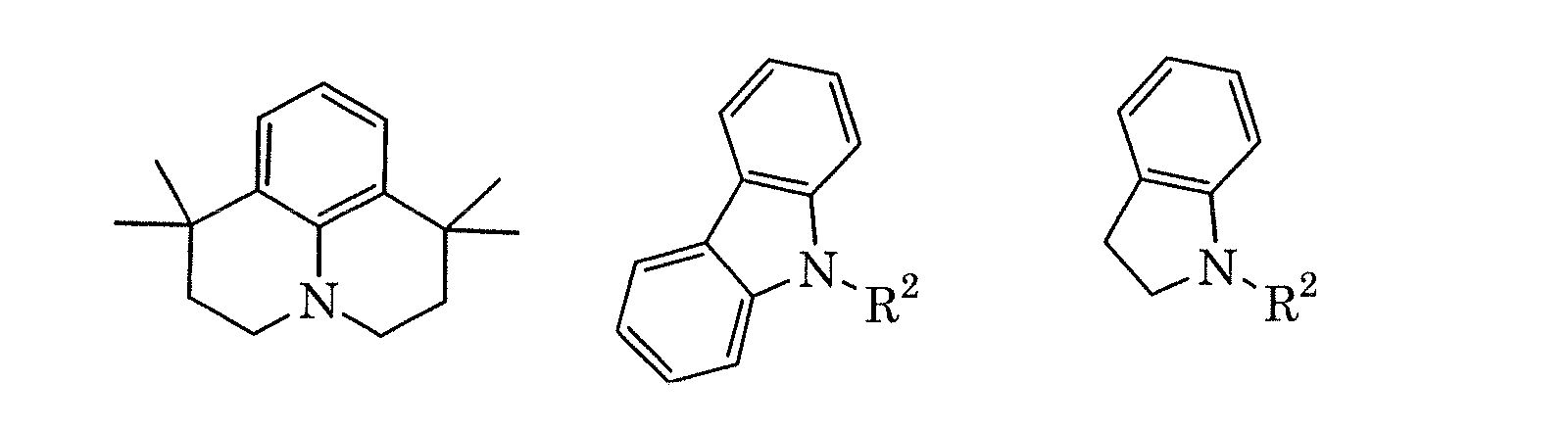
- the cyclic structure formed by allowing R 1 and R 2 to be combined with each other together with a nitrogen atom includes, for example, 1-pyrrolidinyl, piperidino and morpholine.
- the cyclic structure formed by allowing R 1 and R 2 to be combined with each other together with a benzene ring to which a nitrogen atom is bonded includes, for example, the following ones:
- X represents an oxygen atom, a sulfur atom, -NH- or -NR 3 - (R 3 represents an alkyl group having 1 to 10 carbon atoms which may have a substituent, an aryl group having 6 to 20 carbon atoms which may have a substituent or a heteroaryl group having 5 to 20 carbon atoms which may have a substituent).
- alkyl group, the aryl group and the heteroaryl group represented by R 3 described above each include the same groups as given in R 1 and R 2 described above, and the substituents therefor include as well the same groups.
- Y represents an oxygen atom, a sulfur atom or -NR 4 - (R 4 represents an alkyl group having 1 to 10 carbon atoms which may have a substituent, an aryl group having 6 to 20 carbon atoms which may have a substituent or a heteroaryl group having 5 to 20 carbon atoms which may have a substituent), and in Formulas (V) to (IV), Y represents an oxygen atom, a sulfur atom, -NH- or -NR 4 - (R 4 is the same as described above).
- alkyl group, the aryl group and the heteroaryl group represented by R 4 described above include the same groups as given respectively in R 1 and R 2 described above, and substituents therefor include as well the same groups.
- Ar represents an aryl group having 6 to 20 carbon atoms which may have a substituent or a heteroaryl group having 5 to 20 carbon atoms which may have a substituent.
- the examples of the aryl group and the heteroaryl group each include the same groups as given in R 1 and R 2 described above, and the substituents therefor include as well the same groups.
- the specific example of the compound represented by Formula (II) described above includes, for example, a compound in which a ring formed by X assumes a six-membered structure represented by Formula (II) in the compound represented by Formula (I-a).
- the compounds of the present invention represented by Formula (I) and Formula (II) are coloring matters and can suitably be used as disperse dyes, coloring matters for ink-jet printing, electrophotographic toners, heat transfer coloring matters, non-linear optical materials such as light modulation elements, photoelectric transfer coloring matters such as organic solar batteries and high density optical recording type coloring matters each containing the above coloring matters. Further, they can also be used as intermediates for producing the following compounds of the present invention represented by Formula (V) to Formula (VIII).
- the specific examples of the compound represented by Formula (VII) described above include, for example, compounds in which a ring formed by X assumes a six-membered structure represented by Formula (VII) in the compounds represented by (V-a) to (V-c) described above.
- the specific examples of the compound represented by Formula (VIII) described above include, for example, compounds in which a ring formed by X assumes a six-membered structure represented by Formula (VIII) in the compounds represented by (VI-a) to (VI-c) described above.
- the compounds of the present invention represented by Formula (III) to Formula (VIII) are organic fluorescent coloring matters and can suitably be used as disperse dyes, coloring matters for ink-jet printing, electrophotographic toners, heat transfer coloring matters, luminescent materials such as organic electroluminescent elements, non-linear optical materials such as light modulation elements, photoelectric transfer coloring matters such as organic solar batteries, fluorescent coloring matters such as organic EL ⁇ dye lasers, modulated light ⁇ wavelength transfer coloring matters such as agricultural films, high density optical recording type coloring matters and fluorescent coloring matters for molecular recognition each containing the above coloring matters.
- some compounds have a clathrate-forming ability, and they can be derived as well into solid-luminescent organic fluorescent coloring matters comprising clathrate complexes in which a color tone and a fluorescent luminescence are changed and in which performances are raised further more by allowing various organic guest molecules to be included therein.
- the compounds of the present invention represented by Formula (III) to Formula (VIII) and the clathrate complexes thereof can be used for various applications as the organic fluorescent coloring matters, for example, fluorescence-changing films in various display equipments, coloring matter laser, light toning, energy changing, high density optical recording, display and fluorescent sensors for molecular recognition.
- the fluorescence-changing films in various display equipments can be applied to electronic display devices such as, for example, PDP (plasma display), ELD (electroluminescence display), LED (light-emitting diode) and VFD (fluorescent display tube).
- PDP plasma display
- ELD electroluminescence display
- LED light-emitting diode
- VFD fluorescent display tube
- the hetero-polycyclic compound of the present invention represented by Formula (I) which is a 1,2-naphthoquinone base derivative can be produced according to, for example, a reaction equation (A) shown below when X is an oxygen atom: wherein M represents an alkali metal atom, and R 1 and R 2 are the same as described above.
- the substantially stoichiometric amounts of 1,2-naphthoquinone-4-sulfonic acid alkali metal salt (a) and m-substituted phenol (b) are reacted at a temperature of about 0 to 80°C in a suitable solvent such as acetic acid in the presence of a catalyst such as copper (II) halide, whereby a compound which has a benzofurano-1,2-naphthoquinone skeleton represented by Formula (I-1) and in which X is an oxygen atom.
- a compound represented by Formula (c) is by-produced.
- the compound represented by Formula (c) is obtained as a principal component by using a catalyst having a weak oxidizing strength such as nickel chloride in the above reaction equation (A), and after isolating the compound represented by Formula (c), cyclization reaction is carried out at a temperature of about 40 to 120°C in a solvent such as dimethylsulfoxide in the presence of a catalyst having a strong oxidizing strength such as copper acetate, whereby the above compound represented by Formula (II) can be produced.
- a catalyst having a weak oxidizing strength such as nickel chloride
- cyclization reaction is carried out at a temperature of about 40 to 120°C in a solvent such as dimethylsulfoxide in the presence of a catalyst having a strong oxidizing strength such as copper acetate
- a 1,2-naphthoquinone derivative represented by Formula (d) is reacted with a substantially stoichiometric amount or a little excessive amount of arylaldehyde (e) and an excessive amount of ammonium acetate in a suitable solvent such as acetic acid at a temperature of about 50 to 100°C, whereby compounds represented by Formula (III-1) and (IV-1) having a naphthoxazole skeleton are obtained.
- the compound represented by Formula (I-1) is reacted with a little excessive amount of arylaldehyde (f) and an excessive amount of ammonium acetate in a suitable solvent such as acetic acid at a temperature of about 50 to 100°C, whereby compounds having a benzofuranonaphthoxazole skeleton represented by Formula (V-1) and (VI-1) are obtained.
- a suitable solvent such as acetic acid
- the color-changing material composition of the present invention shall be explained below.
- the color-changing material composition of the present invention comprises (A) a fluorescent coloring matter comprising at least one of the hetero-polycyclic compounds represented by Formulas (III) to (VIII) described above and (B) a binder material.
- a concentration of the component (A) described above shall not specifically be restricted, and it is preferably 0.1 to 10 % by weight, more preferably 0.2 to 5 % by weight based on the whole amount of the solid matters contained in the color-changing material composition. If the concentration is 0.1 by weight or more, light can sufficiently be absorbed from a light source, and the color can be changed. If it is 10 by weight or less, it is prevented that the color-changing efficiency is reduced due to concentration quenching and that highly fine patterning can not be carried out.
- the binder material of the component (B) is more preferably an optically reactive resin.
- the optically reactive resin means a resin which shows curing reaction by light, and it includes resins blended with polymerizable oligomers and/ or monomers such as epoxy acrylate, urethane acrylate and polyether acrylate and resins blended with allylsulfonyl salts and epoxy compounds.
- the binder material of the component (B) is preferably a thermosetting resin or a thermoplastic resin.
- thermosetting resin includes, for example, epoxy resins, urethane resins, alkid resins and polyimide resins, and the epoxy resins and the urethane resins are particularly preferred since they have a high transparency and a high dispersibility of coloring matters.
- the thermoplastic resin includes, for example, (meth)acryl resins, polystyrene resins, polycarbonate resins and polyester resins, and the (meth)acryl resins and the polycarbonate resins are particularly preferred since they have a high transparency and a high dispersibility of coloring matters.
- the color-changing material composition of the present invention contains more preferably a Rhodamine base fluorescent coloring matter such as Rhodamine B and Rhodamine 6G.
- the binder material (B) used in the present invention contains preferably (C) a methacrylic acid ester-methacrylic acid copolymer and (D) a monomer and/or oligomer having a photopolymerizable, ethylenically unsaturated group.
- the methacrylic acid ester-methacrylic acid copolymer (C) described above is represented by a structure shown below:
- R is a substituted or non-substituted alkyl group having 1 to 10 carbon atoms or a substituted or non-substituted aryl group having 6 to 20 carbon atoms, and it includes, for example, benzyl, methyl, ethyl, cyclohexyl, cyclohexylmethyl and hydroxyethyl.
- R is preferably methyl or benzyl since the solubility, the developability and the film quality are balanced.
- the terms m and n each are preferably an integer of 1 or more.
- the above copolymer has a molecular weight of preferably 5,000 to 100,000, more preferably 10,000 to 50,000 in terms of Mw (weight average molecular weight). If Mw is 5,000 or more, the color-changing film is not reduced in a strength. If it is 100,000 or less, a viscosity of the solution is not excessive, and the even color-changing film is formed.
- the monomer and/or oligomer (D) having a photopolymerizable, ethylenically unsaturated group includes 2-hydroxyethyl (meth)acrylate, 2-hydroxypropyl (meth)acrylate and 2-hydroxyhexyl (meth)acrylate.
- the examples of the (meth)acrylate described above include ethylene glycol di(meth)acrylate, diethylene glycol di(meth)acrylate, triethylene glycol di(meth)acrylate, tetraethylene glycol di(meth)acrylate, tetramethylene glycol di(meth)acrylate, trimethylol propane tri(meth)acrylate, pentaerythritol di(meth)acrylate, pentaerythritol tri(meth)acrylate, pentaerythritol tetra(meth)acrylate, dipentaerythritol hexa(meth)acrylate and glycerol (meth)acrylate.
- the monomer and/or oligomer of the component (D) can be used alone or in combination two or more kinds thereof. These monomers and oligomers can be used as long as the qualities of the color-changing material composition and the color-changing film of the present invention are not damaged, and the amount thereof is usually 10 to 200 parts by weight per 100 parts by weight of the methacrylic acid ester-methacrylic acid copolymer (C). If an amount of the component (D) is 200 parts by weight or less, problems are not brought about on the tacking property after pre-curing.
- the color-changing material composition of the present invention further contains preferably (E) a compound having an epoxy group in addition to the components (A) and (B) or the components (A) to (D), and phenol novolak type epoxy compounds and cresol novolak type epoxy compounds can be given as the above compound.
- the film strength is raised by adding the above compounds to the color-changing material composition when a color-changing film is produced from it. Heating after photopolymerization of the component (D) makes it possible to further cross-link the optically cross-linked product with the compound (E) having an epoxy group to elevate a cross-linking density of the film.
- a content of the compound (E) having an epoxy group is preferably 0.1 to 15 % by weight, more preferably 0.5 to 7 % by weight based on the whole amount of the color-changing material composition. If it is 15 % by weight or less, the compound having an epoxy group is not polymerized during storage of the color-changing material composition, and a viscosity of the liquid is not varied. If it is 0.1 % by weight or more, the satisfactory effect is obtained.
- a photopolymerization initiator or a sensitizer may be added, if necessary, to the color-changing material composition of the present invention, and the photopolymerization initiator and the sensitizer are used not only for optical curing reaction of the monomer and/or oligomer of the component (D) having a photopolymerizable, ethylenically unsaturated group but also as a polymerization initiator for other photopolymerizable compounds blended if necessary.
- acetophenones, benzophenones, benzoin ethers, sulfur compounds, anthraquinones, organic peroxides and thiols are suitably used as the above photopolymerization initiator.
- the acetophenones include acetophenone, 2,2-diethoxyacetophenone, p-methylacetophenone, p-dimethylaminopropiophenone, dichloroacetophenone, trichloroacetophenone and p-t-butylacetophenone;
- the benzophenones include benzophenone, 2-chlorobenzophenone and p,p'-bisdimethylaminobenzophenone;
- the benzoin ethers include benzyl, benzoin, benzoin methyl ether, benzoin isopropyl ether and benzoin isobutyl ether;
- the sulfur compounds include benzyl methyl ketal, thioxanthone, 2-chlorothioxanthone, 2,4-diethylthioxanthone, 2-methylthioxanthone and 2-isopropylthioxanthone;
- the anthraquinones include 2-ethylan
- a compound which does not act as the photopolymerization initiator and the sensitizer in itself but can increase the abilities of the photopolymerization initiator and the sensitizer by using in combination with the compounds described above can be added as well.
- Such compound includes, for example, tertiary amines such as triethanolamine which exert an effect by using in combination with benzophenone.
- a preferred use amount of the above photopolymerization initiators and sensitizers is 0 to 10 parts by weight per 100 parts by weight of the component (D). If the use amount is 10 parts by weight or less, light is liable to reach the inside, and the uncured part is not produced. In addition, an adhesion between a substrate and the resin is good, and a fluorescence of the coloring matter is not reduced.
- transparent resins such as oligomers or polymers of melamine resins, phenol resins, alkid resins, polyurethane resins, polyester resins and polyamide resins, polyvinyl alcohol, polyvinylpyrrolidone, hydroxyethyl cellulose, carboxymethyl cellulose, aromatic sulfonamide resins, urea resins and benzoguanamine resins can be added to the color-changing material composition of the present invention in order to raise a fluorescence yield of the fluorescent coloring matter, and the melamine resins and the benzoguanamine resins are particularly preferred.
- the above resins can be used as long as the properties of the color-changing material composition and the color-changing film are not damaged.
- the preferred use amount thereof is 200 parts by weight or less, more preferably 100 parts by weight or less per 100 parts by weight of the methacrylic acid ester-methacrylic acid copolymer of the component (C). If the use amount is 200 parts by weight or less, problems are not likely to be brought about on the tacking property after pre-curing.
- the color-changing material composition of the present invention can be blended, if necessary, with additives such as curing accelerator, a heat polymerization inhibitor, a plasticizer, a filler, a solvent, a defoaming agent and a leveling agent.
- additives such as curing accelerator, a heat polymerization inhibitor, a plasticizer, a filler, a solvent, a defoaming agent and a leveling agent.
- the curing accelerator includes, for example, perbenzoic acid derivatives, peracetic acid and benzophenones;
- the heat polymerization inhibitor includes, for example, hydroquinone, hydroquinone monomethyl ether, pyrogallol, t-butylcatechol and phenothiazine;
- the plasticizer includes, for example, butyl terephthalate, dioctyl terephthalate and tricresyl;
- the filler includes, for example, glass fiber, silica, mica and alumina; and for example, phosphorus base, fluorine base and acryl base compounds can suitably be used as the defoaming agent and the leveling agent.
- the color-changing film of the present invention shall be explained below.
- the color-changing film of the present invention comprises the color-changing material composition of the present invention described above, and the color-changing material composition described above is used to be turned into a film, or the color-changing film can be formed on a substrate by means of coating thereon.
- the color-changing film having a desired pattern can be formed at a good accuracy by using a photolithography method.
- a solvent used in dissolving various components used for the color-changing material composition in a solvent according to the production processes for the color-changing film is preferably ketones, esters or lactones.
- the ketones include methyl ethyl ketone, methyl isobutyl ketone and cyclohexane
- the esters include 2-acetoxy-1-ethoxypropane, methyl cellosolve, ethyl cellosolve, butyl cellosolve and cellosolve acetate.
- the lactones include ⁇ -butyrolactone and the like.
- a solution produced from the photosensitive color-changing material composition described above is usually coated on the surface of a substrate in the form of a solution, and then the solvent is dried (pre-baked) by pre-curing. Thereafter, a photomask is applied on the coating film thus obtained and irradiated with active light to cure an exposed part, and development in which a non-exposed part is eluted by using a weak alkaline aqueous solution is further carried out to form a pattern, followed by further carrying out post-baking for after-drying.
- the substrate on which the solution of the color-changing material composition is coated is preferably a flat substrate in which a transmittance of light in a visible area of 400 to 700 nm is 50 % or more.
- a glass substrate and a polymer plate are used therefor.
- soda lime glass, barium ⁇ strontium-containing glass, lead glass, aluminosilicate glass, borosilicate glass, barium borosilicate glass or quartz can suitably be used as the glass substrate.
- the polymer plate includes polycarbonate, acryl, polyethylene terephthalate, polyether sulfide or polysulfone.
- Any of methods using a roller coater, a land coater and a spinner in addition to a publicly known solution impregnating method and spray method can be used as a method for coating the solution of the color-changing material composition of the present invention on the substrate.
- a coating film is formed by removing (pre-baking) the solvent after coating in a desired thickness.
- This pre-baking is carried out by heating by means of an oven and a hot plate.
- the heating temperature and the heating time in pre-baking are suitably selected according to the solvent used, and it is carried out, for example, at a temperature of 80 to 150°C for 1 to 30 minutes.
- Exposure carried out after pre-baking is carried out by means of an exposure machine, and only a resist of a part corresponding to a pattern is sensitized by carrying out exposure via a photomask.
- the exposure machine and the exposure irradiation conditions can suitably be selected, and visible rays, UV rays, X-rays and electron beams can be used as the irradiated light.
- the dose shall not specifically be restricted and is selected in a range of, for example, 1 to 3000 mJ/cm 2 .
- Alkali development after exposure is carried out for the purpose of removing the resist of a part which is not exposed, and a desired pattern is formed by this development.
- Aqueous solutions of, for example, carbonates of alkaline metals and alkaline earth metals can be used as a developing solution suited to the above alkali development.
- the development is preferably carried out at a temperature of 10 to 50°C, preferably 20 to 40°C using a weak alkaline aqueous solution containing 1 to 3 % by weight of carbonate such as sodium carbonate, potassium carbonate and lithium carbonate, and fine images can precisely be formed by means of a commercial developing machine and supersonic washing machine.
- post-baking heat treatment
- This post-baking is carried out in order to raise an adhesion between the color-changing film subjected to patterning and the substrate. This is carried out by heating by means of an oven and a hot plate as is the case with pre-baking.
- the binder material is a thermoplastic resin or a thermosetting resin
- an exposing step is not required.
- the film of the thermosetting resin is cured by carrying out heat treatment (post-baking) after pre-baking.
- a film thickness required for changing a wavelength of an incident light to a desired wavelength has to be suitably selected for a film thickness of the color-changing film of the present invention, and the film thickness falls in a range of preferably 1 to 100 ⁇ m, more preferably 1 to 20 ⁇ m.
- the color-changing film of the present invention can be equipped with a color filter in order to obtain a desired wavelength to control a color purity.
- a color filter for example, perylene base pigments, lake pigments, azo base pigments, quinacridone base pigments, anthraquinone base pigments, anthracene base pigments, isoindoline base pigments, isoindolinone base pigments, phthalocyanine base pigments, triphenylmethane basic pigments, indanthrone base pigments, indophenol base pigments, cyanine base pigments and dioxazine base pigments can suitably be used alone or in the form of coloring matters comprising mixtures of two or more kinds thereof, or in the form of solid matters obtained by dissolving or dispersing the coloring matters in binder resins.
- the respective structural elements may be laminated in order or may be stuck together.
- the order of lamination in the above color-changing film shall not specifically be restricted and may be carried out from either direction, and it may be prepared from the left side to the right side or from the right side to the left side.
- the color-changing film of the present invention preferably absorbs a light of a light source to emit a light having a longer wavelength, and an organic EL element, LED (light-emitting diode), a cold-cathode tube, an inorganic EL element, a fluorescent lamp or an incandescent lamp is used as the light source described above, and the organic EL element and the LED element which emit less UV rays deteriorating coloring matters are particularly preferred.
- the colorized organic EL element comprises, looking from a light-outgoing side, a glass substrate 1, a color-changing film 2, an anode 3, an organic EL luminescent layer 4 and a cathode 5.
- the organic EL luminescent layer 4 is liable to be deteriorated in the presence of moisture and oxygen, and therefore it is sealed from a cathode 5 side by means of an opposed glass substrate so that the whole element part including the color-changing film is covered.
- the performances of the individual elements are scattered, and organic EL-emitting light itself which is an excited light has a half life, so that it is difficult to evaluate distinctively only a fluorescent performance and a durability of the color-changing film itself.
- a test piece prepared by forming a color-changing film on a transparent glass plate was prepared, and a blue organic EL element separately prepared which has a peak wavelength suitably selected in a range of 440 to 470 nm according to a coloring matter used for the color-changing film was superposed thereon and irradiated with a blue light to measure a spectrum of a transmitted light obtained through the color-changing film and a color filter in a two degree visual field by means of a spectral luminance meter (CS-1000 manufactured by Minolta Co., Ltd.).
- CS-1000 spectral luminance meter
- color-changing efficiency (luminance of transmitted light obtained through the color- changing film and the color filter)/(luminance of the EL element)
- the color coordinate was determined from the measured spectrum.
- the performances of the color-changing films can be compared with each other in the manner described above by using the same EL element.
- a blue organic EL element having a peak in a wavelength of 470 nm was used as an exited light source having a constant intensity, and the exited light source and the color-changing film (the test piece prepared in (1)) were arranged, as shown in Fig. 3, in a nitrogen-substitutable chamber so that it was bought into contact with the light source, and they were left under dry nitrogen atmosphere to continuously light the blue organic EL element at 400 nit for 1000 hours.
- the coloring matter-holding rate was calculated by comparing the absorbances (absorbances originating in coumarin 6 in the case of the comparative examples) of the coloring matter in the test piece before and after irradiated with a blue light.
- the methylene chloride layer was washed with water and then dried up under reduced pressure, and the residue was subjected to silica gel column (developing solvent: dichloromethane/ethyl acetate volume ratio 10/1) to carry out separation and refining.
- the methylene chloride layer was washed with water and then dried up under reduced pressure, and the residue was subjected to silica gel column (developing solvent: dichloromethane/ethyl acetate volume ratio 10/1) to carry out separation and refining.
- DMSO dimethylsulfoxide
- the compound 7 (1.5 g, 4.00 mmol) and 9-anthraldehyde (0.98 g, 4.79 mmol) were dissolved in acetic acid 120 ml, and ammonium acetate (4.93 g, 64.0 mmol) was added thereto to react them at 105°C for 15 hours. After finishing the reaction, water was added thereto, and dichloromethane was further added to extract the product. The dichloromethane layer was separated and concentrated after washed with water, and the remaining liquid was subjected to silica gel column (developing solvent: dichloromethane) to carry out separation and refining, whereby red crystal 0.91 g (yield 46.7 %) of the compound 8 was obtained.
- silica gel column developing solvent: dichloromethane
- the compound 7 (0.176 g, 0.47 mmol) and p-cyanobenzaldehyde (0.61 g, 0.47 mmol) were dissolved in acetic acid 8 ml, and ammonium acetate (0.578 g, 7.5 mmol) was added thereto to react them at 80°C for 7 hours. After finishing the reaction, the reaction product was concentrated under reduced pressure and neutralized with a sodium carbonate aqueous solution to extract the product with dichloromethane.
- the dichloromethane layer was separated and concentrated under reduced pressure after washed with water, and the remainder was subjected to silica gel column (developing solvent: dichloromethane) to carry out separation, whereby orange crystal 0.074 g (yield 32 %) of the compound 13 and the mixture of the compound 11 and the compound 12 were obtained.
- the compound 7 (2.0 g, 5.3 mmol) and p-ethoxybenzaldehyde (0.96 g, 6.39 mmol) were dissolved in acetic acid 60 ml, and ammonium acetate (6.56 g, 84.3 mmol) was added thereto to react them at 100°C for 24 hours. After finishing the reaction, the reaction product was concentrated under reduced pressure and neutralized with a sodium carbonate aqueous solution, and dichloromethane was further added to extract the product.
- the dichloromethane layer was separated and concentrated under reduced pressure after washed with water, and the remainder was subjected to silica gel column (developing solvent: dichloromethane) to carry out separation and refining, whereby yellow crystal 0.978 g (yield 36.5 %) of the compound 14 was obtained.
- the compound 7 (1.50 g, 4.00 mmol) and 4-fluorobenzaldehyde (0.56 g, 4.51 mmol) were dissolved in acetic acid 70 ml, and ammonium acetate (4.93 g, 63.9 mmol) was added thereto to react them at 90°C for 3 hours. After finishing the reaction, the reaction product was concentrated under reduced pressure and neutralized with a sodium carbonate aqueous solution, and the product was extracted with dichloromethane.
- the color-changing material composition thus obtained was used to produce a film on a glass substrate of 2.5 cm ⁇ 5 cm by a spin coater method.
- the film was produced on the conditions of a revolution number of 1000 rpm of the spin coater and a revolution time of 10 seconds, and it was subjected to drying treatment at 120°C for 2 minutes. Thereafter, it was irradiated with UV rays of 300 mJ/cm 2 and then subjected to heat treatment at 200°C for 60 minutes to obtain a color-changing film having a film thickness of 10 ⁇ m or less.
- the color-changing film thus obtained was used to (1) evaluate a color-changing performance and (2) determine an initial color-changing efficiency and a chromaticity coordinate using a blue EL element having a peak in a wavelength of 440 nm according to a method of an excited light continuous irradiation test (evaluation of a coloring matter-holding rate) onto the color-changing film. Further, the blue EL element was irradiated at 400 nit for 1000 hours, and then a chromaticity and a coloring matter-holding rate thereof were measured. The results thereof are shown in Table 3.
- Fluorescent coloring matters a binder material (a binder resin and a monomer and/or oligomer having a photopolymerizable, ethylenically unsaturated group), a compound having an epoxy group and other components (including a solvent) each shown in the following Table 2 were used to prepare color-changing material compositions.
- a binder material a binder resin and a monomer and/or oligomer having a photopolymerizable, ethylenically unsaturated group
- a compound having an epoxy group and other components including a solvent
- Comparative Example 1 Comparative Example 2 Fluorescent coloring matter (A component) Coumarin 6 0.034 g Coumarin 6 0.034 g Rhodamine 6G 0.017 g Rhodamine B 0.017 g Binder resin (C component) Same as in Example 2 Same as in Example 2 Monomer and/or oligomer (D component) Same as in Example 2 Same as in Example 2 Epoxy compound (E component) None None Other components Same as in Example 2 Same as in Example 2 Same as in Example 2
- the color-changing material compositions thus obtained were used to obtain color-changing films in the same manner as in Examples 1 to 3, and an initial color-changing efficiency and a chromaticity coordinate thereof were determined. Further, the chromaticity and the coloring matter-holding rate after irradiation were measured. The results thereof are shown in Table 3.
- Example 1 49.6 0.23, 0.63 0.22, 0.62 72.7
- Example 2 50.3 0.25, 0.65 0.23, 0.63 78.3
- Example 3 19.2 0.64, 0.35 0.63, 0.36 79.1 Comparative Example 1 52.0 0.23, 0.63 0.20, 0.60 49.3 Comparative Example 2 19.0 0.64, 0.35 0.61, 0.37 62.1
- the color-changing material compositions obtained in Examples 4 to 13 were used to produce films on a glass substrate of 2.5 cm ⁇ 5 cm by a spin coater method.
- the films were produced on the conditions of a revolution number of 1000 rpm of the spin coater and a revolution time of 10 seconds, and they were subjected to drying treatment at 120°C for 2 minutes.
- the films produced in Examples 4 to 11 were irradiated with UV rays of 300 mJ/cm 2 and then subjected to heat treatment at 200°C for 60 minutes to obtain color-changing films having a film thickness of 10 ⁇ m or less.
- the film produced in Example 12 was subjected only to heat treatment at 200°C for 60 minutes.
- the color-changing material composition prepared in Example 13 was coated on a commercial blue LED element and dried at 70°C.
- the color-changing films thus obtained were used to (1) evaluate a color-changing performance and (2) determine an initial color-changing efficiency and a chromaticity coordinate using a blue EL element having a peak in a wavelength of 470 nm according to a method of an excited light continuous irradiation test (evaluation of a coloring matter-holding rate) onto the color-changing film. Further, the blue EL element was irradiated at 400 nit for 1000 hours, and then a chromaticity and a coloring matter-holding rate thereof were measured. The results thereof are shown in Table 8.
- Example 4 51.0 0.23, 0.63 0.21, 0.61 57.9
- Example 5 48.5 0.23, 0.64 0.21, 0.62 57.5
- Example 6 48.7 0.24, 0.63 0.21, 0.61 58.8
- Example 7 49.9 0.22, 0.63 0.21, 0.62 65.8
- Example 8 51.1 0.24, 0.62 0.22, 0.61 58.2
- Example 9 51.5 0.22, 0.62 0.20, 0.60 75.8
- Example 10 51.9 0.23, 0.63 0.21, 0.61 78.3
- Example 11 47.9 0.20, 0.60 0.20, 0.60 79.8
- Example 12 47.6 0.22, 0.62 0.21, 0.61 73.9
- the color-changing material compositions obtained in Examples 4 to 12 could stably be stored in a refrigerator of 5°C. Further, green light emission could visually be observed in Example 13.
- a novel hetero-polycyclic compound which functions as a luminescent material for disperse dyes, coloring maters for ink-jet printing and organic electroluminescent elements or as an organic fluorescent coloring matter having a clathrate-forming ability and a fluorescent property and capable of changing the solid optical properties (color tone and fluorescent property) of coloring matters to a large extent by allowing various organic low molecular compounds (organic guest molecules) to be included therein and which is suitably used for various applications, and coloring matters comprising the above hetero-polycyclic compound and pigments or dyes containing the above hetero-polycyclic compound are useful for various applications and particularly suited as materials for color-changing material compositions.
- a color-changing film obtained from the color-changing material composition of the present invention is not deteriorated in a color-changing performance even after used for long time and is prevented from being unusable due to deposition of the coloring matter during storage.
- the color-changing film of the present invention is most suited as a color-changing film for fully colorizing organic electroluminescent elements, LED elements and the like.
Landscapes
- Chemical & Material Sciences (AREA)
- Organic Chemistry (AREA)
- Engineering & Computer Science (AREA)
- Materials Engineering (AREA)
- Electroluminescent Light Sources (AREA)
- Nitrogen Condensed Heterocyclic Rings (AREA)
- Nitrogen And Oxygen Or Sulfur-Condensed Heterocyclic Ring Systems (AREA)
- Furan Compounds (AREA)
- Heterocyclic Carbon Compounds Containing A Hetero Ring Having Nitrogen And Oxygen As The Only Ring Hetero Atoms (AREA)
Abstract
Provided are novel hetero-polycyclic compounds
having a specific structure, color-changing material
compositions comprising (A) a fluorescent coloring
matter comprising at least one of the hetero-polycyclic
compounds described above and (B) a binder
material, color-changing films comprising the above
hetero-polycyclic compounds, coloring matters
comprising the above hetero-polycyclic compounds, and
pigments or dyes comprising the hetero-polycyclic
compounds described above, and provided are color-changing
material compositions which are not
deteriorated in a color-changing performance even
after used for long time and which are prevented from
being unusable due to deposition of coloring matters
during storage and color-changing films produced by
using the same, and novel hetero-polycyclic compounds,
coloring matters and pigments or dyes which actualize
them.
Description
The present invention relates to novel hetero-polycyclic
compounds, and coloring matters, pigments
or dyes, color-changing material compositions and
color-changing films, which are produced by using the
above compounds, specifically to color-changing
material compositions which are not deteriorated in a
color-changing performance even after used for long
time and which are prevented from being unusable due
to deposition of coloring matters during storage and
color-changing films produced by using the same, and
novel hetero-polycyclic compounds, coloring matters
and pigments or dyes which actualize them.
Organic fluorescent coloring matters have so
far been used in the wide fields as coloring matters
for fluorescence-changing films in various display
equipments and as coloring matters for dye lasers,
copy prevention, solar energy changing and
fluorescent films in green houses, in addition to
uses as dyes and pigments.
The organic fluorescent coloring matters used
for the above applications are strongly desired to be
controlled in a fluorescent wavelength in a solid
state and improved in a luminous intensity. However,
it is known that in general, a fluorescent intensity
of an organic fluorescent coloring matter in a solid
state is weak as compared with the fluorescent
intensity thereof in a solution state. It is the
existing situation that this phenomenon is neglected
as concentration quenching and that the details
thereof are not known well. This is because it has
been difficult in conventional organic fluorescent
coloring matters to allow a molecular packing
structure in a crystal lattice to variously change to
investigate an influence thereof exerted to light
absorption and a fluorescent property of an organic
fluorescent coloring matter in a solid state.
The present inventors have created previously
as substances for solving the above points, novel
fluorescent coloring matters having a clathrate-forming
ability capable of changing an intrinsic
color and a fluorescent luminescence which the
coloring matters are endowed with to a large extent
by allowing various organic low molecular compounds
(organic guest molecules) to be included therein in a
solid state (refer to, for example, "Chem. Lett.", p.
9 (1996), "Chem. Lett.", p. 837 (1999), "Chem. Lett.",
p. 714 (2000), "Chem. Lett.", p. 808 (2001) and "J.
Chem. Perkin Trans.", vol. 2, p. 700 to 714 and p.
708 to 714 (2002)). Use of the above fluorescent
coloring matters having a clathrate-forming ability
makes it possible to variously change orientation and
arrangement of the coloring matter molecules on a
molecular level by allowing organic guest molecules
to be included therein, and this makes it possible to
change the solid optical properties (color tone and
fluorescent property) of the coloring matters to a
large extent.
Accordingly, utilization of the above
characteristics makes it possible to obtain basic
knowledge regarding correlation between a packing
structure of coloring matter molecules and light
absorption and fluorescent luminescence thereof in a
solid state, which has not yet sufficiently been
clarified, and this makes it possible to create
fluorescent organic solid materials having optical
properties which meet various needs.
Organic electroluminescent elements
(hereinafter referred to as organic EL elements) are
completely solid elements and can produce displays
which are light-weight and thin and which are driven
at low voltage, and therefore they are actively
researched in various fields at present. In
particular, the largest technical subject for
producing displays from organic EL elements is
development of a full colorization method. Light
emissions of blue, green and red colors have to be
finely arranged in order to produce such full color
displays, and three methods of a three-color separate
coating method, a color filter method and a color-changing
method are considered as the method therefor
at present.
Among them, the color-changing method makes it
easy to produce large-scaled displays as compared
with the three-color separate coating method, and it
has the advantage that a loss in the luminance is
small as compared with that in the color filter
method. Accordingly, the present inventors have been
investigating full colorization of organic EL
elements by the color-changing method.
When producing a full color display by using
this color-changing method, a color-changing film
used for changing a blue color emitted to a green
color and a red color has to be finely patterned.
Further, a color-changing film is constituted from a
fluorescent coloring matter and a resin for
dispersing it, and a fine processing property is
required to this resin itself in order to highly
finely pattern the film. In order to meet the above
purposes, color-changing material compositions
prepared by using basic resins such as vinylpyridine
derivatives and aminostyrene derivatives are used in,
for example, Japanese Patent Application Laid-Open No.
208944/1997; color-changing material compositions
prepared by using ethylenically unsaturated
carboxylic acid copolymers are disclosed in Japanese
Patent Application Laid-Open No. 106888/1997; and
color-changing material compositions comprising
unsaturated group-containing compounds obtained by
reacting polybasic carboxylic acids or anhydrides
thereof with reaction products of epoxy compounds and
acrylic acid or methacrylic acid and at least one
fluorescent substance selected from fluorescent
coloring matters and fluorescent pigments are
disclosed in Japanese Patent Application Laid-Open No.
119645/2000.
However, the above color-changing material
compositions have had the problems that when a color-changing
film containing a coumarin base coloring
matter as a coloring matter absorbing blue light is
continued to be irradiated with blue light emitted
from an organic EL, the coumarin base coloring matter
is decomposed and can not sufficiently absorb blue
light of a light source to allow it to be transmitted
and that the color-changing property is deteriorated
or the coloring matter is deposited during storage
depending on the resin composition to make it
impossible to use the film.
The present invention has been made in order to
solve the problems described above, and a an object
of the present invention is to provide a novel
hetero-polycyclic compound which functions as a
conventional organic coloring matter and organic
fluorescent coloring matter or as an organic
fluorescent coloring matter having a clathrate-forming
ability and a fluorescent property and
capable of changing the solid optical properties
(color tone and fluorescent property) of the coloring
matter to a large extent by allowing organic guest
molecules to be included therein and which is
suitably used for various applications, and a
coloring matter and a pigment or a dye which are
prepared by using the above compound. Further, an
object of the present invention is to provide a
color-changing material composition prepared by using
the above compound, which is not deteriorated in a
color-changing performance even after used for long
time and which is prevented from being unusable due
to deposition of the coloring matter during storage,
and a color-changing film produced by using the same.
Intensive researches repeated by the present
inventors in order to achieve the objects described
above have resulted in finding that the objects
described above can be achieved by using hetero-polycyclic
compounds having the specific structures
represented by the following Formulas (I) and (II) as
coloring matters and the following Formulas (III) to
(VIII) as fluorescent coloring matters.
That is, the present invention provides a
hetero-polycyclic compound represented by any of the
following Formulas (I) to (VIII):

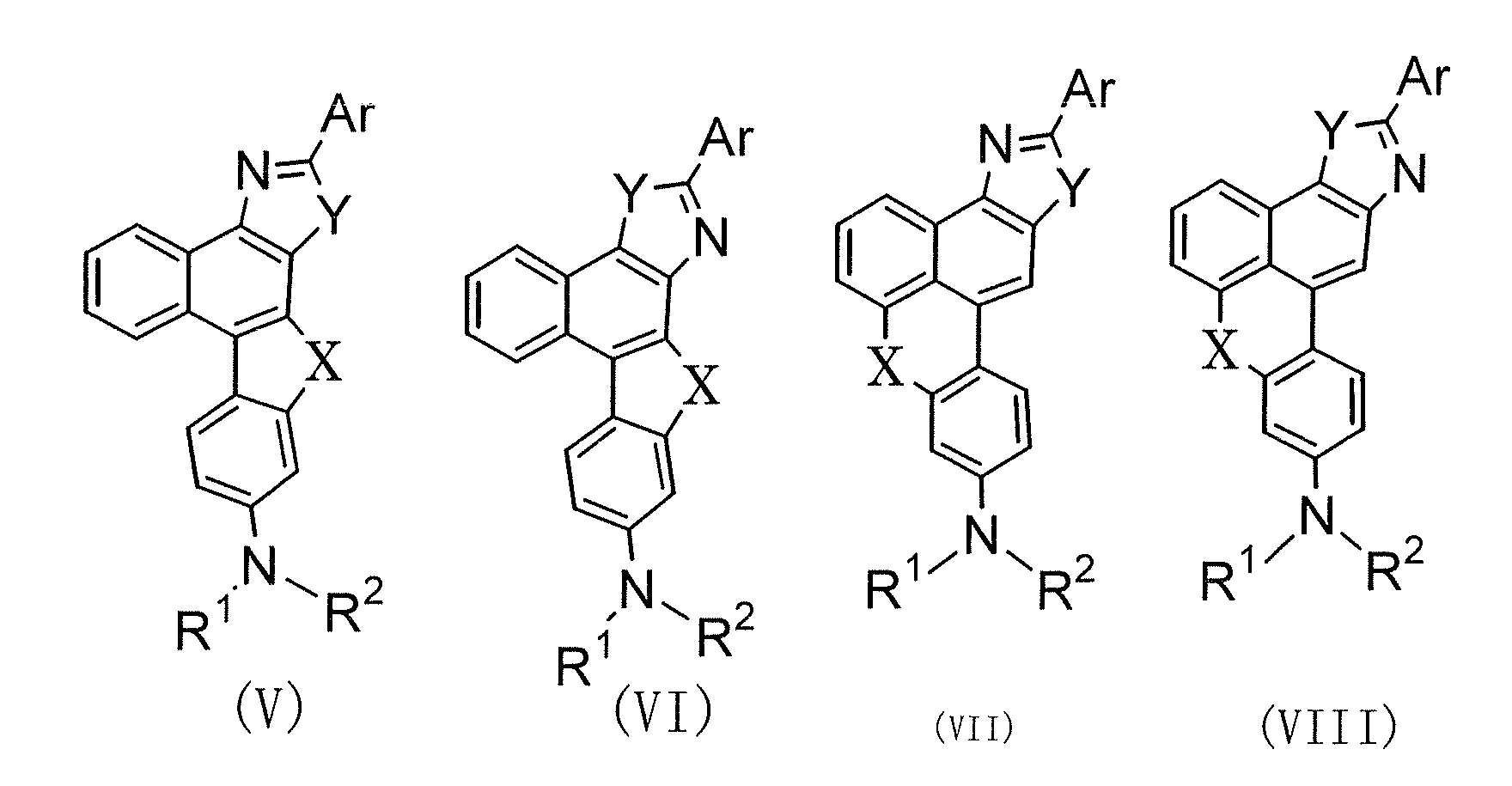 wherein R1 and R2 each represent independently an
alkyl group having 1 to 10 carbon atoms which may
have a substituent, an arylalkyl group having 7 to 30
carbon atoms which may have a substituent, an aryl
group having 6 to 20 carbon atoms which may have a
substituent or a heteroaryl group having 5 to 20
carbon atoms which may have a substituent, and they
may be combined with each other to form a cyclic
structure or may form a cyclic structure together
with a benzene ring to which a nitrogen atom is
bonded;
wherein R1 and R2 each represent independently an
alkyl group having 1 to 10 carbon atoms which may
have a substituent, an arylalkyl group having 7 to 30
carbon atoms which may have a substituent, an aryl
group having 6 to 20 carbon atoms which may have a
substituent or a heteroaryl group having 5 to 20
carbon atoms which may have a substituent, and they
may be combined with each other to form a cyclic
structure or may form a cyclic structure together
with a benzene ring to which a nitrogen atom is
bonded;
X represents an oxygen atom, a sulfur atom, -NH- or -NR3- (R3 represents an alkyl group having 1 to 10 carbon atoms which may have a substituent, an aryl group having 6 to 20 carbon atoms which may have a substituent or a heteroaryl group having 5 to 20 carbon atoms which may have a substituent);
Y represents an oxygen atom, a sulfur atom, -NH- or -NR4- (R4 represents an alkyl group having 1 to 10 carbon atoms which may have a substituent, an aryl group having 6 to 20 carbon atoms which may have a substituent or a heteroaryl group having 5 to 20 carbon atoms which may have a substituent), provided that Y represents an oxygen atom, a sulfur atom or -NR4- in Formulas (III) and (IV); and
Ar represents an aryl group having 6 to 20 carbon atoms which may have a substituent or a heteroaryl group having 5 to 20 carbon atoms which may have a substituent.
X represents an oxygen atom, a sulfur atom, -NH- or -NR3- (R3 represents an alkyl group having 1 to 10 carbon atoms which may have a substituent, an aryl group having 6 to 20 carbon atoms which may have a substituent or a heteroaryl group having 5 to 20 carbon atoms which may have a substituent);
Y represents an oxygen atom, a sulfur atom, -NH- or -NR4- (R4 represents an alkyl group having 1 to 10 carbon atoms which may have a substituent, an aryl group having 6 to 20 carbon atoms which may have a substituent or a heteroaryl group having 5 to 20 carbon atoms which may have a substituent), provided that Y represents an oxygen atom, a sulfur atom or -NR4- in Formulas (III) and (IV); and
Ar represents an aryl group having 6 to 20 carbon atoms which may have a substituent or a heteroaryl group having 5 to 20 carbon atoms which may have a substituent.
Further, the resent invention provides a color-changing
material composition comprising (A) a
fluorescent coloring matter comprising at least one
of the hetero-polycyclic compounds represented by
Formulas (III) to (VIII) and (B) a binder material,
and a color-changing film comprising the above color-changing
material composition.
Further, the resent invention provides a
coloring matter comprising the hetero-polycyclic
compound described above and a pigment or a dye
containing the hetero-polycyclic compound described
above.
A number 1 is a glass substrate; 2 is a color-changing
film; 2 is an anode; 4 is an organic EL
luminescent layer; and 5 is a cathode.
The hetero-polycyclic compound of the present
invention is a novel hetero-polycyclic compound which
has a structure represented by any of the following
Formulas (I) to (VIII) and which is not described in
documents:
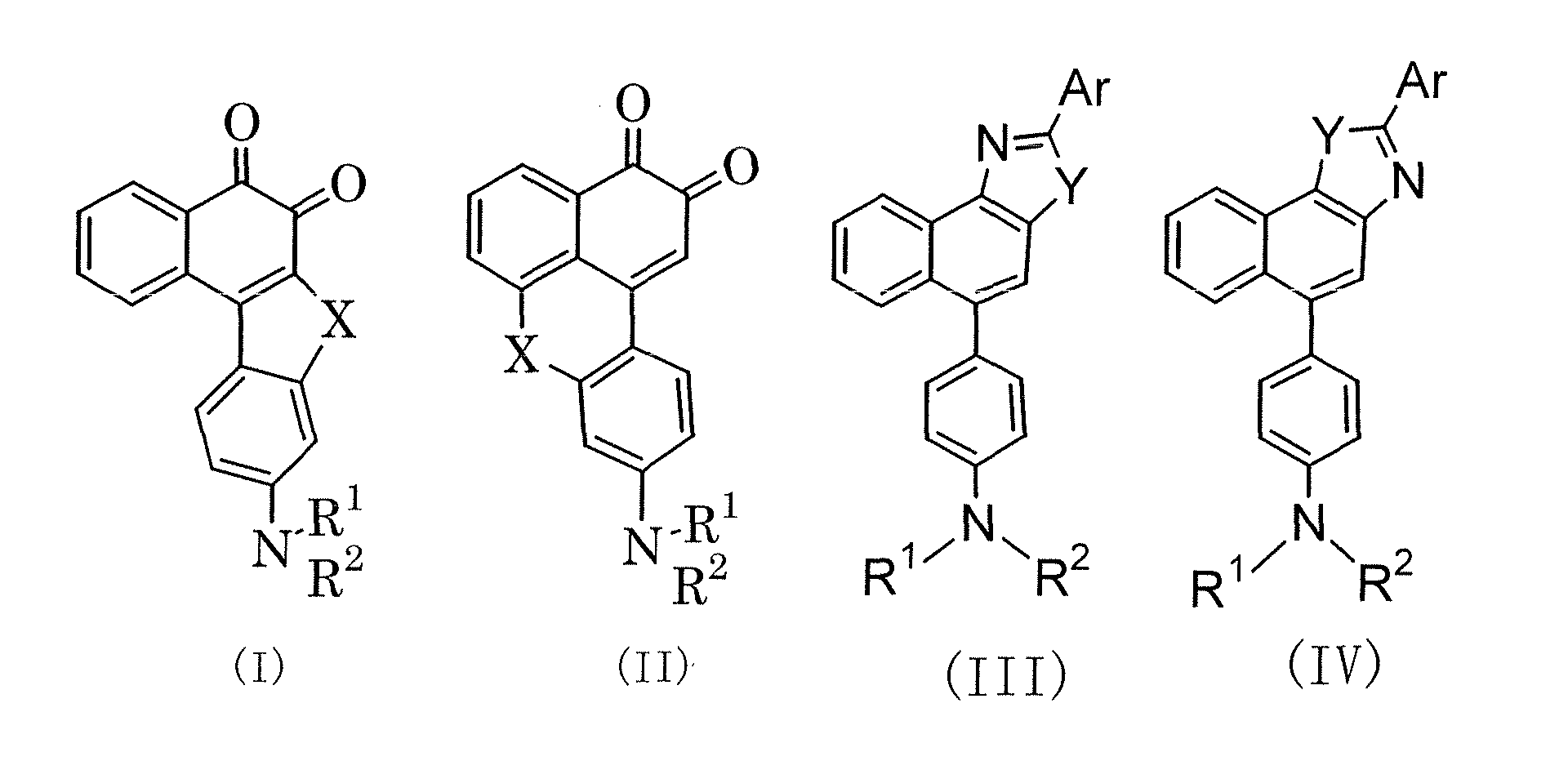

In Formulas (I) to (VIII), R1 and R2 each
represent independently an alkyl group having 1 to 10
carbon atoms which may have a substituent, an
arylalkyl group having 7 to 30 carbon atoms which may
have a substituent, an aryl group having 6 to 20
carbon atoms which may have a substituent or a
heteroaryl group having 5 to 20 carbon atoms which
may have a substituent, and they may be combined with
each other to form a cyclic structure or may form a
cyclic structure together with a benzene ring to
which a nitrogen atom is bonded.
The alkyl group described above may be any of
linear, branched and cyclic groups, and the examples
thereof include methyl, ethyl, n-propyl, isopropyl,
various butyls, various pentyls, various hexyls,
various octyls, various decyls, cyclopentyl,
cyclohexyl, cyclooctyl, benzyl and phenethyl.
The examples of the arylalkyl group described
above include benzyl, 1-phenylethyl, 2-phenylethyl,
1-phenylisopropyl, 2-phenylisopropyl, phenyl-t-butyl,
α-naphthylmethyl, 1-α-naphthylethyl, 2-α-naphthylethyl,
1-α-naphthylisopropyl, 2-α-naphthylisopropyl,
β-naphthylmethyl, 1-β-naphthylethyl,
2-β-naphthylethyl, 1-β-naphthylisopropyl,
2-β-naphthylisopropyl, 1-pyrrolylmethyl,
2-(1-pyrrolyl)ethyl, p-methylbenzyl,
m-methylbenzyl, o-methylbenzyl, p-chlorobenzyl, m-chlorobenzyl,
o-chlorobenzyl, p-bromobenzyl, m-bromobenzyl,
o-bromobenzyl, p-iodobenzyl, m-iodobenzyl,
p-iodobenzyl, p-hydroxybenzyl, m-hydroxybenzyl,
o-hydroxybenzyl, p-aminobenzyl, m-aminobenzyl,
o-aminobenzyl, p-nitrobenzyl, m-nitrobenzyl,
o-nitrobenzyl, p-cyanobenzyl, m-cyanobenzyl,
o-cyanobenzyl, 1-hydroxy-2-phenylisopropyl
and 1-chloro-2-phenylisopropyl.
The examples of the aryl group described above
include phenyl, naphthyl, anthryl and pyrenyl.
The examples of the heteroaryl group described
above include 1-aza-indolizine-2-yl, 1-aza-indolizine-3-yl,
1-aza-indolizine-5-yl, 1-aza-indolizine-6-yl,
1-aza-indolizine-7-yl, 1-aza-indolizine-8-yl,
2-aza-indolizine-1-yl, 2-aza-indolizine-3-yl,
2-aza-indolizine-5-yl, 2-aza-indolizine-6-yl,
2-aza-indolizine-7-yl, 2-aza-indolizine-8-yl,
6-aza-indolizine-1-yl, 6-aza-indolizine-2-yl,
6-aza-indolizine-3-yl, 6-aza-indolizine-5-yl,
6-aza-indolizine-7-yl, 6-aza-indolizine-8-yl,
7-aza-indolizine-1-yl, 7-aza-indolizine-2-yl,
7-aza-indolizine-3-yl, 7-aza-indolizine-5-yl,
7-aza-indolizine-6-yl, 7-aza-indolizine-7-yl,
7-aza-indolizine-8-yl, 8-aza-indolizine-1-yl,
8-aza-indolizine-2-yl, 8-aza-indolizine-3-yl,
8-aza-indolizine-5-yl, 8-aza-indolizine-6-yl,
8-aza-indolizine-7-yl, 1-indolizinyl,
2-indolizinyl, 3-indolizinyl, 5-indolizinyl, 6-indolizinyl,
7-indolizinyl, 8-indolizinyl, 1-pyrrolyl,
2-pyrrolyl, 3-pyrrolyl, pyrazinyl, 2-pyridinyl, 3-pyridinyl,
4-pyridinyl, 1-indolyl, 2-indolyl, 3-indolyl,
4-indolyl, 5-indolyl, 6-indolyl, 7-indolyl,
1-isoindolyl, 2-isoindolyl, 3-isoindolyl, 4-isoindolyl,
5-isoindolyl, 6-isoindolyl, 7-isoindolyl,
2-furyl, 3-furyl, 2-benzofuranyl, 3-benzofuranyl, 4-benzofuranyl,
5-benzofuranyl, 6-benzofuranyl, 7-benzofuranyl,
1-isobenzofuranyl, 3-isobenzofuranyl,
4-isobenzofuranyl, 5-isobenzofuranyl, 6-isobenzofuranyl,
7-isobenzofuranyl, 2-quinolyl, 3-quinolyl,
4-quinolyl, 5-quinolyl, 6-quinolyl, 7-quinolyl,
8-quinolyl, 1-isoquinolyl, 3-isoquinolyl,
4-isoquinolyl, 5-isoquinolyl, 6-isoquinolyl, 7-isoquinolyl,
8-isoquinolyl, 2-quinoxalinyl, 5-quinoxalinyl,
6-quinoxalinyl, 1-carbazolyl, 2-carbazolyl,
3-carbazolyl, 4-carbazolyl, 9-carbazolyl,
1-phenanthridinyl, 2-phenanthridinyl, 3-phenanthridinyl,
4-phenanthridinyl, 6-phenanthridinyl,
7-phenanthridinyl, 8-phenanthridinyl, 9-phenanthridinyl,
10-phenanthridinyl, 1-acridinyl, 2-acridinyl,
3-acridinyl, 4-acridinyl, 9-acridinyl,
1,7-phenanthroline-2-yl, 1,7-phenanthroline-3-yl,
1,7-phenanthroline-4-yl, 1,7-phenanthroline-5-yl,
1,7-phenanthroline-6-yl, 1,7-phenanthroline-8-yl,
1,7-phenanthroline-9-yl, 1,7-phenanthroline-10-yl,
1,8-phenanthroline-2-yl, 1,8-phenanthroline-3-yl,
1,8-phenanthroline-4-yl, 1,8-phenanthroline-5-yl,
1,8-phenanthroline-6-yl, 1,8-phenanthroline-7-yl,
1,8-phenanthroline-9-yl, 1,8-phenanthroline-10-yl,
1,9-phenanthroline-2-yl, 1,9-phenanthroline-3-yl,
1,9-phenanthroline-4-yl, 1,9-phenanthroline-5-yl,
1,9-phenanthroline-6-yl, 1,9-phenanthroline-7-yl,
1,9-phenanthroline-8-yl, 1,9-phenanthroline-10-yl,
1,10-phenanthroline-2-yl, 1,10-phenanthroline-3-yl,
1,10-phenanthroline-4-yl, 1,10-phenanthroline-5-yl,
2,9-phenanthroline-1-yl, 2,9-phenanthroline-3-yl,
2,9-phenanthroline-4-yl, 2,9-phenanthroline-5-yl,
2,9-phenanthroline-6-yl, 2,9-phenanthroline-7-yl,
2,9-phenanthroline-8-yl, 2,9-phenanthroline-10-yl,
2,8-phenanthroline-1-yl, 2,8-phenanthroline-3-yl,
2,8-phenanthroline-4-yl, 2,8-phenanthroline-5-yl,
2,8-phenanthroline-6-yl, 2,8-phenanthroline-7-yl,
2,8-phenanthroline-9-yl, 2,8-phenanthroline-10-yl,
2,7-phenanthroline-1-yl, 2,7-phenanthroline-3-yl,
2,7-phenanthroline-4-yl, 2,7-phenanthroline-5-yl,
2,7-phenanthroline-6-yl, 2,7-phenanthroline-8-yl,
2,7-phenanthroline-9-yl, 2,7-phenanthroline-10-yl, 1-phenazinyl,
2-phenazinyl, 1-phenothiazinyl, 2-phenothiazinyl,
3-phenothiazinyl, 4-phenothiazinyl,
10-phenothiazinyl, 1-phenoxazinyl, 2-phenoxazinyl, 3-phenoxazinyl,
4-phenoxazinyl, 10-phenoxazinyl, 2-oxazolyl,
4-oxazolyl, 5-oxazolyl, 2-oxadiazolyl, 5-oxadiazolyl,
3-frazanyl, 2-thienyl, 3-thienyl, 2-methylpyrrole-1-yl,
2-methylpyrrole-3-yl, 2-methylpyrrole-4-yl,
2-methylpyrrole-5-yl, 3-methylpyrrole-1-yl,
3-methylpyrrole-2-yl, 3-methylpyrrole-4-yl,
3-methylpyrrole-5-yl, 2-t-butylpyrrole-4-yl,
3-(2-phenylpropyl)pyrrole-1-yl, 2-methyl-1-indolyl,
4-methyl-1-indolyl, 2-methyl-3-indolyl,
4-methyl-3-indolyl, 2-t-butyl-1-indolyl, 4-t-butyl-1-indolyl,
2-t-butyl-3-indolyl and 4-t-butyl-3-indolyl.
The above respective groups may have suitable
substituents, and the substituents include, for
example, an alkyl group, an alkoxyl group, a halogen
atom, a cyano group, an alkoxycarbonyl group, a
carboxyl group, an ester group, an amide group, a
sulfoxyl group, a sulfonamide group, a nitro group,
an aryl group and a heteroaryl group.
The examples of the above alkyl group, aryl
group and heteroaryl group include the same groups as
described above. The examples of the halogen atom
include a fluorine atom, a chlorine atom, a bromine
atom and an iodine atom. The alkoxyl group may be
any of linear, branched and cyclic groups, and the
examples thereof include methoxy, ethoxy, n-propoxy,
isopropoxy, various butoxy, various pentoxy, various
hexoxy, various octoxy, various decyloxy,
cyclopenthyloxy, cyclohexyloxy, benzyloxy and
phenethyloxy. The sulfonamide group may be either of
substituted sulfonamide and non-substituted
sulfonamide, and the amide group may be either of
substituted amide and non-substituted amide.
Substituents for the above alkoxyl group, sulfonamide
group and amide group include the same groups as
given in R1 and R2 described above. Further, the
examples of an alkoxyl group in the alkoxycarbonyl
group include the same groups as described above.
The cyclic structure formed by allowing R1 and
R2 to be combined with each other together with a
nitrogen atom includes, for example, 1-pyrrolidinyl,
piperidino and morpholine.
The cyclic structure formed by allowing R1 and
R2 to be combined with each other together with a
benzene ring to which a nitrogen atom is bonded
includes, for example, the following ones:

In Formulas (I), (II) and (V) to (VIII), X
represents an oxygen atom, a sulfur atom, -NH- or
-NR3- (R3 represents an alkyl group having 1 to 10
carbon atoms which may have a substituent, an aryl
group having 6 to 20 carbon atoms which may have a
substituent or a heteroaryl group having 5 to 20
carbon atoms which may have a substituent).
The examples of the alkyl group, the aryl group
and the heteroaryl group represented by R3 described
above each include the same groups as given in R1 and
R2 described above, and the substituents therefor
include as well the same groups.
In Formulas (III) and (IV), Y represents an
oxygen atom, a sulfur atom or -NR4- (R4 represents an
alkyl group having 1 to 10 carbon atoms which may
have a substituent, an aryl group having 6 to 20
carbon atoms which may have a substituent or a
heteroaryl group having 5 to 20 carbon atoms which
may have a substituent), and in Formulas (V) to (IV),
Y represents an oxygen atom, a sulfur atom, -NH- or
-NR4- (R4 is the same as described above).
The examples of the alkyl group, the aryl group
and the heteroaryl group represented by R4 described
above include the same groups as given respectively
in R1 and R2 described above, and substituents
therefor include as well the same groups.
In Formulas (III) to (VIII), Ar represents an
aryl group having 6 to 20 carbon atoms which may have
a substituent or a heteroaryl group having 5 to 20
carbon atoms which may have a substituent. The
examples of the aryl group and the heteroaryl group
each include the same groups as given in R1 and R2
described above, and the substituents therefor
include as well the same groups.
The specific example of the compound
represented by Formula (I) described above includes,
for example, a compound represented by the following
Formula (I-a):
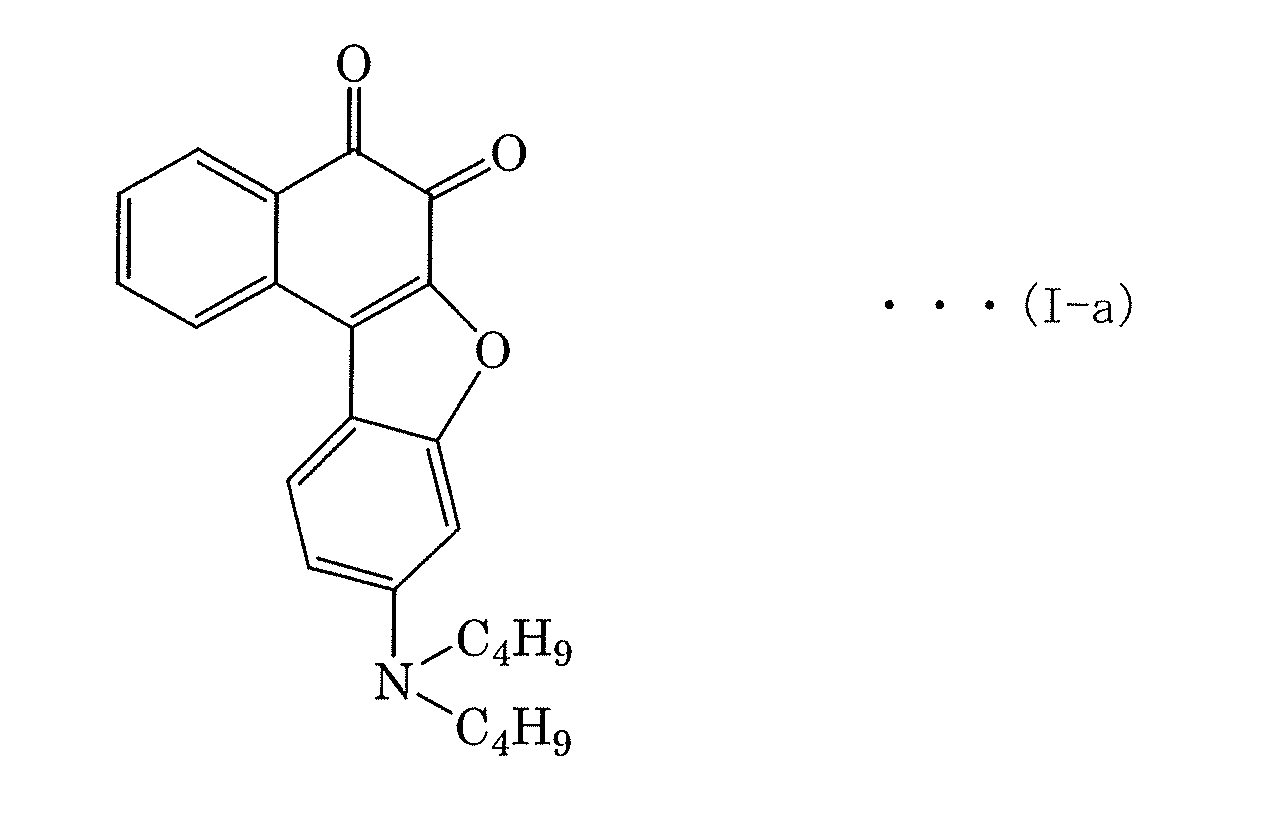
The specific example of the compound
represented by Formula (II) described above includes,
for example, a compound in which a ring formed by X
assumes a six-membered structure represented by
Formula (II) in the compound represented by Formula
(I-a).
The compounds of the present invention
represented by Formula (I) and Formula (II) are
coloring matters and can suitably be used as disperse
dyes, coloring matters for ink-jet printing,
electrophotographic toners, heat transfer coloring
matters, non-linear optical materials such as light
modulation elements, photoelectric transfer coloring
matters such as organic solar batteries and high
density optical recording type coloring matters each
containing the above coloring matters. Further, they
can also be used as intermediates for producing the
following compounds of the present invention
represented by Formula (V) to Formula (VIII).
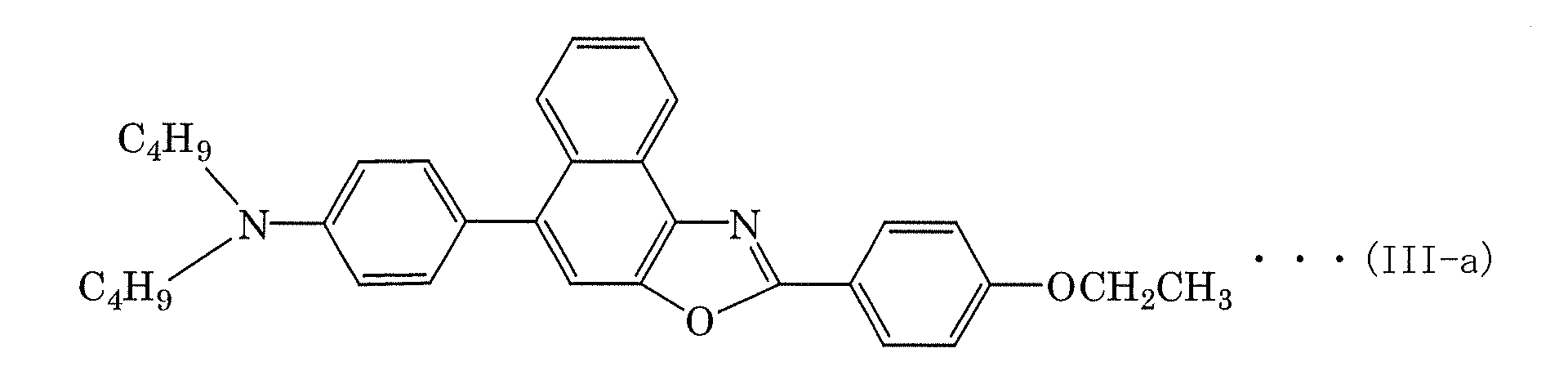
Compounds represented by Formula (III-a) to
Formula (III-d) can be given as the specific examples
of the compound of the present invention represented
by Formula (III):


Compounds represented by Formula (IV-a) to
Formula (IV-d) can be given as the specific examples
of the compound of the present invention represented
by Formula (IV):


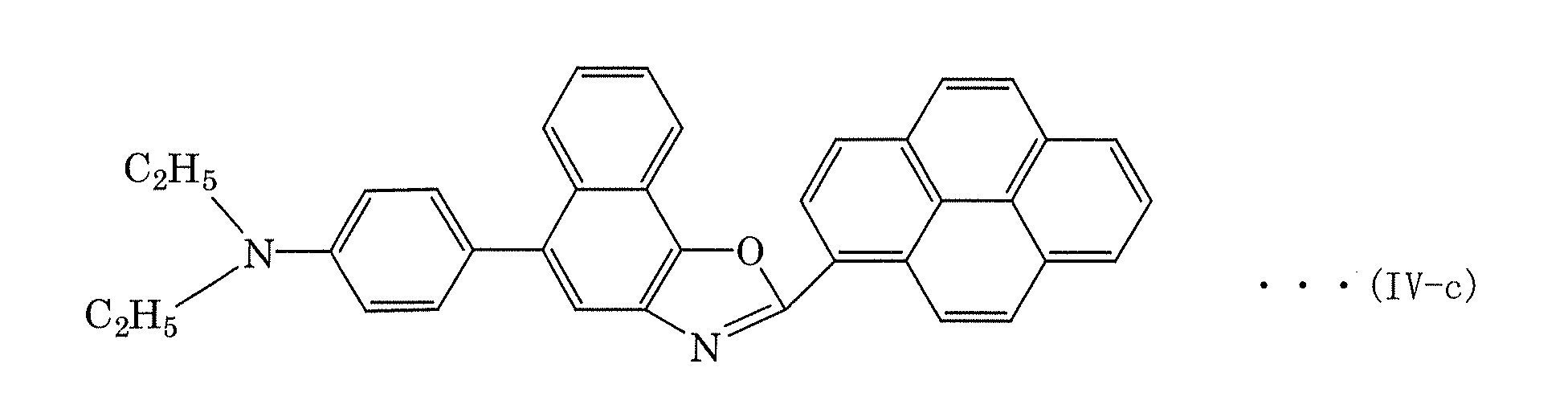
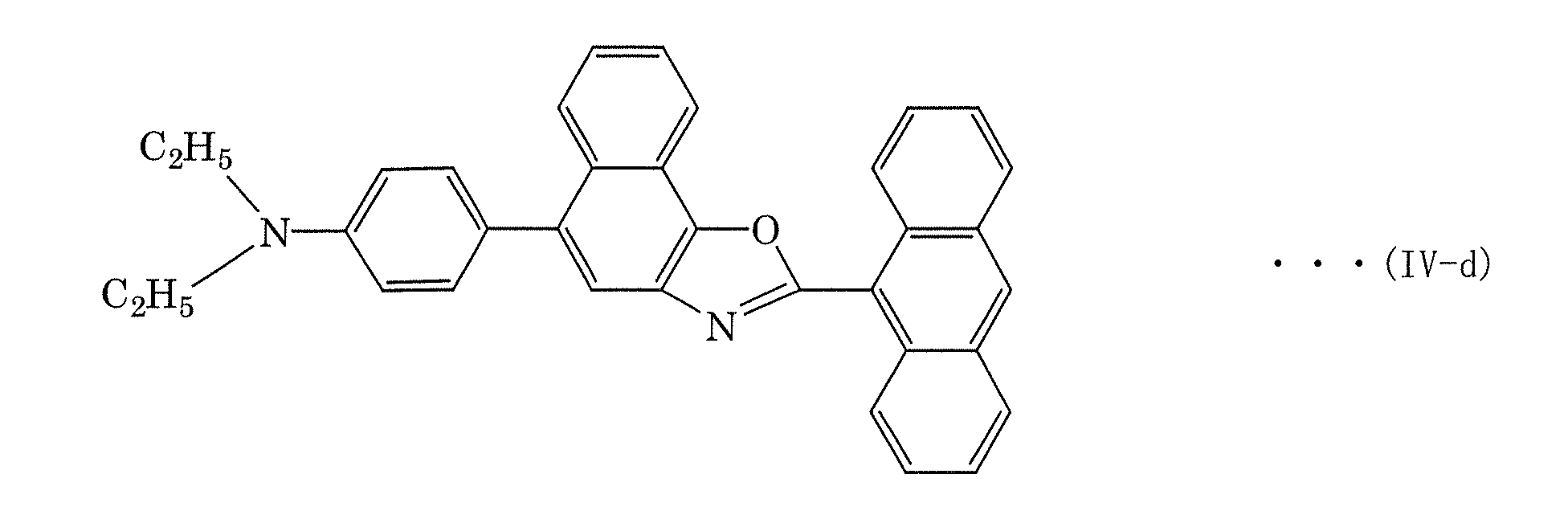
Compounds represented by Formula (V-a) to
Formula (V-c) can be given as the specific examples
of the compound of the present invention represented
by Formula (V):


Compounds represented by Formula (VI-a) to
Formula (VI-c) can be given as the specific examples
of the compound of the present invention represented
by Formula (VI):
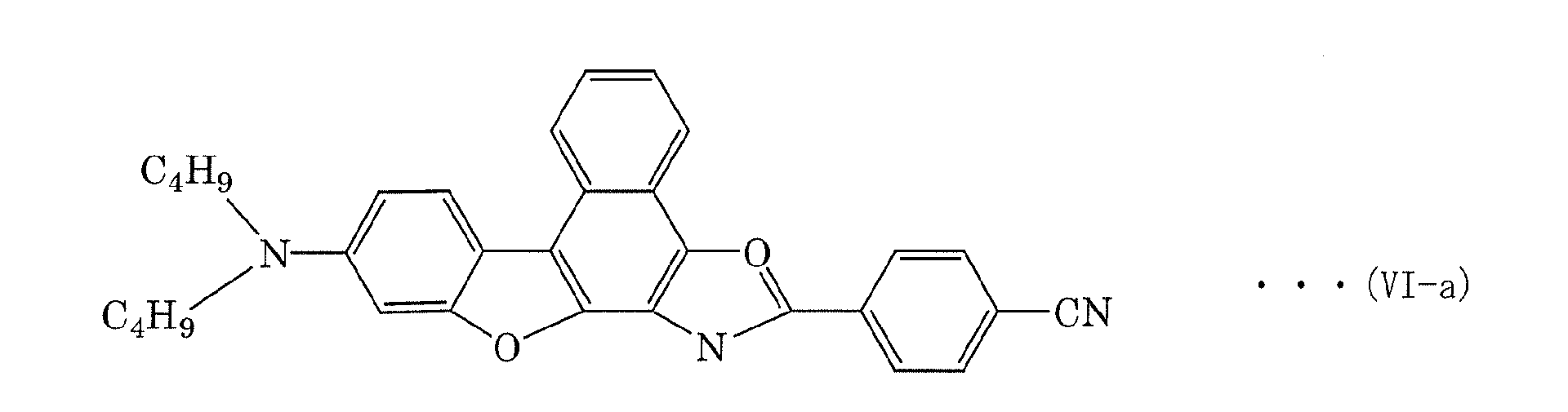
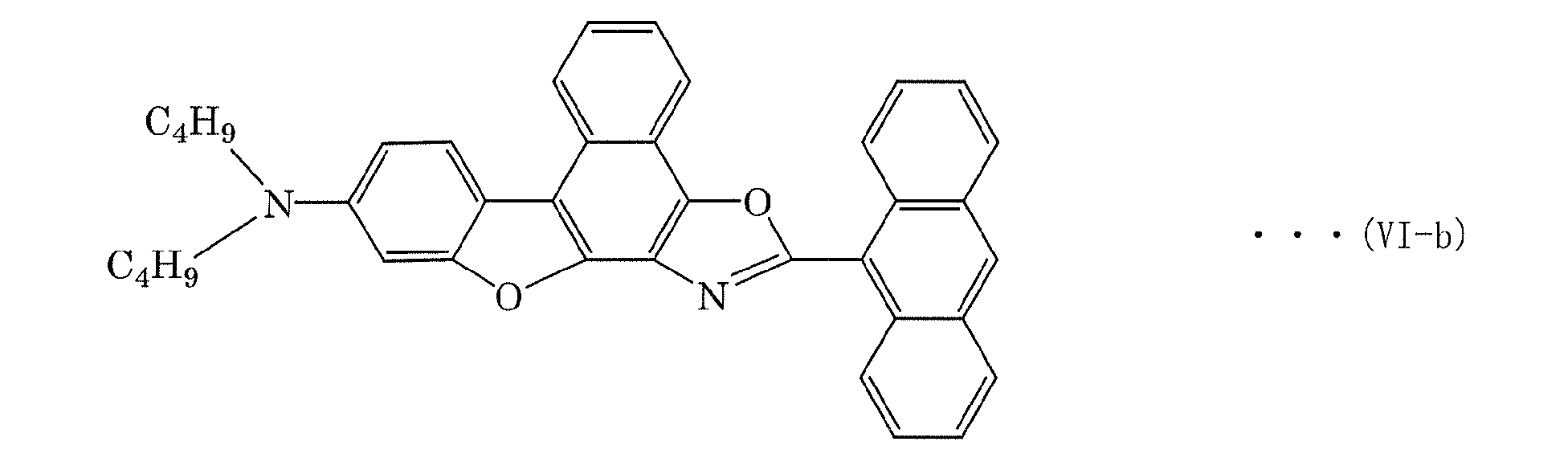

The specific examples of the compound
represented by Formula (VII) described above include,
for example, compounds in which a ring formed by X
assumes a six-membered structure represented by
Formula (VII) in the compounds represented by (V-a)
to (V-c) described above.
The specific examples of the compound
represented by Formula (VIII) described above include,
for example, compounds in which a ring formed by X
assumes a six-membered structure represented by
Formula (VIII) in the compounds represented by (VI-a)
to (VI-c) described above.
The compounds of the present invention
represented by Formula (III) to Formula (VIII) are
organic fluorescent coloring matters and can suitably
be used as disperse dyes, coloring matters for ink-jet
printing, electrophotographic toners, heat
transfer coloring matters, luminescent materials such
as organic electroluminescent elements, non-linear
optical materials such as light modulation elements,
photoelectric transfer coloring matters such as
organic solar batteries, fluorescent coloring matters
such as organic EL·dye lasers, modulated
light·wavelength transfer coloring matters such as
agricultural films, high density optical recording
type coloring matters and fluorescent coloring
matters for molecular recognition each containing the
above coloring matters. Further, some compounds have
a clathrate-forming ability, and they can be derived
as well into solid-luminescent organic fluorescent
coloring matters comprising clathrate complexes in
which a color tone and a fluorescent luminescence are
changed and in which performances are raised further
more by allowing various organic guest molecules to
be included therein.
The compounds of the present invention
represented by Formula (III) to Formula (VIII) and
the clathrate complexes thereof can be used for
various applications as the organic fluorescent
coloring matters, for example, fluorescence-changing
films in various display equipments, coloring matter
laser, light toning, energy changing, high density
optical recording, display and fluorescent sensors
for molecular recognition.
Among the applications described above, the
fluorescence-changing films in various display
equipments can be applied to electronic display
devices such as, for example, PDP (plasma display),
ELD (electroluminescence display), LED (light-emitting
diode) and VFD (fluorescent display tube).
Next, a production process for the hetero-polycyclic
compound of the present invention shall be
explained.
A production process for the compound
represented by Formula (I) shall be explained.
The hetero-polycyclic compound of the present
invention represented by Formula (I) which is a 1,2-naphthoquinone
base derivative can be produced
according to, for example, a reaction equation (A)
shown below when X is an oxygen atom:
 wherein M represents an alkali metal atom, and R1 and
R2 are the same as described above.
wherein M represents an alkali metal atom, and R1 and
R2 are the same as described above.
As shown in the reaction equation (A), the
substantially stoichiometric amounts of 1,2-naphthoquinone-4-sulfonic
acid alkali metal salt (a)
and m-substituted phenol (b) are reacted at a
temperature of about 0 to 80°C in a suitable solvent
such as acetic acid in the presence of a catalyst
such as copper (II) halide, whereby a compound which
has a benzofurano-1,2-naphthoquinone skeleton
represented by Formula (I-1) and in which X is an
oxygen atom. In this case, a compound represented by
Formula (c) is by-produced.
With respect to a production process for the
compound of the present invention represented by
Formula (II), the compound represented by Formula (c)
is obtained as a principal component by using a
catalyst having a weak oxidizing strength such as
nickel chloride in the above reaction equation (A),
and after isolating the compound represented by
Formula (c), cyclization reaction is carried out at a
temperature of about 40 to 120°C in a solvent such as
dimethylsulfoxide in the presence of a catalyst
having a strong oxidizing strength such as copper
acetate, whereby the above compound represented by
Formula (II) can be produced.
With respect to a production process for the
compounds of the present invention represented by
Formula (III) and (IV), they can be produced
according to a reaction equation (B) shown below, for
example, when Y is an oxygen atom:
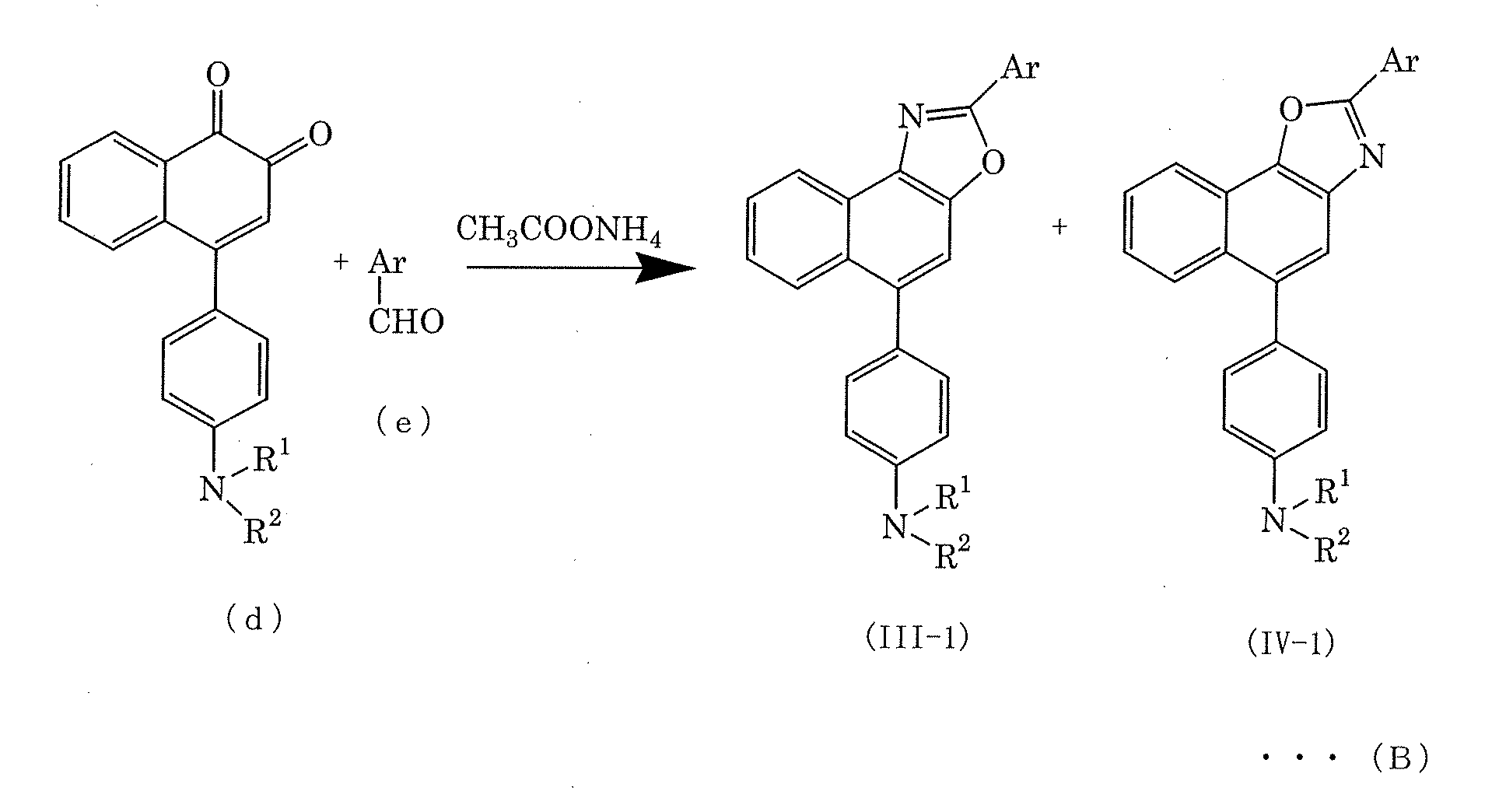 wherein R1, R2 and Ar are the same as described above.
As shown in the reaction equation (B), a 1,2-naphthoquinone
derivative represented by Formula (d)
is reacted with a substantially stoichiometric amount
or a little excessive amount of arylaldehyde (e) and
an excessive amount of ammonium acetate in a suitable
solvent such as acetic acid at a temperature of about
50 to 100°C, whereby compounds represented by Formula
(III-1) and (IV-1) having a naphthoxazole skeleton
are obtained.
With respect to a production process for the
compounds of the present invention represented by
Formula (V) and (VI), they can be produced according
to a reaction equation (C) shown below, for example,
when X and Y each are oxygen atoms:
 wherein R1, R2 and Ar are the same as described above.
As shown in the reaction equation (C), the
compound represented by Formula (I-1) is reacted with
a little excessive amount of arylaldehyde (f) and an
excessive amount of ammonium acetate in a suitable
solvent such as acetic acid at a temperature of about
50 to 100°C, whereby compounds having a
benzofuranonaphthoxazole skeleton represented by
Formula (V-1) and (VI-1) are obtained.
With respect to a production process for the
compounds of the present invention represented by
Formula (VII) and (VIII), they can be produced by
using the compound represented by Formula (II) in
place of the compound represented by Formula (I-1).
The color-changing material composition of the
present invention shall be explained below.
The color-changing material composition of the
present invention comprises (A) a fluorescent
coloring matter comprising at least one of the
hetero-polycyclic compounds represented by Formulas
(III) to (VIII) described above and (B) a binder
material.
A concentration of the component (A) described
above shall not specifically be restricted, and it is
preferably 0.1 to 10 % by weight, more preferably 0.2
to 5 % by weight based on the whole amount of the
solid matters contained in the color-changing
material composition. If the concentration is 0.1 by
weight or more, light can sufficiently be absorbed
from a light source, and the color can be changed.
If it is 10 by weight or less, it is prevented that
the color-changing efficiency is reduced due to
concentration quenching and that highly fine
patterning can not be carried out.
The binder material of the component (B) is
more preferably an optically reactive resin. In this
case, the optically reactive resin means a resin
which shows curing reaction by light, and it includes
resins blended with polymerizable oligomers and/ or
monomers such as epoxy acrylate, urethane acrylate
and polyether acrylate and resins blended with
allylsulfonyl salts and epoxy compounds.
The binder material of the component (B) is
preferably a thermosetting resin or a thermoplastic
resin.
The thermosetting resin includes, for example,
epoxy resins, urethane resins, alkid resins and
polyimide resins, and the epoxy resins and the
urethane resins are particularly preferred since they
have a high transparency and a high dispersibility of
coloring matters.
The thermoplastic resin includes, for example,
(meth)acryl resins, polystyrene resins, polycarbonate
resins and polyester resins, and the (meth)acryl
resins and the polycarbonate resins are particularly
preferred since they have a high transparency and a
high dispersibility of coloring matters.
The color-changing material composition of the
present invention contains more preferably a
Rhodamine base fluorescent coloring matter such as
Rhodamine B and Rhodamine 6G.
Further, the binder material (B) used in the
present invention contains preferably (C) a
methacrylic acid ester-methacrylic acid copolymer and
(D) a monomer and/or oligomer having a
photopolymerizable, ethylenically unsaturated group.
The methacrylic acid ester-methacrylic acid
copolymer (C) described above is represented by a
structure shown below:
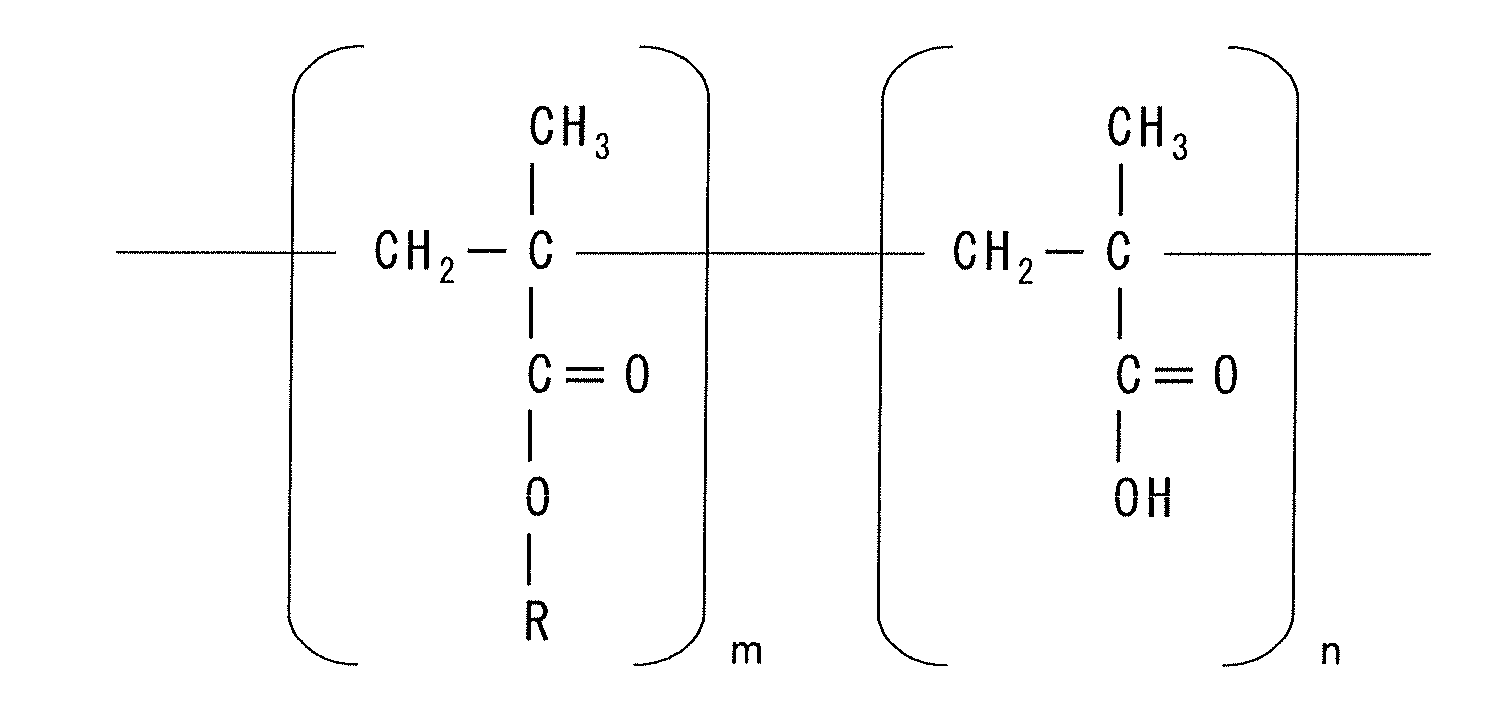
R is a substituted or non-substituted alkyl
group having 1 to 10 carbon atoms or a substituted or
non-substituted aryl group having 6 to 20 carbon
atoms, and it includes, for example, benzyl, methyl,
ethyl, cyclohexyl, cyclohexylmethyl and hydroxyethyl.
R is preferably methyl or benzyl since the solubility,
the developability and the film quality are balanced.
The terms m and n each are preferably an integer of 1
or more. The above copolymer has a molecular weight
of preferably 5,000 to 100,000, more preferably
10,000 to 50,000 in terms of Mw (weight average
molecular weight). If Mw is 5,000 or more, the
color-changing film is not reduced in a strength. If
it is 100,000 or less, a viscosity of the solution is
not excessive, and the even color-changing film is
formed.
The copolymerization ratio q is preferably q =
m/(m + n) = 0.5 to 0.95, more preferably 0.7 to 0.9.
If the copolymerization ratio is 0.5 or more, the
film is not swollen by a developing solution in
developing, and the patterning accuracy is not
reduced. If it is 0.95 or less, the solubility in a
developing solution does not become too small, and a
case where developing can not be carried out is
prevented.
The monomer and/or oligomer (D) having a
photopolymerizable, ethylenically unsaturated group
includes 2-hydroxyethyl (meth)acrylate, 2-hydroxypropyl
(meth)acrylate and 2-hydroxyhexyl
(meth)acrylate.
The examples of the (meth)acrylate described
above include ethylene glycol di(meth)acrylate,
diethylene glycol di(meth)acrylate, triethylene
glycol di(meth)acrylate, tetraethylene glycol
di(meth)acrylate, tetramethylene glycol
di(meth)acrylate, trimethylol propane
tri(meth)acrylate, pentaerythritol di(meth)acrylate,
pentaerythritol tri(meth)acrylate, pentaerythritol
tetra(meth)acrylate, dipentaerythritol
hexa(meth)acrylate and glycerol (meth)acrylate.
In the present invention, the monomer and/or
oligomer of the component (D) can be used alone or in
combination two or more kinds thereof. These
monomers and oligomers can be used as long as the
qualities of the color-changing material composition
and the color-changing film of the present invention
are not damaged, and the amount thereof is usually 10
to 200 parts by weight per 100 parts by weight of the
methacrylic acid ester-methacrylic acid copolymer (C).
If an amount of the component (D) is 200 parts by
weight or less, problems are not brought about on the
tacking property after pre-curing.
The color-changing material composition of the
present invention further contains preferably (E) a
compound having an epoxy group in addition to the
components (A) and (B) or the components (A) to (D),
and phenol novolak type epoxy compounds and cresol
novolak type epoxy compounds can be given as the
above compound. The film strength is raised by
adding the above compounds to the color-changing
material composition when a color-changing film is
produced from it. Heating after photopolymerization
of the component (D) makes it possible to further
cross-link the optically cross-linked product with
the compound (E) having an epoxy group to elevate a
cross-linking density of the film.
A content of the compound (E) having an epoxy
group is preferably 0.1 to 15 % by weight, more
preferably 0.5 to 7 % by weight based on the whole
amount of the color-changing material composition.
If it is 15 % by weight or less, the compound having
an epoxy group is not polymerized during storage of
the color-changing material composition, and a
viscosity of the liquid is not varied. If it is
0.1 % by weight or more, the satisfactory effect is
obtained.
A photopolymerization initiator or a sensitizer
may be added, if necessary, to the color-changing
material composition of the present invention, and
the photopolymerization initiator and the sensitizer
are used not only for optical curing reaction of the
monomer and/or oligomer of the component (D) having a
photopolymerizable, ethylenically unsaturated group
but also as a polymerization initiator for other
photopolymerizable compounds blended if necessary.
For example, acetophenones, benzophenones, benzoin
ethers, sulfur compounds, anthraquinones, organic
peroxides and thiols are suitably used as the above
photopolymerization initiator. To specifically give
the examples thereof, the acetophenones include
acetophenone, 2,2-diethoxyacetophenone, p-methylacetophenone,
p-dimethylaminopropiophenone,
dichloroacetophenone, trichloroacetophenone and p-t-butylacetophenone;
the benzophenones include
benzophenone, 2-chlorobenzophenone and p,p'-bisdimethylaminobenzophenone;
the benzoin ethers
include benzyl, benzoin, benzoin methyl ether,
benzoin isopropyl ether and benzoin isobutyl ether;
the sulfur compounds include benzyl methyl ketal,
thioxanthone, 2-chlorothioxanthone, 2,4-diethylthioxanthone,
2-methylthioxanthone and 2-isopropylthioxanthone;
the anthraquinones include 2-ethylanthraquinone,
octamethylanthraquinone, 1,2-benzanthraquinone
and 2,3-diphenylanthraquinone; the
organic peroxide compounds include
azobisisobutyronitrile, benzoyl peroxide and cumene
peroxide; and the thiols include 2-mercaptobenzoxazole
and 2-mercaptobenzothiazole.
Only one kind of the above photopolymerization
initiators and sensitizers can be used alone, and
they can be used in combination of two or more kinds
thereof.
Further, a compound which does not act as the
photopolymerization initiator and the sensitizer in
itself but can increase the abilities of the
photopolymerization initiator and the sensitizer by
using in combination with the compounds described
above can be added as well. Such compound includes,
for example, tertiary amines such as triethanolamine
which exert an effect by using in combination with
benzophenone.
A preferred use amount of the above
photopolymerization initiators and sensitizers is 0
to 10 parts by weight per 100 parts by weight of the
component (D). If the use amount is 10 parts by
weight or less, light is liable to reach the inside,
and the uncured part is not produced. In addition,
an adhesion between a substrate and the resin is good,
and a fluorescence of the coloring matter is not
reduced.
Further, transparent resins such as oligomers
or polymers of melamine resins, phenol resins, alkid
resins, polyurethane resins, polyester resins and
polyamide resins, polyvinyl alcohol,
polyvinylpyrrolidone, hydroxyethyl cellulose,
carboxymethyl cellulose, aromatic sulfonamide resins,
urea resins and benzoguanamine resins can be added to
the color-changing material composition of the
present invention in order to raise a fluorescence
yield of the fluorescent coloring matter, and the
melamine resins and the benzoguanamine resins are
particularly preferred. The above resins can be used
as long as the properties of the color-changing
material composition and the color-changing film are
not damaged. The preferred use amount thereof is 200
parts by weight or less, more preferably 100 parts by
weight or less per 100 parts by weight of the
methacrylic acid ester-methacrylic acid copolymer of
the component (C). If the use amount is 200 parts by
weight or less, problems are not likely to be brought
about on the tacking property after pre-curing.
The color-changing material composition of the
present invention can be blended, if necessary, with
additives such as curing accelerator, a heat
polymerization inhibitor, a plasticizer, a filler, a
solvent, a defoaming agent and a leveling agent. The
curing accelerator includes, for example, perbenzoic
acid derivatives, peracetic acid and benzophenones;
the heat polymerization inhibitor includes, for
example, hydroquinone, hydroquinone monomethyl ether,
pyrogallol, t-butylcatechol and phenothiazine; the
plasticizer includes, for example, butyl
terephthalate, dioctyl terephthalate and tricresyl;
the filler includes, for example, glass fiber, silica,
mica and alumina; and for example, phosphorus base,
fluorine base and acryl base compounds can suitably
be used as the defoaming agent and the leveling agent.
The color-changing film of the present
invention shall be explained below.
The color-changing film of the present
invention comprises the color-changing material
composition of the present invention described above,
and the color-changing material composition described
above is used to be turned into a film, or the color-changing
film can be formed on a substrate by means
of coating thereon. In particular, the color-changing
film having a desired pattern can be formed
at a good accuracy by using a photolithography method.
A solvent used in dissolving various components
used for the color-changing material composition in a
solvent according to the production processes for the
color-changing film is preferably ketones, esters or
lactones. The ketones include methyl ethyl ketone,
methyl isobutyl ketone and cyclohexane, and the
esters include 2-acetoxy-1-ethoxypropane, methyl
cellosolve, ethyl cellosolve, butyl cellosolve and
cellosolve acetate. The lactones include γ-butyrolactone
and the like.
In producing the color-changing film of the
present invention by a photolithography method, a
solution produced from the photosensitive color-changing
material composition described above is
usually coated on the surface of a substrate in the
form of a solution, and then the solvent is dried
(pre-baked) by pre-curing. Thereafter, a photomask
is applied on the coating film thus obtained and
irradiated with active light to cure an exposed part,
and development in which a non-exposed part is eluted
by using a weak alkaline aqueous solution is further
carried out to form a pattern, followed by further
carrying out post-baking for after-drying.
The substrate on which the solution of the
color-changing material composition is coated is
preferably a flat substrate in which a transmittance
of light in a visible area of 400 to 700 nm is 50 %
or more. To specific, a glass substrate and a
polymer plate are used therefor. In particular, soda
lime glass, barium·strontium-containing glass, lead
glass, aluminosilicate glass, borosilicate glass,
barium borosilicate glass or quartz can suitably be
used as the glass substrate. The polymer plate
includes polycarbonate, acryl, polyethylene
terephthalate, polyether sulfide or polysulfone. Any
of methods using a roller coater, a land coater and a
spinner in addition to a publicly known solution
impregnating method and spray method can be used as a
method for coating the solution of the color-changing
material composition of the present invention on the
substrate. A coating film is formed by removing
(pre-baking) the solvent after coating in a desired
thickness.
This pre-baking is carried out by heating by
means of an oven and a hot plate. The heating
temperature and the heating time in pre-baking are
suitably selected according to the solvent used, and
it is carried out, for example, at a temperature of
80 to 150°C for 1 to 30 minutes. Exposure carried
out after pre-baking is carried out by means of an
exposure machine, and only a resist of a part
corresponding to a pattern is sensitized by carrying
out exposure via a photomask. The exposure machine
and the exposure irradiation conditions can suitably
be selected, and visible rays, UV rays, X-rays and
electron beams can be used as the irradiated light.
The dose shall not specifically be restricted and is
selected in a range of, for example, 1 to 3000 mJ/cm2.
Alkali development after exposure is carried
out for the purpose of removing the resist of a part
which is not exposed, and a desired pattern is formed
by this development. Aqueous solutions of, for
example, carbonates of alkaline metals and alkaline
earth metals can be used as a developing solution
suited to the above alkali development. In
particular, the development is preferably carried out
at a temperature of 10 to 50°C, preferably 20 to 40°C
using a weak alkaline aqueous solution containing 1
to 3 % by weight of carbonate such as sodium
carbonate, potassium carbonate and lithium carbonate,
and fine images can precisely be formed by means of a
commercial developing machine and supersonic washing
machine.
The development is carried out in the manner
described above, and then heat treatment (post-baking)
is carried out on the conditions of 80 to
220°C and 10 to 120 minutes. This post-baking is
carried out in order to raise an adhesion between the
color-changing film subjected to patterning and the
substrate. This is carried out by heating by means
of an oven and a hot plate as is the case with pre-baking.
When the binder material is a thermoplastic
resin or a thermosetting resin, an exposing step is
not required. The film of the thermosetting resin is
cured by carrying out heat treatment (post-baking)
after pre-baking.
A film thickness required for changing a
wavelength of an incident light to a desired
wavelength has to be suitably selected for a film
thickness of the color-changing film of the present
invention, and the film thickness falls in a range of
preferably 1 to 100 µm, more preferably 1 to 20 µm.
The color-changing film of the present
invention can be equipped with a color filter in
order to obtain a desired wavelength to control a
color purity. For example, perylene base pigments,
lake pigments, azo base pigments, quinacridone base
pigments, anthraquinone base pigments, anthracene
base pigments, isoindoline base pigments,
isoindolinone base pigments, phthalocyanine base
pigments, triphenylmethane basic pigments,
indanthrone base pigments, indophenol base pigments,
cyanine base pigments and dioxazine base pigments can
suitably be used alone or in the form of coloring
matters comprising mixtures of two or more kinds
thereof, or in the form of solid matters obtained by
dissolving or dispersing the coloring matters in
binder resins.
The examples of a structure assumed when the
color-changing film of the present invention is
actually used shall be shown below:
In using the structures described above, the
respective structural elements may be laminated in
order or may be stuck together. The order of
lamination in the above color-changing film shall not
specifically be restricted and may be carried out
from either direction, and it may be prepared from
the left side to the right side or from the right
side to the left side.
The color-changing film of the present
invention preferably absorbs a light of a light
source to emit a light having a longer wavelength,
and an organic EL element, LED (light-emitting diode),
a cold-cathode tube, an inorganic EL element, a
fluorescent lamp or an incandescent lamp is used as
the light source described above, and the organic EL
element and the LED element which emit less UV rays
deteriorating coloring matters are particularly
preferred.
Next, the present invention shall be explained
in further details with reference to examples and
comparative examples, but the present invention shall
by no means be restricted by these examples.
Various evaluations of the color-changing films
carried out in the following examples were carried
out in the following manners.
A specific example of a case where a color-changing
film is combined with an organic EL element
to constitute a colorized organic EL element is shown
in Fig. 1. As shown in the same drawing, the
colorized organic EL element comprises, looking from
a light-outgoing side, a glass substrate 1, a color-changing
film 2, an anode 3, an organic EL
luminescent layer 4 and a cathode 5. The organic EL
luminescent layer 4 is liable to be deteriorated in
the presence of moisture and oxygen, and therefore it
is sealed from a cathode 5 side by means of an
opposed glass substrate so that the whole element
part including the color-changing film is covered.
In the colorized organic EL element having the
above structure, the performances of the individual
elements are scattered, and organic EL-emitting light
itself which is an excited light has a half life, so
that it is difficult to evaluate distinctively only a
fluorescent performance and a durability of the
color-changing film itself.
Then, as shown in Fig. 2, a test piece prepared
by forming a color-changing film on a transparent
glass plate was prepared, and a blue organic EL
element separately prepared which has a peak
wavelength suitably selected in a range of 440 to 470
nm according to a coloring matter used for the color-changing
film was superposed thereon and irradiated
with a blue light to measure a spectrum of a
transmitted light obtained through the color-changing
film and a color filter in a two degree visual field
by means of a spectral luminance meter (CS-1000
manufactured by Minolta Co., Ltd.).
It was compared with a luminous spectrum of the
blue organic EL element to identify a relative
fluorescent intensity of the color-changing film in
the following manner:
color-changing efficiency = (luminance of
transmitted light obtained through the color-
changing film and the color filter)/(luminance of
the EL element)
Further, the color coordinate was determined
from the measured spectrum.
The performances of the color-changing films
can be compared with each other in the manner
described above by using the same EL element.
Since the EL element has a half life of a
luminous intensity, a blue organic EL element having
a peak in a wavelength of 470 nm was used as an
exited light source having a constant intensity, and
the exited light source and the color-changing film
(the test piece prepared in (1)) were arranged, as
shown in Fig. 3, in a nitrogen-substitutable chamber
so that it was bought into contact with the light
source, and they were left under dry nitrogen
atmosphere to continuously light the blue organic EL
element at 400 nit for 1000 hours.
The coloring matter-holding rate was calculated
by comparing the absorbances (absorbances originating
in coumarin 6 in the case of the comparative
examples) of the coloring matter in the test piece
before and after irradiated with a blue light.
The above deposit was extracted with
dichloromethane, and then dichloromethane in the
extract was concentrated. The remaining liquid was
subjected to silica gel column (developing solvent:
dichloromethane/ethyl acetate volume ratio 6/1) to
carry out separation and refining, whereby purple
powder-like crystal 586 mg (yield 40.9 %) which was
the intended compound (I-a) was obtained.
The analytical results of the above compound
are shown below.
| C | H | N | |
| Measured value (%) | 76.91 | 6.83 | 3.76 |
| Calculated value (%) | 76.77 | 6.71 | 3.73 |
(measuring solvent: 1,4-dioxane)
Light absorption characteristic; λmax
(εmax/dm3mol-1cm-1): 410 nm (7800), 533 nm (10800)
Fluorescent characteristic: no fluorescence
The compound (I-a) 0.8 g (2.13 mmol) and p-cyanobenzaldehyde
0.42 g (3.16 mmol) were dissolved
in acetic acid 60 ml, and ammonium acetate 2.63 g
(34.1 mmol) was added thereto to react them at 90°C
for 2 hours. After finishing the reaction, water was
added thereto, and dichloromethane was further added
to extract the product. The dichloromethane layer
was separated and concentrated after washed with
water, and the remaining liquid was subjected to
silica gel column (developing solvent: xylene/acetic
acid volume ratio 20/1) to carry out separation and
refining.
Orange powder-like crystal 521 mg (yield
50.2 %) which was the compound (V-a) and yellow
powder-like crystal 266 mg (yield 25.7 %) which was
the compound (VI-a) were obtained.
The analytical results of the compound (V-a)
and the compound (VI-a) are shown below.
| C | H | N | |
| Measured value (%) | 78.58 | 5.75 | 8.70 |
| Calculated value (%) | 78.83 | 6.00 | 8.62 |
(measuring solvent: 1,4-dioxane)
Light absorption characteristic; λmax
(εmax/dm3mol-1cm-1): 362 nm (14000), 420 nm (28900)
Fluorescent characteristic: λem: 526 nm
| C | H | N | |
| Measured value (%) | 78.83 | 5.90 | 8.63 |
| Calculated value (%) | 78.83 | 6.00 | 8.62 |
(measuring solvent: 1,4-dioxane)
Light absorption characteristic; λmax
(εmax/dm3mol-1cm-1): 366 nm (26800), 418 nm (4500)
Fluorescent characteristic: λem: 553 nm
The compound (I-a) 0.8 g (2.13 mmol) and 9-anthraldehyde
1.10 g (5.33 mmol) were dissolved in
acetic acid 150 ml, and ammonium acetate 8.21 g
(0.107 mol) was added thereto to react them at 80°C
for 2 hours. After finishing the reaction, water was
added thereto, and dichloromethane was further added
to extract the product. The dichloromethane layer
was separated and concentrated after washed with
water, and the remaining liquid was subjected to
silica gel column (developing solvent: xylene/acetic
acid volume ratio 20/1) to carry out separation and
refining.
Red crystal 823 mg (yield 30.6 %) which was the
compound (V-b) and orange crystal 585 mg (yield
21.7 %) which was the compound (VI-b) were obtained.
The analytical results of the compound (V-b)
and the compound (VI-b) are shown below.
| C | H | N | |
| Measured value (%) | 83.36 | 6.14 | 5.02 |
| Calculated value (%) | 83.24 | 6.09 | 4.98 |
(measuring solvent: 1,4-dioxane)
Light absorption characteristic; λmax
(εmax/dm3mol-1cm-1): 373 nm (26800), 420 nm
(14400)
Fluorescent characteristic: λem: 569 nm
| C | H | N | |
| Measured value (%) | 83.48 | 6.23 | 5.16 |
| Calculated value (%) | 83.24 | 6.09 | 4.98 |
(measuring solvent: 1,4-dioxane)
Light absorption characteristic; λmax
(εmax/dm3mol-1cm-1): 373 nm (26400)
Fluorescent characteristic; λem: 570 nm
The compound (I-a) 0.8 g (2.13 mmol) and 1-pyrenecarboxaldehyde
0.98 g (4.26 mmol) were
dissolved in acetic acid 150 ml, and ammonium acetate
6.57 g (85 mmol) was added thereto to react them at
80°C for 1.5 hour. After finishing the reaction,
water was added thereto, and dichloromethane was
further added to extract the product. The
dichloromethane layer was separated and concentrated
after washed with water, and the remaining liquid was
subjected to silica gel column (developing solvent:
xylene/acetic acid volume ratio 20/1) to carry out
separation and refining.
Orange crystal 1.117 g (yield 49.4 %) which was
the compound (V-c) and yellow crystal 0.82 g (yield
36.2 %) which was the compound (VI-c) were obtained.
The analytical results of the compound (V-c)
and the compound (VI-c) are shown below.
| C | H | N | |
| Measured value (%) | 83.88 | 5.86 | 4.72 |
| Calculated value (%) | 83.93 | 5.84 | 4.77 |
(measuring solvent: 1,4-dioxane)
Light absorption characteristic; λmax
(εmax/dm3mol-1cm-1): 362 nm (24800), 397 nm
(28800), 436 nm (33600)
Fluorescent characteristic; λem: 538 nm
| C | H | N | |
| Measured value (%) | 83.76 | 5.99 | 4.65 |
| Calculated value (%) | 83.93 | 5.84 | 4.77 |
(measuring solvent: 1,4-dioxane)
Light absorption characteristic; λmax
(εmax/dm3mol-1cm-1): 377 nm (48800), 395 nm
(36400)
Fluorescent characteristic; λem: 551 nm
4-[4-(Dibutylamino)phenyl]-1,2-naphthoquinone
2.00 g (5.54 mmol), p-ethoxybenzaldehyde 0.83 g (5.54
mmol) and ammonium acetate 6.82 g (88.4 mmol) were
dissolved in acetic acid 59 ml and refluxed and
stirred at 80°C for 110 minutes. After finishing the
reaction, the solution was neutralized by a sodium
carbonate aqueous solution, and methylene chloride
was added to extract organic matters. The methylene
chloride layer was washed with water and then dried
up under reduced pressure, and the residue was
subjected to silica gel column (developing solvent:
dichloromethane/ethyl acetate volume ratio 10/1) to
carry out separation and refining.
The compound (III-a) 1.15 g (yield 42.3 %) and
the compound (IV-a) 0.75 g (yield 27.5 %) were
obtained.
| C | H | N | |
| Measured value (%) | 80.67 | 7.16 | 6.57 |
| Calculated value (%) | 80.45 | 7.37 | 6.50 |
(measuring solvent: 1,4-dioxane)
Light absorption characteristic; λmax
(εmax/dm3mol-1cm-1): 337 nm, 446 nm
Fluorescent characteristic; λem: 512 nm
| C | H | N | |
| Measured value (%) | 80.63 | 7.02 | 6.72 |
| Calculated value (%) | 80.45 | 7.37 | 6.50 |
(measuring solvent: 1,4-dioxane)
Light absorption characteristic; λmax
(εmax/dm3mol-1cm-1): 351 nm, 437 nm
Fluorescent characteristic; λem: 540 nm
4-[4-(Dibutylamino)phenyl]-1,2-naphthoquinone
2.00 g (5.54 mmol), 3,4-difluorobenzaldehyde 0.78 g
(5.54 mmol) and ammonium acetate 6.82 g (88.4 mmol)
were dissolved in acetic acid 59 ml and refluxed and
stirred at 80°C for 2.5 hours. After finishing the
reaction, the solution was neutralized by a sodium
carbonate aqueous solution, and methylene chloride
was added to extract organic matters. The methylene
chloride layer was washed with water and then dried
up under reduced pressure, and the residue was
subjected to silica gel column (developing solvent:
dichloromethane/ethyl acetate volume ratio 10/1) to
carry out separation and refining.
The compound (III-b) 0.29 g (yield 10.8 %) and
the compound (IV-b) 0.19 g (yield 7.2 %) were
obtained.
| C | H | N | |
| Measured value (%) | 76.89 | 6.37 | 5.91 |
| Calculated value (%) | 76.67 | 6.43 | 5.77 |
(measuring solvent: 1,4-dioxane)
Light absorption characteristic; λmax
(εmax/dm3mol-1cm-1): 303 nm, 353 nm
Fluorescent characteristic; λem: 454 nm
| C | H | N | |
| Measured value (%) | 77.01 | 6.24 | 5.83 |
| Calculated value (%) | 76.67 | 6.43 | 5.77 |
(measuring solvent: 1,4-dioxane)
Light absorption characteristic; λmax
(εmax/dm3mol-1cm-1): 345 nm (16000), -
Fluorescent characteristic; λem: 466 nm
4-[4-(Diethylamino)phenyl]-1,2-naphthoquinone
3.00 g (9.82 mmol) and 1-pyrenecarboxaldehyde 2.26 g
(9.82 mmol) were dissolved in acetic acid 150 ml, and
ammonium acetate 15.14 g (0.196 mol) was added
thereto to react them by heating and refluxing at
80°C for 1.5 hour. After finishing the reaction,
water was added thereto, and dichloromethane was
further added to extract the product. The
dichloromethane layer was separated and concentrated
after washed with water, and the remaining liquid was
subjected to silica gel column (developing solvent:
xylene/acetic acid volume ratio 20/1) to carry out
separation and refining.
Orange crystal 0.253 g (yield 4.9 %) which was
the compound (III-c) and yellow crystal 0.977 g
(yield 19.2 %) which was the compound (IV-c) were
obtained.
The analytical results of the compound (III-c)
and the compound (IV-c) are shown below.
| C | H | N | |
| Measured value (%) | 86.13 | 5.26 | 5.45 |
| Calculated value (%) | 86.02 | 5.46 | 5.42 |
(measuring solvent: 1,4-dioxane)
Light absorption characteristic; λmax
(εmax/dm3mol-1cm-1): 278 nm (36700), 404 nm
(41500)
Fluorescent characteristic; λem: 518 nm
1609 cm-1
| C | H | N | |
| Measured value (%) | 86.59 | 5.37 | 5.52 |
| Calculated value (%) | 86.02 | 5.46 | 5.42 |
(measuring solvent: 1,4-dioxane)
Light absorption characteristic; λmax
(εmax/dm3mol-1cm-1): 273 nm (39200), 395 nm
(33300)
Fluorescent characteristic; λem: 520 nm
The same operation as in Synthetic Example 7
was carried out to obtain a compound (IV-d), except
that 9-anthraldehyde was substituted for 1-pyrenecarboxaldehyde
in Synthetic Example 7.
The analytical results of the compound (IV-d)
are shown below.
| C | H | N | |
| Measured value (%) | 85.34 | 5.73 | 5.69 |
| Calculated value (%) | 85.60 | 5.77 | 5.85 |
(measuring solvent: 1,4-dioxane)
Light absorption characteristic; λmax
(εmax/dm3mol-1cm-1): 333 nm (12800), 350 nm (12900),
371 nm (12800), 386 nm (12800),
Fluorescent characteristic; λem: 547 nm A light absorption and a fluorescent characteristic (measuring solvent: 1,4-dioxane) of the following compound (III-e) are shown:

The following compound (I-d) (9-(cyclohexylmethyl-hexyl-amino)benzo[b]naphtho[1,2-d]furan-5,6-dione)
was synthesized in the following
manner.

The analytical results of the compound (I-d)
(Mw = 433.25) are shown below.
(Mw = 433.25) are shown below.
The following compound [in Formula (V), R1 =
hexyl, R2 = cyclohexylmethyl, X = O, Y = O, Ar =
benzene ring and substituent of Ar = CN] was
synthesized in the following manner.

The foregoing compound (I-d) (9-(cyclohexylmethyl-hexyl-amino)benzo[b]naphtho[1,2-d]furan-5,6-dione)
(0.135 g, 3.04 × 10⁻⁴ mol) and p-cyanobenzaldehyde
(0.048 g, 3.66 × 10⁻⁴ mol) were
dissolved in acetic acid 20 ml, and ammonium acetate
(0.375 g, 4.86 × 10⁻³ mol) was added thereto to react
them at 90°C for 10 hours. After finishing the
reaction, water was added thereto, and
dichloromethane was further added to extract the
product. The dichloromethane layer was separated and
concentrated after washed with water, and the
remaining liquid was subjected to silica gel column
(developing solvent: dichloromethane) to carry out
separation and refining, whereby yellow crystal 0.04
g (yield 23.5 %) of the compound (V-d) was obtained.
The analytical results of the compound (V-d)
(Mw = 533.31) are shown below.
(Mw = 533.31) are shown below.
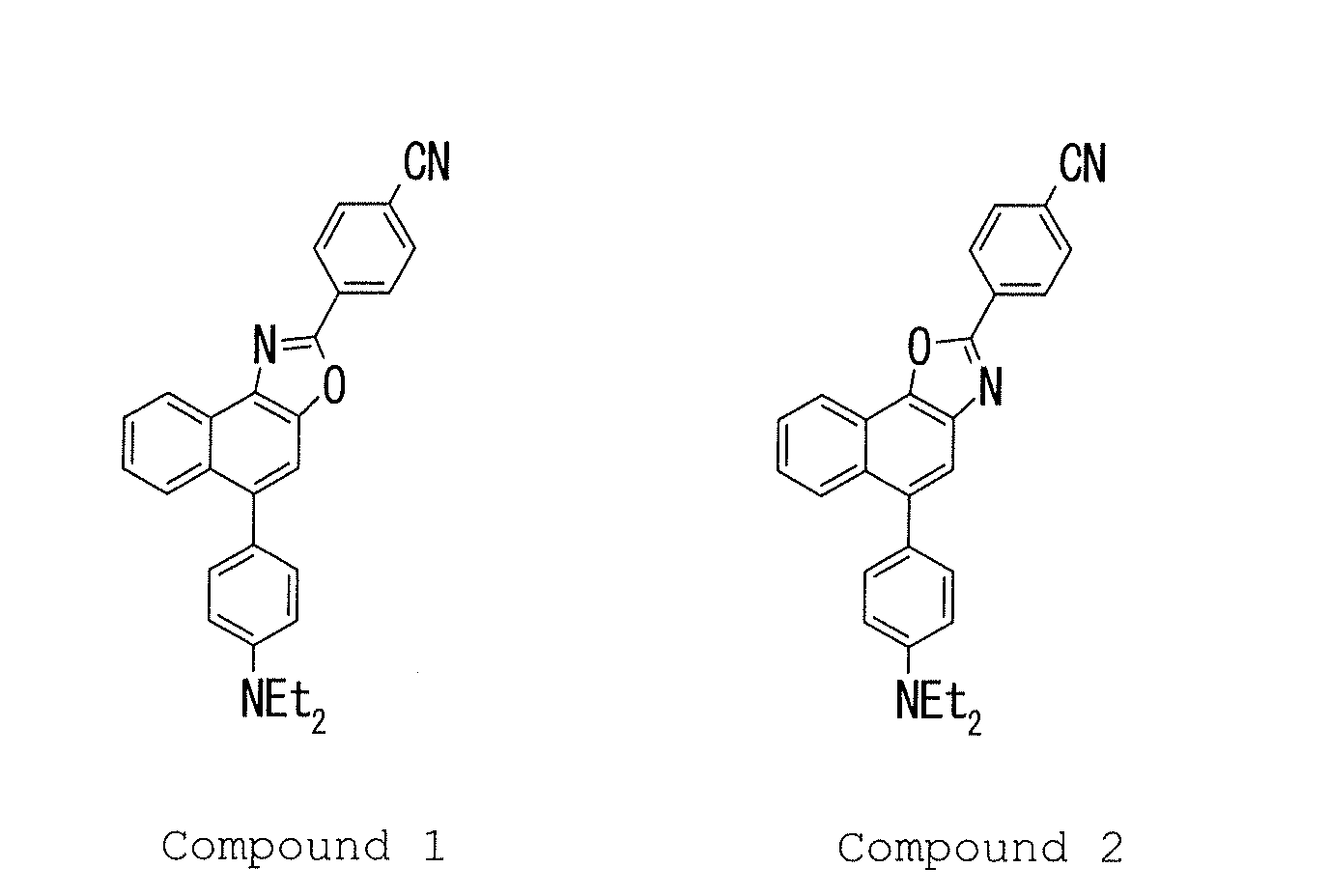
4-[4-(Diethylamino)phenyl]-1,2-naphthoquinone
(2.00 g, 5.54 mmol), p-cyanobenzaldehyde (0.73 g,
5.54 mmol) and ammonium acetate (6.82 g, 88.4 mmol)
were dissolved in acetic acid 59 ml and refluxed and
stirred at 80°C for 110 minutes. After finishing the
reaction, the solution was neutralized by a sodium
carbonate aqueous solution, and methylene chloride
was added to extract organic matters. The methylene
chloride layer was washed with water and then dried
up under reduced pressure, and the residue was
subjected to silica gel column (developing solvent:
dichloromethane : ethyl acetate = 10 : 1) to carry
out separation and refining, whereby powder-like
crystals of the compound 1 (0.82 g, yield 35.7 %) and
the compound 2 (0.59 g, yield 25.4 %) were obtained.
The intermediate 1 (2.07 g, 5.49 mmol) and
anhydrous copper acetate (995 mg, 5.49 mmol) were
dissolved in dimethylsulfoxide (DMSO) 60 ml and
heated and stirred at 100°C for 11 hours. After
finishing the reaction, the reaction product was
poured into 400 ml of distilled water to filter a
deposit, and it was subjected to silica gel column
(developing solvent: dichloromethane/ethyl acetate =
10/1) to carry out separation and refining, whereby
purple powder-like crystal 0.22 g (yield 10.4 %) of
the compound 6 and blue powder-like crystal 1.27 g
(yield 61.7 %) of the compound 7 were obtained.

The compound 7 (1.5 g, 4.00 mmol) and 9-anthraldehyde
(0.98 g, 4.79 mmol) were dissolved in
acetic acid 120 ml, and ammonium acetate (4.93 g,
64.0 mmol) was added thereto to react them at 105°C
for 15 hours. After finishing the reaction, water
was added thereto, and dichloromethane was further
added to extract the product. The dichloromethane
layer was separated and concentrated after washed
with water, and the remaining liquid was subjected to
silica gel column (developing solvent:
dichloromethane) to carry out separation and refining,
whereby red crystal 0.91 g (yield 46.7 %) of the
compound 8 was obtained.
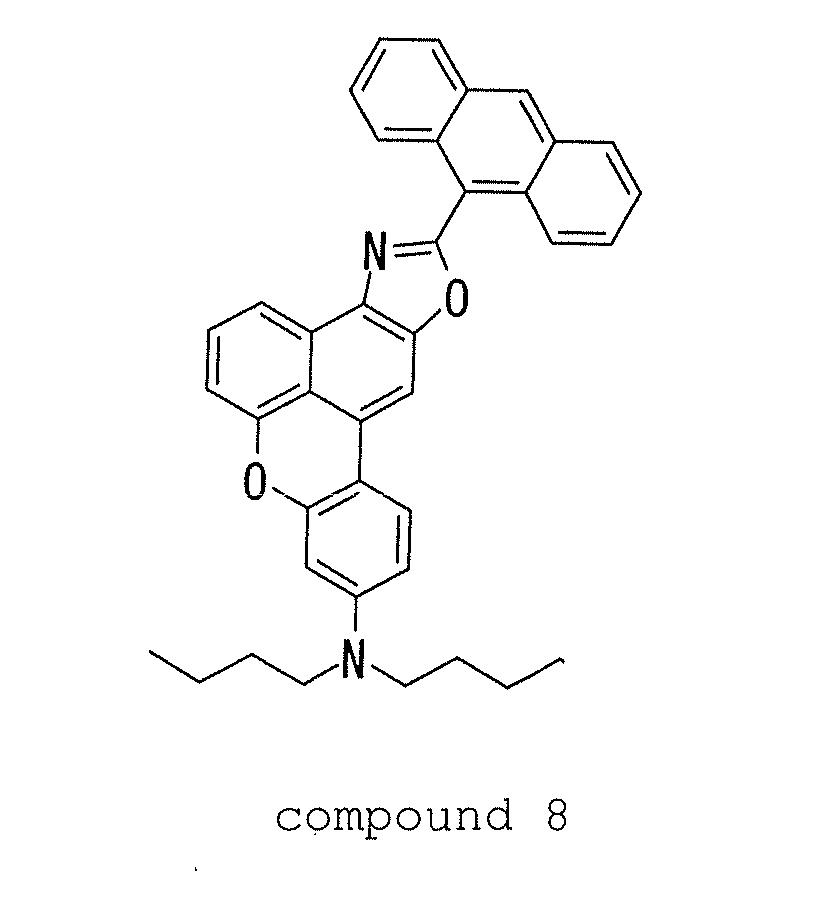
The compound 7 (1.5 g, 4.00 mmol) and 1-pyrenecarboxaldehyde
(1.10 g, 4.79 mmol) were
dissolved in acetcompound 8' ml, and ammonium acetate
(4.93 g, 63.9 mmol) was added thereto to react them
at 100°C for 15 hours. After finishing the reaction,
water was added thereto, and dichloromethane was
further added to extract the product. The
dichloromethane layer was separated and concentrated
under reduced pressure after washed with water, and
the remaining liquid was subjected to silica gel
column (developing solvent: xylene/acetic acid =
20/1) to carry out separation and refining. Orange
crystal 1.12 g (yield 49.4 %) of the compound 9 which
was a naphthoxazole derivative and yellow crystal
0.82 g (yield 36.2 %) of the compound 10 were
obtained.
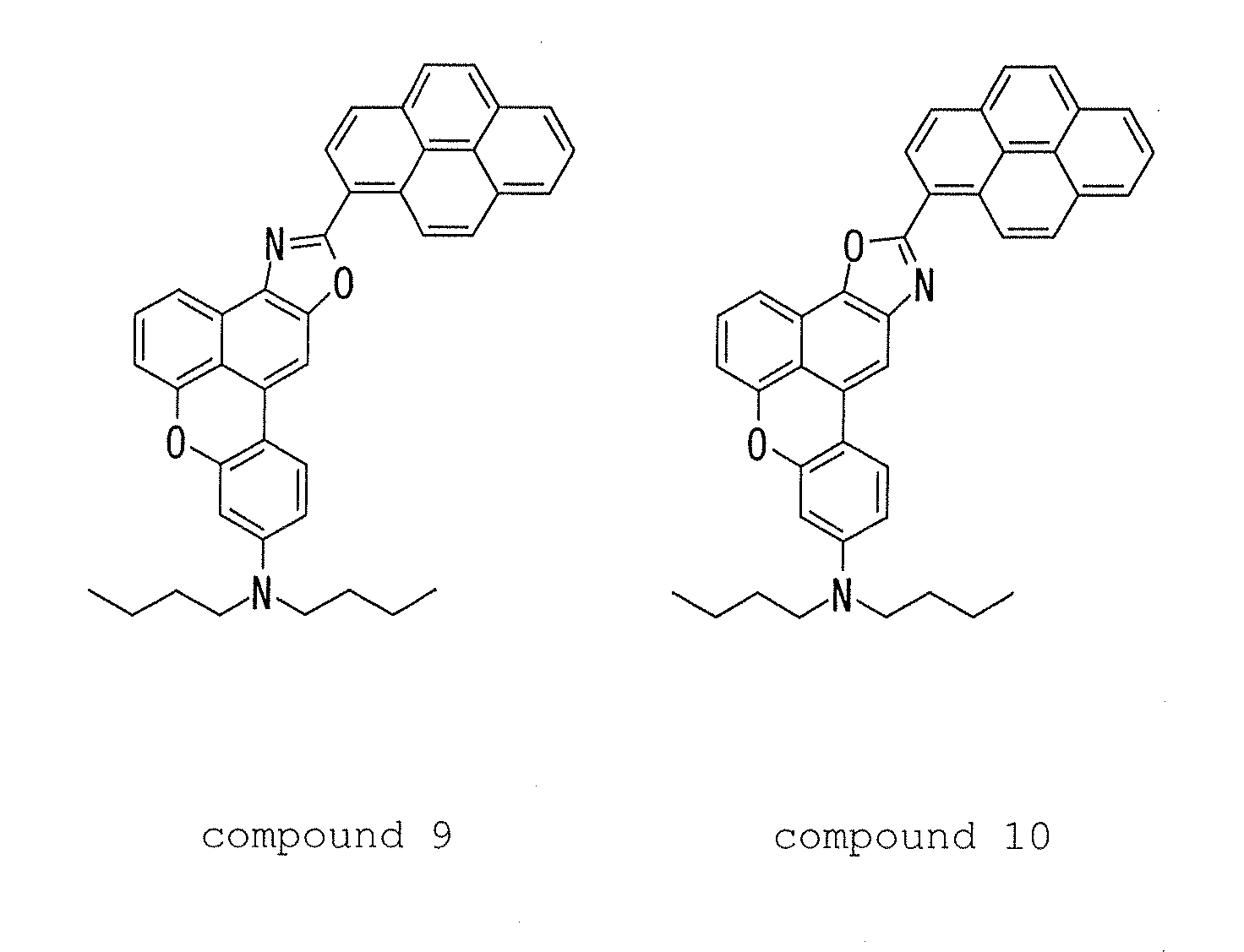
Synthetic Example 15 synthesis of compound 11 [in
Formula (VII), R1 = R2 = n-butyl, X = O, Y = O, Ar =
benzene ring and substituent of Ar = CN], compound 12
[in Formula (VIII), R1 = R2 = n-butyl, X = O, Y = O,
Ar = benzene ring and substituent of Ar = CN] and
compound 13 [in Formula (VII), R1 = R2 = n-butyl, X =
O, Y = NH, Ar = benzene ring and substituent of Ar =
CN]
The compound 7 (0.176 g, 0.47 mmol) and p-cyanobenzaldehyde
(0.61 g, 0.47 mmol) were dissolved
in acetic acid 8 ml, and ammonium acetate (0.578 g,
7.5 mmol) was added thereto to react them at 80°C for
7 hours. After finishing the reaction, the reaction
product was concentrated under reduced pressure and
neutralized with a sodium carbonate aqueous solution
to extract the product with dichloromethane. The
dichloromethane layer was separated and concentrated
under reduced pressure after washed with water, and
the remainder was subjected to silica gel column
(developing solvent: dichloromethane) to carry out
separation, whereby orange crystal 0.074 g (yield
32 %) of the compound 13 and the mixture of the
compound 11 and the compound 12 were obtained. The
mixture of the compound 11 and the compound 12 was
subjected to silica gel column (developing solvent:
xylene/acetic acid = 30/1) to carry out separation
and refining, whereby orange crystal 0.02 g (yield
9 %) of the compound 11 and yellow crystal 0.019 g
(yield 8 %) of the compound 12 were obtained.
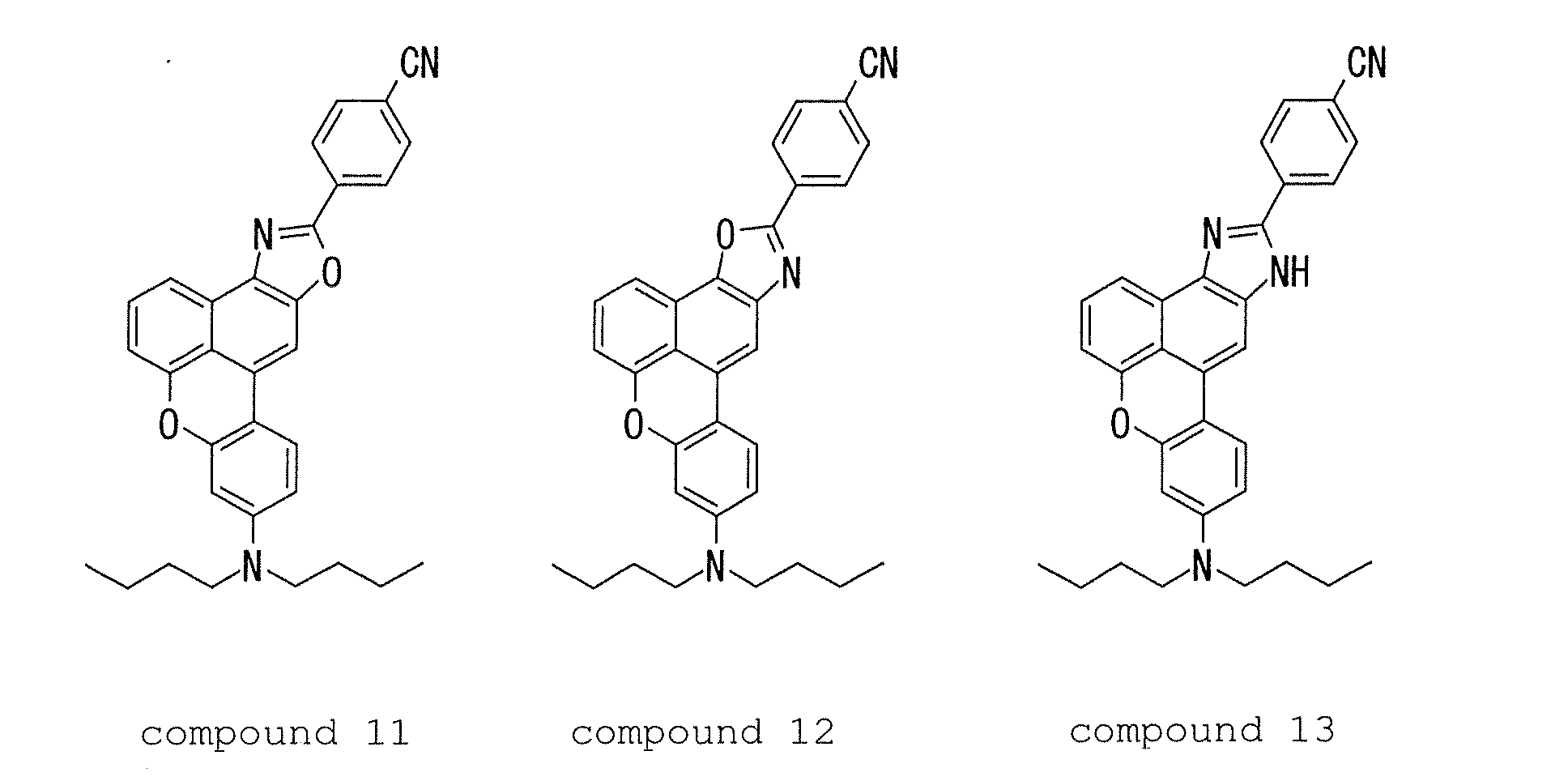
The compound 7 (2.0 g, 5.3 mmol) and p-ethoxybenzaldehyde
(0.96 g, 6.39 mmol) were dissolved
in acetic acid 60 ml, and ammonium acetate (6.56 g,
84.3 mmol) was added thereto to react them at 100°C
for 24 hours. After finishing the reaction, the
reaction product was concentrated under reduced
pressure and neutralized with a sodium carbonate
aqueous solution, and dichloromethane was further
added to extract the product. The dichloromethane
layer was separated and concentrated under reduced
pressure after washed with water, and the remainder
was subjected to silica gel column (developing
solvent: dichloromethane) to carry out separation and
refining, whereby yellow crystal 0.978 g (yield
36.5 %) of the compound 14 was obtained.

The compound 7 (1.50 g, 4.00 mmol) and 4-fluorobenzaldehyde
(0.56 g, 4.51 mmol) were dissolved
in acetic acid 70 ml, and ammonium acetate (4.93 g,
63.9 mmol) was added thereto to react them at 90°C
for 3 hours. After finishing the reaction, the
reaction product was concentrated under reduced
pressure and neutralized with a sodium carbonate
aqueous solution, and the product was extracted with
dichloromethane. The dichloromethane layer was
separated and concentrated under reduced pressure
after washed with water, and the remainder was
subjected to silica gel column (developing solvent:
xylene/acetic acid = 20/1) to carry out separation
and refining, whereby 0.22 g (yield 11.8 %) of the
compound 15 was obtained.

| Example 1 | Example 2 | Example 3 | |
| Fluorescent coloring matter (A component) |
0.072 g |
Compound (V-a) 0.034 g |
Compound (V-a) 0.034 g Rhodamine 6G 0.017 g Rhodamine B 0.017 g |
| Binder resin (C component) |
Benzyl methacrylate -methacrylic acid copolymer (Mw=27,000, q=0.80) 1.9 g | Methyl methacrylate -methacrylic acid copolymer (Mw=25,000, q=0.85) 1.9 g | Same as in Example 2 |
| Monomer/oligomer (D component) |
Dipentaerythritol hexaacrylate (Aronix M-400 manufactured by Toa Gosei) 1.5 g | Trimethylolpropane triacrylate (Aronix M-309 manufactured by Toa Gosei) 1.4 g | Same as in Example 2 |
| Epoxy compound (E component) |
Cresol novolak type epoxy resin (ECN 1299 manufactured by Asahi Kasei) 0.20 g | None | None |
| Other components | 2-Acetoxy-1-ethoxypropane (solvent) 2.5 g Cyclohexanone (solvent) 3.0 g Photopolymerization initiator (Irgacure 907 manufactured by Ciba Specialty Chemicals) 0.035 g | 2-Acetoxy-1-ethoxypropane (solvent) 2.4 g Cyclohexanone (solvent) 3.0 g Photopolymerization initiator (Irgacure 907 manufactured by Ciba Specialty Chemicals) 0.034 g | Same as in Example 2 |
The color-changing material composition thus
obtained was used to produce a film on a glass
substrate of 2.5 cm × 5 cm by a spin coater method.
The film was produced on the conditions of a
revolution number of 1000 rpm of the spin coater and
a revolution time of 10 seconds, and it was subjected
to drying treatment at 120°C for 2 minutes.
Thereafter, it was irradiated with UV rays of 300
mJ/cm2 and then subjected to heat treatment at 200°C
for 60 minutes to obtain a color-changing film having
a film thickness of 10 µm or less.
The color-changing film thus obtained was used
to (1) evaluate a color-changing performance and (2)
determine an initial color-changing efficiency and a
chromaticity coordinate using a blue EL element
having a peak in a wavelength of 440 nm according to
a method of an excited light continuous irradiation
test (evaluation of a coloring matter-holding rate)
onto the color-changing film. Further, the blue EL
element was irradiated at 400 nit for 1000 hours, and
then a chromaticity and a coloring matter-holding
rate thereof were measured. The results thereof are
shown in Table 3.
Fluorescent coloring matters, a binder material
(a binder resin and a monomer and/or oligomer having
a photopolymerizable, ethylenically unsaturated
group), a compound having an epoxy group and other
components (including a solvent) each shown in the
following Table 2 were used to prepare color-changing
material compositions.
| Comparative Example 1 | Comparative Example 2 | |
| Fluorescent coloring matter (A component) | Coumarin 6 0.034 g | Coumarin 6 0.034 g Rhodamine 6G 0.017 g Rhodamine B 0.017 g |
| Binder resin (C component) | Same as in Example 2 | Same as in Example 2 |
| Monomer and/or oligomer (D component) | Same as in Example 2 | Same as in Example 2 |
| Epoxy compound (E component) | None | None |
| Other components | Same as in Example 2 | Same as in Example 2 |
The color-changing material compositions thus
obtained were used to obtain color-changing films in
the same manner as in Examples 1 to 3, and an initial
color-changing efficiency and a chromaticity
coordinate thereof were determined. Further, the
chromaticity and the coloring matter-holding rate
after irradiation were measured. The results thereof
are shown in Table 3.
| Initial color-changing efficiency (%) | Chromaticity (initial) | Chromaticity (after irradiated with light) | Coloring matter-holding rate (%) | |
| Example 1 | 49.6 | 0.23, 0.63 | 0.22, 0.62 | 72.7 |
| Example 2 | 50.3 | 0.25, 0.65 | 0.23, 0.63 | 78.3 |
| Example 3 | 19.2 | 0.64, 0.35 | 0.63, 0.36 | 79.1 |
| Comparative Example 1 | 52.0 | 0.23, 0.63 | 0.20, 0.60 | 49.3 |
| Comparative Example 2 | 19.0 | 0.64, 0.35 | 0.61, 0.37 | 62.1 |
As shown in Table 3, in Comparative Examples 1
and 2, the initial color-changing efficiency stands
comparison with those in Examples 1 to 3, but the
coloring matter-holding rates are notably inferior,
and the color change before and after irradiation is
large.
Further, in the color-changing material
compositions of the comparative examples, crystals of
coumarin 6 have been deposited during storage
(refrigerator 5°C).
| Example 4 | Example 5 | Example 6 | |
| Coloring matter (A component) |
Compound 11 0.0018 g Compound 12 0.0018 g |
Compound 10 0.0035 g |
Compound 9 0.0035 g |
| Binder resin (C component) |
Methyl methacrylate -methacrylic acid copolymer (Mw=25,000, q=0.85) 0.40 g |
Benzyl methacrylate -methacrylic acid copolymer (Mw=27,000, q=0.80) 0.40 g |
Same as in Example 4 |
| Monomer/oligomer (D component) |
Pentaerythritol triacrylate (Aronix M-305 manufactured by Toa Gosei) 0.29 g |
Trimethylolpropane triacrylate (Aronix M-309 manufactured by Toa Gosei) 0.29 g | Same as in Example 4 |
| Epoxy compound (E component) |
None | None | None |
| Other components | 2-Acetoxy-1-ethoxypropane (solvent) 0.75 g Cyclohexanone (solvent) 0.56 g Photopolymerization initiator (Irgacure 907 manufactured by Ciba Specialty Chemicals) 0.0063 g |
Same as in Example 4 | Same as in Example 4 |
| Example | Example 7 | Example 9 |
| Coloring matter (A component) |
Compound 13 0.0035 g |
Compound 9 0.0060 g |
| Binder resin (C component) |
Same as in Example 4 | Methyl methacrylate -methacrylic acid copolymer (Mw=25,000, q=0.87) 0.40 g |
| Monomer/oligomer (D component) |
Same as in Example 4 | Same as in Example 4 |
| Epoxy compound (E component) |
None | Cresol novolak type epoxy resin (ECN 1299 manufactured by Asahi Kasei) 0.15 g |
| Other components | Same as in Example 4 | Same as in Example 4 |
| Example 9 | Example 10 | Example 11 | |
| Coloring matter (A component) |
Compound (V-d) 0.0035 g |
Compound (V-c) 0.0021 g |
Compound (III-c) 0.0026 g |
| Binder resin (C component) |
Methyl methacrylate -methacrylic acid copolymer (Mw=25,000, q=0.87) 0.40 g |
Same as in Example 9 | Benzyl methacrylate -methacrylic acid copolymer (Mw=27,000, q=0.80) 0.40 g |
| Monomer/oligomer (D component) |
Pentaerythritol triacrylate (Aronix M-305 manufactured by Toa Gosei) 0.29 g |
Same as in Example 9 | Dipentaerythritol hexaacrylate (Aronix M-400 manufactured by Toa Gosei) 0.39 g |
| Epoxy compound (E component) |
None | None | Cresol novolak type epoxy resin (ECN 1299 manufactured by Asahi Kasei) 0.023 g |
| Other components | 2-Acetoxy-1-ethoxypropane (solvent) 0.75 g Tetracholoroethane (solvent) 0.56 g Photopolymerization initiator (Irgacure 907 manufactured by Ciba Specialty Chemicals) 0.0063 g |
Same as in Example 9 | 2-Acetoxy-1-ethoxypropane (solvent) 0.86 g Tetracholoroethane (solvent) 0.28 g Photopolymerization initiator (Irgacure 907 manufactured by Ciba Specialty Chemicals) 0.0044 g |
| Example | Example 12 | Example 13 |
| Coloring matter (A component) |
Compound 8 0.010 g |
Same as in Example 9 |
| Binder resin (C component) |
Polycarbonate (Mw = 20,000) 1.99 g |
|
| Monomer/oligomer (D component) |
None | |
| Epoxy compound (E component) |
None | |
| Other components | Toluene (solvent) 8.0 g |
The color-changing material compositions
obtained in Examples 4 to 13 were used to produce
films on a glass substrate of 2.5 cm × 5 cm by a
spin coater method. The films were produced on the
conditions of a revolution number of 1000 rpm of the
spin coater and a revolution time of 10 seconds, and
they were subjected to drying treatment at 120°C for
2 minutes.
Thereafter, the films produced in Examples 4 to
11 were irradiated with UV rays of 300 mJ/cm2 and
then subjected to heat treatment at 200°C for 60
minutes to obtain color-changing films having a film
thickness of 10 µm or less. The film produced in
Example 12 was subjected only to heat treatment at
200°C for 60 minutes. Further, the color-changing
material composition prepared in Example 13 was
coated on a commercial blue LED element and dried at
70°C.
The color-changing films thus obtained were
used to (1) evaluate a color-changing performance and
(2) determine an initial color-changing efficiency
and a chromaticity coordinate using a blue EL element
having a peak in a wavelength of 470 nm according to
a method of an excited light continuous irradiation
test (evaluation of a coloring matter-holding rate)
onto the color-changing film. Further, the blue EL
element was irradiated at 400 nit for 1000 hours, and
then a chromaticity and a coloring matter-holding
rate thereof were measured. The results thereof are
shown in Table 8.
| Initial color-changing efficiency (%) | Chromaticity (initial) | Chromaticity (after irradiated with light) | Coloring matter-holding rate (%) | |
| Example 4 | 51.0 | 0.23, 0.63 | 0.21, 0.61 | 57.9 |
| Example 5 | 48.5 | 0.23, 0.64 | 0.21, 0.62 | 57.5 |
| Example 6 | 48.7 | 0.24, 0.63 | 0.21, 0.61 | 58.8 |
| Example 7 | 49.9 | 0.22, 0.63 | 0.21, 0.62 | 65.8 |
| Example 8 | 51.1 | 0.24, 0.62 | 0.22, 0.61 | 58.2 |
| Example 9 | 51.5 | 0.22, 0.62 | 0.20, 0.60 | 75.8 |
| Example 10 | 51.9 | 0.23, 0.63 | 0.21, 0.61 | 78.3 |
| Example 11 | 47.9 | 0.20, 0.60 | 0.20, 0.60 | 79.8 |
| Example 12 | 47.6 | 0.22, 0.62 | 0.21, 0.61 | 73.9 |
The color-changing material compositions
obtained in Examples 4 to 12 could stably be stored
in a refrigerator of 5°C. Further, green light
emission could visually be observed in Example 13.
According to the present invention, capable of
being provided is a novel hetero-polycyclic compound
which functions as a luminescent material for
disperse dyes, coloring maters for ink-jet printing
and organic electroluminescent elements or as an
organic fluorescent coloring matter having a
clathrate-forming ability and a fluorescent property
and capable of changing the solid optical properties
(color tone and fluorescent property) of coloring
matters to a large extent by allowing various organic
low molecular compounds (organic guest molecules) to
be included therein and which is suitably used for
various applications, and coloring matters comprising
the above hetero-polycyclic compound and pigments or
dyes containing the above hetero-polycyclic compound
are useful for various applications and particularly
suited as materials for color-changing material
compositions.
A color-changing film obtained from the color-changing
material composition of the present
invention is not deteriorated in a color-changing
performance even after used for long time and is
prevented from being unusable due to deposition of
the coloring matter during storage.
Accordingly, the color-changing film of the
present invention is most suited as a color-changing
film for fully colorizing organic electroluminescent
elements, LED elements and the like.
Claims (24)
- A hetero-polycyclic compound represented by the following Formula (I):wherein R1 and R2 each represent independently an alkyl group having 1 to 10 carbon atoms which may have a substituent, an arylalkyl group having 7 to 30 carbon atoms which may have a substituent, an aryl group having 6 to 20 carbon atoms which may have a substituent or a heteroaryl group having 5 to 20 carbon atoms which may have a substituent, and they may be combined with each other to form a cyclic structure or may form a cyclic structure together with a benzene ring to which a nitrogen atom is bonded; and

X represents an oxygen atom, a sulfur atom, -NH- or - NR3- (R3 represents an alkyl group having 1 to 10 carbon atoms which may have a substituent, an aryl group having 6 to 20 carbon atoms which may have a substituent or a heteroaryl group having 5 to 20 carbon atoms which may have a substituent). - A hetero-polycyclic compound represented by the following Formula (II):wherein R1 and R2 each represent independently an alkyl group having 1 to 10 carbon atoms which may have a substituent, an arylalkyl group having 7 to 30 carbon atoms which may have a substituent, an aryl group having 6 to 20 carbon atoms which may have a substituent or a heteroaryl group having 5 to 20 carbon atoms which may have a substituent, and they may be combined with each other to form a cyclic structure or may form a cyclic structure together with a benzene ring to which a nitrogen atom is bonded; and

X represents an oxygen atom, a sulfur atom, -NH- or -NR3- (R3 represents an alkyl group having 1 to 10 carbon atoms which may have a substituent, an aryl group having 6 to 20 carbon atoms which may have a substituent or a heteroaryl group having 5 to 20 carbon atoms which may have a substituent). - A hetero-polycyclic compound represented by the following Formula (III):wherein R1 and R2 each represent independently an alkyl group having 1 to 10 carbon atoms which may have a substituent, an arylalkyl group having 7 to 30 carbon atoms which may have a substituent, an aryl group having 6 to 20 carbon atoms which may have a substituent or a heteroaryl group having 5 to 20 carbon atoms which may have a substituent, and they may be combined with each other to form a cyclic structure or may form a cyclic structure together with a benzene ring to which a nitrogen atom is bonded;

Y represents an oxygen atom, a sulfur atom or -NR4- (R4 represents an alkyl group having 1 to 10 carbon atoms which may have a substituent, an aryl group having 6 to 20 carbon atoms which may have a substituent or a heteroaryl group having 5 to 20 carbon atoms which may have a substituent); and
Ar represents an aryl group having 6 to 20 carbon atoms which may have a substituent or a heteroaryl group having 5 to 20 carbon atoms which may have a substituent. - A hetero-polycyclic compound represented by the following Formula (IV):wherein R1 and R2 each represent independently an alkyl group having 1 to 10 carbon atoms which may have a substituent, an arylalkyl group having 7 to 30 carbon atoms which may have a substituent, an aryl group having 6 to 20 carbon atoms which may have a substituent or a heteroaryl group having 5 to 20 carbon atoms which may have a substituent, and they may be combined with each other to form a cyclic structure or may form a cyclic structure together with a benzene ring to which a nitrogen atom is bonded;
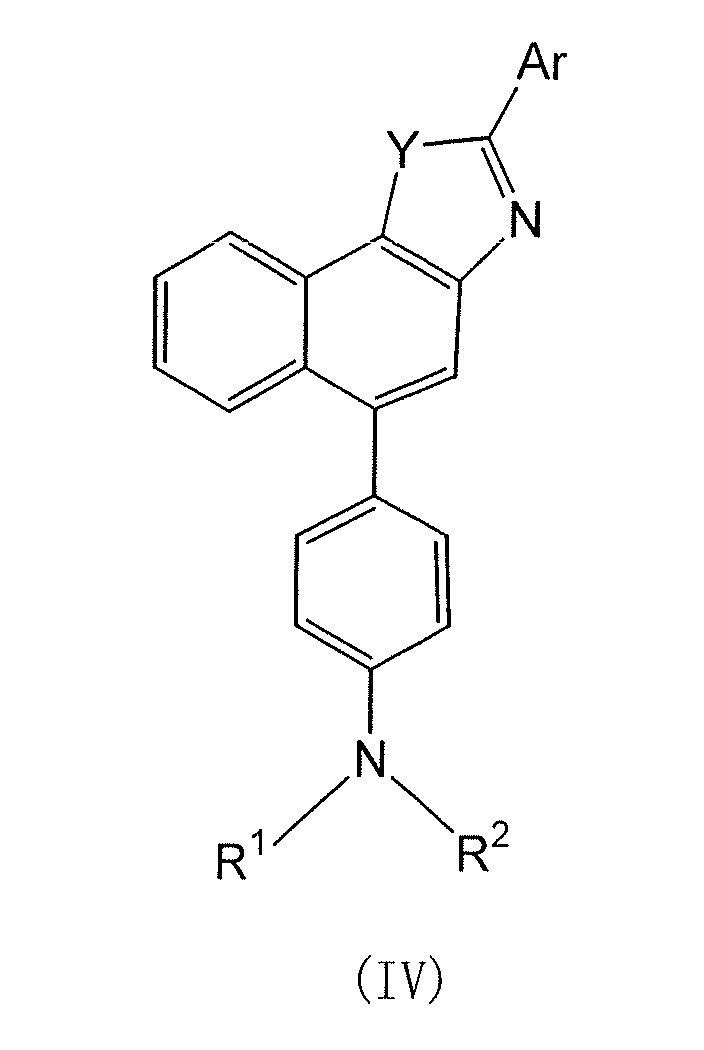
Y represents an oxygen atom, a sulfur atom or -NR4- (R4 represents an alkyl group having 1 to 10 carbon atoms which may have a substituent, an aryl group having 6 to 20 carbon atoms which may have a substituent or a heteroaryl group having 5 to 20 carbon atoms which may have a substituent); and
Ar represents an aryl group having 6 to 20 carbon atoms which may have a substituent or a heteroaryl group having 5 to 20 carbon atoms which may have a substituent. - A hetero-polycyclic compound represented by the following Formula (V):wherein R1 and R2 each represent independently an alkyl group having 1 to 10 carbon atoms which may have a substituent, an arylalkyl group having 7 to 30 carbon atoms which may have a substituent, an aryl group having 6 to 20 carbon atoms which may have a substituent or a heteroaryl group having 5 to 20 carbon atoms which may have a substituent, and they may be combined with each other to form a cyclic structure or may form a cyclic structure together with a benzene ring to which a nitrogen atom is bonded;

X represents an oxygen atom, a sulfur atom, -NH- or -NR3- (R3 represents an alkyl group having 1 to 10 carbon atoms which may have a substituent, an aryl group having 6 to 20 carbon atoms which may have a substituent or a heteroaryl group having 5 to 20 carbon atoms which may have a substituent);
Y represents an oxygen atom, a sulfur atom, -NH- or -NR4- (R4 represents an alkyl group having 1 to 10 carbon atoms which may have a substituent, an aryl group having 6 to 20 carbon atoms which may have a substituent or a heteroaryl group having 5 to 20 carbon atoms which may have a substituent); and
Ar represents an aryl group having 6 to 20 carbon atoms which may have a substituent or a heteroaryl group having 5 to 20 carbon atoms which may have a substituent. - A hetero-polycyclic compound represented by the following Formula (VI):wherein R1 and R2 each represent independently an alkyl group having 1 to 10 carbon atoms which may have a substituent, an arylalkyl group having 7 to 30 carbon atoms which may have a substituent, an aryl group having 6 to 20 carbon atoms which may have a substituent or a heteroaryl group having 5 to 20 carbon atoms which may have a substituent, and they may be combined with each other to form a cyclic structure or may form a cyclic structure together with a benzene ring to which a nitrogen atom is bonded;
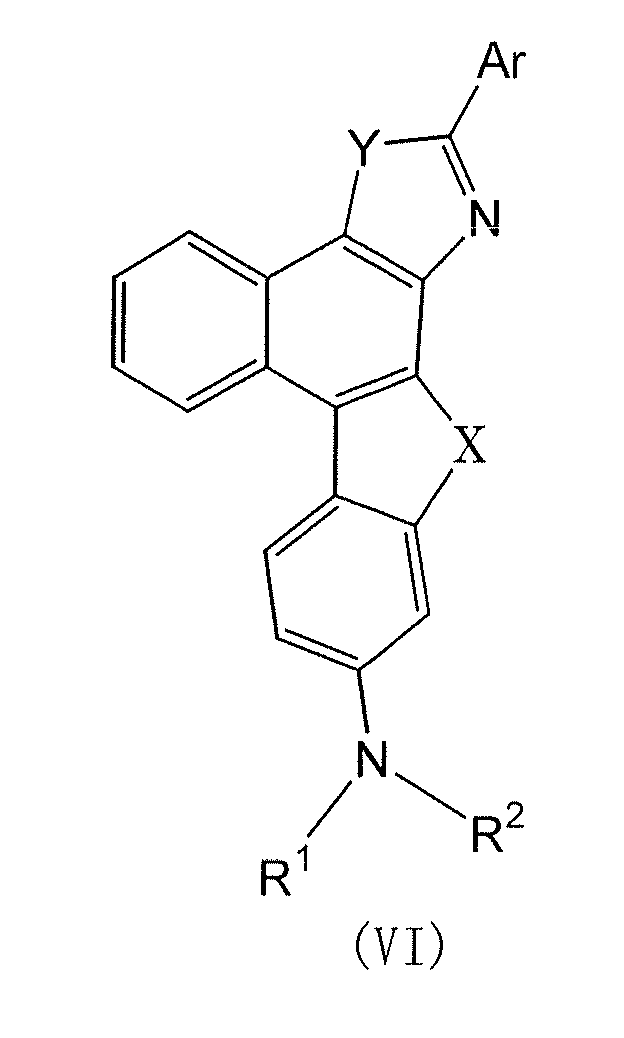
X represents an oxygen atom, a sulfur atom, -NH- or -NR3- (R3 represents an alkyl group having 1 to 10 carbon atoms which may have a substituent, an aryl group having 6 to 20 carbon atoms which may have a substituent or a heteroaryl group having 5 to 20 carbon atoms which may have a substituent);
Y represents an oxygen atom, a sulfur atom, -NH- or -NR4- (R4 represents an alkyl group having 1 to 10 carbon atoms which may have a substituent, an aryl group having 6 to 20 carbon atoms which may have a substituent or a heteroaryl group having 5 to 20 carbon atoms which may have a substituent); and
Ar represents an aryl group having 6 to 20 carbon atoms which may have a substituent or a heteroaryl group having 5 to 20 carbon atoms which may have a substituent. - A hetero-polycyclic compound represented by the following Formula (VII):wherein R1 and R2 each represent independently an alkyl group having 1 to 10 carbon atoms which may have a substituent, an arylalkyl group having 7 to 30 carbon atoms which may have a substituent, an aryl group having 6 to 20 carbon atoms which may have a substituent or a heteroaryl group having 5 to 20 carbon atoms which may have a substituent, and they may be combined with each other to form a cyclic structure or may form a cyclic structure together with a benzene ring to which a nitrogen atom is bonded;

X represents an oxygen atom, a sulfur atom, -NH- or -NR3- (R3 represents an alkyl group having 1 to 10 carbon atoms which may have a substituent, an aryl group having 6 to 20 carbon atoms which may have a substituent or a heteroaryl group having 5 to 20 carbon atoms which may have a substituent);
Y represents an oxygen atom, a sulfur atom, -NH- or -HR4- (R4 represents an alkyl group having 1 to 10 carbon atoms which may have a substituent, an aryl group having 6 to 20 carbon atoms which may have a substituent or a heteroaryl group having 5 to 20 carbon atoms which may have a substituent); and
Ar represents an aryl group having 6 to 20 carbon atoms which may have a substituent or a heteroaryl group having 5 to 20 carbon atoms which may have a substituent. - A hetero-polycyclic compound represented by the following Formula (VIII):wherein R1 and R2 each represent independently an alkyl group having 1 to 10 carbon atoms which may have a substituent, an arylalkyl group having 7 to 30 carbon atoms which may have a substituent, an aryl group having 6 to 20 carbon atoms which may have a substituent or a heteroaryl group having 5 to 20 carbon atoms which may have a substituent, and they may be combined with each other to form a cyclic structure or may form a cyclic structure together with a benzene ring to which a nitrogen atom is bonded;
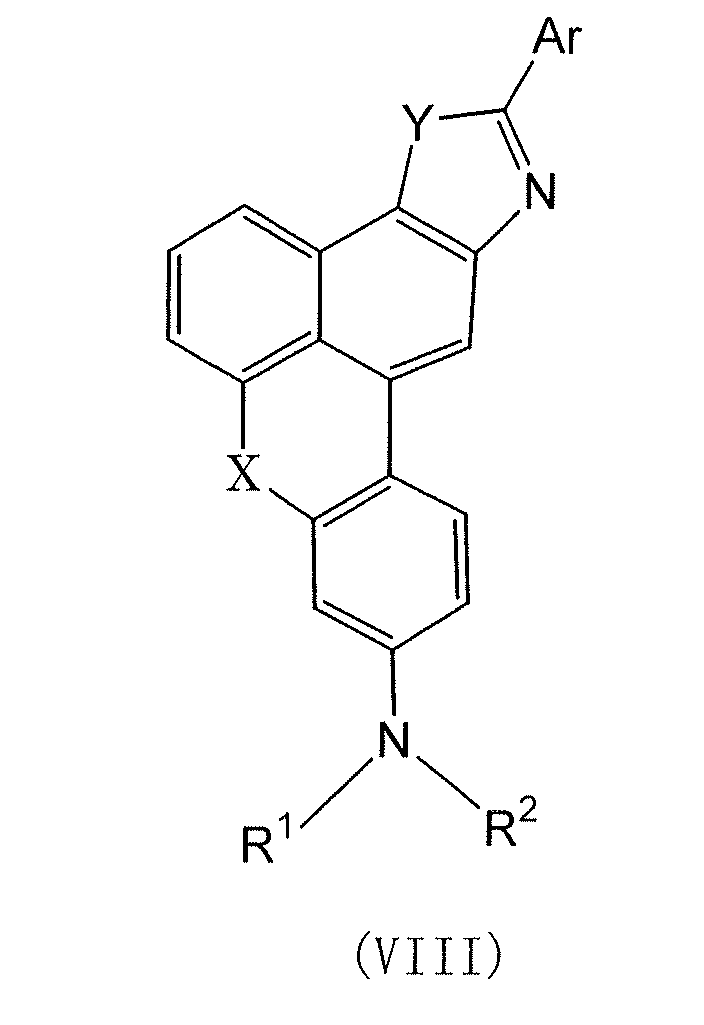
X represents an oxygen atom, a sulfur atom, -NH- or -NR3- (R3 represents an alkyl group having 1 to 10 carbon atoms which may have a substituent, an aryl group having 6 to 20 carbon atoms which may have a substituent or a heteroaryl group having 5 to 20 carbon atoms which may have a substituent);
Y represents an oxygen atom, a sulfur atom, -NH- or -NR4- (R4 represents an alkyl group having 1 to 10 carbon atoms which may have a substituent, an aryl group having 6 to 20 carbon atoms which may have a substituent or a heteroaryl group having 5 to 20 carbon atoms which may have a substituent); and
Ar represents an aryl group having 6 to 20 carbon atoms which may have a substituent or a heteroaryl group having 5 to 20 carbon atoms which may have a substituent. - A color-changing material composition comprising (A) a fluorescent coloring matter comprising at least one of hetero-polycyclic compounds represented by the following Formulas (III) to (VIII) and (B) a binder material:
 wherein R1 and R2 each represent independently an alkyl group having 1 to 10 carbon atoms which may have a substituent, an arylalkyl group having 7 to 30 carbon atoms which may have a substituent, an aryl group having 6 to 20 carbon atoms which may have a substituent or a heteroaryl group having 5 to 20 carbon atoms which may have a substituent, and they may be combined with each other to form a cyclic structure or may form a cyclic structure together with a benzene ring to which a nitrogen atom is bonded;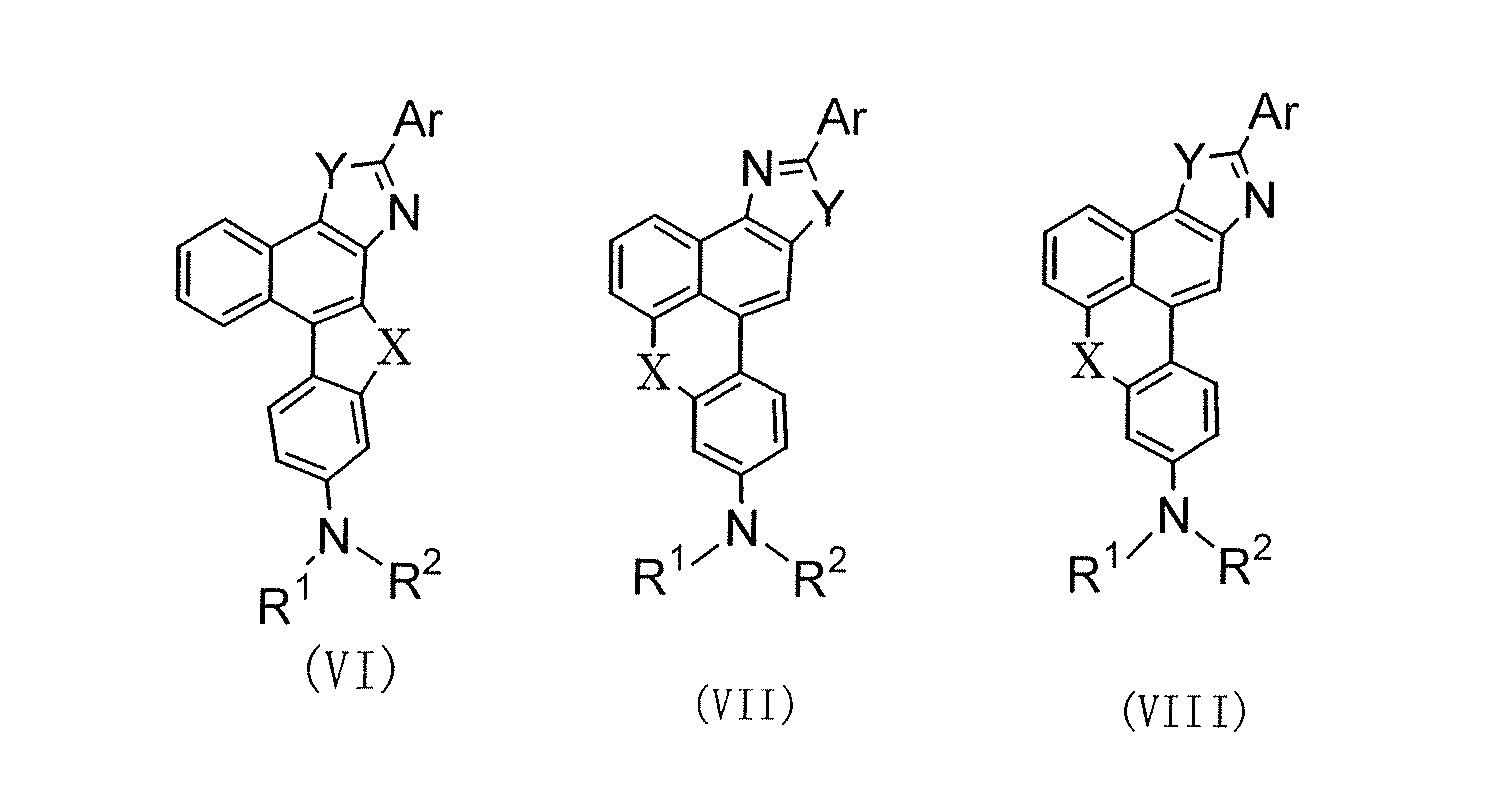
X represents an oxygen atom, a sulfur atom, -NH- or -NR3- (R3 represents an alkyl group having 1 to 10 carbon atoms which may have a substituent, an aryl group having 6 to 20 carbon atoms which may have a substituent or a heteroaryl group having 5 to 20 carbon atoms which may have a substituent);
Y represents an oxygen atom, a sulfur atom, -NH- or -NR4- (R4 represents an alkyl group having 1 to 10 carbon atoms which may have a substituent, an aryl group having 6 to 20 carbon atoms which may have a substituent or a heteroaryl group having 5 to 20 carbon atoms which may have a substituent), provided that Y represents an oxygen atom, a sulfur atom or -NR4- in Formulas (III) and (IV); and
Ar represents an aryl group having 6 to 20 carbon atoms which may have a substituent or a heteroaryl group having 5 to 20 carbon atoms which may have a substituent. - The color-changing material composition as described in claim 9, wherein (B) the binder material described above is an optically reactive resin.
- The color-changing material composition as described in claim 9, wherein (B) the binder material described above is a thermosetting resin.
- The color-changing material composition as described in claim 9, wherein (B) the binder material described above is a thermoplastic resin.
- The color-changing material composition as described in claim 9, wherein (B) the binder material described above comprises (C) a methacrylic acid ester-methacrylic acid copolymer and (D) a monomer and/or oligomer having a photopolymerizable, ethylenically unsaturated group.
- The color-changing material composition as described in claim 13, wherein (B) the binder material described above comprises 10 to 200 parts by weight of (D) the monomer and/or oligomer having a photopolymerizable, ethylenically unsaturated group per 100 parts by weight of (C) the methacrylic acid ester-methacrylic acid copolymer.
- The color-changing material composition as described in claim 9, further comprising (E) a compound having an epoxy group.
- The color-changing material composition as described in claim 15, comprising 0.5 to 15 % by weight of (E) the compound having an epoxy group based on the whole amount of the solid matters of the color-changing material composition described above.
- The color-changing material composition as described in claim 9, comprising 0.1 to 10 % by weight of (A) the component described above based on the whole amount of the solid matters of the color-changing material composition described above.
- The color-changing material composition as described in claim 9, further comprising a fluorescent coloring matter comprising at least one selected from Rhodamine base fluorescent coloring matters.
- A color-changing film comprising the color-changing material composition as described in any of claims 9 to 18.
- A color-changing film formed by a photolithography method using the color-changing material composition as described in any of claims 9, 10 and 13 to 18.
- The color-changing film as described in claim 19, absorbing light of a light source to emit light having a longer wavelength.
- The color-changing film as described in claim 21, wherein the light source described above is an organic electroluminescent element or an LED element.
- A coloring matter comprising the hetero-polycyclic compound as described in any of claims 1 to 8.
- A pigment or a dye comprising the hetero-polycyclic compound as described in any of claims 1 to 8.
Applications Claiming Priority (5)
| Application Number | Priority Date | Filing Date | Title |
|---|---|---|---|
| JP2003036738 | 2003-02-14 | ||
| JP2003036738 | 2003-02-14 | ||
| JP2003036790 | 2003-02-14 | ||
| JP2003036790 | 2003-02-14 | ||
| PCT/JP2004/001472 WO2004072053A1 (en) | 2003-02-14 | 2004-02-12 | Hetero-polycyclic compounds, and coloring matters, pigments, dyes, color-changing material compositions, and color-changing films, made by using the compounds |
Publications (2)
| Publication Number | Publication Date |
|---|---|
| EP1593675A1 true EP1593675A1 (en) | 2005-11-09 |
| EP1593675A4 EP1593675A4 (en) | 2008-03-19 |
Family
ID=32871192
Family Applications (1)
| Application Number | Title | Priority Date | Filing Date |
|---|---|---|---|
| EP04710500A Withdrawn EP1593675A4 (en) | 2003-02-14 | 2004-02-12 | HETERO-POLYCYCLIC COMPOUNDS, COLORING MATERIALS, PIGMENTS, COLORANTS, COLOR-CHANGING MATERIAL COMPOSITIONS, COLOR-CHANGING FILMS MANUFACTURED THEREFROM |
Country Status (6)
| Country | Link |
|---|---|
| US (3) | US7420065B2 (en) |
| EP (1) | EP1593675A4 (en) |
| JP (2) | JP4514710B2 (en) |
| KR (1) | KR20050109940A (en) |
| TW (1) | TW200427656A (en) |
| WO (1) | WO2004072053A1 (en) |
Cited By (6)
| Publication number | Priority date | Publication date | Assignee | Title |
|---|---|---|---|---|
| EP2128217A4 (en) * | 2007-03-07 | 2011-01-19 | Toray Industries | Light-emitting device material and light-emitting device |
| EP2332931A2 (en) | 2008-09-23 | 2011-06-15 | LG Chem, Ltd. | Novel compound, method for preparing same and organic electronic device using same |
| EP2436679A4 (en) * | 2009-05-29 | 2012-12-19 | Idemitsu Kosan Co | ANTHRACENE DERIVATIVE AND ORGANIC ELECTROLUMINESCENT ELEMENT USING THE SAME |
| WO2017175986A1 (en) | 2016-04-08 | 2017-10-12 | Rohm And Haas Electronic Materials Korea Ltd. | Organic electroluminescent compound and organic electroluminescent device comprising the same |
| KR20170115940A (en) | 2016-04-08 | 2017-10-18 | 롬엔드하스전자재료코리아유한회사 | Organic Electroluminescent Compound and Organic Electroluminescent Device Comprising the Same |
| RU2795221C1 (en) * | 2022-07-28 | 2023-05-02 | Федеральное государственное автономное образовательное учреждение высшего образования "Уральский федеральный университет имени первого Президента России Б.Н. Ельцина" | Application of 2-(pyrene-1-yl)naphtho[1,2-d]oxazolyl-5-sulfic acid as a monomolecular agent for photodynamic therapy |
Families Citing this family (18)
| Publication number | Priority date | Publication date | Assignee | Title |
|---|---|---|---|---|
| US7408072B2 (en) * | 2004-02-13 | 2008-08-05 | Kochi University | Heteropolycyclic compound and dye |
| JP4666350B2 (en) * | 2004-02-13 | 2011-04-06 | 国立大学法人高知大学 | Color conversion film, color conversion filter, and organic EL display using the same |
| JP4730731B2 (en) * | 2005-02-15 | 2011-07-20 | 国立大学法人高知大学 | Color conversion filter and organic EL display using the same |
| EP1852486B1 (en) * | 2005-02-25 | 2012-08-22 | Toray Industries, Inc. | Material for light-emitting element and light emitting element |
| JP4986485B2 (en) * | 2006-03-28 | 2012-07-25 | 株式会社Adeka | Epoxy resin curable composition |
| JP5130521B2 (en) * | 2007-02-08 | 2013-01-30 | 国立大学法人高知大学 | Heteropolycyclic phenazine compounds |
| CN101861292A (en) * | 2007-11-19 | 2010-10-13 | 出光兴产株式会社 | Monobenzo derivative, material for organic electroluminescent element containing same, and organic electroluminescent element using same |
| GB0816557D0 (en) * | 2008-09-10 | 2008-10-15 | Merck Patent Gmbh | Electro-optical switching element and electro-optical display |
| WO2011013474A1 (en) | 2009-07-31 | 2011-02-03 | 株式会社Adeka | Schiff base type compound and coloring material containing same |
| JP5501993B2 (en) * | 2011-03-01 | 2014-05-28 | 株式会社野田スクリーン | Fluorescent compounds, fluorescent polymers and coating agents |
| CN105086885A (en) * | 2014-05-20 | 2015-11-25 | 太湖金张科技股份有限公司 | Blue light-blocking acrylic adhesive and film prepared from blue light-blocking acrylic adhesive |
| CN107250087B (en) | 2015-02-03 | 2022-01-18 | 株式会社Lg化学 | Electroactive material |
| CN105086499B (en) * | 2015-08-20 | 2017-04-19 | 中国科学院长春应用化学研究所 | Photosensitive dye, and preparation method and solar cell thereof |
| CN107256881B (en) * | 2017-06-28 | 2020-05-08 | 京东方科技集团股份有限公司 | Display panel, manufacturing method thereof and display device |
| US11426818B2 (en) | 2018-08-10 | 2022-08-30 | The Research Foundation for the State University | Additive manufacturing processes and additively manufactured products |
| KR102173413B1 (en) * | 2018-11-23 | 2020-11-04 | 한국생산기술연구원 | Dye for sensing ammonia gas and sensing sensor using the same |
| KR102721327B1 (en) * | 2019-10-21 | 2024-10-23 | 주식회사 엘지화학 | Photosensitive resin composition, manufacturing method for color conversion filter for display device using same and color conversion filter for display device thereby |
| WO2023177217A1 (en) * | 2022-03-18 | 2023-09-21 | 에스에프씨 주식회사 | Novel heterocyclic compound and organic light-emitting diode comprising same |
Family Cites Families (10)
| Publication number | Priority date | Publication date | Assignee | Title |
|---|---|---|---|---|
| US2783248A (en) * | 1954-06-30 | 1957-02-26 | American Cyanamid Co | Process for preparing dinaphtho-[2, 1, 1', 2']-furan-5, 6-dione |
| GB9225346D0 (en) * | 1992-12-03 | 1993-01-27 | Pilkington Plc | Photochromic compounds |
| GB9225348D0 (en) * | 1992-12-03 | 1993-01-27 | Pilkington Plc | Bridged photochromics |
| JP3719328B2 (en) * | 1997-06-17 | 2005-11-24 | 三菱化学株式会社 | Fluorescent material and organic electroluminescent device using the same |
| GB9722127D0 (en) * | 1997-10-20 | 1997-12-17 | James Robinson Ltd | Photochromic compounds |
| JP3779625B2 (en) | 2002-01-29 | 2006-05-31 | 日本化薬株式会社 | Light emitting element |
| JP3803919B2 (en) * | 2002-02-04 | 2006-08-02 | 日本化薬株式会社 | Light emitting element |
| JP2004006064A (en) * | 2002-03-22 | 2004-01-08 | Nippon Kayaku Co Ltd | Light-emitting element |
| JP3980003B2 (en) * | 2003-02-14 | 2007-09-19 | 出光興産株式会社 | Color conversion material composition and color conversion film using the same |
| JP4514466B2 (en) * | 2003-02-14 | 2010-07-28 | 株式会社テクノネットワーク四国 | Heteropolycyclic compounds |
-
2004
- 2004-02-12 WO PCT/JP2004/001472 patent/WO2004072053A1/en not_active Ceased
- 2004-02-12 EP EP04710500A patent/EP1593675A4/en not_active Withdrawn
- 2004-02-12 JP JP2005504979A patent/JP4514710B2/en not_active Expired - Fee Related
- 2004-02-12 US US10/545,319 patent/US7420065B2/en not_active Expired - Fee Related
- 2004-02-12 KR KR1020057014918A patent/KR20050109940A/en not_active Withdrawn
- 2004-02-13 TW TW093103540A patent/TW200427656A/en unknown
-
2008
- 2008-07-31 US US12/183,905 patent/US20080290329A1/en not_active Abandoned
- 2008-08-01 US US12/184,653 patent/US20090043116A1/en not_active Abandoned
-
2009
- 2009-12-18 JP JP2009287588A patent/JP2010143904A/en active Pending
Cited By (13)
| Publication number | Priority date | Publication date | Assignee | Title |
|---|---|---|---|---|
| EP2128217A4 (en) * | 2007-03-07 | 2011-01-19 | Toray Industries | Light-emitting device material and light-emitting device |
| US9028977B2 (en) | 2008-09-23 | 2015-05-12 | Lg Chem, Ltd. | Compound, method for preparing same and organic electronic device using same |
| EP2332931A2 (en) | 2008-09-23 | 2011-06-15 | LG Chem, Ltd. | Novel compound, method for preparing same and organic electronic device using same |
| US9147847B2 (en) | 2009-05-29 | 2015-09-29 | Idemitsu Kosan Co., Ltd. | Anthracene derivative and organic electroluminescent element using the same |
| US8866135B2 (en) | 2009-05-29 | 2014-10-21 | Idemitsu Kosan Co., Ltd. | Anthracene derivative and organic electroluminescent element using the same |
| US8629430B2 (en) | 2009-05-29 | 2014-01-14 | Idemitsu Kosan Co., Ltd. | Anthracene derivative and organic electroluminescent element using the same |
| EP2436679A4 (en) * | 2009-05-29 | 2012-12-19 | Idemitsu Kosan Co | ANTHRACENE DERIVATIVE AND ORGANIC ELECTROLUMINESCENT ELEMENT USING THE SAME |
| US9373792B2 (en) | 2009-05-29 | 2016-06-21 | Idemitsu Kosan Co., Ltd. | Anthracene derivative and organic electroluminescent element using the same |
| WO2017175986A1 (en) | 2016-04-08 | 2017-10-12 | Rohm And Haas Electronic Materials Korea Ltd. | Organic electroluminescent compound and organic electroluminescent device comprising the same |
| KR20170115940A (en) | 2016-04-08 | 2017-10-18 | 롬엔드하스전자재료코리아유한회사 | Organic Electroluminescent Compound and Organic Electroluminescent Device Comprising the Same |
| US10727416B2 (en) | 2016-04-08 | 2020-07-28 | Rohm And Haas Electronic Materials Korea Ltd. | Organic electroluminescent compound and organic electroluminescent device comprising the same |
| US10927103B1 (en) | 2016-04-08 | 2021-02-23 | Rohm And Haas Electronic Materials Korea Ltd. | Organic electroluminescent compound and organic electroluminescent device comprising the same |
| RU2795221C1 (en) * | 2022-07-28 | 2023-05-02 | Федеральное государственное автономное образовательное учреждение высшего образования "Уральский федеральный университет имени первого Президента России Б.Н. Ельцина" | Application of 2-(pyrene-1-yl)naphtho[1,2-d]oxazolyl-5-sulfic acid as a monomolecular agent for photodynamic therapy |
Also Published As
| Publication number | Publication date |
|---|---|
| US20060235060A1 (en) | 2006-10-19 |
| EP1593675A4 (en) | 2008-03-19 |
| KR20050109940A (en) | 2005-11-22 |
| JPWO2004072053A1 (en) | 2006-06-01 |
| US20080290329A1 (en) | 2008-11-27 |
| JP4514710B2 (en) | 2010-07-28 |
| TW200427656A (en) | 2004-12-16 |
| US20090043116A1 (en) | 2009-02-12 |
| US7420065B2 (en) | 2008-09-02 |
| JP2010143904A (en) | 2010-07-01 |
| WO2004072053A1 (en) | 2004-08-26 |
Similar Documents
| Publication | Publication Date | Title |
|---|---|---|
| US20090043116A1 (en) | Hetero-polycyclic compounds, and coloring matters, pigments, dyes, color-changing material compositions, and color-changing films, made by using the compounds | |
| JP6827938B2 (en) | Materials for electronic devices | |
| CA2382149A1 (en) | Fluorescent maleimides and uses thereof | |
| KR20100041690A (en) | Benzimidazole compounds and organic photoelectric device with the same | |
| KR20080101910A (en) | Polymer compound for organic electroluminescence and its manufacturing method | |
| US6455579B1 (en) | Pyran derivatives | |
| US20100259163A1 (en) | Polymer compound and organic electroluminescent device using the same | |
| KR101382373B1 (en) | Cyclopentafluorene compound and organic light emitting device including the same | |
| WO2014132636A1 (en) | Polymerizable monomer, organic-device material including polymer thereof, hole injection/transport material, organic-electroluminescent-element material, and organic electroluminescent element | |
| CN118406486B (en) | A blue light-emitting composition and an organic electroluminescent device containing the same | |
| TW202136474A (en) | Color conversion composition, color conversion film, light source unit, display, and lighting including same, and compound | |
| KR20130134451A (en) | Novel bicarbazole derivative for organic electroluminescent device and organic electroluminescent device including the same | |
| WO2010098023A1 (en) | Novel polymerizable monomer and polymer of the polymerizable monomer, and material for organic device, hole injection/transport material and organic electroluminescent element each comprising the polymer | |
| JP3980003B2 (en) | Color conversion material composition and color conversion film using the same | |
| WO2015117100A9 (en) | Noncrystallizable sensitized layers for oled and oeds | |
| TW202334159A (en) | Compounds, Luminescent Materials and Light-Emitting Elements | |
| Mattiello et al. | Enhancement of fluorescence and photostability of luminescent radicals by quadruple addition of phenyl groups | |
| JP5501864B2 (en) | Thin film and compound used therefor | |
| JP2010116401A (en) | Hetero-polycyclic compound | |
| CN112174980B (en) | Organic compound with eight-membered ring as core structure and application thereof | |
| KR20130091888A (en) | Triazine derivative compound and organic light emitting device including the same | |
| JP4514466B2 (en) | Heteropolycyclic compounds | |
| TWI894232B (en) | Compound, coloring agent and coloring resin composition | |
| CN120535530A (en) | Benzotriazole-based blue luminescent materials | |
| CN110229055A (en) | Conversion of white light system on anthracene derivant and dim light with conversion of white light emission characteristics in wide spectrum |
Legal Events
| Date | Code | Title | Description |
|---|---|---|---|
| PUAI | Public reference made under article 153(3) epc to a published international application that has entered the european phase |
Free format text: ORIGINAL CODE: 0009012 |
|
| 17P | Request for examination filed |
Effective date: 20050812 |
|
| AK | Designated contracting states |
Kind code of ref document: A1 Designated state(s): AT BE BG CH CY CZ DE DK EE ES FI FR GB GR HU IE IT LI LU MC NL PT RO SE SI SK TR |
|
| AX | Request for extension of the european patent |
Extension state: AL LT LV MK |
|
| DAX | Request for extension of the european patent (deleted) | ||
| A4 | Supplementary search report drawn up and despatched |
Effective date: 20080219 |
|
| STAA | Information on the status of an ep patent application or granted ep patent |
Free format text: STATUS: THE APPLICATION HAS BEEN WITHDRAWN |
|
| 18W | Application withdrawn |
Effective date: 20090527 |