EP1591976A2 - Intrusion detection device for spaces - Google Patents
Intrusion detection device for spaces Download PDFInfo
- Publication number
- EP1591976A2 EP1591976A2 EP05103543A EP05103543A EP1591976A2 EP 1591976 A2 EP1591976 A2 EP 1591976A2 EP 05103543 A EP05103543 A EP 05103543A EP 05103543 A EP05103543 A EP 05103543A EP 1591976 A2 EP1591976 A2 EP 1591976A2
- Authority
- EP
- European Patent Office
- Prior art keywords
- sensor
- echo
- intrusion detection
- echoes
- spaces
- Prior art date
- Legal status (The legal status is an assumption and is not a legal conclusion. Google has not performed a legal analysis and makes no representation as to the accuracy of the status listed.)
- Granted
Links
Images
Classifications
-
- G—PHYSICS
- G08—SIGNALLING
- G08B—SIGNALLING SYSTEMS, e.g. PERSONAL CALLING SYSTEMS; ORDER TELEGRAPHS; ALARM SYSTEMS
- G08B13/00—Burglar, theft or intruder alarms
- G08B13/16—Actuation by interference with mechanical vibrations in air or other fluid
- G08B13/1609—Actuation by interference with mechanical vibrations in air or other fluid using active vibration detection systems
- G08B13/1618—Actuation by interference with mechanical vibrations in air or other fluid using active vibration detection systems using ultrasonic detection means
-
- B—PERFORMING OPERATIONS; TRANSPORTING
- B60—VEHICLES IN GENERAL
- B60R—VEHICLES, VEHICLE FITTINGS, OR VEHICLE PARTS, NOT OTHERWISE PROVIDED FOR
- B60R25/00—Fittings or systems for preventing or indicating unauthorised use or theft of vehicles
- B60R25/10—Fittings or systems for preventing or indicating unauthorised use or theft of vehicles actuating a signalling device
- B60R25/1004—Alarm systems characterised by the type of sensor, e.g. current sensing means
- B60R25/1009—Sonic sensors; Signal treatment therefor
Definitions
- the present invention relates to a highly versatile intrusion detection device for spaces. More particularly, the invention relates to an intrusion detection device for spaces in general and in particular for vehicles of any type, both convertible and sedan, that does not need to diversify the installed device.
- intrusion prevention systems which are suitable to detect and indicate any intrusions into a controlled volume, and engine locking systems.
- Microwave sensors are complicated and expensive and also difficult to manage, since the waves are reflected by metallic objects and can cause false alarms.
- Microwave systems are normally used for convertible vehicles.
- ultrasound systems which operate in an opposite mode, cannot be applied to convertible models and lose their effectiveness if the vehicle, despite being of the sedan type, has for example its windows lowered.
- the aim of the present invention is to provide a highly versatile intrusion detection device for spaces and particularly for vehicles that can be used equally on convertible vehicles and on closed vehicles, since it is capable of detecting an intrusion into the region directly in the vicinity of the sensor that is used, ignoring what happens outside said region.
- an object of the present invention is to provide an intrusion detection device that allows to reduce substantially to zero false alarms caused by incorrect sensing.
- Another object of the present invention is to provide an intrusion detection device in which the sensors used are substantially insensitive to position variations of the internal parts of the space or vehicle cabin, such as for example adjustments of the seats or of the steering wheel.
- Another object of the present invention is to provide an intrusion detection device that is highly reliable, relatively simple to provide and at competitive costs.
- an intrusion detection device for spaces which comprises at least one intrusion detection sensor, characterized in that said at least one sensor is an ultrasound sensor with an asymmetric emission lobe that operates in echo mode.
- the device is illustrated and described with reference by way of example to a car. It is of course understood that the application can be extended without any modification to public or private spaces in general.
- an intrusion detection device for spaces in general and for vehicles in particular according to the invention comprises at least one sensor of the ultrasound type that is hermetic, has an asymmetric emission lobe, and is controlled and operates in echo mode.
- sensors there is a plurality of said sensors, which can be fixed to the doors, below the dashboard, to the posts of the windshield, et cetera.
- the sensors must be installed so that their emission surface faces the region to be protected.
- the distribution of the sensors is variable according to the shape of the environment to be controlled.
- the emissions surface is metallic, hermetic and easily adaptable to the type of vehicle interior.
- the arrangement of the sensors is such as to allow the asymmetric sensing lobe to cover the maximum volume inside the vehicle without however leaving the perimeter of said vehicle.
- the sensors are of the transceiver type.
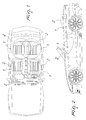
- the sensors are designated by the reference numeral 1 and the associated lobes are shown in dashed lines and designated by the reference numeral 2.
- Each sensor 1 is suitable to monitor a portion of the vehicle cabin and to emit, sequentially with respect to the other sensors, a brief ultrasound transmission.
- the senor is used in receive mode in order to detect the ultrasound echo signal that is reflected by the obstacles inside the vehicle.
- the echo signal related to the region to be protected is then completely stored by means of a control unit with microprocessor, schematically designated by the reference numeral 3 in the figures.
- the echoes received from periodic and successive transmissions have a stable and consistent form, indicating that no alarm has to be issued.
- the repeat frequency of the echo monitoring should be high enough to detect even short-lasting intrusions.
- the envelope of the received echo is altered and changes over time from one transmission to the next.
- the microprocessor 3 which on the basis of a specific algorithm decides whether to issue or not signals indicating intrusions in progress, depending on the type of variation and optionally on the correlation between the signals of all or some of the sensors 1.
- the device thus provided is insensitive to variations in the position of the internal parts of the vehicle, such as for example to the adjustment of the position of the seats and/or of the steering wheel.
- the device autonomously learns the current shapes of the echoes received by the various sensors and considers them as reference echoes for detecting intrusions.
- the acquired references are used to compare the subsequent echoes, so as to verify whether variations in the shape of the received echoes are occurring.
- references can in any case be slowly updated or corrected in order to allow the device to tolerate variations caused by external elements, such as temperature changes, wind, ultrasonic external noise, or others.
- the device analyzes the received echo in order to compare it with at least one reference echo, so as to verify whether the difference between the detected echo and the reference echo lies within a preset value range; if the difference is not within said preset range, it issues an alarm signal, for example of the visual or acoustic type.
- Echo analysis comprises analyzing the echoes received within a preset reception time, in order to verify whether the reception time exceeds a preset threshold.
- the device can also be adapted to strong environmental variations simply by sending to each sensor the functional parameters, such as for example the echo analysis time that determines the depth of the protected region, when the device is activated.
- the device provides the possibility to reduce the consumption of current absorbed by the battery by spreading out the echo verifications on each sensor 1 or by verifying its echoes with a reduced sampling or by performing the echo only on some of the sensors 1, which in this case operate with differentiated parameters (for example, it is possible to operate one sensor in the front part of the vehicle and one sensor in the rear part, with such a lobe depth as to cover the side that lies opposite to its fixing point).
- the system immediately returns to a detailed analysis of the signals in order to check for a possible intrusion.
- the power-save mode is abandoned in order to resume sampling at the normal rate.
- All the sensors 1 can be connected to a single module, which contains an entire electronic circuit for driving the sensors and for analyzing the signals.
- each sensor 1 can be provided with an electronic circuit, which receives the echo execution command from the central processing unit, which in turn receives information from the sensors regarding the characteristics of the received echoes.
- the bidirectional signal for communication between said control unit and the sensors 1 is of the logic and encoded type, so that a single connecting cable allows communication among all the components of the device.
- the anti-theft device according to the present invention fully achieves the intended aim and objects stated above, since it allows to provide a volumetric protection of convertible and closed vehicles without having to differentiate the types of sensors as normally occurs with known types of anti-theft device.
- the materials used may be any according to requirements and to the state of the art.
Landscapes
- Engineering & Computer Science (AREA)
- Mechanical Engineering (AREA)
- Physics & Mathematics (AREA)
- General Physics & Mathematics (AREA)
- Burglar Alarm Systems (AREA)
- Measurement Of Velocity Or Position Using Acoustic Or Ultrasonic Waves (AREA)
- Absorbent Articles And Supports Therefor (AREA)
- Paper (AREA)
- Control Of Vending Devices And Auxiliary Devices For Vending Devices (AREA)
Abstract
Description
Claims (8)
- An intrusion detection device for spaces, comprising at least one intrusion detection sensor (1), characterized in that said at least one sensor (1) is an ultrasound sensor with an asymmetric emission lobe (2) that operates in echo mode.
- The device according to claim 1, characterized in that said at least one sensor (1) is of the transceiver type.
- The device according to claim 1, characterized in that it comprises a microprocessor-based control unit (3) that is suitable to control said at least one sensor (1) and to analyze the echoes received by said at least one sensor (1).
- A method for detecting intrusion in spaces, comprising the steps of:activating at least one ultrasound sensor (1) of the type with an asymmetric emission lobe (2) that operates in echo mode;detecting an echo received by said at least one sensor (1) and analyzing said echo in order to compare it with at least one reference echo, in order to check whether the difference between said detected echo and said reference echo is within a preset value range;if the difference is not within said preset value range, issuing an alarm signal.
- The method according to claim 4, characterized in that it comprises an initial step that consists of the autonomous learning, on the part of said at least one sensor (1), of the current shapes of the echoes received by said at least one sensor (1) and of considering said shapes as reference echoes.
- The method according to claim 4, characterized in that it comprises a step that consists in sending to said at least one sensor functional parameters in order to adapt the operation of said at least one sensor (1) to environmental variations.
- The method according to one or more of claims 4 and 5, characterized in that it comprises a step that consists in reducing current consumption of said at least one sensor (1) by spreading out the verifications of the echoes on said at least one sensor.
- The method according to claim 4, characterized in that said echo analysis comprises analyzing of the echoes received within a preset reception time.
Applications Claiming Priority (2)
| Application Number | Priority Date | Filing Date | Title |
|---|---|---|---|
| ITMO20040094 | 2004-04-30 | ||
| IT000094A ITMO20040094A1 (en) | 2004-04-30 | 2004-04-30 | INTRUSION DETECTION DEVICE FOR ENVIRONMENTS. |
Publications (3)
| Publication Number | Publication Date |
|---|---|
| EP1591976A2 true EP1591976A2 (en) | 2005-11-02 |
| EP1591976A3 EP1591976A3 (en) | 2007-01-31 |
| EP1591976B1 EP1591976B1 (en) | 2010-12-22 |
Family
ID=34939591
Family Applications (1)
| Application Number | Title | Priority Date | Filing Date |
|---|---|---|---|
| EP05103543A Expired - Lifetime EP1591976B1 (en) | 2004-04-30 | 2005-04-28 | Intrusion detection device for spaces |
Country Status (5)
| Country | Link |
|---|---|
| US (1) | US20050242951A1 (en) |
| EP (1) | EP1591976B1 (en) |
| AT (1) | ATE492863T1 (en) |
| DE (1) | DE602005025429D1 (en) |
| IT (1) | ITMO20040094A1 (en) |
Cited By (1)
| Publication number | Priority date | Publication date | Assignee | Title |
|---|---|---|---|---|
| ITMO20090003A1 (en) * | 2009-01-09 | 2010-07-10 | Meta System Spa | IMPROVED ANTI-INTRUSION SYSTEM, IN PARTICULAR FOR APPLICATIONS WITHIN ENVIRONMENTS, ON VEHICLES OR SIMILAR |
Families Citing this family (3)
| Publication number | Priority date | Publication date | Assignee | Title |
|---|---|---|---|---|
| JP4183001B2 (en) * | 2006-10-19 | 2008-11-19 | トヨタ自動車株式会社 | Intrusion detection system |
| US8581725B2 (en) * | 2010-03-04 | 2013-11-12 | Lior Goldenberg | Position change sensing anti-theft device |
| EP2835787B1 (en) * | 2013-08-06 | 2016-04-27 | Skidata Ag | System for detecting customer media comprising an RF transceiver in a public transportation vehicle |
Family Cites Families (9)
| Publication number | Priority date | Publication date | Assignee | Title |
|---|---|---|---|---|
| US4319349A (en) * | 1978-09-29 | 1982-03-09 | Pittway Corporation | Ultrasonic intrusion detection system |
| US4288867A (en) * | 1978-11-14 | 1981-09-08 | Alarm Device Manufacturing Company | Area intrusion adjustable detector unit |
| DE3003887A1 (en) * | 1980-02-02 | 1981-08-13 | Robert Bosch Gmbh, 7000 Stuttgart | Ultrasonic antitheft system for motor car - has several ultrasonic beams monitoring assigned zones for increased sensitivity |
| DE9003065U1 (en) * | 1989-04-12 | 1990-10-25 | Siemens AG, 1000 Berlin und 8000 München | Monitoring device for monitoring the windows of a room, e.g. car interior |
| IT1275766B1 (en) * | 1994-07-16 | 1997-10-17 | Kiekert Ag | PROCEDURE FOR CHECKING THE CABIN IN A VEHICLE |
| DE19521511C1 (en) * | 1995-06-13 | 1997-02-20 | Megamos F & G Sicherheit | Ultrasound room or space monitoring esp for inside vehicles |
| DE19533192A1 (en) * | 1995-09-08 | 1997-03-13 | Kiekert Ag | Internal monitoring for motor vehicle intruder alarm |
| AU751059B2 (en) * | 1998-05-11 | 2002-08-08 | Robert Bosch Gmbh | Ultrasonic monitoring and intruder detection |
| CA2454144C (en) * | 2002-12-27 | 2008-12-16 | Uri Agam | Device and method for adaptive ultrasound sensing |
-
2004
- 2004-04-30 IT IT000094A patent/ITMO20040094A1/en unknown
-
2005
- 2005-04-22 US US11/111,906 patent/US20050242951A1/en not_active Abandoned
- 2005-04-28 DE DE602005025429T patent/DE602005025429D1/en not_active Expired - Lifetime
- 2005-04-28 AT AT05103543T patent/ATE492863T1/en not_active IP Right Cessation
- 2005-04-28 EP EP05103543A patent/EP1591976B1/en not_active Expired - Lifetime
Cited By (2)
| Publication number | Priority date | Publication date | Assignee | Title |
|---|---|---|---|---|
| ITMO20090003A1 (en) * | 2009-01-09 | 2010-07-10 | Meta System Spa | IMPROVED ANTI-INTRUSION SYSTEM, IN PARTICULAR FOR APPLICATIONS WITHIN ENVIRONMENTS, ON VEHICLES OR SIMILAR |
| EP2207151A1 (en) * | 2009-01-09 | 2010-07-14 | Meta System S.p.A. | Upgraded anti break-in system, particularly for applications inside environments, on vehicles or the like |
Also Published As
| Publication number | Publication date |
|---|---|
| EP1591976B1 (en) | 2010-12-22 |
| US20050242951A1 (en) | 2005-11-03 |
| ITMO20040094A1 (en) | 2004-07-30 |
| ATE492863T1 (en) | 2011-01-15 |
| DE602005025429D1 (en) | 2011-02-03 |
| EP1591976A3 (en) | 2007-01-31 |
Similar Documents
| Publication | Publication Date | Title |
|---|---|---|
| US8442755B2 (en) | Systems and methods for preventing motor vehicle side doors from coming into contact with obstacles | |
| US11365580B2 (en) | Method and adjusting device for adjusting a vehicle adjusting part with output status information | |
| US20190122056A1 (en) | Ultrasonic object detection system for motor vehicles and method of operation thereof | |
| US4929925A (en) | Alarm system | |
| US8014921B2 (en) | Ultrasonic sensor-based side impact sensing system | |
| CN109177911B (en) | Blind area detection system based on ultrasonic wave is anti-interference | |
| US20120056734A1 (en) | Method of monitoring vehicle surroundings, and apparatus for monitoring vehicle surroundings | |
| US20070176737A1 (en) | Device for actuating a vehicle door locking system | |
| EP3712020B1 (en) | System for monitoring an acoustic scene outside a vehicle | |
| EP1640745B1 (en) | Obstacle detection method and system, particularly for systems for assisting the parking of vehicles | |
| US12391213B2 (en) | Method for monitoring a transportation vehicle and transportation vehicle | |
| US20160107579A1 (en) | Method and apparatus for controlling vehicle exterior mirrors | |
| KR20190069327A (en) | Method and apparatus for automatically opening an object | |
| EP0632904B1 (en) | A device for and method of surveillance of a space | |
| KR20180037681A (en) | Smart parking assist system of vechicle and method thereof | |
| US7358850B2 (en) | Obstacle detection method and system, particularly for systems for assisting the parking of vehicles | |
| EP1591976B1 (en) | Intrusion detection device for spaces | |
| JP2005161996A (en) | Vehicle perimeter monitoring system | |
| EP1910865B1 (en) | System and method for detecting obstacles for vehicles | |
| US7541915B2 (en) | Anti-theft system for vehicle | |
| CN106515741A (en) | Device and method for automatic driving of motor vehicles | |
| JP2003194939A (en) | Obstacle detection device | |
| JPH07237521A (en) | Vehicle side airbag control device | |
| JP2002053011A (en) | Vehicle security device | |
| US20260097738A1 (en) | Advanced alarm system for a motor vehicle |
Legal Events
| Date | Code | Title | Description |
|---|---|---|---|
| PUAI | Public reference made under article 153(3) epc to a published international application that has entered the european phase |
Free format text: ORIGINAL CODE: 0009012 |
|
| AK | Designated contracting states |
Kind code of ref document: A2 Designated state(s): AT BE BG CH CY CZ DE DK EE ES FI FR GB GR HU IE IS IT LI LT LU MC NL PL PT RO SE SI SK TR |
|
| AX | Request for extension of the european patent |
Extension state: AL BA HR LV MK YU |
|
| PUAL | Search report despatched |
Free format text: ORIGINAL CODE: 0009013 |
|
| AK | Designated contracting states |
Kind code of ref document: A3 Designated state(s): AT BE BG CH CY CZ DE DK EE ES FI FR GB GR HU IE IS IT LI LT LU MC NL PL PT RO SE SI SK TR |
|
| AX | Request for extension of the european patent |
Extension state: AL BA HR LV MK YU |
|
| RIC1 | Information provided on ipc code assigned before grant |
Ipc: G08B 13/16 20060101AFI20050801BHEP Ipc: B60R 25/10 20060101ALI20061228BHEP |
|
| 17P | Request for examination filed |
Effective date: 20070716 |
|
| AKX | Designation fees paid |
Designated state(s): AT BE BG CH CY CZ DE DK EE ES FI FR GB GR HU IE IS IT LI LT LU MC NL PL PT RO SE SI SK TR |
|
| 17Q | First examination report despatched |
Effective date: 20071121 |
|
| GRAP | Despatch of communication of intention to grant a patent |
Free format text: ORIGINAL CODE: EPIDOSNIGR1 |
|
| GRAS | Grant fee paid |
Free format text: ORIGINAL CODE: EPIDOSNIGR3 |
|
| GRAA | (expected) grant |
Free format text: ORIGINAL CODE: 0009210 |
|
| AK | Designated contracting states |
Kind code of ref document: B1 Designated state(s): AT BE BG CH CY CZ DE DK EE ES FI FR GB GR HU IE IS IT LI LT LU MC NL PL PT RO SE SI SK TR |
|
| REG | Reference to a national code |
Ref country code: GB Ref legal event code: FG4D |
|
| REG | Reference to a national code |
Ref country code: CH Ref legal event code: EP |
|
| REG | Reference to a national code |
Ref country code: IE Ref legal event code: FG4D |
|
| REF | Corresponds to: |
Ref document number: 602005025429 Country of ref document: DE Date of ref document: 20110203 Kind code of ref document: P |
|
| REG | Reference to a national code |
Ref country code: DE Ref legal event code: R096 Ref document number: 602005025429 Country of ref document: DE Effective date: 20110203 |
|
| REG | Reference to a national code |
Ref country code: NL Ref legal event code: VDEP Effective date: 20101222 |
|
| PG25 | Lapsed in a contracting state [announced via postgrant information from national office to epo] |
Ref country code: LT Free format text: LAPSE BECAUSE OF FAILURE TO SUBMIT A TRANSLATION OF THE DESCRIPTION OR TO PAY THE FEE WITHIN THE PRESCRIBED TIME-LIMIT Effective date: 20101222 |
|
| LTIE | Lt: invalidation of european patent or patent extension |
Effective date: 20101222 |
|
| PG25 | Lapsed in a contracting state [announced via postgrant information from national office to epo] |
Ref country code: BG Free format text: LAPSE BECAUSE OF FAILURE TO SUBMIT A TRANSLATION OF THE DESCRIPTION OR TO PAY THE FEE WITHIN THE PRESCRIBED TIME-LIMIT Effective date: 20110322 Ref country code: AT Free format text: LAPSE BECAUSE OF FAILURE TO SUBMIT A TRANSLATION OF THE DESCRIPTION OR TO PAY THE FEE WITHIN THE PRESCRIBED TIME-LIMIT Effective date: 20101222 Ref country code: SE Free format text: LAPSE BECAUSE OF FAILURE TO SUBMIT A TRANSLATION OF THE DESCRIPTION OR TO PAY THE FEE WITHIN THE PRESCRIBED TIME-LIMIT Effective date: 20101222 Ref country code: FI Free format text: LAPSE BECAUSE OF FAILURE TO SUBMIT A TRANSLATION OF THE DESCRIPTION OR TO PAY THE FEE WITHIN THE PRESCRIBED TIME-LIMIT Effective date: 20101222 Ref country code: SI Free format text: LAPSE BECAUSE OF FAILURE TO SUBMIT A TRANSLATION OF THE DESCRIPTION OR TO PAY THE FEE WITHIN THE PRESCRIBED TIME-LIMIT Effective date: 20101222 Ref country code: CY Free format text: LAPSE BECAUSE OF FAILURE TO SUBMIT A TRANSLATION OF THE DESCRIPTION OR TO PAY THE FEE WITHIN THE PRESCRIBED TIME-LIMIT Effective date: 20101222 |
|
| PG25 | Lapsed in a contracting state [announced via postgrant information from national office to epo] |
Ref country code: BE Free format text: LAPSE BECAUSE OF FAILURE TO SUBMIT A TRANSLATION OF THE DESCRIPTION OR TO PAY THE FEE WITHIN THE PRESCRIBED TIME-LIMIT Effective date: 20101222 Ref country code: GR Free format text: LAPSE BECAUSE OF FAILURE TO SUBMIT A TRANSLATION OF THE DESCRIPTION OR TO PAY THE FEE WITHIN THE PRESCRIBED TIME-LIMIT Effective date: 20110323 Ref country code: PT Free format text: LAPSE BECAUSE OF FAILURE TO SUBMIT A TRANSLATION OF THE DESCRIPTION OR TO PAY THE FEE WITHIN THE PRESCRIBED TIME-LIMIT Effective date: 20110422 Ref country code: IS Free format text: LAPSE BECAUSE OF FAILURE TO SUBMIT A TRANSLATION OF THE DESCRIPTION OR TO PAY THE FEE WITHIN THE PRESCRIBED TIME-LIMIT Effective date: 20110422 Ref country code: EE Free format text: LAPSE BECAUSE OF FAILURE TO SUBMIT A TRANSLATION OF THE DESCRIPTION OR TO PAY THE FEE WITHIN THE PRESCRIBED TIME-LIMIT Effective date: 20101222 Ref country code: ES Free format text: LAPSE BECAUSE OF FAILURE TO SUBMIT A TRANSLATION OF THE DESCRIPTION OR TO PAY THE FEE WITHIN THE PRESCRIBED TIME-LIMIT Effective date: 20110402 Ref country code: CZ Free format text: LAPSE BECAUSE OF FAILURE TO SUBMIT A TRANSLATION OF THE DESCRIPTION OR TO PAY THE FEE WITHIN THE PRESCRIBED TIME-LIMIT Effective date: 20101222 |
|
| PG25 | Lapsed in a contracting state [announced via postgrant information from national office to epo] |
Ref country code: NL Free format text: LAPSE BECAUSE OF FAILURE TO SUBMIT A TRANSLATION OF THE DESCRIPTION OR TO PAY THE FEE WITHIN THE PRESCRIBED TIME-LIMIT Effective date: 20101222 Ref country code: SK Free format text: LAPSE BECAUSE OF FAILURE TO SUBMIT A TRANSLATION OF THE DESCRIPTION OR TO PAY THE FEE WITHIN THE PRESCRIBED TIME-LIMIT Effective date: 20101222 Ref country code: RO Free format text: LAPSE BECAUSE OF FAILURE TO SUBMIT A TRANSLATION OF THE DESCRIPTION OR TO PAY THE FEE WITHIN THE PRESCRIBED TIME-LIMIT Effective date: 20101222 Ref country code: PL Free format text: LAPSE BECAUSE OF FAILURE TO SUBMIT A TRANSLATION OF THE DESCRIPTION OR TO PAY THE FEE WITHIN THE PRESCRIBED TIME-LIMIT Effective date: 20101222 |
|
| PLBE | No opposition filed within time limit |
Free format text: ORIGINAL CODE: 0009261 |
|
| STAA | Information on the status of an ep patent application or granted ep patent |
Free format text: STATUS: NO OPPOSITION FILED WITHIN TIME LIMIT |
|
| PG25 | Lapsed in a contracting state [announced via postgrant information from national office to epo] |
Ref country code: DK Free format text: LAPSE BECAUSE OF FAILURE TO SUBMIT A TRANSLATION OF THE DESCRIPTION OR TO PAY THE FEE WITHIN THE PRESCRIBED TIME-LIMIT Effective date: 20101222 |
|
| 26N | No opposition filed |
Effective date: 20110923 |
|
| PG25 | Lapsed in a contracting state [announced via postgrant information from national office to epo] |
Ref country code: MC Free format text: LAPSE BECAUSE OF NON-PAYMENT OF DUE FEES Effective date: 20110430 |
|
| REG | Reference to a national code |
Ref country code: CH Ref legal event code: PL |
|
| GBPC | Gb: european patent ceased through non-payment of renewal fee |
Effective date: 20110428 |
|
| PG25 | Lapsed in a contracting state [announced via postgrant information from national office to epo] |
Ref country code: IT Free format text: LAPSE BECAUSE OF FAILURE TO SUBMIT A TRANSLATION OF THE DESCRIPTION OR TO PAY THE FEE WITHIN THE PRESCRIBED TIME-LIMIT Effective date: 20101222 |
|
| REG | Reference to a national code |
Ref country code: DE Ref legal event code: R097 Ref document number: 602005025429 Country of ref document: DE Effective date: 20110923 |
|
| PG25 | Lapsed in a contracting state [announced via postgrant information from national office to epo] |
Ref country code: LI Free format text: LAPSE BECAUSE OF NON-PAYMENT OF DUE FEES Effective date: 20110430 Ref country code: CH Free format text: LAPSE BECAUSE OF NON-PAYMENT OF DUE FEES Effective date: 20110430 |
|
| REG | Reference to a national code |
Ref country code: IE Ref legal event code: MM4A |
|
| PG25 | Lapsed in a contracting state [announced via postgrant information from national office to epo] |
Ref country code: GB Free format text: LAPSE BECAUSE OF NON-PAYMENT OF DUE FEES Effective date: 20110428 |
|
| PG25 | Lapsed in a contracting state [announced via postgrant information from national office to epo] |
Ref country code: IE Free format text: LAPSE BECAUSE OF NON-PAYMENT OF DUE FEES Effective date: 20110428 |
|
| PG25 | Lapsed in a contracting state [announced via postgrant information from national office to epo] |
Ref country code: LU Free format text: LAPSE BECAUSE OF NON-PAYMENT OF DUE FEES Effective date: 20110428 |
|
| PG25 | Lapsed in a contracting state [announced via postgrant information from national office to epo] |
Ref country code: TR Free format text: LAPSE BECAUSE OF FAILURE TO SUBMIT A TRANSLATION OF THE DESCRIPTION OR TO PAY THE FEE WITHIN THE PRESCRIBED TIME-LIMIT Effective date: 20101222 |
|
| PG25 | Lapsed in a contracting state [announced via postgrant information from national office to epo] |
Ref country code: HU Free format text: LAPSE BECAUSE OF FAILURE TO SUBMIT A TRANSLATION OF THE DESCRIPTION OR TO PAY THE FEE WITHIN THE PRESCRIBED TIME-LIMIT Effective date: 20101222 |
|
| REG | Reference to a national code |
Ref country code: FR Ref legal event code: PLFP Year of fee payment: 12 |
|
| REG | Reference to a national code |
Ref country code: FR Ref legal event code: CA Effective date: 20160523 |
|
| REG | Reference to a national code |
Ref country code: FR Ref legal event code: PLFP Year of fee payment: 13 |
|
| REG | Reference to a national code |
Ref country code: FR Ref legal event code: PLFP Year of fee payment: 14 |
|
| PGFP | Annual fee paid to national office [announced via postgrant information from national office to epo] |
Ref country code: IT Payment date: 20220421 Year of fee payment: 18 Ref country code: FR Payment date: 20220425 Year of fee payment: 18 Ref country code: DE Payment date: 20220427 Year of fee payment: 18 |
|
| REG | Reference to a national code |
Ref country code: DE Ref legal event code: R119 Ref document number: 602005025429 Country of ref document: DE |
|
| PG25 | Lapsed in a contracting state [announced via postgrant information from national office to epo] |
Ref country code: FR Free format text: LAPSE BECAUSE OF NON-PAYMENT OF DUE FEES Effective date: 20230430 Ref country code: DE Free format text: LAPSE BECAUSE OF NON-PAYMENT OF DUE FEES Effective date: 20231103 |
|
| PG25 | Lapsed in a contracting state [announced via postgrant information from national office to epo] |
Ref country code: IT Free format text: LAPSE BECAUSE OF NON-PAYMENT OF DUE FEES Effective date: 20230428 |