EP1591500A2 - Vernis anti-graffiti - Google Patents
Vernis anti-graffiti Download PDFInfo
- Publication number
- EP1591500A2 EP1591500A2 EP05370006A EP05370006A EP1591500A2 EP 1591500 A2 EP1591500 A2 EP 1591500A2 EP 05370006 A EP05370006 A EP 05370006A EP 05370006 A EP05370006 A EP 05370006A EP 1591500 A2 EP1591500 A2 EP 1591500A2
- Authority
- EP
- European Patent Office
- Prior art keywords
- graffiti
- coating
- weight
- composition
- acrylates
- Prior art date
- Legal status (The legal status is an assumption and is not a legal conclusion. Google has not performed a legal analysis and makes no representation as to the accuracy of the status listed.)
- Granted
Links
Images


Classifications
-
- C—CHEMISTRY; METALLURGY
- C09—DYES; PAINTS; POLISHES; NATURAL RESINS; ADHESIVES; COMPOSITIONS NOT OTHERWISE PROVIDED FOR; APPLICATIONS OF MATERIALS NOT OTHERWISE PROVIDED FOR
- C09D—COATING COMPOSITIONS, e.g. PAINTS, VARNISHES OR LACQUERS; FILLING PASTES; CHEMICAL PAINT OR INK REMOVERS; INKS; CORRECTING FLUIDS; WOODSTAINS; PASTES OR SOLIDS FOR COLOURING OR PRINTING; USE OF MATERIALS THEREFOR
- C09D133/00—Coating compositions based on homopolymers or copolymers of compounds having one or more unsaturated aliphatic radicals, each having only one carbon-to-carbon double bond, and at least one being terminated by only one carboxyl radical, or of salts, anhydrides, esters, amides, imides, or nitriles thereof; Coating compositions based on derivatives of such polymers
- C09D133/04—Homopolymers or copolymers of esters
- C09D133/14—Homopolymers or copolymers of esters of esters containing halogen, nitrogen, sulfur or oxygen atoms in addition to the carboxy oxygen
Definitions
- the problem that the present invention proposes to solve is therefore in obtaining an anti-graffiti coating, for solid support in particular metallic, painted or unpainted, said coating allowing, first, to apply on its surface a so-called graffiti, and in a second step, eliminate completely and easily said graffiti layer with a cleaning product.
- graffiti we mean here inscriptions or drawings drawn by hand (using felts) or by means of bombs (sprays) on solid supports. From a chemical point of view, graffiti is composed essentially pigments, a binder and a solvent. Binders used frequently for sprays are acrylic resins, resins "Alkyds” and silicone resins.
- anti-graffiti property of a coating means here the capacity said coating to allow, as a first step, to apply on its surface a so-called layer of graffiti, and, in a second time, to remove said layer of graffiti with a cleaning product.
- the cleaning tests have been redone for formulations of the last category with cleaners without danger symbol (Magnus 1302 and degreaser 220 US). The performances found are almost identical to those reported above, which makes it possible to classify these materials G1 or G0 according to the NF F 31-112 standard.
- the formulations of the last category are characterized in particular by a composition of the type: oligomer-type resin + monomer + photoinitiator, suitable composition (when applied to said support) to form under UV radiation a crosslinking network characterized by a high density of crosslinking ( compact crosslinking network). Thanks to this property, the pigments present in the graffiti layer do not penetrate or very little in said network of crosslinking. This makes possible the complete and easy removal of said graffiti layer with a conventional solvent-based cleaner.
- the composition of the varnish also comprises an anti-UV agent.
- the anti-UV agent must be compatible with the photoinitiator used, so as to allow, on the one hand, the polymerization fast under UV radiation, and, secondly, to keep a good hold UV in time.
- a mixed crosslinking (physical - under UV radiation, and chemical - with isocyanate) could to be considered, in particular to cover with the coating of the invention objects that have curved surfaces that are not accessible in their entirety UV radiation.
- the varnish is catalyzed by addition isocyanate before application to a support.
- the adhesion strength of different coatings according to the invention has been measured using an atomic force microscope (Dimension 3100 AFM, DI Digital Instruments, Veeco). This technique makes it possible to measure the forces at the tip of the microscope probe, following the distance between said tip and the surface of the coating.
- the deflection variations of the lever are recorded according to the point-to-sample distance, the value of the adhesion force being obtained from the stiffness constant of the lever (44 N / m) (Fig. 1).
- a series of 30 curves was performed on each sample.
- the coatings with very good anti-graffiti qualities are characterized by a weak adhesion force of less than 200 nN ( Figure 1a).
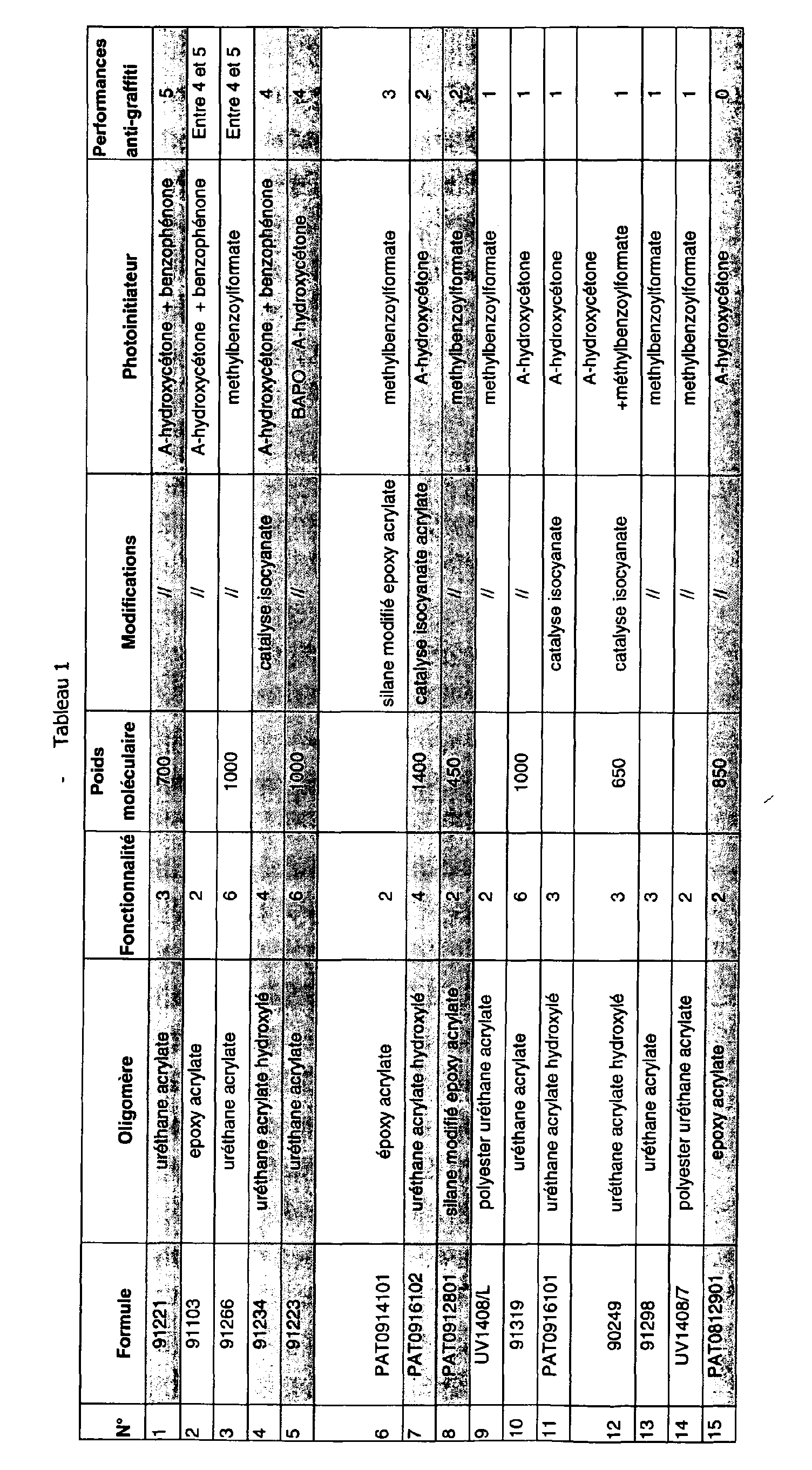
- the coatings with reduced or no anti-graffiti performance (for example, the one that corresponds to formulation No. 15 of Table 1) have a large adhesion strength ranging from 400 to over 800 nN (Fig. 1b).
- the film of varnish is formed on a solid surface, particularly metallic, as described above, it is able to receive a layer of graffiti applied over it, using bombs, felts ...
- the pigments present in the graffiti do not penetrate or very little in said network. This makes it possible the complete and easy removal of said layer of graffiti using a cleaning agent, including cleaning after Several weeks.
- the varnish of the invention is applied in layers whose thickness is the order of 5 to 25 microns.
- compositions among those giving the best results in terms of anti-graffiti resistance according to the invention (formulation No. 2, Table 1) is detailed below:
- compositions giving poor results in terms of anti-graffiti resistance according to the invention (formulation 15, Table 1) is detailed below:
- compositions used to cover solid objects having curved surfaces are detailed below. These compositions are added before application of 2.5% Desmodur N3390 (90% aliphatic polyisocyanate in a mixture of butyl acetate / solvent naphtha).
- Formula Composition % weight Formula 91234 - tetrafunctional hydroxylated urethane acrylate 58.7 - trimethylolpropane triacrylate 17.6 hexanediol diacrylate 8.1 photoinitiator (1-hydroxyketone) 3.9 - benzophenone 2.1 silicone additive (BYK®-346) 0.5 - oligoamine 9.1 100.0
Landscapes
- Chemical & Material Sciences (AREA)
- Life Sciences & Earth Sciences (AREA)
- Engineering & Computer Science (AREA)
- Materials Engineering (AREA)
- Wood Science & Technology (AREA)
- Organic Chemistry (AREA)
- Paints Or Removers (AREA)
- Application Of Or Painting With Fluid Materials (AREA)
- Pharmaceuticals Containing Other Organic And Inorganic Compounds (AREA)
- Acyclic And Carbocyclic Compounds In Medicinal Compositions (AREA)
Abstract
- au moins une résine de type oligomère, sélectionnée dans le groupe : époxy acrylates, uréthane acrylates, uréthane acrylates hydroxylés ; polyester acrylates ;
- au moins un monomère et/ou un solvant ;
- au moins un photoinitiateur,
- éventuellement un agent anti-UV, la sélection des composants de la composition et les conditions de réticulation étant tels que ledit revêtement présente un réseau de réticulation compact et acquiert une classification « G1 » ou « G0 » selon la norme NF F 31-112.
Description
- nettoyer et décaper le support en question, avec des résultats médiocres voire catastrophiques, en abímant le plus souvent le support ;
- repeindre régulièrement ledit support.
- une bonne adhérence ;
- compatibilité avec les différents matériaux ;
- une meilleure perméabilité à la vapeur d'eau (afin d'assurer la respirabilité de certains matériaux, notamment la pierre) ;
- protection contre toutes sortes de graffiti : peinture en bombes, feutres, mixtures des tagueurs à base de colorants naturels...
- une bonne résistance aux UV.
- les non permanents, sous forme de films transparents ; au nettoyage des graffiti, ceux-ci et le film sont enlevés en même temps ;
- les semi-permanents, dont une sous-couche est permanente et une couche supérieure est sacrificielle ;
- les permanents : vernis ou peintures qui font obstacle à la migration des différents pigments présents dans les graffiti, dans le support.
- des supports solides tels que la pierre, le béton, le crépi ou la terre cuite, qui sont poreux ; le revêtement anti-graffiti doit assurer leur aptitude à la respiration ;
- des supports solides à surface lisse et non-poreuse comme les métaux, les matériaux plastiques, les matériaux composites, le verre, qui peuvent être revêtus d'une protection anti-graffiti imperméable à l'air.
- au moins une résine de type oligomère, sélectionnée dans le groupe : époxy acrylates, uréthane acrylates, uréthane acrylates hydroxylés ; polyester acrylates ;
- au moins un monomère et/ou un solvant ;
- au moins un photoinitiateur,
- éventuellement un agent anti-UV,
- le monomère utilisé joue également le rôle de solvant pour permettre une bonne application du vernis;
- les pourcentages en poids des composants de base de ladite composition sont : résine - de 35 à 80% ; monomère et/ou solvant - de 20 à 60% ; photoinitiateur - de 0,5 à 7%;
- présente une force d'adhésion inférieure à 200 nN ;
- pour le cas où ledit support solide présente des surfaces courbes, ladite composition comprend également de l'isocyanate, de sorte que la réticulation sous rayonnement UV puisse être complétée, dans les endroits dudit support peu ou non accessibles aux UV, par une réticulation chimique ;
- il consiste en une pellicule de vernis dont l'épaisseur est comprise entre 5 et 25 µm.
- la fig. 1 montre les courbes de force d'adhésion des revêtements correspondant à la formule 91266 (fig. 1a) et à la formule PAT 0812901 (fig. 1b) respectivement ;
- la fig. 2 montre les courbes de force électrostatique des revêtements correspondant à la formule 91103 (fig. 2a) et à la formule PAT 0812901 (fig. 2b) respectivement.
- d'une part, à la densité du réseau de réticulation, sachant qu'un réseau compact ne peut être obtenu que par une méthode de réticulation mettant en oeuvre un rayonnement UV ou un bombardement d'électrons (réticulation physique) ;
- et, d'autre part, aux propriétés mécaniques de la pellicule de vernis,
telles que :
- force d'adhésion ;
- charges de surface.

- G 0 : matériau « nettoyable » à l'eau ou à sec ;
- G 1 : matériau « nettoyable » avec un produit d'élimination étiqueté sans symbole de danger ;
- G 2 : matériau « nettoyable » avec un produit d'élimination étiqueté irritant « Xi » et/ou facilement inflammable « F » ;
- G 3 : matériau « nettoyable » avec un produit d'élimination étiqueté nocif « Xn » et/ou corrosif « C » ;
- G 4 : matériau « nettoyable » avec un produit d'élimination étiqueté toxique « T » ;
- N N : matériau « NON NETTOYABLE ».
| Degré d'efficacité selon l'invention | Résultats selon NF F 31-112 |
| 5 | Bon |
| 4 | Passable |
| 3 | Passable |
| 2 | Mauvais |
| 1 | Mauvais |
| 0 | Mauvais |
- neuf formulations ne donnent pas un effet anti-graffiti notable (références 7 à 15, tableau 1- performances anti-graffiti allant de 0 à 2);
- trois autres formulations donnent des résultats moyens (références 4 à 6, tableau 1 - performances anti-graffiti 3 ou 4) ;
- trois formulations donnent des résultats exceptionnels, en termes de facilité de nettoyage des graffiti (références 1 à 3, tableau 1 - performances anti-graffiti de 5 ou situées entre 4 et 5).
Les formulations de la dernière catégorie se caractérisent notamment par une composition de type : résine de type oligomère + monomère + photoinitiateur, composition apte (une fois appliquée audit support) à former sous rayonnement UV un réseau de réticulation caractérisé par une densité élevée de réticulation (réseau de réticulation compact). Grâce à cette propriété, les pigments présents dans la couche de graffiti ne pénètrent pas ou fort peu dans ledit réseau de réticulation. Ceci rend possible l'élimination complète et facile de ladite couche de graffiti à l'aide d'un nettoyant usuel à base de solvant.
- application d'une formulation comprenant: au moins une résine de type oligomère, un monomère et/ou un solvant, au moins un photoinitiateur, éventuellement un agent anti-UV et éventuellement de l'isocyanate, sur ledit support solide ;
- exposition dudit support à un rayonnement UV ;
- application d'une couche de graffiti sur la pellicule de vernis ainsi formée ;
- élimination de la couche de graffiti à l'aide d'un produit nettoyant à base de solvant.
- le nettoyant « Magnus 1302 » commercialisé par la société Henkel (Surface Technologies), qui se présente sous la forme d'un liquide miscible à l'eau, sans étiquette de danger ;
- le nettoyant « Socostrip T4210 » commercialisé par la société Socomor, qui se présente sous la forme d'un liquide miscible à l'eau, avec une étiquette Xi (danger irritant) ;
- le dégraissant 220 commercialisé par la société Soficor-Mäder, qui est un nettoyant neutre à base d'un mélange d'éthers de glycols de la série P, sans étiquette de danger.
| Formule | Composition | % poids |
| 91103 | - époxyacrylate difonctionnel (Genomer 2258 - RAHN) | 18,8 |
| - acrylate à fonction -COOH (Genomer 7154 - RAHN) | 18,8 | |
| - TMPEOTA (monomère trifonctionnel) (Genomer 1343 - RAHN) | 56,5 | |
| - 1-hydroxycyclohéxylphénylcétone (Genocure CPK - RAHN) | 2,4 | |
| - additif siliconé (BYK®-300) | 1,0 | |
| - benzophénone | 2,5 | |
| |
| Formule | Composition | % poids |
| PAT0812901 | - époxyacrylate modifié amine difonctionnel | 35,5 |
| - urethane acrylate | 53,3 | |
| - photoinitiateur (1-hydroxycétone) | 1,3 | |
| - additif fluidifiant (silicone poléther acrylate) | 0,9 | |
| - acetate de butyle | 9,0 | |
| |
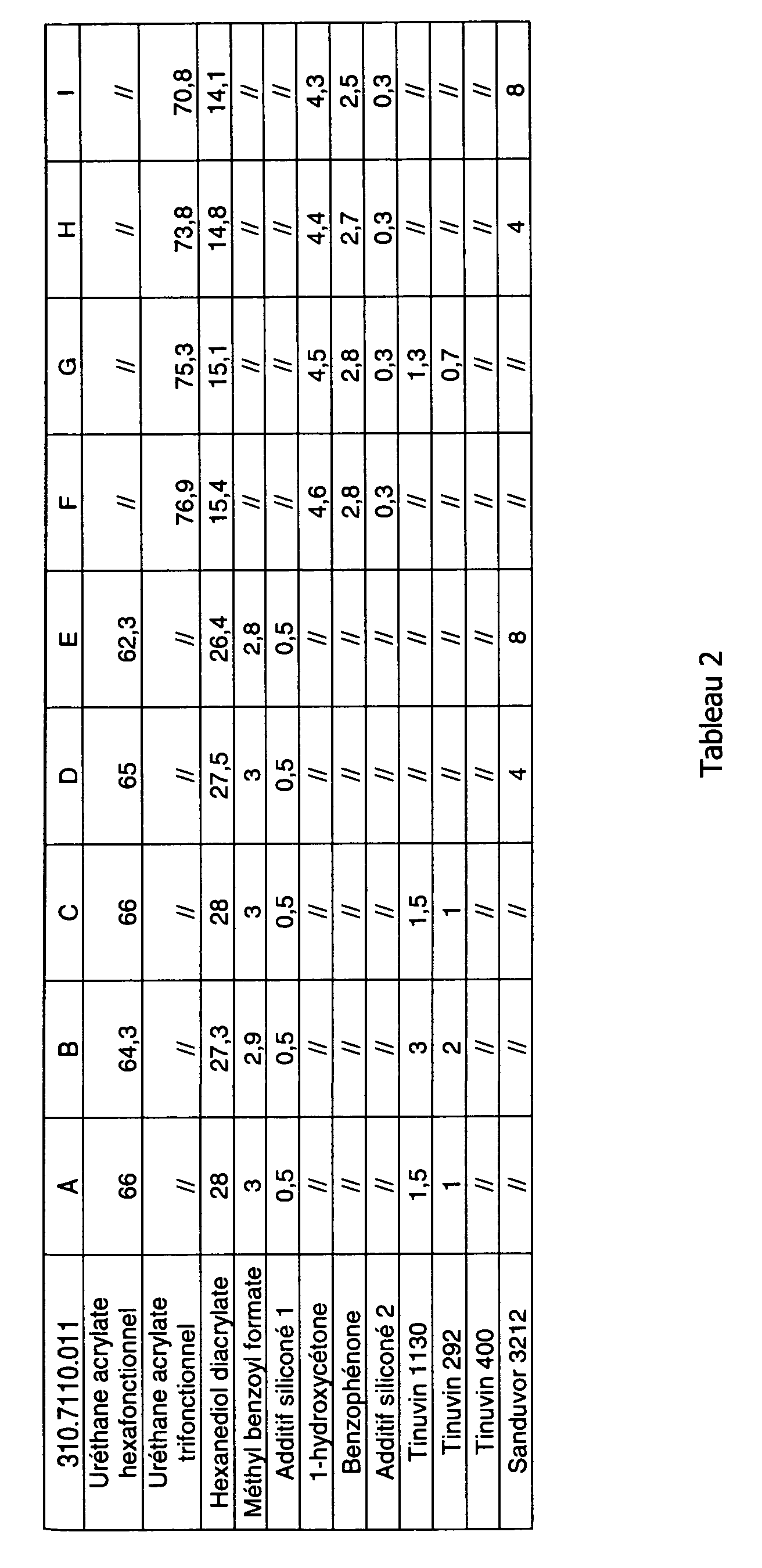
Après plusieurs cycles de 8h (i + ii), qui correspondent à la norme NFT30-036), on mesure le brillant avec un angle de 60° (delta Br correspond à la chute du brillant du film) et l'écart de teinte (deltaE correspond à l'écart colorimétrique global mesuré dans le système CIELAB 1976). Les résultats, présentés dans le tableau 3, montrent que le meilleur compromis tenue anti-graffiti - UV est obtenu pour le vernis 310.7110.011C, qui comprend la formule 91266 (référence 3, tableau 1) détaillée ci-dessous. L'adhérence est mesurée selon la norme ISO 2409 (GT compris entre 0 et 5).
| Formule | Composition | % poids |
| 91266 | - uréthane acrylate hexafonctionnel (Ebecryl 1290 - UCB) | 66,0 |
| - hexanediol diacrylate (Laromer HDDA - BASF) | 28,0 | |
| - méthylbenzoylformate (Genocure MBF - RAHN) | 3,0 | |
| - additif siliconé (Baysilone® OL 17 - BORCHERS) | 0,5 | |
| - agent anti-UV (Tinuvin 1130 - CIBA) | 1,5 | |
| - stabilisateur UV (Tinuvin 292 - CIBA) | 1,0 | |
| |
| Formule | Composition | % poids |
| Formule 91234 | - uréthane acrylate hydroxylé tétrafonctionnel | 58,7 |
| - triméthylolpropane triacrylate | 17,6 | |
| - hexanediol diacrylate | 8,1 | |
| - photoinitiateur (1-hydroxycétone) | 3,9 | |
| - benzophénone | 2,1 | |
| - additif siliconé (BYK®-346) | 0,5 | |
| - oligoamine | 9,1 | |
| |
| Formule | Composition | % poids |
| 90249 | - uréthane acrylate trifonctionnel | 44,6 |
| - uréthane acrylate difonctionnel | 14,8 | |
| - hexanediol diacrylate | 14,8 | |
| - tétrahydro-2-furaneméthanol | 11,1 | |
| - photoinitiateur (1-hydroxycétone) | 1,9 | |
| - méthylbenzoylformate | 2,8 | |
| - diacétone alcool | 8,4 | |
| - additif siliconé (BYK®-306 à 10% dans acetate de butyle) | 0,7 | |
| - CAB 551-0,01 (EASTMAN) à 10% dans HDDA | 0,9 | |
| |
- il est transparent et brillant ;
- il est non-polluant pour l'environnement ; en effet, la réticulation sous rayonnement UV évite les émissions de composés organiques volatiles (COV) ;
- il permet de réaliser des économies d'énergie ;
- le temps nécessaire pour obtenir le revêtement sous rayonnement UV est très court (quelques secondes au maximum).
Claims (9)
- Revêtement anti-graffiti destiné à recouvrir un support solide non-poreux à surface lisse, ledit revêtement étant obtenu par réticulation, notamment par réticulation sous rayonnement UV, d'une composition comprenant :la sélection des composants de la composition et les conditions de réticulation étant tels que ledit revêtement présente un réseau de réticulation compact et acquiert une classification « G1 » ou « G0 » selon la norme NF F 31-112.au moins une résine de type oligomère, sélectionnée dans le groupe : époxy acrylates, uréthane acrylates, uréthane acrylates hydroxylés ; polyester acrylates ;au moins un monomère et/ou un solvant ;au moins un photoinitiateur,éventuellement un agent anti-UV,
- Revêtement selon la revendication 1 caractérisé en ce que les pourcentages en poids desdits composants de ladite composition sont : résine - de 35 à 80% ; monomère et/ou solvant - de 20 à 60% ; photoinitiateur - de 0,5 à 7% .
- Revêtement selon l'une quelconque des revendications 1 et 2 caractérisé en ce qu'il présente une force d'adhésion inférieure à 200 nN.
- Revêtement selon l'une quelconque des revendications 1 à 3 caractérisé en ce que ladite composition comprend également de l'isocyanate.
- Revêtement selon l'une quelconque des revendications 1 à 4 caractérisé en ce qu'il présente une épaisseur comprise entre 5 et 25 µm.
- Composition de revêtement selon l'une quelconque des revendications 1 à 3 et 5 caractérisé en ce qu'elle comprend :a) de 15% à 20% en poids d'un époxyacrylate difonctionnel ;b) de 15% à 20% en poids d'un acrylate à fonction carboxyle ;c) de 50% à 60% en poids d'un monomère trifonctionnel ;d) de 2 à 7% en poids d'au moins un photoinitiateur ;e) de 0,5% à 2% d'un additif siliconé.
- Composition de revêtement selon l'une quelconque des revendications 1 à 3 et 5 adaptée à une utilisation dudit revêtement à l'extérieur caractérisé en ce qu'elle comprend :a) de 60% à 70% en poids d'un uréthane acrylate hexafonctionnel ;b) de 25% à 30% en poids d'un hexanediol diacrylate ;c) de 2 à 5% en poids d'un photoinitiateur ;d) de 1% à 5% en poids d'agent anti-UV ;e) de 0,5% à 2% en poids de stabilisateur UV ;f) de 0,1 à 1% d'additif.
- Procédé de traitement anti-graffiti d'une surface lisse d'un objet solide non-poreux, caractérisé en ce qu'il comprend les étapes suivantes :i) application d'une composition de revêtement selon les revendications 1 à 7 sur un support solide ;ii) exposition dudit support à un rayonnement UV ;iii) application d'une couche de graffiti sur la pellicule de vernis ainsi formée ;iv) élimination de la couche de graffiti à l'aide d'un produit nettoyant à base de solvant.
- Utilisation de la composition selon la revendication 4 pour le traitement anti-graffiti selon la revendication 8 d'un objet solide présentant des surfaces courbes.
Applications Claiming Priority (2)
| Application Number | Priority Date | Filing Date | Title |
|---|---|---|---|
| FR0404407A FR2869321B1 (fr) | 2004-04-26 | 2004-04-26 | Vernis anti-graffiti |
| FR0404407 | 2004-04-26 |
Publications (3)
| Publication Number | Publication Date |
|---|---|
| EP1591500A2 true EP1591500A2 (fr) | 2005-11-02 |
| EP1591500A3 EP1591500A3 (fr) | 2005-12-07 |
| EP1591500B1 EP1591500B1 (fr) | 2007-12-05 |
Family
ID=34942757
Family Applications (1)
| Application Number | Title | Priority Date | Filing Date |
|---|---|---|---|
| EP05370006A Expired - Lifetime EP1591500B1 (fr) | 2004-04-26 | 2005-04-14 | Vernis anti-graffiti |
Country Status (5)
| Country | Link |
|---|---|
| EP (1) | EP1591500B1 (fr) |
| AT (1) | ATE380228T1 (fr) |
| DE (1) | DE602005003609T2 (fr) |
| ES (1) | ES2298980T3 (fr) |
| FR (1) | FR2869321B1 (fr) |
Cited By (5)
| Publication number | Priority date | Publication date | Assignee | Title |
|---|---|---|---|---|
| WO2007043727A1 (fr) | 2005-10-10 | 2007-04-19 | Sscp Co., Ltd. | Composition de revetement durcissable par rayonnement uv tres couvrante |
| WO2007077584A1 (fr) * | 2005-12-30 | 2007-07-12 | Descap Sa | Composition reticulable pour produits de peintures |
| EP2489699A4 (fr) * | 2009-10-16 | 2013-03-13 | Posco | Composition de résine durcissable sous un rayonnement, et composition de résine résistant aux traces de doigts la contenant |
| CN113122091A (zh) * | 2021-03-23 | 2021-07-16 | 四川嘉宝莉涂料有限公司 | 一种抗涂鸦耐擦洗涂料组合物及制备方法 |
| CN117050644A (zh) * | 2023-07-26 | 2023-11-14 | 广东安捷伦新材料科技有限公司 | 一种双固化uv钢琴黑涂料及其制备方法 |
Families Citing this family (1)
| Publication number | Priority date | Publication date | Assignee | Title |
|---|---|---|---|---|
| DE202009008205U1 (de) | 2009-06-09 | 2010-02-11 | Eftec Aftermarket Gmbh | Verwendung einer wachshaltigen Zusammensetzung als Beschichtung von Oberflächen zur Verbesserung ihrer Reinigbarkeit |
Family Cites Families (2)
| Publication number | Priority date | Publication date | Assignee | Title |
|---|---|---|---|---|
| FR2514159A1 (fr) * | 1981-10-02 | 1983-04-08 | Rhone Poulenc Syst | Composition photosensible et plaque lithographique realisee a l'aide de cette composition |
| EP1164149A1 (fr) * | 2000-06-15 | 2001-12-19 | Tarkett Sommer S.A. | Compositions à base de résines émulsifiées réticulables par UV et leur application comme couche de vernis pour revêtements de sols et de murs |
-
2004
- 2004-04-26 FR FR0404407A patent/FR2869321B1/fr not_active Expired - Fee Related
-
2005
- 2005-04-14 DE DE602005003609T patent/DE602005003609T2/de not_active Expired - Lifetime
- 2005-04-14 EP EP05370006A patent/EP1591500B1/fr not_active Expired - Lifetime
- 2005-04-14 AT AT05370006T patent/ATE380228T1/de not_active IP Right Cessation
- 2005-04-14 ES ES05370006T patent/ES2298980T3/es not_active Expired - Lifetime
Cited By (8)
| Publication number | Priority date | Publication date | Assignee | Title |
|---|---|---|---|---|
| WO2007043727A1 (fr) | 2005-10-10 | 2007-04-19 | Sscp Co., Ltd. | Composition de revetement durcissable par rayonnement uv tres couvrante |
| EP1951830A4 (fr) * | 2005-10-10 | 2009-11-11 | Sscp Co Ltd | Composition de revetement durcissable par rayonnement uv tres couvrante |
| WO2007077584A1 (fr) * | 2005-12-30 | 2007-07-12 | Descap Sa | Composition reticulable pour produits de peintures |
| JP2009522393A (ja) * | 2005-12-30 | 2009-06-11 | デスカップ エスエー | 塗料製品に添加される成分としての架橋可能な組成物 |
| EP2489699A4 (fr) * | 2009-10-16 | 2013-03-13 | Posco | Composition de résine durcissable sous un rayonnement, et composition de résine résistant aux traces de doigts la contenant |
| CN113122091A (zh) * | 2021-03-23 | 2021-07-16 | 四川嘉宝莉涂料有限公司 | 一种抗涂鸦耐擦洗涂料组合物及制备方法 |
| CN113122091B (zh) * | 2021-03-23 | 2022-05-20 | 河北嘉宝莉涂料有限公司 | 一种抗涂鸦耐擦洗涂料组合物及制备方法 |
| CN117050644A (zh) * | 2023-07-26 | 2023-11-14 | 广东安捷伦新材料科技有限公司 | 一种双固化uv钢琴黑涂料及其制备方法 |
Also Published As
| Publication number | Publication date |
|---|---|
| FR2869321B1 (fr) | 2008-09-05 |
| DE602005003609T2 (de) | 2008-11-13 |
| DE602005003609D1 (de) | 2008-01-17 |
| FR2869321A1 (fr) | 2005-10-28 |
| ATE380228T1 (de) | 2007-12-15 |
| ES2298980T3 (es) | 2008-05-16 |
| EP1591500B1 (fr) | 2007-12-05 |
| EP1591500A3 (fr) | 2005-12-07 |
Similar Documents
| Publication | Publication Date | Title |
|---|---|---|
| EP2115077B1 (fr) | Utilisation de derives de dioxolane dans des systemes de revetement et formulation de systeme de revetement | |
| CN102712783B (zh) | 具有高透明度的耐刮涂覆的塑料基底,尤其是电子仪器的外壳,它们的制造方法及它们的用途 | |
| CN100351105C (zh) | 用于写字、绘画、绘图和化妆目的的木材包裹的铅笔 | |
| US8101673B2 (en) | Silica-containing UV-crosslinkable hardcoat coatings comprising urethane acrylates | |
| FR2549968A1 (fr) | Lentille en matiere plastique avec revetement en matieres minerales | |
| EP1591500B1 (fr) | Vernis anti-graffiti | |
| US20030045598A1 (en) | Radiation curable coating compositions | |
| TWI547370B (zh) | Antireflective composition, a method for producing the same, and a hardening composition | |
| EP3947577B1 (fr) | Résine organique porteuse de groupements amine tertiaire et acide carboxylique et dispersion aqueuse la comprenant, pour composition réticulable bi-composante | |
| CN113412310B (zh) | 用于光学测量技术应用的组合物 | |
| FR2869322A1 (fr) | Vernis anti-graffiti | |
| EP0728819A1 (fr) | Peintures antisalissures autopolissables | |
| Singh et al. | Confocal microscope—A valuable tool for examining wood-coating interface | |
| CA2477461C (fr) | Utilisation d'un sol organique de cerium dans les peintures, notamment les lasures ou les vernis | |
| FR2828203A1 (fr) | Encre pigmentaire liquide sans solvant, pour impression par jet d'encre | |
| EP2938665A1 (fr) | Procédé de recyclage de polymères et produit issu de ce procédé | |
| KR102736016B1 (ko) | 광경화형 수용성 코팅 조성물 및 이를 이용한 다층 도막 코팅물 | |
| KR101184995B1 (ko) | 반사 방지용 적층체 및 그 제조 방법, 그리고 경화성 조성물 | |
| EP1481662A1 (fr) | Kit de maquillage ou de soin des ongles | |
| EP3008136A1 (fr) | Feuilles de polycarbonate revêtues à faible effet de moiré | |
| EP0466880A1 (fr) | Compositions reticulables du type polyurethane par radiation ionisante pour le revetement de finition de surfaces metalliques ou metalisees | |
| WO2023242220A1 (fr) | Utilisation d'un copolymère époxy-silicone, composition fluide réticulable le contenant et billet de banque revêtu de cette composition | |
| JP3182661B2 (ja) | 被覆材組成物 | |
| AU635852B2 (en) | Composition for paint-removal coatings on substrates | |
| FR3149999A1 (fr) | Procede de marquage 3d |
Legal Events
| Date | Code | Title | Description |
|---|---|---|---|
| PUAI | Public reference made under article 153(3) epc to a published international application that has entered the european phase |
Free format text: ORIGINAL CODE: 0009012 |
|
| PUAL | Search report despatched |
Free format text: ORIGINAL CODE: 0009013 |
|
| AK | Designated contracting states |
Kind code of ref document: A2 Designated state(s): AT BE BG CH CY CZ DE DK EE ES FI FR GB GR HU IE IS IT LI LT LU MC NL PL PT RO SE SI SK TR |
|
| AX | Request for extension of the european patent |
Extension state: AL BA HR LV MK YU |
|
| AK | Designated contracting states |
Kind code of ref document: A3 Designated state(s): AT BE BG CH CY CZ DE DK EE ES FI FR GB GR HU IE IS IT LI LT LU MC NL PL PT RO SE SI SK TR |
|
| AX | Request for extension of the european patent |
Extension state: AL BA HR LV MK YU |
|
| RTI1 | Title (correction) |
Free format text: ANTI-GRAFFITI VARNISH |
|
| 17P | Request for examination filed |
Effective date: 20060311 |
|
| AKX | Designation fees paid |
Designated state(s): AT BE BG CH CY CZ DE DK EE ES FI FR GB GR HU IE IS IT LI LT LU MC NL PL PT RO SE SI SK TR |
|
| 17Q | First examination report despatched |
Effective date: 20060410 |
|
| GRAP | Despatch of communication of intention to grant a patent |
Free format text: ORIGINAL CODE: EPIDOSNIGR1 |
|
| GRAS | Grant fee paid |
Free format text: ORIGINAL CODE: EPIDOSNIGR3 |
|
| GRAA | (expected) grant |
Free format text: ORIGINAL CODE: 0009210 |
|
| AK | Designated contracting states |
Kind code of ref document: B1 Designated state(s): AT BE BG CH CY CZ DE DK EE ES FI FR GB GR HU IE IS IT LI LT LU MC NL PL PT RO SE SI SK TR |
|
| REG | Reference to a national code |
Ref country code: GB Ref legal event code: FG4D Free format text: NOT ENGLISH |
|
| REG | Reference to a national code |
Ref country code: IE Ref legal event code: FG4D Free format text: LANGUAGE OF EP DOCUMENT: FRENCH |
|
| REG | Reference to a national code |
Ref country code: CH Ref legal event code: EP |
|
| REF | Corresponds to: |
Ref document number: 602005003609 Country of ref document: DE Date of ref document: 20080117 Kind code of ref document: P |
|
| GBT | Gb: translation of ep patent filed (gb section 77(6)(a)/1977) |
Effective date: 20080228 |
|
| REG | Reference to a national code |
Ref country code: CH Ref legal event code: NV Representative=s name: BOVARD AG PATENTANWAELTE |
|
| PG25 | Lapsed in a contracting state [announced via postgrant information from national office to epo] |
Ref country code: SE Free format text: LAPSE BECAUSE OF FAILURE TO SUBMIT A TRANSLATION OF THE DESCRIPTION OR TO PAY THE FEE WITHIN THE PRESCRIBED TIME-LIMIT Effective date: 20080305 |
|
| REG | Reference to a national code |
Ref country code: ES Ref legal event code: FG2A Ref document number: 2298980 Country of ref document: ES Kind code of ref document: T3 |
|
| PG25 | Lapsed in a contracting state [announced via postgrant information from national office to epo] |
Ref country code: LT Free format text: LAPSE BECAUSE OF FAILURE TO SUBMIT A TRANSLATION OF THE DESCRIPTION OR TO PAY THE FEE WITHIN THE PRESCRIBED TIME-LIMIT Effective date: 20071205 Ref country code: SI Free format text: LAPSE BECAUSE OF FAILURE TO SUBMIT A TRANSLATION OF THE DESCRIPTION OR TO PAY THE FEE WITHIN THE PRESCRIBED TIME-LIMIT Effective date: 20071205 Ref country code: FI Free format text: LAPSE BECAUSE OF FAILURE TO SUBMIT A TRANSLATION OF THE DESCRIPTION OR TO PAY THE FEE WITHIN THE PRESCRIBED TIME-LIMIT Effective date: 20071205 Ref country code: PL Free format text: LAPSE BECAUSE OF FAILURE TO SUBMIT A TRANSLATION OF THE DESCRIPTION OR TO PAY THE FEE WITHIN THE PRESCRIBED TIME-LIMIT Effective date: 20071205 |
|
| PG25 | Lapsed in a contracting state [announced via postgrant information from national office to epo] |
Ref country code: AT Free format text: LAPSE BECAUSE OF FAILURE TO SUBMIT A TRANSLATION OF THE DESCRIPTION OR TO PAY THE FEE WITHIN THE PRESCRIBED TIME-LIMIT Effective date: 20071205 |
|
| PG25 | Lapsed in a contracting state [announced via postgrant information from national office to epo] |
Ref country code: IS Free format text: LAPSE BECAUSE OF FAILURE TO SUBMIT A TRANSLATION OF THE DESCRIPTION OR TO PAY THE FEE WITHIN THE PRESCRIBED TIME-LIMIT Effective date: 20080405 Ref country code: CZ Free format text: LAPSE BECAUSE OF FAILURE TO SUBMIT A TRANSLATION OF THE DESCRIPTION OR TO PAY THE FEE WITHIN THE PRESCRIBED TIME-LIMIT Effective date: 20071205 |
|
| PG25 | Lapsed in a contracting state [announced via postgrant information from national office to epo] |
Ref country code: RO Free format text: LAPSE BECAUSE OF FAILURE TO SUBMIT A TRANSLATION OF THE DESCRIPTION OR TO PAY THE FEE WITHIN THE PRESCRIBED TIME-LIMIT Effective date: 20071205 Ref country code: SK Free format text: LAPSE BECAUSE OF FAILURE TO SUBMIT A TRANSLATION OF THE DESCRIPTION OR TO PAY THE FEE WITHIN THE PRESCRIBED TIME-LIMIT Effective date: 20071205 |
|
| PG25 | Lapsed in a contracting state [announced via postgrant information from national office to epo] |
Ref country code: PT Free format text: LAPSE BECAUSE OF FAILURE TO SUBMIT A TRANSLATION OF THE DESCRIPTION OR TO PAY THE FEE WITHIN THE PRESCRIBED TIME-LIMIT Effective date: 20080505 |
|
| REG | Reference to a national code |
Ref country code: IE Ref legal event code: FD4D |
|
| PLBE | No opposition filed within time limit |
Free format text: ORIGINAL CODE: 0009261 |
|
| STAA | Information on the status of an ep patent application or granted ep patent |
Free format text: STATUS: NO OPPOSITION FILED WITHIN TIME LIMIT |
|
| PG25 | Lapsed in a contracting state [announced via postgrant information from national office to epo] |
Ref country code: IE Free format text: LAPSE BECAUSE OF FAILURE TO SUBMIT A TRANSLATION OF THE DESCRIPTION OR TO PAY THE FEE WITHIN THE PRESCRIBED TIME-LIMIT Effective date: 20071205 Ref country code: DK Free format text: LAPSE BECAUSE OF FAILURE TO SUBMIT A TRANSLATION OF THE DESCRIPTION OR TO PAY THE FEE WITHIN THE PRESCRIBED TIME-LIMIT Effective date: 20071205 |
|
| 26N | No opposition filed |
Effective date: 20080908 |
|
| PG25 | Lapsed in a contracting state [announced via postgrant information from national office to epo] |
Ref country code: MC Free format text: LAPSE BECAUSE OF NON-PAYMENT OF DUE FEES Effective date: 20080430 |
|
| PG25 | Lapsed in a contracting state [announced via postgrant information from national office to epo] |
Ref country code: EE Free format text: LAPSE BECAUSE OF FAILURE TO SUBMIT A TRANSLATION OF THE DESCRIPTION OR TO PAY THE FEE WITHIN THE PRESCRIBED TIME-LIMIT Effective date: 20071205 Ref country code: GR Free format text: LAPSE BECAUSE OF FAILURE TO SUBMIT A TRANSLATION OF THE DESCRIPTION OR TO PAY THE FEE WITHIN THE PRESCRIBED TIME-LIMIT Effective date: 20080306 |
|
| PG25 | Lapsed in a contracting state [announced via postgrant information from national office to epo] |
Ref country code: BG Free format text: LAPSE BECAUSE OF FAILURE TO SUBMIT A TRANSLATION OF THE DESCRIPTION OR TO PAY THE FEE WITHIN THE PRESCRIBED TIME-LIMIT Effective date: 20080305 |
|
| PG25 | Lapsed in a contracting state [announced via postgrant information from national office to epo] |
Ref country code: CY Free format text: LAPSE BECAUSE OF FAILURE TO SUBMIT A TRANSLATION OF THE DESCRIPTION OR TO PAY THE FEE WITHIN THE PRESCRIBED TIME-LIMIT Effective date: 20071205 |
|
| PG25 | Lapsed in a contracting state [announced via postgrant information from national office to epo] |
Ref country code: LU Free format text: LAPSE BECAUSE OF NON-PAYMENT OF DUE FEES Effective date: 20080414 Ref country code: HU Free format text: LAPSE BECAUSE OF FAILURE TO SUBMIT A TRANSLATION OF THE DESCRIPTION OR TO PAY THE FEE WITHIN THE PRESCRIBED TIME-LIMIT Effective date: 20080606 |
|
| PG25 | Lapsed in a contracting state [announced via postgrant information from national office to epo] |
Ref country code: TR Free format text: LAPSE BECAUSE OF FAILURE TO SUBMIT A TRANSLATION OF THE DESCRIPTION OR TO PAY THE FEE WITHIN THE PRESCRIBED TIME-LIMIT Effective date: 20071205 |
|
| REG | Reference to a national code |
Ref country code: CH Ref legal event code: PFA Owner name: SOFICOR MADER Free format text: SOFICOR MADER#RUE DES CHAMPS#62161 MAROEUIL (FR) -TRANSFER TO- SOFICOR MADER#RUE DES CHAMPS#62161 MAROEUIL (FR) |
|
| REG | Reference to a national code |
Ref country code: FR Ref legal event code: PLFP Year of fee payment: 12 |
|
| REG | Reference to a national code |
Ref country code: FR Ref legal event code: PLFP Year of fee payment: 13 |
|
| REG | Reference to a national code |
Ref country code: FR Ref legal event code: PLFP Year of fee payment: 14 |
|
| PGFP | Annual fee paid to national office [announced via postgrant information from national office to epo] |
Ref country code: NL Payment date: 20200313 Year of fee payment: 16 Ref country code: CH Payment date: 20200424 Year of fee payment: 16 Ref country code: DE Payment date: 20200408 Year of fee payment: 16 Ref country code: ES Payment date: 20200518 Year of fee payment: 16 Ref country code: FR Payment date: 20200420 Year of fee payment: 16 |
|
| PGFP | Annual fee paid to national office [announced via postgrant information from national office to epo] |
Ref country code: GB Payment date: 20200427 Year of fee payment: 16 Ref country code: IT Payment date: 20200410 Year of fee payment: 16 Ref country code: BE Payment date: 20200415 Year of fee payment: 16 |
|
| REG | Reference to a national code |
Ref country code: DE Ref legal event code: R119 Ref document number: 602005003609 Country of ref document: DE |
|
| REG | Reference to a national code |
Ref country code: NL Ref legal event code: MM Effective date: 20210501 |
|
| GBPC | Gb: european patent ceased through non-payment of renewal fee |
Effective date: 20210414 |
|
| REG | Reference to a national code |
Ref country code: BE Ref legal event code: MM Effective date: 20210430 |
|
| PG25 | Lapsed in a contracting state [announced via postgrant information from national office to epo] |
Ref country code: DE Free format text: LAPSE BECAUSE OF NON-PAYMENT OF DUE FEES Effective date: 20211103 Ref country code: GB Free format text: LAPSE BECAUSE OF NON-PAYMENT OF DUE FEES Effective date: 20210414 Ref country code: FR Free format text: LAPSE BECAUSE OF NON-PAYMENT OF DUE FEES Effective date: 20210430 Ref country code: CH Free format text: LAPSE BECAUSE OF NON-PAYMENT OF DUE FEES Effective date: 20210430 Ref country code: LI Free format text: LAPSE BECAUSE OF NON-PAYMENT OF DUE FEES Effective date: 20210430 |
|
| PG25 | Lapsed in a contracting state [announced via postgrant information from national office to epo] |
Ref country code: NL Free format text: LAPSE BECAUSE OF NON-PAYMENT OF DUE FEES Effective date: 20210501 |
|
| REG | Reference to a national code |
Ref country code: ES Ref legal event code: FD2A Effective date: 20220701 |
|
| PG25 | Lapsed in a contracting state [announced via postgrant information from national office to epo] |
Ref country code: ES Free format text: LAPSE BECAUSE OF NON-PAYMENT OF DUE FEES Effective date: 20210415 Ref country code: BE Free format text: LAPSE BECAUSE OF NON-PAYMENT OF DUE FEES Effective date: 20210430 |
|
| PG25 | Lapsed in a contracting state [announced via postgrant information from national office to epo] |
Ref country code: IT Free format text: LAPSE BECAUSE OF NON-PAYMENT OF DUE FEES Effective date: 20200414 |
|
| PG25 | Lapsed in a contracting state [announced via postgrant information from national office to epo] |
Ref country code: IT Free format text: LAPSE BECAUSE OF NON-PAYMENT OF DUE FEES Effective date: 20210414 |