EP1589761A1 - Ein Codec angepasst zu funktionieren im Rgb-Raum - Google Patents
Ein Codec angepasst zu funktionieren im Rgb-Raum Download PDFInfo
- Publication number
- EP1589761A1 EP1589761A1 EP04101594A EP04101594A EP1589761A1 EP 1589761 A1 EP1589761 A1 EP 1589761A1 EP 04101594 A EP04101594 A EP 04101594A EP 04101594 A EP04101594 A EP 04101594A EP 1589761 A1 EP1589761 A1 EP 1589761A1
- Authority
- EP
- European Patent Office
- Prior art keywords
- frame
- color space
- block
- compression
- decoding
- Prior art date
- Legal status (The legal status is an assumption and is not a legal conclusion. Google has not performed a legal analysis and makes no representation as to the accuracy of the status listed.)
- Withdrawn
Links
- 230000006835 compression Effects 0.000 claims abstract description 96
- 238000007906 compression Methods 0.000 claims abstract description 96
- 238000000034 method Methods 0.000 claims abstract description 76
- 238000012545 processing Methods 0.000 claims abstract description 7
- 238000012805 post-processing Methods 0.000 claims description 18
- 230000005540 biological transmission Effects 0.000 claims description 13
- 239000003086 colorant Substances 0.000 claims description 3
- 230000001131 transforming effect Effects 0.000 claims 3
- 230000007423 decrease Effects 0.000 abstract description 3
- 230000006837 decompression Effects 0.000 description 24
- 230000033001 locomotion Effects 0.000 description 23
- 238000004364 calculation method Methods 0.000 description 16
- 239000013598 vector Substances 0.000 description 12
- 238000006243 chemical reaction Methods 0.000 description 10
- 239000002131 composite material Substances 0.000 description 8
- 230000009466 transformation Effects 0.000 description 8
- 230000008569 process Effects 0.000 description 4
- 238000013139 quantization Methods 0.000 description 4
- 238000010295 mobile communication Methods 0.000 description 3
- 230000002457 bidirectional effect Effects 0.000 description 2
- 238000005516 engineering process Methods 0.000 description 2
- 230000006870 function Effects 0.000 description 2
- 230000009467 reduction Effects 0.000 description 2
- 238000005070 sampling Methods 0.000 description 2
- 230000000007 visual effect Effects 0.000 description 2
- 230000009286 beneficial effect Effects 0.000 description 1
- 230000008859 change Effects 0.000 description 1
- 238000004040 coloring Methods 0.000 description 1
- 238000004891 communication Methods 0.000 description 1
- 230000002349 favourable effect Effects 0.000 description 1
- 239000011159 matrix material Substances 0.000 description 1
- 238000012986 modification Methods 0.000 description 1
- 230000004048 modification Effects 0.000 description 1
- 230000002441 reversible effect Effects 0.000 description 1
- 230000002123 temporal effect Effects 0.000 description 1
- 238000000844 transformation Methods 0.000 description 1
Images


Classifications
-
- H—ELECTRICITY
- H04—ELECTRIC COMMUNICATION TECHNIQUE
- H04N—PICTORIAL COMMUNICATION, e.g. TELEVISION
- H04N1/00—Scanning, transmission or reproduction of documents or the like, e.g. facsimile transmission; Details thereof
- H04N1/46—Colour picture communication systems
- H04N1/64—Systems for the transmission or the storage of the colour picture signal; Details therefor, e.g. coding or decoding means therefor
-
- H—ELECTRICITY
- H04—ELECTRIC COMMUNICATION TECHNIQUE
- H04N—PICTORIAL COMMUNICATION, e.g. TELEVISION
- H04N19/00—Methods or arrangements for coding, decoding, compressing or decompressing digital video signals
- H04N19/10—Methods or arrangements for coding, decoding, compressing or decompressing digital video signals using adaptive coding
- H04N19/102—Methods or arrangements for coding, decoding, compressing or decompressing digital video signals using adaptive coding characterised by the element, parameter or selection affected or controlled by the adaptive coding
- H04N19/103—Selection of coding mode or of prediction mode
- H04N19/105—Selection of the reference unit for prediction within a chosen coding or prediction mode, e.g. adaptive choice of position and number of pixels used for prediction
-
- H—ELECTRICITY
- H04—ELECTRIC COMMUNICATION TECHNIQUE
- H04N—PICTORIAL COMMUNICATION, e.g. TELEVISION
- H04N19/00—Methods or arrangements for coding, decoding, compressing or decompressing digital video signals
- H04N19/10—Methods or arrangements for coding, decoding, compressing or decompressing digital video signals using adaptive coding
- H04N19/102—Methods or arrangements for coding, decoding, compressing or decompressing digital video signals using adaptive coding characterised by the element, parameter or selection affected or controlled by the adaptive coding
- H04N19/117—Filters, e.g. for pre-processing or post-processing
-
- H—ELECTRICITY
- H04—ELECTRIC COMMUNICATION TECHNIQUE
- H04N—PICTORIAL COMMUNICATION, e.g. TELEVISION
- H04N19/00—Methods or arrangements for coding, decoding, compressing or decompressing digital video signals
- H04N19/10—Methods or arrangements for coding, decoding, compressing or decompressing digital video signals using adaptive coding
- H04N19/169—Methods or arrangements for coding, decoding, compressing or decompressing digital video signals using adaptive coding characterised by the coding unit, i.e. the structural portion or semantic portion of the video signal being the object or the subject of the adaptive coding
- H04N19/17—Methods or arrangements for coding, decoding, compressing or decompressing digital video signals using adaptive coding characterised by the coding unit, i.e. the structural portion or semantic portion of the video signal being the object or the subject of the adaptive coding the unit being an image region, e.g. an object
- H04N19/176—Methods or arrangements for coding, decoding, compressing or decompressing digital video signals using adaptive coding characterised by the coding unit, i.e. the structural portion or semantic portion of the video signal being the object or the subject of the adaptive coding the unit being an image region, e.g. an object the region being a block, e.g. a macroblock
-
- H—ELECTRICITY
- H04—ELECTRIC COMMUNICATION TECHNIQUE
- H04N—PICTORIAL COMMUNICATION, e.g. TELEVISION
- H04N19/00—Methods or arrangements for coding, decoding, compressing or decompressing digital video signals
- H04N19/10—Methods or arrangements for coding, decoding, compressing or decompressing digital video signals using adaptive coding
- H04N19/169—Methods or arrangements for coding, decoding, compressing or decompressing digital video signals using adaptive coding characterised by the coding unit, i.e. the structural portion or semantic portion of the video signal being the object or the subject of the adaptive coding
- H04N19/186—Methods or arrangements for coding, decoding, compressing or decompressing digital video signals using adaptive coding characterised by the coding unit, i.e. the structural portion or semantic portion of the video signal being the object or the subject of the adaptive coding the unit being a colour or a chrominance component
-
- H—ELECTRICITY
- H04—ELECTRIC COMMUNICATION TECHNIQUE
- H04N—PICTORIAL COMMUNICATION, e.g. TELEVISION
- H04N19/00—Methods or arrangements for coding, decoding, compressing or decompressing digital video signals
- H04N19/50—Methods or arrangements for coding, decoding, compressing or decompressing digital video signals using predictive coding
- H04N19/503—Methods or arrangements for coding, decoding, compressing or decompressing digital video signals using predictive coding involving temporal prediction
- H04N19/51—Motion estimation or motion compensation
-
- H—ELECTRICITY
- H04—ELECTRIC COMMUNICATION TECHNIQUE
- H04N—PICTORIAL COMMUNICATION, e.g. TELEVISION
- H04N19/00—Methods or arrangements for coding, decoding, compressing or decompressing digital video signals
- H04N19/85—Methods or arrangements for coding, decoding, compressing or decompressing digital video signals using pre-processing or post-processing specially adapted for video compression
- H04N19/86—Methods or arrangements for coding, decoding, compressing or decompressing digital video signals using pre-processing or post-processing specially adapted for video compression involving reduction of coding artifacts, e.g. of blockiness
Definitions
- the present invention relates generally to video information delivery systems, and more particularly to encoders producing compressed bit streams adapted to receiving terminals having limited processing power and scarce memory.
- the invention also relates to decoders having limited decoding capacity.
- Mobile communications is currently one of the fastest growing markets although today the functionalities of mobile communications are rather limited. It is expected that image information, especially real-time video information, will greatly add value to mobile communications.
- Low cost mobile video transmission is highly sought for for many practical applications, e.g., mobile visual communications, live TV news reports, mobile surveillance, computer games, etc. Available bandwidth is one of the major limitations to real-time mobile video transmission and therefore such a transmission can only be achieved when a highly efficient compression algorithm with a very low implementation complexity can be implemented.
- Compression is a reversible conversion of data to a format that requires fewer bits, usually performed so that the data can be stored or transmitted more efficiently. If the inverse of the process, decompression, produces an exact replica of the original data, then the compression is lossless. Compression with loss, in other words "lossy" compression, does not allow reproduction of an exact replica of the original image, but allows only an approximation of the original to be generated. However, lossy compression has a higher compression ratio
- All image and video compression techniques utilize the existing correlations within the frames, on one hand, and the understanding of the limitations of the human visual system, on the other.
- the correlations such as stationary objects and areas with constant coloring, may be compressed losslessly, while the omission of invisible details is lossy. Further compression requires compromises to be made in the accuracy of the details and colors in the reproduced images resulting, in blurred and/or blocky imagery.
- Intra-frame compression techniques can be applied to individual frames of a video sequence. It exploits the redundancy within the image, known as spatial redundancy.
- DCT Discrete Cosine Transform
- Inter-frame compression is applied to a sequence of video frames, rather than a single image. Because in most cases relatively little changes from one video frame to the next, inter-frame compression exploits the similarities between successive frames, known as temporal redundancy, to reduce the volume of data required describing the sequence.
- inter-frame compression techniques of various degrees of complexity. Most of them attempt to more efficiently describe the sequence by reusing parts of frames the receiver already has, in order to construct new frames. Widely used techniques are Block Based Difference Coding and Block Based Motion Compensation.
- Block Based Difference Coding the frames are divided into non-overlapping blocks and each block is compared with its counterpart in the previous frame. Then only blocks that change significantly need be updated. It is worth noting that only objects that remain stationary within the image can be effectively coded. Therefore, a motion compensation method must be used for coding moving objects.
- Block based motion compensation produces an approximation of a frame by reusing data contained in the frame's predecessor. This is completed in three stages.
- the frame to be encoded i.e. the current frame
- each block in the current frame is compared to areas of similar size from the preceding (past) frame in order to find an area that is similar.
- a block from the current frame for which a similar area is sought is known as a target block.
- the location of the similar or matching block in the past frame might be different from the location of the target block in the current frame.
- the relative difference in locations is known as the motion vector.
- the motion vector detailing the position (in the past frame) of the target block's match is encoded in place of the target block itself. Because fewer bits are required to code a motion vector than to code actual blocks, compression is achieved.
- the decoder uses the motion vectors to find the matching blocks in the past frame, which it has already received, and copies the matching blocks from the past frame into the appropriate positions in the current frame, thus reconstructing the image.
- Motion compensation may also be bidirectional. Then matching blocks from both a past frame and a future frame are used to code the current frame.
- a future frame is a frame that is displayed after the current frame.
- Bidirectional compression is much more successful than compression that uses only a single past frame, because information that is not to be found in the past frame might be found in the future frame. This allows more blocks to be replaced by motion vectors.
- Bi-directional motion compensation requires that frames are encoded and transmitted in a different order from which the will be displayed.
- video compression is performed on block-basis, i.e. the current frame is first divided into uniform non-overlapping blocks and then each block is compressed separately.
- Various intra-frame and inter-frame compression modes are applied to a block and the best mode for the block is selected according to a predetermined selection criterion that may be a cost function. Most often the cost functions stress byte usage of the compressed block and distortion. The distortion is calculated by comparing the decompressed block with the original uncompressed block and using some matching criteria.
- Y represents luminance information and U and V represent chrominance i.e. color information.
- YUV-components are transformed from the RGB components as follows (1):
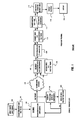
- FIG. 1 depicts elements used for a prior art video encoding/decoding process.
- a video to be encoded is fetched from a video source 100 .
- the original video is stored in the RGB color format. Therefore, prior to applying the video to the codec (coder +decoder), a transformer 101 performs color space transformation from RGB to YUV based on the formulas above. Naturally, transformation to some other composite video signal as YUV may be carried out.
- the encoder 102 compresses video frames of each YUV component with methods as described above. If necessary a residual coding may also be applied to one or more of the compressed blocks of the frame for increasing the quality.
- residual coding is done for Y- components only.
- the encoder outputs compressed YUV frames for further transmission via a transmission network to a receiving terminal.
- the decoder part 1 03 of the codec restores the frame and stores it temporarily in a memory area 104.
- the frame in the memory area acts as the past frame for the codec's decoder and encoder parts.
- the decoder 107 of the receiving terminal restores YUV images from the compressed YUV data received via the transmission network 106 .
- a memory 108 in the decoder's feedback loop is needed for storing temporarily a YUV frame that is used for decoding the next YUV frame.
- unit 109 post-processes the YUV images for removing artifacts.
- Post-processing also known as de-blocking, is carried out so that pixels adjacent to block boundaries are checked. Based on changes of the luminance values of the pixels across the block boundaries it is decided whether and which kind of post-processing is needed. Usually luminance values of the pixels near boundaries are corrected so that differences between the values are rather low, which smoothens the boundaries.
- Post-processing requires a memory from which the YUV image is read but in practice the post-processing unit 109 may share with the decoder the same area of the memory. However, the post-processed YUV frame is temporarily stored in another memory area 110 .
- Unit 113 that carries out display routines of the receiving terminal reads the RGB image from the memory, and finally sends the image with the receiving terminal's native color depth to display 114 .
- the most commonly used color depth is 24 bits (8 bits for each component).
- a drawback in the known decoders of receiving terminals of Fig. 1 is bound with color space transformations. If post-processing is done after the feedback loop to the decoder as in FIG. 1, the post-processed image has to be kept as a separate image in memory 110 .
- a receiver can do color space conversion from YUV to RGB and color depth conversion at the same time but the operation requires one more image in memory 112 .
- the same image is stored at the same time at least in three memory areas: a YUV image restored by the decoder is found in memory 108 , the post-processed image is stored in memory area 110 and the image converted to the RGB space is kept in the memory 112 . This means that the receiving terminal should be provided with sufficient free memory for the converted image.
- the decoder memory footprint i.e., the amount of the memory reserved by the decoder, depends both on the display resolution and the internal color depth of the codec in use as well as on the algorithm used in compression.
- the decoder uses all the available memory that is not reserved for images. Therefore decoding capacity of a low-power receiving terminal having scarce memory decreases pursuant to the need for storing images.
- any additional conversions reduce the compression complexity that might be used and frame rate that the decoder can handle.
- the larger the frame size is the more power is required for calculations and processing.
- a problem of the prior art compression techniques is that in order to achieve efficient compression of a video the encoder uses a composite video signal comprising a separate brightness component Y and separate color components. This results in high memory requirements and a decrease of decoding capacity in the receiving terminal due to the fact that the terminal has to use the RGB color space for displaying a video. Therefore, prior art encoding and decoding techniques are not best suitable for receiving terminals having limited processing power and scarce memory. Most low-end mobile phones today are such terminals, for example.
- One objective of the present invention is to find a solution to said problem by providing an encoding and decoding method that avoids using a composite video signal comprising a separate brightness component, particularly when decoding video.
- a codec that like any prior art codec, uses a composite video signal comprising a separate brightness component and separate color components for the compression of frames, wherein the known efficient compression methods can be used.
- the decoder part of the codec uses color components not including any separate brightness component as its internal color representation and accordingly outputs a decoded frame in the other color space.
- the other color components belong to the RGB color space.
- the decoder performs most decoding operations by using RGB color components of decoded past frames or decoded RGB blocks of the current frame.
- YUV color components are used for decoding operations only when pixel values in the RGB format from past frames or previous blocks of the current frame cannot be utilized for calculating pixel values for a block.
- the encoder part of the codec had compressed a block without using knowledge about pixels of neighboring blocks or past frames.
- the encoder part of the codec operates in a color space comprising a separate brightness component and separate color components but the decoder part of the codec operates in a color space not including a separate brightness component and consequently outputs frames belonging to said latter color space, those frames must be transformed to the color space comprising a separate brightness component and separate color components prior to feeding back to the encoder part.
- the decoder receives via a transmission network an encoded video compressed in a color space comprising a separate brightness component and separate color components. But contrary to the decoders of prior art receiving terminals, it uses RGB color components, for example, while restoring the blocks of a frame. In other words, the decoder performs most decoding operations using RGB color components of decoded past frames or already decoded RGB blocks of the current frame.
- Components of composite video signal comprising a separate brightness component and separate color components are used for decoding operations only when pixels values in the RGB format from past frames or previous blocks of the current frame cannot be utilized for calculating pixel values for a block.
- the restored frame in the RGB format is stored in a memory from which it is read as the past frame when the decoder is decoding the current frame.
- the frame is post-processed. Contrary to the prior-art methods that process Y component only, the post-processing is done for each of the RGB components.
- the post-processed RGB frame is stored in a memory from which display routines read it for presentation of the image on the display.
- the invention makes it possible to give up color space transformation from the color space used in encoding, YUV for example, to RGB. Further, if the encoder at the transmitting end is designed to keep decoded images in the same color format and depth as used by the receiving terminal, the decoded frames can be drawn to display without any additional time and memory-consuming color-depth conversions. This diminishes memory usage in the receiving terminals.
- the present invention is based on the insight that although known compression methods are used for operating in the YUV color space a great deal of these methods uses algorithms that are not bound with a particular color space. Therefore decompression can be done in another color space than in the YUV space. For example, when an inter-frame compression method is used, then motion compensation for decoding a block is calculated traditionally for each of color components Y, U and V. But the same calculations can be made using R, G and B color components as well. Furthermore, when an intra-frame compression method is used, some prediction method for example, pixel values of the block of a frame being currently decoded are calculated from other, often neighboring, pixel values in the same frame.
- FIG. 2 illustrates the main blocks used for encoding and decoding at a service provider's site and at the receiving terminal.
- Encoder part 202 of the codec compresses YUV video frames by applying known effective compression methods resulting in a high compression rate. Each frame is divided into a number of non-overlapping blocks, wherein each block is compressed separately.
- intra-frame compression methods shall be applied to the blocks of the first frame of the video because no past frames exist yet.
- the first block of the first frame is compressed without using other pixels than its own pixels.
- An intra-block compression mode may, of course, be applied to any block of a frame. But when compressing subsequent blocks pixels of previous blocks may be used, wherein compression methods that use pixels of neighboring blocks are called henceforward "inter block compression methods".
- a residual coding may also applied to one or more of the compressed blocks of the frame for removing bits further.
- residual coding is done to Y- components only.
- Decoder part 203 in the feedback loop of the codec may be implemented in two alternative options.
- the first feedback option is to store each compressed block of the frame in a memory area reserved for encoder 202 until compression of the whole is completed. Not until then the compressed blocks are fed to the decoder part 203 starting from the block that was compressed first. In this alternative the decoded image that the decoder produces is used for encoding the next frame only.
- the second feedback option which is the best mode, is to decode an encoded block immediately after encoding of the block has been completed.
- the decoded block may then be used for compressing subsequent blocks of the frame. This is beneficial because such an immediate feedback diminishes calculation errors that the use of a prediction method for compression may cause.
- the decoder part 203 of the codec receives the whole frame and starts to decode the first block.
- that block was compressed with an intra-block compression method, i.e. without using pixels from other blocks wherein decompression results in an image block having YUV color presentation.
- the decoder part immediately transforms color presentation from YUV to RGB. Accordingly, color transformation from YUV to RGB is done for any other block of the frame that has been compressed with an intra-block method.
- Those blocks that have been compressed with an inter-block compression method are decompressed directly to the RGB space. This is possible because intra-block compression methods use prediction, i.e. pixel values from previously decompressed blocks are used for calculation of pixel values of the current block and the pixels used for calculation are already in the RGB color space.
- the decoder part 203 is decoding the blocks of the frame at the same rate the encoder part is encoding them.
- decoded blocks are stored in memory area 204 block by block.
- the resulting RGB frame is stored in memory area 204 .
- the encoder 202 that operates with YUV components needs component values of this frame for compressing the next frame. Therefore pixel values of the stored RGB frame have to be transformed to the YUV color space prior to directing them to the encoder. But the decoder 203 operates with RGB components and therefore RGB values can be fed back directly to the encoder 202 .
- the encoder can also use in addition to the intra-frame compression methods inter-frame compression methods, because past frames now exists. In other words, compression methods utilizing motion estimation are now available.
- the decoder 203 ope rates just as explained above when an inter-frame compression method has been applied to a block of the frame to be decoded.
- the past frame is accessible in the memory 204 .
- the pixel values that are needed for decompressing a block are read from the memory 204 . The values are presented in RGB color space and calculations are performed with RGB values, too. After a frame has been decompressed, the resulting RGB frame is temporarily stored in memory area 204 .
- a receiving terminal receives the encoded video via the transmission network 206.
- the color representation of the encoded video is YUV.
- the decoder 207 has been instructed to operate similarly to decoder 203 of the codec at the transmitting end. In other words, instead of using YUV color components, the decoder 207 uses RGB components for decompression calculations. Only those blocks that have been encoded with an intra-block compression method, i.e. without using pixel information of neighboring blocks, are processed with YUV color components included in the received video. However, each resulting block with YUV color representation is transformed immediately to the RGB color space. It is worth noting that many intra-block compression methods allow decoding of a block in RGB space almost on the fly.
- decompressing may be done by decoding luminance values of the whole block at once and color values are transformed directly to RGB values.
- DCT discrete cosine transformation
- the YUV values of only one pixel are needed at a time; the luminance values have been already decoded and the decoding of the color values is done pixel by pixel during the progression of the decoding of the block. Therefore, YUV values of at least one pixel or at most one block at a time are in the YUV format in the decoder 207 .
- the resulting frame in the RGB format is stored in memory area 208 from which the decoder 207 reads it and uses its information about the past RGB frame for decoding intra-frame blocks of the next (current) frame.
- the resulting images may differ slightly.
- C YUV2RGB (f(YUV)) ⁇ f(C YUV2RGB (YUV)), where C YUV2RGB () denotes the YUV-to-RGB conversion and f() the decoding.
- Differences arise due to rounding errors in calculations, as well as to the different resolution of the U and V components in YUV representation when compared to the one used for RGB. These differences could cause the decoded images to drift from those seen by the encoder and any visible artifacts may get worse or magnified in later images of the video.
- This problem is solved by means of a feedback loop in the encoder, such that, after each coding decision, the encoder knows the exact decoding result or state in the decoder. In practice this can be done so that when the decision is made in the encoder to encode a given block with some method M, the encoding programs instructs the decoder to decode this block in RGB space. The encoder can then use this result as input for all the following image blocks and no drifting occurs.
- Post-processing may be done after the decoder's feedback loop as in FIG. 2. Information about RGB components is read directly from a memory area reserved for the decoder 207 .
- the post-processing unit may also be in the feedback loop, wherein the post-processed frame may be used as a past frame for the decoder.
- the prerequisite for this option is that the feedback loop of the decoder at the transmitting end also contains a post-processing unit.
- the post-processed RGB frame is stored in memory area 212 from which display routines 213 read it for showing on the display 214 of the receiving terminal.
- RGB444 four bits for each channel
- RGB565 5 bits for channels red and blue, and 6 bits for the green channel
- RGB888 eight bits per channel
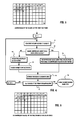
- FIG. 3 depicts the first YUV frame that a receiving terminal has received.
- the frame is divided into 70 blocks that are numbered in a zigzag form 1 to 70 .
- the decoder decodes blocks one by one starting from block 1. Naturally any other numerical and correspondingly decoding order may be used.
- FIG. 4 illustrates the decoding phases.
- the decoder When starting to decompress block N the decoder first examines decoding information related to this block; step 51 . The information tells whether the block has been compressed with an intra-block compression method or an inter-block compression method; step 52 . Furthermore, the information also instructs the decoder to use RGB component values for decoding.
- the decoder contains one block of the YUV format at most and in addition, the existence of such a block or a part of it in theYUV format is very short.
- a prediction method is used for encoding a block, i.e. pixel values of neighboring blocks are used for calculating pixel values of the block.
- pixel values of previously decompressed blocks of the RGB format are fetched from the memory and decompression is done with the aid of those pixels; step 53 .
- the block is stored in a memory area in the RGB format; step 56 .
- step 57 it is examined whether all the blocks of the frame have been decompressed. If not, then the next block in order of FIG.3 will be decompressed. If yes, compression of the whole frame has been completed, step 58 , and compression of the next frame starts.
- FIG. 5 depicts the content of the memory that contains the decoded blocks in which the color representation is RGB.
- FIG. 6 illustrates basic decoding principles of the present invention.
- a frame comprising of 70 blocks.
- the frame has been decoded according to the present invention, wherein the frame represents an image in the RGB color space.
- each block represents a part of the image in the RGB color space.
- the frame acts as the past frame that the decoder needs for decoding the current frame depicted on the right side.
- the current frame was received via a transmission network and the frame has been encoded using YUV color components. As an example decompression of four blocks are considered.
- the blocks are block 15 , block 39 , block 42 , and block 45 .
- Motion compensation means basically that an area of some previous picture in a video is copied to the currently decoded picture.
- the amount of movement between two pictures need not be limited to an integer number of pixels and, for example, movements or motion vectors with a half-pixel or quarter-pixel accuracy can be used.
- the motion vector of the hatched square A in the past frame points to block 15 of the current frame.
- the calculations for decoding block 15 can be made similarly for the R, G and B color components.
- the pixels using those components are directly available from the memory storing the past frame.
- the decoder simply inserts pixels from the square A in the past RGB frame to the block 15 of the current frame.
- the received data relating to this block instructs the decoder to insert pixels from block 39 of the past frame into block 39 of the current frame.
- the motion vector is zero, i.e. pixels are not moved sideward.
- the pixels of the past frame are represented in the RGB color space, wherein decoding of block 39 results directly in pixels in the RGB color space.
- decoding of block 42 is considered.
- the received data relating to this block instructs the decoder to perform decoding without using pixels from neighboring blocks or the past frame.
- the block has been compressed with an intra-block compression method. Therefore decompression of this block uses YUV data, wherein the resulting decompressed block is accordingly in the YUV color space.
- many compression modes also allow decompression of the block almost directly into the RGB color space so that only a few pixels in the YUV format exist during decompression. Anyhow, the decoded block, or a part of it, is stored in the memory only for a very short time because the decoder transforms the block immediately into the RGB color space, wherein the RGB block replaces the YUV block in the memory.
- decoding of block 4 5 is considered.
- the received data pertinent to this block instructs to decompress the block with the aid of pixels of neighboring blocks 34 , 35 , and 44 of the same frame.
- the block has been compressed with an intra-frame method, more precisely with a prediction method, wherein pixels for an area of a picture to be decoded are calculated from other pixels, often neighboring, in the same picture.
- some pixel values from already decoded blocks 34, 35 and 44 are fetched from the memory to use for decompression calculations.
- the pixel values represent values of the RGB color components.
- decompression calculations that traditionally are applied to each color component in the YUV color space are also applicable in the RGB color space. Decompression yields a image block whose pixels are in the RGB color space.
- the decoded block is stored in the memory.
- each block of the frame is decompressed along the guidelines given above.
- the resulting RGB frame is directed to the post-processing unit and further to the display of the device.
- Said frame is also stored in the memory to be used by the decoder as the past frame when the next frame is being decompressed.
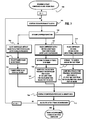
- FIG. 7 is a flow chart illustrating method steps the decoder uses for decompressing any frame subsequent to the first frame.
- the decoder After receiving a frame that has been encoded in the YUV format, step 700 , the decoder starts decoding the first block, step 701 , by defining the compression method, step 702 . Information about that is included in data relating to the block.
- the decoder finds out that the block has been compressed with an intra-block compression method, i.e. without using pixel values of other blocks of the same frame, step 703 .
- the decoder then applies the proper decompression method that produces pixels of the block in the YUV format, step 704 .
- the pixel values are transformed immediately into RGB values, step 705 , and stored in a memory area, step 706 .
- Operative units of the decoder share a common memory but an own memory area is assigned to each operative unit.
- the decoder finds out that the block has been compressed with an inter-block compression method, i.e. with using pixel values of other blocks of the same frame, step 707 , it determines what are the pixels and their values that are needed for calculating values for pixels of the block, step 708 .
- RGB component values of the pixels are read from the memory and used for calculating component values for the pixels of the block, step 709 . Then the RGB pixel values are stored in the memory area.
- the decoder If the decoder has been instructed to decode the block that has been compressed with an inter-block compression method, i.e. using motion vectors, step 710 , it determines based on the motion vector what are the pixels and their values in the past frame, step 711 .
- the decoder reads the RGB component values of those pixels from the memory storing the past frame and uses the values for calculating values for pixels of the block, step 712 . Then the RGB pixel values of the block are stored in the memory area, step 706 .
- step 713 it is checked whether all blocks of the frame are decompressed. If not decompression of the next block is started. If decompression of the frame has been completed, decompression of the next frame begins.
- the decoder of the receiving terminal has to restore residual coded Y components.
- the value of Y component must be changed in relation to the difference D.
- a problem is how to do this because the decoder operates with RGB color components and no YUV co m-ponents exist. The inventors have solved the problems as follows.
- the difference D has to be transformed from the YUV color space to the RGB color space.
- R, G, and B can be solved from the known formula (1), wherein it is obtained:
- the difference D is the same for each of color components R, G and B. Therefore, restoring residual coded components may be performed by applying the same difference to each RGB component.
Landscapes
- Engineering & Computer Science (AREA)
- Multimedia (AREA)
- Signal Processing (AREA)
- Compression Or Coding Systems Of Tv Signals (AREA)
- Color Television Systems (AREA)
Priority Applications (1)
| Application Number | Priority Date | Filing Date | Title |
|---|---|---|---|
| EP04101594A EP1589761A1 (de) | 2004-04-19 | 2004-04-19 | Ein Codec angepasst zu funktionieren im Rgb-Raum |
Applications Claiming Priority (1)
| Application Number | Priority Date | Filing Date | Title |
|---|---|---|---|
| EP04101594A EP1589761A1 (de) | 2004-04-19 | 2004-04-19 | Ein Codec angepasst zu funktionieren im Rgb-Raum |
Publications (1)
| Publication Number | Publication Date |
|---|---|
| EP1589761A1 true EP1589761A1 (de) | 2005-10-26 |
Family
ID=34928973
Family Applications (1)
| Application Number | Title | Priority Date | Filing Date |
|---|---|---|---|
| EP04101594A Withdrawn EP1589761A1 (de) | 2004-04-19 | 2004-04-19 | Ein Codec angepasst zu funktionieren im Rgb-Raum |
Country Status (1)
| Country | Link |
|---|---|
| EP (1) | EP1589761A1 (de) |
Cited By (3)
| Publication number | Priority date | Publication date | Assignee | Title |
|---|---|---|---|---|
| CN106713922A (zh) * | 2017-01-13 | 2017-05-24 | 京东方科技集团股份有限公司 | 图像处理方法和电子设备 |
| CN111402380A (zh) * | 2020-03-12 | 2020-07-10 | 杭州趣维科技有限公司 | 一种gpu压缩纹理处理方法 |
| CN115022642A (zh) * | 2022-07-01 | 2022-09-06 | 光线云(杭州)科技有限公司 | 一种高压缩比的绘制中间图像的无损压缩方法和装置 |
Citations (1)
| Publication number | Priority date | Publication date | Assignee | Title |
|---|---|---|---|---|
| US6108383A (en) * | 1997-07-15 | 2000-08-22 | On2.Com, Inc. | Method and apparatus for compression and decompression of video images |
-
2004
- 2004-04-19 EP EP04101594A patent/EP1589761A1/de not_active Withdrawn
Patent Citations (1)
| Publication number | Priority date | Publication date | Assignee | Title |
|---|---|---|---|---|
| US6108383A (en) * | 1997-07-15 | 2000-08-22 | On2.Com, Inc. | Method and apparatus for compression and decompression of video images |
Non-Patent Citations (3)
| Title |
|---|
| BARTKOWIAK M: "Optimized YCrCb to RGB conversion for realtime decoding of MPEG-2 video", INTERNATIONAL CONFERECE ON SIGNALS AND ELECTRONIC SYSTEMS ICSES 2001, LODZ, POLAND, 18-21 SEPTEMBER 2001, 18 September 2001 (2001-09-18), pages 209 - 213, XP008033745 * |
| RICHARDSON I E C: "Video Codec Design", 2002, JOHN WILEY & SONS, LTD, 0-471-48553, XP002291655, 5 * |
| SIMA M ET AL: "Color space conversion for MPEG decoding on FPGA-augmented trimedia processor", PROCEEEDINGS OF THE APLLICATION-SEPCIFIC SYSTEMS, ARCHITECTURES, AND PROCESSORS, ASAP 03, IEEE 2003, 24 June 2003 (2003-06-24), pages 241 - 250, XP010645225 * |
Cited By (5)
| Publication number | Priority date | Publication date | Assignee | Title |
|---|---|---|---|---|
| CN106713922A (zh) * | 2017-01-13 | 2017-05-24 | 京东方科技集团股份有限公司 | 图像处理方法和电子设备 |
| CN106713922B (zh) * | 2017-01-13 | 2020-03-06 | 京东方科技集团股份有限公司 | 图像处理方法和电子设备 |
| CN111402380A (zh) * | 2020-03-12 | 2020-07-10 | 杭州趣维科技有限公司 | 一种gpu压缩纹理处理方法 |
| CN111402380B (zh) * | 2020-03-12 | 2023-06-30 | 杭州小影创新科技股份有限公司 | 一种gpu压缩纹理处理方法 |
| CN115022642A (zh) * | 2022-07-01 | 2022-09-06 | 光线云(杭州)科技有限公司 | 一种高压缩比的绘制中间图像的无损压缩方法和装置 |
Similar Documents
| Publication | Publication Date | Title |
|---|---|---|
| US12177426B2 (en) | Cross-component adaptive loop filter for chroma | |
| EP2239943B1 (de) | Verfahrung und Vorrichtung zur verbesserung von komprimierten Bild-chroma Daten | |
| US7145594B2 (en) | Digital video signal processing apparatus of mobile communication system and method thereof | |
| US20040136457A1 (en) | Method and system for supercompression of compressed digital video | |
| US9369733B2 (en) | Method and apparatus for encoding and decoding image | |
| US20030123739A1 (en) | Method and apparatus for video compression using microwavelets | |
| JP2000504911A (ja) | ファクシミリ準拠画像圧縮法およびシステム | |
| US7095448B2 (en) | Image processing circuit and method for modifying a pixel value | |
| US5751861A (en) | Reducing residual artifacts in video coding schemes with integer motion compensation | |
| WO2002091282A2 (en) | Color video codec method and system | |
| KR20240089011A (ko) | 선택 가능한 뉴럴 네트워크 기반 코딩 도구를 사용하는 비디오 코딩 | |
| KR102321895B1 (ko) | 디지털 비디오의 디코딩 장치 | |
| FI109394B (fi) | Menetelmä ja laite videokuvan koodaamiseksi ja dekoodaamiseksi | |
| EP3073737A1 (de) | Videocodierungsvorrichtung, videocodierungsverfahren, videodecodierungsvorrichtung und videodecodierungsverfahren | |
| US6427029B1 (en) | Image signal processing method and device, and storage medium | |
| EP1589761A1 (de) | Ein Codec angepasst zu funktionieren im Rgb-Raum | |
| US20030210744A1 (en) | Method and apparatus for decoding video bitstreams to reduced spatial resolutions | |
| Frommholz et al. | High Dynamic Range Image Compression On Commodity Hardware For Real-Time Mapping Applications | |
| JPH0818956A (ja) | 画像データ符号化方法及びその装置 | |
| KR20040046318A (ko) | 화상통신 시스템에서 영상신호 처리방법 | |
| JPH0818968A (ja) | 画像データ符号化/復号化方法及び装置 | |
| HK1148152B (en) | Method and system for improving compressed image chroma information | |
| KR20040061049A (ko) | 동영상 디코딩 방법 | |
| KR20040047046A (ko) | 동영상 디코더 및 디코딩 방법 |
Legal Events
| Date | Code | Title | Description |
|---|---|---|---|
| PUAI | Public reference made under article 153(3) epc to a published international application that has entered the european phase |
Free format text: ORIGINAL CODE: 0009012 |
|
| AK | Designated contracting states |
Kind code of ref document: A1 Designated state(s): AT BE BG CH CY CZ DE DK EE ES FI FR GB GR HU IE IT LI LU MC NL PL PT RO SE SI SK TR |
|
| AX | Request for extension of the european patent |
Extension state: AL LT LV MK |
|
| AKX | Designation fees paid | ||
| REG | Reference to a national code |
Ref country code: DE Ref legal event code: 8566 |
|
| STAA | Information on the status of an ep patent application or granted ep patent |
Free format text: STATUS: THE APPLICATION IS DEEMED TO BE WITHDRAWN |
|
| 18D | Application deemed to be withdrawn |
Effective date: 20060427 |