EP1589647A2 - Current-voltage converter and relative control circuit - Google Patents
Current-voltage converter and relative control circuit Download PDFInfo
- Publication number
- EP1589647A2 EP1589647A2 EP05011676A EP05011676A EP1589647A2 EP 1589647 A2 EP1589647 A2 EP 1589647A2 EP 05011676 A EP05011676 A EP 05011676A EP 05011676 A EP05011676 A EP 05011676A EP 1589647 A2 EP1589647 A2 EP 1589647A2
- Authority
- EP
- European Patent Office
- Prior art keywords
- voltage
- current
- output
- circuit
- input
- Prior art date
- Legal status (The legal status is an assumption and is not a legal conclusion. Google has not performed a legal analysis and makes no representation as to the accuracy of the status listed.)
- Withdrawn
Links
- 239000003990 capacitor Substances 0.000 claims abstract description 29
- 238000002955 isolation Methods 0.000 claims abstract description 10
- 238000004804 winding Methods 0.000 claims description 43
- 238000012937 correction Methods 0.000 claims description 8
- 238000005070 sampling Methods 0.000 claims description 6
- 238000013461 design Methods 0.000 abstract description 3
- 230000001360 synchronised effect Effects 0.000 description 6
- 238000001514 detection method Methods 0.000 description 4
- 230000004913 activation Effects 0.000 description 3
- 230000007774 longterm Effects 0.000 description 3
- 230000001105 regulatory effect Effects 0.000 description 3
- 230000001276 controlling effect Effects 0.000 description 2
- 230000000694 effects Effects 0.000 description 2
- 238000010079 rubber tapping Methods 0.000 description 2
- 239000004065 semiconductor Substances 0.000 description 2
- 238000000926 separation method Methods 0.000 description 2
- 238000013459 approach Methods 0.000 description 1
- 230000008878 coupling Effects 0.000 description 1
- 238000010168 coupling process Methods 0.000 description 1
- 238000005859 coupling reaction Methods 0.000 description 1
- 238000002347 injection Methods 0.000 description 1
- 239000007924 injection Substances 0.000 description 1
- 238000005259 measurement Methods 0.000 description 1
- 238000012544 monitoring process Methods 0.000 description 1
- 230000035515 penetration Effects 0.000 description 1
- 238000012545 processing Methods 0.000 description 1
- 230000001960 triggered effect Effects 0.000 description 1
- 238000011144 upstream manufacturing Methods 0.000 description 1
Images


Classifications
-
- H—ELECTRICITY
- H02—GENERATION; CONVERSION OR DISTRIBUTION OF ELECTRIC POWER
- H02M—APPARATUS FOR CONVERSION BETWEEN AC AND AC, BETWEEN AC AND DC, OR BETWEEN DC AND DC, AND FOR USE WITH MAINS OR SIMILAR POWER SUPPLY SYSTEMS; CONVERSION OF DC OR AC INPUT POWER INTO SURGE OUTPUT POWER; CONTROL OR REGULATION THEREOF
- H02M1/00—Details of apparatus for conversion
- H02M1/42—Circuits or arrangements for compensating for or adjusting power factor in converters or inverters
- H02M1/4208—Arrangements for improving power factor of AC input
- H02M1/4258—Arrangements for improving power factor of AC input using a single converter stage both for correction of AC input power factor and generation of a regulated and galvanically isolated DC output voltage
-
- H—ELECTRICITY
- H02—GENERATION; CONVERSION OR DISTRIBUTION OF ELECTRIC POWER
- H02M—APPARATUS FOR CONVERSION BETWEEN AC AND AC, BETWEEN AC AND DC, OR BETWEEN DC AND DC, AND FOR USE WITH MAINS OR SIMILAR POWER SUPPLY SYSTEMS; CONVERSION OF DC OR AC INPUT POWER INTO SURGE OUTPUT POWER; CONTROL OR REGULATION THEREOF
- H02M3/00—Conversion of DC power input into DC power output
- H02M3/22—Conversion of DC power input into DC power output with intermediate conversion into AC
- H02M3/24—Conversion of DC power input into DC power output with intermediate conversion into AC by static converters
- H02M3/28—Conversion of DC power input into DC power output with intermediate conversion into AC by static converters using discharge tubes with control electrode or semiconductor devices with control electrode to produce the intermediate AC
- H02M3/285—Single converters with a plurality of output stages connected in parallel
-
- H—ELECTRICITY
- H02—GENERATION; CONVERSION OR DISTRIBUTION OF ELECTRIC POWER
- H02M—APPARATUS FOR CONVERSION BETWEEN AC AND AC, BETWEEN AC AND DC, OR BETWEEN DC AND DC, AND FOR USE WITH MAINS OR SIMILAR POWER SUPPLY SYSTEMS; CONVERSION OF DC OR AC INPUT POWER INTO SURGE OUTPUT POWER; CONTROL OR REGULATION THEREOF
- H02M3/00—Conversion of DC power input into DC power output
- H02M3/22—Conversion of DC power input into DC power output with intermediate conversion into AC
- H02M3/24—Conversion of DC power input into DC power output with intermediate conversion into AC by static converters
- H02M3/28—Conversion of DC power input into DC power output with intermediate conversion into AC by static converters using discharge tubes with control electrode or semiconductor devices with control electrode to produce the intermediate AC
- H02M3/325—Conversion of DC power input into DC power output with intermediate conversion into AC by static converters using discharge tubes with control electrode or semiconductor devices with control electrode to produce the intermediate AC using devices of a triode or a transistor type requiring continuous application of a control signal
- H02M3/335—Conversion of DC power input into DC power output with intermediate conversion into AC by static converters using discharge tubes with control electrode or semiconductor devices with control electrode to produce the intermediate AC using devices of a triode or a transistor type requiring continuous application of a control signal using semiconductor devices only
-
- H—ELECTRICITY
- H02—GENERATION; CONVERSION OR DISTRIBUTION OF ELECTRIC POWER
- H02M—APPARATUS FOR CONVERSION BETWEEN AC AND AC, BETWEEN AC AND DC, OR BETWEEN DC AND DC, AND FOR USE WITH MAINS OR SIMILAR POWER SUPPLY SYSTEMS; CONVERSION OF DC OR AC INPUT POWER INTO SURGE OUTPUT POWER; CONTROL OR REGULATION THEREOF
- H02M3/00—Conversion of DC power input into DC power output
- H02M3/22—Conversion of DC power input into DC power output with intermediate conversion into AC
- H02M3/24—Conversion of DC power input into DC power output with intermediate conversion into AC by static converters
- H02M3/28—Conversion of DC power input into DC power output with intermediate conversion into AC by static converters using discharge tubes with control electrode or semiconductor devices with control electrode to produce the intermediate AC
- H02M3/325—Conversion of DC power input into DC power output with intermediate conversion into AC by static converters using discharge tubes with control electrode or semiconductor devices with control electrode to produce the intermediate AC using devices of a triode or a transistor type requiring continuous application of a control signal
- H02M3/335—Conversion of DC power input into DC power output with intermediate conversion into AC by static converters using discharge tubes with control electrode or semiconductor devices with control electrode to produce the intermediate AC using devices of a triode or a transistor type requiring continuous application of a control signal using semiconductor devices only
- H02M3/33561—Conversion of DC power input into DC power output with intermediate conversion into AC by static converters using discharge tubes with control electrode or semiconductor devices with control electrode to produce the intermediate AC using devices of a triode or a transistor type requiring continuous application of a control signal using semiconductor devices only having more than one ouput with independent control
-
- H—ELECTRICITY
- H02—GENERATION; CONVERSION OR DISTRIBUTION OF ELECTRIC POWER
- H02M—APPARATUS FOR CONVERSION BETWEEN AC AND AC, BETWEEN AC AND DC, OR BETWEEN DC AND DC, AND FOR USE WITH MAINS OR SIMILAR POWER SUPPLY SYSTEMS; CONVERSION OF DC OR AC INPUT POWER INTO SURGE OUTPUT POWER; CONTROL OR REGULATION THEREOF
- H02M3/00—Conversion of DC power input into DC power output
- H02M3/22—Conversion of DC power input into DC power output with intermediate conversion into AC
- H02M3/24—Conversion of DC power input into DC power output with intermediate conversion into AC by static converters
- H02M3/28—Conversion of DC power input into DC power output with intermediate conversion into AC by static converters using discharge tubes with control electrode or semiconductor devices with control electrode to produce the intermediate AC
- H02M3/325—Conversion of DC power input into DC power output with intermediate conversion into AC by static converters using discharge tubes with control electrode or semiconductor devices with control electrode to produce the intermediate AC using devices of a triode or a transistor type requiring continuous application of a control signal
- H02M3/335—Conversion of DC power input into DC power output with intermediate conversion into AC by static converters using discharge tubes with control electrode or semiconductor devices with control electrode to produce the intermediate AC using devices of a triode or a transistor type requiring continuous application of a control signal using semiconductor devices only
- H02M3/33569—Conversion of DC power input into DC power output with intermediate conversion into AC by static converters using discharge tubes with control electrode or semiconductor devices with control electrode to produce the intermediate AC using devices of a triode or a transistor type requiring continuous application of a control signal using semiconductor devices only having several active switching elements
-
- H—ELECTRICITY
- H02—GENERATION; CONVERSION OR DISTRIBUTION OF ELECTRIC POWER
- H02M—APPARATUS FOR CONVERSION BETWEEN AC AND AC, BETWEEN AC AND DC, OR BETWEEN DC AND DC, AND FOR USE WITH MAINS OR SIMILAR POWER SUPPLY SYSTEMS; CONVERSION OF DC OR AC INPUT POWER INTO SURGE OUTPUT POWER; CONTROL OR REGULATION THEREOF
- H02M7/00—Conversion of AC power input into DC power output; Conversion of DC power input into AC power output
- H02M7/42—Conversion of DC power input into AC power output without possibility of reversal
- H02M7/44—Conversion of DC power input into AC power output without possibility of reversal by static converters
- H02M7/48—Conversion of DC power input into AC power output without possibility of reversal by static converters using discharge tubes with control electrode or semiconductor devices with control electrode
- H02M7/493—Conversion of DC power input into AC power output without possibility of reversal by static converters using discharge tubes with control electrode or semiconductor devices with control electrode the static converters being arranged for operation in parallel
-
- H—ELECTRICITY
- H02—GENERATION; CONVERSION OR DISTRIBUTION OF ELECTRIC POWER
- H02M—APPARATUS FOR CONVERSION BETWEEN AC AND AC, BETWEEN AC AND DC, OR BETWEEN DC AND DC, AND FOR USE WITH MAINS OR SIMILAR POWER SUPPLY SYSTEMS; CONVERSION OF DC OR AC INPUT POWER INTO SURGE OUTPUT POWER; CONTROL OR REGULATION THEREOF
- H02M1/00—Details of apparatus for conversion
- H02M1/0067—Converter structures employing plural converter units, other than for parallel operation of the units on a single load
- H02M1/0074—Plural converter units whose inputs are connected in series
-
- H—ELECTRICITY
- H02—GENERATION; CONVERSION OR DISTRIBUTION OF ELECTRIC POWER
- H02M—APPARATUS FOR CONVERSION BETWEEN AC AND AC, BETWEEN AC AND DC, OR BETWEEN DC AND DC, AND FOR USE WITH MAINS OR SIMILAR POWER SUPPLY SYSTEMS; CONVERSION OF DC OR AC INPUT POWER INTO SURGE OUTPUT POWER; CONTROL OR REGULATION THEREOF
- H02M1/00—Details of apparatus for conversion
- H02M1/0083—Converters characterised by their input or output configuration
- H02M1/009—Converters characterised by their input or output configuration having two or more independently controlled outputs
-
- Y—GENERAL TAGGING OF NEW TECHNOLOGICAL DEVELOPMENTS; GENERAL TAGGING OF CROSS-SECTIONAL TECHNOLOGIES SPANNING OVER SEVERAL SECTIONS OF THE IPC; TECHNICAL SUBJECTS COVERED BY FORMER USPC CROSS-REFERENCE ART COLLECTIONS [XRACs] AND DIGESTS
- Y02—TECHNOLOGIES OR APPLICATIONS FOR MITIGATION OR ADAPTATION AGAINST CLIMATE CHANGE
- Y02B—CLIMATE CHANGE MITIGATION TECHNOLOGIES RELATED TO BUILDINGS, e.g. HOUSING, HOUSE APPLIANCES OR RELATED END-USER APPLICATIONS
- Y02B70/00—Technologies for an efficient end-user side electric power management and consumption
- Y02B70/10—Technologies improving the efficiency by using switched-mode power supplies [SMPS], i.e. efficient power electronics conversion e.g. power factor correction or reduction of losses in power supplies or efficient standby modes
Definitions
- the invention relates to a current-voltage converter with an input to to which a first inductance is connected, via a capacitor and a diode connected to a first terminal of a primary winding of an isolating transformer is connected to its second terminal to an output, wherein a junction between the first inductor and the capacitor via a Power switching element is connected to the output and wherein a junction between the capacitor and the diode via a series connection of second inductance and measuring element is connected to the output as well as to an associated one
- a control circuit for operating the current-voltage converter comprising a voltage regulator with voltage comparator and voltage amplifier as well as a current regulator with current comparator and current amplifier, as well as between voltage regulator and current regulator arranged correction member.
- double booster topologies which have a DC link with an electrolyte-Kodensator, so that this or the upstream network in Switching on the high input voltage due to penetration without short-circuit current limitation is charged. Therefore, this capacitor must be at the peak voltage be designed at the input, which is higher than the regulated output voltage of the booster.
- a primary-clocked voltage converter is proposed, whose Primary side is constructed of several, serially connected subsystems, each including a transistor power switch assembly, each having its own Transformer primary winding is assigned, which via the secondary side of the Converter are coupled to a common load output.
- the coupling causes via the transformer winding voltage an automatic, dynamic and quasi lossless voltage balancing between the subsystems in load operation.
- the transformer windings on the secondary side are "hard” -parallel connected. This has the disadvantage that asymmetries are not current-limited dynamic balance currents lead, but only effect the symmetrization.
- this circuit arrangement has the disadvantage that in converters with AC input an injection of the peak value of the rectified voltage on a directly at the output of a rectifier arranged capacitor with very large capacity and all of these flow transformer topologies do not have the input voltage waveform allow adjusted power consumption (Power Factor Correction PFC).
- the present invention is therefore based on the problem of a current-voltage converter with a simple design and multiple output voltages to To make available.
- the isolation transformer output has multiple outputs with separate secondary windings over one common core are energized by the primary winding. Due to the power supply of the isolation transformer determine the output voltages of the multiple Outputs solely from the winding ratio of the number of turns from primary to secondary winding. The individual streams share according to the internal resistance of Load on the individual outputs. Therefore, the output voltages are also with you changing load currents constant.
- an additional winding or a secondary winding and / or the primary winding itself be designed as a measuring winding to signals for the control loop for To make available.
- a control circuit for a current-voltage converter of the aforementioned type comprises a Voltage regulator with voltage comparator and voltage amplifier and a current regulator with current comparator and current amplifier as well as between voltage regulator and Current regulator arranged correction element.
- the control circuit has a circuit for detecting the mains voltage and / or mains frequency on, wherein the circuit is connected to a sampling circuit, which with a Input is connected to output voltage and with an output to the first input a voltage comparator is connected and wherein the voltage regulator on the output side is connected to a preferably multiplying D / A converter, which in turn with a second input is connected to an output of the circuit and the output side is connected to an input of the current comparator of the current controller.
- control loop Due to the detection of mains voltage and mains frequency, the control loop can be set to different Input voltages and / or frequencies can be adjusted.
- the corresponding Control parameters are provided by the circuit.
- a PFC rating can thus at any input AC voltage (amplitude, range and Frequency).
- the rectified input voltage can also be used (after the rectifier) are sampled or recorded.
- the mains voltage can also be a DC voltage - the circuit is designed as an integrated circuit, preferably as a microcomputer or microcontroller.
- the error amplified voltage difference k u x _U A applied to the output of the voltage amplifier can then be multiplied by the digital sine function provided at the output of the microcontroller.
- the voltage amplifier is followed by the D / A converter, to which the digital sine of the circuit is supplied.
- the D / A converter At the output of the D / A converter is a sinus modulated error amplified voltage can be tapped, which is available as a setpoint for the downstream current control loop.
- the advantage of the novel control loop arrangement is that a correction due to input voltage changes is not necessary.
- the correction term requires no correction as a function of the input voltage U E.
- the actual current I Alst supplied to the control circuit is also independent of fluctuations in the input voltage U E.
- the synthetic sine generated in the circuit as a reference is used for continuous under- or overvoltage detection.
- control circuit has a comparator circuit integrated in the circuit on, with the voltage applied to the output of the circuit synthetic sine to Network is synchronized.
- the circuit If the mains voltage has no zero crossings, i. H. it is a DC input voltage, thus, the circuit outputs a constant value B, so that the Control circuit operates as a DC loop and a PFC rating does not take place in this case.
- the application of the voltage converter system be extended significantly, so that especially in the railway at least four UIC voltages (1000 VAC 16 2/3 Hz, 1500 VAC 50 Hz, 1500 VDC, 3000 VDC) or 48/60/110 / 220V DC and 110/234 VAC 60/50 Hz grids as a voltage range transformer are manageable.
- the converter or regenerator very wide input voltage ranges allows, the problem is whether DC input voltage or AC input voltage solved with different frequency by the aforementioned approach, so that all Four voltage ranges plus tolerances (+/- 30%) and long-term transients in one input voltage range can be processed.
- DC input voltages with Particularly high AC voltage component preferably without peak currents are manageable.
- some control parameters to the rated voltage can be preset (sound-time).
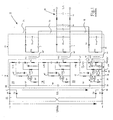
- Fig. 1 shows a current-voltage converter 10 which is connected via a diode D1 to D4 comprehensive rectifier 12 with a mains voltage U network .
- the mains voltage U net in this embodiment is typically in the range of 1000 to 1500 VAC and may have a frequency of 16 2/3 Hz to 400 Hz. Also, input voltages in the range of 1500 VDC to 3000 VDC are possible.
- a sinusoidal pulsating, half-wave input AC voltage U E which is converted by the voltage converter 10 in a constant output voltage U A.
- the current-voltage converter 10 has a primary side 14, which has a plurality of series connected Subsystems 16, 18, 20, each having at least one transistor power switch T1, T2, T3.
- the subsystems 16, 18, 20 are shown in the here Embodiment designed as a SEPIC converter or regenerators whose Output in each case with a primary winding TP1, TP2, TP3 of an isolating transformer TR1, TR2, TR3 is connected.
- the isolation transformers TR1, TR2, TR3 each have secondary coils TS1, TS2, TS3, via a secondary side 22 of the voltage converter 10 are coupled to a common load output 24.
- the subsystem 20 includes a SEPIC converter 26, a primary side Input 28 to which an inductance as input inductor L20.1 connected is connected via a capacitor 30 and a diode 32 to a first terminal 34 of the Transformer primary winding TP3 is connected. Another connection 36 is with a primary-side output 38 of the SEPIC converter 26 connected. Between the input side Throttle L20.1 and the capacitor 30 is a junction 40, the over a ballast network 42 having a first terminal 44 of the transistor power switching element T3 is connected. Another port 46 of the transistor power switch T3 is connected to the output 38.
- a control input 48 of the transistor power switch T3 is via a secondary winding of a transformer 50 with the Output 38 connected. Between the capacitor 30 and the diode 32 is a junction 52, which has a second choke L20.2 and a resistor 56 like shunt connected to the output 38. Parallel to the primary-side transformer winding TP3 is a relief network as a series circuit of capacitor 58 and resistor 60 arranged.
- the secondary winding TS3 of the isolation transformer TR3 is connected to a peak rectification circuit 62 consisting of the diode D5, at whose output a capacitor 64 is located.
- the secondary winding TS2 is also followed by a rectifier circuit 66, at whose output a capacitor 68 is located.
- the same applies to the secondary winding TS1 which is followed by a rectifier circuit 70, at whose output a capacitor 72 is located.
- the secondary side 22 consists essentially of three secondary systems 74, 76, 78, each consisting of the secondary transformer winding, the associated and associated rectifier and the output capacitor.
- the secondary systems 74, 76, 78 are electrically connected in parallel and form an output 80 to which the regulated output voltage U A can be tapped via a filter network 82.
- the capacitors 64, 68, 72 can also be designed as a single common capacitor with a large capacity.
- the windings of the isolation transformers are on a separate transformer core 84, 84 ', 84 "Alternatively, however, there is the possibility of the windings with a corresponding ratio of the voltages and currents on a common Core to arrange.
- each stage is located at one third of the input voltage U E.
- drive windings are the transformers 50, 50', 50 "arranged on a common magnetic core. Alternatively, however, it is possible to design the drive windings as separate transformers, especially at very high input voltages.
- a current flows from the positive pole 86 of the rectifier 12 via an input inductor L16.1 of the subsystem 16, a ballast network 42 "and the transistor power switch T1, as well as via the Input inductor L18.1, Snubbernetzteil 42 'and the transistor power switch T2 and via the input choke L20.1, the ballast power supply 42 and the transistor power switch T3 to the negative pole 88 of the rectifier.
- the capacitors 90, 90 ', 90 " at which in each case only 1/3 of the input voltage U E drops, are located parallel to the inputs of the respective subsystems 16, 18, 20.
- the otherwise usual very large storage capacitor the primary direct access of the input voltage withdrawn and transformed to the low-voltage or secondary side and charged there short-circuit current controlled.
- a current-voltage converter 92 is shown, which is connected via a rectifier 94 to the diodes D6 - D9 with mains voltage U network .
- the line voltage U network is typically in the range of 110 - 234 VAC or 28 - 48 VAC and may have a frequency of 16 2/3 Hz - 400 Hz.
- Mains voltages in the range of 4 - 72 or 14.4 - 154 VDC are also possible.
- the current-voltage converter 92 is designed in particular for high input currents I E and output currents I A.
- the current-voltage converter 92 has a primary side 96, which has a plurality of parallel connected Subsystems 98, 100, 102, each having at least one transistor power switch T4, T6, T7.
- Subsystems 98, 100, 102 are in this illustrated embodiment designed as a SEPIC converter or regenerators, whose output is in each case connected to a primary winding TP4, TP5, TP6 of an isolating transformer TR4, TR5, TR6 is connected.
- the isolating transformers TR4, TR5, TR6 each have Secondary coils TS4, TS5, TS6, which via a secondary side 104 of the voltage-current converter 92 are coupled to a common load output 106.
- the structure of the subsystems 98, 100, 102 substantially corresponds to the subsystems 16, 18, 20, which have been described in detail with reference to FIG.
- the primary-side parallel connection of the regenerators or SEPIC converters 98, 100, 102 with the potential separation reduces the current flowing through a transistor power switch T4, T5, T6 to one third of the input current I E. For this reason, commercially available current-carrying transistors can be used.
- the drive transmitters 108, 110, 112 in the parallel circuit described here are on a common core.
- the drive transmitters 108, 110, 112 may also be embodied as electronic semiconductor power drivers (not shown).
- the subsystems 98, 100, 102 have input-side inductances L 98.1, L 100.1, L 102.1, which are at least temporarily parallel to the input voltage U E via the transistor power switches and thus effect a current balancing of the overall system.
- the regulation of the current-voltage converter is based on the control circuit of FIG. 3rd be explained.
- FIG. 3 shows a control loop arrangement for controlling at least one subsystem 16, 18, 20 or 98, 100, 102 of the current-voltage converter 10 or 92 according to FIG. 1 or 2.
- the control circuit 200 has on the input side a voltage comparator 202, which has a first input 204 with a reference voltage U ARef and a second input 206 via a sampling circuit 208 such as sample and hold circuit or continuous measurement with the output voltage U A for tapping an actual Voltage U Alst is connected.
- the output voltage U A is measured via an unillustrated measuring element at the output 24 of the current-voltage converter or via the load voltage U A 'at the primary transformer winding TP1 - TP6 during the T OFF phase.
- An output 210 of the comparator 202 is connected to an input 212 of an amplifier 214 in order to amplify a differential voltage _U A formed from the actual voltage U Alst and the reference voltage U ARef .
- an output 216 of the amplifier 214 is an error amplified voltage K U x _ U A , which is supplied to an input 218 of a multiplying D / A converter 220.
- Another input 222 of the D / A converter 220 is connected to an output 224 of a circuit, preferably microcontroller 226.
- the microcontroller 226 is in turn connected via a feed line 228 to a power line or to the mains voltage U Netz .
- the microcontroller 226 is connected via an output 230 and a trigger line 232 to an input 234 of the sampling circuit 208.
- a further input 242 of the comparator 240 is connected via a feed line 138 to the shunt 56 in the branch of the choke coil 220.1 for tapping a size I A 'proportional to the output current I A.
- An output 244 of the comparator is connected to an input 246 of a current amplifier 248.
- At an output 250 of the amplifier is applied to an amplified current difference K 1 x _I A , which is supplied to a drive unit 252 and forms a controlled variable.
- the drive unit further has an input 254 for the mains or input voltage for T ON control and an output 256 for driving the transistor power switches TI and T6 via drive transformers 50, 50 ', 50 "and 108 - 112, respectively Size K, x _I A , the T OFF time of the transistor power switches T1-T6 is controlled or regulated, and even without a U / I controller, T ON control and specification of the T OFF voltage as a DC value become a quasi-constant Output voltage with sinusoidal current consumption at AC voltage supply and changing input range or output load achieved.
- the processing After detection and storage of the time base, the processing starts with a trigger zero crossing and synchronize about it at further zero crossings. Synchronization pulses, which lie between the mathematical zero crossings hidden because of possible disturbances.
- the generated sinusoidal waveform is output via the output 224 to the input 226 of the D / A converter 220.
- the sampling circuit 208 is triggered with a synchronization pulse applied to each half-wave zero crossing.
- the error-amplified differential voltage K U x _U A is now multiplied by the synthetic sinusoid Bmax x
- a sine-weighted voltage- fault -amplified variable is present at the output, which is available as a set current I ASoll for driving the transistor power switches T1-T6.
- there is no need for an additional correction element since the size of the output current in the primary-side choke branch is independent of long-term fluctuations of the input voltage U E but follows the nominal frequency waveform (PFC).
- the sine function generated in the microcontroller can also be used as a reference for under- or overvoltage detection.
- the sine function generated in the microcontroller can be determined by means of a comparator circuit be synchronized to the network.
- the microcontroller 226 detects that the input voltage is a DC voltage, so at the output 224 is a constant voltage B so that a PFC rating is eliminated.
- the described system of current-voltage converter 10, 92 and inventive Control circuit 200 comes in particular in the railway area at four UIC voltages, such as for example, 1000 VAC 16 2/2 Hz, 1500 VAC 50 Hz, 1500 VDC and 3000 VDC to Application. Because the voltage converter or regenerator has a wide input voltage range allows, the problem is whether input AC voltage or DC input voltage or which frequency the input AC voltage has, by the previously stated features solved. However, all four ranges as well as tolerances (+ - 30%) and long-term transients in an input voltage range are processed.
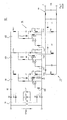
- FIG. 4 shows a current-voltage converter 400 with an independent inventive character.
- the current-voltage converter 400 has a primary side 402, which is connected to mains voltage U Netz via a rectifier 404, and a secondary side 406, which has a plurality, ie multiple, preferably three, outputs 408, 410, 412 with the output voltages U A1 , U A2 , U A3 .
- Parallel to output terminals 414, 416 of the rectifier 404 is a capacitor 418 to which an input voltage U E for the current-voltage converter 400 is applied.
- a primary inductor such as choke coil L420.1
- L420.1 Connected to terminal 414 is a primary inductor, such as choke coil L420.1, which is connected via a capacitor 422 and a diode 424 to a first terminal 426 of a primary-side winding TP7 of an isolation transformer TR.
- the primary-side winding TP7 is connected to the input terminal 416 of the rectifier 404.
- Between the inductor L420.1 and the capacitor 422 is a junction 430 which is connected to the terminal 416 via a snubber network 432 and a transistor power switch T7.
- a control terminal 434 of the transistor power switch T7 is connected to the terminal 416 via a secondary winding 436 of a Anberichtübertragers 438.
- a junction 440 located between the capacitor 422 and the diode 424 is also connected to the terminal 416 via a second inductance such as choke coil L 420.2 and a measuring element in series therewith such as shunt 444.
- the secondary-side multiple outputs 408, 410, 412 each have a secondary winding TS7.1, TS7.2, TS7.3, which are arranged together with the primary winding TP7 on a common core 446.
- the secondary windings TS7.1, TS7.2, TS7.3 are each connected via a rectifier diode 448, 450, 452 to an output capacitor 454, 456, 458, to which the output voltage U A1 , U A2 and U A3 are applied.
- the current-voltage converter 400 is characterized by the fact that a feedback of controlled variables or monitoring functions of secondary-side sizes is not required. This is made possible, in particular, by the fact that the output voltage on the primary side during the T Off time at the terminal 426 of the primary winding TP7 and the output current (average size) on the primary side on the measuring element 440 can be measured. The input voltage can be measured on the secondary side during the T On time.
Landscapes
- Engineering & Computer Science (AREA)
- Power Engineering (AREA)
- Dc-Dc Converters (AREA)
- Details Of Television Scanning (AREA)
- Ignition Installations For Internal Combustion Engines (AREA)
- Measurement Of Current Or Voltage (AREA)
- Measuring Instrument Details And Bridges, And Automatic Balancing Devices (AREA)
Abstract
Description
Die Erfindung bezieht sich auf einen Strom-Spannungswandler mit einem Eingang, an dem eine erste Induktivität angeschlossen ist, die über einen Kondensator und eine Diode mit einer in einem ersten Anschluss einer Primärwicklung eines Trenntransformators verbunden ist, der mit seinem zweiten Anschluss mit einem Ausgang verbunden ist, wobei eine Verbindungsstelle zwischen der ersten Induktivität und dem Kondensator über ein Leistungs-Schaltelement mit dem Ausgang verbunden ist und wobei eine Verbindungsstelle zwischen dem Kondensator und der Diode über eine Reihenschaltung aus zweiter Induktivität und Messelement mit dem Ausgang verbunden ist sowie auf einen zugehörigen Regelkreis zum Betrieb des Stromspannungswandlers, umfassend einen Spannungsregler mit Spannungsvergleicher und Spannungsverstärker sowie einen Stromregler mit Stromvergleicher und Stromverstärker sowie ein zwischen Spannungsregler und Stromregler angeordnetes Korrekturglied.The invention relates to a current-voltage converter with an input to to which a first inductance is connected, via a capacitor and a diode connected to a first terminal of a primary winding of an isolating transformer is connected to its second terminal to an output, wherein a junction between the first inductor and the capacitor via a Power switching element is connected to the output and wherein a junction between the capacitor and the diode via a series connection of second inductance and measuring element is connected to the output as well as to an associated one A control circuit for operating the current-voltage converter, comprising a voltage regulator with voltage comparator and voltage amplifier as well as a current regulator with current comparator and current amplifier, as well as between voltage regulator and current regulator arranged correction member.
Bei aus dem Stand der Technik bekannten Spannungswandlern für hohe Eingangswechselspannungen oder Gleichspannung erfolgt eine Aufschaltung eines Spitzenwertes der gleichgerichteten Spannung auf einen unmittelbar an den Ausgängen eines Gleichrichters angeordneten Kondensators mit sehr großer Kapazität. Folglich mussten sehr teure Ladeschaltungen mit Vorladung über zum Beispiel einen Widerstand und anschließende Überbrückung mit Schützkontakten realisiert werden. In known from the prior art voltage transformers for high input AC voltages or DC voltage is a connection of a peak value of rectified voltage to a directly at the outputs of a rectifier arranged capacitor with very large capacity. Consequently, had very expensive charging circuits with precharge over, for example, a resistor and then bridging be realized with contactor contacts.
Auch sind sogenannte "Doppelbooster"-Topologien bekannt, die einen Zwischenkreis mit einem Elektrolyt-Kodensator aufweisen, so dass dieser oder das vorgeschaltete Netz beim Aufschalten der hohen Eingangsspannung aufgrund des Durchgriffs ohne Kurzschlussstrombegrenzung belastet wird. Daher muss dieser Kondensator auf die Spitzenspannung am Eingang ausgelegt sein, die höher als die geregelte Ausgangsspannung des Boosters ist.Also, so-called "double booster" topologies are known which have a DC link with an electrolyte-Kodensator, so that this or the upstream network in Switching on the high input voltage due to penetration without short-circuit current limitation is charged. Therefore, this capacitor must be at the peak voltage be designed at the input, which is higher than the regulated output voltage of the booster.
Auch treten bei der Beherrschung hoher Eingangsspannungen und Ströme bezüglich der verwendeten Bauelemente Probleme auf. So müssen die verwendeten Halbleiter wie - Transistoren und Dioden an die maximale Eingangsspannung oder Strom angepasst werden und die verwendeten Transformatoren müssen sowohl leistungs- als auch spannungsmäßig an die zu verarbeitende Eingangsspannung angepasst werden, wobei nicht vertretbare Windungs- und Wicklungsspannungen auftreten.Also occur in the control of high input voltages and currents relative to the used components problems. So the used semiconductors like - Transistors and diodes can be adjusted to the maximum input voltage or current and the transformers used must be both power and voltage be adapted to the input voltage to be processed, with unacceptable Winding and winding voltages occur.
Bei bekannten Wandlern, die Leistungstransistoren als Schaltelemente benutzen, ist die zulässige Eingangsspannung durch die Spannungsbelastbarkeit des verwendeten Leistungstransistortyps begrenzt. Bei einer Reihen- /Parallelschaltung mehrerer, synchron getakteter Transistoren stellt sich das Problem der Spannungs- /Stromsymmetrierung, wozu zum Beispiel die Anbringung verlustbehafleter RCD-Leitungszweige parallel zur Transistorschalt- strecke bekannt ist.In known converters that use power transistors as switching elements, is the permissible input voltage due to the voltage rating of the type of power transistor used limited. In a series / parallel connection of several, synchronous clocked transistors raises the problem of voltage / current balance, including For example, the mounting of lossy RCD line branches parallel to the transistor switching route is known.
In der DE 44 14 677 A1 wird ein primärgetakteter Spannungswandler vorgeschlagen, dessen Primärseite aus mehreren, seriell aneinandergeschalteten Teilsystemen aufgebaut ist, die jeweils eine Transistor-Leistungsschalteranordnung beinhalten, denen jeweils eine eigene Transformator-Primärwicklung zugeordnet ist, welche über die Sekundärseite des Wandlers an einen gemeinsamen Lastausgang angekoppelt sind. Die Kopplung bewirkt über die Transformator-Wicklungsspannung eine automatische, dynamische und quasi verlustfreie Spannungssymmetrisierung zwischen den Teilsystemen im Lastbetrieb.In DE 44 14 677 A1 a primary-clocked voltage converter is proposed, whose Primary side is constructed of several, serially connected subsystems, each including a transistor power switch assembly, each having its own Transformer primary winding is assigned, which via the secondary side of the Converter are coupled to a common load output. The coupling causes via the transformer winding voltage an automatic, dynamic and quasi lossless voltage balancing between the subsystems in load operation.
Bei dieser Ausführungsform sind die Transformatorwicklungen sekundärseitig "hart"-parallel geschaltet. Dadurch ergibt sich der Nachteil, dass Unsymmetrien zu nicht strombegrenzten dynamischen Ausgleichströmen führen, die aber erst die Symmetrierung bewirken. In this embodiment, the transformer windings on the secondary side are "hard" -parallel connected. This has the disadvantage that asymmetries are not current-limited dynamic balance currents lead, but only effect the symmetrization.
Auch ist diese Schaltungsanordnung mit dem Nachteil behaftet, dass bei Wandlern mit Wechselspannungseingang eine Aufschaltung des Spitzwertes der gleichgerichteten Spannung auf einen direkt am Ausgang eines Gleichrichters angeordneten Kondensator mit sehr großer Kapazität erfolgt und alle diese Durchflusswandlertopologien keine der Eingangsspannungs-Kurvenform angepasste Stromaufnahme (Power Factor Correction PFC) zulassen.Also, this circuit arrangement has the disadvantage that in converters with AC input an injection of the peak value of the rectified voltage on a directly at the output of a rectifier arranged capacitor with very large capacity and all of these flow transformer topologies do not have the input voltage waveform allow adjusted power consumption (Power Factor Correction PFC).
Der vorliegenden Erfindung liegt daher das Problem zu Grunde, einen Strom-Spannungswandler mit einem einfachen Aufbau und multiplen Ausgangsspannungen zur Verfügung zu stellen.The present invention is therefore based on the problem of a current-voltage converter with a simple design and multiple output voltages to To make available.
Das Problem wird erfindungsmäßig dadurch gelöst, dass der Trenntransformator ausgangsseitig multiple Ausgänge aufweist mit separaten Sekundärwicklungen, die über einen gemeinsamen Kern von der Primärwicklung bestromt werden. Aufgrund der Stromspeisung des Trenntransformators bestimmen sich die Ausgangsspannungen der multiplen Ausgänge allein aus dem Wicklungsverhältnis der Windungszahlen von Primär- zu Sekundärwicklung. Die einzelnen Ströme teilen sich entsprechend dem Innenwiderstand der Last auf die einzelnen Ausgänge auf. Daher sind die Ausgangsspannungen auch bei sich ändernden Lastströmen konstant.The problem is inventively achieved in that the isolation transformer output has multiple outputs with separate secondary windings over one common core are energized by the primary winding. Due to the power supply of the isolation transformer determine the output voltages of the multiple Outputs solely from the winding ratio of the number of turns from primary to secondary winding. The individual streams share according to the internal resistance of Load on the individual outputs. Therefore, the output voltages are also with you changing load currents constant.
Auch hierbei wird der Strom-Spannungswandler im nicht stromlückenden Betrieb betrieben. Die Ausgangsgrößen sind wiederum primärseitig messbar und dem zuvor beschriebenen Regelkreis zuzuführen.Again, the current-voltage converter is operated in non-current-leaking operation. The output variables are again measurable on the primary side and the one described above Feed control loop.
Alternativ können eine Zusatzwicklung oder eine Sekundärwicklung und/oder die Primärwicklung selbst als Messwicklung ausgebildet sein, um Signale für den Regelkreis zur Verfügung zu stellen.Alternatively, an additional winding or a secondary winding and / or the primary winding itself be designed as a measuring winding to signals for the control loop for To make available.
Ein Regelkreis für einen Strom-Spannungswandier der zuvor genannten Art umfasst einen Spannungsregler mit Spannungsvergleicher und Spannungsverstärker sowie einen Stromregler mit Stromvergleicher und Stromverstärker sowie ein zwischen Spannungsregler und Stromregler angeordnetes Korrekturglied. A control circuit for a current-voltage converter of the aforementioned type comprises a Voltage regulator with voltage comparator and voltage amplifier and a current regulator with current comparator and current amplifier as well as between voltage regulator and Current regulator arranged correction element.
Der Regelkreis weist einen Schaltkreis zur Erfassung der Netzspannung und/oder Netzfrequenz auf, wobei der Schaltkreis mit einer Abtastschaltung verbunden ist, die mit einem Eingang an Ausgangsspannung liegt und mit einem Ausgang mit dem ersten Eingang eines Spannungsvergleichers verbunden ist und wobei der Spannungsregler ausgangsseitig mit einem vorzugsweise multiplizierendem D/A-Wandler verbunden ist, der seinerseits mit einem zweiten Eingang mit einem Ausgang des Schaltkreises verbunden ist und ausgangsseitig mit einem Eingang des Stromvergleichers des Stromreglers verbunden ist.The control circuit has a circuit for detecting the mains voltage and / or mains frequency on, wherein the circuit is connected to a sampling circuit, which with a Input is connected to output voltage and with an output to the first input a voltage comparator is connected and wherein the voltage regulator on the output side is connected to a preferably multiplying D / A converter, which in turn with a second input is connected to an output of the circuit and the output side is connected to an input of the current comparator of the current controller.
Durch die Erkennung von Netzspannung und Netzfrequenz kann der Regelkreis auf verschiedene Eingangsspannungen und/oder -frequenzen eingestellt werden. Die entsprechenden Regelparameter werden durch den Schaltkreis zur Verfügung gestellt. Eine PFC-Bewertung kann somit bei beliebiger Eingangswechselspannung (Amplitude, Bereich und Frequenz) durchgeführt werden. Alternativ kann auch die gleichgerichtete Eingangsspannung (nach dem Gleichrichter) abgetastet bzw. erfasst werden.Due to the detection of mains voltage and mains frequency, the control loop can be set to different Input voltages and / or frequencies can be adjusted. The corresponding Control parameters are provided by the circuit. A PFC rating can thus at any input AC voltage (amplitude, range and Frequency). Alternatively, the rectified input voltage can also be used (after the rectifier) are sampled or recorded.
Um eine genaue Ermittlung der Netzspannung und der Netzfrequenz zu gewährleisten - die Netzspannung kann auch eine DC-Spannung sein - ist der Schaltkreis als integrierte Schaltung, vorzugsweise als Mikrocomputer bzw. Mikrocontroller ausgebildet. In Abhängigkeit der ermittelten Netzparameter wird eine synthetische Funktion mit konstanter Amplitude B (bei DC-Eingang) oder eine pulsierende Sinusfunktion B max | sin (ω t) | (bei AC-Eingang) in Phase und synchron mit dem Netzeingang zur Verfügung gestellt, der die tatsächliche synchronisierte Netzfrequenz repräsentiert. Die an dem Ausgang des Spannungsverstärkers anliegende fehlerverstärkte Spannungsdifferenz ku x _UA kann sodann mit der am Ausgang des Mikrocontrollers zur Verfügung gestellten digitalen Sinusfunktion multipliziert werden. Dazu ist dem Spannungsverstärker der D/A-Wandler nachgeschaltet, dem der digitale Sinus des Schaltkreises zugeführt wird. Am Ausgang des D/A-Wandlers ist eine sinusmodulierte fehlerverstärkte Spannung abgreifbar, die als Sollwert für den nachgeschalteten Strom-Regelkreis zur Verfügung steht.In order to ensure an accurate determination of the mains voltage and the mains frequency - the mains voltage can also be a DC voltage - the circuit is designed as an integrated circuit, preferably as a microcomputer or microcontroller. Depending on the determined network parameters, a synthetic function with constant amplitude B (with DC input) or a pulsating sine function B max | sin (ωt) | (at AC input) in phase and in synchronism with the mains input, which represents the actual synchronized line frequency. The error amplified voltage difference k u x _U A applied to the output of the voltage amplifier can then be multiplied by the digital sine function provided at the output of the microcontroller. For this purpose, the voltage amplifier is followed by the D / A converter, to which the digital sine of the circuit is supplied. At the output of the D / A converter is a sinus modulated error amplified voltage can be tapped, which is available as a setpoint for the downstream current control loop.
Vorteil der neuartigen Regelkreisanordnung ist, dass eine Korrektur aufgrund von Eingangsspannungsänderungen nicht notwendig ist. Insbesondere benötigt das Korrekturglied keine Korrektur als Funktion der Eingangsspannung UE Auch der dem Regelkreis zugeführte Ist-Strom IAIst ist unabhängig von Schwankungen der Eingangsspannung UE. The advantage of the novel control loop arrangement is that a correction due to input voltage changes is not necessary. In particular, the correction term requires no correction as a function of the input voltage U E. The actual current I Alst supplied to the control circuit is also independent of fluctuations in the input voltage U E.
Es ist vorgesehen, dass in dem Schaltkreis vorprogrammierte Sinusfunktionen abgelegt sind, wobei die digitalen Werte in dem den Spannungsverstärker nachgeschalteten D/A-Wandler multipliziert und verrechnet werden.It is envisaged that stored in the circuit preprogrammed sine functions with the digital values in the D / A converter connected downstream of the voltage amplifier multiplied and charged.
Auch ist vorgesehen, dass der in dem Schaltkreis erzeugte synthetische Sinus als Referenz für eine kontinuierliche Unter- bzw. Überspannungserkennung herangezogen wird.It is also provided that the synthetic sine generated in the circuit as a reference is used for continuous under- or overvoltage detection.
Des Weiteren weist der Regelkreis eine in dem Schaltkreis integrierte Komparatorschaltung auf, mit der der am Ausgang des Schaltkreises anliegende synthetische Sinus zum Netz synchronisiert wird.Furthermore, the control circuit has a comparator circuit integrated in the circuit on, with the voltage applied to the output of the circuit synthetic sine to Network is synchronized.
Weist die Netzspannung keine Nulldurchgänge auf, d. h. es handelt sich um eine Eingangsgleichspannung, so gibt der Schaltkreis einen konstanten Wert B aus, so dass der Regelkreis als DC-Regelkreis arbeitet und eine PFC-Bewertung in diesem Fall nicht stattfindet.If the mains voltage has no zero crossings, i. H. it is a DC input voltage, Thus, the circuit outputs a constant value B, so that the Control circuit operates as a DC loop and a PFC rating does not take place in this case.
Durch die obigen Maßnahmen kann der Einsatzbereich des Spannungswandlersystems
erheblich erweitert werden, so dass speziell im Bahnbereich zumindest vier UIC-Spannungen
(1000 VAC 16 2/3 Hz, 1500 VAC 50 Hz, 1500 VDC, 3000 VDC) oder
48/60/110/220V DC und 110/234 VAC 60/50 Hz Netze als Einspannungsbereichswandler
beherrschbar sind. Da der Wandler bzw. Regenerator sehr weite Eingangsspannungsbereiche
zulässt, wird die Problematik, ob DC-Eingangsspannung oder AC-Eingangsspannung
mit verschiedener Frequenz durch vorgenannten Lösungsweg gelöst, so dass alle
vier Spannungsbereiche plus Toleranzen (+/- 30 %) und Langzeittransienten in einem Eingangsspannungsbereich
abgearbeitet werden können. Auch DC-Eingangsspannungen mit
besonders hohem Wechselspannungsanteil vorzugsweise ohne Spitzenströme sind beherrschbar.
Auch besteht die Möglichkeit, dass einige Regelparameter auf die Nennspannung
voreinstellbar sind (Ton-Zeit).By the above measures, the application of the voltage converter system
be extended significantly, so that especially in the railway at least four UIC voltages
(1000
Weitere Einzelheiten, Vorteile und Merkmale der Erfindung ergeben sich nicht nur aus den Ansprüchen, den diesen zu entnehmenden Merkmalen - für sich und/oder in Kombination -, sondern auch aus der nachfolgenden Beschreibung von den Figuren zu entnehmenden bevorzugten Ausführungsbeispielen. Further details, advantages and features of the invention will become apparent not only from the Claims, the characteristics to be taken from them - alone and / or in combination - But also from the following description of the figures to be taken preferred embodiments.
Es zeigen:
- Fig. 1
- einen kaskadierten Strom-Spannungswandler mit drei primärseitig in Reihe geschalteten Teilsystemen, wobei die Teilsysteme als SEPIC-Wandler ausgebildet sind,
- Fig. 2
- einen Strom-Spannungswandler mit drei primärseitig parallel geschalteten Teilsystemen,
- Fig. 3
- eine Regelkreisanordnung für zumindest ein Teilsystem des Spannungswandlersystems gemäß Fig. 1 oder Fig. 2 und
- Fig. 4
- einen Strom-Spannungswandler mit sekundärseitig multiplen Ausgängen.
- Fig. 1
- a cascaded current-voltage converter with three subsystems connected on the primary side in series, wherein the subsystems are designed as SEPIC converters,
- Fig. 2
- a current-voltage converter with three subsystems connected in parallel on the primary side,
- Fig. 3
- a control loop arrangement for at least one subsystem of the voltage converter system according to FIG. 1 or FIG. 2 and FIG
- Fig. 4
- a current-voltage converter with secondary side multiple outputs.
Fig. 1 zeigt einen Strom-Spannungswandler 10, der über einen Dioden D1 bis D4 umfassenden
Gleichrichter 12 mit einer Netzspannung UNetz verbunden ist. Die Netzspannung
UNetz liegt bei dieser Ausführungsform typisch im Bereich von 1000 bis 1500 VAC und
kann eine Frequenz von 16 2/3 Hz bis 400 Hz aufweisen. Auch sind Eingangsspannungen
im Bereich von 1500 VDC bis 3000 VDC möglich. Am Ausgang des Gleichrichters 12
liegt in dem hier dargestellten Ausführungsbeispiel eine sinusförmig pulsierende, halbwellenförmige
Eingangswechselspannung UE an, die mittels des Spannungswandlers 10 in
eine konstante Ausgangsspannung UA umgewandelt wird.Fig. 1 shows a current-
Der Strom-Spannungswandler 10 weist eine Primärseite 14 auf, die mehrere in Reihe geschaltete
Teilsysteme 16, 18, 20 aufweist, die jeweils zumindest einen Transistor-Leistungsschalter
T1, T2, T3 aufweisen. Die Teilsysteme 16, 18, 20 sind in dem hier dargestellten
Ausführungsbeispiel als SEPIC-Wandler bzw. Regeneratoren ausgebildet, deren
Ausgang jeweils mit einer Primärwicklung TP1, TP2, TP3 eines Trenntransformators TR1,
TR2, TR3 verbunden ist. Die Trenntransformatoren TR1, TR2, TR3 weisen jeweils Sekundärspulen
TS1, TS2, TS3 auf, die über eine Sekundärseite 22 des Spannungswandlers
10 an einen gemeinsamen Lastausgang 24 angekoppelt sind.The current-
Im Folgenden wird beispielhaft der Aufbau eines SEPIC-Wandlers anhand des Teilsystems
20 beschrieben. Das Teilsystem 20 umfasst einen SEPIC-Wandler 26, einen primärseitigen
Eingang 28 an dem eine Induktivität wie Eingangsdrossel L20.1 angeschlossen
ist, die über einen Kondensator 30 und eine Diode 32 mit einem ersten Anschluss 34 der
Transformatorprimärwicklung TP3 verbunden ist. Ein weiterer Anschluss 36 ist mit einem
primärseitigen Ausgang 38 des SEPIC-Wandlers 26 verbunden. Zwischen der eingangsseitigen
Drossel L20.1 und dem Kondensator 30 liegt eine Verbindungsstelle 40, die über
ein Vorschaltnetzwerk 42 mit einem ersten Anschluss 44 des Transistor-Leistungsschaltelementes
T3 verbunden ist. Ein weiterer Anschluss 46 des Transistor-Leistungsschalters
T3 ist mit dem Ausgang 38 verbunden. Ein Steuereingang 48 des Transistor-Leistungsschalters
T3 ist über eine Sekundärwicklung eines Übertragers 50 mit dem
Ausgang 38 verbunden. Zwischen dem Kondensator 30 und der Diode 32 liegt eine Verbindungsstelle
52, die über eine zweite Drossel L20.2 und einen Widerstand 56 wie Shunt
mit dem Ausgang 38 verbunden ist. Parallel zu der primärseitigen Transformatorwicklung
TP3 ist ein Entlastungsnetzwert als Reihenschaltung aus Kondensator 58 und Widerstand
60 angeordnet.The following is an example of the structure of a SEPIC converter based on the
Sekundärseitig ist die Sekundärwicklung TS3 des Trenntransformators TR3 mit einer Spitzenwert-
Gleichrichtschaltung 62 bestehend aus der Diode D5 verbunden, an dessen Ausgang
ein Kondensator 64 liegt. Der Sekundärwicklung TS2 ist ebenfalls eine Gleichrichtschaltung
66 nachgeschaltet, an deren Ausgang ein Kondensator 68 liegt. Gleiches gilt für
die Sekundärwicklung TS1, der eine Gleichrichtschaltung 70 nachgeschaltet ist, an dessen
Ausgang ein Kondensator 72 liegt. Die Sekundärseite 22 besteht im Wesentlichen aus drei
Sekundärsystemen 74, 76, 78, bestehend aus jeweils der sekundären Transformatorwicklung,
dem zugehörigen und zugeordneten Gleichrichter und dem Ausgangskondensator.
Die Sekundärsysteme 74, 76, 78 sind elektrisch parallel geschaltet und bilden einen Ausgang
80, an dem über ein Filternetzwerk 82 die geregelte Ausgangsspannung UA abgreifbar
ist. Die Kondensatoren 64, 68,72 können auch als einzelner gemeinsamer Kondensator
mit großer Kapazität ausgelegt werden.On the secondary side, the secondary winding TS3 of the isolation transformer TR3 is connected to a
Vorzugsweise sind die Wicklungen der Trenntransformatoren auf einen separaten Transformatorkern
84, 84', 84" angeordnet. Alternativ besteht jedoch die Möglichkeit, die Wicklungen
bei entsprechendem Verhältnis der Spannungen und Ströme auf einem gemeinsamen
Kern anzuordnen.Preferably, the windings of the isolation transformers are on a
Durch die primärseitige Reihenschaltung der Regeneratoren bzw. SEPIC-Wandler mit
Potentialtrennung reduziert sich die an einem Transistor-Leistungsschalter T1, T2, T3 abfallende
Spannung auf ein Drittel der Eingangsspannung UE. Aus diesem Grund können
Transistoren mit handelsüblicher Spannungsfestigkeit eingesetzt werden. Durch zeitsynchrones
Ansteuern der primärseitigen Teilsysteme 16, 18, 20 über die Übertrager 50, 50',
50" liegt jede Stufe an einem Drittel der Eingangsspannung UE. Um ein zeitsynchrones
Ansteuern zu erreichen, sind Ansteuer-Wicklungen der Übertrager 50, 50', 50" der auf einem
gemeinsamen magnetischen Kern angeordnet. Alternativ besteht jedoch die Möglichkeit,
die Ansteuerwicklungen als getrennte Transformatoren auszubilden, speziell bei sehr
hohen Eingangsspannungen.As a result of the primary-side series connection of the regenerators or SEPIC converters with potential separation, the voltage dropped across a transistor power switch T1, T2, T3 is reduced to one third of the input voltage U E. For this reason, transistors with commercial dielectric strength can be used. By time-synchronized activation of the primary-
Beim Ansteuern der Transistor-Leistungsschalter T1, T2, T3 fließt ein Strom von dem
positiven Pol 86 des Gleichrichters 12 über eine Eingangsdrossel L16.1 des Teilsystems
16, ein Vorschaltnetzwerk 42" und den Transistor-Leistungsschalter T1, sowie über die
Eingangsdrossel L18.1, das Snubbernetzteil 42' und den Transistor-Leistungsschalter T2
sowie über die Eingangsdrossel L20.1, das Vorschaltnetzteil 42 und den Transistor-Leistungsschalter
T3 zu dem negativen Pol 88 des Gleichrichters. Da der Strom durch die
Eingangsdrossel L20.1, L18.1 und L16.1 identisch ist, wird - gleiche Induktivitäten der
Drosselspulen und synchrone Ansteuerung der Transistor-Schaltelemente T1, T2, T3 vorausgesetzt
- an jeder Drosselspule L16.1, L18.1, L20.1 die gleiche Spannung abfallen,
wodurch auch an den Transistor-Leistungsschaltern T1, T2, T3 ein gleicher Spannungsabfall
eingestellt wird.When driving the transistor power switches T1, T2, T3, a current flows from the
Parallel zu den Eingängen der jeweiligen Teilsysteme 16, 18, 20 liegen bei DC-Eingang
die Kondensatoren 90, 90', 90", an denen jeweils nur 1/3 der Eingangsspannung UE abfällt.
Im vorliegenden Fall wird der ansonsten übliche sehr große Speicherkondensator
dem primären direkten Zugriff der Eingangsspannung entzogen und auf die Niedervolt-
bzw. Sekundärseite transformiert und dort kurzschlussstromgeregelt aufgeladen.The
In Fig. 2 ist ein Strom-Spannungswandler 92 dargestellt, der über einen Gleichrichter 94
mit den Dioden D6 - D9 mit Netzspannung UNetz verbunden ist. Bei diesem Ausführungsbeispiel
liegt die Netzspannung UNetz typischerweise im Bereich von 110 - 234 VAC oder
28 - 48 VAC und kann eine Frequenz von 16 2/3 Hz - 400 Hz aufweisen. Auch sind Netzspannungen
im Bereich von 4 - 72 oder 14,4 - 154 VDC möglich. Der Strom-Spannungswandler
92 ist insbesondere für hohe Eingangsströme IE bzw. Ausgangsströme
IA konzipiert.In Fig. 2, a current-
Der Strom-Spannungswandler 92 weist eine Primärseite 96 auf, die mehrere parallel geschaltete
Teilsysteme 98, 100, 102 aufweist, die jeweils zumindest einen Transistor-Leistungsschalter
T4, T6, T7 aufweisen. Die Teilsysteme 98, 100, 102 sind in dem hier
dargestellten Ausführungsbeispiel als SEPIC-Wandler bzw. -Regeneratoren ausgebildet,
deren Ausgang jeweils mit einer Primärwicklung TP4, TP5, TP6 eines Trenntransformators
TR4, TR5, TR6 verbunden ist. Die Trenntransformatoren TR4, TR5, TR6 weisen jeweils
Sekundärspulen TS4, TS5, TS6 auf, die über eine Sekundärseite 104 des Spannungs-Stromwandlers
92 an einen gemeinsamen Lastausgang 106 angekoppelt sind.The current-
Der Aufbau der Teilsysteme 98, 100, 102 entspricht im Wesentlichen den Teilsystemen
16, 18, 20, die mit Bezug zu Fig. 1 ausführlich beschrieben wurden. Durch die primärseitige
Parallelschaltung der Regeneratoren bzw. SEPIC-Wandler 98, 100, 102 mit der Potentialtrennung
reduziert sich der durch einen Transistor-Leistungsschalter T4, T5, T6 fließende
Strom auf ein Drittel des Eingangsstroms IE. Aus diesem Grund können Transistoren
mit handelsüblicher Stromfestigkeit eingesetzt werden. Durch zeitsynchrones Ansteuern
der primärseitigen Teilsysteme 98, 100, 102 mittels Ansteuer-Überträger 108, 110, 112
fließt durch jede Stufe ein Drittel des Eingangsstroms IE. Um ein zeitsynchrones Ansteuern
zu erreichen, sind die Ansteuer-Überträger 108, 110, 112 bei der hier beschriebenen Parallelschaltung
auf einem gemeinsamen Kern. Die Ansteuer-Überträger 108, 110, 112 können
auch als elektronische Halbleiter-Leistungstreiber (nicht abgebildet) ausgebildet sein. Die
Teilsysteme 98, 100, 102 weisen eingangsseitige Induktivitäten L 98.1, L 100.1, L 102.1
auf, die über die Transistor-Leistungsschalter zumindest zeitweise parallel an der Eingangsspannung
UE liegen und somit eine Stromsymmetrierung des Gesamtsystems bewirken.The structure of the
Die Regelung des Strom-Spannungswandlers soll anhand der Regelschaltung nach Fig. 3 erläutert werden.The regulation of the current-voltage converter is based on the control circuit of FIG. 3rd be explained.
In Fig. 3 ist eine Regelkreisanordnung zur Ansteuerung zumindest eines Teilsystems 16,
18, 20 oder 98, 100, 102 des Strom-Spannungswandlers 10 oder 92 gemäß Fig. 1 oder 2
dargestellt. Der Regelkreis 200 weist eingangsseitig einen Spannungvergleicher 202 auf,
der mit einem ersten Eingang 204 mit einer Referenzspannung UARef und mit einem zweiten
Eingang 206 über eine Abtastschaltung 208 wie Sample and Hold-Schaltung bzw. kontinuierliches
Messen mit der Ausgangsspannung UA zum Abgriff einer Ist-Spannung UAlst
verbunden ist. Die Ausgangsspannung UA wird über ein nicht dargestelltes Messelement
am Ausgang 24 des Strom-Spannungswandlers gemessen bzw. über die Bürdenspannung
UA' an der primären Transformatorwicklung TP1 - TP6 während der TOFF-Phase.FIG. 3 shows a control loop arrangement for controlling at least one
Ein Ausgang 210 des Vergleichers 202 ist mit einem Eingang 212 eines Verstärkers 214
verbunden, um eine aus Ist-Spannung UAlst und Referenz-Spannung UARef gebildete Differenzspannung
_UA zu verstärken. An einem Ausgang 216 des Verstärkers 214 liegt eine
fehlerverstärkte Spannung KU x _ UA an, die einem Eingang 218 eines multiplizierenden
D/A-Wandlers 220 zugeführt wird. Ein weiterer Eingang 222 des D/A-Wandlers 220 ist
mit einem Ausgang 224 eines Schaltkreises, vorzugsweise Mikrocontrollers 226 verbunden.
Der Mikrocontroller 226 ist seinerseits über eine Zuleitung 228 mit einer Netzleitung
bzw. mit Netzspannung UNetz verbunden. Des Weiteren ist der Mikrocontroller 226 über
einen Ausgang 230 und eine Triggerleitung 232 mit einem Eingang 234 der Abtast-Schaltung
208 verbunden.An
Ein Ausgang 236 des D/A-Wandlers 220, an dem ein Soll-Strom IAsoll anliegt, ist mit einem
Eingang 238 eines Vergleichers 240 verbunden. Ein weiterer Eingang 242 des
Vergleichers 240 ist über eine Zuleitung 138 mit dem Shunt 56 im Zweig der Drosselspule
220.1 zum Abgriff einer dem Ausgangsstrom IA proportionalen Größe IA' verbunden. Ein
Ausgang 244 des Vergleichers ist mit einem Eingang 246 eines Stromverstärkers 248 verbunden.
An einem Ausgang 250 des Verstärkers liegt eine verstärkte Stromdifferenz K1 x
_IA an, die einer Ansteuereinheit 252 zugeführt wird und eine Regelgröße bildet. Die Ansteuereinheit
weist ferner einen Eingang 254 für die Netz- bzw. Eingangsspannung zur
TON-Steuerung sowie einen Ausgang 256 zur Ansteuerung der Transistor-Leistungsschalter
TI bzw. T6 über Ansteuerübertrager 50, 50', 50" bzw. 108 - 112. Mit der
Größe K, x _IA wird die TOFF -Zeit der Transistor-Leistungsschalter T1 - T6 geregelt bzw.
gesteuert. Auch ohne U/I-Regler wird mittels TON-Steuerung und Vorgabe der TOFF-Spannung
als DC-Größe eine quasikonstante Ausgangsspannung mit Sinusstromaufnahme
bei Wechselspannungs-Speisung und wechselndem Eingangsbereich bzw. Ausgangslast
erzielt.An
Über die Eingangsleitung 228 ermittelt der Mikrocontroller 226 einerseits die Eingangsnetzspannung
UNetz sowie andererseits die Netzfrequenz fNetz. Bei Gleichspannung als
Netzspannung wird die Frequenz fNetz = 0 erkannt. Es können beliebige Frequenzen, vorzugsweise
f = 16 2/3, 50 bzw. 60 Hz erkannt werden. Aufgrund der ermittelten Netzfrequenz
wird im Mikrocontroller 120 eine synthetische, ideale pulsierende (gleichgerichtete)
Sinusfunktion abgelegt und generiert, die mit der Netzfrequenz synchronisiert ist und
eine konstante Amplitude Bmax aufweist.Via the
Nach Erkennung und Abspeicherung der Zeitbasis startet die Bearbeitung mit einem Trigger-Nulldurchgang und synchronisiert darüber bei weiteren Nulldurchgängen. Synchronisationsimpulse, die zwischen den mathematischen Nulldurchgängen liegen, werden wegen eventueller Störgrößen ausgeblendet.After detection and storage of the time base, the processing starts with a trigger zero crossing and synchronize about it at further zero crossings. Synchronization pulses, which lie between the mathematical zero crossings hidden because of possible disturbances.
Der generierte Sinusverlauf wird über den Ausgang 224 an den Eingang 226 des D/A-Wandlers
220 ausgegeben. Gleichzeitig wird mit einem Synchronisationsimpuls, der zu
jedem Halbwellen-Nulldurchgang ansteht, die Abtast-Schaltung 208 getriggert. In dem
D/A-Wandler 220 wird nun die fehlerverstärkte Differenzspannung KU x _UA mit dem
synthetischen Sinusverlauf Bmax x| sin (ωt)|, die mit der Netzspannung in Phase liegt,
multipliziert. Am Ausgang liegt somit eine Sinus-bewertete spannungsfehlerverstärkte
Größe an, die als Soll-Strom IASoll zur Ansteuerung der Transistor-Leistungsschalter T1 -
T6 zur Verfügung steht. Im Gegensatz zu bekannten Regelkreisen bedarf es keines zusätzlichen
Korrekturgliedes, da durch die Messung des Ausgangsstroms im primärseitigen
Drosselzweig eine Größe zur Verfügung steht, die von Langzeit-Schwankungen der Eingangsspannung
UE unabhängig ist aber der Kurvenform der Nennfrequenz folgt (PFC).The generated sinusoidal waveform is output via the
Aufgrund der in dem Mikrocontroller generierten synthetischen Sinusfunktion kann diese
auch als Referenz für eine Unter- bzw. Überspannungserkennung herangezogen werden.
Die in dem Mikrocontroller generierte Sinusfunktion kann mittels einer Komparatorschaltung
zum Netz synchronisiert werden. Erkennt der Mikrocontroller 226, dass die Eingangsspannung
eine Gleichspannung ist, so wird an dem Ausgang 224 eine Konstantspannung
B ausgegeben, so dass eine PFC-Bewertung entfällt.Due to the synthetic sine function generated in the microcontroller this can
also be used as a reference for under- or overvoltage detection.
The sine function generated in the microcontroller can be determined by means of a comparator circuit
be synchronized to the network. The
Bezüglich des Ausgangsspannungs-Istwertes UAlst ist anzumerken, dass dieser mit dem
Trigger des Sinus-Null-Durchgangs abgefragt, in die Sample and Hold-Schaltung 208 abgespeichert
und mit dem Referenzwert UARef verglichen wird. With regard to the output voltage actual value U Alst , it should be noted that this is interrogated with the trigger of the sine-zero crossing , stored in the sample-and-
Das beschriebene System aus Strom-Spannungswandler 10, 92 und erfindungsgemäßer
Regelschaltung 200 kommt insbesondere im Bahnbereich an vier UIC-Spannungen, wie
zum Beispiel 1000 VAC 16 2/2 Hz, 1500 VAC 50 Hz, 1500 VDC sowie 3000 VDC zur
Anwendung. Da der Spannungswandler bzw. Regenerator einen weiten Eingangsspannungsbereich
zulässt, wird die Problematik, ob Eingangswechselspannung oder Eingangsgleichspannung
bzw. welche Frequenz die Eingangswechselspannung aufweist, durch die
zuvor angegebenen Merkmale gelöst. Jedoch können alle vier Bereiche sowie Toleranzen
(+- 30 %) und Langzeittransienten in einem Eingangsspannungsbereich abgearbeitet werden.The described system of current-
Der Fig. 4 ist ein Strom-Spannungswandler 400 mit eigenständigem Erfindungscharakter
zu entnehmen. Der Strom-Spannungswandler 400 weist eine über einen Gleichrichter 404
an Netzspannung UNetz liegende Primärseite 402 und eine Sekundärseite 406 auf, die mehrere,
d. h. multiple, vorzugsweise drei Ausgänge 408, 410, 412 mit den Ausgangsspannungen
UA1, UA2, UA3.FIG. 4 shows a current-
Parallel zu Ausgangsklemmen 414, 416 des Gleichrichters 404 liegt ein Kondensator 418
an dem eine Eingangsspannung UE für den Strom-Spannungswandler 400 anliegt. Mit dem
Anschluss 414 ist eine primäre Induktivität wie Drosselspule L420.1 verbunden, die über
einen Kondensator 422 und eine Diode 424 mit einem ersten Anschluss 426 einer primärseitigen
Wicklung TP7 eines Trenntransformators TR verbunden ist. Mit einem Anschluss
428 ist die primärseitige Wicklung TP7 mit der Eingangsklemme 416 des Gleichrichters
404 verbunden. Zwischen der Drosselspule L420.1 und dem Kondensator 422 liegt eine
Verbindungsstelle 430, die über ein Snubber-Netzwerk 432 und einen Transistor-Leistungsschalter
T7 mit der Klemme 416 verbunden ist. Ein Steueranschluss 434 des
Transistor-Leistungsschalters T7 ist über eine Sekundärwicklung 436 eines Ansteuerübertragers
438 mit der Klemme 416 verbunden.Parallel to
Eine zwischen dem Kondensator 422 und der Diode 424 liegende Verbindungsstelle 440
ist über eine zweite Induktivität wie Drosselspule L 420.2 und ein dazu in Reihe liegendes
Messelement wie Shunt 444 ebenfalls mit der Klemme 416 verbunden. Die sekundärseitigen
multiplen Ausgänge 408, 410, 412 weisen jeweils eine Sekundärwicklung TS7.1,
TS7.2, TS7.3 auf, die zusammen mit der Primärwicklung TP7 auf einem gemeinsamen
Kern 446 angeordnet sind. Die Sekundärwicklungen TS7.1, TS7.2, TS7.3 sind jeweils
über eine Gleichrichterdiode 448, 450, 452 mit einem Ausgangskondensator 454, 456, 458
verbunden, an dem die Ausgangsspannung UA1, UA2 und UA3 anliegen.A
Zu Regelung des Strom-Spannungswandlers 400 kann der mit Bezug zu Fig. 3 beschriebene
Regelkreis eingesetzt werden. Auch der Strom-Spannungswandler 400 zeichnet sich
dadurch aus, dass eine Rückführung von Regelgrößen oder Überwachungsfunktionen von
sekundärseitigen Größen nicht erforderlich ist. Dies wird insbesondere dadurch ermöglicht,
dass die Ausgangsspannung primärseitig während der TOff-Zeit am Anschluss 426
der Primärwicklung TP7 und der Ausgangsstrom (Average-Größe) auf der Primärseite an
dem Messelement 440 messbar ist. Die Eingangsspannung kann während der TOn-Zeit
sekundärseitig gemessen werden.For controlling the current-
Claims (12)
dadurch gekennzeichnet, dass der Trenntransformator (TR) mehrere auf einem gemeinsamen Kern (446) angeordnete Sekundärwicklungen (TS7.1, TS7.2, TS7.3) zur Bildung multipler Ausgänge aufweist.A current-to-voltage converter (400) having an input (414) to which is connected a first inductor (L420.1) connected through a capacitor (422) and a diode (424) to a first terminal (426) of a primary winding (TP7) of an isolating transformer (TR) connected to its second terminal (428) to an output (416), wherein a junction (430) between the first inductance (L420.1) and the capacitor (422) via a power switching element (T7) is connected to the output (416) and wherein a junction (440) between the capacitor (422) and the diode (424) via a series circuit of the second inductance (420.2) and measuring element (444) with the Output (416) is connected,
characterized in that the isolation transformer (TR) comprises a plurality of secondary windings (TS7.1, TS7.2, TS7.3) arranged on a common core (446) to form multiple outputs.
dadurch gekennzeichnet, dass der Strom-Spannungswandler (400) im nicht stromlückenden Betrieb arbeitet.Current-voltage converter according to claim 1,
characterized in that the current-voltage converter (400) operates in non-current-consuming operation.
dadurch gekennzeichnet, dass eine den Ausgangsspannungen UA1, UA2, UA3 proportionale Größe UA' an der primären Trafowicklung (TP7) abgreifbar ist.Current-voltage converter according to claim 1,
characterized in that the output voltages U A1 , U A2 , U A3 proportional size U A 'at the primary transformer winding (TP7) can be tapped.
dadurch gekennzeichnet, dass eine den Ausgangsströmen IA1, IA2, IA3 proportionale Größe IA' an dem in Reihe zu der zweiten Induktivität (L420.2) liegenden Messelement (444) wie Shunt messbar ist. Current-voltage converter according to claim 1,
characterized in that a magnitude I A 'proportional to the output currents I A1 , I A2 , I A3 can be measured on the measuring element (444) in series with the second inductance (L420.2), such as shunt.
dadurch gekennzeichnet, dass die Sekundärwicklungen (TS7.1, TS7.2, TS7.3) zur Einstellung der verschiedenen Ausgangsspannung UA1, UA2, UA3 unterschiedliche Windungszahlen aufweisen.Current-voltage converter according to claim 1,
characterized in that the secondary windings (TS7.1, TS7.2, TS7.3) for setting the different output voltage U A1 , U A2 , U A3 have different numbers of turns.
dadurch gekennzeichnet, dass die Ausgangsspannungen UA1, UA2, UA3 konstant sind.Current-voltage converter according to claim 1,
characterized in that the output voltages U A1 , U A2 , U A3 are constant.
dadurch gekennzeichnet, dass eine Zusatzwicklung oder eine Sekundärwicklung und/oder die Primärwicklung selbst als Messwicklung ausgebildet sind und Regelgrößen für einen Regelkreis zur Verfügung stellt.Current-voltage converter according to claim 1,
characterized in that an additional winding or a secondary winding and / or the primary winding itself are designed as a measuring winding and provides control variables for a control loop.
dadurch gekennzeichnet, dass der Regelkreis einen Schaltkreis (226) zur Erfassung der Netzspannung und/oder Netzfrequenz aufweist, dass der Schaltkreis (226) mit einer Abtastschaltung (208) verbunden ist, die mit einem Eingang an einer der Ausgangsspannung UA proportionalen Größe UA' liegt und mit einem Ausgang mit dem Spannungsvergleicher (202) verbunden ist und dass der Spannungsregler ausgangsseitig mit einem ersten Eingang (218) eines D/A-Wandlers (220) verbunden ist, der seinerseits mit einem zweiten Eingang (222) mit einem Ausgang (224) des Schaltkreises (226) und ausgangsseitig mit einem Eingang (238) des Stromvergleichers (240) des Stromreglers verbunden ist. A current-voltage converter (400) control circuit (200) according to any one of claims 1 to 7, comprising a voltage regulator with voltage comparator and voltage amplifier and a current regulator with current comparator and current amplifier, and a correction element arranged between voltage regulator and current regulator.
characterized in that the control circuit comprises a circuit (226) for detecting the mains voltage and / or mains frequency that the circuit (226) is connected to a sampling circuit (208) connected to an input at one of the output voltage U A proportional size U A. 'and is connected to an output to the voltage comparator (202) and that the voltage regulator is connected on the output side to a first input (218) of a D / A converter (220) which in turn is connected to a second input (222) having an output (224) of the circuit (226) and the output side to an input (238) of the current comparator (240) of the current controller is connected.
dadurch gekennzeichnet, dass der Schaltkreis (226) eine Schaltung zur Erfassung der Netzspannung und/oder Netzfrequenz, eine Schaltung zur Erzeugung einer synthetischen Sinusfunktion, eine Triggerschaltung sowie eine Synchronisationsschaltung aufweist.Control circuit according to claim 8,
characterized in that the circuit (226) comprises a circuit for detecting the mains voltage and / or mains frequency, a circuit for generating a synthetic sine function, a trigger circuit and a synchronization circuit.
dadurch gekennzeichnet, dass am Ausgang (224) des Schaltkreises (226) ein synthetischer Sinus B = Bmax |sin (ωt)| mit konstanter Amplitude B zur Verfügung steht, der die tatsächliche Netzfrequenz repräsentiert.Control circuit according to claim 8,
characterized in that at the output (224) of the circuit (226) is a synthetic sine B = B max | sin (ωt) | with constant amplitude B, which represents the actual mains frequency.
dadurch gekennzeichnet, dass am Ausgang (230) des Schaltkreises (226) ein Triggersignal für die AbtastSchaltung (208) zur Verfügung steht.Control circuit according to one of the preceding claims,
characterized in that at the output (230) of the circuit (226) is a trigger signal for the sampling circuit (208) is available.
dadurch gekennzeichnet, dass in dem Schaltkreis (226) vorprogrammierte Sinusfunktionen abgelegt sind.Control circuit according to one of the preceding claims,
characterized in that preprogrammed sine functions are stored in the circuit (226).
Applications Claiming Priority (3)
| Application Number | Priority Date | Filing Date | Title |
|---|---|---|---|
| DE19800105 | 1998-01-05 | ||
| DE19800105A DE19800105A1 (en) | 1998-01-05 | 1998-01-05 | Current-voltage converter and associated control loop |
| EP99100017A EP0928059B1 (en) | 1998-01-05 | 1999-01-04 | Current-voltage converter and relative control circuit |
Related Parent Applications (2)
| Application Number | Title | Priority Date | Filing Date |
|---|---|---|---|
| EP99100017A Division EP0928059B1 (en) | 1998-01-05 | 1999-01-04 | Current-voltage converter and relative control circuit |
| EP99100017.5 Division | 1999-01-04 |
Publications (2)
| Publication Number | Publication Date |
|---|---|
| EP1589647A2 true EP1589647A2 (en) | 2005-10-26 |
| EP1589647A3 EP1589647A3 (en) | 2013-04-24 |
Family
ID=7853979
Family Applications (2)
| Application Number | Title | Priority Date | Filing Date |
|---|---|---|---|
| EP05011676.3A Withdrawn EP1589647A3 (en) | 1998-01-05 | 1999-01-04 | Current-voltage converter and relative control circuit |
| EP99100017A Expired - Lifetime EP0928059B1 (en) | 1998-01-05 | 1999-01-04 | Current-voltage converter and relative control circuit |
Family Applications After (1)
| Application Number | Title | Priority Date | Filing Date |
|---|---|---|---|
| EP99100017A Expired - Lifetime EP0928059B1 (en) | 1998-01-05 | 1999-01-04 | Current-voltage converter and relative control circuit |
Country Status (4)
| Country | Link |
|---|---|
| US (2) | US6094366A (en) |
| EP (2) | EP1589647A3 (en) |
| AT (1) | ATE373334T1 (en) |
| DE (2) | DE19800105A1 (en) |
Families Citing this family (22)
| Publication number | Priority date | Publication date | Assignee | Title |
|---|---|---|---|---|
| AU2001247568A1 (en) | 2000-03-17 | 2001-10-03 | Satcon Technology Corporation | A low-inductance capacitor and a method for minimizing inductance in a snubber circuit |
| DE20115474U1 (en) | 2001-09-19 | 2003-02-20 | Biester, Klaus, 29342 Wienhausen | DC converter device |
| DE20115473U1 (en) * | 2001-09-19 | 2003-02-20 | Biester, Klaus, 29342 Wienhausen | Universal energy supply system |
| US7615893B2 (en) * | 2000-05-11 | 2009-11-10 | Cameron International Corporation | Electric control and supply system |
| DE20115471U1 (en) | 2001-09-19 | 2003-02-20 | Biester, Klaus, 29342 Wienhausen | Universal energy supply system |
| DE20018560U1 (en) * | 2000-10-30 | 2002-03-21 | CAMERON GmbH, 29227 Celle | Control and supply system |
| DE10100862A1 (en) * | 2001-01-11 | 2002-07-18 | Philips Corp Intellectual Pty | Converter system and power supply for converting an input DC voltage into an output DC voltage |
| DE20115475U1 (en) * | 2001-09-19 | 2003-02-20 | Biester, Klaus, 29342 Wienhausen | DC converter device |
| US7020271B2 (en) * | 2003-06-12 | 2006-03-28 | Barbara Isabel Hummel | Ring control device |
| US20050135034A1 (en) * | 2003-12-19 | 2005-06-23 | Caterpillar, Inc. | Resettable circuit breaker |
| DE602004032576D1 (en) * | 2004-02-12 | 2011-06-16 | Mitsubishi Electric Corp | POWER CONVERTER |
| DE102004020792B4 (en) * | 2004-04-28 | 2013-06-06 | Leopold Kostal Gmbh & Co. Kg | Electrical switching converter with high input voltage |
| DE102004043609A1 (en) | 2004-09-07 | 2006-03-30 | Reinhard Kalfhaus | DC converter |
| CN102013826A (en) * | 2010-12-01 | 2011-04-13 | 北京理工大学 | Stable current control method for input-series output-parallel high-frequency link inverter module |
| DK2951910T3 (en) * | 2013-01-30 | 2019-01-21 | Schneider Electric It Corp | Flyback converter |
| US20140268927A1 (en) | 2013-03-14 | 2014-09-18 | Vanner, Inc. | Voltage converter systems |
| JP6357976B2 (en) * | 2014-08-26 | 2018-07-18 | 富士電機株式会社 | DC power supply |
| US10135344B2 (en) * | 2016-07-13 | 2018-11-20 | Silanna Asia Pte Ltd | Lossless snubber circuits |
| US10700611B2 (en) * | 2016-12-28 | 2020-06-30 | Halliburton Energy Services, Inc. | Current-to-voltage power converter |
| DE102019202211A1 (en) * | 2019-02-19 | 2020-08-20 | Richter R & W - Steuerungstechnik GmbH | Device for symmetrizing a current consumption from external conductors of a multi-phase low-voltage network |
| CN114785142B (en) * | 2020-12-21 | 2026-03-10 | 成都芯源系统有限公司 | Control circuit of multiplexing output circuit and feedback circuit thereof |
| US20260018920A1 (en) * | 2024-07-12 | 2026-01-15 | GM Global Technology Operations LLC | Power conversion system for a vehicle |
Citations (5)
| Publication number | Priority date | Publication date | Assignee | Title |
|---|---|---|---|---|
| US4974141A (en) | 1988-05-18 | 1990-11-27 | Viteq Corporation | AC to DC power converter with input current waveform control for buck-boost regualtion of output |
| US5006975A (en) | 1989-11-03 | 1991-04-09 | Cherry Semiconductor Corporation | Power factor correction circuit |
| DE4414677A1 (en) | 1994-04-27 | 1995-11-02 | Pintsch Bamag Ag | High voltage DC-DC converter |
| DE19515210A1 (en) | 1995-04-28 | 1996-10-31 | Reinhard Kalfhaus | Switched mode power supply circuit for AC or DC supply network |
| DE19609123A1 (en) | 1996-03-08 | 1997-09-18 | Siemens Ag | Circuit arrangement for switching power supplies with several load-independent output voltages |
Family Cites Families (12)
| Publication number | Priority date | Publication date | Assignee | Title |
|---|---|---|---|---|
| FR2063511A5 (en) * | 1969-10-20 | 1971-07-09 | Sautel Auguste | |
| US4062057A (en) * | 1977-04-15 | 1977-12-06 | The United States Of America As Represented By The Secretary Of The Navy | Regulated power supply having a series arrangement of inverters |
| GB1554835A (en) * | 1978-02-01 | 1979-10-31 | Marconi Co Ltd | Inverter circuits |
| JPS5967869A (en) * | 1982-10-08 | 1984-04-17 | Fuji Electric Co Ltd | Dc/dc converter |
| DE3242023A1 (en) * | 1982-11-12 | 1984-05-17 | Siemens AG, 1000 Berlin und 8000 München | CIRCUIT ARRANGEMENT FOR SUPPLYING ELECTRICAL CONSUMERS WITH A DC VOLTAGE |
| GB2152770B (en) * | 1983-11-15 | 1987-04-29 | Yokogawa Hokushin Electric | Dc/dc converter |
| US4581692A (en) * | 1984-10-04 | 1986-04-08 | Westinghouse Electric Corp. | Direct current voltage converter apparatus |
| US5146396A (en) * | 1991-06-17 | 1992-09-08 | At&T Bell Laboratories | Single stage power factor corrected converter having isolated output |
| DE9403447U1 (en) * | 1994-03-01 | 1994-04-28 | Siemens AG, 80333 München | Power supply device for passenger coaches |
| US5602465A (en) * | 1994-08-30 | 1997-02-11 | International Rectifier Corporation | Method and circuit to improve output voltage regulation and noise rejection of a power factor control stage |
| DE19505417C2 (en) * | 1995-02-17 | 2001-03-08 | Reinhard Kalfhaus | SEPIC switching power supply |
| US5804890A (en) * | 1995-07-07 | 1998-09-08 | Lucent Technologies Inc. | Direct current voltage power backup system |
-
1998
- 1998-01-05 DE DE19800105A patent/DE19800105A1/en not_active Withdrawn
-
1999
- 1999-01-04 US US09/224,835 patent/US6094366A/en not_active Expired - Lifetime
- 1999-01-04 AT AT99100017T patent/ATE373334T1/en active
- 1999-01-04 DE DE59914492T patent/DE59914492D1/en not_active Expired - Lifetime
- 1999-01-04 EP EP05011676.3A patent/EP1589647A3/en not_active Withdrawn
- 1999-01-04 EP EP99100017A patent/EP0928059B1/en not_active Expired - Lifetime
-
2000
- 2000-05-30 US US09/580,956 patent/US6181586B1/en not_active Expired - Lifetime
Patent Citations (5)
| Publication number | Priority date | Publication date | Assignee | Title |
|---|---|---|---|---|
| US4974141A (en) | 1988-05-18 | 1990-11-27 | Viteq Corporation | AC to DC power converter with input current waveform control for buck-boost regualtion of output |
| US5006975A (en) | 1989-11-03 | 1991-04-09 | Cherry Semiconductor Corporation | Power factor correction circuit |
| DE4414677A1 (en) | 1994-04-27 | 1995-11-02 | Pintsch Bamag Ag | High voltage DC-DC converter |
| DE19515210A1 (en) | 1995-04-28 | 1996-10-31 | Reinhard Kalfhaus | Switched mode power supply circuit for AC or DC supply network |
| DE19609123A1 (en) | 1996-03-08 | 1997-09-18 | Siemens Ag | Circuit arrangement for switching power supplies with several load-independent output voltages |
Also Published As
| Publication number | Publication date |
|---|---|
| US6181586B1 (en) | 2001-01-30 |
| EP1589647A3 (en) | 2013-04-24 |
| EP0928059A2 (en) | 1999-07-07 |
| DE19800105A1 (en) | 1999-07-15 |
| EP0928059B1 (en) | 2007-09-12 |
| US6094366A (en) | 2000-07-25 |
| EP0928059A3 (en) | 2002-03-13 |
| ATE373334T1 (en) | 2007-09-15 |
| DE59914492D1 (en) | 2007-10-25 |
Similar Documents
| Publication | Publication Date | Title |
|---|---|---|
| EP1589647A2 (en) | Current-voltage converter and relative control circuit | |
| DE69712243T2 (en) | Universal power module | |
| EP1497910B1 (en) | Switched-mode power supply arrangement | |
| DE102018112088A1 (en) | PWM-CONTROLLED RESONANCE TRANSFORMER | |
| DE3441631A1 (en) | INVERTER | |
| DE102016115432A1 (en) | System and method for voltage adjustment for parallel stage power converter | |
| DE3537175A1 (en) | DC voltage converter | |
| DE10122534A1 (en) | Resonant converter | |
| DE102014105289A1 (en) | Active EMC filter | |
| DE3111088A1 (en) | MAGNETIC AMPLIFIER AND SWITCHING POWER SUPPLY | |
| DE10020357A1 (en) | DC-DC converter | |
| EP0951133A2 (en) | Method and active filter for reducing ripple of a current drawn by a charge from a network | |
| DE60113166T2 (en) | Regulated resonant converter | |
| EP0772902B1 (en) | Current supply apparatus, in particular battery-loading apparatus for electric vehicles or the like | |
| DE2825240C2 (en) | Ripple control system | |
| EP0162374B1 (en) | Circuit arrangement for a converter | |
| DE3040556C2 (en) | ||
| DE10133865A1 (en) | Electrical circuitry | |
| EP1670129B1 (en) | Voltage converter | |
| DE69415940T2 (en) | AC-DC converter with a filter device | |
| DE4038869C1 (en) | Current symmetrising circuitry for parallel converters - having branches of semiconductor switches and phase outputs coupled together via choke coils | |
| EP4173125A1 (en) | Three-phase boost converter with pfc | |
| DE69735789T2 (en) | Regulated resonant converter | |
| CH712011A2 (en) | Converter for the isolated transmission of electrical energy. | |
| EP0066904A1 (en) | Switching amplifier |
Legal Events
| Date | Code | Title | Description |
|---|---|---|---|
| PUAI | Public reference made under article 153(3) epc to a published international application that has entered the european phase |
Free format text: ORIGINAL CODE: 0009012 |
|
| AC | Divisional application: reference to earlier application |
Ref document number: 0928059 Country of ref document: EP Kind code of ref document: P |
|
| AK | Designated contracting states |
Kind code of ref document: A2 Designated state(s): AT CH DE DK FR GB LI SE |
|
| PUAL | Search report despatched |
Free format text: ORIGINAL CODE: 0009013 |
|
| AK | Designated contracting states |
Kind code of ref document: A3 Designated state(s): AT CH DE DK FR GB LI SE |
|
| RIC1 | Information provided on ipc code assigned before grant |
Ipc: H02M 3/28 20060101AFI20130318BHEP Ipc: H02M 3/335 20060101ALI20130318BHEP Ipc: H02M 1/00 20070101ALI20130318BHEP |
|
| 17P | Request for examination filed |
Effective date: 20131018 |
|
| RBV | Designated contracting states (corrected) |
Designated state(s): AT CH DE DK FR GB LI SE |
|
| GRAP | Despatch of communication of intention to grant a patent |
Free format text: ORIGINAL CODE: EPIDOSNIGR1 |
|
| AKX | Designation fees paid |
Designated state(s): AT CH DE DK FR GB LI SE |
|
| INTG | Intention to grant announced |
Effective date: 20131217 |
|
| STAA | Information on the status of an ep patent application or granted ep patent |
Free format text: STATUS: THE APPLICATION IS DEEMED TO BE WITHDRAWN |
|
| 18D | Application deemed to be withdrawn |
Effective date: 20140429 |