EP1589355A1 - Verfahren zur Justage einer Sicherheitseinrichtung und optoelektronische Sicherheitseinrichtung - Google Patents
Verfahren zur Justage einer Sicherheitseinrichtung und optoelektronische Sicherheitseinrichtung Download PDFInfo
- Publication number
- EP1589355A1 EP1589355A1 EP05003350A EP05003350A EP1589355A1 EP 1589355 A1 EP1589355 A1 EP 1589355A1 EP 05003350 A EP05003350 A EP 05003350A EP 05003350 A EP05003350 A EP 05003350A EP 1589355 A1 EP1589355 A1 EP 1589355A1
- Authority
- EP
- European Patent Office
- Prior art keywords
- receiver
- light
- adjustment
- target
- safety device
- Prior art date
- Legal status (The legal status is an assumption and is not a legal conclusion. Google has not performed a legal analysis and makes no representation as to the accuracy of the status listed.)
- Granted
Links
- 238000000034 method Methods 0.000 title claims abstract description 21
- 230000005693 optoelectronics Effects 0.000 title claims abstract description 8
- 238000011156 evaluation Methods 0.000 claims abstract description 9
- 238000005452 bending Methods 0.000 claims abstract description 8
- 230000003287 optical effect Effects 0.000 claims description 11
- 230000001681 protective effect Effects 0.000 claims description 6
- 230000005540 biological transmission Effects 0.000 claims description 3
- 239000005337 ground glass Substances 0.000 claims description 3
- 230000001747 exhibiting effect Effects 0.000 abstract 1
- 231100001261 hazardous Toxicity 0.000 abstract 1
- 239000011159 matrix material Substances 0.000 description 3
- 238000011161 development Methods 0.000 description 2
- 208000034656 Contusions Diseases 0.000 description 1
- 208000027418 Wounds and injury Diseases 0.000 description 1
- 230000002238 attenuated effect Effects 0.000 description 1
- 238000012937 correction Methods 0.000 description 1
- 230000006378 damage Effects 0.000 description 1
- 238000001514 detection method Methods 0.000 description 1
- 208000014674 injury Diseases 0.000 description 1
- 238000013507 mapping Methods 0.000 description 1
- 230000035515 penetration Effects 0.000 description 1
- 238000004080 punching Methods 0.000 description 1
- 230000000284 resting effect Effects 0.000 description 1
- 238000000926 separation method Methods 0.000 description 1
- 238000007493 shaping process Methods 0.000 description 1
- 238000012549 training Methods 0.000 description 1
- 230000001960 triggered effect Effects 0.000 description 1
Images


Classifications
-
- G—PHYSICS
- G01—MEASURING; TESTING
- G01V—GEOPHYSICS; GRAVITATIONAL MEASUREMENTS; DETECTING MASSES OR OBJECTS; TAGS
- G01V8/00—Prospecting or detecting by optical means
- G01V8/10—Detecting, e.g. by using light barriers
- G01V8/20—Detecting, e.g. by using light barriers using multiple transmitters or receivers
-
- F—MECHANICAL ENGINEERING; LIGHTING; HEATING; WEAPONS; BLASTING
- F16—ENGINEERING ELEMENTS AND UNITS; GENERAL MEASURES FOR PRODUCING AND MAINTAINING EFFECTIVE FUNCTIONING OF MACHINES OR INSTALLATIONS; THERMAL INSULATION IN GENERAL
- F16P—SAFETY DEVICES IN GENERAL; SAFETY DEVICES FOR PRESSES
- F16P3/00—Safety devices acting in conjunction with the control or operation of a machine; Control arrangements requiring the simultaneous use of two or more parts of the body
- F16P3/12—Safety devices acting in conjunction with the control or operation of a machine; Control arrangements requiring the simultaneous use of two or more parts of the body with means, e.g. feelers, which in case of the presence of a body part of a person in or near the danger zone influence the control or operation of the machine
- F16P3/14—Safety devices acting in conjunction with the control or operation of a machine; Control arrangements requiring the simultaneous use of two or more parts of the body with means, e.g. feelers, which in case of the presence of a body part of a person in or near the danger zone influence the control or operation of the machine the means being photocells or other devices sensitive without mechanical contact
- F16P3/144—Safety devices acting in conjunction with the control or operation of a machine; Control arrangements requiring the simultaneous use of two or more parts of the body with means, e.g. feelers, which in case of the presence of a body part of a person in or near the danger zone influence the control or operation of the machine the means being photocells or other devices sensitive without mechanical contact using light grids
Definitions
- the invention relates to a method for adjusting an optoelectronic Safety device of a dangerous machine, such as a bending press or as well as an opto-electronic safety device.
- the invention is not limited to bending presses in the strict sense and can also with press brakes, punching machines, cutting machines and others Machines are used where machine parts are dangerous Work movements against each other.
- a bending press the Forming of the workpiece essentially in that the workpiece with a punch is pressed against a die.
- the desired Shaping can be achieved by appropriate training of the punch and reach the matrix.
- the punch is a tool attached to a first, moving machine part is arranged while the die is attached to a second, stationary machine part sits. As it is only on the Relative movement of the two machine parts to each other arrives, may alternatively also the die can be moved or both machine parts can be used against each other to be moved.
- the safety device according to the invention and the inventive method for adjusting the safety device can in all cases mentioned.
- a bending press poses a considerable danger to the operating personnel, especially the risk of bruising or separation of body parts, is it is known to provide optoelectronic safety devices, as this For example, from WO 03/104711 is known.
- optoelectronic safety devices at this institution are on the moving machine part, a light emitter and a camera-like Light receiver fixed, so that one of the extended beam parallel field defined protective field can be monitored for an engagement.
- the protective field extends along the tool edge of the moving Tool part.
- the required exact Adjustment is based, among other things, in that the receiving element is formed two-dimensionally, for example, from a plurality of individual photoelements assembled in matrix form. A faulty adjustment would have namely As a result, the information contained in the light distribution of the light beam cross-section are not completely or wrongly evaluated. The required safety would not be guaranteed.
- WO 03/104711 For adjustment is therefore provided according to WO 03/104711 that on the transmitter and the recipient can be set a mask with which a pattern, For example, a cross generated by the transmitter and the correct adjustment by the Receiver mask passes through the receiver.
- a disadvantage of this known method for adjustment is that so that only a relatively coarse alignment can be achieved, so that the detection of the Safety device is limited accordingly.
- the invention has the object underlying, an improved method for adjusting a safety device provide a more precise alignment of the receiver on the Light transmitter can be achieved and a corresponding safety device provide.
- the invention provides a method with the features of claim 1 before and a safety device with the features of Claim 10.
- the essential advantage of the method according to the invention is that through the combination of optical pre-adjustment and then further fine adjustment by means of evaluation of the signals of the light receiver a considerably improved Adjustment can be achieved. This is surprising since so far the opinion prevailed that an optical adjustment already sufficient alignment causing.
- the same configuration is used for pre- and fine adjustment, i.e. the same adjustment covers are used so that the complete Adjustment can be done in one piece.
- an optimally adjusted safety device is thus obtained not only safety is increased due to the avoidance of misalignment, but also an optimal function regarding the object recognition over the Light beam cross-section and thus ensured over the protective field cross-section.
- the Establishment also other non-security purposes, such as the Surveying objects within the protective field, can meet.
- the fine adjustment is advantageously carried out by means of an electronic display, the the deviation of the impact point of the non-reflected part of the Justageestrahls displayed on the light receiver from the target impact point.
- a very simple and inexpensive, yet meaningful Display is given by a seven-segment display, which, however, only the Can indicate direction of deviation by means of symbolism. That's enough for one Adjustment.
- the invention provided that the Justagelichtstrahl also parallel to a the Aligning danger tool edge is aligned.
- two additional auxiliary Justagelichtstrahlen parallel to the first generated so that the adjustment is simplified and faster.
- the target on the second adjustment plate as a ground glass educated.
- the target on the second adjustment plate as a ground glass educated.
- a screen has the advantage that the the Adjustment state indicating light spot is little attenuated in its intensity and thus visible with good contrast.
- a press brake 10 shown in Fig. 1 has an upper tool 12, the a working movement vertically down against a lower tool 14th can be driven to a resting on the lower tool 14 Work piece 16 to bend.
- the upper tool 12 and the lower tool 14 have tool edges 18 and 20, which have a corresponding shape to to bend the workpiece 16 into a specific shape.
- During the Working movement is an opening gap 22 between the upper tool 12 and the workpiece 16 gradually closed.
- the press brake 10 becomes controlled by a controller 24 and may, for example, by a footswitch 26 are activated.
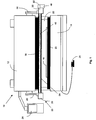
- the support arms 28 carry a light emitter 30 and a spatially resolving Receiver 32, which are parts of an optoelectronic safety device 33.
- the light emitter 30 has a light source 36, for example a laser diode and a transmission optics 38, which expands the transmitted light to a parallel light beam 34.
- the receiver 32 is constructed like a camera and has a spatially resolving two-dimensional light receiver 40, for example a CMOS matrix receiver, which is acted upon by the light beam 34.
- a receiving optics 42 the light is imaged onto the light receiver 40.
- An optical filter 44 whose passband is tuned to the wavelength of the light emitter 36, can filter ambient light, thus improving the signal-to-noise ratio.
- the parallel expanded light beam 34 traverses the opening gap 22 along the lower edge 18 of the upper tool 12.
- a volume-shaped protection region 46 defined by marginal rays 62 and 64.
- an evaluation device 48 is provided, which, e.g. be arranged on the receiver 32 or in the machine control 24 could. If an at least partial interruption of the light beam 34 within of the protection area 46 is present, as for example by an object 50, the This could be caused by the figure on the finger Locating light receiver 40 detected (Fig. 2).
- the evaluation device 48 conditions can be checked, whether the object is e.g. is a legal or Not. If in the evaluation 48 finally a danger of the Penetration of the object 50 is detected in the protection area 46 is a Switching signal triggered, for example, to stop the upper tool 12th As a result, an operator from injury by the upper tool 12th protected.
- the protection area 46 connects directly to the tool edge 18, the Transmitter 30 and the receiver 32 arranged such that a part of Tool edge 18 protrudes into the light beam 34.
- the Tool edge 18 is shown on the spatially resolving light receiver 40, but this mapping is recognized as acceptable in the evaluation unit 48. This can e.g. be realized by storing a reference image or the like.
- the light beam 34 is widened so that it Receiver optics 32 substantially fully illuminated. With it too when vibrations of the light receiver 40 is always taken, the cross section of the Light beam 34 at the location of the light receiver 32 is smaller than the light receiver 40th
- transmitter 30 and receiver 32 become one another aligned.
- a first adjustment aperture 52 is mounted in front of the transmitter 30 and a second adjustment aperture 54 in front of the receiver 32.
- the assembly takes place reproducible such that the Justageblenden 52 and 54 exactly in one desired manner to transmitter 30 and receiver 32 are aligned.
- the first Justageblende 52 has a small opening 56 through which a part of the Light beam 34 is transmitted and thus an adjustment light beam 58 with forms a small cross section which is parallel to the optical axis 60.
- the biggest Part of the light beam 34 is hidden, as shown by dashed line in FIG otherwise present edge beams 62 and 64 is indicated.
- the transmitter 30 is now aligned so that the adjustment beam 58 has an opening 66 the second adjustment plate 54 and into the receiving optics 42 of the receiver 32nd entry. Thus, the transmitter 30 is aligned with the receiver 32.
- the receiver 32 To align the receiver 32 to the transmitter 30 is in the Receiving optics occurred Justagestrahl 58 at an optical interface 68th in part reflected.
- the reflected part 69 encounters one in the second adjustment plate 54 arranged target 70, which is designed as a ground glass.
- target 70 On the Focusing screen 70 is a target target 76 marked so that by turning the receiver 32 in arrow directions 72 and 74 about two mutually perpendicular axes V and H. the receiver 32 is aligned so that the reflected portion 69 of the Justagestrahl 58 hits the target. Then the receiver is at least roughly Good judgment.
- the impact point 78 of the Justagelichtstrahls 58 detected on the spatial resolution light receiver 40 and a deviation dx or dy is determined from a target impact point 80.
- Fig. 7 is a view of the detector surface 84 of the spatially resolving Light receiver 40 shows.
- the target impact point 80 is by means of a cross shown.
- the deviations dx and dy are by means of an electronic Display 82 shown.
- the display 82 is a seven-segment display educated.
- the receiver 32 by further defined rotation in directions 72 and 74 are aligned until the Impact point 78 is on the target impact point 80.
- Fig. 5 shows the first adjustment aperture 54 in plan view.
- the Justageblende 54 still two slot openings 86 and 88 through which Light of the light beam 34 occurs, forming two auxiliary Justagelichtstrahlen. These are used for coarse alignment by eye as well as in above Reference to the adjustment beam 58 described.
- the auxiliary adjustment jets simplify the adjustment, as they due to their larger cross section due the slot openings 86 and 88 at the beginning of the adjustment when the Safety device is still out of alignment, better to find.
- the second adjustment aperture 54 also has two second slot openings 90 and 92, however, here the longitudinal directions of the slot openings 90 and 92 are perpendicular to the longitudinal directions of the first slot openings 86 and 88 lie. At about correct alignment of transmitter 30 and receiver 32 will then only approximate rectangular Detailquerschnit the auxiliary Justagestrahlen passed.
- auxiliary Justagestrahlen This also transmitted by the second adjustment aperture 54 part of the auxiliary Justagestrahlen has a special meaning for the fine adjustment by means of the Light receiver 40, as explained with reference to FIG. 7.
- reference numbers 94 and 96 is the impact point of the auxiliary alignment light beams.
- the auxiliary adjustment jets serve also easier to locate the impact points, which in the adjustment process only as Justification beams are detected when they are in a particular search area 98 the detector surface 84 are located.
- the corresponding impact points 78, 94 and 96 are measured by the light receiver 40 and the deviations dx, dy and the rotation dr are output on the display 82.
- the display 82 is designed as a seven-segment display, with which the deviations, or rather the directions of the deviations are very easy and pictorially representable and indeed according to the specifications of the following table
- two third Justageblenden 100 are provided by means of which the Safety device 33 can be aligned such that the light beam 34th runs exactly parallel to the tool edge 18.
- the two third adjustment covers 100 are identical and have as the first Justegablende 52 a Opening 156 for the central Justagelichtstrahl and two slot openings 186 and 188 for the auxiliary alignment beams.
- the Justageblenden 100 are at the Ends of the tool edge 18 mounted in a predetermined manner, e.g. magnetically attached.
- Fig. 8 shows the press brake 10 with the inventive safety system 33 with mounted first, second and third adjustment apertures 52, 54 and 100.
- the light beam 34 is accurate aligned parallel to the edge of the tool. Thereafter, the receiver 32 can be exact aligned as described above.
Landscapes
- Engineering & Computer Science (AREA)
- General Engineering & Computer Science (AREA)
- Physics & Mathematics (AREA)
- Life Sciences & Earth Sciences (AREA)
- General Life Sciences & Earth Sciences (AREA)
- General Physics & Mathematics (AREA)
- Geophysics (AREA)
- Mechanical Engineering (AREA)
- Presses And Accessory Devices Thereof (AREA)
- Bending Of Plates, Rods, And Pipes (AREA)
- Length Measuring Devices By Optical Means (AREA)
- Air Bags (AREA)
Abstract
Description
- Fig. 1
- eine schematische Frontansicht einer Biegepresse mit einer erfindungsgemäßen Sicherheitseinrichtung;
- Fig. 2
- eine schematische Darstellung der Sicherheitseinrichtung im Schnitt entlang deren optischer Achse;
- Fig. 3
- eine Ansicht wie Fig. 2 mit erster und zweiter Justageblende;
- Fig. 4, 5 und 6
- erste, zweite und dritte Justageblenden;
- Fig. 7
- eine schematische Ansicht eines Lichtempfängers der erfindungsgemäßen Sicherheitseinrichtung.
- Fig. 8
- eine Gesamtansicht wie Fig. 1 mit Justageblenden an der Sicherheitseinrichtung;

Claims (15)
- Verfahren zur Justage einer optoelektronischen Sicherheitseinrichtung (33) einer gefahrbringenden Maschine, wie Biegepresse (10) oder dergleichen, mit folgenden Verfahrensschritten:dadurch gekennzeichnet, dassErzeugen wenigstens eines Justagelichtstrahls (58) parallel aber außerhalb der optischen Achse (60) durch Positionieren einer ersten Justageblende (52) vor einem Lichtsender (30),Positionieren einer zweiten Justageblende (54) vor einem Empfänger (32),Ausrichten des Lichtsenders (30) derart, dass der Justagelichtstrahl (58) durch eine Öffnung (66) der zweiten Justageblende (54) hindurchtritt,Ausrichten des Empfängers (32) derart, dass der Justagelichtstrahl (58) einen Soll-Auftreffpunkt (80) trifft,der durch die Öffnung (66) der zweiten Justageblende (54) hindurchgetretene Justagelichtstrahl (58) teilreflektiert wird undder Empfänger (32) zunächst nach Augenmaß ausgerichtet wird, indem ein Auftreffpunkt des reflektierten Teils (69) des Justagelichtstrahls (58) sichtbar eine Zielscheibe (70) trifft und auf ein Soll-Ziel (76) ausgerichtet wird unddass danach der Auftreffpunkt (78) des nicht reflektierten Teils des Justagestrahls (58) auf dem Empfänger (40) elektronisch bestimmt wird und mit einem Soll-Auftreffpunkt (80) auf dem Empfänger (40) in einer Auswerteeinheit (48) verglichen wird.
- Verfahren nach Anspruch 1, dadurch gekennzeichnet, dass der Justagelichtstrahl (58) einen möglichst kleinen Strahlquerschnitt aufweist, aber dennoch auf der Zielscheibe (70) sichtbar ist.
- Verfahren nach Anspruch 1 oder 2, dadurch gekennzeichnet, dass der Justagelichtstrahl (58) an einer optischen Grenzfläche (68) in einer Empfangsoptik (42) teilreflektiert wird.
- Verfahren nach einem der vorhergehenden Ansprüche, dadurch gekennzeichnet, dass die Abweichung (dx, dy) des Auftreffpunktes (78) des nicht reflektierten Teils des Justagestrahls (58) auf dem Lichtempfänger (40) vom Soll-Auftreffpunkt (80) an einer elektronischen Anzeige (82) angezeigt wird.
- Verfahren nach Anspruch 4, dadurch gekennzeichnet, dass nur die Richtung der Abweichung mit Symbolen angezeigt wird.
- Verfahren nach einem der vorhergehenden Ansprüche, dadurch gekennzeichnet, dass der Justagelichtstrahl (58) parallel zu einer die Gefahr bringenden Werkzeugkante (18) ausgerichtet wird.
- Verfahren nach Anspruch 6, dadurch gekennzeichnet, dass dritte Justageblenden (100) an beiden Enden der Werkzeugkante (18) ausgerichtet angesetzt werden und der Justagelichtstrahl (58) derart ausgerichtet wird, dass er Öffnungen (156) beider dritten Justageblenden (100) durchsetzt.
- Verfahren nach einem der vorhergehenden Ansprüche, dadurch gekennzeichnet, dass zwei zusätzliche Hilfs-Justagelichtstrahlen parallel zum ersten erzeugt werden.
- Verfahren nach einem der vorhergehenden Ansprüche, dadurch gekennzeichnet, dass mit Hilfe der zwei zusätzlichen Hilfs-Justagelichtstrahlen Sender (30) und Empfänger (32) in den jeweiligen Phasen des Justierprozesses vorjustiert werden.
- Optoelektronische Sicherheitseinrichtung für eine Maschine, insbesondere eine Biegepresse (10), mit einem Lichtsender (30) mit Sendeoptik (38) zum Ausleuchten eines Schutzbereichs (46) mit parallelem Licht, einem zweidimensionalen Lichtempfänger (40) mit Empfangsoptik (42, 44) zum Empfangen des Sendelichtes, und mit einer Auswerte- und Steuereinrichtung (48) zum Erzeugen eines Schaltsignals, z. B. zum Anhalten eines ersten Werkzeugteils (12), wenn ein Eingriff in den Schutzbereich (46) durch den Lichtempfänger (40) erkannt wurde und wobei der Schutzbereich (46) parallel zu einer Werkzeugkante (18) des ersten Werkzeugs (12) verläuft, weshalb der Lichtsender (30) und der Lichtempfänger (40) an den Enden des ersten Werkzeugs (12) montiert sind, mit einer ersten Justageblende (52) zum Aufsetzen auf den Lichtsender (30), zum Erzeugen eines Justagelichtstrahls (58) und mit einer zweiten Justageblende (54) zum Aufsetzen auf den Lichtempfänger (32), zum Durchlassen des Justagelichtstrahls (58) in die Empfangsoptik (42, 44), dadurch gekennzeichnet, dass in der Empfangsoptik (42, 44) eine optische Grenzfläche (68) vorgesehen ist, zur Teilreflektion des Justagestrahls (58) und auf der zweiten Justageblende (54) eine Zielscheibe (70) angeordnet ist zur optischen Anzeige des reflektierten Teils (69) des Justagestrahls (58) zur Vorjustage und dass die Auswerteeinheit Mittel aufweist, zum Erkennen und Ausgeben einer Abweichung (dx, dy) eines Auftreffpunktes (78) des nichtreflektierten Teils des Justagelichtstrahls (58) von einem Soll-Auftreffpunkt (80).
- Sicherheitseinrichtung nach Anspruch 10, dadurch gekennzeichnet, dass die Zielscheibe eine Mattscheibe (70) ist.
- Sicherheitseinrichtung nach einem der vorhergehenden Ansprüche 10 bis 11, dadurch gekennzeichnet, dass zwei weitere Hilfs-Justagelichtstrahlen mittels der ersten Justageblende (52) erzeugbar sind.
- Sicherheitseinrichtung nach einem der vorhergehenden Ansprüche 10 bis 12, dadurch gekennzeichnet, dass zwei dritte, identisch ausgebildete Justageblenden (100) vorgesehen sind, zur Ausrichtung des Lichtstrahls parallel zu der Werkzeugkante (18).
- Sicherheitseinrichtung nach einem der vorhergehenden Ansprüche 10 bis 13, dadurch gekennzeichnet, dass eine elektronische Anzeige (82) vorgesehen ist, zur Anzeige der Richtung der Abweichung des Auftreffpunktes (78) des Justierstrahls (58) vom Soll-Auftreffpunkt (80).
- Sicherheitseinrichtung nach Anspruch 14, dadurch gekennzeichnet, dass die Anzeige (82) eine Sieben-Segment-Anzeige ist.
Applications Claiming Priority (2)
| Application Number | Priority Date | Filing Date | Title |
|---|---|---|---|
| DE102004017285A DE102004017285A1 (de) | 2004-04-08 | 2004-04-08 | Verfahren zur Justage einer Sicherheitseinrichtung und optoelektronische Sicherheitseinrichtung |
| DE102004017285 | 2004-04-08 |
Publications (2)
| Publication Number | Publication Date |
|---|---|
| EP1589355A1 true EP1589355A1 (de) | 2005-10-26 |
| EP1589355B1 EP1589355B1 (de) | 2007-03-28 |
Family
ID=34933790
Family Applications (1)
| Application Number | Title | Priority Date | Filing Date |
|---|---|---|---|
| EP05003350A Expired - Lifetime EP1589355B1 (de) | 2004-04-08 | 2005-02-17 | Verfahren zur Justage einer Sicherheitseinrichtung und optoelektronische Sicherheitseinrichtung |
Country Status (3)
| Country | Link |
|---|---|
| EP (1) | EP1589355B1 (de) |
| AT (1) | ATE358283T1 (de) |
| DE (2) | DE102004017285A1 (de) |
Cited By (3)
| Publication number | Priority date | Publication date | Assignee | Title |
|---|---|---|---|---|
| DE102006056648A1 (de) * | 2006-11-29 | 2008-06-05 | Sick Ag | Opto-elektronischer Sensor |
| WO2008092588A1 (de) * | 2007-01-30 | 2008-08-07 | Pilz Gmbh & Co. Kg | Sicherheitseinrichtung für eine maschine |
| US20150314351A1 (en) * | 2014-04-29 | 2015-11-05 | Schechtl Maschinenbau Gmbh | Unknown |
Families Citing this family (1)
| Publication number | Priority date | Publication date | Assignee | Title |
|---|---|---|---|---|
| DE102013205456B4 (de) * | 2013-03-27 | 2021-05-06 | Carl Zeiss Industrielle Messtechnik Gmbh | Ausrichtelement für einen optischen Abstandssensor, optische Sensoranordnung und Verfahren zur Ausrichtung eines optischen Abstandssensors |
Citations (4)
| Publication number | Priority date | Publication date | Assignee | Title |
|---|---|---|---|---|
| US6316763B1 (en) * | 1996-01-05 | 2001-11-13 | Robert Meredith Appleyard | Optical safety device for mounting on a moving member |
| EP1246148A2 (de) * | 2001-03-26 | 2002-10-02 | Sick Ag | Vorrichtung zur Überwachung eines Schutzfeldes |
| US20030024421A1 (en) * | 2001-08-03 | 2003-02-06 | Sick Ag | Method of controlling a light grid |
| WO2003104711A1 (en) * | 2002-06-11 | 2003-12-18 | Kevin Stephen Davies | A safety system |
Family Cites Families (3)
| Publication number | Priority date | Publication date | Assignee | Title |
|---|---|---|---|---|
| DE19717299C2 (de) * | 1996-08-20 | 2002-03-14 | Fiessler Elektronik Ohg | Schutzeinrichtung für Maschinen,insbesondere für Abkantpressen, Schneidemaschinen oder Stanzmaschinen |
| DE10106755B4 (de) * | 2001-02-14 | 2006-05-24 | Leuze Electronic Gmbh & Co Kg | Optoelekronische Vorrichtung |
| DE20317622U1 (de) * | 2003-11-14 | 2004-02-12 | Sick Ag | Lichtschranke |
-
2004
- 2004-04-08 DE DE102004017285A patent/DE102004017285A1/de not_active Withdrawn
-
2005
- 2005-02-17 EP EP05003350A patent/EP1589355B1/de not_active Expired - Lifetime
- 2005-02-17 DE DE502005000511T patent/DE502005000511D1/de not_active Expired - Lifetime
- 2005-02-17 AT AT05003350T patent/ATE358283T1/de not_active IP Right Cessation
Patent Citations (4)
| Publication number | Priority date | Publication date | Assignee | Title |
|---|---|---|---|---|
| US6316763B1 (en) * | 1996-01-05 | 2001-11-13 | Robert Meredith Appleyard | Optical safety device for mounting on a moving member |
| EP1246148A2 (de) * | 2001-03-26 | 2002-10-02 | Sick Ag | Vorrichtung zur Überwachung eines Schutzfeldes |
| US20030024421A1 (en) * | 2001-08-03 | 2003-02-06 | Sick Ag | Method of controlling a light grid |
| WO2003104711A1 (en) * | 2002-06-11 | 2003-12-18 | Kevin Stephen Davies | A safety system |
Cited By (7)
| Publication number | Priority date | Publication date | Assignee | Title |
|---|---|---|---|---|
| DE102006056648A1 (de) * | 2006-11-29 | 2008-06-05 | Sick Ag | Opto-elektronischer Sensor |
| US7667185B2 (en) | 2006-11-29 | 2010-02-23 | Sick Ag | Optoelectronic sensor |
| WO2008092588A1 (de) * | 2007-01-30 | 2008-08-07 | Pilz Gmbh & Co. Kg | Sicherheitseinrichtung für eine maschine |
| US8119964B2 (en) | 2007-01-30 | 2012-02-21 | Pilz Gmbh & Co. Kg | Safety device for a press brake type of machine |
| CN101652598B (zh) * | 2007-01-30 | 2013-01-30 | 皮尔茨公司 | 机器的安全设备 |
| US20150314351A1 (en) * | 2014-04-29 | 2015-11-05 | Schechtl Maschinenbau Gmbh | Unknown |
| US10022761B2 (en) * | 2014-04-29 | 2018-07-17 | Schechtl Maschinenbau Gmbh | Forming device for plastically forming a component |
Also Published As
| Publication number | Publication date |
|---|---|
| DE102004017285A1 (de) | 2005-10-27 |
| DE502005000511D1 (de) | 2007-05-10 |
| EP1589355B1 (de) | 2007-03-28 |
| ATE358283T1 (de) | 2007-04-15 |
Similar Documents
| Publication | Publication Date | Title |
|---|---|---|
| EP1589279B9 (de) | Verfahren zur Sicherung einer Werkzeugmaschine und optoelektronischer Sensor zur Durchführung eines solchen Verfahrens | |
| EP1993081B1 (de) | Optoelektronische Sensoranordnung und Verfahren zur Überwachung eines Überwachungsbereiches | |
| DE19510148A1 (de) | Symbollesevorrichtung mit Fixfokus-Suchstrahl | |
| EP1394504B1 (de) | Lichtgitter | |
| DE10327388B4 (de) | Schutzeinrichtung | |
| EP1734383B1 (de) | Lichtgitter zur Vermessung eines Objekts | |
| EP1246148B1 (de) | Vorrichtung zur Überwachung eines Schutzfeldes | |
| DE10247136A1 (de) | Schutzvorrichtung zur Überwachung eines mit einem Bauteil zu bewegenden Schutzbereichs | |
| EP1437542B1 (de) | Lichtgitter und Verfahren zu dessen Justierung | |
| EP1566588B1 (de) | Lichtschranke oder Lichtgitter mit Ausrichthilfe | |
| DE102006050189B4 (de) | Lichtgitter mit Ausrichtlichtsender und Verfahren zum Ausrichten | |
| EP1589355B1 (de) | Verfahren zur Justage einer Sicherheitseinrichtung und optoelektronische Sicherheitseinrichtung | |
| EP1531345B1 (de) | Justierhilfe für Lichtschranken | |
| DE10335207A1 (de) | Visiereinrichtung und Vorrichtung mit einer kontaktlos oder kontaktbehaftet einsetzbaren Mess-, Arbeits- und/oder Wirkeinrichtung | |
| EP1748246B1 (de) | Schutzeinrichtung für Maschinen, wie Abkantpressen, Schneidemaschinen, Stanzmaschinen oder dergleichen | |
| EP2147729B1 (de) | Umformeinrichtung | |
| EP1746335B1 (de) | Verfahren zur Sicherung einer Biegepresse und optoelektronischer Sensor zur Durchführung eines solchen Verfahrens | |
| EP3799997A1 (de) | Detektionsanordnung, autofokusvorrichtung und fokussierverfahren | |
| DE102006053359B4 (de) | Optoelektronische Sensoranordnung und Verfahren zum Justieren einer optoelektronischen Sensoranordnung | |
| DE102009009386B4 (de) | Optoelektronische Vorrichtung | |
| DE102005035286A1 (de) | Schutzeinrichtung für Maschinen, wie Abkantpressen, Schneidemaschinen, Stanzmaschinen oder dergleichen | |
| DE202007009722U1 (de) | Lichtschnittsensor mit Beleuchtungslinie und zur Frontscheibe beabstandetem Lichtquellpunkt | |
| DE202007002078U1 (de) | Blende | |
| EP2690398A1 (de) | Vorrichtung zum Ermitteln der Lage von mechanischen Elementen | |
| DE102004025751A1 (de) | Justiervorrichtung insbesondere für Lichtschranken oder Lichtgitter und Verfahren zur Justage |
Legal Events
| Date | Code | Title | Description |
|---|---|---|---|
| PUAI | Public reference made under article 153(3) epc to a published international application that has entered the european phase |
Free format text: ORIGINAL CODE: 0009012 |
|
| AK | Designated contracting states |
Kind code of ref document: A1 Designated state(s): AT BE BG CH CY CZ DE DK EE ES FI FR GB GR HU IE IS IT LI LT LU MC NL PL PT RO SE SI SK TR |
|
| AX | Request for extension of the european patent |
Extension state: AL BA HR LV MK YU |
|
| 17P | Request for examination filed |
Effective date: 20051210 |
|
| AKX | Designation fees paid |
Designated state(s): AT BE BG CH CY CZ DE DK EE ES FI FR GB GR HU IE IS IT LI LT LU MC NL PL PT RO SE SI SK TR |
|
| GRAP | Despatch of communication of intention to grant a patent |
Free format text: ORIGINAL CODE: EPIDOSNIGR1 |
|
| RAP1 | Party data changed (applicant data changed or rights of an application transferred) |
Owner name: SICK AG |
|
| GRAS | Grant fee paid |
Free format text: ORIGINAL CODE: EPIDOSNIGR3 |
|
| GRAA | (expected) grant |
Free format text: ORIGINAL CODE: 0009210 |
|
| AK | Designated contracting states |
Kind code of ref document: B1 Designated state(s): AT BE BG CH CY CZ DE DK EE ES FI FR GB GR HU IE IS IT LI LT LU MC NL PL PT RO SE SI SK TR |
|
| PG25 | Lapsed in a contracting state [announced via postgrant information from national office to epo] |
Ref country code: PL Free format text: LAPSE BECAUSE OF FAILURE TO SUBMIT A TRANSLATION OF THE DESCRIPTION OR TO PAY THE FEE WITHIN THE PRESCRIBED TIME-LIMIT Effective date: 20070328 Ref country code: FI Free format text: LAPSE BECAUSE OF FAILURE TO SUBMIT A TRANSLATION OF THE DESCRIPTION OR TO PAY THE FEE WITHIN THE PRESCRIBED TIME-LIMIT Effective date: 20070328 Ref country code: SI Free format text: LAPSE BECAUSE OF FAILURE TO SUBMIT A TRANSLATION OF THE DESCRIPTION OR TO PAY THE FEE WITHIN THE PRESCRIBED TIME-LIMIT Effective date: 20070328 Ref country code: NL Free format text: LAPSE BECAUSE OF FAILURE TO SUBMIT A TRANSLATION OF THE DESCRIPTION OR TO PAY THE FEE WITHIN THE PRESCRIBED TIME-LIMIT Effective date: 20070328 |
|
| REG | Reference to a national code |
Ref country code: GB Ref legal event code: FG4D Free format text: NOT ENGLISH |
|
| REG | Reference to a national code |
Ref country code: CH Ref legal event code: EP |
|
| REF | Corresponds to: |
Ref document number: 502005000511 Country of ref document: DE Date of ref document: 20070510 Kind code of ref document: P |
|
| REG | Reference to a national code |
Ref country code: IE Ref legal event code: FG4D Free format text: LANGUAGE OF EP DOCUMENT: GERMAN |
|
| PG25 | Lapsed in a contracting state [announced via postgrant information from national office to epo] |
Ref country code: SE Free format text: LAPSE BECAUSE OF FAILURE TO SUBMIT A TRANSLATION OF THE DESCRIPTION OR TO PAY THE FEE WITHIN THE PRESCRIBED TIME-LIMIT Effective date: 20070628 |
|
| PG25 | Lapsed in a contracting state [announced via postgrant information from national office to epo] |
Ref country code: ES Free format text: LAPSE BECAUSE OF FAILURE TO SUBMIT A TRANSLATION OF THE DESCRIPTION OR TO PAY THE FEE WITHIN THE PRESCRIBED TIME-LIMIT Effective date: 20070709 |
|
| PG25 | Lapsed in a contracting state [announced via postgrant information from national office to epo] |
Ref country code: IS Free format text: LAPSE BECAUSE OF FAILURE TO SUBMIT A TRANSLATION OF THE DESCRIPTION OR TO PAY THE FEE WITHIN THE PRESCRIBED TIME-LIMIT Effective date: 20070728 |
|
| PG25 | Lapsed in a contracting state [announced via postgrant information from national office to epo] |
Ref country code: PT Free format text: LAPSE BECAUSE OF FAILURE TO SUBMIT A TRANSLATION OF THE DESCRIPTION OR TO PAY THE FEE WITHIN THE PRESCRIBED TIME-LIMIT Effective date: 20070828 |
|
| NLV1 | Nl: lapsed or annulled due to failure to fulfill the requirements of art. 29p and 29m of the patents act | ||
| GBV | Gb: ep patent (uk) treated as always having been void in accordance with gb section 77(7)/1977 [no translation filed] |
Effective date: 20070328 |
|
| EN | Fr: translation not filed | ||
| PG25 | Lapsed in a contracting state [announced via postgrant information from national office to epo] |
Ref country code: SK Free format text: LAPSE BECAUSE OF FAILURE TO SUBMIT A TRANSLATION OF THE DESCRIPTION OR TO PAY THE FEE WITHIN THE PRESCRIBED TIME-LIMIT Effective date: 20070328 |
|
| REG | Reference to a national code |
Ref country code: IE Ref legal event code: FD4D |
|
| PG25 | Lapsed in a contracting state [announced via postgrant information from national office to epo] |
Ref country code: CZ Free format text: LAPSE BECAUSE OF FAILURE TO SUBMIT A TRANSLATION OF THE DESCRIPTION OR TO PAY THE FEE WITHIN THE PRESCRIBED TIME-LIMIT Effective date: 20070328 Ref country code: RO Free format text: LAPSE BECAUSE OF FAILURE TO SUBMIT A TRANSLATION OF THE DESCRIPTION OR TO PAY THE FEE WITHIN THE PRESCRIBED TIME-LIMIT Effective date: 20070328 |
|
| PG25 | Lapsed in a contracting state [announced via postgrant information from national office to epo] |
Ref country code: IE Free format text: LAPSE BECAUSE OF FAILURE TO SUBMIT A TRANSLATION OF THE DESCRIPTION OR TO PAY THE FEE WITHIN THE PRESCRIBED TIME-LIMIT Effective date: 20070328 Ref country code: DK Free format text: LAPSE BECAUSE OF FAILURE TO SUBMIT A TRANSLATION OF THE DESCRIPTION OR TO PAY THE FEE WITHIN THE PRESCRIBED TIME-LIMIT Effective date: 20070328 |
|
| PLBE | No opposition filed within time limit |
Free format text: ORIGINAL CODE: 0009261 |
|
| STAA | Information on the status of an ep patent application or granted ep patent |
Free format text: STATUS: NO OPPOSITION FILED WITHIN TIME LIMIT |
|
| PG25 | Lapsed in a contracting state [announced via postgrant information from national office to epo] |
Ref country code: LT Free format text: LAPSE BECAUSE OF FAILURE TO SUBMIT A TRANSLATION OF THE DESCRIPTION OR TO PAY THE FEE WITHIN THE PRESCRIBED TIME-LIMIT Effective date: 20070328 |
|
| 26N | No opposition filed |
Effective date: 20080102 |
|
| PG25 | Lapsed in a contracting state [announced via postgrant information from national office to epo] |
Ref country code: GB Free format text: LAPSE BECAUSE OF FAILURE TO SUBMIT A TRANSLATION OF THE DESCRIPTION OR TO PAY THE FEE WITHIN THE PRESCRIBED TIME-LIMIT Effective date: 20070328 Ref country code: FR Free format text: LAPSE BECAUSE OF FAILURE TO SUBMIT A TRANSLATION OF THE DESCRIPTION OR TO PAY THE FEE WITHIN THE PRESCRIBED TIME-LIMIT Effective date: 20071116 Ref country code: GR Free format text: LAPSE BECAUSE OF FAILURE TO SUBMIT A TRANSLATION OF THE DESCRIPTION OR TO PAY THE FEE WITHIN THE PRESCRIBED TIME-LIMIT Effective date: 20070629 |
|
| BERE | Be: lapsed |
Owner name: SICK A.G. Effective date: 20080228 |
|
| PG25 | Lapsed in a contracting state [announced via postgrant information from national office to epo] |
Ref country code: MC Free format text: LAPSE BECAUSE OF NON-PAYMENT OF DUE FEES Effective date: 20080228 |
|
| PG25 | Lapsed in a contracting state [announced via postgrant information from national office to epo] |
Ref country code: FR Free format text: LAPSE BECAUSE OF FAILURE TO SUBMIT A TRANSLATION OF THE DESCRIPTION OR TO PAY THE FEE WITHIN THE PRESCRIBED TIME-LIMIT Effective date: 20070328 |
|
| PG25 | Lapsed in a contracting state [announced via postgrant information from national office to epo] |
Ref country code: EE Free format text: LAPSE BECAUSE OF FAILURE TO SUBMIT A TRANSLATION OF THE DESCRIPTION OR TO PAY THE FEE WITHIN THE PRESCRIBED TIME-LIMIT Effective date: 20070328 |
|
| PG25 | Lapsed in a contracting state [announced via postgrant information from national office to epo] |
Ref country code: BE Free format text: LAPSE BECAUSE OF NON-PAYMENT OF DUE FEES Effective date: 20080228 |
|
| PG25 | Lapsed in a contracting state [announced via postgrant information from national office to epo] |
Ref country code: CY Free format text: LAPSE BECAUSE OF FAILURE TO SUBMIT A TRANSLATION OF THE DESCRIPTION OR TO PAY THE FEE WITHIN THE PRESCRIBED TIME-LIMIT Effective date: 20070328 |
|
| PG25 | Lapsed in a contracting state [announced via postgrant information from national office to epo] |
Ref country code: BG Free format text: LAPSE BECAUSE OF FAILURE TO SUBMIT A TRANSLATION OF THE DESCRIPTION OR TO PAY THE FEE WITHIN THE PRESCRIBED TIME-LIMIT Effective date: 20070628 |
|
| REG | Reference to a national code |
Ref country code: CH Ref legal event code: PL |
|
| PG25 | Lapsed in a contracting state [announced via postgrant information from national office to epo] |
Ref country code: CH Free format text: LAPSE BECAUSE OF NON-PAYMENT OF DUE FEES Effective date: 20090228 Ref country code: LI Free format text: LAPSE BECAUSE OF NON-PAYMENT OF DUE FEES Effective date: 20090228 |
|
| PGFP | Annual fee paid to national office [announced via postgrant information from national office to epo] |
Ref country code: IT Payment date: 20100223 Year of fee payment: 6 |
|
| PGFP | Annual fee paid to national office [announced via postgrant information from national office to epo] |
Ref country code: AT Payment date: 20100217 Year of fee payment: 6 |
|
| PG25 | Lapsed in a contracting state [announced via postgrant information from national office to epo] |
Ref country code: HU Free format text: LAPSE BECAUSE OF FAILURE TO SUBMIT A TRANSLATION OF THE DESCRIPTION OR TO PAY THE FEE WITHIN THE PRESCRIBED TIME-LIMIT Effective date: 20070929 Ref country code: LU Free format text: LAPSE BECAUSE OF NON-PAYMENT OF DUE FEES Effective date: 20080217 |
|
| PG25 | Lapsed in a contracting state [announced via postgrant information from national office to epo] |
Ref country code: AT Free format text: LAPSE BECAUSE OF NON-PAYMENT OF DUE FEES Effective date: 20110217 |
|
| PG25 | Lapsed in a contracting state [announced via postgrant information from national office to epo] |
Ref country code: IT Free format text: LAPSE BECAUSE OF NON-PAYMENT OF DUE FEES Effective date: 20110217 |
|
| PGFP | Annual fee paid to national office [announced via postgrant information from national office to epo] |
Ref country code: TR Payment date: 20120215 Year of fee payment: 8 |
|
| PGFP | Annual fee paid to national office [announced via postgrant information from national office to epo] |
Ref country code: DE Payment date: 20130220 Year of fee payment: 9 |
|
| REG | Reference to a national code |
Ref country code: DE Ref legal event code: R119 Ref document number: 502005000511 Country of ref document: DE |
|
| REG | Reference to a national code |
Ref country code: DE Ref legal event code: R119 Ref document number: 502005000511 Country of ref document: DE Effective date: 20140902 |
|
| PG25 | Lapsed in a contracting state [announced via postgrant information from national office to epo] |
Ref country code: DE Free format text: LAPSE BECAUSE OF NON-PAYMENT OF DUE FEES Effective date: 20140902 |
|
| PG25 | Lapsed in a contracting state [announced via postgrant information from national office to epo] |
Ref country code: TR Free format text: LAPSE BECAUSE OF NON-PAYMENT OF DUE FEES Effective date: 20140217 |