EP1586528A1 - Stütze - Google Patents
Stütze Download PDFInfo
- Publication number
- EP1586528A1 EP1586528A1 EP04468007A EP04468007A EP1586528A1 EP 1586528 A1 EP1586528 A1 EP 1586528A1 EP 04468007 A EP04468007 A EP 04468007A EP 04468007 A EP04468007 A EP 04468007A EP 1586528 A1 EP1586528 A1 EP 1586528A1
- Authority
- EP
- European Patent Office
- Prior art keywords
- pivot axis
- support
- connecting rod
- rod
- projection
- Prior art date
- Legal status (The legal status is an assumption and is not a legal conclusion. Google has not performed a legal analysis and makes no representation as to the accuracy of the status listed.)
- Granted
Links
Images

Classifications
-
- B—PERFORMING OPERATIONS; TRANSPORTING
- B66—HOISTING; LIFTING; HAULING
- B66C—CRANES; LOAD-ENGAGING ELEMENTS OR DEVICES FOR CRANES, CAPSTANS, WINCHES, OR TACKLES
- B66C23/00—Cranes comprising essentially a beam, boom, or triangular structure acting as a cantilever and mounted for translatory of swinging movements in vertical or horizontal planes or a combination of such movements, e.g. jib-cranes, derricks, tower cranes
- B66C23/62—Constructional features or details
- B66C23/72—Counterweights or supports for balancing lifting couples
- B66C23/78—Supports, e.g. outriggers, for mobile cranes
- B66C23/80—Supports, e.g. outriggers, for mobile cranes hydraulically actuated
-
- B—PERFORMING OPERATIONS; TRANSPORTING
- B60—VEHICLES IN GENERAL
- B60S—SERVICING, CLEANING, REPAIRING, SUPPORTING, LIFTING, OR MANOEUVRING OF VEHICLES, NOT OTHERWISE PROVIDED FOR
- B60S9/00—Ground-engaging vehicle fittings for supporting, lifting, or manoeuvring the vehicle, wholly or in part, e.g. built-in jacks
- B60S9/02—Ground-engaging vehicle fittings for supporting, lifting, or manoeuvring the vehicle, wholly or in part, e.g. built-in jacks for only lifting or supporting
- B60S9/10—Ground-engaging vehicle fittings for supporting, lifting, or manoeuvring the vehicle, wholly or in part, e.g. built-in jacks for only lifting or supporting by fluid pressure
- B60S9/12—Ground-engaging vehicle fittings for supporting, lifting, or manoeuvring the vehicle, wholly or in part, e.g. built-in jacks for only lifting or supporting by fluid pressure of telescopic type
Definitions
- the invention relates to a support for supporting and / or creation the stability of a working facility, e.g. B. a mounted on a commercial vehicle Crane, during its commissioning, being used to pivot the prop a transport to a working position and vice versa on a knee joint based hinge mechanisms are provided.
- a working facility e.g. B. a mounted on a commercial vehicle Crane
- the support disclosed therein is composed of an outer tubular guide part and a column-like standing part guided therein.
- the standing part has a bottom plate and in its vicinity a pressure cylinder arranged outside the guide and standing part substantially parallel thereto is bound thereto.
- the composite of the leadership and standing part and the impression cylinder structural unit is in use in a vertical plane about a horizontal axis, which is located on a horizontally extendable crane girder, pivotable from the crane and can in two end positions, in the given case in the vertical and an outwardly pivoted position, be locked.
- a pair of rods is incorporated between said horizontally extendable crane girder and the lower end portion of said guide member forming a knee joint.
- the support is pivoted out of the crane at the very extended knee joint, its position is blocked and the hydraulic piston / cylinder unit is pulled apart, while pivoted in the folded knee joint into the crane, the position also blocked and the hydraulic piston / cylinder Unit is pulled together.
- the set goal is inventively achieved in that a journal a horizontal crane crossmember and an eye bearing of a printing cylinder of the support Create a (first) pivot axis of the support against the crane crossmember. At a Front surface of said bearing pin is fixed a projection disc. Two Fixed clamps are on a lateral surface of the hydraulic cylinder fixed and in between a stationary guide rod is inserted, whereupon a Slider is attached. An axially guided handlebar is at one of its ends tied the slider while her other end is free.
- the mentioned projection disk is with reference to the lateral surface of the hydraulic cylinder is tangential and has reference on the cylinder one to one side facing projection and one to the other Side facing lateral support surface on.
- the relevant projection disc which is a fixed Element acts is a key element of the power transmission of the support the crane cross arm and the pivoting of the support.
- crank rod is hinged at one end to the projection, which forms with her a (second) pivot axis of the connecting rod.
- a coupling rod is at one end to those located at the projection disc Clamp hinged, with her a (third) pivot axis of the coupling rod forms.
- One end of a connecting rod is connected to this articulated connection of the crank and Coupled coupling rod, so that the said third pivot axis and a first Swivel axis of the connecting rod is.
- the other end of the connecting rod is hinged to the slider, which with her forms a (fifth) pivot axis, which is a second pivot axis of the connecting rod.
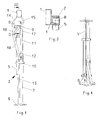
- a horizontal, stationary or extendable crane cross 1 has According to the invention a bearing pin 2.
- a pressure cylinder 3 of the support according to the invention has one with a 4 eye bearing provided hydraulic cylinder 5 and one with a foot 6th provided piston rod 7.
- the bearing pin 2 and the eye bearing 4 provide a pivot axis A of Support against the crane cross 1 ago.
- a projection disc 8 (a stationary element), which solves two essential tasks; first, it is a security against the solution of the structural Bearing / eye bearing pair 2, 4, and second, it is a (explained in more detail below) key connection between the crane cross 1 and the swiveling prop.
- Two stationary clamps 9, 10 are on a lateral surface of the fixed hydraulic cylinder 5: a first at the end at the Projection 8 and a second at the other end of the mentioned Lateral surface.
- a stationary guide rod 11 is between the clamping discs used parallel to the lateral surface of the hydraulic cylinder 5.
- a slider 12 is placed on the guide rod 11.
- a parallel to the piston rod 7 arranged by the clamp 10th guided handlebar 13 is connected at one of its ends to the slider 12, while her other end is free.
- the projection disc 8 is with respect to the lateral surface of the hydraulic Cylinder 5 is set tangentially and has one with respect to the cylinder 5 for a Side facing projection 14 and a side facing towards the other side Support surface 15 on.
- it is a support for the pairwise (left / right) compositions; therefore is the projection disc 8 per se for a left and a right support uniform designed (the projection 14 is directed at a support in one, in the other in the other direction), which causes the projection disc 8 in the illustrated embodiment has a total of two support surfaces 15.
- a crank rod 16 is hinged at one end to the projection 14, which with her forms a pivot axis B of the connecting rod 16.
- a coupling rod 17 is hinged at one end to the clamp 9, with her a pivot axis C of the coupling rod 17 forms.
- the other end of the connecting rod 16 and the other end of the connecting rod 17 are hinged together, so that a pivot axis D is present.
- One end of a connecting rod 18 is connected to the articulated connection of the crank 16 and coupling rod 17 hinged, so that the pivot axis D and a first Pivot axis of the connecting rod 18 is.
- the other end of the connecting rod 18 is hinged to the slider 12, which with her a pivot axis E forms, which is a second pivot axis of the connecting rod 18th is.
- FIG. 4 A possible condition (the support was nearly 180 ° upwards pivoted) is shown in FIG. 4; Vertical V is for illustrative orientation located. It is from FIG. 4 clearly shows that the connecting rod 18 in a upper end position of the support on the lateral support surface 15 is placed.
- the lowering of the support begins with the extension of the piston rod 7 under Participation of the gravity of the support. If gravity alone at the beginning is not sufficient, a repulsion spring means (not shown) may be provided.
- the aim of the invention is thus optimally achieved.
Landscapes
- Engineering & Computer Science (AREA)
- Mechanical Engineering (AREA)
- Physics & Mathematics (AREA)
- Fluid Mechanics (AREA)
- Jib Cranes (AREA)
- Pivots And Pivotal Connections (AREA)
- Forklifts And Lifting Vehicles (AREA)
- Pharmaceuticals Containing Other Organic And Inorganic Compounds (AREA)
Abstract
Description
- FIG. 1
- einen Aufriss (in Richtung eines Seitenblickes eines hier nicht gezeigten Fahrzeugs) einer erfindungsgemäßen Stütze in senkrecht nach unten gerichteter (Arbeits-) Stellung,
- FIG. 2
- einen Seitenriss (in einer Fahrtrichtung des Fahrzeugs) der Stütze der FIG. 1,
- FIG. 3
- den Schnitt III-III der FIG. 1, und
- FIG. 4
- die Stütze der FIG. 1 in einer praktisch senkrecht nach oben weisenden (Transport-) Stellung.
Claims (7)
- Eine Stütze zum Unterstützen oder/und zur Schaffung der Stabilität einer Arbeitseinrichtung, z. B. eines an einem Nutzfahrzeug montierten Kranes, während ihrer/seiner Inbetriebsetzung, wobei zum Schwenken der Stütze aus einer Transport- in eine Arbeitsstellung und umgekehrt auf einem Kniegelenk basierende Gelenkmechanismen vorgesehen sind, dadurch gekennzeichnet, dass ein Lagerzapfen (2) einer waagerechten Krantraverse (1) und ein Augenlager (4) eines Druckzylinders (3) der Stütze eine Schwenkachse (A) der Stütze gegenüber der Krantraverse (1) herstellen, dass an einer Frontfläche des Lagerzapfens (2) eine Vorsprungscheibe (8) festgesetzt ist, dass zwei ortsfeste Klemmschellen (9, 10) an einer Mantelfläche des hydraulischen Zylinders (5) festgesetzt sind und dazwischen eine ortsfeste Führungsstange (11) eingesetzt ist, worauf ein Schieber (12) aufgesetzt ist, und dass eine axial geführte Lenkstange (13) mit einem ihrer Enden an den Schieber (12) gebunden ist, während ihr anderes Ende frei ist.
- Die Stütze nach Anspruch 1, dadurch gekennzeichnet, dass die Vorsprungscheibe (8) mit Bezug auf die Mantelfläche des hydraulischen Zylinders (5) tangential gestellt ist und mit Bezug auf den Zylinder (5) einen zur einen Seite hin weisenden Vorsprung (14) und eine zur anderen Seite hin weisende seitliche Stützfläche (15) aufweist.
- Die Stütze nach Anspruch 2, dadurch gekennzeichnet, dass eine Kurbelstange (16) einenends an den Vorsprung (14) angelenkt ist, der mit ihr eine Schwenkachse (B) der Kurbelstange (16) bildet.
- Die Stütze nach Anspruch 1, dadurch gekennzeichnet, dass eine Koppelstange (17) einenends an die Klemmschelle (9) angelenkt ist, die mit ihr eine Schwenkachse (C) der Koppelstange (17) bildet.
- Die Stütze nach den Ansprüchen 3 und 4, dadurch gekennzeichnet, dass das andere Ende der Kurbelstange (16) und das andere Ende der Koppelstange (17) miteinander gelenkig verbunden sind, so dass eine Schwenkachse (D) vorliegt.
- Die Stütze nach Anspruch 5, dadurch gekennzeichnet, dass ein Ende einer Pleuelstange (18) an die gelenkige Verbindung der Kurbel- (16) und Koppelstange (17) angelenkt ist, so dass die Schwenkachse (D) auch eine erste Schwenkachse der Pleuelstange (18) ist.
- Die Stütze nach Anspruch 6, dadurch gekennzeichnet, dass das andere Ende der Pleuelstange (18) an den Schieber (12) angelenkt ist, der mit ihr eine Schwenkachse (E) bildet, die eine zweite Schwenkachse der Pleuelstange (18) ist.
Priority Applications (3)
| Application Number | Priority Date | Filing Date | Title |
|---|---|---|---|
| AT04468007T ATE419215T1 (de) | 2004-04-16 | 2004-04-16 | Stütze |
| EP04468007A EP1586528B1 (de) | 2004-04-16 | 2004-04-16 | Stütze |
| DE502004008772T DE502004008772D1 (de) | 2004-04-16 | 2004-04-16 | Stütze |
Applications Claiming Priority (1)
| Application Number | Priority Date | Filing Date | Title |
|---|---|---|---|
| EP04468007A EP1586528B1 (de) | 2004-04-16 | 2004-04-16 | Stütze |
Publications (2)
| Publication Number | Publication Date |
|---|---|
| EP1586528A1 true EP1586528A1 (de) | 2005-10-19 |
| EP1586528B1 EP1586528B1 (de) | 2008-12-31 |
Family
ID=34933184
Family Applications (1)
| Application Number | Title | Priority Date | Filing Date |
|---|---|---|---|
| EP04468007A Expired - Lifetime EP1586528B1 (de) | 2004-04-16 | 2004-04-16 | Stütze |
Country Status (3)
| Country | Link |
|---|---|
| EP (1) | EP1586528B1 (de) |
| AT (1) | ATE419215T1 (de) |
| DE (1) | DE502004008772D1 (de) |
Cited By (3)
| Publication number | Priority date | Publication date | Assignee | Title |
|---|---|---|---|---|
| EP1916164B2 (de) † | 2006-10-26 | 2016-03-16 | Wilfried Laumann | Höhenverstellbare Hubstütze für Wohnmobile |
| CN108312940A (zh) * | 2018-01-30 | 2018-07-24 | 天津邬金机械设备有限公司 | 稳定平衡自卸车 |
| US11414308B2 (en) | 2017-05-22 | 2022-08-16 | Hiab Ab | Stabilizer leg device |
Families Citing this family (2)
| Publication number | Priority date | Publication date | Assignee | Title |
|---|---|---|---|---|
| CN105293319A (zh) * | 2015-07-02 | 2016-02-03 | 长沙卓创机械科技有限公司 | 支腿伸缩联动机构 |
| SI26562A (sl) * | 2023-11-10 | 2025-05-30 | Tajfun Liv, Proizvodnja In Razvoj D.O.O. | S samodejno zasukljivo podporno nogo opremljena podporna enota mobilnega hidravličnega dvigala ter mobilno hidravlično dvigalo, obsegajoče tovrstno podporno enoto |
Citations (5)
| Publication number | Priority date | Publication date | Assignee | Title |
|---|---|---|---|---|
| GB1424651A (en) * | 1973-02-08 | 1976-02-11 | Hiab Foco Ab | Support leg for mobile cranes |
| US5013011A (en) * | 1987-06-17 | 1991-05-07 | Halloway Lowell E | Self-deploying stabilizing jack |
| WO1996034782A1 (en) * | 1995-05-03 | 1996-11-07 | Hiab Forest Ab | Support leg |
| RU2116210C1 (ru) * | 1997-08-04 | 1998-07-27 | Закрытое акционерное общество "НК Уралтерминалмаш" | Аутригер |
| EP0945318A1 (de) * | 1998-03-23 | 1999-09-29 | F.LLI FERRARI S.p.A. | Stabilisierungstütze für ein Lastentransportfahrzeug |
-
2004
- 2004-04-16 DE DE502004008772T patent/DE502004008772D1/de not_active Expired - Fee Related
- 2004-04-16 AT AT04468007T patent/ATE419215T1/de not_active IP Right Cessation
- 2004-04-16 EP EP04468007A patent/EP1586528B1/de not_active Expired - Lifetime
Patent Citations (5)
| Publication number | Priority date | Publication date | Assignee | Title |
|---|---|---|---|---|
| GB1424651A (en) * | 1973-02-08 | 1976-02-11 | Hiab Foco Ab | Support leg for mobile cranes |
| US5013011A (en) * | 1987-06-17 | 1991-05-07 | Halloway Lowell E | Self-deploying stabilizing jack |
| WO1996034782A1 (en) * | 1995-05-03 | 1996-11-07 | Hiab Forest Ab | Support leg |
| RU2116210C1 (ru) * | 1997-08-04 | 1998-07-27 | Закрытое акционерное общество "НК Уралтерминалмаш" | Аутригер |
| EP0945318A1 (de) * | 1998-03-23 | 1999-09-29 | F.LLI FERRARI S.p.A. | Stabilisierungstütze für ein Lastentransportfahrzeug |
Non-Patent Citations (1)
| Title |
|---|
| DATABASE WPI Section PQ Week 200004, Derwent World Patents Index; Class Q17, AN 2000-051247, XP002295001 * |
Cited By (3)
| Publication number | Priority date | Publication date | Assignee | Title |
|---|---|---|---|---|
| EP1916164B2 (de) † | 2006-10-26 | 2016-03-16 | Wilfried Laumann | Höhenverstellbare Hubstütze für Wohnmobile |
| US11414308B2 (en) | 2017-05-22 | 2022-08-16 | Hiab Ab | Stabilizer leg device |
| CN108312940A (zh) * | 2018-01-30 | 2018-07-24 | 天津邬金机械设备有限公司 | 稳定平衡自卸车 |
Also Published As
| Publication number | Publication date |
|---|---|
| EP1586528B1 (de) | 2008-12-31 |
| ATE419215T1 (de) | 2009-01-15 |
| DE502004008772D1 (de) | 2009-02-12 |
Similar Documents
| Publication | Publication Date | Title |
|---|---|---|
| DE202012002832U1 (de) | Fahrzeuglift mit Vorspanneinrichtung | |
| DE102012224529A1 (de) | Arbeitsgerät mit Drehkopf-Trennstelle | |
| EP0717602B1 (de) | Ausziehbares einbaubügelbrett | |
| AT509701B1 (de) | Ausziehbarer tisch | |
| DE3025235A1 (de) | Wanderndes oder verfahrbares stuetzgeruest | |
| EP3586674A1 (de) | Tischplatteneinheit mit klappeinlage für einen ausziehbaren tisch | |
| DE202010011240U1 (de) | Automatische Neigungskonstruktion für Sonnenschirme | |
| DE202012005409U1 (de) | Hubgabel | |
| DE202004011998U1 (de) | Sessel | |
| EP1586528B1 (de) | Stütze | |
| DE202010014682U1 (de) | Formwerkzeuganordnung zum Herstellen von Rotorblättern für Windkraftanlagen | |
| DE102007043431A1 (de) | Transportwagen für die Patientenlagerfläche eines Operationstisches | |
| DE10315975B4 (de) | Abfallsammler | |
| DE6919448U (de) | Klappbarer teewagen bzw. klapptisch | |
| WO2016046224A1 (de) | Knickmast | |
| EP0457034A1 (de) | Wäscheständer mit Trocknungsrost | |
| DE102012201204A1 (de) | Verriegelungssystem für eine Tischtennisplatte | |
| WO2012083943A2 (de) | Verlegeeinrichtung zur anordnung an brückenverlegefahrzeugen und brückenverlegefahrzeug | |
| DE2415572B2 (de) | Möbel-, insbesondere Tischgestell | |
| DE102004021314A1 (de) | Bügeltisch | |
| DE4004536C2 (de) | ||
| DE8131898U1 (de) | "rauch- und waermeabzugsvorrichtung" | |
| DE2802177A1 (de) | Klappbarer wandtisch | |
| EP1974631B1 (de) | Ausziehbeschlag für einen Schrank mit einer abgewinkelten Front | |
| DE4115319C1 (de) |
Legal Events
| Date | Code | Title | Description |
|---|---|---|---|
| PUAI | Public reference made under article 153(3) epc to a published international application that has entered the european phase |
Free format text: ORIGINAL CODE: 0009012 |
|
| AK | Designated contracting states |
Kind code of ref document: A1 Designated state(s): AT BE BG CH CY CZ DE DK EE ES FI FR GB GR HU IE IT LI LU MC NL PL PT RO SE SI SK TR |
|
| AX | Request for extension of the european patent |
Extension state: AL HR LT LV MK |
|
| 17P | Request for examination filed |
Effective date: 20060301 |
|
| AKX | Designation fees paid |
Designated state(s): AT BE BG CH CY CZ DE DK EE ES FI FR GB GR HU IE IT LI LU MC NL PL PT RO SE SI SK TR |
|
| 17Q | First examination report despatched |
Effective date: 20061215 |
|
| GRAP | Despatch of communication of intention to grant a patent |
Free format text: ORIGINAL CODE: EPIDOSNIGR1 |
|
| GRAS | Grant fee paid |
Free format text: ORIGINAL CODE: EPIDOSNIGR3 |
|
| GRAA | (expected) grant |
Free format text: ORIGINAL CODE: 0009210 |
|
| AK | Designated contracting states |
Kind code of ref document: B1 Designated state(s): AT BE BG CH CY CZ DE DK EE ES FI FR GB GR HU IE IT LI LU MC NL PL PT RO SE SI SK TR |
|
| REG | Reference to a national code |
Ref country code: GB Ref legal event code: FG4D Free format text: NOT ENGLISH Ref country code: CH Ref legal event code: EP |
|
| REF | Corresponds to: |
Ref document number: 502004008772 Country of ref document: DE Date of ref document: 20090212 Kind code of ref document: P |
|
| REG | Reference to a national code |
Ref country code: IE Ref legal event code: FG4D Free format text: LANGUAGE OF EP DOCUMENT: GERMAN |
|
| RAP2 | Party data changed (patent owner data changed or rights of a patent transferred) |
Owner name: LIV HIDRAVLIKA IN KOLESA, D.O.O. |
|
| PG25 | Lapsed in a contracting state [announced via postgrant information from national office to epo] |
Ref country code: FI Free format text: LAPSE BECAUSE OF FAILURE TO SUBMIT A TRANSLATION OF THE DESCRIPTION OR TO PAY THE FEE WITHIN THE PRESCRIBED TIME-LIMIT Effective date: 20081231 Ref country code: SI Free format text: LAPSE BECAUSE OF FAILURE TO SUBMIT A TRANSLATION OF THE DESCRIPTION OR TO PAY THE FEE WITHIN THE PRESCRIBED TIME-LIMIT Effective date: 20081231 Ref country code: NL Free format text: LAPSE BECAUSE OF FAILURE TO SUBMIT A TRANSLATION OF THE DESCRIPTION OR TO PAY THE FEE WITHIN THE PRESCRIBED TIME-LIMIT Effective date: 20081231 Ref country code: PL Free format text: LAPSE BECAUSE OF FAILURE TO SUBMIT A TRANSLATION OF THE DESCRIPTION OR TO PAY THE FEE WITHIN THE PRESCRIBED TIME-LIMIT Effective date: 20081231 |
|
| NLV1 | Nl: lapsed or annulled due to failure to fulfill the requirements of art. 29p and 29m of the patents act | ||
| PG25 | Lapsed in a contracting state [announced via postgrant information from national office to epo] |
Ref country code: ES Free format text: LAPSE BECAUSE OF FAILURE TO SUBMIT A TRANSLATION OF THE DESCRIPTION OR TO PAY THE FEE WITHIN THE PRESCRIBED TIME-LIMIT Effective date: 20090411 Ref country code: RO Free format text: LAPSE BECAUSE OF FAILURE TO SUBMIT A TRANSLATION OF THE DESCRIPTION OR TO PAY THE FEE WITHIN THE PRESCRIBED TIME-LIMIT Effective date: 20081231 Ref country code: EE Free format text: LAPSE BECAUSE OF FAILURE TO SUBMIT A TRANSLATION OF THE DESCRIPTION OR TO PAY THE FEE WITHIN THE PRESCRIBED TIME-LIMIT Effective date: 20081231 |
|
| REG | Reference to a national code |
Ref country code: IE Ref legal event code: FD4D |
|
| PG25 | Lapsed in a contracting state [announced via postgrant information from national office to epo] |
Ref country code: SE Free format text: LAPSE BECAUSE OF FAILURE TO SUBMIT A TRANSLATION OF THE DESCRIPTION OR TO PAY THE FEE WITHIN THE PRESCRIBED TIME-LIMIT Effective date: 20090331 Ref country code: CZ Free format text: LAPSE BECAUSE OF FAILURE TO SUBMIT A TRANSLATION OF THE DESCRIPTION OR TO PAY THE FEE WITHIN THE PRESCRIBED TIME-LIMIT Effective date: 20081231 Ref country code: PT Free format text: LAPSE BECAUSE OF FAILURE TO SUBMIT A TRANSLATION OF THE DESCRIPTION OR TO PAY THE FEE WITHIN THE PRESCRIBED TIME-LIMIT Effective date: 20090601 |
|
| PG25 | Lapsed in a contracting state [announced via postgrant information from national office to epo] |
Ref country code: SK Free format text: LAPSE BECAUSE OF FAILURE TO SUBMIT A TRANSLATION OF THE DESCRIPTION OR TO PAY THE FEE WITHIN THE PRESCRIBED TIME-LIMIT Effective date: 20081231 |
|
| PG25 | Lapsed in a contracting state [announced via postgrant information from national office to epo] |
Ref country code: IE Free format text: LAPSE BECAUSE OF FAILURE TO SUBMIT A TRANSLATION OF THE DESCRIPTION OR TO PAY THE FEE WITHIN THE PRESCRIBED TIME-LIMIT Effective date: 20081231 Ref country code: DK Free format text: LAPSE BECAUSE OF FAILURE TO SUBMIT A TRANSLATION OF THE DESCRIPTION OR TO PAY THE FEE WITHIN THE PRESCRIBED TIME-LIMIT Effective date: 20081231 |
|
| BERE | Be: lapsed |
Owner name: LIV HIDRAVLIKA, D.O.O., POSTOJNA Effective date: 20090430 |
|
| PLBE | No opposition filed within time limit |
Free format text: ORIGINAL CODE: 0009261 |
|
| STAA | Information on the status of an ep patent application or granted ep patent |
Free format text: STATUS: NO OPPOSITION FILED WITHIN TIME LIMIT |
|
| REG | Reference to a national code |
Ref country code: CH Ref legal event code: PL |
|
| 26N | No opposition filed |
Effective date: 20091001 |
|
| GBPC | Gb: european patent ceased through non-payment of renewal fee |
Effective date: 20090416 |
|
| REG | Reference to a national code |
Ref country code: FR Ref legal event code: ST Effective date: 20091231 |
|
| PG25 | Lapsed in a contracting state [announced via postgrant information from national office to epo] |
Ref country code: BG Free format text: LAPSE BECAUSE OF FAILURE TO SUBMIT A TRANSLATION OF THE DESCRIPTION OR TO PAY THE FEE WITHIN THE PRESCRIBED TIME-LIMIT Effective date: 20090331 Ref country code: DE Free format text: LAPSE BECAUSE OF NON-PAYMENT OF DUE FEES Effective date: 20091103 Ref country code: CH Free format text: LAPSE BECAUSE OF NON-PAYMENT OF DUE FEES Effective date: 20090430 Ref country code: LI Free format text: LAPSE BECAUSE OF NON-PAYMENT OF DUE FEES Effective date: 20090430 |
|
| PG25 | Lapsed in a contracting state [announced via postgrant information from national office to epo] |
Ref country code: MC Free format text: LAPSE BECAUSE OF NON-PAYMENT OF DUE FEES Effective date: 20090430 Ref country code: GB Free format text: LAPSE BECAUSE OF NON-PAYMENT OF DUE FEES Effective date: 20090416 Ref country code: FR Free format text: LAPSE BECAUSE OF NON-PAYMENT OF DUE FEES Effective date: 20091222 |
|
| PG25 | Lapsed in a contracting state [announced via postgrant information from national office to epo] |
Ref country code: BE Free format text: LAPSE BECAUSE OF NON-PAYMENT OF DUE FEES Effective date: 20090430 |
|
| PG25 | Lapsed in a contracting state [announced via postgrant information from national office to epo] |
Ref country code: AT Free format text: LAPSE BECAUSE OF NON-PAYMENT OF DUE FEES Effective date: 20090416 |
|
| PG25 | Lapsed in a contracting state [announced via postgrant information from national office to epo] |
Ref country code: GR Free format text: LAPSE BECAUSE OF FAILURE TO SUBMIT A TRANSLATION OF THE DESCRIPTION OR TO PAY THE FEE WITHIN THE PRESCRIBED TIME-LIMIT Effective date: 20090401 |
|
| PG25 | Lapsed in a contracting state [announced via postgrant information from national office to epo] |
Ref country code: IT Free format text: LAPSE BECAUSE OF FAILURE TO SUBMIT A TRANSLATION OF THE DESCRIPTION OR TO PAY THE FEE WITHIN THE PRESCRIBED TIME-LIMIT Effective date: 20081231 |
|
| PG25 | Lapsed in a contracting state [announced via postgrant information from national office to epo] |
Ref country code: LU Free format text: LAPSE BECAUSE OF NON-PAYMENT OF DUE FEES Effective date: 20090416 |
|
| PG25 | Lapsed in a contracting state [announced via postgrant information from national office to epo] |
Ref country code: HU Free format text: LAPSE BECAUSE OF FAILURE TO SUBMIT A TRANSLATION OF THE DESCRIPTION OR TO PAY THE FEE WITHIN THE PRESCRIBED TIME-LIMIT Effective date: 20090701 |
|
| PG25 | Lapsed in a contracting state [announced via postgrant information from national office to epo] |
Ref country code: TR Free format text: LAPSE BECAUSE OF FAILURE TO SUBMIT A TRANSLATION OF THE DESCRIPTION OR TO PAY THE FEE WITHIN THE PRESCRIBED TIME-LIMIT Effective date: 20081231 |
|
| PG25 | Lapsed in a contracting state [announced via postgrant information from national office to epo] |
Ref country code: CY Free format text: LAPSE BECAUSE OF FAILURE TO SUBMIT A TRANSLATION OF THE DESCRIPTION OR TO PAY THE FEE WITHIN THE PRESCRIBED TIME-LIMIT Effective date: 20081231 |