EP1585308B1 - Appareil pour lire des informations radiographiques d'un panneau luminescent d'enregistrement - Google Patents
Appareil pour lire des informations radiographiques d'un panneau luminescent d'enregistrement Download PDFInfo
- Publication number
- EP1585308B1 EP1585308B1 EP04101370A EP04101370A EP1585308B1 EP 1585308 B1 EP1585308 B1 EP 1585308B1 EP 04101370 A EP04101370 A EP 04101370A EP 04101370 A EP04101370 A EP 04101370A EP 1585308 B1 EP1585308 B1 EP 1585308B1
- Authority
- EP
- European Patent Office
- Prior art keywords
- component
- bearing
- base
- freedom
- read
- Prior art date
- Legal status (The legal status is an assumption and is not a legal conclusion. Google has not performed a legal analysis and makes no representation as to the accuracy of the status listed.)
- Expired - Lifetime
Links
- OAICVXFJPJFONN-UHFFFAOYSA-N Phosphorus Chemical compound [P] OAICVXFJPJFONN-UHFFFAOYSA-N 0.000 title claims description 27
- 230000005855 radiation Effects 0.000 claims abstract description 28
- 230000000638 stimulation Effects 0.000 claims description 14
- 238000005452 bending Methods 0.000 claims description 5
- 239000000835 fiber Substances 0.000 claims description 3
- 239000003365 glass fiber Substances 0.000 claims description 2
- 239000004033 plastic Substances 0.000 claims description 2
- 229920003023 plastic Polymers 0.000 claims description 2
- OKTJSMMVPCPJKN-UHFFFAOYSA-N Carbon Chemical compound [C] OKTJSMMVPCPJKN-UHFFFAOYSA-N 0.000 claims 1
- 229910052799 carbon Inorganic materials 0.000 claims 1
- 230000001419 dependent effect Effects 0.000 claims 1
- 238000007373 indentation Methods 0.000 claims 1
- 230000001678 irradiating effect Effects 0.000 claims 1
- 229920002994 synthetic fiber Polymers 0.000 claims 1
- 238000004088 simulation Methods 0.000 abstract 1
- 239000010410 layer Substances 0.000 description 20
- 230000003287 optical effect Effects 0.000 description 8
- 230000035939 shock Effects 0.000 description 3
- 239000000463 material Substances 0.000 description 2
- 229920000049 Carbon (fiber) Polymers 0.000 description 1
- 239000012790 adhesive layer Substances 0.000 description 1
- 239000004917 carbon fiber Substances 0.000 description 1
- 239000004918 carbon fiber reinforced polymer Substances 0.000 description 1
- 150000001875 compounds Chemical class 0.000 description 1
- 230000000694 effects Effects 0.000 description 1
- 238000011156 evaluation Methods 0.000 description 1
- 239000011152 fibreglass Substances 0.000 description 1
- 230000001771 impaired effect Effects 0.000 description 1
- 238000003780 insertion Methods 0.000 description 1
- 230000037431 insertion Effects 0.000 description 1
- 230000009191 jumping Effects 0.000 description 1
- 238000004519 manufacturing process Methods 0.000 description 1
- 239000002990 reinforced plastic Substances 0.000 description 1
- 238000005096 rolling process Methods 0.000 description 1
Images
Classifications
-
- H—ELECTRICITY
- H04—ELECTRIC COMMUNICATION TECHNIQUE
- H04N—PICTORIAL COMMUNICATION, e.g. TELEVISION
- H04N1/00—Scanning, transmission or reproduction of documents or the like, e.g. facsimile transmission; Details thereof
- H04N1/024—Details of scanning heads ; Means for illuminating the original
- H04N1/028—Details of scanning heads ; Means for illuminating the original for picture information pick-up
- H04N1/03—Details of scanning heads ; Means for illuminating the original for picture information pick-up with photodetectors arranged in a substantially linear array
-
- G—PHYSICS
- G01—MEASURING; TESTING
- G01T—MEASUREMENT OF NUCLEAR OR X-RADIATION
- G01T1/00—Measuring X-radiation, gamma radiation, corpuscular radiation, or cosmic radiation
- G01T1/16—Measuring radiation intensity
- G01T1/20—Measuring radiation intensity with scintillation detectors
- G01T1/2012—Measuring radiation intensity with scintillation detectors using stimulable phosphors, e.g. stimulable phosphor sheets
-
- H—ELECTRICITY
- H04—ELECTRIC COMMUNICATION TECHNIQUE
- H04N—PICTORIAL COMMUNICATION, e.g. TELEVISION
- H04N2201/00—Indexing scheme relating to scanning, transmission or reproduction of documents or the like, and to details thereof
- H04N2201/024—Indexing scheme relating to scanning, transmission or reproduction of documents or the like, and to details thereof deleted
- H04N2201/02406—Arrangements for positioning elements within a head
- H04N2201/02408—Translational positioning
- H04N2201/0241—Translational positioning in a direction parallel to the main-scanning direction
-
- H—ELECTRICITY
- H04—ELECTRIC COMMUNICATION TECHNIQUE
- H04N—PICTORIAL COMMUNICATION, e.g. TELEVISION
- H04N2201/00—Indexing scheme relating to scanning, transmission or reproduction of documents or the like, and to details thereof
- H04N2201/024—Indexing scheme relating to scanning, transmission or reproduction of documents or the like, and to details thereof deleted
- H04N2201/02406—Arrangements for positioning elements within a head
- H04N2201/02425—Self-adjusting arrangements, e.g. compensating for temperature fluctuations
-
- H—ELECTRICITY
- H04—ELECTRIC COMMUNICATION TECHNIQUE
- H04N—PICTORIAL COMMUNICATION, e.g. TELEVISION
- H04N2201/00—Indexing scheme relating to scanning, transmission or reproduction of documents or the like, and to details thereof
- H04N2201/024—Indexing scheme relating to scanning, transmission or reproduction of documents or the like, and to details thereof deleted
- H04N2201/02406—Arrangements for positioning elements within a head
- H04N2201/02427—Element positioned
- H04N2201/02429—Photodetector element, e.g. CCD array
-
- H—ELECTRICITY
- H04—ELECTRIC COMMUNICATION TECHNIQUE
- H04N—PICTORIAL COMMUNICATION, e.g. TELEVISION
- H04N2201/00—Indexing scheme relating to scanning, transmission or reproduction of documents or the like, and to details thereof
- H04N2201/024—Indexing scheme relating to scanning, transmission or reproduction of documents or the like, and to details thereof deleted
- H04N2201/02406—Arrangements for positioning elements within a head
- H04N2201/02427—Element positioned
- H04N2201/02431—Lens or optical system
-
- H—ELECTRICITY
- H04—ELECTRIC COMMUNICATION TECHNIQUE
- H04N—PICTORIAL COMMUNICATION, e.g. TELEVISION
- H04N2201/00—Indexing scheme relating to scanning, transmission or reproduction of documents or the like, and to details thereof
- H04N2201/024—Indexing scheme relating to scanning, transmission or reproduction of documents or the like, and to details thereof deleted
- H04N2201/02406—Arrangements for positioning elements within a head
- H04N2201/02439—Positioning method
Definitions
- the invention relates to a device for reading out X-ray information stored in a phosphor layer according to the preamble of claim 1.
- X-ray information can be stored in so-called storage phosphors, whereby the X-ray radiation passing through an object, for example a patient, is stored as a latent image in a phosphor layer.
- the phosphor layer is irradiated with stimulation radiation and thereby excited to emit emission radiation.
- the emission radiation whose intensity corresponds to the stored image is detected by an optical detector and converted into electrical signals.
- the electrical signals are further processed as needed and finally provided for evaluation, in particular for medical diagnostic purposes, by being connected to a corresponding output device, such. As a monitor or printer.
- EP 1 378 766 A1 a device is known in which a read-out device by means of tapered screws on a support is stored, which is moved during readout together with the readout device on the phosphor layer. In certain situations, for example in the case of vibrations, temperature fluctuations or tilting of the carrier during its movement, the quality of the x-ray information read out of the phosphor layer may be impaired.
- At least one component of the read-out device is mounted on the carrier via at least one first bearing, which has a translatory degree of freedom in a first direction, whereby a movement of the component relative to the carrier in the first direction is made possible and the first bearing comprises a ball which lies in a recess of the carrier and in a groove provided in the component, which serves as a guide, wherein the component is biased by a spring against the ball.
- the invention is based on the idea of storing one or more components of the read-out device on the carrier as a whole, instead of the read-out device.
- the storage of the individual components on the carrier takes place in each case via bearings with a translational degree of freedom.
- the components of the readout device are therefore movable in the direction of this translational degree of freedom within a certain range of motion, whereby shocks, changes in length due to temperature fluctuations and any tilting of the carrier and resulting stresses can be better absorbed or avoided than in the device known from the prior art , In this way, a high quality is ensured when reading out the X-ray information stored in the phosphor layer.
- At least two components of the read-out device each have at least one first bearing, which each have a translational degree of freedom in a first Has direction, are individually stored on the carrier.
- the individual, ie decoupled storage of the components is achieved that the individual components can move independently relative to the carrier. This avoids that changes in length, tension or vibration in individual components influence each other and reinforce if necessary. This ensures a particularly high quality of the X-ray image read.
- the component of the read-out device has an elongated shape in a longitudinal direction, which runs substantially parallel to the first direction.
- the component of the read-out device has a first end and is mounted on the carrier in the region of its first end via the first bearing.
- a third bearing with a translational degree of freedom in the first direction and a further translational degree of freedom in a second direction, wherein the second direction is preferably perpendicular to the first direction.
- the additional third bearing prevents tilting of the component about its longitudinal direction in the region of the first end, without restricting further rotational degrees of freedom.
- the component of the read-out device has a second end and is mounted on the carrier in the region of its second end via a second bearing, which has no translational degree of freedom.
- the component is mounted so as to be translationally movable only at one end, while at the other end, no translational movement is possible.
- a thermal expansion of the component is made possible while reducing the susceptibility to mechanical shocks.
- a fourth bearing with a translational degree of freedom in the first direction and a further translatory degree of freedom in a second direction in the region of the second bearing.
- the fourth bearing prevents tilting of the component about its longitudinal direction in the region of the second end, without restricting further rotational degrees of freedom.
- the respective bearings are designed as point bearings.
- the individual bearings each comprise a ball through which the different degrees of freedom of the respective components are realized in conjunction with the correspondingly configured carrier or the correspondingly configured component.
- the carrier comprises two side parts, on which at least one component of the read-out device is mounted.
- the side parts have corresponding supports, for example in the form of protrusions or depressions.
- the two side parts are interconnected by one or more connecting elements.
- three connecting elements are preferably provided in order to ensure the most stable possible connection of both side parts with at the same time a small number of connecting elements.
- the connecting elements are preferably made of plastic or of a reinforced by fibers, especially glass or carbon fibers, reinforced plastic. In this way, a carrier with high stability can be realized with low weight.
- the connecting elements have a lower coefficient of thermal expansion than the components of the read-out device.
- the carrier behaves relatively rigidly in the case of temperature variations as compared to the individual components of the readout device, i. thermal changes in length of the carrier are negligible compared to those of the individual components.
- the connecting elements have an elongate shape and a cross-sectional profile which stabilizes the elongated shape.
- the cross-sectional profile here is preferably v-shaped, polygonal or circular.
- a further preferred embodiment of the invention provides that at least one component of the readout device is composed of two or more subcomponents with different coefficients of thermal expansion and the subcomponents are arranged and interconnected such that bending forces occurring between each two subcomponents of this component mutually occur as a result of temperature changes cancel, whereby a bending of the component is avoided.
- the component of the readout device is thus constructed so that any "bimetallic effects" be prevented in the contact area of two sub-components of different material.
- the subcomponents of the component may be mechanically decoupled.
- an elastic compound e.g. an elastic adhesive layer
- the sub-components by which a movement of the sub-components relative to each other - at least within certain limits - is made possible.
- the device according to the invention preferably has a receiving device on which the carrier is mounted and which can move the carrier over the phosphor layer. Since the individual components of the read-out device can already be inserted and adjusted in the carrier on the production side, the carrier can be inserted together with the components with relatively little assembly and adjustment effort into the receiving device. A new adjustment of the components during or after the insertion of the carrier in the receiving device can then be omitted as a rule. In this way, a simple interchangeability of the complete readout device for repair and service purposes is achieved.
- the carrier is mounted on the receiving device via at least a fifth bearing, which has a translatory degree of freedom in the first direction, so that a movement of the carrier in the first direction is made possible.
- the carrier can also move, in particular expand, relative to the receiving device in the first direction.
- stresses due to vibration or thermal expansion of the carrier can be avoided.
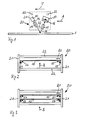
- the readout device is designed as a so-called line sensor, wherein the stimulation radiation source 11 is designed as a line light source, which comprises, for example, a plurality of laser diodes arranged in a line perpendicular to the plane of the figure.
- the detector 17 has a multiplicity of radiation-sensitive areas likewise arranged in a line perpendicular to the plane of the figure, for example in the form of a so-called CCD array.
- the first optical device 13 is one or more cylindrical lenses which run perpendicular to the plane of the figure and which focus the stimulation radiation 12 in the plane of the figure onto the phosphor layer 1.
- the said components of the read-out device are mounted on a carrier 20, which in turn is coupled to a receiving device, not shown, and can be guided through the latter in the transport direction T via the phosphor layer 1.
- a carrier 20 which in turn is coupled to a receiving device, not shown, and can be guided through the latter in the transport direction T via the phosphor layer 1.
- successive different areas of the phosphor layer 1 are read out by the entrained reading device, wherein an X-ray image stored in the phosphor layer 1 is read out.
- the carrier 20 essentially comprises two side parts 21, of which only one can be seen in the side view selected here.
- three connecting elements 22 preferably Tubes of glass or carbon fiber reinforced plastic, provided.
- the side part 21 and the connecting elements 22 are shown dashed or dotted.
- FIG. 2 shows a front view of a first variant of the device shown in FIG. 1 in the direction of view A.
- a highly schematic component 10 of the read-out device shown in FIG. 1 is shown here. The following statements regarding this component 10 apply correspondingly to one or more of the components 11, 13, 15, 16 and 17 of the read-out device shown in FIG. 1.
- both side parts 21 of the carrier 20 and their connection by means of connecting elements 22 are clearly visible.
- the side parts 21 have projections 23 and 24, on which the component 10 of the read-out device is mounted by means of a first bearing 25 and a second bearing 26.
- the first bearing 25 is designed such that it has a translational degree of freedom in a first direction R1, whereby a movement of the component 10 relative to the carrier 20 in the first direction R1 is made possible.
- the other end of the component 10 is mounted via a second bearing 26 on the projection 24 of the side part 21, wherein the second bearing 26 has no translatory degree of freedom in the first direction R1.
- Fig. 3 shows a front view of a second variant of the device according to the invention, in which two components 10 and 10 'on the carrier 20 individually, ie independently of each other, are stored.
- Each of the components 10 and 10 ' is in each case mounted on the side parts 21 of the carrier 20 via a first bearing 25 or 27 and a second bearing 26 or 28.
- the two first bearings 25 and 27 are designed such that they have a translational degree of freedom in the first direction R1 and thus permit a movement of the respective components 10 or 10 'relative to the carrier 20 in the first direction R1. Because the two components 10 and 10 'are mounted individually and independently of one another on the carrier 20, their movements in the first direction R1 can also take place independently of one another.
- the components 10 and 10 'are thus decoupled from each other, so that any stresses due to different thermal expansion coefficients are avoided.
- the two first bearings 25 and 27 are respectively at the same (in Figure 3: at the right) end of the respective components 10 and 10 '.
- first bearing 25 of the one component 10 and the first bearing 27 of the other component 10 'at the opposite ends (in Figure 3: at the right and at the left end) of the respective components 10 and 10 ' is arranged.
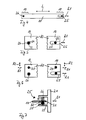
- FIG. 4 shows a view of the component 10 shown in FIGS. 2 and 3 in the viewing direction B.
- the component 10 has an elongated shape which extends parallel to a longitudinal direction L.
- the first bearing 25 is located in the region of a first end 18 of the component 10, while the second bearing 26 is located in the region of a second end 19 of the component 10.
- the longitudinal direction L, along which the elongated shape of the component 10 extends, and the first direction R1, in which the component 10 can move run parallel to one another. This is particularly advantageous in order to avoid tension due to changes in length due to temperature fluctuations.
- the first and second bearings 25 and 26 are indicated only schematically in the representation selected here. Their structure will be explained in more detail below in connection with FIG.
- the first bearing 25 arranged in the region of the first end 18 of the component 10 essentially comprises a groove 31 introduced into the component 10 a ball 32 which is movable in the groove 31 in the first direction R1, for example by rolling and / or sliding.
- a circular recess 33 is provided, in which a ball 34 can be partially sunk.
- Fig. 6 shows the two ends 18 and 19 of a variant of the component 10 shown in Fig. 4 in an enlarged view.
- a third bearing 29 is provided in addition to the first bearing 25, which has both a translatory degree of freedom in the first direction R1 and a translational degree of freedom in a second direction R2.
- the third bearing 29 can be realized in a simple manner by a ball on which the first end 18 of the component 10 rests and which in a circular recess in the support, in particular a projection 23 of the side part 21 of the support 20 (see FIG ) is partially sunk.
- a fourth bearing 30 with two translatory degrees of freedom in the first and second directions R1 and R2 may be provided. This will be the Tilting stability with respect to a parallel to the longitudinal direction L extending axis of rotation ensures a particularly high reliability.
- FIG. 7 shows a detail of the right side part 21 of the carrier with the first bearing 25 according to the invention.
- the component 10 is mounted on the projection 23 of the side part 21 via a ball 32.
- the ball 32 lies in the groove 31 introduced into the component 10, which serves as a guide.
- the component 10 is biased by a spring 37 against the ball 32 to avoid unwanted jumping out of the ball and / or the component 10 from the camp.
- the spring 37 is preferably attached to a further projection 36 of the side part 21.
- the second, third and fourth bearings 26, 29 and 30 can be realized in a corresponding manner, wherein in the second bearing 26, the guide groove 31 is replaced by a round depression, similar to the recess 35, and in the third and fourth bearings 29 and 33, the optical component 10 generally has no recess or guide groove.
Landscapes
- Physics & Mathematics (AREA)
- Health & Medical Sciences (AREA)
- Life Sciences & Earth Sciences (AREA)
- General Physics & Mathematics (AREA)
- High Energy & Nuclear Physics (AREA)
- Molecular Biology (AREA)
- Spectroscopy & Molecular Physics (AREA)
- Engineering & Computer Science (AREA)
- Multimedia (AREA)
- Signal Processing (AREA)
- Apparatus For Radiation Diagnosis (AREA)
- Facsimile Scanning Arrangements (AREA)
- Measurement Of Radiation (AREA)
- Radiography Using Non-Light Waves (AREA)
Claims (15)
- Dispositif destiné à la lecture d'une information radiographique mémorisée dans une couche à base de phosphore (1), comportant :- un dispositif de lecture pour l'exposition de la couche à base de phosphore (1) à un rayonnement de stimulation (12), qui peut stimuler la couche à base de phosphore (1) à émettre un rayonnement d'émission (14) en fonction de l'information radiographique contenue dans la couche à base de phosphore (1), et pour la détection du rayonnement d'émission (14) stimulé dans la couche à base de phosphore (1), et- un support (20), sur lequel est monté le dispositif de lecture,
caractérisé en ce que- au moins un composant (10, 10', 11, 13, 15, 16, 17) du dispositif de lecture est monté sur le support (20) par l'intermédiaire d'au moins un premier palier (25, 27), qui possède un degré de liberté en translation dans une première direction (R1), moyen par lequel le composant (10, 10', 11, 13, 15, 16, 17) peut se déplacer dans la première direction (R1) par rapport au support (20), et- en ce que le premier palier (25, 27) comporte une bille (32), qui est située dans un renfoncement (35) du support (20) et dans une rainure (31) servant de guidage, pratiquée dans le composant (10, 10', 11, 13, 15, 16, 17), le composant (10, 10', 11, 13, 15, 16, 17) étant précontraint par rapport à la bille (32) au moyen d'un ressort (37). - Dispositif selon la revendication 1, dans lequel au moins deux composants (10, 10', 11, 13, 15, 16, 17) du dispositif de lecture sont montés individuellement sur le support (20) par l'intermédiaire d'au moins un premier palier (25, 27), qui possède respectivement un degré de liberté en translation dans une première direction (R1), moyen par lequel les composants (10, 10', 11, 13, 15, 16, 17) peuvent se déplacer indépendamment les uns des autres dans la première direction (R1) par rapport au support (20).
- Dispositif selon la revendication 1 ou 2, dans lequel le composant (10, 10', 11, 13, 15, 16, 17) possède une forme oblongue s'étendant dans une direction longitudinale (L), la direction longitudinale (L) étant sensiblement parallèle à la première direction (R1).
- Dispositif selon l'une des revendications précédentes, dans lequel le composant (10, 10', 11, 13, 15, 16, 17) du dispositif de lecture comporte une première extrémité (18), et est monté sur le support (20) dans la zone de sa première extrémité (18) par l'intermédiaire du premier palier (25, 27).
- Dispositif selon la revendication 5, dans lequel le composant (10, 10', 11, 13, 15, 16, 17) du dispositif de lecture comporte une deuxième extrémité (19), et est monté sur le support (20) dans la zone de sa deuxième extrémité (19) par l'intermédiaire d'un deuxième palier (26), qui ne possède pas de degré de liberté en translation, de préférence pas de degré de liberté en translation dans la première direction (R1).
- Dispositif selon la revendication 4 ou 5, dans lequel un troisième palier (29) avec un degré de liberté en translation dans la première direction (R1), et un degré de liberté en translation dans une deuxième direction (R2), est agencé dans la zone du premier palier (25).
- Dispositif selon la revendication 6, dans lequel un quatrième palier (30) avec un degré de liberté en translation dans la première direction (R1), et un degré de liberté en translation dans une deuxième direction (R2), est agencé dans la zone du deuxième palier (26).
- Dispositif selon l'une des revendications précédentes, dans lequel le support (20) comporte deux parties latérales (21), sur lesquelles est monté au moins un composant (10, 10', 11, 13, 15, 16, 17) du dispositif de lecture.
- Dispositif selon la revendication 8, dans lequel le support (20) comporte un ou plusieurs éléments de liaison (22), notamment trois, qui relient les deux parties latérales (21) entre elles.
- Dispositif selon la revendication 9, dans lequel les éléments de liaison (22) sont en matière plastique ou en une matière plastique renforcée par des fibres, notamment par des fibres de verre ou de carbone.
- Dispositif selon la revendication 9 ou 10, dans lequel les éléments de liaison (22) ont un coefficient de dilatation thermique plus faible que les composants (10, 10', 11, 13, 15, 16, 17) du dispositif de lecture.
- Dispositif selon l'une des revendications 9 à 11, dans lequel les éléments de liaison (22) ont une forme oblongue, et un profil de section transversale stabilisant la forme oblongue, de préférence un profil de section transversale en forme de V, polygonale ou circulaire.
- Dispositif selon l'une des revendications précédentes, dans lequel au moins un composant (10, 10', 11, 13, 15, 16, 17) du dispositif de lecture est constitué de deux ou de plusieurs composants partiels ayant différents coefficients de dilatation thermique, et dans lequel les composants partiels sont agencés et reliés entre eux de telle sorte que des forces de flexion, intervenant en raison de variations de température entre deux composants partiels respectifs des composants (10, 10',11, 13, 15, 16, 17), se compensent mutuellement, ce qui permet d'éviter une déformation des composants (10, 10', 11, 13, 15, 16, 17).
- Dispositif selon l'une des revendications précédentes, comportant un système de réception sur lequel est monté le support (20), et qui peut déplacer le support (20) au-dessus de la couche à base de phosphore (1).
- Dispositif selon la revendication 14, dans lequel le support (20) est monté sur le système de réception par l'intermédiaire d'au moins un cinquième palier, qui possède un degré de liberté en translation dans la première direction (R1), moyen par lequel un déplacement du support (20) par rapport au système de réception est possible dans la première direction (R1).
Priority Applications (4)
| Application Number | Priority Date | Filing Date | Title |
|---|---|---|---|
| AT04101370T ATE361630T1 (de) | 2004-04-02 | 2004-04-02 | Vorrichtung zum auslesen von in einer phosphorschicht gespeicherten röntgeninformation |
| EP04101370A EP1585308B1 (fr) | 2004-04-02 | 2004-04-02 | Appareil pour lire des informations radiographiques d'un panneau luminescent d'enregistrement |
| DE502004003675T DE502004003675D1 (de) | 2004-04-02 | 2004-04-02 | Vorrichtung zum Auslesen von in einer Phosphorschicht gespeicherten Röntgeninformation |
| US11/079,653 US7498598B2 (en) | 2004-04-02 | 2005-03-14 | System for reading out X-ray information stored in a phosphor layer |
Applications Claiming Priority (1)
| Application Number | Priority Date | Filing Date | Title |
|---|---|---|---|
| EP04101370A EP1585308B1 (fr) | 2004-04-02 | 2004-04-02 | Appareil pour lire des informations radiographiques d'un panneau luminescent d'enregistrement |
Publications (2)
| Publication Number | Publication Date |
|---|---|
| EP1585308A1 EP1585308A1 (fr) | 2005-10-12 |
| EP1585308B1 true EP1585308B1 (fr) | 2007-05-02 |
Family
ID=34896112
Family Applications (1)
| Application Number | Title | Priority Date | Filing Date |
|---|---|---|---|
| EP04101370A Expired - Lifetime EP1585308B1 (fr) | 2004-04-02 | 2004-04-02 | Appareil pour lire des informations radiographiques d'un panneau luminescent d'enregistrement |
Country Status (4)
| Country | Link |
|---|---|
| US (1) | US7498598B2 (fr) |
| EP (1) | EP1585308B1 (fr) |
| AT (1) | ATE361630T1 (fr) |
| DE (1) | DE502004003675D1 (fr) |
Families Citing this family (3)
| Publication number | Priority date | Publication date | Assignee | Title |
|---|---|---|---|---|
| DE502004007904D1 (de) * | 2004-09-22 | 2008-10-02 | Agfa Gevaert Healthcare Gmbh | Vorrichtung zum Auslesen von in einer Speicherleuchtstoffplatte gespeicherten Röntgeninformation |
| EP1640801B1 (fr) * | 2004-09-22 | 2008-08-20 | Agfa-Gevaert HealthCare GmbH | Dispositif et procédé de lecture d'information radiographique stockée dans une plaque à mémoire au phosphore |
| ATE439005T1 (de) * | 2005-12-29 | 2009-08-15 | Agfa Gevaert Healthcare Gmbh | Antriebsvorrichtung für eine optische abtasteinrichtung |
Family Cites Families (8)
| Publication number | Priority date | Publication date | Assignee | Title |
|---|---|---|---|---|
| JP2634689B2 (ja) * | 1990-10-02 | 1997-07-30 | 三田工業株式会社 | 画像形成装置 |
| US5440146A (en) * | 1994-03-31 | 1995-08-08 | Minnesota Mining And Manufacturing Company | Radiographic image reader |
| US6473205B1 (en) * | 1998-06-03 | 2002-10-29 | Agfa Corporation | Image sensor module adjustable in six degrees of freedom for use with an image acquisition device |
| DE19946743C1 (de) * | 1999-09-29 | 2000-11-23 | Siemens Ag | Röntgendiagnostikeinrichtung mit einem Speicherleuchtschirm |
| JP4219549B2 (ja) * | 2000-12-20 | 2009-02-04 | 富士フイルム株式会社 | 放射線画像読取方法および装置 |
| JP4636699B2 (ja) * | 2001-01-19 | 2011-02-23 | キヤノン株式会社 | 画像読取装置及び画像形成装置 |
| JP3785372B2 (ja) * | 2002-02-25 | 2006-06-14 | 富士写真フイルム株式会社 | シート状画像記録担体の状態検知装置 |
| EP1378766B1 (fr) * | 2002-07-02 | 2008-01-23 | Agfa-Gevaert HealthCare GmbH | Dispositif et procédé pour lire les informations contenues dans une couche mémoire |
-
2004
- 2004-04-02 EP EP04101370A patent/EP1585308B1/fr not_active Expired - Lifetime
- 2004-04-02 AT AT04101370T patent/ATE361630T1/de not_active IP Right Cessation
- 2004-04-02 DE DE502004003675T patent/DE502004003675D1/de not_active Expired - Lifetime
-
2005
- 2005-03-14 US US11/079,653 patent/US7498598B2/en not_active Expired - Fee Related
Also Published As
| Publication number | Publication date |
|---|---|
| US20050218355A1 (en) | 2005-10-06 |
| US7498598B2 (en) | 2009-03-03 |
| ATE361630T1 (de) | 2007-05-15 |
| EP1585308A1 (fr) | 2005-10-12 |
| DE502004003675D1 (de) | 2007-06-14 |
Similar Documents
| Publication | Publication Date | Title |
|---|---|---|
| DE102006037219B4 (de) | Linsenantriebsvorrichtung | |
| DE19827423C2 (de) | Zweidimensionale Laserdiodenanordnung | |
| EP1014684B1 (fr) | Appareil et méthode pour lire des données enregistrées dans une couche de phosphore | |
| DE102009056722B3 (de) | Kollimatormodul zum modularen Aufbau eines Kollimators für einen Strahlendetektor und Strahlendetektor | |
| EP1482721A1 (fr) | Dispositif de saisie d'informations contenues dans une couche de phosphore | |
| DE10156275B4 (de) | Detektoranordnung und Detektionsverfahren | |
| EP1585308B1 (fr) | Appareil pour lire des informations radiographiques d'un panneau luminescent d'enregistrement | |
| DE102008030893A1 (de) | Streustrahlungskollimator, Strahlungdetektor und Strahlungserfassungseinrichtung | |
| DE60032485T2 (de) | Mehrstrahl diodengepumpter optisches abbildungssystem | |
| EP1691215B1 (fr) | Procédé et appareil pour lire des vues radiographiques enregistrées dans des écrans luminescents | |
| DE102005028904B4 (de) | Röntgenstrahlenerzeuger für ein Röntgengerät mit Röntgenlinsenmodul | |
| EP1482328B1 (fr) | Dispositif de détection d'informations dans une couche de matière luminéscente | |
| EP1804082B1 (fr) | Dispositif destiné à la lecture d'informations radiographiques stockées dans une couche fluorescente de mémoire et module de radiographie | |
| DE3918698C1 (fr) | ||
| EP1480059B1 (fr) | Dispositif de reproduction d'image dans une couche luminescente | |
| EP1081507B1 (fr) | Dispositif pour lire des informations contenues sur une surface de mémorisation avec un rayonnement d'excitation et un moyen de détection | |
| DE2611478A1 (de) | Tomographieanordnung | |
| DE102005061357A1 (de) | Verfahren zur Aufnahme von Projektionsbildern | |
| EP0475544A1 (fr) | Dispositif d'isolation acoustique pour caméra | |
| DE2410230A1 (de) | Roentgen-abtastsystem | |
| EP1378767A1 (fr) | Dispositif et procédé pour lire les informations contenues dans une couche mémoire | |
| EP3217408A2 (fr) | Module de focalisation pour un filtre de forme et filtre de forme destiné à régler une distribution de l'intensité spatiale d'un rayon x | |
| DE102008034580A1 (de) | Verfahren zur automatischen Anpassung der Position und/oder des Absorptionsgrads eines Filters in einem Röntgengerät und Röntgengerät | |
| DE10301961A1 (de) | Optische Linseneinrichtung für einen Scanner | |
| DE102020135127B4 (de) | Aktuatorsystem für ein optisches System eines Endoskops und optisches System für ein Endoskop |
Legal Events
| Date | Code | Title | Description |
|---|---|---|---|
| PUAI | Public reference made under article 153(3) epc to a published international application that has entered the european phase |
Free format text: ORIGINAL CODE: 0009012 |
|
| AK | Designated contracting states |
Kind code of ref document: A1 Designated state(s): AT BE BG CH CY CZ DE DK EE ES FI FR GB GR HU IE IT LI LU MC NL PL PT RO SE SI SK TR |
|
| AX | Request for extension of the european patent |
Extension state: AL LT LV MK |
|
| RAP1 | Party data changed (applicant data changed or rights of an application transferred) |
Owner name: AGFA-GEVAERT HEALTHCARE GMBH |
|
| 17P | Request for examination filed |
Effective date: 20060412 |
|
| AKX | Designation fees paid |
Designated state(s): AT BE BG CH CY CZ DE DK EE ES FI FR GB GR HU IE IT LI LU MC NL PL PT RO SE SI SK TR |
|
| GRAP | Despatch of communication of intention to grant a patent |
Free format text: ORIGINAL CODE: EPIDOSNIGR1 |
|
| GRAS | Grant fee paid |
Free format text: ORIGINAL CODE: EPIDOSNIGR3 |
|
| GRAA | (expected) grant |
Free format text: ORIGINAL CODE: 0009210 |
|
| AK | Designated contracting states |
Kind code of ref document: B1 Designated state(s): AT BE BG CH CY CZ DE DK EE ES FI FR GB GR HU IE IT LI LU MC NL PL PT RO SE SI SK TR |
|
| PG25 | Lapsed in a contracting state [announced via postgrant information from national office to epo] |
Ref country code: FI Free format text: LAPSE BECAUSE OF FAILURE TO SUBMIT A TRANSLATION OF THE DESCRIPTION OR TO PAY THE FEE WITHIN THE PRESCRIBED TIME-LIMIT Effective date: 20070502 |
|
| REG | Reference to a national code |
Ref country code: GB Ref legal event code: FG4D Free format text: NOT ENGLISH |
|
| GBT | Gb: translation of ep patent filed (gb section 77(6)(a)/1977) |
Effective date: 20070502 |
|
| REG | Reference to a national code |
Ref country code: CH Ref legal event code: EP |
|
| REG | Reference to a national code |
Ref country code: IE Ref legal event code: FG4D Free format text: LANGUAGE OF EP DOCUMENT: GERMAN |
|
| REF | Corresponds to: |
Ref document number: 502004003675 Country of ref document: DE Date of ref document: 20070614 Kind code of ref document: P |
|
| PG25 | Lapsed in a contracting state [announced via postgrant information from national office to epo] |
Ref country code: SE Free format text: LAPSE BECAUSE OF FAILURE TO SUBMIT A TRANSLATION OF THE DESCRIPTION OR TO PAY THE FEE WITHIN THE PRESCRIBED TIME-LIMIT Effective date: 20070802 |
|
| PG25 | Lapsed in a contracting state [announced via postgrant information from national office to epo] |
Ref country code: ES Free format text: LAPSE BECAUSE OF FAILURE TO SUBMIT A TRANSLATION OF THE DESCRIPTION OR TO PAY THE FEE WITHIN THE PRESCRIBED TIME-LIMIT Effective date: 20070813 |
|
| ET | Fr: translation filed | ||
| NLV1 | Nl: lapsed or annulled due to failure to fulfill the requirements of art. 29p and 29m of the patents act | ||
| PG25 | Lapsed in a contracting state [announced via postgrant information from national office to epo] |
Ref country code: PL Free format text: LAPSE BECAUSE OF FAILURE TO SUBMIT A TRANSLATION OF THE DESCRIPTION OR TO PAY THE FEE WITHIN THE PRESCRIBED TIME-LIMIT Effective date: 20070502 |
|
| REG | Reference to a national code |
Ref country code: IE Ref legal event code: FD4D |
|
| PG25 | Lapsed in a contracting state [announced via postgrant information from national office to epo] |
Ref country code: NL Free format text: LAPSE BECAUSE OF FAILURE TO SUBMIT A TRANSLATION OF THE DESCRIPTION OR TO PAY THE FEE WITHIN THE PRESCRIBED TIME-LIMIT Effective date: 20070502 Ref country code: PT Free format text: LAPSE BECAUSE OF FAILURE TO SUBMIT A TRANSLATION OF THE DESCRIPTION OR TO PAY THE FEE WITHIN THE PRESCRIBED TIME-LIMIT Effective date: 20071002 Ref country code: DK Free format text: LAPSE BECAUSE OF FAILURE TO SUBMIT A TRANSLATION OF THE DESCRIPTION OR TO PAY THE FEE WITHIN THE PRESCRIBED TIME-LIMIT Effective date: 20070502 Ref country code: CZ Free format text: LAPSE BECAUSE OF FAILURE TO SUBMIT A TRANSLATION OF THE DESCRIPTION OR TO PAY THE FEE WITHIN THE PRESCRIBED TIME-LIMIT Effective date: 20070502 Ref country code: BG Free format text: LAPSE BECAUSE OF FAILURE TO SUBMIT A TRANSLATION OF THE DESCRIPTION OR TO PAY THE FEE WITHIN THE PRESCRIBED TIME-LIMIT Effective date: 20070802 Ref country code: IE Free format text: LAPSE BECAUSE OF FAILURE TO SUBMIT A TRANSLATION OF THE DESCRIPTION OR TO PAY THE FEE WITHIN THE PRESCRIBED TIME-LIMIT Effective date: 20070502 Ref country code: SI Free format text: LAPSE BECAUSE OF FAILURE TO SUBMIT A TRANSLATION OF THE DESCRIPTION OR TO PAY THE FEE WITHIN THE PRESCRIBED TIME-LIMIT Effective date: 20070502 |
|
| PG25 | Lapsed in a contracting state [announced via postgrant information from national office to epo] |
Ref country code: SK Free format text: LAPSE BECAUSE OF FAILURE TO SUBMIT A TRANSLATION OF THE DESCRIPTION OR TO PAY THE FEE WITHIN THE PRESCRIBED TIME-LIMIT Effective date: 20070502 |
|
| PLBE | No opposition filed within time limit |
Free format text: ORIGINAL CODE: 0009261 |
|
| STAA | Information on the status of an ep patent application or granted ep patent |
Free format text: STATUS: NO OPPOSITION FILED WITHIN TIME LIMIT |
|
| 26N | No opposition filed |
Effective date: 20080205 |
|
| PG25 | Lapsed in a contracting state [announced via postgrant information from national office to epo] |
Ref country code: IT Free format text: LAPSE BECAUSE OF FAILURE TO SUBMIT A TRANSLATION OF THE DESCRIPTION OR TO PAY THE FEE WITHIN THE PRESCRIBED TIME-LIMIT Effective date: 20070502 Ref country code: GR Free format text: LAPSE BECAUSE OF FAILURE TO SUBMIT A TRANSLATION OF THE DESCRIPTION OR TO PAY THE FEE WITHIN THE PRESCRIBED TIME-LIMIT Effective date: 20070803 |
|
| PG25 | Lapsed in a contracting state [announced via postgrant information from national office to epo] |
Ref country code: RO Free format text: LAPSE BECAUSE OF FAILURE TO SUBMIT A TRANSLATION OF THE DESCRIPTION OR TO PAY THE FEE WITHIN THE PRESCRIBED TIME-LIMIT Effective date: 20070502 |
|
| BERE | Be: lapsed |
Owner name: AGFA-GEVAERT HEALTHCARE G.M.B.H. Effective date: 20080430 |
|
| PG25 | Lapsed in a contracting state [announced via postgrant information from national office to epo] |
Ref country code: MC Free format text: LAPSE BECAUSE OF NON-PAYMENT OF DUE FEES Effective date: 20080430 |
|
| REG | Reference to a national code |
Ref country code: CH Ref legal event code: PL |
|
| PG25 | Lapsed in a contracting state [announced via postgrant information from national office to epo] |
Ref country code: EE Free format text: LAPSE BECAUSE OF FAILURE TO SUBMIT A TRANSLATION OF THE DESCRIPTION OR TO PAY THE FEE WITHIN THE PRESCRIBED TIME-LIMIT Effective date: 20070502 Ref country code: LI Free format text: LAPSE BECAUSE OF NON-PAYMENT OF DUE FEES Effective date: 20080430 Ref country code: CH Free format text: LAPSE BECAUSE OF NON-PAYMENT OF DUE FEES Effective date: 20080430 |
|
| PG25 | Lapsed in a contracting state [announced via postgrant information from national office to epo] |
Ref country code: BE Free format text: LAPSE BECAUSE OF NON-PAYMENT OF DUE FEES Effective date: 20080430 |
|
| PG25 | Lapsed in a contracting state [announced via postgrant information from national office to epo] |
Ref country code: CY Free format text: LAPSE BECAUSE OF FAILURE TO SUBMIT A TRANSLATION OF THE DESCRIPTION OR TO PAY THE FEE WITHIN THE PRESCRIBED TIME-LIMIT Effective date: 20070502 |
|
| PG25 | Lapsed in a contracting state [announced via postgrant information from national office to epo] |
Ref country code: AT Free format text: LAPSE BECAUSE OF NON-PAYMENT OF DUE FEES Effective date: 20080402 |
|
| REG | Reference to a national code |
Ref country code: FR Ref legal event code: CA |
|
| PG25 | Lapsed in a contracting state [announced via postgrant information from national office to epo] |
Ref country code: LU Free format text: LAPSE BECAUSE OF NON-PAYMENT OF DUE FEES Effective date: 20080402 Ref country code: HU Free format text: LAPSE BECAUSE OF FAILURE TO SUBMIT A TRANSLATION OF THE DESCRIPTION OR TO PAY THE FEE WITHIN THE PRESCRIBED TIME-LIMIT Effective date: 20071103 |
|
| PG25 | Lapsed in a contracting state [announced via postgrant information from national office to epo] |
Ref country code: TR Free format text: LAPSE BECAUSE OF FAILURE TO SUBMIT A TRANSLATION OF THE DESCRIPTION OR TO PAY THE FEE WITHIN THE PRESCRIBED TIME-LIMIT Effective date: 20070502 |
|
| PGFP | Annual fee paid to national office [announced via postgrant information from national office to epo] |
Ref country code: FR Payment date: 20120307 Year of fee payment: 9 |
|
| PGFP | Annual fee paid to national office [announced via postgrant information from national office to epo] |
Ref country code: GB Payment date: 20120306 Year of fee payment: 9 |
|
| REG | Reference to a national code |
Ref country code: DE Ref legal event code: R084 Ref document number: 502004003675 Country of ref document: DE Effective date: 20131026 |
|
| GBPC | Gb: european patent ceased through non-payment of renewal fee |
Effective date: 20130402 |
|
| PG25 | Lapsed in a contracting state [announced via postgrant information from national office to epo] |
Ref country code: GB Free format text: LAPSE BECAUSE OF NON-PAYMENT OF DUE FEES Effective date: 20130402 |
|
| REG | Reference to a national code |
Ref country code: FR Ref legal event code: ST Effective date: 20131231 |
|
| PG25 | Lapsed in a contracting state [announced via postgrant information from national office to epo] |
Ref country code: FR Free format text: LAPSE BECAUSE OF NON-PAYMENT OF DUE FEES Effective date: 20130430 |
|
| PGFP | Annual fee paid to national office [announced via postgrant information from national office to epo] |
Ref country code: DE Payment date: 20140304 Year of fee payment: 11 |
|
| REG | Reference to a national code |
Ref country code: DE Ref legal event code: R119 Ref document number: 502004003675 Country of ref document: DE |
|
| PG25 | Lapsed in a contracting state [announced via postgrant information from national office to epo] |
Ref country code: DE Free format text: LAPSE BECAUSE OF NON-PAYMENT OF DUE FEES Effective date: 20151103 |