EP1583106A1 - Solid polymeric electrolyte material, process for producing the same and membrane/electrode assembly for solid polymer fuel cell - Google Patents
Solid polymeric electrolyte material, process for producing the same and membrane/electrode assembly for solid polymer fuel cell Download PDFInfo
- Publication number
- EP1583106A1 EP1583106A1 EP04730031A EP04730031A EP1583106A1 EP 1583106 A1 EP1583106 A1 EP 1583106A1 EP 04730031 A EP04730031 A EP 04730031A EP 04730031 A EP04730031 A EP 04730031A EP 1583106 A1 EP1583106 A1 EP 1583106A1
- Authority
- EP
- European Patent Office
- Prior art keywords
- polymer electrolyte
- group
- fluoromonomer
- polymer
- repeating unit
- Prior art date
- Legal status (The legal status is an assumption and is not a legal conclusion. Google has not performed a legal analysis and makes no representation as to the accuracy of the status listed.)
- Withdrawn
Links
- 0 CC(C)C1(*)OC(*)(*)C(*)(*)O1 Chemical compound CC(C)C1(*)OC(*)(*)C(*)(*)O1 0.000 description 3
Images

Classifications
-
- C—CHEMISTRY; METALLURGY
- C08—ORGANIC MACROMOLECULAR COMPOUNDS; THEIR PREPARATION OR CHEMICAL WORKING-UP; COMPOSITIONS BASED THEREON
- C08F—MACROMOLECULAR COMPOUNDS OBTAINED BY REACTIONS ONLY INVOLVING CARBON-TO-CARBON UNSATURATED BONDS
- C08F214/00—Copolymers of compounds having one or more unsaturated aliphatic radicals, each having only one carbon-to-carbon double bond, and at least one being terminated by a halogen
- C08F214/18—Monomers containing fluorine
-
- C—CHEMISTRY; METALLURGY
- C08—ORGANIC MACROMOLECULAR COMPOUNDS; THEIR PREPARATION OR CHEMICAL WORKING-UP; COMPOSITIONS BASED THEREON
- C08F—MACROMOLECULAR COMPOUNDS OBTAINED BY REACTIONS ONLY INVOLVING CARBON-TO-CARBON UNSATURATED BONDS
- C08F214/00—Copolymers of compounds having one or more unsaturated aliphatic radicals, each having only one carbon-to-carbon double bond, and at least one being terminated by a halogen
- C08F214/18—Monomers containing fluorine
- C08F214/182—Monomers containing fluorine not covered by the groups C08F214/20 - C08F214/28
-
- H—ELECTRICITY
- H01—ELECTRIC ELEMENTS
- H01B—CABLES; CONDUCTORS; INSULATORS; SELECTION OF MATERIALS FOR THEIR CONDUCTIVE, INSULATING OR DIELECTRIC PROPERTIES
- H01B1/00—Conductors or conductive bodies characterised by the conductive materials; Selection of materials as conductors
- H01B1/06—Conductors or conductive bodies characterised by the conductive materials; Selection of materials as conductors mainly consisting of other non-metallic substances
- H01B1/12—Conductors or conductive bodies characterised by the conductive materials; Selection of materials as conductors mainly consisting of other non-metallic substances organic substances
- H01B1/122—Ionic conductors
-
- H—ELECTRICITY
- H01—ELECTRIC ELEMENTS
- H01M—PROCESSES OR MEANS, e.g. BATTERIES, FOR THE DIRECT CONVERSION OF CHEMICAL ENERGY INTO ELECTRICAL ENERGY
- H01M4/00—Electrodes
- H01M4/86—Inert electrodes with catalytic activity, e.g. for fuel cells
- H01M4/8605—Porous electrodes
-
- H—ELECTRICITY
- H01—ELECTRIC ELEMENTS
- H01M—PROCESSES OR MEANS, e.g. BATTERIES, FOR THE DIRECT CONVERSION OF CHEMICAL ENERGY INTO ELECTRICAL ENERGY
- H01M8/00—Fuel cells; Manufacture thereof
- H01M8/10—Fuel cells with solid electrolytes
- H01M8/1016—Fuel cells with solid electrolytes characterised by the electrolyte material
- H01M8/1018—Polymeric electrolyte materials
- H01M8/102—Polymeric electrolyte materials characterised by the chemical structure of the main chain of the ion-conducting polymer
- H01M8/1023—Polymeric electrolyte materials characterised by the chemical structure of the main chain of the ion-conducting polymer having only carbon, e.g. polyarylenes, polystyrenes or polybutadiene-styrenes
-
- H—ELECTRICITY
- H01—ELECTRIC ELEMENTS
- H01M—PROCESSES OR MEANS, e.g. BATTERIES, FOR THE DIRECT CONVERSION OF CHEMICAL ENERGY INTO ELECTRICAL ENERGY
- H01M8/00—Fuel cells; Manufacture thereof
- H01M8/10—Fuel cells with solid electrolytes
- H01M8/1016—Fuel cells with solid electrolytes characterised by the electrolyte material
- H01M8/1018—Polymeric electrolyte materials
- H01M8/1039—Polymeric electrolyte materials halogenated, e.g. sulfonated polyvinylidene fluorides
-
- H—ELECTRICITY
- H01—ELECTRIC ELEMENTS
- H01M—PROCESSES OR MEANS, e.g. BATTERIES, FOR THE DIRECT CONVERSION OF CHEMICAL ENERGY INTO ELECTRICAL ENERGY
- H01M8/00—Fuel cells; Manufacture thereof
- H01M8/10—Fuel cells with solid electrolytes
- H01M8/1016—Fuel cells with solid electrolytes characterised by the electrolyte material
- H01M8/1018—Polymeric electrolyte materials
- H01M8/1069—Polymeric electrolyte materials characterised by the manufacturing processes
- H01M8/1072—Polymeric electrolyte materials characterised by the manufacturing processes by chemical reactions, e.g. in situ polymerisation or in situ crosslinking
-
- H—ELECTRICITY
- H01—ELECTRIC ELEMENTS
- H01M—PROCESSES OR MEANS, e.g. BATTERIES, FOR THE DIRECT CONVERSION OF CHEMICAL ENERGY INTO ELECTRICAL ENERGY
- H01M4/00—Electrodes
- H01M4/86—Inert electrodes with catalytic activity, e.g. for fuel cells
- H01M2004/8678—Inert electrodes with catalytic activity, e.g. for fuel cells characterised by the polarity
- H01M2004/8689—Positive electrodes
-
- H—ELECTRICITY
- H01—ELECTRIC ELEMENTS
- H01M—PROCESSES OR MEANS, e.g. BATTERIES, FOR THE DIRECT CONVERSION OF CHEMICAL ENERGY INTO ELECTRICAL ENERGY
- H01M2300/00—Electrolytes
- H01M2300/0017—Non-aqueous electrolytes
- H01M2300/0065—Solid electrolytes
- H01M2300/0082—Organic polymers
-
- Y—GENERAL TAGGING OF NEW TECHNOLOGICAL DEVELOPMENTS; GENERAL TAGGING OF CROSS-SECTIONAL TECHNOLOGIES SPANNING OVER SEVERAL SECTIONS OF THE IPC; TECHNICAL SUBJECTS COVERED BY FORMER USPC CROSS-REFERENCE ART COLLECTIONS [XRACs] AND DIGESTS
- Y02—TECHNOLOGIES OR APPLICATIONS FOR MITIGATION OR ADAPTATION AGAINST CLIMATE CHANGE
- Y02E—REDUCTION OF GREENHOUSE GAS [GHG] EMISSIONS, RELATED TO ENERGY GENERATION, TRANSMISSION OR DISTRIBUTION
- Y02E60/00—Enabling technologies; Technologies with a potential or indirect contribution to GHG emissions mitigation
- Y02E60/30—Hydrogen technology
- Y02E60/50—Fuel cells
-
- Y—GENERAL TAGGING OF NEW TECHNOLOGICAL DEVELOPMENTS; GENERAL TAGGING OF CROSS-SECTIONAL TECHNOLOGIES SPANNING OVER SEVERAL SECTIONS OF THE IPC; TECHNICAL SUBJECTS COVERED BY FORMER USPC CROSS-REFERENCE ART COLLECTIONS [XRACs] AND DIGESTS
- Y02—TECHNOLOGIES OR APPLICATIONS FOR MITIGATION OR ADAPTATION AGAINST CLIMATE CHANGE
- Y02P—CLIMATE CHANGE MITIGATION TECHNOLOGIES IN THE PRODUCTION OR PROCESSING OF GOODS
- Y02P70/00—Climate change mitigation technologies in the production process for final industrial or consumer products
- Y02P70/50—Manufacturing or production processes characterised by the final manufactured product
Definitions
- the present invention relates to a polymer electrolyte material comprising a polymer having an ionic group which is useful, for example, as an electrolyte membrane for brine electrolysis or for a polymer electrolyte fuel cell, as an electrolyte for a catalyst layer of a fuel cell, as an electrolyte for a lithium battery, and so on, and a method for its production.
- a polymer obtained by hydrolyzing a copolymer of a fluoromonomer represented by CF 2 CF-(OCF 2 CFY) m -O p -(CF 2 ) n -SO 2 F
- Y is a fluorine atom or a trifluoromethyl group
- n is an integer of from 1 to 12
- m is an integer of from 0 to 3
- p is 0 or 1 and m+p>0
- tetrafluoroethylene or a polymer having a sulfonic acid group (the polymer having a sulfonic acid group will be referred to hereinafter as a "sulfonic acid polymer") obtained by further converting the hydrolyzed copolymer to an acid form.
- an operation temperature of the fuel cell using the polymer is normally at most 80°C.
- a fuel gas for a fuel cell is hydrogen obtained by reforming an organic compound composed of carbon and hydrogen atoms or composed of carbon
- hydrogen and oxygen atoms such as methanol, natural gas or gasoline
- carbon monoxide if contained even in a trace amount, will poison an electrode catalyst, and it will be likely to result in a drop of output power of the fuel cell.
- the increase of the operation temperature is also demanded in order to miniaturize a cooling apparatus for a fuel cell.
- the above-mentioned conventional polymer has the softening temperature too low to meet these demands.
- Japanese Patent 2,675,548 offered a proposal on use of a sulfonic acid polymer having a short side chain and a high softening temperature as an electrolyte for a fuel cell.
- a sulfonic acid polymer is produced with difficulties and at high cost, it has not been produced in practice.
- M' is hydrogen, an alkali metal, an alkaline-earth metal, or the like
- X is a fluorine atom, a chlorine atom or a trifluoromethyl group
- n is 0 to 10
- Q is a hydrogen atom, a fluorine atom, a cyano group, an alkyl group, an SO 2 R (R is an alkyl group or the like), or the like.
- U.S. Patent No. 4,973,714 discloses a monomer represented by formula (F) below where X represents one of various functional groups such as F, Cl, -OC 6 F 5 , -CN, -COF, -COOR (R is -CH 3 , -C 2 H 5 or -CH 2 CF 3 ), -SO 2 F and -SO 2 Cl.
- R f1 is a fluorine atom or a perfluoroalkyl group and R f2 is a perfluoroalkenyl group which may contain an oxygen atom of an ether bond type
- the U.S. Patent describes no synthesis example thereof.
- JP-A-2002-260705 describes that a polymer electrolyte having a ring structure has a high softening temperature as a polymer and that increase of output can be achieved by applying it to an electrolyte contained in a cathode of a fuel cell.
- a perfluorovinyl ether monomer having a sulfonic acid group or a functional group convertible into a sulfonic acid group (which will be referred to hereinafter as a "sulfonic acid type functional group" in the present specification), but having no ring structure is copolymerized with a monomer having no sulfonic acid type functional group and having a ring structure or cyclopolymerizability, thereby obtaining a polymer having a ring structure and a sulfonic acid group.
- a polymer fails to sufficiently increase a ratio of the ring structure to the whole polymer.
- An object of the present invention is to provide a polymer electrolyte material which has a softening temperature higher than before and which allows operation of a fuel cell at a temperature higher than before in use as an electrolyte for a polymer electrolyte fuel cell.
- Another object of the present invention is to provide a polymer electrolyte material that can contribute not only to operation at a high temperature but also to increase of output of a fuel cell.
- the above-mentioned ionic group (which will be referred to hereinafter as a "present ionic group") is, for example, a strong acid group such as sulfonic acid, or a salt thereof, and is suitable for an ionic group of an electrolyte material.
- the repeating unit based on the alicyclic fluoromonomer may contain at least two present ionic groups. Since the polymer forming the polymer electrolyte material of the present invention has a high softening temperature by virtue of the ring structure, it can be used at a higher temperature than the electrolyte materials made of the conventional fluoropolymers.
- the present invention provides a polymer electrolyte membrane which is a membrane comprising the above-mentioned electrolyte material.
- a membrane is suitably applicable as an electrolyte membrane of a polymer electrolyte fuel cell, for example.
- the present invention provides a liquid composition having the above-mentioned electrolyte material dissolved or dispersed in a solvent having a hydroxyl group and/or water.
- An electrolyte membrane can be produced by using such a liquid composition. It is also useful for producing a catalyst layer of a polymer electrolyte fuel cell, for example.
- the present invention provides a method for producing a polymer electrolyte material comprising effecting radical polymerization of an alicyclic fluoromonomer having a fluorosulfonyl group and a carbon-carbon double bond with radical polymerization reactivity, either of carbon atoms at both ends of the double bond constituting a ring structure, in the presence of a radical initiating source, and subsequently converting the fluorosulfonyl group into a sulfonic acid group.
- the present invention provides a membrane electrode assembly for a polymer electrolyte fuel cell comprising a cathode and an anode each having a catalyst layer containing a catalyst and a polymer electrolyte, and a polymer electrolyte membrane disposed between the cathode and the anode, wherein the polymer electrolyte membrane is made of the above-mentioned polymer electrolyte material.
- the present invention provides a membrane electrode assembly for a polymer electrolyte fuel cell comprising a cathode and an anode each having a catalyst layer containing a catalyst and a polymer electrolyte, and a polymer electrolyte membrane disposed between the cathode and the anode, wherein at least one of the catalyst layer of the cathode and the anode contains the above-mentioned polymer electrolyte material.
- a compound represented by formula (X) will be referred to as a compound (X).
- a repeating unit represented by formula (Y) will be referred to as a repeating unit (Y).
- a production method according to the present invention employs a fluoromonomer having a ring structure in a polymerization moiety, in order to introduce the ring structure into the main chain of a polymer constituting a polymer electrolyte material, and having an ionic group or a group convertible into this ionic group; preferably, a perfluorinated monomer.
- the present inventor considered that it was preferable to introduce a ring structure in order to obtain a polymer electrolyte membrane having a high softening temperature or a polymer electrolyte having a high oxygen solubility or oxygen permeability and that it was preferable to adopt polymerization of a monomer having a structure of formula (F) or formula (G) below.
- a monomer having a structure of formula (F) or formula (G) below it is difficult to synthesize the compound of the formula (F). From the viewpoint of synthesis, it is preferable to employ the monomer having the structure of the formula (G) below.
- R A to R D each independently are selected from the group consisting of a monovalent perfluoro organic group which may contain at least one of the present ionic group or its precursor group, and an oxygen atom of an ether bond type, and an fluorine atom, or may be a bivalent perfluoro organic group in which two of R A to R D are bonded to each other and may contain at least one of the present ionic group or its precursor group, and an oxygen atom of an ether bond type. At least one of R A to R D contains the present ionic group or its precursor group.
- R E and R F each independently are a monovalent perfluoro organic group which may contain an oxygen atom of an ether bond type, or a fluorine atom.
- the precursor group of the present ionic group herein is a group convertible into the present ionic group by a known treatment such as hydrolysis or a treatment for conversion into an acid form, e.g., -SO 2 F or the like. After polymerization, the precursor group is converted into the present ionic group to obtain the polymer electrolyte material.
- the above-mentioned perfluoro organic group is preferably a perfluorocarbon group which may contain an oxygen atom of an ether bond type.
- compounds represented by the formula (G) it is particularly preferable to adopt a compound represented by formula (3).
- R 1 is a bivalent perfluoro organic group which may contain an etheric oxygen atom
- R 2 to R 6 each independently are a fluorine atom or a monovalent perfluoro organic group which may contain an oxygen atom of an ether bond type.
- the organic group here means a group containing at least one carbon atom
- the monovalent perfluoro organic group is particularly preferably a linear or branched perfluoroalkyl group which may contain an etheric oxygen atom inside or at one end of the alkyl chain.
- At least one of R 5 and R 6 is preferably a fluorine atom in the compound (3) in order to exhibit high polymerizability.
- the other is more preferably a fluorine atom or a perfluoroalkoxy group, and it is further preferable to use a compound having a structure of formula (3') below where R 5 and R 6 both are a fluorine atom.
- R 12 to R 14 in the compound (3') each independently represent a fluorine atom or a perfluoroalkyl group which may have an etheric oxygen atom inside or at one end of the alkyl chain; and R 1 represents a bivalent perfluoro organic group which may have an etheric oxygen atom, wherein an atom bonded to the ring may be an oxygen atom.
- a compound (4) is particularly preferred among the compounds (3') because it has high polymerization reactivity and is easy to synthesize.
- the compound (4) is synthesized by one of several methods described in International Application Number PCT/JP02/11310. For example, it can be synthesized by a synthesis scheme below.
- R f' represents a linear or branched perfluoroalkyl group which may contain an oxygen atom of an ether bond type.
- Epibromohydrin and a perfluoroalkyl ester of hydroxyacetone in the above synthesis scheme can be replaced by epibromohydrin with a substituent and by a perfluoroalkyl ester of hydroxyacetone with a substituent, respectively. In this case, it is possible to synthesize such a compound that the substituent which is perfluorinated is introduced into the compound (4).
- the compound (3) is a compound having all of a highly polymerizable double bond, a ring structure and a fluorosulfonyl group (-SO 2 F group).
- a polymer obtained by hydrolyzing a polymer resulting from polymerization of this compound can be effectively used as an electrolyte material for brine electrolysis, fuel cells, lithium batteries and so on.
- a fluorosulfonyl group-containing polymer obtained by homopolymerization of the compound (3) can have a high molecular weight, and a sulfonic acid polymer obtained by hydrolysis of the fluorosulfonyl group in the polymer has a high ion-exchange capacity.
- a fluorosulfonyl group-containing polymer obtained by copolymerizing the compound (3) with another polymerizable monomer which is copolymerizable with the compound (3) (which will be referred to hereinafter as the "comonomer") can be provided with a new additional property depending on selection of the comonomer.
- the comonomer may be one kind of comonomer, or at least two kinds of comonomers.
- a nonionic monomer is normally selected as the comonomer.
- the term "nonionic" means that the monomer has neither an ionic group nor a precursor group thereof.
- Examples of the above-mentioned comonomer include tetrafluoroethylene, chlorotrifluoroethylene, trifluoroethylene, vinylidene fluoride, vinyl fluoride, ethylene, perfluoro(3-butenyl vinyl ether), perfluoro(allyl vinyl ether), perfluoro(2,2-dimethyl-1,3-dioxole), perfluoro(1,3-dioxole), perfluoro(2-methylene-4-methyl-1,3-dioxolane), perfluoro(3,5-dioxa-1,6-heptadiene), perfluoro(4-methoxy-1,3-dioxole), and so on.
- tetrafluoroethylene is preferred because a copolymer thereof is chemically stable, is excellent in heat resistance, and has high mechanical strength and a softening temperature higher than that of the conventional sulfonic acid polymer.
- further copolymerizable comonomers to be used may be propene, perfluoro- ⁇ -olefins such as hexafluoropropene, (perfluoroalkyl) ethylenes such as (perfluorobutyl) ethylene, (perfluoroalkyl) propenes such as 3-perfluorooctyl-1-propene, and perfluorovinyl ethers such as perfluoro(alkyl vinyl ether) and perfluoro(alkyl vinyl ether containing an etheric oxygen atom).
- perfluoro- ⁇ -olefins such as hexafluoropropene
- (perfluoroalkyl) ethylenes such as (perfluorobutyl) ethylene
- (perfluoroalkyl) propenes such as 3-perfluorooctyl-1-propene
- perfluorovinyl ethers such as perfluoro(
- t is an integer of from 0 to 3
- Z is a fluorine atom or a trifluoromethyl group
- R f is a C 1-12 perfluoroalkyl group which may be of a linear structure or of a branched structure.
- compounds (5) to (7) below are preferable.
- v is an integer of from 1 to 9
- w is an integer of from 1 to 9
- x is 2 or 3.
- the comonomer having a ring structure examples include perfluoro(2,2-dimethyl-1,3-dioxole), perfluoro(1,3-dioxole), perfluoro(2-methylene-4-methyl-1,3-dioxolane) and perfluoro(4-methoxy-1,3-dioxole).
- Specific examples of the comonomer having cyclopolymerizability include perfluoro(3-butenyl vinyl ether), perfluoro(allyl vinyl ether) and perfluoro(3,5-dioxa-1,6-heptadiene).
- the polymerization reaction there are no particular restrictions on the polymerization reaction as long as it is carried out under such a condition that radicals can be generated.
- it may be carried out by bulk polymerization, solution polymerization, suspension polymerization, emulsion polymerization, polymerization in liquid or in supercritical carbon dioxide, and so on.
- a method of generating radicals there are no particular restrictions on a method of generating radicals, and examples of the method include a method of irradiating such radiation as ultraviolet rays, ⁇ -rays or electron rays, and a method of using a radical initiator applicable to normal radical polymerization.
- the reaction temperature of the polymerization reaction it is normally carried out, for example, in a temperature range of from 15 to 150°C.
- the radical initiator can be one, for example, selected from bis(fluoroacyl) peroxides, bis(chlorofluoroacyl) peroxides, dialkyl peroxydicarbonates, diacyl peroxides, peroxyesters, azo compounds, persulfates, and so on.
- a solvent to be used is preferably one normally having a boiling point of from 20 to 350°C, more preferably from 40 to 150°C from the viewpoint of handlability.
- a predetermined amount of a kind or at least two kinds of the above-mentioned fluoromonomers is put into the solvent, and a radical initiator and so forth are added thereinto, thereby generating radicals to effect polymerization.
- a radical initiator and so forth are added thereinto, thereby generating radicals to effect polymerization.
- a gaseous monomer it may be added all at once, or stepwise, or continuously.
- solvents may be used singly or in combination as a mixture of two or more of them.
- chlorofluorocarbons such as 1,1,2-trichloro-1,2,2-trifuloroethane, 1,1,1-trichloro-2,2,2-trifluoroethane, 1,1,1,3-tetrachloro-2,2,3,3-tetrafluoropropane and 1,1,3,4-tetrachloro-1,2,2,3,4,4-hexafluorobutane.
- chlorofluorocarbons such as 1,1,2-trichloro-1,2,2-trifuloroethane, 1,1,1-trichloro-2,2,2-trifluoroethane, 1,1,1,3-tetrachloro-2,2,3,3-tetrafluoropropane and 1,1,3,4-tetrachloro-1,2,2,3,4,4-hexafluorobutane.
- these chlorofluorocarbons can be technically used, but it is not preferable to use these compounds in view of influence on the global environment.
- Suspension polymerization can be carried out by adding monomers to be polymerized, into water as a dispersion medium with use of a nonionic initiator as a radical initiator, such as bis(fluoroacyl) peroxides, bis(chlorofluoroacyl) peroxides, dialkyl peroxydicarbonates, diacyl peroxides, peroxyesters and azo compounds.
- a nonionic initiator as a radical initiator
- the solvents described in the section of solution polymerization can also be added as an auxiliary agent.
- a surfactant may be optionally added as a dispersion stabilizer.
- the alicyclic fluoromonomer having the present ionic group and the carbon-carbon double bond with radical polymerization reactivity in which at least one of carbon atoms forming the double bond constitutes a ring structure has high homopolymerization reactivity.
- the compound (3) is particularly preferred because it has such homopolymerization reactivity higher than that of the perfluorovinyl ether monomer, as to achieve a large molecular weight.
- Two monomers are compared as follows in terms of homopolymerization reactivity: if each monomer is polymerized under the same polymerization conditions and if one monomer gives a polymer yield and a polymerization degree both larger than those of the other monomer, it is judged that the monomer with the larger polymer yield and polymerization degree has the homopolymerization reactivity higher than the other monomer.
- the "same polymerization conditions” here means that an identical radical initiator is added to monomers in such an amount that it contained in the same concentration based on the mass ratio, and, after deaeration, polymerization is carried out at the same temperature for the same period of time. For example, it is evaluated by a method described in Examples of the present specification.
- a polymer containing a repeating unit (1) is obtained by carrying out polymerization with use of the compound (3), followed by hydrolysis and conversion into an acid form.
- a polymer is suitable for a polymer electrolyte material.
- M + is H + , a monovalent metal cation or an ammonium ion at least one hydrogen atom of which may be substituted by a hydrocarbon group
- R f is a linear or branched perfluoroalkyl group which may contain an oxygen atom of an ether bond type
- R 1 to R 6 are synonymous with R 1 to R 6 in the compound (3).
- a preferred one among the polymers containing the repeating unit (1) is a polymer containing a repeating unit in which each of R 5 and R 6 is a fluorine atom in the formula (1).
- the reason is that, where each of R 5 and R 6 is a fluorine atom, the polymer can be synthesized from a monomer having high polymerization reactivity and will have a high molecular weight.
- a polymer containing a repeating unit (2) is particularly preferable for the same reason.
- the polymer being the polymer electrolyte material according to the present invention has a softening temperature of preferably at least 90°C, more preferably at least 100°C.
- the softening temperature of the polymer here means a temperature at which the elastic modulus thereof starts to decrease abruptly in a test for evaluating the dynamic viscoelasticity of the polymer in which the temperature of the polymer is gradually raised from near room temperature while measuring the elastic modulus.
- the softening temperature in the present invention is different from the glass transition temperature normally determined from a value of tan ⁇ and it is generally observed in a temperature region lower than the glass transition temperature.
- the softening temperature is measured with a dynamic mechanical analyzer (DMA) and it can also be measured with a thermomechanical analyzer (TMA) by a penetration method using a quartz probe having a diameter of 1 mm.
- DMA dynamic mechanical analyzer
- TMA thermomechanical analyzer
- a solution of a polymer electrolyte material to be measured is prepared; a polymer film is cast from the solution; the quartz probe is brought into contact with this film from a direction of a normal to a surface of this film; the temperature is raised at a rate of from 1 to 10°C/min; and with increase of temperature, the softening temperature is measured as a temperature at which the thickness of the film starts to abruptly decrease by the penetration of the probe into the film.
- the inventor of the present invention preliminarily confirmed that the value of the softening temperature obtained by this method agreed with the temperature at which the abrupt decrease in modulus started to be observed in a temperature dependency profile of the forementioned elastic modulus of the polymer.
- the film to be used may be a film produced by melt extrusion or hot press of a precursor polymer, followed by hydrolysis or by a treatment for conversion into an acid form after hydrolysis.
- An operation temperature of a polymer electrolyte fuel cell is generally at most 80°C, but it is desired to be at least 90°C and further at least 100°C. If the operation temperature of the fuel cell becomes at least 100°C, it will become feasible to utilize the exhaust heat of the cell more effectively, and at the same time, it will become easier to control the temperature of the cell during the operation because heat removal of the cell becomes easy. Furthermore, in this case, it will become possible to reduce the catalyst poisoning due to carbon monoxide and others contained in an anode reaction gas, and as a result, it will become possible to improve the cell life and to increase the output power of the cell.
- the softening temperature of the polymer electrolyte material contained in a catalyst layer and the electrolyte material forming an electrolyte membrane is at least 90°C, preferably at least 100°C, whereby the durability of the polymer electrolyte material is improved, so that it becomes possible to suppress change with time of properties such as swelling and deformation of the polymer electrolyte material during the operation of the cell. As a result, the life of the cell can be improved.
- the polymer electrolyte material of the present invention having the softening temperature of at least 100°C is used for a catalyst layer of a cathode at which water is formed by reaction of the cell, the improvement in the durability is effectively enhanced, which is preferable. Furthermore, an output voltage of the cell can be increased. It is conceivably because the polymer electrolyte material of the present invention contains a ring structure and it enhances oxygen solubility and permeability.
- a cross-linking structure is introduced into the polymer to be used as the polymer electrolyte material, excessive swelling is suppressed by cross-linkage, so as to prevent decrease of strength. Therefore, the polymer is able to endure operation at a higher temperature than before even though the softening temperature is not necessarily high. If the cross-linking structure is introduced into a polymer having a high softening temperature, the durability is further effectively enhanced. Since the cross-linked polymer can maintain its shape even at temperatures higher than the softening temperature, a membrane with high reliability can be preferably obtained, particularly, in production of a polymer electrolyte membrane.
- the polymer electrolyte material of the present invention can be used as a solid acid catalyst.
- the reaction temperature can be made higher, whereby a desired reaction can proceed in a higher temperature region.
- the polymer electrolyte material of the present invention preferably has an ion-exchange capacity (hereinafter referred to as "A R ”) of from 0.5 to 2.5 milliequivalent/g dry resin (hereinafter represented by "meq/g"). If A R of the polymer electrolyte material is less than 0.5 meq/g, the polymer electrolyte material will tend to decrease its water content to decrease its ionic conductivity. Therefore, if such a polymer electrolyte material is used as a constitutive material for the polymer electrolyte membrane or the catalyst layer of the polymer electrolyte fuel cell, it will tend to be difficult to obtain an adequate cell output.
- a R ion-exchange capacity
- a R of the polymer electrolyte material exceeds 2.5 meq/g, the density of ion exchange groups will increase in the polymer electrolyte material, whereby the strength of the polymer electrolyte material will be likely to drop. Furthermore, if such a material is used as a constitutive material for a catalyst layer of a polymer electrolyte fuel cell, the water content will tend to be too high, so as to degrade the gas diffusion or water drainage in the catalyst layer, which can result in easy occurrence of flooding and to cause great change in dimensions due to swelling.
- a R of the polymer electrolyte material of the present invention is more preferably from 0.7 to 2.0 meq/g, further preferably from 0.9 to 1.5 meq/g.
- the polymer electrolyte material of the present invention may have the cross-linking structure.
- the preferable lower limit of A R is the same as above, but the preferable upper limit of A R differs depending on a molecular weight of a monomer to be used, a molecular weight of a monomer for cross-linkage as described below and a cross-linking density, because the water content is reduced by introduction of cross-linkage. Therefore, the A R value can be higher with cross-linkage than without cross-linkage.
- the number-average molecular weight of the polymer electrolyte material of the present invention there are no particular restrictions on the number-average molecular weight of the polymer electrolyte material of the present invention, and it can be adequately set by changing the polymerization degree of the copolymer depending on the purpose.
- the number-average molecular weight is preferably from 5,000 to 5,000,000, more preferably from 10,000 to 3,000,000. If the number-average molecular weight of the polymer electrolyte material is less than 5,000, the physical properties such as the swelling degree will tend to change with time, so as to possibly lead to inadequate durability. On the other hand, if the number-average molecular weight exceeds 5,000,000, preparation of a solution can be difficult.
- the number-average molecular weight is preferably from 10,000 to 10,000,000, particularly preferably from 50,000 to 5,000,000, and further preferably from 100,000 to 3,000,000. This is because a too low molecular weight tends to result in inadequate strength as the membrane, while a too high molecular weight tends to make film formation difficult.
- the electrolyte material of the present invention may be cross-linked.
- a cross-linked electrolyte material can be obtained by copolymerizing an alicyclic fluoromonomer having the present ionic group or a group convertible into the present ionic group (e.g., an -SO 2 F group) and having a carbon-carbon double bond with radical polymerization reactivity wherein either of the carbon atoms at both ends of the double bond constitutes a ring structure, with a fluoromonomer having at least two double bonds with radical polymerizability in the molecule, in the presence of a radical initiating source.
- an alicyclic fluoromonomer having the present ionic group or a group convertible into the present ionic group e.g., an -SO 2 F group
- the former monomer examples include monomers below.
- h and k represent integers of from 2 to 8, and i and j each independently represent an integer of from 0 to 5 and i+j ⁇ 1.
- OCF CF 2
- the comonomer as described above may be added to be copolymerized to obtain a polymer having a cross-linking structure.
- an appropriate A R value is that as described above.
- the molecular weight of the polymer becomes too large to specify because a three-dimensional network structure is formed.
- a monomer to be used is preferably one in a state of liquid under the normal pressure and at the temperature of polymerization because of good handlability. It is preferable to form the cross-linked electrolyte membrane in a film shape at the same time as polymerization.
- the electrolyte material of the present invention is not limited to a homopolymer and a random copolymer, and it may be a graft copolymer or a block copolymer.
- a graft copolymer it can be obtained as follows: such radiation as ⁇ rays or an electron beam is irradiated onto a substrate of polyethylene, a tetrafluoroethylene-ethylene copolymer (ETFE), polytetrafluoroethylene (PTFE), a tetrafluoroethylenehexafluoropropene copolymer (FEP), a tetrafluoroethyleneperfluoro(alkyl vinyl ether) copolymer (PFA) or the like to generate radicals; the radicals are brought into contact with at least one alicyclic fluoromonomer having the present ionic group or the group convertible into the present ionic group and having a carbon-carbon double bond with radical polymerization reactivity, in which
- the above-mentioned comonomer may be added and copolymerized. Furthermore, the polymer may be cross-linked by copolymerization with a monomer having a plurality of unsaturated bonds with radical polymerization reactivity in the molecule.
- a block copolymer can be obtained, for example, by polymerizing at least one above-mentioned alicyclic fluoromonomer in the presence of a radical initiating source and an iodine compound such as F(CF 2 ) 4 I or I(CF 2 ) 4 I, and then polymerizing another monomer therewith.
- the other monomer may be the above-mentioned comonomer having no functional group.
- the order of the polymerization steps may be inverted.
- the polymerization of each segment may be either homopolymerization or copolymerization.
- the polymerization of the monomer having the ionic group or a group convertible into the ionic group and a ring structure, which is to be used in the present invention may be copolymerized with another comonomer not having these groups.
- the present ionic group in the polymer electrolyte material of the present invention is represented by - (SO 2 X(SO 2 R f ) a ) - M + , and from the definitions of X and a, it is specifically preferably an -SO 3 - M + group such as a sulfonic acid group, a sulfonimide group (-SO 2 N - M + SO 2 R f ) or a sulfonmethide group (-SO 2 C - M + (SO 2 R f ) 2 ).
- M + is H + , a monovalent metal cation or an ammonium ion at least one hydrogen atom of which may be substituted by a hydrocarbon group
- R f is a linear or branched perfluoroalkyl group which may contain an oxygen atom of an ether bond type; in the case of the sulfonmethide group, two R f s may be identical to or different from each other.
- R f here is a linear or branched perfluoroalkyl group which may contain an oxygen atom of an ether bond type, and the carbon number thereof is preferably from 1 to 8, particularly preferably from 1 to 6. It is specifically preferably a perfluoromethyl group, a perfluoroethyl group, or the like.
- the polymer electrolyte material of the present invention contains a sulfonimide group.
- a monomer containing the sulfonimide group can be synthesized by adding chlorine to the unsaturated bond of the compound (3) and by converting the -SO 2 F group into a sulfonimide group, followed by dechlorination. Accordingly, polymerization may be carried out by using this monomer.
- the -SO 2 F group can be converted into a sulfonimide group by reaction with R f SO 2 NHM a (M a is an alkali metal or one of primary to quaternary ammoniums), by reaction with R f SO 2 NH 2 in the presence of an alkali hydroxide, an alkali carbonate, M a F (M a is the same as above), ammonia or one of primary to tertiary amines, or by reaction with R f SO 2 NM a Si(CH 3 ) 3 (M a is the same as above).
- the sulfonimide group is obtained in the form of a salt derived from the base used, in these reactions.
- a reaction example using the compound (4) is as follows.
- the sulfonimide group of the salt form can be converted into an acid form by treatment with an acid such as sulfuric acid, nitric acid or hydrochloric acid.
- This reaction is applicable to a chlorine-addition product of the compound (4) as described above, but a polymer having a sulfonimide group can also be obtained by polymerizing the compound (4) to form a polymer having a fluorosulfonyl group (-SO 2 F group) and effecting the same treatment on the -SO 2 F group of this polymer.
- a polymer having a sulfonimide group can also be obtained by polymerizing the compound (4) to form a polymer having a fluorosulfonyl group (-SO 2 F group) and effecting the same treatment on the -SO 2 F group of this polymer.
- a polymer having a sulfonate group or a sulfonic acid group can be produced by hydrolyzing the copolymer having an - SO 2 F group in the presence of a base or by effecting a conversion treatment into an acid form after hydrolysis.
- the polymer constituting the polymer electrolyte material according to the present invention may be fluorinated with fluorine gas or heat-treated in the presence of air and/or water after the polymerization, thereby stabilizing an unstable moiety such as a polymer end.
- M b represents a counter ion
- M b is preferably an alkali metal ion or N+R 15 R 16 R 17 R 18 (R 15 to R 18 each independently represent a hydrogen atom or an alkyl group having from 1 to 5 carbons).
- the alkali metal ion is preferably a sodium ion, a potassium ion or a lithium ion.
- N + R 1S R 16 R 17 R 1B is preferably N + (CH 3 ) 4 , N + (CH 2 CH 3 ) 4 , N + (CH 2 CH 2 CH 3 ) 4 or N + (CH 2 CH 2 CH 2 CH 3 ) 4 .
- the polymer wherein M b in the sulfonate group is an alkali metal ion is preferably obtained by reacting an alkali metal hydroxide with a polymer containing a fluorosulfonyl group.
- the polymer wherein M b in the sulfonate group is N + R 15 R 16 R 17 R 18 is preferably obtained by reacting N + R 15 R 16 R 17 R 18 (OH) - with the polymer containing a sulfonic acid group, though it can also be obtained by reacting N + R 15 R 16 R 17 R 18 (OH) - with the polymer containing a fluorosulfonyl group.
- the polymer containing the sulfonate group is immersed in an aqueous solution containing an ion different from M b and capable of becoming a counter ion, thereby enabling conversion into the above-mentioned counter ion.
- the sulfonate group (-SO 3 M b group) can be converted into a sulfonic acid group (-SO 3 H group) by treatment with an acid such as hydrochloric acid, nitric acid or sulfuric acid.
- an acid such as hydrochloric acid, nitric acid or sulfuric acid.
- a polymer containing the ionic group obtained in this manner may be treated with a hydrogen peroxide solution if necessary.
- the polymer electrolyte material of the present invention can be formed into a film and used as a polymer electrolyte membrane.
- a cast film may be made from a liquid obtained by dissolving or dispersing the polymer electrolyte material in a solvent.
- a film may also be obtained through an operation such as extrusion molding or drawing.
- extrusion molding a polymer with an -SO 2 F group which is a precursor of the polymer electrolyte material is used from the viewpoint of excellent melt flowability, and it is preferably converted into a polymer electrolyte membrane by hydrolysis after molding.
- the polymer electrolyte membrane may be reinforced with a porous material, fiber, woven fabric, non-woven fabric, or the like of polytetrafluoroethylene (PTFE), a tetrafluoroethylene-hexafluoropropylene copolymer (FEP), a tetrafluoroethylene-perfluoro(alkoxy vinyl ether) copolymer (PFA), polyethylene, polypropylene or the like.
- PTFE polytetrafluoroethylene
- FEP tetrafluoroethylene-hexafluoropropylene copolymer
- PFA tetrafluoroethylene-perfluoro(alkoxy vinyl ether) copolymer
- the electrolyte membrane is made of a cross-linked polymer, it can be, for example, produced as follows. First, at least one alicyclic fluoromonomer having the present ionic group or its precursor group, is mixed with at least one fluoromonomer having at least two double bonds with radical polymerizability in its molecule, and if necessary, with the above-mentioned comonomer and a polymerization initiator is added to the mixture to prepare a liquid composition. Then, the liquid composition is heated for a short period of time according to need, to appropriately increase the viscosity. This liquid composition is applied onto a substrate to make a liquid film, and the film is then heated to effect polymerization to form a film. In applying the composition to form the film, it can be combined with one of the above-mentioned reinforcing materials.
- the polymer electrolyte material of the present invention can be well dissolved or dispersed in an organic solvent having a hydroxyl group.
- organic solvent having a hydroxyl group there are no particular restrictions on the organic solvent having a hydroxyl group and it is preferably an organic solvent having an alcoholic hydroxyl group.
- organic solvent having an alcoholic hydroxyl group examples include methanol, ethanol, 1-propanol, 2-propanol, 2,2,2-trifluoroethanol, 2,2,3,3,3-pentafluoro-1-propanol, 2,2,3,3-tetrafluoro-1-propanol, 4,4,5,5,5-pentafluoro-1-pentanol, 1,1,1,3,3,3-hexafluoro-2-propanol, 3,3,3-trifluoro-1-propanol, 3,3,4,4,5,5,6,6,6-nonafluoro-1-hexanol, and 3,3,4,4,5,5,6,6,7,7,8,8,8-tridecafluoro-1-octanol.
- an organic solvent having a carboxyl group such as acetic acid can also be used as an organic solvent other than the alcohols.
- the above-mentioned solvents may be used singly or in combination as a mixture of two or more of them, as the organic solvent having a hydroxyl group. Furthermore, they may be used as mixed with water or with other fluorine-containing solvents or the like. Such other fluorine-containing solvents may be the fluorine-containing solvents exemplified as the preferred fluorine-containing solvents in the solution polymerization reaction for producing the polymer electrolyte material as described above.
- the organic solvent having a hydroxyl group is used as a mixed solvent with water or with another fluorine-containing solvent
- the content of the organic solvent having a hydroxyl group is preferably at least 10%, more preferably at least 20%, based on the total mass of the solvent.
- the polymer electrolyte material may be dissolved or dispersed in the mixed solvent from the beginning, or the mixture may be made in such a manner that the polymer electrolyte material is first dissolved or dispersed in the organic solvent having a hydroxyl group and that water or another fluorine-containing solvent is then mixed thereinto.
- the dissolution or dispersion of the polymer electrolyte material in the solvent is preferably carried out in a temperature range of from 0 to 250°C, more preferably in a range of from 20 to 150°C, under atmospheric pressure or under a condition of seal-off pressure by means of an autoclave or the like.
- water is added after or while distilling off the solvent, thereby substituting the solvent with water.
- the liquid composition of the present invention obtained using such a solvent is useful for production of a cast film made of the polymer electrolyte material or for production of the catalyst layer of the polymer electrolyte fuel cell.
- a catalyst is mixed into the liquid composition and the resultant liquid is applied to form a coating layer.
- the content of the polymer electrolyte material in the liquid composition used for such a purpose is preferably from 1 to 50%, more preferably from 3 to 30%, based on the total mass of the liquid composition.
- the content of the polymer electrolyte material is less than 1%, the number of coating steps will have to be increased to produce a film or a catalyst layer in a desired thickness, and it will take a long period of time for removing the solvent, to degrade the efficiency of the production operation.
- the content of the polymer electrolyte material exceeds 50%, the viscosity of the liquid composition will tend to be too high, so as to degrade handlability.
- the liquid composition may contain a resin of another polymer electrolyte material, in addition to the polymer electrolyte material of the present invention.
- the content of the polymer electrolyte material of the present invention in the liquid composition is preferably at least 20%, more preferably at least 50%, based on the total mass of the entire polymer electrolyte material in the liquid composition, from the viewpoint of securing sufficient gas diffusibility and water repellency of the catalyst layer obtained using the liquid composition as the raw material.
- the ionic group is normally used in a state of a strong acid group, i.e., in a state in which the counter ion of the ionic group is H + .
- the polymer electrolyte material of the present invention is used as an electrolyte for a catalyst layer of an anode or a cathode in a polymer electrolyte fuel cell
- description will be given as to an example of preparation of the catalyst layer and an example of preparation of a membrane electrode assembly having this catalyst layer.
- the catalyst layer can be prepared with use of a coating liquid for formation of the catalyst layer which is prepared by dissolving or dispersing the polymer electrolyte material of the present invention having an -SO 3 H group, in a solvent having a hydroxyl group in its molecule to form a liquid composition, and by mixing a catalyst therein.
- the catalyst is preferably carbon black or the like in a fine particle state having platinum or a platinum alloy supported thereon.
- the coating liquid is applied in uniform thickness onto a polymer electrolyte membrane, a gas diffusion layer or a support plate prepared separately, and the solvent is removed by drying. Thereafter, the resultant is hot-pressed according to need, thereby preparing the catalyst layer.
- the catalyst layer obtained in this way is excellent in gas diffusibility and water repellency, and is particularly suitable for a cathode.
- the catalyst layer is improved in the gas diffusibility, especially, when the catalyst layer is prepared using a liquid composition containing the polymer electrolyte material wherein the softening temperature of the polymer itself is at least 100°C.
- a conceivable reason for the improvement is that if the softening temperature of the polymer electrolyte material is at least 100°C, the polymer electrolyte material is unlikely to shrink during gradual vaporization of the solvent from the coating liquid, and pores are formed in adequate size in the interior of the polymer electrolyte material or among agglomerates of catalyst particles coated with the polymer electrolyte material.
- the polymer electrolyte material of the present invention may be contained in both catalyst layers of the cathode and the anode, or it may also be contained in either of the catalyst layers while the other catalyst layer is prepared by use of a liquid in which a conventional polymer electrolyte material is dissolved or dispersed in a predetermined solvent.
- a membrane electrode assembly for a polymer electrolyte fuel cell can be prepared by disposing each of the catalyst layer for a cathode and the catalyst layer for an anode between a polymer electrolyte membrane and a gas diffusion layer.
- the gas diffusion layer separately prepared may be adjacently disposed or bonded on the catalyst layer, for example.
- the polymer electrolyte membrane separately prepared may be disposed or preferably bonded between the catalyst layer of the cathode and the catalyst layer of the anode.
- the catalyst layer is formed on a support plate (support film)
- it may be transferred, for example, to the polymer electrolyte membrane separately prepared, then the support plate is peeled off, and the gas diffusion layer separately prepared is adjacently disposed on the catalyst layer.
- the gas diffusion layer herein is made of a conductive porous material such as carbon paper and has a function of supplying a gas uniformly to the catalyst layer and a function as a current collector.
- the bonding between the polymer electrolyte membrane and the catalyst layer, and the bonding between the catalyst layer and the gas diffusion layer may be implemented, for example, by hot press or by roll press.
- the polymer electrolyte material of the present invention is applicable not only to hydrogen/oxygen type and hydrogen/air type fuel cells, but also to a direct methanol type fuel cells (DMFC).
- Methanol or an aqueous methanol solution to be used as fuel for DMFC may be supplied by a liquid feed or by a gas feed.
- the polymer electrolyte material of the present invention is not limited to use of brine electrolysis and fuel cells, but can be used for various applications.
- the polymer electrolyte material in the present invention means a polymer material that is used by taking advantage of the functions of an ionic group, and the ionic group possesses an ion conductive function, an ion exchange function, a water-absorbing function, and so on. Where it contains a strong acid group, it has a function as an acid catalyst.
- a proton permselective membrane to be used for electrolysis of water, production of hydrogen peroxide, production of ozone, recovery of waste acid, and so on; for a diaphragm of a redox flow cell; for a cation exchange membrane for electrodialysis to be used for desalination or salt production; and so on.
- a polymer electrolyte for a lithium primary cell, a lithium secondary cell, and a lithium ion secondary cell, a solid acid catalyst, a cation exchange resin, a sensor using a modified electrode, an ion exchange filter for removing a slight amount of ions in the air, an actuator, an electrochromic display element, and so on. Namely, it can be used as a material for variety of electrochemical processes.
- the polymer electrolyte material of the present invention is also applicable to membranes for diffusion dialysis to be used for separation and purification of acids, bases and salts, charged porous membranes (a charged reverse osmosis membrane, a charged ultrafiltration membrane, a charged microfiltration membrane, etc.) for separation of protein, dehumidifying membranes, humidifying membranes, and so on.
- charged porous membranes a charged reverse osmosis membrane, a charged ultrafiltration membrane, a charged microfiltration membrane, etc.
- the polymer electrolyte material of the present invention has a low refractive index because it is made of a fluoropolymer. For this reason, when a thin film is formed by applying a liquid in which the polymer electrolyte material of the present invention with a large ion exchange capacity having the ionic group followed by drying, it can also be used as an antireflection film which can be removed with water or with an alkaline aqueous solution. In this case, water and/or an organic solvent can be used as a solvent for the liquid, and water is preferred. It can also be used as an antireflection film applied onto a resist in a production process of a semiconductor device and the like. Furthermore, it can also be used as an agent for imparting the hydrophilic property to a filter composed of a PTFE porous material.
- 1,1,2-trichlorotrifluoroethane will be referred to as R-113, CClF 2 CF 2 CHClF as HCFC 225cb, gas chromatography as GC, size exclusion chromatography as GPC, number-average molecular weight as M n and weight-average molecular weight as M w .
- Perfluorobenzene was used as an internal standard in quantitative determination using 19 F-NMR.
- a quantitative value by means of GC is a value determined from a peak area ratio.
- the compound (4) was synthesized through syntheses of the compounds (A1) to (A5) based on the synthesis scheme as shown previously.
- the compound (A1) was synthesized by a method described in J. Fluorine Chem., 46, 39 (1990).
- a crude liquid obtained was subjected to liquid separation to obtain a fluorocarbon layer. Then the fluorocarbon layer was washed two times with water (250 mL) and dried with magnesium sulfate. It was further filtered to obtain a crude liquid. The filtrate was distilled under reduced pressure to obtain the compound (A2) (167.3 g) as a fraction at 47.1 to 47.9°C/0.7 kPa (absolute pressure). The purity of the fraction by means of GC was 99%.
- the reaction mixture was poured into a mixture of a saturated sodium hydrogen carbonate aqueous solution and ice, and extracted with t-butyl methyl ether (2.9 L) in three times.
- the extract was dried with magnesium sulfate and the drying agent was removed by filtration under reduced pressure, followed by concentration of the filtrate.
- the residue was purified by means of silica gel column chromatography (developing solvent: HCFC 225cb/n-hexane 1:1 (volume ratio) first, and then HCFC 225cb only) to obtain the compound (A3) (1478.95 g).
- the purity by means of GC was 99%.
- R-113 (312 g) was introduced into a 500 ml nickel autoclave and stirred, and the temperature was maintained at 25°C.
- a liquid returning line was installed to return the condensed liquid from the condenser to the autoclave.
- fluorine gas diluted with nitrogen gas to 20% (referred to hereinafter as "diluted fluorine gas") was blown thereinto at a flow rate of 12.72 L/h for one hour. While fluorine gas was blown at the same rate, a solution of the compound (A3) (20.0 g) dissolved in R-113 (200 g) was then injected thereinto over 7.6 hours.
- the compound (A4) (10.6 g), together with KF powder (0.18 g) sufficiently dried, was charged into a flask and stirred at room temperature for 24 hours. After cooling, a sample (8.8 g) recovered from the flask was filtered to recover a liquid sample. It was confirmed by NMR and GC-MS that the main product was the compound (A5). The yield was 77.8%.
- a stainless steel reaction tube (fluidized bed type) having an inner diameter of 1/2 inch and filled with glass beads was heated to 350°C, and a gas mixture of the compound (A5) and nitrogen heated (molar ratio 1:9) was passed through. The residence time was 10 seconds and the linear velocity was 2.5 cm/sec. An amount of the compound (A5) used was 68.1 g. The gas coming out from the reaction tube was cooled to obtain a liquid containing the compound (4) as a main component. The reaction yield was 52%.
- a homopolymer of the compound (4) was obtained as follows.
- the compound (4) (1.25 g) and perfluorobenzoyl peroxide (4.5 mg) were put into a glass tube, solidified with liquid nitrogen, and sealed in vacuum. The mixture was maintained at 70°C for 45 hours and a polymer produced was taken out, dissolved in n-C 6 F 13 H, reprecipitated with hexane, washed with hexane after filtration, and dried under reduced pressure at 80°C for 16 hours. The yield of the homopolymer of the compound (4) was 0.823 g (yield 66%).
- the M n measured by means of GPC was 6.5 ⁇ 10 4
- the M w was 9.8 ⁇ 10 4 .
- the glass transition temperature measured by DSC was 92°C.
- the refractive index was 1.35.
- the filtrate was concentrated under reduced pressure, then precipitated and washed, and a low boiling component was distilled off under reduced pressure. Then the resultant was dried under reduced pressure at 80°C for 16 hours, to recover a polymer in the form of powder (0.072 g) composed of a homopolymer of the compound (4) .
- the yield combined with the polymer previously obtained was 71%.
- the polymer previously obtained was hydrolyzed in a 10% KOH aqueous solution overnight and it was confirmed that the polymer was dissolved in this aqueous solution.
- CF 2 CFOCF 2 CF (CF 3 )OCF 2 CF 2 SO 2 F
- perfluorobenzoyl peroxide 4.5 mg
- the reaction liquid was transferred into a round-bottom flask, and the wall of the glass tube was washed with HCFC 225cb.
- the washing liquid was added into the above-mentioned round-bottom flask.
- a low-boiling component was distilled off under reduced pressure and the mixture was dried under reduced pressure at 80°C for 16 hours.
- An oligomer (0.328 g) like starch syrup was obtained.
- the compound (4) and perfluoro(2-methylene-4-methyl-1,3-dioxolane) were copolymerized, followed by hydrolysis and conversion into an acid form, as described below.
- the ion-exchange capacity A R of the above-mentioned polymer was determined to be 1.13 meq/g, based on the content of sulfur obtained by the elemental analysis.
- the intrinsic viscosity at 30°C measured using perfluoro(2-butyltetrahydrofuran) as a solvent was 0.16 dl/g.
- the compound (4) and perfluoro(2-methylene-4-methyl-1,3-dioxolane) were copolymerized, followed by hydrolysis and conversion into an acid form, as described below.
- the ion-exchange capacity A R of the above-mentioned polymer was determined to be 0.97 meq/g, based on the content of sulfur obtained by the elemental analysis.
- the intrinsic viscosity at 30°C measured using perfluoro(2-butyltetrahydrofuran) as a solvent was 0.16 dl/g.
- This polymer was hydrolyzed and converted into an acid form in the same manner as in Example 2 to prepare a 10 mass% colorless transparent ethanol solution of the polymer.
- a cast film was prepared using the above ethanol solution of the polymer and a softening temperature of the polymer was measured by the penetration method with a 1 mm ⁇ -quartz probe as described above. First, 10 parts by mass of the above ethanol solution of the copolymer and 2 parts by mass of butanol were mixed and the solution obtained was cast to form a film at room temperature, followed by drying at 160°C for 30 minutes to obtain a cast film in a thickness of about 200 ⁇ m. Then the cast film obtained was set in TMA (manufactured by Mac Science Company).
- the compound (4) and perfluoro(2-methylene-4-methyl-1,3-dioxolane) were copolymerized, followed by hydrolysis and conversion into an acid form, as described below.
- the ion-exchange capacity A R of the above-mentioned polymer was determined to be 1.27 meq/g, based on the content of sulfur obtained by the elemental analysis.
- the intrinsic viscosity at 30°C measured using perfluoro(2-butyltetrahydrofuran) as a solvent was 0.14 dl/g.
- This polymer was hydrolyzed and converted into an acid form in the same manner as in Example 2 to prepare a 10 mass% colorless transparent ethanol solution of the polymer.
- a cast film was prepared in the same manner as in Example 3, and the softening temperature thereof was measured and found to be 155°C.
- the compound (4) and perfluoro(2-methylene-4-methyl-1,3-dioxolane) were copolymerized, followed by hydrolysis and conversion into an acid form, as described below.
- the ion-exchange capacity A R of the above-mentioned polymer was determined to be 1.25 meq/g, based on the content of sulfur obtained by the elemental analysis.
- the intrinsic viscosity at 30°C measured using perfluoro(2-butyltetrahydrofuran) as a solvent was 0.46 dl/g.
- This polymer was hydrolyzed and converted into an acid form in the same manner as in Example 2 to prepare a 10 mass% colorless transparent ethanol solution of the polymer.
- the compound (4) and perfluoro(2,2-dimethyl-1,3-dioxole) were copolymerized, followed by hydrolysis and conversion into an acid form, as described below.
- the ion-exchange capacity A R of the above-mentioned polymer was determined to be 1.48 meq/g, based on the content of sulfur obtained by the elemental analysis.
- the intrinsic viscosity at 30°C measured using perfluoro(2-butyltetrahydrofuran) as a solvent was 0.23 dl/g.
- This polymer was hydrolyzed and converted into an acid form in the same manner as in Example 2 to prepare a 10 mass% colorless transparent ethanol solution of the polymer.
- the compound (4) and tetrafluoroethylene were copolymerized, hydrolyzed and converted into an acid form, as described below.
- the precipitate was dried in vacuum at 100°C to obtain 14.1 g of a white polymer.
- the ion exchange capacity A R of the polymer obtained was determined to be 1.12 meq/g from the content of sulfur obtained by the elemental analysis.
- the volumetric flow rate in the present invention means an extruded amount in melt extrusion of a resin under an extruding pressure of 30 kg/cm 2 with a nozzle having a length of 1 mm and an inner diameter of 1 mm, and the unit thereof is expressed by mm 3 /sec.
- the volumetric flow rate of this polymer at 300°C was measured by means of a flow tester CFT-500A (manufactured by SHIMADZU CORPORATION) and found to be 34 mm 3 /sec.
- This polymer was pressed under pressure at 300°C to form a film having a thickness of about 100 ⁇ m.
- This film was immersed in a liquid composed of 30% DMSO, 11% KOH and 59% water at 90°C for 16 hours to convert the fluorosulfonyl group into a -SO 3 K group. After washing with water, it was immersed in 1 mol/L sulfuric acid and washed with water to convert the -SO 3 K group into a sulfonic acid group, followed by drying.
- a dynamic viscoelasticity was measured for this film with a dynamic mechanical analyzer DVA200 manufactured by ITK Co., Ltd., under the following conditions: a sample width of 0.5 cm, a length between chucks of 2 cm, a measurement frequency of 10 Hz, and a temperature raising rate of 3°C/min.
- the softening temperature was 104°C, which was obtained from the temperature at which the modulus started to abruptly decrease.
- a mechanical strength of the above film was measured at 25°C and at the relative humidity of 50% and found to be the strength at break of 19.8 MPa and the elongation at break of 116%, which confirmed that it was strong enough as a film.
- the mechanical strength of the film was measured as follows: the film was cut into a sample having a length of 100 mm, a width of 10 mm and a gauge length of 50 mm, and a tensile test of the sample was carried out with an initial distance between chucks of 50 mm, at a tensile rate of 50 mm/min, at 25°C and at the relative humidity of 50%.
- a polyimide film was placed on a glass plate, and a polytetrafluoroethylene porous material (trade name: Fluoropore FP-100, manufactured by NITTO DENKO CORPORATION, with a pore diameter of 1 ⁇ m) was placed thereon.
- the solution A was applied onto the porous material, and a polyimide film was laid thereon and a glass plate was further laid thereon.
- the glass plates and the polyimide films were removed to prepare a film in which a cross-linked polymer of the compound (4) was reinforced with the polytetrafluoroethylene porous material.
- a tetrafluoroethylene/CF 2 CFOCF 2 CF(CF 3 )OCF 2 CF 2 SO 2 F copolymer, which has conventionally been used as a material for the catalyst layer of the electrode in the polymer electrolyte fuel cell or as a material for the polymer electrolyte membrane, was prepared by a known method.
- the ion exchange capacity A R of the polymer obtained was 1.1 meq/g, which was determined from the content of sulfur obtained by the elemental analysis.
- the polymer was hydrolyzed and converted into an acid form so as to convert the fluorosulfonyl group into a sulfonic acid group, and the softening temperature of the polymer thus obtained was 79°C.
- a film in a thickness of about 100 ⁇ m was prepared by hot press in the same manner as in Example 7, and was hydrolyzed and converted into an acid form in the same manner as in Example 7, to obtain a film composed of a copolymer having a sulfonic acid group.
- a cast film was prepared from each of ethanol solutions of the polymers obtained in Examples 2 to 4, and subjected to a heat treatment at 160°C for 30 minutes. Each of the cast films was immersed in ion exchange water at 90°C for 16 hours, and respective water contents of the films were measured at room temperature and found to be 62%, 40% and 146%, respectively.
- Films of the polymers with a sulfonic acid group obtained in Example 7 and in Comparative Example 2 were immersed in ion exchange water at 90°C for 16 hours, and their water contents were obtained in the same manner as above and found to be 70% and 59%, respectively.
- oxygen gas permeability was evaluated by a high vacuum pressure method (ASTM D1434-75 procedure M).
- the apparatus used was a gas permeability apparatus manufactured by Rikaseiki Co., Ltd.
- the oxygen gas permeability coefficient P was 0.69 ⁇ 10 -13 cm 3 (STP) ⁇ cm ⁇ cm -2 ⁇ s -1 ⁇ Pa -1
- the oxygen gas diffusion coefficient D was 0.030 ⁇ 10 -6 cm 2 ⁇ s -1
- the oxygen gas solubility coefficient S was 2.3 ⁇ 10 -6 cm 3 (STP) ⁇ cm -3 ⁇ Pa -1 .
- the oxygen gas permeability coefficient P was 0.40 ⁇ 10 -13 cm 3 (STP)- ⁇ cm ⁇ cm -2 ⁇ s -1 ⁇ Pa -1
- the oxygen gas diffusion coefficient D was 0.026 ⁇ 10 -6 cm 2 ⁇ s -1
- the oxygen gas solubility coefficient S was 1.5 ⁇ 10 -6 cm 3 (STP) ⁇ cm -3 ⁇ Pa -1 .
- the ethanol solution of the polymer obtained in Example 4 and a supported catalyst having 55 mass% of platinum supported on carbon were mixed with water to obtain a dispersion liquid with a solid content of 12 mass% in which the above polymer and the supported catalyst (at the mass ratio of the polymer to the carbon being 4:5) were dispersed in the mixture dispersion medium of ethanol and water (at the mass ratio of 1:1).
- This dispersion liquid was used as a coating liquid for forming a cathode catalyst layer.
- This coating liquid was applied onto a polyethylene terephthalate (PET) film of a thickness of 100 ⁇ m a surface of which was treated with a silicone-based mold-releasing agent, by a die coating method and dried at 80°C to form a cathode catalyst layer in a thickness of about 10 ⁇ m and in a supported platinum amount of about 0.5 mg/cm 2 .
- PET polyethylene terephthalate
- This dispersion solution was used as a coating liquid for forming an anode catalyst layer.
- This coating liquid was applied onto a PET film by a die coating method in the same manner as in the case of the cathode catalyst layer, to form an anode catalyst layer in a thickness of about 10 ⁇ m and with a supported platinum amount of about 0.5 mg/cm 2 .
- Hydrogen and air were humidified as gases having a dew point of 70°C and supplied at a cell temperature of 70°C, a utilization rate of hydrogen gas of 70% and a utilization rate of air of 40%. Two samples were prepared and a power generation test was conducted therewith. Table 1 shows the result of a relation between current density and cell voltage.
- a membrane electrode assembly was prepared in the same manner as in the above example except that this cathode catalyst layer was used.
- a power generation test was conducted with the assembly. Table 1 shows the result of a relation between current density and cell voltage. run Cell voltage [mV] at 0 A/cm 2 Cell voltage [mV] at 0.2 A/cm 2 Example 1 965 771 2 961 768 Comparative Example 1 951 752 2 945 755
- the polymer electrolyte material of the present invention has the softening temperature higher than those of the conventional materials and demonstrates the low temperature dependency of the water content at high temperatures. Therefore, when it is applied, for example, to a polymer electrolyte fuel cell, it becomes feasible to operate the fuel cell at a temperature higher than before.
- the polymer electrolyte material of the present invention since the polymer electrolyte material of the present invention has the ring structure, it is excellent in oxygen gas permeability. Accordingly, when it is contained, particularly, as an electrolyte in a catalyst layer of a cathode of a polymer electrolyte fuel cell, it is excellent in gas diffusivity.
- one monomer unit in the polymer constituting the polymer electrolyte material has the ring structure and the sulfonic acid group together, the ion exchange capacity of the polymer electrolyte material can be increased, thereby enhancing the electric conductivity. Therefore, the fuel cell using the above-mentioned electrolyte material is able to provide a high output power.
Landscapes
- Chemical & Material Sciences (AREA)
- Chemical Kinetics & Catalysis (AREA)
- General Chemical & Material Sciences (AREA)
- Electrochemistry (AREA)
- Engineering & Computer Science (AREA)
- Manufacturing & Machinery (AREA)
- Life Sciences & Earth Sciences (AREA)
- Sustainable Development (AREA)
- Sustainable Energy (AREA)
- Health & Medical Sciences (AREA)
- Medicinal Chemistry (AREA)
- Polymers & Plastics (AREA)
- Organic Chemistry (AREA)
- Physics & Mathematics (AREA)
- Spectroscopy & Molecular Physics (AREA)
- Crystallography & Structural Chemistry (AREA)
- Addition Polymer Or Copolymer, Post-Treatments, Or Chemical Modifications (AREA)
- Fuel Cell (AREA)
- Compositions Of Macromolecular Compounds (AREA)
- Conductive Materials (AREA)
- Inert Electrodes (AREA)
Abstract
The present invention provides a polymer electrolyte
material comprising a polymer having a repeating unit
based on an alicyclic fluoromonomer having a carbon-carbon
double bond with radical polymerization
reactivity, wherein either of carbon atoms at both ends
of the double bond constitutes a ring structure; the
repeating unit contains a strongly acidic group such as a
sulfonic acid group; the polymer is preferably
perfluorinated. This electrolyte material has a high
softening temperature and a polymer electrolyte fuel cell
using this electrolyte material can be operated at higher
temperatures than before. Furthermore, when this
electrolyte material is used for a catalyst layer of a
cathode in a polymer electrolyte fuel cell, an output
voltage of the cell can be increased.
Description
The present invention relates to a polymer
electrolyte material comprising a polymer having an ionic
group which is useful, for example, as an electrolyte
membrane for brine electrolysis or for a polymer
electrolyte fuel cell, as an electrolyte for a catalyst
layer of a fuel cell, as an electrolyte for a lithium
battery, and so on, and a method for its production.
Heretofore, it has been common practice to employ,
for a membrane for brine electrolysis or for a membrane
or a catalyst layer of a polymer electrolyte fuel cell, a
polymer obtained by hydrolyzing a copolymer of a
fluoromonomer represented by CF2=CF-(OCF2CFY)m-Op-(CF2)n-SO2F
where Y is a fluorine atom or a trifluoromethyl
group, n is an integer of from 1 to 12, m is an integer
of from 0 to 3, p is 0 or 1 and m+p>0, with
tetrafluoroethylene, or a polymer having a sulfonic acid
group (the polymer having a sulfonic acid group will be
referred to hereinafter as a "sulfonic acid polymer")
obtained by further converting the hydrolyzed copolymer
to an acid form.
Since the above-mentioned sulfonic acid polymer has
a softening temperature of near 80°C, an operation
temperature of the fuel cell using the polymer is
normally at most 80°C. However, in a case where a fuel
gas for a fuel cell is hydrogen obtained by reforming an
organic compound composed of carbon and hydrogen atoms or
composed of carbon, hydrogen and oxygen atoms, such as
methanol, natural gas or gasoline, carbon monoxide, if
contained even in a trace amount, will poison an
electrode catalyst, and it will be likely to result in a
drop of output power of the fuel cell. There are,
therefore, strong demands for increase of the operation
temperature, in order to prevent the drop of the power.
Furthermore, the increase of the operation temperature is
also demanded in order to miniaturize a cooling apparatus
for a fuel cell. However, the above-mentioned
conventional polymer has the softening temperature too
low to meet these demands.
Japanese Patent 2,675,548 offered a proposal on use
of a sulfonic acid polymer having a short side chain and
a high softening temperature as an electrolyte for a fuel
cell. However, since such a sulfonic acid polymer is
produced with difficulties and at high cost, it has not
been produced in practice.
It is conceivable that if a polymer has a ring
structure, a softening temperature will generally
increase and it becomes possible to generate power at a
temperature higher than the present level. However, the
conventional technology for introducing an ionic group
such as a sulfonic acid group into a polymer was
copolymerization with a monomer having this ionic group
and a polymerization moiety of vinyl ether, but it had a
problem that the softening temperature of the polymer was
not sufficiently increased.
On the other hand, there has been no conventional
example of synthesis of a monomer having an ionic group,
such as a sulfonic acid group, or its precursor group, a
ring structure and a polymerization moiety with
polymerization reactivity higher than that of a
perfluorovinyl ether. JP-A-2001-522376 exemplifies
monomers of (A) to (E) below, which are, however, hard to
synthesize in fact, and describes neither a synthesis
method nor a synthesis example. Furthermore, there is no
description on a polymer having a repeating unit based on
the monomer. In the formulae below, M' is hydrogen, an
alkali metal, an alkaline-earth metal, or the like, X is
a fluorine atom, a chlorine atom or a trifluoromethyl
group, n is 0 to 10, and Q is a hydrogen atom, a fluorine
atom, a cyano group, an alkyl group, an SO2R (R is an
alkyl group or the like), or the like.


U.S. Patent No. 4,973,714 discloses a monomer
represented by formula (F) below where X represents one
of various functional groups such as F,
Cl, -OC6F5, -CN, -COF, -COOR (R is -CH3, -C2H5
or -CH2CF3), -SO2F and -SO2Cl. However, it is difficult to synthesize a compound wherein X is -SO2F or -SO2Cl (Rf1 is a fluorine atom or a perfluoroalkyl group and Rf2 is a perfluoroalkenyl group which may contain an oxygen atom of an ether bond type), and the U.S. Patent describes no synthesis example thereof.
Cl, -OC6F5, -CN, -COF, -COOR (R is -CH3, -C2H5
or -CH2CF3), -SO2F and -SO2Cl. However, it is difficult to synthesize a compound wherein X is -SO2F or -SO2Cl (Rf1 is a fluorine atom or a perfluoroalkyl group and Rf2 is a perfluoroalkenyl group which may contain an oxygen atom of an ether bond type), and the U.S. Patent describes no synthesis example thereof.
JP-A-2002-260705 describes that a polymer
electrolyte having a ring structure has a high softening
temperature as a polymer and that increase of output can
be achieved by applying it to an electrolyte contained in
a cathode of a fuel cell. In this document, a
perfluorovinyl ether monomer having a sulfonic acid group
or a functional group convertible into a sulfonic acid
group (which will be referred to hereinafter as a
"sulfonic acid type functional group" in the present
specification), but having no ring structure is
copolymerized with a monomer having no sulfonic acid type
functional group and having a ring structure or
cyclopolymerizability, thereby obtaining a polymer having
a ring structure and a sulfonic acid group. However,
such a polymer fails to sufficiently increase a ratio of
the ring structure to the whole polymer. In addition, it
was difficult to produce a polymer with a high molecular
weight if the above-mentioned perfluorovinyl ether
monomer was used.
An object of the present invention is to provide a
polymer electrolyte material which has a softening
temperature higher than before and which allows operation
of a fuel cell at a temperature higher than before in use
as an electrolyte for a polymer electrolyte fuel cell.
Another object of the present invention is to provide a
polymer electrolyte material that can contribute not only
to operation at a high temperature but also to increase
of output of a fuel cell.
The present invention provides a polymer electrolyte
material comprising a polymer having a repeating unit
based on an alicyclic fluoromonomer having a carbon-carbon
double bond with radical polymerization
reactivity, either of carbon atoms at both ends of the
double bond constituting a ring structure, wherein the
fluoromonomer has an ionic group represented by
-(SO2X(SO2Rf)a)-M+ where M+ is H+, a monovalent metal
cation or an ammonium ion at least one hydrogen atom of
which may be substituted by a hydrocarbon group, Rf is a
linear or branched perfluoroalkyl group which may contain
an oxygen atom of an ether bond type, X is an oxygen
atom, a nitrogen atom or a carbon atom, a=0 in the case
of X being an oxygen atom, a=1 in the case of X being a
nitrogen atom, and a=2 in the case of X being a carbon
atom.
The above-mentioned ionic group (which will be
referred to hereinafter as a "present ionic group") is,
for example, a strong acid group such as sulfonic acid,
or a salt thereof, and is suitable for an ionic group of
an electrolyte material. The repeating unit based on the
alicyclic fluoromonomer may contain at least two present
ionic groups. Since the polymer forming the polymer
electrolyte material of the present invention has a high
softening temperature by virtue of the ring structure, it
can be used at a higher temperature than the electrolyte
materials made of the conventional fluoropolymers.
Furthermore, the present invention provides a
polymer electrolyte membrane which is a membrane
comprising the above-mentioned electrolyte material.
Such a membrane is suitably applicable as an electrolyte
membrane of a polymer electrolyte fuel cell, for example.
Furthermore, the present invention provides a liquid
composition having the above-mentioned electrolyte
material dissolved or dispersed in a solvent having a
hydroxyl group and/or water. An electrolyte membrane can
be produced by using such a liquid composition. It is
also useful for producing a catalyst layer of a polymer
electrolyte fuel cell, for example.
Still furthermore, the present invention provides a
method for producing a polymer electrolyte material
comprising effecting radical polymerization of an
alicyclic fluoromonomer having a fluorosulfonyl group and
a carbon-carbon double bond with radical polymerization
reactivity, either of carbon atoms at both ends of the
double bond constituting a ring structure, in the
presence of a radical initiating source, and subsequently
converting the fluorosulfonyl group into a sulfonic acid
group.
Yet furthermore, the present invention provides a
membrane electrode assembly for a polymer electrolyte
fuel cell comprising a cathode and an anode each having a
catalyst layer containing a catalyst and a polymer
electrolyte, and a polymer electrolyte membrane disposed
between the cathode and the anode, wherein the polymer
electrolyte membrane is made of the above-mentioned
polymer electrolyte material.
Moreover, the present invention provides a membrane
electrode assembly for a polymer electrolyte fuel cell
comprising a cathode and an anode each having a catalyst
layer containing a catalyst and a polymer electrolyte,
and a polymer electrolyte membrane disposed between the
cathode and the anode, wherein at least one of the
catalyst layer of the cathode and the anode contains the
above-mentioned polymer electrolyte material.
In the present specification, a compound represented
by formula (X) will be referred to as a compound (X).
Likewise, a repeating unit represented by formula (Y)
will be referred to as a repeating unit (Y).
A production method according to the present
invention employs a fluoromonomer having a ring structure
in a polymerization moiety, in order to introduce the
ring structure into the main chain of a polymer
constituting a polymer electrolyte material, and having
an ionic group or a group convertible into this ionic
group; preferably, a perfluorinated monomer.
The present inventor considered that it was
preferable to introduce a ring structure in order to
obtain a polymer electrolyte membrane having a high
softening temperature or a polymer electrolyte having a
high oxygen solubility or oxygen permeability and that it
was preferable to adopt polymerization of a monomer
having a structure of formula (F) or formula (G) below.
However, as described in the section of Background Art,
it is difficult to synthesize the compound of the formula
(F). From the viewpoint of synthesis, it is preferable
to employ the monomer having the structure of the formula
(G) below.
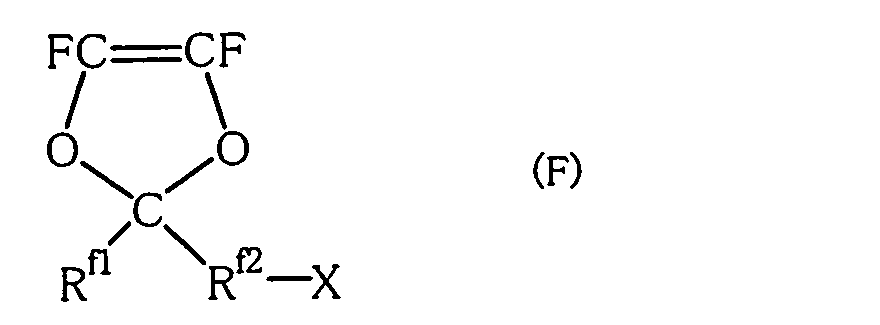

In the formula (G), RA to RD each independently are
selected from the group consisting of a monovalent
perfluoro organic group which may contain at least one of
the present ionic group or its precursor group, and an
oxygen atom of an ether bond type, and an fluorine atom,
or may be a bivalent perfluoro organic group in which two
of RA to RD are bonded to each other and may contain at
least one of the present ionic group or its precursor
group, and an oxygen atom of an ether bond type. At
least one of RA to RD contains the present ionic group or
its precursor group. RE and RF each independently are a
monovalent perfluoro organic group which may contain an
oxygen atom of an ether bond type, or a fluorine atom.
The precursor group of the present ionic group
herein is a group convertible into the present ionic
group by a known treatment such as hydrolysis or a
treatment for conversion into an acid form, e.g., -SO2F
or the like. After polymerization, the precursor group
is converted into the present ionic group to obtain the
polymer electrolyte material. Furthermore, specifically,
the above-mentioned perfluoro organic group is preferably
a perfluorocarbon group which may contain an oxygen atom
of an ether bond type. Among compounds represented by
the formula (G), it is particularly preferable to adopt a
compound represented by formula (3).

In the formula (3), R1 is a bivalent perfluoro
organic group which may contain an etheric oxygen atom,
and R2 to R6 each independently are a fluorine atom or a
monovalent perfluoro organic group which may contain an
oxygen atom of an ether bond type. The organic group
here means a group containing at least one carbon atom,
and the monovalent perfluoro organic group is
particularly preferably a linear or branched
perfluoroalkyl group which may contain an etheric oxygen
atom inside or at one end of the alkyl chain.
At least one of R5 and R6 is preferably a fluorine
atom in the compound (3) in order to exhibit high
polymerizability. In a case wherein either of R5 and R6
is a fluorine atom, the other is more preferably a
fluorine atom or a perfluoroalkoxy group, and it is
further preferable to use a compound having a structure
of formula (3') below where R5 and R6 both are a fluorine
atom. R12 to R14 in the compound (3') each independently
represent a fluorine atom or a perfluoroalkyl group which
may have an etheric oxygen atom inside or at one end of
the alkyl chain; and R1 represents a bivalent perfluoro
organic group which may have an etheric oxygen atom,
wherein an atom bonded to the ring may be an oxygen atom.

A compound (4) is particularly preferred among the
compounds (3') because it has high polymerization
reactivity and is easy to synthesize.

The compound (4) is synthesized by one of several
methods described in International Application Number
PCT/JP02/11310. For example, it can be synthesized by a
synthesis scheme below. In the synthesis scheme, Rf'
represents a linear or branched perfluoroalkyl group
which may contain an oxygen atom of an ether bond type.

Epibromohydrin and a perfluoroalkyl ester of
hydroxyacetone in the above synthesis scheme can be
replaced by epibromohydrin with a substituent and by a
perfluoroalkyl ester of hydroxyacetone with a
substituent, respectively. In this case, it is possible
to synthesize such a compound that the substituent which
is perfluorinated is introduced into the compound (4).
The compound (3) is a compound having all of a
highly polymerizable double bond, a ring structure and a
fluorosulfonyl group (-SO2F group). A polymer obtained
by hydrolyzing a polymer resulting from polymerization of
this compound can be effectively used as an electrolyte
material for brine electrolysis, fuel cells, lithium
batteries and so on.
For example, a fluorosulfonyl group-containing
polymer obtained by homopolymerization of the compound
(3) can have a high molecular weight, and a sulfonic acid
polymer obtained by hydrolysis of the fluorosulfonyl
group in the polymer has a high ion-exchange capacity.
In addition, a fluorosulfonyl group-containing polymer
obtained by copolymerizing the compound (3) with another
polymerizable monomer which is copolymerizable with the
compound (3) (which will be referred to hereinafter as
the "comonomer") can be provided with a new additional
property depending on selection of the comonomer. The
comonomer may be one kind of comonomer, or at least two
kinds of comonomers.
A nonionic monomer is normally selected as the
comonomer. The term "nonionic" means that the monomer
has neither an ionic group nor a precursor group thereof.
Examples of the above-mentioned comonomer include
tetrafluoroethylene, chlorotrifluoroethylene,
trifluoroethylene, vinylidene fluoride, vinyl fluoride,
ethylene, perfluoro(3-butenyl vinyl ether),
perfluoro(allyl vinyl ether), perfluoro(2,2-dimethyl-1,3-dioxole),
perfluoro(1,3-dioxole), perfluoro(2-methylene-4-methyl-1,3-dioxolane),
perfluoro(3,5-dioxa-1,6-heptadiene),
perfluoro(4-methoxy-1,3-dioxole), and so on.
In addition, it is also possible to suitably use monomers
below wherein p is an integer of from 2 to 6. Among
them, tetrafluoroethylene is preferred because a
copolymer thereof is chemically stable, is excellent in
heat resistance, and has high mechanical strength and a
softening temperature higher than that of the
conventional sulfonic acid polymer.


In addition to the comonomers as exemplified above,
further copolymerizable comonomers to be used may be
propene, perfluoro-α-olefins such as hexafluoropropene,
(perfluoroalkyl) ethylenes such as (perfluorobutyl)
ethylene, (perfluoroalkyl) propenes such as 3-perfluorooctyl-1-propene,
and perfluorovinyl ethers such
as perfluoro(alkyl vinyl ether) and perfluoro(alkyl vinyl
ether containing an etheric oxygen atom).
A compound represented by CF2=CF-(OCF2CFZ)t-O-Rf is
preferable as the comonomer of the perfluorovinyl ethers.
Here, t is an integer of from 0 to 3, Z is a fluorine
atom or a trifluoromethyl group, and Rf is a C1-12
perfluoroalkyl group which may be of a linear structure
or of a branched structure. Among them, compounds (5) to
(7) below are preferable. In the formulae below, v is an
integer of from 1 to 9, w is an integer of from 1 to 9,
and x is 2 or 3.
CF2=CFO(CF2)vCF3
CF2=CFOCF2CF(CF3)O(CF2)wCF3
CF2=CF(OCF2CF(CF3))xO(CF2)2CF3
In order to obtain a polymer electrolyte membrane
having a high softening temperature and a polymer
electrolyte having a large oxygen solubility or oxygen
permeability, it is preferable to introduce many ring
structures into the polymer electrolyte and it is
preferable to select a comonomer having a ring structure
or a comonomer having cyclopolymerizability. Specific
examples of the comonomer having a ring structure include
perfluoro(2,2-dimethyl-1,3-dioxole), perfluoro(1,3-dioxole),
perfluoro(2-methylene-4-methyl-1,3-dioxolane)
and perfluoro(4-methoxy-1,3-dioxole). Specific examples
of the comonomer having cyclopolymerizability include
perfluoro(3-butenyl vinyl ether), perfluoro(allyl vinyl
ether) and perfluoro(3,5-dioxa-1,6-heptadiene).
There are no particular restrictions on the
polymerization reaction as long as it is carried out
under such a condition that radicals can be generated.
For example, it may be carried out by bulk
polymerization, solution polymerization, suspension
polymerization, emulsion polymerization, polymerization
in liquid or in supercritical carbon dioxide, and so on.
There are no particular restrictions on a method of
generating radicals, and examples of the method include a
method of irradiating such radiation as ultraviolet rays,
γ-rays or electron rays, and a method of using a radical
initiator applicable to normal radical polymerization.
There are no particular restrictions on the reaction
temperature of the polymerization reaction, and it is
normally carried out, for example, in a temperature range
of from 15 to 150°C. In a case using a radical
initiator, the radical initiator can be one, for example,
selected from bis(fluoroacyl) peroxides,
bis(chlorofluoroacyl) peroxides, dialkyl
peroxydicarbonates, diacyl peroxides, peroxyesters, azo
compounds, persulfates, and so on.
In a case where solution polymerization is carried
out, a solvent to be used is preferably one normally
having a boiling point of from 20 to 350°C, more
preferably from 40 to 150°C from the viewpoint of
handlability. A predetermined amount of a kind or at
least two kinds of the above-mentioned fluoromonomers is
put into the solvent, and a radical initiator and so
forth are added thereinto, thereby generating radicals to
effect polymerization. In a case of a gaseous monomer,
it may be added all at once, or stepwise, or
continuously.
Specific examples of the solvent applicable herein
include the following solvents of (i) to (ix).
These solvents may be used singly or in combination
as a mixture of two or more of them.
Other examples of the solvent to be used in carrying
out the solution polymerization include
chlorofluorocarbons such as 1,1,2-trichloro-1,2,2-trifuloroethane,
1,1,1-trichloro-2,2,2-trifluoroethane,
1,1,1,3-tetrachloro-2,2,3,3-tetrafluoropropane and
1,1,3,4-tetrachloro-1,2,2,3,4,4-hexafluorobutane.
However, these chlorofluorocarbons can be technically
used, but it is not preferable to use these compounds in
view of influence on the global environment.
Suspension polymerization can be carried out by
adding monomers to be polymerized, into water as a
dispersion medium with use of a nonionic initiator as a
radical initiator, such as bis(fluoroacyl) peroxides,
bis(chlorofluoroacyl) peroxides, dialkyl
peroxydicarbonates, diacyl peroxides, peroxyesters and
azo compounds. The solvents described in the section of
solution polymerization can also be added as an auxiliary
agent. Furthermore, in order to prevent suspended
particles from coagulating, a surfactant may be
optionally added as a dispersion stabilizer.
In the present invention, the alicyclic
fluoromonomer having the present ionic group and the
carbon-carbon double bond with radical polymerization
reactivity in which at least one of carbon atoms forming
the double bond constitutes a ring structure, has high
homopolymerization reactivity. The compound (3) is
particularly preferred because it has such
homopolymerization reactivity higher than that of the
perfluorovinyl ether monomer, as to achieve a large
molecular weight. Two monomers are compared as follows
in terms of homopolymerization reactivity: if each
monomer is polymerized under the same polymerization
conditions and if one monomer gives a polymer yield and a
polymerization degree both larger than those of the other
monomer, it is judged that the monomer with the larger
polymer yield and polymerization degree has the
homopolymerization reactivity higher than the other
monomer. The "same polymerization conditions" here means
that an identical radical initiator is added to monomers
in such an amount that it contained in the same
concentration based on the mass ratio, and, after
deaeration, polymerization is carried out at the same
temperature for the same period of time. For example, it
is evaluated by a method described in Examples of the
present specification.
A polymer containing a repeating unit (1) is
obtained by carrying out polymerization with use of the
compound (3), followed by hydrolysis and conversion into
an acid form. Such a polymer is suitable for a polymer
electrolyte material. In the formula (1), M+ is H+, a
monovalent metal cation or an ammonium ion at least one
hydrogen atom of which may be substituted by a
hydrocarbon group, Rf is a linear or branched
perfluoroalkyl group which may contain an oxygen atom of
an ether bond type, X is an oxygen atom, a nitrogen atom
or a carbon atom, a=0 in the case of X being an oxygen
atom, a=1 in the case of X being a nitrogen atom, and a=2
in the case of X being a carbon atom. Furthermore, R1 to
R6 are synonymous with R1 to R6 in the compound (3).

A preferred one among the polymers containing the
repeating unit (1) is a polymer containing a repeating
unit in which each of R5 and R6 is a fluorine atom in the
formula (1). The reason is that, where each of R5 and R6
is a fluorine atom, the polymer can be synthesized from a
monomer having high polymerization reactivity and will
have a high molecular weight. Furthermore, a polymer
containing a repeating unit (2) is particularly
preferable for the same reason.

The polymer being the polymer electrolyte material
according to the present invention has a softening
temperature of preferably at least 90°C, more preferably
at least 100°C. The softening temperature of the polymer
here means a temperature at which the elastic modulus
thereof starts to decrease abruptly in a test for
evaluating the dynamic viscoelasticity of the polymer in
which the temperature of the polymer is gradually raised
from near room temperature while measuring the elastic
modulus. Thus, the softening temperature in the present
invention is different from the glass transition
temperature normally determined from a value of tanδ and
it is generally observed in a temperature region lower
than the glass transition temperature.
The softening temperature is measured with a dynamic
mechanical analyzer (DMA) and it can also be measured
with a thermomechanical analyzer (TMA) by a penetration
method using a quartz probe having a diameter of 1 mm.
Namely, a solution of a polymer electrolyte material to
be measured is prepared; a polymer film is cast from the
solution; the quartz probe is brought into contact with
this film from a direction of a normal to a surface of
this film; the temperature is raised at a rate of from 1
to 10°C/min; and with increase of temperature, the
softening temperature is measured as a temperature at
which the thickness of the film starts to abruptly
decrease by the penetration of the probe into the film.
The inventor of the present invention preliminarily
confirmed that the value of the softening temperature
obtained by this method agreed with the temperature at
which the abrupt decrease in modulus started to be
observed in a temperature dependency profile of the
forementioned elastic modulus of the polymer.
Furthermore, in a case where the load of the probe
exerted on the film is too small, the thermal expansion
of the film will be observed, but by optimizing the load,
it is feasible to measure a degree of penetration of the
probe at the softening temperature of the film, without
any problem. The film to be used may be a film produced
by melt extrusion or hot press of a precursor polymer,
followed by hydrolysis or by a treatment for conversion
into an acid form after hydrolysis.
An operation temperature of a polymer electrolyte
fuel cell is generally at most 80°C, but it is desired to
be at least 90°C and further at least 100°C. If the
operation temperature of the fuel cell becomes at least
100°C, it will become feasible to utilize the exhaust
heat of the cell more effectively, and at the same time,
it will become easier to control the temperature of the
cell during the operation because heat removal of the
cell becomes easy. Furthermore, in this case, it will
become possible to reduce the catalyst poisoning due to
carbon monoxide and others contained in an anode reaction
gas, and as a result, it will become possible to improve
the cell life and to increase the output power of the
cell.
Accordingly, the softening temperature of the
polymer electrolyte material contained in a catalyst
layer and the electrolyte material forming an electrolyte
membrane is at least 90°C, preferably at least 100°C,
whereby the durability of the polymer electrolyte
material is improved, so that it becomes possible to
suppress change with time of properties such as swelling
and deformation of the polymer electrolyte material
during the operation of the cell. As a result, the life
of the cell can be improved. In particular, if the
polymer electrolyte material of the present invention
having the softening temperature of at least 100°C is
used for a catalyst layer of a cathode at which water is
formed by reaction of the cell, the improvement in the
durability is effectively enhanced, which is preferable.
Furthermore, an output voltage of the cell can be
increased. It is conceivably because the polymer
electrolyte material of the present invention contains a
ring structure and it enhances oxygen solubility and
permeability.
Furthermore, where a cross-linking structure is
introduced into the polymer to be used as the polymer
electrolyte material, excessive swelling is suppressed by
cross-linkage, so as to prevent decrease of strength.
Therefore, the polymer is able to endure operation at a
higher temperature than before even though the softening
temperature is not necessarily high. If the cross-linking
structure is introduced into a polymer having a
high softening temperature, the durability is further
effectively enhanced. Since the cross-linked polymer can
maintain its shape even at temperatures higher than the
softening temperature, a membrane with high reliability
can be preferably obtained, particularly, in production
of a polymer electrolyte membrane.
Furthermore, the polymer electrolyte material of the
present invention can be used as a solid acid catalyst.
In this case, as the softening temperature is high, the
reaction temperature can be made higher, whereby a
desired reaction can proceed in a higher temperature
region.
The polymer electrolyte material of the present
invention preferably has an ion-exchange capacity
(hereinafter referred to as "AR") of from 0.5 to 2.5
milliequivalent/g dry resin (hereinafter represented by
"meq/g"). If AR of the polymer electrolyte material is
less than 0.5 meq/g, the polymer electrolyte material
will tend to decrease its water content to decrease its
ionic conductivity. Therefore, if such a polymer
electrolyte material is used as a constitutive material
for the polymer electrolyte membrane or the catalyst
layer of the polymer electrolyte fuel cell, it will tend
to be difficult to obtain an adequate cell output. On
the other hand, if AR of the polymer electrolyte material
exceeds 2.5 meq/g, the density of ion exchange groups
will increase in the polymer electrolyte material,
whereby the strength of the polymer electrolyte material
will be likely to drop. Furthermore, if such a material
is used as a constitutive material for a catalyst layer
of a polymer electrolyte fuel cell, the water content
will tend to be too high, so as to degrade the gas
diffusion or water drainage in the catalyst layer, which
can result in easy occurrence of flooding and to cause
great change in dimensions due to swelling.
From the same viewpoint as above, AR of the polymer
electrolyte material of the present invention is more
preferably from 0.7 to 2.0 meq/g, further preferably from
0.9 to 1.5 meq/g. However, as described below, the
polymer electrolyte material of the present invention may
have the cross-linking structure. In this case, the
preferable lower limit of AR is the same as above, but
the preferable upper limit of AR differs depending on a
molecular weight of a monomer to be used, a molecular
weight of a monomer for cross-linkage as described below
and a cross-linking density, because the water content is
reduced by introduction of cross-linkage. Therefore, the
AR value can be higher with cross-linkage than without
cross-linkage.
Furthermore, there are no particular restrictions on
the number-average molecular weight of the polymer
electrolyte material of the present invention, and it can
be adequately set by changing the polymerization degree
of the copolymer depending on the purpose. In a case
where the material is used for a constituting material
for a catalyst layer of the polymer electrolyte fuel cell
as in the present embodiment, the number-average
molecular weight is preferably from 5,000 to 5,000,000,
more preferably from 10,000 to 3,000,000. If the number-average
molecular weight of the polymer electrolyte
material is less than 5,000, the physical properties such
as the swelling degree will tend to change with time, so
as to possibly lead to inadequate durability. On the
other hand, if the number-average molecular weight
exceeds 5,000,000, preparation of a solution can be
difficult.
Moreover, if a non-cross-linked polymer electrolyte
material is used as a membrane, the number-average
molecular weight is preferably from 10,000 to 10,000,000,
particularly preferably from 50,000 to 5,000,000, and
further preferably from 100,000 to 3,000,000. This is
because a too low molecular weight tends to result in
inadequate strength as the membrane, while a too high
molecular weight tends to make film formation difficult.
The electrolyte material of the present invention
may be cross-linked. A cross-linked electrolyte material
can be obtained by copolymerizing an alicyclic
fluoromonomer having the present ionic group or a group
convertible into the present ionic group (e.g., an -SO2F
group) and having a carbon-carbon double bond with
radical polymerization reactivity wherein either of the
carbon atoms at both ends of the double bond constitutes
a ring structure, with a fluoromonomer having at least
two double bonds with radical polymerizability in the
molecule, in the presence of a radical initiating source.
The above-mentioned fluoromonomer having at least two
double bonds with radical polymerizability is
particularly preferably a perfluorinated monomer, and
among others, it is particularly preferably a monomer
represented by a formula below (where QF1 represents a
single bond, an oxygen atom or a perfluoroalkylene group
of from 1 to 10 carbons which may have an etheric oxygen
atom), or a perfluorodivinyl ether represented by
CF2=CFORf3OCF=CF2 (where Rf3 represents a perfluoroalkylene
group of a linear or branched structure which may have an
oxygen atom of an ether bond type).
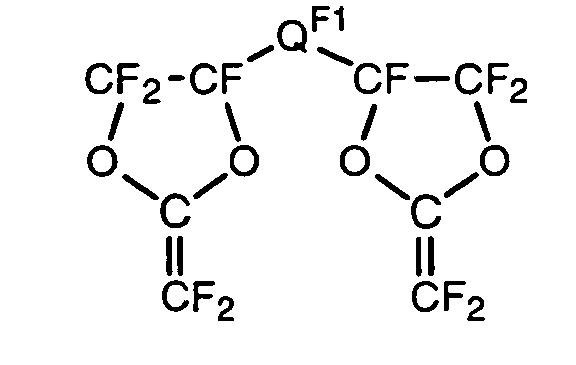
Specific examples of the former monomer include
monomers below.


Specific examples of the latter monomer include
monomers below. In the formulae, h and k represent
integers of from 2 to 8, and i and j each independently
represent an integer of from 0 to 5 and i+j≧1.
CF2=CFOCF=CF2
CF2=CFO(CF2)hOCF=CF2
CF2=CF[OCF2CF(CF3)]iO(CF2)k[OCF(CF3)CF2]jOCF=CF2
Furthermore, the comonomer as described above may be
added to be copolymerized to obtain a polymer having a
cross-linking structure. In this case, an appropriate AR
value is that as described above. The molecular weight
of the polymer becomes too large to specify because a
three-dimensional network structure is formed.
For synthesis of the cross-linked electrolyte
material, a monomer to be used is preferably one in a
state of liquid under the normal pressure and at the
temperature of polymerization because of good
handlability. It is preferable to form the cross-linked
electrolyte membrane in a film shape at the same time as
polymerization.
The electrolyte material of the present invention is
not limited to a homopolymer and a random copolymer, and
it may be a graft copolymer or a block copolymer. In a
case of a graft copolymer, it can be obtained as follows:
such radiation as γ rays or an electron beam is
irradiated onto a substrate of polyethylene, a
tetrafluoroethylene-ethylene copolymer (ETFE),
polytetrafluoroethylene (PTFE), a tetrafluoroethylenehexafluoropropene
copolymer (FEP), a tetrafluoroethyleneperfluoro(alkyl
vinyl ether) copolymer (PFA) or the like
to generate radicals; the radicals are brought into
contact with at least one alicyclic fluoromonomer having
the present ionic group or the group convertible into the
present ionic group and having a carbon-carbon double
bond with radical polymerization reactivity, in which
either of the carbon atoms at both ends of the double
bond constitutes a ring structure, to carry out
polymerization. On the graft polymerization, the above-mentioned
comonomer may be added and copolymerized.
Furthermore, the polymer may be cross-linked by
copolymerization with a monomer having a plurality of
unsaturated bonds with radical polymerization reactivity
in the molecule.
A block copolymer can be obtained, for example, by
polymerizing at least one above-mentioned alicyclic
fluoromonomer in the presence of a radical initiating
source and an iodine compound such as F(CF2)4I or
I(CF2)4I, and then polymerizing another monomer
therewith. The other monomer may be the above-mentioned
comonomer having no functional group. The order of the
polymerization steps may be inverted. The polymerization
of each segment may be either homopolymerization or
copolymerization. The polymerization of the monomer
having the ionic group or a group convertible into the
ionic group and a ring structure, which is to be used in
the present invention, may be copolymerized with another
comonomer not having these groups.
The present ionic group in the polymer electrolyte
material of the present invention is represented
by - (SO2X(SO2Rf)a)-M+, and from the definitions of X and a,
it is specifically preferably an -SO3 -M+ group such as a
sulfonic acid group, a sulfonimide group (-SO2N-M+SO2Rf)
or a sulfonmethide group (-SO2C-M+(SO2Rf)2). Here, M+ is
H+, a monovalent metal cation or an ammonium ion at least
one hydrogen atom of which may be substituted by a
hydrocarbon group; Rf is a linear or branched
perfluoroalkyl group which may contain an oxygen atom of
an ether bond type; in the case of the sulfonmethide
group, two Rfs may be identical to or different from each
other. Rf here is a linear or branched perfluoroalkyl
group which may contain an oxygen atom of an ether bond
type, and the carbon number thereof is preferably from 1
to 8, particularly preferably from 1 to 6. It is
specifically preferably a perfluoromethyl group, a
perfluoroethyl group, or the like.
It is relatively easy to make the polymer
electrolyte material of the present invention contain a
sulfonimide group. A monomer containing the sulfonimide
group can be synthesized by adding chlorine to the
unsaturated bond of the compound (3) and by converting
the -SO2F group into a sulfonimide group, followed by
dechlorination. Accordingly, polymerization may be
carried out by using this monomer.
The -SO2F group can be converted into a sulfonimide
group by reaction with RfSO2NHMa (Ma is an alkali metal or
one of primary to quaternary ammoniums), by reaction with
RfSO2NH2 in the presence of an alkali hydroxide, an alkali
carbonate, MaF (Ma is the same as above), ammonia or one
of primary to tertiary amines, or by reaction with
RfSO2NMaSi(CH3)3 (Ma is the same as above). The
sulfonimide group is obtained in the form of a salt
derived from the base used, in these reactions. A
reaction example using the compound (4) is as follows.

The sulfonimide group of the salt form can be
converted into an acid form by treatment with an acid
such as sulfuric acid, nitric acid or hydrochloric acid.
This reaction is applicable to a chlorine-addition
product of the compound (4) as described above, but a
polymer having a sulfonimide group can also be obtained
by polymerizing the compound (4) to form a polymer having
a fluorosulfonyl group (-SO2F group) and effecting the
same treatment on the -SO2F group of this polymer.
Moreover, according to the present invention, a
polymer having a sulfonate group or a sulfonic acid group
can be produced by hydrolyzing the copolymer having an -
SO2F group in the presence of a base or by effecting a
conversion treatment into an acid form after hydrolysis.
Furthermore, in order to improve the durability or
the like, the polymer constituting the polymer
electrolyte material according to the present invention
may be fluorinated with fluorine gas or heat-treated in
the presence of air and/or water after the
polymerization, thereby stabilizing an unstable moiety
such as a polymer end.
In the above-mentioned hydrolysis, it is preferable
to use an alkali metal hydroxide or an alkali metal
carbonate. In the acid treatment, it is preferable to
use hydrochloric acid, nitric acid or sulfuric acid.
This can convert the fluorosulfonyl group into a
sulfonate group (-SO3Mb group: Mb represents a counter
ion) thereby. Mb is preferably an alkali metal ion or
N+R15R16R17R18 (R15 to R18 each independently represent a
hydrogen atom or an alkyl group having from 1 to 5
carbons). The alkali metal ion is preferably a sodium
ion, a potassium ion or a lithium ion. Furthermore,
N+R1SR16R17R1B is preferably N+(CH3)4, N+(CH2CH3)4,
N+(CH2CH2CH3)4 or N+(CH2CH2CH2CH3)4.
The polymer wherein Mb in the sulfonate group is an
alkali metal ion, is preferably obtained by reacting an
alkali metal hydroxide with a polymer containing a
fluorosulfonyl group. The polymer wherein Mb in the
sulfonate group is N+R15R16R17R18 is preferably obtained by
reacting N+R15R16R17R18(OH)- with the polymer containing a
sulfonic acid group, though it can also be obtained by
reacting N+R15R16R17R18(OH)- with the polymer containing a
fluorosulfonyl group.
Furthermore, the polymer containing the sulfonate
group is immersed in an aqueous solution containing an
ion different from Mb and capable of becoming a counter
ion, thereby enabling conversion into the above-mentioned
counter ion.
Furthermore, the sulfonate group (-SO3Mb group) can
be converted into a sulfonic acid group (-SO3H group) by
treatment with an acid such as hydrochloric acid, nitric
acid or sulfuric acid. A polymer containing the ionic
group obtained in this manner may be treated with a
hydrogen peroxide solution if necessary.
These group conversion methods and polymer treatment
can be carried out in accordance with the known methods
and conditions.
The polymer electrolyte material of the present
invention can be formed into a film and used as a polymer
electrolyte membrane. There are no particular
restrictions on the method of forming into a film, and a
cast film may be made from a liquid obtained by
dissolving or dispersing the polymer electrolyte material
in a solvent. A film may also be obtained through an
operation such as extrusion molding or drawing. For the
extrusion molding, a polymer with an -SO2F group which is
a precursor of the polymer electrolyte material is used
from the viewpoint of excellent melt flowability, and it
is preferably converted into a polymer electrolyte
membrane by hydrolysis after molding.
Furthermore, the polymer electrolyte membrane may be
reinforced with a porous material, fiber, woven fabric,
non-woven fabric, or the like of polytetrafluoroethylene
(PTFE), a tetrafluoroethylene-hexafluoropropylene
copolymer (FEP), a tetrafluoroethylene-perfluoro(alkoxy
vinyl ether) copolymer (PFA), polyethylene, polypropylene
or the like.
If the electrolyte membrane is made of a cross-linked
polymer, it can be, for example, produced as
follows. First, at least one alicyclic fluoromonomer
having the present ionic group or its precursor group, is
mixed with at least one fluoromonomer having at least two
double bonds with radical polymerizability in its
molecule, and if necessary, with the above-mentioned
comonomer and a polymerization initiator is added to the
mixture to prepare a liquid composition. Then, the
liquid composition is heated for a short period of time
according to need, to appropriately increase the
viscosity. This liquid composition is applied onto a
substrate to make a liquid film, and the film is then
heated to effect polymerization to form a film. In
applying the composition to form the film, it can be
combined with one of the above-mentioned reinforcing
materials.
The polymer electrolyte material of the present
invention can be well dissolved or dispersed in an
organic solvent having a hydroxyl group. There are no
particular restrictions on the organic solvent having a
hydroxyl group and it is preferably an organic solvent
having an alcoholic hydroxyl group.
Specific examples of the organic solvent having an
alcoholic hydroxyl group include methanol, ethanol, 1-propanol,
2-propanol, 2,2,2-trifluoroethanol, 2,2,3,3,3-pentafluoro-1-propanol,
2,2,3,3-tetrafluoro-1-propanol,
4,4,5,5,5-pentafluoro-1-pentanol, 1,1,1,3,3,3-hexafluoro-2-propanol,
3,3,3-trifluoro-1-propanol,
3,3,4,4,5,5,6,6,6-nonafluoro-1-hexanol, and
3,3,4,4,5,5,6,6,7,7,8,8,8-tridecafluoro-1-octanol. In
addition, an organic solvent having a carboxyl group such
as acetic acid can also be used as an organic solvent
other than the alcohols.
The above-mentioned solvents may be used singly or
in combination as a mixture of two or more of them, as
the organic solvent having a hydroxyl group.
Furthermore, they may be used as mixed with water or with
other fluorine-containing solvents or the like. Such
other fluorine-containing solvents may be the fluorine-containing
solvents exemplified as the preferred
fluorine-containing solvents in the solution
polymerization reaction for producing the polymer
electrolyte material as described above. In a case where
the organic solvent having a hydroxyl group is used as a
mixed solvent with water or with another fluorine-containing
solvent, the content of the organic solvent
having a hydroxyl group is preferably at least 10%, more
preferably at least 20%, based on the total mass of the
solvent.
In this case, the polymer electrolyte material may
be dissolved or dispersed in the mixed solvent from the
beginning, or the mixture may be made in such a manner
that the polymer electrolyte material is first dissolved
or dispersed in the organic solvent having a hydroxyl
group and that water or another fluorine-containing
solvent is then mixed thereinto. Furthermore, the
dissolution or dispersion of the polymer electrolyte
material in the solvent is preferably carried out in a
temperature range of from 0 to 250°C, more preferably in
a range of from 20 to 150°C, under atmospheric pressure
or under a condition of seal-off pressure by means of an
autoclave or the like. In a case containing an organic
solvent having a boiling point lower than that of water,
water is added after or while distilling off the solvent,
thereby substituting the solvent with water.
The liquid composition of the present invention
obtained using such a solvent is useful for production of
a cast film made of the polymer electrolyte material or
for production of the catalyst layer of the polymer
electrolyte fuel cell. In a case of producing the
catalyst layer, a catalyst is mixed into the liquid
composition and the resultant liquid is applied to form a
coating layer. The content of the polymer electrolyte
material in the liquid composition used for such a
purpose is preferably from 1 to 50%, more preferably from
3 to 30%, based on the total mass of the liquid
composition. If the content of the polymer electrolyte
material is less than 1%, the number of coating steps
will have to be increased to produce a film or a catalyst
layer in a desired thickness, and it will take a long
period of time for removing the solvent, to degrade the
efficiency of the production operation. On the other
hand, if the content of the polymer electrolyte material
exceeds 50%, the viscosity of the liquid composition will
tend to be too high, so as to degrade handlability.
Furthermore, the liquid composition may contain a
resin of another polymer electrolyte material, in
addition to the polymer electrolyte material of the
present invention. In this case, the content of the
polymer electrolyte material of the present invention in
the liquid composition is preferably at least 20%, more
preferably at least 50%, based on the total mass of the
entire polymer electrolyte material in the liquid
composition, from the viewpoint of securing sufficient
gas diffusibility and water repellency of the catalyst
layer obtained using the liquid composition as the raw
material.
When the polymer electrolyte material of the present
invention is applied to a membrane or a catalyst layer as
a material for the polymer electrolyte fuel cell, the
ionic group is normally used in a state of a strong acid
group, i.e., in a state in which the counter ion of the
ionic group is H+.
Concerning a case where the polymer electrolyte
material of the present invention is used as an
electrolyte for a catalyst layer of an anode or a cathode
in a polymer electrolyte fuel cell, description will be
given as to an example of preparation of the catalyst
layer and an example of preparation of a membrane
electrode assembly having this catalyst layer. For
example, the catalyst layer can be prepared with use of a
coating liquid for formation of the catalyst layer which
is prepared by dissolving or dispersing the polymer
electrolyte material of the present invention having
an -SO3H group, in a solvent having a hydroxyl group in
its molecule to form a liquid composition, and by mixing
a catalyst therein. The catalyst is preferably carbon
black or the like in a fine particle state having
platinum or a platinum alloy supported thereon. The
coating liquid is applied in uniform thickness onto a
polymer electrolyte membrane, a gas diffusion layer or a
support plate prepared separately, and the solvent is
removed by drying. Thereafter, the resultant is hot-pressed
according to need, thereby preparing the catalyst
layer.
The catalyst layer obtained in this way is excellent
in gas diffusibility and water repellency, and is
particularly suitable for a cathode. The catalyst layer
is improved in the gas diffusibility, especially, when
the catalyst layer is prepared using a liquid composition
containing the polymer electrolyte material wherein the
softening temperature of the polymer itself is at least
100°C. A conceivable reason for the improvement is that
if the softening temperature of the polymer electrolyte
material is at least 100°C, the polymer electrolyte
material is unlikely to shrink during gradual
vaporization of the solvent from the coating liquid, and
pores are formed in adequate size in the interior of the
polymer electrolyte material or among agglomerates of
catalyst particles coated with the polymer electrolyte
material.
The polymer electrolyte material of the present
invention may be contained in both catalyst layers of the
cathode and the anode, or it may also be contained in
either of the catalyst layers while the other catalyst
layer is prepared by use of a liquid in which a
conventional polymer electrolyte material is dissolved or
dispersed in a predetermined solvent.
A membrane electrode assembly for a polymer
electrolyte fuel cell can be prepared by disposing each
of the catalyst layer for a cathode and the catalyst
layer for an anode between a polymer electrolyte membrane
and a gas diffusion layer. Where the catalyst layer is
formed on the polymer electrolyte membrane, the gas
diffusion layer separately prepared may be adjacently
disposed or bonded on the catalyst layer, for example.
Where the catalyst layer is formed on the gas diffusion
layer, the polymer electrolyte membrane separately
prepared may be disposed or preferably bonded between the
catalyst layer of the cathode and the catalyst layer of
the anode. Furthermore, where the catalyst layer is
formed on a support plate (support film), it may be
transferred, for example, to the polymer electrolyte
membrane separately prepared, then the support plate is
peeled off, and the gas diffusion layer separately
prepared is adjacently disposed on the catalyst layer.
The gas diffusion layer herein is made of a conductive
porous material such as carbon paper and has a function
of supplying a gas uniformly to the catalyst layer and a
function as a current collector.
The bonding between the polymer electrolyte membrane
and the catalyst layer, and the bonding between the
catalyst layer and the gas diffusion layer may be
implemented, for example, by hot press or by roll press.
The polymer electrolyte material of the present
invention is applicable not only to hydrogen/oxygen type
and hydrogen/air type fuel cells, but also to a direct
methanol type fuel cells (DMFC). Methanol or an aqueous
methanol solution to be used as fuel for DMFC may be
supplied by a liquid feed or by a gas feed.
Furthermore, the polymer electrolyte material of the
present invention is not limited to use of brine
electrolysis and fuel cells, but can be used for various
applications. The polymer electrolyte material in the
present invention means a polymer material that is used
by taking advantage of the functions of an ionic group,
and the ionic group possesses an ion conductive function,
an ion exchange function, a water-absorbing function, and
so on. Where it contains a strong acid group, it has a
function as an acid catalyst. It can also be used for a
proton permselective membrane to be used for electrolysis
of water, production of hydrogen peroxide, production of
ozone, recovery of waste acid, and so on; for a diaphragm
of a redox flow cell; for a cation exchange membrane for
electrodialysis to be used for desalination or salt
production; and so on. Furthermore, it may also be used
for a polymer electrolyte for a lithium primary cell, a
lithium secondary cell, and a lithium ion secondary cell,
a solid acid catalyst, a cation exchange resin, a sensor
using a modified electrode, an ion exchange filter for
removing a slight amount of ions in the air, an actuator,
an electrochromic display element, and so on. Namely, it
can be used as a material for variety of electrochemical
processes.
In addition, the polymer electrolyte material of the
present invention is also applicable to membranes for
diffusion dialysis to be used for separation and
purification of acids, bases and salts, charged porous
membranes (a charged reverse osmosis membrane, a charged
ultrafiltration membrane, a charged microfiltration
membrane, etc.) for separation of protein, dehumidifying
membranes, humidifying membranes, and so on.
The polymer electrolyte material of the present
invention has a low refractive index because it is made
of a fluoropolymer. For this reason, when a thin film is
formed by applying a liquid in which the polymer
electrolyte material of the present invention with a
large ion exchange capacity having the ionic group
followed by drying, it can also be used as an
antireflection film which can be removed with water or
with an alkaline aqueous solution. In this case, water
and/or an organic solvent can be used as a solvent for
the liquid, and water is preferred. It can also be used
as an antireflection film applied onto a resist in a
production process of a semiconductor device and the
like. Furthermore, it can also be used as an agent for
imparting the hydrophilic property to a filter composed
of a PTFE porous material.
Now, the present invention will be described in
further detail with reference to Examples, but it should
be understood that the present invention is by no means
restricted to such Examples.
In the following, 1,1,2-trichlorotrifluoroethane
will be referred to as R-113, CClF2CF2CHClF as HCFC
225cb, gas chromatography as GC, size exclusion
chromatography as GPC, number-average molecular weight as
Mn and weight-average molecular weight as Mw.
Perfluorobenzene was used as an internal standard in
quantitative determination using 19F-NMR. A quantitative
value by means of GC is a value determined from a peak
area ratio. Apparatus name: SEC HLC-8020, manufactured
by Tosoh Corporation, was used for GPC; HCFC
225cb/hexafluoroisopropyl alcohol (at a volume ratio of
99/1) was used as a moving bed; two pieces of Plgel 5 µ
MIXED-C manufactured by Polymer Laboratories Ltd. were
used as columns; and polymethyl methacrylate was used as
a standard sample for conversion of molecular weight.
The compound (4) was synthesized through syntheses
of the compounds (A1) to (A5) based on the synthesis
scheme as shown previously. The compound (A1) was
synthesized by a method described in J. Fluorine Chem.,
46, 39 (1990).

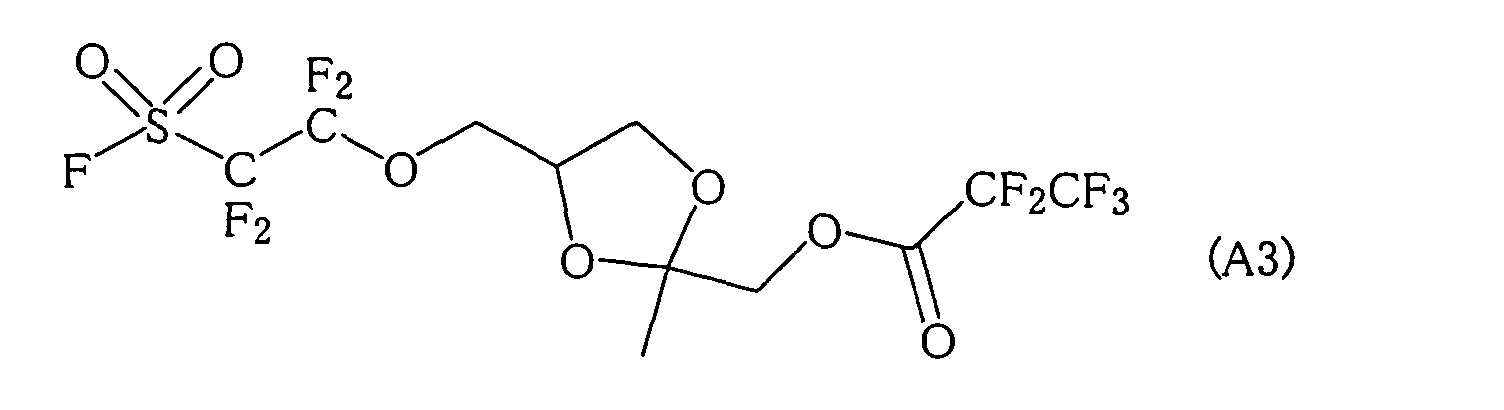
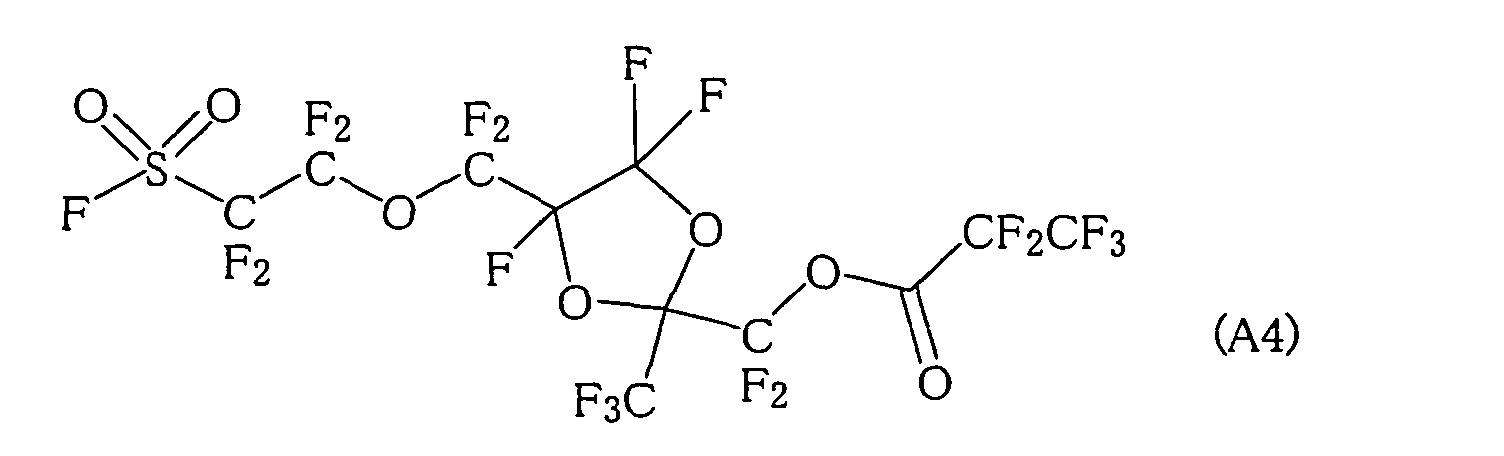

CH3COCH2OH (150.0 g) and triethylamine (225.4 g) were
put into a flask and stirred in an ice bath. CF3CF2COF
(377.5 g) diluted with nitrogen gas was blown thereinto
over 4 hours while the internal temperature was kept at
most 10°C. Then the mixture was stirred at room
temperature for 2 hours and added into 500 ml of ice
water.
A crude liquid obtained was subjected to liquid
separation to obtain a fluorocarbon layer. Then the
fluorocarbon layer was washed two times with water (250
mL) and dried with magnesium sulfate. It was further
filtered to obtain a crude liquid. The filtrate was
distilled under reduced pressure to obtain the compound
(A2) (167.3 g) as a fraction at 47.1 to 47.9°C/0.7 kPa
(absolute pressure). The purity of the fraction by means
of GC was 99%.
Boron trifluoride etherate (32.01 g) and anhydrous
acetone (4.5 L) were mixed under a dry atmosphere, and
the compound (A1) (1198.1 g) was diluted with anhydrous
acetone (1.2 L) and dropwise added into the above
mixture. The mixture was refluxed with heating for one
hour. After distilling off about a half of acetone, the
compound (A2) (1031.41 g) was diluted with toluene (2 L),
and added to the reaction system. The rest of acetone
was then distilled off under reduced pressure with
heating at most 65°C. The reaction mixture was poured
into a mixture of a saturated sodium hydrogen carbonate
aqueous solution and ice, and extracted with t-butyl
methyl ether (2.9 L) in three times. The extract was
dried with magnesium sulfate and the drying agent was
removed by filtration under reduced pressure, followed by
concentration of the filtrate. The residue was purified
by means of silica gel column chromatography (developing
solvent: HCFC 225cb/n-hexane 1:1 (volume ratio) first,
and then HCFC 225cb only) to obtain the compound (A3)
(1478.95 g). The purity by means of GC was 99%.
R-113 (312 g) was introduced into a 500 ml nickel
autoclave and stirred, and the temperature was maintained
at 25°C. A condenser maintained at 20°C, an NaF pellet
layer and a condenser maintained at -10°C were serially
arranged at a gas outlet of the autoclave. A liquid
returning line was installed to return the condensed
liquid from the condenser to the autoclave.
After blowing nitrogen gas for 1.0 hour, fluorine
gas diluted with nitrogen gas to 20% (referred to
hereinafter as "diluted fluorine gas") was blown
thereinto at a flow rate of 12.72 L/h for one hour.
While fluorine gas was blown at the same rate, a solution
of the compound (A3) (20.0 g) dissolved in R-113 (200 g)
was then injected thereinto over 7.6 hours.
Next, while the diluted fluorine gas was blown at
the same flow rate and the reactor pressure was kept at
0.15 MPa, 23 mL of an R-113 solution in a benzene
concentration of 0.01 g/mL was poured as raising the
temperature from 25°C to 40°C. Then, an inlet for
benzene of the autoclave was closed and stirring was
continued for 1.0 hour under the pressure of the reactor
of 0.15 MPa and the internal temperature of the reactor
of 40°C. A total amount of benzene introduced was 0.22
g, and that of R-113 was 23 mL. Then nitrogen gas was
blown for 1.0 hour. The product was analyzed by means of
19F-NMR and it was confirmed that the compound (A4) was
produced and the yield was 98%.
The compound (A4) (10.6 g), together with KF powder
(0.18 g) sufficiently dried, was charged into a flask and
stirred at room temperature for 24 hours. After cooling,
a sample (8.8 g) recovered from the flask was filtered to
recover a liquid sample. It was confirmed by NMR and GC-MS
that the main product was the compound (A5). The
yield was 77.8%.
531 g of a reaction liquid containing the compound
(A5) as a main component was obtained from 706 g of the
compound (A4) in the same manner as above. 481 g of the
compound (A5) in a purity of 99% was obtained by
distillation under reduced pressure. The distillation
temperature was 71 to 73°C/5.3 kPa.
A stainless steel reaction tube (fluidized bed type)
having an inner diameter of 1/2 inch and filled with
glass beads was heated to 350°C, and a gas mixture of the
compound (A5) and nitrogen heated (molar ratio 1:9) was
passed through. The residence time was 10 seconds and
the linear velocity was 2.5 cm/sec. An amount of the
compound (A5) used was 68.1 g. The gas coming out from
the reaction tube was cooled to obtain a liquid
containing the compound (4) as a main component. The
reaction yield was 52%.
Then, methanol was added to the reaction liquid and
the compound (A5) unreacted was methyl-esterified. The
compound (4) was washed with water and then purified by
distillation. The boiling point was 48°C/2.7 kPa.
A homopolymer of the compound (4) was obtained as
follows.
The compound (4) (1.25 g) and perfluorobenzoyl
peroxide (4.5 mg) were put into a glass tube, solidified
with liquid nitrogen, and sealed in vacuum. The mixture
was maintained at 70°C for 45 hours and a polymer
produced was taken out, dissolved in n-C6F13H,
reprecipitated with hexane, washed with hexane after
filtration, and dried under reduced pressure at 80°C for
16 hours. The yield of the homopolymer of the compound
(4) was 0.823 g (yield 66%). The Mn measured by means of
GPC was 6.5×10⁴, and the Mw was 9.8×10⁴. The glass
transition temperature measured by DSC was 92°C. The
refractive index was 1.35.
Furthermore, the filtrate was concentrated under
reduced pressure, then precipitated and washed, and a low
boiling component was distilled off under reduced
pressure. Then the resultant was dried under reduced
pressure at 80°C for 16 hours, to recover a polymer in
the form of powder (0.072 g) composed of a homopolymer of
the compound (4) . The yield combined with the polymer
previously obtained was 71%.
The polymer previously obtained was hydrolyzed in a
10% KOH aqueous solution overnight and it was confirmed
that the polymer was dissolved in this aqueous solution.
CF2=CFOCF2CF (CF3)OCF2CF2SO2F (1.25 g) and
perfluorobenzoyl peroxide (4.5 mg) were put into a glass
tube, solidified with liquid nitrogen and sealed in
vacuum. The mixture was reacted at 70°C for 45 hours and
remained as a colorless transparent liquid. The reaction
liquid was transferred into a round-bottom flask, and the
wall of the glass tube was washed with HCFC 225cb. The
washing liquid was added into the above-mentioned round-bottom
flask. A low-boiling component was distilled off
under reduced pressure and the mixture was dried under
reduced pressure at 80°C for 16 hours. An oligomer
(0.328 g) like starch syrup was obtained. The polymer
yield was 26%, the Mn measured by means of GPC was
3.7×10³, and the Mw was 4.7×10³. This result confirmed
that the compound (4) had polymerization reactivity
higher than that of CF2=CFOCF2CF(CF3)OCF2CF2SO2F.
The compound (4) and perfluoro(2-methylene-4-methyl-1,3-dioxolane)
were copolymerized, followed by hydrolysis
and conversion into an acid form, as described below.
7.90 g of the compound (4), 9.60 g of perfluoro(2-methylene-4-methyl-1,3-dioxolane),
109.7 g of HCFC 225cb
and 255 mg of perfluorobenzoyl peroxide were charged into
a stainless steel autoclave having a capacity of 0.1 L,
and cooled with liquid nitrogen, followed by deaeration.
After reaction at 70°C for 5 hours, the resultant mixture
was poured into hexane so as to precipitate a polymer.
After washing with hexane, the precipitate was dried in
vacuum at 100°C to obtain 14.0 g of a white polymer.
The ion-exchange capacity AR of the above-mentioned
polymer was determined to be 1.13 meq/g, based on the
content of sulfur obtained by the elemental analysis.
The intrinsic viscosity at 30°C measured using
perfluoro(2-butyltetrahydrofuran) as a solvent was 0.16
dl/g.
40 g of methanol and 160 g of a 10% KOH aqueous
solution were added to 10 g of this polymer and
maintained at 60°C for one week so as to convert the
fluorosulfonyl group in the polymer to a -SO3K group.
After filtration, the polymer was immersed in ion
exchange water and maintained at 60°C overnight. The
operation of filtration and immersion in water was
repeated three times. After filtration, the polymer was
immersed in 1 mol/L hydrochloric acid at 60°C overnight.
The operation of filtration and immersion in hydrochloric
acid was repeated four times. Then, the same operation
of filtration and immersion in water as above was
repeated three times. After confirming that the filtrate
was neutral, the copolymer was dried under air in an oven
at 80°C overnight, and further dried in vacuum at 80°C
overnight, so as to convert the -SO3K group into a
sulfonic acid group.
90 Parts by mass of ethanol was added to 10 parts by
mass of the polymer thus obtained, and the mixture was
heated to 60°C, followed by filtration with a PVdF filter
having a pore size of 5 µ to obtain a colorless
transparent ethanol solution in a concentration of 10
mass%.
The compound (4) and perfluoro(2-methylene-4-methyl-1,3-dioxolane)
were copolymerized, followed by hydrolysis
and conversion into an acid form, as described below.
4.36 g of the compound (4), 7.31 g of perfluoro(2-methylene-4-methyl-1,3-dioxolane),
72.59 g of HCFC 225cb
and 170 mg of perfluorobenzoyl peroxide were charged into
a stainless steel autoclave having a capacity of 0.1 L,
and cooled with liquid nitrogen, followed by deaeration.
After reaction at 70°C for 5 hours, polymer coagulation,
washing and drying were conducted in the same manner as
in Example 2 to obtain 9.35 g of a white polymer.
The ion-exchange capacity AR of the above-mentioned
polymer was determined to be 0.97 meq/g, based on the
content of sulfur obtained by the elemental analysis.
The intrinsic viscosity at 30°C measured using
perfluoro(2-butyltetrahydrofuran) as a solvent was 0.16
dl/g.
This polymer was hydrolyzed and converted into an
acid form in the same manner as in Example 2 to prepare a
10 mass% colorless transparent ethanol solution of the
polymer.
A cast film was prepared using the above ethanol
solution of the polymer and a softening temperature of
the polymer was measured by the penetration method with a
1 mmΦ-quartz probe as described above. First, 10 parts
by mass of the above ethanol solution of the copolymer
and 2 parts by mass of butanol were mixed and the
solution obtained was cast to form a film at room
temperature, followed by drying at 160°C for 30 minutes
to obtain a cast film in a thickness of about 200 µm.
Then the cast film obtained was set in TMA (manufactured
by Mac Science Company). Then a load of 10 g was exerted
on the contact part between the cast film and the 1 mmΦ-quartz
probe, while the temperature of the cast film was
raised at a rate of 5°C/min. A change of the thickness
of the cast film was measured. A temperature at which
the thickness of the film started to abruptly decrease by
the penetration of the probe into the cast film was
measured as a softening temperature. The softening
temperature of this polymer was 150°C.
The compound (4) and perfluoro(2-methylene-4-methyl-1,3-dioxolane)
were copolymerized, followed by hydrolysis
and conversion into an acid form, as described below.
5.44 g of the compound (4), 6.23 g of perfluoro(2-methylene-4-methyl-1,3-dioxolane),
72.65 g of HCFC 225cb
and 170 mg of perfluorobenzoyl peroxide were charged into
a stainless steel autoclave having a capacity of 0.1 L
and cooled with liquid nitrogen, followed by deaeration.
After reaction at 70°C for 5 hours, polymer coagulation,
washing and drying were conducted in the same manner as
in Example 2 to obtain 9.11 g of a white polymer.
The ion-exchange capacity AR of the above-mentioned
polymer was determined to be 1.27 meq/g, based on the
content of sulfur obtained by the elemental analysis.
The intrinsic viscosity at 30°C measured using
perfluoro(2-butyltetrahydrofuran) as a solvent was 0.14
dl/g.
This polymer was hydrolyzed and converted into an
acid form in the same manner as in Example 2 to prepare a
10 mass% colorless transparent ethanol solution of the
polymer.
A cast film was prepared in the same manner as in
Example 3, and the softening temperature thereof was
measured and found to be 155°C.
The compound (4) and perfluoro(2-methylene-4-methyl-1,3-dioxolane)
were copolymerized, followed by hydrolysis
and conversion into an acid form, as described below.
9.99 g of the compound (4), 11.44 g of perfluoro(2-methylene-4-methyl-1,3-dioxolane),
28.58 g of HCFC 225cb
and 100 mg of perfluorobenzoyl peroxide were charged into
a stainless steel autoclave having a capacity of 0.1 L
and cooled with liquid nitrogen, followed by deaeration.
After reaction at 70°C for 5 hours, polymer coagulation,
washing and drying were conducted in the same manner as
in Example 2 to obtain 14.15 g of a white polymer.
The ion-exchange capacity AR of the above-mentioned
polymer was determined to be 1.25 meq/g, based on the
content of sulfur obtained by the elemental analysis.
The intrinsic viscosity at 30°C measured using
perfluoro(2-butyltetrahydrofuran) as a solvent was 0.46
dl/g.
This polymer was hydrolyzed and converted into an
acid form in the same manner as in Example 2 to prepare a
10 mass% colorless transparent ethanol solution of the
polymer.
The compound (4) and perfluoro(2,2-dimethyl-1,3-dioxole)
were copolymerized, followed by hydrolysis and
conversion into an acid form, as described below.
6.18 g of the compound (4), 14.23 g of
perfluoro(2,2-dimethyl-1,3-dioxole), 29.61 g of HCFC
225cb and 100 mg of perfluorobenzoyl peroxide were
charged into a stainless steel autoclave having a
capacity of 0.1 L and cooled with liquid nitrogen,
followed by deaeration. After reaction at 65°C for 5
hours, polymer coagulation, washing and drying were
conducted in the same manner as in Example 2 to obtain
7.45 g of a white polymer.
The ion-exchange capacity AR of the above-mentioned
polymer was determined to be 1.48 meq/g, based on the
content of sulfur obtained by the elemental analysis.
The intrinsic viscosity at 30°C measured using
perfluoro(2-butyltetrahydrofuran) as a solvent was 0.23
dl/g.
This polymer was hydrolyzed and converted into an
acid form in the same manner as in Example 2 to prepare a
10 mass% colorless transparent ethanol solution of the
polymer.
The compound (4) and tetrafluoroethylene were
copolymerized, hydrolyzed and converted into an acid
form, as described below.
8.48 g of the compound (4), 76.3 g of HCFC 225cb
containing 17 mg of methanol, and 170 mg of
perfluorobenzoyl peroxide were charged into a stainless
steel autoclave having a capacity of 0.1 L, and cooled
with liquid nitrogen, followed by deaeration. After
introducing 11.3 g of tetrafluoroethylene, the reaction
was conducted at 70°C for 50 minutes. The gage pressure
was decreased from 0.97 MPa to 0.43 MPa during the
reaction. After cooling, the gas inside the system was
purged and the resultant mixture was poured into hexane
so as to precipitate a polymer. After washing with
hexane, the precipitate was dried in vacuum at 100°C to
obtain 14.1 g of a white polymer. The ion exchange
capacity AR of the polymer obtained was determined to be
1.12 meq/g from the content of sulfur obtained by the
elemental analysis.
Next, a volumetric flow rate of this polymer was
measured. The volumetric flow rate in the present
invention means an extruded amount in melt extrusion of a
resin under an extruding pressure of 30 kg/cm2 with a
nozzle having a length of 1 mm and an inner diameter of 1
mm, and the unit thereof is expressed by mm3/sec. The
volumetric flow rate of this polymer at 300°C was
measured by means of a flow tester CFT-500A (manufactured
by SHIMADZU CORPORATION) and found to be 34 mm3/sec.
This polymer was pressed under pressure at 300°C to
form a film having a thickness of about 100 µm. This
film was immersed in a liquid composed of 30% DMSO, 11%
KOH and 59% water at 90°C for 16 hours to convert the
fluorosulfonyl group into a -SO3K group. After washing
with water, it was immersed in 1 mol/L sulfuric acid and
washed with water to convert the -SO3K group into a
sulfonic acid group, followed by drying.
A dynamic viscoelasticity was measured for this film
with a dynamic mechanical analyzer DVA200 manufactured by
ITK Co., Ltd., under the following conditions: a sample
width of 0.5 cm, a length between chucks of 2 cm, a
measurement frequency of 10 Hz, and a temperature raising
rate of 3°C/min. The softening temperature was 104°C,
which was obtained from the temperature at which the
modulus started to abruptly decrease.
A mechanical strength of the above film was measured
at 25°C and at the relative humidity of 50% and found to
be the strength at break of 19.8 MPa and the elongation
at break of 116%, which confirmed that it was strong
enough as a film. Here the mechanical strength of the
film was measured as follows: the film was cut into a
sample having a length of 100 mm, a width of 10 mm and a
gauge length of 50 mm, and a tensile test of the sample
was carried out with an initial distance between chucks
of 50 mm, at a tensile rate of 50 mm/min, at 25°C and at
the relative humidity of 50%.
3 Parts by mass of perfluorobenzoyl peroxide was
dissolved in a liquid mixture of 90 parts by mass of the
compound (4) and 10 parts by mass of a divinyl ether
represented by CF2=CFOCF2CF2CF2CF2OCF(CF3)CF2OCF=CF2, and
the mixture was heated at 60°C for a few minutes to
prepare a solution A having a slightly high viscosity.
A polyimide film was placed on a glass plate, and a
polytetrafluoroethylene porous material (trade name:
Fluoropore FP-100, manufactured by NITTO DENKO
CORPORATION, with a pore diameter of 1 µm) was placed
thereon. The solution A was applied onto the porous
material, and a polyimide film was laid thereon and a
glass plate was further laid thereon. The
polytetrafluoroethylene porous material impregnated with
the solution A sandwiched by the glass plates and
polyimide films, was heated in an oven at 70°C for 16
hours and then heated at 90°C further for 4 hours. The
glass plates and the polyimide films were removed to
prepare a film in which a cross-linked polymer of the
compound (4) was reinforced with the
polytetrafluoroethylene porous material.
It was immersed in HCFC 225cb at 40°C overnight and
dried at 40°C in vacuum overnight. It was immersed in a
liquid composed of 30% DMSO, 11% KOH and 59% water (mass
ratio) at 90°C for 16 hours to convert the fluorosulfonyl
group into a -SO3K group. After washing with water, it
was immersed in 1 mol/L sulfuric acid and washed by water
to convert the -SO3K group into a sulfonic acid group,
thereby obtaining a film composed of a copolymer having a
sulfonic acid group.
A tetrafluoroethylene/CF2=CFOCF2CF(CF3)OCF2CF2SO2F
copolymer, which has conventionally been used as a
material for the catalyst layer of the electrode in the
polymer electrolyte fuel cell or as a material for the
polymer electrolyte membrane, was prepared by a known
method. The ion exchange capacity AR of the polymer
obtained was 1.1 meq/g, which was determined from the
content of sulfur obtained by the elemental analysis. In
the same manner as in Example 7, the polymer was
hydrolyzed and converted into an acid form so as to
convert the fluorosulfonyl group into a sulfonic acid
group, and the softening temperature of the polymer thus
obtained was 79°C.
Then, using the polymer having the fluorosulfonyl
group prior to the hydrolysis and conversion into an acid
form, a film in a thickness of about 100 µm was prepared
by hot press in the same manner as in Example 7, and was
hydrolyzed and converted into an acid form in the same
manner as in Example 7, to obtain a film composed of a
copolymer having a sulfonic acid group.
A cast film was prepared from each of ethanol
solutions of the polymers obtained in Examples 2 to 4,
and subjected to a heat treatment at 160°C for 30
minutes. Each of the cast films was immersed in ion
exchange water at 90°C for 16 hours, and respective water
contents of the films were measured at room temperature
and found to be 62%, 40% and 146%, respectively.
The water content herein was calculated as follows:
where the mass of the polymer at room temperature after
immersed in ion exchange water at 90°C was denoted by W1
and where the mass measured after dried at 80°C for 16
hours after the immersion was denoted by W2, the water
content ΔW% was calculated according to the formula
ΔW(%)=(W1-W2)/W2×100.
Films of the polymers with a sulfonic acid group
obtained in Example 7 and in Comparative Example 2, were
immersed in ion exchange water at 90°C for 16 hours, and
their water contents were obtained in the same manner as
above and found to be 70% and 59%, respectively.
In addition, for each of the films in Example 7 and
in Comparative Example 2, a relation between water
content and temperature at which the film was immersed in
ion exchange water was checked, and Fig. 1 shows the
result. Likewise, for the film obtained in Example 8, a
relation between water content and temperature at which
the film was immersed in ion exchange water was checked
in comparison with the film in Comparative Example 2, and
Fig. 2 shows the result. For calculation of the water
content of Example 8, a difference between the weight of
the film and the weight of the porous material was used.
It is clear from Figs. 1 and 2 that the polymer
electrolyte materials of the present invention show small
temperature dependency of the water content even at high
temperatures and are superior in high-temperature
characteristics to the conventional polymers.
With respect to the films (acid form) in Example 7
and in Comparative Example 2 similar to those used in the
measurement of the water content, oxygen gas permeability
was evaluated by a high vacuum pressure method (ASTM
D1434-75 procedure M). The apparatus used was a gas
permeability apparatus manufactured by Rikaseiki Co.,
Ltd.
Concerning Example 7, the oxygen gas permeability
coefficient P was 0.69×10⁻¹³ cm3(STP)·cm·cm-2·s-1·Pa-1, the
oxygen gas diffusion coefficient D was 0.030×10⁻⁶ cm2·s-1
and the oxygen gas solubility coefficient S was 2.3×10⁻⁶
cm3(STP)·cm-3·Pa-1. As for Comparative Example 2 in
contrast to it, the oxygen gas permeability coefficient P
was 0.40×10⁻¹³ cm3(STP)-·cm·cm-2·s-1·Pa-1, the oxygen gas
diffusion coefficient D was 0.026×10⁻⁶ cm2·s-1 and the
oxygen gas solubility coefficient S was 1.5×10⁻⁶
cm3(STP)·cm-3·Pa-1.
The ethanol solution of the polymer obtained in
Example 4 and a supported catalyst having 55 mass% of
platinum supported on carbon were mixed with water to
obtain a dispersion liquid with a solid content of 12
mass% in which the above polymer and the supported
catalyst (at the mass ratio of the polymer to the carbon
being 4:5) were dispersed in the mixture dispersion
medium of ethanol and water (at the mass ratio of 1:1).
This dispersion liquid was used as a coating liquid for
forming a cathode catalyst layer. This coating liquid
was applied onto a polyethylene terephthalate (PET) film
of a thickness of 100 µm a surface of which was treated
with a silicone-based mold-releasing agent, by a die
coating method and dried at 80°C to form a cathode
catalyst layer in a thickness of about 10 µm and in a
supported platinum amount of about 0.5 mg/cm2.
An ethanol solution of a polymer composed of a
repeating unit based on CF2=CF2 and a repeating unit
based on CF2=CF-OCF2CF(CF3)-OCF2CF2SO3H and having AR of
1.1 meq/g, and a supported catalyst having a
platinum/ruthenium alloy (at the mass ratio of 5:4)
supported on carbon were mixed with water to obtain a
dispersion liquid with a solid content of 12 mass% in
which the above polymer and the supported catalyst (at
the molar ratio of 27:73) were dispersed in the mixture
dispersion medium of ethanol and water (at the mass ratio
of 1:1). This dispersion solution was used as a coating
liquid for forming an anode catalyst layer. This coating
liquid was applied onto a PET film by a die coating
method in the same manner as in the case of the cathode
catalyst layer, to form an anode catalyst layer in a
thickness of about 10 µm and with a supported platinum
amount of about 0.5 mg/cm2.
The above-mentioned cathode catalyst layer was
placed on one surface of an ion exchange membrane (ion
exchange capacity: 1.1 meq/g) of a thickness of 30 µm
composed of a repeating unit based on CF2=CF2 and a
repeating unit based on CF2=CF-OCF2CF(CF3)-OCF2CF2SO3H, and
the above-mentioned anode catalyst layer was placed on
the other surface thereof. Then the cathode catalyst
layer and the anode catalyst layer were each transferred
onto the respective surfaces of the membrane by a
transfer method. Then the PET films were peeled off to
obtain a membrane·catalyst layer assembly having an
effective electrode area of 25 cm2. The transfer was
carried out at 130°C under a pressure of 3 MPa.
Then two pieces of carbon cloth having a thickness
of about 300 µm, on a surface of which a conductive layer
in a thickness of about 10 µm composed of carbon black
and polytetrafluoroethylene particles was formed, were
prepared as gas diffusion layers, and laid on both sides
of the membrane·catalyst layer assembly to obtain a
membrane electrode assembly with gas diffusion layers.
This was mounted with a gasket around it between
separators having flow paths for supply of reaction gases
to obtain a cell for measurement of cell performance.
Hydrogen gas was supplied to the anode of this cell and
air was supplied to the cathode. Hydrogen and air were
humidified as gases having a dew point of 70°C and
supplied at a cell temperature of 70°C, a utilization
rate of hydrogen gas of 70% and a utilization rate of air
of 40%. Two samples were prepared and a power generation
test was conducted therewith. Table 1 shows the result
of a relation between current density and cell voltage.
A cathode catalyst layer was prepared in the same
manner as in the above example except that a polymer
composed of a repeating unit based on CF2=CF2 and a
repeating unit based on CF2=CF-OCF2CF(CF3)-OCF2CF2SO3H and
having AR of 1.1 meq/g was used instead of the polymer
obtained in Example 4. A membrane electrode assembly was
prepared in the same manner as in the above example
except that this cathode catalyst layer was used. A
power generation test was conducted with the assembly.
Table 1 shows the result of a relation between current
density and cell voltage.
| run | Cell voltage [mV] at 0 A/cm2 | Cell voltage [mV] at 0.2 A/cm2 | |
| Example | 1 | 965 | 771 |
| 2 | 961 | 768 | |
| Comparative Example | 1 | 951 | 752 |
| 2 | 945 | 755 |
The polymer electrolyte material of the present
invention has the softening temperature higher than those
of the conventional materials and demonstrates the low
temperature dependency of the water content at high
temperatures. Therefore, when it is applied, for
example, to a polymer electrolyte fuel cell, it becomes
feasible to operate the fuel cell at a temperature higher
than before.
Furthermore, since the polymer electrolyte material
of the present invention has the ring structure, it is
excellent in oxygen gas permeability. Accordingly, when
it is contained, particularly, as an electrolyte in a
catalyst layer of a cathode of a polymer electrolyte fuel
cell, it is excellent in gas diffusivity. In addition,
since one monomer unit in the polymer constituting the
polymer electrolyte material has the ring structure and
the sulfonic acid group together, the ion exchange
capacity of the polymer electrolyte material can be
increased, thereby enhancing the electric conductivity.
Therefore, the fuel cell using the above-mentioned
electrolyte material is able to provide a high output
power.
Claims (27)
- A polymer electrolyte material comprising a polymer having a repeating unit based on an alicyclic fluoromonomer having a carbon-carbon double bond with radical polymerization reactivity, either of carbon atoms at both ends of the double bond constituting a ring structure, wherein the fluoromonomer has an ionic group represented by - (SO2X(SO2Rf)a)-M+ where M+ is H+, a monovalent metal cation or an ammonium ion at least one hydrogen atom of which may be substituted by a hydrocarbon group, Rf is a linear or branched perfluoroalkyl group which may contain an oxygen atom of an ether bond type, X is an oxygen atom, a nitrogen atom or a carbon atom, a=0 in the case of X being an oxygen atom, a=1 in the case of X being a nitrogen atom, and a=2 in the case of X being a carbon atom.
- The polymer electrolyte material according to Claim 1, wherein the polymer is a copolymer containing at least one member selected from the group consisting of a repeating unit based on a nonionic fluoromonomer having a ring structure and radical polymerizability, a repeating unit based on a nonionic fluoromonomer having cyclopolymerizability, and a repeating unit based on tetrafluoroethylene.
- The polymer electrolyte material according to Claim 1 or 2, wherein the polymer is a perfluorinated polymer.
- The polymer electrolyte material according to Claim 3, wherein the repeating unit based on the alicyclic fluoromonomer is a repeating unit represented by formula (1) below where R1 is a bivalent perfluoro organic group which may contain an oxygen atom of an ether bond type, and R2 to R6 each independently are a monovalent perfluoro organic group which may contain an oxygen atom of an ether bond type, or a fluorine atom.

- The polymer electrolyte material according to Claim 4, wherein each of R5 and R6 in the formula (1) is a fluorine atom.
- The polymer electrolyte material according to any one of Claims 1 to 5, wherein the ionic group is represented by -(SO2X(SO2Rf)a)-H+, and has a softening temperature of at least 90°C.
- The polymer electrolyte material according to Claim 5 or 6, wherein the repeating unit based on the alicyclic fluoromonomer is represented by formula (2) below.

- A method for producing a polymer electrolyte material comprising effecting radical polymerization of an alicyclic fluoromonomer having a fluorosulfonyl group and a carbon-carbon double bond with radical polymerization reactivity, either of carbon atoms at both ends of the double bond constituting a ring structure, in the presence of a radical initiating source, and subsequently converting the fluorosulfonyl group into a sulfonic acid group.
- The method for producing a polymer electrolyte material according to Claim 8, wherein the alicyclic fluoromonomer is subjected to radical polymerization with at least one member selected from the group consisting of a nonionic fluoromonomer having a ring structure and radical polymerizability, a nonionic fluoromonomer having cyclopolymerizability, and tetrafluoroethylene.
- The method for producing a polymer electrolyte material according to Claim 8 or 9, wherein the alicyclic fluoromonomer is represented by formula (3) below where R1 is a bivalent perfluoro organic group which may contain an etheric oxygen atom, and R2 to R6 each independently are a monovalent perfluoro organic group which may contain an oxygen atom of an ether bond type, or a fluorine atom.
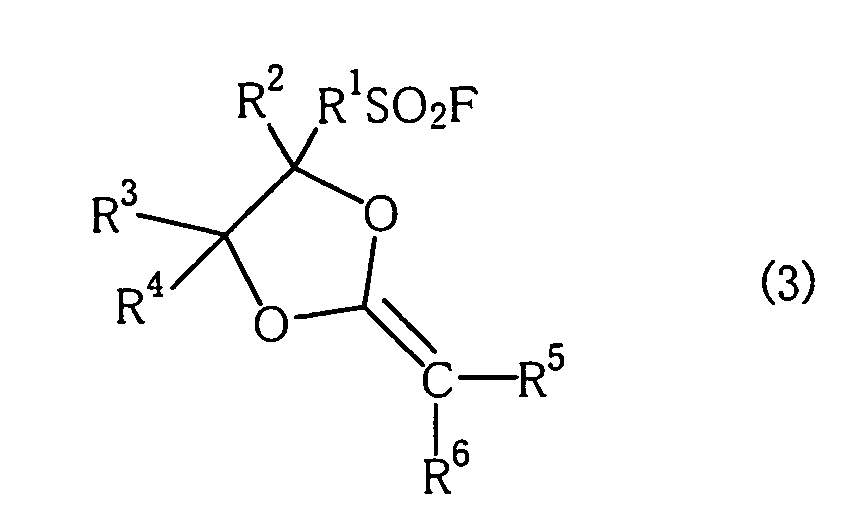
- The method for producing a polymer electrolyte material according to Claim 10, wherein the alicyclic fluoromonomer is represented by formula (4) below.
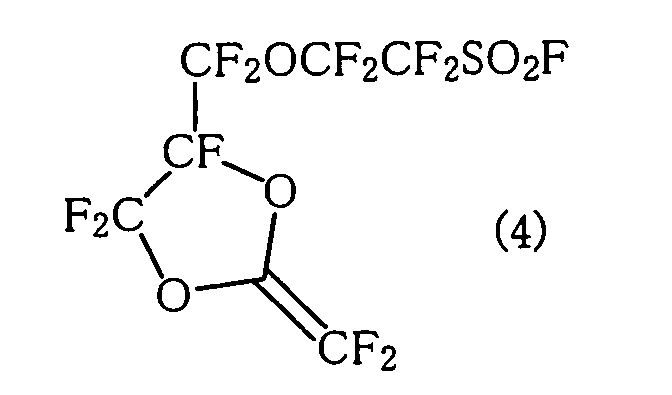
- The method for producing a polymer electrolyte material according to any one of Claims 8 to 11, wherein the alicyclic monomer is copolymerized with a fluoromonomer having at least two double bonds with radical polymerizability in its molecule for the copolymer obtained to be cross-linked.
- A polymer electrolyte membrane comprising a polymer having a repeating unit based on an alicyclic fluoromonomer having a carbon-carbon double bond with radical polymerization reactivity, either of carbon atoms at both ends of the double bond constituting a ring structure, wherein the fluoromonomer has an ionic group represented by -(SO2X(SO2Rf)a)-M+ where M+ is H+, a monovalent metal cation or an ammonium ion at least one hydrogen atom of which may be substituted by a hydrocarbon group, Rf is a linear or branched perfluoroalkyl group which may contain an oxygen atom of an ether bond type, X is an oxygen atom, a nitrogen atom or a carbon atom, a=0 in the case of X being an oxygen atom, a=1 in the case of X being a nitrogen atom, and a=2 in the case of X being a carbon atom.
- The polymer electrolyte membrane according to Claim 13, wherein the polymer is a copolymer containing at least one member selected from the group consisting of a repeating unit based on a nonionic fluoromonomer having a ring structure and radical polymerizability, a repeating unit based on a nonionic fluoromonomer having cyclopolymerizability, and a repeating unit based on tetrafluoroethylene.
- The polymer electrolyte membrane according to Claim 14, wherein the repeating unit based on the alicyclic fluoromonomer is a repeating unit represented by formula (1) below where R1 is a bivalent perfluoro organic group which may contain an oxygen atom of an ether bond type, and R2 to R6 each independently are a monovalent perfluoro organic group which may contain an oxygen atom of an ether bond type, or a fluorine atom.
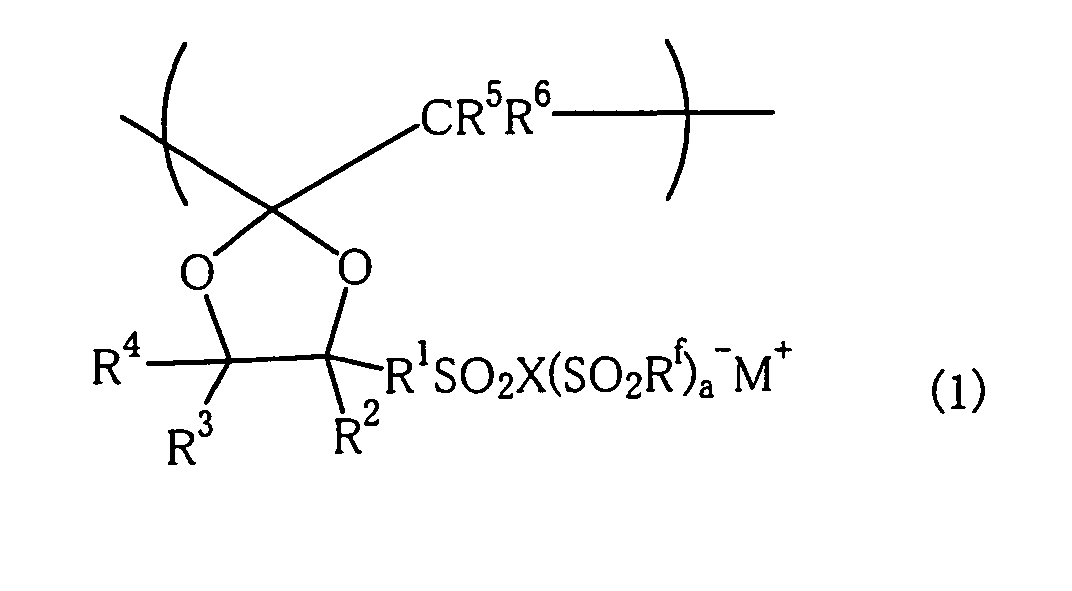
- The polymer electrolyte membrane according to any one of Claims 13 to 15, wherein the ionic group is represented by -(SO2X(SO2Rf)a)-H+, and has a softening temperature of at least 90°C.
- The polymer electrolyte membrane according to Claim 15 or 16, wherein the repeating unit based on the alicyclic fluoromonomer is represented by formula (2) below.
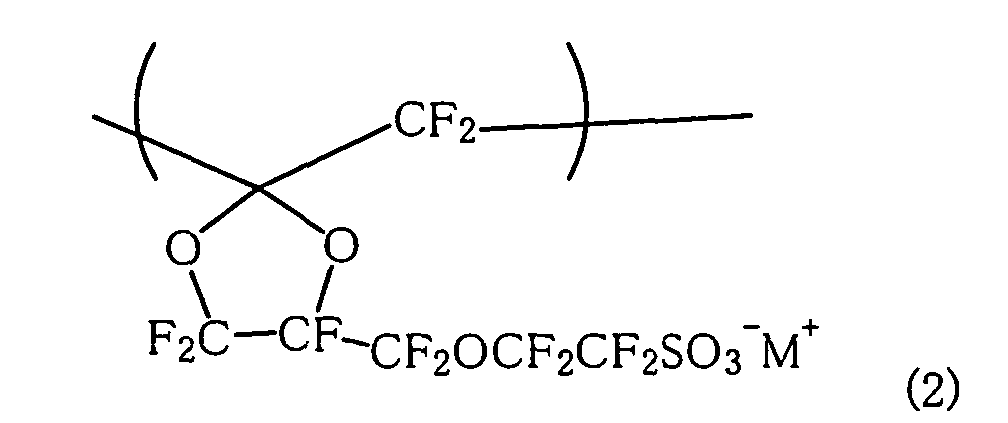
- The polymer electrolyte membrane according to any one of Claims 13 to 17, comprising a repeating unit based on a fluoromonomer having at least two double bonds with radical polymerizability in its molecule, the polymer electrolyte membrane being cross-linked by a said repeating unit.
- A liquid composition having a polymer electrolyte material dissolved or dispersed in at least one solvent selected from the group consisting of a solvent having a hydroxyl group, and water, wherein the polymer electrolyte material comprises a polymer having a repeating unit based on an alicyclic fluoromonomer having a carbon-carbon double bond with radical polymerization reactivity, either of carbon atoms at both ends of the double bond constituting a ring structure, wherein the fluoromonomer has an ionic group represented by - (SO2X(SO2Rf)a)-M+ where M+ is H+, a monovalent metal cation or an ammonium ion at least one hydrogen atom of which may be substituted by a hydrocarbon group, Rf is a linear or branched perfluoroalkyl group which may contain an oxygen atom of an ether bond type, X is an oxygen atom, a nitrogen atom or a carbon atom, a=0 in the case of X being an oxygen atom, a=1 in the case of X being a nitrogen atom, and a=2 in the case of X being a carbon atom.
- The liquid composition according to Claim 19,
wherein the polymer is a copolymer containing at least one member selected from the group consisting of a repeating unit based on a nonionic fluoromonomer having a ring structure and radical polymerizability, a repeating unit based on a nonionic fluoromonomer having cyclopolymerizability, and a repeating unit based on tetrafluoroethylene. - The liquid composition according to Claim 20,
wherein the repeating unit based on the alicyclic fluoromonomer is a repeating unit represented by formula (1) below where R1 is a bivalent perfluoro organic group which may contain an oxygen atom of an ether bond type, and R2 to R6 each independently are a monovalent perfluoro organic group which may contain an oxygen atom of an ether bond type, or a fluorine atom.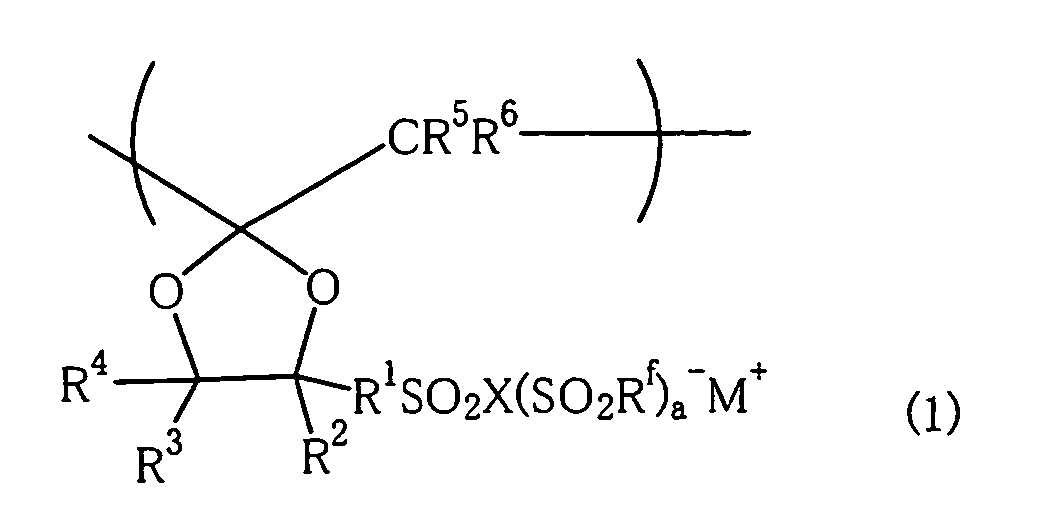
- A membrane electrode assembly for a polymer electrolyte fuel cell comprising a cathode and an anode each having a catalyst layer containing a catalyst and a polymer electrolyte, and a polymer electrolyte membrane disposed between the cathode and the anode, wherein the polymer electrolyte membrane is a polymer having a repeating unit based on an alicyclic fluoromonomer having a carbon-carbon double bond with radical polymerization reactivity, either of carbon atoms at both ends of the double bond constituting a ring structure, wherein the fluoromonomer has an ionic group represented by - (SO2X(SO2Rf)a)-M+ where M+ is H+, a monovalent metal cation or an ammonium ion at least one hydrogen atom of which may be substituted by a hydrocarbon group, Rf is a linear or branched perfluoroalkyl group which may contain an oxygen atom of an ether bond type, X is an oxygen atom, a nitrogen atom or a carbon atom, a=0 in the case of X being an oxygen atom, a=1 in the case of X being a nitrogen atom, and a=2 in the case of X being a carbon atom.
- A membrane electrode assembly for a polymer electrolyte fuel cell comprising a cathode and an anode each having a catalyst layer containing a catalyst and a polymer electrolyte, and a polymer electrolyte membrane disposed between the cathode and the anode, wherein at least one of the catalyst layers of the cathode and the anode comprises a polymer having a repeating unit based on an alicyclic fluoromonomer having a carbon-carbon double bond with radical polymerization reactivity, either of carbon atoms at both ends of the double bond constituting a ring structure, wherein the fluoromonomer has an ionic group represented by -(SO2X(SO2Rf)a)-M+ where M+ is H+, a monovalent metal cation or an ammonium ion at least one hydrogen atom of which may be substituted by a hydrocarbon group, Rf is a linear or branched perfluoroalkyl group which may contain an oxygen atom of an ether bond type, X is an oxygen atom, a nitrogen atom or a carbon atom, a=0 in the case of X being an oxygen atom, a=1 in the case of X being a nitrogen atom, and a=2 in the case of X being a carbon atom.
- The membrane electrode assembly for a polymer electrolyte fuel cell according to Claim 22 or 23,
wherein the polymer is a copolymer containing at least one member selected from the group consisting of a repeating unit based on a nonionic fluoromonomer having a ring structure and radical polymerizability, a repeating unit based on a nonionic fluoromonomer having cyclopolymerizability, and a repeating unit based on tetrafluoroethylene. - The membrane electrode assembly for a polymer electrolyte fuel cell according to Claim 24, wherein the repeating unit based on the alicyclic fluoromonomer is a repeating unit represented by formula (1) below where R1 is a bivalent perfluoro organic group which may contain an oxygen atom of an ether bond type, and R2 to R6 each independently are a monovalent perfluoro organic group which may contain an oxygen atom of an ether bond type, or a fluorine atom.
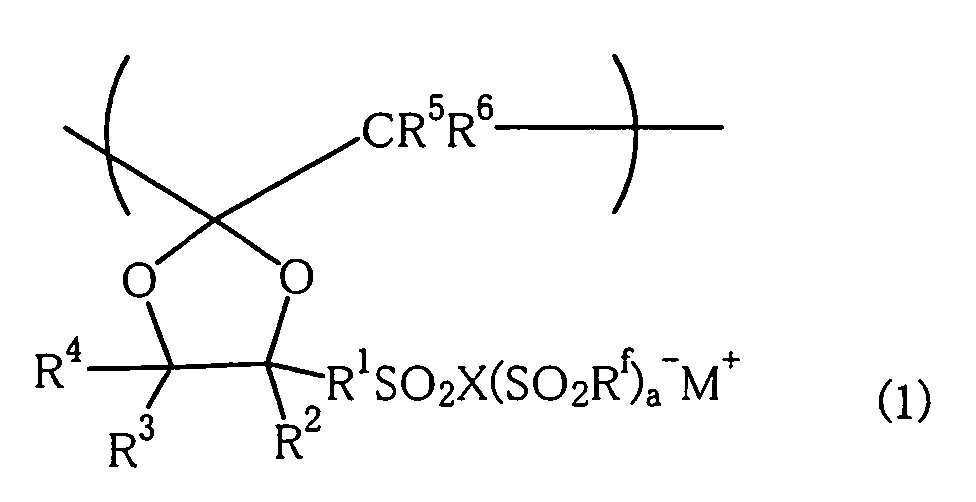
- The membrane electrode assembly for a polymer electrolyte fuel cell according to any one of Claims 23 to 25, wherein the ionic group is represented by - (SO2X(SO2Rf)a)-H+, and the polymer electrolyte material has a softening temperature of at least 90°C.
- The membrane electrode assembly for a polymer electrolyte fuel cell according to Claim 25 or 26, wherein the repeating unit based on the alicyclic fluoromonomer is represented by formula (2) below.
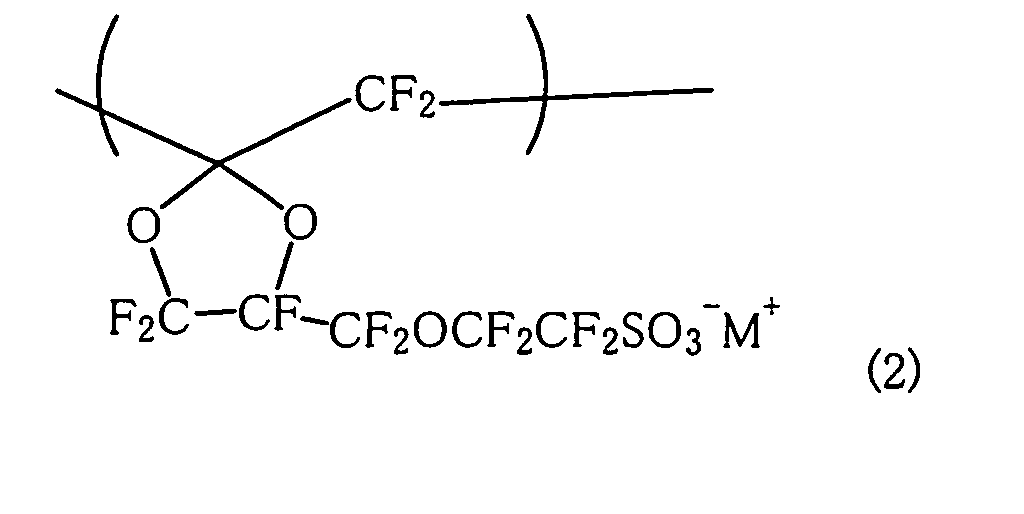
Applications Claiming Priority (3)
| Application Number | Priority Date | Filing Date | Title |
|---|---|---|---|
| JP2003123383 | 2003-04-28 | ||
| JP2003123383 | 2003-04-28 | ||
| PCT/JP2004/006127 WO2004097851A1 (en) | 2003-04-28 | 2004-04-28 | Solid polymeric electrolyte material, process for producing the same and membrane/electrode assembly for solid polymer fuel cell |
Publications (2)
| Publication Number | Publication Date |
|---|---|
| EP1583106A1 true EP1583106A1 (en) | 2005-10-05 |
| EP1583106A4 EP1583106A4 (en) | 2008-07-09 |
Family
ID=33410125
Family Applications (1)
| Application Number | Title | Priority Date | Filing Date |
|---|---|---|---|
| EP04730031A Withdrawn EP1583106A4 (en) | 2003-04-28 | 2004-04-28 | SOLID POLYMER ELECTROLYTE MATERIAL, PROCESS FOR PRODUCING THE MATERIAL, AND MEMBRANE / ELECTRODE ASSEMBLY FOR SOLID POLYMER FUEL CELL |
Country Status (5)
| Country | Link |
|---|---|
| US (1) | US7429428B2 (en) |
| EP (1) | EP1583106A4 (en) |
| JP (1) | JP4774988B2 (en) |
| CN (1) | CN100530442C (en) |
| WO (1) | WO2004097851A1 (en) |
Cited By (9)
| Publication number | Priority date | Publication date | Assignee | Title |
|---|---|---|---|---|
| EP1927601A1 (en) * | 2006-11-28 | 2008-06-04 | Asahi Glass Company, Limited | Polymer, polymer electrolyte membrane for polymer electrolyte fuel cell, and membrane/electrode assembly |
| EP1724291A4 (en) * | 2004-03-08 | 2008-06-18 | Asahi Glass Co Ltd | VULCANIZABLE COMPOSITION AND METHOD FOR MANUFACTURING FLUOR VULCANIS CHEMICAL |
| EP1806371A4 (en) * | 2004-10-27 | 2008-07-02 | Asahi Glass Co Ltd | ELECTROLYTIC MATERIAL, ELECTROLYTIC MEMBRANE, AND MEMBRANE ELECTRODE ASSEMBLY FOR SOLID POLYMER FUEL CELL |
| EP1734603A4 (en) * | 2004-04-02 | 2008-09-03 | Asahi Glass Co Ltd | Electrolyte material for solid polymer type fuel cell, electrolyte membrane and membrane electrode assembly |
| EP1798793A4 (en) * | 2004-08-18 | 2008-09-03 | Asahi Glass Co Ltd | ELECTROLYTIC POLYMER FOR FUEL CELL, PROCESS FOR PRODUCING THE SAME, ELECTROLYTIC MEMBRANE, AND MEMBRANE ELECTRODE ASSEMBLY |
| EP1914824A4 (en) * | 2005-07-27 | 2008-11-19 | Asahi Glass Co Ltd | SOLID POLYMER FUEL CELL ELECTROLYTE MATERIAL, ELECTROLYTE MEMBRANE, AND MEMBRANE-ELECTRODE ASSEMBLY |
| US8124295B2 (en) | 2007-01-26 | 2012-02-28 | Asahi Glass Company, Limited | Polymer, polymer electrolyte membrane for polymer electrolyte fuel cell, and membrane/electrode assembly |
| EP2436705A4 (en) * | 2009-05-29 | 2013-10-09 | Asahi Glass Co Ltd | ELECTROLYTE MATERIAL, LIQUID COMPOSITE, AND ELECTRODE-MEMBRANE ASSEMBLY FOR SOLID POLYMER FUEL CELLS |
| EP3940006A4 (en) * | 2019-03-13 | 2022-11-23 | Agc Inc. | MEMBRANE ELECTRODE ASSEMBLY |
Families Citing this family (38)
| Publication number | Priority date | Publication date | Assignee | Title |
|---|---|---|---|---|
| DE60143635D1 (en) * | 2000-02-15 | 2011-01-27 | Asahi Glass Co Ltd | Block polymer, process for producing polymer and solid polymer electrolyte fuel cell |
| EP1583106A4 (en) * | 2003-04-28 | 2008-07-09 | Asahi Glass Co Ltd | SOLID POLYMER ELECTROLYTE MATERIAL, PROCESS FOR PRODUCING THE MATERIAL, AND MEMBRANE / ELECTRODE ASSEMBLY FOR SOLID POLYMER FUEL CELL |
| WO2004102714A1 (en) * | 2003-05-13 | 2004-11-25 | Asahi Glass Company, Limited | Electrolyte polymer for solid polymer fuel cell, method for producing same, and membrane electrode assembly |
| US20050037265A1 (en) * | 2003-08-14 | 2005-02-17 | Asahi Glass Company, Limited | Polymer electrolyte fuel cell, electrolyte material therefore and method for its production |
| RU2006118782A (en) * | 2003-10-31 | 2007-12-10 | Асахи Гласс Компани, Лимитед (Jp) | NEW Fluorinated Compounds and Fluoropolymer |
| JP4788267B2 (en) * | 2004-10-26 | 2011-10-05 | 旭硝子株式会社 | Polymer having fluorosulfonyl group and 1,3-dioxolane structure and use thereof |
| JP4940608B2 (en) * | 2004-10-26 | 2012-05-30 | 旭硝子株式会社 | Novel fluorine-containing epoxy compound and method for producing the same |
| JP4776303B2 (en) * | 2004-11-22 | 2011-09-21 | 独立行政法人科学技術振興機構 | Method for producing fluorine-containing compound, fluorine-containing compound, fluorine-containing polymer, and optical material or electric material using fluorine-containing polymer |
| JP2006290779A (en) * | 2005-04-08 | 2006-10-26 | Asahi Glass Co Ltd | Novel fluorine-containing compounds and fluorine-containing polymers |
| JP4810868B2 (en) * | 2005-04-19 | 2011-11-09 | 旭硝子株式会社 | ELECTROLYTE MEMBRANE FOR SOLID POLYMER FUEL CELL, METHOD FOR PRODUCING THE SAME, MEMBRANE ELECTRODE ASSEMBLY FOR SOLID POLYMER TYPE FUEL CELL, AND METHOD FOR OPERATING THE SAME |
| JP2006310216A (en) * | 2005-05-02 | 2006-11-09 | Toyota Motor Corp | Method for producing coating solution for forming catalyst electrode layer |
| DE602006014165D1 (en) * | 2005-07-27 | 2010-06-17 | Asahi Glass Co Ltd | A COMPOSITION CONTAINING A FLUOROSULFONYL GROUP, METHOD FOR THE PRODUCTION THEREOF AND POLYMER THEREOF |
| JP5124097B2 (en) * | 2006-03-20 | 2013-01-23 | 日本ゴア株式会社 | Electrolyte membrane and polymer electrolyte fuel cell |
| KR20070106200A (en) * | 2006-04-28 | 2007-11-01 | 삼성에스디아이 주식회사 | Membrane-electrode assembly for fuel cell, manufacturing method thereof and fuel cell system comprising same |
| WO2008024780A2 (en) * | 2006-08-22 | 2008-02-28 | Georgia Tech Research Corporation | Fuel cell vent |
| JP2008066047A (en) * | 2006-09-06 | 2008-03-21 | Matsushita Electric Ind Co Ltd | Nonaqueous electrolyte battery and separator thereof |
| CN101601156B (en) * | 2007-01-10 | 2012-03-28 | 旭硝子株式会社 | Solid polymer electrolyte membrane and membrane electrode assembly for solid polymer fuel cell |
| KR101707245B1 (en) * | 2008-07-08 | 2017-02-15 | 솔베이 스페셜티 폴리머스 이태리 에스.피.에이. | Method for manufacturing fluoropolymers |
| CN102341944B (en) * | 2009-03-04 | 2014-10-29 | 旭化成电子材料株式会社 | Fluorine-containing polymer electrolyte membrane |
| US20110027687A1 (en) * | 2009-07-31 | 2011-02-03 | Asahi Glass Company, Limited | Electrolyte material, liquid composition and membrane/electrode assembly for polymer electrolyte fuel cell |
| WO2011013578A1 (en) | 2009-07-31 | 2011-02-03 | 旭硝子株式会社 | Electrolyte material, liquid composition, and membrane -electrode assembly for polymer electrolyte fuel cell |
| JP5521427B2 (en) | 2009-07-31 | 2014-06-11 | 旭硝子株式会社 | Fuel cell system |
| JP2012084398A (en) * | 2010-10-12 | 2012-04-26 | Toyota Central R&D Labs Inc | Polymer electrolyte and method for producing same, and fuel cell |
| JP5398801B2 (en) * | 2010-10-29 | 2014-01-29 | 旭化成株式会社 | Polymer electrolyte |
| JP6211249B2 (en) * | 2012-04-10 | 2017-10-11 | 株式会社豊田中央研究所 | POLYMER ELECTROLYTE, PROCESS FOR PRODUCING THE SAME, AND FUEL CELL |
| JP6034200B2 (en) * | 2013-01-08 | 2016-11-30 | 旭化成株式会社 | Redox flow secondary battery |
| JP6270269B2 (en) * | 2014-03-04 | 2018-01-31 | 住友ゴム工業株式会社 | Method for producing fluororubber molded product |
| WO2015151714A1 (en) | 2014-03-31 | 2015-10-08 | 三井金属鉱業株式会社 | Membrane electrode assembly and solid polymer fuel cell in which same is used |
| US11289700B2 (en) | 2016-06-28 | 2022-03-29 | The Research Foundation For The State University Of New York | KVOPO4 cathode for sodium ion batteries |
| CN111316380B (en) * | 2017-11-06 | 2022-05-24 | Agc株式会社 | Solid polymer electrolyte membrane, membrane electrode assembly, and water electrolysis device |
| US11807702B2 (en) | 2018-09-28 | 2023-11-07 | Tosoh Corporation | Fluororesin, fluororesin particles, and methods for producing these |
| CN112771086B (en) * | 2018-09-28 | 2023-09-26 | 东曹株式会社 | Fluororesin, fluororesin particles and their manufacturing methods |
| JP7339830B2 (en) * | 2018-09-28 | 2023-09-06 | 東ソー株式会社 | Fluororesin particles and method for producing the same |
| JP7478370B2 (en) * | 2019-02-28 | 2024-05-07 | 東ソー株式会社 | Fluorine resin |
| CN115677887B (en) | 2018-10-09 | 2024-03-08 | 东曹株式会社 | Fluororesin, manufacturing method thereof, and fluororesin particle manufacturing method |
| WO2020145287A1 (en) * | 2019-01-08 | 2020-07-16 | Agc株式会社 | Catalyst layer, catalyst layer forming solution, and membrane electrode assembly |
| WO2021132475A1 (en) * | 2019-12-27 | 2021-07-01 | Agc株式会社 | Catalyst layer, liquid for forming catalyst layer, and membrane electrode assembly |
| CN115991819B (en) * | 2021-10-18 | 2024-05-03 | 山东东岳未来氢能材料股份有限公司 | Phosphonic acid sulfonic acid composite proton exchange membrane and preparation method thereof |
Family Cites Families (16)
| Publication number | Priority date | Publication date | Assignee | Title |
|---|---|---|---|---|
| US3282875A (en) * | 1964-07-22 | 1966-11-01 | Du Pont | Fluorocarbon vinyl ether polymers |
| EP0221178B1 (en) | 1985-05-17 | 1993-02-24 | The Dow Chemical Company | Use of a cell component in fuel cell |
| US4973714A (en) | 1987-07-31 | 1990-11-27 | E. I. Du Pont De Nemours And Company | Halogenated 1,3-dioxolanes and derivatives |
| GB2261711B (en) * | 1991-11-15 | 1995-09-20 | Ferodo Ltd | Brakes |
| JP3043172B2 (en) * | 1992-01-31 | 2000-05-22 | 旭硝子株式会社 | Fluorine-containing compound and method for producing the same |
| JP3818344B2 (en) * | 1997-11-20 | 2006-09-06 | 旭硝子株式会社 | Process for producing fluorine-containing aliphatic ring structure-containing polymer |
| JP5073883B2 (en) | 1998-01-30 | 2012-11-14 | ハイドロ−ケベック | Crosslinkable bisulfonyl derivatives and their use for the production of ion exchange membranes |
| EP1096587A4 (en) * | 1998-06-16 | 2009-03-04 | Panasonic Corp | FUEL CELL COMPRISING A POLYMER ELECTROLYTE |
| JP4802367B2 (en) * | 1999-03-23 | 2011-10-26 | 旭硝子株式会社 | Method for producing fluorine-containing compound by liquid phase fluorination |
| DE60143635D1 (en) * | 2000-02-15 | 2011-01-27 | Asahi Glass Co Ltd | Block polymer, process for producing polymer and solid polymer electrolyte fuel cell |
| JP4061522B2 (en) * | 2000-11-16 | 2008-03-19 | 東洋紡績株式会社 | POLYAZOLE POLYMER COMPOSITION, FILM CONTAINING THE SAME, AND METHOD FOR MOLDING POLYAZOLE POLYMER COMPOSITION |
| JP4032738B2 (en) * | 2000-12-26 | 2008-01-16 | 旭硝子株式会社 | Solid polymer electrolyte material, liquid composition, solid polymer fuel cell, fluoropolymer and fluoropolymer |
| DE60135080D1 (en) * | 2000-12-26 | 2008-09-11 | Asahi Glass Co Ltd | Solid polymer electrolyte material, liquid composition, solid polymer fuel cell and fluoropolymer |
| DE60224554T2 (en) * | 2001-10-30 | 2009-01-08 | Asahi Glass Co., Ltd. | FLUOROSULFONYL COMPOUNDS AND METHOD FOR PRODUCING DIRECTLY DERIVED COMPOUNDS |
| EP1583106A4 (en) * | 2003-04-28 | 2008-07-09 | Asahi Glass Co Ltd | SOLID POLYMER ELECTROLYTE MATERIAL, PROCESS FOR PRODUCING THE MATERIAL, AND MEMBRANE / ELECTRODE ASSEMBLY FOR SOLID POLYMER FUEL CELL |
| US20050037265A1 (en) | 2003-08-14 | 2005-02-17 | Asahi Glass Company, Limited | Polymer electrolyte fuel cell, electrolyte material therefore and method for its production |
-
2004
- 2004-04-28 EP EP04730031A patent/EP1583106A4/en not_active Withdrawn
- 2004-04-28 JP JP2005505925A patent/JP4774988B2/en not_active Expired - Lifetime
- 2004-04-28 CN CNB2004800110237A patent/CN100530442C/en not_active Expired - Lifetime
- 2004-04-28 WO PCT/JP2004/006127 patent/WO2004097851A1/en not_active Ceased
-
2005
- 2005-06-27 US US11/166,371 patent/US7429428B2/en not_active Expired - Lifetime
Cited By (13)
| Publication number | Priority date | Publication date | Assignee | Title |
|---|---|---|---|---|
| EP1724291A4 (en) * | 2004-03-08 | 2008-06-18 | Asahi Glass Co Ltd | VULCANIZABLE COMPOSITION AND METHOD FOR MANUFACTURING FLUOR VULCANIS CHEMICAL |
| EP1734603A4 (en) * | 2004-04-02 | 2008-09-03 | Asahi Glass Co Ltd | Electrolyte material for solid polymer type fuel cell, electrolyte membrane and membrane electrode assembly |
| US7838167B2 (en) | 2004-08-18 | 2010-11-23 | Asahi Glass Company, Limited | Electrolyte polymer for fuel cells, process for its production, electrolyte membrane and membrane/electrode assembly |
| EP1798793A4 (en) * | 2004-08-18 | 2008-09-03 | Asahi Glass Co Ltd | ELECTROLYTIC POLYMER FOR FUEL CELL, PROCESS FOR PRODUCING THE SAME, ELECTROLYTIC MEMBRANE, AND MEMBRANE ELECTRODE ASSEMBLY |
| EP1806371A4 (en) * | 2004-10-27 | 2008-07-02 | Asahi Glass Co Ltd | ELECTROLYTIC MATERIAL, ELECTROLYTIC MEMBRANE, AND MEMBRANE ELECTRODE ASSEMBLY FOR SOLID POLYMER FUEL CELL |
| EP1914824A4 (en) * | 2005-07-27 | 2008-11-19 | Asahi Glass Co Ltd | SOLID POLYMER FUEL CELL ELECTROLYTE MATERIAL, ELECTROLYTE MEMBRANE, AND MEMBRANE-ELECTRODE ASSEMBLY |
| US8097383B2 (en) | 2005-07-27 | 2012-01-17 | Asahi Glass Company, Limited | Electrolyte material for polymer electrolyte fuel cells, electrolyte membrane and membrane/electrode assembly |
| EP1927601A1 (en) * | 2006-11-28 | 2008-06-04 | Asahi Glass Company, Limited | Polymer, polymer electrolyte membrane for polymer electrolyte fuel cell, and membrane/electrode assembly |
| US8124295B2 (en) | 2007-01-26 | 2012-02-28 | Asahi Glass Company, Limited | Polymer, polymer electrolyte membrane for polymer electrolyte fuel cell, and membrane/electrode assembly |
| EP2436705A4 (en) * | 2009-05-29 | 2013-10-09 | Asahi Glass Co Ltd | ELECTROLYTE MATERIAL, LIQUID COMPOSITE, AND ELECTRODE-MEMBRANE ASSEMBLY FOR SOLID POLYMER FUEL CELLS |
| US9508463B2 (en) | 2009-05-29 | 2016-11-29 | Asahi Glass Company, Limited | Electrolyte material, liquid composition and membrane/electrode assembly for polymer electrolyte fuel cell |
| EP3940006A4 (en) * | 2019-03-13 | 2022-11-23 | Agc Inc. | MEMBRANE ELECTRODE ASSEMBLY |
| US12040515B2 (en) | 2019-03-13 | 2024-07-16 | AGC Inc. | Membrane electrode assembly |
Also Published As
| Publication number | Publication date |
|---|---|
| JPWO2004097851A1 (en) | 2006-07-13 |
| EP1583106A4 (en) | 2008-07-09 |
| US20050266291A1 (en) | 2005-12-01 |
| CN1777962A (en) | 2006-05-24 |
| JP4774988B2 (en) | 2011-09-21 |
| US7429428B2 (en) | 2008-09-30 |
| CN100530442C (en) | 2009-08-19 |
| WO2004097851A1 (en) | 2004-11-11 |
Similar Documents
| Publication | Publication Date | Title |
|---|---|---|
| US7429428B2 (en) | Polymer electrolyte material, production method thereof and membrane electrode assembly for polymer electrolyte fuel cell | |
| US6610789B2 (en) | Block polymer, process for producing a polymer, and polymer electrolyte fuel cell | |
| US8097383B2 (en) | Electrolyte material for polymer electrolyte fuel cells, electrolyte membrane and membrane/electrode assembly | |
| EP1734603B1 (en) | Electrolyte material for polymer electrolyte fuel cells, electrolyte membrane and membrane- electrode assembly | |
| EP1596453B1 (en) | Process for production of electrolyte material for solid polymer fuel cells and membrane electrode assembly for solid polymer fuel cells | |
| US7910236B2 (en) | Electrolyte material, electrolyte membrane and membrane-electrolyte assembly for polymer electrolyte fuel cells | |
| CN106471026B (en) | Electrolyte material, liquid composition, membrane electrode assembly for solid polymer fuel cell, and fluorine-containing branched polymer | |
| CN109314262A (en) | Electrolyte material, its manufacturing method and its application | |
| JP4792640B2 (en) | Block polymer, polymer production method, and liquid composition containing block polymer | |
| JP5028711B2 (en) | Polymer electrolyte fuel cell | |
| JP2002231268A (en) | Electrolyte material for polymer electrolyte fuel cell and polymer electrolyte fuel cell | |
| CN1938887A (en) | Electrolyte material for solid polymer type fuel cell, electrolyte membrane and membrane electrode assembly |
Legal Events
| Date | Code | Title | Description |
|---|---|---|---|
| PUAI | Public reference made under article 153(3) epc to a published international application that has entered the european phase |
Free format text: ORIGINAL CODE: 0009012 |
|
| 17P | Request for examination filed |
Effective date: 20050616 |
|
| AK | Designated contracting states |
Kind code of ref document: A1 Designated state(s): AT BE BG CH CY CZ DE DK EE ES FI FR GB GR HU IE IT LI LU MC NL PL PT RO SE SI SK TR |
|
| AX | Request for extension of the european patent |
Extension state: AL HR LT LV MK |
|
| DAX | Request for extension of the european patent (deleted) | ||
| A4 | Supplementary search report drawn up and despatched |
Effective date: 20080606 |
|
| 17Q | First examination report despatched |
Effective date: 20080826 |
|
| STAA | Information on the status of an ep patent application or granted ep patent |
Free format text: STATUS: THE APPLICATION IS DEEMED TO BE WITHDRAWN |
|
| 18D | Application deemed to be withdrawn |
Effective date: 20090306 |