EP1582996A2 - Apparat und computerimplementiertes Verfahren zur Bestimmung von Bestandteilswörtern zusammengesetzter Wörter - Google Patents
Apparat und computerimplementiertes Verfahren zur Bestimmung von Bestandteilswörtern zusammengesetzter Wörter Download PDFInfo
- Publication number
- EP1582996A2 EP1582996A2 EP05102225A EP05102225A EP1582996A2 EP 1582996 A2 EP1582996 A2 EP 1582996A2 EP 05102225 A EP05102225 A EP 05102225A EP 05102225 A EP05102225 A EP 05102225A EP 1582996 A2 EP1582996 A2 EP 1582996A2
- Authority
- EP
- European Patent Office
- Prior art keywords
- word
- compound word
- constituent words
- determining
- compound
- Prior art date
- Legal status (The legal status is an assumption and is not a legal conclusion. Google has not performed a legal analysis and makes no representation as to the accuracy of the status listed.)
- Withdrawn
Links
Images


Classifications
-
- G—PHYSICS
- G06—COMPUTING OR CALCULATING; COUNTING
- G06F—ELECTRIC DIGITAL DATA PROCESSING
- G06F40/00—Handling natural language data
- G06F40/20—Natural language analysis
Definitions
- the present invention relates to an apparatus for determining constituent words of a compound word, comprising a document collection, means for determining a number of documents from the document collection containing the compound word, and means for determining a number of documents from the document collection containing constituent words constituting the compound word.
- the invention also relates to an information retrieval system incorporating such an apparatus and a computerised method for determining constituent words of a compound word.
- a compound of words is common in a number of languages such as German, Dutch, Danish, Greek, Norwegian, Swedish, Icelandic and Finnish. Since compound words may be joined freely, this vastly increases the vocabulary size. These languages are likely to include very long words that are not found in any dictionary of the language.
- a typical example of such a word is the German compound word "Abusingsmother”. This compound word is constructed by concatenating the two words “Abpreparing” and "sky” by means of the linking morpheme "s”.
- Word compounding is an active way of creating new words in these languages. This gives challenges for a number of applications such as machine translation, speech recognition, text classification, information extraction, and information retrieval (CLEF 2001: http://www.ercim.org/pubtication/ws-proceedings/CLEF2/). Finding constituent words constituting a compound word showed to be a challenge. There are basically three solutions known in the art.
- the first solution is to keep a list of 'all' the compound words that exist in a language and the way the compound word should be split.
- a drawback is that it is impossible to keep a list of all the compound words in a language, for there are literally an endless number of compound words in the compound word languages. For this reason, the precision of this solution is low and this method is tedious. The approach applies for one language.
- the second solution is simple: finding constituent words constituting the compound words based on rules, sometimes combined with statistics that state when to split.
- the problem here, however, is that this method often splits the compound word in words that do not exist or in word combinations that do not relate to the meaning of the compound word. Further, it works for the general cases of compound words, but is not robust. The approach applies for one language.
- the third and last solution uses a digital dictionary. Based on the dictionary and some rules, the finding of constituent words constituting the compound word takes place.
- An example of this last solution is disclosed by U.S. Patent Application Publication No. US2003/0097252A1. According to that disclosure, finding the constituent words is based upon a set of compound word probabilistic breakpoints. Breakpoint weights are assigned to the breakpoints in the compound word based on an analysis of n-graphs drawn from an appropriate lexicon. This method may find words within a compound word, but the main drawback is that wrong word splitting can occur.
- the method further comprises means for determining a ratio between the number of documents containing the compound word and the number of documents containing the constituent words constituting the compound word, and means for splitting the compound word in the constituent words when the ratio is smaller than a threshold value.
- This method according to an embodiment of the invention is based upon the observation that when the ratio between the number of documents containing a compound word and the number of documents containing the constituent words constituting the compound word is smaller than a threshold value then the compound word is correctly split into the fond constituent words.
- the method according to the invention comprises detecting a linking morpheme in the compound word.
- the detection of a linking morpheme in the compound word is essential for finding the constituent words.
- the method according to the invention comprises a word list derived from the document collection and means for finding the constituent words constituting the compound word by using the word list.
- the detection of constituent words constituting the compound word is more efficient when a priori a word list is prepared containing all words of the document collection.
- the method according to the invention comprises a word list derived from the document collection and means for determining from the word list the number of documents containing the compound word. It is efficient to have a word list from which the number of documents containing the compound word can be derived.
- the method according to the invention comprises a word list derived from the document collection and means for determining from the word list the number of documents containing the constituent words constituting the compound word. It is efficient to have a word list from which the number of documents containing the constituent words constituting the compound word can be derived.
- the invention also provides an apparatus/system and computer software for implementing the methods of the present invention.
- the apparatus/system according to the invention is incorporated in an information retrieval system.
- a user enters a search term and, if this term is a compound word, it is split in its constituent words and a search is carried out for the constituent words. This way the operator can create a search on which all documents are found that contain the constituent words complying the split decision criteria constituting the compound word.
- the threshold value is selected depending on the document collection. This makes it possible to select the threshold value depending the used document collection. This to optimise the splitting of the compound word.
- the threshold value is 3. This shows to be the optimal threshold value for a Dutch document collection.
- the compound word and constituent words belong to the grammatical category of nouns.
- the apparatus and method according to the invention comprise the word list includes the single and plural form of each noun. This results in that all constituent words constituting the compound word are found.
- Figure 1 illustrates an embodiment of an information retrieval system such as a document management system or web search system according to the present invention.
- the document management system comprises an operator console (101), a search engine front-end (104), a search engine (105), and a document database (106), all operatively coupled.
- the operator console provides a user interface to the system according to the invention, and is provided with a display (102) and data entry means, e.g. a keyboard (103).
- the search engine front-end (104) converts all data that is received from the operator console (101) into a search to be carried out by the search engine (105).
- the search engine (105) carries out the search on the database (106) and takes care that search results are returned to the submitter.
- the database (106) contains the documents to search for.
- Figure 1 all components of Figure 1 may be incorporated into one personal computer.
- search engine (105), search engine front end (104) and document database (106) are embodied in a server, and numerous operator consoles (101), embodied as workstations, may access as client the server and use a web browser as access means to the server.
- Figure 2 presents an embodiment of the search engine (105) and document database (106) according to the invention.
- the document collection (201) may contain any form of written information such as reports, newspaper articles, and webpages.
- all words of the document collection (201) are collected by means of for example a semantic network (202) and are put in order in a word list (203) in the database (106).
- a semantic network (202) For automatic translation or information retrieval, best results are obtained by considering only the words that exist in the document collection. Collecting all words from the document collection and putting these words in an ordered form in a word list does this.
- the search process starts when the search engine (105) receives a search from the search engine front-end (104).
- An example of a search containing T terms is t 1 AND t 2 AND... AND t T where a term t i is a term from the group of used terms; t i ⁇ (t 1 ,..., t T ).
- a term can be any word. Between terms any logical operator can be used such as AND, OR, and NOT.
- the search has T terms, where T is at least one.
- the invention is fully capable of handling one or more terms within the search.
- the split compound decision module (204) of the search engine (105) decides for every term within a search whether the term contains constituent words that should be applied in a separate form in the search.
- the result of the split compound decisions module (204) is a modified search that contains the constituent words of the compound words in a separated form.
- the retrieve and rank documents module (205) of the search engine (105) uses this modified search and the word list to get document references to calculate the relevance score per document reference, to rank the found document references and to communicate the ranked document references with their relevance scores to the search engine front-end (104).
- FIG. 3 presents an embodiment of the split compound decision module (204) according to the invention.
- the split compound decision module (204) decides per term t i of a search whether the term is a compound word and whether to split the constituent words into separated words.
- the term counter i is set to 1.
- the constituent words are derived from the word list (204). Several different constituent words combinations may exist constructing the same compound word, each combination is called a constituent words set.
- the word list is used to find a combination of words constituting the compound word.
- the constituent words set counter j is initialised to 1 in step S304.
- the next step S305 determines the number of documents that contain the compound word t i .
- This function is called DT(i).
- Step S305 also determines the number of documents containing the constituent words of set j, this function being called DP(i,j).
- the function results of DT(i), and DP(i,j) can be found by means of the word list as will be demonstrated later.
- step S306 the split decision criterion DT(i) ⁇ 3 * DP(i,j) is evaluated for each j th set of constituent words. If it is determined that DT(i) ⁇ 3 * DP(i,j), then in step S307 the constituent words set j constituting the compound word t i is split to the words in a separated form.
- step S306 If at step S306 it is determined that DT(i) ⁇ 3 * DP(i,j) is not obtained, then the process is continued in step S308.
- the split decision criterion is evaluated for every term t i and eventually will result in a modified search.
- step 308 the constituent words set counter value j is increased with one and in step S309 it is evaluated whether all constituent words sets are handled. When not all constituent words sets are handled (N at step S309), then for the next constituent words set j the method is continued at step S305. When all constituent words sets are handled (Y at step S309), then the term counter value i is increased with one in step S310.
- step S303 no constituent words constituting the compound word are found (N) resulting in continuation in step S303.
- step S311 it is evaluated whether all terms t i are handled. When not all terms t i are handled (N at step S311) then the method continues in step S303. But, when all terms t i are handled (Y at step S311) then the method stops in step S312.
- an embodiment of the invention is capable of handling one or more terms within the search and is capable to split the terms that are constituent words complying to the split decision criteria of step S306.
- Joining existing words together creates compound words.
- linking morpheme letters may be inserted at the joint. Since there are no simple rules for when such linking morpheme letters may be inserted, it must be checked for between any two words. For German compound words, "s" and “es” as linking morphemes are used. For Dutch, as linking morpheme the "s" is allowed.
- Figure 4 shows a flow diagram of an embodiment of the method (step S303 of Fig. 3) to find constituent words constituting the term t i .
- the embodiment of Figure 4 is for the Dutch language, where as an example only the linking morpheme "s" is considered.
- step S401 the term t i is copied into string w 1 L where L describes the total number of characters of term t i .
- step S404 evaluates whether string w s c(level) is a word by consulting a word list. When w s c(level) is not a word (N at step S404) then in step S408 the word character end position value c(level) is increased with one. But when w s c(level) is a word (Y at step S404) then in step S405 the word is stored in a word store based on the actual word level.
- the situation value is determined, which is one of the eight situations (Table 1) that will be explained later in more detail now continuing with step S407.
- some actions are executed (Table 2). For instance, word character start position s and word character end position c(level) are adapted to new character positions and possibly a word is found and stored, which will be explained later in detail.
- step S407 the method continues with step S403.
- step S409 results in "yes” and continues with step S407 (Y) when the flag status is "true". For example this is the case when the process of trying to split the word w L c(level)+1 is finished, and the process must continue to try to split the word w L c(level)+2 . Thereafter the flag will become “false” and step S409 results in a "no" (N at step S409) and will continue at step S410 in which the word level is decreased with one.
- step S411 it is checked on whether all word levels are evaluated on finding other words.
- the word level > 0 Y at step S411)
- the process continues with expanding the word to another word by first increasing the word character end position value c(level) with one in step S412 and updating the word character start position value s with c(level-1) + 1, and the process is continued at step S403.
- step S413 checks whether constituent words constituting t i are found and thereafter the method finishes in step S413.
- Figure 5 shows an embodiment of the internals of Table 1 (S406) and Table 2 (S407) in detail.
- Table 1 (S406) four decision criteria determine the situation value.
- the decision criteria are: the flag status (true or false), the remainder w L c(level)+1 is a word (yes or no), character position w c(level)+1 c(level)+1 is a "s" (yes or no), and the remainder w L c(level)+2 is a word (yes or no).
- the assigned situation value is shown. There is no situation value update when the flag value is true, as depicted in the last cell of the last row of Table 1. Thereafter Table 2 (S407) is entered with the eventual updated situation.
- two decision criteria determine the required actions: the situation value ( ⁇ 1,2...,8 ⁇ ) and the flag state (yes or no).
- Decision criteria "flag" of Table 2 is the same as the decision criteria "flag" of table 1.
- the flag is made true (to be able to split W L c(level)+2 later)
- the word W L c(level)+1 is copied into the store word(level) and the constituent words as a set are added as a set to the constituent words set list
- the word W L c(level)+2 is copied into the store word(level) and the constituent words as a set are added to the constituent words set list.
- the character positions values c(level)+2 and c(level)+3 are stored in helper constants respectively "sf" and "cf" for later use (to try to split the word W L c(level)+2 into two words after first trying to split the word W L c(level)+1 ) and the character position values s and c(level) are updated respectively with c(level)+1 and c(level)+2 and the method leaves table 2 to continue at step S403 to try to split word W L c(level)+1 into two words.
- the English translation is "basketball championships”.
- the split compound decision module (204) will find all constituent nouns constituting this compound word by means of the word list (203) including all nouns derived from the document collection (201).
- the word list of Figure 6 is used as an example, of which the first column of the word list contains all nouns available in the document collection in alphabetical order.
- the second column contains for each noun all document references from the document collection that incorporate this noun.
- the third column contains the number of documents from the document collection containing this noun.
- An embodiment of the word list can contain only the first two columns.
- the third column can be derived from the second column.
- word list can be expanded with additional information such as the third column, or including other word types such as verbs and indicate the nouns with a noun indicator.
- additional information such as the third column, or including other word types such as verbs and indicate the nouns with a noun indicator.
- the person skilled in the art will understand from Figure 6 that the number of documents (third column) containing the compound word t i (first column) can be derived from the word list.
- the first main step (S303) is to determine all constituent words possibilities called sets constituting "basketbalkampioenschappen” by using the word list (203) of Figure 6.
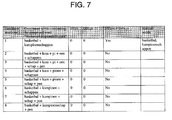
- the split compound decision module (204) finds 8 constituent nouns sets as shown in Fig. 7.
- step S305 the number of documents DT(i) containing the compound word t i "basketbalkampioenschappen” is determined.
- the compound word "basketbalkampioenschappen” is not found in any document within the document collection (201) by the semantic network module (202) as indicated by DT(i) being 0.
- step S305 is to determine the number of documents, DP(i,j), that contain all constituent words of set j.
- step S306 the split decision criteria DT(i) ⁇ 3*DP(i,j) per constituent words set j are evaluated.
- the result of this evaluation is presented in column 5 of Figure 7.
- only the first (j 1) constituent words set satisfy this criteria. That is, in this example, only the constituent words "basketbal” + “kampioenschappen” comply to the split criteria and are thus split up in step S307 into the separated form "basketbal", "kampioenschappen”.
- the split result of step S307 for this example is presented in column 6 of Figure 7.
- Such computer program(s) may be stored in memories such as RAM, ROM, PROM, etc. associated with computers. Alternatively, such computer program(s) may be stored in a different storage medium such as a magnetic disc, optical disc, magneto-optical disc, etc. Such computer program(s) may also take the form of a signal propagating across the
- the computer programs are readable using a known computer or computerbased device.
Landscapes
- Engineering & Computer Science (AREA)
- Theoretical Computer Science (AREA)
- Health & Medical Sciences (AREA)
- Artificial Intelligence (AREA)
- Audiology, Speech & Language Pathology (AREA)
- Computational Linguistics (AREA)
- General Health & Medical Sciences (AREA)
- Physics & Mathematics (AREA)
- General Engineering & Computer Science (AREA)
- General Physics & Mathematics (AREA)
- Machine Translation (AREA)
Priority Applications (1)
| Application Number | Priority Date | Filing Date | Title |
|---|---|---|---|
| EP05102225A EP1582996A2 (de) | 2004-03-31 | 2005-03-21 | Apparat und computerimplementiertes Verfahren zur Bestimmung von Bestandteilswörtern zusammengesetzter Wörter |
Applications Claiming Priority (3)
| Application Number | Priority Date | Filing Date | Title |
|---|---|---|---|
| EP04075975 | 2004-03-31 | ||
| EP04075975 | 2004-03-31 | ||
| EP05102225A EP1582996A2 (de) | 2004-03-31 | 2005-03-21 | Apparat und computerimplementiertes Verfahren zur Bestimmung von Bestandteilswörtern zusammengesetzter Wörter |
Publications (1)
| Publication Number | Publication Date |
|---|---|
| EP1582996A2 true EP1582996A2 (de) | 2005-10-05 |
Family
ID=34889020
Family Applications (1)
| Application Number | Title | Priority Date | Filing Date |
|---|---|---|---|
| EP05102225A Withdrawn EP1582996A2 (de) | 2004-03-31 | 2005-03-21 | Apparat und computerimplementiertes Verfahren zur Bestimmung von Bestandteilswörtern zusammengesetzter Wörter |
Country Status (1)
| Country | Link |
|---|---|
| EP (1) | EP1582996A2 (de) |
Cited By (1)
| Publication number | Priority date | Publication date | Assignee | Title |
|---|---|---|---|---|
| US10572976B2 (en) | 2017-10-18 | 2020-02-25 | International Business Machines Corporation | Enhancing observation resolution using continuous learning |
-
2005
- 2005-03-21 EP EP05102225A patent/EP1582996A2/de not_active Withdrawn
Cited By (1)
| Publication number | Priority date | Publication date | Assignee | Title |
|---|---|---|---|---|
| US10572976B2 (en) | 2017-10-18 | 2020-02-25 | International Business Machines Corporation | Enhancing observation resolution using continuous learning |
Similar Documents
| Publication | Publication Date | Title |
|---|---|---|
| US7720847B2 (en) | Apparatus and computerised method for determining constituent words of a compound word | |
| US6173251B1 (en) | Keyword extraction apparatus, keyword extraction method, and computer readable recording medium storing keyword extraction program | |
| JP4306894B2 (ja) | 自然言語処理装置及びその方法、及び自然言語認識装置 | |
| EP1214643B1 (de) | System und verfahren zum parsen eines dokumentes | |
| US20110295857A1 (en) | System and method for aligning and indexing multilingual documents | |
| US8170867B2 (en) | System for extracting information from a natural language text | |
| US20040193584A1 (en) | Method and device for relevant document search | |
| JP3735336B2 (ja) | 文書要約方法及びシステム | |
| JP2000276487A (ja) | 事例蓄積・検索装置、並びに事例蓄積方法および事例検索方法、並びに事例蓄積プログラムを記録したコンピュータで読取可能な記録媒体および事例検索プログラムを記録したコンピュータで読取可能な記録媒体 | |
| JPH05120345A (ja) | キーワード抽出装置 | |
| JP4631795B2 (ja) | 情報検索支援システム、情報検索支援方法および情報検索支援プログラム | |
| EP1582996A2 (de) | Apparat und computerimplementiertes Verfahren zur Bestimmung von Bestandteilswörtern zusammengesetzter Wörter | |
| JPH0612447A (ja) | 要約文章作成装置 | |
| CN110807322A (zh) | 基于信息熵识别新词的方法、装置、服务器及存储介质 | |
| CN112269852B (zh) | 生成舆情专题方法、系统及存储介质 | |
| JPH07134720A (ja) | 文章作成システムにおける関連情報提示方法及び装置 | |
| JPS61248160A (ja) | 文書情報登録方式 | |
| Paradis et al. | Contextual feature selection for text classification | |
| JP3082889B2 (ja) | モノローグ・データに対する話題構造認識方法および装置 | |
| Alansary | Shallow Parsing for Automatic Arabic Text Summarization | |
| JP2897942B2 (ja) | 日本語形態素解析システム及び形態素解析方式 | |
| Osenova et al. | Learning a token classification from a large corpus.(A case study in abbreviations) | |
| JP2005234732A (ja) | 文書管理装置および方法 | |
| KR101994901B1 (ko) | 인공지능 키워드 등록 방법 및 장치 | |
| EP1258815B1 (de) | Prozess zum Extrahieren von Schlüsselwörtern |
Legal Events
| Date | Code | Title | Description |
|---|---|---|---|
| PUAI | Public reference made under article 153(3) epc to a published international application that has entered the european phase |
Free format text: ORIGINAL CODE: 0009012 |
|
| AK | Designated contracting states |
Kind code of ref document: A2 Designated state(s): AT BE BG CH CY CZ DE DK EE ES FI FR GB GR HU IE IS IT LI LT LU MC NL PL PT RO SE SI SK TR |
|
| AX | Request for extension of the european patent |
Extension state: AL BA HR LV MK YU |
|
| STAA | Information on the status of an ep patent application or granted ep patent |
Free format text: STATUS: THE APPLICATION IS DEEMED TO BE WITHDRAWN |
|
| 18D | Application deemed to be withdrawn |
Effective date: 20161001 |