EP1582134A2 - Wiper and method for manufacturing the same - Google Patents
Wiper and method for manufacturing the same Download PDFInfo
- Publication number
- EP1582134A2 EP1582134A2 EP05251577A EP05251577A EP1582134A2 EP 1582134 A2 EP1582134 A2 EP 1582134A2 EP 05251577 A EP05251577 A EP 05251577A EP 05251577 A EP05251577 A EP 05251577A EP 1582134 A2 EP1582134 A2 EP 1582134A2
- Authority
- EP
- European Patent Office
- Prior art keywords
- fibers
- layer
- fibrous web
- surfacing
- fusible
- Prior art date
- Legal status (The legal status is an assumption and is not a legal conclusion. Google has not performed a legal analysis and makes no representation as to the accuracy of the status listed.)
- Granted
Links
Images

Classifications
-
- A—HUMAN NECESSITIES
- A47—FURNITURE; DOMESTIC ARTICLES OR APPLIANCES; COFFEE MILLS; SPICE MILLS; SUCTION CLEANERS IN GENERAL
- A47L—DOMESTIC WASHING OR CLEANING; SUCTION CLEANERS IN GENERAL
- A47L13/00—Implements for cleaning floors, carpets, furniture, walls, or wall coverings
- A47L13/10—Scrubbing; Scouring; Cleaning; Polishing
- A47L13/16—Cloths; Pads; Sponges
-
- B—PERFORMING OPERATIONS; TRANSPORTING
- B42—BOOKBINDING; ALBUMS; FILES; SPECIAL PRINTED MATTER
- B42D—BOOKS; BOOK COVERS; LOOSE LEAVES; PRINTED MATTER CHARACTERISED BY IDENTIFICATION OR SECURITY FEATURES; PRINTED MATTER OF SPECIAL FORMAT OR STYLE NOT OTHERWISE PROVIDED FOR; DEVICES FOR USE THEREWITH AND NOT OTHERWISE PROVIDED FOR; MOVABLE-STRIP WRITING OR READING APPARATUS
- B42D5/00—Sheets united without binding to form pads or blocks
- B42D5/04—Calendar blocks
-
- D—TEXTILES; PAPER
- D04—BRAIDING; LACE-MAKING; KNITTING; TRIMMINGS; NON-WOVEN FABRICS
- D04H—MAKING TEXTILE FABRICS, e.g. FROM FIBRES OR FILAMENTARY MATERIAL; FABRICS MADE BY SUCH PROCESSES OR APPARATUS, e.g. FELTS, NON-WOVEN FABRICS; COTTON-WOOL; WADDING ; NON-WOVEN FABRICS FROM STAPLE FIBRES, FILAMENTS OR YARNS, BONDED WITH AT LEAST ONE WEB-LIKE MATERIAL DURING THEIR CONSOLIDATION
- D04H1/00—Non-woven fabrics formed wholly or mainly of staple fibres or like relatively short fibres
- D04H1/40—Non-woven fabrics formed wholly or mainly of staple fibres or like relatively short fibres from fleeces or layers composed of fibres without existing or potential cohesive properties
- D04H1/44—Non-woven fabrics formed wholly or mainly of staple fibres or like relatively short fibres from fleeces or layers composed of fibres without existing or potential cohesive properties the fleeces or layers being consolidated by mechanical means, e.g. by rolling
- D04H1/46—Non-woven fabrics formed wholly or mainly of staple fibres or like relatively short fibres from fleeces or layers composed of fibres without existing or potential cohesive properties the fleeces or layers being consolidated by mechanical means, e.g. by rolling by needling or like operations to cause entanglement of fibres
- D04H1/48—Non-woven fabrics formed wholly or mainly of staple fibres or like relatively short fibres from fleeces or layers composed of fibres without existing or potential cohesive properties the fleeces or layers being consolidated by mechanical means, e.g. by rolling by needling or like operations to cause entanglement of fibres in combination with at least one other method of consolidation
- D04H1/485—Non-woven fabrics formed wholly or mainly of staple fibres or like relatively short fibres from fleeces or layers composed of fibres without existing or potential cohesive properties the fleeces or layers being consolidated by mechanical means, e.g. by rolling by needling or like operations to cause entanglement of fibres in combination with at least one other method of consolidation in combination with weld-bonding
-
- D—TEXTILES; PAPER
- D04—BRAIDING; LACE-MAKING; KNITTING; TRIMMINGS; NON-WOVEN FABRICS
- D04H—MAKING TEXTILE FABRICS, e.g. FROM FIBRES OR FILAMENTARY MATERIAL; FABRICS MADE BY SUCH PROCESSES OR APPARATUS, e.g. FELTS, NON-WOVEN FABRICS; COTTON-WOOL; WADDING ; NON-WOVEN FABRICS FROM STAPLE FIBRES, FILAMENTS OR YARNS, BONDED WITH AT LEAST ONE WEB-LIKE MATERIAL DURING THEIR CONSOLIDATION
- D04H1/00—Non-woven fabrics formed wholly or mainly of staple fibres or like relatively short fibres
- D04H1/40—Non-woven fabrics formed wholly or mainly of staple fibres or like relatively short fibres from fleeces or layers composed of fibres without existing or potential cohesive properties
- D04H1/44—Non-woven fabrics formed wholly or mainly of staple fibres or like relatively short fibres from fleeces or layers composed of fibres without existing or potential cohesive properties the fleeces or layers being consolidated by mechanical means, e.g. by rolling
- D04H1/46—Non-woven fabrics formed wholly or mainly of staple fibres or like relatively short fibres from fleeces or layers composed of fibres without existing or potential cohesive properties the fleeces or layers being consolidated by mechanical means, e.g. by rolling by needling or like operations to cause entanglement of fibres
- D04H1/498—Non-woven fabrics formed wholly or mainly of staple fibres or like relatively short fibres from fleeces or layers composed of fibres without existing or potential cohesive properties the fleeces or layers being consolidated by mechanical means, e.g. by rolling by needling or like operations to cause entanglement of fibres entanglement of layered webs
-
- D—TEXTILES; PAPER
- D04—BRAIDING; LACE-MAKING; KNITTING; TRIMMINGS; NON-WOVEN FABRICS
- D04H—MAKING TEXTILE FABRICS, e.g. FROM FIBRES OR FILAMENTARY MATERIAL; FABRICS MADE BY SUCH PROCESSES OR APPARATUS, e.g. FELTS, NON-WOVEN FABRICS; COTTON-WOOL; WADDING ; NON-WOVEN FABRICS FROM STAPLE FIBRES, FILAMENTS OR YARNS, BONDED WITH AT LEAST ONE WEB-LIKE MATERIAL DURING THEIR CONSOLIDATION
- D04H1/00—Non-woven fabrics formed wholly or mainly of staple fibres or like relatively short fibres
- D04H1/40—Non-woven fabrics formed wholly or mainly of staple fibres or like relatively short fibres from fleeces or layers composed of fibres without existing or potential cohesive properties
- D04H1/54—Non-woven fabrics formed wholly or mainly of staple fibres or like relatively short fibres from fleeces or layers composed of fibres without existing or potential cohesive properties by welding together the fibres, e.g. by partially melting or dissolving
- D04H1/541—Composite fibres, e.g. sheath-core, sea-island or side-by-side; Mixed fibres
- D04H1/5412—Composite fibres, e.g. sheath-core, sea-island or side-by-side; Mixed fibres sheath-core
-
- D—TEXTILES; PAPER
- D04—BRAIDING; LACE-MAKING; KNITTING; TRIMMINGS; NON-WOVEN FABRICS
- D04H—MAKING TEXTILE FABRICS, e.g. FROM FIBRES OR FILAMENTARY MATERIAL; FABRICS MADE BY SUCH PROCESSES OR APPARATUS, e.g. FELTS, NON-WOVEN FABRICS; COTTON-WOOL; WADDING ; NON-WOVEN FABRICS FROM STAPLE FIBRES, FILAMENTS OR YARNS, BONDED WITH AT LEAST ONE WEB-LIKE MATERIAL DURING THEIR CONSOLIDATION
- D04H1/00—Non-woven fabrics formed wholly or mainly of staple fibres or like relatively short fibres
- D04H1/40—Non-woven fabrics formed wholly or mainly of staple fibres or like relatively short fibres from fleeces or layers composed of fibres without existing or potential cohesive properties
- D04H1/54—Non-woven fabrics formed wholly or mainly of staple fibres or like relatively short fibres from fleeces or layers composed of fibres without existing or potential cohesive properties by welding together the fibres, e.g. by partially melting or dissolving
- D04H1/541—Composite fibres, e.g. sheath-core, sea-island or side-by-side; Mixed fibres
- D04H1/5414—Composite fibres, e.g. sheath-core, sea-island or side-by-side; Mixed fibres side-by-side
-
- D—TEXTILES; PAPER
- D04—BRAIDING; LACE-MAKING; KNITTING; TRIMMINGS; NON-WOVEN FABRICS
- D04H—MAKING TEXTILE FABRICS, e.g. FROM FIBRES OR FILAMENTARY MATERIAL; FABRICS MADE BY SUCH PROCESSES OR APPARATUS, e.g. FELTS, NON-WOVEN FABRICS; COTTON-WOOL; WADDING ; NON-WOVEN FABRICS FROM STAPLE FIBRES, FILAMENTS OR YARNS, BONDED WITH AT LEAST ONE WEB-LIKE MATERIAL DURING THEIR CONSOLIDATION
- D04H1/00—Non-woven fabrics formed wholly or mainly of staple fibres or like relatively short fibres
- D04H1/40—Non-woven fabrics formed wholly or mainly of staple fibres or like relatively short fibres from fleeces or layers composed of fibres without existing or potential cohesive properties
- D04H1/54—Non-woven fabrics formed wholly or mainly of staple fibres or like relatively short fibres from fleeces or layers composed of fibres without existing or potential cohesive properties by welding together the fibres, e.g. by partially melting or dissolving
- D04H1/541—Composite fibres, e.g. sheath-core, sea-island or side-by-side; Mixed fibres
- D04H1/5418—Mixed fibres, e.g. at least two chemically different fibres or fibre blends
-
- B—PERFORMING OPERATIONS; TRANSPORTING
- B42—BOOKBINDING; ALBUMS; FILES; SPECIAL PRINTED MATTER
- B42P—INDEXING SCHEME RELATING TO BOOKS, FILING APPLIANCES OR THE LIKE
- B42P2241/00—Parts, details or accessories for books or filing appliances
- B42P2241/10—Means for suspending
-
- Y—GENERAL TAGGING OF NEW TECHNOLOGICAL DEVELOPMENTS; GENERAL TAGGING OF CROSS-SECTIONAL TECHNOLOGIES SPANNING OVER SEVERAL SECTIONS OF THE IPC; TECHNICAL SUBJECTS COVERED BY FORMER USPC CROSS-REFERENCE ART COLLECTIONS [XRACs] AND DIGESTS
- Y10—TECHNICAL SUBJECTS COVERED BY FORMER USPC
- Y10T—TECHNICAL SUBJECTS COVERED BY FORMER US CLASSIFICATION
- Y10T428/00—Stock material or miscellaneous articles
- Y10T428/24—Structurally defined web or sheet [e.g., overall dimension, etc.]
- Y10T428/24942—Structurally defined web or sheet [e.g., overall dimension, etc.] including components having same physical characteristic in differing degree
- Y10T428/24992—Density or compression of components
-
- Y—GENERAL TAGGING OF NEW TECHNOLOGICAL DEVELOPMENTS; GENERAL TAGGING OF CROSS-SECTIONAL TECHNOLOGIES SPANNING OVER SEVERAL SECTIONS OF THE IPC; TECHNICAL SUBJECTS COVERED BY FORMER USPC CROSS-REFERENCE ART COLLECTIONS [XRACs] AND DIGESTS
- Y10—TECHNICAL SUBJECTS COVERED BY FORMER USPC
- Y10T—TECHNICAL SUBJECTS COVERED BY FORMER US CLASSIFICATION
- Y10T442/00—Fabric [woven, knitted, or nonwoven textile or cloth, etc.]
- Y10T442/60—Nonwoven fabric [i.e., nonwoven strand or fiber material]
- Y10T442/659—Including an additional nonwoven fabric
-
- Y—GENERAL TAGGING OF NEW TECHNOLOGICAL DEVELOPMENTS; GENERAL TAGGING OF CROSS-SECTIONAL TECHNOLOGIES SPANNING OVER SEVERAL SECTIONS OF THE IPC; TECHNICAL SUBJECTS COVERED BY FORMER USPC CROSS-REFERENCE ART COLLECTIONS [XRACs] AND DIGESTS
- Y10—TECHNICAL SUBJECTS COVERED BY FORMER USPC
- Y10T—TECHNICAL SUBJECTS COVERED BY FORMER US CLASSIFICATION
- Y10T442/00—Fabric [woven, knitted, or nonwoven textile or cloth, etc.]
- Y10T442/60—Nonwoven fabric [i.e., nonwoven strand or fiber material]
- Y10T442/659—Including an additional nonwoven fabric
- Y10T442/66—Additional nonwoven fabric is a spun-bonded fabric
- Y10T442/662—Needled
-
- Y—GENERAL TAGGING OF NEW TECHNOLOGICAL DEVELOPMENTS; GENERAL TAGGING OF CROSS-SECTIONAL TECHNOLOGIES SPANNING OVER SEVERAL SECTIONS OF THE IPC; TECHNICAL SUBJECTS COVERED BY FORMER USPC CROSS-REFERENCE ART COLLECTIONS [XRACs] AND DIGESTS
- Y10—TECHNICAL SUBJECTS COVERED BY FORMER USPC
- Y10T—TECHNICAL SUBJECTS COVERED BY FORMER US CLASSIFICATION
- Y10T442/00—Fabric [woven, knitted, or nonwoven textile or cloth, etc.]
- Y10T442/60—Nonwoven fabric [i.e., nonwoven strand or fiber material]
- Y10T442/659—Including an additional nonwoven fabric
- Y10T442/66—Additional nonwoven fabric is a spun-bonded fabric
- Y10T442/663—Hydroentangled
-
- Y—GENERAL TAGGING OF NEW TECHNOLOGICAL DEVELOPMENTS; GENERAL TAGGING OF CROSS-SECTIONAL TECHNOLOGIES SPANNING OVER SEVERAL SECTIONS OF THE IPC; TECHNICAL SUBJECTS COVERED BY FORMER USPC CROSS-REFERENCE ART COLLECTIONS [XRACs] AND DIGESTS
- Y10—TECHNICAL SUBJECTS COVERED BY FORMER USPC
- Y10T—TECHNICAL SUBJECTS COVERED BY FORMER US CLASSIFICATION
- Y10T442/00—Fabric [woven, knitted, or nonwoven textile or cloth, etc.]
- Y10T442/60—Nonwoven fabric [i.e., nonwoven strand or fiber material]
- Y10T442/659—Including an additional nonwoven fabric
- Y10T442/666—Mechanically interengaged by needling or impingement of fluid [e.g., gas or liquid stream, etc.]
-
- Y—GENERAL TAGGING OF NEW TECHNOLOGICAL DEVELOPMENTS; GENERAL TAGGING OF CROSS-SECTIONAL TECHNOLOGIES SPANNING OVER SEVERAL SECTIONS OF THE IPC; TECHNICAL SUBJECTS COVERED BY FORMER USPC CROSS-REFERENCE ART COLLECTIONS [XRACs] AND DIGESTS
- Y10—TECHNICAL SUBJECTS COVERED BY FORMER USPC
- Y10T—TECHNICAL SUBJECTS COVERED BY FORMER US CLASSIFICATION
- Y10T442/00—Fabric [woven, knitted, or nonwoven textile or cloth, etc.]
- Y10T442/60—Nonwoven fabric [i.e., nonwoven strand or fiber material]
- Y10T442/659—Including an additional nonwoven fabric
- Y10T442/666—Mechanically interengaged by needling or impingement of fluid [e.g., gas or liquid stream, etc.]
- Y10T442/667—Needled
-
- Y—GENERAL TAGGING OF NEW TECHNOLOGICAL DEVELOPMENTS; GENERAL TAGGING OF CROSS-SECTIONAL TECHNOLOGIES SPANNING OVER SEVERAL SECTIONS OF THE IPC; TECHNICAL SUBJECTS COVERED BY FORMER USPC CROSS-REFERENCE ART COLLECTIONS [XRACs] AND DIGESTS
- Y10—TECHNICAL SUBJECTS COVERED BY FORMER USPC
- Y10T—TECHNICAL SUBJECTS COVERED BY FORMER US CLASSIFICATION
- Y10T442/00—Fabric [woven, knitted, or nonwoven textile or cloth, etc.]
- Y10T442/60—Nonwoven fabric [i.e., nonwoven strand or fiber material]
- Y10T442/69—Autogenously bonded nonwoven fabric
-
- Y—GENERAL TAGGING OF NEW TECHNOLOGICAL DEVELOPMENTS; GENERAL TAGGING OF CROSS-SECTIONAL TECHNOLOGIES SPANNING OVER SEVERAL SECTIONS OF THE IPC; TECHNICAL SUBJECTS COVERED BY FORMER USPC CROSS-REFERENCE ART COLLECTIONS [XRACs] AND DIGESTS
- Y10—TECHNICAL SUBJECTS COVERED BY FORMER USPC
- Y10T—TECHNICAL SUBJECTS COVERED BY FORMER US CLASSIFICATION
- Y10T442/00—Fabric [woven, knitted, or nonwoven textile or cloth, etc.]
- Y10T442/60—Nonwoven fabric [i.e., nonwoven strand or fiber material]
- Y10T442/69—Autogenously bonded nonwoven fabric
- Y10T442/692—Containing at least two chemically different strand or fiber materials
Definitions
- the present invention relates to a wiper intended to be used for wiping the human body, furniture, home fixtures and so on in a pre-moistened or dry state and a method for manufacturing the same.
- Nonwoven wipers have been widely used to wipe the human body, furniture, home fixtures and so on. Such wipers may be used in a dry state to absorb water during use or in a pre-moistened state. In either case, nonwoven wipers are formed of hydrophilic fibers such as rayon and synthetic resin fibers.
- Japanese Patent No. 3183818 discloses a wet tissue in which an interlining layer is disposed between upper and lower layers.
- the upper and lower layers contain hydrophobic fibers at a higher proportion than hydrophilic fibers whereas the interlining layer contains hydrophilic fibers at a higher proportion than hydrophobic fibers. Fibers constituting these layers are entangled, fusion-bonded or entangled and fusion-bonded to impart a sufficient strength to a nonwoven fabric.
- the hydrophilic fibers function to retain water. With the hydrophobic fibers appearing on the tissue surfaces, moreover, the wet tissue is allowed to easily separate from another wet tissue.
- Japanese Patent No. 3333718 discloses a wiper stack in which each wiper comprises two fibrous web layers of hydrophilic fibers, polyester fibers and heat-fusible fibers (or thermally bondable fibers) and a pulp fiber layer interposed therebetween. These layers are entangled and integrated together by high-pressure water streams, and the heat-fusible fibers are fusion-bonded to each other. Because the pulp fiber layer is provided as an interlining layer, this wiper is capable of retain much water and doesn't feel sticky to the touch.
- the heat-fusible fibers are fusion-bonded to each other in the upper and lower surfacing layers between which the interlining layer is interposed to retain water.
- the fusion-bonded fibers appear on the sheet surface and make the sheet surface hard due to immovability. Accordingly, the wipers tend to irritate the skin when used for wiping the human body.
- the present invention has been developed in view of the shortcomings in the prior art set forth above. It is therefore an object of the present invention to provide a wiper which is highly retentive of water, soft to the touch, and improved in sheet strength.
- Another object of the present invention is to provide a method for manufacturing the same.
- a wiper in the form of a sheet comprising:
- the wiper of the invention is highly retentive of water due to the presence of the interlining layer comprised of hydrophilic fibers. Since the surfacing layers are comprised of non-fusible fibers, fibers located on the sheet surfaces are kept in a relatively freely movable state to provide a soft feeling. Thus, the sheet surfaces hardly irritate the skin when used for wiping the human body, and the coefficient of friction between the sheet surfaces and an object to be cleaned is lowered to facilitate sliding. On the other hand, the wiper has an increased sheet strength because the reinforcing layer comprised of fusible fibers is disposed inside the sheet and the fusible fibers are fusion-bonded.
- the hydrophilic fibers contained in the interlining layer are cellulosic fibers having a fiber length equal to or less than 10 mm and the interlining layer has a higher density than the first and second surfacing layers. This leads to higher water retentivity of the sheet and enables water contained in the interlining layer to gradually come out of the sheet surfaces when a pressure is exerted thereon during wiping.
- the non-fusible fibers constituting the first surfacing layer and/or the second surfacing layer are at least either of synthetic resin fibers or cellulosic fibers having a fiber length in the range of 20 to 70 mm. If the surfacing layer is comprised only or mainly of synthetic resin fibers, the sheet surface can be prevented from being excessively moistened to provide a sticky feeling to the skin. If the surfacing layer is comprised only or mainly of cellulosic fibers, on the other hand, water adhered to an object to be cleaned can be readily absorbed when the wiper is used in a dry state.
- the reinforcing layer may contain non-fusible fibers in addition to the fusible fibers.
- the non-fusible fibers are preferably hydrophilic fibers, more preferably cellulosic fibers having a fiber length in the range of 20 to 70 mm.
- a method for manufacturing a wiper comprising:
- a wiper which is highly retentive of water, soft to the touch, and improved in sheet strength can be relatively easily manufactured.
- cellulosic fibers having a fiber length equal to or less than 10 mm are deposited to form the interlining layer-forming fibrous web.
- at least either of synthetic resin fibers or cellulosic fibers having a fiber length in the range of 20 to 70 mm are deposited to form the first surfacing layer-forming fibrous web and/or the second surfacing layer-forming fibrous web.
- the reinforcing layer-forming fibrous web may contain non-fusible fibers in addition to the fusible fibers.
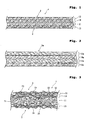
- Fig. 1 is an enlarged sectional view of a wiper 1 according to a first embodiment of the present invention
- Fig. 2 is an enlarged sectional view of a multilayered fibrous web 1a prepared in the process for manufacturing the wiper 1
- Fig. 3 is an enlarged sectional view schematically showing the internal structure of the wiper 1.
- Fibers as used herein are broadly divided into “fusible fiber” and "non-fusible fiber”.
- non-fusible fiber includes “hydrophilic fiber” and “hydrophobic fiber”.
- hydrophilic fiber includes "cellulosic fiber” and "synthetic resin fiber treated to be hydrophilic”. That is, the term “non-fusible fiber” refers to fiber whose surface has a higher melting point than that of the "fusible fiber” or is not allowed to melt.
- the term “fusible fiber” includes synthetic resin fiber treated to be hydrophilic and hydrophobic fibers (hydrophobic synthetic resin fibers).
- the wiper 1 being a single nonwoven fabric, has a first sheet surface 2 and a second sheet surface 3.
- the wiper 1 is intended to be supplied as a wet tissue pre-moistened with water or chemicals or a dry tissue capable of absorbing water during use. It may also be used for wiping a toilet, kitchen fixtures, furniture and so on in a dry or pre-moistened state.
- the wiper 1 may be used for wiping in any suitable manner. For example, two or more sheets of wiper 1 may be stacked and folded.
- the wiper 1 can be divided into four layers: an interlining layer 11; a first surfacing layer 12 appearing on the first surface 2; a second surfacing layer 13 appearing on the second surface 3; and a reinforcing layer 14 located between the first surfacing layer 12 and the interlining layer 11.
- the wiper 1 is manufactured by subjecting a multilayered fibrous web to a water-jet treatment and heat-treating the hydroentangled fibrous web.
- fibers tend to be entangled not only within the individual layers but also across the layers.
- hydrophilic fibers such as pulp having a fiber length equal to or less than 10 mm, e.g., in the range of 0.3-10 mm or 1-10 mm, tend to migrate to another layer (or mix with other fibers) due to high pressure of water streams.
- the interlining layer 11, the first surfacing layer 12, the second surfacing layer 13 and the reinforcing layer 14 cannot be clearly divided, and therefore in Fig. 1, boundaries between the layers are indicated by dashed lines.
- the first surfacing layer, the second surfacing layer, the interlining layer and the reinforcing layer according to the invention may have ill-defined boundaries.
- the interlining layer 11 is mainly constituted of hydrophilic fibers.
- hydrophilic fibers there may be used natural fibers such as pulp and cotton (cellulosic fibers) having a fiber length equal to or less than 10 mm, for example in the range of 1-10 mm, and regenerated fibers such as rayon (cellulosic fibers) having a fiber length in the range of 20-70 mm.
- synthetic resin fibers that are treated to be hydrophilic such as by applying a hydrophilizing agent, e.g., surfactant to the fiber surface or kneading the material resin with such a hydrophilizing agent.
- a hydrophilizing agent e.g., surfactant to the fiber surface or kneading the material resin with such a hydrophilizing agent.
- the interlining layer 11 may contain hydrophobic synthetic resin fibers to such a degree as not to impair water retentivity.
- the reinforcing layer 14 is mainly constituted of fusible fibers alone or in combination with the hydrophilic fibers.
- the fusible fibers have a low-melting resin such as polyethylene or low-melting polypropylene appearing on their surface.
- the fusible fibers include monocomponent fibers of polyethylene, monocomponent fibers of polypropylene, sheath/core bicomponent fibers of which the core is polyethylene terephthalate and the sheath is polyethylene, sheath/core bicomponent fibers of which the core is polypropylene and the sheath is polyethylene, sheath/core bicomponent fibers of which the core is high-melting polypropylene and the sheath is low-melting polypropylene, side-by-side bicomponent fibers composed of polyethylene terephthalate and polyethylene, and side-by-side bicomponent fibers composed of polypropylene and polyethylene.
- the first surfacing layer 12 and the second surfacing layer 13 are mainly constituted of non-fusible fibers.
- the non-fusible fibers may be synthetic resin fibers whose surface has a higher melting point than that of the above-mentioned fusible fiber, preferably by 20 degrees centigrade.
- the non-fusible synthetic resin fibers include polypropylene fibers, polyethylene terephthalate fibers and nylon fibers. Preferably, these fibers are hydrophobic.
- cellulosic fibers preferably regenerate fibers such as rayon having a fiber length in the range of 20-70 mm, may be used as the non-fusible fibers.
- the first surfacing layer 12 and the second surfacing layer 13 may be of different kinds of fibers or different blending ratios.
- the sheet surface can be prevented from being excessively moistened (or soaked) with water or chemicals oozing out of the interlining layer 11 when the wiper is used in a pre-moistened state. This also results in preventing a sticky feeling to the skin, as well as undesirable adhesion of the wiper to an object to be cleaned or another wiper.
- non-fusible fibers constituting the first and second surfacing layers 12 and 13 are only the hydrophilic cellulosic fibers or the blending ratio of the hydrophilic cellulosic fibers to total weight of the non-fusible fibers constituting the first and second surfacing layers 12 and 13 is equal to or greater than 60%, on the other hand, water adhered to the skin or another object to be cleaned can be readily absorbed and introduced into the interlining layer 11 when the wiper is used in a dry state.
- these layers 11-14 are integrated into a single nonwoven fabric.
- the interlining layer 11 is mainly constituted of cellulosic fibers such as pulp, the cellulosic fibers can also be bound to each other through hydrogen bonding due to the presence of hydroxyl group on fiber surface.
- the fusible fibers are fusion-bonded to each other or to the other fibers. Fusion bonds due to the fusible fibers can be found mainly in the reinforcing layer 14. On the other hand, the non-fusible fibers are kept in a relatively freely movable state.
- Fig. 3 schematically shows an exemplary structure of the wiper 1.
- the interlining layer 11 is constituted of pulp fibers 21
- the reinforcing layer 14 is constituted of fusible fibers 22 and rayon fibers (cellulosic fibers) 23 having a fiber length in the range of 20-70 mm.
- the fusible fibers 22 are fusion-bonded to each other or to the rayon fibers 23.
- the first surfacing layer 12 and the second surfacing layer 13 are constituted of non-fusible hydrophobic synthetic resin fibers 24 and rayon fibers (cellulosic fibers) 25 having a fiber length in the range of 20-70 mm.
- the first and second surfaces 2 and 3 of the wiper 1 are mainly formed of the synthetic resin fibers 24 and the rayon fibers 25, which are both non-fusible fibers, and are completely or substantially free from the fusible fibers 22. That is, even if the fusible fibers 22 appear on the first and second surfaces 2 and 3, the ratio of the fusible fibers 22 to the non-fusible fibers is too small to have any effect on the first and second surfaces 2 and 3.
- the density of the pulp fibers 21 in the interlining layer 11 is higher than the fiber densities of the first surfacing layer 12, the second surfacing layer 13 and the reinforcing layer 14.
- the multilayered fibrous web 1a shown in Fig. 2 is formed on a conveyor belt of a net, which is generally called "wire", or a conveyor belt of a perforated plate (not shown).
- the multilayered fibrous web 1a is formed by stacking a second surfacing layer-forming fibrous web 13a, an interlining layer-forming fibrous web 11a, a reinforcing layer-forming fibrous web 14a and a first surfacing layer-forming fibrous web 12a in the order named above upwardly from the conveyor belt.
- the second surfacing layer-forming fibrous web 13a, the first surfacing layer-forming fibrous web 12a and the reinforcing layer-forming fibrous web 14a are all formed by depositing fibers by a carded process. Both the second surfacing layer-forming fibrous web 13a and the first surfacing layer-forming fibrous web 12a are only of non-fusible fibers. More specifically, the fibrous webs 12a, 13a are formed of a blend of 50-100 wt. % of hydrophobic synthetic resin fibers and 0-50 wt. % of rayon fibers (hydrophilic fibers) having a fiber length in the range of 20-70 mm. On the other hand, the fibrous web 14a is formed of a blend of 50-100 wt. % of fusible fibers and 0-50 wt. % of rayon fibers (hydrophilic fibers) having a fiber length in the range of 20-70 mm.
- the interlining layer-forming fibrous web 11a is formed only of hydrophilic fibers having a fiber length equal to or less than 10 mm, e.g., in the range of 0.3-10 mm or 1-10 mm.
- at least either of pulp or cotton may be deposited by air-forming.
- the multilayered fibrous web 1a thus formed on the conveyor belt is then subjected to water jets which are applied from above the first surfacing layer-forming fibrous web 12a and optionally from below the second surfacing layer-forming fibrous web 13a, thereby integrating the fibrous webs into a single nonwoven fabric.
- the obtained nonwoven fabric is heat-treated, wherein the heating temperature is set to melt the surface of the fusible fibers but not melt the surface of the non-fusible fibers.
- the fusible-fibers are fusion-bonded to each other or to the other fibers. Since the fusible fibers are initially contained only in the reinforcing layer-forming fibrous web 14a, the fusion-bonded fibers are present mainly in the reinforcing layer 14 of the completed wiper 1.
- the reinforcing layer 14 is adjacent to the interlining layer 11, the pulp fibers etc. in the interlining layer 11 can also be held by fusion-bonding power of the fusible fibers in the reinforcing layer 14, which contributes to increased sheet strength, particularly increased wet strength.
- the wiper 1 of Figs. 1 and 3 is highly retentive of water due to the presence of hydrophilic fibers such as pulp in the interlining layer 11.
- the interlining layer 11 has a higher fiber density than not only the first and second surfacing layers 12, 13 but also the reinforcing layer 14, the wiper 1 is allowed to retain much water in the interlining layer 11.
- hydrophilic fibers such as rayon contained in the first and second surfacing layers 12, 13 and the reinforcing layer 14 also contribute to high water retentivity of the wiper 1 and facilitate migration of water between the sheet center and the sheet surfaces 2, 3.
- the fusible fibers hardly appear on the first and second surfaces 2, 3, as set forth above, the first and second surfaces 2, 3 can be made soft, for example, so as not to irritate the skin when used for wiping the human body.
- the coefficient of friction between the first and second surfaces 2, 3 and an object to be cleaned is lowered to facilitate sliding.
- the fusible fibers which are fusion-bonded to each other or to the other fibers in the reinforcing layer 14 as well as to the fibers constituting the first surfacing layer 12 and the interlining layer 11, contribute to the increased sheet strength, particularly the increased wet strength.
- the wiper 1 has a basis weight in, but not limited to, the range of 30 to 100 g/m 2 , wherein the interlining layer 11 may have a basis weight in the range of 10 to 60 g/m 2 and the reinforcing layer 14 have a basis weight in the range of 5 to 50 g/m 2 .
- Fig. 4 is an enlarged sectional view of a wiper 101 according to a second embodiment of the present invention
- Fig. 5 is an enlarged sectional view of a multilayered fibrous web 101a prepared in the process for manufacturing the wiper 101.
- the wiper 101 of Fig. 4 includes two reinforcing layers 14, 14 on both sides of the interlining layer 11, wherein one reinforcing layer 14 is covered with the first surfacing layer 12 and the other reinforcing layer 14 is covered with the second surfacing layer 13.
- the multilayered fibrous web 101a is formed by stacking a second surfacing layer-forming fibrous web 13a, a reinforcing layer-forming fibrous web 14a, an interlining layer-forming fibrous web 11a, a reinforcing layer-forming fibrous web 14a and a first surfacing layer-forming fibrous web 12a one on top of the other.
- the individual fibrous webs are constituted in the same manner as in the first embodiment and the wiper 1 is manufactured also in the same manner as in the first embodiment.
- the sheet strength of the wiper 101 according to the second embodiment can be further enhanced.
- the interlining layer 11 containing pulp fibers or the like is moistened with water, hydrogen bonding between the pulp fibers or the like tends to be weakened.
- the sheet strength can be maintained more reliably even in a moistened state because the fusion-bonded reinforcing layers 14, 14 are disposed on both side of the interlining layer 11.
- two or more interlining layers 11 may be provided in the wiper such that the second surfacing layer 13, the interlining layer 11, the reinforcing layer 14, the interlining layer 11 and the first surfacing layer 12 are stacked one on top of the other or such that the second surfacing layer 13, the interlining layer 11, the reinforcing layer 14, the interlining layer 11, the reinforcing layer 14 and the first surfacing layer 12 are stacked one on top of the other. It is also possible to stack the second surfacing layer 13, the reinforcing layer 14, the interlining layer 11, the reinforcing layer 14, the interlining layer 11, the reinforcing layer 14 and the first surfacing layer 12 one on top of the other.
Landscapes
- Engineering & Computer Science (AREA)
- Textile Engineering (AREA)
- Mechanical Engineering (AREA)
- Cleaning Implements For Floors, Carpets, Furniture, Walls, And The Like (AREA)
- Sanitary Thin Papers (AREA)
- Manufacturing Of Multi-Layer Textile Fabrics (AREA)
- Nonwoven Fabrics (AREA)
Abstract
Description
Claims (10)
- A wiper in the form of a sheet comprising:wherein the fusible fibers are fusion-bonded while the non-fusible fibers remain unfused.a first surfacing layer (12) appearing on one sheet surface (2);a second surfacing layer (13) appearing on the other sheet surface (3);a reinforcing layer (14) comprising fusible fibers; andan interlining layer (11) comprising hydrophilic fibers, the reinforcing layer (14) and the interlining layer (11) being located between the first and second surfacing layers (12, 13), the first and second surfacing layers (12, 13) comprising non-fusible fibers whose surface has a higher melting point than that of the fusible fibers or is not allowed to melt,
- A wiper according to claim 1, wherein the hydrophilic fibers contained in the interlining layer (11) are cellulosic fibers having a fiber length equal to or less than 10 mm and the interlining layer (11) has a higher density than the first and second surfacing layers (12, 13).
- A wiper according to claim 1, wherein the non-fusible fibers constituting the first surfacing layer (12) are at least either of synthetic resin fibers or cellulosic fibers having a fiber length in the range of 20 to 70 mm.
- A wiper according to claim 1, wherein the non-fusible fibers constituting the second surfacing layer (13) are at least either of synthetic resin fibers or cellulosic fibers having a fiber length in the range of 20 to 70 mm.
- A wiper according to claim 1, wherein the reinforcing layer (14) contains non-fusible fibers in addition to the fusible fibers.
- A method for manufacturing a wiper comprising:forming a multilayered fibrous web (1a) with a reinforcing layer-forming fibrous web (14a) and an interlining layer-forming fibrous web (11a) located between a first surfacing layer-forming fibrous web (12a) and a second surfacing layer-forming fibrous web (13a), the reinforcing layer-forming fibrous web (14a) comprising fusible fibers, the interlining layer-forming fibrous web (11a) comprising hydrophilic fibers, the first surfacing layer-forming fibrous web (12a) and the second surfacing layer-forming fibrous web (13a) comprising non-fusible fibers whose surface has a higher melting point than that of the fusible fibers or is not allowed to melt,integrating the multilayered fibrous web (1a) through a water-jet treatment; andheat-treating the integrated multilayered fibrous web (1a) at such a temperature as to melt the surface of the fusible fibers but not melt the surface of the non-fusible fibers.
- A method according to claim 6, wherein cellulosic fibers having a fiber length equal to or less than 10 mm are deposited to form the interlining layer-forming fibrous web (11a).
- A method according to claim 6, wherein at least either of synthetic resin fibers or cellulosic fibers having a fiber length in the range of 20 to 70 mm are deposited to form the first surfacing layer-forming fibrous web (12a).
- A method according to claim 6, wherein at least either of synthetic resin fibers or cellulosic fibers having a fiber length in the range of 20 to 70 mm are deposited to form the second surfacing layer-forming fibrous web (13a).
- A method according to claim 6, wherein the reinforcing layer-forming fibrous web (14a) contains non-fusible fibers in addition to the fusible fibers.
Applications Claiming Priority (2)
| Application Number | Priority Date | Filing Date | Title |
|---|---|---|---|
| JP2004109202A JP4458903B2 (en) | 2004-04-01 | 2004-04-01 | Wiper and manufacturing method thereof |
| JP2004109202 | 2004-04-01 |
Publications (3)
| Publication Number | Publication Date |
|---|---|
| EP1582134A2 true EP1582134A2 (en) | 2005-10-05 |
| EP1582134A3 EP1582134A3 (en) | 2007-05-02 |
| EP1582134B1 EP1582134B1 (en) | 2008-06-04 |
Family
ID=34880124
Family Applications (1)
| Application Number | Title | Priority Date | Filing Date |
|---|---|---|---|
| EP20050251577 Ceased EP1582134B1 (en) | 2004-04-01 | 2005-03-16 | Wiper and method for manufacturing the same |
Country Status (8)
| Country | Link |
|---|---|
| US (2) | US7820277B2 (en) |
| EP (1) | EP1582134B1 (en) |
| JP (1) | JP4458903B2 (en) |
| KR (1) | KR101178661B1 (en) |
| CN (1) | CN100488436C (en) |
| DE (1) | DE602005007285D1 (en) |
| MY (1) | MY142628A (en) |
| TW (1) | TWI291337B (en) |
Families Citing this family (23)
| Publication number | Priority date | Publication date | Assignee | Title |
|---|---|---|---|---|
| US7891898B2 (en) | 2005-01-28 | 2011-02-22 | S.C. Johnson & Son, Inc. | Cleaning pad for wet, damp or dry cleaning |
| US7740412B2 (en) | 2005-01-28 | 2010-06-22 | S.C. Johnson & Son, Inc. | Method of cleaning using a device with a liquid reservoir and replaceable non-woven pad |
| US7566671B2 (en) | 2005-01-28 | 2009-07-28 | S.C. Johnson & Son, Inc. | Cleaning or dusting pad |
| US7976235B2 (en) | 2005-01-28 | 2011-07-12 | S.C. Johnson & Son, Inc. | Cleaning kit including duster and spray |
| US8893347B2 (en) | 2007-02-06 | 2014-11-25 | S.C. Johnson & Son, Inc. | Cleaning or dusting pad with attachment member holder |
| KR101959502B1 (en) * | 2011-09-06 | 2019-03-18 | 벤텍스 주식회사 | Panty for urinary incontinence |
| US10060059B2 (en) * | 2012-01-19 | 2018-08-28 | Illinois Tool Works, Inc. | Cross-contamination prevention wipe |
| JP6253238B2 (en) * | 2012-05-28 | 2017-12-27 | 花王株式会社 | Cleaning sheet and manufacturing method thereof |
| JP6289101B2 (en) * | 2014-01-06 | 2018-03-07 | ユニ・チャーム株式会社 | Sorting device |
| JP6796910B2 (en) * | 2014-07-09 | 2020-12-09 | 旭化成アドバンス株式会社 | Wet wiper |
| JP6796369B2 (en) * | 2014-07-23 | 2020-12-09 | 旭化成アドバンス株式会社 | Wet wiper |
| JP6796370B2 (en) * | 2014-07-23 | 2020-12-09 | 旭化成アドバンス株式会社 | Wet wiper |
| EP3011885B1 (en) | 2014-10-20 | 2019-04-24 | Koninklijke Philips N.V. | Floor cleaning device |
| JP6444296B2 (en) * | 2015-12-28 | 2018-12-26 | ユニ・チャーム株式会社 | Laminated nonwoven fabric |
| JP6960719B2 (en) * | 2016-03-04 | 2021-11-05 | ユニ・チャーム株式会社 | Non-woven fabric for wet wipes and its manufacturing method |
| US11027516B2 (en) * | 2016-06-29 | 2021-06-08 | Oji Holdings Corporation | Body wiping sheet |
| CN106917187B (en) * | 2017-03-29 | 2019-11-22 | 杭州可利尔清洁用品有限公司 | An all-purpose cleaning towel and its production method |
| CN107268569B (en) * | 2017-05-25 | 2020-10-16 | 瑛菲生态科技(上海)有限公司 | Base material, matrix, ecological interface restoration system and preparation method thereof |
| CN107284873B (en) * | 2017-05-25 | 2019-10-15 | 瑛菲生态科技(上海)有限公司 | A kind of substrate, matrix and cold chain transportation preservation device |
| JP6917242B2 (en) * | 2017-08-09 | 2021-08-11 | 花王株式会社 | Wiping sheet and its manufacturing method |
| JP7147512B2 (en) * | 2018-11-29 | 2022-10-05 | 株式会社リコー | Inkjet printing device, inkjet printing method, and wiping member |
| JP7115298B2 (en) * | 2018-12-26 | 2022-08-09 | 株式会社リコー | Wiping member, wiping device, liquid ejection device, and wiping method |
| JP2023101036A (en) * | 2022-01-07 | 2023-07-20 | 花王株式会社 | Wet sheet for skin cleansing |
Family Cites Families (20)
| Publication number | Priority date | Publication date | Assignee | Title |
|---|---|---|---|---|
| CH526679A (en) * | 1968-07-01 | 1972-03-15 | Ciba Geigy Ag | Process for the continuous dyeing or printing of textile material made of polyacrylonitrile |
| US3649429A (en) * | 1970-03-12 | 1972-03-14 | Beacon Mfg Co | Needled composite nonwoven fabric having a self-bonded fibrous supporting layer and outer fibrous layers |
| US4275105A (en) * | 1978-06-16 | 1981-06-23 | The Buckeye Cellulose Corporation | Stabilized rayon web and structures made therefrom |
| GB8722004D0 (en) * | 1987-09-18 | 1987-10-28 | Hercules Inc | Absorbent material & thermally bonded cores |
| JP2815899B2 (en) * | 1989-05-26 | 1998-10-27 | ユニチカ株式会社 | Composite nonwoven fabric and method for producing the same |
| JP2900045B2 (en) | 1989-11-04 | 1999-06-02 | 日本バイリーン株式会社 | Nonwoven fabric cleaning material and method for producing the same |
| FR2700782B1 (en) * | 1993-01-26 | 1995-04-14 | Libeltex Nv Sa | Method of manufacturing a nonwoven and nonwoven obtained by this process. |
| JP4045365B2 (en) * | 1993-11-15 | 2008-02-13 | 株式会社日本吸収体技術研究所 | Antibacterial composite nonwoven fabric and method for producing the same |
| JP2765690B2 (en) * | 1993-12-27 | 1998-06-18 | 花王株式会社 | Cleaning sheet |
| JPH0998920A (en) | 1995-10-03 | 1997-04-15 | Kinsei Seishi Kk | Cleaning sheet |
| JP3183818B2 (en) | 1996-02-29 | 2001-07-09 | ユニ・チャーム株式会社 | Wet tissue laminate |
| FR2752248B1 (en) * | 1996-08-09 | 1998-09-25 | Lystil Sa | ABSORBENT NONWOVEN COMPLEX MATERIAL HAVING A FLEXIBLE FACE AND A ROUGH FACE, AND METHOD FOR OBTAINING SAME |
| JP3409988B2 (en) * | 1997-03-21 | 2003-05-26 | ユニ・チャーム株式会社 | Wipe sheet |
| JP3333718B2 (en) | 1997-08-05 | 2002-10-15 | 大和紡績株式会社 | Laminate for wiper |
| US6177370B1 (en) * | 1998-09-29 | 2001-01-23 | Kimberly-Clark Worldwide, Inc. | Fabric |
| DE19917275B4 (en) * | 1999-04-16 | 2004-02-26 | Carl Freudenberg Kg | cleaning cloth |
| FR2808436B1 (en) * | 2000-05-03 | 2003-03-14 | Philippe Doubet | MULTI-PURPOSE HOUSEHOLD ABSORBENT AND DRYING DEVICE |
| US7799968B2 (en) * | 2001-12-21 | 2010-09-21 | Kimberly-Clark Worldwide, Inc. | Sponge-like pad comprising paper layers and method of manufacture |
| JP2003180593A (en) | 2001-12-21 | 2003-07-02 | Lion Corp | Nonwoven fabric for cleaning and nonwoven fabric articles for cleaning |
| DE50301277D1 (en) * | 2003-08-20 | 2006-02-09 | Reifenhaeuser Gmbh & Co Kg | Fiber laminate and method of making a fiber laminate |
-
2004
- 2004-04-01 JP JP2004109202A patent/JP4458903B2/en not_active Expired - Fee Related
-
2005
- 2005-03-11 MY MYPI20051020A patent/MY142628A/en unknown
- 2005-03-16 EP EP20050251577 patent/EP1582134B1/en not_active Ceased
- 2005-03-16 DE DE200560007285 patent/DE602005007285D1/en not_active Expired - Lifetime
- 2005-03-17 US US11/082,503 patent/US7820277B2/en not_active Expired - Fee Related
- 2005-03-29 KR KR1020050025958A patent/KR101178661B1/en not_active Expired - Fee Related
- 2005-03-30 TW TW94110010A patent/TWI291337B/en not_active IP Right Cessation
- 2005-03-31 CN CNB2005100598478A patent/CN100488436C/en not_active Expired - Lifetime
-
2010
- 2010-09-20 US US12/886,055 patent/US20110005676A1/en not_active Abandoned
Also Published As
| Publication number | Publication date |
|---|---|
| US20110005676A1 (en) | 2011-01-13 |
| EP1582134A3 (en) | 2007-05-02 |
| TW200536507A (en) | 2005-11-16 |
| US20050221070A1 (en) | 2005-10-06 |
| MY142628A (en) | 2010-12-15 |
| JP2005287894A (en) | 2005-10-20 |
| EP1582134B1 (en) | 2008-06-04 |
| CN100488436C (en) | 2009-05-20 |
| US7820277B2 (en) | 2010-10-26 |
| CN1676088A (en) | 2005-10-05 |
| DE602005007285D1 (en) | 2008-07-17 |
| JP4458903B2 (en) | 2010-04-28 |
| TWI291337B (en) | 2007-12-21 |
| KR20060044924A (en) | 2006-05-16 |
| KR101178661B1 (en) | 2012-08-30 |
Similar Documents
| Publication | Publication Date | Title |
|---|---|---|
| US20110005676A1 (en) | Wiper and method for manufacturing the same | |
| AU740859B2 (en) | Cleaning cloth | |
| JP4286255B2 (en) | Laminated web with tuft | |
| EP1614790B1 (en) | An absorbent personal care product for cosmetic and/or dermatological applications comprising at least one absorbent sheet | |
| JP6726422B2 (en) | Non-woven fabric for wet wiping sheet and wet wiping sheet for personal use | |
| KR19990088366A (en) | Wiping sheet of raised non-woven fabric and production thereof | |
| JP2002065738A (en) | Absorbent article using surface material of continuous filament | |
| NZ268035A (en) | Layered, non-woven material comprising at least two layers of thermoplastic fibres, one layer of which comprises carded fibres, partially disoriented | |
| JP2002038363A (en) | Non-woven fabric for wet tissue | |
| JP2017119931A (en) | Laminated non-woven fabric | |
| JP5326104B2 (en) | Non-woven fabric for wiper and method for producing the same | |
| CA2561471A1 (en) | Absorbent cleaning pad having a durable cleaning surface and method of making same | |
| JP3992319B2 (en) | Nonwoven fabric for wet tissue | |
| JP2003166161A (en) | Wettable nonwoven fabric, method for producing the same and skin wetting sheet | |
| EP1696064A1 (en) | Cleansing sheets, manufacturing process and use thereof | |
| US20050106979A1 (en) | Personal care and surface cleaning article | |
| US7452834B2 (en) | Fibrous sheet | |
| JP3699332B2 (en) | Wet sheet | |
| JP2004324038A (en) | Fiber sheet | |
| US20030114069A1 (en) | Personal care and surface cleaning article | |
| JP3276578B2 (en) | Thermally bonded nonwoven fabric and method for producing the same | |
| JP3990036B2 (en) | Perforated nonwoven fabric | |
| JP4361576B2 (en) | Fiber sheet | |
| JP3186506B2 (en) | Water-absorbing bulky nonwoven fabric and method for producing the same | |
| EP1696063A1 (en) | Cleansing sheets, manufacturing process and use thereof |
Legal Events
| Date | Code | Title | Description |
|---|---|---|---|
| PUAI | Public reference made under article 153(3) epc to a published international application that has entered the european phase |
Free format text: ORIGINAL CODE: 0009012 |
|
| AK | Designated contracting states |
Kind code of ref document: A2 Designated state(s): AT BE BG CH CY CZ DE DK EE ES FI FR GB GR HU IE IS IT LI LT LU MC NL PL PT RO SE SI SK TR |
|
| AX | Request for extension of the european patent |
Extension state: AL BA HR LV MK YU |
|
| PUAL | Search report despatched |
Free format text: ORIGINAL CODE: 0009013 |
|
| AK | Designated contracting states |
Kind code of ref document: A3 Designated state(s): AT BE BG CH CY CZ DE DK EE ES FI FR GB GR HU IE IS IT LI LT LU MC NL PL PT RO SE SI SK TR |
|
| AX | Request for extension of the european patent |
Extension state: AL BA HR LV MK YU |
|
| RIC1 | Information provided on ipc code assigned before grant |
Ipc: B32B 5/26 20060101ALI20070329BHEP Ipc: D04H 1/48 20060101ALI20070329BHEP Ipc: A47L 13/16 20060101AFI20050706BHEP Ipc: D04H 1/04 20060101ALI20070329BHEP Ipc: D04H 13/00 20060101ALI20070329BHEP |
|
| 17P | Request for examination filed |
Effective date: 20071003 |
|
| AKX | Designation fees paid |
Designated state(s): DE FR GB NL SE |
|
| GRAP | Despatch of communication of intention to grant a patent |
Free format text: ORIGINAL CODE: EPIDOSNIGR1 |
|
| GRAS | Grant fee paid |
Free format text: ORIGINAL CODE: EPIDOSNIGR3 |
|
| GRAA | (expected) grant |
Free format text: ORIGINAL CODE: 0009210 |
|
| AK | Designated contracting states |
Kind code of ref document: B1 Designated state(s): DE FR GB NL SE |
|
| REG | Reference to a national code |
Ref country code: GB Ref legal event code: FG4D |
|
| REF | Corresponds to: |
Ref document number: 602005007285 Country of ref document: DE Date of ref document: 20080717 Kind code of ref document: P |
|
| REG | Reference to a national code |
Ref country code: SE Ref legal event code: TRGR |
|
| PLBE | No opposition filed within time limit |
Free format text: ORIGINAL CODE: 0009261 |
|
| STAA | Information on the status of an ep patent application or granted ep patent |
Free format text: STATUS: NO OPPOSITION FILED WITHIN TIME LIMIT |
|
| 26N | No opposition filed |
Effective date: 20090305 |
|
| REG | Reference to a national code |
Ref country code: FR Ref legal event code: PLFP Year of fee payment: 12 |
|
| REG | Reference to a national code |
Ref country code: FR Ref legal event code: PLFP Year of fee payment: 13 |
|
| REG | Reference to a national code |
Ref country code: FR Ref legal event code: PLFP Year of fee payment: 14 |
|
| PGFP | Annual fee paid to national office [announced via postgrant information from national office to epo] |
Ref country code: NL Payment date: 20190214 Year of fee payment: 15 |
|
| PGFP | Annual fee paid to national office [announced via postgrant information from national office to epo] |
Ref country code: SE Payment date: 20190311 Year of fee payment: 15 |
|
| PGFP | Annual fee paid to national office [announced via postgrant information from national office to epo] |
Ref country code: DE Payment date: 20200303 Year of fee payment: 16 Ref country code: GB Payment date: 20200304 Year of fee payment: 16 |
|
| PGFP | Annual fee paid to national office [announced via postgrant information from national office to epo] |
Ref country code: FR Payment date: 20200214 Year of fee payment: 16 |
|
| REG | Reference to a national code |
Ref country code: NL Ref legal event code: MM Effective date: 20200401 |
|
| PG25 | Lapsed in a contracting state [announced via postgrant information from national office to epo] |
Ref country code: NL Free format text: LAPSE BECAUSE OF NON-PAYMENT OF DUE FEES Effective date: 20200401 |
|
| PG25 | Lapsed in a contracting state [announced via postgrant information from national office to epo] |
Ref country code: SE Free format text: LAPSE BECAUSE OF NON-PAYMENT OF DUE FEES Effective date: 20200317 |
|
| REG | Reference to a national code |
Ref country code: DE Ref legal event code: R119 Ref document number: 602005007285 Country of ref document: DE |
|
| GBPC | Gb: european patent ceased through non-payment of renewal fee |
Effective date: 20210316 |
|
| PG25 | Lapsed in a contracting state [announced via postgrant information from national office to epo] |
Ref country code: DE Free format text: LAPSE BECAUSE OF NON-PAYMENT OF DUE FEES Effective date: 20211001 Ref country code: FR Free format text: LAPSE BECAUSE OF NON-PAYMENT OF DUE FEES Effective date: 20210331 Ref country code: GB Free format text: LAPSE BECAUSE OF NON-PAYMENT OF DUE FEES Effective date: 20210316 |