EP1580980A2 - Method and sample sheet for adjusting exposure heads in an exposure unit for print data - Google Patents
Method and sample sheet for adjusting exposure heads in an exposure unit for print data Download PDFInfo
- Publication number
- EP1580980A2 EP1580980A2 EP05100371A EP05100371A EP1580980A2 EP 1580980 A2 EP1580980 A2 EP 1580980A2 EP 05100371 A EP05100371 A EP 05100371A EP 05100371 A EP05100371 A EP 05100371A EP 1580980 A2 EP1580980 A2 EP 1580980A2
- Authority
- EP
- European Patent Office
- Prior art keywords
- test
- exposure
- laser
- fields
- recording material
- Prior art date
- Legal status (The legal status is an assumption and is not a legal conclusion. Google has not performed a legal analysis and makes no representation as to the accuracy of the status listed.)
- Granted
Links
Images



Classifications
-
- H—ELECTRICITY
- H04—ELECTRIC COMMUNICATION TECHNIQUE
- H04N—PICTORIAL COMMUNICATION, e.g. TELEVISION
- H04N1/00—Scanning, transmission or reproduction of documents or the like, e.g. facsimile transmission; Details thereof
- H04N1/40—Picture signal circuits
- H04N1/407—Control or modification of tonal gradation or of extreme levels, e.g. background level
- H04N1/4076—Control or modification of tonal gradation or of extreme levels, e.g. background level dependent on references outside the picture
- H04N1/4078—Control or modification of tonal gradation or of extreme levels, e.g. background level dependent on references outside the picture using gradational references, e.g. grey-scale test pattern analysis
-
- G—PHYSICS
- G03—PHOTOGRAPHY; CINEMATOGRAPHY; ANALOGOUS TECHNIQUES USING WAVES OTHER THAN OPTICAL WAVES; ELECTROGRAPHY; HOLOGRAPHY
- G03G—ELECTROGRAPHY; ELECTROPHOTOGRAPHY; MAGNETOGRAPHY
- G03G15/00—Apparatus for electrographic processes using a charge pattern
- G03G15/04—Apparatus for electrographic processes using a charge pattern for exposing, i.e. imagewise exposure by optically projecting the original image on a photoconductive recording material
- G03G15/04036—Details of illuminating systems, e.g. lamps, reflectors
- G03G15/04045—Details of illuminating systems, e.g. lamps, reflectors for exposing image information provided otherwise than by directly projecting the original image onto the photoconductive recording material, e.g. digital copiers
- G03G15/04072—Details of illuminating systems, e.g. lamps, reflectors for exposing image information provided otherwise than by directly projecting the original image onto the photoconductive recording material, e.g. digital copiers by laser
-
- G—PHYSICS
- G03—PHOTOGRAPHY; CINEMATOGRAPHY; ANALOGOUS TECHNIQUES USING WAVES OTHER THAN OPTICAL WAVES; ELECTROGRAPHY; HOLOGRAPHY
- G03G—ELECTROGRAPHY; ELECTROPHOTOGRAPHY; MAGNETOGRAPHY
- G03G15/00—Apparatus for electrographic processes using a charge pattern
- G03G15/22—Apparatus for electrographic processes using a charge pattern involving the combination of more than one step according to groups G03G13/02 - G03G13/20
- G03G15/32—Apparatus for electrographic processes using a charge pattern involving the combination of more than one step according to groups G03G13/02 - G03G13/20 in which the charge pattern is formed dotwise, e.g. by a thermal head
- G03G15/326—Apparatus for electrographic processes using a charge pattern involving the combination of more than one step according to groups G03G13/02 - G03G13/20 in which the charge pattern is formed dotwise, e.g. by a thermal head by application of light, e.g. using a LED array
-
- H—ELECTRICITY
- H04—ELECTRIC COMMUNICATION TECHNIQUE
- H04N—PICTORIAL COMMUNICATION, e.g. TELEVISION
- H04N1/00—Scanning, transmission or reproduction of documents or the like, e.g. facsimile transmission; Details thereof
- H04N1/40—Picture signal circuits
- H04N1/401—Compensating positionally unequal response of the pick-up or reproducing head
- H04N1/4015—Compensating positionally unequal response of the pick-up or reproducing head of the reproducing head
-
- B—PERFORMING OPERATIONS; TRANSPORTING
- B41—PRINTING; LINING MACHINES; TYPEWRITERS; STAMPS
- B41C—PROCESSES FOR THE MANUFACTURE OR REPRODUCTION OF PRINTING SURFACES
- B41C1/00—Forme preparation
-
- B—PERFORMING OPERATIONS; TRANSPORTING
- B41—PRINTING; LINING MACHINES; TYPEWRITERS; STAMPS
- B41C—PROCESSES FOR THE MANUFACTURE OR REPRODUCTION OF PRINTING SURFACES
- B41C3/00—Reproduction or duplicating of printing formes
Definitions
- the invention relates to the field of electronic reproduction technology and relates to a method for aligning the exposure heads of an imagesetter, especially an external drum imagesetter, the artwork on Records printing plates. Furthermore, the invention relates to a test form for measurement and comparing the exposure intensities set in the exposure heads.
- print templates for printed pages are generated contain all elements to be printed such as texts, graphics and images.
- a separate print template is created for each ink contains all elements that are printed in the respective color.
- the printing templates separated by printing inks will also be Called color separations.
- the artwork is usually rasterized and with a maturityer exposed on films, with which then printing plates for printing high volumes are produced.
- the artwork can be in special Exposure devices are also immediately exposed to printing plates or they are transferred directly as digital data to a digital press. There For example, the artwork data is then merged into the press integrated exposure unit exposed to printing plates before immediately then the print starts.
- the Postscript or PDF data are recorded before the recording Print templates in a raster image processor (RIP) in a first step in Color separation values for the color separations CMYK converted.
- RIP raster image processor
- Color separation values are a measure of the color densities with which the four cyan, magenta, yellow and black inks printed on the substrate become.
- spot colors special cases where more than four colors are printed (Spot colors)
- each pixel is described by so many color separation values, as there are printing inks.
- the color separation values may be e.g. with 8 bits each Pixel and ink to be stored as data values, bringing the range of values from 0% to 100% is divided into 256 tone levels.
- Different tones of a color separation to be reproduced can be in printing only by area modulation of the applied inks, i. by a screening, play.
- the area modulation of the printing inks can be done for example by a method for dot patterning, in which the different tone levels of the color separation data in grid points different Size to be converted in a regular grid with Periodically repeating grid cells are arranged.
- a grid cell for a typical sixty grid, a square of 1/60 cm edge length, i. a grid cell has the dimensions 166 microns ⁇ 166 microns.
- a typical resolution of the exposure points For example, if 1000 exposure points per centimeter, i. one Exposure point has the dimensions 10 microns ⁇ 10 microns.
- the implementation of Color separation values in grid points are done in a second step in the further processing the color separation data in the raster image processor, thereby the color separation data into high-resolution binary values with only two brightness values be converted (exposed or unexposed), the pattern form the modulated dot matrix.
- the artwork data becomes describes each color separation in the form of a high-resolution raster bitmap, which contains one bit for each of the exposure points on the print area, indicating whether this exposure point is to be exposed or not.
- the tonal values be in this way in an appropriate area coverage on the Converted to print template, which is expressed as the tonal values in percent.
- the area coverage indicates what percentage of the area of a grid cell is exposed becomes.
- an exposure beam is generated, For example, with a laser diode, a laser beam, by optical means shaped and focused on the recording material and by means of a deflection system Point and line deflected over the recording material. It There are also recording devices that increase the speed of exposure generate a bundle of laser beams, e.g. with a separate laser light source for each laser beam, and with each sweep of the recording material expose several lines of the printing form simultaneously.
- the printing forms can be exposed to film material, so called color separation films arise, which subsequently by means of a photographic Umkopiervons serve for the production of printing plates.
- the Printing plates themselves in a platesetter or directly in a digital printing machine are exposed, in which a unit for plate exposure is integrated.
- the recording material can be on a flat surface (flatbed platesetter), in a cylindrical trough (internal drum imagesetter) or on one Drum (external drum imagesetter).
- Flatbed Exposure works mostly with a fast rotating polygon mirror, its mirror surfaces the laser beam across the recording material steer while at the same time the recording material perpendicular to the deflection of the laser beam is moved. In this way will record line exposed for recording line. As reflected by the movement of the laser beam Changing the length of the light path via the recording material is a complicated process Imaging optics required, the resulting size changes compensated for the exposure point.
- the material to be exposed is in the form of Movies or printing plates mounted on a rotatably mounted drum. While As the drum rotates, an exposure head becomes axial at a relatively short distance moved along the drum. The exposure head is in the feed direction moved by means of a feed screw, with which it is positively connected and which is rotated by a feed drive in rotary motion. The exposure head focuses one or more laser beams on the drum surface, which sweep the drum surface in the form of helical lines. On in this way, one or more recording lines are produced at every drum revolution exposed to the recording material.
- each one bundle of N laser beams by means of a Exposure optics as a oriented in the axial direction of the exposure drum linear array of exposure points on the surface of the recording material depict.
- the Exposure heads for example, arranged on an exposure head carrier, which is connected to the feed screw, so that by the rotational movement of the Feed spindle all exposure heads together in the feed direction at the Be moved along exposure drum.
- the exposure heads are in the axial direction the exposure drum arranged at a distance of a fraction the axial drum length is one third, for example, with three exposure heads the axial drum length.
- the different Exposure heads must be recorded, also the generated area coverage be within a tight tolerance the same when the exposure heads be controlled with the same tone value. Otherwise, arose disturbing leap in density, for which the eye resembles a uniform surface Tone value is particularly sensitive. With a constant tone value can the coverage created within certain limits by the change of the optical power of the laser beams in the exposure heads are affected. In this way, the exposure heads can be adjusted to each other be that when moving from one recording tape to the next no Density leap arises.
- Such matching between two adjacent exposure heads could basically be carried out with an iterative procedure in which the Laser power of one exposure head remains unchanged and that of the other Exposure head is gradually changed. Every time becomes an area recorded with the same tone and visually assessed the record.
- EP-0529530-B1 discloses a method for calibrating a multi-channel printer described that generates parallel laser beams with multiple laser diodes and focused on a thermal recording material. With every laser diode is written separately a test pattern, the laser diodes with known tone values are measured, and measured the density of the test pattern. From the comparison of the measured densities with the input tones corrected control values are calculated with which all laser diodes use the generate the same density value.
- EP-1027679-B1 discloses a method and apparatus for calibration an image forming device with multiple image outputs proposed.
- the Image outputs are pulsed laser diodes with a variable laser current and a variable pulse duration are driven to one on one Recording medium to produce different densities.
- Every laser diode becomes a test pattern with several test fields of different nominal density then the recorded density of the test fields is measured.
- For each set of test fields with the same nominal density becomes an answer function formed the recorded density in relation to the laser current and sets the pulse duration.
- the recorded Density variations between the laser diodes can be reduced.
- Another task is to specify a test form with which of the individual Exposure heads recorded area coverage in a simple manner can be compared.
- the task is solved by giving each a test form in each recording tape associated with an exposure head, is exposed and the recorded area coverage in adjacent Recording tapes are compared visually.
- the test form allows without a density measurement the very accurate quantification of the differences the recorded area coverage, from which corresponding correction values for the laser powers in the exposure heads are derived.
- the inventive method can with a test exposure, the necessary Correction values for all exposure heads are detected simultaneously. This allows the complete adjustment of the exposure heads with only a few iterations be achieved.
- Fig. 1 shows schematically the construction of an external drum exposure unit for exposure a printing original 15 on a recording material, in this example on a printing plate 3.
- An exposure drum 1 is rotatably mounted and can with a rotary drive not shown in the direction of the rotation arrow 2 in a uniform rotation can be offset.
- On the exposure drum 1 is an unexposed printing plate 3 by means of a terminal strip 9 at the front edge and fixed by means of clamping pieces 10 at the trailing edge.
- the printing plate 3 is flat by means of a vacuum device, not shown in Fig. 1, the pressure plate 3 sucks through holes in the drum surface, on the drum surface held, so that the pressure plate 3 is not affected by the centrifugal forces during rotation the exposure drum 1 is replaced.
- Multiple exposure heads 11 on a common exposure head carrier 16 are disposed at a relatively short distance axially on the exposure drum 1 while the exposure drum 1 is rotating.
- everyone Exposure head 11 focuses a bunch of exposure beams, in this example N laser beams 12, on the drum surface, the drum surface in the form of helical lines. This way, everyone will Drum rotation one or more groups of N recording lines in the circumferential direction x (main scanning direction) is exposed to the recording material.
- the exposure head carrier 16 is moved in the feeding direction y (sub-scanning direction) moved by means of a feed screw 13, with the erformschiüssig is connected and the offset with a feed drive 14 in rotary motion becomes.
- the feed drive 14 is a stepper motor, wherein the frequency of the The motor fed stepping motor clock the feed rate exactly can be adjusted.
- the productivity of the Exposure increases, especially for the exposure of large format printing plates 3, since a printing plate 3 can be exposed in a shorter time.
- two exposure heads 11 are present, in the feed direction are arranged at a distance W and in each case a bundle of N laser beams 12 focus on the pressure plate 3.
- the printing plate 3 is thereby simultaneously illuminated with two groups of recording lines, the axial distance W cover the drum surface.
- the imagesetter in the feed direction can record at three exposure heads 11 one third of this maximum length, etc.
- Fig. 2 illustrates the recording of the original 15, which is in the exposure each with N laser beams 12 results, on the unwound drum surface 20.
- the pressure plate 3 is clamped, on which the artwork 15 is recorded.
- the recording takes place in each case parallel with N laser beams 12, which are oriented as a feed direction linear Array of exposure points 21 are shown.
- the beam profile of a laser diode has the shape of a Gaussian bell curve, as shown in Fig. 3.
- the energy density H (r) has in the Center of the beam is a maximum value and decreases with increasing radius r a Gaussian function.
- thermal printing plate in which a polymer layer imagewise by the action of Laser energy is destroyed and eroded.
- a Such pressure plate is a positive pressure plate, as the non-color-leading Imaging be exposed imagewise.
- the term "positive” is out compared to the conventional copying of a positive color separation film derived on a printing plate, in which the printing plate through the transparent Film areas is exposed, i.e.. also on the non-color-leading Put.
- Fig. 4a shows schematically the position of the ink-conducting areas 25 of a positive pressure plate 3 relative to the exposed areas.
- FIG. 4 b shows the same relation for a negative pressure plate 3.
- a special test form is after the laser energy of the laser beams 12 first to a nominal operating point were set.
- a control device not explained here ensures that the N laser beams 12 within each exposure head 11 always emit the same laser energy once set.
- the N laser beams 12 as an array of exposure points 21, also as a laser module or module referred to.
- information such as "change in the Laser energy by ... mW "always on all laser beams 12 of a module, i.e. the Energy of all laser beams is changed by the same amount.
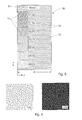
- the test form 50 becomes in the feed direction y over the entire width W of a recording tape 23 exposed.
- the extent of the test mold 50 in the circumferential direction x is arbitrary.
- the test form 50 includes a plurality of test fields 51 on a background surface 52. Background area 52 is rasterized with a constant tone, for example, with the tone value 70.0%. This tone value is particularly suitable good for the visual assessment of smallest density differences.
- One of the test fields 51 is rasterized with the same tone as the background area 52, the rest Test fields 51 are rasterized with tone values, which in small steps both down and up from the tonal value of the background area 52 differ, for example, in steps of 0.5%.
- test fields 51 The number of test fields 51 is obviously, for example, 21 test fields 51 in the tonal range of 65% can 75% are to be provided. In Fig. 5 are for clarity only seven test fields 51 shown.
- the test fields 51 are immediately at the left edge of the test form 50, i. in the circumferential direction x of the recording, arranged.
- the nominal ones Tonal values of the test fields 51 are next to the test fields 51 by Tonwertique 53, which is imprinted in the recording of the test form 50 become.
- Tonwertique 53 which is imprinted in the recording of the test form 50 become.
- module name 54 which indicates with which laser module the test form 50 was recorded has been.
- the different screened tonal values of the test fields 51 and the background area 52 are shown in Fig. 5 by differently dense hatching characterized.
- the test mold 50 becomes simultaneously with all the laser modules of the exposure heads 11 recorded.
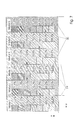
- Fig. 7 shows such a test exposure for an example in an imagesetter six exposure heads 11 are present and each other to be matched.
- the test exposure thus contains six in Feed direction y juxtaposed test forms 50, which at the recording tape boundaries 24 collide. Since the laser powers are still are not balanced, the test forms 50 from the laser modules with something recorded different area coverage, which in Fig. 7 again by different dense hatching is indicated. Despite the different Area coverage naturally has the test field 51 in all test forms 50 the nominal tonal value 70.0% the same area coverage as the background area 52 of the same test form 50.
- the visual comparison is more accurate than a density measurement, which would be subject to a measurement error of about 1% area coverage.
- density differences of ⁇ 0.5% are still perceptible.
- the test fields 51 exposed to the module 1 could also be omitted, since they are not compared to any adjacent background area 52, i.e. for the module 1 it would be sufficient to expose only the background area 52.
- the test mold 50 exposed to the module 2 has a slightly larger area coverage than the test form 50 exposed with the module 1, i.e. she is slightly darker overall. This is expressed in the fact that in the test form 50 of the module 2 the test field 51 with the nominal tone 69.5% already reaches the same area coverage as the background area 52 in FIG Test Form 50 of Module 1 with the nominal tone value 70.0%. For better Overview is this match in Fig. 7 marked with an arrow.
- the test form 50 of the module 3 is exposed overall somewhat brighter than the test form 50 of Module 2. Therefore, the area coverage of the background area becomes 52 of the module 2 of the module 3 first with the test field 51 with the nominal Tonal value 70.5% achieved.
- the visual comparison becomes at each recording band limit 24 between two modules, and the nominal ones Tone values of the test fields 51, their area coverage in each case with the area coverage the background of the previous module or the lowest Difference, be in the first line of an evaluation table entered.
- Fig. 8 shows the evaluation table for the test exposure of Fig. 7.
- a second line of the evaluation table will be the differences of the nominal Levels from line 1 to the respective predecessor module formed. These differences are then moved from module 1 to the current module added up, and the sum is in a third line of the evaluation table entered.
- the values in line 3 thus indicate which area coverage differences the recorded with the respective modules test forms 50 related to the test form written with Module 1. Based on these differences correction values could already be calculated by what amounts the laser powers of the individual modules must be increased or decreased, to match the exposure heads 11 to each other.
- the threshold M is undershot in which the polymer layer of the printing plate is secure and complete is removed (Fig.
- the inventive method was the example of a positive-working Pressure plate described. It can also work for negative pressure plates as well as for other recording materials, only to be noted is in which direction the laser powers have to be changed to For example, to effect a reduction of the area coverage, or which Thresholds or other limits must be met.
- the procedure and the test form 50 are also not for use in an external drum imagesetter limited, but they can with any design of a Druckvorlagebelichters be used, which is a print template with multiple exposure heads records.
Landscapes
- Physics & Mathematics (AREA)
- General Physics & Mathematics (AREA)
- Engineering & Computer Science (AREA)
- Multimedia (AREA)
- Signal Processing (AREA)
- Optics & Photonics (AREA)
- Exposure And Positioning Against Photoresist Photosensitive Materials (AREA)
- Manufacture Or Reproduction Of Printing Formes (AREA)
- Accessory Devices And Overall Control Thereof (AREA)
- Facsimile Heads (AREA)
Abstract
Description
Die Erfindung bezieht sich auf das Gebiet der elektronischen Reproduktionstechnik und betrifft ein Verfahren zum Abgleichen der Belichtungsköpfe eines Belichters, insbesondere eines Außentrommelbelichters, der Druckvorlagen auf Druckplatten aufzeichnet. Weiterhin betrifft die Erfindung eine Testform zur Messung und zum Vergleich der in den Belichtungsköpfen eingestellten Belichtungsintensitäten.The invention relates to the field of electronic reproduction technology and relates to a method for aligning the exposure heads of an imagesetter, especially an external drum imagesetter, the artwork on Records printing plates. Furthermore, the invention relates to a test form for measurement and comparing the exposure intensities set in the exposure heads.
In der Reproduktionstechnik werden Druckvorlagen für Druckseiten erzeugt, die alle zu druckenden Elemente wie Texte, Grafiken und Bilder enthalten. Für den farbigen Druck wird für jede Druckfarbe eine separate Druckvorlage erzeugt, die alle Elemente enthält, die in der jeweiligen Farbe gedruckt werden. Für den Vierfarbdruck sind das die Druckfarben Cyan (C), Magenta (M), Gelb (Y) und Schwarz (K). Die nach Druckfarben separierten Druckvorlagen werden auch Farbauszüge genannt. Die Druckvorlagen werden in der Regel gerastert und mit einem Beliebter auf Filme belichtet, mit denen dann Druckplatten für das Drucken hoher Auflagen hergestellt werden. Alternativ können die Druckvorlagen in speziellen Belichtungsgeräten auch gleich auf Druckplatten belichtet werden oder sie werden direkt als digitale Daten an eine digitale Druckmaschine übergeben. Dort werden die Druckvorlagendaten dann beispielsweise mit einer in die Druckmaschine integrierten Belichtungseinheit auf Druckplatten belichtet, bevor unmittelbar anschließend der Auflagendruck beginnt.In reproduction technology, print templates for printed pages are generated contain all elements to be printed such as texts, graphics and images. For the colored printing, a separate print template is created for each ink contains all elements that are printed in the respective color. For four-color printing These are the printing inks Cyan (C), Magenta (M), Yellow (Y) and Black (K). The printing templates separated by printing inks will also be Called color separations. The artwork is usually rasterized and with a beliebter exposed on films, with which then printing plates for printing high volumes are produced. Alternatively, the artwork can be in special Exposure devices are also immediately exposed to printing plates or they are transferred directly as digital data to a digital press. There For example, the artwork data is then merged into the press integrated exposure unit exposed to printing plates before immediately then the print starts.
Nach dem heutigen Stand der Technik werden die Druckvorlagen elektronisch reproduziert. Dabei werden Bilder in einem Farbscanner gescannt und in Form von digitalen Daten gespeichert. Texte werden mit Textverarbeitungsprogrammen erzeugt und Grafiken mit Zeichenprogrammen. Mit einem Layoutprogramm werden die Bild-, Text- und Grafik-Elemente zu einer Druckseite zusammengestellt. Die Daten mehrerer Druckseiten werden mit den Daten weiterer Elemente, wie Passkreuzen, Schnittmarken und Falzmarken sowie Druckkontrollfeldern, zu Druckvorlagen für einen Druckbogen zusammengefasst. Nach der Separation in die Druckfarben liegen die Druckvorlagen dann in digitaler Form vor. Als Datenformate zur Beschreibung der Druckvorlagen werden heute weitgehend die Seitenbeschreibungssprachen Postscript und PDF (Portable Document Format) verwendet. Die Postscript- bzw. PDF-Daten werden vor der Aufzeichnung der Druckvorlagen in einem Raster-Image-Prozessor (RIP) in einem ersten Schritt in Farbauszugswerte für die Farbauszüge CMYK umgerechnet. Dabei entstehen für jeden Bildpunkt vier Farbauszugswerte als Tonwerte im Wertebereich von 0 bis 100%. Die Farbauszugswerte sind ein Maß für die Farbdichten, mit denen die vier Druckfarben Cyan, Magenta, Gelb und Schwarz auf dem Bedruckstoff gedruckt werden. In Sonderfällen, in denen mit mehr als vier Farben gedruckt wird (Schmuckfarben), ist jeder Bildpunkt durch so viele Farbauszugswerte beschrieben, wie es Druckfarben gibt. Die Farbauszugswerte können z.B. mit 8 bit je Bildpunkt und Druckfarbe als Datenwerte gespeichert sein, womit der Wertebereich von 0 % bis 100% in 256 Tonwertstufen unterteilt ist.According to the current state of the art, the artwork is electronic reproduced. Images are scanned in a color scanner and in shape stored by digital data. Texts are created using word processing programs generated and graphics with drawing programs. With a layout program the image, text and graphic elements are combined to form a printed page. The data of several printed pages are combined with the data of further elements, such as registration marks, crop marks and folding marks as well as print control fields Print templates summarized for a printed sheet. After separation in the inks will then be in digital form. As data formats to describe the print templates today are largely the page description languages Postscript and PDF (Portable Document Format) used. The Postscript or PDF data are recorded before the recording Print templates in a raster image processor (RIP) in a first step in Color separation values for the color separations CMYK converted. In the process arise for each pixel four color separation values as tone values in the value range from 0 to 100%. The color separation values are a measure of the color densities with which the four cyan, magenta, yellow and black inks printed on the substrate become. In special cases where more than four colors are printed (Spot colors), each pixel is described by so many color separation values, as there are printing inks. The color separation values may be e.g. with 8 bits each Pixel and ink to be stored as data values, bringing the range of values from 0% to 100% is divided into 256 tone levels.
Unterschiedliche Tonwerte eines zu reproduzierenden Farbauszugs lassen sich
im Druck nur durch eine Flächenmodulation der aufgetragenen Druckfarben, d.h.
durch eine Rasterung, wiedergeben. Die Flächenmodulation der Druckfarben
kann beispielsweise nach einem Verfahren zur Punktrasterung erfolgen, bei dem
die verschiedenen Tonwertstufen der Farbauszugsdaten in Rasterpunkte unterschiedlicher
Größe umgewandelt werden, die in einem regelmäßigen Raster mit
sich periodisch wiederholenden Rasterzellen angeordnet sind. Eine Rasterzelle
für ein typisches 60er Raster umfasst ein Quadrat mit 1/60 cm Kantenlänge, d.h.
eine Rasterzelle hat die Abmessungen 166 µm × 166 µm. Bei der Aufzeichnung
der Farbauszüge auf eine Druckplatte werden die Rasterpunkte in den einzelnen
Rasterzellen aus Belichtungspunkten zusammengesetzt, die um eine Größenordnung
kleiner als die Rasterpunkte sind. Eine typische Auflösung der Belichtungspunkte
ist beispielsweise 1000 Belichtungspunkte je Zentimeter, d.h. ein
Belichtungspunkt hat die Abmessungen 10 µm × 10 µm. Die Umsetzung der
Farbauszugswerte in Rasterpunkte geschieht in einem zweiten Schritt bei der
weiteren Verarbeitung der Farbauszugsdaten im Raster-Image-Prozessor, wodurch
die Farbauszugsdaten in hochaufgelöste Binärwerte mit nur zwei Helligkeitswerten
(belichtet bzw. nicht belichtet) umgewandelt werden, die das Muster
des modulierten Punktrasters bilden. Auf diese Weise werden die Druckvorlagendaten
jedes Farbauszugs in Form einer hochaufgelösten Rasterbitmap beschrieben,
die für jeden der Belichtungspunkte auf der Druckfläche ein Bit enthält,
das angibt, ob dieser Belichtungspunkt zu belichten ist oder nicht. Die Tonwerte
werden auf diese Weise in eine entsprechende Flächendeckung auf der
Druckvorlage umgewandelt, die so wie die Tonwerte in Prozent angegeben wird.
Die Flächendeckung gibt an, wie viel Prozent der Fläche einer Rasterzelle belichtet
wird.Different tones of a color separation to be reproduced can be
in printing only by area modulation of the applied inks, i.
by a screening, play. The area modulation of the printing inks
can be done for example by a method for dot patterning, in which
the different tone levels of the color separation data in grid points different
Size to be converted in a regular grid with
Periodically repeating grid cells are arranged. A grid cell
for a typical sixty grid, a square of 1/60 cm edge length, i.
a grid cell has the dimensions 166 microns × 166 microns. When recording
The color separations on a printing plate become the halftone dots in the individual
Raster cells composed of exposure points, by an order of magnitude
smaller than the grid points are. A typical resolution of the exposure points
For example, if 1000 exposure points per centimeter, i. one
Exposure point has the
In den Aufzeichnungsgeräten, die in der elektronischen Reproduktionstechnik zur Belichtung von Druckvorlagen eingesetzt werden, wird ein Belichtungsstrahl erzeugt, beispielsweise mit einer Laserdiode ein Laserstrahl, durch optische Mittel geformt und auf das Aufzeichnungsmaterial fokussiert und mittels eines Ablenksystems Punkt- und Linienweise über das Aufzeichnungsmaterial abgelenkt. Es gibt auch Aufzeichnungsgeräte, die zur Erhöhung der Belichtungsgeschwindigkeit ein Bündel von Laserstrahlen erzeugen, z.B. mit einer separaten Laserlichtquelle für jeden Laserstrahl, und mit jedem Überstreichen des Aufzeichnungsmaterials mehrere Aufzeichnungslinien der Druckform gleichzeitig belichten. Die Druckformen können auf Filmmaterial belichtet werden, so dass sogenannte Farbauszugsfilme entstehen, die anschließend mittels eines fotografischen Umkopierverfahrens zur Herstellung von Druckplatten dienen. Statt dessen können auch die Druckplatten selbst in einem Plattenbelichter oder direkt in einer digitalen Druckmaschine belichtet werden, in die eine Einheit zur Plattenbelichtung integriert ist. Das Aufzeichnungsmaterial kann sich auf einer ebenen Fläche befinden (Flachbettbelichter), in einer zylindrischen Mulde (Innentrommelbelichter) oder auf einer Trommel (Außentrommelbelichter). In the recording devices used in electronic reproduction technology for Exposure of artwork, an exposure beam is generated, For example, with a laser diode, a laser beam, by optical means shaped and focused on the recording material and by means of a deflection system Point and line deflected over the recording material. It There are also recording devices that increase the speed of exposure generate a bundle of laser beams, e.g. with a separate laser light source for each laser beam, and with each sweep of the recording material expose several lines of the printing form simultaneously. The printing forms can be exposed to film material, so called color separation films arise, which subsequently by means of a photographic Umkopierverfahrens serve for the production of printing plates. Instead, the Printing plates themselves in a platesetter or directly in a digital printing machine are exposed, in which a unit for plate exposure is integrated. The recording material can be on a flat surface (flatbed platesetter), in a cylindrical trough (internal drum imagesetter) or on one Drum (external drum imagesetter).
Flachbettbelichter arbeiten überwiegend mit einem schnell rotierenden Polygonspiegel, dessen Spiegelflächen den Laserstrahl quer über das Aufzeichnungsmaterial lenken, während gleichzeitig das Aufzeichnungsmaterial senkrecht zur Ablenkrichtung des Laserstrahls bewegt wird. Auf diese Weise wird Aufzeichnungslinie für Aufzeichnungslinie belichtet. Da sich bei der Bewegung des Laserstrahls über das Aufzeichnungsmaterial die Länge des Lichtwegs ändert, ist eine aufwendige Abbildungsoptik erforderlich, die die dadurch bedingte Größenänderungen des Belichtungspunktes kompensiert.Flatbed Exposure works mostly with a fast rotating polygon mirror, its mirror surfaces the laser beam across the recording material steer while at the same time the recording material perpendicular to the deflection of the laser beam is moved. In this way will record line exposed for recording line. As reflected by the movement of the laser beam Changing the length of the light path via the recording material is a complicated process Imaging optics required, the resulting size changes compensated for the exposure point.
Bei einem Innentrommelbelichter wird das zu belichtende Material auf der Innenfläche eines teilweise offenen Hohlzylinders montiert und mit einem Laserstrahl belichtet, der entlang der Zylinderachse auf eine Ablenkvorrichtung gerichtet wird, die den Laserstrahl senkrecht auf das Material reflektiert. Die Ablenkvorrichtung, ein Prisma oder ein Spiegel, rotiert im Betrieb mit hoher Drehzahl und wird dabei in Richtung der Zylinderachse bewegt, so dass der abgelenkte Laserstrahl kreisförmige oder schraubenförmige Aufzeichnungslinien auf dem Material beschreibt.In an internal drum imagesetter, the material to be exposed on the inner surface a partially open hollow cylinder mounted and with a laser beam exposed to a deflection device along the cylinder axis, which reflects the laser beam perpendicular to the material. The deflection device, a prism or a mirror, rotates in high-speed operation and is doing so moved in the direction of the cylinder axis, so that the deflected laser beam circular or describes helical recording lines on the material.
Bei einem Außentrommelbelichter wird das zu belichtende Material in Form von Filmen oder Druckplatten auf eine drehbar gelagerte Trommel montiert. Während die Trommel rotiert, wird ein Belichtungskopf in einem relativ kurzen Abstand axial an der Trommel entlang bewegt. Der Belichtungskopf wird in der Vorschubrichtung mittels einer Vorschubspindel bewegt, mit der er formschlüssig verbunden ist und die mit einem Vorschubantrieb in Drehbewegung versetzt wird. Der Belichtungskopf fokussiert einen oder mehrere Laserstrahlen auf die Trommeloberfläche, die die Trommeloberfläche in Form von Schraubenlinien überstreichen. Auf diese Weise werden bei jeder Trommelumdrehung eine bzw. mehrere Aufzeichnungslinien auf das Aufzeichnungsmaterial belichtet.In an external drum imagesetter, the material to be exposed is in the form of Movies or printing plates mounted on a rotatably mounted drum. While As the drum rotates, an exposure head becomes axial at a relatively short distance moved along the drum. The exposure head is in the feed direction moved by means of a feed screw, with which it is positively connected and which is rotated by a feed drive in rotary motion. The exposure head focuses one or more laser beams on the drum surface, which sweep the drum surface in the form of helical lines. On in this way, one or more recording lines are produced at every drum revolution exposed to the recording material.
Um die Belichtungszeit zu verkürzen und damit die Wirtschaftlichkeit des Belichters zu erhöhen, arbeiten Außentrommelbelichter bevorzugt mit einem oder mehreren Belichtungsköpfen, die jeder ein Bündel von N Laserstrahlen mittels einer Belichtungsoptik als ein in Achsrichtung der Belichtungstrommel orientiertes lineares Array von Belichtungspunkten auf der Oberfläche des Aufzeichnungsmaterials abbilden. Wenn mehrere Belichtungsköpfe vorhanden sind, sind die Belichtungsköpfe beispielsweise auf einem Belichtungskopfträger angeordnet, der mit der Vorschubspindel verbunden ist, so dass durch die Drehbewegung der Vorschubspindel alle Belichtungsköpfe gemeinsam in Vorschubrichtung an der Belichtungstrommel entlang bewegt werden. Die Belichtungsköpfe sind in Achsrichtung der Belichtungstrommel in einem Abstand angeordnet, der ein Bruchteil der axialen Trommellänge ist, zum Beispiel bei drei Belichtungsköpfen ein Drittel der axialen Trommellänge. Um eine Druckvorlage über die gesamte Trommellänge aufzuzeichnen, braucht der Belichtungskopfträger mittels der Vorschubspindel nur über eine Strecke bewegt zu werden, die dem Abstand der Belichtungsköpfe entspricht. Jeder Belichtungskopf belichtet dann nur ein Aufzeichnungsband der Druckvorlage. Entsprechend kurz ist die Aufzeichnungszeit für die Druckvorlage.To shorten the exposure time and thus the efficiency of the imagesetter To increase external drum imagesetter work preferably with one or more Exposure heads, each one bundle of N laser beams by means of a Exposure optics as a oriented in the axial direction of the exposure drum linear array of exposure points on the surface of the recording material depict. If several exposure heads are present, the Exposure heads, for example, arranged on an exposure head carrier, which is connected to the feed screw, so that by the rotational movement of the Feed spindle all exposure heads together in the feed direction at the Be moved along exposure drum. The exposure heads are in the axial direction the exposure drum arranged at a distance of a fraction the axial drum length is one third, for example, with three exposure heads the axial drum length. To print a template over the entire drum length record, needs the exposure head carrier by means of the feed screw only to be moved over a distance equal to the distance of the exposure heads equivalent. Each exposure head then exposes only one recording tape the artwork. Correspondingly short is the recording time for the print template.
An der Grenze zwischen den Aufzeichnungsbändern, die von den verschiedenen Belichtungsköpfen aufgezeichnet werden, müssen auch die erzeugten Flächendeckungen innerhalb einer engen Toleranz gleich sein, wenn die Belichtungsköpfe mit dem jeweils gleichen Tonwert angesteuert werden. Sonst entsteht ein störender Dichtesprung, für den das Auge in einer einheitlichen Fläche gleichen Tonwertes besonders empfindlich ist. Bei einem gleichbleibenden Tonwert kann die erzeugte Flächendeckung in bestimmten Grenzen durch die Veränderung der optischen Leistung der Laserstrahlen in den Belichtungsköpfen beeinflusst werden. Auf diese Weise können die Belichtungsköpfe so aufeinander abgeglichen werden, dass beim Übergang von einem Aufzeichnungsband zum nächsten kein Dichtesprung entsteht.At the border between the tapes, the different Exposure heads must be recorded, also the generated area coverage be within a tight tolerance the same when the exposure heads be controlled with the same tone value. Otherwise, arose disturbing leap in density, for which the eye resembles a uniform surface Tone value is particularly sensitive. With a constant tone value can the coverage created within certain limits by the change of the optical power of the laser beams in the exposure heads are affected. In this way, the exposure heads can be adjusted to each other be that when moving from one recording tape to the next no Density leap arises.
Ein solcher Abgleich zwischen zwei benachbarten Belichtungsköpfen könnte grundsätzlich mit einem iterativen Verfahren durchgeführt werden, bei dem die Laserleistung des einen Belichtungskopfes unverändert bleibt und die des anderen Belichtungskopfes schrittweise verändert wird. Jedes Mal wird eine Fläche mit dem gleichen Tonwert aufgezeichnet und die Aufzeichnung visuell beurteilt. Such matching between two adjacent exposure heads could basically be carried out with an iterative procedure in which the Laser power of one exposure head remains unchanged and that of the other Exposure head is gradually changed. Every time becomes an area recorded with the same tone and visually assessed the record.
Dies wird solange wiederholt, bis kein Dichtesprung mehr sichtbar ist. Dann wird in gleicher Weise der nächste Belichtungskopf abgeglichen, usw. Ein solches Verfahren wäre sehr zeitaufwendig, da die Belichtungsköpfe für jede Testbelichtung eine Vorschubstrecke durchlaufen müssen, die der Breite eines Aufzeichnungsbandes entspricht. Außerdem wäre der Verbrauch an Aufzeichnungsmaterial für die Testbelichtungen sehr hoch. Das iterative Verfahren kann durch eine zusätzliche Dichtemessung der aufgezeichneten Flächendeckungen beschleunigt werden. Wegen der Fähigkeit des Auges, auch sehr geringe Dichteänderungen unter 0,5% wahrzunehmen, und andererseits eines typischen Messfehlers von mehr als 1% reicht eine solchen Messung und eine daraus berechnete Änderung der Laserleistung allein für den optimalen Abgleich jedoch nicht aus. Die Messergebnisse können bestenfalls zum Auffinden günstiger Startwerte für die Iterationen herangezogen werden.This is repeated until no more density jump is visible. Then it will be similarly, the next exposure head is adjusted, and so on Procedure would be very time consuming as the exposure heads for each test exposure must pass through a feed distance, the width of a recording tape equivalent. In addition, the consumption of recording material would be very high for the test exposures. The iterative method can be replaced by a accelerated additional density measurement of recorded areal coverage become. Because of the ability of the eye, even very small density changes below 0.5%, and on the other hand a typical measurement error of more than 1%, such a measurement and a change calculated from it suffice However, the laser power alone for the optimal balance is not enough. The At best, measuring results can be used to find favorable starting values for the Iterations are used.
In der EP-0529530-B1 wird ein Verfahren zur Kalibrierung eines Mehrkanal-Druckers beschrieben, der mit mehreren Laserdioden parallele Laserstrahlen erzeugt und auf ein thermisches Aufzeichnungsmaterial fokussiert. Mit jeder Laserdiode wird separat ein Testmuster geschrieben, wobei die Laserdioden mit bekannten Tonwerten angesteuert werden, und die Dichte der Testmuster gemessen. Aus dem Vergleich der gemessenen Dichten mit den Eingangstonwerten werden korrigierte Ansteuerwerte berechnet, mit denen alle Laserdioden den gleichen Dichtewert erzeugen.EP-0529530-B1 discloses a method for calibrating a multi-channel printer described that generates parallel laser beams with multiple laser diodes and focused on a thermal recording material. With every laser diode is written separately a test pattern, the laser diodes with known tone values are measured, and measured the density of the test pattern. From the comparison of the measured densities with the input tones corrected control values are calculated with which all laser diodes use the generate the same density value.
In der EP-1027679-B1 wird ein Verfahren und eine Vorrichtung zur Kalibrierung eines Bilderzeugungsgeräts mit mehreren Bildausgängen vorgeschlagen. Die Bildausgänge sind gepulste Laserdioden, die mit einem veränderlichen Laserstrom und einer veränderlichen Pulsdauer angesteuert werden, um auf einem Aufzeichnungsmedium unterschiedliche Dichten zu erzeugen. Mit jeder Laserdiode wird ein Testmuster mit mehreren Testfeldern unterschiedlicher Solldichte belichtet, und anschließend wird die aufgezeichnete Dichte der Testfelder gemessen. Für jeden Satz von Testfeldern mit gleicher Solldichte wird eine Antwortfunktion gebildet, die die aufgezeichnete Dichte in Beziehung zum Laserstrom und zur Pulsdauer setzt. Auf der Basis der Differenz zwischen den gemessenen Dichten und den nach der Antwortfunktion berechneten Dichten werden die Ansteuerwerte für die einzelnen Laserdioden korrigiert, wobei die aufgezeichneten Dichtevariationen zwischen den Laserdioden reduziert werden.EP-1027679-B1 discloses a method and apparatus for calibration an image forming device with multiple image outputs proposed. The Image outputs are pulsed laser diodes with a variable laser current and a variable pulse duration are driven to one on one Recording medium to produce different densities. With every laser diode becomes a test pattern with several test fields of different nominal density then the recorded density of the test fields is measured. For each set of test fields with the same nominal density becomes an answer function formed the recorded density in relation to the laser current and sets the pulse duration. On the basis of the difference between the measured Densities and the densities calculated after the response function become the drive values corrected for the individual laser diodes, the recorded Density variations between the laser diodes can be reduced.
Die bisher bekannten Verfahren zum Abgleichen der Belichtungsköpfe eines Belichters sind zeitaufwändig oder sie erreichen nicht die für die Anwendung in einem Druckvorlagenbelichter erforderliche hohe Genauigkeit.The previously known methods for aligning the exposure heads of an imagesetter are time consuming or they do not reach for the application in one Print platesetter required high accuracy.
Es ist deshalb die Aufgabe der vorliegenden Erfindung, ein mit weniger Zeitaufwand arbeitendes sowie zuverlässiges und ausreichend genaues Verfahren zum Abgleichen der Belichtungsköpfe in einem Druckvorlagenbelichter anzugeben. Eine weitere Aufgabe ist es, eine Testform anzugeben, mit der die von den einzelnen Belichtungsköpfen aufgezeichneten Flächendeckungen in einfacher Weise verglichen werden können. Die Aufgabe wird gelöst, indem jeweils eine Testform in jedem Aufzeichnungsband, das einem Belichtungskopf zugeordnet ist, belichtet wird und die aufgezeichneten Flächendeckungen in aneinander grenzenden Aufzeichnungsbändern visuell verglichen werden. Die Testform ermöglicht ohne eine Dichtemessung die sehr genaue Quantifizierung der Unterschiede der aufgezeichneten Flächendeckungen, aus denen entsprechende Korrekturwerte für die Laserleistungen in den Belichtungsköpfen abgeleitet werden. Durch das erfindungsgemäße Verfahren können mit einer Testbelichtung die notwendigen Korrekturwerte für alle Belichtungsköpfe gleichzeitig festgestellt werden. Damit kann der vollständige Abgleich der Belichtungsköpfe mit nur wenigen Iterationsschritten erreicht werden.It is therefore the object of the present invention, one with less time Working as well as reliable and sufficiently accurate method for Align the exposure heads in a Print Imagesetter. Another task is to specify a test form with which of the individual Exposure heads recorded area coverage in a simple manner can be compared. The task is solved by giving each a test form in each recording tape associated with an exposure head, is exposed and the recorded area coverage in adjacent Recording tapes are compared visually. The test form allows without a density measurement the very accurate quantification of the differences the recorded area coverage, from which corresponding correction values for the laser powers in the exposure heads are derived. By The inventive method can with a test exposure, the necessary Correction values for all exposure heads are detected simultaneously. This allows the complete adjustment of the exposure heads with only a few iterations be achieved.
Die Erfindung wird anhand der Figuren näher beschrieben.
Es zeigen:
- Fig. 1
- den Aufbau eines Außentrommelbelichters,
- Fig. 2
- die aufgezeichnete Druckvorlage auf einer abgewickelten Trommeloberfläche,
- Fig. 3
- das Strahlprofil eines Laserstrahls,
- Fig. 4
- die Wirkungsweise einer positiv arbeitenden und einer negativ arbeitenden Druckplatte,
- Fig. 5
- den Aufbau einer Testform,
- Fig. 6
- Beispiele für ein frequenzmoduliertes Raster,
- Fig. 7
- eine Testbelichtung mit mehreren Testformen,
und - Fig. 8
- eine Auswertungstabelle.
Show it:
- Fig. 1
- the construction of an external drum imagesetter,
- Fig. 2
- the recorded artwork on a unwound drum surface,
- Fig. 3
- the beam profile of a laser beam,
- Fig. 4
- the mode of action of a positive-working and a negative-working pressure plate,
- Fig. 5
- the structure of a test form,
- Fig. 6
- Examples of a frequency-modulated grid,
- Fig. 7
- a test exposure with several test forms,
and - Fig. 8
- an evaluation table.
Fig. 1 zeigt schematisch den Aufbau eines Außentrommelbelichters zur Belichtung
einer Druckvorlage 15 auf ein Aufzeichnungsmaterial, in diesem Beispiel auf
eine Druckplatte 3. Eine Belichtungstrommel 1 ist drehbar gelagert und kann mit
einem nicht gezeigten Rotationsantrieb in Richtung des Rotationspfeils 2 in eine
gleichmäßige Rotationsbewegung versetzt werden. Auf der Belichtungstrommel 1
ist eine unbelichtete Druckplatte 3 mittels einer Klemmleiste 9 an der Vorderkante
und mittels Klemmstücken 10 an der Hinterkante fixiert. Die Druckplatte 3 wird
flächig mittels einer in Fig. 1 nicht gezeigten Vakuumeinrichtung, die die Druckplatte
3 durch Löcher in der Trommeloberfläche ansaugt, auf der Trommeloberfläche
gehalten, damit die Druckplatte 3 nicht durch die Fliehkräfte bei der Rotation
der Belichtungstrommel 1 abgelöst wird.Fig. 1 shows schematically the construction of an external drum exposure unit for exposure
a printing original 15 on a recording material, in this example on
a
Mehrere Belichtungsköpfe 11, die auf einem gemeinsamen Belichtungskopfträger
16 angeordnet sind, werden in einem relativ kurzen Abstand axial an der Belichtungstrommel
1 entlang bewegt, während die Belichtungstrommel 1 rotiert. Jeder
Belichtungskopf 11 fokussiert ein Bündel von Belichtungsstrahlen, in diesem Beispiel
N Laserstrahlen 12, auf die Trommeloberfläche, die die Trommeloberfläche
in Form von Schraubenlinien überstreichen. Auf diese Weise werden bei jeder
Trommelumdrehung eine bzw. mehrere Gruppen von N Aufzeichnungslinien in
der Umfangsrichtung x (Hauptabtastrichtung) auf das Aufzeichnungsmaterial belichtet.
Der Belichtungskopfträger 16 wird in der Vorschubrichtung y (Nebenabtastrichtung)
mittels einer Vorschubspindel 13 bewegt, mit der erformschiüssig
verbunden ist und die mit einem Vorschubantrieb 14 in Drehbewegung versetzt
wird. Der Vorschubantrieb 14 ist ein Schrittmotor, wobei mit der Frequenz der
dem Motor zugeführten Schrittmotortakte die Vorschubgeschwindigkeit genau
eingestellt werden kann.Multiple exposure heads 11 on a common
Durch die Verwendung mehrerer Belichtungsköpfe 11 wird die Produktivität des
Belichters erhöht, insbesondere für die Belichtung von großformatigen Druckplatten
3, da eine Druckplatte 3 in kürzerer Zeit belichtet werden kann. In dem Beispiel
von Fig. 1 sind zwei Belichtungsköpfe 11 vorhanden, die in der Vorschubrichtung
im Abstand W angeordnet sind und jeweils ein Bündel von N Laserstrahlen
12 auf die Druckplatte 3 fokussieren. Die Druckplatte 3 wird dadurch gleichzeitig
mit zwei Gruppen von Aufzeichnungslinien belichtet, die im axialen Abstand W
die Trommeloberfläche überstreichen. Bei zwei Belichtungsköpfen 11 entspricht
der Abstand W der halben Maximallänge, die der Belichter in Vorschubrichtung
aufzeichnen kann, bei drei Belichtungsköpfen 11 einem Drittel dieser Maximallänge,
usw. Nachdem der Belichtungskopfträger 16 und somit alle Belichtungsköpfe
11 die Vorschubstrecke W zurückgelegt haben, ist die Belichtung der Druckplatte
3 unabhängig vom Format der aufgezeichneten Druckvorlage 15 abgeschlossen.
Je mehr Belichtungsköpfe 11 vorhanden sind, desto kürzer ist die Vorschubstrecke
W und damit die Belichtungszeit, die für die Aufzeichnung gebraucht wird.Through the use of multiple exposure heads 11, the productivity of the
Exposure increases, especially for the exposure of large
Fig. 2 veranschaulicht die Aufzeichnung der Druckvorlage 15, die sich bei der Belichtung
mit jeweils N Laserstrahlen 12 ergibt, auf der abgewickelten Trommeloberfläche
20. Auf die Trommeloberfläche 20 ist die Druckplatte 3 aufgespannt,
auf der die Druckvorlage 15 aufgezeichnet wird. Die Aufzeichnung erfolgt jeweils
parallel mit N Laserstrahlen 12, die als ein in Vorschubrichtung orientiertes lineares
Array von Belichtungspunkten 21 abgebildet werden. Die Zahl der Belichtungspunkte
21 in dem Array beträgt beispielsweise N=64. Wenn die Belichtungstrommel
1 rotiert, werden mit dem ersten Belichtungskopf 11 Aufzeichnungsstreifen
22 von jeweils N parallelen Aufzeichnungslinien belichtet, die in Fig. 2 mit E1,
E2, E3, usw. bezeichnet sind. Mit dem zweiten Belichtungskopf 11 werden im Abstand
W gleichzeitig weitere Aufzeichnungsstreifen 22 belichtet, die in Fig. 2 mit
F1, F2, F3, usw. bezeichnet sind. Jeder Belichtungskopf 11 belichtet ein
separates Aufzeichnungsband 23, das sich jeweils aus den Aufzeichnungsstreifen
22 zusammensetzt. Die Vorschubgeschwindigkeit der Belichtungsköpfe 11 ist so
eingestellt, dass sie sich nach einer Trommelumdrehung um die Breite eines Aufzeichnungsstreifens
22 in Vorschubrichtung bewegt haben, so dass sich die bei
jeder Trommelumdrehung belichteten Aufzeichnungsstreifen 22 nahtlos aneinander
anschließen. Bei einer anderen Arbeitsweise, dem sogenannten Interleave-Schreibverfahren,
werden die Laserstrahlen nicht als N Belichtungspunkte mit
dem Abstand von jeweils einer Aufzeichnungslinienbreite abgebildet sondern mit
einem größeren Abstand, der einem Vielfachen der Breite einer Aufzeichnungslinie
entspricht. Bei geeigneten Kombinationen von Linienzahl N und Linienabstand
werden in aufeinanderfolgenden Trommelumdrehungen nach und nach die Lücken
zwischen den zunächst belichteten Aufzeichnungslinien mit weiteren Aufzeichnungslinien
gefüllt, so dass schließlich doch eine lückenlose Belichtung des
Aufzeichnungsmaterials erfolgt.Fig. 2 illustrates the recording of the original 15, which is in the exposure
each with
Am Ende des Vorschubwegs W schließt die letzte Aufzeichnungslinie des ersten
Aufzeichnungsbandes 23 an die erste Aufzeichnungslinie des zweiten Aufzeichnungsbandes
23 an der Aufzeichnungsbandgrenze 24 an. An dieser Grenze
kann es zu sichtbaren Dichtesprüngen kommen, wenn die bei gleichbleibendem
Tonwert von den benachbarten Belichtungsköpfen 11 aufgezeichneten Flächendeckungen
nicht exakt übereinstimmen. Für solche Dichtesprünge in einer einheitlichen
Fläche gleichen Tonwertes ist das Auge besonders empfindlich, da
auch sehr geringe Dichteänderungen unter 0,5% wahrgenommen werden können.
Die Dichtesprünge werden dadurch verursacht, dass die von den Laserstrahlen
12 in den verschiedenen Belichtungsköpfen 11 auf das Aufzeichnungsmaterial
fokussierten Belichtungspunkte 21 geringfügig unterschiedliche Durchmesser
haben können. Diese Unterschiede können durch eine entsprechende
Anpassung der Laserleistung ausgeglichen werden.At the end of the feed path W closes the last record line of the
Die Rasterpunkte werden bei der Belichtung der Druckvorlagen aus vielen kleinen Belichtungspunkten zusammengesetzt, z.B. mit einer Auflösung von 1000 Belichtungspunkten/cm. Um diese Auflösung zu erreichen, müssen die Aufzeichnungslinien einen Abstand a = 10 µm haben. Ob der Durchmesser der Belichtungspunkte ebenfalls auf D = 10µm eingestellt werden muss, hängt vom Strahlprofil des Laserstrahls und von den Belichtungseigenschaften des Aufzeichnungsmaterials ab. Das Strahlprofil einer Laserdiode hat die Form einer Gauß-Glockenkurve, wie sie in Fig. 3 gezeigt ist. Die Energiedichte H(r) hat in der Mitte des Strahls einen Maximalwert und fällt mit zunehmendem Radius r nach einer Gaußfunktion ab.The halftone dots become many small ones when the print templates are exposed Exposure points composed, e.g. with a resolution of 1000 Exposure points / cm. To achieve this resolution, the Recording lines have a distance a = 10 microns. Whether the diameter of the Exposure points must also be set to D = 10μm depends on Beam profile of the laser beam and the exposure properties of the recording material from. The beam profile of a laser diode has the shape of a Gaussian bell curve, as shown in Fig. 3. The energy density H (r) has in the Center of the beam is a maximum value and decreases with increasing radius r a Gaussian function.
Für die weitere Erläuterung eines Ausführungsbeispiels der Erfindung wird angenommen,
dass die Druckvorlage auf eine sogenannte Thermal-Druckplatte aufgezeichnet
wird, bei der eine Polymerschicht bildmäßig durch die Einwirkung der
Laserenergie zerstört und abgetragen wird. Die verbleibenden Bereiche der Polymerschicht
sind später in der Druckmaschine die farbführenden Bereiche, d.h.
sie nehmen die Druckfarbe an und übertragen sie auf den Bedruckstoff. Eine
solche Druckplatte ist eine positiv arbeitende Druckplatte, da die nicht farbführenden
Stellen bildmäßig belichtet werden. Die Bezeichnung "positiv" wird aus
dem Vergleich mit dem konventionellen Umkopieren eines positiven Farbauszugfilms
auf eine Druckplatte abgeleitet, bei dem die Druckplatte durch die transparenten
Filmbereiche hindurch belichtet wird, d.h. auch an den nicht farbführenden
Stellen. Thermal-Druckplatten, die direkt mit einem Laser belichtet werden, weisen
eine Schwellencharakteristik auf, d.h. die Polymerschicht wird zerstört, wenn
die Energiedichte H(r) einen Schwellwert M überschreitet und die Polymerschicht
bleibt bei einer geringeren Energiedichte erhalten (Fig. 3). Daraus ergibt sich
unmittelbar, dass der Durchmesser D der Belichtungspunkte 21 vergrößert werden
kann, wenn die Laserenergie erhöht wird, und dass der Durchmesser D der
Belichtungspunkte 21 verkleinert wird, wenn die Laserenergie verringert wird. Da
es sich um eine positiv arbeitende Druckplatte handelt, verändert sich die Flächendeckung
der farbführenden Bereiche umgekehrt zur Veränderung des
Durchmessers D, so dass die Flächendeckung also durch eine Erhöhung der Laserenergie
verringert wird und durch eine Verringerung der Laserenergie erhöht
wird. Für die Druckplatte Kodak Polychrome Graphics Electra Excel wurde beispielsweise
gemessen, dass die Laserenergie um 3,6 mW erhöht werden muss,
um die Flächendeckung um 1% zu reduzieren. Für andere Druckplatten ergeben
sich etwas andere Werte, je nach der Lichtempfindlichkeit der Druckplatte und
der genauen Form des Strahlprofils. Bei einer negativ arbeitenden Druckplatte,
bei der die farbführenden Stellen bildmäßig belichtet werden, bewirkt eine Erhöhung
der Laserenergie auch eine entsprechende Erhöhung der aufgezeichneten
Flächendeckung. Fig. 4a zeigt schematisch die Lage der farbführenden Bereiche
25 einer positiv arbeitenden Druckplatte 3 relativ zu den belichteten Stellen. Fig.
4b zeigt dieselbe Relation bei einer negativ arbeitenden Druckplatte 3.For the further explanation of an embodiment of the invention, it is assumed
that the artwork is recorded on a so-called thermal printing plate
is, in which a polymer layer imagewise by the action of
Laser energy is destroyed and eroded. The remaining areas of the polymer layer
later in the printing press, the ink-bearing areas, i.
they accept the ink and transfer it to the substrate. A
Such pressure plate is a positive pressure plate, as the non-color-leading
Imaging be exposed imagewise. The term "positive" is out
compared to the conventional copying of a positive color separation film
derived on a printing plate, in which the printing plate through the transparent
Film areas is exposed, i.e.. also on the non-color-leading
Put. Thermal printing plates, which are exposed directly with a laser point
a threshold characteristic, i. the polymer layer is destroyed when
the energy density H (r) exceeds a threshold value M and the polymer layer
remains at a lower energy density (FIG. 3). This results in
directly, that the diameter D of the exposure points 21 are increased
can, if the laser energy is increased, and that the diameter D of the
Exposure points 21 is reduced as the laser energy is reduced. There
it is a positive pressure plate, the area coverage changes
the color - leading areas vice versa for the change of the
Diameter D, so that the area coverage by increasing the laser energy
is reduced and increased by a reduction of the laser energy
becomes. For example, for the printing plate Kodak Polychrome Graphics Electra Excel was
measured that the laser energy must be increased by 3.6 mW,
to reduce the area coverage by 1%. For other printing plates yield
slightly different values, depending on the photosensitivity of the printing plate and
the exact shape of the beam profile. For a negative pressure plate,
in which the ink-carrying bodies are exposed imagewise, causes an increase
The laser energy also has a corresponding increase in recorded energy
Coverage. Fig. 4a shows schematically the position of the ink-conducting
Nach dem erfindungsgemäßen Verfahren werden die für den Abgleich der Belichtungsköpfe
11 notwendigen Korrekturwerte der Laserenergie ermittelt, indem
mit allen Belichtungsköpfen 11 gleichzeitig eine besondere Testform aufgezeichnet
wird, nachdem die Laserenergien der Laserstrahlen 12 zunächst auf einen
nominellen Arbeitspunkt eingestellt wurden. Eine hier nicht erläuterte Regelungseinrichtung
sorgt dafür, dass die N Laserstrahlen 12 innerhalb jedes Belichtungskopfes
11 stets die gleiche einmal eingestellte Laserenergie abstrahlen. Im folgenden
werden die Lasereinheiten, die in jedem Belichtungskopf 11 die N Laserstrahlen
12 als Array von Belichtungspunkten 21 erzeugen, auch als Lasermodul
bzw. Modul bezeichnet. Weiterhin beziehen sich Angaben wie "Veränderung der
Laserenergie um ... mW" immer auf alle Laserstrahlen 12 eines Moduls, d.h. die
Energie aller Laserstrahlen wird um den gleichen Betrag verändert.According to the method of the invention for the adjustment of the exposure heads
11 necessary correction values of the laser energy determined by
recorded with all exposure heads 11 at the same time a special test form
is after the laser energy of the
Fig. 5 zeigt den Aufbau der erfindungsgemäßen Testform 50. Die Testform 50
wird in der Vorschubrichtung y über die ganze Breite W eines Aufzeichnungsbandes
23 belichtet. Die Ausdehnung der Testform 50 in der Umfangsrichtung x
ist beliebig. Die Testform 50 enthält mehrere Testfelder 51 auf einer Hintergrundfläche
52. Die Hintergrundfläche 52 ist mit einem konstanten Tonwert gerastert,
beispielsweise mit dem Tonwert 70,0%. Dieser Tonwert eignet sich besonders
gut für die visuelle Beurteilung kleinster Dichteunterschiede. Eins der Testfelder
51 ist mit dem gleichen Tonwert gerastert wie die Hintergrundfläche 52, die übrigen
Testfelder 51 sind mit Tonwerten gerastert, die in kleinen Schritten sowohl
nach unten als auch nach oben von dem Tonwert der Hintergrundfläche 52
abweichen, beispielsweise in Schritten von 0,5%. Die Zahl der Testfelder 51 ist
beliebig, beispielsweise können 21 Testfelder 51 im Tonwertbereich von 65% bis
75% vorgesehen werden. In Fig. 5 sind zur besseren Übersicht nur sieben Testfelder
51 gezeigt. Die Testfelder 51 sind unmittelbar am linken Rand der Testform
50, d.h. in Umfangsrichtung x der Aufzeichnung, angeordnet. Die nominellen
Tonwerte der Testfelder 51 sind neben den Testfeldern 51 durch Tonwertzahlen
53 gekennzeichnet, die bei der Aufzeichnung der Testform 50 mitbelichtet
werden. Weiterhin wird am oberen Rand der Testform 50 eine Modulbezeichnung
54 mitbelichtet, die angibt, mit welchem Lasermodul die Testform 50 aufgezeichnet
wurde. Die unterschiedlichen gerasterten Tonwerte der Testfelder 51
und der Hintergrundfläche 52 sind in Fig. 5 durch unterschiedlich dichte Schraffuren
gekennzeichnet.5 shows the structure of the
Die Rasterung der Testfelder 51 und der Hintergrundfläche 52 kann mit einem
beliebigen Rasterverfahren erfolgen. Bevorzugt wird jedoch eine frequenzmodulierte
Rasterung verwendet. Fig. 6 zeigt in starker Vergrößerung Beispiele dafür
mit den Tonwerten 10% und 70%. Das Raster enthält eine unregelmäßige Anordnung
von sehr kleinen Rasterpunkten, etwa mit einer Größe von 20 µm, deren
Anzahl mit zunehmendem Tonwert wächst. Ihre Größe wird dabei nicht verändert.
Bei Tonwerten über 50% berühren sich mehr und mehr Rasterpunkte, bis
schließlich bei hohen Tonwerten eine schwarze Fläche entsteht, in der unregelmäßig
kleine "Löcher" verstreut sind. Die frequenzmodulierte Rasterung reagiert
empfindlicher auf Veränderungen der Laserleistung, d.h. die aufgezeichnete Flächendeckung
verändert sich stärker als bei einer konventionellen amplitudenmodulierten
Rasterung, bei der regelmäßig angeordnete Rasterpunkte in ihrer Größe
variiert werden. Sie eignet sich deshalb besser für die Testform 50, mit der
Einstellwerte für die Laserleistung in den Belichtungsköpfen ermittelt werden.The screening of the test fields 51 and the
Die Testform 50 wird mit allen Lasermodulen der Belichtungsköpfe 11 gleichzeitig
aufgezeichnet. Fig. 7 zeigt eine solche Testbelichtung für ein Beispiel, bei
dem in einem Belichter sechs Belichtungsköpfe 11 vorhanden sind und aufeinander
abgeglichen werden sollen. Die Testbelichtung enthält also sechs in
Vorschubrichtung y nebeneinander belichtete Testformen 50, die an den Aufzeichnungsbandgrenzen
24 aneinander stoßen. Da die Laserleistungen noch
nicht abgeglichen sind, werden die Testformen 50 von den Lasermodulen mit etwas
unterschiedlicher Flächendeckung aufgezeichnet, was in Fig. 7 wieder durch
unterschiedlich dichte Schraffuren gekennzeichnet ist. Trotz der unterschiedlichen
Flächendeckungen hat natürlich in allen Testformen 50 das Testfeld 51 mit
dem nominellen Tonwert 70,0% die gleiche Flächendeckung wie die Hintergrundfläche
52 derselben Testform 50. An den Aufzeichnungsbandgrenzen 24 grenzen
jeweils die Hintergrundfläche 52 einer Testform 50 und die Testfelder 51 der
benachbarten Testform 50 direkt aneinander. Das ermöglicht eine einfache visuelle
Auswertung der Testbelichtung durch den Vergleich der mit einem Modul belichteten
Hintergrundfläche 52 mit den durch den benachbarten Modul belichteten
Testfeldern 51. Der visuelle Vergleich ist genauer als eine Dichtemessung,
die mit einem Messfehler von etwa 1 % Flächendeckung behaftet wäre. Beim visuellen
Vergleich sind Dichteunterschiede von < 0,5% noch wahrnehmbar. In der
Testbelichtung könnten die mit dem Modul 1 belichteten Testfelder 51 auch wegfallen,
da sie mit keiner benachbarten Hintergrundfläche 52 verglichen werden,
d.h. für den Modul 1 würde es genügen, nur die Hintergrundfläche 52 zu belichten.The
In dem Beispiel von Fig. 7 hat die mit dem Modul 2 belichtete Testform 50 eine
etwas größere Flächendeckung als die mit dem Modul 1 belichtete Testform 50,
d.h. sie ist insgesamt etwas dunkler. Das drückt sich darin aus, dass in der Testform
50 des Moduls 2 das Testfeld 51 mit dem nominellen Tonwert 69,5% bereits
die gleiche Flächendeckung erreicht wie die Hintergrundfläche 52 in der
Testform 50 des Moduls 1 mit dem nominellen Tonwert 70,0%. Zur besseren
Übersicht ist diese Übereinstimmung in Fig. 7 mit einem Pfeil gekennzeichnet.
Die Testform 50 des Moduls 3 ist insgesamt etwas heller belichtet als die Testform
50 des Moduls 2. Deshalb wird die Flächendeckung der Hintergrundfläche
52 des Moduls 2 von dem Modul 3 erst mit dem Testfeld 51 mit dem nominellen
Tonwert 70,5% erreicht. Der visuelle Vergleich wird an jeder Aufzeichnungsbandgrenze
24 zwischen zwei Modulen durchgeführt, und die nominellen
Tonwerte der Testfelder 51, deren Flächendeckung jeweils mit der Flächendeckung
des Hintergrunds des vorangehenden Moduls übereinstimmt bzw. den geringsten
Unterschied aufweist, werden in die erste Zeile einer Auswertungstabelle
eingetragen.In the example of FIG. 7, the
Fig. 8 zeigt die Auswertungstabelle für die Testbelichtung von Fig. 7. In einer
zweiten Zeile der Auswertungstabelle werden die Differenzen der nominellen
Tonwerte von Zeile 1 zum jeweiligen Vorgängermodul gebildet. Diese Differenzen
werden anschließend vom Modul 1 beginnend bis zum jeweils aktuellen Modul
aufsummiert, und die Summe wird in eine dritte Zeile der Auswertungstabelle
eingetragen. Die Werte in Zeile 3 geben somit an, welche Flächendeckungsdifferenzen
die mit den jeweiligen Modulen aufgezeichneten Testformen 50 bezogen
auf die mit dem Modul 1 geschriebene Testform haben. Auf Basis dieser Differenzen
könnten bereits Korrekturwerte berechnet werden, um welche Beträge
die Laserleistungen der einzelnen Module erhöht bzw. erniedrigt werden müssen,
um die Belichtungsköpfe 11 aufeinander abzugleichen. Um zu vermeiden, dass
bei einer Verringerung der Laserleistung in einem Modul der Schwellwert M unterschritten
wird, bei dem die Polymerschicht der Druckplatte sicher und vollständig
abgetragen wird (Fig. 3), wird von den Werten in Zeile 4 der Auswertungstabelle
noch ein gemeinsamer Offsetwert abgezogen, damit keine positiven Differenzwerte
auftreten. Die mit dem Offset versehenen Differenzwerte sind in der
Zeile 5 der Auswertungstabelle eingetragen. Aus diesen Differenzwerten können
dann mit der Kenntnis, dass beispielsweise eine Erhöhung der Laserleistung um
3,6 mW eine Reduzierung der Flächendeckung um 1% bewirkt, die für den Abgleich
erforderlichen Leistungsänderungen direkt berechnet werden. Diese Korrekturwerte
sind in der Zeile 5 der Auswertungstabelle eingetragen. Mit den korrigierten
Laserleistungen werden jeweils weitere Testbelichtungen durchgeführt,
wobei jedes Mal die Flächendeckungen von Hintergrundflächen 52 und benachbarten
Testfeldern 51 wieder verglichen werden und daraus neue Korrekturwerte
für die Laserleistungen berechnet werden. Nach wenigen Wiederholungen, typischerweise
nach drei Iterationsschritten, ergeben die mit allen Lasermodulen belichteten
Testformen 50 die gleichen Flächendeckungen, d.h. der Abgleich der
Belichtungsköpfe 11 ist abgeschlossen. Die Genauigkeit des Abgleichs kann
noch erhöht werden, wenn für die weiteren Iterationsschritte eine Testform 50
verwendet wird, bei der die Dichtestufen zwischen benachbarten Testfeldern 51
kleiner gewählt sind, z.B. 0,25%.Fig. 8 shows the evaluation table for the test exposure of Fig. 7. In a
second line of the evaluation table will be the differences of the nominal
Levels from
Das erfindungsgemäße Verfahren wurde am Beispiel einer positiv arbeitenden
Druckplatte beschrieben. Es kann ebenso für negativ arbeitende Druckplatten
sowie für andere Aufzeichnungsmaterialien verwendet werden, wobei nur zu beachten
ist, in welche Richtung die Laserleistungen verändert werden müssen, um
beispielsweise eine Verringerung der Flächendeckung zu bewirken, bzw. welche
Schwellwerte oder andere Grenzwerte eingehalten werden müssen. Das Verfahren
und die Testform 50 sind auch nicht auf die Anwendung in einem Außentrommelbelichter
beschränkt, sondern sie können bei jeder Bauform eines Druckvorlagenbelichters
eingesetzt werden, der eine Druckvorlage mit mehreren Belichtungsköpfen
aufzeichnet.The inventive method was the example of a positive-working
Pressure plate described. It can also work for negative pressure plates
as well as for other recording materials, only to be noted
is in which direction the laser powers have to be changed to
For example, to effect a reduction of the area coverage, or which
Thresholds or other limits must be met. The procedure
and the
Claims (11)
eine Hintergrundfläche (52), die mit einem ersten Tonwert gerastert ist, und Testfelder (51), die mit Tonwerten gerastert sind, die in kleinen Schritten um den ersten Tonwert herum variieren.A test mold (50) for use in aligning the exposure heads (11) of an imagesetter which records with a plurality of exposure heads (11) print originals (15) on a recording material with respect to the recorded area coverage, wherein
a background area (52) rasterized with a first tone value and test fields (51) rasterized with tone values that vary in small steps around the first tone value.
Applications Claiming Priority (2)
| Application Number | Priority Date | Filing Date | Title |
|---|---|---|---|
| DE102004008074 | 2004-02-19 | ||
| DE102004008074A DE102004008074A1 (en) | 2004-02-19 | 2004-02-19 | Method and test form for adjusting the exposure heads in an imagesetter for printing originals |
Publications (3)
| Publication Number | Publication Date |
|---|---|
| EP1580980A2 true EP1580980A2 (en) | 2005-09-28 |
| EP1580980A3 EP1580980A3 (en) | 2010-01-20 |
| EP1580980B1 EP1580980B1 (en) | 2011-12-28 |
Family
ID=34853522
Family Applications (1)
| Application Number | Title | Priority Date | Filing Date |
|---|---|---|---|
| EP05100371A Expired - Lifetime EP1580980B1 (en) | 2004-02-19 | 2005-01-21 | Method and printing plate for adjusting exposure heads in an exposure unit for print data |
Country Status (5)
| Country | Link |
|---|---|
| US (1) | US7289137B2 (en) |
| EP (1) | EP1580980B1 (en) |
| JP (1) | JP4215730B2 (en) |
| AT (1) | ATE539550T1 (en) |
| DE (1) | DE102004008074A1 (en) |
Families Citing this family (7)
| Publication number | Priority date | Publication date | Assignee | Title |
|---|---|---|---|---|
| JP4558464B2 (en) * | 2004-11-30 | 2010-10-06 | 株式会社リコー | Image forming apparatus and image forming method |
| US8122846B2 (en) * | 2005-10-26 | 2012-02-28 | Micronic Mydata AB | Platforms, apparatuses, systems and methods for processing and analyzing substrates |
| KR101474566B1 (en) * | 2005-10-26 | 2014-12-18 | 마이크로닉 마이데이터 아베 | Lighting apparatus and method |
| WO2014140047A2 (en) | 2013-03-12 | 2014-09-18 | Micronic Mydata AB | Method and device for writing photomasks with reduced mura errors |
| WO2014140046A2 (en) | 2013-03-12 | 2014-09-18 | Micronic Mydata AB | Mechanically produced alignment fiducial method and device |
| CN108353111B (en) * | 2015-10-30 | 2020-03-17 | 惠普发展公司有限责任合伙企业 | Print inconsistency quantification |
| WO2019037868A1 (en) * | 2017-08-25 | 2019-02-28 | Hp Indigo B.V. | Adjusting power levels to compensate for print spot size variation |
Family Cites Families (16)
| Publication number | Priority date | Publication date | Assignee | Title |
|---|---|---|---|---|
| US5323179A (en) | 1991-08-23 | 1994-06-21 | Eastman Kodak Company | Method of calibrating a multichannel printer |
| US5598272A (en) * | 1994-04-07 | 1997-01-28 | Imation, Inc. | Visual calibrator for color halftone imaging |
| US5638117A (en) | 1994-11-14 | 1997-06-10 | Sonnetech, Ltd. | Interactive method and system for color characterization and calibration of display device |
| US6034711A (en) * | 1996-03-06 | 2000-03-07 | Hewlett-Packard Company | Self-indicating test page for use in setting density level and color balance in a color laser printer |
| US5838117A (en) * | 1997-02-28 | 1998-11-17 | General Electric Company | Ballast circuit with synchronization and preheat functions |
| US6128090A (en) * | 1996-12-11 | 2000-10-03 | Agfa Gevaert N.V. | Visual control strip for imageable media |
| US6721061B1 (en) * | 1997-02-13 | 2004-04-13 | Agfa Corporation | Method and apparatus for display of banding |
| US5933578A (en) * | 1997-04-08 | 1999-08-03 | Barco Graphics, N.V. | Method and device for determining the color appearance of color overprints |
| US6618158B1 (en) * | 1997-11-03 | 2003-09-09 | Kodak Polychrome Graphics, Llc | Method and device for calibrating an imaging apparatus having multiple imaging outputs |
| US6268932B1 (en) * | 1998-04-23 | 2001-07-31 | Internatiaonal Business Machines Corporation | Gray scale calibration tool for setting the density of a printer |
| US6215562B1 (en) * | 1998-12-16 | 2001-04-10 | Electronics For Imaging, Inc. | Visual calibration |
| EP1199881A1 (en) * | 2000-10-18 | 2002-04-24 | Ricoh Company, Ltd. | Image forming apparatus adjusting concentration of gray with improved reference and test patterns |
| US6832552B2 (en) * | 2001-06-26 | 2004-12-21 | Creo Inc. | Method of automated setting of imaging and processing parameters |
| US7034968B2 (en) * | 2001-08-31 | 2006-04-25 | Hewlett-Packard Development Company, L.P. | Color calibration chart |
| JP3820979B2 (en) * | 2001-12-17 | 2006-09-13 | ブラザー工業株式会社 | Patch forming apparatus and program |
| AR038839A1 (en) | 2002-02-14 | 2005-01-26 | Ranbaxy Lab Ltd | FORMULATION OF ATORVASTATIN STABILIZED WITH ALKALIN METAL ADDITIONS. METHOD FOR THEIR DEVELOPMENT |
-
2004
- 2004-02-19 DE DE102004008074A patent/DE102004008074A1/en not_active Withdrawn
-
2005
- 2005-01-21 AT AT05100371T patent/ATE539550T1/en active
- 2005-01-21 EP EP05100371A patent/EP1580980B1/en not_active Expired - Lifetime
- 2005-02-21 JP JP2005044747A patent/JP4215730B2/en not_active Expired - Fee Related
- 2005-02-22 US US11/062,998 patent/US7289137B2/en not_active Expired - Fee Related
Also Published As
| Publication number | Publication date |
|---|---|
| US7289137B2 (en) | 2007-10-30 |
| EP1580980B1 (en) | 2011-12-28 |
| US20050185161A1 (en) | 2005-08-25 |
| ATE539550T1 (en) | 2012-01-15 |
| JP4215730B2 (en) | 2009-01-28 |
| DE102004008074A1 (en) | 2005-09-15 |
| JP2005234586A (en) | 2005-09-02 |
| EP1580980A3 (en) | 2010-01-20 |
Similar Documents
| Publication | Publication Date | Title |
|---|---|---|
| DE2262824C3 (en) | Process for the rasterized reproduction of colored halftone images in single or multi-color printing | |
| DE60119612T2 (en) | More ray exposure device | |
| DE2809338C3 (en) | Density control arrangement for inkjet printers | |
| DE69416029T2 (en) | Method for correcting halftone dot image data and image processing device using this correction | |
| DE10306104B4 (en) | Apparatus and method for detecting the edge of a recording material | |
| EP0074422A1 (en) | Method for the production of printing plates by means of printing irregularly distributed points | |
| EP0719434B1 (en) | Arrangement for generating a matrix image on a photosensitive recording medium | |
| DE69608842T2 (en) | Size-modulated stochastic screening | |
| DE69822093T2 (en) | Method and apparatus for exposing by means of laser diodes with correction of fluctuations of the output power | |
| EP1580980B1 (en) | Method and printing plate for adjusting exposure heads in an exposure unit for print data | |
| DE602004008979T2 (en) | Method for color adjustment in a proof | |
| DE10353029B3 (en) | Displacement spindle length variation measuring method, for printing plate exposure device, uses measurement of stepping motor clock pulses for displacement of exposure head carrier along reference path | |
| EP1450210B1 (en) | Apparatus and method for detecting the edge of a recording material | |
| EP1530151B1 (en) | Process for correcting the recording skew when illuminating a printing master | |
| DE2401672B2 (en) | Device for controlling the image quality of an image to be processed in a reproduction and printing process and method for producing the device | |
| DE69326646T2 (en) | Method and device for improving resolution and contrast through oversampled illumination with intensity control in a two-dimensional micro-addressable printer | |
| DE69714197T2 (en) | Visible control strip for imaging media | |
| EP1454743B1 (en) | Device for adjusting the focal point of an exposure head in a plate exposure system | |
| WO1991013511A1 (en) | Process and device for producing a reproducible | |
| DE2219442A1 (en) | Image transmission device, in particular facsimile writer | |
| EP2177356B1 (en) | Compensation of errors in an imaging device | |
| DE2147398A1 (en) | Apparatus for reproducing graphic material | |
| DE3010880C2 (en) | Raster conversion process for engraving printing forms | |
| DE3046397C2 (en) | Digital photo typesetting machine | |
| DE69617200T2 (en) | Halftone reproduction by recording individual points using several laser beams |
Legal Events
| Date | Code | Title | Description |
|---|---|---|---|
| PUAI | Public reference made under article 153(3) epc to a published international application that has entered the european phase |
Free format text: ORIGINAL CODE: 0009012 |
|
| AK | Designated contracting states |
Kind code of ref document: A2 Designated state(s): AT BE BG CH CY CZ DE DK EE ES FI FR GB GR HU IE IS IT LI LT LU MC NL PL PT RO SE SI SK TR |
|
| AX | Request for extension of the european patent |
Extension state: AL BA HR LV MK YU |
|
| PUAL | Search report despatched |
Free format text: ORIGINAL CODE: 0009013 |
|
| AK | Designated contracting states |
Kind code of ref document: A3 Designated state(s): AT BE BG CH CY CZ DE DK EE ES FI FR GB GR HU IE IS IT LI LT LU MC NL PL PT RO SE SI SK TR |
|
| AX | Request for extension of the european patent |
Extension state: AL BA HR LV MK YU |
|
| RIC1 | Information provided on ipc code assigned before grant |
Ipc: H04N 1/407 20060101ALI20091214BHEP Ipc: H04N 1/401 20060101AFI20050729BHEP |
|
| 17P | Request for examination filed |
Effective date: 20100720 |
|
| 17Q | First examination report despatched |
Effective date: 20100813 |
|
| AKX | Designation fees paid |
Designated state(s): AT BE BG CH CY CZ DE DK EE ES FI FR GB GR HU IE IS IT LI LT LU MC NL PL PT RO SE SI SK TR |
|
| GRAP | Despatch of communication of intention to grant a patent |
Free format text: ORIGINAL CODE: EPIDOSNIGR1 |
|
| RTI1 | Title (correction) |
Free format text: METHOD AND PRINTING PLATE FOR ADJUSTING EXPOSURE HEADS IN AN EXPOSURE UNIT FOR PRINT DATA |
|
| RIN1 | Information on inventor provided before grant (corrected) |
Inventor name: LIEBIG, NORBERTC/O HEIDELBERGER DRUCKMASCHINEN |
|
| GRAS | Grant fee paid |
Free format text: ORIGINAL CODE: EPIDOSNIGR3 |
|
| GRAA | (expected) grant |
Free format text: ORIGINAL CODE: 0009210 |
|
| AK | Designated contracting states |
Kind code of ref document: B1 Designated state(s): AT BE BG CH CY CZ DE DK EE ES FI FR GB GR HU IE IS IT LI LT LU MC NL PL PT RO SE SI SK TR |
|
| REG | Reference to a national code |
Ref country code: GB Ref legal event code: FG4D Free format text: NOT ENGLISH |
|
| REG | Reference to a national code |
Ref country code: CH Ref legal event code: EP |
|
| REG | Reference to a national code |
Ref country code: AT Ref legal event code: REF Ref document number: 539550 Country of ref document: AT Kind code of ref document: T Effective date: 20120115 |
|
| REG | Reference to a national code |
Ref country code: IE Ref legal event code: FG4D |
|
| REG | Reference to a national code |
Ref country code: NL Ref legal event code: T3 |
|
| REG | Reference to a national code |
Ref country code: DE Ref legal event code: R096 Ref document number: 502005012265 Country of ref document: DE Effective date: 20120322 |
|
| PG25 | Lapsed in a contracting state [announced via postgrant information from national office to epo] |
Ref country code: LT Free format text: LAPSE BECAUSE OF FAILURE TO SUBMIT A TRANSLATION OF THE DESCRIPTION OR TO PAY THE FEE WITHIN THE PRESCRIBED TIME-LIMIT Effective date: 20111228 |
|
| LTIE | Lt: invalidation of european patent or patent extension |
Effective date: 20111228 |
|
| PG25 | Lapsed in a contracting state [announced via postgrant information from national office to epo] |
Ref country code: GR Free format text: LAPSE BECAUSE OF FAILURE TO SUBMIT A TRANSLATION OF THE DESCRIPTION OR TO PAY THE FEE WITHIN THE PRESCRIBED TIME-LIMIT Effective date: 20120329 Ref country code: SI Free format text: LAPSE BECAUSE OF FAILURE TO SUBMIT A TRANSLATION OF THE DESCRIPTION OR TO PAY THE FEE WITHIN THE PRESCRIBED TIME-LIMIT Effective date: 20111228 Ref country code: SE Free format text: LAPSE BECAUSE OF FAILURE TO SUBMIT A TRANSLATION OF THE DESCRIPTION OR TO PAY THE FEE WITHIN THE PRESCRIBED TIME-LIMIT Effective date: 20111228 |
|
| PG25 | Lapsed in a contracting state [announced via postgrant information from national office to epo] |
Ref country code: CY Free format text: LAPSE BECAUSE OF FAILURE TO SUBMIT A TRANSLATION OF THE DESCRIPTION OR TO PAY THE FEE WITHIN THE PRESCRIBED TIME-LIMIT Effective date: 20111228 |
|
| REG | Reference to a national code |
Ref country code: IE Ref legal event code: FD4D |
|
| BERE | Be: lapsed |
Owner name: HEIDELBERGER DRUCKMASCHINEN A.G. Effective date: 20120131 |
|
| PG25 | Lapsed in a contracting state [announced via postgrant information from national office to epo] |
Ref country code: EE Free format text: LAPSE BECAUSE OF FAILURE TO SUBMIT A TRANSLATION OF THE DESCRIPTION OR TO PAY THE FEE WITHIN THE PRESCRIBED TIME-LIMIT Effective date: 20111228 Ref country code: IE Free format text: LAPSE BECAUSE OF FAILURE TO SUBMIT A TRANSLATION OF THE DESCRIPTION OR TO PAY THE FEE WITHIN THE PRESCRIBED TIME-LIMIT Effective date: 20111228 Ref country code: IS Free format text: LAPSE BECAUSE OF FAILURE TO SUBMIT A TRANSLATION OF THE DESCRIPTION OR TO PAY THE FEE WITHIN THE PRESCRIBED TIME-LIMIT Effective date: 20120428 Ref country code: SK Free format text: LAPSE BECAUSE OF FAILURE TO SUBMIT A TRANSLATION OF THE DESCRIPTION OR TO PAY THE FEE WITHIN THE PRESCRIBED TIME-LIMIT Effective date: 20111228 Ref country code: BG Free format text: LAPSE BECAUSE OF FAILURE TO SUBMIT A TRANSLATION OF THE DESCRIPTION OR TO PAY THE FEE WITHIN THE PRESCRIBED TIME-LIMIT Effective date: 20120328 Ref country code: CZ Free format text: LAPSE BECAUSE OF FAILURE TO SUBMIT A TRANSLATION OF THE DESCRIPTION OR TO PAY THE FEE WITHIN THE PRESCRIBED TIME-LIMIT Effective date: 20111228 |
|
| PG25 | Lapsed in a contracting state [announced via postgrant information from national office to epo] |
Ref country code: RO Free format text: LAPSE BECAUSE OF FAILURE TO SUBMIT A TRANSLATION OF THE DESCRIPTION OR TO PAY THE FEE WITHIN THE PRESCRIBED TIME-LIMIT Effective date: 20111228 Ref country code: PT Free format text: LAPSE BECAUSE OF FAILURE TO SUBMIT A TRANSLATION OF THE DESCRIPTION OR TO PAY THE FEE WITHIN THE PRESCRIBED TIME-LIMIT Effective date: 20120430 Ref country code: MC Free format text: LAPSE BECAUSE OF NON-PAYMENT OF DUE FEES Effective date: 20120131 Ref country code: PL Free format text: LAPSE BECAUSE OF FAILURE TO SUBMIT A TRANSLATION OF THE DESCRIPTION OR TO PAY THE FEE WITHIN THE PRESCRIBED TIME-LIMIT Effective date: 20111228 |
|
| REG | Reference to a national code |
Ref country code: CH Ref legal event code: PL |
|
| PGFP | Annual fee paid to national office [announced via postgrant information from national office to epo] |
Ref country code: IT Payment date: 20120127 Year of fee payment: 8 |
|
| PG25 | Lapsed in a contracting state [announced via postgrant information from national office to epo] |
Ref country code: DK Free format text: LAPSE BECAUSE OF FAILURE TO SUBMIT A TRANSLATION OF THE DESCRIPTION OR TO PAY THE FEE WITHIN THE PRESCRIBED TIME-LIMIT Effective date: 20111228 Ref country code: LI Free format text: LAPSE BECAUSE OF NON-PAYMENT OF DUE FEES Effective date: 20120131 Ref country code: CH Free format text: LAPSE BECAUSE OF NON-PAYMENT OF DUE FEES Effective date: 20120131 |
|
| PLBE | No opposition filed within time limit |
Free format text: ORIGINAL CODE: 0009261 |
|
| STAA | Information on the status of an ep patent application or granted ep patent |
Free format text: STATUS: NO OPPOSITION FILED WITHIN TIME LIMIT |
|
| 26N | No opposition filed |
Effective date: 20121001 |
|
| PG25 | Lapsed in a contracting state [announced via postgrant information from national office to epo] |
Ref country code: BE Free format text: LAPSE BECAUSE OF NON-PAYMENT OF DUE FEES Effective date: 20120131 |
|
| REG | Reference to a national code |
Ref country code: DE Ref legal event code: R097 Ref document number: 502005012265 Country of ref document: DE Effective date: 20121001 |
|
| REG | Reference to a national code |
Ref country code: AT Ref legal event code: MM01 Ref document number: 539550 Country of ref document: AT Kind code of ref document: T Effective date: 20120121 |
|
| PG25 | Lapsed in a contracting state [announced via postgrant information from national office to epo] |
Ref country code: ES Free format text: LAPSE BECAUSE OF FAILURE TO SUBMIT A TRANSLATION OF THE DESCRIPTION OR TO PAY THE FEE WITHIN THE PRESCRIBED TIME-LIMIT Effective date: 20120408 |
|
| PGFP | Annual fee paid to national office [announced via postgrant information from national office to epo] |
Ref country code: NL Payment date: 20130121 Year of fee payment: 9 |
|
| PG25 | Lapsed in a contracting state [announced via postgrant information from national office to epo] |
Ref country code: FI Free format text: LAPSE BECAUSE OF FAILURE TO SUBMIT A TRANSLATION OF THE DESCRIPTION OR TO PAY THE FEE WITHIN THE PRESCRIBED TIME-LIMIT Effective date: 20111228 Ref country code: AT Free format text: LAPSE BECAUSE OF NON-PAYMENT OF DUE FEES Effective date: 20120121 |
|
| PG25 | Lapsed in a contracting state [announced via postgrant information from national office to epo] |
Ref country code: TR Free format text: LAPSE BECAUSE OF FAILURE TO SUBMIT A TRANSLATION OF THE DESCRIPTION OR TO PAY THE FEE WITHIN THE PRESCRIBED TIME-LIMIT Effective date: 20111228 |
|
| PG25 | Lapsed in a contracting state [announced via postgrant information from national office to epo] |
Ref country code: LU Free format text: LAPSE BECAUSE OF NON-PAYMENT OF DUE FEES Effective date: 20120121 |
|
| PG25 | Lapsed in a contracting state [announced via postgrant information from national office to epo] |
Ref country code: HU Free format text: LAPSE BECAUSE OF FAILURE TO SUBMIT A TRANSLATION OF THE DESCRIPTION OR TO PAY THE FEE WITHIN THE PRESCRIBED TIME-LIMIT Effective date: 20050121 |
|
| REG | Reference to a national code |
Ref country code: NL Ref legal event code: V1 Effective date: 20140801 |
|
| PG25 | Lapsed in a contracting state [announced via postgrant information from national office to epo] |
Ref country code: NL Free format text: LAPSE BECAUSE OF NON-PAYMENT OF DUE FEES Effective date: 20140801 |
|
| REG | Reference to a national code |
Ref country code: FR Ref legal event code: PLFP Year of fee payment: 11 |
|
| PGFP | Annual fee paid to national office [announced via postgrant information from national office to epo] |
Ref country code: DE Payment date: 20150131 Year of fee payment: 11 |
|
| PGFP | Annual fee paid to national office [announced via postgrant information from national office to epo] |
Ref country code: FR Payment date: 20150119 Year of fee payment: 11 Ref country code: GB Payment date: 20150122 Year of fee payment: 11 |
|
| PG25 | Lapsed in a contracting state [announced via postgrant information from national office to epo] |
Ref country code: IT Free format text: LAPSE BECAUSE OF NON-PAYMENT OF DUE FEES Effective date: 20140121 |
|
| REG | Reference to a national code |
Ref country code: DE Ref legal event code: R119 Ref document number: 502005012265 Country of ref document: DE |
|
| GBPC | Gb: european patent ceased through non-payment of renewal fee |
Effective date: 20160121 |
|
| REG | Reference to a national code |
Ref country code: FR Ref legal event code: ST Effective date: 20160930 |
|
| PG25 | Lapsed in a contracting state [announced via postgrant information from national office to epo] |
Ref country code: GB Free format text: LAPSE BECAUSE OF NON-PAYMENT OF DUE FEES Effective date: 20160121 Ref country code: DE Free format text: LAPSE BECAUSE OF NON-PAYMENT OF DUE FEES Effective date: 20160802 |
|
| PG25 | Lapsed in a contracting state [announced via postgrant information from national office to epo] |
Ref country code: FR Free format text: LAPSE BECAUSE OF NON-PAYMENT OF DUE FEES Effective date: 20160201 |