EP1580679B1 - Verfahren und Kennzeichnungsetikett für die Verwaltung von Wirtschaftsgütern - Google Patents
Verfahren und Kennzeichnungsetikett für die Verwaltung von Wirtschaftsgütern Download PDFInfo
- Publication number
- EP1580679B1 EP1580679B1 EP05101812.5A EP05101812A EP1580679B1 EP 1580679 B1 EP1580679 B1 EP 1580679B1 EP 05101812 A EP05101812 A EP 05101812A EP 1580679 B1 EP1580679 B1 EP 1580679B1
- Authority
- EP
- European Patent Office
- Prior art keywords
- asset
- data
- identification
- tag
- global routing
- Prior art date
- Legal status (The legal status is an assumption and is not a legal conclusion. Google has not performed a legal analysis and makes no representation as to the accuracy of the status listed.)
- Expired - Lifetime
Links
Images






Classifications
-
- G—PHYSICS
- G06—COMPUTING OR CALCULATING; COUNTING
- G06Q—INFORMATION AND COMMUNICATION TECHNOLOGY [ICT] SPECIALLY ADAPTED FOR ADMINISTRATIVE, COMMERCIAL, FINANCIAL, MANAGERIAL OR SUPERVISORY PURPOSES; SYSTEMS OR METHODS SPECIALLY ADAPTED FOR ADMINISTRATIVE, COMMERCIAL, FINANCIAL, MANAGERIAL OR SUPERVISORY PURPOSES, NOT OTHERWISE PROVIDED FOR
- G06Q10/00—Administration; Management
- G06Q10/06—Resources, workflows, human or project management; Enterprise or organisation planning; Enterprise or organisation modelling
-
- G—PHYSICS
- G06—COMPUTING OR CALCULATING; COUNTING
- G06Q—INFORMATION AND COMMUNICATION TECHNOLOGY [ICT] SPECIALLY ADAPTED FOR ADMINISTRATIVE, COMMERCIAL, FINANCIAL, MANAGERIAL OR SUPERVISORY PURPOSES; SYSTEMS OR METHODS SPECIALLY ADAPTED FOR ADMINISTRATIVE, COMMERCIAL, FINANCIAL, MANAGERIAL OR SUPERVISORY PURPOSES, NOT OTHERWISE PROVIDED FOR
- G06Q10/00—Administration; Management
- G06Q10/08—Logistics, e.g. warehousing, loading or distribution; Inventory or stock management
- G06Q10/087—Inventory or stock management, e.g. order filling, procurement or balancing against orders
-
- G—PHYSICS
- G06—COMPUTING OR CALCULATING; COUNTING
- G06K—GRAPHICAL DATA READING; PRESENTATION OF DATA; RECORD CARRIERS; HANDLING RECORD CARRIERS
- G06K17/00—Methods or arrangements for effecting co-operative working between equipments covered by two or more of main groups G06K1/00 - G06K15/00, e.g. automatic card files incorporating conveying and reading operations
-
- G—PHYSICS
- G06—COMPUTING OR CALCULATING; COUNTING
- G06Q—INFORMATION AND COMMUNICATION TECHNOLOGY [ICT] SPECIALLY ADAPTED FOR ADMINISTRATIVE, COMMERCIAL, FINANCIAL, MANAGERIAL OR SUPERVISORY PURPOSES; SYSTEMS OR METHODS SPECIALLY ADAPTED FOR ADMINISTRATIVE, COMMERCIAL, FINANCIAL, MANAGERIAL OR SUPERVISORY PURPOSES, NOT OTHERWISE PROVIDED FOR
- G06Q40/00—Finance; Insurance; Tax strategies; Processing of corporate or income taxes
- G06Q40/06—Asset management; Financial planning or analysis
-
- H—ELECTRICITY
- H04—ELECTRIC COMMUNICATION TECHNIQUE
- H04L—TRANSMISSION OF DIGITAL INFORMATION, e.g. TELEGRAPHIC COMMUNICATION
- H04L61/00—Network arrangements, protocols or services for addressing or naming
-
- H—ELECTRICITY
- H04—ELECTRIC COMMUNICATION TECHNIQUE
- H04L—TRANSMISSION OF DIGITAL INFORMATION, e.g. TELEGRAPHIC COMMUNICATION
- H04L61/00—Network arrangements, protocols or services for addressing or naming
- H04L61/09—Mapping addresses
- H04L61/25—Mapping addresses of the same type
-
- H—ELECTRICITY
- H04—ELECTRIC COMMUNICATION TECHNIQUE
- H04L—TRANSMISSION OF DIGITAL INFORMATION, e.g. TELEGRAPHIC COMMUNICATION
- H04L61/00—Network arrangements, protocols or services for addressing or naming
- H04L61/30—Managing network names, e.g. use of aliases or nicknames
-
- H—ELECTRICITY
- H04—ELECTRIC COMMUNICATION TECHNIQUE
- H04L—TRANSMISSION OF DIGITAL INFORMATION, e.g. TELEGRAPHIC COMMUNICATION
- H04L61/00—Network arrangements, protocols or services for addressing or naming
- H04L61/35—Network arrangements, protocols or services for addressing or naming involving non-standard use of addresses for implementing network functionalities, e.g. coding subscription information within the address or functional addressing, i.e. assigning an address to a function
-
- H—ELECTRICITY
- H04—ELECTRIC COMMUNICATION TECHNIQUE
- H04L—TRANSMISSION OF DIGITAL INFORMATION, e.g. TELEGRAPHIC COMMUNICATION
- H04L61/00—Network arrangements, protocols or services for addressing or naming
- H04L61/45—Network directories; Name-to-address mapping
-
- H—ELECTRICITY
- H04—ELECTRIC COMMUNICATION TECHNIQUE
- H04L—TRANSMISSION OF DIGITAL INFORMATION, e.g. TELEGRAPHIC COMMUNICATION
- H04L2101/00—Indexing scheme associated with group H04L61/00
- H04L2101/60—Types of network addresses
- H04L2101/604—Address structures or formats
Definitions
- This application is directed to methods and systems of asset management, and more particularly, to methods and systems of identifying assets using radio frequency identification (“RFID").
- RFID radio frequency identification
- UPC Uniform Product Codes
- SSCC Serialized Shipping Container Codes
- ISBN International Standard Book Numbers
- RFID radio frequency identification
- These tags when read and translated, identify some property of the asset which maybe used to track, collate, manage or convey the assets in the asset management system.
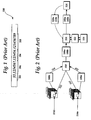
- the identification data may be stored in the tag in a private format, but to improve interoperability, the EPCglobal organization (Electronic Product Code organization) has developed a standard format for the RFID numbers.
- the electronic product codes (“EPC") 500 are typically 96 bits wide and include a version number 502, a manager number 504 that identifies the producer of the asset, an object class 506 that identifies the type of asset (such as a SKU), and a serial number 508 that distinguishes each individual tag.
- EPC electronic product codes
- various other EPC formats have been proposed including a 256-bit EPC.
- the EPC is typically stored on a RFID tag 514 (shown in Fig. 2 ) including a microchip or IC with an attached antenna.
- a reader 510 sends a radio frequency signal 512 querying any identification tags 514 in range, as shown in Fig. 2 .
- An active identification tag 514a has a battery to run the IC to broadcast a reply to the reader, and a passive tag 514b draws power from the sent signal 512 to reply.
- Either reply 518 to the reader will include the tag's EPC 500a, 500b.
- the reader then communicates with a Savant computer system 516, which is a form of distributed software specified by the Massachusetts Institute of Technology Auto-ID Center (now a part of EPCglobal).
- the reader may be physically connected to the Savant computer and/or may be a mobile reader which communicates with the Savant computer system either through a wireless connection, such as "Wi-Fi", or may download a batch of received EPC's when physically connected to the Savant computer system and/or the network, such as through a docking station.
- the Savant computer system sends the received EPCs 500a, 500b to an Object Name Service 524.
- the Object Name Service 524 then returns an address 520a, 520b for a Product Markup language (“PML”) server 526 containing asset information 522 for each given EPC.
- PML server 526 may contact the PML server 526 to retrieve and/or update the asset information 522.
- EPC numbering system described above although feasible, is not compatible with existing numbering systems such as SSCCs and ISBNs. Even further EPCs are not compatible with current or proposed computer communication protocols. Thus, in the prior art, a single company may maintain multiple numbering systems depending on the asset being tracked.
- ONS working group "Auto-ID object name service (ONS) 1.0°, Auto-ID center working draft, 12 August 2003 relates to the Auto-ID Object Name Service. It specifies how the Domain Name System (DNS) is used to locate authoritative metadata and services associated with a given Electronic Product Code (EPC).
- DNS Domain Name System
- EPC Electronic Product Code
- the Auto-ID architecture makes several axiomatic assumptions, the most important being that it should leverage existing Internet technology and infrastructure as much as possible.
- the Object Name Service (ONS) uses the existing DNS for looking up (resolving) information about an EPC. This means that the query and response formats must adhere to the DNS standards, meaning that the EPC will be converted to a domain-name and the results must be a valid DNS Resource Record.
- a sequence of bits containing an EPC is read from an RFID tag.
- the TAG Reader sends that sequence of bits to a local server. That local server converts the bit sequence into the URI Form and sends it to the local ONS Resolver.
- the resolver converts the URI form into a domain-name and issues a DNS query for NAPTR records for that domain.
- the DNS infrastructure returns a series of answers that contain URLs that point to one or more services (for example, an EPCIS Server).
- IPv6 address (prefix part) is designed for specifying a network address in the hierarchical network address space, and the lower half is for specifying a host ID, usually MAC address. In such a situation, the lower half is considered as the unique ID of the node, and the upper half as the route specifying information to get to the node. In short, routing information is added to each network object by the IPv6 addressing scheme.
- Machine IDs are simply expressed with MAC address in some products. Then, an electronic device that has a connection to an IPv6 network will be expressed by a network address comprising routing information and ID information.
- the mechanism can be used universally as to find the way to communicate with machines or locate numbered objects. RFID may be an expected application by using this scheme.
- Embodiments of the invention are directed toward identification tags and asset management methods which are compliant with computer protocol addressing schemes.
- the asset identification tags may reply to a query from a reader with identification data which comprises a global routing prefix of an Internet Protocol address and an asset identifier.
- the global routing prefix may be identical to the Internet Protocol address global routing prefix of the asset manufacturer, the tag manufacturer, or an entity maintaining the asset information for asset management, or any other entity.
- the reader system or other computer system may determine a uniform resource locator (URL) for a selected asset lookup service, and based on the determined URL, the reader may send the received asset identifier to the asset lookup service.
- URL uniform resource locator
- the global routing prefix becomes a paradigm for a universal lookup system for both IP routing of packets and for asset identification.
- identification tags compliant with IP addressing schemes may allow future packet communication directly with the ID tag as tags increase in computing capability.
- identification tags will fall within a settled standard with its attendant reliability and security.
- IPv6 Internet Protocol version 6
- the numeric IPv6 address 600 shown in Fig. 3 , is a 128 bit quantity divided into two parts.
- the first part, a subnet prefix 602 is typically 64 bits wide and specifies an individual subnet within the site of an end user.
- the subnet prefix 602 is further divided into two fields.
- the first portion (typically 48 bits wide) is called the global routing prefix 604 or public address which indicates a specific end user's site on the Internet.
- the second portion, the site subnet identification (“ID”) 606 occupies the remaining portion of the subnet prefix 602 and indicates the subnetwork location of the end user within the site indicated by the global routing prefix.
- the second part of the IPv6 address, typically 64 bits, is designated the interface identification ("ID") 608 and specifies a particular device on the indicated subnet.
- IPv6 In a modified EUI-64 format, requires that the seventh bit of the first byte of the Interface ID be either a I if the address is global, i.e., assigned by IEEE, or 0 if the Interface ID is local, i.e., assigned by an entity other than IEEE.
- IPv6 in a modified EUI-64 format also requires that the eighth bit of the first byte of the Interface ID be a 1 if more than one device shares the ID or 0 if a single device uses the Interface ID.
- the seventh and eighth bits are 00 to comply with EUI-64 format conditions, and the remaining 78 bits may be assigned by the support entity as it wishes to define the subnet and interface identification.
- the assigned global routing prefix may have only 47 or 46 bits, or any other issued bit width, and thus, the remaining bits in a 128 bit IPv6 address may be designated for internal use, and consequently, provide a larger private address space.
- Entities exercising asset management also support various computer systems connected to the Internet, and thus, these same companies already have assigned global routing prefixes with a private address space identifying subnets and individual hosts in each subnetwork.
- an asset manager must register and use a unique EPC manager number to identify its products, which is distinct from its global routing prefix issued by its ISP for providing an address on the Internet.
- the asset manager may use its existing, or newly acquired, global routing prefix as a portion of a data structure on an identification tag to identify assets for asset management.
- the global routing prefix is used as part of the typical Internet Protocol address scheme as well as to identify asset under management.
- the data structure stored on the RFID tag may also comply with IPv6 address format constraints. It is to be appreciated that other versions of Internet Protocols and other computer addressing schemes may be suitable for identifying assets in an asset management method.
- the RFID tag 10 includes an information storage device 11 such as a microchip and an antenna 12 which may be integrated into or separate from the microchip. If the tag 10 is an active system, it may also include a battery (not shown).
- an information storage device 11 such as a microchip and an antenna 12 which may be integrated into or separate from the microchip. If the tag 10 is an active system, it may also include a battery (not shown).
- a battery not shown.
- the illustrated embodiment is described with reference to RFID tags, it is to be appreciated that many devices may be suitable to store identification tag information, including, but not limited to, bar codes, magnetic strips and numeric codes. Additionally or alternatively, it is to be appreciated that many devices may be suitable to communicate the stored data, including, but not limited to, magnetic readers, optical readers, electronic readers or visual inspection.
- the storage device 11 stores a data structure 14 for use in identifying an associated asset.
- Fig. 4 illustrates one example of a data structure compliant with a standard network protocol for storing and/or communicating identification data from an identification tag.
- the data structure 14 may include a first data field 15 containing data representing the global routing prefix 604 which is compliant with standard Internet Protocol addressing schemes.
- IPv6 in the prior art, the site subnet identifies the subnet for routing to the end user and the interface identification identifies the particular host on the subnet.
- those data fields may be used to store identification information for an asset, such as for asset management.
- the second data field may be set to a predetermined and/or fixed value representing a tag index 16.
- the global routing prefix registrant may then designate a single predetermined and fixed value to the tag index, thus, reserving a branch of the available private address space to contain asset identification information.
- the second field 17 of the IP address holding the value of the tag index 16 would no longer indicate a routing location for packets, but would rather indicate that the IP address itself contained identification information about an asset.
- the tag index contains 16 bits which are all set to 1, e.g., FFFF in hexadecimal notation.
- tag index may contain more or fewer bits, either allowing for alternative field sizes for the global routing prefix and/or the interface ID fields within or outside the IP address format.
- Other tag indexes may include FF (only 8 bits) or any other predetermined code of any length which may indicate that the data structure, an IP address in this embodiment, contains asset information rather than routing information.
- the third data field 18 contains data representing an asset identifier 20 which indicates a property of the asset rather than an interface identification indicating a particular host on a network.
- the Interface ID field 18 holding the asset identifier is independent of a routing location on the Internet.
- the asset information may include, for example and without limitation, a product code, a serial number, a shipment number, a manufacturing date, a batch number, a version number, a manufacturing or shipping facility identifier, a name or contact information such as a URL or phone number.
- the asset identifier 20 may include an asset type identifier 22 and a serial number 24.
- the asset type identifier 22 may indicate a general property of the asset which is common to multiple assets, for example, the type of asset, e.g., a 12 amp vacuum cleaner; the size or weight of the asset, e.g., a container carrying 25 tons of cargo; a product model or version, e.g., Windows® version 1.0; a personnel pass for access to particular areas; the color and/or size of a type of apparel, e.g., a large red shirt; a logistics unit of at least one asset, e.g.
- the same data structure may be used for asset management of not only single assets (like the EPC), but also shipping units (like the SSCC) and/or other asset management systems.
- the serial number 24 may indicate a specific and unique asset within that asset type e.g., Windows ® version 1.0 with product serial number AB123456XYZ; the asset geographic location, e.g., distribution center in Peoria; the asset age or manufacture date; or an asset environment descriptor, e.g., the current temperature of the tag 10.
- asset type e.g., Windows ® version 1.0 with product serial number AB123456XYZ
- the asset geographic location e.g., distribution center in Peoria
- the asset age or manufacture date e.g., the current temperature of the tag 10.
- the asset type indicator 22 contains 24 bits of data, and consequently 40 bits remain in the Interface ID for the serial number. Twenty-two bits of data for the asset type indicator theoretically allows 16 million asset type indicators and the 40 bits of data for the serial number allows 1 trillion unique serial numbers. However, under the constraints of IPv6, the seventh and eighth bits of the interface ID should be set to 00 to indicate that the Interface ID is an asset identifier 20 (here the asset type identifier and the serial number) not set by IEEE and is unique (not shared). Accordingly, there is a small limitation with the allocated 24 bits of data for the asset type identifier, and thus, the number of unconstrained bits in the interface ID is 22.
- asset type indicator including 32 bits, with a resultant decrease in the available asset identifier field to 32 bits to comply with the 64 bit Interface ID field, or any other bit length providing a suitable numbering space for the asset under management.
- MAC message authentication code
- EUI-614 64-bit extended unique identifier
- the data structure 13 may not comply with any IP address format while containing a global routing prefix, an asset identifier and/or any other asset information placed in predetermined fields or bits.
- the tag index may be any suitable predetermined field of bits in a standard IP address or any other data structure.
- Fig. 6 illustrates an example asset management system 100.
- Asset management identifies assets and includes but is not limited to tracking retail or wholesale products in transit or as they are being purchased by a consumer, tracking payment of tolls by vehicles at a tollbooth, allowing or denying access to personnel, identifying and/or tracking pets, identifying and/or tracking parolees, etc.
- asset management systems which differ in what assets are being identified and how they are tracked.
- asset managers over the complete lifetime of the asset, and moreover, there may be multiple asset managers at the same time interested in the same asset.
- an asset manufacturer may attach an identification tag 10 to a manufacturing part to track the manufacturing process, address any bottlenecks or other manufacturing concerns, and/or track assets through retail sale for recall and/or marketing purposes.
- a distributor may monitor the identification tag 10 attached to the finished asset and/or a logistics unit of assets from the manufacturer to delivery at a retail outlet by the distributor.
- a retail outlet may monitor the same asset through the distribution process, monitor the asset as inventory in its warehouse and stock on its store shelves to assist in restock and check out.
- a purchaser may also practice asset management in tracking items at locations and or tracking the age/freshness of items in storage.
- the asset management system resolves the data stored on the tag 10 with a reader 32.
- a reader 32 may interrogate the tag 10 by sending an identification query 30.
- the query may be any data or signal indicative of a query to an identification tag to respond with its stored identification data.
- the identification tags within the reader's field may respond with the data stored in the data structure 14.
- the received data structure 14 may contain at least a global routing prefix 604 rather than an EPC issued manager number, and an asset identifier 20.
- the reader sends a signal through a transceiver over a frequency communication channel which is detected by the tags within its frequency transmission range. The signal may be unmodulated or modulated, matching the capabilities of the identification tags 10 under interrogation.
- any radio frequency may be suitable for use with RFID
- frequency transmissions are regulated by the FCC.
- high frequency transmissions will typically occur at approximately 915 MHz or 13.36 MHz
- low frequency transmissions will typically occur at approximately 125 kHz
- microwave radio transmissions will typically occur at approximately 2.46 GHz or 5.8 GHz.
- Other frequencies may be appropriate, including sonic, optical, infrared, and ultraviolet.
- Communication methods other than RFID, may also be suitable with various storage devices, including magnetic readers, visual inspection, laser readers, etc. Depending on the exact technology and system configuration, anti-collision methods may be used to allow a reader to read more than one tag within its range as well as allow multiple readers to interrogate adjacent or identical tags.
- the identification data received from the identification tag may include, as noted above with reference to Fig. 4 , a global routing prefix and an asset identifier which may include an asset type indicator and/or serial number.
- the identification data may also include an optional tag index.
- the identification data may be stored and/or communicated to the reader in any suitable format.
- the identification data may be stored and/or communicated in a data structure which is compliant with a standard Internet Protocol address, such as the Mobile Internet Protocol version 6 address format shown in Fig. 4 .
- the reader then communicates the received data structure 14 information (a global routing prefix with associated asset identifier) to an asset controller 34.
- the asset controller 34 determines a URL 38 for a selected asset lookup service for each received global routing prefix.
- the asset lookup service 40 maintains a database which stores the asset identifiers 20 for a given global routing prefix 604.
- asset information 42 for asset management may include an asset type indicator and/or serial number.
- the asset controller 34 may access the asset lookup service 40 and retrieve asset information 42 for a given asset identifier 20 to provide asset management. Additionally or alternatively, the asset controller may access the asset lookup service to update asset information 42.
- the asset information 42 may be any data or signal indicative of the asset information, for example, the information may be incorporated into a dynamic serial number with fields indicating static information (e.g., asset type or name), dynamic information (e.g., asset environment measurements), temporal asset information (e.g., asset location, sales status, etc.), and/or other asset information which may be independent of the asset and/or the asset identifier 20.
- the asset information may be received by the asset controller and/or the asset lookup service in any number of ways, including but not limited to, any data or signal discernable by the asset controller and/or asset lookup service as asset information, such as a message in any format of any computer communication protocol.
- the asset manager may set up an IP address with its global routing prefix and the predetermined site subnet ID and Interface ID to point to its selected asset lookup service.
- the asset controller may self determine the URL by combining the received global routing prefix 604 with the predetermined site subnet ID and Interface ID.
- the asset controller may append a predetermined suffix, such as ALS.aspx, to the received global routing prefix to format the URL for the asset lookup service.
- the asset controller 34 may resolve the global routing prefix to a URL for an asset lookup service by interrogating a predetermined resource service 36.
- the asset controller may contact a predetermined URL pointing to the resource service 36.
- the resource service correlates each registered global routing prefix 604 with a URL 38 provided by the asset manager controlling the asset. In this manner, the resource service 36 returns a URL for each provided global routing prefix.
- the resource service includes a provider of the Universal Description, Discovery, and Integration Business Registry ("UBR"). UBRs are currently operated by International Business Systems, Microsoft, and SAP. It should be recognized that various server systems may maintain a resource database correlating each global routing prefix with the URL for the selected lookup service provider, including the asset controller itself.
- the reader 32, asset controller 34, asset lookup service 40 and resource service 36, illustrated in Fig. 6 all may be present and operating on one or more computers or other devices acting as a server computer for the identification tag 10.
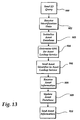
- the reader 32 and asset controller 34 are an integrated system, herein called the reader system 200 which will be discussed below with reference to Figs. 7-8 and 13 .
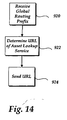
- the asset lookup service 40 is provided by an asset lookup server 300 (discussed below with reference to Figs. 9-10 and 14 ) and the resource service 36 is provided by a resource server 400 (discussed below with reference to Figs. 11-12 and 15 ).
- the asset lookup server 300 and the resource server 400 may be networked systems accessed by the reader system 200 in any manner known in the art (e.g., via the Internet).
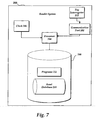
- the reader system 200 may include one or more communication ports 202 which may include a tag interrogator 212 such as a transceiver, magnetic strip reader, laser reader, optical character recognition device, or other device suitable to determine tag information from tag 10.
- the reader system 200 also includes one or more processors 204, an internal date and time clock 206, and storage 208 which includes one or more computer programs 222 defining instructions, which when executed, instruct the computer to perform the operations of the reader and asset controller.
- the storage also may include an asset database 210.
- the asset database will now be described in more detail in connection with Fig. 8 and the programs 222 will be discussed further below with respect to Fig. 13 .
- Fig. 8 illustrates an example table 250 for the asset database 210, which includes one or more records 252.
- each record associates a global routing prefix 604 with at least one asset identifier 20, and optionally, additional information about the asset.
- each record 252 includes a global routing prefix 604, an asset identifier 20 including an asset type identifier 22 and a serial number 24, a model 254, size 256, color 258, asset manufacturer 260, asset manager 261, location 262, temperature 264, manufacturing date 266, expiration date 268, asset weight 270, and asset lookup service URL 38.
- Entries in the asset database are initialized by the reader system as it receives a global routing prefix 604, asset identifier 20 and/or other information from each tag 10.
- the asset lookup service URL 38 is initialized and updated by either the reader system or the resource service 36 (when existing). Some data may be initialized and updated as the asset lookup service 40 provides the asset information 42 when given a specific asset identifier. Dynamic data, including asset environment such as temperature, etc. and temporal data, such as asset location, may be updated by the reader system as it determines or receives that information.
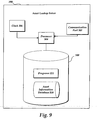
- the asset lookup server 300 hosting the asset lookup service 40 may include one or more communication ports 302, one or more processors 304, an internal date and time clock 306, and storage 308 which includes one or more computer programs 322 defining instructions, which when executed, instruct the computer to perform the operations of the asset lookup server.
- the storage 308 also may include an asset information database 310.
- the asset information database will now be described in more detail in connection with Fig. 10 and the programs 322 will be discussed further below with respect to Fig. 14 .
- Fig. 10 illustrates an example table 350 for an asset information database 310, which includes one or more records 352.
- each record associates an asset identifier 20 with specific static, temporal, dynamic and/or other asset information.
- each record 352 includes an asset identifier 20 including an asset type identifier 22 and a serial number 24 associated with a model 254, size 256, color 258, asset manufacturer 260, asset manager 261, location 262, temperature 264, manufacturing date 266, expiration date 268, and asset weight 270.
- Entries of static, temporal, dynamic and/or other information in the asset information database may be initialized by the asset manager as the identification tag 10 is associated with a particular asset.
- a particular asset may have multiple asset managers interested in identifying and/or tracking the asset over the lifetime of the tag.
- the temporal and dynamic asset information database records may be updated by an asset manager based upon information received from the reader system or other system.
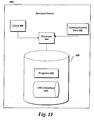
- the resource server 400 hosting the resource service 36 may include one or more communication ports 402, one or more processors 404, an internal date and time clock 406, and storage 408 which includes one or more computer programs 422 defining instructions, which when executed, instruct the computer to perform the operations of the resource server.
- the storage also may include a URL database 410.
- the URL database will now be described in more detail in connection with Fig. 12 and the programs 422 will be discussed further below with respect to Fig. 15 .
- Fig. 12 illustrates an example table 450 for URL database 410, which includes one or more records 452.
- each record associates a global routing prefix 604 with the associated asset lookup service URL 38.
- Entries in this database are made by the asset manager as the global routing prefix is first associated with an identification tag 10.
- the asset manager may change over the lifetime of the asset, e.g., manufacturer, distributor, retailer, purchaser, etc.
- some identification tags are read/write capable, which allows the new asset manager to write its own global routing prefix and selected asset identifier to the identification tag 10.
- simpler, and cheaper, idendfication tags may be read-only tags, where the data structure including the global routing prefix and the asset identifier are written to the tag only once.
- the manufacturer may store its own global routing address on each tag that it manufactures; however, the manufacturer's asset lookup service then may be required to store the asset information for each and every tag through the lifetime of the tag.
- the purchaser of the identification tags from the tag manufacturer e.g., the asset manufacturer
- the asset manufacturer may request that the purchased tags be written with the global routing prefix of the asset manufacturer. In this manner, the asset manufacturer would maintain only those products that it manufactures itself. Asset managers which would like to monitor the asset and tag 10 after leaving the asset manufacturer's control may negotiate with the asset manufacturer to host and allow access to its asset information database to the new asset manager.
- a global routing prefix is issued by an ISP or Local Internet Registry.
- asset manager here the asset manufacturer, may have to negotiate to preserve the URL entry in the resource service and to restrict the use of the old global routing prefix, e.g., no use for RFID purposes, while the assets are still being actively monitored.
- Each database described above may be any kind of database, including a relational database, object-oriented database, unstructured database or other database.
- a database may be constructed using a flat file system such as ACSII text, a binary file, or any other file system. Notwithstanding these possible implementations of the foregoing databases, the term database as used herein refers to any data that is collected and stored in any manner accessible by a computer.
- these operations include, but are not limited to, sending 900 an identification query from the reader to the identification tag and receiving 902 identification data from the identification tag.
- the identification data includes a global routing prefix 604 and an asset identifier 20 and optionally a tag index 16.
- the identification data may be stored in a data structure 14 which is compliant with an IP address format. If the reader system 200 receives identification data (in one example, the data structure of Fig. 6 ) as determined at 902, the reader system 200 initializes the asset database 903.
- the asset data may be received through any computer readable medium including without limitation modulated or unmodulated frequency signals, magnetic readers, laser signals, or through the Internet. Records in the asset database of Fig. 8 may be created or updated using the received identification data.
- the reader system associates the received asset identification data (such as a global routing prefix and/or asset identifier) with other tag information that may be discoverable or known by the reader system.
- the operations of the reader system 200 may also include determining 904 a URL for an asset lookup service based on the received asset information.
- the URL 38 of the asset lookup service may be determined by the reader system based upon a received global routing prefix concatenated with a predetermined suffix, such as ALS.aspx.
- the reader system 200 may contact a resource service 36 (shown in Fig. 6 ) at a resource server 400 ( Fig. 11 ) to determine the URL 38.
- the operations of the reader system may also include sending 906 the asset identifier to the site located at the determined URL of the asset lookup service.
- the reader system may then receive 908 asset information from the asset lookup service stored in the asset information database ( Fig. 10 ) of the asset lookup server 300. Records in the asset database of Fig. 8 are updated (909) by the reader system with the received asset information. In particular, the reader system associates a particular asset identifier 20 with the received asset information 42. As shown in Fig. 10 , the asset information 42 may include various combinations of static, temporal, dynamic, and/or other information. In one example, the temporal, dynamic, and/or other information may be determinable or known by the reader system, e.g., the geographic location of the tag, the reader subnet prefix, etc.
- the reader system may send (910) asset information to the asset lookup service.
- the reader system may send the geographic location of the reader, measurement information taken or received by the reader, such as local temperature, and/or any other data known or determinable by the reader system.
- the operations of the resource server 400 providing the resource service 36 include, but are not limited to, receiving 604 the global routing prefix from the tag through the reader system 920, determining 922 the URL of the asset lookup service 40 based upon the global routing prefix, and sending 924 the URL to the reader system.
- the resource server operations may be performed by a UBR.
- the operations of the asset lookup server 300 providing the asset lookup service 40 include, but are not limited to, initializing 930 the asset information database ( Fig. 10 ) by associating the asset identifier of the tag 10 with specific asset information. More particularly, information about the asset is received by the asset manufacturer or other asset manager. Information about the asset, in an embodiment using the database structure above ( Fig. 10 ), may include a global routing prefix, an asset identifier which may include an asset type identifier and/or a serial number, model, size, color, asset manufacturer, asset manager, location of the asset, temperature of the asset, manufacturing date, expiration date, and/or asset weight. Any conventional registration or input process or mechanism may be used to obtain this information.
- the elements of the asset information database may be provided at once or separately and at different times, allowing an asset manager to update the database when information becomes available. Records in the asset information database of Fig. 10 are created or updated using the received information.
- the asset lookup server associates an asset identifier with asset information.
- the asset lookup server 300 operations also include receiving 932 the asset identifier from the reader system along with a query for asset information.
- the asset lookup server may then match the received asset identifier with a record in the asset information database.
- the asset lookup server may then send 934 the associated asset information to the reader system.
- the asset lookup server operations may also include receiving 936 asset information from the reader system.
- the reader system may retrieve more than a global routing prefix and serial number from the identification tag, including static, temporal, dynamic data, and/or other information.
- the asset information database may include records for information determined by the reader system, e.g., the geographic location, and/or other information of the tag. If the static, temporal, dynamic, and/or other data needs to be updated or corrected, this information may be received 936 by the asset lookup service to update 938 and maintain the asset information database.
- the computer system with which the various elements of the reader system, the asset lookup server, and the resource server of Figs. 6 , 7 , 9 , and/or 11 may be implemented either individually or in combination and typically includes at least one main unit connected to both an output device which displays information to a user and an input device which receives input from a user.
- the main unit may include a processor connected to a memory system via an interconnection mechanism.
- the input device and output device also are connected to the processor and memory system via the interconnection mechanism.
- Computer readable media can be any available media that can be accessed by the other computing devices in the asset management system.
- Computer readable media may comprise computer storage media and communication media.
- Computer storage media includes volatile and nonvolatile, removable and non-removable media implemented in any method or technology for storage of information such as computer readable instructions, data structures, program modules or other data.
- Computer storage media includes, but is not limited to, RAM, ROM, EEPROM, flash memory or other memory technology, CD-ROM, digital versatile disks (DVD) or other optical storage, magnetic cassettes, magnetic tape, magnetic disk storage or other magnetic storage devices, or any other medium which can be used to store the desired information and which can be accessed by the computing systems in the asset management system.
- Communication media typically embodies computer readable instructions, data structures, program modules or other data in a modulated data signal such as a carrier wave or other transport mechanism and includes any data in a modulated data signal such as a carrier wave or other transport mechanism and includes any information delivery media.
- communication media includes wired media such as wired network or direct-wired connection, and wireless media such as acoustic, RF, infrared, and other wireless media. Combinations of any of the above should also be included within the scope of computer readable media.
- Example output devices include cathode ray tubes (CRT) display, liquid crystal displays, and other video output devices, printers, communication devices such as a modem, storage devices such as a disk or tape, and audio input.
- One or more input devices maybe connected to the computer system.
- Example input devices include a keyboard, keypad, trackball, mouse, pen and tablet, communications device, and data input devices such as audio and video capture devices. The invention is not limited to the particular input or output devices used in combination with the computer system or to those described herein.
- the computer system may be a general purpose computer system which is programmable using a computer programming language, such as SmallTalk, C++, Java, Ada, or C#(C-sharp), or other language, such as a scripting language or even assembly language.
- Various aspects of the invention may be implemented in a non-programmed environment (e.g., documents created in HTML, XML or other format that when viewed in a window of a browser program, render aspects of a graphical user interface or perform other functions).
- Various aspects of the invention may be implemented as programmed or non-programmed elements, or any combination thereof.
- the computer system may also be specially programmed, special purpose hardware, or an application specific integrated circuit (ASIC).
- the reader system may also include a pager, telephone, personal digital assistant or other electronic data communication device.
- the processor is typically a commercially available processor such as the well-known Pentium® processor available from the Intel Corporation. Many other processors are available. Such a processor usually executes an operating system which may be, for example, the Windows 95®, Windows 98®, Windows NT®, Windows 2000® or Windows XP® available from Microsoft Corporation, MAC OS System X available from Apple Computer, the Solaris Operating System available from Sun Microsystems, or UNIX available from various sources. Many other operating systems may be use.
- an operating system which may be, for example, the Windows 95®, Windows 98®, Windows NT®, Windows 2000® or Windows XP® available from Microsoft Corporation, MAC OS System X available from Apple Computer, the Solaris Operating System available from Sun Microsystems, or UNIX available from various sources. Many other operating systems may be use.
- the processor and operating system together define a computer platform for which application programs in high-level programming languages are written. It should be understood that the invention is not limited to a particular computer system platform, processor, operating system, or network. Also, it should be apparent to those skilled in the art that the present invention is not limited to a specific programming language or computer system. Further, it should be appreciated that other appropriate programming languages and other appropriate computer systems could also be used.
- One or more portions of the computer system may be distributed across one or more computer systems (not shown) coupled to a communications network. These computer systems also may be general purpose computer systems. For example, various aspects of the invention may be distributed among one or more computer systems configured to provide a service (e.g., servers) to one or more client computers, or to perform an overall task as part of a distributed system. For example, various aspects of the invention may be performed on a client-server system that includes components distributed among one or more server systems that perform various functions according to various embodiments of the invention. These components may be executable, intermediate (e.g., IL) or interpreted (e.g., Java) code which communicate over a communication network (e.g., the Internet) using a communication protocol (e.g., TCP/IP).
- a communication network e.g., the Internet
- a communication protocol e.g., TCP/IP
Landscapes
- Engineering & Computer Science (AREA)
- Business, Economics & Management (AREA)
- Computer Networks & Wireless Communication (AREA)
- Signal Processing (AREA)
- Economics (AREA)
- Development Economics (AREA)
- Theoretical Computer Science (AREA)
- Physics & Mathematics (AREA)
- Entrepreneurship & Innovation (AREA)
- Human Resources & Organizations (AREA)
- Accounting & Taxation (AREA)
- Finance (AREA)
- General Physics & Mathematics (AREA)
- Strategic Management (AREA)
- Operations Research (AREA)
- General Business, Economics & Management (AREA)
- Marketing (AREA)
- Tourism & Hospitality (AREA)
- Quality & Reliability (AREA)
- Game Theory and Decision Science (AREA)
- Technology Law (AREA)
- Educational Administration (AREA)
- Data Exchanges In Wide-Area Networks (AREA)
- Management, Administration, Business Operations System, And Electronic Commerce (AREA)
- Information Transfer Between Computers (AREA)
Claims (20)
- Verfahren zur Verwaltung von Wirtschaftsgütern, mit:Senden (900) einer Identifizierungsanfrage zu einem Wirtschaftsgüter-Identifizierungsetikett;Empfangen (902) von Identifikationsdaten aus dem Wirtschaftsgüter-Identifizierungsetikett, wobei ein erstes Datenelement (602) der Identifikationsdaten ein globales Weiterleitungs-Präfix (604) einer Internetprotokoll-Adresse (600) und ein zweites Datenelement (608) eine Wirtschaftsgüter-Kennung (20) umfasst;auf der Grundlage des globalen Weiterleitungs-Präfix, Ermitteln (904) einer Internetadresse für einen ausgewählten Wirtschaftsgüter-Suchdienst des empfangenen globalen Weiterleitungs-Präfix; undauf der Grundlage der ermittelten Internetadresse, Senden (906) der empfangenen Wirtschaftsgüter-Kennung an den Wirtschaftsgüter-Suchdienst.
- Verfahren nach Anspruch 1, wobei die Identifikationsdaten mit einem Format einer Adresse des Internetprotokolls der Version 6 verträglich sind.
- Verfahren nach Anspruch 1, wobei Ermitteln der Internetadresse umfasst:Senden des empfangenen globalen Weiterleitungs-Präfix an einen vorbestimmten Ressourcendienst; undEmpfangen der Internetadresse für den ausgewählten Wirtschaftsgüter-Suchdienst.
- Verfahren nach Anspruch 3, wobei der vorbestimmte Ressourcendienst eine universelle Beschreibung, Ermittlung und Integrationsgeschäfts-Eintragung umfasst.
- Verfahren nach Anspruch 1, wobei Ermitteln der Internetadresse umfasst:Formatieren einer Internetadresse aus dem empfangenen globalen Weiterleitungs-Präfix und aus einem vorbestimmten allgemeinen Anhang für einen Wirtschaftsgüter-Suchdienst.
- Verfahren nach Anspruch 1, wobei Senden einer Identifizierungsanfrage umfasst: Übertragen eines modulierten Datensignals über einen Frequenzkommunikationskanal.
- Verfahren nach Anspruch 6, wobei Übertragen eines modulierten Datensignals umfasst: Übertragen eines modulierten Datensignals über einen Funkfrequenzkommunikationskanal.
- Verfahren nach Anspruch 1, das ferner umfasst: Senden einer Wirtschaftsgüter-Eigenschaftsinformation an den Wirtschaftsgüter-Suchdienst.
- Verfahren nach Anspruch 8, wobei die Wirtschaftsgüter-Eigenschaftsinformation einen physikalischen Ort der Wirtschaftsgüter und/oder eine Beschreibung des Alters der Wirtschaftsgüter und/oder eine Beschreibung der Umgebung der Wirtschaftsgüter umfasst.
- Verfahren nach Anspruch 1, wobei die Identifikationsinformation eine Datenstruktur umfasst mit einem ersten Datenfeld, das Daten enthält, die ein globales Weiterleitungs-Präfix einer Internetprotokoll-Adresse mit einem Internetprotokoll-Adressenformat repräsentieren, einem zweiten Datenfeld, das Daten enthält, die einen Etikettenindex repräsentieren, der mit dem Internetprotokoll-Adressenformat verträglich ist, und einem dritten Datenfeld, das Daten enthält, die eine Wirtschaftsgüter-Kennung repräsentieren, die eine Eigenschaft der Wirtschaftsgüter angeben.
- Verfahren nach Anspruch 10, wobei der Etikettenindex das dritte Datenfeld als eines kennzeichnet, das die Daten enthält, die die Wirtschaftsgüter-Kennung repräsentieren, und unabhängig von einer Weiterleitungsknoten im Internet ist.
- Verfahren nach Anspruch 11, wobei die Etiketten-Kennung einen vorbestimmten festgelegten Wert unabhängig von einer Position oder einer Weiterleitungsroute im Internet enthält.
- Verfahren nach Anspruch 1, wobei die Wirtschaftsgüter-Kennung eine Beschreibung eines Wirtschaftsgüter-Modells und/oder eine eindeutige Wirtschaftsgüter-Seriennummer und/oder einen physikalischen Ort der Wirtschaftsgüter und/oder eine Beschreibung eines Alters der Wirtschaftsgüter und/oder eine Beschreibung einer Umgebung der Wirtschaftsgüter enthält.
- Verfahren nach Anspruch 13, wobei die Identifikationsdaten ferner ein drittes Datenelement umfassen, das vorbestimmte festgelegte Daten enthält, die einen Etikettenindex repräsentieren, der mit einem Internetprotokoll-Adressenformat verträglich ist.
- Verfahren nach Anspruch 14, wobei das erste, das zweite und das dritte Datenelement mit einem Format der Internetprotokoll-Adresse der Version 6 verträglich sind.
- Verfahren nach Anspruch 13, das ferner umfasst: Senden des empfangenen globalen Weiterleitungs-Präfix an einen vorbestimmten Ressourcendienst, und Empfangen der Internetadresse aus dem ausgewählten Wirtschaftsgüter-Suchdienst.
- Verfahren nach Anspruch 13, wobei Senden einer Identifizierungsanfrage umfasst: Übertragen eines modulierten Datensignals über einen Frequenzkommunikationskanal.
- Verfahren nach Anspruch 13, das ferner umfasst: Senden des physikalischen Ortes der Wirtschaftsgüter und/oder einer Beschreibung der Umgebung der Wirtschaftsgüter an den Wirtschaftsgüter-Suchdienst zur Speicherung.
- Computerlesbares Medium mit von einem Computer ausführbaren Schritten zur Ausführung der Schritte, die in einem der Ansprüche 1 bis 18 angegeben sind.
- Computersystem mit Mittel, die ausgebildet sind, das Verfahren nach einem der Ansprüche 1 bis 18 auszuführen.
Applications Claiming Priority (2)
| Application Number | Priority Date | Filing Date | Title |
|---|---|---|---|
| US798007 | 2001-03-02 | ||
| US10/798,007 US8032429B2 (en) | 2004-03-10 | 2004-03-10 | Method and identification tag for asset management |
Publications (3)
| Publication Number | Publication Date |
|---|---|
| EP1580679A2 EP1580679A2 (de) | 2005-09-28 |
| EP1580679A3 EP1580679A3 (de) | 2006-03-22 |
| EP1580679B1 true EP1580679B1 (de) | 2016-09-28 |
Family
ID=34861989
Family Applications (1)
| Application Number | Title | Priority Date | Filing Date |
|---|---|---|---|
| EP05101812.5A Expired - Lifetime EP1580679B1 (de) | 2004-03-10 | 2005-03-09 | Verfahren und Kennzeichnungsetikett für die Verwaltung von Wirtschaftsgütern |
Country Status (5)
| Country | Link |
|---|---|
| US (1) | US8032429B2 (de) |
| EP (1) | EP1580679B1 (de) |
| JP (1) | JP5099975B2 (de) |
| KR (1) | KR101143168B1 (de) |
| CN (1) | CN1667647B (de) |
Families Citing this family (81)
| Publication number | Priority date | Publication date | Assignee | Title |
|---|---|---|---|---|
| CN1434774A (zh) | 2000-06-08 | 2003-08-06 | 赛克特10控股公司 | 符合安全规程的移动设备 |
| US7956742B2 (en) | 2003-10-30 | 2011-06-07 | Motedata Inc. | Method and system for storing, retrieving, and managing data for tags |
| US7388488B2 (en) * | 2003-10-30 | 2008-06-17 | Peter Lupoli | Method and system for storing, retrieving, and managing data for tags |
| US7422152B2 (en) * | 2004-05-13 | 2008-09-09 | Cisco Technology, Inc. | Methods and devices for providing scalable RFID networks |
| US7322523B2 (en) * | 2004-05-13 | 2008-01-29 | Cisco Technology, Inc. | Methods and devices for uniquely provisioning RFID devices |
| US8113418B2 (en) | 2004-05-13 | 2012-02-14 | Cisco Technology, Inc. | Virtual readers for scalable RFID infrastructures |
| US7789308B2 (en) * | 2004-05-13 | 2010-09-07 | Cisco Technology, Inc. | Locating and provisioning devices in a network |
| US7325734B2 (en) * | 2004-05-13 | 2008-02-05 | Cisco Technology, Inc. | Methods and devices for assigning RFID device personality |
| US8249953B2 (en) * | 2004-05-13 | 2012-08-21 | Cisco Technology, Inc. | Methods and apparatus for determining the status of a device |
| US7336175B2 (en) * | 2004-05-13 | 2008-02-26 | Cisco Technology, Inc. | Methods and devices for locating and uniquely provisioning RFID devices |
| US8604910B2 (en) * | 2004-07-13 | 2013-12-10 | Cisco Technology, Inc. | Using syslog and SNMP for scalable monitoring of networked devices |
| US7130773B1 (en) * | 2004-11-30 | 2006-10-31 | Sun Microsystems, Inc. | Method and apparatus for processing data using objects |
| US7987272B2 (en) | 2004-12-06 | 2011-07-26 | Cisco Technology, Inc. | Performing message payload processing functions in a network element on behalf of an application |
| US7213768B2 (en) * | 2005-03-16 | 2007-05-08 | Cisco Technology, Inc. | Multiple device and/or user association |
| US7400251B2 (en) * | 2005-05-23 | 2008-07-15 | International Business Machines Corporation | Methods for managing electronic asset tags for asset devices |
| US7953826B2 (en) * | 2005-07-14 | 2011-05-31 | Cisco Technology, Inc. | Provisioning and redundancy for RFID middleware servers |
| US7345585B2 (en) | 2005-08-01 | 2008-03-18 | Cisco Technology, Inc. | Network based device for providing RFID middleware functionality |
| US7300281B2 (en) * | 2005-08-02 | 2007-11-27 | Giuseppe Cantatore | Endodontic file having bi-directional scraping edges |
| US20070229264A1 (en) * | 2005-11-14 | 2007-10-04 | Ronald Eveland | Software method and system for encapsulation of RFID data into a standardized globally routable format |
| US8698603B2 (en) | 2005-11-15 | 2014-04-15 | Cisco Technology, Inc. | Methods and systems for automatic device provisioning in an RFID network using IP multicast |
| US7848996B2 (en) * | 2006-04-24 | 2010-12-07 | The Nasdaq Omx Group, Inc. | Derivative securitized index participation notes |
| US8046291B2 (en) * | 2006-04-24 | 2011-10-25 | The Nasdaq Omx Group, Inc. | Redemption of derivative secured index participation notes |
| US7827094B2 (en) * | 2006-04-24 | 2010-11-02 | The Nasdaq Omx Group, Inc. | Trading of derivative secured index participation notes |
| US7747514B2 (en) * | 2006-04-24 | 2010-06-29 | The Nasdaq Omx Group, Inc. | Index participation notes securitized by options contracts |
| US7778917B2 (en) * | 2006-04-24 | 2010-08-17 | The Nasdaq Omx Group, Inc. | Magnified bull and/or bear index participation notes |
| US7792737B2 (en) * | 2006-04-24 | 2010-09-07 | The Nasdaq Omx Group, Inc. | Index participation notes securitized by futures contracts |
| US7769674B2 (en) * | 2006-04-24 | 2010-08-03 | The Nasdaq Omx Group, Inc. | Upside participation / downside protection index participation notes |
| US20070285235A1 (en) * | 2006-06-07 | 2007-12-13 | Ravigopal Vennelakanti | Managing Of Items Distributed In A Global Supply Chain |
| US7738456B2 (en) * | 2006-08-07 | 2010-06-15 | Cisco Technology, Inc. | Techniques to map switch and router ports to physical locations |
| US8345710B2 (en) * | 2006-11-10 | 2013-01-01 | Fisher-Rosemount Systems, Inc. | FDT for EDDL-based field devices |
| US8896448B2 (en) * | 2006-11-29 | 2014-11-25 | Verizon Patent And Licensing Inc. | Method and apparatus for mapping radio frequency identification (RFID) tags to network addresses |
| KR100937439B1 (ko) * | 2007-10-02 | 2010-01-19 | 주식회사 케이티 | 자산관리 시스템 및 그 동작방법 |
| US20090091450A1 (en) * | 2007-10-08 | 2009-04-09 | Sector 10 Holdings, Inc. | Distributed safety apparatus |
| US9262912B2 (en) * | 2008-02-25 | 2016-02-16 | Checkpoint Systems, Inc. | Localizing tagged assets using modulated backscatter |
| US20090271298A1 (en) * | 2008-04-24 | 2009-10-29 | The Nasdaq Omx Group, Inc. | Securitized Commodity Participation Certificates Securitized by Physically Settled Contracts |
| US20090271328A1 (en) * | 2008-04-24 | 2009-10-29 | The Nasdaq Omx Group, Inc. | Securitized Commodity Participation Certifices Securitized by Physically Settled Option Contracts |
| US20100138357A1 (en) * | 2008-12-03 | 2010-06-03 | Morgan Stanley (A Delaware Corporation) | Trading system |
| KR101022762B1 (ko) * | 2008-12-12 | 2011-03-17 | 박훤일 | 자동인식데이타수집 기술을 이용한 동산관리시스템 및 그 운용방법 |
| US8977220B2 (en) * | 2009-05-29 | 2015-03-10 | Iheartmedia Management Services, Inc. | Delivering content associated with a unique identifier |
| US8103681B2 (en) * | 2009-05-29 | 2012-01-24 | Clear Channel Management Services, Inc. | Associating works with unique identifiers |
| US20100306062A1 (en) * | 2009-05-29 | 2010-12-02 | Clear Channel Management Services, Inc. | Tracking public performances using unique identifiers |
| US8527527B2 (en) | 2009-05-29 | 2013-09-03 | Clear Channel Management Services, Inc. | Content enrichment using unified system of unique identifiers |
| CN101883087A (zh) * | 2010-04-09 | 2010-11-10 | 北京宇辰龙马信息技术服务有限公司 | 计算机设备户籍化的全生命周期管理系统 |
| US9472042B2 (en) * | 2010-11-23 | 2016-10-18 | Ncr Corporation | Controllable kiosk return gate |
| CN102176297A (zh) * | 2011-03-25 | 2011-09-07 | 武宝军 | 身份/财物识别标牌 |
| US20130063251A1 (en) * | 2011-09-13 | 2013-03-14 | United Parcel Service Of America, Inc. | Monitoring resources using radio frequency identification technologies |
| US9189560B2 (en) * | 2012-02-13 | 2015-11-17 | Ca, Inc. | Discovery of asset information through scanning of communication tags associated with assets |
| CN103577909A (zh) * | 2012-07-27 | 2014-02-12 | 苏州市国贸电子系统工程有限公司 | 一种基于rfid的资产管理系统 |
| US10033469B2 (en) * | 2013-08-29 | 2018-07-24 | Battelle Memorial Institute | Injectable acoustic transmission devices and process for making and using same |
| US10033470B2 (en) | 2013-08-29 | 2018-07-24 | Battelle Memorial Institute | Acoustic transmission devices and process for making and using same |
| US10101429B2 (en) | 2015-02-25 | 2018-10-16 | Battelle Memorial Institute | Acoustic transmission device and process for tracking selected hosts |
| KR20180006893A (ko) * | 2015-05-15 | 2018-01-19 | 파커-한니핀 코포레이션 | 통합 자산 완전성 관리 시스템 |
| US9658310B2 (en) | 2015-06-16 | 2017-05-23 | United Parcel Service Of America, Inc. | Concepts for identifying an asset sort location |
| US10495723B2 (en) | 2015-06-16 | 2019-12-03 | United Parcel Service Of America, Inc. | Identifying an asset sort location |
| US10067112B2 (en) | 2015-09-30 | 2018-09-04 | Battelle Memorial Institute | Autonomous sensor fish to support advanced hydropower development |
| US11278004B2 (en) | 2015-12-15 | 2022-03-22 | Battelle Memorial Institute | Transmitters for animals and methods for transmitting from animals |
| US10236920B2 (en) | 2015-12-15 | 2019-03-19 | Battelle Memorial Institute | Signal transmitter and methods for transmitting signals from animals |
| CA3030040C (en) | 2016-07-20 | 2021-12-07 | United Parcel Service Of America, Inc. | Location tracking using beacons |
| US10531639B2 (en) | 2016-08-25 | 2020-01-14 | Battelle Memorial Institute | Systems and methods for monitoring organisms within an aquatic environment |
| CN106203560A (zh) * | 2016-08-29 | 2016-12-07 | 苏州千予千愿信息科技有限公司 | 一种用于物品实时精确定位的管理模块及其管理方法 |
| US10471478B2 (en) | 2017-04-28 | 2019-11-12 | United Parcel Service Of America, Inc. | Conveyor belt assembly for identifying an asset sort location and methods of utilizing the same |
| GEAP202115376A (en) * | 2017-11-28 | 2021-06-10 | Sicpa Holding Sa | System and method of identification and authentication for tracing agricultural assets, identification element for secure identification of agricultural assets and corresponding computer programs |
| EP3785195A4 (de) * | 2018-04-24 | 2021-12-08 | Air Stayz Pty Limited | Verfahren und systeme zur buchung von ressourcen und zur verwaltung des zugriffs auf gebuchte ressourcen |
| KR102058011B1 (ko) * | 2019-03-04 | 2019-12-20 | 고권석 | 묶음식 연관 검색어를 이용한 상품의 진열 위치 및 재고 관리 시스템 |
| US11533818B2 (en) | 2019-03-12 | 2022-12-20 | Battelle Memorial Institute | Sensor assemblies and methods for emulating interaction of entities within water systems |
| CN110297577A (zh) * | 2019-05-07 | 2019-10-01 | 惠科股份有限公司 | 画面显示控制方法 |
| US11037101B2 (en) | 2019-05-17 | 2021-06-15 | Direct Supply, Inc. | Systems, methods, and media for managing inventory associated with a facility |
| US11171918B2 (en) * | 2019-06-03 | 2021-11-09 | Rockwell Automation Technologies, Inc. | Generating location-based addresses for wireless network communication |
| JP7339038B2 (ja) * | 2019-07-10 | 2023-09-05 | Juki株式会社 | 部品管理システム及び部品管理方法 |
| US11456070B2 (en) * | 2020-01-31 | 2022-09-27 | GE Precision Healthcare LLC | System and method for identifying healthcare assets |
| US11853680B2 (en) * | 2020-07-06 | 2023-12-26 | Synopsys, Inc. | Incremental routing based pin assignment |
| CN114863625A (zh) * | 2021-01-20 | 2022-08-05 | 易见天树科技(北京)有限公司 | 多通道联合检测方法、装置、介质及电子设备 |
| CN112967125A (zh) * | 2021-03-08 | 2021-06-15 | 北京华顺信安信息技术有限公司 | 一种老旧资产的识别方法 |
| CN113098992A (zh) * | 2021-04-02 | 2021-07-09 | 周宏仁 | 编码方法及装置、存储介质及电子设备 |
| CN113328939A (zh) * | 2021-05-26 | 2021-08-31 | 西安热工研究院有限公司 | 基于数据库实例名前缀的电力数据传输中间件标签路由方法 |
| US12141745B2 (en) * | 2021-08-13 | 2024-11-12 | Kezzler As | Method and system to determine an originating traceability application for a product item using a serialized code |
| US12561697B2 (en) | 2021-08-13 | 2026-02-24 | Kezzler As | Method for establishing network connections between a client, an originating traceability application and a first computer system in a network and evoking functions on data from both systems |
| CN114567501B (zh) * | 2022-03-04 | 2023-10-31 | 科来网络技术股份有限公司 | 基于标签评分的资产自动识别方法、系统及设备 |
| CN115955522B (zh) * | 2022-11-30 | 2024-09-06 | 绿盟科技集团股份有限公司 | 一种资产指纹识别方法、装置、设备和介质 |
| US12482027B2 (en) | 2023-02-13 | 2025-11-25 | Kezzler As | Method and system to determine an originating traceability application for a product item using a serialized code and using CRIn or CRIx information in order to send a contextual response |
| CN119520304A (zh) * | 2024-10-12 | 2025-02-25 | 国家电网有限公司华东分部 | 数字化变电站电力工控系统网络硬件资产识别方法及装置 |
Family Cites Families (24)
| Publication number | Priority date | Publication date | Assignee | Title |
|---|---|---|---|---|
| US5280159A (en) | 1989-03-09 | 1994-01-18 | Norand Corporation | Magnetic radio frequency tag reader for use with a hand-held terminal |
| US6567416B1 (en) * | 1997-10-14 | 2003-05-20 | Lucent Technologies Inc. | Method for access control in a multiple access system for communications networks |
| US6688522B1 (en) | 1998-09-11 | 2004-02-10 | L. V. Partners, L.P. | Unique bar code |
| US6247057B1 (en) | 1998-10-22 | 2001-06-12 | Microsoft Corporation | Network server supporting multiple instance of services to operate concurrently by having endpoint mapping subsystem for mapping virtual network names to virtual endpoint IDs |
| US6507869B1 (en) | 1999-04-28 | 2003-01-14 | International Business Machines Corporation | Method and apparatus for asset tracking of network attached devices |
| US6853294B1 (en) * | 2000-07-26 | 2005-02-08 | Intermec Ip Corp. | Networking applications for automated data collection |
| US20020074398A1 (en) | 2000-09-29 | 2002-06-20 | Lancos Kenneth J. | System and method for making monetary transactions within a coverage area |
| US6483433B2 (en) | 2001-02-20 | 2002-11-19 | International Business Machines Corporation | Method and apparatus for notifying of receipt |
| US20020188506A1 (en) | 2001-06-08 | 2002-12-12 | International Business Machines Corporation | Method and apparatus for providing a pay-at-delivery interface to a driver of a vehichle |
| US6925471B2 (en) | 2001-08-23 | 2005-08-02 | International Business Machines Corporation | Detecting interactions via intelligent gateway |
| JP2003108452A (ja) | 2001-09-27 | 2003-04-11 | Yutaka Nishimura | インターネット情報提供システム及びインターネット情報提供方法並びにインターネット情報提供用プログラム。 |
| NL1021651C2 (nl) * | 2001-10-17 | 2004-11-02 | Denso Corp | Elektronische nummerplaat en informatiestelsel. |
| JP2003157477A (ja) | 2001-11-19 | 2003-05-30 | Hitachi Ltd | タグ管理サーバとこれを用いた情報の取得・活用システム |
| US7406439B2 (en) | 2002-01-31 | 2008-07-29 | International Business Machines Corporation | Inventory controls with radio frequency identification |
| JP2004013501A (ja) | 2002-06-06 | 2004-01-15 | Daishowa Seiki Co Ltd | 情報システム及び情報保持体 |
| US20040024660A1 (en) * | 2002-08-05 | 2004-02-05 | General Electric Company | System and method for providing asset management and tracking capabilities |
| AU2003257987A1 (en) | 2002-08-05 | 2004-02-23 | General Electric Company | System and method for providing asset management and tracking capabilities |
| ATE557360T1 (de) * | 2002-11-15 | 2012-05-15 | Sensitech Inc | Rf-identifikationsetikett zur übermittlung von mit einem artikelassoziierten zustandsinformationen |
| US7333479B2 (en) * | 2003-06-30 | 2008-02-19 | Nokia Corporation | RFID system with packetized data storage in a mobile environment: methods, systems and program products |
| JP4334980B2 (ja) * | 2003-09-05 | 2009-09-30 | 株式会社エヌ・ティ・ティ・ドコモ | 物品管理装置、及び情報処理方法 |
| US20050137904A1 (en) * | 2003-10-14 | 2005-06-23 | Kathleen Lane | System and method for monitoring secured liens |
| WO2005045743A2 (en) * | 2003-11-04 | 2005-05-19 | Captech Ventures, Inc. | System and method for rfid system integration |
| US20050108076A1 (en) * | 2003-11-13 | 2005-05-19 | Battelle Memorial Institute | System for routing and tracking deliverables |
| US7165722B2 (en) * | 2004-03-10 | 2007-01-23 | Microsoft Corporation | Method and system for communicating with identification tags |
-
2004
- 2004-03-10 US US10/798,007 patent/US8032429B2/en not_active Expired - Fee Related
-
2005
- 2005-03-09 EP EP05101812.5A patent/EP1580679B1/de not_active Expired - Lifetime
- 2005-03-09 KR KR1020050019524A patent/KR101143168B1/ko not_active Expired - Fee Related
- 2005-03-10 JP JP2005067118A patent/JP5099975B2/ja not_active Expired - Fee Related
- 2005-03-10 CN CN200510052752.3A patent/CN1667647B/zh not_active Expired - Fee Related
Also Published As
| Publication number | Publication date |
|---|---|
| EP1580679A3 (de) | 2006-03-22 |
| US8032429B2 (en) | 2011-10-04 |
| KR20060043578A (ko) | 2006-05-15 |
| EP1580679A2 (de) | 2005-09-28 |
| US20050209947A1 (en) | 2005-09-22 |
| CN1667647A (zh) | 2005-09-14 |
| JP2005339511A (ja) | 2005-12-08 |
| JP5099975B2 (ja) | 2012-12-19 |
| KR101143168B1 (ko) | 2012-05-08 |
| CN1667647B (zh) | 2014-11-26 |
Similar Documents
| Publication | Publication Date | Title |
|---|---|---|
| US8032429B2 (en) | Method and identification tag for asset management | |
| EP1580678B1 (de) | Verfahren und System zur Kommunikation mit Kennzeichnungsetiketten | |
| CN101263506B (zh) | 定位、供给和识别网络中的设备 | |
| EP1759328B1 (de) | Finden und bereitstellen von einrichtungen in einem netzwerk | |
| KR100733986B1 (ko) | Ip주소 기반 rfid 서비스를 위한 rfid 태그 및그를 이용한 ip주소 기반 rfid 서비스 방법 | |
| Främling et al. | Globally unique product identifiers–requirements and solutions to product lifecycle management | |
| US7765253B1 (en) | Object name system | |
| WO2006137633A1 (en) | System for searching or registering rfid and controlling method thereof | |
| AU2005246794B2 (en) | Locating, provisioning and identifying devices in a network | |
| US8395480B2 (en) | Low-frequency tag system and method | |
| EP1865452A1 (de) | Verwaltung von über eine globale Lieferkette verteilten Artikeln | |
| US20170200212A1 (en) | Systems and methods for network product identification and service delivery | |
| CA2556551A1 (en) | Data collection system with document production capability | |
| Lee et al. | Evolution of rfid applications and its implications: Standardization perspective | |
| KR20090000109A (ko) | 인터넷 프로토콜을 이용한 개인의 물품 관리 지원 무선식별시스템 및 그의 물품 관리 방법 | |
| Roussos | Identifier Systems | |
| KR20100048239A (ko) | 전파식별을 이용한 트랙엔트레이스 서비스 제공 방법, 장치및 시스템 |
Legal Events
| Date | Code | Title | Description |
|---|---|---|---|
| PUAI | Public reference made under article 153(3) epc to a published international application that has entered the european phase |
Free format text: ORIGINAL CODE: 0009012 |
|
| AK | Designated contracting states |
Kind code of ref document: A2 Designated state(s): AT BE BG CH CY CZ DE DK EE ES FI FR GB GR HU IE IS IT LI LT LU MC NL PL PT RO SE SI SK TR |
|
| AX | Request for extension of the european patent |
Extension state: AL BA HR LV MK YU |
|
| PUAL | Search report despatched |
Free format text: ORIGINAL CODE: 0009013 |
|
| RIC1 | Information provided on ipc code assigned before grant |
Ipc: H04L 29/12 20060101ALI20060123BHEP Ipc: G06F 17/60 00000000AFI20050805BHEP |
|
| AK | Designated contracting states |
Kind code of ref document: A3 Designated state(s): AT BE BG CH CY CZ DE DK EE ES FI FR GB GR HU IE IS IT LI LT LU MC NL PL PT RO SE SI SK TR |
|
| AX | Request for extension of the european patent |
Extension state: AL BA HR LV MK YU |
|
| 17P | Request for examination filed |
Effective date: 20060918 |
|
| AKX | Designation fees paid |
Designated state(s): AT BE BG CH CY CZ DE DK EE ES FI FR GB GR HU IE IS IT LI LT LU MC NL PL PT RO SE SI SK TR |
|
| 17Q | First examination report despatched |
Effective date: 20120117 |
|
| RAP1 | Party data changed (applicant data changed or rights of an application transferred) |
Owner name: MICROSOFT TECHNOLOGY LICENSING, LLC |
|
| REG | Reference to a national code |
Ref country code: DE Ref legal event code: R079 Ref document number: 602005050296 Country of ref document: DE Free format text: PREVIOUS MAIN CLASS: G06F0017600000 Ipc: H04L0029120000 |
|
| GRAP | Despatch of communication of intention to grant a patent |
Free format text: ORIGINAL CODE: EPIDOSNIGR1 |
|
| RIC1 | Information provided on ipc code assigned before grant |
Ipc: H04L 29/12 20060101AFI20160125BHEP |
|
| INTG | Intention to grant announced |
Effective date: 20160208 |
|
| GRAP | Despatch of communication of intention to grant a patent |
Free format text: ORIGINAL CODE: EPIDOSNIGR1 |
|
| INTG | Intention to grant announced |
Effective date: 20160415 |
|
| GRAS | Grant fee paid |
Free format text: ORIGINAL CODE: EPIDOSNIGR3 |
|
| GRAA | (expected) grant |
Free format text: ORIGINAL CODE: 0009210 |
|
| AK | Designated contracting states |
Kind code of ref document: B1 Designated state(s): AT BE BG CH CY CZ DE DK EE ES FI FR GB GR HU IE IS IT LI LT LU MC NL PL PT RO SE SI SK TR |
|
| REG | Reference to a national code |
Ref country code: GB Ref legal event code: FG4D |
|
| REG | Reference to a national code |
Ref country code: CH Ref legal event code: EP |
|
| REG | Reference to a national code |
Ref country code: AT Ref legal event code: REF Ref document number: 833607 Country of ref document: AT Kind code of ref document: T Effective date: 20161015 |
|
| REG | Reference to a national code |
Ref country code: IE Ref legal event code: FG4D |
|
| REG | Reference to a national code |
Ref country code: DE Ref legal event code: R096 Ref document number: 602005050296 Country of ref document: DE |
|
| REG | Reference to a national code |
Ref country code: NL Ref legal event code: FP |
|
| REG | Reference to a national code |
Ref country code: LT Ref legal event code: MG4D |
|
| PG25 | Lapsed in a contracting state [announced via postgrant information from national office to epo] |
Ref country code: LT Free format text: LAPSE BECAUSE OF FAILURE TO SUBMIT A TRANSLATION OF THE DESCRIPTION OR TO PAY THE FEE WITHIN THE PRESCRIBED TIME-LIMIT Effective date: 20160928 Ref country code: FI Free format text: LAPSE BECAUSE OF FAILURE TO SUBMIT A TRANSLATION OF THE DESCRIPTION OR TO PAY THE FEE WITHIN THE PRESCRIBED TIME-LIMIT Effective date: 20160928 |
|
| REG | Reference to a national code |
Ref country code: FR Ref legal event code: PLFP Year of fee payment: 13 |
|
| REG | Reference to a national code |
Ref country code: AT Ref legal event code: MK05 Ref document number: 833607 Country of ref document: AT Kind code of ref document: T Effective date: 20160928 |
|
| PG25 | Lapsed in a contracting state [announced via postgrant information from national office to epo] |
Ref country code: SE Free format text: LAPSE BECAUSE OF FAILURE TO SUBMIT A TRANSLATION OF THE DESCRIPTION OR TO PAY THE FEE WITHIN THE PRESCRIBED TIME-LIMIT Effective date: 20160928 Ref country code: GR Free format text: LAPSE BECAUSE OF FAILURE TO SUBMIT A TRANSLATION OF THE DESCRIPTION OR TO PAY THE FEE WITHIN THE PRESCRIBED TIME-LIMIT Effective date: 20161229 |
|
| PG25 | Lapsed in a contracting state [announced via postgrant information from national office to epo] |
Ref country code: EE Free format text: LAPSE BECAUSE OF FAILURE TO SUBMIT A TRANSLATION OF THE DESCRIPTION OR TO PAY THE FEE WITHIN THE PRESCRIBED TIME-LIMIT Effective date: 20160928 Ref country code: RO Free format text: LAPSE BECAUSE OF FAILURE TO SUBMIT A TRANSLATION OF THE DESCRIPTION OR TO PAY THE FEE WITHIN THE PRESCRIBED TIME-LIMIT Effective date: 20160928 |
|
| PG25 | Lapsed in a contracting state [announced via postgrant information from national office to epo] |
Ref country code: BE Free format text: LAPSE BECAUSE OF FAILURE TO SUBMIT A TRANSLATION OF THE DESCRIPTION OR TO PAY THE FEE WITHIN THE PRESCRIBED TIME-LIMIT Effective date: 20160928 Ref country code: PL Free format text: LAPSE BECAUSE OF FAILURE TO SUBMIT A TRANSLATION OF THE DESCRIPTION OR TO PAY THE FEE WITHIN THE PRESCRIBED TIME-LIMIT Effective date: 20160928 Ref country code: PT Free format text: LAPSE BECAUSE OF FAILURE TO SUBMIT A TRANSLATION OF THE DESCRIPTION OR TO PAY THE FEE WITHIN THE PRESCRIBED TIME-LIMIT Effective date: 20170130 Ref country code: AT Free format text: LAPSE BECAUSE OF FAILURE TO SUBMIT A TRANSLATION OF THE DESCRIPTION OR TO PAY THE FEE WITHIN THE PRESCRIBED TIME-LIMIT Effective date: 20160928 Ref country code: IS Free format text: LAPSE BECAUSE OF FAILURE TO SUBMIT A TRANSLATION OF THE DESCRIPTION OR TO PAY THE FEE WITHIN THE PRESCRIBED TIME-LIMIT Effective date: 20170128 Ref country code: SK Free format text: LAPSE BECAUSE OF FAILURE TO SUBMIT A TRANSLATION OF THE DESCRIPTION OR TO PAY THE FEE WITHIN THE PRESCRIBED TIME-LIMIT Effective date: 20160928 Ref country code: CZ Free format text: LAPSE BECAUSE OF FAILURE TO SUBMIT A TRANSLATION OF THE DESCRIPTION OR TO PAY THE FEE WITHIN THE PRESCRIBED TIME-LIMIT Effective date: 20160928 Ref country code: ES Free format text: LAPSE BECAUSE OF FAILURE TO SUBMIT A TRANSLATION OF THE DESCRIPTION OR TO PAY THE FEE WITHIN THE PRESCRIBED TIME-LIMIT Effective date: 20160928 Ref country code: BG Free format text: LAPSE BECAUSE OF FAILURE TO SUBMIT A TRANSLATION OF THE DESCRIPTION OR TO PAY THE FEE WITHIN THE PRESCRIBED TIME-LIMIT Effective date: 20161228 |
|
| REG | Reference to a national code |
Ref country code: DE Ref legal event code: R097 Ref document number: 602005050296 Country of ref document: DE |
|
| PG25 | Lapsed in a contracting state [announced via postgrant information from national office to epo] |
Ref country code: IT Free format text: LAPSE BECAUSE OF FAILURE TO SUBMIT A TRANSLATION OF THE DESCRIPTION OR TO PAY THE FEE WITHIN THE PRESCRIBED TIME-LIMIT Effective date: 20160928 |
|
| PG25 | Lapsed in a contracting state [announced via postgrant information from national office to epo] |
Ref country code: DK Free format text: LAPSE BECAUSE OF FAILURE TO SUBMIT A TRANSLATION OF THE DESCRIPTION OR TO PAY THE FEE WITHIN THE PRESCRIBED TIME-LIMIT Effective date: 20160928 |
|
| PLBE | No opposition filed within time limit |
Free format text: ORIGINAL CODE: 0009261 |
|
| STAA | Information on the status of an ep patent application or granted ep patent |
Free format text: STATUS: NO OPPOSITION FILED WITHIN TIME LIMIT |
|
| 26N | No opposition filed |
Effective date: 20170629 |
|
| REG | Reference to a national code |
Ref country code: CH Ref legal event code: PL |
|
| PG25 | Lapsed in a contracting state [announced via postgrant information from national office to epo] |
Ref country code: SI Free format text: LAPSE BECAUSE OF FAILURE TO SUBMIT A TRANSLATION OF THE DESCRIPTION OR TO PAY THE FEE WITHIN THE PRESCRIBED TIME-LIMIT Effective date: 20160928 Ref country code: MC Free format text: LAPSE BECAUSE OF FAILURE TO SUBMIT A TRANSLATION OF THE DESCRIPTION OR TO PAY THE FEE WITHIN THE PRESCRIBED TIME-LIMIT Effective date: 20160928 |
|
| REG | Reference to a national code |
Ref country code: IE Ref legal event code: MM4A |
|
| PG25 | Lapsed in a contracting state [announced via postgrant information from national office to epo] |
Ref country code: LU Free format text: LAPSE BECAUSE OF NON-PAYMENT OF DUE FEES Effective date: 20170309 |
|
| REG | Reference to a national code |
Ref country code: FR Ref legal event code: PLFP Year of fee payment: 14 |
|
| PG25 | Lapsed in a contracting state [announced via postgrant information from national office to epo] |
Ref country code: LI Free format text: LAPSE BECAUSE OF NON-PAYMENT OF DUE FEES Effective date: 20170331 Ref country code: IE Free format text: LAPSE BECAUSE OF NON-PAYMENT OF DUE FEES Effective date: 20170309 Ref country code: CH Free format text: LAPSE BECAUSE OF NON-PAYMENT OF DUE FEES Effective date: 20170331 |
|
| PG25 | Lapsed in a contracting state [announced via postgrant information from national office to epo] |
Ref country code: HU Free format text: LAPSE BECAUSE OF FAILURE TO SUBMIT A TRANSLATION OF THE DESCRIPTION OR TO PAY THE FEE WITHIN THE PRESCRIBED TIME-LIMIT; INVALID AB INITIO Effective date: 20050309 |
|
| PG25 | Lapsed in a contracting state [announced via postgrant information from national office to epo] |
Ref country code: CY Free format text: LAPSE BECAUSE OF NON-PAYMENT OF DUE FEES Effective date: 20160928 |
|
| PG25 | Lapsed in a contracting state [announced via postgrant information from national office to epo] |
Ref country code: TR Free format text: LAPSE BECAUSE OF FAILURE TO SUBMIT A TRANSLATION OF THE DESCRIPTION OR TO PAY THE FEE WITHIN THE PRESCRIBED TIME-LIMIT Effective date: 20160928 |
|
| REG | Reference to a national code |
Ref country code: DE Ref legal event code: R079 Ref document number: 602005050296 Country of ref document: DE Free format text: PREVIOUS MAIN CLASS: H04L0029120000 Ipc: H04L0067286900 |
|
| PGFP | Annual fee paid to national office [announced via postgrant information from national office to epo] |
Ref country code: GB Payment date: 20220203 Year of fee payment: 18 Ref country code: DE Payment date: 20220203 Year of fee payment: 18 |
|
| PGFP | Annual fee paid to national office [announced via postgrant information from national office to epo] |
Ref country code: NL Payment date: 20220215 Year of fee payment: 18 Ref country code: FR Payment date: 20220208 Year of fee payment: 18 |
|
| P01 | Opt-out of the competence of the unified patent court (upc) registered |
Effective date: 20230505 |
|
| REG | Reference to a national code |
Ref country code: DE Ref legal event code: R119 Ref document number: 602005050296 Country of ref document: DE |
|
| REG | Reference to a national code |
Ref country code: NL Ref legal event code: MM Effective date: 20230401 |
|
| GBPC | Gb: european patent ceased through non-payment of renewal fee |
Effective date: 20230309 |
|
| PG25 | Lapsed in a contracting state [announced via postgrant information from national office to epo] |
Ref country code: NL Free format text: LAPSE BECAUSE OF NON-PAYMENT OF DUE FEES Effective date: 20230401 |
|
| PG25 | Lapsed in a contracting state [announced via postgrant information from national office to epo] |
Ref country code: GB Free format text: LAPSE BECAUSE OF NON-PAYMENT OF DUE FEES Effective date: 20230309 |
|
| PG25 | Lapsed in a contracting state [announced via postgrant information from national office to epo] |
Ref country code: GB Free format text: LAPSE BECAUSE OF NON-PAYMENT OF DUE FEES Effective date: 20230309 Ref country code: FR Free format text: LAPSE BECAUSE OF NON-PAYMENT OF DUE FEES Effective date: 20230331 Ref country code: DE Free format text: LAPSE BECAUSE OF NON-PAYMENT OF DUE FEES Effective date: 20231003 |