EP1580285A1 - Programm zur unterstützung des designs von gamma-strich-ausscheidungsverfestigten-ni-basis-superlegierungen mit platingruppenelementzusatz und vorrichtung zur unterstützung des designs von gamma-strich-ausscheidungsverfestigten-ni-basis-superlegierungen mit platingruppenelementzusatz - Google Patents
Programm zur unterstützung des designs von gamma-strich-ausscheidungsverfestigten-ni-basis-superlegierungen mit platingruppenelementzusatz und vorrichtung zur unterstützung des designs von gamma-strich-ausscheidungsverfestigten-ni-basis-superlegierungen mit platingruppenelementzusatz Download PDFInfo
- Publication number
- EP1580285A1 EP1580285A1 EP03809865A EP03809865A EP1580285A1 EP 1580285 A1 EP1580285 A1 EP 1580285A1 EP 03809865 A EP03809865 A EP 03809865A EP 03809865 A EP03809865 A EP 03809865A EP 1580285 A1 EP1580285 A1 EP 1580285A1
- Authority
- EP
- European Patent Office
- Prior art keywords
- based superalloy
- alloy
- added
- platinum group
- group element
- Prior art date
- Legal status (The legal status is an assumption and is not a legal conclusion. Google has not performed a legal analysis and makes no representation as to the accuracy of the status listed.)
- Withdrawn
Links
- 229910000601 superalloy Inorganic materials 0.000 title claims abstract description 96
- BASFCYQUMIYNBI-UHFFFAOYSA-N platinum Chemical group [Pt] BASFCYQUMIYNBI-UHFFFAOYSA-N 0.000 title claims abstract description 74
- 238000001556 precipitation Methods 0.000 title claims abstract description 66
- PWPJGUXAGUPAHP-UHFFFAOYSA-N lufenuron Chemical compound C1=C(Cl)C(OC(F)(F)C(C(F)(F)F)F)=CC(Cl)=C1NC(=O)NC(=O)C1=C(F)C=CC=C1F PWPJGUXAGUPAHP-UHFFFAOYSA-N 0.000 title 1
- 229910045601 alloy Inorganic materials 0.000 claims abstract description 193
- 239000000956 alloy Substances 0.000 claims abstract description 193
- 239000000203 mixture Substances 0.000 claims abstract description 127
- 238000003860 storage Methods 0.000 claims abstract description 42
- 238000004364 calculation method Methods 0.000 claims abstract description 41
- 239000000470 constituent Substances 0.000 claims abstract description 24
- 238000000638 solvent extraction Methods 0.000 claims description 18
- 229910052782 aluminium Inorganic materials 0.000 claims description 11
- 229910052804 chromium Inorganic materials 0.000 claims description 11
- 229910052735 hafnium Inorganic materials 0.000 claims description 11
- 229910052741 iridium Inorganic materials 0.000 claims description 11
- 229910052750 molybdenum Inorganic materials 0.000 claims description 11
- 229910052702 rhenium Inorganic materials 0.000 claims description 11
- 229910052707 ruthenium Inorganic materials 0.000 claims description 11
- 229910052715 tantalum Inorganic materials 0.000 claims description 11
- 229910052719 titanium Inorganic materials 0.000 claims description 11
- 229910052721 tungsten Inorganic materials 0.000 claims description 11
- 229910052758 niobium Inorganic materials 0.000 claims description 10
- 229910052763 palladium Inorganic materials 0.000 claims description 10
- 229910052697 platinum Inorganic materials 0.000 claims description 10
- 229910052703 rhodium Inorganic materials 0.000 claims description 10
- 229910052759 nickel Inorganic materials 0.000 claims description 7
- 238000009826 distribution Methods 0.000 claims description 4
- 238000004458 analytical method Methods 0.000 abstract description 13
- 239000006104 solid solution Substances 0.000 description 6
- 229910001012 TMS-138 Inorganic materials 0.000 description 5
- 239000013078 crystal Substances 0.000 description 5
- 238000000034 method Methods 0.000 description 5
- 238000010586 diagram Methods 0.000 description 3
- 238000005275 alloying Methods 0.000 description 2
- 238000011161 development Methods 0.000 description 2
- 230000018109 developmental process Effects 0.000 description 2
- 238000005516 engineering process Methods 0.000 description 2
- 230000005484 gravity Effects 0.000 description 2
- 238000002844 melting Methods 0.000 description 2
- 230000008018 melting Effects 0.000 description 2
- 238000010248 power generation Methods 0.000 description 2
- 238000000611 regression analysis Methods 0.000 description 2
- 101100203596 Caenorhabditis elegans sol-1 gene Proteins 0.000 description 1
- 229910001295 No alloy Inorganic materials 0.000 description 1
- KJTLSVCANCCWHF-UHFFFAOYSA-N Ruthenium Chemical compound [Ru] KJTLSVCANCCWHF-UHFFFAOYSA-N 0.000 description 1
- 238000005266 casting Methods 0.000 description 1
- 230000008878 coupling Effects 0.000 description 1
- 238000010168 coupling process Methods 0.000 description 1
- 238000005859 coupling reaction Methods 0.000 description 1
- 230000003247 decreasing effect Effects 0.000 description 1
- 230000000694 effects Effects 0.000 description 1
- 230000002708 enhancing effect Effects 0.000 description 1
- GKOZUEZYRPOHIO-UHFFFAOYSA-N iridium atom Chemical compound [Ir] GKOZUEZYRPOHIO-UHFFFAOYSA-N 0.000 description 1
- 238000004519 manufacturing process Methods 0.000 description 1
- 230000002265 prevention Effects 0.000 description 1
- -1 structural factor Substances 0.000 description 1
- 238000010792 warming Methods 0.000 description 1
Images


Classifications
-
- C—CHEMISTRY; METALLURGY
- C22—METALLURGY; FERROUS OR NON-FERROUS ALLOYS; TREATMENT OF ALLOYS OR NON-FERROUS METALS
- C22C—ALLOYS
- C22C19/00—Alloys based on nickel or cobalt
- C22C19/03—Alloys based on nickel or cobalt based on nickel
- C22C19/05—Alloys based on nickel or cobalt based on nickel with chromium
- C22C19/051—Alloys based on nickel or cobalt based on nickel with chromium and Mo or W
- C22C19/057—Alloys based on nickel or cobalt based on nickel with chromium and Mo or W with the maximum Cr content being less 10%
-
- C—CHEMISTRY; METALLURGY
- C22—METALLURGY; FERROUS OR NON-FERROUS ALLOYS; TREATMENT OF ALLOYS OR NON-FERROUS METALS
- C22C—ALLOYS
- C22C1/00—Making non-ferrous alloys
- C22C1/02—Making non-ferrous alloys by melting
-
- C—CHEMISTRY; METALLURGY
- C22—METALLURGY; FERROUS OR NON-FERROUS ALLOYS; TREATMENT OF ALLOYS OR NON-FERROUS METALS
- C22C—ALLOYS
- C22C19/00—Alloys based on nickel or cobalt
- C22C19/03—Alloys based on nickel or cobalt based on nickel
-
- G—PHYSICS
- G16—INFORMATION AND COMMUNICATION TECHNOLOGY [ICT] SPECIALLY ADAPTED FOR SPECIFIC APPLICATION FIELDS
- G16C—COMPUTATIONAL CHEMISTRY; CHEMOINFORMATICS; COMPUTATIONAL MATERIALS SCIENCE
- G16C20/00—Chemoinformatics, i.e. ICT specially adapted for the handling of physicochemical or structural data of chemical particles, elements, compounds or mixtures
- G16C20/50—Molecular design, e.g. of drugs
Definitions
- the present invention relates to a ⁇ ' precipitation strengthened platinum group element-added Ni-based superalloy designing support program and a ⁇ ' precipitation strengthened platinum group element-added Ni-based superalloy designing support apparatus. More particularly, the present invention relates to a novel design support program of a ⁇ ' precipitation strengthened platinum group element-added Ni-based superalloy and its design support apparatus which are useful for alloy characteristic analysis and alloy composition search of a ⁇ ' precipitation strengthened Ni-based superalloy with a platinum group element added.
- the ⁇ ' precipitation strengthened Ni-based superalloy has been widely used as a heat resistance alloy having excellent high temperature strength in a high temperature member of a heat engine such as a jet engine and a power generation gas turbine.
- the ⁇ ' precipitation strengthened Ni-based superalloy is essential to turbine blades which are used at high temperature and high pressure, and high temperate characteristics of this alloy have significant effect on the power output and thermal efficiency of the heat engine.
- ultra-high efficiency is demanded in the power generation gas turbine system and it is hoped that the higher performance alloy will be developed.
- the ⁇ ' precipitation strengthened Ni-based superalloy is composed of more than ten elements such as Ni, Al, Co, Cr, Mo, W, Ti, Ta, Hf, and Re.
- platinum group elements are added such as ruthenium (Ru) and iridium (Ir).
- Ru ruthenium
- Ir iridium
- PHACOMP is a technology which judges harmful phase on the basis of quantum theory of electrons and is not intended to develop a new alloy.
- DV-X ⁇ cluster method is a method of finding composition of a new alloy by using energy level and covalent bond degree of alloy elements as parameters, but it makes no consideration about structural factors directly relating to the alloy performance such as lattice constant misfit of composition phase and is not applicable to platinum group elements.
- the ⁇ ' precipitation strengthened Ni-based superalloy designing support apparatus is an excellent alloy design support apparatus wherein the alloy composition is inputted, and the convergent calculation of composition and partitioning ratio of ⁇ ' phase which is the constituent phase and the convergent calculation of volume fraction of ⁇ ' phase are coupled with each other, and structural factors which are composition of ⁇ phase and ⁇ ' phase, volume fraction of ⁇ ' phase, and lattice misfit are calculated, and then the mechanical performance is calculated from the structural factors and alloy composition.
- the apparatus requires the structural factor calculation to be fixed at 900°C and is not applicable to platinum group elements.
- Non-patent reference 1 Chester T. Sims et al., "Superalloys II,” John Wiley & Sons, Inc., 1987, pp. 230 - 233.
- Non-patent reference 2 Yoshiyuki Kowada, "DV-X ⁇ home page,” [online], updated October 10, 2002, DV-X ⁇ Study Society, [searched October 28, 2002], Internet ⁇ URL: http://www.sci.hyogo-u.ac.jp/ykowada/>
- Patent reference 1 Japanese Patent Application Laid-Open No. 3-191032
- a first aspect of the present invention to provide a ⁇ ' precipitation strengthened platinum group element-added Ni-based superalloy designing support program which, in order to support designing of ⁇ ' precipitation strengthened platinum group element-added Ni-based superalloy, makes the computer to function as input means for inputting alloy composition, working temperature and working stress of Ni-based superalloy, storage means for preliminarily storing Ni-based superalloy constituent elements, structural factor formula, and alloy characteristics formula, structural factor calculating means for calculating the structural factors from the alloy composition by using the structural factor formula being read out from the storage means, alloy characteristics calculating means for calculating the alloy characteristics from the alloy composition, structural factor, working temperature, and working stress by using the alloy characteristics formula being read out from the storage means, and output means for outputting the structural factor and alloy characteristics together with the alloy composition.
- a ⁇ ' precipitation strengthened platinum group element-added Ni-based superalloy designing support apparatus being an apparatus for supporting design of ⁇ ' precipitation strengthened platinum group element-added Ni-based superalloy, comprising input means for inputting alloy composition, working temperature and working stress of Ni-based superalloy, storage means for preliminarily storing Ni-based superalloy constituent elements, structural factor formula, and alloy characteristics formula, structural factor calculating means for calculating the structural factors from the alloy composition by using the structural factor formula being read out from the storage means, alloy characteristics calculating means for calculating the alloy characteristics from the alloy composition, structural factor, working temperature, and working stress by using the alloy characteristics formula being read out from the storage means, and output means for outputting the structural factor and alloy characteristics together with the alloy composition.
- a ninth aspect of the present invention to provide a ⁇ ' precipitation strengthened platinum group element-added Ni-based superalloy designing support program which, in order to support designing of ⁇ ' precipitation strengthened platinum group element-added Ni-based superalloy, makes the computer to function as input means for inputting one or more required performances, working temperature and working stress of Ni-based superalloy, storage means for preliminarily storing Ni-based superalloy constituent elements, structural factor formula, and alloy characteristics formula, alloy composition calculating means for calculating the alloy composition for satisfying the required performance, structural factor calculating means for calculating the structural factors from the alloy composition by using the structural factor formula being read out from the storage means, alloy characteristics calculating means for calculating the alloy characteristics from the alloy composition, structural factor, working temperature, and working stress by using the alloy characteristics formula being read out from the storage means, and output means for outputting the structural factor and alloy characteristics together with the alloy composition.
- a ⁇ ' precipitation strengthened platinum group element-added Ni-based superalloy designing support apparatus being an apparatus for supporting design of ⁇ ' precipitation strengthened platinum group element-added Ni-based superalloy, comprising input means for inputting one or more required performances, working temperature and working stress of Ni-based superalloy, storage means for preliminarily storing Ni-based superalloy constituent elements, structural factor formula, and alloy characteristics formula, alloy composition calculating means for calculating the alloy composition for satisfying the required performance, structural factor calculating means for calculating the structural factors from the alloy composition by using the structural factor formula being read out from the storage means, alloy characteristics calculating means for calculating the alloy characteristics from the alloy composition, structural factor, working temperature, and working stress by using the alloy characteristics formula being read out from the storage means, and output means for outputting the structural factor and alloy characteristics together with the alloy composition.
- structural factors such as lattice constant, lattice misfit and solid solution index of alloy elements can be calculated automatically by the preliminarily stored structural factor formula, upon inputting of alloy composition, working temperature and working stress.
- This structural factor formula may include, for example, an equilibrium formula of ⁇ phase and ⁇ ' phase at working temperature in convergent calculation, more specifically, an equilibrium formula of ⁇ phase and ⁇ ' phase composed of a formula of ⁇ ' surface at working temperature and formula of distribution ratio.
- alloy characteristics such as creep rupture life can be also calculated automatically.
- This alloy characteristics formula may be expressed as a function of alloy composition, structural factor, working temperature and working stress.
- the calculated structural factor and alloy characteristics are displayed on screen together with the inputted alloy composition, and can be referred upon designing the alloy.
- Ni-based superalloy such as Ni, Co, Cr, Mo, W, Al, Ti, Nb, Ta, Hf, Re, Ir, Ru, Rh, Pd, and Pt
- the alloy composition satisfying the required performance can be calculated automatically. More specifically, while automatically changing the composition and phase amount of the ⁇ ' phase, the composition of each ⁇ phase is calculated sequentially and the alloy composition is calculated automatically by combining these compositions,.
- the structural factor can be calculated automatically based on the calculated alloy composition by the structural factor formula
- the alloy composition can be calculated automatically based on the calculated alloy composition and structural factor and the inputted working temperature and working stress by the alloy characteristics formula, and a list of structural factor, alloy characteristics and alloy composition can be outputted by screen display and such.
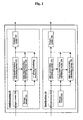
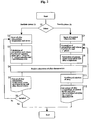
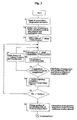
- Fig. 1 to Fig. 4 are function block diagrams and flowcharts explaining an embodiment of the present invention having such features as mentioned above.
- the alloy characteristics analysis and alloy composition search in the embodiment are explained below.
- Fig. 1 and Fig. 2 show an embodiment consisting of two systems, that is, analysis system (1) for calculating and outputting alloy structural factor and alloy characteristics from the entered alloy composition, working temperature and working stress, and search system (2) for searching and outputting the alloy composition satisfying the entered required performance.
- analysis system (1) for calculating and outputting alloy structural factor and alloy characteristics from the entered alloy composition
- search system (2) for searching and outputting the alloy composition satisfying the entered required performance.
- either the analysis system (1) or search system (2) is selected according to the purpose of use (step S1), and a desired calculation result can be obtained.
- it is not required to install two units each, such as input means (11), (21), storage means (21), (22), or output means (16), (26).
- the composition and volume fractions of ⁇ phase and ⁇ ' phase at the entered working temperature are calculated according to the equilibrium formula (Fig. 1 - composition factor calculating means (13), ⁇ ' phase calculating means (15), Fig. 2 - step S3, Fig. 3, Fig. 4 - steps S3a to S3p).
- This equilibrium formula is a calculation formula of phase composition in which ⁇ phase and ⁇ ' phase are present in equilibrium, that is, formula of ⁇ ' surface and formula of partitioning ratio of alloy elements (expressed by ratio of concentration of constituent elements Co, Cr, Mo, W, Al, Ti, Nb, Ta, Hf, Re, Ir, Ru, Rh, Pd, and Pt in ⁇ phase and concentration thereof in ⁇ ' phase).
- the formula of ⁇ ' surface and formula of partitioning ratio are compiled on the basis of the analytical data of multiple regression analysis of existing Ni-based superalloy.
- ⁇ ' surface is expressed as function of constituent element concentration in ⁇ ' phase and temperature as indicated in formula (1).
- Al concentration in ⁇ phase f ⁇ concentration of Co, Cr, Mo, W, Al, Ti, Nb, Ta, Hf, Re, Ir, Ru, Rh, Pd, and Pt in ⁇ ' phase (at%), temperature ⁇
- i is any one of Co, Cr, Mo, W, Al, Ti, Nb, Ta, Hf, Re, Ir, Ru, Rh, Pd, and Pt.
- the iterative convergence is calculated according to the calculation flow shown in Fig. 3 and Fig. 4.
- the composition and volume fraction of ⁇ phase and ⁇ ' phase are calculated, in principle, at 900°C (this temperature is only an example) (steps S3a to S3h).
- step S2 by using the input values of alloy composition, working temperature, and working stress (step S2), the initial value of structural factor calculation such as partitioning ratio of alloying elements (step S3a), and initial value of fraction of ⁇ ' phase (step S3b), calculation of ⁇ ' phase composition and volume fraction (step S3c) and partitioning ratio (step S3d) is repeated (first iterative convergent calculation) until the input alloy composition and calculated alloy composition are matched (step S3e), while slightly changing the volume fraction of ⁇ ' and partitioning ratio (step S3f), and after reaching coincidence, the equation of ⁇ ' surface is calculated at reference temperature 900 degrees (step S3g), and the process (steps S3c to S3g) is repeated until the calculation result is put on the ⁇ ' surface (step S3h).
- step S3a partitioning ratio of alloying elements
- step S3b initial value of fraction of ⁇ ' phase
- step S3d partitioning ratio
- step S3d partitioning ratio
- step S3i calculating the differential portion of the ⁇ ' surface and partitioning ratio due to difference between the entered working temperature and the reference temperature 900°C (step S3i), the composition and volume fraction of ⁇ phase and ⁇ ' phase at the entered working temperature are calculated (steps S3j to S3o). More specifically, in this calculation, second iterative convergent calculation similar to the first iterative convergent calculation is operated at the working temperature.
- step S3n If the result of ⁇ ' surface equation calculation (step S3n) is on the ⁇ ' surface (step S3o), it means that the composition and volume fraction of ⁇ phase and ⁇ ' phase at working temperature are calculated (step S3p).
- step S3c to S3h first iterative convergent calculation
- step S3j to S3o second iterative convergent calculation
- composition and volume fraction of ⁇ phase and ⁇ ' phase After calculating the composition and volume fraction of ⁇ phase and ⁇ ' phase, other structural factors and alloy characteristics shown in Table 1 below are predicted and calculated (Fig. 1 - composition factor calculating means (13), alloy characteristics calculating means (14), ⁇ ' phase calculating means (15), Fig. 2, Fig. 4- step S4).
- the calculation formula of structural factor and alloy characteristics formula of alloy are calculated preliminarily (Fig. 1- storage means (12)).
- the alloy characteristics formula is used as function of alloy composition and structural factor, alloy composition and working temperature, alloy composition and working stress, alloy composition, structural factor and working temperature, alloy composition, structural factor and working stress, alloy composition, working temperature and working stress, alloy composition, structural factor, working temperature and working stress. Accordingly, by calculating various alloy characteristics shown in Table 1, they can be displayed together with the entered alloy composition and calculated structural factor.
- the search system When searching for composition of a new alloy having desired characteristic, first, the search system is selected (Fig. 1 - search system (2), Fig. 2 - step S1), and the working temperature, working stress, and required performance are entered (Fig. 1 - input means (21), Fig. 2 - step S7).
- the required performance any desired one or more can be selected from the alloy characteristics listed in Table 1.
- one or more structural factors may be selected, and added as required performance.
- the alloy composition slightly changes automatically, and same as in the analysis system (1) mentioned above, the composition of the ⁇ phase balanced with the ⁇ ' phase equivalent to the composition is calculated (Fig. 1- alloy composition calculating means (23), Fig. 2 - steps S8, S9), and the structural factor and alloy characteristics at working temperature and working stress are calculated (Fig. 1- structural factor calculating means (24), alloy characteristics calculating means (25), Fig. 2 - step 10). Comparing these values with the entered required performance, when the required performance is satisfied, by ranking as required (level ranking means, not shown), the calculated alloy composition, structural factor, and alloy characteristics are stored (calculating result storage means, not shown), and a list thereof is issued (Fig. 1 - output means (26), Fig. 2 - step S12).
- Fig. 5 is an example of printed output of the results. Symbols in the diagram are defined as shown in Table 2. Symbol Structural factor or Characteristic Unit Unit or State (WT%) Alloy composition wt % - (AT%) Alloy composition atom % - GP ⁇ ' phase composition atom % working temperature (°C) G ⁇ phase composition atom % working temperature (°C) Fraction. GP ⁇ ' phase volume fraction at amount working temperature (°C) Lat. GP ⁇ ' phase lattice constant ⁇ working temperature (°C) Lat.
- the required characteristics were creep rupture life (test condition 1100°C, 137 MPa) of 500 hours or more, and the ⁇ ' phase solid solution temperature width of 40°C or more, and also the lattice misfit and solubility index were limited by certain conditions, and the vicinity of composition range of TMS-138 alloy was searched.
- Ru was increased from 2.0 wt% to 2.5 wt%, it has been found that TMS-157 alloy having alloy characteristics equivalent to that of TMS-138 alloy can be obtained if other alloying elements are decreased by the increment portion of Ru.
- the present invention is not limited to the embodiment and example, but may be changed or modified in details.
- the present invention can predict the characteristics about arbitrary alloy composition, temperature and stress of a ⁇ ' precipitation strengthened Ni-based superalloy including a platinum group element-added superalloy. It is also possible to search efficiently a new ⁇ ' precipitation strengthened Ni-based superalloy including a new platinum group element-added superalloy satisfying the required characteristics. Hence, it is easy to analyze and search a Ni-based superalloy including a platinum group element-added superalloy, thereby significantly enhancing the efficiency of alloy developments.
Landscapes
- Chemical & Material Sciences (AREA)
- Engineering & Computer Science (AREA)
- Materials Engineering (AREA)
- Mechanical Engineering (AREA)
- Metallurgy (AREA)
- Organic Chemistry (AREA)
- Bioinformatics & Cheminformatics (AREA)
- Medicinal Chemistry (AREA)
- Health & Medical Sciences (AREA)
- General Health & Medical Sciences (AREA)
- Physics & Mathematics (AREA)
- Pharmacology & Pharmacy (AREA)
- Spectroscopy & Molecular Physics (AREA)
- Crystallography & Structural Chemistry (AREA)
- Life Sciences & Earth Sciences (AREA)
- Bioinformatics & Computational Biology (AREA)
- Computing Systems (AREA)
- Theoretical Computer Science (AREA)
- Turbine Rotor Nozzle Sealing (AREA)
- Investigating And Analyzing Materials By Characteristic Methods (AREA)
Applications Claiming Priority (3)
| Application Number | Priority Date | Filing Date | Title |
|---|---|---|---|
| JP2002316891A JP2004149859A (ja) | 2002-10-30 | 2002-10-30 | γ’析出強化型白金族元素添加Ni基超合金設計支援プログラムおよびγ’析出強化型白金族元素添加Ni基超合金設計支援装置 |
| JP2002316891 | 2002-10-30 | ||
| PCT/JP2003/013928 WO2004040028A1 (ja) | 2002-10-30 | 2003-10-30 | γ'析出強化型白金族元素添加Ni基超合金設計支援プログラムおよびγ'析出強化型白金族元素添加Ni基超合金設計支援装置 |
Publications (2)
| Publication Number | Publication Date |
|---|---|
| EP1580285A1 true EP1580285A1 (de) | 2005-09-28 |
| EP1580285A4 EP1580285A4 (de) | 2006-05-24 |
Family
ID=32211701
Family Applications (1)
| Application Number | Title | Priority Date | Filing Date |
|---|---|---|---|
| EP03809865A Withdrawn EP1580285A4 (de) | 2002-10-30 | 2003-10-30 | Programm zur unterstützung des designs von gamma-strich-ausscheidungsverfestigten-ni-basis-superlegierungen mit platingruppenelementzusatz und vorrichtung zur unterstützung des designs von gamma-strich-ausscheidungsverfestigten-ni-basis-superlegierungen mit platingruppenelementzusatz |
Country Status (4)
| Country | Link |
|---|---|
| US (1) | US20060054251A1 (de) |
| EP (1) | EP1580285A4 (de) |
| JP (1) | JP2004149859A (de) |
| WO (1) | WO2004040028A1 (de) |
Families Citing this family (8)
| Publication number | Priority date | Publication date | Assignee | Title |
|---|---|---|---|---|
| JP5173554B2 (ja) * | 2008-04-23 | 2013-04-03 | 三菱重工業株式会社 | 薄肉合金の評価方法 |
| GB2536939A (en) * | 2015-04-01 | 2016-10-05 | Isis Innovation | Method for designing alloys |
| GB2536940A (en) | 2015-04-01 | 2016-10-05 | Isis Innovation | A nickel-based alloy |
| GB2539959A (en) * | 2015-07-03 | 2017-01-04 | Univ Oxford Innovation Ltd | A Nickel-based alloy |
| GB2540964A (en) * | 2015-07-31 | 2017-02-08 | Univ Oxford Innovation Ltd | A nickel-based alloy |
| KR101862059B1 (ko) * | 2016-11-29 | 2018-05-29 | 국방과학연구소 | 고강도 니켈기 초내열합금의 설계 방법 |
| US20210357546A1 (en) | 2018-10-31 | 2021-11-18 | Showa Denko K.K. | Material search apparatus, method, and program |
| CN110197050A (zh) * | 2019-07-01 | 2019-09-03 | 山西云时代太钢信息自动化技术有限公司 | 一种真空感应炉冶炼镍基合金的配料方法 |
Family Cites Families (8)
| Publication number | Priority date | Publication date | Assignee | Title |
|---|---|---|---|---|
| JPH03191032A (ja) * | 1989-12-21 | 1991-08-21 | Natl Res Inst For Metals | γ′析出強化型Ni基超合金設計支援装置 |
| US5078092A (en) * | 1989-12-22 | 1992-01-07 | Corning Incorporated | Flash vaporizer system for use in manufacturing optical waveguide fiber |
| US5151249A (en) * | 1989-12-29 | 1992-09-29 | General Electric Company | Nickel-based single crystal superalloy and method of making |
| US5482789A (en) * | 1994-01-03 | 1996-01-09 | General Electric Company | Nickel base superalloy and article |
| JP3646155B2 (ja) * | 1996-10-28 | 2005-05-11 | 独立行政法人物質・材料研究機構 | イリジウム添加Ni基超耐熱合金 |
| FR2780982B1 (fr) * | 1998-07-07 | 2000-09-08 | Onera (Off Nat Aerospatiale) | Superalliage monocristallin a base de nickel a haut solvus |
| EP1184473B1 (de) * | 2000-08-30 | 2005-01-05 | Kabushiki Kaisha Toshiba | Monokristalline Nickel-Basis-Legierungen und Verfahren zur Herstellung und daraus hergestellte Hochtemperaturbauteile einer Gasturbine |
| JP4449337B2 (ja) * | 2003-05-09 | 2010-04-14 | 株式会社日立製作所 | 高耐酸化性Ni基超合金鋳造物及びガスタービン部品 |
-
2002
- 2002-10-30 JP JP2002316891A patent/JP2004149859A/ja active Pending
-
2003
- 2003-10-30 WO PCT/JP2003/013928 patent/WO2004040028A1/ja not_active Ceased
- 2003-10-30 EP EP03809865A patent/EP1580285A4/de not_active Withdrawn
- 2003-10-30 US US10/532,139 patent/US20060054251A1/en not_active Abandoned
Also Published As
| Publication number | Publication date |
|---|---|
| US20060054251A1 (en) | 2006-03-16 |
| JP2004149859A (ja) | 2004-05-27 |
| WO2004040028A1 (ja) | 2004-05-13 |
| EP1580285A4 (de) | 2006-05-24 |
Similar Documents
| Publication | Publication Date | Title |
|---|---|---|
| Darolia | Development of strong, oxidation and corrosion resistant nickel-based superalloys: critical review of challenges, progress and prospects | |
| Pollock | Alloy design for aircraft engines | |
| Shingledecker et al. | Influences of composition and grain size on creep–rupture behavior of Inconel® alloy 740 | |
| EP1580285A1 (de) | Programm zur unterstützung des designs von gamma-strich-ausscheidungsverfestigten-ni-basis-superlegierungen mit platingruppenelementzusatz und vorrichtung zur unterstützung des designs von gamma-strich-ausscheidungsverfestigten-ni-basis-superlegierungen mit platingruppenelementzusatz | |
| Tang et al. | Using the PARROT module of Thermo-Calc with the Cr–Ni system as example | |
| Yuan et al. | Nano-twinning in a γ′ precipitate strengthened Ni-based superalloy | |
| Jones et al. | Influence of elevated Co and Ti levels on polycrystalline powder processed Ni-base superalloy | |
| Lin et al. | Alloying-element dependence of structural, elastic and electronic properties of nickel-based superalloys: Influence of γ’volume fraction | |
| CN102471833A (zh) | Ni基单晶超合金和涡轮叶片 | |
| Chen et al. | Screening of possible re-substitutional elements in single-crystal Ni-based superalloys: a viewpoint from interdiffusion coefficients in Ni-Al-X ternaries | |
| Gardner et al. | Atom probe tomography investigations of microstructural evolution in an aged nickel superalloy for exhaust applications | |
| Cheng et al. | The nucleation of δ phases triggered by the stacking faults in a single crystal superalloy | |
| Ju et al. | Stress driving element redistribution and rafting of γ′ phase in Ni–Al–Mo superalloy | |
| Volz et al. | Creep properties and deformation mechanisms of single-crystalline γ′-strengthened superalloys in dependence of the Co/Ni ratio | |
| CN120041707A (zh) | 一种基于多目标优化的增材制造用高通量镍基高温合金成分设计 | |
| Kontis et al. | A review on the partitioning of solutes along dislocations and stacking faults in superalloys | |
| Sulzer et al. | Critical assessment 31: on the modelling of tertiary creep in single-crystal superalloys | |
| CN114974474A (zh) | 结构材料的多尺度链条式集成设计方法及数据库系统 | |
| Zhang et al. | Effects of low-to medium-angle grain boundaries on creep properties of superalloy | |
| Lv et al. | Insights in improving creep resistance of low-cost 2nd-generation nickel based single crystal superalloys at intermediate temperature | |
| Salas-Reyes et al. | Comments on the Intermediate-Temperature embrittlement of metals and alloys: the conditions for transgranular and intergranular failure | |
| JPH0514778B2 (de) | ||
| Guduru et al. | DuctGPT: A Generative Transformer for Forward Screening of Ductile Refractory Multi-Principal Element Alloys | |
| Zhao et al. | High-temperature creep-induced site occupation evolution in the γ′ lattice in a Ru-bearing Ni-based superalloy | |
| Zacherl | A computational investigation of the effect of alloying elements on the thermodynamic and diffusion properties of fcc Ni alloys, with application to the creep rate of dilute Ni-X alloys. |
Legal Events
| Date | Code | Title | Description |
|---|---|---|---|
| PUAI | Public reference made under article 153(3) epc to a published international application that has entered the european phase |
Free format text: ORIGINAL CODE: 0009012 |
|
| 17P | Request for examination filed |
Effective date: 20050523 |
|
| AK | Designated contracting states |
Kind code of ref document: A1 Designated state(s): AT BE BG CH CY CZ DE DK EE ES FI FR GB GR HU IE IT LI LU MC NL PT RO SE SI SK TR |
|
| RIC1 | Information provided on ipc code assigned before grant |
Ipc: G06F 17/50 19950101ALI20040517BHEP Ipc: C22C 19/03 19740701AFI20051125BHEP |
|
| RBV | Designated contracting states (corrected) |
Designated state(s): DE FR GB |
|
| A4 | Supplementary search report drawn up and despatched |
Effective date: 20060406 |
|
| 17Q | First examination report despatched |
Effective date: 20060714 |
|
| 17Q | First examination report despatched |
Effective date: 20060714 |
|
| STAA | Information on the status of an ep patent application or granted ep patent |
Free format text: STATUS: THE APPLICATION IS DEEMED TO BE WITHDRAWN |
|
| 18D | Application deemed to be withdrawn |
Effective date: 20070616 |