EP1580086A1 - Flip-up apparatus for hood of vehicle - Google Patents
Flip-up apparatus for hood of vehicle Download PDFInfo
- Publication number
- EP1580086A1 EP1580086A1 EP05250857A EP05250857A EP1580086A1 EP 1580086 A1 EP1580086 A1 EP 1580086A1 EP 05250857 A EP05250857 A EP 05250857A EP 05250857 A EP05250857 A EP 05250857A EP 1580086 A1 EP1580086 A1 EP 1580086A1
- Authority
- EP
- European Patent Office
- Prior art keywords
- hood
- actuator
- lock
- flip
- arm
- Prior art date
- Legal status (The legal status is an assumption and is not a legal conclusion. Google has not performed a legal analysis and makes no representation as to the accuracy of the status listed.)
- Granted
Links
- 230000001133 acceleration Effects 0.000 description 8
- 238000001514 detection method Methods 0.000 description 4
- 238000004519 manufacturing process Methods 0.000 description 2
- 230000004075 alteration Effects 0.000 description 1
- 230000001174 ascending effect Effects 0.000 description 1
- 238000006073 displacement reaction Methods 0.000 description 1
- 230000000694 effects Effects 0.000 description 1
- 230000004048 modification Effects 0.000 description 1
- 238000012986 modification Methods 0.000 description 1
Images




Classifications
-
- E—FIXED CONSTRUCTIONS
- E05—LOCKS; KEYS; WINDOW OR DOOR FITTINGS; SAFES
- E05D—HINGES OR SUSPENSION DEVICES FOR DOORS, WINDOWS OR WINGS
- E05D11/00—Additional features or accessories of hinges
-
- B—PERFORMING OPERATIONS; TRANSPORTING
- B60—VEHICLES IN GENERAL
- B60R—VEHICLES, VEHICLE FITTINGS, OR VEHICLE PARTS, NOT OTHERWISE PROVIDED FOR
- B60R21/00—Arrangements or fittings on vehicles for protecting or preventing injuries to occupants or pedestrians in case of accidents or other traffic risks
- B60R21/34—Protecting non-occupants of a vehicle, e.g. pedestrians
- B60R21/38—Protecting non-occupants of a vehicle, e.g. pedestrians using means for lifting bonnets
-
- E—FIXED CONSTRUCTIONS
- E05—LOCKS; KEYS; WINDOW OR DOOR FITTINGS; SAFES
- E05Y—INDEXING SCHEME ASSOCIATED WITH SUBCLASSES E05D AND E05F, RELATING TO CONSTRUCTION ELEMENTS, ELECTRIC CONTROL, POWER SUPPLY, POWER SIGNAL OR TRANSMISSION, USER INTERFACES, MOUNTING OR COUPLING, DETAILS, ACCESSORIES, AUXILIARY OPERATIONS NOT OTHERWISE PROVIDED FOR, APPLICATION THEREOF
- E05Y2900/00—Application of doors, windows, wings or fittings thereof
- E05Y2900/50—Application of doors, windows, wings or fittings thereof for vehicles
- E05Y2900/53—Type of wing
- E05Y2900/536—Hoods
Definitions
- the present invention relates to a flip-up apparatus for a hood of a vehicle. More particularly, the invention relates to the flip-up apparatus that can lift up a rear end of the hood at a vehicle collision in order to secure a deformation of the hood thereby absorbing a collision impact.
- An automobile is generally provided, on a front part thereof, with an engine compartment whose upper opening is covered with a hood.
- a hood whose rear end is lifted up by a predetermined amount at a vehicle collision although the hood is adapted so as to open and shut about the rear end in a normal state.
- the lift-up of the rear end of the hood allows its downward deformable span to be increased. Therefore, even if an external load (e.g. collision object) due to the collision is applied on the rear end of the hood, such collision energy can be effectively absorbed due to increased deformable span of the hood.
- Such a hood namely, "flip-up" type hood,is disclosed in Japanese Patent Application Laid-open No. 2002-37128.
- the conventional "flip-up" type hood is equipped with a hood-link lock that serves to lock the hinge in order to suppress rattling movement of the hood during a vehicle's normal traveling.
- the upward movement of the actuator causes the hood-link lock to be deflected for release. That is, since kinetic energy of the actuator in its upward movement is partially utilized for the above deflection of the hood-link lock, the flip-up motion of the hood cannot be accomplished effectively.
- the hood may be equipped with an exclusive component for releasing the hood-link lock in its locked condition.
- this measure would cause the resulting hood assembly to be deteriorated in view of its total weight and manufacturing cost, disadvantageously.
- the present invention provides a flip-up apparatus for a hood of a vehicle, comprising: a hinge device arranged between a vehicle body and the hood to support the hood rotatably to the vehicle body; and an actuator arranged in the vicinity of the hinge device to lift up the hood at a vehicle collision, wherein the actuator is provided with an active part which is movable upwardly and engageable with a part of the hinge device in an upward movement of the active part.
- the flip-up apparatus is capable of lifting up the hood together with the active part of the actuator, it is possible to adjust acceleration of a flip-up motion of the hood itself appropriately.
- both velocity and acceleration of the active part of the actuator in its upward movement can be adjusted by alternating a setting pressure of the actuator or the like. Therefore, if only moving the active part of the actuator upwardly under condition that the active part is held by the hinge device attached to the hood, it is possible to adjust acceleration of the hood in its flip-up motion appropriately.
- Fig. 1 is a side view showing a front part of a vehicle equipped with a flip-up apparatus for a hood in accordance with the embodiment of the present invention.
- a hood 3 is arranged to close an upper opening of an engine compartment.
- This hood 3 is adapted so that its front part opens and shuts about a hinge device 5 at a rear end 3a under normal conditions. While, at a vehicle collision, the rear end 3a of the hood 3 pops upwardly as shown with a two-dotted line of Fig. 1, thereby forming a so-called "flip-up" hood.
- a front bumper 7 is arranged at the front end of the vehicle body 1.
- the front bumper 7 is provided with a bumper sensor 9 that detects a vehicle collision with an obstacle 11.
- a control unit 19 is provided to transmit a drive signal 17 to an actuator 15 on receipt of a detection signal 13 outputted from the bumper sensor 9.
- Fig. 2 is an exploded perspective view showing the hinge device 5 of the embodiment.
- the hinge device 5 includes a first arm 21 and a second arm 23 both forming an arm unit that pivotally supports the hood 3 rotatably to the vehicle body 1, and a first lock plate 25 and a second lock plate 27 both forming a lock unit that is arranged on the under face of the hood 3 to hold an active part (top end) of the actuator 15 moving upwardly.
- An arm bracket 29 is fastened to a frame member 37 (see Fig. 9) of the vehicle body 1 by means of bolts.
- the first arm 21 forming the arm unit has its one end pivotally connected to the rear end of the arm bracket 29.
- the front end of the second arm 23 is pivoted to the other end of the first arm 21. In this way, both of the first arm 21 and the second arm 23 constitute a link assembly.
- the rear end of the second arm 23 is pivotally supported by a support piece 39 of an attachment plate member 31.
- the attachment plate member 31 comprises an attachment plate body 33 in the form of a plate, a pair of support plates 35 extending from the under face of the attachment plate body 33 and the support piece 39 formed at an inside end of the attachment plate body 33 in the vehicle-width direction to extend downwardly.
- Each of the support plates 35 has its lower portion formed to extend in the fore-and-aft direction of the vehicle and also provided with two support holes 35a, 35a at a predetermined interval.
- the support piece 39 is provided, at its lower portion, with a support hole 39a that supports an end of the second arm 23 rotatably.
- the attachment plate body 33 is provided, at its front part, with attachment holes 33a to which recesses 43 of a later-mentioned lock lever bracket 41 are fastened by means of bolts.
- a lock lever 45 is rotatably attached to the attachment plate member 31.
- the lock lever bracket 41 is fastened to the attachment plate body 33 through the bolts.
- the lock lever 45 is rotatably supported by lock lever bracket 41.
- An anchor part 47 is formed at the leading end of the lock lever 45 and also engaged with an engagement part 49 of a first lock plate 25 mentioned later.
- the lock unit comprises the first lock plate 25 and the second lock plate 27 both pivoted to the support plate 35 of the attachment plate member 31 through support pins 53.
- the first lock plate 25 is shaped so as to be substantially triangular in side view.
- the first lock plate 25 is provided, at its inner end in the vehicle-width direction, with an engagement part 49.
- the above-mentioned anchor part 47 of the lock lever 45 is engaged with a corner of the top end of the engagement part 49.
- Fig. 3 is a side view of the hinge device 5 in its normal state.
- Fig. 4 is a perspective view showing a substantial part of the hinge device 5 of Fig. 3.
- the lock lever 45 Under condition that the anchor part 47 at the leading end of the lock lever 45 is engaged with the engagement part 49 of the first lock plate 25, the lock lever 45 is prevented from being rotated. Normally, the actuator 15 is positioned below the lock unit formed by the first lock plate 25 and the second lock plate 27.
- the actuator 15 has its upper portion formed so as to be a reversed truncated cone, providing a head part (active part) 51. While, the lower portion of the actuator 15 below a neck portion 51a is formed so as to gradually enlarge an actuator's diameter when it comes from the neck portion 51a to the downside.
- Fig. 5 is a side view showing the hinge device 5 at an early stage of a vehicle collision.
- Fig. 6 is a perspective view showing a substantial part of Fig. 5.
- the bumper sensor 9 detects the vehicle collision to transmit the detection signal 17 to the control unit 19.
- the control unit 19 transmits the drive signal 17 to the actuator 15.
- the active part of the actuator 15 moves upwardly as shown in Fig. 5, so that the head part 51 unclenches the first lock plate 25 and the second lock plate 27 for pivotal movement. Consequently, the lock lever 45 is released from its locked condition on the first lock plate 25, so that the lock lever 34 rotates downwardly.
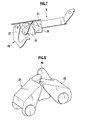
- Fig. 7 is a side view showing the hinge device 5 when the active part of the actuator 15 is abutting on the under face of the hood as a result of the vehicle collision.
- Fig. 8 is a perspective view showing the substantial part of Fig. 7.
- the first lock plate 25 and the second lock plate 27 After the pivotal movement of the first lock plate 25 and the second lock plate 27, they rotate downwardly due to their own weights. Subsequently, the first lock plate 25 and the second lock plate 27 hold the root 51a of the head part (active part) 51 of the actuator 15, while the top end of the actuator 15 abuts on the under face of the hood 3 and lifts up it. Thus, at the subsequent stages, the actuator 15 in one body with the hinge device 5 operates to lift up the hood 3.
- a further upward movement of the active part of the actuator 15 allows the first arm 21 and the second arm 23 to rotate, so that the hinge device 5 moves upwardly together with the hood 3.
- the front portion of the first arm 21 rotates upwardly about the rear end of the arm 21 as a pivot
- the rear portion of the second arm 23 rotates upwardly about the front end of the arm 23 as another pivot. Consequently, the rear end 3a of the hood 3 is raised to enable the hood 3 being subjected to a collision load to be deformed certainly, whereby the collision energy can be absorbed effectively.
- Fig. 10 is a graph showing the relationship between level of the rear end of the hood at a vehicle collision and time.
- T A denotes a time required to complete the flip-up action of the hood 3 since a vehicle collision was detected
- S A denotes a displacement of the hood 3 in its flip-up motion, which is necessary to absorb impact energy applied on the hood 3 as a result of the collision.
- a dashed area AS designates an area where the actuator 15 starts to accelerate in the course of moving the hood 3 upwardly
- a dashed area AE denotes an area where the actuator 15 decelerates in completing the upward movement of the hood 3.
- the hinge device 5 since the hinge device 5 includes the arm unit supporting the hood 3 rotatably to the frame member of the vehicle body and the lock unit having the first lock plate 25 and the second lock plate 27 both holding the head part 51 of the actuator 15, the device 5 enables the hood 3 to move upwardly together with the actuator 15. Therefore, for example, an alteration in gas pressure of the actuator 15 would allow the acceleration of the flip-up motion of the hood 3 to be adjusted appropriately.
- the arm unit is formed by the link assembly having the first arm 21 pivoted to the frame member and the second arm 23 pivoted to the under face of the hood 3.
- the rotation of the second arm 23 is locked by the lock unit in a normal state, while the locked condition by the lock unit is released by the upward movement of the active part of the actuator 15. That is, since the conventional deformation of a hood link lock is not required in the present invention, it is possible to utilize energy of the active part of the actuator 15 in the upward movement effectively.
- the lock unit has a function to release the locked condition, there is no need of providing any exclusive component for releasing the locked arm unit, whereby the number of components and the manufacturing cost can be reduced.
- the lock lever 45 is rotatably supported on the under face of the hood 3. In the normal state, the lock unit is prevented from rotating by the lock lever 45. While, when a vehicle has a collision, the actuator 15 is moved upwardly to release such a locked condition of the lock unit by the lock lever 45. In this way, locking or unlocking of the lock unit can be accomplished with such a simple structure.
- respective tips of the first lock plate 25 and the second lock plate 27 are together tapered off, they can engage the root 51a of the head part 51 of the actuator 15 certainly.
Landscapes
- Engineering & Computer Science (AREA)
- Mechanical Engineering (AREA)
- Superstructure Of Vehicle (AREA)
Abstract
Description
- The present invention relates to a flip-up apparatus for a hood of a vehicle. More particularly, the invention relates to the flip-up apparatus that can lift up a rear end of the hood at a vehicle collision in order to secure a deformation of the hood thereby absorbing a collision impact.
- An automobile is generally provided, on a front part thereof, with an engine compartment whose upper opening is covered with a hood. Among a variety of hoods, there is a hood whose rear end is lifted up by a predetermined amount at a vehicle collision although the hood is adapted so as to open and shut about the rear end in a normal state. The lift-up of the rear end of the hood allows its downward deformable span to be increased. Therefore, even if an external load (e.g. collision object) due to the collision is applied on the rear end of the hood, such collision energy can be effectively absorbed due to increased deformable span of the hood. Such a hood, namely, "flip-up" type hood,is disclosed in Japanese Patent Application Laid-open No. 2002-37128.
- In the earlier art, although the flip-up position of the hood at a vehicle collision is determined by a mechanical stopper of a hinge connecting the hood to a vehicle body, there is a problem of impossibility to control the acceleration rate of the flip-up operation of the hood.
- Also noted, the conventional "flip-up" type hood is equipped with a hood-link lock that serves to lock the hinge in order to suppress rattling movement of the hood during a vehicle's normal traveling. At a vehicle collision, the upward movement of the actuator causes the hood-link lock to be deflected for release. That is, since kinetic energy of the actuator in its upward movement is partially utilized for the above deflection of the hood-link lock, the flip-up motion of the hood cannot be accomplished effectively.
- Alternatively, the hood may be equipped with an exclusive component for releasing the hood-link lock in its locked condition. However, this measure would cause the resulting hood assembly to be deteriorated in view of its total weight and manufacturing cost, disadvantageously.
- In the above-mentioned situation, it would be desirable to be able to provide a flip-up apparatus that allows acceleration of a vehicle's hood in its flip-up motion to be controlled.
- Accordingly, the present invention provides a flip-up apparatus for a hood of a vehicle, comprising: a hinge device arranged between a vehicle body and the hood to support the hood rotatably to the vehicle body; and an actuator arranged in the vicinity of the hinge device to lift up the hood at a vehicle collision, wherein the actuator is provided with an active part which is movable upwardly and engageable with a part of the hinge device in an upward movement of the active part.
- According to the present invention, since the flip-up apparatus is capable of lifting up the hood together with the active part of the actuator, it is possible to adjust acceleration of a flip-up motion of the hood itself appropriately. In detail, both velocity and acceleration of the active part of the actuator in its upward movement can be adjusted by alternating a setting pressure of the actuator or the like. Therefore, if only moving the active part of the actuator upwardly under condition that the active part is held by the hinge device attached to the hood, it is possible to adjust acceleration of the hood in its flip-up motion appropriately.
- These and other objects and features of the present invention will become more fully apparent from the following description and appended claims taken in conjunction with the accompanying drawings.
-
- Fig. 1 is a side view showing a front part of a vehicle having a flip-up apparatus for a vehicle hood in accordance with an embodiment of the present invention;
- Fig. 2 is an exploded perspective view showing a hinge device in accordance with the embodiment of the present invention;
- Fig. 3 is a side view of the hinge device in a normal state thereof;
- Fig. 4 is a perspective view showing a substantial part of Fig. 3;
- Fig. 5 is a side view showing the hinge device in an early stage of a vehicle collision;
- Fig. 6 is a perspective view showing a substantial part of Fig. 5;
- Fig. 7 is a side view of the hinge device when an active part of an actuator abuts on the under face of the hood as a result of a vehicle collision;
- Fig. 8 is a perspective view showing a substantial part of Fig. 7;
- Fig. 9 is a side view showing a condition where the rear end of the hood is lifted up by the actuator; and
- Fig. 10 is a graph showing the relationship between level of the rear end of the hood and time at a vehicle collision.
-
- Referring to the accompanying drawings, an embodiment of the present invention will be described below.
- Fig. 1 is a side view showing a front part of a vehicle equipped with a flip-up apparatus for a hood in accordance with the embodiment of the present invention.
- At the front part of a vehicle body 1, a hood 3 is arranged to close an upper opening of an engine compartment. This hood 3 is adapted so that its front part opens and shuts about a
hinge device 5 at arear end 3a under normal conditions. While, at a vehicle collision, therear end 3a of the hood 3 pops upwardly as shown with a two-dotted line of Fig. 1, thereby forming a so-called "flip-up" hood. - A front bumper 7 is arranged at the front end of the vehicle body 1. The front bumper 7 is provided with a
bumper sensor 9 that detects a vehicle collision with anobstacle 11. In the vehicle body 1, acontrol unit 19 is provided to transmit adrive signal 17 to anactuator 15 on receipt of adetection signal 13 outputted from thebumper sensor 9. - Fig. 2 is an exploded perspective view showing the
hinge device 5 of the embodiment. - The
hinge device 5 includes afirst arm 21 and asecond arm 23 both forming an arm unit that pivotally supports the hood 3 rotatably to the vehicle body 1, and afirst lock plate 25 and asecond lock plate 27 both forming a lock unit that is arranged on the under face of the hood 3 to hold an active part (top end) of theactuator 15 moving upwardly. - An
arm bracket 29 is fastened to a frame member 37 (see Fig. 9) of the vehicle body 1 by means of bolts. Thefirst arm 21 forming the arm unit has its one end pivotally connected to the rear end of thearm bracket 29. The front end of thesecond arm 23 is pivoted to the other end of thefirst arm 21. In this way, both of thefirst arm 21 and thesecond arm 23 constitute a link assembly. The rear end of thesecond arm 23 is pivotally supported by asupport piece 39 of anattachment plate member 31. - The
attachment plate member 31 comprises anattachment plate body 33 in the form of a plate, a pair ofsupport plates 35 extending from the under face of theattachment plate body 33 and thesupport piece 39 formed at an inside end of theattachment plate body 33 in the vehicle-width direction to extend downwardly. Each of thesupport plates 35 has its lower portion formed to extend in the fore-and-aft direction of the vehicle and also provided with twosupport holes support piece 39 is provided, at its lower portion, with asupport hole 39a that supports an end of thesecond arm 23 rotatably. Theattachment plate body 33 is provided, at its front part, withattachment holes 33a to which recesses 43 of a later-mentionedlock lever bracket 41 are fastened by means of bolts. - Through the
lock lever bracket 41, alock lever 45 is rotatably attached to theattachment plate member 31. In detail, as mentioned before, thelock lever bracket 41 is fastened to theattachment plate body 33 through the bolts. Thelock lever 45 is rotatably supported bylock lever bracket 41. Ananchor part 47 is formed at the leading end of thelock lever 45 and also engaged with anengagement part 49 of afirst lock plate 25 mentioned later. - Here noted, the lock unit comprises the
first lock plate 25 and thesecond lock plate 27 both pivoted to thesupport plate 35 of theattachment plate member 31 throughsupport pins 53. Thefirst lock plate 25 is shaped so as to be substantially triangular in side view. Thefirst lock plate 25 is provided, at its inner end in the vehicle-width direction, with anengagement part 49. The above-mentionedanchor part 47 of thelock lever 45 is engaged with a corner of the top end of theengagement part 49. - The above-constructed flip-up apparatus of the
hood 47 operates as follows. Fig. 3 is a side view of thehinge device 5 in its normal state. Fig. 4 is a perspective view showing a substantial part of thehinge device 5 of Fig. 3. - Under condition that the
anchor part 47 at the leading end of thelock lever 45 is engaged with theengagement part 49 of thefirst lock plate 25, thelock lever 45 is prevented from being rotated. Normally, theactuator 15 is positioned below the lock unit formed by thefirst lock plate 25 and thesecond lock plate 27. - The
actuator 15 has its upper portion formed so as to be a reversed truncated cone, providing a head part (active part) 51. While, the lower portion of theactuator 15 below aneck portion 51a is formed so as to gradually enlarge an actuator's diameter when it comes from theneck portion 51a to the downside. - Fig. 5 is a side view showing the
hinge device 5 at an early stage of a vehicle collision. Fig. 6 is a perspective view showing a substantial part of Fig. 5. - As described with reference to Fig. 1, when the vehicle collides with the
obstacle 11, thebumper sensor 9 detects the vehicle collision to transmit thedetection signal 17 to thecontrol unit 19. On receipt of thedetection signal 13, thecontrol unit 19 transmits thedrive signal 17 to theactuator 15. Then, receiving thedrive signal 17, the active part of theactuator 15 moves upwardly as shown in Fig. 5, so that thehead part 51 unclenches thefirst lock plate 25 and thesecond lock plate 27 for pivotal movement. Consequently, thelock lever 45 is released from its locked condition on thefirst lock plate 25, so that the lock lever 34 rotates downwardly. - Fig. 7 is a side view showing the
hinge device 5 when the active part of theactuator 15 is abutting on the under face of the hood as a result of the vehicle collision. Fig. 8 is a perspective view showing the substantial part of Fig. 7. - After the pivotal movement of the
first lock plate 25 and thesecond lock plate 27, they rotate downwardly due to their own weights. Subsequently, thefirst lock plate 25 and thesecond lock plate 27 hold theroot 51a of the head part (active part) 51 of theactuator 15, while the top end of theactuator 15 abuts on the under face of the hood 3 and lifts up it. Thus, at the subsequent stages, theactuator 15 in one body with thehinge device 5 operates to lift up the hood 3. - Thereafter, as shown in Fig. 9, a further upward movement of the active part of the
actuator 15 allows thefirst arm 21 and thesecond arm 23 to rotate, so that thehinge device 5 moves upwardly together with the hood 3. In detail, the front portion of thefirst arm 21 rotates upwardly about the rear end of thearm 21 as a pivot, while the rear portion of thesecond arm 23 rotates upwardly about the front end of thearm 23 as another pivot. Consequently, therear end 3a of the hood 3 is raised to enable the hood 3 being subjected to a collision load to be deformed certainly, whereby the collision energy can be absorbed effectively. - Fig. 10 is a graph showing the relationship between level of the rear end of the hood at a vehicle collision and time. In Fig. 10, TA denotes a time required to complete the flip-up action of the hood 3 since a vehicle collision was detected, while SA denotes a displacement of the hood 3 in its flip-up motion, which is necessary to absorb impact energy applied on the hood 3 as a result of the collision. Similarly, a dashed area AS designates an area where the actuator 15 starts to accelerate in the course of moving the hood 3 upwardly, while a dashed area AE denotes an area where the
actuator 15 decelerates in completing the upward movement of the hood 3. - As shown in Fig. 10, at an early stage of the vehicle collision, since the hood 3 gradually moves upwardly on detection of a vehicle collision, the acceleration of the upward movement is relatively small. Subsequently, the velocity of the flip-up motion of the hood 3 is increased. In the vicinity of a completion point of the flip-up motion, the ascending acceleration is gradually reduced for the completion point.
- The operation and effect of the apparatus will be described below.
- As mentioned above, since the
hinge device 5 includes the arm unit supporting the hood 3 rotatably to the frame member of the vehicle body and the lock unit having thefirst lock plate 25 and thesecond lock plate 27 both holding thehead part 51 of theactuator 15, thedevice 5 enables the hood 3 to move upwardly together with theactuator 15. Therefore, for example, an alteration in gas pressure of theactuator 15 would allow the acceleration of the flip-up motion of the hood 3 to be adjusted appropriately. - Additionally, according to the embodiment, the arm unit is formed by the link assembly having the
first arm 21 pivoted to the frame member and thesecond arm 23 pivoted to the under face of the hood 3. The rotation of thesecond arm 23 is locked by the lock unit in a normal state, while the locked condition by the lock unit is released by the upward movement of the active part of theactuator 15. That is, since the conventional deformation of a hood link lock is not required in the present invention, it is possible to utilize energy of the active part of theactuator 15 in the upward movement effectively. Again, since the lock unit has a function to release the locked condition, there is no need of providing any exclusive component for releasing the locked arm unit, whereby the number of components and the manufacturing cost can be reduced. - Again, according to the embodiment, the
lock lever 45 is rotatably supported on the under face of the hood 3. In the normal state, the lock unit is prevented from rotating by thelock lever 45. While, when a vehicle has a collision, theactuator 15 is moved upwardly to release such a locked condition of the lock unit by thelock lever 45. In this way, locking or unlocking of the lock unit can be accomplished with such a simple structure. - Moreover, since respective tips of the
first lock plate 25 and thesecond lock plate 27 are together tapered off, they can engage theroot 51a of thehead part 51 of theactuator 15 certainly. - Japanese Patent Application No. 2004-083436 is incorporated herein by reference in its entirety.
- Finally, it will be understood by those skilled in the art that the foregoing descriptions are nothing but one embodiment of the disclosed flip-up for the vehicle hood and,therefore, various changes and modifications may be made within the scope of claims.
Claims (6)
- A flip-up apparatus for a hood of a vehicle, comprising:a hinge device (5) arranged between a vehicle body (1) and the hood (3) to support the hood (3) rotatably to the vehicle body (1); andan actuator (15) arranged in the vicinity of the hinge device (5) to lift up the hood (3) at a vehicle collision, whereinthe actuator (15) is provided with an active part which is movable upwardly and engageable with a part of the hinge device (5) in an upward movement of the active part.
- The flip-up apparatus of claim 1, wherein
the hinge device (5) includes an arm unit (21, 23) supporting the hood (3) rotatably to a frame member of the vehicle body (1) and a lock unit (25, 27) arranged on an under face of the hood (3) to hold the active part of the actuator (15) in the upward movement. - The flip-up apparatus of claim 2, wherein
the hinge device (5) is formed by a link assembly having a first arm (21) pivoted to the frame member of the vehicle body (1) and a second arm (23) pivoted to the under face of the hood (3) as the arm unit (21, 23),
rotation of the second arm (23) is prevented by the lock unit (25, 27) when the actuator (15) is not operated, thereby establishing the arm unit (21, 23) under a locked condition, and
the locked condition due to the lock unit (25, 27) is released by the active part of the actuator (15) in the upward movement. - The flip-up apparatus of claim 2, further comprising a lock lever (45) rotatably connected to the under face of the hood (3), wherein
rotation of the lock unit (25, 27) is prevented by the lock lever (45) when the actuator (15) is not operated, thereby establishing the lock unit (25, 27) in a locked condition thereof, and
the locked condition due to lock lever (45) is released by the active part of the actuator (15) in the upward movement. - The flip-up apparatus of claim 4, wherein the lock unit (25, 27) includes a pair of lock plates (25, 27) which are rotatably connected to the hood (3) to oppose to each other and between which the active part of the actuator (15) can be inserted.
- The flip-up apparatus of claim 5, wherein the active part is provided with a neck portion engageable with the lock plates (25, 27) in pairs.
Applications Claiming Priority (2)
| Application Number | Priority Date | Filing Date | Title |
|---|---|---|---|
| JP2004083436 | 2004-03-22 | ||
| JP2004083436A JP4479297B2 (en) | 2004-03-22 | 2004-03-22 | Vehicle hood flip-up structure |
Publications (2)
| Publication Number | Publication Date |
|---|---|
| EP1580086A1 true EP1580086A1 (en) | 2005-09-28 |
| EP1580086B1 EP1580086B1 (en) | 2006-10-25 |
Family
ID=34858384
Family Applications (1)
| Application Number | Title | Priority Date | Filing Date |
|---|---|---|---|
| EP05250857A Ceased EP1580086B1 (en) | 2004-03-22 | 2005-02-15 | Flip-up apparatus for hood of vehicle |
Country Status (5)
| Country | Link |
|---|---|
| US (1) | US7077225B2 (en) |
| EP (1) | EP1580086B1 (en) |
| JP (1) | JP4479297B2 (en) |
| CN (1) | CN1328093C (en) |
| DE (1) | DE602005000200T2 (en) |
Cited By (1)
| Publication number | Priority date | Publication date | Assignee | Title |
|---|---|---|---|---|
| CN112277868A (en) * | 2019-07-26 | 2021-01-29 | 浙江吉利汽车研究院有限公司 | Pedestrian protection system and method |
Families Citing this family (29)
| Publication number | Priority date | Publication date | Assignee | Title |
|---|---|---|---|---|
| DE10243497B4 (en) * | 2002-09-19 | 2004-10-07 | Ise Innomotive Systems Europe Gmbh | Device for protecting people in a frontal impact on a motor vehicle |
| US7594555B2 (en) * | 2004-11-17 | 2009-09-29 | Delphi Technologies, Inc. | Hood lift mechanism and method |
| DE602006001692D1 (en) * | 2005-06-23 | 2008-08-21 | Mazda Motor | Safety device on a vehicle |
| CA2518682A1 (en) * | 2005-09-09 | 2007-03-09 | Multimatic Inc. | Pedestrian protection hood hinge |
| DE102007012175B4 (en) | 2006-08-15 | 2018-03-29 | Magna Electronics Europe Gmbh & Co. Ohg | closing device |
| JP2008120117A (en) * | 2006-11-08 | 2008-05-29 | Mitsubishi Motors Corp | Vehicle hood flip-up device |
| JP2008247259A (en) * | 2007-03-30 | 2008-10-16 | Toyota Motor Corp | Pop-up hood device for vehicle |
| JP4831013B2 (en) * | 2007-08-16 | 2011-12-07 | 三菱自動車工業株式会社 | Vehicle hood flip-up device |
| KR100956997B1 (en) * | 2007-11-28 | 2010-05-11 | 볼보 컨스트럭션 이키프먼트 홀딩 스웨덴 에이비 | Construction Equipment Engine Room Hood Stay Device |
| US20090194348A1 (en) * | 2008-01-31 | 2009-08-06 | Faubert Robert J | Automotive hood-hinge system |
| US7730990B2 (en) * | 2008-05-13 | 2010-06-08 | Honda Motor Co., Ltd. | Restraint system for a hood lift device |
| US8056961B2 (en) * | 2010-01-26 | 2011-11-15 | GM Global Technology Operations LLC | Pedestrian impact mitigation system and method of use |
| EP2634047B1 (en) * | 2012-03-02 | 2014-11-26 | Volvo Car Corporation | Hinge mechanism |
| CN103171630B (en) * | 2013-03-19 | 2015-05-20 | 力帆实业(集团)股份有限公司 | Trunk lid microswitch mounting bracket |
| KR101481306B1 (en) | 2013-08-13 | 2015-01-09 | 현대자동차주식회사 | Active hood drive for vehicle |
| KR101491298B1 (en) * | 2013-08-20 | 2015-02-06 | 현대자동차주식회사 | Active hood latch device for vehicle |
| KR101567637B1 (en) * | 2013-10-21 | 2015-11-09 | 현대자동차주식회사 | Active hood apparatus for vehicle |
| KR101526958B1 (en) * | 2013-10-31 | 2015-06-09 | 현대자동차주식회사 | Structure of hood latch in vehicle |
| CN104675243B (en) * | 2013-12-03 | 2017-06-06 | 北京真金昌汽车科技有限公司 | The living hinge arrangement of the car engine cover with double rivet arrangements |
| JP6151853B2 (en) * | 2014-04-22 | 2017-06-21 | 本田技研工業株式会社 | Body front structure |
| JP2017520734A (en) * | 2014-07-03 | 2017-07-27 | ティーケー ホールディングス インク.Tk Holdings Inc. | Actuator housing seal mechanism |
| US9283924B1 (en) * | 2014-09-23 | 2016-03-15 | Ford Global Technologies, Llc | Hinge for a vehicle hood |
| CN106627472B (en) * | 2015-07-29 | 2019-02-26 | 比亚迪股份有限公司 | Engine hood hinge structure and pedestrian protection device |
| CN110719861B (en) * | 2017-07-07 | 2022-03-04 | 本田技研工业株式会社 | Vehicle body front structure |
| US11168498B2 (en) | 2017-09-01 | 2021-11-09 | Magna Closures Inc. | Active pedestrian hood latch with dual function cam lever |
| US11383672B2 (en) | 2018-11-27 | 2022-07-12 | Magna Closures Inc. | Active pedestrian hood hinge with integrated latch assembly |
| DE102019134108A1 (en) * | 2018-12-13 | 2020-06-18 | Magna Closures Inc. | ACTIVE PEDESTRIAN HOOD HINGE WITH INTEGRATED LOCKING ARRANGEMENT |
| DE102020128865B4 (en) * | 2020-11-03 | 2024-02-08 | Dr. Ing. H.C. F. Porsche Aktiengesellschaft | Front flap drive, front flap system and motor vehicle |
| DE102022116438A1 (en) * | 2022-07-01 | 2024-01-04 | Bayerische Motoren Werke Aktiengesellschaft | Front lid hinge for a motor vehicle and motor vehicle with such a front lid hinge |
Citations (3)
| Publication number | Priority date | Publication date | Assignee | Title |
|---|---|---|---|---|
| DE19712961A1 (en) * | 1997-03-27 | 1998-10-01 | Bayerische Motoren Werke Ag | Safety mounting for front engine cover |
| JP2002037128A (en) * | 2000-07-25 | 2002-02-06 | Honda Motor Co Ltd | Vehicle hood device |
| DE10055828A1 (en) * | 2000-11-10 | 2002-05-23 | Acts Gmbh & Co Kg | Hinge device for motor vehicle with safety device enables interaction of hinge device between hood and vehicle body to be deactivated or interrupted for safe raising of hood |
Family Cites Families (3)
| Publication number | Priority date | Publication date | Assignee | Title |
|---|---|---|---|---|
| JP3377763B2 (en) * | 1999-07-08 | 2003-02-17 | 本田技研工業株式会社 | Vehicle hood device |
| US6415882B1 (en) * | 2001-11-05 | 2002-07-09 | Ford Global Technologies, Inc. | Deployable hinge for pedestrian protection vehicle hood |
| US6439330B1 (en) * | 2001-11-05 | 2002-08-27 | Ford Global Technologies, Inc. | Vehicle hood deployment device for pedestrian protection |
-
2004
- 2004-03-22 JP JP2004083436A patent/JP4479297B2/en not_active Expired - Fee Related
-
2005
- 2005-02-15 EP EP05250857A patent/EP1580086B1/en not_active Ceased
- 2005-02-15 DE DE602005000200T patent/DE602005000200T2/en not_active Expired - Lifetime
- 2005-03-03 US US11/069,998 patent/US7077225B2/en not_active Expired - Lifetime
- 2005-03-21 CN CNB2005100542843A patent/CN1328093C/en not_active Expired - Fee Related
Patent Citations (3)
| Publication number | Priority date | Publication date | Assignee | Title |
|---|---|---|---|---|
| DE19712961A1 (en) * | 1997-03-27 | 1998-10-01 | Bayerische Motoren Werke Ag | Safety mounting for front engine cover |
| JP2002037128A (en) * | 2000-07-25 | 2002-02-06 | Honda Motor Co Ltd | Vehicle hood device |
| DE10055828A1 (en) * | 2000-11-10 | 2002-05-23 | Acts Gmbh & Co Kg | Hinge device for motor vehicle with safety device enables interaction of hinge device between hood and vehicle body to be deactivated or interrupted for safe raising of hood |
Non-Patent Citations (1)
| Title |
|---|
| PATENT ABSTRACTS OF JAPAN vol. 2002, no. 06 4 June 2002 (2002-06-04) * |
Cited By (2)
| Publication number | Priority date | Publication date | Assignee | Title |
|---|---|---|---|---|
| CN112277868A (en) * | 2019-07-26 | 2021-01-29 | 浙江吉利汽车研究院有限公司 | Pedestrian protection system and method |
| CN112277868B (en) * | 2019-07-26 | 2022-07-12 | 浙江吉利汽车研究院有限公司 | Pedestrian protection system and method |
Also Published As
| Publication number | Publication date |
|---|---|
| CN1672988A (en) | 2005-09-28 |
| US20050206199A1 (en) | 2005-09-22 |
| CN1328093C (en) | 2007-07-25 |
| DE602005000200D1 (en) | 2006-12-07 |
| DE602005000200T2 (en) | 2007-09-13 |
| JP2005271604A (en) | 2005-10-06 |
| JP4479297B2 (en) | 2010-06-09 |
| EP1580086B1 (en) | 2006-10-25 |
| US7077225B2 (en) | 2006-07-18 |
Similar Documents
| Publication | Publication Date | Title |
|---|---|---|
| EP1580086B1 (en) | Flip-up apparatus for hood of vehicle | |
| US6345679B1 (en) | Vehicle hood apparatus | |
| US6293362B1 (en) | Vehicle hood apparatus | |
| US6217108B1 (en) | Vehicle hood apparatus | |
| US7596833B2 (en) | Hood hinge assembly for vehicle | |
| US6257657B1 (en) | Vehicular hood apparatus | |
| JP3785722B2 (en) | Flip-up hood | |
| KR101122190B1 (en) | A safety arrangement | |
| JP2000211553A (en) | Vehicle front structure | |
| JPH1134925A (en) | Flip-up hood | |
| JP3765164B2 (en) | Automotive hood | |
| JP7527507B2 (en) | Automotive hinges for pedestrian protection | |
| JP3842022B2 (en) | Vehicle hood device | |
| JP3789735B2 (en) | Vehicle hood device | |
| WO2014013937A1 (en) | Hood support structure for hood tip-up device | |
| JP3216467B2 (en) | Seat mounting structure | |
| JP7521444B2 (en) | Vehicle hood support structure | |
| KR100726165B1 (en) | Hinge device for vehicle's active hood | |
| JP3791141B2 (en) | Flip-up hood | |
| JP2004203249A (en) | Lift-up device and lift-up system structure | |
| GB2394922A (en) | Motor vehicle with deployable hood | |
| JP2022029721A (en) | Vehicular pop-up hood structure | |
| JP3808292B2 (en) | Vehicle hood device | |
| KR100644488B1 (en) | A Hinge of a Hood for an Automobile | |
| JP4624154B2 (en) | Vehicle safety device |
Legal Events
| Date | Code | Title | Description |
|---|---|---|---|
| PUAI | Public reference made under article 153(3) epc to a published international application that has entered the european phase |
Free format text: ORIGINAL CODE: 0009012 |
|
| 17P | Request for examination filed |
Effective date: 20050303 |
|
| AK | Designated contracting states |
Kind code of ref document: A1 Designated state(s): AT BE BG CH CY CZ DE DK EE ES FI FR GB GR HU IE IS IT LI LT LU MC NL PL PT RO SE SI SK TR |
|
| AX | Request for extension of the european patent |
Extension state: AL BA HR LV MK YU |
|
| GRAP | Despatch of communication of intention to grant a patent |
Free format text: ORIGINAL CODE: EPIDOSNIGR1 |
|
| AKX | Designation fees paid |
Designated state(s): DE GB |
|
| GRAS | Grant fee paid |
Free format text: ORIGINAL CODE: EPIDOSNIGR3 |
|
| GRAA | (expected) grant |
Free format text: ORIGINAL CODE: 0009210 |
|
| AK | Designated contracting states |
Kind code of ref document: B1 Designated state(s): DE GB |
|
| REG | Reference to a national code |
Ref country code: GB Ref legal event code: FG4D |
|
| REF | Corresponds to: |
Ref document number: 602005000200 Country of ref document: DE Date of ref document: 20061207 Kind code of ref document: P |
|
| PLBE | No opposition filed within time limit |
Free format text: ORIGINAL CODE: 0009261 |
|
| STAA | Information on the status of an ep patent application or granted ep patent |
Free format text: STATUS: NO OPPOSITION FILED WITHIN TIME LIMIT |
|
| 26N | No opposition filed |
Effective date: 20070726 |
|
| PGFP | Annual fee paid to national office [announced via postgrant information from national office to epo] |
Ref country code: GB Payment date: 20190213 Year of fee payment: 15 Ref country code: DE Payment date: 20190205 Year of fee payment: 15 |
|
| REG | Reference to a national code |
Ref country code: DE Ref legal event code: R119 Ref document number: 602005000200 Country of ref document: DE |
|
| GBPC | Gb: european patent ceased through non-payment of renewal fee |
Effective date: 20200215 |
|
| PG25 | Lapsed in a contracting state [announced via postgrant information from national office to epo] |
Ref country code: DE Free format text: LAPSE BECAUSE OF NON-PAYMENT OF DUE FEES Effective date: 20200901 Ref country code: GB Free format text: LAPSE BECAUSE OF NON-PAYMENT OF DUE FEES Effective date: 20200215 |