EP1579979A1 - Preform, process for producing the same, and biaxially stretched container obtained from the preform - Google Patents
Preform, process for producing the same, and biaxially stretched container obtained from the preform Download PDFInfo
- Publication number
- EP1579979A1 EP1579979A1 EP03809851A EP03809851A EP1579979A1 EP 1579979 A1 EP1579979 A1 EP 1579979A1 EP 03809851 A EP03809851 A EP 03809851A EP 03809851 A EP03809851 A EP 03809851A EP 1579979 A1 EP1579979 A1 EP 1579979A1
- Authority
- EP
- European Patent Office
- Prior art keywords
- preform
- layer
- polyester resin
- resin
- forming
- Prior art date
- Legal status (The legal status is an assumption and is not a legal conclusion. Google has not performed a legal analysis and makes no representation as to the accuracy of the status listed.)
- Granted
Links
Images


Classifications
-
- B—PERFORMING OPERATIONS; TRANSPORTING
- B29—WORKING OF PLASTICS; WORKING OF SUBSTANCES IN A PLASTIC STATE IN GENERAL
- B29B—PREPARATION OR PRETREATMENT OF THE MATERIAL TO BE SHAPED; MAKING GRANULES OR PREFORMS; RECOVERY OF PLASTICS OR OTHER CONSTITUENTS OF WASTE MATERIAL CONTAINING PLASTICS
- B29B11/00—Making preforms
- B29B11/06—Making preforms by moulding the material
- B29B11/12—Compression moulding
-
- B—PERFORMING OPERATIONS; TRANSPORTING
- B29—WORKING OF PLASTICS; WORKING OF SUBSTANCES IN A PLASTIC STATE IN GENERAL
- B29C—SHAPING OR JOINING OF PLASTICS; SHAPING OF MATERIAL IN A PLASTIC STATE, NOT OTHERWISE PROVIDED FOR; AFTER-TREATMENT OF THE SHAPED PRODUCTS, e.g. REPAIRING
- B29C43/00—Compression moulding, i.e. applying external pressure to flow the moulding material; Apparatus therefor
- B29C43/32—Component parts, details or accessories; Auxiliary operations
- B29C43/34—Feeding the material to the mould or the compression means
-
- B—PERFORMING OPERATIONS; TRANSPORTING
- B29—WORKING OF PLASTICS; WORKING OF SUBSTANCES IN A PLASTIC STATE IN GENERAL
- B29C—SHAPING OR JOINING OF PLASTICS; SHAPING OF MATERIAL IN A PLASTIC STATE, NOT OTHERWISE PROVIDED FOR; AFTER-TREATMENT OF THE SHAPED PRODUCTS, e.g. REPAIRING
- B29C49/00—Blow-moulding, i.e. blowing a preform or parison to a desired shape within a mould; Apparatus therefor
- B29C49/0005—Blow-moulding, i.e. blowing a preform or parison to a desired shape within a mould; Apparatus therefor characterised by the material
-
- B—PERFORMING OPERATIONS; TRANSPORTING
- B29—WORKING OF PLASTICS; WORKING OF SUBSTANCES IN A PLASTIC STATE IN GENERAL
- B29C—SHAPING OR JOINING OF PLASTICS; SHAPING OF MATERIAL IN A PLASTIC STATE, NOT OTHERWISE PROVIDED FOR; AFTER-TREATMENT OF THE SHAPED PRODUCTS, e.g. REPAIRING
- B29C49/00—Blow-moulding, i.e. blowing a preform or parison to a desired shape within a mould; Apparatus therefor
- B29C49/02—Combined blow-moulding and manufacture of the preform or the parison
- B29C49/0685—Compression blow-moulding
-
- B—PERFORMING OPERATIONS; TRANSPORTING
- B29—WORKING OF PLASTICS; WORKING OF SUBSTANCES IN A PLASTIC STATE IN GENERAL
- B29C—SHAPING OR JOINING OF PLASTICS; SHAPING OF MATERIAL IN A PLASTIC STATE, NOT OTHERWISE PROVIDED FOR; AFTER-TREATMENT OF THE SHAPED PRODUCTS, e.g. REPAIRING
- B29C49/00—Blow-moulding, i.e. blowing a preform or parison to a desired shape within a mould; Apparatus therefor
- B29C49/071—Preforms or parisons characterised by their configuration, e.g. geometry, dimensions or physical properties
-
- B—PERFORMING OPERATIONS; TRANSPORTING
- B29—WORKING OF PLASTICS; WORKING OF SUBSTANCES IN A PLASTIC STATE IN GENERAL
- B29C—SHAPING OR JOINING OF PLASTICS; SHAPING OF MATERIAL IN A PLASTIC STATE, NOT OTHERWISE PROVIDED FOR; AFTER-TREATMENT OF THE SHAPED PRODUCTS, e.g. REPAIRING
- B29C49/00—Blow-moulding, i.e. blowing a preform or parison to a desired shape within a mould; Apparatus therefor
- B29C49/08—Biaxial stretching during blow-moulding
-
- B—PERFORMING OPERATIONS; TRANSPORTING
- B29—WORKING OF PLASTICS; WORKING OF SUBSTANCES IN A PLASTIC STATE IN GENERAL
- B29C—SHAPING OR JOINING OF PLASTICS; SHAPING OF MATERIAL IN A PLASTIC STATE, NOT OTHERWISE PROVIDED FOR; AFTER-TREATMENT OF THE SHAPED PRODUCTS, e.g. REPAIRING
- B29C49/00—Blow-moulding, i.e. blowing a preform or parison to a desired shape within a mould; Apparatus therefor
- B29C49/22—Blow-moulding, i.e. blowing a preform or parison to a desired shape within a mould; Apparatus therefor using multilayered preforms or parisons
-
- B—PERFORMING OPERATIONS; TRANSPORTING
- B29—WORKING OF PLASTICS; WORKING OF SUBSTANCES IN A PLASTIC STATE IN GENERAL
- B29C—SHAPING OR JOINING OF PLASTICS; SHAPING OF MATERIAL IN A PLASTIC STATE, NOT OTHERWISE PROVIDED FOR; AFTER-TREATMENT OF THE SHAPED PRODUCTS, e.g. REPAIRING
- B29C43/00—Compression moulding, i.e. applying external pressure to flow the moulding material; Apparatus therefor
- B29C43/32—Component parts, details or accessories; Auxiliary operations
- B29C43/34—Feeding the material to the mould or the compression means
- B29C2043/3433—Feeding the material to the mould or the compression means using dispensing heads, e.g. extruders, placed over or apart from the moulds
-
- B—PERFORMING OPERATIONS; TRANSPORTING
- B29—WORKING OF PLASTICS; WORKING OF SUBSTANCES IN A PLASTIC STATE IN GENERAL
- B29C—SHAPING OR JOINING OF PLASTICS; SHAPING OF MATERIAL IN A PLASTIC STATE, NOT OTHERWISE PROVIDED FOR; AFTER-TREATMENT OF THE SHAPED PRODUCTS, e.g. REPAIRING
- B29C43/00—Compression moulding, i.e. applying external pressure to flow the moulding material; Apparatus therefor
- B29C43/32—Component parts, details or accessories; Auxiliary operations
- B29C43/34—Feeding the material to the mould or the compression means
- B29C2043/3466—Feeding the material to the mould or the compression means using rotating supports, e.g. turntables or drums
-
- B—PERFORMING OPERATIONS; TRANSPORTING
- B29—WORKING OF PLASTICS; WORKING OF SUBSTANCES IN A PLASTIC STATE IN GENERAL
- B29C—SHAPING OR JOINING OF PLASTICS; SHAPING OF MATERIAL IN A PLASTIC STATE, NOT OTHERWISE PROVIDED FOR; AFTER-TREATMENT OF THE SHAPED PRODUCTS, e.g. REPAIRING
- B29C43/00—Compression moulding, i.e. applying external pressure to flow the moulding material; Apparatus therefor
- B29C43/32—Component parts, details or accessories; Auxiliary operations
- B29C43/36—Moulds for making articles of definite length, i.e. discrete articles
- B29C2043/3676—Moulds for making articles of definite length, i.e. discrete articles moulds mounted on rotating supporting constuctions
- B29C2043/3689—Moulds for making articles of definite length, i.e. discrete articles moulds mounted on rotating supporting constuctions on a support table, e.g. flat disk-like tables having moulds on the periphery
-
- B—PERFORMING OPERATIONS; TRANSPORTING
- B29—WORKING OF PLASTICS; WORKING OF SUBSTANCES IN A PLASTIC STATE IN GENERAL
- B29C—SHAPING OR JOINING OF PLASTICS; SHAPING OF MATERIAL IN A PLASTIC STATE, NOT OTHERWISE PROVIDED FOR; AFTER-TREATMENT OF THE SHAPED PRODUCTS, e.g. REPAIRING
- B29C2949/00—Indexing scheme relating to blow-moulding
- B29C2949/07—Preforms or parisons characterised by their configuration
- B29C2949/072—Preforms or parisons characterised by their configuration having variable wall thickness
-
- B—PERFORMING OPERATIONS; TRANSPORTING
- B29—WORKING OF PLASTICS; WORKING OF SUBSTANCES IN A PLASTIC STATE IN GENERAL
- B29C—SHAPING OR JOINING OF PLASTICS; SHAPING OF MATERIAL IN A PLASTIC STATE, NOT OTHERWISE PROVIDED FOR; AFTER-TREATMENT OF THE SHAPED PRODUCTS, e.g. REPAIRING
- B29C2949/00—Indexing scheme relating to blow-moulding
- B29C2949/07—Preforms or parisons characterised by their configuration
- B29C2949/072—Preforms or parisons characterised by their configuration having variable wall thickness
- B29C2949/0722—Preforms or parisons characterised by their configuration having variable wall thickness at neck portion
-
- B—PERFORMING OPERATIONS; TRANSPORTING
- B29—WORKING OF PLASTICS; WORKING OF SUBSTANCES IN A PLASTIC STATE IN GENERAL
- B29C—SHAPING OR JOINING OF PLASTICS; SHAPING OF MATERIAL IN A PLASTIC STATE, NOT OTHERWISE PROVIDED FOR; AFTER-TREATMENT OF THE SHAPED PRODUCTS, e.g. REPAIRING
- B29C2949/00—Indexing scheme relating to blow-moulding
- B29C2949/07—Preforms or parisons characterised by their configuration
- B29C2949/072—Preforms or parisons characterised by their configuration having variable wall thickness
- B29C2949/0723—Preforms or parisons characterised by their configuration having variable wall thickness at flange portion
-
- B—PERFORMING OPERATIONS; TRANSPORTING
- B29—WORKING OF PLASTICS; WORKING OF SUBSTANCES IN A PLASTIC STATE IN GENERAL
- B29C—SHAPING OR JOINING OF PLASTICS; SHAPING OF MATERIAL IN A PLASTIC STATE, NOT OTHERWISE PROVIDED FOR; AFTER-TREATMENT OF THE SHAPED PRODUCTS, e.g. REPAIRING
- B29C2949/00—Indexing scheme relating to blow-moulding
- B29C2949/07—Preforms or parisons characterised by their configuration
- B29C2949/072—Preforms or parisons characterised by their configuration having variable wall thickness
- B29C2949/0724—Preforms or parisons characterised by their configuration having variable wall thickness at body portion
-
- B—PERFORMING OPERATIONS; TRANSPORTING
- B29—WORKING OF PLASTICS; WORKING OF SUBSTANCES IN A PLASTIC STATE IN GENERAL
- B29C—SHAPING OR JOINING OF PLASTICS; SHAPING OF MATERIAL IN A PLASTIC STATE, NOT OTHERWISE PROVIDED FOR; AFTER-TREATMENT OF THE SHAPED PRODUCTS, e.g. REPAIRING
- B29C2949/00—Indexing scheme relating to blow-moulding
- B29C2949/07—Preforms or parisons characterised by their configuration
- B29C2949/073—Preforms or parisons characterised by their configuration having variable diameter
-
- B—PERFORMING OPERATIONS; TRANSPORTING
- B29—WORKING OF PLASTICS; WORKING OF SUBSTANCES IN A PLASTIC STATE IN GENERAL
- B29C—SHAPING OR JOINING OF PLASTICS; SHAPING OF MATERIAL IN A PLASTIC STATE, NOT OTHERWISE PROVIDED FOR; AFTER-TREATMENT OF THE SHAPED PRODUCTS, e.g. REPAIRING
- B29C2949/00—Indexing scheme relating to blow-moulding
- B29C2949/07—Preforms or parisons characterised by their configuration
- B29C2949/073—Preforms or parisons characterised by their configuration having variable diameter
- B29C2949/0731—Preforms or parisons characterised by their configuration having variable diameter at neck portion
-
- B—PERFORMING OPERATIONS; TRANSPORTING
- B29—WORKING OF PLASTICS; WORKING OF SUBSTANCES IN A PLASTIC STATE IN GENERAL
- B29C—SHAPING OR JOINING OF PLASTICS; SHAPING OF MATERIAL IN A PLASTIC STATE, NOT OTHERWISE PROVIDED FOR; AFTER-TREATMENT OF THE SHAPED PRODUCTS, e.g. REPAIRING
- B29C2949/00—Indexing scheme relating to blow-moulding
- B29C2949/07—Preforms or parisons characterised by their configuration
- B29C2949/073—Preforms or parisons characterised by their configuration having variable diameter
- B29C2949/0732—Preforms or parisons characterised by their configuration having variable diameter at flange portion
-
- B—PERFORMING OPERATIONS; TRANSPORTING
- B29—WORKING OF PLASTICS; WORKING OF SUBSTANCES IN A PLASTIC STATE IN GENERAL
- B29C—SHAPING OR JOINING OF PLASTICS; SHAPING OF MATERIAL IN A PLASTIC STATE, NOT OTHERWISE PROVIDED FOR; AFTER-TREATMENT OF THE SHAPED PRODUCTS, e.g. REPAIRING
- B29C2949/00—Indexing scheme relating to blow-moulding
- B29C2949/07—Preforms or parisons characterised by their configuration
- B29C2949/073—Preforms or parisons characterised by their configuration having variable diameter
- B29C2949/0733—Preforms or parisons characterised by their configuration having variable diameter at body portion
-
- B—PERFORMING OPERATIONS; TRANSPORTING
- B29—WORKING OF PLASTICS; WORKING OF SUBSTANCES IN A PLASTIC STATE IN GENERAL
- B29C—SHAPING OR JOINING OF PLASTICS; SHAPING OF MATERIAL IN A PLASTIC STATE, NOT OTHERWISE PROVIDED FOR; AFTER-TREATMENT OF THE SHAPED PRODUCTS, e.g. REPAIRING
- B29C2949/00—Indexing scheme relating to blow-moulding
- B29C2949/07—Preforms or parisons characterised by their configuration
- B29C2949/076—Preforms or parisons characterised by their configuration characterised by the shape
- B29C2949/0768—Preforms or parisons characterised by their configuration characterised by the shape characterised by the shape of specific parts of preform
- B29C2949/077—Preforms or parisons characterised by their configuration characterised by the shape characterised by the shape of specific parts of preform characterised by the neck
- B29C2949/0772—Closure retaining means
- B29C2949/0773—Threads
-
- B—PERFORMING OPERATIONS; TRANSPORTING
- B29—WORKING OF PLASTICS; WORKING OF SUBSTANCES IN A PLASTIC STATE IN GENERAL
- B29C—SHAPING OR JOINING OF PLASTICS; SHAPING OF MATERIAL IN A PLASTIC STATE, NOT OTHERWISE PROVIDED FOR; AFTER-TREATMENT OF THE SHAPED PRODUCTS, e.g. REPAIRING
- B29C2949/00—Indexing scheme relating to blow-moulding
- B29C2949/07—Preforms or parisons characterised by their configuration
- B29C2949/076—Preforms or parisons characterised by their configuration characterised by the shape
- B29C2949/0768—Preforms or parisons characterised by their configuration characterised by the shape characterised by the shape of specific parts of preform
- B29C2949/077—Preforms or parisons characterised by their configuration characterised by the shape characterised by the shape of specific parts of preform characterised by the neck
- B29C2949/0777—Tamper-evident band retaining ring
-
- B—PERFORMING OPERATIONS; TRANSPORTING
- B29—WORKING OF PLASTICS; WORKING OF SUBSTANCES IN A PLASTIC STATE IN GENERAL
- B29C—SHAPING OR JOINING OF PLASTICS; SHAPING OF MATERIAL IN A PLASTIC STATE, NOT OTHERWISE PROVIDED FOR; AFTER-TREATMENT OF THE SHAPED PRODUCTS, e.g. REPAIRING
- B29C2949/00—Indexing scheme relating to blow-moulding
- B29C2949/07—Preforms or parisons characterised by their configuration
- B29C2949/0861—Other specified values, e.g. values or ranges
- B29C2949/0872—Weight
-
- B—PERFORMING OPERATIONS; TRANSPORTING
- B29—WORKING OF PLASTICS; WORKING OF SUBSTANCES IN A PLASTIC STATE IN GENERAL
- B29C—SHAPING OR JOINING OF PLASTICS; SHAPING OF MATERIAL IN A PLASTIC STATE, NOT OTHERWISE PROVIDED FOR; AFTER-TREATMENT OF THE SHAPED PRODUCTS, e.g. REPAIRING
- B29C2949/00—Indexing scheme relating to blow-moulding
- B29C2949/20—Preforms or parisons whereby a specific part is made of only one component, e.g. only one layer
- B29C2949/22—Preforms or parisons whereby a specific part is made of only one component, e.g. only one layer at neck portion
-
- B—PERFORMING OPERATIONS; TRANSPORTING
- B29—WORKING OF PLASTICS; WORKING OF SUBSTANCES IN A PLASTIC STATE IN GENERAL
- B29C—SHAPING OR JOINING OF PLASTICS; SHAPING OF MATERIAL IN A PLASTIC STATE, NOT OTHERWISE PROVIDED FOR; AFTER-TREATMENT OF THE SHAPED PRODUCTS, e.g. REPAIRING
- B29C2949/00—Indexing scheme relating to blow-moulding
- B29C2949/20—Preforms or parisons whereby a specific part is made of only one component, e.g. only one layer
- B29C2949/24—Preforms or parisons whereby a specific part is made of only one component, e.g. only one layer at flange portion
-
- B—PERFORMING OPERATIONS; TRANSPORTING
- B29—WORKING OF PLASTICS; WORKING OF SUBSTANCES IN A PLASTIC STATE IN GENERAL
- B29C—SHAPING OR JOINING OF PLASTICS; SHAPING OF MATERIAL IN A PLASTIC STATE, NOT OTHERWISE PROVIDED FOR; AFTER-TREATMENT OF THE SHAPED PRODUCTS, e.g. REPAIRING
- B29C2949/00—Indexing scheme relating to blow-moulding
- B29C2949/20—Preforms or parisons whereby a specific part is made of only one component, e.g. only one layer
- B29C2949/26—Preforms or parisons whereby a specific part is made of only one component, e.g. only one layer at body portion
-
- B—PERFORMING OPERATIONS; TRANSPORTING
- B29—WORKING OF PLASTICS; WORKING OF SUBSTANCES IN A PLASTIC STATE IN GENERAL
- B29C—SHAPING OR JOINING OF PLASTICS; SHAPING OF MATERIAL IN A PLASTIC STATE, NOT OTHERWISE PROVIDED FOR; AFTER-TREATMENT OF THE SHAPED PRODUCTS, e.g. REPAIRING
- B29C2949/00—Indexing scheme relating to blow-moulding
- B29C2949/20—Preforms or parisons whereby a specific part is made of only one component, e.g. only one layer
- B29C2949/28—Preforms or parisons whereby a specific part is made of only one component, e.g. only one layer at bottom portion
-
- B—PERFORMING OPERATIONS; TRANSPORTING
- B29—WORKING OF PLASTICS; WORKING OF SUBSTANCES IN A PLASTIC STATE IN GENERAL
- B29C—SHAPING OR JOINING OF PLASTICS; SHAPING OF MATERIAL IN A PLASTIC STATE, NOT OTHERWISE PROVIDED FOR; AFTER-TREATMENT OF THE SHAPED PRODUCTS, e.g. REPAIRING
- B29C2949/00—Indexing scheme relating to blow-moulding
- B29C2949/30—Preforms or parisons made of several components
- B29C2949/3008—Preforms or parisons made of several components at neck portion
-
- B—PERFORMING OPERATIONS; TRANSPORTING
- B29—WORKING OF PLASTICS; WORKING OF SUBSTANCES IN A PLASTIC STATE IN GENERAL
- B29C—SHAPING OR JOINING OF PLASTICS; SHAPING OF MATERIAL IN A PLASTIC STATE, NOT OTHERWISE PROVIDED FOR; AFTER-TREATMENT OF THE SHAPED PRODUCTS, e.g. REPAIRING
- B29C2949/00—Indexing scheme relating to blow-moulding
- B29C2949/30—Preforms or parisons made of several components
- B29C2949/3008—Preforms or parisons made of several components at neck portion
- B29C2949/3009—Preforms or parisons made of several components at neck portion partially
-
- B—PERFORMING OPERATIONS; TRANSPORTING
- B29—WORKING OF PLASTICS; WORKING OF SUBSTANCES IN A PLASTIC STATE IN GENERAL
- B29C—SHAPING OR JOINING OF PLASTICS; SHAPING OF MATERIAL IN A PLASTIC STATE, NOT OTHERWISE PROVIDED FOR; AFTER-TREATMENT OF THE SHAPED PRODUCTS, e.g. REPAIRING
- B29C2949/00—Indexing scheme relating to blow-moulding
- B29C2949/30—Preforms or parisons made of several components
- B29C2949/3012—Preforms or parisons made of several components at flange portion
-
- B—PERFORMING OPERATIONS; TRANSPORTING
- B29—WORKING OF PLASTICS; WORKING OF SUBSTANCES IN A PLASTIC STATE IN GENERAL
- B29C—SHAPING OR JOINING OF PLASTICS; SHAPING OF MATERIAL IN A PLASTIC STATE, NOT OTHERWISE PROVIDED FOR; AFTER-TREATMENT OF THE SHAPED PRODUCTS, e.g. REPAIRING
- B29C2949/00—Indexing scheme relating to blow-moulding
- B29C2949/30—Preforms or parisons made of several components
- B29C2949/3016—Preforms or parisons made of several components at body portion
-
- B—PERFORMING OPERATIONS; TRANSPORTING
- B29—WORKING OF PLASTICS; WORKING OF SUBSTANCES IN A PLASTIC STATE IN GENERAL
- B29C—SHAPING OR JOINING OF PLASTICS; SHAPING OF MATERIAL IN A PLASTIC STATE, NOT OTHERWISE PROVIDED FOR; AFTER-TREATMENT OF THE SHAPED PRODUCTS, e.g. REPAIRING
- B29C2949/00—Indexing scheme relating to blow-moulding
- B29C2949/30—Preforms or parisons made of several components
- B29C2949/302—Preforms or parisons made of several components at bottom portion
-
- B—PERFORMING OPERATIONS; TRANSPORTING
- B29—WORKING OF PLASTICS; WORKING OF SUBSTANCES IN A PLASTIC STATE IN GENERAL
- B29C—SHAPING OR JOINING OF PLASTICS; SHAPING OF MATERIAL IN A PLASTIC STATE, NOT OTHERWISE PROVIDED FOR; AFTER-TREATMENT OF THE SHAPED PRODUCTS, e.g. REPAIRING
- B29C2949/00—Indexing scheme relating to blow-moulding
- B29C2949/30—Preforms or parisons made of several components
- B29C2949/3024—Preforms or parisons made of several components characterised by the number of components or by the manufacturing technique
-
- B—PERFORMING OPERATIONS; TRANSPORTING
- B29—WORKING OF PLASTICS; WORKING OF SUBSTANCES IN A PLASTIC STATE IN GENERAL
- B29C—SHAPING OR JOINING OF PLASTICS; SHAPING OF MATERIAL IN A PLASTIC STATE, NOT OTHERWISE PROVIDED FOR; AFTER-TREATMENT OF THE SHAPED PRODUCTS, e.g. REPAIRING
- B29C2949/00—Indexing scheme relating to blow-moulding
- B29C2949/30—Preforms or parisons made of several components
- B29C2949/3024—Preforms or parisons made of several components characterised by the number of components or by the manufacturing technique
- B29C2949/3026—Preforms or parisons made of several components characterised by the number of components or by the manufacturing technique having two or more components
-
- B—PERFORMING OPERATIONS; TRANSPORTING
- B29—WORKING OF PLASTICS; WORKING OF SUBSTANCES IN A PLASTIC STATE IN GENERAL
- B29C—SHAPING OR JOINING OF PLASTICS; SHAPING OF MATERIAL IN A PLASTIC STATE, NOT OTHERWISE PROVIDED FOR; AFTER-TREATMENT OF THE SHAPED PRODUCTS, e.g. REPAIRING
- B29C2949/00—Indexing scheme relating to blow-moulding
- B29C2949/30—Preforms or parisons made of several components
- B29C2949/3024—Preforms or parisons made of several components characterised by the number of components or by the manufacturing technique
- B29C2949/3026—Preforms or parisons made of several components characterised by the number of components or by the manufacturing technique having two or more components
- B29C2949/3028—Preforms or parisons made of several components characterised by the number of components or by the manufacturing technique having two or more components having three or more components
-
- B—PERFORMING OPERATIONS; TRANSPORTING
- B29—WORKING OF PLASTICS; WORKING OF SUBSTANCES IN A PLASTIC STATE IN GENERAL
- B29C—SHAPING OR JOINING OF PLASTICS; SHAPING OF MATERIAL IN A PLASTIC STATE, NOT OTHERWISE PROVIDED FOR; AFTER-TREATMENT OF THE SHAPED PRODUCTS, e.g. REPAIRING
- B29C2949/00—Indexing scheme relating to blow-moulding
- B29C2949/30—Preforms or parisons made of several components
- B29C2949/3032—Preforms or parisons made of several components having components being injected
-
- B—PERFORMING OPERATIONS; TRANSPORTING
- B29—WORKING OF PLASTICS; WORKING OF SUBSTANCES IN A PLASTIC STATE IN GENERAL
- B29C—SHAPING OR JOINING OF PLASTICS; SHAPING OF MATERIAL IN A PLASTIC STATE, NOT OTHERWISE PROVIDED FOR; AFTER-TREATMENT OF THE SHAPED PRODUCTS, e.g. REPAIRING
- B29C2949/00—Indexing scheme relating to blow-moulding
- B29C2949/30—Preforms or parisons made of several components
- B29C2949/3032—Preforms or parisons made of several components having components being injected
- B29C2949/3034—Preforms or parisons made of several components having components being injected having two or more components being injected
-
- B—PERFORMING OPERATIONS; TRANSPORTING
- B29—WORKING OF PLASTICS; WORKING OF SUBSTANCES IN A PLASTIC STATE IN GENERAL
- B29C—SHAPING OR JOINING OF PLASTICS; SHAPING OF MATERIAL IN A PLASTIC STATE, NOT OTHERWISE PROVIDED FOR; AFTER-TREATMENT OF THE SHAPED PRODUCTS, e.g. REPAIRING
- B29C2949/00—Indexing scheme relating to blow-moulding
- B29C2949/30—Preforms or parisons made of several components
- B29C2949/3056—Preforms or parisons made of several components having components being compression moulded
-
- B—PERFORMING OPERATIONS; TRANSPORTING
- B29—WORKING OF PLASTICS; WORKING OF SUBSTANCES IN A PLASTIC STATE IN GENERAL
- B29C—SHAPING OR JOINING OF PLASTICS; SHAPING OF MATERIAL IN A PLASTIC STATE, NOT OTHERWISE PROVIDED FOR; AFTER-TREATMENT OF THE SHAPED PRODUCTS, e.g. REPAIRING
- B29C2949/00—Indexing scheme relating to blow-moulding
- B29C2949/30—Preforms or parisons made of several components
- B29C2949/3056—Preforms or parisons made of several components having components being compression moulded
- B29C2949/3058—Preforms or parisons made of several components having components being compression moulded having two or more components being compression moulded
-
- B—PERFORMING OPERATIONS; TRANSPORTING
- B29—WORKING OF PLASTICS; WORKING OF SUBSTANCES IN A PLASTIC STATE IN GENERAL
- B29C—SHAPING OR JOINING OF PLASTICS; SHAPING OF MATERIAL IN A PLASTIC STATE, NOT OTHERWISE PROVIDED FOR; AFTER-TREATMENT OF THE SHAPED PRODUCTS, e.g. REPAIRING
- B29C2949/00—Indexing scheme relating to blow-moulding
- B29C2949/30—Preforms or parisons made of several components
- B29C2949/3056—Preforms or parisons made of several components having components being compression moulded
- B29C2949/3058—Preforms or parisons made of several components having components being compression moulded having two or more components being compression moulded
- B29C2949/306—Preforms or parisons made of several components having components being compression moulded having two or more components being compression moulded having three or more components being compression moulded
-
- B—PERFORMING OPERATIONS; TRANSPORTING
- B29—WORKING OF PLASTICS; WORKING OF SUBSTANCES IN A PLASTIC STATE IN GENERAL
- B29C—SHAPING OR JOINING OF PLASTICS; SHAPING OF MATERIAL IN A PLASTIC STATE, NOT OTHERWISE PROVIDED FOR; AFTER-TREATMENT OF THE SHAPED PRODUCTS, e.g. REPAIRING
- B29C2949/00—Indexing scheme relating to blow-moulding
- B29C2949/30—Preforms or parisons made of several components
- B29C2949/3086—Interaction between two or more components, e.g. type of or lack of bonding
- B29C2949/3088—Bonding
- B29C2949/3092—Bonding by using adhesives
-
- B—PERFORMING OPERATIONS; TRANSPORTING
- B29—WORKING OF PLASTICS; WORKING OF SUBSTANCES IN A PLASTIC STATE IN GENERAL
- B29C—SHAPING OR JOINING OF PLASTICS; SHAPING OF MATERIAL IN A PLASTIC STATE, NOT OTHERWISE PROVIDED FOR; AFTER-TREATMENT OF THE SHAPED PRODUCTS, e.g. REPAIRING
- B29C43/00—Compression moulding, i.e. applying external pressure to flow the moulding material; Apparatus therefor
- B29C43/02—Compression moulding, i.e. applying external pressure to flow the moulding material; Apparatus therefor of articles of definite length, i.e. discrete articles
- B29C43/04—Compression moulding, i.e. applying external pressure to flow the moulding material; Apparatus therefor of articles of definite length, i.e. discrete articles using movable moulds
- B29C43/06—Compression moulding, i.e. applying external pressure to flow the moulding material; Apparatus therefor of articles of definite length, i.e. discrete articles using movable moulds continuously movable in one direction, e.g. mounted on chains, belts
- B29C43/08—Compression moulding, i.e. applying external pressure to flow the moulding material; Apparatus therefor of articles of definite length, i.e. discrete articles using movable moulds continuously movable in one direction, e.g. mounted on chains, belts with circular movement, e.g. mounted on rolls, turntables
-
- B—PERFORMING OPERATIONS; TRANSPORTING
- B29—WORKING OF PLASTICS; WORKING OF SUBSTANCES IN A PLASTIC STATE IN GENERAL
- B29C—SHAPING OR JOINING OF PLASTICS; SHAPING OF MATERIAL IN A PLASTIC STATE, NOT OTHERWISE PROVIDED FOR; AFTER-TREATMENT OF THE SHAPED PRODUCTS, e.g. REPAIRING
- B29C43/00—Compression moulding, i.e. applying external pressure to flow the moulding material; Apparatus therefor
- B29C43/32—Component parts, details or accessories; Auxiliary operations
- B29C43/36—Moulds for making articles of definite length, i.e. discrete articles
- B29C43/42—Moulds for making articles of definite length, i.e. discrete articles for undercut articles
-
- B—PERFORMING OPERATIONS; TRANSPORTING
- B29—WORKING OF PLASTICS; WORKING OF SUBSTANCES IN A PLASTIC STATE IN GENERAL
- B29K—INDEXING SCHEME ASSOCIATED WITH SUBCLASSES B29B, B29C OR B29D, RELATING TO MOULDING MATERIALS OR TO MATERIALS FOR MOULDS, REINFORCEMENTS, FILLERS OR PREFORMED PARTS, e.g. INSERTS
- B29K2067/00—Use of polyesters or derivatives thereof, as moulding material
-
- B—PERFORMING OPERATIONS; TRANSPORTING
- B29—WORKING OF PLASTICS; WORKING OF SUBSTANCES IN A PLASTIC STATE IN GENERAL
- B29K—INDEXING SCHEME ASSOCIATED WITH SUBCLASSES B29B, B29C OR B29D, RELATING TO MOULDING MATERIALS OR TO MATERIALS FOR MOULDS, REINFORCEMENTS, FILLERS OR PREFORMED PARTS, e.g. INSERTS
- B29K2105/00—Condition, form or state of moulded material or of the material to be shaped
- B29K2105/25—Solid
- B29K2105/253—Preform
- B29K2105/258—Tubular
-
- B—PERFORMING OPERATIONS; TRANSPORTING
- B29—WORKING OF PLASTICS; WORKING OF SUBSTANCES IN A PLASTIC STATE IN GENERAL
- B29K—INDEXING SCHEME ASSOCIATED WITH SUBCLASSES B29B, B29C OR B29D, RELATING TO MOULDING MATERIALS OR TO MATERIALS FOR MOULDS, REINFORCEMENTS, FILLERS OR PREFORMED PARTS, e.g. INSERTS
- B29K2995/00—Properties of moulding materials, reinforcements, fillers, preformed parts or moulds
- B29K2995/0037—Other properties
- B29K2995/0041—Crystalline
-
- B—PERFORMING OPERATIONS; TRANSPORTING
- B29—WORKING OF PLASTICS; WORKING OF SUBSTANCES IN A PLASTIC STATE IN GENERAL
- B29K—INDEXING SCHEME ASSOCIATED WITH SUBCLASSES B29B, B29C OR B29D, RELATING TO MOULDING MATERIALS OR TO MATERIALS FOR MOULDS, REINFORCEMENTS, FILLERS OR PREFORMED PARTS, e.g. INSERTS
- B29K2995/00—Properties of moulding materials, reinforcements, fillers, preformed parts or moulds
- B29K2995/0037—Other properties
- B29K2995/0065—Permeability to gases
- B29K2995/0067—Permeability to gases non-permeable
-
- B—PERFORMING OPERATIONS; TRANSPORTING
- B29—WORKING OF PLASTICS; WORKING OF SUBSTANCES IN A PLASTIC STATE IN GENERAL
- B29L—INDEXING SCHEME ASSOCIATED WITH SUBCLASS B29C, RELATING TO PARTICULAR ARTICLES
- B29L2001/00—Articles provided with screw threads
-
- B—PERFORMING OPERATIONS; TRANSPORTING
- B29—WORKING OF PLASTICS; WORKING OF SUBSTANCES IN A PLASTIC STATE IN GENERAL
- B29L—INDEXING SCHEME ASSOCIATED WITH SUBCLASS B29C, RELATING TO PARTICULAR ARTICLES
- B29L2031/00—Other particular articles
- B29L2031/712—Containers; Packaging elements or accessories, Packages
- B29L2031/7158—Bottles
-
- Y—GENERAL TAGGING OF NEW TECHNOLOGICAL DEVELOPMENTS; GENERAL TAGGING OF CROSS-SECTIONAL TECHNOLOGIES SPANNING OVER SEVERAL SECTIONS OF THE IPC; TECHNICAL SUBJECTS COVERED BY FORMER USPC CROSS-REFERENCE ART COLLECTIONS [XRACs] AND DIGESTS
- Y10—TECHNICAL SUBJECTS COVERED BY FORMER USPC
- Y10T—TECHNICAL SUBJECTS COVERED BY FORMER US CLASSIFICATION
- Y10T428/00—Stock material or miscellaneous articles
- Y10T428/13—Hollow or container type article [e.g., tube, vase, etc.]
- Y10T428/1352—Polymer or resin containing [i.e., natural or synthetic]
-
- Y—GENERAL TAGGING OF NEW TECHNOLOGICAL DEVELOPMENTS; GENERAL TAGGING OF CROSS-SECTIONAL TECHNOLOGIES SPANNING OVER SEVERAL SECTIONS OF THE IPC; TECHNICAL SUBJECTS COVERED BY FORMER USPC CROSS-REFERENCE ART COLLECTIONS [XRACs] AND DIGESTS
- Y10—TECHNICAL SUBJECTS COVERED BY FORMER USPC
- Y10T—TECHNICAL SUBJECTS COVERED BY FORMER US CLASSIFICATION
- Y10T428/00—Stock material or miscellaneous articles
- Y10T428/13—Hollow or container type article [e.g., tube, vase, etc.]
- Y10T428/1352—Polymer or resin containing [i.e., natural or synthetic]
- Y10T428/1397—Single layer [continuous layer]
Definitions
- the present invention relates to a single-layer or multi-layer preform having a polyester layer, to a method of producing the preform and to a container obtained by biaxially draw-blow-forming the preform. More specifically, the invention relates to a preform suppressing the thermal decomposition of the polyester resin and drastically decreasing the residual acetaldehyde, and to a biaxially drawn container obtained by biaxially draw blow-forming the preform and having excellent mechanical strength and flavor-retaining property.
- Draw blow-formed plastic containers and, particularly, biaxially drawn polyester containers have nowadays been generally used for such applications as containing liquids like liquid detergent, shampoo, cosmetics, soy source, source, etc. as well as for containing carbonated beverages like beer, coke, cider, fruit juice, mineral water, etc. owing to their excellent transparency and a suitable degree of gas barrier property.
- a biaxially drawn polyester container is formed by a method of forming, in advance, a preform of an amorphous polyester with a bottom having a size considerably smaller than the size of the finally obtained container by injection-molding a polyester resin, pre-heating the preform at a drawing temperature, tension-drawing the preform in the axial direction in a blowing metal mold, and blow-drawing the preform in the circumferential direction (see, for example, JP-A-4-154535).
- the preform with the bottom has a shape that includes a mouth-and-neck portion that corresponds to the mouth-and-neck portion of the container and the cylindrical portion with a bottom that is to be draw blow-formed, the shape being, usually, like that of a test tube as a whole.
- the mouth-and-neck portion forms engaging means to engage with an open end for sealing or with a closure. From the necessity of injection-molding, further, a gate portion is necessarily formed to protrude outward from the center of the bottom portion. It has been known already to produce the preform with the bottom by compression-forming a resin.
- the melt-plasticized resin is injected into a cavity through a nozzle, a sprue, a runner and a gate. That is, the resin resides in the injection-molding machine for extended periods of time accounting for a cause of deterioration of the resin. In particular, the inherent viscosity and the molecular weight of the polyester resin decrease due to the thermal decomposition making it difficult to obtain a satisfactory mechanical strength.
- acetaldehyde generates during the thermal decomposition of the polyester resin.
- the acetaldehyde that remains in the polyester becomes a cause of deteriorating the flavor-retaining property of the bottle.
- an object of the present invention to provide a preform that suppresses the thermal decomposition of the resin at the time of forming the preform and effectively suppresses the drop of the inherent viscosity and the formation of the acetaldehyde.
- Another object of the present invention is to provide a biaxially drawn container having excellent mechanical strength and flavor-retaining property by biaxially draw blow-forming the preform.
- a preform having at least a layer of a polyester resin and is formed by the compression-forming, wherein the time is not shorter than 300 seconds before a calorific value of isothermal crystallization of the layer of the polyester resin at 210°C reaches a maximum value.
- a biaxially drawn container obtained by biaxially draw blow-forming the preform, wherein the time is not shorter than 300 seconds before a calorific value of isothermal crystallization of the polyester layer at 210°C reaches a maximum value.
- the preform of the invention is the one having at least a polyester layer and is formed by the compression-forming, wherein an important feature resides in that the time is not shorter than 300 seconds before a calorific value of isothermal crystallization of the polyester layer at 210°C reaches a maximum value.
- the mechanical strength of the draw blow-formed container decreases due to a drop in the inherent viscosity caused by the thermal decomposition of the polyester resin at the time of forming the preform.
- the present invention is based on a discovery that a preform having a favorable crystallization time effectively suppresses the thermal deterioration of the resin.
- the preform of the present invention is produced suppressing the thermally decomposition accounting for a very decreased amount of acetaldehyde that remains in the preform. Therefore, the draw blow-formed container obtained by biaxially draw blow-forming the preform features excellent draw blow-formability and flavor-retaining property.
- the time is not shorter than 300 seconds before a calorific value of isothermal crystallization of the polyester layer at 210°C reaches a maximum value like that of the preform, exhibiting excellent mechanical strength and flavor-retaining property.
- Fig. 1 illustrates the measurement of times before peaks of heat generation occur accompanying the crystallization when samples cut out from the container bodies are heated and melted at 290°C for 3 minutes and are held at 210°C by using a differential scanning calorimeter (DSC) when there are used a preform of the invention and a conventional preform obtained by the injection-informing.
- DSC differential scanning calorimeter
- the preform of the invention exhibits a peak of heat generation due to the crystallization which is broader than a peak of heat generation due to the crystallization of the preform obtained by the injection-forming. Further, the time T 1 before the calorific value of the preform of the invention reaches a maximum value is considerably longer than the time T 2 before the caloric value of the preform obtained by the injection-forming reaches a maximum value, from which it will be comprehended that the crystallization time is considerably longer than that of the preform obtained by the injection-forming.
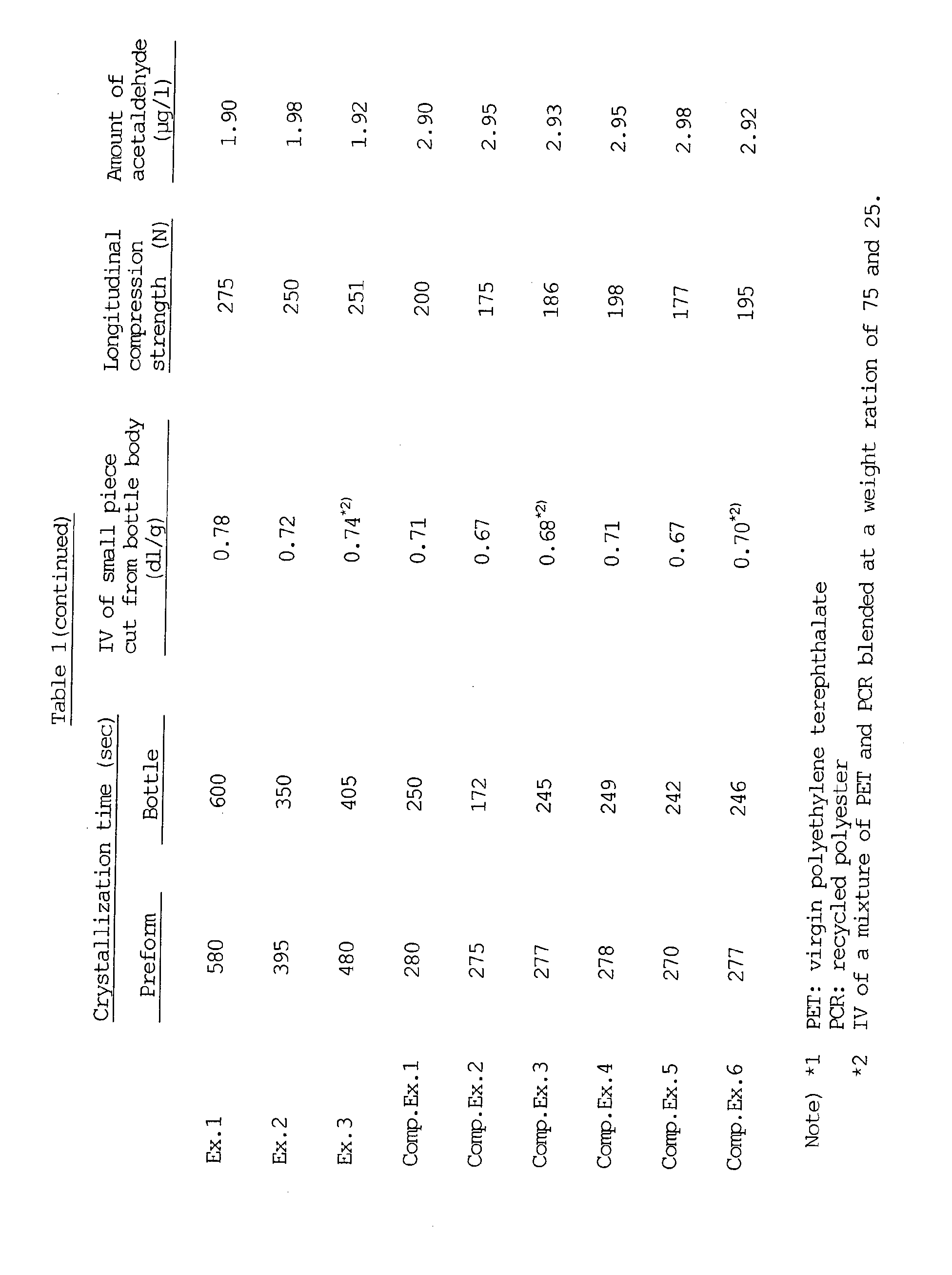
- the time is not shorter than 300 seconds and, particularly, is in a range of 400 to 700 seconds before the calorific value of isothermal crystallization of the surface of the bottle body at 210°C reaches a maximum value. This will become obvious from the results of Examples appearing later.
- this preform is biaxially draw blow-formed into a bottle, the time is 250 seconds before the calorific value of isothermal crystallization of the polyester layer at 210°C reaches a maximum value, and the container body exhibits a low buckling strength, a poor mechanical strength and inferior flavor-retaining property.
- the amount of the acetaldehyde is 1.9 ⁇ g/L which is a conspicuous decrease in the amount of the acetaldehyde as compared to that of Comparative Example 1.
- the time is 600 seconds before the calorific value of isothermal crystallization of the polyester layer at 210°C reaches a maximum value, and the container body exhibits a high buckling strength and excellent flavor-retaining property.
- the preform of the present invention is compression-formed by feeding a molten polyester resin having an inherent viscosity of not smaller than 0.72 dL/g to the compression-forming machine.
- a molten resin mass (drop) must be conveyed to the position of compression-forming.
- a crystalline resin that can be drawn and oriented such as a polyester resin, usually, has a large draw-down tendency.
- the resin When plasticized, i.e., when an inherent viscosity (IV) greatly drops down during the melt-kneading, therefore, the resin exhibits decreased mechanical strength and decreased flavor retentivity due to the thermal deterioration and, besides, undergoes the draw-down when a drop is formed arousing problems of spinning at the time of obtaining a molten resin mass (drop) by cutting the molten resin, a decrease in the stability of conveyance up to the step of compression molding and a decrease in the upright attitude in the compression metal mold.
- IV inherent viscosity
- the present invention suppresses a drop in the inherent viscosity (IV) caused by the thermal decomposition of the resin when it is being plasticized and maintains the inherent viscosity to be not lower than 0.72 dL/g when the resin is being melt-extruded making it possible to improve the problems of spinning in obtaining the drop, stability in the conveyance up to the step of compression-forming and stability in the upright attitude in the compression metal mold.
- IV inherent viscosity
- polyester resin that can be used for the present invention
- thermoplastic polyester resins in general that have heretofore been used for the packaging containers such as blow-formed containers.
- an ethylene terephthalate type thermoplastic polyester there can be advantageously used an ethylene terephthalate type thermoplastic polyester. It is, however, also allowable to use any other polyesters such as a polybutylene terephthalate and a polyethylene naphthalate, as well as a blend thereof with a polycarbonate or a polyarylate, as a matter of course.
- thermoplastic polyester which is a polyester resin that can be favorably used for the present invention, most of and, particularly, not less than 95 mol% of the ester recurring unit is occupied by the ethylene terephthalate unit. It is therefore desired to use a thermoplastic polyester having a glass transition point (Tg) of 50 to 90°C and, particularly, 55 to 80°C and a melting point (Tm) of 200 to 275°C and, particularly, 220 to 270°C.
- Tg glass transition point
- Tm melting point
- a homopolyethylene terephthalate is preferred from the standpoint of heat resistance and pressure resistance, it is allowable to use a copolymerized polyester containing small amounts of ester units other than the ethylene terephthalate units.
- dibasic acid other than the terephthalic acid there can be used aromatic dicarboxylic acids such as isophthalic acid, phthalic acid and naphthalenedicarboxylic acid; alicyclic dicarboxylic acids such as cyclohexanedicarboxylic acid; and aliphatic dicarboxylic acids such as succinic acid, adipic acid, sebacic acid and dodecanedioic acid in one kind or in a combination of two or more kinds. From the standpoint of improving the heat resistance, in particular, it is desired to use the isophthalic acid in combination.
- aromatic dicarboxylic acids such as isophthalic acid, phthalic acid and naphthalenedicarboxylic acid
- alicyclic dicarboxylic acids such as cyclohexanedicarboxylic acid
- aliphatic dicarboxylic acids such as succinic acid, adipic acid, sebacic acid and dodecanedioic acid in one
- diol component other than the ethylene glycol there can be exemplified propylene glycol, 1,4-butanediol, diethylene glycol, 1,6-hexylene glycol, cyclohexanedimethanol, and ethylene oxide adduct of bisphenol A, which may be used in one kind or in two or more kinds.
- the ethylene terephthalate thermoplastic polyester may be used being blended with, for example, a polyethylene naphthalate, a polycarbonate or a polyarylate having a relatively high glass transition point in an amount of about 5 to about 25%. Further, there may be formed a double layer of the polyethylene terephthalate and the above material having a relatively high glass transition point.
- the polyester resin that is used should at least have a molecular weight large enough for forming a film, and is of the injection grade or the extrusion grade depending upon the use.
- Its inherent viscosity (IV) is, usually, desired to lie in a range of 0.72 to 0.90 dL/g and, particularly, 0.73 to 0.88 dL/g as measured in a mixed solvent of phenol and tetrachloroethane at a weight ratio of 60:40 at a temperature of 30°C.
- the preform of the present invention may be a single-layer preform of the polyester resin only or a multi-layer preform having layers of thermoplastic resins other than the above polyester resin.
- thermoplastic resin other than the polyester resin there can be used any resin provided it can be draw blow-formed and heat-crystallized.
- examples thereof may include olefin-type resins such as polyethylene, polypropylene, ethylene/propylene copolymer, ethylene/vinyl alcohol copolymer and cyclic olefin polymer, and polyamide resins such as xylylene group-containing polyamide.
- an oxygen-absorbing gas-barrier resin composition obtained by blending a xylylene group-containing polyamide with a diene compound and a transition metal catalyst, or a recycled polyester (PCR (resin regenerated from the used bottles), SCR (resin by-produced in the production plant) or a mixture thereof). It is desired that the recycled polyester resins have intrinsic viscosities (IVs) in a range of 0.65 to 0.75 dL/g as measured by the above-mentioned method.
- the recycled polyester may be used alone or as a blend with a virgin polyester.
- the recycled polyester has a decreased inherent viscosity, it is desired to use it as a blend with the virgin polyester.
- the blending ratio of the recycled polyester to the virgin polyester is desirably from 1:5 to 5:1 by weight.
- the inner layer or the outer layer may be adhered to the intermediate layer via an adhesive resin.
- the adhesive resin there can be used an acid-modified olefin resin which is graft-polymerized with maleic acid, an amorphous polyester resin, or a polyamide resin.
- the above polyester resins or the thermoplastic resins other than the above polyester resin may be blended with various additives for resins, such as a coloring agent, an ultraviolet ray absorber, a parting agent, a lubricant and a nucleating agent in a range in which they do not impair the quality of the biaxially drawn container which is the finally formed article.
- various additives for resins such as a coloring agent, an ultraviolet ray absorber, a parting agent, a lubricant and a nucleating agent in a range in which they do not impair the quality of the biaxially drawn container which is the finally formed article.
- the layer constitutions of the multi-layer preforms of the present invention are as described below.
- Abbreviations in the following multi-layer structures are PET: virgin polyester resin, GBR: gas-barrier resin, PCR: recycled polyester resin, ADR: adhesive resin, OAR: oxygen-absorbing resin composition, and COC: cyclic olefin copolymer.
- PET/PCR/PET PET/(PET + PCR)/PET Four-layer structure PET/GBR/PCR/PET PET/GBR/OAR/PET PET/GBR/COC/PET
- the preform has a layer of a polyester resin and is formed by the compression-forming, wherein the time is not shorter than 300 seconds before a calorific value of isothermal crystallization of the layer of the polyester resin at 210°C reaches a maximum value.
- the cavity is filled with the resin running through a hot runner and a gate.
- the residence time of the molten resin increases and the resin tends to be thermally decomposed making it difficult to form the preform having the layer of the polyester resin, wherein the time is not shorter than 300 seconds before a calorific value of isothermal crystallization of the layer of the polyester resin at 210°C reaches a maximum value.
- the residence time of the resin is short, and the resin is not thermally deteriorated unlike that of the case of the injection forming making it possible to use a general-purpose resin.
- the preform is compression-formed and, particularly, the molten polyester resin having an inherent viscosity of not smaller than 0.72 dL/g is fed to the compression-forming machine at the time of melt extrusion preventing the thermal deterioration of the resin, improving the spinning at the time of obtaining a drop by cutting the molten polyester resin, improving the stability in the conveyance up to the step of compression-forming and in the upright attitude in the compression metal mold.
- the temperature of melt-extruding the molten polyester resin is in a range of Tm + 5°C to Tm + 40°C and, particularly, in a range of Tm + 10°C to Tm + 30°C with the melting point (Tm) of the polyester resin as a reference.
- Tm melting point
- a drop in the inherent viscosity at the time of melt extrusion is not larger than 10% on the basis of the inherent viscosity at the time when the polyester resin is thrown into the extruder.
- Fig. 2 is a view illustrating a compression-forming apparatus used for forming the multi-layer preform of the present invention.
- a resin A for forming the inner and outer layers is continuously fed from a main extruder 2, and a resin B for forming the intermediate layer is intermittently fed from a sub-extruder 3.
- the two resins meet together in a multi-layer die 4 and are melt-extruded from a nozzle 5 provided under the multi-layer die 4 in a manner that the resin B is sealed in the resin A.
- a resulting composite molten resin 7 that is extruded is cut into a predetermined size at a portion where there is no intermediate layer by cutting means 6 that moves in a horizontal direction.
- a mass 8 of the composite molten resin that is cut is held by a jig and is conveyed into a female mold 9 of the compression-forming apparatus constituted by the female mold 9 and a male mold 10.
- the mass 8 of the composite molten resin in the female mold 9 is compression-formed by the male mold 10 to form a multi-layer preform having the intermediate layer sealed by the inner layer and the outer layer.
- the preform of the invention is formed by using a multi-axis extruder that extrudes the molten resin in carrying out the compression-forming.
- This makes it possible to plasticize the resin at a lower temperature, under a lower pressure and at a lower rate than those of when a monoaxial extruder is used, as well as to relatively narrow the distribution of residence times in the extruder and, hence, to suppress the thermal degradation of the resin at the time of plasticizing, and to suppress a drop in the inherent viscosity and the formation of the acetaldehyde caused by the hydrolysis.
- the extruder is equipped with a vent to forcibly drain the water contained in the molten resin and the aldehyde formed by the thermal decomposition through a vent hole on the extruder side, making it possible to suppress the hydrolysis of the polyester caused by water and to improve the flavor-retaining property of the bottle.
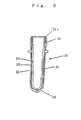
- Fig. 3 is a sectional view illustrating a multi-layer preform among the preforms of the present invention.
- the multi-layer preform generally designated at 20 includes a mouth-and-neck portion 21, a container body 22 and a bottom portion 23.
- the drawing concretely illustrates the preform obtained by the compression-forming without gate in the bottom portion.
- the mouth-and-neck portion 21 except an end portion 21a has the same three-layer structure including an inner layer 24, an intermediate layer 25 and an outer layer 26.
- the biaxially drawn container of the invention is such that the time is not shorter than 300 seconds before a calorific value of isothermal crystallization of the layer of the polyester resin at 210°C reaches a maximum value, and is obtained by subjecting the preform of the invention to the biaxial draw blow-forming.
- the preform of the present invention is heated at a drawing temperature, drawn in the axial direction and is blow-formed in the circumferential direction to produce the biaxially drawn container.
- preform and the draw blow forming can be applied not only to the cold parison system but also to the hot parison system which effects the draw blow forming without completely cooling the preform.
- the preform Prior to the draw blow, the preform, as required, is pre-heated to a temperature suited for the drawing by such means as the hot air, infrared-ray heater or r-f induction heating.
- the temperature range is 85 to 120°C and, particularly, 95 to 110°C.
- the preform is fed into the known draw blow-forming apparatus, is set in a metal mold, is tension-drawn in the axial direction by pushing a drawing rod, and is draw-formed in the circumferential direction by blowing the fluid.
- the metal mold temperature is in a range of room temperature to 190°C.
- the metal mold temperature is set to be 120 to 180°C.
- the drawing ratio in the final biaxially drawn container is desirably 1.5 to 25 times in terms of an area ratio and, particularly, 1.2 to 6 times in terms of a drawing ratio in the axial direction and 1.2 to 4.5 times in terms of a drawing ratio in the circumferential direction.
- the biaxially drawn container of the present invention can be thermally fixed by known means.
- the thermal fixing can be conducted by a one-molding method in a blow-forming metal mold or by a two-molding method in a metal mold for thermal fixing separate from the blow-forming metal mold.
- the temperature for the thermal fixing is in a range of, suitably, 120 to 180°C.
- a two-step blow-forming method in which the preform is formed into a primary blow-formed body of a size larger than that of the finally formed article by using a primary blow metal mold, and the primary blow-formed article is heat-shrunk and is draw blow-formed by using a secondary blow metal mold to obtain the finally formed article.
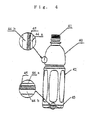
- Fig. 4 illustrates a multi-layer structure among the biaxially drawn containers of the invention.
- the biaxially drawn container generally designated at 40 has the shape of a bottle including a mouth portion 41, a container body 42 and a bottom portion 43, the container body 42 and the bottom portion 43 being formed by an inner layer 44a, an outer layer 44b and an intermediate layer 45 sealed therebetween.
- the mouth portion 41 is formed by the inner layer and the outer layer only like that of the above-mentioned multi-layer preform.
- the samples (10 mg) cut out from the preforms and from the bottle bodies were measured by using a differential scanning calorimeter (DSC 7 manufactured by Perkin Elmer Co.).
- the sample temperature was scanned in order of:
- the sample to be measured was a blend or multi-layers of the virgin polyethylene terephthalate resin and the recycled polyester resin
- the time was measured until a maximum peak value of crystallization of the virgin polyethylene terephthalate resin was reached since the virgin polyethylene terephthalate resin undergoes the crystallization at a slow rate.
- a bottle was purged with nitrogen, sealed, preserved at 22°C for one day, and the concentration of the acetaldehyde in the bottle was found by the gas chromatographic analysis.
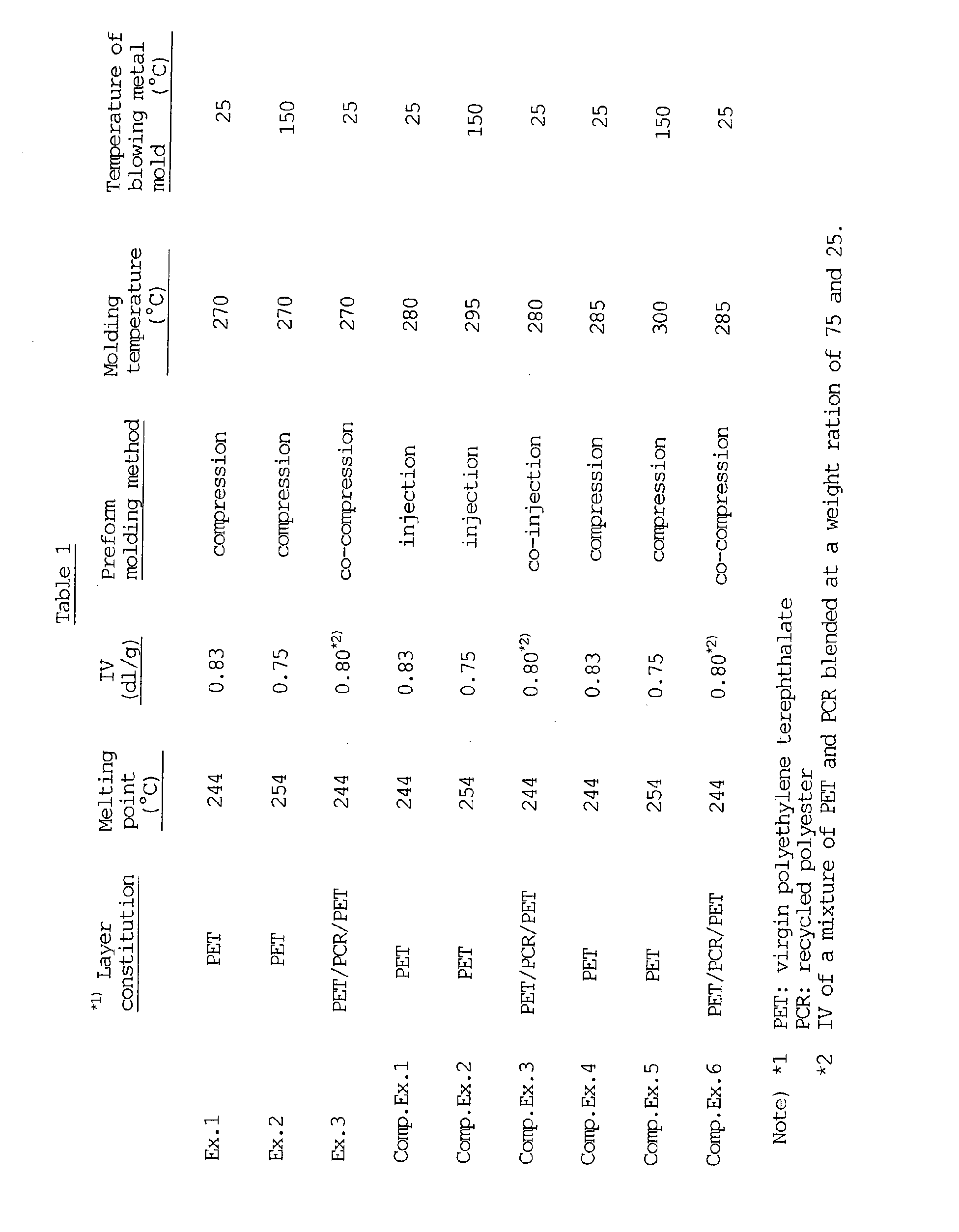
- a polyethylene terephthalate resin (5015W manufactured by Shinkogosen Co., containing 98.0 mol% of ethylene terephthalate units, melting point of 244°C, inherent viscosity of 0.83) was fed into the hopper of an extruder, extruded under the conditions of a temperature of 270°C at the die portion, resin pressure of 70 kgf/cm 2 and an inherent viscosity of the molten polyester resin at the time of melt extrusion of 0.78 dL/g, and was cut into a molten resin mass.
- the molten resin mass was set into a compression metal mold maintained at 20°C and was compression-formed under a condition of the mold-tightening pressure of 100 kgf/cm 2 to form a single-layer preform.
- the obtained preform was heated at a drawing temperature of 110°C and was biaxially draw blow-formed in a metal mold maintained at 25°C to obtain a bottle having a weight of 25 g and a volume of 530 ml.
- the preform that was formed was measured for its DSC, and the bottle was measured for its DSC, compression strength, tensile strength and the amount of the aldehyde.
- a preform and a bottle were formed in the same manner as in Example 1 but extruding, as the polyester resin, a polyethylene terephthalate resin (J125T manufactured by Mitsui Kagaku Co., containing 100 mol% of ethylene terephthalate units, melting point of 254°C, inherent viscosity of 0.75 dL/g) under such a condition that the inherent viscosity of the molten polyester resin at the time of melt extrusion was 0.72 dL/g, setting the temperature of the metal mold in the biaxial draw blow-forming to be 150°C and effecting the thermal fixing in the metal mold, and were evaluated in the same manner as in Example 1.
- a polyethylene terephthalate resin J125T manufactured by Mitsui Kagaku Co., containing 100 mol% of ethylene terephthalate units, melting point of 254°C, inherent viscosity of 0.75 dL/g
- a polyethylene terephthalate resin (5015W manufactured by Shinkogosen Co., containing 98.0 mol% of ethylene terephthalate units, melting point of 244°C, inherent viscosity of 0.83) was fed into an extruder for forming inner and outer layers, and a recycled polyester resin (flakes manufactured by Yono PET Bottle Recycle Co.) was fed into a biaxial extruder with a vent for forming an intermediate layer.
- the resins were co-extruded in a manner that the recycled polyester resin was sealed with the polyethylene terephthalate resin under the conditions of a temperature of 270°C at the die head, resin pressure of 70 kgf/cm 2 and an inherent viscosity of the molten polyester resin at the time of melt extrusion of 0.74 dL/g, and were cut into a molten resin mass.
- the molten resin mass was set into a compression metal mold maintained at 20°C and was multi-layer compression-formed under a condition of the mold-tightening pressure of 100 kgf/cm 2 to form a two-kind-three-layer preform having the intermediate layer of the recycled polyester resin.
- the obtained preform was heated at a drawing temperature of 110°C and was biaxially draw blow-formed in a metal mold maintained at 25°C to obtain a two-kind-three-layer bottle having a weight of 25 g, a ratio of the intermediate layer of 25% by weight and a volume of 530 ml.
- the preform that was formed was measured for its DSC, and the bottle was measured for its DSC, compression strength, tensile strength and the amount of the aldehyde.
- a preform and a bottle were formed in the same manner as in Example 1 but using an injector molding machine under such conditions that the temperature of the injection nozzle was 280°C, the resin pressure was 250 kgf/cm 2 and the inherent viscosity of the molten polyester at the time of melt injection, i.e., at the time of melt extrusion was 0.71 dL/g, and were evaluated in the same manner.
- a preform and a bottle were formed in the same manner as in Example 2 but using an injector molding machine under such conditions that the temperature of the injection nozzle was 295°C, the resin pressure was 250 kgf/cm 2 and the inherent viscosity of the molten polyester at the time of melt injection, i.e., at the time of melt extrusion was 0.67 dL/g, and were evaluated in the same manner.
- a preform and a bottle were formed in the same manner as in Example 3 but using a co-injector molding machine equipped with an injector for forming inner and outer layers and an injector for forming an intermediate layer under such conditions that the temperature of the injection nozzle was 280°C, the resin pressure was 250 kgf/cm 2 and the inherent viscosity of the molten polyester at the time of melt injection, i.e., at the time of melt extrusion was 0.68 dL/g, and were evaluated in the same manner.
- a preform and a bottle were formed in the same manner as in Example 1 but using an extruder under such conditions that the temperature of the die head was 285°C and the inherent viscosity of the molten polyester resin at the time of melt extrusion was 0.71 dL/g, and were evaluated in the same manner.
- a preform and a bottle were formed in the same manner as in Example 2 but using an extruder under such conditions that the temperature of the die head was 300°C and the inherent viscosity of the molten polyester resin at the time of melt extrusion was 0.67 dL/g, and were evaluated in the same manner.
- a preform and a bottle were formed in the same manner as in Example 3 but using an extruder under such conditions that the temperature of the die portion was 285°C and the inherent viscosity of the molten polyester resin at the time of melt extrusion was 0.70 dL/g, and were evaluated in the same manner.
Landscapes
- Engineering & Computer Science (AREA)
- Mechanical Engineering (AREA)
- Manufacturing & Machinery (AREA)
- Physics & Mathematics (AREA)
- Geometry (AREA)
- Blow-Moulding Or Thermoforming Of Plastics Or The Like (AREA)
- Processing And Handling Of Plastics And Other Materials For Molding In General (AREA)
- Laminated Bodies (AREA)
- Containers Having Bodies Formed In One Piece (AREA)
Abstract
Description
| Three-layer structure | PET/GBR/PET, PET/PCR/PET PET/(PET + PCR)/PET |
| Four-layer structure | PET/GBR/PCR/PET PET/GBR/OAR/PET PET/GBR/COC/PET |
| Five-layer structure | PET/ADR/GBR/ADR/PET PET/ADR/OAR/ADR/PET PET/GBR/PCR/GBR/PET PET/ADR/(GBR + OAR)/ADR/PET |
| Six-layer structure | PET/ADR/GBR/ADR/PCR/PET PET/ADR/OAR/ADR/PCR/PET |
| Seven-layer structure | PET/PCR/ADR/GBR/ADR/PCR/PET PET/ADR/GBR/ADR/OAR/ADR/PET |
and the time was measured in 4. above until a calorific value of crystallization reaches a maximum value.
Claims (9)
- A preform having at least a layer of a polyester resin and is formed by the compression-forming, wherein the time is not shorter than 300 seconds before a calorific value of isothermal crystallization of said layer of the polyester resin at 210°C reaches a maximum value.
- A preform according to claim 1, wherein said polyester resin is the one that contains an ethylene terephthalate unit at a ratio of not smaller than 95 mol%.
- A preform according to claim 1, wherein said polyester resin contains recycled polyester resins.
- A preform according to claim 1, wherein the preform has a layer of a thermoplastic resin other than the layer of said polyester resin.
- A preform according to claim 4, wherein the layer of said thermoplastic resin is an intermediate layer with the layers of said polyester resin as inner and outer layers, and is at least a layer of a gas-barrier resin or a recycled polyester resin.
- A method of producing a preform having at least a layer of a polyester resin and is formed by the compression-forming, wherein a molten polyester resin having an inherent viscosity at the time of melt-extrusion of not smaller than 0.72 dL/g is fed to a compression-forming machine and is compression-formed.
- A method of producing a preform according to claim 6, wherein the temperature of melt-extruding the molten polyester resin is in a range of Tm + 5°C to Tm + 40°C with the melting point (Tm) of the polyester resin as a reference.
- A method of producing a preform according to claim 6, wherein a drop of the inherent viscosity at the time of melt-extrusion from the inherent viscosity of when the polyester resin to be used is thrown into the extruder is not larger than 10%.
- A biaxially drawn container obtained by biaxially draw blow-forming the preform of claim 1, wherein the time is not shorter than 300 seconds before a calorific value of isothermal crystallization of the polyester layer at 210°C reaches a maximum value.
Priority Applications (1)
| Application Number | Priority Date | Filing Date | Title |
|---|---|---|---|
| EP20080169920 EP2025497A1 (en) | 2002-10-30 | 2003-10-23 | Method of producing a preform |
Applications Claiming Priority (3)
| Application Number | Priority Date | Filing Date | Title |
|---|---|---|---|
| JP2002315160 | 2002-10-30 | ||
| JP2002315160 | 2002-10-30 | ||
| PCT/JP2003/013549 WO2004039559A1 (en) | 2002-10-30 | 2003-10-23 | Preform, process for producing the same, and biaxially stretched container obtained from the preform |
Related Child Applications (1)
| Application Number | Title | Priority Date | Filing Date |
|---|---|---|---|
| EP20080169920 Division EP2025497A1 (en) | 2002-10-30 | 2003-10-23 | Method of producing a preform |
Publications (3)
| Publication Number | Publication Date |
|---|---|
| EP1579979A1 true EP1579979A1 (en) | 2005-09-28 |
| EP1579979A4 EP1579979A4 (en) | 2007-08-01 |
| EP1579979B1 EP1579979B1 (en) | 2009-04-01 |
Family
ID=32211643
Family Applications (2)
| Application Number | Title | Priority Date | Filing Date |
|---|---|---|---|
| EP20030809851 Expired - Lifetime EP1579979B1 (en) | 2002-10-30 | 2003-10-23 | Preform and biaxially stretched container obtained from the preform |
| EP20080169920 Withdrawn EP2025497A1 (en) | 2002-10-30 | 2003-10-23 | Method of producing a preform |
Family Applications After (1)
| Application Number | Title | Priority Date | Filing Date |
|---|---|---|---|
| EP20080169920 Withdrawn EP2025497A1 (en) | 2002-10-30 | 2003-10-23 | Method of producing a preform |
Country Status (8)
| Country | Link |
|---|---|
| US (2) | US20060127615A1 (en) |
| EP (2) | EP1579979B1 (en) |
| KR (1) | KR20050067213A (en) |
| CN (1) | CN100425432C (en) |
| AU (1) | AU2003277521B2 (en) |
| CA (1) | CA2504212A1 (en) |
| DE (1) | DE60326995D1 (en) |
| WO (1) | WO2004039559A1 (en) |
Cited By (1)
| Publication number | Priority date | Publication date | Assignee | Title |
|---|---|---|---|---|
| WO2007088475A1 (en) * | 2006-02-03 | 2007-08-09 | Sacmi Cooperativa Meccanici Imola Societa' Cooperativa | Preforms for obtaining containers and corresponding container |
Families Citing this family (11)
| Publication number | Priority date | Publication date | Assignee | Title |
|---|---|---|---|---|
| EP1876019B1 (en) * | 2005-04-08 | 2013-01-16 | Toyobo Co., Ltd. | Heat-shrinkable polyester film and heat-shrinkable labels |
| DE102008014215A1 (en) * | 2008-03-13 | 2009-09-17 | Krones Ag | Device for heating containers |
| WO2010024165A1 (en) * | 2008-08-28 | 2010-03-04 | 東洋製罐株式会社 | Compression-molding mold of preform and preform, and aseptic filling system for food or drink and method for producing blow-molded container using the same |
| GB2478732B (en) * | 2010-03-15 | 2014-08-20 | Kraft Foods R & D Inc | Improvements in injection moulding |
| WO2013172812A1 (en) | 2012-05-14 | 2013-11-21 | Bayer Materialscience Ag | Multi-layer film with improved modulus properties |
| JP6605312B2 (en) * | 2015-11-27 | 2019-11-13 | 株式会社吉野工業所 | Liquid blow molding method |
| US10870263B2 (en) | 2017-05-31 | 2020-12-22 | Bay Materials, Llc | Dual shell dental appliance and material constructions |
| US11999141B2 (en) | 2017-05-31 | 2024-06-04 | Bay Materials, Llc. | Dual shell dental appliance and material constructions |
| WO2018222864A1 (en) | 2017-05-31 | 2018-12-06 | Bay Materials, Llc | Dual shell dental appliance and material constructions |
| EP3722219B1 (en) | 2019-04-12 | 2024-11-27 | Société Anonyme des Eaux Minérales d'Evian et en Abrégé "S.A.E.M.E" | Thin wall container made with a recycled material |
| WO2023205730A1 (en) * | 2022-04-20 | 2023-10-26 | Origin Materials Operating, Inc. | Polyester resin closures for containers |
Family Cites Families (19)
| Publication number | Priority date | Publication date | Assignee | Title |
|---|---|---|---|---|
| JPS59136253A (en) * | 1983-01-26 | 1984-08-04 | 東洋製罐株式会社 | Multilayer plastic laminated structure |
| JP2942849B2 (en) * | 1990-10-16 | 1999-08-30 | 株式会社吉野工業所 | Biaxial stretch blow molded bottle |
| DE19505680C1 (en) * | 1995-02-20 | 1996-05-23 | Inventa Ag | Condensn. injection moulding of preform for food-quality bottle |
| US6004638A (en) * | 1995-03-09 | 1999-12-21 | Mitsui Chemicals, Inc. | Bottle from polyester composition and process for producing the same |
| JP2917851B2 (en) | 1995-03-28 | 1999-07-12 | 東洋製罐株式会社 | Method and apparatus for manufacturing a heat-resistant pressure-resistant self-standing container |
| AR001460A1 (en) * | 1995-03-29 | 1997-10-22 | Continental Pet Technologies | Refillable plastic container for pressurized applications, method for manufacturing it, preform for manufacturing the container and method for molding the preform. |
| US5804016A (en) * | 1996-03-07 | 1998-09-08 | Continental Pet Technologies, Inc. | Multilayer container resistant to elevated temperatures and pressures, and method of making the same |
| US6060140A (en) * | 1997-04-25 | 2000-05-09 | Eastman Chemical Company | Lightweight bottles and method for making same |
| JP3417255B2 (en) * | 1997-06-05 | 2003-06-16 | 東洋製罐株式会社 | Preformed body to be blow molded into a container and compression molding apparatus for compression molding the same |
| CN1239035A (en) * | 1998-06-15 | 1999-12-22 | 财团法人工业技术研究院 | Extrusion blow molding method and device thereof |
| JP3405209B2 (en) * | 1998-07-09 | 2003-05-12 | 東洋製罐株式会社 | Method of manufacturing preform for blow molding |
| JP3436144B2 (en) * | 1998-08-26 | 2003-08-11 | 東洋製罐株式会社 | Container manufacturing method, and compression mold and preformed body used for the method |
| US6349838B1 (en) * | 1998-12-25 | 2002-02-26 | Toyo Seikan Kaisha, Ltd. | Plastic bottle and method of producing the same |
| JP3674385B2 (en) * | 1999-04-02 | 2005-07-20 | 東洋製罐株式会社 | Synthetic resin feeder |
| JP2002103428A (en) * | 2000-09-29 | 2002-04-09 | Toyo Seikan Kaisha Ltd | Multilayer preform and multilayer bottle manufactured using the same |
| JP2002248675A (en) * | 2001-02-23 | 2002-09-03 | Toyo Seikan Kaisha Ltd | Multilayer preform and method of manufacturing the same |
| JP4232348B2 (en) * | 2001-03-30 | 2009-03-04 | 東洋製罐株式会社 | Multilayer preform manufacturing method |
| JP2003136583A (en) * | 2001-11-02 | 2003-05-14 | Toyo Seikan Kaisha Ltd | Preform molding method |
| AU2003252855B2 (en) * | 2002-10-22 | 2008-09-18 | Mitsubishi Gas Chemical Company, Inc. | Gas-barrier multi-layer structure |
-
2003
- 2003-10-23 DE DE60326995T patent/DE60326995D1/en not_active Expired - Lifetime
- 2003-10-23 CA CA 2504212 patent/CA2504212A1/en not_active Abandoned
- 2003-10-23 US US10/533,301 patent/US20060127615A1/en not_active Abandoned
- 2003-10-23 WO PCT/JP2003/013549 patent/WO2004039559A1/en not_active Ceased
- 2003-10-23 KR KR1020057007634A patent/KR20050067213A/en not_active Ceased
- 2003-10-23 CN CNB2003801078662A patent/CN100425432C/en not_active Expired - Fee Related
- 2003-10-23 EP EP20030809851 patent/EP1579979B1/en not_active Expired - Lifetime
- 2003-10-23 EP EP20080169920 patent/EP2025497A1/en not_active Withdrawn
- 2003-10-23 AU AU2003277521A patent/AU2003277521B2/en not_active Ceased
-
2009
- 2009-09-01 US US12/552,227 patent/US20090317577A1/en not_active Abandoned
Cited By (2)
| Publication number | Priority date | Publication date | Assignee | Title |
|---|---|---|---|---|
| WO2007088475A1 (en) * | 2006-02-03 | 2007-08-09 | Sacmi Cooperativa Meccanici Imola Societa' Cooperativa | Preforms for obtaining containers and corresponding container |
| RU2421331C2 (en) * | 2006-02-03 | 2011-06-20 | Сакми Кооператива Мекканичи Имола Сочиета` Кооператива | Billet for producing containers and appropriate container |
Also Published As
| Publication number | Publication date |
|---|---|
| US20090317577A1 (en) | 2009-12-24 |
| WO2004039559A1 (en) | 2004-05-13 |
| EP1579979A4 (en) | 2007-08-01 |
| CA2504212A1 (en) | 2004-05-13 |
| AU2003277521A1 (en) | 2004-05-25 |
| EP2025497A1 (en) | 2009-02-18 |
| CN100425432C (en) | 2008-10-15 |
| US20060127615A1 (en) | 2006-06-15 |
| CN1732074A (en) | 2006-02-08 |
| DE60326995D1 (en) | 2009-05-14 |
| EP1579979B1 (en) | 2009-04-01 |
| AU2003277521B2 (en) | 2009-01-08 |
| KR20050067213A (en) | 2005-06-30 |
Similar Documents
| Publication | Publication Date | Title |
|---|---|---|
| US20090317577A1 (en) | Preform, method of producing the same, and biaxially drawn container made from the preform | |
| US6929836B2 (en) | Multi-layered preform and multi-layered bottle manufactured by using the same | |
| AU688899B2 (en) | Polyethylene terephthalate-containing laminate | |
| EP1757430B1 (en) | Preform | |
| AU727103B2 (en) | Method for preventing uncontrolled polymer flow in preform neck finish during packing and cooling stage | |
| KR20000048355A (en) | Plastic bottle and method of producing the same | |
| JP4186587B2 (en) | Preform and biaxially stretched container manufactured using the same | |
| US20050136201A1 (en) | Method of improving the environmental stretch crack resistance of RPET without solid stating | |
| JP2003127211A (en) | Preform molding method and apparatus | |
| JP2003039531A (en) | Multilayer preform and multilayer bottle using the same | |
| JP2002248675A (en) | Multilayer preform and method of manufacturing the same | |
| JP2004168039A (en) | Preform, method for producing the same, and biaxially stretched container comprising the preform | |
| JP2005171081A (en) | Polyester resin for compression molding and preform and polyester container made of this resin | |
| JP2005171109A (en) | Polyester resin for compression molding, method for producing preform, preform and polyester container | |
| JP2005171082A (en) | Polyester resin for compression molding and preform and polyester container made of this resin | |
| JPH01214423A (en) | Oriented blow polyester container and its manufacture |
Legal Events
| Date | Code | Title | Description |
|---|---|---|---|
| PUAI | Public reference made under article 153(3) epc to a published international application that has entered the european phase |
Free format text: ORIGINAL CODE: 0009012 |
|
| 17P | Request for examination filed |
Effective date: 20050429 |
|
| AK | Designated contracting states |
Kind code of ref document: A1 Designated state(s): AT BE BG CH CY CZ DE DK EE ES FI FR GB GR HU IE IT LI LU MC NL PT RO SE SI SK TR |
|
| AX | Request for extension of the european patent |
Extension state: AL LT LV MK |
|
| DAX | Request for extension of the european patent (deleted) | ||
| RBV | Designated contracting states (corrected) |
Designated state(s): DE FR GB IT |
|
| A4 | Supplementary search report drawn up and despatched |
Effective date: 20070702 |
|
| RIC1 | Information provided on ipc code assigned before grant |
Ipc: B29C 49/22 20060101ALN20070626BHEP Ipc: B29B 11/12 20060101ALI20070626BHEP Ipc: B29C 49/08 20060101ALN20070626BHEP Ipc: B29C 43/08 20060101ALN20070626BHEP Ipc: B29C 49/02 20060101AFI20040518BHEP Ipc: B29C 43/42 20060101ALN20070626BHEP |
|
| 17Q | First examination report despatched |
Effective date: 20071004 |
|
| GRAP | Despatch of communication of intention to grant a patent |
Free format text: ORIGINAL CODE: EPIDOSNIGR1 |
|
| RTI1 | Title (correction) |
Free format text: PREFORM AND BIAXIALLY STRETCHED CONTAINER OBTAINED FROM THE PREFORM |
|
| GRAS | Grant fee paid |
Free format text: ORIGINAL CODE: EPIDOSNIGR3 |
|
| GRAA | (expected) grant |
Free format text: ORIGINAL CODE: 0009210 |
|
| AK | Designated contracting states |
Kind code of ref document: B1 Designated state(s): DE FR GB IT |
|
| REG | Reference to a national code |
Ref country code: GB Ref legal event code: FG4D |
|
| REF | Corresponds to: |
Ref document number: 60326995 Country of ref document: DE Date of ref document: 20090514 Kind code of ref document: P |
|
| PLBE | No opposition filed within time limit |
Free format text: ORIGINAL CODE: 0009261 |
|
| STAA | Information on the status of an ep patent application or granted ep patent |
Free format text: STATUS: NO OPPOSITION FILED WITHIN TIME LIMIT |
|
| 26N | No opposition filed |
Effective date: 20100105 |
|
| REG | Reference to a national code |
Ref country code: FR Ref legal event code: PLFP Year of fee payment: 13 |
|
| REG | Reference to a national code |
Ref country code: FR Ref legal event code: PLFP Year of fee payment: 14 |
|
| REG | Reference to a national code |
Ref country code: FR Ref legal event code: PLFP Year of fee payment: 15 |
|
| REG | Reference to a national code |
Ref country code: FR Ref legal event code: PLFP Year of fee payment: 16 |
|
| PGFP | Annual fee paid to national office [announced via postgrant information from national office to epo] |
Ref country code: GB Payment date: 20201022 Year of fee payment: 18 Ref country code: DE Payment date: 20201022 Year of fee payment: 18 Ref country code: FR Payment date: 20201021 Year of fee payment: 18 Ref country code: IT Payment date: 20201026 Year of fee payment: 18 |
|
| REG | Reference to a national code |
Ref country code: DE Ref legal event code: R119 Ref document number: 60326995 Country of ref document: DE |
|
| GBPC | Gb: european patent ceased through non-payment of renewal fee |
Effective date: 20211023 |
|
| PG25 | Lapsed in a contracting state [announced via postgrant information from national office to epo] |
Ref country code: GB Free format text: LAPSE BECAUSE OF NON-PAYMENT OF DUE FEES Effective date: 20211023 Ref country code: DE Free format text: LAPSE BECAUSE OF NON-PAYMENT OF DUE FEES Effective date: 20220503 |
|
| PG25 | Lapsed in a contracting state [announced via postgrant information from national office to epo] |
Ref country code: FR Free format text: LAPSE BECAUSE OF NON-PAYMENT OF DUE FEES Effective date: 20211031 |
|
| PG25 | Lapsed in a contracting state [announced via postgrant information from national office to epo] |
Ref country code: IT Free format text: LAPSE BECAUSE OF NON-PAYMENT OF DUE FEES Effective date: 20211023 |