EP1578327B1 - Absorbierende artikel mit verbessertem auslaufschutz - Google Patents
Absorbierende artikel mit verbessertem auslaufschutz Download PDFInfo
- Publication number
- EP1578327B1 EP1578327B1 EP03754826A EP03754826A EP1578327B1 EP 1578327 B1 EP1578327 B1 EP 1578327B1 EP 03754826 A EP03754826 A EP 03754826A EP 03754826 A EP03754826 A EP 03754826A EP 1578327 B1 EP1578327 B1 EP 1578327B1
- Authority
- EP
- European Patent Office
- Prior art keywords
- elastomeric
- chassis
- absorbent article
- absorbent
- article
- Prior art date
- Legal status (The legal status is an assumption and is not a legal conclusion. Google has not performed a legal analysis and makes no representation as to the accuracy of the status listed.)
- Revoked
Links
- 230000002745 absorbent Effects 0.000 title claims abstract description 123
- 239000002250 absorbent Substances 0.000 title claims abstract description 123
- 239000000463 material Substances 0.000 claims description 83
- 239000007788 liquid Substances 0.000 claims description 24
- -1 polypropylene Polymers 0.000 claims description 15
- 239000013536 elastomeric material Substances 0.000 claims description 11
- 239000004743 Polypropylene Substances 0.000 claims description 9
- 229920001155 polypropylene Polymers 0.000 claims description 9
- 239000002648 laminated material Substances 0.000 claims description 4
- 239000010410 layer Substances 0.000 description 28
- 239000000835 fiber Substances 0.000 description 19
- 239000000853 adhesive Substances 0.000 description 16
- 230000001070 adhesive effect Effects 0.000 description 16
- 238000000034 method Methods 0.000 description 14
- 239000002131 composite material Substances 0.000 description 12
- 239000004744 fabric Substances 0.000 description 12
- 229920001971 elastomer Polymers 0.000 description 7
- 239000000806 elastomer Substances 0.000 description 7
- 239000006260 foam Substances 0.000 description 6
- 230000008569 process Effects 0.000 description 6
- 239000004698 Polyethylene Substances 0.000 description 5
- 238000010276 construction Methods 0.000 description 5
- 230000014759 maintenance of location Effects 0.000 description 5
- 229920000573 polyethylene Polymers 0.000 description 5
- 239000004094 surface-active agent Substances 0.000 description 5
- 206010021639 Incontinence Diseases 0.000 description 4
- FAPWRFPIFSIZLT-UHFFFAOYSA-M Sodium chloride Chemical compound [Na+].[Cl-] FAPWRFPIFSIZLT-UHFFFAOYSA-M 0.000 description 4
- 239000000203 mixture Substances 0.000 description 4
- 230000000704 physical effect Effects 0.000 description 4
- 229920000728 polyester Polymers 0.000 description 4
- 239000011780 sodium chloride Substances 0.000 description 4
- 229920002994 synthetic fiber Polymers 0.000 description 4
- 239000012209 synthetic fiber Substances 0.000 description 4
- 229920001169 thermoplastic Polymers 0.000 description 4
- 229920002633 Kraton (polymer) Polymers 0.000 description 3
- 229920002614 Polyether block amide Polymers 0.000 description 3
- 229920001131 Pulp (paper) Polymers 0.000 description 3
- 230000008901 benefit Effects 0.000 description 3
- 230000015556 catabolic process Effects 0.000 description 3
- 238000006731 degradation reaction Methods 0.000 description 3
- 239000013013 elastic material Substances 0.000 description 3
- 239000012530 fluid Substances 0.000 description 3
- 230000002209 hydrophobic effect Effects 0.000 description 3
- 239000004745 nonwoven fabric Substances 0.000 description 3
- 229920000098 polyolefin Polymers 0.000 description 3
- 239000000126 substance Substances 0.000 description 3
- 229920000742 Cotton Polymers 0.000 description 2
- 229920000297 Rayon Polymers 0.000 description 2
- VYPSYNLAJGMNEJ-UHFFFAOYSA-N Silicium dioxide Chemical compound O=[Si]=O VYPSYNLAJGMNEJ-UHFFFAOYSA-N 0.000 description 2
- 229920002334 Spandex Polymers 0.000 description 2
- 229920002522 Wood fibre Polymers 0.000 description 2
- 238000007796 conventional method Methods 0.000 description 2
- 230000000593 degrading effect Effects 0.000 description 2
- 238000009826 distribution Methods 0.000 description 2
- 239000000499 gel Substances 0.000 description 2
- 238000010030 laminating Methods 0.000 description 2
- 239000011159 matrix material Substances 0.000 description 2
- 230000002175 menstrual effect Effects 0.000 description 2
- 238000012986 modification Methods 0.000 description 2
- 230000004048 modification Effects 0.000 description 2
- 231100000344 non-irritating Toxicity 0.000 description 2
- 239000002245 particle Substances 0.000 description 2
- 239000002985 plastic film Substances 0.000 description 2
- 229920006255 plastic film Polymers 0.000 description 2
- 229920005594 polymer fiber Polymers 0.000 description 2
- 238000007639 printing Methods 0.000 description 2
- 239000002964 rayon Substances 0.000 description 2
- 239000002356 single layer Substances 0.000 description 2
- 239000004759 spandex Substances 0.000 description 2
- 239000004416 thermosoftening plastic Substances 0.000 description 2
- 206010016322 Feeling abnormal Diseases 0.000 description 1
- 239000004831 Hot glue Substances 0.000 description 1
- 239000004952 Polyamide Substances 0.000 description 1
- 229920001247 Reticulated foam Polymers 0.000 description 1
- QAOWNCQODCNURD-UHFFFAOYSA-L Sulfate Chemical compound [O-]S([O-])(=O)=O QAOWNCQODCNURD-UHFFFAOYSA-L 0.000 description 1
- 230000004913 activation Effects 0.000 description 1
- 239000011230 binding agent Substances 0.000 description 1
- 210000001124 body fluid Anatomy 0.000 description 1
- 239000003795 chemical substances by application Substances 0.000 description 1
- 239000011248 coating agent Substances 0.000 description 1
- 238000000576 coating method Methods 0.000 description 1
- 230000001010 compromised effect Effects 0.000 description 1
- 230000008602 contraction Effects 0.000 description 1
- 229920006037 cross link polymer Polymers 0.000 description 1
- 238000004049 embossing Methods 0.000 description 1
- 210000000416 exudates and transudate Anatomy 0.000 description 1
- 239000011521 glass Substances 0.000 description 1
- 238000010438 heat treatment Methods 0.000 description 1
- 229910010272 inorganic material Inorganic materials 0.000 description 1
- 239000011147 inorganic material Substances 0.000 description 1
- 238000005304 joining Methods 0.000 description 1
- 239000006210 lotion Substances 0.000 description 1
- 238000004519 manufacturing process Methods 0.000 description 1
- 238000010297 mechanical methods and process Methods 0.000 description 1
- 230000005226 mechanical processes and functions Effects 0.000 description 1
- 230000007246 mechanism Effects 0.000 description 1
- 229920005615 natural polymer Polymers 0.000 description 1
- 150000002894 organic compounds Chemical class 0.000 description 1
- 239000011368 organic material Substances 0.000 description 1
- 238000004806 packaging method and process Methods 0.000 description 1
- 239000000049 pigment Substances 0.000 description 1
- 229920002647 polyamide Polymers 0.000 description 1
- 229920001748 polybutylene Polymers 0.000 description 1
- 229920000642 polymer Polymers 0.000 description 1
- 229920006254 polymer film Polymers 0.000 description 1
- 229920002635 polyurethane Polymers 0.000 description 1
- 239000004814 polyurethane Substances 0.000 description 1
- 230000002040 relaxant effect Effects 0.000 description 1
- 238000007665 sagging Methods 0.000 description 1
- 239000000377 silicon dioxide Substances 0.000 description 1
- 239000011122 softwood Substances 0.000 description 1
- 238000005507 spraying Methods 0.000 description 1
- 230000000087 stabilizing effect Effects 0.000 description 1
- 238000003860 storage Methods 0.000 description 1
- 229920001059 synthetic polymer Polymers 0.000 description 1
- 239000004753 textile Substances 0.000 description 1
- 239000012815 thermoplastic material Substances 0.000 description 1
- XLYOFNOQVPJJNP-UHFFFAOYSA-N water Substances O XLYOFNOQVPJJNP-UHFFFAOYSA-N 0.000 description 1
- 238000009941 weaving Methods 0.000 description 1
- 238000003466 welding Methods 0.000 description 1
- 239000002023 wood Substances 0.000 description 1
- 239000002759 woven fabric Substances 0.000 description 1
Images



Classifications
-
- A—HUMAN NECESSITIES
- A61—MEDICAL OR VETERINARY SCIENCE; HYGIENE
- A61F—FILTERS IMPLANTABLE INTO BLOOD VESSELS; PROSTHESES; DEVICES PROVIDING PATENCY TO, OR PREVENTING COLLAPSING OF, TUBULAR STRUCTURES OF THE BODY, e.g. STENTS; ORTHOPAEDIC, NURSING OR CONTRACEPTIVE DEVICES; FOMENTATION; TREATMENT OR PROTECTION OF EYES OR EARS; BANDAGES, DRESSINGS OR ABSORBENT PADS; FIRST-AID KITS
- A61F13/00—Bandages or dressings; Absorbent pads
- A61F13/15—Absorbent pads, e.g. sanitary towels, swabs or tampons for external or internal application to the body; Supporting or fastening means therefor; Tampon applicators
- A61F13/45—Absorbent pads, e.g. sanitary towels, swabs or tampons for external or internal application to the body; Supporting or fastening means therefor; Tampon applicators characterised by the shape
- A61F13/49—Absorbent pads, e.g. sanitary towels, swabs or tampons for external or internal application to the body; Supporting or fastening means therefor; Tampon applicators characterised by the shape specially adapted to be worn around the waist, e.g. diapers, nappies
- A61F13/494—Absorbent pads, e.g. sanitary towels, swabs or tampons for external or internal application to the body; Supporting or fastening means therefor; Tampon applicators characterised by the shape specially adapted to be worn around the waist, e.g. diapers, nappies characterised by edge leakage prevention means
-
- A—HUMAN NECESSITIES
- A61—MEDICAL OR VETERINARY SCIENCE; HYGIENE
- A61F—FILTERS IMPLANTABLE INTO BLOOD VESSELS; PROSTHESES; DEVICES PROVIDING PATENCY TO, OR PREVENTING COLLAPSING OF, TUBULAR STRUCTURES OF THE BODY, e.g. STENTS; ORTHOPAEDIC, NURSING OR CONTRACEPTIVE DEVICES; FOMENTATION; TREATMENT OR PROTECTION OF EYES OR EARS; BANDAGES, DRESSINGS OR ABSORBENT PADS; FIRST-AID KITS
- A61F13/00—Bandages or dressings; Absorbent pads
- A61F13/15—Absorbent pads, e.g. sanitary towels, swabs or tampons for external or internal application to the body; Supporting or fastening means therefor; Tampon applicators
- A61F13/45—Absorbent pads, e.g. sanitary towels, swabs or tampons for external or internal application to the body; Supporting or fastening means therefor; Tampon applicators characterised by the shape
- A61F13/49—Absorbent pads, e.g. sanitary towels, swabs or tampons for external or internal application to the body; Supporting or fastening means therefor; Tampon applicators characterised by the shape specially adapted to be worn around the waist, e.g. diapers, nappies
- A61F13/494—Absorbent pads, e.g. sanitary towels, swabs or tampons for external or internal application to the body; Supporting or fastening means therefor; Tampon applicators characterised by the shape specially adapted to be worn around the waist, e.g. diapers, nappies characterised by edge leakage prevention means
- A61F13/49406—Absorbent pads, e.g. sanitary towels, swabs or tampons for external or internal application to the body; Supporting or fastening means therefor; Tampon applicators characterised by the shape specially adapted to be worn around the waist, e.g. diapers, nappies characterised by edge leakage prevention means the edge leakage prevention means being at the crotch region
- A61F13/49413—Absorbent pads, e.g. sanitary towels, swabs or tampons for external or internal application to the body; Supporting or fastening means therefor; Tampon applicators characterised by the shape specially adapted to be worn around the waist, e.g. diapers, nappies characterised by edge leakage prevention means the edge leakage prevention means being at the crotch region the edge leakage prevention means being an upstanding barrier
- A61F13/4942—Absorbent pads, e.g. sanitary towels, swabs or tampons for external or internal application to the body; Supporting or fastening means therefor; Tampon applicators characterised by the shape specially adapted to be worn around the waist, e.g. diapers, nappies characterised by edge leakage prevention means the edge leakage prevention means being at the crotch region the edge leakage prevention means being an upstanding barrier the barrier not being integral with the top- or back-sheet
-
- A—HUMAN NECESSITIES
- A61—MEDICAL OR VETERINARY SCIENCE; HYGIENE
- A61F—FILTERS IMPLANTABLE INTO BLOOD VESSELS; PROSTHESES; DEVICES PROVIDING PATENCY TO, OR PREVENTING COLLAPSING OF, TUBULAR STRUCTURES OF THE BODY, e.g. STENTS; ORTHOPAEDIC, NURSING OR CONTRACEPTIVE DEVICES; FOMENTATION; TREATMENT OR PROTECTION OF EYES OR EARS; BANDAGES, DRESSINGS OR ABSORBENT PADS; FIRST-AID KITS
- A61F13/00—Bandages or dressings; Absorbent pads
- A61F13/15—Absorbent pads, e.g. sanitary towels, swabs or tampons for external or internal application to the body; Supporting or fastening means therefor; Tampon applicators
-
- A—HUMAN NECESSITIES
- A61—MEDICAL OR VETERINARY SCIENCE; HYGIENE
- A61F—FILTERS IMPLANTABLE INTO BLOOD VESSELS; PROSTHESES; DEVICES PROVIDING PATENCY TO, OR PREVENTING COLLAPSING OF, TUBULAR STRUCTURES OF THE BODY, e.g. STENTS; ORTHOPAEDIC, NURSING OR CONTRACEPTIVE DEVICES; FOMENTATION; TREATMENT OR PROTECTION OF EYES OR EARS; BANDAGES, DRESSINGS OR ABSORBENT PADS; FIRST-AID KITS
- A61F13/00—Bandages or dressings; Absorbent pads
- A61F13/15—Absorbent pads, e.g. sanitary towels, swabs or tampons for external or internal application to the body; Supporting or fastening means therefor; Tampon applicators
- A61F13/45—Absorbent pads, e.g. sanitary towels, swabs or tampons for external or internal application to the body; Supporting or fastening means therefor; Tampon applicators characterised by the shape
- A61F13/49—Absorbent pads, e.g. sanitary towels, swabs or tampons for external or internal application to the body; Supporting or fastening means therefor; Tampon applicators characterised by the shape specially adapted to be worn around the waist, e.g. diapers, nappies
- A61F13/49007—Form-fitting, self-adjusting disposable diapers
- A61F13/49009—Form-fitting, self-adjusting disposable diapers with elastic means
- A61F13/49017—Form-fitting, self-adjusting disposable diapers with elastic means the elastic means being located at the crotch region
-
- A—HUMAN NECESSITIES
- A61—MEDICAL OR VETERINARY SCIENCE; HYGIENE
- A61F—FILTERS IMPLANTABLE INTO BLOOD VESSELS; PROSTHESES; DEVICES PROVIDING PATENCY TO, OR PREVENTING COLLAPSING OF, TUBULAR STRUCTURES OF THE BODY, e.g. STENTS; ORTHOPAEDIC, NURSING OR CONTRACEPTIVE DEVICES; FOMENTATION; TREATMENT OR PROTECTION OF EYES OR EARS; BANDAGES, DRESSINGS OR ABSORBENT PADS; FIRST-AID KITS
- A61F13/00—Bandages or dressings; Absorbent pads
- A61F13/15—Absorbent pads, e.g. sanitary towels, swabs or tampons for external or internal application to the body; Supporting or fastening means therefor; Tampon applicators
- A61F13/45—Absorbent pads, e.g. sanitary towels, swabs or tampons for external or internal application to the body; Supporting or fastening means therefor; Tampon applicators characterised by the shape
- A61F13/49—Absorbent pads, e.g. sanitary towels, swabs or tampons for external or internal application to the body; Supporting or fastening means therefor; Tampon applicators characterised by the shape specially adapted to be worn around the waist, e.g. diapers, nappies
- A61F13/496—Absorbent pads, e.g. sanitary towels, swabs or tampons for external or internal application to the body; Supporting or fastening means therefor; Tampon applicators characterised by the shape specially adapted to be worn around the waist, e.g. diapers, nappies in the form of pants or briefs
-
- A—HUMAN NECESSITIES
- A61—MEDICAL OR VETERINARY SCIENCE; HYGIENE
- A61F—FILTERS IMPLANTABLE INTO BLOOD VESSELS; PROSTHESES; DEVICES PROVIDING PATENCY TO, OR PREVENTING COLLAPSING OF, TUBULAR STRUCTURES OF THE BODY, e.g. STENTS; ORTHOPAEDIC, NURSING OR CONTRACEPTIVE DEVICES; FOMENTATION; TREATMENT OR PROTECTION OF EYES OR EARS; BANDAGES, DRESSINGS OR ABSORBENT PADS; FIRST-AID KITS
- A61F13/00—Bandages or dressings; Absorbent pads
- A61F13/15—Absorbent pads, e.g. sanitary towels, swabs or tampons for external or internal application to the body; Supporting or fastening means therefor; Tampon applicators
- A61F13/56—Supporting or fastening means
- A61F13/66—Garments, holders or supports not integral with absorbent pads
- A61F13/80—Garments, holders or supports not integral with absorbent pads adjustable relative to body crotch area
Definitions
- the present invention relates generally to the field of absorbent articles and garments, such as children's training pants, disposable diapers, incontinence articles, and the like, which incorporate leak guards or containment flaps along their side edges.
- absorbent pad structure for absorbing and wicking away bodily fluids.
- the absorbent pads are conventionally formed from an absorbent web disposed between a liquid pervious bodyside liner and a liquid impermeable outer cover.
- Such absorbent articles may include an elasticized waistband and leg cuffs to help reduce the leakage of body exudates.
- Some conventional absorbent articles have also included leak guards (also known in the art as "containment flaps") at the leg or waist sections of the article to further reduce the occurrence of leaks. These guards may be "elasticized” along their free longitudinal edge by incorporating elastic strips or strands along the free edge.
- pant-like absorbent structures such as a child's training pant
- lateral leak guards alongside of the absorbent structure generally from the front waist band to the back waist band.
- containment flaps in training pants is also described, for example, in WO 00/35395 and U.S. Pat. No. 6,231,557 B1 .
- the lateral containment flaps are formed of non-stretch or non-elastomeric materials.
- a conventional leak guard used in the HUGGIES® PULL-UPS® disposable training pants is a laminate of a non-stretch polyethylene film and non-stretch spunbond web.
- the non-stretch leak guards may detract from the performance or properties of other stretch materials or components, such as stretch waistbands, stretch outer covers, stretch bodyside liners, and stretch absorbent structures.
- non-stretch leak guards are attached (e.g., bonded or adhered) to a stretchable component such as an elastic waistband or elastomeric bodyside liner, the ability of such component to stretch as designed may be compromised.
- a stretchable component such as an elastic waistband or elastomeric bodyside liner
- the present Invention provides an improved configuration for absorbent article leak guards that is compatible with other elastomeric or stretchable components in the article.
- the present invention provides an improved absorbent article having stretchable or elastomeric leak guards that cooperate with other stretchable components of the article while protecting against leakage from the sides of the absorbent structure contained in the article.
- a particularly useful embodiment of the invention is a child's training pant.
- other absorbent articles such as incontinence devices, disposable diapers, diaper pants, feminine hygiene products, swim pants, and the like, are also within the scope of the invention.
- a pant-like absorbent article includes a chassis defining a front waist region at a first longitudinal end, a back waist region at an opposite longitudinal end, and a crotch region extending longitudinally between said front and back waist regions.
- the chassis may be defined generally entirely of elastomeric materials, or may only have particular regions or portions made up of elastomeric materials. It should be appreciated that the materials used in the article are not a limiting factor, and that any combination of known materials and compositions may be used in the manufacture of articles according to the invention.
- laterally extending panel portions are defined at opposed lateral sides of one or both of the front and back waist regions. These panel portions extend around the front and back waist of a wearer and meet at side seams of the article.
- the side panel portions may also define laterally inwardly directed leg contours. When the chassis is formed into the pant-like article, the panel portions are joined at the side seams and the leg contours define leg openings in conjunction with the crotch region of the article. This type of configuration is well known in the art.
- At least the front and back panel portions of the chassis waist regions are elastomeric and thus stretchable.
- elastomeric side panels may be attached to a generally non-elastomeric central portion of the chassis.
- essentially the entire chassis may be formed of elastomeric materials and be stretchable.
- the article includes an absorbent body structure having a central portion that extends longitudinally along said crotch region generally from the front waist region to the back waist region.
- the absorbent body structure may have any desired shape depending on the type of absorbent article.
- the absorbent body structure may be rectangular, T-shape, hour-glass shape, dogbone shape, etc.
- the absorbent body structure may include any combination of conventional absorbent materials used in absorbent articles.
- the absorbent body structure may be generally elastomeric, and in another embodiment the structure may be generally non-elastomeric.
- the absorbent article may include various types of side seam configurations.
- the panel portions may be bonded at the side seams such that the wearer must pull the article on, much like underwear.
- These bonded seams may also be tearable such that the article may be removed from the wearer by separating or tearing at or along the seams and removing the article, much like a diaper.
- the side seams are releasable and re-attachable.
- a hook-and-loop or other type of re-attachable system may be used along the side seams.
- Each guard has longitudinal ends attached to the chassis generally at the waistband regions.
- the guards have a free laterally inward side that, in certain embodiments, may be elasticized in the longitudinal direction, for example by incorporating elastic strands along the free lateral side.
- Each guard has a laterally outward side attached to the chassis, for example to the bodyside liner, along its longitudinal dimension. The outward side is typically attached to the chassis outboard of the absorbent body structure.
- the leak guards are generally elongated strips having parallel sides. However, this is not a limitation of the invention.
- the guards may also be contoured to accommodate the leg openings.
- the leak guards desirably but not necessarily include a liquid impermeable or resistant material and define a containment pocket along the lateral sides of the absorbent body structure.
- the leak guards are formed substantially of an elastomeric material or elastomeric composite material so as to be stretchable in the transverse direction. In this manner, regardless of the points of attachment of the guards laterally or at their respective longitudinal ends, the guards will not detract from the desired stretchable characteristics of another component of the article. For example, it is desirable to attach the longitudinal ends of the leak guards to the chassis at its elastic waistband structures. Non-elastomeric leak guards tend to inhibit or degrade the stretchability of the waistbands, which can lead to performance and comfort issues.
- elastomeric materials For performance, comfort, and wider body size range considerations, it may be desired to utilize more and more elastomeric materials in the construction of absorbent articles.
- stretchable outer covers, stretchable bodyside liners, and stretch absorbents are finding particular usefulness.
- Elastomeric leak guards may be used to enhance the stretch properties of such components.
- the present invention could also be employed with other articles, including disposable diapers, feminine care articles, incontinence garments, diaper pants, swim pants, and the like.
- the disposable articles are intended for limited use and are not intended to be laundered or otherwise cleaned for reuse.
- a child's training pant for example, is discarded after it has become soiled by the wearer.
- the invention can provide a distinctive absorbent article which exhibits desirable physical properties, such as softness, flexibility, conformance, trim appearance, reduced gapping and reduced leakage, particularly from around the sides of the article.
- the article can include an absorbent body structure which exhibits desirable physical properties, such as improved softness, flexibility, durability, conformance and stretchability.
- desirable physical properties such as improved softness, flexibility, durability, conformance and stretchability.
- an article such as the representatively shown child's training pant 10, includes a body or chassis 20 having a lengthwise, longitudinal direction 6, a lateral, transverse cross-direction 4, a front waist region 14, a back waist region 12, and an intermediate crotch region 16 interconnecting the front and back waist regions.
- the waist regions 12 and 14 comprise those portions of the article 10 which when worn, wholly or partially cover or encircle the waist or mid-lower torso of the wearer.
- the front 14 and back 12 waist regions includes elastic front and back waistband portions 17, 11.
- the elastic waistband portions 11,17 are generally continuous around the waist opening 24 of the article.
- the waistband portions 11,17 extend only partially across their respective waist regions.
- the intermediate crotch region 16 lies between and interconnects the waist regions 14 and 12, and comprises that portion of the article 10 which, when worn, is positioned between the legs of the wearer and covers the lower torso of the wearer.
- the intermediate crotch region 16 is an area where repeated fluid surges typically occur in the training pant or other disposable absorbent article.
- the article 10 includes a substantially liquid-impermeable outer cover member 30, a liquid-permeable bodyside liner 28, and an absorbent body structure 32 sandwiched between the outer cover member 30 and the bodyside liner layer 28.
- the absorbent body structure may be secured to the outer cover member 30 by an adhesive 82, and secured to the bodyside liner 28 by an adhesive 84, as represented in Fig. 3 .
- the outer cover member 30 and absorbent body structure 32 may be stretchable, particularly in the lateral or transverse direction 24.
- the outer cover member 30 may be made substantially of an elastomeric material, and the absorbent body structure may include an elastomeric absorbent material.
- the bodyside liner 28 is also stretchable.
- the bodyside liner 28 may be made of an elastomeric material.
- the chassis 20 includes laterally extending front panel portions 50 and back panel portions 52.
- This configuration is common for training pants.
- the panel portions are an extension of the chassis 20 and may be, for example, extensions of the outer cover member 30, bodyside liner 28, or both.
- This configuration may be desirable particularly if the chassis 20, including the central structure 16, is stretchable in the transverse direction 4, particularly across the front and back waist regions 14, 12.
- the chassis may include an elastomeric cover member 30, elastomeric bodyside liner 28, and any combination of other elastomeric components that in combination render a stretchable unitary chassis.
- the panel portions 50, 52 are defined by generally elastomeric side panels 56 that are attached to lateral sides 54 of the chassis 20, for example along seam lines 27 with an adhesive 80.
- the components of the central structure of the chassis 20 may or may not be elastomeric.
- the absorbent body structure 32 may include laterally extending wing portions 32a that extend laterally into the panel portions 50, 52. These wing portions may be at the front waist region, the back walst region, or both of the front and back waist regions.
- the training pant 10 may be of a style and configuration wherein the front and back panel portions 50, 52 have lateral sides 29 that are brought together upon folding the chassis to form a pant structure having the waist opening 24 and leg openings 22.
- the lateral sides 29 are bonded In a known manner so as to define side seams 26 of the pant structure.
- these seams 26 may be separable or tearable so that the pant 10 may be removed from the wearer by tearing at or along the seams 26 and removing the article in a manner similar to a diaper.
- the front and back panel portions 50, 52 may be separable and re-attachable at the side seams 26.
- a fastening system such as a hook-and-loop system, may be used to Interconnect the first waist region 12 with the second waist region 14 to define the pant structure and hold the article on a wearer. Additional suitable releasable fastening systems are described in U.S. Pat. No, 6,231,557 B1 and the International Application WO 00/35395 .
- the article 10 also incorporates longitudinally extending leak guards 58 disposed over the bodyside liner 28 in the body facing direction.
- the guards 58 have longitudinal ends 64 that are attached to the chassis 20 at the longitudinal ends 13, 15 thereof.
- the guards 58 may extend over and be attached to the waistband portions 11, 17, for example by ultrasonic bonding,
- the guards 58 have an outboard lateral side 62 that is attached to the chassis desirably outboard of the underlying absorbent body structure 32, as shown by the dashed lines in Fig. 1 .
- Examples of conventional leak guards may be found, for example, In the HUGGIES® PULL-UPS® disposable training pants. Referring to Fig.
- the lateral sides 62 may also extend to the side seams 26 and be attached in a common bonding process with the side seams 26.
- the lateral side 62 may not be outboard of the absorbent body structure, but extends over a portion of the absorbent body structure 32.
- the guards 58 may be attached, for example, along a generally continuous ultrasonic bond line 63.
- the guards 58 have a laterally inboard "free" side 60 such that the guards essentially define a containment pocket along the lateral sides of the absorbent structure 32.
- the leak guards 58 according to the present invention will be described in greater detail below.
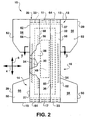
- Fig. 2 and Fig. 2A show a body facing plan views of alternative representative articles 10 in a generally flat-out, uncontracted state (i.e., with substantially all elastic induced gathering and contraction removed).
- the elastomeric leak guards 58 have a laterally outboard side 62 that is bonded along lines 27.
- the laterally outboard sides 62 extend to the lateral sides 29 of the chassis and would be attached at the side seams 26.
- the leak guards 58 may be coextensive with the liner 28 and/or outer cover member 30, all of which may be elastomeric, such that the outboard sides 62 are coextensive with the chassis lateral sides 29.
- the portions of the leak guards 58 in the side panel regions 50, 52 may actually be the sole material defining the side panels.
- the liner 28 and outer cover member 30 may be generally attached along the central portion of the chassis 20 along the lines 27 (dashed line in Fig. 2A ) with the leak guards being the only material defining the panels 50, 52 and being joined at side seams 26.
- the leak guards may be coextensive with attached elastomeric side panels 56.
- the article 10 will typically include a porous, liquid permeable bodyside liner 28; a substantially liquid impermeable outer cover member 30; and an absorbent body structure 32 positioned and attached between the outer cover member and bodyside liner.
- a surge layer 48 may be optionally located adjacent the absorbent structure and attached by way of adhesive 84 to the liner 28 ( Fig. 3 ).
- Elastomeric gathering members, such as leg elastics 34 and waist elastics 33 may be provided, as is well known in the art.
- the liner 28, outer cover 30, absorbent structure 32, surge layer 48, and elastic members 34 and 32 may be assembled together Into a variety of well-known absorbent article configurations,
- the leg elastic members 34 may be located in the lateral side margins of the chassis 20, particularly along the lateral sides of the crotch region 16, and are configured to draw and hold the chassis 20 against the legs of the wearer.
- the elastic members 34 are secured to the chassis 20 in an elastically contracted state so that in a normal under strain condition, the elastic members 34 effectively contract against the chassis.
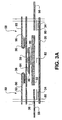
- An adhesive 80 ( Figs. 3 and 3A ) attaches the leg elastic members 34 to the outer cover 30 and one or both of the side panel 56 and leak guard 58.
- the use of elastic leg members in absorbent articles such as disposable diapers and training pants Is widely known and understood In the art.
- the waist elastics 33 are provided generally across the entirety of the front and back waistbands 17, 11. In alternate embodiments, the waist elastics 33 may extend only partially across the front and back waistbands, as represented In Fig. 2 .
- the waist elastics 33 may be composed of any suitable elastomeric material, such as an elastomeric film, an elastic foam, multiple elastic strands, an elastomeric fabric, and the like.
- Embodiments of waistband structures that may be utilized with articles 10 according to the invention are also described in U.S. Patent Nos. 5,601,547 ; 6,358,350 B1 ; 6,336,921 B1 ; and 5,711,832 .
- the liner 28 and outer cover member 30 may be generally coextensive, and may have length and width dimensions which are generally larger than and extend beyond the corresponding dimensions of the absorbent structure 32 to provide for the corresponding side and end margins.
- the bodyside liner 28 and outer cover member 30 may not be coextensive.
- the outer cover member 30 may be composed of a liquid permeable material, but desirably comprises a material which is configured to be substantially impermeable to liquids.
- a typical outer cover can be manufactured from a thin plastic film, a composite laminate, or other flexible, substantially liquid-impermeable material.
- the term "flexible" refers to materials which are compliant and which will readily conform to the general shape and contours of the wearer's body.
- the outer cover member 30 may comprise a woven or non-woven fibrous web layer which has been totally or partially constructed or treated to impart the desired levels of liquid impermeability to selected regions that are adjacent or proximate the absorbent body.
- the outer cover may include a gas-permeable, nonwoven fabric layer laminated to a polymer film layer which may or may not be gas-permeable.
- fibrous, cloth-like outer cover materials can comprise a stretch thinned or stretch thermal laminate material.
- the outer cover 30 typically provides the outermost layer of the article, optionally the article may include a separate outer cover component member which is additional to the outer cover member.
- the outer cover 30 may be formed substantially from an elastomeric material and is thus stretchable. In this embodiment, the outer cover 30 may define the entire front and back waist regions 14, 12, including the front and back panel portions 50, 52.
- the outer cover 30 may, for example, be composed of a single layer, multiple layers, laminates, spunbond fabrics, films, meltblown fabrics, elastic netting, microporous web, bonded carded webs or foams comprised of elastomeric or polymeric materials.
- Elastomeric nonwoven laminate webs may include a nonwoven material joined to one or more gatherable nonwoven webs, films, or foams.
- Stretch Bonded Laminates and Neck Bonded Laminates (NBL) are examples of elastomeric composites.
- Nonwoven fabrics are any web of material which has been formed without the use of textile weaving processes which produce a structure of individual fibers which are interwoven in an identifiable repeating manner. Examples of suitable materials are Spunbond-Meltblown fabrics, Spunbond-Meltblown-Spunbond fabrics, Spunbond fabrics, or laminates of such fabrics with films, foams, or other nonwoven webs.
- Elastomeric materials may include cast or blown films, foams, or meltblown fabrics composed of polyethylene, polypropylene, or polyolefin copolymers, as well as combinations thereof.
- the elastomeric materials may include polyether block amides such as PEBAX® elastomer (available from AtoChem located in Philadelphia, Pa.), HYTREL® elastomeric polyester (available from E. I. DuPont de Nemours located in Wilmington, Del.), KRATON® elastomer (available from Shell Chemical Company located in Houston, Tex.), or strands of LYCRA® elastomer (available from E.I. DuPont de Nemous located in Wilmington, Del.), or the like, as well as combinations thereof.
- the outer cover 30 may include materials that have elastomeric properties through a mechanical process, printing process, heating process, or chemical treatment. For examples such materials may be apertured, creped, neck-stretched, heat activated, embossed, and micro-strained; and may be in the form of films, webs, and laminates.
- the chassis 20 may be substantially non-elastomeric along the crotch region 16.
- the outer cover 30 may be made of a generally non-elastomeric material and essentially covers only the central structure of the chassis 20.
- elastomeric side panels 56 may provide a desired degree of stretchability to the chassis 20, particularly around the waist and sides of the wearer. A structure of this type is known, for example, from the HUGGIES® PULL-UPS® disposable training pants.
- the pair of transversely opposed side panels 56 may be permanently bonded to the lateral sides of the chassis 16 at bond lines 63 ( Fig. 3 ) using attachment means known to those skilled in the art, such as adhesive, thermal or ultrasonic bonding.
- the elastic material comprises a stretch-thermal laminate (STL), a neck-bonded laminate (NBL), a reversibly necked laminate, or a stretch-bonded laminate (SBL) material.
- STL stretch-thermal laminate
- NBL neck-bonded laminate
- SBL stretch-bonded laminate
- the bodyside liner 28 presents a body-facing surface which is compliant, soft-feeling, and non-irritating to the wearer skin. Further, the bodyside liner 28 can be less hydrophilic than the absorbent body 32, and is sufficiently porous to be liquid permeable, permitting liquid to readily penetrate through its thickness to reach the absorbent body.
- a suitable bodyside liner layer 28 may be manufactured from a wide selection of web materials, such as porous foams, reticulated foams, apertured plastic films, natural fibers (for example, wood or cotton fibers), synthetic fibers (for example, polyester or polypropylene fibers), or a combination of natural and synthetic fibers. The bodyside liner layer 28 is typically employed to help isolate the wearer's skin from liquids held in absorbent body 32.
- the bodyside liner 28 may include a meltblown web, a spunbonded web, or a bonded-carded-web composed of the desired fibers.
- the various fabrics can be composed of natural fibers, synthetic fibers or combinations thereof.
- the bodyside liner 28 may be comprised of polymer fibers, networks, laminates, liquid permeable films, cellulosic fibers, rayon, water swellable gels, and elastomeric materials, as well as combinations thereof.
- Suitable materials for the bodyside liner can include meltblown webs, airlaid webs, spunbond webs, or bonded-carded webs of synthetic continuous or discrete polymer fibers and/or natural fibers, a pattern bonded spunbonded web, airlaid web, or bonded carded web, as well as combinations thereof.
- Suitable polymers can include polypropylene, polyethylene, polyester, and bicomponent materials composed of these polyolefins.
- the bodyside liner fabrics may be composed of a substantially hydrophobic material, and the hydrophobic material may optionally be treated with a surfactant or otherwise processed to impart a desired level of wettability and hydrophilicity.
- the bodyside liner 28 can be a nonwoven, spunbond polypropylene fabric which is necked approximately 60%. Strands of about KRATON® G2760 elastomer material may be adhered to the necked spunbond material.
- the fabric can be surface treated with an operative amount of surfactant, such as about 0.6% AHCOVEL Base N62 surfactant, available from ICI Americas, a business having offices located in Wilmington, Del.
- the surfactant can be applied by any conventional means, such as spraying, printing, brush coating or the like.
- suitable elastomeric materials can include elastic strands, LYCRA® elastics, elastic films, cast or blown; nonwoven elastic webs, meltblown or spunbond elastomeric fibrous webs, as well as combinations thereof.
- elastomeric materials include KRATON® elastomers, HYTREL® elastomers, ESTANE® elastomeric polyurethanes (available from B.F. Goodrich and Company located in Cleveland, Ohio), or PEBAX® elastomers.
- the bodyside liner may include blends or laminates of fibers, scrim, webs, and films with perforations, apertures, creping, heat activation, embossing, micro-straining, chemically treatment, or the like, as well as combinations thereof.
- the bodyside liner 28 and outer cover 30 are connected or otherwise associated together in an operable manner.
- the term "associated” encompasses configurations in which the bodyside liner 28 is directly joined to the outer cover 30 by affixing the bodyside liner 28 directly to the outer cover 30, and configurations wherein the bodyside liner 28 is indirectly joined to the outer cover 30 by affixing the bodyside liner 28 to intermediate members which in turn are affixed to the outer cover 30.
- the bodyside liner 28 and outer cover 30 can, for example, be joined to each other in at least a portion of the training pant periphery by suitable attachment mechanisms (not shown) such as adhesive bonds, ultrasonic bonds, thermal bonds, pinning, stitching or any other attachment technique known in the art, as well as combinations thereof.
- suitable attachment mechanisms such as adhesive bonds, ultrasonic bonds, thermal bonds, pinning, stitching or any other attachment technique known in the art, as well as combinations thereof.
- a uniform continuous layer of adhesive, a patterned layer of adhesive, a sprayed pattern of adhesive or an array of separate lines, swirls or spots of construction adhesive may be used to affix the bodyside liner 28 to the outer cover 30.
- suitable attachment mechanisms such as adhesive bonds, ultrasonic bonds, thermal bonds, pinning, stitching or any other attachment technique known in the art, as well as combinations thereof.
- the absorbent body structure 32 is positioned between the outer cover 30 and the bodyside liner 28.
- the absorbent body structure 32 can be any structure or combination of components which are generally compressible, conformable, non-irritating to a wearer's skin, and capable of absorbing and retaining liquids and certain body wastes.
- the structure 32 may include an absorbent web material of cellulosic fibers (e.g., wood pulp fibers), other natural fibers, synthetic fibers, woven or nonwoven sheets, scrim netting or other stabilizing structures, superabsorbent material, binder materials, surfactants, selected hydrophobic materials, pigments, lotions, odor control agents or the like, as well as combinations thereof.
- the absorbent web material is a matrix of cellulosic fluff and superabsorbent hydrogel-forming particles.
- the cellulosic fluff may comprise a blend of wood pulp fluff.
- One preferred type of fluff is identified with the trade designation CR 1654, available from U.S. Alliance of Childersburg, Alabama, USA, and is a bleached, highly absorbent sulfate wood pulp containing primarily soft wood fibers.
- the absorbent materials may be formed into a web structure by employing various conventional methods and techniques.
- the absorbent web may be formed with a dry-forming technique, an air forming technique, a wet-forming technique, a foam-forming technique, or the like, as well as combinations thereof. Methods and apparatus for carrying out such techniques are well known in the art.
- the superabsorbent material is present in the absorbent web in an amount of from about 0 to about 90 weight percent based on total weight of the web.
- the web may have a density within the range of about 0.10 to about 0.35 grams per cubic centimeter.
- Superabsorbent materials are well known in the art and can be selected from natural, synthetic, and modified natural polymers and materials.
- the superabsorbent materials can be inorganic materials, such as silica gels, or organic compounds, such as crosslinked polymers.
- a suberabsorbent material is capable of absorbing at least about 15 times its weight in liquid, and desirably is capable of absorbing more than about 25 times its weight in liquid.
- Suitable superabsorbent materials are readily available from various suppliers. For example, Favor 880 superabsorbent is available from Stockhausen GmbH of Germany; and Drytech 2035 is available from Dow Chemical Company, of Midland Michigan, USA.
- the absorbent web material may be wrapped or encompassed by a suitable tissue wrap that aids In maintaining the integrity and shape of the absorbent structure 32.
- the absorbent web material may also be a coform material.
- coform material generally refers to composite materials comprising a mixture or stabilized matrix of thermoplastic fibers and a second non-thermoplastic material.
- coform materials may be made by a process in which at least one meitblown die head is arranged near a chute through which other materials are added to the web while it is forming.
- Such other materials may include, but are not limited to, fibrous organic materials such as woody or non-woody pulp such as cotton, rayon, recycled paper, pulp fluff and also superabsorbent particles, inorganic absorbent materials, treated polymeric staple fibers and the like. Any of a variety of synthetic polymers may be utilized as the melt-spun component of the coform material.
- thermoplastic polymers can be utilized.
- suitable thermoplastics include polyolefins, such as polyethylene, polypropylene, polybutylene and the like; polyamides; and polyesters.
- the thermoplastic polymer is polypropylene.
- the absorbent body structure 32 is elastomeric.
- the absorbent body structure 32 is also stretchable so as not to inhibit the stretchability of other components.
- the absorbent web material can include elastomeric fibers in an amount which is at least a minimum of about 2 wt %.
- the amount of elastomeric fibers can alternatively be at least about 3 wt %, and can optionally be at least about 5 wt % to provide improved performance.
- the amount of elastomeric fibers can be not more than about 60 wt %.
- the amount of elastomeric fibers can be not more than about 45 wt %, and optionally, can be not more than about 30 wt % to provide improved benefits. These values are important because they can provide the absorbent retention portion with desired levels of stretchability and structural stability without excessively degrading the physical properties or the liquid-management properties of the absorbent structure.
- An absorbent web material with an excessively low proportion of elastomeric fibers may be insufficiently stretchable, and a web material with an excessively high proportion of elastomeric fibers may exhibit an excessive degradation of its absorbency functionalities, such as poor intake, poor distribution, poor retention of liquid and/or an excessive tension force when stretched.
- the absorbent body structure 32 may include an elastomeric coform absorbent web material.
- the elastomeric coform material can have an overall coform basis weight which is at least a minimum of about 50 grams per square meter (g/m 2 ).
- the coform basis weight can alternatively be at least about 100 g/m 2 and can optionally be at least about 200 g/m 2 to provide improved performance.
- the coform basis weight can be not more than about 1200 g 2 .
- the coform basis weight can be not more than about 900 g/m 2 , and optionally, can be not more than about 600 g/m 2 to provide improved benefits.
- the absorbent web material utilized in the absorbent body structure 32 is also selected so that the individual absorbent body structure possesses a particular individual total absorbency depending on the intended article of use.
- the total absorbency can be within the range of about 200-900 grams of 0.9 wt% saline, and can typically be about 500g of saline.
- the total absorbency can be within the range of about 400-2000 grams of saline, and can typically be about 1300g of saline.
- the total absorbency can be within the range of about 7-50 grams of menstrual fluid, and can typically be within the range of about 30-40 g of menstrual fluid. '
- the absorbent body structure 32 may also Indue a surge management layer 48 which helps to decelerate and diffuse surges or gushes of liquid that may be rapidly introduced into the absorbent body of the article.
- the surge management layer can rapidly accept and temporarily hold the liquid prior to releasing the liquid into the storage or retention portions of the absorbent structure.
- the surge layer can be located below the bodyside liner layer 28. Alternatively, the surge layer may be located on the body facing surface of the bodyside liner 28. Examples of suitable surge management layers are described in U.S. Pat. No. 5,486,166 ; and U.S. Pat. No. 5.490,846 . Other suitable surge management materials are described in U.S. Pat. No. 5,820,973 .
- the leak guards 58 are desirably formed substantially of an elastomeric material or elastomeric composite material so as to be stretchable in the transverse direction. In this manner, regardless of the points of attachment of the guards laterally or at their respective longitudinal ends, the guards will not detract from the desired stretchable characteristics of another component of the article.
- the leak guards 58 are not limited to any particular type of elastomeric material, so long as such material is moisture resistant and preferably presents a cloth-like feel to the wearer. Suitable materials may be, for example, a neck-bonded laminate, stretch-bonded laminate, stretch-thermal laminate, or any combination of materials that provides moisture resistance and a desired degree of cloth-like feel to the wearer.
- a particularly suitable material is a neck-bonded laminate (NBL) of an elastic polyethylene film and neck stretched spunbond polypropylene.
- the guards 58 may be a laminate composite of a liquid impervious elastic film 92 and the necked spunbond web 94.
- An adhesive 96 is used to laminate the materials together in combination with ultrasonic welding.
- Elastic strands 36 may be incorporated into the laminating process with an adhesive 88 to produce the type of structure shown In Fig. 3 .
- An extension or "flap" of the necked spunbond web 94 may be folded over along the free side 60 of the guards 58 and attached to the underside of the elastic film 92 with an adhesive 90- It should be appreciated, however, that the invention is not limited to this structural configuration of leak guards 58. Suitable other constructions and arrangements for the leak guards 58 are generally known to those skilled in the art and examples are also described In U.S. Pat. No. 4,704,116 .
- the leak guards are formed from a single layer of material 93, for example any suitable generally elastomeric and liquid impervious or resistant material.
- the material 93 is folded under at the free edge 60 and bonded with, for example, and adhesive 90. Elastic strands may be incorporated into the fold.
- a suitable elastic film 92 is available from Huntsman Packaging and identified as XMAX-314.0.
- a suitable necked spunbond web is a 0.25 to 0.5 osy polypropylene necked down to about 50% to about 40% of its original width resulting in a final necked basis weight of approximately 0.55 to 1.1 osy.
- a suitable hot melt adhesive used for laminating the materials together is H2525A (RM7499) from Findley Adhesives, Inc. of Wauwatosa, Wisconsin, U.S.A.
Landscapes
- Health & Medical Sciences (AREA)
- Epidemiology (AREA)
- Engineering & Computer Science (AREA)
- Biomedical Technology (AREA)
- Heart & Thoracic Surgery (AREA)
- Vascular Medicine (AREA)
- Life Sciences & Earth Sciences (AREA)
- Animal Behavior & Ethology (AREA)
- General Health & Medical Sciences (AREA)
- Public Health (AREA)
- Veterinary Medicine (AREA)
- Absorbent Articles And Supports Therefor (AREA)
- Orthopedics, Nursing, And Contraception (AREA)
Claims (20)
- Absorptionsfähiger Artikel (10), welcher umfasst:einen Rahmen (20), der einen vorderen Taillenbereich (14) an einem ersten Längsende (15), einen hinteren Taillenbereich (12) an einem gegenüberliegenden Längsende (13) und einen Schrittbereich (16) aufweist, der sich längs zwischen dem vorderen und hinteren Taillenbereich (14, 12) erstreckt;eine absorptionsfähige Körperstruktur (32), die sich längs generell von dem vorderen Taillenbereich (14) zu dem hinteren Taillenbereich (12) erstreckt; undsich längs erstreckende Leckschutzvorrichtungen (58), wobei jede der Leckschutzvorrichtungen (58) eine freie seitliche Innenseite (60) und eine seitliche Außenseite (62) aufweist, die am Rahmen (20) befestigt ist, um so entsprechende Auffangtaschen entlang gegenüberliegenden seitlichen Seiten der absorptionsfähigen Körperstruktur (32) zu definieren, wobei der Rahmen (20) dehnbare Taillenbänder (11, 17) entlang zumindest eines Teils des vorderen und hinteren Taillenbereichs (14, 12) beinhaltet, wobei die Leckschutzvorrichtungen (58) Längsenden (64) aufweisen, die an dem Rahmen (20) koextensiv mit den dehnbaren Taillenbändern (11, 17) befestigt sind,
dadurch gekennzeichnet, dass
die Leckschutzvorrichtungen (58) in einer Querrichtung (4) entlang deren Längslänge elastomer sind. - Absorptionsfähiger Artikel (10) gemäß Anspruch 1, wobei der Artikel (10) das Trainingshöschen eines Kindes ist.
- Absorptionsfähiger Artikel (10) gemäß Anspruch 1 oder 2, wobei der Rahmen (20) ein im Wesentlichen elastomeres äußeres Deckelement (30) beinhaltet, wobei die seitlichen Außenseiten der Leckschutzvorrichtungen (58) an dem elastomeren äußeren Deckelement (30) befestigt sind.
- Absorptionsfähiger Artikel (10) gemäß Anspruch 1 oder 2, wobei der Rahmen (20) eine im Wesentlichen elastomere körperseitige Auskleidung (28) beinhaltet, wobei die seitlichen Außenseiten (62) der Leckschutzvorrichtungen (58) an der elastomeren körperseitigen Auskleidung (28) befestigt sind.
- Absorptionsfähiger Artikel (10) gemäß Anspruch 1 oder 2, wobei der Rahmen (20) eine generell nicht elastomere Struktur umfasst, und des Weiteren elastomere Seitenbahnen (56) umfasst, die an seitlichen Seiten des Rahmens (20) befestigt sind, wobei die seitlichen Außenseiten (62) der Leckschutzvorrichtungen (58) an dem Rahmen (20) mit den elastomeren Seitenbahnen (56) befestigt sind.
- Absorptionsfähiger Artikel (10) gemäß Anspruch 5, wobei die Seiten bahnen (56) seitlich sich erstreckende vordere und hinteren Bahnteile (50, 52) an gegenüberliegenden seitlichen Seiten des vorderen und hinteren Taillenbereichs (14, 12) definieren.
- Absorptionsfähiger Artikel (10) gemäß Anspruch 6. wobei die Leckschutzvorrichtungen (58) Längsenden (64) aufweisen, die an den Seitenbahnen (56) in den Taillenbereichen (14, 12) des Rahmens (20) befestigt sind.
- Absorptionsfähiger Artikel (10) gemäß einem der vorherigen Ansprüche, wobei die seitlichen Innenseiten (60) der Leckschutzvorrichtungen (58) in Längsrichtung elastisch sind.
- Absorptionsfähiger Artikel (10) gemäß einem der vorherigen Ansprüche, wobei die Leckschutzvorrichtungen (58) aus einem flüssigkeitsundurchlässigen oder flüssigkeitsresistenten Neck-Bonding-Laminatmaterial gebildet sind.
- Absorptionsfähiger Artikel (10) gemäß Anspruch 9, wobei das Neck-Bonding-Laminatmaterial eine Necked-Streck-Polypropylen-Spinnvliesbahn umfasst, die auf einen elastischen Film laminiert ist.
- Absorptionsfähiger Artikel (10) gemäß einem der Ansprüche 1 bis 8, wobei die Leckschutzvorrichtungen (58) aus einem flüssigkeitsundurchlässigen Streck-Bonding-Laminatmaterial gebildet sind.
- Absorptionsfähiger Artikel (10) gemäß Anspruch 1, wobei:der Rahmen (20) einen generell elastomeren absorptionsfähigen Rahmen (20) umfasst, der eine körperseitige Auskleidung (28), eine äußere Deckschicht (30), die mit der körperseitigen Lage (28) verbunden ist und eine absorptionsfähige Struktur (32) umfasst, die zwischen der körperseitigen Auskleidung (28) und der äußeren Deckschicht (30) angeordnet ist;wobei der vordere und hintere Taillenbereich (14, 12) des Weiteren sich seitlich erstreckende Seitenbahnenteile (56) umfasst, wobei die Seitenbahnenteile (56) Beinkonturen mit dem Schrittbereich (16) entlang gegenüberliegenden seitlichen Seiten des Rahmens (20) definieren;wobei die Leckschutzvorrichtungen (58) die Auffangtaschen entlang der Beinkonturen und der Seitenbahnteile (56) definieren; undbeim Ausbilden des Rahmens (20) zu einer Hosenstruktur mit vorderen und hinteren Seitenbahnteilen (56), die an Seitensäumen (26) des Artikels (10) verbunden sind, die Leckschutzvorrichtungen (58) Leckschutz für einen Träger generell vollständig um den vorderen und hinteren Taillenbereich (14, 12) bereitstellen.
- Absorptionsfähiger Artikel (10) gemäß Anspruch 12, wobei die absorptionsfähige Struktur (32) des Weiteren einen zentralen sich längs erstreckenden Teil und elastomere Flügelteile (32a) umfasst, die sich seitlich in den vorderen und hinteren Seitenbahnenteil (56) erstrecken.
- Absorptionsfähiger Artikel (10) gemäß Anspruch 13, wobei die absorptionsfähige Struktur (32) ein elastomeres absorptionsfähiges Material entlang des zentralen Teils und der Flügelteile (32a) beinhaltet.
- Absorptionsfähiger Artikel (10) gemäß Anspruch 14, wobei die absorptionsfähige Struktur (32) an der äußeren Deckschicht (30) entlang des zentralen Teils und der Flügelteile befestigt ist.
- Absorptionsfähiger Artikel (10) gemäß einem der Ansprüche 12 bis 15, wobei sich die absorptionsfähige Struktur (32) zentral entlang des Schrittbereichs (16) zwischen dem vorderen und hinteren Taillenbereich (14, 12) erstreckt.
- Absorptionsfähiger Artikel (10) gemäß einem der Ansprüche 12 bis 16, wobei der Artikel (10) ein Trainingshöschen eines Kindes ist.
- Absorptionsfähiger Artikel (10) gemäß einem der Ansprüche 12 bis 17, wobei die Seitensäume (26) verbundene zerreißbare Säume sind.
- Absorptionsfähiger Artikel (10) gemäß einem der Ansprüche 12 bis 17, wobei die Seitesäume (26) lösbar und wiederbefestigbar sind.
- Absorptionsfähiger Artikel (10) gemäß einem der Ansprüche 12 bis 19, wobei die Leckschutzvorrichtungen (58) aus einem elastomeren Material gemacht sind.
Applications Claiming Priority (3)
| Application Number | Priority Date | Filing Date | Title |
|---|---|---|---|
| US331956 | 2002-12-30 | ||
| US10/331,956 US20040127868A1 (en) | 2002-12-30 | 2002-12-30 | Absorbent article with improved leak guards |
| PCT/US2003/029843 WO2004060239A1 (en) | 2002-12-30 | 2003-09-18 | Absorbent article with improved leak guards |
Publications (2)
| Publication Number | Publication Date |
|---|---|
| EP1578327A1 EP1578327A1 (de) | 2005-09-28 |
| EP1578327B1 true EP1578327B1 (de) | 2010-08-04 |
Family
ID=32654874
Family Applications (1)
| Application Number | Title | Priority Date | Filing Date |
|---|---|---|---|
| EP03754826A Revoked EP1578327B1 (de) | 2002-12-30 | 2003-09-18 | Absorbierende artikel mit verbessertem auslaufschutz |
Country Status (8)
| Country | Link |
|---|---|
| US (1) | US20040127868A1 (de) |
| EP (1) | EP1578327B1 (de) |
| KR (1) | KR101063045B1 (de) |
| AU (1) | AU2003272633A1 (de) |
| BR (1) | BR0316749A (de) |
| DE (1) | DE60333670D1 (de) |
| MX (1) | MXPA05006484A (de) |
| WO (1) | WO2004060239A1 (de) |
Families Citing this family (12)
| Publication number | Priority date | Publication date | Assignee | Title |
|---|---|---|---|---|
| US20050124962A1 (en) * | 2003-12-05 | 2005-06-09 | Kimberly-Clark Worldwide, Inc. | Stretchable absorbent article including a suspended absorbent body |
| US7763004B2 (en) | 2005-05-18 | 2010-07-27 | The Procter & Gamble Company | Disposable absorbent article having layered containment pockets |
| US7695463B2 (en) | 2005-06-22 | 2010-04-13 | The Procter & Gamble Company | Disposable absorbent article having dual layer barrier cuff strips |
| US7618404B2 (en) | 2005-06-23 | 2009-11-17 | The Procter & Gamble Company | Disposable absorbent article having doubled side flaps and backsheet strips |
| US20070118088A1 (en) * | 2005-11-23 | 2007-05-24 | The Procter & Gamble Company | Disposable absorbent article having barrier cuff strips |
| US7737324B2 (en) | 2005-11-23 | 2010-06-15 | The Procter & Gamble Company | Disposable absorbent article having deployable chassis ears |
| US7976662B2 (en) * | 2005-12-15 | 2011-07-12 | Kimberly-Clark Worldwide, Inc. | Laminate containing a fluorinated nonwoven web |
| US7857801B2 (en) | 2007-03-23 | 2010-12-28 | The Procter & Gamble Company | Diaper having deployable chassis ears and stretch waistband |
| JP5822475B2 (ja) * | 2011-01-31 | 2015-11-24 | ユニ・チャーム株式会社 | 使い捨てのパンツ型の着用物品 |
| JP6273169B2 (ja) * | 2014-06-02 | 2018-01-31 | 大王製紙株式会社 | 吸収体物品及びその製造方法 |
| US10857040B2 (en) * | 2014-12-11 | 2020-12-08 | Attends Healthcare Products, Inc. | Disposable absorbent garment having elastic sheet material and elastic strands |
| BR112017013144B1 (pt) * | 2014-12-31 | 2021-11-09 | Kimberly-Clark Worldwide, Inc | Artigo absorvente tendo painéis esticáveis e método de produzir o mesmo |
Family Cites Families (94)
| Publication number | Priority date | Publication date | Assignee | Title |
|---|---|---|---|---|
| US2538596A (en) * | 1947-03-13 | 1951-01-16 | Vesta Underwear Company | Infant's garment |
| US3039466A (en) * | 1959-01-23 | 1962-06-19 | Charles H Wilson | Diaper panty |
| US3338992A (en) * | 1959-12-15 | 1967-08-29 | Du Pont | Process for forming non-woven filamentary structures from fiber-forming synthetic organic polymers |
| US3502763A (en) * | 1962-02-03 | 1970-03-24 | Freudenberg Carl Kg | Process of producing non-woven fabric fleece |
| CH421025A (de) * | 1965-05-20 | 1966-09-30 | Parravicini Flora | Unterhose |
| US3341394A (en) * | 1966-12-21 | 1967-09-12 | Du Pont | Sheets of randomly distributed continuous filaments |
| US3542615A (en) * | 1967-06-16 | 1970-11-24 | Monsanto Co | Process for producing a nylon non-woven fabric |
| US3849241A (en) * | 1968-12-23 | 1974-11-19 | Exxon Research Engineering Co | Non-woven mats by melt blowing |
| DE2048006B2 (de) * | 1969-10-01 | 1980-10-30 | Asahi Kasei Kogyo K.K., Osaka (Japan) | Verfahren und Vorrichtung zur Herstellung einer breiten Vliesbahn |
| DE1950669C3 (de) * | 1969-10-08 | 1982-05-13 | Metallgesellschaft Ag, 6000 Frankfurt | Verfahren zur Vliesherstellung |
| CA948388A (en) * | 1970-02-27 | 1974-06-04 | Paul B. Hansen | Pattern bonded continuous filament web |
| US4100324A (en) * | 1974-03-26 | 1978-07-11 | Kimberly-Clark Corporation | Nonwoven fabric and method of producing same |
| US4205679A (en) * | 1976-07-23 | 1980-06-03 | Johnson & Johnson | Disposable undergarment |
| DK144382C (da) * | 1977-11-08 | 1982-07-26 | Kroyer K K K | Apparat til fremstilling af et baneformet fiberprodukt |
| US4227531A (en) * | 1978-06-12 | 1980-10-14 | Mcleod Syble A | Panty liner construction |
| US4351340A (en) * | 1978-06-12 | 1982-09-28 | Mcleod Syble A | Panty liner construction |
| US4486192A (en) * | 1979-11-15 | 1984-12-04 | Kimberly-Clark Corporation | Conformable garments with discrete elasticized areas |
| US4375448A (en) * | 1979-12-21 | 1983-03-01 | Kimberly-Clark Corporation | Method of forming a web of air-laid dry fibers |
| US4340563A (en) * | 1980-05-05 | 1982-07-20 | Kimberly-Clark Corporation | Method for forming nonwoven webs |
| US4302853A (en) * | 1980-05-27 | 1981-12-01 | Johnson & Johnson Baby Products Company | Disposable undergarment |
| US4402690A (en) * | 1980-10-21 | 1983-09-06 | Robin Redfern | High absorbency, contoured, reusable diaper |
| US4374888A (en) * | 1981-09-25 | 1983-02-22 | Kimberly-Clark Corporation | Nonwoven laminate for recreation fabric |
| US4427408A (en) * | 1981-12-08 | 1984-01-24 | Colgate-Palmolive Company | Disposable panty and method |
| USD281540S (en) * | 1983-01-12 | 1985-12-03 | Molnlycke Aktiebolag | Baby pants |
| BR8303466A (pt) * | 1983-06-29 | 1985-02-12 | Johnson & Johnson | Estrutura de artigo absorvente,artigo absorvente |
| US4681581A (en) * | 1983-12-05 | 1987-07-21 | Coates Fredrica V | Adjustable size diaper and folding method therefor |
| US4704117A (en) * | 1984-03-12 | 1987-11-03 | Ernest H. Mccoy | Formed and washable diaper |
| US4581772A (en) * | 1984-03-28 | 1986-04-15 | Smith Alice G | Training panty |
| US4619649A (en) * | 1984-04-30 | 1986-10-28 | Joan Roberts | Disposable toddler training panty |
| US4640810A (en) * | 1984-06-12 | 1987-02-03 | Scan Web Of North America, Inc. | System for producing an air laid web |
| US4568342A (en) * | 1984-12-26 | 1986-02-04 | Davis Culley W | Variable size, reusable diaper with fastener covers |
| US4641381A (en) * | 1985-01-10 | 1987-02-10 | Kimberly-Clark Corporation | Disposable underpants, such as infant's training pants and the like |
| US4646362A (en) * | 1985-01-10 | 1987-03-03 | Kimberly-Clark Corporation | Disposable underpants, such as child's training pants and the like |
| US4639949A (en) * | 1985-01-10 | 1987-02-03 | Kimberly-Clark Corporation | Elastic form-fitting closure constructions for disposable garments |
| US4610681A (en) * | 1985-05-31 | 1986-09-09 | Kimberly-Clark Corporation | Disposable underpants having discrete outer seals |
| US4610680A (en) * | 1985-04-29 | 1986-09-09 | Lafleur Ruby S | Disposable training panty |
| US4720415A (en) * | 1985-07-30 | 1988-01-19 | Kimberly-Clark Corporation | Composite elastomeric material and process for making the same |
| US4657802A (en) * | 1985-07-30 | 1987-04-14 | Kimberly-Clark Corporation | Composite nonwoven elastic web |
| US4655760A (en) * | 1985-07-30 | 1987-04-07 | Kimberly-Clark Corporation | Elasticized garment and method of making the same |
| US4630320A (en) * | 1985-10-18 | 1986-12-23 | Kimberly-Clark Corporation | Garment with one or more gusseted adjustable openings and method of making the same |
| SE453886B (sv) * | 1986-07-02 | 1988-03-14 | Moelnlycke Ab | For engangsanvendning avsedd vetskabsorberande artikel, foretredesvis ett inkontinensskydd |
| US4781966A (en) * | 1986-10-15 | 1988-11-01 | Kimberly-Clark Corporation | Spunlaced polyester-meltblown polyetherester laminate |
| US5162074A (en) * | 1987-10-02 | 1992-11-10 | Basf Corporation | Method of making plural component fibers |
| US4940464A (en) * | 1987-12-16 | 1990-07-10 | Kimberly-Clark Corporation | Disposable incontinence garment or training pant |
| AU612450B2 (en) * | 1988-02-11 | 1991-07-11 | Jackilyn Mary Knight | Absorbent garment |
| US4880423A (en) * | 1988-03-02 | 1989-11-14 | Green Lyel A | Disposable underpants |
| US4900384A (en) * | 1988-06-15 | 1990-02-13 | Kimberly-Clark Corporation | Method and apparatus for making elasticized containment flaps |
| USD318732S (en) * | 1988-09-02 | 1991-07-30 | Chautin Paul F | Diaper |
| US4965122A (en) * | 1988-09-23 | 1990-10-23 | Kimberly-Clark Corporation | Reversibly necked material |
| US5226992A (en) * | 1988-09-23 | 1993-07-13 | Kimberly-Clark Corporation | Process for forming a composite elastic necked-bonded material |
| US5026364A (en) * | 1988-12-21 | 1991-06-25 | The Procter & Gamble Company | Absorbent article having unitary waistcap and waistband |
| US5069970A (en) * | 1989-01-23 | 1991-12-03 | Allied-Signal Inc. | Fibers and filters containing said fibers |
| US4944733A (en) * | 1989-06-12 | 1990-07-31 | Larry Casale | Diaper for use in toilet training male children or for use by incontinent male adults |
| US4978345A (en) * | 1989-08-28 | 1990-12-18 | Holliday Craig S | Reusable multi-layered diaper |
| US5057368A (en) * | 1989-12-21 | 1991-10-15 | Allied-Signal | Filaments having trilobal or quadrilobal cross-sections |
| US5246431A (en) * | 1990-01-31 | 1993-09-21 | Pope & Talbot Company | Diaper with source reduction overlay and having improved fecal containment characteristics |
| JP2826185B2 (ja) * | 1990-03-12 | 1998-11-18 | ユニ・チャーム株式会社 | 使い捨てパンツ型着用物品 |
| USD332659S (en) * | 1990-09-10 | 1993-01-19 | Philip Bisaga | Wetness indicating diaper |
| US5275590A (en) * | 1990-11-05 | 1994-01-04 | Paragon Trade Brands, Inc. | Disposable asborbent garment with composite topsheet assembly |
| CA2048905C (en) * | 1990-12-21 | 1998-08-11 | Cherie H. Everhart | High pulp content nonwoven composite fabric |
| AU111262S (en) * | 1991-03-07 | 1991-06-11 | A nappy | |
| USD339633S (en) * | 1991-07-12 | 1993-09-21 | Porter Judith A | Disposable diaper panty |
| US5899894A (en) * | 1991-07-30 | 1999-05-04 | Societa' Consortile Ricerche Angelini, S.p.A. | Absorbent article with elasticated flaps |
| US5277976A (en) * | 1991-10-07 | 1994-01-11 | Minnesota Mining And Manufacturing Company | Oriented profile fibers |
| US5385775A (en) * | 1991-12-09 | 1995-01-31 | Kimberly-Clark Corporation | Composite elastic material including an anisotropic elastic fibrous web and process to make the same |
| USD345015S (en) * | 1991-12-26 | 1994-03-08 | Booth Dayna S | Diaper |
| USD346214S (en) * | 1992-03-10 | 1994-04-19 | Bradford Laura K | Diaper |
| US5350624A (en) * | 1992-10-05 | 1994-09-27 | Kimberly-Clark Corporation | Abrasion resistant fibrous nonwoven composite structure |
| DK168670B1 (da) * | 1993-03-09 | 1994-05-16 | Niro Separation As | Apparat til fordeling af fibre |
| USD354130S (en) * | 1993-05-13 | 1995-01-03 | Johnson Antoinette M | Form fitting cloth diaper |
| ES2136214T3 (es) * | 1994-03-04 | 1999-11-16 | Kimberly Clark Co | Tela no tejida fibrosa con control mejorado de derramamiento de liquido para articulos absorbentes de higiene personal y similares. |
| US5562650A (en) * | 1994-03-04 | 1996-10-08 | Kimberly-Clark Corporation | Absorbent article having an improved surge management |
| US5486166A (en) * | 1994-03-04 | 1996-01-23 | Kimberly-Clark Corporation | Fibrous nonwoven web surge layer for personal care absorbent articles and the like |
| US5464402A (en) * | 1994-03-17 | 1995-11-07 | Paragon Trade Brands, Inc. | Absorbent garment with conformable pads |
| US5645542A (en) * | 1994-12-29 | 1997-07-08 | Kimberly-Clark Worldwide, Inc. | Elastomeric absorbent structure |
| US5620431A (en) * | 1994-12-30 | 1997-04-15 | Kimberly-Clark Corporation | Absorbent article with elasticized leg cuffs |
| USD383207S (en) * | 1995-04-03 | 1997-09-02 | Cassell Lucille R | Diaper |
| US5601547A (en) * | 1995-05-31 | 1997-02-11 | Kimberly-Clark Corporation | Waist elastic system with improved modulus of elasticity for a child's training pant |
| US6336921B1 (en) * | 1995-05-31 | 2002-01-08 | Kimberly-Clark Worldwide, Inc. | Waist elastic system with improved elastic decay properties for a training pant |
| US6551430B1 (en) * | 1995-05-31 | 2003-04-22 | Kimberly-Clark Worldwide, Inc. | Process for making a training pant having a unitary waist elastic system |
| US5711832A (en) * | 1995-05-31 | 1998-01-27 | Kimberly-Clark Worldwide, Inc. | Process for making a training pant having a separate waist elastic system |
| US6117121A (en) * | 1995-12-11 | 2000-09-12 | Kimberly-Clark Worldwide, Inc. | Absorbent article using extensible leg cuffs |
| US5695849A (en) * | 1996-02-20 | 1997-12-09 | Kimberly-Clark Worldwide Inc. | Elastic, breathable, barrier fabric |
| US5952252A (en) * | 1996-02-20 | 1999-09-14 | Kimberly-Clark Worldwide, Inc. | Fully elastic nonwoven fabric laminate |
| US6264642B1 (en) * | 1996-02-29 | 2001-07-24 | Kimberly-Clark Worldwide, Inc. | Elasticized laminate, liquid impermeable backsheet for a disposable absorbent article |
| US5964743A (en) * | 1997-02-27 | 1999-10-12 | Kimberly-Clark Worldwide, Inc. | Elastic absorbent material for personal care products |
| US6129720A (en) * | 1997-12-31 | 2000-10-10 | Kimberly-Clark Worldwide, Inc. | Extensible absorbent article including an extensible absorbent pad layer |
| US6132410A (en) * | 1998-05-07 | 2000-10-17 | Kimberly-Clark Worldwide, Inc. | Disposable garment having dryness barriers with expandable attachment to an absorbent |
| US6362389B1 (en) * | 1998-11-20 | 2002-03-26 | Kimberly-Clark Worldwide, Inc. | Elastic absorbent structures |
| US6969441B2 (en) * | 2000-05-15 | 2005-11-29 | Kimberly-Clark Worldwide, Inc. | Method and apparatus for producing laminated articles |
| US6613033B1 (en) * | 2000-08-15 | 2003-09-02 | Kimberly-Clark Worldwide, Inc. | Pant-like absorbent garments having curved leg cuffs |
| US6635041B1 (en) * | 2000-08-15 | 2003-10-21 | Kimberly-Clark Worldwide, Inc. | Absorbent garment with asymmetrical leg elastic tension |
| US6881205B2 (en) * | 2000-10-27 | 2005-04-19 | Kimberly-Clark Worldwide, Inc. | Independence of components in absorbent articles |
| US6682512B2 (en) * | 2001-12-18 | 2004-01-27 | Kimberly-Clark Worldwide, Inc. | Continuous biaxially stretchable absorbent with low tension |
-
2002
- 2002-12-30 US US10/331,956 patent/US20040127868A1/en not_active Abandoned
-
2003
- 2003-09-18 EP EP03754826A patent/EP1578327B1/de not_active Revoked
- 2003-09-18 BR BR0316749-6A patent/BR0316749A/pt not_active Application Discontinuation
- 2003-09-18 AU AU2003272633A patent/AU2003272633A1/en not_active Abandoned
- 2003-09-18 MX MXPA05006484A patent/MXPA05006484A/es active IP Right Grant
- 2003-09-18 KR KR1020057010919A patent/KR101063045B1/ko not_active Expired - Fee Related
- 2003-09-18 WO PCT/US2003/029843 patent/WO2004060239A1/en not_active Ceased
- 2003-09-18 DE DE60333670T patent/DE60333670D1/de not_active Expired - Lifetime
Also Published As
| Publication number | Publication date |
|---|---|
| EP1578327A1 (de) | 2005-09-28 |
| WO2004060239A1 (en) | 2004-07-22 |
| KR101063045B1 (ko) | 2011-09-07 |
| BR0316749A (pt) | 2005-10-25 |
| AU2003272633A1 (en) | 2004-07-29 |
| KR20050090395A (ko) | 2005-09-13 |
| MXPA05006484A (es) | 2005-08-26 |
| US20040127868A1 (en) | 2004-07-01 |
| DE60333670D1 (de) | 2010-09-16 |
Similar Documents
| Publication | Publication Date | Title |
|---|---|---|
| EP1578335B1 (de) | Absorbierender artikel mit barriereklappen | |
| EP2701655B1 (de) | Saugfähiger artikel mit einem gepolsterten taillenband | |
| US8257333B2 (en) | Absorbent article with an elastic waistband having a preferred ratio of elastic to non-elastic materials | |
| JP4557722B2 (ja) | エラストマー材料を有する吸収性物品 | |
| AU2017400543B2 (en) | Diaper pants having a waistband that provides softness and skin comfort | |
| WO1997048357A1 (en) | Absorbent article having a fit panel | |
| US20050124961A1 (en) | Absorbent article with elastomeric bordered extensible material bodyside liner and method of making | |
| CA2138428A1 (en) | Absorbent garment comprising dual containment flaps and a method for the production thereof | |
| US9339424B2 (en) | Absorbent article having an absorbent assembly with integral containment flaps | |
| US20040127868A1 (en) | Absorbent article with improved leak guards | |
| US20040127880A1 (en) | Absorbent article with suspended absorbent pad structure | |
| US20050215974A1 (en) | Absorbent garment with integral elastomeric side panels | |
| RU2734305C1 (ru) | Впитывающее изделие с задним карманом | |
| WO2003053311A1 (en) | Absorbent articles having stretchable chassis |
Legal Events
| Date | Code | Title | Description |
|---|---|---|---|
| PUAI | Public reference made under article 153(3) epc to a published international application that has entered the european phase |
Free format text: ORIGINAL CODE: 0009012 |
|
| 17P | Request for examination filed |
Effective date: 20050713 |
|
| AK | Designated contracting states |
Kind code of ref document: A1 Designated state(s): AT BE BG CH CY CZ DE DK EE ES FI FR GB GR HU IE IT LI LU MC NL PT RO SE SI SK TR |
|
| AX | Request for extension of the european patent |
Extension state: AL LT LV MK |
|
| DAX | Request for extension of the european patent (deleted) | ||
| RBV | Designated contracting states (corrected) |
Designated state(s): DE GB |
|
| 17Q | First examination report despatched |
Effective date: 20080527 |
|
| GRAP | Despatch of communication of intention to grant a patent |
Free format text: ORIGINAL CODE: EPIDOSNIGR1 |
|
| GRAS | Grant fee paid |
Free format text: ORIGINAL CODE: EPIDOSNIGR3 |
|
| GRAA | (expected) grant |
Free format text: ORIGINAL CODE: 0009210 |
|
| AK | Designated contracting states |
Kind code of ref document: B1 Designated state(s): DE GB |
|
| REG | Reference to a national code |
Ref country code: GB Ref legal event code: FG4D |
|
| REF | Corresponds to: |
Ref document number: 60333670 Country of ref document: DE Date of ref document: 20100916 Kind code of ref document: P |
|
| PGFP | Annual fee paid to national office [announced via postgrant information from national office to epo] |
Ref country code: DE Payment date: 20100929 Year of fee payment: 8 |
|
| PLBI | Opposition filed |
Free format text: ORIGINAL CODE: 0009260 |
|
| PLAX | Notice of opposition and request to file observation + time limit sent |
Free format text: ORIGINAL CODE: EPIDOSNOBS2 |
|
| 26 | Opposition filed |
Opponent name: SCA HYGIENE PRODUCTS AB Effective date: 20110428 |
|
| REG | Reference to a national code |
Ref country code: DE Ref legal event code: R026 Ref document number: 60333670 Country of ref document: DE Effective date: 20110428 |
|
| PLAF | Information modified related to communication of a notice of opposition and request to file observations + time limit |
Free format text: ORIGINAL CODE: EPIDOSCOBS2 |
|
| PGFP | Annual fee paid to national office [announced via postgrant information from national office to epo] |
Ref country code: GB Payment date: 20110926 Year of fee payment: 9 |
|
| PLAB | Opposition data, opponent's data or that of the opponent's representative modified |
Free format text: ORIGINAL CODE: 0009299OPPO |
|
| R26 | Opposition filed (corrected) |
Opponent name: SCA HYGIENE PRODUCTS AB Effective date: 20110428 |
|
| RDAF | Communication despatched that patent is revoked |
Free format text: ORIGINAL CODE: EPIDOSNREV1 |
|
| GBPC | Gb: european patent ceased through non-payment of renewal fee |
Effective date: 20120918 |
|
| PG25 | Lapsed in a contracting state [announced via postgrant information from national office to epo] |
Ref country code: DE Free format text: LAPSE BECAUSE OF NON-PAYMENT OF DUE FEES Effective date: 20130403 Ref country code: GB Free format text: LAPSE BECAUSE OF NON-PAYMENT OF DUE FEES Effective date: 20120918 |
|
| RDAG | Patent revoked |
Free format text: ORIGINAL CODE: 0009271 |
|
| STAA | Information on the status of an ep patent application or granted ep patent |
Free format text: STATUS: PATENT REVOKED |
|
| 27W | Patent revoked |
Effective date: 20130517 |
|
| REG | Reference to a national code |
Ref country code: DE Ref legal event code: R119 Ref document number: 60333670 Country of ref document: DE Effective date: 20130403 |