EP1577831B1 - Systems and methods for encoding randomly distributed features in an object - Google Patents
Systems and methods for encoding randomly distributed features in an object Download PDFInfo
- Publication number
- EP1577831B1 EP1577831B1 EP05101320A EP05101320A EP1577831B1 EP 1577831 B1 EP1577831 B1 EP 1577831B1 EP 05101320 A EP05101320 A EP 05101320A EP 05101320 A EP05101320 A EP 05101320A EP 1577831 B1 EP1577831 B1 EP 1577831B1
- Authority
- EP
- European Patent Office
- Prior art keywords
- data
- randomly distributed
- authentication object
- point
- distributed features
- Prior art date
- Legal status (The legal status is an assumption and is not a legal conclusion. Google has not performed a legal analysis and makes no representation as to the accuracy of the status listed.)
- Expired - Lifetime
Links
Images


Classifications
-
- G—PHYSICS
- G06—COMPUTING OR CALCULATING; COUNTING
- G06K—GRAPHICAL DATA READING; PRESENTATION OF DATA; RECORD CARRIERS; HANDLING RECORD CARRIERS
- G06K19/00—Record carriers for use with machines and with at least a part designed to carry digital markings
- G06K19/06—Record carriers for use with machines and with at least a part designed to carry digital markings characterised by the kind of the digital marking, e.g. shape, nature, code
- G06K19/08—Record carriers for use with machines and with at least a part designed to carry digital markings characterised by the kind of the digital marking, e.g. shape, nature, code using markings of different kinds or more than one marking of the same kind in the same record carrier, e.g. one marking being sensed by optical and the other by magnetic means
- G06K19/083—Constructional details
- G06K19/086—Constructional details with markings consisting of randomly placed or oriented elements, the randomness of the elements being useable for generating a unique identifying signature of the record carrier, e.g. randomly placed magnetic fibers or magnetic particles in the body of a credit card
-
- E—FIXED CONSTRUCTIONS
- E01—CONSTRUCTION OF ROADS, RAILWAYS, OR BRIDGES
- E01C—CONSTRUCTION OF, OR SURFACES FOR, ROADS, SPORTS GROUNDS, OR THE LIKE; MACHINES OR AUXILIARY TOOLS FOR CONSTRUCTION OR REPAIR
- E01C9/00—Special pavings; Pavings for special parts of roads or airfields
- E01C9/08—Temporary pavings
- E01C9/083—Temporary pavings made of metal, e.g. plates, network
-
- E—FIXED CONSTRUCTIONS
- E01—CONSTRUCTION OF ROADS, RAILWAYS, OR BRIDGES
- E01C—CONSTRUCTION OF, OR SURFACES FOR, ROADS, SPORTS GROUNDS, OR THE LIKE; MACHINES OR AUXILIARY TOOLS FOR CONSTRUCTION OR REPAIR
- E01C5/00—Pavings made of prefabricated single units
- E01C5/16—Pavings made of prefabricated single units made of metallic units
-
- G—PHYSICS
- G06—COMPUTING OR CALCULATING; COUNTING
- G06T—IMAGE DATA PROCESSING OR GENERATION, IN GENERAL
- G06T1/00—General purpose image data processing
- G06T1/0021—Image watermarking
-
- G—PHYSICS
- G06—COMPUTING OR CALCULATING; COUNTING
- G06V—IMAGE OR VIDEO RECOGNITION OR UNDERSTANDING
- G06V10/00—Arrangements for image or video recognition or understanding
- G06V10/40—Extraction of image or video features
- G06V10/48—Extraction of image or video features by mapping characteristic values of the pattern into a parameter space, e.g. Hough transformation
-
- G—PHYSICS
- G06—COMPUTING OR CALCULATING; COUNTING
- G06V—IMAGE OR VIDEO RECOGNITION OR UNDERSTANDING
- G06V20/00—Scenes; Scene-specific elements
- G06V20/80—Recognising image objects characterised by unique random patterns
-
- G—PHYSICS
- G07—CHECKING-DEVICES
- G07D—HANDLING OF COINS OR VALUABLE PAPERS, e.g. TESTING, SORTING BY DENOMINATIONS, COUNTING, DISPENSING, CHANGING OR DEPOSITING
- G07D7/00—Testing specially adapted to determine the identity or genuineness of valuable papers or for segregating those which are unacceptable, e.g. banknotes that are alien to a currency
- G07D7/20—Testing patterns thereon
- G07D7/202—Testing patterns thereon using pattern matching
- G07D7/2033—Matching unique patterns, i.e. patterns that are unique to each individual paper
-
- G—PHYSICS
- G09—EDUCATION; CRYPTOGRAPHY; DISPLAY; ADVERTISING; SEALS
- G09C—CIPHERING OR DECIPHERING APPARATUS FOR CRYPTOGRAPHIC OR OTHER PURPOSES INVOLVING THE NEED FOR SECRECY
- G09C1/00—Apparatus or methods whereby a given sequence of signs, e.g. an intelligible text, is transformed into an unintelligible sequence of signs by transposing the signs or groups of signs or by replacing them by others according to a predetermined system
-
- H—ELECTRICITY
- H04—ELECTRIC COMMUNICATION TECHNIQUE
- H04L—TRANSMISSION OF DIGITAL INFORMATION, e.g. TELEGRAPHIC COMMUNICATION
- H04L9/00—Cryptographic mechanisms or cryptographic arrangements for secret or secure communications; Network security protocols
- H04L9/32—Cryptographic mechanisms or cryptographic arrangements for secret or secure communications; Network security protocols including means for verifying the identity or authority of a user of the system or for message authentication, e.g. authorization, entity authentication, data integrity or data verification, non-repudiation, key authentication or verification of credentials
- H04L9/3247—Cryptographic mechanisms or cryptographic arrangements for secret or secure communications; Network security protocols including means for verifying the identity or authority of a user of the system or for message authentication, e.g. authorization, entity authentication, data integrity or data verification, non-repudiation, key authentication or verification of credentials involving digital signatures
- H04L9/3249—Cryptographic mechanisms or cryptographic arrangements for secret or secure communications; Network security protocols including means for verifying the identity or authority of a user of the system or for message authentication, e.g. authorization, entity authentication, data integrity or data verification, non-repudiation, key authentication or verification of credentials involving digital signatures using RSA or related signature schemes, e.g. Rabin scheme
-
- H—ELECTRICITY
- H04—ELECTRIC COMMUNICATION TECHNIQUE
- H04L—TRANSMISSION OF DIGITAL INFORMATION, e.g. TELEGRAPHIC COMMUNICATION
- H04L9/00—Cryptographic mechanisms or cryptographic arrangements for secret or secure communications; Network security protocols
- H04L9/32—Cryptographic mechanisms or cryptographic arrangements for secret or secure communications; Network security protocols including means for verifying the identity or authority of a user of the system or for message authentication, e.g. authorization, entity authentication, data integrity or data verification, non-repudiation, key authentication or verification of credentials
- H04L9/3263—Cryptographic mechanisms or cryptographic arrangements for secret or secure communications; Network security protocols including means for verifying the identity or authority of a user of the system or for message authentication, e.g. authorization, entity authentication, data integrity or data verification, non-repudiation, key authentication or verification of credentials involving certificates, e.g. public key certificate [PKC] or attribute certificate [AC]; Public key infrastructure [PKI] arrangements
-
- H—ELECTRICITY
- H04—ELECTRIC COMMUNICATION TECHNIQUE
- H04L—TRANSMISSION OF DIGITAL INFORMATION, e.g. TELEGRAPHIC COMMUNICATION
- H04L9/00—Cryptographic mechanisms or cryptographic arrangements for secret or secure communications; Network security protocols
- H04L9/32—Cryptographic mechanisms or cryptographic arrangements for secret or secure communications; Network security protocols including means for verifying the identity or authority of a user of the system or for message authentication, e.g. authorization, entity authentication, data integrity or data verification, non-repudiation, key authentication or verification of credentials
- H04L9/3271—Cryptographic mechanisms or cryptographic arrangements for secret or secure communications; Network security protocols including means for verifying the identity or authority of a user of the system or for message authentication, e.g. authorization, entity authentication, data integrity or data verification, non-repudiation, key authentication or verification of credentials using challenge-response
- H04L9/3278—Cryptographic mechanisms or cryptographic arrangements for secret or secure communications; Network security protocols including means for verifying the identity or authority of a user of the system or for message authentication, e.g. authorization, entity authentication, data integrity or data verification, non-repudiation, key authentication or verification of credentials using challenge-response using physically unclonable functions [PUF]
-
- G—PHYSICS
- G06—COMPUTING OR CALCULATING; COUNTING
- G06T—IMAGE DATA PROCESSING OR GENERATION, IN GENERAL
- G06T2201/00—General purpose image data processing
- G06T2201/005—Image watermarking
- G06T2201/0051—Embedding of the watermark in the spatial domain
-
- H—ELECTRICITY
- H04—ELECTRIC COMMUNICATION TECHNIQUE
- H04L—TRANSMISSION OF DIGITAL INFORMATION, e.g. TELEGRAPHIC COMMUNICATION
- H04L2209/00—Additional information or applications relating to cryptographic mechanisms or cryptographic arrangements for secret or secure communication H04L9/00
- H04L2209/30—Compression, e.g. Merkle-Damgard construction
-
- H—ELECTRICITY
- H04—ELECTRIC COMMUNICATION TECHNIQUE
- H04L—TRANSMISSION OF DIGITAL INFORMATION, e.g. TELEGRAPHIC COMMUNICATION
- H04L2209/00—Additional information or applications relating to cryptographic mechanisms or cryptographic arrangements for secret or secure communication H04L9/00
- H04L2209/80—Wireless
- H04L2209/805—Lightweight hardware, e.g. radio-frequency identification [RFID] or sensor
Definitions
- the systems and methods described herein generally relate to counterfeit-resistant and/or tamper-resistant labels, and more particularly, to utilizing randomly distributed features of an object (whether embedded or naturally inherent) to limit unauthorized attempts in counterfeiting and/or tampering with the label.
- a scanner may be utilized to scan a high-resolution image of a genuine label which can then be reproduced repeatedly at a minimum cost.
- coupons may be scanned, modified (e.g., to have a higher value), repeatedly printed, and redeemed.
- Bar codes are generally machine-readable code that is printed on a label. Using a bar code scanner, the label with a bar code may be quickly read and authenticated.
- One problem with current bar coded labels is that an identical label may be used on various items.
- Another current solution is to have the scanned bar code examined against secure data stored in a database (e.g., a point of sale (POS) system).
- POS point of sale
- This solution requires incorporation of up-to-date data from a marketer or manufacturer.
- Such a solution requires timely and close cooperation of multiple entities. Also, such a solution limits its implementation flexibility and may not always be feasible.
- a Huffman coding tree is built by using a greedy Huffman algorithm.
- a table is generated by following every root-to-leaf path while the left/right 0/1 edges which are followed are recorded. For example, the number of times every character of a sequence occurs is counted. These counts are used to create an initial forest of 1-node trees. Each node has a character and a weight equal to the number of times the character occurs.
- the systems and methods described herein are directed at encoding randomly distributed features in an object.
- randomly distributed features in an authentication object are determined.
- Data representing the randomly distributed features is compressed and encoded with a signature.
- a label is created and includes the authentication object and the encoded data.
- the data is compressed by determining a probability density function associated with the authentication object.
- Vectors associated with the randomly distributed attributes are determined based, at least in part, on the probability density function.
- the vectors are encoded using an arithmetic coding algorithm.
- Labels may include any type of identification means that are attached to or incorporated within an item.
- a label that is configured to be authenticated is referred herein as a certificate of authenticity.
- An object with randomly distributed features used in a certificate of authenticity is referred to herein as an authentication object.
- a certificate of authenticity may include both the authentication object and the information about the randomly distributed features.
- a compression method may be used to increase the amount of information about the randomly distributed features that can be encoded and included in the certificate of authenticity. According to one example calculation, the cost of forging a certificate of authenticity is exponentially increased proportional to the improvement in compressing the information. This substantial increase in forging cost results in a reliable certificate of authenticity that is relative cheap to manufacture but is difficult to falsify.
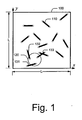
- Fig. 1 shows an example authentication object 100 for use as part of a label, such as a certificate of authenticity.
- authentication object 100 typically contains randomly distributed features that are unique and are hard to replicate.
- the example authentication object 100 shown in Fig. 1 is part of a fiber-based certificate of authenticity and contains fibers 110 that are embedded in the object in a random manner. Fibers 110 serve as the randomly distributed features of authentication object 100. Fibers 110 may be incorporated in authentication object 100 by any means. For example, fibers 100 may be sprayed onto authentication object 100. Fibers 100 may also be embedded into authentication object 100 during the manufacturing process.
- fibers 110 are optical fibers capable of transmitting light between their endpoints. Thus, by shedding light on a certain region 120 of authentication object 100, endpoints of fibers 131-133 that have at least one end-point within the lit up region are illuminated.
- authentication object 100 includes ⁇ randomly distributed fibers.
- Authentication object 100 may be scanned at a resolution of L x L pixels.
- Each fiber has a fixed length of R .
- the example authentication object 100 in Fig. 1 contains fibers, it is to be understood that authentication objects with other randomly distributed features may also be used in a certificate of authenticity in a similar manner.
- the randomly distributed features of authentication object 100 may be used in a certificate of authenticity to protect the proof of authenticity of an arbitrary object, such as a product.
- certain hard-to-replicate data about the randomly distributed features of the certificate of authenticity may be digitized, signed with the private key of the issuer, and the signature may be imprinted on the certificate of authenticity in a machine-readable form to validate that the produced instance is authentic.
- Each instance of the certificate of authenticity is associated with an object whose authenticity the issuer wants to vouch.
- verification of authenticity is done by extracting the signed data (data about the randomly distributed features) using the public key of the issuer and verifying that the extracted data matches the data of the associated instance of the certificate of authenticity.
- the adversary needs to either: (i) figure out the private key of the issuer, (ii) devise a manufacturing process that can exactly replicate an already signed instance of the certificate of authenticity, or (iii) misappropriate signed instances of the certificate of authenticity.
- the certificate of authenticity can be used to protect products whose value roughly does not exceed the cost of forging a single certificate of authenticity instance, including the accumulated development of a successful adversarial manufacturing process.
- a goal of a certificate of authenticity system is to ensure the authenticity of products or certain information associated with a product.
- the set of applications is numerous and broad, ranging from software and media (e.g., DVD, CD) anti-piracy to unforgeable coupons and design of tamper-proof hardware. For example, creating a tamper-resistant chip would require coating its package with a certificate of authenticity. Before each usage, the integrity of the certificate of authenticity should be verified in order to verify authenticity of the protected silicon.
- the hardware platforms may include a barcode. Since the capacity of a barcode for low-cost readers is limited to about 3K bits, the message signed by the private key is limited to the same length. Also, since one of the goals of a certificate of authenticity system is to maximize the effort of the adversary who aims at forging a specific instance of the certificate of authenticity, the problem associated with storing in the fixed-length signed message as much as possible information about the unique and randomly distributed features of a fiber-based certificate of authenticity will be discussed. An example analytical model for a fiber-based certificate of authenticity will be provided.
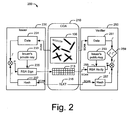
- Fig. 2 is a schematic diagram illustrating an example certificate of authenticity system 200 and example procedures employed by the system for issuing and verifying a certificate of authenticity.
- Certificate of authenticity system 200 includes certificate of authenticity 210, an issuer 230, and a verifier 250.
- certificate of authenticity 210 may include the authentication object 100 in Fig. 1 , a barcode 213, and text 215.
- the information that needs to be protected on a certificate of authenticity includes: ( a ) the representation of the hard-to-replicate randomly distributed features of authentication object 100 and ( b ) an arbitrary associated textual data. Initially, the randomly distributed features of authentication object 100, such as locations of fibers, are scanned using a hardware device. Details on how this information is collected and represented will be discussed below in conjunction with Fig. 3 .
- n F k * nRSA, k ⁇ N
- the digest f of data 231 representing the randomly distributed features of authentication object 100 may statistically maximize the distance between any two distinct certificate of authenticity instances. This goal translates directly to minimized likelihood of a false negative and false positive during the verification step.
- the textual data t is an arbitrary string of characters which depends on the application (e.g., expiration date, manufacturer's warranty).
- the textual data is derived from text 215, which is printed on certificate of authenticity 210 as shown in Fig. 2 .
- the textual data may be hashed using a cryptographically secure hash algorithm 237, such as SHA1.
- the output of the hash function is denoted as a message t with n T bits.
- ⁇ ⁇ ⁇ f ⁇ E t ( f ) of f using t or certain subset of bits from t as a key.
- Message m is signed with an RSA signature 235 using the private-key 233 of the issuer 230.
- Each n RSA bits of m are signed separately.
- This message is encoded and printed as barcode 213 (such as barcodes that obey the PDF417 standard) onto certificate of authenticity 210.
- the verification of certificate of authenticity 210 involves several steps. Verifier 250 initially scans the printed components: text 215 and barcode 213. Barcode 213 is decoded into the originally printed signature s . Text 215 is scanned and is hashed in order to create the message t . Note that generic optical character recognition (OCR) is not required for this task because the font used to print the text is known to the verifier 250 and optimized for improved OCR. For successful certificate of authenticity verification, text 215 and barcode 213 need to be read without errors; a task which is readily achievable with modem scanning technologies.
- OCR optical character recognition
- verifier 250 scans data 251 of representing the randomly distributed features in authentication object 251 and creates their presentation f '. Verifier 250 compares f' to the extracted f . Verifier 250 needs to quantify the correlation between the two sets of data: the one attached to the certificate and the one used to create the signature on the certificate of authenticity. At decision block 259, if the level of similarity of the two sets of data surpasses a certain threshold, verifier 250 announces that the certificate of authenticity 210 is authentic and vice versa.
- Fig. 3A is a schematic diagram of an example scanning system 300 for capturing randomly distributed features of authentication object 310 associated with a certificate of authenticity.
- Scanning system 300 includes optical sensor 322 and light source 324.
- Optical sensor 322 is configured to scan authentication object 310 and may include a charged coupled device (CCD) matrix of a particular resolution. In one embodiment, optical sensor 322 has a resolution of 128 x 128 pixels.
- Light source 324 is configured to provide light of a particular wavelength to illuminate a region of authentication object 310.
- Light source 324 may include, for example, a light emitting diode (LED).
- LED light emitting diode
- Fig. 3B is a top view of the authentication object 310 in Fig. 3A .
- the scanning system 300 divides authentication object 310 into regions, such as regions 311-314.
- regions 311-314 As shown in Fig. 3B , light source 324 of scanning system 300 sheds light onto region 314 while regions 311-313 are isolated from light source 324.
- the location of the endpoints in regions 311-313 of authentication object 310 can be determined by optical sensor 322.
- the read-out of the randomly distributed features in authentication object 310 includes four digital images that contain four different point-sets. Each point-set is associated with a particular region and is determined by illuminating that region.
- scanning system 300 may be configured to prevent this method of forging by changing the wavelength (e.g. color) of the light used by light source 324.
- the wavelength of the light may be randomly selected each time an authentication object is scanned by scanning system 300.
- Optical sensor 322 may be configured to detect the wavelength of the light emitted by the fibers in the authentication object and to determine whether that wavelength corresponds to the wavelength of the light emitted by light source 324. If the wavelengths of the emitted and detected light do not match, the certificate of authenticity is likely a forgery.
- Fig. 4 is a flow diagram of an example process 400 that may be used to create a certificate of authenticity.
- the authentication object in a certificate of authenticity is scanned.
- the authentication object may be scanned using scanning system 300 in Fig. 3A .
- data representing the randomly distributed attributes of the authentication object is determined.
- the data may include the positions of the endpoints of fibers that are illuminated, such as the endpoints shown in Fig. 3B .
- the data is compressing to enhance the security level of the certificate of authenticity.
- Data compression will be discussed in detail in conjunction with Fig. 5 . Briefly stated, a path may be determined for compressing a portion of the data representing randomly distributed attributes in the authentication object.
- the compressed data is encoded.
- the compressed data may be signed using private-key 233 in Fig. 2 .
- the encoded data is incorporated in the certificate of authenticity.
- the encoded data may be printed onto the certificate of authenticity as a barcode, such as barcode 213 in Fig. 2 .
- Fig. 5 is a flow diagram of an example process 500 that may be used to compress data that represents the randomly distributed attributes of an authentication object.
- process 500 will be described in the context of a fiber-based certificate of authenticity. However, process 500 may be applied to any type of certificate of authenticity.
- a probability density function associated with the authentication object is determined. Probability density function will be discussed in Section III-A. An example probability density function is shown in Equation 11. A graphical presentation of the example probability density function is illustrated in Fig. 8 . Briefly stated, the probability density function represents the likelihood that a unit of the randomly distributed attributes is found in a certain location of the authentication object. In the context of a fiber-based certificate of authenticity, the probability density function may represent the probability that a particular point in a region of the authentication object is illuminated. The probability density function may also be used to compute how many of the total fibers will be illuminated in a particular region.
- vectors associated with the randomly distributed attributes are determined.
- point-to-point vectors are used and will be discussed in Section IV-A.
- Equation 16 may be used to compute point-to-point vectors to represent the randomly distributed attributes in a fiber-based certificate of authenticity.
- the vectors are encoded using an arithmetic coding algorithm. Arithmetic coding algorithm will be discussed in Section IV-A. An example algorithm is shown in Table 2.
- a path for compressing a portion of the vectors within a fixed amount of data is determined.
- the method for computing the path is discussed in Section IV-B.
- the example path may be computed using Equation 20.
- the path of the compressed data representing a portion of the randomly distributed attributes is returned.
- An authentication object (L,R,K) is modeled as a square with an edge of L units and K fibers of fixed length R ⁇ Ll2 randomly thrown over the object.
- Other model variants such as variable fiber length or arbitrary shape authentication object, can be derived from this model.
- the authentication object is positioned in the positive quadrant of a 2D Cartesian coordinate system as illustrated in Fig. 1 .
- ⁇ i ⁇ P Pr A ⁇ P
- f A ⁇ B ⁇ S
- B ⁇ S i ⁇ ⁇ Q x ⁇ y ⁇ P ⁇ ⁇ i , Q x ⁇ y ⁇ d ⁇ x ⁇ d ⁇ y .
- the perimeter containment function l( A ) is defined, which measures the length of the part of the perimeter (arc) of the circle centered at A with radius R that is encompassed by the entire authentication object S .
- l( A ) is uniformly computed.
- Fig. 6 is a graphical representation of areas P1-P4 that correspond to the four different regions in an example authentication object 600.
- the perimeter containment function is computed using a closed analytical form distinct for that area using Equations 7-10 as discussed below.
- AREA P1 This is the central area of the authentication object, where for any point Q ⁇ P1, the circle with radius R centered at Q does not intersect with any of the edges of the authentication object.
- ⁇ browses the perimeter of C ( Q , R ) ⁇ S i and a is a constant such that: ⁇ ⁇ Q x ⁇ y ⁇ S - S i ⁇ ⁇ i , Q x ⁇ y ⁇ d ⁇ x ⁇ d ⁇ y 1.
- the probability that A lands on a specific infinitesimally small arc of length d l ⁇ S is equal to d l /l( B ).
- ⁇ i ⁇ Q area ⁇ S - S i - 1 ⁇ ⁇ C Q ⁇ R ⁇ S i ⁇ 4 ⁇ R ⁇ d / d ⁇ ⁇ ⁇ B Q ⁇ R ⁇ ⁇ ⁇ C ⁇ d ⁇ l , where function area( S - S i ) computes the area under S - S i .
- the pdf ⁇ (1, Q ( x , y )) at a point Q ⁇ S - S 1 is proportional to the integral of the inverse of the value of l( ⁇ ) over C ( Q , R ) ⁇ S 1 .
- Figure 7 is a graphical representation of the nineteen different regions on an example authentication object 700 that have distinct analytical formulae as a solution to the integral quantified in Equation 11.
- ⁇ (1, Q ( x , y )) is approximately solved using a simple numerical computation. The results is illustrated in Fig. 8
- Fig. 8 shows that the likelihood that an endpoint of a fiber lands on a certain small area P ⁇ S-S 1 varies significantly depending on the particular position of P within S-S 1 .
- f A ⁇ B , A ⁇ S i .
- Figure 9 is a graphical representation of the areas T0-T8, where ⁇ ( i , Q ( x , y )) is computed using distinct closed analytical forms. ⁇ ( i , Q ( x , y )) is analytically computed based on the analysis of the events ( i-ii ) from Section III-A. Similarly to Section III-A, only in the case when region S 1 is lit up is computed. There are nine different regions in the COA (marked T0 through T8 in Fig. 9 ) where ⁇ (1, Q ) is computed uniformly.
- the analytical closed forms for ⁇ (1, Q ) depending on the location of Q within S 1 are given in Table 1.
- a circle centered at a point A ⁇ S with radius R is denoted as C ( A,R ) .
- C ( A,R ) A circle centered at a point A ⁇ S with radius R.
- the goal of the certificate of authenticity system is to ensure that the task of manufacturing (i.e. forging) a specific authentication object instance as difficult as possible.
- This goal is quantified as a demand for recording the positions of as many as possible fibers of the authentication object.
- the number of regions of authentication object equals four; hence, for each region S i , a quarter n M /4 of bits in the signed message m is dedicated to storing as many as possible fiber end-points illuminated in S - S i once light is shed on S i . Note that in general, not all illuminated points need to be stored; only the largest subset of these points that can be encoded using n M /4 bits.
- An arithmetic coder converts an input stream of arbitrary length into a single rational number within [0,1 ⁇ .
- the principal strength of AC is that it can compress arbitrarily close to the entropy.
- the discussion below shows how a word " aba " is encoded given an alphabet with an unknown pdf of symbol occurrence.
- the example is illustrated in Fig. 10 .
- the AC divides its range into two subranges [0,0.5 ⁇ and [0.5,1 ⁇ , each representing "b” and " a " respectively.
- Symbol a is encoded by constraining the range of the AC to the range that corresponds to this symbol, i.e., [0.5,1 ⁇ .
- the AC divides its range into [0.5,0.6667 ⁇ and [0.6667,1 ⁇ , each representing "b” and " a " respectively.
- the decoder understands the message length either explicitly in the header of the compressed message or via a special " end-of-file " symbol.
- the AC iteratively reduces its operating range up to a point when its range is such that the leading digit of the high and low bound are equal. Then, the leading digit can be transmitted.
- This process called renormalization , enables compression of files of any length on limited precision arithmetic units. Performance improvements of classic AC focus on: using precomputed approximations of arithmetic calculations, replacing division and multiplication with shifting and addition.
- f A ⁇ B K .
- Equation 16 is concluded.
- the encoding of a unit-to-unit vector is done using an AC, which uses algorithm A 1 to assign a corresponding range on the encoding interval for each encoding symbol, i.e. each unit v ⁇ S - S i different from the source unit u .
- algorithm A 1 assigns a range equal to the probability that v is one of the two closest illuminated units with respect to the source unit u . This probability is denoted as p ( v
- u ) can be computed as follows: p v
- u ⁇ u ⁇ w ⁇ M v w 1 - ⁇ w + ⁇ w ⁇ M v w ⁇ u ⁇ ⁇ w ⁇ z ⁇ M v w , z ⁇ w 1 - ⁇ z , where the set of units M v (u) is computed as in algorithm A1.
- Dual vector encoding is used as a primitive to encode a subset of points in the overall compression algorithm presented in the Section IV-B.
- the encoding algorithm is near-optimal for the set of assumptions presented in Section IV-A.2, the same set of constraints is not valid for the overall compression goal, hence, the inherent optimality of using arithmetic coding with range allocation via A 1 is discussed in Section IV-B.
- INSTANCE Directed, complete, and weighted graph G ( N,E ) with a non-negative vertex function ⁇ : E ⁇ R , positive integer l min ⁇ Z + , positive real number ⁇ R + .
- Problem 2 models the optimization problem of compressing as many as possible (i.e. l ) fiber end-points in an authentication object using a fixed storage (i.e. A).
- This problem is NP-complete as it can be shown that the ASYMMETRIC TRAVELING SALESMAN PROBLEM, ATSP, can be reduced to CPS, ATSP ⁇ CPS m p , via binary search for A.
- an efficient constructive heuristic A2 is presented that aims at solving this problem.
- the premier design requirement for the heuristic is fast run-time performance because each certificate of authenticity must be signed separately at a manufacturing line.
- the distance measure between two nodes in N does not obey the triangle inequality for all nodes.
- the encoding procedure from Section IV-A encodes vectors in S - S i using a number of bits proportional to the likelihood that a certain unit is one of the two closest illuminated points. Hence, units farther from the source node are encoded with significantly longer codewords as they are unlikely to occur, which renders shortcuts to these nodes in the solution route highly undesirable.
- Theorem 2 The distance measure w does not universally obey the triangle inequality: ⁇ e u ⁇ v + ⁇ ( e v ⁇ w ⁇ ⁇ u ⁇ w .
- the developed heuristic A2 has two stages: a constructive and an iterative improvement phase.
- the constructive phase follows a greedy heuristic which builds the initial solution.
- A2 identifies a set of dominating edges E' .
- For each pair of edges, e ( u , v ), e( v , u ), between nodes u , v , A2 selects only the shorter of the two and stores it in E' .
- a set P of initial subpaths is created by sorting the edges in E' and selecting the top K shortest edges whose weights sum up as close as possible to A.
- the first and last node in a path p i are denoted as s i and d i respectively.
- 1, the optimal solution is found and the search is stopped. Else, all single-edge subpaths are removed from P .
- the shortest paths are routed via nodes which are not in P .
- the shortest path is denoted between s i and d j as q ( i,j ) .
- A2 sorts all concatenations p i
- A2 continues concatenating subpaths in P via nodes in N - P until the total number of remaining paths is
- the remaining paths are concatenated using an exact algorithm which finds a path p h with the optimal metric: maximal cardinality and a sum of weights smaller than A.
- a rerouting procedure browses all the nodes in P , and using the Dijkstra algorithm tries to find shortest paths to other nodes in P via the remaining nodes in E. The same procedure also tries to find a better ending tail than the one that exists in p h . For each reroute, A2 checks whether the new reroute has a better metric than the current, best path p h .
- A2 contracts the currently best found path p best into p h , so that
- the contraction parameter ⁇ is randomly selected in each iteration within ⁇ ⁇ ⁇ 0.4,0.8 ⁇ .
- Nodes n 0 and n are denoted as the first and last node in p h . While the sum of weights in p h is smaller than ⁇ , among edges that have n 0 or n l as destination or source respectively, we find an edge e with minimal weight and concatenate it to p h .
- A2 performs the rerouting procedure previously described.
- the worst-time complexity of A2 is O (
- the complexity of A2 can be reduced to O (
- the graph is originally complete, by removing edges with high weights, we create a sparse graph, where Johnson's algorithm for all-pairs shortest paths yields O (
- FIG. 11 illustrates a solution to a single instance of the problem, an authentication object (512,0.4 ⁇ 512,256).
- the scanning grid to L 512 scanning cells.
- the figure depicts the case when the lower left quadrant of the authentication object is illuminated.
- the compression ratio is defined as a ratio of the size of the compressed message vs. the original message size.
- a goal of the certificate of authenticity designer is to maximize the cost of forgery ⁇ f using a bounded manufacturing cost ⁇ m .
- ⁇ m Several parameters may impact ⁇ m . For brevity and simplicity, three parameters are discussed:
- the certificate of authenticity issuer and verifier repeat their parts of the algorithm A3 for each authentication object quadrant S i .
- the issuer initially scans the authentication object instance and collects information about the set of points N which illuminate when S i is lit up. Next, using the available A bits, it compresses the largest subset P ⁇ N ,
- G returned by A2. Then, A3 finds a subset U ⁇ S - S i , such that the Euclidean distance between each unit u i ⁇ U and its closest unit p j ⁇ P is at most ⁇ 1 . Subset U of units represents an ⁇ 1 -neighborhood of P. Then, the issuer counts the number K T of points in N that exist in U .
- the verifier extracts from the attached signature the compressed point subset P and ⁇ 2 and recreates the corresponding ⁇ 1 -neighborhood, U .
- the verifier scans the authentication object instance for the set of illuminated fibers N' when S t is lit up. It announces that the instance is authentic by checking that the number of common points in U and N' is at most G + ⁇ 2 and that the number of common points in N ' and P is at least G ⁇ .
- the adversary's goal is to place at least G ⁇ fiber end-points from P accurately, hence, the adversary can afford G (1- ⁇ )+ ⁇ 2 misplacements located in the ⁇ 1 -neighborhood of P during the forgery process. It is expected that each trial, targeting a point p i , if unsuccessful, ends up in the ⁇ 1 -neighborhood of p i .
- the verifier can identify possible misplacements over a larger neighborhood; however, this also increases the expectation for ⁇ 2 - a value that the certificate of authenticity designer wants to keep as low as possible.
- Figure 12 is a graphical representation of a certificate of authenticity design for optimized cost effectiveness.
- the abscissa quantifies fiber length R relative to L , while the ordinate shows the number of fibers K .
- a simple empirical technique may be used that searches for the best fiber cut ⁇ R * , K * ⁇ .
- the search procedure is illustrated using Figure 12 .
- the abscissa and the ordinate represent the values of R and K respectively.
- the bar denotes the expected log-cost of forging an certificate of authenticity instance, log 10 ( ⁇ f ( A 2, RK )).
- the diagram in Figure 12 was computed empirically.
- the expected compression performance for each point in the remaining portion of the ⁇ R , K ⁇ -space was obtained by interpolating the empirical results. From Figure 12 , the best fiber cut can be found in the neighborhood of K * ⁇ 900 and R * ⁇ 0.1 L . This result points to the fact that for the selected design environment, a cross-shaped certificate of authenticity is the best option.
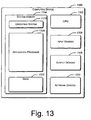
- Fig. 13 illustrates an example computing device 1300 within which the described systems and methods can be either fully or partially implemented.
- Computing device 1300 is only one example of a computing system and is not intended to suggest any limitation as to the scope of the use or functionality of the invention.
- Computing device 1300 can be implemented with numerous other general purpose or special purpose computing system environments or configurations. Examples of well known computing systems, environments, and/or configurations that may be suitable for use include, but are not limited to, personal computers, server computers, thin clients, thick clients, hand-held or laptop devices, multiprocessor systems, microprocessor-based systems, set top boxes, programmable consumer electronics, network PCs, minicomputers, mainframe computers, gaming consoles, distributed computing environments that include any of the above systems or devices, and the like.
- computing device 1300 can include, but are not limited to, processor 1302 (e.g., any of microprocessors, controllers, and the like), system memory 1304, input devices 1306, output devices 1308, and network devices 1310.
- processor 1302 e.g., any of microprocessors, controllers, and the like
- system memory 1304 e.g., any of microprocessors, controllers, and the like
- Computing device 1300 typically includes a variety of computer-readable media. Such media can be any available media that is accessible by computing device 1300 and includes both volatile and non-volatile media, removable and non-removable media.
- System memory 1304 includes computer-readable media in the form of volatile memory, such as random access memory (RAM), and/or non-volatile memory, such as read only memory (ROM).
- RAM random access memory
- ROM read only memory
- BIOS basic input/output system
- System memory 1304 typically contains data and/or program modules that are immediately accessible to and/or presently operated on by processor 1302.
- System memory 1304 can also include other removable/non-removable, volatile/non-volatile computer storage media.
- a hard disk drive may be included for reading from and writing to a non-removable, non-volatile magnetic media;
- a magnetic disk drive may be included for reading from and writing to a removable, non-volatile magnetic disk (e.g., a "floppy disk”);
- an optical disk drive may be included for reading from and/or writing to a removable, non-volatile optical disk such as a CD-ROM, DVD, or any other type of optical media.
- the disk drives and their associated computer-readable media provide non-volatile storage of computer-readable instructions, data structures, program modules, and other data for computing device 1300. It is to be appreciated that other types of computer-readable media which can store data that is accessible by computing device 1300, such as magnetic cassettes or other magnetic storage devices, flash memory cards, CD-ROM, digital versatile disks (DVD) or other optical storage, random access memories (RAM), read only memories (ROM), electrically erasable programmable read-only memory (EEPROM), and the like, can also be utilized to implement exemplary computing device 1300. Any number of program modules can be stored in system memory 1304, including by way of example, an operating system 1320, application programs 1328, and data 1332.
- Computing device 1300 can include a variety of computer-readable media identified as communication media.
- Communication media typically embodies computer-readable instructions, data structures, program modules, or other data in a modulated data signal such as a carrier wave or other transport mechanism and includes any information delivery media.
- modulated data signal refers to a signal that has one or more of its characteristics set or changed in such a manner as to encode information in the signal.
- communication media includes wired media such as a wired network or direct-wired connection, and wireless media such as acoustic, RF, infrared, and other wireless media. Combinations of any of the above are also included within the scope of computer-readable media.
- a user can enter commands and information into computing device 1300 via input devices 1306 such as a keyboard and a pointing device (e.g., a "mouse").
- input devices 1306 such as a keyboard and a pointing device (e.g., a "mouse").
- Other input devices 1306 may include a microphone, joystick, game pad, controller, satellite dish, serial port, scanner, touch screen, touch pads, key pads, and/or the like.
- Output devices 1308 may include a CRT monitor, LCD screen, speakers, printers, and the like.
- Computing device 1300 may include network devices 1310 for connecting to computer networks, such as local area network (LAN), wide area network (WAN), and the like.
- LAN local area network
- WAN wide area network
Landscapes
- Engineering & Computer Science (AREA)
- Physics & Mathematics (AREA)
- General Physics & Mathematics (AREA)
- Computer Security & Cryptography (AREA)
- Theoretical Computer Science (AREA)
- Computer Networks & Wireless Communication (AREA)
- Signal Processing (AREA)
- Multimedia (AREA)
- Architecture (AREA)
- Civil Engineering (AREA)
- Structural Engineering (AREA)
- Computer Vision & Pattern Recognition (AREA)
- Credit Cards Or The Like (AREA)
- Compression, Expansion, Code Conversion, And Decoders (AREA)
- Collating Specific Patterns (AREA)
- Seasonings (AREA)
- Micro-Organisms Or Cultivation Processes Thereof (AREA)
- Storage Device Security (AREA)
- Image Analysis (AREA)
- Image Processing (AREA)
- Medicines Containing Material From Animals Or Micro-Organisms (AREA)
- Geophysics And Detection Of Objects (AREA)
- Train Traffic Observation, Control, And Security (AREA)
- Air Bags (AREA)
Applications Claiming Priority (2)
| Application Number | Priority Date | Filing Date | Title |
|---|---|---|---|
| US802981 | 2004-03-17 | ||
| US10/802,981 US7577844B2 (en) | 2004-03-17 | 2004-03-17 | Systems and methods for encoding randomly distributed features in an object |
Publications (3)
| Publication Number | Publication Date |
|---|---|
| EP1577831A2 EP1577831A2 (en) | 2005-09-21 |
| EP1577831A3 EP1577831A3 (en) | 2006-08-09 |
| EP1577831B1 true EP1577831B1 (en) | 2009-03-18 |
Family
ID=34838913
Family Applications (1)
| Application Number | Title | Priority Date | Filing Date |
|---|---|---|---|
| EP05101320A Expired - Lifetime EP1577831B1 (en) | 2004-03-17 | 2005-02-22 | Systems and methods for encoding randomly distributed features in an object |
Country Status (18)
| Country | Link |
|---|---|
| US (1) | US7577844B2 (https=) |
| EP (1) | EP1577831B1 (https=) |
| JP (1) | JP4718843B2 (https=) |
| KR (1) | KR101153016B1 (https=) |
| CN (1) | CN1670761B (https=) |
| AT (1) | ATE426217T1 (https=) |
| AU (1) | AU2005200403B2 (https=) |
| BR (1) | BRPI0500133B1 (https=) |
| CA (1) | CA2497108C (https=) |
| DE (1) | DE602005013318D1 (https=) |
| MX (1) | MXPA05001925A (https=) |
| MY (1) | MY143631A (https=) |
| NO (1) | NO20050284L (https=) |
| NZ (1) | NZ538305A (https=) |
| RU (1) | RU2386168C2 (https=) |
| SG (1) | SG115726A1 (https=) |
| TW (1) | TWI360782B (https=) |
| ZA (1) | ZA200501336B (https=) |
Families Citing this family (56)
| Publication number | Priority date | Publication date | Assignee | Title |
|---|---|---|---|---|
| US7089420B1 (en) * | 2000-05-24 | 2006-08-08 | Tracer Detection Technology Corp. | Authentication method and system |
| US7162035B1 (en) | 2000-05-24 | 2007-01-09 | Tracer Detection Technology Corp. | Authentication method and system |
| US8171567B1 (en) | 2002-09-04 | 2012-05-01 | Tracer Detection Technology Corp. | Authentication method and system |
| FR2866139B1 (fr) * | 2004-02-06 | 2006-04-14 | Yann Boutant | Procede pour proteger de la lecture directe des informations sensibles, un support porteur de telles informations protegees et un procede de lecture de ces informations protegees |
| DE602005014755D1 (de) | 2004-03-12 | 2009-07-16 | Ingenia Technology Ltd | Verfahren und vorrichtungen zur erzeugung authentifizierbarer gegenstände und ihrer nachfolgenden überprüfung |
| AU2005220385B2 (en) | 2004-03-12 | 2010-07-15 | Ingenia Holdings Limited | Authenticity verification methods, products and apparatuses |
| GB2417592B (en) * | 2004-08-13 | 2006-07-26 | Ingenia Technology Ltd | Authenticity verification of articles |
| US7856116B2 (en) * | 2004-11-09 | 2010-12-21 | Digimarc Corporation | Authenticating identification and security documents |
| US20060286569A1 (en) * | 2005-03-10 | 2006-12-21 | Bar-Or Yuval A | Method, apparatus, and system for authentication using labels containing nucleotide sequences |
| US20060294583A1 (en) * | 2005-05-11 | 2006-12-28 | Ingenia Holdings (U.K.) Limited | Authenticity Verification |
| JP2009503670A (ja) * | 2005-07-27 | 2009-01-29 | インゲニア・テクノロジー・リミテッド | 真正性検証 |
| RU2417448C2 (ru) * | 2005-07-27 | 2011-04-27 | Инджениа Холдингс Лимитед | Верификация аутентичности |
| EP1927067A2 (en) * | 2005-09-14 | 2008-06-04 | Koninklijke Philips Electronics N.V. | Device, system and method for determining authenticity of an item |
| FR2894757B1 (fr) * | 2005-12-13 | 2008-05-09 | Viaccess Sa | Procede de controle d'acces a un contenu embrouille |
| CN101923647B (zh) | 2005-12-23 | 2013-01-09 | 英根亚控股有限公司 | 光学鉴别 |
| GB2434442A (en) * | 2006-01-16 | 2007-07-25 | Ingenia Holdings | Verification of performance attributes of packaged integrated circuits |
| US7949148B2 (en) | 2006-01-23 | 2011-05-24 | Digimarc Corporation | Object processing employing movement |
| US8224018B2 (en) | 2006-01-23 | 2012-07-17 | Digimarc Corporation | Sensing data from physical objects |
| GB2440386A (en) * | 2006-06-12 | 2008-01-30 | Ingenia Technology Ltd | Scanner authentication |
| US8837721B2 (en) * | 2007-03-22 | 2014-09-16 | Microsoft Corporation | Optical DNA based on non-deterministic errors |
| US8788848B2 (en) * | 2007-03-22 | 2014-07-22 | Microsoft Corporation | Optical DNA |
| US7884805B2 (en) * | 2007-04-17 | 2011-02-08 | Sony Ericsson Mobile Communications Ab | Using touches to transfer information between devices |
| US9977721B2 (en) | 2007-12-20 | 2018-05-22 | Netapp, Inc. | Evaluating and predicting computer system performance using kneepoint analysis |
| US8805647B2 (en) * | 2007-12-20 | 2014-08-12 | Netapp, Inc. | Evaluating and predicting computer system performance using kneepoint analysis |
| US7995196B1 (en) | 2008-04-23 | 2011-08-09 | Tracer Detection Technology Corp. | Authentication method and system |
| WO2009156904A1 (en) * | 2008-06-27 | 2009-12-30 | Koninklijke Philips Electronics N.V. | Device, system and method for verifying the authenticity integrity and/or physical condition of an item |
| US7991153B1 (en) * | 2008-08-26 | 2011-08-02 | Nanoglyph, LLC | Glyph encryption system and related methods |
| GB2466465B (en) * | 2008-12-19 | 2011-02-16 | Ingenia Holdings | Authentication |
| GB2466311B (en) | 2008-12-19 | 2010-11-03 | Ingenia Holdings | Self-calibration of a matching algorithm for determining authenticity |
| US9135948B2 (en) * | 2009-07-03 | 2015-09-15 | Microsoft Technology Licensing, Llc | Optical medium with added descriptor to reduce counterfeiting |
| EP2315358A1 (en) * | 2009-10-09 | 2011-04-27 | Thomson Licensing | Method and device for arithmetic encoding or arithmetic decoding |
| BR122022013454B1 (pt) | 2009-10-20 | 2023-05-16 | Fraunhofer-Gesellschaft Zur Forderung Der Angewandten Forschung E.V. | Codificador de áudio, decodificador de áudio, método para codificar uma informação de áudio, método para decodificar uma informação de áudio que utiliza uma detecção de um grupo de valores espectrais previamente decodificados |
| GB2476226B (en) | 2009-11-10 | 2012-03-28 | Ingenia Holdings Ltd | Optimisation |
| AU2011206677B9 (en) | 2010-01-12 | 2014-12-11 | Fraunhofer-Gesellschaft Zur Foerderung Der Angewandten Forschung E.V. | Audio encoder, audio decoder, method for encoding and decoding an audio information, and computer program obtaining a context sub-region value on the basis of a norm of previously decoded spectral values |
| MD4151C1 (ro) * | 2010-01-19 | 2012-09-30 | ШКИЛЁВ Думитру | Procedeu de aplicare a marcajului individual de identificare şi marcaj individual de identificare |
| KR20110127812A (ko) * | 2010-05-20 | 2011-11-28 | 엘지이노텍 주식회사 | 불법 복제 방지 시스템 및 방법 |
| JP5554677B2 (ja) * | 2010-10-07 | 2014-07-23 | Kddi株式会社 | 映像コンテンツ生成システム、映像コンテンツ生成装置及びコンピュータプログラム |
| US9195810B2 (en) | 2010-12-28 | 2015-11-24 | Microsoft Technology Licensing, Llc | Identifying factorable code |
| JP2013015898A (ja) * | 2011-06-30 | 2013-01-24 | Fuji Xerox Co Ltd | 真贋判定支援装置、真贋判定装置、真贋判定支援プログラム、及び真贋判定プログラム |
| US20150379321A1 (en) | 2012-03-01 | 2015-12-31 | Sys-Tech Solutions, Inc. | Methods and a system for verifying the authenticity of a mark |
| US20150169928A1 (en) | 2012-03-01 | 2015-06-18 | Sys-Tech Solutions, Inc. | Methods and a system for verifying the identity of a printed item |
| SG11201405180SA (en) | 2012-03-01 | 2014-09-26 | Sys Tech Solutions Inc | Unique identification information from marked features |
| US9473303B2 (en) * | 2013-05-23 | 2016-10-18 | Rosemount Inc. | Method and system for product authentication |
| FR3017333B1 (fr) * | 2014-02-07 | 2019-06-21 | Advanced Track & Trace | Procede et dispositif de securisation d'un objet, procede et dispositif de controle leur correspondant et objet securise |
| US20160188643A1 (en) * | 2014-12-31 | 2016-06-30 | Futurewei Technologies, Inc. | Method and apparatus for scalable sorting of a data set |
| US9940572B2 (en) | 2015-02-17 | 2018-04-10 | Sys-Tech Solutions, Inc. | Methods and a computing device for determining whether a mark is genuine |
| EP3093795A1 (en) * | 2015-05-12 | 2016-11-16 | Nokia Technologies Oy | An apparatus and method for providing identification |
| AU2016278954B2 (en) | 2015-06-16 | 2018-05-24 | Sys-Tech Solutions, Inc. | Methods and a computing device for determining whether a mark is genuine |
| US12598197B2 (en) | 2015-10-28 | 2026-04-07 | Qomplx Llc | System and methods for detecting authentication object forgery or manipulation attacks |
| US11552968B2 (en) | 2015-10-28 | 2023-01-10 | Qomplx, Inc. | System and methods for detecting and mitigating golden SAML attacks against federated services |
| US11570204B2 (en) | 2015-10-28 | 2023-01-31 | Qomplx, Inc. | Detecting and mitigating golden ticket attacks within a domain |
| EP3168825A1 (en) * | 2015-11-10 | 2017-05-17 | Alcatel Lucent | A unique identifier module, a system for providing with a unique identification, a related module and related method |
| EP4057206B1 (en) | 2016-03-14 | 2024-08-21 | Sys-Tech Solutions, Inc. | Methods and a computing device for determining whether a mark is genuine |
| GB201803528D0 (en) * | 2018-03-05 | 2018-04-18 | Septillion Tech Limited | Data processing apparatus |
| US12155646B2 (en) | 2019-06-10 | 2024-11-26 | Microsoft Technology Licensing, Llc | Authentication with random noise symbols and pattern recognition |
| KR20220082257A (ko) | 2020-12-10 | 2022-06-17 | 주식회사 투비유니콘 | 확률함수를 이용한 자연어의 인식률 계산방법으로 자연어를 분석하는 시스템 |
Family Cites Families (39)
| Publication number | Priority date | Publication date | Assignee | Title |
|---|---|---|---|---|
| US4424414A (en) | 1978-05-01 | 1984-01-03 | Board Of Trustees Of The Leland Stanford Junior University | Exponentiation cryptographic apparatus and method |
| US4386233A (en) | 1980-09-29 | 1983-05-31 | Smid Miles E | Crytographic key notarization methods and apparatus |
| EP0085130A1 (en) | 1982-02-02 | 1983-08-10 | Omnet Associates | Method and apparatus for maintaining the privacy of digital messages conveyed by public transmission |
| US4633036A (en) | 1984-05-31 | 1986-12-30 | Martin E. Hellman | Method and apparatus for use in public-key data encryption system |
| NL8502567A (nl) | 1985-09-19 | 1987-04-16 | Bekaert Sa Nv | Werkwijze en inrichting voor het op echtheid controleren van voorwerpen en voorwerp geschikt voor het toepassen van deze werkwijze. |
| US4881264A (en) | 1987-07-30 | 1989-11-14 | Merkle Ralph C | Digital signature system and method based on a conventional encryption function |
| US5016274A (en) | 1988-11-08 | 1991-05-14 | Silvio Micali | On-line/off-line digital signing |
| US4956863A (en) | 1989-04-17 | 1990-09-11 | Trw Inc. | Cryptographic method and apparatus for public key exchange with authentication |
| JPH0327489A (ja) * | 1989-06-23 | 1991-02-05 | Toyo Ink Mfg Co Ltd | 書類の真正さを検査する方法 |
| JPH0330097A (ja) * | 1989-06-27 | 1991-02-08 | Matsushita Electric Works Ltd | 光電式煙感知器 |
| US5003597A (en) | 1989-12-21 | 1991-03-26 | Xerox Corporation | Method and apparatus for data encryption |
| NL9001368A (nl) | 1990-06-15 | 1992-01-02 | Tel Developments B V | Beveiliging van voorwerpen of dokumenten. |
| JPH05270181A (ja) * | 1992-03-24 | 1993-10-19 | Toppan Printing Co Ltd | カード及びカードの真偽判定方法 |
| JPH05270178A (ja) * | 1992-03-30 | 1993-10-19 | Toppan Printing Co Ltd | 情報記録媒体およびその真偽判定方法ならびにその情報記録方法 |
| US5299262A (en) | 1992-08-13 | 1994-03-29 | The United States Of America As Represented By The United States Department Of Energy | Method for exponentiating in cryptographic systems |
| JP3322729B2 (ja) * | 1992-09-25 | 2002-09-09 | 日本発条株式会社 | 被検出物の真偽を判別する方法および装置 |
| US5864622A (en) | 1992-11-20 | 1999-01-26 | Pitney Bowes Inc. | Secure identification card and method and apparatus for producing and authenticating same |
| US5388158A (en) * | 1992-11-20 | 1995-02-07 | Pitney Bowes Inc. | Secure document and method and apparatus for producing and authenticating same |
| US5384846A (en) | 1993-04-26 | 1995-01-24 | Pitney Bowes Inc. | System and apparatus for controlled production of a secure identification card |
| US5420924A (en) | 1993-04-26 | 1995-05-30 | Pitney Bowes Inc. | Secure identification card and method and apparatus for producing and authenticating same by comparison of a portion of an image to the whole |
| JPH07156580A (ja) * | 1993-12-08 | 1995-06-20 | Nhk Spring Co Ltd | 真正さがチェックされるカード状の被検出物 |
| US6035914A (en) * | 1993-10-22 | 2000-03-14 | Martin Marietta Energy Systems Inc. | Counterfeit-resistant materials and a method and apparatus for authenticating materials |
| RU2088971C1 (ru) | 1994-01-11 | 1997-08-27 | Юрий Дмитриевич Карякин | Способ защиты ценных бумаг от подделки |
| US5469506A (en) | 1994-06-27 | 1995-11-21 | Pitney Bowes Inc. | Apparatus for verifying an identification card and identifying a person by means of a biometric characteristic |
| US6904525B1 (en) | 1997-07-01 | 2005-06-07 | Pitney Bowes Inc. | Method for preventing counterfeiting of articles of manufacture |
| US5974150A (en) * | 1997-09-30 | 1999-10-26 | Tracer Detection Technology Corp. | System and method for authentication of goods |
| US6332030B1 (en) * | 1998-01-15 | 2001-12-18 | The Regents Of The University Of California | Method for embedding and extracting digital data in images and video |
| JP4035221B2 (ja) * | 1998-03-10 | 2008-01-16 | 新生化学工業株式会社 | 構造体 |
| US6193156B1 (en) | 1998-11-12 | 2001-02-27 | Wenyu Han | Method and apparatus for patterning cards, instruments and documents |
| US6321981B1 (en) | 1998-12-22 | 2001-11-27 | Eastman Kodak Company | Method and apparatus for transaction card security utilizing embedded image data |
| CA2595621C (en) | 1999-02-26 | 2009-07-07 | Canada Post Corporation | Unique identifier bar code on stamps and apparatus and method for monitoring stamp usage with identifier bar codes |
| EA003919B1 (ru) | 1999-12-08 | 2003-10-30 | Валентин Александрович Мищенко | Способ и система для маркировки и идентификации изделий |
| US7089420B1 (en) * | 2000-05-24 | 2006-08-08 | Tracer Detection Technology Corp. | Authentication method and system |
| US7152047B1 (en) * | 2000-05-24 | 2006-12-19 | Esecure.Biz, Inc. | System and method for production and authentication of original documents |
| EP1173001A3 (en) | 2000-07-11 | 2004-05-06 | Eastman Kodak Company | Authenticatable image with an embedded image having a discernible physical characteristic |
| JP2003030097A (ja) * | 2001-07-19 | 2003-01-31 | Jeecom Japan Corp | 基本構造が異なる複数の携帯電話・パソコンへの出力を可能にしたソフトウェアシステム |
| DE10204870B4 (de) | 2002-02-06 | 2018-11-15 | Infineon Technologies Ag | Verfahren zur Fälschungssicherung eines Wertträgers, Wertträger und Verfahren zur Überprüfung seiner Echtheit |
| US7010167B1 (en) * | 2002-04-30 | 2006-03-07 | The United States Of America As Represented By The National Security Agency | Method of geometric linear discriminant analysis pattern recognition |
| US7519726B2 (en) * | 2003-12-12 | 2009-04-14 | International Business Machines Corporation | Methods, apparatus and computer programs for enhanced access to resources within a network |
-
2004
- 2004-03-17 US US10/802,981 patent/US7577844B2/en not_active Expired - Fee Related
-
2005
- 2005-01-18 NO NO20050284A patent/NO20050284L/no unknown
- 2005-01-20 JP JP2005013317A patent/JP4718843B2/ja not_active Expired - Fee Related
- 2005-01-24 BR BRPI0500133A patent/BRPI0500133B1/pt not_active IP Right Cessation
- 2005-01-26 KR KR1020050007087A patent/KR101153016B1/ko not_active Expired - Fee Related
- 2005-01-26 TW TW094102365A patent/TWI360782B/zh not_active IP Right Cessation
- 2005-02-01 SG SG200500623A patent/SG115726A1/en unknown
- 2005-02-01 AU AU2005200403A patent/AU2005200403B2/en not_active Ceased
- 2005-02-15 ZA ZA200501336A patent/ZA200501336B/xx unknown
- 2005-02-15 CA CA2497108A patent/CA2497108C/en not_active Expired - Fee Related
- 2005-02-16 CN CN2005100094917A patent/CN1670761B/zh not_active Expired - Fee Related
- 2005-02-17 MX MXPA05001925A patent/MXPA05001925A/es active IP Right Grant
- 2005-02-17 NZ NZ538305A patent/NZ538305A/en not_active IP Right Cessation
- 2005-02-17 MY MYPI20050581A patent/MY143631A/en unknown
- 2005-02-17 RU RU2005104394/09A patent/RU2386168C2/ru not_active IP Right Cessation
- 2005-02-22 AT AT05101320T patent/ATE426217T1/de not_active IP Right Cessation
- 2005-02-22 DE DE602005013318T patent/DE602005013318D1/de not_active Expired - Lifetime
- 2005-02-22 EP EP05101320A patent/EP1577831B1/en not_active Expired - Lifetime
Non-Patent Citations (2)
| Title |
|---|
| ASTRACHAN OWEN L.: "Huffman Coding: A CS2 Assignment", INTERNET CITATION, 4 February 2004 (2004-02-04), XP001152046, Retrieved from the Internet <URL:http://www.cs.duke.edu/csed/poop/huff/info/> [retrieved on 20070802] * |
| MENEZES A.J. ET AL: "HANDBOOK OF APPLIED CRYPTOGRAPHY, PASSAGE", HANDBOOK OF APPLIED CRYPTOGRAPHY, 1 January 1997 (1997-01-01), BOCA RATON, FL, CRC PRESS, USA, pages 352 - 368, XP002302003 * |
Also Published As
| Publication number | Publication date |
|---|---|
| CA2497108C (en) | 2012-06-19 |
| EP1577831A3 (en) | 2006-08-09 |
| AU2005200403A1 (en) | 2005-10-06 |
| NO20050284D0 (no) | 2005-01-18 |
| TW200535699A (en) | 2005-11-01 |
| ATE426217T1 (de) | 2009-04-15 |
| KR101153016B1 (ko) | 2012-06-04 |
| US20050210255A1 (en) | 2005-09-22 |
| CN1670761B (zh) | 2012-03-14 |
| RU2005104394A (ru) | 2006-07-27 |
| MY143631A (en) | 2011-06-15 |
| CN1670761A (zh) | 2005-09-21 |
| ZA200501336B (en) | 2006-10-25 |
| KR20050093715A (ko) | 2005-09-23 |
| TWI360782B (en) | 2012-03-21 |
| EP1577831A2 (en) | 2005-09-21 |
| BRPI0500133B1 (pt) | 2017-05-23 |
| JP4718843B2 (ja) | 2011-07-06 |
| CA2497108A1 (en) | 2005-09-17 |
| RU2386168C2 (ru) | 2010-04-10 |
| NO20050284L (no) | 2005-09-19 |
| JP2005269610A (ja) | 2005-09-29 |
| NZ538305A (en) | 2006-07-28 |
| AU2005200403B2 (en) | 2010-03-18 |
| DE602005013318D1 (de) | 2009-04-30 |
| HK1082084A1 (en) | 2006-05-26 |
| SG115726A1 (en) | 2005-10-28 |
| BRPI0500133A (pt) | 2005-11-01 |
| US7577844B2 (en) | 2009-08-18 |
| MXPA05001925A (es) | 2005-09-21 |
Similar Documents
| Publication | Publication Date | Title |
|---|---|---|
| EP1577831B1 (en) | Systems and methods for encoding randomly distributed features in an object | |
| EP2257909B1 (en) | Secure item identification and authentication system and method based on unclonable features | |
| CN1661627B (zh) | 具有随机出现特征的防假冒和防篡改标签的方法和系统 | |
| EP1334472B1 (en) | Self-authentication of value documents using digital signatures | |
| US8417960B2 (en) | Method for generating an encryption key using biometrics authentication and restoring the encryption key and personal authentication system | |
| KR101934444B1 (ko) | 문서 및 유가증권의 무결성 데이터 관리 방법 | |
| US7188258B1 (en) | Method and apparatus for producing duplication- and imitation-resistant identifying marks on objects, and duplication- and duplication- and imitation-resistant objects | |
| Chang et al. | Robust extraction of secret bits from minutiae | |
| Kailasanathan et al. | Image authentication surviving acceptable modifications using statistical measures and k-mean segmentation | |
| US20220230187A1 (en) | Authentication of packaged products | |
| Bulens et al. | How to strongly link data and its medium: the paper case | |
| Wan et al. | Visual secret sharing scheme with (n, n) threshold for selective secret content based on QR codes | |
| Kirovski | Toward an automated verification of certificates of authenticity | |
| KR102219751B1 (ko) | 블록체인에 기반하여 규격화된 패턴을 머클 트리 구조로 인증하는 방법 및 장치 | |
| EP1668604A1 (en) | A method of preparing a document so that it can be authenticated | |
| US7548665B2 (en) | Method, systems, and media for identifying whether a machine readable mark may contain sensitive data | |
| HK1082084B (en) | Systems and methods for encoding randomly distributed features in an object | |
| US7664266B2 (en) | Compression of fiber-based certificate of authenticity data | |
| Kirovski | A point-set compression heuristic for fiber-based certificates of authenticity | |
| Arakala et al. | Practical considerations for secure minutiae based templates | |
| AU2004242534B2 (en) | Counterfeit and tamper resistant labels with randomly occurring features | |
| EA006012B1 (ru) | Система защиты подлинности носителя печатной информации |
Legal Events
| Date | Code | Title | Description |
|---|---|---|---|
| PUAI | Public reference made under article 153(3) epc to a published international application that has entered the european phase |
Free format text: ORIGINAL CODE: 0009012 |
|
| AK | Designated contracting states |
Kind code of ref document: A2 Designated state(s): AT BE BG CH CY CZ DE DK EE ES FI FR GB GR HU IE IS IT LI LT LU MC NL PL PT RO SE SI SK TR |
|
| AX | Request for extension of the european patent |
Extension state: AL BA HR LV MK YU |
|
| REG | Reference to a national code |
Ref country code: HK Ref legal event code: DE Ref document number: 1082084 Country of ref document: HK |
|
| PUAL | Search report despatched |
Free format text: ORIGINAL CODE: 0009013 |
|
| AK | Designated contracting states |
Kind code of ref document: A3 Designated state(s): AT BE BG CH CY CZ DE DK EE ES FI FR GB GR HU IE IS IT LI LT LU MC NL PL PT RO SE SI SK TR |
|
| AX | Request for extension of the european patent |
Extension state: AL BA HR LV MK YU |
|
| 17P | Request for examination filed |
Effective date: 20070111 |
|
| 17Q | First examination report despatched |
Effective date: 20070213 |
|
| AKX | Designation fees paid |
Designated state(s): AT BE BG CH CY CZ DE DK EE ES FI FR GB GR HU IE IS IT LI LT LU MC NL PL PT RO SE SI SK TR |
|
| GRAP | Despatch of communication of intention to grant a patent |
Free format text: ORIGINAL CODE: EPIDOSNIGR1 |
|
| GRAS | Grant fee paid |
Free format text: ORIGINAL CODE: EPIDOSNIGR3 |
|
| GRAA | (expected) grant |
Free format text: ORIGINAL CODE: 0009210 |
|
| AK | Designated contracting states |
Kind code of ref document: B1 Designated state(s): AT BE BG CH CY CZ DE DK EE ES FI FR GB GR HU IE IS IT LI LT LU MC NL PL PT RO SE SI SK TR |
|
| REG | Reference to a national code |
Ref country code: GB Ref legal event code: FG4D |
|
| REG | Reference to a national code |
Ref country code: CH Ref legal event code: EP |
|
| REG | Reference to a national code |
Ref country code: IE Ref legal event code: FG4D |
|
| REF | Corresponds to: |
Ref document number: 602005013318 Country of ref document: DE Date of ref document: 20090430 Kind code of ref document: P |
|
| PG25 | Lapsed in a contracting state [announced via postgrant information from national office to epo] |
Ref country code: LT Free format text: LAPSE BECAUSE OF FAILURE TO SUBMIT A TRANSLATION OF THE DESCRIPTION OR TO PAY THE FEE WITHIN THE PRESCRIBED TIME-LIMIT Effective date: 20090318 Ref country code: FI Free format text: LAPSE BECAUSE OF FAILURE TO SUBMIT A TRANSLATION OF THE DESCRIPTION OR TO PAY THE FEE WITHIN THE PRESCRIBED TIME-LIMIT Effective date: 20090318 Ref country code: NL Free format text: LAPSE BECAUSE OF FAILURE TO SUBMIT A TRANSLATION OF THE DESCRIPTION OR TO PAY THE FEE WITHIN THE PRESCRIBED TIME-LIMIT Effective date: 20090318 Ref country code: SI Free format text: LAPSE BECAUSE OF FAILURE TO SUBMIT A TRANSLATION OF THE DESCRIPTION OR TO PAY THE FEE WITHIN THE PRESCRIBED TIME-LIMIT Effective date: 20090318 |
|
| PG25 | Lapsed in a contracting state [announced via postgrant information from national office to epo] |
Ref country code: SE Free format text: LAPSE BECAUSE OF FAILURE TO SUBMIT A TRANSLATION OF THE DESCRIPTION OR TO PAY THE FEE WITHIN THE PRESCRIBED TIME-LIMIT Effective date: 20090618 Ref country code: AT Free format text: LAPSE BECAUSE OF FAILURE TO SUBMIT A TRANSLATION OF THE DESCRIPTION OR TO PAY THE FEE WITHIN THE PRESCRIBED TIME-LIMIT Effective date: 20090318 Ref country code: PL Free format text: LAPSE BECAUSE OF FAILURE TO SUBMIT A TRANSLATION OF THE DESCRIPTION OR TO PAY THE FEE WITHIN THE PRESCRIBED TIME-LIMIT Effective date: 20090318 |
|
| NLV1 | Nl: lapsed or annulled due to failure to fulfill the requirements of art. 29p and 29m of the patents act | ||
| PG25 | Lapsed in a contracting state [announced via postgrant information from national office to epo] |
Ref country code: BE Free format text: LAPSE BECAUSE OF FAILURE TO SUBMIT A TRANSLATION OF THE DESCRIPTION OR TO PAY THE FEE WITHIN THE PRESCRIBED TIME-LIMIT Effective date: 20090318 |
|
| PG25 | Lapsed in a contracting state [announced via postgrant information from national office to epo] |
Ref country code: ES Free format text: LAPSE BECAUSE OF FAILURE TO SUBMIT A TRANSLATION OF THE DESCRIPTION OR TO PAY THE FEE WITHIN THE PRESCRIBED TIME-LIMIT Effective date: 20090629 Ref country code: PT Free format text: LAPSE BECAUSE OF FAILURE TO SUBMIT A TRANSLATION OF THE DESCRIPTION OR TO PAY THE FEE WITHIN THE PRESCRIBED TIME-LIMIT Effective date: 20090826 Ref country code: CZ Free format text: LAPSE BECAUSE OF FAILURE TO SUBMIT A TRANSLATION OF THE DESCRIPTION OR TO PAY THE FEE WITHIN THE PRESCRIBED TIME-LIMIT Effective date: 20090318 Ref country code: EE Free format text: LAPSE BECAUSE OF FAILURE TO SUBMIT A TRANSLATION OF THE DESCRIPTION OR TO PAY THE FEE WITHIN THE PRESCRIBED TIME-LIMIT Effective date: 20090318 |
|
| REG | Reference to a national code |
Ref country code: HK Ref legal event code: GR Ref document number: 1082084 Country of ref document: HK |
|
| PG25 | Lapsed in a contracting state [announced via postgrant information from national office to epo] |
Ref country code: RO Free format text: LAPSE BECAUSE OF FAILURE TO SUBMIT A TRANSLATION OF THE DESCRIPTION OR TO PAY THE FEE WITHIN THE PRESCRIBED TIME-LIMIT Effective date: 20090318 Ref country code: IS Free format text: LAPSE BECAUSE OF FAILURE TO SUBMIT A TRANSLATION OF THE DESCRIPTION OR TO PAY THE FEE WITHIN THE PRESCRIBED TIME-LIMIT Effective date: 20090718 Ref country code: SK Free format text: LAPSE BECAUSE OF FAILURE TO SUBMIT A TRANSLATION OF THE DESCRIPTION OR TO PAY THE FEE WITHIN THE PRESCRIBED TIME-LIMIT Effective date: 20090318 |
|
| PLBE | No opposition filed within time limit |
Free format text: ORIGINAL CODE: 0009261 |
|
| STAA | Information on the status of an ep patent application or granted ep patent |
Free format text: STATUS: NO OPPOSITION FILED WITHIN TIME LIMIT |
|
| PG25 | Lapsed in a contracting state [announced via postgrant information from national office to epo] |
Ref country code: DK Free format text: LAPSE BECAUSE OF FAILURE TO SUBMIT A TRANSLATION OF THE DESCRIPTION OR TO PAY THE FEE WITHIN THE PRESCRIBED TIME-LIMIT Effective date: 20090318 Ref country code: BG Free format text: LAPSE BECAUSE OF FAILURE TO SUBMIT A TRANSLATION OF THE DESCRIPTION OR TO PAY THE FEE WITHIN THE PRESCRIBED TIME-LIMIT Effective date: 20090618 |
|
| 26N | No opposition filed |
Effective date: 20091221 |
|
| REG | Reference to a national code |
Ref country code: CH Ref legal event code: PL |
|
| PG25 | Lapsed in a contracting state [announced via postgrant information from national office to epo] |
Ref country code: LI Free format text: LAPSE BECAUSE OF NON-PAYMENT OF DUE FEES Effective date: 20100228 Ref country code: MC Free format text: LAPSE BECAUSE OF NON-PAYMENT OF DUE FEES Effective date: 20100301 Ref country code: CH Free format text: LAPSE BECAUSE OF NON-PAYMENT OF DUE FEES Effective date: 20100228 Ref country code: GR Free format text: LAPSE BECAUSE OF FAILURE TO SUBMIT A TRANSLATION OF THE DESCRIPTION OR TO PAY THE FEE WITHIN THE PRESCRIBED TIME-LIMIT Effective date: 20090619 |
|
| PG25 | Lapsed in a contracting state [announced via postgrant information from national office to epo] |
Ref country code: IE Free format text: LAPSE BECAUSE OF NON-PAYMENT OF DUE FEES Effective date: 20100222 |
|
| PG25 | Lapsed in a contracting state [announced via postgrant information from national office to epo] |
Ref country code: CY Free format text: LAPSE BECAUSE OF FAILURE TO SUBMIT A TRANSLATION OF THE DESCRIPTION OR TO PAY THE FEE WITHIN THE PRESCRIBED TIME-LIMIT Effective date: 20090318 |
|
| PG25 | Lapsed in a contracting state [announced via postgrant information from national office to epo] |
Ref country code: LU Free format text: LAPSE BECAUSE OF NON-PAYMENT OF DUE FEES Effective date: 20100222 Ref country code: HU Free format text: LAPSE BECAUSE OF FAILURE TO SUBMIT A TRANSLATION OF THE DESCRIPTION OR TO PAY THE FEE WITHIN THE PRESCRIBED TIME-LIMIT Effective date: 20090919 |
|
| PG25 | Lapsed in a contracting state [announced via postgrant information from national office to epo] |
Ref country code: TR Free format text: LAPSE BECAUSE OF FAILURE TO SUBMIT A TRANSLATION OF THE DESCRIPTION OR TO PAY THE FEE WITHIN THE PRESCRIBED TIME-LIMIT Effective date: 20090318 |
|
| REG | Reference to a national code |
Ref country code: DE Ref legal event code: R082 Ref document number: 602005013318 Country of ref document: DE Representative=s name: GRUENECKER, KINKELDEY, STOCKMAIR & SCHWANHAEUS, DE |
|
| REG | Reference to a national code |
Ref country code: GB Ref legal event code: 732E Free format text: REGISTERED BETWEEN 20150108 AND 20150114 |
|
| REG | Reference to a national code |
Ref country code: DE Ref legal event code: R082 Ref document number: 602005013318 Country of ref document: DE Representative=s name: GRUENECKER PATENT- UND RECHTSANWAELTE PARTG MB, DE Effective date: 20150126 Ref country code: DE Ref legal event code: R081 Ref document number: 602005013318 Country of ref document: DE Owner name: MICROSOFT TECHNOLOGY LICENSING, LLC, REDMOND, US Free format text: FORMER OWNER: MICROSOFT CORP., REDMOND, WASH., US Effective date: 20150126 |
|
| REG | Reference to a national code |
Ref country code: FR Ref legal event code: TP Owner name: MICROSOFT TECHNOLOGY LICENSING, LLC, US Effective date: 20150724 |
|
| REG | Reference to a national code |
Ref country code: FR Ref legal event code: PLFP Year of fee payment: 12 |
|
| REG | Reference to a national code |
Ref country code: FR Ref legal event code: PLFP Year of fee payment: 13 |
|
| REG | Reference to a national code |
Ref country code: FR Ref legal event code: PLFP Year of fee payment: 14 |
|
| PGFP | Annual fee paid to national office [announced via postgrant information from national office to epo] |
Ref country code: DE Payment date: 20190212 Year of fee payment: 15 Ref country code: FR Payment date: 20190111 Year of fee payment: 15 Ref country code: IT Payment date: 20190221 Year of fee payment: 15 Ref country code: GB Payment date: 20190220 Year of fee payment: 15 |
|
| REG | Reference to a national code |
Ref country code: DE Ref legal event code: R119 Ref document number: 602005013318 Country of ref document: DE |
|
| GBPC | Gb: european patent ceased through non-payment of renewal fee |
Effective date: 20200222 |
|
| PG25 | Lapsed in a contracting state [announced via postgrant information from national office to epo] |
Ref country code: FR Free format text: LAPSE BECAUSE OF NON-PAYMENT OF DUE FEES Effective date: 20200229 Ref country code: GB Free format text: LAPSE BECAUSE OF NON-PAYMENT OF DUE FEES Effective date: 20200222 Ref country code: DE Free format text: LAPSE BECAUSE OF NON-PAYMENT OF DUE FEES Effective date: 20200901 |
|
| PG25 | Lapsed in a contracting state [announced via postgrant information from national office to epo] |
Ref country code: IT Free format text: LAPSE BECAUSE OF NON-PAYMENT OF DUE FEES Effective date: 20200222 |