EP1574532A1 - Polychloroprene latex, process for the production thereof and aqueous adhesive compositions - Google Patents
Polychloroprene latex, process for the production thereof and aqueous adhesive compositions Download PDFInfo
- Publication number
- EP1574532A1 EP1574532A1 EP03780956A EP03780956A EP1574532A1 EP 1574532 A1 EP1574532 A1 EP 1574532A1 EP 03780956 A EP03780956 A EP 03780956A EP 03780956 A EP03780956 A EP 03780956A EP 1574532 A1 EP1574532 A1 EP 1574532A1
- Authority
- EP
- European Patent Office
- Prior art keywords
- mass
- polychloroprene latex
- parts
- chloroprene
- aqueous adhesive
- Prior art date
- Legal status (The legal status is an assumption and is not a legal conclusion. Google has not performed a legal analysis and makes no representation as to the accuracy of the status listed.)
- Granted
Links
Classifications
-
- C—CHEMISTRY; METALLURGY
- C08—ORGANIC MACROMOLECULAR COMPOUNDS; THEIR PREPARATION OR CHEMICAL WORKING-UP; COMPOSITIONS BASED THEREON
- C08F—MACROMOLECULAR COMPOUNDS OBTAINED BY REACTIONS ONLY INVOLVING CARBON-TO-CARBON UNSATURATED BONDS
- C08F236/00—Copolymers of compounds having one or more unsaturated aliphatic radicals, at least one having two or more carbon-to-carbon double bonds
- C08F236/02—Copolymers of compounds having one or more unsaturated aliphatic radicals, at least one having two or more carbon-to-carbon double bonds the radical having only two carbon-to-carbon double bonds
- C08F236/04—Copolymers of compounds having one or more unsaturated aliphatic radicals, at least one having two or more carbon-to-carbon double bonds the radical having only two carbon-to-carbon double bonds conjugated
- C08F236/14—Copolymers of compounds having one or more unsaturated aliphatic radicals, at least one having two or more carbon-to-carbon double bonds the radical having only two carbon-to-carbon double bonds conjugated containing elements other than carbon and hydrogen
- C08F236/16—Copolymers of compounds having one or more unsaturated aliphatic radicals, at least one having two or more carbon-to-carbon double bonds the radical having only two carbon-to-carbon double bonds conjugated containing elements other than carbon and hydrogen containing halogen
- C08F236/18—Copolymers of compounds having one or more unsaturated aliphatic radicals, at least one having two or more carbon-to-carbon double bonds the radical having only two carbon-to-carbon double bonds conjugated containing elements other than carbon and hydrogen containing halogen containing chlorine
-
- C—CHEMISTRY; METALLURGY
- C09—DYES; PAINTS; POLISHES; NATURAL RESINS; ADHESIVES; COMPOSITIONS NOT OTHERWISE PROVIDED FOR; APPLICATIONS OF MATERIALS NOT OTHERWISE PROVIDED FOR
- C09J—ADHESIVES; NON-MECHANICAL ASPECTS OF ADHESIVE PROCESSES IN GENERAL; ADHESIVE PROCESSES NOT PROVIDED FOR ELSEWHERE; USE OF MATERIALS AS ADHESIVES
- C09J111/00—Adhesives based on homopolymers or copolymers of chloroprene
- C09J111/02—Latex
Definitions
- the present invention relates to a polychloroprene latex useful as an adhesive, a process for its production and an aqueous adhesive composition employing it. More particularly, it relates to a polychloroprene latex suitable for an aqueous contact type adhesive and a two-part aqueous adhesive excellent in adhesive performance such as the initial adhesive force, the ordinary state adhesive force, the adhesion water resistance, etc., and a process for its production and further an aqueous adhesive composition employing it.
- a polychloroprene latex adhesive exhibits a high adhesive force immediately after bonding by applying it to both adherends to be bonded, drying such adhesive layers, followed by bonding. From such a characteristic, it is expected to be utilized as an aqueous contact type adhesive. Nevertheless, as compared with a solvent type adhesive, it is inferior in the adhesive performance such as the initial adhesive strength, water resistance, etc., and an improvement in this respect has been desired.
- a production method has, for example, been proposed wherein a metal salt of disproportionated abietic acid or an alkyl sulfonate compound is used as the main component of the emulsifier, and a nonionic emulsifier such as nonylphenol is used as a sub-component (e.g. JP-A-52-992, JP-A-52-27494, JP-A-51-136773, JP-A-52-91050 and JP-A-7-90031).
- a metal salt of disproportionated abietic acid or an alkyl sulfonate compound is used as the main component of the emulsifier
- a nonionic emulsifier such as nonylphenol
- a nonylphenol emulsifier is designated as an endocrine-disrupting chemical and thus is not preferable.
- a method for producing a polychloroprene latex adhesive which comprises polymerizing chloroprene in the presence of an unsaturated carboxylic acid, a polyvinyl alcohol and a chain transfer agent.
- a polychloroprene latex the adhesion water resistance has been inadequate (e.g. JP-A-06-287360).
- the present invention is to solve such problems of the prior art and to provide a polychloroprene latex for an aqueous adhesive which is excellent in the initial adhesive force, the ordinary state adhesive force and the water resistance and which has good mechanical stability and storage stability, a process for its production, and an aqueous adhesive composition employing it.
- an aqueous adhesive composition comprising a polychloroprene latex obtained by emulsion polymerization of chloroprene, or chloroprene and a monomer copolymerizable with chloroprene, in the presence of a specific amount of a specific nonionic emulsifier and a specific amount of a specific anionic emulsifier, is excellent in the adhesive characteristics, and thus have accomplished the present invention.
- the present invention provides the following:
- the aqueous adhesive composition and the two-part aqueous adhesive composition, each containing the polychloroprene latex obtained by the process of the present invention are excellent in the initial adhesive strength and water resistance and suitable particularly for bonding wood material such as plywood, or bonding paper material, cloth, jersey, laser products, shoe components, synthetic resins, foamed resin sheets, steel plates, cement substrates, etc.
- an ethylenically unsaturated carboxylic acid may be employed as the monomer copolymerizable with chloroprene contained in the copolymer.
- an ethylenically unsaturated carboxylic acid acrylic acid, methacrylic acid, crotonic acid, fumaric acid, maleic acid or citraconic acid may, for example, be mentioned, and if necessary, two or more types may be used in combination. Among them, it is preferred to use acrylic acid or methacrylic acid, and it is particularly preferred to use methacrylic acid.
- the content of the ethylenically unsaturated carboxylic acid in the chloroprene copolymer is preferably from 0.3 to 10 parts by mass, more preferably from 1 to 5 parts by mass, per 100 parts by mass of the copolymer. If the content of the ethylenically unsaturated carboxylic acid exceeds 10 parts by mass, the adhesion water resistance of the aqueous adhesive composition tends to be poor, and if it is less than 0.3 part by mass, the mechanical stability of the latex tends to deteriorate.
- an ester of acrylic acid, an ester of methacrylic acid, 2,3-dichloro-1,3-butadiene, 1-chloro-1,3-butadiene, butadiene, isoprene, styrene or acrylonitrile may, for example, be mentioned, and if necessary, two or more types may be used in combination.
- the nonionic emulsifier in the present invention is one having the formula (1):
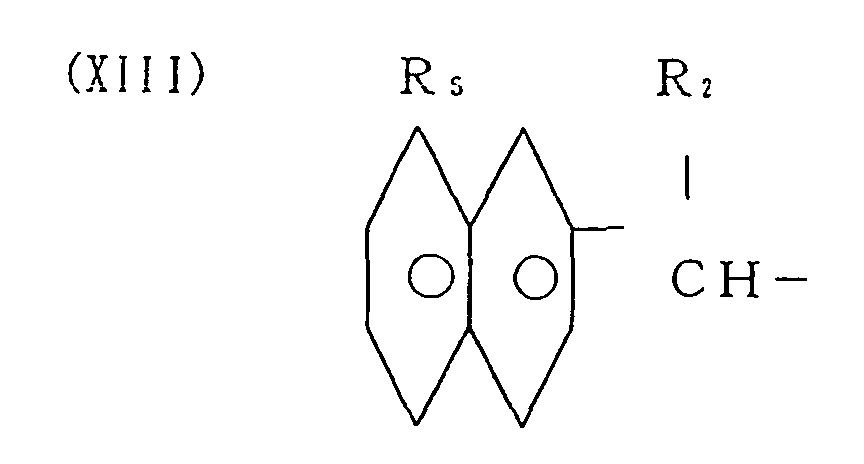
- R is a substituent containing at least one benzene ring and/or naphthalene ring, n is from 1 to 200, and R 1 is hydrogen or a C 1-5 alkyl group.
- R 2 is hydrogen or a C 1-6 alkyl group.
- R 3 is hydrogen or a C 1-6 alkyl group.
- R 2 is hydrogen or a C 1-6 alkyl group.
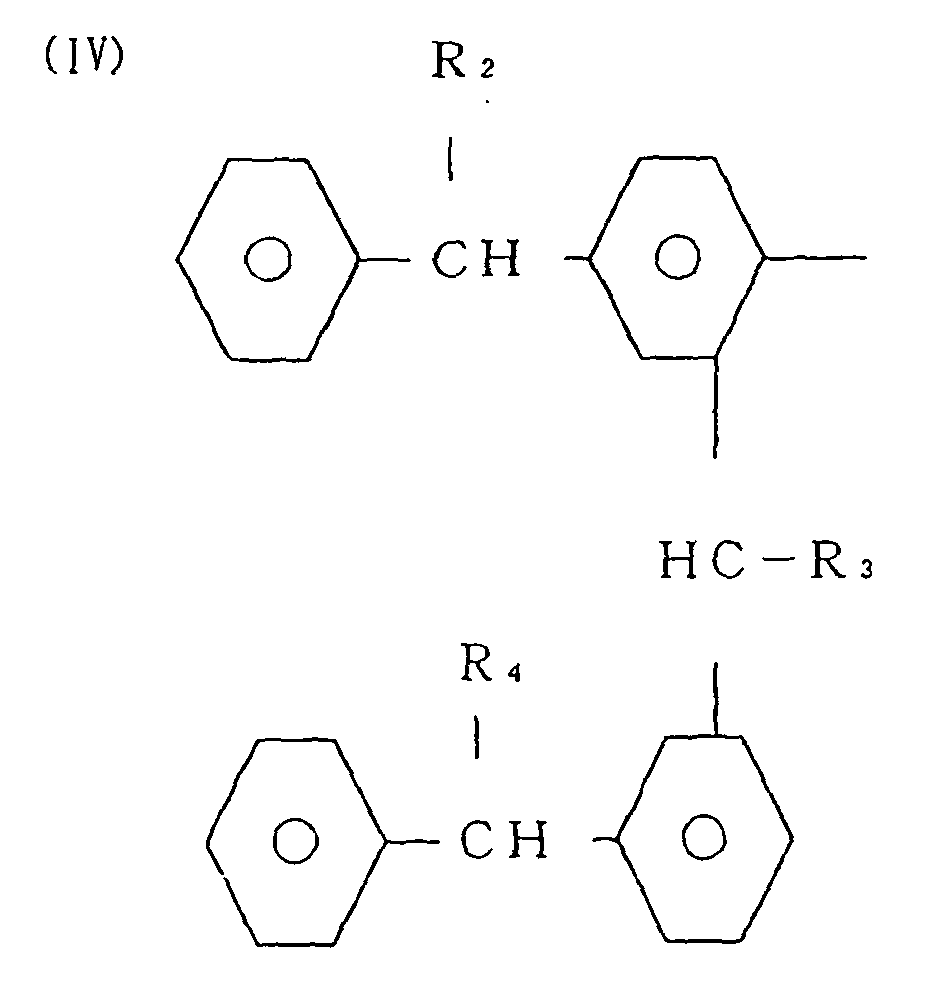
- each of R 2 , R 3 and R 4 is hydrogen or a C 1-6 alkyl group.
- each of R 2 and R 3 is hydrogen or a C 1-6 alkyl group.
- each of R 2 , R 3 and R 4 is hydrogen or a C 1-6 alkyl group.
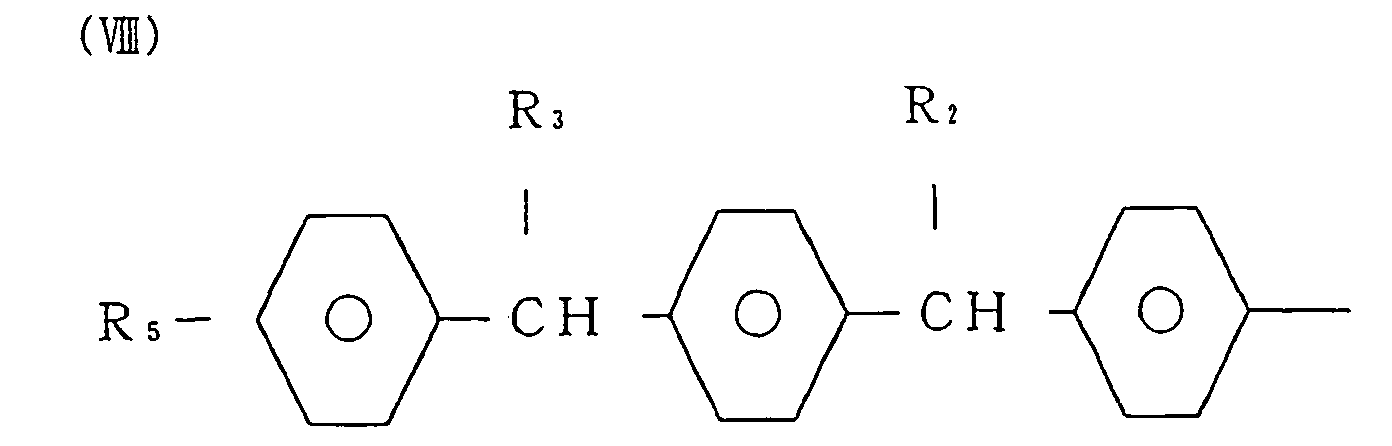
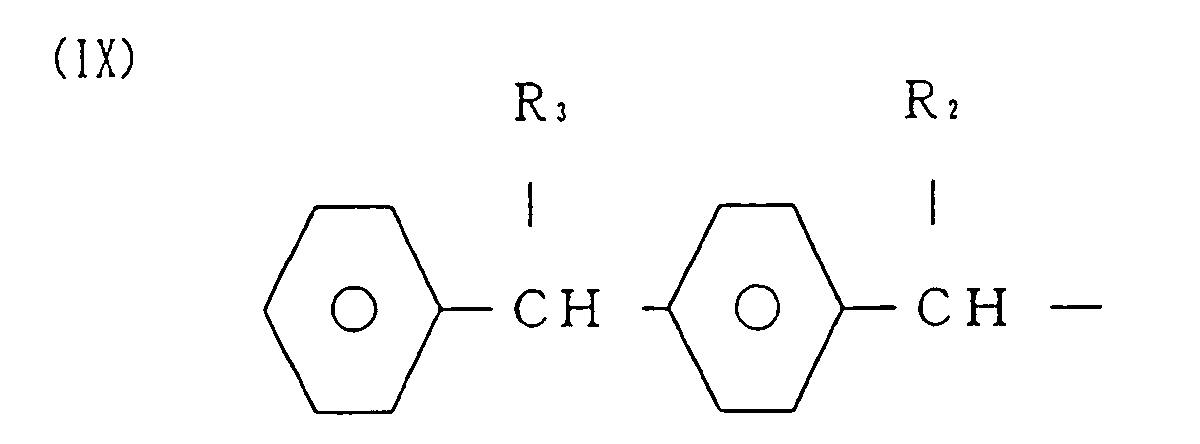
- each of R 2 and R 3 is hydrogen or a C 1-6 alkyl group, and R 5 is a C 1-6 alkyl group or a hydroxyl group. wherein each of R 2 and R 3 is hydrogen or a C 1-6 alkyl group, and R 5 is a C 1-6 alkyl group or a hydroxyl group. wherein each of R 2 and R 3 is hydrogen or a C 1-6 alkyl group. wherein each of R 2 and R 3 is hydrogen or a C 1-6 alkyl group. wherein R 2 is hydrogen or a C 1-6 alkyl group. wherein R 2 is hydrogen or a C 1-6 alkyl group, and R 5 is a C 1-6 alkyl group or a hydroxyl group.
- the nonionic emulsifier having the above formula (1) may, for example, be polyoxyethylene styrylphenyl ether, polyoxyethylene distyrylphenyl ether, polyoxyethylene tristyrylphenyl ether, polyoxyethylene styrylcresyl ether, polyoxyethylene distyrylcresyl ether, polyoxyethylene tristyrylcresyl ether, polyoxyethylene styrylhydroxyphenyl ether, polyoxyethylene distyrylhydroxyphenyl ether, polyoxyethylene tristyrylhydroxyphenyl ether, polyoxyethylene naphthyl ether, polyoxyethylene hydroxynaphthyl ether or polyoxyethylene cresylnaphthyl ether.
- one having at least one styrene structure such as polyoxyethylene styrylphenyl ether, polyoxyethylene distyrylphenyl ether or polyoxyethylene tristyrylphenyl ether, is preferred.
- These nonionic emulsifiers may be used as a mixture.
- the amount of the nonionic emulsifier of the formula (1) of the present invention is from 0.5 to 15 parts by mass, preferably from 1 to 7 parts by mass, per 100 parts by mass of the whole monomer comprising the chloroprene monomer, or the chloroprene monomer and the monomer copolymerizable with chloroprene (hereinafter referred to also as the whole monomer). If it is less than 0.5 part by mass, polymerization for a polychloroprene latex tends to be difficult. If it exceeds 15 parts by mass, the adhesion water resistance of the aqueous adhesive composition tends to deteriorate.
- the HLB value of the nonionic emulsifier of the formula (1) to be used in the present invention is preferably at least 9, particularly preferably within a range of at least 12 and at most 19. If it departs from this range, constant polymerization of the chloroprene monomer tends to be difficult.
- the HLB value of the nonionic emulsifier is an index showing the hydrophilic/lipophilic balance devised by Mr. Griffin of ICI, U.S.A. and a numerical value of from 1 to 20 calculated in accordance with the following formula.
- HLB (molecular weight of the hydrophilic group moiety)/(molecular weight of surfactant) ⁇ (100/5)
- the nonionic emulsifier having the formula (1) preferably comprises a plurality of nonionic emulsifiers having HLB values being apart preferably by at least 2, particularly preferably by from 2.5 to 5, from one another. It is particularly preferred to use a nonionic emulsifier having a HLB value of at least 9 and less than 16, preferably from 11 to 15.5 (hereinafter referred to as the nonionic emulsifier A) and a nonionic emulsifier having a HLB value of at least 16, preferably at least 17 and having no aromatic ring (hereinafter referred to as the nonionic emulsifier B) in combination.
- the above nonionic emulsifier B is used to stabilize the polymerization behavior of the polychloroprene latex.
- the nonionic emulsifier B has a structure having no aromatic ring, and at least one type may be selected for use among polyoxyethylene derivatives such as a polyoxyalkylene alkyl ether, a polyoxyalkylene alkylallyl ether, a polyoxyalkylene sorbitan ether and a polyoxyethylene caster oil ether, sorbitan fatty acid esters such as sorbitan monostearate, sorbitan monolaurylate and sorbitan monocolatate, fatty acid esters of glycerol such as glycerol monostearate and glycerol monooleate, and aliphatic alkanolamines.
- polyoxyethylene derivatives such as a polyoxyalkylene alkyl ether, a polyoxyalkylene alkylallyl ether, a polyoxyalkylene sorb
- the amount of the nonionic emulsifier A of the present invention is required to be from 1 to 10 parts by mass, preferably from 2 to 7 parts by mass, per 100 parts by mass of the whole monomer. If it is less than 1 part by mass, the mechanical stability of the polychloroprene latex tends to be inadequate, and if it exceeds 10 parts by mass, the adhesion water resistance of the aqueous adhesive composition tends to deteriorate.
- the amount of the nonionic emulsifier B of the present invention is required to be from 0.1 to 2 parts by mass, preferably from 0.2 to 1.5 parts by mass, per 100 parts by mass of the whole monomer. If it is less than 0.1 part by mass, the mechanical stability of the polychloroprene latex tends to be inadequate, and if it exceeds 2 parts by mass, the adhesion water resistance of the aqueous adhesive composition tends to deteriorate.
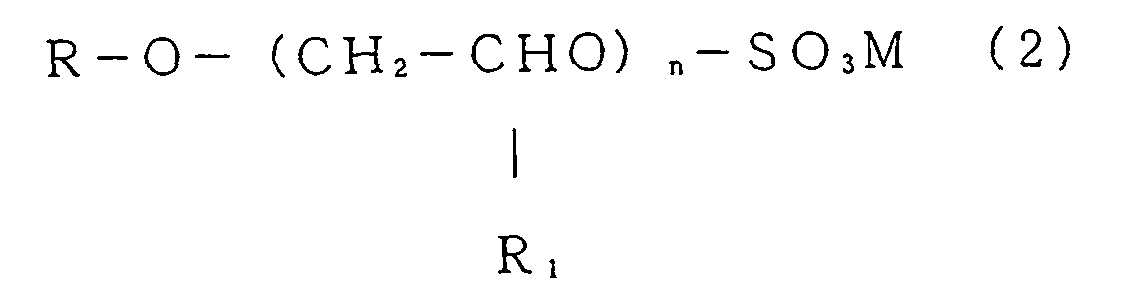
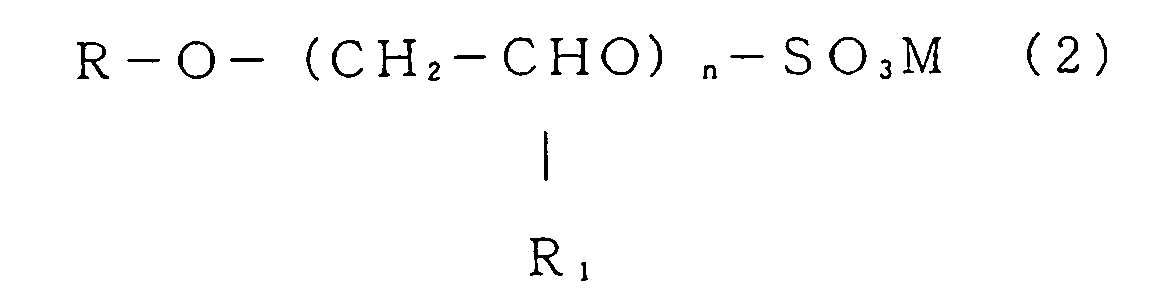
- the anionic emulsifier to be used in the present invention is one having the following formula (2):
- R is a substituent containing at least one benzene ring and/or naphthalene ring, n is from 1 to 200, R 1 is hydrogen or a C 1-5 alkyl group, and M is a monovalent cation.
- substituent R the above-mentioned structures (I) to (XIII) may, for example, be mentioned. Such groups may be used in combination as a mixture of two or more of them.
- substituent M may be ions of alkali metals such as lithium, sodium, potassium and cesium, and groups of various amines such as ammonia, trimethylamine, diethylamine and triethanolamine.
- the anionic emulsifier is used in an amount of from 0.05 to 2 parts by mass, preferably from 0.1 to 2 parts by mass, particularly preferably from 0.2 to 1.5 parts by mass, per 100 parts by mass of the whole monomer. If the amount is less than 0.05 part by mass, the mechanical stability of the polychloroprene latex tends to be inadequate, and if it exceeds 2 parts by mass, the adhesion water resistance of the aqueous adhesive composition tends to deteriorate.
- a metal salt of an aromatic sulfonic acid/formaline condensate may be employed, and particularly, a lithium, sodium, potassium or cesium salt of a ⁇ -naphthalene sulfonic acid/formaline condensate may, for example, be mentioned. Among them, preferred is the sodium salt or the potassium salt.
- the metal salt of an aromatic sulfonic acid/formaline condensate is used for the purpose of improving the storage stability of the polychloroprene latex.
- the metal salt of an aromatic sulfonic acid/formaline condensate is used as the anionic emulsifier
- its amount is preferably from 0.05 to 1 part by mass, more preferably from 0.05 to 0.5 part by mass, most preferably from 0.08 to 0.4 part by mass, per 100 parts by mass of the whole monomer. If the amount is less than 0.05 part by mass, the effect to improve the storage stability of the polychloroprene latex tends to be small, and if it exceeds 0.5 part by mass, the mechanical stability of the polychloroprene latex tends to deteriorate.
- the catalyst to be used for homopolymerization or copolymerization of chloroprene in the present invention may, for example, be an inorganic peroxide such as potassium persulfate or an organic peroxide such as a ketone peroxide, a peroxyketal, a hydroperoxide, a dialkyl peroxide or a diacyl peroxide.
- an inorganic peroxide such as potassium persulfate or an organic peroxide such as a ketone peroxide, a peroxyketal, a hydroperoxide, a dialkyl peroxide or a diacyl peroxide.
- potassium persulfate it is preferred to use potassium persulfate, whereby polymerization can be carried out constantly.
- potassium persulfate is preferably used in the form of an aqueous solution having a concentration of from 0.1 to 5 mass%.
- sodium sulfite, potassium sulfite, iron(II) oxide, ⁇ anthraquinone sodium sulfonate, formamidine sulfonic acid or L-ascorbic acid may, for example, be added.
- the toluene-insoluble gel content in the polychloroprene latex is not particularly limited and may be optionally changed depending upon the required properties.
- the gel content is preferably controlled to be at most 60 mass%, particularly preferably at most 50 mass%.
- the gel content is preferably controlled to be at least 20 mass%.
- the gel content of the polychloroprene latex of the present invention can be optionally adjusted by controlling (1) use of a chain transfer agent and its amount, (2) the polymerization temperature and (3) the polymerization degree.
- the chain transfer agent is not particularly limited so long as it is commonly used for the production of a chloroprene polymer, and a known chain transfer agent, such as a long chain alkyl mercaptan such as n-dodecyl mercaptan or tert-dodecyl mercaptan, a dialkyl xanthogen disulfide such as diisopropyl xanthogen disulfide or diethyl xanthogen disulfide, or iodoform, may be used.
- a long chain alkyl mercaptan such as n-dodecyl mercaptan or tert-dodecyl mercaptan
- a dialkyl xanthogen disulfide such as diisopropyl xanthogen disulfide or diethyl xanthogen disulfide, or iodoform
- the temperature for the above-mentioned polymerization is preferably within a range of from 0 to 55°C from the viewpoint of the control of polymerization. Further, in order to carry out the polymerization reaction smoothly and safely, it is preferred to adjust the polymerization temperature within a range of from 10 to 45°C.
- the final polymerization degree is preferably at least 60 mass%, more preferably at least 90 mass%.
- the solid content concentration in the polychloroprene latex is preferably within a range of from 40 to 65 mass%, more preferably within a range of from 45 to 60 mass%.
- the solid content concentration may be adjusted also by the ratio of the monomer to water at the time of the polymerization. However, it can also be adjusted by carrying out concentration after the polymerization.
- the method for such concentration may, for example, be concentration under reduced pressure, but it is not particularly limited.
- the pH may be freely adjusted by adding to the polychloroprene latex a basic substance such as diethanolamine or triethanolamine, or a weakly acidic salt such as sodium carbonate, potassium carbonate, trisodium phosphate, disodium hydrogen phosphate, tripotassium phosphate, dipotassium hydrogen phosphate, tripotassium citrate, dipotassium hydrogen citrate, sodium acetate, potassium acetate or sodium tetraborate.
- a basic substance such as diethanolamine or triethanolamine
- a weakly acidic salt such as sodium carbonate, potassium carbonate, trisodium phosphate, disodium hydrogen phosphate, tripotassium phosphate, dipotassium hydrogen phosphate, tripotassium citrate, dipotassium hydrogen citrate, sodium acetate, potassium acetate or sodium tetraborate.
- the method of adding the pH adjusting agent in the present invention is not particularly limited, and a powder of the pH adjusting agent may be added directly or after being diluted to an optional proportion with water.
- the timing for addition of the pH adjusting agent is not particularly limited, and it may be added before the initiation of polymerization or after the completion of polymerization.
- a dispersing agent such as an anionic emulsifier, a polyoxyalkylene alkyl ether, or a nonionic emulsifier such as a 1:2 mol type fatty acid alkanolamide, may be added.
- the timing for the addition is not particularly limited, and it may be added before the initiation of polymerization, during or after the completion of polymerization.
- the tackifier resin to be incorporated to the aqueous adhesive composition containing the polychloroprene latex of the present invention may, for example, be a resinate resin, a terpene phenol resin, a coumarone-indene resin, an aliphatic hydrocarbon resin or an aromatic resin.
- An emulsion of a terpene phenol resin or a resinate resin is particularly preferred with a view to obtaining the initial adhesive force and the water resistance of the aqueous adhesive composition.
- the content (calculated as the solid content) of the tackifier resin in the aqueous adhesive composition is preferably from 10 to 100 parts by mass, particularly preferably from 20 to 70 parts by mass, per 100 parts by mass of the solid content of the latex. If it is less than 10 parts by mass, the initial adhesive force may sometimes be poor, and if it exceeds 100 parts by mass, formation of the adhesive coating film tends to be impaired.
- the metal oxide to be preferably contained in the aqueous adhesive composition of the present invention may, for example, be zinc oxide, titanium oxide, aluminum oxide, magnesium oxide or iron oxide. Zinc oxide or titanium oxide is preferred with a view to improving the water resistance of the adhesive composition, and it is particularly preferred to use zinc oxide.
- the content of the metal oxide in the aqueous adhesive composition is preferably from 0.2 to 6 parts by mass, particularly preferably from 0.5 to 3 parts by mass, per 100 parts by mass of the solid content of the polychloroprene latex. If it is less than 0.2 part by mass, the water resistance of the adhesive composition may sometimes be inadequate, and if it exceeds 6 parts by mass, the initial adhesive force tends to be poor.
- the aqueous adhesive composition and the two-part aqueous adhesive composition of the present invention may optionally contain an inorganic filler such as calcium carbonate, silica, talc or clay, a plasticizer/softening agent such as dibutyl phthalate or process oil, a thickener such as sodium polyacrylate, water-soluble polyurethane or methyl cellulose, an emulsifier such as a polyoxyalkylene alkyl ether, a 1:2 mol type aliphatic alkanolamide, a 1:1 mol type diethanolamine, polyoxyethylene stearate or poval, a vulcanization accelerator such as zinc isopropyl xanthogenate, ethylene thiourea or tetrathiuram disulfide, an anticeptic, an anti-aging agent, an ultraviolet absorber, or an antioxidant, as the case requires.
- an inorganic filler such as calcium carbonate, silica, talc or clay
- a plasticizer/softening agent
- the aqueous adhesive composition of the present invention is prepared by mixing the polychloroprene latex, the tackifier resin and the metal oxide, etc.
- the mixing means is not particularly limited, and a known apparatus such as a three one motor, a homogenizer media mill or a colloid mill may be used.
- the two-part aqueous adhesive composition of the present invention is prepared by mixing the main agent and the curing agent, etc.
- the mixing means is not particularly limited, and a known apparatus such as a three one motor, a homogenizer media mill or a colloid mill may be used.
- the mixing ratio of the main agent and the curing agent in the two-part aqueous adhesive composition of the present invention is preferably such that the curing agent is mixed so that it will be from 0.5 to 15 parts by mass as the solid content, per 100 parts by mass of the polychloroprene latex (solid content) in the main material. If the mixing ratio is outside the above range, the effect of the addition tends to be small.
- the viscosity of the two-part aqueous adhesive composition of the present invention is preferably such that at most 10,000 (mPas ⁇ s) (B-model viscometer, 25°C, 30 rpm) can be maintained for 24 hours after mixing the main agent and the curing agent. If the viscosity becomes higher than 10,000 (mPas ⁇ s), uniform coating tends to be difficult.
- the main agent of the two-part aqueous adhesive composition contains the polychloroprene latex as the main component, but a tackifier resin may optionally be incorporated, as the case requires.
- the curing agent in the two-part aqueous adhesive composition of the present invention is added primarily for the purpose of improving the adhesive performance of the aqueous adhesive. It may, for example, be an epoxy compound, an oxazoline compound, or an isocyanate compound. As the curing agent, particularly preferred is an isocyanate compound.
- the water-dispersible isocyanate compound is one having hydrophilic groups introduced to a polyisocyanate polymer having a structure such as a biuret, an isocyanurate, an urethane, an allophanate in the molecule obtained from an aliphatic and/or alicyclic diisocyanate.
- a polyisocyanate polymer having a structure such as a biuret, an isocyanurate, an urethane, an allophanate in the molecule obtained from an aliphatic and/or alicyclic diisocyanate.
- Such an isocyanate compound is a self-emulsifiable isocyanate compound, which will be dispersed as fine particles when added and stirred in water.
- the aqueous adhesive composition and the two-part adhesive composition obtained by the present invention are suitable for bonding the same or different types of paper, wood, cloth, hides, jersey, leathers, rubbers, plastics, foams, porcelains, glass, mortal, cement materials, ceramics, metals, etc.
- the application method for bonding may, for example, be brush coating, bar coating, spray coating or roll coater coating.
- a latex sample was freeze-dried and then accurately weighed to obtain A.
- This sample was dissolved in toluene (adjusted to 0.6%) and subjected to a centrifugal separator, and then, the gel content was separated by using a metal net of 200 mesh. The gel content was dried in air and then dried in an atmosphere of 110°C for one hour and accurately weighed to obtain B.
- the latex was stored in a glass bottle in a closed state at 23°C for two months, and the change in the appearance was visually observed.
- an aqueous adhesive composition was prepared by the formulation as identified in Table 1.
- the 180° peel strength was measured at a tensile speed of 200 mm/min.
- the 180° peel strength was measured at a tensile speed of 200 mm/min.
- the sample After pressing for 7 days, the sample was immersed in water for two days, and by means of a tensile tester, the 180° peel strength was measured at a tensile speed of 200 mm/min.
- a two-part aqueous adhesive composition was prepared by the formulation as identified in Table 1.
- a polychloroprene latex was prepared in the same manner as in Example 1 except that in Example 1, the sodium salt of a ⁇ naphthalene sulfonic acid/formaline condensate was changed to 0.3 part by mass (calculated as the solid content) of a liquid product (Demol NL, manufactured by Kao Corporation).
- a polychloroprene latex was prepared in the same manner as in Example 1 except that in Example 1, the sodium salt of a ⁇ naphthalene sulfonic acid/formaline condensate was changed to an anionic emulsifier(1) (Newcol 707SN, manufactured by Nippon Nyukazai Co., Ltd.).
- a polychloroprene latex was prepared in the same manner as in Example 1 except that in Example 1, the nonionic emulsifier (1) was changed to 4.5 parts by mass of a nonionic emulsifier (2) (Newcol 710, manufactured by Nippon Nyukazai Co., Ltd.) and 1.0 part by mass of a nonionic emulsifier (3) (NOIGEN 197, manufactured by Daiichi Kogyo Seiyaku Co., Ltd.), and the amount of the sodium salt of a ⁇ naphthalene sulfonic acid/formaline condensate (Demol N, manufactured by Kao Corporation) was changed to 0.1 part by mass.
- a nonionic emulsifier (2) Newcol 710, manufactured by Nippon Nyukazai Co., Ltd.
- NOIGEN 197 manufactured by Daiichi Kogyo Seiyaku Co., Ltd.
- a polychloroprene latex was prepared in the same manner as in Example 4 except that in Example 4, the nonionic emulsifier (3) was changed to a nonionic emulsifier (4) (Emulgen 1135 S-70, manufactured by Kao Corporation).
- a polychloroprene latex was prepared in the same manner as in Example 1 except that in Example 1, the nonionic emulsifier (1) was changed to a nonionic emulsifier (5) (PIONIN D6115, manufactured by Takemoto Oil & Fat Co., Ltd.), the amount of the sodium salt of a ⁇ naphthalene sulfonic acid/formaline condensate (Demol N, manufactured by Kao Corporation) was changed to 0.6 part by mass, and the final polymerization degree was changed to 90%.
- a nonionic emulsifier (5) PIONIN D6115, manufactured by Takemoto Oil & Fat Co., Ltd.
- the amount of the sodium salt of a ⁇ naphthalene sulfonic acid/formaline condensate (Demol N, manufactured by Kao Corporation) was changed to 0.6 part by mass, and the final polymerization degree was changed to 90%.
- a polychloroprene latex was prepared in the same manner as in Example 1 except that in Example 1, the nonionic emulsifier was changed to polyvinyl alcohol (PVA-405, manufactured by Kuraray Co., Ltd.).
- a polychloroprene latex was prepared in the same manner as in Example 3 except that in Example 3, the nonionic emulsifier (1) was changed to 1.0 part by mass of a nonionic emulsifier (5) (NEWCOL 568, manufactured by Nippon Nyukazai Co., Ltd.), and the anionic emulsifier (1) was changed to 4.0 parts by mass of an anionic emulsifier (2) (LATEMUL PS, manufactured by Kao Corporation).
- a nonionic emulsifier (5) Nippon Nyukazai Co., Ltd.
- LATEMUL PS anionic emulsifier
Landscapes
- Chemical & Material Sciences (AREA)
- Organic Chemistry (AREA)
- Health & Medical Sciences (AREA)
- Chemical Kinetics & Catalysis (AREA)
- Medicinal Chemistry (AREA)
- Polymers & Plastics (AREA)
- Adhesives Or Adhesive Processes (AREA)
- Polymerisation Methods In General (AREA)
- Addition Polymer Or Copolymer, Post-Treatments, Or Chemical Modifications (AREA)
Abstract
Description










Claims (14)
- A polychloroprene latex comprising a homopolymer of chloroprene or a copolymer of a chloroprene monomer with a monomer copolymerizable with chloroprene, characterized in that the chloroprene homopolymer or copolymer is one obtained by emulsion polymerization in the presence of from 0.5 to 15 parts by mass of a nonionic emulsifier having the formula (1) and from 0.05 to 2 parts by mass of an anionic emulsifier having the formula (2), per 100 parts by mass of the whole monomer:wherein R is a substituent containing at least one benzene ring and/or naphthalene ring, n is from 1 to 200, and R1 is hydrogen or a C1-5 alkyl group,
 wherein R is a substituent containing at least one benzene ring and/or naphthalene ring, n is from 1 to 200, R1 is hydrogen or a C1-5 alkyl group, and M is a monovalent cation.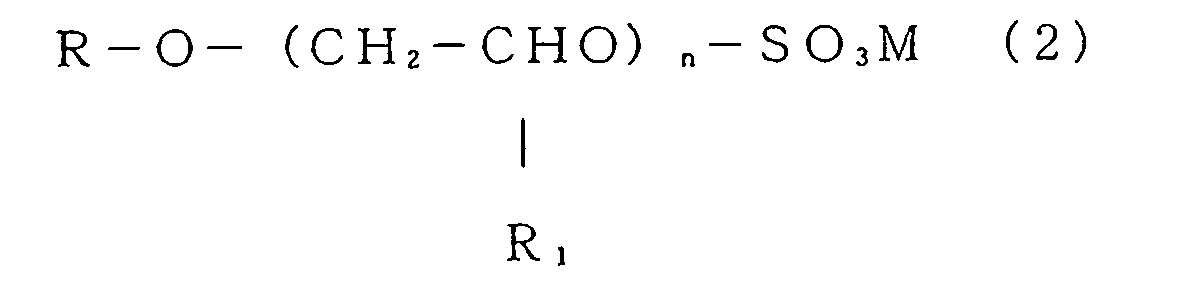
- The polychloroprene latex according to Claim 1, wherein the anionic emulsifier is an aromatic sulfonic acid/formaline condensate, which is present in an amount of from 0.05 to 1 part by mass, per 100 parts by mass of the whole monomer.
- The polychloroprene latex according to Claim 1 or 2, wherein the nonionic emulsifier having the formula (1) comprises two types of nonionic emulsifiers having HLB values being apart by at least 2 from each other.
- The polychloroprene latex according to Claim 1 or 2, wherein the nonionic emulsifier having the formula (1) comprises a nonionic emulsifier having a HLB value of at least 9 and less than 16, and a nonionic emulsifier having a HLB value of at least 16 and having no aromatic ring.
- The polychloroprene latex according to any one of Claims 1 to 4, wherein substituent R in the nonionic emulsifier having the formula (1) contains at least one styrene structure.
- The polychloroprene latex according to any one of Claims 1 to 5, wherein the monomer copolymerizable with chloroprene is an ethylenically unsaturated carboxylic acid, which is contained in an amount of from 0.3 to 10 parts by mass, per 100 parts by mass of the copolymer.
- The polychloroprene latex according to Claim 6, wherein the ethylenically unsaturated carboxylic acid is methacrylic acid, acrylic acid or a mixture thereof.
- The polychloroprene latex according to any one of Claims 1 to 7, which has a gel content of at most 60 mass%.
- An aqueous adhesive composition obtained by adding a tackifier resin to the polychloroprene latex as defined in any one of Claims 1 to 8.
- An aqueous adhesive composition obtained by adding a tackifier resin and a metal oxide to the polychloroprene latex as defined in any one of Claims 1 to 8.
- A two-part aqueous adhesive composition which is a combination of a main agent containing as the main component the polychloroprene latex as defined in any one of Claims 1 to 8, and a curing agent.
- The two-part aqueous adhesive composition according to Claim 11, wherein the main agent contains a metal oxide.
- The two-part aqueous adhesive composition according to Claim 11 or 12, wherein the curing agent is a water-dispersible isocyanate compound.
- A process for producing a polychloroprene latex, characterized by emulsion-polymerizing chloroprene, or chloroprene and a monomer copolymerizable with chloroprene, in the presence of from 0.5 to 15 parts by mass of a nonionic emulsifier having the formula (1) and from 0.05 to 2 parts by mass of an anionic emulsifier having the formula (2), per 100 parts by mass of the whole monomer:wherein R is a substituent containing at least one benzene ring and/or naphthalene ring, n is from 1 to 200, and R1 is hydrogen or a C1-5 alkyl group,
 wherein R is a substituent containing at least one benzene ring and/or naphthalene ring, n is from 1 to 200, R1 is hydrogen or a C1-5 alkyl group, and M is a monovalent cation.
Applications Claiming Priority (11)
| Application Number | Priority Date | Filing Date | Title |
|---|---|---|---|
| JP2002367862 | 2002-12-19 | ||
| JP2002367862 | 2002-12-19 | ||
| JP2003023930 | 2003-01-31 | ||
| JP2003023930 | 2003-01-31 | ||
| JP2003023929 | 2003-01-31 | ||
| JP2003023929 | 2003-01-31 | ||
| JP2003332753 | 2003-09-25 | ||
| JP2003332753 | 2003-09-25 | ||
| JP2003340384 | 2003-09-30 | ||
| JP2003340384 | 2003-09-30 | ||
| PCT/JP2003/016384 WO2004056889A1 (en) | 2002-12-19 | 2003-12-19 | Polychloroprene latex, process for the production thereof and aqueous adhesive compositions |
Publications (3)
| Publication Number | Publication Date |
|---|---|
| EP1574532A1 true EP1574532A1 (en) | 2005-09-14 |
| EP1574532A4 EP1574532A4 (en) | 2010-03-03 |
| EP1574532B1 EP1574532B1 (en) | 2012-01-11 |
Family
ID=32686317
Family Applications (1)
| Application Number | Title | Priority Date | Filing Date |
|---|---|---|---|
| EP03780956A Expired - Lifetime EP1574532B1 (en) | 2002-12-19 | 2003-12-19 | Polychloroprene latex, process for the production thereof and aqueous adhesive compositions |
Country Status (6)
| Country | Link |
|---|---|
| US (1) | US7514487B2 (en) |
| EP (1) | EP1574532B1 (en) |
| JP (1) | JP4084384B2 (en) |
| AU (1) | AU2003289466A1 (en) |
| ES (1) | ES2376428T3 (en) |
| WO (1) | WO2004056889A1 (en) |
Cited By (3)
| Publication number | Priority date | Publication date | Assignee | Title |
|---|---|---|---|---|
| EP2166054A1 (en) * | 2008-08-29 | 2010-03-24 | Wakol GmbH | Dispersion adhesive and use of a dispersion adhesive |
| EP2824121A4 (en) * | 2012-03-02 | 2015-10-07 | Denki Kagaku Kogyo Kk | POLYCHLOROPRENE LATEX, POLYCHLOROPRENE LATEX COMPOSITION AND MOLDED ARTICLE |
| IT201800009263A1 (en) * | 2018-10-09 | 2020-04-09 | Lucio Palagano | SKIN BONDING SYSTEM ON PC-TABLET WITH TWO-COMPONENT GLUE |
Families Citing this family (9)
| Publication number | Priority date | Publication date | Assignee | Title |
|---|---|---|---|---|
| JP4597607B2 (en) * | 2004-08-09 | 2010-12-15 | 電気化学工業株式会社 | Aqueous adhesive composition and method for producing the same |
| CN1313504C (en) * | 2004-10-12 | 2007-05-02 | 中国石油天然气集团公司 | Method for preparing latex of polybutadiene in small grain size |
| EP2703434B1 (en) * | 2008-01-18 | 2015-09-16 | Rhodia Operations | Latex binders, aqueous coatings and paints having freeze-thaw stability and methods for using same |
| US9388323B2 (en) * | 2008-01-18 | 2016-07-12 | Rhodia Operations | Latex binders, aqueous coatings and paints having freeze-thaw ability and methods for using same |
| JP5428215B2 (en) * | 2008-06-20 | 2014-02-26 | 東ソー株式会社 | Chloroprene latex and method for producing the same |
| WO2011021626A1 (en) * | 2009-08-21 | 2011-02-24 | 電気化学工業株式会社 | Method for producing polychloroprene latex, polychloroprene latex, and adhesive using same |
| JP5369135B2 (en) * | 2011-04-11 | 2013-12-18 | 電気化学工業株式会社 | Polychloroprene latex and method for producing the same |
| JP6440425B2 (en) * | 2014-09-18 | 2018-12-19 | 株式会社日本触媒 | Graft polymer and detergent composition |
| CN113881368A (en) * | 2021-09-07 | 2022-01-04 | 山纳合成橡胶有限责任公司 | Chloroprene latex adhesive for mica tape and preparation method thereof |
Family Cites Families (24)
| Publication number | Priority date | Publication date | Assignee | Title |
|---|---|---|---|---|
| JPS5137114B2 (en) | 1972-10-09 | 1976-10-13 | ||
| US3839241A (en) * | 1973-06-22 | 1974-10-01 | Du Pont | Isocyanate-modified neoprene foam process |
| GB1545104A (en) | 1975-05-07 | 1979-05-02 | Bayer Ag | Process for the production of concentrated polychloroprene latices |
| DE2527396A1 (en) | 1975-06-19 | 1976-12-30 | Bayer Ag | METHOD FOR MANUFACTURING DILUTED POLYCHLOROPRENLATICES |
| DE2536970A1 (en) | 1975-08-20 | 1977-03-03 | Bayer Ag | CONCENTRATED POLYCHLOROPRENLATICES WITH REACTIVE GROUPS |
| DE2602353A1 (en) | 1976-01-22 | 1977-08-04 | Bayer Ag | METHOD FOR PRODUCING A FREEZE-THAVABLE POLYCHLOROPRENE LATEX |
| FR2661913B1 (en) | 1990-05-11 | 1992-08-28 | Distugil | PROCESS FOR PRODUCING POLYCHLOROPRENE. |
| JPH05331440A (en) | 1992-05-29 | 1993-12-14 | Japan Synthetic Rubber Co Ltd | Latex for water resistant adhesive and water resistant adhesive |
| JPH06287360A (en) | 1993-03-30 | 1994-10-11 | Denki Kagaku Kogyo Kk | Polychloroprene latex and its composition |
| KR100353910B1 (en) * | 1994-11-04 | 2002-12-28 | 도소 가부시키가이샤 | Treatment Agents for Bonding, Treated Polyester Fibers, Elastomers and Methods for Making the Same |
| JPH08188694A (en) | 1995-01-11 | 1996-07-23 | Sekisui Chem Co Ltd | Vinyl chloride resin emulsion |
| JPH08269114A (en) | 1995-04-04 | 1996-10-15 | Sekisui Chem Co Ltd | Method for producing vinyl chloride resin emulsion |
| JPH0912656A (en) | 1995-06-29 | 1997-01-14 | Sekisui Chem Co Ltd | Vinyl chloride resin emulsion and method for producing the same |
| JP3884781B2 (en) * | 1995-07-18 | 2007-02-21 | 東ソー株式会社 | Chloroprene rubber latex for adhesive, method for producing the same, and adhesive composition using the same |
| JP3652859B2 (en) | 1997-11-26 | 2005-05-25 | 電気化学工業株式会社 | Chloroprene-based copolymer latex and adhesive composition thereof |
| JP3652860B2 (en) * | 1997-11-27 | 2005-05-25 | 電気化学工業株式会社 | Chloroprene latex composition and method for producing the same, and adhesive composition using the same |
| DE69924033T2 (en) * | 1999-05-27 | 2005-07-21 | Denki Kagaku Kogyo K.K. | CHLOROPRENE LATEX COMPOSITION, METHOD OF MANUFACTURE AND ADHESIVE COMPOSITION COMPRISING THIS CONTAINS |
| USH2092H1 (en) * | 1999-06-30 | 2003-12-02 | Dupont Dow Elastomers L.L.C. | Process for production of polychloroprene having low odor |
| JP3979749B2 (en) * | 1999-08-10 | 2007-09-19 | 電気化学工業株式会社 | Chloroprene latex composition and method for producing the same |
| US7073201B2 (en) * | 2001-09-21 | 2006-07-11 | Denki Kagaku Kogyo Kabushiki Kaisha | Aqueous Adhesive |
| JP2002047377A (en) | 2000-08-01 | 2002-02-12 | Denki Kagaku Kogyo Kk | Polychloroprene latex composition and water-based adhesive |
| JP4342706B2 (en) | 2000-08-08 | 2009-10-14 | 電気化学工業株式会社 | Polychloroprene latex composition and method for producing the same, and adhesive composition using the same |
| JP4578643B2 (en) | 2000-08-09 | 2010-11-10 | 電気化学工業株式会社 | Latex composition and aqueous adhesive |
| AU2003227419A1 (en) * | 2002-04-19 | 2003-11-03 | Denki Kagaku Kogyo Kabushiki Kaisha | Latex composition |
-
2003
- 2003-12-19 AU AU2003289466A patent/AU2003289466A1/en not_active Abandoned
- 2003-12-19 US US10/539,801 patent/US7514487B2/en not_active Expired - Fee Related
- 2003-12-19 EP EP03780956A patent/EP1574532B1/en not_active Expired - Lifetime
- 2003-12-19 JP JP2005502622A patent/JP4084384B2/en not_active Expired - Fee Related
- 2003-12-19 ES ES03780956T patent/ES2376428T3/en not_active Expired - Lifetime
- 2003-12-19 WO PCT/JP2003/016384 patent/WO2004056889A1/en not_active Ceased
Cited By (4)
| Publication number | Priority date | Publication date | Assignee | Title |
|---|---|---|---|---|
| EP2166054A1 (en) * | 2008-08-29 | 2010-03-24 | Wakol GmbH | Dispersion adhesive and use of a dispersion adhesive |
| EP2824121A4 (en) * | 2012-03-02 | 2015-10-07 | Denki Kagaku Kogyo Kk | POLYCHLOROPRENE LATEX, POLYCHLOROPRENE LATEX COMPOSITION AND MOLDED ARTICLE |
| US9296849B2 (en) | 2012-03-02 | 2016-03-29 | Denka Company Limited | Polychloroprene latex, polychloroprene latex composition, and molded article |
| IT201800009263A1 (en) * | 2018-10-09 | 2020-04-09 | Lucio Palagano | SKIN BONDING SYSTEM ON PC-TABLET WITH TWO-COMPONENT GLUE |
Also Published As
| Publication number | Publication date |
|---|---|
| EP1574532A4 (en) | 2010-03-03 |
| US20060063885A1 (en) | 2006-03-23 |
| JP4084384B2 (en) | 2008-04-30 |
| WO2004056889A1 (en) | 2004-07-08 |
| AU2003289466A1 (en) | 2004-07-14 |
| JPWO2004056889A1 (en) | 2006-04-20 |
| US7514487B2 (en) | 2009-04-07 |
| ES2376428T3 (en) | 2012-03-13 |
| EP1574532B1 (en) | 2012-01-11 |
Similar Documents
| Publication | Publication Date | Title |
|---|---|---|
| US9040438B2 (en) | Low-viscosity aqueous adhesive polymer dispersions | |
| EP1574532B1 (en) | Polychloroprene latex, process for the production thereof and aqueous adhesive compositions | |
| JP5221353B2 (en) | Chloroprene-based polymer latex and method for producing the same | |
| US20100076149A1 (en) | Polychloroprene latex composition and its production method | |
| US8519047B2 (en) | Aqueous adhesive dispersions | |
| EP1167446B1 (en) | Chloroprene latex composition, process for producing the same, and adhesive composition comprising the same | |
| JP4342706B2 (en) | Polychloroprene latex composition and method for producing the same, and adhesive composition using the same | |
| JP4597607B2 (en) | Aqueous adhesive composition and method for producing the same | |
| CN100523027C (en) | Polychloroprene latex, process for the production thereof and aqueous adhesive compositions | |
| JP4730983B2 (en) | Chloroprene latex, production method thereof and adhesive composition using the same | |
| TWI302560B (en) | ||
| US5681891A (en) | Method for producing a polychloroprene latex | |
| EP2468777B1 (en) | Method for producing polychloroprene latex, polychloroprene latex, and adhesive using same | |
| JP2025038027A (en) | Chloroprene polymer latex, its manufacturing method, and water-based adhesive using said chloroprene polymer latex | |
| JP2003055627A (en) | Water-based adhesive composition and bonded structure | |
| CN100497459C (en) | Polychloroprene latex composition and process for producing the same | |
| JP4837289B2 (en) | Polychloroprene latex and production method and use thereof | |
| JP2006160804A (en) | Polychloroprene latex composition, method for producing the same, and aqueous adhesive composition using the same | |
| JP2001288448A (en) | Foamed rubber material, method for bonding wet suit and bonded structure | |
| JP2004359787A (en) | Water-based adhesive composition and bonded structure | |
| JP2005008859A (en) | Polychloroprene latex composition, adhesive, coating agent, and method for producing the same | |
| JP2001089737A (en) | Water-based adhesive | |
| JP2024018849A (en) | Chloroprene polymer latex and water-based adhesive | |
| JP4244253B2 (en) | Adhesive composition |
Legal Events
| Date | Code | Title | Description |
|---|---|---|---|
| PUAI | Public reference made under article 153(3) epc to a published international application that has entered the european phase |
Free format text: ORIGINAL CODE: 0009012 |
|
| 17P | Request for examination filed |
Effective date: 20050616 |
|
| AK | Designated contracting states |
Kind code of ref document: A1 Designated state(s): AT BE BG CH CY CZ DE DK EE ES FI FR GB GR HU IE IT LI LU MC NL PT RO SE SI SK TR |
|
| AX | Request for extension of the european patent |
Extension state: AL LT LV MK |
|
| DAX | Request for extension of the european patent (deleted) | ||
| RBV | Designated contracting states (corrected) |
Designated state(s): DE ES FR GB IT |
|
| A4 | Supplementary search report drawn up and despatched |
Effective date: 20100203 |
|
| 17Q | First examination report despatched |
Effective date: 20100510 |
|
| GRAP | Despatch of communication of intention to grant a patent |
Free format text: ORIGINAL CODE: EPIDOSNIGR1 |
|
| RIC1 | Information provided on ipc code assigned before grant |
Ipc: C08F 236/18 20060101AFI20110714BHEP Ipc: C09J 111/02 20060101ALI20110714BHEP Ipc: C08F 2/24 20060101ALI20110714BHEP Ipc: C08F 2/26 20060101ALI20110714BHEP Ipc: C08F 2/30 20060101ALI20110714BHEP |
|
| GRAS | Grant fee paid |
Free format text: ORIGINAL CODE: EPIDOSNIGR3 |
|
| GRAA | (expected) grant |
Free format text: ORIGINAL CODE: 0009210 |
|
| AK | Designated contracting states |
Kind code of ref document: B1 Designated state(s): DE ES FR GB IT |
|
| REG | Reference to a national code |
Ref country code: GB Ref legal event code: FG4D |
|
| REG | Reference to a national code |
Ref country code: DE Ref legal event code: R096 Ref document number: 60339704 Country of ref document: DE Effective date: 20120308 |
|
| REG | Reference to a national code |
Ref country code: ES Ref legal event code: FG2A Ref document number: 2376428 Country of ref document: ES Kind code of ref document: T3 Effective date: 20120313 |
|
| PLBE | No opposition filed within time limit |
Free format text: ORIGINAL CODE: 0009261 |
|
| STAA | Information on the status of an ep patent application or granted ep patent |
Free format text: STATUS: NO OPPOSITION FILED WITHIN TIME LIMIT |
|
| 26N | No opposition filed |
Effective date: 20121012 |
|
| REG | Reference to a national code |
Ref country code: DE Ref legal event code: R097 Ref document number: 60339704 Country of ref document: DE Effective date: 20121012 |
|
| REG | Reference to a national code |
Ref country code: FR Ref legal event code: PLFP Year of fee payment: 13 |
|
| REG | Reference to a national code |
Ref country code: FR Ref legal event code: PLFP Year of fee payment: 14 |
|
| PGFP | Annual fee paid to national office [announced via postgrant information from national office to epo] |
Ref country code: GB Payment date: 20161214 Year of fee payment: 14 Ref country code: DE Payment date: 20161213 Year of fee payment: 14 Ref country code: FR Payment date: 20161111 Year of fee payment: 14 |
|
| PGFP | Annual fee paid to national office [announced via postgrant information from national office to epo] |
Ref country code: ES Payment date: 20161111 Year of fee payment: 14 Ref country code: IT Payment date: 20161221 Year of fee payment: 14 |
|
| REG | Reference to a national code |
Ref country code: DE Ref legal event code: R119 Ref document number: 60339704 Country of ref document: DE |
|
| GBPC | Gb: european patent ceased through non-payment of renewal fee |
Effective date: 20171219 |
|
| REG | Reference to a national code |
Ref country code: FR Ref legal event code: ST Effective date: 20180831 |
|
| PG25 | Lapsed in a contracting state [announced via postgrant information from national office to epo] |
Ref country code: IT Free format text: LAPSE BECAUSE OF NON-PAYMENT OF DUE FEES Effective date: 20171219 Ref country code: DE Free format text: LAPSE BECAUSE OF NON-PAYMENT OF DUE FEES Effective date: 20180703 Ref country code: FR Free format text: LAPSE BECAUSE OF NON-PAYMENT OF DUE FEES Effective date: 20180102 |
|
| PG25 | Lapsed in a contracting state [announced via postgrant information from national office to epo] |
Ref country code: GB Free format text: LAPSE BECAUSE OF NON-PAYMENT OF DUE FEES Effective date: 20171219 |
|
| REG | Reference to a national code |
Ref country code: ES Ref legal event code: FD2A Effective date: 20190703 |
|
| PG25 | Lapsed in a contracting state [announced via postgrant information from national office to epo] |
Ref country code: ES Free format text: LAPSE BECAUSE OF NON-PAYMENT OF DUE FEES Effective date: 20171220 |