EP1571176A1 - Resin composition with high vibration damping ability - Google Patents
Resin composition with high vibration damping ability Download PDFInfo
- Publication number
- EP1571176A1 EP1571176A1 EP05101303A EP05101303A EP1571176A1 EP 1571176 A1 EP1571176 A1 EP 1571176A1 EP 05101303 A EP05101303 A EP 05101303A EP 05101303 A EP05101303 A EP 05101303A EP 1571176 A1 EP1571176 A1 EP 1571176A1
- Authority
- EP
- European Patent Office
- Prior art keywords
- resin composition
- constitutional units
- acid
- composition according
- polyester resin
- Prior art date
- Legal status (The legal status is an assumption and is not a legal conclusion. Google has not performed a legal analysis and makes no representation as to the accuracy of the status listed.)
- Withdrawn
Links
Classifications
-
- F—MECHANICAL ENGINEERING; LIGHTING; HEATING; WEAPONS; BLASTING
- F16—ENGINEERING ELEMENTS AND UNITS; GENERAL MEASURES FOR PRODUCING AND MAINTAINING EFFECTIVE FUNCTIONING OF MACHINES OR INSTALLATIONS; THERMAL INSULATION IN GENERAL
- F16F—SPRINGS; SHOCK-ABSORBERS; MEANS FOR DAMPING VIBRATION
- F16F1/00—Springs
- F16F1/36—Springs made of rubber or other material having high internal friction, e.g. thermoplastic elastomers
- F16F1/3605—Springs made of rubber or other material having high internal friction, e.g. thermoplastic elastomers characterised by their material
-
- A—HUMAN NECESSITIES
- A45—HAND OR TRAVELLING ARTICLES
- A45F—TRAVELLING OR CAMP EQUIPMENT: SACKS OR PACKS CARRIED ON THE BODY
- A45F5/00—Holders or carriers for hand articles; Holders or carriers for use while travelling or camping
-
- A—HUMAN NECESSITIES
- A45—HAND OR TRAVELLING ARTICLES
- A45F—TRAVELLING OR CAMP EQUIPMENT: SACKS OR PACKS CARRIED ON THE BODY
- A45F5/00—Holders or carriers for hand articles; Holders or carriers for use while travelling or camping
- A45F5/1516—Holders or carriers for portable handheld communication devices, e.g. pagers or smart phones
-
- C—CHEMISTRY; METALLURGY
- C08—ORGANIC MACROMOLECULAR COMPOUNDS; THEIR PREPARATION OR CHEMICAL WORKING-UP; COMPOSITIONS BASED THEREON
- C08K—Use of inorganic or non-macromolecular organic substances as compounding ingredients
- C08K3/00—Use of inorganic substances as compounding ingredients
- C08K3/01—Use of inorganic substances as compounding ingredients characterized by their specific function
- C08K3/013—Fillers, pigments or reinforcing additives
-
- C—CHEMISTRY; METALLURGY
- C08—ORGANIC MACROMOLECULAR COMPOUNDS; THEIR PREPARATION OR CHEMICAL WORKING-UP; COMPOSITIONS BASED THEREON
- C08K—Use of inorganic or non-macromolecular organic substances as compounding ingredients
- C08K3/00—Use of inorganic substances as compounding ingredients
- C08K3/02—Elements
- C08K3/04—Carbon
-
- C—CHEMISTRY; METALLURGY
- C08—ORGANIC MACROMOLECULAR COMPOUNDS; THEIR PREPARATION OR CHEMICAL WORKING-UP; COMPOSITIONS BASED THEREON
- C08K—Use of inorganic or non-macromolecular organic substances as compounding ingredients
- C08K3/00—Use of inorganic substances as compounding ingredients
- C08K3/18—Oxygen-containing compounds, e.g. metal carbonyls
- C08K3/20—Oxides; Hydroxides
- C08K3/22—Oxides; Hydroxides of metals
-
- A—HUMAN NECESSITIES
- A45—HAND OR TRAVELLING ARTICLES
- A45F—TRAVELLING OR CAMP EQUIPMENT: SACKS OR PACKS CARRIED ON THE BODY
- A45F5/00—Holders or carriers for hand articles; Holders or carriers for use while travelling or camping
- A45F2005/006—Holders or carriers for hand articles; Holders or carriers for use while travelling or camping comprising a suspension strap or lanyard
Definitions
- the present invention relates to resin compositions with a high vibration damping ability.
- Soft vinyl chloride resins composed of a vinyl chloride resin added with a plasticizer have been known as a material to absorb vibration energy, for example, a vibration damping material.
- the soft vinyl chloride resins are designed so as to attenuate vibration energy by consuming vibration energy in the resins as frictional heat. However, the absorption and attenuation of energy is still insufficient.
- Rubber materials such as butyl rubber and acrylonitrile-butadiene rubber have been widely used as vibration damping materials excellent in processability, mechanical strength and costs. Although, these rubber materials are most excellent in attenuation performance (transfer-insulating or transfer-reducing performance of vibration energy) among polymeric materials, the vibration damping ability (absorbability of vibration energy) thereof is low for its sole use as a vibration damping material. Therefore, to apply it, for example, to vibration proof structures for buildings or apparatuses, the rubber materials have been used in composite forms such as a laminate of the rubber material and a steel plate and a vibration damping structure of the laminate combined with a lead core that absorbs vibration energy by plastic deformation or an oil damper.
- the conventional rubber materials cannot be solely used as vibration damping materials and should be made into composite forms, inevitably making the vibration proof structures complicated. Therefore, it has been demanded to enhance the vibration damping ability of the vibration damping materials themselves and the rubber materials themselves.
- compositions composed mainly of a polymeric material and a piezoelectric powdery material (JP 60-51750A, JP 3-188165A and Inaba, et al., Relationship between Mechanical Properties and Damping Performance of Piezoelectric Damping Composites: Journal of The Society of Rubber Industry, Japan, vol. 67, p. 564 (1994)).
- These compositions are intended to absorb and attenuate vibrations by converting vibration energy into electric energy by the action of electro-mechanical conversion of the piezoelectric material and dispersing electric energy.
- the compositions must contain the piezoelectric particles in an amount as large as 50% by mass or more.
- the blending in such a high content lowers the fluidity in a molten state and makes the kneading and molding difficult.
- the piezoelectric particles are made of ceramics such as lead zirconate titanate and barium titanate, the composition is unfavorably increased in its mass.
- vibration damping materials comprising a polymer matrix that contains an active ingredient for increasing dipole moment
- vibration damping materials composed of a polyester resin and an electroconductive material (JP 2003-221496A, JP 7-179735A, JP 6-136104A, JP 6-329770A, JP 6-263972A, JP 2000-281886A, JP 6-73276A, JP 6-16913A, JP 2003-241766A, JP 2003-171820A and JP 5-222239A).
- a vibration damping material prepared by dispersing an electroconductive material in a polyester resin satisfying the following relationship I: 0-5 ⁇ (A1 + B1)/(A0 + B0) ⁇ 1 wherein A0 is the number of dicarboxylic acid constitutional units, B0 is the number of diol constitutional units, A1 is the number of dicarboxylic acid constitutional units having an odd number of carbon atoms in a polyester main chain, and B1 is the number of diol constitutional units having an odd number of carbon atoms in the polyester main chain.
- the composite vibration damping material made of a viscoelastic resin composed of a copolyester, a crosslinking agent, etc.
- JP 2003-221496A is not produced easily because a step of crosslinking reaction by heating is needed.
- the glass transition temperature of the usable copolyester is limited to the range from -60 to 0°C, the proposed material does not fully meet the requirements for the material excellent in flexibility.
- a sound damping structure using nonwoven fabric JP 2003-241766A
- a sound damping fiber using a piezoelectric polymer JP 2003-171820A
- a vibration damping steel plate using a viscoelastic resin for vibration damping material JP 5-222239A
- thermoplastic polymer composition containing a styrene resin disclosed in JP 10-67901A and the composition for vibration damping material containing polyvinyl chloride, chlorinated polyethylene and epoxidized polyisoprene disclosed in JP 10-231385A are not so high in the vibration damping ability for a relatively large thickness, 2 mm or 3 mm, of sample pieces, showing that a well satisfactory vibration damping material is not achieved by merely incorporating fillers into the polymer matrix.
- WO 2002/053647 discloses a vibration damping material containing a viscoelastic polymer. Although, examples of the viscoelastic polymers are provided therein, the document is completely silent about details of the raw material for constituting the viscoelastic polymer.
- An object of the present invention is to provide a resin composition made mainly of a polymeric material, which is lightweight, exhibits a more excellent vibration damping ability, and is produced easily.
- the inventors have found that in a resin composition produced by dispersing an electroconductive material and/or filler into a polyester resin containing dicarboxylic acid constitutional units and diol constitutional units, the vibration damping ability of the resin composition is significantly improved over a wide temperature range including ordinary temperature by using a specific polyester resin.
- the present invention is based on this finding.
- the present invention relates a resin composition
- a resin composition comprising a polyester resin containing dicarboxylic acid constitutional units and diol constitutional units and at least one of an electroconductive material and filler which is dispersed in the polyester resin, wherein the polyester resin satisfies the following relationship I: 0.5 ⁇ (A1 + B1)/(A0 + B0) ⁇ 1 wherein A0 is the number of total dicarboxylic acid constitutional units, B0 is the number of total diol constitutional units, A1 is the number of dicarboxylic acid constitutional units having an odd number of carbon atoms in a polyester main chain, and B1 is the number of diol constitutional units having an odd number of carbon atoms in the polyester main chain.
- the invention further relates a vibration damping material made of the resin composition mentioned above.
- the invention still further relates to a vibration damper comprising a shaped article of the vibration damping material.
- the resin composition of the invention contains, as a polymeric material, a polyester resin containing dicarboxylic acid constitutional units and diol constitutional units.
- a high vibration damping performance is achieved by dispersing an electroconductive material and/or a filler into a polyester resin satisfying the following relationship I: 0.5 ⁇ (A1 + B1)/(A0 + B0) ⁇ 1 wherein A0 is the number of total dicarboxylic acid constitutional units, B0 is the number of total diol constitutional units, A1 is the number of dicarboxylic acid constitutional units having an odd number of carbon atoms in a polyester main chain, and B1 is the number of diol constitutional units having an odd number of carbon atoms in the polyester main chain.
- the ratio, (A1 + B1)/(A0 + B0), is preferably 0.7 to 1, and the odd number for A1 and B1 is preferably 1, 3, 5, 7 or 9.
- dicarboxylic acid constitutional units having an odd number of carbon atoms in the polyester main chain include constitutional units derived from isophthalic acid, malonic acid, glutaric acid, pimelic acid, azelaic acid, undecanedioic acid, brassilic acid, 1,3-cyclohexanedicarboxylic acid, etc., with the constitutional units derived from isophthalic acid, azelaic acid and 1,3-cyclohexanedicarboxylic acid being preferred and the constitutional unit derived from isophthalic acid being more preferred.
- the polyester resin may include one or more kinds of constitutional units derived from the above dicarboxylic acids. If two or more kinds of constitutional units are included, preferred are those derived from isophthalic acid and azelaic acid.
- diol constitutional units having an odd number of carbon atoms in the polyester main chain include constitutional units derived from 1,3-propanediol, 1,3-butanediol, 2-methyl-1,3-propanediol, 1,3-pentanediol, 1-methyl-1,3-butanediol, 2-methyl-1,3-butanediol, neopentyl glycol, 1,3-hexanediol, 3-methyl-1,3-butanediol, 1-methyl-1,3-butanediol, 1,5-pentanediol, 2-methyl-1,5-pentanediol, 3-methyl-1,5-pentanediol, 1,5-hexanediol, 2-ethyl-1,5-pentanediol, 2-propyl-1,5-pentanediol, m-xylene glycol, 1,3-cyclo
- the polyester resin satisfies the following relationship II: 0.5 ⁇ A1/A0 ⁇ 1 wherein A1 and A0 are as defined above, and the following relationship III: 0.5 ⁇ B2/B0 ⁇ 1 wherein B0 is as defined above and B2 is the number of constitutional units derived from the diol represented by the following formula 1: wherein n is 3 or 5, and Rs may be the same or different and each independently hydrogen atom or C 1 to C 3 alkyl group, and further satisfies the following requirements A and B:
- Examples of the diols represented by the formula 1 include 1,3-propanediol, 1,3-butanediol, 2-methyl-1,3-propanediol, 1,3-pentanediol, 1-methyl-1,3-butanediol, 2-methyl-1,3-butanediol, neopentyl glycol, 1,3-hexanediol, 3-methyl-1,3-butanediol, 1,5-pentanediol, 2-methyl-1,5-pentanediol, 3-methyl-1,5-pentanediol, 1,5-hexanediol, 2-ethyl-1,5-pentanediol, and 2-propyl-1,5-pentanediol, with 1,3-propanediol, 1,5-pentanediol, 2-methyl-1,3-propanediol, 1,3-but
- the polyester resin satisfies the relationship I, the following relationship IV: 0.7 ⁇ B2/B0 ⁇ 1 wherein B0 and B2 are as defined above, and the requirements A and B.
- the polyester resin satisfies the following relationship V: 0.5 ⁇ A2/A0 ⁇ 1 wherein A0 is as defined above and A2 is the number of constitutional units derived from at least one dicarboxylic acid selected from the group consisting of isophthalic acid, malonic acid, glutaric acid, pimelic acid, azelaic acid, undecanedioic acid, brassilic acid and 1,3-cyclohexanedicarboxylic acid.
- the polyester resin satisfies the following relationship VI: 0.7 ⁇ A2/A0 ⁇ 1 wherein A0 and A2 are as defined above.
- the polyester resin satisfies the following relationship VII: 0.5 ⁇ A3/A0 ⁇ 1 wherein A0 is as defined above and A3 is the number of constitutional units derived from isophthalic acid.
- the polyester resin satisfies the relationship V, the following relationship VIII: 0.5 ⁇ B3/B0 ⁇ 1 wherein B0 is as defined above and B3 is the number of constitutional units derived from at least one diol selected from the group consisting of 1,3-propanediol, 1,5-pentanediol, 2-methyl-1,3-propanediol, 1,3-butanediol and neopentyl glycol, and the requirements A and B.
- the polyester resin satisfies the relationship V, the following relationship IX: 0.7 ⁇ B3/B0 ⁇ 1 wherein B0 and B3 are as defined above, and the requirements A and B.
- the polyester resin used in the present invention may further contain other constitutional units in amounts not adversely affecting the effects of the invention.
- the types of other constitutional units are not critical, and the polyester resin may contain constitutional units derived from any of polyester-forming dicarboxylic acids and their esters (other dicarboxylic acids), polyester-forming diols (other diols) and polyester-forming hydroxycarboxylic acids and their esters (other hydroxycarboxylic).
- dicarboxylic acids examples include dicarboxylic acids such as terephthalic acid, orthophthalic acid, 2-methylterephthalic acid, 2,6-naphthalenedicarboxylic acid, succinic acid, adipic acid, suberic acid, sebacic acid, dodecanedioic acid, 1,4-cyclohexanedicarboxylic acid, decalindicarboxylic acid, norbornanedicarboxylic acid, tricyclodecanedicarboxylic acid, pentacyclododecanedicarboxylic acid, isophoronedicarboxylic acid and 3,9-bis(2-carboxylethyl)-2,4,8,10-tetraoxaspiro[5.5]undecane; and tri- or more valent polycarboxylic acid such as trimellitic acid, trimesic acid, pyromellitic acid and tricarbarylic acid.
- dicarboxylic acids such as terephthalic acid, ortho
- diols examples include aliphatic diols such as ethylene glycol, 1,2-propylene glycol, 2-methyl-1,2-propanediol, 1,4-butanediol, 1,6-hexanediol, 2,5-hexanediol, diethylene glycol and triethylene glycol; polyether compounds such as polyethylene glycol, polypropylene glycol and polybutylene glycol; tri or more valents polyhydric alcohols such as glycerin, tirmethylol propane and pentaerythritol; alicyclic diols such as 1,3-cyclohexane dimethanol, 1,4-cyclohexane dimethanol, 1,2-decahydronaphthalene dimethanol, 1,3-decahydronaphthalene dimethanol, 1,4-decahydronaphthalene dimethanol, 1,5-decahydronaphthalene dimethanol, 1,6-decahydronaphthalene dimethanol, 2,7-deca
- hydroxycarboxylic acid examples include hydroxybenzoic acid, dihydroxybenzoic acid, hydroxyisophthalic acid, hydroxyacetic acid, 2,4-dihydroxyacetophenone, 2-hydroxyhexadecanoic acid, 12-hydroxystearic acid, 4-hydroxyphthalic acid, 4,4'-bis(p-hydroxyphenyl)pentanoic acid and 3,4-dihydroxycinnamic acid.
- the polyester resin may be produced by known methods without any particular limitation.
- the polyester resin is produced by polycondensation of starting monomers, for example, by transesterification or direct esterification conducted by melt polymerization method and solution polymerization method.
- transesterification catalysts such as compounds of manganese, cobalt, zinc, titanium and calcium
- esterification catalysts such as compounds of manganese, cobalt, zinc, titanium and calcium
- etherification inhibitors such as amine compounds
- polycondensation catalysts such as compounds of germanium, antimony, tin and titanium
- stabilizers such as heat stabilizers, e.g.
- the starting dicarboxylic acid components may be in either form of free acid and dicarboxylic derivative such as diester, dihalide, active acyl derivative and dinitrile.
- the resin composition of the present invention contains an electroconductive material and/or filler dispersed therein.
- electroconductive materials are usable. Examples thereof include inorganic electroconductive materials, e.g., powders or fibers of metals such as silver, copper, copper alloys, nickel and low-melting alloys; fine particles of copper and silver each being coated with a noble metal; fine particles or whiskers of metal oxides such as tin oxide, zinc oxide and indium oxide; electroconductive carbon particles such as various carbon blacks and carbon nanotubes; and carbon fibers such as PAN-based carbon fibers, pitch-based carbon fibers and vapor-phase grown graphite, and organic conductive materials, e.g., low-molecular surfactant-type antistatic agents; polymer antistatic agents; electroconductive polymers such as polypyrrole and polyaniline; and metal-coated fine particles of polymers. These electroconductive materials may be used alone or in combination of two or more.
- inorganic electroconductive materials e.g., powders or fibers of metals such as silver, copper, copper alloys, nickel and low-melting alloys; fine particles of copper and
- At least one carbonaceous material selected from the group consisting of electroconductive carbon powders such as carbon blacks and carbon nanotubes, and carbon fibers such as PAN-based carbon fibers, pitch-based carbon fibers and vapor-phase grown graphite.
- the electroconductive material to be used contains at least electroconductive carbon particles because the resultant resin composition exhibits a higher vibration damping ability.
- the amount of the electroconductive material dispersed in the resin composition is not particularly limited, and preferably 0.01 to 25% by mass of the resin composition in view of achieving a high vibration damping ability. If the content is less than 0.01% by mass, the effect of the electroconductive material to improve the vibration damping ability is not obtained. Even if exceeding 25% by mass, the vibration damping ability is not improved so much for its high content and the moldability is instead deteriorated. To achieve a still higher vibration damping ability, the content of the electroconductive material is preferably 1 to 20% by mass and more preferably 5 to 20% by mass.
- the mixing ratio between the polyester resin and the electroconductive material is preferably controlled so as to allow the resin composition to have a volume resistivity of 10 12 ⁇ cm or lower, because a still higher vibration damping ability is achieved.
- the volume resistivity is measured by the method of JIS K6911.
- the resin composition is preferably incorporated with filler.
- Inorganic scaly fillers are preferably used.
- the scaly fillers include mica scales, glass flakes, sericite, graphite, talc, aluminum flakes, boron nitride, molybdenum disulfide and graphite, with mica scales being preferred because a still higher vibration damping ability is attained.
- Other fillers with different shapes may be additionally used unless their use adversely affects the effects of the present invention.
- fillers having shapes other than scaly shape include, but not limited to, glass fibers, carbon fibers, calcium carbonate, calcium sulfate, calcium silicate, titanium dioxide, zinc oxide, silicon dioxide, strontium titanate, barite, precipitated barium sulfate, magnesium silicate, aluminum silicate, ferrite, clay, vermiculite, montmorillonite, stainless steel flakes, nickel flakes, silica, borax, kiln ashes, cement, dolomite, iron powder, lead powder and copper powder.
- the amount of the filler added is preferably 10 to 80% by mass of the total amount of the resin composition. If less than 10% by mass, the effect of improving the vibration damping ability by its addition is not obtained. Even if exceeding 80% by mass, the vibration damping ability is not improved so much for its high content and the moldability is instead deteriorated.
- the resin composition of the invention is composed mainly of the polyester resin and the electroconductive material and/or the filler.
- the ingredients are not limited thereto and the resin composition may further contain, if necessary, at least one additive in amounts not adversely affect the effects of the invention.
- additives include dispersants, compatibilizers, surfactants, antistatic agents, lubricants, plasticizers, flame retardants, crosslinking agents, antioxidants, anti-aging agents, weather-resisting agents, heat-resisting agents, processing aids, brighteners, colorants such as pigments and dyes, foaming agents and foaming aids.
- Other resins may be blended into the resin composition and the molded articles of the resin composition may be surface-treated unless the effects of the present invention are adversely affected.
- the resin composition is produced by mixing the polyester resin, the electroconductive material and/or the filler, and the optional additives by known methods, for example, by a melt mixing using a mixing apparatus such as heat rolls, Banbury mixer, twin-screw kneader and extruder.
- a mixing apparatus such as heat rolls, Banbury mixer, twin-screw kneader and extruder.
- the polyester resin is dissolved into or swelled in a solvent and then dried after mixed with the electroconductive material and/or the filler, or the components are mixed in fine powder form.
- the method and order of mixing the electorconductive material, filler and additives are not particularly limited.
- the vibration damping material made of the resin composition is molded or processed into injection-molded articles, sheets, films, fibers, containers, foamed articles, adhesives, paints, constrained damping sheets and non-constrained damping sheets which are suitably used as vibration insulators, vibration dampers and sound absorbers applicable to vehicles, rail road, airplanes, electric appliances, office automation apparatuses, precision apparatuses, building machines, civil engineering buildings, shoes, sport goods, etc.
- the polyester resin and the resin composition were evaluated by the following methods.
- a 500-mL reaction vessel equipped with a stirrer, a partial condenser, a total condenser, a cold trap, a thermometer, a heater and a nitrogen inlet was charged with 115.57 g (0.7 mol) of isophthalic acid, 145.78 g (1.4 mol) of 1,5-pentanediol and 0.034 g of manganese acetate tetrahydrate catalyst (29 ppm in terms of manganese based on total charge), and the contents were heated to 220°C under ordinary pressure in a nitrogen atmosphere to cause esterification to proceed for 3.5 h.
- Example 2 In the same manner as in Example 1 except for using an isophthalic acid/azelaic acid mixture in place of the sole use of isophthalic acid, a polyester resin having the following unit ratios was produced.
- Isophthalic acid AG. International Chemical Co., Inc.
- Azelaic acid "EMEROX 1144" available from Cognis Co., Ltd. (dicarboxylic acid: 99.97%; azelaic acid: 93.3 %) (A1 + B1)/(A0 + B0): 1.0 A1/A0: 1.0 A2/A0: 0.8 B2/B0: 1.0 B3/B0: 1.0
- a 30-L polyester apparatus equipped with a packed fractionating column, a stirrer, a partial condenser, a total condenser, a cold trap, a thermometer, a heater and a nitrogen inlet was charged with 12375 g (75 mol) of isophthalic acid, 11400 g (150 mol) of 1,3-propanediol and 3.5 g of a manganese acetate tetrahydrate (33 ppm in terms of manganese based on total charge), and the contents were heated to 220°C under ordinary pressure in a nitrogen atmosphere to cause esterification to proceed for 3.5 h.
- Example 4 In the same manner as in Example 4 except for using an isophthalic acid/azelaic acid mixture in place of the sole use of isophthalic acid, a polyester resin having the following unit ratios was produced.
- Isophthalic acid AG. International Chemical Co., Inc.
- Azelaic acid "EMEROX 1144" available from Cognis Co., Ltd. (dicarboxylic acid: 99.97%; azelaic acid: 93.3 %) (A1 + B1)/(A0 + B0):1.0 A1/A0: 1.0 A2/A0: 0.73 B2/B0: 1.0 B3/B0: 1.0
- Example 4 In the same manner as in Example 4 except for using an isophthalic acid/azelaic acid mixture in place of the sole use of isophthalic acid and using 2-methyl-1,3-propanediol in place of 1,3-propanediol, a polyester resin having the following unit ratios was produced.
- Isophthalic acid AG. International Chemical Co., Inc.
- Azelaic acid "EMEROX 1144" available from Cognis Co., Ltd. (dicarboxylic acid: 99.97%; azelaic acid: 93.3 %)
- 2-Methyl-1,3-propanediol Dai-Ren Chemical Industries, Ltd. (A1 + B1)/(A0 + B0):1.0 A1/A0: 1.0 A2/A0: 0.8 B2/B0: 1.0 B3/B0: 1.0
- Example 4 In the same manner as in Example 4 except for using an isophthalic acid/azelaic acid mixture in place of the sole use of isophthalic acid and using 2-methyl-1,3-propanediol in place of 1,3-propanediol, a polyester resin having the following unit ratios was produced.
- Isophthalic acid AG. International Chemical Co., Inc.
- Azelaic acid "EMEROX 1144" available from Cognis Co., Ltd. (dicarboxylic acid: 99.97%; azelaic acid: 93.3 %)
- 2-Methyl-1,3-propanediol Dai-Ren Chemical Industries, Ltd. (A1 + B1)/(A0 + B0): 1.0 A1/A0: 1.0 A2/A0: 0.67 B2/B0: 1.0 B3/B0: 1.0
- Example 4 In the same manner as in Example 4 except for using an isophthalic acid/azelaic acid mixture in place of the sole use of isophthalic acid and using 2-methyl-1,3-propanediol in place of 1,3-propanediol, a polyester resin having the following unit ratios was produced.
- Isophthalic acid AG. International Chemical Co., Inc.
- Azelaic acid "EMEROX 1144" available from Cognis Co., Ltd. (dicarboxylic acid: 99.97%; azelaic acid: 93.3 %)
- 2-Methyl-1,3-propanediol Dai-Ren Chemical Industries, Ltd. (A1 + B1)/(A0 + B0):1.0 A1/A0: 1.0 A2/A0: 0.6 B2/B0: 1.0 B3/B0: 1.0
- the polyester resin of Example 5 (A1 + B1)/(A0 + B0):1.0 A1/A0: 1.0 A2/A0: 0.73 B2/B0: 1.0 B3/B0: 1.0 was made into a resin composition in the same manner as in Example 5 except for omitting the use of the electroconductive carbon powder.
- Example 4 In the same manner as in Example 4 except for using terephthalic acid in place of isophthalic acid and using ethylene glycol in place of 1,3-propanediol, a polyester resin having the following unit ratios was produced.
- Terephthalic acid Mizushima Aroma Co., Ltd.
- Ethylene glycol Nisso Maruzen Chemical Co., Ltd. (Fiber Grade) (A1 + B1)/(A0 + B0): 0 A1/A0: 0 A2/A0: 0 B2/B0: 0 B3/B0: 0
- PETG "EASTER 6763" (terephthalic acid/ethylene glycol/cyclohexanedimethanol) available from Eastman Chemical Co., Ltd. (A1 + B1)/(A0 + B0): 0 A1/A0. 0 A2/A0: 0 B2/B0: 0 B3/B0: 0
- Example 4 In the same manner as in Example 4 except for using a terephthalic acid/sebacic acid mixture in place of isophthalic acid and using ethylene glycol in place of 1,3-propanediol, a polyester resin having the following unit ratios was produced.
- Terephthalic acid Mizushima Aroma Co., Ltd.
- Sebacic acid Hokoku Corporation
- Ethylene glycol Nisso Maruzen Chemical Co., Ltd. (Fiber Grade) (A1 + B1)/(A0 + B0): 0 A1/A0: 0 A2/A0: 0 B2/B0: 0 B3/B0: 0
- a resin composition was produced by kneading 70 parts by weight of a polyester resin produced in the same manner as in Example 1: (A1 + B1)/(A0 + B0):1.0 A1/A0: 1.0 A2/A0: 1.0 B2/B0: 1.0 B3/B0: 1.0 and 30 parts by weight of mica scales ("B-82", tradename of Yamaguchi Mica Co., Ltd.) in a twin-screw kneader at 150°C.
- the molar ratios of constitutional units and properties of resin composition are respectively shown in Tables 3 and 4.
- a resin composition was produced by kneading 70 parts by weight of a polyester resin produced in the same manner as in Example 2: (A1 + B1)/(A0 + B0):1.0 A1/A0: 1.0 A2/A0: 0.8 B2/B.0: 1.0 B3/B0: 1.0 and 30 parts by weight of mica scales (B-82) in a twin-screw kneader at 150°C.
- the molar ratios of constitutional units and properties of resin composition are respectively shown in Tables 3 and 4.
- a resin composition was produced by kneading 70 parts by weight of a polyester resin produced in the same manner as in Example 3: (A1 + B1)/(A0 + B0):1.0 A1/A0: 1.0 A2/A0: 1.0 B2/B0 1.0 B3/B0: 1.0 and 30 parts by weight of mica scales (B-82) in a twin-screw kneader at 150°C.
- the molar ratios of constitutional units and properties of resin composition are respectively shown in Tables 3 and 4.
- a resin composition was produced by kneading 63 parts by weight of a polyester resin produced in the same manner as in Example 4: (A1 + B1)/(A0 + B0):1.0 A1/A0: 1.0 A2/A0: 1.0 B2/B0: 1.0 B3/B0: 1.0 and 37 parts by weight of mica scales (B-82) in a twin-screw kneader at 150°C.
- the molar ratios of constitutional units and properties of resin composition are respectively shown in Tables 3 and 4.
- a resin composition was produced by kneading 40 parts by weight of a polyester resin produced in the same manner as in Example 5: (A1 + B1)/(A0 + B0): 1.0 A1/A0: 1.0 A2/A0: 0.73 B2/B0: 1.0 B3/B0: 1.0 and 60 parts by weight of mica scales (B-82) in a twin-screw kneader at 150°C.
- the molar ratios of constitutional units and properties of resin composition are respectively shown in Tables 3 and 4.
- a resin composition was produced by kneading 70 parts by weight of a polyester resin produced in the same manner as in Example 6: (A1 + B1)/(A0 + B0):1.0 A1/A0: 1.0 A2/A0: 1.0 B2/B0: 0.8 B3/B0: 0.8 and 30 parts by weight of mica scales (B-82) in a twin-screw kneader at 150°C.
- the molar ratios of constitutional units and properties of resin composition are respectively shown in Tables 3 and 4.
- a resin composition was produced by kneading 70 parts by weight of a polyester resin produced in the same manner as in Example 7: (A1 + B1)/(A0 + B0): 1.0 A1/A0: 1.0 A2/A0: 1.0 B2/B0: 1.0 B3/B0: 1.0 and 30 parts by weight of mica scales (B-82) in a twin-screw kneader at 150°C.
- the molar ratios of constitutional units and properties of resin composition are respectively shown in Tables 3 and 4.
- a resin composition was produced by kneading 70 parts by weight of a polyester resin produced in the same manner as in Example 8: (A1 + B1)/(A0 + B0): 1.0 A1/A0: 1.0 A2/A0: 1.0 B2/B0: 1.0 B3/B0: 1.0 and 30 parts by weight of mica scales (B-82) in a twin-screw kneader at 150°C.
- the molar ratios of constitutional units and properties of resin composition are respectively shown in Tables 3 and 4.
- a resin composition was produced by kneading 70 parts by weight of a polyester resin produced in the same manner as in Example 9: (A1 + B1)/(A0 + B0):1.0 A1/A0: 1.0 A2/A0: 0.8 B2/B0: 1.0 B3/B0: 1.0 and 30 parts by weight of mica scales (B-82) in a twin-screw kneader at 150°C.
- the molar ratios of constitutional units and properties of resin composition are respectively shown in Tables 3 and 4.
- a resin composition was produced by kneading 40 parts by weight of a polyester resin produced in the same manner as in Example 10: (A1 + B1)/(A0 + B0): 1.0 A1/A0: 1.0 A2/A0: 0.67 B2/B0: 1.0 B3/B0: 1.0 and 60 parts by weight of mica scales (B-82) in a twin-screw kneader at 150°C.
- the molar ratios of constitutional units and properties of resin composition are respectively shown in Tables 3 and 4.
- a resin composition was produced by kneading 40 parts by weight of a polyester resin produced in the same manner as in Example 11: (A1 + B1)/(A0 + B0): 1.0 A1/A0: 1.0 A2/A0: 0.6 B2/B0: 1.0 B3/B0: 1.0 and 60 parts by weight of mica scales (B-82) in a twin-screw kneader at 150°C.
- the molar ratios of constitutional units and properties of resin composition are respectively shown in Tables 3 and 4.
- a resin composition was produced by kneading 70 parts by weight of a polyester resin produced in the same manner as in Comparative Example 2: (A1 + B1)/(A0 + B0): 0 A1/A0: 0 A2/A0: 0 B2/B0: 0 B3/B0: 0 and 30 parts by weight of mica scales (B-82) in a twin-screw kneader at 250°C.
- the molar ratios of constitutional units and properties of resin composition are respectively shown in Tables 3 and 4.
- a resin composition was produced by kneading 70 parts by weight of a polyester resin produced in the same manner as in Comparative Example 3: (A1 + B1)/(A0 + B0): 0 A1/A0: 0 A2/A0: 0 B2/B0: 0 B3/B0: 0 and 30 parts by weight of mica scales (B-82) in a twin-screw kneader at 250°C.
- the molar ratios of constitutional units and properties of resin composition are respectively shown in Tables 3 and 4.
- a resin composition was produced by kneading 70 parts by weight of a polyester resin produced in the same manner as in Comparative Example 4: (A1 + B1)/(A0 + B0): 0 A1/A0: 0 A2/A0: 0 B2/B0: 0 B3/B0: 0 and 30 parts by weight of mica scales (B-82) in a twin-screw kneader at 150°C.
- the molar ratios of constitutional units and properties of resin composition are respectively shown in Tables 3 and 4.
- a resin composition was produced by kneading 54 parts by weight of a polyester resin produced in the same manner as in Example 1: (A1 + B1)/(A0 + B0): 1.0 A1/A0: 1.0 A2/A0: 1.0 B2/B0: 1.0 B3/B0: 1.0 6 parts by weight of electroconductive carbon powder (Ketjenblack EC) and 40 parts by weight of mica powder (B-82) in a twin-screw kneader at 150°C.
- the molar ratios of constitutional units and properties of resin composition are respectively shown in Tables 5 and 6.
- a resin composition was produced by kneading 54 parts by weight of a polyester resin produced in the same manner as in Example 2: (A1 + B1)/(A0 + B0): 1.0 A1/A0: 1.0 A2/A0: 0.8 B2/B0: 1.0 B3/B0: 1.0 6 parts by weight of electroconductive carbon powder (Ketjenblack EC) and 40 parts by weight of mica powder (B-82) in a twin-screw kneader at 150°C.
- the molar ratios of constitutional units and properties of resin composition are respectively shown in Tables 5 and 6.
- a resin composition was produced by kneading 54 parts by weight of a polyester resin produced in the same manner as in Example 3: (A1 + B1)/(A0 + B0): 1.0 A1/A0: 1.0 A2/A0: 1.0 B2/B0: 1.0 B3/B0: 1.0 6 parts by weight of electroconductive carbon powder (Ketjenblack EC) and 40 parts by weight of mica powder (B-82) in a twin-screw kneader at 150°C.
- the molar ratios of constitutional units and properties of resin composition are respectively shown in Tables 5 and 6.
- a resin composition was produced by kneading 63 parts by weight of a polyester resin produced in the same manner as in Example 4: (A1 + B1)/(A0 + B0):1.0 A1/A0: 1.0 A2/A0: 1.0 B2/B0: 1.0 B3/B0: 1.0 7 parts by weight of electroconductive carbon powder (Ketjenblack EC) and 30 parts by weight of mica powder (B-82) in a twin-screw kneader at 150°C.
- the molar ratios of constitutional units and properties of resin composition are respectively shown in Tables 5 and 6.
- a resin composition was produced by kneading 36 parts by weight of a polyester resin produced in the same manner as in Example 5: (A1 + B1)/(A0 + B0):1.0 A1/A0: 1.0 A2/A0: 0.73 B2/B0: 1.0 B3/B0: 1.0 4 parts by weight of electroconductive carbon powder (Ketjenblack EC) and 60 parts by weight of mica powder (B-82) in a twin-screw kneader at 150°C.
- the molar ratios of constitutional units and properties of resin composition are respectively shown in Tables 5 and 6.
- a resin composition was produced by kneading 36 parts by weight of a polyester resin produced in the same manner as in Example 6: (A1 + B1)/(A0 + B0):1.0 A1/A0: 1.0 A2/A0 1.0 B2/B0: 0.8 B3/B0: 0.8 4 parts by weight of electroconductive carbon powder (Ketjenblack EC) and 60 parts by weight of mica powder (B-82) in a twin-screw kneader at 150°C.
- electroconductive carbon powder Ketjenblack EC
- mica powder B-82
- a resin composition was produced by kneading 36 parts by weight of a polyester resin produced in the same manner as in Example 7: (A1 + B1)/(A0 + B0):1.0 A1/A0: 1.0 A2/A0: 1.0 B2/B0: 1.0 B3/B0: 1.0 4 parts by weight of electroconductive carbon powder (Ketjenblack EC) and 60 parts by weight of mica powder (B-82) in a twin-screw kneader at 150°C.
- electroconductive carbon powder Ketjenblack EC
- mica powder B-82
- a resin composition was produced by kneading 36 parts by weight of a polyester resin produced in the same manner as in Example 8: (A1 + B1)/(A0 + B0): 1.0 A1/A0: 1.0 A2/A0: 1.0 B2/B0: 1.0 B3/B0: 1.0 4 parts by weight of electroconductive carbon powder (Ketjenblack EC) and 60 parts by weight of mica powder (B-82) in a twin-screw kneader at 150°C.
- the molar ratios of constitutional units and properties of resin composition are respectively shown in Tables 5 and 6.
- a resin composition was produced by kneading 36 parts by weight of a polyester resin produced in the same manner as in Example 9: (A1 + B1)/(A0 + B0):1.0 A1/A0: 1.0 A2/A0: 0.8 B2/B0: 1.0 B3/B0: 1.0 4 parts by weight of electroconductive carbon powder (Ketjenblack EC) and 60 parts by weight of mica powder (B-82) in a twin-screw kneader at 150°C.
- the molar ratios of constitutional units and properties of resin composition are respectively shown in Tables 5 and 6.
- a resin composition was produced by kneading 36 parts by weight of a polyester resin produced in the same manner as in Example 10: (A1 + B1)/(A0 + B0): 1.0 A1/A0: 1.0 A2/A0: 0.67 B2/B0: 1.0 B3/B0: 1.0 4 parts by weight of electroconductive carbon powder (Ketjenblack EC) and 60 parts by weight of mica powder (B-82) in a twin-screw kneader at 150°C.
- the molar ratios of constitutional units and properties of resin composition are respectively shown in Tables 5 and 6.
- a resin composition was produced by kneading 36 parts by weight of a polyester resin produced in the same manner as in Example 11: (A1 + B1)/(A0 + B0):1.0 A1/A0: 1.0 A2/A0: 0.6 B2/B0: 1.0 B3/B0: 1.0 4 parts by weight of electroconductive carbon powder (Ketjenblack EC) and 60 parts by weight of mica powder (B-82) in a twin-screw kneader at 150°C.
- the molar ratios of constitutional units and properties of resin composition are respectively shown in Tables 5 and 6.
- a resin composition was produced by kneading 36 parts by weight of a polyester resin produced in the same manner as in Comparative Example 2: (A1 + B1)/(A0 + B0): 0 A1/A0: 0 A2/A0: 0 B2/B0: 0 B3/B0: 0 4 parts by weight of electroconductive carbon powder (Ketjenblack EC) and 60 parts by weight of mica powder (B-82) in a twin-screw kneader at 250°C.
- the molar ratios of constitutional units and properties of resin composition are respectively shown in Tables 5 and 6.
- a resin composition was produced by kneading 54 parts by weight of a polyester resin produced in the same manner as in Comparative Example 3: (A1 + B1)/(A0 + B0): 0 A1/A0: 0 A2/A0: 0 B2/B0: 0 B3/B0: 0 6 parts by weight of electroconductive carbon powder (Ketjenblack EC) and 40 parts by weight of mica powder (B-82) in a twin-screw kneader at 250°C.
- the molar ratios of constitutional units and properties of resin composition are respectively shown in Tables 5 and 6.
- a resin composition was produced by kneading 36 parts by weight of a polyester resin produced in the same manner as in Comparative Example 4: (A1 + B1)/(A0 + B0): 0 A1/A0: 0 A2/A0: 0 B2/B0: 0 B3/B0: 0 4 parts by weight of electroconductive carbon powder (Ketjenblack EC) and 60 parts by weight of mica powder (B-82) in a twin-screw kneader at 150°C.
- the molar ratios of constitutional units and properties of resin composition are respectively shown in Tables 5 and 6.
- the resin compositions of the invention show a high vibration damping ability as compared with the resin composition of Comparative Example 1 having a volume resistivity of more than 10 12 ⁇ cm.
- the resin compositions of Comparative Examples 2-10 having a ratio, (A1 + B1)/(A0 + B0), of less than 0.5, the resin compositions of the invention have a larger loss factors and show good vibration damping performance.
- the resin composition of the invention is easily produced and capable of providing a lightweight material having an improved vibration damping ability.
- the invention is of great industrial value.
Landscapes
- Chemical & Material Sciences (AREA)
- Health & Medical Sciences (AREA)
- Chemical Kinetics & Catalysis (AREA)
- Medicinal Chemistry (AREA)
- Polymers & Plastics (AREA)
- Organic Chemistry (AREA)
- Engineering & Computer Science (AREA)
- General Engineering & Computer Science (AREA)
- Mechanical Engineering (AREA)
- Compositions Of Macromolecular Compounds (AREA)
- Vibration Prevention Devices (AREA)
Abstract
Description
the following relationship III:

and further satisfies the following requirements A and B:
and the requirements A and B.
and the requirements A and B.
and the requirements A and B.
Calculated from integrated peak areas of 400 MHz 1H-NMR spectra.
Calculated from integrated peak areas of 400 MHz 1H-NMR spectra.
Calculated from integrated peak areas of 400 MHz 1H-NMR spectra.
Calculated from integrated peak areas of 400 MHz 1H-NMR spectra.
Calculated from integrated peak areas of 400 MHz 1H-NMR spectra.
Calculated from integrated peak areas of 400 MHz 1H-NMR spectra.
Calculated from integrated peak areas of 400 MHz 1H-NMR spectra.
Measured by the method according to JIS K6911.
Measured in a 40:60 by weight trichloroethane/phenol mixed solvent at 25°C using a Cannon-Fenske viscometer.
Isophthalic acid: AG. International Chemical Co., Inc.
1,5-Pentanediol: Wako Pure Chemical Industries, Ltd.
Manganese acetate tetrahydrate: Wako Pure Chemical Industries, Ltd.
Titanium (IV) tetrabutoxide: Wako Pure Chemical Industries, Ltd.
Isophthalic acid: AG. International Chemical Co., Inc.
Azelaic acid: "EMEROX 1144" available from Cognis Co., Ltd. (dicarboxylic acid: 99.97%; azelaic acid: 93.3 %)
1,5-Pentanediol: Wako Pure Chemical Industries, Ltd.
1,3-Propanediol: Shell Chemicals Japan Co., Ltd.
Isophthalic acid: AG. International Chemical Co., Inc.
1,3-Propanediol: Shell Chemicals Japan Co., Ltd.
Manganese acetate tetrahydrate: Wako Pure Chemical Industries, Ltd. Titanium (IV) tetrabutoxide, monomer: Wako Pure Chemical Industries, Ltd.
Isophthalic acid: AG. International Chemical Co., Inc.
Azelaic acid: "EMEROX 1144" available from Cognis Co., Ltd. (dicarboxylic acid: 99.97%; azelaic acid: 93.3 %)
1,3-Propanediol: Shell Chemicals Japan Co., Ltd.
1,3-Propanediol: Shell Chemicals Japan Co., Ltd.
2-Methyl-1,3-propanediol: Dai-Ren Chemical Industries, Ltd.
Isophthalic acid: AG. International Chemical Co., Inc.
Azelaic acid: "EMEROX 1144" available from Cognis Co., Ltd. (dicarboxylic acid: 99.97%; azelaic acid: 93.3 %)
2-Methyl-1,3-propanediol: Dai-Ren Chemical Industries, Ltd.
Isophthalic acid: AG. International Chemical Co., Inc.
Azelaic acid: "EMEROX 1144" available from Cognis Co., Ltd. (dicarboxylic acid: 99.97%; azelaic acid: 93.3 %)
2-Methyl-1,3-propanediol: Dai-Ren Chemical Industries, Ltd.
Isophthalic acid: AG. International Chemical Co., Inc.
Azelaic acid: "EMEROX 1144" available from Cognis Co., Ltd. (dicarboxylic acid: 99.97%; azelaic acid: 93.3 %)
2-Methyl-1,3-propanediol: Dai-Ren Chemical Industries, Ltd.
Ethylene glycol: Nisso Maruzen Chemical Co., Ltd. (Fiber Grade)
PETG: "EASTER 6763" (terephthalic acid/ethylene glycol/cyclohexanedimethanol) available from Eastman Chemical Co., Ltd.
Terephthalic acid: Mizushima Aroma Co., Ltd.
Sebacic acid: Hokoku Corporation
Ethylene glycol: Nisso Maruzen Chemical Co., Ltd. (Fiber Grade)
| Constitutional Units of Polyester | |||||||||||
| dicarboxylic acid units (molar ratio) | diol units (molar ratio) | ||||||||||
| IA | AzA | TA | SA | PDO | PeDO | MPO | EG | CHDM | MXG | NPG | |
| Examples | |||||||||||
| 1 | 100 | - | - | - | - | 100 | - | - | - | - | - |
| 2 | 80 | 20 | - | - | - | 100 | - | - | - | - | - |
| 3 | 100 | - | - | - | 10 | 90 | - | - | - | - | - |
| 4 | 100 | - | - | - | 100 | - | - | - | - | - | - |
| 5 | 73 | 27 | - | - | 100 | - | - | - | - | - | - |
| 6 | 100 | - | - | - | 80 | - | - | - | - | 20 | - |
| 7 | 100 | - | - | - | 70 | - | - | - | - | - | 30 |
| 8 | 100 | - | - | - | - | - | 100 | - | - | - | - |
| 9 | 80 | 20 | - | - | - | - | 100 | - | - | - | - |
| 10 | 67 | 33 | - | - | - | - | 100 | - | - | - | - |
| 11 | 60 | 40 | - | - | - | - | 100 | - | - | - | - |
| Comparative Examples | |||||||||||
| 1 | 73 | 27 | - | - | 100 | - | - | - | - | - | |
| 2 | - | - | 100 | - | - | - | - | 100 | - | - | - |
| 3 | - | - | 100 | - | - | - | - | 67 | 33 | - | - |
| 4 | - | - | 50 | 50 | - | - | - | 100 | - | - | - |
| IA: Isophthalic acid | |||||||||||
| AzA: Azelaic acid | |||||||||||
| TA: Terephthalic acid | |||||||||||
| SA: Sebacic acid | |||||||||||
| PDO: 1,3-Propane diol | |||||||||||
| PeDO: 1,5-Pentane diol | |||||||||||
| MPO: 2-Methyl-1,3-propane diol | |||||||||||
| EG: Ethylene glycol | |||||||||||
| CHDM: Cyclohexane dimethanol | |||||||||||
| MXG: m-Xylene glycol | |||||||||||
| NPG: Neopentyl glycol |
| [η] (dL/g) | ΔHc (J/g) | Volume resistivity (Ω·cm) | KB (wt %) | Loss factor | |
| Examples | |||||
| 1 | 0.49 | 0 | 6.9 × 10⁶ | 10 | 0.06 |
| 2 | 0.52 | 0 | 7.5 × 10⁶ | 10 | 0.05 |
| 3 | 0.47 | 0 | 7.1 × 10⁶ | 10 | 0.06 |
| 4 | 0.31 | 0 | 6.9 × 10⁶ | 20 | 0.10 |
| 5 | 0.68 | 0 | 6.7 × 10⁶ | 10 | 0.08 |
| 6 | 0.63 | 0 | 6.9 × 10⁶ | 10 | 0.09 |
| 7 | 0.69 | 0 | 7.2 × 10⁶ | 10 | 0.08 |
| 8 | 0.73 | 0 | 6.9 × 10⁶ | 10 | 0.09 |
| 9 | 0.67 | 0 | 7.1 × 10⁶ | 10 | 0.09 |
| 10 | 0.61 | 0 | 7.0 × 10⁶ | 10 | 0.08 |
| 11 | 0.38 | 0 | 6.8 × 10⁶ | 10 | 0.08 |
| Comparative Examples | |||||
| 1 | 0.68 | 0 | 3.1 × 10¹³ | 0 | 0.02 |
| 2 | 0.85 | 38 | 6.8 × 10⁶ | 10 | 0.01 |
| 3 | 0.75 | 0 | 6.3 × 10⁶ | 10 | 0.01 |
| 4 | 0.35 | 0 | 5.5 × 10⁷ | 10 | 0.03 |
| KB: Ketjenblack |
| Constitutional Units of Polyester | |||||||||||
| dicarboxylic acid units (molar ratio) | diol units (molar ratio) | ||||||||||
| IA | AzA | TA | SA | PDO | PeDO | MPO | EG | CHDM | MXG | NPG | |
| Examples | |||||||||||
| 12 | 100 | - | - | - | - | 100 | - | - | - | - | - |
| 13 | 80 | 20 | - | - | - | 100 | - | - | -- | -- | - |
| 14 | 100 | - | - | - | 10 | 90 | -- | - | - | - | -- |
| 15 | 100 | - | - | - | 100 | - | - | - | - | - | - |
| 16 | 73 | 27 | - | - | 100 | - | - | - | - | - | - |
| 17 | 100 | - | - | - | 80 | - | - | - | - | 20 | -- |
| 18 | 100 | - | - | - | 70 | - | - | - | - | - | 30 |
| 19 | 100 | - | - | - | - | - | 100 | - | - | - | - |
| 20 | 80 | 20 | - | - | -- | - | 100 | - | - | - | - |
| 21 | 67 | 33 | - | - | - | - | 100 | -- | - | - | - |
| 22 | 60 | 40 | - | - | - | - | 100 | - | - | - | - |
| Comparative Examples | |||||||||||
| 1 | 73 | 27 | - | - | 100 | - | - | - | - | - | - |
| 5 | - | -- | 100 | -- | - | - | - | 100 | - | - | - |
| 6 | - | - | 100 | - | - | - | - | 67 | 33 | - | - |
| 7 | - | - | 50 | 50 | - | - | - | 100 | - | - | - |
| IA: Isophthalic acid | |||||||||||
| AzA: Azelaic acid | |||||||||||
| TA: Terephthalic acid | |||||||||||
| SA: Sebacic acid | |||||||||||
| PDO: 1,3-Propane diol | |||||||||||
| PeDO: 1,5-Pentane diol | |||||||||||
| MPO: 2-Methyl-1,3-propane diol | |||||||||||
| EG: Ethylene glycol | |||||||||||
| CHDM: Cyclohexane dimethanol | |||||||||||
| MXG: m-Xylene glycol | |||||||||||
| NPG: Neopentyl glycol |
| [η] (dL/g) | ΔHc (J/g) | B-82 (wt %) | Loss factor | |
| Examples | ||||
| 12 | 0.49 | 0 | 30 | 0.14 |
| 13 | 0.52 | 0 | 30 | 0.13 |
| 14 | 0.47 | 0 | 30 | 0.16 |
| 15 | 0.31 | 0 | 37 | 0.26 |
| 16 | 0.68 | 0 | 60 | 0.28 |
| 17 | 0.63 | 0 | 30 | 0.25 |
| 18 | 0.69 | 0 | 30 | 0.13 |
| 19 | 0.73 | 0 | 30 | 0.15 |
| 20 | 0.67 | 0 | 30 | 0.15 |
| 21 | 0.61 | 0 | 60 | 0.30 |
| 22 | 0.38 | 0 | 60 | 0.26 |
| Comparative Examples | ||||
| 1 | 0.68 | 0 | 0 | 0.02 |
| 5 | 0.85 | 38 | 30 | 0.01 |
| 6 | 0.75 | 0 | 30 | 0.04 |
| 7 | 0.35 | 0 | 30 | 0.06 |
| B-82: Mica powder |
| Constitutional Units of Polyester | |||||||||||
| dicarboxylic acid units (molar ratio) | diol units (molar ratio) | ||||||||||
| IA | AzA | TA | SA | PDO | PeDO | MPO | EG | CHDM | MXG | NPG | |
| Examples | |||||||||||
| 23 | 100 | - | - | - | - | 100 | - | - | - | - | - |
| 24 | 80 | 20 | - | - | - | 100 | - | - | - | - | - |
| 25 | 100 | - | - | - | 10 | 90 | - | - | - | - | - |
| 26 | 100 | - | - | - | 100 | - | - | - | - | - | - |
| 27 | 73 | 27 | - | - | 100 | - | - | - | - | - | - |
| 28 | 100 | - | - | - | 80 | - | - | - | - | 20 | - |
| 29 | 100 | - | - | - | 70 | - | -- | - | - | - | 30 |
| 30 | 100 | - | - | - | - | - | 100 - | - | - | - | |
| 31 | 80 | 20 | -- | - | - | - | 100 - | - | -- | - | |
| 32 | 67 | 33 | - | - | - | - | 100 - | - | - | - | |
| 33 | 60 | 40 | - | - | - | - | 100 - | - | - | - | |
| Comparative Examples | |||||||||||
| 8 | - | - | 100 | - | - | - | - | 100 | - | - | - |
| 9 | - | - | 100 | - | - | - | - | 67 | 33 | - | -- |
| 10 | - | - | 50 | 50 | - | -- | - | 100 | - | - | - |
| IA: Isophthalic acid | |||||||||||
| AzA: Azelaic acid | |||||||||||
| TA: Terephthalic acid | |||||||||||
| SA: Sebacic acid | |||||||||||
| PDO: 1,3-Propane diol | |||||||||||
| PeDO: 1,5-Pentane diol | |||||||||||
| MPO: 2-Methyl-1,3-propane diol | |||||||||||
| EG: Ethylene glycol | |||||||||||
| CHDM: Cyclohexane dimethanol | |||||||||||
| MXG: m-Xylene glycol | |||||||||||
| NPG: Neopentyl glycol |
| [η] (dL/g) | ΔHc (J/g) | Volume resistivity (Ω·cm) | KB (wt %) | B-82 (wt %) | Loss factor | |
| Examples | ||||||
| 23 | 0.49 | 0 | 7.2 × 10⁶ | 6 | 40 | 0.20 |
| 24 | 0.52 | 0 | 7.1 × 10⁶ | 6 | 40 | 0.19 |
| 25 | 0.47 | 0 | 7.0 × 10⁶ | 6 | 40 | 0.21 |
| 26 | 0.31 | 0 | 6.8 × 10⁶ | 7 | 30 | 0.32 |
| 27 | 0.68 | 0 | 7.0 × 10⁶ | 4 | 60 | 0.29 |
| 28 | 0.63 | 0 | 6.6 × 10⁶ | 4 | 60 | 0.27 |
| 29 | 0.69 | 0 | 7.2 × 10⁶ | 4 | 60 | 0.20 |
| 30 | 0.73 | 0 | 6.9 × 10⁶ | 4 | 60 | 0.30 |
| 31 | 0.67 | 0 | 7.1 × 10⁶ | 4 | 60 | 0.26 |
| 32 | 0.61 | 0 | 7.1 × 10⁶ | 4 | 60 | 0.31 |
| 33 | 0.38 | 0 | 6.8 × 10⁶ | 4 | 60 | 0.27 |
| Comparative Examples | ||||||
| 8 | 0.85 | 38 | 6.7 × 10⁶ | 4 | 60 | 0.02 |
| 9 | 0.75 | 0 | 6.5 × 10⁶ | 6 | 40 | 0.05 |
| 10 | 0.35 | 0 | 5.1 × 10⁷ | 4 | 60 | 0.13 |
| KB: Ketjenblack | ||||||
| B-82: Mica powder |
Claims (20)
- A resin composition comprising a polyester resin containing dicarboxylic acid constitutional units and diol constitutional units and at least one of an electroconductive material and filler which is dispersed in the polyester resin, wherein the polyester resin satisfies the following relationship I:
- The resin composition according to claim 1, wherein the polyester resin satisfies the following relationship II:
the following relationship III:wherein n is 3 or 5, and Rs may be the same or different and each independently hydrogen atom or C1 to C3 alkyl group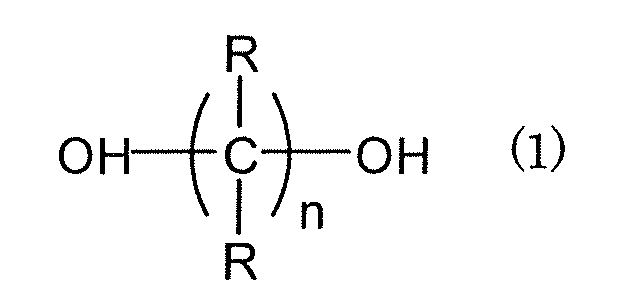
- The resin composition according to claim 1 or 2, wherein the polyester resin satisfies the following requirements A and B:(A) an intrinsic viscosity is 0.2 to 2.0 dL/g when measured at 25°C in a 40/60 by weight trichloroethane/phenol mixed solvent, and(B) a heat value of a crystallization exotherm peak is 5 J/g or lower when measured by a differential scanning calorimeter under temperature drop conditions.
- The resin composition according to claim 2 or 3, wherein the ratio, B2/B0, is 0.7 to 1.
- The resin composition according to any one of claims 1 to 4, wherein the polyester resin satisfies the following relationship V:
- The resin composition according to claim 5, wherein the ratio, A2/A0, is 0.7 to 1.
- The resin composition according to any one of claims 1 to 6, wherein the polyester resin satisfies the following relationship VII:
- The resin composition according to according to any one of claims 5 to 7, wherein the polyester resin satisfies the following relationship VIII:
- The resin composition according to claim 8, wherein the ratio, B3/B0, is 0.7 to 1.
- The resin composition according to any one of claims 1 to 9, wherein the diol constitutional units having an odd number of carbon atoms in the polyester main chain are units derived from at least one diol selected from the group consisting of 1,3-propanediol, 1,5-pentanediol, 2-methyl-1,3-propanediol, 1,3-butanediol and neopentyl glycol.
- The resin composition according to claim 1 to 10, wherein the dicarboxylic acid is a combination of isophthalic acid and azelaic acid.
- The resin composition according to any one of claims 1 to 11, wherein the electroconductive material is a carbonaceous material.
- The resin composition according to any one of claims 1 to 12, wherein the electroconductive material is an electroconductive carbon powder.
- The resin composition according to any one of claims 1 to 13, wherein a content of the electroconductive material is 0.01 to 25% by mass.
- The resin composition according to any one of claims 1 to 14, wherein the composition has a volume resistivity of 1012 Ω·cm or lower.
- The resin composition according to any one of claims 1 to 15, wherein the filler is scaly inorganic filler.
- The resin composition according to claim 16, wherein the filler is mica scale.
- The resin composition according to any one of claims 1 to 17, wherein a content of the filler is 10 to 80% by mass.
- A vibration damping material comprising the resin composition as defined in any one of claims 1 to 18.
- A vibration damper comprising a shaped article of the vibration damping material as defined in claim 19.
Applications Claiming Priority (6)
| Application Number | Priority Date | Filing Date | Title |
|---|---|---|---|
| JP2004056423 | 2004-03-01 | ||
| JP2004056423 | 2004-03-01 | ||
| JP2004195402 | 2004-07-01 | ||
| JP2004195402 | 2004-07-01 | ||
| JP2004205823 | 2004-07-13 | ||
| JP2004205823 | 2004-07-13 |
Publications (1)
| Publication Number | Publication Date |
|---|---|
| EP1571176A1 true EP1571176A1 (en) | 2005-09-07 |
Family
ID=34753508
Family Applications (1)
| Application Number | Title | Priority Date | Filing Date |
|---|---|---|---|
| EP05101303A Withdrawn EP1571176A1 (en) | 2004-03-01 | 2005-02-21 | Resin composition with high vibration damping ability |
Country Status (4)
| Country | Link |
|---|---|
| US (1) | US20050215703A1 (en) |
| EP (1) | EP1571176A1 (en) |
| KR (1) | KR101186755B1 (en) |
| TW (1) | TWI372164B (en) |
Cited By (5)
| Publication number | Priority date | Publication date | Assignee | Title |
|---|---|---|---|---|
| EP2050983A4 (en) * | 2006-08-09 | 2010-11-17 | Mitsubishi Gas Chemical Co | Vibration-damping material |
| EP2210915A4 (en) * | 2007-11-13 | 2010-12-08 | Mitsubishi Gas Chemical Co | Vibration damping material |
| EP1921122A4 (en) * | 2005-08-29 | 2011-07-06 | Mitsubishi Gas Chemical Co | Damping material and method for production thereof |
| EP3214147A4 (en) * | 2014-10-31 | 2018-04-04 | Kao Corporation | Polyester resin composition for damping material |
| US10465063B2 (en) | 2014-10-31 | 2019-11-05 | Kao Corporation | Polyamide resin composition for damping material |
Families Citing this family (5)
| Publication number | Priority date | Publication date | Assignee | Title |
|---|---|---|---|---|
| JP2007537928A (en) * | 2004-05-20 | 2007-12-27 | イー・アイ・デュポン・ドウ・ヌムール・アンド・カンパニー | Polymer fuel supply system components |
| KR100706271B1 (en) | 2006-09-22 | 2007-04-13 | 박순현 | Brush fragrance building finishing composition using synthetic resin and manufacturing method thereof |
| KR101326490B1 (en) * | 2007-05-25 | 2013-11-08 | 현대자동차주식회사 | Process for manufacturing anti vibration steel sheets |
| DE102015005754A1 (en) * | 2015-05-05 | 2016-11-10 | Audi Ag | Solenoid valve device for a motor vehicle |
| US11167999B2 (en) * | 2018-02-22 | 2021-11-09 | The Regents Of The University Of Michigan | Biomimetic composite materials for vibration isolation |
Citations (4)
| Publication number | Priority date | Publication date | Assignee | Title |
|---|---|---|---|---|
| JPH03119063A (en) * | 1989-10-03 | 1991-05-21 | Nippon Steel Corp | Viscoelastic resin composition for vibration damper |
| EP0516081A2 (en) * | 1991-05-31 | 1992-12-02 | Toyo Boseki Kabushiki Kaisha | Viscoelastic resin composition for vibration-damping material |
| JPH0873648A (en) * | 1994-03-03 | 1996-03-19 | C C I Kk | Sound insulation and damping material |
| US6635721B1 (en) * | 1995-12-06 | 2003-10-21 | Ucb, S.A. | Powder coating of semicrystalline and amorphous polyesters with crosslinker |
Family Cites Families (7)
| Publication number | Priority date | Publication date | Assignee | Title |
|---|---|---|---|---|
| US4311751A (en) * | 1976-05-27 | 1982-01-19 | Ferro Corporation | Moldable sound control composite and product |
| DE3038243A1 (en) * | 1980-10-10 | 1982-05-27 | Hoechst Ag, 6000 Frankfurt | METHOD FOR THE PRODUCTION OF HEAT-HARDENING, WATER-THINNABLE VARNISHES AND THE USE THEREOF FOR COATINGS |
| DE19612898C1 (en) * | 1996-03-30 | 1997-04-03 | Herberts Gmbh | Coating coils of sheet material |
| US6103859A (en) * | 1997-04-09 | 2000-08-15 | Eastman Chemical Company | Late addition of supplemental ethylene glycol in the preparation of copolyesters |
| DE10057164A1 (en) * | 2000-11-16 | 2002-05-23 | Basf Ag | Pigment preparation for pigmenting plastic moulding material, e.g. for vehicle parts, obtained by dispersing pigment in a solution of thermoplastic polymer and then removing solvent to form granules |
| US7041737B2 (en) * | 2001-11-28 | 2006-05-09 | Rohm And Haas Company | Coating powder composition, method of use thereof, and articles formed therefrom |
| JP2003221496A (en) | 2002-01-31 | 2003-08-05 | Toyobo Co Ltd | Viscoelastic resin composition and composite damping material using the same |
-
2005
- 2005-02-21 EP EP05101303A patent/EP1571176A1/en not_active Withdrawn
- 2005-02-25 TW TW094105718A patent/TWI372164B/en not_active IP Right Cessation
- 2005-02-28 KR KR1020050016405A patent/KR101186755B1/en not_active Expired - Fee Related
- 2005-02-28 US US11/066,172 patent/US20050215703A1/en not_active Abandoned
Patent Citations (4)
| Publication number | Priority date | Publication date | Assignee | Title |
|---|---|---|---|---|
| JPH03119063A (en) * | 1989-10-03 | 1991-05-21 | Nippon Steel Corp | Viscoelastic resin composition for vibration damper |
| EP0516081A2 (en) * | 1991-05-31 | 1992-12-02 | Toyo Boseki Kabushiki Kaisha | Viscoelastic resin composition for vibration-damping material |
| JPH0873648A (en) * | 1994-03-03 | 1996-03-19 | C C I Kk | Sound insulation and damping material |
| US6635721B1 (en) * | 1995-12-06 | 2003-10-21 | Ucb, S.A. | Powder coating of semicrystalline and amorphous polyesters with crosslinker |
Non-Patent Citations (2)
| Title |
|---|
| PATENT ABSTRACTS OF JAPAN vol. 015, no. 317 (C - 0858) 13 August 1991 (1991-08-13) * |
| PATENT ABSTRACTS OF JAPAN vol. 1996, no. 07 31 July 1996 (1996-07-31) * |
Cited By (8)
| Publication number | Priority date | Publication date | Assignee | Title |
|---|---|---|---|---|
| EP1921122A4 (en) * | 2005-08-29 | 2011-07-06 | Mitsubishi Gas Chemical Co | Damping material and method for production thereof |
| US8198362B2 (en) | 2005-08-29 | 2012-06-12 | Mitsubishi Gas Chemical Company, Inc. | Damping material and method for production thereof |
| EP2050983A4 (en) * | 2006-08-09 | 2010-11-17 | Mitsubishi Gas Chemical Co | Vibration-damping material |
| US8030388B2 (en) | 2006-08-09 | 2011-10-04 | Mitsubishi Gas Chemical Company, Inc. | Vibration-damping material |
| EP2210915A4 (en) * | 2007-11-13 | 2010-12-08 | Mitsubishi Gas Chemical Co | Vibration damping material |
| US8357742B2 (en) | 2007-11-13 | 2013-01-22 | Mitsubishi Gas Chemical Company, Inc. | Vibration damping material |
| EP3214147A4 (en) * | 2014-10-31 | 2018-04-04 | Kao Corporation | Polyester resin composition for damping material |
| US10465063B2 (en) | 2014-10-31 | 2019-11-05 | Kao Corporation | Polyamide resin composition for damping material |
Also Published As
| Publication number | Publication date |
|---|---|
| TW200602424A (en) | 2006-01-16 |
| KR101186755B1 (en) | 2012-09-28 |
| KR20060044290A (en) | 2006-05-16 |
| TWI372164B (en) | 2012-09-11 |
| US20050215703A1 (en) | 2005-09-29 |
Similar Documents
| Publication | Publication Date | Title |
|---|---|---|
| US8198362B2 (en) | Damping material and method for production thereof | |
| JP5440175B2 (en) | Damping material | |
| US20050215703A1 (en) | Resin compositions with high vibration damping ability | |
| JP5737187B2 (en) | Molding material and molded product having vibration damping properties | |
| JP2006052377A (en) | High vibration damping resin composition | |
| US8030388B2 (en) | Vibration-damping material | |
| JP5070687B2 (en) | Damping sheet for flooring and flooring | |
| JP5028766B2 (en) | Molding materials and molded products | |
| JP5733207B2 (en) | Damping film | |
| JP4951897B2 (en) | High damping shoe sole | |
| JP2011068722A (en) | Molding material | |
| JP5217081B2 (en) | Damping member for disk-type recording media | |
| JP2011074244A (en) | Molding material | |
| JP2012236907A (en) | Vibration-damping and sound-insulating material | |
| JP6168731B2 (en) | Molding material and molded product having vibration damping properties | |
| HK1149040B (en) | Vibration damping material | |
| JP2013010929A (en) | Molding material and molded article having vibration-damping properties and sound insulating properties |
Legal Events
| Date | Code | Title | Description |
|---|---|---|---|
| PUAI | Public reference made under article 153(3) epc to a published international application that has entered the european phase |
Free format text: ORIGINAL CODE: 0009012 |
|
| AK | Designated contracting states |
Kind code of ref document: A1 Designated state(s): AT BE BG CH CY CZ DE DK EE ES FI FR GB GR HU IE IS IT LI LT LU MC NL PL PT RO SE SI SK TR |
|
| AX | Request for extension of the european patent |
Extension state: AL BA HR LV MK YU |
|
| 17P | Request for examination filed |
Effective date: 20060209 |
|
| AKX | Designation fees paid |
Designated state(s): DE FR GB IT |
|
| 17Q | First examination report despatched |
Effective date: 20071218 |
|
| GRAP | Despatch of communication of intention to grant a patent |
Free format text: ORIGINAL CODE: EPIDOSNIGR1 |
|
| INTG | Intention to grant announced |
Effective date: 20130925 |
|
| STAA | Information on the status of an ep patent application or granted ep patent |
Free format text: STATUS: THE APPLICATION IS DEEMED TO BE WITHDRAWN |
|
| 18D | Application deemed to be withdrawn |
Effective date: 20140206 |