EP1570046B1 - Verfahren und vorrichtung zur trocknung von mikroorganismen - Google Patents
Verfahren und vorrichtung zur trocknung von mikroorganismen Download PDFInfo
- Publication number
- EP1570046B1 EP1570046B1 EP03767637A EP03767637A EP1570046B1 EP 1570046 B1 EP1570046 B1 EP 1570046B1 EP 03767637 A EP03767637 A EP 03767637A EP 03767637 A EP03767637 A EP 03767637A EP 1570046 B1 EP1570046 B1 EP 1570046B1
- Authority
- EP
- European Patent Office
- Prior art keywords
- strip
- preparation
- micro
- sealable
- water absorbent
- Prior art date
- Legal status (The legal status is an assumption and is not a legal conclusion. Google has not performed a legal analysis and makes no representation as to the accuracy of the status listed.)
- Expired - Lifetime
Links
Images



Classifications
-
- C—CHEMISTRY; METALLURGY
- C12—BIOCHEMISTRY; BEER; SPIRITS; WINE; VINEGAR; MICROBIOLOGY; ENZYMOLOGY; MUTATION OR GENETIC ENGINEERING
- C12N—MICROORGANISMS OR ENZYMES; COMPOSITIONS THEREOF; PROPAGATING, PRESERVING, OR MAINTAINING MICROORGANISMS; MUTATION OR GENETIC ENGINEERING; CULTURE MEDIA
- C12N1/00—Microorganisms; Compositions thereof; Processes of propagating, maintaining or preserving microorganisms or compositions thereof; Processes of preparing or isolating a composition containing a microorganism; Culture media therefor
- C12N1/04—Preserving or maintaining viable microorganisms
-
- C—CHEMISTRY; METALLURGY
- C12—BIOCHEMISTRY; BEER; SPIRITS; WINE; VINEGAR; MICROBIOLOGY; ENZYMOLOGY; MUTATION OR GENETIC ENGINEERING
- C12N—MICROORGANISMS OR ENZYMES; COMPOSITIONS THEREOF; PROPAGATING, PRESERVING, OR MAINTAINING MICROORGANISMS; MUTATION OR GENETIC ENGINEERING; CULTURE MEDIA
- C12N11/00—Carrier-bound or immobilised enzymes; Carrier-bound or immobilised microbial cells; Preparation thereof
- C12N11/02—Enzymes or microbial cells immobilised on or in an organic carrier
-
- C—CHEMISTRY; METALLURGY
- C12—BIOCHEMISTRY; BEER; SPIRITS; WINE; VINEGAR; MICROBIOLOGY; ENZYMOLOGY; MUTATION OR GENETIC ENGINEERING
- C12N—MICROORGANISMS OR ENZYMES; COMPOSITIONS THEREOF; PROPAGATING, PRESERVING, OR MAINTAINING MICROORGANISMS; MUTATION OR GENETIC ENGINEERING; CULTURE MEDIA
- C12N11/00—Carrier-bound or immobilised enzymes; Carrier-bound or immobilised microbial cells; Preparation thereof
- C12N11/14—Enzymes or microbial cells immobilised on or in an inorganic carrier
-
- Y—GENERAL TAGGING OF NEW TECHNOLOGICAL DEVELOPMENTS; GENERAL TAGGING OF CROSS-SECTIONAL TECHNOLOGIES SPANNING OVER SEVERAL SECTIONS OF THE IPC; TECHNICAL SUBJECTS COVERED BY FORMER USPC CROSS-REFERENCE ART COLLECTIONS [XRACs] AND DIGESTS
- Y10—TECHNICAL SUBJECTS COVERED BY FORMER USPC
- Y10T—TECHNICAL SUBJECTS COVERED BY FORMER US CLASSIFICATION
- Y10T428/00—Stock material or miscellaneous articles
- Y10T428/13—Hollow or container type article [e.g., tube, vase, etc.]
- Y10T428/1334—Nonself-supporting tubular film or bag [e.g., pouch, envelope, packet, etc.]
Definitions
- This invention is concerned with a simplified procedure for the substantially dry storage of micro-organisms at temperatures above freezing without the need to apply external drying/vacuum to the system.
- the method involves placing a small amount of the material containing the micro-organisms into a re-sealable strip device containing dry, water absorbent material of much greater mass in so doing rendering the micro-organisms substantially dry and stable in storage.
- J. Antheunisse et al. Antonie van Leeuwenhoek 47 (1981), 539-545 , disclose the drying of micro-organisms in an exsiccator containing CaCl 2 and silica gel as desiccating chemicals. Direct contact between the micro-organisms and the desiccating chemicals is avoided by putting the micro-organisms in ampoules containing a folded strip of filter paper and provided with cotton stoppers. Drying could be achieved within one week. After this, the ampoules have to be removed from the dry environment of the exsiccator, exposing the cultures to the risk of absorption of atmospheric moisture in so doing, before sealing with paraffin wax for convenient long term storage. J. Antheunisse et al reported that immediately after drying the logarithmic exponent of number of viable cells had decreased by 2-3 units and that in some cases this initial decline in viability was even greater, reflecting that this drying method is not optimal for many bacterial strains.
- T. Popovic et al. Journal of Clinical Microbiology, 36(6) (1998), 1765-1766 , report the use of foil envelopes containing sterile silica gel. The micro-organisms are harvested with a polyester swab and the swab with the harvested micro-organisms is put within the foil envelope.
- T. Popovic et al reported survival of Neisseria meningitidis at room temperature, describing recovery by stating that all strains exhibited heavy growth for at least 4 days but also that moderate growth on average persisted until day 9, suggesting significant reduction in viability in a relatively short period at room temperature. Table 1 in T. Popovic et al further illustrates significant decrease in strain viability in storage at room temperature for up to 90 days.
- the present invention relates to a re-sealable strip device for drying and storage of viable micro-organisms without losing viability comprising
- the water absorbent preparation incorporates substances that have both protective and water absorbent properties.
- the primary water absorbent preparation further comprises one or several absorbent bibulous foam or fibre-based pads or other matrices.
- the water absorbent preparation is in contact with or in proximity to a secondary water absorbent preparation.
- the secondary water absorbent preparation comprises a desiccating chemical such as silica gel or molecular sieve materials.
- the secondary water absorbent preparation has the format of one or several absorbent beads, tablets, coupons, labels, polymer films, plugs, foam or fibre-based pads enclosed within the strip device.
- the re-sealable housing is a foil pouch.
- the re-sealable housing comprises one or more access windows over each of which there is a water impermeable cover that can be opened and re-sealed such that once re-sealed the device regains its water impermeable properties.
- the re-sealable housing has a label on to which details of the micro-organism preparation can be noted and/or recorded by means such as bar coding.
- the re-sealable housing has a secondary tear or peel seal which can be opened in order to aseptically remove the strip.
- the present invention further relates to a process for the drying and storage of viable micro-organisms without losing viability, by
- step e the micro-organisms are recovered by
- step e) the strip device is stored at a temperature between -70°C and 37°C.
- step e) the strip device is stored at a temperature between 0°C and 30°C.
- the present invention further relates to a kit for drying and storage of micro-organisms at least comprising a re-sealable strip device according to the method of the invention.
- Said kit may also include any required information on procedures and/or ancillary materials such as containers of relevant solutions such as buffers or solutions incorporating protective substances that may be needed to optimise said procedures to achieve maximum efficiency of the preservation procedures.
- This invention relates to a device and a method for drying micro-organisms for long-term storage. This is achieved by placing a preparation containing the micro-organisms (the micro-organism preparation) into a re-sealable strip device.
- the strip device comprises a water impermeable re-sealable housing and a strip within the housing.
- the strip comprises a solid support on to which is attached one or more water absorbent preparations.
- a water absorbent preparation comprises at least one or more water absorbent substances and one or more protective substances, whereby the volume of the micro-organism preparation and the amount and composition of the water absorbent preparation are chosen such that after the addition of the micro-organism preparation on to the water absorbent preparation and resealing of the test strip the said water absorbent preparation is able to absorb the water contained in the added micro-organism preparation and remain substantially dry, in so doing rendering the micro-organisms therein substantially dry and stable to storage.
- the solid support is typically non-water absorbent material, often plastic such as polyester sheet.
- the water absorbent preparation is typically bonded to the solid support by adhesive.
- the water absorbent preparation further comprises one or several absorbent bibulous foam or fibre-based pads or matrices being bonded to the solid support and incorporating one or more water absorbent substances and one or more protective substances.
- the expression "re-sealable device” means a device which is sealed to water ingress prior to use is such a way that within the water impermeable external housing of said device there are one or more holes (access windows) the water impermeable covers over which can be opened to allow access into the device then re-sealed to restore the barrier to water ingress.
- micro-organisms or cells that can be dried and stored according to the present invention include bacteria such as, but are not limited to, Enterobacteriaceae, such as Escherichia coli (including strains used for molecular biology procedures including transformation and including strains already transformed), Vibrionaceae such as Vibrio fischeri, organisms of industrial importance (Lactobacilli Spp.), organisms of medical relevance, Pseudomonadaceae, etc. Cells need not be in vegetative form but can also be in the spore state.
- cells for example E.coli NovaBlue (Novagen Inc., Madison, USA) can be dried using the method of the invention and then, after storage, rehydrated with a suitable competency inducing solution such that it is then possible to directly transform the cells with exogenous DNA, such as plasmid molecules, according to the method of WO 02/50252 .
- E.coli NovaBlue Novagen Inc., Madison, USA
- the sample of micro-organisms which is added to the device is called the micro-organism preparation, independently of how it is added (e.g. directly or after resuspension).
- Various sources of micro-organisms can be used, for example colonies, liquid-cultures, field samples, blood samples, etc.
- the micro-organism preparation can be obtained, for example, by sampling from a colony growing on a solid microbiological growth medium.
- This micro-organism preparation can be added direct onto the water absorbent preparation on the strip within the device or first suspended in a suitable solution before addition to the device, the latter shown in the flow diagram representation in Figure 2 .
- the micro-organism preparation can be obtained by sampling from a liquid culture or suspension of cells. In all cases above, as an example, a 1 ⁇ l loop can be used to transfer the micro-organism preparation into the device.
- the micro-organism preparation can be pre-mixed with a solution containing protective substances prior to addition to the device. This may be achieved by dilution with such a solution or by centrifugation of the micro-organism preparation followed by re-suspension in such a solution.
- a solution containing protective substances prior to addition to the device.
- This may be achieved by dilution with such a solution or by centrifugation of the micro-organism preparation followed by re-suspension in such a solution.
- One can use the same protective substance(s) that is/are part of the water absorbent preparation or different protective substance(s).
- a late logarithmic or stationary phase bacterial culture may contain approximately 10 9 cells per millilitre, equivalent to 10 6 cells per microlitre, so that very significant numbers of cells can easily be applied to the strip device in relatively low volumes of liquid.
- the volume of the micro-organism preparation and the amount and type of the water absorbent preparation or preparations within the re-sealable strip device are chosen such that after the addition of the micro-organisms the water absorbent preparation is able to absorb the water contained in the added sample, in so doing rendering the micro-organisms substantially dry.
- this represents a closed system which is self-drying without external physical processes.
- substantially dry means that the final amount of water after addition of the cells in the preparation(s) is preferably less that 10% w/w, more preferably less than 5% w/w and even more preferably less than 2% w/w water.
- the amount of water absorbent preparation needed depends upon the amount of micro-organism preparation to be dried and upon the water absorbing capacity of the material. A person skilled in the art is able to find out a suitable amount of water absorbent preparation so that it remains substantially dry after the addition of the micro-organism preparation and in doing so rendering the micro-organisms substantially dry.
- the water absorbent preparation that can be used to dry the cells according to the procedure of the present invention comprises at least one water absorbent substance and one protective substance.
- a protective substance is a substance which actively promotes maintenance of viability of the cells during and after drying.
- the protective substances which are preferably incorporated into the water absorbent preparation and which are thus in contact with the micro-organisms are chosen to stabilise the cells during the drying process and minimise loss of viability.
- the protective substances assist in the preservation of the structural integrity of the cells in the dried state and also especially in the transition stages (drying and rehydration respectively) into and out of the dried state.
- Such protective substances may also act as water absorbent substances when incorporated into the water absorbent preparation.
- protective substances include carbohydrates (either natural or synthetic), for example, sugars (e.g. sucrose, lactose, lactitol, trehalose, glucose, cellobiose, raffinose, cyclodextrin) and derivatives thereof and/or polymers (sugar and non-sugar based) and derivatives thereof and/or amino acids, peptides or proteins and derivatives thereof and/or protein-based preparations and fractions such as bovine serum albumin fraction V.
- sugars e.g. sucrose, lactose, lactitol, trehalose, glucose, cellobiose, raffinose, cyclodextrin
- polymers sugar and non-sugar based
- amino acids peptides or proteins and derivatives thereof and/or protein-based preparations and fractions
- bovine serum albumin fraction V bovine serum albumin fraction V
- the water absorbent substances can include any substance which is able to absorb water and whose properties (e.g. acidity, chemical reactivity) have no negative influence on the viability of the cells in the micro-organism preparation. Such material should not for example generate significant heat by exothermic reaction during the process of drying of the micro-organism preparation.
- suitable water absorbent substances are dried carbohydrates or other organic or inorganic polymers like starch, dextrin, dextran, cellulose, protein, polypeptide, agar, agarose, polyacrilamide, sephadex, sepharose or mixtures thereof.
- the water absorbent substances additionally show the properties of protective substances, so that the water absorbent preparation may only comprise one substance which functions both as a water absorbent substance and as a protective substance.
- a water absorbent substance may only comprise one substance which functions both as a water absorbent substance and as a protective substance.
- a dried carbohydrate such as trehalose or sucrose.
- the water absorbent preparation may be formulated to include other biologically compatible substances familiar to those skilled in the art such as biologically compatible buffer components, for example HEPES [N-[2-Hydroxyethyl]piprazine-N'-[2-ethanesulfonic acid], microbiological culture media or components of such media, activated charcoal, compatible solutes such as ectoines (reference: Louis P et al., Appl.
- biologically compatible buffer components for example HEPES [N-[2-Hydroxyethyl]piprazine-N'-[2-ethanesulfonic acid]
- microbiological culture media or components of such media activated charcoal
- compatible solutes such as ectoines (reference: Louis P et al., Appl.
- the water absorbent preparation consists of sugars such as trehalose and/or sucrose and one or more biologically compatible buffer components.
- the water absorbent preparation has the format and thereby uses as a carrier of the protective substances one or several absorbent bibulous foam or fibre-based pads or matrices on the solid support incorporated within the strip device.
- Suitable pad materials include materials such as conventional cellulosic paper, nitrocellulose or derivatives thereof. Glass fibre materials, fibrous plastic materials such as Porex ® sheet materials (Porex Corporation), activated charcoal cloth and non-woven fabrics comprising such materials as viscose and polyester may also be used. All such materials above are well known to those skilled in the art.
- the strip device in addition to the water absorbent preparation (in the following, for ease of understanding called "primary water absorbent preparation"), the strip device further comprises a secondary water absorbent preparation.
- the secondary water absorbent preparation (either directly in contact with the primary water absorbent preparation or remote from it and in either case within the strip device) further enhances the efficiency of drying of the micro-organism preparation within the device.
- the primary water absorbent preparation is put directly in contact with the micro-organism preparation. If the amount of primary water absorbent preparation in relation to the amount of micro-organism preparation is too low to completely render the micro-organisms substantially dry or to ensure fast drying of the micro-organism preparation, the secondary water absorbent preparation is used to remove the excess water in the system.
- the amount of secondary water absorbent preparation is sufficient that the whole mixture becomes substantially dry.
- the amount of primary and secondary water absorbent preparation taken together is equivalent to the amount of water absorbent preparation that would be needed if no differentiation was made and the whole water absorbent preparation was put directly in contact with the micro-organism preparation.
- Primary and secondary water absorbent preparations can be made of the same or different water absorbent substances and can incorporate the same or different protective substances. They can have the same or different physical formats. Typically, the secondary water absorbent preparation need not incorporate any protective substances if it has only marginal contact with the micro-organism preparation.
- the secondary water absorbent preparation has the format of one or several beads, sachets, tablets, coupons, labels, polymer films, or pellets which may or may not be attached to the strip. It can be an advantage of such a combination of formats for the water absorbent preparations when, after storage and opening of the secondary seal of the water impermeable protective outer housing of the re-sealable strip device, the strip can then be easily separated from the secondary water absorbent preparation prior to rehydrating the micro-organism preparation from out of the primary water absorbent preparation. In this way the volume of solution needed to rehydrate the micro-organism preparation from out of the primary water absorbent preparation is lower than that required for rehydrating both the primary and secondary drying preparations. This has the further advantage that as less rehydration solution may be used, the resultant suspension of micro-organisms is more concentrated.
- water absorbent substances which do not need to be biologically compatible may be present within the device in secondary water absorbent preparations but physically separated from the micro-organisms.
- desiccating chemicals which have excellent water absorbent properties can be deployed in the device in secondary water absorbent preparations without deleterious effects upon the micro-organism preparation caused, for example, by exothermic reaction upon hydration.
- Preferred examples of such desiccating chemicals which do not need to be biologically compatible are molecular sieves like zeolites, inorganic oxides like aluminium oxide or silica gel, montimorillonite clay or other materials known to those expert in the art.
- water absorbent substances or desiccating chemicals which do not need to be biologically compatible may be present within the device by incorporation of these substances into the material of the solid support of the strip.
- the re-sealable housing of the strip device according to the present invention comprises a water impermeable protective outer packaging such as an aluminium foil pouch.
- a water impermeable protective outer packaging such as an aluminium foil pouch.
- Other water impermeable protective outer packaging materials are well known to those skilled in the art.
- the housing there are one or more access windows over each of which there is a water impermeable cover that can be opened and re-sealed such that once this is done the device regains its water impermeable properties.
- a water impermeable cover typically, would be secured to the device by suitable re-sealable adhesive at its periphery.
- the water impermeable cover could in this case take the form of a peelable tape.
- a hinge design can be conceived in which the cover is an integral part of the water impermeable protective outer packaging of the device and therefore secured by suitable re-sealable adhesive at only part of its periphery.
- a two-step mechanism can be conceived in which the primary cover over a given access window is peelable and removable and a secondary cover, such as a tape, is subsequently put into place over the access window so that the device regains its water impermeable properties.
- the water impermeable protective housing such as an aluminium foil pouch has a label on to which details of the micro-organism preparation can be noted and/or recorded by means such as bar coding.
- the housing has a secondary tear or peel seal which can be opened as required after storage in order to aseptically remove the strip holding the micro-organism preparation for reconstitution of the dried micro-organism preparation for use.
- the contents of the re-sealable strip devices including the water absorbent preparation need to be sterile before adding the micro-organism preparation.
- the components of the devices may be sterilised separately prior to assembly or the devices may be sterilised subsequent to this but prior to adding the micro-organism preparation, for example using gamma irradiation or similar treatment.
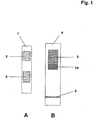
- Figure 1 shows an example of a format for a re-sealable strip device according to the present invention.
- Part A shows the strip, part B the housing.
- the strip comprises a plastic strip (1) on to which is attached the water absorbent preparation (2) comprising a pad with at least one water absorbent substance and at least one protective substance.
- a secondary water absorbent preparation (3) comprising a pad with at least one water absorbent substance is located further down the strip.
- the housing comprises a foil pouch (4) with one re-sealable access window (5).
- the access window is peeled open at the peelable seal (5a) one gains access to the water absorbent preparation on the strip to be able to inoculate the micro-organism preparation on to the water absorbent preparation.
- the housing can be opened by tearing the tear line (6).
- the invention further relates to a process for the drying and storage of viable micro-organisms by
- the sealed strip devices with micro-organisms dried according to the present invention can be stably stored at temperatures between -70°C and +37°C, preferably between 0°C and +30°C.
- Cells which are "stably stored” are able to withstand storage for extended periods of time at a suitable temperature, without appreciably losing their viability.
- the storage period of time may range from about 0 days to about 2000 days, typically from about 20 days or less to about 500 days, although even longer storage times may be used at temperatures of less than about -20 °C.
- Rehydration is typically performed either by the addition of a suitable reconstitution solution to the water absorbent preparation holding the preserved micro-organism preparation or by insertion of the test device into a suitable solution such as a microbiological culture medium or buffer solution.
- step 2 One example for the procedure of the method according to the present invention is shown in Figure 2 .
- step 1 cells are removed from a colony of micro-organisms on an agar plate.
- step 2 the cells are suspended in a small amount of sterile liquid medium which may contain protective substances.
- step 3 the re-sealable window cover on the strip device is opened to gain access to the pad of the re-sealable strip device.
- a small volume (1 ⁇ l in this example) of the micro-organism preparation to be dried is taken and inoculated through the window on the device on to the water absorbent preparation in the pad on the strip device.
- step 5 the strip device is straight away re-sealed by closing the re-sealable window cover on the test strip device.
- step 6 the details of the micro-organism preparation are entered on to the label on the external packaging of the strip device.
- step 7 the test strip is put into storage (for example in a fridge at 4°C) prior to use.
- step 8 the strip device is opened in order to gain access to the preserved bacteria by opening a second seal, in this example a peel seal.
- step 9 the strip device is then removed from its packaging.
- step 10 the cells are rehydrated by the addition of a suitable rehydration solution either by direct addition to the pad (step 10a) or by insertion of the pad of the test device into a suitable rehydration solution (step 10b).
- a microbiological culture medium could serve as a suitable rehydration solution.
- step 2 may be omitted so that in the next step, the re-sealable window cover on the strip device is opened to gain access to the pad of the re-sealable strip device and then the cells removed from a colony of micro-organisms on an agar plate inoculated direct through the window on the device on to the water absorbent preparation in the pad on the strip device without prior suspension in liquid.
- steps 1 and 2 may be omitted so that in the next step, a small volume (1 ⁇ l in this example) of a micro-organism preparation that is a pre-existing liquid suspension such as a broth culture is taken and inoculated through the window on the device on to the water absorbent preparation in the pad on the strip device.
- a suspension may contain added protective substances.
- such a suspension may be constituted by prior centrifugation of a broth culture or other suspension of micro-organisms and resuspension of the micro-organisms in a solution of choice which may include protective substances.
- These additional preparatory steps of centrifugation and resuspension may be used to adjust the concentration of micro-organisms in the suspension inoculated through the window on the device on to the strip device, typically to concentrate the micro-organisms.
- a kit for simple and instant drying of micro-organisms according to the method of the present invention.
- the kit comprises at least one re-sealable strip device containing at least one water absorbent preparation incorporating one or more protective substances according to the present invention.
- the water absorbent preparation is configured in the format of one or several absorbent bibulous foam or fibre-based pads or other matrices deployed on the strip enclosed within the strip device so that the user simply has to open the cover of the access window of the device, add the micro-organism preparation containing micro-organisms to the pad and re-seal the access window of the device for storage.
- Said kit may also include any required information on procedures and/or ancillary materials such as containers of relevant solutions such as buffers or solutions incorporating protective substances that may be needed to optimise said procedures to achieve maximum efficiency of the preservation procedures.
- the device and method according to the present invention eliminate the need for applying external drying equipment after adding the micro-organisms. Drying of the preparation(s) in the system is performed before the organisms are added, thus, the system is pre-prepared, sterilised (if required), and stored (without requirement for temperature controlled storage conditions) before use.
- the system thus has very few restrictions on when and where the micro-organism preparation sample is added, i.e. it is very flexible. Generally, storage at 4 oC or below is recommended for long term storage after addition of the micro-organism preparation although this may depend on the organism.
- the main advantage of the self-drying methodology according to the present invention is the simplicity and convenience of the procedures involved in that typically the user only has to add a small amount of micro-organism suspension (or semi-solid material e.g. a colony) and then place in a refrigerator for storage.
- micro-organism suspension or semi-solid material e.g. a colony
- the device is a closed system so there is no significant time period in which the device is open to atmosphere during the process of drying of the micro-organism preparation. This is in marked contrast to, for example, many freeze drying processes in which aerosols are likely during the drying process, thus the present invention makes the process of handling and drying pathogenic organisms much safer.
- the strips to be dried were placed within this area upon a plastic grid (Denleystor, cryostorage ABS plastic gridded rack, 150mm x 150mm, with grids placed 5mm apart) raising the strips above the bench by 20mm.
- the strips were prepared and dried in batches of 36.
- Self adhesive desiccant (CSP Technologies, ACTIV-STRIP, M-0002-58,) was removed from the protective foil pouch, cut into 3 pieces of 44.0mm x ⁇ 2.6mm x 0.60mm and placed immediately into a tin containing sachets of dry silica desiccant beads (Sigma, Silica beads for desiccation, Type II, size 1/8 "beads). After the pads on the strips were dried the desiccant pieces were removed from the tin and attached to the strips (see Figure 1 for position). The strips were then returned to the foil pouches and the pouches placed in a second tin containing dry silica desiccant beads for interim storage.
- the pouches were removed from this tin and their cut ends were foil sealed using a Multivac A300 Packager.
- the packager was programmed to draw a vacuum of approximately 600mbar with heat/pressure seal time of 3.5 seconds, sealing pressure 1 atmosphere.
- the pouches were then placed into a third tin containing dry silica desiccant.
- the pouches were removed from the tin and a strip of self adhesive plastic film (Tenza Clearview Film Art No. 329111) placed over the access window. The strips were held at room temperature for at least 16 hours prior to inoculation.
- E.coli JM109 a K12 derivative
- LB a primary culture of E.coli JM109, a K12 derivative
- E.coli JM109 cells were streaked on an LB (10g/l Tryptone (peptone from casein - Merck KGaA., Art. No. 1.07213), 5g/l Yeast Extract (Merck KGaA., Art No.
- a vial of seed stock JM109 was removed from - 70°C storage.
- a sample was removed by scraping the surface of the content of the vial.
- the sample was spread on a Luria Broth Agar plate (10g/l Tryptone (Difco, Art. No. 211705), 5g/l Yeast Extract (Difco, Art No. 212750), 10g/l NaCl (Sigma, Art No. S7653), 15g/l Agar (Merck, KGaA, 536025J), pH adjusted to 7.5 with NaOH), using conventional methods to ensure growth of individual separate single colonies of bacteria.
- the plate was incubated for 16 hours at 37°C and transferred to +4°C storage.
- the above plate was removed from +4°C storage and 3 colonies transferred to a 1L (Pyrex, Art No. 1130/26) conical flask containing 100ml LB broth (10g/l Tryptone (Difco, Art No. 212750), 5g/l Yeast extract (Difco, Art No. 212750), 10g/l NaCl (Sigma, Art No. S7653), - pH adjusted to 7.5 with NaOH).
- Two flasks were prepared in this manner. The flasks were incubated at 37°C with shaking at 180rpm. After approximately 16 hours the cultures reached an OD 600nm (Pharmacia LKB, Novaspec II Visible Spectrophotometer) of 1.49 and 1.45. The contents of the flasks were pooled and immediately placed on ice for 15 minutes.
- the pellets were each resuspended in 0.45ml of the supernatant by gentle aspiration using a 1 ml sterile plastic pasteur pipette.
- the resuspended pellets were pooled, and returned to the ice bath. This concentrated cell suspension was used as the inoculum.
- the viability of the cells in the inoculum was determined at this point.
- a standard dilution series was prepared in NB and plated in duplicate onto Nutrient Agar, NA (Merck KGaA, Art. no. 1.05450). The plates were incubated at 37°C for at least 18hours, or at 20°C for at least 72hours and the colonies counted.
- the cells used for the inoculum were maintained in the ice bath for the duration of this procedure.
- the adhesive film sealing the access window was peeled back allowing access to the pad.
- An aliquot of 1 ⁇ l of the cell suspension was dispensed onto the pad using standard micropipettes (BRAND TRANSFERPETTE 0.1-1 ⁇ l, PLASTIBRAND Tips, 0.1-20 ⁇ ).
- the adhesive film was replaced immediately after inoculation and the access window thus re-sealed. This procedure was repeated for each of the strips to be inoculated.
- the inoculated strips remained at room temperature (ie 20°C) for 1 hour.
- six strips were tested to determine the average initial viable cell number on the strip according to the procedure below.
- the remaining strips were then transferred to elevated (30°C) temperature storage for defined periods. As required, after set time periods at the storage temperature, the strips were removed from this incubation, 6 in total for each time point, equilibrated to room temperature, then tested to determine the remaining viable cell number on the strip according to the procedure below.
- the foil pouch was opened by tearing the foil at the opposite end to the inoculated pad.
- the strip was aseptically removed and transferred to a Bijou (Sterilin Art. no. 129A) containing 2ml NB in order to immerse the pad.
- the Bijou and contents were gently agitated and a 5 minute period allowed for the cells/protectant to re-hydrate from the pad.
- a standard dilution series was prepared in NB and plated in duplicate onto Nutrient Agar, NA (Merck KGaA, Art. no. 1.05450). The plates were incubated at 37°C for at least 18 hours, or at 20°C for at least 72hours and the colonies counted.
- Strip devices were prepared and tested as described in the above method, except for the omission of the dispensing and drying of protectant on the pad. The strip device was therefore also not placed for 30 minutes beneath the hot air fan.
- Strip devices were prepared and tested as described in the above method, except for the omission of the dispensing and drying of protectant on the pad and except for the following modification to the preparation of the inoculum.
- the inoculum was prepared as described above except that each pellet was resuspended in 0.45ml protectant solution (25% (w/w) Sucrose (BDH Art.no. 102745C) in Nutrient Broth (Nutrient Broth No.2 Merck KGaA, Art. no. 110136), filter sterilised)
- the contents of the Bijou were pooled in a 30ml Universal vial (Sterilin, Art. No.128A) and immediately placed on ice for 15 minutes.
- the OD 600nm (Pharmacia LKB, Novaspec II Visible Spectrophotometer) of the pooled culture was measured to be 0.21.
- An aliquot of approximately 3ml of this culture was maintained on ice and used to inoculate the strips (the Culture inoculum).
- the pellets were resuspended, each with 0.13ml of the chilled supernatent by gentle aspiration using a 1ml sterile plastic pasteur pipette.
- the concentrated cell suspensions were pooled and used to inoculate the strips (the Concentrated cell inoculum).
- the plate from which single colonies were to be used was removed from the incubator and placed onto the workbench at 20°C.
- the seal on a strip was peeled back allowing access to the pad via the access window.
- Each colony was removed from the agar plate using a ⁇ l loop (Nunc Brand, 1 ⁇ l Clear, Art No. 254410) and "rubbed" onto the pad/protectant. The seal was replaced immediately. This procedure was repeated for each of the strips to be inoculated.
- the cell viability of a typical colony from the plate was determined at this point.
- the colony was resuspended in 1 ml of Bolton Broth (without blood), a standard dilution series was prepared in the same broth, plated in duplicate onto Columbia Blood Agar and incubated at the required temperature and duration. The colonies were counted to establish the cfu per colony.
- Bolton Broth (without blood) was used as the diluent, and Columbia Blood Agar as the growth medium. The plates were incubated at 37°C for at least 48-72 hours in a CO 2 enriched atmosphere.
- Strip devices were prepared and tested as described in the above method, except for the omission of any kind of inoculum. The strips were tested, 36 in total, as described above for the determination of cell viability after storage.
- Table B below shows good stability (survival for greater than 56 days) in elevated (30°C) temperature storage using the method of the invention.
- Table B Time (days) Strips inoculated with single colonies (cfu/strip) Strips inoculated with stationery culture (cfu/strip) Strips inoculated with concentrated cells (cfu/strip) Control C No inoculation (cfu/strip) Inoculum added to strip 0 1.5E+08 9.0E+05 3.9E+06 No colonies observed.
- the self adhesive desiccant (CSP Technologies, ACTIV-STRIP, M-0002-58). was removed from the protective foil pouch, and cut into pieces of 44.0mm x ⁇ 12.6mm x 0.30mm.
- Candida albicans ATCC-10231 was obtained as TWISTER 0006 from which a seed stock was prepared.
- the TWISTER was rehydrated using the rehydration solution provided, streaked onto the Sabouraud 4% Maltose agar (65g/l Merck Art. no. 105439) and incubated at 25°C for 72 hours.
- a well isolated colony was selected from the agar plate, transferred to a vial containing cryobeads (Microbank, PROLAB Diagnostics, Art. No. PL160) and emulsified in the protective medium.
- the vial was inverted several times and as much of the protectant medium as possible was removed by aspiration.
- the vial was transferred to -70°C immediately after inoculation.
- the organism was streaked from this cryobead stock onto a Sabouraud 4% Maltose Agar plate using conventional methods to ensure growth of individual separate single colonies of bacteria, and incubated at 25°C for 72 hours.
- This agar plate was used to provide single colonies for the inoculation of the strips (the Colony inoculum), and to inoculate broth to be used for the Culture and Concentrated cell inoculums.
- a single colony from the plate prepared above was used to inoculate 50ml Maltose Broth (10g/l Peptone, Merck Art. No. 107213, 40g/l Maltose, Merck Art. No. 291314H) in a 100ml Sterilin pot (Sterilin Art. No. 185AM), incubated at 25°C for 72 hours.
- the optical density, OD 600nm was measured (Pharmacia LKB, Novaspec II Visible Spectrophotometer) to be 0.86.
- the culture was placed on ice for 15 minutes. An aliquot of approximately 4ml of this culture was maintained on ice and used to inoculate the strips (the Culture inoculum).
- the pellet was resuspended in 0.45ml of the supernatant by gentle aspiration using a 1ml sterile plastic pasteur pipette.
- the resuspended pellet was pooled, and returned to the ice bath. This concentrated cell suspension was used to inoculate the strips (the Concentrated cell inoculum).
- Maltose broth was used as the diluent, and Sabouraud 4% Maltose Agar as the growth medium. The plates were incubated at 25°C for at least 72 hours.
- Table C below shows good stability (survival for greater than 56 days) in elevated (30°C) temperature storage using the method of the invention.
- Table C Time (days) Strips inoculated with single colonies (cfu/strip) Strips inoculated with stationery culture (cfu/strip) Strips inoculated with concentrated cells (cfu/strip) Control D No Inoculation (cfu/strip) Inoculum added to strip 0 1.2E+07 7.0E+04 3.4E+06 No colonies observed.
- the self adhesive desiccant (CSP Technologies, ACTIV-STRIP, M-0002-58), was removed from the protective foil pouch, and cut into pieces of 44.0mm x ⁇ 12.6mm x 0.30mm.
- TWISTER 0026 PROLAB Diagnostics
- the TWISTER was rehydrated using the rehydration solution provided and streaked onto Nutrient Agar (Merck KGaA, Art. no.1.05450) at 37°C for 16 hours.
- a well isolated colony was selected from the agar plate, transferred to a vial containing cryobeads (Microbank, PROLAB Diagnostics, Art. No. PL160) and emulsified in the protective medium.
- the vial was inverted several times and as much of the protectant medium as possible was removed by aspiration.
- the vial was transferred to -70°C immediately after inoculation.
- the organism was streaked from this cryobead stock onto a Nutrient Agar plate using conventional methods to ensure growth of individual separate single colonies of bacteria, and incubated at 37°C for 16 hours.
- This agar plate was used to provide single colonies for the inoculation of the strips (the Colony inoculum), and to inoculate broth to be used for the Culture and Concentrated cell inoculums.
- a single colony from the plate prepared above was used to inoculate 50ml Nutrient Broth (Nutrient Broth No.2 Merck KGaA, Art. no. 11013610g/l) in a 100ml Sterilin pot (Sterilin Art. No. 185AM), and incubated at 37°C for 16 hours.
- the optical density, OD 600nm was measured (Pharmacia LKB, Novaspec II Visible Spectrophotometer) to be 0.48.
- the culture was placed on ice for 15 minutes. An aliquot of approximately 4ml of this culture was maintained on ice and used to inoculate the strips (the Culture inoculum).
- the pellet was resuspended in 0.45ml of the supernatant by gentle aspiration using a 1 ml sterile plastic pasteur pipette.
- the resuspended pellet was pooled, and returned to the ice bath. This concentrated cell suspension was used to inoculate the strips (the Concentrated cell inoculum).
- the plates were incubated at 37°C for at least 16 hours.
- Table D below shows good stability (survival for greater than 56 days) in elevated (30°C) temperature storage using the method of the invention.
- Table D Time (days) Strips inoculated with single colonies (cfu/strip) Strips inoculated with stationery culture (cfu/strip) Strips inoculated with concentrated cells (cfu/strip) Control E No inoculation (cfu/strip) Inoculum added to strip 0 4.1 E+07 3.8E+06 1.4E+08 No colonies observed.
- Lactobacilus acidophilus ATCC-4356 was obtained as TWISTER 0018 (PROLAB Diagnostics).
- the TWISTER was rehydrated using the rehydration solution provided and streaked onto MRS Agar (52.4g/l MRS Broth, Merck KGaA, Art. no. 11066, 14g/l Agar, Merck KGaA, Art. No. 101614).
- MRS Agar 52.4g/l MRS Broth, Merck KGaA, Art. no. 11066, 14g/l Agar, Merck KGaA, Art. No. 101614.
- the agar plate was incubated at 35°C for 72 hours in a CO 2 enriched atmosphere. This agar plate was used to provide single colonies for the inoculation of the strips (the Colony inoculum).
- the pellet was resuspended in 0.45ml of the supernatant by gentle aspiration using a 1ml sterile plastic pasteur pipette.
- the resuspended pellet was pooled, and returned to the ice bath. This concentrated cell suspension was used to inoculate the strips (the Concentrated cell inoculum).
- MRS broth was used as the diluent, and MRS Agar as the growth medium.
- the plates were incubated at 35°C for at least 72 hours in a CO 2 enriched atmosphere.
- Control F - Strips prepared as described above without inoculation
- Table E below shows good stability (survival for greater than 56 days) in elevated (30°C) temperature storage.
- E.coli ATCC-25922 was obtained as TWISTER 0014 (PROLAB Diagnostics) from which a seed stock was prepared.
- the TWISTER was rehydrated using the rehydration solution provided and streaked onto Nutrient Agar (Merck KGaA, Art. no.1.05450) at 37°C for 16 hours.
- a well isolated colony was selected from the agar plate, transferred to a vial containing cryobeads (Microbank, PROLAB Diagnostics, Art. No. PL160) and emulsified in the protective medium.
- the vial was inverted several times and as much of the protectant medium as possible was removed by aspiration.
- the vial was transferred to -70°C immediately after inoculation.
- the organism was streaked from this cryobead stock onto a Nutrient Agar plate using conventional methods to ensure growth of individual separate single colonies of bacteria, and incubated at 37°C for 16 hours.
- a single colony from the plate prepared above was used to inoculate 50ml Nutrient Broth (Nutrient Broth No.2 Merck KGaA, Art. no. 11013610g/l) in a 100ml Sterilin pot (Sterilin Art. No. 185AM), and incubated at 37°C for 16 hours.
- the optical density, OD 600nm was measured (Pharmacia LKB, Novaspec II Visible Spectrophotometer) to be 0.52.
- the culture was placed on ice for 15 minutes. This culture was used to inoculate the strips.
- Strip devices were prepared and tested as described in the above method, except for the omission of the desiccant.
- Table F The surprising result can be seen from Table F below that good stability (survival for greater than 14 days (in elevated (30°C) temperature storage) was only achieved with the incorporation of desiccant within the device. The bacteria inoculated into the device did not survive for greater than seven days in the absence of desiccant in the device.
Landscapes
- Chemical & Material Sciences (AREA)
- Engineering & Computer Science (AREA)
- Health & Medical Sciences (AREA)
- Life Sciences & Earth Sciences (AREA)
- Wood Science & Technology (AREA)
- Zoology (AREA)
- Organic Chemistry (AREA)
- Genetics & Genomics (AREA)
- Bioinformatics & Cheminformatics (AREA)
- Biotechnology (AREA)
- General Engineering & Computer Science (AREA)
- Biochemistry (AREA)
- Microbiology (AREA)
- General Health & Medical Sciences (AREA)
- Biomedical Technology (AREA)
- Inorganic Chemistry (AREA)
- Medicinal Chemistry (AREA)
- Tropical Medicine & Parasitology (AREA)
- Virology (AREA)
- Micro-Organisms Or Cultivation Processes Thereof (AREA)
- Apparatus Associated With Microorganisms And Enzymes (AREA)
- Agricultural Chemicals And Associated Chemicals (AREA)
- Drying Of Solid Materials (AREA)
Claims (13)
- Wiederverschließbare Streifenvorrichtung, die sich zum Trocknen und Lagern von lebensfähigen Mikroorganismen ohne Verlust der Lebensfähigkeit eignet, enthaltend- einen Streifen enthaltend eine wasserabsorbierende Zubereitung, welche eine Menge mindestens einer wasserabsorbierenden Substanz enthält, die in der Lage ist, das in dem gewählten Volumen an zugesetzter Mikroorganismenzubereitung enthaltene Wasser so zu absorbieren, dass die Endmenge an Wasser in der/den Zubereitung(en) nach Zugabe der Zellen weniger als 10% w/w beträgt, und mindestens eine Schutzsubstanz- einen wiederverschließbaren Behälter, der im verschlossenen Zustand ein geschlossenes, wasserundurchlässiges System um den Streifen bereitstellt.
- Wiederverschließbare Streifenvorrichtung nach Anspruch 1, dadurch gekennzeichnet, dass die wasserabsorbierende Zubereitung eine oder mehrere Substanzen beinhaltet, die sowohl schützende als auch wasserabsorbierende Eigenschaften besitzen.
- Wiederverschließbare Streifenvorrichtung nach Anspruch 1 oder 2, dadurch gekennzeichnet, dass die primäre wasserabsorbierende Zubereitung weiterhin ein oder mehrere absorbierende Schaumstoff- oder faserbasierende Polster oder andere Matrizes enthält.
- Wiederverschließbare Streifenvorrichtung nach einem oder mehreren der Ansprüche 1 bis 3, dadurch gekennzeichnet, dass sich die wasserabsorbierende Zubereitung im Kontakt mit oder in der Nähe von einer sekundären wasserabsorbierenden Zubereitung befindet.
- Wiederverschließbare Streifenvorrichtung nach einem oder mehreren der Ansprüche 1 bis 4, dadurch gekennzeichnet, dass die sekundäre wasserabsorbierende Zubereitung in Form von einer oder mehreren in der Streifenvorrichtung eingeschlossenen absorbierenden Perlen, Tabletten, Pfropfen, Schaumstoff- oder faserbasierenden Polstern vorliegt.
- Wiederverschließbare Streifenvorrichtung nach einem oder mehreren der Ansprüche 1 bis 5, dadurch gekennzeichnet, dass der wiederverschließbare Behälter ein Folienbeutel ist.
- Wiederverschließbare Streifenvorrichtung nach einem oder mehreren der Ansprüche 1 bis 6, dadurch gekennzeichnet, dass der wiederverschließbare Behälter ein oder mehrere Zugangsfenster enthält, über denen sich jeweils eine wasserundurchlässige Abdeckung befindet, die so geöffnet und wieder verschlossen werden kann, dass die Vorrichtung nach dem Wiederverschließen ihre wasserundurchlässigen Eigenschaften zurückerhält.
- Wiederverschließbare Streifenvorrichtung nach einem oder mehreren der Ansprüche 1 bis 7, dadurch gekennzeichnet, dass der wiederverschließbare Behälter ein Etikett aufweist.
- Wiederverschließbare Streifenvorrichtung nach einem oder mehreren der Ansprüche 1 bis 8, dadurch gekennzeichnet, dass der wiederverschließbare Behälter einen sekundären aufreißbaren oder abziehbaren Verschluss aufweist, der geöffnet werden kann, um den Streifen aseptisch zu entnehmen.
- Verfahren zum Trocknen und Lagern von lebensfähigen Mikroorganismen ohne Verlust der Lebensfähigkeit, durcha) Bereitstellen einer wiederverschließbaren Streifenvorrichtung nach einem oder mehreren der Ansprüche 1 bis 9;b) Öffnen einer wiederverschließbaren Zugangsfensterabdeckung im Behälter der Streifenvorrichtung, um Zugang zum Streifen zu erhalten;c) Zugeben der zu trocknenden Mikroorganismenzubereitung durch das besagte Fenster auf die auf dem Streifen befindliche wasserabsorbierende Zubereitung;d) Verschließen der Streifenvorrichtung durch Schließen der wiederverschließbaren Fensterabdeckung am genannten Behälter;e) Lagern der Streifenvorrichtung;wobei die Menge der Mikroorganismenzubereitung und die Menge der wasserabsorbierenden Zubereitung in der Vorrichtung so gewählt werden, dass die wasserabsorbierende Zubereitung nach der Zugabe der Mikroorganismenzubereitung in der Lage ist, das in der Mikroorganismenzubereitung enthaltene Wasser zu absorbieren und im Wesentlichen trocken zu bleiben, so dass die Endmenge an Wasser in der/den Zubereitung(en) nach Zugabe der Zellen weniger als 10% w/w beträgt.
- Verfahren nach Anspruch 10, dadurch gekennzeichnet, dass, nach Schritt e), die Mikroorganismen wiedergewonnen werden durcha) Öffnen der Streifenvorrichtung und Entfernen des Streifens aus dem Behälter;b) Rehydratisieren der Mikroorganismen.
- Verfahren nach Anspruch 10 oder 11, dadurch gekennzeichnet, dass, in Schritt e), die Streifenvorrichtung bei einer Temperatur zwischen 0°C und 30°C gelagert wird.
- Kit zum Trocknen und Lagern von Mikroorganismen, mindestens enthaltend eine wiederverschließbare Streifenvorrichtung nach einem oder mehreren der Ansprüche 1 bis 9.
Priority Applications (1)
| Application Number | Priority Date | Filing Date | Title |
|---|---|---|---|
| EP03767637A EP1570046B1 (de) | 2002-12-13 | 2003-11-25 | Verfahren und vorrichtung zur trocknung von mikroorganismen |
Applications Claiming Priority (4)
| Application Number | Priority Date | Filing Date | Title |
|---|---|---|---|
| EP02027875 | 2002-12-13 | ||
| EP02027875 | 2002-12-13 | ||
| EP03767637A EP1570046B1 (de) | 2002-12-13 | 2003-11-25 | Verfahren und vorrichtung zur trocknung von mikroorganismen |
| PCT/EP2003/013205 WO2004055171A1 (en) | 2002-12-13 | 2003-11-25 | Method and device for drying of micro-organisms |
Publications (2)
| Publication Number | Publication Date |
|---|---|
| EP1570046A1 EP1570046A1 (de) | 2005-09-07 |
| EP1570046B1 true EP1570046B1 (de) | 2008-03-05 |
Family
ID=32524002
Family Applications (1)
| Application Number | Title | Priority Date | Filing Date |
|---|---|---|---|
| EP03767637A Expired - Lifetime EP1570046B1 (de) | 2002-12-13 | 2003-11-25 | Verfahren und vorrichtung zur trocknung von mikroorganismen |
Country Status (7)
| Country | Link |
|---|---|
| US (1) | US20060147662A1 (de) |
| EP (1) | EP1570046B1 (de) |
| JP (1) | JP2006509513A (de) |
| AT (1) | ATE388221T1 (de) |
| AU (1) | AU2003292098A1 (de) |
| DE (1) | DE60319576T2 (de) |
| WO (1) | WO2004055171A1 (de) |
Families Citing this family (4)
| Publication number | Priority date | Publication date | Assignee | Title |
|---|---|---|---|---|
| US20120270302A1 (en) * | 2011-04-25 | 2012-10-25 | Eben Bayer | Method for Making Dehydrated Mycelium Elements and Product Made Thereby |
| DE102010005622A1 (de) * | 2010-01-25 | 2011-12-15 | Umweltmykologie Dr. Dill & Trautmann Gbr (Vertreten Durch Den Gesellschafter: Dr.Trautmann, 10961 Berlin) | Folien - Test |
| TR201007549A2 (tr) * | 2010-09-15 | 2011-01-21 | �Novat�F B�Yoteknoloj� Organ�Zasyonu T�Caret L�M�Ted ��Rket� | Emici boncuklar ile santrifüje gereksinimi ortadan kaldıran yoğunlaştırma yöntemi ve kitleri. |
| US8785183B2 (en) | 2010-09-21 | 2014-07-22 | Biogaia Ab | Active plastic material in oil |
Family Cites Families (6)
| Publication number | Priority date | Publication date | Assignee | Title |
|---|---|---|---|---|
| US4886664A (en) * | 1982-06-18 | 1989-12-12 | Rhone-Poulenc, S.A. | Low-water-activity inocula for biological control |
| JPS60221078A (ja) * | 1984-04-18 | 1985-11-05 | Morinaga Milk Ind Co Ltd | 有用微生物粉末の粒状製品およびその製造法 |
| GB8713601D0 (en) * | 1987-06-10 | 1987-07-15 | Unilever Plc | Fermentation |
| GB9916790D0 (en) * | 1999-07-16 | 1999-09-22 | Health Lab Service Board | Storage of microorganisms,cells and tissue |
| IL149778A0 (en) * | 1999-11-22 | 2002-11-10 | Universal Preservation Technologies Inc | Preservation of sensitive biological material |
| US6927062B2 (en) * | 2002-11-25 | 2005-08-09 | Agdia, Inc. | Controls and standards for assays and method for manufacture thereof |
-
2003
- 2003-11-25 AT AT03767637T patent/ATE388221T1/de not_active IP Right Cessation
- 2003-11-25 US US10/538,292 patent/US20060147662A1/en not_active Abandoned
- 2003-11-25 EP EP03767637A patent/EP1570046B1/de not_active Expired - Lifetime
- 2003-11-25 AU AU2003292098A patent/AU2003292098A1/en not_active Abandoned
- 2003-11-25 WO PCT/EP2003/013205 patent/WO2004055171A1/en not_active Ceased
- 2003-11-25 JP JP2004559716A patent/JP2006509513A/ja active Pending
- 2003-11-25 DE DE60319576T patent/DE60319576T2/de not_active Expired - Lifetime
Also Published As
| Publication number | Publication date |
|---|---|
| AU2003292098A1 (en) | 2004-07-09 |
| DE60319576T2 (de) | 2009-03-19 |
| WO2004055171A1 (en) | 2004-07-01 |
| DE60319576D1 (de) | 2008-04-17 |
| EP1570046A1 (de) | 2005-09-07 |
| US20060147662A1 (en) | 2006-07-06 |
| JP2006509513A (ja) | 2006-03-23 |
| ATE388221T1 (de) | 2008-03-15 |
Similar Documents
| Publication | Publication Date | Title |
|---|---|---|
| US5856172A (en) | Preservation of microorganisms in a vial with a cap comprising an immobilized desiccant | |
| CA1308636C (en) | Method and compositions for protecting anerobic microorganisms | |
| US4672037A (en) | Method of culturing freeze-dried microorganisms | |
| US20070074451A1 (en) | Shelf life and on seed stabilization of liquid bacterium inoculants | |
| Perry | Freeze-drying and cryopreservation of bacteria | |
| AU693993B2 (en) | A rapid microbiological test for the detection of antibacterial compounds | |
| Koike et al. | Fine structures of intracytoplasmic organelles of mycobacteria | |
| JP2002534079A (ja) | ガラス化による周囲温度での感受性生物学的物質の保存 | |
| Forsberg et al. | N-acetylmuramyl-L-alanine amidase of Bacillus licheniformis and its L-form | |
| US20060147662A1 (en) | Method and device for drying of micro-organisms | |
| Collins-Thompson et al. | Depletion of sodium nitrite by lactic acid bacteria isolated from vacuum-packed bologna | |
| Malik | Use of activated charcoal for the preservation of anaerobic phototrophic and other sensitive bacteria by freeze-drying | |
| Acker et al. | Engineering desiccation tolerance in mammalian cells: tools and techniques | |
| CN115926989A (zh) | 一种重组大肠杆菌菌种冻干保藏方法 | |
| Higgins et al. | The mesosome | |
| Gottschal et al. | Principles of enrichment, isolation, cultivation, and preservation of bacteria | |
| EP1196541A2 (de) | Aufbewahrung von mikroorganismen, zellen und gewebe | |
| Symington | Improved transport system for Neisseria gonorrhoeae in clinical specimens | |
| US8778657B1 (en) | Culture medium for cultivation of microorganisms | |
| Barker | Spore Research 1976 V2 | |
| Lachica et al. | Two improved media for isolating and enumerating enterococci in certain frozen foods | |
| SLEESMAN | Preservation of phytopathogenic prokaryotes | |
| Malik | Preservation of Chloroflexus by deep-freezing and liquid-drying methods | |
| Malik et al. | Successful preservation of Campylobacteraceae and related bacteria by liquid-drying under anaerobic conditions | |
| CN111635925B (zh) | 一种即用型生物素检测载体及其制备方法 |
Legal Events
| Date | Code | Title | Description |
|---|---|---|---|
| PUAI | Public reference made under article 153(3) epc to a published international application that has entered the european phase |
Free format text: ORIGINAL CODE: 0009012 |
|
| 17P | Request for examination filed |
Effective date: 20050316 |
|
| AK | Designated contracting states |
Kind code of ref document: A1 Designated state(s): AT BE BG CH CY CZ DE DK EE ES FI FR GB GR HU IE IT LI LU MC NL PT RO SE SI SK TR |
|
| AX | Request for extension of the european patent |
Extension state: AL LT LV MK |
|
| DAX | Request for extension of the european patent (deleted) | ||
| 17Q | First examination report despatched |
Effective date: 20060308 |
|
| GRAP | Despatch of communication of intention to grant a patent |
Free format text: ORIGINAL CODE: EPIDOSNIGR1 |
|
| RIN1 | Information on inventor provided before grant (corrected) |
Inventor name: RAYNER-BRANDES, MICHAEL HOWARD Inventor name: WATKINS, IAN DAVID Inventor name: JONES, JULIE KAY |
|
| GRAS | Grant fee paid |
Free format text: ORIGINAL CODE: EPIDOSNIGR3 |
|
| GRAA | (expected) grant |
Free format text: ORIGINAL CODE: 0009210 |
|
| AK | Designated contracting states |
Kind code of ref document: B1 Designated state(s): AT BE BG CH CY CZ DE DK EE ES FI FR GB GR HU IE IT LI LU MC NL PT RO SE SI SK TR |
|
| REG | Reference to a national code |
Ref country code: GB Ref legal event code: FG4D |
|
| REG | Reference to a national code |
Ref country code: CH Ref legal event code: EP |
|
| REG | Reference to a national code |
Ref country code: IE Ref legal event code: FG4D |
|
| REF | Corresponds to: |
Ref document number: 60319576 Country of ref document: DE Date of ref document: 20080417 Kind code of ref document: P |
|
| PG25 | Lapsed in a contracting state [announced via postgrant information from national office to epo] |
Ref country code: ES Free format text: LAPSE BECAUSE OF FAILURE TO SUBMIT A TRANSLATION OF THE DESCRIPTION OR TO PAY THE FEE WITHIN THE PRESCRIBED TIME-LIMIT Effective date: 20080616 Ref country code: FI Free format text: LAPSE BECAUSE OF FAILURE TO SUBMIT A TRANSLATION OF THE DESCRIPTION OR TO PAY THE FEE WITHIN THE PRESCRIBED TIME-LIMIT Effective date: 20080305 |
|
| PG25 | Lapsed in a contracting state [announced via postgrant information from national office to epo] |
Ref country code: AT Free format text: LAPSE BECAUSE OF FAILURE TO SUBMIT A TRANSLATION OF THE DESCRIPTION OR TO PAY THE FEE WITHIN THE PRESCRIBED TIME-LIMIT Effective date: 20080305 |
|
| NLV1 | Nl: lapsed or annulled due to failure to fulfill the requirements of art. 29p and 29m of the patents act | ||
| PG25 | Lapsed in a contracting state [announced via postgrant information from national office to epo] |
Ref country code: BE Free format text: LAPSE BECAUSE OF FAILURE TO SUBMIT A TRANSLATION OF THE DESCRIPTION OR TO PAY THE FEE WITHIN THE PRESCRIBED TIME-LIMIT Effective date: 20080305 Ref country code: SI Free format text: LAPSE BECAUSE OF FAILURE TO SUBMIT A TRANSLATION OF THE DESCRIPTION OR TO PAY THE FEE WITHIN THE PRESCRIBED TIME-LIMIT Effective date: 20080305 |
|
| PG25 | Lapsed in a contracting state [announced via postgrant information from national office to epo] |
Ref country code: SK Free format text: LAPSE BECAUSE OF FAILURE TO SUBMIT A TRANSLATION OF THE DESCRIPTION OR TO PAY THE FEE WITHIN THE PRESCRIBED TIME-LIMIT Effective date: 20080305 Ref country code: SE Free format text: LAPSE BECAUSE OF FAILURE TO SUBMIT A TRANSLATION OF THE DESCRIPTION OR TO PAY THE FEE WITHIN THE PRESCRIBED TIME-LIMIT Effective date: 20080605 Ref country code: CZ Free format text: LAPSE BECAUSE OF FAILURE TO SUBMIT A TRANSLATION OF THE DESCRIPTION OR TO PAY THE FEE WITHIN THE PRESCRIBED TIME-LIMIT Effective date: 20080305 Ref country code: PT Free format text: LAPSE BECAUSE OF FAILURE TO SUBMIT A TRANSLATION OF THE DESCRIPTION OR TO PAY THE FEE WITHIN THE PRESCRIBED TIME-LIMIT Effective date: 20080805 Ref country code: NL Free format text: LAPSE BECAUSE OF FAILURE TO SUBMIT A TRANSLATION OF THE DESCRIPTION OR TO PAY THE FEE WITHIN THE PRESCRIBED TIME-LIMIT Effective date: 20080305 |
|
| ET | Fr: translation filed | ||
| PG25 | Lapsed in a contracting state [announced via postgrant information from national office to epo] |
Ref country code: RO Free format text: LAPSE BECAUSE OF FAILURE TO SUBMIT A TRANSLATION OF THE DESCRIPTION OR TO PAY THE FEE WITHIN THE PRESCRIBED TIME-LIMIT Effective date: 20080305 |
|
| PLBE | No opposition filed within time limit |
Free format text: ORIGINAL CODE: 0009261 |
|
| STAA | Information on the status of an ep patent application or granted ep patent |
Free format text: STATUS: NO OPPOSITION FILED WITHIN TIME LIMIT |
|
| PG25 | Lapsed in a contracting state [announced via postgrant information from national office to epo] |
Ref country code: DK Free format text: LAPSE BECAUSE OF FAILURE TO SUBMIT A TRANSLATION OF THE DESCRIPTION OR TO PAY THE FEE WITHIN THE PRESCRIBED TIME-LIMIT Effective date: 20080305 |
|
| 26N | No opposition filed |
Effective date: 20081208 |
|
| PG25 | Lapsed in a contracting state [announced via postgrant information from national office to epo] |
Ref country code: BG Free format text: LAPSE BECAUSE OF FAILURE TO SUBMIT A TRANSLATION OF THE DESCRIPTION OR TO PAY THE FEE WITHIN THE PRESCRIBED TIME-LIMIT Effective date: 20080605 Ref country code: EE Free format text: LAPSE BECAUSE OF FAILURE TO SUBMIT A TRANSLATION OF THE DESCRIPTION OR TO PAY THE FEE WITHIN THE PRESCRIBED TIME-LIMIT Effective date: 20080305 |
|
| PG25 | Lapsed in a contracting state [announced via postgrant information from national office to epo] |
Ref country code: MC Free format text: LAPSE BECAUSE OF NON-PAYMENT OF DUE FEES Effective date: 20081130 |
|
| REG | Reference to a national code |
Ref country code: CH Ref legal event code: PL |
|
| PG25 | Lapsed in a contracting state [announced via postgrant information from national office to epo] |
Ref country code: IT Free format text: LAPSE BECAUSE OF FAILURE TO SUBMIT A TRANSLATION OF THE DESCRIPTION OR TO PAY THE FEE WITHIN THE PRESCRIBED TIME-LIMIT Effective date: 20080305 |
|
| PG25 | Lapsed in a contracting state [announced via postgrant information from national office to epo] |
Ref country code: CY Free format text: LAPSE BECAUSE OF FAILURE TO SUBMIT A TRANSLATION OF THE DESCRIPTION OR TO PAY THE FEE WITHIN THE PRESCRIBED TIME-LIMIT Effective date: 20080305 |
|
| PG25 | Lapsed in a contracting state [announced via postgrant information from national office to epo] |
Ref country code: LI Free format text: LAPSE BECAUSE OF NON-PAYMENT OF DUE FEES Effective date: 20081130 Ref country code: IE Free format text: LAPSE BECAUSE OF NON-PAYMENT OF DUE FEES Effective date: 20081125 Ref country code: CH Free format text: LAPSE BECAUSE OF NON-PAYMENT OF DUE FEES Effective date: 20081130 |
|
| PG25 | Lapsed in a contracting state [announced via postgrant information from national office to epo] |
Ref country code: LU Free format text: LAPSE BECAUSE OF NON-PAYMENT OF DUE FEES Effective date: 20081125 Ref country code: HU Free format text: LAPSE BECAUSE OF FAILURE TO SUBMIT A TRANSLATION OF THE DESCRIPTION OR TO PAY THE FEE WITHIN THE PRESCRIBED TIME-LIMIT Effective date: 20080906 |
|
| PG25 | Lapsed in a contracting state [announced via postgrant information from national office to epo] |
Ref country code: TR Free format text: LAPSE BECAUSE OF FAILURE TO SUBMIT A TRANSLATION OF THE DESCRIPTION OR TO PAY THE FEE WITHIN THE PRESCRIBED TIME-LIMIT Effective date: 20080305 |
|
| PG25 | Lapsed in a contracting state [announced via postgrant information from national office to epo] |
Ref country code: GR Free format text: LAPSE BECAUSE OF FAILURE TO SUBMIT A TRANSLATION OF THE DESCRIPTION OR TO PAY THE FEE WITHIN THE PRESCRIBED TIME-LIMIT Effective date: 20080606 |
|
| PGFP | Annual fee paid to national office [announced via postgrant information from national office to epo] |
Ref country code: GB Payment date: 20141119 Year of fee payment: 12 Ref country code: DE Payment date: 20141118 Year of fee payment: 12 Ref country code: FR Payment date: 20141110 Year of fee payment: 12 |
|
| REG | Reference to a national code |
Ref country code: DE Ref legal event code: R119 Ref document number: 60319576 Country of ref document: DE |
|
| GBPC | Gb: european patent ceased through non-payment of renewal fee |
Effective date: 20151125 |
|
| REG | Reference to a national code |
Ref country code: FR Ref legal event code: ST Effective date: 20160729 |
|
| PG25 | Lapsed in a contracting state [announced via postgrant information from national office to epo] |
Ref country code: GB Free format text: LAPSE BECAUSE OF NON-PAYMENT OF DUE FEES Effective date: 20151125 Ref country code: DE Free format text: LAPSE BECAUSE OF NON-PAYMENT OF DUE FEES Effective date: 20160601 |
|
| PG25 | Lapsed in a contracting state [announced via postgrant information from national office to epo] |
Ref country code: FR Free format text: LAPSE BECAUSE OF NON-PAYMENT OF DUE FEES Effective date: 20151130 |