EP1569385A1 - Verfahren und System zur Verbesserung der QoS-Unterstützung in einem dezentral organisierten Mobilfunknetz - Google Patents
Verfahren und System zur Verbesserung der QoS-Unterstützung in einem dezentral organisierten Mobilfunknetz Download PDFInfo
- Publication number
- EP1569385A1 EP1569385A1 EP04004590A EP04004590A EP1569385A1 EP 1569385 A1 EP1569385 A1 EP 1569385A1 EP 04004590 A EP04004590 A EP 04004590A EP 04004590 A EP04004590 A EP 04004590A EP 1569385 A1 EP1569385 A1 EP 1569385A1
- Authority
- EP
- European Patent Office
- Prior art keywords
- station
- stations
- means adapted
- transmission medium
- signal
- Prior art date
- Legal status (The legal status is an assumption and is not a legal conclusion. Google has not performed a legal analysis and makes no representation as to the accuracy of the status listed.)
- Granted
Links
- 238000000034 method Methods 0.000 title claims abstract description 35
- 230000005540 biological transmission Effects 0.000 claims abstract description 65
- 238000012913 prioritisation Methods 0.000 claims description 23
- 238000001514 detection method Methods 0.000 claims description 6
- 230000008054 signal transmission Effects 0.000 claims description 6
- 238000004364 calculation method Methods 0.000 claims description 4
- 230000011664 signaling Effects 0.000 claims 4
- 230000000694 effects Effects 0.000 abstract description 3
- 230000008030 elimination Effects 0.000 description 6
- 238000003379 elimination reaction Methods 0.000 description 6
- 238000012795 verification Methods 0.000 description 5
- 230000004048 modification Effects 0.000 description 4
- 238000012986 modification Methods 0.000 description 4
- 230000008901 benefit Effects 0.000 description 3
- 230000007246 mechanism Effects 0.000 description 3
- 238000010295 mobile communication Methods 0.000 description 3
- 238000000926 separation method Methods 0.000 description 2
- 238000001228 spectrum Methods 0.000 description 2
- 230000003044 adaptive effect Effects 0.000 description 1
- 238000009826 distribution Methods 0.000 description 1
- 230000007717 exclusion Effects 0.000 description 1
- 238000007726 management method Methods 0.000 description 1
- 238000013507 mapping Methods 0.000 description 1
- 230000002688 persistence Effects 0.000 description 1
- 230000004083 survival effect Effects 0.000 description 1
- 238000009827 uniform distribution Methods 0.000 description 1
Images


Classifications
-
- H—ELECTRICITY
- H04—ELECTRIC COMMUNICATION TECHNIQUE
- H04W—WIRELESS COMMUNICATION NETWORKS
- H04W74/00—Wireless channel access
- H04W74/08—Non-scheduled access, e.g. ALOHA
- H04W74/0866—Non-scheduled access, e.g. ALOHA using a dedicated channel for access
- H04W74/0875—Non-scheduled access, e.g. ALOHA using a dedicated channel for access with assigned priorities based access
-
- H—ELECTRICITY
- H04—ELECTRIC COMMUNICATION TECHNIQUE
- H04W—WIRELESS COMMUNICATION NETWORKS
- H04W74/00—Wireless channel access
- H04W74/04—Scheduled access
Definitions
- the present invention relates to a method and a system for improving the QoS support in mobile communication environments, especially ones where legacy stations are present.
- QoS Quality of Service
- AP access point
- IEEE 802.11 ANSI/IEEE Std 802.11, 1999 Edition
- DCF Distributed Coordination Function
- EDCF Enhanced Distributed Coordination Function
- the IEEE 802.11e draft defines extensions to the Distributed Coordination Function (DCF) and the Point Coordination Function (PCF).
- DCF Distributed Coordination Function
- PCF Point Coordination Function
- EDCF Enhanced Distributed Coordination Function
- TCs prioritized traffic categories
- An EDCF station will have at most 8 prioritized output queues, one for each TC.
- a station may also implement fewer than 8 physical queues and provide a mapping from traffic categories to the available queues.
- Each station competes for transmission opportunities using an EDCF wherein the minimum specified idle duration time is a distinct value AIFS[TC] (Arbitration Inter Frame Space), rather than DIFS (DCF Inter Frame Space) and employs a TC specific contention window CWmin[TC] rather than CWmin.
- AIFS[TC] Bitration Inter Frame Space
- DIFS DIFS
- CWmin[TC] TC specific contention window
- the values for the AIFS and CWmin[TC] are assigned to each TC by default.
- the AIFS can be of different length, as this is a parameter that can be varied depending on the TC.
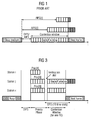
- Fig. 1 gives an example of two TCs (i and j) and the procedure used to avoid collisions.
- legacy stations are operating in parallel they do not know of AIFS. Since these stations will not wait AIFS but DIFS, all legacy stations will contend with the highest priority. Once, the idle period has elapsed all stations will begin the back-off procedure. Additionally, even with EDCF stations there is an impact of stations with lower priority TCs on the throughput of stations with higher TCs as far as the AIFS plus the backoff size exceeds the AIFS value of the lower priority.
- H/1 High Performance Radio Local Area Network (HIPERLAN) Type 1; Functional specification EN300652 V 1.2.1, July 1998)
- EY-NPMA Elimination-Yield Non-Pre-emptive Priority Multiple Access
- H/1 a channel access cycle (shown in Fig.2), the cycle is comprised of three phases: prioritization, contention, and transmission. During the prioritization phase, all stations that do not currently have the highest priority are singled out.
- priority levels are numbered 0 to m cp -1, with 0 denoting the highest priority level.
- the station listens to the channel during n priority slots. If the channel is sensed idle in the n prioritization slot intervals, the node asserts the channel access priority by transmitting immediately a channel access burst for the duration of the priority assertion interval n+1th slot (PA), and it is admitted to the contention phase.
- n+1th slot PA
- the contention phase starts immediately after the priority assertion interval (PA) and consists of a further two phases: elimination and yield.
- PA priority assertion interval
- each station transmits an elimination burst for a number b of elimination slots, the number b lies in the interval [0, m ES ] which is determined according to a truncated geometric probability distribution.
- each station senses the channel for the duration of the elimination survival verification slot (ESV).
- ESV elimination survival verification slot
- the station If the channel is sensed idle, the station starts immediately with the yield phase, which consists of a number d of yield slots before beginning transmission, as long as the channel was idle during the whole yield phase.
- the number d follows a uniform distribution in the interval [0, m YS ] with equal likelihood. If during this yield phase the channel is not idle the station yields to the other contending stations and withdraws from the channel accessing procedure in the current channel access cycle.
- the EY-NPMA scheme does support prioritization, however it is very complicated, introduces a large overhead and can't be introduced in current access scheme of IEEE 802.11. Hence it is not suitable as an extension for it, and thus has not been taken into account in the IEEE 802.11e.
- a station Depending on the priority of the data a station has to transmit, it transmits a signal when it senses that the transmission medium is free. The higher the priority the longer the duration of the signal. Stations that sense that the transmission medium is active during this time, will not try to transmit. In this way the station with the highest priority will gain access to the medium and transmit its data.
- the advantage of this invention over the existing prior art is that by use of this transmitted signal, stations with high priority data will always get access to the medium and avoid background traffic influences.
- a novel access scheme for the IEEE 802.11 standard is necessary, which can support Quality of In this access scheme, which comprises a prioritization and a contention phase, stations in a wireless network environment (fixed or mobile) that support traffic streams (voice, audio, video, data) with special priority requirements, will send out signals onto the radio medium (channel) after a pre-defined idle period following a preceding packet transmission.
- This pre-defined idle period is equal to the DCF Inter Frame Space (DIFS), in order to be compliant with legacy terminals / systems.
- DIFS DCF Inter Frame Space
- the time interval between frames is defined as an Inter Frame Space (IFS).
- the different Inter Frame Spaces are defined in the IEEE 802.11 standard as time gaps on the radio medium and are fixed.
- EIFS Extended IFS
- DIFS DIFS
- EIFS Extended IFS
- DIFS DIFS
- EIFS Extended IFS
- EIFS are used to allow ongoing transmissions to continue and end successfully even though another station (that back-offs for the duration of EIFS) has not received the transmission (e.g. it could not decode the message).
- the EIFS shall be used by the DCF whenever the PHY has indicated to the MAC that a frame transmission begun that did not result in the correct reception of a complete MAC frame with a correct frame check sequence values.
- the EIFS interval shall begin following indication by the PHY that the medium is idle after detection of the erroneous frame. The higher the priority is, the longer the signal is transmitted by the station or stations.
- the number of slots that are used for the signal transmission is determined by the priority of the traffic stream. With a priority l ⁇ [1;L], where L is the highest priority, a station will transmit the signal for a duration of l ⁇ t slot . E.g. for a priority level of 3 the station will transmit a signal with a duration equal to 3 time slots.
- the signals are any type of signals with a pre-defined duration equal to one time slot as defined in the IEEE 802.11 standard.
- the stations can be a fraction of an RTS (request to send control frame) or CTS (clear to send control frame) signal or any other coded / modulated signal, or simply a jamming signal, which fits the spectrum requirements (spectrum mask) and maximum EIRP for the target frequency range (e.g. ISM band).
- the stations After transmitting their respective signals, the stations will listen to the radio medium during one further time slot (Verification Slot (VS)) in order to verify the radio medium. If the medium is idle the stations will begin the back-off procedure, as defined in the IEEE 802.11 standard, in order to avoid instabilities in the system. If the medium is busy because of a signal that is still being transmitted, the stations resign to transmit and will re-try during the next access cycle.
- VS Very Short Slot
- the station with the highest priority will occupy the radio medium for the longest time and will survive this prioritization phase. Hence stations with the highest priority will always gain access to the radio medium over stations with lower priorities.
- the contention phase only the station with the randomly selected lowest back-off will start to transmit a packet first. This avoids contention between stations that have the same priority and thus have won the prioritization phase.
- Fig. 3 a more detailed description of the mechanism of the improved access scheme is shown.
- three stations i, j, k
- traffic class priorities (4, 6, 6) are competing for access to the radio medium.
- the radio medium is idle, i.e. a preceding packet transmission has ended, all three stations will wait for DIFS and then they will start to transmit onto the medium an signal, to begin the prioritization phase.
- the duration of each station's signal depends on the priority of the traffic class. Once the signal has been transmitted the stations will sense the medium to see if it is idle or not. It can be clearly seen in Fig. 3, that station i which has a traffic class priority 4 will end its signal transmission first as its signal will have a shorter duration.
- Station i therefore will sense that the radio medium is still busy and so will resign to transmit and will defer re-trying until the medium has been idle for DIFS.
- Stations j and k which have the same traffic class priority will continue to transmit until the duration of their signal ends. Once they have ended transmission they will sense the medium to ascertain if it is idle or not. In this case, as the medium is idle, they will then wait for a further time slot the Verification Slot (VS) in order to verify that the medium still remains idle.
- VS Verification Slot
- the station After the prioritization phase, all stations that have the same traffic class priority will compete for the medium during the contention phase, in this case stations j and k. To avoid instabilities in the system the negative back-off scheme as defined in IEEE 802.11 is used.
- the station When generating the random time value the station will run a sub-process which calculates the time it will take before it can start transmitting, if the duration exceeds the duration of the Extended IFS (EIFS), which is of a length of 19 time slots, then the station will transmit another signal in the 18 th time slot after the back-off procedure has started (equal to 360 ⁇ s of idle time taking into account the VS as well). If the time calculated is also equal to 19 time slots, then also a signal is transmitted.
- EIFS Extended IFS
- Such stations do not decrement their back-off timers, they simply wait EIFS after the signal of the station with the highest priority has ended. In this way, such stations will have to wait again for EIFS before transmitting, giving time for the station backing-off, to finish its back-off procedure. Afterwards the station continues with the back-off procedure and repeats this step after the back-off counter has been decremented by a further 18 time slots. This repetition, re-freshes the exclusion of those stations that have been excluded from contention during the prioritization phase after DIFS.
- the signal which could be any signal that generates some noise on the receiver, will cause the back-off of all stations for at least a duration of EIFS. This time is needed to successfully accomplish the back-off procedure for the active stations with the same priority and with data waiting to be transmitted.
- the station that has the lowest randomly selected back-off, between stations j and k will transmit first, once the back-off counter reaches zero. In this way contention and collisions are avoided.
- the station that doesn't have the lowest back-off will sense that the medium is busy and will resign to transmit and wait for the next access cycle. When the next access cycle begins it will not generate a new random back-off, but will use the one it already has and which has been already decremented from the previous cycle.
- the transmitted signal is modified to contain information about the duration of the transmission that is to follow. In this way the transmission of a signal to prolong the time period that stations decrement their counters during the EIFS period is avoided, as stations will know by the end of the prioritization phase when the medium will be free, because they will have detected that the medium is busy and exited the access cycle and from the detected signal their detection means will also have detected the information.
- This information contains the calculated time duration of the transmission by the station that has the highest priority. This duration includes the generated back-off time period, the actual time needed to transmit the data and time for acknowledgements to be received. Apart from the modification necessary to include the duration of the transmisssion in the signal transmitted, another modification necessary is to generate the random time value during the prioritization phase, as each station at that point of the access scheme needs to calculate the time of transmission in order to include it into the signal.
- Fig. 4 shows the algorithm of the invention.
- the station detects whether the medium is idle. If it is not, then it waits till it becomes idle. If it is idle it will wait for a time period equal to DIFS. Once this time period is over, the station enters into the prioritization phase and transmits a signal for a duration that depends on the priority level of the data waiting to be transmitted.The higher the priority level the longer the signal is transmitted for.
- the station wil detect whether the medium is busy or nor. If it is busy the station will resign from transmitting and exit the phase and wait for the next accessing cycle. If it is not busy, the station will wait for a time verification time slot, in order to check that there is no signal being transmitted.
- the station After this it then enters into the contention phase.
- the station will generate a random time value and then perform a back-off procedure.
- the station still decrements its back-off counter and continues to detect for any transmissions on the medium, if it does detect then it resigns to transmit and exits until the next cycle.
- the station wins the prioritization phase i.e. the priority of the data it has is still the highest, it will continue to decrement its counter that was generated in the previous cycle, thus ensuring that high priority data does get access to the medium. If it detects no transmission it will decrement its counter till it reaches a zero value and will then transmit its data.
- a sub-process will calculate whether the sum of therandom time value and of the verification time slot is equal to or exceeds the predefined value of EIFS. If it does not, then the back-off counter is decremented until it reaches zero if no other transmission occurs and then the data is transmitted. If another transmission occurs then the station resigns and exits the cycle. If the calculated value is equal or higher to EIFS then the station will decrement its counter and transmit a signal for a duration of one slot on the 18 th time slot after the beginning of EIFS and then once again on the 18 th slot of that. If during this time period another transmission is heard on the medium the station resigns and exits the cycle, otherwise when the counter reaches zero it tranmsits its data.
- the novel access mechanism implements a hierarchical independence but it is non-pre-emptive in that this activity is not allowed to interrupt a transmission once it has begun. Similar also to the use of VS, only the station that transmits for the longest time i.e. has the highest number of slots to transmit, will survive and see an empty VS. However, the difference to HIPERLAN type 1 (H/1), is that all stations immediately start to transmit at the same time after DIFS to avoid legacy terminals gaining access to the medium.
- a comparison between the IEEE 802.11e and the novel access scheme is presented.
- the 4-way handshaking mechanism with RTS/CTS and data acknowledgement has been used.
- the high priority curve of IEEE 802.11e has been added to the figure as a reference.
- IEEE 802.11e supports three different traffic classes (TCs), however only the traffic class with the highest priority has been depicted as a reference).
Landscapes
- Engineering & Computer Science (AREA)
- Computer Networks & Wireless Communication (AREA)
- Signal Processing (AREA)
- Mobile Radio Communication Systems (AREA)
- Small-Scale Networks (AREA)
- Preparation Of Compounds By Using Micro-Organisms (AREA)
Priority Applications (4)
| Application Number | Priority Date | Filing Date | Title |
|---|---|---|---|
| EP04004590A EP1569385B1 (de) | 2004-02-27 | 2004-02-27 | Verfahren und System zur Verbesserung der QoS-Unterstützung in dezentral organisierten Mobilfunknetzen |
| AT04004590T ATE331367T1 (de) | 2004-02-27 | 2004-02-27 | Verfahren und system zur verbesserung der qos- unterstützung in dezentral organisierten mobilfunknetzen |
| ES04004590T ES2266934T3 (es) | 2004-02-27 | 2004-02-27 | Metodo y sistema para la mejora del soporte de la calidad de servicio (qos) en redes inalambricas organizadas de manera descentralizada. |
| DE602004001330T DE602004001330T2 (de) | 2004-02-27 | 2004-02-27 | Verfahren und System zur Verbesserung der QoS-Unterstützung in dezentral organisierten Mobilfunknetzen |
Applications Claiming Priority (1)
| Application Number | Priority Date | Filing Date | Title |
|---|---|---|---|
| EP04004590A EP1569385B1 (de) | 2004-02-27 | 2004-02-27 | Verfahren und System zur Verbesserung der QoS-Unterstützung in dezentral organisierten Mobilfunknetzen |
Publications (2)
| Publication Number | Publication Date |
|---|---|
| EP1569385A1 true EP1569385A1 (de) | 2005-08-31 |
| EP1569385B1 EP1569385B1 (de) | 2006-06-21 |
Family
ID=34745931
Family Applications (1)
| Application Number | Title | Priority Date | Filing Date |
|---|---|---|---|
| EP04004590A Expired - Lifetime EP1569385B1 (de) | 2004-02-27 | 2004-02-27 | Verfahren und System zur Verbesserung der QoS-Unterstützung in dezentral organisierten Mobilfunknetzen |
Country Status (4)
| Country | Link |
|---|---|
| EP (1) | EP1569385B1 (de) |
| AT (1) | ATE331367T1 (de) |
| DE (1) | DE602004001330T2 (de) |
| ES (1) | ES2266934T3 (de) |
Cited By (1)
| Publication number | Priority date | Publication date | Assignee | Title |
|---|---|---|---|---|
| CN109699089A (zh) * | 2017-10-20 | 2019-04-30 | 中移(苏州)软件技术有限公司 | 一种信道接入方法及装置 |
Citations (1)
| Publication number | Priority date | Publication date | Assignee | Title |
|---|---|---|---|---|
| WO2002078229A1 (en) * | 2001-03-21 | 2002-10-03 | Stine John A | An access and routing protocol for ad hoc networks using synchronous collision resolution and node state dissemination |
-
2004
- 2004-02-27 AT AT04004590T patent/ATE331367T1/de not_active IP Right Cessation
- 2004-02-27 DE DE602004001330T patent/DE602004001330T2/de not_active Expired - Lifetime
- 2004-02-27 ES ES04004590T patent/ES2266934T3/es not_active Expired - Lifetime
- 2004-02-27 EP EP04004590A patent/EP1569385B1/de not_active Expired - Lifetime
Patent Citations (1)
| Publication number | Priority date | Publication date | Assignee | Title |
|---|---|---|---|---|
| WO2002078229A1 (en) * | 2001-03-21 | 2002-10-03 | Stine John A | An access and routing protocol for ad hoc networks using synchronous collision resolution and node state dissemination |
Non-Patent Citations (3)
| Title |
|---|
| CHUN-TING CHOU ET AL: "Inter-frame space (IFS) based service differentiation for ieee 802.11 wireless LANs", VEHICULAR TECHNOLOGY CONFERENCE, 2003. VTC 2003-FALL. 2003 IEEE 58TH ORLANDO, FL, USA 6-9 OCT. 2003, PISCATAWAY, NJ, USA,IEEE, US, 6 October 2003 (2003-10-06), pages 1412 - 1416, XP010702439, ISBN: 0-7803-7954-3 * |
| MANGOLD S ET AL: "IEEE 802.11e - fair resource sharing between overlapping basic service sets", COMNETS RWTH AACHEN UNIV. OF TECHNOLOGY, vol. 1, 15 September 2002 (2002-09-15), pages 166 - 171, XP010614208 * |
| MANGOLD S ET AL: "IEEE 802.11e Wireless LAN for Quality of Service", COMNETS RWTH AACHEN UNIV. OF TECHNOLOGY, February 2002 (2002-02-01), pages 1 - 8, XP002251598 * |
Cited By (2)
| Publication number | Priority date | Publication date | Assignee | Title |
|---|---|---|---|---|
| CN109699089A (zh) * | 2017-10-20 | 2019-04-30 | 中移(苏州)软件技术有限公司 | 一种信道接入方法及装置 |
| CN109699089B (zh) * | 2017-10-20 | 2020-11-20 | 中移(苏州)软件技术有限公司 | 一种信道接入方法及装置 |
Also Published As
| Publication number | Publication date |
|---|---|
| ATE331367T1 (de) | 2006-07-15 |
| EP1569385B1 (de) | 2006-06-21 |
| ES2266934T3 (es) | 2007-03-01 |
| DE602004001330D1 (de) | 2006-08-03 |
| DE602004001330T2 (de) | 2007-06-14 |
Similar Documents
| Publication | Publication Date | Title |
|---|---|---|
| JP4680191B2 (ja) | 無線通信ネットワークおよび無線通信ネットワークのチャネルを介してパケットを送信するための方法 | |
| Hiertz | IEEE 802.11 e Wireless LAN for Quality of Service | |
| US7489666B2 (en) | Media access control apparatus and method for guaranteeing quality of service in wireless LAN | |
| JP4473069B2 (ja) | フレーム・バーストの管理 | |
| KR101417937B1 (ko) | 무선 통신 시스템 및 이의 데이터 전송방법 | |
| US20060215686A1 (en) | Communication method for accessing wireless medium under enhanced distributed channel access | |
| US7289529B2 (en) | Method and system for optimally serving stations on wireless LANs using a controlled contention/resource reservation protocol of the IEEE 802.11e standard | |
| Kosek-Szott | A survey of MAC layer solutions to the hidden node problem in ad-hoc networks | |
| KR20060064512A (ko) | 무선 랜 기지국장치의 서비스 품질 제어방법 | |
| JP2007511972A (ja) | マルチチャネルデバイスによる媒体へのアクセス方法 | |
| JP2007189690A (ja) | 無線ネットワークにおけるアクセス制御のためのシステム及び方法 | |
| Jeong et al. | Achieving weighted fairness between uplink and downlink in IEEE 802.11 DCF-based WLANs | |
| CN101715241B (zh) | 用于分布式无线局域网介质接入控制的方法及装置 | |
| WO2007006701A1 (en) | Transmit power control in a random access scheme | |
| JP4179512B2 (ja) | 無線基地局 | |
| WO2021230764A1 (en) | Devices and methods for a wireless multi ap network | |
| EP1569385B1 (de) | Verfahren und System zur Verbesserung der QoS-Unterstützung in dezentral organisierten Mobilfunknetzen | |
| KR20110034092A (ko) | 무선 랜용 우선 순위 접근에 기반한 수락 제어 방법 | |
| Scalia et al. | WLC24-1: Dynamic MAC parameters configuration for performance optimization in 802.11 e networks | |
| Farooq et al. | An Overview of Wireless LAN Standards IEEE 802.11 and IEEE 802.11 e | |
| Guo et al. | Dynamic TXOP Assignment for Fairness (DTAF) in IEEE 802.11 e WLAN under heavy load conditions | |
| KR20100072959A (ko) | 무선 근거리 네트워크에서의 통신 시스템 및 방법 | |
| Chetoui et al. | Improving the bandwidth sharing in IEEE 802.11 | |
| Gannoune et al. | A survey of QoS techniques and enhancements for IEEE 802.11 wireless LANs | |
| Pudasaini et al. | QoS provisioning in CSMA/iCA based medium access control protocol for WLAN |
Legal Events
| Date | Code | Title | Description |
|---|---|---|---|
| PUAI | Public reference made under article 153(3) epc to a published international application that has entered the european phase |
Free format text: ORIGINAL CODE: 0009012 |
|
| AK | Designated contracting states |
Kind code of ref document: A1 Designated state(s): AT BE BG CH CY CZ DE DK EE ES FI FR GB GR HU IE IT LI LU MC NL PT RO SE SI SK TR |
|
| AX | Request for extension of the european patent |
Extension state: AL LT LV MK |
|
| 17P | Request for examination filed |
Effective date: 20050922 |
|
| GRAP | Despatch of communication of intention to grant a patent |
Free format text: ORIGINAL CODE: EPIDOSNIGR1 |
|
| GRAS | Grant fee paid |
Free format text: ORIGINAL CODE: EPIDOSNIGR3 |
|
| AKX | Designation fees paid |
Designated state(s): AT BE BG CH CY CZ DE DK EE ES FI FR GB GR HU IE IT LI LU MC NL PT RO SE SI SK TR |
|
| GRAA | (expected) grant |
Free format text: ORIGINAL CODE: 0009210 |
|
| AK | Designated contracting states |
Kind code of ref document: B1 Designated state(s): AT BE BG CH CY CZ DE DK EE ES FI FR GB GR HU IE IT LI LU MC NL PT RO SE SI SK TR |
|
| PG25 | Lapsed in a contracting state [announced via postgrant information from national office to epo] |
Ref country code: NL Free format text: LAPSE BECAUSE OF FAILURE TO SUBMIT A TRANSLATION OF THE DESCRIPTION OR TO PAY THE FEE WITHIN THE PRESCRIBED TIME-LIMIT Effective date: 20060621 Ref country code: SI Free format text: LAPSE BECAUSE OF FAILURE TO SUBMIT A TRANSLATION OF THE DESCRIPTION OR TO PAY THE FEE WITHIN THE PRESCRIBED TIME-LIMIT Effective date: 20060621 Ref country code: RO Free format text: LAPSE BECAUSE OF FAILURE TO SUBMIT A TRANSLATION OF THE DESCRIPTION OR TO PAY THE FEE WITHIN THE PRESCRIBED TIME-LIMIT Effective date: 20060621 Ref country code: FI Free format text: LAPSE BECAUSE OF FAILURE TO SUBMIT A TRANSLATION OF THE DESCRIPTION OR TO PAY THE FEE WITHIN THE PRESCRIBED TIME-LIMIT Effective date: 20060621 Ref country code: CH Free format text: LAPSE BECAUSE OF FAILURE TO SUBMIT A TRANSLATION OF THE DESCRIPTION OR TO PAY THE FEE WITHIN THE PRESCRIBED TIME-LIMIT Effective date: 20060621 Ref country code: IT Free format text: LAPSE BECAUSE OF FAILURE TO SUBMIT A TRANSLATION OF THE DESCRIPTION OR TO PAY THE FEE WITHIN THE PRESCRIBED TIME-LIMIT;WARNING: LAPSES OF ITALIAN PATENTS WITH EFFECTIVE DATE BEFORE 2007 MAY HAVE OCCURRED AT ANY TIME BEFORE 2007. THE CORRECT EFFECTIVE DATE MAY BE DIFFERENT FROM THE ONE RECORDED. Effective date: 20060621 Ref country code: SK Free format text: LAPSE BECAUSE OF FAILURE TO SUBMIT A TRANSLATION OF THE DESCRIPTION OR TO PAY THE FEE WITHIN THE PRESCRIBED TIME-LIMIT Effective date: 20060621 Ref country code: CZ Free format text: LAPSE BECAUSE OF FAILURE TO SUBMIT A TRANSLATION OF THE DESCRIPTION OR TO PAY THE FEE WITHIN THE PRESCRIBED TIME-LIMIT Effective date: 20060621 Ref country code: BE Free format text: LAPSE BECAUSE OF FAILURE TO SUBMIT A TRANSLATION OF THE DESCRIPTION OR TO PAY THE FEE WITHIN THE PRESCRIBED TIME-LIMIT Effective date: 20060621 Ref country code: AT Free format text: LAPSE BECAUSE OF FAILURE TO SUBMIT A TRANSLATION OF THE DESCRIPTION OR TO PAY THE FEE WITHIN THE PRESCRIBED TIME-LIMIT Effective date: 20060621 Ref country code: LI Free format text: LAPSE BECAUSE OF FAILURE TO SUBMIT A TRANSLATION OF THE DESCRIPTION OR TO PAY THE FEE WITHIN THE PRESCRIBED TIME-LIMIT Effective date: 20060621 |
|
| REG | Reference to a national code |
Ref country code: GB Ref legal event code: FG4D |
|
| REG | Reference to a national code |
Ref country code: CH Ref legal event code: EP |
|
| REG | Reference to a national code |
Ref country code: IE Ref legal event code: FG4D |
|
| REF | Corresponds to: |
Ref document number: 602004001330 Country of ref document: DE Date of ref document: 20060803 Kind code of ref document: P |
|
| PG25 | Lapsed in a contracting state [announced via postgrant information from national office to epo] |
Ref country code: DK Free format text: LAPSE BECAUSE OF FAILURE TO SUBMIT A TRANSLATION OF THE DESCRIPTION OR TO PAY THE FEE WITHIN THE PRESCRIBED TIME-LIMIT Effective date: 20060921 Ref country code: SE Free format text: LAPSE BECAUSE OF FAILURE TO SUBMIT A TRANSLATION OF THE DESCRIPTION OR TO PAY THE FEE WITHIN THE PRESCRIBED TIME-LIMIT Effective date: 20060921 |
|
| PG25 | Lapsed in a contracting state [announced via postgrant information from national office to epo] |
Ref country code: PT Free format text: LAPSE BECAUSE OF FAILURE TO SUBMIT A TRANSLATION OF THE DESCRIPTION OR TO PAY THE FEE WITHIN THE PRESCRIBED TIME-LIMIT Effective date: 20061121 |
|
| NLV1 | Nl: lapsed or annulled due to failure to fulfill the requirements of art. 29p and 29m of the patents act | ||
| REG | Reference to a national code |
Ref country code: CH Ref legal event code: PL |
|
| PG25 | Lapsed in a contracting state [announced via postgrant information from national office to epo] |
Ref country code: MC Free format text: LAPSE BECAUSE OF NON-PAYMENT OF DUE FEES Effective date: 20070228 |
|
| REG | Reference to a national code |
Ref country code: ES Ref legal event code: FG2A Ref document number: 2266934 Country of ref document: ES Kind code of ref document: T3 |
|
| PLBE | No opposition filed within time limit |
Free format text: ORIGINAL CODE: 0009261 |
|
| STAA | Information on the status of an ep patent application or granted ep patent |
Free format text: STATUS: NO OPPOSITION FILED WITHIN TIME LIMIT |
|
| EN | Fr: translation not filed | ||
| 26N | No opposition filed |
Effective date: 20070322 |
|
| PG25 | Lapsed in a contracting state [announced via postgrant information from national office to epo] |
Ref country code: IE Free format text: LAPSE BECAUSE OF NON-PAYMENT OF DUE FEES Effective date: 20070227 |
|
| PG25 | Lapsed in a contracting state [announced via postgrant information from national office to epo] |
Ref country code: GR Free format text: LAPSE BECAUSE OF FAILURE TO SUBMIT A TRANSLATION OF THE DESCRIPTION OR TO PAY THE FEE WITHIN THE PRESCRIBED TIME-LIMIT Effective date: 20060922 Ref country code: FR Free format text: LAPSE BECAUSE OF FAILURE TO SUBMIT A TRANSLATION OF THE DESCRIPTION OR TO PAY THE FEE WITHIN THE PRESCRIBED TIME-LIMIT Effective date: 20070504 |
|
| PG25 | Lapsed in a contracting state [announced via postgrant information from national office to epo] |
Ref country code: BG Free format text: LAPSE BECAUSE OF FAILURE TO SUBMIT A TRANSLATION OF THE DESCRIPTION OR TO PAY THE FEE WITHIN THE PRESCRIBED TIME-LIMIT Effective date: 20060921 |
|
| PG25 | Lapsed in a contracting state [announced via postgrant information from national office to epo] |
Ref country code: EE Free format text: LAPSE BECAUSE OF FAILURE TO SUBMIT A TRANSLATION OF THE DESCRIPTION OR TO PAY THE FEE WITHIN THE PRESCRIBED TIME-LIMIT Effective date: 20060621 |
|
| PG25 | Lapsed in a contracting state [announced via postgrant information from national office to epo] |
Ref country code: FR Free format text: LAPSE BECAUSE OF FAILURE TO SUBMIT A TRANSLATION OF THE DESCRIPTION OR TO PAY THE FEE WITHIN THE PRESCRIBED TIME-LIMIT Effective date: 20060621 |
|
| REG | Reference to a national code |
Ref country code: GB Ref legal event code: 732E Free format text: REGISTERED BETWEEN 20090205 AND 20090211 |
|
| PG25 | Lapsed in a contracting state [announced via postgrant information from national office to epo] |
Ref country code: CY Free format text: LAPSE BECAUSE OF FAILURE TO SUBMIT A TRANSLATION OF THE DESCRIPTION OR TO PAY THE FEE WITHIN THE PRESCRIBED TIME-LIMIT Effective date: 20060621 Ref country code: LU Free format text: LAPSE BECAUSE OF NON-PAYMENT OF DUE FEES Effective date: 20070227 |
|
| PG25 | Lapsed in a contracting state [announced via postgrant information from national office to epo] |
Ref country code: TR Free format text: LAPSE BECAUSE OF FAILURE TO SUBMIT A TRANSLATION OF THE DESCRIPTION OR TO PAY THE FEE WITHIN THE PRESCRIBED TIME-LIMIT Effective date: 20060621 Ref country code: HU Free format text: LAPSE BECAUSE OF FAILURE TO SUBMIT A TRANSLATION OF THE DESCRIPTION OR TO PAY THE FEE WITHIN THE PRESCRIBED TIME-LIMIT Effective date: 20061222 |
|
| REG | Reference to a national code |
Ref country code: ES Ref legal event code: PC2A Owner name: "NOKIA SIEMENS NETWORKS GMBH& Effective date: 20110621 Ref country code: ES Ref legal event code: PC2A Owner name: NOKIA SIEMENS NETWORKS GMBH&CO.KG Effective date: 20110621 |
|
| REG | Reference to a national code |
Ref country code: DE Ref legal event code: R081 Ref document number: 602004001330 Country of ref document: DE Owner name: NOKIA SOLUTIONS AND NETWORKS GMBH & CO. KG, DE Free format text: FORMER OWNER: NOKIA SIEMENS NETWORKS GMBH & CO. KG, 81541 MUENCHEN, DE Effective date: 20140731 |
|
| REG | Reference to a national code |
Ref country code: ES Ref legal event code: PC2A Owner name: NOKIA SOLUTIONS AND NETWORKS GMBH & CO.KG Effective date: 20141121 |
|
| PGFP | Annual fee paid to national office [announced via postgrant information from national office to epo] |
Ref country code: ES Payment date: 20200302 Year of fee payment: 17 Ref country code: GB Payment date: 20200219 Year of fee payment: 17 Ref country code: DE Payment date: 20200211 Year of fee payment: 17 |
|
| REG | Reference to a national code |
Ref country code: DE Ref legal event code: R119 Ref document number: 602004001330 Country of ref document: DE |
|
| GBPC | Gb: european patent ceased through non-payment of renewal fee |
Effective date: 20210227 |
|
| PG25 | Lapsed in a contracting state [announced via postgrant information from national office to epo] |
Ref country code: DE Free format text: LAPSE BECAUSE OF NON-PAYMENT OF DUE FEES Effective date: 20210901 Ref country code: GB Free format text: LAPSE BECAUSE OF NON-PAYMENT OF DUE FEES Effective date: 20210227 |
|
| REG | Reference to a national code |
Ref country code: ES Ref legal event code: FD2A Effective date: 20220513 |
|
| PG25 | Lapsed in a contracting state [announced via postgrant information from national office to epo] |
Ref country code: ES Free format text: LAPSE BECAUSE OF NON-PAYMENT OF DUE FEES Effective date: 20210228 |