EP1569202A2 - Vorrichtung und Verfahren zur Verbesserung der Spracherkennung durch Korrigierung häufiger Fehler in der linguistischen Stufe - Google Patents
Vorrichtung und Verfahren zur Verbesserung der Spracherkennung durch Korrigierung häufiger Fehler in der linguistischen Stufe Download PDFInfo
- Publication number
- EP1569202A2 EP1569202A2 EP05100603A EP05100603A EP1569202A2 EP 1569202 A2 EP1569202 A2 EP 1569202A2 EP 05100603 A EP05100603 A EP 05100603A EP 05100603 A EP05100603 A EP 05100603A EP 1569202 A2 EP1569202 A2 EP 1569202A2
- Authority
- EP
- European Patent Office
- Prior art keywords
- speech
- words
- module
- user
- probabilities
- Prior art date
- Legal status (The legal status is an assumption and is not a legal conclusion. Google has not performed a legal analysis and makes no representation as to the accuracy of the status listed.)
- Withdrawn
Links
Images

Classifications
-
- G—PHYSICS
- G10—MUSICAL INSTRUMENTS; ACOUSTICS
- G10L—SPEECH ANALYSIS TECHNIQUES OR SPEECH SYNTHESIS; SPEECH RECOGNITION; SPEECH OR VOICE PROCESSING TECHNIQUES; SPEECH OR AUDIO CODING OR DECODING
- G10L15/00—Speech recognition
- G10L15/08—Speech classification or search
- G10L15/18—Speech classification or search using natural language modelling
-
- G—PHYSICS
- G10—MUSICAL INSTRUMENTS; ACOUSTICS
- G10L—SPEECH ANALYSIS TECHNIQUES OR SPEECH SYNTHESIS; SPEECH RECOGNITION; SPEECH OR VOICE PROCESSING TECHNIQUES; SPEECH OR AUDIO CODING OR DECODING
- G10L15/00—Speech recognition
- G10L15/08—Speech classification or search
- G10L15/18—Speech classification or search using natural language modelling
- G10L15/183—Speech classification or search using natural language modelling using context dependencies, e.g. language models
-
- G—PHYSICS
- G10—MUSICAL INSTRUMENTS; ACOUSTICS
- G10L—SPEECH ANALYSIS TECHNIQUES OR SPEECH SYNTHESIS; SPEECH RECOGNITION; SPEECH OR VOICE PROCESSING TECHNIQUES; SPEECH OR AUDIO CODING OR DECODING
- G10L15/00—Speech recognition
- G10L15/08—Speech classification or search
- G10L15/18—Speech classification or search using natural language modelling
- G10L15/183—Speech classification or search using natural language modelling using context dependencies, e.g. language models
- G10L15/187—Phonemic context, e.g. pronunciation rules, phonotactical constraints or phoneme n-grams
Definitions
- the present invention relates to spoken dialog systems and more specifically to a system and method of augmenting spoken language recognition and understanding by correcting common errors in linguistic performance.
- FIG. 1 illustrates the basic components of a spoken dialog system 100.
- the spoken dialog system 100 may operate on a single computing device or on a distributed computer network.
- the system 100 receives speech sounds from a user 102 and operates to generate a response.
- the general components of such a system include an automatic speech recognition (“ASR") module 104 that recognizes the words spoken by the user 102. AT&T's Watson ASR component is an illustration of this module.
- a spoken language understanding (“SLU”) module 106 associates a meaning to the words received from the ASR module 104.
- a dialog management (“DM”) module 108 manages the dialog by determining an appropriate response to the customer question.
- ASR automatic speech recognition
- SLU spoken language understanding
- DM dialog management
- AT&T's Florence DM engine is an example of this module.
- a spoken language generation (“SLG) module 110 Based on the determined action, a spoken language generation (“SLG”) module 110 generates the appropriate words to be spoken by the system in response and a Text-to-Speech (“TTS”) module 112 synthesizes the speech for the user 102.
- SLG spoken language generation
- TTS Text-to-Speech
- AT&T's Natural Voices TTS engine provides an example of the TTS module.
- Data and rules 114 are used to train each module and to process run-time data in each module.
- a key component in achieving wide-spread acceptance of interactive spoken dialog services is achieving a sufficiently high percentage correct interpretations of requests spoken by callers.
- the ASR module 104 uses statistical models of acoustic information to recognize patterns as semantic units such as words and phrases.
- the patterns are typically matched against large or specialized dictionaries of words that are found in general or restricted contexts. In general, the smaller the set of accepted target words the greater the recognition accuracy.
- the embodiments of the invention comprise a method, software module, and spoken dialog system for performing automatic speech recognition and spoken language understanding.
- the method comprises receiving speech from a user, the speech including at least one speech error, modifying the probabilities of closely related words to the at least one speech error and processing the received speech using the modified probabilities.
- a corpora of data is used to identify words that are commonly mis-stated so that when the at least one speech error is received, related words to the at least one speech error may have their probabilities modified when speech recognition occurs or language understanding occurs. This increases the likelihood that the speaker's intended word will be interpreted.
- FIG. 1 illustrates a typical spoken language dialog system
- FIG. 2 illustrates a method according to an aspect of the present invention
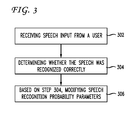
- FIG. 3 illustrates another method of the present invention.
- the present invention relates to improving the correct interpretation of the speaker's intent in the SLU module 106.
- SLU module 106 As referenced above, often a user will not speak fluently and will have "slips of the tongue" where words are spoken that are different from the user's intent.
- an ASR module In speech recognition, a basic fundamental process involved relates to probability theory. When speech sounds are received, an ASR module will determine based on probability theory what text should be associated with the sounds. The details of probability theory and pattern recognition are beyond the scope of this disclosure, but details are known to those of skill in the art and may be found in such books as Huang, Acero and Hon, Spoken Language Processing , Prentice Hall, 2001. It is sufficient for this disclosure to understand that an ASR system will receive speech and use probability theory to seek to determine the appropriate words to assign to each utterance.
- the present invention provides a method for using predictable linguistic disfluencies to augment automatic speech recognition models used in a spoken language understanding system. Further, the present invention may provide data and input to the spoken language understanding module to increase the understanding of the recognized speech. For example, it is known that many slips of the tongue are the result of a word spoken in error that is quite similar to the word the speaker "meant" to say. These words spoken in error can be identified in predictable ways. In particular, words that share 1) the initial phoneme, 2) the final phoneme, and 3) number of syllables with the "correct" intended word are quite common as a type of slip of the tongue. For example, in an telephone operator services environment, if the operator prompts the user to determine the type of call the user desires to make, the user may respond by saying "correct” or "connect” instead of what they intended to say, which is "collect.”
- the system will preferably comprise a computing device such as a computer server operating in a stand-alone mode, in a local area network or on a wide area network such as the Internet. Any particular configuration of the computing device is immaterial to the present invention.
- the computing device may also operate in a wireless network and/or a wired network either as a client computing device or a server computing device.
- the system may involve computer processing partially on a client device and partially on a server device as well to accomplish speech recognition.
- a the spoken dialog system upon receiving the word "correct” when the applicant intended to say “collect” would seek to accurately recognize the input by raising or modifying the probabilities of close relatives of the word recognized based on the similarity according to the characteristics described.
- the modification of probabilities may be an increase in some or all probability parameters or may be a decrease in some or all of the parameters.
- the modification may also increase some and decrease other probability parameters associated with speech recognition. In most cases, the probability is increased but the invention covers all these alternative ways of modifying the parameters. Therefore, the probability of the word "collect” is increased in the operator domain to increase the chance that the ASR module will interpret "correct” as "collect.” Such a modification will increase the correct interpretation of user input and increase user satisfaction with the system.
- slips of the tongue often involve two or more words in a phrase with beginning or ending or words interposed.
- This invention also provides methods for potentially correcting these slips of the tongue.
- Another aspect of this invention is to understand slips of the tongue of people who are not native English speakers, including situations where words of different languages are mixed with words in English.
- the invention also makes use of existing corpora of slips of the tongue, as well as future database of slips of the tongue that may be collected by analyzing the actual interaction of callers with systems.
- the corpora may be based on specific domains such as dialogs related to handling collect calls or customer care related to a telephone service, or any other domain.
- the corpora may also be based on different languages.
- an English ASR system can utilize a corpora of Japanese speaker slips and utilize that corpora when adjusting the probabilities of potential recognitions based on the common slips.
- a similar process of adjusting probabilities may occur for speakers of different dialects of English. For example, a person with a New York accent or a southern accent may have particular words that they are more likely to mis-state and the probabilities associated with those words may be modified to improve recognition.
- the corpora of data may provide, for example, increased probabilities for the predictable error words spoken in a particular domain or for a particular cultural or language domain. Therefore, if the system determines that the person communicating with the system is Japanese, then the Japanese language corpora may be loaded that identifies predictable error speech and increases the probabilities of certain words or phrases or sentences to increase the probability that the correct word or phrase will be recognized.
- FIG. 2 illustrates the basic steps of the invention. They may be practiced on any computing device used to perform ASR or SLU. There is no specific programming language required to practice the invention.
- the method comprises receiving user speech containing at least one speech error such as a slip (202).
- the system raises the probabilities of close relatives of the at least one speech error (204).
- the ASR step then involves recognizing the speech using the raised or modified probabilities in the ASR module (206).
- step (206) may also involve performing spoken language understanding based on the raised probabilities of certain word or phrases as set forth herein.
- the system may lower probabilities of certain based on words that a Japanese speaker rarely slips on.
- This invention will improve the performance of systems such as AT&T's "How May I Help You" system and related systems being developed.
- the system provides a learning mode which operates to make probabilities adjustments based on an ongoing conversation between a user and the system.
- the system determines whether it is interpreting the speech correctly (304). This step may occur by asking for a confirmation of the recognition. For example, "did you say Washington, D.C.?". Other methods of determining the accuracy of the recognition are also contemplated such as other actions taken by the user when interacting with the system.
- the system modifies the probabilities (306) to improve the recognition accuracy.
- the system can adjust its recognition accuracy on a person by person basis as one particular person may more often articulate specific speech errors than another person.
- spoonerisms Another linguistic problem that the present invention addresses relates to "spoonerisms".
- a person speaks a "spoonerism” letters become interchanged in a phrase. For example, if a caller is making an insurance claim, he or she may say "I need to report a clammage dame.”
- the system modifies the word recognition probabilities of well-known or anticipated spoonerisms and unpacks to spoonerism to reveal the user intention rather than the slip. This cognitive repair work may be performed to improve recognition.
- Embodiments within the scope of the present invention may also include computer-readable media for carrying or having computer-executable instructions or data structures stored thereon.
- Such computer-readable media can be any available media that can be accessed by a general purpose or special purpose computer.
- Such computer-readable media can comprise RAM, ROM, EEPROM, CD-ROM or other optical disk storage, magnetic disk storage or other magnetic storage devices, or any other medium which can be used to carry or store desired program code means in the form of computer-executable instructions or data structures.
- a network or another communications connection either hardwired, wireless, or combination thereof
- any such connection is properly termed a computer-readable medium. Combinations of the above should also be included within the scope of the computer-readable media.
- Computer-executable instructions include, for example, instructions and data which cause a general purpose computer, special purpose computer, or special purpose processing device to perform a certain function or group of functions.
- Computer-executable instructions also include program modules that are executed by computers in stand-alone or network environments.
- program modules include routines, programs, objects, components, and data structures, etc. that perform particular tasks or implement particular abstract data types.
- Computer-executable instructions, associated data structures, and program modules represent examples of the program code means for executing steps of the methods disclosed herein. The particular sequence of such executable instructions or associated data structures represents examples of corresponding acts for implementing the functions described in such steps.
- Embodiments of the invention may be practiced in network computing environments with many types of computer system configurations, including personal computers, hand-held devices, multi-processor systems, microprocessor-based or programmable consumer electronics, network PCs, minicomputers, mainframe computers, and the like. Embodiments may also be practiced in distributed computing environments where tasks are performed by local and remote processing devices that are linked (either by hardwired links, wireless links, or by a combination thereof) through a communications network. In a distributed computing environment, program modules may be located in both local and remote memory storage devices.
Landscapes
- Engineering & Computer Science (AREA)
- Artificial Intelligence (AREA)
- Computational Linguistics (AREA)
- Health & Medical Sciences (AREA)
- Audiology, Speech & Language Pathology (AREA)
- Human Computer Interaction (AREA)
- Physics & Mathematics (AREA)
- Acoustics & Sound (AREA)
- Multimedia (AREA)
- Machine Translation (AREA)
Applications Claiming Priority (2)
| Application Number | Priority Date | Filing Date | Title |
|---|---|---|---|
| US10/787,782 US7505906B2 (en) | 2004-02-26 | 2004-02-26 | System and method for augmenting spoken language understanding by correcting common errors in linguistic performance |
| US787782 | 2004-02-26 |
Publications (2)
| Publication Number | Publication Date |
|---|---|
| EP1569202A2 true EP1569202A2 (de) | 2005-08-31 |
| EP1569202A3 EP1569202A3 (de) | 2007-07-04 |
Family
ID=34750519
Family Applications (1)
| Application Number | Title | Priority Date | Filing Date |
|---|---|---|---|
| EP05100603A Withdrawn EP1569202A3 (de) | 2004-02-26 | 2005-01-31 | Vorrichtung und Verfahren zur Verbesserung der Spracherkennung durch Korrigierung häufiger Fehler in der linguistischen Stufe |
Country Status (3)
| Country | Link |
|---|---|
| US (2) | US7505906B2 (de) |
| EP (1) | EP1569202A3 (de) |
| CA (1) | CA2493265C (de) |
Families Citing this family (130)
| Publication number | Priority date | Publication date | Assignee | Title |
|---|---|---|---|---|
| US8645137B2 (en) | 2000-03-16 | 2014-02-04 | Apple Inc. | Fast, language-independent method for user authentication by voice |
| US7310602B2 (en) * | 2004-09-27 | 2007-12-18 | Kabushiki Kaisha Equos Research | Navigation apparatus |
| TWI269268B (en) * | 2005-01-24 | 2006-12-21 | Delta Electronics Inc | Speech recognizing method and system |
| US20060200338A1 (en) * | 2005-03-04 | 2006-09-07 | Microsoft Corporation | Method and system for creating a lexicon |
| US20060200337A1 (en) * | 2005-03-04 | 2006-09-07 | Microsoft Corporation | System and method for template authoring and a template data structure |
| US20060200336A1 (en) * | 2005-03-04 | 2006-09-07 | Microsoft Corporation | Creating a lexicon using automatic template matching |
| US8677377B2 (en) | 2005-09-08 | 2014-03-18 | Apple Inc. | Method and apparatus for building an intelligent automated assistant |
| US8170868B2 (en) * | 2006-03-14 | 2012-05-01 | Microsoft Corporation | Extracting lexical features for classifying native and non-native language usage style |
| US9318108B2 (en) | 2010-01-18 | 2016-04-19 | Apple Inc. | Intelligent automated assistant |
| US8977255B2 (en) | 2007-04-03 | 2015-03-10 | Apple Inc. | Method and system for operating a multi-function portable electronic device using voice-activation |
| US7437291B1 (en) * | 2007-12-13 | 2008-10-14 | International Business Machines Corporation | Using partial information to improve dialog in automatic speech recognition systems |
| US9330720B2 (en) | 2008-01-03 | 2016-05-03 | Apple Inc. | Methods and apparatus for altering audio output signals |
| US8996376B2 (en) | 2008-04-05 | 2015-03-31 | Apple Inc. | Intelligent text-to-speech conversion |
| US10496753B2 (en) | 2010-01-18 | 2019-12-03 | Apple Inc. | Automatically adapting user interfaces for hands-free interaction |
| US20100030549A1 (en) | 2008-07-31 | 2010-02-04 | Lee Michael M | Mobile device having human language translation capability with positional feedback |
| WO2010067118A1 (en) | 2008-12-11 | 2010-06-17 | Novauris Technologies Limited | Speech recognition involving a mobile device |
| US9858925B2 (en) | 2009-06-05 | 2018-01-02 | Apple Inc. | Using context information to facilitate processing of commands in a virtual assistant |
| US10241752B2 (en) | 2011-09-30 | 2019-03-26 | Apple Inc. | Interface for a virtual digital assistant |
| US10706373B2 (en) | 2011-06-03 | 2020-07-07 | Apple Inc. | Performing actions associated with task items that represent tasks to perform |
| US10241644B2 (en) | 2011-06-03 | 2019-03-26 | Apple Inc. | Actionable reminder entries |
| US9659559B2 (en) * | 2009-06-25 | 2017-05-23 | Adacel Systems, Inc. | Phonetic distance measurement system and related methods |
| US9431006B2 (en) | 2009-07-02 | 2016-08-30 | Apple Inc. | Methods and apparatuses for automatic speech recognition |
| US10553209B2 (en) | 2010-01-18 | 2020-02-04 | Apple Inc. | Systems and methods for hands-free notification summaries |
| US10276170B2 (en) | 2010-01-18 | 2019-04-30 | Apple Inc. | Intelligent automated assistant |
| US10679605B2 (en) | 2010-01-18 | 2020-06-09 | Apple Inc. | Hands-free list-reading by intelligent automated assistant |
| US10705794B2 (en) | 2010-01-18 | 2020-07-07 | Apple Inc. | Automatically adapting user interfaces for hands-free interaction |
| US8682667B2 (en) | 2010-02-25 | 2014-03-25 | Apple Inc. | User profiling for selecting user specific voice input processing information |
| US9263034B1 (en) | 2010-07-13 | 2016-02-16 | Google Inc. | Adapting enhanced acoustic models |
| US10762293B2 (en) | 2010-12-22 | 2020-09-01 | Apple Inc. | Using parts-of-speech tagging and named entity recognition for spelling correction |
| US9262612B2 (en) | 2011-03-21 | 2016-02-16 | Apple Inc. | Device access using voice authentication |
| US10057736B2 (en) | 2011-06-03 | 2018-08-21 | Apple Inc. | Active transport based notifications |
| US20120310642A1 (en) | 2011-06-03 | 2012-12-06 | Apple Inc. | Automatically creating a mapping between text data and audio data |
| US8994660B2 (en) | 2011-08-29 | 2015-03-31 | Apple Inc. | Text correction processing |
| US8762156B2 (en) * | 2011-09-28 | 2014-06-24 | Apple Inc. | Speech recognition repair using contextual information |
| US10134385B2 (en) | 2012-03-02 | 2018-11-20 | Apple Inc. | Systems and methods for name pronunciation |
| US9483461B2 (en) | 2012-03-06 | 2016-11-01 | Apple Inc. | Handling speech synthesis of content for multiple languages |
| US9280610B2 (en) | 2012-05-14 | 2016-03-08 | Apple Inc. | Crowd sourcing information to fulfill user requests |
| US9721563B2 (en) | 2012-06-08 | 2017-08-01 | Apple Inc. | Name recognition system |
| US9495129B2 (en) | 2012-06-29 | 2016-11-15 | Apple Inc. | Device, method, and user interface for voice-activated navigation and browsing of a document |
| US9576574B2 (en) | 2012-09-10 | 2017-02-21 | Apple Inc. | Context-sensitive handling of interruptions by intelligent digital assistant |
| US9547647B2 (en) | 2012-09-19 | 2017-01-17 | Apple Inc. | Voice-based media searching |
| EP4560630A3 (de) | 2013-02-07 | 2025-08-06 | Apple Inc. | Sprachauslöser für einen digitalen assistenten |
| US9368114B2 (en) | 2013-03-14 | 2016-06-14 | Apple Inc. | Context-sensitive handling of interruptions |
| US10652394B2 (en) | 2013-03-14 | 2020-05-12 | Apple Inc. | System and method for processing voicemail |
| WO2014144579A1 (en) | 2013-03-15 | 2014-09-18 | Apple Inc. | System and method for updating an adaptive speech recognition model |
| CN105027197B (zh) | 2013-03-15 | 2018-12-14 | 苹果公司 | 训练至少部分语音命令系统 |
| WO2014197336A1 (en) | 2013-06-07 | 2014-12-11 | Apple Inc. | System and method for detecting errors in interactions with a voice-based digital assistant |
| US9582608B2 (en) | 2013-06-07 | 2017-02-28 | Apple Inc. | Unified ranking with entropy-weighted information for phrase-based semantic auto-completion |
| WO2014197334A2 (en) | 2013-06-07 | 2014-12-11 | Apple Inc. | System and method for user-specified pronunciation of words for speech synthesis and recognition |
| WO2014197335A1 (en) | 2013-06-08 | 2014-12-11 | Apple Inc. | Interpreting and acting upon commands that involve sharing information with remote devices |
| EP3008641A1 (de) | 2013-06-09 | 2016-04-20 | Apple Inc. | Vorrichtung, verfahren und grafische benutzeroberfläche für gesprächspersistenz über zwei oder mehrere instanzen eines digitaler assistenten |
| US10176167B2 (en) | 2013-06-09 | 2019-01-08 | Apple Inc. | System and method for inferring user intent from speech inputs |
| HK1220313A1 (zh) | 2013-06-13 | 2017-04-28 | 苹果公司 | 用於由语音命令发起的紧急呼叫的系统和方法 |
| US10791216B2 (en) | 2013-08-06 | 2020-09-29 | Apple Inc. | Auto-activating smart responses based on activities from remote devices |
| US9620105B2 (en) | 2014-05-15 | 2017-04-11 | Apple Inc. | Analyzing audio input for efficient speech and music recognition |
| US10592095B2 (en) | 2014-05-23 | 2020-03-17 | Apple Inc. | Instantaneous speaking of content on touch devices |
| US9502031B2 (en) | 2014-05-27 | 2016-11-22 | Apple Inc. | Method for supporting dynamic grammars in WFST-based ASR |
| US9785630B2 (en) | 2014-05-30 | 2017-10-10 | Apple Inc. | Text prediction using combined word N-gram and unigram language models |
| US9760559B2 (en) | 2014-05-30 | 2017-09-12 | Apple Inc. | Predictive text input |
| US10170123B2 (en) | 2014-05-30 | 2019-01-01 | Apple Inc. | Intelligent assistant for home automation |
| US9633004B2 (en) | 2014-05-30 | 2017-04-25 | Apple Inc. | Better resolution when referencing to concepts |
| US10289433B2 (en) | 2014-05-30 | 2019-05-14 | Apple Inc. | Domain specific language for encoding assistant dialog |
| US9430463B2 (en) | 2014-05-30 | 2016-08-30 | Apple Inc. | Exemplar-based natural language processing |
| US10078631B2 (en) | 2014-05-30 | 2018-09-18 | Apple Inc. | Entropy-guided text prediction using combined word and character n-gram language models |
| US9966065B2 (en) | 2014-05-30 | 2018-05-08 | Apple Inc. | Multi-command single utterance input method |
| US9734193B2 (en) | 2014-05-30 | 2017-08-15 | Apple Inc. | Determining domain salience ranking from ambiguous words in natural speech |
| US9715875B2 (en) | 2014-05-30 | 2017-07-25 | Apple Inc. | Reducing the need for manual start/end-pointing and trigger phrases |
| US9842101B2 (en) | 2014-05-30 | 2017-12-12 | Apple Inc. | Predictive conversion of language input |
| US10659851B2 (en) | 2014-06-30 | 2020-05-19 | Apple Inc. | Real-time digital assistant knowledge updates |
| US9338493B2 (en) | 2014-06-30 | 2016-05-10 | Apple Inc. | Intelligent automated assistant for TV user interactions |
| US10446141B2 (en) | 2014-08-28 | 2019-10-15 | Apple Inc. | Automatic speech recognition based on user feedback |
| US9818400B2 (en) | 2014-09-11 | 2017-11-14 | Apple Inc. | Method and apparatus for discovering trending terms in speech requests |
| US10789041B2 (en) | 2014-09-12 | 2020-09-29 | Apple Inc. | Dynamic thresholds for always listening speech trigger |
| US9646609B2 (en) | 2014-09-30 | 2017-05-09 | Apple Inc. | Caching apparatus for serving phonetic pronunciations |
| US9668121B2 (en) | 2014-09-30 | 2017-05-30 | Apple Inc. | Social reminders |
| US10074360B2 (en) | 2014-09-30 | 2018-09-11 | Apple Inc. | Providing an indication of the suitability of speech recognition |
| US10127911B2 (en) | 2014-09-30 | 2018-11-13 | Apple Inc. | Speaker identification and unsupervised speaker adaptation techniques |
| US9886432B2 (en) | 2014-09-30 | 2018-02-06 | Apple Inc. | Parsimonious handling of word inflection via categorical stem + suffix N-gram language models |
| US10552013B2 (en) | 2014-12-02 | 2020-02-04 | Apple Inc. | Data detection |
| US9711141B2 (en) | 2014-12-09 | 2017-07-18 | Apple Inc. | Disambiguating heteronyms in speech synthesis |
| US9865280B2 (en) | 2015-03-06 | 2018-01-09 | Apple Inc. | Structured dictation using intelligent automated assistants |
| US9886953B2 (en) | 2015-03-08 | 2018-02-06 | Apple Inc. | Virtual assistant activation |
| US10567477B2 (en) | 2015-03-08 | 2020-02-18 | Apple Inc. | Virtual assistant continuity |
| US9721566B2 (en) | 2015-03-08 | 2017-08-01 | Apple Inc. | Competing devices responding to voice triggers |
| US9899019B2 (en) | 2015-03-18 | 2018-02-20 | Apple Inc. | Systems and methods for structured stem and suffix language models |
| US9842105B2 (en) | 2015-04-16 | 2017-12-12 | Apple Inc. | Parsimonious continuous-space phrase representations for natural language processing |
| US10083688B2 (en) | 2015-05-27 | 2018-09-25 | Apple Inc. | Device voice control for selecting a displayed affordance |
| US10127220B2 (en) | 2015-06-04 | 2018-11-13 | Apple Inc. | Language identification from short strings |
| US9578173B2 (en) | 2015-06-05 | 2017-02-21 | Apple Inc. | Virtual assistant aided communication with 3rd party service in a communication session |
| US10101822B2 (en) | 2015-06-05 | 2018-10-16 | Apple Inc. | Language input correction |
| US10186254B2 (en) | 2015-06-07 | 2019-01-22 | Apple Inc. | Context-based endpoint detection |
| US11025565B2 (en) | 2015-06-07 | 2021-06-01 | Apple Inc. | Personalized prediction of responses for instant messaging |
| US10255907B2 (en) | 2015-06-07 | 2019-04-09 | Apple Inc. | Automatic accent detection using acoustic models |
| US10410629B2 (en) * | 2015-08-19 | 2019-09-10 | Hand Held Products, Inc. | Auto-complete methods for spoken complete value entries |
| US10671428B2 (en) | 2015-09-08 | 2020-06-02 | Apple Inc. | Distributed personal assistant |
| US10747498B2 (en) | 2015-09-08 | 2020-08-18 | Apple Inc. | Zero latency digital assistant |
| US9697820B2 (en) | 2015-09-24 | 2017-07-04 | Apple Inc. | Unit-selection text-to-speech synthesis using concatenation-sensitive neural networks |
| US10366158B2 (en) | 2015-09-29 | 2019-07-30 | Apple Inc. | Efficient word encoding for recurrent neural network language models |
| US11010550B2 (en) | 2015-09-29 | 2021-05-18 | Apple Inc. | Unified language modeling framework for word prediction, auto-completion and auto-correction |
| US11587559B2 (en) | 2015-09-30 | 2023-02-21 | Apple Inc. | Intelligent device identification |
| US10691473B2 (en) | 2015-11-06 | 2020-06-23 | Apple Inc. | Intelligent automated assistant in a messaging environment |
| US10049668B2 (en) | 2015-12-02 | 2018-08-14 | Apple Inc. | Applying neural network language models to weighted finite state transducers for automatic speech recognition |
| US10223066B2 (en) | 2015-12-23 | 2019-03-05 | Apple Inc. | Proactive assistance based on dialog communication between devices |
| US10446143B2 (en) | 2016-03-14 | 2019-10-15 | Apple Inc. | Identification of voice inputs providing credentials |
| US9934775B2 (en) | 2016-05-26 | 2018-04-03 | Apple Inc. | Unit-selection text-to-speech synthesis based on predicted concatenation parameters |
| US9972304B2 (en) | 2016-06-03 | 2018-05-15 | Apple Inc. | Privacy preserving distributed evaluation framework for embedded personalized systems |
| US10249300B2 (en) | 2016-06-06 | 2019-04-02 | Apple Inc. | Intelligent list reading |
| US10049663B2 (en) | 2016-06-08 | 2018-08-14 | Apple, Inc. | Intelligent automated assistant for media exploration |
| DK179588B1 (en) | 2016-06-09 | 2019-02-22 | Apple Inc. | INTELLIGENT AUTOMATED ASSISTANT IN A HOME ENVIRONMENT |
| US10067938B2 (en) | 2016-06-10 | 2018-09-04 | Apple Inc. | Multilingual word prediction |
| US10192552B2 (en) | 2016-06-10 | 2019-01-29 | Apple Inc. | Digital assistant providing whispered speech |
| US10509862B2 (en) | 2016-06-10 | 2019-12-17 | Apple Inc. | Dynamic phrase expansion of language input |
| US10490187B2 (en) | 2016-06-10 | 2019-11-26 | Apple Inc. | Digital assistant providing automated status report |
| US10586535B2 (en) | 2016-06-10 | 2020-03-10 | Apple Inc. | Intelligent digital assistant in a multi-tasking environment |
| DK201670540A1 (en) | 2016-06-11 | 2018-01-08 | Apple Inc | Application integration with a digital assistant |
| DK179343B1 (en) | 2016-06-11 | 2018-05-14 | Apple Inc | Intelligent task discovery |
| DK179415B1 (en) | 2016-06-11 | 2018-06-14 | Apple Inc | Intelligent device arbitration and control |
| DK179049B1 (en) | 2016-06-11 | 2017-09-18 | Apple Inc | Data driven natural language event detection and classification |
| US10043516B2 (en) | 2016-09-23 | 2018-08-07 | Apple Inc. | Intelligent automated assistant |
| US10593346B2 (en) | 2016-12-22 | 2020-03-17 | Apple Inc. | Rank-reduced token representation for automatic speech recognition |
| US10831796B2 (en) * | 2017-01-15 | 2020-11-10 | International Business Machines Corporation | Tone optimization for digital content |
| DK201770439A1 (en) | 2017-05-11 | 2018-12-13 | Apple Inc. | Offline personal assistant |
| DK179745B1 (en) | 2017-05-12 | 2019-05-01 | Apple Inc. | SYNCHRONIZATION AND TASK DELEGATION OF A DIGITAL ASSISTANT |
| DK179496B1 (en) | 2017-05-12 | 2019-01-15 | Apple Inc. | USER-SPECIFIC Acoustic Models |
| DK201770431A1 (en) | 2017-05-15 | 2018-12-20 | Apple Inc. | Optimizing dialogue policy decisions for digital assistants using implicit feedback |
| DK201770432A1 (en) | 2017-05-15 | 2018-12-21 | Apple Inc. | Hierarchical belief states for digital assistants |
| DK179549B1 (en) | 2017-05-16 | 2019-02-12 | Apple Inc. | FAR-FIELD EXTENSION FOR DIGITAL ASSISTANT SERVICES |
| US11597519B2 (en) | 2017-10-17 | 2023-03-07 | The Boeing Company | Artificially intelligent flight crew systems and methods |
| US11361769B2 (en) | 2019-11-05 | 2022-06-14 | International Business Machines Corporation | Assessing accuracy of an input or request received by an artificial intelligence system |
| CN113505589B (zh) * | 2021-07-15 | 2024-07-23 | 华中师范大学 | 一种基于bert模型的mooc学习者认知行为识别方法 |
Family Cites Families (19)
| Publication number | Priority date | Publication date | Assignee | Title |
|---|---|---|---|---|
| US5261112A (en) | 1989-09-08 | 1993-11-09 | Casio Computer Co., Ltd. | Spelling check apparatus including simple and quick similar word retrieval operation |
| US5920836A (en) * | 1992-11-13 | 1999-07-06 | Dragon Systems, Inc. | Word recognition system using language context at current cursor position to affect recognition probabilities |
| US5537317A (en) * | 1994-06-01 | 1996-07-16 | Mitsubishi Electric Research Laboratories Inc. | System for correcting grammer based parts on speech probability |
| US5903864A (en) * | 1995-08-30 | 1999-05-11 | Dragon Systems | Speech recognition |
| US5855000A (en) | 1995-09-08 | 1998-12-29 | Carnegie Mellon University | Method and apparatus for correcting and repairing machine-transcribed input using independent or cross-modal secondary input |
| JP3490555B2 (ja) * | 1995-10-02 | 2004-01-26 | 株式会社リコー | 発注管理システム |
| US5852801A (en) * | 1995-10-04 | 1998-12-22 | Apple Computer, Inc. | Method and apparatus for automatically invoking a new word module for unrecognized user input |
| US5999896A (en) * | 1996-06-25 | 1999-12-07 | Microsoft Corporation | Method and system for identifying and resolving commonly confused words in a natural language parser |
| US6195634B1 (en) * | 1997-12-24 | 2001-02-27 | Nortel Networks Corporation | Selection of decoys for non-vocabulary utterances rejection |
| JP4438028B2 (ja) * | 1998-07-27 | 2010-03-24 | キヤノン株式会社 | 情報処理装置及びその方法、及びそのプログラムを記憶した記憶媒体 |
| US7216079B1 (en) * | 1999-11-02 | 2007-05-08 | Speechworks International, Inc. | Method and apparatus for discriminative training of acoustic models of a speech recognition system |
| US7280964B2 (en) * | 2000-04-21 | 2007-10-09 | Lessac Technologies, Inc. | Method of recognizing spoken language with recognition of language color |
| US6754625B2 (en) * | 2000-12-26 | 2004-06-22 | International Business Machines Corporation | Augmentation of alternate word lists by acoustic confusability criterion |
| US20020087309A1 (en) * | 2000-12-29 | 2002-07-04 | Lee Victor Wai Leung | Computer-implemented speech expectation-based probability method and system |
| US20020120446A1 (en) * | 2001-02-23 | 2002-08-29 | Motorola, Inc. | Detection of inconsistent training data in a voice recognition system |
| TW559783B (en) | 2002-05-31 | 2003-11-01 | Ind Tech Res Inst | Error-tolerant natural language understanding system and method integrating with confidence measure |
| US20040102971A1 (en) * | 2002-08-09 | 2004-05-27 | Recare, Inc. | Method and system for context-sensitive recognition of human input |
| US7389228B2 (en) * | 2002-12-16 | 2008-06-17 | International Business Machines Corporation | Speaker adaptation of vocabulary for speech recognition |
| US7117153B2 (en) * | 2003-02-13 | 2006-10-03 | Microsoft Corporation | Method and apparatus for predicting word error rates from text |
-
2004
- 2004-02-26 US US10/787,782 patent/US7505906B2/en not_active Expired - Lifetime
-
2005
- 2005-01-19 CA CA2493265A patent/CA2493265C/en not_active Expired - Fee Related
- 2005-01-31 EP EP05100603A patent/EP1569202A3/de not_active Withdrawn
-
2009
- 2009-02-05 US US12/365,980 patent/US20090144050A1/en not_active Abandoned
Also Published As
| Publication number | Publication date |
|---|---|
| US7505906B2 (en) | 2009-03-17 |
| CA2493265C (en) | 2011-03-15 |
| US20090144050A1 (en) | 2009-06-04 |
| EP1569202A3 (de) | 2007-07-04 |
| US20050192801A1 (en) | 2005-09-01 |
| CA2493265A1 (en) | 2005-08-26 |
Similar Documents
| Publication | Publication Date | Title |
|---|---|---|
| US7505906B2 (en) | System and method for augmenting spoken language understanding by correcting common errors in linguistic performance | |
| US7542907B2 (en) | Biasing a speech recognizer based on prompt context | |
| US8285546B2 (en) | Method and system for identifying and correcting accent-induced speech recognition difficulties | |
| US7640159B2 (en) | System and method of speech recognition for non-native speakers of a language | |
| US8024179B2 (en) | System and method for improving interaction with a user through a dynamically alterable spoken dialog system | |
| EP2282308B1 (de) | System und Verfahren für Mehrfelder-Dialog | |
| US8457966B2 (en) | Method and system for providing speech recognition | |
| US10468016B2 (en) | System and method for supporting automatic speech recognition of regional accents based on statistical information and user corrections | |
| KR102915192B1 (ko) | 대화 시스템, 대화 처리 방법 및 전자 장치 | |
| US7412387B2 (en) | Automatic improvement of spoken language | |
| KR20050098839A (ko) | 네트워크 환경에서 음성 처리를 위한 중간 처리기 | |
| Raux et al. | Using task-oriented spoken dialogue systems for language learning: potential, practical applications and challenges | |
| USH2187H1 (en) | System and method for gender identification in a speech application environment | |
| CA2319002A1 (en) | Generic run-time engine for interfacing between applications and speech engines | |
| WO2007101088A1 (en) | Menu hierarchy skipping dialog for directed dialog speech recognition | |
| Gibbon et al. | Spoken language system and corpus design | |
| Neto et al. | Free tools and resources for Brazilian Portuguese speech recognition | |
| JPH10504404A (ja) | 音声認識のための方法および装置 | |
| Rabiner et al. | Speech recognition: Statistical methods | |
| Kamm et al. | Design issues for interfaces using voice input | |
| KR101598950B1 (ko) | 발음 평가 장치 및 이를 이용한 발음 평가 방법에 대한 프로그램이 기록된 컴퓨터 판독 가능한 기록 매체 | |
| US7853451B1 (en) | System and method of exploiting human-human data for spoken language understanding systems | |
| JP2010197644A (ja) | 音声認識システム | |
| Ferreiros et al. | Improving continuous speech recognition in Spanish by phone-class semicontinuous HMMs with pausing and multiple pronunciations | |
| HK1075533A (en) | System and method for augmenting spoken language understanding by correcting common errors in linguistic performance |
Legal Events
| Date | Code | Title | Description |
|---|---|---|---|
| PUAI | Public reference made under article 153(3) epc to a published international application that has entered the european phase |
Free format text: ORIGINAL CODE: 0009012 |
|
| AK | Designated contracting states |
Kind code of ref document: A2 Designated state(s): AT BE BG CH CY CZ DE DK EE ES FI FR GB GR HU IE IS IT LI LT LU MC NL PL PT RO SE SI SK TR |
|
| AX | Request for extension of the european patent |
Extension state: AL BA HR LV MK YU |
|
| REG | Reference to a national code |
Ref country code: HK Ref legal event code: DE Ref document number: 1075533 Country of ref document: HK |
|
| PUAL | Search report despatched |
Free format text: ORIGINAL CODE: 0009013 |
|
| AK | Designated contracting states |
Kind code of ref document: A3 Designated state(s): AT BE BG CH CY CZ DE DK EE ES FI FR GB GR HU IE IS IT LI LT LU MC NL PL PT RO SE SI SK TR |
|
| AX | Request for extension of the european patent |
Extension state: AL BA HR LV MK YU |
|
| 17P | Request for examination filed |
Effective date: 20070815 |
|
| AKX | Designation fees paid |
Designated state(s): DE FR GB |
|
| 17Q | First examination report despatched |
Effective date: 20100610 |
|
| STAA | Information on the status of an ep patent application or granted ep patent |
Free format text: STATUS: THE APPLICATION IS DEEMED TO BE WITHDRAWN |
|
| 18D | Application deemed to be withdrawn |
Effective date: 20101021 |
|
| REG | Reference to a national code |
Ref country code: HK Ref legal event code: WD Ref document number: 1075533 Country of ref document: HK |