EP1566426A2 - Phosphor converted light emitting device - Google Patents
Phosphor converted light emitting device Download PDFInfo
- Publication number
- EP1566426A2 EP1566426A2 EP05101220A EP05101220A EP1566426A2 EP 1566426 A2 EP1566426 A2 EP 1566426A2 EP 05101220 A EP05101220 A EP 05101220A EP 05101220 A EP05101220 A EP 05101220A EP 1566426 A2 EP1566426 A2 EP 1566426A2
- Authority
- EP
- European Patent Office
- Prior art keywords
- light
- phosphor
- fluorescent material
- emitting
- radiation source
- Prior art date
- Legal status (The legal status is an assumption and is not a legal conclusion. Google has not performed a legal analysis and makes no representation as to the accuracy of the status listed.)
- Granted
Links
Images



Classifications
-
- C—CHEMISTRY; METALLURGY
- C09—DYES; PAINTS; POLISHES; NATURAL RESINS; ADHESIVES; COMPOSITIONS NOT OTHERWISE PROVIDED FOR; APPLICATIONS OF MATERIALS NOT OTHERWISE PROVIDED FOR
- C09K—MATERIALS FOR MISCELLANEOUS APPLICATIONS, NOT PROVIDED FOR ELSEWHERE
- C09K11/00—Luminescent materials, e.g. electroluminescent or chemiluminescent
- C09K11/08—Luminescent materials, e.g. electroluminescent or chemiluminescent containing inorganic luminescent materials
- C09K11/0883—Arsenides; Nitrides; Phosphides
-
- C—CHEMISTRY; METALLURGY
- C09—DYES; PAINTS; POLISHES; NATURAL RESINS; ADHESIVES; COMPOSITIONS NOT OTHERWISE PROVIDED FOR; APPLICATIONS OF MATERIALS NOT OTHERWISE PROVIDED FOR
- C09K—MATERIALS FOR MISCELLANEOUS APPLICATIONS, NOT PROVIDED FOR ELSEWHERE
- C09K11/00—Luminescent materials, e.g. electroluminescent or chemiluminescent
- C09K11/08—Luminescent materials, e.g. electroluminescent or chemiluminescent containing inorganic luminescent materials
- C09K11/77—Luminescent materials, e.g. electroluminescent or chemiluminescent containing inorganic luminescent materials containing rare earth metals
- C09K11/7728—Luminescent materials, e.g. electroluminescent or chemiluminescent containing inorganic luminescent materials containing rare earth metals containing europium
- C09K11/77347—Silicon Nitrides or Silicon Oxynitrides
-
- C—CHEMISTRY; METALLURGY
- C09—DYES; PAINTS; POLISHES; NATURAL RESINS; ADHESIVES; COMPOSITIONS NOT OTHERWISE PROVIDED FOR; APPLICATIONS OF MATERIALS NOT OTHERWISE PROVIDED FOR
- C09K—MATERIALS FOR MISCELLANEOUS APPLICATIONS, NOT PROVIDED FOR ELSEWHERE
- C09K11/00—Luminescent materials, e.g. electroluminescent or chemiluminescent
- C09K11/08—Luminescent materials, e.g. electroluminescent or chemiluminescent containing inorganic luminescent materials
- C09K11/0838—Aluminates; Silicates
-
- C—CHEMISTRY; METALLURGY
- C09—DYES; PAINTS; POLISHES; NATURAL RESINS; ADHESIVES; COMPOSITIONS NOT OTHERWISE PROVIDED FOR; APPLICATIONS OF MATERIALS NOT OTHERWISE PROVIDED FOR
- C09K—MATERIALS FOR MISCELLANEOUS APPLICATIONS, NOT PROVIDED FOR ELSEWHERE
- C09K11/00—Luminescent materials, e.g. electroluminescent or chemiluminescent
- C09K11/08—Luminescent materials, e.g. electroluminescent or chemiluminescent containing inorganic luminescent materials
- C09K11/77—Luminescent materials, e.g. electroluminescent or chemiluminescent containing inorganic luminescent materials containing rare earth metals
- C09K11/7728—Luminescent materials, e.g. electroluminescent or chemiluminescent containing inorganic luminescent materials containing rare earth metals containing europium
- C09K11/7729—Chalcogenides
- C09K11/7731—Chalcogenides with alkaline earth metals
-
- C—CHEMISTRY; METALLURGY
- C09—DYES; PAINTS; POLISHES; NATURAL RESINS; ADHESIVES; COMPOSITIONS NOT OTHERWISE PROVIDED FOR; APPLICATIONS OF MATERIALS NOT OTHERWISE PROVIDED FOR
- C09K—MATERIALS FOR MISCELLANEOUS APPLICATIONS, NOT PROVIDED FOR ELSEWHERE
- C09K11/00—Luminescent materials, e.g. electroluminescent or chemiluminescent
- C09K11/08—Luminescent materials, e.g. electroluminescent or chemiluminescent containing inorganic luminescent materials
- C09K11/77—Luminescent materials, e.g. electroluminescent or chemiluminescent containing inorganic luminescent materials containing rare earth metals
- C09K11/7728—Luminescent materials, e.g. electroluminescent or chemiluminescent containing inorganic luminescent materials containing rare earth metals containing europium
- C09K11/77348—Silicon Aluminium Nitrides or Silicon Aluminium Oxynitrides
-
- C—CHEMISTRY; METALLURGY
- C09—DYES; PAINTS; POLISHES; NATURAL RESINS; ADHESIVES; COMPOSITIONS NOT OTHERWISE PROVIDED FOR; APPLICATIONS OF MATERIALS NOT OTHERWISE PROVIDED FOR
- C09K—MATERIALS FOR MISCELLANEOUS APPLICATIONS, NOT PROVIDED FOR ELSEWHERE
- C09K11/00—Luminescent materials, e.g. electroluminescent or chemiluminescent
- C09K11/08—Luminescent materials, e.g. electroluminescent or chemiluminescent containing inorganic luminescent materials
- C09K11/77—Luminescent materials, e.g. electroluminescent or chemiluminescent containing inorganic luminescent materials containing rare earth metals
- C09K11/7766—Luminescent materials, e.g. electroluminescent or chemiluminescent containing inorganic luminescent materials containing rare earth metals containing two or more rare earth metals
- C09K11/7774—Aluminates
-
- H—ELECTRICITY
- H10—SEMICONDUCTOR DEVICES; ELECTRIC SOLID-STATE DEVICES NOT OTHERWISE PROVIDED FOR
- H10H—INORGANIC LIGHT-EMITTING SEMICONDUCTOR DEVICES HAVING POTENTIAL BARRIERS
- H10H20/00—Individual inorganic light-emitting semiconductor devices having potential barriers, e.g. light-emitting diodes [LED]
- H10H20/80—Constructional details
- H10H20/85—Packages
- H10H20/851—Wavelength conversion means
- H10H20/8511—Wavelength conversion means characterised by their material, e.g. binder
- H10H20/8512—Wavelength conversion materials
- H10H20/8513—Wavelength conversion materials having two or more wavelength conversion materials
-
- H—ELECTRICITY
- H10—SEMICONDUCTOR DEVICES; ELECTRIC SOLID-STATE DEVICES NOT OTHERWISE PROVIDED FOR
- H10H—INORGANIC LIGHT-EMITTING SEMICONDUCTOR DEVICES HAVING POTENTIAL BARRIERS
- H10H20/00—Individual inorganic light-emitting semiconductor devices having potential barriers, e.g. light-emitting diodes [LED]
- H10H20/80—Constructional details
- H10H20/85—Packages
- H10H20/851—Wavelength conversion means
- H10H20/8516—Wavelength conversion means having a non-uniform spatial arrangement or non-uniform concentration, e.g. patterned wavelength conversion layer or wavelength conversion layer with a concentration gradient
Definitions
- the present invention generally relates to an illumination system comprising a radiation source and a fluorescent material comprising a phosphor.
- Previous illumination systems have been based in particular either on the trichromatic (RGB) approach, i.e. on mixing three colors, namely red, green and blue, in which case the latter component may be provided by a phosphor or by the primary emission of the LED or in a second, simplified solution, on the dichromatic (BY) approach, mixing yellow and blue colors, in which case the yellow component may be provided by a yellow phosphor and the blue component may be provided by the primary emission of blue LED.
- RGB trichromatic
- BY dichromatic
- the dichromatic approach as disclosed in, for example, U.S. Patent 5,998,925 uses a blue light emitting diode of InGaN semiconductor combined with a Y 3 Al 5 O 12 :Ce 3+ (YAG-Ce 3+ ) phosphor.
- the YAG-Ce 3+ phosphor is coated on the InGaN LED, and a portion of the blue light emitted from the LED is converted to yellow light by the phosphor. Another portion of the blue light from the LED is transmitted through the phosphor.
- this system emits both blue light emitted from the LED, and yellow light emitted from the phosphor.
- the mixture of blue and yellow emission bands are perceived as white light by an observer with a CRI in the middle 80s and a color temperature, T c , that ranges from about 6000 K to about 8000 K.
- white light LEDs based on the dichromatic approach can only be used to a limited extent for general-purpose illumination, on account of their poor color rendering caused by the absence of red color components.
- a system includes a radiation source capable of emitting first light and a fluorescent material capable of absorbing the first light and emitting second light having a different wavelength than the first light.
- the fluorescent material is a phosphor having the formula (Lu 1-x-y-a-b Y x Gd y ) 3 (Al 1-z Ga z ) 5 O 12 :Ce a Pr b wherein 0 ⁇ x ⁇ 1, 0 ⁇ y ⁇ 1, 0 ⁇ z ⁇ 0.1, 0 ⁇ a ⁇ 0.2 and 0 ⁇ b ⁇ 0.1.
- the (Lu 1-x-y-a-b Y x Gd y ) 3 (Al 1-z Ga z ) 5 O 12 :Ce a Pr b is combined with a second fluorescent material capable of emitting third light.
- the second fluorescent material may be a red-emitting phosphor, such that the combination of first, second, and third light emitted from the system appears white.
- Embodiments of the invention provide new phosphors that are excitable in the near LTV-to-blue range and emit in the visible green range.
- the new phosphors are capable of absorbing a part of light emitted by a radiation source and emitting light of a wavelength different from the absorbed light.
- Embodiments of the present invention focus on a lutetium aluminum garnet as a phosphor in any configuration of an illumination system containing a radiation source, including, but not limited to discharge lamps, fluorescent lamps, LEDs, laser diodes and X-ray tubes.
- the lutetium aluminum garnet phosphor is cerium-activated.
- radiation encompasses radiation in the UV, IR and visible regions of the electromagnetic spectrum.
- the present invention is described with particular reference to and finds particular application to light emitting diodes, especially UV- and blue-light-emitting diodes.
- the fluorescent material according to embodiments of the invention comprises as a phosphor a cerium-activated lutetium-aluminum-garnet compound.
- the phosphor conforms to the general formula (Lu 1-x-y-a-b Y x Gd y ) 3 (Al 1-z Ga z ) 5 O 12 :Ce a Pr b wherein 0 ⁇ x ⁇ 1, 0 ⁇ y ⁇ 1, 0 ⁇ z ⁇ 0.1, 0 ⁇ a ⁇ 0.2 and 0 ⁇ b ⁇ 0.1.
- This class of phosphor material is based on activated luminescence of cubic garnet crystals.
- Garnets are a class of materials with the crystal chemical formula A 3 B 5 O 12 .
- a garnet crystal lattice has three different atomic occupying sites of dodecahedron octacoordination, octahedron hexacoordination and tetrahedron tetracoordination, in which the A cations are eight-coordinated with oxygens and the B cations are either octahedrally (six) or tetrahedrally (four) coordinated with oxygens.
- the crystal structure is cubic with 160 ions per unit cell containing eight formula units.
- the A cations are lutetium ions alone or in combination with Yttrium and Gadolinium, in combinations and with activator substitutions of cerium and possibly praseodymium.
- the B cations may be aluminum and may be gallium or other ions, again, alone, in combinations and/or with substitutions.
- activator ions substituted in the eight-coordinated or six-coordinated sites these garnets are luminescent in response to x-ray stimulation.
- a particularly important activator ion, which is x-ray luminescent in this host material, is the Ce 3+ ion located in eight-coordinated sites.
- Lu 3 Al 5 O 12 :Ce phosphor Replacing some of the lutetium in a cerium activated lutetium aluminum garnet, Lu 3 Al 5 O 12 :Ce phosphor with a smaller ion such as gadolinium Gd 3+ or yttrium Y 3+ causes a shift in the phosphor's emission band from green to the yellow range.
- Lu 3 Al 5 O 12 :Ce phosphor with a larger ion such as gallium Ga 3+ causes a shift in the phosphor's emission band from green to the blue range.
- Replacing some of the cerium in a cerium-activated lutetium-aluminum-garnet by praseodymium as a co-activator has the effect that the praseodymium produces secondary emission that is concentrated in the red region of the visible spectrum, instead of a typical broadband secondary emission from cerium-activated lutetium-aluminum-phosphor that is generally centered in the yellow region of the visible spectrum.
- the amount of praseodymium as a co-activator can vary, depending on the amount of red color that may be required in the white output light for a particular application. Compositions having praseodymium as an activator cation present at low concentrations may be particularly desirable since such compositions show a sharp line emission in the red region of the visible spectrum.
- the lutetium concentration influences the color locus of the emission light when used in a light source, in particular an LED.
- the color locus of this phosphor can be additionally fine-tuned using the ratio of the two concentrations Lu:Ce, which simplifies or optimizes adaptation to any further (yellow or red) phosphors in the LED.
- concentration of Ce in the phosphor increases, the blue-end of the emission spectrum of the phosphor shifts to longer wavelengths.
- the phosphor contains about 1 to about 1.5 mole-percent Ce.
- these garnet phosphors may be coated with a thin, uniform layer of one or more compounds selected from the group formed by the fluorides and orthophosphates of the elements aluminum, scandium, yttrium, lanthanum gadolinium and lutetium, the oxides of aluminum, yttrium and lanthanum and the nitride of aluminum.
- the layer thickness customarily ranges from 0.001 to 0.2 ⁇ m and, thus, is so thin that it can be penetrated by the radiation of the radiation source without substantial loss of energy.
- the coatings of these materials on the phosphor particles can be applied, for example, by deposition from the gas phase or a wet-coating process.
- the phosphors according to the invention are responsive to ultraviolet light as in fluorescent lamps and light emitting diodes, visible light as in blue-emitting diodes, electrons (as in cathode ray tubes) and x-rays (as in radiography).
- the invention also concerns an illumination system comprising a radiation source and a fluorescent material comprising at least one phosphor of general formula (Lu 1-x-y-a-b Y x Gd y ) 3 (Al 1-z Ga z ) 5 O 12 :Ce a Pr b wherein 0 ⁇ x ⁇ 1, 0 ⁇ y ⁇ 1, 0 ⁇ z ⁇ 0.1, 0 ⁇ a ⁇ 0.2 and 0 ⁇ b ⁇ 0.1.
- Radiation sources include semiconductor optical radiation emitters and other devices that emit optical radiation in response to electrical excitation.
- Semiconductor optical radiation emitters include light emitting diode LED chips, light emitting polymers (LEPs), organic light emitting devices (OLEDs), polymer light emitting devices (PLEDs), etc.
- light emitting components such as those found in discharge lamps and fluorescent lamps, such as mercury low and high pressure discharge lamps, sulfur discharge lamps, and discharge lamps based an molecular radiators are also contemplated for use as radiation sources with the present inventive phosphor compositions.
- the radiation source is a light-emitting diode.
- Any configuration of an illumination system which includes a LED and a cerium- activated lutetium-aluminum garnet phosphor composition is contemplated in the present invention, preferably with addition of other well-known phosphors, which can be combined to achieve a specific color or white light of high efficiency and/or high color rendering index ("CRI") at a required color temperature, when irradiated by a LED emitting primary UV or blue light as specified above.
- CRI color rendering index
- White-emitting devices according to embodiments of the present invention are based on the combination of blue, red, and green colors. In some embodiments, the yellow to green and the red phosphors are so broad-banded that they have a sufficient proportion of emission throughout the whole spectral region.
- the primary radiation source used is the radiation from a UV-emitting or blue-emitting LED-chip. Particularly good results are achieved with a blue LED whose emission maximum lies at 400 to 480 nm. Optimal ranges have been found to lie at 445 to 460 nm and 438 to 456 nm, taking particular account of the excitation spectrum of the garnet phosphors described above.
- Desirable white light lamp characteristics for general purposes are high brightness and high color rendering at economical cost. Improved efficiency and much improved color rendering ability is possible with the trichromatic lamp spectrum according to the RGB-approach having three emission bands: red at 590 to 630, green at 520 to 560 and blue at 450 nm. These wavelengths are near peaks in the CIE tristimulus functions, which are used to define colors.
- particularly good color rendering is achieved by the joint use of two phosphors, namely a green emitting cerium-activated lutetium-aluminum-garnet phosphor of general formula (Lu 1-x-y-a-b Y x Gdy) 3 (Al 1-z Ga z ) 5 O 12 :Ce a Pr b wherein 0 ⁇ x ⁇ 1, 0 ⁇ y ⁇ 1, 0 ⁇ z ⁇ 0.1, 0 ⁇ a ⁇ 0.2 and 0 ⁇ b ⁇ 0.1 together with a second phosphor.
- two phosphors namely a green emitting cerium-activated lutetium-aluminum-garnet phosphor of general formula (Lu 1-x-y-a-b Y x Gdy) 3 (Al 1-z Ga z ) 5 O 12 :Ce a Pr b wherein 0 ⁇ x ⁇ 1, 0 ⁇ y ⁇ 1, 0 ⁇ z
- the second phosphor may be, for example, a red-emitting phosphor, such as a red emitting europium-activated phosphor selected from the group of (Ca 1-x Sr x )S:Eu wherein 0 ⁇ x ⁇ 1 and (Sr 1-x-y Ba x Ca y ) 2-z Si 5-a Al a N 8-a O a :Eu z wherein 0 ⁇ a ⁇ 5, 0 ⁇ x ⁇ 1, 0 ⁇ y ⁇ 1, and 0 ⁇ z ⁇ 1.
- a red-emitting phosphor such as a red emitting europium-activated phosphor selected from the group of (Ca 1-x Sr x )S:Eu wherein 0 ⁇ x ⁇ 1 and (Sr 1-x-y Ba x Ca y ) 2-z Si 5-a Al a N 8-a O a :Eu z wherein 0 ⁇ a ⁇ 5, 0
- a europium activated calcium strontium sulfide is used, which is a high chromaticity red phosphor excitable from the near UV (400 nm) to the blue-green (500 nm) with high quantum efficiency.
- this phosphor for luminescent conversion of primary LED light it is necessary to modify the photophysical characteristics to achieve, for example, efficacy, color specifications and life time of related light emitting devices.
- the chromaticity and quantum efficiency of the europium activated strontium sulfide can be modified through the substitution of divalent metal ions for strontium from the list including Ba, Ca, Mg, and Zn.
- Suitable red phosphors are described in the following table: Phosphor composition ⁇ max [nm] Color point x, y SrS:Eu 610 0.627, 0.372 (Sr 1-x-y Ba x Ca y ) 2 Si 5 N 8 :Eu 615 0.615, 0.384 (Sr 1-x-y Ba x Ca y ) 2 Si 5-x Al x N 8-x O x :Eu 615 - 650 Depends on x, y CaS:Eu 655 0.700, 0.303 (Sr 1-x Ca x )S:Eu 610 - 655 Depends on x, y
- the phosphor blend comprises a mixture of predetermined amounts and relative proportions of garnet-structured lutetium-aluminum oxide activated by cerium and calcium-strontium sulfide activated by divalent europium.
- the relative phosphor proportions are such that the composite emission of the first phosphor layer falls approximately within the warm-white ellipse as inscribed on the x-y chromaticity diagram of the ICI system.
- the spectra of such white emitting devices comprising three different blends of Lu 3 Al 5 O 12 :Ce and CaS:Eu are given in Fig. 4A.
- Fig. 4B illustrates spectra of three white devices including blends of Lu 3 Al 5 O 12 :Ce and Sr 2 Si 5 N 8 :Eu, excited by a blue LED at 450 nm.
- FIG. 1 A detailed construction of such a light-emitting device according to embodiments of the invention is shown in Fig. 1.
- the device of Fig. 1 comprises an LED 1 positioned in a reflector cup 2.
- a phosphor composition 4,5 is positioned in the path of light emitted by LED 1.
- the phosphor composition is embedded in a resin.
- the shape of reflector cup 2 may be selected to provide a particular pattern of light emitted from the device, as is known in the art.
- the walls of reflector cup 2 can be parabolic.
- the device further comprises a polymer for encapsulating the phosphor or phosphor blend.
- the phosphor or phosphor blend should exhibit high stability properties in the encapsulant.
- the polymer is optically clear to prevent significant light scattering.
- the polymer is selected from the group consisting of epoxy and silicone resins.
- a variety of polymers are known in the LED industry for making LED lamps. Adding the phosphor mixture to a liquid that is a polymer precursor can perform encapsulation.
- the phosphor mixture can be a powder. Introducing phosphor particles into polymer precursor liquid results in formation of a slurry (i.e. a suspension of particles). Upon polymerization, the phosphor mixture is fixed rigidly in place by the encapsulation.
- both the composition and the LED are encapsulated in the polymer.
- the phosphors are applied either separately or in a mixture.
- the phosphors completely or partially absorb the light from the LED and emit it again in other spectral regions (primarily yellow and green) in a sufficiently broad band (specifically with a significant proportion of red) that an overall emission with the desired color point is formed.
- the wavelength of the LED is tuned to the particular phosphors in the blend such that each of the phosphors in the blend is excited by emission from the LED.
- a phosphor blend using wide band phosphors according to embodiments of the invention may have a relatively high color rendering index, as high as 91-93.
- the phosphor blend may also include a phosphor that emits blue light.
- the color points corresponding to a black body at various temperatures are given by the black body locus (BBL). Because the color emitted from a black body is considered to be white, and white light is generally desirable for a lamp, it is generally desirable that color point of the light emitted from the luminescent material of a luminescent lamp fall on or near the BBL.
- a portion of the BBL shown in Fig. 2A includes three color temperature points highlighted on the BBL corresponding to white light emitting LEDs, whose emission spectra are given in Fig. 4A.
- a portion of the BBL shown in Fig. 2B includes three color temperature points highlighted on the BBL corresponding to white light emitting LEDs, whose emission spectra are given in Fig. 4B.
- a CRI of 100 is an indication that the light emitted from the light source is similar to that from a black body source, i.e. an incandescent or halogen lamp.
- a CRI of 85 to 95 can be attained by applying a phosphor mixture comprising Lu 3 Al 5 O 12 :Ce and CaS:Eu to a blue-emitting LED.
- Figs. 2A and 2B show the color coordinates of a range of illumination systems providing white light that can be produced from various combinations of blue LEDs and a cerium-activated lutetium-aluminum-garnet phosphor and CaS:Eu or Sr 2 Si 5 N 8 :Eu of the present invention.
- More than one phosphor according to embodiments of the present invention may be incorporated in the same device to provide for color adjustment.
- the green-emitting phosphor may be combined when appropriate, with a further yellow or red-emitting phosphor for the production of specific colored light and more preferably for production of white light with a high color-rendering index of greater than 80.
- a green emission can be generated which is shown in some examples in Fig. 3.
- a green emission can be generated which is shown in some examples in Fig. 3.
- the amount of phosphor disposed on the device increases, eventually all of the emission from the LED is absorbed, such that only emission from the phosphor remains.
- Devices with such heavy phosphor loading may be used in applications requiring green light.
- the garnet phosphors described above emit a broad band in the yellow-green spectral range of the visible spectrum with very high intensity under both UV and blue excitations and thus can provide the green component in LEDs emitting specific colors or white light. Total conversion efficiency can be up to 90%. Additional important characteristics of the phosphors include 1) resistance to thermal quenching of luminescence at typical device operating temperatures (e.g. 80°C); 2) lack of interfering reactivity with the encapsulating resins used in the device fabrication; 3) suitable absorptive profiles to minimize dead absorption within the visible spectrum; 4) a temporally stable luminous output over the operating lifetime of the device and; 5) compositionally controlled tuning of the phosphors excitation and emission properties. Fig.
- Sr 2 Si 5 N 8 :Eu 2+ is preferred as a red phosphor as it exhibits similar performance at high temperatures, as illustrated in Fig. 9, which illustrates the relative intensity of Sr 2 Si 5 N 8 :Eu 2+ as a function of temperature.
- the Sr 2 Si 5 N 8 :Eu 2+ emission intensity is 90% room temperature intensity.
- Lutetium-containing garnet phosphors included with other phosphors in devices designed to emit white light may offer improved color rendering over garnet phosphors that do not include lutetium, such as Y 3 Al 5 O 12 :Ce 3+ .
- the improved color rendering is due to the smaller Stokes' shift of Lu 3 Al 5 O 12 :Ce 3+ relative to Y 3 Al 5 O 12 :Ce 3+ .
- Phosphors such as Lu 3 Al 5 O 12 :Ce 3+ and Y 3 Al 5 O 12 :Ce 3+ absorb an excitation energy typically in the form of radiation, store the energy, then emit the stored energy as radiation of a different energy.
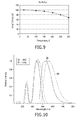
- Fig. 10 illustrates the smaller Stokes' shift of Lu 3 Al 5 O 12 :Ce 3+ as demonstrated by excitation and emission spectra of Lu 3 Al 5 O 12 :Ce 3+ and Y 3 Al 5 O 12 :Ce 3+ .
- the excitation spectra of both phosphors are very similar, the peak emission from Lu 3 Al 5 O 12 :Ce 3+ (curve 20) occurs at a wavelength about 40 nm shorter than the peak emission from Y 3 Al 5 O 12 :Ce 3+ (curve 22).
- the smaller Stokes' shift of Lu 3 Al 5 O 12 :Ce 3+ eliminates a gap in the spectrum of combined pump emission and phosphor emission at long blue wavelengths and short green wavelengths, resulting in better color rendering.
- a red-emitting phosphor is mixed with a lutetium-containing garnet phosphor, such as the device illustrated in Fig. 1, it may be difficult to exploit the small Stokes' shift of the lutetium-containing garnet phosphor since the red-emitting phosphor may absorb a significant portion of the light emitted by the lutetium-containing garnet phosphor. Lutetium-containing garnet phosphors tend to be very dense.
- 11-14 illustrate embodiments of the device where the red-emitting phosphor and lutetium-containing garnet phosphor are deposited such that absorption by the red-emitting phosphor of light emitted by the lutetium-containing garnet phosphor is minimized.
- the lutetium-containing garnet phosphor 5 is mixed with a resin or other transparent material and disposed on one side of reflector cup 2, while any other phosphors 4 are mixed separately with a resin or other transparent material and disposed on the other side of reflector cup 2, such that slurry 5 does not appreciably mix with slurry 4.
- the viscosity of the transparent material forming the slurry is selected to avoid mixing phosphor 4 with phosphor 5.
- lutetium-containing garnet phosphor 5 and any other phosphors 4 are adjacent to each other, rather than mixed in the same slurry, light emitted by lutetium-containing garnet phosphor 5 is less likely to be absorbed by any red-emitting phosphors in slurry 4.
- the lutetium-containing garnet phosphor 5 and other phosphors 4 are deposited over LED 1 as discrete layers.
- Phosphor layer 4 including any red-emitting phosphors, is deposited closest to LED 1.
- Lutetium-containing garnet phosphor 5 is then deposited over phosphor layer 4.
- Phosphor layers 4 and 5 may be separated by an optional transparent layer 6.
- Phosphor layers 4 and 5 may be deposited as slurries in a resin or other transparent material; deposited as thin films by, for example, electron beam evaporation, thermal evaporation, rf-sputtering, chemical vapor deposition, or atomic layer epitaxy; or deposited as conformal layers over LED 1 by, for example, screen printing, stenciling as described in U.S. Patent 6,650,044, or by electrophoretic deposition as described in U.S. Patent 6,576,488. Thin films are described in more detail in U.S. Patent 6,696,703. Each of U.S. Patent 6,696,703, U.S. Patent 6,650,044 and U.S. Patent 6,576,488 are incorporated herein by reference.
- a thin film which typically behaves as a single, large phosphor particle
- the phosphor in a conformal layer generally behaves as multiple phosphor particles.
- a thin film typically contains no materials other than phosphor.
- a conformal layer often includes materials other than phosphor, such as, for example, silica.
- the lutetium-containing garnet phosphor 5 and other phosphors 4 are deposited on LED 1 in a plurality of small regions.
- the different regions may form a pattern, such as a checkerboard pattern. If light from LED 1 is to escape unconverted, as in the case where blue light emitted by the LED mixes with green and red light emitted by phosphors to make white light, the amount of unconverted light may be controlled by controlling the thickness of phosphor regions 4 and 5, or by leaving regions of LED 1 uncovered, or covered by an optional transparent material 7 that does not convert the light emitted by LED 1. Patterns of different phosphor layers as illustrated in Fig.
- a first layer of phosphor by electrophoretic deposition may be formed by depositing a first layer of phosphor by electrophoretic deposition, patterning that layer using conventional lithography and etching techniques, then depositing a second phosphor layer by electrophoretic deposition.
- patterns of phosphor layers may be deposited by screen printing or ink jet printing.
- a pattern of phosphor layers may be formed by pipetting the individual phosphor mixes 4 and 5 into wells in a clear plastic microplate used for microbiology. The phosphor-filled microplate is then placed on LED 1. Phosphor-filled microplates may be formed separately from LED 1.
- a plurality of small regions of phosphor 4 which includes any red-emitting phosphors, is formed on the surface of LED 1.
- a layer of lutetium-containing garnet phosphor 5 is then deposited over the plurality of regions of phosphor 4.
- Each of the embodiments illustrated in Figs. 11-14 avoid the problem of light being absorbed and reemitted by the lutetium-containing garnet phosphor prior to being incident on a red-emitting phosphor.
- light emitted by LED 1 is incident on the red-emitting phosphor first, or is incident on the red-emitting phosphor and the lutetium-containing garnet phosphor in separate regions.
- the arrangements illustrated in Figs. 11-14 thus reduce the probability of light emitted from the lutetium-containing garnet phosphor being absorbed by a red-emitting phosphor.
- Lutetium-containing garnet phosphors according to the present invention are easily synthesized, as illustrated in the following example:
- one or more of the starting materials may be oxygen-containing compounds such as oxides, nitrates, sulfates, acetates, citrates, or chlorates, which are soluble in a nitric acid solution.
- nitric acid solution amounts of Lu 2 O 3 , Al(NO 3 ) 3 ⁇ 9H 2 O, Ce(NO 3 ) 3 ⁇ 6H 2 O and AlF 3 are blended and dissolved in a nitric acid solution.
- the strength of the acid solution is chosen to rapidly dissolve the oxygen-containing compounds and the choice is within the skill of a person skilled in the art.
- the nitric acid solution is evaporated.
- the dried precipitate is ball milled or otherwise thoroughly blended and then calcined in a CO-atmosphere at about 1300°C for a sufficient time to ensure a substantially complete dehydration of the starting material.
- the calcination may be carried out at a constant temperature.
- the calcinations temperature may be ramped from ambient to and held at the final temperature for the duration of the calcination.
- the calcined material is similarly fired at 1500-1700°C under a reducing atmosphere such as H 2 , CO, or a mixture of one of these gases with an inert gas.
- the calcined material is fired for a sufficient time for the decomposition of the oxygen-containing compounds to convert all of the calcined material to the desired phosphor composition.
- the resulting powder is milled on a roller bench for several hours.
- the milled powder has an average particle size of 40 to 60 ⁇ m. Its quantum efficiency is 90 % and its lumen equivalent is between 430 and 470 1m/W.
- the table below gives the wavelength and color point of several suitable phosphor compounds.
- Figs. 5, 6, and 7 illustrate the emission spectra of some of the compounds in the above table. When excited with radiation of wavelength 355 nm, these garnet phosphors are found to give a broad band emission, which peaks at 515 nm.
- Fig. 5 shows excitation and emission spectra for the composition (Lu 0.99 Ce 0.01 ) 3 Al 5 O 12 .
- Fig. 6 shows excitation and emission spectra for the composition (Lu 0.495 Y 0.495 Ce 0.01 ) 3 Al 5 O 12 .
- Fig, 7 demonstrates that the excitation band of (Lu 0.989 Ce 0.010 Pr. 001 ) 3 Al 5 O 12 , is a broad band (515 - 540 nm) with a peak extending from 515 - 540 nm and a side band at 610 nm.
- a phosphor blend comprising at least one of the suitable red phosphors described above is suspended into a silicone precursor. A droplet of this suspension is deposited onto the LED chip and subsequently polymerized. A plastic lens seals the LED.
Landscapes
- Chemical & Material Sciences (AREA)
- Inorganic Chemistry (AREA)
- Engineering & Computer Science (AREA)
- Materials Engineering (AREA)
- Organic Chemistry (AREA)
- Luminescent Compositions (AREA)
- Led Device Packages (AREA)
- Led Devices (AREA)
- Non-Portable Lighting Devices Or Systems Thereof (AREA)
Abstract
Description
- The present invention generally relates to an illumination system comprising a radiation source and a fluorescent material comprising a phosphor.
- Recently, various attempts have been made to make white light emitting illumination systems by using light emitting diodes (LEDs) as radiation sources. When generating white light with an arrangement of red, green and blue light emitting diodes, there has been such a problem that white light of the desired tone cannot be generated due to variations in the tone, luminance and other factors of the light emitting diodes.
- In order to solve these problems, there have been previously developed various illumination systems, which convert the color of light emitted by light emitting diodes, by means of a fluorescent material comprising a phosphor to provide a visible white light illumination.
- Previous illumination systems have been based in particular either on the trichromatic (RGB) approach, i.e. on mixing three colors, namely red, green and blue, in which case the latter component may be provided by a phosphor or by the primary emission of the LED or in a second, simplified solution, on the dichromatic (BY) approach, mixing yellow and blue colors, in which case the yellow component may be provided by a yellow phosphor and the blue component may be provided by the primary emission of blue LED.
- In particular, the dichromatic approach as disclosed in, for example, U.S. Patent 5,998,925 uses a blue light emitting diode of InGaN semiconductor combined with a Y3Al5O12:Ce3+ (YAG-Ce3+) phosphor. The YAG-Ce3+ phosphor is coated on the InGaN LED, and a portion of the blue light emitted from the LED is converted to yellow light by the phosphor. Another portion of the blue light from the LED is transmitted through the phosphor. Thus, this system emits both blue light emitted from the LED, and yellow light emitted from the phosphor. The mixture of blue and yellow emission bands are perceived as white light by an observer with a CRI in the middle 80s and a color temperature, Tc, that ranges from about 6000 K to about 8000 K.
- However, white light LEDs based on the dichromatic approach can only be used to a limited extent for general-purpose illumination, on account of their poor color rendering caused by the absence of red color components.
- In accordance with embodiments of the invention, a system includes a radiation source capable of emitting first light and a fluorescent material capable of absorbing the first light and emitting second light having a different wavelength than the first light. The fluorescent material is a phosphor having the formula (Lu1-x-y-a-bYxGdy)3(Al1-zGaz)5O12:CeaPrb wherein 0 < x < 1, 0 < y < 1, 0 <z ≤ 0.1, 0 < a ≤ 0.2 and 0 < b ≤ 0.1. In some embodiments, the (Lu1-x-y-a-bYxGdy)3(Al1-zGaz)5O12:CeaPrb is combined with a second fluorescent material capable of emitting third light. The second fluorescent material may be a red-emitting phosphor, such that the combination of first, second, and third light emitted from the system appears white.
-
- Fig. 1 shows a schematic view of a tri-color white LED lamp comprising a two- phosphor blend positioned in a pathway of light emitted by an LED structure.
- Fig. 2A shows the coordinates of phosphor mixtures of (Lu0.495Y0.495Ce0.01)3Al5O12 and CaS in the chromaticity diagram of the Commission Internationals de I'Eclairage ("CIE"). Fig. 2B shows the coordinates of phosphor mixtures of Lu3Al5O12:Ce3+ and Sr2Si5N8:Eu in the CIE diagram. Blends of these phosphors may be produced to have coordinates close to the black body locus.
- Fig. 3 illustrates emission spectra of green LEDs upon excitation by a blue LED at 460 nm.
- Figs. 4A and 4B illustrates emission spectra of white LEDs.
- Fig. 5 illustrates the excitation and emission spectra of (Lu0.99Ce0.01)3Al5O12.
- Fig. 6 illustrates the excitation and emission spectra of (Lu0.989Ce0.01Pr0.001)3Al5O12.
- Fig. 7 illustrates the excitation and emission spectra of (Lu0.495Y0.495Ce0.01)3Al5O12.
- Fig. 8 illustrates the relative intensity of Lu3Al5O12:Ce3+ as a function of temperature.
- Fig. 9 illustrates the relative intensity of Sr2Si5N8:Eu2+ as a function of temperature.
- Fig. 10 illustrates excitation and emission spectra of Lu3Al5O12:Ce3+ and Y3Al5O12:Ce3+.
- Figs. 11, 12, 13, and 14 illustrate embodiments of the invention including multiple phosphors.
-
- Embodiments of the invention provide new phosphors that are excitable in the near LTV-to-blue range and emit in the visible green range. The new phosphors are capable of absorbing a part of light emitted by a radiation source and emitting light of a wavelength different from the absorbed light.
- Embodiments of the present invention focus on a lutetium aluminum garnet as a phosphor in any configuration of an illumination system containing a radiation source, including, but not limited to discharge lamps, fluorescent lamps, LEDs, laser diodes and X-ray tubes. In some embodiments, the lutetium aluminum garnet phosphor is cerium-activated. As used herein, the term "radiation" encompasses radiation in the UV, IR and visible regions of the electromagnetic spectrum.
- While the use of the present phosphor is contemplated for a wide array of illumination, the present invention is described with particular reference to and finds particular application to light emitting diodes, especially UV- and blue-light-emitting diodes.
- The fluorescent material according to embodiments of the invention comprises as a phosphor a cerium-activated lutetium-aluminum-garnet compound. The phosphor conforms to the general formula (Lu1-x-y-a-bYxGdy)3(Al1-zGaz)5O12:CeaPrb wherein 0 < x < 1, 0 < y < 1, 0 <z ≤ 0.1, 0 < a ≤ 0.2 and 0 < b ≤ 0.1.
- This class of phosphor material is based on activated luminescence of cubic garnet crystals. Garnets are a class of materials with the crystal chemical formula A3B5O12.
- A garnet crystal lattice has three different atomic occupying sites of dodecahedron octacoordination, octahedron hexacoordination and tetrahedron tetracoordination, in which the A cations are eight-coordinated with oxygens and the B cations are either octahedrally (six) or tetrahedrally (four) coordinated with oxygens. The crystal structure is cubic with 160 ions per unit cell containing eight formula units. In embodiments of the present invention, the A cations are lutetium ions alone or in combination with Yttrium and Gadolinium, in combinations and with activator substitutions of cerium and possibly praseodymium. The B cations may be aluminum and may be gallium or other ions, again, alone, in combinations and/or with substitutions. In particular, it was found that with activator ions substituted in the eight-coordinated or six-coordinated sites, these garnets are luminescent in response to x-ray stimulation. A particularly important activator ion, which is x-ray luminescent in this host material, is the Ce3+ ion located in eight-coordinated sites.
- Replacing some of the lutetium in a cerium activated lutetium aluminum garnet, Lu3Al5O12:Ce phosphor with a smaller ion such as gadolinium Gd3+ or yttrium Y3+ causes a shift in the phosphor's emission band from green to the yellow range.
- Replacing some of the aluminum in a cerium activated lutetium aluminum garnet, Lu3Al5O12:Ce phosphor with a larger ion such as gallium Ga3+ causes a shift in the phosphor's emission band from green to the blue range.
- Replacing some of the cerium in a cerium-activated lutetium-aluminum-garnet by praseodymium as a co-activator has the effect that the praseodymium produces secondary emission that is concentrated in the red region of the visible spectrum, instead of a typical broadband secondary emission from cerium-activated lutetium-aluminum-phosphor that is generally centered in the yellow region of the visible spectrum. The amount of praseodymium as a co-activator can vary, depending on the amount of red color that may be required in the white output light for a particular application. Compositions having praseodymium as an activator cation present at low concentrations may be particularly desirable since such compositions show a sharp line emission in the red region of the visible spectrum.
- The lutetium concentration influences the color locus of the emission light when used in a light source, in particular an LED. The color locus of this phosphor can be additionally fine-tuned using the ratio of the two concentrations Lu:Ce, which simplifies or optimizes adaptation to any further (yellow or red) phosphors in the LED. As the concentration of Ce in the phosphor increases, the blue-end of the emission spectrum of the phosphor shifts to longer wavelengths. In some embodiments, the phosphor contains about 1 to about 1.5 mole-percent Ce.
- Preferably these garnet phosphors may be coated with a thin, uniform layer of one or more compounds selected from the group formed by the fluorides and orthophosphates of the elements aluminum, scandium, yttrium, lanthanum gadolinium and lutetium, the oxides of aluminum, yttrium and lanthanum and the nitride of aluminum.
- The layer thickness customarily ranges from 0.001 to 0.2 µm and, thus, is so thin that it can be penetrated by the radiation of the radiation source without substantial loss of energy. The coatings of these materials on the phosphor particles can be applied, for example, by deposition from the gas phase or a wet-coating process.
- The phosphors according to the invention are responsive to ultraviolet light as in fluorescent lamps and light emitting diodes, visible light as in blue-emitting diodes, electrons (as in cathode ray tubes) and x-rays (as in radiography).
- The invention also concerns an illumination system comprising a radiation source and a fluorescent material comprising at least one phosphor of general formula (Lu1-x-y-a-bYxGdy)3(Al1-zGaz)5O12:CeaPrb wherein 0 < x < 1, 0 < y < 1, 0 <z ≤ 0.1, 0 < a ≤ 0.2 and 0 < b ≤ 0.1.
- Radiation sources include semiconductor optical radiation emitters and other devices that emit optical radiation in response to electrical excitation. Semiconductor optical radiation emitters include light emitting diode LED chips, light emitting polymers (LEPs), organic light emitting devices (OLEDs), polymer light emitting devices (PLEDs), etc.
- Moreover, light emitting components such as those found in discharge lamps and fluorescent lamps, such as mercury low and high pressure discharge lamps, sulfur discharge lamps, and discharge lamps based an molecular radiators are also contemplated for use as radiation sources with the present inventive phosphor compositions.
- In a preferred embodiment of the invention the radiation source is a light-emitting diode. Any configuration of an illumination system which includes a LED and a cerium- activated lutetium-aluminum garnet phosphor composition is contemplated in the present invention, preferably with addition of other well-known phosphors, which can be combined to achieve a specific color or white light of high efficiency and/or high color rendering index ("CRI") at a required color temperature, when irradiated by a LED emitting primary UV or blue light as specified above. White-emitting devices according to embodiments of the present invention are based on the combination of blue, red, and green colors. In some embodiments, the yellow to green and the red phosphors are so broad-banded that they have a sufficient proportion of emission throughout the whole spectral region.
- In a preferred embodiment of the invention the primary radiation source used is the radiation from a UV-emitting or blue-emitting LED-chip. Particularly good results are achieved with a blue LED whose emission maximum lies at 400 to 480 nm. Optimal ranges have been found to lie at 445 to 460 nm and 438 to 456 nm, taking particular account of the excitation spectrum of the garnet phosphors described above.
- Desirable white light lamp characteristics for general purposes are high brightness and high color rendering at economical cost. Improved efficiency and much improved color rendering ability is possible with the trichromatic lamp spectrum according to the RGB-approach having three emission bands: red at 590 to 630, green at 520 to 560 and blue at 450 nm. These wavelengths are near peaks in the CIE tristimulus functions, which are used to define colors.
- In some embodiments, particularly good color rendering is achieved by the joint use of two phosphors, namely a green emitting cerium-activated lutetium-aluminum-garnet phosphor of general formula (Lu1-x-y-a-bYxGdy)3(Al1-zGaz)5O12:CeaPrb wherein 0 < x < 1, 0 < y < 1, 0 <z ≤ 0.1, 0 < a ≤ 0.2 and 0 < b ≤ 0.1 together with a second phosphor. The second phosphor may be, for example, a red-emitting phosphor, such as a red emitting europium-activated phosphor selected from the group of (Ca1-xSrx)S:Eu wherein 0 < x ≤ 1 and (Sr1-x-yBaxCay)2-zSi5-aAlaN8-aOa:Euz wherein 0 ≤ a < 5, 0 ≤ x ≤ 1, 0 ≤ y ≤ 1, and 0 < z ≤ 1.
- Preferably a europium activated calcium strontium sulfide is used, which is a high chromaticity red phosphor excitable from the near UV (400 nm) to the blue-green (500 nm) with high quantum efficiency. For an optimized use of this phosphor for luminescent conversion of primary LED light it is necessary to modify the photophysical characteristics to achieve, for example, efficacy, color specifications and life time of related light emitting devices. The chromaticity and quantum efficiency of the europium activated strontium sulfide can be modified through the substitution of divalent metal ions for strontium from the list including Ba, Ca, Mg, and Zn. Suitable red phosphors are described in the following table:
Phosphor composition λmax [nm] Color point x, y SrS:Eu 610 0.627, 0.372 (Sr1-x-yBaxCay)2Si5N8:Eu 615 0.615, 0.384 (Sr1-x-yBaxCay)2Si5-xAlxN8-xOx:Eu 615 - 650 Depends on x, y CaS:Eu 655 0.700, 0.303 (Sr1-xCax)S:Eu 610 - 655 Depends on x, y - The phosphor blend comprises a mixture of predetermined amounts and relative proportions of garnet-structured lutetium-aluminum oxide activated by cerium and calcium-strontium sulfide activated by divalent europium. The relative phosphor proportions are such that the composite emission of the first phosphor layer falls approximately within the warm-white ellipse as inscribed on the x-y chromaticity diagram of the ICI system.
- Especially preferred is a white emitting radiation source comprising a InGaN chip, emitting in the blue range of the visible spectrum with a peak emission at 455 nm together with a phosphor blend comprising Lu3Al5O12:Ce and CaS:Eu with the corresponding spectral weight ratio blue:green:red = 1.1:2.4:2.18 which emits white light with color coordinates x = 0.336 and y = 0.339 and index of color rendering of 83. The spectra of such white emitting devices comprising three different blends of Lu3Al5O12:Ce and CaS:Eu are given in Fig. 4A.
- Fig. 4B illustrates spectra of three white devices including blends of Lu3Al5O12:Ce and Sr2Si5N8:Eu, excited by a blue LED at 450 nm.
- A detailed construction of such a light-emitting device according to embodiments of the invention is shown in Fig. 1. The device of Fig. 1 comprises an
LED 1 positioned in areflector cup 2. Aphosphor composition LED 1. The phosphor composition is embedded in a resin. The shape ofreflector cup 2 may be selected to provide a particular pattern of light emitted from the device, as is known in the art. For example, the walls ofreflector cup 2 can be parabolic. - In one embodiment, the device further comprises a polymer for encapsulating the phosphor or phosphor blend. In this embodiment, the phosphor or phosphor blend should exhibit high stability properties in the encapsulant. Preferably, the polymer is optically clear to prevent significant light scattering. In one embodiment, the polymer is selected from the group consisting of epoxy and silicone resins. A variety of polymers are known in the LED industry for making LED lamps. Adding the phosphor mixture to a liquid that is a polymer precursor can perform encapsulation. For example, the phosphor mixture can be a powder. Introducing phosphor particles into polymer precursor liquid results in formation of a slurry (i.e. a suspension of particles). Upon polymerization, the phosphor mixture is fixed rigidly in place by the encapsulation. In one embodiment, both the composition and the LED are encapsulated in the polymer.
- The phosphors are applied either separately or in a mixture. The phosphors completely or partially absorb the light from the LED and emit it again in other spectral regions (primarily yellow and green) in a sufficiently broad band (specifically with a significant proportion of red) that an overall emission with the desired color point is formed. The wavelength of the LED is tuned to the particular phosphors in the blend such that each of the phosphors in the blend is excited by emission from the LED. A phosphor blend using wide band phosphors according to embodiments of the invention may have a relatively high color rendering index, as high as 91-93. In the case of an LED emitting UV light, for example between about 330 nm and about 365 nm, in order to achieve high color rendering, in addition to yellow/green and red phosphors described above, the phosphor blend may also include a phosphor that emits blue light.
- The color points corresponding to a black body at various temperatures are given by the black body locus (BBL). Because the color emitted from a black body is considered to be white, and white light is generally desirable for a lamp, it is generally desirable that color point of the light emitted from the luminescent material of a luminescent lamp fall on or near the BBL. A portion of the BBL shown in Fig. 2A includes three color temperature points highlighted on the BBL corresponding to white light emitting LEDs, whose emission spectra are given in Fig. 4A. A portion of the BBL shown in Fig. 2B includes three color temperature points highlighted on the BBL corresponding to white light emitting LEDs, whose emission spectra are given in Fig. 4B.
- Another figure of merit is the quality in rendering illuminated colors of a white light emitting radiation source, which is indicated as the color rendering index (CRI). A CRI of 100 is an indication that the light emitted from the light source is similar to that from a black body source, i.e. an incandescent or halogen lamp. A CRI of 85 to 95 can be attained by applying a phosphor mixture comprising Lu3Al5O12:Ce and CaS:Eu to a blue-emitting LED.
- Figs. 2A and 2B show the color coordinates of a range of illumination systems providing white light that can be produced from various combinations of blue LEDs and a cerium-activated lutetium-aluminum-garnet phosphor and CaS:Eu or Sr2Si5N8:Eu of the present invention.
- More than one phosphor according to embodiments of the present invention may be incorporated in the same device to provide for color adjustment.
- A further group of embodiments is directed to a green emitting illumination system with particularly good color rendering comprising the combination of a light emitting semiconductor component which emits primary light in the blue spectral range from 420 to 480 nm together with a phosphor blend containing a green emitting cerium-activated lutetium-aluminum garnet phosphor Lu3Al5O12:Ce, with the corresponding spectral weight ratio blue:green is chosen from 1.0:2.4 to 1.0:3.5 which emits green light with color coordinates x = 0.336 and y = 0.339, an index of color rendering of 83, and a lumen equivalent of about 450 lumen/Watt.
- The green-emitting phosphor may be combined when appropriate, with a further yellow or red-emitting phosphor for the production of specific colored light and more preferably for production of white light with a high color-rendering index of greater than 80.
- As a result of the green to yellow broad-band emission, a green emission can be generated which is shown in some examples in Fig. 3. As the amount of phosphor disposed on the device increases, eventually all of the emission from the LED is absorbed, such that only emission from the phosphor remains. Devices with such heavy phosphor loading may be used in applications requiring green light.
- The garnet phosphors described above emit a broad band in the yellow-green spectral range of the visible spectrum with very high intensity under both UV and blue excitations and thus can provide the green component in LEDs emitting specific colors or white light. Total conversion efficiency can be up to 90%. Additional important characteristics of the phosphors include 1) resistance to thermal quenching of luminescence at typical device operating temperatures (e.g. 80°C); 2) lack of interfering reactivity with the encapsulating resins used in the device fabrication; 3) suitable absorptive profiles to minimize dead absorption within the visible spectrum; 4) a temporally stable luminous output over the operating lifetime of the device and; 5) compositionally controlled tuning of the phosphors excitation and emission properties. Fig. 8 illustrates the relative intensity of Lu3Al5O12:Ce3+ as a function of temperature. The relative intensity is expressed as a percentage of the intensity at room temperature, 25°C. At 200°C, the Lu3Al5O12:Ce3+ emission intensity is 90% of room temperature intensity. At 300°C, the Lu3Al5O12:Ce3+ emission intensity is 70% of room temperature intensity. In embodiments requiring white light and operation at high temperature, Sr2Si5N8:Eu2+ is preferred as a red phosphor as it exhibits similar performance at high temperatures, as illustrated in Fig. 9, which illustrates the relative intensity of Sr2Si5N8:Eu2+ as a function of temperature. At 200°C, the Sr2Si5N8:Eu2+ emission intensity is 90% room temperature intensity.
- Lutetium-containing garnet phosphors included with other phosphors in devices designed to emit white light may offer improved color rendering over garnet phosphors that do not include lutetium, such as Y3Al5O12:Ce3+. The improved color rendering is due to the smaller Stokes' shift of Lu3Al5O12:Ce3+ relative to Y3Al5O12:Ce3+. Phosphors such as Lu3Al5O12:Ce3+ and Y3Al5O12:Ce3+ absorb an excitation energy typically in the form of radiation, store the energy, then emit the stored energy as radiation of a different energy. When the emitted radiation has less quantum energy than the absorbed radiation, the wavelength of the emitted light increases over the absorbed light. This increase is referred to as the Stokes' shift. Fig. 10 illustrates the smaller Stokes' shift of Lu3Al5O12:Ce3+ as demonstrated by excitation and emission spectra of Lu3Al5O12:Ce3+ and Y3Al5O12:Ce3+. Though the excitation spectra of both phosphors are very similar, the peak emission from Lu3Al5O12:Ce3+ (curve 20) occurs at a wavelength about 40 nm shorter than the peak emission from Y3Al5O12:Ce3+ (curve 22). When used in a white device, the smaller Stokes' shift of Lu3Al5O12:Ce3+ eliminates a gap in the spectrum of combined pump emission and phosphor emission at long blue wavelengths and short green wavelengths, resulting in better color rendering.
- In a device where a red-emitting phosphor is mixed with a lutetium-containing garnet phosphor, such as the device illustrated in Fig. 1, it may be difficult to exploit the small Stokes' shift of the lutetium-containing garnet phosphor since the red-emitting phosphor may absorb a significant portion of the light emitted by the lutetium-containing garnet phosphor. Lutetium-containing garnet phosphors tend to be very dense. As a result, when a slurry containing such phosphors is deposited over a device, the lutetium-containing garnet phosphor particles tend to sink quickly, leaving most of the lutetium-containing garnet phosphor close to the device and most of the red-emitting phosphor further from the device. Light emitted by the lutetium-containing garnet phosphor thus has a high likelihood of striking a red-emitting phosphor particle and being absorbed. Figs. 11-14 illustrate embodiments of the device where the red-emitting phosphor and lutetium-containing garnet phosphor are deposited such that absorption by the red-emitting phosphor of light emitted by the lutetium-containing garnet phosphor is minimized.
- In the device illustrated in Fig. 11, the lutetium-containing
garnet phosphor 5 is mixed with a resin or other transparent material and disposed on one side ofreflector cup 2, while anyother phosphors 4 are mixed separately with a resin or other transparent material and disposed on the other side ofreflector cup 2, such thatslurry 5 does not appreciably mix withslurry 4. In some embodiments, the viscosity of the transparent material forming the slurry is selected to avoid mixingphosphor 4 withphosphor 5. Since lutetium-containinggarnet phosphor 5 and anyother phosphors 4 are adjacent to each other, rather than mixed in the same slurry, light emitted by lutetium-containinggarnet phosphor 5 is less likely to be absorbed by any red-emitting phosphors inslurry 4. - In the device illustrated in Fig. 12, the lutetium-containing
garnet phosphor 5 andother phosphors 4 are deposited overLED 1 as discrete layers.Phosphor layer 4, including any red-emitting phosphors, is deposited closest toLED 1. Lutetium-containinggarnet phosphor 5 is then deposited overphosphor layer 4. Phosphor layers 4 and 5 may be separated by an optionaltransparent layer 6. Phosphor layers 4 and 5 may be deposited as slurries in a resin or other transparent material; deposited as thin films by, for example, electron beam evaporation, thermal evaporation, rf-sputtering, chemical vapor deposition, or atomic layer epitaxy; or deposited as conformal layers overLED 1 by, for example, screen printing, stenciling as described in U.S. Patent 6,650,044, or by electrophoretic deposition as described in U.S. Patent 6,576,488. Thin films are described in more detail in U.S. Patent 6,696,703. Each of U.S. Patent 6,696,703, U.S. Patent 6,650,044 and U.S. Patent 6,576,488 are incorporated herein by reference. In contrast to a thin film, which typically behaves as a single, large phosphor particle, the phosphor in a conformal layer generally behaves as multiple phosphor particles. In addition a thin film typically contains no materials other than phosphor. A conformal layer often includes materials other than phosphor, such as, for example, silica. - In the device illustrated in Fig. 13, the lutetium-containing
garnet phosphor 5 andother phosphors 4 are deposited onLED 1 in a plurality of small regions. The different regions may form a pattern, such as a checkerboard pattern. If light fromLED 1 is to escape unconverted, as in the case where blue light emitted by the LED mixes with green and red light emitted by phosphors to make white light, the amount of unconverted light may be controlled by controlling the thickness ofphosphor regions LED 1 uncovered, or covered by an optional transparent material 7 that does not convert the light emitted byLED 1. Patterns of different phosphor layers as illustrated in Fig. 13 may be formed by depositing a first layer of phosphor by electrophoretic deposition, patterning that layer using conventional lithography and etching techniques, then depositing a second phosphor layer by electrophoretic deposition. Alternatively, patterns of phosphor layers may be deposited by screen printing or ink jet printing. In some embodiments, a pattern of phosphor layers may be formed by pipetting the individual phosphor mixes 4 and 5 into wells in a clear plastic microplate used for microbiology. The phosphor-filled microplate is then placed onLED 1. Phosphor-filled microplates may be formed separately fromLED 1. - In the device illustrated in Fig. 14, a plurality of small regions of
phosphor 4, which includes any red-emitting phosphors, is formed on the surface ofLED 1. A layer of lutetium-containinggarnet phosphor 5 is then deposited over the plurality of regions ofphosphor 4. - Each of the embodiments illustrated in Figs. 11-14 avoid the problem of light being absorbed and reemitted by the lutetium-containing garnet phosphor prior to being incident on a red-emitting phosphor. In each case, light emitted by
LED 1 is incident on the red-emitting phosphor first, or is incident on the red-emitting phosphor and the lutetium-containing garnet phosphor in separate regions. The arrangements illustrated in Figs. 11-14 thus reduce the probability of light emitted from the lutetium-containing garnet phosphor being absorbed by a red-emitting phosphor. - Lutetium-containing garnet phosphors according to the present invention are easily synthesized, as illustrated in the following example:
- For the phosphor synthesis of a phosphor of general formula (Lui1-x-y-a-bYxGdy)3(Al1-zGaz)5O12:CeaPrb wherein 0 < x < 1, 0 < y < 1, 0 <z ≤ 0.1, 0 < a ≤ 0.2 and 0 < b ≤ 0.1, one or more of the starting materials may be oxygen-containing compounds such as oxides, nitrates, sulfates, acetates, citrates, or chlorates, which are soluble in a nitric acid solution. For example, amounts of Lu2O3, Al(NO3)3·9H2O, Ce(NO3)3·6H2O and AlF3 are blended and dissolved in a nitric acid solution. The strength of the acid solution is chosen to rapidly dissolve the oxygen-containing compounds and the choice is within the skill of a person skilled in the art. The nitric acid solution is evaporated. The dried precipitate is ball milled or otherwise thoroughly blended and then calcined in a CO-atmosphere at about 1300°C for a sufficient time to ensure a substantially complete dehydration of the starting material. The calcination may be carried out at a constant temperature. Alternatively, the calcinations temperature may be ramped from ambient to and held at the final temperature for the duration of the calcination. After an intermittent milling step the calcined material is similarly fired at 1500-1700°C under a reducing atmosphere such as H2, CO, or a mixture of one of these gases with an inert gas. The calcined material is fired for a sufficient time for the decomposition of the oxygen-containing compounds to convert all of the calcined material to the desired phosphor composition.
- The resulting powder is milled on a roller bench for several hours. The milled powder has an average particle size of 40 to 60 µm. Its quantum efficiency is 90 % and its lumen equivalent is between 430 and 470 1m/W. The color point is at x = 0.33 to 0.38, y = 0.57 to 0.58. The table below gives the wavelength and color point of several suitable phosphor compounds.
Phosphor composition λmax [nm] Color point x, y (Lu0.99Ce0.01)3Al5O12 515 + 540 0.339, 0.579 (Lu0.989Ce0.010Pr.001)3Al5O12 515 + 540 + 610 0.332, 0.574 (Lu0.495Y0.495Ce0.01)3Al5O12 525 + 550 0.377, 0.570 (Lu0.75Gd0.24Ce0.01)3Al5O12 520 + 545 0.350, 0.573 - Figs. 5, 6, and 7 illustrate the emission spectra of some of the compounds in the above table. When excited with radiation of wavelength 355 nm, these garnet phosphors are found to give a broad band emission, which peaks at 515 nm. Fig. 5 shows excitation and emission spectra for the composition (Lu0.99Ce0.01)3Al5O12. Fig. 6 shows excitation and emission spectra for the composition (Lu0.495Y0.495Ce0.01)3Al5O12. Fig, 7 demonstrates that the excitation band of (Lu0.989Ce0.010Pr.001)3Al5O12, is a broad band (515 - 540 nm) with a peak extending from 515 - 540 nm and a side band at 610 nm.
- From the excitation spectra, it is also clear that these cerium-activated lutetium-aluminum garnet phosphors can be excited efficiently with radiation of wavelength 254 as well as 355 and 420 nm.
- For manufacturing a white illumination system based on a 460 nm emitting InGaN LED, a phosphor blend comprising at least one of the suitable red phosphors described above is suspended into a silicone precursor. A droplet of this suspension is deposited onto the LED chip and subsequently polymerized. A plastic lens seals the LED.
- Having described the invention in detail, those skilled in the art will appreciate that, given the present disclosure, modifications may be made to the invention without departing from the spirit of the inventive concept described herein. Therefore, it is not intended that the scope of the invention be limited to the specific embodiments illustrated and described.
Claims (21)
- A system comprising:wherein the first fluorescent material and the second fluorescent material are disposed over the radiation source as discrete layers.a radiation source capable of emitting first light;a first fluorescent material capable of absorbing the first light and emitting second light having a different wavelength than the first light, wherein said fluorescent material comprises a phosphor having the formula (Lu1-x-y-a-bYxGdy)3(Al1-zGaz)5O12:CeaPrb wherein 0 < x < 1, 0 < y < 1, 0 <z ≤ 0.1, 0 < a ≤ 0.2 and 0 < b ≤ 0.1; anda second fluorescent material capable of emitting third light;
- The system of claim 1 wherein the first light comprises light having a peak emission wavelength in the range of 400 to 480 nm.
- The system of claim 1 wherein the first light comprises light having a peak emission wavelength in the range of 438 to 456 nm.
- The system of claim 1 wherein the first light comprises light having a peak emission wavelength in the range of 330 to 365 nm.
- The system of claim 1 wherein the radiation source is a light emitting diode.
- The system of claim 1 wherein the second light is green light.
- The system of claim 1 wherein the third light comprises red light.
- The system of claim 1 wherein the second fluorescent material comprises an Eu(II)-activated phosphor.
- The system of claim 1 wherein the second fluorescent material comprises (Sr1-x-yBaxCay)2Si5-xAlxN8-xOx:Eu wherein 0 ≤ a < 5, 0 < x ≤ 1, 0 ≤ y ≤ 1, and 0 < z ≤ 1.
- The system of claim 1 wherein the second fluorescent material comprises Sr2Si5N8:Eu2+.
- The system of claim 1 wherein the second fluorescent material comprises (Sr1-xCax)S:Eu.
- The system of claim 1 wherein the second fluorescent material is closer to the radiation source than the first fluorescent material.
- The system of claim 1 further comprising a layer of transparent material disposed between the first fluorescent material and the second fluorescent material.
- The system of claim 1 wherein:the first fluorescent material is disposed over a first portion of the radiation source; andthe second fluorescent material is disposed over a second portion of the radiation source.
- The system of claim 1 wherein:the first fluorescent material is disposed over the radiation source in a plurality of first discrete regions; andthe second fluorescent material is disposed over the radiation source in a plurality of second discrete regions.
- The system of claim 15 wherein the plurality of first discrete regions and the plurality of second discrete regions form a pattern.
- The system of claim 15 further comprising a transparent material disposed over the radiation source in a plurality of third discrete regions.
- The system of claim 1 wherein:the second fluorescent material is disposed over the radiation source in a plurality of first discrete regions; andthe first fluorescent material is disposed over the second fluorescent material.
- The system of claim 1 further comprising a third fluorescent material capable of emitting fourth light.
- The system of claim 19 wherein the fourth light comprises blue light.
- The system of claim 1 wherein particles of the first fluorescent material are coated with a layer of one or more compounds selected from the group formed by the fluorides and orthophosphates of the elements aluminum, scandium, yttrium, lanthanum gadolinium and lutetium, the oxides of aluminum, yttrium and lanthanum and the nitride of aluminum.
Applications Claiming Priority (2)
| Application Number | Priority Date | Filing Date | Title |
|---|---|---|---|
| US785620 | 2004-02-23 | ||
| US10/785,620 US7038370B2 (en) | 2003-03-17 | 2004-02-23 | Phosphor converted light emitting device |
Publications (3)
| Publication Number | Publication Date |
|---|---|
| EP1566426A2 true EP1566426A2 (en) | 2005-08-24 |
| EP1566426A3 EP1566426A3 (en) | 2011-04-06 |
| EP1566426B1 EP1566426B1 (en) | 2015-12-02 |
Family
ID=34711904
Family Applications (1)
| Application Number | Title | Priority Date | Filing Date |
|---|---|---|---|
| EP05101220.1A Expired - Lifetime EP1566426B1 (en) | 2004-02-23 | 2005-02-18 | Phosphor converted light emitting device |
Country Status (3)
| Country | Link |
|---|---|
| EP (1) | EP1566426B1 (en) |
| JP (2) | JP4787521B2 (en) |
| TW (1) | TWI381044B (en) |
Cited By (11)
| Publication number | Priority date | Publication date | Assignee | Title |
|---|---|---|---|---|
| WO2008100517A1 (en) * | 2007-02-13 | 2008-08-21 | Lumination Llc | Red line emitting phosphors for use in led applications |
| WO2009066206A1 (en) * | 2007-11-19 | 2009-05-28 | Koninklijke Philips Electronics N.V. | Light source and illumination system having a predefined external appearance |
| WO2009136351A1 (en) * | 2008-05-07 | 2009-11-12 | Koninklijke Philips Electronics N.V. | Illumination device with led with a self-supporting grid containing luminescent material and method of making the self-supporting grid |
| WO2010043287A1 (en) * | 2008-10-13 | 2010-04-22 | Merck Patent Gmbh | Doped garnet fluorescent substance having red shift for pc leds |
| WO2010102576A1 (en) * | 2009-03-11 | 2010-09-16 | 旭明光电股份有限公司 | Lighting device comprising leds with phosphor layers |
| WO2014130051A1 (en) * | 2013-02-25 | 2014-08-28 | Empire Technology Development Llc | Hybrid nanoparticles and illumination devices using the hybrid nanopaticles |
| RU2549406C1 (en) * | 2013-09-26 | 2015-04-27 | Открытое акционерное общество "Институт пластмасс имени Г.С. Петрова" | Polymer luminescent composite for colourless light production, which is excited by blue light-emitting diode |
| US9068702B2 (en) | 2010-03-04 | 2015-06-30 | Xicato, Inc. | Efficient LED-based illumination modules with high color rendering index |
| US9978913B2 (en) | 2013-06-25 | 2018-05-22 | Shin-Etsu Chemical Co., Ltd. | Outdoor luminaire |
| WO2021073914A1 (en) * | 2019-10-14 | 2021-04-22 | Evonik Operations Gmbh | Blue to uv up-converter comprising lanthanide ions such as pr3+ activated garnet and its application for surface disinfection purposes |
| CN113845807A (en) * | 2020-06-26 | 2021-12-28 | 赢创运营有限公司 | Composition for producing coatings with antimicrobial properties |
Families Citing this family (26)
| Publication number | Priority date | Publication date | Assignee | Title |
|---|---|---|---|---|
| US7671529B2 (en) * | 2004-12-10 | 2010-03-02 | Philips Lumileds Lighting Company, Llc | Phosphor converted light emitting device |
| JP2009512178A (en) * | 2005-11-04 | 2009-03-19 | パナソニック株式会社 | LIGHT EMITTING MODULE AND DISPLAY DEVICE AND LIGHTING DEVICE USING THE SAME |
| JP2007173397A (en) * | 2005-12-20 | 2007-07-05 | Matsushita Electric Ind Co Ltd | LIGHT EMITTING MODULE AND DISPLAY DEVICE AND LIGHTING DEVICE USING THE SAME |
| US8264138B2 (en) * | 2006-01-20 | 2012-09-11 | Cree, Inc. | Shifting spectral content in solid state light emitters by spatially separating lumiphor films |
| US7775687B2 (en) | 2006-02-20 | 2010-08-17 | Nichia Corporation | Light emitting device |
| JP2007266583A (en) * | 2006-02-20 | 2007-10-11 | Nichia Chem Ind Ltd | Light emitting device |
| JP2008050493A (en) * | 2006-08-25 | 2008-03-06 | Mitsubishi Chemicals Corp | Phosphor and light emitting device using the same |
| US8529791B2 (en) * | 2006-10-20 | 2013-09-10 | Intematix Corporation | Green-emitting, garnet-based phosphors in general and backlighting applications |
| JP4953846B2 (en) * | 2007-02-06 | 2012-06-13 | スタンレー電気株式会社 | Light emitting device and manufacturing method thereof |
| JP2008308510A (en) * | 2007-06-12 | 2008-12-25 | Sony Corp | Luminescent composition, optical device using the same, and display device using the same |
| US7905618B2 (en) | 2007-07-19 | 2011-03-15 | Samsung Led Co., Ltd. | Backlight unit |
| JP2010275426A (en) * | 2009-05-28 | 2010-12-09 | Sumitomo Chemical Co Ltd | Method for producing surface-treated phosphor particles and surface-treated phosphor particles |
| US8273589B2 (en) * | 2010-03-19 | 2012-09-25 | Micron Technology, Inc. | Light emitting diodes and methods for manufacturing light emitting diodes |
| DE102010021341A1 (en) * | 2010-05-22 | 2011-11-24 | Merck Patent Gmbh | phosphors |
| KR101335522B1 (en) | 2012-02-29 | 2013-12-02 | 한국화학연구원 | Phosphors for blue-light excitation, a method for producing the same and white light emitting diode comprising the same |
| WO2014061393A1 (en) * | 2012-10-16 | 2014-04-24 | 電気化学工業株式会社 | Phosphor, light emitting device and lighting apparatus |
| WO2014097802A1 (en) * | 2012-12-21 | 2014-06-26 | 電気化学工業株式会社 | Fluorescent substance, light-emitting device, and illuminator |
| JP6326830B2 (en) * | 2013-02-28 | 2018-05-23 | 日亜化学工業株式会社 | Light emitting device and lighting device including the same |
| JP2014232826A (en) * | 2013-05-30 | 2014-12-11 | 亞徳光機股▲ふん▼有限公司 | Light emitting device |
| DE102014010175A1 (en) * | 2014-07-09 | 2016-01-14 | Hydac Filtertechnik Gmbh | filter element |
| US20170336040A1 (en) * | 2014-12-09 | 2017-11-23 | Shin-Etsu Chemical Co., Ltd. | Led light source for vehicle-mounted headlight |
| EP3274423B1 (en) | 2015-03-24 | 2019-09-18 | Koninklijke Philips N.V. | Blue emitting phosphor converted led with blue pigment |
| JPWO2016195080A1 (en) * | 2015-06-05 | 2018-03-22 | 国立大学法人九州大学 | Phosphorescent light emitting material, method for emitting phosphorescence from phosphorescent light emitter, method for producing phosphorescent light emitting material, organic light emitting device and gas sensor |
| JP6288061B2 (en) | 2015-12-10 | 2018-03-07 | 日亜化学工業株式会社 | Method for manufacturing light emitting device |
| FR3083371B1 (en) * | 2018-06-28 | 2022-01-14 | Aledia | TRANSMITTER DEVICES, ASSOCIATED DISPLAY SCREEN AND METHODS OF MAKING A TRANSMITTER DEVICE |
| US12298003B2 (en) | 2021-12-17 | 2025-05-13 | Signify Holding B.V. | Light source with disinfection function |
Citations (7)
| Publication number | Priority date | Publication date | Assignee | Title |
|---|---|---|---|---|
| US5998925A (en) | 1996-07-29 | 1999-12-07 | Nichia Kagaku Kogyo Kabushiki Kaisha | Light emitting device having a nitride compound semiconductor and a phosphor containing a garnet fluorescent material |
| WO2001024284A1 (en) | 1999-09-27 | 2001-04-05 | Lumileds Lighting, U.S., Llc | A light emitting diode device that produces white light by performing complete phosphor conversion |
| US6351069B1 (en) | 1999-02-18 | 2002-02-26 | Lumileds Lighting, U.S., Llc | Red-deficiency-compensating phosphor LED |
| US6576488B2 (en) | 2001-06-11 | 2003-06-10 | Lumileds Lighting U.S., Llc | Using electrophoresis to produce a conformally coated phosphor-converted light emitting semiconductor |
| US6650044B1 (en) | 2000-10-13 | 2003-11-18 | Lumileds Lighting U.S., Llc | Stenciling phosphor layers on light emitting diodes |
| US6696703B2 (en) | 1999-09-27 | 2004-02-24 | Lumileds Lighting U.S., Llc | Thin film phosphor-converted light emitting diode device |
| WO2004084261A2 (en) | 2003-03-17 | 2004-09-30 | Philips Intellectual Property & Standards Gmbh | Illumination system comprising a radiation source and a fluorescent material |
Family Cites Families (9)
| Publication number | Priority date | Publication date | Assignee | Title |
|---|---|---|---|---|
| JP3486345B2 (en) * | 1998-07-14 | 2004-01-13 | 東芝電子エンジニアリング株式会社 | Semiconductor light emitting device |
| JP3645422B2 (en) * | 1998-07-14 | 2005-05-11 | 東芝電子エンジニアリング株式会社 | Light emitting device |
| EP1104799A1 (en) * | 1999-11-30 | 2001-06-06 | Patent-Treuhand-Gesellschaft für elektrische Glühlampen mbH | Red emitting luminescent material |
| JP2002042525A (en) * | 2000-07-26 | 2002-02-08 | Toyoda Gosei Co Ltd | Planar light source |
| JP2004505172A (en) * | 2000-07-28 | 2004-02-19 | オスラム オプト セミコンダクターズ ゲゼルシャフト ミット ベシュレンクテル ハフツング | Luminescence conversion based light emitting diodes and phosphors for wavelength conversion |
| DE10051242A1 (en) * | 2000-10-17 | 2002-04-25 | Philips Corp Intellectual Pty | Light-emitting device with coated phosphor |
| AU2003215785A1 (en) * | 2002-03-25 | 2003-10-08 | Philips Intellectual Property And Standards Gmbh | Tri-color white light led lamp |
| JP4991026B2 (en) * | 2003-02-26 | 2012-08-01 | 日亜化学工業株式会社 | Light emitting device |
| JP3871668B2 (en) * | 2003-08-26 | 2007-01-24 | 東芝電子エンジニアリング株式会社 | Semiconductor light emitting device |
-
2005
- 2005-02-18 EP EP05101220.1A patent/EP1566426B1/en not_active Expired - Lifetime
- 2005-02-21 TW TW094105105A patent/TWI381044B/en not_active IP Right Cessation
- 2005-02-23 JP JP2005084754A patent/JP4787521B2/en not_active Expired - Lifetime
-
2011
- 2011-03-08 JP JP2011050587A patent/JP5186016B2/en not_active Expired - Lifetime
Patent Citations (7)
| Publication number | Priority date | Publication date | Assignee | Title |
|---|---|---|---|---|
| US5998925A (en) | 1996-07-29 | 1999-12-07 | Nichia Kagaku Kogyo Kabushiki Kaisha | Light emitting device having a nitride compound semiconductor and a phosphor containing a garnet fluorescent material |
| US6351069B1 (en) | 1999-02-18 | 2002-02-26 | Lumileds Lighting, U.S., Llc | Red-deficiency-compensating phosphor LED |
| WO2001024284A1 (en) | 1999-09-27 | 2001-04-05 | Lumileds Lighting, U.S., Llc | A light emitting diode device that produces white light by performing complete phosphor conversion |
| US6696703B2 (en) | 1999-09-27 | 2004-02-24 | Lumileds Lighting U.S., Llc | Thin film phosphor-converted light emitting diode device |
| US6650044B1 (en) | 2000-10-13 | 2003-11-18 | Lumileds Lighting U.S., Llc | Stenciling phosphor layers on light emitting diodes |
| US6576488B2 (en) | 2001-06-11 | 2003-06-10 | Lumileds Lighting U.S., Llc | Using electrophoresis to produce a conformally coated phosphor-converted light emitting semiconductor |
| WO2004084261A2 (en) | 2003-03-17 | 2004-09-30 | Philips Intellectual Property & Standards Gmbh | Illumination system comprising a radiation source and a fluorescent material |
Non-Patent Citations (1)
| Title |
|---|
| WU ET AL., MAT. RES. SOC. SYMP. PROC., vol. 658, 2001 |
Cited By (21)
| Publication number | Priority date | Publication date | Assignee | Title |
|---|---|---|---|---|
| US7648649B2 (en) | 2005-02-02 | 2010-01-19 | Lumination Llc | Red line emitting phosphors for use in led applications |
| WO2008100517A1 (en) * | 2007-02-13 | 2008-08-21 | Lumination Llc | Red line emitting phosphors for use in led applications |
| US8277064B2 (en) | 2007-11-19 | 2012-10-02 | Koninklijke Philips Electronics N.V. | Light source and illumination system having a predefined external appearance |
| WO2009066206A1 (en) * | 2007-11-19 | 2009-05-28 | Koninklijke Philips Electronics N.V. | Light source and illumination system having a predefined external appearance |
| CN101861660B (en) * | 2007-11-19 | 2012-12-26 | 皇家飞利浦电子股份有限公司 | Light source and illumination system having a predefined external appearance |
| US8262257B2 (en) | 2008-05-07 | 2012-09-11 | Koninklijke Philips Electronics N.V. | Illumination device with LED with a self-supporting grid containing luminescent material and method of making the self-supporting grid |
| WO2009136351A1 (en) * | 2008-05-07 | 2009-11-12 | Koninklijke Philips Electronics N.V. | Illumination device with led with a self-supporting grid containing luminescent material and method of making the self-supporting grid |
| CN102186944B (en) * | 2008-10-13 | 2016-01-27 | 默克专利有限公司 | For the doped garnet luminescent material with red shift of PC LED |
| WO2010043287A1 (en) * | 2008-10-13 | 2010-04-22 | Merck Patent Gmbh | Doped garnet fluorescent substance having red shift for pc leds |
| US8350465B2 (en) | 2008-10-13 | 2013-01-08 | Merck Patent Gmbh | Doped garnet fluorescent substance having red shift for pc LEDs |
| WO2010102576A1 (en) * | 2009-03-11 | 2010-09-16 | 旭明光电股份有限公司 | Lighting device comprising leds with phosphor layers |
| US8835953B2 (en) | 2009-03-11 | 2014-09-16 | SemiLEDs Optoelectronics Co., Ltd. | Lighting device comprising LEDs with phosphor layers |
| US9835295B2 (en) | 2010-03-04 | 2017-12-05 | Xicato, Inc. | Efficient LED-based illumination modules with high color rendering index |
| US9068702B2 (en) | 2010-03-04 | 2015-06-30 | Xicato, Inc. | Efficient LED-based illumination modules with high color rendering index |
| WO2014130051A1 (en) * | 2013-02-25 | 2014-08-28 | Empire Technology Development Llc | Hybrid nanoparticles and illumination devices using the hybrid nanopaticles |
| US9759855B2 (en) | 2013-02-25 | 2017-09-12 | Empire Technology Development Llc | Hybrid nanoparticles and illumination devices using the hybrid nanoparticles |
| US9978913B2 (en) | 2013-06-25 | 2018-05-22 | Shin-Etsu Chemical Co., Ltd. | Outdoor luminaire |
| RU2549406C1 (en) * | 2013-09-26 | 2015-04-27 | Открытое акционерное общество "Институт пластмасс имени Г.С. Петрова" | Polymer luminescent composite for colourless light production, which is excited by blue light-emitting diode |
| WO2021073914A1 (en) * | 2019-10-14 | 2021-04-22 | Evonik Operations Gmbh | Blue to uv up-converter comprising lanthanide ions such as pr3+ activated garnet and its application for surface disinfection purposes |
| CN114555758A (en) * | 2019-10-14 | 2022-05-27 | 赢创运营有限公司 | Containing lanthanide ions such as Pr3+blue-to-UV upconverter of activated garnets and use thereof for surface disinfection purposes |
| CN113845807A (en) * | 2020-06-26 | 2021-12-28 | 赢创运营有限公司 | Composition for producing coatings with antimicrobial properties |
Also Published As
| Publication number | Publication date |
|---|---|
| JP4787521B2 (en) | 2011-10-05 |
| JP2011119768A (en) | 2011-06-16 |
| TWI381044B (en) | 2013-01-01 |
| EP1566426B1 (en) | 2015-12-02 |
| JP2005303289A (en) | 2005-10-27 |
| TW200602475A (en) | 2006-01-16 |
| EP1566426A3 (en) | 2011-04-06 |
| JP5186016B2 (en) | 2013-04-17 |
Similar Documents
| Publication | Publication Date | Title |
|---|---|---|
| US7038370B2 (en) | Phosphor converted light emitting device | |
| EP1566426B1 (en) | Phosphor converted light emitting device | |
| EP1859657B1 (en) | Illumination system comprising a radiation source and a fluorescent material | |
| US6685852B2 (en) | Phosphor blends for generating white light from near-UV/blue light-emitting devices | |
| US7768189B2 (en) | White LEDs with tunable CRI | |
| JP4418758B2 (en) | Irradiation system having a radiation source and a light emitter | |
| EP1411558B1 (en) | Phosphor converted light emitting device | |
| TWI443854B (en) | Lighting system containing yellow-green luminescent materials | |
| US20040124758A1 (en) | Luminescene conversion based light emitting diode and phosphors for wave length conversion | |
| US7252787B2 (en) | Garnet phosphor materials having enhanced spectral characteristics | |
| TWI407474B (en) | Ceramic luminescence converter and illumination system including the same | |
| KR100774028B1 (en) | Fluorescent Substance, Method of Manufacturing Fluorescent Substance, and Light Emitting Device Using the Fluorescent Substance | |
| CN102660269B (en) | Illumination system comprising a radiation source and a luminescent material | |
| CN101072844A (en) | Illumination system comprising a radiation source and a luminescent material | |
| WO2007120216A2 (en) | Charge compensated nitride phosphors for use in lighting applications | |
| US20090026918A1 (en) | Novel phosphor and fabrication of the same | |
| KR20110004884A (en) | Red phosphor for solid state lighting and manufacturing method thereof | |
| KR100818601B1 (en) | Red phosphor, manufacturing method thereof and white light emitting device comprising the same | |
| Jose | Mueller-Mach et a |
Legal Events
| Date | Code | Title | Description |
|---|---|---|---|
| PUAI | Public reference made under article 153(3) epc to a published international application that has entered the european phase |
Free format text: ORIGINAL CODE: 0009012 |
|
| AK | Designated contracting states |
Kind code of ref document: A2 Designated state(s): AT BE BG CH CY CZ DE DK EE ES FI FR GB GR HU IE IS IT LI LT LU MC NL PL PT RO SE SI SK TR |
|
| AX | Request for extension of the european patent |
Extension state: AL BA HR LV MK YU |
|
| RAP1 | Party data changed (applicant data changed or rights of an application transferred) |
Owner name: PHILIPS LUMILEDS LIGHTING COMPANY LLC |
|
| PUAL | Search report despatched |
Free format text: ORIGINAL CODE: 0009013 |
|
| AK | Designated contracting states |
Kind code of ref document: A3 Designated state(s): AT BE BG CH CY CZ DE DK EE ES FI FR GB GR HU IE IS IT LI LT LU MC NL PL PT RO SE SI SK TR |
|
| AX | Request for extension of the european patent |
Extension state: AL BA HR LV MK YU |
|
| 17P | Request for examination filed |
Effective date: 20111006 |
|
| AKX | Designation fees paid |
Designated state(s): AT BE BG CH CY CZ DE DK EE ES FI FR GB GR HU IE IS IT LI LT LU MC NL PL PT RO SE SI SK TR |
|
| 17Q | First examination report despatched |
Effective date: 20120426 |
|
| GRAP | Despatch of communication of intention to grant a patent |
Free format text: ORIGINAL CODE: EPIDOSNIGR1 |
|
| INTG | Intention to grant announced |
Effective date: 20150916 |
|
| GRAS | Grant fee paid |
Free format text: ORIGINAL CODE: EPIDOSNIGR3 |
|
| GRAA | (expected) grant |
Free format text: ORIGINAL CODE: 0009210 |
|
| AK | Designated contracting states |
Kind code of ref document: B1 Designated state(s): AT BE BG CH CY CZ DE DK EE ES FI FR GB GR HU IE IS IT LI LT LU MC NL PL PT RO SE SI SK TR |
|
| REG | Reference to a national code |
Ref country code: GB Ref legal event code: FG4D Ref country code: DE Ref legal event code: R081 Ref document number: 602005047994 Country of ref document: DE Owner name: LUMILEDS HOLDING B.V., NL Free format text: FORMER OWNER: LUMILEDS LIGHTING U.S., LLC, SAN JOSE, CALIF., US |
|
| REG | Reference to a national code |
Ref country code: AT Ref legal event code: REF Ref document number: 763621 Country of ref document: AT Kind code of ref document: T Effective date: 20151215 Ref country code: CH Ref legal event code: EP |
|
| REG | Reference to a national code |
Ref country code: IE Ref legal event code: FG4D |
|
| REG | Reference to a national code |
Ref country code: DE Ref legal event code: R096 Ref document number: 602005047994 Country of ref document: DE |
|
| REG | Reference to a national code |
Ref country code: FR Ref legal event code: PLFP Year of fee payment: 12 |
|
| REG | Reference to a national code |
Ref country code: NL Ref legal event code: MP Effective date: 20160302 |
|
| REG | Reference to a national code |
Ref country code: LT Ref legal event code: MG4D |
|
| REG | Reference to a national code |
Ref country code: AT Ref legal event code: MK05 Ref document number: 763621 Country of ref document: AT Kind code of ref document: T Effective date: 20151202 |
|
| PG25 | Lapsed in a contracting state [announced via postgrant information from national office to epo] |
Ref country code: LT Free format text: LAPSE BECAUSE OF FAILURE TO SUBMIT A TRANSLATION OF THE DESCRIPTION OR TO PAY THE FEE WITHIN THE PRESCRIBED TIME-LIMIT Effective date: 20151202 Ref country code: ES Free format text: LAPSE BECAUSE OF FAILURE TO SUBMIT A TRANSLATION OF THE DESCRIPTION OR TO PAY THE FEE WITHIN THE PRESCRIBED TIME-LIMIT Effective date: 20151202 |
|
| PG25 | Lapsed in a contracting state [announced via postgrant information from national office to epo] |
Ref country code: AT Free format text: LAPSE BECAUSE OF FAILURE TO SUBMIT A TRANSLATION OF THE DESCRIPTION OR TO PAY THE FEE WITHIN THE PRESCRIBED TIME-LIMIT Effective date: 20151202 Ref country code: FI Free format text: LAPSE BECAUSE OF FAILURE TO SUBMIT A TRANSLATION OF THE DESCRIPTION OR TO PAY THE FEE WITHIN THE PRESCRIBED TIME-LIMIT Effective date: 20151202 Ref country code: NL Free format text: LAPSE BECAUSE OF FAILURE TO SUBMIT A TRANSLATION OF THE DESCRIPTION OR TO PAY THE FEE WITHIN THE PRESCRIBED TIME-LIMIT Effective date: 20151202 Ref country code: SE Free format text: LAPSE BECAUSE OF FAILURE TO SUBMIT A TRANSLATION OF THE DESCRIPTION OR TO PAY THE FEE WITHIN THE PRESCRIBED TIME-LIMIT Effective date: 20151202 Ref country code: PL Free format text: LAPSE BECAUSE OF FAILURE TO SUBMIT A TRANSLATION OF THE DESCRIPTION OR TO PAY THE FEE WITHIN THE PRESCRIBED TIME-LIMIT Effective date: 20151202 Ref country code: GR Free format text: LAPSE BECAUSE OF FAILURE TO SUBMIT A TRANSLATION OF THE DESCRIPTION OR TO PAY THE FEE WITHIN THE PRESCRIBED TIME-LIMIT Effective date: 20160303 Ref country code: BE Free format text: LAPSE BECAUSE OF NON-PAYMENT OF DUE FEES Effective date: 20160229 |
|
| PG25 | Lapsed in a contracting state [announced via postgrant information from national office to epo] |
Ref country code: IS Free format text: LAPSE BECAUSE OF FAILURE TO SUBMIT A TRANSLATION OF THE DESCRIPTION OR TO PAY THE FEE WITHIN THE PRESCRIBED TIME-LIMIT Effective date: 20151202 |
|
| PG25 | Lapsed in a contracting state [announced via postgrant information from national office to epo] |
Ref country code: CZ Free format text: LAPSE BECAUSE OF FAILURE TO SUBMIT A TRANSLATION OF THE DESCRIPTION OR TO PAY THE FEE WITHIN THE PRESCRIBED TIME-LIMIT Effective date: 20151202 Ref country code: IT Free format text: LAPSE BECAUSE OF FAILURE TO SUBMIT A TRANSLATION OF THE DESCRIPTION OR TO PAY THE FEE WITHIN THE PRESCRIBED TIME-LIMIT Effective date: 20151202 |
|
| PG25 | Lapsed in a contracting state [announced via postgrant information from national office to epo] |
Ref country code: EE Free format text: LAPSE BECAUSE OF FAILURE TO SUBMIT A TRANSLATION OF THE DESCRIPTION OR TO PAY THE FEE WITHIN THE PRESCRIBED TIME-LIMIT Effective date: 20151202 Ref country code: IS Free format text: LAPSE BECAUSE OF FAILURE TO SUBMIT A TRANSLATION OF THE DESCRIPTION OR TO PAY THE FEE WITHIN THE PRESCRIBED TIME-LIMIT Effective date: 20160402 Ref country code: RO Free format text: LAPSE BECAUSE OF FAILURE TO SUBMIT A TRANSLATION OF THE DESCRIPTION OR TO PAY THE FEE WITHIN THE PRESCRIBED TIME-LIMIT Effective date: 20151202 Ref country code: SK Free format text: LAPSE BECAUSE OF FAILURE TO SUBMIT A TRANSLATION OF THE DESCRIPTION OR TO PAY THE FEE WITHIN THE PRESCRIBED TIME-LIMIT Effective date: 20151202 Ref country code: PT Free format text: LAPSE BECAUSE OF FAILURE TO SUBMIT A TRANSLATION OF THE DESCRIPTION OR TO PAY THE FEE WITHIN THE PRESCRIBED TIME-LIMIT Effective date: 20160404 |
|
| REG | Reference to a national code |
Ref country code: DE Ref legal event code: R097 Ref document number: 602005047994 Country of ref document: DE |
|
| PG25 | Lapsed in a contracting state [announced via postgrant information from national office to epo] |
Ref country code: MC Free format text: LAPSE BECAUSE OF FAILURE TO SUBMIT A TRANSLATION OF THE DESCRIPTION OR TO PAY THE FEE WITHIN THE PRESCRIBED TIME-LIMIT Effective date: 20151202 Ref country code: LU Free format text: LAPSE BECAUSE OF FAILURE TO SUBMIT A TRANSLATION OF THE DESCRIPTION OR TO PAY THE FEE WITHIN THE PRESCRIBED TIME-LIMIT Effective date: 20160218 |
|
| REG | Reference to a national code |
Ref country code: CH Ref legal event code: PL |
|
| PLBE | No opposition filed within time limit |
Free format text: ORIGINAL CODE: 0009261 |
|
| STAA | Information on the status of an ep patent application or granted ep patent |
Free format text: STATUS: NO OPPOSITION FILED WITHIN TIME LIMIT |
|
| PG25 | Lapsed in a contracting state [announced via postgrant information from national office to epo] |
Ref country code: DK Free format text: LAPSE BECAUSE OF FAILURE TO SUBMIT A TRANSLATION OF THE DESCRIPTION OR TO PAY THE FEE WITHIN THE PRESCRIBED TIME-LIMIT Effective date: 20151202 Ref country code: LI Free format text: LAPSE BECAUSE OF NON-PAYMENT OF DUE FEES Effective date: 20160229 Ref country code: CH Free format text: LAPSE BECAUSE OF NON-PAYMENT OF DUE FEES Effective date: 20160229 |
|
| 26N | No opposition filed |
Effective date: 20160905 |
|
| PG25 | Lapsed in a contracting state [announced via postgrant information from national office to epo] |
Ref country code: SI Free format text: LAPSE BECAUSE OF FAILURE TO SUBMIT A TRANSLATION OF THE DESCRIPTION OR TO PAY THE FEE WITHIN THE PRESCRIBED TIME-LIMIT Effective date: 20151202 |
|
| REG | Reference to a national code |
Ref country code: IE Ref legal event code: MM4A |
|
| PG25 | Lapsed in a contracting state [announced via postgrant information from national office to epo] |
Ref country code: BE Free format text: LAPSE BECAUSE OF FAILURE TO SUBMIT A TRANSLATION OF THE DESCRIPTION OR TO PAY THE FEE WITHIN THE PRESCRIBED TIME-LIMIT Effective date: 20151202 |
|
| PG25 | Lapsed in a contracting state [announced via postgrant information from national office to epo] |
Ref country code: IE Free format text: LAPSE BECAUSE OF NON-PAYMENT OF DUE FEES Effective date: 20160218 |
|
| REG | Reference to a national code |
Ref country code: FR Ref legal event code: PLFP Year of fee payment: 13 |
|
| REG | Reference to a national code |
Ref country code: DE Ref legal event code: R081 Ref document number: 602005047994 Country of ref document: DE Owner name: LUMILEDS HOLDING B.V., NL Free format text: FORMER OWNER: PHILIPS LUMILEDS LIGHTING COMPANY, LLC, SAN JOSE, CALIF, US |
|
| REG | Reference to a national code |
Ref country code: FR Ref legal event code: PLFP Year of fee payment: 14 |
|
| PG25 | Lapsed in a contracting state [announced via postgrant information from national office to epo] |
Ref country code: HU Free format text: LAPSE BECAUSE OF FAILURE TO SUBMIT A TRANSLATION OF THE DESCRIPTION OR TO PAY THE FEE WITHIN THE PRESCRIBED TIME-LIMIT; INVALID AB INITIO Effective date: 20050218 Ref country code: CY Free format text: LAPSE BECAUSE OF FAILURE TO SUBMIT A TRANSLATION OF THE DESCRIPTION OR TO PAY THE FEE WITHIN THE PRESCRIBED TIME-LIMIT Effective date: 20151202 |
|
| PG25 | Lapsed in a contracting state [announced via postgrant information from national office to epo] |
Ref country code: TR Free format text: LAPSE BECAUSE OF FAILURE TO SUBMIT A TRANSLATION OF THE DESCRIPTION OR TO PAY THE FEE WITHIN THE PRESCRIBED TIME-LIMIT Effective date: 20151202 |
|
| PG25 | Lapsed in a contracting state [announced via postgrant information from national office to epo] |
Ref country code: BG Free format text: LAPSE BECAUSE OF FAILURE TO SUBMIT A TRANSLATION OF THE DESCRIPTION OR TO PAY THE FEE WITHIN THE PRESCRIBED TIME-LIMIT Effective date: 20151202 |
|
| REG | Reference to a national code |
Ref country code: GB Ref legal event code: 732E Free format text: REGISTERED BETWEEN 20180920 AND 20180926 |
|
| P01 | Opt-out of the competence of the unified patent court (upc) registered |
Effective date: 20230530 |
|
| PGFP | Annual fee paid to national office [announced via postgrant information from national office to epo] |
Ref country code: DE Payment date: 20240228 Year of fee payment: 20 Ref country code: GB Payment date: 20240220 Year of fee payment: 20 |
|
| PGFP | Annual fee paid to national office [announced via postgrant information from national office to epo] |
Ref country code: FR Payment date: 20240226 Year of fee payment: 20 |
|
| REG | Reference to a national code |
Ref country code: DE Ref legal event code: R071 Ref document number: 602005047994 Country of ref document: DE |
|
| REG | Reference to a national code |
Ref country code: GB Ref legal event code: PE20 Expiry date: 20250217 |
|
| PG25 | Lapsed in a contracting state [announced via postgrant information from national office to epo] |
Ref country code: GB Free format text: LAPSE BECAUSE OF EXPIRATION OF PROTECTION Effective date: 20250217 |