EP1565790B1 - Strahlungsempfindliche elemente und ihre lagerstabilität - Google Patents
Strahlungsempfindliche elemente und ihre lagerstabilität Download PDFInfo
- Publication number
- EP1565790B1 EP1565790B1 EP03811776A EP03811776A EP1565790B1 EP 1565790 B1 EP1565790 B1 EP 1565790B1 EP 03811776 A EP03811776 A EP 03811776A EP 03811776 A EP03811776 A EP 03811776A EP 1565790 B1 EP1565790 B1 EP 1565790B1
- Authority
- EP
- European Patent Office
- Prior art keywords
- radiation
- substrate
- sensitive element
- group
- alkyl
- Prior art date
- Legal status (The legal status is an assumption and is not a legal conclusion. Google has not performed a legal analysis and makes no representation as to the accuracy of the status listed.)
- Expired - Lifetime
Links
- 230000005855 radiation Effects 0.000 title claims abstract description 92
- 238000003860 storage Methods 0.000 title description 13
- 239000000758 substrate Substances 0.000 claims abstract description 60
- 238000000576 coating method Methods 0.000 claims abstract description 52
- 239000011248 coating agent Substances 0.000 claims abstract description 48
- 239000003381 stabilizer Substances 0.000 claims abstract description 41
- 229920000642 polymer Polymers 0.000 claims abstract description 30
- 238000001179 sorption measurement Methods 0.000 claims abstract description 27
- 239000000178 monomer Substances 0.000 claims abstract description 24
- 230000005660 hydrophilic surface Effects 0.000 claims abstract description 20
- 238000010526 radical polymerization reaction Methods 0.000 claims abstract description 10
- 239000006096 absorbing agent Substances 0.000 claims abstract description 7
- 230000002401 inhibitory effect Effects 0.000 claims abstract description 7
- 238000007639 printing Methods 0.000 claims description 43
- 239000000203 mixture Substances 0.000 claims description 42
- -1 ethylene, propylene, acrylic acid Chemical class 0.000 claims description 36
- 150000001875 compounds Chemical class 0.000 claims description 30
- 239000000975 dye Substances 0.000 claims description 29
- 239000003112 inhibitor Substances 0.000 claims description 22
- 239000011230 binding agent Substances 0.000 claims description 15
- 229910052757 nitrogen Inorganic materials 0.000 claims description 14
- 239000000654 additive Substances 0.000 claims description 13
- 238000000034 method Methods 0.000 claims description 12
- 125000003710 aryl alkyl group Chemical group 0.000 claims description 11
- 239000011888 foil Substances 0.000 claims description 11
- ODUCDPQEXGNKDN-UHFFFAOYSA-N nitroxyl Chemical group O=N ODUCDPQEXGNKDN-UHFFFAOYSA-N 0.000 claims description 11
- 239000003795 chemical substances by application Substances 0.000 claims description 10
- 238000010438 heat treatment Methods 0.000 claims description 10
- 239000003999 initiator Substances 0.000 claims description 10
- 230000008569 process Effects 0.000 claims description 10
- 230000000996 additive effect Effects 0.000 claims description 9
- 229910052782 aluminium Inorganic materials 0.000 claims description 9
- XAGFODPZIPBFFR-UHFFFAOYSA-N aluminium Chemical compound [Al] XAGFODPZIPBFFR-UHFFFAOYSA-N 0.000 claims description 9
- 238000006116 polymerization reaction Methods 0.000 claims description 9
- 239000002904 solvent Substances 0.000 claims description 9
- 229910052760 oxygen Inorganic materials 0.000 claims description 8
- 239000004014 plasticizer Substances 0.000 claims description 8
- 125000000008 (C1-C10) alkyl group Chemical group 0.000 claims description 7
- 125000006702 (C1-C18) alkyl group Chemical group 0.000 claims description 7
- 125000000041 C6-C10 aryl group Chemical group 0.000 claims description 7
- 125000004435 hydrogen atom Chemical group [H]* 0.000 claims description 7
- 239000011256 inorganic filler Substances 0.000 claims description 7
- 229910003475 inorganic filler Inorganic materials 0.000 claims description 7
- 238000004519 manufacturing process Methods 0.000 claims description 7
- 239000004094 surface-active agent Substances 0.000 claims description 7
- 238000012546 transfer Methods 0.000 claims description 7
- VZCYOOQTPOCHFL-OWOJBTEDSA-N Fumaric acid Chemical compound OC(=O)\C=C\C(O)=O VZCYOOQTPOCHFL-OWOJBTEDSA-N 0.000 claims description 6
- PPBRXRYQALVLMV-UHFFFAOYSA-N Styrene Chemical compound C=CC1=CC=CC=C1 PPBRXRYQALVLMV-UHFFFAOYSA-N 0.000 claims description 6
- 238000001035 drying Methods 0.000 claims description 6
- 230000005284 excitation Effects 0.000 claims description 6
- 125000005842 heteroatom Chemical group 0.000 claims description 6
- 125000002373 5 membered heterocyclic group Chemical group 0.000 claims description 5
- 125000004070 6 membered heterocyclic group Chemical group 0.000 claims description 5
- 229920001577 copolymer Polymers 0.000 claims description 5
- 125000004433 nitrogen atom Chemical group N* 0.000 claims description 5
- 229910052717 sulfur Inorganic materials 0.000 claims description 5
- 125000004400 (C1-C12) alkyl group Chemical group 0.000 claims description 4
- 239000001257 hydrogen Substances 0.000 claims description 4
- 229910052739 hydrogen Inorganic materials 0.000 claims description 4
- FPYJFEHAWHCUMM-UHFFFAOYSA-N maleic anhydride Chemical compound O=C1OC(=O)C=C1 FPYJFEHAWHCUMM-UHFFFAOYSA-N 0.000 claims description 4
- 239000003505 polymerization initiator Substances 0.000 claims description 4
- 150000004053 quinones Chemical class 0.000 claims description 4
- 239000011877 solvent mixture Substances 0.000 claims description 4
- VZCYOOQTPOCHFL-UHFFFAOYSA-N trans-butenedioic acid Natural products OC(=O)C=CC(O)=O VZCYOOQTPOCHFL-UHFFFAOYSA-N 0.000 claims description 4
- IMROMDMJAWUWLK-UHFFFAOYSA-N Ethenol Chemical compound OC=C IMROMDMJAWUWLK-UHFFFAOYSA-N 0.000 claims description 3
- 239000001530 fumaric acid Substances 0.000 claims description 3
- 125000002496 methyl group Chemical group [H]C([H])([H])* 0.000 claims description 3
- 238000007788 roughening Methods 0.000 claims description 3
- 125000000732 arylene group Chemical group 0.000 claims description 2
- 125000005397 methacrylic acid ester group Chemical group 0.000 claims description 2
- 150000002832 nitroso derivatives Chemical class 0.000 claims description 2
- 229920001567 vinyl ester resin Polymers 0.000 claims description 2
- 238000007743 anodising Methods 0.000 claims 1
- GDOPTJXRTPNYNR-UHFFFAOYSA-N methyl-cyclopentane Natural products CC1CCCC1 GDOPTJXRTPNYNR-UHFFFAOYSA-N 0.000 description 21
- ZWEHNKRNPOVVGH-UHFFFAOYSA-N 2-Butanone Chemical compound CCC(C)=O ZWEHNKRNPOVVGH-UHFFFAOYSA-N 0.000 description 19
- 239000000243 solution Substances 0.000 description 18
- 238000005299 abrasion Methods 0.000 description 17
- 239000000463 material Substances 0.000 description 14
- 239000002243 precursor Substances 0.000 description 13
- XLYOFNOQVPJJNP-UHFFFAOYSA-N water Substances O XLYOFNOQVPJJNP-UHFFFAOYSA-N 0.000 description 11
- NBIIXXVUZAFLBC-UHFFFAOYSA-N Phosphoric acid Chemical compound OP(O)(O)=O NBIIXXVUZAFLBC-UHFFFAOYSA-N 0.000 description 10
- CERQOIWHTDAKMF-UHFFFAOYSA-M Methacrylate Chemical compound CC(=C)C([O-])=O CERQOIWHTDAKMF-UHFFFAOYSA-M 0.000 description 9
- 230000035945 sensitivity Effects 0.000 description 9
- 229910019142 PO4 Inorganic materials 0.000 description 7
- 239000002253 acid Substances 0.000 description 7
- 229910052751 metal Inorganic materials 0.000 description 7
- 239000002184 metal Substances 0.000 description 7
- 239000010452 phosphate Substances 0.000 description 7
- 150000003254 radicals Chemical class 0.000 description 7
- 238000012360 testing method Methods 0.000 description 7
- QIGBRXMKCJKVMJ-UHFFFAOYSA-N Hydroquinone Chemical compound OC1=CC=C(O)C=C1 QIGBRXMKCJKVMJ-UHFFFAOYSA-N 0.000 description 6
- 239000007864 aqueous solution Substances 0.000 description 6
- 206010034972 Photosensitivity reaction Diseases 0.000 description 5
- 150000001252 acrylic acid derivatives Chemical class 0.000 description 5
- 229910000147 aluminium phosphate Inorganic materials 0.000 description 5
- NBIIXXVUZAFLBC-UHFFFAOYSA-K phosphate Chemical compound [O-]P([O-])([O-])=O NBIIXXVUZAFLBC-UHFFFAOYSA-K 0.000 description 5
- 230000036211 photosensitivity Effects 0.000 description 5
- 238000002360 preparation method Methods 0.000 description 5
- 239000007787 solid Substances 0.000 description 5
- GEPIUTWNBHBHIO-UHFFFAOYSA-N 3-carboxy-PROXYL Chemical group CC1(C)CC(C(O)=O)C(C)(C)N1[O] GEPIUTWNBHBHIO-UHFFFAOYSA-N 0.000 description 4
- VVBLNCFGVYUYGU-UHFFFAOYSA-N 4,4'-Bis(dimethylamino)benzophenone Chemical compound C1=CC(N(C)C)=CC=C1C(=O)C1=CC=C(N(C)C)C=C1 VVBLNCFGVYUYGU-UHFFFAOYSA-N 0.000 description 4
- 125000000217 alkyl group Chemical group 0.000 description 4
- 229910052801 chlorine Inorganic materials 0.000 description 4
- ISAOCJYIOMOJEB-UHFFFAOYSA-N desyl alcohol Natural products C=1C=CC=CC=1C(O)C(=O)C1=CC=CC=C1 ISAOCJYIOMOJEB-UHFFFAOYSA-N 0.000 description 4
- 125000000524 functional group Chemical group 0.000 description 4
- 150000002734 metacrylic acid derivatives Chemical class 0.000 description 4
- 239000000049 pigment Substances 0.000 description 4
- 229920006267 polyester film Polymers 0.000 description 4
- 229920002451 polyvinyl alcohol Polymers 0.000 description 4
- 230000003595 spectral effect Effects 0.000 description 4
- 239000000126 substance Substances 0.000 description 4
- 150000003918 triazines Chemical class 0.000 description 4
- 125000004169 (C1-C6) alkyl group Chemical group 0.000 description 3
- AZQWKYJCGOJGHM-UHFFFAOYSA-N 1,4-benzoquinone Chemical compound O=C1C=CC(=O)C=C1 AZQWKYJCGOJGHM-UHFFFAOYSA-N 0.000 description 3
- ARXJGSRGQADJSQ-UHFFFAOYSA-N 1-methoxypropan-2-ol Chemical compound COCC(C)O ARXJGSRGQADJSQ-UHFFFAOYSA-N 0.000 description 3
- HEQOJEGTZCTHCF-UHFFFAOYSA-N 2-amino-1-phenylethanone Chemical class NCC(=O)C1=CC=CC=C1 HEQOJEGTZCTHCF-UHFFFAOYSA-N 0.000 description 3
- XEKOWRVHYACXOJ-UHFFFAOYSA-N Ethyl acetate Chemical compound CCOC(C)=O XEKOWRVHYACXOJ-UHFFFAOYSA-N 0.000 description 3
- OKKJLVBELUTLKV-UHFFFAOYSA-N Methanol Chemical compound OC OKKJLVBELUTLKV-UHFFFAOYSA-N 0.000 description 3
- ZMXDDKWLCZADIW-UHFFFAOYSA-N N,N-Dimethylformamide Chemical compound CN(C)C=O ZMXDDKWLCZADIW-UHFFFAOYSA-N 0.000 description 3
- 239000004793 Polystyrene Substances 0.000 description 3
- 235000000126 Styrax benzoin Nutrition 0.000 description 3
- 244000028419 Styrax benzoin Species 0.000 description 3
- 235000008411 Sumatra benzointree Nutrition 0.000 description 3
- YXFVVABEGXRONW-UHFFFAOYSA-N Toluene Chemical compound CC1=CC=CC=C1 YXFVVABEGXRONW-UHFFFAOYSA-N 0.000 description 3
- 238000010521 absorption reaction Methods 0.000 description 3
- 125000004036 acetal group Chemical group 0.000 description 3
- 150000001412 amines Chemical class 0.000 description 3
- 125000003118 aryl group Chemical group 0.000 description 3
- 229960002130 benzoin Drugs 0.000 description 3
- 125000005520 diaryliodonium group Chemical group 0.000 description 3
- 150000002148 esters Chemical class 0.000 description 3
- 235000019382 gum benzoic Nutrition 0.000 description 3
- 239000007788 liquid Substances 0.000 description 3
- NWVVVBRKAWDGAB-UHFFFAOYSA-N p-methoxyphenol Chemical compound COC1=CC=C(O)C=C1 NWVVVBRKAWDGAB-UHFFFAOYSA-N 0.000 description 3
- 239000002985 plastic film Substances 0.000 description 3
- 229920006255 plastic film Polymers 0.000 description 3
- 229920000728 polyester Polymers 0.000 description 3
- 229920002223 polystyrene Polymers 0.000 description 3
- 229920002689 polyvinyl acetate Polymers 0.000 description 3
- 239000011118 polyvinyl acetate Substances 0.000 description 3
- 125000001424 substituent group Chemical group 0.000 description 3
- 125000003866 trichloromethyl group Chemical group ClC(Cl)(Cl)* 0.000 description 3
- 229920002554 vinyl polymer Polymers 0.000 description 3
- QGKMIGUHVLGJBR-UHFFFAOYSA-M (4z)-1-(3-methylbutyl)-4-[[1-(3-methylbutyl)quinolin-1-ium-4-yl]methylidene]quinoline;iodide Chemical compound [I-].C12=CC=CC=C2N(CCC(C)C)C=CC1=CC1=CC=[N+](CCC(C)C)C2=CC=CC=C12 QGKMIGUHVLGJBR-UHFFFAOYSA-M 0.000 description 2
- LEJBBGNFPAFPKQ-UHFFFAOYSA-N 2-(2-prop-2-enoyloxyethoxy)ethyl prop-2-enoate Chemical compound C=CC(=O)OCCOCCOC(=O)C=C LEJBBGNFPAFPKQ-UHFFFAOYSA-N 0.000 description 2
- INQDDHNZXOAFFD-UHFFFAOYSA-N 2-[2-(2-prop-2-enoyloxyethoxy)ethoxy]ethyl prop-2-enoate Chemical compound C=CC(=O)OCCOCCOCCOC(=O)C=C INQDDHNZXOAFFD-UHFFFAOYSA-N 0.000 description 2
- HCLJOFJIQIJXHS-UHFFFAOYSA-N 2-[2-[2-(2-prop-2-enoyloxyethoxy)ethoxy]ethoxy]ethyl prop-2-enoate Chemical compound C=CC(=O)OCCOCCOCCOCCOC(=O)C=C HCLJOFJIQIJXHS-UHFFFAOYSA-N 0.000 description 2
- XUXUHDYTLNCYQQ-UHFFFAOYSA-N 4-amino-TEMPO Chemical compound CC1(C)CC(N)CC(C)(C)N1[O] XUXUHDYTLNCYQQ-UHFFFAOYSA-N 0.000 description 2
- GOUHYARYYWKXHS-UHFFFAOYSA-N 4-formylbenzoic acid Chemical compound OC(=O)C1=CC=C(C=O)C=C1 GOUHYARYYWKXHS-UHFFFAOYSA-N 0.000 description 2
- CSCPPACGZOOCGX-UHFFFAOYSA-N Acetone Chemical compound CC(C)=O CSCPPACGZOOCGX-UHFFFAOYSA-N 0.000 description 2
- WKBOTKDWSSQWDR-UHFFFAOYSA-N Bromine atom Chemical group [Br] WKBOTKDWSSQWDR-UHFFFAOYSA-N 0.000 description 2
- ZTQSAGDEMFDKMZ-UHFFFAOYSA-N Butyraldehyde Chemical compound CCCC=O ZTQSAGDEMFDKMZ-UHFFFAOYSA-N 0.000 description 2
- KZBUYRJDOAKODT-UHFFFAOYSA-N Chlorine Chemical compound ClCl KZBUYRJDOAKODT-UHFFFAOYSA-N 0.000 description 2
- LFQSCWFLJHTTHZ-UHFFFAOYSA-N Ethanol Chemical compound CCO LFQSCWFLJHTTHZ-UHFFFAOYSA-N 0.000 description 2
- QPFXPETVDSOTAM-UHFFFAOYSA-N FC1=CC=C(N2C=CC=C2)C(F)=C1[Ti](C=1C(=C(C=CC=1F)N1C=CC=C1)F)(C1C=CC=C1)C1C=CC=C1 Chemical compound FC1=CC=C(N2C=CC=C2)C(F)=C1[Ti](C=1C(=C(C=CC=1F)N1C=CC=C1)F)(C1C=CC=C1)C1C=CC=C1 QPFXPETVDSOTAM-UHFFFAOYSA-N 0.000 description 2
- VEXZGXHMUGYJMC-UHFFFAOYSA-N Hydrochloric acid Chemical compound Cl VEXZGXHMUGYJMC-UHFFFAOYSA-N 0.000 description 2
- CERQOIWHTDAKMF-UHFFFAOYSA-N Methacrylic acid Chemical compound CC(=C)C(O)=O CERQOIWHTDAKMF-UHFFFAOYSA-N 0.000 description 2
- VVQNEPGJFQJSBK-UHFFFAOYSA-N Methyl methacrylate Chemical compound COC(=O)C(C)=C VVQNEPGJFQJSBK-UHFFFAOYSA-N 0.000 description 2
- BAVYZALUXZFZLV-UHFFFAOYSA-N Methylamine Chemical compound NC BAVYZALUXZFZLV-UHFFFAOYSA-N 0.000 description 2
- LRHPLDYGYMQRHN-UHFFFAOYSA-N N-Butanol Chemical compound CCCCO LRHPLDYGYMQRHN-UHFFFAOYSA-N 0.000 description 2
- 229920002845 Poly(methacrylic acid) Polymers 0.000 description 2
- 239000004698 Polyethylene Substances 0.000 description 2
- 239000004743 Polypropylene Substances 0.000 description 2
- 239000004372 Polyvinyl alcohol Substances 0.000 description 2
- VYPSYNLAJGMNEJ-UHFFFAOYSA-N Silicium dioxide Chemical compound O=[Si]=O VYPSYNLAJGMNEJ-UHFFFAOYSA-N 0.000 description 2
- QAOWNCQODCNURD-UHFFFAOYSA-N Sulfuric acid Chemical compound OS(O)(=O)=O QAOWNCQODCNURD-UHFFFAOYSA-N 0.000 description 2
- GWEVSGVZZGPLCZ-UHFFFAOYSA-N Titan oxide Chemical compound O=[Ti]=O GWEVSGVZZGPLCZ-UHFFFAOYSA-N 0.000 description 2
- XTXRWKRVRITETP-UHFFFAOYSA-N Vinyl acetate Chemical compound CC(=O)OC=C XTXRWKRVRITETP-UHFFFAOYSA-N 0.000 description 2
- XRMBQHTWUBGQDN-UHFFFAOYSA-N [2-[2,2-bis(prop-2-enoyloxymethyl)butoxymethyl]-2-(prop-2-enoyloxymethyl)butyl] prop-2-enoate Chemical compound C=CC(=O)OCC(COC(=O)C=C)(CC)COCC(CC)(COC(=O)C=C)COC(=O)C=C XRMBQHTWUBGQDN-UHFFFAOYSA-N 0.000 description 2
- BGYHLZZASRKEJE-UHFFFAOYSA-N [3-[3-(3,5-ditert-butyl-4-hydroxyphenyl)propanoyloxy]-2,2-bis[3-(3,5-ditert-butyl-4-hydroxyphenyl)propanoyloxymethyl]propyl] 3-(3,5-ditert-butyl-4-hydroxyphenyl)propanoate Chemical compound CC(C)(C)C1=C(O)C(C(C)(C)C)=CC(CCC(=O)OCC(COC(=O)CCC=2C=C(C(O)=C(C=2)C(C)(C)C)C(C)(C)C)(COC(=O)CCC=2C=C(C(O)=C(C=2)C(C)(C)C)C(C)(C)C)COC(=O)CCC=2C=C(C(O)=C(C=2)C(C)(C)C)C(C)(C)C)=C1 BGYHLZZASRKEJE-UHFFFAOYSA-N 0.000 description 2
- NIXOWILDQLNWCW-UHFFFAOYSA-N acrylic acid group Chemical group C(C=C)(=O)O NIXOWILDQLNWCW-UHFFFAOYSA-N 0.000 description 2
- 150000001298 alcohols Chemical class 0.000 description 2
- PYKYMHQGRFAEBM-UHFFFAOYSA-N anthraquinone Natural products CCC(=O)c1c(O)c2C(=O)C3C(C=CC=C3O)C(=O)c2cc1CC(=O)OC PYKYMHQGRFAEBM-UHFFFAOYSA-N 0.000 description 2
- 239000001000 anthraquinone dye Substances 0.000 description 2
- 150000004056 anthraquinones Chemical class 0.000 description 2
- 150000008365 aromatic ketones Chemical class 0.000 description 2
- 150000008366 benzophenones Chemical class 0.000 description 2
- 125000001797 benzyl group Chemical group [H]C1=C([H])C([H])=C(C([H])=C1[H])C([H])([H])* 0.000 description 2
- 230000001680 brushing effect Effects 0.000 description 2
- 150000001728 carbonyl compounds Chemical class 0.000 description 2
- 239000007795 chemical reaction product Substances 0.000 description 2
- 239000000460 chlorine Substances 0.000 description 2
- 125000001309 chloro group Chemical group Cl* 0.000 description 2
- 239000003086 colorant Substances 0.000 description 2
- 230000000052 comparative effect Effects 0.000 description 2
- DOIRQSBPFJWKBE-UHFFFAOYSA-N dibutyl phthalate Chemical compound CCCCOC(=O)C1=CC=CC=C1C(=O)OCCCC DOIRQSBPFJWKBE-UHFFFAOYSA-N 0.000 description 2
- 238000001362 electron spin resonance spectrum Methods 0.000 description 2
- UHESRSKEBRADOO-UHFFFAOYSA-N ethyl carbamate;prop-2-enoic acid Chemical class OC(=O)C=C.CCOC(N)=O UHESRSKEBRADOO-UHFFFAOYSA-N 0.000 description 2
- XLLIQLLCWZCATF-UHFFFAOYSA-N ethylene glycol monomethyl ether acetate Natural products COCCOC(C)=O XLLIQLLCWZCATF-UHFFFAOYSA-N 0.000 description 2
- 230000001747 exhibiting effect Effects 0.000 description 2
- 150000008376 fluorenones Chemical class 0.000 description 2
- 229910052731 fluorine Inorganic materials 0.000 description 2
- 125000005843 halogen group Chemical group 0.000 description 2
- 230000007062 hydrolysis Effects 0.000 description 2
- 238000006460 hydrolysis reaction Methods 0.000 description 2
- DZVCFNFOPIZQKX-LTHRDKTGSA-M merocyanine Chemical compound [Na+].O=C1N(CCCC)C(=O)N(CCCC)C(=O)C1=C\C=C\C=C/1N(CCCS([O-])(=O)=O)C2=CC=CC=C2O\1 DZVCFNFOPIZQKX-LTHRDKTGSA-M 0.000 description 2
- IJGRMHOSHXDMSA-UHFFFAOYSA-N nitrogen Substances N#N IJGRMHOSHXDMSA-UHFFFAOYSA-N 0.000 description 2
- WXZMFSXDPGVJKK-UHFFFAOYSA-N pentaerythritol Chemical compound OCC(CO)(CO)CO WXZMFSXDPGVJKK-UHFFFAOYSA-N 0.000 description 2
- 150000002978 peroxides Chemical class 0.000 description 2
- 229920000058 polyacrylate Polymers 0.000 description 2
- 229920000570 polyether Polymers 0.000 description 2
- 229920000573 polyethylene Polymers 0.000 description 2
- 229920000139 polyethylene terephthalate Polymers 0.000 description 2
- 239000005020 polyethylene terephthalate Substances 0.000 description 2
- 229920001155 polypropylene Polymers 0.000 description 2
- 239000001267 polyvinylpyrrolidone Substances 0.000 description 2
- 229920000036 polyvinylpyrrolidone Polymers 0.000 description 2
- 235000013855 polyvinylpyrrolidone Nutrition 0.000 description 2
- BWHMMNNQKKPAPP-UHFFFAOYSA-L potassium carbonate Chemical compound [K+].[K+].[O-]C([O-])=O BWHMMNNQKKPAPP-UHFFFAOYSA-L 0.000 description 2
- 239000003755 preservative agent Substances 0.000 description 2
- 238000010791 quenching Methods 0.000 description 2
- 230000000171 quenching effect Effects 0.000 description 2
- XSCHRSMBECNVNS-UHFFFAOYSA-N quinoxaline Chemical compound N1=CC=NC2=CC=CC=C21 XSCHRSMBECNVNS-UHFFFAOYSA-N 0.000 description 2
- 150000003839 salts Chemical class 0.000 description 2
- XOAAWQZATWQOTB-UHFFFAOYSA-N taurine Chemical compound NCCS(O)(=O)=O XOAAWQZATWQOTB-UHFFFAOYSA-N 0.000 description 2
- 150000003568 thioethers Chemical class 0.000 description 2
- YRHRIQCWCFGUEQ-UHFFFAOYSA-N thioxanthen-9-one Chemical class C1=CC=C2C(=O)C3=CC=CC=C3SC2=C1 YRHRIQCWCFGUEQ-UHFFFAOYSA-N 0.000 description 2
- LDHQCZJRKDOVOX-UHFFFAOYSA-N trans-crotonic acid Natural products CC=CC(O)=O LDHQCZJRKDOVOX-UHFFFAOYSA-N 0.000 description 2
- 125000005409 triarylsulfonium group Chemical group 0.000 description 2
- 125000000391 vinyl group Chemical group [H]C([*])=C([H])[H] 0.000 description 2
- PSXVVEFTUBMHJR-UHFFFAOYSA-N (1,3-dioxoisoindol-2-yl) benzoate Chemical compound O=C1C2=CC=CC=C2C(=O)N1OC(=O)C1=CC=CC=C1 PSXVVEFTUBMHJR-UHFFFAOYSA-N 0.000 description 1
- 125000000027 (C1-C10) alkoxy group Chemical group 0.000 description 1
- 229920002818 (Hydroxyethyl)methacrylate Polymers 0.000 description 1
- JYEUMXHLPRZUAT-UHFFFAOYSA-N 1,2,3-triazine Chemical group C1=CN=NN=C1 JYEUMXHLPRZUAT-UHFFFAOYSA-N 0.000 description 1
- UDOPFAXNNPAWQS-UHFFFAOYSA-N 1,2,4,5-tetramethyl-3-nitrosobenzene Chemical compound CC1=CC(C)=C(C)C(N=O)=C1C UDOPFAXNNPAWQS-UHFFFAOYSA-N 0.000 description 1
- WOAHJDHKFWSLKE-UHFFFAOYSA-N 1,2-benzoquinone Chemical compound O=C1C=CC=CC1=O WOAHJDHKFWSLKE-UHFFFAOYSA-N 0.000 description 1
- QKOWXXDOHMJOMQ-UHFFFAOYSA-N 1,3,5-tris(6-isocyanatohexyl)biuret Chemical compound O=C=NCCCCCCNC(=O)N(CCCCCCN=C=O)C(=O)NCCCCCCN=C=O QKOWXXDOHMJOMQ-UHFFFAOYSA-N 0.000 description 1
- YXIWHUQXZSMYRE-UHFFFAOYSA-N 1,3-benzothiazole-2-thiol Chemical compound C1=CC=C2SC(S)=NC2=C1 YXIWHUQXZSMYRE-UHFFFAOYSA-N 0.000 description 1
- YHMYGUUIMTVXNW-UHFFFAOYSA-N 1,3-dihydrobenzimidazole-2-thione Chemical compound C1=CC=C2NC(S)=NC2=C1 YHMYGUUIMTVXNW-UHFFFAOYSA-N 0.000 description 1
- 229940005561 1,4-benzoquinone Drugs 0.000 description 1
- AFBBKYQYNPNMAT-UHFFFAOYSA-N 1h-1,2,4-triazol-1-ium-3-thiolate Chemical compound SC=1N=CNN=1 AFBBKYQYNPNMAT-UHFFFAOYSA-N 0.000 description 1
- KGRVJHAUYBGFFP-UHFFFAOYSA-N 2,2'-Methylenebis(4-methyl-6-tert-butylphenol) Chemical compound CC(C)(C)C1=CC(C)=CC(CC=2C(=C(C=C(C)C=2)C(C)(C)C)O)=C1O KGRVJHAUYBGFFP-UHFFFAOYSA-N 0.000 description 1
- VEPOHXYIFQMVHW-XOZOLZJESA-N 2,3-dihydroxybutanedioic acid (2S,3S)-3,4-dimethyl-2-phenylmorpholine Chemical compound OC(C(O)C(O)=O)C(O)=O.C[C@H]1[C@@H](OCCN1C)c1ccccc1 VEPOHXYIFQMVHW-XOZOLZJESA-N 0.000 description 1
- QWQNFXDYOCUEER-UHFFFAOYSA-N 2,3-ditert-butyl-4-methylphenol Chemical compound CC1=CC=C(O)C(C(C)(C)C)=C1C(C)(C)C QWQNFXDYOCUEER-UHFFFAOYSA-N 0.000 description 1
- DXUMYHZTYVPBEZ-UHFFFAOYSA-N 2,4,6-tris(trichloromethyl)-1,3,5-triazine Chemical compound ClC(Cl)(Cl)C1=NC(C(Cl)(Cl)Cl)=NC(C(Cl)(Cl)Cl)=N1 DXUMYHZTYVPBEZ-UHFFFAOYSA-N 0.000 description 1
- OZAIFHULBGXAKX-UHFFFAOYSA-N 2-(2-cyanopropan-2-yldiazenyl)-2-methylpropanenitrile Chemical compound N#CC(C)(C)N=NC(C)(C)C#N OZAIFHULBGXAKX-UHFFFAOYSA-N 0.000 description 1
- JAHNSTQSQJOJLO-UHFFFAOYSA-N 2-(3-fluorophenyl)-1h-imidazole Chemical compound FC1=CC=CC(C=2NC=CN=2)=C1 JAHNSTQSQJOJLO-UHFFFAOYSA-N 0.000 description 1
- XNWFRZJHXBZDAG-UHFFFAOYSA-N 2-METHOXYETHANOL Chemical compound COCCO XNWFRZJHXBZDAG-UHFFFAOYSA-N 0.000 description 1
- MCNPOZMLKGDJGP-UHFFFAOYSA-N 2-[2-(4-methoxyphenyl)ethenyl]-4,6-bis(trichloromethyl)-1,3,5-triazine Chemical compound C1=CC(OC)=CC=C1C=CC1=NC(C(Cl)(Cl)Cl)=NC(C(Cl)(Cl)Cl)=N1 MCNPOZMLKGDJGP-UHFFFAOYSA-N 0.000 description 1
- NXBXJOWBDCQIHF-UHFFFAOYSA-N 2-[hydroxy-[2-(2-methylprop-2-enoyloxy)ethoxy]phosphoryl]oxyethyl 2-methylprop-2-enoate Chemical compound CC(=C)C(=O)OCCOP(O)(=O)OCCOC(=O)C(C)=C NXBXJOWBDCQIHF-UHFFFAOYSA-N 0.000 description 1
- ZWVHTXAYIKBMEE-UHFFFAOYSA-N 2-hydroxyacetophenone Chemical compound OCC(=O)C1=CC=CC=C1 ZWVHTXAYIKBMEE-UHFFFAOYSA-N 0.000 description 1
- OMIGHNLMNHATMP-UHFFFAOYSA-N 2-hydroxyethyl prop-2-enoate Chemical compound OCCOC(=O)C=C OMIGHNLMNHATMP-UHFFFAOYSA-N 0.000 description 1
- LETDRANQSOEVCX-UHFFFAOYSA-N 2-methyl-4,6-bis(trichloromethyl)-1,3,5-triazine Chemical compound CC1=NC(C(Cl)(Cl)Cl)=NC(C(Cl)(Cl)Cl)=N1 LETDRANQSOEVCX-UHFFFAOYSA-N 0.000 description 1
- HAZQZUFYRLFOLC-UHFFFAOYSA-N 2-phenyl-4,6-bis(trichloromethyl)-1,3,5-triazine Chemical compound ClC(Cl)(Cl)C1=NC(C(Cl)(Cl)Cl)=NC(C=2C=CC=CC=2)=N1 HAZQZUFYRLFOLC-UHFFFAOYSA-N 0.000 description 1
- HXIQYSLFEXIOAV-UHFFFAOYSA-N 2-tert-butyl-4-(5-tert-butyl-4-hydroxy-2-methylphenyl)sulfanyl-5-methylphenol Chemical compound CC1=CC(O)=C(C(C)(C)C)C=C1SC1=CC(C(C)(C)C)=C(O)C=C1C HXIQYSLFEXIOAV-UHFFFAOYSA-N 0.000 description 1
- JIGUICYYOYEXFS-UHFFFAOYSA-N 3-tert-butylbenzene-1,2-diol Chemical compound CC(C)(C)C1=CC=CC(O)=C1O JIGUICYYOYEXFS-UHFFFAOYSA-N 0.000 description 1
- CDSULTPOCMWJCM-UHFFFAOYSA-N 4h-chromene-2,3-dione Chemical compound C1=CC=C2OC(=O)C(=O)CC2=C1 CDSULTPOCMWJCM-UHFFFAOYSA-N 0.000 description 1
- WPDAVTSOEQEGMS-UHFFFAOYSA-N 9,10-dihydroanthracene Chemical class C1=CC=C2CC3=CC=CC=C3CC2=C1 WPDAVTSOEQEGMS-UHFFFAOYSA-N 0.000 description 1
- OZAIFHULBGXAKX-VAWYXSNFSA-N AIBN Substances N#CC(C)(C)\N=N\C(C)(C)C#N OZAIFHULBGXAKX-VAWYXSNFSA-N 0.000 description 1
- 229910000838 Al alloy Inorganic materials 0.000 description 1
- BTBUEUYNUDRHOZ-UHFFFAOYSA-N Borate Chemical compound [O-]B([O-])[O-] BTBUEUYNUDRHOZ-UHFFFAOYSA-N 0.000 description 1
- DKPFZGUDAPQIHT-UHFFFAOYSA-N Butyl acetate Natural products CCCCOC(C)=O DKPFZGUDAPQIHT-UHFFFAOYSA-N 0.000 description 1
- 229920001747 Cellulose diacetate Polymers 0.000 description 1
- DQEFEBPAPFSJLV-UHFFFAOYSA-N Cellulose propionate Chemical compound CCC(=O)OCC1OC(OC(=O)CC)C(OC(=O)CC)C(OC(=O)CC)C1OC1C(OC(=O)CC)C(OC(=O)CC)C(OC(=O)CC)C(COC(=O)CC)O1 DQEFEBPAPFSJLV-UHFFFAOYSA-N 0.000 description 1
- 229920002284 Cellulose triacetate Polymers 0.000 description 1
- RYGMFSIKBFXOCR-UHFFFAOYSA-N Copper Chemical compound [Cu] RYGMFSIKBFXOCR-UHFFFAOYSA-N 0.000 description 1
- 229920000089 Cyclic olefin copolymer Polymers 0.000 description 1
- MQIUGAXCHLFZKX-UHFFFAOYSA-N Di-n-octyl phthalate Natural products CCCCCCCCOC(=O)C1=CC=CC=C1C(=O)OCCCCCCCC MQIUGAXCHLFZKX-UHFFFAOYSA-N 0.000 description 1
- PYGXAGIECVVIOZ-UHFFFAOYSA-N Dibutyl decanedioate Chemical compound CCCCOC(=O)CCCCCCCCC(=O)OCCCC PYGXAGIECVVIOZ-UHFFFAOYSA-N 0.000 description 1
- YCAGGFXSFQFVQL-UHFFFAOYSA-N Endothion Chemical compound COC1=COC(CSP(=O)(OC)OC)=CC1=O YCAGGFXSFQFVQL-UHFFFAOYSA-N 0.000 description 1
- IAYPIBMASNFSPL-UHFFFAOYSA-N Ethylene oxide Chemical compound C1CO1 IAYPIBMASNFSPL-UHFFFAOYSA-N 0.000 description 1
- YCKRFDGAMUMZLT-UHFFFAOYSA-N Fluorine atom Chemical compound [F] YCKRFDGAMUMZLT-UHFFFAOYSA-N 0.000 description 1
- 229940123457 Free radical scavenger Drugs 0.000 description 1
- 108010010803 Gelatin Proteins 0.000 description 1
- UFHFLCQGNIYNRP-UHFFFAOYSA-N Hydrogen Chemical compound [H][H] UFHFLCQGNIYNRP-UHFFFAOYSA-N 0.000 description 1
- WOBHKFSMXKNTIM-UHFFFAOYSA-N Hydroxyethyl methacrylate Chemical compound CC(=C)C(=O)OCCO WOBHKFSMXKNTIM-UHFFFAOYSA-N 0.000 description 1
- 235000000177 Indigofera tinctoria Nutrition 0.000 description 1
- OAZWDJGLIYNYMU-UHFFFAOYSA-N Leucocrystal Violet Chemical compound C1=CC(N(C)C)=CC=C1C(C=1C=CC(=CC=1)N(C)C)C1=CC=C(N(C)C)C=C1 OAZWDJGLIYNYMU-UHFFFAOYSA-N 0.000 description 1
- WZKXBGJNNCGHIC-UHFFFAOYSA-N Leucomalachite green Chemical compound C1=CC(N(C)C)=CC=C1C(C=1C=CC(=CC=1)N(C)C)C1=CC=CC=C1 WZKXBGJNNCGHIC-UHFFFAOYSA-N 0.000 description 1
- NTIZESTWPVYFNL-UHFFFAOYSA-N Methyl isobutyl ketone Chemical compound CC(C)CC(C)=O NTIZESTWPVYFNL-UHFFFAOYSA-N 0.000 description 1
- NIPNSKYNPDTRPC-UHFFFAOYSA-N N-[2-oxo-2-(2,4,6,7-tetrahydrotriazolo[4,5-c]pyridin-5-yl)ethyl]-2-[[3-(trifluoromethoxy)phenyl]methylamino]pyrimidine-5-carboxamide Chemical compound O=C(CNC(=O)C=1C=NC(=NC=1)NCC1=CC(=CC=C1)OC(F)(F)F)N1CC2=C(CC1)NN=N2 NIPNSKYNPDTRPC-UHFFFAOYSA-N 0.000 description 1
- 125000000815 N-oxide group Chemical group 0.000 description 1
- 239000000020 Nitrocellulose Substances 0.000 description 1
- CTQNGGLPUBDAKN-UHFFFAOYSA-N O-Xylene Chemical compound CC1=CC=CC=C1C CTQNGGLPUBDAKN-UHFFFAOYSA-N 0.000 description 1
- PCNDJXKNXGMECE-UHFFFAOYSA-N Phenazine Natural products C1=CC=CC2=NC3=CC=CC=C3N=C21 PCNDJXKNXGMECE-UHFFFAOYSA-N 0.000 description 1
- ABLZXFCXXLZCGV-UHFFFAOYSA-N Phosphorous acid Chemical compound OP(O)=O ABLZXFCXXLZCGV-UHFFFAOYSA-N 0.000 description 1
- 239000004721 Polyphenylene oxide Substances 0.000 description 1
- OFOBLEOULBTSOW-UHFFFAOYSA-N Propanedioic acid Natural products OC(=O)CC(O)=O OFOBLEOULBTSOW-UHFFFAOYSA-N 0.000 description 1
- GOOHAUXETOMSMM-UHFFFAOYSA-N Propylene oxide Chemical group CC1CO1 GOOHAUXETOMSMM-UHFFFAOYSA-N 0.000 description 1
- 239000004115 Sodium Silicate Substances 0.000 description 1
- QYTDEUPAUMOIOP-UHFFFAOYSA-N TEMPO Chemical group CC1(C)CCCC(C)(C)N1[O] QYTDEUPAUMOIOP-UHFFFAOYSA-N 0.000 description 1
- YSMRWXYRXBRSND-UHFFFAOYSA-N TOTP Chemical compound CC1=CC=CC=C1OP(=O)(OC=1C(=CC=CC=1)C)OC1=CC=CC=C1C YSMRWXYRXBRSND-UHFFFAOYSA-N 0.000 description 1
- DAKWPKUUDNSNPN-UHFFFAOYSA-N Trimethylolpropane triacrylate Chemical compound C=CC(=O)OCC(CC)(COC(=O)C=C)COC(=O)C=C DAKWPKUUDNSNPN-UHFFFAOYSA-N 0.000 description 1
- HCHKCACWOHOZIP-UHFFFAOYSA-N Zinc Chemical compound [Zn] HCHKCACWOHOZIP-UHFFFAOYSA-N 0.000 description 1
- QCWXUUIWCKQGHC-UHFFFAOYSA-N Zirconium Chemical compound [Zr] QCWXUUIWCKQGHC-UHFFFAOYSA-N 0.000 description 1
- NNLVGZFZQQXQNW-ADJNRHBOSA-N [(2r,3r,4s,5r,6s)-4,5-diacetyloxy-3-[(2s,3r,4s,5r,6r)-3,4,5-triacetyloxy-6-(acetyloxymethyl)oxan-2-yl]oxy-6-[(2r,3r,4s,5r,6s)-4,5,6-triacetyloxy-2-(acetyloxymethyl)oxan-3-yl]oxyoxan-2-yl]methyl acetate Chemical compound O([C@@H]1O[C@@H]([C@H]([C@H](OC(C)=O)[C@H]1OC(C)=O)O[C@H]1[C@@H]([C@@H](OC(C)=O)[C@H](OC(C)=O)[C@@H](COC(C)=O)O1)OC(C)=O)COC(=O)C)[C@@H]1[C@@H](COC(C)=O)O[C@@H](OC(C)=O)[C@H](OC(C)=O)[C@H]1OC(C)=O NNLVGZFZQQXQNW-ADJNRHBOSA-N 0.000 description 1
- FJWGYAHXMCUOOM-QHOUIDNNSA-N [(2s,3r,4s,5r,6r)-2-[(2r,3r,4s,5r,6s)-4,5-dinitrooxy-2-(nitrooxymethyl)-6-[(2r,3r,4s,5r,6s)-4,5,6-trinitrooxy-2-(nitrooxymethyl)oxan-3-yl]oxyoxan-3-yl]oxy-3,5-dinitrooxy-6-(nitrooxymethyl)oxan-4-yl] nitrate Chemical compound O([C@@H]1O[C@@H]([C@H]([C@H](O[N+]([O-])=O)[C@H]1O[N+]([O-])=O)O[C@H]1[C@@H]([C@@H](O[N+]([O-])=O)[C@H](O[N+]([O-])=O)[C@@H](CO[N+]([O-])=O)O1)O[N+]([O-])=O)CO[N+](=O)[O-])[C@@H]1[C@@H](CO[N+]([O-])=O)O[C@@H](O[N+]([O-])=O)[C@H](O[N+]([O-])=O)[C@H]1O[N+]([O-])=O FJWGYAHXMCUOOM-QHOUIDNNSA-N 0.000 description 1
- HVVWZTWDBSEWIH-UHFFFAOYSA-N [2-(hydroxymethyl)-3-prop-2-enoyloxy-2-(prop-2-enoyloxymethyl)propyl] prop-2-enoate Chemical compound C=CC(=O)OCC(CO)(COC(=O)C=C)COC(=O)C=C HVVWZTWDBSEWIH-UHFFFAOYSA-N 0.000 description 1
- JAWMENYCRQKKJY-UHFFFAOYSA-N [3-(2,4,6,7-tetrahydrotriazolo[4,5-c]pyridin-5-ylmethyl)-1-oxa-2,8-diazaspiro[4.5]dec-2-en-8-yl]-[2-[[3-(trifluoromethoxy)phenyl]methylamino]pyrimidin-5-yl]methanone Chemical compound N1N=NC=2CN(CCC=21)CC1=NOC2(C1)CCN(CC2)C(=O)C=1C=NC(=NC=1)NCC1=CC(=CC=C1)OC(F)(F)F JAWMENYCRQKKJY-UHFFFAOYSA-N 0.000 description 1
- IKHGUXGNUITLKF-XPULMUKRSA-N acetaldehyde Chemical compound [14CH]([14CH3])=O IKHGUXGNUITLKF-XPULMUKRSA-N 0.000 description 1
- 150000001241 acetals Chemical class 0.000 description 1
- 239000000999 acridine dye Substances 0.000 description 1
- 150000003926 acrylamides Chemical class 0.000 description 1
- PNEYBMLMFCGWSK-UHFFFAOYSA-N aluminium oxide Inorganic materials [O-2].[O-2].[O-2].[Al+3].[Al+3] PNEYBMLMFCGWSK-UHFFFAOYSA-N 0.000 description 1
- YLFIGGHWWPSIEG-UHFFFAOYSA-N aminoxyl Chemical class [O]N YLFIGGHWWPSIEG-UHFFFAOYSA-N 0.000 description 1
- 239000000010 aprotic solvent Substances 0.000 description 1
- QVGXLLKOCUKJST-UHFFFAOYSA-N atomic oxygen Chemical compound [O] QVGXLLKOCUKJST-UHFFFAOYSA-N 0.000 description 1
- 239000000987 azo dye Substances 0.000 description 1
- BJQHLKABXJIVAM-UHFFFAOYSA-N bis(2-ethylhexyl) phthalate Chemical compound CCCCC(CC)COC(=O)C1=CC=CC=C1C(=O)OCC(CC)CCCC BJQHLKABXJIVAM-UHFFFAOYSA-N 0.000 description 1
- ZFMQKOWCDKKBIF-UHFFFAOYSA-N bis(3,5-difluorophenyl)phosphane Chemical compound FC1=CC(F)=CC(PC=2C=C(F)C=C(F)C=2)=C1 ZFMQKOWCDKKBIF-UHFFFAOYSA-N 0.000 description 1
- 239000001273 butane Substances 0.000 description 1
- 125000004432 carbon atom Chemical group C* 0.000 description 1
- 239000006229 carbon black Substances 0.000 description 1
- 125000003178 carboxy group Chemical group [H]OC(*)=O 0.000 description 1
- 229920002301 cellulose acetate Polymers 0.000 description 1
- 229920006217 cellulose acetate butyrate Polymers 0.000 description 1
- 229920006218 cellulose propionate Polymers 0.000 description 1
- 238000006243 chemical reaction Methods 0.000 description 1
- 239000003638 chemical reducing agent Substances 0.000 description 1
- 229910052681 coesite Inorganic materials 0.000 description 1
- 238000004040 coloring Methods 0.000 description 1
- 239000002131 composite material Substances 0.000 description 1
- 229910052802 copper Inorganic materials 0.000 description 1
- 239000010949 copper Substances 0.000 description 1
- 229910052593 corundum Inorganic materials 0.000 description 1
- 150000004775 coumarins Chemical class 0.000 description 1
- 229910052906 cristobalite Inorganic materials 0.000 description 1
- LDHQCZJRKDOVOX-NSCUHMNNSA-N crotonic acid Chemical compound C\C=C\C(O)=O LDHQCZJRKDOVOX-NSCUHMNNSA-N 0.000 description 1
- 239000013078 crystal Substances 0.000 description 1
- 125000004122 cyclic group Chemical group 0.000 description 1
- PESYEWKSBIWTAK-UHFFFAOYSA-N cyclopenta-1,3-diene;titanium(2+) Chemical class [Ti+2].C=1C=C[CH-]C=1.C=1C=C[CH-]C=1 PESYEWKSBIWTAK-UHFFFAOYSA-N 0.000 description 1
- 125000000058 cyclopentadienyl group Chemical group C1(=CC=CC1)* 0.000 description 1
- 239000001002 diarylmethane dye Substances 0.000 description 1
- PUFGCEQWYLJYNJ-UHFFFAOYSA-N didodecyl benzene-1,2-dicarboxylate Chemical compound CCCCCCCCCCCCOC(=O)C1=CC=CC=C1C(=O)OCCCCCCCCCCCC PUFGCEQWYLJYNJ-UHFFFAOYSA-N 0.000 description 1
- ZBCBWPMODOFKDW-UHFFFAOYSA-N diethanolamine Chemical compound OCCNCCO ZBCBWPMODOFKDW-UHFFFAOYSA-N 0.000 description 1
- 229940043237 diethanolamine Drugs 0.000 description 1
- MTHSVFCYNBDYFN-UHFFFAOYSA-N diethylene glycol Chemical class OCCOCCO MTHSVFCYNBDYFN-UHFFFAOYSA-N 0.000 description 1
- 230000004069 differentiation Effects 0.000 description 1
- 238000003618 dip coating Methods 0.000 description 1
- RSJLWBUYLGJOBD-UHFFFAOYSA-M diphenyliodanium;chloride Chemical compound [Cl-].C=1C=CC=CC=1[I+]C1=CC=CC=C1 RSJLWBUYLGJOBD-UHFFFAOYSA-M 0.000 description 1
- KPUWHANPEXNPJT-UHFFFAOYSA-N disiloxane Chemical class [SiH3]O[SiH3] KPUWHANPEXNPJT-UHFFFAOYSA-N 0.000 description 1
- 239000006185 dispersion Substances 0.000 description 1
- 230000000694 effects Effects 0.000 description 1
- 239000003792 electrolyte Substances 0.000 description 1
- YYXLGGIKSIZHSF-UHFFFAOYSA-N ethene;furan-2,5-dione Chemical group C=C.O=C1OC(=O)C=C1 YYXLGGIKSIZHSF-UHFFFAOYSA-N 0.000 description 1
- UKZQEOHHLOYJLY-UHFFFAOYSA-M ethyl eosin Chemical compound [K+].CCOC(=O)C1=CC=CC=C1C1=C2C=C(Br)C(=O)C(Br)=C2OC2=C(Br)C([O-])=C(Br)C=C21 UKZQEOHHLOYJLY-UHFFFAOYSA-M 0.000 description 1
- JVICFMRAVNKDOE-UHFFFAOYSA-M ethyl violet Chemical compound [Cl-].C1=CC(N(CC)CC)=CC=C1C(C=1C=CC(=CC=1)N(CC)CC)=C1C=CC(=[N+](CC)CC)C=C1 JVICFMRAVNKDOE-UHFFFAOYSA-M 0.000 description 1
- 229920001038 ethylene copolymer Polymers 0.000 description 1
- 238000002474 experimental method Methods 0.000 description 1
- 239000004744 fabric Substances 0.000 description 1
- 239000011737 fluorine Substances 0.000 description 1
- 238000012682 free radical photopolymerization Methods 0.000 description 1
- 229920000159 gelatin Polymers 0.000 description 1
- 239000008273 gelatin Substances 0.000 description 1
- 235000019322 gelatine Nutrition 0.000 description 1
- 235000011852 gelatine desserts Nutrition 0.000 description 1
- 229910052736 halogen Inorganic materials 0.000 description 1
- 150000002367 halogens Chemical class 0.000 description 1
- RBTKNAXYKSUFRK-UHFFFAOYSA-N heliogen blue Chemical compound [Cu].[N-]1C2=C(C=CC=C3)C3=C1N=C([N-]1)C3=CC=CC=C3C1=NC([N-]1)=C(C=CC=C3)C3=C1N=C([N-]1)C3=CC=CC=C3C1=N2 RBTKNAXYKSUFRK-UHFFFAOYSA-N 0.000 description 1
- FUZZWVXGSFPDMH-UHFFFAOYSA-M hexanoate Chemical compound CCCCCC([O-])=O FUZZWVXGSFPDMH-UHFFFAOYSA-M 0.000 description 1
- 150000002430 hydrocarbons Chemical group 0.000 description 1
- 229920001477 hydrophilic polymer Polymers 0.000 description 1
- 125000002887 hydroxy group Chemical group [H]O* 0.000 description 1
- 125000002768 hydroxyalkyl group Chemical group 0.000 description 1
- 230000006872 improvement Effects 0.000 description 1
- 229940097275 indigo Drugs 0.000 description 1
- COHYTHOBJLSHDF-UHFFFAOYSA-N indigo powder Natural products N1C2=CC=CC=C2C(=O)C1=C1C(=O)C2=CC=CC=C2N1 COHYTHOBJLSHDF-UHFFFAOYSA-N 0.000 description 1
- 239000010954 inorganic particle Substances 0.000 description 1
- 230000003993 interaction Effects 0.000 description 1
- LDHQCZJRKDOVOX-IHWYPQMZSA-N isocrotonic acid Chemical compound C\C=C/C(O)=O LDHQCZJRKDOVOX-IHWYPQMZSA-N 0.000 description 1
- IQPQWNKOIGAROB-UHFFFAOYSA-N isocyanate group Chemical group [N-]=C=O IQPQWNKOIGAROB-UHFFFAOYSA-N 0.000 description 1
- 125000001261 isocyanato group Chemical group *N=C=O 0.000 description 1
- 150000002576 ketones Chemical class 0.000 description 1
- 239000002648 laminated material Substances 0.000 description 1
- 238000012698 light-induced step-growth polymerization Methods 0.000 description 1
- 238000001459 lithography Methods 0.000 description 1
- VZCYOOQTPOCHFL-UPHRSURJSA-N maleic acid Chemical compound OC(=O)\C=C/C(O)=O VZCYOOQTPOCHFL-UPHRSURJSA-N 0.000 description 1
- 239000011976 maleic acid Substances 0.000 description 1
- 239000006224 matting agent Substances 0.000 description 1
- 150000002739 metals Chemical class 0.000 description 1
- 125000005395 methacrylic acid group Chemical class 0.000 description 1
- LVHBHZANLOWSRM-UHFFFAOYSA-N methylenebutanedioic acid Natural products OC(=O)CC(=C)C(O)=O LVHBHZANLOWSRM-UHFFFAOYSA-N 0.000 description 1
- 238000013508 migration Methods 0.000 description 1
- 230000005012 migration Effects 0.000 description 1
- DAHPIMYBWVSMKQ-UHFFFAOYSA-N n-hydroxy-n-phenylnitrous amide Chemical class O=NN(O)C1=CC=CC=C1 DAHPIMYBWVSMKQ-UHFFFAOYSA-N 0.000 description 1
- 229920001220 nitrocellulos Polymers 0.000 description 1
- 239000012299 nitrogen atmosphere Substances 0.000 description 1
- NLRKCXQQSUWLCH-UHFFFAOYSA-N nitrosobenzene Chemical compound O=NC1=CC=CC=C1 NLRKCXQQSUWLCH-UHFFFAOYSA-N 0.000 description 1
- 125000005245 nitryl group Chemical group [N+](=O)([O-])* 0.000 description 1
- 238000007645 offset printing Methods 0.000 description 1
- 150000004010 onium ions Chemical class 0.000 description 1
- 239000011146 organic particle Substances 0.000 description 1
- 230000003647 oxidation Effects 0.000 description 1
- 238000007254 oxidation reaction Methods 0.000 description 1
- 239000001301 oxygen Substances 0.000 description 1
- 239000002245 particle Substances 0.000 description 1
- 239000012466 permeate Substances 0.000 description 1
- 150000002989 phenols Chemical class 0.000 description 1
- 238000006552 photochemical reaction Methods 0.000 description 1
- 229920002120 photoresistant polymer Polymers 0.000 description 1
- IEQIEDJGQAUEQZ-UHFFFAOYSA-N phthalocyanine Chemical compound N1C(N=C2C3=CC=CC=C3C(N=C3C4=CC=CC=C4C(=N4)N3)=N2)=C(C=CC=C2)C2=C1N=C1C2=CC=CC=C2C4=N1 IEQIEDJGQAUEQZ-UHFFFAOYSA-N 0.000 description 1
- 230000000704 physical effect Effects 0.000 description 1
- 229920003023 plastic Polymers 0.000 description 1
- 239000004033 plastic Substances 0.000 description 1
- 229920000412 polyarylene Polymers 0.000 description 1
- 229920000515 polycarbonate Polymers 0.000 description 1
- 239000004417 polycarbonate Substances 0.000 description 1
- 230000000379 polymerizing effect Effects 0.000 description 1
- 229920002635 polyurethane Polymers 0.000 description 1
- 239000004814 polyurethane Substances 0.000 description 1
- 229910000027 potassium carbonate Inorganic materials 0.000 description 1
- 230000002335 preservative effect Effects 0.000 description 1
- 238000002203 pretreatment Methods 0.000 description 1
- BDERNNFJNOPAEC-UHFFFAOYSA-N propan-1-ol Chemical compound CCCO BDERNNFJNOPAEC-UHFFFAOYSA-N 0.000 description 1
- LLHKCFNBLRBOGN-UHFFFAOYSA-N propylene glycol methyl ether acetate Chemical compound COCC(C)OC(C)=O LLHKCFNBLRBOGN-UHFFFAOYSA-N 0.000 description 1
- 239000002516 radical scavenger Substances 0.000 description 1
- 230000009467 reduction Effects 0.000 description 1
- 229930195734 saturated hydrocarbon Natural products 0.000 description 1
- 239000000377 silicon dioxide Substances 0.000 description 1
- NTHWMYGWWRZVTN-UHFFFAOYSA-N sodium silicate Chemical compound [Na+].[Na+].[O-][Si]([O-])=O NTHWMYGWWRZVTN-UHFFFAOYSA-N 0.000 description 1
- 229910052911 sodium silicate Inorganic materials 0.000 description 1
- PYODKQIVQIVELM-UHFFFAOYSA-M sodium;2,3-bis(2-methylpropyl)naphthalene-1-sulfonate Chemical compound [Na+].C1=CC=C2C(S([O-])(=O)=O)=C(CC(C)C)C(CC(C)C)=CC2=C1 PYODKQIVQIVELM-UHFFFAOYSA-M 0.000 description 1
- 238000001228 spectrum Methods 0.000 description 1
- 238000013112 stability test Methods 0.000 description 1
- 238000003756 stirring Methods 0.000 description 1
- 229910052682 stishovite Inorganic materials 0.000 description 1
- 150000005846 sugar alcohols Polymers 0.000 description 1
- 238000004381 surface treatment Methods 0.000 description 1
- 239000000725 suspension Substances 0.000 description 1
- 229960003080 taurine Drugs 0.000 description 1
- 229920001897 terpolymer Polymers 0.000 description 1
- 239000010936 titanium Substances 0.000 description 1
- 229910052719 titanium Inorganic materials 0.000 description 1
- 239000004408 titanium dioxide Substances 0.000 description 1
- JOXIMZWYDAKGHI-UHFFFAOYSA-N toluene-4-sulfonic acid Chemical compound CC1=CC=C(S(O)(=O)=O)C=C1 JOXIMZWYDAKGHI-UHFFFAOYSA-N 0.000 description 1
- 150000003624 transition metals Chemical group 0.000 description 1
- URAYPUMNDPQOKB-UHFFFAOYSA-N triacetin Chemical compound CC(=O)OCC(OC(C)=O)COC(C)=O URAYPUMNDPQOKB-UHFFFAOYSA-N 0.000 description 1
- 229960002622 triacetin Drugs 0.000 description 1
- 239000001003 triarylmethane dye Substances 0.000 description 1
- 229910052905 tridymite Inorganic materials 0.000 description 1
- 229940096522 trimethylolpropane triacrylate Drugs 0.000 description 1
- WFKWXMTUELFFGS-UHFFFAOYSA-N tungsten Chemical compound [W] WFKWXMTUELFFGS-UHFFFAOYSA-N 0.000 description 1
- 229910052721 tungsten Inorganic materials 0.000 description 1
- 239000010937 tungsten Substances 0.000 description 1
- 229920006305 unsaturated polyester Polymers 0.000 description 1
- 229920006337 unsaturated polyester resin Polymers 0.000 description 1
- 238000007740 vapor deposition Methods 0.000 description 1
- ZTWTYVWXUKTLCP-UHFFFAOYSA-N vinylphosphonic acid Chemical compound OP(O)(=O)C=C ZTWTYVWXUKTLCP-UHFFFAOYSA-N 0.000 description 1
- 239000000080 wetting agent Substances 0.000 description 1
- 239000001018 xanthene dye Substances 0.000 description 1
- 239000008096 xylene Substances 0.000 description 1
- 229910001845 yogo sapphire Inorganic materials 0.000 description 1
- 229910052725 zinc Inorganic materials 0.000 description 1
- 239000011701 zinc Substances 0.000 description 1
- 229910052726 zirconium Inorganic materials 0.000 description 1
Classifications
-
- B—PERFORMING OPERATIONS; TRANSPORTING
- B41—PRINTING; LINING MACHINES; TYPEWRITERS; STAMPS
- B41M—PRINTING, DUPLICATING, MARKING, OR COPYING PROCESSES; COLOUR PRINTING
- B41M5/00—Duplicating or marking methods; Sheet materials for use therein
- B41M5/26—Thermography ; Marking by high energetic means, e.g. laser otherwise than by burning, and characterised by the material used
- B41M5/40—Thermography ; Marking by high energetic means, e.g. laser otherwise than by burning, and characterised by the material used characterised by the base backcoat, intermediate, or covering layers, e.g. for thermal transfer dye-donor or dye-receiver sheets; Heat, radiation filtering or absorbing means or layers; combined with other image registration layers or compositions; Special originals for reproduction by thermography
- B41M5/46—Thermography ; Marking by high energetic means, e.g. laser otherwise than by burning, and characterised by the material used characterised by the base backcoat, intermediate, or covering layers, e.g. for thermal transfer dye-donor or dye-receiver sheets; Heat, radiation filtering or absorbing means or layers; combined with other image registration layers or compositions; Special originals for reproduction by thermography characterised by the light-to-heat converting means; characterised by the heat or radiation filtering or absorbing means or layers
-
- B—PERFORMING OPERATIONS; TRANSPORTING
- B41—PRINTING; LINING MACHINES; TYPEWRITERS; STAMPS
- B41C—PROCESSES FOR THE MANUFACTURE OR REPRODUCTION OF PRINTING SURFACES
- B41C1/00—Forme preparation
- B41C1/10—Forme preparation for lithographic printing; Master sheets for transferring a lithographic image to the forme
- B41C1/1008—Forme preparation for lithographic printing; Master sheets for transferring a lithographic image to the forme by removal or destruction of lithographic material on the lithographic support, e.g. by laser or spark ablation; by the use of materials rendered soluble or insoluble by heat exposure, e.g. by heat produced from a light to heat transforming system; by on-the-press exposure or on-the-press development, e.g. by the fountain of photolithographic materials
-
- G—PHYSICS
- G03—PHOTOGRAPHY; CINEMATOGRAPHY; ANALOGOUS TECHNIQUES USING WAVES OTHER THAN OPTICAL WAVES; ELECTROGRAPHY; HOLOGRAPHY
- G03F—PHOTOMECHANICAL PRODUCTION OF TEXTURED OR PATTERNED SURFACES, e.g. FOR PRINTING, FOR PROCESSING OF SEMICONDUCTOR DEVICES; MATERIALS THEREFOR; ORIGINALS THEREFOR; APPARATUS SPECIALLY ADAPTED THEREFOR
- G03F7/00—Photomechanical, e.g. photolithographic, production of textured or patterned surfaces, e.g. printing surfaces; Materials therefor, e.g. comprising photoresists; Apparatus specially adapted therefor
- G03F7/004—Photosensitive materials
- G03F7/027—Non-macromolecular photopolymerisable compounds having carbon-to-carbon double bonds, e.g. ethylenic compounds
- G03F7/028—Non-macromolecular photopolymerisable compounds having carbon-to-carbon double bonds, e.g. ethylenic compounds with photosensitivity-increasing substances, e.g. photoinitiators
- G03F7/029—Inorganic compounds; Onium compounds; Organic compounds having hetero atoms other than oxygen, nitrogen or sulfur
-
- B—PERFORMING OPERATIONS; TRANSPORTING
- B41—PRINTING; LINING MACHINES; TYPEWRITERS; STAMPS
- B41C—PROCESSES FOR THE MANUFACTURE OR REPRODUCTION OF PRINTING SURFACES
- B41C1/00—Forme preparation
- B41C1/10—Forme preparation for lithographic printing; Master sheets for transferring a lithographic image to the forme
- B41C1/1008—Forme preparation for lithographic printing; Master sheets for transferring a lithographic image to the forme by removal or destruction of lithographic material on the lithographic support, e.g. by laser or spark ablation; by the use of materials rendered soluble or insoluble by heat exposure, e.g. by heat produced from a light to heat transforming system; by on-the-press exposure or on-the-press development, e.g. by the fountain of photolithographic materials
- B41C1/1016—Forme preparation for lithographic printing; Master sheets for transferring a lithographic image to the forme by removal or destruction of lithographic material on the lithographic support, e.g. by laser or spark ablation; by the use of materials rendered soluble or insoluble by heat exposure, e.g. by heat produced from a light to heat transforming system; by on-the-press exposure or on-the-press development, e.g. by the fountain of photolithographic materials characterised by structural details, e.g. protective layers, backcoat layers or several imaging layers
-
- B—PERFORMING OPERATIONS; TRANSPORTING
- B41—PRINTING; LINING MACHINES; TYPEWRITERS; STAMPS
- B41C—PROCESSES FOR THE MANUFACTURE OR REPRODUCTION OF PRINTING SURFACES
- B41C2201/00—Location, type or constituents of the non-imaging layers in lithographic printing formes
- B41C2201/02—Cover layers; Protective layers
-
- B—PERFORMING OPERATIONS; TRANSPORTING
- B41—PRINTING; LINING MACHINES; TYPEWRITERS; STAMPS
- B41C—PROCESSES FOR THE MANUFACTURE OR REPRODUCTION OF PRINTING SURFACES
- B41C2201/00—Location, type or constituents of the non-imaging layers in lithographic printing formes
- B41C2201/14—Location, type or constituents of the non-imaging layers in lithographic printing formes characterised by macromolecular organic compounds, e.g. binder, adhesives
-
- B—PERFORMING OPERATIONS; TRANSPORTING
- B41—PRINTING; LINING MACHINES; TYPEWRITERS; STAMPS
- B41C—PROCESSES FOR THE MANUFACTURE OR REPRODUCTION OF PRINTING SURFACES
- B41C2210/00—Preparation or type or constituents of the imaging layers, in relation to lithographic printing forme preparation
- B41C2210/04—Negative working, i.e. the non-exposed (non-imaged) areas are removed
-
- B—PERFORMING OPERATIONS; TRANSPORTING
- B41—PRINTING; LINING MACHINES; TYPEWRITERS; STAMPS
- B41C—PROCESSES FOR THE MANUFACTURE OR REPRODUCTION OF PRINTING SURFACES
- B41C2210/00—Preparation or type or constituents of the imaging layers, in relation to lithographic printing forme preparation
- B41C2210/06—Developable by an alkaline solution
-
- B—PERFORMING OPERATIONS; TRANSPORTING
- B41—PRINTING; LINING MACHINES; TYPEWRITERS; STAMPS
- B41C—PROCESSES FOR THE MANUFACTURE OR REPRODUCTION OF PRINTING SURFACES
- B41C2210/00—Preparation or type or constituents of the imaging layers, in relation to lithographic printing forme preparation
- B41C2210/20—Preparation or type or constituents of the imaging layers, in relation to lithographic printing forme preparation characterised by inorganic additives, e.g. pigments, salts
-
- B—PERFORMING OPERATIONS; TRANSPORTING
- B41—PRINTING; LINING MACHINES; TYPEWRITERS; STAMPS
- B41C—PROCESSES FOR THE MANUFACTURE OR REPRODUCTION OF PRINTING SURFACES
- B41C2210/00—Preparation or type or constituents of the imaging layers, in relation to lithographic printing forme preparation
- B41C2210/22—Preparation or type or constituents of the imaging layers, in relation to lithographic printing forme preparation characterised by organic non-macromolecular additives, e.g. dyes, UV-absorbers, plasticisers
-
- B—PERFORMING OPERATIONS; TRANSPORTING
- B41—PRINTING; LINING MACHINES; TYPEWRITERS; STAMPS
- B41C—PROCESSES FOR THE MANUFACTURE OR REPRODUCTION OF PRINTING SURFACES
- B41C2210/00—Preparation or type or constituents of the imaging layers, in relation to lithographic printing forme preparation
- B41C2210/24—Preparation or type or constituents of the imaging layers, in relation to lithographic printing forme preparation characterised by a macromolecular compound or binder obtained by reactions involving carbon-to-carbon unsaturated bonds, e.g. acrylics, vinyl polymers
-
- Y—GENERAL TAGGING OF NEW TECHNOLOGICAL DEVELOPMENTS; GENERAL TAGGING OF CROSS-SECTIONAL TECHNOLOGIES SPANNING OVER SEVERAL SECTIONS OF THE IPC; TECHNICAL SUBJECTS COVERED BY FORMER USPC CROSS-REFERENCE ART COLLECTIONS [XRACs] AND DIGESTS
- Y10—TECHNICAL SUBJECTS COVERED BY FORMER USPC
- Y10S—TECHNICAL SUBJECTS COVERED BY FORMER USPC CROSS-REFERENCE ART COLLECTIONS [XRACs] AND DIGESTS
- Y10S430/00—Radiation imagery chemistry: process, composition, or product thereof
- Y10S430/1053—Imaging affecting physical property or radiation sensitive material, or producing nonplanar or printing surface - process, composition, or product: radiation sensitive composition or product or process of making binder containing
- Y10S430/1055—Radiation sensitive composition or product or process of making
- Y10S430/114—Initiator containing
- Y10S430/118—Initiator containing with inhibitor or stabilizer
Definitions
- the present invention relates to radiation-sensitive elements with excellent storage stability, in particular radiation-sensitive elements comprising a stabilizer in the radiation-sensitive coating, which can be sorbed at the surface of the substrate.
- the invention furthermore relates to a process for the production of such elements and to a lithographic printing form.
- the technical field of lithographic printing is based on the immiscibility of oil and water, wherein the oily material or the printing ink is preferably accepted by the image area, and the water or fountain solution is preferably accepted by the non-image area.
- the background or non-image area accepts the water and repels the printing ink
- the image area accepts the printing ink and repels the water.
- the printing ink in the image area is then transferred to the surface of a material such as paper, fabric and the like, on which the image is to be formed.
- the printing ink is first transferred to an intermediate material, referred to as blanket, which then in turn transfers the printing ink onto the surface of the material on which the image is to be formed; this technique is referred to as offset lithography.
- a frequently used type of lithographic printing plate precursor comprises a photosensitive coating applied onto a substrate on aluminum basis.
- the coating can react to radiation such that the exposed portion becomes so soluble that it is removed during the developing process.
- Such a plate is referred to as positive working.
- a plate is referred to as negative working if the exposed portion of the coating is hardened by the radiation.
- the remaining image area accepts printing ink, or is oleophilic
- the non-image area (background) accepts water, or is hydrophilic.
- the differentiation between image and non-image areas takes place during exposure, for which a film is attached to the printing plate precursor under vacuum in order to guarantee good contact.
- the plate is then exposed by means of a radiation source, part of which is comprised of UV radiation.
- the area on the film corresponding to the image on the plate is so opaque that the light does not affect the plate, while the area on the film corresponding to the non-image area is clear and allows light to permeate the coating, whose solubility increases.
- the opposite takes place: The area on the film corresponding to the image on the plate is clear, while the non-image area is opaque.
- the coating beneath the clear film area is hardened due to the incident light, while the area not affected by the light is removed during developing.
- the light-hardened surface of a negative working plate is therefore oleophilic and accepts printing ink, while the non-image area that used to be coated with the coating removed by the developer is desensitized and therefore hydrophilic.
- Photosensitive mixtures have been used for years in photopolymerizable compositions for the production of photosensitive materials such as e.g. printing plates.
- an improved sensitivity in particular in the visible spectral range is required for new and advanced applications (e.g. exposure by means of lasers) so that the exposure time can be shortened.
- low-intensity lasers can be used, which are less expensive and more reliable than high-intensity lasers. Therefore, efforts have been made for some time to increase the sensitivity of photosensitive mixtures to be used in photopolymerizable compositions.
- EP-A-122 223 discloses photoinitiators and photopolymerizable compositions comprising metallocenes.
- the use of such metallocenes resulted in an increase in the sensitivity of the photopolymerizable layer and thus a reduction of the necessary irradiation time and the required power of the radiation source. Attempts were also made to obtain improved results from the use of metallocenes that had been modified further, e.g. in the documents EP-A-401 165 , US-A-4,590,287 , EP-A-255 486 , EP-A-256 981 and US-A-5,106,722 .
- Document DE-A-40 08 815 describes a photopolymerizable mixture comprising a polymeric binder, a free-radical polymerizable compound with at least one polymerizable group and at least one photooxidizable group in the molecule and a metallocene compound as photoinitiator.
- EP-B-269 573 discloses liquid mixtures of photoinitiators which are solutions of titanocene compounds in liquid photoinitiators of the type ⁇ -hydroxy- and ⁇ -aminoacetophenone derivatives.
- DE-A-38 32 032 describes a photopolymerizable mixture comprising a polymeric binder, a free-radical polymerizable compound with at least one polymerizable group, a photoreducible dye, and, as initiator, a metallocene as well as a coinitiator.
- the coinitiator is a trihalogenomethyl compound divisible by radiation, which is intended to increase photosensitivity. Compounds with a triazine ring in the parent substance carrying two trihalogneomethyl groups are preferred.
- DE-A-40 13 358 describes a specific process for the production of printing forms or photoresists using metallocene compounds as photoinitiator, which is aimed at an improvement of sensitivity.
- US-A-3,717,558 describes metallocenes of subgroup elements in combination with a further photoinitiator comprising an activated halogen-containing group for the use in photopolymerizable recording materials.
- these initiator combinations are very sensitive to oxygen and hydrolysis and are therefore not very suitable for the production of printing plates and resist materials.
- organometal compounds are used whose essential feature is that they comprise at least one metal-metal sigma bond, i.e. that at least two transition-metal atoms are present in one complex.
- the hardening agents described in US-A-5,086,086 are not used together with dyes for light-induced polymerization.
- US-A-4,971,892 discloses photopolymerizable compositions which are particularly suitable for printing plates and are said to exhibit a high degree of sensitivity to visible light.
- these photopolymerizable compositions comprise an initiator selected from diaryliodonium salts, halogenated triazines and triarylsulfonium salts, as well as a specific merocyanine dye.
- US-A-4,959,297 is directed to photopolymerizable compositions comprising at least one vinyl monomer capable of undergoing free-radical polymerization, a photoinitiator system, a diaryliodonium salt, a pigment, one or more electron donating compounds and additives.
- DE-A-4,217,495 discloses a photopolymerizable mixture and a recording material produced therefrom.
- DE-A-4,418,645 describes a photosensitive mixture comprising a binder, one or more polymerizable compounds with at least one polymerizable group and one or more dyes absorbing in the range of 250 nm to 700 nm, as well as an initiator system comprising at least one metallocene compound and at least one onium compound.
- WO 96/34314 describes negative working lithographic printing plates comprising an overcoat on their photosensitive coating, which overcoat comprises a quenching agent bonded to a polymer which can deactivate free radicals.
- the quenching agent preferably comprises a nitryl function such as e.g. a TEMPO group (2,2,6,6-tetramethyl-1-piperidinyl-oxy).
- TEMPO group 2,2,6,6-tetramethyl-1-piperidinyl-oxy
- free-radical scavengers such as e.g. TEMPO in light-hardenable compositions is furthermore known from the documents US-B-6,291,704 , US-B-6,308,001 , US-A-01 0044481 , US-A-01 0053502 , US-A-02 0012516 and US-A-01 0034458 .
- TEMPO free-radical scavengers
- JP-A-2001-222101 describes photosensitive compositions comprising a nitroxyl compound and a sensitizer system comprising a borate complex and a dye.
- Various TEMPO derivatives are listed as suitable nitroxyl compounds.
- GB 2198736 A discloses photopolymerizable compositions comprising compounds with N-Oxyl structural units. Also EP 1091247 A2 relates to photopolymerizable compositions.
- alkyl group, alkanediyl group or alkyl unit of an aralkyl goup refer to a straight-chain, branched or cyclic saturated hydrocarbon group, which optionally comprises one or more substituents selected from halogen atoms, C 1 -C 12 alkyl, (wherein R is selected from C 1 -C 12 alkyl).
- the radiation-sensitive coating comprises one or more stabilizers, which comprise two kinds of functional groups in one molecule:
- sorption encompasses absorption, adsorption and chemisorption.
- the stabilizer can be a monomeric or polymeric compound.
- the inhibitor group is preferably derived from stable free radicals such as e.g. nitroxyl radicals, mono-, di- or trihydroxy aromatics (e.g. derived from hydroquinone, hydroquinone monomethylester and phenols with sterically superior substituents in the 2- or 2- and 6-positions), quinones (e.g. derived from 1,2- or 1,4-benzoquinone), nitroso compounds (e.g. derived from nitrosobenzene, nitrosodurene and nitroso-tert.-butane) and mixtures thereof.
- stable free radicals such as e.g. nitroxyl radicals, mono-, di- or trihydroxy aromatics (e.g. derived from hydroquinone, hydroquinone monomethylester and phenols with sterically superior substituents in the 2- or 2- and 6-positions), quinones (e.g. derived from 1,2- or 1,4-benzoquinone), nitroso compounds (
- An especially preferred inhibitor group is represented by the following formula: wherein each A is independently selected from C 1 -C 10 alkyl (preferably C 1 -C 3 ); the alkyl group can optionally be substituted with one or more (preferably one) substituents selected from halogen atoms or C 1 -C 10 alkoxy.
- the nitroxyl function is part of a 5- or 6-membered heterocyclic ring, which optionally comprises one or more (preferably no or one) double bonds and optionally contains, in addition to the nitrogen atom of the nitroxyl group, one or more (preferably one) further heteroatoms selected from O, S, and N (preferably O or N).
- the preferred inhibitor group of formula (I) is selected from:
- the sorption group is selected from wherein R 1 is selected from C 1 -C 18 alkyl, C 7 -C 11 aralkyl and C 6 -C 10 aryl and mixtures thereof, and X represents a single bond, -O-, -NH or -N(C 1 -C 10 alkyl)-.
- R 1 is preferably C 1 -C 6 alkyl, C 7 aralkyl or C 6 aryl; preferably, X is -O-.
- the sorption group is
- the stabilizer is a monomeric compound, it is preferably selected from compounds of formula (M1) and mixtures thereof: wherein X is as defined above, R 2 represents hydrogen, C 1 -C 18 alkyl, C 7 -C 11 aralkyl, C 6 -C 10 aryl or each group A is as defined above and the nitroxyl function is part of a 5- or 6-membered heterocyclic ring, which optionally comprises one or more (preferably no or one) double bonds and optionally contains, in addition to the nitrogen atom of the nitroxyl group, one or more further heteroatoms selected from O, S, and N (preferably no additional heteroatom or one selected from O or N).
- R 2 represents a group of formula (I)
- it is preferably selected from formulas (Ia) to (If) as shown above in connection with the inhibitor group.
- R 2 is preferably C 1 -C 6 alkyl, C 7 aralkyl or C 6 -aryl or a hydrogen atom, especially preferred, R 2 is a hydrogen atom.
- R 2 is a hydrogen atom.
- all groups A be identical, preferably methyl groups.
- the stabilizer can also be a polymeric compound, wherein at least one sorption group and at least one inhibitor group are bonded to its polymeric parent structure.
- a polymeric stabilizer is preferable a copolymer obtained by polymerization of at least one of the following monomers: Fumaric acid, maleic acid anhydride (preferably decyclized with C 1 -C 10 alcohols), ethylene, propylene, acrylic acid esters (preferably C 1 -C 10 alkyl ester), methacrylic acid esters (preferably C 1 -C 10 alkyl ester), vinyl esters (preferably vinyl acetate), vinyl alcohol and styrene with at least one copolymerizable monomer substituted with a sorption group and at least one polymerizable monomer substituted with an inhibitor group.
- Fumaric acid preferably C 1 -C 10 alkyl ester
- methacrylic acid esters preferably C 1 -C 10 alkyl ester
- vinyl esters preferably vinyl acetate
- vinyl alcohol and styrene with at least one copolymerizable monomer substituted with a sorption group and at least one polymerizable monomer substituted with an
- the structural unit of the polymeric stabilizer carrying the sorption group preferably comprises the following structural units : wherein X 2 is C 1 -C 12 alkanediyl or C 6 -C 10 arylene, R 3 is C 1 -C 12 alkyl, X 1 is selected from -O-, -NH- and -N(C 1 -C 10 alkyl) and R 2 is as defined above.
- X 2 is preferably C 2 -C 6 alkanediyl.
- R 3 is preferably -CH 3 .
- X 1 preferably represents -O-.
- R 2 is preferably hydrogen, C 1 -C 6 alkyl, C 7 aralkyl and C 6 aryl, especially preferred hydrogen. If X 1 is -N(C 1 -C 10 alkyl), the alkyl group preferably comprises 1 to 4 carbon atoms.
- the sorption group of the polymeric stabilizer is represented by the formula PSA 1 .
- the structural unit of the polymeric stabilizer carrying the inhibitor group is preferably selected from: wherein A is defined as above with respect to a monomeric stabilizer, X 1 and R 3 are as defined above with respect to the sorption group, and the nitroxyl function is part of a 5- or 6-membered heterocyclic ring, which optionally comprises one or more double bonds and optionally contains, in addition to the nitrogen atom of the nitroxyl group, one or more further heteroatoms selected from O, S, and N.
- the inhibitor group of the polymeric stabilizer is represented by the formula PI 1 .
- At least 80 wt.-% of the stabilizer (iii) sorb at the hydrophilic substrate surface, especially preferred at least 90 wt.-%, and most preferred at least 95 wt.-%.
- the sorption is an absorption or a chemisorption.
- Spectroscopic testing indicates that the stabilizer is sorbed at the substrate surface; preferably, at least 80 wt.-% of the stabilizer are sorbed at the hydrophilic substrate surface, especially preferred at least 90 wt.-%, and most preferred more than 95 wt.-%.
- All monomers, oligomers and polymers with C-C double bonds which are free-radical polymerizable, and comprise at least one C-C double bond can be used as ethylenically unsaturated monomers, oligomers and polymers.
- Monomers, oligomers and polymers with C-C triple bonds can also be used, but they are not preferred.
- Suitable compounds are well known to the person skilled in the art and can be used in the present invention without any particular limitations.
- Esters of acrylic and methacrylic acids, itaconic acid, crotonic acid, isocrotonic acid, maleic acid and fumaric acid with one or more unsaturated groups in the form of monomers, oligomers or prepolymers are preferred.
- Compounds suitable as monomers include for instance trimethylol propane triacrylate and methacrylate, pentaerythrite triacrylate and methacrylate, dipentaerythritemonohydroxy pentaacrylate and methacrylate, dipentaerythrite hexaacrylate and methacrylate, pentaerythrite tetraacrylate and methacrylate, ditrimethylol propane tetraacrylate and methacrylate, diethyleneglycol diacrylate and methacrylate, triethyleneglycol diacrylate and methacrylate or tetraethyleneglycol diacrylate and methacrylate.
- Suitable oligomers and/or prepolymers are for example urethane acrylates and methacrylates, epoxide acrylates and methacrylates, polyester acrylates and methacrylates, polyether acrylates and methacrylates or unsaturated polyester resins.
- polymers comprising free-radical polymerizable C-C double bonds in the main or side chains.
- examples thereof include reaction products of maleic acid anhydride olefin copolymers and hydroxyalkyl(meth)acrylates; polyesters comprising an allylalcoholester group; reaction products of polymeric polyalcohols and isocyanato(meth)acrylates; unsaturated polyesters; (meth)acrylate-terminated polystyrenes, poly(meth)acrylic acid ester, poly(meth)acrylic acids, poly(meth)acrylamides and polyethers.
- the prefix "(meth)" indicates that both derivatives of acrylic acid and of methacrylic acid can be used.
- the free-radical polymerizable monomers, oligomers or polymers are preferably present in an amount of 35 to 90 wt.-%; if monomers/oligomers are used, 45 to 60 wt.-%, based on the dry layer weight of the IR-sensitive coating, are especially preferred.
- a photoinitiator is a compound capable of absorbing radiation when exposed and of forming free radicals by itself, i.e. without the addition of coinitiators.
- suitable photoinitiators include triazine derivatives with 1 to 3 CX 3 groups (wherein every X is independently selected from a chlorine or bromine atom, and is preferably a chlorine atom), hexaarylbisimidazole compounds, benzoin ethers, benzyl ketals, oxime ethers, oxime esters, ⁇ -hydroxy- or ⁇ -amino-acetophenones, acylphosphines, acylphosphine oxides, acylphosphine sulfides, metallocenes, peroxides etc.
- Suitable triazine derivatives include 2-phenyl-4,6-bis(trichloromethyl)-s-triazine, 2,4,6-tris(trichloromethyl)-s-triazine, 2-methyl-4,6-bis(trichloromethyl)-s-triazine, 2-(styryl-4,6-bis(trichloromethyl)-s-triazine, 2-(p-methoxystyryl)-4,6-bis(trichloromethyl)-s-triazine, 2-(4-methoxy-naphtho-1-yl)-4,6-bis-trichloromethyl-s-triazine, and 2-(4-ethoxy-naphtho-1-yl)-4,6-bis(trichloromethyl)-s-triazine and 2-[4-(2-ethoxyethyl)-naphtho-1-yl]-4,6-bis(trichloromethyl)-s-tri
- Suitable oxime ethers and oxime esters are for example those derived from benzoin.
- Preferred metallocenes are for example titanocenes with two five-membered cyclodienyl groups such as e.g. cyclopentadienyl groups and one or two six-membered aromatic groups having at least one ortho-fluorine atom and optionally also one pyrryl group; most preferred metallocenes are bis(cyclopentadienyl)-bis-[2,6-difluoro-3-(pyrr-1-yl)-phenyl]titanium und dicyclopentadiene-bis-2,4,6-trifluorophenyl-titanium or zirconium.
- a single photoinitiator or a mixture of two or more can be used.
- the photoinitiators can be used alone or in combination with one or more coinitiators; the addition of coinitiators can increase the effectiveness of the photoinitiation.
- the amount of photoinitiator(s) is not particularly restricted; however, if photoinitiators are present, it is preferably in the range of 0.2 to 25 wt.-%, based on the dry layer weight, especially preferred 0.5 to 15 wt.-%.
- a sensitizer as referred to in the present invention is a compound which can absorb radiation when it is exposed but which cannot by itself, i.e. without the addition of coinitiators, form free radicals.
- All light-absorbing compounds that are photooxidizable or photoreducible or capable of transferring their excitation energy to receptor molecules are suitable sensitizers for use in the present invention.
- suitable sensitizers include cyanine dyes, merocyanine dyes, oxonol dyes, diarylmethane dyes, triarylmethane dyes, xanthene dyes, coumarin derivatives, ketocoumarin dyes, acridine dyes, phenazine dyes, quinoxaline dyes, pyrrylium dyes or thiapyrrylium dyes, azaanulene dyes (such as phthalocyanines and porphyrines), indigo dyes, anthraquinone dyes, polyarylenes, polyarylpolyenes, 2,5-diphenylisobenzofuranes, 2,5-diarylfuranes, 2,5-diarylthiofuranes, 2,5-diarylpyrroles, 2,5-d
- one sensitizer or a mixture of two or more can be used.
- the sensitizers are used in combination with one or more coinitiators. Additionally, photoinitiators can be used; however, this is not preferred.
- sensitizer(s) is not particularly restricted; however, if sensitizers are present, it is preferably in the range of 0.2 to 15 wt.-%, based on the dry layer weight, especially preferred 0.5 to 10 wt.-%. If both photoinitiators and sensitizers are present in the coating, their total amount is preferably 0.5 to 30 wt.-%, based on the dry layer weight, especially preferred 1 to 15 wt.-%.
- a coinitiator as referred to in the present invention is a compound that is essentially unable to absorb when exposed and forms free radicals together with the light-absorbing sensitizers.
- Coinitiators suitable for use in the present invention include e.g. amines such as alkanol amines or 4-dialkylaminebenzoic acid esters, diaryliodonium salts, triarylsulfonium salts, aryldiazonium salts, N-arylglycine derivatives, diaryldiiminodiacetic acid compounds, aryloxyacetic acid, aromatic sulfonyl halides, trihalomethylsulfones, nitrogen heterocycles with N-oxide substituents (such as alkoxy pyridinium salts), nitrogen heterocycles such as N-benzoyloxyphthalimide, diazosulfonates, 9,10-dihydroanthracene derivatives, thiol compounds (e.g.
- mercaptobenzthiazole mercaptobenzimidazole and mercaptotriazole
- triazine derivatives with 1 to 3 CX 3 groups (wherein every X is independently selected from a chlorine or bromine atom, and is preferably a chlorine atom), hexaarylbisimidazole compounds, benzoin ethers, benzyl ketals, oxime ethers, oxime esters, ⁇ -hydroxy- or ⁇ -amino-acetophenones, acylphosphines, acylphosphine oxides, acylphosphine sulfides, metallocenes, peroxides etc., carbonyl compounds such as aromatic ketones or quinones, e.g. benzophenone derivatives, Michler's ketone, thioxanthone derivatives, anthraquinone derivatives and fluorenone derivatives.
- coinitiators can also function as photoinitiators when they are exposed in their absorption band. This way, photosensitive layers can be obtained that are e.g. sensitive over a wide spectral range because a photoinitiator or sensitizer covers the long-wavelength spectral range (IR and/or visible range) and a coinitiator covers the short-wavelength spectral range (e.g. the UV range). This effect can be advantageous if the consumer wants to irradiate the same material with different radiation sources.
- the coinitiator can function as an actual coinitiator in the sense of the definition given above for the IR or visible range, while it functions as a photoinitiator for the UV range.
- one coinitiator or a mixture of coinitiators can be used.
- the amount of coinitiator(s) is not particularly restricted; however, it is preferably in the range of 0.2 to 25 wt.-%, based on the dry layer weight, especially preferred 0.5 to 15 wt.-%.
- the radiation-sensitive coating of the present invention can also comprise a binder or a mixture of binders.
- the binder is preferably selected from polyvinyl acetals, acrylic polymers and polyurethanes. It is preferred that the binder contains acid groups, especially preferred carboxy groups. Most preferred are acrylic polymers. Binders with acid groups preferably have acid numbers in the range of 20 to 180 mg KOH/g polymer.
- the binder can comprise unsaturated groups in the main chain or the side chains. Such unsaturated bonds are capable of undergoing a free-radical photopolymerization reaction or another photoreaction such as e.g. a 2+2-photocycloaddition.
- the radiation-sensitive coating can optionally also comprise small amounts of a thermopolymerization inhibitor which is not suitable for sorption at the hydrophilic surface of the substrate.
- a thermopolymerization inhibitor which is not suitable for sorption at the hydrophilic surface of the substrate.
- polymerization inhibitors include hydroquinone, p-methoxyphenol, di-t-butyl-p-cresol, pyrrogallol, t-butylcatechol, benzoquinone, 4,4'-thio-bis-(3-methyl-6-t-butylphenol), 2,2'-methylene-bis-(4-methyl-6-t-butylphenol) and N-nitroso-phenylhydroxylamine salts.
- the amount of the non-absorbable polymerization inhibitor in the radiation-sensitive coating is preferably 0 to 5 wt.-%, based on the dry layer weight, especially preferred 0.01 to 2 wt.-%.
- Such inhibitors are often introduced into the radiation-sensitive coating via commercial monomers or oligomers and are therefore not expressly mentioned.
- the radiation-sensitive coating of the present invention can comprise dyes or pigments for coloring the layer.
- colorants include e.g. phthalocyanine pigments, azo pigments, carbon black and titanium dioxide, ethyl violet, crystal violet, azo dyes, anthraquinone dyes and cyanine dyes,
- the amount of colorant is preferably 0 to 20 wt.-%, based on the dry layer weight, especially preferred 0.5 to 10 wt.-%.
- the radiation-sensitive coating can additionally comprise further additives such as plasticizers or inorganic fillers.
- plasticizers include e.g. dibutyl phthalate, dioctyl phthalate, didodecyl phthalate, dioctyl adipate, dibutyl sebacate, triacetyl glycerin und tricresyl phosphate.
- the amount of plasticizer is not particularly restricted, however, it is preferably 0 to 10 wt.-%, based on the dry layer weight, especially preferred 0.25 to 5 wt.-%.
- the radiation-sensitive coating can also comprise known chain transfer agents such as e.g. mercapto compounds. They are preferably used in an amount of 0 to 15 wt.-%, based on the dry layer weight, especially preferred 0.5 to 5 wt.-%.
- chain transfer agents such as e.g. mercapto compounds. They are preferably used in an amount of 0 to 15 wt.-%, based on the dry layer weight, especially preferred 0.5 to 5 wt.-%.
- the radiation-sensitive coating can comprise leuco dyes such as e.g. leuco crystal violet and leucomalachite green. They are preferably present in an amount of 0 to 10 wt.-%, based on the dry layer weight, especially preferred 0.5 to 5 wt.-%.
- leuco dyes such as e.g. leuco crystal violet and leucomalachite green. They are preferably present in an amount of 0 to 10 wt.-%, based on the dry layer weight, especially preferred 0.5 to 5 wt.-%.
- the radiation-sensitive coating can comprise surfactants.
- Suitable surfactants include siloxane-containing polymers, fluorine-containing, polymers and polymers with ethylene oxide and/or propylene oxide groups. They are preferably present in an amount of 0 to 10 wt.-%, based on the dry layer weight, especially preferred 0.2 to 5 wt.-%.
- the radiation-sensitive coating include inorganic fillers such as e.g. Al 2 O 3 and SiO 2 . They are preferably present in an amount of 0 to 20 wt.-%, based on the dry layer weight, especially preferred 0.1 to 5 wt.-%.
- inorganic fillers such as e.g. Al 2 O 3 and SiO 2 . They are preferably present in an amount of 0 to 20 wt.-%, based on the dry layer weight, especially preferred 0.1 to 5 wt.-%.
- the radiation-sensitive elements of the present invention can for example be printing plate precursors (in particular precursors of lithographic printing plates), printed circuit boards for integrated circuits or photomasks.
- a dimensionally stable plate or foil-shaped material is preferably used as a substrate in the production of printing plate precursors.
- a material is used as dimensionally stable plate or foil-shaped material that has already been used as a substrate for printing matters.
- substrates include paper, paper coated with plastic materials (such as polyethylene, polypropylene, polystyrene), a metal plate or foil, such as e.g. aluminum (including aluminum alloys), zinc and copper plates, plastic films made e.g.
- an aluminum plate or foil is especially preferred since it shows a remarkable degree of dimensional stability; is inexpensive and furthermore exhibits excellent adhesion to the coating.
- a composite film can be used wherein an aluminum foil has been laminated onto a polyethylene terephthalate film.
- the substrate has a hydrophilic surface on one side; substrates having a hydrophilic surface on their front and back sides can also be used in the present invention.
- the hydrophilic nature of the surface can be an inherent property of the substrate material itself, or be generated by treating the substrate surface with suitable substances known to the person skilled in the art.
- a substrate that exhibits a low degree of hydrophilia which is reinforced by the surface treatment is also encompassed by the present invention.
- a metal substrate in particular an aluminum substrate, is preferably subjected to at least one treatment selected from roughening (e.g. by brushing in a dry state or brushing with abrasive suspensions, or electrochemical roughening, e.g. by means of a hydrochloric acid electrolyte), anodic oxidation and application of a hydrophilizing layer.
- roughening e.g. by brushing in a dry state or brushing with abrasive suspensions
- electrochemical roughening e.g. by means of a hydrochloric acid electrolyte
- anodic oxidation e.g. by means of a hydrochloric acid electrolyte
- the metal substrate can be subjected to an aftertreatment with an aqueous solution of sodium silicate, calcium zirconium fluoride, polyvinylphosphonic acid or phosphoric acid.
- an aqueous solution of sodium silicate, calcium zirconium fluoride, polyvinylphosphonic acid or phosphoric acid within the framework of the present invention, the term "substrate” also encompasses an optionally pre-treated substrate exhibiting, for example, a hydrophilizing layer on its surface.
- the radiation-sensitive coating of the present invention is applied to the hydrophilic surface of the substrate by means of common coating processes. If both the front and the back sides of the substrate have a hydrophilic surface, a radiation-sensitive coating can be applied on both sides; in the elements according to the present invention it is preferred that a radiation-sensitive coating is only applied to one side of the substrate.
- the radiation-sensitive elements of the present invention can be prepared as follows:
- a radiation-sensitive mixture comprising
- the stabilizer is concentrated at the substrate surface; in a preferred embodiment, at least 80 wt.-% of the stabilizer are concentrated at the hydrophilic substrate surface, especially preferred at least 90 wt.-%, and most preferred more than 95 wt.-%.
- both the front and the back sides of the substrate have a hydrophilic surface
- a radiation-sensitive coating can be applied on both sides, if desired.
- the element is dried and an oxygen-impermeable overcoat is optionally applied by means of known processes.
- Suitable solvents include low alcohols (e.g. methanol, ethanol, propanol and butanol), glycolether derivatives (e.g. ethyleneglycol monomethylether, propyleneglycol monomethylether, ethyleneglycol monomethylether acetate and propyleneglycol monomethylether acetate), ketones (e.g. methyl ethyl keton, methyl isobutyl keton), esters (e.g. ethyl acetate and butyl acetate), aromatics (e.g. toluene and xylene) and dipolar aprotic solvents (e.g. THF, dimethylformamide and N-methylpropyrrolidone).
- the solids content of the radiation-sensitive mixture to be applied depends on the coating method that is used and is preferably 1 to 20 wt.-%.
- the radiation-sensitive elements can be prepared according to the following two-step coating process:
- a mixture that is not radiation-sensitive and comprises at least one solvent and at least one stabilizer as defined above is applied.
- the term "mixture that is not radiation-sensitive” refers to a mixture comprising neither photoinitiators nor sensitizers nor coinitiators.
- the substrate can optionally be coated on both sides and an oxygen-impermeable overcoat can be applied on the dried radiation-sensitive coating.
- the stabilizer is not homogeneously dispersed in the radiation-sensitive mixture when it is applied; preferably, at least 80wt.-% of the stabilizer used remains on the substrate surface, especially preferred at least 90 wt.-%, and most preferred more than 95 wt.-%.
- the radiation-sensitive coating of the radiation-sensitive elements according to the present invention can consist of several "layers". It is not necessary for all components of the radiation-sensitive coating to be uniformly dispersed throughout the entire thickness of the radiation-sensitive coating; for instance, the stabilizer sorbed at the substrate surface is also considered part of the radiation-sensitive coating.
- the additional application of a water-soluble oxygen-impermeable overcoat onto the radiation-sensitive layer can be advantageous.
- the polymers suitable for such an overcoat include, inter alia , polyvinyl alcohol, polyvinyl alcohol/polyvinyl acetate copolymers, polyvinyl pyrrolidone, polyvinyl pyrrolidone/polyvinyl acetate copolymers and gelatin.
- the composition for the oxygen-impermeable overcoat is applied in the form of a solution in water or in a solvent miscible with water; in any case, the solvent is selected such that the radiation-sensitive coating already present on the substrate does not dissolve.
- the layer weight of the overcoat can e.g.
- the printing plate precursors according to the present invention show excellent properties even without an overcoat.
- the overcoat can also comprise matting agents (i.e. organic or inorganic particles with a particle size of 2 to 20 ⁇ m) which facilitate the planar positioning of the film during contact exposure. If an overcoat is present, it is essentially free of the stabilizers used in the present invention.
- the overcoat according to the present invention is permeable for radiation; essentially no photochemical reactions take place in this layer, which also distinguishes this layer from the radiation-sensitive coating.
- the thus produced printing plate precursors are image-wise exposed in a manner known to the person skilled in the art with radiation of an appropriate wavelength and subsequently developed with a commercially available aqueous alkaline developer. After image-wise exposure, i.e. prior to developing, a heat treatment at 50 to 180°C, preferably 90 to 150°C, can be carried out.
- the developed plates can be treated with a preservative ("gumming") using a common method.
- the preservatives are aqueous solutions of hydrophilic polymers, wetting agents and other additives.
- baking it is furthermore advantageous to increase the mechanical strength of the printing layers by subjecting them to a heat treatment (what is referred as "baking") and/or a combination of baking and overall exposure (e.g. to UV light).
- a heat treatment what is referred as "baking”
- baking and overall exposure e.g. to UV light
- the plate is treated with a solution that protects the non-image areas such that the heat treatment does not cause these areas to accept ink.
- a solution suitable for this purpose is e.g. described in US-A-4,355,096 .
- Baking takes place at a temperature in the range of 150 to 250°C.
- printing plates prepared from printing plate precursors according to the present invention show excellent properties even without having been subjected to a heat treatment.
- the two treatment steps can be performed simultaneously or one after the other.
- ⁇ Lithographic printing plate precursors according to the present invention are characterized by improved photosensitivity in combination with good storage stability; the developed printing plates exhibit excellent abrasion resistance which allows a large number of copies.
- the solution was filtered, applied to the pretreated substrate and the coating was dried for 5 minutes at 90°C.
- the dry layer weight of the photopolymer layer was about 2 g/m 2 .
- the obtained samples were coated with an overcoat by applying an aqueous solution of poly(vinylalcohol) (Airvol 203 available from Airproducts; degree of hydrolysis: 88%). After drying for 5 minutes at 90°C, the overcoat had a dry layer weight of about 3 g/m 2 .
- poly(vinylalcohol) Airvol 203 available from Airproducts; degree of hydrolysis: 88%. After drying for 5 minutes at 90°C, the overcoat had a dry layer weight of about 3 g/m 2 .
- the printing plate precursor was exposed to the light of a tungsten lamp having a metal interference filter for 532 nm for 60 seconds through a gray scale having a tonal range of 0.15 to 1.95, wherein the density increments amount to 0.15 (UGRA gray scale). Immediately after exposure, the plate was heated in an oven for 2 minutes at 90°C.
- the developer solution was again rubbed over the surface for another 30 seconds using a tampon and then the entire plate was rinsed with water. After this treatment, the exposed portions remained on the plate.
- the plate was blackened in a wet state with printing ink.
- the unexposed printing plate precursors were stored for 60 minutes in a 90°C oven, then exposed and developed as described above (storage stability test).
- the exposed plates were heated in an infrared heating device NE459/125P from BasysPrint at a plate rate of 60 cm/min, and the temperature on the plate surface, measured with a temperature strip on the back of the plate, was 140°C (preheating latitude test).
- a printing layer was applied to the aluminum foil, as explained above, exposed, heated, developed, and after rinsing with water, the developed plate was rubbed with an aqueous solution of 0.5% phosphoric acid and 6% gum arable.
- the thus prepared plate was loaded in a sheet-fed offset printing machine and used for printing with an abrasive printing ink (Offset S 7184 available from Sun Chemical, containing 10% potassium carbonate).
- both the inhibitor group and the sorption groups are essential for an additive leading to improved storage stability and a larger heating latitude without affecting the photosensitivity of the plate.
- Table 2 Example Stabilizer applied as component of the radiation-sensitive mixture 8) Stabilizer applied between lithographic substrate and radiation-sensitive layer 8) Gray scale 532 nm 1) Gray scale 532 nm 1) 60 min/90° 6) Gray scale 532 nm 1) 140°C/60 cm min 7) Printing results Comp.1 none none 3/8 to 9 3/7 not developable abrasion visible after 170,000 copies 1 0.00005 g TEMPO phosphate none 3/8 3/8 3/8 abrasion visible after 170,000 copies 0.00010 g TEMPO phosphate 0.00015 g TEMPO phosphate none 3/8 3/8 3/8 not determined none 3/8 3/8 3/8 abrasion visible after 160,000 copies 2 0.0005 g copolymer acc.
- the polymer was prepared according to WO 96/34314 by reacting an maleic acid anhydride ethylene copolymer with 4-amino TEMPO and taurine 3) 0.05 % of the polymer described in 2) above were present in the overcoat.
- Irganox 1010 is a commercially available inhibitor of the company CIBA Specialities/Switzerland; it is pentaerythritol-tetrakis-(3-(3,5-di-tert-butyl-4-hydroxyphenyl)propionate).
- Q-1301 is a commercially available inhibitor of the company Wako Chemicals Ltd./Japan; it is N-nitrosophenylhydroxylamine-aluminum salt.
- Storage stability Result obtained after 60 minute storage of the unexposed plate precursor at 90°C.
- Preheating latitude test Result obtained after the exposed plate passed through a 140°C oven.
Landscapes
- Physics & Mathematics (AREA)
- Optics & Photonics (AREA)
- Chemical & Material Sciences (AREA)
- Inorganic Chemistry (AREA)
- Spectroscopy & Molecular Physics (AREA)
- General Physics & Mathematics (AREA)
- Thermal Sciences (AREA)
- Engineering & Computer Science (AREA)
- Manufacturing & Machinery (AREA)
- Materials For Photolithography (AREA)
- Paints Or Removers (AREA)
- Photosensitive Polymer And Photoresist Processing (AREA)
Claims (21)
- Strahlungsempfindliches Element, das Folgendes umfasst:(a) ein Substrat mit mindestens einer hydrophilen Fläche und(b) eine strahlungsempfindliche Beschichtung auf mindestens einer hydrophilen Fläche des Substrats, worin die Beschichtung Folgendes umfasst:(i) mindestens ein radikalisch polymerisierbares Monomer und/oder Oligomer und/oder Polymer mit je mindestens einer ethylenisch ungesättigten Gruppe,(ii) mindestens einen Absorber, ausgewählt aus Polymerisierungsinitiatoren und -sensibilisierern, der eine Strahlung von einer Wellenlänge im Bereich von 250 bis 1.200 nm zu absorbieren vermag, und(iii) mindestens einen Stabilisierer, der in seinem Molekül mindestens eine Gruppe umfasst, die eine radikalische Polymerisation zu inhibieren vermag, und mindestens eine weitere Gruppe, die an der hydrophilen Fläche des Substrats sorptionsfähig ist und ausgewählt ist ausworin R1 ausgewählt ist aus C1-C18 Alkyl, C7-C11 Aralkyl und C6-C10 Aryl und worin X für eine einzelne Bindung steht, -O-, -NH oder -N(C1-C10 Alkyl)-.
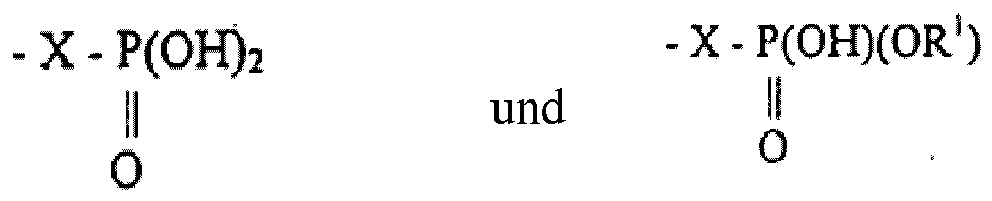
- Strahlungsempfindliches Element nach Anspruch 1, worin die mindestens eine Gruppe des Stabilisierermoleküls, das die radikalische Polymerisation inhibiert, abgeleitet ist von stabilen Radikalen, Mono-, Di- oder Trihydroxy-Aromaten, Chinonen, Nitrosoverbindungen und Mischungen daraus.
- Strahlungsempfindliches Element nach einem der Ansprüche 1 bis 2, worin der Stabilisierer eine Monomerverbindung ist.
- Strahlungsempfindliches Element nach einem der Ansprüche 1 bis 2, worin der Stabilisierer eine Polymerverbindung ist.
- Strahlungsempfindliches Element nach Anspruch 3, worin der Stabilisierer ausgewählt ist aus Verbindungen der Formel M1 und Mischungen daraus:


- Strahlungsempfindliches Element nach Anspruch 5, worin die Einheit


- Strahlungsempfindliches Element nach Anspruch 5 oder 6, worin X für -O- steht.
- Strahlungsempfindliches Element nach einem der Ansprüche 5 bis 7, worin R2 ein Wasserstoffatom ist.
- Strahlungsempfindliches Element nach einem der Ansprüche 5 bis 8, worin alle Gruppen A für Methylgruppen stehen.
- Strahlungsempfindliches Element nach Anspruch 4, worin der polymere Stabilisierer ein Copolymer ist, erhalten durch Polymerisation von mindestens einem der folgenden Monomere:Fumarsäure, Maleinsäureanhydrid, Ethylen, Propylen, Acrylsäureester, Methacrylsäureester, Vinylester, Vinylalkohol und Styrol mit mindestens einem copolymerisierbaren Monomer, substituiert mit mindestens einer Sorptionsgruppe und mindestens einem polymerisierbaren Monomer, substituiert mit mindestens einer Inhibitorgruppe.
- Strahlungsempfindliches Element nach Anspruch 4 oder 10, worin das Polymer mindestens eine Struktureinheit umfasst, die am Substrat sorptionsfähig ist, ausgewählt aus


- Strahlungsempfindliches Element nach einem der Ansprüche 4, 10 und 11, worin das Polymer mindestens eine Struktureinheit umfasst, die eine radikalische Polymerisation zu inhibieren vermag, ausgewählt aus:


- Strahlungsempfindliches Element nach einem der Ansprüche 1 bis 12, worin die strahlungsempfindliche Beschichtung zudem mindestens ein Additiv umfasst, ausgewählt aus Coinitiatoren, die freie Radikale nach der Anregung des Initiators oder Sensibilisierers mit Strahlung von einer Wellenlänge von 250 bis 1.200 nm bilden, Bindemitteln, Farbstoffen, Tensiden und Polymerisationsinhibitoren, die nicht an der Fläche des Substrats sorptionsfähig sind.
- Strahlungsempfindliches Element nach einem der Ansprüche 1 bis 13, worin mindestens 80 Gew.-% des Stabilisierers (iii) an der hydrophilen Fläche des Substrats sorbiert werden.
- Strahlungsempfindliches Element nach einem der Ansprüche 1 bis 14, worin das Substrat eine Aluminiumfolie oder -platte ist mit einer hydrophilen Fläche auf mindestens einer Seite.
- Strahlungsempfindliches Element nach einem der Ansprüche 1 bis 15, worin das Element zudem eine sauerstoffundurchlässige Deckschicht umfasst.
- Verfahren zur Herstellung eines strahlungsempfindlichen Elements nach einem der Ansprüche 1 bis 15, das Folgendes umfasst:(a) Bereitstellen eines wahlweise vorbehandelten Substrats mit einer hydrophilen Fläche;(b) Aufbringen einer strahlungsempfindlichen Mischung, die Folgendes umfasst:(i) mindestens ein radikalisch polymerisierbares Monomer und/oder Oligomer und/oder Polymer mit je mindestens einer ethylenisch ungesättigten Gruppe,(ii) mindestens einen Absorber, ausgewählt aus Photoinitiatoren und -sensibilisierern, der eine Strahlung von einer Wellenlänge im Bereich von 250 bis 1.200 nm zu absorbieren vermag,(iii) mindestens einem Stabilisierer, der in seinem Molekül mindestens eine Gruppe umfasst, die an der hydrophilen Fläche des Substrats sorptionsf ähig ist und ausgewählt ist aus
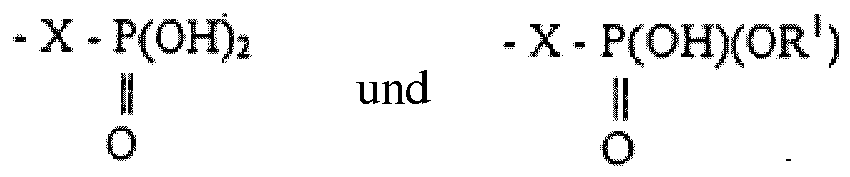
und mindestens eine weitere Gruppe, die radikalische Polymerisation zu inhibieren vermag,(iv) ein Lösungsmittel oder eine Lösungsmittelmischung und(v) wahlweise mindestens ein Additiv, ausgewählt aus Coinitiatoren, die freie Radikale nach Anregung des Initiators oder Sensibilisierers mit Strahlung von einer Wellenlänge von 250 bis 1.200 nm bilden, Bindemittel, Farbstoffe, Tenside und Polymerisationsinhibitoren, die nicht an der Fläche des Substrats sorptionsfähig sind;
undc) Trocknen. - Verfahren zur Herstellung eines strahlungsempfindlichen Elements mit folgenden Schritten:(a) Bereitstellen eines wahlweise vorbehandelten Substrats mit einer hydrophilen Fläche;(b) Aufbringen einer Mischung, die nicht strahlungsempfindlich ist, die mindestens ein Lösungsmittel und mindestens einen Stabilisator umfasst, der in seinem Molekül mindestens eine Gruppe umfasst, die an dem Substrat sorptionsfähig ist und ausgewählt ist aus
 (c) Trocknen;(d) Aufbringen einer strahlungsempfindlichen Mischung, die Folgendes umfasst:(i) mindestens ein radikalisch polymerisierbares Monomer oder Oligomer und/oder Polymer mit je mindestens einer ethylenisch ungesättigten Gruppe,(ii) mindestens einen Absorber, ausgewählt aus Polymerisationsinitiatoren und -sensibilisierern, der eine Strahlung von einer Wellenlänge im Bereich von 250 bis 1.200 nm zu absorbieren vermag,(iii) ein Lösungsmittel oder eine Lösungsmittelmischung und(iv) wahlweise mindestens ein Additiv, ausgewählt aus Coinitiatoren, die freie Radikale bilden nach Anregung des Initiators oder Sensibilisierers mit Strahlung von einer Wellenlänge von 250 bis 1.200 nm, Bindemittel, Farbstoffe, Weichmacher, Kettenübertragungsmittel, Leucofarbstoffe, anorganische Füllmittel, Tenside und Polymerisationsinhibitoren, die nicht an der Fläche des Substrats sorptionsfähig sind;
und(e) Trocknen. - Verfahren nach Anspruch 17 oder 18, worin das Verfahren zudem den Schritt des Anwendens einer sauerstoffundurchlässigen Deckschicht umfasst.
- Verfahren nach einem der Ansprüche 17 bis 19, worin das wahlweise vorbehandelte Substrat mit einer hydrophilen Oberfläche eine Aluminiumfolie oder -platte ist, die vor dem Beschichten wahlweise mindestens einer Behandlung unterzogen wurde, ausgewählt aus Aufrauen, Anodisieren und Aufbringen einer Hydrophilierungsschicht.
- Offsetdruckform, herstellbar durch(a) Bereitstellen eines strahlungsempfindlichen Elements nach einem der Ansprüche 1 bis 16;(b) bildweises Belichten des Elements mit Strahlung von einer Wellenlänge, die auf den in der strahlungsempfindlichen Beschichtung enthaltenen Absorber abgestimmt ist;(c) wahlweises Erwärmen des bestrahlten Elements;(d) Entfernen der unbelichteten Bereiche der Beschichtung mit einem wässrigen alkalischen Entwickler;(e) wahlweise Erwärmen der entwickelten Druckform und/oder Unterziehen der Druckform mit einer Gesamtbelichtung.
Applications Claiming Priority (3)
| Application Number | Priority Date | Filing Date | Title |
|---|---|---|---|
| DE10255667A DE10255667B4 (de) | 2002-11-28 | 2002-11-28 | Strahlungsempfindliche Elemente mit ausgezeichneter Lagerbeständigkeit |
| DE10255667 | 2002-11-28 | ||
| PCT/EP2003/013431 WO2004049071A1 (en) | 2002-11-28 | 2003-11-28 | Radiation-sensitive elements and their storage stability |
Publications (2)
| Publication Number | Publication Date |
|---|---|
| EP1565790A1 EP1565790A1 (de) | 2005-08-24 |
| EP1565790B1 true EP1565790B1 (de) | 2012-08-15 |
Family
ID=32335836
Family Applications (1)
| Application Number | Title | Priority Date | Filing Date |
|---|---|---|---|
| EP03811776A Expired - Lifetime EP1565790B1 (de) | 2002-11-28 | 2003-11-28 | Strahlungsempfindliche elemente und ihre lagerstabilität |
Country Status (5)
| Country | Link |
|---|---|
| US (1) | US7285372B2 (de) |
| EP (1) | EP1565790B1 (de) |
| AU (1) | AU2003302194A1 (de) |
| DE (1) | DE10255667B4 (de) |
| WO (1) | WO2004049071A1 (de) |
Families Citing this family (34)
| Publication number | Priority date | Publication date | Assignee | Title |
|---|---|---|---|---|
| JP2005221715A (ja) * | 2004-02-05 | 2005-08-18 | Konica Minolta Medical & Graphic Inc | 平版印刷版原版および平版印刷版の製版方法 |
| US7923193B2 (en) * | 2004-11-05 | 2011-04-12 | Agfa Graphics Nv | Photopolymerizable composition |
| DE102005007615B3 (de) * | 2005-02-18 | 2006-11-02 | Kodak Polychrome Graphics Gmbh | Verfahren zur Herstellung von Lithographie-Druckplatten |
| JP2006316311A (ja) * | 2005-05-12 | 2006-11-24 | Institute Of Physical & Chemical Research | 金属錯イオンの光還元方法 |
| EP1783548B1 (de) * | 2005-11-08 | 2017-03-08 | Rohm and Haas Electronic Materials LLC | Verfahren zur Bildung einer gemusterten Schicht auf einem Substrat |
| KR101000360B1 (ko) * | 2008-09-22 | 2010-12-13 | 롬엔드하스전자재료코리아유한회사 | 현상 가능한 초소수성 감광성조성물 |
| KR20100052948A (ko) * | 2008-11-11 | 2010-05-20 | 삼성전자주식회사 | 라디칼 중합용 조성물 및 이를 이용한 패턴 형성 방법 |
| US20100227269A1 (en) | 2009-03-04 | 2010-09-09 | Simpson Christopher D | Imageable elements with colorants |
| US8900798B2 (en) | 2010-10-18 | 2014-12-02 | Eastman Kodak Company | On-press developable lithographic printing plate precursors |
| US20120090486A1 (en) | 2010-10-18 | 2012-04-19 | Celin Savariar-Hauck | Lithographic printing plate precursors and methods of use |
| US20120141935A1 (en) | 2010-12-03 | 2012-06-07 | Bernd Strehmel | Developer and its use to prepare lithographic printing plates |
| US20120141941A1 (en) | 2010-12-03 | 2012-06-07 | Mathias Jarek | Developing lithographic printing plate precursors in simple manner |
| US20120141942A1 (en) | 2010-12-03 | 2012-06-07 | Domenico Balbinot | Method of preparing lithographic printing plates |
| US20120199028A1 (en) | 2011-02-08 | 2012-08-09 | Mathias Jarek | Preparing lithographic printing plates |
| US8632940B2 (en) | 2011-04-19 | 2014-01-21 | Eastman Kodak Company | Aluminum substrates and lithographic printing plate precursors |
| US8722308B2 (en) | 2011-08-31 | 2014-05-13 | Eastman Kodak Company | Aluminum substrates and lithographic printing plate precursors |
| US8632941B2 (en) | 2011-09-22 | 2014-01-21 | Eastman Kodak Company | Negative-working lithographic printing plate precursors with IR dyes |
| US9029063B2 (en) | 2011-09-22 | 2015-05-12 | Eastman Kodak Company | Negative-working lithographic printing plate precursors |
| US8679726B2 (en) | 2012-05-29 | 2014-03-25 | Eastman Kodak Company | Negative-working lithographic printing plate precursors |
| US8889341B2 (en) | 2012-08-22 | 2014-11-18 | Eastman Kodak Company | Negative-working lithographic printing plate precursors and use |
| US8927197B2 (en) | 2012-11-16 | 2015-01-06 | Eastman Kodak Company | Negative-working lithographic printing plate precursors |
| EP2735903B1 (de) | 2012-11-22 | 2019-02-27 | Eastman Kodak Company | Negativ arbeitende Lithografiedruckplattenvorläufer mit hochverzweigtem Bindemittelmaterial |
| US9063423B2 (en) | 2013-02-28 | 2015-06-23 | Eastman Kodak Company | Lithographic printing plate precursors and use |
| US9201302B2 (en) | 2013-10-03 | 2015-12-01 | Eastman Kodak Company | Negative-working lithographic printing plate precursor |
| WO2016157988A1 (ja) * | 2015-03-31 | 2016-10-06 | 富士フイルム株式会社 | 上層膜形成用組成物、パターン形成方法、レジストパターン、及び、電子デバイスの製造方法 |
| US10828884B2 (en) | 2017-03-02 | 2020-11-10 | Eastman Kodak Company | Lithographic printing plate precursors and method of use |
| KR20220049492A (ko) * | 2019-08-28 | 2022-04-21 | 닛토덴코 가부시키가이샤 | 편광 필름, 적층 편광 필름, 화상 표시 패널, 및 화상 표시 장치 |
| KR102918311B1 (ko) * | 2019-08-28 | 2026-01-27 | 닛토덴코 가부시키가이샤 | 편광 필름, 적층 편광 필름, 화상 표시 패널, 및 화상 표시 장치 |
| JP7793371B2 (ja) * | 2019-08-28 | 2026-01-05 | 日東電工株式会社 | 偏光フィルム、積層偏光フィルム、画像表示パネル、および画像表示装置 |
| US11117412B2 (en) | 2019-10-01 | 2021-09-14 | Eastman Kodak Company | Lithographic printing plate precursors and method of use |
| US11633948B2 (en) | 2020-01-22 | 2023-04-25 | Eastman Kodak Company | Method for making lithographic printing plates |
| EP3922462B1 (de) * | 2020-06-08 | 2023-03-01 | Agfa Offset Bv | Lithografischer photopolymerer druckplattenvorläufer mit verbesserter tageslichtstabilität |
| WO2022119719A1 (en) | 2020-12-04 | 2022-06-09 | Eastman Kodak Company | Lithographic printing plate precursors and method of use |
| WO2022132444A1 (en) | 2020-12-17 | 2022-06-23 | Eastman Kodak Company | Lithographic printing plate precursors and method of use |
Family Cites Families (31)
| Publication number | Priority date | Publication date | Assignee | Title |
|---|---|---|---|---|
| US3717558A (en) | 1972-03-30 | 1973-02-20 | Scm Corp | Photopolymerization catalyst comprising a metallocene and an active halogen-containing compound |
| IT976524B (it) | 1973-01-29 | 1974-09-10 | Cioni E | Congegno per l avanzamento delle fiale lungo un piano inclinato per macchine infialatrici e simili |
| US4355096A (en) | 1980-07-11 | 1982-10-19 | American Hoechst Corporation | Process for heating exposed and developed light-sensitive lithographic printing plates with carboxylic acid and amine moiety containing compounds on surface thereof |
| DE3126627A1 (de) * | 1981-07-06 | 1983-01-20 | Hoechst Ag, 6000 Frankfurt | Polyvinylmethylphosphinsaeure, verfahren zu ihrer herstellung und ihre verwendung |
| US4590287A (en) | 1983-02-11 | 1986-05-20 | Ciba-Geigy Corporation | Fluorinated titanocenes and photopolymerizable composition containing same |
| EP0256981B1 (de) | 1986-08-01 | 1993-02-17 | Ciba-Geigy Ag | Titanocene und deren Verwendung |
| US4857654A (en) | 1986-08-01 | 1989-08-15 | Ciba-Geigy Corporation | Titanocenes and their use |
| EP0269573B1 (de) | 1986-11-26 | 1991-03-27 | Ciba-Geigy Ag | Flüssige Photoinitiatorgemische |
| DE3641014A1 (de) * | 1986-12-19 | 1988-06-16 | Wolfen Filmfab Veb | Fotopolymerisierbares material |
| US5086086A (en) | 1987-08-28 | 1992-02-04 | Minnesota Mining And Manufacturing Company | Energy-induced curable compositions |
| US5008302A (en) | 1987-12-01 | 1991-04-16 | Ciba-Geigy Corporation | Titanocenes, the use thereof, and N-substituted pyrroles |
| US4959297A (en) | 1987-12-09 | 1990-09-25 | Minnesota Mining And Manufacturing Company | Ternary photoinitiator system for addition polymerization |
| DE3832032A1 (de) | 1988-09-21 | 1990-03-22 | Hoechst Ag | Photopolymerisierbares gemisch und daraus hergestelltes aufzeichnungsmaterial |
| US4971892A (en) | 1988-11-23 | 1990-11-20 | Minnesota Mining And Manufacturing Company | High sensitivity photopolymerizable composition |
| US5192642A (en) | 1989-06-01 | 1993-03-09 | Ciba-Geigy Corporation | Oxygen-containing titanocenes, and the use thereof |
| DE4008815A1 (de) | 1990-03-20 | 1991-09-26 | Hoechst Ag | Photopolymerisierbares gemisch und daraus hergestelltes aufzeichnungsmaterial |
| DE4013358A1 (de) | 1990-04-26 | 1991-10-31 | Hoechst Ag | Verfahren zur herstellung von druckformen oder photoresists durch bildmaessiges bestrahlen eines photopolymerisierbaren aufzeichnungsmaterials |
| DE4217495A1 (de) | 1992-05-27 | 1993-12-02 | Hoechst Ag | Photopolymerisierbares Gemisch und daraus hergestelltes Aufzeichnungsmaterial |
| DE4418645C1 (de) | 1994-05-27 | 1995-12-14 | Sun Chemical Corp | Lichtempfindliches Gemisch und daraus herstellbares Aufzeichnungsmaterial |
| US5599650A (en) * | 1995-04-28 | 1997-02-04 | Polaroid Corporation | Photoreaction quenchers in on-press developable lithographic printing plates |
| US5677108A (en) * | 1995-04-28 | 1997-10-14 | Polaroid Corporation | On-press removable quenching overcoat for lithographic plates |
| US5912106A (en) * | 1996-09-10 | 1999-06-15 | Ciba Specialty Chemicals Corporation | Method for improving photoimage quality |
| US5795698A (en) * | 1996-09-13 | 1998-08-18 | Polaroid Corporation | On-press developable printing plate with amphoteric hydrogen bond forming developability stabilizer |
| US6323361B1 (en) | 1997-04-17 | 2001-11-27 | Corning Inc. | Photocurable halofluorinated acrylates |
| US6291704B1 (en) | 1998-01-20 | 2001-09-18 | Alliedsignal Inc. | Polymerizable halogenated vinyl ethers |
| US6308001B1 (en) | 1998-12-22 | 2001-10-23 | Alliedsignal Inc. | Radiation curable fluorinated vinyl ethers derived from hexafluoropropene |
| JP4037015B2 (ja) * | 1999-09-22 | 2008-01-23 | 富士フイルム株式会社 | 光重合性組成物、画像形成材料及び平版印刷版用版材 |
| JP4092055B2 (ja) | 2000-02-09 | 2008-05-28 | 三菱製紙株式会社 | 感光性組成物および感光性平版印刷版材料 |
| JP4156784B2 (ja) | 2000-07-25 | 2008-09-24 | 富士フイルム株式会社 | ネガ型画像記録材料及び画像形成方法 |
| JP4512281B2 (ja) * | 2001-02-22 | 2010-07-28 | 富士フイルム株式会社 | ネガ型平版印刷版原版 |
| US7226964B2 (en) * | 2003-04-03 | 2007-06-05 | Arkema France | Composition comprising a nitroxide, a promoter and optionally a free-radical initiator |
-
2002
- 2002-11-28 DE DE10255667A patent/DE10255667B4/de not_active Expired - Fee Related
-
2003
- 2003-11-28 US US10/536,514 patent/US7285372B2/en not_active Expired - Fee Related
- 2003-11-28 EP EP03811776A patent/EP1565790B1/de not_active Expired - Lifetime
- 2003-11-28 WO PCT/EP2003/013431 patent/WO2004049071A1/en not_active Ceased
- 2003-11-28 AU AU2003302194A patent/AU2003302194A1/en not_active Abandoned
Also Published As
| Publication number | Publication date |
|---|---|
| US7285372B2 (en) | 2007-10-23 |
| US20060051699A1 (en) | 2006-03-09 |
| WO2004049071A1 (en) | 2004-06-10 |
| AU2003302194A1 (en) | 2004-06-18 |
| DE10255667B4 (de) | 2006-05-11 |
| WO2004049071A8 (en) | 2005-06-02 |
| EP1565790A1 (de) | 2005-08-24 |
| DE10255667A1 (de) | 2004-07-08 |
Similar Documents
| Publication | Publication Date | Title |
|---|---|---|
| EP1565790B1 (de) | Strahlungsempfindliche elemente und ihre lagerstabilität | |
| EP1690138B1 (de) | Strahlungsempfindliche zusammensetzungen und darauf basierende abbildbare elemente | |
| EP1595183B1 (de) | Strahlungsempfindliche zusammensetzungen mit oxazolderivaten und darauf basierende abbildbare elemente | |
| US7615323B2 (en) | Lithographic printing plate precursors with oligomeric or polymeric sensitizers | |
| US20060063101A1 (en) | Radiation-sensitive elements | |
| EP1987396B1 (de) | Vorläufer einer uv-empfindlichen lithographischen druckplatte mit benzoxazolderivat und analoga davon als sensibilisator | |
| EP1969426B1 (de) | Für lithografische druckplatten geeignete photopolymerzusammensetzung | |
| WO2004074929A2 (en) | Radiation-sensitive compositions and imageable elements based thereon | |
| WO2007121871A1 (en) | Bakeable lithographic printing plates with a high resistance to chemicals | |
| US7169534B2 (en) | Photopolymer composition suitable for lithographic printing plates | |
| EP1910896B1 (de) | Für lithographische druckplatten geeignete photopolymerzusammensetzung | |
| US20060154169A1 (en) | Radiation-sensitive compositions comprising a 1,4-dihydropyridine sensitizer and imageable elements based thereon | |
| WO2004111731A1 (en) | Radiation-sensitive compositions comprising a 1,4-dihydropyridine sensitizer and imageable elements based thereon | |
| EP1921500A1 (de) | UV-empfindliche Elemente mit Triarylaminderivaten als Sensibilisatoren |
Legal Events
| Date | Code | Title | Description |
|---|---|---|---|
| PUAI | Public reference made under article 153(3) epc to a published international application that has entered the european phase |
Free format text: ORIGINAL CODE: 0009012 |
|
| 17P | Request for examination filed |
Effective date: 20050504 |
|
| AK | Designated contracting states |
Kind code of ref document: A1 Designated state(s): AT BE BG CH CY CZ DE DK EE ES FI FR GB GR HU IE IT LI LU MC NL PT RO SE SI SK TR |
|
| AX | Request for extension of the european patent |
Extension state: AL LT LV MK |
|
| DAX | Request for extension of the european patent (deleted) | ||
| RIN1 | Information on inventor provided before grant (corrected) |
Inventor name: DWARS, UDO Inventor name: FLUGEL, MICHAEL Inventor name: BAUMANN, HARALD Inventor name: KOTTMAIR, EDUARD |
|
| RAP1 | Party data changed (applicant data changed or rights of an application transferred) |
Owner name: KODAK GRAPHIC COMMUNICATIONS GMBH |
|
| 17Q | First examination report despatched |
Effective date: 20101126 |
|
| GRAP | Despatch of communication of intention to grant a patent |
Free format text: ORIGINAL CODE: EPIDOSNIGR1 |
|
| GRAC | Information related to communication of intention to grant a patent modified |
Free format text: ORIGINAL CODE: EPIDOSCIGR1 |
|
| GRAS | Grant fee paid |
Free format text: ORIGINAL CODE: EPIDOSNIGR3 |
|
| GRAA | (expected) grant |
Free format text: ORIGINAL CODE: 0009210 |
|
| AK | Designated contracting states |
Kind code of ref document: B1 Designated state(s): AT BE BG CH CY CZ DE DK EE ES FI FR GB GR HU IE IT LI LU MC NL PT RO SE SI SK TR |
|
| REG | Reference to a national code |
Ref country code: CH Ref legal event code: EP Ref country code: GB Ref legal event code: FG4D Ref country code: AT Ref legal event code: REF Ref document number: 571127 Country of ref document: AT Kind code of ref document: T Effective date: 20120815 |
|
| REG | Reference to a national code |
Ref country code: IE Ref legal event code: FG4D |
|
| REG | Reference to a national code |
Ref country code: DE Ref legal event code: R096 Ref document number: 60341867 Country of ref document: DE Effective date: 20121011 |
|
| REG | Reference to a national code |
Ref country code: NL Ref legal event code: T3 |
|
| REG | Reference to a national code |
Ref country code: AT Ref legal event code: MK05 Ref document number: 571127 Country of ref document: AT Kind code of ref document: T Effective date: 20120815 |
|
| PG25 | Lapsed in a contracting state [announced via postgrant information from national office to epo] |
Ref country code: FI Free format text: LAPSE BECAUSE OF FAILURE TO SUBMIT A TRANSLATION OF THE DESCRIPTION OR TO PAY THE FEE WITHIN THE PRESCRIBED TIME-LIMIT Effective date: 20120815 Ref country code: AT Free format text: LAPSE BECAUSE OF FAILURE TO SUBMIT A TRANSLATION OF THE DESCRIPTION OR TO PAY THE FEE WITHIN THE PRESCRIBED TIME-LIMIT Effective date: 20120815 |
|
| PG25 | Lapsed in a contracting state [announced via postgrant information from national office to epo] |
Ref country code: SI Free format text: LAPSE BECAUSE OF FAILURE TO SUBMIT A TRANSLATION OF THE DESCRIPTION OR TO PAY THE FEE WITHIN THE PRESCRIBED TIME-LIMIT Effective date: 20120815 Ref country code: SE Free format text: LAPSE BECAUSE OF FAILURE TO SUBMIT A TRANSLATION OF THE DESCRIPTION OR TO PAY THE FEE WITHIN THE PRESCRIBED TIME-LIMIT Effective date: 20120815 Ref country code: PT Free format text: LAPSE BECAUSE OF FAILURE TO SUBMIT A TRANSLATION OF THE DESCRIPTION OR TO PAY THE FEE WITHIN THE PRESCRIBED TIME-LIMIT Effective date: 20121217 Ref country code: BE Free format text: LAPSE BECAUSE OF FAILURE TO SUBMIT A TRANSLATION OF THE DESCRIPTION OR TO PAY THE FEE WITHIN THE PRESCRIBED TIME-LIMIT Effective date: 20120815 Ref country code: GR Free format text: LAPSE BECAUSE OF FAILURE TO SUBMIT A TRANSLATION OF THE DESCRIPTION OR TO PAY THE FEE WITHIN THE PRESCRIBED TIME-LIMIT Effective date: 20121116 |
|
| PG25 | Lapsed in a contracting state [announced via postgrant information from national office to epo] |
Ref country code: CZ Free format text: LAPSE BECAUSE OF FAILURE TO SUBMIT A TRANSLATION OF THE DESCRIPTION OR TO PAY THE FEE WITHIN THE PRESCRIBED TIME-LIMIT Effective date: 20120815 Ref country code: EE Free format text: LAPSE BECAUSE OF FAILURE TO SUBMIT A TRANSLATION OF THE DESCRIPTION OR TO PAY THE FEE WITHIN THE PRESCRIBED TIME-LIMIT Effective date: 20120815 Ref country code: ES Free format text: LAPSE BECAUSE OF FAILURE TO SUBMIT A TRANSLATION OF THE DESCRIPTION OR TO PAY THE FEE WITHIN THE PRESCRIBED TIME-LIMIT Effective date: 20121126 Ref country code: RO Free format text: LAPSE BECAUSE OF FAILURE TO SUBMIT A TRANSLATION OF THE DESCRIPTION OR TO PAY THE FEE WITHIN THE PRESCRIBED TIME-LIMIT Effective date: 20120815 Ref country code: DK Free format text: LAPSE BECAUSE OF FAILURE TO SUBMIT A TRANSLATION OF THE DESCRIPTION OR TO PAY THE FEE WITHIN THE PRESCRIBED TIME-LIMIT Effective date: 20120815 |
|
| PG25 | Lapsed in a contracting state [announced via postgrant information from national office to epo] |
Ref country code: IT Free format text: LAPSE BECAUSE OF FAILURE TO SUBMIT A TRANSLATION OF THE DESCRIPTION OR TO PAY THE FEE WITHIN THE PRESCRIBED TIME-LIMIT Effective date: 20120815 Ref country code: SK Free format text: LAPSE BECAUSE OF FAILURE TO SUBMIT A TRANSLATION OF THE DESCRIPTION OR TO PAY THE FEE WITHIN THE PRESCRIBED TIME-LIMIT Effective date: 20120815 Ref country code: CY Free format text: LAPSE BECAUSE OF FAILURE TO SUBMIT A TRANSLATION OF THE DESCRIPTION OR TO PAY THE FEE WITHIN THE PRESCRIBED TIME-LIMIT Effective date: 20120815 |
|
| PLBE | No opposition filed within time limit |
Free format text: ORIGINAL CODE: 0009261 |
|
| STAA | Information on the status of an ep patent application or granted ep patent |
Free format text: STATUS: NO OPPOSITION FILED WITHIN TIME LIMIT |
|
| REG | Reference to a national code |
Ref country code: CH Ref legal event code: PL |
|
| 26N | No opposition filed |
Effective date: 20130516 |
|
| PG25 | Lapsed in a contracting state [announced via postgrant information from national office to epo] |
Ref country code: BG Free format text: LAPSE BECAUSE OF FAILURE TO SUBMIT A TRANSLATION OF THE DESCRIPTION OR TO PAY THE FEE WITHIN THE PRESCRIBED TIME-LIMIT Effective date: 20121115 Ref country code: LI Free format text: LAPSE BECAUSE OF NON-PAYMENT OF DUE FEES Effective date: 20121130 Ref country code: CH Free format text: LAPSE BECAUSE OF NON-PAYMENT OF DUE FEES Effective date: 20121130 |
|
| REG | Reference to a national code |
Ref country code: FR Ref legal event code: ST Effective date: 20130731 |
|
| REG | Reference to a national code |
Ref country code: DE Ref legal event code: R097 Ref document number: 60341867 Country of ref document: DE Effective date: 20130516 |
|
| PG25 | Lapsed in a contracting state [announced via postgrant information from national office to epo] |
Ref country code: FR Free format text: LAPSE BECAUSE OF NON-PAYMENT OF DUE FEES Effective date: 20121130 |
|
| PG25 | Lapsed in a contracting state [announced via postgrant information from national office to epo] |
Ref country code: TR Free format text: LAPSE BECAUSE OF FAILURE TO SUBMIT A TRANSLATION OF THE DESCRIPTION OR TO PAY THE FEE WITHIN THE PRESCRIBED TIME-LIMIT Effective date: 20120815 Ref country code: MC Free format text: LAPSE BECAUSE OF NON-PAYMENT OF DUE FEES Effective date: 20121130 |
|
| PG25 | Lapsed in a contracting state [announced via postgrant information from national office to epo] |
Ref country code: LU Free format text: LAPSE BECAUSE OF NON-PAYMENT OF DUE FEES Effective date: 20121128 |
|
| PG25 | Lapsed in a contracting state [announced via postgrant information from national office to epo] |
Ref country code: HU Free format text: LAPSE BECAUSE OF FAILURE TO SUBMIT A TRANSLATION OF THE DESCRIPTION OR TO PAY THE FEE WITHIN THE PRESCRIBED TIME-LIMIT Effective date: 20031128 |
|
| PG25 | Lapsed in a contracting state [announced via postgrant information from national office to epo] |
Ref country code: IE Free format text: LAPSE BECAUSE OF FAILURE TO SUBMIT A TRANSLATION OF THE DESCRIPTION OR TO PAY THE FEE WITHIN THE PRESCRIBED TIME-LIMIT Effective date: 20120815 |
|
| REG | Reference to a national code |
Ref country code: IE Ref legal event code: MM4A |
|
| PGFP | Annual fee paid to national office [announced via postgrant information from national office to epo] |
Ref country code: DE Payment date: 20151130 Year of fee payment: 13 Ref country code: GB Payment date: 20151027 Year of fee payment: 13 |
|
| PGFP | Annual fee paid to national office [announced via postgrant information from national office to epo] |
Ref country code: NL Payment date: 20151106 Year of fee payment: 13 |
|
| REG | Reference to a national code |
Ref country code: DE Ref legal event code: R119 Ref document number: 60341867 Country of ref document: DE |
|
| REG | Reference to a national code |
Ref country code: NL Ref legal event code: MM Effective date: 20161201 |
|
| GBPC | Gb: european patent ceased through non-payment of renewal fee |
Effective date: 20161128 |
|
| PG25 | Lapsed in a contracting state [announced via postgrant information from national office to epo] |
Ref country code: NL Free format text: LAPSE BECAUSE OF NON-PAYMENT OF DUE FEES Effective date: 20161201 |
|
| PG25 | Lapsed in a contracting state [announced via postgrant information from national office to epo] |
Ref country code: DE Free format text: LAPSE BECAUSE OF NON-PAYMENT OF DUE FEES Effective date: 20170601 Ref country code: GB Free format text: LAPSE BECAUSE OF NON-PAYMENT OF DUE FEES Effective date: 20161128 |