EP1565023A2 - Verfahren zur Durchführung von Compressed-Mode HARQ in einem HSDPA unterstützenden mobilen Kommunikationssystem - Google Patents
Verfahren zur Durchführung von Compressed-Mode HARQ in einem HSDPA unterstützenden mobilen Kommunikationssystem Download PDFInfo
- Publication number
- EP1565023A2 EP1565023A2 EP05003074A EP05003074A EP1565023A2 EP 1565023 A2 EP1565023 A2 EP 1565023A2 EP 05003074 A EP05003074 A EP 05003074A EP 05003074 A EP05003074 A EP 05003074A EP 1565023 A2 EP1565023 A2 EP 1565023A2
- Authority
- EP
- European Patent Office
- Prior art keywords
- ack
- transmission
- period
- nack
- transmitting
- Prior art date
- Legal status (The legal status is an assumption and is not a legal conclusion. Google has not performed a legal analysis and makes no representation as to the accuracy of the status listed.)
- Withdrawn
Links
Images




Classifications
-
- H—ELECTRICITY
- H04—ELECTRIC COMMUNICATION TECHNIQUE
- H04L—TRANSMISSION OF DIGITAL INFORMATION, e.g. TELEGRAPHIC COMMUNICATION
- H04L1/00—Arrangements for detecting or preventing errors in the information received
- H04L1/12—Arrangements for detecting or preventing errors in the information received by using return channel
- H04L1/16—Arrangements for detecting or preventing errors in the information received by using return channel in which the return channel carries supervisory signals, e.g. repetition request signals
- H04L1/1607—Details of the supervisory signal
- H04L1/1628—List acknowledgements, i.e. the acknowledgement message consisting of a list of identifiers, e.g. of sequence numbers
-
- H—ELECTRICITY
- H04—ELECTRIC COMMUNICATION TECHNIQUE
- H04W—WIRELESS COMMUNICATION NETWORKS
- H04W36/00—Hand-off or reselection arrangements
- H04W36/12—Reselecting a serving backbone network switching or routing node
-
- H—ELECTRICITY
- H04—ELECTRIC COMMUNICATION TECHNIQUE
- H04B—TRANSMISSION
- H04B7/00—Radio transmission systems, i.e. using radiation field
- H04B7/24—Radio transmission systems, i.e. using radiation field for communication between two or more posts
- H04B7/26—Radio transmission systems, i.e. using radiation field for communication between two or more posts at least one of which is mobile
- H04B7/2628—Radio transmission systems, i.e. using radiation field for communication between two or more posts at least one of which is mobile using code-division multiple access [CDMA] or spread spectrum multiple access [SSMA]
- H04B7/2631—Radio transmission systems, i.e. using radiation field for communication between two or more posts at least one of which is mobile using code-division multiple access [CDMA] or spread spectrum multiple access [SSMA] for broadband transmission
-
- H—ELECTRICITY
- H04—ELECTRIC COMMUNICATION TECHNIQUE
- H04L—TRANSMISSION OF DIGITAL INFORMATION, e.g. TELEGRAPHIC COMMUNICATION
- H04L1/00—Arrangements for detecting or preventing errors in the information received
- H04L1/12—Arrangements for detecting or preventing errors in the information received by using return channel
- H04L1/16—Arrangements for detecting or preventing errors in the information received by using return channel in which the return channel carries supervisory signals, e.g. repetition request signals
- H04L1/18—Automatic repetition systems, e.g. Van Duuren systems
- H04L1/1829—Arrangements specially adapted for the receiver end
-
- H—ELECTRICITY
- H04—ELECTRIC COMMUNICATION TECHNIQUE
- H04L—TRANSMISSION OF DIGITAL INFORMATION, e.g. TELEGRAPHIC COMMUNICATION
- H04L1/00—Arrangements for detecting or preventing errors in the information received
- H04L1/12—Arrangements for detecting or preventing errors in the information received by using return channel
- H04L1/16—Arrangements for detecting or preventing errors in the information received by using return channel in which the return channel carries supervisory signals, e.g. repetition request signals
- H04L1/18—Automatic repetition systems, e.g. Van Duuren systems
- H04L1/1803—Stop-and-wait protocols
-
- H—ELECTRICITY
- H04—ELECTRIC COMMUNICATION TECHNIQUE
- H04W—WIRELESS COMMUNICATION NETWORKS
- H04W36/00—Hand-off or reselection arrangements
- H04W36/0005—Control or signalling for completing the hand-off
- H04W36/0083—Determination of parameters used for hand-off, e.g. generation or modification of neighbour cell lists
- H04W36/0085—Hand-off measurements
- H04W36/0088—Scheduling hand-off measurements
Definitions
- the present invention relates generally to a mobile communication system supporting High Speed Downlink Packet Access (HSDPA).
- HSDPA High Speed Downlink Packet Access
- the present invention relates to a method for minimizing a data transmission delay of Hybrid Automatic Repeat reQuest (HARQ) in an uplink compressed mode.
- HARQ Hybrid Automatic Repeat reQuest
- HSDPA refers to a scheme for supporting high speed downlink packet data transmission in a Universal Mobile Telecommunication System (UMTS) communication system, a next generation asynchronous communication system, and supports a high speed downlink shared channel (HS-DSCH), a shared control channel (HS-SCCH) for HS-DSCH, and an uplink dedicated physical control channel (HS-DPCCH) for HS-DSCH.
- UMTS Universal Mobile Telecommunication System
- HS-DSCH high speed downlink shared channel
- HS-SCCH shared control channel
- HS-DPCCH uplink dedicated physical control channel
- AMC Adaptive Modulation and Coding
- the AMC scheme refers to a data transmission scheme for adaptively determining a modulation scheme and a coding scheme according to a channel state between a Node B and a user equipment (UE), thereby improving the entire system efficiency of the Node B. Therefore, the AMC scheme comprises a plurality of modulation schemes and a plurality of coding schemes, and modulates/codes a data channel signal with a combination of the modulation schemes and the coding schemes. Commonly, each of the combinations of the modulation schemes and the coding schemes is referred to as a "Modulation and Coding Scheme (MCS)", and a plurality of MCSs with a level 1 to level n can be defined according to the number of the MCSs. That is, the AMC scheme adaptively determines a level of the MCS according to a channel state between a Node B and a UE currently connected to the Node B, thereby improving the entire system efficiency of the Node B.
- MCS Modulation and Coding Scheme
- the HARQ scheme introduces the following two planes in order to increase transmission efficiency of an Automatic Repeat request (ARQ) scheme.
- a first plane is provided to perform an exchange of the retransmission request and response between a UE and a Node B, and a second plane is provided to temporarily store defective data and then combine the stored defective data with its retransmitted data.
- the HARQ scheme introduces the n-channel SAW HARQ scheme in order to make up for the defects of the conventional Stop And Wait ARQ (SAW ARQ) scheme.
- SAW ARQ Stop And Wait ARQ
- the SAW ARQ scheme cannot transmit the next packet data before an acknowledgement (ACK) for the previous packet data is received.
- the SAW ARQ scheme should wait for an ACK even though it is now possible to transmit packet data.
- the n-channel SAW HARQ scheme continuously transmits a plurality of data packets even before the ACK for the previous packet data is received, thereby increasing channel efficiency.
- n logical channels are established between a UE and a Node B, and if each of the n logical channels can be identified by its unique time and channel number, the UE receiving packet data can determine a channel over which the received packet data is transmitted, and reorder data packets in a good order or soft-combine the corresponding packet data.
- a UE checks whether there is an error in data transmitted by a Node B, and transmits an ACK or a negative ACK (NACK) as the error check result over an HS-DPCCH for supporting HSDPA.
- Information indicating whether there is an error in transmitted data is denoted by ACK/NACK.
- a UE can transmit channel quality information to a Node B. Downlink channel quality information is indicated by a channel quality indicator (CQI).
- CQI channel quality indicator
- the compressed mode refers to a scheme in which a UE is ordered to provide a timing gap for monitoring and measuring the other communication network in order to perform inter-frequency handover or inter-radio access technology handover.
- the UE receives primary common pilot channel (P-CPICH) signals from available cells, and measures Received Signal Strength Indicators (RSSIs) of the received P-CPICH signals.
- the UE reports the measured RSSIs of the P-CPICH signals to a radio network controller (RNC).
- RNC radio network controller
- the RNC determines a handover state of the UE based on the RSSIs of the P-CPICH signals that are reported from the UE. That is, the RNC includes a step (1) of determining whether the UE should perform handover, and if the UE should perform handover, a step (2) of selecting a target cell to which the UE should perform handover from among the cells.
- the UE in order to perform handover, the UE necessarily requires a process of measuring P-CPICH signals from its neighbor cells.
- a UE In the compressed mode, if a part of an HS-DPCCH transmitting the ACK/NACK or CQI information to a Node B overlaps with a slot corresponding to a transmission gap (TG) period of an uplink dedicated physical channel (DPCH), a UE cannot transmit ACK/NACK or CQI through its associated subframe of the HS-DPCCH.
- TG transmission gap
- DPCH uplink dedicated physical channel
- FIG. 1 is a diagram illustrating a conventional timing relationship between an uplink dedicated physical channel and a downlink channel when uplink control information cannot be transmitted due to a TG period in a compressed mode.
- an uplink dedicated physical channel (UL-DPCH) 120 basically has a 10-ms frame structure. Each frame is comprised of 15 slots, and each slot has a 2560-chip length. Therefore, one frame has a 38400-chip length.
- OVSF orthogonal variable spreading factor
- Control information for controlling the HS-PDSCH is transmitted over a high speed shared control channel (HS-SCCH).
- HS-SCCH high speed shared control channel
- the HS-PDSCH control information transmitted over the HS-SCCH includes:
- the HS-SCCH can be roughly divided into the TFRI part and the HARQ information part.
- the TFRI information is information necessary for despreading the HS-PDSCH over which HSDPA packet data is transmitted. If the UE does not have the TFRI information, it cannot despread the HS-PDSCH. Therefore, the TFRI information is transmitted with a first part of the HS-SCCH and the HARQ information is transmitted with a last part of the HS-SCCH.
- the HS-SCCH can be allocated one or more channelization codes.
- the maximum possible number of HS-SCCHs allocable to each UE is 4. Therefore, a Node B should inform a UE which of the 4 HS-SCCHs is allocated thereto.
- the Node B scrambles the TFRI information part, a first part of the HS-SCCH, using a UE ID.
- the UE ID is an ID allocated by the Node B to distinguish UEs. Then the UE can determine an HS-SCCH allocated thereto by descrambling TFRI information parts of received HS-SCCHs using the UE ID.
- a UE checks whether there is an error in data transmitted from a Node B, and transmits an ACK or a NACK as the error check result over the HS-DPCCH. Further, in order to support AMC, the UE can transmit channel quality report information to the Node B.
- the channel quality report information can be referred to as "channel quality indicator (CQI)". If a subframe, at which overlapping with a TG period begins in the HS-PDSCH, is an n th subframe, the UE cannot transmit ACKs corresponding to (n-2) th and (n-1) th subframes.
- the UE in a subframe period overlapping with a TG period of the UL-DPCH, the UE cannot transmit over the HS-PDSCH, ACKs 143 and 144 corresponding to packet data transmitted through an 0 th subframe and a 1 st subframe of the HS-PDSCH. That is, the UE cannot transmit ACK signals corresponding to the 0 th subframe and the 1 st subframe to the Node B at the two parts 161 and 162 of the HS-PDSCH. Because of its failure to receive the ACKs from the HS-PDSCH, the Node B retransmits the corresponding HS-PDSCH, causing a packet data transmission delay.
- an object of the present invention to provide a method for transmitting an ACK/NACK signal given an uplink compressed mode.
- TG transmission gap
- a method for preventing a transmission delay of data packets transmitted through an uplink due to a transmission gap (TG) period occurring when a user equipment (UE) performs handover from a Node B to its neighbor Node B in a mobile communication system.
- the Node B sequentially transmits data packets to the UE through a plurality of subframes, and the UE transmits response signals for the data packets transmission-delayed for the TG period to the Node B through a subframe of an uplink dedicated physical control channel (DPCCH), following the TG period.
- DPCCH uplink dedicated physical control channel
- the present invention provides a method for inserting ACK/NACK which failed to be transmitted for a transmission gap (TG) period of a compressed mode, into a non-TG period before transmission in order to prevent deterioration in the transmission of packet data.
- TG transmission gap
- the present invention provides a method for defining neighboring subframes after a TG period as a recovery period and then transmitting ACK/NACK which failed to be transmitted for the TG period, for the recovery period to prevent unnecessary retransmission, thereby improving a rate of packet data.
- An exemplary operation performed in the recovery period will now be described in greater detail.
- FIG. 2 is a diagram illustrating a method for transmitting control information using subframes located after a TG period according to an embodiment of the present invention.
- a transmission time of ACK or NACK for an 0 th subframe 231, a 1 st subframe 232, and a 2 nd subframe 233 of an HS-PDSCH 230 that is transmitted over an HS-DPCCH 240 overlaps with a TG period 214.
- the present invention defines a subframe 244 that is first transmitted after an end of the TG period 214 as a recovery period 244, and transmits over the recovery period 244, ACK or NACK for the 0 th subframe 231, the 1 st subframe 232, and the 2 nd subframe 233 of the HS-PDSCH 230.
- the recovery period 244 in the HS-DPCCH 240 refers to a first or predetermined period after the TG period 214 and is used for a special purpose that is different from that of the existing channel format.
- the present invention transmits ACK or NACK information for the 0 th subframe 231, the 1 st subframe 232, and the 2 nd subframe 233 of the HS-PDSCH 230, which failed to be transmitted due to their overlapping with the TG period 214, over the recovery period 244.
- a Node B (not shown) receiving ACK/NACK information (or response information) for the subframe of the HS-PDSCH 230 that was previously transmitted for the TG period, can receive the ACK/NACK information for data packets 231, 232 and 233, within a minimized delay time. In this manner, it is possible to prevent unnecessary retransmission of the HS-PDSCH data packets 231, 232 and 233.
- the HS-DPCCH 240 transmits the ACK/NACK using a 2-ms subframe, and the subframe is comprised of 3 slots.
- a first slot includes a field for transmitting ACK/NACK information indicating whether or not transmitted packet data is received
- second and third slots include fields for transmitting CQI information.
- the present invention defines a particular subframe after the TG period as a recovery period, and transmits ACK/NACK that are transmission-delayed due to the TG period, over the recovery period. While the number of ACK/NACK signals that failed transmission in the TG period is a maximum ofN, the subframe includes 1 slot for one ACK/NACK signal and 2 slots for the CQI.
- the present invention comprises a method for transmitting ACK/NACK information for more packets at a time using a less-than-10-bit iterative coding technique, instead of a basic 10-bit iterative coding technique, in order to transmit several ACK/NACK signals after the TG period.
- the present invention further comprises a method for transmitting an ACK/NACK representative value, and a method using a CQI field for transmitting the ACK/NACK information.
- a decrease in reliability due to the reduction in coding rate can be compensated by increasing transmission power.
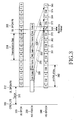
- FIG. 3 is a diagram illustrating a method for transmitting a representative value of ACK/NACK information according to a first embodiment of the present invention.
- a UE (not shown) receiving packet data over an HS-PDSCH 330 from a Node B (not shown), transmits ACK/NACK information for the received packet data.
- the UE supporting a compressed mode fails to transmit ACK/NACK at the corresponding time for a TG period 314.
- the UE transmits the ACK/NACK that failed transmission for the TG period 314, through an available subframe 344 after the TG period 314. That is, the UE uses the subframe 344 after the TG period 314 as a recovery period 344 for the ACK/NACK that failed transmission for the TG period 314.
- An ACK/NACK value transmitted for the recovery period 344 is denoted by A R representing ACK/NACK signals 331, 332 and 333 for an 0 th subframe, a 1 st subframe, and a 2 nd subframe.
- the representative value A R can be determined by the UE.
- the representative value A R represents a total of N ACK/NACK signals
- the representative value A R is set to ACK before being transmitted.
- the representative value A R is set to NACK before being transmitted.
- the ACK/NACK representative value is set to ACK or NACK before being transmitted even though not all of the ACK/NACK signals are identical to each other.
- the representative value A R is set by analyzing ACK/NACK information for the TG period.
- T denotes a threshold, and is greater than 0.
- the threshold T can be determined according to a ratio of ACKs to NACKs.
- the present invention transmits a representative value of the ACK/NACK signals that failed transmission for the TG period using an ACK/NACK field of a first slot without modifying a format of the existing HS-DPCCH subframe. In this way, it is possible to prevent unnecessary retransmission of an HS-PDSCH not transmitted during a TG period of the existing system or of an already received error-free HS-PDSCH packet.
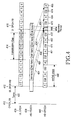
- FIG. 4 is a diagram illustrating a method for transmitting N ACK/NACK signals through an ACK/NACK field according to a second embodiment of the present invention.
- a second embodiment of the present invention sequentially allocates ACK/NACK signals 431, 432 and 433 for an 0 th subframe, a 1 st subframe and a 2 nd subframe to an ACK/NACK field of a recovery period 444 before transmission. That is, a second embodiment of the present invention defines an ACK/NACK field 444 of an HS-DPCCH 440, corresponding to the 2 nd subframe, as the recovery period 444.
- a UE After the definition, a UE (not shown) performs (N, 1) iterative coding lower than (10, 1) iterative coding on the ACK/NACK field 444 of the HS-DPCCH 440, and sequentially transmits the multiple ACK/NACK signals.
- N is an integer greater than 1.
- the UE can increase transmission power in order to compensate for deterioration in coding performance possibly caused by the reduction in coding rate of the ACK/NACK field 444.
- control of the transmission power for the recovery period 444 may be further dependent on a channel condition.
- FIG. 5 is a diagram illustrating a method for transmitting transmission-delayed ACK/NACK information using a CQI field according to a third embodiment of the present invention.
- a third embodiment of the present invention transmits ACK/NACK for a 2 nd subframe of an HS-PDSCH 530 through an ACK/NACK field using the existing coding scheme, and transmits ACK/NACK signals 531 and 532 for an 0 th subframe and a 1 st subframe of the HS-PDSCH 530 that failed transmission for a TG period 514 through a CQI field using a coding scheme having a higher or lower coding rate than that of the existing coding scheme.
- a UE (not shown) transmits the ACK/NACK signals 531 and 532 for the 0 th subframe and the 1 st subframe through a CQI field 544 of a first HS-DPCCH subframe after an end of the TG period 514.
- the UE transmits ACK/NACK information 563 for the 2 nd subframe 533 of the HS-PDSCH 530 through an ACK/NACK field 563 which is its original response period, using a (10, 1) iterative coding scheme, and transmits ACK/NACK signals 531 and 532 for the 0 th subframe and the 1 st subframe using a coding scheme having a lower coding rate than that of (10, 1) iterative coding scheme.
- a remaining part of the CQI field is subject to discontinuous transmission (DTX).
- DTX discontinuous transmission
- the UE can use a coding scheme having a coding rate higher than that of the (10, 1) iterative coding scheme. That is, the coding scheme should be selected according to the number of the ACK/NACK signals.
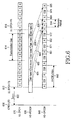
- FIG. 6 is a diagram illustrating a method for transmitting ACK/NACK information at a fixed ratio of a CQI field according to a fourth embodiment of the present invention. It is assumed in FIG. 6 that the fixed ratio corresponds to the entire CQI field.
- a UE transmits an ACK/NACK signal for a 2 nd subframe of an HS-PDSCH 630 through an ACK/NACK field using the existing coding scheme, and transmits ACK/NACK signals 631 and 632 for an 0 th subframe and a 1 st subframe of the HS-PDSCH 630 that failed transmission for a TG period 614 through a CQI field using the existing coding scheme.
- the coding scheme should be selected according to the fixed ratio of the CQI field and the number of ACK/NACK signals.
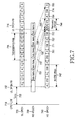
- FIG. 7 is a diagram illustrating a method for transmitting transmission-delayed ACK/NACK information using an ACK/NACK field and a CQI according to a fifth embodiment of the present invention.
- a UE (not shown) defines the entire subframe following a TG period 714 as a recovery period 744, and transmits transmission-delayed ACK/NACK signals for the recovery period 744, maintaining the existing coding rate. That is, the UE transmits the ACK/NACK signals to be transmitted for the recovery period 744 without separating them into an ACK/NACK field and a CQI field.
- the UE For the recovery period 744, the UE first transmits ACK/NACK signals 731 and 732 that failed transmission for the TG period 714, and then transmits an ACK/NACK signal 733 to be transmitted for the recovery period 744.
- the UE defines the entire subframe of an HS-DPCCH 740 as the recovery period 744, and transmits the ACK/NACK signals that failed transmission for the TG period 714 for the recovery period 744. That is, the UE codes the ACK/NACK information by a fixed number of bits, transmits the coded ACK/NACK information through predetermined fields 731, 732 and 733, and performs DTX processing on the remaining part.
- a coding scheme for the ACK/NACK signals should be set higher in coding rate than the existing coding scheme. If the number of ACK/NACK signals to be transmitted for the recovery period 744 is larger than 3, a coding scheme for the ACK/NACK signals should be set lower in coding rate than the existing coding scheme. However, if the number of ACK/NACK signals to be transmitted through the CIQ field is 2, the existing coding scheme can be used. That is, the coding scheme should be selected according to the number of the ACK/NACK signals.
- FIG. 8 is a diagram illustrating a method for transmitting ACK/NACK information at a fixed ratio of an ACK/NACK field and a CQI field according to a sixth embodiment of the present invention.
- a UE (not shown) appropriately codes an entire subframe 844 which is a recovery period according to the number of ACK/NACK signals 831, 832 and 833, before transmission.
- the recovery period 844 can have either one subframe or several subframes.
- the recovery period 844 can be set in proportion to a length of a TG period 814, or some ACK/NACK signals for the TG period 814 can be subjected to DTX thereby adjusting a length of the recovery period 844. For example, if a length of the TG period is set such that 4 ACK/NACK signals should be compensated, the recovery period can be defined over 2 subframes.
- the present invention transmits ACK/NACK signals that failed transmission for a TG period of an uplink channel through a subframe located after the TG period and without a separate channel.
- the present invention minimizes a data transmission delay caused by retransmission by transmitting the ACK/NACK signals through a subframe after the TG period, thereby improving the entire performance of the mobile communication system.
Landscapes
- Engineering & Computer Science (AREA)
- Computer Networks & Wireless Communication (AREA)
- Signal Processing (AREA)
- Mobile Radio Communication Systems (AREA)
- Detection And Prevention Of Errors In Transmission (AREA)
Applications Claiming Priority (2)
| Application Number | Priority Date | Filing Date | Title |
|---|---|---|---|
| KR2004009875 | 2004-02-14 | ||
| KR1020040009875A KR20050081566A (ko) | 2004-02-14 | 2004-02-14 | 고속 순방향 패킷 데이터를 전송하는 이동통신시스템에서압축 모드에 따른 복합 재전송을 수행하는 방법 |
Publications (2)
| Publication Number | Publication Date |
|---|---|
| EP1565023A2 true EP1565023A2 (de) | 2005-08-17 |
| EP1565023A3 EP1565023A3 (de) | 2007-07-11 |
Family
ID=34698990
Family Applications (1)
| Application Number | Title | Priority Date | Filing Date |
|---|---|---|---|
| EP20050003074 Withdrawn EP1565023A3 (de) | 2004-02-14 | 2005-02-14 | Verfahren zur Durchführung von Compressed-Mode HARQ in einem HSDPA unterstützenden mobilen Kommunikationssystem |
Country Status (5)
| Country | Link |
|---|---|
| US (1) | US20050213575A1 (de) |
| EP (1) | EP1565023A3 (de) |
| JP (1) | JP4125730B2 (de) |
| KR (1) | KR20050081566A (de) |
| CN (1) | CN1674715A (de) |
Cited By (7)
| Publication number | Priority date | Publication date | Assignee | Title |
|---|---|---|---|---|
| WO2007024559A1 (en) * | 2005-08-24 | 2007-03-01 | Lucent Technologies Inc. | Method and apparatus for controlling retransmissions in a wireless communications system |
| WO2007084065A3 (en) * | 2006-01-18 | 2007-09-20 | Ericsson Telefon Ab L M | Method and arangement for multiplexed feedback information using harq |
| WO2009087429A1 (en) * | 2008-01-04 | 2009-07-16 | Nokia Siemens Networks Oy | Channel allocation when using measurement gaps with h-arq |
| WO2010018181A3 (en) * | 2008-08-14 | 2010-04-08 | Infineon Technologies Ag | Radio communication terminal devices, radio communication network arrangement, method for operating a radio communication terminal device, for dual-cell reception with transmission gap |
| WO2010019621A3 (en) * | 2008-08-11 | 2010-06-17 | Qualcomm Incorporated | Methods and apparatuses for processing measurement gaps in a wireless communication system |
| CN101166344B (zh) * | 2006-10-18 | 2011-04-20 | 鼎桥通信技术有限公司 | 恢复数据方式的选取方法及无线网络控制器 |
| US10321489B2 (en) | 2008-08-08 | 2019-06-11 | Qualcomm Incorported | Method and apparatus for handling measurement gaps in wireless networks |
Families Citing this family (38)
| Publication number | Priority date | Publication date | Assignee | Title |
|---|---|---|---|---|
| JP4331728B2 (ja) * | 2003-02-13 | 2009-09-16 | ノキア コーポレイション | アップリンク信号の検出改善とアップリンク信号の電力節減とを図るシステムおよび方法 |
| JP4645208B2 (ja) * | 2005-02-02 | 2011-03-09 | 富士通株式会社 | 無線通信装置 |
| KR100983277B1 (ko) * | 2005-02-15 | 2010-09-24 | 엘지전자 주식회사 | 멀티미디어 방송/멀티캐스트 서비스 송수신 방법 |
| KR101221898B1 (ko) * | 2005-06-14 | 2013-01-15 | 엘지전자 주식회사 | 이동 통신 시스템에서의 시그널링 방법 |
| WO2007004628A1 (ja) * | 2005-07-06 | 2007-01-11 | Nec Corporation | 携帯端末装置を使用する移動通信システムとハンドオーバ制御方法 |
| WO2007029066A2 (en) * | 2005-08-05 | 2007-03-15 | Nokia Corporation | Power control for discontinuous uplink control channels |
| US7936741B2 (en) * | 2005-08-05 | 2011-05-03 | Nokia Corporation | Dynamic uplink control channel gating to increase capacity |
| TWI410078B (zh) * | 2006-02-06 | 2013-09-21 | Lg Electronics Inc | 多媒體廣播多播服務雙接收器 |
| MX2008011601A (es) * | 2006-03-15 | 2008-09-22 | Matsushita Electric Ind Co Ltd | Dispositivo de transmision inalambrica y metodo de transmision inalambrica. |
| CN101064588B (zh) * | 2006-04-30 | 2010-08-18 | 中兴通讯股份有限公司 | 上行增强专用信道中压缩模式传输控制方法 |
| WO2007126192A1 (en) * | 2006-05-02 | 2007-11-08 | Lg Electronics Inc. | Data transmission method in mobile communications system |
| US8102802B2 (en) * | 2006-05-08 | 2012-01-24 | Motorola Mobility, Inc. | Method and apparatus for providing downlink acknowledgments and transmit indicators in an orthogonal frequency division multiplexing communication system |
| WO2007144956A1 (ja) * | 2006-06-16 | 2007-12-21 | Mitsubishi Electric Corporation | 移動体通信システム及び移動端末 |
| US8644252B2 (en) * | 2006-08-25 | 2014-02-04 | Telefonaktiebolaget L M Ericsson (Publ) | Method for recovery from a failed handover procedure in a telecommunication system |
| AU2007301647B2 (en) * | 2006-09-29 | 2011-09-22 | Nokia Technologies Oy | Uplink allocations for acknowledgement of downlink data |
| US8094554B2 (en) | 2006-10-26 | 2012-01-10 | Qualcomm Incorporated | Compressed mode operation and power control with discontinuous transmission and/or reception |
| EP2890183B1 (de) | 2006-10-31 | 2019-05-08 | InterDigital Technology Corporation | Bestimmung von kanalqualitätsindikatoren (cqis) und übertragungszeitintervallen (ttis) zum senden von cqis |
| KR100934664B1 (ko) | 2007-02-02 | 2009-12-31 | 엘지전자 주식회사 | 이동 통신 시스템에서 제어 채널 송신 방법 |
| US8020075B2 (en) | 2007-03-16 | 2011-09-13 | Apple Inc. | Channel quality index feedback reduction for broadband systems |
| US9294231B2 (en) * | 2007-03-17 | 2016-03-22 | Qualcomm Incorporated | Configurable acknowledgement processing in a wireless communication system |
| JP4913641B2 (ja) * | 2007-03-20 | 2012-04-11 | 株式会社エヌ・ティ・ティ・ドコモ | 基地局、通信端末、送信方法、受信方法、通信システム |
| KR101363744B1 (ko) * | 2007-07-13 | 2014-02-21 | 삼성전자주식회사 | 무선통신 시스템에서 상향링크 제어 채널의 송수신 장치 및방법 |
| BRPI0815202A2 (pt) * | 2007-08-14 | 2015-03-31 | Ntt Docomo Inc | Aparelho de estação de base e método de controle de transmissão |
| JP4574659B2 (ja) * | 2007-10-01 | 2010-11-04 | 株式会社エヌ・ティ・ティ・ドコモ | 移動局装置、上りリンク送信方法、および通信システム |
| US9510360B2 (en) * | 2007-10-06 | 2016-11-29 | Alcatel-Lucent Usa Inc. | Method and apparatus for a coordinated scheduling method to avoid multiplexing of control and data for power limited users in the LTE reverse link |
| US7953049B2 (en) * | 2007-10-22 | 2011-05-31 | Telefonaktiebolaget Lm Ericsson (Publ) | Method and apparatus for allocating receiver resources based on delay |
| US8254244B2 (en) | 2007-10-30 | 2012-08-28 | Qualcomm Incorporated | Arrangement and method for transmitting control information in wireless communication systems |
| JP5137547B2 (ja) * | 2007-12-07 | 2013-02-06 | パナソニック株式会社 | 無線通信端末装置及びギャップ割当方法 |
| US9065646B2 (en) * | 2008-02-04 | 2015-06-23 | Nokia Solutions And Networks Oy | ACK/NACK channelization for resource blocks containing both ACK/NACK and CQI |
| WO2009116754A2 (en) * | 2008-03-16 | 2009-09-24 | Lg Electronics Inc. | Method of performing hybrid automatic repeat request (harq) in wireless communication system |
| JP5283423B2 (ja) * | 2008-05-02 | 2013-09-04 | 株式会社エヌ・ティ・ティ・ドコモ | 移動通信システムにおける基地局装置、ユーザ装置及び方法 |
| CN101340442B (zh) * | 2008-08-07 | 2012-10-10 | 中兴通讯股份有限公司 | 信息复用方法 |
| CN101383683B (zh) * | 2008-09-22 | 2014-04-09 | 中兴通讯股份有限公司 | 反馈信息的发送方法和装置 |
| KR101505089B1 (ko) * | 2009-01-13 | 2015-03-23 | 삼성전자주식회사 | 이동통신 시스템의 핸드오버 장치 및 방법 |
| JPWO2010128598A1 (ja) * | 2009-05-08 | 2012-11-01 | パナソニック株式会社 | 通信装置及びデータ再送処理方法 |
| CN102118237B (zh) * | 2010-08-02 | 2013-06-05 | 电信科学技术研究院 | 基于mimo系统的uci处理方法和装置及其传输方法 |
| US8675554B2 (en) * | 2010-11-08 | 2014-03-18 | Intel Corporation | Wireless communication device and method for performing neighbor cell analysis during continuous packet connectivity mode |
| US10631323B2 (en) * | 2015-12-08 | 2020-04-21 | Qualcomm Incorporated | Delayed control feedback in a time division duplex carrier utilizing common bursts |
Family Cites Families (18)
| Publication number | Priority date | Publication date | Assignee | Title |
|---|---|---|---|---|
| DE19742650C2 (de) * | 1997-09-26 | 2000-05-11 | Siemens Ag | Optimierung von Nachbarkanal-Meßberichten |
| US6148422A (en) * | 1997-10-07 | 2000-11-14 | Nortel Networks Limited | Telecommunication network utilizing an error control protocol |
| US6990098B1 (en) * | 2000-09-11 | 2006-01-24 | Sun Microsystems, Inc. | Reliable multicast using merged acknowledgements |
| FR2819661B1 (fr) * | 2001-01-15 | 2003-03-28 | Nortel Networks | Procede et dispositifs de transmission de donnees avec mecanisme d'acquittement |
| JP4724928B2 (ja) * | 2001-02-27 | 2011-07-13 | ソニー株式会社 | 無線伝送装置及び無線伝送方法 |
| US6961309B2 (en) * | 2001-04-25 | 2005-11-01 | International Business Machines Corporation | Adaptive TCP delayed acknowledgment |
| US6804220B2 (en) * | 2001-05-07 | 2004-10-12 | Qualcomm Incorporated | Method and apparatus for generating control information for packet data |
| US20030014716A1 (en) * | 2001-07-16 | 2003-01-16 | Cute Ltd. | Universal lossless data compression |
| EP1313232B1 (de) * | 2001-11-19 | 2004-08-25 | Samsung Electronics Co., Ltd. | Verfahren und Vorrichtung für die Leistungsregelung des Aufwärtskanals in einem CDMA Kommunikationssystem |
| KR100487245B1 (ko) * | 2001-11-28 | 2005-05-03 | 삼성전자주식회사 | 고속 순방향 패킷 접속 방식을 사용하는 이동 통신시스템에서압축 모드에 따른 전송 불능 구간을 최소화하는장치 및 방법 |
| US7428406B2 (en) * | 2002-02-15 | 2008-09-23 | Siemens Aktiengesellschaft | Data transfer method for halting communication of data when a transfer gap is detected |
| US7209483B2 (en) * | 2002-02-19 | 2007-04-24 | Nokia Corporation | Apparatus, and associated method, for operating upon packet data communicated in a packet communication system utilizing a packet retransmission scheme |
| US7352722B2 (en) * | 2002-05-13 | 2008-04-01 | Qualcomm Incorporated | Mitigation of link imbalance in a wireless communication system |
| US20050141446A1 (en) * | 2002-05-31 | 2005-06-30 | Mitsubishi Denki Kabushiki Kaisha | Communication system |
| EP1388964B1 (de) * | 2002-08-06 | 2006-11-22 | Mitsubishi Electric Information Technology Centre Europe B.V. | Übertragungsqualitätsberichtverfahren |
| US7260073B2 (en) * | 2002-12-02 | 2007-08-21 | Nokia Corporation | Method for scheduling of plural packet data flows |
| US7069037B2 (en) * | 2003-04-11 | 2006-06-27 | Qualcomm, Inc. | System and method for fluid power control of a reverse link communication |
| US7639643B2 (en) * | 2003-09-17 | 2009-12-29 | Intel Corporation | Channel estimation feedback in an orthogonal frequency division multiplexing system or the like |
-
2004
- 2004-02-14 KR KR1020040009875A patent/KR20050081566A/ko not_active Withdrawn
-
2005
- 2005-02-14 US US11/056,388 patent/US20050213575A1/en not_active Abandoned
- 2005-02-14 JP JP2005036928A patent/JP4125730B2/ja not_active Expired - Fee Related
- 2005-02-14 EP EP20050003074 patent/EP1565023A3/de not_active Withdrawn
- 2005-02-16 CN CNA2005100716385A patent/CN1674715A/zh active Pending
Cited By (14)
| Publication number | Priority date | Publication date | Assignee | Title |
|---|---|---|---|---|
| WO2007024559A1 (en) * | 2005-08-24 | 2007-03-01 | Lucent Technologies Inc. | Method and apparatus for controlling retransmissions in a wireless communications system |
| WO2007084065A3 (en) * | 2006-01-18 | 2007-09-20 | Ericsson Telefon Ab L M | Method and arangement for multiplexed feedback information using harq |
| CN101166344B (zh) * | 2006-10-18 | 2011-04-20 | 鼎桥通信技术有限公司 | 恢复数据方式的选取方法及无线网络控制器 |
| US8249022B2 (en) | 2008-01-04 | 2012-08-21 | Nokia Siemens Networks Oy | Channel allocation when using measurement gaps with H-ARQ |
| WO2009087429A1 (en) * | 2008-01-04 | 2009-07-16 | Nokia Siemens Networks Oy | Channel allocation when using measurement gaps with h-arq |
| US10531498B2 (en) | 2008-08-08 | 2020-01-07 | Qualcomm Incorporated | Method and apparatus for handling measurement gaps in wireless networks |
| US10321489B2 (en) | 2008-08-08 | 2019-06-11 | Qualcomm Incorported | Method and apparatus for handling measurement gaps in wireless networks |
| RU2479945C2 (ru) * | 2008-08-11 | 2013-04-20 | Квэлкомм Инкорпорейтед | Способы и устройства для обработки промежутков измерения в системе беспроводной связи |
| CN102150452A (zh) * | 2008-08-11 | 2011-08-10 | 高通股份有限公司 | 用于处理无线通信系统中的测量间隙的方法和设备 |
| AU2009282091B2 (en) * | 2008-08-11 | 2014-02-20 | Qualcomm Incorporated | Methods and apparatuses for processing measurement gaps in a wireless communication system |
| US8873522B2 (en) | 2008-08-11 | 2014-10-28 | Qualcomm Incorporated | Processing measurement gaps in a wireless communication system |
| WO2010019621A3 (en) * | 2008-08-11 | 2010-06-17 | Qualcomm Incorporated | Methods and apparatuses for processing measurement gaps in a wireless communication system |
| US8391244B2 (en) | 2008-08-14 | 2013-03-05 | Intel Mobile Communications GmbH | Radio communication terminal devices, radio communication network system, method for operating a radio communication terminal device |
| WO2010018181A3 (en) * | 2008-08-14 | 2010-04-08 | Infineon Technologies Ag | Radio communication terminal devices, radio communication network arrangement, method for operating a radio communication terminal device, for dual-cell reception with transmission gap |
Also Published As
| Publication number | Publication date |
|---|---|
| JP4125730B2 (ja) | 2008-07-30 |
| JP2005229628A (ja) | 2005-08-25 |
| US20050213575A1 (en) | 2005-09-29 |
| CN1674715A (zh) | 2005-09-28 |
| EP1565023A3 (de) | 2007-07-11 |
| KR20050081566A (ko) | 2005-08-19 |
Similar Documents
| Publication | Publication Date | Title |
|---|---|---|
| US20050213575A1 (en) | Method for performing compressed mode-based HARQ in a mobile communication system supporting HSDPA | |
| US7359345B2 (en) | Signaling method between MAC entities in a packet communication system | |
| US7633899B2 (en) | Method for transmitting and receiving common information in a CDMA communication system providing HSDPA service | |
| KR100606008B1 (ko) | 부호 분할 다중 접속 통신 시스템에서 역방향 데이터재전송 요청 송수신 장치 및 방법 | |
| US7299065B2 (en) | Method for transmitting HSDPA service information in a CDMA mobile communication system | |
| US7116651B2 (en) | Method and apparatus for HS-DPCCH signalling with activity information in HSDPA | |
| EP1703659B1 (de) | Wiederholungsprotokoll mit Verminderung von falschem Nachweis von Rückquittierungsnachrichten | |
| US7903559B2 (en) | Apparatus and method for transmitting reverse packet data in mobile communication system | |
| US7164650B2 (en) | Method for transmitting/receiving information about orthogonal variable spreading factor codes assigned to user data in a high speed data packet access communication system | |
| US8942080B2 (en) | Transmission of bundled ACK/NAK bits | |
| EP1769593B1 (de) | Verfahren und vorrichtung zum übertragen und empfangen von abwärtsstreckensteuerinformationen in einem mobilen kommunikationssystem, das uplink-paketdienst unterstützt | |
| US20050243793A1 (en) | Apparatus and method for transmitting control information for transmission of high-speed packet data in a mobile communication system | |
| US8089919B2 (en) | Packet transmission acknowledgement in wireless communication system | |
| US20040022213A1 (en) | Apparatus and method for determining CQI report cycle in an HSDPA communication system | |
| US20040219917A1 (en) | HARQ ACK/NAK coding for a communication device during soft handoff | |
| US7720504B2 (en) | Radio communication apparatus or mobile station | |
| CA2515291A1 (en) | System and method for improved uplink signal detection and reduced uplink signal power | |
| CN1833379A (zh) | 移动站装置和接收方法 | |
| GB2378101A (en) | A method of indicating a change in service information in a High Speed Downlink Packet Access (HSDPA) service | |
| KR101081201B1 (ko) | 고속 하향 패킷 접속 서비스를 위한 이동통신 시스템 및패킷 데이터 전송 방법 |
Legal Events
| Date | Code | Title | Description |
|---|---|---|---|
| PUAI | Public reference made under article 153(3) epc to a published international application that has entered the european phase |
Free format text: ORIGINAL CODE: 0009012 |
|
| 17P | Request for examination filed |
Effective date: 20050214 |
|
| AK | Designated contracting states |
Kind code of ref document: A2 Designated state(s): AT BE BG CH CY CZ DE DK EE ES FI FR GB GR HU IE IS IT LI LT LU MC NL PL PT RO SE SI SK TR |
|
| AX | Request for extension of the european patent |
Extension state: AL BA HR LV MK YU |
|
| PUAL | Search report despatched |
Free format text: ORIGINAL CODE: 0009013 |
|
| AK | Designated contracting states |
Kind code of ref document: A3 Designated state(s): AT BE BG CH CY CZ DE DK EE ES FI FR GB GR HU IE IS IT LI LT LU MC NL PL PT RO SE SI SK TR |
|
| AX | Request for extension of the european patent |
Extension state: AL BA HR LV MK YU |
|
| AKX | Designation fees paid |
Designated state(s): DE FR GB IT |
|
| 17Q | First examination report despatched |
Effective date: 20080320 |
|
| STAA | Information on the status of an ep patent application or granted ep patent |
Free format text: STATUS: THE APPLICATION IS DEEMED TO BE WITHDRAWN |
|
| 18D | Application deemed to be withdrawn |
Effective date: 20090829 |